
WEEKLY
May 11, 2026
ANALYSIS
TWO PATHS TO HYDROGEN POWER: KHI AND MHI BET ON DIFFERENT FUTURES
- The future of hydrogen power in Japan may depend on two major engineering firms with different visions. Yet these are somewhat complementary rather than competitive.
- KHI sees hydrogen primarily as a fuel supply and infrastructure business. MHI treats hydrogen as a way to decarbonize existing thermal power generation.
ENERGY JOBS IN JAPAN: CONTRACT TYPES, FIXED-TERM VS. INDEFINITE
- Indefinite employment agreements are the standard for employment contracts.
- As more multinational companies enter the market and as Japanese firms are more competitive in hiring top talent, the use of fixed-term contracts is rising.
ASIA PACIFIC REVIEW
This column provides a brief overview of the region’s main energy events from the past week
NEWS
- Japan spent ¥180 bln on March fuel subsidies, eating through emergency fund
- Japan secures additional 20 mln barrels of UAE crude via Hormuz bypass
- Iran war impacts Japan’s fuel and supply chains
- TOCOM power derivatives drop, open interest grows
- Iran war impacts utilities’ earnings forecasts
- Osaka Gas launches another gas-fired power unit
- Shikoku Electric exits LTDA auction over ammonia supply uncertainty
- KHI signs MoU for liquefied H2 supply chain in Canada
- Takasago participates in project for green hydrogen supply chain using MCH
- Large-scale Fukushima solar plant operator ordered to return govt subsidies
- TEPCO hits ¥24 billion in sales from residential solar and storage
- First firm gets certified under the new recycling law
WIND POWER AND OTHER RENEWABLES
- MoE gives opinions on Cosmo, KTA wind farms
- Mitsubishi revises decarbonization strategy after wind sector fiasco
- Penta-Ocean and Tokyo U to research floating wind
- Nuclear firms accelerate workforce training amid reactor revival
- METI Minister visits Kashiwazaki-Kariwa after restart
- Tomari NPP Unit 3 restart delayed for safety works
- Tokyo Gas raises prices for first time in 46 years
- Idemitsu Kosan’s oil tanker passes through Hormuz
- Idemitsu to supply 4 mln barrels of crude to Vietnam
CARBON CAPTURE & SYNTHETIC FUELS
- Govt to support CCS for 15 yrs after storage begins
- Sekisui House claims high energy-efficiency targets for ZEH, ZEB
EVENTS
June 3 South Korea – Local Elections
June 23-25 “Summer Davos” in Dalian, China
September 14-18 IAEA General Conference 2026
October International Maritime Organization –
Net-zero Discussions
Nov 2-5 ADIPEC 2026 @ Abu Dhabi
Nov 3 U.S. Midterm Elections
Nov Publication of International Energy
Agency – World Energy Outlook 2026
Nov 18-19 Asia-Pacific Economic Cooperation –
Leaders Meeting @ Shenzhen, China
PUBLISHER
K. K. Yuri Group
Editorial Team
Yuriy Humber (Chief Editor)
John Varoli (Senior Editor, Americas)
Kyoko Fukuda (Data, Events)
Magdalena Osumi (Renewables & Storage)
Filippo Pedretti (Thermal, CCS, Nuclear)
Tetsuji Tomita (Power Market, Hydrogen)
Aglaé Bange (Renewables and Biomass)
George Hoffman (Sales, Business Development)
Tim Young (Design)
SUBSCRIPTIONS & ADVERTISING
Japan NRG offers individual, corporate and academic subscription plans. Basic details are our website or write to subscriptions@japan-nrg.com
For marketing, advertising, or collaboration opportunities, contact sales@japan-nrg.com. For all other inquiries, write to info@japan-nrg.com
NEWS: GENERAL OUTLOOK AND TRENDS

Japan spent ¥180 bln on March fuel subsidies, eating through emergency fund
(Nikkei, May 7)
- METI said state spending on fuel subsidies reached about ¥180 billion for March alone, after Tokyo restarted support measures on March 19 to cap gasoline prices amid Middle East supply disruptions
- The subsidy fund balance stood at ¥980 billion at end-April, including an additional ¥800 billion drawn from FY2025 contingency reserves. Some private-sector estimates suggest the fund could be depleted by June once April subsidy payments are made.
- CONTEXT: Subsidies compensate refiners for keeping nationwide average gasoline prices near ¥170/ liter, and also apply to diesel, kerosene and heavy oil.
- TAKEAWAY: The growing fiscal burden highlights the notable cost of Japan’s emergency energy response. It is also another reason for the pressure on the yen. And yet, PM Takaichi has been firm in ruling out a supplementary budget, indicating a desire to reign in further spending, which could push the cost of Japanese state debt higher. Meanwhile, METI Minister Akazawa has been busy trying to secure new oil sources.
- SIDE DEVELOPMENT:
- Japan may use electricity and natural gas subsidies
- (Reuters, April 30)
- Japan is considering reviving electricity and natural gas subsidies from July to Sept to offset rising energy costs linked to the Iran war.
- The plan would cost around ¥500 billion and use reserve funds rather than a supplementary budget.
- PM Takaichi is reviewing the subsidy details. Japan has already extended gasoline subsidies using ¥2 trillion in reserves. But, adding electricity and gas support could deplete those funds. No supplementary budget is planned for now.
Govt begins new oil reserve release
(Japan NRG, May 1)
- Starting May 1, METI launched a second release of national oil reserves.
- The amount is 5.8 million kiloliters (36.5 million barrels), equal to 20 days of supply.
- They will be sold to four major oil companies for a total of ¥540 billion.
- SIDE DEVELOPMENT:
- Japan secures additional 20 mln barrels of UAE crude via Hormuz bypass
- (Government statements, May 6-7)
- Japan agreed with the UAE to procure an additional 20 million barrels of crude oil, as Tokyo accelerates efforts to diversify supply routes away from the Strait of Hormuz.
- METI Minister Akazawa made the deal during talks in Abu Dhabi, following earlier requests for stable crude supply and alternative shipping arrangements. o The additional crude volume is equivalent to roughly 8–9 days of Japan’s oil demand, based on 2025 consumption of about 2.36 million barrels/ day.
- Japan is expected to rely heavily on the UAE’s Fujairah export terminal on the Gulf of Oman, which allows crude exports to bypass Hormuz, though the route itself has also faced security concerns following recent drone attacks.
- CONTEXT: The govt said earlier that about 60% of May crude requirements could be covered through non-Hormuz procurement routes, with the remainder supplemented through releases from domestic petroleum reserves.
- SIDE DEVELOPMENT:
- First ‘replacement’ shipment of U.S. crude arrives in Japan
- (Asahi Shimbun, Japan NRG, April 26)
- Cosmo Energy received a shipment of U.S. crude oil. This marks the first time that U.S. crude oil procured following the de facto blockade of the Strait of Hormuz has arrived in Japan.
- 910,000 barrels arrived at the Chiba refinery – about four days of operations. o CONTEXT: The govt said April procurement through routes other than the Strait of Hormuz will account for more than 20% of last year’s total import volume.
- SIDE DEVELOPMENT:
- Taiyo Oil receives petroleum from Sakhalin-2
- (Japan NRG, May 8)
- Taiyo Oil Co received petroleum from Russia’s Sakhalin-2 project for the first time since the Strait of Hormuz blockade began. The shipment arrived on May 4, following a request from METI.
- CONTEXT: Sakhalin-2 is exempt from U.S.-led sanctions on Russia. This petroleum is a byproduct of LNG production on Sakhalin. Without removing it, LNG output would stop because of full tanks. Taiyo Oil last bought oil from Russia last year in June, after a more than two-year hiatus.
Crisis in Persian Gulf impacts Japan’s fuel and supply chains
(Japan NRG, May 8)
- All Nippon Airways (ANA) and Japan Airlines (JAL) face fallout from the Iran war.
- Domestic jet fuel production is high (12.1 million kiloliters in 2025), while imports remain very low (280,000 kiloliters).
- But for European flights, refueling at the destination is unavoidable. A solution is to refuel in India, which both airlines already serve.
- LDP deputy head Hagiuda Koichi said the govt cannot indefinitely rely on reserve funds for gasoline subsidies and a supplemental budget may be needed, a move so far rejected by PM Takaichi.
- The PM originally said Japan had enough naphtha supplies for “more than six months” but has reassessed that to “beyond the end of the year.” This improvement is due to increasing imports from non-Middle Eastern countries and domestic refining.
- SIDE DEVELOPMENT:
- Naphtha supply concerns hit downstream industries
- (Nikkan Gendai, April 28)
- A Keidanren survey found 44% of firms already feel the impact from naphtha supply uncertainty, with a further 31% expecting disruptions within three months.
- Shortages of naphtha-derived materials such as inks and solvents impact packaging.
- Upstream suppliers remain unable to provide clear delivery outlooks for May–June, adding to uncertainty across supply chains.
- CONTEXT: The disruptions risk further food price increases, highlighting the impact of petrochemical feedstock constraints on consumer goods.
Tesla expands retail network in Japan, seeks sales growth
(Company statement, Nikkei, April 28)
- Tesla Japan is expanding its retail network, with stores opening in Osaka, Tokyo, Sendai, and Sapporo by the end of May.
- This brings Tesla to 38 dealerships and 40 sites including pop-ups nationwide; with plans to have 60 dealerships open by year’s end.
- Tesla is shifting from mainly online sales to more in-person retail locations in shopping centers, helping drive sales growth in Japan.
- Domestic sales reached a record roughly 10,600 vehicles in 2025, up about 90% YoY, with 2026 sales also growing strongly.
- TAKEAWAY: Japan’s EV adoption still lags behind China, Europe, and the U.S., so Tesla sees room for growth, and will focus on physical stores and test drives because Japanese consumers want to test EVs before buying. Govt subsidies help make EVs more affordable.
NEWS: ELECTRICITY MARKETS

TOCOM power derivatives decline, open interest grows
(Exchange data, May 1)
- TOCOM’s electricity futures trading volumes declined, falling under 200 GWh in March, from over 400 GWh in February, and over 500 GWh in January.
- Daily trading volumes also declined despite concern over the Iran war’s impact on energy supplies, and were well below year-earlier levels: March 2025 trading volumes were about 900 GWh.
- In contrast, open interest in TOCOM power futures rose steadily to about 15,000 contracts by March, close to the highest level since at least 2024, signalling continued accumulation of hedging positions.
- TOCOM power market’s participant mix remains heavily weighted toward Japanese utilities and trading houses, which account for roughly half or more of positions, while financial institutions and overseas investors remain smaller but visible.
- In oil derivatives, TOCOM-listed Brent futures daily average volumes spiked to nearly 6,000 contracts in March, from about 4,000 in both Feb and Jan.
- Open interest has declined to about 2,000–3,000 contracts, down from about 25,000 in 2020, with trading dominated by overseas investors and brokerages.
- TAKEAWAY: The Japanese exchange has not been able to capitalize on heightened interest in hedging during this volatile period, with its larger rival EEX absorbing nearly all of the additional volumes. Still, the major power utilities retain a strong footprint on TOCOM. This offers arbitrage opportunities for investors willing to invest in access to both platforms.
Iran war impacts utilities’ earnings forecasts
(Japan NRG, May 8)
- JERA said its FY2026 earnings forecast is uncertain due to the Iran war. If tensions persist then it could affect fuel prices.
- JERA plans to leverage the purchasing power of its trading subsidiary, JERA Global Markets, to stabilize fuel procurement and power supply. The firm said it secured enough LNG supply until July.
- Chubu Electric postponed FY2026 earnings forecast due to surging fuel costs; its reliance on thermal power (63%) makes it difficult to predict financial performance.
- The utility also raised profitability targets, aiming to lift ROE above 8% within five years, from 7.5% in FY2025, after achieving earlier targets of more than ¥200 billion in recurring profit and ROIC above 3.2%.
- Chubu seeks to improve capital efficiency through both business restructuring and shareholder returns, including potential asset replacements.
- Chugoku Electric expects FY2026 net profit to fall 55% to ¥31 billion, due to soaring LNG and coal prices and a nuclear reactor outage.
- Okinawa Electric’s FY2025 net profit rose 44% to ¥6.2 billion, helped by higher subsidiary earnings and lower fuel costs. Revenue fell 7% to ¥220 billion due to lower electricity demand.
- The utility gave no earnings forecast for the coming year.
- TEPCO reported a FY2025 net loss of ¥454 billion, swinging from a profit. This is due to over ¥900 billion in losses from the Fukushima Daiichi NPP decommissioning, specifically ¥914 billion for debris removal and ¥83 billion for damage compensation.
- Tohoku Electric didn’t make a FY2026 earnings forecast due to fuel price volatility. It reported a 54% drop in FY2025 net profit to ¥85 billion, missing its initial forecast by ¥50 billion. It still aims for an ordinary profit of ¥190 billion in FY2026.
- Kyushu Electric’s FY2025 net profit rose 20% to ¥154.5 billion, helped by higher transmission revenue and lower fuel costs. The utility expects consolidated FY2026 net profit to fall 16% to ¥130 billion, which would be its first decline in two years. It anticipates higher wholesale power revenues and increased nuclear plant use. But, these won’t offset higher fuel prices, a weaker yen, and higher interest rates.
- SIDE DEVELOPMENT:
- JERA reports net profit up 5% YoY
- (Company statement, April 27)
- JERA reported net profit of ¥193 billion in FY2025, up 5% YoY.
- Revenue fell 9% to ¥3 trillion; operating profit rose 15% to ¥276 billion.
- The utility said it felt no impact from the Strait of Hormuz closure.
- TAKEAWAY: The net profit increase was due to lower coal and LNG prices. Another factor is the sale of a stake in the Carroll County natural gas plant in the state of Ohio.
Major utilities cut LNG, coal use in FY2025 thanks to nuclear restarts
(Denki Shimbun, May 7)
- Fuel consumption by Japan’s nine major thermal power utilities declined in FY2025, with total LNG consumption falling 3.7% YoY to 32.72 million tons, while coal use dropped 1.4% to 55.05 million tons, the lowest in recent years.
- LNG consumption fell at JERA, Kansai Electric and Kyushu Electric, partly reflecting nuclear restarts and lower thermal utilization rates. JERA alone consumed 22.35 million tons of LNG, accounting for roughly two-thirds of total utility LNG demand.
- Heavy fuel oil consumption across the nine utilities dropped sharply by 35.5% to 840,000 kL, reflecting reduced use of oil-fired generation except during peak-demand periods.
- Coal consumption trends diverged by utility. Hokkaido Electric and JERA reduced coal burn due to nuclear availability, while Kansai Electric increased coal use because of lower operation of oil-fired plants.
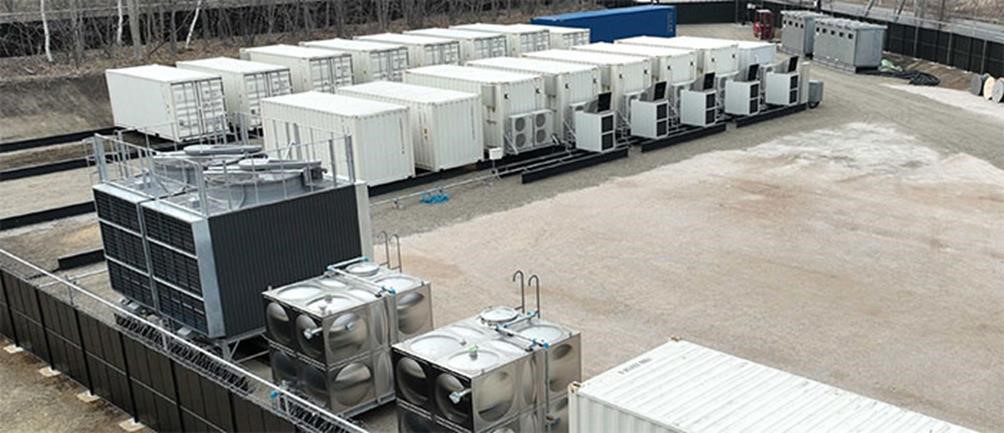
Hokkaido Electric and Getworks partner on containerized DCs
(Company statement, April 27)
- Hokkaido Electric and Getworks, a data center (DC) provider, formed a partnership to build and operate containerized DCs.
- The deal will explore deploying containerized DCs on idle land, analyze and optimize power and water use in cold climates, expand renewable energy utilization, assess future demand response (DR) use, and jointly develop AI/GPU services.
- CONTEXT: Getworks delivers AI/HPC (high-performance computing) infrastructure with containerized DCs and GPUs, with 300+ deployments and large-scale operations enabled by in-house design and domestic production.
- TAKEAWAY: The Misawa-no-Mori AI Container Park was developed by Getworks with contributions from GX Technology in the areas of energy optimization, data-driven efficiency improvements, and decarbonization system design. Sanyo Kensetsu Kogyo was responsible for building the facility. The project has multiple partners, including Hokkaido Electric. The facility also connects with telecom networks provided by NTT Docomo Business, enabling distributed DC operations and advanced “Watt-Bit” integration between energy and digital systems. The park aims to serve as a core hub for a decentralized DC network and to establish a model for integrating AI infrastructure and energy systems in Japan.
Resonac and CRIEPI awarded for SiC wafer production tech for semiconductors
(Company statement, May 7)
- Resonac Holdings, a chemical products maker, and the Central Research Institute of Electric Power Industry, won an industry award for developing production tech for silicon carbide (SiC) epitaxial wafers for use in semiconductors.
- The tech improves wafer quality, reduces defects, and lowers production costs.
- This helps make semiconductors more reliable and affordable for use in EVs, data centers, renewables systems, and power control equipment.
- TAKEAWAY: The partnership tackles key bottlenecks in SiC scaling – defect density, yield, and throughput – via integrated control of particle contamination, basal plane dislocations, and thermal cycle efficiency. These are widely recognized constraints on cost and reliability in SiC devices.
Osaka Gas launches Himeji Unit 2
(Company statement, April 30)
- Osaka Gas began commercial operation of Unit 2 at its Himeji Natural Gas Power Plant. Unit 1 launched in January.
- With both units online, Daigas Group’s domestic thermal power capacity increases from 2 GW to 3.2 GW.
- Both use high-efficiency natural gas-fired gas turbine combined cycle (GTCC) tech.
NEWS: HYDROGEN

Shikoku Electric exits LTDA auction over ammonia supply uncertainty
(Company statement, April 23)
- Shikoku Electric will withdraw from the long-term decarbonized power sources (LTDA) auction after failing to secure ammonia supply for its 500-MW Saijo No.1 coal plant.
- The utility had planned to introduce 20% ammonia co-firing by FY2030/31, backed by auction revenues designed to support fixed costs for low-carbon power projects.
- CONTEXT: Shikoku Electric was the only LTDA winner in Round 2 in the hydrogen and ammonia power category. This category in Round 1 had several winners.
- Shikoku pledged to explore ammonia co-firing but has no timeline for re-entry.
- TAKEAWAY: The utility was banking on supply from ExxonMobil’s blue ammonia Baytown project in Texas, in which Mitsubishi Corp was a partner. In November 2025, ExxonMobil suspended investment into the $7 billion project due to weak customer demand and challenges in securing long-term offtake contracts. It was also strongly impacted by President Trump’s decision to freeze IRA subsidies, which affected hydrogen projects. Shikoku Electric not only successfully bid in the 2025 LTDA Round 2 auction, but it was also part of a hydrogen/ ammonia hub initiative alongside Mitsubishi and others to set up an ammonia terminal in Ehime Pref. Until another supplier comes forward, that may now be put on hold.
KHI signs MoU for liquefied H2 supply chain in Canada
(Company statement, April 22)
- Kawasaki Heavy Industries (KHI) inked an MoU with Edmonton Region Hydrogen Hub, Alberta Industrial Heartland Association and Edmonton Global in Canada to explore building a liquefied hydrogen supply chain for domestic use and export.
- The goal is to strengthen Canada’s role as an energy hub and boost hydrogen export.
- CONTEXT: The Edmonton region seeks to be a major hydrogen hub, covering production, transport, and utilization. Supported by supply of low-cost natural gas, CCS experience, and commercial-scale expertise, the region has potential as a reliable hydrogen export base for global markets.
- SIDE DEVELOPMENT:
- KHI delivers H2 co-firing ready gas turbine system
- (Company statement, April 21)
- KHI delivered the PUC80D gas turbine system to the Teijin Matsuyama Plant. It’s capable of hydrogen co-firing and has four units with a 30 MW generation capacity.
- KHI turbines enable up to 30% hydrogen co-firing without turbine modification.
- CONTEXT: In March 2023, KHI launched hydrogen co-firing DLE combustors for its 20 MW and 5 MW gas turbines, with deployment for all its cogeneration turbines.
AGC freezes green hydrogen membrane plant amid global project delays
(Asia Nikkei, May 2)
- AGC suspended construction of a planned ¥15 billion ion exchange membrane plant in Kitakyushu, citing delays and cancellations in hydrogen projects globally and uncertainty over when large-scale hydrogen demand will emerge.
- The facility, originally scheduled to begin operations in 2026, was expected to become Japan’s first new chemical plant in Kitakyushu in 24 years and support a target of ¥30 billion in hydrogenrelated sales by FY2030.
- CONTEXT: AGC’s fluorinated membranes are used in PEM electrolysis systems, which are generally considered better suited than alkaline electrolysers for intermittent renewable power sources.
- TAKEAWAY: The decision reveals a broader slowdown in hydrogen investment. Toray Industries also delayed major membrane investment plans, and hydrogen projects in Australia and Europe face postponements amid weaker policy momentum. The slowdown is shifting from downstream hydrogen deployment into upstream supply chains and manufacturing. Even technologies widely viewed as important for long-term decarbonization, such as PEM, are affected by the delays. Still, some of Japan’s top engineering firms still remain committed to hydrogen-fired power and heat production. See this week’s Analysis for further details.
Takasago participates in Tokyo project for green hydrogen supply chain using MCH
(Company statement, April 28)
- Takasago Thermal Engineering (TTE) joined the Tokyo Govt’s demo on hydrogen technology using MCH (methylcyclohexane) in urban areas.
- The project is proposed by ShinMaywa Industries, Koatsu Gas Kogyo, and H2 & DX Social Research Institute.
- The goal is to develop a compact MCH-based hydrogen supply unit and show a safe small-scale supply chain, including testing at an indoor restaurant.
- TTE provides green hydrogen produced by the Hydro Creator system (100 Nm³/h) installed at the Innovation Center in Tsukubamirai City, Ibaraki.
- ShinMaywa is responsible for project management, and for development and installation, as well as the operation of MCH units.
- Koatsu Gas Kogyo is responsible for the supply, transportation, and disposal of MCH, as well as development and demo of the supply chain.
- CONTEXT: The Tokyo Govt seeks to accelerate wider adoption of hydrogen by supporting R&D and demo projects that address key hydrogen utilization challenges.
NEWS: SOLAR AND BATTERIES

METI issues first-ever FIT subsidy repayment order to solar operator
(Nikkei, May 8)
- BluePower, a large-scale solar plant operator in Fukushima Pref, was ordered by METI to return ¥500–600 million in subsidies after violating its approved plan.
- Such action by the govt is a first in Japan.
- The project falsely claimed to operate as a single connected facility, but its sites were not actually linked by transmission infrastructure, breaching FIT requirements.
- CONTEXT: Revisions to the Renewable Energy Special Measures Act in 2024 allows the govt to revoke FIT certification, suspend subsidies and demand repayment.
- While METI revoked BluePower’s FIT certification in July 2025, the news only became public last month.
- TAKEAWAY: Japan is tightening oversight of renewable energy projects as policymakers try to balance rapid renewable deployment with public trust and regulatory compliance. The case also reflects broader concerns that some FIT-era developments prioritised subsidy access over operational integrity and local accountability. The problem for the government, however, is that it lacks strong legal enforcement powers and is now relying on the public naming of the operator and repeated requests to achieve repayment.
TEPCO hits ¥24 billion in sales from residential solar and storage
(Company statement, April 24)
- TEPCO reported sales figures for its zero-upfront residential solar and battery services.
- To date, the utility has sold 55,000 units, including 10,000 in FY2025, generating revenue of ¥24 billion, a 20% market share.
- CONTEXT: TEPCO sold three models through its subsidiaries TEPCO Energy Partners (Enekari), TEPCO HomeTech (Enekari Plus), and LIXIL (Tate-e). The latter uses PPAs as its business model. Enekari, in addition to BESS and solar, features V2H (Vehicle-to-Home), a bidirectional charging technology that allows an EV battery to supply electricity to a home.
- TAKEAWAY: Zero-upfront services are gaining traction to accelerate the adoption of residential solar with storage. Beyond the benefits for customers in terms of electricity cost savings and resilience during outages, these models allow retailers to aggregate distributed assets into VPPs. While ¥24 billion in revenue remains modest, the fact that it accounted for nearly one-fifth of total sales in the last fiscal year points to a fast market expansion.
- SIDE DEVELOPMENT:
- Tohoku Electric and Mitsubishi HC Capital set up solar firm, target northeast
- (Company statement, May 7)
- Tohoku Electric and Mitsubishi HC Capital will set up a firm to develop 20 MW-scale solar power projects in northeastern Japan and Niigata by FY2028.
- The generated electricity will be supplied to corporate customers via offsite PPAs.
Eurus Energy begins operation of two solar farms in Tunisia
(Company statement, April 24)
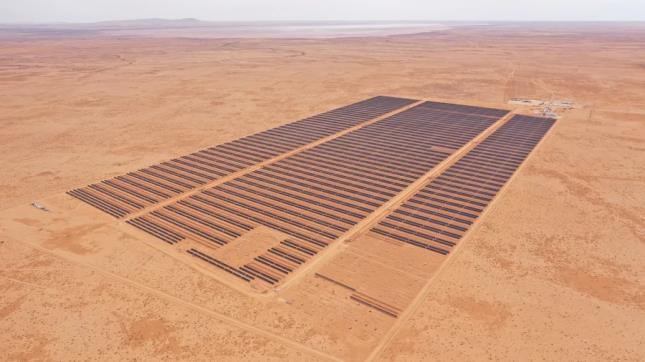
- Eurus Energy said AEOLUS, set up with Toyota Tsusho subsidiary CFAO to support sustainability in Africa, launched two solar farms in Tunisia, each 60 MW (DC).
- Operation of Sidi Bouzid Mezzouna PV Power began on Jan 1, and Tozeur PV Power on March 4.
- AEOLUS has a 49% stake; and Scatec, a Norwegian firm, has a 51% stake in the operating companies.
- Electricity will be sold under a 30-year PPA with Tunisian Electricity and Gas.
- Both solar farms were chosen for the Joint Crediting Mechanism (JCM) Financing Program in FY2023. These are AEOLUS’s first investment projects.
- CONTEXT: By 2030, the Tunisian govt seeks to increase nationwide solar capacity to 1.5 GW. Overall, Tunisia aims to have 35% of its electricity, about 3.8 GW, generated from renewable sources (mostly wind and solar) by 2030. In 2025, Japan’s MoE selected Marubeni for a 130 MW solar power plant project in Gabès (central Tunisia) under the JCM.
GLOME HD to acquire ¥1.5 billion in BESS assets
(Company statement, April 30)
- In September, GLOME HD will enter the BESS market, acquiring two assets, each worth ¥750 million.
- To minimize risk, the company said it would focus on investing in late-stage projects nearing completion, while holding the assets through SPCs and a subsidiary.
- The company justified the move by citing losses in FY2025 and fluctuations in the revenue environment surrounding its medical-related businesses.
- TAKEAWAY: This announcement illustrates how the BESS market has gained such a strong reputation for profitability that companies with no historical involvement in the energy sector – GLOME HD is in pharmaceuticals – are now willing to enter the market in search of new revenue streams. This also echoes Higo Bank’s decision to establish a subsidiary specifically dedicated to BESS in February, marking a more direct involvement beyond traditional financing agreements.
Nippon Storage Battery secures ¥4.9bn project finance for 14 BESS sites
(Company statement, April 27)
- Nippon Storage Battery signed a ¥4.9 billion credit facility agreement with Ricoh Leasing to finance 14 high-voltage grid-connected battery storage facilities across Japan, marking the company’s first large-scale project financing round.
- The financing is structured as a non-recourse loan through an SPC, with asset management entrusted to eco Properties. The facilities will generate revenue through DR and wholesale electricity markets, effectively operating as a merchant BESS portfolio.
- SIDE DEVELOPMENT:
- Palma partners with JB Sustainable to deploy BESS at self-storage sites
- (Company statement, April 23)
- Self-storage operator Palma signed a business alliance with JB Sustainable to install and operate grid-scale battery storage systems at trunk room and container storage facilities nationwide.
- The companies plan to use portions of container-type storage sites, including 20-foot container spaces, as battery installation hubs, leveraging Palma’s distributed roadside storage network and existing power infrastructure.
- The partnership will explore multiple deployment models, including company-owned, customer-owned and leased facilities, while JB Sustainable provides battery operation expertise and infrastructure management.
Fujifilm converts electricity to clean power in North America in solar PPA
(Company statement, April 21)
- Fujifilm Holdings converted the electricity used across all its North American operations to 100% renewable energy under a virtual PPA tied to a new 270 MW solar project in Texas developed by Geronimo Power.
- Fujifilm contracted for 125 MW of the project’s output, and will purchase renewable energy certificates equivalent to about 300 GWh/ year.
- CONTEXT: The move supports Fujifilm’s decarbonization strategy. Its North American business spans healthcare, imaging, semiconductors, business innovation, and industrial materials, all of which require large-scale, stable electricity use.
MoE opens subsidy call to support BIPV
(Government statement, April 28)
- MoE opened a subsidy call for building-integrated photovoltaics – solar systems integrated into building materials such as windows, walls and façades to expand distributed renewable deployment.
- Applications are accepted until May 28.
- For details go to: https://www.eta.or.jp/offering/2026/offsite/index.php#tab01.
Hamada becomes first firm certified under revised recycling law
(Company statement, May 7)
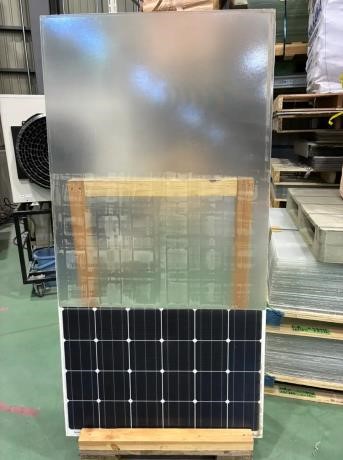
- On April 30, Osaka-based environmental solution firm Hamada became the first company certified under the govt’s advanced recycling law (Category 2: high-level separation/ recovery).
- Hamada’s goal is to shift from landfill to so-called “horizontal recycling,” reusing panel cover glass as raw material for new flat glass.
- CONTEXT: The certification targets the approaching mass disposal of solar panels; over 60% (mainly glass) has been landfilled after partial material recovery. The Act on Sophistication of Resource Recycling Businesses came into effect in 2025.
- TAKEAWAY: The tech relies on a water-jet process that removes resin residues from panel glass without damaging it. This solves a major barrier that prevents glass from meeting manufacturer quality standards and enables “glass-to-glass” recycling instead of downcycling – a significant step toward a circular economy for solar panel waste.
Looop and Bbox to test reuse of retired solar panels in Kenya
(Company statement, April 27)
- Looop agreed with Bboxx Kenya, a platform that helps to provide affordable clean energy, to test reusing retired solar panels in off-grid areas of Kenya.
- The project will supply up to 500 used but still functional panels (about 0.3 MW) to power homes, schools, clinics, and water facilities.
- The goal is to extend panel lifespan, and develop a sustainable business model ahead of full commercialization targeted for FY2027.
- TAKEAWAY: Kenya has a target of 100% clean energy sources on the national grid by 2030. Japan supports Kenya’s clean energy goals, expanding solar power in off-grid areas through partnerships, investment, and tech transfer, including pilot projects like solar panel reuse. This appears to be a way to address Japan’s own problem with a growing volume of aging solar panels, originally installed during the 2010s solar boom.
EM Solutions to participate in PSC demo in Aichi
(Company statement, April 23)
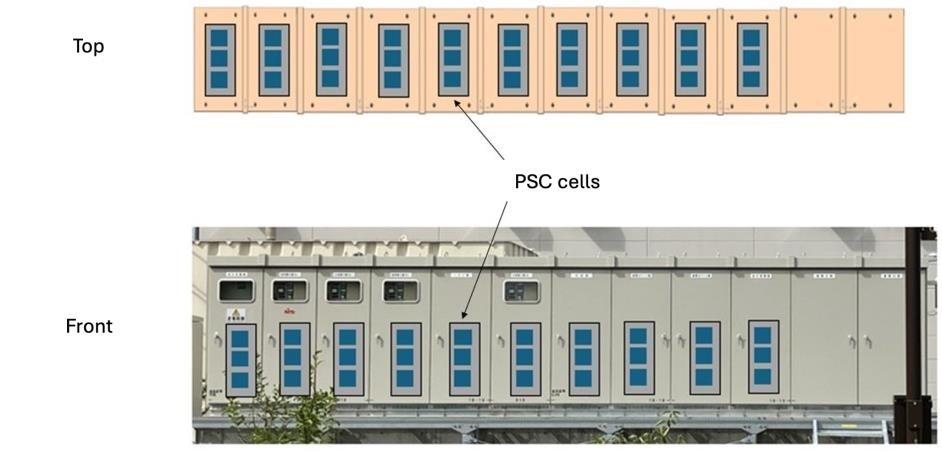
- EM Solutions joined an Aichi Pref project to develop PSCs, in a demo with Nitto Kogyo at its factory in Seto.
- The goal is to test PSCs when monocrystalline silicon panels can’t be deployed.
- The demo will run for two to three years starting November.
Sun Village agrees with Daihen for procurement of JC-STAR equipment
(Company statement, April 24)
- Sun Village agreed with Daihen for the procurement of interconnected equipment certified under JC-STAR.
- Daihen will supply batteries, EMS, PCS, and transformers; while Sun Village will handle EPC and O&M services for BESS projects.
- CONTEXT: Six projects are now in development, with 70 more planned for FY2026. In total, Sun Village aims to reach 500 MW of installed capacity across 250 projects.
Zeon to increase production of carbon tubes for li-ion batteries
(Company statement, April 24)
- Zeon plans to increase production for its SWCNT (single-walled carbon nanotubes) at its factory in Shunan (Yamaguchi Pref).
- Expansion should be completed in 2028, with METI support.
- CONTEXT: SWCNTs are lightweight cylindrical nanostructures with high conductivity, used in EV batteries, drones, robotics, sensors, and aerospace. They improve conductivity in lithium-ion batteries, reducing internal resistance, and enabling faster charging.
NEWS: WIND POWER AND OTHER RENEWABLES

MoE issues opinion on 150 MW Aomori wind farm
(Government statement, April 24)
- The MoE minister called on Cosmo Eco Power to carefully assess its 150 MW planned wind farm in Goshogawara and Nakadomari, Aomori Pref.
- Plans call for up to 35 turbines, each with a 4 MW-5 MW capacity.
- The project could take up to 4 years to build.
- The MoE urged for:
- evaluation of cumulative impacts with nearby existing or other planned wind farms;
- several projects are undergoing assessment in the vicinity including plans by Eurus Energy;
- reducing noise and shadow flicker by ensuring distance from homes;
- protection of rare bird species through environmental studies.
- SIDE DEVELOPMENT:
- MoE issues urges KTA to reassess its 120 MW Iwate wind farm plan
- (Government statement, May 7)
- The MoE minister called on energy firm KTA for a more thorough assessment of a planned 120 MW wind power project in Karumai Town, Iwate Pref.
- The project plans to use 20 to 40 turbines, each with 3 MW or 6 MW capacity.
- MoE warned of cumulative impacts with nearby projects, risks to protected birds (golden eagles and migratory species), and noise/shadow effects on residents.
- CONTEXT: The area already hosts operating wind farms and multiple projects under environmental review, raising concerns about cumulative impacts. KTA Karumai Wind has been operating since 2018, but its ownership structure is undisclosed.
Mitsubishi revises decarbonization strategy after wind sector fiasco
(Company statement, May 1)
- Mitsubishi Corp’s latest carbon-neutral roadmap reinforces a pragmatic approach to renewables, emphasizing diversification (renewables, LNG, etc).
- Compared to earlier strategies that targeted rapid renewables capacity growth (doubling it by 2030), the updated direction is more cautious.
- TAKEAWAY: This shift is likely influenced by the trading house’s withdrawal from ~1.7 GW of offshore wind projects due to cost inflation and profitability issues, which exposed structural risks in large-scale wind development. This seems to have pushed Mitsubishi toward a more conservative, diversified energy strategy.
Penta-Ocean and Tokyo Univ to research floating wind power
(Company statement, April 22)
- Penta-Ocean Construction and The University of Tokyo will launch a five-year research program on floating offshore wind power, from 2026 to 2031.
- The project will focus on improving construction efficiency, operational optimization and resilience for floating wind farms under Japan’s harsh marine conditions, including typhoons, strong currents and complex seabed geology.
- Key research areas include optimized floating platform design, digital twin modelling for weather and ocean conditions, and more efficient offshore construction systems.
- TAKEAWAY: Floating offshore wind is increasingly viewed as essential for Japan because most of the country’s offshore areas become too deep for fixed-bottom foundations close to shore. However, scaling the sector remains technically and logistically difficult. Turbines in the 15–20 MW class are expected to become standard, implying deployment of roughly 750–1,000 units to meet Japan’s floating wind ambitions. That raises major challenges not only around construction and installation, but also around long-term operability under Japan’s severe metocean conditions, making reliability, maintenance access and weather resilience critical cost drivers for the industry.
Eurus Energy begins dismantling ageing Soya-Misaki wind farm for full repowering
(Company statement, May 1)
- Eurus Energy started dismantling work on the 57 MW Soya-Misaki Wind Farm in Wakkanai, Hokkaido, after ending commercial operations in April following roughly 20 years of operation.
- The wind farm began operations in November 2005 and consists of 57 MHI turbines rated at 1 MW each. Eurus cited ageing equipment and long-term operational wear as the reason for retirement.
- After dismantling is completed, Eurus plans to fully repower the site with new turbines and equipment to continue utilizing the region’s strong wind resources and support local economic activity.
- CONTEXT: Eurus plans to repower the site with 14 new 4.3 MW turbines under a project that has already completed Japan’s environmental assessment process. Reports indicate commercial operations are targeted for April 2029.
- TAKEAWAY: The project highlights the emerging repowering cycle facing Japan’s early-generation wind fleet, much of which was built in the 2000s using relatively small turbines that are now approaching the end of their operational lives. Replacing older 1 MW-class turbines with modern multi-megawatt models could significantly increase output without requiring entirely new development sites.
OCCTO orders power transfer from Hokuriku due to increased hydropower output
(Agency statement, May 5)
- On May 5, OCCTO ordered power transfer from Hokuriku TSO to Chubu and Chugoku TSOs to improve the supply-demand balance in the Hokuriku area.
- Between 6:30 and 8:00, up to 115 MW of electricity was transferred from Hokuriku to Chubu.
- Between 7:30 and 8:00, up to 9.4 MW of electricity was transferred from Hokuriku to Chugoku.
- Amid weak regional electricity demand, increased hydropower output reduced Hokuriku’s operational flexibility, even after curtailment of thermal generation and non-hydro renewable output.
- CONTEXT: OCCTO operates inter-area corrective power interchange to adjust actual power flows between regions when real-time supply-demand deviates from plans.
- TAKEAWAY: While similar transfer orders linked to insufficient curtailment capacity were recently issued in the Kansai area, this appears to be an unusual and potentially the first such case involving Hokuriku. On April 12, OCCTO ordered transfers from Kansai to Chugoku following increased renewable generation. Hokuriku has one of Japan’s highest shares of hydropower, accounting for roughly 25% of generation. During snowmelt and heavy rainfall periods, rising river flows can make run-of-river hydropower difficult to suppress, limiting the region’s ability to absorb additional renewable generation even after thermal shutdowns and solar curtailment.
Toshiba inks MoU with Bulgaria’s national power firm on hydro plant
(Company statement, April 27)
- Toshiba signed an MoU with the National Electricity Company, Bulgaria’s state-owned power company, to restore and operate long-term the Chaira pumped-storage hydropower plant (864 MW), the country’s largest.
- During his visit to Tokyo, Bulgaria’s energy minister Vladimir Malinov discussed other investment opportunities with Toshiba’s VP Matsushita Takehiko.
- CONTEXT: The project includes refurbishment and technical support for all units, building on Toshiba’s past delivery of four turbines (864 MW) and four generators (940 MVA). Bulgaria plans around 4.5 GW of additional pumped-storage capacity to support a power system expected to reach 91% renewables by 2050.
- CONTEXT: Toshiba Energy Systems & Solutions is the maker and supplier of equipment for the Chaira plant.
Tekken and others complete Yamanashi hydro plant
(Company statement, April 28)
- Construction firm Tekken and partner completed the Maki River Small Hydropower Plant in Otsuki City, Yamanashi Pref, under the govt’s FIT scheme.
- With a capacity of 199 kW and max flow of 0.30 m3/ s, the project uses Austria’s Vertical Pelton (WWS Wasserkraft, Austria) turbines.
- CONTEXT: It follows Tekken’s selection in 2022 under Yamanashi’s public forest small hydropower development program. Agreements with both the prefecture and local municipality enabled development within publicly owned forest land.
- TAKEAWAY: While small in scale, the project reflects Japan’s ongoing push toward distributed, site-specific renewable generation, leveraging untapped small hydropower resources in mountainous regions. It also highlights continued reliance on the FIT framework to ensure project bankability.
Kyuden Mirai starts supply of geothermal energy across Kyushu
(Company statement, April 27)
- Kyuden Mirai Energy, a renewables subsidiary of Kyushu Electric, began supplying geothermal power to 16 Nichirei facilities across Kyushu.
- Electricity generated at four geothermal plants in Oita and Kagoshima cities is sent to Nichirei’s factories and refrigerated warehouses. Nichirei is one of Japan’s top producers of frozen foods.
- The firm is using an off-site corporate PPA model. It’s reportedly the first use of geothermal power for the food and logistics industry.
- CONTEXT: Nichirei chose geothermal energy because it provides around-the-clock electricity, making it suitable as a reliable baseload power source. Kyushu Electric’s geothermal power capacity accounts for about 40% of Japan’s total.
- TAKEAWAY: Geothermal PPAs have seen moderate but noticeable growth over the past two years, with an average size larger than that of solar PPAs, many of which remain below 1 MW. However, future trends will depend on whether installed capacity expands through next-gen technologies capable of significantly improving efficiency, and on whether solar energy continues to face regular curtailment.
- SIDE DEVELOPMENT:
- JOGMEC selects six geothermal projects to conduct drilling and surveys
- (Organization statement, April 28)
- JOGMEC selected six projects to receive support under the FY2026 geothermal power plant resource survey grant program. o The projects aim to assess Japan’s geothermal potential and underground resources. o The selected projects are:
| Company | Location |
| Nippon Steel Mining, Electric Power Development | Kirishima, Kagoshima Pref |
| TEPCO Renewable Power | Shiobara, Tochigi Pref |
| Kyuden Mirai Energy | Kokonoe, Oita Pref |
| Nippon Heavy Chemical Industries, Chubu Electric, Kajima | Otari, Nagano Pref Itoigawa, Niigata Pref |
| Idemitsu Kosan, Kanto Natural Gas Development | Kurihara and Osaki, Miyagi Pref |
| INPEX | Shibetsu, Hokkaido |
NEWS: NUCLEAR ENERGY

Japanese nuclear firms accelerate workforce training amid reactor revival
(Asia Nikkei, May 7)
- Japanese nuclear equipment makers are expanding worker training programs using digital tools such as VR and video-assisted instruction, as the govt revives plans for new reactor construction.
- IHI introduced a new welding training system in January that combines classroom instruction with video-based practical training, cutting the training period for reactor pressure vessel technicians to roughly one-fifth of previous requirements.
- MHI developed around 50 VR training courses covering nuclear plant design, construction and maintenance, while Hitachi compiled 16,000 critical technical points related to nuclear construction and maintenance to systematize knowledge transfer.
- The training push comes as Japan targets raising nuclear’s share of the power mix to 20% by FY2040, from less than 10% in FY2023.
- CONTEXT: Japan’s nuclear workforce has shrunk sharply since Fukushima. Employment related to new reactor construction at firms in the industry body, the Japan Atomic Industrial Forum, fell by about half to roughly 2,300 workers in FY2024; experienced construction technicians at Hitachi now account for only around 15% of the total.
METI Minister visits Kashiwazaki-Kariwa after restart
(Yomiuri Shimbun, April 25)
- METI Minister Akazawa inspected Kashiwazaki-Kariwa NPP, the first time a METI minister inspected the facility since the 2011 earthquake.
- This follows resumption of commercial operations at Unit 6 on April 16, which ended a 14-year hiatus.
- Akazawa said the govt will help foster nationwide understanding of nuclear power.
- He plans a regular forum with the prefecture to discuss pertinent issues.
Tomari NPP Unit 3 restart delayed due to safety works
(Nikkei, April 28)
- Tomari NPP Unit 3’s restart in Hokkaido faces a setback, with its anticipated date pushed back to at least summer of 2027. Hokkaido Electric said this is due to the construction of a seawall for tsunamis. It will take four months longer than planned.
- This delay is due to the need for extra ground reinforcement.
- Hokkaido Electric planned a 11% reduction in household electricity rates after Tomari’s restart. Now, instead of the 11% cut, the company speaks of a reduction of “about ¥1,000 per month”.
- CONTEXT: Hokkaido Electric based its planned 11% rate reduction on crude oil prices of $70 per barrel and an exchange rate of ¥145 to the dollar. The new forecast for FY2026 is bleaker, assuming crude oil prices of $95 per barrel and a weaker exchange rate of ¥158 to the dollar.
Tohoku Electric to delay dry storage at Onagawa NPP Unit 2
(Company statement, April 27)
- Tohoku Electric will delay by two months construction for one of two planned dry spent nuclear fuel storage facilities at Onagawa NPP Unit 2.
- Work will begin in early autumn; the reason is to verify components of containers.
- Operational start is unchanged, planned for after March 2028. The second storage facility will start operation in June 2032.
- The utility also submitted a revised construction plan to the NRA.
- CONTEXT: The utility also said it will bring the reactor back online, currently offline due to regular inspections, on May 11 instead of May 5, as previously stated.
Steam detected at Mihama NPP Unit 3, no radiation leakage
(Company statement, May 8)
- KEPCO said an alarm went off at Mihama NPP Unit 3. Control room operators confirmed steam leakage near the high-pressure turbine via camera.
- The reactor was shut down shortly after detecting the steam. KEPCO will investigate.
NEWS: TRADITIONAL FUELS

Tokyo Gas raises prices for first time in 46 years
(Company statement, Japan NRG, April 27)
- In October, Tokyo Gas will raise urban gas prices across Tokyo and six prefectures (Kanto region), the first increase since the late 1970s oil crisis. The hike, driven by rising labor and equipment costs, will apply to households and most corporate customers.
- For households (except in Gunma Pref), the basic fee will rise ¥150 per contract, and the per-unit charge by ¥0.02 per cubic meter. A typical household’s March bill would increase 2.6% to ¥5,884. Corporate rates will rise by an average of 2.7%.
- CONTEXT: Tokyo Gas serves 8.6 million urban gas customers, but consumption has fallen about 20% since 2006 due to warmer temperatures and energy-efficient appliances. The firm faces large costs over a need for a large staff at call centers and for safety. LNG terminal repair costs are also rising, making it difficult to cover operational expenses.
- TAKEAWAY: Fuel price fluctuations are passed on to consumers monthly through a surcharge. This current hike is calculated based on the multi-month average of LNG import prices. The spike linked to the Iran war will be reflected starting Sept.
- SIDE DEVELOPMENT:
- Tokyo Gas sells stake in U.S. gas-fired power plant
- (Company statement, May 8)
- Tokyo Gas will sell its entire stake in a natural gas-fired power project in Pennsylvania operated via Birdsboro Power Holdings.
- Tokyo Gas owned a 33% stake and will sell all of it to Strategic PPAV, which is already an investor.
- CONTEXT: The Birdsboro plant began commercial operation in 2019, with 488 MW capacity. It sells electricity into the wholesale power market.
Idemitsu Kosan’s oil tanker passes through Hormuz
(Nikkei, April 28)
- A large oil tanker operated by Idemitsu Kosan likely passed through the Strait of Hormuz on April 28. This would be the first time a vessel owned by a Japanese refinery major has exited the Persian Gulf since the war in Iran began.
- A Japanese official said the passage resulted from negotiations, without transit fees.
- According to a vessel tracking site, the tanker Idemitsu Maru transited the strait. The ship, which departed from Saudi Arabia, is expected to arrive around mid-May. Iranian media said the tanker passed with Iran’s permission. The Idemitsu Maru can carry around 2 million barrels of crude oil.
- TAKEAWAY: Several Japanese-affiliated LNG and LPG carriers have passed through the strait, but their destinations were Oman and India. This is the first confirmed passage of a Japanese crude oil tanker headed to Japan. This single passage isn’t a reliable sign that Japan can avoid the war’s impact, especially as Trump warned allies of a longer Hormuz blockade.
Idemitsu Kosan to supply 4 million barrels of crude to Vietnam
(Jiji Press, April 29)
- Idemitsu Kosan will supply about 4 million barrels of crude oil to Vietnam, sourced from the Middle East via a route avoiding the Strait of Hormuz.
- The oil will go to Vietnam’s Nghi Son refinery, which is partly owned by Idemitsu, and will be refined into gasoline and naphtha for local sale.
- The move supports supply chains, as Vietnam exports oil-based electronics and auto parts to Japan. The volume equals roughly 10 days of Vietnam’s consumption.
LNG stocks down from previous week, up YoY
(Government data, April 30)
- As of April 26, the LNG stocks of 10 power utilities were 2.16 Mt; down 2.7% from the previous week (2.22 Mt); up 8% from end April 2025 (2 Mt); and up 1.9% from the 5-year average of 2.12 Mt.
March Oil/ Gas/ Coal trade statistics
(Government data, May 2)
- Japan imported 11 million kiloliters of crude oil in March, up 2.4% YoY, but down 6.1% from the previous month. Despite tension in the Strait of Hormuz, the share of crude oil imports from the Middle East reached almost 95% (less from Saudi Arabia and Kuwait, but more from Qatar and UAE; about the same from Oman). A small sum of imports came from Brunei for the first time in 2026. For the first three months in 2026, oil imports totaled 36.5 million kiloliters, about 7.9% more than in 2025.
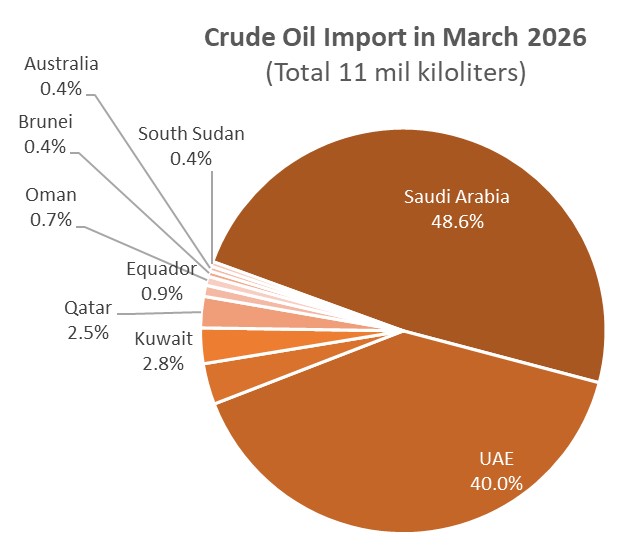
- CONTEXT: It takes several weeks for oil tankers from the Middle East to reach Japan, so impact from the de facto closure of the Strait of Hormuz will be more apparent in the April data.
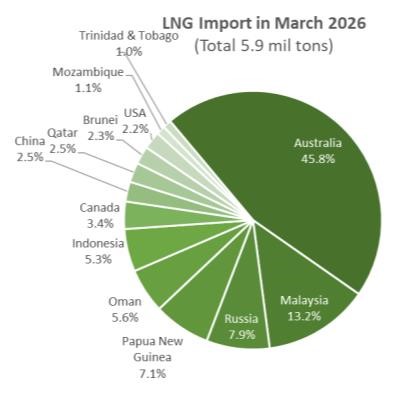
- LNG imports in March totaled 5.9 Mt, up 0.9% over Feb (5.8 Mt) and up 13.9% YoY. Imports from Qatar nearly halved (from 0.31 Mt to 0.14 Mt); from Oman up 71% (from 0.19 Mt to 0.33 Mt); and none came from UAE (0.12 Mt to zero). Japan started importing from China and Trinidad & Tobago this month. Deliveries from Asia & Pacific countries were steady. Imports from the U.S. doubled from Feb to March, but the volume remained small (from 0.06 Mt to 0.13 Mt). Over the past 3 months, the share of LNG imports from the Middle East ranged from 12% to 8%, gradually decreasing, but it did not have a significant impact on stock levels.
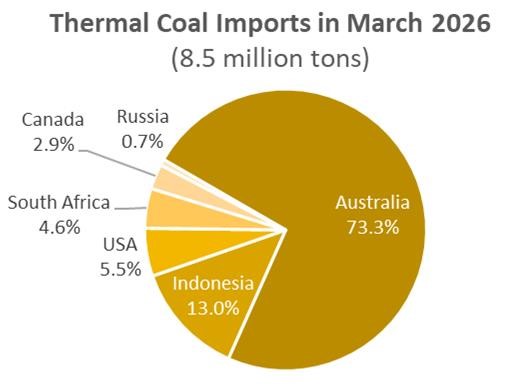
- Thermal coal imports in March were 8.5 Mt, down 2.8% from Feb, but up 2.2% YoY. Japan does not source coal from the Middle East, but consumption may increase to fill in the shortages of crude oil and LNG in the coming months.
NEWS: CARBON CAPTURE & SYNTHETIC FUELS

Govt to support CCS project for 15 years after storage begins
(Government statement, April 27)
- METI and ANRE decided on a framework to support CCS projects.
- The govt will provide financial support for 15 years after CO2 storage begins, covering costs from capture to transport and storage.
- After the support period ends, operators must continue the project for an extra 10 years. The amount will be reviewed every few years to reflect inflation, technological progress, and cost reductions.
- The support will cover the gap between: 1) a “baseline price” (capture + transport/ storage costs); and 2) a “reference price” based on carbon pricing.
- The govt will review and approve costs, and reassess them routinely.
- The method for determining transport and storage costs was revised from an auction system to a govt review system.
Sekisui House claims high energy-efficiency targets for ZEH, ZEB
(Company statement, April 22)
- One of Japan’s largest homebuilders, Sekisui House, said it met or exceeded all its 2025 energyefficiency targets.
- This includes a 96% rate for ZEH (zero-emission houses) and 55% for ZEB (zero-emission buildings), both above their respective goals.
- The targets were:
- ZEH for detached homes: 90%
- ZEH for rental housing: 75%
- ZEB: over 50% (by March 2026)
- This year concludes the firm’s mid-term plan, with a major boost in non-residential ZEB adoption, driven by new offices and clinics.
- The firm promoted solar power, energy storage, etc.
METI awards Nippon Biofuel a ¥4 billion subsidy for jatropha cultivation
(Company statement, April 20)
- METI will give Nippon Biofuel a ¥4 billion subsidy towards its ¥7 billion biofuel project for cultivation of jatropha in Ghana and Mozambique.
- It aims to supply 400,000 tons of biofuel annually for maritime use by 2032.
- Participants include Mitsui O.S.K. Lines, Japan Maritime Association, Fujii Oil, and Tottori University.
ANALYSIS
BY TETSUJI TOMITA
Two Paths to Hydrogen Power: KHI and MHI Bet on Different Futures
NOTE: This continues from our April 20, 2026 analysis that focused on ammonia-fired power generation in Japan.
The future of hydrogen power generation in Japan may ultimately depend on two major engineering firms pursuing very different visions for the market. Yet those differences are becoming complementary rather than directly competitive.
Kawasaki Heavy Industries (KHI) sees hydrogen primarily as a fuel supply and infrastructure business. Mitsubishi Heavy Industries (MHI), by contrast, treats hydrogen as a way to decarbonize existing thermal power generation. Both are developing hydrogen combustion technologies, but they differ sharply in where they expect value to emerge and how hydrogen is ultimately likely to be used.
That distinction matters because Japan’s hydrogen ambitions depend on solving two separate problems at once: securing large-scale hydrogen supply and creating commercially viable demand for it in hard-to-abate sectors such as power generation. Without cheap and reliable fuel imports, hydrogen-fired power plants will struggle to expand. Without large-scale downstream demand, meanwhile, investment in hydrogen supply infrastructure becomes difficult to justify.
The result is an emerging industrial symbiosis. While KHI is focusing on liquefied hydrogen transport, storage, and distributed hydrogen utilization, MHI is concentrating on large-scale hydrogen turbines and thermal power systems – effectively leaving endusers to determine how and where hydrogen will ultimately be consumed.
Despite persistently high costs, Japan continues to position hydrogen as a long-term decarbonization option. The interaction between KHI’s supply-chain strategy and MHI’s power-generation strategy may prove just as important as the individual technologies.
Comparison of Hydrogen Power Technologies and Strategies: KHI vs. MHI
| Category | KHI | MHI |
| Strategic Focus | Hydrogen supply chain / Infrastructure | Hydrogen power generation |
| Core Technology | Liquefied hydrogen transport and storage | Hydrogen gas turbines |
| Target Market | Distributed and industrial power & heat | Large-scale utility power |
| Development Approach | Retrofit and phased co-firing | High-efficiency turbine development |
| Key Strength | Hydrogen logistics and infrastructure | Turbine efficiency and combustion technology |
| Major Projects | Suiso Frontier; Kobe Hydrogen Energy Center | Takasago Hydrogen Park |
KHI: treating hydrogen itself as the business
KHI’s hydrogen strategy is structured around the creation of a full hydrogen supply chain encompassing production, transportation, storage, and utilization. Unlike firms focused primarily on power-generation equipment, KHI positions hydrogen as the core business domain, treating it as a future global energy carrier rather than simply another thermal fuel.
The company’s investments span the entire value chain, including liquefaction systems, liquefied hydrogen storage, receiving terminals, hydrogen transport infrastructure, gas turbines, gas engines, and maritime transportation.
KHI began hydrogen-related R&D in the late 2000s and early 2010s, initially focusing on combustion tech capable of handling hydrogen’s unique physical properties. Compared with natural gas, hydrogen has a much higher flame speed and combustion temperature, creating challenges such as flashback, knocking, elevated NOx emissions, and thermal stress on combustion components.
To address these issues, KHI developed proprietary low-NOx combustion systems and advanced combustion controls, while also building expertise in safety technologies such as leak detection and purge systems. These efforts laid the foundation for future hydrogen co-firing and hydrogen-only combustion systems.
During the late 2010s, KHI accelerated commercialization of hydrogen-compatible gas turbines, including a 1.8 MW-class hydrogen co-firing gas turbine cogeneration system designed to operate on mixed natural gas and hydrogen fuel while maintaining stable combustion and low emissions.
A major milestone came in 2021, when KHI supplied a 30 MW-class gas turbine cogeneration system to the Seibu Oil Yamaguchi refinery. It used refinery off-gas containing by-product hydrogen, and supported hydrogen co-firing ratios of roughly 2050% by volume.
With output exceeding 34 MW, this was one of Japan’s largest practical hydrogen cofiring applications at the time and demonstrated how hydrogen utilization could be integrated into existing industrial facilities.
In September 2025, KHI became the first company globally to launch commercial sales of large-scale gas engines capable of burning a 30% hydrogen blend, positioning them as “hydrogen-ready” systems compatible with existing natural-gas infrastructure. In February 2026, KHI delivered another hydrogen co-firing-ready 30 MW gas-turbine cogeneration system to Teijin’s Matsuyama plant.
Meanwhile, KHI has extended hydrogen combustion to large gas engines through its “Kawasaki Green Gas Engine” platform. The system achieved stable operation with hydrogen co-firing ratios of up to 30% by volume while maintaining low NOx emissions.
Alongside combustion technologies, KHI has continued expanding liquefied hydrogen infrastructure. One of its headline projects is the world’s first liquefied hydrogen carrier, Suiso Frontier. Because liquid hydrogen must be stored at roughly -253°C, maritime transportation requires advanced cryogenic engineering and insulation technologies, an area where KHI sees a competitive advantage.
In 2025, KHI began building a demo facility for its “KM Comp-H₂” centrifugal hydrogen compressor for liquefaction plants, aimed at improving liquefied hydrogen supply-chain efficiency. The company is also expanding transport capacity. In 2026, it signed a contract to build a 40,000 m³-class liquefied hydrogen carrier as part of a plan to supply imported clean hydrogen to Japanese power plants and gas turbines.
MHI: extending the thermal power business into hydrogen
MHI’s hydrogen strategy emerged from a different industrial logic. Rather than building a hydrogen supply business, the company approached hydrogen primarily as a decarbonized fuel for thermal power plants.
As one of the world’s largest gas-turbine manufacturers, MHI’s focus has been on adapting existing thermal-generation tech to operate with progressively higher hydrogen content while preserving efficiency, reliability, and operational stability.
MHI’s experience with hydrogen combustion dates back to the 1970s, when it developed industrial gas turbines capable of using by-product gases from steel plants and refineries. Because these gases often contained significant amounts of hydrogen, the company accumulated expertise in combustion control, flashback prevention, NOx reduction, and high-temperature materials engineering.
Starting in the mid-2010s, MHI accelerated development of hydrogen-fired gas turbines in response to global decarbonization policies, focusing on its large-scale M501JAC unit and the medium-sized H-25. MHI adopted a phased strategy starting with hydrogennatural gas co-firing before progressing toward full hydrogen combustion. It developed 30% hydrogen co-firing technology for large-frame gas turbines and later tested combustion at 50% co-firing levels.
At the same time, MHI advanced combustors capable of operating entirely on hydrogen fuel.
A major milestone came in 2022 with the launch of Takasago Hydrogen Park at an MHI facility in Hyogo Prefecture. It is designed as an integrated hydrogen validation center capable of testing the entire value chain from the production of hydrogen to its storage and use in hydrogen-fired power generation. The Park also houses large-scale alkaline water electrolysis systems, hydrogen supply infrastructure, and validation systems for both JAC-class and H-25 gas turbines under commercial operating conditions.
Alongside gas turbines, Mitsubishi Heavy Industries Engine & Turbocharger (MHIET) has also expanded into hydrogen reciprocating engines. Rather than developing entirely new systems, the company has focused on adapting existing gas and diesel engine platforms for hydrogen use.
Since 2019, MHIET has worked with AIST to address challenges including knocking, pre-ignition, and combustion instability. After demonstrating 100% hydrogen combustion in a single-cylinder engine in 2021, the company achieved hydrogen cofiring ratios of up to 50 vol% in gas engines by 2023. Two years later, it launched a 450 kW cogeneration system capable of 15 vol% hydrogen co-firing.
MHIET has also pursued fully hydrogen-fueled engine-generator systems. In 2025, a 500 kW-class six-cylinder hydrogen engine generator installed at the Sagamihara Plant achieved stable rated operation using 100% hydrogen fuel, marking a significant step toward commercialization of practical multi-cylinder hydrogen engine systems.
These developments suggest MHI is positioning itself less as a standalone turbine manufacturer and more as a broader energy-systems provider centered on thermal power that is compatible with hydrogen.
Two companies solving opposite sides of the same problem
The clearest distinction between KHI and MHI lies in where each company believes the hydrogen economy will face its greatest constraints.
KHI is effectively betting that hydrogen’s biggest challenge will be supply-chain scale and distribution. MHI, meanwhile, is betting that the key challenge will be creating enough large-scale demand to justify that infrastructure.
Although rivals within Japan’s engineering sector, the two firms increasingly appear structurally interdependent. Large-scale hydrogen-fired power generation will require affordable fuel imports, while hydrogen supply infrastructure becomes easier to justify if utility-scale demand emerges.
For now, both companies are effectively working toward the same goal: creating a hydrogen market large enough to eventually compete within.
ANALYSIS
BY ANDREW STATTER
Energy Jobs in Japan: Contract Types, Fixed-term vs Indefinite
In Japan, the common standard for employment contracts has been indefinite employment agreements. This essentially means that the employee is hired by the company on an open-ended contract and is protected by Japan’s labour law.
In recent years, as more multinational companies enter the Japan market and as Japanese companies evolve to become more competitive to hire top talent, we are seeing a rise in fixed-term contracts for various reasons.
Let’s take a look at the reasons behind the rise in fixed-term contracts, what advantages and disadvantages there are both for employer and employee, and cover what the market still expects.
The gold standard = forever contracts
Japan’s employers typically see a responsibility to take care of employees and give them a place for life. This is reflected in the structure of employment contracts, which tend to be open-ended and have an indefinite term.
This type of contract is how almost all new Japanese employees entering the workforce will be structured. For the majority of Japanese employees who have also changed jobs a couple of times, all of their employment contracts will also have been structured this way.
Thus, when a Japanese candidate receives a new offer of employment, the base-level expectation is that your offer will be a permanent, open-ended, indefinite employment contract. For most people, to receive otherwise, for example, a one-year fixed-term contract, is seen as a risk.
In Japan, stability tends to be valued higher than upside opportunity. The image of stability that an indefinite contract gives, as well as the structural protections in place for permanent employees, are attractive for most conservatively minded Japanese professionals.
Rise of the fixed-term contracts
Over the last five years, the number of companies offering fixed-term contracts has significantly increased. We can broadly divide these companies into two groups.
Firstly, let’s look at multinational companies that wish to manage risk. Japan has a reputation, rightly so, for being a very difficult market to fire people, make them redundant, or otherwise let them go. Many new employers, especially investors or developers, are reluctant to make hiring decisions and take on 100% of the risk of making a mis-hire and being stuck with that person.
Secondarily, some companies entering Japan’s market recognize how competitive it is. If the business fails to meet targets, they want the option to scale back or exit the market quickly. The primary reason for offering fixed-term contracts is therefore risk mitigation, with much of that risk effectively shifted onto employees.
Japanese companies are the second type of company utilizing fixed-term contracts looking to become more competitive to secure top-level talent. With the Japanese permanent employee system, professionals are put into a highly structured, graded employee promotion cycle, which gives limited wiggle room for fast-track promotions, salary increases, or creativity in role and benefits. Hiring on a fixed-term contract, however, allows these companies to circumvent those rules and hire people under a different system.
As the employees are not typical permanent employees, the company’s HR department and business leaders have more freedom to offer more competitive salary packages, offer more senior positions to younger talents, or otherwise be more flexible in the working conditions offered.
Why has this come about in Japanese companies that already have a large number of employees? The reason is largely because the bulk of hiring for large Japanese companies is done via new graduate programs. The speed of change and evolution in the energy industry has meant that the talent that companies hired 10 to 15 years ago may not be the talent required to drive the company forward today.
In order to attract experienced talent, Japanese firms must go into the mid-career executive-level markets in direct competition with well-financed, aggressive multinational competitors. This means the type of talent they are looking to attract are typically professionals who have already made one or two career moves and are the type of person who has increased their monetary value and has a higher risk tolerance.
Realities and limitations
- Market expectation to shift to permanent:
In many cases, the employing company may wish to initially hire on a fixed-term contract. This may be three, six, or twelve months in most cases, and the rationale behind this is risk mitigation for the employer.
Typically, this can be framed as a probation period. At the end of this period, the expectation is that the contract will be transferred to a permanent, indefinite version, typically under the same employment conditions, salary, and benefits. - The Five-Year Rule:
Under Japanese labor law, the maximum length of any single fixed-term employment contract is three years, and the maximum amount of time for consecutive role in contracts is five years.
This means that for both multi-national companies looking at hedging their risk or Japanese companies looking at offering an alternative salary and employment structure to their employees, they have a five-year window. After this time, they will need to make that employee permanent under a standard indefinite employment contract.
Is it easier to let someone go? Japan is infamous for being difficult to fire. You need to either have material proof of a severe breach of contract or, in the case of a performance firing, clear reviews and documentation of poor performance. Efforts to improve performance and continued documentation showing this has failed are required in order to legally justify the decision. In the case of fixed-term contracts, it is also difficult to fire somebody based on performance mid-term.
Therefore, if you offer a 12-month contract to mitigate the risk of a mis-hire and, six months in, you wish to let that person go, you still face the same challenges as you would with an indefinite contract. For the purposes of mitigating this higher risk, it was advisable to initially start with either a three- or a six-month contract and essentially treat this as a probation period. - Paying the risk premium:
Finally, as mentioned, a typical expectation is an openended, indefinite contract because most Japanese professionals value stability. In a competitive market such as today, if your firm hires on a fixed-term contract, this will be seen as a risk by the employee. - Make your offer attractive is highly advisable:
To pay a salary and/or offer benefits that are over and above what would be expected under an open-ended contract. Think of this as a risk premium in insurance. At the end of the day, you’re shifting the risk from yourself onto the employee, and that has a real-life cost.
Andrew Statter is a Partner at Titan GreenTech, an executive recruitment agency focused on the clean energy space.
ASIA ENERGY REVIEW
BY JOHN VAROLI
A brief overview of the region’s main energy events from the past week
Australia / Natural gas
The govt confirmed a domestic gas reservation policy that will affect gas exporters starting July 2027. This signals the govt will opt for a domestic market obligation policy; it recently ruled out plans for a new 25% gas tax.
Australia / Renewables
New South Wales introduced the Energy Legislation Amendment Bill 2026 enabling the energy minister to identify and prioritize the highest-value projects in the pipeline. The proposed law will allow streamlined approvals for generation, storage and network projects.
China / Natural gas
Beijing won’t finance the $4.6 billion Phase Four of the Galkynysh natural gas field that Turkmenistan will develop with a CNPC subsidiary. This suggests China does not attach much importance to it. Construction starts this year and will take over four years to complete.
China / Oil and gas
During the 14th Five-Year Plan (2021-25), 225 large and medium-sized crude oil and natural gas fields were discovered, including 13 oil fields with reserves exceeding 100 million tons and 26 gas fields with reserves exceeding 100 billion cubic meters.
China / Wind
Construction began on a 500 MW wind farm in Kazakhstan, developed by a Kazakh–Chinese firm, Karaganda Wind Power. Total investment equals $645 million.
India / Coal
India is burning more coal due to the Iran war. More than 70% of India’s power is already generated from coal-fired plants, and the share is expected to rise this year.
India / Solar
Govt data shows that FDI into the solar energy sector reached $2.38 billion in 2025.
Singapore / Solar and grid
Indonesia’s new sovereign wealth fund Danantara is considering investments of up to US$30 billion in renewable energy in Singapore. One proposed project would include solar power infrastructure and a cross-border power transmission network.
South Korea / Oil
An oil tanker arrived at the port of Daesan with 1 million barrels of crude. This is the first crude cargo to the country via Hormuz since the Iran war began.
Taiwan / LNG
Not a single LNG carrier from Qatar has arrived at Kaohsiung Port since the Strait of Hormuz was blocked in March. Taiwan has only 11 days of reserves remaining. Taiwan imports 96% of its energy; LNG accounts for half of that.
Disclaimer
This communication has been prepared for information purposes only, is confidential and may be legally privileged. This is a subscription-only service and is directed at those who have expressly asked K.K. Yuri Group or one of its representatives to be added to the mailing list. This document may not be onwardly circulated or reproduced without prior written consent from Yuri Group, which retains all copyright to the content of this report.
Yuri Group is not registered as an investment advisor in any jurisdiction. Our research and all the content express our opinions, which are generally based on available public information, field studies and own analysis. Content is limited to general comment upon general political, economic and market issues, asset classes and types of investments. The report and all of its content does not constitute a recommendation or solicitation to buy, sell, subscribe for or underwrite any product or physical commodity, or a financial instrument.
The information contained in this report is obtained from sources believed to be reliable and in good faith. No representation or warranty is made that it is accurate or complete. Opinions and views expressed are subject to change without notice, as are prices and availability, which are indicative only. There is no obligation to notify recipients of any changes to this data or to do so in the future. No responsibility is accepted for the use of or reliance on the information provided. In no circumstances will Yuri Group be liable for any indirect or direct loss, or consequential loss or damages arising from the use of, any inability to use, or any inaccuracy in the information.
K.K. Yuri Group: Hulic Ochanomizu Bldg. 3F, 2-3-11, Surugadai, Kanda, Chiyoda-ku, Tokyo, Japan, 101-0062.