
WEEKLY
June 8, 2026
ANALYSIS
HOW JAPAN IS TRYING TO TURN ITS LARGEST CLEANUP EFFORT INTO A RECYCLING PROGRAM
- In the cleanup from the 2011 Fukushima disaster, attention focuses on the power plant. But another operation takes place outside the facility to decontaminate the land.
- While some of the soil is radioactive, 75% is safe for reuse in construction. Can the world’s largest decontamination effort turn into one of its largest recycling operations?
ENERGY JOBS IN JAPAN: OFFSHORE WIND, REBUILDING A DISSIPATED WORKFORCE
- In 2021, offshore wind was set to lead Japan’s renewables efforts. While no auctions now take place, there’s movement behind the scenes.
- Much work remains in development, bid preparation, etc. So, what happened to the workforce in 2021? What human resources does Japan have to execute on these goals?
ASIA PACIFIC REVIEW
This column provides a brief overview of the region’s main energy events from the past week
NEWS
- Tokyo unveils ¥54 bln energy security package
- Japan to invest ¥3.2 bln to strengthen critical mineral supply chain
- Japanese officials held LNG, commodity talks during Russia visit
- Top traders say credit risk is next constraint for Japan’s power market
- Power retailer number reaches 800, but competition remains uneven
- OCCTO sees tough power supply outlook for 2028–2035 under severe weather conditions
- JH2A launches hydrogen backbone initiative with govt support
- Malaysia and Japan to scale down joint hydrogen project
- MoE mulls stricter environmental assessment for solar projects
- Hitachi and partners create JV to optimize EV battery production
- Security giant SECOM signs PPA with Toshiba
WIND POWER AND OTHER RENEWABLES
- Govt finalizes offshore wind auction rules
- Cosmo debuts offshore-style PPA model with multiple FIP-switched wind farms
- Belgian DEME wins contract for large offshore wind project near Akita
- Govt sets targets for replacing old NPPs
- TEPCO proceeds with treated water discharge and nuclear fuel recovery at Fukushima
- Japan’s rapid switch away from Persian Gulf crude incurred high costs: S&P’s
- Oil reserves decline while U.S. imports grow
- Marubeni divests 40% stake in Taiwan LNG
CARBON CAPTURE & SYNTHETIC FUELS
- Japan faces growing competition for biofuel, SAF feedstocks
EVENTS
June 9-11 APAC Wind Energy Summit @ Hanoi, Vietnam
Jun 11-Jul 19 FIFA World Cup
June 15-17 G7 Summit @ Evian, France
June 23-25 “Summer Davos” in Dalian, China
Jun 30-Jul 1 Asia Nuclear Energy & SMR 2026 @
Singapore
July 1-2 4th WFO Asia Pacific Summit @ Tokyo
August Asia-Pacific Economic Cooperation / Energy Ministerial Meeting
September 14-18 IAEA General Conference 2026
October International Maritime Organization –
Net-zero Discussions
Nov 2-5 ADIPEC 2026 @ Abu Dhabi
Nov 3 U.S. Midterm Elections
Nov Publication of International Energy
Agency – World Energy Outlook 2026
Nov 18-19 Asia-Pacific Economic Cooperation –
Leaders Meeting @ Shenzhen, China
PUBLISHER
K. K. Yuri Group
Editorial Team
Yuriy Humber (Chief Editor)
John Varoli (Senior Editor, Americas)
Kyoko Fukuda (Data, Events)
Magdalena Osumi (Renewables & Storage)
Filippo Pedretti (Thermal, CCS, Nuclear)
Tetsuji Tomita (Power Market, Hydrogen)
Aglaé Bange (Renewables and Biomass)
George Hoffman (Sales, Business Development)
Tim Young (Design)
SUBSCRIPTIONS & ADVERTISING
Japan NRG offers individual, corporate and academic subscription plans. Basic details are our website or write to subscriptions@japan-nrg.com
For marketing, advertising, or collaboration opportunities, contact sales@japan-nrg.com. For all other inquiries, write to info@japan-nrg.com
NEWS: GENERAL OUTLOOK AND TRENDS

Tokyo unveils ¥54 bln package to boost energy security
(Government statement, May 29)
- The Tokyo Metropolitan Govt announced a ¥54.2 billion supplementary budget.
- The goal is to reduce Japan’s reliance on imported oil while supporting companies facing higher energy and raw material costs.
- Key measures include more support for non-petroleum alternatives such as biomass products and SAF, and programs to recover rare metals from discarded electronics.
- EV and plug-in hybrid vehicle subsidies will increase by ¥300,000, raising the max support to ¥1.3 million for EVs and ¥1.15 million for PHEVs. Both individuals and businesses are eligible.
- Tokyo will support SMEs, subsidizing up to 80% of equipment costs that improve efficiency and reduce material use, with a max grant of ¥20 million per firm.
Japan to invest ¥3.2 bln to strengthen critical mineral supply chain
(Organization statement, Japan media reports, June 1)
- Japan will contribute $20 million (¥3.2 billion) to the World Bank Group to establish RISE+ (Resilient and Inclusive Supply-chain Enhancement Plus), a new initiative to strengthen critical mineral supply chains in developing countries.
- The program will support infrastructure development, feasibility studies, investment facilitation, and local mineral processing, helping resource-rich countries attract private investment and create jobs.
- CONTEXT: The initiative builds on the existing RISE framework launched with support from G7 members to help developing nations assess opportunities and challenges in critical mineral development.
- TAKEAWAY: Rather than focusing only on securing supplies for Japan, the initiative seeks to help develop mineral-processing industries and investment opportunities in resource-rich developing economies, aiming to create a more distributed and stable global supply network. For Japan’s wind sector, the key point is that the program is part of a strategy to secure upstream materials needed for the energy transition, including rare earths used in permanent magnets for wind turbine generators.
- SIDE DEVELOPMENT:
- Japan to develop next-gen deep-sea drone for rare earth exploration
- (Asia Nikkei, June 3)
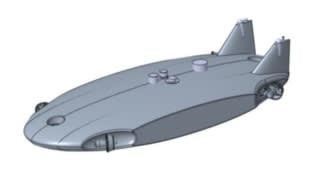
- The Japan Agency for Marine-Earth Science and Technology (JAMSTEC) plans to develop a new hybrid autonomous underwater vehicle to improve seabed surveys for rare earths and other critical minerals.
- The vehicle, capable of diving to depths of around 6,000 meters in about 90 minutes, will allow for faster mapping of deep-sea mineral resources.
- CONTEXT: Japan has intensified efforts to secure domestic sources of critical minerals amid concerns over supply chain security and China’s market dominance.
- TAKEAWAY: This is one of a number of technological approaches put forward to allow Japan to exploit the potential mineral wealth in its surrounding waters. The challenges were and remain the cost of surveying and extraction. But the govt has made it clear that such work is a strategic priority, and domestic deep-sea robotics could have a number of uses in addition to helping the country diversify supplies of critical minerals.
Japanese officials held LNG, commodity talks during Russia visit
(Bloomberg, June 4)
- Japanese govt officials visited Moscow on May 26-27 for discussions with Russian ministries and commodity producers, including suppliers of LNG, oil, fertilizers, aluminum, palladium, and other metals.
- Tokyo said the official goal was protection of Japanese corporate assets in Russia.
- Tokyo stressed that no new economic cooperation was under consideration. It continues to coordinate sanctions policy with G7 partners.
- CONTEXT: Japan remains a shareholder in Sakhalin-2 LNG under a sanctions waiver from Washington and continues to import Russian LNG.
- TAKEAWAY: As Japan NRG covered in an analysis on May 18, Japan maintains channels of communication with Russia. While political relations are strained and new cooperation is off the table, Japan continues to monitor access to important commodities and energy supplies in this time of heightened geopolitical uncertainty and conflict.
Aclara Resources to set up rare earth supply chain eyeing sales to Japan
(Nikkei, June 3)
- Canadian mining firm Aclara Resources plans to establish a rare earth supply chain by 2028, using mines in Brazil and Chile alongside proprietary separation and refining tech developed with U.S. partners.
- The company expects its commercial processing facilities to begin operating by 2028 and produce neodymium and praseodymium, which are key rare earths used in EV motors and wind turbine permanent magnets.
- Aclara targets sales to major automakers such as Toyota Motor, and seeks to meet U.S. demand.
- CONTEXT: In March, JOGMEC agreed with Brazil’s state of Goiás to support stable rare earth procurement. Brazil holds an estimated 20% of global rare earth reserves.
- TAKEAWAY: The move will support global efforts to diversify rare earth supply chains away from China and may become an important new source of magnet rare earths for EVs and offshore wind turbines.
Tokyo firm develops metals analysis that could improve sourcing traceability
(Company statement, June 2)
- Tokyo-based Spicy Company announced development of PMAS-1, a precious metals analysis system that it claims can determine the authenticity, purity, processing history, and approximate refining age of gold, silver, platinum, and palladium.
- CONTEXT: SpicyCompany Group operates across several advanced and tech-driven industries, particularly, space, fintech, security, and advanced materials. Many sectors face growing pressure to show responsible sourcing and circular-economy practices for critical minerals and metals.
- The firm will also launch a certification and traceability service that links physical metal products to digital records via QR-code identification.
NEWS: ELECTRICITY MARKETS

Top traders say credit risk is next constraint for Japan’s power market
(Japan NRG, June 3)
- Japan’s power trading market has become far more resilient since the 2022 energy crisis, but the next test will be whether the country can build a credible medium- to long-term market without creating unmanageable credit and collateral risks, according to a panel of major power traders who spoke at an EEX conference in Tokyo.
- Speakers warned that liquidity alone won’t solve structural problems that the sector now faces: volatile fuel prices, consumer exposure to market-linked tariffs, underinvestment in generation, and the practical difficulty of clearing multi-year physical power contracts.
- The panel drew a sharp contrast between the 2022 Ukraine crisis and the latest Persian Gulf-driven price shock:
- In 2022, forward curves were often indicative rather than executable. Market players could see a price, but not necessarily trade at it.
- This time, futures prices are seen as more reliable reference points, helping firms assess exposure and execute hedges.
- The number of market players has expanded, from about 33 to 127.
- Overseas trading firms helped prevent the market from freezing by keeping offers available even during the shock period.
- Many traders reduced exposure rather than bet on direction. Firms cut outright long or short positions as prices and volatility increased; some adjusted cross-commodity hedges involving power, LNG, oil, coal, and Dubai crude.
- Retailers are now more aware of wholesale-market exposure and have better access to hedging tools. But the risk has changed rather than disappeared.
- In 2022, retailers had sold fixed-price contracts while relying heavily on JEPX spot procurement. Today, market-linked retail tariffs are widespread, meaning wholesale price volatility can pass through more directly to customers.
- That could create a different kind of crisis. The next shock may bring reputational problems if customers say they were not warned that market-linked tariffs could rise sharply. Another concern is that state subsidies may dull demand response, leaving power consumption higher than expected even when wholesale prices rise.
- As METI prepares to roll out a new mid- to long-term power market, traders highlighted several concerns around what they described as a very complex market design.
- Retailers may be required to procure power years ahead for customers who may leave before delivery.
- Long-term obligations could create not only short risk, but also long risk if retailers overprocure.
- Fuel adjustment mechanisms do not eliminate risk, especially if coal, LNG or oil prices move sharply or if policy rules change.
- Existing bilateral contracts in Japan are still often based on trust-based commercial practices rather than financial-market-style collateral rules.
- The main concern is credit risk. Traders argued that Japan can’t impose longer-term procurement obligations without building the clearing and collateral infrastructure to support them.
- A legally grounded clearing house, supported by clearing members, would be needed before large-scale long-term physical trading could develop, they said. Otherwise, market makers and generators would potentially face huge credit exposure. A more realistic approach, one trader suggested, might be to start with a shorter obligation, such as full procurement two months ahead, closer to the timing of fuel procurement and shipping decisions.
- TAKEAWAY: Although technical in nature, the discussion pointed to a central issue in the next stage of Japan’s power-market reform. Policymakers are trying to shift market design away from pure competition and toward security of supply, in response to geopolitical risk, inflation and underinvestment in generation. But the trading infrastructure needed to support that shift has not yet caught up. The risk is that a market designed to improve security of supply could become unstable if credit risk is not properly handled. Locking in supply three years ahead involves substantial collateral and replacement-cost exposure. If some counterparties fail, the losses could ripple through the market and fall heavily on generators and incumbent utilities.
That would be a major change for EPCOs, which historically did not have to treat counterparty credit risk as a central business concern. Under a system built around long-term contracts, however, they could become more exposed to retailer failures and unpaid mark-to-market losses. If that happens, funds that should support new investment might instead be used to cover by credit losses, undermining the very security-of-supply objective the reforms are meant to achieve.
Power retail market reaches 800 suppliers, but competition remains uneven
(Denki Shimbun, June 1)
- Japan’s number of registered electricity retailers exceeded 800 as of April, a milestone nearly ten years after full retail market liberalization began in 2016.
- The growth was driven by policies that lowered barriers to entry, including allowing retailers to rely entirely on wholesale power purchases from JEPX rather than requiring their own generation assets.
- New entrants expanded rapidly in liberalization’s early years.
- But the market has faced turbulence. By April 2025, more than 130 retailers had exited or dissolved, with many business models heavily exposed to wholesale market volatility, especially in the wake of the Ukraine war and 2022 jump in prices.
- One of the most controversial episodes involved retailer F-Power, which repeatedly submitted demand forecasts below expected consumption and relied on purchasing additional electricity via the spot market. Market players and former policymakers cited this as an example of how liberalization revealed distortions in market design.
- TAKEAWAY: Ten years on, liberalization’s success is sometimes questioned due to episodes such as that of FPower and the mass exits of retailers at times of extreme price movements, such as in 2021 and 2022. Still, the market is more sophisticated today and its players robust. The problem may lie more in the design of the current retail license process. Although each license holder is classified as a retail agent, some are only interested in trading on the markets with no B2C or retailing operations planned in the near future. This suggests that the licensing model is due for an update – before METI rolls out the Mid-to-Long-Term Power Market and its procurement obligations.
Govt launches working group for Mid-to-Long-Term electricity market
(Government statement, June 2)
- The govt launched a working group to develop the Mid-to-Long-Term electricity market. Discussions will focus on the following.
- Products: Define long-term electricity products, such as contract duration, delivery profile, and trading periods.
- Pricing: Establish how power generators should set prices based on fixed and variable costs.
- Trading Mechanism: Design a detailed order-matching process, including types, auction options, etc.
- Supply Obligations: Determine how mandatory offering volumes are calculated and allocated among generators and products.
- Market Scope and Congestion Risk: Define geographic scope and mechanisms to manage transmission congestion and price-separation risks.
- Settlement and Clearing: Develop settlement, clearing, and risk-management to ensure secure and reliable transactions.
- Market Operator: Specify requirements, standards, and selection process.
- Market Participants: Define participant eligibility and address cases where buyers and sellers may take on dual or reversed roles.
- Relationship with Other Markets: Ensure consistency with the capacity market and set a transition path from the Baseload Market.
- Market Monitoring: Design monitoring frameworks to detect market manipulation, anticompetitive behavior, and other unfair trading practices.
- CONTEXT: The govt is promoting a Mid-to-Long-Term electricity market to reduce reliance on the volatile spot market and enhance price stability. The new market is expected to support stable power procurement by retailers, improve investment certainty for generators, and establish reliable price benchmarks.
OCCTO assesses power supply 2028–2035 outlook under severe weather conditions
(Agency statement, June 2)
- OCCTO assessed Japan’s power supply outlook for FY2028-2035 under severe weather conditions using a reserve-margin methodology aligned with actual system operations.
- The analysis found that reserve margins in the Tohoku and Tokyo areas could fall to 1.6% in FY2029, below the 3% level generally considered necessary to maintain supply reliability. Approximately 1 GW of additional capacity may be required to maintain adequate reserves.
- OCCTO identified growing electricity demand and continued thermal power plant retirements as the main drivers of tightening supply-demand conditions. Additional closures of aging coal-fired plants could further reduce reserve margins.
- CONTEXT: The assessment is based on FY2026 supply-plan data and examines medium-term resource adequacy under severe weather conditions, using an Expected Unserved Energy (EUE) approach. OCCTO has warned that uncertainty is increasing as demand grows while thermal generators continue to announce retirements and decommissioning plans.
- TAKEAWAY: While policymakers seek to reduce reliance on aging thermal generation, many of those same plants continue to provide the capacity needed to maintain reliability during peak demand periods. The findings suggest that replacement capacity – whether renewables with storage, demand response, new thermal generation, or nuclear restarts – will need to come online faster if reserve margins are to remain comfortable through the early 2030s.
Govt launches subcommittee on renewable energy as a main power source
(Government statement, June 3)
- The government launched a new subcommittee to examine policies needed to establish renewable energy as Japan’s primary power source.
- ANRE identified several priority areas for discussion, including achieving a 40–50% renewable electricity share by 2040, expanding market-based deployment beyond FIT and FIP support schemes, strengthening grid infrastructure, improving project acceptance among local communities, and enhancing environmental and sustainability standards.
- The first meeting also discussed the role of renewables in strengthening energy security by reducing fuel import dependence and exposure to geopolitical risks.
- CONTEXT: The Subcommittee on Making Renewable Energy a Main Power Source was established to address challenges associated with higher renewable penetration, including grid integration, social acceptance, and long-term system sustainability.
- TAKEAWAY: The creation of the subcommittee signals a shift in focus from expanding renewable capacity to managing a power system in which renewables play a dominant role. As Japan moves toward its 2040 target, policy discussions are increasingly centered on integration costs, grid investment, market design, and community acceptance rather than deployment incentives alone.
EGC reports on trends after balancing market products transition to day-ahead trading
(Government statement, May 29)
- EGC, the market regulator, reported on trends in the two months since all balancing market products transitioned to day-ahead trading.
- Operation was stable throughout FY2025, with bid volumes generally exceeding procurement requirements and costs remaining relatively low.
- Measures such as the utilization of contracted reserve capacity and pumped-storage contracts helped improve market liquidity.
- Following the transition to day-ahead trading on 14 March, bidding behavior changed. o Market players shifted bids toward the composite balancing product, which offered a higher probability of acceptance, resulting in lower bid volumes and higher clearing prices in the Tertiary-2 market.
- The impact varied by region: some areas experienced increased bid volumes, while others saw declines due to high spot-market prices, plant outages, and network constraints.
- Primary reserve procurement shortages also persisted in several regions.
- CONTEXT: On March 14, the balancing market (EPRX) moved all products to day-ahead trading with 30-minute settlement intervals, expanded nationwide procurement, and revised price caps for fastresponse services (Primary, Secondary-1, Composite). The reforms aim to improve market liquidity, enhance procurement efficiency, facilitate participation by batteries, and reduce balancing costs amid growing renewable energy integration.
- TAKEAWAY: The report indicates that the transition to day-ahead balancing procurement is functioning as intended by reducing uncertainty and encouraging participation. But, it also reveals new challenges such as resource migration between balancing products, regional disparities in procurement performance, continued shortages of primary reserves, and increasing operational complexity. Govts and system operators will need to refine market rules while maintaining sufficient incentives for flexible resources.
KEPCO urges new LNG thermal plants as power demand rises
(Nikkei, June 1)
- KEPCO CEO Mori said building new LNG thermal power plants is a priority.
- By 2040, the utility plans to invest ¥15 trillion, boosting total generation capacity by 30% to meet growing demand from semiconductor firms and data centers.
- KEPCO wants to replace existing LNG plants with more efficient facilities, and aims to develop thermal and renewable energy sources outside the Kansai region in partnership with other companies.
- On the impact from the Persian Gulf conflict, Mori said that regulated rates (for households) won’t rise because fuel cost adjustments have exceeded the upper limit of their pass-through mechanism. Unregulated rates have begun to increase a little.
- Mori said the nuclear industry faces a shortage of personnel for construction and operation. He called on the govt to provide a long-term roadmap for maintaining and expanding nuclear power – to include how many new reactors to build and by when.
TEPCO PG admits to sharing false grid connection data, affecting over 6,500 firms
(Japan NRG, June 2)
- TEPCO Power Grid admitted it had provided incorrect grid connection information for renewable energy developers.
- The errors involved key data such as available transmission capacity and the likelihood of renewable energy curtailment; information used by solar and wind developers when assessing project feasibility.
- TEPCO PG said the issue stemmed from inaccuracies in its internal grid information database and that it has corrected all affected data.
- TAKEAWAY: Grid connection availability is one of the biggest bottlenecks for renewable energy development in Japan. Incorrect grid data may have influenced investment decisions, project planning, and site selection, highlighting ongoing challenges around transmission infrastructure transparency and the integration of new renewable capacity. The incident was significant enough that METI requested a report from TEPCO under the Electricity Business Act. Get in touch with Japan NRG and let us know if you’ve been affected.
Chubu Electric launches biomass PPAs in Shizuoka Pref
(Company statement, June 1)
- Chubu Electric Power Miraiz launched an off-site virtual PPA service using electricity from the 7-MW Enshu Forest Energy Power (Shizuoka), a woody biomass facility.
- Biomass-generated electricity and NFCs will be traded.
- TAKEAWAY: Until now, biomass assets have operated primarily under the FIT, but biomass-based PPAs are starting to appear. Several such PPAs were signed in 2025, including one involving Chubu Electric and the Fukuyama Biomass Power Plant (Hiroshima Pref). While such agreements remain rare for now, their number is expected to increase as firms prepare for the post-FIT era and seek new revenue models.
- SIDE DEVELOPMENT:
- Toyota Tsusho and Chubu Electric PM launch CO2-free electricity offering
- (Company statement, June 1)
- Toyota Tsusho and Chubu Electric Power Miraiz launched a CO2-free electricity offering for 12 suppliers of Tokai Rika, a Toyota Group auto parts maker affiliate.
- The scheme uses environmental attributes from wind farms owned by Eurus Energy, allowing Toyota Group renewable energy assets to be used in its supply chain.
- Unlike typical 20-year PPA deals, the new product offers a shorter period of up to five years, making renewable power procurement more accessible for suppliers.
- TAKEAWAY: The initiative highlights a trend in Japan where large industrial groups leverage their renewable energy portfolios to help suppliers cut emissions. It also reveals more focus on Scope 3 and supply-chain decarbonization, as automakers face pressure to slash emissions beyond their own operations.
Kyushu Electric, MDI develop compact heat pump for industrial electrification
(Company statement, June 1)
- Kyushu Electric and MDI developed and launched the BBⅢi, a compact water-source heat pump designed to support electrification of industrial heat demand.
- The BBⅢi uses low-grade heat from sources such as cooling water, wastewater, and groundwater to produce hot water at 60–65°C (up to 70°C), helping industrial facilities replace steam and fossil-fuel-based heating systems with electricity.
- TAKEAWAY: The heat pump could be used in Japan’s semiconductor sector, which consumes large amounts of cooling water and processed water. It could recover waste heat from cooling loops and produce hot water for other plant operations. The device’s compact design is suitable for existing factories with installation constraints.
Digital Grid enters low-voltage electricity market
(Company statement, June 2)
- Digital Grid Corp will enter the low-voltage electricity market, expanding beyond its main focus on large industrial and commercial customers.
- The move aims to provide smaller businesses with flexible electricity procurement.
- CONTEXT: In Japan, low-voltage customers are typically small businesses, retail stores and restaurants.
NEWS: HYDROGEN

JH2A launches hydrogen backbone initiative with govt support
(Car Watch, June 4)
- The Japan Hydrogen Association (JH2A) announced that it will work with METI, ANRE, local governments, and private-sector partners to advance the proposed “Hydrogen Backbone Initiative,” aimed at expanding hydrogen use in Japan. The initiative follows a policy proposal submitted to PM Takaichi on May 28 calling for greater support for hydrogen deployment and industrial development.
- As part of the effort, 62 companies and organizations, including Toyota and the Tokyo Metropolitan Govt, have joined a voluntary “Hydrogen 1% Procurement Declaration.” Participants will pursue measures such as converting 1% of company or government vehicle fleets to fuel-cell vehicles (FCEVs) and introducing hydrogen-powered buses and trucks.
- The initiative does not set specific hydrogen consumption targets but is intended to encourage practical applications and demand creation.
- JH2A also established a new council to promote the Hydrogen Backbone Initiative, bringing together industry, government, and local authorities. Initial discussions focus on mobility applications, but future working groups may cover power generation and industrial sectors such as steel and chemicals.
- The group envisions a hydrogen corridor stretching from Fukushima to Fukuoka, supported by 30 hydrogen stations serving around 1,500 heavy-duty trucks and consuming approximately 7,500 tonnes of hydrogen annually within the next decade.
- TAKEAWAY: While Japan remains a leader in hydrogen-related technologies, deployment is lagging behind China and parts of Europe. The Hydrogen 1% Procurement Declaration is an attempt to stimulate early-stage consumption through voluntary commitments, helping build the customer base needed to support future hydrogen infrastructure investments.
Malaysia and Japan to scale down joint hydrogen project
(Asia Nikkei, May 25)
- A hydrogen project in the state of Sarawak involving Malaysian and Japanese investors is being scaled down due to funding constraints.
- The developers failed to secure Japanese govt subsidies. Without them, the cost of transporting the hydrogen to Japan would soar and make it financially unviable.
- CONTEXT: When announced in 2023, the project planned to produce 90,000 tons of hydrogen a year by 2030, mainly for Japan, using cheap hydropower in Sarawak.
NEWS: SOLAR AND BATTERIES

MoE mulls stricter environmental assessment for solar projects
(Government statement, June 1)
- The MoE proposed stricter environmental assessment requirements for solar projects, lowering the threshold for mandatory assessments from 40 MW to 20 MW.
- Projects of 15 MW or more would also become subject to case-by-case screening, down from the current 30 MW threshold.
- CONTEXT: The proposed changes reflect concerns over the environmental impacts of large-scale solar projects, particularly those involving forest clearing, land modification, and construction on steep slopes. If adopted, the measures would increase scrutiny of utility-scale solar and make project development more complex and time-consuming.
- A review of past environmental impact assessments showed that even small solar projects in the 10 MW to 37.5 MW range have raised environmental concerns. As a result, the MoE issued strict opinions in 15 out of 58 cases between FY2014 and FY2023, citing the potential for substantial environmental impacts.
- TAKEAWAY: Japan faces a difficult balance between accelerating renewables deployment and tightening project oversight in the face of community concerns. With only 76.6 GW of solar capacity installed as of March 2025, and a further 27–41 GW needed within the next six years to meet the govt’s 2030 target, stricter environmental review requirements could lengthen development timelines at a time when annual installation rates actually need to accelerate.
Hitachi and partners create JV to optimize EV battery production
(Nikkei Asia, June 3)
- Nine battery manufacturing equipment suppliers – including Hitachi, Ricoh, Seibu Giken, Toshin, and Hirata – launched Swiftfab Energy Systems, to develop a cost-effective and easily deployable production model for battery makers.
- The model aims to integrate all battery production equipment into customizable container units, turning each into a compact battery-making plant.
- CONTEXT: Effective manufacturing is key in China’s dominance of the lithium-ion battery market for EVs, where it has about 80% of global production capacity.
- TAKEAWAY: Battery manufacturers often face inefficiencies because building a factory requires coordinating with dozens of equipment suppliers, resulting in long construction timelines that can exceed five years, as well as production delays if any supplier encounters procurement or delivery issues. Swiftfab aims to provide a turnkey solution in which all equipment is integrated into a single system. This model could reduce total costs 70%, a major advantage as Japanese battery manufacturers compete with Chinese rivals whose production lines are more optimized in terms of automation and component integration.
- SIDE DEVELOPMENT:
- Biprogy launches subsidiary for BESS aggregation, signs deal with Shizen
- (Company statement, June 1)
- Biprogy set up a subsidiary, Biprogy Energy Storage, for BESS aggregation, and agreed with Shizen Connect to use its VPP platform to do research for major energy companies – the first, Tokyo Gas – and expand its scope to include EVs.
- The firm said the decision was driven by growing demand and the expansion of its aggregation-related services, including VPP aggregation, environmental value trading.
- TAKEAWAY: Obtaining rights to operate the platforms of larger aggregators is a practical way for smaller players to quickly expand the scope of services by becoming RA (Resource Aggregator) / AC (Aggregator Coordinator), namely handling both infrastructure and trading. This is relevant in a highly competitive market with a growing number of new entrants (nearly 150 to date, according to METI).
Green Growth, Rising Next convert solar plant to FIP with BESS addition
(Company statement, June 1)
- Green Growth and Rising Next began converting an existing 2.5 MW solar plant in Fukuoka Pref from the FIT to FIP, adding an 1.99 MW/ 8.1 MWh BESS, with operations targeted for spring 2027.
- CONTEXT: Green Growth is a renewables advisory and project developer supporting solar, BESS storage, FIP transition, etc. Rising Next is a Fukuoka-based renewable energy asset owner and developer.
- TAKEAWAY: The project aims to reduce curtailment risk in Kyushu, increase revenues by participating in wholesale and balancing markets, and improve the economics of existing solar assets in Japan’s post-FIT era. The announcement highlights the trend of pairing batteries with existing solar plants and transitioning them to FIP. It also reflects efforts to build local renewables ecosystems and local-production, local-consumption energy models.
- SIDE DEVELOPMENT:
- Mitsubishi Estate to open BESS station in Fukuoka
- (Company statement, June 1)
- Mitsubishi Estate began building a 67 MW / 230 MWh BESS facility in Chikuzen (Fukuoka Pref), with commercial operations scheduled to begin in 2028.
- Mitsubishi Estate is project manager, in cooperation with Itochu and Tokyo Century.
- CONTEXT: There are around 10 EHV projects in the prefecture and about 25 across the Kyushu region, all of which are expected to begin commercial operations by 2030.
Security giant SECOM signs PPA with Toshiba for rooftop solar
(Company statement, June 3)
- SECOM inked a virtual PPA with Toshiba Corp to procure environmental attributes from a new rooftop solar project scheduled to launch in October.
- CONTEXT: The deal supports SECOM’s RE100 goals. RE100 is a global initiative under which firms pledge to source 100% electricity from renewables.
- TAKEAWAY: SECOM is Japan’s largest security services firm, but it has operations in insurance, healthcare, disaster preparedness, etc. As investors and customers increasingly scrutinize corporate carbon footprints, companies in the broader financial and insurance sector face growing pressure to show credible decarbonization strategies. The deal reveals how non-energy firms are using PPAs and renewable energy procurement to meet climate targets and strengthen ESG credentials.
Denkosha launches new flexible solar module for nonstandard surfaces
(Company statement, June 1)
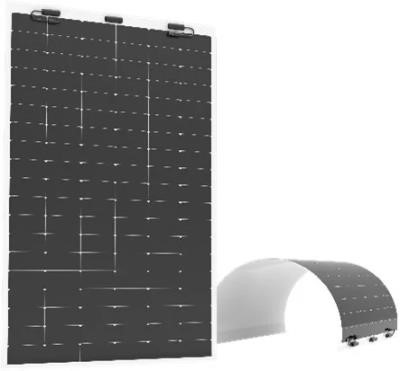
- Electrical engineering firm Denkosha launched a new 420 W version of its Flexible Solar G+ ultra-lightweight solar module.
- The panel, weighing just 2.5 kg per square meter and only 2 mm thick, is designed for rooftops and building surfaces that cannot support conventional solar installations.
- TAKEAWAY: The launch addresses a key constraint in Japan’s solar market: the limited availability of structurally suitable rooftop space. As utility-scale solar development faces land and grid constraints, lightweight solar tech could help expand distributed solar deployment across commercial and industrial buildings.
Tokyo Fire Dept selects Toppan to develop fire-extinguishing film for batteries
(Company statement, May 27)
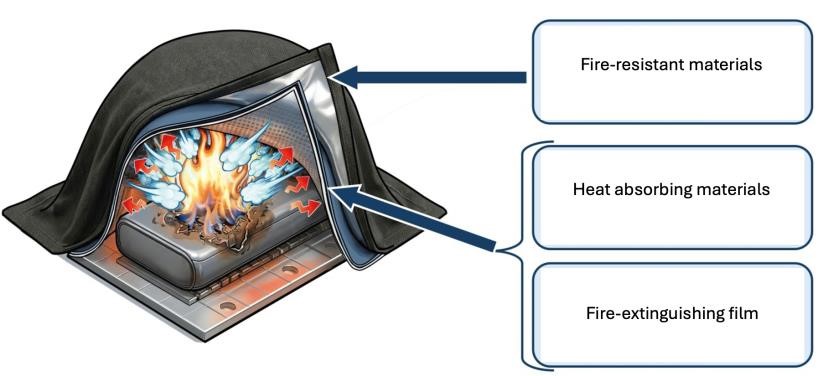
- Tokyo Fire Dept selected Toppan to do R&D on a fire-extinguishing film aimed at mitigating fire risks associated with lithium-ion batteries.
- The research will focus on:
- Fire-extinguishing films;
- Heat-absorbing materials;
- Fire-resistant materials.
- Toppan aims to complete product development by 2028.
- CONTEXT: Toppan developed an aerosolbased fireextinguishing product in 2021 and has been supplying it to battery manufacturers.
- TAKEAWAY: Lithium-ion battery fires are difficult to extinguish using conventional extinguishers, as these are unable to cool the internal cells. This can lead to the decomposition of internal materials, which in turn release flammable gases. At high temperatures, some cathode materials can decompose and release oxygen, letting combustion continue inside the cell even if the fire is deprived of external oxygen.
NTT and Panasonic launch anti-theft systems for solar power plants
(Company statement, May 27)
- NTT Docomo Business and Panasonic Connect launched a next-gen intrusion detection system to prevent copper cable theft at large-scale solar power plants.
- The system consists of PTZ (Pan-Tilt-Zoom) cameras and millimeter-wave radars, able to cover a semi-circular area within a 70-meter range.
- CONTEXT: A PTZ camera is a remotely controlled camera used in surveillance to cover large areas with a single device.
Nissan, Mitsubishi Motor to launch vehicle-to-grid services
(Asia Nikkei, June 4)
- Nissan and Mitsubishi Motors plan a service that allows EV owners to sell surplus power in car batteries to the grid.
- Launch is targeted for 2030.
- Tests of vehicle-to-grid have already taken place near Tokyo and other regions. EV owners were able to remotely control the charging and discharging of their EV batteries and earn from the sale of electricity.
- CONTEXT: Spot power prices fluctuate significantly during the day from a little above ¥0 to double-digit amounts that could climb as high as ¥200/ kWh. Mitsubishi’s eK X EV, a kei minicar, can hold 20 kWh.
NEWS: WIND POWER AND OTHER RENEWABLES

Govt finalizes revised offshore wind auction rules
(Government statement, June 5)
- METI and the Ministry of Land, Infrastructure, Transport and Tourism (MLIT) finalized revisions to Japan’s offshore wind auction framework following industry consultations and a public comment process, shifting the emphasis from securing the lowest bid price to ensuring projects can be financed and completed.
- The revised rules introduce a price band between the auction price cap and a level deemed necessary for project realization. Bids below the lower threshold will receive the maximum price score of 120 points, reducing incentives for aggressively low bids. The reforms also increase the weighting of project feasibility and financial robustness while reducing the importance of accelerated construction schedules.
- The changes move away from the previous scoring framework, which heavily rewarded “zeropremium” and “near-zero-premium” bids under the FIP scheme. Future auction guidelines will also include more detailed provisions covering issues such as withdrawal by selected developers and bidding restrictions.
- CONTEXT: The reforms stem from a review launched after developers withdrew from three offshore wind projects off Akita and Chiba. Government and industry participants concluded that deteriorating project economics, including inflation, rising costs and supply-chain pressures, had exposed weaknesses in earlier auction rounds, where aggressive bidding was strongly incentivized. METI and MLIT first proposed reforms through a series of expert meetings before conducting public consultations from January to February 2026, with the final rules incorporating industry feedback.
- TAKEAWAY: The finalized framework marks a significant shift in Japan’s offshore wind policy. Rather than maximizing competition on headline price, future auctions will place greater emphasis on project execution and long-term viability, bringing Japan’s approach closer to European markets that prioritize delivery certainty alongside cost.
Cosmo debuts offshore-style PPA model with multiple FIP-switched wind farms
(Company statement, May 28)
- Cosmo Eco Power and Nippon Steel Engineering began supplying renewable power to Kioxia Iwate through an off-site PPA that combines power from several wind farms that have transitioned from the FIT to FIP.
- CONTEXT: Kioxia Iwate is a subsidiary of Kioxia Holdings that operates Kioxia’s major chips fab facility in Kitakami, Iwate Pref.
- The project will procure renewable electricity from:
- Shin-Iwaya Wind Park (27 MW), Aomori Pref;
- Tsurugamine Wind Farm (7.48 MW), Yamagata Pref;
- Kaze no Mori Oga Wind Farm (4.2 MW), Akita Pref.
- It is expected to supply about 35 GWh/ year.
- TAKEAWAY: By aggregating multiple wind farms, the scheme reduces output variability and improves hourly matching between renewable generation and electricity demand, one of the key challenges for corporate PPAs. The deal shows a new pathway for Japan’s growing fleet of FIP-transitioned renewable assets, and how existing wind projects can continue generating value after leaving the FIT. It also shows the increasing role of aggregation services in making wind-based corporate PPAs more bankable and attractive for large industrial consumers such as semiconductor manufacturers.
Belgian DEME wins contract for 315-MW offshore wind project near Akita
(Company statement, May 29)
- DEME, a Belgian marine engineering and infrastructure contractor, won a contract for the Oga– Katagami–Akita Offshore Wind Project (315 MW, bottom-fixed).
- Japan Offshore Marine is DEME’s Tokyo-based JV with Penta-Ocean Construction. It will carry out engineering works and provide vessel charter services for the offshore installation of the turbines.
- The wind farm will be built off Akita Pref using 21 Vestas V236-15 MW turbines.
- The operating firm is a JV of JERA, J-POWER, Tohoku Electric, and Itochu.
- TAKEAWAY: For a sector shaken by project withdrawals and rising costs, the award is a rare sign of momentum. The Akita project appears to have cleared the financing and development hurdles that have tripped up other schemes; attention will now turn to whether developers can navigate the more difficult task of construction and delivery.
PowerX begins power procurement from post-FIT onshore wind asset
(Company statement, June 1)
- PowerX began procuring electricity from Wind Park Misato (16 MW) in Tsu City, Mie Pref, owned by C-Tech, a subsidiary of Chubu Electric.
- PowerX will purchase 4 MW of output for its corporate electricity supply business.
- The wind farm began operating in 2006 and was later accredited under the FIT scheme. Its FIT purchase period has now ended, making it a post-FIT renewable energy asset.
- As more renewable energy projects reach the end of their FIT contracts in the coming years, the firm plans to increase procurement from post-FIT assets, particularly wind power, which can provide more stable generation, including during nighttime hours.
- TAKEAWAY: Japan’s first generation of renewable projects is beginning to enter the post-FIT era. The agreement illustrates how older wind farms can remain commercially viable through corporate power sales, creating an alternative to immediate repowering or retirement while expanding the pool of renewable electricity available to businesses.
Eurus Energy to upgrade 84 MW Campania wind farm
(Company statement, June 1)
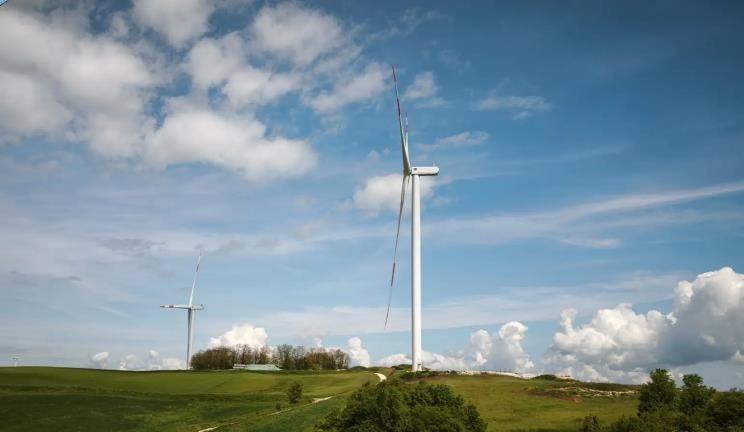
- Eurus Energy and Italy’s IVPC Group began full-scale repowering of their wind farm that spans several municipalities in Campania, Italy, south of Rome.
- The upgrade will increase installed capacity from 84 MW to 134 MW.
- The project will replace 140 older 600 kW turbines installed in the late 1990s with 22 modern 6 MW turbines supplied by GE Vernova.
- The project will be renamed Fortore Wind Farm, to be completed in October 2027.
- TAKEAWAY: The upgrade is expected to increase energy production, reduce maintenance requirements, and lower environmental impact while using largely the same wind resource area. The project reflects a trend across Europe of upgrading wind farms built in the 1990s and early 2000s rather than developing entirely new sites.
Chubu Electric PM and INFRONEER ink PPA on renewables development
(Company statement, May 29)
- Chubu Electric Power Miraiz and INFRONEER inked a partnership to speed up renewables deployment in Japan, particularly wind power.
- As the first project under this collaboration, Chubu Miraiz signed a long-term PPA with Japan Wind Development for electricity from four onshore wind farms under development in Aomori Pref. The projects will begin operations in early 2027.
- CONTEXT: By acquiring Japan Wind Development, INFRONEER has become an important player in the onshore and offshore wind sector.
NEWS: NUCLEAR ENERGY

Govt sets targets for replacing old NPPs and to boost the industry
(Government statements, Japan NRG, June 5)
- The govt set targets for replacing nuclear reactors, as many approach the 60-yr limit.
- By 2040s, the goal is to replace two to five reactors (about 2.2 to 5.5 GW of capacity). o By the 2050s, that target expands to a total of 11 to 14 reactors (12.7 to 16 GW).
- The govt also plans to extend operational cycles (the period after which a reactor must undergo periodic inspections), from the current 13 months to 15, 18, or even 24 months. It also encourages digital technologies and AI for safety upgrade processes.
- Japan will develop advanced light-water reactors, SMRs, fast reactors, and HTGRs.
- Completion of the Rokkasho reprocessing plant and MOX fuel plant are crucial; both are expected in FY2026 and FY2027.
- Japan aims to strengthen global nuclear supply chains in cooperation with allied nations. A key example is the “Sapporo 5” declaration (Japan, US, UK, France, and Canada) that pledges at least $4.2 billion to boost uranium enrichment capabilities and reduce reliance on Russian fuel.
- To accelerate consensus-building, the “important power development site designation system” is being revised and will include next-gen reactors.
- TAKEAWAY: This is the first plan of its kind since the Fukushima disaster. The rush is due to the fact that by 2040 four domestic reactors will have exceeded 60-year lifespans. Surveying and constructing new reactors can take as long as 20 years. So, the govt must hurry, because geological surveys must begin in the 2020s to meet 2040s goals. Another pressing issue is the selection process for final high-level radioactive waste disposal sites. The govt recently made a decisive step by selecting Minamitorishima as a candidate for final disposal.
TEPCO proceeds with treated water discharge and nuclear fuel recovery at Fukushima (Company statement, Japan NRG, June 2)
- TEPCO said continuous water injection maintains Units 1, 2, and 3 in a state of cold shutdown. Spent fuel pools for Units 1, 2, 5, and 6 also undergo cooling.
- The transfer and release of ALPS-treated water from Tank Group B began on June 1. Subdrain water from Tank K was discharged on May 31. Further discharges from Tank A and Groundwater Bypass Group 1 will happen in the first half of June.
- TEPCO started recovering nuclear fuel from the spent fuel pool of Unit 2. It holds 587 spent fuel rods and 28 unused fuel rods.
- Fuel removal is completed for Units 3 and 4. TEPCO plans to begin fuel extraction from Unit 1 in FY2027, aiming to finish removal across all units by 2031.
- TAKEAWAY: See this week’s Analysis section for further details on the Fukushima cleanup operation.
TEPCO sells stake in Canadian uranium mine
(Company statement, Japan NRG, June 3)
- TEPCO agreed to sell its entire 5% stake in the Cigar Lake uranium mine in Canada to co-partners in the venture.
- Cameco Corp will get a 2.871% stake, while Orano Canada will get the remaining 2.129%. TEPCO didn’t disclose the deal’s value.
- CONTEXT: Production at Cigar Lake could end in the mid-2030s. So, TEPCO concluded that liquidating the stake to boost capital efficiency is a good move.
- TAKEAWAY: TEPCO’s financial woes also drive this move. TEPCO faces huge compensation costs from the Fukushima nuclear disaster, and so it’s selling off ¥200 billion worth of corporate assets over the next three years. At present, Kashiwazaki-Kariwa NPP Unit 6 is the only nuclear asset operated by TEPCO, and its demand for uranium can be secured through bilateral contracts and open market procurement.
NEWS: TRADITIONAL FUELS

Japan’s rapid switch away from Persian Gulf crude incurred high costs: S&P
(Japan NRG, June 4)
- Japan’s oil system has shown it can withstand a disruption from key suppliers in the Persian Gulf thanks to reserves and alternative imports, but the result is a more expensive and operationally complicated system, and renewed fiscal pressure, an analyst with S&P Global Energy said at the firm’s Tokyo Energy Briefing 2026.
- The govt has released about 50 days of oil stockpiles so far: o March 26: ~8.5 million kl, equivalent to 30 days consumption, at ¥63.5/ liter; o May 2: ~5.8 million kl, or 20 days, at ¥93.1/ liter; o June: planned release postponed.
- Alternative procurement led to boosting U.S. purchases to 1.9 million barrels per day (b/d) in June, from 90,000 b/d a year earlier.
- U.S. oil poses challenges: crude quality and time to deliver. o Japanese refineries are optimized to process medium-sour and heavy-sour Middle Eastern grades, especially Saudi crude; To process large volumes of lighter, sweeter U.S. crude such as WTI Midland, refineries may need equipment modifications and to supplement it with heavier sour alternatives.
- A Saudi cargo transiting the Strait of Hormuz takes 20–25 days to reach Japan. U.S. Gulf Coast crude carried by VLCC ships (which cannot pass through the Panama canal) take 50– 60 days to reach Japan via the Cape of Good Hope.
- VLCC freight costs also jumped from ~$4.4/b in early January to $14.8/b in early March, before falling to around $8.5/b by late May.
- Japan’s domestic fuel-policy response is another pressure point. MoF estimates say that a ¥30/ liter subsidy would require the govt to spend ¥300 billion a month.
- Refineries have responded in several ways so far. o Cosmo Oil postponed by a year regular maintenance at Chiba refinery’s No. 2 topper, originally planned for FY2026;
- Idemitsu withdrew a plan to cut refining capacity by 180,000 b/d by 2030; o Refiners initially cut plant utilization rate to ~70% from early March to late April to preserve crude stocks, but this rate has returned to ~75%.
- In the near term, energy security concerns may freeze Japanese refinery consolidation.
- Japan’s consumption is structurally declining due to a shrinking population, so the ‘extra’ capacity will remain essentially to cover emergency events.
Japan’s oil reserves down to 203 days, U.S. oil imports grow
(Japan NRG, June 5)
- METI Minister Akazawa said Japan’s required amount of crude oil and petroleum products is secure via reserve releases and alternative procurement.
- METI said Japan’s public and private oil reserves totaled about 203 days.
- Also, Akazawa said domestic naphtha production will return to normal levels around July, after a period of facility maintenance.
- CONTEXT: As of late 2025, Japan had a 254-day consumption buffer. This included state (146 days), private (101 days) and joint-producer stockpiles (7 days).
- In May, U.S. crude oil exports to Japan reached 800,000 barrels per day, over three times the level before the U.S.-Israeli attack on Iran.
- CONTEXT: Before the attack, U.S. exports to Japan averaged below 230,000 bpd. The figure rose to 370,000 bpd in March 2026 and 600,000 bpd in April. U.S. crude oil has a lower viscosity than Middle Eastern crude. But the ministry said Japanese facilities can process it by blending the two together.
- On June 3, ENEOS’ Endeavor arrived at Kagoshima, the second Japanese crude tanker to navigate the Strait of Hormuz and return to Japan since the war began. The first was Idemitsu Kosan’s Idemitsu Maru. The Endeavor brought 2.15 million barrels of crude oil sourced from Kuwait and the UAE.
- The crude will first go to the ENEOS Kiire Terminal in Kagoshima, and then to Negishi Refinery in Yokohama where it will be refined into gasoline and naphtha.
- Evergreen Retailing (an Erex company) offers discounts on electricity bills. This initiative is a company-led effort (not a govt subsidy). For the July billing period (covering June usage), the company will apply a discount of ¥1.2/ kWh.
Marubeni divests 40% stake in Taiwan LNG project
(Company statement, June 1)
- Marubeni Corp sold its 40% stake in a Taiwanese power project, Everpower IPP, to Jack Wang Motors.
- The latter is a Taiwanese investment company and Everpower’s largest shareholder. The sale price is estimated in the tens of billions of yen. Everpower owns and operates a 900 MW LNG-fired combined cycle power plant in Taoyuan City, providing electricity to state-owned Taiwan Power.
- Marubeni took part in development, construction, and management of the project from 1995, building its stake to 40% by 2008.
- CONTEXT: Marubeni aims to sell off businesses that do not meet its conditions for high uniqueness or scalability.
- SIDE DEVELOPMENT:
- Ineos and Marubeni sign LNG supply deal for Asia
- (Offshore Energy, June 2)
- Ineos Energy inked a LNG supply deal with Marubeni for deliveries to Asia starting 2029, its first LNG shipments to the Pacific Basin.
- The deal provides access to key Asian markets on a delivered ex-ship (DES) basis. o CONTEXT: Ineos has future supply – 1.4 Mtpa – from the under-construction Port Arthur LNG export plant in Texas, to come online in 2027.
MOL invests in first U.S. offshore FLNG project
(Company statement, June 4)
- MOL reached FID to invest $300 million for a 23% stake in the Delfin FLNG 1 project off Louisiana. • It will be the first FLNG facility in the U.S. and the largest globally. Production will start in 2030 at 4.4 Mtpa.
- MOL has supported this project since an initial investment in 2023. The facility will receive natural gas from the mainland via existing pipelines, and liquefy it onboard 40 miles offshore, and load it onto LNG carriers.
- CONTEXT: Offshore FLNG facilities offer advantages such as avoiding congested shipping channels. They also allow disconnection and evacuation during severe weather like hurricanes.
- TAKEAWAY: This investment marks the first time a Japanese shipping company joined an FLNG business. MOL is moving into upstream production rather than focusing on LNG transport only. The company targets ¥92 billion in net profit from its energy business by FY2030; half is expected to come from LNG-related operations.
Australian union strikes at INPEX’s Ichthys LNG
(Reuters, June 2)
- The union Offshore Alliance began a strike at INPEX’s Ichthys LNG facility in Australia, after wage negotiations stalled.
- The union notified INPEX of extra strike plans from June 11-23.
- The strike includes a ban on loading LNG, LPG, and condensate from the Bladin Point onshore storage tanks to carriers.
- The union wants wage hikes, but the Australian Resources and Energy Employer Association warns this could increase labor costs up to 60%. The current average annual wage for INPEX employees is between $300,000 and $400,000 AUD.
- CONTEXT: Despite initial progress in negotiations in May, the strike has gone ahead.
- TAKEAWAY: Ichthys is a massive energy supplier with a production capacity of 9.3 Mtpa. About 70% of output goes to Japan, which accounts for 10% of Japan’s total LNG imports.
JGC receives EPC contract for LNG Canada expansion
(Company statement, June 2)
- JGC’s overseas EPC subsidiary inked a deal for preliminary EPC services at the LNG Canada expansion project in British Columbia.
- CONTEXT: EPC stands for engineering, procurement, and construction. LNG Canada is a JV of Shell, Petronas, CNPC, Mitsubishi Corp, and KOGAS. Plans calls to double production from 14 Mtpa to about 28 Mtpa. FID is still needed.
- TAKEAWAY: JGC is executing EPC at other LNG projects, such as Ruwais LNG in the UAE, a nearshore FLNG project in Malaysia, and work on an FLNG project in Mozambique. This new deal with Canada recognizes the firm’s strong performance and track record on large-scale LNG projects, and it marks another step toward a potential Phase 2 FID, after the successful delivery of Phase 1 last year, including the facility’s first exports.
LNG stocks down from previous week, down YoY
(Government data, June 3)
- As of May 31, the LNG stocks of 10 power utilities were 1.91 Mt, down 2.1% from the previous week (1.95 Mt), down 17.7% from end May 2025 (2.32 Mt), and down 12% from the 5-year average of 2.17 Mt.
NEWS: CARBON CAPTURE & SYNTHETIC FUELS

Japan faces growing competition for biofuel, SAF feedstocks
(Japan NRG, June 4)
- Rising demand for SAF is expected to intensify competition for ethanol, waste oils, and other lowcarbon feedstocks used in transport, and this may be an issue for Japan, according to an S&P Global Energy presentation.
- This matters for shipping because shipping biofuels, aviation SAF and road-fuel blending all compete for overlapping feedstocks. If aviation demand grows faster, the shipping sector may find biofuel compliance increasingly expensive.
- Japan has ambitious SAF and ethanol targets, the former to help lower emissions for aviation and the latter to do the same for road transport.
- SAF demand is expected to reach about 1 Mt by 2030 and more than double by 2040. Net imports would need to account for the vast majority of near-term demand, according to S&P.
- Ethanol demand, meanwhile, is expected to triple between 2025 and 2030 to just over 3 Mt driven by an expected on-road ethanol blend rate of about 8%, and could hit 5.5 Mt in 2040.
- Those plans face constraints due to potential increase in on-road blendrates in the U.S. and Brazil, and competition in the medium-to-long-term for low-carbon crop ethanol.
- Japan’s target SAF blend rate of around 34% by 2060 depends on advanced pathways such as methanol-to-jet, Fischer-Tropsch routes using municipal solid waste, and access to energy crops.
- The aviation industry will also be competing with shipping for biofuel feedstocks, although LNG is emerging as the latter’s dominant transition fuel. LNG use in marine bunkering is likely to grow strongly through the 2030s and 2040s, with more than 600 LNG-fuelled vessels already in operation globally.
- TAKEAWAY: Japan’s transport decarbonization plans depend heavily on access to imported biofuel feedstocks. Efforts to expand SAF and ethanol use were gaining momentum before the Iran war, but concerns over energy security have added another layer of urgency. As aviation, shipping, and road transport compete for the same feedstocks, the challenge is shifting from setting targets to securing affordable supplies at scale.
- SIDE DEVELOPMENT:
- JAL and ANA release report on SAF
- (Company statement, May 27)
- JAL and ANA released a joint report on decarbonization of the aviation sector.
- In 2025, SAF accounted for 0.6% of global aviation fuel consumption; a further rise in that share faces challenges such as feedstock shortages and rising fuel costs.
- Securing a stable supply of aviation fuel is important for Japan given its geography as an archipelago and the govt’s target of attracting 60 million visitors annually.
- Air transport is vital to Japan’s economy, generating ¥17 trillion in value per year.
- TAKEAWAY: The airlines highlighted their initiatives to promote SAF, such as collaborative projects with local govts. These include “Fry to Fly”, which collects used cooking oil (UCO) from households; however, it’s a highcost feedstock collection model. The report identifies several barriers to wider SAF adoption, most notably the price gap between conventional jet fuel and SAF. Japan’s govt acknowledged the difficulty of narrowing this gap, as SAF can cost up to five times more than conventional fuel, with prices reaching around ¥480/ L. To support deployment, authorities began covering part of the additional cost, with the Tokyo Govt introducing a subsidy of ¥100/ L for SAF in May 2025.
- SIDE DEVELOPMENT:
- Chubu Electric and JGC consider sorghum-based SAF
- (Company statement, May 28)
- Chubu Electric and JGC Global’s study on sorghum-based SAF production was chosen by the Japan Cooperation Center for Petroleum and Sustainable Energy.
- Sorghum, a crop resistant to hot and arid climates, has high sugar content, making it suitable for fermentation and bioethanol production.
- To secure feedstock supply, discussions began with Omani energy company OQ.
- TAKEAWAY: Cultivating sorghum is aimed at a stable feedstock supply, but relying on the Middle East may be risky in light of the Iran conflict, even if Oman has been less affected than its Persian Gulf neighbors. While sorghum offers several advantages, most production is concentrated in Africa and the Middle East. Sorghum can also be cultivated in the U.S., South America and SE Asia. Diversifying sourcing would strengthen supply security.
Sumitomo forms JV with Graphyte, seeks to bury carbon in form of rice hulls
(Company statement, June 4)
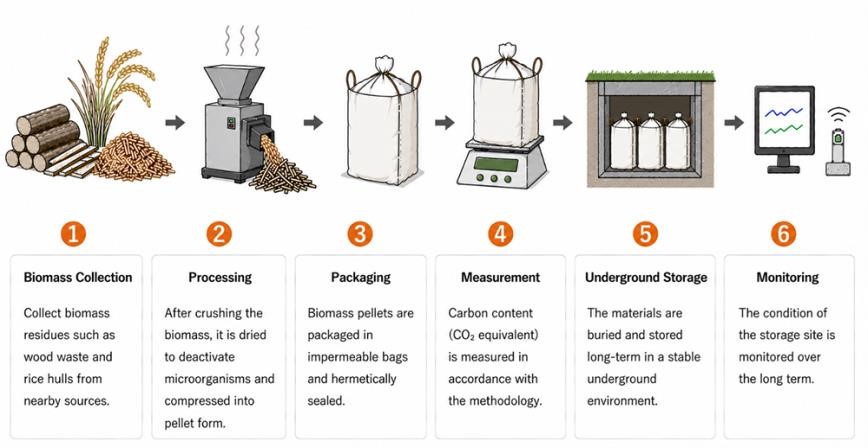
- Sumitomo agreed to form a JV with carbon-removal startup Graphyte (U.S.), taking a 49% stake to develop and market Carbon Dioxide Removal (CDR) credits.
- It will focus on Graphyte’s “Loblolly” project in Arkansas, which uses rice hull biomass and the company’s proprietary “Carbon Casting” tech to remove and store CO2 underground. The project will expand to remove 50,000 tons of CO2 per year.
- CONTEXT: Backed by Bill Gates’ Breakthrough Energy Ventures, Graphyte already commercialized the tech in the U.S. The JV plans to scale additional projects across North America and supply CDR credits, including to Japanese companies such as NYK Line, for biomass-powered vessel projects.
CDR Credit Generation:
Carbon Xtract, Sojitz test small-scale DAC tech for on-site reuse
(Company statement, June 2)
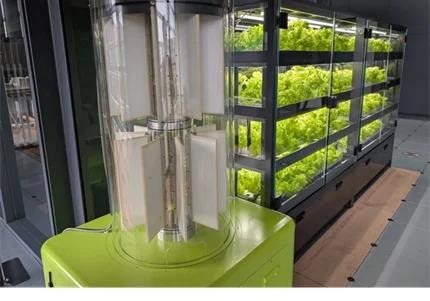
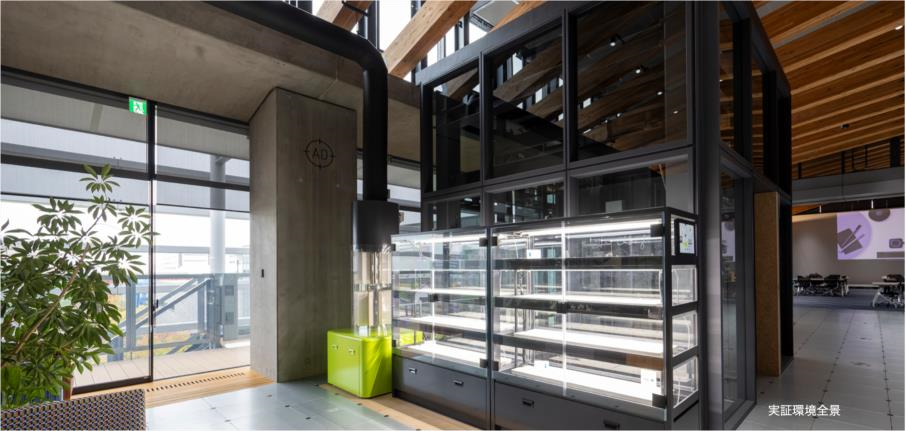
- Carbon Xtract, construction firm Shimizu Corp, and Sojitz launched a pilot project in Tokyo to test a small-scale direct air capture (DAC) system that removes CO2 directly from indoor air and reuses it on-site.
- The demo uses Carbon Xtract’s modular tech to capture CO2 from a building and supply it to an indoor plant cultivation facility.
- TAKEAWAY: Unlike conventional DAC that rely on large centralized facilities, this one explores distributed carbon capture in urban environments such as office buildings, stations, and commercial facilities. The concept could support future carbon utilization pathways including urban agriculture, low-carbon construction materials, and synthetic fuel production.
MHI develops methane fermentation system for biogas production
(Company statement, June 1)
- MHI has developed a recycling and biomass fuel recovery system that produces biogas through anaerobic digestion.
- The system uses paper and food waste generated by households as feedstock, processed to produce biogas.
- By improving waste sorting, crushing and decomposition efficiency, it can increase biogas production up to 40% compared with conventional processes.
- TAKEAWAY: In Japan, installed capacity for biogas production through anaerobic digestion is limited (around 150 MW in 2021), but the technology could be improved and developed for industrial or agricultural heat and power generation. Investment by major companies such as MHI in domestically produced biogas could help stimulate the market.
Daiichi Jitsugyo and Agro Ludens start operation of biofuel production plant
(Company statement, June 1)
- Daiichi Jitsugyo and Agro Ludens began operation of a power plant in Otawara (Tochigi Pref) producing bioethanol and rice-derived mycoprotein.
- The company intends to open other production sites both in Japan and abroad.
- TAKEAWAY: Mycoprotein is made via fermentation of filamentous fungi (microscopic molds distinct from yeasts), and is used in the food industry and for the production of antibiotics. The facility does not intend to use mycoprotein for energy applications, but residues from mycoprotein production could be valorized for energy applications, such as biogas through anaerobic digestion. Biofuel production based on fungal fermentation remains at the R&D stage, with bioethanol and used cooking oil the preferred feedstocks today.
- SIDE DEVELOPMENT:
- Idemitsu Kosan launches demo of biofuel bus
- (Company statement, May 26)
- Idemitsu Kosan and Meitetsu Area Partners launched a demo of a bus running on biofuel, conducted on public roads in Nagoya (Aichi Pref). The fuel, called IRD (Idemitsu Renewable Diesel), is a next-gen biodiesel.
Mitani Sekisan unveils industry’s low-carbon tech cutting emissions 60%
(Company statement, June 1)
- Japanese concrete pile maker Mitani Sekisan launched a new version of its Hybrid Kneading Method that reduces cement-related carbon emissions by about 60%.
- By replacing part of the cement used in piles, the method lowers the carbon footprint of building foundations, one of the most emissions-intensive stages of construction.
KHI launches carbon capture demo at waste incineration plant
(Company statement, June 3)
- KHI launched its first demo for capturing CO2 from waste incineration exhaust gas.
- Located in Koriyama, Fukushima Pref, it can capture 300 kg of CO2 per day.
- CONTEXT: The system passes exhaust gas through pellet-shaped CO2 absorbents, separating the captured CO2 at a low temperature of about 60 C, lower than the industry standard of 150 C. It allows for reduced energy consumption, an innovation derived from KHI’s submarine technology.
ANALYSIS
BY THOMAS SHOMAKER
How Japan is Trying to Turn its Largest Cleanup Effort into a Recycling Program
Source: Thomas Shomaker
In the ongoing cleanup from the 2011 Fukushima disaster, attention often focuses on the power plant itself, which on June 2 began fuel removal. But as that decommissioning proceeds, another massive operation takes place outside the facility’s walls to decontaminate the land.
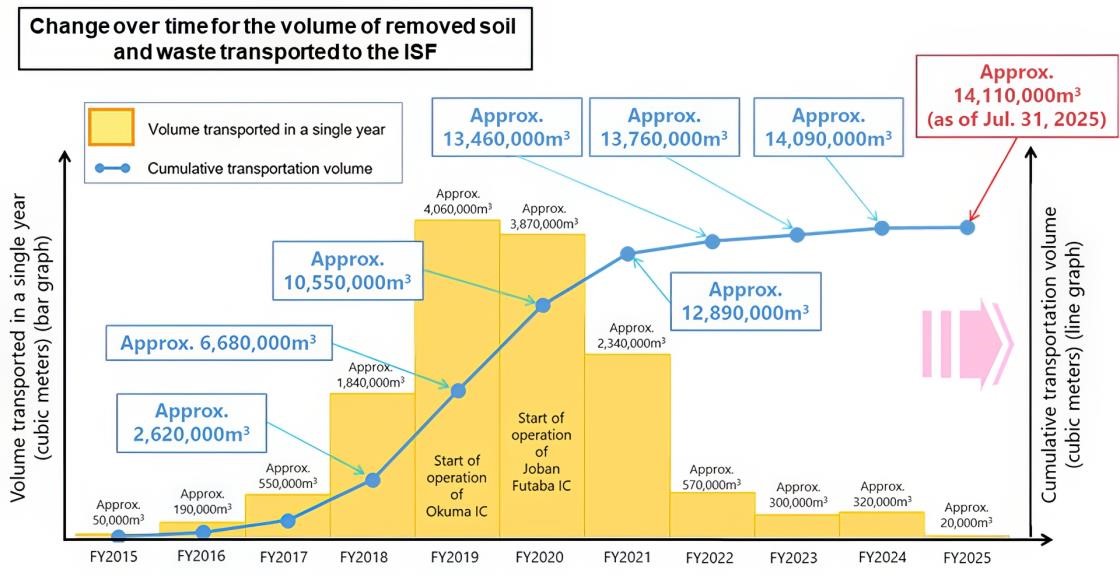
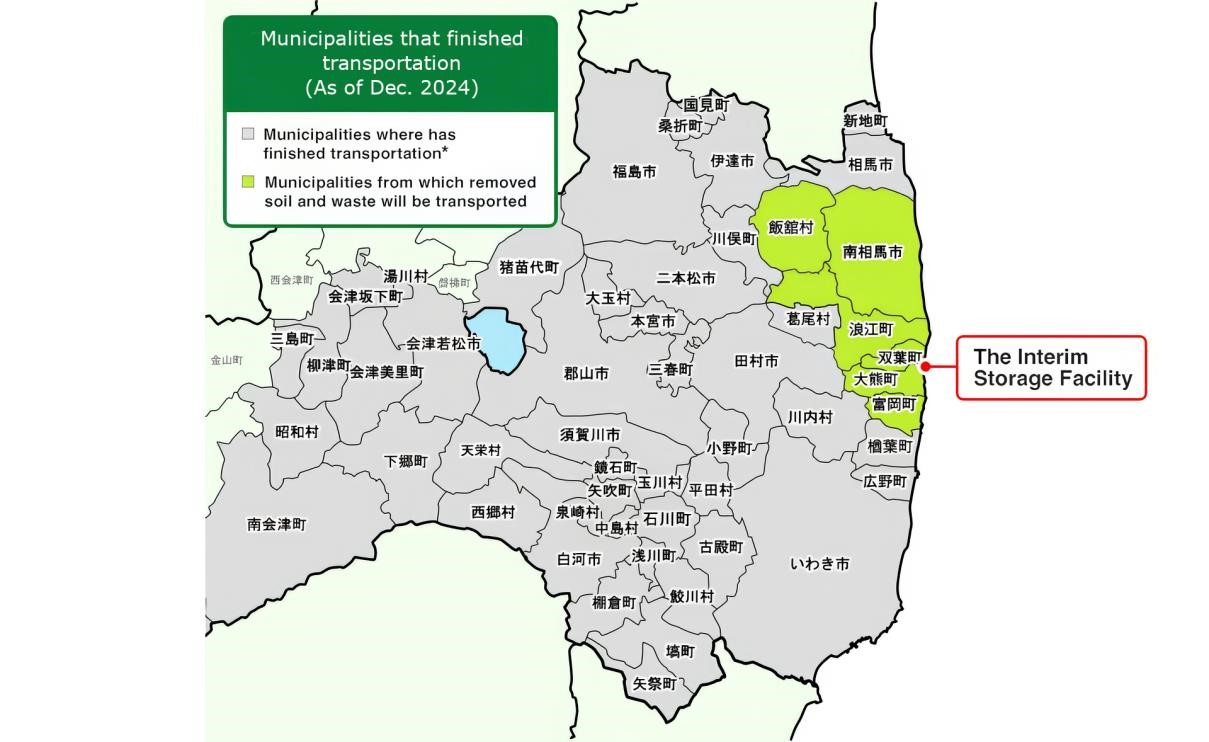
This ongoing effort under the Ministry of the Environment (MoE) has so far isolated 14.36 million cubic meters of irradiated soil on a dedicated site around the power plant dubbed the Interim Storage Facility, as well as hundreds of thousands of tons of tsunami debris.
The monumental task of collecting, transporting, processing – in some cases incinerating – and storing these materials has come with a massive carbon footprint. As the operation winds down from its peak, the environmental impact is clear.
Two towns bordering the Fukushima Daiichi Nuclear Power Plant provided the land for the 16-square kilometer Interim Storage Facility – a territory slightly larger than Tokyo’s special ward of Shibuya – on the condition that the MoE remove all the contaminated material by 2045.
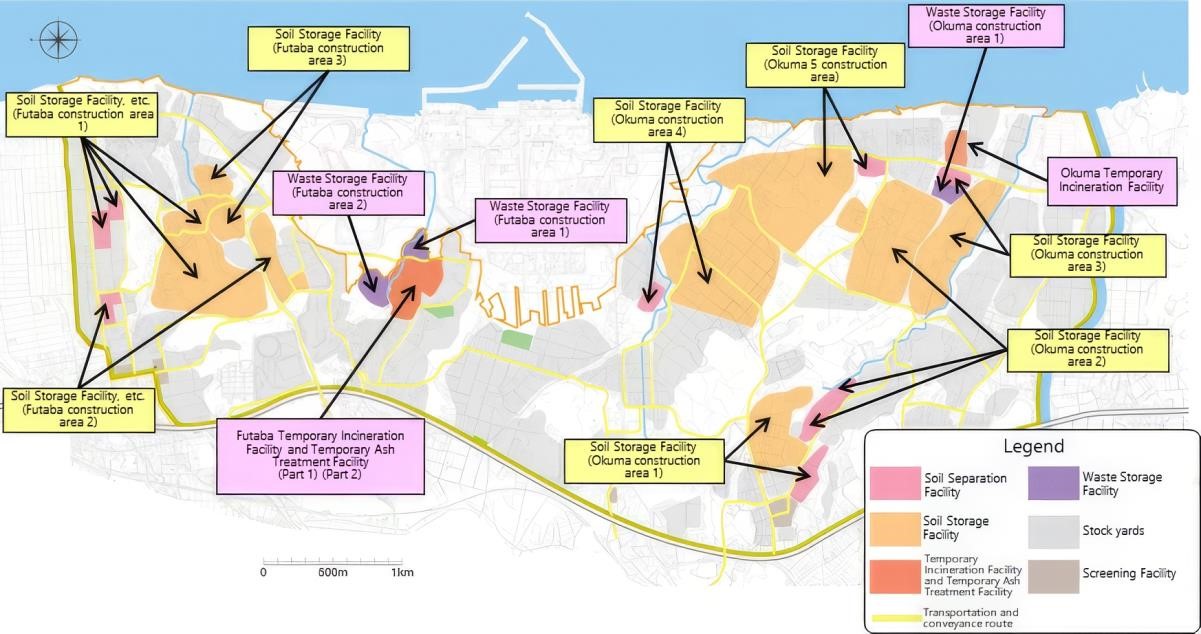
Without a decided-upon final destination, the MoE’s stated goal is to recycle and reuse as much of the material as possible ahead of this deadline. The scale of the task is daunting. The 14.36 million m3 of soil alone is equivalent to the volume of about 11 Tokyo Domes.
While some of the soil is radioactive enough to warrant indefinite isolation, about 75% is deemed safe for reuse in construction projects. Much of the incombustible tsunami debris, such as concrete, is also applicable for a second life.
The question is whether the world’s largest decontamination effort can turn into one of its largest recycling operations.
Cost of the cleanup
While the MoE has not assessed the decontamination’s carbon footprint, it is possible to calculate the impact so far. The 14.36 million m3 of soil was carted to the Interim Storage Facility from 1,370 temporary storage sites across 47 municipalities, with 2,0003,000 daily dump truck loads arriving during the cleanup’s 2019-2020 peak.
One cubic meter of typical soil weighs about 1.5 tons. As most vehicles used were 10-ton dump trucks, each carried about 6.67 m3 of soil per trip, equal to about 2.145 million in deliveries.
As the MoE publishes regular updates of the amount of debris collected from each of the 47 municipalities, assessing the round trip distance from each to the Interim Storage Center with the volumes transported shows that about 202 million dump truck kilometers have been logged.
Using Japanese 2015-era 10-ton dump truck fuel efficiencies (loaded and unloaded kilometers) leads to a diesel consumption of about 56.2 million liters. Factoring for a liter of diesel’s lifetime carbon footprint, this process has so far produced approximately 182,000 tons of CO2.
But to reduce the volume of materials to be transported, the MoE set up 12 strategically placed Temporary Incineration Facilities. As of the end of February 2026, 1.6 million tons of tsunami refuse have been burned, reducing the volume of these items by up to 95%.
The MoE told Japan NRG that incinerated debris was mostly building materials and household goods, making its composition similar to Municipal Solid Waste. Municipal Solid Waste, typically incinerated in Japan, produces about 1.2 tons of CO2 for every ton burned. The Temporary Incineration Facilities have produced about 1.92 million tons of CO2.
By comparison, Tokyo’s 21 incineration facilities process about 8,000 tons of Municipal Solid Waste daily, but also produce electricity – 1,226 GWh in FY2023. Tsunami debris combustion has been equivalent to seven months of Tokyo’s incineration, without any energy production.
But material transport and incineration, coming to 2.1 million tons of CO2, only represent a fraction of the decontamination operation. For instance, all soil brought to the Temporary Storage Facility was initially processed in large sieving machines to remove combustible materials like vegetation.
The separated soil was then carted to one of eight soil storage facilities, while the combustibles were, again, burned, although the MoE said it didn’t collect tonnage data for these onsite incinerations. The still-radioactive remains, along with the ash from the Temporary Incineration Facilities, were sent to Temporary Ash Treatment Facilities to be melted and entombed in steel containers within reinforced concrete Waste Storage Facilities.
Also missing in this assessment is the energy use of the Temporary Storage Facility’s machinery, the construction of the site, and the initial collection of soil and debris to create the 1,370 temporary storage sites. And when all the material must, by law, be removed ahead of 2045, much of this process will repeat.
Reduce, reuse, recycle
Recycling and reuse has already made a notable contribution in reducing the total amount of soil and debris deposited at the Interim Storage Facility. As of late 2024, 2.45 million tons of non-combustable waste collected at temporary storage sites was recycled, never having to be transported to the Interim Storage Facility.
Most of this was concrete rubble, crushed, assessed for radiation and, if acceptable, used as aggregate for public works projects – including the rebuilding and enhancement of tsunami walls throughout Tohoku.
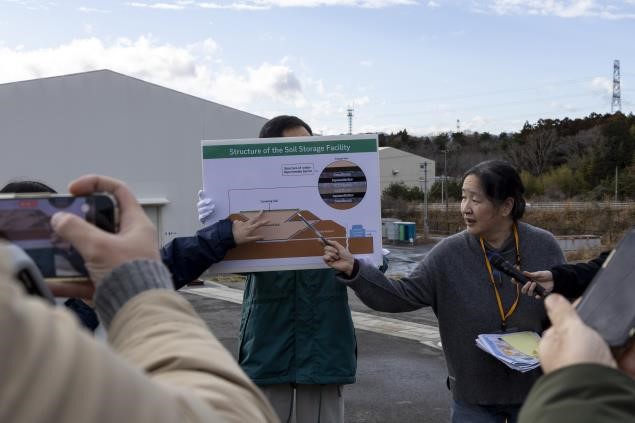
The MoE’s most pressing goal now is to reduce the 14.36 million m3 of soil at the Interim Storage Facility – currently arranged into geometric hills swathed in layers of insulation and non-irradiated “normal” soil.
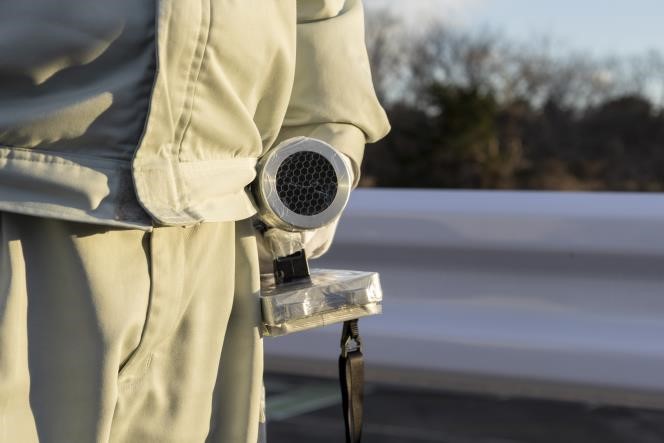
The 75% of irradiated soil that the MoE deems applicable for reuse carries a radioactive decay rate of less than 8,000 becquerel/ kilogram per second, an amount considered to carry a negligible risk (consider that a typical adult’s body produces about 4,400 becquerels per second from internal potassium).
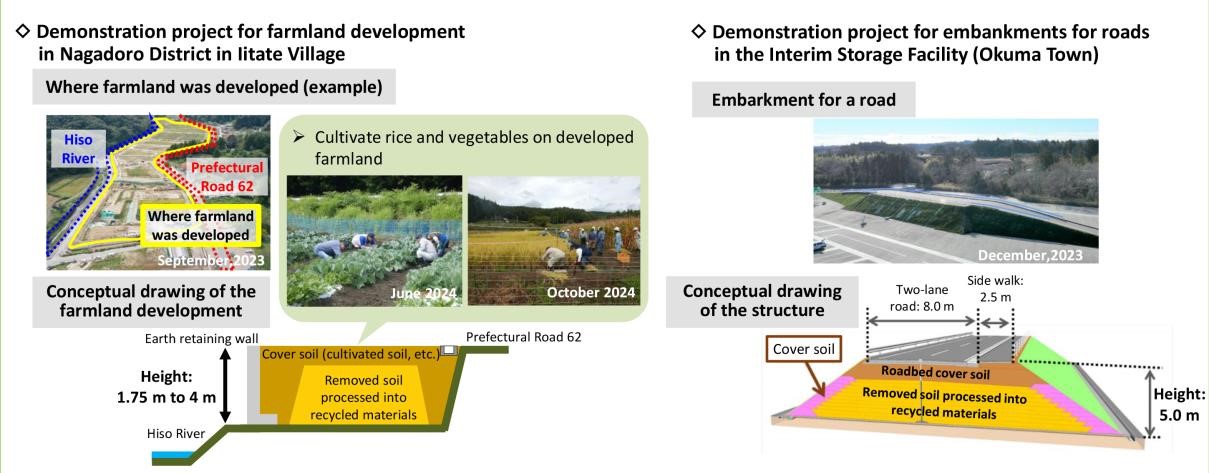
To show that the soil can be recycled safely and effectively, the MoE conducted three demonstration projects and publicity stunts. In 2025 a small amount of soil (66 m3) was sent to Tokyo and used at the Prime Minister’s residence as well as across nine central ministry office locations for flower beds and landscaping, to demystify its use.
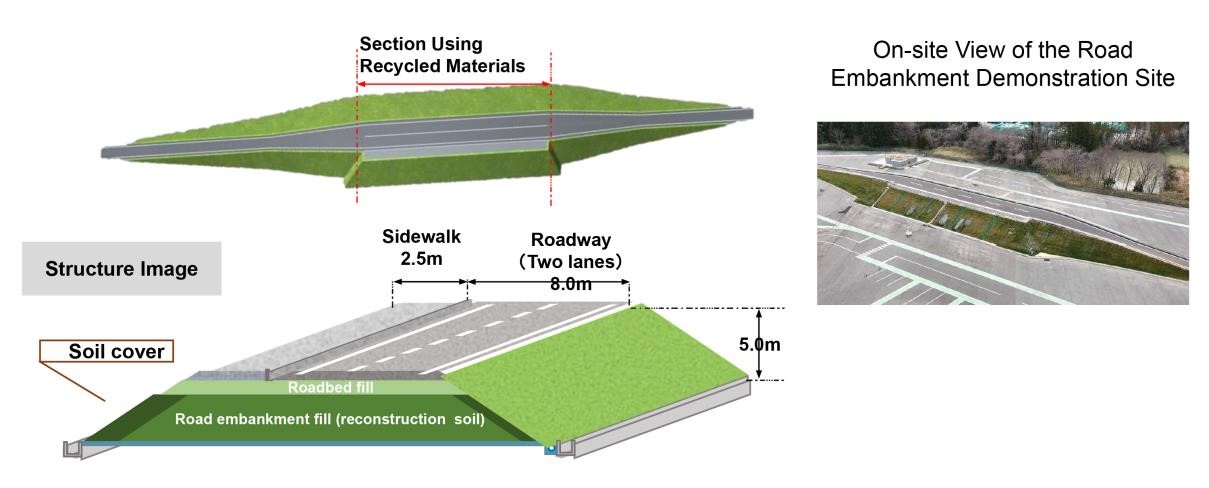
A 2023 demonstration project at the Interim Storage Facility built an on-site, typical highway embankment to display how the soil can be used for infill.
This showpiece contains 2,700 m3 of reused soil which form its interior, topped with 1.6 meters of normal soil and at least 50 cm of normal soil on each slope. A similar but smaller embankment demonstration project in Minamisoma City used about 470 m3 of recycled soil.
The largest demonstration is a still-ongoing project in Iitate Village that has so far created 22 hectares of new-level farmland via riverside embankments, topped with 50 cm of normal soil. To date, it has used about 200,000 m3 of recycled soil that otherwise would be interred at the Interim Storage Facility, a 1.83% reduction of the 75% of soil deemed safe for reuse.
Public Relations challenge
In Tokyo in 2021, the MoE hosted the first of a series of traveling dialogue forums called “Fukushima: Towards the Future Environment”, which were organized to raise awareness of reuse applications for the excavated soil and other materials. According to the MoE’s account of its post-event surveys, there’s been an increase in positive responses since 2021 regarding safety.
Nevertheless, a 2025 study revealed that 60% of Japanese residents were opposed to recycled soil being relocated near to where they live. But, nearly 76% of respondents said they had never received information on radiation and its health effects while 66% wanted more information about recycled soil. In its dialogue with the public, the MoE still has many people to reach.
As is typical with construction worldwide but especially in high population density countries like Japan, getting rid of excess soil can be quite an expense. Often, a project that produces excavated soil will link with a project that requires infill to offload the earth for free, provided the “purchaser” covers the transportation costs.
As reactors are restarted across Japan and the nation’s post-Fukushima nuclear fears subside, the MoE may be able to spur soil reuse by covering transportation costs and even paying contractors by ton or volume, an incentivization that could go a long way during a time of inflated construction costs.
For the applicable soil that goes unrecycled, the 25% deemed too radioactive and the warehoused ash, the government has not determined a final resting place. The MoE, in fact, has said that final disposal may depend on advances in technologies to further reduce what must be interred, separating the most radioactive portions and concentrating them.
In other words, part of the MoE’s plan is relying on technologies that do not yet exist. And while the tiny island of Minamitorishima, 2,000 kilometers from Tokyo, is now considered by METI and the Nuclear Waste Management Organization of Japan for the storage of high-level nuclear waste, the mass of the Interim Storage Facility’s materials render that site untenable.
Nuclear power disasters are rare compared with thermal energy production accidents, but the extreme mobilization and haste surrounding a serious incident like Chernobyl or Fukushima comes with a massive and difficult-to-quantify environmental cost.
For Japan, much of that cost involved simply transporting and processing millions of tons of material, a process that will largely repeat itself in a compressed timeline ahead of 2045 unless reuse of the excavated soil can proceed apace.
If the recent sea change towards nuclear power can repeat itself towards the Fukushima decontamination, Japan’s largest cleanup operation may become a de facto recycling project, and the government will be spared a significant expense.
ANALYSIS
BY ANDREW STATTER
Energy Jobs in Japan: Offshore Wind, Rebuilding a Dissipated Workforce
In 2021, offshore wind was set to lead the charge for Japan’s decarbonization and energy security efforts, with the Mitsubishi-led consortium winning all three Round 1 auctions. GE Vernova was ready to supply 134 turbines (each 15-MW) and was deep in negotiations with Toshiba to build a nacelle assembly factory.
Despite well-known headwinds for the industry: rising supply chain costs, rewriting the auction rules after Round 1, high-profile market exits and changing political temperature, offshore wind remains a key growth driver for Japan’s energy mix.
Though we aren’t seeing live auctions right now, there is movement behind the scenes.
In March, METI, MLIT, and MoE published proposed revisions to the Promotion Zone Designation Guideline and Central Method policy, as institutional preparation for the amended Marine Renewable Energy Act that took effect on April 1.
The regulatory groundwork is ready, but no auction launch date has been announced for either Round 1 rebids or the upcoming Round 4 auctions. According to the ministries, these should come relatively close to each other which means there is a lot of work to be done in development, bid preparation, and – once bids are won – in real project preparation.
So, what happened to the workforce that existed in 2021? It was a nascent sector then, and after a turbulent few years, what resources does Japan have to execute on these goals?
Impact of market exits and slowdowns
Throughout 2020 and 2021, the offshore wind industry attracted many foreign and domestic players alike. Hiring was aggressive; teams were built; expats were sent to Japan. Companies were sending their staff to get educated, certified, and prepared for the industry to come.
In 2022, we saw a hiring slowdown, but there was a shift to growth in strategic and regulatory professionals. In 2023, there were winners in Round 2. Hiring from a project management, project control, and engineering perspective picked up among the winners.
Overall, though, new hiring certainly slowed. Critically, there was still no FID across winning projects, which also resulted in companies hesitating to invest heavily in building out project execution teams.
Conversely, we’ve seen a number of companies exit the market – Orsted, Shell, and Northland Power. Others remain but have kept their teams flat or even seen a reduction, as people have slowly left and not been replaced. Some multinational firms – developers, manufacturers, and advisory – who won’t be named as they’re still active, have seen a reduction in their teams by about 50% from peak level.
So where did the displaced talent go? From our data, we estimate that 50% of those employed by offshore wind players who exited the market subsequently moved within the industry to competitors that they felt were in a stronger position to win projects.
The other 50%, however, opted to move into other asset types that they saw as having less binary risk. Key to this was the fact that a lot of the talent, especially those employed by developers, were not offshore wind career professionals. Rather, many had come from the solar industry, oil and gas, or conventional energy.
Borrowed talent disappears back into the woodwork
We first used the term “borrowed talent” last year when writing about building the workforce for the hydrogen economy. Here, we refer to non-specialized rotating talent typically found in large Japanese organizations.
Whether we are looking at the large Japanese trading houses, power utilities, or EPC companies, the story is the same. When investment cases looked good, these firms rotated a large volume of their talent into the offshore wind industry to ensure they were well prepared and in the best position to win projects and become a long-term player. As auction rounds were delayed and project economics called into question, some teams downsized and rotated talent back into other areas of their business.
There are notable exceptions, such as Kansai Electric continuing to grow its offshore wind workforce; Sumitomo showing positive signs to follow through with a successful bid and continuing to push long-term, as well as Toda, which led the Goto Floating Wind project. Though not an exhaustive list, there are some Japanese domestic players who have shown patience, a long-term commitment, and quietly developed their workforce in this quiet time.
Zooming out, the scale of Japan’s offshore wind ambitions has not shrunk from levels announced earlier in the decade. But there’s now less time, less committed companies, and less people.
Domestic experienced talent shortage
Ideally, four rounds should have now been completed, and we’d have somewhere between a dozen and 20 winning companies. We’d have had a dozen or so projects moving forward with serious development, engineering, and preparation in order to hit COP target dates before 2030. This all would have resulted in a large, growing workforce of talent engaged and gaining experience in the offshore wind industry.
Instead, what we have is a smaller workforce than before, which has still been focused on earlier-stage, more theoretical, less-execution work. Japan still just has a handful of operating offshore wind farms, which are all small in scale.
From a project execution standpoint, we’d expect there to be demand for talent experienced in global markets to help make up the shortfall. Such talents is not limited to Japan, so the case for them to come and work here has to be compelling. That said, some other markets, such as the U.S., have more challenges than in Japan.
So it could be said there is less competition for experienced talent from a global perspective than a few years ago.
Highly skilled workforce needs a highly committed market
Japan is capable of building the workforce needed to deliver gigawatts of offshore wind power. For many key positions — from bid preparation to project management to engineering to O&M — these complex jobs require highly educated, certified, and trained talent.
This type of highly skilled workforce only comes about through education and investment from companies that are confident in the market’s long-term health.
The onus now sits with the government to ensure a clear and attractive roadmap for the sector, as well as a bidding framework that is attractive, and reasonable state support to get the industry to a level of scale where it is self-sufficient.
Better late than never. On the workforce development side, there is plenty of work to be done.
Andrew Statter is a Partner at Titan GreenTech, an executive recruitment agency focused on the clean energy space.
ASIA ENERGY REVIEW
BY JOHN VAROLI
A brief overview of the region’s main energy events from the past week
Australia / BESS
The govt of Victoria approved four new energy projects worth a combined AU$2.4 billion via its Development Facilitation Program, including 1.39 GW of battery energy storage.
Australia / Emissions
Emissions are at their lowest since the COVID pandemic, dropping 2.1% YoY in 2025. The drop is driven by clean energy replacing fossil fuels in electricity generation.
China / Emissions
China’s CO2 emissions grew 2% in Q1 of 2026, after a rise in the amount of “wasted” wind and solar power.
China / Oil & gas
Russian President Putin said Moscow and Beijing “will soon delight the global energy sector with new agreements.” He didn’t elaborate.
India / LPG imports
The U.S. displaced Gulf suppliers to become India’s largest source of cooking gas. Between
March and May, Between March and May, India imported 1.4 Mt of LPG from the U.S..S., or 44% of India’s total LPG LPG imports. Last year, that figure was 90k tons or 2.7% of the the total.
India / Oil
Delcy Rodríguez, Venezuela’s acting president, was in India to meet PM Modi. In May, In May, Venezuela was India’s fifth-largest source of crude oil imports, supplying about 266,000 barrels a day, or 5.3% of India’s total crude imports.
Indonesia / Waste power
The govt is accelerating the development of waste-to-energy facilities in several priority areas, with three locations soon entering the groundbreaking stage.
Malaysia / Oil
Via Petronas, the govt is securing new sources of oil supply, including from South Africa and the U.S. Malaysia is already heavily dependent on Indonesia for oil.
South Korea / Power generation
The govt plans to triple renewables power generation capacity power generation over the next four years, to nearly 100 GW, replacing half of imported fossil fuels, and slashing the country’s import bill by $12 billion. Renewables currently account for 11.4% of the national energy mix.
Taiwan / Solar
Via its local subsidiary, Thailand-based BCPG acquired 100% of shares in Hui Yu Energy, a solar power plant developer in Taiwan.
Disclaimer
This communication has been prepared for information purposes only, is confidential and may be legally privileged. This is a subscription-only service and is directed at those who have expressly asked K.K. Yuri Group or one of its representatives to be added to the mailing list. This document may not be onwardly circulated or reproduced without prior written consent from Yuri Group, which retains all copyright to the content of this report.
Yuri Group is not registered as an investment advisor in any jurisdiction. Our research and all the content express our opinions, which are generally based on available public information, field studies and own analysis. Content is limited to general comment upon general political, economic and market issues, asset classes and types of investments. The report and all of its content does not constitute a recommendation or solicitation to buy, sell, subscribe for or underwrite any product or physical commodity, or a financial instrument.
The information contained in this report is obtained from sources believed to be reliable and in good faith. No representation or warranty is made that it is accurate or complete. Opinions and views expressed are subject to change without notice, as are prices and availability, which are indicative only. There is no obligation to notify recipients of any changes to this data or to do so in the future. No responsibility is accepted for the use of or reliance on the information provided. In no circumstances will Yuri Group be liable for any indirect or direct loss, or consequential loss or damages arising from the use of, any inability to use, or any inaccuracy in the information.
K.K. Yuri Group: Hulic Ochanomizu Bldg. 3F, 2-3-11, Surugadai, Kanda, Chiyoda-ku, Tokyo, Japan, 101-0062.