
WEEKLY
July 27, 2026
ANALYSIS
INNOVATION WITHOUT COMMERCIALIZATION: JAPAN’S PRECARIOUS ENERGY R&D MODEL
- Japan is a leader in R&D intensity, especially in energy. This includes hydrogen, ammonia, synthetic fuels, carbon capture, batteries, offshore wind, etc.
- The result is an awkward reality in which state-supported R&D and investment flow in abundance without the urgency to reach profitability. It’s innovation without clear commercial ownership.
RETHINKING STRATEGIC STOCKPILES IN AN ERA OF FREQUENT UPHEAVAL: NAPHTHA AS A CASE STUDY
- Decades after Japan scrapped mandatory naphtha stockpiles, the idea is back. Policymakers and industry previously prioritized lean supply chains, low inventories and cheaper imports based on the belief that critical raw materials are always available.
- Recent disruptions to Middle Eastern naphtha supplies show this approach to be risky. As firms now scramble for alternative cargoes and prices surge, the shock has spread beyond refineries.
ASIA PACIFIC REVIEW
This column provides a brief overview of the region’s main energy events from the past week
NEWS
- Japan confirms heavy rare earths in seabed mud near a remote Pacific island
- Satsumasendai inks site deal with KSDI for AI data center
- Power futures rise as heat and LNG risk lift near-term prices
- Diet passes amendment to Electricity Business Act
- OCCTO requests additional thermal power to support supply in Tokyo area
- Utilities struggle amid surging imported fuel costs and strict regulatory price caps
- Yamaha and Finnish group to field-test hydrogenpowered boat
- Kansai Electric develops technique to predict hydrogen equipment deterioration
- Tohoku Electric to evaluate PSC performance
- Tokyo Gas and SoftBank to test CSCs at remote island telecom site
- ANRE issues guidance on JC-STAR in case of product replacement
WIND POWER AND OTHER RENEWABLES
- Three arrested over alleged wind project rights fraud
- Japan’s first tree-bark wood pellet plant to start operation
- Japan nuclear investment in U.S. stalls over liability concerns
- TEPCO to reorganize operations for Fukushima decommissioning
- METI says alternative oil procurement recovering, but naphtha bottleneck remains severe
- Govt surveys show LP gas providers still violate market regulations
CARBON CAPTURE & SYNTHETIC FUELS
- INPEX to launch exploratory CCS drilling in Chiba
- Mitsubishi and ADM to explore grain-based SAF
- ENEOS partners with GEF1 on German e-fuel imports
EVENTS
August Asia-Pacific Economic Cooperation / Energy Ministerial Meeting
Sept 7-10 APPEC 2026 @ Singapore
Sept 9-11 Smart Energy Week (Autumn) 2026 @ Makuhari Messe (co-exhibiting H2 & FC Expo, Battery Japan, Smart Grid, Wind Expo, CCUS Expo, etc.)
Sept 9-11 Automotive World @ Makuhari Messe
Sept 14-18 IAEA General Conference 2026 @ Vienna, Austria
Sept 14-17 Gastech @ Bangkok
Oct 8 Innovations for Cool Earth Forum (ICEF) @ Westin Tokyo
Oct 13-15 Global Offshore Wind Summit – Japan 2026 @ Nagasaki
Nov 2-5 ADIPEC 2026 @ Abu Dhabi
Nov 3 U.S. Midterm Elections
Nov Publication of International Energy Agency – World Energy Outlook 2026
Nov 18-19 Asia-Pacific Economic Cooperation – Leaders Meeting @ Shenzhen, China
PUBLISHER
K. K. Yuri Group
Editorial Team
Yuriy Humber (Chief Editor)
John Varoli (Senior Editor, Americas)
Kyoko Fukuda (Data, Events)
Magdalena Osumi (Renewables & Storage)
Filippo Pedretti (Thermal, CCS, Nuclear)
Tetsuji Tomita (Power Market, Hydrogen)
Aglaé Bange (Renewables and Biomass)
George Hoffman (Sales, Business Development)
Tim Young (Design)
SUBSCRIPTIONS & ADVERTISING
Japan NRG offers individual, corporate and academic subscription plans. Basic details are our website or write to subscriptions@japan-nrg.com
For marketing, advertising, or collaboration opportunities, contact sales@japan-nrg.com. For all other inquiries, write to info@japan-nrg.com
NEWS: GENERAL OUTLOOK AND TRENDS

Japan confirms heavy rare earths in seabed mud near a remote Pacific island
(Nikkei, July 24)
- The Cabinet Office and other agencies said analysis of seabed mud recovered near the remote Pacific island of Minamitorishima confirmed a high share of medium and heavy rare earths, including yttrium and dysprosium.
- The island is in Japan’s EEZ. In a three-day test that began Feb 1, the deep-sea drilling vessel Chikyu recovered 50 tons of seabed mud from a depth of 5,600 meters.
- Analysis showed medium and heavy rare earths accounted for 54% of the rare earth composition. Yttrium made up 29.9%, gadolinium 4.9%, dysprosium 4.6%. Neodymium, used in highperformance magnets, accounted for 18.4%.
- The total rare earth weight and concentration were not disclosed. Officials said few radioactive or hazardous substances were detected; environmental pollution risk from the lifting process was considered low.
- A large field test in Feb 2027 will lift mud, ship it to the mainland, and test the full process from separation to refining and smelting at industrial scale.
- The Cabinet and its private sector partners aim to assess the economics by late FY2027 and target industrialization from FY2028.
- CONTEXT: China accounts for about 70% of global rare earth mine production. Minamitorishima lies about 1,950–2,000 km southeast of Tokyo, making commercial development technically and logistically complicated. The area is believed to contain vast rare earth resources, making it important for Japan’s economic security.
- TAKEAWAY: The test indicates that Japan can continuously lift rare-earth-bearing mud from the deep seabed. The high share of medium and heavy rare earths should be a major relief for the govt and project backers. These materials are strategic and used in semiconductors, defense, nuclear control materials, EVs and highperformance magnets. How this project will be developed commercially remains to be seen. The 2027 demo will be particularly revealing.
Satsumasendai City inks site deal with KSDI for a data center in Kyushu
(Government statement, July 18)
- Satsumasendai City signed a location agreement with Kai Shin Digital Infrastructure (KSDI), a firm that develops, owns, and operates AI data centers (DCs).
- Following a demo phase, the facility will be expanded in stages to a 350 MW total capacity, making it one of Japan’s largest DCs. The location is in Kagoshima Pref.
- Investment totals ¥850 billion, with additional AI server-related investment across the entire Circular Park Kyushu site running even higher.
- The city expects the project to attract related industries, create jobs, and support GX initiatives, marking an important step toward becoming a GX Strategic Region.
- CONTEXT: KSDI was established in Satsumasendai City in January by CDIB Capital Group, one of Taiwan’s leading venture capital firms, and Shinetsu Science Industry, a Japanese EPC contractor specializing in AI DC projects. Circular Park Kyushu is a JV between Kyushu Electric and Nakadai Holdings, a recycling company.
- TAKEAWAY: This project combines Japan’s power, land, and local policy support with Taiwan’s capital, hardware supply chain, and AI infrastructure expertise. It suggests a new model for building large AI DCs outside Tokyo and Osaka, while also turning a former power plant site into a next-gen digital and industrial hub. If successful, it could strengthen Japan’s AI capacity, deepen Japan-Taiwan industrial ties, and create a broader cluster around servers, maintenance, logistics, and advanced manufacturing.
- SIDE DEVELOPMENT:
- Satsumasendai and three organizations ink partnership on DC cluster
- (Government statement, July 22)
- Satsumasendai City, Kagoshima University, Kyushu Electric, and Sony Network Communications signed a partnership to develop an AI data center cluster.
- The partners will be responsible for:
- Satsumasendai City: Support infrastructure, demo projects, and policy coordination to develop a GX-based regional model.
- Kagoshima University: Promote GX R&D, field tests, and talent development while validating the regional model.
- Kyushu Electric: Support redevelopment of the ex-Sendai Power Station site.
- Sony Network Communications: Develop a sustainable regional model through digital innovation and regional branding.
- CONTEXT: Satsumasendai is preparing to develop an AI DC on the former Kyushu Electric Sendai Power Station site and was chosen as a promising GX industrial cluster under the govt’s GX Strategic Region Program. The city is promoting the Circular Park Kyushu initiative to advance a circular economy, diversify local industries, and support sustainable regional growth.
- TAKEAWAY: This partnership shows a shift from viewing AI DCs as standalone digital infrastructure to positioning them as catalysts for regional industrial transformation. By integrating AI infrastructure with GX, resource recycling, and academia–industry–govt collaboration, the project aims to create a sustainable regional development model.
ASUENE raises $87 million in new funding round
(Company statement, Japan NRG, July 22)
- ASUENE raised $87 million in its Series D funding round, bringing its total capital raised to $161 million.
- Decarbonization Partners, a JV between BlackRock and Singapore’s Temasek, led the round. This is the fund’s very first investment in a Japanese company.
- The Series D funding includes $43.8 million in new equity, and includes investments from domestic and international backers like Daikin and Ricoh.
- ASUENE’s corporate valuation is now ¥50 billion, a 40% rise over Sept 2025. CEO Kohei Nishiwada said the company aims for an IPO on the Tokyo Stock Exchange Prime Market at a ¥200 billion scale within a few years.
- The proceeds from this funding will go toward international mergers and acquisitions, to speed up expansion across North America, Europe, and Asia. ASUENE plans to acquire four to five companies a year, aiming to increase its overseas sales ratio from the current 30% to over 50% within three years.
- A pillar of this strategy was the recent acquisition of 2degrees, a UK-based carbon visibility system.
- CONTEXT: ASUENE is a Japanese AI sustainability and decarbonization management firm. Founded in 2019, ASUENE provides an AI platform to help companies measure, report, and reduce carbon emissions. It’s now used by 56,000 companies in Japan and 24,000 companies overseas.
- TAKEAWAY: ASUENE is expanding into Europe and North America through M&As. The firm aims to tap surging demand for decarbonization tech and strong market demand. A recent acquisition in the UK brought the firm 8,000 new corporate clients across 90 countries.
NEWS: ELECTRICITY MARKETS

Power futures rise as heat and LNG risk lift near-term prices
(Exchange and brokerage data, July 24)
- Power futures rose sharply over the past week, led by August contracts as extreme heat increased cooling demand and fuel-risk concerns lifted near-term pricing.
- Tullett Prebon’s forward curves show the Tokyo baseload contract for August rising to ¥24.65/ kWh on July 23, up 8.1% from ¥22.80/ kWh on July 17.
- The Kansai baseload contract for August rose to ¥21.30, up 13.6% from ¥18.75. The Chubu baseload contract rose to ¥23.55, up 9% from ¥21.60.
- Sept and Oct contracts also moved higher across Tokyo, Kansai and Chubu, indicating the market is pricing in broader summer and early-autumn supply risk rather than only a short heat-wave spike.
- The spot market also tightened. JEPX’s nationwide day-ahead 24-hour system price reached ¥24.78/ kWh on July 23, with the daytime price at ¥29.55.
- Heat is a major driver. JMA weather data showed 674 observation points with highs of at least 30°C; and 252 points with highs of at least 35°C on July 20.
- Bullish signals are underpinned by fuel supply risk. JKM LNG prices remain elevated amid persistent concern over the U.S.-Iran war and shipping risks in the Persian Gulf. The JKM benchmark rose sharply earlier in July after an LNG carrier was attacked near Hormuz, although high inventories and limited spot demand in Japan and South Korea later capped the move, according to JOGMEC.
- CONTEXT: Japan’s nationwide day-ahead spot price reached its highest level since January 2023, according to Bloomberg data; this was driven by blistering heat, yen weakness and rising fuel costs. Parts of Kanto, Chubu and Kansai were expected to hit 40°C, with the Tokyo forecast at 36.8°C, more than 6°C above normal.
- TAKEAWAY: August futures contracts are rising as the market faces immediate cooling demand, but gains across Sept and Oct suggest traders also add a risk premium for fuel procurement and plant dispatch through summer’s end. The link between JKM gains and power prices will be strongest in the peak-demand period through early Sept, but should recede with autumn weather. The passage of LNG tankers through Hormuz continues to be watched, although it affects Japanese buyers much less than the rest of Asia.
Diet passes amendment to Electricity Business Act
(Government statement, July 21)
- The bill to amend the Electricity Business Act was passed by the House of Councilors. Key measures include:
- (1) Promote development of large-scale transmission lines and power generation facilities:
- OCCTO will provide financing backed by govt investment.
- Govt funding for OCCTO’s program for transmission projects will rise.
- Cross-regional electricity trading revenues will support grid expansion.
- Power generators must consult TSOs before retiring power plants.
- (2) Set up a framework for electricity industry development:
- Grounds for registration cancellation for electricity retailers will be expanded to include prolonged business suspension.
- METI will supervise wholesale electricity exchanges, including mid- to long-term and balancing markets.
- (3) Enhance safety of solar power generation facilities:
- Third-party safety verification to be required before construction.
- Manufacturers and contractors required to support incident queries.
- (1) Promote development of large-scale transmission lines and power generation facilities:
- The amended act will take effect within nine months after its promulgation, which has not been announced yet.
- TAKEAWAY: The act was amended to boost energy security and ensure stable electricity supply amid geopolitical risks, growing electricity demand driven by DX and GX, and renewable energy expansion. Key points to watch include how the govt implements new regulations, supports investment in grids and power generation, and develops new wholesale electricity markets.
OCCTO requests additional thermal power to support supply in Tokyo area
(Agency statement, Nikkei, July 22)
- On July 22, OCCTO requested operators of captive generation facilities, mainly thermal units, in the TEPCO Power Grid area to raise output to improve the power supply-demand balance.
- Tokyo area electricity demand was expected to rise due to high temperatures, with the wide-area reserve margin forecast to fall below 5%, indicating tight supply-demand conditions.
- OCCTO asked operators to increase output where possible and, if they were JEPX members, to bid the additional electricity into the hour-ahead market. It also asked them to continue additional generation even if the bids did not clear.
- OCCTO didn’t publish the actual amount of capacity secured through the request, but media reports said an additional 2.15 GW was secured, lifting available supply capacity to 56.38 GW.
- The TEPCO service area reserve ratio fell into the 2% range at 17:00 on July 22, below the 3% stable-supply threshold. Western Japan had also been expected to drop below 3%, but maintained a reserve ratio of at least 4% that day.
- Despite tight supply-demand conditions, METI didn’t issue a national power-saving request.
- CONTEXT: The government and OCCTO respond to power supply tightness in stages by monitoring supply-demand conditions, maximizing available generation and interregional transfers, and promoting conservation or demand response if needed. If supply remains tight, OCCTO can request operators of captive generation facilities to increase output.
- TAKEAWAY: OCCTO’s request shows a preventive approach to summer supply tightness. Based on demand forecasts, extreme heat and tightening reserve margins, it moved to secure additional capacity before tight reserves turned into a supply disruption. On July 22, Tokyo recorded an average temperature of 31.9°C and a high of 36.1°C. The 16:30–17:30 request window also matters: it coincided with the period when air-conditioning demand remained high while solar PV output was falling, increasing pressure on dispatchable supply in the Tokyo area.
Utilities struggle amid surging imported fuel costs and strict regulatory price caps
(Denki Shimbun, July 24)
- For the first time in 15 months, Kyushu Electric will likely exceed its price cap in September; average fuel price could hit ¥41,800/ kl, surpassing its strict cap of ¥41,100 (based on a standard price of ¥27,400).
- In the past, Kansai Electric has opted not to raise its baseline standard fuel price; for example, at the onset of the energy crisis in March 2022 the utility exceeded its price cap but chose to absorb excess costs.
- CONTEXT: The 2022 Ukraine-Russia war caused massive global energy instability. In response, seven utilities applied for rate hikes to raise their baseline standard fuel prices to avoid losses. Kyushu Electric, however, chose to absorb the excess costs for roughly three years until prices stabilized in mid-2025.
- TAKEAWAY: Regulations are in place to shield consumers from high costs. When a utility’s average fuel price exceeds 1.5 times its set “standard fuel price,” the company cannot pass the extra costs onto its customers. Any fuel costs above this upper limit become an “out-of-pocket” expense for the supplier. This forces regional utilities to absorb the financial burden. It is now evident that geopolitical risks dictate the management of these power companies. Recently, LNG spot prices for Northeast Asia exceeded $20/1 MMBtu amid global tensions. So, regional suppliers will continue to face unstable fuel procurement costs.
NEWS: HYDROGEN

KEPCO technique predicts hydrogen production equipment deterioration
(Company statement, July 13)
- KEPCO developed a technique that predicts signs of deterioration and changes in the state of hydrogen production equipment via machine learning technology.
- It used data obtained from co-firing field tests at Himeji No. 2 Power Plant.
- In addition to controlling deterioration, it will improve the project’s efficiency and competitiveness by decreasing the cost of hydrogen manufacturing.
Yamaha and Finnish group to conduct field tests of a hydrogen-powered boat
(Company statement, July 23)
- Yamaha and Central Finland Mobility Foundation will do field tests for a hydrogen-powered sauna boat at the World Rally Championship in Finland.
- The boat will be driven by HARMO, an electrical propeller developed by Yamaha, powered by electricity generated from a hydrogen fuel cell and a hydrogen cartridge.
- This is Yamaha’s first effort to collaborate with an outside organization to test the combination of hydrogen and electricity for marine purposes.
NEWS: SOLAR AND BATTERIES

Tohoku Electric to evaluate PSC performance in Miyagi
(Company statement, July 17)
- Tohoku Electric began evaluating the performance of PSCs at its R&D center in Sendai (Miyagi Pref), using cells supplied by Kuramoto Seisakusho.
- Their performance will be compared with silicon solar cells under the same conditions.
- Installed on a building wall and rooftop, the following will be evaluated:
- Cell durability;
- Effects of temperature and humidity;
- Power generation performance;
- Compatibility with existing energy systems, including the power grid and an on-site hydrogen production system.
- For film-type PSCs installed on the wall, the study will monitor changes in cell shape (deformation) and power generation performance.
- SIDE DEVELOPMENT:
- Pacific Consultants releases results of PSC demo
- (Company statement, July 21)
- Pacific Consultants released the results of a demo involving PSCs installed on an embankment slope in Kota (Aichi Pref).
- The demo, which ran from July 2025 to March 2026, showed the following:
- Power generation was unaffected by temperatures, despite 52 hot days;
- No short circuits occurred despite strains on solar modules;
- The cross-sectional shape of the embankment slope caused no issues;
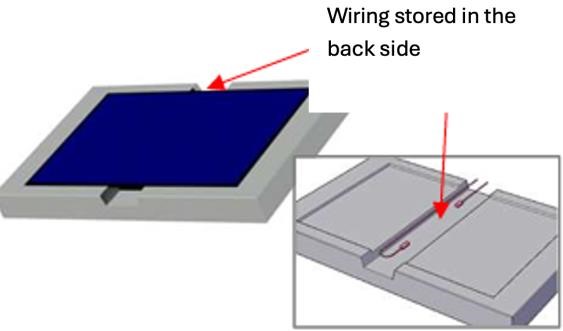
- The firm chose a design where the solar module and slope block are integrated, with the wiring housed inside the block. This helps prevent electric shock, facilitates maintenance, and reduces environmental impact with use of low-carbon concrete.
- TAKEAWAY: By enclosing the wiring in concrete, the design not only minimizes maintenance requirements and reduces the risk of failures, but also protects the cables against theft, like the concrete foundations of BESS containers. Also, it enables the deployment of solar PVs on sites where installation is challenging, such as embankment slopes.
Tokyo Gas and SoftBank to do a CSCs demo in remote environment
(Company statement, July 23)
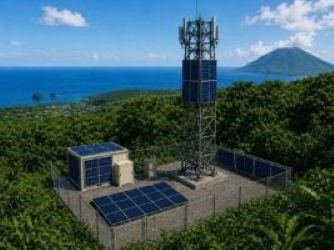
- Tokyo Gas and SoftBank will collaborate on a demo for chalcopyrite solar cells, or CSCs (supplied by PXP), at a telecom station on a remote island administered by the Tokyo Govt.
- The firms will test a lightweight adhesive installation method to evaluate its ability to:
- transport equipment to a remote location;
- install CSCs on a telecom tower and infrastructure such as storage facilities;
- verify CSC durability in a high-wind environment exposed to salt damage.
- CONTEXT: The Tokyo Govt chose the project as part of efforts to promote next-gen renewable energy technologies. The goal is to facilitate the deployment of Tokyo Gas’s “Hinatao” solar PPA service across a wider range of sites.
- TAKEAWAY: CSCs are suited for testing in a constrained environment; their light weight makes them easier to transport to distant sites. The use of an adhesive installation method helps prevent the solar cells from detaching or being damaged on islands highly exposed to typhoons and salty seawater, while avoiding the need to reinforce existing structures.
ANRE issues guidance on JC-STAR in case of product replacement
(Government statement, July 24)
- ANRE released additional guidance on JC-STAR certification rules for when replacing failed components or making new installations.
- As a rule, replacement equipment must be JC-STAR ★1 certified. But, exceptions can be granted if certified equipment would impose an excessive burden on the operator. In such cases, and following consultation with the local TSO, operators may temporarily replace the failed component with a similar non-certified product.
- Govt recognizes this situation may arise if:
- replacing a failed PCS with a JC-STAR-certified model would require replacing the entire PV system because of compatibility issues;
- operators signed long-term warranty agreements before the end of March 2026;
- operators have already secured inventories of non-certified replacement equipment that cannot be exchanged for JC-STAR-certified products.
- To benefit from this exemption, operators must:
- explain why replacing the equipment with a JC-STAR ★1-certified product is temporarily impractical;
- provide a timeline to ensure that all replacement equipment will eventually comply with JC-STAR ★1 requirements.
- TAKEAWAY: This guidance aims to ensure a smoother transition to JC-STAR certification by addressing energy industry concerns, particularly regarding solar power systems and BESS, showing a pragmatic approach to limit power outages and operational issues for developers.
Omron and E-Flow aggregate balancing capacity from co-located BESS
(Company statement, July 22)
- Omron and E-Flow will collaborate on balancing capacity trading using co-located BESS at solar power plants transitioning from FIT to FIP.
- CONTEXT: Omron has been providing power plant owners with its “FIP Transition Solution” to facilitate the shift from FIT to FIP for high-voltage renewable energy power plants. These owners seek additional sources of revenue from co-located BESS initially installed solely to secure grid connection, and not for market trading.
- Under the partnership, Omron controls co-located BESS to provide primary balancing capacity, while E-Flow manages market transactions.
- SIDE DEVELOPMENT:
- Omron adds power purchase management to solar power generation monitors
- (Company statement, July 16)
- Omron added a power purchase amount measurement function to its Energy Intelligent Gateway residential solar monitoring unit.
- The new function enables:
- a reduction in the number of metering and telecommunications devices required for residential PPA operation, thereby lowering installation costs;
- the elimination of certified electricity meters and controllers previously required, which had to be replaced every 10 years.
- Products are JC-STAR★1-certified.
- TAKEAWAY: The solution aims to lower the cost of residential PPAs by reducing the amount of equipment required, decreasing upfront installation costs and making residential solar more attractive to operators which are hesitant due to the initial CapEx investment.
eMotion Fleet agrees with Kyuhen to develop EV charging systems in Kyushu
(Company statement, July 16)
- eMotion Fleet agreed with Kyuhen to expand sales of smart EV charging solutions in the Kyushu region.
- Leveraging Kyuhen’s local customer base, eMotion Fleet will offer an integrated solution combining its EV fleet operation and Fleet Management System / energy management systems with Kyuhen’s charging infrastructure.
- The solution will enable the following smart charging functions:
- Peak shaving, which avoids extra costs by controlling charging power in real time to keep electricity demand within the contracted capacity;
- Peak shifting, which reduces electricity costs by shifting EV charging from peak-demand periods to off-peak hours.
BYD Japan joins association to support local sales of EV buses
(Company statement, July 17)
- BYD Japan joined the Nihon Bus Association as a supporting member.
- BYD has been selling electric buses in Japan since 2015 and offers various models.
- CONTEXT: In total, BYD sold 3,870 vehicles in Japan in 2025, up 62% YoY, driven primarily by SUV sales. But BYD still holds a modest share of Japan’s EV market.
NEWS: WIND POWER AND OTHER RENEWABLES

Three arrested over alleged ¥200 million wind project rights fraud
(Yomiuri Shimbun, July 22)
- Police arrested the former head of renewable energy company Shindengen and two others on suspicion of defrauding two Tokyo companies of ¥200 million.
- The suspects allegedly told the companies in 2022 that they could transfer rights to wind power projects in Hokkaido, even though those project rights had already been sold to another company in 2019.
- The two companies, both based in Minato Ward, formed a joint venture for the proposed transaction and agreed that the wind power business would cost ¥5 billion.
- Each company paid ¥100 million as a deposit, for a total of ¥200 million.
- About one month after the payment, one of the companies was contacted by a firm that had actually acquired the project rights, revealing that the proposed transfer could not proceed.
- According to other media reports, the suspects also took company representatives to the planned wind project site in Hokkaido, which police believe may have helped convince them the transaction was genuine.
- CONTEXT: The FIT system encouraged investment in renewable energy projects by guaranteeing longterm power purchase prices. That created value not only in operating renewable assets, but also in project rights and development pipelines. In some cases, complex or opaque project-rights transactions created room for disputes and fraud.
- TAKEAWAY: The case highlights a little-discussed risk in Japan’s renewables market: value can be attached to permits, grid rights and development claims long before any electricity is generated. That creates opportunities for legitimate project development, but also for double-selling, misrepresentation and speculative trading in project rights. As renewable development becomes more competitive and grid access more valuable, buyers will need stricter due diligence on ownership, transferability and project status before paying deposits.
Mitsui to survey the impact of offshore wind on fishing industry
(Company statement, July 17)
- Mitsui & Co will conduct surveys between 2027-2032 to study the potential impact on the fishing industry by an offshore wind plant to be built near Tainai and Murakami cities in Niigata Pref.
- CONTEXT: METI’s Renewable Energy Sea Area Utilization Act requires offshore wind power generation projects to conduct extensive assessments before, during, and after construction. The proposed plan will begin surveys a year before construction starts and end surveys after the facility has operated for three years.
Japan’s first wood pellet production plant using tree bark to start operation
(Company statement, July 15)
- Kumagai Gumi, Shinsho, and Kiyomoto Iron Works completed a production plant for manufacturing wood pellets from tree bark.
- Black Bark Pellets have a calorific value comparable to that coal and can be co-fired with coal in kilns or coal-fired power plants without new infrastructure.
- CONTEXT: As cement production requires large amounts of heat to process raw materials, the industry is exploring alternative fuels to coal and coke, including biomass raw materials to promote decarbonization.
- The pellets can also be used as Pulverized Coal Injection (PCI) fuel or as a reducing agent in blast furnaces, replacing pulverized coal or coke.
- CONTEXT: PCI is an ironmaking technology in which pulverized coal is injected directly into a blast furnace. Replacing coal with biomass-derived PCI raw material can also contribute to lowering carbon emissions.
- The plant, located in Saijo (Ehime Pref), has an annual production capacity of 30,000 tons and is scheduled to start operation in October.
- TAKEAWAY: This plant is the first of its kind in Japan. The country generates large amounts of tree bark thanks to its large forestry industry, which produced 19 million m³ of wood in 2024. However, tree bark remains a niche feedstock within the biomass sector, as it is currently used mainly for mulch or compost. While tree bark contributes to industrial decarbonization thanks to properties similar to coal, it has a higher ash content and contains more impurities (sand, soil) than conventional wood residues.
- SIDE DEVELOPMENT:
- MoE selects renewable power plants in Asia and Africa as part of JM
- (Government statement, July 14)
- The MoE selected a 50 MW biomass power project in Cambodia under the 10th round of the JCM (Joint Crediting Mechanism) for FY2025–FY2027.
- Developed by erex, the project is located in Kampong Speu province.
- CONTEXT: erex plans to further expand its biomass power generation business in Cambodia, including the use of tree bark as a fuel.
- Eurus Energy was also awarded JCM credits for developing a 75 MW onshore wind farm in Tunisia.
Toshiba wins order from Hokkaido Electric for 200 MW hydro turbine
(Company statement, July 21)
- Toshiba won an order from Hokkaido Electric for a 200 MW pump-turbine, and one set of turbine power generation equipment for Unit 3 of the Kyogoku hydro power plant, scheduled to begin operations in 2031.
- The new unit will be a pure pumped-storage facility.
- CONTEXT: Pure pumped-storage refers to a power plant that pumps water uphill using electricity and then generates it by releasing the stored water. It helps balance fluctuations in electricity supply and demand.
- TAKEAWAY: This investment comes as Hokkaido witnesses rapid growth in electricity demand, driven by major semiconductor projects and data center expansion. While pure pumped-storage is not a next-gen technology, it complements renewable energy and BESS to supply electricity to the grid. However, new pumped-storage projects remain limited in Japan due to extensive hydropower infrastructure and high investment costs.
NEWS: NUCLEAR ENERGY

Japan nuclear investment in U.S. stalls over liability concerns
(The FT, July 23)
- Japan’s participation in a planned $40 billion U.S. nuclear project has stalled over concerns that Japanese lenders could face liability in the event of a nuclear accident.
- CONTEXT: PM Takaichi agreed during a U.S. visit in March that Japan will provide funding and industrial cooperation for next-gen SMRs in Tennessee and Alabama. These projects form part of Japan’s $550 billion investment pledge to the U.S., in return for lower tariffs on Japanese exports.
- The U.S. Commerce Dept verbally assured Japan that JBIC and other institutions won’t assume liability for a nuclear accident, but Japanese negotiators are seeking clearer legal assurances.
- The U.S. side says Japan would only finance the projects, not operate them, and that the reactors would be built on federal land and fully owned by the U.S. govt.
- Japanese officials remain concerned because U.S. nuclear liability rules differ from Japan’s, where plant operators bear responsibility for accidents.
- CONTEXT: The issue is sensitive because of the Fukushima accident, where decommissioning and compensation costs are estimated at ¥23.4 trillion. There are no Western commercial SMRs in operation yet, which adds to project-execution risk.
- TAKEAWAY: Japan has been put under pressure to move quickly on further U.S. projects ahead of November midterm elections. But the lenders are concerned that political promises in the U.S. today could become legal and financial issues years in the future – and nuclear liability is not a normal financing risk. For Japanese banks, even theoretical exposure to a U.S. nuclear accident is difficult to accept. The issue may be resolved with legal structuring, but given these project’s political nature, some solutions may be rushed and unorthodox.
TEPCO to reorganize Fukushima decommissioning operations
(Nikkei, July 22)
- TEPCO plans to reorganize its Fukushima-related operations, including work on Fukushima Daiichi decommissioning, compensation and decontamination, and Fukushima Daini decommissioning.
- The company’s Fukushima-related responsibilities are currently divided across several organizations, making governance and operational oversight complex.
- The planned restructuring is expected to clarify management responsibility and improve coordination across decommissioning and local recovery work.
- At a recent meeting, NRA Chairman Yamanaka asked TEPCO to report on the restructuring plan.
- TEPCO President Kobayakawa said the company would need the NRA’s evaluation of the plan, reflecting the regulator’s concern over how the reorganization could affect nuclear safety oversight.
- TAKEAWAY: Fukushima is not a single decommissioning project, but a long-term set of linked responsibilities covering Daiichi, Daini, compensation, decontamination and regional recovery. TEPCO needs a structure that can improve efficiency without blurring accountability for safety.
Kyushu Electric reports malfunction at Sendai NPP Unit 1
(Company statement, July 21)
- Kyushu Electric reported a malfunction at Sendai NPP Unit 1 involving equipment related to a steam valve between the reactor containment vessel and the power-generation turbine.
- The utility reported the deviation to the NRA and Kagoshima Prefecture.
- Kyushu Electric said the incident had no radioactive impact.
- Workers identified a malfunctioning component in the control panel and replaced it.
- CONTEXT: Sendai Unit 1 was the first reactor to receive approval under Japan’s post-Fukushima nuclear safety regulations. In 2023, together with Unit 2, it received approval to operate beyond 40 years, enabling operation for up to 60 years. Local groups have continued to challenge the plant’s operation, citing concerns over evacuation plans and volcanic risk.
NEWS: TRADITIONAL FUELS

METI says oil procurement recovering, but naphtha bottleneck remains severe
(Government statement, July 24)
- METI said Japan’s alternative oil procurement has recovered rapidly after the U.S./Israel-Iran war disrupted Middle East supply routes.
- Japanese crude oil import volumes fell sharply after the crisis began, dropping 63.7% YoY in April and 57.2% YoY in May.
- Domestic refinery runs also fell, with crude processed at refineries down 13.7% YoY in April. Operations were reduced partly to avoid equipment problems from unfamiliar stockpiled crude grades and to prioritize domestic supply over exports.
- METI said alternative procurement recovered to around 65% of normal levels in May and 80% in June, and could reach 100% in July.
- The release of petroleum reserves helped stabilize domestic supply. National and joint oil-producing country reserves began arriving in mid-April, allowing private inventories to recover.
- Despite the import shock, domestic fuel sales remained close to normal levels, reaching 97.9% of 2025 volumes in April and 99.7% in May.
- However, the crisis exposed severe supply problems for naphtha-related products such as paints and adhesives. Petrochemical naphtha is not covered by mandatory stockpiling requirements.
- In response, METI established a new Working Group on Enhancing the Resilience of the Oil Supply Structure in July.
- CONTEXT: Japan relies heavily on imported crude oil, with about 94% sourced from the Middle East and almost all of that passing through the Strait of Hormuz. Before the crisis, Japan held 243 days of oil reserves, including 145 days of national reserves and 91 days of private reserves. But mandatory reserve calculations and stockpiling targets exclude petrochemical naphtha. During the crisis, spot tanker transport costs reportedly rose to as much as 11 times normal levels.
- TAKEAWAY: The crisis showed that Japan’s oil reserve system can absorb an initial crude supply shock, but it also exposed a major weak point in petrochemical feedstocks. Crude and fuel inventories helped keep domestic fuel sales near normal, while alternative procurement recovered faster than feared. Naphtha was different: because it sits outside mandatory stockpiling, shortages quickly affected downstream products such as paints and adhesives.
The second lesson is that diversification has a price. Procuring more crude from the U.S. or other non-Middle Eastern suppliers raises normal transport costs, but the premium functions as insurance against emergency freight spikes and Hormuz disruption. Shipping from the U.S. costs roughly $2 more per barrel.
For more about this topic, see the Analysis section. - SIDE DEVELOPMENT:
- Govt secures oil supplies for August, postpones release of oil reserves
- (Nikkei, July 24)
- The govt secured crude oil supplies for August at levels comparable to the previous year, thanks to alternative procurement routes that bypass the Strait of Hormuz.
- This includes a tenfold increase in U.S. imports and diversified sourcing from Latin America, Central Asia, and Africa.
- Due to this strategy’s success, the govt is postponing a third release of its national oil reserves, which currently stands at a 203-day supply.
Govt surveys show LP gas providers still violate market regulations
(Government statement, July 22)
- Persian Gulf tensions have disrupted the global distribution of LP gas. While Japan imports very little from the region, other Asian nations like China and India have shifted procurement to the Americas, driving up global import and wholesale prices.
- To counter rising costs, the government allocated an extra ¥100 billion in the FY2026 supplementary budget. This enabled 45 prefectures to put in place targeted price reduction measures and household subsidies.
- Japan’s LP gas industry is grappling with major regulatory crackdowns. A revised ministerial ordinance enforced in April 2025 mandates transparent “three-part tariffs” and prohibits operators from burying equipment costs in monthly gas bills.
- A recent govt survey shows widespread, ongoing non-compliance. Consumers face opaque price hikes without explanation. They are often locked into restrictive 10-year contracts with exorbitant cancellation fees.
- CONTEXT: LP gas is roughly 4% of Japan’s final energy consumption and accounts for 10% of household energy usage. Japan imports about 85% of its LP gas from regions like the U.S., Canada, and Australia. Japan maintains national and private reserves equal to 100 days of consumption.
Enagas will buy Osaka Gas’ stake in Saggas LNG plant
(Bairdmaritime, July 22)
- Spanish gas grid operator Enagas will buy Osaka Gas’ 20% stake in Saggas LNG (Valencia, Spain) for €31 million, increasing its stake to 92.5%.
- Enagas accounts for 18% of Spain’s total LNG storage capacity and 15% of its regasification capacity. Oman Oil Holdings Spain will keep the remaining 7.5% stake.
LNG stocks up from previous week, up YoY
(Government data, July 22)
- As of July 19, the LNG stocks of 10 power utilities were 2.51 Mt, up 3.7% from the previous week (2.42 Mt), up 42.6% from end July 2025 (1.76 Mt), and up 23% from the 5-year average (2.04 Mt).
- CONTEXT: LNG stocks reached their highest since January 2024. Some regions saw temperatures exceed 40°C, increasing demand for cooling and thus power demand.
June oil, LNG and coal imports show crude recovery after May slump
(Government data, July 22)
| Imports Volume YoY Value (Yen) YoY | ||||
| Crude oil | 8.8 million kiloliters (55.5 million barrels) | -13.7% | 1,037.5 billion | 59.3% |
| LNG | 4.7 million tons | 6.3% | 434.5 billion | 14.7% |
| Thermal coal | 7.1 million tons | 18.5% | 165.8 billion | 60.4% |
- Crude oil imports recovered sharply in June after plunging in May. Imports rose to 8.8 million kl, up about 87% MoM from 4.7 million kl in May, although they remained down 13.7% YoY.
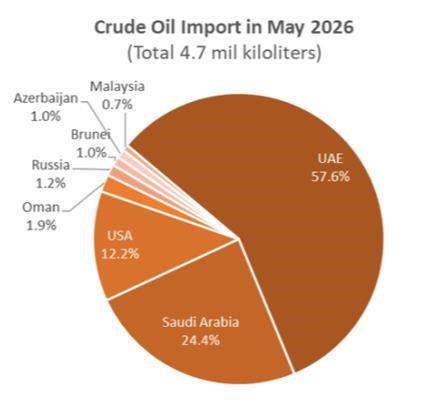
- In May, crude imports totaled 4.7 million kl, up 5.5% MoM but down 57.3% YoY. Middle East supply accounted for 84% of total imports, or about 4 million kl.
- Among Middle East suppliers in May, imports from the UAE and Oman rose 38% and 28%, respectively, while imports from Saudi Arabia fell 35%. There were no imports from Kuwait or Qatar.
- U.S. crude imports rose 26% in May. Azerbaijan and Russia also appeared as crude suppliers for the first time in 2026.
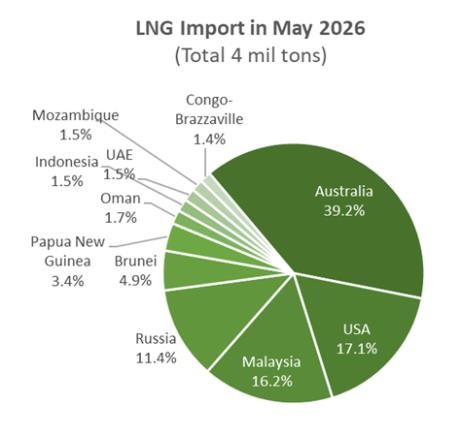
- LNG imports in May totaled 4.0 Mt, down 7.3% MoM and 15.1% YoY. Imports from Indonesia fell 65%, while imports from the U.S. rose 248% from April.
- Oman was the only Middle East LNG supplier to deliver cargoes to Japan in May, with volumes down 50.7% MoM. There were no LNG imports from Qatar or the UAE. The Republic of Congo appeared as an LNG supplier for the first time in 2026.
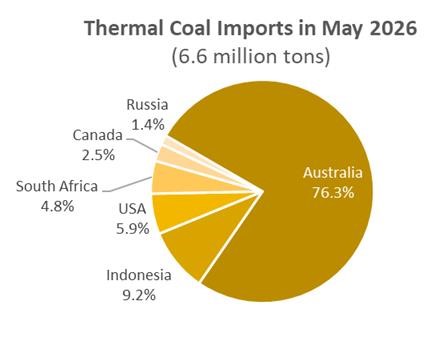
- Thermal coal imports in May totaled 6.6 Mt, down 7.1% MoM but up 14.1% YoY. The average import price was ¥22,455/ ton, up 7.4% MoM and 30% YoY.
- TAKEAWAY: The June trade data shows that crude oil arrivals recovered sharply after the severe import disruption in May, but volumes were still below year-earlier levels and import values remained elevated. LNG and thermal coal imports also rose YoY in June, suggesting utilities and fuel buyers were still managing around fuel-security and price risks. Coal’s role is worth watching because it is sourced outside the Middle East and can provide a dispatchable alternative when oil and LNG supply chains are stressed. However, higher coal import prices could still feed into fuel-cost adjustments and put upward pressure on electricity tariffs, depending on each utility’s pass-through limits.
NEWS: CARBON CAPTURE & SYNTHETIC FUELS

INPEX to launch exploratory CCS drilling in Chiba
(Nikkei Asia, July 23)
- INPEX is launching an exploratory CCS drilling project off the coast of Chiba Pref. Its subsidiary Metropolitan CCS aims to capture CO2 from sectors like the steel industry, and then sequester it deep underground.
- A drilling rig 5 km offshore will drill 1,900 meters into the seabed, and will then inject seawater to test the site’s geological suitability for long-term CO2 storage.
- INPEX plans to transport up to 5 Mtpa of CO2 from industrial areas to the facility via pipelines. The company targets full commercialization by the early 2030s.
- CONTEXT: Chiba is home to major industrial facilities, such as Nippon Steel, which produces the highest industrial CO2 emissions in Japan.
- CONTEXT: The U.S and China lead a growing global market of over 700 planned or operating CCS projects. Japan has no commercial CCS facilities in operation as of today.
- TAKEAWAY: The project faces barriers. INPEX estimates processing costs of ¥20,000 and 30,000/ metric ton are needed for viability, higher than the govt estimate of ¥10,000. At these rates, decarbonizing a single large steel mill could cost up to ¥300 billion a year, posing severe business risks. Firms can trade carbon allowances for much cheaper (between ¥1,700 and 4,300/ ton). So, Japan pledges to subsidize the cost difference.
Mitsubishi and ADM to explore grain-based SAF production
(Asia Nikkei, July 20)
- Mitsubishi Corp and U.S. grain major Archer Daniels Midland (ADM) will explore using soybeans and corn to produce sustainable aviation fuel (SAF).
- Mitsubishi President Nakanishi said the two companies plan trials soon.
- Mitsubishi and ADM formed an alliance in 2025 to explore collaboration across the agriculture supply chain, including areas such as biofuels. ADM has major soybean and grain-processing capacity in the U.S. and Brazil, including oil-extraction facilities that could support SAF feedstock supply.
- Mitsubishi’s U.S. grain-trading subsidiary, Agrex, may participate in the plan, which could cover grain procurement, oil extraction and SAF production.
- Mitsubishi already has exposure to aviation fuel and aircraft leasing, and plans to use its airline network as potential SAF customers.
- CONTEXT: Mitsubishi works with ENEOS on FEED for a SAF production at the Wakayama refinery, with planned annual output of about 300,000 tons from FY2028 if the project proceeds. Mitsubishi and ENEOS also joined Par Pacific in 2025 to establish Hawaii Renewables, a JV to produce renewable fuels at a refinery in Hawaii.
- TAKEAWAY: The Mitsubishi-ADM plan shows how SAF is becoming a crossover business between energy, aviation and agriculture. For Mitsubishi, ADM offers feedstock scale and processing capacity, while Mitsubishi brings fuel trading and aviation relationships. With Japan’s 2030 target for SAF in place, demand for this fuel is expected to rise as blending mandates expand. Still, securing reliable feedstock will be one of the main bottlenecks. Also, Mitsubishi’s challenge will be to turn agricultural supply-chain access into SAF that qualifies under tightening global sustainability rules, not just additional biofuel volume.
ENEOS collaborates with GEF1 to develop e-fuel
(Company Statement, July 17)
- ENEOS will collaborate with Germany’s GEF1 to support e-fuel introduction to Japan and the creation of a low-carbon international e-fuel value chain.
- Under the guidance of GEF1’s system, e-fuel will be made at Germany’s first large e-gasoline production facility using synthetic gas resulting from vaporization of green hydrogen, CO2, or biomass, and provided to GEF1 and ENEOS.
- This is the first project to import e-fuel to Japan and export e-fuel outside of Europe.
- The project provides GEF1 with its first strategic partner in Asia.
- CONTEXT: E-fuel is attracting attention as a low-carbon, practical solution for meeting demand for decarbonization in the transportation industry; e-fuels can significantly reduce CO2 emissions while maintaining high compatibility with existing infrastructure, engines, and circulation systems.
- TAKEAWAY: This partnership is an important step for promoting the energy transition in Japan, expanding the introduction of e-fuel to the Japanese market, and strengthening energy collaboration between Japan and Germany by capitalizing on European production capacity and Japanese demand. E-fuel is a big part of ENEOS’s carbon neutral policy. But for an alternative take on the deal and its broader strategic context, see this week’s Analysis section.
Itochu Enex registers renewable diesel with MLIT
(Company statement, July 17)
- Itochu Enex’s renewable diesel was approved by MLIT’s official database that lists new technologies for public infrastructure works.
- Approval covered two versions of the product, RD100 (100% renewable diesel), and RD40 (mixed with conventional fuel).
- The fuel, with feedstock sourced from Finland, is made from vegetable and animal oil fats, and used cooking oil.
- TAKEAWAY: MLIT registration aims to promote sales of renewable diesel in vehicles and machinery used for public infrastructure works (bulldozers, cranes, graders). Drop-in biofuels are more competitive than batteries due to the vehicles’ heavy weight, long daily operating hours, and higher autonomy requirements compared with regular vehicles.
ANALYSIS
BY GILLIAN SAWYER and YURIY HUMBER
Innovation Without Commercialization: Japan’s Precarious Energy R&D Model
Japan is hardly short of research spending. The country ranks among the world’s leading economies for R&D intensity, with total expenditure equivalent to around 3.7% of GDP. Nor are Japan’s large energy companies strangers to new technology. Hydrogen, ammonia, synthetic fuels, carbon capture, batteries, offshore wind, blue carbon, space solar cells and sustainable aviation fuel all appear somewhere in their medium-term strategy decks.
The question is whether this activity is actually creating new businesses.
Much of Japan’s energy-sector innovation is supported, shaped, and de-risked by the state. METI, NEDO, JAXA, JOGMEC and other agencies provide the frameworks and budgets through which many early-stage technologies are nurtured. This reduces technical risk in a capital-intensive sector. But it also produces a ‘comfortable’ form of risk-taking: companies participate in many projects and keep their options open without committing to any of them.
The result is an awkward reality in which R&D and investment flows in abundance without any sense of urgency to reach profitability. It’s innovation without clear commercial ownership.
One sign that investors are unconvinced by this “Jack of all trades” model, among other issues, is that Japanese energy firms are valued poorly both for both present assets and future options. The market capitalization of Idemitsu Kosan, a top Japanese energy firm, is smaller than its quarterly revenue. Several power utilities trade at only a third of the value of the assets on their books.
In fact, among the 15 listed Japanese power, oil and gas companies reviewed by Japan NRG in early June, only one traded at or above book value. And while the reasons for that include low returns, the constrictions of a highly regulated market, and shrinking domestic demand, the sector’s generally weak capital efficiency – underscored by tepid innovation – is the key concern.
To meet Japan’s net-zero commitments while retaining energy security and competitiveness, Prime Minister Takaichi’s government seeks to mobilize corporate Japan to channel trillions of yen into the next wave of strategic GX initiatives. But firms trading below book value and struggling to show where future earnings will come from are poorly placed to make such bold commercial bets.
Innovation at a standstill
ENEOS offers a useful case study. Japan’s biggest oil refiner has a crude-processing footprint comparable to the refining capacity of some European integrated majors, such as Shell and bp. Recognizing that Japan’s oil demand will decline over time in line with a shrinking population, ENEOS was among the first to explore other fuel technologies to diversify the business.
About two decades ago, ENEOS first poured resources into e-fuel, a synthetic fuel technology. It financed much of the work in this field through state-backed programs and funding from sources such as NEDO. Field tests eventually advanced and ENEOS began scale-up efforts in 2022. With a domestic demo plant set up in 2024, it was finally able to supply e-fuel for shuttle buses and official vehicles at the 2025 Osaka-Kansai World Expo.
Yet 20 years on, the project remains far from a commercial business. In fact, the company’s latest communication on synthetic fuel notes that ENEOS will now embark on “commercialization studies” for yet another technology – bio-based synthetic fuels. After decades of trying to make e-fuels work based on domestic CO2 supply, in July this year ENEOS decided to import this fuel instead, signing a sales and purchase agreement (SPA) for e-gasoline with a German producer.
ENEOS e-fuel timeline
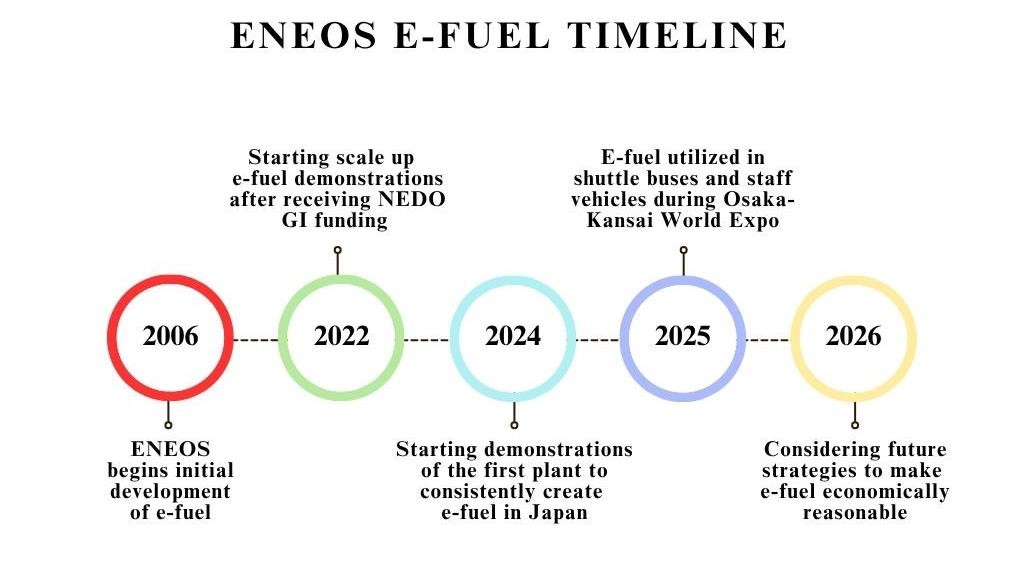
The ease with which the company can pivot from domestic technology development to imported synthetic fuel supply is partly explained by the financing approach. ENEOS’ efuel project involved a total investment of roughly ¥56 billion, of which ¥54.5 billion came from NEDO’s Green Innovation Fund.
From the company’s point of view, this is good risk management. But it reveals low corporate conviction and meager internal incentive to map commercial pathways and tailor R&D to market needs, rather than government documents.
The limited visible record of Japan’s top energy firms in turning new technologies into material businesses – at least in recent decades, as reviewed by Japan NRG – helps explain why investors give them so little credit for the future.
Although ENEOS’ core business is comparable in size to the current footprint of global majors, it is worth less than one-tenth that of Shell. As of mid-July, the roughly $21 billion market value of ENEOS – Japan’s second-highest among listed energy companies after INPEX – barely registers next to ExxonMobil’s $610 billion. This means, the ability of ENEOS to invest in new technologies internally or through acquisition via equity is much more limited than those of its peers. Meanwhile, the rising interest rate environment in Japan is eating away at its advantage in borrowing cheaply.
Valuations of energy firms in Japan and globally, based on assets
| Group | Rough P/B range |
| Japanese power utilities | 0.37–0.76 |
| Japanese fuel / integrated energy | 0.81–1.01 |
| US utilities | 1.83–3.30 |
| Global oil-majors | 1.24–2.22 |
Of course, the gap in market value for Japanese energy firms is not explained by innovation alone. Still, if we use share prices as a tool that investors use to project expectations on the future of a business, then how does ENEOS fare?
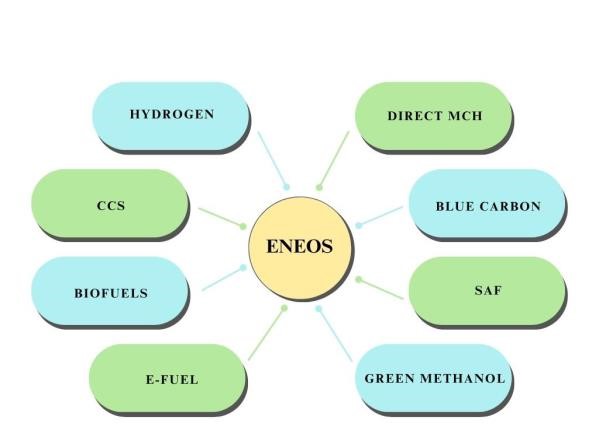
Trying to imagine ENEOS in 10 or 15 years’ time is a difficult task. It is deeply involved in Direct MCH, its own technology for transporting hydrogen as methylcyclohexane. It is working on biofuels, green methanol, refinery upgrades for SAF production and multiple blue-carbon initiatives. Is ENEOS a refiner, a power producer, a synthetic-fuel company, a hydrogen carrier, a SAF supplier, a CCS developer, a materials company, or a renewable-energy owner?
Five years ago, it looked like ENEOS was leaning more into green electrons. In 2022, it acquired Japan Renewable Energy from Goldman Sachs and GIC for about ¥200 billion, one of its largest strategic moves, with the aim of building more than 1 GW of renewable power capacity. This fiscal year, ENEOS forecasts that the renewable energy business will account for just 0.1% of its operating profit, after two straight years of losses.
More recently, ENEOS has tried to get a foothold in the CCS space. It is part of a consortium that targets commercial operations at a Japanese CCS project around FY2030. This site would store CO2 from ENEOS’ refineries and it neatly fits in with Japan’s decarbonization strategy. The business model, however, is far from clear.
So, will the CCS project become a future profit center or yet another policy project without a commercial end-goal? What businesses will ENEOS focus on a decade from now? If the answer is “all of the above” – that’s a concern.
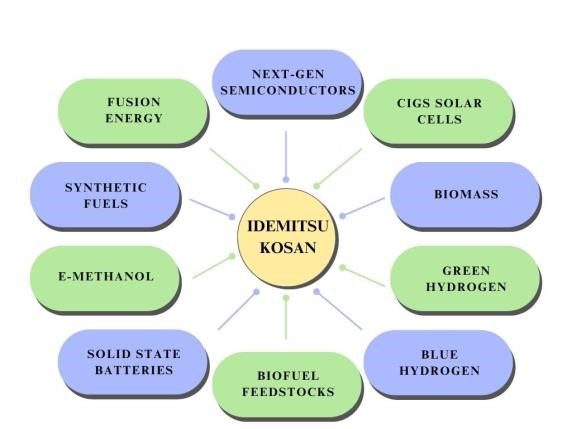
Japan’s biggest oil refining companies seek new business opportunities
Source: Company statements
Extreme diversity
ENEOS is not alone. Japan’s large energy companies increasingly resemble portfolios of small technology options rather than focused builders of new businesses.
Idemitsu Kosan is a good example. In June, the company secured up to ¥3 billion from JAXA’s Space Strategy Fund to develop high-efficiency, lightweight CIGS solar cells for satellites and mass-production technology. At first glance, this looks like a curious move for an oil company. In reality, Idemitsu has inherited a solar legacy through Showa Shell and Solar Frontier. Its group history includes years of CIGS research, even past commercial production, and cumulative shipments of terrestrial solar modules before the business was wound down.
That makes the JAXA project interesting and suggests that public funds are used to repurpose a technology base that failed to remain competitive in terrestrial solar manufacturing. The remaining question, however, is whether this contract can act as a springboard for Idemitsu to claim a real stake in the solar sector.
Real technology capabilities can become stranded if they do not become globally competitive businesses. Does Idemitsu have enough motivation to become a CIGS solar manufacturer at mass scale? Well, solar cells are certainly not the only thing on Idemitsu’s plate.
Like its larger counterpart ENEOS, Idemitsu is heavily invested in synthetic fuels and biofuel feedstocks. It has a stake in the world’s largest floating offshore wind farm, Hywind Tampen in Norway, which suggests an interest in seeking to commercialize this technology also in Japan.
Idemitsu is perfecting its own wood-pellet technology for biomass power generation; it’s developing materials for solid-state batteries and next-generation semiconductors. It’s involved in a green hydrogen project in Hokkaido, a blue hydrogen one in Aichi, emethanol in the U.S., and CCS in Tomakomai. Earlier this year, Idemitsu made its first bet on fusion energy by participating in a $100 million Series B funding round for a U.S. startup.
Some of these may prove commercially valuable. But at present, the portfolio looks more like an option book of relatively small-scale bets akin to that of a venture fund.
Japan’s public-private innovation model encourages companies to participate across many themes. This keeps them close to emerging technologies and allows Japan to build knowledge across multiple decarbonization pathways. But it clearly also dilutes capital discipline. The pressure to ask hard commercial questions weakens when the cost of keeping an option alive is low.
The missing middle
Japan has no shortage of engineers, laboratories, demonstration projects or policy visions. The weakness is the middle stage: the expensive, uncomfortable period between a promising technology and a scalable business. Among startups, this is known as the “valley of death”.
This stage requires more than government grants. It requires companies to commit capital, build customers, accept failure, create demand and explain to investors how the technology will affect future earnings. That is where the evidence is thinner.
Japan’s large energy companies talk often about a hydrogen society, synthetic fuels, carbon recycling and energy security. These are serious themes. They are also policy themes. What is less clear is whether the companies are willing to create markets, rather than wait for the state to enable them.
All of which brings us back to market valuations. A listed company does not receive a market premium for joining a consortium. It receives one when investors believe it owns something that can scale: a technology, a platform, a customer base, a cost advantage, a regulated asset, or a business model. Participation is not enough.
Japan has seen this problem before. Japanese companies were early leaders in solar technology, yet manufacturing scale shifted decisively to China. Japan once had promise in large-scale wind turbines, but global leadership moved elsewhere, particularly to Europe and China. While Japanese companies retain important tech and materials supply positions in the battery supply chain, China now dominates the manufacturing.
The pattern is uncomfortable. Japan is present at the energy technology table, but its firms often struggle with profitability and prove unable to be market leaders.
Conclusion
Japan’s public-private energy R&D model is not all bad. In many cases, it is necessary. Energy technologies are capital-intensive, slow to scale and deeply connected to national security. No responsible government leaves them entirely to private markets.
But the model now faces a harder test. Japan not only needs technologies that can be demonstrated, but businesses that can be financed, scaled and exported. Energy security, decarbonization and industrial competitiveness all point in the same direction: public money can start the process, but it cannot substitute for commercial conviction.
For Japan’s energy companies, the risk is not that they lack ambition. It is that ambition remains spread across too many subsidized projects, with too little evidence of followthrough into earnings. That leaves investors unconvinced, taxpayers exposed and Japan vulnerable to a familiar outcome: developing technologies that others commercialize at scale.
Japan doesn’t have an innovation problem; it has a commercialization problem. Until that changes, energy firms risk continuing to dabble without sufficient commitment — developing infrastructure for other countries’ growth, rather than creating new value for themselves.
ANALYSIS
BY FILIPPO PEDRETTI
Rethinking Strategic Stockpiles in an Era of Upheaval: Naphtha as a Case Study
Exactly 33 years after Japan scrapped mandatory naphtha stockpiles, the idea is back.
The proposal itself may sound technical. Yet it reflects a broader change taking place across the economy. For decades, policymakers and industry prioritized lean supply chains, low inventories and cheaper imports. The strategy helped strengthen Japan’s industrial competitiveness, but it also assumed that critical raw materials would remain readily available.
The disruption to Middle East naphtha supplies exposed the limits of that belief. As businesses scrambled for alternative cargoes and prices surged to their highest levels in almost two decades, the shock spread beyond refineries. Construction firms failed, petrochemical trade patterns shifted and the government is reconsidering policies that had been abandoned a generation ago.
Since late February, global prices for naphtha and petrochemical products (like paint and thinner) have risen by about 30%. In April, Japan’s total naphtha imports fell 47% year-on-year, driven by a 79% plunge in imports from the Middle East. To compensate, Japan pivoted to the U.S., which soon became its top supplier. American naphtha imports surged 209-fold in April.
The timing made matters worse. Due to scheduled maintenance, domestic naphtha production fell 23% in April. It was still down by close to a fifth year-on-year in May, with the nation’s naphtha crackers operating at a record low rate of 68%.
The government is now looking for a policy fix.
Exporter turns importer
The impact of Japan’s naphtha crisis first became visible among businesses far removed from Japan’s petrochemical complexes. In Fukushima Prefecture, painting contractor Shiga Toso suspended operations over soaring material costs. In Kyoto, exterior construction company Miyoshi folded after the naphtha shortage disrupted procurement of materials.
Neither company consumed naphtha directly; both depended on paints, plastics and other products manufactured from it. Their failures illustrate how disruptions to a single industrial feedstock can ripple through supply chains, even among businesses with no direct exposure to the petrochemical industry. In the first half of 2026, about 1,040 construction firms went bankrupt, a record high, according to Teikoku Databank.
The impact was also stark in petrochemical trade statistics. For the first time since such data became available in 2000, Japan was a net monthly importer of petrochemical products, with import surpluses of 19,000 tons and 15,000 tons (ethylene equivalent) in April and May, respectively. Behind that headline lay a dramatic shift in purchasing behaviour. Between March and May, imports of ethylene increased 14-fold year-on-year. Benzene imports rose more than 28-fold and butadiene more than tripled, while ethylene exports almost disappeared by May.
Ironically, raw naphtha inventories increased by 3.5% year-on-year in May, and by 24.2% from April, reaching 1.53 million kl. Rather than reflecting an improvement in supply, METI attributed the increase to historically low operating rates at domestic naphtha crackers. With less naphtha being converted into ethylene, inventories accumulated upstream even as downstream manufacturers continued facing shortages of processed materials.
Faced with higher domestic production costs, Japanese manufacturers had increasingly turned to imported base chemicals from countries with surplus petrochemical capacity, particularly China and South Korea. During normal market conditions, this strategy improved flexibility and cut costs. During the Hormuz disruption, however, it also exposed how quickly upstream supply issues could reverberate through domestic industry.
The known unknowns
The irony is this vulnerability isn’t a surprise. Former METI official Imai Takaya recalled in a December 2025 interview that officials spent years running detailed simulations of a potential closure of the Strait of Hormuz while debating petroleum liberalization during the early 1990s.
Similar warnings were made a decade earlier by the Institute of Energy Economics, Japan (IEEJ), which modelled severe economic damage from large-scale disruptions to Middle Eastern oil exports. But in a world of efficiency and global supply chain optimization the belief was that maintaining additional inventories imposed costs that outweighed the benefits.
That same logic led Japan to abolish mandatory naphtha stockpiling requirements in 1993 as imports were liberalized. Today, policymakers are debating whether to partially reverse that decision.
Prime Minister Takaichi has instructed METI to examine ways of strengthening the country’s energy supply structure, including possible strategic reserves for naphtha. Yet every option carries drawbacks. Naphtha itself evaporates relatively quickly and requires dedicated storage.
Holding intermediate petrochemical products would reduce flexibility because each serves narrower industrial applications. Expanding crude oil reserves would provide the greatest versatility, but would require regulatory changes and could increase costs for refiners and distributors.
Learning to love the trade-offs
Those trade-offs highlight a broader shift underway. For much of the past three decades, minimizing inventories was regarded as good business.
The just-in-time philosophy that transformed Japanese manufacturing also encouraged companies to avoid tying up capital in stocks that might never be needed. Today, governments and companies face a different calculation. Geopolitical uncertainty is forcing them to ask how much resilience is worth paying for.
The naphtha shock may ultimately prove to be more than a temporary supply disruption. It demonstrated how quickly a single bottleneck can spread through manufacturing, construction and trade, while reopening policy debates that many assumed had been settled decades ago.
Whether Japan ultimately chooses to stockpile naphtha, crude oil or petrochemical intermediates, the direction of travel is becoming clearer. In a less predictable world, resilience is no longer seen as an inefficiency, but as another form of infrastructure.
ASIA ENERGY REVIEW
BY JOHN VAROLI
A brief overview of the region’s main energy events from the past week
Australia / LNG
East Canada will receive its first Australian LNG shipment, according to Kpler. The journey is unusually long, with the tanker traveling around 26,000 km to reach its destination.
Australia / Solar and BESS
Yanara secured €150 million from French sustainable asset manager Mirova to develop over 2 GW of multi-technology renewable energy projects. Most funds will finance the hybrid Mortlake Energy Hub in Victoria – 450 MW of solar PV, 600 MW BESS.
China / Electricity
China installed another 151 GW of electricity generation capacity in the first six months of 2026. Nearly half of the extra capacity was grid-scale solar (72 GW) with other significant contributions from wind (39 GW) and thermal power plants (30 GW). Non-fossil generators now account for 60% of installed capacity, up from 40% in 2018.
China / Oil
The U.S. said there has been a substantial decrease in China’s purchases of Iranian oil, owing to sanctions on private Chinese teapot refineries. China has dropped overall purchases of crude over the past few months by about 40%.
China / Oil & gas
China’s oil and gas ector faces “enormous challenges” in boosting reserves and expanding production after record-high output last year – 420 Mt of oil equivalent last year, with crude oil output hitting a record 216 Mt, said the National Energy Administration.
India / Solar
India’s renewable energy sector has seen major growth over the past decade, with the country’s installed renewable energy capacity increasing nearly four times from 76 GW in 2014 to 289 GW as of June, reports the Ministry of Renewable Energy.
South Korea / Oil
South Korea has enough crude oil lined up through September even if the Red Sea closes, the govt said. Crude arriving in July and August was secured at over 110% of last year’s monthly average, and Sept volumes are over 90% of last year’s level.
Taiwan / Electricity
An amendment to the “Renewable Energy Regulations” will require all large power consumers — 5 MW or more — to install power generation and storage. The law already requires large consumers to offset 10% of electricity consumption with renewables.
Taiwan / Solar
Sino-American Silicon and United Renewable Energy will invest $40 million in a JV to build a solar panel factory in the U.S. to meet rising power demand from American data centers.
Thailand / Oil & gas
The Gulf of Thailand holds nearly 12 trillion cubic feet of natural gas and 700 million barrels of oil, valued at $300 billion, reports the Asia Times. It called on Cambodia and Thailand to end their border dispute in the gulf and cooperate.
Disclaimer
This communication has been prepared for information purposes only, is confidential and may be legally privileged. This is a subscription-only service and is directed at those who have expressly asked K.K. Yuri Group or one of its representatives to be added to the mailing list. This document may not be onwardly circulated or reproduced without prior written consent from Yuri Group, which retains all copyright to the content of this report.
Yuri Group is not registered as an investment advisor in any jurisdiction. Our research and all the content express our opinions, which are generally based on available public information, field studies and own analysis. Content is limited to general comment upon general political, economic and market issues, asset classes and types of investments. The report and all of its content does not constitute a recommendation or solicitation to buy, sell, subscribe for or underwrite any product or physical commodity, or a financial instrument.
The information contained in this report is obtained from sources believed to be reliable and in good faith. No representation or warranty is made that it is accurate or complete. Opinions and views expressed are subject to change without notice, as are prices and availability, which are indicative only. There is no obligation to notify recipients of any changes to this data or to do so in the future. No responsibility is accepted for the use of or reliance on the information provided. In no circumstances will Yuri Group be liable for any indirect or direct loss, or consequential loss or damages arising from the use of, any inability to use, or any inaccuracy in the information.
K.K. Yuri Group: Hulic Ochanomizu Bldg. 3F, 2-3-11, Surugadai, Kanda, Chiyoda-ku, Tokyo, Japan, 101-0062.