
WEEKLY
August 31, 2026
ANALYSIS
JAPANESE SUSTAINABILITY DISCLOSURE STANDARDS: FROM VOLUNTARY TO MANDATORY
- New sustainability reporting standards are taking effect. Some firms have the data to meet reporting requirements but face time pressure to reorganize that data. Others have time to prepare their reports, but collecting data from partner firms is difficult.
- Yet, some voices see the changes as optimistic for both efficiency and power prices. Which of these positions has the most merit?
ENERGY JOBS IN JAPAN: INCREASING APPETITE FOR ENERGY TALENT AMONG INDUSTRIAL PLAYERS
- In recent years, there’s been a growing appetite from industrial clientele for a range of energy professionals.
- From data center developers to major power consumers and insurance firms, talent is poached from traditional and renewable energy players into the broader industrial space.
ASIA PACIFIC REVIEW
This column provides a brief overview of the region’s main energy events from the past week
NEWS
- Govt launches “POWERR GX” package in response to energy-security risks
- Mitsubishi Electric buys U.S. energy management platform for $1.4 billion
- EEX launches tender for Japan power futures market makers
- ANRE details OCCTO financing scheme for large power and grid projects
- OCCTO reassesses FY2027 supply-demand outlook
- MHIET sets hydrogen co-firing specification for KU gas engine
- ABB Bailey to supply control system for world’s first commercial liquid H2 plant / terminal
- OCCTO posts results of second FY2026 solar auction
- Govt proposes key criteria for commercial solar projects under FIT/FIP
- Sumitomo aims for 500 MW of BESS by 2030
WIND POWER AND OTHER RENEWABLES
- NEDO selects R&D programs for geothermal surveys
- JFE makes Japan’s first monopile for offshore wind
- Toyo advances offshore wind undersea cable installation system
- Govt to amend NEDO Act to support nuclear R&D
- Tokai No. 2 NPP restart delayed
- Chubu Electric admits fraud during Hamaoka NPP decommissioning
- TotalEnergies exits Russia’s Arctic LNG; Japan now the only G7 participant
- JAPEX starts production at field in Norway
CARBON CAPTURE & SYNTHETIC FUELS
- ANRE considers rules for reflecting GX-ETS costs in power markets
- Osaka Gas joins FEED for U.S. e-methane project
- ENEOS, Sumitomo and partners chosen for Mizushima CCS hub study
EVENTS
Sept 7-10 APPEC 2026 @ Singapore
Sept 9-11 Smart Energy Week (Autumn) 2026 @ Makuhari Messe (co-exhibiting H2 & FC Expo, Battery Japan, Smart Grid, Wind Expo, CCUS Expo, etc.)
Sept 9-11 Automotive World @ Makuhari Messe
Sept 14-18 IAEA General Conference 2026 @ Vienna, Austria
Sept 14-17 Gastech @ Bangkok
Oct 8 Innovations for Cool Earth Forum (ICEF) @ Westin Tokyo
Oct 13-15 Global Offshore Wind Summit – Japan 2026 @ Nagasaki
Nov 2-5 ADIPEC 2026 @ Abu Dhabi
Nov 3 U.S. Midterm Elections
Nov Publication of International Energy Agency – World Energy Outlook 2026
Nov 18-19 Asia-Pacific Economic Cooperation – Leaders Meeting @ Shenzhen, China
PUBLISHER
K. K. Yuri Group
Editorial Team
Yuriy Humber (Chief Editor)
John Varoli (Senior Editor, Americas)
Kyoko Fukuda (Data, Events)
Filippo Pedretti (Thermal, CCS, Nuclear)
Tetsuji Tomita (Power Market, Hydrogen)
Aglaé Bange (Renewables, Biomass & Energy Storage)
Gillian Sawyer (Renewables)
George Hoffman (Sales, Business Development)
Rada Kuznetsova (Clients Accounts, Website)
Tim Young (Design)
SUBSCRIPTIONS & ADVERTISING
Japan NRG offers individual, corporate and academic subscription plans. Basic details are our website or write to subscriptions@japan-nrg.com
For marketing, advertising, or collaboration opportunities, contact sales@japan-nrg.com. For all other inquiries, write to info@japan-nrg.com
NEWS: GENERAL OUTLOOK AND TRENDS

Govt launches “POWERR GX” package in response to energy-security risks
(Government statement, media reports, August 26)
- The government compiled the POWERR GX package – formally the Policy Package for Wide Energy and Resources Resilience through GX – to strengthen Japan’s energy supply-demand structure after the Persian Gulf conflict exposed vulnerabilities in fossil-fuel procurement and critical-material supply chains.
- This package newly positions fossil-fuel procurement diversification and risk reduction as part of Japan’s GX agenda, alongside the existing goals of decarbonization, industrial competitiveness and energy security.
- Measures under consideration include incentives for companies diversifying crude oil and naphtha procurement (i.e. subsidized transport costs), stronger supply systems for petroleum-related products, and support via JOGMEC for alternative procurement routes and infrastructure that bypass the Strait of Hormuz.
- The government also plans to consider state support for tanker reinsurance if domestic insurers cannot secure overseas reinsurance for high-risk shipping routes. Media reports say the government may submit related legislation to the autumn extraordinary Diet session.
- The package also calls for faster deployment of non-fossil energy such as perovskite solar cells, nextgeneration geothermal power and other domestic decarbonized power sources. Nuclear power is at the center of the strategy, with the govt confirming plans to rebuild two to five reactors by the 2040s and add a further nine by the 2050s.
- PM Takaichi instructed ministers to begin implementing measures that can move quickly, including submission of necessary bills to the next Diet session. The government plans to finalize details as the Power GX Strategy by the end of the year.
- CONTEXT: Japan’s energy self-sufficiency rate stood at 16.4% in 2024, the lowest among G7 nations. The vulnerability became clear when the U.S.-Iran war shut the Strait of Hormuz, disrupting a route that Japan relies on for over 90% of its crude oil imports.
- TAKEAWAY: The package shows how Japan’s GX strategy is being reshaped by energy-security pressure. The government is still committed to net-zero by 2050, but the immediate response is not only more renewables and nuclear; it also includes support for fossil-fuel procurement diversification, tanker insurance and petroleumproduct supply chains. That creates a policy tension, but not necessarily a contradiction. Tokyo’s argument is that fossil-fuel resilience is needed to keep the economy stable while it accelerates domestic non-fossil power and low-carbon fuel deployment. The risk is that “transitional” support for fossil-fuel infrastructure becomes harder to unwind if geopolitical instability persists.
Mitsubishi Electric buys U.S. energy management platform for $1.4 billion
(Company statement, August 20)
- Mitsubishi Electric bought U.S. software company PCI Energy Solutions for $1.4 billion, making it a wholly owned subsidiary.
- PCI Energy Solutions developed an energy management and electricity trading platform used to manage about 60% of total U.S. power generation.
- The platform will be combined with Mitsubishi Electric’s existing digital platforms, such as those used for power trading and supply-demand control and for project management.
- TAKEAWAY: Mitsubishi Electric aims to expand its energy business to ¥200 billion by FY2031, doubling its FY2027 forecast. The firm can now significantly expand its market share in Japan’s smart energy platform sector and potentially achieve a position comparable to PCI in the U.S. PCI’s net sales have risen rapidly due to demand for energy management and aggregation services.
- SIDE DEVELOPMENT:
- Kajima and Mitsubishi Electric develop DR system for buildings
- (Company statement, August 26)
- Construction and engineering company Kajima and Mitsubishi Electric developed a DR system that automatically controls the electricity consumption of buildings based on realtime electricity supply and demand conditions.
- The system can control power consumption within ±10% of the target for 30 minutes following an energy-saving request.
- The platform combines an AI connected to power and heat generation equipment with cloud-based weather information services.
Hitachi Energy invests $300 million in China for transformer capacity
(Company statement, Aug 17)
- Hitachi Energy will invest $300 million in China to expand power transformer and component manufacturing capacity at the company’s site in Hefei, Anhui Province.
- The China investment is part of the company’s broader $9 billion global investment plan to expand manufacturing, engineering, R&D and partnerships amid rising demand for grid equipment.
NEWS: ELECTRICITY MARKETS

EEX launches tender for Japan power futures market makers
(Exchange notice, Aug 28)
- EEX launched a public tender for participants interested in quoting Japanese power futures on its electronic orderbook.
- The tender covers provision of bid-ask spreads in the Tokyo, Kansai and Chubu pricing areas. Target products span monthly contracts through fiscal-year tenors.
- The open-offer phase ends on Aug 28.
- TAKEAWAY: The tender suggests EEX is trying to deepen visible orderbook liquidity in Japan power futures, rather than relying mainly on negotiated trades. Tighter and more consistent bid-ask quotes would make the market easier for utilities, retailers and traders to use for hedging, especially outside the most liquid Tokyo products. The caution is TOCOM: it also introduced market makers last year, which briefly lifted liquidity, but most trading has remained off-market. For EEX, the tender will matter most if it helps convert Japan power futures into a more continuously visible screen market.
ANRE details OCCTO financing scheme for large power and grid projects
(Government statement, August 25)
- ANRE further discussed the design of a new OCCTO financing scheme for large-scale power-source and grid projects, ahead of the amended Electricity Business Act’s enforcement in December.
- OCCTO loans would in principle be capped at around 30% of total project financing, with private financial institutions expected to provide the remaining funding.
- For large-scale power plants, the scheme would generally target projects of 500 MW or more, with priority for decarbonized power sources.
- For grid projects, support would cover advanced local grid development and additional financing for exceptionally large investments. The latter would also be capped at around 30% of total financing.
- ANRE also discussed how the scheme should apply to the planned Hokkaido–Honshu HVDC project, an unprecedented 800-km project estimated to cost ¥1.5–1.8 trillion. Separately from OCCTO loans, such projects may also need regulated cost-recovery measures through wheeling charges, including an additional return for large and risky grid investments.
- Financing performance will be reviewed annually, and the overall scheme will be reviewed about five years after implementation.
- Operators seeking FY2026 financing from OCCTO should first consult METI.
- TAKEAWAY: METI is turning OCCTO into a public financing channel for large power and grid investments. This should help to make long-lead projects more bankable by adding stable public funding alongside commercial finance. Such an approach could make grid works attractive to private lenders and investors. But financing is only one issue. For very large grid projects such as the Hokkaido–Honshu HVDC link, regulated cost recovery through wheeling charges and an appropriate return on investment will also be needed to offset project risk.
- SIDE DEVELOPMENT:
- METI seeks sharp increase in OCCTO lending funds for power and grid projects
- (Denki Shimbun, Aug 26)
- METI will request ¥203 billion in FY2027 budget funding for loans that OCCTO will provide to companies developing large-scale power sources and grid infrastructure.
- The request is 3.75 times the ¥54 billion included in the FY2026 fiscal investment and loan program for OCCTO.
- FY2027 would be the first full year of operation for the new lending scheme.
- Official FY2026 information shows the ¥54 billion allocation was newly established to support long-term, large-scale power-source and grid development by supplementing private finance. The FY2026 funding was divided into ¥24 billion for power-source development loans and ¥30 billion for grid-development loans.
- TAKEAWAY: The sharp increase in the requested OCCTO lending funds shows how the govt is using the newly amended OCCTO framework as a financing tool for large-scale power and grid investment. This should help accelerate grid reinforcement and large power-source development.
OCCTO reassesses FY2027 supply-demand outlook
(Agency statement, August 24)
- OCCTO reassessed the FY2027 supply-demand outlook based on the latest capacity-market additional auction results and changes to power generation plans.
- Under severe-weather demand assumptions, reserve margins could fall below the 3% benchmark in several western and central areas, especially in the winter peak period.
- The tightest periods are expected in parts of December and late January, with low reserve margins in Chubu, Hokuriku, Kansai, Chugoku and Kyushu. OCCTO said operators should avoid further supply reductions from plan changes during these periods.
- If Chita Thermal Power Station Unit 2 is counted as a reserve power source, all areas and months are expected to maintain reserve margins above 3%.
- OCCTO will also work to improve supply adequacy by shifting planned maintenance outages to periods with more available capacity.
- TAKEAWAY: The FY2027 outlook suggests Japan’s supply-demand balance is broadly manageable, but only after counting reserve power and adjusting maintenance schedules. The risk is concentrated in specific peak periods, especially severe winter demand in western and central Japan, rather than across the whole year. What OCCTO now needs to do is focus on coordinating maintenance timing and keeping reserve power available for tight periods.
ANRE proposes criteria to revoke licenses of electricity retail businesses
(Government statement, August 25)
- ANRE proposed new criteria for revoking the registrations of inactive electricity retail businesses.
- A retailer would generally be considered to lack a justifiable reason for keeping its registration if it has not started business within one year of registration, or has suspended operations for more than one year.
- However, ANRE would consider unavoidable or unforeseeable circumstances, as well as whether the company has a concrete plan to launch or resume supply within a reasonable period.
- Revocation would not permanently bar a company from the market. A company could apply for registration again if it later has a viable business plan and meets the requirements.
- CONTEXT: More than 800 entities are registered as electricity retailers, but about one-third have no track record of supplying electricity.
- TAKEAWAY: The proposal is aimed at cleaning up Japan’s electricity retail registry rather than blocking market entry. ANRE wants to reduce inactive registrations that no longer represent real retail businesses, while still allowing companies to re-enter if they later develop credible supply plans. Companies without an electricity supply record should review their business plans and be ready to explain any legitimate reason for inactivity.
EGC reviews TSOs’ revisions to wheeling revenue forecasts
(Government statement, August 24)
- The EGC, the market regulator, reviewed eight TSO applications for approval of revisions to revenue forecasts for wheeling services and related activities.
- Higher regulated returns were justified by unexpected inflation and interest-rate increases. Remuneration rates rose from 1.5% to 2.14% (FY2026) and 2.44% (FY2027).
- The total adjustment of ¥884 billion raises the five-year revenue cap from ¥23,489 billion to ¥24,373 billion.
- As a result, there is no objection to approving the revised revenue forecasts for wheeling services and related activities submitted by Hokkaido NW, Tohoku NW, Chubu PG, Kansai T&D, Shikoku T&D, Kyushu T&D, and Okinawa Electric.
- CONTEXT: Since April 2023, each TSO has operated under the revenue cap system after its revenue forecast was rigorously reviewed by the EGC and the Expert Meeting on Tariff Systems. In July, eight TSOs except for Hokuriku and Chugoku submitted applications to revise their revenue forecasts for the first regulatory period (from FY2023 to FY2027).
- TAKEAWAY: The regulator is expected to approve increases in transmission and distribution revenue caps. The main drivers are uncontrollable cost inflation and higher interest rates. Starting November, wheeling charges are expected to rise in many regions, with many utilities also planning to revise their electricity rates accordingly.
OCCTO outlines design of supplementary auction to secure additional supply capacity
(Agency statement, August 24)
- OCCTO outlined the design of a supplementary auction, comprising short- and mid-term measures to secure additional supply capacity through FY2030; this is based on the mid- to long-term supplydemand outlook.
- CONTEXT: As part of the capacity market, a supplementary auction secures supply capacity one to three years ahead of delivery, complementing the main and additional auctions.
- Since the auction targets aging power plants scheduled for retirement or decommissioning, capacity is procured via a cost-based, multi-price auction, like the kW procurement auction.
- TAKEAWAY: Power plant retirements are outpacing new construction and replacements amid rising demand, increasing the risk that existing capacity market mechanisms may not secure sufficient supply. Aging plants scheduled for retirement are difficult to maintain due to low market profitability. The new auction favors multiyear, cost-based procurement to keep aging plants available when they would otherwise be retired. This improves revenue visibility and provides incentives to maintain capacity that would otherwise be uneconomical. The mechanism helps supplement the capacity market. After FY2031, broader reforms are expected to support new-build investment and optimize existing assets.
Kyushu Electric says average Sept fuel price exceeds regulatory ceiling
(Company statement, Japan NRG, August 27)
- Kyushu Electric’s average fuel price for September billing (based on May–July import prices) reached ¥41,800/ kiloliter, breaching the ¥41,100 regulatory ceiling.
- This marks the first time in 15 months that the utility’s fuel prices have exceeded the cap; thus, the utility must absorb the excess cost.
- The company factored a ¥2 billion negative impact on its ordinary profit for its FY2026 earnings forecasts.
- CONTEXT: Electricity rates, adjusted monthly, reflect changes in the import prices of fossil fuels against a set base price. To protect consumers, regulations cap the largest price change for household regulated plans at 1.5 times the base price. For Kyushu Electric the cap is ¥41,100/ kiloliter against a base of ¥27,400. This is not the first time Kyushu Electric has faced this issue. Kyuden’s fuel prices exceeded the regulatory cap for a prolonged three-year period from July 2022 to June 2025.
- TAKEAWAY: Regulated household sales account for 16% of Kyushu Electric’s power sales, but the company is facing renewed cost pressure from Middle East conflict and currency depreciation. Also, the price ceiling only applies to household regulated plans. It leaves household free-market plans and corporate plans uncapped. This asymmetrical regulation has led executives to call for a removal of the cap as it distorts market competition.
OCCTO says no urgent grid rule changes needed after Iberian blackout
(Agency statement, August 24)
- OCCTO reviewed Japan’s power grid measures after the April 2025 Iberian blackout, which involved voltage instability and cascading generator disconnections during a period of high renewable output.
- The agency said Japan already has measures in place for similar risks, including voltage management, generator disconnection rules, frequency control and operational coordination by TSOs.
- OCCTO concluded there is no immediate need for major additional measures, but said it will continue to monitor international analysis and consider further action as Japan’s renewable share rises.
- TAKEAWAY: OCCTO does not see the Iberian blackout as exposing a Japan-specific regulatory gap that needs an urgent fix. Japan’s grid still faces growing challenges from renewables, inverter-based resources and regional congestion, but OCCTO’s message is that existing voltage and frequency-control rules are adequate for now.
REXEV launches platform to trade electricity from EVs
(Company statement, August 18)
- REXEV launched a V2B (Vehicle-to-Building) to facilitate EV energy management for market transactions.
- CONTEXT: V2B refers to the use of electricity stored in EVs to supply the building to which they’re connected, particularly during power outages. The tech is promoted by Tokyo Govt, which provides subsidies to firms installing V2B infrastructure.
- Customers do not pay installation or monthly energy management platform fees, and generate revenue through activity in the balancing market using electricity stored in EV batteries and surplus solar generation.
NEWS: HYDROGEN

MHIET sets hydrogen co-firing specification for KU gas engine
(Company statement, August 27)
- MHIET, a subsidiary of MHI, established a hydrogen co-firing specification for its KU gas engine, which is widely used in cogeneration systems.
- The specification is based on tests using a single-cylinder version of a 5.75 MW-class gas engine, in which MHIET confirmed stable combustion with a hydrogen co-firing ratio of up to 50%.
- The specification allows operators to adjust the hydrogen co-firing ratio depending on hydrogen availability, while minimizing changes to the existing engine design.
- MHIET said some existing gas and diesel engines can also be modified for hydrogen co-firing, and it plans to expand the lineup of compatible engines.
- TAKEAWAY: The main point is retrofit flexibility. Hydrogen supply is likely to remain uneven and expensive, so users of industrial gas engines will need equipment that can shift gradually from natural gas toward higher hydrogen blends rather than requiring an immediate full conversion. MHIET’s specification gives existing KU engine users a potential path to partial hydrogen use while limiting equipment changes. That is useful for industrial cogeneration customers, though the commercial impact will still depend on hydrogen availability, fuel cost and whether customers have a clear reason to pay for lower-carbon heat and power.
ABB Bailey to supply control system for Kawasaki liquid hydrogen terminal
(Company statement, August 26)
- KHI selected ABB Bailey Japan to supply the ABB Ability System 800xA distributed control system for the Kawasaki liquid hydrogen terminal.
- ABB said the system builds on its work with HySTRA, which conducted pilot tests for a carbon-free hydrogen supply chain using liquefied hydrogen.
- The Kawasaki LH2 terminal is being developed with JSE as the main operator.
- The terminal will include a 50,000 cubic meter liquefied hydrogen storage tank, marine cargohandling facilities, hydrogen liquefaction facilities, hydrogen gas transmission facilities and liquefied hydrogen tanker-truck facilities.
- SIDE DEVELOPMENT:
- KHI begins work on hydrogen production facility
- (Company statement, August 25)
- KHI began construction of a hydrogen production facility using steam methane reforming in Kawasaki’s coastal industrial area.
- The facility is scheduled for completion by spring 2029 and will produce 18 tons of highpurity hydrogen per day using city gas as feedstock.
- KHI will send the hydrogen through a high-pressure pipeline to the Kawasaki LH2 terminal, where JSE will conduct liquefied hydrogen supply-chain demonstrations.
Mitsui E&S commercializes ammonia-fueled ship engine system
(Company statement, August 20)
- Mitsui E&S completed commercialization of its MITSUI-Everllence B&W 7S60ME-C10.5-LGIA-HPSCR ammonia-fueled engine for large ships, together with an ammonia fuel supply system.
- The company said it is Japan’s only manufacturer developing both ammonia-fueled marine engines and ammonia fuel supply systems.
- Mitsui E&S plans to move toward mass production and continue developing marine engines that use next-generation fuels.
Tohoku Univ develops green hydrogen production and storage system
(Organization statement, August 24)
- Tohoku University researchers demonstrated that multivalent alcohol produced from biomass can serve as a liquid organic hydrogen carrier, enabling high-density hydrogen storage.
- The project also showed a sustainable green hydrogen production and storage cycle using iron and yeast.
- CONTEXT: LOHCs can use parts of existing petrochemical infrastructure to store and transport hydrogen, making them a focus of hydrogen-related decarbonization research. Previous experiments using IPA showed limits in hydrogen storage density, leading the researchers to examine multivalent alcohol.
NEWS: SOLAR AND BATTERIES

OCCTO releases results of second FY2026 solar auction
(Government statement, August 24)
- OCCTO announced the results of FY2026’s second utility-scale solar FIP auction.
- The 29th solar auction attracted 13 bids for 115 MW of available capacity. Eight bids were awarded, for a total of 38.2 MW.
- The weighted average winning bid was ¥8.89/ kWh. The highest successful bid reached ¥9.48/ kWh, while the lowest was ¥5.30/ kWh.
- The largest winner was AC 12, which was awarded 29.9 MW, accounting for about 78% of the total awarded capacity.
| Company name (JP) | Company name (EN) | Winning price (¥/kWh) | Awarded capacity (kW) |
| 合同会社 Sandia | Sandia LLC | 5.30 | 1,666.5 |
| 合同会社 Sandia | Sandia LLC | 5.30 | 888.8 |
| ソーラー・フィールド13合同会社 | Solar Field 13 LLC | 7 | 1,999 |
| 株式会社IQg | IQg | 7.5 | 850 |
| 株式会社WAKO | WAKO | 7.6 | 400 |
| 石油資源開発株式会社 | JAPEX | 7.6 | 1,999.5 |
| 株式会社サンシャイン九州本部 | Sunshine Kyushu HQ | 7.8 | 500 |
| AC12合同会社 | AC 12 LLC | 9.48 | 29,900 |
- TAKEAWAY: The main feature of this round was not price, but weak final participation. The auction had 115 MW of available capacity, yet only 38.2 MW was awarded, largely because several larger eligible projects did not submit final bids. That suggests some developers may still be struggling to make large FIP solar projects work at the available price levels, or may be delaying bids until project economics and other factors improve. Still, one auction does not define the market. The previous auction was 1.5 times oversubscribed. The FIP solar sector continues its uneven participation in the auctions.
Govt proposes key criteria for prioritizing commercial solar projects under FIT/FIP
(Government statement, August 24)
- ANRE proposed three key parameters for identifying types of commercial solar projects to prioritize for support under the FIT/FIP.
- 1. Future deployment potential: Important for expanding renewables, based on deployment potential and the Basic Energy Plan.
- 2. Local community coexistence: Limited impacts on safety, disaster prevention, landscape, and the environment, particularly without new land development or major land-use changes.
- 3. FIT/FIP compatibility: Clearly defined project types that can be uniformly supported; highly customized projects and self-consumption/on-site PPAs may be addressed through other measures.
- ANRE will apply these criteria to candidate projects and develop the support scheme, including eligibility requirements, FIT/FIP treatment, and support levels and periods, for implementation in April 2027.
- CONTEXT: Starting 2027, the govt plans to exclude ground-mounted utility-scale solar projects from new FIT/FIP support.
- TAKEAWAY: The govt plans to shift FIT/FIP support for commercial solar away from conventional groundmounted projects and toward project types that minimize new land development and can coexist more easily with local communities. Rooftop solar, public land, and infrastructure-related projects will become more important as priority support areas. Developers may need to focus more on site characteristics and community compatibility to qualify for future support.
Eurus targets 100 MW of VPP battery operations
(Denki Shimbun, Aug 24)
- Eurus Energy aims to expand use of its ReEra VPP platform for grid-scale BESS, targeting 100 MW of managed capacity in FY2026.
- ReEra supports battery operations by handling market transactions and imbalance settlement, as well as trial operation and grid-connection checks before full operation.
- The platform operates customer-owned batteries as a portfolio, helping maximize revenue from JEPX, the balancing market and the capacity market.
- TAKEAWAY: Eurus is trying to turn its own renewable and BESS operating experience into an aggregator service for third-party battery owners. That is a logical move as many grid-scale BESS projects face delays and operational complexity between construction and full market participation. The target of 100 MW this fiscal year is modest compared with the pipeline of grid-scale BESS projects, but it signals yet another established renewable developer moving into the software, trading and operational layer of the battery business.
Sumitomo to develop 500 MW of BESS by 2030
(Denki Shimbun, August 28)
- Sumitomo announced plans to develop 500 MW of BESS capacity in Japan by 2030.
- CONTEXT: Sumitomo’s BESS capacity is primarily held via its 50%-owned subsidiary SMFL (Sumitomo Mitsui Finance and Leasing), which does not always hold a majority or full ownership stake, particularly in extra-high-voltage projects. Last year, the company approved projects equal to about 390 MW of capacity.
PowerX reaches 500-unit BESS production milestone
(Company statement, August 24)
- PowerX said cumulative production of its Mega Power 2700A grid-scale BESS reached 500 units.
- Production began in 2023, and the 500 units represent about 1.37 GWh of nominal storage capacity.
- TAKEAWAY: Beyond the Mega Power 700A, PowerX’s disclosed delivered and ordered BESS capacity appears to total almost 2 GWh. While roughly 80% of projects are in the 2 MW / 8 MWh configuration, an increasing share is coming from EHV projects, notably the future 256 MWh project in Kushiro (Hokkaido) and the 230 MWh project in Chikuzen (Fukuoka Pref). Overseas orders are also expected to further boost production. The company remains a relatively new entrant compared with older battery manufacturers such as GS Yuasa, but it has moved quickly by focusing on standardized, transportable container-type systems. With PowerX planning to launch the Mega Power 4000 in 2027 and open a second factory in Hokkaido, the milestone highlights the rapid growth of Japan’s BESS market.
Honda and partners launch demo of swappable batteries
(Company statement, August 20)
- Honda launched a demo with construction machinery rental firm Kanamoto and the Tokyo Govt to assess the practicality of electrifying construction sites using the “Honda Mobile Power Pack e:,” a swappable battery that can be shared across various electric equipment.
- The batteries will be shared across high-pressure washers, floodlights, excavators, portable power stations, refrigeration units and electric motorcycles.
- Held at Torch Tower, a skyscraper under construction in Chiyoda Ward, the demo runs until March 2027.
- TAKEAWAY: This type of demo is useful because construction-site electrification is constrained by the lack of standardized battery and charger specifications across different equipment types. Honda’s approach is to test whether swappable batteries can serve multiple uses at the same site, from light construction equipment to refrigeration units and electric motorcycles. The demonstration also fits Tokyo’s broader policy goal of phasing out gasoline-powered motorcycles by 2035.
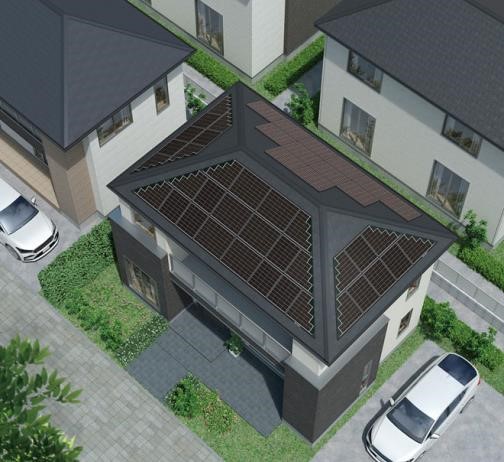
Sharp launches solar module for particular shapes of roof
(Nikkan Kogyo Shimbun, August 24)
- Sharp launched “Full Fit,” a roof-type solar module designed for installation on gable and single-slope roofs.
- The range comprises five models, with power production ranging from 132 to 230 W.
- The range is designed to enable an easier installation on these roofs thanks to the vertical length reduced by around 7% compared with conventional models. Sharp said the system can reduce the minimum number of required PCS units from three to two.
Nippon Shokubai revises initial investment in lithium-ion battery electrolyte plant
(Nikkei, August 27)
- Nippon Shokubai will revise the investment for its new battery electrolyte plant.
- The firm initially planned to invest ¥37.5 billion but raised it to ¥43 billion, citing the weak yen, higher prices for copper and crude oil, and rising construction costs driven by strong demand in Western Japan.
- The plant is scheduled to begin commercial operations in Dec 2028.
- CONTEXT: Nippon Shokubai produces LiFSI, an electrolyte material used in li-ion batteries, which offers better ionic conductivity, improved low-temperature discharge performance and greater thermal stability than conventional electrolyte salts.
- TAKEAWAY: The higher investment cost shows that battery-material projects are not immune to the same inflation, currency and construction-cost pressures affecting other energy infrastructure. But Nippon Shokubai is still proceeding, with only a five-month delay to commercial operations. That suggests the company still sees enough medium-term demand for lithium-ion battery materials to justify absorbing higher upfront costs, especially as BESS and EV-related supply chains continue to expand.
NEWS: WIND POWER AND OTHER RENEWABLES

NEDO selects R&D programs for geothermal surveys
(Organization statement, August 19)
- NEDO chose several firms for geothermal surveys of areas with high potential.
| Research theme | Companies selected |
| Environmental conservation technologies for shortening geothermal development lead times | CRIEPI (Central Research Institute of Electric Power Industry) Tohoku Ryokka Kankyo Hozen |
| Development of silica scaling inhibitors based on initial formation mechanisms | Kyuden Sangyo Kyushu University Kyuden Mirai Energy Nippon Shokubai Aizoth |
| Countermeasure technologies for silica deposits | Geothermal Engineering Tohoku Natural Energy Tokyo University of Marine Science and Technology Kurita Water Industries |
| Corrosion-resistant alloys for use in high-acidity wells | JFE Steel C&A |
| Technical specifications for geothermal well materials in acidic fluid environments and research of low-cost materials | Geothermal Technology Development |
| Utilization of supercritical geothermal resources at Yamakawa (Kagoshima Pref) | West Japan Engineering Consultants |
- TAKEAWAY: The selected themes show that geothermal development still depends on solving practical operating problems, not just finding the resources. Silica scaling, corrosion and acidic fluids can damage wells, pipes and equipment, raising maintenance costs and shortening plant life. Technologies that prevent silica deposits, improve well materials and reduce environmental-survey lead times could help make geothermal projects easier to develop and operate. Japan has strong domestic geothermal resources, but project development remains slow and most operating plants are small.
- SIDE DEVELOPMENT:
- Chiyoda and Sage Geosystems start feasibility study for geothermal energy storage
- (Company statement, August 26)
- Chiyoda and U.S.-based Sage Geosystems began a feasibility study to assess equipment configuration, operating costs and power-generation costs for Sage’s geothermal technology.
- Sage has developed a next-generation geothermal technology called Pressure Geothermal.
- The system injects water into an underground reservoir created in hot rock formations, storing energy as both heat and pressure.
- The stored energy can later be recovered according to power demand, making the technology potentially suitable for long-duration energy storage.
JFE produces Japan’s first monopile for offshore wind
(Company statement, August 26)
- JFE Engineering completed the first section of Japan’s first domestically produced monopile, a foundation structure for offshore wind power generation.
- The monopile is for the Akita city offshore wind power generation project promoted by Oga Katagami Akita Offshore Green Energy.
- The Kasaoka Monopile Manufacturing Plant, built in March 2024, is Japan’s only monopile manufacturing site and utilizes processing and welding technology for large-scale steel structures developed over the course of over 100 years.
- CONTEXT: JFE began manufacturing on order from Kajima which will undertake site construction for the Akita offshore wind project.
- TAKEAWAY: Developing a domestic supply chain for key offshore wind components is a METI priority, both to reduce long-term costs and improve energy security.
Toyo advances offshore wind undersea cable installation system
(Company statement, August 24)
- Toyo Construction obtained an Approval in Principle from ClassNK, a maritime classification and certification society, for a design for a high-output water jet-type electric cable installation system for offshore wind power generation facilities.
- The device, which is still under development and could be completed by year-end, is intended to improve the efficiency of undersea cable installation work.
- CONTEXT: Toyo received a NEDO grant from FY2023-FY2025 for optimizing undersea electric cable installation operations in which it initially demonstrated the technology for constructing water jet-type undersea cable installation equipment.
Itochu Enex to supply renewable diesel for construction machinery
(Company statement, August 21)
- Itochu Enex agreed with Kanamoto to promote the use of renewable diesel at construction sites.
- Kanamoto will provide information and rental supply for construction machinery that can use renewable diesel, while Itochu Enex will supply RD100% and RD40%, also branded as Fine Diesel.
- The companies said renewable diesel can be used in existing diesel engines as an alternative to light oil, helping construction companies reduce Scope 1 emissions without major new equipment investment.
- CONTEXT: Itochu Enex said RD100% and RD40% have been registered in MLIT’s NETIS database, which provides information on new construction technologies.
NEWS: NUCLEAR ENERGY
Govt to amend law to promote investment in nuclear power
(Denki Shimbun, August 27)
- The govt plans to amend Article 15 of the NEDO Act to remove the clause excluding nuclear energy.
- This will allow NEDO to fund development for next-gen nuclear reactors and nuclear fusion, making it easier to leverage private investment.
- The target is to submit the amendment to the ordinary Diet session in 2027. The initiative aligns with national goals to build two to five replacement reactors by the 2040s, and a total of 11–14 replacement reactors by the 2050s.
- R&D plans will prioritize small modular reactors (SMRs) engineered for Japan’s earthquake and tsunami risks.
- TAKEAWAY: This is another sign that the government is preparing a more active industrial policy for nuclear power, not only regulatory support for restarts. By 2050, about 15 reactors are expected to reach the 60-year operating limit. Hence, the govt considers it urgent to advance replacements and R&D in new technologies. Besides regulations and policies, the govt must tackle the issue of possible long and costly replacement work, as well as creating a skilled workforce for NPPs.
Tokai No.2 NPP restart delayed
(Nikkei, August 28)
- The restart of JAPC’s Tokai No. 2 NPP will be delayed to late FY2028 or FY2029 due to a two-year setback in seawall construction.
- Construction halted in 2023 when the firm found defects in the tsunami defense wall.
- TAKEAWAY: The NPP’s restart remains hindered by regulatory and safety challenges. In the past three years, 11 fire incidents occurred, eroding public trust in JAPC. Evacuation plans are also an issue. Out of 14 municipalities in a 30 km radius, six key municipalities were unable to secure evacuation sites. This prompted a Mito court injunction against operating the plant. There is also opposition from the Ibaraki Governor, despite support from the local mayor. This is not good news for JAPC, which also has troubles with its Tsuruga plant. The latter became the first NPP unable to receive approval from the NRA due to an active fault.
Chubu Electric admits fraud during decommissioning of Hamaoka NPP
(Company statement, Japan NRG, August 27)
- Chubu Electric admitted it carried out fraudulent procedures during the decommissioning of Units 1 and 2 at the Hamaoka NPP, falsely claiming that demolition and removal work on facilities was further advanced than actual progress.
- After an internal investigation this month, Chubu Electric confirmed 14 improper alterations.
- CONTEXT: This scandal follows a prior controversy at the same plant involving Units 3 and 4. The utility had used data fabrication to underestimate expected seismic ground motion. This earlier issue halted and reset the regulatory safety reviews for restarting those reactors. Following this, the company received a formal reporting order.
- TAKEAWAY: The case deepens governance concerns at Chubu Electric’s Hamaoka NPP. The company was already under scrutiny after the earlier seismic-data issue involving Units 3 and 4, and the new decommissioning-record problem suggests weaknesses in internal checks and project reporting. Unless Chubu can show that the misconduct was isolated and has been corrected, the incident will further damage trust in its nuclear division.
TEPCO to dissolve third-party monitoring committee
(Nikkei, August 27)
- TEPCO will dissolve its third-party Nuclear Reform Monitoring Committee.
- TEPCO said the committee had achieved its core purpose, arguing that a culture of nuclear safety awareness had taken root.
- CONTEXT: The panel was founded in 2012 following the Fukushima Daiichi nuclear accident to oversee internal safety practices and elevate safety awareness. TEPCO restarted Kashiwazaki-Kariwa NPP Unit 6 in January 2026. External oversight will continue through the Kashiwazaki-Kariwa Operation Council, a separate body established in 2025 to inspect plant operations.
Fukui Pref approves KEPCO dry storage plan
(Company statement, August 28)
- Fukui Pref authorized KEPCO to build dry storage facilities for spent nuclear fuel at its NPP in the prefecture.
- The decision clears the path for construction at Takahama and Mihama NPPs. This is part of KEPCO’s broader roadmap to build four dry storage sites in Fukui. This is an intermediate step toward eventually transporting fuel out of the prefecture.
- CONTEXT: Fukui Pref had postponed its decision due to concerns over delays at the Rokkasho reprocessing plant, which is intended to receive spent fuel for reprocessing.
NEWS: TRADITIONAL FUELS

TotalEnergies exits Russia’s Arctic LNG; Japan now the only G7 nation participating
(Japan NRG, July 28)
- TotalEnergies completed the transfer of its 10% equity stake in Arctic LNG 2 to NordLine. The latter is a subsidiary of Russia’s Novatek.
- TotalEnergies thus severed its liability and shareholder exposure to a sanctioned Russian asset.
- TotalEnergies’ exit has consolidated equity among Novatek (70%), CNPC (10%), CNOOC (10%), and the Japan Arctic LNG consortium (10%).
- CONTEXT: Arctic LNG 2 is an export facility in the Siberian Arctic with a nominal capacity of 19.8 Mtpa. Following the start of the war in Ukraine, Western sanctions targeted the venture.
- TAKEAWAY: TotalEnergies’ exit leaves Japan as the only G7 country with an equity stake in Arctic LNG 2, increasing the risk of friction with Western allies. The position is also awkward because Japan Arctic LNG – owned by JOGMEC and Mitsui – receives no physical LNG from the project because of sanctions, while public and corporate balance sheets have already absorbed heavy costs, including JOGMEC’s $890 million loan guarantee settlement. Tokyo continues to describe the project as important for energy security, but that argument is becoming harder to sustain while the asset remains stranded. Pushing too hard to defend Arctic LNG 2 could also weaken Japan’s more important case for maintaining access to Sakhalin-2, which still supplies physical LNG to Japan.
JAPEX starts production at oil and gas field in Norway
(Company statement, August 28)
- JAPEX said production at the Alve Nord oil and gas field in the Norwegian Sea has begun. JAPEX holds a 10% interest through its subsidiary JAPEX Norge.
- Production started nearly a year ahead of its original first-half 2027 target. The field primarily produces natural gas along with crude oil and condensate.
- CONTEXT: JAPEX Norge’s 2026 average production should reach 2,200 barrels of oil equal per day.
LNG stocks up from previous week, up YoY
(Government data, August 26)
- As of August 23, the LNG stocks of 10 power utilities were 2.38 Mt; up 4.8% from the previous week (2.27 Mt); up 18.4% from end August 2025 (2.01 Mt), and up 12.3% from the 5-year average of 2.12 Mt.
July Oil/ Gas/ Coal trade statistics
(Government data, August 20)
| Imports Volume YoY Value (Yen) YoY | ||||
| Crude oil | 12.1 million kiloliters (76.1 million barrels) | 5.5% | 1,408.9 billion | 87.8% |
| LNG | 5 million tons | -4.8% | 548 billion | 22.5% |
| Thermal coal | 8.8 million tons | -9.1% | 213.4 billion | 29.4% |
NEWS: CARBON CAPTURE & SYNTHETIC FUELS

Osaka Gas joins FEED for U.S. e-methane project
(Company statement, Aug 28)
- Osaka Gas said the Live Oak e-methane project in Nebraska has started FEED, with KBR and Técnicas Reunidas selected to conduct parallel engineering work.
- The consortium consists of TotalEnergies, Tree Energy Solutions, Osaka Gas, Toho Gas and Itochu. TotalEnergies and TES each hold 33.35%, while the three Japanese companies together hold 33.3%.
- The project will produce e-methane in Norfolk, Nebraska, using green hydrogen from water electrolysis and CO2 captured from a bioethanol plant.
- It plans to use a 250 MW-class electrolyzer and produce about 75,000 tons/ year of e-methane, with exports to Japan using existing U.S. gas and LNG infrastructure.
- FEED is scheduled to finish in FY2027, followed by the start of EPC, with commercial operations targeted during FY2030.
- Osaka Gas and Toho Gas plan to be major offtakers. The project is intended to support their target of introducing e-methane and similar fuels equivalent to 1% of gas supply by FY2030.
- TAKEAWAY: The Live Oak project shows how Japanese gas utilities are trying to make e-methane fit existing LNG and city-gas infrastructure rather than waiting for an entirely new hydrogen supply chain. Synthetic methane can be liquefied, shipped and burned through much of the existing gas system. But the project also highlights the scale problem. Even a 250 MW-class electrolyzer would produce only about 75,000 tons/ year, enough to support early 2030 targets but still far from mass deployment.
ANRE considers rules for reflecting GX-ETS costs in power markets
(Government statement, August 25)
- ANRE discussed how costs and revenues from Japan’s GX-ETS should be reflected in wholesale electricity trading as the emissions trading system moves toward implementation.
- For spot-market bidding, generators would be allowed to reflect reasonably estimated GX-ETS compliance costs in bidding prices for the relevant fiscal year.
- The costs would be calculated at the generation-unit level, based on the difference between each unit’s emissions intensity and the benchmark level used for free allowance allocation.
- ANRE also proposed that revenues from selling surplus allowances should not automatically be used to reduce bidding prices if the generator commits to using those revenues for future allowance procurement or decarbonization investment.
- To support monitoring, major generators would be expected to disclose information on surplus allowance sales and how related revenues are used.
- CONTEXT: ANRE is trying to integrate carbon pricing into electricity market rules without undermining cost-reflective bidding. The key problem is that GX-ETS will create both costs, when generators need to procure allowances, and revenues, when they have surplus allowances to sell. The proposal aims to let carbon costs flow into wholesale prices while preventing surplus allowance revenues from simply becoming margin or distorting bidding behavior.
ENEOS, Sumitomo and partners chosen for Mizushima CCS hub study
(Company statements, Denki Shimbun, August 24)
- Sumitomo Corp, Asahi Kasei, ENEOS, JFE Steel, Mitsubishi Gas Chemical and Mitsubishi Chemical agreed with JOGMEC for a ship-based advanced CCS project in the Mizushima area of Kurashiki, Okayama Prefecture.
- The six-company project will study CO2 separation and capture, liquefaction, temporary storage and shipping facilities for a CCS hub serving the Mizushima industrial complex.
- The project expects to ship about 3.43 Mtpa of liquefied CO2 when commercial operations begin, making it one of Japan’s largest CCS hub concepts.
- Sumitomo will act as the lead company. The other partners are major local emitters and industrial operators in the complex, including chemicals, steel and refining firms.
- The project aims to reduce costs by clustering multiple CO2 emitters and sharing liquefaction, temporary storage and shipping infrastructure before transporting CO2 by vessel to storage sites.
- JOGMEC said its FY2026 support for ship-based CCS projects is intended to promote such emitter clustering and shared facilities.
- In a separate project, Cosmo Oil and KEPCO won a JOGMEC contract for engineering design work on a CCS project in the Sakai-Semboku area of Osaka Pref. The project would capture CO2 from Cosmo’s Sakai refinery and KEPCO’s power station in Sakai City, with expected combined CO2 shipments of about 750,000 tons/ year.
- CONTEXT: Mizushima is one of Japan’s largest coastal industrial complexes, with major refinery, steel and chemical facilities.
- TAKEAWAY: The CCS hub concept assumes multiple emitters are in close enough proximity to share CO2 liquefaction, temporary storage and shipping infrastructure, spreading costs across a number of parties. That makes Mizushima suitable, with Cosmo’s Sakai-Semboku study also following the same logic but on a smaller scale, linking refinery and power-sector emissions in the Osaka Bay industrial area. Challenges remain in finding the appropriate long-term storage-sites and extending the supply chain to accommodate them.
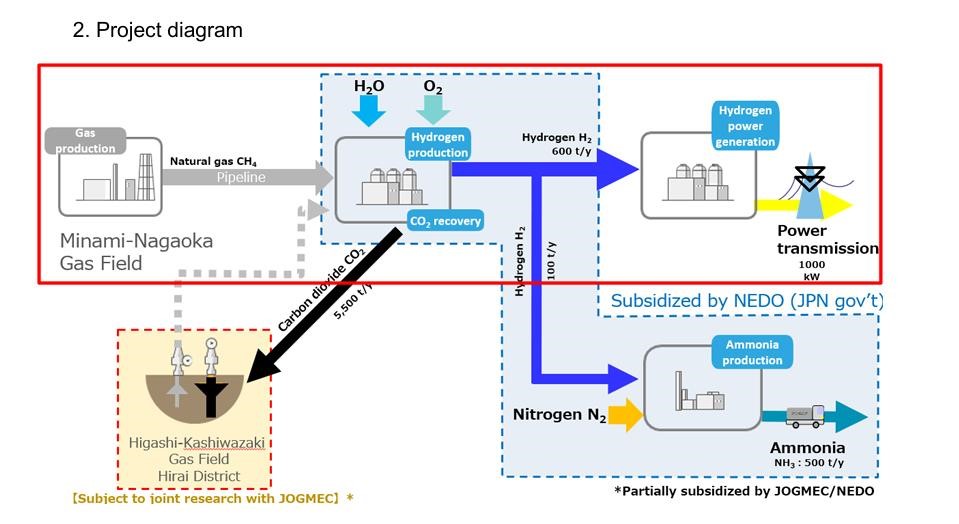
INPEX begins injecting CO2 at Higashi-Kashiwazaki Gas Field
(Company statement, August 27)
- INPEX began injecting CO2 – a by-product of hydrogen production – into a subsurface reservoir in the Higashi-Kashiwazaki Gas Field (Niigata Pref).
- This is Japan’s first project to integrate the value chain for blue hydrogen and ammonia. The facility uses gas from the Minami-Nagaoka Field as feedstock.
- The plant employs CO2 capture technology developed with JGC Global and BASF. INPEX plans to transition the project into an independent commercial operation.
- CONTEXT: Gas production at the Higashi-Kashiwazaki Gas Field has ceased. This makes its depleted subsurface structures ideal for geological CO2 storage. Hydrogen emits no carbon when burned, but conventional production relies on fossil fuels.
NGK to commercialize higher-efficiency CO2 capture material
(Nikkei, August 25)
- NGK plans to begin commercial production in FY2027 of a ceramic component that can capture CO2 about three times more efficiently than existing materials.
- The component uses NGK’s ceramic-processing technology to create microscopic channels coated with a CO2-adsorbing substance, allowing air to pass through while CO2 is captured.
- NGK is applying know-how from its ceramic exhaust-gas filters for vehicles, where precise material blending and firing processes are key manufacturing barriers.
- CONTEXT: The technology is aimed at direct air capture and other CO2 removal applications.
ANALYSIS
BY GILLIAN SAWYER
Japanese Sustainability Disclosure Standards: From Voluntary to Mandatory
After years of debate, planning and preparation, national sustainability reporting standards are taking effect that are intended to have a major impact on Japan’s energy sector, as well as how major corporations organize the consumption of their power supply.
In April, Japan also moved into a new phase of its GX policy framework, alongside new securities disclosure rules that will make SSBJ (Sustainability Standards Board of Japan) reporting mandatory for the largest listed companies. Together, the reforms are shifting corporate emissions management from largely voluntary reporting towards statutory disclosure and, for large emitters, carbon-pricing obligations.
SSBJ reporting standards require major companies to formalize and expand disclosures of its Scope 1, 2, and 3 emissions in securities reports, with heightened scrutiny on value-chain data. Eventually, it will likely turn emissions reporting into a part of supplier obligations.
The transition has led to an inconsistent effect across Japan’s corporate world. While some firms have the data necessary for meeting reporting requirements, they now face time pressure to reorganize that data within new frameworks. Others have more time to prepare their inaugural reports, but collecting the data from partner firms is proving difficult.
But there are voices that see the changes as optimistic for both efficiency and power prices. Which of these positions has the most merit?
Shifts in global sustainability reporting standards
The 2015 Paris Agreement was a transition for ‘sustainability’ – progressing from a term tossed around by activists to one with official status in the corporate world. By 2017, the Task Force on Climate-related Financial Disclosures published sustainability recommendations, establishing a framework for governance, strategy, risk management, as well as metrics and targets. In 2021, the ISSB (International Sustainability Standards Board) was established.
In Japan, the SSBJ was established in July 2022 by the Financial Accounting Standards Foundation and followed by the GX Promotion Act. Prior to this, sustainability reporting was fragmented, based on the TSE (Tokyo Stock Exchange) Corporate Governance Code that required climate disclosures in governance reporting and individual frameworks like CSR (Corporate Social Responsibility) reports which lacked strict structure and clarity.
But when IFRS (International Financial Reporting Standards) was established, the need for united Japanese standards became evident.
The foundation: IFRS sustainability standards
The global baseline came in June 2023, when the ISSB issued its inaugural IFRS Sustainability Disclosure Standards. IFRS S1 sets general requirements for sustainabilityrelated financial disclosures, while IFRS S2 covers climate-related risks and opportunities. The standards have been adopted by 36 jurisdictions.
The framework builds on earlier initiatives including TCFD (Task Force for Climaterelated Financial Disclosures), CDSB (Climate Disclosure Standards Board), SASB (Sustainability Accounting Standards Board) and the Integrated Reporting Framework.
However, the IFRS does not require companies to disclose how corporate activity impacts environmental sustainability; only how sustainability matters affect the value of a business.
Japan-specific challenges
The SSBJ was established to develop sustainability disclosure standards in Japan and contribute to international standards, aiming to align with IFRS while making adjustments needed to fit the Japanese context. The standards require the preparation of sustainability-related financial information to be disclosed as a part of general financial disclosures and are organized into four overarching types: Universal; Theme-based (including general and climate-related); Industry-based; and Practical.
Following IFRS, core disclosure requirements cover governance, strategy, risk management, and metrics and targets. Japan-specific requirements include disaggregation of Scope 3 emissions into individual amounts for each of the 15 categories defined in the GHG protocol, whereas IFRS requires a single aggregate figure. Companies must also disclose a transition plan in alignment with the GX policy framework and 2050 carbon neutrality commitment. Also, disclosures must be included in a sustainability section of the annual securities report.
The initial reporting timeline has been organized based on market capitalization, targeting companies listed on the Prime Market of the TSE, including large scale corporations with high standards for governance.
Phase 0 began this year with voluntary adoption. Phase 1 launches in the fiscal year ending March 2027 for companies with a market cap greater than or equal to ¥3 trillion, such as Toyota, Sony, and Mitsubishi UFJ. These major companies already have a foundation for sustainability reporting, in contrast to those slated to start in later phases.
Toyota already reports comprehensive emissions data (totaling hundreds of millions of tCO₂e annually, dominated by Scope 3 Category 11 from vehicle use) and holds SBTi-validated targets, such as absolute Scope 1+2 cuts and intensity reductions for use-phase emissions.
Phase 2 will launch in FY2028 for firms with a market cap greater than or equal to ¥1 trillion. Phase 3 launches in FY2029 for those with a market cap of ¥500 billion or more, potentially comprising all Prime Market firms. The timeline for smaller firms is not yet decided.
SSBJ disclosures seek to carry the same legal weight as financial disclosures, with consequences for inadequate reporting that are just as severe. If reporting is delayed, then companies risk data infrastructure gaps, filing risk, investor pressure, and multi-framework inefficiency. Like IFRS, the SSBJ standards only focus on the impact that sustainability has on corporate finances and does not account for the impact that corporate activity has on sustainability.
Practical applications
Some Japanese companies are already finding that the biggest change is not calculating emissions, but making those calculations reliable enough for statutory disclosure and eventual third-party assurance.
Tokyo Metro, for example, previously collected emissions data from departments in Excel, requiring staff to manually consolidate information across 770 sites. Multiple versions of files made it difficult to identify the latest figures or connect them with documentary evidence. After introducing a dedicated GHG management system partly in preparation for SSBJ, the transport firm says the aggregation process fell from around one week to one day.
Logistics firm SG Holdings is making a similar transition on an even larger scale. It has introduced an environmental data system covering more than 1,000 domestic sites, revised its GHG accounting manual and begun preparing for third-party assurance ahead of its mandatory SSBJ reporting date.
The effects are reaching procurement departments and suppliers. Semiconductor equipment maker Advantest says obtaining detailed Scope 3 data from suppliers and customers remains extremely difficult. The company is trying to improve those data while making renewable-energy adoption among major suppliers a procurement KPI; 52% had adopted renewable power in FY2024, against a 60% target for FY2026.
Advantest said it has also begun using DHL’s SAF-based GoGreen Plus service for some international shipments, allowing it to record verified reductions in logistics-related Scope 3 emissions. In this case, suppliers that offer verifiable carbon footprints will fare better.
Impact on suppliers, prices
Still, part of what makes the process complicated is that alongside SSBJ, Japanese firms must also comply with a separate carbon-pricing and transition-policy regime under the GX Promotion Act. Large direct emitters must prepare transition plans and participate in the nationwide emissions trading system, which entered its mandatory phase in FY2026.
Mandating sustainability disclosure is a key step towards fulfilling global sustainabilityrelated goals, but Japanese firms face several challenges in meeting the demands of SSBJ and the GX Promotion Act. While many might have had reporting frameworks, the new mandatory system is extensive and specific, and there is a deadline for Phase 1 companies to prepare disclosures.
For companies that operate globally, there’s little time to organize multiple reports from organizations with slightly different requirements.
Small and medium-sized companies without existing reporting frameworks are forced to catch up, especially if they’re on the same supply chain as SSBJ Phase 1 companies that may request assistance in meeting fast approaching deadlines.
Some smaller firms even rely on paper-based reporting, posing another burden towards transitioning into digital. Also, there is significant variation in data collection and calculation of Scope 3 emissions, aggravated by a lack of industry specific guidelines for calculation. The SSBJ has acknowledged that various interpretations of emissions figure calculations have popped up among Japanese firms.
Since Scope 3 covers indirect emissions across both the upstream and downstream value chain, companies must collect or estimate emissions data far beyond their own operations. Obtaining primary data from suppliers can improve the quality of those calculations, but gaps sometimes have to be filled using secondary estimates.
How much the professionalization of emissions accounting will lead to real change in operations – beyond corporate reporting – is unclear but some firms are optimistic. Renewables developer Renova expects the new disclosure environment to put upward pressure on corporate PPA prices as tighter corporate requirements accelerate demand for renewable electricity.
How this fosters genuine decarbonization remains uncertain. What is clear so far, however, is the shift to better accounting: new software, assurance procedures and requests for more detailed supplier data. The examples of Advantest and Renova also show how disclosure requirements can start moving into commercial decisions. If carbon data increasingly influences which suppliers companies use, how they ship products and where they procure electricity, then what began as a reporting reform could gradually become a driver of energy demand and investment.
ANALYSIS
BY ANDREW STATTER
Energy Jobs in Japan: Increasing Appetite for Energy Talent Among Industrial Players
We’ve long seen the trend of the energy industry hiring talent from outside. At the start of the renewable energy boom in the mid-2010s, scores of overseas developers set up shop in Japan when there was still a small talent pool.
Developers were typically hired from sales roles outside the industry or talent coming from real estate. Engineers and project managers came from working on different types of infrastructure or conventional energy into renewables. Finance was another big area where talent left banks and advisory to fill demand in private equity investors and developers.
The trend still continues – in forecasting, trading operations, and asset optimization – where we see an increase in demand for people with machine learning and data science backgrounds. In recent years, however, we’re seeing the opposite trend – an increasing appetite for a broad range of energy professionals from a wider industrial clientele.
From data center developers to major power consumers to insurance firms, talent is being poached from traditional and renewable energy players into the broader industrial space.
CPPA Growth
Led by massive global power consumers such as Google and Amazon, but closely followed by major Japanese players such as Aeon Mall, Honda or Seven & I Holdings, the demand to hire experienced talent with a track record in structuring off-take contracts is steadily increasing.
These firms have targeted talent from power utilities, developers and energy retailers to lead the charge on their power procurement strategy. All of these companies have large, complex organizations and a well-established procurement team. The complexity of energy procurement has led to the common theme of external expert hires.
Structuring a corporate PPA is not as simple as negotiating on price, availability, and terms of liability. It requires a deep understanding of the energy industry, regulations, interconnection issues, and supply and demand balance etc.
Rather than energy being lumped in as another commodity to procure, the trend has been for large companies to create a new, separate, specialized department.
Data Centers are hungry for talent
The data center build-out is accelerating with estimates between 20% and 25% CAGR through 2035. One main area that data center developers are pulling talent from is the energy industry, and it is not limited to one skill set.
Land acquisition, development and permitting professionals bring transferable skills from the plateauing solar and wind industries. Grid connection is one of the biggest bottlenecks that data center developers face, especially with the heavy concentration of projects around the Greater Tokyo and Osaka areas, which reflects continual strong demand for grid and electrical engineers.
The volume of data centers reaching the construction phase is much higher, creating a supply-demand squeeze for project managers, construction managers, site managers, etc. Here is another space where we have seen broad demand for professionals coming from energy. But due to the complexity of hyperscale data center projects, they tend to prefer talent coming from oil and gas or conventional energy rather than relatively simple or smaller-scale renewable projects.
As a next growth area, we expect Japan to follow the trend in the U.S. of AI tech majors to become active participants in the power markets. Equinix, Colt, AWS, Google etc are already active in building out energy procurement functionality.
In addition, there’s the trend of AI data center companies becoming energy traders, aggregators and retailers themselves. In the U.S., Anthropic Open AI Meta have all either established or are applying to establish energy trading businesses. And they’re poaching talent from power utilities, energy developers, retailers, and even the public and policy sectors.
Banks and insurance
MUFG Bank secured regulatory approval in October 2024 to offer power futures trade execution and clearing services, and backed that up by taking a stake in eClear, the operator of Japan’s largest power hedge wholesale trading marketplace.
Japanese megabanks have financed energy infrastructure for decades. The novelty, however, is that MUFG positions itself as a market participant, clearing and executing trades, rather than purely being an underwriter of debt. That requires people who understand wholesale power markets, hedging structures and risk management, not just project finance which is a talent pool they have needed to externally source.
SMBC and Mizuho are also following suit. SMBC has paired with Japan Research
Institute to build a long-term electricity price forecasting simulation service, while Mizuho acquired 100% of Augusta & Co, an independent advisory firm specializing in renewable energy and energy transition financing.
Insurance is also building out teams of professionals coming from energy developers and power market participants as well. Underwriting itself has become more technical as projects grow in size, complexity, and the power is now sold on the market. Providers have been hiring talent with a technical background to understand new asset types and therefore new risks.
What is next? GX-ETS as a candidate
Japan’s emissions trading scheme is entering its mandatory phase for large emitters. This is a new compliance function for the domestic market, and there’s an increase in carbon accounting, reporting, and management services. Asuene is one of the headline growth firms in Japan, but they face competition from global and domestic players such as Zeroboard and Persefoni.
There is high corporate demand for such services, but this will become a cost burden, especially on heavy emitters across manufacturing, refining, steel making, etc. Companies will want to make direct hires of carbon accounting and management professionals in order to reduce their external costs, as well as develop their own IP and to protect and control their data.
When such reporting was voluntary margins for these services were low, as reflected in talent demand and salaries in the subsector. With real bottom-line costs in failing to measure, track, and report, demand for such services will rise, which in turn will drive the relevant talent demand.
A safety net for energy professionals
We see increasing demand for a broad range of energy professionals across an increasingly wider range of industries as an excellent safety net for professionals who have dedicated years of their life to study, train, and work in the energy sector.
While particular asset types go through growth and degrowth cycles based on policy support, investor appetite, and technology demand, this trend shows there’s a desire for the transferable skills that people develop in the energy industry.
Even though professionals may dedicate years of their life to an asset type or sub-sector that is winding down or struggling to grow, it’s also true that there’s a trend where they’re not limited or boxed in to staying with that exact sub-sector.
Andrew Statter is a Partner at Titan GreenTech, an executive recruitment agency focused on the clean energy space.
ASIA ENERGY REVIEW
BY JOHN VAROLI
A brief overview of the region’s main energy events from the past week
Australia / Power rates
Wholesale prices fell in 2025 from a year earlier, indicating easing pressure, but remained higher than in 2022 — when the nation suffered an unprecedented failure of its main power market, the Energy Regulator said. A 177% jump in grid-scale battery capacity last year contributed to lower prices.
Australia / Renewables
Researchers discovered that Western Australia’s iron-rich rocks can naturally generate hydrogen and that the process can help to produce much larger amounts.
China / Oil & gas
CNOOC sees potential for energy cooperation between China and the U.S. The company will consider investments alongside U.S. partners.
India / LNG
LNG supplies from Qatar will be impacted due to strikes on energy facilities. India, the world’s fourth-largest LNG importer, relies on Qatar for about 41% of its gas imports.
India / Solar
Agastya Green Energy will invest $820 million to build 12 GW each of integrated ingot and wafer manufacturing capacity in Andhra Pradesh.
Singapore / Gas power
The Energy Market Authority awarded Tuas Power the right to build and operate a combined cycle gas turbine generating unit, planned to provide 670 MW of power capacity.
Southeast Asia / LNG
Population growth and rising living standards are strengthening the region’s case for LNG imports and infrastructure. SE Asia is emerging as a counterweight to weaker LNG demand across Asia-Pacific, as growing energy requirements and declining domestic production increase the region’s need for additional supply, said the International Gas Union.
South Korea / Renewables
The govt will replace its portfolio standard for new renewable energy facilities with a competitive contract market. The new system will require renewable energy projects to compete by power source and facility capacity to win contracts.
Taiwan / Power demand
The govt and Taiwan Power plan to raise the 2.5% annual electricity demand growth forecast through 2035 to provide a larger safety margin as demand increases due to AI.
Thailand / Solar power
Thailand could reduce dependence on imported LNG by reforming rooftop solar policies, according to the Institute for Energy Economics and Financial Analysis. It recommends a shift from net billing to net metering, to raise rooftop solar buyback rates, etc.
Disclaimer
This communication has been prepared for information purposes only, is confidential and may be legally privileged. This is a subscription-only service and is directed at those who have expressly asked K.K. Yuri Group or one of its representatives to be added to the mailing list. This document may not be onwardly circulated or reproduced without prior written consent from Yuri Group, which retains all copyright to the content of this report.
Yuri Group is not registered as an investment advisor in any jurisdiction. Our research and all the content express our opinions, which are generally based on available public information, field studies and own analysis. Content is limited to general comment upon general political, economic and market issues, asset classes and types of investments. The report and all of its content does not constitute a recommendation or solicitation to buy, sell, subscribe for or underwrite any product or physical commodity, or a financial instrument.
The information contained in this report is obtained from sources believed to be reliable and in good faith. No representation or warranty is made that it is accurate or complete. Opinions and views expressed are subject to change without notice, as are prices and availability, which are indicative only. There is no obligation to notify recipients of any changes to this data or to do so in the future. No responsibility is accepted for the use of or reliance on the information provided. In no circumstances will Yuri Group be liable for any indirect or direct loss, or consequential loss or damages arising from the use of, any inability to use, or any inaccuracy in the information.
K.K. Yuri Group: Hulic Ochanomizu Bldg. 3F, 2-3-11, Surugadai, Kanda, Chiyoda-ku, Tokyo, Japan, 101-0062.