
WEEKLY
September 14, 2026
ANALYSIS
AGGREGATION IN JAPAN: BALANCING GROWTH, COMPETITION AND PRICE DECLINES
- Renewable energy expansion has stimulated growth in aggregation, which pools generation assets to participate in electricity markets.
- Now aggregation faces an inflection point thanks to large-scale BESS deployment and growth of trading on exchanges. Market insiders believe this will have an impact on prices.
FUEL SHOCK TESTS JAPAN’S ELECTRICITY PRICE BUFFER, AGAIN
- The fuel cost adjustment system is a shock absorber between volatile global markets and Japanese consumers. But this system has reached its limits.
- Intended to smooth ordinary changes in commodity prices, the system now has to absorb extraordinary ones. The government has yet to update policy, but the EPCOs are taking matters into their own hands.
ASIA PACIFIC REVIEW
This column provides a brief overview of the region’s main energy events from the past week
NEWS
- OCCTO prepares staffing and governance update as role expands
- Uzbekistan and Japan push ahead with major energy projects
- Honda invests in U.S. rare-earth-free magnet startup
- Power futures rise as LNG price shock filters through
- August spot power trading hits record high
- Octopus partners with Nagano firm in power retail
- Digital Grid launches short-term PPA service
- METI launches group for hydrogen mobility initiative
- MHI to test methane pyrolysis hydrogen production
- KHI installs hydrogen-burning gas turbine
- Toshiba-led group extends PSC durability
- Idemitsu starts U.S. R&D for space-use solar cells
- Upsolar launches snow-resistant solar module lineup
WIND POWER AND OTHER RENEWABLES
- SHI picks partner for floating wind turbines
- GeoDreams raises funds to advance closed-loop geothermal energy
- Taisei launches study for next-gen supercritical geothermal tech
- Chubu Electric to withdraw Hamaoka restart review applications
- KEPCO to complete Mihama replacement survey in 2030
- NRA completes safety review for Shimane NPP
- JNFL delays revised Rokkasho construction plan
- Australian ambassador reaffirms close energy cooperation with Japan
- METI inks LNG deals with Petronas and Montenegro
- ENEOS Xplora to acquire additional Papua LNG stake
CARBON CAPTURE & SYNTHETIC FUELS
- Erevista, Sumitomo Forestry partner on J-Credits
- Sanyo Chemical’s innovation boosts biofuel performance
EVENTS
Sept 14-17 Gastech @ Bangkok
Sept 14-18 IAEA General Conference 2026 @ Vienna, Austria
Sept 30-Oct 1 Sustainable Material Expo @ Makuhari Messe
Oct 8 Innovations for Cool Earth Forum (ICEF) @ Westin Tokyo
Oct 13-15 Global Offshore Wind Summit – Japan 2026 @ Nagasaki
Nov 2-5 ADIPEC 2026 @ Abu Dhabi
Nov 9-20 COP31 @ Antalya, Türkiye
Nov 18-19 Asia-Pacific Economic Cooperation – Leaders Meeting @ Shenzhen, China
PUBLISHER
K. K. Yuri Group
Editorial Team
Yuriy Humber (Chief Editor)
John Varoli (Senior Editor, Americas)
Kyoko Fukuda (Data, Events)
Filippo Pedretti (Thermal, CCS, Nuclear)
Tetsuji Tomita (Power Market, Hydrogen)
Aglaé Bange (Renewables, Biomass & Energy Storage)
Gillian Sawyer (Renewables)
George Hoffman (Sales, Business Development)
Rada Kuznetsova (Clients Accounts, Website)
Tim Young (Design)
SUBSCRIPTIONS & ADVERTISING
Japan NRG offers individual, corporate and academic subscription plans. Basic details are our website or write to subscriptions@japan-nrg.com
For marketing, advertising, or collaboration opportunities, contact sales@japan-nrg.com. For all other inquiries, write to info@japan-nrg.com
NEWS: GENERAL OUTLOOK AND TRENDS

OCCTO aims to update policies on staffing and governance, as role expands
(Government and OCCTO statements, September 11)
- OCCTO and METI met to review how the organization should update its staffing, governance, budget and financing controls as its role expands under the amended Electricity Business Act.
- The law will give OCCTO new responsibilities in financing large-scale power sources and intraregional grid projects, in addition to its existing role in interregional grid development.
- OCCTO said its work has become more complex since it was created in 2015, expanding from supply-demand monitoring and interconnector management into capacity markets, the Long-Term Decarbonized Power Sources Auction (LTDA), reserve power, future supply-demand scenarios, FIT/FIP levy and grant operations, and renewable curtailment reviews.
- OCCTO’s membership reached 2,364 as of Sept 1, roughly three times the level in its first year. Staff numbers rose to 283, or about twice the original level.
- Its FY2026 budget stands at ¥29.5 billion, with system-related spending and renewable-energy-related spending each accounting for about one-third.
- OCCTO also outlined governance measures for its new lending role. It plans to separate project-facing lending teams from credit-management oversight, with power-source lending handled by the Planning Department, grid lending by the System Planning Department, and independent review by a Loan Management Office in the General Affairs Department.
- TAKEAWAY: OCCTO is being prepared for a much more active role in the power system. It is no longer just a coordination body; it is becoming a market operator, grid-planning body, and public-finance channel for large power and transmission projects. That makes its basic organizational issues central to the next phase of electricity reform. It’s also worth noting how OCCTO is keen to grow its own staff to gain further independence from the EPCOs, which retain a strong influence on the market.
Uzbekistan, Japan push ahead with major energy projects
(UZA, Japan NRG, September 10)
- Uzbekistan and Japan are moving ahead with major energy projects covering power generation, transmission and gas infrastructure.
- Uzbekistan’s Energy Minister Sherzod Khodjaev met with Japan’s State METI Minister Yamada Kenji in Tashkent.
- The two sides reviewed the progress of projects involving major Japanese energy companies, including Sojitz, Sumitomo, Itochu, Chubu Electric and Shikoku Electric.
- The projects cover electricity generation, transmission-line development and modernization of Uzbekistan’s gas transmission infrastructure.
- The meeting also focused on maintaining momentum for joint initiatives and strengthening cooperation between Uzbek and Japanese energy-sector partners.
- The Uzbek Energy Ministry said energy remains one of the key areas of Uzbekistan-Japan strategic cooperation, with major projects creating opportunities to modernize infrastructure and develop the country’s energy system.
- CONTEXT: In July, Uzbekistan and Japan discussed expanding energy-sector cooperation, including a pipeline of new projects worth $7.7 billion. A Keidanren delegation traveled to Tashkent to meet Energy Ministry officials. Sojitz is involved in major power-generation infrastructure, including a 1.6 GW gas–fired power plant project. Chubu Electric and Shikoku Electric are partnering with Sumitomo and international institutions on solar and BESS projects.
- TAKEAWAY: The latest talks underline Japan’s growing role in Uzbekistan’s energy modernization, especially in power generation, grid development and gas infrastructure. China, Russia and Saudi Arabia remain larger players in Uzbekistan’s energy sector, but Japan appears to have the strongest presence among G7 countries. According to the Uzbek Energy Ministry, Japanese companies have already participated in 14 energy projects in Uzbekistan worth $5.6 billion, with six more projects worth $2.6 billion under implementation and another seven worth $7.7 billion under development.
Honda invests in U.S. rare-earth-free magnet startup
(Company statement, September 10)
- Honda invested in U.S.-based Niron Magnetics via its corporate VC arm, Honda Xcelerator Ventures.
- Niron is commercializing rare-earth-free permanent magnets using iron nitride, made from iron and nitrogen.
- Magnets used in electric propulsion motors are exposed to resource constraints and market fluctuations, making alternative materials important.
- Niron said Honda’s investment will support continued commercialization of its technology and help scale manufacturing. Niron is building a manufacturing facility in Sartell, Minnesota.
- CONTEXT: Rare-earth is used to make sintered permanent magnets, which are widely used in EV motors and other high-performance applications; but supply chains remain heavily exposed to China.
KG Motors raises ¥470 million to develop lightweight EVs

(Company statement, September 1)
- KG Motors raised ¥470 million in funding, bringing its total equity raised to more than ¥2.2 billion.
- Its main investors are Chugin Capital, NTT docomo Ventures, Mitsuba, Hokuhoku Capital, and Toho Gas-owned Shin-Infrastructure Fund.
- The company is developing a lightweight EV, “mitbot,” and will use the funds to:
- Improve production;
- Improve productivity;
- Conduct demos;
- Develop OTA-capable software (Over-the-Air).
- CONTEXT: OTA is a wireless technology that enables a vehicle to install software updates via 4G/5G or Wi-Fi, eliminating the need to visit a dealership for software updates.
NEWS: ELECTRICITY MARKETS

Power forwards rise as LNG price shock filters through
(Broker and exchange data, September 10)
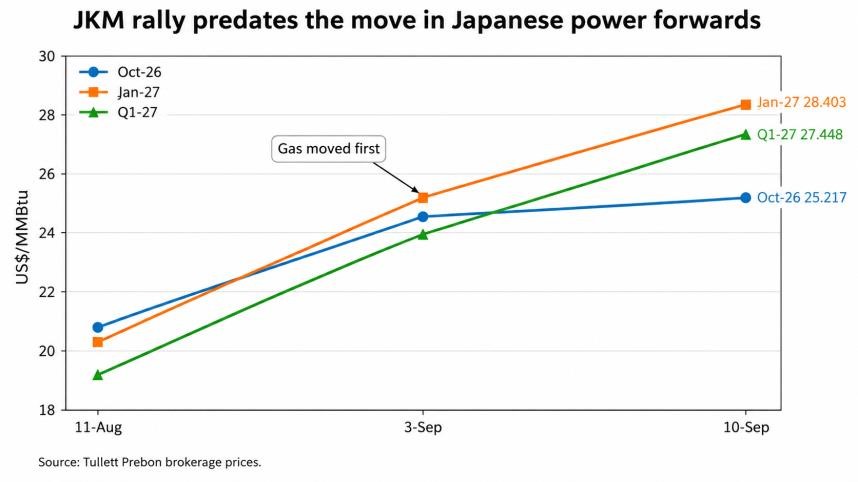
- Electricity futures contract prices rose over the past week, especially in Tokyo and Chubu, as the market began to reflect a higher LNG price environment amid renewed fighting around the Strait of Hormuz.
- Tokyo baseload rose across the near curve. Oct 2026 increased to ¥25.45/ kWh from ¥23.85/ kWh on Sept 3; while Jan 2027 rose to ¥25.90/ kWh from ¥23.90/ kWh, according to Tullett Prebon data.
- Chubu baseload also strengthened, with Oct 2026 rising to ¥23.75 from ¥21.75; and Jan 2027 to ¥24.60 from ¥22.80.
- Kansai baseload remained much lower, with Oct 2026 at ¥17.85 and Jan 2027 at ¥21.55, reflecting the region’s larger volume of nuclear baseload supply.
- Peakload prices show the same regional split. Tokyo peakload for Oct 2026 was ¥28.45, and Chubu peakload was ¥27.05, compared with ¥21.60 in Kansai.
- LNG prices had already moved sharply higher before the latest power forward adjustment. On Sept 10, Tullett Prebon data showed JKM swaps at $25.22/ MMBtu for Oct 2026; $28.72/ MMBtu for Nov 2026; and $28.59/ MMBtu for Dec 2026, up from around $20–21/ MMBtu for the same winter months on Aug 11.
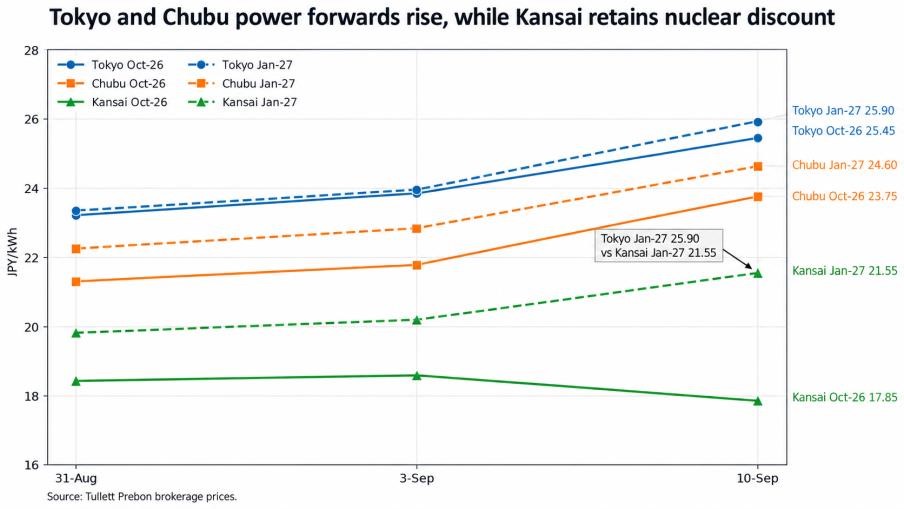
- TAKEAWAY: The latest futures moves suggest that the LNG price shock is now filtering more visibly into Japan power derivatives. Gas prices have repriced sharply over the past month, but the larger power-market adjustment appears to have come later, especially in Tokyo and Chubu. Kansai remains the clear outlier because its nuclear supply dampens exposure to LNG-linked thermal generation. Looking ahead, Tokyo and Chubu forwards are increasingly pricing in an expensive winter fuel environment, while Kansai retains a structural nuclear discount.
August spot power trading hits record high
(Exchange report, September 8)
- Spot power market set new monthly records in August for sell bids, buy bids and contracted volumes, with all three exceeding previous highs from July.
- Monthly demand fell below the previous year for the first time in about a year, partly because August 2025 set a record high for demand and because average temperatures in eastern and northern Japan were lower YoY.
- Sell bids rose as some thermal units returned from maintenance and solar output was strong. Buy bids also rose because of peak summer demand, leading contracted volumes to rise in line with higher buy-side activity.
- Daily average spot prices were volatile through the month. Prices weakened around mid-August, but rose sharply in the final week, with Tokyo, Chubu and Hokuriku moving above ¥25/ kWh on several days.
- Spot prices fell MoM in Tohoku, but rose in Hokkaido, Tokyo, Chubu, Hokuriku, Kansai, Chugoku, Shikoku and Kyushu.
- Weather patterns were highly regional. Western Japan experienced record-breaking heat, while temperatures in Kanto, eastern and northern Japan were lower.
- TAKEAWAY: August’s spot-market data show record activity, but not a uniformly tight market. National demand was lower YoY, and prices dipped around mid-month, suggesting that supply conditions were not consistently strained.
- SIDE DEVELOPMENT:
- TOCOM power futures trading rises
- (Exchange report, September 8)
- TOCOM power futures trading volume rose in August to 2,365 lots, up from 1,116 lots in July; the number of transactions rose to 139, from 57.
- Trading was supported by continued high fuel-price volatility.
- Unlike July, when all trades were negotiated off-exchange, August saw 124 negotiated trades and 15 orderbook trades.
- Monthly contracts remained the main focus. The largest trading volume was in the East area baseload, with 1,838 lots, including 1,643 monthly contracts, 155 weekly contracts and 40 fiscal-year contracts.
- The highest execution price was ¥26/ kWh for East area daytime-load Oct 2026, while the lowest was ¥14.10/ kWh for East area baseload FY2028.
- Final settlement prices for August monthly contracts included ¥21.24/ kWh for East area baseload, ¥19.23/ kWh for West area baseload and ¥21.61/ kWh for Chubu baseload.
- TAKEAWAY: August’s futures data show a clear rebound in TOCOM activity, with trading volume more than doubling from July and some orderbook trading returning. The market remains concentrated in monthly contracts, especially East area baseload, but the appearance of Chubu trades and limited weekly and fiscal-year activity suggests slightly broader use.
Octopus partners with Nagano City Gas in electricity retail
(Company statement, September 8)
- Octopus Energy will take over the electricity retail operations of Nagano City Gas and partner with the company on electricity sales.
- Octopus will handle power procurement, market-risk management and retail operations through its Kraken platform.
- Nagano CG will remain the local customer-facing partner, focusing on relationships with households and businesses in its service area.
- The deal expands Octopus’ partnerships with regional gas companies in Japan, following similar tieups with Izumo Gas, Hamada Gas and Tokyo Gas Yamanashi.
- TAKEAWAY: The partnership shows Octopus continuing to use regional gas firms as a route into Japan’s retail power market. That’s not surprising given that Octopus’ Japanese partner is Tokyo Gas, which has strong relations with the regional players. For smaller gas utilities, the model offers a way to add or maintain electricity services without directly managing procurement and market volatility. Octopus gains local customer access while keeping the trading, risk-management and retail platform functions centralized through Kraken.
METI approves TSO revisions to wheeling revenue forecasts
(Government statement, September 4)
- METI approved applications by eight TSOs to revise their revenue forecasts for wheeling services for FY2026–FY2027.
- The approved companies are Hokkaido NW, Tohoku NW, TEPCO PG, Chubu PG, Kansai T&D, Shikoku T&D, Kyushu T&D and Okinawa Electric.
- The revisions reflect changes in costs outside the utilities’ control, mainly higher labor costs, inflation-related expenses and increased interest costs due to rising rates.
- The approved adjustments are expected to be reflected in wheeling charges from November, increasing costs ultimately borne by electricity retailers and consumers.
- CONTEXT: Under the revenue-cap system, TSOs can revise approved revenue forecasts during a regulatory period when actual costs deviate from initial assumptions due to external factors or policy changes. The latest applications cover FY2026–FY2027, were submitted on July 10, and were reviewed by the EGC, the market regulator, before METI granted approval.
- TAKEAWAY: METI’s approval confirms that higher inflation and interest rates are now feeding directly into regulated grid costs. The revenue-cap system allows TSOs to recover uncontrollable cost increases, helping preserve their financial stability and ability to invest. But the result is higher wheeling charges, which will flow through to retailers and customers. As electricity demand rises and grid investment needs grow, the policy challenge will be to maintain cost recovery for TSOs while limiting the impact on power prices, especially for energy-intensive users. See this week’s Analysis section for a further dive into a related topic: the fuel cost adjustment system.
erex launches external aggregation service for electricity trading
(Company statement, September 1)
- erex launched its own aggregation service for companies to trade electricity on the capacity, wholesale and balancing markets.
- The service will be open to stationary BESS (high or extra-high-voltage), co-located BESS, corporate PPAs and demand-response.
- The company aims for 100 MW of installed capacity by 2028.
- TAKEAWAY: For more information on competition among aggregators, see this week’s issue analysis.
Digital Grid launches short-term PPA procurement service
(Company statement, September 3)
- Digital Grid launched a service allowing corporate clients to procure renewable electricity through short-term PPAs.
- While conventional PPAs typically run for 10–20 years, the new service allows high-voltage and extra-high-voltage customers to sign contracts for one year.
- Digital Grid said the service is aimed at companies that want to use renewable electricity but find long-term PPAs difficult because of changes in electricity demand, business sites or internal procurement policy.
- The company will use its renewable-energy procurement platform to match customers with power producers and manage contract execution.
- CONTEXT: Digital Grid has been working on shorter-term off-site PPA structures. In 2023, it demonstrated a two-year off-site PPA with ReENE, Takashimaya and Tokyu Land using non-FIT solar power plants.
- TAKEAWAY: Shorter PPAs could widen the buyer base for corporate renewable procurement. Long-term contracts remain important for financing new renewable projects, but they are not suitable for every customer, especially companies that cannot lock in demand or site needs for 10–20 years. Digital Grid’s one-year product lowers the commitment threshold and makes renewable procurement closer to a regular power-purchasing decision. The trade-off is that shorter contracts offer less revenue certainty for developers, so the model is more likely to support existing or portfolio-based renewable supply than fully project-financed new capacity.
NEWS: HYDROGEN

METI launches working group for Hydrogen Backbone Initiative
(Government statement, September 3)
- METI launched a working group to support the Hydrogen Backbone Initiative, focusing on wider hydrogen use in the mobility sector.
- The working group will address both demand- and supply-side challenges, including hydrogen cost, vehicle performance, station use and business-model development.
- The main target is to achieve TCO parity with diesel vehicles by lowering hydrogen costs and improving vehicle and operational performance.
- Over the next 10 years, the initiative aims to develop 30 commercial-vehicle hydrogen stations and introduce 1,500 heavy-duty trucks.
- In the short term, the government and private sector will work on self-sustaining hydrogen-station and project-development models.
- In the medium to long term, successful regional models will be expanded nationwide.
- CONTEXT: The Hydrogen Backbone Initiative was proposed by groups including the Japan Hydrogen Association and the Japan Automobile Manufacturers Association. It aims to build clean hydrogen supply chains and create demand for hydrogen in heavy-duty transport. The council was launched in June to bring together industry, government and local authorities.
- TAKEAWAY: Passenger fuel-cell vehicles and retail hydrogen stations have seen limited uptake, while much of Japan’s hydrogen policy attention has shifted toward ammonia, power generation, and industrial fuel use. METI is now trying to rebuild the mobility case around heavy-duty trucks, where battery electrification can be more difficult and where demand can be concentrated around logistics routes and commercial depots. The 10-year target of 30 stations and 1,500 trucks is modest, but that may be a good thing in that it seems achievable and doesn’t overextend the state support.
MHI to test methane pyrolysis hydrogen production
(Asia Nikkei, Company statement, September 10)
- Mitsubishi Heavy Industries developed a methane pyrolysis system that produces hydrogen from natural gas without releasing CO2. The system heats and decomposes methane, the main component of natural gas, into hydrogen and solid carbon.
- MHI plans trials in 2028, connecting the hydrogen production system to a gas turbine at its Takasago Machinery Works (Hyogo Pref).
- The trial will test power generation using a blend of natural gas and hydrogen, with the longer-term aim of using hydrogen alone.
- MHI plans to offer the hydrogen production system together with its gas turbines as a decarbonization option for power utilities and other customers.
- TAKEAWAY: MHI wants to link hydrogen production directly with its gas turbine business. The appeal of methane pyrolysis is that it could use existing natural gas supply chains while avoiding CO2 emissions, producing solid carbon instead. That makes it potentially useful in regions where natural gas is available but renewable power for green hydrogen is limited.
KHI installs 30 MW hydrogen-burning gas turbine
(Company statement, September 7)
- KHI and RWE Generation completed installation of a power-generation facility using KHI’s L30A, a 30 MW hydrogen-capable gas turbine.
- The facility is located at RWE’s Emsland Power Plant Hydrogen Park in Lingen, Germany.
- KHI said it will be Europe’s first demonstration of a gas turbine using 100% CO2-free hydrogen produced by water electrolysis powered by RWE’s wind farm.
- Natural gas will also be used as a secondary fuel, allowing the hydrogen co-firing rate to be adjusted depending on market conditions and hydrogen supply.
- TAKEAWAY: The project gives KHI a European demo site for hydrogen-fired turbines. The turbine’s fuel flexibility is also crucial because hydrogen supply remains limited and expensive, even as utilities and turbine makers prepare equipment for higher hydrogen blends.
NEDO completes field test for hydrogen engine for large boats
(Company statement, September 8)
- Japan Engine, Yanmar Power Technology and KHI completed a field test of what they describe as the world’s first hydrogen engine for large commercial vessels.
- The engine achieved a 95% hydrogen co-firing rate, reducing GHG emissions by more than 95% compared with heavy-oil engines.
- The project was conducted under NEDO’s Green Innovation Fund project for next-generation ships.
- Under the Blue Harmony project, Mitsui O.S.K. Lines and subsidiary MOL Drybulk plan to install the engine on multipurpose vessels.
- KHI will supply hydrogen fuel and develop bunkering facilities to load hydrogen onto vessels.
- SIDE DEVELOPMENT:
- Yanmar gained DNV approval for marine hydrogen fuel cell system
- (Company statement, September 4)
- Yanmar Power Solutions obtained Type Approval from DNV for its GH-FC marine hydrogen fuel cell system.
- The system generates electricity through a chemical reaction between hydrogen and oxygen, without emitting CO2 during operation.
- Yanmar said the system can be used on a range of vessels, from passenger ships to commercial boats.
- The company has been developing marine hydrogen fuel cell technology since 2015.
- TAKEAWAY: Japan’s marine hydrogen work is moving on two tracks: combustion engines for larger vessels and fuel cells for smaller or auxiliary power applications. The hydrogen engine test is notable because large-vessel decarbonization remains difficult, and drop-in alternatives to existing marine engine systems are limited. But fuel supply and bunkering infrastructure remain the central constraint, which is why KHI’s role in hydrogen supply and loading facilities is as important as the engine test itself.
Slovenian firms ink MoU with Yokogawa for hydrogen ecosystem
(Company statement, September 10)
- Slovenian companies ELES, the transmission system operator, and Plinovodi, the gas transmission system operator, signed an MoU with Yokogawa to develop a hydrogen ecosystem in Slovenia.
- The partners aim to strengthen Slovenia’s energy infrastructure and support the development of a low-carbon hydrogen sector.
- The project will examine a hydrogen plant connected to both electricity and gas transmission networks.
- The companies also plan to introduce green hydrogen mobility solutions.
NEWS: SOLAR AND BATTERIES

Toshiba-led group develops long-duration PSC technology
(Nikkei Asia, Company statements, September 8)
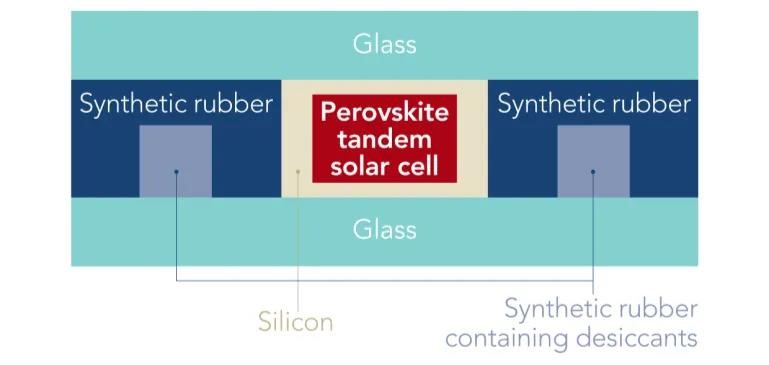
- A consortium including Toshiba, Shin-Etsu Chemical and Niigata University developed a perovskite solar cell with 1.5 times the durability of conventional cells.
- Toshiba developed the cell, Shin-Etsu Chemical developed the protective casing, and Niigata University contributed to improving cell durability.
- The cell generated electricity for 3,000 hours under harsh test conditions of 85°C and 85% humidity.
- The group aims to commercialize a tandem solar cell combining perovskite and silicon layers, with a target durability of at least 20 years.
- CONTEXT: Toshiba’s NEDO-backed tandem PSC project aims to achieve module conversion efficiency of at least 30% and durability of at least 20 years by FY2029. Toshiba has said tandem PSCs could eventually be used to raise output at existing solar power sites and support replacement demand after FIT contracts expire.
- TAKEAWAY: This is a breakthrough for Japan’s PSC industry. First, the durability of conventional PSCs is closer to 15 years. Durability is becoming one of the main battlegrounds for PSC commercialization. High efficiency matters, but utilities and corporate buyers also need confidence that next-gen cells can survive heat, humidity and long operating periods. Second, this shows the ability of Japanese manufacturers to compete with Chinese peers that can achieve only 2,000 hours of power generation under similar conditions. Japan is trying to compete in PSCs through materials, encapsulation and reliability engineering – areas where domestic makers may have more room to differentiate than in conventional silicon panels, where Chinese scale is already overwhelming.
- SIDE DEVELOPMENT:
- Sekisui demos film-type PSCs with waterproofing
- (Company statement, September 7)
- Sekisui Chemical began a demo of film-type PSCs that will run until spring.
- The cells were installed on the roof of a building in an area exposed to strong winds and salt damage.
- The demo will assess the durability and power-generation performance of PSCs installed together with waterproofing materials.
- TAKEAWAY: The demo is useful because film-type PSCs are often discussed as a way to use roofs and building surfaces that are difficult for conventional silicon panels. Testing them with waterproofing materials in a windy, salt-prone environment should provide more practical data on whether the technology can be integrated into real buildings, rather than treated only as a standalone solar product.
Idemitsu starts U.S. R&D for space-use solar cells
(Company statement, September 8)
- Idemitsu Kosan opened an R&D center at the University of California to develop CIGS solar cells for space applications.
- CIGS cells use semiconductors made from copper, indium, gallium, and selenium. Their broad light absorption range and radiation resistance make them suitable for space applications.
- R&D will be conducted with companies in the U.S. space industry, with results shared with Idemitsu’s R&D centers in Japan.
- Idemitsu aims to establish a bench-scale pilot plant in Japan in 2027.
- CONTEXT: Although Idemitsu is best known as an oil refiner, it inherited solar-cell expertise through its 2019 merger with Showa Shell, including Solar Frontier’s CIGS technology. Showa Shell began solar R&D in 1978, began full-scale CIGS development in 1993 and commercialized the tech in 2005. Idemitsu says cumulative CIGS shipments reached 6 GW in 2020, though commercial production for terrestrial solar ended in 2022.
- TAKEAWAY: The project follows Idemitsu’s selection for JAXA’s Space Strategy Fund earlier this year. Idemitsu plans to use the subsidy to develop lightweight, high-efficiency CIGS cells for space, build and start up a bench plant at its Next Generation Technology Research Institute in Chiba in 2027, and demonstrate continuous production. This seems to be the impetus behind the oil refiner’s push into solar cells as it leans on the know-how of the old Showa Shell / Solar Frontier team. The concern is that this latest push into solar is driven less by business strategy and more by government goals to create next-generation solar tech in Japan. Once JAXA funding ends, will Idemitsu remain committed to the sector?
NTT Smile Energy launches low-voltage solar management tool
(Company statement, September 1)
- NTT Smile Energy launched a new option in its B2B service Eco-Glasses for Self-Consumption to manage low-voltage bulk electricity supply for residential solar power.
- The service is aimed at low-rise apartment buildings of three floors or less, and is designed to support applications for GX ZEH-M certification.
- GX ZEH-M refers to apartment housing designed to achieve net-zero annual primary energy consumption through insulation, high-efficiency equipment and renewable energy, mainly solar.
- The service automates data collection by linking smart meters to the cloud, eliminating on-site meter readings and enabling 30-minute electricity consumption calculations.
- It also automates service suspension and restart when residents move in or out.
- The tool includes remote monitoring and alerts for on-site solar PV systems, making operation easier for property owners.
TESS Engineering integrates NaaS to boost solar cybersecurity
(Company statement, September 7)
- TESS Engineering is collaborating with NTT Docomo Business to integrate the docomo business SIGN Network as a Service solution.
- TESS will install SIMs in IoT routers used to remotely control solar farms and process operational data.
- The NaaS solution is designed to strengthen device security by detecting cyber threats and cutting off communications if an attack is detected.
- TAKEAWAY: The collaboration reflects the cybersecurity risk around distributed energy assets. Solar farms often rely on remote monitoring and control, which creates more points of exposure through IoT devices and communications networks.
Upsolar launches snow-resistant solar module lineup
(Company statement, September 9)
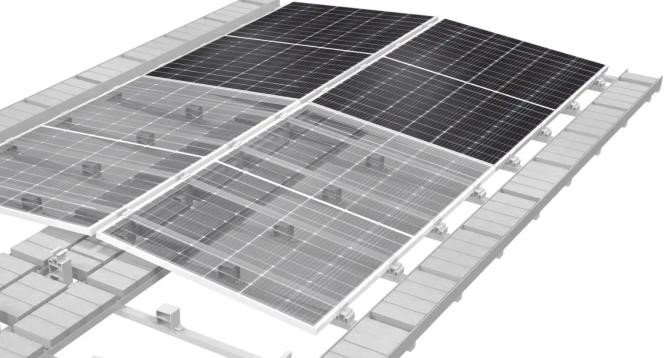
- Upsolar launched a snow-resistant design for its UP-Base NEO solar PV lineup.
- UP-Base NEO was first launched in 2021, and the company says it has sold the equivalent of 10 MW of installed capacity to date.
- The system uses a lightweight, anchorless mounting structure designed for flat roofs in heavy snowfall areas.
- CONTEXT: Heavy snowfall has caused PV-related accidents in Japan, with more than 50 cases reported between 2020 and 2024. Upsolar said its slightly sloped, snow-resistant design is intended to address these risks.
NEWS: WIND POWER AND OTHER RENEWABLES

SHI and Albatross to cooperate on floating offshore wind turbines
(Company statement, September 9)
- Sumitomo Heavy Industries (SHI) agreed to form an alliance with Albatross Technology to develop floating offshore wind turbine technology.
- The companies will work on establishing a domestic supply chain covering design, manufacturing, installation and maintenance.
- They also plan to develop mass-production systems and cost-reduction strategies for the technology.
- The partners will move toward a demonstration of a 2 MW-class floating-axis wind turbine, based on a smaller-scale device previously tested off Iki City, Nagasaki Pref.
- CONTEXT: Japan sees floating offshore wind as a key technology because many potential offshore wind sites are in deeper waters where fixed-bottom turbines are harder to deploy. The government’s national offshore wind target calls for 30–45 GW of project formation by 2040, with floating wind expected to play an important role.
- TAKEAWAY: This is another example of Japanese manufacturers trying to build domestic capabilities around floating offshore wind, rather than relying only on imported turbine and foundation technology. Albatross’s floating-axis design is still at an early stage, but the planned 2 MW-class demo would move it closer to commercial-scale validation. The key test will be whether it can offer a credible cost advantage, since Japan’s floating wind opportunity is large but will remain difficult to finance at current estimated levels.
GeoDreams raises funds to advance closed-loop geothermal energy
(Company statement, September 8)
- GeoDreams raised funds in a pre-Series A round through a third-party allotment of shares, with SBI Group as the subscriber.
- The funds will be used for R&D to advance closed-loop geothermal technology.
- Closed-loop geothermal generation circulates water through sealed underground pipes to extract subsurface heat, rather than relying on natural hot water reservoirs.
- GeoDreams aims to conduct its first demonstration in 2030 and launch a small-scale pilot plant the following year.
- CONTEXT: The government aims to reach 7.7 GW of installed geothermal capacity by 2050 and is promoting R&D programs. NEDO will provide up to ¥110 billion in R&D support, with 2026–2030 set as the priority period.
- SIDE DEVELOPMENT:
- Taisei studies next-gen supercritical geothermal tech
- (Company statement, September 8)
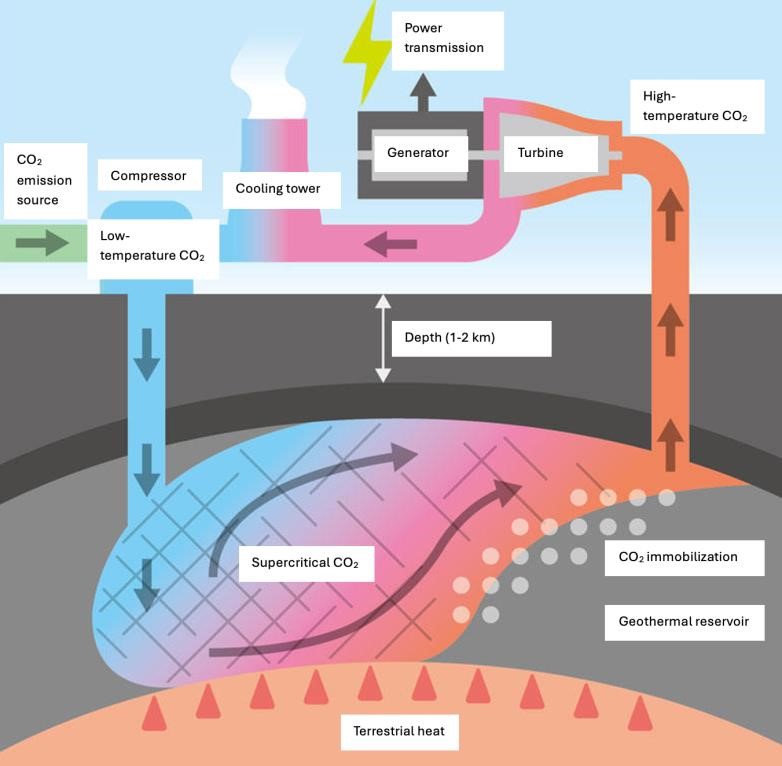
- Taisei launched a feasibility study on next-generation geothermal power technology that uses recycled CO2 instead of hot water.
- The technology involves injecting CO2 into heated underground geological formations and circulating it as a heat-transfer medium to generate electricity.
- Some of the CO2 is expected to mineralize as carbonate minerals in underground reservoirs, contributing to both power generation and carbon storage.
- The study will assess technical challenges and costs, and set a roadmap for commercialization.
- TAKEAWAY: These projects point to the same problem in Japan’s geothermal sector: conventional development depends on sites with sufficient heat, hot water, and suitable underground fractures – but these sites are often in areas with environmental or local consent constraints. Closed-loop systems and CO2-based geothermal aim to separate heat extraction from the need for naturally abundant hot water. If they work, they could expand the range of usable geothermal sites, including high-temperature areas that are currently difficult to develop. The risk is that both technologies remain technically demanding and expensive, so the near-term impact is likely to be R&D progress rather than new commercial capacity.
Mammoet Japan and Tokyo Juki to expand crane technology for energy sector
(Company statement, September 9)
- Mammoet Japan and crane supplier Tokyo Juki signed an MoU to expand ultra-heavy lifting capability in Japan.
- The collaboration will focus on energy-sector applications, including offshore wind and nuclear.
- Mammoet’s ring cranes can lift 1,600–6,000 tons while requiring a smaller site footprint than many conventional heavy-lift options.
- The companies said the technology could support pre-assembly and loading of offshore wind components, as well as other large industrial equipment
NEWS: NUCLEAR ENERGY

Chubu Electric to withdraw Hamaoka restart review applications
(Nikkei, September 11)
- Chubu Electric decided to withdraw its restart review applications for Hamaoka NPP Units 3 and 4. The decision follows governance failures related to falsified seismic-motion data and other irregularities at the plant.
- CONTEXT: The withdrawal is highly unusual because it is being driven by procedural misconduct rather than a technical rejection by the NRA.
- Chubu Electric announced in January that seismic-motion data needed for the restart review of Units 3 and 4 were improperly altered.
- The utility set up an external investigation committee to examine the facts, causes, and recurrence prevention measures.
- Restart reviews for Hamaoka Units 3 and 4 were filed more than 10 years ago, but the review process has been suspended since Dec 2025.
- CONTEXT: Chubu Electric’s governance problems have widened. In August, the company disclosed improper procedures during decommissioning work at Hamaoka Units 1 and 2. On Sept 10, it also said it had overcharged at least 5 million households and other customers for electricity since April 2024 due to an overlooked error.
- TAKEAWAY: The withdrawal would push any restart of Hamaoka Units 3 and 4 much further into the future – most likely to the 2030s. The core issue now isn’t seismic safety or restart approval, but public trust. The fact that the seismic-data misconduct reportedly continued internally even after the NRA began investigating in 2025 makes the problem much more serious. Chubu Electric will need to explain not only how the data was altered, but also why misconduct persisted for so long inside its nuclear division. It would not be a surprise if a number of top executives at Chubu Electric were to retire, similar to the response at Kansai Electric when a massive scandal surfaced in 2019 against its nuclear division.
KEPCO to complete geological survey for Mihama NPP replacement in 2030
(Company statement, September 9)
- KEPCO said its ongoing geological survey for a possible new reactor at Mihama NPP is now expected to be completed in 2030.
- The initial preliminary survey stage will now end in March 2028, one year later than previously planned.
- Since starting the survey in Nov 2025, KEPCO has confirmed bedrock capable of supporting a reactor in both the northern and southern areas of the site.
- The company said no active faults have been detected so far.
- After the preliminary phase, KEPCO plans to move to a detailed survey phase involving tunnel excavation.
- CONTEXT: Mihama NPP has three PWRs. Units 1 and 2 began operating in the 1970s and were permanently retired in 2015. Unit 3 began commercial operation in 1976 and remains active. KEPCO is studying the possibility of building a replacement reactor at the site.
- TAKEAWAY: The new timeline makes it very clear that Japan’s first replacement-reactor planning is still at an early stage. KEPCO wants to build a stronger geological and seismic evidence base before any formal reactor development advances, especially considering the difficulty of nuclear safety reviews in Japan. Even if the site survey remains positive, the path to construction is still uncertain. KEPCO would need to clear the NRA safety review, secure long-term financing, justify a new reactor’s economics, and maintain local support in Fukui.
NRA completes safety review for Shimane NPP Unit 3
(Chugoku Shimbun, Japan NRG, September 10)
- The NRA completed its safety review for Chugoku Electric’s Shimane NPP Unit 3.
- Chugoku Electric will next submit a corrected application reflecting the regulator’s review.
- The utility aims to begin commercial operations by FY2030.
- CONTEXT: Shimane Unit 3 is a newly built 1.37 GW reactor. The government has updated local evacuation plans for disaster scenarios and sheltering rules, but local consent from Shimane Pref and surrounding municipalities is still required before startup. Chugoku Electric has said operation of Unit 3 could improve ordinary profit by about ¥30 billion.
- TAKEAWAY: If commissioned, Shimane Unit 3 would be Japan’s first new reactor to enter commercial operation since the Fukushima disaster, and the first new reactor online since Tomari Unit 3 in 2009. For Chugoku Electric, the unit is strategically important because only Shimane Unit 2 is currently operating, leaving the utility heavily exposed to coal and LNG costs. Unit 3 would add large baseload capacity, reduce fuel-price exposure, and support the company’s medium-term earnings targets. But the remaining hurdles are not only technical: Chugoku Electric still needs corrected NRA documentation and local consent, as well as a credible safety and evacuation framework before commercial operation can begin.
JNFL delays revised Rokkasho construction plan submission
(Nikkei, September 7)
- JNFL postponed submission of its revised construction plan for the Rokkasho nuclear fuel reprocessing plant.
- The company now aims to submit the plan in November or later, compared with the previous target of late September to early October.
- JNFL said it needs until at least late October to prepare supplementary explanatory materials.
- The company still needs to complete work on about half of the 40 required safety items, including critical areas such as seismic design.
- CONTEXT: The Rokkasho reprocessing plant has already faced 27 official delays. The latest delay stems from additional safety and regulatory work, including measures to address radioactive liquid waste that accumulated during active testing. The NRA has required JNFL to treat and solidify the waste before full plant completion, which requires a revised construction plan.
- TAKEAWAY: The delay makes JNFL’s goal of completing Rokkasho in FY2026 nigh impossible. Completion depends on NRA approval of the revised construction plan, but JNFL is still preparing key supplementary materials and has not finished work on several safety items. METI already signaled in July that the schedule could slip because of newly added processes for nuclear solutions and liquid waste. JNFL’s latest delay confirms that those regulatory and technical issues remain unresolved.
- SIDE DEVELOPMENT:
- Hitachiomiya council divided over nuclear waste survey
- (Nikkei, September 9)
- Hitachiomiya City Council in Ibaraki Pref discussed the government’s request for a literature survey for a possible high-level radioactive waste disposal site.
- All 16 city councilors attended the session, but no official vote was held.
- Councilors remain divided between support, opposition and undecided positions.
- Opposition surfaced during the regular council session on Sept 8, with one councilor arguing that accepting the survey would cast a shadow over city policies.
- Councilors will gather input from residents before reconvening on Sept 16.
- The mayor plans to make a final decision on whether to accept the government’s request before the council session closes on Sept 18.
TEPCO to use robot arm to inspect Fukushima fuel debris
(Asia Nikkei, September 11)
- TEPCO is preparing to use a large robot arm to inspect and remove fuel debris from one of the Fukushima Daiichi reactors.
- The 4.6-ton, 22-meter arm will be used for a six-month study.
- The goal is to determine conditions inside the reactor containment vessel, where radiation levels remain too high for human entry.
- The arm will remove obstacles with high-pressure water jets to create access routes deeper into the reactor.
- CONTEXT: Deployment has been delayed several times since the original 2021 schedule due to technical problems. The robot arm was developed by IRID, MHI, and Veolia Nuclear Solutions. METI has provided ¥7.8 billion for the project.
Japan cooperates with UN on solar plant at Chernobyl
(United Nations, September 9)
- A new 2 MW solar plant was installed at the Chernobyl NPP site to supply clean electricity and support management of the plant’s nuclear legacy.
- The project was implemented by the United Nations Development Programme, with $825,000 in funding from Japan.
- The project builds on Lithuania’s 2024 donation of more than 7,000 PV modules.
- Japan’s Ambassador to Ukraine Osumi Masashi said the project reflects the evolution of cooperation “from addressing the consequences of Chernobyl, through sharing the lessons of Fukushima.”
- TAKEAWAY: The project is small in power-sector terms, but symbolically important. Japan is linking its Fukushima experience with international nuclear-safety and recovery work at Chernobyl, while also supporting Ukraine’s energy resilience. The use of solar power at a former nuclear disaster site gives the project added diplomatic and public-relations significance.
NEWS: TRADITIONAL FUELS

Australian ambassador reaffirms close energy cooperation with Japan
(Japan NRG, September 10)
- Andrew Shearer, Australia’s ambassador to Japan, said Australia seeks to expand energy-sector cooperation with Japan, while noting China’s increasing economic coercion in the Asia-Pacific region.
- Speaking at the Japan National Press Club in Tokyo, Shearer reaffirmed Australia’s goal of remaining Japan’s largest LNG supplier.
- “Australia has never failed to deliver LNG shipments to Japan, notwithstanding financial crises, pandemics and periods of global instability,” Shearer said. “Our economies remain highly complementary. Australia brings resources, Japan brings technology, innovation, capital and manufacturing expertise. That powerful combination can help shape the energy systems of the future.”
- CONTEXT: Japan imports almost all of its natural gas, around 65 Mtpa, and Australia is its largest supplier, accounting for about 36% of total imports. Malaysia is second with about 14%. Qatar, which normally accounts for about 5%, has stopped supplying Japan since the start of the U.S.-Iran war. • TAKEAWAY: Shearer’s comments were partly a reassurance message to Tokyo. Australia remains Japan’s most important LNG supplier, but Japanese buyers have become more sensitive to Canberra’s domestic gas policy after Australia considered requiring LNG exporters to reserve 20% of output for the local market. The revised rule is more flexible, requiring exporters to reserve up to 20% “as determined by the energy regulator,” but it still reminds Japan that even trusted suppliers face domestic energy-security pressures of their own. For Tokyo, Australia remains the least politically difficult LNG partner among major suppliers, but reliability now depends not only on diplomatic alignment, but also on how Canberra balances exports with east-coast gas shortages.
METI inks LNG deals with Petronas and Montenegro
(Japan NRG, September 11)
- METI Minister Akazawa announced new LNG-related partnerships at the LNG Producer-Consumer Conference 2026 in Tokyo.
- JOGMEC and Petronas established a framework to support LNG supply to Japan during emergencies.
- METI also signed an MoC with Montenegro’s Ministry of Energy to support its planned LNG deployment and broader energy infrastructure such as receiving terminals, thermal power generation and grid interconnection.
- TAKEAWAY: The Petronas agreement fits Japan’s effort to build more emergency flexibility into LNG procurement, especially after recent disruptions exposed the limits of relying on normal commercial flows. The Montenegro MoC is different: it is less about immediate Japanese supply security and more about exporting Japan’s LNG and power-infrastructure expertise to emerging import markets.
ENEOS expands stake in Papua New Guinea LNG
(Denki Shimbun, Company statements, September 8)
- ENEOS Xplora will acquire an additional interest in the Papua LNG project in Papua New Guinea.
- The stake will rise from 2.58% to 3.07%, according to media reports.
- TotalEnergies said it will sell part of its stake to existing Papua LNG partners while transferring operatorship to ExxonMobil.
- After TotalEnergies’ farm-down and Papua New Guinea’s state back-in, TotalEnergies said the project partners will be ExxonMobil 34.1%, Santos 21.0%, ENEOS Xplora 2.4%, and Kumul Petroleum / MRDC 22.5%, with TotalEnergies retaining 20%.
- The differences in the stake percentages appear to reflect different post-transaction / post-stateback-in bases.
- CONTEXT: Papua LNG is designed to produce about 5.6 Mtpa of LNG and is targeting FID in Q4 2026. The project website says EPC tendering was completed this month and project optimization reduced estimated capex to about $14 billion.
LNG stocks up from previous week, up YoY
(Government data, September 9)
- As of Sept 6, the LNG stocks of 10 power utilities were 2.43 Mt; up 2.5% from the previous week (2.37 Mt); up 47.3% from end Sept 2025 (1.65 Mt), and up 18.5% from the 5-year average of 2.05 Mt.
NEWS: CARBON CAPTURE & SYNTHETIC FUELS

Erevista, Sumitomo Forestry partner on J-credits
(Denki Shimbun, September 7)
- Erevista will partner with Sumitomo Forestry and NTT Docomo Business to streamline credit creation and expand sales.
- The three companies will support wider market adoption of forest-derived J-Credits.
- CONTEXT: Erevista operates OFFSEL, a carbon-credit procurement and purchasing platform, and also supports credit creation. Sumitomo Forestry and NTT Docomo Business jointly operate Morikachi, a platform for creating and trading forest-derived J-Credits.
Sanyo Chemical’s innovation boosts biofuel performance
(Company statement, August 31)
- Sanyo Chemical developed Neoprover HBF-151, a cold-flow improver for HVO that enables stable use of the fuel at low temperatures.
- HVO contains a high proportion of straight-chain paraffin components derived from feedstock, which can cause wax crystals to form and reduce fluidity.
- Reduced low-temperature fluidity can clog filters and pumps, making cold-flow performance important for practical fuel use.
- Sanyo Chemical said the product improves low-temperature properties while limiting excessive increases in viscosity.
- The company said the product enables HVO to remain fluid down to minus 25°C.
- CONTEXT: Another way to improve low-temperature fluidity is catalytic hydroisomerization, which converts linear paraffins into branched paraffins that are less prone to crystallization. Nippon Ketjen developed a biorefining catalyst for this purpose in 2024, called ReNewFine.
- TAKEAWAY: The product addresses a practical barrier to wider HVO use rather than the core question of feedstock availability. Renewable diesel-type fuels can work in existing engines and distribution systems, but cold-weather performance matters if they are to be used reliably across regions and seasons. Additives such as Sanyo Chemical’s cold-flow improver offer one route to improving operability, while refinery-side solutions such as hydroisomerization address the same problem during production. The issue is also relevant beyond road fuels, because low-temperature fluidity affects biofuel handling, storage and use across applications including diesel substitutes and potentially SAF-related supply chains.
Nippon Steel unit and Kitakyushu agree on decarbonization cooperation
(Company statement, September 7)
- Nippon Steel Engineering and Kitakyushu City agreed to cooperate on decarbonization and advanced local energy use.
- The partners will promote the use of hydrogen and ammonia.
- They will also work on optimizing local energy supply and demand through energy management systems.
- The agreement also covers more effective use of waste-based power generation and renewable energy.
ANALYSIS
BY AGLAÉ BANGE
Aggregation in Japan: Balancing Growth, Competition and Price Declines
The expansion of renewable energy throughout the 2010s stimulated growth in aggregation, a process that enables power generation assets to participate in electricity markets.
After 2020, aggregation in Japan faced a critical turning point with the large-scale deployment of BESS assets and proliferation of power exchange platforms, significantly improving the profitability of pooling assets when trading.
One major consequence is the growing number of players and increased competition, particularly in AI-based optimization software, which is especially critical since a BESS station can participate in several different markets on the same day.
While the aggregation and BESS markets are far from saturated, bid and clearing prices are expected to drop by 2030, a trend that is already becoming increasingly apparent.
In this context, how will the continued development of BESS projects impact aggregator revenue and market structure?
What is aggregation?
In the mid-2010s, aggregators emerged from a need to “bundle” small-scale distributed generation, demand, and battery resources. This allowed resources that could not easily participate in electricity markets on their own to be utilized as a single, larger power resource.
In Japan, aggregators gained attention as businesses that manage demand response (DR). Electricity system reforms and new market frameworks created mechanisms allowing for the utilization of DR and distributed energy resources in the balancing, capacity, and wholesale electricity markets. All these processes gave rise to aggregators in their current form.
Today, aggregation involves managing electricity production, supply, and trading to optimize the use of energy assets (solar, BESS, or wind power). Aggregators maintain a portfolio of assets, with 1 MW the minimum capacity required to access the market.
They can act as one of these or both:
- Resource aggregator (RA), responsible for software infrastructure and control of energy assets, such as BESS facilities;
- Aggregator coordinator (AC), whose role is focused on electricity trading.
According to ANRE, as many as 172 aggregators are expected to operate in Japan’s market by 2029, a number bound to rise as more companies obtain licenses.
Revenue generation models
Revenue generation depends on common parameters considered by all aggregators: the time of day or night, expected peak hours, the different ancillary services, TSO regions, and seasons. Energy developers and pricing forecasters say that an aggregator will accept or refuse to aggregate an asset depending on two major factors: its willingness to accept risk, and the station voltage.
For example, this assessment of risk can be seen in the revenue share derived from JEPX arbitrage. As electricity cannot be stored on a large scale without dedicated infrastructure, prices can fluctuate significantly, collapsing during periods of oversupply and surging when electricity is scarce.
BESS facilities participating in the spot market discharge electricity during times of scarcity, thereby maximizing spreads. According to industry insiders, arbitrage accounts on average for roughly 20% of aggregators’ revenue, while the most profitable market remains balancing.
Risk considerations also influence aggregators’ preferences regarding the voltage level of assets. Some developers that own a typical high-voltage (HV) BESS unit (2 MW / 8 MWh) say they face difficulties in securing aggregators, which tend to prefer extra-highvoltage (EHV) facilities. Indeed, larger EHV assets can generate higher revenues while limiting the operational and commercial risks associated with managing a larger number of smaller assets.
This trend is expected to strengthen as the Japanese BESS market shifts from being dominated by HV projects towards an EHV-dominated market.
Major market players
At present, a relatively small group of players have established prominent positions. Shizen Connect, for example, has been ranked No. 1 in Japan’s DR/VPP platform market in terms of the number of corporate customers, with an estimated share of around 25%; other major participants include Kansai Electric’s E-Flow, Toshiba ESS and NTT Anode Energy.
Recent contracts illustrate the growing number of assets covered and the resulting expansion in portfolio sizes. Earlier this year, Shizen Connect, for example, was chosen to operate two stations being developed by Hulic Energy Solutions in Saga and Hyogo prefectures, while Tokyo Gas agreed to operate five assets owned by Life One, a housing equipment and renovation company.
Foreign aggregators are also entering Japan’s market, as seen by Ireland-based GridBeyond, which began operating three assets in Gunma Prefecture last year.
As for larger projects, as early as 2024, E-Flow secured an aggregation contract for a 48 MW station in Wakayama Prefecture, and will continue on this path with other largescale deals ahead, including a 99 MW station in Osaka Prefecture. Toshiba also secured aggregation of two batteries totaling about 84 MW being developed in Nagano. Other deals of a similar size are in discussion among all these aggregators.
Internal aggregation: a new source of competition
A noticeable trend among market players is the growing number of assets that developers choose to manage by themselves, including large-scale facilities.
This is the case with the 50 MW Helios project in Hokkaido, where aggregation is handled by the developers’ subsidiary, a venture between Manoa Energy and HD Renewable Energy).
Similarly, some companies relying on external aggregators are possibly considering ending their contracts and bringing aggregation in-house to avoid any additional costs. A number of developers say they are weighing the benefit of creating and then selling licenses for their own software, which will add additional competition challenges.
| Announced / operational | BESS owner / developer | Aggregator / platform | Project / size | Notes |
| 2023–24 | Tokyu Land | Shizen Connect | TENOHA Higashimatsuyama; 1.8 MW / 4.9 MWh | One of the earliest commercial cases. Shizen Connect controls the battery across the wholesale, balancing and capacity markets. |
| 2024 | ORIX, Kansai Electric | E-Flow (Kansai Electric) | Kinokawa 48 MW / 113 MWh | External aggregation contract with Kansai Electric’s specialist aggregation subsidiary. |
| 2025 | Port | GridBeyond | 3 sites × 2 MW / 8 MWh | First Japan grid-scale battery trading project series for GridBeyond as overseas optimization specialists enter the market. |
| 2025–26 | Life One | Tokyo Gas | 5 sites × 2 MW / 8 MWh | Tokyo Gas’s first disclosed HV BESS aggregation mandate. Importantly, the agreement also makes Tokyo Gas the preferred negotiating partner for Life One’s future projects. |
2026 | Hulic Energy Solutions | Shizen Connect | 2 sites × 1.999 MW / 8.224 MWh | Shizen Connect handles forecasting, charge/discharge scheduling, remote control, wholesale, balancing and capacity-market participation. |
| 2026 | OPTIRON Hokushin / SMFL Mirai Partners & Fujimaki Construction | Toshiba | Kijimadaira ~52 MW + Hachisu ~32 MW; total ~84 MW | Toshiba handles aggregation while Toshiba Plant Systems does EPC and O&M, showing the emergence of vertically integrated offerings around larger batteries. |
| 2028 | Kansai Electric, Kinden, JEXI | E-Flow | Tannowa; 99 MW / 396 MWh | External aggregation contract with Kansai Electric’s specialist aggregation subsidiary. |
Impact on prices: declines ahead
The expanding aggregation market has already had a noticeable impact on prices, particularly in the balancing market, where price declines have been observed, in part due to a shift in trading to day-ahead products from weekly contracts.
Further bearish movement is expected by several developers based on government signals that the balancing market should not trade at or near price caps on a regular basis. Since METI capped balancing prices at ¥15 per ΔkW/30 min starting March, this market has seen more instances of near-zero-yen bids in almost every region.
Minimum clearing prices appeared not only towards the end of the day and during the night, but even sometimes during regular workday hours. A change in bidding strategies by BESS operators and more LNG-fired power plants bidding in the market are among the reasons.
Lower balancing prices put downward pressure on fees charged by aggregators. This should not necessarily be interpreted as a negative signal, but rather as part of a maturation of Japan’s aggregation. Similar declines in bid and clearing prices have been observed in more mature power markets such as Texas, which has a much larger BESS capacity (16 GW in early 2026).
Texas ancillary service markets have become increasingly saturated, with very low average day-ahead clearing prices (around $1–4/ MWh, depending on the service). As a result, aggregators and battery owners are turning to maximizing spreads through energy arbitrage to generate higher revenues.
Japan remains far from the level of saturation in Texas, and is not expected to face similarly sharp price declines before the 2030s. At present, the market is fragmented with periods of saturation and undercapacity coexisting depending on the time of day and the TSO region.
Conclusion
Amid intensifying competition, resulting in a tangible impact on prices, aggregators need to adapt. Among the products explored by aggregators are electricity stored in EV batteries, namely the use of surplus solar power generated during the daytime to charge vehicles, or low-voltage BESS.
The latter became eligible to participate in the balancing market last spring, opening up additional revenue opportunities for assets easier to invest in, particularly for smaller aggregators.
Together with the evolution of electricity markets, this paves the way for a more diversified aggregation market. And while that market will remain centered on BESS, it should be able to develop new revenue streams that will enhance competition and support revenue growth.
ANALYSIS
BY JAPAN NRG TEAM
Fuel Shock Tests Japan’s Electricity Price Buffer, Again
The fuel cost adjustment system is supposed to act as a shock absorber between volatile international energy markets and Japanese electricity consumers. This system, however, seems to have reached its limits.
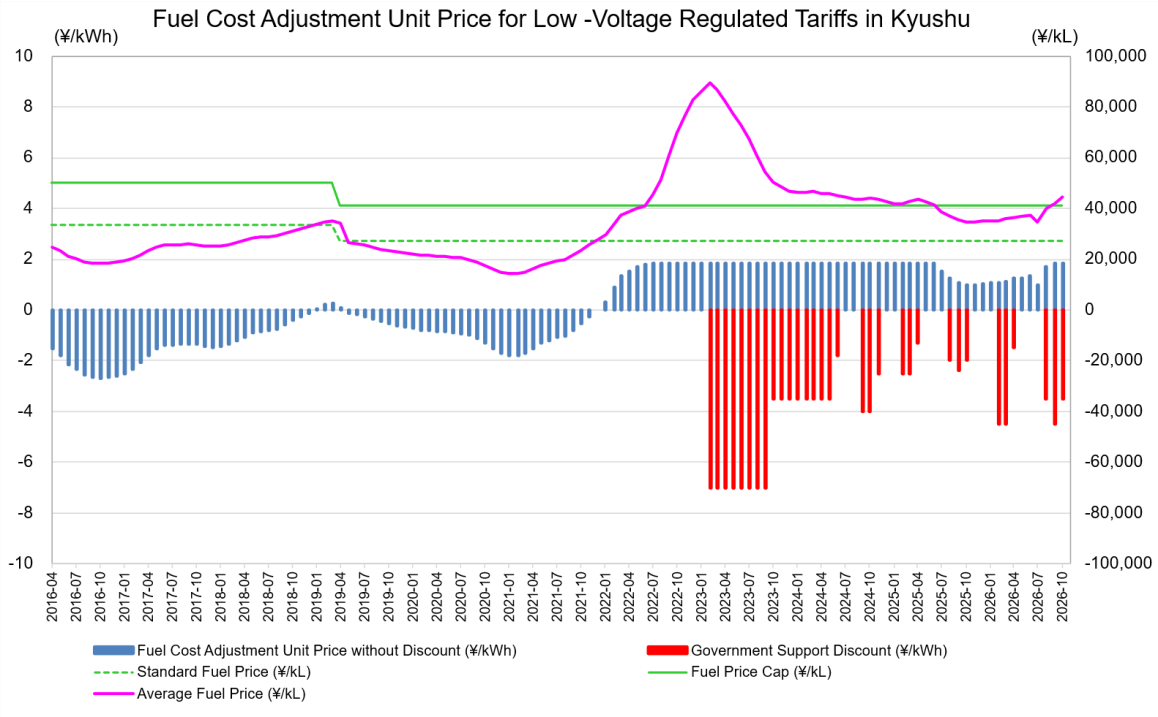
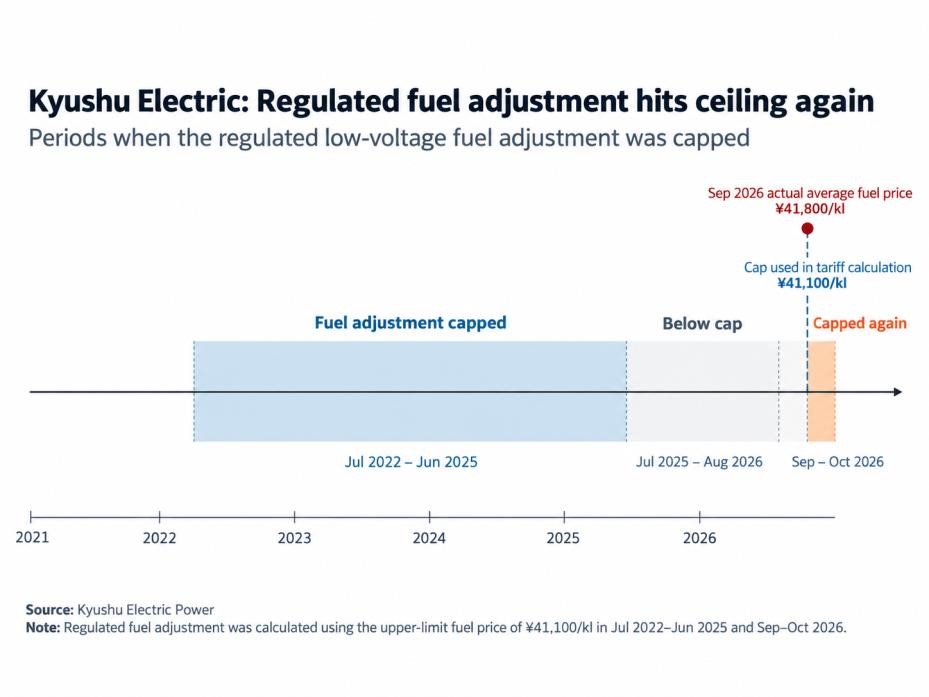
Kansai Electric is the clearest example. The average fuel price used for its regulated tariff calculation has remained above the ¥40,700/ kL upper limit since the March 2022 billing month – more than four years. Kyushu Electric also remained at its ceiling continuously between July 2022 and June 2025. And, after just over a year below the limit, it has now reached the cap again.
These are not isolated cases. Several EPCOs, the former regional power monopolies, have spent years unable to pass further fuel-price increases through regulated tariffs. And while the automatic adjustment mechanism plays an important consumerprotection function, it also pushes the risk onto the electricity supplier.
Obviously, this cuts into a utility’s profit margins. A system intended to smooth ordinary changes in commodity prices is now regularly asked to absorb extraordinary ones. Wars in Ukraine and around Iran have turned into a protracted crisis, with global fuel prices inching upward. And as margins get squeezed, so does the capital these companies need to invest heavily in generation, grids, storage and other infrastructure.
The fuel adjustment framework was created for an industry in which utilities could recover costs over long periods and financing conditions were forgiving. Today, EPCOs operate in liberalized markets, are attuned to shareholder scrutiny of their returns, and need to borrow in a rising interest rate environment. At the same time, geopolitical disruptions appear to be occurring with greater frequency and lasting longer.
While the government has yet to update policy to reflect the changing realities, the EPCOs are taking matters into their own hands. The adjustment mechanism is getting adjusted.
Shock absorber with limits
The fuel cost adjustment system automatically changes electricity tariffs according to movements in imported crude oil, LNG and coal prices. The calculation also captures exchange-rate movements because the fuels are largely imported.
For Kyushu Electric’s regulated tariffs, the benchmark average fuel price is ¥27,400/ kl. Positive adjustments are allowed as fuel prices rise, but the fuel price used in the calculation cannot exceed ¥41,100/ kl, or 1.5 times the benchmark.
That arrangement serves an important purpose. Utilities do not need to seek approval for a basic tariff revision every time LNG or coal prices change, while consumers are protected from the full impact of an extreme fuel-price shock.
The experience of the 2022–2023 energy crisis – precipitated by G7 sanctions on Russian energy following the Ukraine invasion – showed the other side of the arrangement. All ten EPCOs eventually reached their regulated fuel adjustment ceilings as energy prices and the yen moved sharply against them. Seven subsequently raised their tariffs in June 2023.
The cap can delay a price increase, but it cannot indefinitely reconcile selling electricity below the cost assumptions embedded in the tariff.
Kyushu’s return to the ceiling in 2026 matters beyond the relatively small difference between its calculated ¥41,800/ kl fuel price and the ¥41,100/ kl cap. It is an early indication that the mechanism designed to absorb ordinary commodity fluctuations no longer fits the market conditions.
Time has a price
The ceiling is only one source of risk. Even where utilities can eventually pass higher fuel costs through, they do so with a delay.
Traditionally, Kyushu Electric has calculated its fuel adjustment from a three-month average of fuel prices three to five months before the tariff is applied. This smoothes short-term volatility for customers, but means the company may be buying fuel at today’s price while recovering costs based on considerably older prices.
That timing difference can generate significant gains when fuel costs fall and significant losses when they rise.
The financials of Kyushu Electric serve as a good illustration. The company forecasts FY2026 ordinary profit of around ¥180 billion, down from ¥207 billion in FY2025, while net income is projected to fall to around ¥130 billion from ¥154.5 billion. One of the reasons is the fuel cost adjustment time lag, which is expected to switch from a positive contribution in the previous year to a negative one this year.
In other words, the fuel risk can be carried for months and years, putting downward pressure on earnings and company equity value, crimping its ability to fundraise with the latter.
Kyushu shortens the lag
Some of the EPCOs are no longer willing to endure. Kyushu Electric announced that from November it will revise its fuel adjustment formula for all high-voltage and extra-high-voltage customers. Instead of using the three-month average fuel price from three to five months earlier, it will use the fuel price from a single month three months earlier. Customers below 500 kW will move onto the new system starting in December.
Chubu Electric Power Miraiz and TEPCO Energy Partners enacted similar changes in the late spring of this year.
For customers, this removes some of the smoothing price mechanism. Corporate electricity bills will respond faster when fuel prices fall, but also rise faster when they increase.
In effect, the power utilities are shifting the fuel price risk to their customers – particularly businesses. Some Kyushu corporate tariffs include a separate market price adjustment linked to wholesale electricity prices, allowing movements in JEPX to enter the bill more directly.
Greater exposure to global fuel prices for a large swathe of the Japanese economy is likely to provoke a changing attitude toward energy procurement, even at traditional manufacturing firms.
For households, another layer of protection currently sits above the fuel adjustment mechanism: state subsidies.
The government’s support reduces Kyushu Electric’s low-voltage tariffs by ¥3.50/ kWh in August and October and ¥4.50/ kWh in September. For a model household consuming 250 kWh, the September measure cuts the monthly bill by ¥1,125. High-voltage customers receive smaller per-kWh discounts, while extra-high-voltage users are not covered.
Hedging risk before it reaches the tariff
There is another way for utilities to manage this problem: reduce their exposure before it reaches either earnings or the customer bill.
Japanese power firms have long used fuel procurement contracts and financial hedges to manage commodity exposure, but electricity forwards offer another way to lock in part of the future expenditure.
Japan’s electricity futures market is expanding rapidly from a slow start around 2020. The EEX and TOCOM exchanges have posted numerous records in terms of trading volumes this year as market participants sought to hedge against energy price inflation from the U.S.-Iran conflict.
The EEX, which commands an overwhelming market share in terms of power derivatives trading in Japan, said that its number of active participants reached 69 in August. This refers to those trading at least 100 GWh in a month. Among those trading are 14 domestic power and gas utilities. And while not all the EPCOs are involved as yet, exchange officials see almost all the major players showing interest in setting up risk-hedging operations to support their generation divisions.
METI too has been keen to promote further integration of physical and derivative power markets in Japan, judging this a vital tool for managing medium- to short-term electricity price risk.
The latest fuel shock shows why that effort matters. Utilities cannot guarantee that the regulator will approve future applications to increase regulated tariffs. Following the 2022 energy crisis, there were cases where METI did not accept utilities’ requested increases in full despite intense fuel-cost pressure. Utilities can, however, hedge at least part of that exposure before it reaches their balance sheets.
In that sense, derivatives function not only as a tool for managing market risk, but also as protection against regulatory risk.
What is true for EPCOs is increasingly true for large corporate buyers facing more volatile and extreme energy costs. It may be only a matter of time before more of them stop relying on tariff formulas to smooth that exposure and head directly to the markets to lock in energy prices themselves.
ASIA ENERGY REVIEW
BY JOHN VAROLI
A brief overview of the region’s main energy events from the past week
APAC / LNG
The Hormuz closure removed 80 Mtpa of LNG from the market, which is a fifth of global supply, said Wood Mackenzie. As 90% of LNG through Hormuz flows east, Asia-Pacific (APAC) has been greatly impacted by the U.S. war on Iran.
Australia / Natural gas
Australia revised a proposed rule requiring natural gas exporters to keep 20% of output for the local market. Instead, exporters will now need to reserve up to 20% “as determined by the energy regulator”. This rule aims to ensure an oversupply for the east coast gas market, which has faced shortages for ten years.
Australia / Solar
European Energy Australia completed module installation at its 131 MW solar farm in Victoria. The project will be followed by a 100 MW/ 200 MWh BESS.
China / Energy demand
In 2025, renewable power generation covered all growth in electricity demand, which rose 5% nationwide. Strong growth in wind and solar covered this increase.
China / EVs
China set a goal for 70% of new cars to be EVs or hybrids by 2030, as well as for 40% of new commercial vehicle sales to be electric by 2030.
China / Renewables
Azerbaijan and China Energy International will accelerate renewable energy, such as the company’s first investment in Azerbaijan, a 160 MW solar farm. They also discussed offshore wind in the Caspian Sea.
India / Natural gas
Rising prices for oil and LNG, as well as higher maritime shipping costs, have negatively impacted margins for India’s oil and gas sector. While higher refining profits are offsetting this, margins on petrol and diesel fuel sales remain negative.
New Zealand / Wind
Utility company Mercury completed the Kaiwera Downs wind farm on South Island. The $486 million project took two years to finish and added 36 turbines and 155 MW of capacity, bringing total capacity to 198 MW.
Philippines / Solar
Sembcorp Industries terminated a $105 million deal to acquire full ownership of Puente Al Sol in Cadiz city. The group cited poor market conditions and new priorities as reasons.
Southeast Asia / LNG
By 2035, the region’s data center pipeline could reach 9.4 GW, and will drive combined-cycle gas turbine development and LNG demand, says Wood Mackenzie. SE Asian LNG demand is expected to grow 16% annually through 2035 as data center power demand rises more than threefold to 57 TWh, up from 17 TWh this year.
Disclaimer
This communication has been prepared for information purposes only, is confidential and may be legally privileged. This is a subscription-only service and is directed at those who have expressly asked K.K. Yuri Group or one of its representatives to be added to the mailing list. This document may not be onwardly circulated or reproduced without prior written consent from Yuri Group, which retains all copyright to the content of this report.
Yuri Group is not registered as an investment advisor in any jurisdiction. Our research and all the content express our opinions, which are generally based on available public information, field studies and own analysis. Content is limited to general comment upon general political, economic and market issues, asset classes and types of investments. The report and all of its content does not constitute a recommendation or solicitation to buy, sell, subscribe for or underwrite any product or physical commodity, or a financial instrument.
The information contained in this report is obtained from sources believed to be reliable and in good faith. No representation or warranty is made that it is accurate or complete. Opinions and views expressed are subject to change without notice, as are prices and availability, which are indicative only. There is no obligation to notify recipients of any changes to this data or to do so in the future. No responsibility is accepted for the use of or reliance on the information provided. In no circumstances will Yuri Group be liable for any indirect or direct loss, or consequential loss or damages arising from the use of, any inability to use, or any inaccuracy in the information.
K.K. Yuri Group: Hulic Ochanomizu Bldg. 3F, 2-3-11, Surugadai, Kanda, Chiyoda-ku, Tokyo, Japan, 101-0062.