
WEEKLY
October 13, 2026
ANALYSIS
FEAR OF HARD CHOICES? HYDROGEN STRATEGY REMAINS BROAD AS RIVALS SPECIALIZE
- The global hydrogen industry must make choices. For years almost every production method, carrier and end-use attracted investment. But developers are now more selective about which technologies have a realistic path to commercial scale.
- Yet, Japan pursues almost all of them. Can Japan turn its wide portfolio into a real business – before competitors do?
PINK HYDROGEN QUESTION STARTS WITH WATER AND DEMAND
- Japan’s nuclear power restarts have brought pink hydrogen closer to a practical conversation.
- But a reactor and electrolyzer do not, by themselves, make a hydrogen strategy. The question is where such hydrogen would be used, what resources its production would consume, and whether the whole arrangement makes economic sense.
ASIA PACIFIC REVIEW
This column provides a brief overview of the region’s main energy events from the past week
NEWS
- JERA-backed Chiba AI data center highlights power-siting challenge
- Japan to tighten cybersecurity rules for grid-connected DERs
- JBIC triples loan ceiling for U.S. gas project that’s part of $550bn Japan-U.S. investment program
- EEX Japan power futures volumes double YoY
- Power demand falls to lowest Sept level since 2010
- ANRE proposes new LTDA revenue-refund option for LNG power plants
- Millennium hires ex-JERA trader for Japan expansion
- Hokkaido Electric to retire aging thermal capacity
- Cosmo, Iwatani approve ¥50 billion Chiba hydrogen project
- ENEOS opens MW-scale Direct MCH demo plant in Australia
- ANRE weighs higher connection fees, tighter rules for low-voltage BESS
- Sumitomo buys into India wind-solar-BESS project
- Vena Energy plans Niigata solar farm
- Toko Electrical to test PSCs and flexible silicon cells
WIND POWER AND OTHER RENEWABLES
- Sumitomo-backed IWS orders four more offshore wind CSOVs
- NTT Data, KHI and Itochu test biofuel at data center
- Japan and U.S. deepen tech deal; fusion a key focus
- TEPCO tests AI for nuclear regulatory applications
- Helical Fusion raises ¥3.23 billion in Series B
- ANRE sets future direction for Gas System Reform
- Japan to help strengthen Philippine oil reserves
- JAPEX receives first Persian Gulf LNG cargo since Hormuz blockade
CARBON CAPTURE & SYNTHETIC FUELS
- Toho Gas-led group launches regional CO2 recycling demo
- Miura, SMFL launch J-Credit-linked equipment leasing
EVENTS
Oct 13-15 Global Offshore Wind Summit – Japan 2026 @ Nagasaki
Oct 19-20 Japan CCUS Summit @Hamamatsucho Convention Hall
Oct 26 GGZ Finance Summit @ Tokyo Prince
Hotel
Nov 2-5 ADIPEC 2026 @ Abu Dhabi
Nov 3 U.S. Midterm Elections
Nov 9-20 COP31 @ Antalya, Türkiye
Nov 18-19 Asia-Pacific Economic Cooperation – Leaders Meeting @ Shenzhen, China
Nov 28 Taiwan Local Elections
Dec 1-3 DeCarbon Tokyo 2026 @ Tokyo Marriott Hotel
PUBLISHER
K. K. Yuri Group
Editorial Team
Yuriy Humber (Chief Editor)
John Varoli (Senior Editor, Americas)
Kyoko Fukuda (Data, Events)
Filippo Pedretti (Thermal, CCS, Nuclear)
Tetsuji Tomita (Power Market, Hydrogen)
Aglaé Bange (Renewables, Biomass & Energy Storage)
Gillian Sawyer (Renewables)
George Hoffman (Sales, Business Development)
Rada Kuznetsova (Clients Accounts, Website)
Tim Young (Design)
SUBSCRIPTIONS & ADVERTISING
Japan NRG offers individual, corporate and academic subscription plans. Basic details are our website or write to subscriptions@japan-nrg.com
For marketing, advertising, or collaboration opportunities, contact sales@japan-nrg.com. For all other inquiries, write to info@japan-nrg.com
NEWS: GENERAL OUTLOOK AND TRENDS

JERA-backed Chiba AI data center highlights power-siting challenge
(Company statement, Diamond, October 1-6)
- JERA, Dell Technologies and UK-based RHAELM agreed to develop a standardized model for large-scale AI infrastructure in Japan, with the first project planned at JERA’s Chiba thermal power station.
- The project will have up to 400 MW power capacity, with total investment to exceed ¥2.3 trillion, and operations starting 2028.
- It will use on-site power from JERA’s existing generation assets, allowing it to avoid delays associated with conventional grid connections.
- JERA and RHAELM are considering similar projects at other JERA power-station sites, aiming to support multi-GW AI infrastructure capacity in Japan in the 2030s.
- CONTEXT: Diamond cited industry participants saying data center operators are likely to prioritize power cost and reliability, not only access to decarbonized electricity, when selecting sites.
- TAKEAWAY: The project highlights an issue in Japan’s data center strategy. METI is trying to steer new loads toward areas with available land, grid capacity and decarbonized power, while commercial projects may still favor locations where large volumes of firm electricity can be secured quickly and competitively. JERA’s model gives thermal sites an advantage by combining land, generation and behind-the-meter supply. The longer-term decarbonization question will depend on how that power mix evolves, rather than on aggregation alone.
Govt to revise grid connection rules to require JC-STAR-1 for DERs
(Government statement, October 6)
- The govt will revise grid connection rules to require JC-STAR-1 certification for IP communication devices used in newly connected distributed energy resources (DERs), including solar PV and BESS.
- The rule takes effect in April 2027.
- The covered power sources, implementation date, and scope are:
- Solar PV & BESS: April 2027 for extra-high/high voltage; Oct 2027 for low voltage.
- Wind power: April 2027; Gateway firewalls only.
- Fuel cells (inverter type): April 2028 (transitional measures under study); IP-enabled devices and connected IoT devices
- Existing equipment may continue in use; newly added or replaced equipment must be certified. If replacement poses an undue burden, certification can be deferred.
- CONTEXT: As DERs expand, cybersecurity risks emerge. In February 2025, METI proposed requiring JCSTAR-certified products for grid connection to strengthen cybersecurity. OCCTO then proposed in December 2025 to require JC-STAR-1 (minimum required level of cybersecurity) for solar PV and batteries from 2027, expanding the scope to wind power and fuel cells.
- TAKEAWAY: The new rules adopt a system-wide approach, covering all IP-enabled components rather than gateways alone, recognizing that any network-connected device can serve as an entry point for cyberattacks. With cyberattacks increasingly affecting Japanese firms – with over 600 incidents recorded so far this year, according to Trend Micro – further cybersecurity measures may be needed to protect energy infrastructure.
JBIC triples loan ceiling for U.S. gas-fired power project that’s part of $550bn pledge
(Bank statement, October 9)
- JBIC increased the maximum loan amount for Japan Invest 3 LLC (JI3) to about $1.98 billion, from roughly $630 million previously. The amended loan is co-financed with private financial institutions, bringing total financing to about $5.92 billion. The private-bank portion is insured by NEXI.
- JI3 is a U.S. vehicle established with equity investment from JBIC, and the financing will support its second investment in a U.S. natural gas-fired power project.
- CONTEXT: The project is being financed under the Japan-U.S. Strategic Investment Initiative, the $550billion program that is based on the bilateral strategic investment memorandum announced in September 2025.
Informetis expands range of devices controlled by DR
(Company statement, October 1)
- AI firm Informetis expanded the range of devices eligible for its demand response (DR) platform, BridgeLAB DR, used by Chugoku Electric since last April.
- The service automatically controls energy devices via a cloud to shift electricity consumption to periods of surplus of renewable energy.
- The upgrade will control BESS, EVs and air-conditioning equipment.
- SIDE DEVELOPMENT:
- TEPCO adds new EcoCute models to DR service
- (Company statement, October 1)
- TEPCO added EcoCute heat pump water heaters made by Sekisui and Corona to the list of devices meant for its Eco-Energy Saving Challenge DR service.
- Remote control of the EcoCute units is managed by Energy Gateway, which is 60% owned by TEPCO and 40% by Informetis.
- CONTEXT: The service helps balance electricity supply and demand by shifting consumption to periods of high renewable energy generation.
NEWS: ELECTRICITY MARKETS

September volumes double on EEX Japan power futures exchange
(Exchange report, October 6)
- In Sept, EEX Japan power futures volume rose for a fourth consecutive month, reaching 18.4 TWh, up from 17.6 TWh in August, double the 9.1 TWh a year earlier.
- Trading remained elevated amid continued volatility in gas and power markets, including uncertainty linked to the Iran war.
- EEX said growing use of futures may be encouraging participants to hedge next-fiscal-year exposure earlier than the conventional November–February period.
- Weekly contracts set a monthly volume record for a second consecutive month, while the number of participants reached a record 33 firms in Sept.
- Kansai trading rose for a fourth straight month, recovering close to last winter’s levels. Chubu remained volatile due to the limited number of participants.
- EEX trading rose while JEPX spot-market volume declined with temperatures moderating. This lifted the EEX-to-JEPX spot volume ratio above 50%.
- EEX’s overall market share slipped from August as trading volumes also rose on competing exchanges.
- CONTEXT: EEX is considering launching day and week futures for Chubu, as well as European-style options. ECC also plans to roll out a new VaR-based margining model, Prisma for Commodities, around March 2027.
- TAKEAWAY: A recent increase in activity on the TOCOM and ICE exchanges has grown volumes there, bringing EEX’s market share to its lowest since July 2025. That said, it’s still nearly 95% and there’s little to suggest this will change considerably in the coming months. What is positive is that overall Japan market volumes are growing. Are they at the level of Europe’s biggest gas and power markets or the North American markets? No. But the trend is visible over the past three months and this winter will be a good test of the market’s depth as several newcomers begin activities.
Power demand falls to lowest level since 2010
(TOCOM, JEPX data, October 9)
- As cooler weather reduced air-conditioning, nationwide electricity demand in Sept fell 10.1% YoY to about 66.7 TWh, the lowest Sept level since 2010.
- Sell bids, buy bids and contracted volumes on the spot market all declined from August, when trading activity reached record levels.
- Lower demand did not translate into uniformly lower prices because thermal plant outages increased, reducing available supply. Daily JEPX system prices remained volatile, ranging from roughly ¥12/ kWh to more than ¥26/ kWh during the month.
- Regional prices diverged, with a marked increase in market splitting between Chubu and Kansai, widening inter-area price differences.
- Daily JEPX volumes eased through the month, ranging from about 0.9 TWh to 1.25 TWh, consistent with weaker seasonal demand.
- CONTEXT: Fuel prices remained elevated amid Middle East uncertainty. At the end of Sept, WTI was around the high-$90s/ barrel, Brent $103/ barrel, Northeast Asian LNG $24/ MMBtu, and Newcastle coal $146/ ton, according to TOCOM.
- TAKEAWAY: Weaker electricity demand does not remove price risk. Cooler weather reduced consumption substantially, but lower thermal availability and transmission constraints still produced sharp daily and regional price swings. The widening Chubu-Kansai spread is the most interesting new trend in the market and shows yet again how grid constraints increasingly matter alongside other supply-demand fundamentals.
- SIDE DEVELOPMENT:
- TOCOM power futures trading falls after August surge
- (Exchange report, October 7)
- TOCOM power futures trading volume fell 35.3% MoM in Sept to 1,531 lots, from 2,365 lots in August. Monthly contracts accounted for 1,336 lots, week futures 135 lots and fiscalyear contracts 60 lots.
- Fiscal-year trading increased from 40 lots in August to 60 lots, even as monthly and weekly products declined.
- The number of transactions fell to 82 from 139 in August. Negotiated trades accounted for 72 transactions and orderbook trades for 10.
- Seven block trades of at least 100 lots (10 MW) were recorded, mainly in East and West baseload. Winter hedging remained the main focus, especially for January 2027.
- Transactions below 10 lots accounted for 56 deals, around 70% of the total, with activity spread across monthly, weekly and fiscal-year products.
- The month’s highest traded price was ¥26.64/ kWh for January 2027 East baseload on Sept 16, while the lowest was ¥14.50/ kWh for FY2028 East baseload on Sept 7.
- Sept monthly contracts settled at ¥23.78/ kWh for East baseload; ¥16.45 for West baseload; and ¥23.77 for Chubu baseload. Daytime contracts settled at ¥28.75, ¥22.78, and ¥29.89, respectively.
Millennium hires former JERA power trader in Japan expansion
(Bloomberg, October 5)
- Millennium Management is set to hire Matthias Soreau, formerly head of Japanese power trading at JERA Global Markets, for its Tokyo team.
- Soreau is expected to join this month and help build out Millennium’s Japanese power trading business.
- Millennium is also in talks to hire additional staff for the team.
- CONTEXT: Japan’s liberalized power market has attracted growing interest from overseas trading firms and hedge funds as liquidity and price volatility increase.
ANRE proposes moving non-FIT NFC certification work to JEPX
(Government statement, October 7)
- ANRE plans to transfer the examination and review work for issuing non-FIT non-fossil certificates (NFCs) to JEPX from FY2027, while remaining the formal issuing authority.
- The change is intended to cope with the rapid expansion of the non-FIT NFC system: the number of newly certified facilities increased roughly tenfold between FY2020 and FY2025, while certified electricity volumes doubled.
- JEPX already operates the non-fossil value trading market and handles certificate tracking, giving it an established role in NFC administration.
- CONTEXT: Certification of non-FIT generation facilities and electricity volumes is currently carried out by BIPROGY under government commission. Tracking functions were transferred to JEPX in FY2022.
- TAKEAWAY: The proposal would bring more of the non-FIT NFC administration under JEPX as the market grows. With JEPX already responsible for trading and tracking, adding certification review should reduce duplication and simplify data handling between generation certification, certificate issuance and market transactions. ANRE would retain formal responsibility for issuing the certificates, so the change is mainly an operational consolidation rather than a transfer of regulatory authority.
- SIDE DEVELOPMENT:
- Green Growth launches non-FIT NFC service for FIP power sales
- (Company statement, October 2)
- Green Growth launched a bilateral transaction service for non-FIT non-fossil certificates (NFCs) linked to electricity generated by solar projects operating under, or transitioning to, the FIP scheme.
- Through its platform, Green Growth will aggregate the certificates and arrange their transfer to electricity retailers on a monthly basis after issuance.
- The service is intended to simplify the handling of environmental value alongside electricity sales from FIP projects.
- CONTEXT: Under the FIP scheme, generators can retain and monetize the environmental value associated with their electricity in addition to receiving the FIP premium, increasing the importance of managing and transferring non-FIT NFCs efficiently.
ANRE proposes new LTDA revenue-refund option for LNG power plants
(Government statement, October 7)
- For the 4th Round of the LTDA, ANRE proposed a new option allowing LNG-fired power plants to fix in advance the amount of revenue they must return from electricity sales outside the subsidy mechanism.
- Under the existing system, around 90% of revenues earned in other markets are refunded based on actual results. ANRE argues this can weaken incentives for generators to enter long-term LNG procurement contracts because they bear the risk of surplus fuel while retaining relatively little upside from stronger power-market revenues.
- The proposed fixed-refund option would allow operators to retain additional earnings if they improve fuel procurement or plant utilization beyond the assumptions built into the fixed amount.
- ANRE revised the proposed refund from the earlier ¥8,000/ kW-year to ¥9,800/ kW-year for a five-year fixed period or ¥8,300/ kW-year for ten years, using the national system price as the reference.
- The revised calculation assumes higher LNG plant utilization than the earlier proposal, which had effectively capped the assumed capacity factor at 40%. The new estimates use roughly 60% over five years and 52% over ten years, contributing to the higher proposed refund rates.
- Generators would be able to choose between the new fixed-refund method and the existing actual-revenue-based approach.
- The fixed rates would be adjusted annually for core CPI and reviewed in FY2031 in light of LNG contract conditions, plant operation and developments in long-term electricity markets.
- CONTEXT: LTDA provides long-term capacity payments intended to recover fixed costs, while requiring generators to return most revenues earned elsewhere. The proposed fixed-refund option is designed specifically for LNG plants to give operators more incentive to secure fuel through long-term contracts and manage market and utilization risk themselves.
ANRE outlines rules to curb phantom grid reservations by large power users
(Government statement, October 6)
- ANRE outlined new rules to prevent phantom grid connection requests, with implementation planned from April 2027.
- The rules will apply to large-scale demand of 30 MW or more. Capacity could be released where a customer delays the start of actual electricity use by more than one year, or where actual demand remains below the contracted amount for more than a year. Earlier METI discussions already identified 30 MW-plus projects as the initial focus of the anti-squatting framework.
- The framework will also require settlement of costs associated with grid capacity that has been reserved but is no longer needed.
- Last resort supply (LR) will remain available as a temporary safety net for customers unable to secure a retail supplier. As LR contracts are intended in principle to last no more than one year, future grid capacity would generally not be reserved beyond that period for LR customers.
- ANRE will also study more flexible connection methods, including N-1 contingency restrictions, time-based usage restrictions and revised BESS connection rules, to make fuller use of existing grid capacity.
- Grid-capacity information and GX Strategic Areas will be used to steer data centers and other large loads toward locations where electricity supply can be provided more readily. METI has already framed this as part of a broader effort to use existing networks more efficiently and discourage capacity hoarding.
- CONTEXT: Japan has seen a sharp rise in large connection requests from data centers and other new loads. METI previously said applications for unconnected extra-high-voltage demand could total around 15 GW by FY2030, even though not all projects are expected to proceed as originally planned.
- TAKEAWAY: The new rules are intended to stop speculative or delayed projects from tying up scarce grid capacity that could otherwise serve projects ready to proceed. The 30 MW threshold targets the largest users, while the one-year test gives utilities a clearer basis for releasing unused capacity. At the same time, conditional connection options could help viable projects connect sooner without waiting for full grid reinforcement.
ANRE clarifies role of new Supplementary Capacity Auction
(Government statement, October 7)
- ANRE clarified how the proposed Capacity Market Supplementary Auction would interact with existing supply-security mechanisms.
- Because the new auction would overlap with the existing Reserve Power Source System in eligible resources and procurement timing, ANRE proposes folding the latter into the Supplementary Auction where it is used to cover capacity-market shortfalls.
- ANRE proposes securing about 5 GW through the auction: roughly 3 GW to cover expected power plant closures, with the balance providing a buffer against unexpected supply shortages. The aim is to ensure at least the 3% minimum reserve margin, while targeting around 5%.
- Costs for Supplementary Auction capacity would be recovered through capacity-market contributions, while reserve-power costs could continue to be borne by TSOs where applicable.
- If cheaper capacity is available through the existing Additional Auction, it would be procured ahead of Supplementary Auction resources.
- The new mechanism could help retain plants that announce closure after the Main Auction and are therefore unable to participate in the Additional Auction.
- CONTEXT: OCCTO proposed the Supplementary Auction in August as a short-term measure to address potential supply-capacity gaps through FY2030.
- TAKEAWAY: The Supplementary Auction is intended as a backstop for capacity that falls through the gaps of the existing auction structure, particularly aging thermal plants that decide to close after the Main Auction. By combining expected closure risk with an additional contingency buffer, ANRE is effectively creating a more flexible mechanism for keeping reserve capacity available when the normal capacity-market timetable cannot respond quickly enough. The target is decommissioned or retiring thermal plants of 100 MW or larger.
- SIDE DEVELOPMENT:
- Officials cite lack of eligible assets for zero bids in reserve auction
- (Government statement, October 7)
- ANRE reviewed why the third FY2026 Reserve Power Sources auction received no bids. Officials identified a shortage of eligible idle generation as a key reason.
- Tightness in the Capacity Market meant few plants were left outside the main and additional auctions that could participate as reserve resources.
- In the latest Capacity Market Main Auction, the Tohoku and Tokyo areas remained undersupplied, with all resources offered below the price cap clearing.
- In the Additional Auction for FY2027, all submitted capacity cleared, but secured capacity still fell about 1.18 GW short of the target.
- CONTEXT: OCCTO announced on September 16 that the third Reserve Power Sources auction had received no bids.
Hokkaido Electric to suspend or decommission thermal power facilities
(Denki Shimbun, October 5)
- Hokkaido Electric will suspend or decommission aging thermal power facilities.
- Those set for suspension by April 2030 are: Tomakomai Unit 1 (heavy oil/natural gas, 250 MW) and Tomakomai Kyodo Thermal Unit 3 (heavy oil, 250 MW).
- Those slated for decommissioning are Onbetsu Units 1 & 2 (gas turbine, 148 MW combined); Sunagawa Units 3-4 (coal, 125 MW each); and Naie Units 1 & 2 (coal, 175 MW each).
- To maintain grid capacity, Hokkaido Electric aims to restart Tomari NPP Unit 3 (PWR, 912 MW) as early as 2027, and to bring the Ishikari Wan Shin-Port Unit 2 (LNG gas turbine combined cycle, 580 MW) online in FY2030.
- CONTEXT: The plants due for closure are 50 years old and face infrastructure aging. Once these units shut down, the Shiriuchi Power Station will remain as Hokkaido Electric’s sole active oil-fired thermal plant.
- TAKEAWAY: Capacity utilization rates at the three plants slated for decommissioning or suspension have been declining for years. This allows the utility to retire them without causing an immediate supply deficit. To offset the phase-out of oil and coal, Hokkaido Electric is betting on LNG and nuclear power. The former, however, will increase fuel price volatility while the latter requires large investment and is prone to regulatory risk. The review of the Tomari facility by the NRA is already in its 14th year. Hokkaido Electric said on Oct 9 that the total cost of installing a seawall at its Tomari NPP will rise by about ¥16 billion from the previous plan to ¥125.5 billion. Meanwhile, construction delays caused by intermittent suspensions due to severe winter weather have pushed the completion date back five months, from March 2027 to August 2027.
NEWS: HYDROGEN

Cosmo, Iwatani approve ¥50 billion Chiba hydrogen project
(Company statement, October 6)
- Cosmo Energy and Iwatani made a final investment decision to restore an idle hydrogen production unit and build a new liquefied-hydrogen plant at Cosmo Oil’s Chiba refinery.
- Cosmo will restore a hydrogen unit with a capacity of about 80 tons/day, while Iwatani will build an 11.6 tons/ day liquefaction plant. The projects involve investment of about ¥20 billion and ¥30 billion, respectively, with operations planned from 2030.
- Hydrogen produced at the refinery will be used in Cosmo’s refining operations, with part supplied to Iwatani for liquefaction and delivery to domestic customers by tanker truck.
- The facility will be Iwatani’s fourth liquefied-hydrogen production base in Japan.
- CONTEXT: The project builds on the companies’ April 2024 capital and business alliance. Their joint engineering venture, established in 2023, will handle EPC.
- TAKEAWAY: For Cosmo, the benefit is restoring an additional production source, which gives its refinery greater security and flexibility in procuring hydrogen used in petroleum refining, including against future restructuring of the petrochemical complex. For Iwatani, the project expands domestic liquefied-hydrogen supply capacity and links refinery-produced hydrogen directly into its distribution network.
ENEOS opens MW-scale Direct MCH demo plant in Australia
(Company statement, October 6)
- ENEOS opened a large-scale demo plant in Queensland using its proprietary Direct MCH technology, with operations scheduled to begin in January 2027.
- The plant uses a 1.2 MW electrolyzer, around eight times larger than ENEOS’ previous Australian demo, and can produce up to 9 tons/ day of MCH. It is planned to operate for about two years to assess performance and degradation.
- Direct MCH produces methylcyclohexane from water, renewable electricity and toluene in a single process, avoiding the conventional intermediate step of producing and storing hydrogen before conversion to MCH.
- MCH is a liquid hydrogen carrier that can be handled at ambient temperature and pressure and transported using existing petroleum infrastructure, making it one option for moving hydrogen over long distances.
- CONTEXT: ENEOS previously operated a smaller Direct MCH demo in Queensland in 2022–23, including shipping MCH-derived hydrogen to Japan. The latest project is intended to provide data for a future large-scale international green hydrogen supply chain.
- TAKEAWAY: The key step is the scale-up from a 150 kW demo to a commercial-scale minimum unit of 1.2 MW. ENEOS will get a chance to test whether Direct MCH can maintain performance at a materially larger scale. If ENEOS can also demonstrate that hydrogen can be transported and stored as MCH at competitive cost, it could strengthen MCH’s case against other hydrogen carriers, including ammonia.
Toyota begins sales of next-generation SORA fuel cell bus
(Company statement, October 5)
- Toyota began sales of a new version of its SORA hydrogen fuel cell bus.
- The updated model increases driving range by about 100 km and includes improved safety features.
- CONTEXT: SORA is a city bus powered by Toyota’s fuel cell system, incorporating technology originally developed for the Mirai passenger vehicle.
- TAKEAWAY: Toyota continues to position hydrogen fuel cells primarily for commercial and public transport applications, where vehicles operate predictable routes and can use centralized refueling infrastructure. The new SORA is another example of Japan’s hydrogen mobility strategy concentrating on use cases where fuel cells may have practical advantages over passenger vehicles.
NEWS: SOLAR AND BATTERIES

ANRE reviews connection fees and tighter rules for low-voltage BESS
(Government statement, October 6)
- ANRE reviewed two measures affecting generator grid connections: higher connection-study fees and tighter rules for low-voltage BESS projects.
- For connection studies, the government is considering raising the current ¥220,000 per-site fee, which largely reflects administrative costs, to discourage speculative or low-probability applications.
- Separately, applications for low-voltage BESS have surged since such resources became eligible for participation in the balancing market through aggregators. By late August, applications totaled about 130 MW across 2,800 contracts.
- Low-voltage projects do not undergo the standard connection study and currently require less documentation, making it easier to submit large numbers of applications or divide projects into multiple smaller sites.
- ANRE is therefore considering tighter anti-splitting rules, including extending checks on common land ownership from one year to five years and removing the exemption that can apply when adjacent facilities are classified as different equipment types.
- CONTEXT: From FY2026, low-voltage resources including batteries, EVs and water heaters can participate in the balancing market through device-level metering, with aggregators combining multiple small assets into a single balancing resource.
- TAKEAWAY: For developers and aggregators, the proposals point to a higher bar for securing grid access, particularly for strategies based on large numbers of small BESS sites. Higher upfront application costs and stricter anti-splitting rules should favor projects with clearer site control and a stronger likelihood of proceeding, while potentially reducing grid queues and improving visibility over viable connection capacity.
Sumitomo agrees with Hero Future Energies for co-located project in India
(Company statement, October 5)
- Sumitomo Corp agreed with Hero Future Energies (India) to develop a 500 MW wind and solar project, co-located with a 200 MWh BESS station in Karnataka, India.
- Sumitomo has a 49% stake in the project. Electricity will be sold under a 25-year PPA to the state-owned power producer SJVN, with surplus electricity traded on the market.
- TAKEAWAY: India has a target of 500 GW of installed non-fossil energy capacity by 2030 and has attracted more than $23 billion in FDI in renewable energy since 2000. India is one of the fastest-growing energy markets, with nearly 38 GW of solar and about 6 GW of wind power capacity installed in 2025 alone. India’s fifth-largest source of FDI, Japan has a strong presence in the country’s renewable energy sector, with Sumitomo deciding to double its renewable energy investment to $1.3 billion, reflected in this project.
- SIDE DEVELOPMENT:
- Sumitomo to build LTDA-backed BESS station in Fukushima
- (Company statement, October 1)
- Sumitomo unveiled details of its extra-high-voltage BESS station in Namie (Fukushima Pref). The LTDA-backed station has a capacity of 62 MW / 291 MWh.
- With Mitsubishi UFJ Bank as lead arranger of financing, Sumitomo will begin construction of the BESS facility, with operation expected to start in 2029.
- The project will be operated via a wholly-owned SPC (Special Purpose Company).
Vena Energy to build a 61 MW solar farm
(Company statement, September 30)
- Vena Energy plans a 61 MW solar power plant in Shibata (Niigata Pref). Silicon PVs will be installed over 115 hectares of a former golf course.
- Operation is expected to start in March 2032.
- CONTEXT: Vena Energy has a portfolio of more than 1 GW of installed solar capacity in Japan. All assets are at least 1 MW. The largest, in Miyagi Pref, has 162 MW of capacity.
Toko Electrical to test PSCs, CSCs and flexible silicon cells
(Company statement, October 6)

- Toko Electrical Construction launched a demo for next-gen solar cells at its HQ and other company-owned buildings.
- It installed film-type PSCs developed by Okinawa-based Moribeni.
- The demo aims to evaluate product-specific mounting methods and installation procedures on various surfaces, including vertical and curved surfaces and rooftops.
Toenec and Chubu Electric launch PSC demo
(Company statement, October 6)
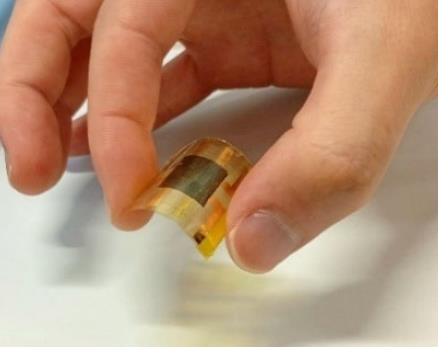
- Toenec, Chubu Electric, Chubu Electric Power Miraiz and Toyota City launched a demo of PSCs supplied by Aisin.
- The demo will run through 2028 and aims to assess the impact of cell degradation on power generation, as well as installation on rooftops and at ground-mounted sites.
- Toenec will provide O&M and installation services.
- SIDE DEVELOPMENT:
- Chemitox launches testing service for large-sized PSCs
- (Company statement, October 5)
- Chemitox launched a testing service for two-meter-long PSCs using a dedicated large-size solar simulator.
- CONTEXT: In April, Chemitox secured a patent for a method to measure PSC performance, which requires different testing approaches from those used for silicon cells, given the higher sensitivity of PSC components to moisture.
- The company can conduct performance measurements every few hundred hours during long-term testing.
- Chemitox can also monitor I-V characteristic curves and changes in performance over time under continuous light irradiation, using a Maximum Power Point Tracking (MPPT) device compatible with PSCs.
- CONTEXT: MPPT refers to a performance measurement method continuously tracking the operating point at which a PV cell delivers its maximum power under given conditions of sunlight and temperature. An I-V characteristic curve shows the relationship between electric current and voltage, revealing how PSC cells degrade over time rather than only measuring the final power generation capacity.
- SIDE DEVELOPMENT:
- Soar and OPERA Solutions complete PSC prototype with barrier film
- (Company statement, October 6)
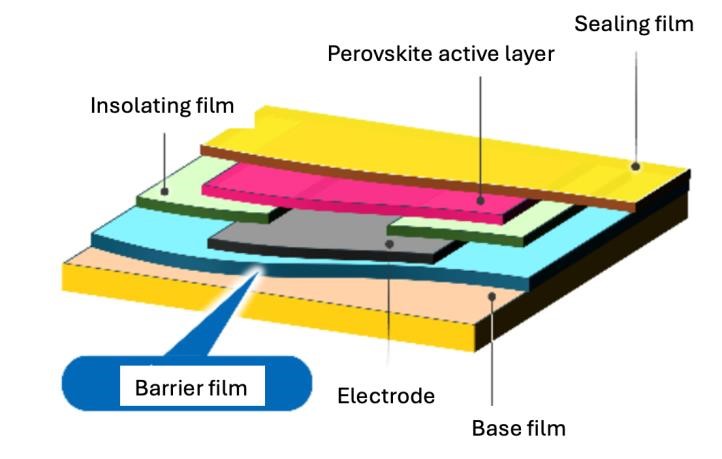
- Soar and OPERA Solutions completed a PSC prototype incorporating a barrier film designed to protect the cell from oxygen and moisture.
- CONTEXT: Soar specializes in OLED devices; OPERA Solutions is an R&D venture providing prototyping and contract research services for electronics.
- The barrier film was evaluated using the calcium corrosion method to assess its resistance to water vapor, demonstrating effective moisture blocking.
- TAKEAWAY: These tests put strong emphasis on moisture resistance, as moisture sensitivity is one of the main drawbacks of PSCs compared with conventional silicon cells, contributing to faster degradation and a shorter expected lifespan. Progress has been made in this regard with tandem-type PSCs. Toshiba technology shows stable results under an 85°C heat and relative humidity rate, a standard stress condition used to assess PV module durability. A decrease in power generation of up to 50% can be observed under an 85°C / 85% humidity rate test. Still, many PSC prototypes and early commercial products have yet to show comparable performance; hence, Chemitox’s offer of testing conditions adapted to these cells.
NEWS: WIND POWER AND OTHER RENEWABLES

Sumitomo firm orders four offshore wind CSOVs
(Company statement, October 7)
- IWS Fleet, a Norwegian offshore wind power support vessel operator affiliated with Sumitomo, ordered four additional Commissioning Service Operation Vessels (CSOV), expanding their total fleet to ten.
- The ships provide transportation and accommodation to offshore wind personnel.
- Vessels are scheduled to join the existing fleet between 2029-2030.
- CONTEXT: Demand for CSOVs has grown in response to the expected growth of the offshore wind power industry. CSOVs provide a quality living environment and safe transportation to workers during periods of maintenance, construction, and commissioning.
- CONTEXT: Sumitomo initially invested in IWS Fleet in 2024 to expand beyond their expertise in offshore wind power generation into construction, operation, and other areas along the value chain.
- TAKEAWAY: Sumitomo is able to support IWS Fleet’s growth through its global network and knowledge base in marine and shipbuilding sectors. While the current fleet focuses on projects in Europe, Sumitomo’s involvement is an opportunity to accumulate operational and business knowledge overseas before bringing that home to Japan. Through 2030, Japan has a major program for offshore wind power expansion, though it’s currently stalled due to rising costs and bureaucratic hurdles.
NTT Data, KHI and Itochu demo biofuel use in data center
(Company statement, October 6)
- NTT Data, KHI and Itochu Enex were chosen for the Tokyo Govt’s program to commercialize decarbonized fuels.
- The firms are conducting a demo using HVO (Hydrotreated Vegetable Oil) to power a 500 kVA emergency gas turbine at an NTT data center in Tokyo. It will run from September 2026 to March 2028.
- The demo aims to assess the fuel’s performance and quantify the reductions in Scope 1 emissions. Ancillary equipment, including piping and oil containment tanks, will be installed alongside existing equipment.
- CONTEXT: Emergency power equipment at data centers often includes gas turbines running on fossil fuels. To offset the associated emissions, companies can either purchase environmental value or use nextgen biofuels.
JWPA and JWEA to strengthen wind power industry-academia collaboration
(Organization statement, September 29)
- The Japan Wind Power Association (JWPA) agreed with the Japan Wind Energy Association (JWEA) to strengthen industry-academia collaboration in the wind power sector through next-gen personnel training and technology development.
- CONTEXT: The JWPA leads the wind power industry. The JWEA aims to promote and disseminate wind-power related science and technology from around the world.
- TAKEAWAY: The agreement gives the wind industry and academic community a more formal framework for addressing skills and technology-development needs. The first focus will be next-generation personnel training and education, an increasingly important issue as Japan tries to expand its domestic wind supply chain and workforce.
NEDO selects Mazda for R&D in microalgae-derived biofuel
(Company statement, October 7)
- NEDO chose Mazda to conduct R&D on HVO production using oils and fats extracted from microalgae.
- The process involves cultivating and harvesting microalgae, drying them, and extracting their oils and fats.
- Working with Idemitsu Kosan on fuel refining, Mazda aims to begin using the resulting HVO as factory-fill fuel for all diesel vehicles produced at its Japanese plants in the early 2030s.
- TAKEAWAY: Microalgae are a promising feedstock for biofuel, avoiding competition with food crops and with limited land requirements. Several firms are developing microalgae-based biofuels, including Atierra that focuses on SAF. Honda is another automotive maker investing in microalgae R&D through its “DREAMO” project that focuses on developing microalgae suitable for large-scale cultivation.
NEWS: NUCLEAR ENERGY

U.S., Japan deepen $1 billion technology partnership with fusion a key focus
(Government statement, October 5)
- U.S. and Japanese officials met in Washington to advance cooperation under the U.S.-Japan Technology Prosperity Deal, covering strategic technologies including fusion energy, quantum science, biotechnology and advanced materials.
- A key pillar is the $1 billion U.S.-Japan scientific partnership launched in June between the U.S. DOE, MEXT and METI under the Genesis Mission. Japan became the initiative’s first international partner.
- The program established 11 joint scientific teams linking U.S. national laboratories and Japanese research institutions, with fusion energy and advanced materials among the priority areas.
- CONTEXT: U.S.-Japan fusion cooperation already includes work between Oak Ridge National Laboratory and Kyoto Fusioneering on areas such as fuel-cycle and breeding-blanket technologies, including the planned UNITY-3 testing facility.
TEPCO tests AI system for nuclear regulatory applications
(Company statement, October 5)
- TEPCO, Itochu Techno-Solutions and Stockmark developed a generative-AI system to support preparation and review of nuclear regulatory applications.
- The system uses generative AI and image-recognition tech to search documents and diagrams, and help check applications for omissions and inconsistencies. Human staff retain final responsibility for judging AI-generated results.
- TEPCO said nuclear applications can involve 42,000 pages of documents plus 27,000 pages of supplementary materials, creating a heavy review burden for specialists.
Helical Fusion raises ¥3.23 billion in Series B
(Company statement, October 9)
- Helical Fusion raised ¥3.23 billion in the second close of its Series B round, bringing total funding to ¥13.05 billion (about $84 million).
- New shareholders include Fuji Electric, Fujikura, Tokyo Gas, KKT, URATA and Kepple Group. The round also includes previously announced investment from Hazama Ando, an eCrowd fund and support from a Gifu Prefecture startup subsidy.
- Fuji Electric also joined Helical Fusion’s Helix Program as a partner, expanding cooperation on the development and commercialization of fusion power systems.
- CONTEXT: Helical Fusion is developing its HELIX program around helical-confinement fusion, with pilot testing planned before a larger commercial-scale reactor concept.
GE Vernova sees Japan SMRs as longer-term opportunity
(Japan NRG, October 8)
- A GE Vernova nuclear executive said Japan is unlikely to become an early market for small modular reactors (SMRs), as the country still lacks a dedicated regulatory framework and is prioritizing restarts of its existing nuclear fleet.
- The company remains in regular contact with Japanese nuclear utilities, but near-term SMR development will focus overseas, led by Canada, followed by the U.S. and Europe.
- GE Hitachi sees SMRs as complementing rather than replacing large reactors, widening nuclear options for utilities and potentially opening sites that are unsuitable for larger plants.
- Canada was chosen for the first BWRX-300 deployment because it is actively building an SMR strategy now, allowing GE Hitachi to accumulate operating and construction experience that can later support wider fleet deployment globally.
- The executive said lessons from Fukushima have already been incorporated into modern BWR designs. For the BWRX-300, GE Hitachi has further simplified safety systems by replacing more active components with passive features.
- CONTEXT: Hitachi GE Vernova is developing both the BWRX-300 SMR and larger next-generation light-water reactor concepts, while Japan’s domestic nuclear strategy remains focused first on restarting existing reactors before moving toward new-build projects.
KEPCO detects abnormal temperature rise at Takahama NPP Unit 1
(Company statement, October 3)
- KEPCO detected an abnormal rise in the outlet temperature of a pressurizer safety valve at Takahama NPP Unit 1 and strengthened monitoring.
- The reactor remains in operation because the temperature has not reached the 77°C threshold requiring shutdown.
- CONTEXT: KEPCO operates seven reactors in Fukui Prefecture with a total capacity of around 6.5 GW. Of these, Ohi Unit 3 and Mihama Unit 3 are currently offline due to equipment problems.
- SIDE DEVELOPMENT:
- KEPCO prepares to restart Mihama NPP Unit 3
- (Company statement, October 9)
- KEPCO plans to restart the reactor and begin adjustment operations at Mihama NPP Unit 3, with commercial operation scheduled to resume on November 4.
- The restart was delayed after a September water leak caused by corrosion in high-pressure feedwater-heater piping.
Mutsu council discusses plan for nuclear fuel interim storage
(Nikkei, October 6)
- The Mutsu city council (Aomori Pref) held a review committee, focusing on an “inter-operator cooperation” plan for its spent nuclear fuel interim storage facility.
- Under the proposal, TEPCO and JAPC would accept 600 tons of spent nuclear fuel from KEPCO and Tohoku Electric. This four-company plan aims to meet the facility’s total planned capacity of 5,000 tons.
- Operators said that storage for the two incoming utilities will respect the 50-year storage limit.
- CONTEXT: The original 2005 location agreement did not expect shipments from companies other than TEPCO and JAPC.
- TAKEAWAY: The proposal would broaden Mutsu from a storage facility serving only TEPCO and JAPC into a shared asset for four utilities. Bringing in KEPCO and Tohoku Electric would help make fuller use of the planned 5,000-ton capacity while providing the two utilities with additional interim storage options for spent fuel.
NEWS: TRADITIONAL FUELS

ANRE review for Gas System Reform policy direction
(Government statement, October 9)
- ANRE published its final review and future direction for the Gas System Reform.
- The govt plans to implement core institutional and regulatory revisions by FY2026.
- It will extend mandatory supply and manufacturing planning cycles from three to five years to enhance mid-to-long-term market predictability for regulators and operators.
- Another goal is to allow inflation and higher operating/investment costs to be reflected in gas wheeling tariffs, helping utilities fund infrastructure maintenance, smart metering and AI/DX upgrades.
- The government also plans to ease rules for on-site methanation while creating frameworks to verify the environmental value of synthetic methane and biogas.
- The govt will keep monitoring wholesale transactions and third-party access to LNG terminals, alongside inventory surveys of major LNG operators to guard against energy security risks.
- Price transparency will be supported by disclosing average household retail prices across four major service regions: Tokyo, Osaka, Toho, and Saibu gas networks.
- Many opposed passing GX investment costs and inflation estimates onto wheeling tariffs, saying it could create an undue burden on households and regional consumers.
- CONTEXT: Gas System Reform introduced full retail market deregulation in April 2017, introducing legal unbundling of pipeline distribution in April 2022. Initial goals focused on price suppression, competition, and user choice.
- TAKEAWAY: The review points to a more interventionist gas-market framework than the original liberalization agenda. ANRE is preparing to give utilities greater visibility over future costs and investment needs through five-year planning and tariff adjustments, while retaining tighter oversight of LNG inventories, wholesale transactions and terminal access. The key tension now is how much of the cost of maintaining and upgrading gas infrastructure can be passed through to consumers as demand growth becomes less certain.
Japan to strengthen Philippine oil reserves
(Nikkei Asia, October 8)
- Japan and the Philippines agreed to strengthen the latter’s oil reserves. Tokyo is prioritizing the Philippines within SE Asia, and will provide financial aid and technical help to build local oil storage infrastructure.
- JOGMEC will launch training programs in the country.
- The initiative is part of Japan’s “POWERR Asia” program.
- CONTEXT: As of March, 94% of the Philippines’ crude oil imports passed through the Strait of Hormuz, leaving it exposed to war-related supply disruptions. In 2024, petroleum accounted for 29% of the Philippines’ total energy supply.
- TAKEAWAY: The Philippines relies more on the Middle East than its neighbours, and its reserves stood at only 53 days in March, forcing the country to enact consumption restrictions such as gasoline rationing. Yet, this is not only a Philippine problem; it has become a problem for Japan itself. With strong economic ties with SE Asian nations – such as across manufacturing and trade supply chains – regional energy instability poses a direct threat to the Japanese economy. Tokyo is thus willing to expand its history of stockpiling experience (following the 1970s oil crisis) to the entire SE Asian region in the hopes of improving regional energy security. That is the heart of the POWERR Asia initiative.
JAPEX receives first Persian Gulf LNG cargo since Hormuz blockade
(Nikkei, October 8)
- JAPEX received an LNG cargo from the Persian Gulf at its Soma LNG Terminal in Fukushima Prefecture, the first such delivery since the de facto blockade of the Strait of Hormuz began.
- Earlier this year, JAPEX replaced two Persian Gulf cargoes scheduled for FY2026 Q1 with spot LNG from other producing regions, saying the substitution would significantly raise procurement costs.
- CONTEXT: Soma LNG Terminal began operations in 2018 and is a core hub in JAPEX’s domestic gas network. Gas from Soma can be sent through JAPEX’s pipeline system connecting the Pacific side with its Niigata-area supply network, strengthening supply flexibility across northern Honshu.
- TAKEAWAY: The shipment illustrates the trade-off JAPEX faces between physical supply risk in the Persian Gulf and the higher cost of replacing contracted LNG with spot cargoes from elsewhere. The company’s broader procurement strategy already combines term and spot supply, but the Hormuz disruption has shown the value of diversifying long-term LNG sources as well as maintaining flexible replacement options.
Tokyo Gas acquires AGPIU to develop Indonesian LNG infrastructure
(Company statement, October 8)
- Tokyo Gas and wholly owned Tokyo Gas Asia acquired 100% of PT AGP Indonesia Utama (AGPIU), joining development of an LNG infrastructure project in Indonesia.
- The project is being developed with PLN Energi Primer Indonesia and shipping company PT Suasa Benua Sukses.
- Plans call for one floating facility, six onshore facilities and one small-scale LNG carrier serving six locations across Sulawesi and the Maluku Islands.
- Indonesian LNG procured by the PLN group would be transported by small LNG carrier to PLNowned power plants, replacing imported diesel fuel.
- Tokyo Gas says the switch could reduce CO2 emissions, fuel-import dependence and generation costs, while the same small-scale LNG model could potentially be expanded to other island regions.
- CONTEXT: Tokyo Gas is expanding its downstream gas business in Southeast Asia as part of a broader strategy to build LNG value chains combining procurement, transport and local infrastructure.
LNG stocks up from previous week, up YoY
(Government data, October 7)
- As of Oct 4, the LNG stocks of 10 power utilities were 2.58 Mt; up 7.1% from the previous week (2.41 Mt); up 38% from end October 2025 (1.87 Mt), and up 22.9% from the 5-year average of 2.1 Mt.
NEWS: CARBON CAPTURE & SYNTHETIC FUELS

Toho Gas-led group launches regional CO2 recycling demo
(Company statement, October 9)
- Toho Gas, Aisin, Toyo Construction and SMBC launched a demonstration project to build a regional carbon-recycling model using CO2 captured from factories in Aichi Pref.
- CO2 from Aisin’s Nishio die-casting plant and AGC’s Aichi plant will be captured and liquefied for transport, while gaseous CO2 will also be collected from Denso’s Anjo plant.
- Part of the captured CO2 will be converted into e-methane at Toho Gas’s Chita facility and supplied back to Aisin and Denso through the city-gas network. Another portion will be used for CO2 fixation and neutralization at a managed marine landfill.
- SMBC will assess the overall business model, including CO2 and environmental-value management and supply-demand balancing.
- The project runs through March 2031 and is supported by MoE.
Miura and SMFL launch J-Credit-linked equipment leasing
(Company statement, October 1)
- Miura and Sumitomo Mitsui Finance & Leasing agreed to offer leases for equipment including boilers, air compressors and heat pumps with J-Credits bundled into the contract.
- Customers can select the type and quantity of J-Credits, which SMFL purchases and retires to offset the equipment’s estimated CO2 emissions over the lease period.
- The structure allows customers to combine equipment financing and carbon offsetting without separately sourcing or retiring credits themselves.
- TAKEAWAY: The model turns J-Credits into an add-on to equipment finance rather than a separate procurement exercise. That could make voluntary carbon offsetting more accessible to smaller industrial customers that lease equipment but lack dedicated carbon-market capabilities. The potential for aggregation of the environmental value across multiple pieces of equipment is also interesting. J-Credits for buildings cover not only installation of solar PVs, but also energy-saving equipment (heat pumps, boilers, LED lighting).
ANALYSIS
BY TETSUJI TOMIYA
Fear of Hard Choices? Japan’s Hydrogen Strategy Remains Broad as Rivals Specialize
The global hydrogen industry is beginning to make choices. After years in which almost every production method, carrier and end-use attracted investment, developers are more selective about which technologies have a realistic path to commercial scale. Japan, however, is pursuing almost all of them.
That breadth once looked like a strength. Japan was among the earliest to build a national hydrogen strategy and remains strong in several key areas, including hydrogen and ammonia combustion, maritime standards, liquid-hydrogen and the integration of new fuels into existing power assets.
But maintaining parallel bets on liquid hydrogen, ammonia, MCH and other pathways also risks spreading capital and industrial effort across too many options.
The contrast is more visible as other markets narrow their focus. Recent industry discussions and technology demonstrations at Gastech in Bangkok pointed to a pragmatic hydrogen sector, where projects are judged less by technological novelty than by whether they can secure demand, financing and infrastructure. Established uses such as ammonia, refining and power remain central, but developers put greater emphasis on delivered cost, offtake and the ability to use existing energy systems.
Hydrogen investment has not disappeared. Capital committed to clean hydrogen reached about $130 billion across more than 570 projects globally, according to the Hydrogen Council, with operational capacity rising sharply over the past year. But capital is moving beyond pilots to tech or projects that can show a credible route to commercial scale.
For Japan, that shift presents a different challenge from the one a decade ago. Can Japan turn its wide portfolio of technical strengths into real business use before competitors do?
Japan still has formidable technology
It would be misleading to portray Japan as falling behind. In several parts of the hydrogen value chain, Japanese firms retain capabilities that few competitors can easily replicate. The country is strong in hydrogen and ammonia combustion and has deep experience in liquid-hydrogen handling, vessel operation and safety standards needed to move a difficult cryogenic fuel at scale.
This comes as the commercialization drive moves beyond the hydrogen molecule itself. Most sector professionals are now more interested in how the fuel will be transported, stored, certified and consumed, and how new systems can be incorporated into existing infrastructure without prohibitive costs. Japan’s strength in heavy engineering, power generation systems and shipping gives it a prominent position in these areas.
But competitors are beginning to establish clearer leads in particular technologies. South Korean shipbuilders are pushing ahead with larger liquid-hydrogen carrier designs, while European developers have advanced industrial-scale ammonia-cracking systems. Japan remains active in both areas, but its approach is broader: Kawasaki Heavy Industries is pursuing liquid hydrogen, Chiyoda has developed the MCH route, and JERA and IHI are working on ammonia.
Rather than choosing a single carrier, Japan continues to preserve several options.
There is a logic to that strategy. No one yet knows which hydrogen supply chains will ultimately prove cheapest or most resilient, and Tokyo, as a major energy importer, has good reason to avoid becoming dependent on a single technology. But this optionality comes at a cost. Capital, engineering resources and policy support are divided among competing pathways at the same time that rival companies are concentrating efforts on technologies they believe can reach commercial scale.
The time for experimentation appears to be giving way to a more demanding phase. What investors and potential offtakers want to see are standardized equipment, large projects, repeat orders and ultimately lower costs. The discussions at Gastech focused on questions of scale, infrastructure, bankability and demand.
The next phase of the competition may be determined by who is prepared to place the biggest commercial bets on a smaller number of technologies.
From demo to commercial scale
The technologies showcased at Gastech were at very different stages of development. Some are approaching commercial deployment, while others are solving engineering problems. Here is a run through the most interesting ones we saw.
Ammonia cracking: among the closest to commercial readiness. Air Liquide’s Antwerp pilot has reached technology-readiness level 8, while Casale says its MACH2 cracker can process more than 1,300 tons per day, with around 90% of its capital equipment already at TRL 9. On the consumption side, GE Vernova turbines can burn up to 100% hydrogen, while an ammonia-fired F-class combustor developed with Japan’s IHI has met emissions targets.
The remaining hurdle is very much commercial: securing enough demand to justify the final investment decisions.
Liquid hydrogen: moving into a scale-up phase. Samsung Heavy Industries built a 10 m³ pilot tank and is developing a 2,000 m³ demo vessel, targeting commercialization around 2027–2030. Shell and Woodside, meanwhile, found that better management of boil-off gas could cut costs across the full supply chain by around 7%. Other components are also advancing: a cryogenic loading arm developed by Air Liquide, Technip Energies and Manntek completed over 20,000 leak-free cycles and is now commercially available.
The technology is no longer confined to small demos, but large-scale shipping and storage still require further certification and operating experience.
Hydrogen production: pathways remain fragmented. Kent develops chemical-looping reforming with near-total carbon capture, while EN2CORE is working on a three-tonper-day turquoise-hydrogen demonstration in South Korea. In Thailand, PTT, Thyssenkrupp Uhde and GIZ are developing an e-methanol project targeting 120,000 tons per year, potentially rising to 350,000 tons.
Rather than one production route winning out, different markets are beginning to pursue technologies that fit local feedstocks, infrastructure and demand.
Supply chain technologies: solutions as yet less visible. H2MOF is developing solidstate hydrogen storage at just 20–30 bar, while Xi’an Petroleum University has been testing the feasibility of underground hydrogen storage. Its modeling found near-neutral pH because of carbonate buffering and no hydrogen sulfide where sulfate was absent.
Flowserve tested a water-lubricated compressor seal for more than 800 hours, aimed at reducing emissions and contamination during hydrogen compression. Work is also advancing on cryogenic piping and large-scale safety systems.
These do not yet represent commercial businesses at scale. Yet progress in such areas will determine how cheaply and reliably hydrogen can move from producer to customer.
Integration with existing systems: finding other paths to adoption. Several players are now focused less on producing hydrogen from scratch than fitting it into existing industrial and power infrastructure. Lummus Technology is developing modular steam electrolysis that uses waste heat and requires around 35 kWh/ kg, cutting carbon intensity by an estimated 17–22% compared with SMR revamps. Wood presented another retrofit route using biorefinery feedstock in steam-methane reforming, which it estimates could cut hydrogen production costs by as much as 30% in Asia while eliminating natural-gas feedstock. Shell India Markets also showed the use of gridforming inverters and battery storage to keep PEM electrolyzers stable on weaker power grids.
The common thread is lower-disruption deployment: using existing heat, industrial equipment or power infrastructure rather than building a new hydrogen system around every project.
Conclusion
Is Japan losing ground in hydrogen development? Not necessarily in technology, but there is a stronger case in the commercial arena. Japanese firms still have formidable engineering capabilities and valuable expertise in safety, standards and certification.
Those strengths matter because standards and certification will help determine which projects attract offtake, financing and ultimately reach commercial scale.
What Japanese players need to do is follow international peers in picking their battles. Japan cannot prove every technology option through domestic projects supported by government subsidies and CfD-style schemes. It needs more large-scale projects with overseas partners, real customers and commercial capital.
As Southeast Asia emerges as both a production base and regional energy gateway, Japan’s hydrogen strategy could ultimately depend more on international business development than domestic industrial policy.
ANALYSIS
BY DR. VENERA N. ANDERSON
Japan’s Pink Hydrogen Question Starts With Water and Demand
Japan has low-emissions hydrogen projects on the International Energy Agency’s Hydrogen Tracker, but no clearly identifiable nuclear hydrogen industry.
The IEA’s map classifies projects largely as electrolysis, fossil fuels with carbon capture, or “other,” rather than carving out a separate category for so-called “pink” hydrogen produced using nuclear energy. Japan’s renewed interest in nuclear power has brought pink hydrogen closer to a practical conversation.
But a reactor and an electrolyzer do not, by themselves, make a hydrogen strategy. The harder question is where the hydrogen would be used, what resources its production would consume, and whether the whole arrangement makes economic sense.
One way to think about that question is through a partial circular economy approach. In earlier research at Johns Hopkins University, I compared future green and nuclear-powered hydrogen production in Japan using that framework and concluded that, beyond 2040, pink hydrogen deserved consideration as part of the country’s domestic supply mix.
Developments since the study was completed in December 2024 have made that proposition more concrete, even if they have not yet proved the business case.
In practical terms, the idea is to design hydrogen production around resources and infrastructure that already exist or could be shared. Treated wastewater that might otherwise go unused could be further purified for electrolysis; a nearby nuclear plant could provide low-carbon electricity; and industrial users could give the hydrogen a destination.
The value lies less in claiming that the system is perfectly circular than in planning these pieces together – including their costs, resource use and tradeoffs.
Why the nuclear discussion changed
Japan’s nuclear debate is moving beyond whether individual reactors will restart. TEPCO has discussed data centers and possible hydrogen production around Kashiwazaki-Kariwa NPP. In June, METI proposed replacing the equivalent of two to five aging reactors by the 2040s and 11 to 14 by the 2050s. These are signals of long-term intent, even if a policy proposal or a possible industrial use is still a long way from an operating hydrogen hub.
The experimental evidence is narrower but valuable. Kansai Electric has already made small volumes of hydrogen using nuclear-generated electricity in Fukui and included some in subsequent demonstrations. JAEA, meanwhile, is pursuing a different route at its High Temperature Engineering Test Reactor in Oarai: connecting a hydrogen production facility to the reactor to test the use of high-temperature nuclear heat. These efforts show that nuclear-derived hydrogen is becoming a physical engineering question in Japan. Neither proves that large-scale production will be competitive.
These projects should also be read at their actual scale. Kansai Electric’s Fukui demonstration produced roughly 140 kg of hydrogen over six months. It showed that nuclear electricity could be used for hydrogen production, while leaving the question of commercial scale open.
JAEA’s planned tests are an important step toward understanding reactor-to-hydrogen integration, but a research reactor is not a blueprint for an immediately bankable supply chain. The next questions concern uptime, licensing, capital costs, and offtakers. That is where laboratory promise encounters commercial reality.
The distinction matters. Nuclear electricity sent to an electrolyzer has an opportunity cost: that electricity could serve the grid and directly displace fossil-fuel generation. Using reactor heat for industrial processes could eventually present different economics, but the technology must still be demonstrated. Japan should ask where hydrogen does a job that electricity cannot do as easily, rather than assuming every new source of lowcarbon power should produce clean hydrogen.
Start with the customer, then trace the resources
Japan has also begun building the demand side. In June, companies and organizations joined a voluntary H2 1% Procurement Declaration, while the Japan H2 Association advanced its proposed Hydrogen Backbone Initiative with public and private partners. A procurement pledge can help reveal prospective customers. It is not a binding offtake agreement, and it does not establish the price at which those customers will buy hydrogen.
When I think about a hydrogen hub, I start with the customer. A developer needs to know which chemical, refining, steel, or other industrial user would take the hydrogen; the volume and reliability that user needs; and how much it could pay.
Only then can the developer assess a location, a nuclear power source, water supply, treatment requirements, storage, and transport. An attractive production cost at the plant gate can become much less attractive once you account for all the connecting infrastructure.
Japan will continue to rely on international hydrogen and ammonia supply chains. Domestic production should be evaluated as one part of a balanced energy portfolio, with particular attention to industrial locations where it may reduce import exposure and shorten the distance between production and use. That is a strategic possibility, not proof that domestic hydrogen will always be cheaper.
The case for a domestic option also rests on energy resilience. War in the Middle East has again made evident the exposure of an island economy that imports much of its energy through long maritime routes and chokepoints. Yet energy security has a price. If a local hydrogen hub requires costly new infrastructure or diverts scarce low-carbon electricity from more effective uses, the security benefit must be weighed against those costs. It cannot simply be assumed.
The overlooked water connection
Electrolysis also needs suitable water. My original research was based on seeing the circular economy through a practical lens. Based on the Ellen MacArthur Foundation’s circular economy system diagram, it accepted that an entire energy system cannot be made perfectly circular, but can be successful by seeking a partial approach (technical cycle). In this sense, I examined the water issue for pink hydrogen by considering whether unused, highly treated effluents from wastewater plants could be purified further.
The point is not that treated effluent can flow straight into an electrolyzer. Water quality, additional treatment, energy use, permitting, and the available volume must all be tested at a specific site. Japan’s sewage sector offers a useful starting point. The Japan Sewage Works Agency has supported implementation of new technologies and the B-DASH program, while operators and technology firms continue to improve monitoring and treatment.
These advances make a conversation between water utilities, energy developers and industrial buyers more plausible. They do not yet demonstrate that a given wastewater plant can reliably supply a commercial pink hydrogen project.
This part of the proposal is easy to miss because water is rarely the headline in a hydrogen announcement. But a plant that depends on unused tertiary effluents would require agreements between organizations that often plan on different timelines and answer to different regulators. The wastewater utility must still meet its primary public service obligations.
The hydrogen developer needs predictable volume and quality. The industrial customer needs predictable hydrogen delivery. The commercial design has to work for all three. There are other issues. Nuclear power has its own lifecycle impacts and remaining unresolved spent-fuel problems. Japan’s nuclear fuel reprocessing plans have encountered repeated delays, while proposals for additional storage encounter local communities’ resistance.
Electrolyzers need materials and capital; even promising efforts to reduce precious-metal use still have to reach commercial scale. Calling hydrogen “clean” cannot make those problems disappear. The real test is whether a design lowers emissions and resource use at a cost that customers and society can accept.
A decision for the 2040s begins now
I suggest starting with a small number of candidate pink hydrogen hubs and asking for a joined-up feasibility assessment. Map actual hydrogen demand and potential offtake.
Compare the value of supplying electricity to the grid with using it for electrolysis. Measure the volume and treatment cost of available effluent.
Examine grid connections, hydrogen storage, lifecycle emissions, nuclear waste obligations, and local acceptance. Then compare the result with other domestic and imported supply options.
This would give policymakers and investors a way to separate a promising site from a tempting diagram, and would also show where a demonstration could answer a real commercial question. A pilot that only proves hydrogen can be produced is useful; but a pilot that also tests water treatment, customer demand, and the full system’s economics would tell considerably more.
A few years ago I began this research with a simple concern: Japan cannot build a durable hydrogen economy by looking at production, water, and industrial demand in separate rooms. Recent changes in nuclear policy, hydrogen procurement, and wastewater technology make it more worthwhile to bring those rooms together.
Pink hydrogen may earn a place in Japan’s energy mix beyond 2040. The task now is to find out where that place is, and on what terms.
Guest column by Dr. Venera N. Anderson, Founder and CEO of Zanpa Edge; Co-Founder and Non-Executive Board Director of Carbon Management Society. Adapted from her research published as the three-part “From Theory to Reality” series on illuminem
ASIA ENERGY REVIEW
BY JOHN VAROLI
A brief overview of the region’s main energy events from the past week
Australia / Renewables
Renewables supplied 42% of electricity on Australia’s major grids in 2025, while wind and solar generation continue to grow, according to Australian Energy Statistics. Wind power grew 20.9% and solar increased 12.7% in 2025.
Australia / Renewables and BESS
South Australia’s pipeline of large renewable energy and storage projects under construction or with approval surpassed $32 billion; nearly $7 billion of projects are operational. Construction recently began on two major wind farms, Tilt Renewables 288 MW Palmer and Neoen’s 346 MW Goyder North.
China / Energy cooperation
Chinese and EU officials agreed to explore cooperation in new energy and AI during their recent trade talks that Beijing described as “equal, professional and constructive”. European media have recently been sounding the alarm over China’s AI and energy dominance.
China / Nuclear
China’s operating nuclear capacity ended 2025 more than 10% below its Five-Year Plan target, according to the World Nuclear Industry Report 2026. Gross operating capacity stood at 62.5 GW in late 2025, falling short of the “around 70 GW” goal in the 14th Five-Year Plan. The 15th Five-Year Plan targets 110 GW of gross capacity by 2030.
Indonesia / Oil
Indonesia Energy Corp began oil production from its new K-29 well at the Kruh Block in Sumatra and targets to launch the deeper WK-5 well by November.
Offshore wind
East Asian countries have 82 GW of offshore wind projects in development, but projects are not breaking ground fast enough to meet their 2030 targets, reports the Global Energy Monitor. Japan has about 27 GW of offshore wind in its pipeline; South Korea has 44 GW and Taiwan has 11 GW.
Singapore / Energy development
The Energy Market Authority will study whether a 200-hectare site on Pulau Tekong can host 6 GW of power generation and 2 GW of electricity imports. Besides gas, power plants could run on hydrogen or ammonia, or biomass plants that capture their emissions and geothermal.
South Korea / Power supply
South Korea announced a technology build-out that needs an extra 27.7 GW of power by 2040, but has not decided whether to build more nuclear plants, said the World Nuclear Industry Status Report 2026.
Vietnam / Energy
Siemens Energy is confident in Vietnam’s growth prospects and wants to expand its operations there. Thorbjorn Fors, senior VP of Siemens and head of APAC, met with Vietnam’s Deputy PM in Hanoi and said the development of new industries would drive a sharp increase in Vietnam’s electricity demand.
Disclaimer
This communication has been prepared for information purposes only, is confidential and may be legally privileged. This is a subscription-only service and is directed at those who have expressly asked K.K. Yuri Group or one of its representatives to be added to the mailing list. This document may not be onwardly circulated or reproduced without prior written consent from Yuri Group, which retains all copyright to the content of this report.
Yuri Group is not registered as an investment advisor in any jurisdiction. Our research and all the content express our opinions, which are generally based on available public information, field studies and own analysis. Content is limited to general comment upon general political, economic and market issues, asset classes and types of investments. The report and all of its content does not constitute a recommendation or solicitation to buy, sell, subscribe for or underwrite any product or physical commodity, or a financial instrument.
The information contained in this report is obtained from sources believed to be reliable and in good faith. No representation or warranty is made that it is accurate or complete. Opinions and views expressed are subject to change without notice, as are prices and availability, which are indicative only. There is no obligation to notify recipients of any changes to this data or to do so in the future. No responsibility is accepted for the use of or reliance on the information provided. In no circumstances will Yuri Group be liable for any indirect or direct loss, or consequential loss or damages arising from the use of, any inability to use, or any inaccuracy in the information.
K.K. Yuri Group: Hulic Ochanomizu Bldg. 3F, 2-3-11, Surugadai, Kanda, Chiyoda-ku, Tokyo, Japan, 101-0062.