
JAPAN NRG WEEKLY
NOVEMBER 9, 2020
JAPAN NRG WEEKLY
November 9, 2020
NEWSTOP
OIL & GAS
POWER & NUCLEAR
RENEWABLES, OTHER
| ANALYSISDESPITE TROUBLED WIN, BIDEN SEEMS TO HAVE ENOUGH OPTIONS TO PURSUE GREEN AGENDA In January 2021 Joe Biden is set to become the 46th U.S. president, barring exceptional circumstances. The Democratic challenger beat incumbent, Donald Trump, partly based on a promise to tackle climate change with a $2 trillion “green” energy policy. The nature of Biden’s win makes an aggressive realization of this policy, dubbed the “New Green Deal,” difficult. Still, Biden has various tactics to drive his energy policy, which we see having a strong impact on international and Japanese markets in particular. JAPAN EASES REGULATION TO EXPAND USE OF BIOFUELS IN SHIPPING, AVIATION WITHIN DECADE As Japan looks for ways to meet its environmental goals, one avenue identified by the government to cut emissions is greater usage of biofuels. From this year, Japan has eased restrictions on which source materials qualify as alternative fuels for use in jets, and vowed to channel more funding for biofuel development. Shipping and aviation are viewed as the two main industries which could switch to a fuel mix that includes an increasing non-petroleum component. State support is emboldening companies from the two industries to deepen engagement with biofuel suppliers and widen testing of the technology. Last month, ANA Holdings, Japan’s largest airline, signed up its third supplier of sustainable aviation fuel (SAF) in less than two years. STATUS OF JAPAN’S NUCLEAR REACTORS We update last week’s table with the latest figures. GLOBAL VIEWThe valuations of renewable energy companies and funds are up over 100% this year. Natural gas prices are recovering. COVID-19 rates look dangerous. And China gives an estimate of the cost of its 2060 energy transition. See details on these and other events in the Global View column. |
JAPAN NRG WEEKLY
PUBLISHER
K. K. Yuri Group
Editorial Team
Yuriy Humber (Editor-in-Chief)
Tom O’Sullivan (Japan, Middle East, Africa)
John Varoli (Americas)
Contributors
Mayumi Watanabe
Daniel Shulman
Art & Design
22 Graphics Inc.

SUBSCRIPTIONS & ADVERTISING
Japan NRG offers individual, corporate and academic subscription plans. See details here.
For further details, or to discuss marketing, advertising, or collaboration opportunities, please contact one of the Editorial Team members or write to info@japan-nrg.com
Disclaimer
This communication has been prepared for information purposes only, is confidential and may be legally privileged. This is a subscription-only service and is directed at those who have expressly asked K.K. Yuri Group or one of its representatives to be added to the mailing list. This document may not be onwardly circulated or reproduced without the prior written consent of Yuri Group, which retains all copyright to the content of this report.
Yuri Group is not registered as an investment advisor in any jurisdiction. Our research and all the content of our reports express our opinions, which are generally based on available public information, field studies and own analysis. Content is limited to general comment upon general political, economic and market issues, asset classes and types of investments. The report and all of its content does not constitute a recommendation or solicitation to buy, sell, subscribe for or underwrite any product or physical commodity, or a financial instrument.
The information contained in this report is obtained from sources believed to be reliable and in good faith. No representation or warranty is made that it is accurate or complete. Opinions and views expressed are subject to change without notice, as are prices and availability, which are indicative only. There is no obligation to notify recipients of any changes to this data or to do so in the future. No responsibility is accepted for the use of or reliance on the information provided. In no circumstances will Yuri Group be liable for any indirect or direct loss, or consequential loss or damages including without limitation, loss of business or profits arising from the use of, any inability to use, or any inaccuracy in the information.
K.K. Yuri Group: Oonoya Building 8F, Yotsuya 1-18, Shinjuku-ku, Tokyo, Japan, 160-0004.
NEWS: OIL & GAS
JERA LNG trading chief says short-term deals, use of TTF, JKM becoming common
(Gas Energy News, Nov. 2)
- JERA’s trading in shorter-term LNG deals and employment of pricing benchmarks such as Henry Hub, TTF, and JKM has become “commonplace,” while the liquidity of physical cargo and derivatives has improved, according to
Kasai Kazunori, CEO of JERA Global Markets, a unit that specializes in LNG and coal trading for the parent firm. - LNG demand will increase over the next few years because prices are expected to remain low after the pandemic outbreak, Kasai said in a seminar with the Japan Planning Research Institute (JPI).
- The trading unit has secured stable sales destinations in Japan and Europe, and is trying to optimize ship allocation and inventory management by making full use of destination-free LNG cargos and its shipping fleet, Kasai said.
- In tough times, it is important that both sellers and buyers “cooperate through flexible LNG contracts”, which helps grow the market for the fuel and shares new development risks between the two sides, Kasai said.
- JERA has strengthened knowledge and personnel with the takeover of EDF unit, Kasai said.
- CONTEXT: JERA, Japan’s biggest LNG buyer, integrated EDF’s Singapore trading desk for LNG into a joint venture in 2018. JERA controls about 67% of the venture, which also trades coal, and EDF the rest.
- CONTEXT: JERA buys about 35 million tons of LNG a year. Of that, about seven million tons comes through spot and short-term deals, which are managed via JERA Global Markets unit. EDF added its LNG book to the JV with JERA, bringing about 3-5 million tons of volume and helping the Japanese firm get access to European markets and LN import / export terminals in the U.K., France, the Netherlands, Belgium and Spain.
TAKEAWAY: JERA is already the top buyer of LNG globally, but with demand in Japan waning the company needs to transition into being a supplier not just for its homeland but for the world at large. JERA has sought entry into LNG sales in India and China. So far, its biggest expansion seems to be in Europe, thanks to the partnership with EDF, and in Southeast Asia.
- SIDE DEVELOPMENT:
JERA 1H profit drops 21% on lower fuel demand and losses from LNG cargo resale
(Denki Shimbun, Nov. 2)- 1H revenue fell 22.9% YoY to ¥1.25 trillion; operating profit down 7.8%; electricity sales down 16.3%; net profit down 21% to ¥108.9 billion
- JERA posts ¥13.9 billion loss on re-sale of LNG to third-parties and ¥7.4 billion loss related to upstream investments
- This is the first time JERA has published interim results
- Co. sees full year profit down 30% this fiscal year
- SIDE DEVELOPMENT:
JERA, Japan’s Power utilities consumer 6.7% less LNG from April to September
(Denki Shimbun, Nov. 4)- JERA and the other of Japan’s eight major power utilities consumed 6.7% less LNG in the April to Sept six-month period compared to last year, utilizing less than 20 million tons of the fuel. This is the lowest volume in the period since 2010.
- Power demand drop due to the COVID-19 and greater use of renewables contributed to the trend. JERA alone consumed 12.4% less LNG YoY.
- However, five of the utilities used more LNG than they did last year. These are Hokkaido, Hokuriku, Shikoku, Kyushu and Okinawa EPCOs.
Mitsui CEO says will consider withdrawal from oil and gas E&P due to COVID
(Sunday Mainichi/Economist via Yahoo News, Nov. 6)
- Mitsui & Co. CEO Yasunaga Tatsuo said the trading company is considering a radical restructuring in the wake of the coronavirus pandemic. This includes a withdrawal from sectors in which it formerly excelled such as passenger rail, energy, mining, and E&P.
- Yasunaga made the comments at an investor relations event on Nov. 2. He said changes in the business environment due to the pandemic and global trends in environmental, social, and governance policy necessitated a re-evaluation of Mitsui’s existing businesses, and a review of the way resources were allocated.
- While oil and gas E&P has been Mitsui’s bread-and-butter since 1969, this year the company has been severely hurt by falling crude and gas prices.
TAKEAWAY: More than any other Japanese general trading company, Mitsui is associated with energy and resources. It derives close to 90% of its earnings from these fields. While there are plenty of opportunities in renewables and the alternative energy space, it is hard to imagine Mitsui abandoning its roots as an oil, gas and coal supplier to Japan. This is most likely Yasunaga’s last year as CEO of Mitsui before the traditional changing of the guard. This could embolden Yasunaga to take a revolutionary decision, and yet most likely he will propose limiting Mitsui’s upstream investments rather than pulling out entirely.
Japan’s LPG shipments drop 11.8% on reduced demand from hotels and restaurants
(Sekiyu Tsushin, Nov. 4)
- Liquefied propane gas shipments in the six months to September were down 11.8% on the same period in 2019, according to statistics released by the Japan LP Gas Association. The fall in butane consumption was particularly pronounced, with shipments down 23%.
- While domestic gas demand increased significantly in April and May as the public stayed home, commercial demand fell due to bar and restaurant closures. The drop was even more pronounced for butane, due to factories suspending operations.
Osaka Exchange to launch CME Group Petroleum Index Futures contract in 3Q 2021
(Company press release, Nov 2)
- Osaka Exchange, a unit of Japan Exchange Group Inc., said it is preparing to launch a “CME Group Petroleum Index Futures” contract targeting 3Q 2021
- The CME Petroleum Index is an index calculated and distributed by CME Group, and it is comprised of three products currently trading on NYMEX: WTI Crude Oil futures, NY Harbor RBOB Gasoline futures, and NY Harbor ULSD futures. The weighting of each component within the Petroleum Index is set as follows: NYMEX WTI Crude Oil 72%, NYMEX RBOB Gasoline 13%, and NYMEX NY Harbor ULSD 15%.
TEPCO undercuts Osaka Gas in west Japan
(Nikkei, Nov. 5)
- TEPCO Holdings subsidiary TEPCO Energy Partner said on Nov. 5 that it would launch a residential gas plan for domestic subscribers in west and central Japan. The service will start at the end of the month, and customers are able to sign up from Nov. 16.
- Hoping to entice Osaka Gas and Toho Gas customers to switch providers, TEPCO Energy Partners is offering tariffs some 3% below its competitors.
- TEPCO Energy Partner hopes that its gas business will help compensate for weak demand for domestic electricity services. The company’s recurring profits fell 17.5% YoY in 2019/20 as a result of domestic market regulation.
Hokkaido Electric doubles LNG capacity
(Denki Shimbun, Nov. 4)
- The Hokkaido Electric Power Co. said on Oct. 30 that it had finished constructing its second LNG storage tank in Ishikari, Hokkaido.
- The tank is 60 m high and 90 m in diameter.
NYK takes delivery of LNG tanker
(Japan Maritime Daily, Nov. 6)
- NYK said on Nov. 4 that construction of the Diamond Gas Metropolis, an LNG tanker, had been completed. The Diamond Gas Metropolis will be operated under an 18-year contract between NYK, Mitsubishi Corp and Singapore’s Diamond Gas International.
- The ship’s dual-fuel engines can be run on LPG boil-off, and the ship is also able to re-liquefy boiled-off LPG.
- The 118,000-ton ship was constructed in South Korea by Hyundai.
NEWS: POWER & NUCLEAR
| No. of operable nuclear reactors | 33 | |||
| of which | applied for restart | 25 | ||
| approved by regulator | 16 | |||
| restarted | 9 | |||
| in operation today | 1 | |||
| able to use MOX fuel | 4 | |||
| No. of nuclear reactors under construction | 3 | |||
| No. of reactors slated for decommissioning | 27 | |||
| of which | completed work | 1 | ||
| started process | 4 | |||
| yet to start / not known | 22 | |||
Source: Company websites, JANSI and JAIF, as of Nov. 8, 2020
Utility Earnings Reports: Chubu Electric reports first earnings dip in three years
(Mainichi Shimbun, Nov. 6)
- The Chubu Electric Power Company’s mid-term consolidated financial report for the period to September states profits were down nearly 16% on the previous year while sales fell nearly 8% to ¥1.45 trillion.
- This is the first time Chubu Electric has reported a drop in profits in three years.
- Chubu upwardly revised its projected full-year sales to ¥2.8 trillion, citing hot weather over summer and signs that commercial demand is recovering.
- SIDE DEVELOPMENTS:
(Various reports)
J-Power raises full-year net income outlook 8.5% to ¥51 billion
(Various reports)
Kyushu Electric forecasts full-year net income at ¥30 billion
(Various reports)
Kansai Electric says July-Sept. electricity sales fell 8.8% YoY
(Various reports)- profit down 2.4% YoY to lowest in four years
Tokyo Gas books ¥10 billion ($96m) loss from resale of LNG in April-Sept. period
(Various reports)
-
- Co. targets overseas, energy services to shift profit mix
Osaka Gas says July-Sept. gas sales down 7.9%, but profits up as power sales rise
(Various reports)
J-power, Chubu Electric and Chugoku Electric shares gain on mostly positive earnings season
(Various reports)
-
- Sector shares bolstered by speculation that the government’s 2050 net zero emissions plan will boost demand for electricity as more of the nation’s industry turns to electrification
Nissan and ENEOS to test dynamic electricity pricing for e-car owners
(Nikkei, Nov. 4)
- Nissan said on Oct. 30 that it would conduct a trial to evaluate dynamic pricing for drivers of electric vehicles in collaboration with ENEOS.
- The trial will run for two months and take place in Kyushu. ENEOS will offer participating subscribers discounted electricity between 10 am and 2 pm in spring through autumn and then evaluate the impact on recharging behavior.
- Electric vehicles can help buffer capacity fluctuations on the electricity grid, and are viewed as an essential part of furthering the uptake of renewable energy.
ENEOS to invest in Sharing Energy power retailer
(New Energy Business News, Nov. 4)
- ENEOS has bought a stake in Tokyo-based retail electricity operator Share Energy, with the aim of providing services to assist subscribers who generate their own electricity. Share Energy is strong in solar panel installation and has a network that covers most of Japan.
- The move is strategic for ENEOS as the Co. aims to grow its presence as a provider of next-generation, distributed, energy-supply services.
Only one nuclear plant operating in Japan as Ohi No.4 begins maintenance work
(Livedoor News, Nov. 3)
- The number four reactor at Ohi nuclear power plant, operated by the Kansai Electric, was shut down on Nov. 3 for scheduled maintenance. For the first time in almost four years, KEPCO does not have a single reactor online.
- This also means that there is now only a single nuclear reactor operating in the entire country, which is the Genkai NPP’s No. 4 unit, operated by Kyushu Electric.
- KEPCO was forced to shut down its Takahama nuclear plant after it missed a deadline for retrofitting security features to guard against terrorism and major accidents. The Takahama plant will be restarted in February at the earliest.
- SIDE DEVELOPMENT:
Ohi-4 reactor to restart no earlier than mid-February
(Yomiuri Shimbun, Nov. 3)
TAKEAWAY: See our detailed feature in the Nov. 2 edition of Japan NRG for a detailed breakdown of which reactors are down and when we expect them to restart.
Fukushima area cesium levels plummet with better than expected recovery
(Newswitch, Nov. 5)
- According to testing performed on topsoil and rivers near the Fukushima nuclear plant, the environment is recovering faster than expected. Levels of radioactive cesium 137 appear to be decreasing much faster than projections, which were formulated based on data from the Chernobyl disaster.
- It is thought that heavy rainfall and extensive decontamination has helped reduce cesium levels.
- Cesium concentrations in former paddy fields in the area are now only 3% of what they were after the accident.
- SIDE DEVELOPMENT:
269 workplace accidents logged in relation to Fukushima disaster
(Mainichi Shimbun, Nov. 6)- After making enquiries with the Ministry of Health, Labour and Welfare, the Mainichi Shimbun has ascertained that a total of 269 work-related accidents have been reported among workers decommissioning the Fukushima nuclear plant in the nine the half years since the disaster in March 2011.
- Accidents peaked in 2014, and around 20 new accidents have been reported each year. Cases include cancer caused by radiation exposure, and heatstroke. A total of three deaths of been reported.
- These numbers suggest that safety remains an issue on the decommissioning site, where around 4,000 people work each day.
TAKEAWAY: Opponents and critics of nuclear energy will both find relevant data points in the recent news. However, for now, public opinion remains largely against the industry and recent statements by top cabinet officials do not portend a strong resurgence for the country’s nuclear industry. This may change as a deeper understanding of what Japan’s commitment to net-zero emissions by 2050 entails filters through to the public. Indeed, one media poll published Nov. 9 hints that this is starting to happen with a more positive stance on nuclear energy. If we see more polls with similar results appear in mainstream, this could lay the groundwork to a change in the government stance on nuclear energy to a more pro-active one. Japan NRG will continue to monitor the developments in this space.
Kansai Electric to develop electric ship for 2050 Osaka Expo
(Nikkei, Nov. 6)
- Kansai Electric (KEPCO) said it will develop an electrically powered ship in collaboration with Tokyo-based e5 Labo in time for the 2025 World Expo in Osaka.
- The ship will be quieter and be more environmentally friendly than traditional technologies. KEPCO will use the project to as a way of reducing its greenhouse gas emissions.
- e5 Labo is partially owned by Mitsui OSK Lines and Mitsubishi Corp.
NEWS: RENEWABLES & OTHERS
Toshiba enters wholesale market for green electricity, to set up VPP by 2022
(Nikkei, Nov. 2)
- In a joint venture with a German corporation Next Kraftwerke, Toshiba will soon begin the wholesale purchasing of electricity generated by renewable generators spread throughout the country.
- By centrally controlling electricity output, the venture will suppress fluctuations in the electricity price, thereby reducing the risk for generators.
- The first such JV between a Japanese and foreign partner will create a virtual power plant (VPP) business. The move is expected to boost the uptake of renewable energy.
- Toshiba sees a chance to store renewable electricity in batteries, and then sell it at higher prices in the wholesale market.
- CONTEXT: The government purchases electricity generated by renewable generators at a fixed feed-in tariff, with any premium above the market price passed on to subscribers in the form of a levy. However, with this levy now costing subscribers over ¥2 trillion per year, in 2022 Japan will switch to a feed-in premium (FIP) scheme, under which the government will pay a premium to renewable generators on electricity sold.
- SIDE DEVELOPMENT:
World first for Toshiba as it trials carbon sequestration on a commercial scale
(Kankyo Business Online, Nov. 4)- On Oct. 31, Toshiba Energy Systems said it had begun a trial of technology to separate carbon dioxide from flue gases at its biomass-fired Mikawa power station.
- The pilot sequestration plant will remove 10 metric tons of carbon dioxide from flue gases every day.
Foreign firms set to dominate Japan’s green revolutions
(Nikkei Shimbun, Nov. 7)
- Chinese suppliers already dominate Japan’s solar panels market and now overseas manufactures of wind turbines are taking over that sector of the renewables market. Japanese manufacturers risk losing business to overseas suppliers despite Japan’s 2050 zero-net emissions pledge.
- Siemens Gamesa Renewable Energy, the world’s No. 2 wind turbine maker, plans to open an office in Japan next year.
- Iberdrola bought its way into the Japan wind power market via acquisition of Acacia Renewables. Equinor of Norway and Denmark’s Orsted have established local offices in the last few years.
- Japanese producers of wind-power generation equipment only have about 29% of the domestic market, according to the Japan Wind Power Association. European and U.S. rivals have a 64.5% market share.
- The only major wind-power technology manufacture in Japan, Mitsubishi Heavy Industries, outsources production of its turbines to Denmark’s Vestas.
- Shipment by volume of solar panels by non-Japanese suppliers beat those of domestic companies for the first time during last fiscal year ended March, according to data from the Japan Photovoltaic Energy Association. Production scale and costs are the reasons.
- SIDE DEVELOPMENT:
Mitsubishi Heavy Industries establishes offshore wind company
(Asahi Shimbun, Oct. 30)- In a move calculated to get a piece of Japan’s growing renewable energy market, Mitsubishi Heavy Industries said on Oct. 29 that it would establish a new entity to market offshore wind farms sometime next year.
- Mitsubishi plans to use turbines manufactured by Danish manufacturer Vestas Wind Systems and will also establish a manufacturing hub in Japan.
Japan says biomass certification of crops will depend on the impact on other crops
(METI industry paper, Nov.)
- METI says biomass certification of a crop should depend on how the crop will affect land usage of other edible biomass crops, rather than whether the crop is edible or not.
Shikoku Electric gets serious about renewables, restructures renewables division
(New Energy Business News, Nov. 5)
- The Shikoku Electric Power Company has created a development team within its renewable energy division in an effort to further renewable energy initiatives.
- While Shikoku Electric currently operates 170 MW of renewable capacity, the regional utility aims to reach 500 MW globally by 2030-31.
Tokyu Land says renewables portfolio now at 1 GW
(Soshochiku Enerugi Sokuho, Nov. 1)
- Yamanaka Shinji of Tokyu Land Corporation says that as of the end of Oct., the corporation operated or co-operated 53 renewable generation facilities around the country with a total capacity of over 1 GW. Tokyu’s renewables operation operates under the ReEne brand.
- Solar projects dominate Tokyu’s portfolio due to the ease of installing solar panels. While Tokyu also operates a biomass fired power plant in Tottori, there are question marks over the future of this operation due to the escalation in the price of wood pellets, says Yamanaka.
- CONTEX: Tokyu has been a major player in the renewables business since 2016, leveraging its expertise in forestry development and farm conversion to expand in the solar and wind sector, in collaboration with operators with expertise in generation. A portfolio of 1 GW would make Tokyu Land among the biggest green energy companies in Japan.
- SIDE DEVELOPMENT:
Osaka Gas to invest in onshore wind project with Tokyu Land
(Kensetsu Shimbun, Nov. 2)- Osaka Gas, Tokyu Land Corporation, and the Development Bank of Japan have signed a memorandum of understanding on joint investment to promote the growth of renewable energy.
- The first joint project is a wind farm in Aomori.
- The land-based wind farm will have an output of 36 MW and is scheduled to go online in April 2022.
JFE Steel to invest $1 billion in shrinking its carbon footprint 20% within a decade
(Asia Nikkei, Nov. 6)
- CONTEXT: Outside of power generation, steelmaking is Japan’s biggest emitter of CO2.
- Co. will replace oxygen furnaces with updated energy-efficient ones, and which should allow mills to use more ferrous scrap as raw material.
- The change will reduce the ratio of steel made from iron ore, a process that consumes coal and releases CO2.
- Nippon Steel, Japan’s leading steelmaker, will release its first-ever carbon-cutting plan later this fiscal year.
Marubeni, Osaka Gas to build 75 MW biomass power plant by 2024
(New Energy Business News, Nov. 6)
- Three companies, Marubeni, JAG Kokusai Energy and Osaka Gas, will jointly build a 75 MW woody biomass power plant in Tahara City, Aichi prefecture.
- Construction and operation will be conducted through Aichi Tahara Biomass Power Generation Co., a special purpose company owned by the three. Construction is scheduled to start in Sept. 2021 and operations in Oct. 2024.
- Osaka Gas has 25%; the rest is split evenly between Marubeni and JAG.
CoreFields borrows ¥400 million to build solar farm in Hiroshima
(New Energy business News, Oct. 29)
- Solar generator CoreFields has borrowed ¥400 million from Resona Bank to finance a solar farm project in Fukuyama, Hiroshima.
- The Japan Finance Corporation will also participate in the project as a lender once work on the farm is completed.
- The farm, which is due to go online in March 2021, has an output of 2.5 MW, and will supply electricity at a feed-in tariff price of ¥18 per kWh.
TAKEAWAY: Financing for new solar power projects in Japan had been frozen earlier this year amid uncertainty over new license cancelation rules by METI. The ability of CoreFields to secure financing for its Hiroshima indicates that the issue may be receding. However, the presence of Japan Finance Corp is surely one reason for the financing to go through.
ANALYSIS
JOHN VAROLI
DIRECTOR, NORTH AMERICA
YURI INVEST RESEARCH
Despite Troubled Win in Presidential Race
Biden Has Enough Options to Pursue Green Agenda
Joe Biden is set to become the 46th U.S. President in January 2021, barring any extraordinary circumstances. The Democratic challenger beat incumbent, Donald Trump, partly based on a promise to tackle climate change with a $2 trillion “green” energy policy.
The nature of Biden’s win makes an aggressive realization of this policy, dubbed the “New Green Deal,” difficult. Still, there are tactics Biden can employ to drive energy policy change and we see this having a strong impact on international and Japanese markets in particular.
THE CAVEATS TO A GREEN WIN
In addition to Trump’s refusal to concede the election, and his vow to challenge the results in the Supreme Court, a legal battle over voting irregularities in several key swing-states looks set to drag on for weeks.
Trump will continue in office through late January and could enact a raft of executive orders until then to complicate his successor’s early moves on stated policy goals. Given that Biden has talked about climate change as an “existential threat to humanity” and Trump has, at best, downplayed the issue, the incumbent may seek to enact certain protective measures for the oil and gas sector. These would be tricky for Biden to roll back immediately since his pre-election rhetoric was portrayed by the Republicans as a desire to “kill” the U.S. oil and gas industry.
Also, Biden’s Democratic Party looks unlikely to capture control of the Senate and lost seats in the House of Representatives. While the final Senate makeup will not become clear until early January, Democrats would need to win both seats where vote count is ongoing to get even a slim majority. Without Senate backing, Biden’s chances of pushing through the New Green Deal in its pure form, as envisioned by the younger members of Congress from the Democrat side, look slim.
Political and legal gridlock is likely to drag out over as much as two years, until the midterm elections. That would take the U.S. into the start of the next electoral cycle for the presidency adding a further complication for Biden’s green ambitions.
THE POTENTIAL CATALYSTS FOR CHANGE
For all the caveats, Japan NRG believes Biden’s efforts in energy policy will be among his most successful. We expect him to engage in swift and strong action on climate and energy issues. Here is why.
After President Bill Clinton failed to convince Congress on the Kyoto Protocol, Barack Obama took a different path with the 2016 Paris Agreement. Former President Obama bypassed Senate and signed up the U.S. to the deal via an executive order. Biden can do the same. Moreover, returning to the accord would be a matter of months, rather than the lengthy exit process.
Biden has the added benefit of acting in an environment in which most of the G7 countries – and China – have already introduced their own greenhouse gas reduction pledges. In the last two months alone, China, Japan and then South Korea announced plans to achieve net-zero carbon emissions (or similar) within decades.
The argument that the U.S. should not act until others do – namely, China – no longer holds.
Joe Biden’s New Green Deal
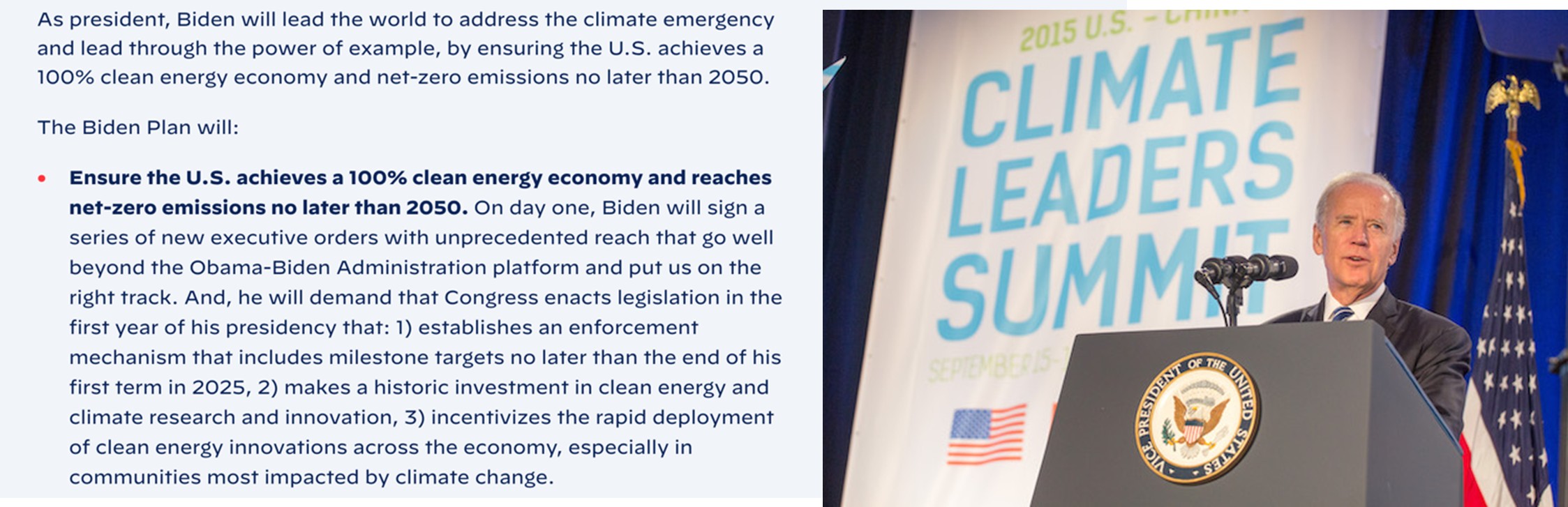
Source: https://joebiden.com/climate-plan/
Despite expected resistance from a Republican-controlled Senate for any “green” initiatives, as president Biden has an ace up his sleeve —national emergency powers. The COVID-19 pandemic, and the government’s reaction to it, has already set a clear precedent giving the president the right to declare an emergency and assume powers to tackle a problem.
Climate activists, citing the government’s reaction to COVID-19 as an example, have been agitating for strong state powers to tackle the climate crisis. It is widely believed that Biden could be receptive to the green activists within the Democratic Party given their growing influence and the direct support for the New Green Deal from Biden’s Vice President-elect, Kamala Harris. As Biden turns 78 this month, many political experts view him as under the sway of the more aggressive party members.
Should Biden call for a national climate emergency, his administration would have the levers of power to accelerate the U.S. economy’s transition to more green energy use.
Biden has already committed to decarbonize the U.S. power sector by 2035. To achieve that, measures would undoubtedly include massive spending on renewable energy infrastructure, and probably a heavier tax burden on the fossil fuel sector, especially consumption. Indeed, such taxation could help offset the costs to implement a green revolution.
Comments from many U.S. oil and gas executives suggest that the industry is not overjoyed, but also not cowed by the prospect, seeing the transition to renewable sources as inevitable. The main point of contention is the timeline.
Federal policy aside, governors in major Democratic-controlled states will forge ahead with their own green energy plans, just as they did after Trump announced plans to exit the Paris accord. The top ones to keep an eye on are California, Washington State and Massachusetts. The latter, for example, has a target of 25% reduction in emissions by the end of this year, and an 80% reduction in emissions by 2050. California has pledged to generate 60% of its electricity via renewables within a decade.
This is not to say that all Republicans are against the green agenda. Many youth groups of the Republican party wrestled with their elders on environmental policy despite supporting Trump on other issues.
Likewise, Republican-controlled states are not set against climate change. Texas may be the country’s oil and gas powerhouse, producing 40% of its oil and 25% of its gas, yet in 2018 the state also led the nation in decarbonization, accounting for one-third of all coal power plant retirements in the U.S., according to U.S. Energy Information Administration data.
Also, the Lone Star State leads the nation in wind generation capacity, with nearly 25 GW or more than a quarter of the total. Annually, Texas is adding more renewable generation than any other state. If Texas were an independent country, it would rank No. 5 globally in wind capacity.
THE IMPACT ON JAPAN
Biden will find ready support among allies in Europe for his green energy agenda, and this will likely determine the course for Japan too. Since taking over as prime minister, Suga Yoshihide has accelerated calls for decarbonization and a shift to renewables. That U.S. is now moving in this direction will justify his gambit.
As Japan NRG Weekly reported in September, Warren Buffett recently spent $6 billion investing in five Japanese trading companies that count among the country’s leading investors in the U.S. These firms and other Japanese investors will now be forced to re-examine their U.S. energy portfolios, and will likely opt for more green deals going forward.
Also, having the U.S. aligned with European policy would help clarify the kind of fossil fuel deals Japanese companies can still pursue in North America. After the French government stepped in last month to block the import of LNG derived from U.S. shale gas fields, clarity on what energy sources have value in today’s global market and how they can be exploited should help drive a new boom in Japanese investments overseas.
ANALYSIS
YURIY HUMBER,
BASED ON AN ARTICLE IN
SHIN ENERGY SHINPO
Japan Eases Regulation to Expand Use of Biofuels
With Biggest Potential by 2030 Seen in Shipping and Aviation
As Japan looks for ways to meet its environmental goals, one avenue identified by the government to cut emissions is greater usage of biofuels. From this year, Japan has eased restrictions on which source materials qualify as alternative fuels for use in jets, and vowed to channel more funding for biofuel development.
Shipping and aviation are viewed as the two main industries which could switch to a fuel mix that includes an increasing non-petroleum component. State support is emboldening companies from the two industries to deepen their engagement with biofuel suppliers and widen testing of the technology. Last month, ANA Holdings, Japan’s largest airline, signed up its third supplier of sustainable aviation fuel (SAF) in less than two years.
STEPPING STONES PROMPTED BY GLOBAL MEASURES
At the end of September, the Ministry of Economy, Trade and Industry (METI) said it had allocated ¥4.5 billion in the 2021 budget as funding to support “business development of biofuel production and bio-derived product manufacturing technology as a means to speed up our ability to start carbon recycling.”
This is part of a new biofuels strategy unveiled by the Ministry of Land, Infrastructure, Transport and Tourism (MLIT) earlier this year. The strategy seeks to draw a path toward dropping the cost of production of biofuels and synthetic fuels to the same level as hydrocarbon fuels through adoption of carbon capture and recycling, among other measures.
While the domestic auto industry has favored fuel cell technology, hybrids, and (to a smaller extent until recently) electric vehicles as the way to reduce its carbon footprint, Japanese shipping and aviation companies are rapidly turning to biofuels to plot a near-term path to decarbonization.
Japan’s top shipper, Nippon Yusen (NYK Line), last year embarked on trials of biofuel derived from waste oils, such as cooking oil. The trial, performed in collaboration with mining giant BHP, used product manufactured by GoodFuels, a biofuel company from the Netherlands. NYK’s dry bulk carrier, Frontier Sky, ran on a fuel that contained 30% of biofuel.
Euglena Co., a Japanese manufacturer of microalgae, is experimenting with biofuel from algae in the service of Yaeyama Kanko Ferry, an operator that connects the Yaeyama Islands of Okinawa, southern Japan.
According to the Japanese government’s biofuel strategy, a next-generation fuel for shipping should be commercially viable by 2030.
Efforts by Japanese shippers are partly driven by a change in global shipping rules. From this year, new standards enforced by the International Maritime Organization (IMO) require fuel used by vessels to drastically cut their sulphur content to 0.5% from 3.5%. This will help to cut global sulphur oxide (SOx) emissions from ships by 77%.
By 2050, the total greenhouse gas emissions (GHG) from ships are supposed to fall by 50% compared to 2008 levels. At the turn of the century, marine transport players aim for net-zero emissions.
Aviation has a similar story, though the trend to decarbonization there started earlier. Since 2010, the International Civil Aviation Organization (ICAO) has set a goal of improving fuel efficiency by 2%. In 2016, ICAO also started the Carbon Offsetting and Reduction Scheme for International Aviation (CORSIA). According to the scheme, aviation companies are obligated to purchase credits to offset excess emissions, tightening the environmental measures for the international aviation industry.
This has driven airlines, including Japan’s flagship carrier ANA, to seek greater use of SAF. The source component of a biofuel tends to absorb the carbon dioxide that is released when the fuel is burned.
In January 2019, ANA partnered with Showa Shell Sekiyu of Japan to purchase 70,000 U.S. gallons (265 kiloliters) of SAF for mixing with its regular jet fuel on San Francisco flights. In June of the same year, ANA signed an offtake agreement for more SAF deliveries with U.S. green energy firm LanzaTech Inc. Mitsui & Co. is an investor in LanzaTech.
This October, ANA found another partner for SAF in Finland’s Neste Oyj, whose Singapore refinery has just started test supplies to the Japanese carrier.
One reason to sign up so many suppliers is the lack of volume in the global SAF market. The entire SAF output on an annual basis accounts for 0.015% of jet fuel worldwide, according to International Air Transport Association data cited by Bloomberg. To qualify as SAF, the fuel must meet sustainability criteria, such as reduced carbon emissions, limits on fresh water consumption, no deforestation and no competition with food production.
Seeing the lack of SAF supply, Japan has moved to ease rules that specify which petroleum alternatives can be used as jet fuel. At the end of last year, the Ministry of Land, Infrastructure, Transport and Tourism amended a 2015 statute that paves the way for a broader set of bio-jet fuels in domestic aviation.
Alternative jet fuels currently include those that use algae, city waste, and non-edible plants as raw materials. While this “blend-in” type of biofuel can be immediately mixed with the conventional jet fuel, those volumes are low. The ministry’s rule change adds five types of synthetic fuel to the permitted standard.
Fuel approved by the new rule change are:
① Paraffinic kerosene purified through the Fischer-Tropsch Process,
② Paraffinic kerosene purified through hydrogen treatment,
③ Isoparaffin derived from fermented hydrogenated sugars,
④ Synthetic kerosene derived from alkylation of aromatics, and
⑤ Alcohol-to-jet synthetic paraffinic kerosene.
With the rule amendment, private companies such as euglena and engineering firm, IHI, obtained industry standard certification for the fuels they were developing in-house. This means their fuels can be used on domestic flights.
Of course, one factor determining whether biofuels will get broader use will be the cost of production. According to Japan’s biofuel strategy, the cost of bio-jet fuel derived from algae should drop to ¥100-¥200 / liter by 2030, while the cost of synthetic and decarbonized fuels should also reach the ¥200 / liter level by 2040.
That will require a big technological leap. The cost base of algae-derived biofuel currently sits at around ¥1,600 / liter.
Recent breakthroughs in gene technology may hold the key. Japan researchers have started to borrow gene modification techniques to improve carbon absorption of microalgae, which are already the most effective biological systems for capturing carbon. The goal would be to combine mass production of microalgae with carbon capture facilities at thermal power plants. If successful, this technology would help decarbonize thermal generation while, literally, feeding the green energy revolution
ROADMAP TO NUCLEAR RESTAR
| Company | NPP Name | Capacity | Reactor Type | Status | Since | Known or Expected Restart* | |
| Hokkaido | Tomari-1 | 579 MW | PWR | Under inspection | 2011.04.22 | at earliest, late 2021 | |
| Tomari-2 | 579 MW | PWR | Under inspection | 2011.08.26 | at earliest, late 2021 | ||
| Tomari-3 | 912 MW | PWR | Under inspection | 2012.05.05 | at earliest, late 2021 | ||
| Tohoku | Higashidori-1 | 1,100 MW | BWR | Under inspection | 2011.02.06 | at earliest, in 2022 | |
| Onagawa-2 | 825 MW | BWR | Under inspection | 2010.11.06 | at earliest, in 2022 | ||
| Onagawa-3 | 825 MW | BWR | Not applied for restart | 2011.09.10 | at earliest, mid 2020s | ||
| Tokyo | Kashiwazaki Kariwa-1 | 1,100 MW | BWR | Not applied for restart | 2011.08.06 | unlikely to restart | |
| Kashiwazaki Kariwa-2 | 1,100 MW | BWR | Not applied for restart | 2007.02.19 | unlikely to restart | ||
| Kashiwazaki Kariwa-3 | 1,100 MW | BWR | Not applied for restart | 2007.09.19 | unlikely to restart | ||
| Kashiwazaki Kariwa-4 | 1,100 MW | BWR | Not applied for restart | 2008.02.11 | unlikely to restart | ||
| Kashiwazaki Kariwa-5 | 1,100 MW | BWR | Not applied for restart | 2012.01.25 | unlikely to restart | ||
| Kashiwazaki Kariwa-6 | 1,356 MW | ABWR | Under inspection | 2012.03.26 | possibly, late 2021 | ||
| Kashiwazaki Kariwa-7 | 1,356 MW | ABWR | Under inspection | 2011.08.23 | at earliest, late spring 2021 | ||
| Chubu | Hamaoka-3 | 1,100 MW | BWR | Under inspection | 2010.11.29 | unlikely to restart | |
| Hamaoka-4 | 1,137 MW | BWR | Under inspection | 2012.01.25 | unlikely to restart | ||
| Hamaoka-5 | 1,380 MW | ABWR | Not applied for restart | 2012.03.22 | unlikely to restart | ||
| Hokuriku | Shika-1 | 540 MW | BWR | Not applied for restart | 2011.10.08 | unlikely to restart | |
| Shika-2 | 1,206 MW | ABWR | Under inspection | 2011.03.11 | at earliest, late 2021 | ||
| Kansai | Mihama-3 | 826 MW | PWR | Under inspection | 2011.05.14 | 2021.01.xx | |
| Ohi-3 | 1,180 MW | PWR | Under inspection | 2020.07.20 | possibly, spring 2021 | ||
| Ohi-4 | 1,180 MW | PWR | Under inspection | 2020.11.03 | 2021.02.15 | ||
| Takahama-1 | 826 MW | PWR | Under inspection | 2011.01.10 | 2021.03.xx | ||
| Takahama-2 | 826 MW | PWR | Under inspection | 2011.11.25 | 2021.06.xx | ||
| Takahama-3 | 870 MW | PWR | Under inspection | 2020.01.06 | 2020.12.22 | ||
| Takahama-4 | 870 MW | PWR | Under inspection | 2020.10.07 | 2021.01.25 | ||
| Chugoku | Shimane-2 | 820 MW | BWR | Under inspection | 2012.01.27 | possibly, late 2021 | |
| Shikoku | Ikata-3 | 890 MW | PWR | Under inspection | 2019.12.26 | at earliest, mid-2020 | |
| Kyushu | Genkai-3 | 1,180 MW | PWR | Under inspection | 2020.09.18 | 2020.11.23 | |
| Genkai-4 | 1,180 MW | PWR | In operation | 2019.11.20 | – | ||
| Sendai-1 | 890 MW | PWR | Under inspection | 2020.03.16 | 2020.11.26 | ||
| Sendai-2 | 890 MW | PWR | Under inspection | 2020.05.20 | 2020.12.26 | ||
| J- Atomic | Tokai-2 | 1,100 MW | BWR | Under inspection | 2011.05.21 | at earliest, 2023 | |
| Tsuruga-2 | 1,160 MW | PWR | Under inspection | 2011.08.29 | unlikely to restart | ||
* In the “Known or Expected Restart” column, company/media announced dates are left-aligned; Japan NRG calculations are centered
Source: Company websites, JAIF, Japan NRG calculations
GLOBAL VIEW
Below are some of last week’s most important international developments monitored by the Japan NRG team because of their potential to impact energy supply and demand, as well as prices. We see the following as relevant to Japanese and international energy investors.
Renewable Energy Valuations:
October was another very good month for valuations of publicly-listed renewable energy (‘RE’) companies and funds with strong RE components. Some of the funds are up by more than 100% on a year-to-date basis. This contrasts sharply with the performance of listed oil and gas companies, where equities prices are down by more than 50%. The Invesco Solar ETF is up 150% on a year-to-date basis outperforming the S&P Oil & Gas E&P Index by a factor of almost four.
Natural Gas Prices:
Global prices of natural gas have improved dramatically in Q4 since summer lows, with some indices almost doubling due to the onset of winter and greater demand for electricity due to work-from-home practices. The U.S. natural gas index, Henry Hub, is at its highest level since Jan. 2019 at $3.2 mmbtu; the European gas index, TTF, is trading at $5 mmbtu, its highest since Oct. 2019; and Asian spot prices are currently trading at $7.5 mmbtu, a two-year high.
Covid-19:
Infection rates are rising dramatically in many countries, with U.S. and French daily infections exceeding 100,000 and 50,000 cases, respectively, for the first time. Cumulative global infections at the end of last week were approaching 50 million. ICU occupancy rates in hospitals in some Midwest U.S. states are approaching 80%. New lockdowns, curfews, and stay-at-home orders are negatively impacting the outlook for oil prices. WTI and Brent oil indices both closed last week at $40 or below, with WTI falling by 4% on Friday alone. Last Thursday the U.K. instituted a second nationwide lockdown that will last until Dec. 2.
China:
1). An estimated $20 trillion in capital expenditures are required to peak emissions by 2030 and to achieve net-zero CO2 by 2060, according to a recent study by Tsinghua University.
2). The Chinese government has mandated that 50% of new car sales by 2035 must be EVs, FCVs, or hybrids.
3). China’s president Xi Jinping has indicated that the Chinese economy could double to almost $30 trillion by 2035, creating further significant potential for growth in China’s energy markets.
South Asia:
Pakistan’s first ever electric-powered metro train service started commercial service in Lahore, Punjab. The project was constructed under the umbrella of the China-Pakistan Economic Corridor and was built by China State Railway Company.
Russia:
The Russian currency collapsed to a six-year low last week due to low oil prices, breaking through 80 rubles to the U.S. dollar for the first time in over six months.
Belarus:
Belarus opened its first nuclear plant last week, Astravyets, which was built by Russia’s Rosatom. Lithuania closed its electricity links with Belarus on Tuesday due to opposition to the 400 MW plant, which is 40 km from Vilnius. Earlier, Belarus closed its land borders with Latvia, Lithuania and Poland. Last week the EU added Belarusian President Alexander Lukashenko to a sanctions list.
Middle East:
1). OPEC+ are considering extending oil production cuts due to prolonged low demand and low oil prices.
2). Saudi Arabia’s Aramco will pay a $19 billion dividend in Q3 despite low oil prices.
3). The Iraq economy is in a state of “collapse” due to low oil prices, according to Prime Minister Mustafa al-Kadhami during a recent trip to Europe. Ninety percent of Iraqi government revenues come from oil.
4). Malawi became the first African country to move its embassy in Israel to Jerusalem.
EU:
1). France’s Engie canceled negotiations on a $7 billion, 20-year contract to import LNG from the U.S.
2). Spain’s Iberdola announced it would spend $88 billion over the next five years to double its renewable-energy power capacity.
UK:
1). An all-U.K. parliamentary group has adopted a 10-point plan to achieve net-zero carbon emissions by 2050. The plan has been endorsed by Centrica, National Grid and EdF, three of the U.K.’s largest energy groups, and includes an acceleration of the ban on the sale of ICE vehicles to 2032 and the adoption of green hydrogen technologies.
2). BP, the U.K.’s second largest oil and gas producer, is being forced to sell its London HQ for over $330 million to meet a cash flow shortage.
Americas:
1). The U.S. formally exited the Paris Agreement on Nov. 4.
2). Exelon, the largest operator of nuclear power plants in the U.S., announced during its Q3 results that it may separate its utilities businesses from the nuclear generation fleet as it struggles with the economics of operating nuclear power plants. It is also threatening to close the Bryon and Dresden nuclear facilities in Illinois unless it receives zero-credit incentives from the state government.
STOCK MARKET PERFORMANCE
| As of close on October 30, 2020 | Ticker | Market Cap | 1W (%) | MTD (%) | YTD (%) | |
| billions of yen | ||||||
| Energy | ||||||
| INPEX CORP | 1605 JP | 741.40 | 1.60 | -54.58 | -10.91 | |
| JAPAN PETROLEUM EXPL. | 1662 JP | 97.16 | 2.72 | -40.80 | -5.97 | |
| ENEOS HOLDINGS INC | 5020 JP | 1173.56 | 2.48 | -22.70 | -5.76 | |
| IDEMITSU KOSAN CO LTD | 5019 JP | 641. 90 | 1.65 | -24.66 | -5.15 | |
| COSMO ENERGY HOLD. | 5021 JP | 134.45 | 2.65 | -33.59 | -1.86 | |
| Industrials | ||||||
| JGC HOLDINGS CORP | 1963 JP | 227.33 | 0.69 | -49.34 | -14.94 | |
| CHIYODA CORP | 6366 JP | 59.61 | 0.00 | -19.08 | -8.76 | |
| MITSUBISHI CORP | 8058 JP | 3550.14 | 0.80 | -13.05 | -6.35 | |
| MITSUI & CO LTD | 8031 JP | 2929.38 | 1.64 | -8.18 | -7.71 | |
| Utilities | ||||||
| TOKYO ELECTRIC POWER | 9501 JP | 459.61 | 1.06 | -38.76 | -0.69 | |
| CHUBU ELECTRIC POWER | 9502 JP | 951.67 | 0.88 | -15.67 | -2.41 | |
| KANSAI ELECTRIC POWER | 9503 JP | 918.83 | 1.55 | -19.10 | -4.23 | |
| KYUSHU ELECTRIC POWER | 9508 JP | 426.77 | -1.21 | -1.40 | -6.44 | |
| J-POWER | 9513 JP | 268.72 | -3.80 | -42.39 | -6.44 | |
| TOKYO GAS CO | 9531 JP | 1108.30 | 4.18 | -3.28 | 4.99 | |
| OSAKA GAS CO | 9532 JP | 842.94 | 1.05 | -0.92 | 0.15 | |
| TOHO GAS CO | 9533 JP | 620.96 | 5.38 | 33.21 | 13.29 | |
| SAIBU GAS CO | 9536 JP | 102.49 | 4.67 | 11.20 | 4.00 | |
| SHIZUOKA GAS CO | 9543 JP | 76.27 | 6.49 | 6.18 | 7.29 | |
DATA
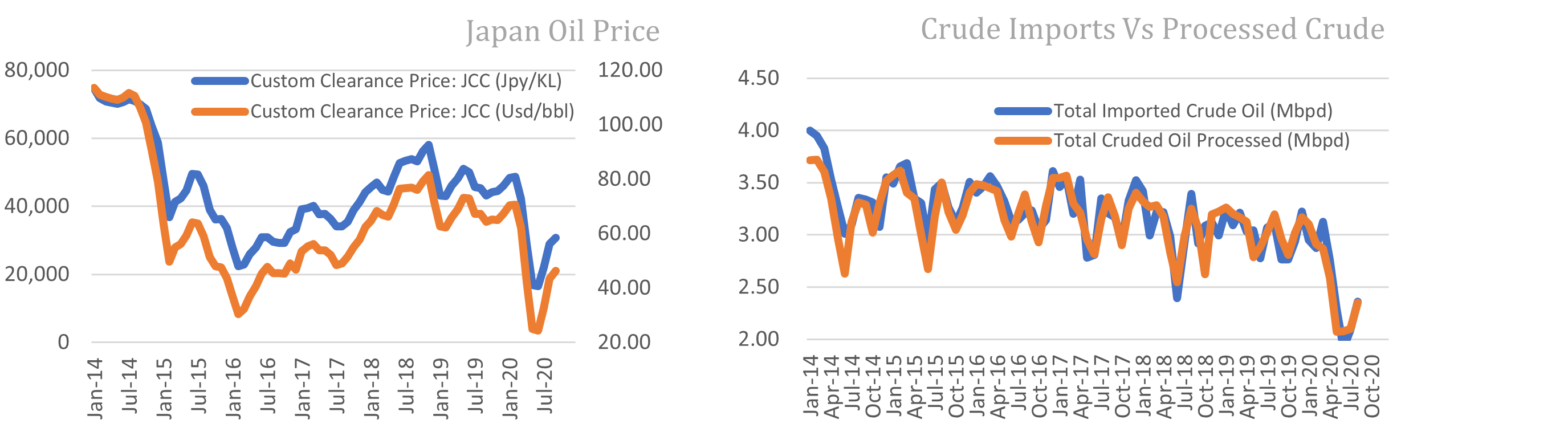
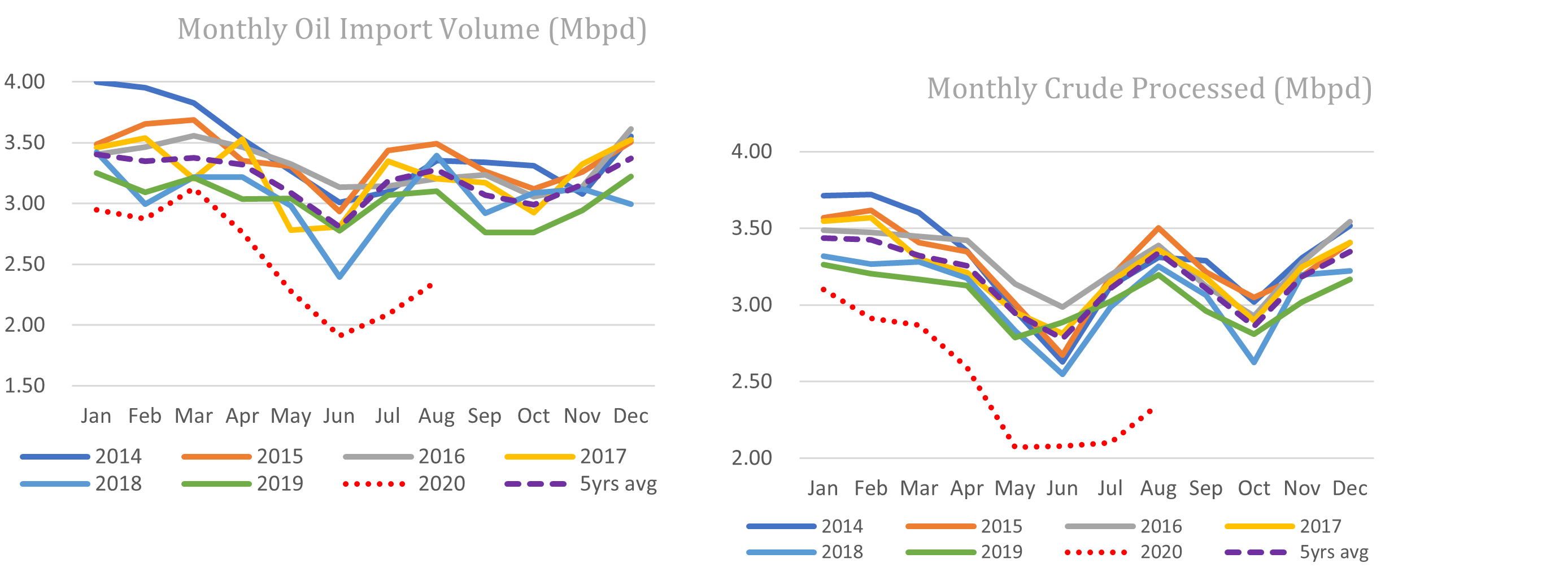
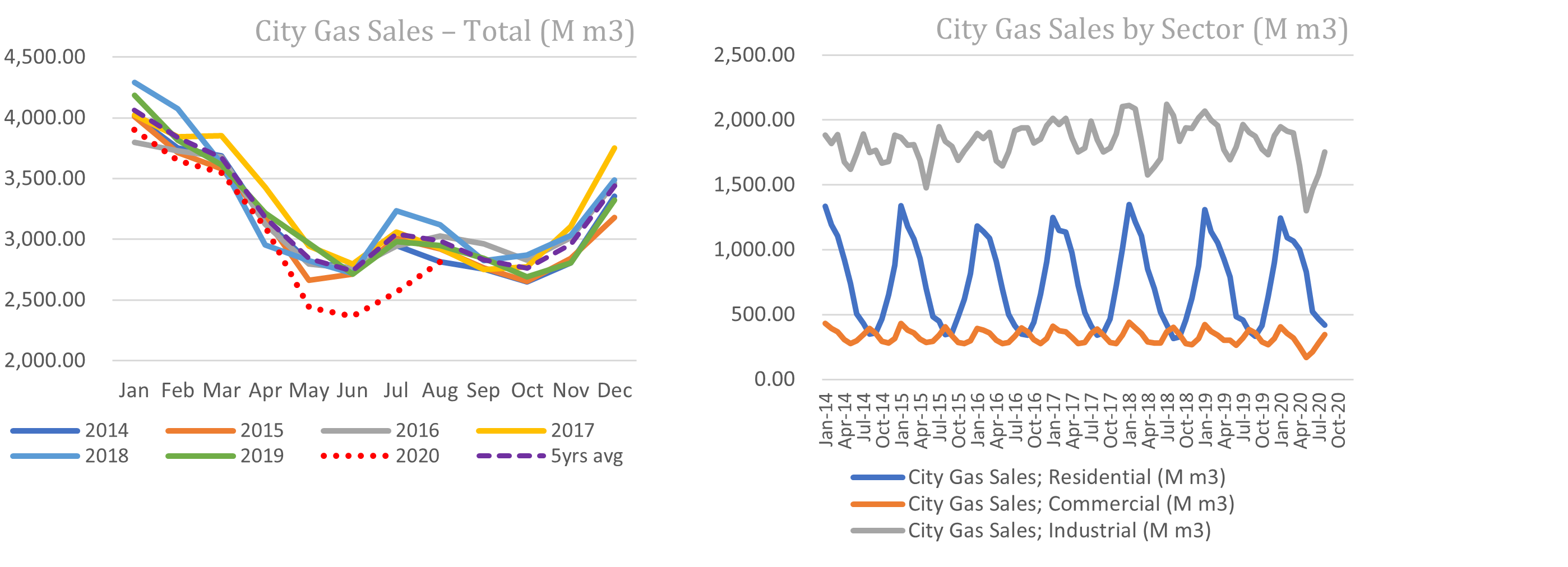
 SOURCES: the Ministry of Economy, Trade, and Industry (METI), Ministry of Finance, and the Petroleum Association of Japan
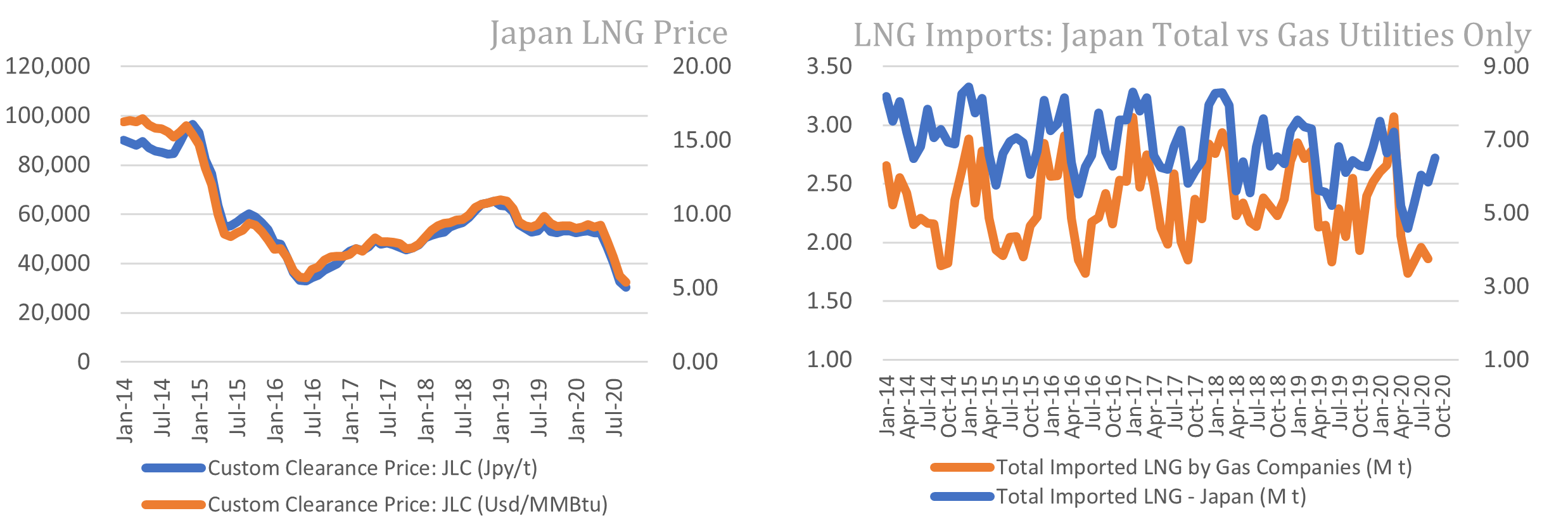
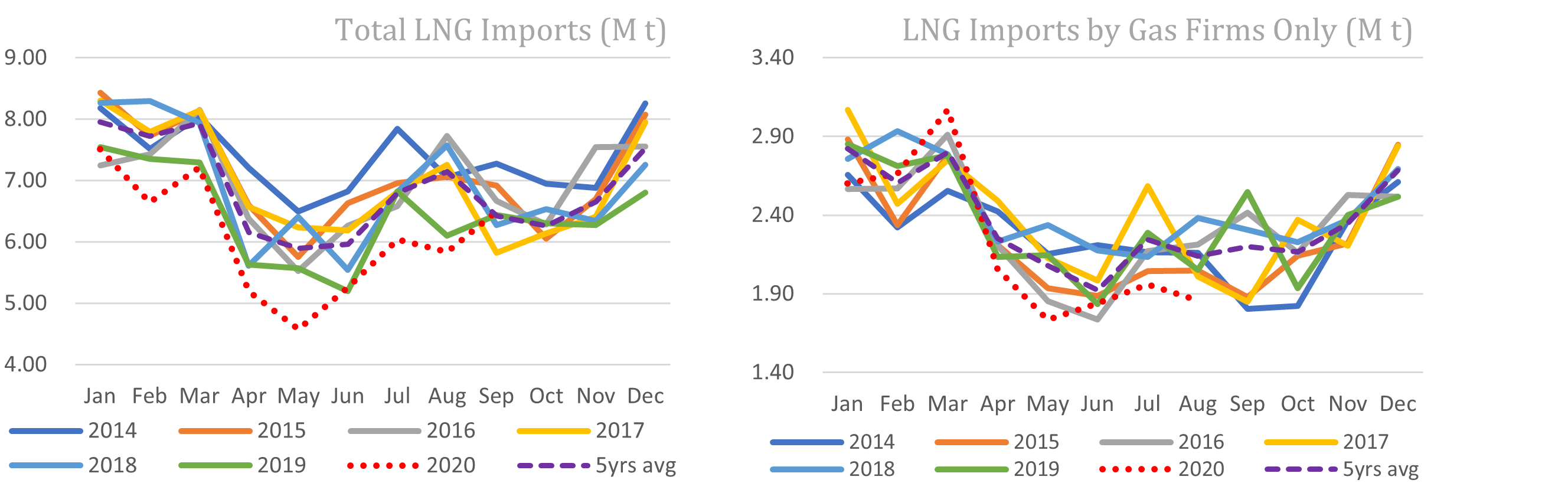
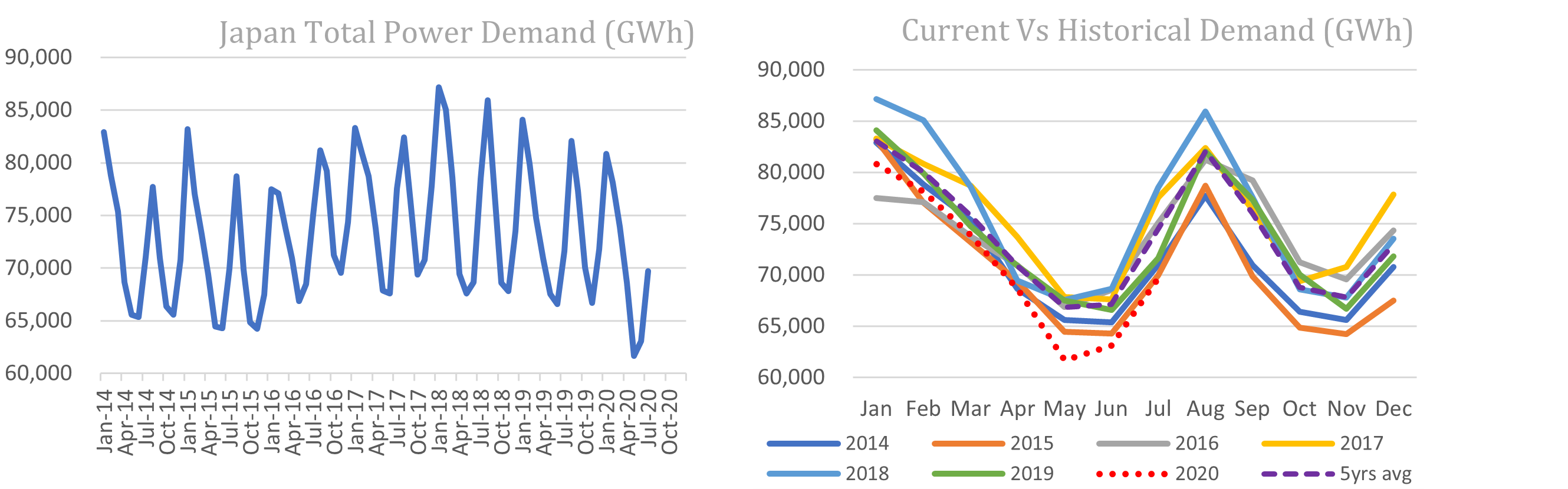
 SOURCES: the Ministry of Economy, Trade, and Industry (METI),
Ministry of Finance
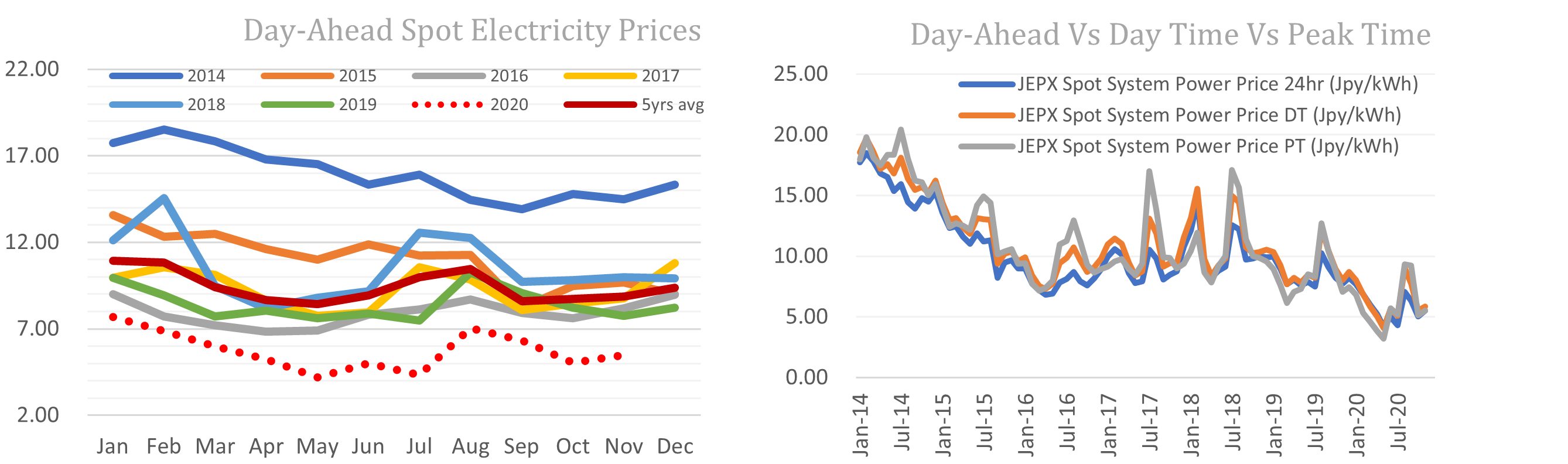
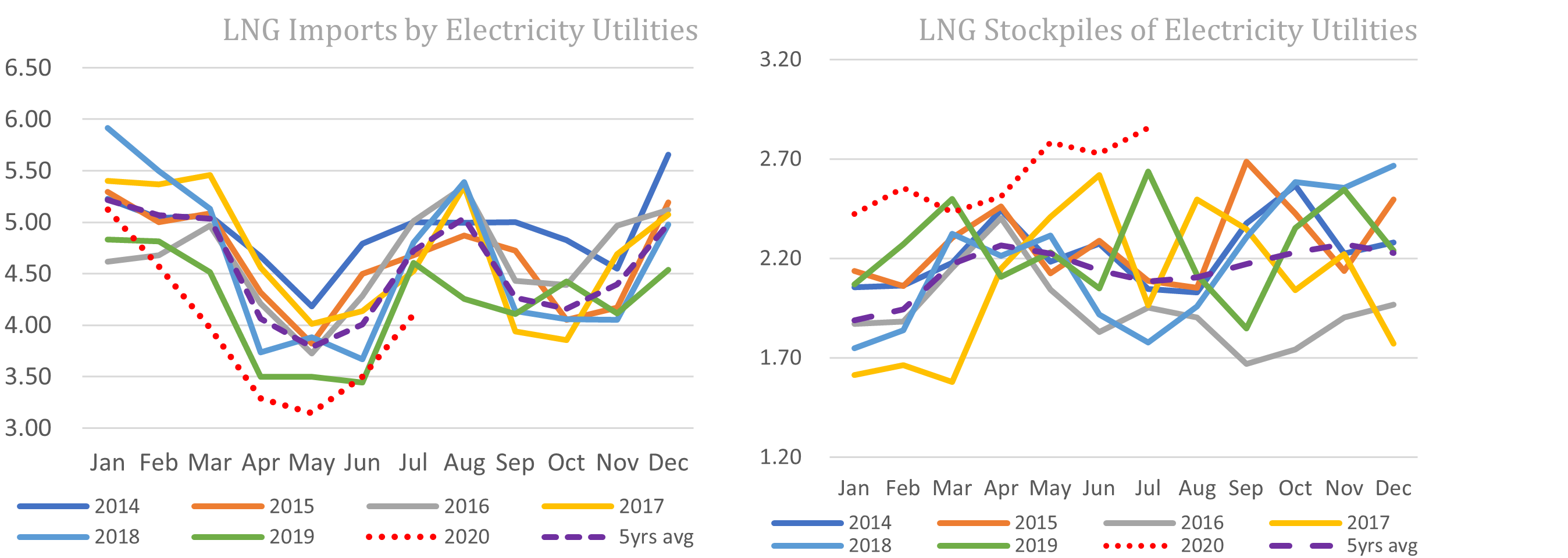 SOURCES: the Ministry of Economy, Trade, and Industry (METI), and the Japan Electric Power Exchange