
JAPAN NRG WEEKLY
MARCH 1, 2021
JAPAN NRG WEEKLY
March 1, 2021
NEWS
TOP
- TEPCO drops plans for near-term restart of Kashiwazaki nuclear plant; Utility ignored broken seismographs for months; Water leaks at Fukushima site; Court liability claims climb to ¥22 trillion
- Top business group chief says nuclear power is vital but needs a new vision; Japan will seek U.S., EU support for decarbonization
- New $5.6B fund to buy LNG vessels and lease to Japanese firms
ENERGY TRANSITION & POLICY
- Toshiba mulls GE partnership to produce wind turbine parts in Japan; Japanese startup makes first typhoon-proof wind turbines
- Itochu, Air Liquide to build world’s top hydrogen plant; Itochu and Nippon Coke explore opportunities in hydrogen supply chain
- Komatsu to develop hydrogen-powered heavy-duty mining trucks
- Toyota is top globally for patents in solid state batteries
- Toyota group forecasts hydrogen demand in Chubu by 2030
- Gas/Renewables is the best mix for Japan, REI study says
- Could JOGMEC cobalt find make Japan the metal’s superpower?
- Top Japan banking group establishes $1B fund for renewables
- Kansai Electric to deliver solar and storage kits to regions in Africa
- Kansai Electric, BYD to collaborate on Japan electric bus initiative
- Sumitomo Rubber to manufacture tires without emissions by 2050
- Major delivery firm to switch all small cars to electric … [MORE]
ELECTRICITY MARKETS
- ENEOS, others test JEPX-linked pricing plans for electricity to EVs
- Energy Agency looks for radical ways to boost nuclear output
- Kansai Electric is main hope for cutting Japan’s plutonium stocks; Co. CEO also lends support to new nuclear tech development
- Major power utilities group endorse wider use of futures contracts
- Mitsubishi Corp exits Vietnam coal power project amid pressure
- Power retailers fear March 5 deadline after falling into price “trap”
OIL, GAS & MINING
- INPEX makes its first acquisition of carbon credits
ANALYSIS
JAPAN MULLS DOMESTIC CARBON TAX, BUT FORGETS THAT CARBON IS GLOBAL AND ITS TAX MUST ALSO BE
Current government thinking around carbon price focuses on creating a tax at Japan’s border. This is not in the best interest of Japan or the planet, says Japan’s former chief climate negotiator and UN advisor Mutsuyoshi Nishimura.
We need a global Carbon Budget and an in-built rising carbon price mechanism for the scheme to have a real impact on climate, Mr. Nishimura writes in an exclusive column for Japan NRG, detailing both Japan’s current actions and his proposed alternative.
GEOTHERMAL: JAPAN’S OVERLOOKED RENEWABLES SOURCE STRUGGLES TO FULFILL ITS RICH POTENTIAL
Renewable energy is often criticized for its inability to deliver electricity as reliably as a coal-fired or nuclear plant. Japan does, however, classify one renewable source as “base-load.” It is also a source the country is richly blessed with: geothermal.
Since the 2011 Fukushima disaster, Japan has been getting more serious about tapping that potential. The government set an ambitious target of more than tripling geothermal’s share of the electricity mix and loosened legislation to favor development. For all of the potential and ambition, however, Japan’s ability to realize this target looks uncertain.
GLOBAL VIEW
Brazil’s president fired the CEO of the nation’s top oil firm and replaced him with a general. His Mexico peer unwound competition in the country’s power sector. EV maker Lucid plans to go public as does electric plane maker Joby. See this section for details on these and other global energy-related news.
2021 EVENT CALENDAR
Industry / political events related to Japan energy.
DATA Gas, power, and oil stats
JAPAN NRG WEEKLY
PUBLISHER
K. K. Yuri Group
Editorial Team
Yuriy Humber (Editor-in-Chief)
Tom O’Sullivan (Japan, Middle East, Africa)
John Varoli (Americas)
Regular Contributors
Mayumi Watanabe (Japan)
Daniel Shulman (Japan)
Takehiro Masutomo (Japan)
Art & Design
22 Graphics Inc.
Sponsored
SUBSCRIPTIONS & ADVERTISING
Japan NRG offers individual, corporate and academic subscription plans. Basic details are our website or write to subscriptions@japan-nrg.com
For marketing, advertising, or collaboration opportunities, contact sales@japan-nrg.com For all other inquiries, write to info@japan-nrg.com
Disclaimer
This communication has been prepared for information purposes only, is confidential and may be legally privileged. This is a subscription-only service and is directed at those who have expressly asked K.K. Yuri Group or one of its representatives to be added to the mailing list. This document may not be onwardly circulated or reproduced without prior written consent from Yuri Group, which retains all copyright to the content of this report.
Yuri Group is not registered as an investment advisor in any jurisdiction. Our research and all the content express our opinions, which are generally based on available public information, field studies and own analysis. Content is limited to general comment upon general political, economic and market issues, asset classes and types of investments. The report and all of its content does not constitute a recommendation or solicitation to buy, sell, subscribe for or underwrite any product or physical commodity, or a financial instrument.
The information contained in this report is obtained from sources believed to be reliable and in good faith. No representation or warranty is made that it is accurate or complete. Opinions and views expressed are subject to change without notice, as are prices and availability, which are indicative only. There is no obligation to notify recipients of any changes to this data or to do so in the future. No responsibility is accepted for the use of or reliance on the information provided. In no circumstances will Yuri Group be liable for any indirect or direct loss, or consequential loss or damages arising from the use of, any inability to use, or any inaccuracy in the information.
K.K. Yuri Group: Oonoya Building 8F, Yotsuya 1-18, Shinjuku-ku, Tokyo, Japan, 160-0004.
NEWS: ENERGY TRANSITION & POLICY
Toshiba looks to partner with GE to manufacture wind turbine components
(Nikkan Kogyo Shimbun, Feb. 23)
- Toshiba is understood to be in negotiations with General Electric to manufacture nacelles and other components for wind turbines.
- An agreement could be reached by spring, with details likely to be announced in March.
- CONTEXT: The move comes after Japan’s government identified offshore wind as its key focus in decarbonization strategy, whereby the govt. set a target of 60% of wind turbine components sourced from domestic manufacturers by 2040 to lower offshore wind generation costs.
- SIDE DEVELOPMENT:
Toshiba and GE to manufacture key turbine components in Japan
(Nikkei, Feb. 22)- Despite Hitachi and other Japanese manufacturers having pulled out of the wind sector, Toshiba plans to re-enter the burgeoning market via a partnership with GE.
- Toshiba will manufacture nacelles for wind turbines at its Yokohama plant. The Co’s recent withdrawal from coal-fired power generation is expected to free up personnel at the plant.
- Toshiba plans to cut costs and increase competitiveness by standardizing components with GE.
- SIDE DEVELOPMENT:
Japanese startup to roll out first typhoon-proof wind power turbines this year
(Asia Nikkei, Feb. 22)- Japanese startup Challenergy plans to produce its first stormproof wind power turbines this year and believes it can sell as many as 100 units next year.
- The Magnus VAWT, or Vertical Axis Wind Turbine model, uses rotating vertical cylinders that are more stable and can work even when wind speeds reach 40 meters per second. That is almost twice the design specs for a regular turbine.
- The company is targeting island nations with frequent storms, such as the Philippines, where the first 10 kW unit will be installed. Th turbines will be sold together with a storage battery to compensate for lower and costlier power output.
- Mitsui Sumitomo Insurance Venture Capital and Dai-Ichi Life Insurance are among the investors in Challenergy.
Itochu partners with Air Liquide to build one of the world’s largest hydrogen plants
(Nikkei, Feb. 25)
- Itochu, a Japanese trading house, will work with Air Liquide of France to build a liquid hydrogen plant in central Japan. The facility will use natural gas as feedstock and, when completed in mid-2020s, will be among the world’s largest.
- The partners plan to produce 30 tons of liquid hydrogen a day and target power generation facilities and fuel-cell vehicles as buyers.
- CONTEXT: Japan’s current output of liquid hydrogen is 44 tons / day. Of that, 70% is produced by Iwatani, a Japanese competitor to Air Liquide.
- SIDE DEVELOPMENT:
Itochu and Nippon Coke study hydrogen supply chain
(New Energy Business News, Feb. 26)- Nippon Coke and Engineering and Itochu Corporation agreed to work with Belgium’s largest shipping company, Compagnie Maritime Belge (CMB), on a project to establish a hydrogen supply chain in Kita-Kyushu by 2023.
- While Nippon Coke and Engineering’s Kita-Kyushu plant doesn’t currently extract hydrogen from coking byproducts, it’s potentially a stable supply of the fuel.
- For its part, CMB plans to commence trials of its hydrogen-powered maritime engine in the Seto Inland Sea in 2021.
Komatsu to develop hydrogen-powered heavy-duty mining dump trucks
(Nikkei, Feb. 22)
-
- Japan’s top construction equipment maker will start in 2021 to develop hydrogen-fueled vehicles, and aims to have trucks powered with it by 2030.
- In an industry-first, Komatsu also wants to transform heavy-duty mining dump trucks to run on CO2-free hydrogen. The vehicles’ fuel cell stacks will be outsourced.
- CONTEXT: Most mining trucks run on diesel. Adding hydrogen fuel cells to such heavy equipment promises to be technically challenging and expensive.
Toyota top in global patents for solid state batteries
(Shukan Economist, March 2)
- Toyota currently holds the largest number of patents in the world for solid-state batteries, closely followed by Panasonic.
- Solid-state batteries can be categorized into the smaller oxide type and the larger sulfide type, suitable for powering electric vehicles. Sulfide batteries promise greatly improved performance over lithium technology.
- New entrant in the EV market, Idemitsu, also plans to use solid-state batteries in its vehicles.
Toyota group says local hydrogen demand to surpass 100,000 tons by 2030
(Chemical Daily, Feb. 22)
- On Feb. 19, the Chubu Hydrogen Utilization Study Group, a consortium of 11 private sector companies that includes Toyota, presented a report on its outlook for the Chubu region’s hydrogen market.
- Among findings are: the Chubu region will account for one-third of Japan’s hydrogen demand by 2030, which could be as much as 110,000 metric tons. An investment of ¥100 billion in plants will be required.
- Less than 20% of demand will be for the ultrapure grade required for fuel cells, says the report.
- Group members are ENEOS, Idemitsu, Sumitomo Corporation, Toho Gas, Toyota, Sumitomo Mitsui Banking Corporation, Mitsubishi Chemical, Japan Steel, and Air Liquide Japan.
Konica Minolta leads Japan manufacturers in decarbonization model
(Shukan Diamond, Feb. 20)
- With global companies such as Google and Amazon demanding their suppliers go green, a commitment to decarbonization is now a prerequisite for doing business in Japan.
- Konica Minolta, the first Japanese manufacturer to commit to cutting carbon emissions, says businesses should treat green policies not as a cost but as an opportunity to make money.
- Minolta’s strategy differs from other Japanese manufacturers in that the corporation demands suppliers to cut carbon emissions to help Minolta achieve decarbonization goals.
- Konica Minolta also provides technical assistance and expertise to suppliers in China and Malaysia to help them reduce carbon emissions while also reducing procurement costs.
Gas/renewables mix will provide ample power at low cost, Renewable Energy Institute says
(Gas Energy News, Feb. 22)
- The Renewable Energy Institute released findings suggesting that limiting Japan’s energy sources by 2030 to natural gas and renewables won’t create any economic or supply issues.
- The report claims that after emissions costs are factored in, limiting energy sources in this way will actually reduce Japan’s total energy cost to ¥11.1 trillion in 2030, which compares favorably with the ¥12.7 trillion spent in 2019/20.
- The report called for the use of coal-fired power stations to be limited to Hokkaido and Okinawa, which face supply issues.
- The findings are based on simulations of major power plant shutdowns and other emergencies.
- The report cites an analysis of electricity supply and demand in all regions at all times of the day.
Could JOGMEC’s cobalt find make Japan a rare metals superpower?
(Emira, Feb. 24)
- In July, JOGMEG announced that they had successfully extracted minerals from areas of cobalt-rich crust that lie within Japan’s exclusive economic zone, in a world first.
- The crust, only a few centimeters thick, tops undersea mountains that are located at depths of 1,000 to 2,500 meters below sea level.
- The achievement has the possibility to turn Japan into a rare metals superpower in the next 10 to 20 years.
- Demand for lithium-ion batteries has seen global demand for cobalt double in recent years.
MUFG establishes ¥100 bn fund to invest in renewable electricity
(New Energy Business News, Feb. 25)
- As the first stage in an initiative to power its offices and branches exclusively with renewable electricity, the Mitsubishi UFJ Group established a green investment fund that will invest around ¥100 billion in renewables.
- The fund will initially concentrate on procurement of electricity from FIT-approved solar farms, and later broaden focus to include virtual power plants and hydrogen generation.
- MUFG expects the initiative to reduce its CO2 emissions by 20,000 tons.
- The bank’s offices and branches consume around 400 GWh per year. Assuming a renewable electricity procurement cost of ¥12- ¥13 per kWh, it will cost ¥100 billion to procure the bank’s electricity requirements over the next 20 years.
Kansai Electric to deliver power to less developed African regions
(New Energy Business News, Feb. 26)
- Kansai Electric is collaborating with Tokyo-based SucreCube Japon to trial a service to bring electricity and communications services to parts of Africa that currently lack these services.
- The one-month trial will take place in March.
- Under a memorandum signed with Senegal’s Ministry of Health and Social Action in 2019, SucreCube Japon deploys a product known as the “Tumiqui Smart Kit”, which combines solar panels, storage batteries, and LED lighting with communications equipment, to regions of Senegal that lack electricity and communications services.
Kansai Electric, Keihan Bus and BYD to collaborate on electric bus initiative
(New Energy Business News, Feb. 26)
- Kansai Electric, also known as KEPCO, Keihan Bus, and BYD Japan have agreed to collaborate on an electric bus trial in Kyoto.
- The first stage in the trial involves deploying four electric buses on the Kyoto-Station to Hotel Emion Kyoto route. In a first for Japan, the route will be served solely by electric buses.
- Subsequently, other routes will be added. In order to optimize bus operations, KEPCO will also analyze data on bus movements and charging times.
Ammonia generation major opportunity for turbine manufacturers
(Shukan Economist, March 2)
- JERA plans to blend an average of 20% ammonia with the thermal coal burned at its power stations by the early 2030s.
- JERA will trial an ammonia-coal blend at its Hekinan power plant in Aichi from 2021/22, necessitating modifications to boilers, port facilities, storage tanks, and evaporation units. Experiments with hydrogen blends are also planned.
- The transition to ammonia will also create demand for new turbine technology. Since ammonia releases polluting nitrogen oxides upon combustion, Mitsubishi Power is pursuing a strategy of using waste heat to separate out ammonia’s hydrogen component and then using that hydrogen to power dedicated turbines.
- Mitsubishi Power aims to leverage its hydrogen gas turbine technology to gain a bigger piece of the ¥500 billion global gas turbine market, of which both Mitsubishi and GE currently control one third each.
- Sophisticated technology is required to build turbines that run on pure hydrogen because of the risk of “flashback”. Mitsubishi has succeeded in producing a hydrogen turbine capable of operating at 1,800 degrees with no risk of flashback.
Sumitomo Rubber to manufacture tires without CO2 by 2050, may use hydrogen
(New Energy Business News, Feb. 22)
- Sumitomo Rubber Industries is aiming for virtually zero CO2 emissions in the tire manufacturing process by 2050, and as part of that effort, it’s considering using hydrogen energy at its main tire factories in Japan.
- The Co. has joined the domestic hydrogen council to participate in solving problems around the building of a hydrogen-based society.
Japanese delivery firm to switch all small cars to electric by 2030
(Nikkei, Feb. 24)
- SG Holdings, which runs the Sagawa Express courier and delivery service, plans to move all of its 7,000 mini-cars to electric models by 2030, which should cut the company’s carbon footprint by more than 10%.
- This is the first such move by a Japanese delivery company.
- The switch relates to the so-called kei cars – the smaller, narrow mini autos often used in Japan to navigate in residential areas.
- SG will use a new EV developed jointly with Japanese startup ASF. The prototype is due in spring.
Kawasaki Heavy forced to delay first hydrogen shipment due to Covid lockdown
(Various, Feb. 22)
- Kawasaki Heavy’s plans to receive its first trial shipment of hydrogen from Australia this spring will be delayed due to the impact from the COVID-19 pandemic.
- The Co. has manufactured the world’s first liquid hydrogen carrier, and carried out some test runs last October. However, the ship needs to undergo a final registration process, which has been delayed after overseas engineers were barred from visiting Japan as part of the recent lockdown in the country.
- The ship might not sail from Australia to Japan with the fuel until second half of this year.
Hitachi to put more focus on decarbonization for M&A investment assessment
(Nikkei; February 26, 2021)
- On February 25, Hitachi held a conference regarding its environmental strategies and announced that the company will be putting more focus on decarbonization when deciding on new M&A or research activities.
- Due to an increase in investments that focus on environmental issues and CSR across the globe, Hitachi will put environmental issues at the core of its business.
- As a first clear step, the company announced that by 2030 it will invest 84 billion yen into environment-related action. Of that, 60 billion yen will go into energy saving and 24 billion yen for purchasing renewable energy.
- Excluding listed subsidiaries, Hitachi aim to cut its CO2 output by 24% and decrease its electricity use by 22%.
NEWS: POWER MARKETS
| No. of operable nuclear reactors | 33 | |||
| of which | applied for restart | 25 | ||
| approved by regulator | 16 | |||
| restarted | 9 | |||
| in operation today | 4 | |||
| able to use MOX fuel | 4 | |||
| No. of nuclear reactors under construction | 3 | |||
| No. of reactors slated for decommissioning | 27 | |||
| of which | completed work | 1 | ||
| started process | 4 | |||
| yet to start / not known | 22 | |||
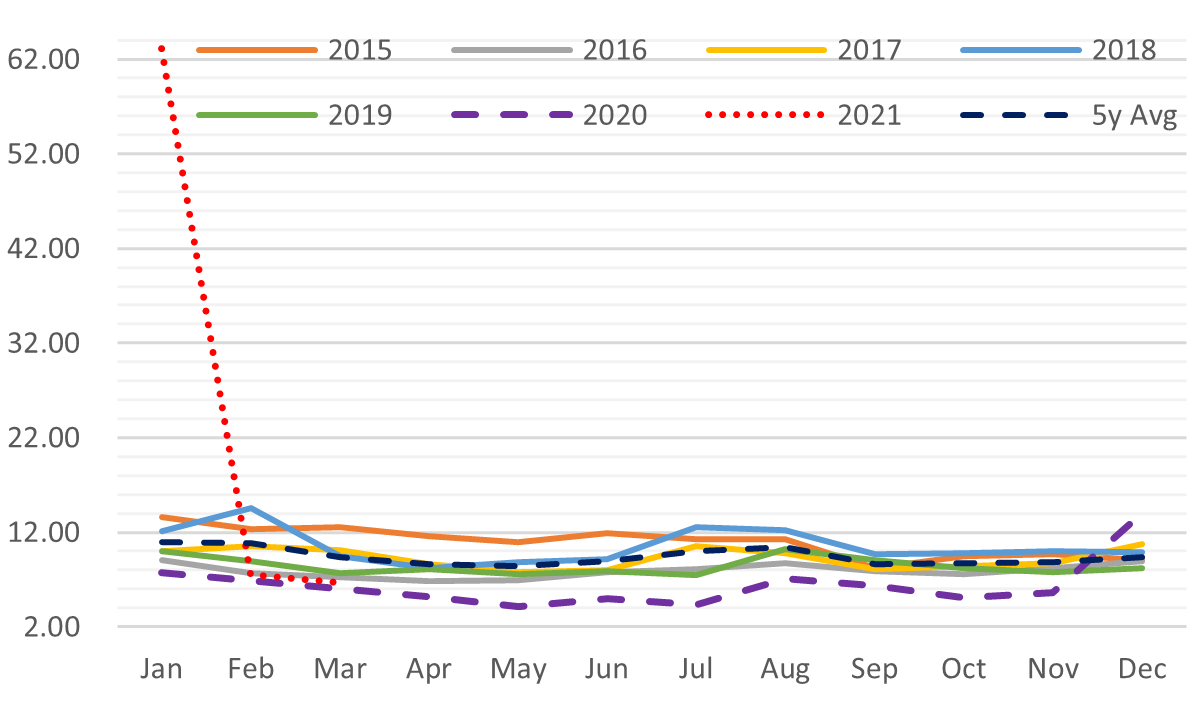
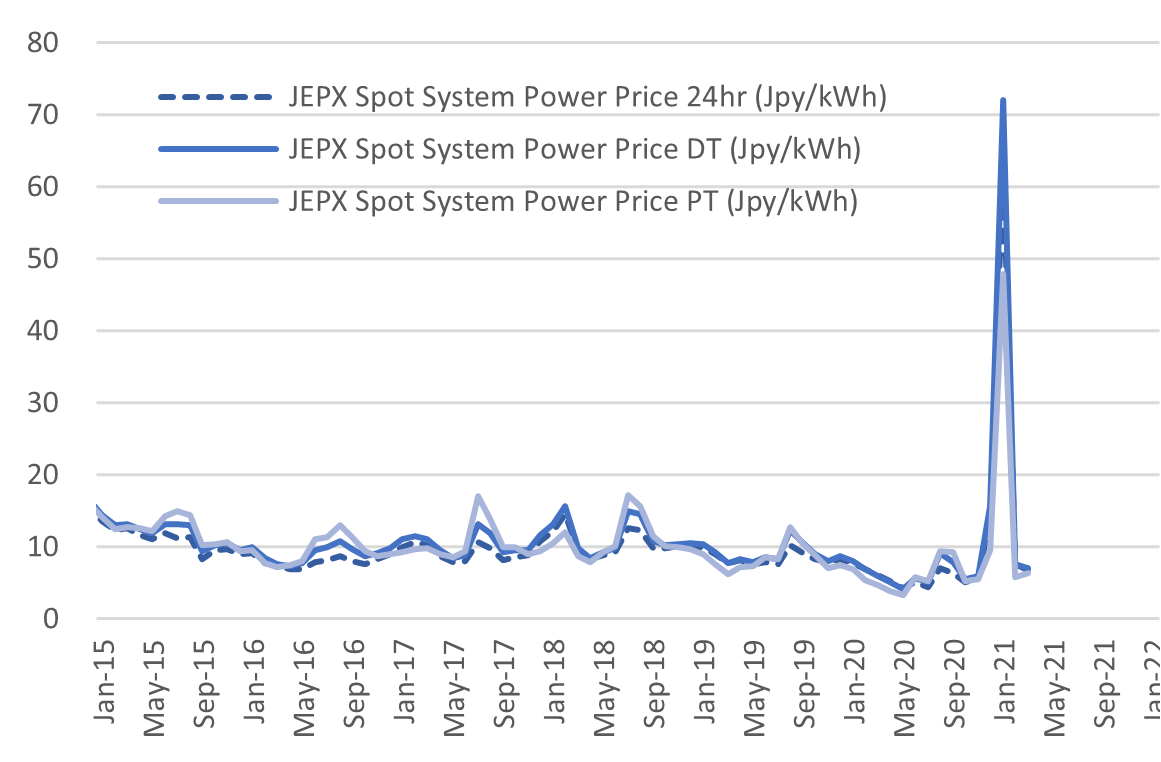
Spot Electricity Prices
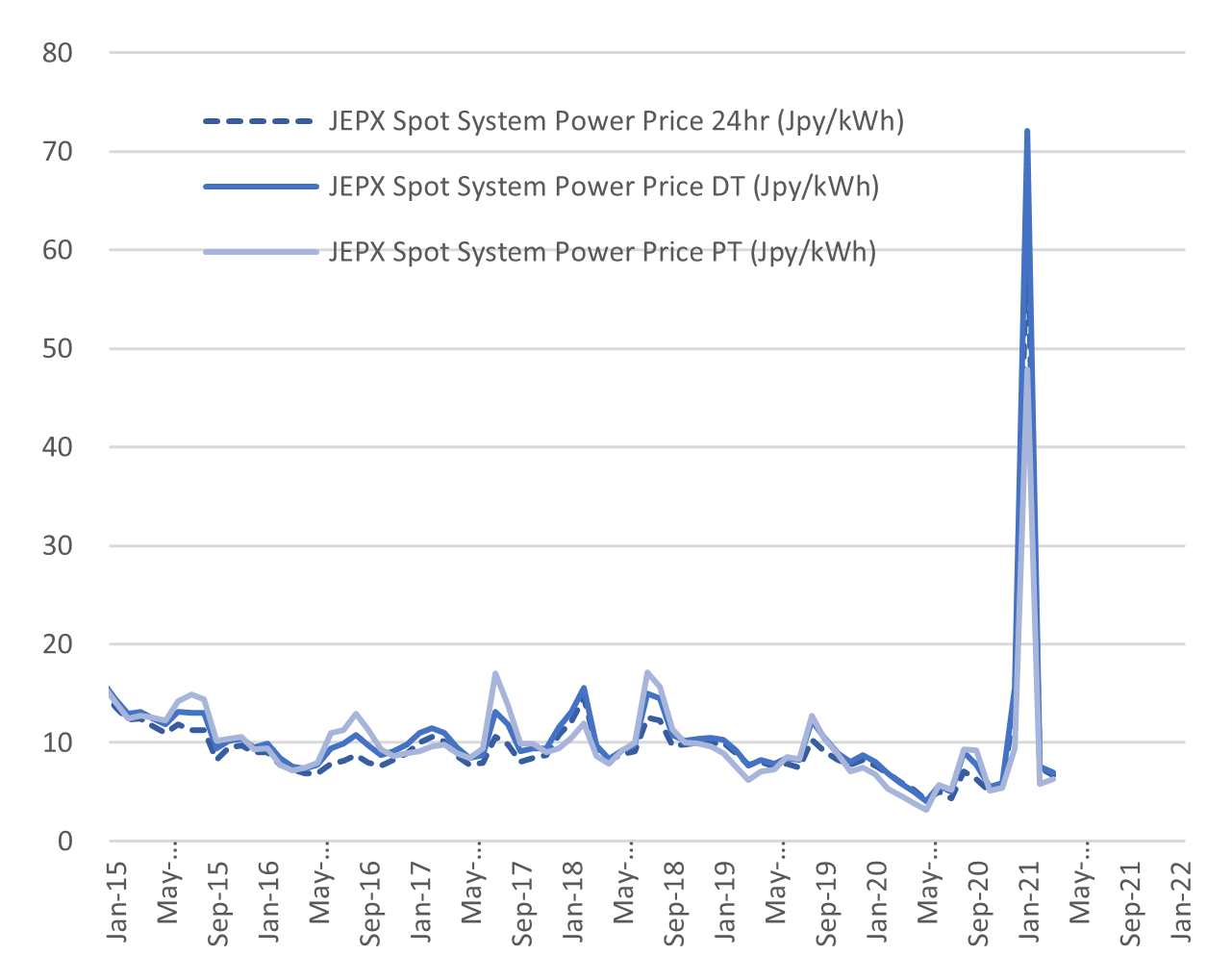
Source: Company websites, JANSI and JAIF, as of Feb. 18, 2021
TEPCO drops plans for near-term restart of Kashiwazaki nuclear plant
(Japan NRG, Feb 26)
- The power utility operator said a recent inspection of Unit 7 at the Kashiwazaki Kariwa NPP found that work to fix a water leak issue hasn’t yet been resolved,
- This made the company change the status of the unit restart to “undecided” from June.
- CONTEXT: The utility had flagged its intention to load fuel into Unit 7 this spring ahead of a restart.
- SIDE DEVELOPMENT:
TEPCO ignored broken seismographs for months
(Tokyo Shimbun, Feb. 22)- TEPCO said on Feb. 22 that because both of the seismographs installed in the unit three reactor building at the Fukushima Daiichi nuclear power plant were faulty, it was unable to record seismological data from the Feb. 13 earthquake.
- According to TEPCO, the seismographs stopped working last year due to rain damage and other causes. A TEPCO representative apologized for the oversight.
- SIDE DEVELOPMENT:Water leaking from Fukushima containment vessels
(NHK, Feb. 23)- On Feb. 22, TEPCO revealed since the Feb. 13 earthquake, water has been leaking from the containment vessels enclosing Units 1 and 3 at the Fukushima Dai-Ichi nuclear power plant.
- Nitrogen gas injected into the containment vessels to prevent explosion has also leaked out, with the pressure within the vessels dropping from 1.2 kPa to slightly above atmospheric pressure. The earthquake ’s force also caused the slight movement of tanks erected on the site used to store radioactive water.
- The Nuclear Regulation Authority, while saying the leaks do not pose a safety issue, has called for TEPCO to step up its monitoring of the plant.
- SIDE DEVELOPMENT:
Liability claims against TEPCO from shareholder lawsuits climb to ¥22 trillion
(FACTA, March edition)- Lawsuits related to the TEPCO Fukushima Dai-Ichi NPP accident have been ongoing for almost 10 years, almost since the date of the accident itself. One of these is a lawsuit by the company’s shareholders asking former TEPCO management to be responsible for liabilities, and which has seen the compensation requested grow to ¥22 trillion.
- TEPCO faces three kinds of court actions.
1) Shareholder lawsuits against the company filed at the Tokyo District Court
2) Class action suits by citizens from various areas of Japan who claim both the company and the state are responsible for forced resident evacuations
3) Criminal suits against former TEPCO management, including ex-chairman Katsumata - In all cases, the main focus of the trial is whether the accident was avoidable and if appropriate measures were in place. A lawyer experienced in such cases says all of these suits will hinge on the Supreme Court and whether it rules that enough long-term assessments highlighting the risks were available prior to the accident.
- Lawsuits related to the TEPCO Fukushima Dai-Ichi NPP accident have been ongoing for almost 10 years, almost since the date of the accident itself. One of these is a lawsuit by the company’s shareholders asking former TEPCO management to be responsible for liabilities, and which has seen the compensation requested grow to ¥22 trillion.
- TEPCO faces three kinds of court actions.
1) Shareholder lawsuits against the company filed at the Tokyo District Court
2) Class action suits by citizens from various areas of Japan who claim both the company and the state are responsible for forced resident evacuations
3) Criminal suits against former TEPCO management, including ex-chairman Katsumata - In all cases, the main focus of the trial is whether the accident was avoidable and if appropriate measures were in place. A lawyer experienced in such cases says all of these suits will hinge on the Supreme Court and whether it rules that enough long-term assessments highlighting the risks were available prior to the accident.
TAKEAWAY: The recent scandals around an unauthorized personnel entry into the control room of the NPP is just the latest in a number of small yet persistent mishaps around the company’s facilities. The fact it wasn’t aware that seismographs at the Fukushima plant weren’t working until after this year’s quake on Feb. 13 can be added to the list, which includes such basic errors as misreading radiation levels by a factor of 1,000. On the eve of the 10-year Fukushima anniversary, it’s not clear how TEPCO can ever restore public faith, while the liability claims against it keep climbing.
In our view, TEPCO has less than a year to restart its Kashiwazaki NPP and show the government that it can come back from nuclear exile. If it fails, we expect the company to lose its operable nuclear facilities in a state-orchestrated restructuring.
Japan’s top business lobby chief says nuclear is vital but needs a new vision
(Asia Nikkei, Feb. 24)
- CONTEXT: The chairman of Keidanren, Japan’s top big business lobby group, is also the chairman of Hitachi Ltd.
- Chairman Nakanishi of Keidanren said the group understands the risks associated with climate change and will seek cooperation with the U.S., the EU and others on decarbonization.
- Nakanishi believes the difference in energy transition approach between Japan and the EU is that the latter ignores the option of transition technologies.
- Nakanishi did not dismiss the idea of a new carbon tax in Japan, but said the pricing mechanism and how the money raised is then utilized needs to be discussed. Keidanren is working on a set of recommendations about carbon pricing and will present them to METI. The business group wants its basic principles set out before debating it with lawmakers.
- Nakanishi reiterated that “not using nuclear is not an option” for decarbonization and stable electricity supply reasons.
- Japan has so far missed the boat on new nuclear developments, especially in the area of small modular reactors, and the country’s companies aren’t deeply involved in this technology, Nakanishi said.
- Japan needs a new vision for nuclear and it’s not clear who will bring that, he said.
ENEOS, others testing JEPX-linked pricing plan for electricity for EV drivers
(Japan NRG, Feb. 28)
- ENEOS, Direct Power and three other firms are testing dynamic pricing for electricity for power planned to be offered to EV drivers.
- ENEOS, which is partnering with Nissan Motor on its price tests, is using a market that is a discount to the 10am to 2pm price levels on the JPEX spot market. The test is being carried out in the Kyushu area and would see prices change with the seasons.
- Electricity market-based pricing trials are also being conducted by a JV between Mitsubishi Corp and Lawson, Direct Power and at least two other firms.
Energy Agency to look radical ways to boost nuclear output
(Denki Shimbun, Feb. 26)
- The Agency for Natural Resources and Energy has begun a review of ways of improving the utilization of nuclear power plants.
- To achieve the government’s target of 20% to 22% of power from nuclear sources by 2030, the Agency will review options such as the adoption of 10 by 10 fuel rod arrays, the extension of operation cycles, and the shortening of scheduled maintenance times.
Kansai Electric’s nuclear plants seen as key for Japan cutting plutonium stocks
(Japan NRG, Feb. 26)
- The Federation for Electric Power Companies, or FEPC, has published plans of its 11 members in terms of employing plutonium as part of the fuel in their nuclear power stations. Plutonium mixed with uranium as a fuel is known as Mixed Oxide Fuel (MOX).
- Japan is expected to use only 0.2 tons of plutonium during FY2021, based on an assumption that Shikoku Electric’s Ikata NPP will restart. The NPP is currently prevented from operating by a court due to a citizens’ group challenging the reactor’s safety.
- If Ikata NPP restarts and uses the expected plutonium volume, then the country’s total stocks would decline to 41.5 tons in the 2021 fiscal year.
- Next fiscal year and in FY2023, Kansai Electric’s Takahama NPP Units 3 and 4 are seen as the only facilities that will deploy plutonium from the stocks. The two reactors are expected to require 1.5 tons of plutonium to cut Japan’s total to 40 tons.
- Kansai Electric owns Japan’s second-largest volume of plutonium at 12.6 tons. TEPCO is the biggest owner with 13.7 tons.
- Only four reactors in Japan can employ plutonium, with Kyushu Electric’s Genkai NPP Unit 3 being the fourth. By 2030, FEPC expects this number to grow to 12 units.
- Japan’s total used uranium fuel volume stood at 19,040 tons at the end of FY2019, according to FEPC.
- The FEPC also said that a Japanese facility would start to produce MOX from FY2026.
TAKEAWAY: FEPC’s timeline also suggests that the Rokkasho used fuel processing plant would be working at its 800 tons per year of uranium full capacity only in FY2026. At that point, the plant would extract 6.6 tons of plutonium from its uranium processing work. Very rough calculations suggest that Japan needs at least 10 reactors to be burning MOX fuel by (or close to) FY2026 in order to make sure plutonium stocks do not rise. At present, Japan doesn’t have 10 reactors licensed to operate. Unless the country embarks on an aggressive restart program in the next five years, the plutonium stocks will grow with no end use.
- SIDE DEVELOPMENT:
Kansai Electric CEO lends support to new nuclear tech development, eyes green ammonia
(Nikkei, Feb. 26)- CEO Mori gave interview to Nikkei, saying the company is exploring how to move away from generation that emits CO2. This will include the company producing hydrogen, a fuel Kansai Electric plans to test at its generation facilities.
- Kansai Electric also wants to supporting the development of new nuclear technologies, such as Small Modular Rectors and High-Temperature Gas Reactors. These two would be suitable for Japan, Mori said.
- The CEO said he is still working on regaining public trust, including of local govt. officials, so that the utility can restart nuclear reactors, but did not give details on what Kansai Electric will do with its used nuclear fuel.
Federation of Electric Power Companies lends support to power futures contracts
(Nikkan Kogyo Shimbun, Feb. 22)
- Federation of Electric Power companies chair and Kyushu Electric Power Company CEO, Ikebe Kazuhiro, said the government’s proposed carbon pricing scheme will be counter-productive if it results in higher power bills.
- The Federation maintains that the transition to electricity from other energy sources is an important part of reducing carbon emissions.
- Commenting on January’s power shortage, Ikebe said there’s no such thing as a perfect energy market.
- Ikebe also called for more active use of the electricity futures and baseload markets to prevent future shortages.
Mitsubishi Corp exits Vietnam coal power plant project amid pressure
(Nikkei, Feb. 25)
- Japan’s largest trading house decided to exit from the Vinh Tan 3 coal-fired power plant project in Vietnam amid rising pressure to stop all fossil-fuel related investments.
- This is the first time a Japanese trading house has withdrawn from a power project on climate grounds. Mitsubishi said it now plans to contribute to more environmentally friendly power projects, including in LNG and renewables.
- The 2 GW Vinh Tan 3, planned for southern Vietnam, is scheduled to come online in 2024. Chinese companies are handling all the EPC and project financing after several western banks pulled out.
- CONTEXT: Mitsubishi earlier this year defended its participation in a separate Vung Ang 2 coal-fired power plant in Vietnam, saying the country’s capital Hanoi is beset by chronic power shortages and needs a stable power supply. Several Japanese banks are involved in the financing of Vung Ang 2.
TAKEAWAY: Mitsubishi is exiting the Vinh Tan 3 but staying in the similar Vung Ang 2 project. The pretext is climate, but the reality is more complicated. The former is not a national project, whereas Vung Ang 2 is. This represents the real politik of business that climate activists mostly ignore. If one firm exits, another (which won’t be swayed by environmental groups) will take its place. For Japanese firms to fully exit all coal-related projects abroad, they need to know that these same contracts won’t go to Chinese or other rivals – and then be used against them by local politicians, which may see the exit as a sign of disloyalty.
Japan’s power retailers fear March 5 payment after falling into EPCOs’ trap
(FACTA, February edition)
- Power Producer and Supplier (PPS) are new electricity firms that came to being after the liberalization of Japan’s power industry in 2016. Many PPS don’t actually have their own generation facilities and simply buy electricity on JEPX and then resell it. Until recently, that has provided a healthy margin of some ¥10 to ¥15 per kWh. However, the January energy crisis, which saw electricity spot price jump to record levels, burned the PPS very badly.
- Retailers were lulled into a false sense of security by record-low LNG prices in the first half of 2020 and the drop in power demand soon after the spread of COVID-19.
- PPS like Shizen Energy, TERA Energy and Minna Denryoku offer electricity prices linked to market rates. They have over 800,000 customers that use this kind of plan. Due to the spike in electricity prices in January, the bills of these customers will be 2 to 3 times higher, according to Shizen. That will encourage many to cancel their contract.
- PPS would have been protected from this situation had it not been for a change in which the Feed-In Tariff system for solar and wind wasn’t changed. In 2016, the FIT was linked to retail prices. This was a trap set by the incumbent regional power utilities, which had foreseen such an emergency situation and prepared for it.
- Under the new rules from 2016, when faced with a shortage of electricity available on the wholesale market, PPS must secure power via the so-called “imbalance price”. The latter is higher than JEPX spot prices.
- The imbalance fee is paid on the fifth business day, two months after. So, the PPS are scared of the “March threat.”
- PPS companies are lobbying the government to have the incumbent utilities “return” the unexpected gains they made from the imbalance fee.
Hokkaido Electric starts to offer carbon-neutral electricity plan
(New Energy Business News, Feb. 24)
- Hokkaido Electric has started offering a new environment-friendly plan that supplies electricity derived from 100% renewable energy.
- The Carbon F Plan Premium is aimed at corporate consumers from low voltage to high voltage and extra high voltage, and provides electricity from the utility’s own facilities that are backed by non-fossil certificates.
TEPCO Power Grid wins substation contract in Thailand
(Kensetsu News, Feb. 26)
- Tokyo Power Grid has won a contract from Thailand’s Metropolitan Electricity Authority to provide consulting services in relation to a project to construct an underground substation in Bangkok.
- The Authority selected Tokyo Power Grid to perform the project because of its significant expertise in the area. Tokyo Power Grid will collaborate with ATT Consultants.
NEWS: OIL, GAS & MINING
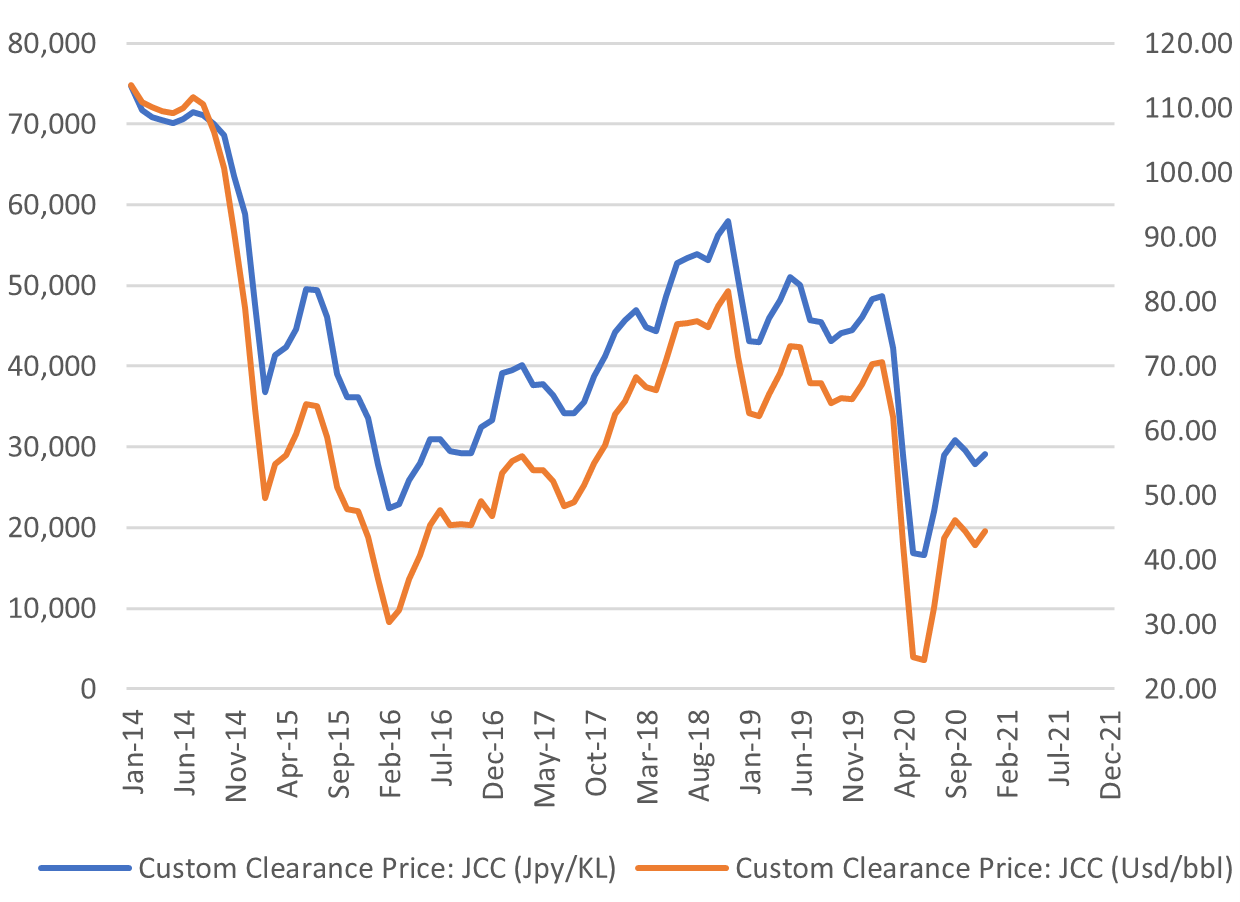
Japan Oil Price: $50.09/ barrel
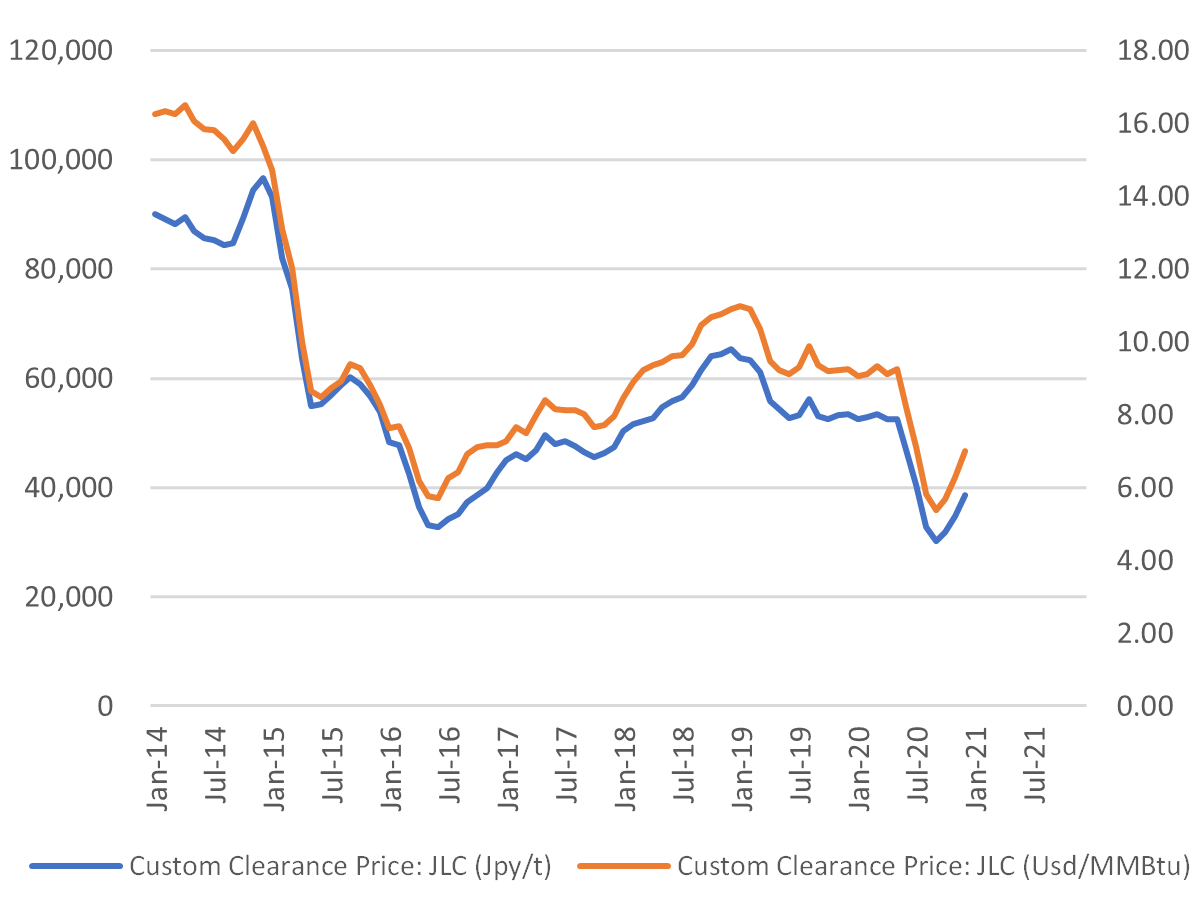
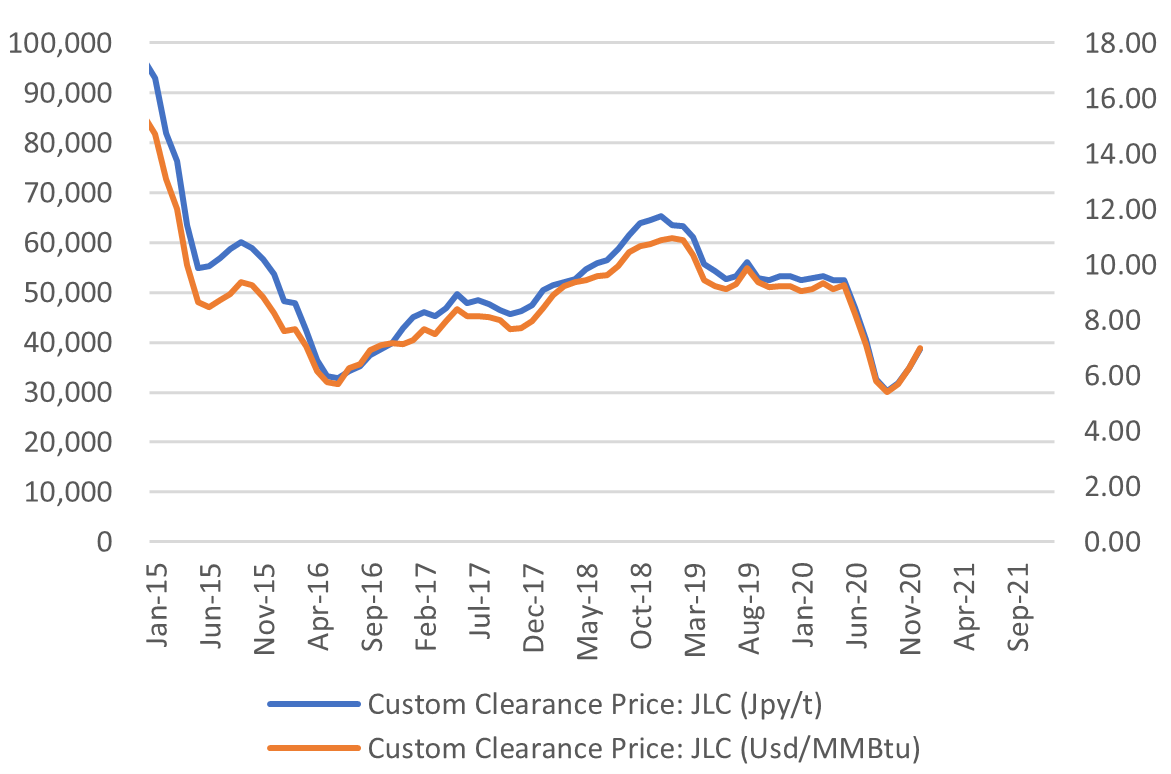
Japan (JLC) LNG Price: $8.28/ mmbtu
New $5.6B fund to buy LNG-powered vessels for Japanese shipping firms
(Nikkei, Feb. 26)
- A private fund manager, Anchor Ship Partners, plans to start a ¥600 billion ($5.6 billion) fund that will buy fuel-efficient new LNG carriers (that also run on LNG themselves) and lease them to Japanese shipping companies such as Nippon Yusen, Mitsui OSK and Kawasaki Kisen.
- The fund aims to help the shippers decarbonize their operations, and as a result bring more LNG to Japan, which would help the power utilities switch their generation to gas from oil and coal.
- The fund may later start to invest in vessels that run on hydrogen and ammonia, and other non-carbon-based fuels.
- Anchor Ship Partners is raising financing from regional banks and other financial institutions in Japan on the promise of double-digit returns.
- SIDE DEVELOPMENT:
Nippon Yusen to trial fuel cell powered ship in Yokohama Bay in 2024
(Nikkei, Feb. 26)- Yokohama City said that it will carry out a demonstration operation of a fuel cell ship at Yokohama Port around 2024 in collaboration with Nippon Yusen and Kawasaki Heavy Industries.
- The trial will be used to study what equipment would be necessary to have around the port with such vessels.
- One idea is also that in the event of a disaster the fuel cell ship would supply electricity to land.
- CONTEXT: ENEOS, Toshiba Energy Systems, and Nippon Kaiji Kyokai this month signed a cooperation agreement to promote the practical application of a fuel cell ship that uses hydrogen.
- The city of Yokohama is considering making Yokohama Port an import hub for hydrogen and introducing fuel cells into cargo handling machinery.
INPEX makes its first acquisition of carbon credits via Indonesia project
(Japan NRG, Feb. 23)
- Oil and gas producer INPEX said it has entered into an agreement with conservation firm InfiniteEARTH to acquire 5 million tons worth of carbon credits over five years.
- The project involves forest conservation in the Rimba Raya Biodiversity Reserve on Indonesia’s part of the island of Borneo. The carbon credits are verified under the UN’s REDD+ scheme.
TAKEAWAY: This is the company’s first foray into carbon credits. It helps the company show that it is decarbonizing the business, and it also offers INPEX an option to start offering carbon-neutral LNG plans, which could be added to its Ichthys LNG portfolio. For details on what is carbon-neutral LNG and how it works, see the Feb. 15 edition of Japan NRG.
JAPEX’s Soma LNG hub restarts after earthquake shutdown
(Gas and Energy News, Feb. 22)
- JAPEX employees temporarily shut down the company’s LNG hub in Soma, Fukushima after power cuts caused by the Feb. 13 earthquake left the plant with insufficient electricity to operate. The shutdown interrupted the supply of reticulated gas and the operation of gas tankers, as well as the supply of gas to the associated gas-fired power station.
- By Feb. 19 all services had been restored. Initial supply resumed from LNG pipeline and tank truck.
ANALYSIS
Japan mulls domestic carbon tax but forgets the obvious:
Carbon is global and so its tax must also be
In the last month, several key government committees discussed how Japan should act regarding setting a price on carbon emissions. Ideas range from setting a border fee taxing goods produced in places with “insufficient environmental measures”, to bolstering Japan’s nascent carbon credit mechanisms. There’s even talk of tying carbon pricing to the development of CCS technology inside Japan.
The arguments within government, academia, and business circles will likely go on for the rest of the year. Yet, there is one basic truth that Japan cannot avoid when discussing carbon pricing: CO2 emissions are not restricted by national borders and, therefore, any scheme implemented by Japan has to be part of a global initiative.
Mutsuyoshi Nishimura, formerly Japan’s chief climate negotiator and a member of the UN Secretary-General’s High-level Advisory Group on Climate Change Financing (AGF), tells Japan NRG that the country’s best chance to keep competitive, while moving forward with a levy on emissions, will be to support the creation of a new international carbon market system, and outlines how one could work in practice.
BY MUTSUYOSHI NISHIMURA
FORMER DIRECTOR-GENERAL FOR EUROPEAN AFFAIRS,
MINISTRY OF FOREIGN AFFAIRS
FORMER AMBASSADOR TO THE UN CLIMATE NEGOTIATIONS
Putting a price on carbon emissions creates an added financial burden for polluters. As such, it forces companies to include the carbon cost in their price of goods/services, reduce their CO2 output and invest in cleaner technologies.
There are two main types of carbon pricing: emissions trading systems (ETS) and carbon taxes. Japan has done neither of these so far, mostly because its business community feared losing its competitive edge against overseas peers.
Instead, Japan created several limited-application carbon reduction schemes that were entirely voluntary, and touted “PR effects” and lower running costs among their core benefits. The schemes were merged in 2013 into a unified J-Credit system.
The unification opened up the credits to bilateral trading, and firms can even buy them at government auctions. However, it’s safe to say that the J-Credit scheme is a minor blip on the Japanese industrial landscape. By June 2020 its cumulative number of projects registered over eight years was 325. These projects are set to remove a mere 13 million tons of CO2 before 2030 – equivalent to 1% of the country’s annual carbon emissions total.
What’s worse, the pace of projects applying for J-Credits has slowed to a trickle, with just 26 added in 2019.
Of course, the entire landscape changed in October last year when Prime Minister Suga vowed that Japan would achieve net-zero emissions by 2050. The momentum has carried on, and with growing pressure at policy level PM Suga was compelled to declare on Jan. 18 this year that Japan will adopt “carbon pricing that would lead [the country] to economic growth”.
Compared to the action (or lack thereof) in the last two decades, this represents a major leap in Japan’s decarbonization efforts. However, it also creates an enormous challenge to transform the economy in less than 30 years. So, can it really also lead to economic growth?
Can carbon tax really lead to growth?
Judging by recent media reports, the Suga government is preparing to introduce a carbon tax system with a possible price converging mechanism vis-a-vis competing countries.
Carbon tax is supposed to work as an incentive for firms to reduce emissions by quickly installing more modern technologies. But, this is only in theory. In practice, if the carbon tax is set too high, companies cannot afford new clean technologies.
On the other hand, if the government is too soft on the carbon tax, firms may simply choose to pay the levy rather than pursue emissions reductions any time soon.
This makes the carbon tax a very tricky mechanism to manage for a bureaucracy and, in truth, nobody knows if it will lead to economic growth. Furthermore, coordinating a new tax on carbon with other tax systems in Japan and abroad, plus managing the tax against the rising and falling prices of goods and services, is bound to be a thorny and exhausting issue for all governments. At some point, the lure of protectionism for domestic industry will come through.
The way to avoid the extra bureaucracy and politics would be to adopt a market-based pricing system. Several microcosms of carbon pricing already exist around the world, most famously perhaps in the EU. However, the fact that they work separately makes it very hard to utilize them as an effective tool to stop climate change. After all, CO2 emissions are global and have an impact on the entire planet, no matter where they’re released.
If we can create a global commodity market for crude oil, which while separated by blends and bourses is intricately linked, we should aim to do so for CO2. No matter where it’s traded, CO2 prices around the world must converge in a narrow band.
A CO2 price signal that’s ascending is just as important as carbon pricing itself. It shows the danger of staying put for too long with old technologies.
Moreover, we need an ascending price signal for businesses to take continual decarbonizing actions on a long-term basis. Again, such an approach is very tough to implement for a bureaucracy.
With the above conditions in mind, here is a proposal for an alternative to the Japanese carbon pricing system.
PROPOSAL: a new International Carbon Price System
We need a new international carbon market system that both allows for the price formation of a universal carbon price and one that continuously rises in order to achieve carbon neutrality by 2050. In practice, it could work like this.
- Creating a fully global system would take an enormous amount of time and diplomatic effort, so a new carbon market system could be created in a more compact and manageable format. The top 20 emitting countries account for about 80% of the global CO2 total each year. All but two of these countries (Iran and Poland) are also members of the G20. Starting dialog via an existing international institution would save time in creating a new global carbon market.
Global CO2 Emissions by Country
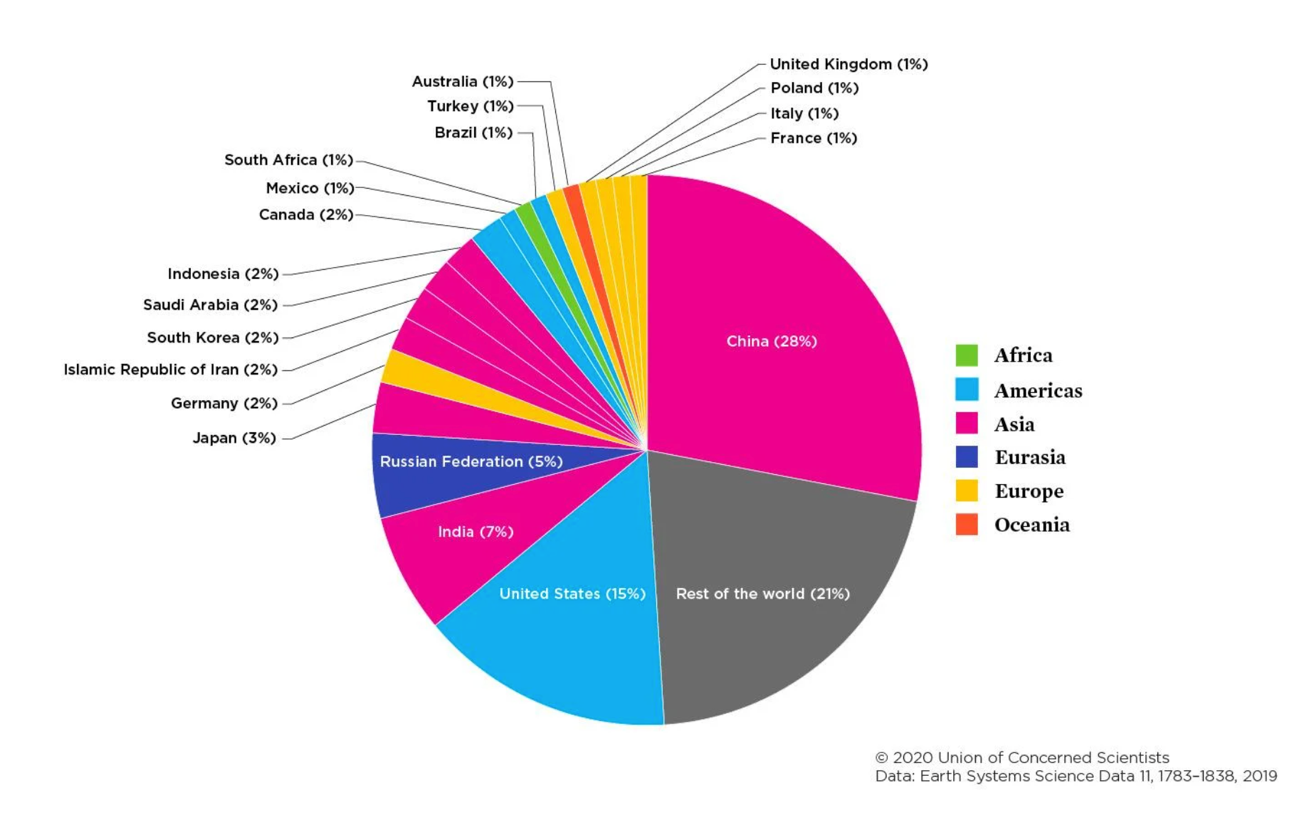
- So far, more than 110 countries have made pledges to achieve net-zero carbon emissions by 2050. (The only major standout is China, whose goal is for 2060.) Assuming that the Top 20 emitters all share the same timeline, we can plot a basic “Carbon Budget” for the bloc, based on their aggregated emissions in a recent year. For example, in 2018.
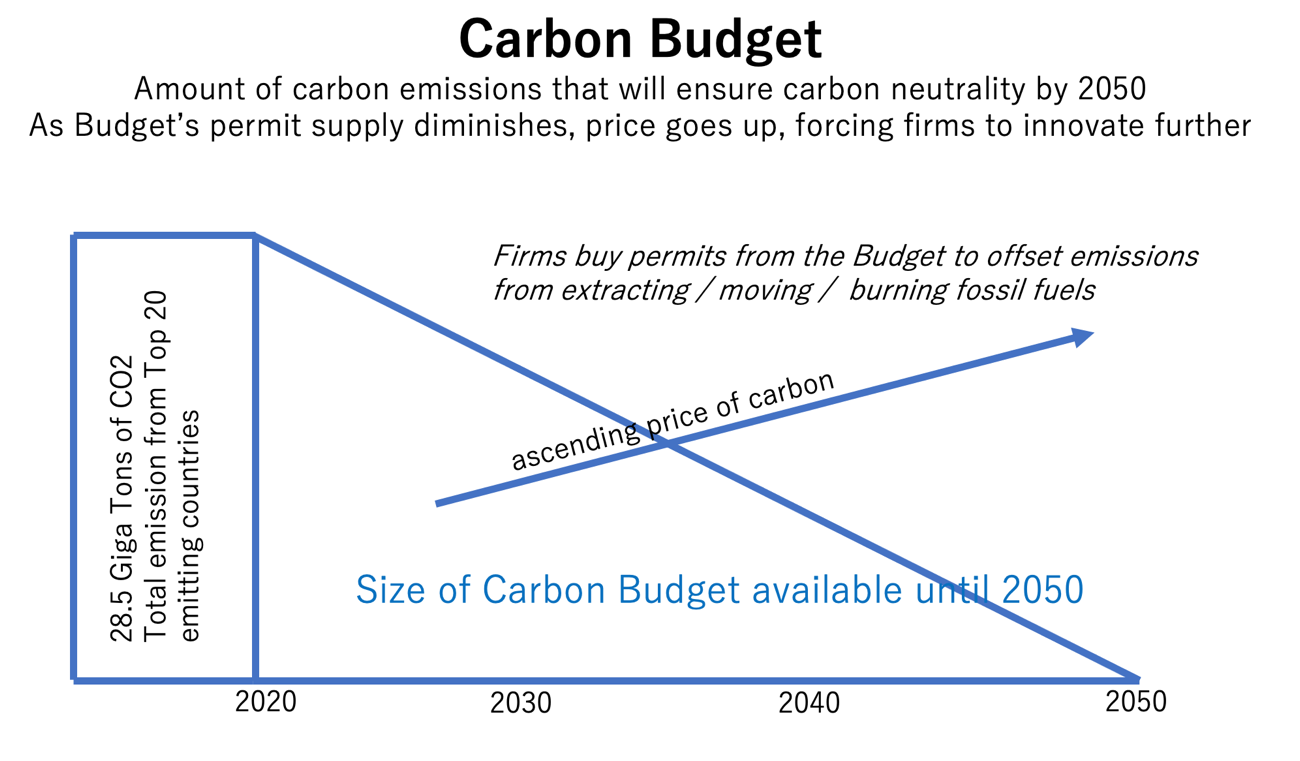
The “Carbon Budget” represents the maximum amount of CO2 that can be emitted before 2050 while still meeting climate targets. The budget will give rise to an ascending pricing signal for carbon.
- The international carbon market rules:
- The market would work by offering a limited number of emissions permits, with the limit imposed by the Carbon Budget. Firms would buy the permits in correspondence with the carbon content of their operations. This would apply to all CO2 emissions, including fossil fuel extraction, transport and combustion.
- The permits would be verified by each country’s Customs Office when fossil fuels are imported. The same verification applies when fossil fuels are extracted and burned in the same country.
- Firms would then pass on the carbon cost to the downstream. So, a steelmaker would add their carbon cost to the cost of a steel sheet, which when used to make a car would be added to the sale price of the auto. This is a neat way to realize the environmental economists’ most cherished “polluter pays” principle.
- The global carbon market should be managed by an international secretariat. Perhaps, it can be linked to an existing international body to save time. Operational costs should be small as everything would be done digitally.
- Funds raised from the sale of permits will be used based on the agreement of the participating countries. Ideally, part of the money would go to support developing nations in the form of subsidies for decarbonization initiatives and technology.
- Those that transgress the market’s rules or cheat would face strict penalties.
ANALYSIS
BY TAKEHIRO MASUTOMO
Geothermal: Japan’s Overlooked Renewable Energy Source
Renewable energy is often criticized for its inability to deliver electricity as reliably as a coal-fired or nuclear power plant. Japan, however, classifies one renewable source as “base-load.” It is also the source the country is richly blessed in: geothermal energy.
The amount of heat within 10 km of the Earth’s surface contains 50,000 times the energy of all the world’s oil and gas resources, according to the International Renewable Energy Agency (IRENA).
Since the 2011 Fukushima disaster, Japan is more serious about tapping that potential. The government set an ambitious target of more than tripling geothermal’s share of the electricity mix and loosened legislation to favor development. In addition, Japan already has companies that rule the global market for geothermal turbines.
For all of the ambition, however, Japan’s ability to realize its target looks uncertain.
In a different league
Geothermal is the only renewable energy source classified as “base-load power” – meaning one that can work around the clock and independently of weather conditions – according to the country’s latest Strategic Energy Plan. This ranks geothermal alongside nuclear and thermal power in terms of being a stable energy supplier, in contrast with intermittent sources such as solar and wind.
Unlike its nuclear fleet, geothermal also benefits from Japan’s tricky geology that has the country hug the volcano-rich Ring of Fire. The country has potential for at least 23.47 GW of geothermal capacity, ranking third in the world after the U.S. and Indonesia, according to Japan’s own figures.
Still, progress in developing the resource has been slow. Data shows that as of 2017 Japan’s installed geothermal capacity was about 0.55 GW, up just 3% from a decade ago. In 2019, IRENA estimated capacity at 525 MW, meaning that only 2% of total potential is utilized.
Japan gets just 0.3% of its electricity from geothermal facilities, barely placing the country in the Top 10 countries for volume of electricity from this source. This contrasts with progress elsewhere. Global geothermal capacity rose to 13.9 GW in 2019, up 37.3% since 2011, according to IRENA. The World Geothermal Congress reports an annual compound growth rate for geothermal direct utilization at 8.7%.
Japan’s lawmakers have tried to reverse course and bring more business interest to the sector. A non-partisan geothermal energy caucus of Japan’s Diet was established with Nikai, the current secretary-general of the ruling Liberal Democratic Party as a co-head. Nikai is credited with helping to install current Prime Minister Suga in power.
The government has also made geothermal power applicable for the Feed-In Tariff system, which helped fuel massive investments into solar over the last decade.
Most notably, relaxed laws on development inside national parks opened up more of the country’s geothermal capacity and METI is seeking to shorten the average development period of a project from 14 years to less than 10 years through faster drilling and environmental assessment. Also, the national budget for geothermal power, mainly consisting of subsidies for potential surveys and drilling activities, has increased.
NOTABLE GEOTHERMAL PROJECTS IN JAPAN
| Companies involved | Project details |
| J-Power), Mitsubishi Materials, and Mitsubishi Gas Chemical | 46MW double flash Wasabizawa station, based in Akita prefecture. Commenced operation in May 2019. |
| J-Power), Mitsubishi Materials, and Mitsubishi Gas Chemical | 15 MW plant in Hachimantai, also in Akita pref. Expected to go online in 2024. |
| Idemitsu, INPEX, and Mitsui Oil Exploration | Environmental assessment ongoing for a 15 MW plant at Katatsumuri Mountain, Akita. Aims to start operation in 2024. |
| ORIX Corp, Ormat Technologies (U.S.) | Orix acquired a stake in Nevada-based Ormat, which is building a geothermal plant in Hakodate, Hokkaido. Operation due to start in spring 2022. It will be one of the largest binary power plants in Japan. Orix also conducting drilling surveys in neaby Aomori prefecture and near Tokyo Bay. |
| Nippon Heavy Industries, Geothermal Engineering, JFE Engineering, Mitsui Oil Exploration, and JOGMEC | 7-MW plant started operating in January 2019 in Hachimantai, Iwate Prefecture |
Progress on the ground
Although excavation surveys and environmental assessments are currently conducted at about 100 sites across the country, many are small-sized because the geothermal fluid reservoirs are scattered around volcanos, mainly in Tohoku and Kyushu regions. That leaves only a handful of large-scale projects on the horizon.
Apart from the Ministry of Environment, which mainly focuses on binary generators around hot springs, geothermal power development is handled by the Policy Planning Division of Natural Resources and Fuel Department in the Agency for Natural Resources and Energy (ANRE), which is subordinate to METI.
The second driver of geothermal projects in Japan is the quasi-governmental resource company, Japan Oil, Gas and Metals National Corporation (JOGMEC), which is tasked with identifying new development sites. An accurate, publicly available map showing good candidate sites is still lacking, according to geothermal industry experts.
While China is ahead of Japan in the production of solar and wind energy equipment, Japanese companies have a stronger presence in geothermal power generation. Fuji Electric, Toshiba, and Mitsubishi Hitachi Power Systems manufacture turbines for geothermal power generation, and altogether they have more than 60% of the global market. These turbines are often tailor-made.
Against this backdrop, trading companies such as Marubeni, Itochu, Sumitomo, and Toyota Trading have taken the lead in exporting the package infrastructure, for example to Kenya and Indonesia, which are now bigger geothermal power producers than Japan.
Also, representing regions where geothermal power resources are concentrated, Tohoku Electric and Kyushu Electric are not only building facilities at home but also actively participating in overseas projects through capital investment. This will become important as global systems evolve, with the new Enhanced Geothermal Systems (EGS) technology being receiving wide attention in the U.S. and Europe.
The government has set a target of renewable energy generating 22-24 % of electricity by 2030, with geothermal supplying 1.6 GW, or 1-1.1% of Japan’s energy needs, about triple the current level. However, with few new large-scale projects at this point and the lack of clear strategies, many believe the 2030 goal is unachievable.
Given the fact that nearly 80% of geothermal resources are located in national parks, deregulation is paramount. In an interview with Nikkei last October, Environment Minister Koizumi hinted at further relaxation of restrictions imposed on national parks in order to encourage the building of geothermal and other renewable energy plants.
The risks of development
Geothermal power development in Japan is fraught with risk and high cost. Promising sites are often in mountainous regions rather than in flat territory. Finding a profitable geothermal source requires long-term drilling surveys, and developers are reluctant because of the risk of wasting investment if they can’t find one.
Close to 30% of a geothermal plant’s development cost in Japan comes from initial surveys and planning, according to NEDO. Plants also take three to four years to construct, less than offshore wind developments, but longer than solar.
Worse still, potential geothermal power generation sites often overlap with hot spring resorts, making it difficult to convince residents who are concerned about the impact on hot spring sources. Reflecting this concern, the government set up an advisory committee inside JOGMEC, offering relevant analysis data to municipalities upon request.
The industry finally had something to cheer when Japan’s first 10 MW-plus geothermal project in 23 years opened in Akita prefecture in May 2019. The 46MW Wasabizawa Geothermal Power Plant has a double-flash cycle system and is a joint development from J-Power, Mitsubishi Materials, and Mitsubishi Gas Chemical.
The next big step for geothermals in Japan may come this summer, when the government is due to update its Strategic Energy Plan. There’s expectation that the target portion of renewable energy sources will be raised. Some lawmakers argue geothermal energy should even take center stage.
While that may seem fanciful, geothermal power has the ingredients to generate 1% of the country’s electricity by 2030, as per current target. It will be up to the new Strategy to show industry that the government is serious about turning that potential into reality.
GLOBAL VIEW
BY TOM O’SULLIVAN
Below are some of last week’s most important international energy developments monitored by the Japan NRG team because of their potential to impact energy supply and demand, as well as prices. We see the following as relevant to Japanese and international energy investors.
Latin America:
Brazil’s President Jair Bolsonaro fired the CEO of Petrobras, the country’s oil monopoly, last week. Outgoing CEO, Roberto Castelo Branco, will be replaced by Army General Joaquim Silva e Luna who has no prior energy industry experience. Castelo Branco had sought to increase gasoline and diesel prices by between 10% to 15%, a move that Bolsonaro objected to. Petrobras’ stock price dropped by 20% in Sao Paolo after the announcement. Petrobras has a market capitalization of $4 billion and Castelo Branco had reduced Petrobras debt by $30 billion over the last two years. Petrobras’ oil production is over 2 million bpd, 90% of which is deep-water offshore. Bolsonaro faces an election in 2022.
Mexico’s President Andreas Manuel Lopez Obrador (‘AMLO’) passed a law in the lower house of parliament last week that gives priority grid access to the state electricity monopoly, CPE, over private sector utilities. This effectively cancels important parts of the 2013 energy legislation enacted by AMLO’s predecessor that opened Mexico’s energy markets to foreign investors.
Oil & Gas:
1). Brent prices closed February up over 20% for the month, or $12 a barrel ending the month at $66. The next OPEC+ meeting will be held this week on Thursday and Friday.
2). Stronger oil prices enabled Saudi Arabia to raise $1.8 billion in sovereign debt on Wednesday that had a negative 6 basis point yield.
3). J-K-M gas prices in Asia dropped to $5.9 mmbtu on Friday about 80% lower than the January peak.
EVs:
1). Lucid, the Silicon Valley EV maker, will go public in a $24 billion SPAC deal backed by Michael Klein, the former Citigroup executive. Lucid is 85% owned by Saudi Arabia’s Public Investment Fund, has 2,000 employees, and operates a manufacturing facility in Arizona. The Lucid Air is expected to go on sale this year.
2). Fisker, the Californian EV manufacturer, has signed a collaboration agreement with Foxconn
Batteries:
Californian battery maker Enovix will go public via a SPAC, having raised $400 million last week. The company makes silicon lithium-ion batteries.
Power Infrastructure:
Three European power cable manufacturers, Prysmian, Nexans, and NKT, have doubled their market capitalizations since March 2020 as demand for undersea high-voltage lines surges because of developments in offshore wind and the broader energy transition.
Aviation:
1). Joby Aviation, the electric aircraft maker, will go public through a SPAC merger with Reinvent Technology. Joby is backed by Uber and Toyota.
2). IATA is now predicting $75-$95 billion of losses for international airline companies in 2021. Last week British Airways owner, IAG, reported losses of $9 billion for 2020.
Carbon Pricing:
EU carbon allowance prices hit E40 per ton on Friday.
Climate:
The UN climate change executive secretary has criticized 75 countries, including Japan, for seriously inadequate emissions reduction strategies.
China:
1). In 2020, Chinese energy-related Belt & Road financing fell to its lowest level since 2008, with Africa getting over half of the financing, including projects in Nigeria, Lesotho, Rwanda, and Ivory Coast. Other country recipients included Bangladesh, Serbia and Pakistan.
2). China’s new 2021-2025 energy plan will be delivered to parliament this month and is expected to outline the strategies to peak emissions and to achieve carbon neutrality by 2030 and 2060, respectively.
South Korea:
Hyundai Motor will recall 82,000 EVs, the Kona brand, due to battery cell issues at a cost of almost $1 billion.
Australia:
1). Australia’s natural gas pipeline companies are moving to transition their $60 billion pipeline infrastructure to deal with hydrogen or methane as several Australian states have committed to carbon neutrality by 2050.
2). Macquarie raised revenues for 2021 by $250 million because of windfall opportunities arising from the ‘Texas Freeze’.
Russia:
1).The U.S. State Department cleared Nord Stream 2 in a report last week to the U.S. Congress allowing the Russian-German project to proceed to completion for now. Gas, 50 bcm per annum, is expected to transit through the pipeline starting in 2022.
2).The EU sanctioned four individuals in connection with the arrest of Alexei Navalny imposing travel bans and asset freezes. No impact is expected on the energy sector.
Israel:
A 120-mile stretch of Israel’s Mediterranean coastline suffered significant environmental damage after an unidentified oil spill that has impacted 90% of the coastline and may take months to clean up.
Africa:
1). The Nigerian government is moving forward with plans to build important infrastructure projects, including gas pipelines. $23 billion of financing has been approved, including $17 billion from China Exim Bank.
2). The Africa Energy Indaba Conference will take place virtually this week and is one of the definitive energy conferences for Africa providing an annual program that shapes energy policy for the African continent.
Belgium:
Engie took an impairment loss of $3.5 billion on its Belgian nuclear portfolio for FY2020.
France:
On Thursday the nuclear safety agency agreed with EDF to extend the life of 32 of the oldest French reactors to 50 years. The German government has objected to the extensions. Fessenheim, a reactor on the German-French border, was closed last year and 12 other reactors are slated for closure.
Spain:
Iberdrola has submitted 150 energy projects, valued at $25 billion, for financing under the EU’s $900 billion recovery fund. The projects involve 350 companies and could generate 45,000 jobs.
United Kingdom:
Mike Davis, the former CEO of Xstrata, has raised $60 million in the UK to invest in battery production for EVs.
Brazil:
Honda temporarily halted its manufacturing plan in Sao Paulo last week because of Covid-19 related issues.
U.S.:
1). Jennifer Granholm was confirmed as the 16th U.S. secretary of energy on Thursday, the first woman to hold the post.
2). Last week, President Biden ordered a 100-day review of U.S. EV and critical raw material supply chains.
EVENTS CALENDAR
Below is a selection of domestic and international events that we believe will have an impact on the Japanese energy and electricity industry.
| February | Approval of Fiscal 2021 Budget by Japanese parliament including energy funding projects;
CMC LNG Conference |
| March | 10th Anniversary of Fukushima Nuclear Accident;
Smart Energy Week – Tokyo; Quarterly OPEC Meeting; Japan LPG Annual Conference; Full completion of all aspects of the multi-year deregulation of Japan’s electricity market; End of 2020/21 Fiscal Year in Japan; |
| April | Japan Atomic Industrial Forum – Annual Nuclear Power Conference;
38th ASEAN Annual Conference-Brunei; Japan LNG & Gas Virtual Summit (DMG)-Tokyo Three crucial by-elections in Hokkaido, Nagano & Hiroshima – April 25th |
| May | Bids close in first tender for commercial offshore wind projects in Japan;
Prime Minister Suga to visit the U.S.-tentative |
| June | Release of New Japan National Basic Energy Plan-2021;
G7 Meeting – U.K. Forum for China-Africa Cooperation Summit (Senegal) |
| July | Tokyo Metropolitan Govt. Assembly Elections;
Commencement of 2020 Tokyo Olympics |
| August | Hydrogen Ministerial Conference in conjunction with IEA World Economic Forum in Singapore – Deferred from May |
| September | Ruling LDP Presidential Election;
UN General Assembly Annual Meeting that is expected to address energy/climate challenges; IMF/World Bank Annual Meetings (multilateral and central banks expected to take further action on emissions disclosures and lending to fossil fuel projects); End of H1 FY2021 Fiscal Year in Japan; Japan-Russia: Eastern Economic Forum (Vladivostok)-tentative |
| October | Last possible month for holding Japan’s 2021 General Election;
METI Sponsored LNG Producer/Consumer Conference; Innovation for Cool Earth Forum – Tokyo Conference; Task Force on Climate-Related Financial Disclosure (TCFD) – Tokyo Conference; G20 Meeting-Italy |
| November | COP26 (Glasgow);
Asian Development Bank (‘ADB’) Annual Conference; Japan-Canada Energy Forum; East Asia Summit (EAS) – Brunei |
| December | Asia Pacific Economic Cooperation (APEC) Forum – New Zealand;
Final details expected from METI on proposed unbundling of natural gas pipeline network scheduled for 2022. |
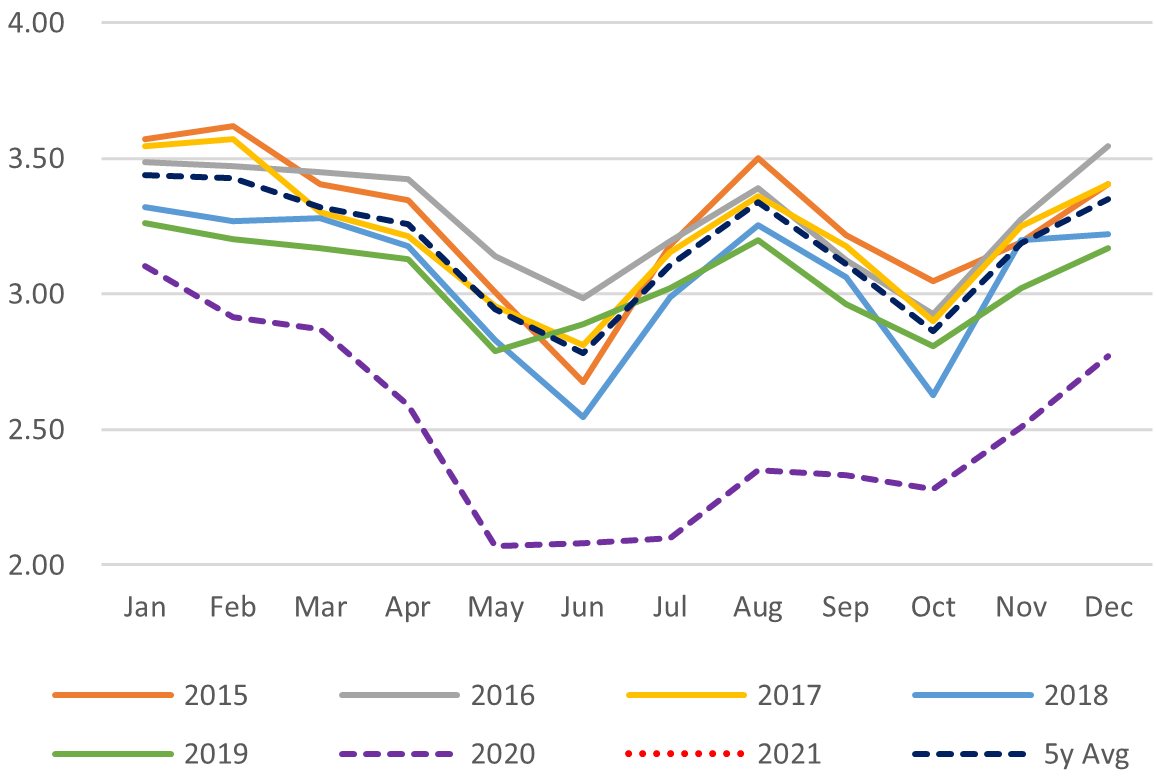
DATA
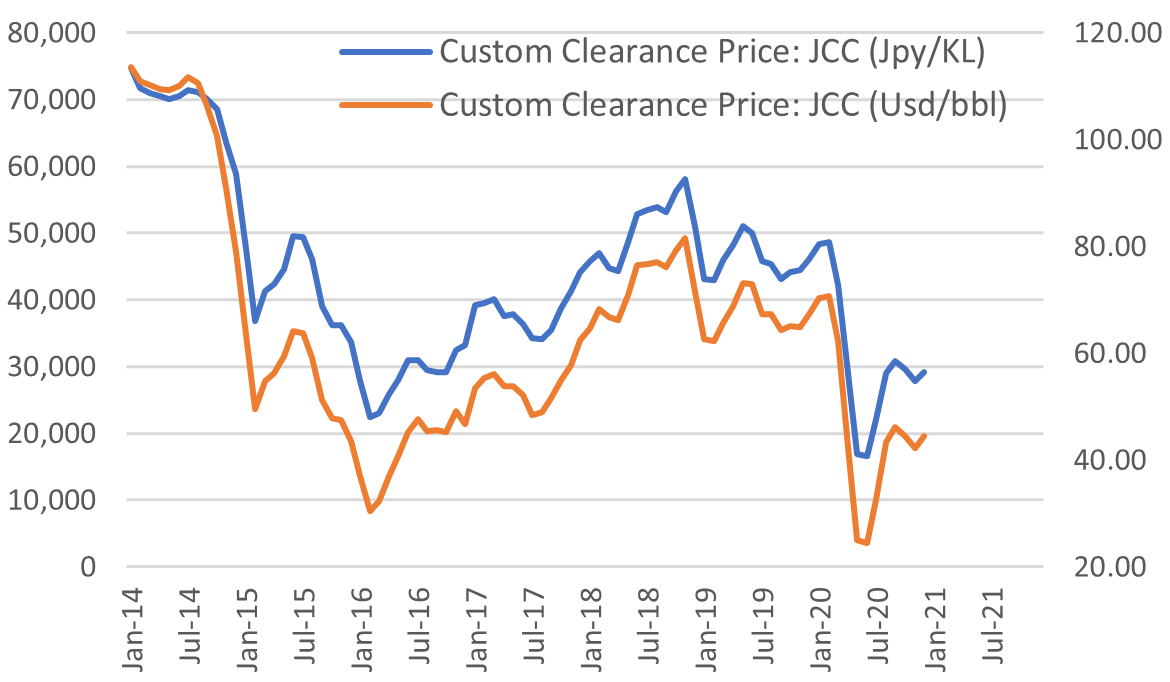
Japan Oil Price
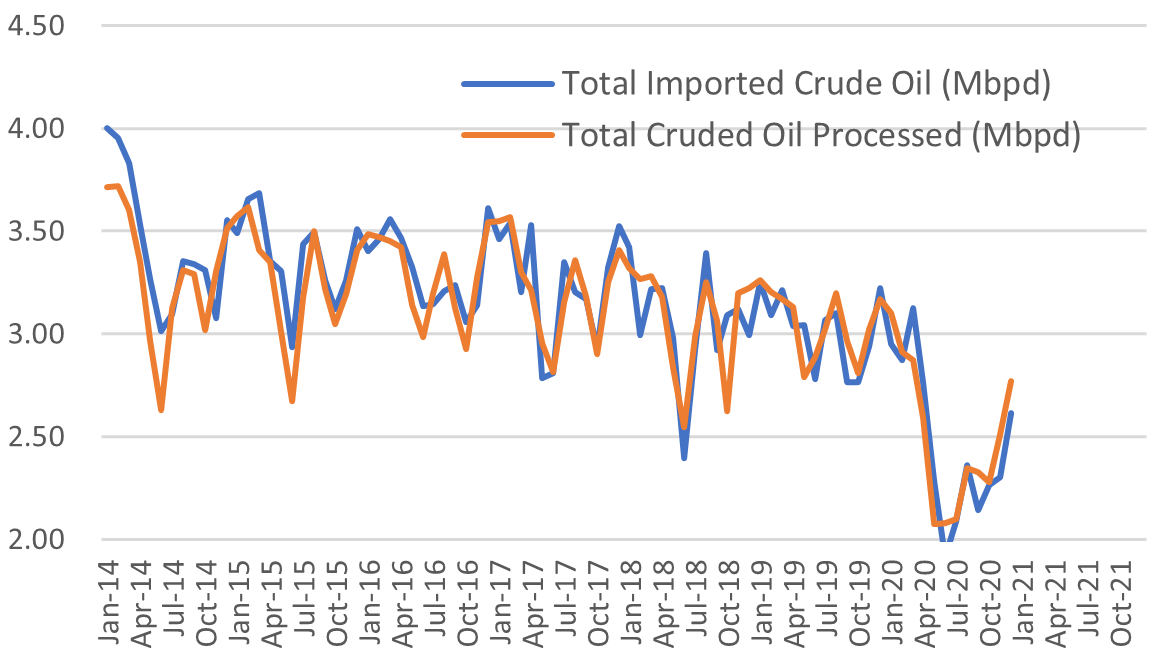
Crude Imports Vs Processed Crude
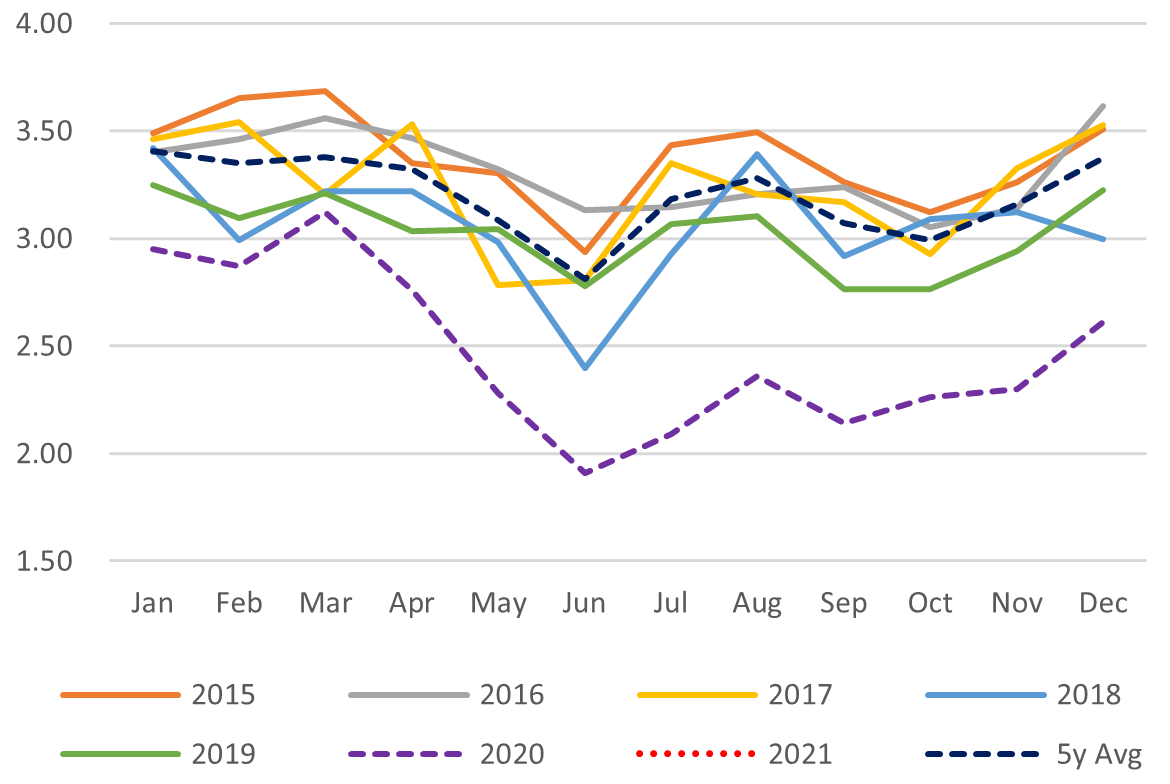
Monthly Oil Import Volume (Mbpd)
Monthly Crude Processed (Mbpd)
Domestic Fuel Sales
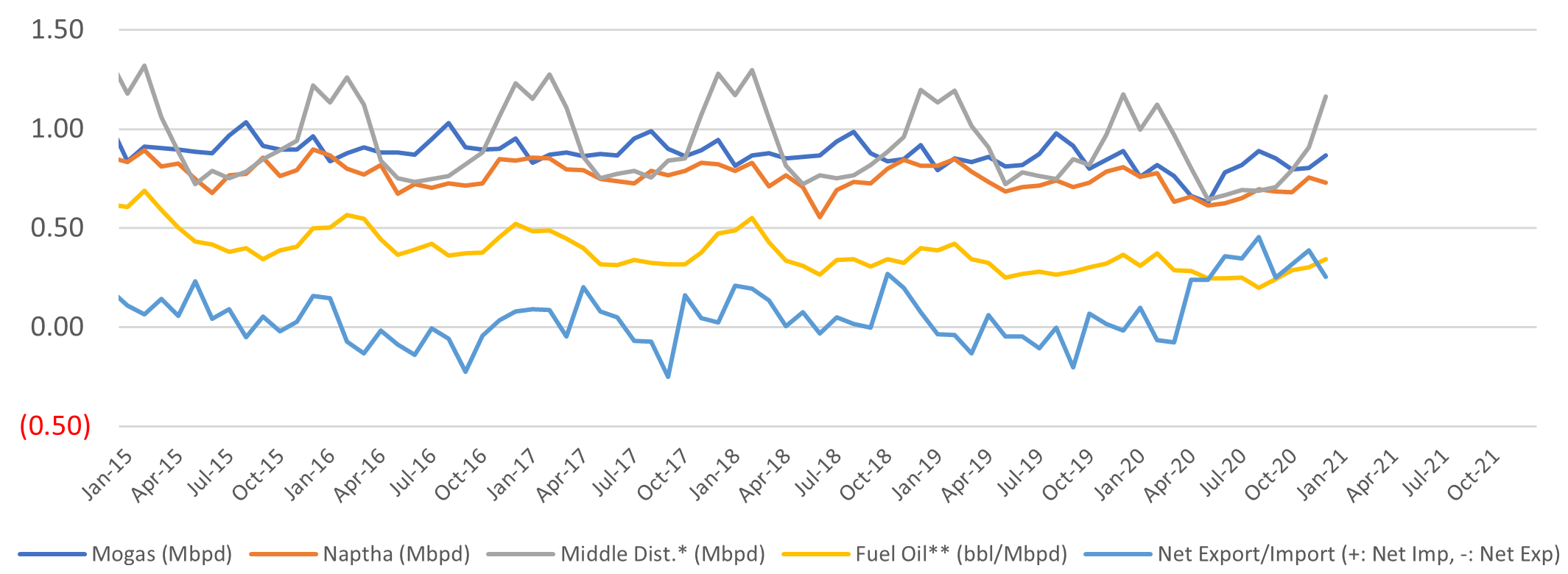
SOURCES: Ministry of Economy, Trade, and Industry (METI), Ministry of Finance, and the Petroleum Association of Japan
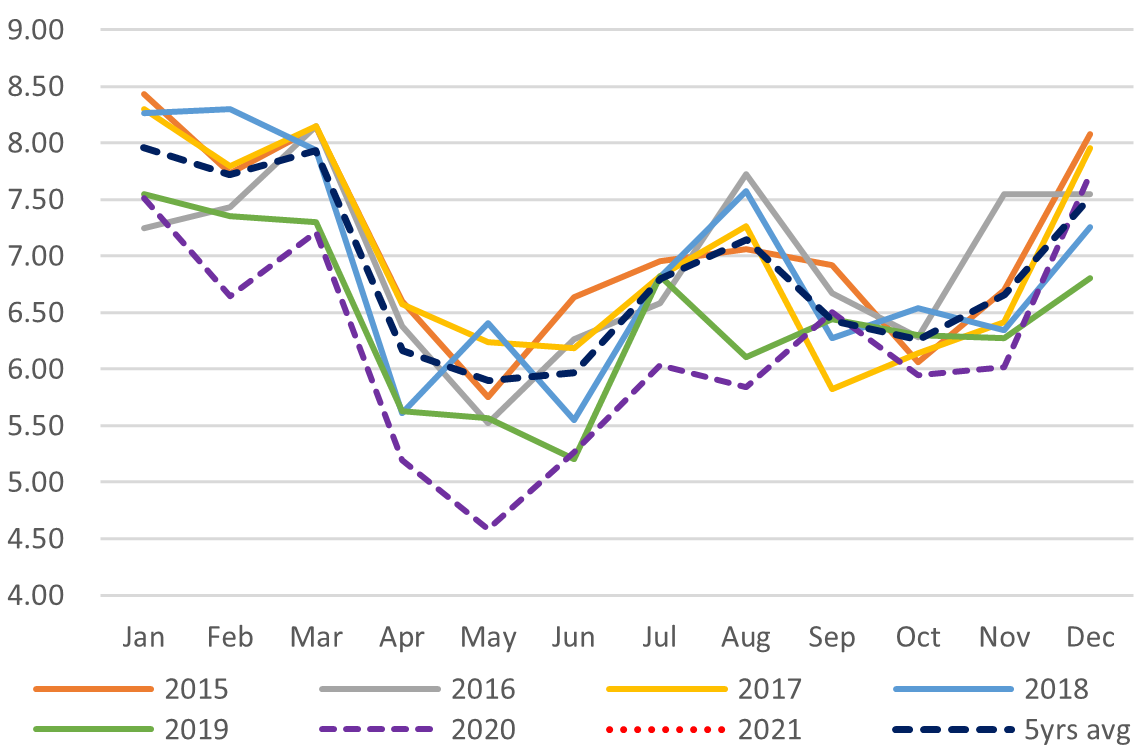
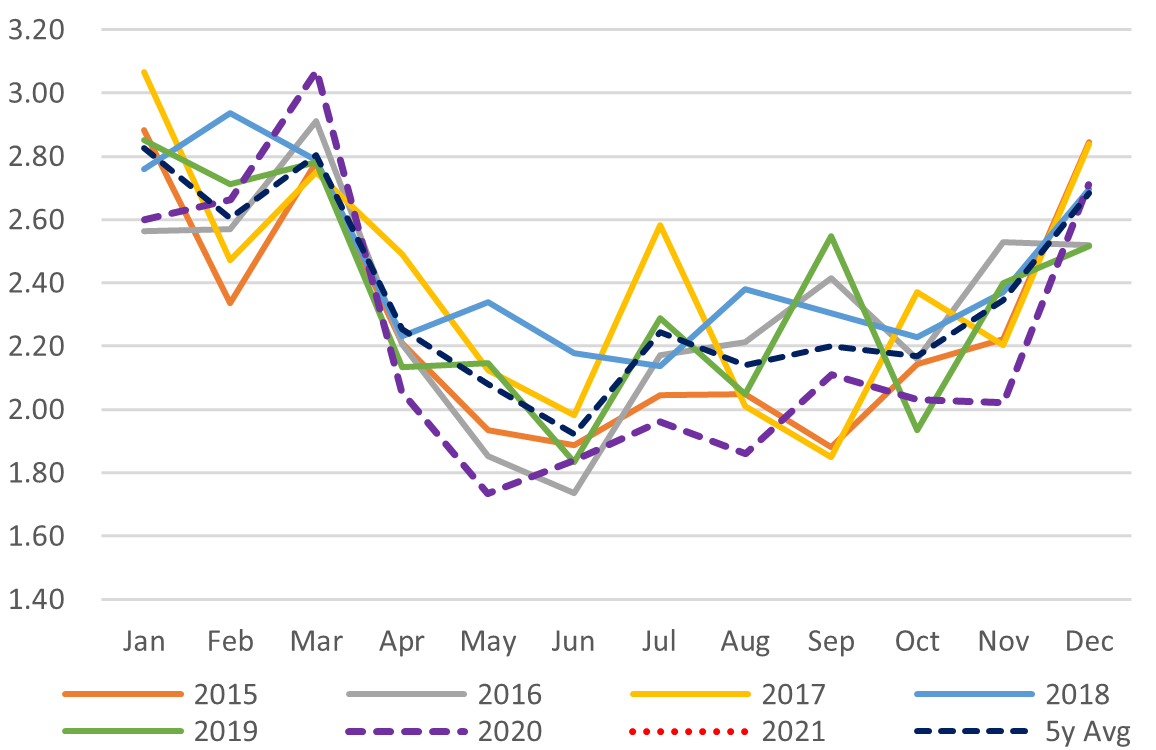
Japan LNG Price
LNG Imports: Japan Total vs Gas Utilities Only
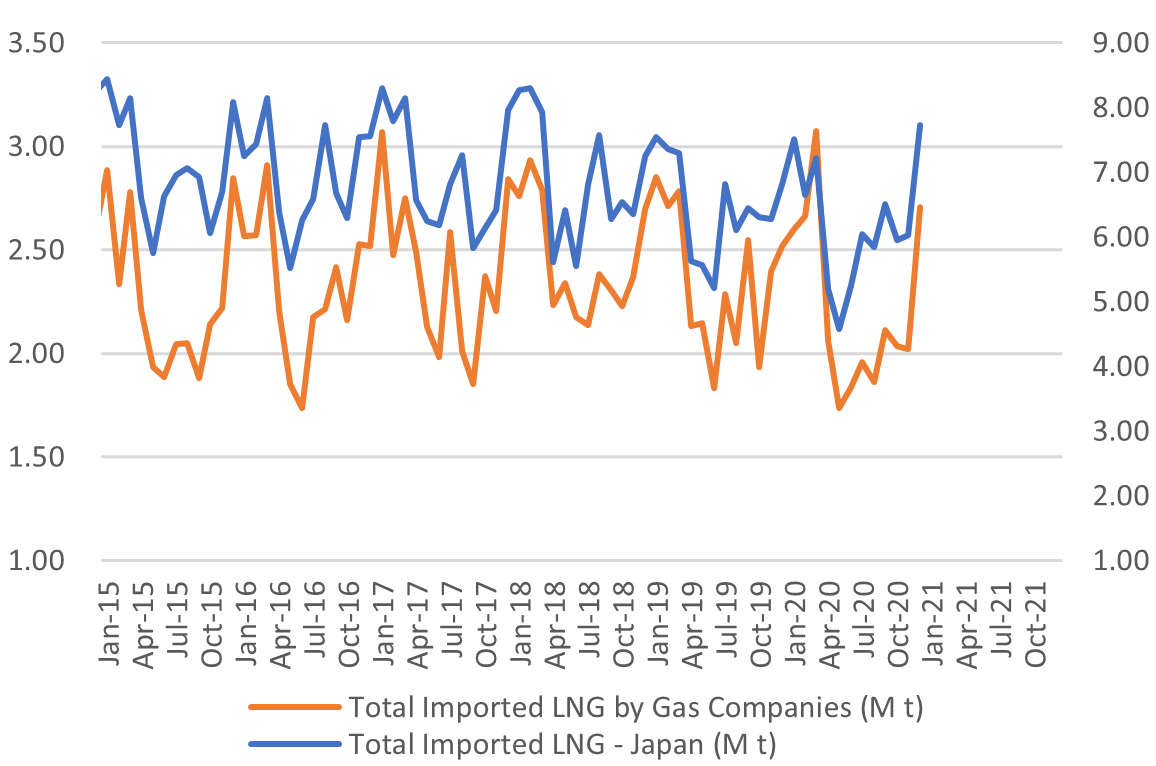
Total LNG Imports (M t)
LNG Imports by Gas Firms Only (M t)
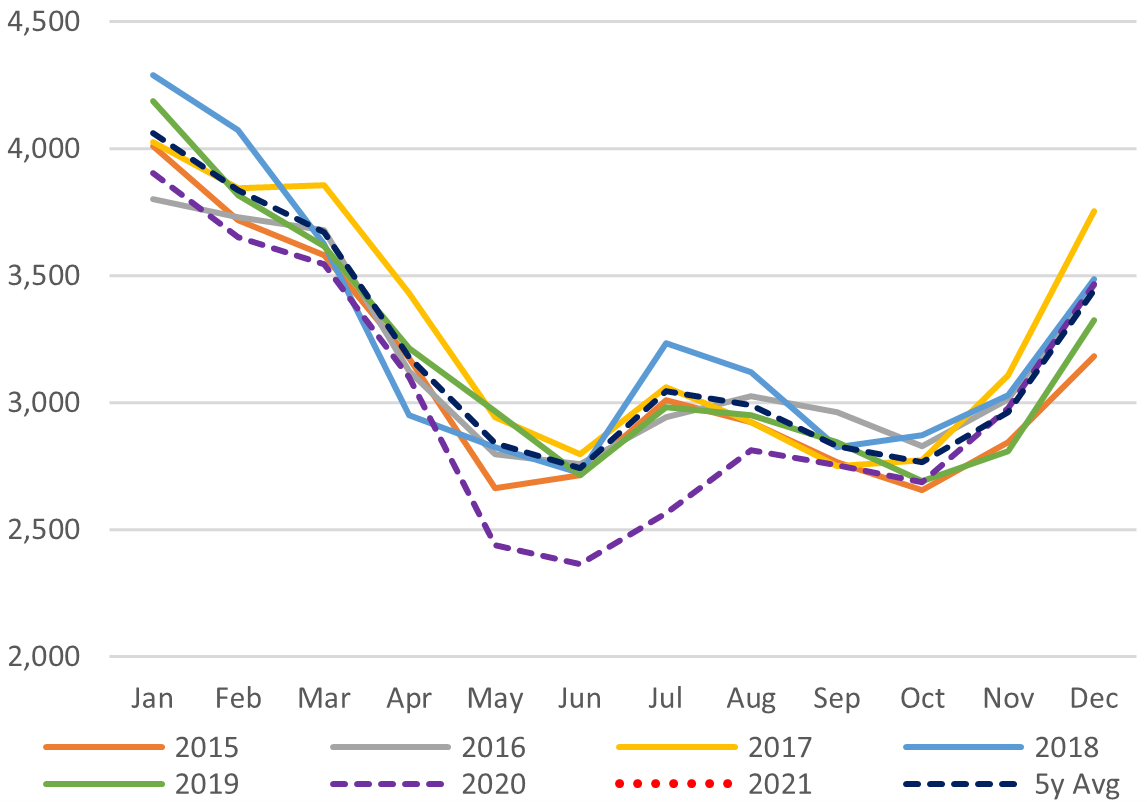
City Gas Sales – Total (M m3)
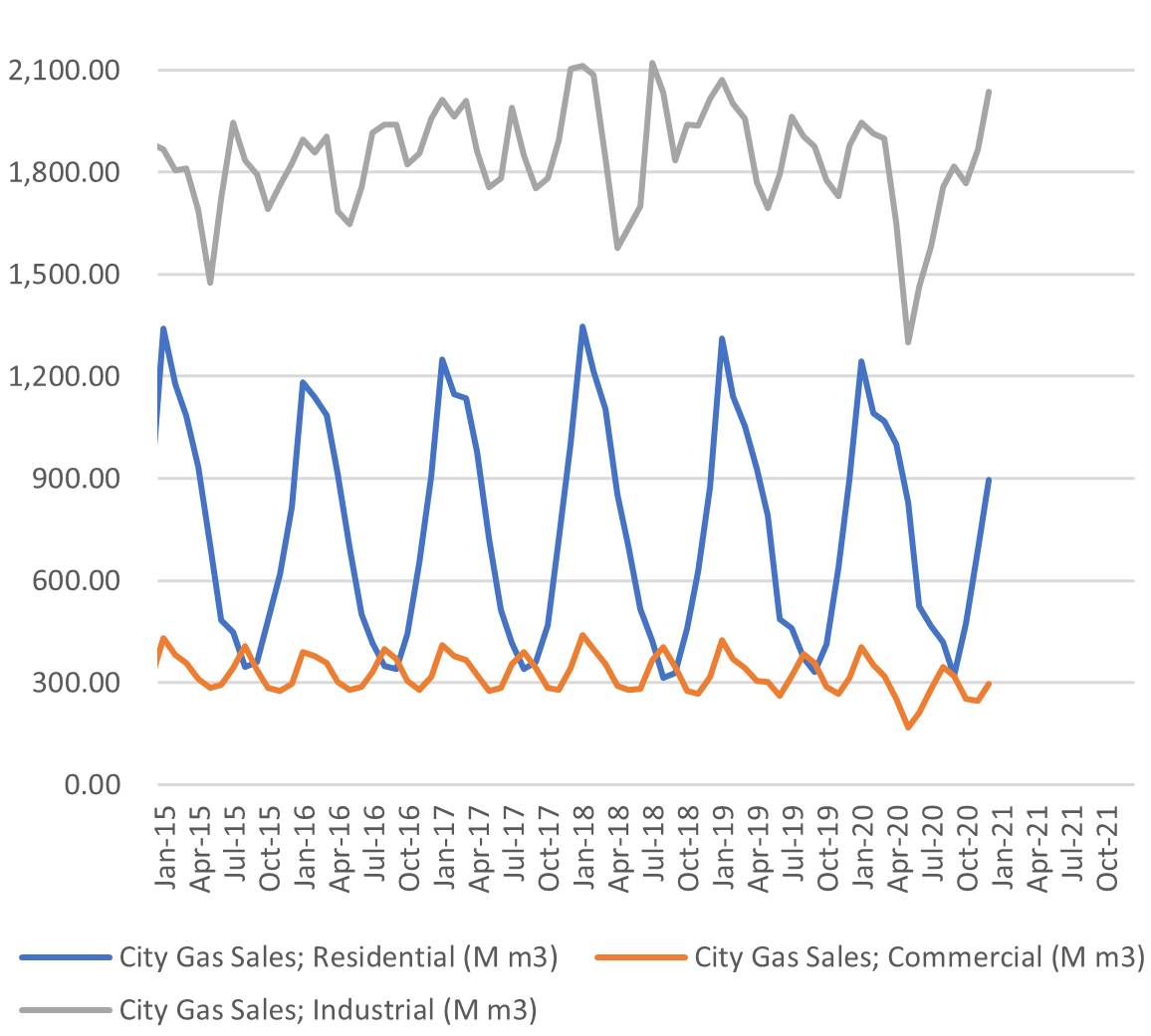
City Gas Sales by Sector (M m3)
SOURCES: Ministry of Economy, Trade, and Industry (METI),
Ministry of Finance
Japan Total Power Demand (GWh)
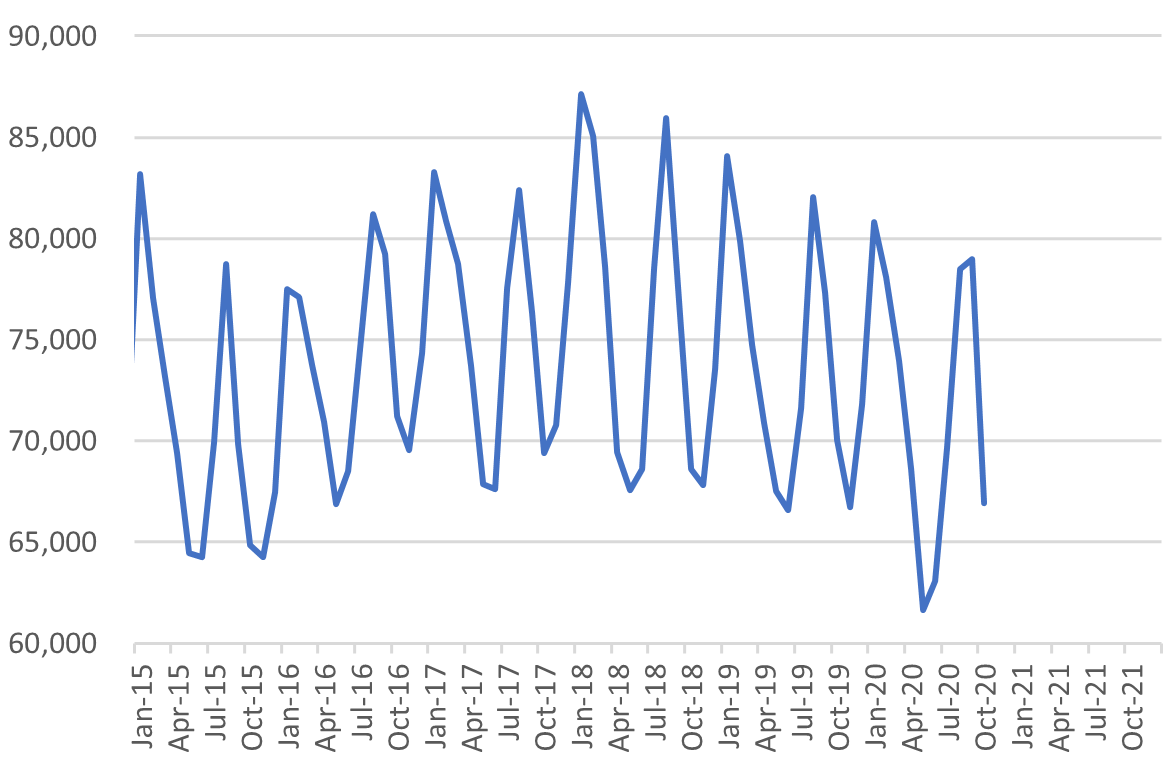
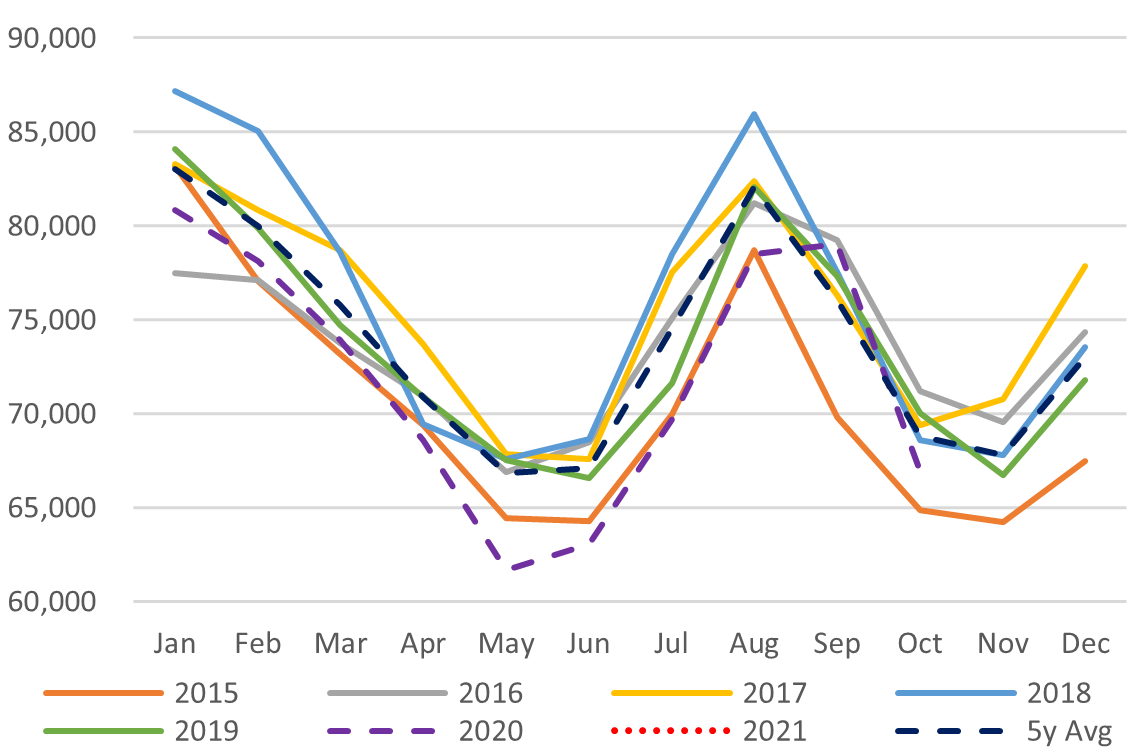
Current Vs Historical Demand (GWh)
Day-Ahead Spot Electricity Prices
Day-Ahead Vs Day Time Vs Peak Time
LNG Imports by Electricity Utilities
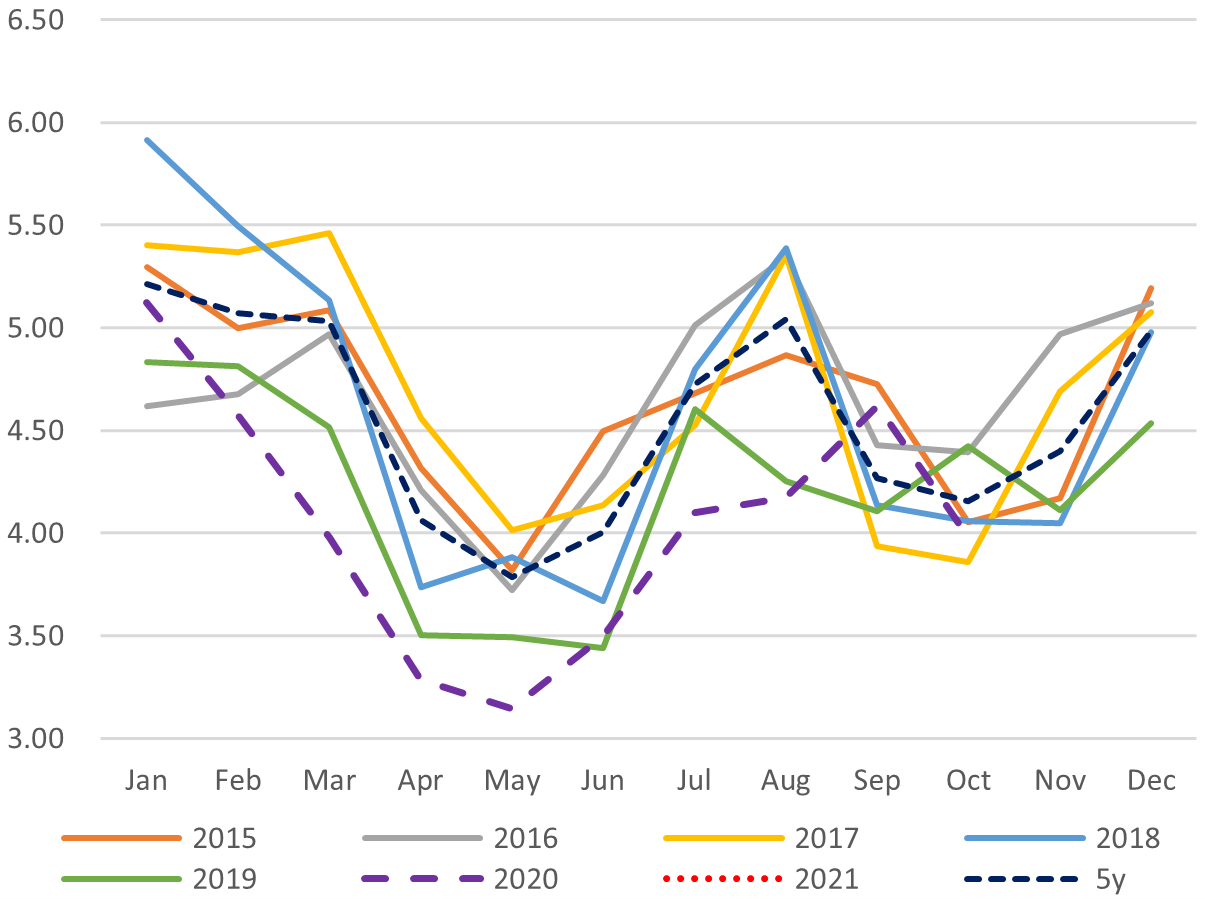
LNG Stockpiles of Electricity Utilities
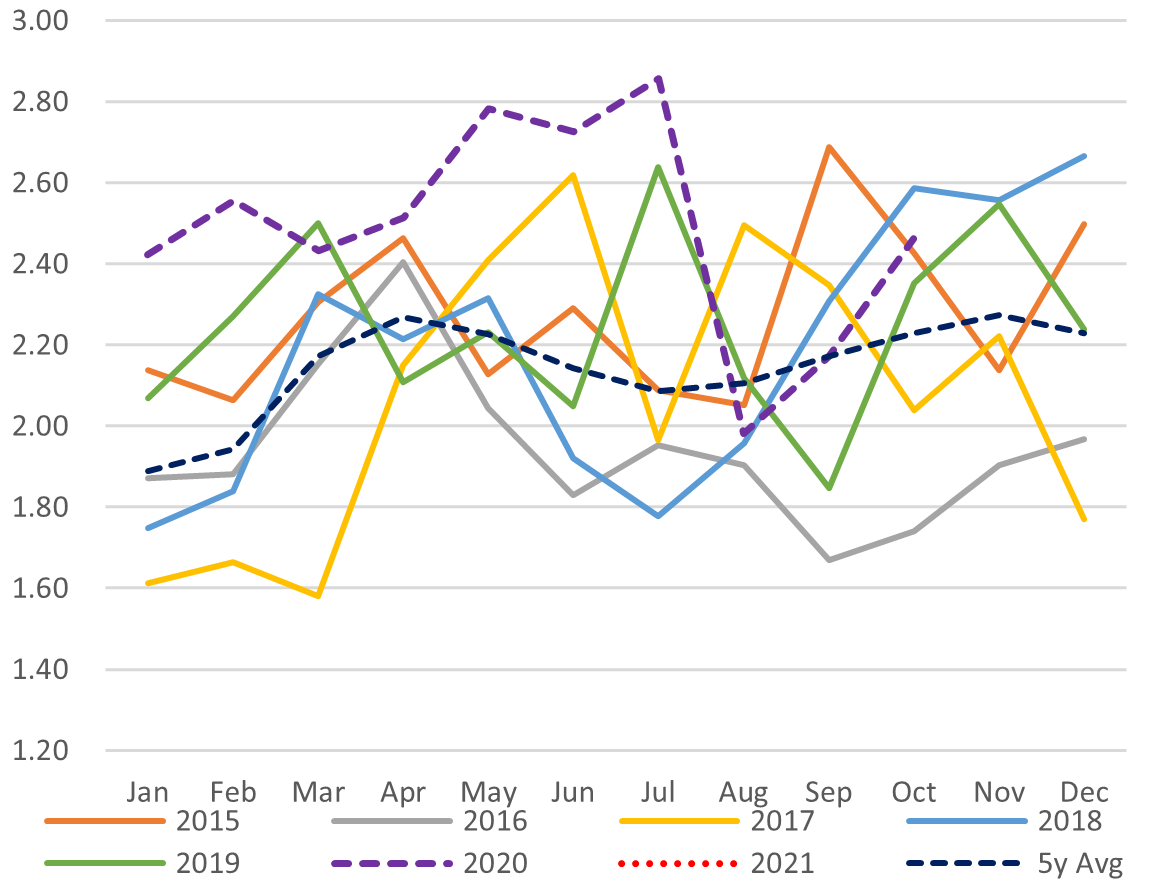
SOURCES: Ministry of Economy, Trade, and Industry (METI), and the Japan Electric Power Exchange
ACRONYMS
| METI | The Ministry of Energy, Trade and Industry | mmbtu | Million British Thermal Units |
| ANRE | Agency for Natural Resources and Energy | mb/d | Million barrels per day |
| TEPCO | Tokyo Electric Power Company | mtoe | Million Tons of Oil Equivalent |
| KEPCO | Kansai Electric Power Company | kWh | Kilowatt hours (electricity generation volume) |
| EPCO | Electricity power company, refers to the 10 regional utilities that used to control all parts of the Japanese power industry | ||
| NEDO | New Energy and Industrial Technology Development Organization | ||
| JCC | Japan Crude Cocktail | ||
| JKM | Japan Korea Market, the Platt’s LNG benchmark | ||
| CCUS | Carbon Capture, Utilization and Storage | ||
| CCUR | Carbon Capture, Utilization and |