Wariness around solar power grows after rain-induced landslide; localities raise concern around land management and halt new projects as various lawmakers vow to get involved
Govt. publishes renewables capacity targets for 2030; solar could hit 74-88 GW; MoE sees further gains in non-utility solar; targets for installed offshore wind are surprisingly low
Basic Energy Plan draft publication now slated for July 21; Cabinet approval, however, not expected until late October
ENERGY TRANSITION & POLICY
MoE studies how global warming will impact river flows, typhoons
Roadmap for zero-emission sea and air vessels gets published
Study confirms changing consumer behavior can cut emissions
INPEX, JERA group may create “clean” ammonia business in UAE
BlackRock to launch $500M green infrastructure fund in Asia
Yara keen to supply green ammonia to Japan from Australia
Daikin creates refrigerant for EVs that boosts their range by 50%
Hokkaido group forms alliance to promote hydrogen business
Platts to publish hydrogen pump prices for Japan via Iwatani
NEDO backs CO2-free hydrogen from methane reforming project
Hitachi tests next-generation power grid in Poland … [MORE]
ELECTRICITY MARKETS
Vena Energy gets govt. feedback on 1.3 GW offshore wind farm
Mitsubishi Corp may build a 180 MW wind farm offs coast of Akita
TEPCO to issue ¥30B green bonds to finance wind power projects
Toshiba ties up with C020 to expand in solar maintenance sector
Minna Denryoku begins solar sharing trials in Okayama region
TEPCO ex-CEO denies any responsibility for Fukushima in court
Japan’s benzene price jumps to highest in over six years on crude
Mitsui Oil to explore for oil and gas offshore in northern Japan
ANALYSIS
INDIA AND JAPAN IDENTIFY EACH OTHER AS PERFECT PARTNERS IN HYDROGEN SUPPLY
Japan wants to create a carbon-free hydrogen supply chain. India plans to more than triple its renewables capacity within this decade, which could result in a surplus of power volumes that could be diverted to producing hydrogen. The two national strategies are potentially complementary, and both sides are starting to take note. For India, traditionally an energy buyer, this opens the door to large-scale energy exports. For Japan, it’s a way to diversify the geography of its supply, securing new hydrogen sources in a country with which it already enjoys a strong relationship in the energy sphere.
ONE COUNTRY, TWO POWER SYSTEMS: HOW JAPAN PLANS TO IMPROVE THE LINK BETWEEN ITS GRIDS
Japan and Tahiti are the only nations in the world to run two power frequencies in one electricity system. In a way, it is akin to Japan operating two separate grids, splitting the country into east and west. At present, the power converters connecting the two zones have a low capacity and in time of natural disaster, this bottleneck has even led to a blackout in eastern Japan. This risk, as well as the rising dependence on decentralized and intermittent renewable energy sources, is making such grid weakness a key issue. To this end, Japan has started to create a Master Plan to tackle the problem.
GLOBAL VIEW
UAE continues standoff around OPEC+ oil quotas. Natural gas demand may jump 4% this year. The world currently has 20 commercial CCUS projects. WHO calls for an end to all fossil fuel financing. The EU looks to introduce a carbon border tax. Italy’s MDC is set to become world’s largest container shipping group. Details on these and more in our global wrap.
EVENT CALENDAR / DATA SECTION
JAPAN NRG WEEKLY
PUBLISHER K. K. Yuri Group
Editorial Team
Yuriy Humber (Editor-in-Chief)
Tom O’Sullivan (Japan, Middle East, Africa)
John Varoli (Americas)
METI The Ministry of Energy, Trade and Industry MOE Ministry of Environment ANRE Agency for Natural Resources and Energy NEDO New Energy and Industrial Technology Development Organization TEPCO Tokyo Electric Power Company KEPCO Kansai Electric Power Company EPCO Electric Power Company JCC Japan Crude Cocktail JKM Japan Korea Market, the Platt’s LNG benchmark CCUS Carbon Capture, Utilization and Storage
mmbtu Million British Thermal Units
mb/d Million barrels per day
mtoe Million Tons of Oil Equivalent
kWh Kilowatt hours (electricity generation volume)
NEWS: ENERGY TRANSITION & POLICY
Discussions around new Basic Energy Plan near completion
(Various, July 8)
Govt. discussions for updated Basic Energy Plan now in final stage.
METI plan to present a draft on July 21.
Next, open the plan to public comments from mid-Sept and complete debates in time for the Cabinet to give final approval at end of Oct.
The schedule is set with COP26 UN conference in Nov. in mind.
Language around use of nuclear will be to “continue using it at the required level” while talk of new plants to replace existing, aging reactors has been dropped. Nuclear’s ratio in the power mix will remain at around 20-22% by 2030.
Use of renewables will be expanded as much possible in line with the national decarbonization policy. Renewables’ ratio in the power mix will rise to 36-38% by 2030.
TAKEAWAY: The timing of publication for the Plan seems to change weekly if not daily, but several reports across the major daily newspapers indicate the latest information is coming from ministry sources. The numbers on nuclear and renewables are not surprising at this point and have been reported several times previously.
Government publishes renewables capacity targets for 2030
(Japan NRG, July 6)
A METI panel released a forecast for renewables capacities in FY2030. It puts solar capacity at 74 GW but notes there’s room to expand it to 88 GW by introducing key performance indicators for policies to accelerate the development.
MoE says Japan can also gain 6 GW from adding solar panels to half of the nation’s public buildings, another 10 GW from panels on buildings owned by private businesses, parking lots, and other non-housing facilities, and 4.1 GW from solar installations on public land across 1,000 towns and cities of Japan.
On wind, METI sees onshore capacity climbing to 13-15 GW by 2030, up from about 4 GW today.
Installed offshore wind is seen at 1.7-3.7 GW by 2030, up from a tiny amount today. This offshore expansion will depend on operators managing to develop their projects in line with the national offshore wind strategy.
Hydro power is seen at 50.7 GW maximum in 2030, little changed from 50 GW today.
Biomass is seen rising to 7.3 GW from around 4.5 GW.
MoE minister Koizumi keen on renewables grant idea
(Nikkei, July 6)
Minister of the Environment Koizumi Shinjiro is interested in creating a scheme to pay local bodies for introducing renewable energy technologies.
The scheme would lead to changes in behavior in Japan’s regions.
MoE released a report on how the rise in temperatures impacts typhoons. The study compiled simulations of typhoons in 2019 and resulted in numbers that show water flow in eight major rivers of Japan could increase by 15% on average if temperatures rise by 2 degrees Celsius, and by 29% if the rise is 4 degrees.
The possibility of floods in smaller rivers increases by 1.44 times for a 2-degree rise, and 2.28 times from a 4-degree rise.
Water depth in Tokyo Bay was seen increasing by 5% on a 2-degree rise; 13% on a 4-degree rise.
This shows that river infrastructure must be strengthened to protect from stormwater.
The Green Innovation Project group of Industry Structure Council released road maps for developing zero emission sea and air vessels.
Ministry of Land, Infrastructure, Transport and Tourism plans to develop zero emission sea vessels that run on hydrogen and ammonia engines, as well as a technology to prevent methane leakage from LNG-powered vessels.
Hydrogen engines and their peripherals plan trial runs starting in 2027, with ammonia engines and peripherals a little earlier around in 2025.
Methane leakage systems on LNG-fueled ships will start tests in early 2024.
METI aims to establish core technologies for hydrogen-powered aircrafts by 2030, and to develop new material that realizes 30% weight reduction by 2035.
MoE commissioned study confirms that changing consumer behavior can cut CO2 emissions
(New Energy Business News, July 5)
A trial conducted between 2017 and 2020 by Oracle Japan and energy efficiency consultants at the Jyukankyo Research Institute applied the ‘nudge’ theory pioneered by U.S. economist Richard Thaler and succeeded in reducing CO2 emissions by 47,000 metric tons.
The trial was commissioned by the MoE.
In the trial, 300,000 subscribers to Hokkaido Gas, Tohoku Electric, Hokuriku Electric, KEPCO, and Okinawa Electric used the service to monitor their energy use. Energy savings averaged 2%.
INPEX, JERA group to study ammonia business in UAE with oil ADNOC
(Denki Shimbun, July 9)
INPEX, JERA, and Japan Oil, Gas and Metals National Corp (JOGMEC) agreed with Abu Dhabi National Oil Company (ADNOC) to explore producing ammonia in United Arab Emirates (UAE).
A bilateral accord between Japan and the UAE for ammonia fuel was also signed.
The parties will study the potential to create a clean ammonia supply chain in UAE, which will involve capturing CO2 at the production site and sequestering emissions. The ammonia would be transported to Japan.
The captured CO2 could also be injected into ADNOC oil and gas fields to boost output. INPEX is a co-investor in some of ADNOC’s oil fields.
A feasibility study will be conducted through November.
BlackRock will launch a ¥55 billion ($500 million) fund in order to develop infrastructure for the transportation of green energy in emerging markets.
The fund is named Climate Finance Partnership and will be in collaboration with state agencies and private financial institutions from Japan, Germany and France. The goal is to encourage developing countries to accelerate initiatives to tackle climate change.
The fund will invest in infrastructure projects in Asia, Latin America and Africa. BlackRock will coordinate the fund.
CONTEXT: BlackRock is one of the world’s largest investment management companies.
Norway’s Yara interested in supplying green ammonia to Japan
(Nikkei Asia, July 8)
Norway’s Yara International, one of the world’s top fertilizer companies, plans to produce ammonia using solar energy in Australia and export it to Japan, said CEO Svein Tore Holsether.
The company aims to set up a supply chain for ammonia, which does not emit CO2 when burned.
Yara is working with French electric utility Engie in the ammonia project in western Australia’s Pilbara region.
Yara hopes to start small-scale production of 3,700 tons by end of 2023.
Also, JERA has agreed with Yara to look at whether it’s feasible to produce “blue ammonia” — created from natural gas, but with the CO2 captured and stored — at the Pilbara plant.
CONTEXT: Yara, which has 17 ammonia plants worldwide, also plans to produce “green ammonia” in Norway and Netherlands.
Daikin develops a refrigerant for EVs that can boost range by up to 50%
(Nikkei, July 7)
Daikin Industries, Japan’s top air conditioner maker, has developed a refrigerant for EVs that extends their range by up to 50%. The company plans to commercialize the product by 2025.
Air conditioners use heat generated by compressing the refrigerant to heat and cool the air inside the car. Daikin’s new refrigerant has a boiling point of about minus 40 C, which is 10 to 15 degrees lower than the conventional product. This reduces the power required for compression.
Hokkaido Electric group forms hydrogen alliance to promote the new business
(Various, July 7)
Hokkaido Electric, and eight other companies based in the northernmost island of Hokkaido, formed an alliance to promote the development of hydrogen projects in the region.
The “Hokkaido Hydrogen Business Platform” aims to connect with domestic and foreign companies that are interested in building out the hydrogen projects supply chain in Hokkaido.
Other companies in the alliance include Hokkaido Gas, JR Hokkaido, Hokkaido Bank, and Megmilk Snow Brand.
Platts to publish hydrogen pump prices for Japan
(Company statement, July 6)
S&P Global Platts will start to publish new monthly assessments for hydrogen pump prices in Japan.
The monthly price survey would consider representative high and low pump prices heard in the market from hydrogen fuel station operators.
Hydrogen manufacturer Iwatani will provide the price numbers for the Tohoku, Metropolitan, Chubu, Kinki, Chugoku and Kyushu areas.
CO2-free hydrogen from methane reforming gets NEDO backing
(Energy Business News, July 9)
The state-backed New Energy and Industrial Technology Development Organisation (NEDO) chose a hydrogen synthesis system made by chemical giant Toda Kogyo and Osaka-based Energy Water for further development.
Toda and Air Water will be able to generate hydrogen with a purity of 99.99% from methane gas using the direct methane reforming process.
Unlike traditional steam reforming, the direct reforming process does not generate CO2. Rather, pure carbon is deposited as nanotubes.
Hitachi announced that the smart grid demonstration project in Poland has been completed. In collaboration with a local power company, Hitachi verified an electric power system that combines renewable energy and multiple storage batteries.
The system used in the demonstration project will continue to be used on the Polish side. Hitachi, in cooperation with Sumitomo Mitsui Banking Corporation, has also proceeded with the construction of a business model and consideration of financing to expand use of the system outside Poland.
Waste heat, CO2 used to grow tomatoes
(Kankyo Business, July 6)
Osaka-based Air Water launched a “tri-generation” facility in Nagano.
The first of its kind in Japan, the facility uses waste heat and CO2 from a wood-fired generation plant to grow tomatoes.
The arrangement reduces the amount of LPG heating and liquefied CO2 required by the greenhouses.
The biomass plant has an output of 2 MW.
Sumitomo Metal Mining to increase production of anodes for EV batteries
(Kankyo Business, July 7)
Sumitomo Metal Mining will increase production of anodes for use in EV batteries.
Sumitomo will invest ¥47 billion in building a new factory in Aichi and increasing the capacity of its Hyogo anode factory.
The investment allows Sumitomo to boost monthly anode production to 2,000 metric tons.
The company plans to continue boosting production, and by 2027 hopes to manufacture 10,000 tons per month.
Aquifer thermal energy storage may be key to zero energy buildings: NEDO
(Kankyo Business, July 8)
In a first for Japan, govt-backed NEDO says it’s trialing a system that uses thermal energy stored aquifers to heat and cool zero energy buildings.
The trial is made with Aichi-based Zeneral Heatpump and will collect data on the system’s ability to provide air-conditioning and water heating.
Aquifer thermal energy storage offers the potential to heat and cool buildings without the use of heat pumps, although the high cost of installing such systems remains a hurdle.
NEDO and Nihon Chikasui Kaihatsu already succeeded in major reductions in costs.
Shipper NYK in ¥20 billion green bond issue
(Kankyo Business, July 6)
Shipping giant NYK will issue ¥20 billion of “transition bonds”. The funds will help develop LNG powered vessels, improve operational efficiency, and be invested in ammonia and hydrogen-fueled vessel research.
NYK aims to reduce GHG emissions by 30% by 2030, and 50% by 2050 (against 2015 levels).
Suntory to switch all its global manufacturing hubs to renewables
(Kankyo Business, July 2)
Suntory Holdings aims to switch its 63 Japanese, U.S. and European beverage and foodstuff manufacturing hubs to renewably-generated electricity by 2022.
The change will enable Suntory to reduce greenhouse gas emissions through 2030 by around 1 million tons.
In 2018, Suntory established a set of 2030 climate goals, which have been accredited by the Science-Based Targets initiative.
Mitsui, JFE projects selected for Joint Crediting Mechanism (JCM)
(Kankyo Business, July 2)
The MoE selected a total of 11 new projects—four in Vietnam, two in Indonesia, one in Mexico, two in Thailand, and two in the Philippines—to be included in the government’s joint crediting mechanism to enable carbon credits from Japanese entities’ overseas operations to be used in Japan.
Among the projects selected are a 60 MW Mitsui & Co solar farm and a 20 MW Mizuho Toshiba Lease geothermal electricity project in the Philippines, and a JFE Engineering waste to electricity project in Vietnam.
These projects are expected to reduce GHG emissions by 20 million metric tons by 2030.
Kyushu Electric launches power battery service in Ireland
(Kankyo Business, July 5)
Through a tie-up with Tokyo-based Exergy Power Systems, Kyushu Electric launched a service to supply 1 MW power batteries in Ireland.
30% of electricity generated in Ireland is sourced from wind farms, which tend to have a fluctuating output. The storage batteries are able to smooth differences in supply and demand.
Only 15% of the population understands carbon neutrality
(NHK, July 5)
Of 1,400 consumers aged 10 to 79 recently surveyed by Dentsu, only 15% said they understood the concept of carbon neutrality.
66% of those surveyed understood EVs and the circular economy, but less than half said they understood the remainder of the 14 “green growth” areas identified by the govt. as priorities for carbon neutrality.
74% said they accepted that goods and services will become more expensive as a result of carbon neutral initiatives.
NEWS:POWER MARKETS
No. of operable nuclear reactors
33
of which
applied for restart
25
approved by regulator
17
restarted
10
in operation today
9
able to use MOX fuel
4
No. of nuclear reactors under construction
3
No. of reactors slated for decommissioning
27
of which
completed work
1
started process
4
yet to start / not known
22
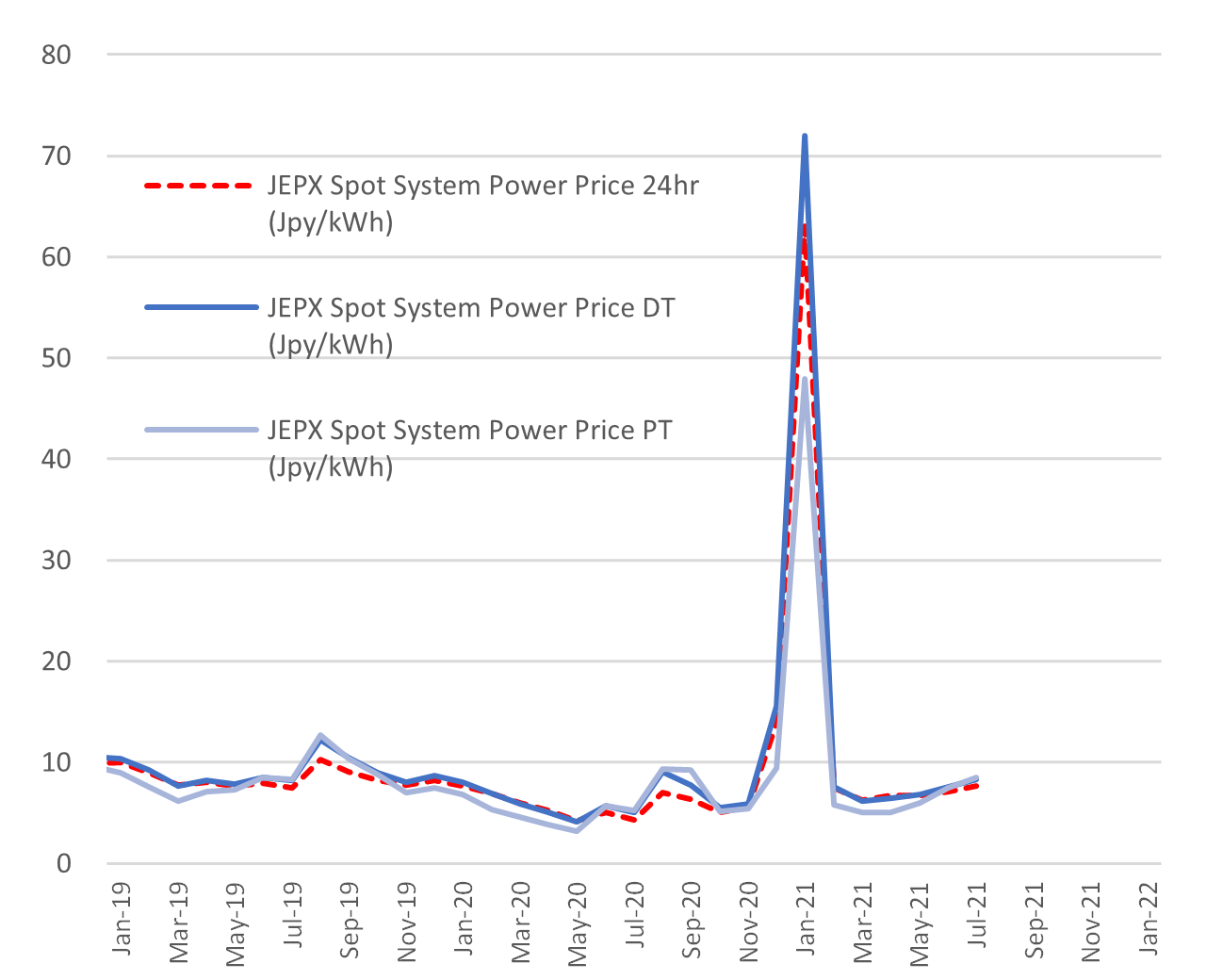
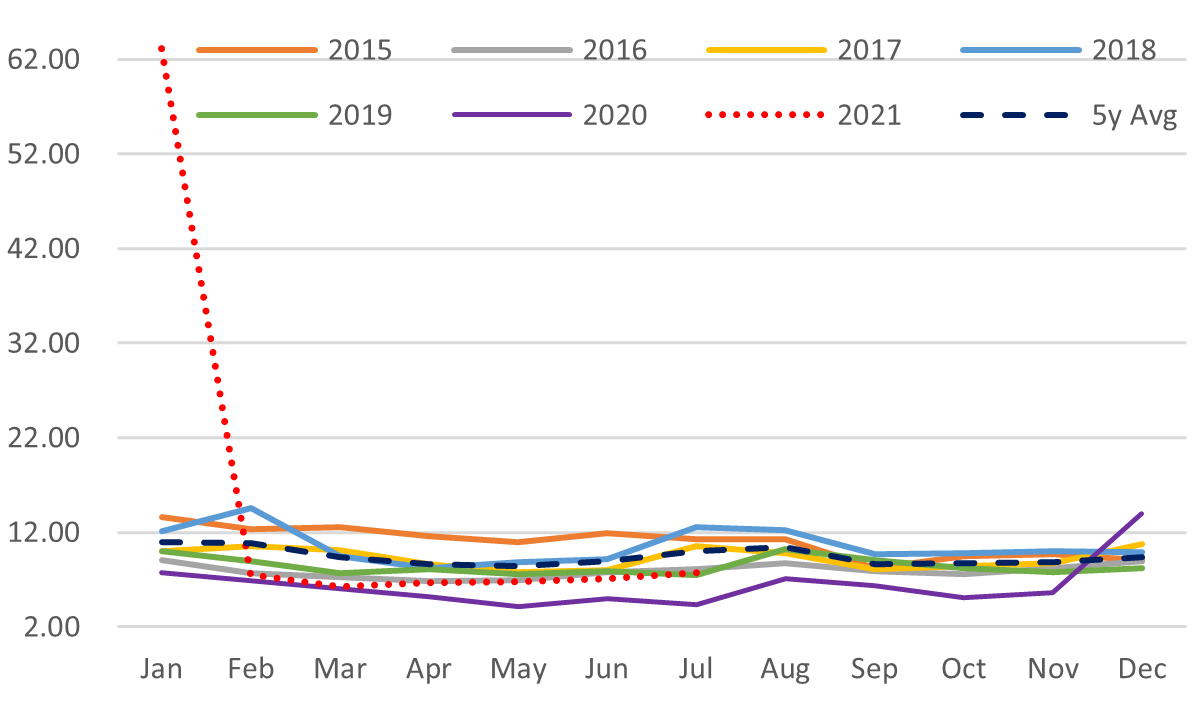
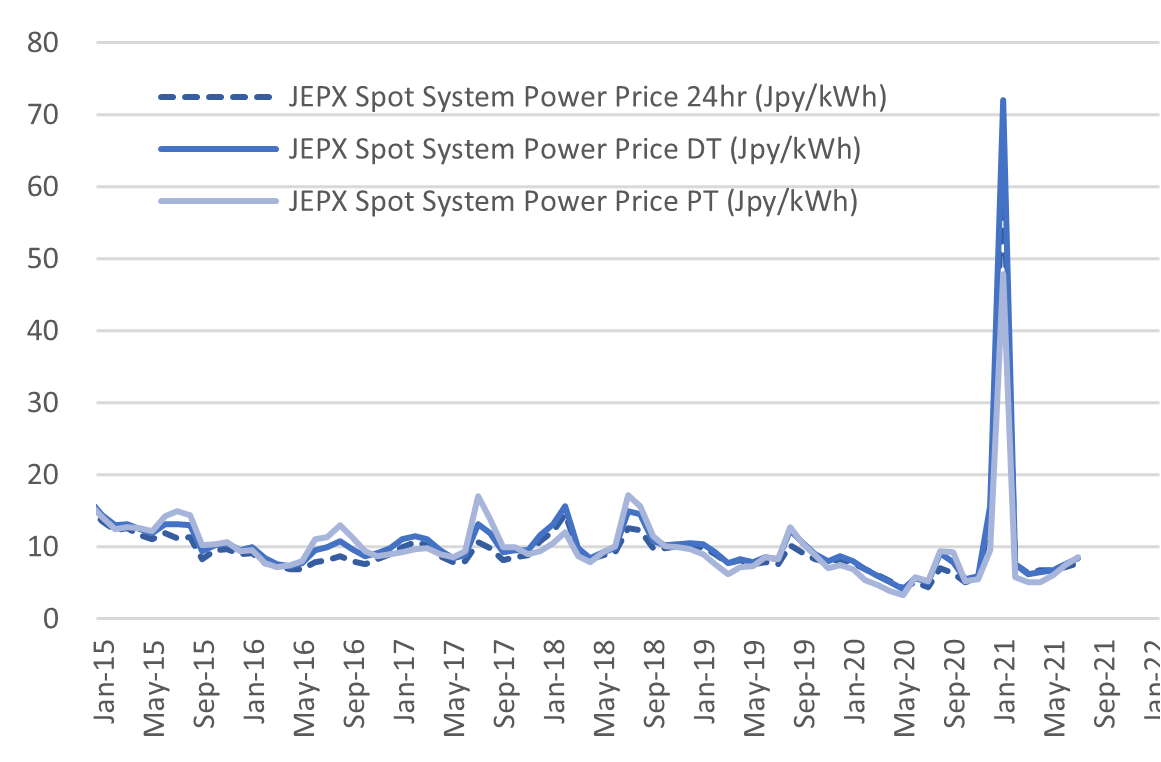
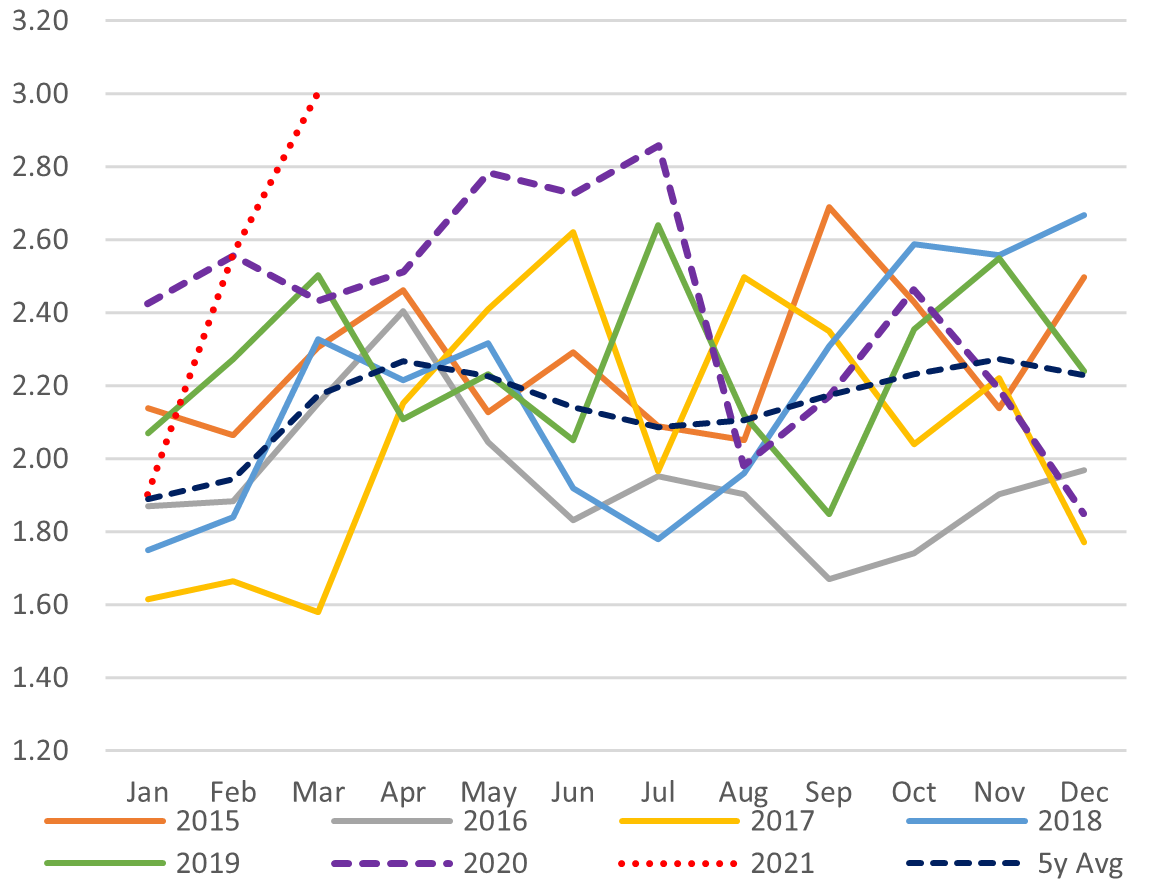
Spot Electricity Prices, Monthly Avg.
Source: Company websites, JANSI and JAIF, as of July 4, 2021
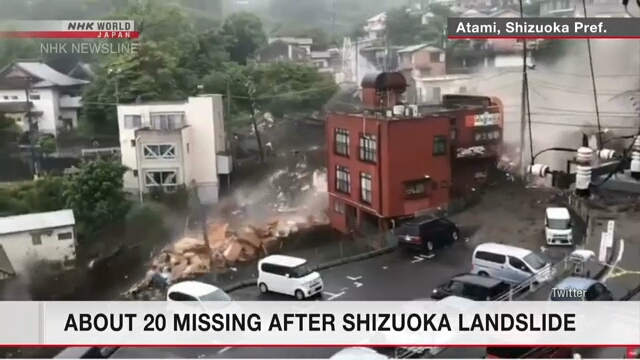
Solar Farms in the Eye of the Storm: Mudslide Unearths Local Concerns
Only a few weeks ago Japan’s most controversial energy source was nuclear, with furious debates inside government and business about the need to continue supporting the industry. Now, much of the concern has shifted to solar power.
How does this fit with announcements about national targets to boost solar capacity? It doesn’t. But, as we noted in the June 28 edition, national policy is increasingly at odds with on-the-ground developments. Unless this is resolved, the 2030 projections simply won’t materialize.
The spark for the current solar debate came after a natural disaster at the popular hot springs resort town of Atami on July 3. Several days of heavy rain led to a landslide — a massive mud avalanche that rolled down the hillside killing at least four people. More than 80 people are still missing and there is damaged to homes and roads.
Atami lies 90 km southwest of Tokyo.
The cause seems to have been the collapse of a landfill high up in the mountains that was made to create land for new development.
Although the development of a solar project in the town was not named as the direct cause of this disaster, forest clearing and land development in mountainous areas for projects such as solar farms were identified as aggravating the severity of such natural disasters.
Just a week before the mudslide, a top daily, the Mainichi, published results of a survey showing that 80% of Japan’s 47 prefectures claim to have experienced problems with solar development. One of the issues cited is the “destructive impact on the environment” from solar.
Two days after the disaster, the left-leaning newspaper, Asahi, published a rather skeptical editorial also questioning the economic costs of renewables.
Even Bloomberg Japan published an article to show how Japan has more solar panels per square kilometer than any other economy, and how this is creating a sense of limitation to further utility-scale development.
The Atami disaster is not just a media topic – it’s already impacting projects. Ito, a neighbor city to Atami, last week rejected a solar project proposal, citing local opposition. It mentioned the Atami disaster in its commentary.
Other cities are appealing to lawmakers to gain more control over renewable energy project operators, which will at the very least push up the cost of doing business for utility-scale solar.
The issue may be as “simple” as setting up clear no-go zones for solar projects to reassure the local population that developments are not taking place on land that is at risk.
Fair or not, the solar industry in Japan is in the eye of the storm and must adapt to changing public opinion and any new regulations that might follow.
SIDE DEVELOPMENT: Ministry of Environment to enact ordinance to stop solar projects in risky areas (Denki Shimbun, July 9)
MoE will enact a new ordinance to prevent the construction of solar power generation on land at risk of sediment-related disasters. This will reference the Global Warming Countermeasures Promotion Law and show which areas are suitable for solar projects.
The move will encourage businesses to closely study land created by embankments and on natural slopes where the risk of landslides is greatest.
SIDE DEVELOPMENT: 80% of Japan’s 47 prefectures have problems with solar power plants (Mainichi, June 28, reprinted in English on July 4)
A Mainichi Shimbun survey found that of all 47 prefectures in Japan, 80% have some kind of problem with solar power.
SIDE DEVELOPMENT: Ito City cancels solar project citing residents opposition (Mainichi, June 8)
Ito City in Shizuoka prefecture announced the construction plan for a large-scale solar power plant in the Yawatano area.
The city has been embroiled in a debate with the solar project developer, including in the courts, over permissions to move heavy machinery to the project site, as well as other issues.
Rejecting the project outright, the local mayor said Japan needs new regulation to govern developments in the mountain areas, especially in light of the landslide in the nearby city of Atami.
SIDE DEVELOPMENT: Kada Yukiko visits controversial solar site (Asahi Shimbun, July 5)
Independent Diet member Kada Yukiko visited the planned site of a solar farm in Shiga that faces local opposition.
Residents’ groups say Japan’s laws limit demands that can be made on solar operators, and are calling for more regulation.
Solar panels will be erected on the 7,600 m² site by end of September.
Kada will study the issue further before considering a response.
CONTEXT: Kada is a very well-known environmentalist and a former two-term governor of Shiga prefecture. She is in her first term as a lower house lawmaker.
SIDE DEVELOPMENT: Causal relations between solar panels and landslides (Toyo Keizai, July 10)
Author Kono Hiroko points out that in the push to have more land available for solar and wind, the government did not provide any guidance over land that should be off-limits because of natural disaster risk. That leaves locals wary of accepting solar projects because they do not feel like such factors have been properly vetted.
Some localities have taken it upon themselves to put some restrictions in place to protect land that might be at risk. However, it is not clear whether these ordinances are appropriate within the current legal framework. Also, from the outside, such ordinances may look as if localities are against all solar and wind projects, as opposed to being protective over which land gets used.
SIDE DEVELOPMENT: Hosono Goshi pledges investigation into solar farms’ role in landslide (Nikkan Sports, July 4)
Shizuoka Diet member and former Environment Minister Hosono Goshi took to social media to call for an investigation into the link between solar farms on the Izu peninsula and the landslide in Atami on July 3.
Hosono is trying to stop a new solar farm in neighboring Kannami.
SIDE DEVELOPMENT: The rocky road to carbon neutrality (Asahi Shimbun editorial, July 5)
Japan’s pledge to reduce net carbon emissions to zero by 2050 will require widescale adoption of renewable energy.
The govt. wants to source over 35% of energy from renewable sources by 2030. Since it’s not possible to install so much offshore wind capacity in a short time, solar energy is the hope to achieve the target.
METI, however, says that even if solar panels are installed on the roof of every house, block of flats, factory, and commercial premises built in the next nine years, we’ll still be nowhere near to achieving this goal. Extensive new solar farms are also required.
Sourcing half of our electricity needs from renewable sources by 2050 is also expected to double the cost of electricity.
Instead of only talking about the role that renewables can play in economic growth, the govt. needs to explain the harsh realities of a transition to renewables for both businesses and households.
Vena Energy receives ministry comments on 1.3 GW offshore wind project
(New Energy Business News, July 6)
The MoE submitted its opinion regarding the Aomori Offshore Wind Power Project planned by Vena Energy. It noted that the project area should be set more firmly based on the offshore wind zoning map.
The project could have a maximum capacity of 1.3 GW. The operator’s plan is to install 500 MW via bottom-fixed turbines (63 units) and later add 800 MW of floating wind turbines (100 units). The estimated project implementation area would be about 23,225 ha.
Construction of the bottom-fixed turbines is scheduled to start in 2025 with an eye on operations from 2028. The floating turbines that are part of the project is still under consideration.
Mitsubishi may build 180 MW wind farm off Akita
(New Energy Business News, July 8)
Mitsubishi Corporation Energy Solutions plans a wind farm off the coast of Akita with a maximum output of 180 MW.
The company released its environmental impact statement on 25 June.
The project involves installing up to 18 wind turbines in a 3,300-ha area of the sea. The turbines would be anchored to the seafloor.
TEPCO to issue debt to finance wind farms
(Nikkei, July 5)
TEPCO Holdings is preparing to issue its first ever “green bonds” to finance wind farm projects both within Japan and overseas.
TEPCO envisages a ¥30 billion bond issue in 2021/22, followed by annual issues in the order of ¥10 billion in subsequent years.
TEPCO aims for 7 GW of additional renewable capacity in coming years, including up to 3 GW of offshore hydro and up to 3 GW of offshore wind.
By attracting investment in renewable energy, TEPCO hopes to shore up its finances, which took a battering after the reopening of TEPCO’S nuclear plants was put on hold.
Toshiba joins forces with solar maintenance industry
(Kankyo Business, July 7)
Toshiba Energy Systems is preparing to collaborate with Tokyo-based solar generation operation and maintenance specialist, CO2O, to provide a one-stop service that includes the engineering, procurement, construction, operation and maintenance of solar facilities.
The companies will target High-Voltage and Ultra High-Voltage installations with an output of 500 kW and more, and hope to operate and maintain 15 GW of capacity by 2030.
The Japanese market for the operation and maintenance of solar facilities is predicted to be worth ¥270 billion by 2030.
TAKEAWAY: Toshiba’s solar power business has so far focused on large-scale power generation. It will now branch out to smaller power plants.
Minna Denryoku begins “solar sharing” in Okayama
(Kankyo Business, July 8)
Tokyo-based Minna Denryoku is serious about sustainable generation market. Its “solar sharing” operation in Okayama consists of mounted solar panels on roofs of greenhouses used to raise mushrooms.
The panels have an output of around 50 kW, and the site is expected to produce around 1,700 kg of mushrooms annually.
Lots of sun and low rainfall makes Okayama one of Japan’s prime locations for solar power, with solar farms in the prefecture often generating four times as much electricity as those elsewhere.
Former TEPCO chief denies responsibility for disaster
(Asahi Shimbun, July 6)
In his first public appearance in nine years, former KEPCO CEO Shimizu Masataka appeared at the Tokyo District Court on July 6 for questioning.
Shimizu and three others have been sued for ¥22 trillion in damages.
Under questioning, all defendants said they were not aware of the dangers posed by giant tsunamis at the time.
When asked about documentation distributed in 2008 that referred to the possibility that a 14-meter tsunami could hit the plant, Shimizu repeatedly stated he was either unaware or couldn’t remember the documentation.
Experimental biomass pilot plant opens in Ibaraki
(New Energy Business News, July 5)
Tokyo-based Lignomateria opened an experimental biomass fired power station in Ibaraki.
The 5.8 MW facility will be operated by Hitachi Zosen.
The plant will burn a modified lignin feedstock made by treating waste cedar and supplied by the Forest Research and Management Organization.
NEWS:OIL, GAS & MINING
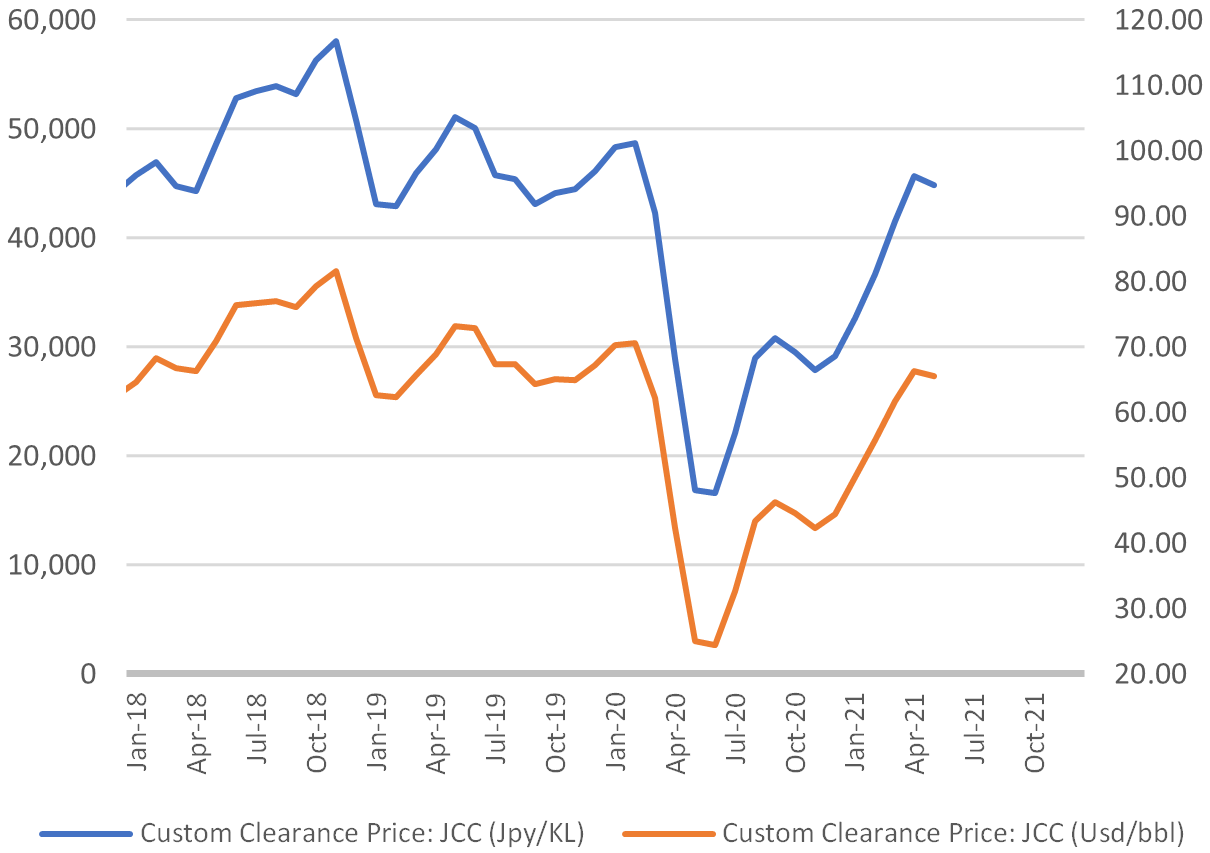
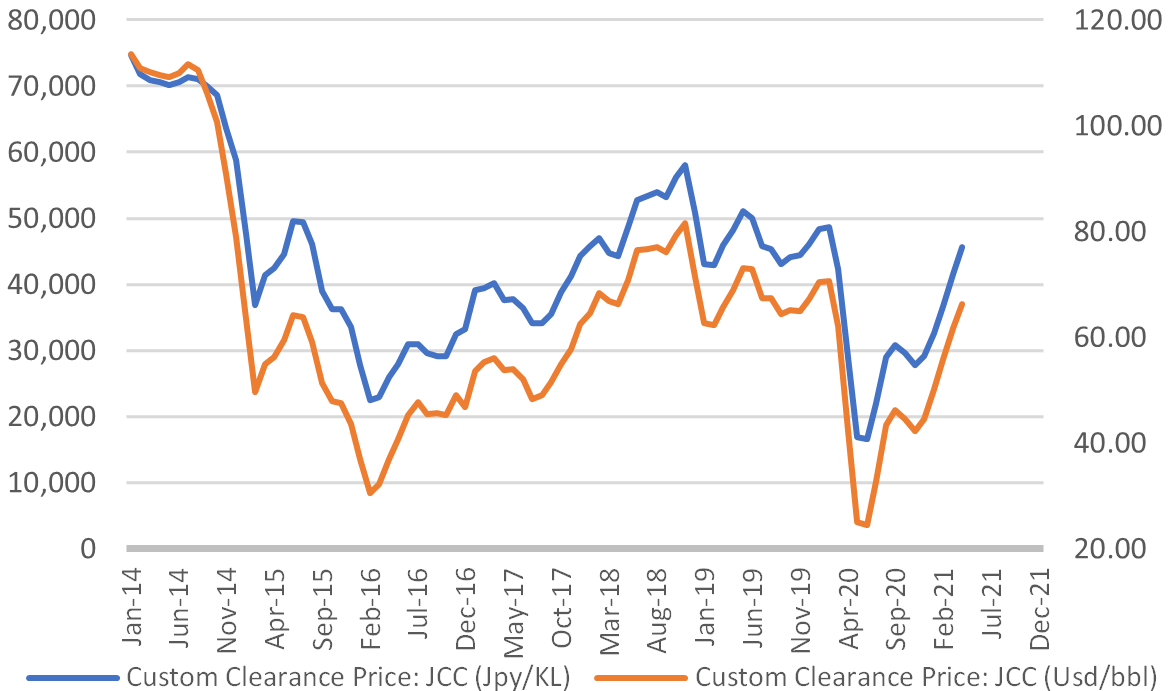
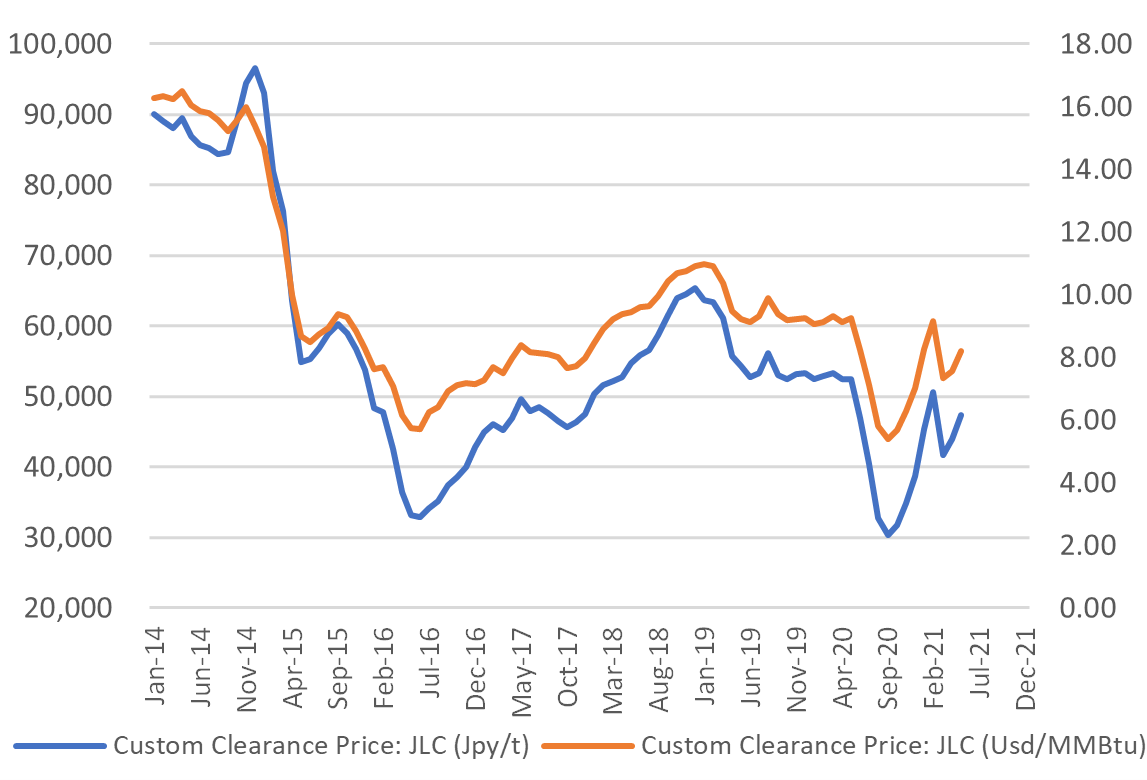
Japan Oil Price: $65.45/ barrel
¥ $
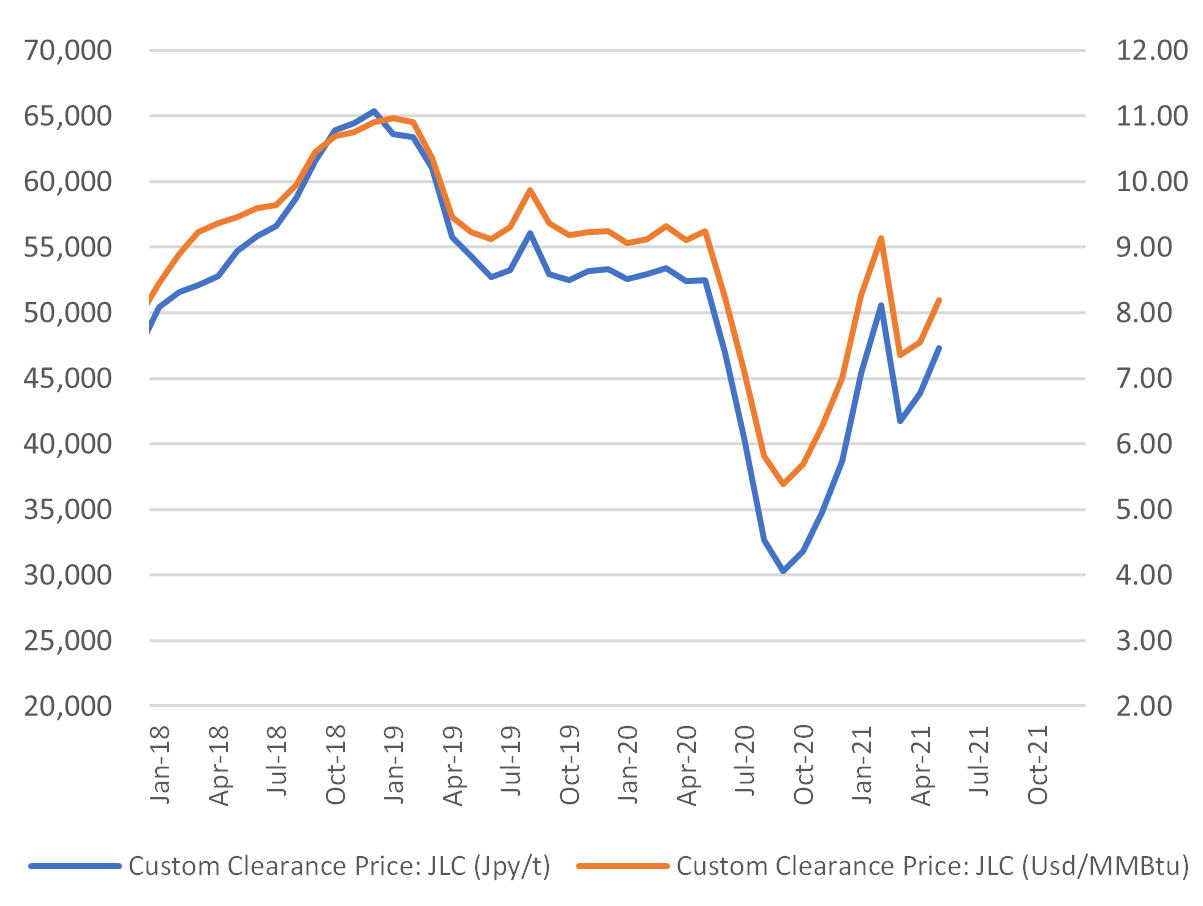
Japan (JLC) LNG Price: $8.19/ mmbtu
¥ $
Japan’s benzene price jumps to highest in over six years
(Sekiyu Tsushin, July 5)
Oil refining major ENEOS has decided on the benzene contract price (ACP = Asian Contract Price) for July, which will be $70 per ton higher than the previous month at $1040/ ton.
This is the first time in about six and a half years that the ACP exceeds $1,000. It was at $1,095 in November 2014.
The Asian benzene market has risen sharply this year, supported by rising crude oil prices and strong regional demand.
CONTEXT: Benzene is used as a raw material for petrochemicals that are turned into plastics and as a solvent. It can also be used for lubricants, rubbers, dyes, detergents, and drugs.
Mitsui Oil starts exploring for oil and gas offshore in northern Japan
(Denki Shimbun, July 6)
Mitsui Oil Exploration started an excavation survey about 30 kilometers from the coast of Embetsu Town, Hokkaido, with the aim of confirming the existence of oil and natural gas.
Mitsui Oil is supported in the project by METI and the Agency for Natural Resources and Energy, which see the potential discovery of commercial-scale oil and natural gas deposits as a way to improve energy security.
The survey will be conducted until mid-Sept. Since the water depth is relatively shallow at about 91 meters, a jackup rig is used for excavation.
ANALYSIS
BY SNEHA RANI
Japan and India See Complementary Energy Strategies Signaling Partnership in Hydrogen Development
Japan wants to create a carbon-free hydrogen supply chain. India plans to more than triple its renewables capacity within this decade, which could create a surplus of energy that could be diverted to producing hydrogen.
The two national strategies are potentially complementary, and both sides are starting to take note. For India, traditionally a buyer of energy-related fuels, this opens the door to large-scale energy exports. For Japan, it’s a way to diversify the geography of its hydrogen supply and secure new providers in a country with which it already enjoys a strong energy relationship.
As 2030 is widely forecast to be when the cost of making hydrogen from renewables starts to be cost-competitive with its manufacture from fossil fuels, India’s green wave could play a major role for Japan and the broader Asia region.
Known quantities Japan and India already enjoy a strong relationship in energy, holding regular meetings at the ministerial and working-group level. Also, ministers from both countries attend a Japan-Indian Energy Dialog every few years, and, recently, on an annual basis.
There are also numerous task forces with experts and officials from both countries looking at smart grids, energy storage, energy efficiency and methanation, among others. Hydrogen entered the conversation in 2019, via a Workshop on Hydrogen and Fuel Cells, held in Delhi to exchange information and find ways to work together for “mutual cooperation in this field”, according to comments at the time posted by Japan’s METI.
The workshop, and subsequent intergovernmental meetings, focused specifically on cost-competitive applications of the fuel for transport, industry, as well as regulations and standards needed for the hydrogen industry. Recently, however, the dialog has evolved to the topic of production.
At an online event in April, officials and experts from India and Japan spoke positively about a “perfect alignment” for working together in green hydrogen. The two countries should pour investment into R&D and commercialization of lower cost hydrogen production, was one of the conclusions from the webinar hosted by the Embassy of India in Tokyo in collaboration with India’s Department of Science and Technology (DST), IGES (The Japanese Institute for Global Environmental Strategies) and TERI (The Energy and Resources Institute).
Government policy
In 2017, Japan was the first country to unveil a comprehensive hydrogen policy, and last year it unveiled what was then the world’s largest green hydrogen manufacturing facility in Fukushima.
India’s progress in hydrogen has been slower, but in the 2021-22 budget the government announced a Hydrogen Mission – a $15 billion initiative to reduce the nation’s dependence on fossil fuels and lower the economy’s carbon footprint through use of hydrogen.
Further, the MNRE (Ministry of New and Renewable Energy) is recommending that India creates four integrated hydrogen hubs, which would introduce long-haul hydrogen buses and other hydrogen transport options. Other proposed measures include facilitating open access to renewable energy, and support to lower the cost of production at these hydrogen hubs.
So far, India’s DST has put funding to around 30 projects related to the production, transportation, and storage of hydrogen with a focus on discovering new catalysts to perform electrolysis.
Among the Indian companies involved are Tata Motors, which has launched a hydrogen fuel cell bus in collaboration with Indian Oil and ISRO (Indian Space Research Organisation). Indian Oil and NTPC (National Thermal Power Corporation) are interested in setting up pilot hydrogen production units. A group that includes Mahindra & Mahindra has developed and tested two/three wheelers and mini buses running on hydrogen fuel.
Reliance Industries Ltd., the largest private company in India, has said that hydrogen applications in transport and power will be one of the components of its plan to to achieve carbon neutrality by 2035.
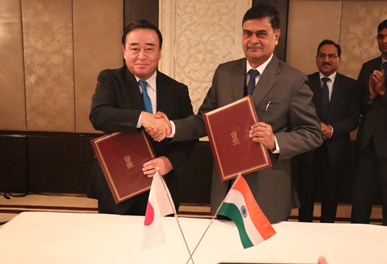
Co-chairs of the 10th Japan-India Energy Dialogue, Minister Kajiyama and H.E. Mr. Raj Kumar Singh, Minister of State for Power, and New and Renewable Energy. Source: METI
Low-cost renewables rollout is key The biggest ace for India in rolling out green hydrogen is the country’s low cost of renewables. Solar tariffs have declined to (¥2.95 / ₹1.99 rupees per kWh). That’s at least three times cheaper than in Japan.
Further price drops should make India a net exporter of hydrogen from 2030, according to the Global Hydrogen Council.
At present, India consumes 6 million tons of hydrogen (about 8.5% of global demand) as a chemical feedstock by reforming 18 million tons of import-dependent natural gas.
These hydrogen volumes will rise once India’s renewables expansion plans materialize. The country already has 136 GW of capacity that it classifies as renewable energy, according to the office of PM Modi. By 2030, that number is expected to be at 450 GW.
The business case
Japanese companies may be involved in that Indian renewables drive. Although the SoftBank Group has recently sold out of its Indian solar venture, SB Energy, another major Japanese investor in green power, Orix Group, spent about $980 million earlier in 2021 to buy 22% of Indian renewable energy firm Greenko Energy Holdings.
Other Japanese corporates active in the Indian market, such as Suzuki, Toyota, Honda and Mitsubishi Corp, and Hitachi also have interest in energy or CO2-free mobility, and may branch out to renewables and / or hydrogen. Trading house Mitsubishi Corp in particular has a strong LNG sales business in India and could deploy some of its local LNG infrastructure for the hydrogen supply chain.
So far, Japan’s efforts in building out the global hydrogen supply chain have focused on countries with which it has an existing strong energy relationship, such as Australia and Saudi Arabia. India looks a likely candidate to join that list.
ANALYSIS
BY DANIEL SHULMAN PRINCIPAL SHULMAN ADVISORY
One Country, Two Power Systems: How Japan Plans to Improve Grid Connections to Aid Renewables Rollout
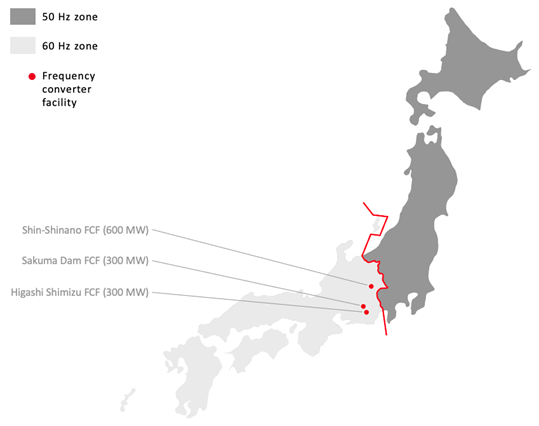
Japan is the only major economy globally to use two power frequencies in its electricity grid. The nation’s system is split between a 60Hz zone in the east and a 50Hz zone in the west, which is a major issue for transferring electricity around the country.
To move electricity from one frequency zone to another requires conversion facilities, which currently have a relatively low capacity. In time of natural disaster, this bottleneck has even led to a blackout in eastern Japan.
As Japan increases its intermittent and decentralized renewable energy capacity, such grid weaknesses can no longer be ignored. Grid resiliency is key to maximizing the integration of more wind and solar assets, and limiting their curtailment.
To this end, Japan has started to create a Master Plan to overcome the issue.
Japan’s Frequency Converter Facilities
Strengthening Japan’s Power Grid A total of 9.7 GW of power generation capacity was lost in eastern Japan after the devastating 2011 earthquake. The frequency converter capacity between the Tokyo and Chubu zones was only 1.0 GW, thus capping how much power could be provided from western to eastern Japan. Since then, the capacity has increased to 2.1 GW and it will reach 3.0 GW by 2027.
Power markets in Japan would gain much more if that capacity were bolstered even further.
Current government strategy is committed to boosting the share of renewables in the power mix. As more decentralized generation such as solar and wind is installed, however, there needs to be more flexibility in transmission. The grid needs to be redeveloped to allow upstream power flow, which would include allowing excess solar power from one region to pass to another.
The burden of managing such distribution falls on the Organization for Cross-regional Coordination of Transmission Operators (OCCTO), which aims to devise an interconnector master plan, due to be completed in FY2022. A preliminary draft of the plan was recently published.
Four Scenarios
OCCTO is working on the basis of four different development scenarios for Japan, based on different expectations around new renewables capacity and also expectations around how far that capacity will be from the country’s main demand centers.
An OCCTO expert committee compared these four scenarios to quantitatively analyze the needs for interconnector capacity increases over the next 30 years. This analysis will be used to refine the Master Plan, but will also serve as a blueprint for work in the near term.
Offshore Wind Capacity by 2040
Location of Offshore Wind projects
Notes
1
30 GW
Follows the locations designated by the METI “Public-Private Council on Enhancement of Industrial Competitiveness for Offshore Wind Power Generation” (Not necessarily near large power consumption areas)
2
45 GW
Same as Scenario 1. Follows the locations designated by the METI expert committee
3
45 GW
Half are located near large power consumption areas
4
45 GW
Same as Scenario 1 & 2. Follows the locations designated by the METI expert committee
Renewable energy is set at 53% of the nation’s total by 2050
Results of OCCTO’s Simulations
Developing half the target offshore wind capacity in high-consumption areas would reduce the grid reinforcement cost by 60%–65%, from ¥2.3–3.1 trillion to ¥1.5–1.7 trillion. This, however, does not account for the asset connection costs that asset owners will have to shoulder, nor does it account for differences in asset construction costs.
In Scenario 3, the interconnection reinforcement costs would be 32%–37% lower than for Scenario 1.
OCCTO also performed a benefit-to-cost ratio analysis by evaluating the generator and consumer benefits of the interconnector upgrades. Only Scenario 4 shows a benefit-to-cost ratio lower than 1 under some conditions because there’d be such a high volume of renewable assets across the country that interconnection capacity usage would decrease, according to OCCTO. The ratio increases with the power demand.
In Scenario 4, as more intermittent renewable assets are introduced, their curtailment rate jumps to 39% (42% without interconnector upgrades). This is conspicuously high and proves the need for a strategy of adding storage or shifting consumption to integrate these assets into the energy system.
OCCTO’s Preliminary Recommendations
Based on the current analysis, OCCTO is suggesting that the Japanese government modify its policy for offshore wind to encourage projects closer to power demand centers. This would save ¥2–3 trillion in interconnector upgrade costs.
It also recommends taking measures on the demand side to optimize renewable energy consumption by, for instance, connecting assets to batteries or electrolyzers. This would increase the benefit-to-cost ratio in Scenario 4.
At this stage, OCCTO has already identified high-priority interconnector reinforcement projects that could be started immediately and would profit all scenarios.
OCCTO’s analysis underscores the need for a national strategy to better integrate renewable generation into the system. As OCCTO recommends bringing generation capacity closer to demand areas, the government is already planning to encourage high power consumption activity in regional cities. The initiative would, for instance, provide financial support for companies and municipalities to establish data centers in a decentralized manner in roughly five regional cities.
Perhaps the greatest challenge highlighted by this exercise comes in Scenario 4. It shows that with high penetration of intermittent generation, a significant amount of the power produced would be lost if storage or demand response does not take place. If the economics of storage do not make sense by this timeline, it raises the question of whether renewable projects can reasonably be developed with a curtailment risk near 40%.
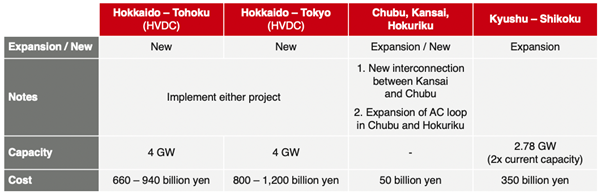
High priority Interconnector reinforcement projects
Source: OCCTO
GLOBAL VIEW
BY TOM O’SULLIVAN
Below are some of last week’s most important international energy developments monitored by the Japan NRG team because of their potential to impact energy supply and demand, as well as prices. We see the following as relevant to Japanese and international energy investors.
Hydropower:
Severe droughts in California have reduced hydroelectric generation by 1 GW, pushing up prices for coal-fired power. The California Independent System Operator (CAISO) is trying to secure emergency electricity supplies from outside the state.
Railways:
In the U.S., Amtrak awarded a $7.3 billion order to Siemens Mobility to replace railcars with dual-powered battery hybrid environmentally-friendly locomotives in the largest single order in Amtrak’s 50-year history.
EVs:
1). The EU Commission is considering legislation mandating that all new car sales by 2035 must be zero CO2 emissions.
2). Stellantis will invest $35 billion over the next four years developing EVs.
3). VW and BMW have been fined over $1 billion by the EU for colluding to prevent deployment of clean emissions technology.
E-Bicycles:
Bosch predicts that 50% of bikes sold in Europe will have an electric motor by 2025 following a surge in sales during the pandemic.
E-Trucks:
Volvo, Daimler and Traton, the EU’s three largest truck makers, plan to roll out a superfast $600 million electric charging network for haulage vehicles, creating 1,700 charging stations across Europe.
Oil:
1). OPEC+ negotiations to increase oil production were abandoned last week with the UAE refusing to endorse a 400,000 bpd production increase from August because of disagreements over baseline calculations and quotas. Azerbaijan, Kazakhstan, Kuwait and Nigeria had their quotas revised in previous negotiations. The tough line adopted by the UAE is regarded as one of the most significant shifts in oil policy in recent times by a petrostate. UAE has around 50 years of reserves at current production levels.
2). Oil hedging losses in the U.S. may have hit $7.5 billion for shale producers in H1 2021 as many hedged oil sales at $55. Oil’s trading close to $75 at present. If current prices persist, hedging losses for U.S. producers for FY2021 could hit $12 billion.
3). Paris will institute a 30 kph speed limit from the end of August to reduce pollution.
Natural Gas:
Global natural gas demand is expected to rise almost 4% in 2021 before easing to an average growth rate of 1.7% over the following three years, according to the IEA’s latest quarterly Gas Market Report. By 2024, demand will be up 7% vs 2019.
Natural gas demand growth in 2021 reflects economic recovery from Covid-19, but is set to be driven in the following years by economic activity and by gas replacing other more polluting fuels such as coal and oil. Asia accounts for about 50% of the increase in gas demand between 2020 and 2024.
Coal:
China, India, Indonesia, Japan and Vietnam are planning to build 600 coal plants that could generate 300 GW of power according to a report last week by Carbon Tracker warning that this could undermine the Paris Agreement.
Nuclear Power:
1). India’s Bharat Heavy Electricals Limited (BHEL) has been awarded a $190 million contract by Nuclear Power Corporation of India to supply 12 steam generators for domestically developed 700 MW pressurized heavy water reactors to be constructed at four locations across India.
In May 2017, the cabinet approved the construction of ten 700 MW units to fast-track India’s nuclear power program. The reactors are to be built at four plant locations – including two new sites – by 2031. Two of the reactors would be constructed as units 5 and 6 of the Kaiga nuclear power plant in Karnataka state; two as units 3 and 4 of the Gorakhpur plant in Haryana state; two as units 1 and 2 of the new Chutka plant in Madhya Pradesh; and four units at the new Mahi Banswara plant in Rajasthan.
2). Argentina’s Nucleoeléctrica Argentina SA will complete the construction of a prototype small modular reactor, CAREM-25, under a contract signed with the country’s National Atomic Energy Commission. The contract specifies construction will be completed within three years.
3). In the UK, Rolls-Royce and Cavendish Nuclear signed a MoU to cooperate on the Rolls-Royce Small Modular Reactor program. Cavendish Nuclear will consider what roles it can take in design, licensing, manufacturing and delivery of the small modular reactors. The Rolls-Royce SMR Consortium already includes Assystem, Atkins, BAM Nuttall, Laing O’Rourke, National Nuclear Laboratory, Jacobs, and others.
Carbon Capture & Storage (CCUS):
Only 20 commercial CCUS projects are currently operating globally, with plans for an additional 30, according to recent analysis by the IEA. The current 20 projects capture around 40 million tons of CO2. The IEA estimates this needs to increase to 800 million tons by 2030 and 2.8 billion tons by 2050 under the terms of the Paris Agreement. The ‘Coalition for Negative Emissions’ believes 1 billion tons needs to be removed from the atmosphere by 2025 and 1 billion tons every year thereafter.
Methane Emissions:
The European Space Agency recently spotted a massive plume of methane emissions in China’s largest coal region in Northeast Shanxi Province where 34 mines are based.
Climate Finance:
James Murdoch has committed $250 million to a BlackRock climate finance fund focused on emerging markets.
2050 Net-Zero:
1). The EU is expected to propose 13 legislative measures for achieving net-zero CO2 emissions by 2050. The legislation will require approval by the EU parliament and the 27 members states.
2). The head of the World Health Organization, Tedros Adhanom Ghebreyesus, last week called for an end to all permits, subsidies and financing for fossil fuels.
Carbon Price:
Allianz and Aviva and other international asset managers are calling on governments and the UN to introduce a common price for carbon emissions.
Carbon Offsets:
Mark Carney, the former governor of the Bank of England, is now estimating that the carbon offset market will be worth $50 billion by 2030 and could eventually reach $100 billion.
Carbon Border Tax:
The EU is now expecting to raise $12 billion a year in carbon border taxes by 2030. The tax is expected to be introduced in 2023.
China:
Xpeng, the Chinese EV maker based in Guangzhou, listed on the Hong Kong Stock Exchange last week, raising $1.8 billion. Nio and Li Auto are also thought to be planning similar listings.
Singapore:
Global Foundries, the semiconductor manufacturer, will invest an additional $4 billion in Singapore to increase production semiconductor capacity at its Woodlands plant, creating 1,000 new jobs and easing the pressure on the transportation sector. Chinese auto sales fell in June due to a shortage of semiconductors.
Australia:
Sydney Airport has received a $17 billion takeover offer from a consortium that includes Global Infrastructure Partners, the NY-based asset manager.
India:
The Scottish oil producer, Cairn Energy, has seized Indian state-owned properties in Paris as part of its ongoing $1.7 billion tax dispute with India.
Myanmar:
Thomas Andrews, the special UN rapporteur on human rights in Myanmar, is calling for specific sanctions on Myanmar’s oil and gas sector.
Saudi Arabia:
Aramco is planning billions of dollars of additional asset infrastructure sales following the $12.4 billion it raised from the sale of its U.S. oil pipeline business in April, and has created a new team to review its assets.
Italy:
The Mediterranean Shipping Company (MSC) is set to become the world’s largest container group, by capacity, overtaking Moller-Maersk after the acquisition of 60 second-hand vessels and with 43 new ships on order. MSC has revenues of $25 billion and 100,000 employees.
Switzerland:
Last week, an energy agreement between the EU and Switzerland governing grid connections to the EU lapsed. Switzerland is scheduled to exit nuclear power by 2034 and may need to construct almost 1,000 wind turbines to improve energy self-reliance.
UK:
1). Landis+Gyr, the Swiss-based metering company, has been awarded a 20-year contract by National Grid for a grid modernization project in the U.S.
2). Stellantis (Peugeot+Fiat) will manufacture electric vans at its Ellesmere Port plant in the UK investing $140 million.
3). Lotus, the UK sports carmaker owned by China’s Geely, unveiled its new but last-ever petrol car last week.
4). The UK’s climate targets will cost the government less over the next 30 years than the price of battling the Covid-19 pandemic if it acts quickly. Forecasts from the Office for Budget Responsibility (OBR) show that ending the UK’s contribution to the global climate crisis would add 21% of GDP to the national debt by 2050, or $650 billion. But those costs could climb twice as high if the government delays action to cut emissions. The independent spending forecasts found that taking early action to decarbonize the economy would have a smaller net impact on the UK’s finances than Covid or the 2008 financial crisis.
5). The north-east of England is in line for a green jobs windfall thanks to private investment in the offshore wind industry backed by a grant from the government’s $220 million support fund. The investment is expected to increase the UK’s offshore wind manufacturing capacity by creating up to 1,000 jobs. The funding will help SeAH Wind set up a $160 million factory to build offshore wind turbine foundations at the Able Marine Energy Park, creating up to 750 direct jobs by 2030.
Canada:
TC Energy, the Canadian infrastructure company, which had its Keystone XL license revoked by the U.S. government is seeking damages of $15 billion from the U.S.
U.S.:
1). Several oil companies, including Exxon, BP, and Shell have been asked to meet the $7.2 billion of costs to cap used oil wells in the Gulf of Mexico following the bankruptcy protection of Fleetwood Energy.
2). Heliogen, the concentrated solar power company founded by Bill Gross, will go public through a SPAC with an expected valuation of over $2 billion.
Mexico:
1). Cemex, North America’s largest concrete producer, will cut CO2 emissions 40% in its concrete by 2030 and become net-zero by 2050. The cuts are expected to be produced mainly using renewable energy, carbon-capture and storage, and from offset programs.
2). Pemex has been awarded control and operator status of the Zama offshore oil field, one of Mexico’s biggest oil discoveries, beating Talos Energy, Premier Oil and Wintershall. The Zama oilfield is thought to have 670 million barrels of oil reserves.
Chile:
The government constructed one of the world’s most ambitious plans for renewable energy that spans wind power in southern Patagonia and solar power in the Atacama Desert, with 40% of inbound Chilean FDI now directed at renewable energy. The country is also focusing on green hydrogen and was recently voted the most attractive renewable energy investment location in the world by a leading think tank.
EVENTS CALENDAR
A selection of domestic and international events we believe will have an impact on Japanese energy.
February
Approval of Fiscal 2021 Budget by Japanese parliament including energy funding projects;
CMC LNG Conference
March
10th Anniversary of Fukushima Nuclear Accident;
Smart Energy Week – Tokyo;
Quarterly OPEC Meeting;
Japan LPG Annual Conference;
Full completion of all aspects of the multi-year deregulation of Japan’s electricity market;
End of 2020/21 Fiscal Year in Japan;
April
Japan Atomic Industrial Forum – Annual Nuclear Power Conference;
38th ASEAN Annual Conference-Brunei;
Japan LNG & Gas Virtual Summit (DMG)-Tokyo
Three crucial by-elections in Hokkaido, Nagano & Hiroshima – April 25th
May
Bids close in first tender for commercial offshore wind projects in Japan;
Prime Minister Suga to visit the U.S.
June
Release of New Japan National Basic Energy Plan-2021;
G7 Meeting – U.K.
Presidents Biden and Putin are due to meet at a summit in Geneva
Forum for China-Africa Cooperation Summit (Senegal)
July
Tokyo Metropolitan Govt. Assembly Elections;
Commencement of 2020 Tokyo Olympics
August
Hydrogen Ministerial Conference in conjunction with IEA
September
Ruling LDP Presidential Election;
UN General Assembly Annual Meeting that is expected to address energy/climate challenges;
IMF/World Bank Annual Meetings (multilateral and central banks expected to take further action on emissions disclosures and lending to fossil fuel projects);
End of H1 FY2021 Fiscal Year in Japan;
Japan-Russia: Eastern Economic Forum (Vladivostok)-tentative
October
Last possible month for holding Japan’s 2021 General Election;
METI Sponsored LNG Producer/Consumer Conference;
Innovation for Cool Earth Forum – Tokyo Conference;
Task Force on Climate-Related Financial Disclosure (TCFD) – Tokyo Conference;
G20 Meeting-Italy
November
COP26 (Glasgow);
Asian Development Bank (‘ADB’) Annual Conference;
Japan-Canada Energy Forum;
East Asia Summit (EAS) – Brunei
December
Asia Pacific Economic Cooperation (APEC) Forum – New Zealand;
Final details expected from METI on proposed unbundling of natural gas pipeline network scheduled for 2022.
DATA
Japan Oil Price
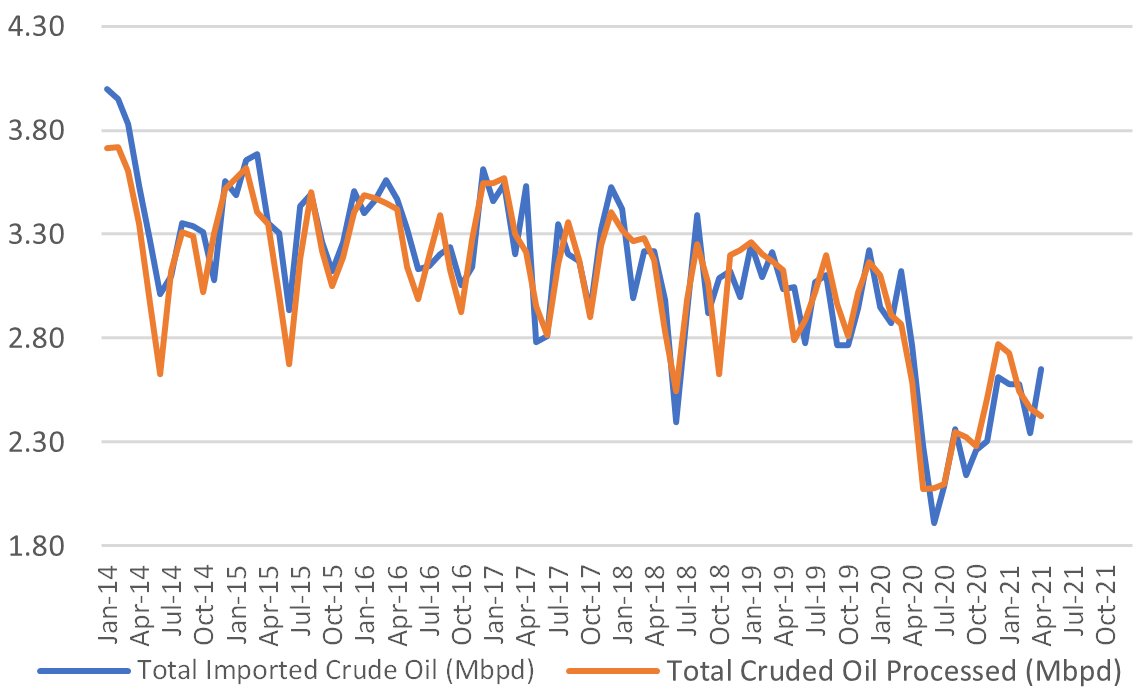
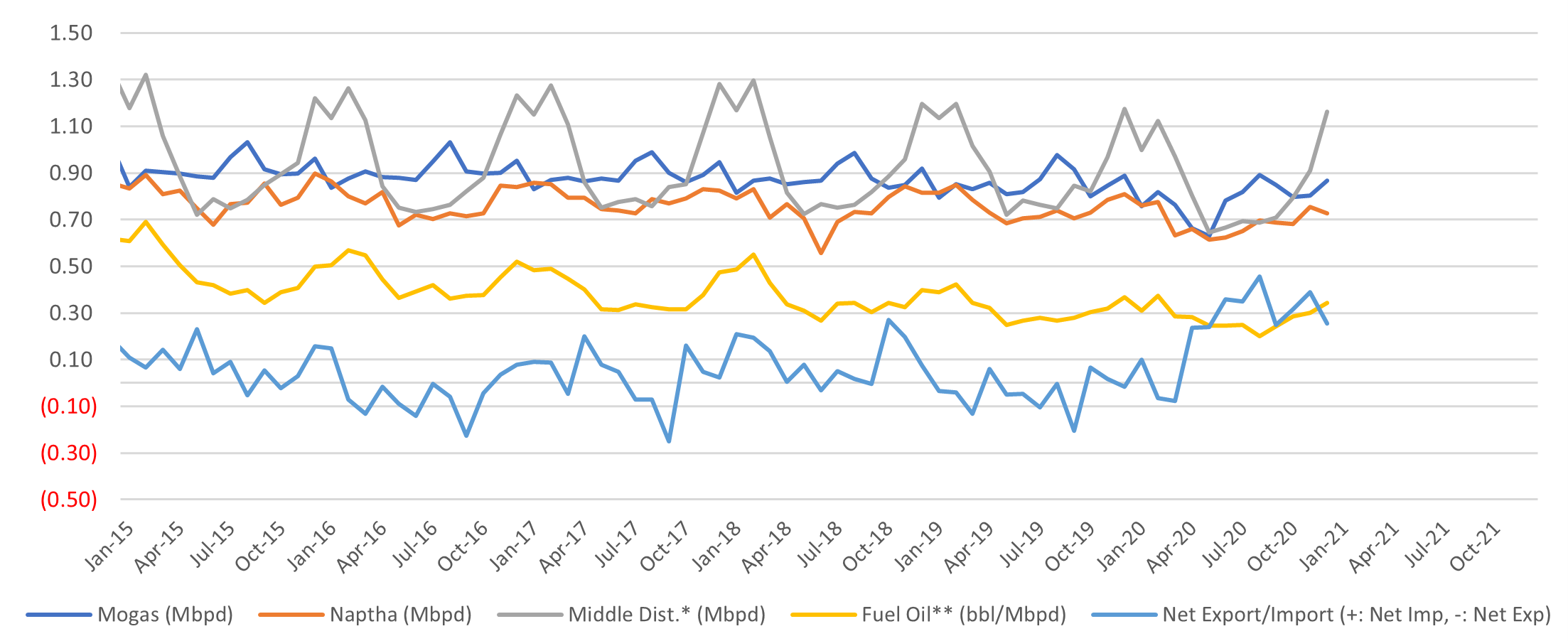
Crude Imports Vs Processed Crude
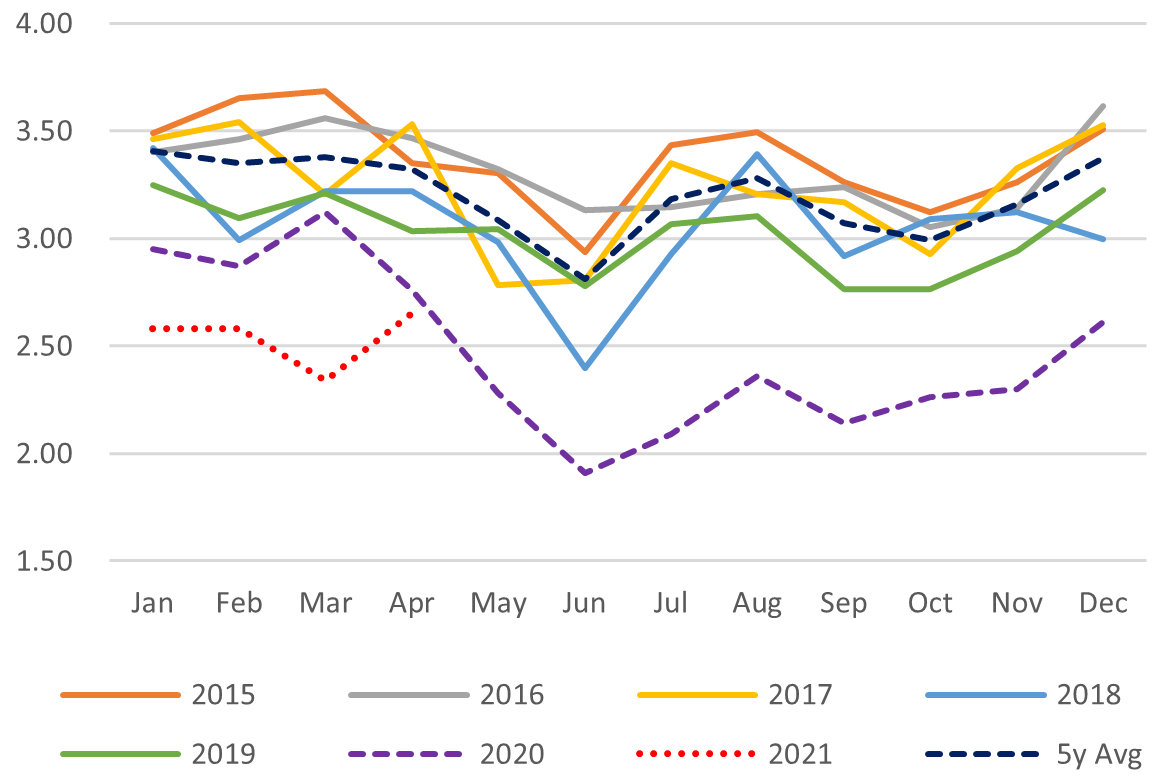
Monthly Oil Import Volume (Mbpd)
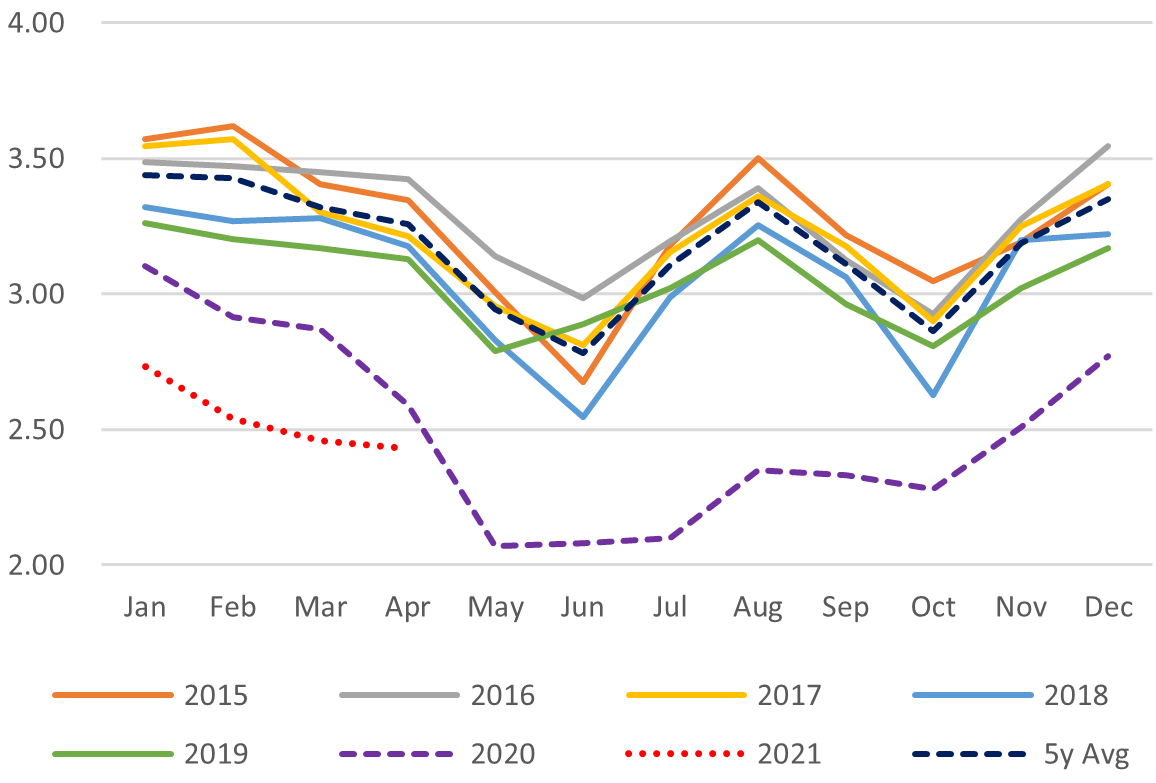
Monthly Crude Processed (Mbpd)
Domestic Fuel Sales
SOURCES: Ministry of Economy, Trade, and Industry (METI), Ministry of Finance, and the Petroleum Association of Japan
Japan LNG Price
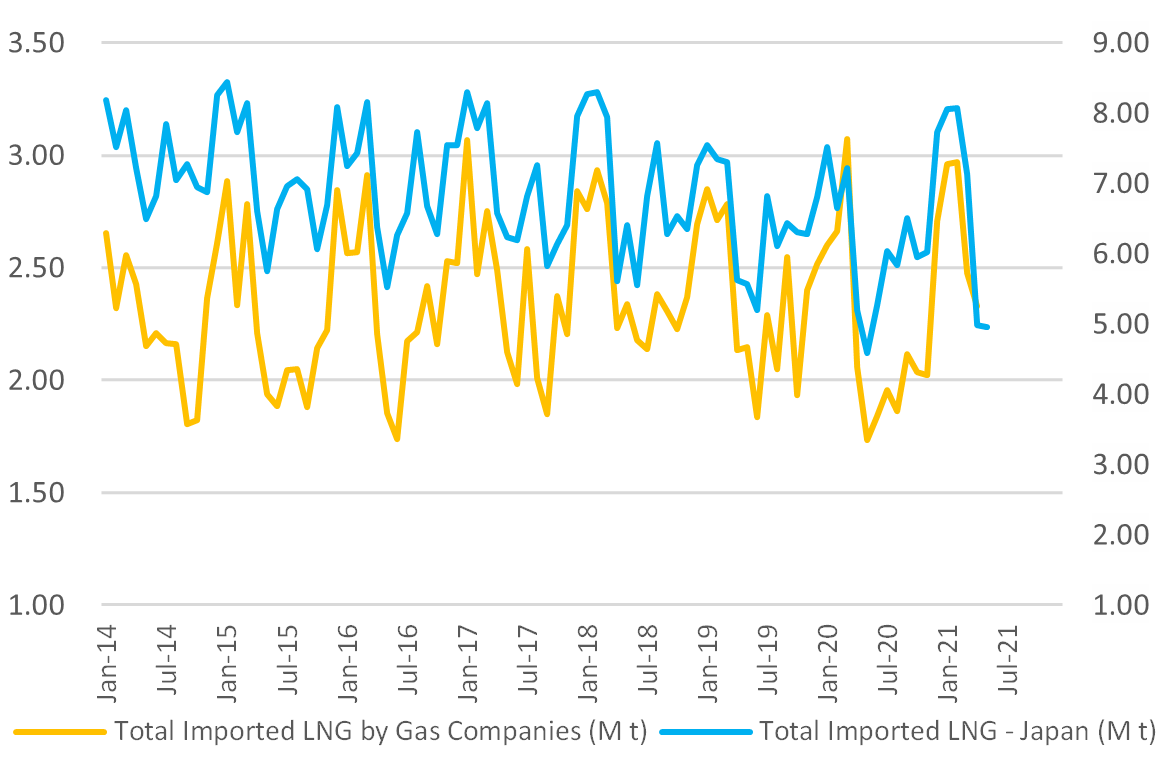
LNG Imports: Japan Total vs Gas Utilities Only
Total LNG Imports (M t)
LNG Imports by Gas Firms Only (M t)
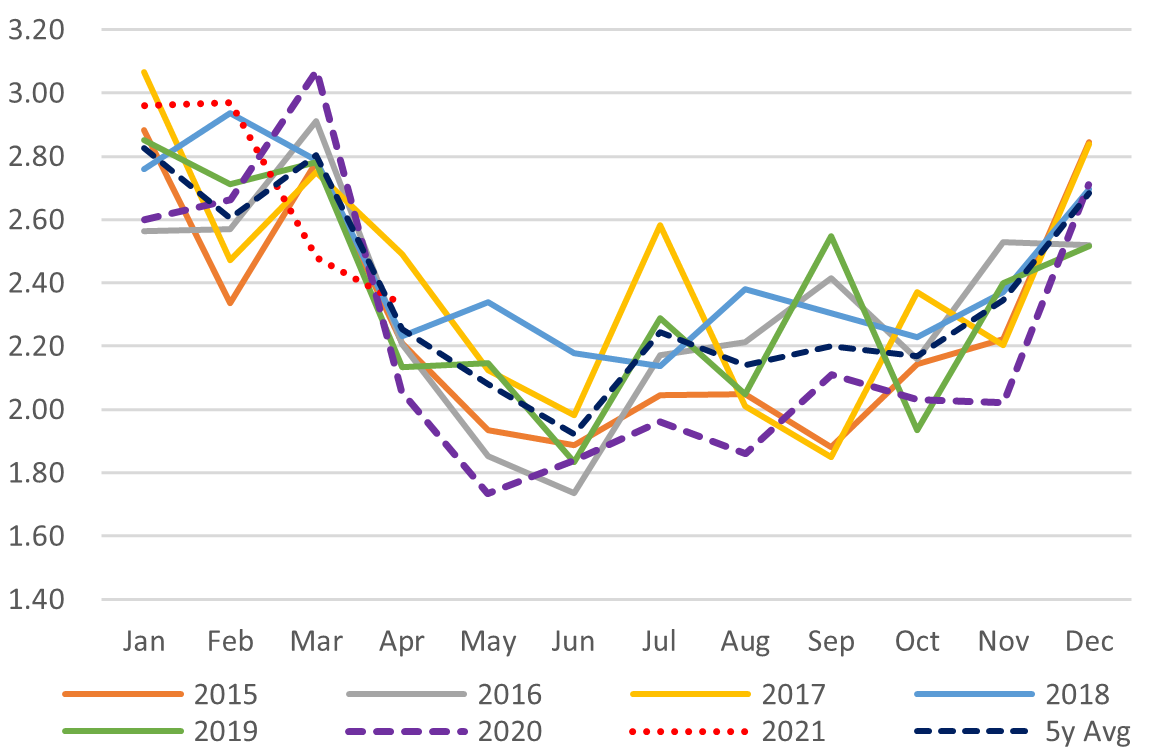
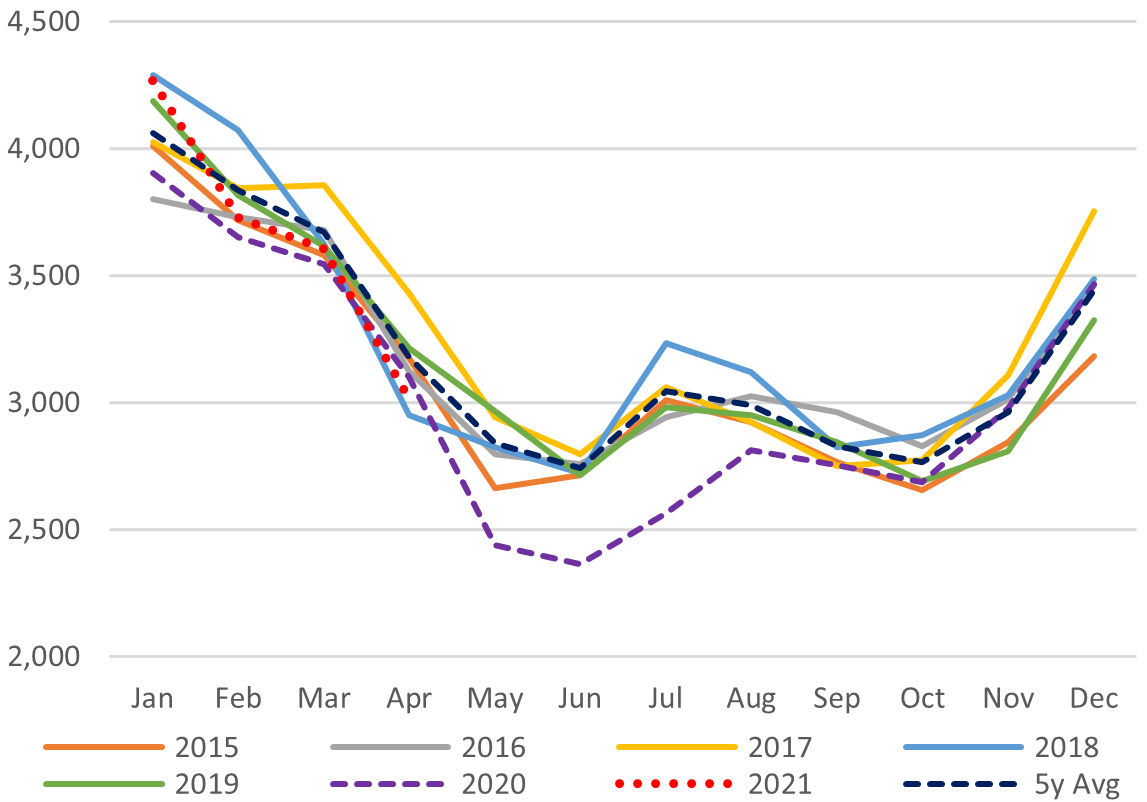
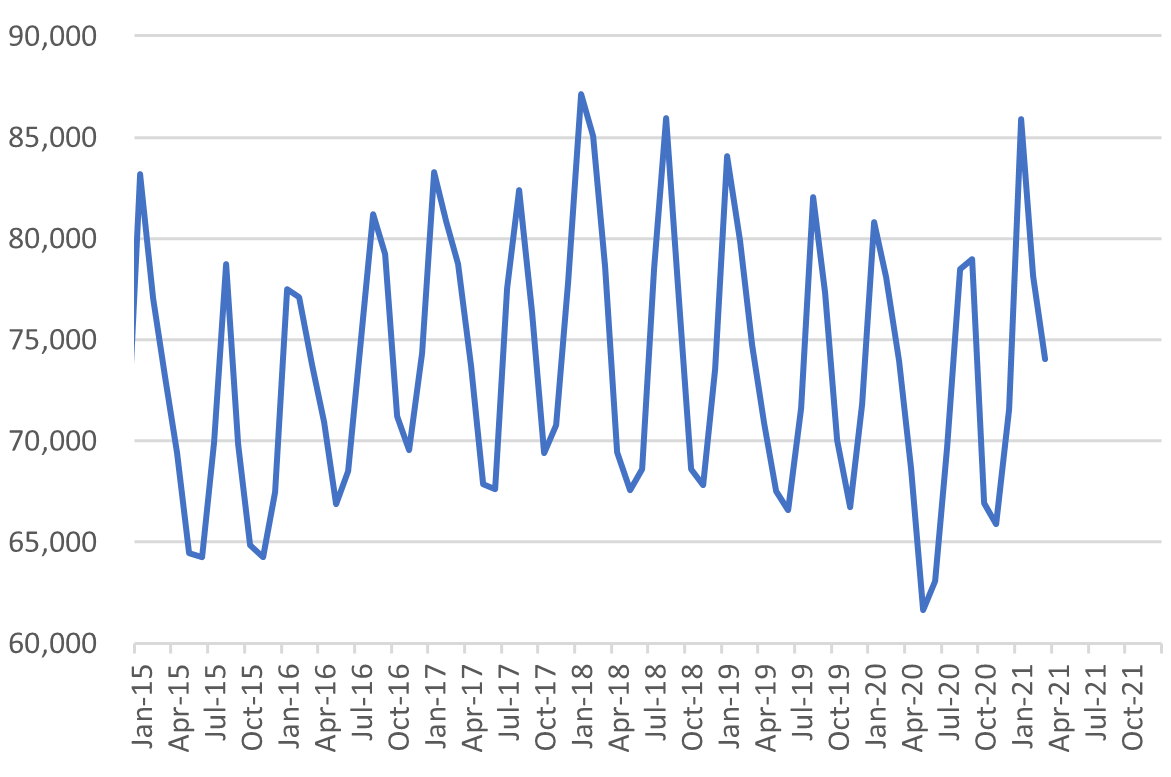
City Gas Sales – Total (M m3)
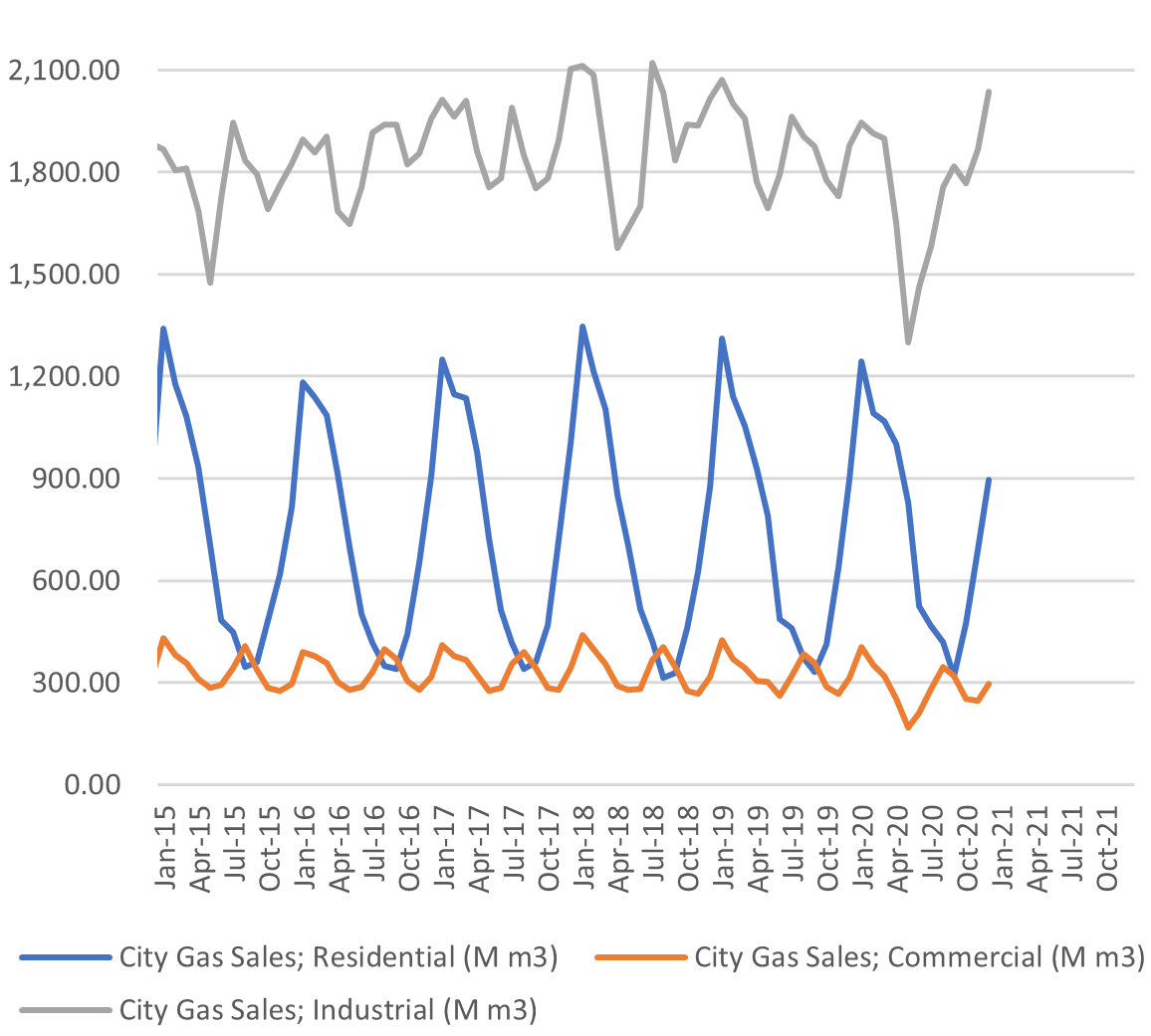
City Gas Sales by Sector (M m3)
SOURCES: Ministry of Economy, Trade, and Industry (METI), Ministry of Finance
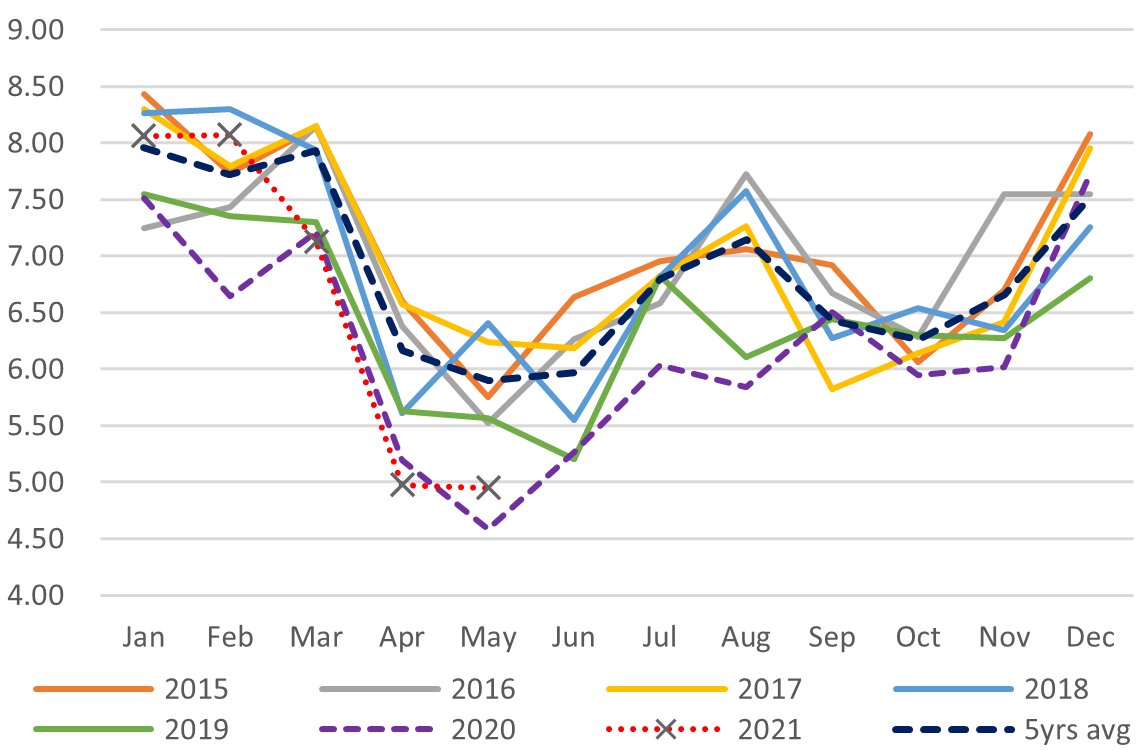
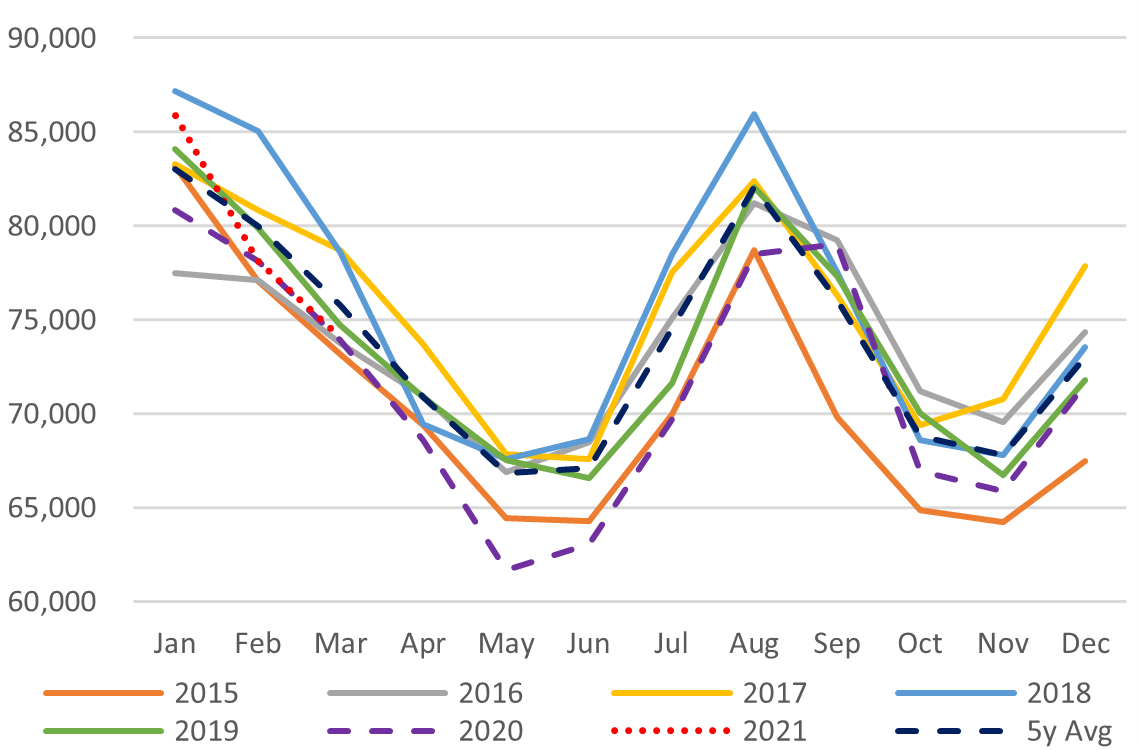
Japan Total Power Demand (GWh)
Current Vs Historical Demand (GWh)
Day-Ahead Spot Electricity Prices
Day-Ahead Vs Day Time Vs Peak Time
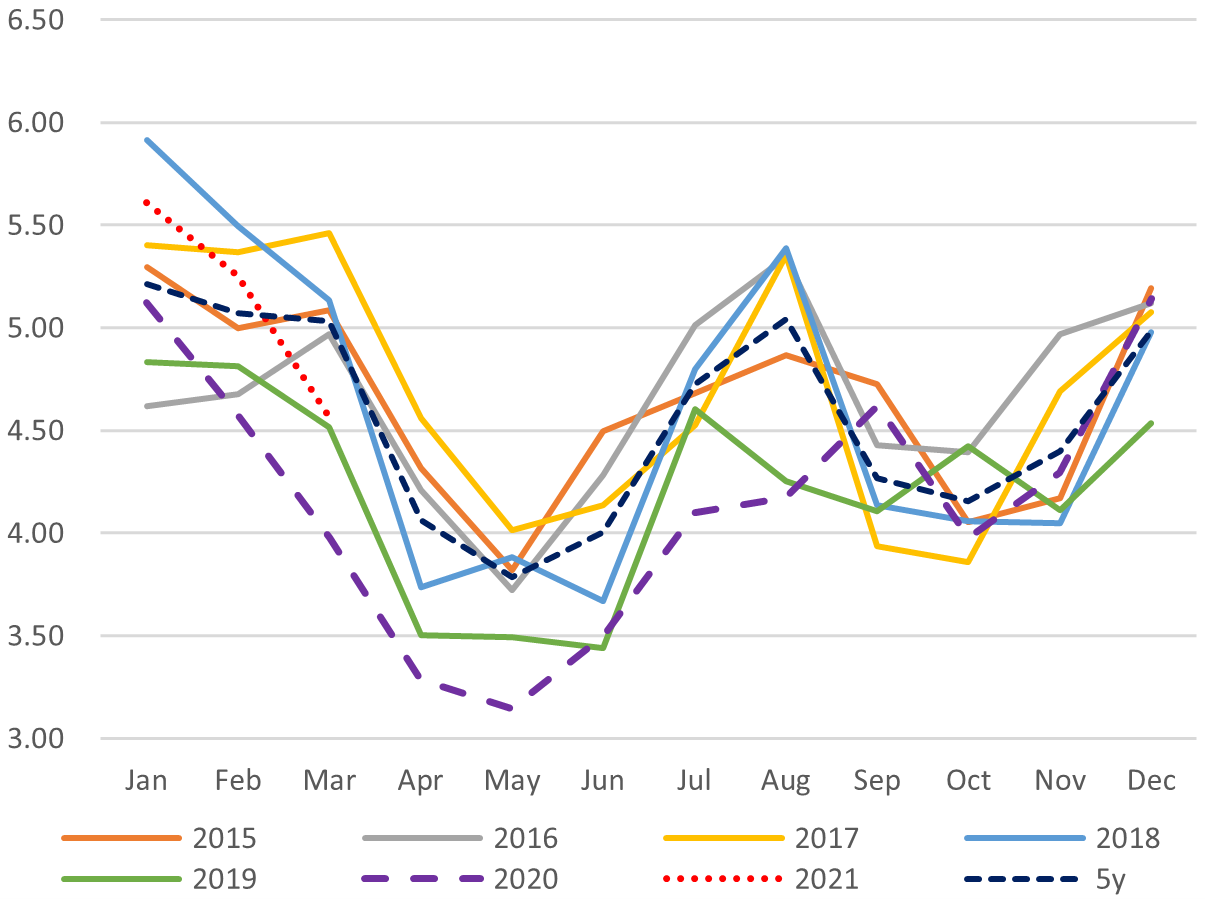
LNG Imports by Electricity Utilities
LNG Stockpiles of Electricity Utilities
SOURCES: Ministry of Economy, Trade, and Industry (METI), and the Japan Electric Power Exchange
Disclaimer
This communication has been prepared for information purposes only, is confidential and may be legally privileged. This is a subscription-only service and is directed at those who have expressly asked K.K. Yuri Group or one of its representatives to be added to the mailing list. This document may not be onwardly circulated or reproduced without prior written consent from Yuri Group, which retains all copyright to the content of this report.
Yuri Group is not registered as an investment advisor in any jurisdiction. Our research and all the content express our opinions, which are generally based on available public information, field studies and own analysis. Content is limited to general comment upon general political, economic and market issues, asset classes and types of investments. The report and all of its content does not constitute a recommendation or solicitation to buy, sell, subscribe for or underwrite any product or physical commodity, or a financial instrument.
The information contained in this report is obtained from sources believed to be reliable and in good faith. No representation or warranty is made that it is accurate or complete. Opinions and views expressed are subject to change without notice, as are prices and availability, which are indicative only. There is no obligation to notify recipients of any changes to this data or to do so in the future. No responsibility is accepted for the use of or reliance on the information provided. In no circumstances will Yuri Group be liable for any indirect or direct loss, or consequential loss or damages arising from the use of, any inability to use, or any inaccuracy in the information.
K.K. Yuri Group: Oonoya Building 8F, Yotsuya 1-18, Shinjuku-ku, Tokyo, Japan, 160-0004.
NEWS
・Wariness around solar power grows after rain-induced landslide; localities raise concern around land management and halt new projects as various lawmakers vow to get involved
・Govt. publishes renewables capacity targets for 2030; solar could hit 74-88 GW; MoE sees further gains in non-utility solar; targets for installed offshore wind are surprisingly low
・Basic Energy Plan draft publication now slated for July 21; Cabinet approval, however, not expected until late October