
JAPAN NRG WEEKLY
NOV. 15, 2021
JAPAN NRG WEEKLY
Nov. 15, 2021
NEWS
TOP
- PM Kishida’s $265 bn stimulus package backs batteries and SMRs as “new capitalism” sees energy a strategic area for the economy
- Onshore wind finally in favor: FIT auctions go sub ¥15/ kWh and J-Power unveils plans for major development in western Japan
- Kansai Electric mulls LNG cargo swaps, joint procurement and power generation with South Korean steelmaker POSCO
ENERGY TRANSITION & POLICY
- New Environment Minister meets with Keidanren to win support
- METI offers ¥151 bn in subsidies for new battery tech and motors
- Okinawa, Tokyo and Shikoku areas most reliant on thermal power
- Minister holds talks with Saudi Arabia about raising oil output
- Tokyo government to establish ¥1 bn sustainable energy fund
- Air Water invests in California’s biggest hydrogen stations chain
- Toyota Tsusho to put ¥1.6 trillion into decarbonization by 2030
- Mitsui to introduce world’s first carrier that can switch to ammonia
- Erex partners with Samsung C&T on clean fuel R&D … [MORE]
ELECTRICITY MARKETS
- Sumitomo, Shell, Equinor form floating offshore wind lobby, call on govt. to set 2-3 GW floating wind capacity target by 2030
- NUCLEAR REACTOR WRAP: Ikata NPP edges closer to a restart
- Utilities concerned that major power buyers are becoming rivals
- Geothermal power quadruples in Japan since Fukushima disaster; Idemitsu and INPEX to develop large geothermal plant in Akita
- Hokkaido Electric, Mitsubishi tie up for local hydropower projects
- Belgium’s DEME ties up with local partner for Japan offshore wind
- Renova launches first overseas renewables power plant … [MORE]
OIL, GAS & MINING
- JAPEX sells part of its INPEX stake to fund CCS and renewables
- Activist fund blocks ENEOS deal to buy out its subsidiary Nippo
- Japan’s pump prices jump for a 10th straight week; kerosene up
- BHP to sell out of Mitsui coking coal venture in Australia
ANALYSIS
JAPAN JOINS RACE TO DEVELOP GREEN TECH
THAT SUCKS CO2 OUT OF THE ATMOSPHERE
With more and more countries saying that decreasing greenhouse gas emissions isn’t enough to combat climate change, the idea of Direct Air Capture (DAC) has gained traction as a solution to cut atmospheric levels of CO2. Japan initially ignored DAC, seeing Carbon Capture and Storage as more promising. This year, however, that stance changed. Not wishing to be left behind in global green innovation, the govt. has launched an ambitious R&D initiative that envisions Japan catching up and leading in DAC technology.
PROFILE: STATE-BACKED JOGMEC CORPORATION;
JAPAN’S OILMEN GET A NEW ROLE AMID DOUBTS
Success in the clean energy revolution will require access to vast quantities of minerals, nearly all of which Japan needs to import. The role of securing that supply has fallen to a state-backed entity traditionally tasked with procuring Japan’s oil and gas. Now, JOGMEC will need to use its prowess in prospecting deep below the Earth’s surface to deliver the minerals required to power Japan’s decarbonization. But an entity that’s forged its reputation in fossil fuels also has its own views on the new energy landscape.
GLOBAL VIEW
China begins review of its biggest emitters. Bitcoin and nuclear industries ponder synergies. EV maker Rivian lists to become one of the most valuable auto firms. Adani sets ambitious renewables targets in India. Details on these and more in our global wrap.
COP26: Week 2 in Review
Few deals recorded in the second half of the climate summit, but two stand out. A coal “phase down” agreement starts the process of moving the world away from coal-fired electricity. Meanwhile, a deal on carbon offset trading should help Japan meet its CO2 emission reduction commitments.
JAPAN NRG WEEKLY
PUBLISHER
K. K. Yuri Group
Editorial Team
Yuriy Humber (Editor-in-Chief)
Tom O’Sullivan (Japan, Middle East, Africa)
John Varoli (Americas)
Regular Contributors
Mayumi Watanabe (Japan)
Daniel Shulman (Japan)
Takehiro Masutomo (Japan)
Art & Design
22 Graphics Inc.
Sponsored
SUBSCRIPTIONS & ADVERTISING
Japan NRG offers individual, corporate and academic subscription plans. Basic details are our website or write to subscriptions@japan-nrg.com
For marketing, advertising, or collaboration opportunities, contact sales@japan-nrg.com
For all other inquiries, write to info@japan-nrg.com
OFTEN USED ACRONYMS
METI The Ministry of Energy, Trade and Industry
MOE Ministry of Environment
ANRE Agency for Natural Resources and Energy
NEDO New Energy and Industrial Technology Development Organization
TEPCO Tokyo Electric Power Company
KEPCO Kansai Electric Power Company
EPCO Electric Power Company
JCC Japan Crude Cocktail
JKM Japan Korea Market, the Platt’s LNG benchmark
CCUS Carbon Capture, Utilization and Storage
mmbtu Million British Thermal Units
mb/d Million barrels per day
mtoe Million Tons of Oil Equivalent
kWh Kilowatt hours (electricity generation volume)
NEWS: ENERGY TRANSITION & POLICY
Japan kicks off debate on $265 billion stimulus including batteries and chip factories
(Nikkei Asia, Nov. 9)
- The Japanese government kicked off discussions on a ¥30 trillion ($265 billion) stimulus package for PM Kishida’s council on a “new capitalism”. This includes ¥10 trillion for universities to support storage batteries and mass production of electric-vehicle batteries
- Development of small modular nuclear reactors (SMRs) was also proposed, as well as aid for a new semiconductor device plant by Taiwanese chipmaker TSMC in Kumamoto.
- The government will finalize the new stimulus measures as early as Nov. 19, and then pass a supplementary budget in December.
- SIDE DEVELOPMENT:
- Kishida new capitalism advisors call for more priority for green and clean energy
- (Japan NRG, Nov. 8)
- The Kishida cabinet panel on “new capitalism” proposed advancing development of cutting-edge technologies in digitization, as well as “green” and “clean energy”, as strategic areas to boost the national economy. The panel advisors called for making science and technology Japan’s backbone.
- The key research and development areas were identified as digitalization, AI, quantum computing, bio and space technologies. The panel also urged the spread of digital transformation and clean energy supply systems, which are comprised of renewables, domestic production of storage batteries, hydrogen vehicles and infrastructures, alternative energy sources for carbon-intensive chemical and steel industries, decarbonization of homes and building structures, and development of nuclear fusion.
- The 15-member panel is comprised of representatives of Japan Business Federation, Chamber of Commerce, Z-Holdings, Shionogi, and Japanese Trade Union Confederation; but the energy sector is not represented.
TAKEAWAY: The panel proposal seems to categorize “clean energy” as something available in the near term, while “green energy” is decades away. This is a shift that Japan NRG has commented on previously – Kishida’s replacement of Suga’s “green” with “clean”. We understand this to mean less emphasis on renewables in order to allude also to carbon capture, nuclear and hydrogen.
New Environment Minister discusses joint efforts with Keidanren deputy chief
(Denki Shimbun, Nov. 8)
- Environment Minister Yamaguchi met with Sugimori Tsutomu, vice chairman of the Keidanren (Japan Business Federation) and chairman of ENEOS.
- Minister Yamaguchi said: “I’d like to join hands with the Keidanren to realize a virtuous cycle between the economy and the environment.”
- Sugimori responded: “Amid the difficult situation around nuclear power and other issues, there’s a major need to work closely and share knowledge on how to create a virtuous cycle between the economy and the environment.”
- The meeting was held around the theme of COP26.
- CONTEXT: This is the first time the new Environment Minister has met with the big business lobby, which traditionally has supported nuclear energy over renewables.
TAKEAWAY: Yamaguchi’s predecessor, Koizumi, made his position on energy very clear. He fully supported renewable energy and pushed back against nuclear power. Yamaguchi’s position is yet to be fully seen, with many in the renewables industry concerned that the new minister may favor the nuclear lobby. It’s curious that the Keidanren’s top rep opened with mention of nuclear and the economy.
METI opens Green Innovation Fund applications for batteries and vehicle motors
(Japan NRG, Nov. 11)
- METI opened applications to companies and consortiums for its Green Innovation Fund to develop battery and motor systems for vehicles.
- A total of up to ¥151 billion will be provided for the development of solid state and other new batteries; cutting cobalt consumption used for cathodes and graphite used for anodes; reducing carbon emissions while treating battery raw materials; recycling 70% of lithium, 95% of nickel and 95% of cobalt from spent lithium-ion storage batteries; improving performance of motors, downsizing and reducing weight.
- The application deadline is Jan. 6; winners will be announced in late February.
TAKEAWAY: High prices of critical raw materials, driven by looming supply shortages, propel more investment in recycling and development of alternative materials. Increases in secondary supplies may dampen prices a little, but news of replacement materials is likely to have the bigger impact with the premise of possibly turning the supply-demand balance around. Intermediate brokers that do not directly consume the materials will stop buying them.
The market will also be looking for the least carbon-intensive supplies. Recycling does not involve long haul transport of materials as waste is typically treated within the country of consumption. Primary materials travel across continents before reaching battery makers.
METI minister holds online talks with Saudi Arabian energy minister
(Japan NRG, Nov. 9)
- METI minister Hagiuda and Saudi Arabia’s Energy Minister Prince Abdulaziz bin Salman held an online meeting on Nov. 8, four days after Abdulaziz said he hadn’t received any request from Japan to ramp up oil output at a faster pace.
- CONTEXT: Saudi Arabia is Japan’s second largest oil supplier after the United Arab Emirates, with a 30-40% share.
TAKEAWAY: Saudi Arabia seeks to increase foreign direct investment in a bid to diversify its economy and decrease dependency on oil. In February, the Ministry of Investment of Saudi Arabia was established for this purpose. Thus, talks with Japan on oil production are unlikely to be limited to that topic.
Okinawa, Tokyo and Shikoku the most dependent regions on thermal power
(Japan NRG, Nov. 12)
- During the Golden Week holiday in May, thermal power accounted for 50-60% of electricity demand in Okinawa, Tokyo and Shikoku areas, while the ratio was less than 20% for Kansai and Kyushu due to the latter two region’s nuclear capacities.
- May is when power demand hits yearly lows due to the holidays. Tokyo had renewable power supplies of 15.3 GWh, the largest among all areas, but this was not enough to meet demand.
- The panel seeks to lower the operating rate of thermal power stations by converting their systems to run at 20-25% operating rates rather than the present minimum threshold of 30-50%.
- Renewable operators are urged to connect to online supply monitoring systems for a faster response to demand and supply changes.
Tokyo Govt. to establish a sustainable energy fund
(New Energy Business News, Nov. 10)
- The Tokyo Metropolitan Government (Tocho) will launch a sustainable energy fund, investing ¥1 billion in finance, renewable energy power plants, and clean energy bases.
- In February, Tocho had set up a committee to come up with a “Global Financial City: Tokyo Vision” by November.
- In March, Tocho published the “Zero Emission Tokyo Strategy 2020 Update & Report”.
- Next, fund operators will be selected in December and establish a partnership in Feb 2022. Investment is targeted at ¥10 billion or more, and to last for 10 years.
Japan’s Air Water invests in biggest operator of hydrogen stations in California
(Kankyo Business, Nov. 9)
- Osaka-based Air Water has invested in FirstElement Fuel (FEF), the largest developer and operator of hydrogen stations in California.
- Also, Mitsubishi UFJ Bank, Nikkiso Co., and Japan Infrastructure Initiative acquired FEF’s newly-issued preferred shares to the tune of $105 million (about ¥11.5 billion); Air Water’s subscription amount was the largest — $50 million.
- FEF was established in 2013 and operates 31 of California’s 52 hydrogen stations, and it has the largest market share.
- The Japan Bank for International Cooperation (JBIC) has previously invested in FEF; also, Toyota Motor and Honda Motor support the company.
Toyota Tsusho to invest ¥1.6 trillion in decarbonization by 2030
(Company Statement, Nov. 4)
- Toyota Tsusho will invest ¥1.6 trillion in decarbonization by 2030. Specifically, it focuses on five business areas:
- Renewable energy (¥700 billion) – construction of wind power plants by its subsidiary, Eurus Energy Holdings, and the development of 50% of in-house power consumption from renewables.
- Batteries (¥400 billion): enter lithium-ion battery market, especially manufacturing
- Hydrogen/alternative fuels (¥200 billion): secure a 30% share in external sales of fuel cell systems.
- Resource circulation (¥200 billion): recycling rare metals and plastics
- Economy of Life (¥100 billion): invest in agriculture/food-related business
- Through its decarbonization-related business, Toyota Tsusho plans to expand its automobile business and achieve carbon neutrality by 2050.
ENEOS, Chiyoda scale up Australian CO2-Free Hydrogen Supply Chain Demonstration
(Company Statement, Nov. 2)
- ENEOS, Chiyoda, and Queensland University of Technology (QUT) have expanded the scale of technological verifications of CO2- free hydrogen to a practical level.
- To store and transport hydrogen, previous technology required storing hydrogen produced via water electrolysis in a tank, then converting it to methylcyclohexane (“MCH”), a type of organic hydride. ENEOS’ technology simplifies this process by producing MCH from water and toluene through the electro-chemical synthesis of organic hydride (Direct MCH).
- In March 2019, ENEOS, Chiyoda and QUT produced MCH from water and toluene derived from renewable energy; transporting MCH to Japan and then extracting hydrogen.
- Now, the scale of MCH has expanded to contain about 6 kg of hydrogen from the previous 0.2 kg. Hydrogen is also extracted from MCH technology, where it’s used to fill and drive a fuel cell electric vehicle (FCEV).
Mitsui to introduce Ammonia fuel-ready carrier at the end of 2023
(Nikkei, Nov. 7)
- Mitsui & Co. will deliver a ship that transports ammonia and that can switch to using ammonia for its own fuel in Dec. 2023. The ship will transport ammonia from Southeast Asia to Northeast Asia, primarily Japan.
- The new vessel will be 160 meters long, with a depth of 15.9 meters.
- Once completed, it will be the first environmentally friendly unit owned by a Japanese shipping company that can switch between LPG fuel and ammonia fuel.
- Mitsui O.S.K. Lines (MOL), the shipping company, aims to place an order for an ammonia-fueled ship in 2023.
- This will also be the world’s first ammonia carrier to be designed and built based on the American Bureau of Shipping (ABS) certification.
Japan’s Erex and South Korea’s Samsung C&T to partner on clean fuel development
(Nikkei Asia, Nov. 4)
- Erex (Japan) and Samsung C&T (South Korea) will partner on biomass and establish a global supply chain for cleaner fuels.
- Erex plans to buy coal-run power plants from major utilities and refit them for biomass fuel. This is part of Erex’s campaign to convert aging coal plants to run on biomass.
- Erex aims to boost annual procurement of biomass fuel to 3-5m tons in 2025 and to 10m tons in 2030. Currently, it produces about 1m tons.
Japan firm develops geothermal power module that doesn’t require rare metal
(Nikkei, Nov. 10)
- Hakusan, a company that handles electronic components, developed a geothermal power generation module that doesn’t use rare metals, reducing raw material costs by one-fourth compared to conventional products.
- Hakusan aims to mass-produce and commercialize this in 2022, offering its module for half the price of similar products that do use rare metals.
MOL, Mitsubishi, and Namura Shipbuilding in ammonia carrier joint development
(Seatrade Maritime News, Nov. 4)
- Mitsubishi Shipbuilding, Mitsui OSK Lines (MOL) and Namura Shipbuilding will develop a large-sized ammonia carrier, fueled by ammonia.
- Japan’s annual ammonia demand will be 3m tons by 2030, and 30m tons by 2050.
Mitsubishi Shipbuilding and NYK Line to jointly develop a large CO2 carrier
(Company Statement, Nov. 9)
- Mitsubishi Shipbuilding and Nippon Yusen Kabushiki Kaisha (NYK Line) agreed to develop a large-scale liquefied CO2 (LCO2) carrier.
- The technology combines Mitsubishi Shipbuilding’s advanced gas handling technologies with NYK Line’s expertise in large sized vessels.
- The two companies will participate in the CCUS value chain based on LCO2 carriers.
NEDO begins research of next-generation hydrogen aircrafts
(Kankyo Business, Nov. 9)
- NEDO announced research into development of next-gen aircraft, including hydrogen-powered aircraft and into dramatic weight reduction of major aircraft.
- Research will have a ¥21 billion budget.
Mitsubishi Heavy, Sumitomo invest in U.S. CO2-solutions biotechnology venture, Cemvita
(New Energy Business News, Nov. 9)
- Mitsubishi Heavy Industries (MHI) and Sumitomo Corporation have invested in Houston-based Cemvita Factory Inc., which provides CO2 utilization solutions using biotechnology.
- MHI aims to build its portfolio in the carbon capture, utilization and storage (CCUS) value chain.
- Energy Capital Ventures will invest together with MHI and Sumitomo.
- Cemvita is a biotech start-up that uses biosynthetic technologies to develop and provide decarbonization solutions for heavy industries such as chemicals, mining, and oil and gas.
ENEOS oil exploration units join with U.S. startup 8 Rivers for CCUS development
(Sekiyu Tsushinsha, Nov. 11)
- JX Nippon Oil Exploration Corporation, part of the ENEOS Group, signed an alliance with 8 Rivers Capital, LLC of the U.S. to promote environment-friendly businesses.
- The partners want to work on CCUS (CO2 Capture, Utilization and Storage) tech.
- 8 Rivers has developed technologies for zero-carbon power generation, hydrogen and ammonia; and has projects for these in the UK and Oceania, and in the U.S.
One-Dot News:
- Nomura Real Estate Development and Tokyo Gas plan to build Japan’s first condominium with virtually zero CO2 emissions. Located in Sagamihara City, Kanagawa Prefecture, the building will be completed in March 2025. (Kankyo Business, Nov. 11)
- Hitachi and NEDO plan to start a cloud EMS verification experiment in Slovenia utilizing an energy storage system together with ELES, a local state-owned power transmission company (Kankyo Business, Nov. 10)
- Idemitsu and other companies will experiment with the use of EVs for public transportation on Tanegashima Island. After a trial run in January 2022, full-scale operations are planned to start in February. (Kankyo Business, Nov. 5)
- Tokyo Gas, Tokyo Gas Engineering Solutions (TGES) and Noritake Co. announced development of the world’s first hydrogen-burning continuous sintering kiln for lithium-ion battery (LiB) electrode materials (Gas Energy Shimbun, Nov. 7).
- Idemitsu will invest $25 million in the Azimuth V Energy Evolution Fund, a $1 billion fund established by Azimuth Canada Management to develop innovative technologies for the energy transition. The fund will support growth-stage companies working on hydrogen production from municipal waste and natural gas, waste plastic recycling, and efficient geothermal power generation. (Nikkan Kogyo Shimbun, Nov. 10)
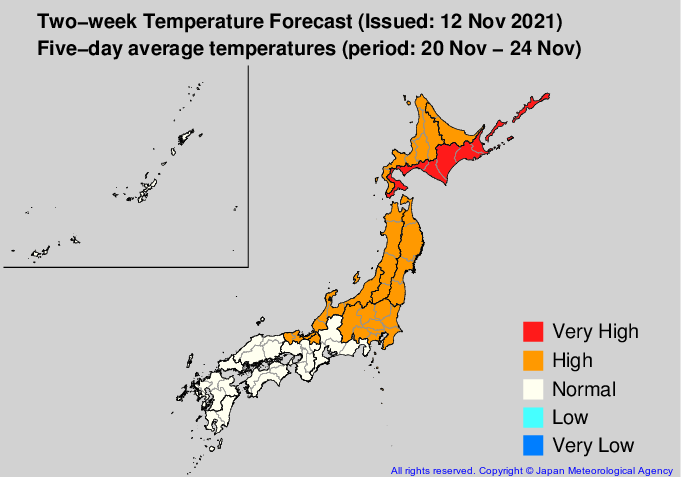
WEATHER OUTLOOK
TWO-WEEK TEMPERATURE FORECASTS (NOV. 12~ NOV. 24)
Nation-wide
Tokyo area
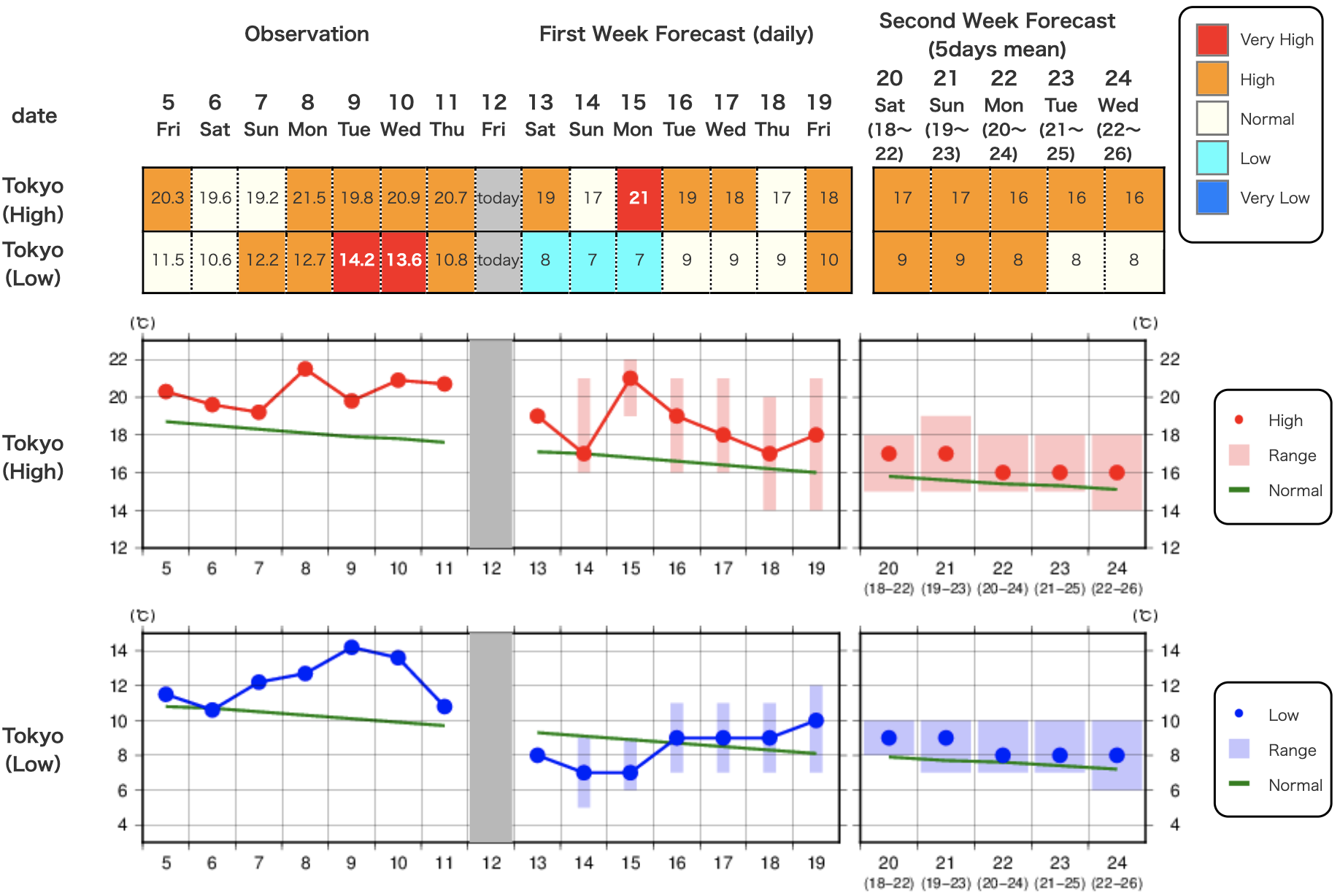
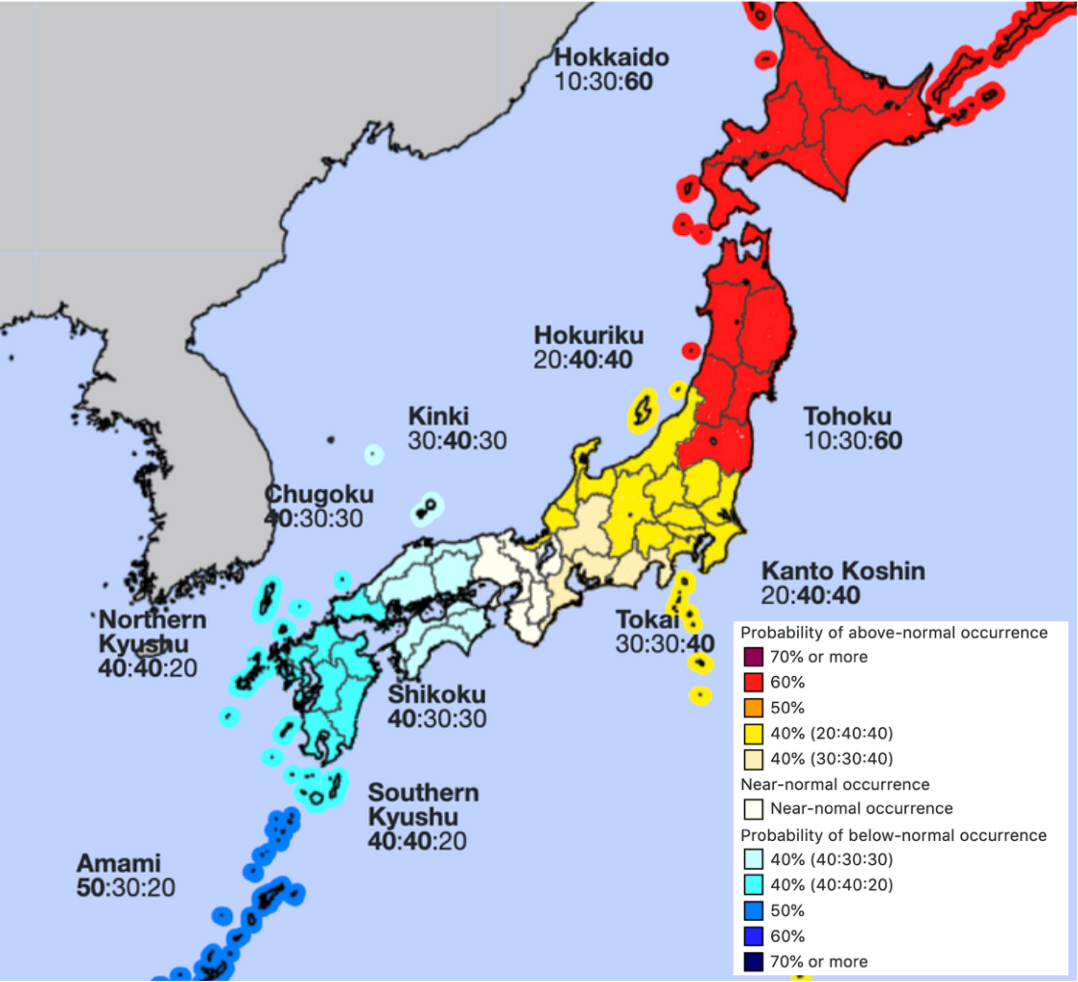
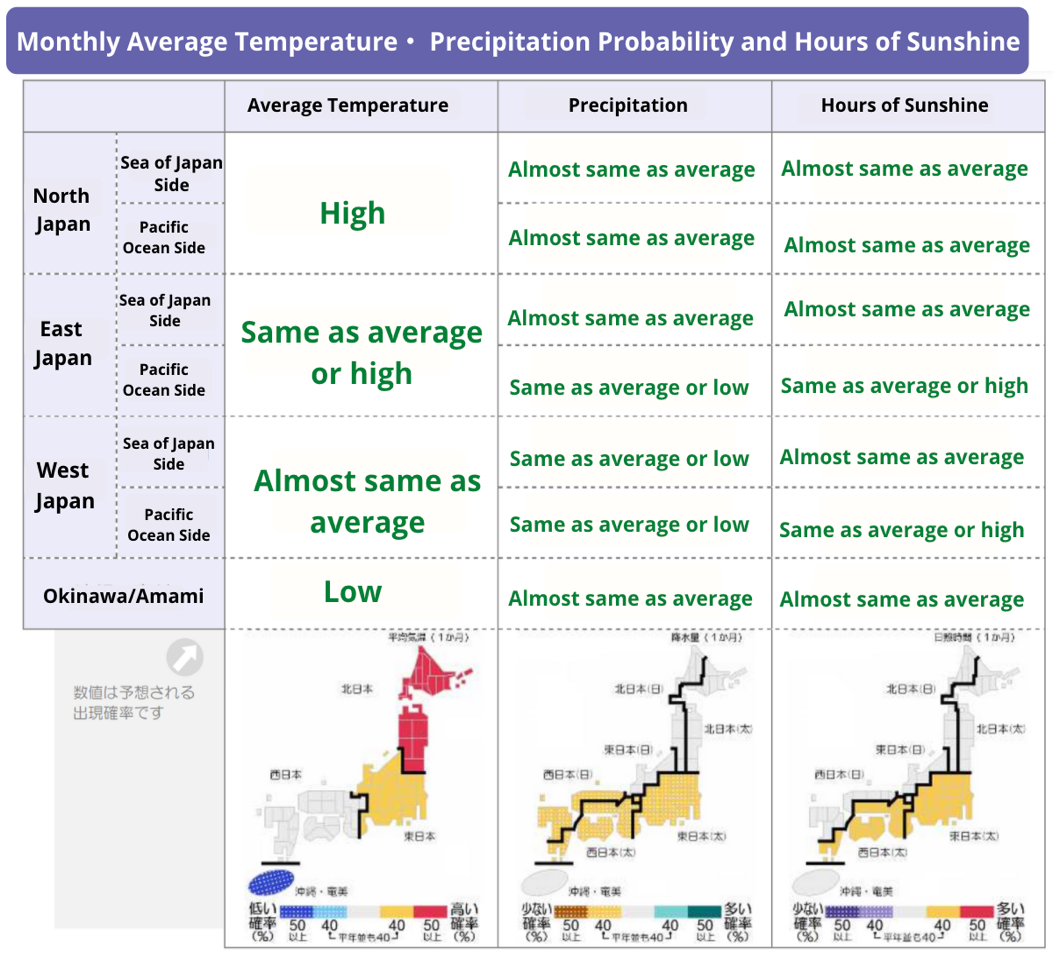
- North Japan: Very high temperatures from Nov. 18.
- East/West Japan: Average temperatures but slightly cold.
- Okinawa/Amami region: In line with the average for this time of year.
ONE-MONTH SEASONAL FORECAST (NOV. 13~ DEC. 12)
NEWS: POWER MARKETS
| No. of operable nuclear reactors | 33 | Electricity Price | Friday, Nov. 12 | |||
| Of which | restarted | 10 | JEPX 24-Hour Spot | ¥18.88/ kWh | ||
| in operation today | 7 | TOCOM Nov. baseload (Tokyo area) | ¥16.42/ kWh | |||
Source: Company websites, JANSI and JAIF, as of Nov 14, 2021
J-Power plans a giant 142 MW onshore wind project in Yamaguchi/Shimane Prefecture
(Nikkei, Nov. 10)
- CONTEXT: J-Power is the No. 2 wind power producer in Japan with capacity of about 530 MW.
- J-Power plans to build a wind farm with a total output of up to 142 MW in the area between Yamaguchi and Shimane prefectures.
- The estimated project area is 10,175 hectares in Shunan City and Iwakuni City, and (Yamaguchi Prefecture) and Yoshika town (Shimane Prefecture).
- J-Power plans to install 33 wind power facilities each with a maximum output of 4.3 MW. Construction expected to last for 4-5 years.
TAKEAWAY: Much criticized for its heavy dependence on coal-fired generation, J-Power is capitalizing on its wind power base to announce a significant shift to green power. Onshore wind in Japan is still a small sector that measures less than 5 GW of capacity. J-Power’s project may be unable to compete in scale with offshore wind efforts but it would be a notable development on land and one clearly backed by the government.
FIT on-shore wind auction awarded at ¥14.98 to ¥17 per kWh, biomass at ¥18.50
(Japan NRG, Nov. 5)
- The 2021 renewable power auctions awarded 32 onshore wind operators with tariffs of ¥14.98-17/ kWh and one biomass operator a tariff of ¥18.50/ kWh, reports Green Investment Promotion Organization (GIPO). The results will set renewable rates under the Feed-in-Tariff (FIT) scheme. GIPO sought to auction 1 GW of onshore wind power and 120 MW of biomass power.
- Some 44 onshore wind projects went to auction. The lowest bid of ¥14.98/ kWh came from Tokyo-based wind power operator Reetech. Hokuriku Electric Power followed at ¥15.48/ kWh. Nagoya-based SunWay bid the highest at ¥17/ kWh, which was also the level of the price cap. Some 29 other winners included Tohoku Electric Power, Japan Renewable Energy, ENEOS and Cosmo Eco Power. The sole biomass entrant was Oji Green Power Ebetsu in Hokkaido, that bid at ¥18.50/kWh, the price cap. The company has a capacity of 75 MW, below the 120 MW target.
- This was the first onshore wind power auction, and the fourth for biomass. The last biomass tender was awarded also at ¥18.50/kWh. Wind operators with capacities of a minimum of 250 kW, and biomass operators with a minimum of 10 MW capacities, were eligible. The bids were placed in late October.
TAKEAWAY: Participation remains the key for successful auctions and healthy market mechanism. In 2020, 1.92 MW biomass capacity was sourced against the target of 120 MW. There were no winners in the 2018 and 2019 tenders due to a lack of participants and one potential winner being disqualified. While the first onshore power auction was successful hitting the 1 GW target, the offshore fixed foundation wind power auction, which was held last year, failed to attract bidders.
Sumitomo, Shell, Equinor, others form offshore wind lobby to push government
(Company Statement, Oct. 29)
- Sumitomo Corp Global Metals, Shell, Equinor, Toda Construction and Ocean Winds, a JV between EDP Renewables and ENGIE, said they formed an industry lobby group to press for changes in Japan’s offshore wind power industry.
- Floating Offshore Wind Promotion Group, as the lobby is known, is asking the Japanese government to set a target of 2-3 GW of floating wind power capacity by 2030, and for medium and long-term targets.
- The group wants the government to create dedicated committees to discuss floating offshore wind issues and to chart a clear path towards the creation of a suitable business environment, including towards development in the EEZ.
NUCLEAR REACTOR ROUND-UP:
- Local mayor approves Ikata nuclear plant’s restart
- (Yahoo news, Nov. 11)
- The mayor of Ikata met with the operator, expressing his approval in restarting the Ikata Unit 3 reactor (Shikoku Electric).
- As a next step, the operator will meet with Special Committee members from Ehime Prefecture assembly, on Nov. 16.
- Governor Nakamura has indicated that he will make his final decision based on the opinions of the prefectural assembly.
- The plant’s restart, scheduled for Oct. 12, was delayed after an operator left his post several times while on standby duty.
- Work on anti-terrorism safety measures has been completed.
TAKEAWAY: Ikata No. 3 looks like it may restart at the end of this month or early December, providing the rest of the local politics go its way. This would be a major event as it’d be the first time in years that a reactor outside of Kansai Electric or Kyushu Electric was online.
- SIDE DEVELOPMENT:
- NRA to check Kashiwazaki Kariwa’s damage from the 2007 Chuetsu-Oki Earthquake
- (NHK, Nov. 10)
- The NRA will conduct on-site inspection on damage to underground piles supporting the facility at the Kashiwazaki Kariwa Unit 6 plant (TEPCO).
- Damage was found at eight reinforced concrete piles supporting the foundation of a facility adjacent to a building housing the plant’s No.6 reactor.
- The NRA says the damage may have been caused by the 2007 earthquake in Niigata and suggested that the cause of the damage should be clarified.
- SIDE DEVELOPMENT:
- Second inspection at Onagawa NPP after hydrogen sulfide leak caused staff sickness
- (NHK, Nov. 9)
- Miyagi Prefecture conducted its second on-site inspection after 7 workers complained of sickness caused by hydrogen sulfide leaked at the Onagawa nuclear plant (Tohoku Electric) in July.
- An investigation revealed a tank for storing liquid waste leaked hydrogen sulfide.
- Soon after the accident, the prefecture, Onagawa town, and Ishinomaki held its first on-site inspection. Holding a second on-site investigation is an unusual response.
- Meanwhile, the operator aims to restart the plant from 2022 onwards.
- SIDE DEVELOPMENT:
- NRA to conduct on-site inspection at Shika NPP after concerns of active fault
- (Yahoo news, Nov. 9)
- On Nov. 18 and 19, the NRA will inspect Shika nuclear plant (Hokuriku Electric) for the site’s active earthquake fault.
- Under new regulations, a plant can’t restart if there’s an active fault underneath.
Power utilities concerned over loss of major clients such as Sony to PPA deals
(Diamond, Nov. 9)
- There’s a growing trend for large electricity users to get into power generation. In September, Mitsubishi Corp signed a long-term power purchase agreement (corporate PPA) with Amazon. The agreement calls for the construction of about 450 new solar power plants, with all the electricity generated by the plants to be consumed by Amazon.
- Total installed capacity is 22 MW. This is Amazon’s first PPA in Japan, and the country’s largest.
- Corporate PPAs are well established in Europe and the U.S. as a way to directly control renewable energy supplies without relying on state subsidies such as the Feed-in Tariff (FIT).
- Such PPAs will play a lead role in Japan’s electricity market. A senior executive at a major electric power company expressed his dismay, saying, “From now on, unless we have a large amount of renewable energy, we will be ignored by consumers.”
- Sony is another major Japanese company that plans to secure power supplies to meet the criteria of its big client, Apple, to source 100% renewable energy. Sony is building solar power generation plants and telling retailers it’ll only buy electricity from renewable sources.
- Big Japanese power users are destroying the existing industry relationships by putting pressure on major power utilities to convert to renewable energy.
- To date, major utilities have focused on how to provide stable and inexpensive power, and saw the best solution in nuclear and thermal power plants. Now, with top clients more concerned about the “color” of electricity, utilities must change or watch clients become competitors.
Geothermal power plants in Japan quadruple since Fukushima disaster
(Mainichi, Nov. 6)
- The number of geothermal power plants in Japan has quadrupled since the 2011 nuclear disaster in Fukushima, according to industry data.
- Japan has the third-largest geothermal resources in the world, after the U.S. and Indonesia, accounting for an estimated generation of 23.5 GW.
- Geothermal power facilities in the country jumped to 92 units in 70 sites in FY2019, up from 20 units in 17 sites in FY2010.
- In October, the Cabinet approved plans to double geothermal power facilities by 2030.
- Geothermal accounts for only 0.3% of Japan’s total power output because many plants are small scale, according to Thermal and Nuclear Power Engineering Social Data.
Idemitsu and INPEX to develop large geothermal power plant in Akita
(Nikkei, Nov. 11)
- Idemitsu Kosan, INPEX, and Mitsui Oil Exploration plan to operate a geothermal power plant in Yuzawa City, Akita Prefecture in 2025. The maximum output is about 15 MW.
- Capacity factor is 70%, more efficient than solar and wind power, with 10-20%.
- Construction starts in 2022. The environmental impact assessment is completed.
- INPEX and Idemitsu are discussing development of geothermal power in Hokkaido.
Hokkaido Electric and Mitsubishi Corporation to partner on hydropower in Hakodate
(Nikkei, Nov. 8)
- In November, Hokkaido Electric and Mitsubishi Corporation will partner on a 50/50 JV in a new entity, Donan Hydropower LLC, in Hakodate.
- The JV will involve renewing the five aging hydro power generation facilities owned by Hokkaido Electric, and to ensure long-term operation.
- For the five plants, Donan Hydropower will stop operation in order to conduct facility upgrades between 2023 and 2024, and then resume operation from 2024-2026.
DEME Offshore and Penta-Ocean Construction forms Japan offshore wind joint venture
(Renews, Nov. 2)
- DEME Offshore (Belgium) and Penta-Ocean Construction (Japan) will partner in a new entity, Japan Offshore Marine (JOM). JOM will combine DEME Offshore’s marine engineering knowledge with Penta-Ocean’s specialized marine construction technology
Renova launches first overseas renewables power plant
(New Energy Business News, Nov. 10)
- Renova began operation of the 144 MW Quang Tri Wind Power Project in Vietnam, its first overseas renewable energy project and its first onshore wind power facility.
- The project consists of three plots, each with 48 MW capacity; the power generated will be sold under Vietnam’s FIT system at 8.5 US cents/ kWh (about ¥9.3/ kWh).
- Renova and Power Construction Joint Stock Company No.1, a power utility in Vietnam, will jointly operate the power plant, in which Renova holds a 40% stake.
Young nuclear engineers voice support for industry’s future as COP26 unfolds
(Nikkei Business, Nov. 11)
- This is a lengthy feature based on interviews with young nuclear engineering staff at Mitsubishi Heavy Industries, one of Japan’s top builders of nuclear power plants. They discuss the industry’s third-generation tech and how they believe in its future despite the various challenges, including memories of the Fukushima disaster.
- Click on the headline to access the story.
NEWS: OIL, GAS & MINING
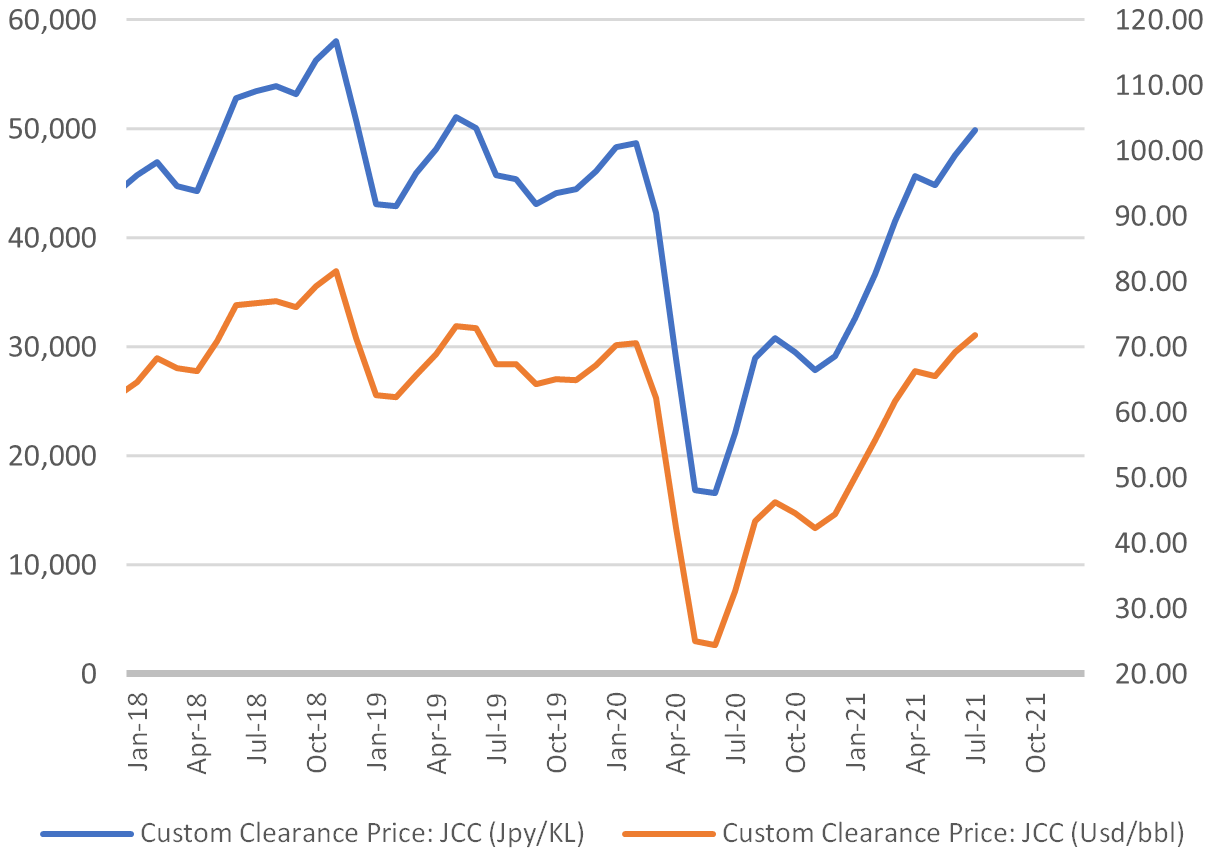
Japan Oil Price: $71.72/ barrel
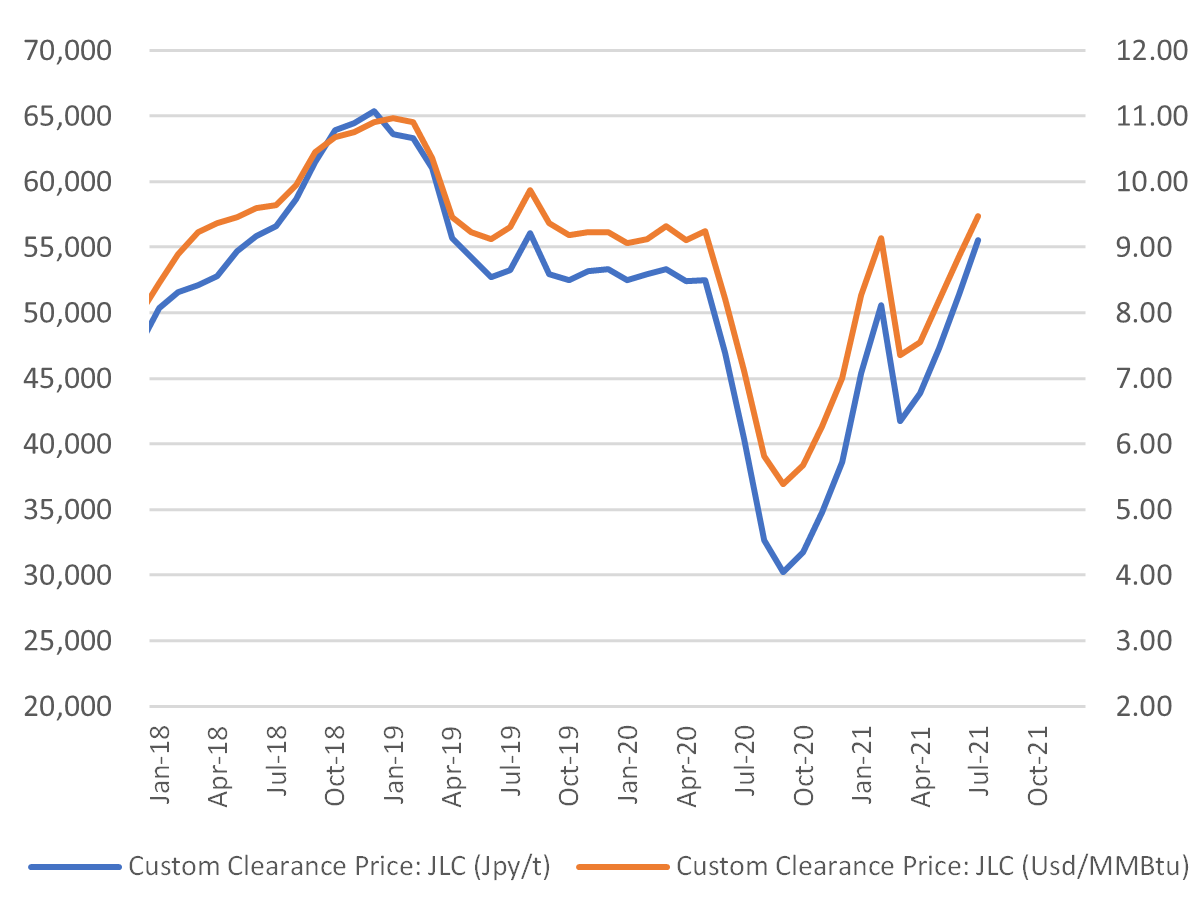
Japan (JLC) LNG Price: $9.47/ mmbtu
Kansai Electric mulls LNG cargo swaps, procurement with Korea’s POSCO
(Denki Shimbun, Nov. 8)
- Kansai Electric will consider working with POSCO Energy, a major steel group in South Korea, in areas such as in LNG swaps.
- Specific details will be discussed later. The two companies will consider joint participation in LNG procurement, power generation and LNG terminal projects.
TAKEAWAY: This deal is surprising given the combative nature of heavy industry and utilities between Japan and South Korea, and also because of different geographies of operation. It shows, however, there’s a need for a balancing system between the major LNG users that would allow cargos to be swapped in times of emergency. For Kansai Electric, this gives security in negotiating long-term contracts with supplies that another major gas consumer can add buying power and offtake volumes.
JAPEX sells part of its INPEX stake to raise capital for CCS and renewables
(Denki Shimbun, Nov. 9)
- Japan Petroleum Exploration Co. (JAPEX) sold a portion of its INPEX Corp. as part of the share buyback carried out by the latter.
- JAPEX intends to use the ¥39.8 billion gain from the sale to invest in future growth, such as development of renewable energy sources and CCS business.
- CONTEXT: The two firms are Japan’s biggest state-backed oil and gas exploration companies.
Activist fund Oasis blocks ENEOS’s deal for construction subsidiary abetted by Goldman
(Financial Times, Nov. 9)
- Hong Kong-based hedge fund Oasis says the decision by ENEOS to buy out and de-list its subsidiary, Nippo Corporation, hurts minority shareholders, and it has started a campaign to engage other stock owners.
- Goldman Sachs is facilitating this deal.
- CONTEXT: A few months ago, Goldman Sachs was the seller to ENEOS of Japan Renewable Energy Corp., a renewable energy developer. Media reports said ENEOS’ bid for JRE was tied to Goldman’s promise to help with the Nippo Corp buyout.
Japan’s average pump price up for 10ths straight week
(Japan Times, Nov. 11)
- The average retail price of regular gasoline rose for 10 weeks straight.
- As of Nov. 8, the price stood at ¥169 per liter, up by ¥0.3 from a week earlier.
- An official at the Oil Information Center, which conducted the price survey, said gasoline prices continued to rise because “service stations have yet to fully pass the past increase in purchase costs on to consumers”.
- However, the official added that the price spike is expected to end following wholesale price cuts by around ¥0.5 this week.
Kerosene 30-40% higher than previous years in cold regions
(Nikkei, Nov. 8)
- Kerosene prices are 30-40% higher in Hokkaido and Tohoku region compared to last year. Hokkaido reached its highest crude prices for the first time in 13 years.
- The kerosene price in Sapporo in early Nov. (COOP Sapporo) was ¥107 per liter. This is ¥30 higher (40% increase) compared to the same month last year.
- Behind this is the increase in crude prices. With economic recovery, demand grows faster than supply, forcing higher prices for oil and petroleum products.
- While households in Hokkaido struggles, the demand for kerosene has been declining due to the spread of all-electric homes and high-insulated housings.
BHP to sell out of Mitsui coking coal venture in Australia
(NIkkan Sangyo Shimbun, Nov. 9)
- Mining giant BHP will sell an 80% stake in BHP Mitsui Coal (BMC), its Australian coking coal joint venture with Mitsui & Co., to Australian firm Stanmore Resources for up to $1.35 billion (¥153.1 billion).
- The transaction will be completed in mid-2022, subject to state approval, and BHP will narrow down its coking coal business to BMA, a JV with Mitsubishi Corp.
- BMC operates the South Water Creek and Poythrel coal mines in Australia, which produced 8.74m tons in the fiscal year to June. Mitsui holds a 20% interest in BMC.
ANALYSIS
BY SAKI ISETANI
Japan Joins Race to Develop Green Tech
That Sucks CO2 Out of the atmosphere
With more and more countries saying that decreasing greenhouse gas emissions isn’t enough to combat climate change, the idea of Direct Air Capture (DAC) has gained traction as a solution to cut atmospheric levels of CO2.
Japan initially ignored DAC as a theoretical technology that seemed less promising than Carbon Capture and Storage (CCS). This year, however, that stance changed. Not wishing to be left behind in global green innovation, the Cabinet Office launched an ambitious R&D initiative that includes efforts to create technology that pulls more CO2 out of the atmosphere than it emits.
For now, Japan is simply catching up. There are 15 DAC pilot plants already operating in the world, mostly led by startups in Switzerland (Climeworks), Canada (Carbon Engineering), U.S. (Global Thermostat), and the UK (Center for Negative Carbon Emissions), according to the IEA. Together they suck more than 9,000 Mt of CO2 from the atmosphere each year. Climeworks switched on the world’s biggest DAC plant just two months ago.
Still, Japan believes it can catch up and become a world leader by developing its own approach. The country’s DAC research is led by several groups of major scientific institutions and universities that are looking at ways to capture CO2 from discarded energy or via membrane separation, among other ideas. Armed with ample government funding, Japan could yet become a serious contender in the DAC arena.
Carbon Capture isn’t enough
Until recently, Japan’s CO2 reduction strategy focused on collecting the emissions at source, such as by installing a carbon capture system at a thermal power plant. Among the standout projects was the group effort led by Toshiba, which in October 2020 installed the world’s first carbon capture system at a biomass plant.
The Mikawa power station in Fukuoka Prefecture runs a system known as BECCS (Bio Energy Carbon Capture and Storage), which collects over 50% of total emissions, or about 500 tons of CO2 daily.
More installations like that could make a significant contribution, but they’re unlikely to gather all the CO2 being released. This led the government to seriously consider developing DAC as a technology that could not only suck up the CO2 that CCS systems cannot but also allow Japan eventually to aim for a negative carbon footprint.
Mastering DAC will not be easy. Part of the challenge in directly removing CO2 from the atmosphere is its low level of concentration. While average CO2 concentration from factory emissions reaches about 10% to 15%, in a regular setting CO2 only accounts for 0.04% of the atmosphere. This makes DAC more challenging than CCS.
How DAC could work is still under development but there are several potential approaches being considered. The main DAC research directions the Japanese government wants to explore are:
- Separation of CO2 through chemical absorption
- Membrane separation, which involves separation of CO2 through ion exchange membranes
- Deep cooling, whereby CO2 is made into dry ice
DAC research finally launches
All major technological leaps require major resources as well as policy. That’s why this year the Cabinet Office officially launched a ¥115-billion “Moonshot Research & Development Program” as a way to support work to create technologies that could be provisionally functional by 2030 and fully commercialized by 2050.
There are seven research projects within the ‘Moonshot’ program that relate to DAC:
| Research Project | Project Manager | |
| 1 | Bio Process that uses electric energy to fix atmospheric CO2 | AIST |
| 2 | High-efficiency CO2 separation and carbon cycle technology | Kanazawa University |
| 3 | CO2 resource recovery system centered on electrochemical processes | Tokyo University |
| 4 | Calcium Carbonate Circulation System for Construction | Tokyo University and NEDO |
| 5 | CO2 capture using cold energy | Nagoya University |
| 6 | Integrated fixed reaction system (qua-C system) that can use standby CO2 | Tohoku University |
| 7 | CO2 circulation system | Kyushu University |
Source: RITE
The approaches are all quite different and there is a lack of detailed information on many of them.
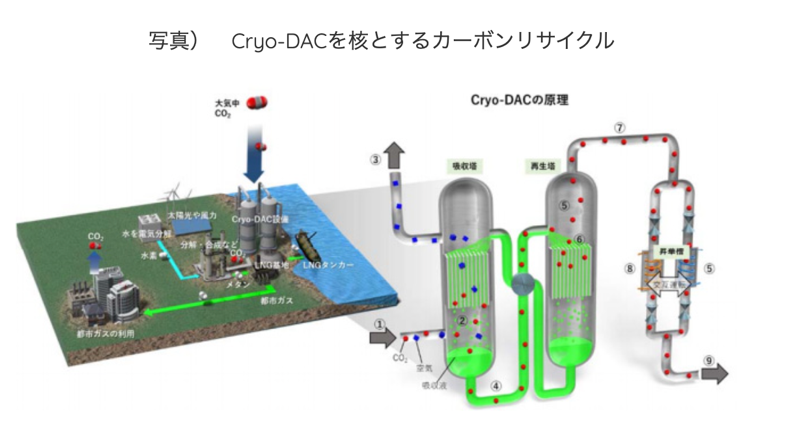
One interesting project, however, is being pursued by Nagoya University and Toho Gas, a gas utility based in Nagoya. The two seek to develop technology that utilizes cold energy created when natural gas is cooled to -160°C to make LNG. This cold energy is discarded when the liquid fuel is converted back into gas, but researchers at Nagoya want to put it to good use.
The idea is to absorb CO2 via a chemical solution and then use cold energy to turn the gas into dry ice. The approach is called Cryo-DAC, referring to cryogenics. So far, it has only been tested successfully in a lab, but the researchers aim to scale it up to a demonstration plant within the next 10 years.
Source: Nagoya University
Capturing CO2 with membranes
Another approach is being taken by researchers at Kyushu University’s International Institute for Carbon-Neutral Energy Research (I2CNER), who are working with NanoMembrane Technologies, a venture that specializes in the commercialization of nano-membrane technology.
Their idea is to develop a system that captures CO2 with the aid of membranes and subsequently converts the captured gas into useful chemicals. The membrane that the researchers are working with is about 34 nanometers thin, which is about 1/300th of the thickness of a food wrap.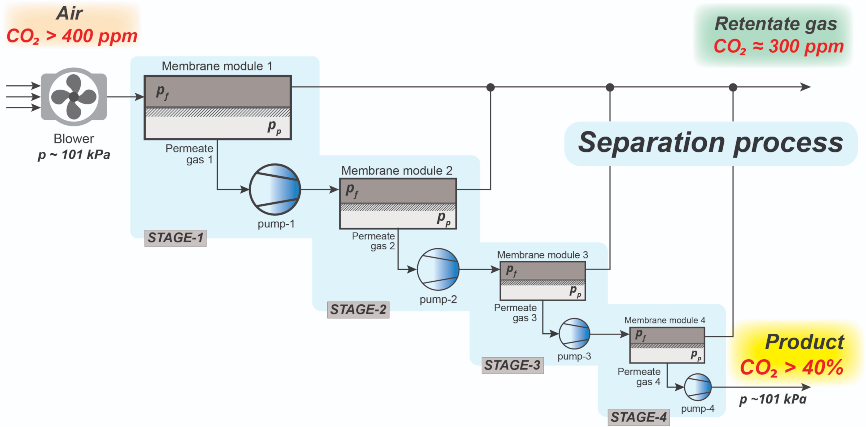
Source: Kyushu University
Membranes can capture CO2 using tiny air holes that allow the gas to enter. However, applying membrane separation in DAC has long been a challenge due to the air’s aforementioned low CO2 concentration.
The four-stage membrane separation technology created by Kyushu University and NanoMembrane Technologies can increase CO2 concentration from up to the 40% level, which is sufficient for subsequent conversions.
Fujikawa Shigenori, an associate professor at Kyushu University’s I2CNER and the current project manager, explains the significance of this membrane-based DAC system (m-DAC) as technology that enables CO2 capture to take place any time and any place. In theory, it could be installed in homes, schools, shops and regular housing, in a manner similar to a photovoltaic system.
What about the cost?
Of course, the main challenge for commercializing DAC is cost. Most DAC techniques use amine, a chemical mixture that acts as a solvent to capture atmospheric CO2. Amine absorbs the gas before being heated to allow for the separation and removal of CO2. The amine process required very large facilities, which leads to high operational costs.
According to the Center for Low Carbon Society Strategy (LCS), a national research think-tank of the Japan Science and Technology Agency (JST), as of 2020 the domestic cost for DAC stands at around ¥35.4/ kg-CO2. The largest cost item is the equipment, which accounts for 58% of total.
On a global level, Japan’s DAC costs appear to be somewhere in the middle. Projects around the world run at a cost level of about $250 to $600 per ton of CO2 depending on the scale of the DAC plant.
A second challenge is the high energy volumes required to power DAC systems, which also need substantial amounts of heat to separate the CO2 from the capture medium. In this regard, Japan has a relative advance. While existing DAC pilot plants overseas require a lot of energy, Japan’s technology captures and separates CO2 at low temperatures, which also allows for the installation of smaller-scale DAC plants, an appropriate option for a country with a high percentage of land covered by mountains or forest.
But perhaps Japan’s biggest challenge in the DAC space will be storage. Whether it is CCS or DAC, the captured CO2 needs a large geological repository and identifying one on Japanese territory has proved difficult. Any such site needs to have low risk of CO2 leakage and serve for the very long term.
That’s why Yamaji Kenji, the director of the national Moonshot program, stresses that the DAC project must aim not only to remove the CO2 but find a use for it in new materials and fuels. Whether in the form of dry-ice or as chemicals for industrial processes, the CO2 should have a practical value after it’s separated from the atmosphere.
Japan was one of the first countries to outline a vision for a hydrogen economy. To succeed with DAC technology, the country will need to come up with another bold and innovative vision for an economy based on CO2.
Beyond Moonshot
Separate from the Moonshot program, Japanese engineering giant IHI Corp. has recently developed a small-scale DAC plant that captures CO2 from the air at its lab in the Soma IHI Green Energy Center.
IHI captures CO2 by first using an amine solution to solidify and dry the CO2 particle. Then, the amine is used to act as a membrane to cover and absorb the CO2. Once absorbed from the air, the CO2 is heated to separate the particles.
The captured CO2 from the DAC plant will be used to generate a 400 m2 hydroponic facility where the CO2 is supplied to plants through a pipe. IHI plans to further develop this technology to build a DAC plant that’s smaller but with improved performance, and by the end of 2022 wants to have a fully operational factory with negative CO2 emissions.
ANALYSIS
BY TAKEHIRO MASUTOMO
JOGMEC Profile:
Japan’s State Oilmen Stick to Old Principles in a New Role
While most clean energy focus falls on what’s above ground, in fact, what’s happening below the surface will in large part determine the success of the Clean Energy Revolution.
Building electric vehicles, solar plants, wind turbines, and many other components of the energy transition will require access to vast quantities of minerals, some of which are hard to find, and nearly all of which Japan needs to secure outside its borders.
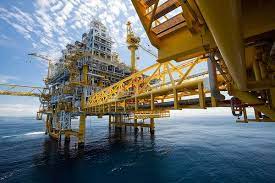
The role of securing that supply has fallen to a state-backed corporation traditionally tasked with procuring Japan’s oil and gas. Now, JOGMEC will need to use its prowess in prospecting deep below the Earth’s surface to deliver the minerals required to power Japan’s decarbonization.
However, an entity that’s forged its reputation in fossil fuels also has its own views on the new energy landscape, and not all of JOGMEC’s experts believe that a radical energy shift is the best way to go.
INFO BOX
JOGMEC is actively engaged in energy and metals projects in Canada, South America, and Africa, in addition to development of Russian and Yamal projects. It also supported the Ichthys LNG project in Australia and the LNG Canada project in British Columbia, Canada.
JOGMEC’s current balance sheet is over $12 billion, and equity investments in energy and metals projects currently exceed $6 billion. It also provides equity and liability guarantee support to almost 60 companies. JOGMEC’s annual operating budget exceeds $1.6 billion.
Changing role for the oilmen
Two major state entities direct Japan’s energy development. One is The New Energy and Industrial Technology Development Organization, or NEDO. As its title suggests, NEDO tends to focus on developments in “new” energy fields, such as renewables and green hydrogen.
The other entity is the Japan Oil, Gas and Metals National Corporation (JOGMEC), and true to its name the administrative agency-cum-corporation grew out of a need for Japan, once the world’s Top 3 oil buyer, to secure vast quantities of hydrocarbons. In 2004, JOGMEC’s predecessor, the Japan National Oil Corporation, merged with the Japan Metal Industry Development Corporation, forming JOGMEC and officially broadening its scope from oil to mining.
As a sign of the times, JOGMEC’s budget for FY2020 was ¥19.5 billion, roughly one-eighth that of NEDO. But while the latter agency is leading the charge to develop Japan’s technologies of the future, it will be up to JOGMEC to deliver the materials with which to forge them.
The new role for JOGMEC was made official when METI unveiled the New International Resources Strategy in March 2020. As well as its work in oil and gas, including in LNG, JOGMEC was tasked with securing rare metals and other critical minerals, the supply of which is currently dominated by China.
In 2010, China restricted exports of rare earth metals to Japan following the eruption of a territorial dispute over islands in the East China Sea.
The law under which JOGMEC operates was revised and approved in June 2020. It added new mandates, including the procurement of fuel for Japan’s power generators in times of emergency, investment or other financial support for overseas mining and metals smelting, and also natural gas storage.
National stockpiles of key materials
As part of its new role, JOGMEC will also take charge of stockpiling critical raw materials (CRMs). Japan lists 34 types of metals and minerals, including rare earth metals lithium and cobalt, as CRMs because they are indispensable for manufacturing magnets for EV motors and electronic components for semiconductors. Japan imports nearly all of the volumes it requires and JOGMEC is tasked with creating an inventory sufficient enough for at least 60 to 180 days of domestic consumption, depending on the metal. The exact target numbers are secret.
Partly prompted by the 2010 trade issues with China, JOGMEC has teamed up with Japanese trading house Sojitz to provide a $250 million loan to Australia’s Lynas Corp, the biggest rare earth producer and processor outside of China. Further investments followed. In 2016, the two Japanese entities partially cut debt obligations to Lynas and then in 2020 JOGMEC further injected capital of $425 million into the Australian firm to help it compete with Chinese rivals.
The urgency around CRMs is rising. Earlier this year, a person familiar with the matter told Bloomberg that China may ban the export of rare-earths refining technology to countries or companies that it deems a threat. Asia’s most populous nation could also ban or restrict shipments of rare earths in case of a trade war, among other reasons, the person said.
In response, Japan is trying to accelerate the potential development of both deep-sea mining and seabed mining. In the summer of 2020, JOGMEC conducted the world’s first successful excavation of cobalt from the ocean floor, collecting 649 kilograms of mineral-rich seabed crust. Part of the seabed in Japan’s exclusive economic zone (EEZ) is rich in cobalt and nickel, two essential components for EV batteries and other green tech.
Japanese estimates show the EEZ seabed contains enough cobalt to meet Japan’s demand for 88 years and enough nickel for 12 years.
Digging deep for green energy
JOGMEC’s expanded role doesn’t stop with securing CRMs, and in April, it unveiled the Action Plan on Carbon Neutrality, in which, alongside measures to support upstream oil and gas development and LNG, the agency outlined plans to promote geothermal energy.
Starting last fiscal year, JOGMEC began surveys of potential sites for new geothermal stations in Japan, with five areas outside national parks under consideration. In total, the state corporation plans to survey about 30 new sites, including in the national parks located in Hokkaido, Niigata, Nagano, Kumamoto, and Oita.
Japan’s new energy strategy sees geothermal power’s role in the energy mix at least doubling to about 1% of the total by FY2030.
Outside of its foray into renewables, JOGMEC is also part of the Japanese government’s push to create a hydrogen society. The agency was not previously tasked with working on ammonia and hydrogen projects, which were considered to be NEDO’s territory. However, the latest Basic Energy Plan, approved by the Cabinet this October, states that “JOGMEC will contribute to carbon neutrality through the introduction and expansion of decarbonized fuels and technologies such as hydrogen, ammonia, and Carbon Capture and Storage (CCS), in addition to the stable and low-cost supply of oil, natural gas, and metal mineral resources”.
The Plan specifies that “JOGMEC will review its role and consider strengthening its functions, such as the supply of risk money and technological demonstrations, to contribute to carbon neutrality”.
An additional amendment to the law under which JOGMEC governs is being considered to officially bring hydrogen and ammonia projects within its remit. JOGMEC is already studying potential investments in ammonia production in four countries, including Russia and Indonesia.
Opposition to a complete energy shift
Despite JOGMEC’s new role in the energy transition, the agency’s 625 staff don’t necessarily agree that the industry must change entirely. At heart, JOGMEC remains an entity with strong roots in the hydrocarbon community.
A top official in charge of fossil fuel procurement at JOGMEC says today’s criticism of fossil fuels is over-done. “I think there needs to be some kind of alternative force to the critical trends sweeping from Europe,” he said, noting that more voices from Asian countries should be heard in the global energy debate. “For example, we can still use coal but [make sure it is done] in the cleanest way possible; or, we can use natural gas but focus on projects that emit as little CO2 as possible at the production stage.”
“I think the time has come for us to communicate a kind of code of conduct for Asia that includes carbon recycling, considerations around economic growth and around stable energy supply,” the JOGMEC official added.
To be clear, JOGMEC continues to be a major investor in oil and gas projects and recently played a role in bringing more clarity to LNG supply contracts for Japanese companies. For example, JOGMEC is involved in the $20 billion Mozambique LNG project, which is on pause at the moment due to local unrest.
The agency provided about 75% of the ¥300-400 billion invested by Japanese companies in the Arctic LNG 2 project led by Russian natural gas firm Novatek in the Yamal Peninsula. That project is expected to produce 19.8 million tons of LNG per year starting in 2023.
Also, JOGMEC is applying its sea-mining knowledge to promote development of
methane hydrate deposits in Japanese waters. The crystal-like solid could become a major source of gas since it’s found in large quantities in the eastern Nankai Trough area and in the Japan Sea. Known as “flammable ice”, methane hydrate is a frozen mix of water and natural gas formed under high pressure and low temperatures in permafrost or on the seafloor.
In the Basic Plan for Ocean Policy approved by the Cabinet in 2018, commercialization of methane hydrate is seen by 2027, although the government has recently mulled bringing forward this target. JOGMEC is working in this sphere together with private oil and gas companies and engineering firms.
For many at JOGMEC, the future of energy doesn’t need to be entirely “new” and even the development of alternative sources such as hydrogen makes better sense as an extension of the current energy infrastructure.
Speaking to the media last year, JOGMEC President Hosono said: “There are still many technical and economic issues to be resolved before we can secure stable and safe hydrogen supply. Until we find an innovative way to supply hydrogen through technological innovation, the most efficient and shortest route is to extract hydrogen from fossil fuels, such as oil and gas.”
JOGMEC’s Overseas Asset Base
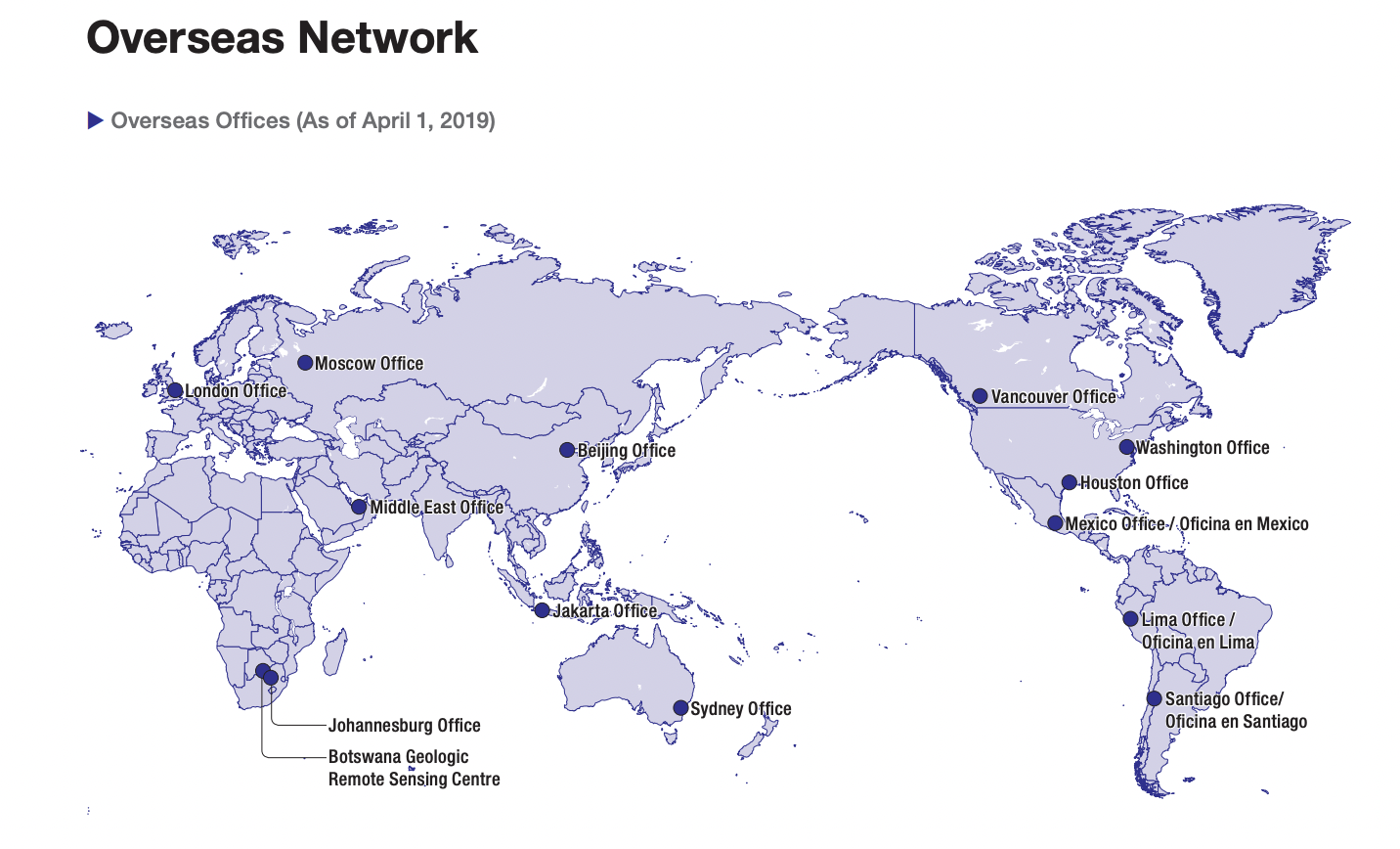
Source: JOGMEC Corp.
GLOBAL VIEW
BY JOHN VAROLI
Below are some of last week’s most important international energy developments monitored by the Japan NRG team because of their potential to impact energy supply and demand, as well as prices. We see the following as relevant to Japanese and international energy investors.
Bitcoin/ Nuclear power
Nuclear energy has “tremendous opportunity” for the energy-intensive Bitcoin mining industry, said a panel of top crypto-currency executives during the “Bitcoin & Beyond Virtual Summit”. Previous discussions about Bitcoin and renewable energy have focused on solar and wind power, not nuclear. “What we’d love to see is an expansion of nuclear power,” said Harry Sudock, vice president of Griid, a U.S. company that procures renewable energy for Bitcoin mining.
Brazil/ Wind and Solar power
Equatorial Energia will pay €1 billion to buy wind developer Echoenergia, which has built and operates wind farms in Brazil, with a total of 1 GW of installed capacity. Echoenergia has another 200 MW under construction and a portfolio of planned projects with capacity of 1.1 GW, consisting of 90% solar and 10% wind. In related news, Essentia Energia began operations of its 475 MW solar power plant in Brazil’s state of Bahia.
Caribbean & Africa/ Renewables
London-based PASH Global Management will invest £1 billion in renewable energy generation in the Caribbean Region, Africa and Latin America over the next five years. PASH CEO Kofi Owusu Bempah says the company is building solar projects in Puerto Rico, and it has a 50% stake in a 50 MW solar farm in Mali, the largest project of its kind in West Africa. Among PASH’s leading partners is the Swiss commodity trading company Trafigura.
China/ Carbon emissions
The National Development and Reform Commission, China’s main economic planner, will promote low-carbon energy in heavy industry, agriculture, construction and transportation. The main focus will be on 100 enterprises including steel, petrochemicals, nonferrous metals and building materials; these generate the most carbon emissions and pollution. Steel production in China last year emitted 15 percent of the country’s total carbon emissions.
Truck EVs/ IPO
EV truck maker Rivian ended its first day of trading with an $86 billion valuation, putting the company among the top names in the auto industry. Backed by Amazon and Ford Motor Co, Rivian is a decade old, but it only delivered a product this year — 156 pickup trucks. Coupled with TESLA’s trillion-dollar valuation, it’s clear that EVs are a hot topic for investor, who believe in the market potential and are willing to pay a premium for those deemed to have good leadership.
France/ Onshore Wind
German energy company RWE will expand its renewables portfolio in France, investing in the 44 MW Les Nouvions onshore wind farm. Construction begins next year and full operation begins in 2023. With 11 turbines, the wind farm will generate enough electricity to meet the needs of about 23,000 households. In 2020, RWE acquired an onshore wind and solar development pipeline in France of ~1.9 GW.
India/ Renewable energy
Indian billionaire Gautam Adani said he’ll invest $70 billion over the next decade to build the world’s largest renewable energy company. Adani Green Energy, the world’s largest solar developer, plans 45 GW of capacity by 2030. Adani Transmission, India’s largest private sector power transmission and retail firm, wants to increase its share of renewable power procurement from 3% to 30% by FY2023 and to 70% by FY2030.
Netherlands/ Offshore Wind
As part of efforts to meet the EU’s goal of a 55% reduction in CO2 emissions by 2030 over 1990 levels, the Netherlands said it’ll add another 10.7 GW of offshore wind capacity this decade. The Dutch Ministry of Infrastructure and Water Management published its North Sea Programme 2022 – 2027, which increases the country’s offshore wind target from the current 11.5 GW to 22.2 GW of offshore wind capacity.
United Kingdom/ SMR reactors
Rolls-Royce Group, BNF Resources UK Limited and Exelon Generation Limited will invest £195 million over three years to develop a 470 MW small modular reactor (SMR), which should connect to the British grid in the early 2030s. This investment will be matched with £210 million in UK Research and Innovation funding. A single Rolls-Royce SMR power station will occupy the space of two football pitches and power approximately 1 million homes.
USA/ Renewable energy
Entergy Mississippi will replace natural gas plants with 1 GW of renewable energy by 2027. In the next five years, the company’s power mix from renewables will increase from less than 1% to nearly one-third of total. Natural gas currently makes up most of the generation portfolio. In related news, Entergy Louisiana said it will purchase 475 MW of solar from four facilities across the state.
USA/ Oil prices
President Joe Biden faces growing pressure from fellow Democrats to address rising gasoline prices. About a dozen Democratic senators urged Biden to help families and small businesses, possibly banning exports for refined oil products to help force down prices. However, a release of oil from the Strategic Petroleum Reserve is considered the most likely measure. U.S. oil exports often surpass 3 million barrels a day, more than leading OPEC members.
USA/ Energy transition
General Electric will split into three publicly traded companies focusing on energy, healthcare and aviation. The energy unit will combine existing wind and gas-fired power turbines and services. The spinoff will be complete in 2024. “Customers need GE at its best and at its most focused to help them navigate the energy transition,” said GE CEO Larry Culp.
USA/Energy fraud
Jeff Carpool, owner of DC Solar, was sentenced to 30 years in prison for defrauding investors of about $1 billion. Between 2011 and 2018, DC Solar made mobile solar generators (MSGs). Federal tax credits were an incentive. Carpoff lied about market demand, and made false financial statements and fake lease contracts. DC Solar sold 8,500 MSGs that were never made. Among victims were Warren Buffet’s Berkshire Hathaway and insurance giant Progressive.
Vietnam/ Offshore Wind
The world’s largest offshore wind energy producer, Denmark’s Ørsted, will invest as much as $13.6 billion to build 3.9 GW of offshore wind turbines in the Gulf of Tonkin off the coast of Vietnam. The complex is planned to have annual electricity generation of about 13.7 million MWh.
GLOBAL VIEW: COP26
COP26 Ran Out of Fuel in Week 2,
But Some Measures Will Have Lasting Impact
After a fairly substantive first week, the second half of the COP26 climate summit in Glasgow ended up falling short of concrete achievements. The U.S. and China unexpectedly announced a pact to work together to tackle climate issues, but the declaration held few details. While this eventually may become a platform that’ll have larger ramifications later on, for now it’s hard to credit it with much.
One of the only major developments of the second week occurred this past weekend. Close to 200 countries agreed to a new deal on climate action that aims to wean the world off burning coal for power generation. Originally, the deal’s wording discussed a “phase out” of coal power, the single biggest source of GHGs. Lobbying from several major coal countries, however, saw that phrase altered to “phase down”.
The Japanese government is expected to welcome the looser language around the use of coal that came from the Glasgow summit late on Saturday. India, South Africa and China insisted on ‘phase-down’ rather than ‘phase-out’, and this was reflected in the final Glasgow Climate Pact. The International Energy Agency still believes that 40% of the world’s coal plants should close by 2030.
COP26’s closing statement also called for a 45% reduction in CO2 emissions by 2030, and more robust, transparent and accountable international carbon markets. That said, participating countries, including Japan, agreed to submit larger emissions cutting pledges for 2030 when COP27 meets in Sharm el-Sheik, Egypt in 2022.
COP26 also called for implementation of a global CO2 stocktake.
The agreement on coal was not the only fossil fuel measure reached at the summit. The Glasgow Climate Pact called for accelerating the ‘phasing-down’ of “inefficient” fossil fuel state subsidies. Coal, oil, and gas are estimated to currently receive $5.9 trillion of annual subsidies globally.
For Japan specifically, the impact from cutting state subsidies to hydrocarbon fuels should be small, although it remains to be seen how the operations of JOGMEC Corp, the state-backed agency in charge of oil and gas exploration and investment, will be affected, as well as other other major players in that sector.
Of more importance to Japan will be the strengthening of adaptation finance mechanisms to compensate the most vulnerable nations for ‘losses and damages’ caused by a changing climate, an area the Japanese government is expected to be actively involved in. A specific Glasgow Dialogue was established to accelerate finance-related action plans. The U.S. and the EU specifically refused to participate in ‘losses and damages’ finance mechanisms.
New rules for carbon markets
Opinion on the value of this will differ, but among major items at the summit’s conclusion was a deal to set out the rules for carbon credit markets. The final deal allows nations to buy carbon credits that represent emission cuts achieved in other countries to partially offset their own totals.
To avoid double-counting, Japan proposed that the country generating the credit should have the right to decide whether the credit counts towards its own CO2 total or if it’s sold. If sold, the originator country cannot claim to have made the emissions cut. This proposal was accepted.
This is a major “win” from a Japanese government standpoint, which sees credits based on overseas projects helping to cover as much as a quarter of Japan’s CO2 reduction by 2030. Japan already runs the Joint Crediting Mechanism (JCM), which is a bilateral system that allows counting credits based on GHG cuts that Japanese firms have made abroad.
Other nations such as Australia and Brazil will also be big beneficiaries of carbon offsets.
As part of a separate system, 5% of the proceeds from trading carbon offsets will be go to an adaptation fund for developing countries.
EVENTS CALENDAR
A selection of domestic and international events we believe will have an impact on Japanese energy.
| February | Approval of Fiscal 2021 Budget by Japanese parliament including energy funding projects;
CMC LNG Conference |
| March | 10th Anniversary of Fukushima Nuclear Accident;
Smart Energy Week – Tokyo; Quarterly OPEC Meeting; Japan LPG Annual Conference; Full completion of all aspects of the multi-year deregulation of Japan’s electricity market; End of 2020/21 Fiscal Year in Japan; |
| April | Japan Atomic Industrial Forum – Annual Nuclear Power Conference;
38th ASEAN Annual Conference-Brunei; Japan LNG & Gas Virtual Summit (DMG)-Tokyo Three crucial by-elections in Hokkaido, Nagano & Hiroshima – April 25th |
| May | Bids close in first tender for commercial offshore wind projects in Japan;
Prime Minister Suga to visit the U.S. |
| June | Release of New Japan National Basic Energy Plan-2021;
G7 Meeting – U.K. Presidents Biden and Putin are due to meet at a summit in Geneva Forum for China-Africa Cooperation Summit (Senegal) |
| July | Tokyo Metropolitan Govt. Assembly Elections;
Commencement of 2020 Tokyo Olympics |
| August | METI committee approves draft of Japan’s 6th Basic Energy Plan |
| September | Ruling LDP Presidential Election;
UN General Assembly Annual Meeting that is expected to address energy/climate challenges; IMF/World Bank Annual Meetings (multilateral and central banks expected to take further action on emissions disclosures and lending to fossil fuel projects); End of H1 FY2021 Fiscal Year in Japan; Japan-Russia: Eastern Economic Forum (Vladivostok)-tentative |
| October | Potentially, Japan’s 2021 General Election; Hydrogen Ministerial Conference in conjunction with IEA METI Sponsored LNG Producer/Consumer Conference; Innovation for Cool Earth Forum – Tokyo Conference; Task Force on Climate-Related Financial Disclosure (TCFD) – Tokyo Conference; G20 Meeting-Italy |
| November | COP26 (Glasgow);
Asian Development Bank (‘ADB’) Annual Conference; Japan-Canada Energy Forum; East Asia Summit (EAS) – Brunei |
| December | Asia Pacific Economic Cooperation (APEC) Forum – New Zealand;
Final details expected from METI on proposed unbundling of natural gas pipeline network scheduled for 2022. |
Disclaimer
This communication has been prepared for information purposes only, is confidential and may be legally privileged. This is a subscription-only service and is directed at those who have expressly asked K.K. Yuri Group or one of its representatives to be added to the mailing list. This document may not be onwardly circulated or reproduced without prior written consent from Yuri Group, which retains all copyright to the content of this report.
Yuri Group is not registered as an investment advisor in any jurisdiction. Our research and all the content express our opinions, which are generally based on available public information, field studies and own analysis. Content is limited to general comment upon general political, economic and market issues, asset classes and types of investments. The report and all of its content does not constitute a recommendation or solicitation to buy, sell, subscribe for or underwrite any product or physical commodity, or a financial instrument.
The information contained in this report is obtained from sources believed to be reliable and in good faith. No representation or warranty is made that it is accurate or complete. Opinions and views expressed are subject to change without notice, as are prices and availability, which are indicative only. There is no obligation to notify recipients of any changes to this data or to do so in the future. No responsibility is accepted for the use of or reliance on the information provided. In no circumstances will Yuri Group be liable for any indirect or direct loss, or consequential loss or damages arising from the use of, any inability to use, or any inaccuracy in the information.
K.K. Yuri Group: Oonoya Building 8F, Yotsuya 1-18, Shinjuku-ku, Tokyo, Japan, 160-0004.