
JAPAN NRG WEEKLY
MARCH 7, 2022
JAPAN NRG WEEKLY
March 7, 2022
NEWS
TOP
- PM Kishida says Japanese firms will decide on Russia oil & gas future but confirms energy security is the vital consideration
- Cabinet approves key energy act amendments to reach net-zero goals as government turns proactive in pushing for change
- Japan to make world’s second-largest release from oil stockpiles after the U.S. as part of action coordinated by the IEA
ENERGY TRANSITION & POLICY
- Govt. advisors stress importance of nuclear power for security
- METI calculates 2050 coal-ammonia co-firing capacity potential
- Used rail land to be considered as location for new solar projects
- IHI Corp to develop electric propulsion system for ships
- Sony and Honda jointly to develop EVs, aiming for release in 2025
- Mitsubishi Chemical to make carbon-negative alternative to wood
- Events in Japan now able to buy green electricity certificates
- NTT Data tells about 150 suppliers they must cut GHG emissions
ELECTRICITY MARKETS
- Solar cell maker raises prices by 20% on rising raw material costs
- New law says generators to notify govt. before closing down units
- Kansai Electric shuts one of its nuclear reactors for maintenance
- Japanese industry scrambles to get into Akita offshore wind space
- Eurus Energy submits plans for a 600 MW offshore wind project
- Okinawa firm seeks to build 164 MW solar project in Fukushima
- Sumitomo, Shikoku EPCo, Singapore firm to develop Japan solar
- Kansai Electric joins 1.9 GW offshore wind project in Europe
OIL, GAS & MINING
- PM Kishida pours cold water on gasoline tax relief idea and asks everyone to use less oil
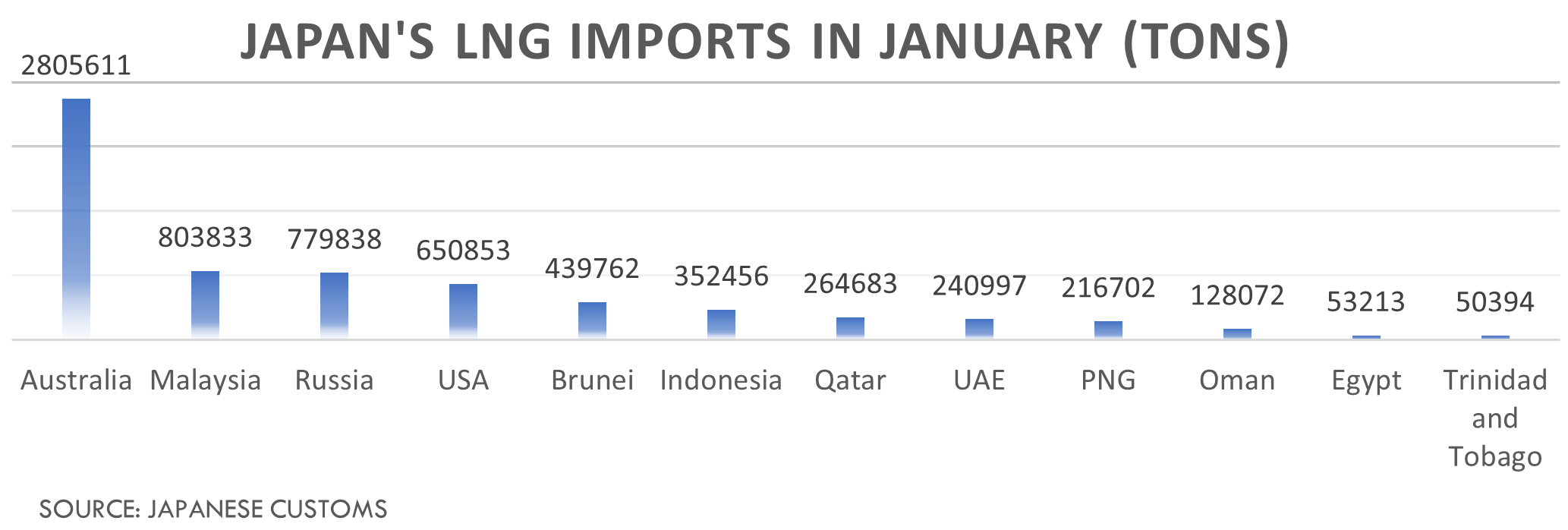
- Russian LNG accounted for 11.5% of Japan’s January imports
- Japanese utilities hunt for alternative LNG sources to Russia
- Toshiba group to develop EV motor that uses less rare earths
ANALYSIS
GAS MARKETS IN TURMOIL MEANS
SECOND THOUGHTS OVER “CARBON-NEUTRAL” LNG
As the war in Ukraine further pounds natural gas markets already facing upheaval and soaring prices, major industry players now have to grapple with a wide array of issues in order to bring order and calm to the sector. One of those issues in Japan is the future of “carbon-neutral” LNG, a product that offers both the molecules and credits that claim to offset the emissions from the fuel. After taking off a year ago with sales to Tokyo Gas, the niche sector has quickly expanded to involve over 40 gas utilities in Japan. That momentum is now slowing and the war is only one reason.
JAPAN ACCELERATES GEOTHERMAL CAPACITY AT HOME AND ABROAD, BUT PROJECT SIZE FRUSTRATES
The government has recently drawn a clearer blueprint for geothermal, the country’s promising yet largely untapped renewable energy source. The end goal is to drive private companies to expand business at home and abroad. With the right policies and state support, Japan has the potential to become a global leader in geothermal. Since the Fukushima disaster, the number of geothermal facilities has quadrupled to over 90, but many sites are mini-sized. The ambition is to triple the capacity over this decade, but even if Japan reached that target, that is only the beginning for the sector.
GLOBAL VIEW
Top western energy companies announce exit from Russia projects and investments. Saudi Arabia to develop world’s largest off-grid battery storage site. India accelerated solar rollout last year. AIG to stop insuring firms with significant coal or oil sands revenue. Details on these and more in our global wrap.
EVENT CALENDAR FOR 2022
Key political and business events in Japan and abroad.
JAPAN NRG WEEKLY
PUBLISHER
K. K. Yuri Group
Events
Editorial Team
Yuriy Humber (Editor-in-Chief)
John Varoli (Senior Editor, Americas)
Mayumi Watanabe (Japan)
Wilfried Goossens (Japan, Events)
Regular Contributors
Chisaki Watanabe (Japan)
Daniel Shulman (Japan)
Takehiro Masutomo (Japan)
Art & Design
22 Graphics Inc.
SUBSCRIPTIONS & ADVERTISING
Japan NRG offers individual, corporate and academic subscription plans. Basic details are our website or write to subscriptions@japan-nrg.com
For marketing, advertising, or collaboration opportunities, contact sales@japan-nrg.com
For all other inquiries, write to info@japan-nrg.com
OFTEN USED ACRONYMS
METI The Ministry of Energy, Trade and Industry
MOE Ministry of Environment
ANRE Agency for Natural Resources and Energy
NEDO New Energy and Industrial Technology Development Organization
TEPCO Tokyo Electric Power Company
KEPCO Kansai Electric Power Company
EPCO Electric Power Company
JCC Japan Crude Cocktail
JKM Japan Korea Market, the Platt’s LNG benchmark
CCUS Carbon Capture, Utilization and Storage
mmbtu Million British Thermal Units
mb/d Million barrels per day
mtoe Million Tons of Oil Equivalent
kWh Kilowatt hours (electricity generation volume)
NEWS: ENERGY TRANSITION & POLICY

Cabinet approves five key energy act amendments to meet net-carbon goals
(Japan NRG, March 1)
- The Kishida Cabinet approved amendments to five energy acts, aligning them to 2030 and 2050 carbon neutrality goals. These amendments aim to change energy structures both from demand and supply sides, without sacrificing energy security. The proposals will be discussed in parliament in coming weeks.
- Proposed amendments:
|
Energy Conservation Act |
|
Enforces energy conservation to end-users, large and small; changes the energy demand structure |
| ||
| ||
|
Acts to Promote Non-Fossil Energy and Sophisticated Supply Structure |
|
Power retailers to mix CCS, hydrogen, ammonia-fired power to their services |
| ||
|
Japan Oil, Gas and Metals Corporation Act |
Scope of JOGMEC activities will be expanded to: |
JOGMEC roles in securing energy and. |
|
critical metal resources are expanded | |
| ||
|
Rare metal refineries in Japan are nickel, cobalt and lithium hydroxide. | |
| ||
|
Mining Act |
|
Japan plans to launch rare earth mining to break away from Chinese supplies |
|
Electricity Business Act |
|
Slows dismantling of thermal power plants to secure energy during winter and summer demand seasons; while storage batteries could improve energy balance |
| ||
|
TAKEAWAY: The move is a major change for METI, which previously drove energy transition through voluntarism and “co-regulation”, rather than laws. Some are likely to call for incentives to push stronger requirements on businesses. According to Australia’s Lynas, the largest rare earth producer outside of China, 1 million units of EVs requires 600 tons of neodymium and praseodymium, and 1 GW of offshore wind turbines need 300 tons of neodymium praseodymium oxide. Japan imported 8,475 tons of rare earths in 2021: 4,778 tons from China, and 3,073 tons from Vietnam.
METI advisors stress the importance of nuclear power for energy security
(Japan NRG, March 1)
- METI advisors at the Clean Energy Strategy Conference stressed the potential of nuclear power as the Ukraine conflict revealed energy security risks.
- CONTEXT: Following the 2011 Fukushima accident, 13 new nuclear plant projects and feasibility studies were suspended, and one was scrapped.
- Nuclear power is a continual process and stopping means throwing away the technologies built up over years. China and Russia are developing advanced nuclear reactors. Japan should collaborate more with the U.S., UK, France and South Korea, the advisors said.
- Another panelist said that a review of long-term gas procurement strategy is needed since gas use will gradually decline, to be replaced 1% with synthetic methane by 2030 and 90% in 2050.
TAKEAWAY: Nuclear ambitions are growing in other countries, including those that do not currently have the technology, such as the Philippines and Singapore. Small modular reactors (SMR), said to be safer than the current reactors, are driving this interest. The U.S. Nuclear Energy Institute forecasts half of global nuclear capacity will be in Asia and Oceania in 2050, increasing three-fold from today.
Japan’s nuclear component exports slumped to ¥21.4 billion in 2020, from ¥131.4 billion in 2010. China and Russia jointly have a 60% share of pressurized water reactors under construction and 55% share of new PWR projects. METI aims for Japan’s resurgence in SMR, high temperature gas reactor, and fast-neutron reactor markets.
Coal-ammonia co-firing potential seen at 25.5 GW for 2050
(Japan NRG, Feb. 25)
- Japan’s best potential for ammonia co-firing at utility-owned coal power plants is 25.5 GW in 2050, according to METI calculations. After removing inefficient units, Japan’s coal power capacity will be at 35 GW in 2050, down from 40 GW today.
- Ammonia co-firing requires additional space of 15,000 m3 or more for storage, gasification and other equipment.
- Not all plants will be expandable, said a METI survey. 40 power plants account for the 25.5 GW capacity. 20% ammonia co-firing will require 11 million tons of ammonia, according to METI.
- CONTEXT: JERA last month announced a global tender for ammonia supply. It is seeking half a million tons a year from FY2027.
Government eyes unused rail land for solar generation
(Mainichi Shimbun, March 2)
- The government says if all unused land around railway lines was covered with solar panels, the electricity generated would equal the output of a nuclear power station.
- The Ministry of Land, Infrastructure and Transport is planning to hold discussions with JR East, the Japan Private Railway Association, and representatives of the Environment Ministry in coming months to discuss the proposal.
IHI to develop electric propulsion system for ships
(Japan Maritime Daily, March 4)
- IHI Power Systems was commissioned by Honda Heavy Industries to develop an electric ship propulsion system.
- The system will be deployed on tankers used to carry biomass feedstock to the Kansai Electric Power Company’s new Aioi biomass-fired power plant.
- It will be powered by batteries recharged while the ship is in port.
Sony and Honda tie up to develop electric vehicles, aiming for release in 2025
(Company statements, March 4)
- Sony Group and Honda Motor will establish a JV to develop, market, and commercialize high value-added EVs, and to provide mobility-oriented services.
- The JV will launch in late 2022 and the first EV models are expected for sale in 2025. The JV won’t own its own manufacturing and will rely on Honda’s production facilities.
Mitsubishi Chemical to produce carbon-negative alternative to wood and plastic
(Kankyo Business, Feb. 25)
- Through its U.S. subsidiary Diamond Edge Ventures, Mitsubishi Chemical Holdings will produce Ekoa(R), a plant-derived carbon-negative composite material that replaces wood and plastic.
- Ekoa(R) is a composite of natural fibers, and has excellent formability and durability, and can achieve a higher strength-to-weight ratio than steel.
- At a low cost it substitutes for wood, high-pressure laminates, plastics, and metals. It might be used in EV instrument panels, kitchen and bath appliances, soundproofing panels, and etc.
Events now able to purchase certificates to show they source green electricity
(Kankyo Business, March 2)
- Enechange has expanded its online green power certificate issuance platform, jointly operated with Japan Natural Energy, to allow businesses to purchase proof that they are using green electricity at limited-time venues, such as at events.
- Green Power Certificates allow users to trade the environmental value of electricity generated from renewable energy sources such as solar and wind. The new service will be available from April.
- CONTEXT: The purchase of Green Certificates used to take about one month but can now be done almost instantaneously online.
One-Dot Wrap:
- Erex aims to construct a 100 MW to 150 MW biomass power plant in the Binh Phuoc Province in the north of Vietnam. The company and T&T Group, a Vietnamese conglomerate, signed an MoU. Erex also plans a 20 MW plant in southern Vietnam. (New Energy Business News, March 1)
- NTT DATA has briefed about 150 suppliers from various industries that it wants everyone to make an effort to reduce greenhouse gas (GHG) emissions throughout its supply chain. (Kankyo Business, March 1)
- Mitsui & Co. has established a subsidiary that provides support for companies and municipalities to cut CO2 emissions; the unit, e-dash, helps form visualization of CO2 emissions and offer ways to reduce them, and already has about 50 clients. (Kankyo Business, March 1)
NEWS: POWER MARKETS

Solar cell maker raises prices by 20% based on rising raw material costs
(Kankyo Business, March 3)
- Kaneka Corporation will raise the prices of all solar cell products by more than 20% from April 1 due to rising input costs.
- The price of silicon wafers, the main raw material for solar cells, has skyrocketed due to the global shortage of silicon raw materials. In addition, the price of other raw materials, such as high-transmission glass, and rising logistics costs have also put pressure on business earnings, resulting in the latest price increase.
- The company said it reached a limit on how much it can absorb rising costs.
TAKEAWAY: The cost of solar panels has fallen continuously for years, but all signs indicate this trend is now played out or about to take a multi-year pause. The price of raw materials for clean energy products has been rising quickly and is now accelerating. This is in part due to the higher fossil fuel prices that feed into industrial power generation and transport costs.
New law requires generators to notify authorities before shutting down power stations
(NHK, March 1)
- The cabinet approved a bill that will require operators of thermal power plants to notify the authorities before shutting down such plants.
- The bill will make it easier to forecast supply and demand for electricity. A recent spate of power plant closures exacerbated winter power shortages.
Kansai Electric shuts one nuclear reactor for maintenance from March 1
(Company statement, Feb. 25)
- Kansai Electric’s Takahama NPP shut its Unit 3 for regular inspection on March 1. The facility will be offline for three months, with restart planned for mid-May.
- It’ll send power to the grid soon after, returning to full capacity before mid-June.
- CONTEXT: Japan now has only 6 nuclear reactors online after Kyushu Electric shut its Sendai NPP Unit 2 for regular inspection on Feb. 21.
Akita offshore wind: industry scrambles to get a piece of the action
(Nikkei, March 3)
- With contracts to build wind farms off the coast of Akita now awarded, many industries want a presence there in the hope of benefiting from the economic boom.
- Shipbuilding giant NYK Line is opening a branch in Akita in April. The last time NYK opened a new branch in Japan was 1963.
- Many lenders, including Yokohama Bank, offer project finance in the region.
- Local metal manufacturer Toko Tekko is hoping that project operators will take advantage of its drone-based maintenance solutions.
Eurus Energy submits plans to develop 600 MW offshore wind plant
(New Energy Business News, March 1)
- Eurus Energy Holdings plans to develop the 600 MW “Soya Wind Power Generation Project”, near Wakkanai City, Hokkaido. The environmental assessment was released on Feb. 17.
- The project area is 131,000 ha, accommodating between 120 and 150 wind turbines. Construction begins in March 2028; operation in March 2031.
Okinawa firms seeks to build 164 MW solar project in Fukushima region
(New Energy Business News, March 4)
- MoE released its opinion with some recommendations on the Environmental Impact Statement for a 164 MW solar project planned by CES Iwaki Solar Power Plant LLC in Iwaki City, Fukushima Prefecture.
- Construction will begin in January 2025, and commercial operation in mid 2026.
- The plant will utilize 650-Watt monocrystalline silicon panels and requires an area of approximately 142 ha.
Sumitomo, Shikoku Electric tie up with Singapore firm to build Japan solar farms
(New Energy Business News, March 3)
- Shikoku Electric and Sumitomo Corporation, together with Singapore’s Sunseap Group, a clean energy business focused on the Asia-Pacific, established Sun Trinity LLC to develop and operate solar power projects in Japan under the PPA model. The company is capitalized at ¥10 million.
- Sun Trinity will promote the use of renewable energy by corporate and municipal customers and support decarbonization through the development and operation of solar PPA projects.
- Sunseap is one of the largest players in distributed solar power generation in Southeast Asia.
Kansai Electric joins 1.9 GW offshore wind development in Europe
(Kankyo Business, March 1)
- Kansai Electric joined with Gremont Partners as an investor in the 1.9 GW Borkumriftgrund 3 offshore wind power project. When completed, it’ll be one of Germany’s largest offshore wind power facilities. Operation will begin in 2025.
- The project is developed by Orsted; Kansai acquired an interest of about 3.5%.
- Kansai’s pro-rata capacity in overseas renewable energy projects is 1.08 GW.
- In addition to Europe, the company plans to work with Gremont Partners in renewable energy projects in the Asia-Pacific and North American regions.
Vena Energy secures ¥10.7 billion green loan for two solar projects
(Kankyo Business, Feb. 25)
- Vena Energy raised ¥10.7 billion via a green loan from Mitsubishi UFJ Bank for two solar power plants (total 50 MW) it’s developing in Aomori Prefecture.
- They are the Shichinohe 9 Solar Power Plant (25 MW / Shichinohe-cho, Kamikita-gun, Aomori Prefecture), and the Aomori 2 Solar Power Plant (25 MW / Aomori-shi, Aomori Prefecture).
Outgoing NRA head endorses his replacement
(NHK, March 2)
- Outgoing Nuclear Regulation Agency chair Fuketa Toyoshi said his proposed replacement, Yamanaka Shinsuke, was excellent for the role and won’t result in any change in the way the NRA assesses nuclear plant safety.
TEPCO stock at one year high on LNG news
(Morningstar, March 4)
- TEPCO Holdings share price rallied as investors reacted to news that JERA, which is jointly owned by TEPCO and Chubu electric, took delivery of the first shipment of LNG produced at the Louisiana based Calcasieu Pass project.
- The Calcasieu Pass facility can produce 10 million metric tons of LNG per year, making it one of the largest in the U.S.
NEWS: OIL, GAS & MINING

War in Ukraine and rising energy prices:
- PM Kishida says Japan firms in Russian oil projects will decide exit by themselves
- (Reuters, Jiji, Kyodo and Japan NRG, March 2-4)
- CONTEXT: Japanese companies are investors in several Russian oil and gas projects. The two most prominent are Sakhalin-I (led by ExxonMobil) and Sakhalin-II (led by Shell). Exxon and Shell say they’ll seek to exit.
- CONTEXT: Japanese investors haven’t yet made clear their position. In Sakhalin I, Japanese consortium SODECO owns a 30% stake. In Sakhalin II, trading houses Mitsui & Co. and Mitsubishi Corp. own 12.5% and 10%, respectively.
- PM Kishida was asked if Japanese companies should follow their western peers in exiting Russian projects. He told a parliamentary committee that Japanese firms are private businesses and must make their “own” decision. The government will only consult with the private sector and cooperate where necessary.
- Kishida also said Japan will “suspend for the time being” all Russian economic projects.
- The PM added that energy security must be protected as much as possible and that the government is still assessing the situation.
TAKEAWAY: Western media believe Japanese firms should quit Russian oil and gas projects in line with overseas peers. While the PM initially suggested this may happen based on a private business decision, his comment was disingenuous. When he spoke directly to the press, his comments toned down and didn’t promise a quick resolution.
Japan’s investments in Russian oil and gas projects were all done with support and encouragement from the state. An exit from the Sakhalin projects is not a business-only decision and it’s misleading to assume that Mitsui’s CEO will be the final authority.
When considering Japanese ownership structure, it’s clear the state is directly invested alongside private business and is also a key financial guarantor. For example, the SODECO consortium is half owned by the state. Some other shareholders like trading house Itochu Corp are private, but others like oil exploration firm JAPEX are part-owned by the state and controlled by METI and other government structures.
Even Mitsui & Co, entirely a private company, can’t make a decision on Sakhalin II without also making the same decision on Arctic LNG 2, a project that has yet to begin production, but which won Japanese state and financial backing as recently as 2019.
The current goal of both PM Kishida, METI, and domestic firms is to lie low and hope that pressure on Russia from other directions distracts from the Japanese oil and gas investments. Just like Europe can’t immediately ditch Russian gas supply, so Japan can’t easily walk away from Russian oil, gas, and coal. For more details on Japanese energy imports from Russia, see last week’s Analysis section.
- SIDE DEVELOPMENT:
Japan to release 7.5 million barrels of oil reserves as part of global action
(Kyodo News, March 4)- Japan will release 7.5 million barrels of oil as part of a coordinated response overseen by the International Energy Agency (IEA) to stabilize energy markets.
- METI minister Hagiuda said Japan’s contribution was the second highest of the 31 IEA members who will release 60 million barrels of oil reserves to counteract high oil prices brought about by Russia’s invasion of Ukraine.
- The U.S. will release 30 million barrels.
- Japan’s contribution is equivalent to about four days’ domestic consumption; the govt. will reduce mandatory private-sector oil reserves to 66 days’ worth from the current 70 days’ worth.
- Japan will continue to encourage oil-producing nations to increase output.
- SIDE DEVELOPMENT:
PM unenthusiastic about reinstatement of gasoline ‘trigger clause’
(Mainichi Shimbun, March 3)- The PM does not support reinstating a gasoline tax relief scheme introduced by the Democratic party of Japan.
- The govt. will boost the maximum subsidy to petrochemical companies to ¥25 liter.
- The PM said he’d ‘consider all options’ in the event that energy prices remained high in the long-term, suggesting there might be reinstatement of tax relief.
- Reduce oil use says PM Kishida
(Huffpost Japan, March 3)- The PM called on the Japanese to reduce usage in response to rising energy prices.
- Saying that every little bit helps, PM Kishida stressed citizens conserving energy and reducing oil and gas usage to minimize the impact of high energy prices.
Russian LNG accounts for 11.5% of Japan’s January imports
(Japan NRG, February 28)
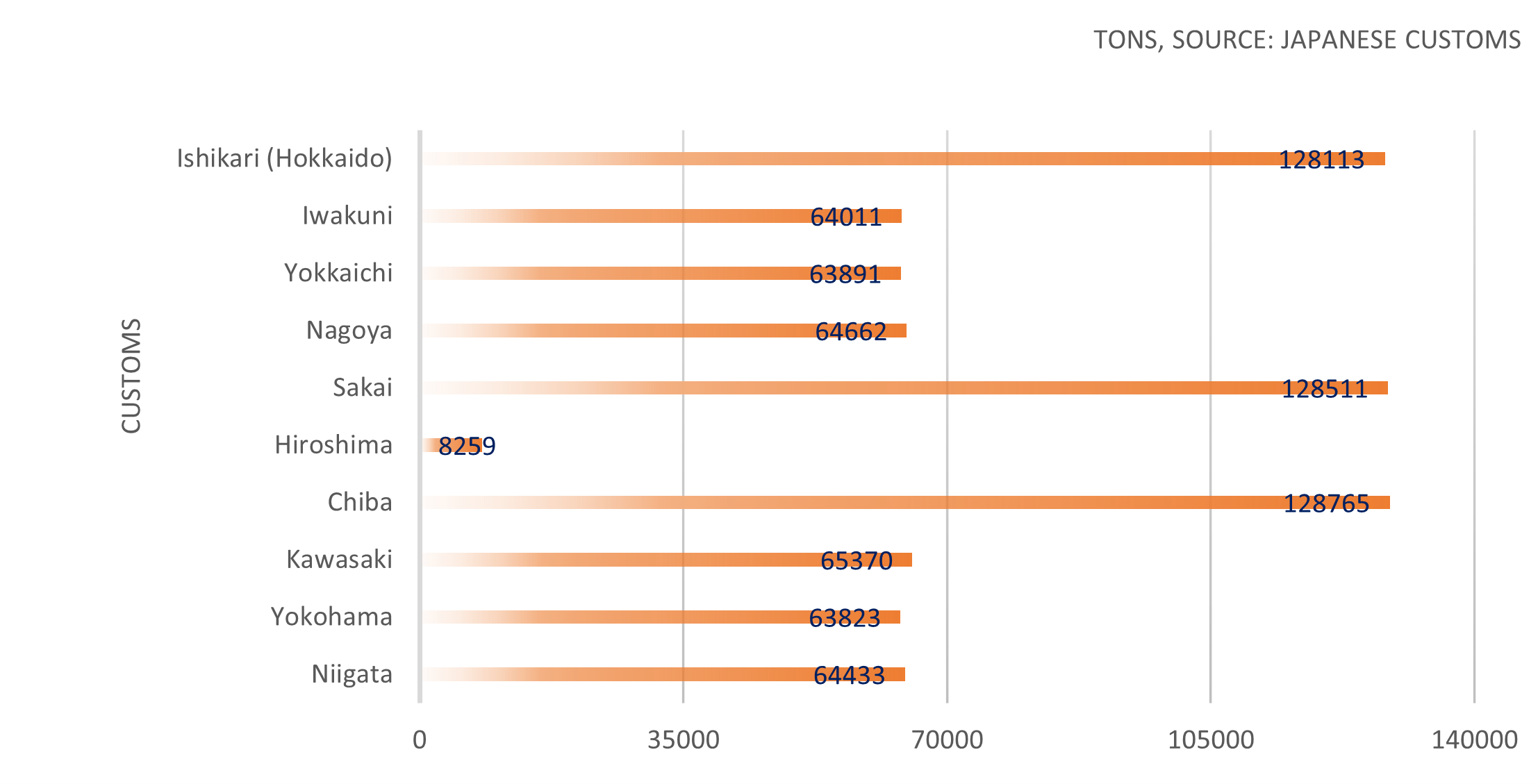
- Japan imported 779,838 tons of LNG from Russia in January, accounting for 11.5% of the total imports. Chiba’s customs area was the largest delivery destination, followed by Sakai and Hokkaido. Separately, METI said Japan’s stocks of LNG stood at 1.8 million tons as of Feb. 27, down from 1.82 million tons a week ago. This was lower than 2.3 million tons a year ago and the four-year average of 1.98 million tons.
Breakdown of Russian LNG imports by the customs region (January)
- Japan imported 13.38 million kiloliters of crude oil in January, up 5.2% YoY. Imports from Russia were 0.58 million kiloliters, up 57.9% YoY.
JERA says SWIFT ban won’t affect Russian LNG imports
(S&P Global, Feb. 28)
- JERA, Japan’s biggest LNG buyer, relies on Russia for 10% of its supply. The company doesn’t expect problems in receiving LNG from Sakhalin-2 because its operating company and the bank that services the trade are not Russian entities.
- Output is not affected at this time.
- Most of Japan’s Russian LNG comes under long-term contracts from Sakhalin-2.
- SIDE DEVELOPMENT:
Japanese utilities hunt for alternative LNG sources beyond Russia
(Nikkei Asia, March 4)- Japanese utilities and trading companies seek alternative ways to procure LNG to make up for an interruption in shipments from Russia.
- It’s hard to find new sources since the global market is tight, but Japanese firms also trade about 10 million tons of LNG abroad each year, and could divert it to the domestic market or use swap trades. That could cut the cost of cargo transport, helping both sides of the swap.
- Other options include turning to the spot market.
- Hiroshima Gas is one of the most dependent Japanese firms on Russian LNG, securing half of its purchases from the country under long-term deals. Russia also provides about 10% of the supply for Tohoku Electric and Tokyo Gas
Toshiba, Tohoku University develop EV motor magnet with less neodymium rare earth
(Company statement, March 1)
- Toshiba and Tohoku University developed a bonded magnet that reduces neodymium rare earth consumption to half, replacing it with samarium, another type of rare earth more abundantly supplied. Bonded magnets are used for hybrid and electric vehicles.
- The research team succeeded in producing a powerful magnetic alloy that’s only 6% samarium. By comparison, neodymium alloys contain 13% neodymium.
- Magnets made from the new alloy are more resistant to heating than those made from traditional alloys.
- Manufacturers are dependent on China for sourcing neodymium.
- CONTEXT: Of the 17 rare earth types, METI classifies neodymium and dysprosium, also used for automotive magnets, as the most critical resources that require strong recycling initiatives, while samarium is a less critical “priority resource”.
ANALYSIS
BY MAYUMI WATANABE
Gas Markets in Turmoil Mean
Second Thoughts Over “Carbon-Neutral” LNG
As the war in Ukraine further pounds natural gas markets already facing upheaval and soaring prices, major industry players now have to grapple with a wide array of issues in order to bring order and calm to the sector.
One of those issues in Japan is the future of “carbon-neutral” LNG (CN-LNG), a product that offers both the molecules and credits that claim to offset the emissions from the fuel. After taking off a year ago with sales of CN-LNG to Tokyo Gas, the niche sector has quickly expanded to involve over 40 gas utilities in Japan.
That momentum is now slowing, however, as higher LNG prices eat into company budgets for the CN premiums. It was true even before recent sanctions linked to the war cast doubt on the viability of some energy transactions.
The war in Ukraine is starting to reshape energy markets and the CN-LNG sector, which was created quickly in just about a year, may now need to take a pause and reflect. Japan’s government and businesses need time to analyze CN-LNG standards and framework, which have lacked a common meeting point not only domestically but globally.
Whether the CN-LNG sector takes stock and rebuilds, or disappears just as quickly, will depend on several key issues.
Required resolutions
For the CN-LNG product offering to have wider credibility, several basic tenets of its business need to be resolved.
The most important one is probably the value and credibility of the carbon offsets system. As of today, Japan’s regulatory framework for GHG reduction is far from complete. The country has yet to launch a system that verifies carbon credit quality, or a national carbon pricing and trading scheme.
The Japan Gas Association has launched studies on CN-LNG, aiming to set up guidelines to clarify product definition, requirements and approach to quantifying carbon and the credits. In March, METI will release its plan for a national carbon pricing and trading scheme.
Once the government clarifies how things are measured and logged, it will be up to the CN-LNG marketplace to embed its activities within the Japanese government emissions system. The Carbon Neutral LNG Buyers Alliance wants (and needs) to certify voluntary credits used as emission cuts in official GHG filings to the Japanese government.
Once the rules for the creation and registration of credits are in place, buyers said they will also ask for more transparency around the various CN-LNG offerings, with the level of information delivered by sellers today varying greatly.
Japan’s CN-LNG market overview
Just one year ago, only Tokyo Gas was supplying CN-LNG to domestic end-users. That changed in August 2021 when Malaysia’s Petronas delivered CN-LNG to Shikoku Electric. Later in the year, it signed a supply agreement with Hiroshima Gas.
By the end of 2021, the Japan Gas Association reported that around 40 out of 197 gas utilities nationwide had plans for CN-LNG. This proves there’s strong interest among end-users since many have embraced 2050 carbon neutrality goals, but either cannot turn to or cannot afford to access renewable energy.
Currently, Japan’s CN-LNG supplies come from the following sources — Shell, Malaysia’s Petronas, Brunei LNG, Mitsubishi Group’s Diamond Gas International, Mitsui & Co., INPEX, and oil refiner ENEOS. Then there’s JAPEX, an upstream oil and gas firm that buys CN-LNG from Diamond Gas International and resells it to city gas utilities. It plans to launch its own CN-LNG product based on its own domestic gas production volumes and access to voluntary credits.
CN-LNG supply portfolio in Japan
|
Supplier |
What is being offset |
Which credits are used |
|
Shell/Tokyo Gas |
GHG |
Verified Carbon Standard (VCS), Climate, Community & Biodiversity (CCB), China Certified Emission Reduction |
|
Brunei LNG |
GHG |
VCS and CCB credits from Shell projects |
|
INPEX |
GHG |
VCS |
|
Diamond Gas International |
GHG |
NA |
|
Petronas |
CO2 |
VCS |
|
Mitsui & Co. |
CO2 |
NA |
|
ENEOS |
CO2 |
NA |
Where companies source credits
How are voluntary carbon offset credits used to offset GHG emissions? Let’s take a look at oil and gas firm INPEX. It’s fully self-sufficient in offset credits earned from its investment in the Indonesian Rimba Raya Biodiversity Reserve Project that could generate 5 million tons of carbon offsets in 2021 to 2025. Similarly, ENEOS generates carbon credits from forest projects in Indonesia.
Tokyo Gas mixes carbon credits. Shell’s voluntary credits are used to offset gas supplied to Yakult, Sakai Chemical Industry and others. Tokyo Gas uses its own credits for some users, while CN-LNG to Saibu Gas utilizes credits that Tokyo Gas sources from third parties. Mitsubishi and Mitsui source credits based on various client needs.
The large gas operators that own LNG tanks — Tokyo Gas, Osaka Gas, Toho Gas, and Hokuriku Lnes, a gas arm of Hokuriku Electric — directly import CN-LNG for resale to
|
Utility |
LNG supply sources |
Credit sources |
Main buyers |
|
Tokyo Gas |
Shell group; Own production in Australia, etc |
Shell, Tokyo Gas, third parties |
Saibu Gas, end-users |
|
Osaka Gas |
Brunei LNG |
Shell Eastern Trading |
8 city gas operators, end-users |
|
Toho Gas |
Diamond Gas International, INPEX |
Diamond Gas International, INPEX |
End-users |
|
Hiroshima Gas |
Petronas |
Petronas |
End-users |
|
Hokkaido Gas |
Mitsui & Co owned projects |
Mitsui & Co |
End-users |
|
Tobu Gas |
To be decided |
To be decided |
To be decided |
|
Hachinohe Gas |
ENEOS |
ENEOS |
End-users |
|
Shizuoka Gas |
INPEX |
INPEX |
End-users |
|
Matsue City Gas |
ENEOS |
ENEOS |
End-users |
|
Izumo Gas |
ENEOS |
ENEOS |
End-users |
|
Obihiro Gas |
Diamond Gas International via JAPEX |
Diamond Gas International via JAPEX |
Own consumption |
|
Ome Gas |
INPEX |
INPEX |
Own consumption |
|
Tomakomai Gas |
Diamond Gas International via JAPEX |
Diamond Gas International via JAPEX |
End-users |
|
Shibata Gas |
Diamond Gas International via JAPEX |
Diamond Gas International via JAPEX |
Own consumption |
|
Buyo Gas |
NA |
NA |
Own consumption of up to 67,900 m3/ year |
|
Shirone Gas |
Diamond Gas International via JAPEX |
Diamond Gas International via JAPEX |
Own consumption |
|
Komatsu Gas |
Japanese trading houses via Hokuriku Electric |
Trading houses |
End-users |
|
Kiryu Gas |
INPEX |
INPEX |
Gunma Bank, other end-users |
|
Bushu Gas |
Tokyo Gas |
NA |
End-users |
|
Saitama Gas |
INPEX |
INPEX |
Own consumption |
|
Daito Gas |
NA |
NA |
One end-user |
|
Honjo Gas |
INPEX |
INPEX |
Own consumption |
|
Saibu Gas |
Tokyo Gas |
Tokyo Gas to source credits from third party brokers |
End-users |
|
Iruma Gas |
INPEX |
INPEX |
End-users |
|
Horikawa Sangyo |
INPEX |
INPEX |
Own consumption |
|
Keiyo Gas |
NA |
NA |
End-users |
|
Noda Gas |
NA |
NA |
End-users |
|
Atsugi Gas |
NA |
NA |
End-users |
|
Echigo Natural Gas |
Diamond Gas International via JAPEX |
Diamond Gas International via JAPEX |
Own consumption |
|
Ebara Gas |
INPEX |
INPEX |
Own consumption |
|
Tokai Gas |
Various |
J Credits owned by Tokai Gas |
End-users |
|
Okayama Gas |
Osaka Gas |
Shell Eastern Trading |
Own consumption, end users from 2022 |
|
Shikoku Gas |
Osaka Gas |
Shell Eastern Trading |
Own consumption |
|
Shingu Gas |
Osaka Gas |
Shell Eastern Trading |
Own consumption |
|
Daiwa Gas |
Osaka Gas |
Shell Eastern Trading |
Own consumption |
|
Tottori Gas |
Osaka Gas |
Shell Eastern Trading |
Own consumption |
|
Tokai Energy |
Osaka Gas |
Shell Eastern Trading |
Own consumption |
|
Nabari Kintetsu Gas |
Osaka Gas |
Shell Eastern Trading |
End-users |
|
Biwako Blue Energy |
Osaka Gas |
Shell Eastern Trading |
Own consumption |
|
Nihonkai Gas |
INPEX |
INPEX |
Hokuriku Bank, other end-users |
|
Hokuriku Lnes |
Japanese trading houses |
Trading houses |
Komatsu Gas, end-users |
other city gas operators, as well as to end-users. Currently, there are 23 smaller utilities that started to supply end-users, or plan to start supplies this year.
The Japan Gas Association estimates that if 2 billion m3, or 5% of Japan’s city gas demand, were carbon neutral, then carbon credits of 5 million tons would be needed.
Hot market, but confusion abounds
The Japan Gas Association said there were 107 CN-LNG end-users as of Dec. 31, and 64 were manufacturers. Interest is strong in industry-intensive Tokyo, Nagoya and Osaka areas, while less in areas with fewer listed companies.
One end-user in the Kanto region said his company sought to increase the volume of CN-LNG but was told it wasn’t possible to do so under the same terms. “We signed up to CN-LNG because renewable power wasn’t so available. One year later, it’s the other way around,” he said.
On the other hand, a utility in northwest Japan said that only one end-user signed up in the first three months of service. Another company limited the use of CN-LNG to just one out of seven plants, because management wants to see how the service develops first and to monitor changes in GHG reporting regulations.
End-users were also required to make efforts to clarify the terms of CN-LNG products and services, since the Japanese context is different from overseas. The scope of CN-LNG offered in Japan includes drilling, production, liquefaction, storage, shipping, regasification, gas transmission, storage, and end use.
A Japan NRG survey showed that while INPEX and Tokyo Gas were transparent about where their credits come from, others did not disclose details to the public. Some Japanese gas utilities confirmed that, in reality, CN-LNG may not cover the end-user emissions from gas consumption, and they may need to source additional offset credits to completely offset either GHG or just carbon.
The subtle differences in the CN-LNG offerings confused end-users, prompting the Japan Gas Association to start writing guidelines on what comprises CN-LNG.
Regulatory challenges
A lack of regulatory visibility is also a problem. Utilities say that end-users have needs that are too varied, from cutting overall GHGs throughout the Scope III supply chain to proof that they are taking some kind of green measures to show to shareholders.
Companies report annual carbon emissions to METI, via industry associations, on a voluntary basis. There is no penalty if they fail to report.
The MoE requires companies with over 1,500 kiloliters/ year of energy consumption to file GHG emission reports every July. Companies emitting over 3,000 CO2 equivalent tons/year of GHGs must also report. There are fines for failing to report, as well as for fraudulent reporting of such emissions.
Presently, voluntary credits for CN-LNG can’t be used for filings to the government. However, J-Credits can be used. According to a METI study, overseas voluntary credits typically trade at $1-5/ ton, and the local J-credits at $14-18/ ton.
METI, taking note of the increase in the variety of players in the offset credit market, has defined four regulatory frameworks that need to be established immediately:
- A trading platform, such as an exchange
- Transparency of offset credit pricing
- Consumer-supplier matching mechanisms
- Quality assurance for the credits
This month, a METI panel is expected to release a proposal on the launch of a national carbon exchange. Trial runs are scheduled for fall of 2022, and a formal launch in April 2023. The roadmaps for the three other frameworks remain unclear.
If the government and industry can work together to establish these standards and measures, then the CN-LNG system has a good chance to be further implemented throughout Japan’s gas sector.
ANALYSIS
BY MASUTOMO TAKEHIRO
Japan Accelerates Geothermal Capacity Rollout
at Home and Abroad, but Project Size Frustrates
Japan’s government has recently drawn a clearer blueprint for geothermal, the country’s promising yet largely untapped renewable energy source. The end goal is to drive private companies to expand business at home and abroad. With the right policies and state support, Japan has the potential to become a global leader in geothermal.
Since the Fukushima disaster, the number of Japan’s geothermal facilities have quadrupled to over 90, but many sites are mini-sized. While statistics show installed geothermal capacity in Japan remains at a meager 481 MW, the ambition is to grow it to 1.55 GW, which is roughly 1% of the country’s total power needs by 2030.
Even if Japan reaches that goal for geothermal, it would still be just the beginning for the industry. Research shows the country has potential for at least 23.5 GW of geothermal capacity. If Japan could even reach 25% of that amount, it would easily be the world leader. To put the matter in context, total global capacity is 16.4 GW. Currently, the world’s top geothermal energy producer is the U.S. with installed capacity of 3.71 GW, followed by Indonesia with 2.13 GW.
Clearer government vision
Investment risk and lack of large-scale facilities constitute the main obstacle and challenge to growing geothermal capacity, which in general is an arduous process. On average, global geothermal growth for 2022-2032 will be a sluggish 5%. Compare that to an approximate 15% growth in wind power capacity in 2020 alone, according to the Global Wind Energy Council.
Japan’s latest Basic Energy Plan, unveiled in October 2021, offers hope. As a reflection of former Prime Minister Suga administration’s enthusiasm for renewable energy, the Plan pays more attention to geothermal with a variety of new policy directions. Here are some main points:
- JOGMEC will survey 30 sites, mainly in national parks where about 80% of geothermal resources lie underneath the ground, and share survey data with businesses. Only five sites, mostly outside national parks, have so far been surveyed. JOGMEC will hand over drilled wells to businesses if requested, to further reduce risks and costs.
- Review laws and regulations, including the Natural Parks Act, the Hot Springs Act, and the Forest Act. Also, to ensure smooth coordination between business operators and local communities.
- Develop hydrothermal resources deeper (about 5 km) underground compared to those used in conventional geothermal power generation. This could hopefully scale up each facility’s size.
- Reaffirm the “Geothermal Development Acceleration Plan” announced by the MoE in April 2021. The ministry pledged to shorten the lead time by up to two years, for a total of eight years, and double the number of geothermal power generation facilities nationwide by 2030.
- Make a push for geothermal resource surveys and power generation projects in oversea volcanic belts similar to Japan’s. Also, gain knowledge, experience, and insights to be applied to the exploration and development of geothermal resources at home.
Spending plans
According to one study, the cost of building and operating a geothermal power plant in Japan is ¥10-¥18 per KW (excluding tax), which is two to three times higher than in the U.S. and New Zealand. In Japan, it costs around ¥500 million to drill a geothermal well, but without digging it’s impossible to know whether hot water will come out. The success rate is around 30%. Therefore, improving the accuracy of potential resource mapping is a top priority.
In terms of public investment, METI has included ¥18.3 billion for geothermal development in its FY2022 budget request, an increase of 60% from the previous year, when ¥11 billion was secured.
As Japan’s first 10 MW-plus geothermal project in 23 years, the 46 MW double flash Wasabizawa Geothermal Power Plant opened in Akita Prefecture in May 2019. This will be followed by the 15 MW Appi Plant in Iwate Prefecture in 2024, and the 15 MW Katatsumuriyama Plant in Akita Prefecture in 2025, and the 15 MW Kijiyama Plant in Akita Prefecture in 2029. No other large-scale geothermal projects are on the horizon, however.
Meanwhile, as for mid-sized plants, 6.5 MW and 2 MW facilities are scheduled to be operational in Hokkaido and Kumamoto prefectures this year. Based on this reality, the Japan Geothermal Association requested the government in October 2021 to maintain the FIT price for geothermal power, and pass the Geothermal Power Act that’s harmonious with the Hot Spring Act.
Private investments up
In geothermal, Japanese trade houses are signing engineering, procurement and construction contracts with overseas companies and accumulating know-how. Toyota Tsusho has an order for the Olkaria geothermal plant in Kenya, with a maximum output of 280 MW, one of the world’s biggest.
Itochu and Kyushu Electric, are participating in a 330 MW geothermal project in North Sumatra, Indonesia. In addition, a 98 MW geothermal power plant in South Sumatra, in which Marubeni and Tohoku Electric are participating, started operation in December.
Meanwhile, JAPEX will set up a new division dedicated to geothermal, and Osaka Gas will invest ¥120 billion in renewable energy projects over three years from fiscal 2021, including geothermal. In April 2021, Kyushu Electric said it would invest ¥250 billion in geothermal power and other renewables over five years from FY2021.
Construction companies are also rushing into the industry. In July 2021, Obayashi Corporation built a geothermal power facility as well as a hydrogen production demonstration plant in Kokonoe Town, Oita Prefecture. The hydrogen has been shipped as fuel for marine fuel cell systems and Toyota’s hydrogen-powered racing cars. This is the first demonstration project in Japan to supply hydrogen produced by geothermal power.
In November 2021, Shimizu Corporation started the construction of a demonstration plant to produce hydrogen using electricity from geothermal power in the same town. Likewise, Takenaka Corporation announced in April 2021 that it had entered into a geothermal power generation project in Takayama City, Gifu Prefecture.
Global demand
Plans are underway to establish a new financial support system to make it easier for companies to enter the geothermal business overseas, by possibly amending the JOGMEC Act. Similarly, Japan’s Foreign Ministry is reportedly preparing to create new projects for FY2022 to support developing countries, with geothermal and other renewable energy projects in mind.
INPEX issued ¥10 billion in green bonds in October 2021 to develop geothermal power plants and other projects in Japan and abroad. The oil firm said in December that it had participated in the Muara Laboh Geothermal Power Generation project in West Sumatra, Indonesia. The company added in February that it would invest up to ¥1 trillion in decarbonization-related projects, including geothermal power generation, by 2030.
At the same time, global demand for turbines has soared, creating an opportunity for Japanese manufacturers. Toshiba Energy Systems has delivered turbines to geothermal power plants in 11 countries around the world. Compared with other overseas manufacturers, Toshiba’s turbines can withstand long-term specifications without losing output.
The company plans to further expand its turbine business in Indonesia and East Africa, and wants to add larger and smaller turbines to its lineup. Also, MHI has delivered geothermal turbines to 13 countries, and in a pleasant surprise, its market share in Iceland has reached 55%.
Finally, the development of next-gen geothermal technology is accelerating. Taisei Corporation, together with the Geothermal Energy Research & Development Co., is working on generating electricity by turning turbines with high-temperature CO2 instead of water. On-site demonstrations will begin in 2026, and hopefully put the technology to practical use from 2036.
Given its ample geothermal potential, Japan would miss a great opportunity to expand its renewables base if it doesn’t take more determined action on this front. The interest from top government and business is there. However, a lack of bureaucratic resources allotted to developing geothermal capacity is also visible, mostly because it lacks the scalability of solar and wind.
Still, with Japan hard pressed to meet net-zero goals by 2030, every option has to be explored and every little bit counts.
GLOBAL VIEW
BY JOHN VAROLI
Below are some of last week’s most important international energy developments monitored by the Japan NRG team because of their potential to impact energy supply and demand, as well as prices. We see the following as relevant to Japanese and international energy investors.
Australia/ Wind power
Spain’s Acciona Energía said construction of its planned 923 MW MacIntyre wind farm in Queensland was approved. Once built, the project will be 70% owned by Acciona, with 30% held by Ark Energy, a subsidiary of Korea Zinc whose goal is to decarbonize the group’s energy supply.
Germany/ Wind and solar
The Economy Ministry plans to triple new onshore wind and solar facilities, and wants to accelerate the country’s goal to generate all electricity from renewables by 2035, instead of 2050. Germany will diversify energy sources away from Russia, on whom it relies for over half of its natural gas.
Green investment
Macquarie’s Green Investment Group announced plans to launch an offshore wind business – Corio Generation. It will commence operations in April 2022, with a project pipeline of over 15 GW – one of the world’s largest.
India/ Solar power
India added more than 10 GW of solar PV in 2021, reaching cumulative installed solar capacity of 49 GW, according to Mercom India Research. The 10 GW of new capacity made in 2021 represented a 210% increase YoY.
Pakistan/ Gas
During his trip to Moscow just hours after Russian forces invaded Ukraine, PM Imran Khan signed a deal to import about 2 million tons of wheat and buy natural gas. “We signed agreements to import natural gas because Pakistan’s own gas reserves are depleting,” Khan said.
Russia/ Energy divestments
In the wake of the Russian invasion, Shell will end its partnership with Gazprom, selling a 27.5% stake in the Sakhalin-II oil and gas project. BP will end relations with Rosneft, which accounts for half of BP’s oil and gas reserves, and a third of its production. ExxonMobil will stop operating its Sakhalin-I oil and gas project, and halt new investments in Russia. Also, Norway’s $1.3 trillion sovereign wealth fund will divest its Russian assets.
Saudi Arabia/ Battery storage
A consortium composed of ACWA Power, SPIC Huanghe Hydropower Development and Saudi Tabreed Cooling raised $1.3 billion to invest in infrastructure for the world’s largest off-grid battery energy storage system, with capacity of 1.3 GWh.
Ukraine/ Nuclear power
After armed hostilities between Russian and Ukrainian troops ignited a fire on the premises, the Russian army took the Zaporizhzhia nuclear power plant, which is Europe’s largest. It’s located in central Ukraine in the city of Enerhodar on the banks of the Dnieper River.
U.S./ Fossil fuel divestment
Insurance company AIG will stop insuring and investing in companies that derive more than 30% of revenue from coal-fired power, thermal coal mines or oil sands projects. AIG plans to achieve net-zero emissions across its global underwriting and investment portfolios by 2050.
U.S./ Oil and gas
Republicans are urging President Biden to increase domestic oil and gas production, and to wean the nation and allies off Russian oil. The U.S. gets 5% to 10% of its crude oil and refined products from Russia. Sanctions imposed on Russia so far don’t include oil and gas exports.
U.S./ Solar power
Solar power generation rose by 25.2% in 2021, making it the country’s fastest-growing source of electricity; renewables accounted for 21% of all electricity and in 2022 will surpass coal in terms of total production. For 2022, the U.S. Energy Information Administration expects 21.8 GW of new utility-scale solar capacity and 4.4 GW of small-scale solar capacity to come online. It also predicts 7.6 GW of new wind capacity to come online.
2022 EVENTS CALENDAR
A selection of domestic and international events we believe will have an impact on Japanese energy
|
January |
OPEC quarterly meeting; JCCP Petroleum Conference – Tokyo; EU Taxonomy Climate Delegated Act activates; Regional Comprehensive Economic Partnership (RCEP) Trade Agreement that includes ASEAN countries, China and Japan activates; Indonesia to temporarily ban coal exports for one month; Regional bloc developments: Cambodia assumes presidency of ASEAN; Thailand assumes presidency of APEC; Germany assumes presidency of G7; France assumes presidency of EU; Indonesia assumes presidency of G20; and Senegal assumes presidency of African Union; Japan-U.S. two-plus-two meeting; Japan’s parliament convenes on Jan. 17 for 150 days; Prime Minister Kishida visits Australia (tentative) |
|
February |
Chinese New Year (Jan. 31 to Feb. 6); Beijing Winter Olympics; South Korea joins RCEP trade agreement |
|
March |
Renewable Energy Institute annual conference; Smart Energy Week – Tokyo; Japan Atomic Industrial Forum annual conference – Tokyo; World Hydrogen Summit – Netherlands; EU New strategy on international energy engagement published; End of 2021/22 Japanese Fiscal Year; South Korean presidential election |
|
April |
Japan Energy Summit – Tokyo; MARPOL Convention on Emissions reductions for containerships and LNG carriers activates; Japan Feed-in-Premium system commences as Energy Resilience Act takes effect; Launch of Prime Section of Japan Stock Exchange with TFCD climate reporting requirement; Convention on Biological Diversity Conference for post-2020 biodiversity framework – China; Elections: French presidential election; Hungarian general election |
|
May |
World Natural Gas Conference WCG2022 – South Korea; Elections: Australian general election; Philippines general and presidential elections |
|
June |
Happo-Noshiro offshore wind project auction closes; Annual IEA Global Conference on Energy Efficiency – Denmark; UNEP Environment Day, Environment Ministers Meeting – Sweden; G7 meeting – Germany |
|
July |
Japan to finalize economic security policies as part of natl. security strategy review; China connects to grid 2nd 200 MW SMR at Shidao Bay Nuclear Plant, Shandong; Czech Republic assumes presidency of EU; Elections: Japan’s Upper House Elections; Indian presidential election |
|
August |
Japan: Africa (TICAD 8) Summit – Tunisia; Kenyan general election |
|
September |
IPCC to release Assessment and Synthesis Report; Clean Energy Ministerial and the Mission Innovation Summit – Pittsburg, U.S.; Japan LNG Producer/Consumer Conference – Tokyo; IMF/World Bank annual meetings – Washington; Annual UN General Assembly meetings; METI to set safety standards for ammonia and hydrogen-fired power plants; End of 1H FY2022 Fiscal Year in Japan; Swedish general election |
|
October |
EU Review of CO2 emission standards for heavy-duty vehicles published; Chinese Communist Party 20th quinquennial National Party Congress; G20 Meeting – Bali, Indonesia; Innovation for Cool Earth TCFD & Annual Forums – Tokyo; Elections: Okinawa gubernational election; Brazilian presidential election; |
|
November |
COP27 – Egypt; U.S. mid-term elections; Soccer World Cup – Qatar; |
|
December |
Germany to eliminate nuclear power from energy mix; Happo-Noshiro offshore wind project auction result released; Japan submits revised 2030 CO2 reduction goal following Glasgow’s COP26; Japan-Canada Annual Energy Forum (tentative); Tesla expected to achieve 1.3 million EV deliveries for full year 2022 |
Disclaimer
This communication has been prepared for information purposes only, is confidential and may be legally privileged. This is a subscription-only service and is directed at those who have expressly asked K.K. Yuri Group or one of its representatives to be added to the mailing list. This document may not be onwardly circulated or reproduced without prior written consent from Yuri Group, which retains all copyright to the content of this report.
Yuri Group is not registered as an investment advisor in any jurisdiction. Our research and all the content express our opinions, which are generally based on available public information, field studies and own analysis. Content is limited to general comment upon general political, economic and market issues, asset classes and types of investments. The report and all of its content does not constitute a recommendation or solicitation to buy, sell, subscribe for or underwrite any product or physical commodity, or a financial instrument.
The information contained in this report is obtained from sources believed to be reliable and in good faith. No representation or warranty is made that it is accurate or complete. Opinions and views expressed are subject to change without notice, as are prices and availability, which are indicative only. There is no obligation to notify recipients of any changes to this data or to do so in the future. No responsibility is accepted for the use of or reliance on the information provided. In no circumstances will Yuri Group be liable for any indirect or direct loss, or consequential loss or damages arising from the use of, any inability to use, or any inaccuracy in the information.
K.K. Yuri Group: Oonoya Building 8F, Yotsuya 1-18, Shinjuku-ku, Tokyo, Japan, 160-0004.