
JAPAN NRG WEEKLY
MARCH 22, 2022
JAPAN NRG WEEKLY
March 22, 2022
NEWS
TOP
- Strong earthquake in northeast Japan sends power plants offline; Tokyo grid calls for limited power use due to “severe” situation
- Government revises tender criteria for offshore wind projects after repeated industry lobbying to address recent auction results
- Nuclear regulator rules out early reactor restarts to ease power crunch and rising electricity prices, saying safety is top priority
ENERGY TRANSITION & POLICY
- Regulator says building SMRs underground is under discussion
- Govt. may relax competition rules to help business decarbonize
- Firm designs ship to carry surplus power from offshore wind farms
- Utilities ask METI to reverse hydropower rule to help boost profits
- Kawasaki Heavy develops hydrogen co-firing large-size engines
- Japan tests domestic bio jet fuel in 60-minute passenger flight
- Taiwan’s Foxconn to enlist 100 Japanese companies in EV drive
- OPINION: Japan-U.S. nuclear collaboration lacks strategic drive
ELECTRICITY MARKETS
- Three regions asked to send surplus power to Tohoku after quake
- Operators forecast impact from storage batteries on their grids
- Aker, Mainstream Power take stake in Japan offshore wind project
- Japan to consider new police unit for guarding nuclear plants: PM
- Kansai Electric tests digital currency for electricity, other payments
- Tokyo Gas, Kyushu Electric venture to build 2 GW gas-fired plant
- AgriHills to build 110 MW solar power project in Kumamoto area
- Mitsubishi Heavy, Denmark’s CIP plan Hokkaido wind power plant
OIL, GAS & MINING
- Japanese utilities scramble for alternatives to Russian LNG supply
- Volatile commodity prices get in the way of battery development
- Japan’s LNG stocks rebound, remain below four-year average
- February crude oil imports jump double-digit; coal buying also up
- Will copper be the next oil? Several Japanese firms look to profit
ANALYSIS
THE 18 PROJECTS THAT WILL TRANSFORM JAPAN INTO AN OFFSHORE WIND POWERHOUSE
Japan has embraced wind power as one of its top priorities for the future energy mix. The CO2-free generation source has particular potential offshore. But, the depth of the waters around Japan makes today’s wind power technologies, which are fixed to the sea floor, less effective. That’s why Japan has embarked on an ambitious program to develop floating offshore wind turbines and power systems. The initial phase of that public-private program consists of 18 key projects. We give an overview of these projects and the sector’s goals as a whole.
SECTOR OVERVIEW: CCUS, TECHNOLOGICAL GAMBLE FOR JAPAN’S DECARBONIZATION GOALS
Japan is a strong proponent of adapting existing energy systems to meet decarbonization goals, and arguably its biggest gamble is on an emerging set of technologies that seek to capture CO2 and then either store or recycle it. This tech potentially allows Japan to meet net carbon neutrality commitments by 2050, while retaining thermal power generation. Commercialization of CCUS technology could be as soon as this decade, but its economics rely on a very important tool that is not in place today.
GLOBAL VIEW
The UK mulls life extension of nuclear power plants. U.S. unveils pollution law that may see mass coal-fired plant closures. Sweden and Portugal are actively expanding in wind power generation. Mumbai sets a net-zero target that’s ahead of national goals. Details on these and more in our global wrap.
EVENT CALENDAR FOR 2022
Key political and business events in Japan and abroad.
JAPAN NRG WEEKLY
PUBLISHER
K. K. Yuri Group
Editorial Team
Yuriy Humber (Editor-in-Chief)
John Varoli (Senior Editor, Americas)
Mayumi Watanabe (Japan)
Wilfried Goossens (Japan, Events)
Regular Contributors
Chisaki Watanabe (Japan)
Daniel Shulman (Japan)
Takehiro Masutomo (Japan)
Art & Design
22 Graphics Inc.
Events
SUBSCRIPTIONS & ADVERTISING
Japan NRG offers individual, corporate and academic subscription plans. Basic details are our website or write to subscriptions@japan-nrg.com
For marketing, advertising, or collaboration opportunities, contact sales@japan-nrg.com
For all other inquiries, write to info@japan-nrg.com
OFTEN USED ACRONYMS
METI The Ministry of Energy, Trade and Industry
MOE Ministry of Environment
ANRE Agency for Natural Resources and Energy
NEDO New Energy and Industrial Technology Development Organization
TEPCO Tokyo Electric Power Company
KEPCO Kansai Electric Power Company
EPCO Electric Power Company
JCC Japan Crude Cocktail
JKM Japan Korea Market, the Platt’s LNG benchmark
CCUS Carbon Capture, Utilization and Storage
mmbtu Million British Thermal Units
mb/d Million barrels per day
mtoe Million Tons of Oil Equivalent
kWh Kilowatt hours (electricity generation volume)
NEWS: ENERGY TRANSITION & POLICY

Nuclear regulator chief says safety cannot be compromised for early restarts
(Japan NRG, March 16)
- In response to rising calls among lawmakers to speed up nuclear plant inspection and restarts, the Nuclear Regulation Authority chairman, Fuketa Toyoshi, said there won’t be any compromise on nuclear safety. The NRA was established not to repeat the mistakes that lead to the Fukushima meltdown. In order to speed up inspections, there’s much that plant operators can do, he added.
- CONTEXT: Ruling party lawmakers formally asked METI minister Hagiuda Koichi to speed up the processes to restart idled nuclear power plants. The NRA is independent from METI and falls under the MoE.
- SIDE DEVELOPMENT:
Nuclear Regulation Authority chief says underground small modular reactor is a possibility
(Japan NRG, March 16)- Nuclear Regulation Authority chairman Fuketa said building a small modular reactor (SMR) underground is under discussion because it’s more resilient against earthquakes and improves performance of cooling systems. It will also be protected from airborne missile attacks. However, an underground SMR has cost issues.
METI-UK energy minister discuss nuclear cooperation
(Japan NRG, March 16)
- State METI minister Hosoda Kenichi and UK energy and climate minister Greg Hands met online to discuss initiatives in renewable, nuclear and other clean energies.
- CONTEXT: The UK is pushing the development of a high-temperature gas nuclear reactor and has shown interest in the Japan Atomic Energy Agency’s 30 MW high-temperature engineering test reactor (HTTR) that started a trial run in July 2021.
- Japan and the UK have another nuclear dialog framework via the Foreign Ministry, where the Japan Nuclear Regulation Authority and the UK Office of Nuclear Regulation discuss safety standards for advanced nuclear reactors.
- Government alliances for advanced nuclear reactors:
| Japan Atomic Energy Agency | Poland National Centre for Nuclear Research | MoC on high-temperature gas reactor |
| Japan Atomic Energy Agency | UK URENCO | MoC on high-temperature gas reactor |
| Japan Atomic Energy Agency, MHI, MFBR | U.S. TerraPower | MoU on fast reactor development |
| China Nuclear Engineering Corp. | Indonesia National Atomic Energy Agency | MoC on high-temperature gas reactor and staff training |
| China National Nuclear Corp. | King Abdullah City for Atomic and Renewable Energy, Saudi Arabia | MoU on high temperature gas reactor |
| U.S. Nuclear Regulatory Commission | Canadian Nuclear Safety Commission | MoC to develop common regulatory position on advanced nuclear techs |
| Korea Atomic Energy Research Institute | King Abdullah City for Atomic and Renewable Energy, Saudi Arabia | MoU on SMR development |
| Russian State Atomic Energy Corp. | The Philippine Department of Energy | MoI on SMR feasibility studies |
| Korea Hydro and Nuclear Power | The Philippine Department of Energy | MoU on SMR pre-feasibility studies in Cagayan |
| Russian State Atomic Energy | Energy Ministry of Kyrgyz Republic | MoU on SMR plant construction |
| Hungary | Atomic Energy Organization of Iran | MoU on developing and financing SMR |
| Saudi Arabia | Jordan | Agreement of Cooperation to explore uranium and SMR
construction in Jordan |
Government may relax competition regulations to help businesses decarbonize
(Nikkei, March 16)
- Corporate alliances are essential if Japanese industry is to develop the technologies and make the necessary investment to become carbon neutral. The government is considering relaxing anti-trust regulations as they apply to these sectors.
- METI plans to establish an expert panel to debate amendments to legislation.
- The Netherlands, Australia, Greece, Germany and the EC have relaxed competition legislation for the renewable energy sector.
- Japan has a precedent for such measures. In 2001, the Japan Fair Trade Commission issued guidelines for recycling collaboration among competing appliance producers.
Tokyo firm to design ship that carries electricity from offshore wind farms to shore
(Kankyo Business, March 14)
- Tokyo-based Power-X signed an MoU with ClassNK to collaborate in the design, development, and test operation of an “electricity carrier” to transport renewable energy from offshore wind farms to the coast.
- Power-X is working on a project for the world’s first electricity carrier, dubbed Power ARK, and is in the design and development phase. Demo testing and full-scale operation is planned for 2025.
- CONTEXT: Nippon Kaiji Kyokai, known as ClassNK or NK, is a ship classification society. It registers ships and oversees the technical information and rules for shipping.
Several utilities ask METI to reverse hydropower reserve to boost profits
(Denki Shimbun, March 14)
- Chubu Electric Power Milize, Hokuriku Electric, and Shikoku Electric applied to METI for reversal of the drought reserve, claiming that soaring wholesale electricity and fuel prices justify this emergency action under current law.
- If approved by the end of this fiscal year, all three utilities can expect improved financial results. Not since 2014 has a utility asked for this measure.
- The drought reserve is a system based on the former Electricity Business Law to mitigate fluctuations in income and expenditures caused by fluctuations in the amount of electricity received from hydropower stations.
Kawasaki Heavy develops hydrogen co-firing large-size gas engines
(New Energy Business News, March 18)
- Kawasaki Heavy Industries’ new combustion technology provides stable operation of large 5 MW or more gas engines, by mixing hydrogen with natural gas at a ratio of up to 30%. Kawasaki is Japan’s first gas engine manufacturer to achieve this.
- Compared to burning natural gas, this tech reduces CO2 emissions by 1,000 tons/ year.
- The new model is based on a conventional gas engine and can be used for hydrogen co-firing with minimal modifications. Gas engine modification and the market launch of the new hydrogen co-firing model will be available from 2025.
Japan tests domestic bio jet fuel in 60-minute flights, including with passengers
(New Energy Business News, March 18)
- A low-wing turboprop twin-engine aircraft owned and operated by Asia Aerospace made a 60-minute flight fueled in part with domestic bio jet fuel.
- The flight started and ended at Yao Airport in Osaka. The diesel fuel employed was the Susteo brand developed by Euglena, which tries to create sustainable aviation fuel (SAF) by employing used cooking oils and fats derived from microalgae. The bio fuel is blended with petroleum-based jet fuel.
- The test is part of “Bio-Jet Fuel Production Technology Development Project / Establishment of Supply Chain Model through Demonstration and Development of Microalgae Infrastructure Technology,” funded by NEDO.
- CONTEXT: Euglena’s bio jet fuel, Susteo, has also been tested on a charter flight by Fuji Dream Airlines, which operates the Embraer ERJ175 jet model. The short 60-minute flight carried 77 passengers.
Taiwan’s Foxconn to enlist 100 Japanese companies in EV drive
(Nikkei Asia; March 13)
- About 100 Japanese companies will participate in developing EVs spearheaded by Taiwan’s Foxconn, Inc, and suppliers close to Toyota Motor.
- Toshiba, Asahi Kasei, and Showa Denko will supply materials and electronics.
PM pledges to work with businesses to pass on price increases properly
(Nikkei, March 14)
- PM Kishida is concerned that small businesses must find a way to figure the rising price of oil and other commodities into the price of their own goods.
- There’ll be more inspectors to work with small businesses and their pricing.
Japan-US nuclear collaboration lacks strategic direction
(Nikkei, March 16)
- CONTEXT: This is an editorial by the Nikkei Shimbun’s editorial committee.
- The Japan Atomic Energy Agency and Mitsubishi Heavy Industries agreed to collaborate with U.S.-based TerraPower to develop fast breeder reactor technology.
- Russia is also investing heavily in fast breeder reactors, so the latest move does have significance for the Japan-U.S. alliance.
- However, the project will require enormous investment, and the technology is unlikely to be commercially viable until at least the 2050s.
- Like the ill-fated Japanese Monju reactor, TerraPower’s reactor will also be cooled by molten sodium, a difficult material because it explodes on contact with water.
- While the U.S. side will benefit from Japan’s experience on the Monju project, it’s unclear how the project will benefit Japan.
- This project probably won’t be realized because Japan’s lack of commitment on nuclear energy means skilled nuclear engineers are few and far between.
ENEOS and Idemitsu turn to delivery robots to offset falling gasoline demand
(Nikkei, March 16)
- In a bid to remain profitable despite falling gasoline demand, ENEOS and Idemitsu are leveraging their service station chains to offer more diverse services.
- ENEOS trialed meal delivery that uses service stations as hubs for delivery robots.
- Idemitsu trialed a “mobile MRI” service where an MRI machine in a trailer offers brain checkups to those living far from a hospital.
- Falling demand and aggressive pricing by U.S. chain Costco has forced many Japanese-owned petrol stations to close.
- Consumers pay ¥15/ liter less than the national average at Costco service stations, which purportedly operate at a loss.
One-Dot Wrap:
- Toyota Motor has developed a “hydrogen storage module” integrating multiple 70MPa plastic high-pressure hydrogen tanks for automobiles, with safety devices such as hydrogen sensors and automatic shut-off valves. (Kankyo Business, March 17)
- Since it’s now mandatory for solar power generation facilities with an output of 10 kW or more to have fire insurance and earthquake insurance, the Agency for Natural Resources and Energy posted insurance products sold by private companies on its website in order to help operators access the information. (Kankyo Business, March 16)
NEWS: POWER MARKETS

Earthquake sends 12 power plants offline
(Nikkei, Japan NRG, March 17)
- METI said the 7.4 earthquake on March 16 off the Fukushima coast caused 12 thermal power plants — operated by the Tohoku Electric and JERA — to shut temporarily, removing 6 GW of capacity from the grid. Also, 22 hydroelectric power stations temporarily shut.
- In the early hours of March 17, to mitigate shortages, the Organization for Cross-regional Coordination of Transmission Operators (OCCTO) instructed Hokkaido Electric to share power with Tohoku Electric.
- Unit 6 of JERA’s Hirono thermal power station will be operational after March 18.
- SIDE DEVELOPMENT:
Tokyo Grid asks users to limit power use
(Company Statement, March 18)- TEPCO Grid, the operator for the central Kanto region around Tokyo, asked users to start limiting power use (“setsuden” in Japanese).
- The local grid is facing “severe power supply and demand situation due to the continuous shutdown of some power plants in eastern Japan” after last week’s quake and also due to a recent drop in temperatures.
- Even with additional supply from grids in other regions, the supply-demand is expected to be extremely tight around 9pm to 10pm, the grid operator said, warning that outages were possible.
- SIDE DEVELOPMENT:
OCCTO widens power sharing orders to help northeast region
(Japan NRG, March 18)- OCCTO expanded power sharing in order to send surplus electricity to the northeast Tohoku area to help cover shortages.
- On March 18, between 9am and noon, OCCTO asked Hokkaido Electric to send 24.6 MW, Chubu Electric to send 250 MW, and Kansai Electric to send 250 MW.
- Power prices jumped to the highest in about a year. The LNG price benchmark for Asia was in the low-to-mid $30s.
- JERA, the nation’s top thermal power utility by capacity, promptly sought to buy several LNG cargoes on the spot market to secure alternative fuel as its Hirono coal-fired power plant was idled due to the quake.
- 2 million homes in the Tokyo area had no power for a few hours after the quake.
TAKEAWAY: Japan has several thousand earthquakes each year, though most are too small to be felt. The country has experienced major tremors in the last decade — Fukushima in 2011, the Kyushu area in 2016, and Hokkaido in 2018, which caused widespread disruption and damages. In the near term, the concerns are about energy supply and power prices, already elevated due to high natural gas and coal costs. This recent quake is a reminder of the need to build resilience into energy systems, whether gas, wind, nuclear or other. As explained in previous Japan NRG issues, we expect government spending to focus more and more on energy system resilience, as well as energy security, all of which ultimately mean rising power prices.
- SIDE DEVELOPMENT:
TEPCO will analyze the earthquake’s effect on its reactors
(NHK, March 17)- TEPCO observed an increase in pressure in the containment vessel of Unit 1 of its Fukushima Dai-Ichi nuclear station after the March 16 quake. The pressure inside the vessel subsequently dropped to below pre-quake levels.
- While no increase in radioactivity at the site was measured, TEPCO is investigating whether any air leaked out of the containment vessel.
- TEPCO also observed a drop in the water level in a tank connected to the spent fuel pool attached to unit two. While cooling systems were temporarily shut, TEPCO says cooling was recommenced a few hours later.
METI to revise tender criteria for offshore wind power operators
(Nikkei, March 18)
- METI will revise the criteria for selecting offshore wind power generation projects via public auctions. Until now, METI said that price was the main criteria, thereby incentivizing lowest-cost bids. Going forward, however, the government will also give weight to how soon a project can begin operating.
- The ministry will soon discuss the details with its expert panels. The evaluation criteria for bids will be changed by the end of this year.
- The bid deadline for projects off the Akita prefecture coast was postponed.
TAKEAWAY: As Japan NRG forecasted on Jan. 17, 2022, auctions are on hold due to the offshore wind industry’s anger at the first tender results late last year. Ministry action to appease bigger Japanese and foreign players was inevitable, but it leaves the government in a precarious position since it doesn’t want offshore wind project prices to escalate. Any pause for a redrawing of the rules will push back the start of projects that haven’t yet completed the bidding process, putting into doubt the 2030 target for wind energy.
Power grids forecast impact from storage batteries on curbing electricity output
(Japan NRG, March 14)
- Power grids forecast how storage battery systems that store redundant solar and wind power will mitigate output curbs of variable renewables.
- Output curb mitigation rate (%)
| Hokkaido | Tohoku | Tokyo | Chubu | Hokuriku | Kansai | Chugoku | Shikoku | Kyushu | Okinawa |
| -0.3 | -3.8 | NA | -1.6 | -0.6 | NA | -11.2 | -1.1 | -6 | -1.6 |
| Possibility of curbs if renewable capacity rises 150% (in %) | |||||||||
| 49.3 | 41.6 | 6.3 | 5.8 | 3.7 | 8.8 | 28.6 | 2.1 | 3.4 | 1.7 |
- Storage batteries have the highest effect in Chugoku and Kyushu areas, where solar power shares are high, the study showed.
- The base assumption was that battery systems can store up to 10% of total area power demand, and can accommodate charging and recharging cycles of six hours, which is more enhanced compared to current systems designed for two-hour cycles. Output curbs typically last six hours.
TAKEAWAY: There may be over expectation on the capability of battery storage systems. One member of METI’s power and gas working group said the current battery systems may be useful for adjusting supply shortfalls on a daily basis, which typically take one or two hours of discharging. It also takes time to recharge the batteries. Some argue that it’s also risky to position storage batteries as an emergency power source since they could be recharging at the very moment when power is needed.
Aker and Mainstream Power take stake in Japan offshore wind project
(Company Statements, March 14)
- Aker Offshore Wind will join Mainstream Renewable Power to take an initial 50% stake in Progression Energy’s 800 MW floating offshore wind project in Japan. This is a well-formed, early-stage opportunity.
- The three companies combine highly complementary capabilities and experience. Progression Energy has a team in Japan with experience in engaging stakeholders such as fishing unions and securing permits for its multiple projects.
TAKEAWAY: Floating offshore wind is still at an early stage in Japan, but the country’s energy policy has identified this segment as the more promising of wind power technologies. For a detailed overview of Japan’s plan for offshore wind, see this week’s Analysis section.
Japan to consider new police unit for guarding nuclear plants: PM Kishida
(Asia Nikkei, March 15)
- Japan might create a police unit to protect the country’s nuclear plants, PM Kishida said, following Russia’s takeover of Ukrainian nuclear facilities. There’s a growing interest in Japan regarding safety at nuclear plants, he said.
- CONTEXT: The PM reacted to Russia’s seizure of Ukraine’s Chernobyl and Zaporizhzhia nuclear plants, which ignited a fire at the latter’s training facility.
TAKEAWAY: The Fukui Prefecture, which is home to the most reactors of any prefecture in Japan, already operates a police unit for nuclear plant protection. In effect, all the nuclear plants nationwide have some kind of police protection. PM Kishida’s comments show a desire to ward off unease among lawmakers and the public over the safety of nuclear facilities.
An attack on a nuclear plant was considered off-limits in war. Russia’s attack on the Ukrainian facility, whether an error or a scare tactic, has reignited concerns in Japan about “what if” its own nuclear power plants face an attack. The monthly FACTA covered the issue and concluded that the “era of Atoms for Peace is over”. The popular weekly, Bunshun, ran a story last week in which a top Nikkei editor alleged the Ukrainian nuclear plant attack was staged to provoke a global outcry against Russia. While Bunshun couched these allegations as conspiracy theories, it shows the issue’s delicacy. On top of it all, Russia is a major reactor vendor globally.
While high energy prices have impacted the Japanese public’s attitude towards nuclear restarts, the Ukrainian plant attack will be used by the anti-nuclear lobby. The road to restarts has grown more complicated.
Kansai Electric tests digital currency for electricity payments and beyond
(Gas Energy News, March 14)
- Kansai Electric will hold Japan’s first demo to use the digital currency in electricity transactions to store settlements, and it will study models for commercialization.
- Kansai Electric’s digital currency is obtained through transactions involving electricity and environmental values.
Tokyo Gas and Kyushu Electric venture to build 2 GW gas-fired power plant
(New Energy Business News, March 18)
- A JV between Tokyo Gas and Kyushu Electric will build a combined cycle power plant with a total output of 1.95 GW in Sodegaura City, Chiba Prefecture. Construction starts in March 2023, with the first unit ready by May 2028. The final third unit will be completed in early 2029. All units have 650 MW capacity.
- The construction site is 122,000 m2 of unused land owned by Idemitsu Kosan. It is in the vicinity of the Tokyo Gas Sodegaura LNG terminal, where natural gas vaporized at the existing facilities is supplied via pipeline. The plant was slated to run on coal, but its fuel type changed to natural gas.
AgriHills Solar plans to build 110 MW solar plant in Kumamoto area
(New Energy Business News, March 17)
- Kumamoto Prefecture made recommendations to Agrihills Solar, which aims to build a 110 MW solar power plant in the local Yamata Town. More than 232,000 PV modules would be placed over approximately 580,000 square meters.
- The current schedule states that the plant could be completed by December 2024. The local government asked the operator to consider the impact the project will have on grassland butterflies and a local cycling route.
Mitsubishi Heavy, Denmark’s CIP plan Hokkaido offshore wind project
(New Energy Business News, March 17)
- Hokkaido Offshore Wind Development, a JV between Copenhagen Infrastructure Partners (CIP) of Denmark and Mitsubishi Heavy Industries, will develop a 585 MW offshore wind power project.
- The proposed project area is approximately 16,815 hectares, and a maximum of 56 floor-mounted wind turbines with outputs ranging from 9.5 MW to 15 MW will be installed. The construction period is estimated at two years.
- Discussions with the local village and the Shimamaki Fishery Cooperative Association have been underway since 2019.
Tokyo Century expands ties with France’s Ciel-Terre to invest in floating solar
(Kankyo Business, March 15)
- Tokyo Century will expand its partnership in floating solar power with France’s Ciel-Terre and invest in two entities (Mizutako 2 LLC and Mizutako 3 LLC) that are operating 22 MW of floating solar power capacity in Japan.
- The companies will operate both Mizutako’s 30 floating solar assets.
- Tokyo Century and Ciel-Terre, which provides floating solar panel systems, formed a business and capital alliance in 2015.
NEWS: OIL, GAS & MINING

Japanese utilities look for alternatives to Russian LNG fearing disruptions
(Mainichi, March 18)
- Japanese gas and electric utilities seek alternatives to Russian natural gas, fearing delays due to U.S. and European sanctions following Russia’s invasion of Ukraine, or that Russia might cut back on supplies in retaliation.
- Some local gas companies are highly dependent on Russia and seek to establish a system to ensure a stable supply to customers.
- About half of Hiroshima Gas’s purchased LNG comes from Sakhalin. If shipments are halted, the impact will be great. The company will consider LNG from other countries, such as Indonesia, or expand the supply from other companies.
- Hiroshima Gas and Tokyo Gas both said they are following the developments closely.
- Chairman of the Japan Gas Association said domestic firms will set up a flexible system allowing them to cooperate, including the sharing of relevant information.
- SIDE DEVELOPMENT:
Few alternatives to Russian LNG, says Osaka Gas
(Asahi Shimbun, March 18)- Osaka Gas CEO Fujiwara Masataka sees few supply alternatives to Russian gas.
- Osaka Gas buys most of its LNG on long-term agreements with little flexibility.
Volatile commodities get in the way of batteries
(Japan NRG, Mar. 17)
- The London Metal Exchange resumed nickel futures trading on March 16 after suspending it March 8 on soaring prices triggered by China’s Tsingshan group. The LME also set a new trading limit to control sharp price moves.
- The price dropped to $40,000/ ton, from a record $100,000/ ton last week.
- CONTEXT: Nickel is used for lithium-ion-batteries, the mainstream EV, as well as grid storage batteries.
- Meanwhile, prices of vanadium pentoxide, used for electrodes of the vanadium redox flow batteries (VRFB), jumped 35% this month to $12-12.50/ lb. European buyers rushed to secure supplies before sanctions disrupt Russian exports.
- Some experts see VRFB as a solution to prevent renewable output curbs and a replacement to the current lithium-ion storage systems. However, vanadium supply is more limited than nickel. Vanadium pentoxide prices need to stay at around $5/ lb or less to make VRFB systems commercially viable.
TAKEAWAY: Parliament will discuss energy law amendments to recognize storage batteries as a source of power that can be connected to the grid. Technologies need to catch up fast as current lithium-ion cell systems, which can recharge a car, don’t have capacity large enough to satisfy the public’s needs. VRFB systems feature higher storage capacity in a small volume while generating zero emission.
Vanadium pentoxide it trading at a third of its record high, and efforts to secure alternative supply sources have begun. One possibility is recovering vanadium from industrial waste. ANRE has reached out to Australia to reduce the dependency on China. In January, Fukuoka-based LE Systems partnered with Australian miner Technology Metals, providing them the technology to extract vanadium from industrial waste.
Japan’s Feb crude oil imports jump 13.2%; LNG, coal fall
(Japan NRG, March 16)
- Japan’s crude oil imports in February jumped 13.2%, to 12.9 million kiloliters, while LNG imports were down 11.9% to 7.1 million tons, and coal by 3.2% to 9.5 million tons, according to preliminary customs data.
Japan’s LNG stocks rebound to 1.72 million tons
(Japan NRG, Mar. 17)
- Japan’s LNG stocks rebounded to 1.72 million tons on March 13, up from 1.47 million tons a week ago. The stocks at the end of March in 2021 were 2.41 million tons, and the four-year average was 2.19 million tons.
Will copper be the next oil? Mitsubishi and Sumitomo benefit from surging demand
(Shukan Economist, March 14)
- According to the Japan Oil, Gas and Metals National Corporation (JOGMEC), global copper production stood at 21 million metric tons in 2019.
- The recent boom in EVs and wind power has increased demand for copper. However, the investment required to enter the market caps supply.
- Mitsubishi Corp. and Mitsubishi Materials will benefit from the copper boom. Mitsubishi will invest ¥30 billion in 2020-2026 to boost manufacturing capacity.
- Sumitomo Metal Mining, which has interests in copper exploration, manufacture and processing, also stands to benefit.
ENEOS signs up four more firms to carbon-neutral LNG contracts
(Sekiyu Tsushin, March 18)
- ENEOS signed a “carbon neutral” LNG (CNLNG) sales and purchase agreement with Kamaishi Gas, Hanamaki Gas, Mizusawa Gas, and Morioka Gas, all of which operate city gas businesses in Iwate Prefecture.
- ENEOS began selling CNLNG in November last year.
ANALYSIS
18 Projects Aiming to Help Japan Transform
Into an Offshore Wind Powerhouse
Japan has been slow to embrace wind energy. Two decades since the very first developments, the country still has less than 5 GW of wind power generation, almost all of it onshore. That’s a fifth of the UK, another island nation with half the population and GDP.
Since the commitment to decarbonization made in October 2020, however, the government has embraced wind power as one of its top priorities for the future energy mix. Most of the government’s plans center on development of wind generation offshore. Still, the depth of the waters around Japan makes today’s top commercial turbines, which are fixed to the sea floor, less effective.
That’s why Japan has embarked on an ambitious program not only to catch up with European peers in offshore wind, but also to develop floating offshore wind turbines that would make better use of its strong sea winds.
The differences between a wind turbine installation fixed to the sea floor and one that floats are not trivial and extend to manufacturing, transportation, and assembly, as well as operations.
Below is the plan of how Japan’s public and private actors aim to get ahead in floating offshore wind.
BASED ON MATERIAL OF
SHIN ENERGY SHIMPO
Planning for success
Japan’s efforts in wind are masterminded by the state research institute, NEDO, via its ¥2-trillion Green Innovation Fund. NEDO launched a ¥120 billion (~$1.1 billion) program to cut costs in power generation, especially in floating turbine technologies. The first phase of the program will focus on 18 projects split into four areas:
- Development of next-generation wind turbines
- Lowering cost of manufacture and installation for floating structures
- Developing electrical systems best-suited to offshore wind
- Offshore wind project operation and maintenance (O&M)
The total allocated for R&D in Phase 1 is ¥34.5 billion. Almost half of that, ¥15 billion, will go to R&D for next-generation wind turbines; while about a third (¥10 billion) will support the second of the four focus areas.
In terms of timeframe, turbine R&D will require five years, according to NEDO’s plans. Other areas are expected to achieve results in three years.
18 PROJECTS
AREA 1 (Turbine R&D)
| Company | Project Details |
| Daido Metal Industry | Allow the main bearings on a wind turbine to be able to slide |
| Ishibashi Works | Develop drive trays for 15 MW-class wind turbine intensifiers; lower cost of industrial integration |
| NTN | Improve cost competitiveness of bearings for the main shaft of offshore wind turbines |
| Komai Haltech | Develop and demonstrate high-efficiency production technology for offshore wind turbine towers |
By 2030, the public-private program aims to have the cost of power from fixed-bottom wind turbines drop to ¥8-¥9/ kWh, while the manufacturing costs of floating turbines should allow the technology to be commercially viable.
The program envisions Japanese firms collaborating with global manufacturers to achieve high-quality mass-production of wind turbines, next-generation generators, equipment that can withstand typhoons and lightning, and the development of blades for low-wind-speed regions. The goals are to make competitive wind power generation tech for both the Japan and Asian markets.
As production volumes ramp up, Japan expects the cost of manufacture to drop and the run rate of the equipment to improve.
AREA 2 (Floating Structures)
| Company | Details |
| Hitachi Zosen and Kajima Corporation | Mass production and cost reduction for semi-submersible hybrid floating structures |
| Mitsui Ocean Development, Toyo Construction, Furukawa Electric, and JERA | Verification of low-cost floating offshore wind power generation technology (TLP floating structure) |
| Japan Marine United, Japan Shipyard, K-Line Wind Service, and Toa Corp. | Mass production and cost reduction for floating semi-submersible platforms |
| TEPCO Renewable Power and TEPCO Holdings | Development of low-cost manufacture and installation of floating foundations (large spar floating platforms) |
| Tokyo Gas | Mass production and cost reduction of manufacturing and installation for semi-submersible 15 MW-class large floating platforms |
In addition to lowering costs to a competitive level, the goal is to develop various types of floating structures and mooring systems by utilizing Japan’s shipbuilding technology and construction infrastructure.
The high stability of the TLP method, characterized by its submarine foundation and tension mooring, makes it possible to mount a 15 MW-class wind turbine, which is likely to become the mainstream in the future, on a compact floating structure. The mooring cable occupies only 1/1,000th of the sea floor surface compared to other mooring methods. This would help minimize disruption on fishing and ship operations.
JERA will conduct TLP monitoring at the demonstration site and establish the design of power generation facilities, while Mitsui Ocean Development will develop the floating and mooring systems, Toyo Construction will build the foundations, and Furukawa Electric will make the transmission system.
AREA 3 (Electrical Systems)
| Company | Details |
| TEPCO Renewable Power, Tohoku Electric, Hokuriku Electric, J-Power, Chubu Electric, Kansai Electric, Shikoku Electric, Kyuden Mirai Energy, Sumitomo Electric Industries, Furukawa Electric, Toshiba, and Mitsubishi Electric | Development of common elemental technologies for wind power generation systems with a focus on lowering costs for floating offshore systems |
The power and engineering firms will work together, forming a council that will direct the work to address common issues to floating offshore wind power systems. The structures need to be able to withstand constant bending and twisting of cables, as well as extreme weather and ocean conditions such as typhoons, storms and swells.
Other key technologies under development are high-voltage dynamic cables, floating offshore substations, and conversion stations. The idea of grouping the engineering firms with the utilities is that the former can propose technological solutions that the latter will immediately examine from a practical and commercial perspective.
AREA 4 (O&M)
| Company | Details | |
| Kansai Electric and Kanden Plant Corp. | Development of innovative inspection technology for floating wind turbine blades | |
| Furukawa Electric, Tokyo Kisen Co., and East Bridge Renewable | Development of dedicated submarine cable-laying vessels | |
| TEPCO Renewable Power, Toshiba | Digital tools for preventative measures and maintenance to keep turbines in top shape | |
| Tokyo Kisen Co., and East Bridge Renewable | Develop a dedicated windmill construction and maintenance vessel | |
| NTN | Develop digital platform for O&M of long-form floating wind technologies | |
| NTN | Develop an advanced CMS that also looks after the life cycle of bearings | |
| Toda Corporation | Develop preventive maintenance tech using digital twin AI technology | |
The focus is on smart O&M that absorbs digital innovations not only to improve efficiency of energy generation by collecting and analyzing data, but also to find better solutions that can protect the health of offshore wind equipment against the elements: lightning strikes, typhoons, and other natural events specific to the Japan and Asian markets.
Kansai Electric, for example, is examining several types of drones and will develop devices so that they can conduct external inspection of floating wind power facilities; carry out testing of down conductors (equipment that safely discharges lightning current to the ground); and inspect blades. New tech will be mixed with existing systems like GPS to track the real time location of floating structures. The use of drones should speed up inspections and cut the downtime for equipment.
TEPCO Renewable Power and Toshiba plan to use sensors and remotely operated vehicles (ROVs), as well as drones, for monitoring of floating structures and mooring cables.
Automation of the offshore industry will continue. At a late stage, Japan’s offshore wind program has plans to create robots that can inspect inside the nacelle, the part of the wind turbine inside of which all the main engine components sit. Early checks can prevent wear and tear from causing damage, and overall reduce O&M costs.
Japan certainly has the technical and engineering prowess to bring all these offshore wind power plans to fruition. The question is whether the government will have the will and resources to see these plans through over the course of this decade, which is what will be necessary to forge a domestic offshore wind sector that is profitable and sustainable. NEDO’s blueprint is just the crucial first step toward that goal.
ANALYSIS
BY DAN SHULMAN
PRINCIPAL
SHULMAN ADVISORY
CCUS: a Technological Gamble for Japan’s Decarbonization Goals
Japan is a strong proponent of adapting existing energy systems to meet decarbonization goals, and arguably its biggest gamble is on an emerging set of technologies that seek to capture CO2 and then either store or recycle it.
Carbon capture, usage and storage technology (CCUS) potentially allows Japan to meet net carbon neutrality commitments by 2050, while retaining thermal power generation to provide reliable baseload power. CCUS technology should be available for certain applications by 2030, and to be widely used in the power generation and chemical industries by 2050.
Major Japanese industrial corporations are already researching and experimenting with the technology in pilot projects supported by state subsidies. However, the technology only appears financially viable for industrial use when coupled with carbon taxation at levels much higher than today’s. The technology also needs to be demonstrated at scale in Japan.
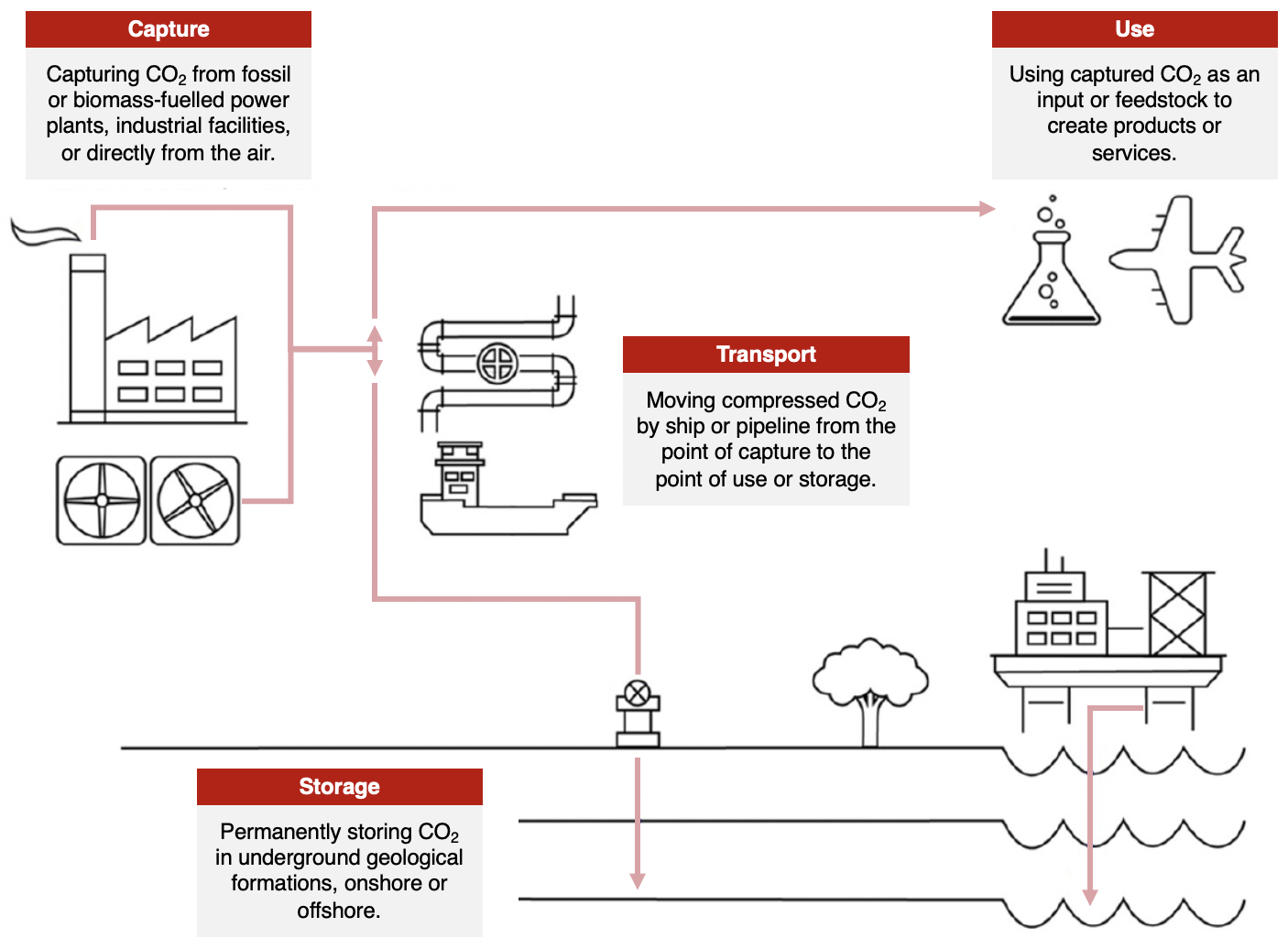
CCUS Technology and Its Applications in Japan
CCUS refers to several technologies that aim to capture CO2 before it’s emitted into the atmosphere or to capture it directly from the air, transport it and either permanently store it or use it to create products.
One strategic approach of the Basic Energy Plan is to keep using thermal generation, but decarbonize it by either adding hydrogen and ammonia to the fuel mix, or by using carbon capture at the power plants. METI’s Fifth Basic Energy Plan issued in July 2018, already emphasized the research and development of CO2 capture, as well as its effective utilization or storage, with a commercialization targeted for 2020.
Carbon recycling was included in the Green Growth Strategy in 2020. Those technologies are able to receive financial support from the Green Innovation Fund, which targets R&D projects for the capture and separation of CO2 from gas thermal power plants, starting from FY2022 and until at least FY2030.
CCUS is seen as a natural option for oil and gas companies, and INPEX, JAPEX and ENEOS in Japan have incorporated it into their growth strategies. They’d like to use the technology to reduce both Scope 1 and 3 emissions, applying it to upstream and downstream assets and also offering it to industrial clients that burn their oil and gas.
Leading industries are especially keen on CCUS. Taiheiyo Cement Corp. is conducting R&D to apply CCUS to production. Meanwhile engineering and construction companies Shimizu Corp., Chiyoda Corp. and Taisei Corp. would like to offer the technology to customers.
According to a report by the Yano Research Institute in 2021, the Japanese CCUS and carbon recycling market is worth about ¥2 billion, and is expected to grow to ¥160 billion in 2030 and ¥480 billion by 2050.
The Hurdles to CCUS Deployment in Japan
CCUS technology is still in its infancy and Japan doesn’t yet have any such large-scale project. Oil and gas companies, such as INPEX and JAPEX, are considering integrated CCUS projects – with CO2 captured from upstream activities before being transported and stored in depleted oil and gas fields, or used in methanation, for example.
Despite having pledged net carbon neutrality for Scope 1 and 2 emissions by 2050, and announcing CCUS as a strategic pillar to achieve this, the two companies have yet to provide any technological/cost roadmap.
The question of CCUS’s cost is rarely discussed by industrial players. However, an advisor from INPEX said that future CCUS activities at its offshore Ichthys gas field would only make financial sense with CO2 priced at $40/ ton or above. The project is planned for the late 2020s. METI published some CCUS cost estimates for thermal power plants, which it says will add ¥7 to ¥9/ kWh for coal plants and ¥3 to ¥4/ kWh for gas plants.
CO2 storage capacity is another possible limitation for CCUS in Japan. The Global CCS Institute estimated in 2019 that Japan’s storage capacity was about 14,000 million tons, while annual CO2 emissions are ~1,100 million tons per year. The development of carbon recycling technologies is therefore high on METI’s roadmap.
METI views CCUS as essential to reach the 2050 net carbon neutrality target, but there are several hurdles, in particular the costs of CAPEX, along with OPEX and associated energy consumption. There’s also the issue of CO2 transport and storage.
Support from METI focuses on developing low-cost CO2 separation and capture and transportation methods by vessels for liquified CO2. Those technologies necessary for CO2 separation, capture & storage should be ready by 2030 and deployed by 2040.
As for CO2 recycling, METI only published a crude roadmap for development of the necessary technologies in the 2020s, as well as cost reduction in the 2030s and full adoption in chemicals production, methanation and concrete production after 2040.
Current Projects and Players
While there’s no commercial CCUS application in Japan so far, several pilot projects are operational. With METI’s support, Kansai Power, Kawasaki Heavy Industry and the Research Institute of Innovative Technology for the Earth are running a CCS demonstration project at the Maizaru thermal power plant using solid absorbent.
A storage project by Japan CCS K.K. has been running since FY2012 in Tomakomai, Hokkaido. It stored 300,000 tons of CO2 under high pressure in the harbor’s seabed. Construction was completed in 2015 and storage in 2019. Since then, it has been in the monitoring phase.
Hitachi Zosen, with Ministry of Environment financing, has a methanation project using green hydrogen and CO2 captured from a waste incinerator. Sekisui Chemical is conducting a similar project, also subsidized by the MoE, producing syngas from green hydrogen and CO2 captured from a waste incinerator. Kawasaki Heavy Industry is working on a solid absorbent material to capture CO2 from low CO2 concentration gases with a low energy process.
In addition, a consortium of 18 industrial and academic entities was created to develop and implement CCS technologies in Japan. Members include Toshiba, Chiyoda, Mitsubishi Material, Taisei Corp., INPEX, Mizuho and the University of Tokyo.
Looking Ahead
METI sees CCUS as a cornerstone of its decarbonization strategy, and is both supporting the development of associated technologies and putting together a framework for their development and commercialization.
Several Japanese industrial players are also betting on the potential of CCUS and are participating in internal R&D or joining pilot projects, with the goal of reducing their own carbon emissions and/or commercializing their CCUS solutions. However, as of today, it’s difficult to separate the hype from the technology’s genuine realities.
Detailed technological and cost roadmaps have yet to be published and it’s still not obvious whether the technology will have a major impact on emissions reduction in Japan. Even more, it’s also far from clear if it’ll allow Japan to continue burning coal and gas in the coming decades. Something that the country certainly would like to do, given the challenges it’s facing in expanding its renewable energy sector.
GLOBAL VIEW
BY JOHN VAROLI
Below are some of last week’s most important international energy developments monitored by the Japan NRG team because of their potential to impact energy supply and demand, as well as prices. We see the following as relevant to Japanese and international energy investors.
China/ Energy financing
In a first, the China Development Bank and the Export-Import Bank of China didn’t make a single overseas energy finance deal in 2021. In the past 20 years, these two main trade policy banks have loaned a total of $234 billion to foreign governments and the global energy sector.
Europe/ Tidal energy
A total of €70 million was invested in 2021 to build 2.2 MW of tidal stream capacity, compared to just 260 kW in 2020; also, 681 kW of wave energy was installed in 2021, a 300% YoY increase. Europe now has 11.5 MW of tidal stream capacity, and 1.4 MW of wave energy.
Finland/ Nuclear power
The 1.6 GW Olkiluoto nuclear reactor 3 came online, nearly 12 years behind schedule. It is Finland’s first new nuclear plant in four decades and Europe’s first in 15 years. Costs ballooned from the originally estimated €3 billion ($3.27 billion) to around €11 billion.
France/ Nuclear power
EDF expects a €26 billion hit in 2022, in stark contrast to a 2021 profit of €18 billion. EDF has been forced to sell its nuclear power to distributors at a capped price. Also, the company faces outages at several reactors in France due to pipe issues. Energy production decreases could lead to losses of €16 billion, while price regulatory measures might lead to losses of €10 billion.
India/ Net-zero
Mumbai plans to reach net-zero by 2050, far ahead of India’s national goal of 2070. It’ll be South Asia’s first city with such a goal. Mumbai, which is India’s largest city and home to 19 million residents, is the country’s financial centre and where many leading national and international corporations have headquarters.
Portugal/ Wind power
In summer, the first auction for floating offshore farms will be held. Once completed, they’re expected to produce as much as 4 GW starting in 2026. Last year, Portugal closed both of its coal-fired power plants. The country currently has 7.3 GW of hydropower and 5.6 GW of onshore wind, accounting for 83% of total power generation capacity.
Russia/ Fossil fuels
The three biggest western oilfield service companies — Schlumberger, Baker Hughes and Halliburton — will remain in Russia, where they conduct billions of dollars’ worth of business. The three companies are partners of state-controlled Rosneft and Gazprom.
Sweden/ Wind power
Wind power generation will increase 70% by 2024, over 2021 levels, rising from a total output of 27.4 TWh in 2021 to 46.9 TWh in 2024. In 2021, Sweden installed 2.1 GW of new wind power capacity. Hydropower and nuclear energy remain the country’s two largest sources of electricity generation.
U.S. / Coal financing
Goldman Sachs was criticized for a $150 million loan to Peabody Energy, the world’s biggest private sector coal producer. In 2019, Goldman said it would curb fossil fuel financing, then considered the strongest pledge adopted by any major U.S financial institution.
U.S. / Coal power
The Environmental Protection Agency unveiled an air pollution law that could lead to the closure of about 18 GW of coal-fired power plants by 2030. The proposed rule would require upwind states to curb emissions of pollutants that inhibit downwind states’ from complying with the National Ambient Air Quality Standards.
UK/ Nuclear power
The operation of the Sizewell B nuclear power plant might be extended from 2035 to 2055. French owner and operator, EDF, will make a final decision in 2024. But any decision must be ratified by the government. In wake of the Ukraine crisis, the British PM is drawing up a new “energy supply strategy” to be published next week.
2022 EVENTS CALENDAR
A selection of domestic and international events we believe will have an impact on Japanese energy
| January | OPEC quarterly meeting;
JCCP Petroleum Conference – Tokyo; EU Taxonomy Climate Delegated Act activates; Regional Comprehensive Economic Partnership (RCEP) Trade Agreement that includes ASEAN countries, China and Japan activates; Indonesia to temporarily ban coal exports for one month; Regional bloc developments: Cambodia assumes presidency of ASEAN; Thailand assumes presidency of APEC; Germany assumes presidency of G7; France assumes presidency of EU; Indonesia assumes presidency of G20; and Senegal assumes presidency of African Union; Japan-U.S. two-plus-two meeting; Japan’s parliament convenes on Jan. 17 for 150 days; Prime Minister Kishida visits Australia (tentative) |
| February | Chinese New Year (Jan. 31 to Feb. 6);
Beijing Winter Olympics; South Korea joins RCEP trade agreement |
| March | Renewable Energy Institute annual conference;
Smart Energy Week – Tokyo; Japan Atomic Industrial Forum annual conference – Tokyo; World Hydrogen Summit – Netherlands; EU New strategy on international energy engagement published; End of 2021/22 Japanese Fiscal Year; South Korean presidential election |
| April | Japan Energy Summit – Tokyo;
MARPOL Convention on Emissions reductions for containerships and LNG carriers activates; Japan Feed-in-Premium system commences as Energy Resilience Act takes effect; Launch of Prime Section of Japan Stock Exchange with TFCD climate reporting requirement; Convention on Biological Diversity Conference for post-2020 biodiversity framework – China; Elections: French presidential election; Hungarian general election |
| May | World Natural Gas Conference WCG2022 – South Korea;
Elections: Australian general election; Philippines general and presidential elections |
| June | Happo-Noshiro offshore wind project auction closes;
Annual IEA Global Conference on Energy Efficiency – Denmark; UNEP Environment Day, Environment Ministers Meeting – Sweden; G7 meeting – Germany |
| July | Japan to finalize economic security policies as part of natl. security strategy review;
China connects to grid 2nd 200 MW SMR at Shidao Bay Nuclear Plant, Shandong; Czech Republic assumes presidency of EU; Elections: Japan’s Upper House Elections; Indian presidential election |
| August | Japan: Africa (TICAD 8) Summit – Tunisia;
Kenyan general election |
| September | IPCC to release Assessment and Synthesis Report;
Clean Energy Ministerial and the Mission Innovation Summit – Pittsburg, U.S.; Japan LNG Producer/Consumer Conference – Tokyo; IMF/World Bank annual meetings – Washington; Annual UN General Assembly meetings; METI to set safety standards for ammonia and hydrogen-fired power plants; End of 1H FY2022 Fiscal Year in Japan; Swedish general election |
| October | EU Review of CO2 emission standards for heavy-duty vehicles published;
Chinese Communist Party 20th quinquennial National Party Congress; G20 Meeting – Bali, Indonesia; Innovation for Cool Earth TCFD & Annual Forums – Tokyo; Elections: Okinawa gubernational election; Brazilian presidential election; |
| November | COP27 – Egypt;
U.S. mid-term elections; Soccer World Cup – Qatar; |
| December | Germany to eliminate nuclear power from energy mix;
Happo-Noshiro offshore wind project auction result released; Japan submits revised 2030 CO2 reduction goal following Glasgow’s COP26; Japan-Canada Annual Energy Forum (tentative); Tesla expected to achieve 1.3 million EV deliveries for full year 2022 |
Disclaimer
This communication has been prepared for information purposes only, is confidential and may be legally privileged. This is a subscription-only service and is directed at those who have expressly asked K.K. Yuri Group or one of its representatives to be added to the mailing list. This document may not be onwardly circulated or reproduced without prior written consent from Yuri Group, which retains all copyright to the content of this report.
Yuri Group is not registered as an investment advisor in any jurisdiction. Our research and all the content express our opinions, which are generally based on available public information, field studies and own analysis. Content is limited to general comment upon general political, economic and market issues, asset classes and types of investments. The report and all of its content does not constitute a recommendation or solicitation to buy, sell, subscribe for or underwrite any product or physical commodity, or a financial instrument.
The information contained in this report is obtained from sources believed to be reliable and in good faith. No representation or warranty is made that it is accurate or complete. Opinions and views expressed are subject to change without notice, as are prices and availability, which are indicative only. There is no obligation to notify recipients of any changes to this data or to do so in the future. No responsibility is accepted for the use of or reliance on the information provided. In no circumstances will Yuri Group be liable for any indirect or direct loss, or consequential loss or damages arising from the use of, any inability to use, or any inaccuracy in the information.
K.K. Yuri Group: Oonoya Building 8F, Yotsuya 1-18, Shinjuku-ku, Tokyo, Japan, 160-0004.