PM Kishida to announce subsidy system for electricity bills to protect vulnerable consumers from rising prices
Two coastal areas added as potential offshore wind development zones as government seeks to revive momentum in the sector
Japan’s first nationwide carbon credit trading begins with 145 participants joining the system’s initial trial period
ENERGY TRANSITION & POLICY
Governor seeks to create new tax for solar project in forest areas
ASEAN banks agree on green financing approach at Tokyo forum
Ministry to finance development of biodegradable plastic wrap
METI backs gene edits to create biotech-based carbon recycling
Eurus Energy among firms awarded carbon credits under JCM
Hitachi-led group to seek proof of practical use for hydrogen
Orix looks to corner a third of the nation’s EV charger market
Toshiba develops transparent solar cell that mounts on car roof
Steelmaker group successfully tests low-emissions concrete
ELECTRICITY MARKETS
Mitsubishi gives details on Akita offshore wind project schedules
TEPCO calls on commercial subscribers to further reduce power
TEPCO’s retail arm bailed out for now; potential acquirers lurking
MHI and Hitachi both plan to develop new nuclear reactors
Lawmakers tour NPPs looking for sites to build new nuclear units
NGK Insulators and Ricoh partner in virtual power plant business
Group to convert environmental value of renewables into credits
Ministry reviews which ports can service offshore wind projects
OIL, GAS & MINING
Mitsubishi to construct major blue ammonia facility in the U.S.
Malaysia agrees to let Japan access LNG stocks in time of crisis
INPEX considers expanding Abadi LNG project with hydrogen
Idemitsu becomes anchor investor in vanadium miner’s IPO
ANALYSIS
FROM COAL AND GAS TO EVS AND NET-ZERO: JAPAN UPDATES ENERGY TIES WITH INDONESIA
One of Japan’s closest economic partners, especially in the energy sector, is Indonesia. The resource-rich, emerging Southeast Asian economy has long been a key supplier of coal and gas. Now these ties are being upgraded for the era of net-zero. Next month, Indonesia will become the first nation alongside Japan to endorse the Asian Zero Emissions Community initiative. Jakarta will be given the rank of co-initiator, with the move due to be announced at the G20 to take place in Bali. In terms of policy, this supports Japan’s ambition to corral an Asia-led energy transition that fine-tunes decarbonization roadmaps based on local conditions.
AS JAPAN PREPARES FOR BATTERY POWER TRADE, HOKKAIDO TURNS HOTSPOT FOR NEW UNITS
Japan’s power market will get a boost from a recent law change that elevates the status of storage batteries connected to the grid to a power generation business. This could spur major change to the power system, both in terms of the technical potential and for business models. More battery installations should allow for a better balancing of the rising electricity volume from variable energy sources such as solar and wind. It also should breathe life into several subcategories of the electricity market, as battery operators seek ways to turn a profit.
GLOBAL VIEW
Europe faces environmental disaster from Nord Stream gas pipeline leaks, scientists say. EDF to consider delay to UK nuclear reactor closures. GE wins major India order for wind turbines. Shell makes first renewables investment in Nigeria. Russia strikes fuel deal with the Taliban. German businesses face gas shortages. Details on these and more in our global wrap.
JAPAN NRG WEEKLY
PUBLISHER K. K. Yuri Group
Editorial Team Yuriy Humber (Editor-in-Chief) John Varoli (Senior Editor, Americas) Mayumi Watanabe (Japan) Yoshihisa Ohno (Japan) Wilfried Goossens (Events, global)
METI The Ministry of Energy, Trade and Industry
MOE Ministry of Environment
ANRE Agency for Natural Resources and Energy
NEDO New Energy and Industrial Technology Development Organization
TEPCO Tokyo Electric Power Company
KEPCO Kansai Electric Power Company
EPCO Electric Power Company
JCC Japan Crude Cocktail
JKM Japan Korea Market, the Platt’s LNG benchmark
CCUS Carbon Capture, Utilization and Storage
mmbtu Million British Thermal Units
mb/d Million barrels per day
mtoe Million Tons of Oil Equivalent
kWh Kilowatt hours (electricity generation volume)
NEWS: ENERGY TRANSITION & POLICY
Japan government hosts “Tokyo GX Week”
(Japan NRG, Sept. 26)
METI is holding “Tokyo GX Week”, a series of international conferences on energy and the environment. These stretch across a range of industries.
Ministers and world leaders are among the conference attendees with the goal of working towards GX (Green Transformation).
Tokyo GX Week is comprised of the following:
(1) Second Asia Green Growth Partnership Ministerial Meeting, Sept 26
(2) Fourth International Conference on Carbon Recycling, Sept 26
(3) Fifth Hydrogen Energy Ministerial Meeting, Sept 26
(4) Second International Conference on Fuel Ammonia, Sept 28
(10) First Global Green Transformation Conference (GGX), Oct 7
CONTEXT: Tokyo GX Week” was previously called “Tokyo Beyond Zero”. It was part of the “Beyond Zero” carbon neutrality policy of former PM Suga.
Kishida to announce electricity subsidy
(Nikkei, Sept. 28)
PM Kishida will announce a new subsidy to reduce power bills when he addresses the Diet on Oct 3. While the amount is not yet known, an across-the-board subsidy of 10% would cost the govt about ¥1.4 trillion annually.
With no end in sight for the weak yen or high energy prices, policymakers must debate an exit strategy that will eventually scrap the subsidy.
The govt’s gasoline subsidy, now at ¥35/ liter, will cost ¥3.2 trillion by year’s end.
PM Kishida plans a new system to protect vulnerable consumers from the impact of power rate hikes, expected to rise 20-30% next spring.
He ordered ministries to come up with a system by the end of October.
TAKEAWAY: Some METI advisors warn that the government needs to communicate with consumers about the need to share energy security costs rather than easing the impact of power rate hikes.
Japan Exchange began carbon offset credit trades that saw 145 GX League companies participate. The trades will be on a trial basis until January 2023, before moving to a formal launch.
In the trial phase, eight J-Credit types, three J-Ver (compliance credits prior to J-Credit), six regional credits and voluntary credits earned by GX League members will trade, conducted in Yen/ton of carbon.
There will be two sessions: the morning session closes at 11:29 local time, and the afternoon session closes at 14:29.
On Sept 22, the turnover was 627 trades, mostly J-Credit for renewables, closing at ¥3,300/ ton. J-Credit for energy conservation closed at ¥1,600/ ton. The Sept 26 turnover was 10 trades, and J-Credit for renewables closed at ¥3,300/ ton.
The reference price of voluntary credits was set at ¥1,600/ ton.
TAKEAWAY: Trades were launched while unresolved issues, such as verifying voluntary credits, remain on the back burner. The soft launch strengthened the market’s impression that METI is desperate for a number that could be called a carbon price and is willing to let the details work themselves out later.
On the day before the soft launch on Sept. 21, the Federation of Thai Industries also launched exchange-based carbon trades.
Carbon trading during first week
Date
Lots traded
Sept. 22
627
26
10
27
40
28
1
29
120
Governor looks to introduce new tax on renewables projects in hilly and woody areas
(RIEF, Sept. 29)
Local media reports that Miyagi Prefecture Governor Murai Yoshihiro has announced plans to introduce a tax on the construction of renewable energy facilities such as solar farms that lead to forest clearing.
The governor reasoned that this would encourage solar farm creation on flat land by making forest clearing, which often occurs in hilly areas, uneconomic. Cutting down trees can increase the risk of landslides.
Miyagi aims to introduce the levy, which will be a non-statutory general tax, after April 2024.
CONTEXT: Miyagi would become the first prefecture to introduce such an ordinance, the details of which have yet to be designed.
TAKEAWAY: As Japan NRG reported at the start of the year, there are a number of localities seeking to extract new taxation on solar and other renewable energy projects, citing increased local government resources required to both service the developments and liaise with the local population. It’s possible that municipalities are also looking at new ways to raise revenue and solar farms have been one of the few large growth areas in the last ten years or so.
ASEAN green finance forum has banks set guidelines
(Asia Nikkei, Sept. 27)
CONTEXT: On Sept 2, Japan hosted the 2nd Asia Green Growth Partnership Ministerial Meeting (AGGPM) organized by METI to discuss green transition and financing strategies for Japan and Southeast Asia.
Japan’s top financial group, MUFG, and other Asian lenders agreed to deem projects eligible for green financing.
Other banks include Sumitomo Mitsui Banking, Mizuho Bank, Citibank and Southeast Asian lenders Bank Mandiri and Maybank.
In cases when a country has yet to publish an official decarbonization framework, banks will refer to the clean technologies set out by the Economic Research Institute for ASEAN and East Asia. These include gas-fired thermal plants that reuse waste heat and the co-firing of fossil fuels with hydrogen or ammonia.
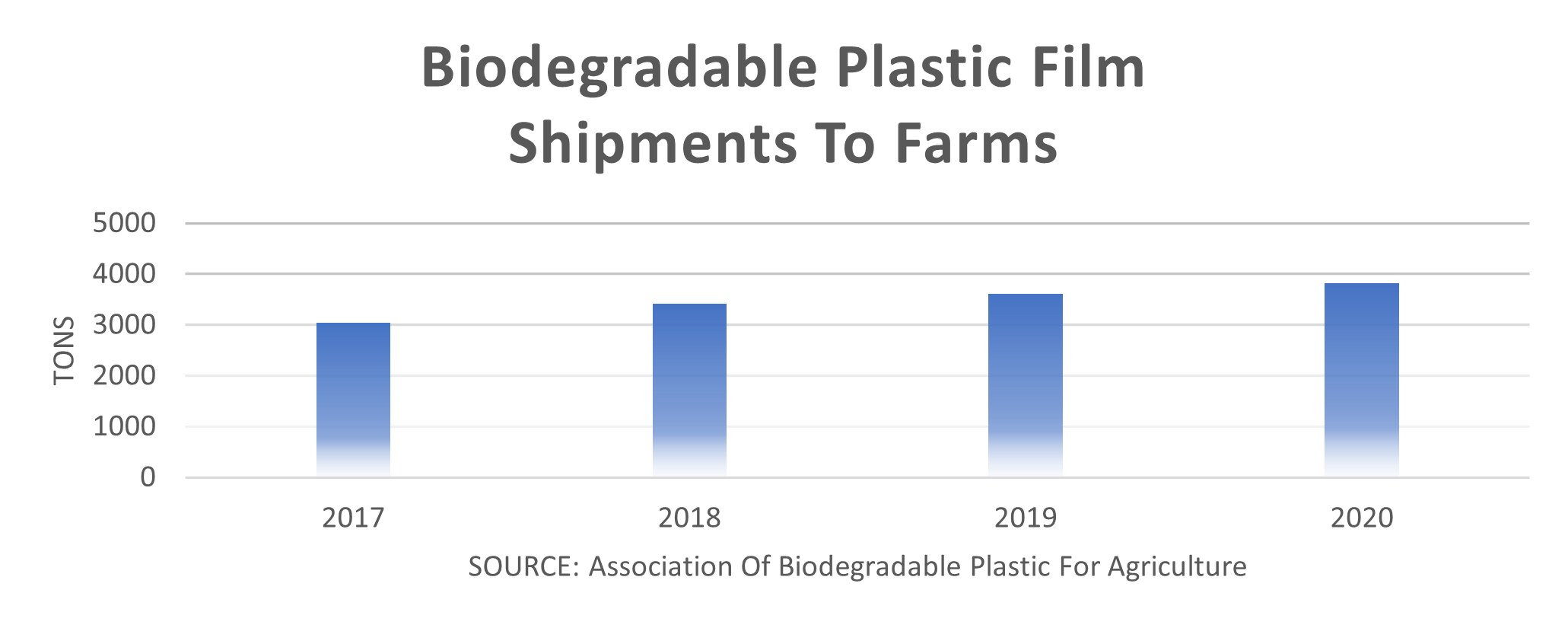
As part of efforts to promote plastic recycling for carbon neutrality, the MoE will support Konno Ltd in developing biodegradable plastic wrap with higher biomass content.
Konno manufacturers biodegradable wrap spread on farm lands to prevent weeds, conserve soil moisture and during winter, heat. The ministry will finance up to 50% of expenses required to increase the share of biomass in the wrap feedstock.
The ministry will also support Sekisui Chemical in the reuse of scrapped car window glass, and Tachiura Fishery Cooperative for recycling PET fishing nets.
CONTEXT: Biodegradable plastic wrap accounts for 10-20% of the total used by farms. They cost more than those made of polyolefin, but users have increased notably in the Kanto region as it saves labor. Plastic wrap must be removed after each harvest as torn pieces degrade soil quality. Manufacturer focus has been on developing wrap with multiple uses to increase crop production amid climate change, rather than as solutions to reduce the carbon footprint.
METI will back gene engineering technologies to develop carbon recycling processes using microorganisms. It plans a budget of ¥177 billion over 2022-2030 to fund universities and businesses to build technology platforms, develop new breeds of microorganisms able to capture carbon in the air, and establish manufacturing processes for products potentially replacing plastics.
METI aims to shorten development time to 1/10 that of today by using AI and robotics, and hopes for commercialization of breakthrough biotech products as early as 2035.
The biotech-driven carbon recycling market could grow to almost ¥200 billion by 2050, said the National Institute of Advanced Industrial Science and Technology.
Biotech-driven carbon recycling potentials
Global GHG reductions
Global market size
2040
1.35 billion tons/ year
¥65.4 trillion/ year
2050
4.21 billion tons/ year
¥199.4 trillion/ year
Source: AIST
TAKEAWAY: METI will either need an exit strategy from the Cartagena Protocol, or ways to develop the biotech sector within its framework. Japan endorses the Cartagena Protocol on biosafety and biodiversity. The biomass operators under the Feed-in-Tariff system are required to prove they’re not using unauthorized genetically modified crops.
Technology advocates claim that microorganism-assisted bio products do not conflict with food supply chains. But in a bid to protect local biodiversity, Japan has been strictly banning growth of foreign-origin algae. There may be new conflicts between energy producers and environmental conservationists.
Orix to establish large nationwide EV charging station chain by mid-decade
(Company statement, Sept. 27)
The ORIX leasing and financial group invests in Ubiden Inc., operator of charging stations and hubs under the “WeCharge” brand.
ORIX plans to introduce the WeCharge service at its hotels, condominiums, car parks, and logistics facilities.
Eventually, Orix plans to install 50,000 charging stations by 2025 together with Ubiden, which would make it the country’s largest provider of the service.
CONTEXT: Japan plans to have 150,000 charging spots for EVs by 2030.
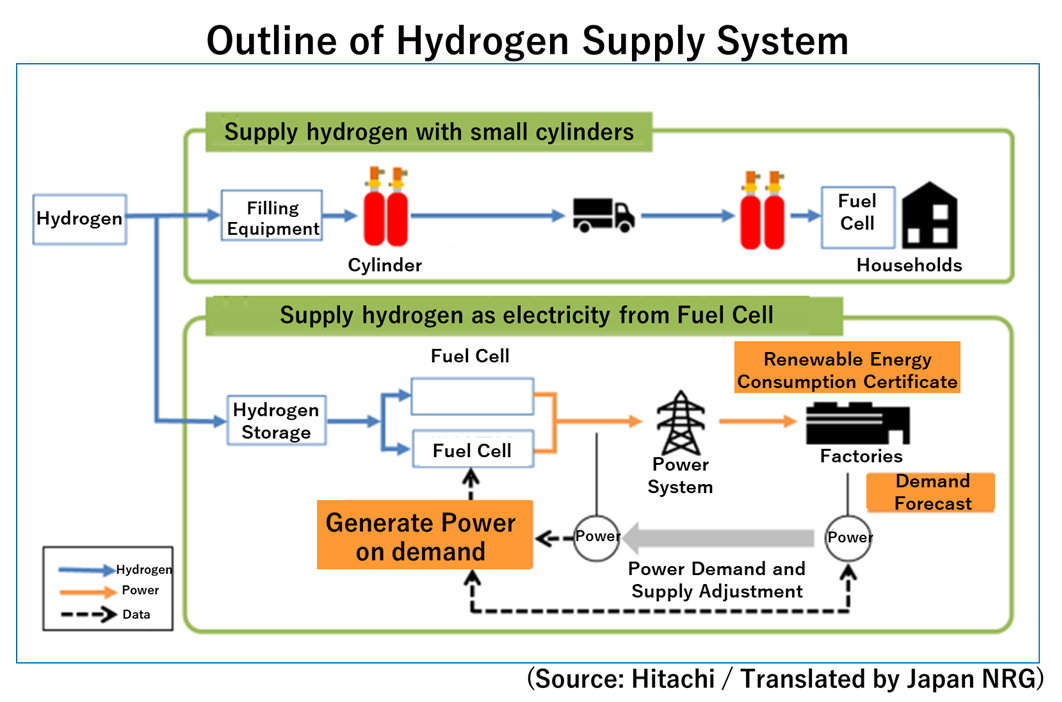
Hitachi began to build a demo system of hydrogen energy at Namie Town, Fukushima Prefecture. In July 2021, Hitachi, Namie Town, Panasonic, Marubeni and Miyagi inked a collaboration.
In mass transport, hydrogen will be used in fuel cells. For households, hydrogen will be delivered in cylinders. For industry, electricity generated by fuel cells will be utilized by factories.
Hitachi will design and manage the project; Panasonic will supply the fuel cells.
TAKEAWAY: After the Fukushima Disaster, about 21,000 residents of Namie Town were forced to leave. Some returned after the evacuation directive was partly lifted in March 2017. METI is trying to create non-fossil fuel business projects in this area.
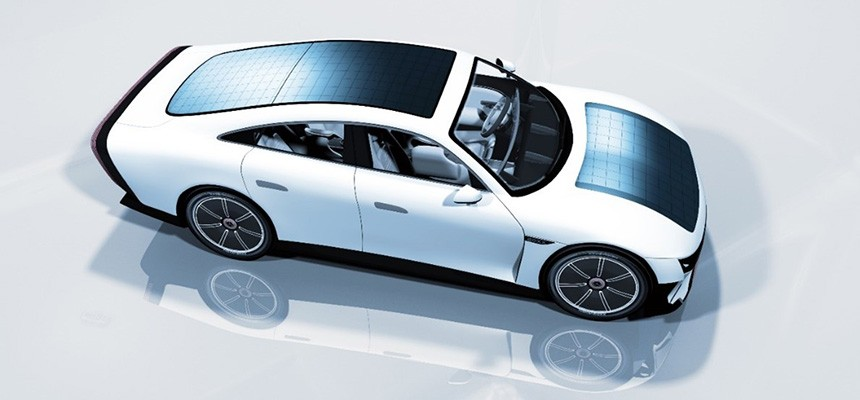
Toshiba Boosts Transparent Solar Cell
(Company statement, Sept. 27)
Toshiba developed an efficient, low cost, reliable tandem solar cell that increases panel output by layering a transparent solar cell over a standard silicon cell.
Researchers report making a transparent cuprous oxide (Cu2O) solar cell with a conversion efficiency (PCE) of 9.5%, the highest achieved (*1).
The new cell is expected to boost development of EVs that don’t require plug-in charging, and to advance other mobility applications, such as high-altitude platform stations, and telecom platforms in the stratosphere.
Toshiba is committed to developing highly efficient and reliable low-cost tandem solar cells that can be mounted on vehicles and trains.
Car equipped with Toshiba transparent cuprous oxide (Cu2O) solar cell
JFE Steel-led group successfully tests concrete that cuts CO2 emissions
(Kankyo Business, Sept. 26)
JFE Steel Corp, in collaboration with Nishimatsu Corp, Tohoku University, and four other companies, announced success in testing concrete products made from alkaline activated material (AAM) that can reduce CO2 emissions during production by about 75% compared to conventional concrete.
CONTEXT: AAM is a low-carbon concrete that does not use ordinary cement. AAM has high viscosity and a tendency to harden easily when mixed, making it difficult to use. However, researchers led by JFE Steel developed a unique AAM solution that has stable fluidity and improved resistance to frost damage.
SIDE DEVELOPMENT: Taiheiyo develops CO2-absorbing cement material (Company statement, Sept. 20)
Taiheiyo Cement developed CARBOFIX(R) Cement, a CO2 absorbing and hardening cement material. It emits less CO2 during manufacturing and hardens via a chemical reaction with CO2 to develop additional strength.
Carbofix contains an aluminate phase with one of the constituent minerals of Portland cement (i.e. regular cement).
The new material has a lower calcium oxide (CaO) content and the clinker is calcined at lower temperatures, cutting CO2 emissions during manufacturing.
Sumitomo Mitsui Trust says Japan puts too much faith into ammonia
(Denki Shimbun, Sept. 28)
Sumitomo Mitsui Trust Bank issued a report to warn the government and businesses not to depend too strongly on ammonia-firing technology. Japan is the main proponent of this approach among the G7 countries.
Global production of ammonia in 2020 was around 185 million tons; half of it in Asia. Now, 80% of ammonia is used for fertilizer, and the rest is for medicine and refrigeration. Almost none was used for power generation.
For Japan to consider ammonia as a major power source, it needs to tackle great challenges such as securing supply chains and reducing the cost.
Denso unveils CO2 recycling system
(Monoist, Sept. 20)
Denso unveiled a system that captures and purifies CO2 given off by an aluminum melting furnace.
The system combines the CO2 with hydrogen to produce methane, then reuse it.
While the system only recovers 8 metric tons of CO2 per year, Daiso plans to install more small-capacity recovery units across other operations.
Tohoku Electric in CO2 capture study
(Nikkei, Sept. 26)
Mitsubishi Gas Chemical, Tohoku Electric, and the Nomura Research Institute began a feasibility study for CO2 recovery at thermal power stations in Niigata.
It will study the cost of capturing CO2 and transporting it to the Higashi-Niigata oil and gas well for storage.
CONTEXT: The project is funded by JOGMEC, which aims to build a chain of capture, store and supply CO2 at East Niigata Port.
Toshiba joins with Accenture for GX consulting
(Denki Shimbun, Sept. 28)
Toshiba will work with Accenture to build a comprehensive GX consulting business to help clients with carbon neutral goals. Their new service will include target setting, building roadmaps, selection / installation / operation and maintenance of related systems and equipment.
The two companies will launch the service in October.
The coast of Kujukuri in Chiba Prefecture was added to the list of promising offshore wind promotion zones, which is a rank below promotion zones.
The east coast of Toyama prefecture was added to preparatory zones.
TAKEAWAY: With the public tender process under reconfiguration and new auctions on hold until the new rules are set, the government is seeking to at least breathe some life into the sector by including more zones as eligible for development in the future.
Mitsubishi gives details on Akita offshore wind project schedule
(New Energy Business News, Sept. 29)
Mitsubishi Corp-led Akita Yurihonjo Offshore Wind LLC, which won the tender to develop offshore wind power off the coast of Yurihonjo City, Akita Prefecture (north and south sides), said at a meeting that construction of the onshore portion will begin in March 2026, while offshore construction will only start in April 2029. The wind farm will begin in December 2030.
The 819 MW wind farm will generate approximately 2,600 GWh. It will use Akita Port for construction, and Honjo Port for operation and maintenance. Grid connection will be with the Kawabe substation, part of Tohoku Electric Power Network.
GE will manufacture and deliver the wind turbines, and Toshiba Energy Systems will assemble them. Kajima Corporation and Van Oord of the Netherlands will be in charge of offshore construction. The onshore work will be ordered from C-Tech, with Sumitomo Electric Industries and Furukawa Electric in charge of the manufacture and delivery of transmission equipment, and Toshiba ESS and Mitsubishi Electric in charge of the manufacture of substation equipment.
GE will be responsible for maintenance of the wind turbines during the operation period. Hokuto will be in charge of the offshore operations and maintenance, NYK will own and manage the vessels, and Seatec will manage the onshore systems.
SIDE DEVELOPMENT:
Mitsubishi gives details on second Akita offshore wind project
(New Energy Business News, Sept. 30)
Mitsubishi Corp-led Akita Noshiro-Mitane-Oga Offshore Wind LLC, which won the public tender to develop offshore wind power near Noshiro City, Mitane Town, and Oga City, Akita Prefecture, revealed details of the project schedule. Construction of the onshore portion will begin in March 2026, with offshore construction starting in June 2027 and operations in December 2028.
The 478.8 MW project will generate approximately 1,400 GWh. The Port of Noshiro will be used for construction, operation, and maintenance. Grid connection will be made to Tohoku Electric’s Noshiro substation.
The project structure is generally the same as the offshore Yurihonjo-shi project (above).
TEPCO calls on commercial subscribers to further reduce demand
(Nikkei, Sept. 28)
TEPCO Holdings increased the demand reduction ceiling it will request from commercial subscribers at times of peak demand to over 500 MW.
METI projects TEPCO network’s January capacity will exceed demand by 4.1%, but a cold snap could make supply tighter.
Could TEPCO’s retail arm be on the chopping block?
(Diamond, Oct. 1)
By end of March, TEPCO’s retail arm TEPCO Energy Partner had a negative net worth; liabilities exceeded assets by ¥6.7 billion.
Thanks to aggressive marketing in recent years, the energy company is Japan’s largest electricity retailer in terms of kWh sold, which now works against the company as it can’t pass on increased fuel costs to subscribers. Energy Partner avoided insolvency thanks to a ¥200 billion bailout from its parent TEPCO Holdings.
ENEOS Holdings, Tokyo Gas, NTT, and Chubu Electric are among the companies rumored to be interested in buying Energy Partner.
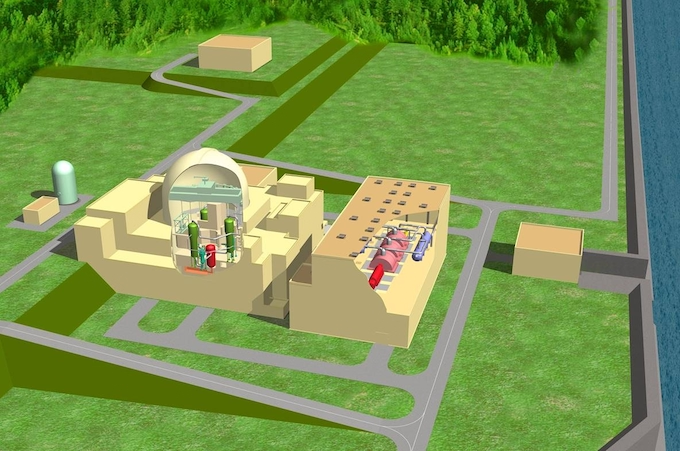
MHI to Develop Underground Nuclear Power Plant in the mid 2030s
(Nikkei, Sept 29)
By the mid 2030s, Mitsubishi Heavy Industries plans to develop a nuclear power plant “SRZ-1200” installed underground.
The project will be in partnership with Kansai, Hokkaido, Shikoku and Kyushu EPCOs. Those four power companies operate the PWR type nuclear reactors supplied by MHI.
Located underground, the “Innovative Light Water Reactor” would be more resilient to earthquakes, other natural disasters and terror attacks.
The reactor containment vessel will be 100 times safer than conventional reactors, by fortifying the outer wall. The power supply for the cooling system would also be underground.
Output will be about 1,200 MW. While conventional nuclear power plants are mostly operated at a steady output in Japan, this new reactor would be able to change output four times faster.
SIDE DEVELOPMENT: GE and Hitachi to develop new nuclear reactors (Asia Nikkei, Sept. 30)
Hitachi GE Nuclear Energy, a joint venture between Hitachi and General Electric (GE), will develop a new type of nuclear reactor called the “Innovative Light Water Reactor” with high safety standards.
The new design will be based on the AWR technology that was also used at the Fukushima station, but will incorporate new features that the prevent problems that occurred during the 2011 accident.
Commercialization is targeted for the mid-2030s. Hitachi-GE Nuclear Energy seeks to offer new units to plants that use boiling-water reactors.
TAKEAWAY: Japan tends to be overconfident in domestic technology, which puts a question mark over some of the roadmap dates being proposed. There are also a high number of new designs now under proposal. Not all of them will be able to go ahead, so there will be a degree of competition between vendors.
MHI’s “Innovative Light Water Reactor”
Source: MHI
LDP Diet members visit Mihama and Tsuruga NPPs
(Denki Shimbun, Sept. 26)
10 Diet members from the ruling Liberal Democratic Party that are part of a parliamentary group that promotes the replacement of older reactors with new technology, visited the Mihama (Kansai Electric) and Tsuruga (Japan Atomic) nuclear power plants on Sept 21 and 22.
The group, established in April 2021, plans to make recommendations to the govt. by the end of 2022. However, the group’s chair, Inada Tomomi, has yet to name the sites where new nuclear construction should take place.
Inada also stressed that the group plans to ask the govt to clarify its position on replacement and new reactor construction. The group will also soon visit the Sendai NPP (Kyushu Electric).
TAKEAWAY: Public sentiment towards nuclear power is warming. A recent Nikkei poll of 100 presidents of major companies in Japan revealed that 60% believe new nuclear units should be built with over 70% of the respondents claiming that power constraints were having an impact on their business.
The question is, then, where would any new reactors be built in Japan? The similarities between older technology and new developments touted by Mitsubishi Heavy Industries suggest new units could be added at the Mihama NPP.
Tsuruga may also be an option. In March 2004, Japan Atomic applied to the industry regulator to build 1,538 MW of capacity at Units 3 and 4 of Tsuruga NPP. The plan was to install Advanced Pressurized Water Reactor (APWR) technology supplied by MHI. Site renovation work in preparation for the new build was completed in 2009, but the regulator’s review stopped in the wake of the Fukushima disaster.
NGK Insulators and Ricoh will establish a virtual power plant in February, combining NGK’s storage batteries and Ricoh’s renewable tracking system.
CONTEXT: NGK is a manufacturer of sodium sulfide (NAS) storage batteries and evolving as regional power suppliers, setting up power operators in Chubu and Hokkaido areas.
TAKEAWAY: NAS batteries do not use critical resources, allowing NGK to expand downstream. Lithium-ion and vanadium redox flow storage batteries use critical raw materials, driving players to invest upstream.
Group to convert environmental value of renewables into tradable credit
(Kankyo Business, Sept. 22)
Ricoh, IHI, and NGK Insulators, together with Ena City in Gifu Prefecture, will start a demo to package the “environmental value” derived from renewable energy generation as a credit that can be sold to third parties.
The group has helped form a new regional electric power company, Ena Denryoku, which will carry out the demo. There are a number of renewable energy generation assets in Ena City.
The ‘green value’ packaged as credits will be used locally with the goal of helping to expand the rollout of renewable energy.
Tokyo Gas and partners form new solar management company
(Kankyo Business, Sept. 22)
Tokyo Gas Engineering Solutions, Kyocera Communication Systems, and Century Tokyo established a JV, A&Tm Corp, to provide one-stop asset management services and technical management for PV generation assets. The business will seek to improve the profitability of PV facilities.
The new company will launch businesses, such as the use of storage batteries.
Century Tokyo will take a 51% stake, with Tokyo Gas 39%, and Kyocera the rest.
Ministry surveys ports to see which can service offshore wind
(New Energy Business News, Sept. 26)
The Ministry of Land, Infrastructure, Transport and Tourism surveyed 932 ports in order to determine bases for offshore wind power generation projects.
The ministry said 11 ports are interested to be base ports. They are: Wakkanai Port, Rumoi Port, Ishikari Bay New Port, Muroran Port (Hokkaido Prefecture), Aomori Port (Aomori Prefecture), Kuji Port (Iwate Prefecture), Niigata Port (Niigata Prefecture), Fukui Port (Fukui Prefecture), Omaezaki Port (Shizuoka Prefecture), and Imari Port (Saga Prefecture).
In addition, the ports of Noshiro (Akita Prefecture) and Kitakyushu (Fukuoka Prefecture), already designated as base ports, plan to expand to meet the demands of the offshore wind industry.
The survey didn’t indicate that the above ports will be certified by the government. Future designation will be based on the status of offshore wind generation projects.
Mitsui Oil and Chevron to partner on geothermal projects
(Company Statement, Sept. 26)
Mitsui Oil Exploration and Chevron New Energies International will explore the feasibility of new geothermal technologies in Japan. The two will examine potential geothermal resources and evaluate the effectiveness of Advanced Closed Loop technology (ACL technology).
They’ll also consider collaboration with overseas partners.
CONTEXT: ACL can be used deeper in the ground than conventional geothermal projects, which makes it applicable to a wider range of temperatures and geologies.
Mitsui to invest in Indonesian solar power company, Xurya
(Company Statement, Sept. 28)
Mitsui & Co. will acquire a stake in Xurya, the parent company of the Indonesian solar developer, PT Xurya Daya.
Since its founding in 2018, Xurya has developed distributed solar assets, and also does operation and maintenance services. Xurya has installed distributed solar assets for more than 70 SMEs and large companies, including Japanese companies.
Hitachi to make Hitachi Energy a wholly-owned subsidiary
(Company Statement, Sept. 30)
Hitachi agreed with ABB to acquire 19.9% of its shares in Hitachi Energy, to make the company a wholly owned subsidiary.
The acquisition price for the stake will be $1.679 billion and the deal will be completed by the end of the year, subject to regulatory approvals.
Osaka Gas led group to establish new off-site corporate PPA model
(New Energy Business News, Sept. 29)
Osaka Gas, GPSS Holdings, Tokyu, Tokyu Recreation, and Tokyu Power Supply will work together to establish an off-site corporate PPA model utilizing newly constructed small- and medium-sized solar power plants.
For this project, renewable energy power from the new small- and medium-sized solar power plants to be developed by Osaka Gas and GPSS will be used at large-scale complexes owned and developed by Tokyu and Tokyu Recreation. A 50-50 joint venture between Osaka Gas and GPSS will develop eight new non-FIT/non-FIP solar power plants with a total generation capacity of approximately 9 MW.
This initiative is subsidized by METI.
Kawasaki Kinkai plans a biomass power plant
(L News, Sept. 29
Major shipping company Kawasaki Kinkai is partnering with JAPEX, Shizuoka Gas & Power, Tokyo Energy & Systems, and Solariant Capital to build a biomass plant in Tahara (Aichi).
The 50 MW plant will burn imported wood pellets.
NEWS: OIL, GAS & MINING
Mitsubishi plans blue ammonia facilities in the U.S.
(Nikkei, Sept. 27)
Mitsubishi Corp wants to set up a 10-million ton/ year production facility for blue ammonia in Texas. It would be one of the world’s largest.
Production, which is based on natural gas, will start early in the next decade, with supply heading to Japan and other parts of Asia.
CONTEXT: During the ICFA conference in Tokyo on Sept. 28, the trading house signed a MoU with the Corpus Christi port authority for space to house the facility. Corpus Christi is America’s top energy export terminal.
Malaysia’s Petronas agrees to let Japan access LNG stocks in time of emergency
(Bloomberg, Nikkei, Sept. 27)
Japan signed an accord with Malaysian state oil company Petronas that will allow the nation to receive LNG in times of emergency. METI announced the deal at its LNG Producer-Consumer Conference.
The two sides will also consider future joint investments in gas exploration and production, and ways to cut CO2 emissions from projects.
CONTEXT: Japanese govt. has expanded the powers of state company JOGMEC to allow it to import LNG in bulk should domestic utilities be unable to do so.
CONTEXT: METI’s near-term interest is to secure LNG supplies, and in the longer term hydrogen, while Petronas is possibly exploring the potential of LNG-hydrogen combustion. Petronas signed a separate but a similar agreement with the Japan Bank of International Cooperation on Sept 27 and with JERA last year.
TAKEAWAY: Japan floated the idea of regional LNG hubs throughout Asia a couple of years ago and started to sign intergovernmental agreements around this framework. However, the initiative has clearly gained more momentum this year after international energy supplies were disruption by Russia’s invasion of Ukraine and the sanctions that came after it. How well this can work in practice for the LNG sector has yet to be tested.
INPEX expands MoU with Indonesia’s PLN from LNG to blue hydrogen
(Company Statement, Sept. 27)
INPEX extended an MoU with PT PLN (Persero) (PLN) over long-term LNG supply and expanded the accord to incorporate joint studies in hydrogen/ammonia and CCS in relation to the Abadi LNG Project. The MOU was signed at the Second Asia Green Growth Partnership Ministerial Meeting organized by METI.
INPEX and its partner in the project will study the potential to introduce CCS facilities and the option of blue hydrogen and ammonia from the Abadi gas. The fuels could then be used for co-firing thermal power plants in Indonesia that PLN owns.
JBIC to provide low-interest LNG finance
(Nikkei, Sept. 29)
Japan Bank for International Cooperation will provide low-interest loans to power and gas utilities to alleviate the costs of procuring LNG amid rising prices.
Nippon Export and Investment Insurance will insure lenders against default.
Idemitsu becomes anchor investor in IPO of vanadium miner
(Company Statement, Sept. 27)
Oil refining major Idemitsu joined a vanadium exploration project in Australia after buying 32.2% of shares in local miner Critical Minerals Group.
CONTEXT: Vanadium and molybdenum are used in steel and oil refining. Vanadium is also used as an electrolyte for energy storage in so-called vanadium redox flow batteries (VRFB).
This is Idemitsu’s first step in building a critical mineral mining business that will supply VRFB batteries.
TAKEAWAY: The move will help diversify storage systems now dominated by lithium-ion batteries.
The cost of VRFB installations is lower than that of lithium-ion batteries but higher than sodium sulfide batteries. China dominates the global vanadium supply chain.
LNG stocks of 10 power grids stood at 2.69 million tons as of Sep. 25, up from 2.55 million tons a week earlier. The end September stocks last year were 2.46 million tons. The five-year average for this time of year is 1.94 million tons.
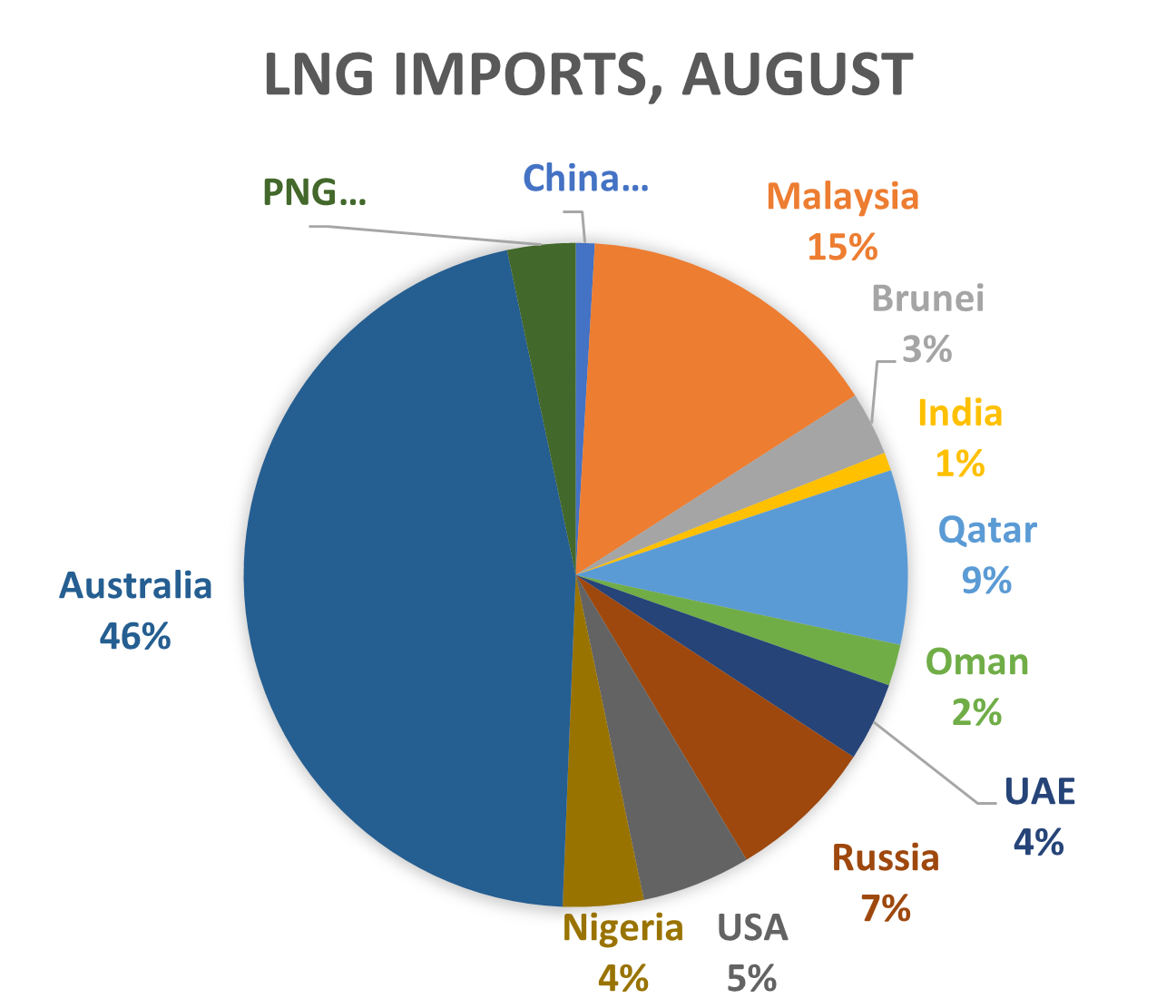
Japan imported 0.45 million tons of LNG from Russia in August, 7% of the 6.27-million-ton total. Imports included spot cargoes from non-exporters such as China and India. Japan imported 57,300 tons from China at a price of ¥167,000/ ton, and 55,600 tons from India at ¥108,000/ ton. Japan paid Russia ¥105,000/ ton.
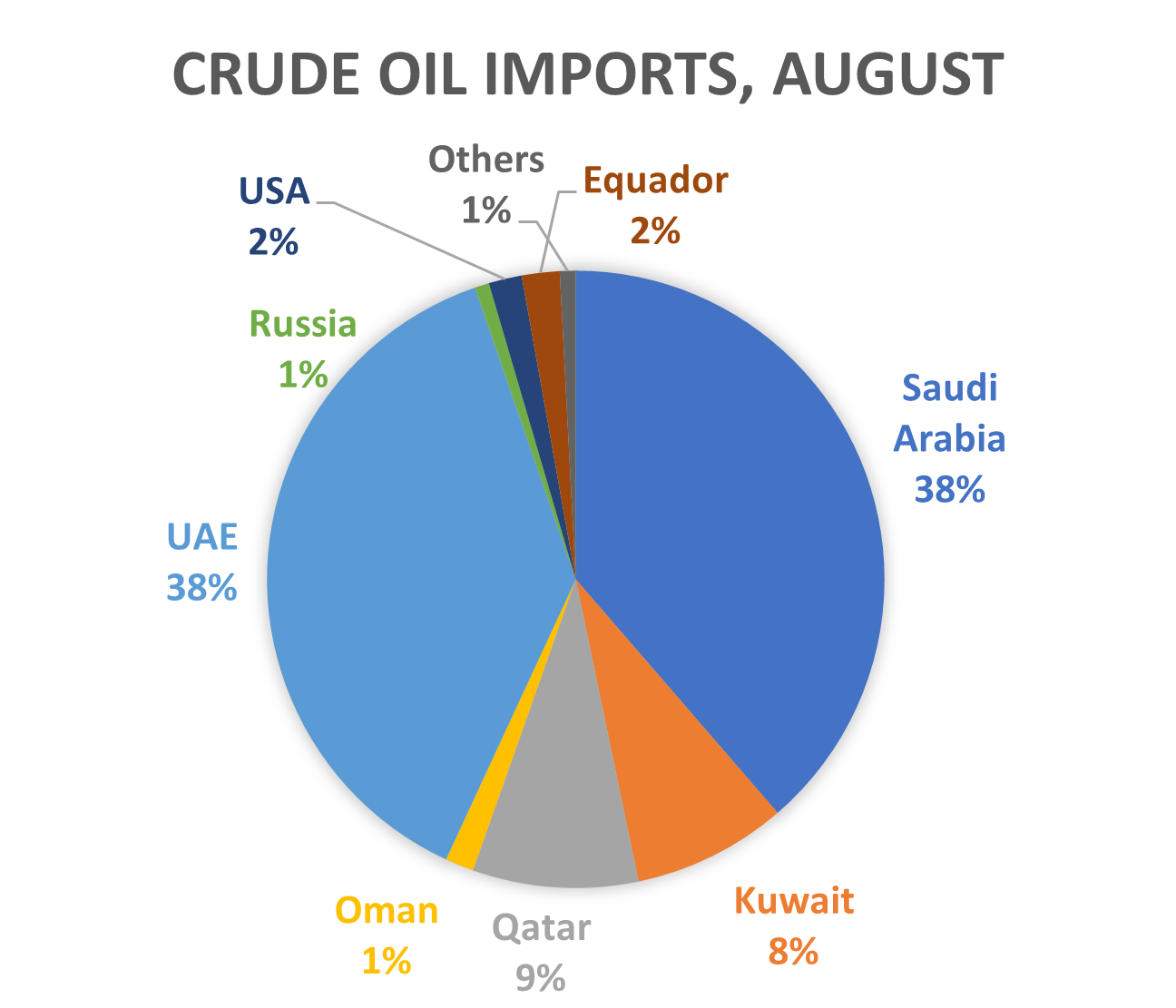
Japan imported 103,000 kiloliters of crude oil from Russia in August, accounting for 1% of the total imports of 13.7 million kl.
ANALYSIS
BY MASUTOMO TAKEHIRO
Coal, Gas, EVs and Net-Zero: Japan Updates Energy Ties with Indonesia
One of Japan’s closest economic partners, especially in the energy sector, is Indonesia. The resource-rich, emerging Southeast Asian economy has long been a key supplier of coal and gas. Now these ties are being upgraded for the era of net-zero.
Next month, Indonesia will become the first nation alongside Japan to endorse the Asian Zero Emissions Community initiative. Jakarta will be given the rank of co-initiator, with the move due to be announced at the G20 to take place in Bali.
In terms of policy, this supports Japan’s ambition to corral an Asia-led energy transition that fine-tunes decarbonization roadmaps based on local conditions. Indonesia’s onboarding will also show the willingness of one of Asia’s biggest coal users to start working on a structured, concrete framework for a shift to a clean economy.
For businesses, the step is even more significant. Japanese firms have a history of fossil fuel investments in Indonesia. Jakarta’s broad alignment with Tokyo on decarbonization will help Japanese firms share their cleantech while also achieving a larger market scale.
Political drivers Indonesia is Japan’s No. 2 coal supplier after Australia and among the major sellers of natural gas. It even delivers a significant volume of crude oil to Japan.
Should Japan succeed in its planned reduction of fossil fuel consumption, trade revenues would drop in kind. Yet, Tokyo seeks to establish the next set of energy ties with Jakarta, extending an invitation to become a co-initiator of the Asian Zero Emissions Community that collates the development of zero-emission technologies and their standardization, the creation of carbon credit markets, and of clean financing options.
While a focus on Asia as a whole has always been a part of Japan’s decarbonization strategy, the Community concept was announced by Prime Minister Kishida and fits with this greater emphasis on regional frameworks for trade, security, and rule of law.
Interestingly, when Kishida established the GX Council in July as the HQ for the government’s decarbonization efforts, he named a leading Indonesian expert among the Council’s 13 members.
Such moves suggest Japan sees great potential in Indonesia, whose goal is to be among the world’s top five economies by 2045. Indonesia is the most coal-reliant nation in Southeast Asia, but shares Japan’s interest in moving thermal power generation to biomass and ammonia, at least partially. “Japan has the technology and Indonesia has the natural resources,” an Indonesian official told Japan NRG.
Questions around “zero”
Indonesia is clearly high on Kishida’s Asia-focused decarbonization initiative. Takashi Shiraishi, Chancellor of Kumamoto Prefectural University, is one of the GX Council’s inaugural members and an Indonesia expert.
Still, merging Indonesia and Japan interests won’t be easy given their different economic cycles. Indonesia has the world’s fourth-largest population and is not entirely comfortable with the “zero emission” wording that Kishida proposed.
Indonesia is not ready for such a drastic transition and also questions the vision’s viability since the Community initiative excludes China, the world’s largest emitter. Jakarta only last summer pledged to aim for carbon neutrality and set its deadline as 2060, a decade after Japan’s target, which is now enshrined in law.
The two countries have yet to hammer out an actual bilateral cooperation agreement to fit the Community aims. Still, should these challenges be overcome, Japan hopes to invite more ASEAN members into the Community ahead of the G7 next year.
While the political dialogue is ongoing, in March firms led by JERA and TEPCO drafted a future electricity roadmap for Indonesia. In the context of energy security and balance, the roadmap advises focusing on three energy sources – ammonia, hydrogen and LNG (with carbon capture) – as the main fuels.
These suggestions are moving into practice. Mitsubishi Heavy earlier this year announced that it would conduct feasibility studies on ammonia co-firing at the Suralaya thermal power plant (coal) and look at pairing the clean-burning fuel with natural gas.
In a related development, Mitsubishi Corp signed an MoU with Pertamina, Indonesia’s state oil company, and Pupuk Indonesia, a state-owned fertilizer firm, to establish a green hydrogen and ammonia value chain and jointly develop CCUS businesses.
Marubeni Corp and Chiyoda Corp have also signed MOUs with Pertamina around joint development of decarbonization projects. Meanwhile, Mitsubishi Power is working with Indonesia’s state-owned PT PLN and Bandung Institute of Technology, the top engineering school, to compile policy proposals for biomass co-firing.
Business projects forging ahead
Indonesia also has targets in the renewable energy sector – to reach 23% of the power mix in 2025, compared with around 11% in 2020.
Indonesia has traditionally focused on biomass and geothermal as two main renewables, but the archipelagic country is now shifting to solar power as a new growth sector. Here too, Japanese firms are involved. For instance, in September 2021, Alamport and NiX Co. began developing factory-roof PV generation under a third-party ownership model (PPA).
Tie-ups in geothermal power have also progressed: INPEX invested in a project in West Sumatra in December 2021. In the same month, Marubeni and Tohoku Electric began commercial operation at the Rantau Dedap Geothermal Power Project in South Sumatra.
Kansai Electric started a renewable energy certificate project in Indonesia based on power generated at its Rajamandala Hydroelectric Power Plant in West Java. The utility agreed to sell the renewable energy value of the electricity (i.e., the green certificates) to three Indonesian entities belonging to Japanese auto-parts maker Aisin.
For automakers, Indonesia is an important market. As well as its large population, the country has vast reserves of cobalt and nickel, and seeks to become a manufacturing and exporting hub for EVs. Indonesia aims to start full-scale EV manufacturing this year when it hosts the G20, and then for 20% of domestic car production to be EVs by 2025.
Japanese auto firms have long enjoyed a market share of more than 90% in Indonesia, but the arrival of the EV era is changing the playing field dramatically. South Korea’s Hyundai began EV production in Indonesia this spring, ahead of Japanese rivals, while LG Energy Solution is building a local battery factory. Likewise, China’s battery giant CATL entered the market and U.S.-based Tesla is also preparing to invest.
Finally, Toyota said in July that it will invest $1.8 billion in EV development in Indonesia over the next five years as part of efforts to support local green energy initiatives. In the same month, Mitsubishi Motors announced plans to invest about 10 trillion rupiah ($667 million) in Indonesia between 2022 and 2025 to produce hybrid and EVs.
Many of the above-mentioned projects are in a nascent stage, but Japanese firms believe that the size of the Indonesian market will help achieve commercial scale relatively quickly. Successes can then be translated to other Southeast Asian nations that are also wrestling with how to handle the energy transition without sacrificing their economic growth.
Bringing Indonesia in as a major partner in the Asian Zero Emission Community won’t allow Japanese cleantech to avoid competition in such a major market. But it should help businesses to upgrade their Southeast Asian strategies to align with the global net-zero agenda.
ANALYSIS
BY CHISAKI WATANABE
As Japan Prepares for More Battery Power Trading, Hokkaido Is a Hotspot
Japan’s power market will get a boost from a recent law change that elevates the status of storage batteries connected to the grid to a power generation business.
This could spur major change to the power system, both in terms of the technical potential and for business models. More battery installations should allow for a better balancing of the rising electricity volume from variable energy sources such as solar and wind. It also should breathe life into several subcategories of the electricity market, as battery operators seek ways to turn a profit.
The law change has led to a wave of domestic and foreign company interest in battery projects in Japan. And by far the most popular location so far is Hokkaido, the country’s northernmost isle.
Hokkaido served as the vanguard of Japan’s renewables revolution a decade ago. Now the island’s unique geography and role in the national energy system is providing interesting findings for Japan’s battery pioneers.
The original trailblazer
There’s a spike in the number of grid connection applications by companies planning storage battery projects in Hokkaido, reported Hokkaido Electric Power Network (the transmission business unit of Hokkaido Electric) in a recent METI grid task force meeting. As of the end of July, 61 projects totaling 1.6 GW applied for access to the Hokkaido grid. That’s nearly half of the island’s demand average of 3.5 GW.
Hokkaido has been a testing ground for storage battery systems in Japan from the start. Barely a year after the country rolled out its feed-in tariff (FIT) program in 2012 to spur investment in renewables, almost 30% of new solar installations were concentrated in Hokkaido, one of the few areas of Japan endowed with large open spaces and flat land.
The surge in renewables projects in Hokkaido led METI to announce special measures to make sure the jump in the volume of intermittent power output did not overwhelm the local grid. After all, Hokkaido’s own power demand was often far below its local production, while the transfer of electricity to other areas was constrained by low throughput capacity.
So, the ministry in April 2013 implemented a number of steps including a large-scale storage battery system at a substation and smaller systems at each renewable power station. METI set aside about ¥30 billion to install a 60 MWh battery system that could improve Hokkaido’s total short-term balancing ability by 10%.
While the 60-MWh project was under construction, new solar projects of 2MW or larger were asked to install on-site storage batteries. This requirement was later expanded to wind power.
What this looks like in practice can be demonstrated by the solar and battery complex set up by SB Energy and Mitsubishi UFJ Lease in Hokkaido’s Yakumo Town. The companies built a 102 MW solar farm in the town and an onsite 27.8 MWh lithium-ion battery system. The batteries, charged when it is sunny and discharged when cloudy, help keep the fluctuations of power output within 1% per minute, according to SBEnergy.
This strategy, however, has proved inefficient. Natural intermittencies mean that one storage battery working with just one renewables project does little to balance supply over a whole area. It’s expected that METI will soon drop this requirement.
Now a more promising approach has emerged in the shape of installing batteries on the grid side, which would inherently service numerous energy generators.
Redox flow batteries
In 2017, Hokkaido Electric Power Network began soliciting applications for a battery system to be jointly installed by multiple developers of wind projects across the area.
Earlier this year, Sumitomo Electric supplied a 51 MWh redox flow battery system for the Power Network’s Minami Hayakita substation. The project is already operational and adds to the 60 MWh pilot project at the same location and by the same supplier that came online in 2015.
Redox flow batteries have a long service life of 20 years with almost no degradation of electrodes and electrolytes, and offer a high safety standard as they are made from non-combustible materials, making them ideal for the grid, according to the company.
The pilot phase tested whether batteries could be employed for frequency regulation, a role that was traditionally played by thermal and hydropower stations, and found the results to be positive.
New business models
The rise in interest in battery installations comes thanks to revisions to the Electricity Business Act passed by parliament in May. These allowed large-scale battery systems installed on the grid side to qualify as a power generation business. The revision, which will take effect in April 2023, gives clarity to the status of storage battery projects in the power market and guarantees their access to the grid.
This is important as batteries are expected to play a bigger role in the capacity market, the balancing market and the whole power markets. But it will take time for operators to find the right business model for the power storage facilities.
At present, selling power stored in batteries on the wholesale market is not a viable business model and once the capacity market is open for battery operators, that could become a route to profitability, according to some industry watchers. The capacity market is due to start in 2024.
According to Takuya Ogushi, president of renewables firm Smart Energy, an investment in storage batteries could be recouped in under three and a half years through trading of its power on the balancing market. Ogushi’s calculations, published in May in Mega Solar Business, assume that the cost of a 1-MWh battery system is ¥150 million. Japan introduced a balancing market in April 2021.
Batteries could become a big business and are already attracting major companies and investments. Orix and Kansai Electric earlier announced a plan for a 113 MWh lithium-ion battery system in Wakayama Prefecture.
The project, slated to start in April 2024, is considered one of Japan’s largest for stand-alone batteries not owned by a transmission operator. Kyushu Electric wants to start trading battery power from 2023 based on a 4.2 MWh lithium-ion battery system currently under construction.
Last month, Toho Gas also announced plans to install a 70 MWh sodium-sulphur (NAS) battery, which will be up and running in 2025.
Solution creates another problem
While more batteries mean better balancing of intermittent energy sources, they are also starting to aggravate another grid issue. Batteries require transmission capacity to both send power to the grid and receive it. This is going to strain the Japanese grid even further and requires new investments in electricity transmission lines and other infrastructure, METI says.
For now, METI urges firms keen to expand in the battery space to seek out areas with easy grid access and for utilities to give better information on where such access is available. Soon, however, the issue of grid upgrades will become even more critical. How costs will be split among existing and new market participants is yet to be seen.
See the next page for a table of related battery projects around Japan
Battery projects around Japan
Owned by
Capacity
Type and manufacturer
Operation start date
Location
Purpose
Hokkaido Hokubu Furyoku Soden (owned by Eurus Energy, HEPCO and others)
720MWh
Lithium-ion by GS Yuasa
2023
Kitatoyotomi substation, Hokkaido
Adjust wind power
Kyushu Electric
300MWh
NAS by NGK
2016
Buzen substation, Fukuoka
Green Power Investment
180MWh for 112 MW offshore wind
NA
Dec. 2023
Ishikari Bay, Hokkaido
Adjust wind power
Orix, Kansai Electric
113MWh
Lithium-ion
April 2024
Kinokawa substation, Wakayama
Trade on markets
Toho Gas
70MWh
NAS by NGK
FY 2025
Former LNG station in Mie prefecture
Trade on markets
Hokkaido Electric, Sumitomo Electric
60MWh
Redox flow by Sumitomo Electric
Dec. 2015
Minami Hayakita substation, Hokkaido
Hokkaido Electric and unidentified wind power generators
51MWh
Redox flow by Sumitomo Electric
April 2022
Minami Hayakita substation, Hokkaido
SoftBank Energy, Mitsubishi UFJ
27.8MWh for 102MW solar farm
Lithium-ion
2020
Yakumo, Hokkaido
Adjust solar power
NTT Anode Energy, Kyushu Elec., Mitsubishi Corp.
4.2MWh on the grid side
Lithium-ion
Feb. 2023
Tagawa, Fukuoka
Adjust solar power, trade on markets
Sources: Company websites
GLOBAL VIEW
BY JOHN VAROLI
Below are some of last week’s most important international energy developments monitored by the Japan NRG team because of their potential to impact energy supply and demand, as well as prices. We see the following as relevant to Japanese and international energy investors.
Afghanistan/ Fuel deal
The Taliban signed a deal with Russia for the supply of gasoline, diesel, and gas. The move is the first known major international economic deal struck by the Taliban since they returned to power more than a year ago.
Brazil/ Oil
London-based Trident Energy seeks a partner to develop the Siri discovery in the Badejo and Linguado oil fields that are part of the Pampo and Enchova hub acquired from Petrobras in 2020. Siri is estimated to have 2 billion barrels of oil equivalent.
Germany/ Energy crisis
About 10% of mid-sized companies have cut or halted production because of gas prices. Some industrial giants in gas-heavy industries are shifting production and sourcing from elsewhere; others are switching from gas to coal or oil. Also, the government announced a €200 billion energy aid package including a cap on gas prices to protect businesses and consumers.
German/ LNG
Germany has managed to fill its gas reserves to 91.32% of capacity, allaying fears it could run out this winter after Russian gas flows fell sharply following European sanctions.
Germany/ Nuclear power
The lifespan of two of the country’s last nuclear power plants — Isar 2 and Neckarwestheim — will be extended beyond their planned phase-out. Berlin had planned to complete a phase-out of nuclear power by the end of this year but a collapse in energy supplies from Russia induced the government to keep two plants on standby until April.
France/ Nuclear power
The government picked Luc Rémont, a senior Schneider Electric executive, to head EDF as it moves to fully renationalise the nuclear power operator and end reactor outages straining electricity supplies across Europe. A €9.7 billion tender offer to buy out minority shareholders could be handed to regulators next week.
India/ Wind power
GE Renewable Energy has orders from Continuum Green Energy Limited to supply, install and commission 81 units of onshore wind turbines for the 219 MW wind power projects across Tamil Nadu and Madhya Pradesh, India.
Nigeria/ Renewables
Shell made its first renewable power acquisition in Africa with the purchase of Daystar Power, which operates in Nigeria, Ghana and three other countries across west Africa, providing solar power and battery solutions to business and industry across the region.
Philippines/ LNG
Two advanced LNG projects have delayed commercial operations to next year. The terminals, being built by First Gen and Singapore-headquartered Atlantic Gulf & Pacific, now aim to begin operations in Q1 2023. However, these problems are unlikely to be resolved by early 2023. In fact, the supply crunch may not ease until 2026.
Sweden/ Environmental disaster
Europe faces an environmental catastrophe as natural gas leaks out of the damaged Nord Stream 1 and 2 pipelines in Swedish and Danish waters. A ton of methane has a climate impact 80 times that of CO2, said David McCabe, a scientist at Clean Air Task Force. “If pipelines fail, the impact to the climate can be disastrous, even unprecedented.”
United Kingdom/ Nuclear power
French-owned EDF Energy will review whether the closure of two of Britain’s five remaining nuclear power plants – Hartlepool and Heysham 1 nuclear power plants – could be postponed beyond 2024. Together, both have a generation capacity of 2.2 GW. Both are currently scheduled to close in March 2024
2022 EVENTS CALENDAR
A selection of domestic and international events we believe will have an impact on Japanese energy
January
OPEC quarterly meeting;
JCCP Petroleum Conference – Tokyo;
EU Taxonomy Climate Delegated Act activates;
Regional Comprehensive Economic Partnership (RCEP) Trade Agreement that includes ASEAN countries, China and Japan activates;
Indonesia to temporarily ban coal exports for one month;
Regional bloc developments: Cambodia assumes presidency of ASEAN; Thailand assumes presidency of APEC; Germany assumes presidency of G7; France assumes presidency of EU; Indonesia assumes presidency of G20; and Senegal assumes presidency of African Union;
Japan-U.S. two-plus-two meeting;
Japan’s parliament convenes on Jan. 17 for 150 days;
Prime Minister Kishida visits Australia (tentative)
February
Chinese New Year (Jan. 31 to Feb. 6);
Beijing Winter Olympics;
South Korea joins RCEP trade agreement
March
Renewable Energy Institute annual conference;
Smart Energy Week – Tokyo;
Japan Atomic Industrial Forum annual conference – Tokyo;
World Hydrogen Summit – Netherlands;
EU New strategy on international energy engagement published;
End of 2021/22 Japanese Fiscal Year;
South Korean presidential election
April
Japan Energy Summit – Tokyo;
MARPOL Convention on Emissions reductions for containerships and LNG carriers activates;
Japan Feed-in-Premium system commences as Energy Resilience Act takes effect;
Launch of Prime Section of Japan Stock Exchange with TFCD climate reporting requirement;
Convention on Biological Diversity Conference for post-2020 biodiversity framework – China;
Elections: French presidential election; Hungarian general election
May
World Natural Gas Conference WCG2022 – South Korea;
Elections: Australian general election; Philippines general and presidential elections
Germany to eliminate nuclear power from energy mix;
Happo-Noshiro offshore wind project auction result released;
Japan submits revised 2030 CO2 reduction goal following Glasgow’s COP26;
Japan-Canada Annual Energy Forum (tentative);
Tesla expected to achieve 1.3 million EV deliveries for full year 2022
Disclaimer
This communication has been prepared for information purposes only, is confidential and may be legally privileged. This is a subscription-only service and is directed at those who have expressly asked K.K. Yuri Group or one of its representatives to be added to the mailing list. This document may not be onwardly circulated or reproduced without prior written consent from Yuri Group, which retains all copyright to the content of this report.
Yuri Group is not registered as an investment advisor in any jurisdiction. Our research and all the content express our opinions, which are generally based on available public information, field studies and own analysis. Content is limited to general comment upon general political, economic and market issues, asset classes and types of investments. The report and all of its content does not constitute a recommendation or solicitation to buy, sell, subscribe for or underwrite any product or physical commodity, or a financial instrument.
The information contained in this report is obtained from sources believed to be reliable and in good faith. No representation or warranty is made that it is accurate or complete. Opinions and views expressed are subject to change without notice, as are prices and availability, which are indicative only. There is no obligation to notify recipients of any changes to this data or to do so in the future. No responsibility is accepted for the use of or reliance on the information provided. In no circumstances will Yuri Group be liable for any indirect or direct loss, or consequential loss or damages arising from the use of, any inability to use, or any inaccuracy in the information.
K.K. Yuri Group: Oonoya Building 8F, Yotsuya 1-18, Shinjuku-ku, Tokyo, Japan, 160-0004.
NEWS
・PM Kishida to announce subsidy system for electricity bills to protect vulnerable consumers from rising prices
・Two coastal areas added as potential offshore wind development zones as government seeks to revive momentum in the sector
・Japan’s first nationwide carbon credit trading begins with 145 participants joining the system’s initial trial period