Japan to establish carbon footprint guidelines by next spring
Govt to revise roadmap to develop next-gen reactors, eyes RAB
Ruling party lawmakers set up biofuel and synthetic fuel group
Asahi Kasei to produce PPE plastic from biomass raw materials
MHI wins order to trial carbon capture at steel plants
Japan and Singapore sign multiple accords in LNG and hydrogen
IHI partners with JERA to develop ammonia utilization in Malaysia
Osaka Gas, MHI, IBM to visualize emissions, set value on methane
ELECTRICITY MARKETS
METI to offer 20-year revenue guarantees for green generators
Power utilities raised a record ¥1.5 trillion in bonds in six months
Canada’s CDPQ invests ¥70 billion in developer Shizen Energy
TEPCO gets additional compensation in nuclear subsidy payout
Mitsubishi opens first new Japan offices in decades to cover wind
Tokyu Land seeks to develop 121 MW wind farm in central Japan
INPEX joins Japanese consortium in Indonesia geothermal plant
Kyushu Electric invests in Philippines renewable energy utility
OIL, GAS & MINING
Malaysia tries to replace Japan LNG volumes lost to pipeline leak
Kishida visits BHP nickel refinery to back Australia supply chain
Panasonic nears offtake deal with Canadian graphite maker
Russian LNG at 11% of total imports in Sept; Russian crude at zero
ANALYSIS
BURNED BY THE SUN: ON-THE-GROUND REPORT OF A LOCAL CONFLICT OVER SOLAR DEVELOPMENT
“At the end of the day, it’s all about money. People weren’t getting into the solar business because they had strong opinions on energy,” says a restaurant owner in a small town in central Japan. The owner shrugs as he recounts an unfortunate story about a local solar development gone wrong.
Apathetic or even negative views towards renewables are not unusual in rural Japan. That bodes ill for the country’s 2030 climate targets.
In an effort to remedy the issue, the government recently created a conflict resolution panel. What challenges will the panel’s experts face? For this special report, Japan NRG visited the auto heartland of Nagoya to speak with a community in conflict.
NUCLEAR REACTOR LIFE EXTENSIONS: A QUICK BUT TEMPORARY SOLUTION FOR JAPAN
Japanese power firms have spent roughly $40 billion since the Fukushima disaster to revamp nuclear safety. Despite the rich outlay, most of the utilities have so far failed to reap any benefits as most of the units remain offline for over a decade. So, it comes as little surprise that the government wants to help the utilities increase the permitted operating life of reactors to help balance the financials. But even if all goes smoothly and the units are able to work for longer, the core challenges of the industry will not be resolved. We review the practical issues faced by the nation’s reactors.
GLOBAL VIEW
Asia will surpass the EU in offshore wind capacity by 2030. Chinese energy firm discovers major shale gas reserves. China needs $14 trillion in investments to hit net zero: World Bank. European gas prices decline as storage fills up. Kazakhstan touts green hydrogen ambitions. Details on these and more in our global wrap.
JAPAN NRG WEEKLY
PUBLISHER K. K. Yuri Group
Editorial Team Yuriy Humber (Editor-in-Chief) John Varoli (Senior Editor, Americas) Mayumi Watanabe (Japan) Yoshihisa Ohno (Japan) Wilfried Goossens (Events, global)
METI The Ministry of Energy, Trade and Industry
MOE Ministry of Environment
ANRE Agency for Natural Resources and Energy
NEDO New Energy and Industrial Technology Development Organization
TEPCO Tokyo Electric Power Company
KEPCO Kansai Electric Power Company
EPCO Electric Power Company
JCC Japan Crude Cocktail
JKM Japan Korea Market, the Platt’s LNG benchmark
CCUS Carbon Capture, Utilization and Storage
mmbtu Million British Thermal Units
mb/d Million barrels per day
mtoe Million Tons of Oil Equivalent
kWh Kilowatt hours (electricity generation volume)
The govt announced a ¥39 trillion package to protect households and businesses from rising costs of power, gas and gasoline, encourage new startups, attract foreign investment into Japan, and propel speedy recovery from COVID.
Subsidies will offset energy cost rise from January next year.
Household energy spending could be cut as much as ¥45,000 next year
There will be programs to push energy-efficient homes, buildings and storage battery systems.
The govt said the package would increase Japan’s GDP by 4.6%.
TAKEAWAY: Electricity subsidies alone may cost about ¥1 trillion per quarter, based on prices and volumes in the first months of this year. Together with existing gasoline and new natural gas subsidies, the government’s annual outlay could approach ¥10 trillion.
The deluge of government spending should calm households and small businesses. But it could also have some negative consequences. Construction experts warn of “hangovers” as the rush to supply equipment to procure the subsidies could flood the market with low quality storage batteries and renewables systems.
METI and the Ministry of Land, Infrastructure, Transport and Tourism updated offshore wind auction rules, such as how to assess “speedy project completion”.
The rules will apply to the Happo Noshiro project in Akita Prefecture, the Murakami-Tainai project in Niigata Prefecture, the Oga-Katagami-Akita project in Akita Prefecture and the Saikai-Eshima project in Nagasaki Prefecture.
The wind power stations need to be operational by March 2031, and more merit points will be awarded to groups that propose earlier launch dates.
Rules on decommissioning stays the same.
TAKEAWAY: One panel member said that a lack of port facilities may create difficulties for operators under the deadline pressure as their port access plans may crash.
PM Kishida asked the METI minister to work closely with the GX Council to come up with an effective carbon pricing system.
Kishida said the growth-oriented carbon pricing should ideally combine “a carbon tariff” and emissions trading.
Costs should reduce over time, and it will encourage investments by showing how tariff-related burdens on the private sector will decrease.
The PM wants to expand net zero technology-based projects into Asia as soon as possible to tap into the vast decarbonization demand in Asia.
The next GX meeting will discuss net-zero roadmaps for the next 10 years.
TAKEAWAY: The idea of “growth-oriented carbon pricing” was to rely wholly on voluntary emission cuts of businesses and their zeal for new markets, and no “tax” of any form, but this assumption is already changing.
SIDE DEVELOPMENT: Japan eyes ‘green transition’ bonds ahead of full-scale trading in FY2026 (Mainichi Shimbun, Oct. 27)
The GX panel meeting sought to create a deadline of FY2026 for starting full-fledged trading of carbon credits in Japan. The carbon pricing system will be one way for the country to fund its energy transition.
Further details on pricing measures, as well as a review of whether a carbon tax is needed, will be rolled out by the end of the year.
The government also wants to issue as much as ¥20 trillion in so-called “GX economic transition bonds”.
CONTEXT: Last month, the TSE launched trial trading in CO2 emission credits. Over 400 companies accounting for about 40% of Japan’s emissions plan to join this market.
One goal of COP27 is to agree on details of the mitigation work program (MWP) to speed up climate change measures before 2030, said Tamura Kentaro, director of the Kanagawa-based Institute of Global Environmental Strategies.
Delegates are brainstorming on responsibilities of industrialized nations and heavy emitters, how to increase transfer of funds to developing economies, time frames and review process, and etc.
The MWP will likely address mitigation in each industrial sector, and will be positioned to complement the global structures in the Paris Agreement, and will possibly directly report to the high-level ministerial round table, Tamura said.
METI set to revise roadmap to develop next-gen reactor
(Japan NRG, Oct. 24)
METI held the 5th meeting of the Innovative Reactor Working Group of Nuclear Sectional Meeting under the Electricity and Gas Industry Committee.
After the previous session on July 29, Kishida announced on August 24 that he’d back development of the next-gen reactor, along with helping more reactors to restart or extend lifespan of aging reactors.
MHI gave a presentation to explain its next-gen reactor “SRZ-1200”, stressing that it can withstand large earthquakes, tsunamis, typhoons, volcano eruptions.
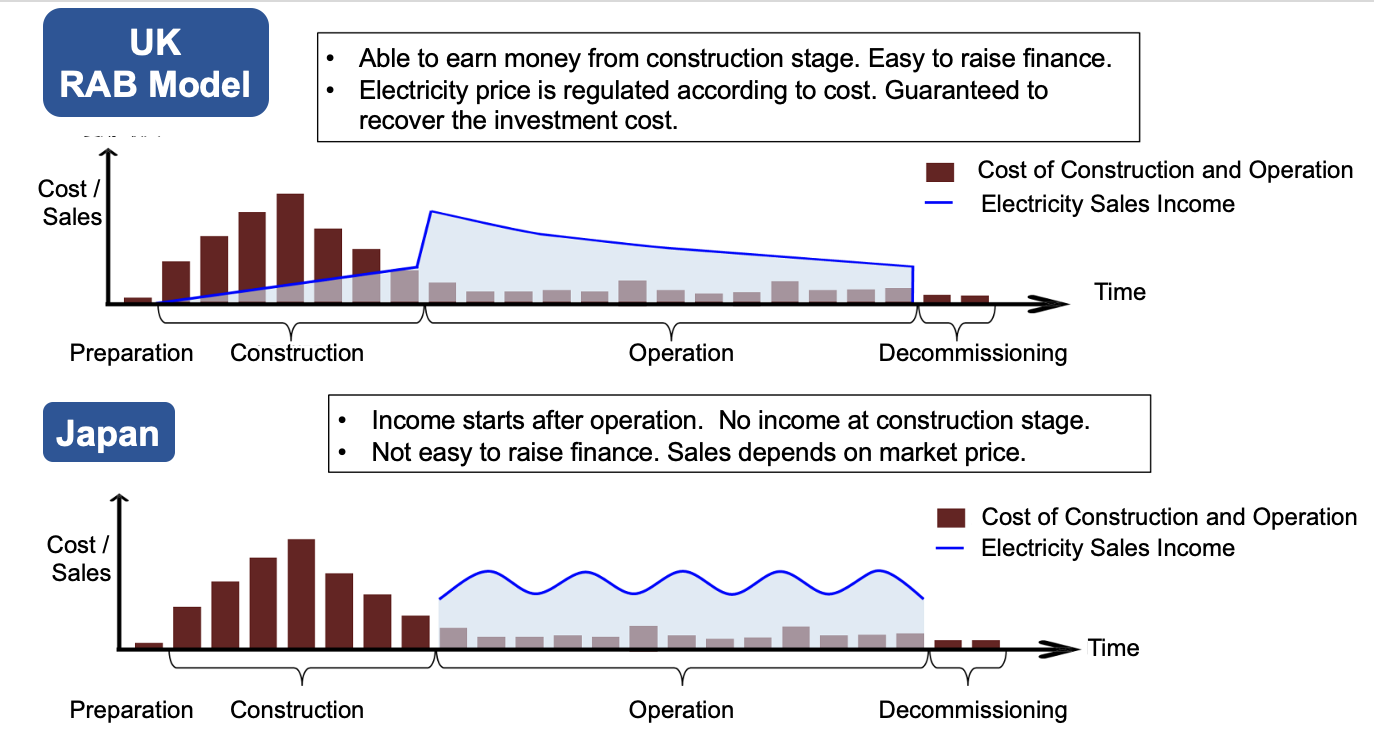
TAKEAWAY: The remarkable point of this meeting was that METI said the present roadmap should be revised. Also, METI referred to the UK’s nuclear regulated asset base (RAB) model as suitable for Japan to increase financing for development of next-gen reactors.
Ruling party lawmakers established the Federation of Lawmakers to Promote Domestic Production of Biofuel and Synthetic Fuel for Decarbonization.
An inaugural meeting was attended by 20 lawmakers and 40 deputies, as well as officials from METI, MoE, Ministry of Land, Infrastructure, Transport and Tourism, and Ministry of Agriculture, Forestry and Fisheries.
The group will be headed by former METI minister Amari Akira, and PM Kishida and the former PM Suga Yoshihide as senior advisors. It will form strategies to drive decarbonization in aviation and road transport.
TAKEAWAY: Biofuel reports are expected to be published by the government. Japan’s biotech development has focused on medicine and this move will push more research into green fuel. The major challenge is to ignite a rapid expansion in the bio feedstock production while striking a balance among energy and food security, net-zero and biodiversity. Most energy experts feel the increased consumption of biofuels will not change the shifts to EV or battery-fueled aircrafts.
SIDE DEVELOPMENT: Toyota-led next-gen green fuel association signs accord to produce bioethanol in Fukushima (New Energy Business News, Oct. 26)
The Next Generation Green CO2 Fuel Technology Research Association, whose members include ENEOS, Suzuki, and Toyota Motor, has concluded a basic agreement with the town of Okuma in Fukushima Prefecture. Based on this, the association will set up its HQ in the town and also built a research facility there by October 2024 in order to produce bioethanol from plant materials.
The industrial group wants to find the most efficient way to produce bioethanol fuel for autos by optimally circulating hydrogen, oxygen, and CO2.
Asahi Kasei to produce PPE plastic from biomass raw materials starting next year
(Kankyo Business, Oct. 21)
In January 2023, Asahi Kasei plans to begin production of polyphenylene ether (PPE) using biomass-certified raw materials.
PPE made by Asahi Kasei Plastics Singapore recently received ISCC PLUS certification, one of the international certification systems for sustainable products. It’s the first PPE plant in Asia to do so.
CONTEXT: PPE is widely used as a raw material to make automotive parts, home appliances, and industrial products. It is also used for solar power generation system components and EV battery components.
MHI wins order from ArcelorMittal and BHP to trial carbon capture at a steel plant
(Japan NRG, Oct. 27)
Mitsubishi Heavy Industries Engineering, a unit of MHI, will trial carbon capture technology at steel facilities of ArcelorMittal and BHP.
The three firms and a unit of Mitsubishi Corp will undertake a joint, multi-year trial of the Japanese carbon capture tech to measure its feasibility and operations. Currently, there are no full-scale carbon capture facilities attached to a blast furnace used to make steel anywhere in the world.
MHI will install its tech at an ArcelorMittal steel plant in Belgium and at another location in North America. The CO2 captured will be converted into ethanol.
Mitsubishi Corp and BHP, which supply ArcelorMittal with raw materials used to make steel, will fund the multi-year trial.
METI and Singapore’s Ministry of Trade and Industry signed a MoE to stabilize energy supplies and accelerate the energy transition.
The two countries will plan joint investment in LNG and provide support during emergencies, and cooperate in upstream hydrogen and ammonia projects.
Last month, METI signed such an agreement with Malaysia’s Petronas.
CONTEXT: Combined, the two countries import 8-9 million tons/ year of LNG, and have been competing to become the leading regional LNG trading hub.
TAKEAWAY: The two ministries have yet to narrow down the investment details, which could be anything upstream or downstream, but will be key in improving supply security. METI is in talks with other Asian countries to expand cooperation on LNG supplies.
SIDE DEVELOPMENT: Chiyoda and Mitsubishi to cooperate on hydrogen supply chain (Denki Shimbun, Oct. 27)
Chiyoda Corp, Mitsubishi Corp and Singapore’s Sembcorp Industries signed a MoU to build a hydrogen supply chain in Singapore utilizing SPERA Hydrogen (LOHC-MCH), Chiyoda’s proprietary technology for the safe and reliable storage and transportation of hydrogen.
In October 2021, the three signed a MOU to explore a commercial-scale supply chain to deliver low-carbon hydrogen into Singapore.
When operational in 2026, the project will be the largest low-carbon hydrogen import project in Asia with a capacity of about 60,000 tons per year.
SIDE DEVELOPMENT: Itochu mulls partnering with EDF and Singapore firm to supply ammonia to the city-state (Asia Nikkei, Oct. 26)
Trading firm Itochu may partner with French utility EDF and Singapore’s Tuas Power to supply ammonia to the Southeast Asian city-state.
Itochu wants to set up a supply network for the gas by 2030 and may site production facilities in Australia, the Middle East or other areas. Details on production scale and supply channels are yet to be determined.
Itochu would use renewables to electrolyze water for the ammonia synthesizing process.
IHI and Sembcorp will develop the ammonia supply chain in Singapore and APAC
(Japan NRG, Oct. 25)
IHI signed a MoU with leading energy and urban solutions provider Sembcorp Industries to explore decarbonization initiatives that will underpin the energy transition and sustainable development in Singapore and Asia Pacific.
The goal is an integrated green ammonia supply chain, both upstream and downstream.
In Singapore, the two companies will study introducing an ammonia-fueled gas turbine as well as the conversion of existing assets to ammonia and mixed fuel within Sembcorp’s facilities on Jurong Island, along with developing infrastructure for the utilization of ammonia.
TAKEAWAY: In four days, IHI put out three press releases on ammonia and hydrogen. This indicates the high level of priority that ammonia holds for the company.
SIDE DEVELOPMENT: IHI to Join the Hydrogen Council (Japan NRG, Oct. 28)
IHI announced joining the Hydrogen Council, one of the world’s largest hydrogen-related entities, as a steering member to play a central role in strategic decision-making.
CONTEXT: Launched at the World Economic Forum in Davos in January 2017, the Hydrogen Council is the world’s first CEO-led global body of activity and currently includes around 150 companies representing the hydrogen value chain.
SIDE DEVELOPMENT: IHI partners with JERA Asia for ammonia utilization in Malaysia (Denki Shimbun, Oct. 27)
IHI Corp and IHI Asia Pacific signed an MoU with JERA Asia to develop low carbon fuel such as ammonia to decarbonize thermal power plants in Malaysia.
By 2030, IHI and JERA will help Malaysia cut GHG emissions 45% from 2005 levels and make the nation carbon neutral by 2050. The two companies also want to use ammonia co-firing in other SE Asian countries.
Osaka Gas, MHI and IBM to visualize emissions and set a value on synthetic methane
(Kankyo Business, Oct. 25)
Osaka Gas, Mitsubishi Heavy Industries, and IBM Japan will jointly create a proof-of-concept (PoC) for a digital platform that visualizes CO2 distribution, with the aim of optimizing the environmental value of synthetic methane.
The PoC will visualize CO2 emissions throughout the entire supply chain from production to supply and the CCU process. The results will be used for CO2 trading, environmental value transfer, and estimates of the carbon footprint of the synthetic methane supply chain.
The project will track and manage CO2 emissions at the point of synthetic methane production, transport and utilization.
New material promises low-temperature charging of lithium batteries
(Nikkei X-Tech, Oct. 26)
State-backed National Institute of Advanced Industrial Science and Technology (AIST) developed an organic thermoelectric element that uses temperatures of below 100°C to recharge miniature lithium-ion batteries.
AIST researchers were able to reduce resistance of the organic thermoelectric material PEDOT/PSS to levels that allowed 50 units to be stacked in series.
Toyota, Kyoto University lead research into fluoride-ion batteries
(Nikkei, Oct. 24)
An increasing number of car manufacturers are interested in fluoride-ion batteries, which boast an energy density up to seven times higher than conventional lithium-ion batteries.
The use of fluoride-ion batteries could increase vehicle range to 1,000 km.
Toyota and Kyoto University are leading research into the technology, which may also make it possible to manufacture batteries that don’t use rare earths.
In 2017, Kyoto University researchers successfully developed a fluoride-ion battery that exhibited high conductivity at relatively low temperatures.
Toyota pioneers use of reclaimed vehicle batteries in grid battery systems
(JCN Newswire, Oct. 27)
JERA and Toyota have announced the construction and launch of the world’s first large-capacity “sweep energy” storage system.
The system was built using batteries reclaimed from EVs and is connected to the consumer electrical power grid.
“Sweep energy” is a technology that allows the full potential of deteriorated vehicle batteries to be harnessed.
By reusing the batteries’ onboard inverters, the technology also eliminates the need for power conditioners.
Hitachi will commercialize a micro-grid energy supply service that combines energy supply facilities with a management system that uses Lumada.
Hitachi is expected to introduce it at four sites in Japan from FY2023 H2, reducing CO2 by 4,500 tons/ year. Hitachi sees this as a step towards achieving its goal of taking its carbon emissions to zero by 2030.
Industrial associations representing solar, wind, geothermal, hydro and biomass power operators, and officials from two municipalities presented their views to a METI panel for resolving local conflicts while expanding renewable capacity.
The Japan Photovoltaic Energy Association (JPEA) doesn’t support tighter regulations. Operators should be allowed to begin generation without waiting for reviews to be completed, simply by showing the review status. But panel members questioned this.
JPEA said operators often outsource tasks, from feasibility studies to plant maintenance; contractors must be held liable for noncompliance. Panel members said the operators are responsible to manage contractors and the contracts.
JPEA is opposed to making meetings with local stakeholders mandatory as they are often a formality. If issues arise, municipalities should arbitrate.
CONTEXT: This was the second meeting after the Oct 17 relaunch of the community conflict panel renamed as the Working Group to Make Renewables a Long-Term Supply Source While Coexisting with Communities.
TAKEAWAY: Rules need to be consistent across renewable types and locations. However, as the Japan Wind Power Association pointed out, flexibility is required for rules that relate to geographic and climatic conditions. The panel has the difficult task to provide guidance on delivering value to communities. See also the Analysis section for a report on this issue.
20-year revenue guarantee for green generators
(Kyodo, Oct. 25)
METI will support environmentally-friendly power plants by guaranteeing their revenue for the first 20 years of operation. The plan, which may come into effect as early as next year, will cover renewable energy plants as well as thermal plants that use new technologies to reduce their net emissions to zero.
METI hopes the plan will encourage the construction of new plants.
Power companies raised a record ¥1.5 trillion in April-Sept in rush to get liquidity
(Nikkei; Oct. 20)
The value of bonds issued by nine key Japanese power companies in April-Sept 2022 hit a record high of ¥1.5 trillion. They’re issuing these bonds due to high fuel prices and financing difficulties.
Hokuriku Electric and Shikoku Electric set record highs for bonds issued.
TEPCO Power Grid increased its issued bonds’ value from ¥360 bn to ¥460 bn.
Rising interest rates are making bond issuance more difficult.
Canada’s CDPQ invests ¥70 billion in Shizen Energy
(Company Statement, Oct. 24)
CDPQ, which invests Quebec pension and insurance money, put ¥70 billion into renewables developer Shizen Energy. In return, CDPQ will get one seat on Shizen’s board.
Shizen Energy and CDPQ also agreed to a co-investment framework, which will involve investments by CDPQ of ¥50 billion.
Earlier this year, Shizen raised ¥4.4 billion from JIC Venture Growth Investments and SIGMAXYZ Investment Inc.
The new capital will go to accelerating ongoing renewables project development and supporting Shizen’s expansion into energy management systems, as well as overseas business in southeast Asia and Brazil.
TEPCO gets additional compensation in nuclear subsidy payout
(Japan NRG, Oct. 24)
Tokyo Electric received a grant of ¥10.7 billion from the Nuclear Damage Compensation and Decommissioning Facilitation Corporation (NDF).
The amount was estimated to exceed the sum of the compensation received in accordance with the “Act for Indemnification of Nuclear Damage Compensation” and NDF assistance.
TAKEAWAY: TEPCO has suffered greatly from rising fuel prices and weaker yen. The utility has to pay for decommissioning of 10 units at the Fukushima Dai-Ichi and Fukushima Dai-Ni NPPs, as well as investing in new business lines. Currently, the only way to significantly improve TEPCO’s financial performance would be to restart the company’s remaining operable nuclear power plant, the Kashiwazaki Kariwa NPP. However, scandals around TEPCO staff continue to plague the company and erode public trust. In the latest episode, a TEPCO staff was recently accused of taking home sensitive information about nuclear security with permission.
Mitsubishi sets up branches in Akita and Chiba to develop offshore wind farms
(Denki Shimbun, Oct. 27)
Mitsubishi will open two new Japanese branches in November 2022, one in Akita City, and the other in Choshi City. This marks the first time in 35 years that Mitsubishi added branches in Japan.
In December 2021, Mitsubishi was appointed one of the operators of Japan’s first, general-sea-area fixed-foundation wind farm off the coasts of Akita and Choshi. The company seeks to strengthen ties with local authorities, business partners and residents.
CONTEXT: Together with C-Tech Corp, a subsidiary of Chubu Electric, Mitsubishi Corp was selected as developer to install a total 1.69 GW of fixed-bottom offshore wind farms in the Akita and Choshi areas.
Tokyo Land to develop 121 MW onshore wind farm in Wakayama
(New Energy Business News, Oct. 26)
Tokyu Land plans to develop an onshore wind farm near the town of Inan, Wakayama Prefecture. The maximum output is 121 MW.
The project area is approximately 1,816 ha in the vicinity of the administrative boundaries of the towns of Inan and Hidakagawa. It will hosts 22 wind turbines.
INPEX joins geothermal power project in Indonesia
(Denki Shimbun, Oct. 26)
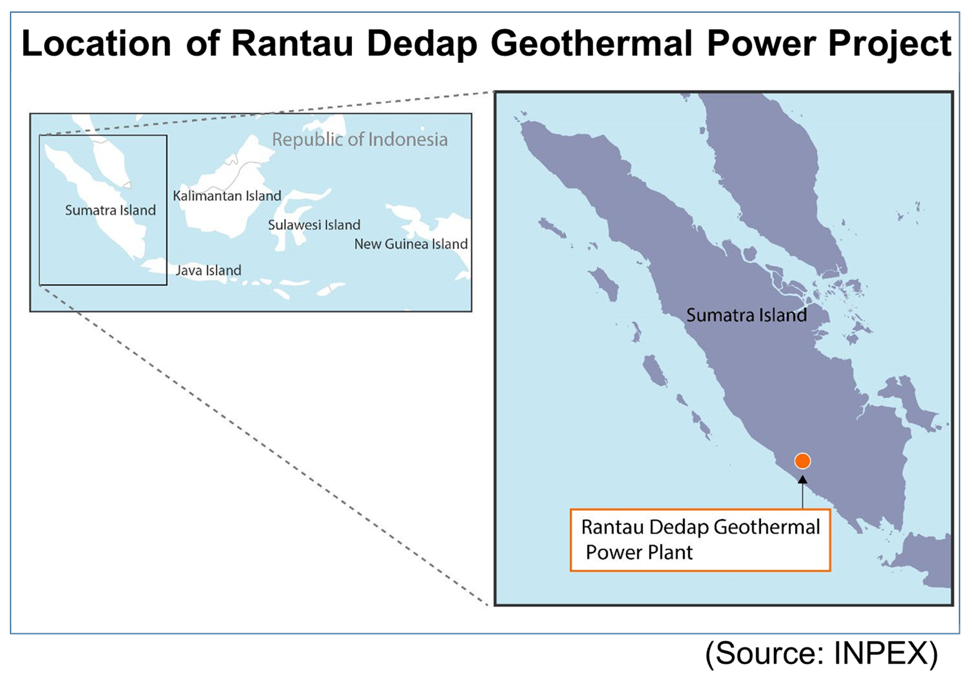
INPEX joined the Rantau Dedap Geothermal Power Project in Indonesia’s Sumatra region. Other partners include ENGIE, Marubeni, and Tohoku Electric.
INPEX acquired 27.4% of the shares of PT Supreme Energy Rantau Dedap held by ENGIE. The geothermal plant has a 98.4 MW capacity.
TAKEAWAY: A week ago Tohoku Electric said it doubled its stake in the project to 20%, buying stock from ENGIE. Now, INPEX has also joined. The high interest in the project from Japanese firms is partly because Indonesian state-owned utility PLN committed to buying electricity from the station for 30 years. It also indicates the scarcity of projects in the same sector.
Source: Inpex
Kyushu Electric invests in PetroGreen Energy in the Philippines
(Denki Shimbun, Oct. 27)
Kyuden International, a member of Kyushu Electric, invested in PetroGreen Energy Corp (PGEC), a renewable energy developer in the Philippines.
PGEC develops and operates geothermal, wind, and solar power projects.
Total output of Kyuden Group’s overseas power generation will now increase to about 2.83 GW.
Eurus Energy’s Aomori wind farm meets unexpected opposition
(Mainichi Shimbun, Oct. 27)
Wind farm developer Eurus Energy has been forced to rethink plans to construct a 600 MW wind farm in Aomori that was to comprise up to 150 turbines.
In addition to the prefectural governor, local mayors and residents groups have voiced opposition to the project, which they say will create visual pollution and possibly even water pollution.
In response to the opposition, Eurus says that it is considering excluding from the project those turbine sites that fall within national parks.
JERA to restart thermal unit at Anesaki power plant
(Nikkei, Oct. 22)
JERA will restart Unit 6 of its Anesaki thermal power plant in February.
JERA shut down the aging gas-fired unit in early 2021, but decided to restart it over projected winter electricity shortages.
Unit 6 has an output of 600 MW, which will boost TEPCO capacity by about 1%.
NEWS: OIL, GAS & MININGMalaysia tries to replace Japan LNG shipments lost due to pipeline leak
(Bloomberg, Oct. 28)
Malaysia’s Petroliam Nasional energy company told Japanese LNG buyers that over the next few months it will try to provide alternative supply to shipments it canceled due to a pipeline leak.
CONTEXT: The company previously told clients in Japan it would curb contracted deliveries at least until March and declared a force majeure. Japan strongly appealed to Malaysia to find alternative solutions since the supply-demand balance in the global LNG market is extremely tight.
Malaysia may boost output at other gas fields at home or in Australia to meet Japan export needs.
PM Kishida visited BHP’s West Kwinana Nickel Refinery with officials from Prime Planet Energy & Solutions and Toyota Tsusho.
Kishida said the battery supply chain between Japan and Australia will become stronger as two countries collaborate toward net zero.
CONTEXT: BHP signed nickel supply agreements with several automakers including Tesla and Ford Motor.
Government wants to make propane suppliers more efficient
(Nikkei, Oct. 25)
METI minister Nishimura Yasutoshi plans to support propane suppliers by subsidizing smart gas meter installation and other ways to boost efficiency.
Nishimura wants to finalize the details after discussions with suppliers. Savings would be passed onto gas users.
Around 25 million Japanese households use propane cylinders.
Panasonic signs MoU for off-take from Canadian graphite manufacturer
(New Energy Business News, Oct. 25)
Panasonic Energy ¥ signed an MOU on an off-take agreement with Nouveau Monde Graphite (NMG), a Canadian graphite manufacturer, to establish a supply chain in North America for graphite.
CONTEXT: The material is used for anodes in lithium-ion batteries for electric vehicles (EVs). Panasonic wants to expand its auto battery business in the U.S.
Through collaboration with Mitsui, which underwrites NMG’s convertible bonds, the three parties will conduct a feasibility study to develop an integrated graphite production business in North America, with the aim of concluding an off-take agreement within fiscal 2022.
As of Oct. 23, LNG stocks of 10 power grids stood at 2.56 million tons, up from 2.52 million tons a week earlier. The end-October stocks last year were 2.07 million tons. The five-year average for this time of year is 1.84 million tons.
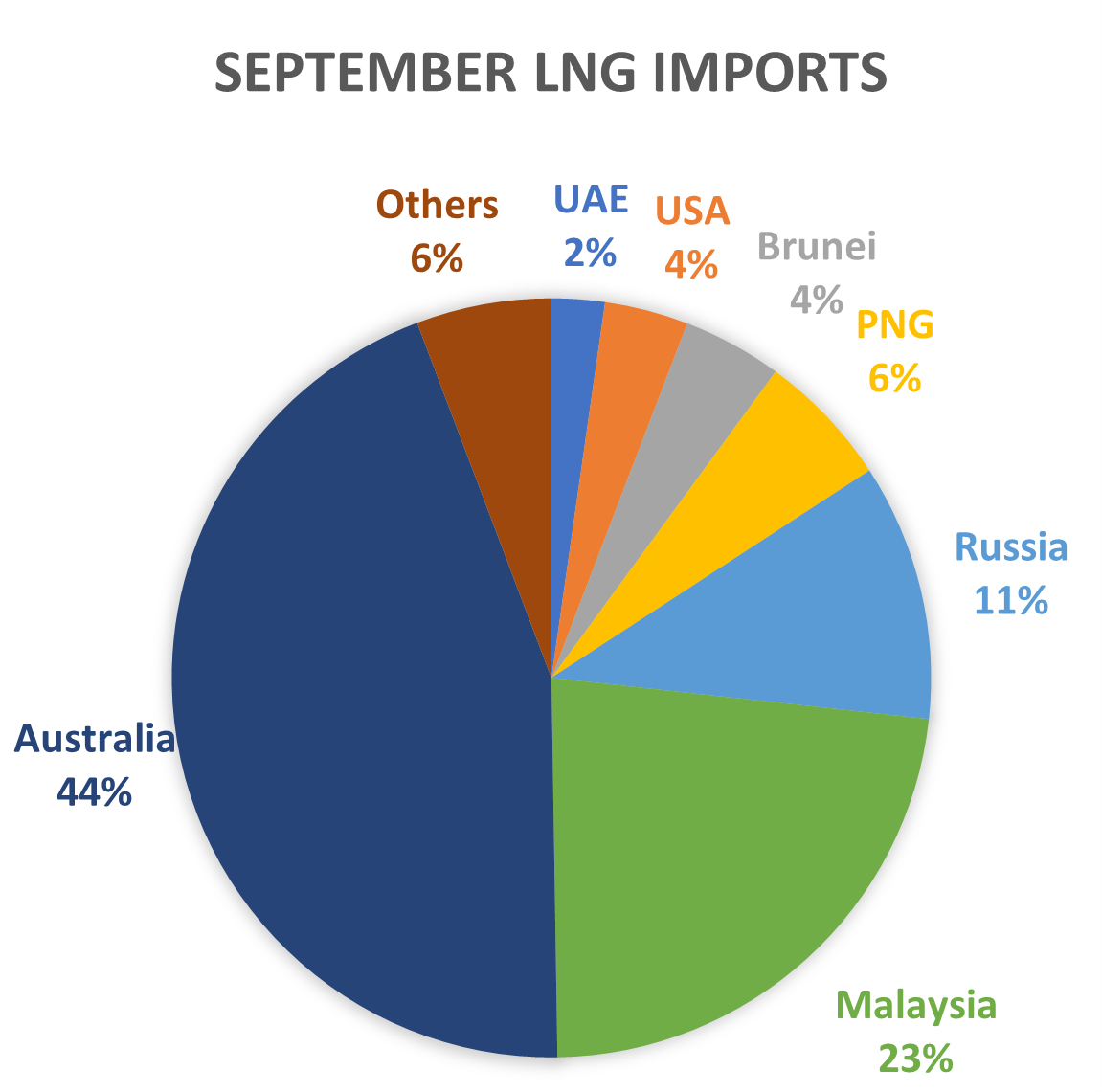
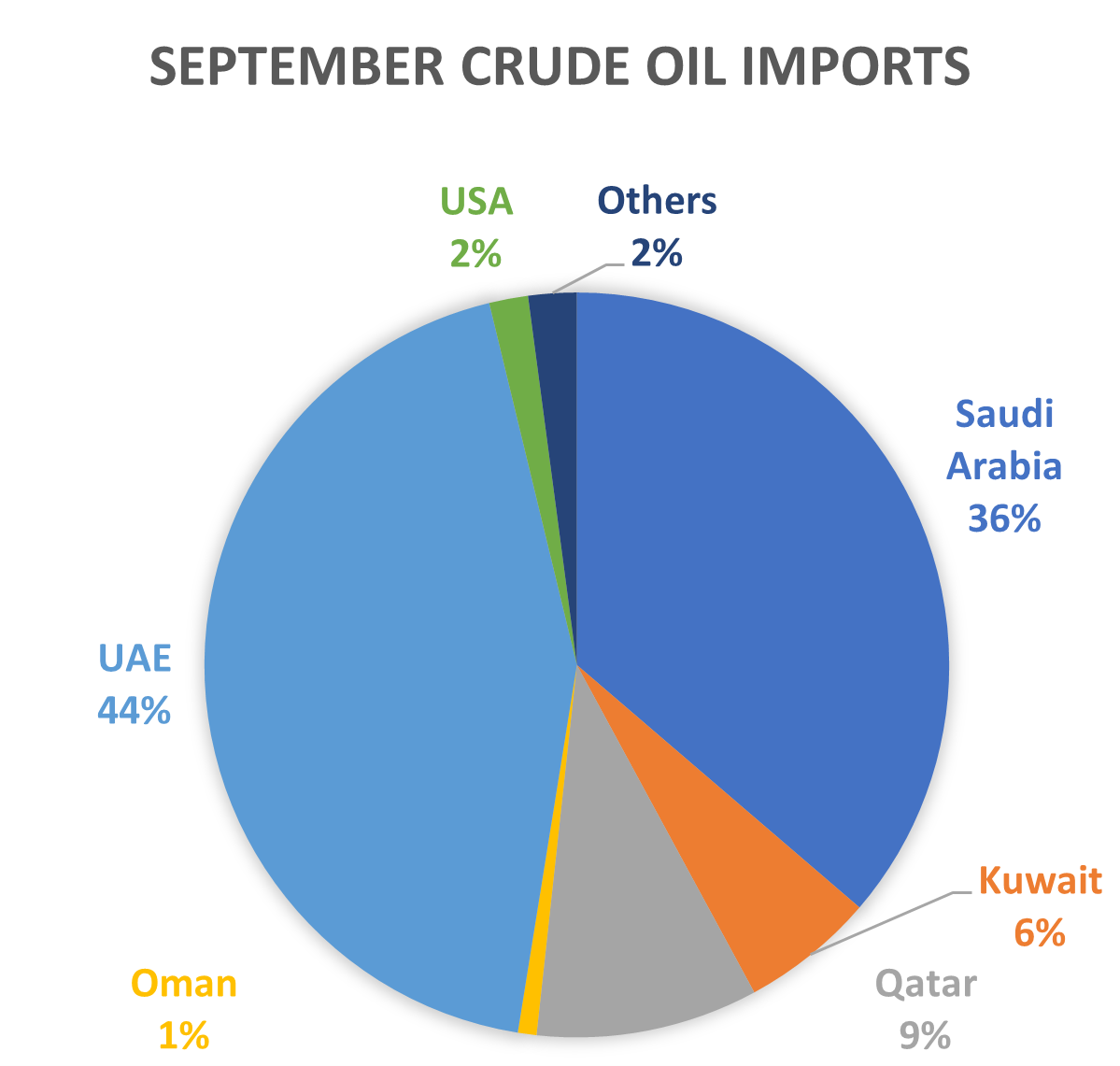
Japan imported 0.6 million tons of LNG from Russia in September, accounting for 11% of total LNG imports for the month. Japan didn’t import any crude oil from Russia in September, following 103,467 kiloliter imports in August.
ANALYSIS
BY MAYUMI WATANABE
Burned by the Sun: Learning from a Local Solar Power Conflict
“At the end of the day, it’s all about money. People weren’t getting into the solar business because they had strong opinions on energy,” says a restaurant owner in a small town in central Japan. The owner shrugs as he explains in detail an apathetic and sometimes hostile local attitude towards renewable energy.
Like a number of municipalities around the country, this township about 60 km south of Nagoya City, has its own unfortunate story related to solar development. That and gaps in local resources and knowledge about renewables are making it more and more difficult for developers to move forward with projects in rural Japan.
That bodes ill for the government’s 2030 climate targets. To meet internationally declared cuts in greenhouse gases, METI estimates that Japan needs to boost its operational solar capacity to 103-118 GW, from the current 66 GW. With other renewables unlikely to fill the gap near-term, reversing the malaise that’s descended on the solar sector is crucial.
The country needs a growth strategy that makes communities happy and allows operators to turn a profit, though working in the confines of the law. That’s the basis for a key advisory panel launched by the government. Its role is to be the peacemaker between renewables operators and communities.
What challenges will the government’s experts need to tackle? For this special report, Japan NRG visited the nation’s auto industry heartland of Nagoya to speak with a community in conflict.
Policy background
On Oct 17, the government re-launched a four-ministry advisory panel that is tasked with resolving conflicts between renewable operators and communities. The panel was originally formed in April this year.
The panel advises METI, the MoE, the Ministry of Agriculture, Forestry and Fisheries, and the Ministry of Land, Infrastructure, Transport and Tourism. The experts spent their first meeting discussing forestry protection, effective regulatory oversight, and improving communications between operators and communities.
Along with its previous peacemaker role, the panel has an additional mission to explore expansion of renewable capacities.
Big Trouble in Little Chita
About 60 kilometers south of Nagoya is the coastal town of Minami Chita. In the first hour of the drive from Nagoya, the scenes are industrial with trucks heading to JERA’s thermal power stations, as well as to Nippon Steel and Aichi Steel. But then the landscape turns green.
Minami Chita is a laid-back fishing and farming community with a population of about 4,000. The area is mostly flat with no tall structures. Locals say “seaside” to mean east and “mountainside” to mean west.
The town is bordered on the north by small mountains owned by the local farms. Two years ago, the Nagoya-based developer DSS started to buy up property and applied to the town with a plan to build some 9.9 kW solar power stations in the mountain area. There’s little regulatory scrutiny over solar projects smaller than 10 kW. Little did the locals know that DSS was planning 107 units of the mini-solar stations.
DSS began construction in 2021, tearing down areas far larger than land needed for a 9.9 kW power station. Not only that. Workers were intruding into unauthorized areas and by “error” had depleted 1.8 hectares of forest while damaging roads.
The town asked the company to file elaborate plans and solicited help from METI and Aichi Prefecture for stronger regulatory enforcement. In February this year, DSS canceled the project and agreed to repair the roads and restore the forests at its own expense. The town confirmed to Japan NRG that the road repairs had mostly been completed.
Community impact
Even before DSS, some residents were frustrated with solar and on-shore wind projects. One fruit farmer told Japan NRG that for the last few years developers and banks had been knocking on their doors, asking if they were interested in investing in new renewables projects. The farmer was told that banks and developers would take care of everything. Then, after a solar facility goes online, the farmer would be able to sell it to the local grid.
“I became dizzy when I learned about the amount of money involved, so I backed out. But some friends made a hideous profit by reselling the facilities,” said one local carpenter, who was also invited to projects.
That’s pretty much all that was at stake, says a local restaurant owner. “At the end of the day, it’s all about money. People weren’t getting into the power business because they had strong opinions on energy. Many neglect the plant’s maintenance and wouldn’t know whom to contact if they catch fire, or if panels were blown away by strong wind,” said a restaurant owner.
Numerous municipalities shared similar concerns and the four-ministry panel on community conflicts drafted action plans in summer that included:
Increased oversight for small solar units, conducting on-site checks to spot large projects pretending to be multiple small projects,
Require developers to gain all approvals before starting forest projects
Disclose project details in front of town meetings before construction starts
The problem was that many operators weren’t energy experts or pioneers. News of tighter regulations drove them to consider exit strategies. And they got stuck. “Removing the plant costs money, they realized, and they have no idea how to dispose of or recycle the panels,” said one resident close to a solar plant.
The Minami Chita township tightened its solar safety guidelines with immediate effect in February 2022, and the guidelines will be escalated into ordinances pending town assembly approval later this year.
Some local construction firms won’t engage with renewable projects, including residential rooftop solar panel installations, although the recent regulations don’t cover residential systems. “Go speak to solar panel manufacturers like Panasonic if you want a rooftop solar,” said another local carpenter.
Some community members have mixed feelings, as they feel there is a need for new power sources. In the last two or three years, three gasoline service stations closed. One was due to the absence of a business heir, and the others due to the regulatory requirement to overhaul their 30-year-old tank facilities. The owners decided it wasn’t worth investing in new tanks.
“I’m keen to drive electric vehicles and the good news is the local supermarket has decided to open a new charging station,” said a local car repair shop owner. She hopes for charging stations powered by locally generated solar power.
Some added that they saw DSS as an extreme case and it would be a great loss to the community if all renewable projects were perceived negatively.
METI panel has lots of work
Municipal governments will still have a vital role in gathering the renewable energy businesses and community stakeholders. Compared to cities, there’s vibrant communication between the municipality and town residents in places the size of Minami Chita, because taxpayers want the small local budget to be spent wisely.
Ties are strong enough to build frameworks for clean power supplies, and communities will be rewarded from them. There is already a foundation for community-wide collaboration since locals are very aware that a better future will only materialize if they begin work today.
Many would be happy to engage in a clean energy value chain that will be relevant to current projects to transform the Chita area into an “organic farm capital”, for example. The town coordinating plans and measures with neighboring villages is also important.
“Varying regulations and guidelines would only create the impression that after all that commotion, the government was unable to bring renewable businesses under control,” said one home builder. “People will say, no renewables, period.”
Some municipalities may be empathetic to Minami Chita’s experiences but not all areas are the same. Policies need to be uniform and strictly enforced while offering flexibility to take into account the needs of each area.
This is precisely what the re-launched METI panel needs to clarify. This work load is a tall order, and the panel certainly has its work cut out in the coming months.
ANALYSIS
BY YOSHIHISA OHNO
Reactor Life Extensions: A Quick but Temporary Solution for Japan
In tough times, it pays to stretch your money and make it work a little bit harder. This is especially true if the money at stake is $40 billion. That’s roughly the amount Japanese firms have spent since the Fukushima disaster to revamp nuclear safety.
Despite the rich outlay, most of the utilities have so far failed to reap any benefits. Less than one in five of the nation’s nuclear reactors are currently online. What’s worse, after the 2011 accident a 40-year limit was placed on the equipment’s operating life. So far, most of the reactors have spent over a quarter of that life fixing pipes and polishing the dust, all without producing a kW of electricity.
So it comes as little surprise that Prime Minister Kishida made headlines in recent months arguing for more of the Japanese nuclear fleet to be brought online. But even if his words move regulators and local politicians to accelerate the restart process, current reactor economics look grim. Safety upgrades have increased utility investments into the nuclear stations by about 30-40%. And yet, the facilities have spent a quarter of their permitted life without earning a single yen.
It was only a matter of time before the issue of operational life extension came up. But this can’t be more than a temporary answer.
Background
Before the 2011 accident at the Fukushima Dai-Ichi NPP, Japan counted 54 operable nuclear reactors. When the disaster was analyzed, reactor age often came up as an issue since the older units lacked some of the new safety features of more recent models. This pushed utilities to agree to decommission more than 20 of the older, smaller or experimental units (This includes six units of the damaged Fukushima Dai-Ichi NPP and four units of the not damaged but nearby Fukushima Dai-Ni NPP).
Today, there are 33 reactors classified as operable by the industry regulator, the NRA. Only 17 of those have so far received NRA approval to come back online. This figure includes two units at TEPCO’s Kashiwazaki-Kariwa NPP, which the regulator has again “frozen” pending probes into onsite safety culture.
Only 10 reactors have made it all the way back to generating electricity, a process that also requires a green light from local municipalities and prefectural chiefs. With some of the 10 currently down for maintenance or additional safety upgrade work, just six reactors are on the grid as of late October.
Rebranding the restarts
Since coming into office a year ago, PM Kishida has unveiled an ambitious decarbonization program called “Green Transformation”, or GX for short. The program is supposed to involve multiple elements, many of which are as yet undefined. One that has come front and center in recent months, however, is the need to revive nuclear energy in Japan.
Kishida’s interest in nuclear energy clearly increased as energy prices jumped over the past year. It peaked after western sanctions related to Russia’s war in Ukraine put energy security on high alert.
As a result, the great taboo of Japanese politics of the last decade – discussing the construction of new nuclear power plants – has been broken. In the past few months, PM Kishida, METI and key government figures have floated plans to:
Extend the lifespan of all operable reactors from 40 years to a maximum of 60 years
Scrap the lifespan limit entirely and review facilities on a regular basis
Build new reactors to replace aging units
Consider sites for entirely new nuclear stations
Support the development of next-generation nuclear technology.
The ideas above are the boldest pronouncements by the government in a decade. And, without many other elements of GX visible or tangible at this moment, it feels almost as if the GX platform was put forward as a way to rebrand nuclear energy in the country.
Of course, for the administration, there is ample cover. Renewed interest in nuclear energy is a global trend and extending the lifespan of reactors is happening even in locations that hitherto fiercely opposed the idea. Germany’s recent reversal of pledges to phase out its nuclear units by the end of this year follows on the heels of similar decisions by Belgium, California, and the Netherlands, among others.
Portraying nuclear restarts as a way to cut LNG imports, leaving more on the market for other players, and a bulwark against further yen weakening, are other talking points Kishida and METI have deployed.
Short-term fix
Keeping as much existing nuclear capacity online is vital for the economics of domestic utilities, which in turn affects the bills of ordinary consumers and businesses. After 2011, Japan’s power firms spent approximately $90 billion more on coal, LNG and oil supplies to cover the gap left by nuclear capacity. In that context, $40 billion invested in nuclear safety upgrades is a cost that should pay itself back.
The challenge for the government and the utilities, however, is the Fukushima accident severely cut available domestic power capacity, and as a result heightened energy security concerns. The decommissioning of older reactors eliminated more than 16.3 GW in baseload power capacity. TEPCO alone lost 10 nuclear units through the accident itself and public pressure.
So, extending the lifespan of remaining reactors is really a way to prevent further capacity leakage. As a result, it is only a temporary solution.
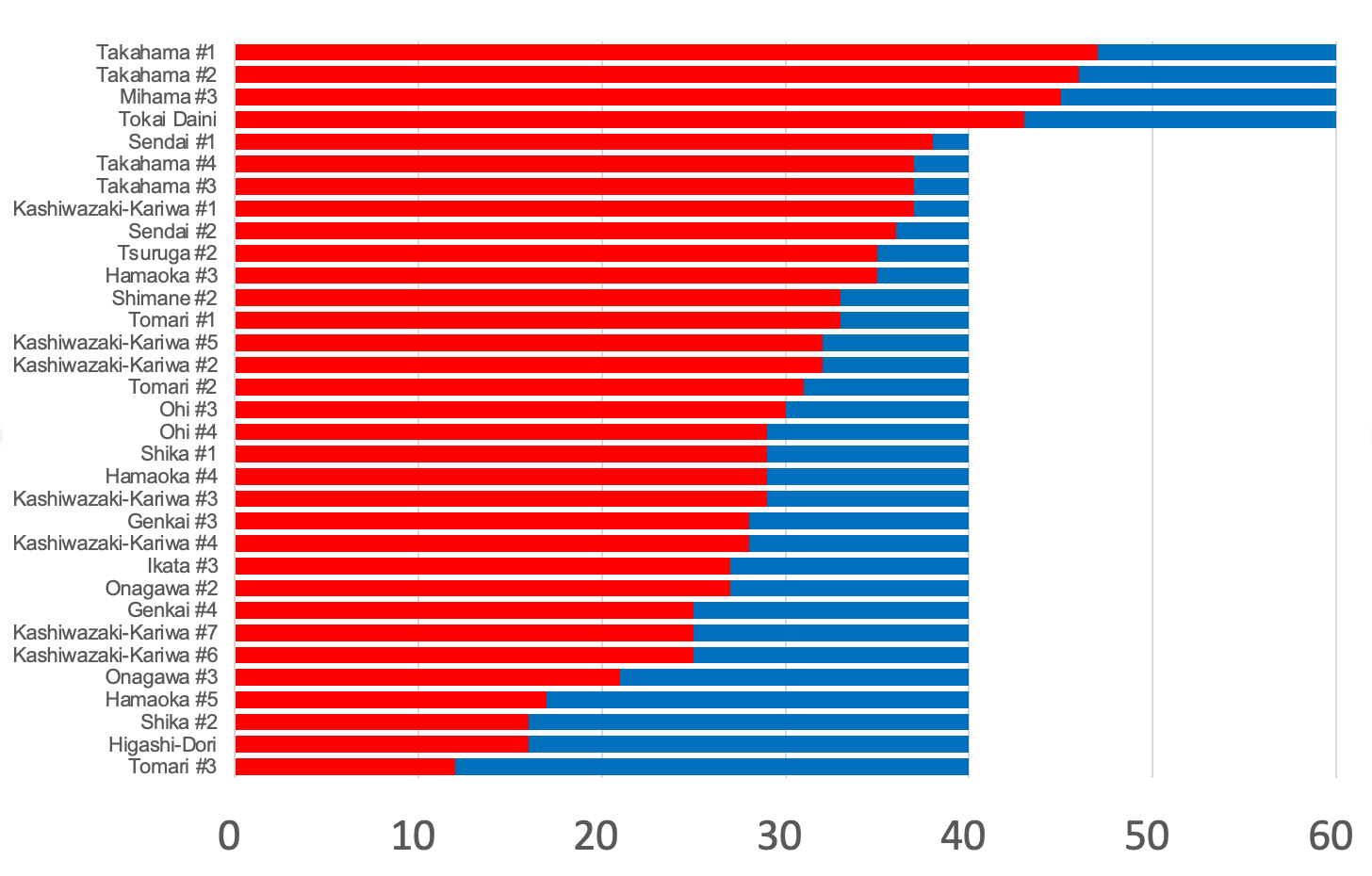
So far, only four reactors are approved to operate for an additional 20 years (Mihama #3, Takahama #1・2 and Tokai Dai-Ni). But, as per the graph above, other reactors are soon to reach their 40-year limit. Giving them a 20-year extension buys Japan time to find other ways to plug the capacity gap, but does not solve it since eventually the reactors will need to decommission.
Company
NPP
MW
Type
Supplier
Started Operations
Age
Years left on permit
Restarted since 2011?
Kansai
Takahama #1
826
PWR
WH / MHI
1974/11/01
47
13
No
Kansai
Takahama #2
826
PWR
MHI
1975/11/01
46
14
No
Kansai
Mihama #3
826
PWR
MHI
1976/12/01
45
15
Yes
JAPC
Tokai Daini
1,100
BWR
Hitachi / Toshiba
1978/11/28
43
17
No
Kyushu
Sendai #1
890
PWR
MHI
1984/07/01
38
2
Yes
Tokyo
Kashiwazaki-Kariwa #1
1,100
BWR
Toshiba
1985/09/01
37
3
No
Kansai
Takahama #3
870
PWR
MHI
1985/01/01
37
3
Yes
Kansai
Takahama #4
870
PWR
MHI
1985/06/01
37
3
Yes
Kyushu
Sendai #2
890
PWR
MHI
1985/11/01
36
4
Yes
Chubu
Hamaoka #3
1,100
BWR
Toshiba / Hitachi
1987/08/01
35
5
No
JAPC
Tsuruga #2
1,160
PWR
MHI
1987/02/01
35
5
No
Hokkaido
Tomari #1
579
PWR
MHI
1989/06/01
33
7
No
Chugoku
Shimane #2
820
BWR
Hitachi
1989/02/01
33
7
No
Tokyo
Kashiwazaki-Kariwa #2
1,100
BWR
Toshiba
1990/09/01
32
8
No
Tokyo
Kashiwazaki-Kariwa #5
1,100
BWR
Hitachi
1990/04/01
32
8
No
Hokkaido
Tomari #2
579
PWR
MHI
1991/04/01
31
9
No
Kansai
Ohi #3
1,180
PWR
MHI
1991/12/01
30
10
Yes
Tokyo
Kashiwazaki-Kariwa #3
1,100
BWR
Toshiba
1993/08/01
29
11
No
Chubu
Hamaoka #4
1,137
BWR
Toshiba / Hitachi
1993/09/01
29
11
No
Hokuriku
Shika #1
540
BWR
Hitachi
1993/07/01
29
11
No
Kansai
Ohi #4
1,180
PWR
MHI
1993/02/01
29
11
Yes
Tokyo
Kashiwazaki-Kariwa #4
1,100
BWR
Hitachi
1994/08/01
28
12
No
Kyushu
Genkai #3
1,180
PWR
MHI
1994/03/01
28
12
Yes
Tohoku
Onagawa #2
825
BWR
Toshiba
1995/07/01
27
13
No
Shikoku
Ikata #3
890
PWR
MHI
1994/12/01
27
13
Yes
Tokyo
Kashiwazaki-Kariwa #6
1,356
ABWR
Toshiba / GE / Hitachi
1996/11/01
25
15
No
Tokyo
Kashiwazaki-Kariwa #7
1,356
ABWR
Hitachi / GE / Toshiba
1997/07/01
25
15
No
Kyushu
Genkai #4
1,180
PWR
MHI
1997/09/01
25
15
Yes
Tohoku
Onagawa #3
825
BWR
Toshiba/Hitachi
2001/01/01
21
19
No
Chubu
Hamaoka #5
1,267
ABWR
Toshiba / Hitachi
2005/01/01
17
23
No
Tohoku
Higashi-Dori
1,100
BWR
Toshiba
2005/12/01
16
24
No
Hokuriku
Shika #2
1,358
ABWR
Hitachi
2006/03/01
16
24
No
Hokkaido
Tomari #3
912
PWR
MHI
2009/12/01
12
28
No
Permitted operating life of reactors in Japan (Remaining permit life in blue)
Source: Power companies, METI
Nuclear plant planning and construction often takes a decade or more, so if the older units are to be replaced with the latest reactors, discussion on this needs to start almost as soon as the 20-year extension is granted.
Furthermore, reactor construction and operations require engineering and human resources that have started to disperse since the Fukushima accident. To retain staff and vendors for the nuclear industry, the government needs to offer a vision for the future. To attract the best young minds, that vision cannot be about standing still by replacing existing technology with similar units. There has to be emphasis on new developments.
In a way, METI’s nuclear industry strategy published in the summer vaunted the potential of four reactor technologies in addition to the regular BWR/ ABWR and PWR tech that account for all of the commercial reactors in Japan today. The following GX committee discussions, however, focused on improved (“advanced”) versions of the same BWR and PWR reactors.
It’s normal for governments to focus on the immediate future, and simply getting social and legal approval for reactor life extensions will require a massive amount of political capital. But if Kishida truly believes in a nuclear energy future for Japan, his government will need to provide a more exciting vision for next-gen reactors to tempt next-gen talent.
GLOBAL VIEW
BY JOHN VAROLI
Below are some of last week’s most important international energy developments monitored by the Japan NRG team because of their potential to impact energy supply and demand, as well as prices. We see the following as relevant to Japanese and international energy investors.
Asia/ Wind power
Asia will surpass the EU in offshore wind power by 2030, and eventually garner 60% of total global capacity by 2050. In 2019, Asia had 5 GW of installed offshore wind capacity, while Europe had 19 GW, said the International Renewable Energy Agency. EU turbine-makers still have a technological advantage over Chinese competitors.
China/ Natural gas
Sinopec discovered major shale gas reserves in the Sichuan basin. With daily natural gas production reaching 258,600 c/m, and an estimated resource capacity of 388 bcm, it’s touted as a breakthrough for China’s shale gas sector.
China/ Renewables
About $14 trillion investment in power and transportation is needed by 2060 to reach Beijing’s goal of net zero emissions, said the World Bank. The ruling Party congress last week reaffirmed its green energy plans.
EU/ Natural gas price
Thanks to warm weather and near full gas storage, EU natural gas prices dropped below €100/ MWh for the first time since Russian supplies were cut. EU gas prices are now 70% below August levels, when they soared over €300/MWh, but they’re still well above the €20 to €40/ MWh range they traded at over the past decade.
Germany/ Coal
The government has again legalized the use of idled brown coal capacity to next summer. Already, one small wind farm is being dismantled to expand an open-pit lignite coal mine operated by RWE. The company said this will “strengthen the security of supply in Germany during the energy crisis.”
Kazakhstan/ Green hydrogen
Svevind Energy Group will build a $50 billion hub that will annually produce about 2 million tons of green hydrogen. The project consists of a 40 GW renewable energy station (wind, solar), and a 20 GW water electrolysis production, mainly for export to the EU.
Poland/ Nuclear power
U.S. firm Westinghouse Electric will build Poland’s first nuclear power plant. The first stage envisions three AP1000 reactors to start by 2033, with an additional three possibly to be built. If completed in full, total capacity would be as much as 9 GW.
Slovakia/ Nuclear power
Slovakia’s 471 MW Mochovce Unit 3 nuclear power plant is expected to launch in early 2023. The unit will produce about 3.7 TWh per year, nearly 13% of Slovakia’s electricity consumption.
U.S./ Wind power
The White House wants to spark an offshore wind power boom, growing the industry from less than 1 GW today to 30 GW by the end of the decade. But executives are concerned that many challenges are pushing that target beyond reach: permits are too slow, leases too expensive, equipment is in short supply and inflation is high.
UK/ Energy tax
The de facto windfall tax on low carbon electricity companies will have “catastrophic consequences” for investment in green technologies. The policy was introduced to raise funds for the government’s energy bills support plan for households and could remain in place until the end of 2027. The bill is still in Parliament.
Oil services
Schlumberger is rebranding from an oilfield services giant to a global energy innovation company, changing its name to SLB. CEO Olivier Le Peuch said: “Our new identity symbolizes SLB’s commitment to moving farther and faster in facilitating the world’s energy needs and forging the road ahead for the energy transition.”
2022 EVENTS CALENDAR
A selection of domestic and international events we believe will have an impact on Japanese energy
January
OPEC quarterly meeting;
JCCP Petroleum Conference – Tokyo;
EU Taxonomy Climate Delegated Act activates;
Regional Comprehensive Economic Partnership (RCEP) Trade Agreement that includes ASEAN countries, China and Japan activates;
Indonesia to temporarily ban coal exports for one month;
Regional bloc developments: Cambodia assumes presidency of ASEAN; Thailand assumes presidency of APEC; Germany assumes presidency of G7; France assumes presidency of EU; Indonesia assumes presidency of G20; and Senegal assumes presidency of African Union;
Japan-U.S. two-plus-two meeting;
Japan’s parliament convenes on Jan. 17 for 150 days;
Prime Minister Kishida visits Australia (tentative)
February
Chinese New Year (Jan. 31 to Feb. 6);
Beijing Winter Olympics;
South Korea joins RCEP trade agreement
March
Renewable Energy Institute annual conference;
Smart Energy Week – Tokyo;
Japan Atomic Industrial Forum annual conference – Tokyo;
World Hydrogen Summit – Netherlands;
EU New strategy on international energy engagement published;
End of 2021/22 Japanese Fiscal Year;
South Korean presidential election
April
Japan Energy Summit – Tokyo;
MARPOL Convention on Emissions reductions for containerships and LNG carriers activates;
Japan Feed-in-Premium system commences as Energy Resilience Act takes effect;
Launch of Prime Section of Japan Stock Exchange with TFCD climate reporting requirement;
Convention on Biological Diversity Conference for post-2020 biodiversity framework – China;
Elections: French presidential election; Hungarian general election
May
World Natural Gas Conference WCG2022 – South Korea;
Elections: Australian general election; Philippines general and presidential elections
Germany to eliminate nuclear power from energy mix;
Happo-Noshiro offshore wind project auction result released;
Japan submits revised 2030 CO2 reduction goal following Glasgow’s COP26;
Japan-Canada Annual Energy Forum (tentative);
Tesla expected to achieve 1.3 million EV deliveries for full year 2022
Disclaimer
This communication has been prepared for information purposes only, is confidential and may be legally privileged. This is a subscription-only service and is directed at those who have expressly asked K.K. Yuri Group or one of its representatives to be added to the mailing list. This document may not be onwardly circulated or reproduced without prior written consent from Yuri Group, which retains all copyright to the content of this report.
Yuri Group is not registered as an investment advisor in any jurisdiction. Our research and all the content express our opinions, which are generally based on available public information, field studies and own analysis. Content is limited to general comment upon general political, economic and market issues, asset classes and types of investments. The report and all of its content does not constitute a recommendation or solicitation to buy, sell, subscribe for or underwrite any product or physical commodity, or a financial instrument.
The information contained in this report is obtained from sources believed to be reliable and in good faith. No representation or warranty is made that it is accurate or complete. Opinions and views expressed are subject to change without notice, as are prices and availability, which are indicative only. There is no obligation to notify recipients of any changes to this data or to do so in the future. No responsibility is accepted for the use of or reliance on the information provided. In no circumstances will Yuri Group be liable for any indirect or direct loss, or consequential loss or damages arising from the use of, any inability to use, or any inaccuracy in the information.
K.K. Yuri Group: Oonoya Building 8F, Yotsuya 1-18, Shinjuku-ku, Tokyo, Japan, 160-0004.
NEWS
・Govt unveils ¥39 trillion package to shield consumers from energy price increases from January, covering multiple sectors
・PM Kishida asks GX Council for effective carbon pricing plan, seeking a way to kickstart full-scale trading by FY2026
・Solar operators and bureaucrats clash over ways to help industry gain better traction at community level