Nuclear regulator to remove age limit on reactor operations, moving to a system of checking the facilities every 10 years
Govt. to ask citizens, business to conserve power from December as cost of energy generation starts to bite
Japan to remain in Sakhalin-1 oil project after Russia restructures ownership, claiming energy security considerations
ENERGY TRANSITION & POLICY
PM Kishida pushes for more net-zero options in mobility sector
Renewables operators claim Ukraine crisis causing surge in costs
New tariff system needs reform: Japan Wind Power Association
Private sector requests state funding for CCS development
Agency publishes data on firms with best energy saving practices
Japan leads in sustainable concrete technologies: METI
Itochu to import “neat SAF”, establish blending supply chain
ENEOS-led group to develop Hokkaido green hydrogen supply
MHI and Indonesia to research ammonia, biomass co-firing
ELECTRICITY MARKETS
Winter power forecast improves, but METI cautious on situation
Chugoku Electric brings online first new thermal plant in 22 years
TEPCO may raise regulated power rates for first time since 2012
Power firms to trial a VPP based on household storage batteries
Toyota, JERA launch world-first large sweep energy storage unit
TEPCO acquires Scotland’s Flotation Energy offshore wind firm
SoftBank unit signs 924 MW solar PPA with Google in the U.S.
Osaka Gas makes its biggest solar investment in Japan to date
OIL, GAS & MINING
Japan offers JERA second major loan to secure more LNG cargos
Mitsubishi Power to help Egypt LNG producer boost supply
Idemitsu makes second vanadium investment in Australia
Mitsubishi, German firm form auto raw materials consultancy JV
ANALYSIS
COP27 PREVIEW: JAPAN READY TO TALK CARBON TRADING
COP27 kicks off in Egypt this week. Some participants have come to talk about policy; others to bemoan geopolitics; and more than a few to argue over the validity of various climate actions. Japan, however, will be there primarily to do business. Tokyo’s primary goal at the UN climate change conference, which officially opened on Nov. 6, will be to help craft an international framework for cross-border trading of emissions credits.
Should carbon trading align across many countries, it would incentivize investment in decarbonization in lower cost geographies, providing funds for green solutions in developing economies.
UPGRADING JAPAN’S PORTS FOR OFFSHORE WIND BRINGS NEW CHALLENGES
The government is betting on Japan’s natural geographical advantage – some of the world’s longest coast lines – to provide substantial electricity volumes from wind generation. In recent years, a new law has been passed and existing ones updated. For example, revisions to the Port and Harbor Act have been made to promote offshore wind projects near ports. While this is positive news, it’s just the start of a long road of work ahead. Required specifications for suitable ports – such as the water depth and ground bearing capacity – will have to be surveyed and will vary depending on the types of foundations to be deployed. Some are still in pilot projects. We review the scale of the challenges ahead.
GLOBAL VIEW
Argentina and the EU plan to ink gas deal soon. European energy-intensive industries mull moves abroad. Moscow accuses the UK of Nord Stream gas pipeline attacks. UAE renewables firm buys UK assets. Vietnam and Indonesia to get cash to lower coal usage. Details on these and more in our global wrap.
JAPAN NRG WEEKLY
PUBLISHER K. K. Yuri Group
Editorial Team Yuriy Humber (Editor-in-Chief) John Varoli (Senior Editor, Americas) Mayumi Watanabe (Japan) Yoshihisa Ohno (Japan) Wilfried Goossens (Events, global)
METI The Ministry of Energy, Trade and Industry
MOE Ministry of Environment
ANRE Agency for Natural Resources and Energy
NEDO New Energy and Industrial Technology Development Organization
TEPCO Tokyo Electric Power Company
KEPCO Kansai Electric Power Company
EPCO Electric Power Company
JCC Japan Crude Cocktail
JKM Japan Korea Market, the Platt’s LNG benchmark
CCUS Carbon Capture, Utilization and Storage
mmbtu Million British Thermal Units
mb/d Million barrels per day
mtoe Million Tons of Oil Equivalent
kWh Kilowatt hours (electricity generation volume)
PM Kishida met with a group of business leaders to push decarbonization, digitization and other changes in the mobility sector.
The PM suggests setting priorities for the govt and private sector in order to cope with geopolitical constraints on supply chains and global decarbonization trends.
The priorities will be discussed in the next mobility business leaders meeting.
TAKEAWAY: This is potentially a very big development and shows that the government is not convinced that electrification will spread sufficiently in the auto and other transport sectors.
Renewable operator groups claimed to the Power Tariff Committee that the Ukraine crisis has driven up their costs; this comes as the Committee prepares the 2023 tariff levels.
About 55% of rooftop residential installations saw a more than 15% cost rise, YoY, on the back of the weaker yen and semiconductor shortages.
Wind projects have suffered delays as component supply tightened globally and prices rose 20-86%.
Key biomass import prices surged in the range of 20-50% on higher freight and tight feed supply, lacking Russian material.
The groups requested that the Committee take into account these cost rises when deciding the 2023 tariffs.
Average power generation costs in ¥/ kWh (includes installation and running costs)
Residential solar
Solar for businesses
Onshore wind
Offshore wind
Geothermal
Biomass
2020
17.7
12.9
19.8
30.0
16.7
29.8
2030 goal
7
7
8-9
8-9
To be independent from FIT
To be independent from FIT
Source: ANRE
TAKEAWAY: Some experts argue that renewable cost rises are moderate compared to fossil fuel prices. Spot commodity prices are often used to make cost comparisons, but prices reflect market trends, not costs. Japanese companies have limited direct exposure to spot markets as they have long-term contracts and may be paying more or less than spot levels, depending on contract terms.
The Japan Wind Power Association reported to the Power Tariff Committee that the project financing feed-in-premium (FIP) system faces challenges as banks claim it lacks visibility on the power business future.
Renewable output curbs also contribute to a lack of visibility.
The Association urged the Committee to speak with banks and institutional investors in order to improve the FIP system.
TAKEAWAY: In theory, the FIP incentivizes investment as players are rewarded with higher returns depending on how their business models cope with electricity price volatility. This makes the power market more efficient as segmented renewable sectors integrate into a single power market. Tools to forecast FIP income are provided on ANRE’s website. On the other hand, there has been no wind project financed with FIP and it’s been a struggle for on-going projects too.
19 companies and associations, including trading houses, shipping companies and energy associations, requested METI state-funding for capital expenditure and to cover running costs of future carbon capture and storage projects.
Japan CCS Co. urged a quick setup of CCS regulatory framework and to avoid overlap in regulations between the central government and municipalities.
A study by the Research Institute of Innovative Technology for the Earth (RITE) showed that at least ¥400 billion would be required for capturing, transporting and storing 1 million tons/ year of carbon.
CONTEXT: METI solicited the CCS Costs and Implementation Working Group members to put forward requests.
TAKEAWAY: The RITE study highlighted that the origin of carbon – from coal, LNG or hydrogen production – will have a major impact on costs.
ANRE proposes to publish on METI’s website the energy data of companies that achieved “S”, the highest rating for energy saving practices.
Every year, ANRE rates companies in four categories: “S” (energy saving is excellent), “A” (general), “B” (stagnation) and “C” (requires work). There are about 10,000 companies rated “S”, and they can be found on ANRE’s website.
ANRE will disclose company names and energy data, provided they give consent. Major disclosure items are energy efficiency data, the use of demand response power systems, and shifts to non-fossil power.
CONTEXT: Following the Energy Conservation Act amendments in May, large energy consumers are to report shifts to renewables and demand response systems, in addition to energy efficiency data. Companies receiving an “S” last year include Tokyo Electric Power Grid and Nansei Sekiyu.
TAKEAWAY: The Petroleum Association of Japan said it was a shame that ANRE’s energy saving measurement system doesn’t reflect efforts to cut SCOPE-3 emissions.
The Energy Conservation Center Japan (ECCJ) urged ANRE to promote atmospheric heat as a renewable energy source by establishing a methodology to measure it, and subsequently include it in energy statistics.
CONTEXT: Japanese energy regulations didn’t provide a clear definition of atmospheric heat until the recent changes to the Energy Conservation Act defined it as “energy”.
METI reported that Japanese sustainable concrete technologies are leading its overseas peers with higher carbon reduction and capture values.
CO2 Suicom, jointly developed by Kashima, Chugoku Electric and Denka, posted a carbon reduction of 306 kg/ m2 and carbon capture of 109 kg/ m3, which was over ten times more than the figures of a Canadian competitor.
The govt will promote sustainable concrete at the 2025 Osaka Pavilion, and plans to include it in the offset credit mechanism.
Itochu to import ‘neat SAF’ and establish blending supply chain
(Company statement Nov. 1)
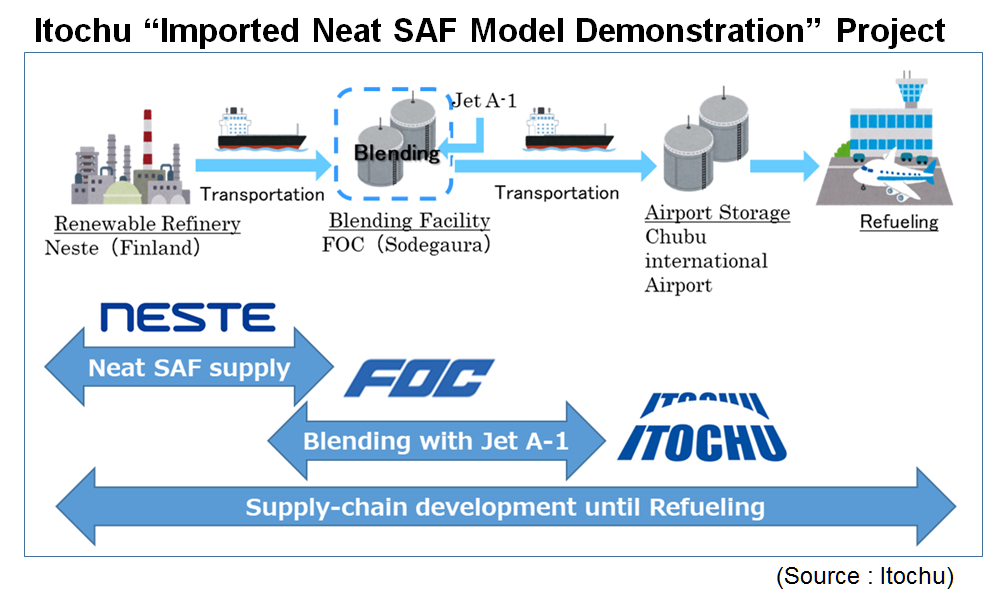
Trading house Itochu Corp was selected by the Civil Aviation Bureau for its “Imported Neat SAF Model Project”.
In a first for Japan, Itochu will import neat SAF (a jet fuel produced with biomass materials, and blended with a certain percentage of fossil-based jet fuel) from Neste. It will demonstrate blending of neat SAF with conventional fossil jet fuel, as well as certification of blended SAF with Fuji Oil.
Some of this locally blended SAF will supply Central Japan International Airport.
Source: Itochu
ENEOS-led group seeks to develop Hokkaido green hydrogen supply chain
(New Energy Business News, Nov. 2)
ENEOS, JFE Engineering, Deloitte, Hokkaido Electric and the Hokkaido grid company won state backing to create a large-scale green hydrogen supply chain project on Japan’s northernmost isle.
The five companies have NEDO backing for a research project until Sept 2023 that will investigate creating a green hydrogen supply chain in Hokkaido’s Tomakomai region. Initial ideas center on deploying 100 MW class electrolyzers to produce about 10,000 tons of green hydrogen annually.
CONTEXT: Hokkaido is rich in renewable energy resources such as solar and wind, but local demand for electricity in Hokkaido is limited. Hydrogen is seen as one way to deliver energy from Hokkaido to high-demand areas in Japan.
TAKEAWAY: An analysis of surplus renewable energy used to generate hydrogen is in the Feb. 21, 2022 Japan NRG issue. An analysis about electrolyzer use to balance the local grid is in the Aug. 1, 2022 Japan NRG issue.
SIDE DEVELOPMENT: JX and Mizuho to test hydrogen production from biomass also using CCS (New Energy Business News, Nov. 2)
NEDO chose a group of Japanese firms for a test project to produce hydrogen from domestic biomass while also deploying carbon capture technology.
ENEOS unit JX Petroleum Development and J-Power, will introduce a BECCS (BioEnergy with Carbon Capture and Storage) system at the former’s Nakajo Oil Terminal in Tainai City, Niigata Prefecture. The demo will combine gasification technology with CCS at a generator that burns locally sourced woody biomass.
Mizuho Research & Technologies will help survey and verify the total system, which will be CO2-negative in terms of emissions. The test will run until September 2023.
MHI and Indonesia to research co-firing with hydrogen, biomass and ammonia
(Company statement, Nov. 2)
MHI and PT Indonesia Power, a subsidiary of state-owned electricity provider PLN, signed an MoU for three studies on co-firing carbon-friendly fuels at power plants owned and operated by Indonesia Power.
The three studies will be conducted with support from Mitsubishi Power, and will advance solutions to accelerate Indonesia’s decarbonization.
The first study will examine the feasibility of co-firing up to 100% biomass at the Suralaya coal-fired power plant (CFPP). The second will investigate co-firing ammonia in Indonesia. The third study will evaluate the feasibility of hydrogen co-firing in an M701F gas turbine at the Tanjung Priok gas turbine combined-cycle (GTCC) facility.
Mitsubishi partners with Aussie cement maker on methanol from CO2, green hydrogen
(New Energy Business News, Nov. 4)
Mitsubishi Gas Chemical signed an MoU with Cement Australia to explore the feasibility of producing and selling methanol from CO2 and green hydrogen recovered from its Gladstone plant in Queensland.
MGC recently developed recyclable methanol production technology.
Itochu and PowerX will produce battery energy storage systems in Japan
(Company statement, Oct. 27)
Trading house Itochu and startup PowerX will partner to make battery energy storage systems. The two will also work on EV charging business opportunities.
Itochu will help PowerX use data from EV charging to develop new services and promote and sell its battery systems.
CONTEXT: PowerX is establishing one of Japan’s largest battery assembly plants in Okayama Prefecture, which the startup says will enable it to produce energy storage systems and ultrafast EV chargers at a low cost.
IHI creates CO2 traceability and origin labeling system for ammonia
(Kankyo Business, Nov. 2)
Engineering major IHI created a CO2 traceability platform for ammonia that tracks emissions from ammonia production to utilization by using blockchain.
The system calculates, records, and visualizes CO2 emissions at each stage of ammonia production, transportation, storage, and use. This enables both sellers and buyers to prove their CO2 emissions and any reductions to stakeholders seeking info on their decarbonization efforts.
The company started a demo test to verify the calculation method and improve the platform’s functionality.
U.S. energy official says Japan could be an export destination for hydrogen
(Asia Nikkei, Oct. 29)
David Crane, the nominee for U.S. undersecretary of energy, said that plans to develop $7 billion in hydrogen production infrastructure in the U.S. could benefit Japan as an importer of the fuel.
The U.S. would like to cooperate with Japan on hydrogen and ammonia projects and would welcome Japanese investment, Crane said.
Companies such as Mitsubishi Heavy Industries might be interested.
CONTEXT: Crane is in the process of Congressional approval. He’s a former director at JERA.
Green Gold Label, International Sustainability and Carbon Certification, and the Roundtable on Sustainable Biomaterials and Sustainable Biomaterial Program made presentations on their GHG tracking and certification methodology.
CONTEXT: METI plans to increase the third-party biomass sustainability certifiers.
METI to support human resource development for nuclear industry
(METI statement, Nov. 2)
METI will support the overseas business of nuclear equipment suppliers by building a Nuclear Supply Chain Platform (NSCP) via a network of METI offices.
METI’s Innovative Reactor Working Group in the Nuclear Energy Subcommittee is concerned that the number of businessmen and students interested in nuclear energy has been declining. Sufficient human resources for nuclear energy is imperative in the development of new innovative reactors.
Many nuclear business suppliers have suffered from a sharp decline in orders, and suppliers must scale back or close operations.
TAKEAWAY: There was a big drop-off in interest among younger people in studying nuclear power generation after the 2011 Fukushima disaster. Securing proper human resources to drive innovation in nuclear sector technologies is a major challenge for the government.
Japan’s empty villages are a warning for China
(FT, Nov. 30)
Nomura Research Institute predicts that Japan will have about 11 million unoccupied residences, and up to one-third of Japan’s homes might be empty.
According to Jefferies, China now faces this demographic issue – how to avoid the same property crisis that Japan experienced. Jefferies stresses the strong resemblance between those two countries.
For example, the ratio of children born to unmarried couples for both Japan or China is very low, about 3%; compared with 60% in major western countries.
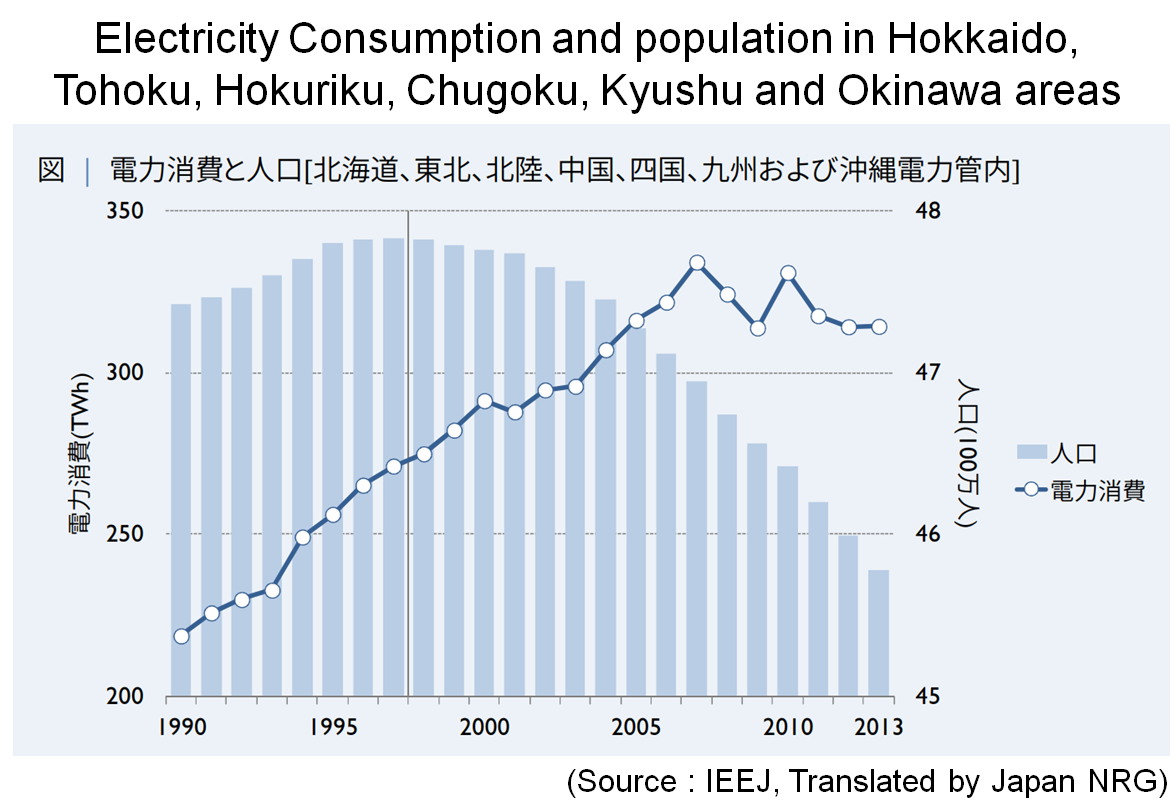
TAKEAWAY: While both Japan and China must grapple with negative demographics, the paper, “Population Decrease and Electricity Demand / Myth and Reality” by Akira Yanagisawa, argues that while population has been decreasing steeply, even in already depopulated areas such as Hokkaido, Tohoku, Chugoku, Kyushu and Okinawa, electricity demand is more impacted by lifestyle than population numbers. For this reason, demand for new energy infrastructure, including renewables, might not decline in line with a fall in population.
Electricity consumption and population in Hokkaido, Tohoku, Hokuriku, Chugoku, Kyushu and Okinawa areas
Source: IEEJ
NEWS: POWER MARKETS
The NRA to remove age limit on operation of nuclear reactors
(Sankei Shimbun, Nov. 2)
The NRA will abolish the 60-years operation limit for nuclear reactors. But it will require approval for every 10 years, starting 30 years after operational start.
Currently, utilities need approval for an extension before a reactor turns 40 years old. Therefore, power companies must get approval 10 years earlier. Now, with this decision, Japanese companies can operate NPPs for 70 or 80 years, like in the U.S.
The NRA will decide the details of this issue by the end of 2022.
TAKEAWAY: After the Fukushima disaster in 2011, all nuclear reactors had to cease operations, even if they had no problems at all. For example, Chubu Electric hasn’t operated units 3, 4 and 5 of its Hamaoka NPP (total output 3.5 GW) for more than 10 years. Therefore, the NRA’s decision can be seen as a way to compensate utilities for the “lost” 10+ years. See last week’s Analysis section for a detailed overview of this situation.
Government to ask citizens, businesses to conserve power starting December
(NHK, Oct. 31)
Due to the energy crisis, the govt plans to ask households and businesses to cut electricity use between December and March.
While the country has enough capacity to generate sufficient electricity, the cost of fuel is at a record high.
CONTEXT: In summer, the government asked for energy conservation and electricity use was significantly cut on certain days.
METI said the power reserve rate from December to February is holding above 4% for all areas, including Tokyo, and which previously was forecast to be in a deficit of 0.6% in January and 0.5% in February.
At least nine nuclear plants will be operational during the winter months, as construction work schedules were pushed forward.
METI will continue to monitor supply side factors such as available power generation capacities, fuel and non-fossil power sources, as well as drive energy conservation by spreading demand response systems among businesses.
Government buildings will be kept at 19°C and all lighting systems will be replaced by light-emitting diodes (LED) by 2030.
Chugoku Electric starts first new thermal power plant in 22 years
(Denki Shimbun, Nov. 2)
Chugoku Electric started Unit 2 of the Misumi coal-fired power plant. Together with Unit 1, Misumi’s output is 2 GW.
As Unit 2’s power generation efficiency reaches 43.3%, fuel costs will drop significantly. And as woody biomass will account for 10% of the fuel, CO2 emissions should also be reduced.
The plant was delivered by MHI. For Chugoku Electric, Misumi Unit 2 is the first thermal power plant to open in 22 years.
TAKEAWAY: While 10 nuclear reactors, with total output of 9.96 GW, have restarted in Western Japan, Chugoku, Hokuriku and Chubu Electric which use a different reactor tech have yet to restart a single one. Misumi’s Unit 2 will replace costly, older gas and oil power plants and help improve Chugoku Electric’s finances.
TEPCO may raise regulated power rates for first time since 2012
(Denki Shimbun, Nov. 2)
TEPCO Holdings and TEPCO Energy Partner said that due to soaring fuel prices, high JEPX electricity prices, and a steeply weakening yen, their financial situation is worsening rapidly.
According to 2022 midterm results, TEPCO had its first loss for an interim period because TEPCO EP must sell electricity lower than the purchasing price.
To make matters worse, TEPCO needs to supply electricity for old customers who once switched to a PPS but then returned after their PPS went bankrupt.
CONTEXT: For the first time since 2012, TEPCO wants to raise regulated rates for low-voltage customers, which tend to be households.
TAKEAWAY: Recently, other regional power companies also announced price hikes, for the same reasons as TEPCO. They first suffered by losing customers, then competing with PPSs, and now suffer from returning customers. A verification for the result of electricity deregulation would be needed.
Power operators to trial VPP based on household storage batteries
(New Energy Business News, Nov. 1)
A number of power companies including Shizen Energy and Minna Denryoku will join with Tokyo Gas and battery manufacturers including GridShare Japan to set up a virtual power plant (VPP) based on residential energy storage batteries.
The group plans to recruit 700 households to participate, which would be equivalent to about 2,200 kW of regulated power, and begin a trial in mid-December. Shizen Energy will serve as the VPP aggregator and use its Shizen Connect energy management system.
The VPP will remotely control residential storage batteries to balance out local power supply and demand, and verify the impact on grid balancing and electricity cost.
CONTEXT: This is Japan’s largest VPP demo using household energy resources.
Toyota and JERA launch the world’s first large-capacity sweep energy storage system
(Company statement, Oct. 27)
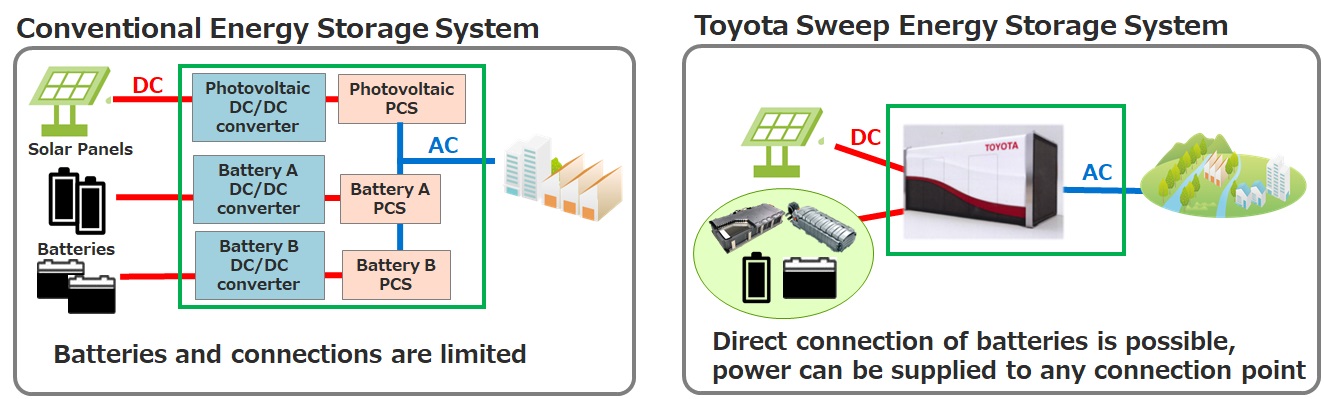
JERA and Toyota launched the world’s first large-capacity sweep energy storage system, a way to use old vehicle batteries of varying size and output, in tandem.
The system was built using batteries reclaimed from EVs (HEV, PHEV, BEV, FCEV) and is connected to the consumer electrical power grid. Toyota’s sweep function can freely control energy discharge by switching electricity flow on and off through series-connected batteries.
The storage system will be connected to the Chubu Electric Power Grid and installed at JERA’s Yokkaichi thermal power plant.
The sweep function enables direct AC output from the batteries. That helps to reduce costs and avoid power loss when converting from AC to DC.
TAKEAWAY: Despite high demand for batteries, insufficient supply of raw materials is a major challenge. Reusing older car batteries for power storage also addresses environmental considerations.
TEPCO acquires Scotland’s Flotation Energy
(Company statement, Nov. 2)
Edinburgh-based Flotation Energy will be acquired by TEPCO Group.
Flotation is a pioneer in floating offshore wind and it developed Kincardine, the world’s largest floating wind farm. The company is working on more than 12 GW of commercial scale fixed and floating offshore wind farms.
“Flotation Energy’s experience with the world’s biggest floating offshore wind development and its global network will accelerate development of our offshore wind business both domestically and internationally,” said Masashi Nagasawa, head of TEPCO Renewable Power.
SoftBank U.S. subsidiary signs PPA with Google for 924 MW of solar power
(New Energy Business News, Nov. 4)
SB Energy Global, a U.S.-based SoftBank Group subsidiary, signed a PPA to supply renewable energy power for Google’s data center from a 942 MW solar power plant to be built in Texas. Operation begins in 2024.
CONTEXT: This will be one of Google’s largest renewable energy suppliers in Texas. SB Energy Global is developing four solar power plants totaling 1.2 GW in size. Of these, 75% will supply power to Google.
Osaka Gas buys 40% stake in three large solar farms
(Kankyo Business, Oct. 28)
Osaka Gas acquired a 40% stake in three solar power plants, with a total capacity of 131 MW, from global renewables operator SONEDIX Power.
Osaka Gas and SONEDIX want to increase the value of these assets, and will also consider developing new ones using the corporate PPA model.
The assets will be the biggest solar farms in which Osaka Gas Group has invested in Japan. Osaka Gas will offtake all the electricity from the three farms, which are in Ibaraki, Tottori and Oita prefectures
IHI and JGC to join with NuScale for study to develop SMRs in Ghana
(JETRO, Oct. 28)
Japan will support an SMR study by domestic and U.S. companies — IHI, JGC, Regnum Technology Group, and NuScale Power — on behalf of Ghana.
The study is for the potential deployment of a NuScale VOYGR SMR, including existing infrastructure assessments, as well as evaluating supply chain opportunities in Ghana.
TAKEAWAY: Japan has been supporting SMR technology by investing in NuScale with funds supplied by JBIC. Major Japanese nuclear suppliers such as Toshiba and MHI are less advanced in their development of SMR reactors.
NEWS: OIL, GAS & MINING
Japan will remain in Sakhalin-1 after Russia changes ownership to local entity
(Asia Nikkei, Oct. 31)
The govt decided that Japan will remain a stakeholder in Russia’s Sakhalin-1 oil and gas project even after Exxon’s exit. Russia is moving the assets from the current operating company to a new, locally registered entity set up last month.
Russia gave current Sakhalin-1 shareholders a month to decide whether to invest in the new entity. A Japanese state-backed consortium owns 30% of the current company.
Exxon said earlier this year it would leave the project. A unit of Russia’s state-run oil major, Rosneft, will take over as project leader. India’s state firm ONGC also owns 20% of Sakhalin-1.
TAKEAWAY: Production at Sakhalin-1 has almost ground to a halt and Japan stopped buying its oil. However, the project is the fruit of decades of Japanese investment and Tokyo doesn’t want to lose ownership. It does leave Japanese investors in a precarious position, but a risk that the government believes is worth taking.
Japan to offer JERA up to $677 million in loans to secure LNG
(Company statement, Oct. 31)
The Japan Bank for International Cooperation agreed to offer JERA loans of up to ¥100 billion to import LNG. This loan will be made with help from private financial institutions.
CONTEXT: This is the second such loan for JERA after the ¥130 billion offered earlier in October and is intended to help Japan’s biggest LNG importer secure more of the key fuel needed for power generation.
The Japan Bank of International Cooperation and Woodside Energy agreed to expand their partnership to ammonia, hydrogen, and CCUS. The two began to partner on LNG in 2012.
Mitsubishi Power and Egypt’s Damietta LNG join forces
(Company statement, Nov. 2)
Mitsubishi Power agreed with Damietta LNG, a leading LNG producer and exporter in Egypt, to enhance reliability and availability of supply, and to protect LNG production at the plant.
Damietta LNG, one of Egypt’s two LNG export plants, has capacity to produce up to five million tons of LNG per year. It’s a long-term Mitsubishi customer in Egypt.
Mitsubishi will answer for the parts, repairs and services for five Mitsubishi Power H-25 gas turbines used at the facility in New Damietta Port in north Egypt.
LNG stocks of 10 power grids stood at 2.5 million tons as of Oct. 30, down from 2.55 million tons a week earlier. The Oct. 30 stocks were first reported as 2.56 million tons, but were revised. The end-October stocks last year were 2.07 million tons. The five-year average for this time of year is 1.84 million tons.
Idemitsu acquired a stake in Vecco Group that’s developing the Debella vanadium mine in Queensland. Vecco also runs a refinery to produce vanadium electrolyte for redox flow storage batteries.
Idemitsu didn’t disclose the investment amount.
CONTEXT: The move follows Idemitsu in September taking a 32.22% share of Critical Minerals Group, also an Australian exploration company focused on vanadium.
TAKEAWAY: The price of vanadium surged following Russia’s invasion on fear of supply cuts, but eased in recent months. Historically, the vanadium price has been volatile, going up and down in short cycles, which discourages the use of redox flow batteries.
Mitsubishi Corp and FEV Consulting create new engineering services firm
(New Energy Business News, Nov. 2)
Mitsubishi Corp and FEV Consulting (Germany) set up Beyond Materials, which will offer consulting and engineering services for the materials industry.
Mitsubishi has a global network and expertise in the materials industry, while FEV specializes in the automotive industry, including user needs, end-product design and development capabilities.
The partners will target auto clients as the mobility sector shifts to new technologies such as EVs and raw material needs also change.
ANALYSIS
BY MASUTOMO TAKEHIRO
Japan Ready to Talk Carbon Trading at COP27
COP27 kicks off in Egypt this week. Some participants have come to talk about policy; others to bemoan geopolitics; and more than a few to argue over the validity of various climate actions. Japan, however, will be there primarily to do business.
Of course, the nature of the business is very much linked to climate and the ways in which Japan can meet its agreed GHG emission cuts. Tokyo’s primary goal at the UN climate change conference, which officially opened on Nov. 6, will be to help craft an international framework for the cross-border trading of emissions credits.
Japan has worked on such a framework ever since the basis of such trading, Article 6 of the Paris Agreement, was ratified at last year’s COP26 in Glasgow. Also, Tokyo recently launched a domestic carbon trading exchange, albeit on a trial basis.
Should carbon trading mechanisms align across many countries, it would incentivize investment in decarbonization in lower cost geographies, potentially creating better efficiencies and providing funds for green solutions in developing economies. Such an international approach could create an export market for Japanese decarbonization tech, while also locking in emissions cuts as a business procedure.
Separate national markets
A sore point for COP participants from developing economies over recent years is the lack of progress in promises by wealthier countries to adhere to Articles 2 and 9 of the 2015 Paris Agreement. The former vows to set aside adequate financial flows for emission reduction pathways, while the latter says developed countries have a responsibility to provide financial assistance to developing economies.
From a Japanese perspective, the solution lies in another article, No. 6, which allows for the creation, exchange and trading of credits based on GHG emission reductions among member countries. For every 1 ton of CO2 emissions reduced intentionally, the acting party can claim a credit. Further, under Article 6 a country is allowed to transfer credits earned from cutting emissions to help other countries meet their climate targets.
At present, the trading of carbon credits is segregated in over a dozen separate national and regional markets from California to New Zealand. Among the largest is the European Union’s Emissions Trading System (EU ETS), which was worth €683 billion ($678 billion) at the end of 2021.
The quality and configurations of credits varies significantly between markets. This is one of the issues that Japan and over 30 countries and international organizations would like to standardize during COP27.
In theory, this opens the potential for developing nations to attract funding for climate reduction measures due to a lower cost base. In addition, they would gain access to cleaner and more efficient tech to improve the local economy’s competitiveness. For developed economies, this potentially lowers the overall cost associated with cutting CO2 volumes and opens new markets for green tech.
If the trade is fully implemented, Japan estimates the size of the market for climate tech could be worth ¥20 trillion and emissions could be cut by 9 billion tons of CO2 equivalent per year, or 30% of the world’s total, within this decade.
Sharing is caring
Commoditizing credits has greater implications when the value can be transferred across countries. This concept is something that Japan has worked on for many years. In fact, Japan pioneered the idea that credit values can be shared when the GHG reduction is made possible by an overseas party.
In 2013, Japan launched a bilateral credit-sharing system, known as the Joint Crediting Mechanism (JCM). Last month, it welcomed Uzbekistan as the 24th nation state member of the system. Most JCM members are in Asia and Africa, as well as Central and South America.
Since launch, more than 200 projects have been implemented, including support for the introduction of renewable energy generation. In each case, one condition is that the project that wins JCM approval must involve at least one Japanese company.
Example: in Bac Ninh Province, Vietnam, JFE Engineering, a major Japanese plant builder, and others are building a large-scale waste-to-energy facility to incinerate 500 tons of waste per day and use the heat to generate electricity. All without using fossil fuels. The project is expected to cut annual CO2 emissions by about 41,800 tons. A portion of this will be credited to the Japanese side.
The impact of instability and war
A preparatory meeting for the new credit trading framework, currently known as the “Paris Agreement Article 6 Implementation Partnership,” was held in the Kanagawa Prefecture in September. In attendance were 19 countries and regions, including the UK, EU, Germany, India, Indonesia, Australia, Canada, Korea, Singapore, and Gambia. Also, 14 international organizations such as the World Bank and the Asian Development Bank took part.
Asked about Tokyo’s top priority for COP27, a Japanese official told Japan NRG that the war in Ukraine and sanctions against Russia have greatly impacted many parts of the world.
“One factor that’s deeply intertwined with climate change-related initiatives is the instability in the energy market. During the summit we’d be very glad to reaffirm the solidarity within the international community regarding the need to take climate countermeasures”.
The official stressed that while adhering to the timelines set during COP26, talks in Egypt should proceed in “a well-balanced manner,” covering both adaptation and mitigation, and taking into account the recent loss and damage in the global system.
With the G7 summit to be held in Hiroshima next July, the Kishida government is anxious to leave a mark at COP27 and connect it with next year’s event. “We pay attention to this connection”, another Japanese official said.
Can the international community be unified?
As it looks to future editions of the COP series, Japan is expected to work with the United Arab Emirates (host of COP28), and India (the G20 host), to help unify the international community and lead global efforts toward net-zero in 2050.
The reaction in some Japanese media ahead of COP27 was that the country should do more. Yet, despite making a keynote speech at COP26, Prime Minister Kishida has yet to announce his plans to attend on the eve of the event. In contrast, Tokyo Governor Koike Yuriko, who studied in the summit’s host country, plans to go and showcase the metropolitan government’s measures against climate change.
While the Japanese COP27 delegation will seek to steer the agenda on public climate financing, officials will be wary of what the private actors say. European companies have traditionally led the debate on private funding for decarbonization, and in the process taken positions that officials in Asia disagree with.
One of the biggest outcomes of last year’s summit was the creation of the Glasgow Financial Alliance for Net Zero (GFANZ), a group of global financiers led by former Bank of England Governor Mark Carney. This time, the group is expected to discuss global green investment standards, especially what can be deemed as acceptable energy transition pathways.
With global financial standards likely to impact Japanese firms, Tokyo’s representatives in Egypt will be keen to support the consensus, but avoid a detailed and prescriptive approach that may clash with the realities faced by Asian economies.
ANALYSIS
BY CHISAKI WATANABE
Upgrading Japan’s Ports for Offshore Wind Power Brings a New Set of Challenges
Building offshore wind power generation capacity counts among the greatest modern marvels. Each year, across the globe, hundreds of wind turbines are installed in coastal waters as part of the effort to achieve zero carbon energy goals by 2050.
Installing such capacity isn’t only about finding advantageous locations, or procuring turbines and support structures. It’s also necessary to secure, upgrade, and develop vital infrastructure such as vessels to tow the turbines, and ports where the turbines and equipment are stored, assembled and transported, and maintenance work done.
Japan’s target to add 45 GW of offshore wind by 2040 is ambitious for a country where renewable energy development has been mainly led by solar power in recent years. As of June, Japan has 4.7 GW of wind capacity, of which a measly 52 MW lies offshore. That pales in comparison with 66 GW of solar across the country.
The government is betting on Japan’s natural geographical advantage – some of the world’s longest coast lines – to provide substantial electricity volumes from wind generation. In recent years, a new law has been passed and existing ones updated. For example, revisions to the Port and Harbor Act have been made to promote offshore wind projects near ports.
While this is positive news, it’s just the start of a long road of work ahead. Required specifications for suitable ports – such as the water depth and ground bearing capacity – will have to be surveyed and will vary depending on the types of foundations (spar, barge, and semi-submersible) that are still in pilot projects.
Building offshore wind generation capacity is certainly a titanic challenge for any country, but the effort to tackle those issues carry the potential for dramatic transformation among many sectors of the national economy. This in turn means even more opportunity to stimulate more economic activity and job creation.
Offshore Wind Ports
Since April 2019, Japan has allowed offshore wind projects to operate for up to 30 years within 12 nautical miles (about 22 km) in the government’s so-called “promotion zones”, of which there are now eight. In September 2020, the Ministry of Land, Infrastructure and Transportation (MLIT) designated four ports for offshore wind usage. This now allows wind developers to rent the necessary port space for up to 30 years.
Ports are crucial because they’re used for the assembly of parts, operation and maintenance work, not to mention that wind turbines and other equipment are transported from there. The port of Akita is ahead of others in strengthening infrastructure, including its ground bearing capacity increased to 35 t/m², much stronger than the 3 t/m² that’s the average for most ports.
Port (Prefecture)
Current Tenants or Status
Timeline
Wharves
Ground bearing cap
Area (potential additions)
Noshiro
(Akita)
Port Improvement Work
FY2019 ~ FY2023
10 m deep, 180 m wide
35t/m²
8 ha
(7 ha)
Akita
(Akita)
Akita Offshore Wind (joint venture between Marubeni, Obayashi and others)
April 2021 ~ Dec. 2046
11 m deep, 190 m wide
35t/m²
8 ha
(10 ha)
Kashima
(Ibaraki)
Port Improvement Work
FY2020 ~ FY2023
12 m deep, 200 m wide
35t/m²
5 ha
(11 ha)
Kitakyushu (Fukuoka)
Port Improvement Work
FY2020 ~ FY2024
10 m deep, 180 m wide
35t/m²
8 ha
(12 ha)
Source: MLIT
The MLIT, which plans to designate more offshore wind ports, published a report in February describing suitable specifications for future ports. Some key points are:
Larger turbines and projects: In Europe, in 2020, the average sizes of a turbine and an offshore wind project were 8.2 MW and 788 MW, respectively. The chart below shows specifications for a 10 MW turbine and estimates for a 15 MW and a 20 MW turbine still being developed.
10 MW
15 MW
20 MW
Weight
About 2,100 tons
About 3,100 tons
About 4,200 tons
Height
186 ~ 215 m
244 ~ 258 m
300 m
Width
164 ~ 193 m
222 ~ 236 m
280 m
Source: MLIT
A 20 MW wind turbine would stand 300-meter tall and weigh 4,200 tons, including its monopile foundation. That’s twice as tall as the 4.2 MW turbines installed for two projects expected to start operations soon near Akita and Noshiro ports.
Large vessels: Japan’s Obayashi and Penta-Ocean are building jack-up barges, to be operational next year. Blue Wind, which was built for Japanese construction company Shimizu and is one of the world’s largest jack-up vessels, has been completed. Its crane has a maximum lifting capacity of 2,500 tons and a maximum lifting height of 158 meters, which can be used for installing the foundation and assembling components for 14–15 MW turbines.
Number of ports: The MLIT studied how many ports are needed to install 45 GW of offshore wind by 2040, and has divided the country into three areas: 1) Hokkaido/Tohoku/Hokuriku; 2) Tokyo/Chubu/Kansai; and 3) Chugoku, Shikoku, Kyushu.
Aside from the four existing ports, Japan will need as many as 15 ports to service its offshore wind sector. In September, in response to a MLIT survey, several ports said they are willing to be designated as ‘offshore wind ports’. But two areas – 1) Tokyo/Chubu/Kansai and 2) Chugoku/Shikoku/Kyushu – were short of enough candidates.
Estimated number of ports needed by 2040
A + B
A: Already designated
B: Intended to be designated
Hokkaido
Tohoku
Hokuriku
6 ~ 10
11
2 (Noshiro, Akita)
9
Tokyo
Chubu
Kansai
3
2
1 (Kashima)
1
Chugoku
Shikoku
Kyushu
4 ~ 6
2
1 (Kitakyushu)
1
Source: MLIT
The ministry’s estimates are based on the model capacity of 500 MW per promotion zone. The Japan Wind Power Association thinks that future projects could be twice as large.
Floating offshore wind: Another element that could change the requirements for future offshore wind ports is an expansion of floating offshore wind turbines. While most projects in the pipeline will use turbines fixed to the ocean bottom, there’s growing interest in setting turbines on floating structures installed in deep waters with higher wind potential.
In Japan, floating offshore wind has a potential of 424 GW, more than three times that of projects with fixed-bottom turbines, according to the JWPA. While floating turbines installed further offshore can take advantage of strong winds in deeper oceans, their foundations tend to be larger, and up to 10 times heavier than the monopile substructure for bottom-fixed turbines, according to the MLIT.
As future projects will likely be built much further out in the ocean, the government has begun looking into expanding development beyond Japan’s territorial waters. The Cabinet Office held its first meeting on Oct. 6 to discuss international law related to offshore wind projects in Japan’s Economic Exclusive Zone (EEZ).
While territorial waters – the current outer limit for Japan’s offshore wind projects – are 12 nautical miles (about 22 km) from the coastline, the EEZ extends 200 nautical miles from the coastline (about 370 km). Available area will dramatically expand and opportunities for floating offshore wind farms will multiply. This means that service vessels will need to travel a much longer distance to reach those sites.
Any final decision on a possible foundation for wind turbines will only be made when the developer has won an auction. This means that port development needs to be conducted in a timely manner while ensuring extra room for future upgrades, the JWPA said.
Furthermore, some of Japan’s offshore wind ports are also expected to function as “carbon neutral ports (CNP).” The government wants to reduce port emissions by building facilities to import and store hydrogen and fuel ammonia, and introduce zero-emission cargo handling equipment, vessels and trucks. There are also plans to decarbonize industries in port areas such as using hydrogen at steel plants and mixing fuel ammonia at thermal power plants.
About two dozen ports that have the potential to become CNP include two offshore wind ports – Kitakyushu and Kashima.
Also, the JWPA says that the optimal number of ports of the appropriate size is needed so that they won’t later end as excess or idle facilities. That’s crucial because the cost of port upgrade work will be covered by the power generators in the form of port use fees (貸付料).
For example, the fee to use Kashima Port is ¥11.5 billion (¥5.5 billion to the central government and the rest to Ibaraki prefecture) to be paid by all developers that use the port in coming years.
The JWPA wants to see large-size ports that can allow for multiple projects simultaneously, and that each port will ideally have the capacity to accommodate 1 GW of offshore wind construction and maintenance work per year allowing multiple developers to use the space.
Now and in the coming years, Japan will have to invest significantly in port development. Without such investment, the country’s ambitious plan to develop offshore wind power might just be dead in the water. While Japan’s rollout of public tenders to develop offshore areas for wind power generation has been much slower than many expected, the additional time should help the country prepare the infrastructure in such a way that makes future project development move with much more speed.
GLOBAL VIEW
BY JOHN VAROLI
Below are some of last week’s most important international energy developments monitored by the Japan NRG team because of their potential to impact energy supply and demand, as well as prices. We see the following as relevant to Japanese and international energy investors.
Argentina/ Natural gas
The EU plans to sign an MoU with Argentina “soon,” as part of efforts to tackle energy supply shortages. Argentina has one of the world’s largest reserves of natural gas and is looking for new investments to increase exports.
EU/ Renewables
EIB Group, which consists of the European Investment Bank and European Investment Fund – will mobilize up to €115 billion by 2027 to invest in renewables, energy efficiency, grids and storage, as well as EV charging infrastructure.
EU/ Energy crisis
Energy-intensive industries, such as aluminium, fertilisers, and chemicals are at risk of permanently shifting production to locations plentiful in cheap energy, such as the U.S., where natural gas costs only about a fifth of EU rates. Moreover, 17% of German auto sector companies plan to move some production abroad.
Finland/ Nuclear power
Small cracks were found in all four feedwater pumps of the Olkiluoto 3 (OL3) nuclear reactor. The damage to Europe’s largest nuclear reactor is a major setback. Power blackouts in winter are possible if OL3 doesn’t supply electricity. Under construction since 2005, OL3 was originally planned to start operation in 2009.
Germany/ Natural gas
Uniper reported a €40 billion loss in the first nine months of the year, one of the biggest in corporate history. This compares to a €4.7 billion loss in the same period for 2021. Once Europe’s largest importer of Russian gas, Uniper has been hard hit by the war in Ukraine, with its shares having plunged nearly 93% this year.
Italy/ Natural gas
The new government plans to double national gas production to 6 bcm/ year. Rome will also authorize new offshore drilling in the Adriatic Sea as part of plans to become “the energy hub of the Mediterranean”, said Industry Minister Adolfo Urso.
Russia/ Nord Stream attack
Moscow officially accused the British Navy of carrying out attacks on the Nord Stream undersea gas pipelines deep in NATO waters, off the coast of Poland. The Kremlin said “we will think about further steps; it definitely can’t be left like this.”
UAE/ Renewables
Renewable energy company Masdar acquired UK-based battery energy storage system (BESS) developer, Arlington Energy. The acquisition allows Masdar to expand its presence in the UK and EU renewable energy markets.
Vietnam/ Coal power
Vietnam and Indonesia will be given cash offers of around $5 billion and $10 billion, respectively, to reduce coal usage. Both Indonesia and Vietnam rely heavily on coal-fired power generation and it’s unclear what sources could replace this.
UK/ Wind power
The UK’s onshore and offshore wind farms generated more than 20 GW yesterday, setting a new record, reported the National Grid ESO. This was 53% of the UK’s electricity. Overall yesterday, wind, solar, nuclear, hydro, and storage provided 70% of the UK’s electricity.
U.S./ Energy crisis
President Biden will spend $13.5 billion to help low-income households pay heating bills this winter. Due to surging fuel costs and colder weather, U.S. consumers can expect to pay up to 28% more to heat their homes this winter than last year.
2022 EVENTS CALENDAR
A selection of domestic and international events we believe will have an impact on Japanese energy
January
OPEC quarterly meeting;
JCCP Petroleum Conference – Tokyo;
EU Taxonomy Climate Delegated Act activates;
Regional Comprehensive Economic Partnership (RCEP) Trade Agreement that includes ASEAN countries, China and Japan activates;
Indonesia to temporarily ban coal exports for one month;
Regional bloc developments: Cambodia assumes presidency of ASEAN; Thailand assumes presidency of APEC; Germany assumes presidency of G7; France assumes presidency of EU; Indonesia assumes presidency of G20; and Senegal assumes presidency of African Union;
Japan-U.S. two-plus-two meeting;
Japan’s parliament convenes on Jan. 17 for 150 days;
Prime Minister Kishida visits Australia (tentative)
February
Chinese New Year (Jan. 31 to Feb. 6);
Beijing Winter Olympics;
South Korea joins RCEP trade agreement
March
Renewable Energy Institute annual conference;
Smart Energy Week – Tokyo;
Japan Atomic Industrial Forum annual conference – Tokyo;
World Hydrogen Summit – Netherlands;
EU New strategy on international energy engagement published;
End of 2021/22 Japanese Fiscal Year;
South Korean presidential election
April
Japan Energy Summit – Tokyo;
MARPOL Convention on Emissions reductions for containerships and LNG carriers activates;
Japan Feed-in-Premium system commences as Energy Resilience Act takes effect;
Launch of Prime Section of Japan Stock Exchange with TFCD climate reporting requirement;
Convention on Biological Diversity Conference for post-2020 biodiversity framework – China;
Elections: French presidential election; Hungarian general election
May
World Natural Gas Conference WCG2022 – South Korea;
Elections: Australian general election; Philippines general and presidential elections
Germany to eliminate nuclear power from energy mix;
Happo-Noshiro offshore wind project auction result released;
Japan submits revised 2030 CO2 reduction goal following Glasgow’s COP26;
Japan-Canada Annual Energy Forum (tentative);
Tesla expected to achieve 1.3 million EV deliveries for full year 2022
Disclaimer
This communication has been prepared for information purposes only, is confidential and may be legally privileged. This is a subscription-only service and is directed at those who have expressly asked K.K. Yuri Group or one of its representatives to be added to the mailing list. This document may not be onwardly circulated or reproduced without prior written consent from Yuri Group, which retains all copyright to the content of this report.
Yuri Group is not registered as an investment advisor in any jurisdiction. Our research and all the content express our opinions, which are generally based on available public information, field studies and own analysis. Content is limited to general comment upon general political, economic and market issues, asset classes and types of investments. The report and all of its content does not constitute a recommendation or solicitation to buy, sell, subscribe for or underwrite any product or physical commodity, or a financial instrument.
The information contained in this report is obtained from sources believed to be reliable and in good faith. No representation or warranty is made that it is accurate or complete. Opinions and views expressed are subject to change without notice, as are prices and availability, which are indicative only. There is no obligation to notify recipients of any changes to this data or to do so in the future. No responsibility is accepted for the use of or reliance on the information provided. In no circumstances will Yuri Group be liable for any indirect or direct loss, or consequential loss or damages arising from the use of, any inability to use, or any inaccuracy in the information.
K.K. Yuri Group: Oonoya Building 8F, Yotsuya 1-18, Shinjuku-ku, Tokyo, Japan, 160-0004.
NEWS
・Nuclear regulator to remove age limit on reactor operations, moving to a system of checking the facilities every 10 years
・Govt. to ask citizens, business to conserve power from December as cost of energy generation starts to bite
・Japan to remain in Sakhalin-1 oil project after Russia restructures ownership, claiming energy security considerations