Japan’s total GHG emissions rise 2% compared to a year earlier; but growth in carbon capture volumes is even greater
METI edges closer to creating a new day-ahead power markets that would combine spot volume with balancing function
Oman overtakes Qatar as Japan’s top LNG exporter thanks to more flexible shipping terms
ENERGY TRANSITION & POLICY
No more power capacity auctions expected this year: METI
Agency wants stringent recycling requirements for renewables
Japan receives first low-carbon ammonia cargo from Saudi Arabia
Kubota to invest ¥1 billion to enter EV battery materials market
Honda, GS Yuasa and Blue Energy plan Japan Li-on Gigafactory
Mitsubishi to establish $1 bn decarbonization fun for startups
MHI and Italy’s Saipem sign agreement on carbon capture tech
South Pole and Mitsubishi create JV for CO2 removal credits
ENEOS tests transparent solar PVs at rail station in central Tokyo
ELECTRICITY MARKETS
Minister seeks heavier penalties for power utilities that transgress
METI to give priority to retired oil-fired plants for reserve capacity
Cosmo Eco plans giant offshore wind farm in Hokkaido area
Sumitomo, partners to build 500 MW offshore wind farm in France
Kyushu Electric to boost capital amid losses from high fuel prices
Toyota Tsusho completes SB Energy deal, renames the company
Kansai Electric to apply for license extension for two reactors
First geothermal power plant designated as “important” by METI
OIL, GAS & MINING
UAE surpasses Saudi Arabia in oil volumes to Japan
Tokyo Gas to conduct biggest ever share buyback program
March thermal coal imports drop almost by a fifth YoY
LNG stockpiles at power utilities jump almost 6% in a week
ANALYSIS
WILL A STRONGER REGULATOR EMERGE IN THE ELECTRICITY AND GAS SECTOR?
Recent scandals over cartel behavior in Japan’s power market have sent shockwaves across the energy sector. Authorities spent the past few months investigating what exactly has transpired and the results are grim, revealing illegal practices that go back to 2016 – the year that the markets were fully liberalized. In response, a wave of indignation has led to calls for major reforms in the power sector. There’s a growing momentum behind the idea that former regional power monopolies, the EPCOs, should be forced to fully separate their assets.
ENERGY JOBS IN JAPAN COLUMN: WHICH COMPANIES PAY THE MOST?
For many years, the energy industry had certain preconceptions about salary. That oil & gas pays higher than renewables; that multinational companies pay higher than Japanese firms; that large corporations are the best paying players in the market. As the energy industry transitions and diversifies, subsidies and large-scale investment have flowed into new technologies across renewable generation, grid flexibility and next-generation mobility, resulting in a shift in the salary and power balance.
New Energy and Industrial Technology Development Organization
kWh
Kilowatt hours (electricity generation volume)
TEPCO
Tokyo Electric Power Company
FIT
Feed-in Tariff
KEPCO
Kansai Electric Power Company
FIP
Feed-in Premium
EPCO
Electric Power Company
SAF
Sustainable Aviation Fuel
JCC
Japan Crude Cocktail
NPP
Nuclear power plant
JKM
Japan Korea Market, the Platt’s LNG benchmark
JOGMEC
Japan Organization for Metals and Energy Security
CCUS
Carbon Capture, Utilization and Storage
OCCTO
Organization for Cross-regional Coordination of Transmission Operators
NRA
Nuclear Regulation Authority
GX
Green Transformation
NEWS: ENERGY TRANSITION & POLICY
MoE releases final GHG data for FY2021
(Government statement, April 21)
Japan’s total GHG emissions were 1.17 billion CO2 equivalent tons in the April 2021-March 2022 period, up 2% YoY.
Carbon capture was 47.6 million tons, up 3.6%. The net GHG release was 1.12 billion tons, factoring in the captured carbon.
This will be filed to the U.N. as the official national emissions data.
METI edges closer to a new day-ahead power market that combines volumes and balancing
(Denki Shimbun, April 26)
A working group at METI discussed the results of its investigation into a new power market that will combine the spot market (kWh) and balancing market (delta kWh) so that the two are traded simultaneously on a day-ahead basis.
CONTEXT: At present, power retailers buy electricity on the spot market, while transmission firms separately procure volumes needed to balance demand and supply. The trades are done on two separate market platforms, which can lead to redundancies and inefficiencies.
A combined market will allow for simultaneous contract settlement.
The panel noted that one other way to improve the power market will be through better fuel consumption forecasting at the stage that the fuel (LNG) is procured. More risk hedging by market participants is also necessary, as well as better disclosure of the trades between generators and retailers, the panel noted.
TAKEAWAY: The new day-ahead market is inspired by the PJM system in the U.S., which operates a synchronized reserve market. While a spot market by itself is only able to put a value on price and quantity, the PJM system also takes into account the cost of bringing power capacity online. This can be useful for avoiding mismatches in capacity calculations and making sure the reality of securing more generation is reflected in the final price.
METI won’t hold additional capacity market auction this year
(Denki Shimbun, April 27)
METI won’t hold an additional Capacity Market auction for 2023 because it believes the power supply for 2024 will be sufficient.
Biomass and coal co-firing power plants are expected to supply a certain amount of capacity, while any shortfall across regions is forecast to be modest with the imbalance covered by generators held in reserve.
Hokkaido, Tokyo and Kyushu are the areas most sensitive to capacity shortages, but METI said it will be less costly to restart reserve generators than host more capacity auctions.
METI minister seeks heavier penalties on non-compliant power companies
(Sankei Shimbun, April 28)
METI Minister Nishimura instructed relevant ministry bodies to come up with appropriate measures following charges brought against some major power utilities (EPCOs) for cartel behavior and unauthorized data access.
Nishimura said he wants to see healthy competition in the power retail market and he plans to install heavier penalties on violators. If some EPCOs access data of other operators, the offenders will be denied access to the shared data systems.
The minister said he also plans to push for amendments to the Electricity Business Act to increase the size of fines and bestow the METI minister with authority to suspend power retail operations.
ANRE seeks stringent recycling requirement for renewable operators
(Japan NRG, April 24)
ANRE formed a new study group on recycling and scrapping renewable facilities, to set new recycling requirements that will cover small residential installations as well as large facilities. The group is chaired by Prof. Takamura Yukari of Tokyo University.
To facilitate panel recycling, ANRE proposed requiring operators of new solar facilities to file data on selenium, cadmium, lead, and arsenic contained in the panels.
When operators apply for new FIT and FIP licenses, they’ll have to submit data on the four toxic materials in their panels.
ANRE will study how current regulations could raise recycling awareness also among wind power operators since reports of abandoned wind turbines are on the rise.
CONTEXT: Immediate tasks include advancing research on recycling reinforced plastics used for wind blades and securing landfill space for panel wastes.
TAKEAWAY: Solar panel recycling poses a major challenge. As much as 280,000 tons of panels is forecast to require disposal by 2036, accounting for as much as 2.7% of Japan’s total amount of non-recyclable wastes. Hydro, geothermal and biomass operators will also be required to speed up the dismantling of their equipment and decommissioning once operations finish.
METI to give priority to retired oil-fired power plants for reserve power capacity
(Denki Shimbun, April 27)
At a Subcommittee for Electricity and Gas Basic Policy meeting on April 26, METI said it will prioritize retired oil-fired power plants as reserve power capacity.
Reserve power sources are not listed as available in the capacity market (because they are retired), but these stations are maintained so that they can be ready to supply electricity in emergencies.
If a power source is certified as “reserve power capacity”, the operator is paid the cost of maintenance.
TAKEAWAY: Before liberalization of the power market, major power utilities (the EPCOs) voluntarily maintained retired oil-fired power plants as reserve power sources to be used during peak demand times. In a fully competitive market, however, the utilities started to decommission aging oil-fired plants because of their high costs. METI seeks to bring back the financial incentive for utilities to retain the capacity because it is concerned that there is a shortage of capacity nationwide in case of emergency.
NRA to require same inspection for 40 year and 60-year life extension application
(Nikkei, April 26)
The NRA decided to conduct inspections of nuclear power plants that have been in operation for more than 60 years using the same criteria as the special inspections conducted at the 40-year mark.
Normally, nuclear plants are only allowed to operate for 40 years unless they are granted an extension. In order to get that, plant operators must conduct additional inspections of the reactor pressure vessel, containment vessel, and concrete structures.
Plant operators may also be allowed to use alternative methods to prove the safety of their facilities if they can provide evidence that this will achieve the same results.
TAKEAWAY: This is largely a procedural item, but it does indicate a certain flexibility from the regulator, at least on the surface. Preparing for inspections is a long and laborious process. If the procedure can be replicated at the 60-year mark, it will help operators deal with it more efficiently.
Japan receives first low-carbon ammonia from Saudi Arabia
(Reuters, April 21)
The first low-carbon ammonia cargo from Saudi Arabia arrived in Japan; it will be used for co-firing with fossil fuels in order to reduce total CO2 emissions in power generation.
Ammonia shipped to Fuji Oil’s Sodegaura refinery (Chiba) was produced by SABIC Agri-Nutrients using feedstock from Aramco and the cargo was delivered by Mitsui O.S.K. Lines.
CONTEXT: Japan is adding hydrogen and ammonia to its energy mix and aims to boost fuel ammonia demand to 3 million tons per year by 2030 from nearly zero at present. Japan’s biggest power generator JERA has been co-firing ammonia with coal in a trial project since 2021.
Kubota to invest ¥1 billion to enter market for EV battery materials
(Company statement, April 25)
Kubota will enter the battery material market by mass producing titanium-niobium composite oxide, to be used for the cathode (negative electrode) of lithium-ion batteries.
The company will invest ¥1 billion at its Amagasaki factory in Hyogo Pref to start production in late 2024, gradually increasing from 50 tons of material per month.
Previously, graphite was used as the cathode material in Li-ion batteries, but the company believes titanium-niobium composite oxide is superior as it allows for longer battery life and faster recharge times. End users will be manufacturers of batteries for EVs.
Honda, GS Yuasa and Blue Energy to invest ¥434 billion for Li-ion battery gigafactory
(Company statement, April 28)
Honda Motor and battery makers GS Yuasa and Blue Energy will invest a total of ¥434 billion to manufacture lithium-ion batteries in Japan.
The companies will develop technologies enabling mass production of high capacity/ high output storage batteries. Production is planned to start in April 2027, and output will increase gradually to 20 GWh/ year.
METI will provide up to ¥159 billion in subsidies as a part of the govt program to secure supplies of storage batteries.
Mitsubishi to establish $1 billion decarbonization fund, one of Japan’s largest
(Company statement, Nikkei Asia, May 2)
Mitsubishi Corp has partnered with MUFG bank and South Korean Pavilion Private Equity to launch a $1 billion decarbonization fund in Japan. The Marunouchi Climate Tech Growth Fund will invest in renewable energy, next-gen fuels, storage batteries, etc.
Individual investments will range from $20 million to $100 million per startup with about 20 investments to be made by April 2029. The fund will focus on mainly European and U.S. startups in the decarbonization sector.
Mitsubishi plans to invest $15 billion in decarbonization projects by fiscal 2030, and has already invested $100 million in Bill Gates’ Breakthrough Energy Catalyst.
MHI and Italy’s Saipem sign agreement on CO2 capture
(Company statement, April 27)
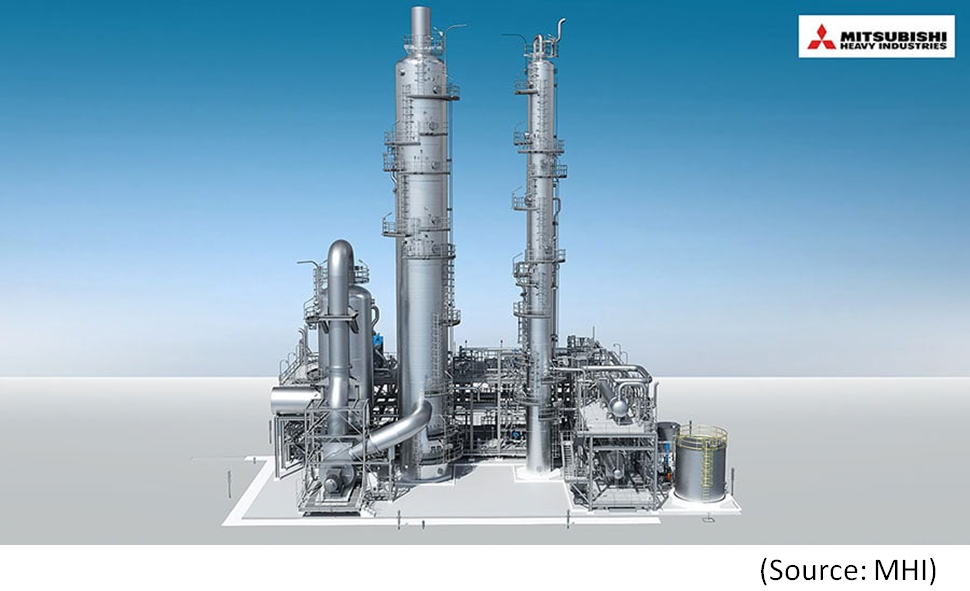
Mitsubishi Heavy Industries (MHI) agreed with Italy’s Saipem to provide its proprietary carbon capture technologies for use in CO2 capture plants.
The agreement will expand sales of CO2 capture plants to their core businesses in Europe and the Middle East.
CONTEXT: While MHI has a competitive record in the CO2 capture business in North America, Saipem’s main market is Europe and the Middle East. Now, the two companies will jointly operate their CO2 capture business globally. Also, MHI has worked with Saipem on its urea technology, and they have in the past jointly built fertilizer plants.
Mitsubishi and South Pole establish largest diversified portfolio of CO2 removal
(Company statement, April 26)
Mitsubishi Corp and climate project developer South Pole set up a JV, NextGen CDR, which is the first facility to specialize in innovative carbon removal tech.
NextGen announced the advance purchase of about 200,000 tons of Carbon Dioxide Removals (CDRs), and it plans to purchase over one million CDRs by 2025.
The facility is backed by Mitsui O.S.K. Lines, Boston Consulting Group, LGT, Swiss Re, and UBS.
ENEOS tests transparent solar PVs at Takanawa Gateway Station
(Company statement, April 26)
ENEOS Holdings, JR (Japan Railway) East, YKK AP, and Nihon Sheet Glass (NSG) installed transparent solar panels in the windows at Takanawa Gateway station (on the JR Yamanote Line in Tokyo). Their efficiency will be tested for the next two months.
The solar panels are developed by Ubiquitous Energy, a company in which ENEOS is an investor and which works in collaboration with NSG. The panels are as transparent as glass windows and generate power from ultraviolet and infrared rays.
When applied to skyscrapers and multi-story buildings, the panels can provide thermal insulation and improve energy efficiency.
CONTEXT: ENEOS and NSG tested the transparent solar panels in a field for about a year from Sept 2021 and found that their performance met expectations. This is the second round of testing and the success of it will determine if the technology can be applied to other railway stations.
Metropolitan Tokyo to test H2 co-firing boiler for district heating
(Government statement, April 28)
Tokyo Govt will test hydrogen co-firing boilers for district heating for the Aomi District in Tokyo in association with Tokyo Bureau of Port and Harbor, AIST (National Institute of Advanced Industrial Science and Technology), Shimizu Corp, Tokyo Rinkai Heat Supply Corp, and Tokyo Teleport Center.
This experimental H2 co-firing boiler mixes hydrogen and city gas and reduces CO2 emissions. Tokyo is the first prefecture to adopt this boiler.
Commercial operation are expected to start in 2024.
MHI and Iwatani plan development and sale of liquefied hydrogen boosting pumps
(Company statement, April 26)
Iwatani Corp and Mitsubishi Heavy Industries (MHI) plan to develop a liquefied hydrogen boosting pump to build an innovative hydrogen supply system.
This will help to optimize liquefied hydrogen stations for the domestic market.
CONTEXT: Liquefied hydrogen pressure pumps boost hydrogen in a liquid state, reducing energy consumption to just 1/10 of gaseous hydrogen boosting systems. MHI has delivered many pumps to nuclear power plants and other industrial applications
Hole discovered at bottom of Fukushima NPP Unit 1 reactor pressure vessel
(Nikkei, April 24)
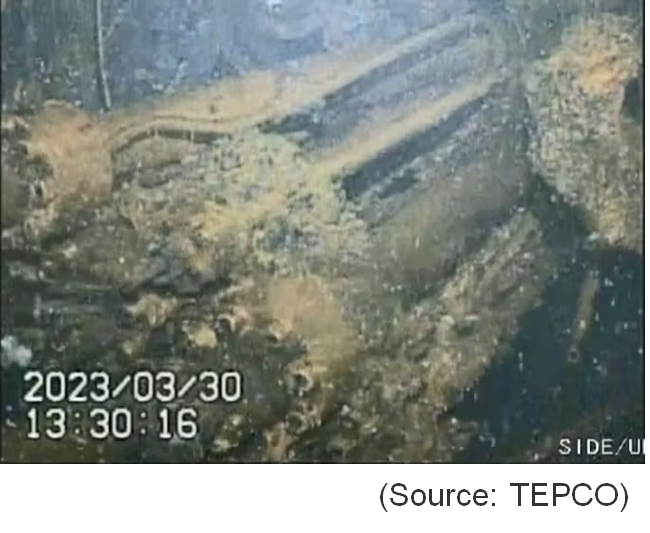
TEPCO discovered a hole in the control rod drive located at the bottom of the reactor pressure vessel of Fukushima NPP Unit 1. It is expected that additional holes will be found as more water used for cooling the nuclear debris is drained.
In late March, TEPCO dispatched a robot into the reactor pressure vessel. Based on that investigation, it is believed that the holes were formed due to heat generated by nuclear fuel debris.
SIDE DEVELOPMENT: Govt to face problems with disposal of Fukushima contaminated soil to other regions (Mainichi Shimbun, April 20)
In a survey of the nation’s governors about plans to dispose of contaminated soil outside Fukushima Pref by 2045, six said they opposed the plan, and none supported it.
Ryukoku University’s Oshima Ken’ichi said the govt should create a central disposal site for contaminated soil.
INPEX and Idemitsu seek to supply ANA with “zero emissions” jet fuel for G7
(Company statement, May 1)
INPEX, Idemitsu and All Nippon Airways (ANA) will see to offer “zero emissions” jet fuel for select flights in honor of the G7 Summit in Hiroshima (May 19-21).
In effect, this will mean buying carbon credits to offset the CO2 generated across the entire jet fuel supply chain, from the production of crude oil to flight emissions.
Marubeni and Pros join forces on rice husk charcoal production
(Nikkei, April 28)
Pros will work with Marubeni to increase production and sales of rice husk charcoal. The companies plan to update facilities, increase production capacity, and collaborate on product development.
Pros produces rice husk charcoal, which has multiple uses, including as biochar and an industrial heat-retaining agent. The product has been certified for the J-Credit System and can be used as carbon credits.
G7 members should take into account Japan’s stance on global energy
(Nikkei Asia, April 24)
CONTEXT: This is an opinion piece by Vandana Hari, founder of Vanda Insights.
Japan is under pressure from its G7 colleagues and environmentalists to phase out coal and gas, but it also has to consider the energy needs of Asian neighbors that heavily rely on these fuels. That’s why Japan has not pushed for a hard deadline to phase out fossil fuels.
The writer praises Japan’s efforts to find a solution that bridges the gaps between developed economies and the Global South, in terms of environmental sustainability and energy security, calling on other G7 members to heed a more pragmatic line.
NEWS: POWER MARKETS
METI to give priority to retired oil-fired power plants for reserve power capacity
(Denki Shimbun, April 27)
At a Subcommittee for Electricity and Gas Basic Policy meeting on April 26, METI said it will prioritize retired oil-fired power plants as reserve power capacity.
Reserve power sources are not listed as available in the capacity market (because they are retired), but these stations are maintained so that they can be ready to supply electricity in emergencies.
If a power source is certified as “reserve power capacity”, the operator is paid the cost of maintenance.
TAKEAWAY: Before liberalization of the power market, major power utilities (the EPCOs) voluntarily maintained retired oil-fired power plants as reserve power sources to be used during peak demand times. In a fully competitive market, however, the utilities started to decommission aging oil-fired plants because of their high costs. METI seeks to bring back the financial incentive for utilities to retain the capacity because it is concerned that there is a shortage of capacity nationwide in case of emergency.
Cosmo plans 1 GW offshore wind farm in Hokkaido
(Company statement, April 25)
Cosmo Eco Power, a subsidiary of Cosmo Energy, published an environmental impact assessment for an offshore wind farm off the coast of Hiyama in the southern part of Hokkaido. The project’s will be as large as 1 GW and involve as many as 100 turbines.
In the neighboring area, J-Power has been participating in a 722 MW offshore wind farm project called Hiyama Area Offshore Wind Farm.
Sumitomo to start construction of 500 MW offshore wind farm in France
(Company statement, April 27)
Sumitomo, along with Spain’s Ocean Winds and France’s Caisse des Dépôts et des Consignations, secured financing for the Éoliennes en Mer Dieppe Le Tréport offshore wind farm in France. Construction starts this May.
Total project cost is around ¥380 billion. Sumitomo and partners have secured €2.4 billion in financing.
Located in the English Channel, the wind farm will have a capacity of about 500 MW and provide 850,000 people with electricity under a PPA contract. Operation starts in 2026.
CONTEXT: Sumitomo is also participating in the Éoliennes en Mer des Iles d’Yeu et de Noirmoutier offshore wind farms off the coast of Bay of Biscay. Total capacity of the two projects is expected to be 1 GW.
Kyushu Electric to increase capital by ¥200 billion amid losses due to high fuel prices
(Nikkei, April 27)
Kyushu Electric will increase its capital by ¥200 billion through preferred stocks. The company is likely to post a loss for FY2023, impacted by high fuel prices in 2022.
Mizuho Bank and the Development Bank of Japan will underwrite ¥80 billion each. Mitsubishi UFJ Bank will underwrite ¥40 billion.
This will be the first time in nine years that Kyushu Electric increases its capital by issuing preferred stocks. In 2014, the company took a hit after the shutdown of nuclear power plants following the 2011 earthquake and tsunami.
Toyota Tsusho completes SB Energy acquisition, renames the company
(Company statement, April 28)
Toyota Tsusho completed the acquisition of 85% of renewable energy developer SB Energy from SoftBank Group (SBG) and renamed the company Terras Energy. SBG will retain the rest of the shares in the firm.
SBG will continue to focus on the advancement of tech innovation in renewables and also operate green capacity in the U.S. through SB Energy Global Holdings Ltd.
CONTEXT: Through this acquisition, trading house Toyota Tsusho will become one of Japan’s largest power generators in wind (3.2 GW) and solar (1 GW), with a total renewable energy portfolio of about 4.5 GW.
TAKEAWAY: The announcement of the purchase was made in February this year. SB Energy was founded in 2011, and operates around 773 MW of capacity including 667 MW of solar and 56 MW of wind in Japan. It also operates 50 MW of wind power in Mongolia. The purchase follows Toyota Tsusho’s acquisition of Eurus Energy from TEPCO. Toyota Tsusho is part of the Toyota Motor group.
Kansai Electric to apply for license extension at Takahama NPP Units 3 and 4
(Denki Shimbun, April 26)
Kansai Electric applied for the 20-year operational life extension for its Takahama NPP Units 3 and Unit 4 (both PWR type reactors, 870 MW). Kansai Electric already has approval from the governments of Fukui Pref and Takahama Town.
Unit 3 will be 40 years old in January 2025; Unit 4 will reach that in June 2025. In 2022, Kansai Electric carried out an inspection necessary for operating license extensions and concluded that the nuclear reactor pressure vessel, nuclear reactor containment structure and concrete structures are safe to operate for the additional 20 years.
However, Kansai Electric does plan to replace steam generators at both reactors before a regular inspection scheduled around 2026.
TAKEAWAY: Kansai Electric has already won such an operating life extension for three of its reactors: Takahama NPP Units 1 and 2 (both PWR, 826 MW) and Mihama NPP Unit 3 (PWR, 826MW). Two more of its reactors, at the Ooi NPP, have another 10 years to go until their 40-year limit is reached.
First geothermal power plant to be designated “important power source” by METI
(Denki Shimbun, April 26)
Idemitsu Kosan, INPEX and Mitsui Oil Exploration said their 15 MW geothermal power plant to be built in Yuzawa, Akita Pref, was designated as an “important power source” site by METI. It’s the first geothermal power plant to receive this designation.
Work is underway and the plant will be operational in March 2027. The electricity generated will be sold to the Tohoku Electric at ¥40/ kWh under the FIT system.
TAKEAWAY: METI designates sites as “important power source” in order to facilitate procedures by the relevant ministries and agencies. It also serves the purpose of gaining local consensus. Geothermal power plants often face resistance from hot springs owners, as they fear it will cause a drop in water pressure and temperature at their services.
Hitachi demos tech for improving power grid efficiency in Thailand
(Company statement, April 26)
Hitachi installed a performance-enabling network in the power transmission system of Thailand’s Electricity Generating Authority.
The network was linked to the Supervisory Control and Data Acquisition (SCADA) system and helped to cut 1,000 tons of CO2 from Feb 21 to March 10 by optimizing the voltage and reactive power controls.
The emissions cut may allow the parties to register the project with the Joint Crediting Mechanism (JCM) system and to coin CO2 credits through third-party entity verification.
CONTEXT: NEDO and Thailand’s Ministry of Energy (MoEN) have a demo project in low carbon and energy efficiency with Hitachi as the contractor.
Concern about experience of staff at TEPCO’s only nuclear power plant
(Yomiuri Shimbun, April 27)
METI plans to restart Kashiwazaki-Kariwa NPP Units 6 and 7 in summer 2025.
About 260 people work at Units 1 to 7. However, 30% of them have little experience operating the plant. TEPCO trains them using simulators and by sending them to thermal power plants to gain experience.
Overall, TEPCO struggles to find new staff for Kashiwazaki-Kariwa NPP.
TAKEAWAY: Kashiwazaki-Kariwa’s reactors have long been idle. Units 2 and 3 haven’t operated since 2007; Unit 4 since 2008; Units 1 and 7 since 2011; and Units 5 and 6 since 2012. In such a situation of prolonged idleness, staff have certainly lost their expertise.
NYK’s new CTV arrived in Hokkaido
(Company statement, April 20)
NYK’s new crew transfer vessel (CTV) arrived in Hokkaido. After completing all legal processes and inspections, the vessel will be chartered to Siemens Gamesa and managed by Hokkaido-based Hokuyu Kaiun to transport workers to an offshore wind power station currently under construction at Ishikari Bay New Port.
The vessel “Rera As” is 27-by-9-meters, with a 12 passenger capacity.
TAKEAWAY: As the offshore wind sector develops, demands for CTVs will grow. Shipping and shipbuilding companies are watching for opportunities in this new market.
NEWS: OIL, GAS & MINING
In March, Oman exported more LNG to Japan than Qatar
(Government data, April 27)
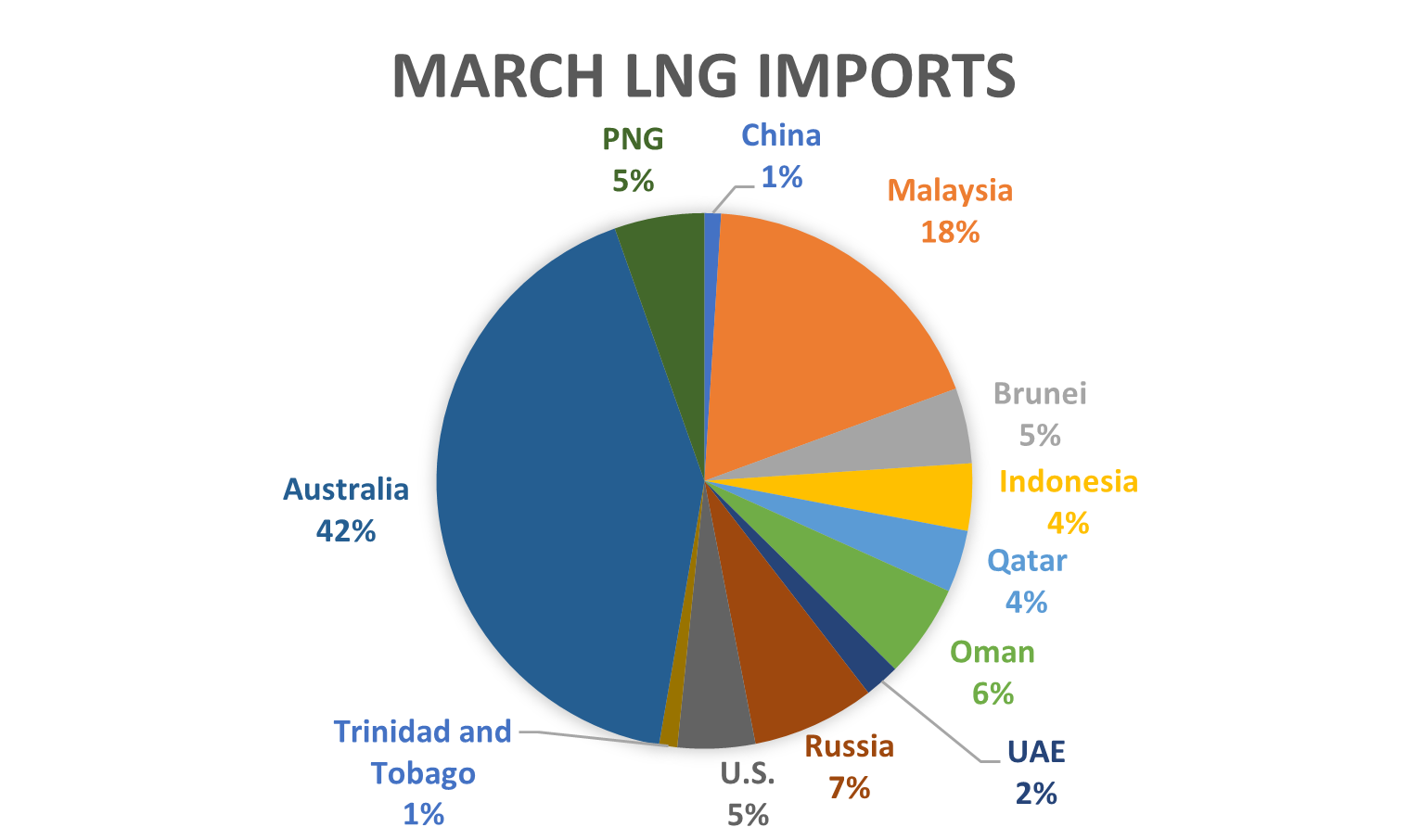
In March, Japan imported 323,573 tons of LNG from Oman, exceeding the 214,437 tons from Qatar.
Historically, Japan has imported three times more from Qatar than Oman; Since last year it has been shifting away from Qatari supplies due to inflexible shipping conditions, according to JOGMEC.
Japan imported 267,553 tons of LNG from the U.S. in March. The volume from the U.S. has been declining, from 447,475 tons in December. Like Oman, the U.S. cargoes are mostly destination free.
The LNG imports were 5.7 million tons in total, down 12% YoY.
UAE surpasses Saudi Arabia as Japan’s top oil exporter
(Government data, April 27)
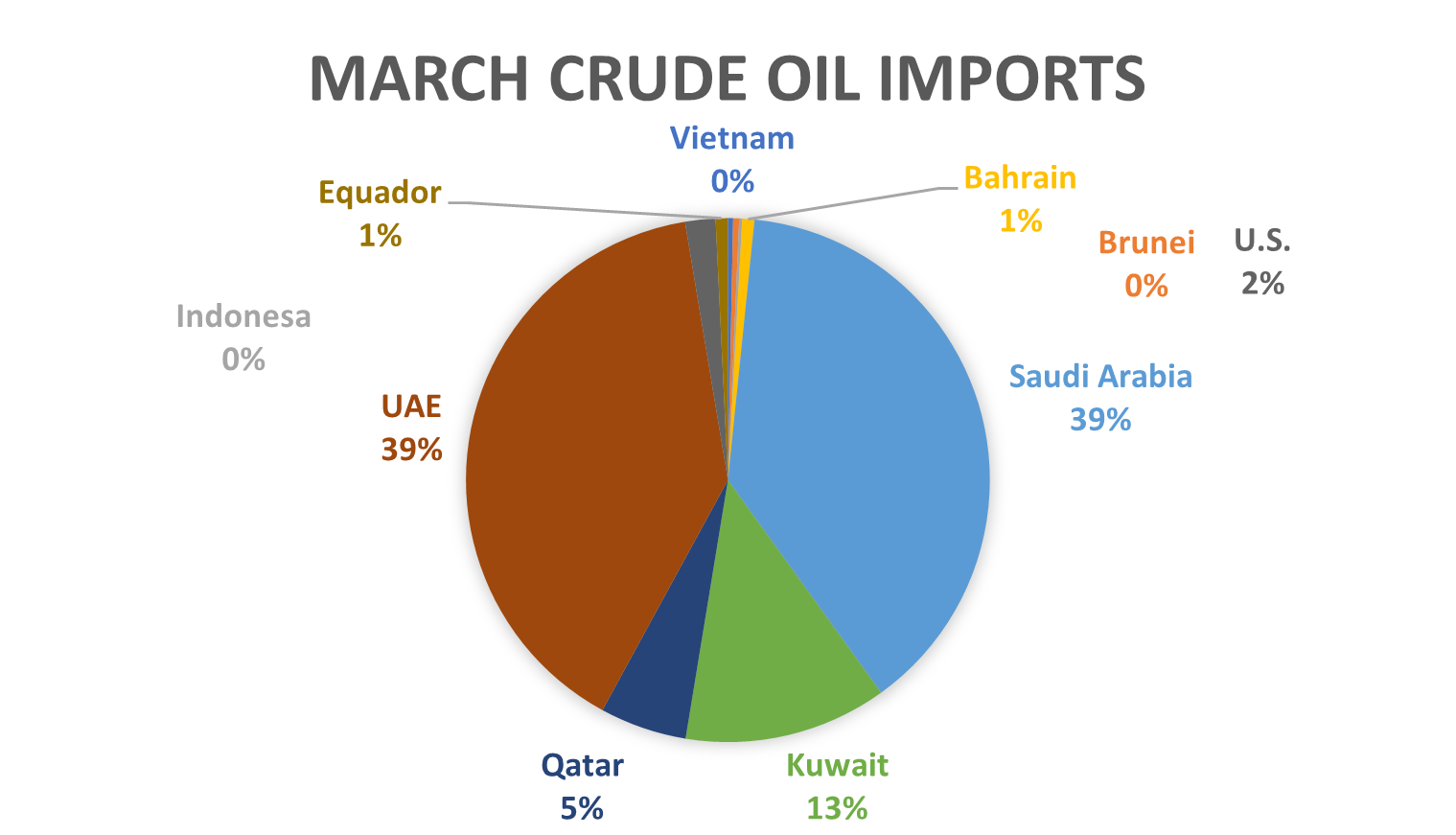
Crude oil imports from the UAE were 5.1 million kiloliters (32 million barrels) in March, surpassing Saudi Arabia as Japan’s top supplier.
Japan imported a total of 12.98 million kiloliters (82 million barrels) in March, up 0.4% YoY; 96.5% came from the Middle East.
Tokyo Gas to buy back ¥113 billion in shares, the company’s largest ever
(Nikkei, April 26)
Tokyo Gas will spend up to ¥113 billion to repurchase 12.2% of its shares, the largest buyback in its history.
Its consolidated FY2022 results increased almost three-fold, YoY, to ¥281 billion, a record high for the past 7 years. Sales rose 53% to ¥3.3 trillion.
Margins for FY2022 increased thanks to rising LNG prices, which the company buys under long-term contracts with stable prices.
CONTEXT: High profits were also due to the weak yen, but this year the company expects lower LNG demand with sales expected to decline 12% to ¥2.9 trillion. Profits are expected to drop 64% to ¥100 billion.
LNG stocks rise to 2.56 million tons
(Government data, April 26)
LNG stocks of 10 power grids stood at 2.56 million tons as of April 26, up 5.8% from 2.42 million tons a week earlier.
The end-April stocks last year were 1.96 million tons. The five-year average for this time of year was 1.95 million tons.
Japan’s March thermal coal imports down 19.9% YoY, value up by 44%
(Government data, April 27)
In March, Japan’s coal imports were about 14 million tons, down 16% YoY. However, the total value of imports amounted to over ¥602 billion, a 28% increase YoY.
Importantly, Japan’s imports from the U.S. decreased 19% to 891,497 tons. Russian imports saw an even more dramatic decrease of 55% to 650,782 tons.
Japan’s thermal coal imports were 8.5 million tons, a 19.9% decrease YoY. Import value rose 44% YoY to ¥376 billion.
ANALYSIS
BY MAYUMI WATANABE
Will a Stronger Regulator Emerge in Japan’s Power and Gas Sector?
Recent scandals over cartel behavior in Japan’s power market have sent shockwaves across the energy sector. Authorities spent the past few months investigating what exactly has transpired and the results are grim, revealing illegal practices that go back to 2016 – the year that the markets were fully liberalized.
In response, a wave of indignation has led to calls for major reforms in the power sector.
Official probes found that major power utilities were illicitly accessing customer data of other generators. Also, it seems that Chubu Electric, Chugoku Electric, Kyushu Electric, Chubu Electric Power Miraiz, and Kyuden Mirai Energy had agreed in 2018 to restrain competition in the high-voltage market, which covers business users. In response, the Japan Fair Trade Commission has levied penalties totaling ¥101 billion against the firms.
At first glance, this scandal couldn’t have come at a worse time. The government is launching its much vaunted GX program to entirely overhaul the national energy system in line with global efforts to transition to clean energy. It wants and needs the country’s biggest power providers to invest large sums in boosting non-fossil energy volumes.
However, as Churchill once said: “Never let a crisis go to waste”. This scandal is giving the reformers among government and bureaucracy circles an opportunity to push for even deeper changes than the 2016 liberalization. For example, there’s a growing momentum behind the idea that former regional power monopolies, the EPCOs, should be forced to fully separate their generation, transmission and retail units to guarantee a level playing field. The fragility of EPCOs’ current arrangement has been exposed.
More power to the EGC?
While the full liberalization of the power sector in 2016 and of the gas sector in 2017 led to the unbundling of EPCOs, most of these major power utilities simply formed a new holding company to manage their legacy generation, transmission and other assets.
In theory, the integrity of each business unit is protected by Chinese walls. In reality, what Japanese officials found was that staff from one division of an EPCO had access to data from another.
During discussions with industry over how to revise market rules in line with the shift to non-fossil generation, government officials discovered that some EPCO staff had regular access to the govt database of renewable energy operators, including privacy data. What’s more, these staff stand accused of passing the data to the retail businesses that sit within the same EPCO group or holding.
The data on renewables operators was stored in a METI database, access to which was guarded by select logins. However, in one case, it was found that one ID and password issued by the government to an EPCO was shared by up to 50 people inside the groups.
Oversight of the industry is conducted by the Electricity and Gas Markets Surveillance Commission (EGC), which falls under the METI umbrella. Upon the discovery of the irregularities, the regulator simply asked the EPCOs to report back with improvement plans. Such a response was criticized by many as soft and entirely inappropriate when dealing with criminal conduct such as unauthorized data access and data breach.
In some ways, it evoked memories of the kind of cozy relationships that the previous nuclear industry regulator enjoyed with nuclear generators prior to the Fukushima accident.
So, it is no surprise that calls for a stronger regulatory body, or an EGC with more teeth, have come to the fore.
It’s complicated
Some officials say that the main problem lies in IT security rather than regulatory systems. One government panel consisting of IT security experts, for example, said that METI was not following the government’s own cyber security rules in administering its database. The EGC consequently recommended that METI change its ID and password policies and that by 2026 all the customer data systems within EPCOs are fully separated.
The regulator also asked that EPCOs conduct compliance staff training and disclose progress of corrective actions. But behind the veneer of IT trouble and compliance gaffs lies a more complicated situation.
EGC as a regulator has little coercive power. The EGC is a “soft regulator” classified as an “Article 8 commission”, which means it can only provide advice to the state minister, and issue non-binding advisories and guidance to companies. It can’t enforce decisions.
In contrast, other agencies are classified as Article 3 commissions, which means they can issue orders to companies and impose penalties if non-compliant. The Japan Fair Trade Commission (JFTC) is just such a group.
On March 2, the Cabinet Taskforce to Review Renewable Regulations submitted a proposal to improve regulatory enforcement in the power sector. The main measures are: 1) To probe EPCO non-compliance back to 2016 to measure the costs of regulatory failure; 2) To penalize offenders by taking away their licenses, while the government facilitates a smooth transition to a second service provider; and 3) to empower the EGC with the required authority to implement these measures.
The four panelists were Hatta Tatsuo, the inaugural EGC chairman; Prof. Takahashi Hiroshi of Hosei University; Obayashi Mika of the Renewable Energy Institute (REI); and Kawamoto Akira of Aspirant Group. Hatta told the taskforce that EPCOs have an attitude: they “well know that their licenses will never be taken away and they can get away with anything.” The panelists proposed elevating the EGC to an Article 3 Commission, giving it teeth to bite and not just engage in advisory.
The EGC’s independence from METI was also questioned, as it was forced to probe a data breach case that involved the ministry’s own data system.
Article 3 Commissions
Article 8 Commissions
Role definition
Government functions
Advisory bodies reporting to state ministers
Authority
Enforce orders, penalties, guidance
Issue non-binding advisory, guidance
Staff recruitment
Can recruit its own staff
State minister appoints staff
Examples
JFTC, Nuclear Regulation Authority
EGC, Securities and Exchange Surveillance Commission
Wanted: Experienced professionals
For any reform to succeed, one critical area will be to build capable teams of experienced and motivated experts, one former EGC official told Japan NRG. The four members of the Cabinet Taskforce to Review Renewable Regulations also proposed to make EGC’s current part-time chairman and four commissioners full-time officials.
For the sake of independence, the regulator will also need to limit the number of METI and ANRE staff it takes in. EGC’s Tokyo head office has 77 staff, of which 40 are temporary transfers from METI and ANRE; they usually return to their original ministry after two years.
“If more people from the JFTC joined the EGC it will make a world of difference,” Prof. Takahashi Hiroshi told Japan NRG. Presently, the head of the market surveillance unit is an official from the JFTC.
Takahashi and others hope that the increased number of JFTC officials taking EGC positions will improve its effectiveness. The antitrust watchdog was the one that exposed the non-compliant practices of the EPCOs, not just the cartel but potential infringements in wholesale trade and power generation units. On March 30, the EGC took over the non-cartel investigation from the JFTC.
EGC reform proposal
Independence
Change to Article 3 Commission from Article 8.
Increase authority
Give supervisory authority to impose orders and penalties by amending the Electricity Business Act.
Increase staffing
Make chairman and four commissioners full time positions; Recruit more staff but decrease staff from METI and ANRE.
But hiring entirely from outside of METI in the name of independence would not work either, says the former EGC official. Market surveillance is a niche skill and antitrust officials that arrived at the power industry regulator in the past had to start from scratch when it came to understanding how the sector operates.
Since EGC cannot hire people from the power companies to avoid a conflict of interest, taking in some staff from METI makes sense, the former EGC official said. METI people can provide sector experience and balance in decision-making. Completely separating the EGC from METI in the name of independence is like running a computer without software, he said.
Complete separation?
The EGC has three units: one to monitor power and gas markets, another to monitor networks, and a policy coordination unit. Compared to the UK’s Office of Gas and Electricity Markets (OFGEM) EGC’s role is quite limited.
Division of authorities
Tasks
Japan
The UK
Licensing
ANRE/METI
OFGEM
Competition law compliance
JFTC
Consumer affairs
Consumer Affairs Agency
Wholesale/retail markets
EGC
Network connection
OCCTO
Some observers say the EGC should monitor the effectiveness of government policies in addition to market compliance. ANRE/ METI should focus on policy making; while everything else, including licensing, should shift to the EGC. But not everything could be split clearly between them.
The JFTC is the most relevant authority to write competition rules. METI and ANRE policy makers are more focused on breaking up the EPCOs, seen as a fast track approach to creating a level playing field by weakening their market power, building on the “partial” unbundling that the former monopolies achieved by packaging the assets inside holding companies or group structures.
On April 28, METI announced its plan to amend the Electricity Business Act to raise penalties for non compliance. In June, the Cabinet is expected to come up with a proposal to improve regulatory practices. Prime Minister Kishida’s popularity has been on the rise in recent months and he may be able to expend some political capital to push for strong industry reforms, especially if it will be seen as a boon to his GX initiative.
However, it would be risky to bet against the EPCOs. They are the great survivors and stalwarts of Japan’s electricity system with strong influence in the media, among big business lobby groups and beyond. PM Kishida’s government will need to decide whether this is a hill on which it wants to take a stand or accept another mid-way solution that papers over the cracks in competition.
ENERGY JOBS IN JAPAN
BY ANDREW STATTER
Salary Trends Across Japan’s Energy Sector
For many years, the energy industry had certain perceptions about salary. That oil & gas pays higher than renewables; that multinational companies pay higher than the Japanese firms; that large corporations are the best paying players in the market.
As the energy industry transitions and diversifies, subsidies and large-scale investment have flowed into new technologies across renewable generation, grid flexibility and next-generation mobility, resulting in a shift in the salary and power balance.
Do Japanese companies pay less, and does oil & gas pay more?
The answer is not so simple. We need to look into the value of the whole package, not only taking into account the cash (base + bonus) portion of a salary package. Typically, large Japanese firms do pay a lower cash portion than their foreign counterparts, and often oil and gas majors are competitive with global renewable energy firms.
Looking at the benefits offered and understanding their value is key when assessing the true total package. A few common benefits are listed below:
Housing allowance. Junior staff often live in company-provided dormitories, and housing allowances of a certain percentage are paid to higher-ranking employees. As this allowance is paid pre-tax, the savings can be significant for the employee.
Retirement allowance (tiashokukin). Often, retirement benefits are tied to length of service in Japanese firms. Especially in cases where an employee has spent their whole career with one firm and is in their 40s or 50s, the difference between their payouts if they leave the company, or remain and retire there, can be in the tens of millions of yen.
Employee stock plans. Not limited to Japanese companies, stock plans are sometimes overlooked and their true value not understood. Depending on the company, these may come in the form of RSU (restricted stock units) that will vest over a period of time, or stock options that are harder to assess, especially in pre-IPO companies.
Flights, benefit station, allowances, etc. For someone who travels internationally on a regular basis, the difference between business and economy class flights can be significant. Corporate tie-ups and partnerships with company getaways (besso) or discounts on restaurants, hotels etc, through plans such as benefit stations add some, though generally not significant value to a total package.
Risk vs reward
As energy technologies have developed, investment has diversified and players have globalized. There’s now a wide range of options for professionals to choose from. We tend to see a clearer correlation between risk and reward, compared to Japanese vs multinational, for example.
Size matters
Though many Japanese see foreign capital firms as inherently risky, the truth is that well-known foreign names such as the oil and gas majors, as well as power utilities, have become desirable employers, and they have a long-term view of the Japanese market. This has resulted in such large foreign firms having a lower risk profile and means that they tend to pay in line with, or modestly more than, domestic counterparts of similar standing in the industry. However, no one is doubling their salary moving from a major trading house to a multinational power utility.
Put your money where your mouth is
Developers backed by private equity are increasingly prevalent in the market. Typically, they take on more risk, get involved in projects at an earlier stage, keep leaner teams where each employee’s work is clearly visible to management. The mandate of these funds is to turn a profit; therefore, in a down market the risk of downsizing or leaving is certainly higher. These firms often pay for performance, giving a higher base salary, as well as a lucrative bonus, profit sharing, carried interest, etc. Not only choosing the company’s size, but also choosing the timing to join can have a significant effect on the offer given to a new employee. Similar to tech startups in the U.S., those joining earlier bear greater risk, bring bigger impact to the firm and are rewarded in line with this.
In-demand talent and transferable skills
Supply vs demand is basic economics, and in the energy transition there are windows of opportunity for professionals who have experience or widely desired skills. Experience in bidding for an offshore wind project, or structuring and negotiating an offsite corporate PPA, are examples of this. Often, those who hold the in-demand experience are in a position to gain multiple offers, and command negotiation power to increase the value of offers. Both companies looking to attract such talent, and firms who seek to retain their top performers, need to be aware of this trend, as increases of 20-40% are not uncommon.
Naturally, in a growth market, there’s not enough experienced talent to fill all open positions. Companies will often hire talent they see as high-potential, without the required experience, but who have a strong base of transferable skills. Engineering, project management and building supply chains for wind or battery projects are common examples. In these cases, the employer needs to invest significant time, energy and resources into upskilling, often including business trips to HQ or regional project sites. In these cases, the onus is often on the employee to understand the value that the new skills will bring them. Ambitious employees may then accept a smaller pay increase or even a small drop in their overall remuneration in order to take this chance and acquire the valuable skills.
Case A: Combining risk vs reward and in-demand talent scenarios. Titan introduced a Head of Engineering with over six years of directly relevant experience to an investment driven development platform as one of their original members. The employee was leaving a stable Japanese organization with a sizable operational portfolio. His offer was a 60% increase in base salary, as well as access to potentially lucrative profit-sharing opportunities.
Case B: Investing in future development. In another case, Titan introduced a young, high potential professional for a senior role that would lead commercial, contract and PPA negotiations for a well-known developer with an excellent track record and training capabilities. Though the employee didn’t have direct experience with such contracts, he demonstrated agility, adaptability and willingness to learn. He understood the value of the skills and experience he’d gain by taking on the role, and made the move without an increase.
Salary benchmarking or value-based offers
What are they making now vs what value do they bring? These two significantly different questions are asked when companies consider their budget or how to make an offer. This tends to correlate with risk vs reward, or size and complexity of the organization.
Large, publicly-traded companies will typically set a budget range prior to beginning a search, and when identifying talent at the lower end of the range, they often pay a menial increase that doesn’t touch their budget ceiling. The basic idea tends to revolve around the candidate’s current salary level, and how it compares to those already in the team (internal equity).
On the other hand, smaller, leaner, result-driven firms give a wide budget range, or ask their agency partner to provide typical ranges. Rather than excluding candidates who exceed their ideal range, they’ll typically meet the candidate and try to understand what additional value that person can bring. The position may be widened, scope changed, and budget increased to accommodate such talent. Often, large increases are seen here, where previously undervalued talent are given a chance to show what they are worth.
It’s difficult to say which approach is better, as each organization has different needs, internal resources and benefits for those who decide to join. As with assessing the package value mentioned above, much more than simply cash compensation must be considered by both the employer and employee when it comes to number crunching time.
GLOBAL VIEW
BY JOHN VAROLI
Below are some of last week’s most important international energy developments monitored by the Japan NRG team because of their potential to impact energy supply and demand, as well as prices. We see the following as relevant to Japanese and international energy investors.
California/ Diesel truck ban
California became the first U.S. state to approve regulation to end diesel truck sales by 2036. By 2045 the governor’s plan calls for all trucks on the road to reach zero emissions.
Denmark/ Energy island
Shell joined the VindØ Energy Island Consortium that will be connected to 10 GW of offshore wind in order to power Denmark and neighboring countries. Located about 100 km off Denmark’s west coast, the project will be the world’s first energy island.
Europe/ Biofuels
Global incentives to slash fossil fuels have inflated biofuels demand, but feedstocks are in short supply, such as vegetable oils, animal fats, and waste products. This has led to much fraudulent biofuel on sale, warns the European Biodiesel Board, especially from China.
France/ Climate lawsuit
TotalEnergies has sued Greenpeace France and climate consultants Factor-X over a 2019 report claiming that the energy company underestimated its emissions to 455 million tons of CO2. Greenpeace alleged that Total’s emissions were 1.6 billion tons of CO2.
North Sea/ Oil and gas
Spain’s Repsol agreed with China’s Sinopec to resolve an 8-year dispute over North Sea oil and gas assets. Repsol paid $2.1 billion to acquire Sinopec’s 49% stake in their JV.
Norway/ Gas exploration
The Petroleum and Energy Minister called on oil and gas companies to fulfill their “social responsibility” to find more natural gas resources in the Barents Sea. Norway wants more oil and gas to boost energy security and help EU partners.
Nuclear Power/ SMRs
Westinghouse unveiled plans for a small modular reactor (SMR) called AP300 (300 MW capacity), which won’t use special fuels or liquid metal coolants, unlike some other next-gen reactors. Work on the reactors begins by 2030. The company sees Africa as a major market.
Scotland/ Energy transition
Cerulean Winds plans to build the North Sea Renewables Grid, an offshore integrated power and transmission system powered by floating wind that oil and gas platforms can plug into. The £20 billion project will develop three sites of hundreds of floating turbines to produce many GW of electricity.
U.S./ Climate aid
The White House made a $1 billion commitment to the Green Climate Fund, a major international climate aid program. Biden also pledged to approve $500 million over five years to combat rainforest deforestation through Brazil’s Amazon Fund program.
U.S./ Hydrogen power
Wyoming, Colorado, New Mexico, Utah and eight companies applied for $1.25 billion from the Department of Energy to build the Western Interstate Hydrogen Hub that will produce “green” and “blue” hydrogen. The federal govt has earmarked about $8 billion for hydrogen hub projects.
U.S./ LNG
The White House formally approved Alaska LNG, a $39 billion project that will export natural gas to Asian markets. The project is touted as the only major new LNG project in the U.S. that has so far secured all its permits and an export license.
2023 EVENTS CALENDAR
A selection of domestic and international events we believe will have an impact on Japanese energy
ASEAN-Japan summit to mark 50 years of cooperation
Last market trading day (December 30)
Disclaimer
This communication has been prepared for information purposes only, is confidential and may be legally privileged. This is a subscription-only service and is directed at those who have expressly asked K.K. Yuri Group or one of its representatives to be added to the mailing list. This document may not be onwardly circulated or reproduced without prior written consent from Yuri Group, which retains all copyright to the content of this report.
Yuri Group is not registered as an investment advisor in any jurisdiction. Our research and all the content express our opinions, which are generally based on available public information, field studies and own analysis. Content is limited to general comment upon general political, economic and market issues, asset classes and types of investments. The report and all of its content does not constitute a recommendation or solicitation to buy, sell, subscribe for or underwrite any product or physical commodity, or a financial instrument.
The information contained in this report is obtained from sources believed to be reliable and in good faith. No representation or warranty is made that it is accurate or complete. Opinions and views expressed are subject to change without notice, as are prices and availability, which are indicative only. There is no obligation to notify recipients of any changes to this data or to do so in the future. No responsibility is accepted for the use of or reliance on the information provided. In no circumstances will Yuri Group be liable for any indirect or direct loss, or consequential loss or damages arising from the use of, any inability to use, or any inaccuracy in the information.
K.K. Yuri Group: Oonoya Building 8F, Yotsuya 1-18, Shinjuku-ku, Tokyo, Japan, 160-0004.
NEWS
・Japan’s total GHG emissions rise 2% compared to a year earlier; but growth in carbon capture volumes is even greater
・METI edges closer to creating a new day-ahead power markets that would combine spot volume with balancing function
・Oman overtakes Qatar as Japan’s top LNG exporter thanks to more flexible shipping terms