Shareholder activist wants oil refineries to consolidate
Japan buys its cheapest LNG cargo in two years
LNG stocks rise 19% to 2.67 million tons
April LNG imports drop 18.7%; oil, coal also down
ANALYSIS
LNG IN SOUTHEAST ASIA AND JAPAN’S STRATEGIC INROADS
Southeast Asia is forecasted by the IMF to be the world’s fastest-growing region this year. That economic development, however, can only succeed and be sustained if there’s a substantial increase in energy supplies. Japan is a leading force supporting natural gas/LNG growth in the region, and it’s the main country outside Southeast Asia that’s set to benefit.
ENERGY TRANSITION EXPERIMENT: JAPAN’S FIRST HYDROGEN-POWERED HOTEL
As major economies across the globe launch plans to accelerate the energy transition, many sectors previously untouched by reforms feel obliged to come up with plans to end fossil fuel dependence. Japan’s hotel industry is a prime example of the challenges that the consumer service sector must grapple with in order to help the country meet its decarbonization goals.
New Energy and Industrial Technology Development Organization
kWh
Kilowatt hours (electricity generation volume)
TEPCO
Tokyo Electric Power Company
FIT
Feed-in Tariff
KEPCO
Kansai Electric Power Company
FIP
Feed-in Premium
EPCO
Electric Power Company
SAF
Sustainable Aviation Fuel
JCC
Japan Crude Cocktail
NPP
Nuclear power plant
JKM
Japan Korea Market, the Platt’s LNG benchmark
JOGMEC
Japan Organization for Metals and Energy Security
CCUS
Carbon Capture, Utilization and Storage
OCCTO
Organization for Cross-regional Coordination of Transmission Operators
NRA
Nuclear Regulation Authority
GX
Green Transformation
NEWS:ENERGY TRANSITION & POLICY
G7 pledged support for sustainable fuels, ammonia, but wants end to Russia energy supplies
(G7 statement, May 20)
The G7 summit in Hiroshima reaffirmed a commitment to decarbonize the power sector by 2035, and to accelerate an end to Russian energy.
CONTEXT: Japan gets about 10% of its LNG from Russia’s Sakhalin-2 project.
The group said investment in natural gas and LNG “can be appropriate in response to the current crisis and to address potential gas market shortfalls”, and as a way to respond to a country’s reliance on Russian energy. Nonetheless, gas investments should be “consistent with our climate objectives without creating lock-in effects”.
While acknowledging various pathways according to each country’s industrial and geographical conditions, the G7 “recognize that low-carbon and renewable hydrogen and its derivatives such as ammonia should be developed and used as effective emission reduction tools to advance decarbonization”.
The summit also called to end building new unabated coal fired power generation.
For mobility, the G7 committed to making electrified vehicles the only new passenger cars on sale from 2035, but also allowed for the use of “sustainable carbon-neutral fuels including sustainable bio- and synthetic fuels”.
Finally, the G7 endorsed TEPCO’s decommissioning of Fukushima NPP and the discharge of ALPS treated water as long as it’s consistent with IAEA standards.
TAKEAWAY: In recent years, Japan has called for “diverse net zero pathways” and “technology neutrality”, which some observers said was an attempt to maintain its thermal power stations and avoid going all-in on EVs. But Japan’s position on hydrogen and ammonia co-firing seems to be increasingly gaining recognition as potential energy transition approaches. The same could be said of Japan’s calls to consider how legacy gasoline vehicles can cut their emissions via innovative clean fuels. In this sense, the G7 communiqué suggests that Japan’s approach to “diverse net zero pathways” and “technology neutrality” was mostly accepted, even if the language around LNG and natural gas is understandably cautious. It seems likely that Japan’s position was helped by having India, Indonesia and other major Asian economies attend the summit as guests.
Japan fusion startup raises $72.5 mln; Mitsubishi, Mitsui, INPEX among investors
(Company statement, May 16)
Nuclear fusion startup Kyoto Fusioneering (KF) raised ¥10.5 billion ($72.5 million) in a Series C investment round.
Led by existing investor, JIC Venture Growth Investments, the round had 17 investors, including 11 new supporters, such as Mitsubishi, Mitsui, INPEX and J-Power.
KF will build its nuclear fusion test plant “Unity”, increase the number of engineers from 90 to 300, and operate in the U.S. and U.K.
KF was founded in 2019 at Kyoto University, and has raised ¥12.2 billion to date. KF is the only company outside of Europe to join the conceptual design of United Kingdom Atomic Energy Authority (UKAEA)’s STEP Programme.
CONTEXT: Nuclear fusion has the potential to offer virtually limitless, carbon-free energy by harnessing the heat generated by merging hydrogen atoms to form helium, akin to the process that fuels the sun. The raw material for fusion reactions can be extracted from seawater, making it virtually boundless. Japan has been actively engaged in fusion power research in the last thirty years, but recently global competition has intensified.
TAKEAWAY: Investments in fusion startups have boomed especially in the U.S. in the last couple of years as major public companies and figures like Bill Gates claim there are signs of progress in the sector. Unlike its broader nuclear sector, Japan’s fusion scene has quite a few startups and many of them are offering very bullish targets for the construction of demonstration facilities. Whether these targets are achievable is impossible to say, but it’s clear that big business and the government in Japan have decided that it’s worth backing the local fusion startup ecosystem just in case and to keep up with trends overseas.
Not enough resources for EVs to be only clean car option, says top Toyota scientist
(Reuters, May 18)
A lack of resources means battery electric vehicles (BEV) can’t be the auto sector’s only answer to climate change, said Gill Pratt, head of the Toyota Research Institute, adding that focusing on BEVs could lead drivers to hold onto polluting vehicles.
In countries where coal still produces power, hybrids were better for CO2 emissions, he added. “It’s going to take decades for battery material mines, renewable power generation, transmission lines and seasonal energy-storage facilities to scale up.”
CONTEXT: Toyota, which seeks to sell 1.5 million battery-powered cars by 2026 and introduce 10 new fully electric models, has frequently argued that reaching carbon neutrality will mean the use of hybrid and fuel-cell vehicles, as well as possibly synthetic and bio fuels. The world’s top automaker by sales says that BEVs are just one option and that gasoline-electric hybrids are a more realistic choice for some markets.
Govt needs to reset GX priorities, introduce multi-year financing: Business lobby
(Japan NRG, May 17)
The current 22 main areas of the Green Transformation (GX) stretch from ammonia supply chains to EVs; but this is too many, the Japan Association of New Economy (JANE) told lawmakers. JANE proposed narrowing the GX focus to automotives.
CONTEXT: JANE comprises around 500 startups. Its lobby activities have been focused on expanding startup support and deregulation. JANE’s GX presentation was attended by deputy MoE minister Yamada Miki and other ruling party lawmakers.
JANE seeks a plan to allow govt financing for several years, rather than including the funds in annual govt spending.
Plans to raise ¥130 trillion for the GX from the private sector may be unrealistic as most financial institutions are hesitant on net-zero projects, JANE said. It urges the govt to share risks by becoming a debt guarantor.
Also, JANE proposed creation of a new GX Ministry.
TAKEAWAY: Lawmaker Shibayama Masahiko, who heads the Parliamentary Association for Promotion of Renewable Energies, said that narrowing down the GX focus is challenging as various industries require “attention”. He added that he seeks proposals to expand renewables amid growing public resistance, which may impact GX initiatives.
JANE urges EPCO unit separations, new law on non-discriminatory wholesale power sales
(Japan NRG, May 17)
The Japan Association of New Economy (JANE) proposed amendments to the Electricity Business Act (EBA) to separate power generation, transmission and retail units of EPCOs to realize fair and transparent competition.
Full separation of the EPCOs, which involves dividing assets, could be bogged down in discussion about basic rights. So, JANE proposes penalty clauses to the EBA and more oversight of EPCOs to ensure that their units are acting independently.
JANE proposes a law to mandate fair wholesale power sales to utilities.
CONTEXT: During the power cartel probe, the Japan Fair Trade Commission found evidence of the EPCOs selling power to competitors at higher prices than to its group.
TAKEAWAY: In 2020, in a bid to ensure a fair market, the market regulator EGC asked the EPCOs to pledge a commitment to non-discriminatory power sales. A pledge, however, isn’t legally binding. Companies might lose money if they adhere to their own pledges and their peers do not, and so, rules need to be clearly legally binding, said one JANE member.
ANRE aims e-fuel roll out as early as 2030, instead of 2040
(Japan NRG, May 16)
ANRE proposed revising the roadmap to replace car fuel with carbon-neutral synthetic fuel (e-fuel), moving its target commercialization date to 2030-2034, instead of 2040.
Instead of waiting for breakthroughs, ANRE wants to use existing technologies produced by oil refineries and gas utilities and financed by the Green Innovation Fund.
The GI Fund seeks to develop mass e-fuel production technologies based on the traditional Fischer-Tropsch process.
ANRE’s e-fuel production expansion scenario
2025
By 2028
Before 2040
Pilot production starting at 1 barrel/ day
300 barrels/ day
10,000 barrels/ day
CONTEXT: E-fuel development has only a handful of players because the technologies have a long way to go. ANRE hopes this commercialization schedule will spur new market entries. METI set a daily production target of 10,000 barrels by 2035. In addition, it plans to join foreign e-fuel projects with investment from JOGMEC.
TAKEAWAY: A sustainable e-fuel business model is not easy to establish since production costs are more than double current gasoline prices. Bioethanol is a key transition fuel before the e-fuel market develops. ANRE plans a separate roadmap for bioethanol in coming weeks.
Cosmo Oil and JGC start construction on SAF plant in Sakai
(Company statement, May 17)
JGC Holdings, Cosmo Oil, REVO international, and Saffaire Sky Energy broke ground on its first sustainable aviation fuel (SAF) production facility that processes used cooking oil (UCO); the site is located at Cosmo’s Sakai Refinery in Osaka Pref.
The SAF factory starts operation in 2024, and will annually produce 30,000 kiloliters; the SAF will go to supply Kansai International Airport.
REVO and JGC will collect the UCO, and Cosmo will process it into SAF.
TAKEAWAY: 30,000 tons/ year is roughly 10% of Japan’s UCO supplies. If UCO prices rise amid competition among SAF manufacturers in Japan and overseas, livestock farmers will likely complain. (See also Analysis: “Once Trash, Used Cooking Oil Now Center of Tug-of-War Between Food and Jet Fuel” on May 23, 2022 issue).
Seibu Railway invests ¥25 billion to go green
(Company statement, May 11)
Seibu Railway released its business investment plans for FY2023 stating that it will invest ¥25 billion to improve safety and security, and environmental conditions.
By introducing “sustainable” train cars and LED lights, Seibu reduces 60% of electricity consumption compared to traditional train cars. The company also will modernize VVVF inverter control systems and conserve another 35% electricity.
CONTEXT: Seibu Railway operates 177 km of train network in the greater Tokyo area with 92 stations, holding 1,267 train cars serving average daily passengers of 1.4 million. Mass transit systems like trains and subways are already contributing to reducing CO2 emissions, rather than driving ICE cars, but Seibu goes even further to cut energy consumption.
IHI tested world’s first 80% ammonia fuel blend in vessel
(Company statement, May 16)
IHI Power Systems blended over 80% ammonia in a fuel for a domestic vessel, a world first at this ratio.
This tech is funded by the Green Innovation Fund, along with Nippon Yusen (NYK Line), Nihon Shipyard, Japan Engine, and Nippon Kaiji Kyokai (ClassNK). The test was done on the engine made for an ammonia-fueled tugboat at the Ohta Factory of IHI Power Systems (Gunma Pref) in April.
Plans call for commercial operation of ammonia-fueled tugboats in 2024.
TAKEAWAY: Ammonia-fueled tugboats can reduce to almost zero the emission of dinitrogen monoxide (N2O), which has 300 times more greenhouse effect than CO2.
Motorcycle makers to study and develop hydrogen small mobility engines
(Company statement, May 17)
Kawasaki Motors, Suzuki Motor, Honda Motor, and Yamaha obtained approval from METI to establish a research alliance, the HySE (Hydrogen Small mobility & Engine technology). It aims to advance hydrogen-based engines for small-scale transportation.
The use of hydrogen as a fuel presents notable technical hurdles, including concerns regarding stable combustion and restricted fuel tank capacity in compact vehicles.
The HySE will conduct research, and use its expertise and technologies in conventional gasoline engines. The alliance will focus on researching hydrogen-powered engines, hydrogen refueling and fuel supply systems.
World’s first yacht sails with hydrogen produced by wind power
(NHK Nagasaki News, May 16)
A zero-emission vessel built by MOL (Mitsui OSK Line) is conducting an experiment to sail a 12-meter yacht with hydrogen generated from wind power when no wind blows.
The yacht is equipped with a special device to store hydrogen in the liquid form of methylcyclohexane (MCH). This special device converts MCH to hydrogen (H2) gas.
This is the world’s first yacht that sails with hydrogen converted from MCH.
Euglena introduces next-gen biodiesel fuel in Hokkaido
(Company statement, May 17)
Euglena and Tomakomai Wharf will supply biodiesel fuel “SUSTEO” to Dai Kita Transport in Hokkaido to be used for delivery trucks.
SUSTEO is the next-gen biomass biodiesel that Euglena developed in 2018; it has been supplied to customers for transport and delivery vehicles on land, at sea and air.
CONTEXT: Biodiesel emits CO2 when burned, but biomass absorbs CO2 through its photosynthesis process, making SUSTEO a carbon neutral fuel.
Hydrogen produced via chemical recycling of waste plastic
(Company statement, May 18)
Iwatani, Toyota Tsusho, and JGC, along with 14 local govts, formed a new group – “Hydrogen production commission via chemical recycling of waste plastic.”
Their goal is to develop a plastic recycling system utilizing gasification chemical recycling, and to create a low-carbon hydrogen supply system in the Chubu region.
Iwatani, Toyota and JGC will collect plastic wasted and also produce hydrogen as energy or fuel. JGC helps process the plastic to hydrogen by gasification, and the hydrogen will be distributed via pipelines.
TAKEAWAY: The forming of this group follows the “Act on Promotion of Resource Recycling Related to Plastics” that came into force in April 2022. The group seeks ways to reduce plastic waste and use it for a new source of energy.
Marubeni and Panasonic set up JV to provide fleet management services for EVs
(Company statement, May 19)
Marubeni and Panasonic set up a JV for fleet management of commercial EVs.
The goal is to assist large fleet operators in introducing and operating EVs, thereby driving the wider adoption of EVs.
The JV will address challenges associated with EV deployment, including charging infrastructure, operational procedures, battery monitoring, and maintenance systems.
Toshiba finalizes VC investment in Turkish and UK startup Smartpulse
(Company statement, May 19)
Toshiba Energy Systems & Solutions invested in SmartPulse teknoloji A.S., a Turkey/UK company that offers trading management solutions for renewables.
The investment aims to provide valuable services in the energy aggregation business. SmartPulse is developing a Software as a Service (SaaS) platform to reduce imbalance risks and automate power trading.
It serves the Turkish power market and are expanding into Europe.
JERA and PTT collaborate on decarbonization of Thailand
(Company statement, May 9)
JERA signed a MoU with PTT, a petroleum company under the Energy Ministry of Thailand, to establish a domestic supply chain and usage of hydrogen and ammonia.
The project also includes development of hydrogen production tech and hydrogen/ ammonia upstream businesses.
Marubeni signs MoU with VinES on battery energy storage systems in Vietnam
(Company statement, May 18)
Marubeni and VinES Energy inked a MoU to collaborate on a battery energy storage system in Vietnam.
The project includes a study to install battery energy storage systems at VinES’ parent company businesses.
Marubeni provides renewable energy to commercial and industrial clients through solar PV systems; this project expands their offerings to battery energy storage systems.
Idemitsu, Sumitomo Corp, Kumho to build biomass-derived chemical supply chain
(Company statement, May 17)
Idemitsu, Sumitomo Corp and South Korea’s Kumho Petrochemical agreed to build a biomass derived chemical products supply chain, producing synthetic styrene-butadiene rubber and its feedstock styrene monomer.
Synthetic rubber production will be launched in 2024.
NEWS: POWER MARKETS
Govt approves household electricity rate increase of 14% to 42% from next month
(Nikkei, May 16)
The govt approved a price increase in household electricity rates for seven major electric power companies (EPCOs). The increase begins in June.
TEPCO and six other EPCOs submitted applications to METI for the price increase. Five EPCOs had already requested revisions starting in April, while TEPCO and Hokkaido Electric Power requested the changes to take effect from June.
METI announced that the rate of increase in electricity rates for standard households would be 21% for Hokkaido, 24% for Tohoku, 14% for TEPCO, 42% for Hokuriku, 29% for Chugoku, 25% for Shikoku, and 38% for Okinawa.
CONTEXT: The price increase is due to rising costs of LNG and coal, which are used for thermal power generation. Initially, the companies asked for a price increase ranging from 30% to 50%, but after a government valuation it was reduced to 14%-42%.
TAKEAWAY: With the local elections done and PM Kishida’s party triumphant, the government has used the week of the G7 to approve the power tariff hikes. These were always going to get passed given the reality of increasing fuel prices, but Kishida delayed the timing of the increase and dampened the scale to score points with the electorate, and it worked. Household electricity subsidies should mask the scale of the increases to an extent, but it would be safe to expect a public debate on energy prices to reopen during the heat of the summer when demand will rise to peak levels.
SIDE DEVELOPMENT:NRA to require additional work to restart Kashiwazaki-Kariwa NPP Unit 7(Denki Shimbun, May. 18)
The NRA decided to require additional improvements from TEPCO for nuclear safety equipment at Kashiwazaki-Kariwa NPP Unit 7.
In September 2021, TEPCO was asked to improve a total of 27 items. The regulator approved 23 of these items, but says the other 4 points still need further action.
NRA Chairman Yamanaka said he expects the rest of the improvement work to require over 1-2 months to finish.
TAKEAWAY: TEPCO’s new electricity price is based on the restart of Kashiwazaki-Kariwa NPP Unit 7 in October. However, if the restart doesn’t go ahead, it will need to find tens-of-billions-of-yen for additional fuel costs at its thermal power plants instead. The company’s reduction of compliance staff numbers at Kashiwazaki-Kawira has been blamed on some of its problems.
NTT Anode Energy and JERA to acquire Green Power Investment
(Company statement, Nikkei, May 18)
NTT Anode Energy and JERA agreed with Pattern Energy, a U.S. renewable energy company, for the joint acquisition of Green Power Investment Corp and other renewable energy businesses in Japan owned by Pattern Energy.
GPI is one of Japan’s largest onshore and offshore wind platforms by capacity. GPI currently owns and operates six renewable energy projects totaling 337 MW, which includes the 122 MW Wind Far Tsugaru, which was Japan’s largest when it opened in 2020.
The company also has two offshore wind projects under construction totaling 192 MW, including the 112 MW project in Ishikari Bay, Hokkaido.
CONTEXT: NTT faces challenges in achieving substantial growth due to a declining population and is diversifying its non-telecom business. With a specific focus on renewable energy, NTT established NTT Anode Energy in 2019 to explore opportunities in solar, wind, and other renewable sectors.
TAKEAWAY: The number of large acquisitions in the renewables sector has markedly increased in the last six months. After ENEOS acquired Japan Renewable Energy Corp. for about ¥200 billion in October 2021 there was a lull in M&A. However, recently Toyota Tsusho bought most of SB Energy, Canadian group CDPQ invested $502 million stake in Shizen Energy, and Orix took over all of Spanish renewables first Elewan Energy. There is potential for more deals in Japan’s sector with the pipeline of new projects shrinking.
SIDE DEVELOPMENT: Telecom giant NTT will invest ¥1 trillion to promote green solutions (Company statement, May 12)
Japan’s telecoms giant, NTT Corp, announced its new strategy, “New Value Creation & Sustainability 2027” based on three pillars. The main pillar is to become an accelerator of global sustainability.
NTT will invest ¥1 trillion over the next five years to develop green solutions with its “Green Energy x ICT” plan by expanding power generation from renewable energy and stable energy supply through local production and consumption.
The plans include green solutions such as garbage recycling, biogas plant, smart forestry, or creation of circular economy businesses.
Kansai Electric to improve compliance, possible spin-off for power generation and retail
(Denki Shimbun, May. 15)
Kansai Electric President Mori seeks ways to reform the company to improve compliance, in accordance with METI instructions.
Several options are considered, including breaking up some functions like accounting, or even a spin-off of power generation and retail.
Mori sent an improvement plan to METI Minister Nishimura. This is their second case to submit such a plan to METI after the 2021 bribery scandal of Takayama Town Mayor that involved Kansai Electric senior execs.
TAKEAWAY: While METI has been working to restart NPPs and support EPCOs, which have been weakened by high fuel prices and market competition, the major companies are making it difficult for officials to openly back them. The compliance issue could force METI to ask for greater reform than it might otherwise and set off a chain of events that see the power industry enter a period of major reorganization.
Toyota Tsusho to build power infrastructure and onshore wind farm in Hokkaido
(Company statement, May 16)
Toyota Tsusho is installing Japan’s largest storage battery system, transmission and substation facilities in northern Hokkaido, along with one of the country’s largest wind power generation facilities.
Construction of the transmission and substation facilities was completed, and commercial operation began in April 2023. The facility includes the largest lithium-ion storage batteries in Japan, with a capacity of 240 MW/ 720 MWh.
In the nearby area, companies affiliated with Eurus Energy are constructing an onshore wind farm with a 540 MW capacity. It has already been partially connected to the transmission and substation facilities and has been operational since April 2023.
CONTEXT: This project is part of a demo project initiated by METI to address technical challenges and develop the regional transmission network in Hokkaido, which is expected to become Japan’s largest wind power supplying region in 2025.
TAKEAWAY: Recognizing Hokkaido’s potential, the govt plans to establish a power grid capable of supplying 10 GW across the country. Nevertheless, several obstacles need to be overcome, such as environmental worries regarding the impact of wind turbines on birds, as well as the cost and logistics of moving electricity across such long distances.
Osaka Gas acquires 350 MW solar project in U.S. from European Energy
(Company statement, May 15)
EE North America, a subsidiary of European Energy, agreed to sell a 350 MW utility scale solar project in Texas to Osaka Gas USA (OGUSA).
The project is expected to be operational in 2025.
OGUSA has been co-developing and operating utility scale and distributed generation solar power plants with several U.S. power generation and renewable energy developers. Outside of these partnerships, OGUSA will continue to acquire mid-stage power assets in the U.S. as it grows.
Taiyo Life Insurance invests ¥13.4 billion in solar power plant in Nagano
(New Energy Business, May 16)
Taiyo Life Insurance will invest ¥13.4 billion in a solar PV project in Komagane, Nagano Pref as part of its ESG investment.
The plant was built by BCPG Japan, a Thai company’s subsidiary; it has already converted Komagane Golf Course into a renewable power generation plant.
NTT plans world’s first wind turbine inspection during operation
(Company statement, May 15)
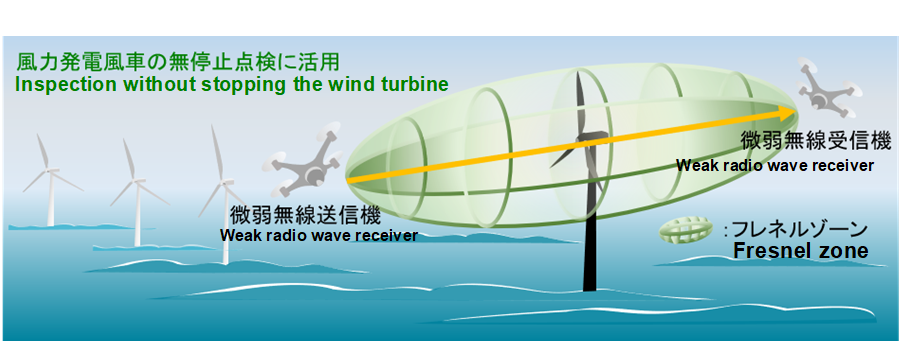
NTT Corp is developing a wind inspection technology that doesn’t require stopping the turbines; it transmits weak radio waves between two drones to detect problems.
Traditionally, wind turbines stop operations while under inspections. The new technology will have no negative impact on power generation efficiency.
One of the drones transmits the radio wave and the other is a receiver. Using the weak radio wave means operators don’t need a radio emitter license. The drones detect changes in the Fresnel zone to determine if the turbines are functioning properly.
Daido Metal won a major bearing supply contract in Europe
(Company Statement, May 10)
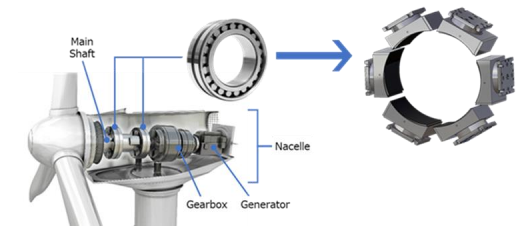
Daio Metal, the world’s largest hydrodynamic bearing supplier, won a main bearing supply contract for an unnamed wind turbine manufacturer in Europe, and will invest ¥6 billion to build a new bearing factory at Daido Metal Czech in Brno, Czechia.
The construction of the factory began in April 2023 and production starts in 2025. Currently, the DMC factory supplies hydrodynamic bearings to most major European automakers and automotive parts suppliers.
Hydrodynamic bearings are the standard technology in dynamic loading rotating machines that improves noise and vibration to improve the life of turbines.
J-Power seeks to build 129 MW wind farm in Kumamoto area
(New Energy Business, May 15)
J-Power published a draft environmental impact statement for Hisatsu Wind Farm in Minamata and Izumi cities in Kumamoto Pref. This onshore wind farm will have a maximum capacity of 129 MW.
J-Power plans to install 30 units of 4.3 MW-wind turbines over 3,500 hectares. Construction starts in April 2025; commercial operation to start in January 2029.
Oyo to make environmental assessment for offshore wind projects in Hokkaido
(Company statement, May 16)
Oyo Corp was awarded two environmental assessments for offshore wind projects. Both are for geophysical research on the seabed of western Hokkaido.
In 2022, a new rule passed calling for geophysical exploration before the start of offshore wind power projects.
Oyo’s main businesses are technical operations of ground research for roads and city planning, as well as for civil engineering and building.
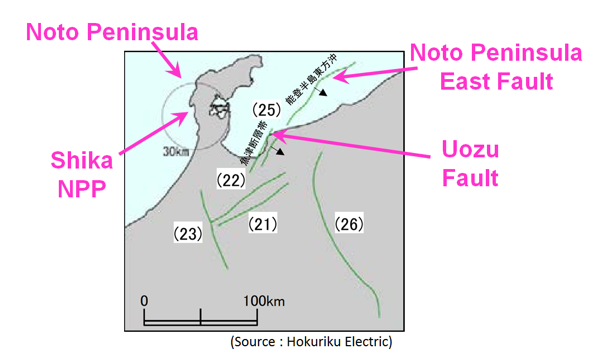
NRA tells Hokuriku Electric to redo earthquake inspection of Shika NPP Unit 2
(Denki Shimbun, May 15)
The NRA told Hokuriku Electric to redo an anti-earthquake resistance inspection for Shika NPP Unit 2.
If there are multiple subsea faults nearby, and more than one fault is activated at once by an earthquake, there would be a multiplier effect.
Hokuriku Electric said it investigated 10 pairs of undersea faults, and concluded that only the pair could possibly activate at the same time.
The NRA asked to investigate each fault individually, and redo the inspection.
TAKEAWAY: In March, the NRA approved Hokuriku Electric’s inspection for the fault inside the NPP site. Now, if the issue of subsea faults is settled, then Shika’s anti-earthquake resistance capacity will be considered completed.
Project Starts in Brief:
NGK Insulators started operation of a NAS battery system for the demonstration project of KEPCO (Korea Electric Power Corp), South Korea. The order was placed by German BASF aiming for acceleration of renewable energy applications. (Company statement)
Also, NGK Insulators started operation of a NAS battery system at a nickel-copper-cobalt mine in Australia. The NAS battery was delivered through BASF Stationary Energy Storage and it is the first installation of a NAS battery in Australia. (Company statement)
Kyudenko, Tokyo Century, Fukuoka Jisho, Taisei, and Kyuden Mirai Energy began operation of Miya River Watarai Solar Park (72 MW capacity) in Mie Pref. (Company statement)
Green Power Investment (GPI) started commercial operation of Sumida Tohno Wind Farm (capacity 113 MW), selling electricity at ¥22/ kWh to Tohoku Electric Network. The farm installed 27 units of Vestas 4,200 kW turbines. (New Energy Business News)
Samegawa Energy, a company funded by Sharp Energy Solution and Fuyo General Lease, started commercial operation of Samegawa Aono Solar Power Station that has a 48 MW output. Sharp is responsible for M&O. (New Energy Business News)
JNC completed a two-year modernization of two hydropower plants, Uchiya No. 1 and No. 2, in Yatsushiro, Kumamoto Pref; the two plants began operations with slightly increased capacity. Uchiya No. 1 has 16,600 kW of capacity, and No. 2 has 8,300 kW. (Company statement)
NEWS: OIL, GAS & MINING
Shareholder activist wants oil refineries to consolidate
(Bloomberg, May 18)
Shareholder activist Murakami Aya sees oil sector consolidation as demand decreases and seeks a dialogue with Cosmo Energy Holdings, Idemitsu and ENEOS. Murakami and City Index Eleventh own around 20% of Cosmo.
She said Cosmo’s refinery run rates are high and its operations are profitable. “Should consolidation happen now, or later, and if later, when? We need to talk,” she said.
It’s questionable if the country needs three oil refineries amid demand declines, said Fukushima Hironao, the president of City Index Eleventh.
TAKEAWAY: The consolidation scenario may work if oil refineries will continue to process crude oil and nothing else. The companies are seeking possibilities in SAF, hydrogen and ammonia markets and will be using legacy assets.
LNG stocks rise 19% to 2.67 million tons
(Government data, May 17)
LNG stocks of 10 power grids stood at 2.67 million tons as of May 14, up 19.2% from 2.24 million tons a week earlier. The May 7 stocks were first reported at 2.25 million tons, but the figure was revised.
The end-May stocks last year were 2.11 million tons. The five-year average for this time of year was 2.01 million tons.
April LNG imports slump 18.7%; oil, thermal coal also down 10%
(Government data, May 18)
Japan imported 4.5 million tons of LNG in April, down 18.7% YoY; crude oil imports were 12.7 million kiloliters (80 million barrels), down 10% YoY; thermal coal was down 10.8% YoY to 7.3 million tons.
Japan buys its cheapest LNG cargo in two years
(Bloomberg News, May 19)
Tohoku Electric agreed to buy an LNG cargo for late July at just below $10 per mmbtu, the cheapest that a Japanese buyer has paid for a spot transaction in the market for more than two years.
Lower fuel prices should translate into lower electricity prices in Japan.
ANALYSIS
BY KYOKO FUKUDA
Energy Transition Experiment: Japan’s First Hotel Powered by Hydrogen
As major economies across the globe launch initiatives to accelerate the energy transition, many sectors of the economy previously untouched by reforms feel obliged to come up with plans to bring an end to fossil fuel dependence. Japan’s hotel industry is a prime example of the energy challenges that the consumer service sector must grapple with in order to help the country meet its decarbonization goals.
In an effort to minimize its GHG emissions, a hotel in Kawasaki city has been experimenting with deploying electricity generated by burning hydrogen over the past several years. After testing the feasibility and economics of such an arrangement, the hotel owner says it’s now ready to set up its supply of hydrogen-fueled electricity on a commercial basis.
What’s more, the hotel group thinks that it might be able to implement this test project experience across its extensive portfolio of properties.
While demand for hydrogen fuel at one hotel is a tiny drop in the ocean of what people expect the hydrogen economy to become in coming decades, the Kawasaki case has captured some of the possibilities and challenges of trying to implement new energy forms into daily life and commerce.
Hotels: a sector ripe for greening
According to the Ministry of Environment, Japan emitted just over 1 billion tons of CO2 equivalent in 2019 (most recent statistics). Of that, 184 million tons, or 17.7%, came from the building and commercial industry, which includes over 550,000 restaurants and 52,000 hotels. The emissions figure is equivalent to that of the transportation sector (cars, ships, and airplanes).
Before the onset of the Covid pandemic, tourism was one of Japan’s biggest growth industries. The number of foreign visitors almost quadrupled to nearly 32 million in 2019, spurring a boom in new hotel construction.
No data exists specifically for the hotel industry, but it’s believed that the country’s hotels could account for between 5% and 10% of Japan’s total CO2 emissions.
Like many other industries, the hotel sector contributes to greenhouse gas emissions through energy consumption, water usage, waste generation and transportation. Here are a few key factors to consider:
Energy: Hotels require significant amounts of energy for lighting, heating, cooling, ventilation, etc. The type of energy sources greatly impacts a hotel’s carbon footprint.
Water usage: Hotels consume substantial amounts of water for various purposes such as guest usage, laundry, landscaping, and swimming pools.
Waste generation: The hotel industry generates large amounts of waste, including food waste, packaging materials, and other disposables. Disposal of the waste can contribute to carbon emissions.
Transportation: The movement of guests, staff, and goods can also contribute to carbon emissions.
So, when the Tokyu Group decided to build a new hotel in the Kawasaki area, the company decided to try something different in order to minimize its impact on the environment.
A hotel betting on hydrogen
In the 1960s and 1970s, Kawasaki City was infamous for its heavy industry. The Keihin Coastal Industrialized Zone had a reputation as one of the country’s most polluted areas, and asthma numbers among local children spiked. The local Tama River was covered in waste from petrochemical plants.
At the turn of the century, the city decided to clean up its image. It set up a new industrial complex focused on zero-emission manufacturing and waste recycling. The city claimed to host the world’s first zero-emission paper mill, which opened in 2003 with a promise to fully recycle its waste and control pollution.
As the Japanese government unveiled the world’s first national hydrogen strategy in 2017, Kawasaki looked at how it could incorporate some of the new ideas locally. With the city’s government keen to continue its clean energy rebranding, Tokyu proposed a renewable energy project at its Kawasaki King Skyfront Tokyu REI Hotel.
The 184-room facility opened in 2018. A short ride to Haneda Airport and JR rail stations to central Tokyo, the hotel was aimed at a business audience that might be visiting companies and factories in the surrounding Keihin industrial zone (petrochemical complex).
While the industrial location wasn’t going to attract a broader audience, it did carry the advantage of putting the hotel within a short distance of hydrogen fuel manufacturing facilities. So, it was decided to tap into that supply to help generate 30% of the hotel’s electricity and part of its heating. The Ministry of Environment even provided some of the financing and labeled it a “Low-carbon Hydrogen Supply Chain Development Project”.
According to the developers, this was the world’s first experiment of its kind – generating hydrogen from waste plastic. Resonac, a joint venture of Showa Denko and ex-Hitachi Chemical, supplied the hydrogen, piped it to a location where it was converted into fuel cells for storage and then utilized when needed to produce heat and electricity.
The hotel used a 50-kW pure hydrogen fuel cell power generation and storage system made by Meiji Electric Industries. Toyota Motors provided the fuel cell modules. And as a result, the project annually offset the release of 175,000 kg of CO2.
Building around sustainability
To date, most travelers have focused on cost and convenience, as well as amenities, when choosing their mode of transport and accommodation. But this may be changing as the level of awareness around environmental impact increases. Already, Japan’s two main airlines are offering business travelers packages that include carbon offsets for the miles they travel.
Within the limits of a hotel, sustainability options are often limited to energy conservation. However, the Kawasaki hotel decided to experiment further. It installed a small plant factory at a corner of the lobby area where leafy lettuces were grown with LED lamps, the power for which comes from food waste from the hotel’s restaurants.
The hotel sends all its food waste to a nearby biomass power plant for methanation to turn it into biogas, which is then deployed as a fuel to power the hotel’s gas engine and to generate electricity.
This use of biomass power generation, or “bio-food recycling,” as well as hydrogen from the local industrial zone, helps the hotel to rely on a lot of CO2-free electricity.
The hotel has also introduced measures to reduce plastic use, switching toothbrushes, hairbrushes, and shower caps to mixed materials that are partly derived from plants or rice husks (chaff). As it no longer provides mineral water in PET bottles, the hotel avoids the need for about 20,000 bottles each year.
Finding a way forward
Officially, the test project to generate 30% of the hotel’s electricity using hydrogen from the local industrial complex ended in March 2022. But the hotel plans to continue using the fuel to generate power and wants to do so on a commercial basis.
Repeating this model outside of an industrial zone, where hydrogen supply is more readily available and without the need to add new high-safety infrastructure, will be tough. In some ways, the niche application shows the clear limitations of trying to move regular facilities such as hotels or commercial buildings to energy forms such as hydrogen. However, without even a few real-life use cases, it will be difficult to seek greater hydrogen adoption no matter how many subsidies and policy plans governments put in place.
A hotel that runs on hydrogen may sound like a gimmick. The fact that its owner is ready to keep using hydrogen suggests there’s hope that the new energy source will find a way into wider demand.
ANALYSIS
BY JIAXIN YANG AND RICHARD YIU
Fueling Progress: Southeast Asia’s LNG Market And Japan’s Strategic Inroads
Southeast Asia is forecasted by the IMF to be the world’s fastest-growing region this year. That economic development, however, can only succeed and be sustained if there’s a substantial increase in energy supplies.
Traditionally, most Southeast Asian nations have relied heavily on coal to fuel industry and meet household needs, but amid growing global concern over greenhouse gas emissions, the region is considering other alternatives. While the small presence of renewables is expanding in Southeast Asia, it’s likely that for the foreseeable future natural gas will be the region’s fuel of choice.
In 2020, Southeast Asia accounted for about 6% of global LNG demand, and this is expected to grow to around 11% by 2030, according to the latest G2M2 database. Natural gas is mostly used for industry and power generation in Southeast Asia, and this will continue to drive demand growth. Residential and commercial use is limited because of poorly developed infrastructure and a lower demand for heating due to a subtropical climate.
In an effort to discern future growth traits and trends for natural gas demand in Southeast Asia, this market analysis focuses on Thailand, Malaysia, Singapore, Indonesia, Vietnam, Myanmar, and Philippines. Domestic gas production among these seven countries is expected to decrease, and LNG will likely become the main energy source powering growth.
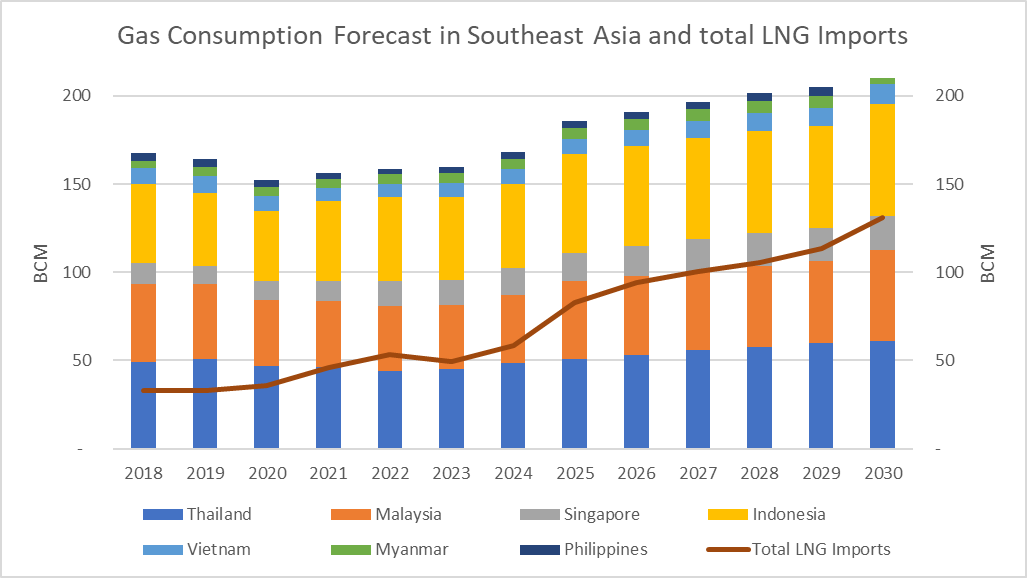
The total gas consumption of the seven countries through 2030 is predicted to increase 37%, to around 60 BCM of growth in consumption and 78 BCM of growth in LNG imports, with an average annual growth rate of 4% and 12%, respectively. However, most of these countries are new to the LNG market. Japan is a leading force supporting natural gas growth in the region and it’s the main country outside Southeast Asia that’s set to benefit.
Figure 1: Forecast of natural gas consumption and total LNG imports in major Southeast Asian countries.
Opportunities for Japan
In 2022, approximately 25% of Japan’s LNG imports originated in Southeast Asia. However, with Japan’s own energy transition focused on decarbonization, the overall volume of natural gas imported by Japan will decrease in the coming years.
Changes in the Japanese and Southeast Asian natural gas markets offer opportunities for Japan to establish a foothold in the region’s midstream and downstream sectors. Southeast Asia is transitioning from being an LNG exporter to an LNG importer, not only driven by an increase in domestic demand but also by a gradual decline in production.
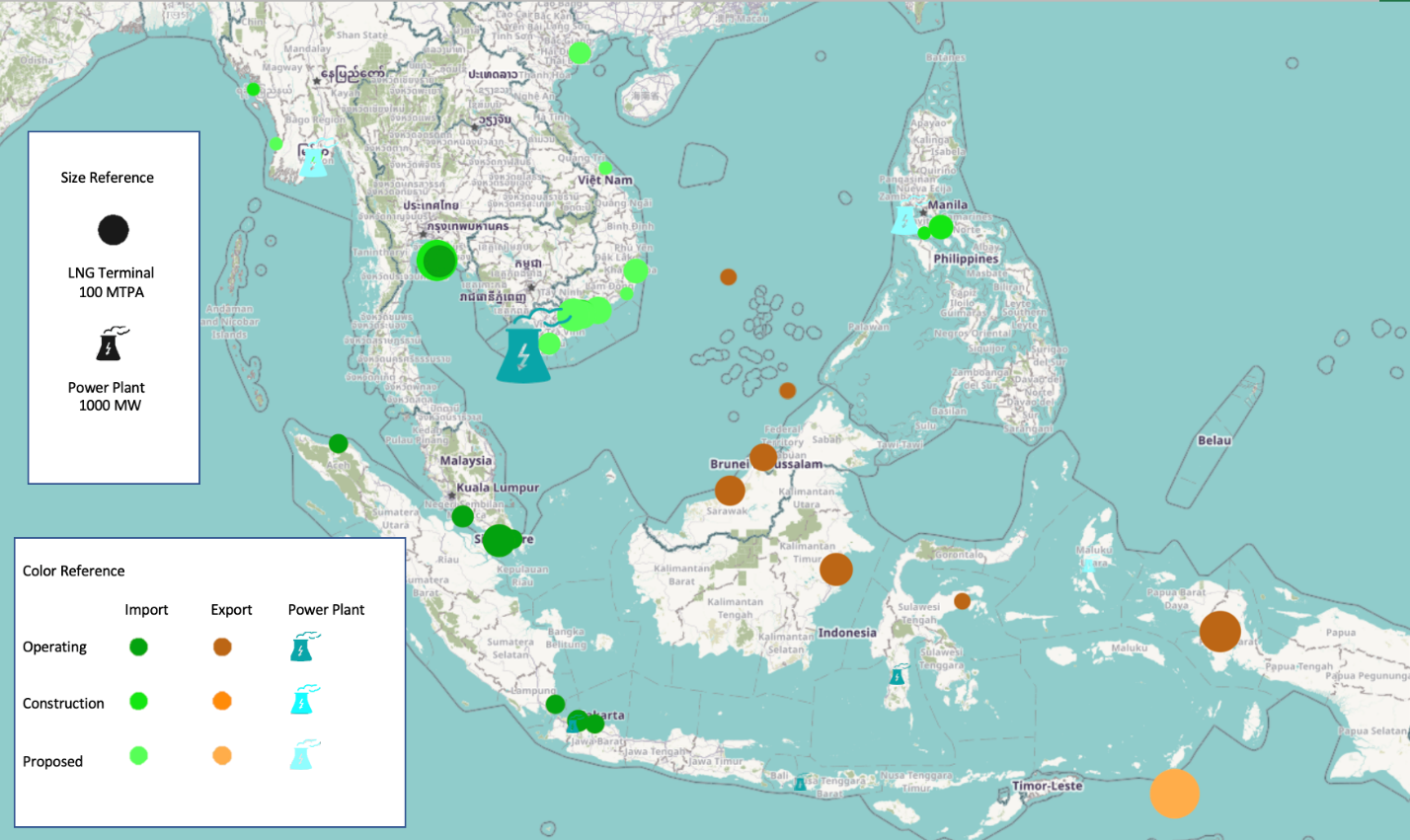
In recent years, Japan has signed LNG contracts with Southeast Asian producers that exceed its projected domestic consumption. This indicates that Japan plans to resell those cargos to other countries, possibly within the Southeast Asian region itself. Japanese companies, such as Tokyo Gas and JERA, are investing in the construction of LNG receiving terminals locally, particularly in Vietnam and Philippines.
Japan’s investments in LNG-importing countries in Southeast Asia contribute to establishing a local downstream natural gas industry value chain. While there are other nations, such as the U.S. and China, that can in theory capitalize on this, Japan clearly has a head start. And with geopolitical tensions increasing, Japan is expected to be tenacious to maintain that primacy.
Map: Terminals and Power Plants in Southeast Asia
Thailand
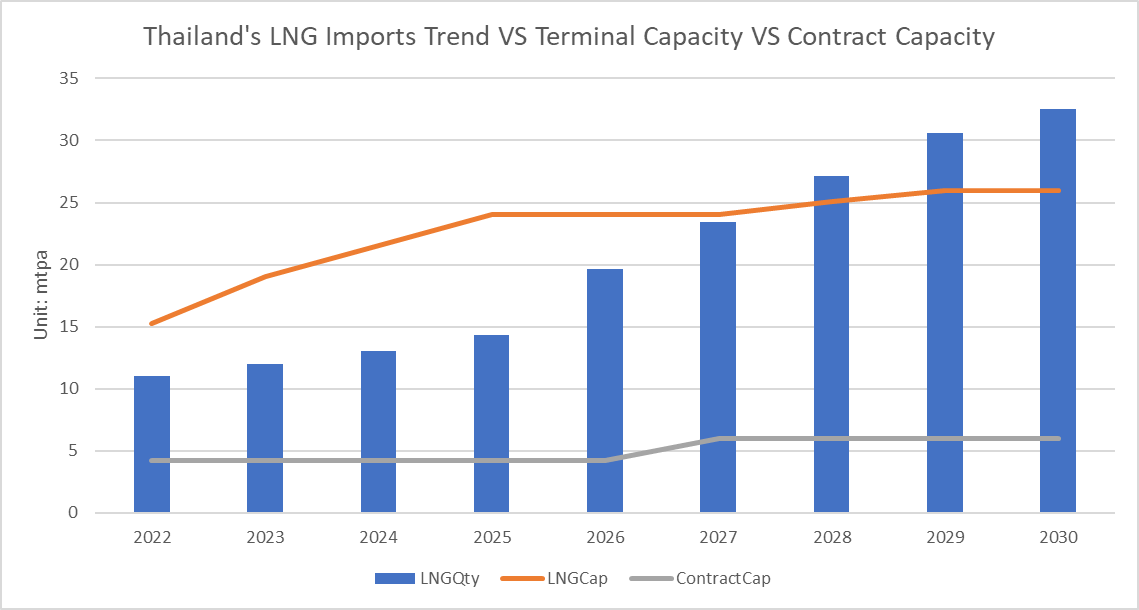
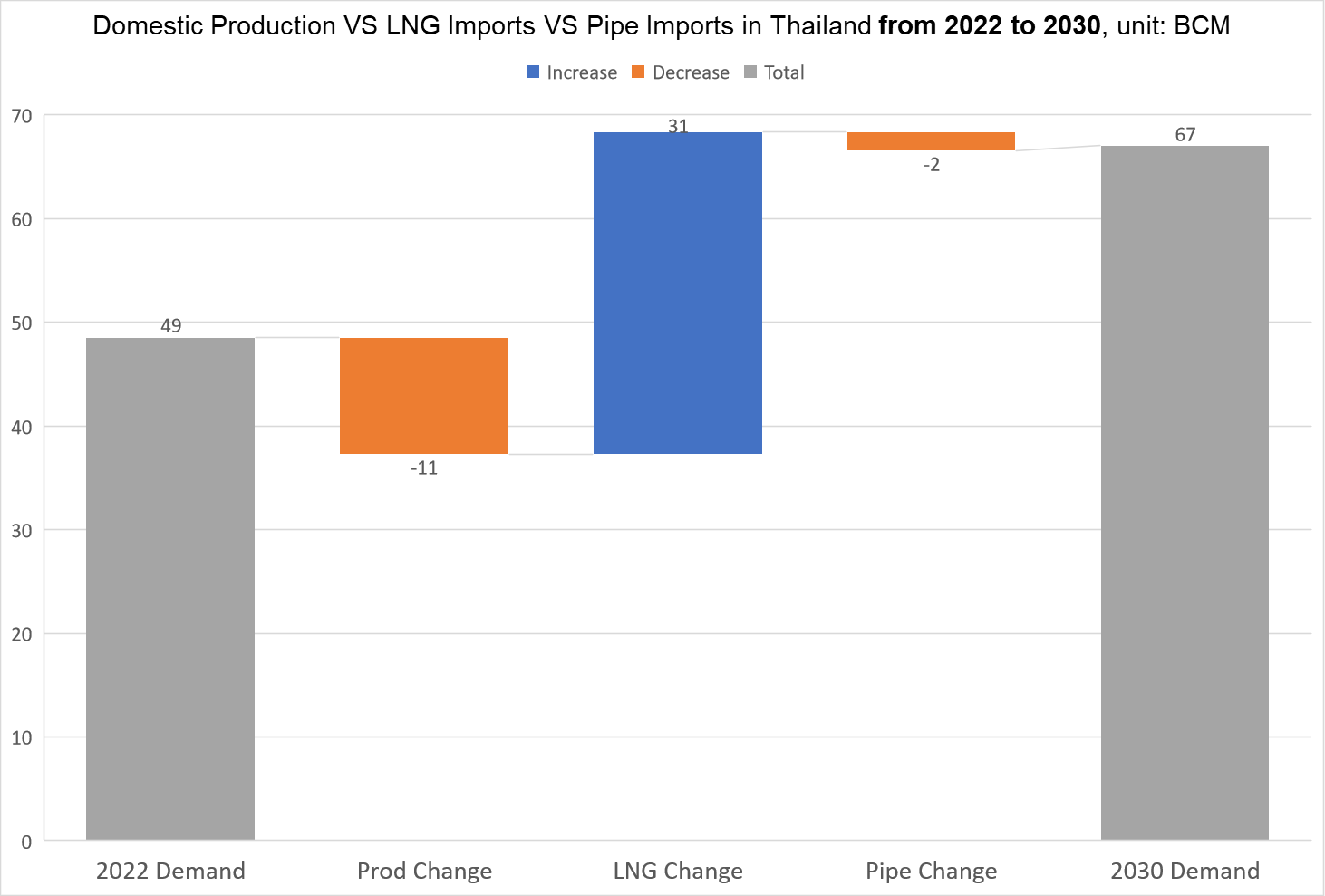
In recent years, natural gas consumption in Thailand has remained stable. However, LNG imports increased 21% in 2022 over 2021, reaching 11 BCM and accounting for 25% of total consumption. Thailand’s local natural gas production is gradually decreasing. Due to the uncertainty of gas imports from Myanmar, Thailand will import more LNG in the future to balance the decrease in production.
As shown in Figure 2, the required amount of LNG will exceed the current regasification capacity by the end of 2030, indicating that if the current situation persists, purchasing LNG in the future may occur directly from the spot market. This would increase the risk of vulnerabilities related to possible high prices and/or potential shortages.
Figure 2: Thailand’s LNG Imports Trend VS Terminal Capacity VS Contract Capacity.
Figure 3: Domestic Production VS Thailand’s LNG Imports VS Pipe Imports from 2022 to 2030.
Singapore
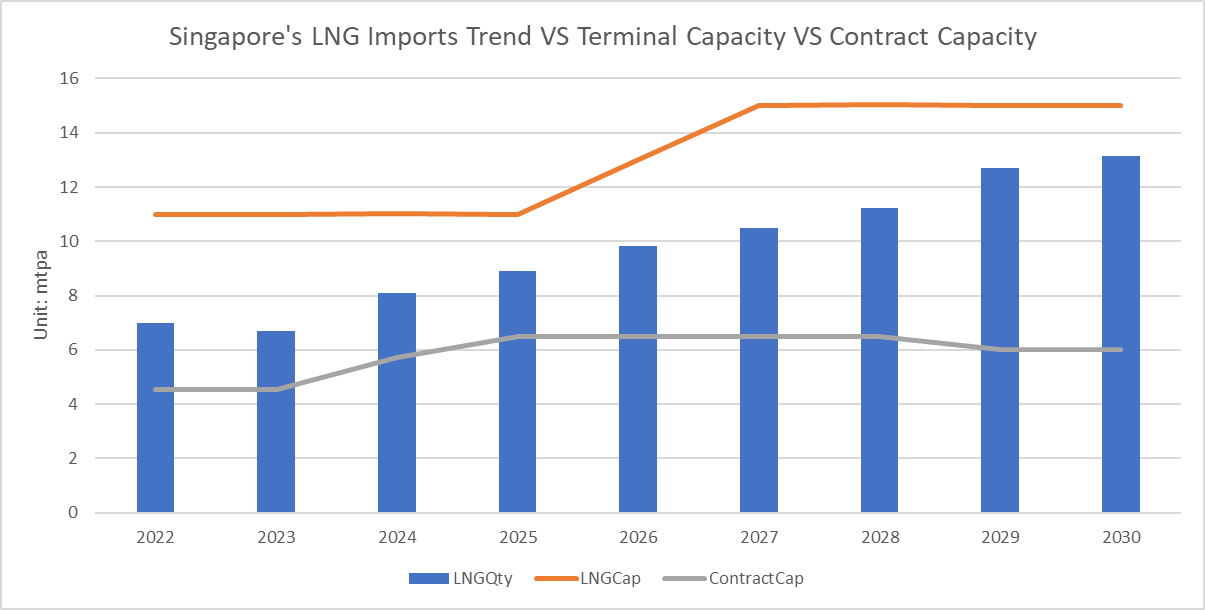
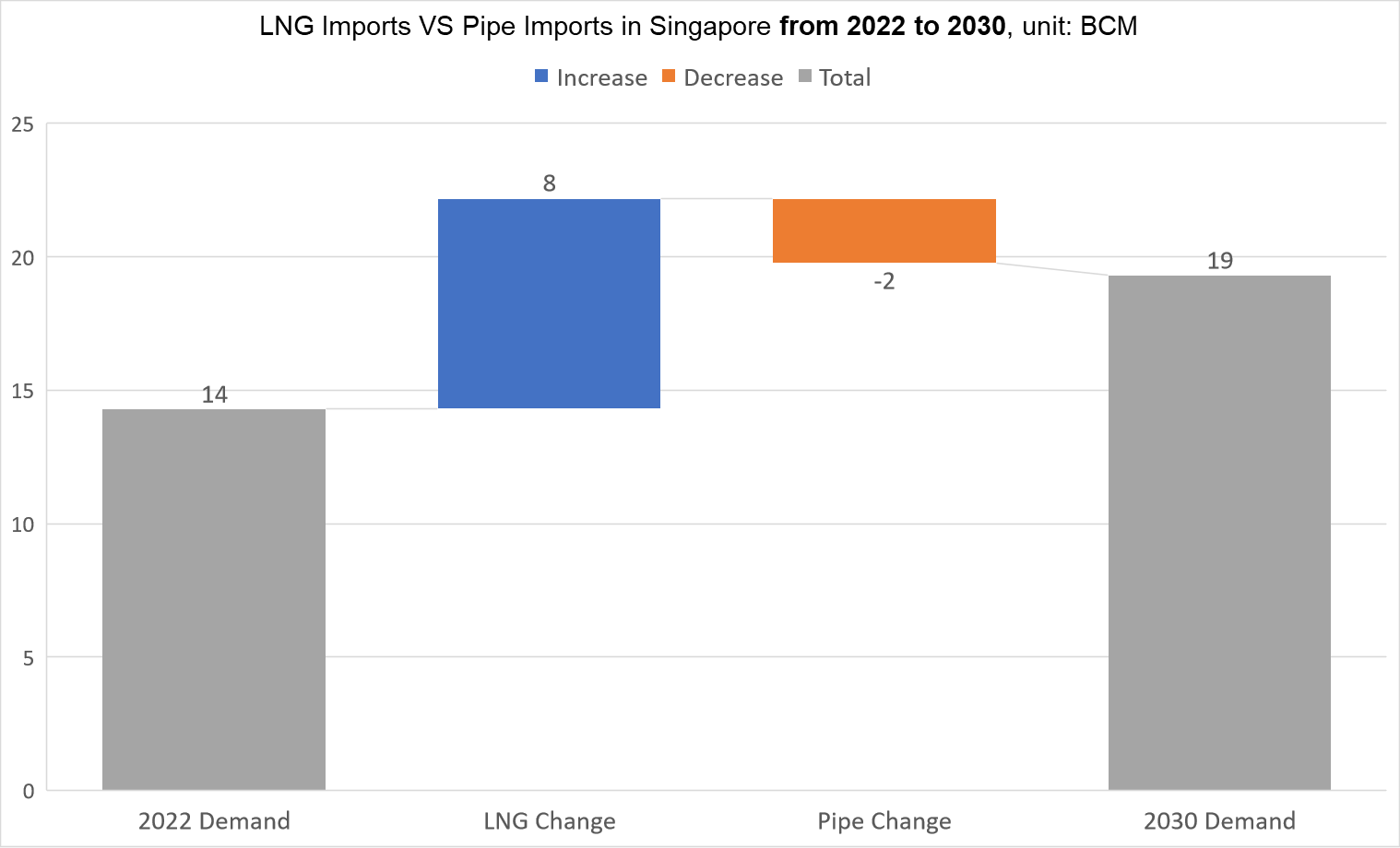
Natural gas is Singapore’s main source of electricity generation, and it will maintain a relatively stable growth over the next decade. Similar to Thailand, Singapore will gradually reduce its reliance on pipeline gas from Malaysia and Indonesia and increase LNG imports. Singapore also has plans to gradually expand its receiving terminals.
LNG will account for the vast majority of total consumption by 2030. However, according to industry specialist GIIGNL’s 2022 annual report, the current total amount of LNG contracted by Singaporean companies will cover about 6 mmpta out of expected 13 mmpta total demand for LNG, as demonstrated in Figure 4.
Figure 4: Singapore’s LNG Imports Trend VS Terminal Capacity VS Contract Capacity.
Figure 5: Singapore’s LNG Imports VS Pipe Imports from 2022 to 2030.
Malaysia Increasing domestic natural gas consumption, combined with the inability to replace or expand reserves, is expected to limit Malaysia’s export potential. The country will maintain a stable level of exports with no incremental growth. Malaysia LNG in Bintulu, in the state of Sarawak consists of nine LNG trains. Partners include Japanese trading houses Itochu and Mitsubishi, as well as shipping company Nippon Yusen Kabushiki Kaisha (NYK Line).
Indonesia
Indonesia will gradually reduce its LNG and pipeline gas exports. The Donggi-Senoro LNG plant, a JV between Mitsubishi and local partners, aims to produce LNG for domestic and export markets. The Jawa 1 project in West Java envisages a 1.76 GW combined-cycle gas turbine power plant and an LNG receiving terminal. It’s a JV between state energy company Pertamina (40%), and Japanese trading houses Marubeni (40%) and Sojitz (20%).
Vietnam
Vietnam’s natural gas demand is expected to rise due to its 6-7% annual GDP growth. However, it’s been increasingly difficult for domestic gas fields to support energy needs. As a result, Vietnam plans to construct more LNG terminals. Nhon Trach 2 includes a 750 MW gas-fired power plant and a terminal; partners include Tokyo Gas and Marubeni.
Vietnam’s government finally green-lit a new mid-term plan for the national power industry just last week. While it seeks to draw on renewables for just over 30% of the total at the end of this decade, according to Reuters, Vietnam will also heavily lean on gas and especially imported LNG to help the country ease its reliance on coal-fired generation.
Myanmar
Myanmar’s natural gas demand is forecasted to continue increasing. Despite having a significant number of gas fields, Myanmar’s production is far from sufficient to meet its growing demand. This is substantially different from the situation in the past decade where two-thirds of its gas production was exported to Thailand and China.
Forecasts predict that Myanmar’s domestic gas production will decline from 14 BCM in 2025 to 8.4 BCM in 2040. Myanmar must now import LNG, purchasing its first volumes in 2020. Even though those were small amounts, imports are expected to rise in the future due to Myanmar’s increasing demand and diminishing reserves. But political instability could complicate future energy projects that investors in Japan and elsewhere might become involved with.
Philippines
Despite a small increase, natural gas growth in the Philippines remains below the Southeast Asia average, in part because the country is running out of gas. The Malampaya gas field will stop producing gas completely by 2028 and the Philippines will transition from being self-sufficient to being an importer. With that future in mind, Tokyo Gas, together with Philippine power generation company First Gen Corp is developing an LNG terminal in Soma, Batangas.
The Batangas terminal is about to receive the Philippines’ first-ever cargo of LNG in May after a deal was concluded in April. The fuel will be sent to power plants in the region.
The authors are analysts with RBAC Inc., a leading supplier of global and regional gas and LNG market simulation systems. The G2M2® Market Simulator is designed for developing scenarios for forecasting natural gas and LNG production, transportation, storage, and deliveries across the global gas markets. For more information visit http://www.rbac.com
GLOBAL VIEW
BY JOHN VAROLI
Below are some of last week’s most important international energy developments monitored by the Japan NRG team because of their potential to impact energy supply and demand, as well as prices. We see the following as relevant to Japanese and international energy investors.
Brazil/ Oil development
The environmental regulator has blocked state-owned oil company Petrobras from drilling for oil at the mouth of the Amazon River. The ruling effectively ends development of new oil discoveries in that environmentally sensitive region.
Canada/ Natural gas
Recent wildfires are spreading and have slowed the outflow of natural gas from Canada into the U.S., leading to a spike in prices. The gas volume flowing to the U.S. dropped to a 2-year low of 6.4 bcf per day.
EU/ Energy transition
The EU has called for a new target by 2030 of 42.5% of the bloc’s energy to be generated by renewables, up from the current target of 32%. The final text still needs formal approval from members.
Germany/ LNG
Germany will nearly halve planned capacity for LNG terminals in the Baltic Sea, as Berlin reevaluates its LNG needs. Two floating LNG terminals are to be built at Mukran Port with an annual capacity of 10 bcm, down from the 18 bcm previously planned.
Norway/ Electrolysers
Norway’s electrolyser manufacturer, Nel, will invest $400 million in a 4 GW gigafactory in the State of Michigan in the U.S. The plant will be among the world’s largest, and will produce both alkaline and PEM electrolysers used to produce green hydrogen.
Russia-Iran/ Oil and gas
Deputy PM Alexander Novak, who heads energy diplomacy, visited Iran to discuss deeper cooperation in the oil and gas sectors. Russia and Iran, both under Western sanctions, are forging closer ties in order to support their economies and to counter Western sanctions.
Spain/ Green hydrogen
The €1 billion, 500 MW green hydrogen ErasmoPower2X project that will be powered by 1.2 GW of solar, has secured a major industrial off-taker in central Spain. In related news, transmission company Enagás and Danish fund Copenhagen Infrastructure Partners (CIP) will invest €1.7 billion in the 500 MW Catalina green hydrogen project in Spain.
U.S./ Energy transition
Rural electric utilities and other energy providers can now apply for $11 billion in grants and loans for clean energy projects as part of the Inflation Reduction Act. The White House said that expanding clean energy to rural communities is critical to meeting U.S. net-zero goals.
U.S./ Oil and gas infrastructure
Pipeline giant Oneok will buy Magellan Midstream Partners for $18.8 billion, creating one of North America’s biggest oil and gas infrastructure companies. The deal will create a company with a value of $60 billing and a 25,000-mile network of pipelines.
Vietnam/ Energy transition
Vietnam has approved a long-awaited power plan to boost wind energy and gas use by 2030, while reducing reliance on coal. Known as PDP8, the plan needs $135 billion of funding for new power plants and grids.
2023 EVENTS CALENDAR
A selection of domestic and international events we believe will have an impact on Japanese energy
ASEAN-Japan summit to mark 50 years of cooperation
Last market trading day (December 30)
Disclaimer
This communication has been prepared for information purposes only, is confidential and may be legally privileged. This is a subscription-only service and is directed at those who have expressly asked K.K. Yuri Group or one of its representatives to be added to the mailing list. This document may not be onwardly circulated or reproduced without prior written consent from Yuri Group, which retains all copyright to the content of this report.
Yuri Group is not registered as an investment advisor in any jurisdiction. Our research and all the content express our opinions, which are generally based on available public information, field studies and own analysis. Content is limited to general comment upon general political, economic and market issues, asset classes and types of investments. The report and all of its content does not constitute a recommendation or solicitation to buy, sell, subscribe for or underwrite any product or physical commodity, or a financial instrument.
The information contained in this report is obtained from sources believed to be reliable and in good faith. No representation or warranty is made that it is accurate or complete. Opinions and views expressed are subject to change without notice, as are prices and availability, which are indicative only. There is no obligation to notify recipients of any changes to this data or to do so in the future. No responsibility is accepted for the use of or reliance on the information provided. In no circumstances will Yuri Group be liable for any indirect or direct loss, or consequential loss or damages arising from the use of, any inability to use, or any inaccuracy in the information.
K.K. Yuri Group: Oonoya Building 8F, Yotsuya 1-18, Shinjuku-ku, Tokyo, Japan, 160-0004.
NEWS
・In a partial win for Japan the G7 pledged support for sustainable fuels and ammonia; but natural gas must be “temporary”
・In a boost for nuclear fusion Kyoto Fusioneering raises $72.5 mln; Mitsubishi, Mitsui among investors
・Govt approves household electricity rate increase of between 14% to 42% for major power utilities