
JAPAN NRG WEEKLY
JUN. 5, 2023
JAPAN NRG WEEKLY
June 5, 2023
NEWS
TOP
- GX Decarbonization Power Supply Act passed by Diet’s upper house, confirming among other things nuclear operating rules
- Summer power supply clears minimum requirement;
all regions cleared reserve rate of 3% - Nissan reportedly developing cobalt-free lithium iron phosphate battery to reduce supply chain risks
ENERGY TRANSITION & POLICY
- JOGMEC to rewrite resource diplomacy strategy
- The MoE tightens criteria for offshore wind
- Govt to prepare measures to tackle curtailment of renewables
- Toshiba-led group creates tech for green hydrogen
- Trading houses plan major green energy investments
- PSC solar system to be tested in closed spaces
- Itochu partners with Neste on renewable diesel
- Marubeni eyes Canada to Asia ammonia supply chain
- Toyota Tsusho, Eurus to collaborate on EV battery systems
ELECTRICITY MARKETS
- EPCO shareholders file resolutions for stronger compliance
- Local authorities want TEPCO replaced as nuclear operator
- JWPA publishes roadmap for wind power sector until 2050
- J-Power develops floating wind turbines that lower costs
- Eurus Energy bids for major wind power project in Hokkaido
- SSE Pacifico to join a large offshore wind project in Niigata
- Kansai curtailed solar and wind power output for the first time
- MoE questions net-zero compatibility of gas-fired power plant
OIL, GAS & MINING
- METI, British Columbia confirm alignment on LNG investment
- April LNG imports from Malaysia down 27% YoY
- LNG stocks rise to 2.48 million tons, up 0.4% from last week
- Japan’s coal imports from the U.S. jump, Russia down 81%
ANALYSIS
EX-HEAD OF POWER REGULATOR EGC SAYS:
REFORMS ARE IMPERATIVE
Japan NRG spoke with Hatta Tatsuo, the very first chair of the nation’s electricity market regulator, the EGC, who served there 2015 to 2021. According to Hatta, major reforms at the EGC are imperative if the power markets are to function effectively. He also believes that Japan must rethink the role of the regulator and its financing model.
NUCLEAR RESTARTS: IMMOVABLE REGULATOR VS
UNSTOPPABLE ENERGY POLICY
Almost a year ago, Prime Minister Kishida promised to have up to 17 nuclear reactors operating at the start of the summer of 2023. The premier’s comments were interpreted as a significant acceleration of the restart program. After all, 17 units is just over half of Japan’s total. It is now the start of the summer, 2023. There are nine reactors online. One of the main reasons is the independent stance taken by the industry regulator that makes it difficult for the govt to make good on its promises.
GLOBAL VIEW
A wrap of top energy news from around the world.
EVENTS SCHEDULE
A selection of events to keep an eye on in 2023.
JAPAN NRG WEEKLY
PUBLISHER
K. K. Yuri Group
Events
Editorial Team
Yuriy Humber (Editor-in-Chief)
John Varoli (Senior Editor, Americas)
Mayumi Watanabe (Japan)
Yoshihisa Ohno (Japan)
Wilfried Goossens (Events, global)
Kyoko Fukuda (Japan)
Filippo Pedretti (Japan)
Regular Contributors
Chisaki Watanabe (Japan)
Takehiro Masutomo (Japan)
SUBSCRIPTIONS & ADVERTISING
Japan NRG offers individual, corporate and academic subscription plans. Basic details are our website or write to subscriptions@japan-nrg.com
For marketing, advertising, or collaboration opportunities, contact sales@japan-nrg.com For all other inquiries, write to info@japan-nrg.com
OFTEN USED ACRONYMS
|
METI |
The Ministry of Energy, |
mmbtu |
Million British Thermal Units | |
|
MoE |
Ministry of Environment |
mb/d |
Million barrels per day | |
|
ANRE |
Agency for Natural Resources and Energy |
mtoe |
Million Tons of Oil Equivalent | |
|
NEDO |
New Energy and Industrial Technology Development Organization |
kWh |
Kilowatt hours (electricity generation volume) | |
|
TEPCO |
Tokyo Electric Power Company |
FIT |
Feed-in Tariff | |
|
KEPCO |
Kansai Electric Power Company |
FIP |
Feed-in Premium | |
|
EPCO |
Electric Power Company |
SAF |
Sustainable Aviation Fuel | |
|
JCC |
Japan Crude Cocktail |
NPP |
Nuclear power plant | |
|
JKM |
Japan Korea Market, the Platt’s LNG benchmark |
JOGMEC |
Japan Organization for Metals and Energy Security | |
|
CCUS |
Carbon Capture, Utilization and Storage | |||
|
OCCTO |
Organization for Cross-regional Coordination of Transmission Operators | |||
|
NRA |
Nuclear Regulation Authority | |||
|
GX |
Green Transformation |
NEWS: ENERGY TRANSITION & POLICY

GX Decarbonization Power Supply Act passed by Diet’s upper house
(Japan NRG, May 31)
- The Diet’s House of Councillors (upper house) approved the GX Decarbonization Power Supply Act. It concerns a range of issues, including the nuclear power sector and renewable energy.
- According to the Act, the Nuclear Regulation Authority will write the rules related to power plant inspections, extending the operating life, etc. The NRA will have no role in deciding reactor lifespan. METI is the sole authority to decide that issue.
- NRA Chairman Yamanaka said there’ll be no change in review principles due to the Act, but there’ll be new processes such as filing long-term facility management plans for 30–50-year-old plants. The NRA will need to speed up reviews.
- The law also clarified reactor decommissioning rules.
- The Federation of Electric Power Companies welcomed the law as it is also expected to drive the spread of renewables via power transmission network building, financing and community relations.
TAKEAWAY: The law confirms that METI will be the main authority on overall reactor lifespan decisions, but also confirms that the NRA can request inspections of the facilities every 10 years after 30 years of operation. This makes the METI license terms subject to NRA approval since the regulator has sole authority over nuclear safety. This is a nuance that could develop into a bigger issue as any outside funding for reactor development, for example from banks, will question whether the guaranteed license term for a new nuclear facility is 30 or 40 years. For further details, see this week’s Analysis section.
Govt to establish expert group to decide mechanism for new electricity settlement platform
(Denki Shimbun, May 31)
- METI and ANRE plan to establish an expert group to work on a new power market that would allow the simultaneous settlement of kilowatt-hours (electricity volume on the spot market) and delta kilowatts (balancing power on the supply-demand adjustment market). The idea is to allow trading of the two on a day-ahead basis. In other words, a day before actual supply and demand.
- The goal, as proposed at the Comprehensive Resource Energy Study Committee, is to prevent potential over-trading and unnecessary startup of thermal power that would increase costs and CO2 emissions due to the simultaneous but separate operation of the spot market and the supply-demand adjustment market.
- The new market, expected to prevent price surges and alleviate power supply-demand imbalances, will be designed to start necessary power generation across Japan and rationally distribute delta kilowatts and kilowatt-hours.
- The feasibility of the new market will be evaluated through simulations and cost-benefit analyses in collaboration with transmission and distribution operators (T&D) and the Japan Wholesale Power Exchange (JEPX).
Measures to reduce renewable energy output curtailment to be compiled by year’s end
(Denki Shimbun, May 30)
- METI and ANRE plan measures by year’s end to reduce output curtailment of renewable energy. They also seek a plan to reduce the minimum output of new thermal power generation facilities from the current 50% to 30% by FY2024.
- ANRE reported that the amount of output curtailment, which was about 100 GWh in FY2018, increased to about 600 GWh in FY2022 due to the reduction in power demand resulting from energy saving and conservation in the wake of rising electricity prices.
- The agency emphasized the need for drastic efforts to expand renewable energy capacity, such as using storage batteries and power control devices.
- The meeting also discussed how to connect and use system storage batteries, examining mechanisms to encourage charging at times when output curtailment occurs, and explore the expansion of transmission line operating capacity using storage batteries. They also noted the need to consider national rules since requests for connection of system storage batteries are rapidly increasing nationwide.
JOGMEC to rewrite resource diplomacy strategy to integrate net zero projects
(Japan NRG, May 29)
- JOGMEC will rewrite the resource diplomacy strategy to integrate net zero projects and goals for ammonia, hydrogen, biofuel and other carbon neutral energy sources, and to reflect changes in geopolitical and market realities.
- Rather than building a resource-specific strategy, the integrated strategies cover multi-sectors, and interests will be developed for a single country.
- 24 countries were selected for the primary analysis and categorized into five groups based on resource potential, economic efficiency and infrastructure, export capacity and stability, and approach to net zero and relations with Japan.
- JOGMEC will complete the country analysis that includes potential, Japan’s possible approaches, and risks.
|
Classification |
Countries |
Description |
Strategy |
|
Comprehensive partners |
U.S., Australia, Canada, Norway |
Have capacities to export resources, strong tech and accountability |
Collaborations in ammonia, hydrogen, CCS, etc. |
|
Traditional and stable suppliers |
UAE, Oman, Qatar, Saudi Arabia, Chile |
Traditional suppliers with potential to expand ties in energy transition |
Secure traditional supplies, etc. |
|
Countries establishing frameworks |
DR Congo, Zambia, Namibia, Peru, Madagascar, Mozambique |
Has rooms to improve investment climate while has huge resource potential |
Build infrastructure to drive investments, etc. |
|
Regional partners |
Indonesia, Thailand, Philippines, Vietnam, Malaysia |
Close neighbors with potential to expand ties in net zero economies |
Share energy transition concepts, etc. |
|
Emerging resource giants |
Argentina, Brazil, South Africa, India |
Has huge growth potential and would take visible rule-making roles |
Collaborate in net zero rule-making, etc. |
- CONTEXT: JOGMEC will implement programs to strengthen data gathering and sharing with private and state sectors. It will discuss Japan’s resource strategy with partner countries.
TAKEAWAY: This ambitious approach will require major reforms within JOGMEC, which has historically had strong silos. For example, staff in its gas unit, one of the biggest, hardly spoke with those involved in rare metals.
MoE tightens criteria for offshore wind, will coordinate with METI and MLIT
(Government statement, June 1)
- The MoE proposed conducting environmental impact surveys of wind projects and considering results in the selection process for Offshore Wind Promotion Zones.
- If major impacts can’t be avoided, the MoE will seek changes in wind turbine installation plans, including a decrease in the number of turbines.
- The MoE will coordinate with METI and MLIT, which have the authority to designate the Offshore Wind Promotion Zones.
Toshiba, Toray, and Panasonic develop tech to lower costs of green hydrogen
(Nikkei Asia, June 2)
- Green hydrogen is often produced using polymer electrolyte membranes (PEM) that require electrodes containing iridium. Toshiba developed a way to reduce iridium content by 90% while maintaining output and durability. Since iridium’s price is 2.5 times more than gold due to high demand for green hydrogen, Toshiba’s tech should help to cut costs.
- Toray makes an electrolyte membrane for PEM electrolyzers that uses hydrocarbons instead of fluoride and is four times stronger. It improves efficiency and lowers costs.
- Panasonic enhanced alkaline electrolyzers without the need for expensive metals, and hydrogen production efficiency was achieved by reducing the size of nickel and iron to nanometers to make a catalyst
TAKEAWAY: Japan seeks to reduce the cost of hydrogen from ¥100/m3 today to ¥20/m3 by 2050. These new technologies mentioned above will reduce costs, but still aren’t enough to achieve targets. The hope is that more companies will strive to develop new technologies in the coming years, which will increase overall hydrogen demand.
Major trading houses plan multi-trillion-yen investments in green energy
(Nikkan Kogyo Shimbun, May 30)
- Trading companies, including Marubeni and Mitsui, are ramping up investments in sustainable energy. Marubeni, for example, plans to allocate about ¥1.73 trillion to develop offshore wind in the UK.
- Mitsui wants to increase the proportion of renewable energy in its power generation business, from 14% to over 30% by 2030. Sumitomo is considering a ¥692 billion investment to expand offshore wind in the UK.
- Mitsui’s medium-term strategy calls for energy transition investment of roughly ¥1 trillion, with a specific focus on next-gen fuels and the establishment of value chains.
Tokyo govt, Sekisui Chemical plan PSC solar system tests in closed space
(Japan NRG, May 29)
- The Tokyo govt and Sekisui Chemical launched a pilot solar power project installing nine perovskite solar cell (PSC) panels on top of a facility at the Morigasaki water reclamation center. A govt official told Japan NRG that it’s considering testing PSCs installed in closed spaces.
- They also plan to test panels installed at various angles in open spaces. Testing, however, hasn’t been finalized.
- The nine panels, provided by Sekisui, have a combined capacity of 1 kW and occupy a total space of 4.1 x 3.6 meters. The panels are 1-mm thick. This PSC pilot is the largest in Japan, and the trial runs until Dec 1, 2025.
TAKEAWAY: This may be the country’s first pilot PSC in a closed space. Other companies developing PSC include Toshiba Energy Systems, Kaneka, Panasonic, Aisin, Mitsubishi Chemicals, and Enecoat Technologies. Municipal govts are keen to collaborate as they need to set zero-carbon plans and attract new industries. Toshiba Energy Systems launched Japan’s first PSC outdoor test in Yokohama in February.
- PSC hopes to be the next-gen solar power system; it’s made of perovskite-crystal materials that are lighter, thinner and more flexible compared to silicon-based panels. Many govts plan to rebuild their solar system supply chains to be more self-sufficient and are expected to take action to foster these technologies.
Perovskite panel layout
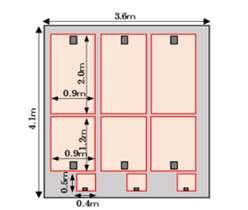
Source: Tokyo metropolitan govt
Itochu partners with Finland’s Neste on renewable diesel in Japan
(Company statement, May 29)
- Itochu and Finland’s Neste will partner on distributing a renewable diesel fuel in Japan. Neste is the world’s largest renewable diesel producer.
- In May 2021, Itochu began sales of renewable diesel as an alternative fuel for delivery trucks, and set up a supply chain.
- Itochu will obtain a license from Neste and begin importing renewable diesel on a larger scale in 2023. The company will expand distribution, focusing on potential demand from construction sites associated with the Osaka-Kansai Japan EXPO.
- CONTEXT: Neste’s diesel is produced using non-food raw materials like waste cooking oil and waste animal fats, ensuring no competition with food products. It achieves a reduction of about 90% in GHG emissions compared to petroleum-derived diesel. As a “drop-in” fuel, it can be used in existing vehicles and refueling facilities without modifications. The fuel has gained wide distribution in Europe and the U.S.
Marubeni and Pembina to develop low-carbon ammonia supply chain from Canada to Asia
(Company statement, May 30)
- Marubeni and Canada’s Pembina Pipeline agreed to develop a low-carbon ammonia supply chain from West Canada to Asia, specifically Japan. Operations begin in 2028.
- They’ll build a large production facility for low-carbon hydrogen and ammonia on Pembina-owned lands in Alberta. The facility, expected to have an annual production capacity of one million tons, will employ advanced technology to capture CO2.
- Rail will be utilized to transport the low-carbon ammonia to Canada’s west coast; from there it will be shipped to Japan and elsewhere in Asia.
Sojitsu invests in a SAF plant in the U.S.
(Company statement, May 29)
- Sojitsu Corp of America (SCA) has invested in Next Renewable Fuels.
- Next Renewable will build a plant at Port Westward, Oregon to make renewable fuels from used cooking oil and other materials with HEFA technology. Annual production will be 2.8 billion liters of sustainable aviation fuel (SAF) and renewable diesel.
- Next Renewable has investment from United Airlines and relationships with major oil & gas companies. Sojitsu will work with Next Renewable to supply raw materials and expand sales.
Toyota Tsusho and Eurus Energy collaborate on EV batteries as renewable energy storage
(Company statement, May 29)
- Toyota Tsusho and Eurus Energy will develop a stationary storage battery system (1 MW/ 3 MWh) that utilizes batteries from EVs. They’ll use new batteries at first, but will consider deploying used ones in the future.
- The project starts in autumn and will combine the EV batteries, control parts, and technology of Toyota used in EVs, with TEPCO’s know-how for grid connection at Tashirotai Wind Farm (7.65 MW), whose feed-in-tariff (FIT) has expired.
- CONTEXT: Eurus and Toyota Tsusho aim to reuse EV batteries for stationary storage. Eurus seeks to maximize value provided by the batteries and ensure continuity of large-scale wind power plants and contribute to the optimal operation of charging and discharging of storage batteries to stabilize the power system.
ENEOS, Toyota test-drive synthetic fuel cars
(Company statement, May 29)
- ENEOS and Toyota Motor conducted a test drive of two Toyota passenger vehicles pumped with synthetic fuel (e-fuel) in Shizuoka Pref.
- In attendance were Toyota Motor’s president, a METI vice minister and ruling party lawmakers who promote bio and e-fuel. They confirmed the e-fuel car driving experience was just like with a gasoline vehicle.
- CONTEXT: Commercialization of e-fuel is decades away as production costs are ¥700/ liter, four times the current gasoline prices. ENEOS, which is Japan’s largest oil company, aims to start e-fuel supply before 2040.
TAKEAWAY: A ride on e-fuel and gasoline may feel the same but they’re not, according to some industry sources. E-fuel quality consistency and potential problems with driving need to be studied in depth, the Japan Automobile Manufacturers Association warns.
Hitachi Zosen partners with TRE to recycle industrial wastes, investing ¥10 million
(Company statement, May 22)
- Hitachi Zosen will partner with TRE Holdings and invest ¥10 million in processing and recycling local and industrial wastes; the goal is to foster a circular economy.
- TRE Holdings was created in 2021 by merging Takeei Corp and Rever Corp; both were industrial waste processing and recycling leaders. Hitachi Zosen designs and builds the waste processing and recycling plants.
- This partnership will establish a one-stop-service for collecting, delivering, and recycling waste through a public private partnership (PPP) that covers Aichi, Gifu, Fukui Pref and other areas east of Ishikawa Pref (except Hokkaido) by using renewable energy.
A hotel in Hakone uses green energy from hot springs
(Company statement, May 22)
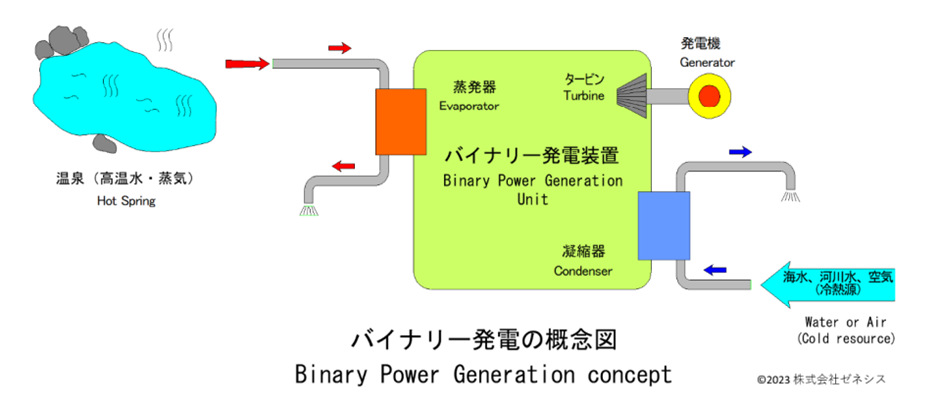
- Hakone Yunohana Prince Hotel in Kanagawa Pref is using binary cycle power generation equipment to supply electricity made by thermal heat from hot springs.
- It meets 20% of the hotel’s electricity demand, and helps reduce CO2 emissions by 63%, equivalent to 187 tons CO2-equivalent per year.
TAKEAWAY: Japan NRG Weekly’s May 22 issue told of a hotel powered by hydrogen. The cost of using clean energy still exceeds that of supply from traditional sources, on average, but social interest in climate issues could support those businesses that seek to differentiate themselves through such offerings.
Mitsui Fudosan issues ¥130 billion green bond, biggest in industry’s history
(Company statement, May 31)
- Mitsui Fudosan, a real estate company, fixed its green bond rates for refinancing its properties – Yaesu Central Tower; Tokyo Midtown Yaesu; Otemachi One Tower; and Nihonbashi Muromachi Mitsui Tower. This is the company’s fourth green bond issue, amounting to ¥130 billion, the largest of its kind by a Japanese real estate company.
- The issuance of the green bonds brings the company’s total sustainable financing to about ¥600 billion, the largest for a real estate company in Japan.
Tokyo, Ota City, Kawasaki City sign hydrogen collaboration
(Government statement, June 2)
- The Tokyo Metropolitan govt, Ota City (Tokyo), and Kawasaki City (Kanagawa Pref.) signed an MoU to build hydrogen supply systems and develop the molecule’s demand in the Haneda Airport area. The three will also conduct relevant research.
- The Kawasaki area has a hydrogen receiving terminal for shipments from Australia. The municipalities eye building pipeline networks to connect the main hydrogen hubs.
- The agreement expires in March 2031.
DHL Japan starts delivery service fueled by SAF
(Company statement, May 31)
- DHL Express started its service, “GoGreen Plus”, in Japan. As an option, customers can use sustainable aviation fuels (SAF) for DHL’s cargo planes.
- This requires additional cost on top of the delivery fee, which varies from ¥40/ kg to ¥170/ kg depending on the destinations and distances from the shipping point.
TAKEAWAY: In February, DHL Express announced that “GoGreen Plus” will cover Italy, Denmark, Sweden, Canada, Australia, and South Africa. SAF made from recycling waste oil will be supplied by BP and Neste, and is expected to reduce GHGs by 80%. DHL plans to expand this optional service to other countries.
Mitsubishi Electric begins DR experiment with heat pumps in Europe
(Company statement, May 31)
- Mitsubishi Electric R&D Center started a demo on Aran Island (Ireland) to evaluate heat pump control for demand-response (DR) to foster energy independence on remote islands as a part of its REACT project. It will also be deployed in San Pietro Island (Italy).
- The REACT project, co-funded by the EU’s Horizon 2020 program, involves 22 partners from 11 countries for energy management on remote islands using distributed renewable energy generation and storage technologies with DR to balance power supply and demand.
Japan Gas Association, Francegaz to collaborate on e-methane, biogas initiatives
(JGA statement, May 29)
- The Japan Gas Association (JGA) and Francegaz signed an agreement to develop synthetic methane (e-methane), biogas and other low carbon gas.
- The projects will include setting up carbon measuring rules and framework, developing technologies associated with manufacturing and delivery of gas, and other energy transition challenges.
NRA mulls using ChatGPT to process public documents
(Japan NRG, May 31)
- The NRA is considering the possibility of using ChatGPT to produce public documents stated in plain language for non-nuclear experts, but it will not share confidential data, said Chairman Yamanaka.
NEWS: POWER MARKETS

Summer power supply clears minimum requirement, all regions cleared reserve rate of 3%
(Government statement, May 30)
- Power supply shortages in July-Sept are unlikely as all regions have cleared the minimum reserve rate level of 3%. However, METI asked for continued savings in Tokyo, notably in July, and urged power operators to brace for emergencies by ensuring stable supply of LNG and other fossil fuels.
- METI asked owners of in-house power generators to introduce demand-response (DR) plans and offer supplies to the spot market.
- Power retailers are asked to hedge risks by making use of futures and DR contracts.
Regional reserve rates (%)
|
|
July |
August |
September |
|
Hokkaido |
5.2 |
7.6 |
5.8 |
|
Tohoku | |||
|
Tokyo |
3.1 |
4.5 |
5.3 |
|
Chubu |
9.8 |
11.7 |
7.8 |
|
Hokuriku |
11.9 |
11.3 | |
|
Kansai | |||
|
Chugoku | |||
|
Shikoku |
11.2 |
14.4 | |
|
Kyushu |
9.8 |
11.9 |
18.5 |
|
Okinawa |
22.3 |
18.7 |
21.6 |
- CONTEXT: Reserve rates are the forecast demand over supply in worst-case scenarios. Japan Meteorological Agency estimates that there is a 30-40% chance of July-Sept temperatures hitting average levels and a 40-50% chance of them being higher.
Niigata municipality heads call to remove TEPCO from running nuclear reactors
(Japan NRG, June 1)
- The Kashiwazaki City mayor, the Nagaoka City mayor and members of the ruling party Niigata prefectural assembly called on the central govt to seek a new entity to operate the seven Kashiwazaki nuclear reactors.
- Local leaders are sceptical over Tokyo Electric’s (TEPCO) ability to run the reactors after multiple fire, security and data breach incidents. “It is not an easy decision. If TEPCO loses the Kashiwazaki reactors, the company won’t be financially sustainable…I’m asking what could be possible alternatives to TEPCO,” said the Kashiwazaki City mayor.
- CONTEXT: Kashiwazaki was at one point considered to be the world’s largest nuclear-power generating plant. It was idled after a July 2007 earthquake, which did not cause major damage but did exceed its design basis. Concerns about the level of tremors the plant can withstand led to major upgrade works at the site that took several years and part of it was still not restarted in 2011 when the Fukushima disaster hit. Since then, the plant’s operator has struggled to convince the regulator and local authorities that the facility is ready to restart. There have been two outbreaks of fire onsite, and last month a TEPCO employee lost 80 pages of documents on safety measures. All seven reactors are currently not operational.
TAKEAWAY: See this week’s Analysis section for further discussion of this issue.
EPCO shareholders file resolutions for stronger compliance
(Japan NRG, May 30)
- Shareholders of Chubu Electric and Kyushu Electric filed resolutions to strengthen compliance following cartel charges in March by the Japan Fair Trade Commission.
- 74 Chubu Electric shareholders demanded to set up a compliance committee, and one shareholder at Kyushu Electric filed a resolution saying that company executives should face pay cuts for allowing the cartel. The companies oppose the resolutions saying effective compliance systems already exist.
- An unnamed shareholder, (or shareholders), of four power companies (EPCOs) will demand auditors to claim damages from the executives who failed to stop the cartel. The EPCOs involved are Kansai Electric (KEPCO), Chubu Electric, Kyushu Electric and Chugoku Electric, according to Nikkei.
- The shareholder(s) will send a letter on June 7. Under the Companies Act, shareholders can file suit after 60 days if companies fail to act.
- CONTEXT: On March 30, the JFTC imposed a total of ¥101 billion in penalties on Chugoku Electric, Chubu Electric, Chubu Electric Miraiz, Kyushu Electric and Kyuden Mirai Energy for cartel conduct. Chugoku Electric, Chubu Electric and its subsidiary Chubu Electric Miraiz challenged the JFTC decision. KEPCO was granted leniency for cooperating with authorities.
|
Shareholder resolutions related to cartel |
Potential shareholder suit | |
|
Kepco |
none |
Acknowledges cartel but no charges |
|
Chubu Electric |
Set up compliance committee |
Challenges cartel allegation |
|
Chugoku Electric |
none |
Challenges cartel allegation |
|
Kyushu Electric |
Executive pay cuts |
Acknowledges non-compliance |
TAKEAWAY: Shareholder lawsuits on anti-trust violations are quite rare in Japan. The methodology that the plaintiff will try to employ to calculate the KEPCO damage will be interesting since the company wasn’t hit with penalties and their amount is the base for calculating compensation.
JWPA published publishes roadmap for wind power sector until 2050
(Company statement, May 29)
- The Japan Wind Power Association (JWPA) released “Wind Vision 2023” in light of the govt’s plans to go carbon neutral by 2050 via the Green Transformation (GX) strategy.
- The Vision sets the goal to source 33%, or 140 GW, of Japan’s energy demand from wind power by 2050; 40 GW from onshore and 100 GW from offshore (40 GW from fixed-bottom and 60 GW from floating).
TAKEAWAY: In 2019, METI and the JWPA released a plan to adopt 36 GW of both onshore and offshore wind power by 2030, 66 GW by 2040, and 75 GW by 2050. In Dec 2020, METI revised the offshore wind target to 10 GW by 2030 and 30-45 GW by 2040. As of Dec 2022, installed wind power capacity was 4.7 GW for onshore and 0.1 GW for offshore. Capacity has been growing every year, but reaching 140 GW by 2050 requires 5 GW of installations per year for the next 27 years. Although Wind Vision 2023 is not an official govt plan, the association does coordinate closely with the authorities and pushes officials to aim higher. The latest plan shows just how much will need to change in this sector for the govt to meet its GX goals.
J-Power develops 20 kW floating wind turbines that lower costs
(Company statement, May 30)
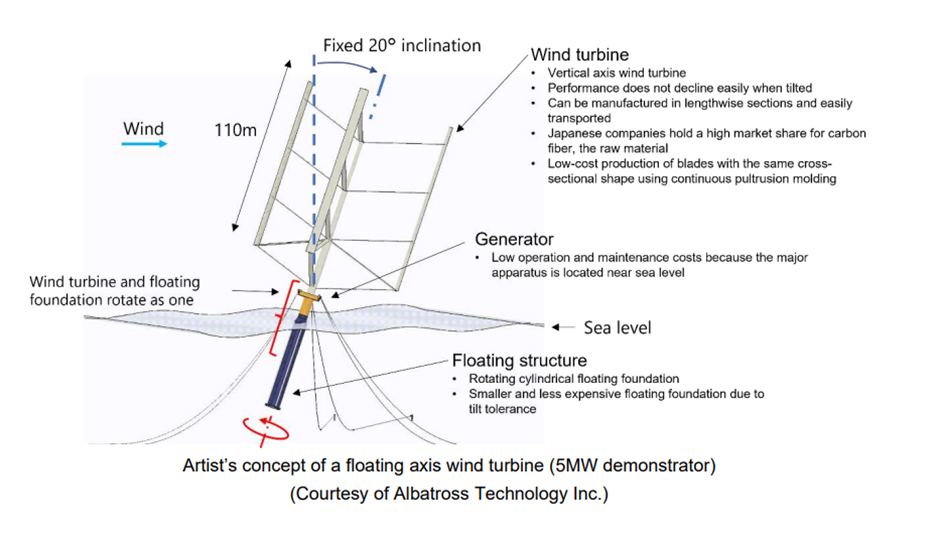
- J-Power, TEPCO, Chubu Electric, K LINE, and Albatross Technology plan to build a small-scale, next-gen floating axis wind turbine (FAWT) demo project.
- The FAWT concept is studied by J-Power, Osaka Univ Graduate School of Engineering, and Albatross. Small-scale experimental versions of the FAWT will be installed, and then after validation of analysis and design, the group plans to move on to building MW-class offshore demo projects.
- Fukui Fibertech (Aichi Pref) and Mirai Ships (Miyagi Pref) will help develop the wind turbine and the floating section, respectively. Kanazawa Institute of Technology will develop carbon composite molding technology and do motion analysis.
TAKEAWAY: METI plans to increase offshore wind power generation capacity to 30-45 GW by 2040. The government has asked industry to source at least 60% of the components for wind systems domestically by 2040. Yet, very few wind turbines for onshore or offshore are made by Japanese companies. Nearly all sales in Japan are by overseas turbine manufacturers such as GE, Vestas, and Siemens Gamesa, which primarily use supply chains in Europe and elsewhere. This project promises to be a “game changer” for Japanese manufacturers interested in the wind sector, but it is still at an early stage.
Eurus Energy bids for a 650 MW wind power project in Hokkaido
(Company statement, June 1)
- Eurus Energy submitted its environmental assessment in preparation for bidding for an onshore wind farm project in Northern Rumoi in Hokkaido. The project will have 650 MW total capacity; comprising 90-100 turbines, each 4 MW to 7 MW in capacity.
- The assessment will be on view from June 1 to July 14 at state offices and online.
SSE Pacifico to join a 420 MW offshore wind project in Niigata
(Company statement, May 22)
- SSE Pacifico will join the tender for an offshore wind power project near Murakami and Tainai cities in Niigata Pref. The generation capacity is 420 MW, equipped with 28 units of 14-18 MW wind turbines.
- The company submitted its environmental assessment that’s available for public viewing until late June.
Japan Wind Development plans 105 MW offshore wind station in Aomori
(Company statement, May 24)
- Japan Wind Development will develop a 105 MW offshore wind station in Aomori Pref. The company obtained feed-in-tariff (FIT) certification from METI in March.
- The company will present the plan to the local government and fishing association, and set up a company that will conduct an environmental assessment and design, and build the power station. The company aims to start operation in 2029.
Kansai curtailed solar and wind power output for the first time
(Nikkei, June 3)
- Kansai Electric Power Transmission and Distribution Co., a subsidiary of Kansai Electric (KEPCO), suspended some solar and wind power generation on June 4 (Sunday), from 9:00 a.m. to 1:30 p.m. This is the first such curtailment in the Kansai area.
- Due to the holidays, factory operations decreased and demand for electricity dropped, but the output of solar power generation increased due to good weather. The affected capacity was estimated to be around 420 MW to 520 MW.
- CONTEXT: Curtailment issues are on the rise nationwide. In April, there was a curtailment in the Chubu area for the first time.
TAKEAWAY: Renewable energy power generation is growing in the Kansai area. At the end of April, the region’s solar and wind power generation capacity was 7.18 million kW, a 43% increase compared to the end of October 2018. To further expand renewable energy power generation, it’s necessary to develop power transmission and distribution networks, as well as power storage facilities.
MoE won’t rule out decommissioning Konan GTCC gas-fired power plant
(Government statement, June 1)
- MoE said Kansai Electric’s (KEPCO) plan to upgrade the LNG-fired Konan power plants to GTCC (gas turbine combined cycle) plants with less carbon emissions may need to be scrapped if it is incompatible with the national net zero goal. The Konan plants have three power generators with a total 1.8 GW capacity.
- GTCC is possibly the best available gas-based technology but more ambitious efforts are required, including shifts to decarbonized fuel and CCUS, and environmental sustainability throughout the fuel supply chain, the ministry said.
- CONTEXT: METI will make a final decision, factoring in the MoE’s conclusion.
TAKEAWAY: The MoE’s push for a faster departure from fossil fuels will propel more companies to work with ammonia, hydrogen and CCUS. This week, Mitsui Chemical and Osaka Gas agreed to study deploying CCUS at the Semboku Industrial Zone by 2030.
Itochu and Kaneka to cooperate in storage, solar PPAs and regional microgrid
(Company statement, June 1)
- Itochu and Kaneka Solar will launch an electricity service business in the Toyooka Core Industrial Park, Hyogo Pref, combining an energy storage plant business (1.9 MW/ 6.0 MWh), a solar PPA business (2.2 MW), and a regional microgrid business.
- The energy storage plant project involves the reuse of storage batteries from commercial EVs provided by Itochu. Solar PPA projects will be implemented by installing solar power generation facilities on the roofs of buildings in the park.
- The electricity generated will be supplied to companies in the park. Any surplus power will be purchased by iGrid Solutions to supply surrounding areas. In the event of a power supply interruption, a microgrid system will be set up.
Itochu acquires U.S. water turbine producer
(Company statement, May 29)
- Itochu completed the acquisition of American Hydro, a company in Pennsylvania that specializes in producing and maintaining water turbines. The acquisition from Wärtsilä Corp also included related assets in Canada.
- American Hydro is a reliable provider of services for water turbines and related equipment, serving over 2,000 hydraulic power stations in North America.
- Itochu’s goal is to expand equipment maintenance services in North America, capitalizing on the demand to maintain aging infrastructure.
KEPCO postpones restart of Units 1 and 2 Takahama NPP
(Company statement, June 1)
- Kansai Electric (KEPCO) has postponed the restart of Unit 1 and Unit 2 of Takahama NPP in order to perform fire barrier installation works. The NRA said in March that the required work had not been done.
- Unit 1 was to restart on June 3; Unit 2 on July 15. Both have a 826 MW capacity.
TAKEAWAY: The new restart dates have not been given as they are subject to NRA inspection after the work is completed.
NEWS: OIL, GAS & MINING

METI and Canada to cooperate on energy and R&D
(METI, May 30)
- METI and the govt of British Columbia in Canada confirmed collaboration in energy and R&D. Both emphasized the need for alignment between investments in LNG and gas development.
- The MoU was extended to explore opportunities in natural gas, hydrogen, ammonia, carbon capture, coking coal, and mineral resources.
- Clean technologies such as hydrogen fuel cells, as well as AI, were identified as important areas, aiming to advance industrial technologies.
Nissan reportedly developing cobalt-free lithium iron phosphate battery
(Asahi Shimbun, May 31)
- Nissan Motor is developing lithium iron phosphate (LFP) batteries that don’t contain any cobalt, in order to cut down EV battery costs, possibly by 30%.
- The LFP cells have lower performance compared to nickel-manganese-cobalt (NMC) lithium-ion cells that are mainstream EV batteries, but their quality has improved thanks to Chinese producers.
TAKEAWAY: Nissan has been pursuing cobalt-free batteries for almost two decades. It partnered with NEC Tokin, which has track records in development of cobalt substitutes, to form a battery joint venture, Automotive Energy Supply Corp (AESC). Nissan, however, sold AESC to China’s Envision group in 2018.
Tokyo Gas to invest ¥30 billion in synthetic methane and hydrogen R&D
(Jiji, June 1)
- Shinichi Sasayama, President of Tokyo Gas, said the company will invest ¥30 billion over the next three years into R&D into synthetic methane and hydrogen.
- CONTEXT: Synthetic methane emits CO2 during combustion, but if it is produced by capturing carbon dioxide emitted from factories, its emissions are not considered as additional. Tokyo Gas, Mitsubishi Corporation, Osaka Gas and others, are currently working on a synthetic methane production project in the US.
- Sasayama said that if hydrogen can be procured cheaply using existing infrastructure such as LNG terminals, there is a strong possibility that synthetic methane can be manufactured at an economically viable cost.
April LNG imports from Malaysia down 27% YoY; Saudi crude down 17%
(Government data, May 30)
- Japan imported 4.5 million tons of LNG in April, down 18.7% YoY; imports from Malaysia decreased 27.3%; Australia down 14.3%; and Russia down 10.6%.
- April crude imports were 12.7 million kiloliters (80 million barrels), down 10% YoY; Saudi Arabian imports were down 16.6%; UAE imports up 0.9%.
LNG stocks rise to 2.48 million tons, up 0.4% from a week earlier
(Government data, May 31)
- LNG stocks of 10 power grids stood at 2.48 million tons as of May 28, up 0.4% from 2.47 million tons a week earlier. The May 21 stocks were first reported at 2.5 million tons but the figure was revised.
- The end-May stocks last year were 2.11 million tons. The five-year average for this time of year was 2.01 million tons.
Japan’s coal imports from the U.S. up 29%, Russia down 81%
(Govt data, May 31)
- Japan imported a total of 13.2 million tons of coal in April, falling 1.6% YoY. The value of imports was over ¥518 billion, rising to almost 10% YoY, the data showed.
- Imports from the U.S. rose 29% YoY to 829,767 tons, and the value soared 127% to ¥35.32 billion. Receipts from Russia dropped 81% YoY, to 269,767 tons, which was worth ¥10.15 billion, a 80% decrease in value.
- In April, Japan imported 7.28 million tons of thermal coal, down 11% YoY, with import value at ¥284 billion, up 10% YoY.
ANALYSIS
BY MAYUMI WATANABE
Former Head of the Power Regulator Says:
Reforming the Industry Is a Must
The power sector requires trillions of yen in investment to upgrade to a net-zero economy. But there’s growing concern about the sector’s ability to raise the funds or carry out the long-term investment programs required for decarbonization. In addition to seeing their profits squeezed by high fuel prices and a weak yen, Japan’s major power utilities have been rocked by numerous scandals. None are bigger than the claim that the companies, which used to operate as regional power monopolies, failed to adapt to the new competitive landscape. State probes found that several of the utilities, known also as EPCOs, illicitly passed on competitor data to their retail units. Now, the companies face a record \101 billion in antitrust penalties.
The problems don’t seem to be limited to a few poor individual decisions. Criticism has swirled also about the role of the regulator and govt officials. In an effort to appease the public, in April, the METI Minister Nishimura vowed to make amendments to the Electricity Business Act that will strictly penalize wrongdoing. But many industry players say that this is not enough. While stricter laws should help, their impact will mean little without stricter enforcement.
The Electricity and Gas Market Surveillance Commission (EGC) was created to oversee the newly liberalized utility markets. The power sector was fully opened to new players in 2016, with the gas sector following in 2017. The EGC, however, is what is known as a “soft regulator”. It can issue advisories but not orders. It cannot impose fines. Such powers are reserved for ANRE and METI. So, is it time for Japan to rethink the role of the regulator?
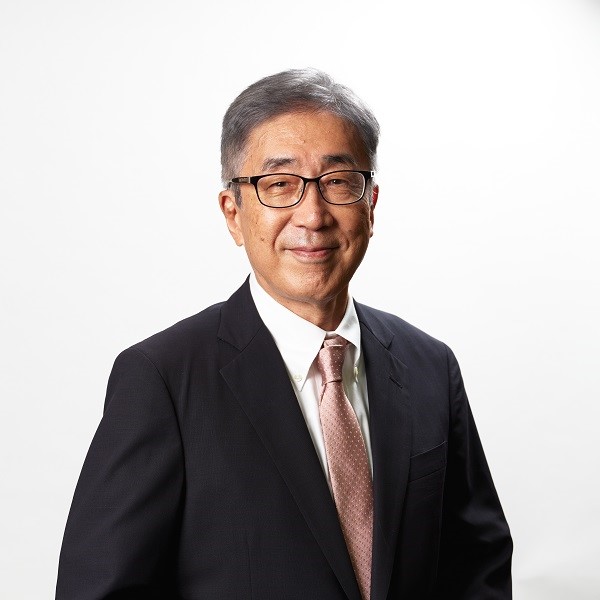
Japan NRG interviewed Hatta Tatsuo, the very first chair of the EGC, who served in the role from 2015 to 2021. Hatta is a former professor of economics at Osaka University and presently a member of the Cabinet Taskforce to Review Renewables Regulations. He is also chair of the state-run Asian Growth Research Institute.
Basic reforms: amending the Electricity Business Act
Q: How should the Electricity Business Act change to make power sector regulation more effective?
A: The Electricity Business Act is a weak law. This needs to change more than anything else. The law’s major flaws are: 1) It is not aimed at promoting competition, and 2) there is no penalty for anticompetitive behavior. It needs to be revamped into a law the clear purpose of which is to promote fair competition. The law would be more effectively implemented if the regulator could administer penalties.
Currently, the law talks about the need for electricity to be sold in an “appropriate manner”. It’s unclear what that means. But is there anything more inappropriate than a transmission network passing on customer data of competitors to their [related] power retail division? This offense should be enough for a company to lose its operating license.
When ANRE was planning the liberalization of the power industry, EPCOs told the agency: please leave competition issues to us, we will ensure competition on a voluntary basis. We recently learned this was not the case at all.
Q: What are some rules that need to be clarified within the law?
A: The law needs to say clearly that it seeks to promotes fair competition. The law needs to restrict information and personnel exchanges between various EPCO units and ensures non-discriminatory power sales to parties in and outside of the [EPCO] business group. I would also add a new requirement for EPCOs to set up an independent compliance panel. Following the case of Kansai Electric (KEPCO) executives receiving gifts from the Takahama town mayor, KEPCO created a compliance panel comprised of outside lawyers. It now appears that the panel was instrumental to instilling change. In fact, it is the outside lawyers who may have influenced KEPCO management to report their cartel behavior to the Japan Fair Trade Commission (JFTC) and in return to seek leniency.
Q: The JFTC has been offering advice to small businesses about their rights in this case. Have whistleblowers come forward?
A: JFTC action tends to be whistleblower-driven. The Commission’s powers are backed by its ability to hand out heavy penalties. The Securities and Exchange Market Surveillance Commission is another government agency that the power to punish, thus people fear them. In the case of EGC, yes, businesses have reached to them for advice, but there are no whistleblowers. Because in the present system, offenders are not punished.
Financial independence paves way to a strong regulator
Q: How can EGC become more authoritative?
A: The regulator needs experts such as lawyers, electric engineers, accountants and IT engineers. Let me give you an example. In 2016, the EGC found that Tokyo Electric (TEPCO) Energy Partners was selling in the spot market at levels above their marginal cost, which pushed up spot prices. It was an IT programmer who spotted it. He was analyzing exchange data and started to dig deeper. A case was established and the EGC contacted the company president.
The market is evolving. Day ahead market trade volumes are rising. Regulators need to have the skills to detect non-compliance. METI officials often do not have this skill set. The EGC needs to hire outside talent and offer them competitive compensation. But is it possible for the EGC to increase staff while reducing its headcount seconded from METI or MoE? There is a cap on the number of government employees [the regulator can employ] and this is written in law. So, the EGC can become financially independent. In the U.S., the Federal Energy Regulatory Commission (FERC) and, in the UK, the Office of Gas and Electricity Markets (Ofgem) are run by license fees charged to operators. The Japan Patent Office also has a similar scheme. The EGC can introduce such a system.
Q: A former EGC official said the regulator’s limited career path dampened motivation.
A: The EGC can create an affiliate organization that conducts research, plans programs and designs market mechanisms. The affiliate body will recruit people from power operators. If the EGC had its own budget, it could become an “Article 3 commission” like the JFTC. (Presently the EGC is an “Article 8 commission” with limited enforcement capacities.) This would help promote new career paths and opportunities. At an Article 3 commission, there are director-general positions and opportunities to climb to a vice-minister rank. Ultimately, the regulator’s experience and knowledge base won’t grow unless people stay. In the long term, as the EGC acquires a track record, it could take over some ANRE duties.
Independence from politics
Q: Does the EGC also needs to be more independent and neutral?
A: Independent from what? That is the question. The EGC needs to be independent from the subjects it regulates. Like the ANRE is. But the EGC is not independent from govt policymakers. METI officials told parliament that ANRE’s energy policies take priority over the EGC functions.
The EGC needs to stay independent from politics. Presently our electricity bills include surcharges that go towards nuclear power and renewables operators. In order to be independent from nuclear and renewables policies, the present mechanism to pool funds from electricity charges needs to stop. Any policy related programs should be financed by tax, not electricity fees or surcharges. Revenues from power services should be spent on those services. Separating policy-related items from the electricity bills will allow the regulator to focus on market efficiency and not be distracted by policy and budget issues.
The regulator should pursue market efficiency, think about avoiding losses, and promote fair practices. They’ll be able to do it if they are the best specialized professionals, who know what works.
ANALYSIS
BY YURIY HUMBER
Nuclear Restarts: What Happens When an Immovable Regulator
Meets an Unstoppable Energy Policy?
Almost a year ago, Prime Minister Kishida promised to have up to 17 nuclear reactors operating at the start of the summer of 2023. The premier’s comments raised much excitement/concern (depending on one’s stance on nuclear power), but all agreed this was a significant acceleration of the restart program. After all, 17 units is just over half of Japan’s total.
It is now the start of the summer, 2023. There are nine reactors online. That number has yet to actually hit double-figures since the nation’s nuclear plants were idled after the 2011 Fukushima accident. And, the two more Kansai Electric units that were certain to swirl into action this and next month are now back “under review” by the regulator with no restart date announced.
The situation is probably best described as what happens when the seemingly unstoppable force of energy policy, driven by record fuel and electricity prices, meets the immovable object of industry regulation. In the 10 years since its inception, Japan’s Nuclear Regulation Authority (NRA) has become one of the most powerful state entities, skillfully rebuffing nearly all attempts by industry and government to wrest control.
Perhaps unintentionally, the NRA now challenges the ability of bureaucrats and politicians to fully determine national energy policy. As a new debate heats up in Japan over policing of the broader electricity sector (see the first article in this week’s Analysis section), the NRA could serve as a useful case study. After a series of recent scandals involving major utilities, the power industry is ripe for stronger regulation. But, will the government accept less policy control?
Background
In 2022, on the back of record fuel and electricity prices, Kishida became the first Japanese PM in over a decade to announce unequivocal support for a revival of the domestic nuclear power industry. The PM said he wanted nine reactors online in the winter of 2022/23, and as many as 17 by the summer of 2023.
With Kishida’s backing, METI quickly rolled out a long-term roadmap for the nuclear sector that outlined a strategy to support the R&D of four additional reactor technologies in addition to those already deployed in Japan. The ministry’s plan called for new reactors to replace aging units at existing nuclear station sites, with an eye for further developments at an undefined point in the future.
In the last decade, the main stumbling block to a more positive nuclear energy strategy in Japan has been public opposition. However, in 2022, due to a jump in energy costs and concern about future resource supply from Russia, public opinion turned favorable towards nuclear power.
The government set course to accelerate the sector’s revival. Yet the regulator has shown up those plans.
The making of the NRA
Prior to the 2011 nuclear accident, both promotion and regulation of the nuclear industry was spearheaded by METI. Ostensibly, the Nuclear and Industrial Safety Agency (NISA) policed the nuclear operators, but it was simply a branch of METI. In 2012, NISA was disbanded and a new entity took its place.
The NRA was created as an Article 3 commission organization with the sole right to exercise authority over nuclear safety. Nominally, it was part of the Ministry of Environment (MoE), but it has grown as a fiercely independent entity with the resources to hold its own in the world of politics and policy. The NRA was reported as employing over 1,100 staff last year, almost a third of the personnel at the entire MoE.
From its inception, the NRA was determined to be viewed as independent and transparent. It avoided all “on-background” briefings with industry people, kept its correspondences strictly official, and streamed its main deliberations and meetings on YouTube.
The regulator has not shied away from publicly shaming nuclear operators for mistakes in their documentation, from challenging the validity of geological data to pointing out typographical errors. The NRA has recently cast doubt over the future of several major facilities that METI officials and the ruling party lawmakers deem vital to Japan’s energy security.
- Kashiwazaki Kariwa Nuclear Power Plant (NPP): The regulator said in May 2023 that an on-site inspection revealed that the owner, TEPCO, had yet to resolve safety issues in four out of 27 areas; the NRA has also attacked the overall safety culture at the facility after a string of minor security incidents
- Tsuruga NPP: Plant operator Japan Atomic Power Co. was asked in April 2023 to revise its restart application after finding a large number of errors, both factual and typographical, in the document; the operator was already questioned by the NRA several times about the validity of its data, which is likely to translate into problems securing a green light from the local government for the restart
- Takahama NPP: Kansai Electric said on May 2 that the planned restart of Unit 1 on June 3 after 12 years, and the same for Unit 2 on July 15, will now be delayed until the NRA completes its review of amendments to the design and construction of a new fire prevention system at the facilities
Who’s really in charge?
The NRA is led by five commissioners. Their terms are intentionally staggered so that they cannot be replaced at once at the whim of lawmakers and the NRA puts forward its own candidates, according to Florentine Koppenborg, Chair of Environmental and Climate Policy at the Technical University of Munich and author of “Japan’s nuclear disaster and the politics of safety governance”, which is due to be published later this month.
Koppenborg has spent years researching the NRA and concluded that the state entity has resisted capture by the industry, thus fundamentally altering the environment for nuclear policy implementation in Japan away from a top-down dictate. In the process, the NRA has opened up the industry to additional scrutiny from the public and wider legal action, raising the cost of nuclear generation while taking authority away from the government to control the sector’s development.
For example, this year TEPCO filed an application to METI asking for an increase in its power tariff to reflect the rising cost of purchasing natural gas and coal to fuel its thermal stations. The utility lowered the rate increase that it sought based on the understanding that it could restart at least one unit at its only operable nuclear power plant, Kashiwazaki Kariwa, in October 2023. However, while METI approved the tariff increase, the regulator did not concur that TEPCO’s NPP was fit to restart.
NRA Chair Yamanaka Shinsuke said in May that it was “up to TEPCO” in terms of how long the regulators will continue to inspect the Kashiwazaki Kariwa site.
De jure, Japan has an administrative act that limits to two years the time that a state entity has to respond. De facto, no company or government official can instruct the NRA on how and when to conduct its work, or challenge the regulator’s way of doing things.
Next month will be the 10-year anniversary since the NRA started to review the restart application of the three reactors at the Tomari NPP (Hokkaido Electric).
Conclusion
When asked to assess whether the nuclear industry revival promised by PM Kishida is real, an energy expert that sits on numerous METI committees and panels frowns.
Building new reactors is a huge up-front investment commitment, which requires good visibility on future demand and operational conditions. A regulator that avoids working with the industry to problem-solve makes that visibility very uncertain, the expert says. After all, even if the government promises industry players certain conditions, such as an operating license valid for a specific number of years, the NRA can unveil rules that effectively impose a different scenario. Private business simply can’t take on such risks, the expert concludes.
Even if Japan’s reactor builders prepare new designs, domestic utilities may hesitate to continue their involvement in the nuclear business, according to Koppenborg. But such an exit would open a Pandora’s box worth of challenges for the government, not the least of which is what would then happen to used nuclear fuel and processed plutonium.
Japan needs a state-owned nuclear company to take the industry forward, says one industry expert. Waiting on the revival of TEPCO as a nuclear operator has been a mistake. METI must resolve TEPCO’s future before the government can make realistic promises for the sector.
GLOBAL VIEW
BY JOHN VAROLI
Below are some of last week’s most important international energy developments monitored by the Japan NRG team because of their potential to impact energy supply and demand, as well as prices. We see the following as relevant to Japanese and international energy investors.
Australia/ Solar power
The defunct firm Sun Cable was rescued by part owner and tech entrepreneur Mike Cannon-Brookes via his Grok Ventures, bidding less than A$100 million. The prize is the firm’s permit to build 20 GW in solar capacity with up to 42 GW hours of battery storage in the Northern Territory.
Belgium/ Synthetic fuel
TotalEnergies and a Belgian energy start-up Tree Energy Solutions plan to build a $2 billion plant in the U.S. to produce synthetic natural gas. The plant, which will probably be in Texas, will use wind and solar power to make hydrogen that will be combined with carbon dioxide to create synthetic methane.
Canada/ Oil pipeline
The govt will provide C$3 billion in loans to Trans Mountain Corp (TMC), which is building a long-delayed oil pipeline expansion that will triple the flow of crude (to 890,000 bpd) from Alberta’s oil sands to the Pacific coast. Most will be exported to Asian refining markets
China/ India/ Oil imports
In May, Russian crude oil imports by China and India hit an all-time high as buyers snapped up discounted supplies. The world’s No. 1 and No. 3 crude importers and top buyers of Russian oil imported about 110 million barrels in May, reported Kpler, which was up 10% from April despite U.S. warnings against price cap evasion.
India/ Clean energy
State-owned Oil and Natural Gas Corp will invest $12 billion by 2030 to develop 10 GW of green energy projects. The company produces more than half of India’s oil and gas. It wants to focus on using clean energy to produce ammonia and other technologies that offer around-the-clock generation.
Indonesia/ LNG
Indonesia might place caps on LNG exports, adding it to a list of critical raw materials subject to export controls. The goal of such limits, if enacted, is to secure sufficient supply for domestic consumption and encourage domestic industrial growth. Existing export commitments won’t be impacted, said the govt.
Portugal/ Offshore wind power
The country will have its first auction of licenses to build offshore wind farms for a total capacity of about 1 GW. Portugal will invest €30-€40 billion by 2030 to build a total of 10 GW of offshore wind capacity.
Qatar/ LNG deal
QatarEnergy will sign a long-term LNG supply contract with Bangladesh’s state-owned Petrobangla. The 15-year agreement is for a supply of 2 million tons annually. This is the second Asian deal for Qatar’s North Field project.
Russia/ Oil pipeline
On June 1, Ukraine raised transit fees for Russian oil running via the Druzhba pipeline. The transport of crude to Hungary and Slovakia rose €3.4/ ton to €17, bringing the total hike to 25% so far this year. This increase was the second this year; in January, Kiev raised the tariff 18.3%.
Ukraine/ Power capacity
Power generation capacity dropped by 23 GW, or about 40% of the 2021 total of 58 GW. Kiev cited both war damage to power generation infrastructure and the fact that some regions are under Russian control. The Zaporozhye NPP, which generated about 20% of all energy produced in Ukraine, is now controlled by Russian forces.
U.S./ Battery storage
Energy storage companies attracted $5.5 billion in 2022, and there are plans to install 65 GW of grid storage nationally by 2030, which is 15 times the 4 GW added in 2022. Texas will account for nearly 25% of the U.S. grid-scale storage market over the next five years. These projects are helped by a 30% tax credit for energy storage in the Inflation Reduction Act (IRA).
2023 EVENTS CALENDAR
A selection of domestic and international events we believe will have an impact on Japanese energy
Disclaimer
This communication has been prepared for information purposes only, is confidential and may be legally privileged. This is a subscription-only service and is directed at those who have expressly asked K.K. Yuri Group or one of its representatives to be added to the mailing list. This document may not be onwardly circulated or reproduced without prior written consent from Yuri Group, which retains all copyright to the content of this report.
Yuri Group is not registered as an investment advisor in any jurisdiction. Our research and all the content express our opinions, which are generally based on available public information, field studies and own analysis. Content is limited to general comment upon general political, economic and market issues, asset classes and types of investments. The report and all of its content does not constitute a recommendation or solicitation to buy, sell, subscribe for or underwrite any product or physical commodity, or a financial instrument.
The information contained in this report is obtained from sources believed to be reliable and in good faith. No representation or warranty is made that it is accurate or complete. Opinions and views expressed are subject to change without notice, as are prices and availability, which are indicative only. There is no obligation to notify recipients of any changes to this data or to do so in the future. No responsibility is accepted for the use of or reliance on the information provided. In no circumstances will Yuri Group be liable for any indirect or direct loss, or consequential loss or damages arising from the use of, any inability to use, or any inaccuracy in the information.
K.K. Yuri Group: Hulic Ochanomizu Bldg. 3F, 2-3-11, Surugadai, Kanda, Chiyoda-ku, Tokyo, Japan, 101-0062.