
JAPAN NRG WEEKLY
JULY 3, 2023
JAPAN NRG WEEKLY
July 3, 2023
NEWS
TOP
- Japan begins GX campaign by creating Sapporo-Hokkaido hub, seeking to raise ¥150 billion for the region’s energy transition
- Round 2 offshore wind tenders worth ¥1 trillion attract heavy interest with almost two dozen companies participating
- Toyota Motor teams up with Kyoto startup to develop next-gen Perovskite solar cells that could be used in EVs
ENERGY TRANSITION & POLICY
- ANRE drafts new rules for renewables projects under GX Act
- Govt should link negative emissions tech to carbon credits: Study
- Final safety inspection for Fukushima NPP water release begins
- METI creates divisions dedicated to promoting CCUS, ammonia
- Toshiba, IHI to decarbonize coal-fired power stations in Malaysia
- Mitsui and TotalEnergies join hunt for CCS sites in Malaysia
- Sumitomo Electric scores first redox flow battery order in Australia
- MHI gets approval in principle for ammonia, liquid CO2 carrier
- Group successfully tests liquid biomethane as shipping fuel
ELECTRICITY MARKETS
- Nuclear reactor restarts not proceeding as govt planned: Nikkei
- Kyushu Electric explores potential for ammonia or H2 co-firing
- Daido Metal invests in major turbine bearing facility in Czechia
- Shareholders reject climate resolutions at EPCOs’ latest AGMs
- Osaka Gas enters battery and solar business in the U.S.
- Latest solar capacity auction sees prices drop as low as ¥9/ kWh
- Toyota Tsusho to build its first solar farm in the Middle East
- JEPX to gradually lift ban on resale of wholesale electricity
OIL, GAS & MINING
- Osaka Gas starts LNG bunkering in Osaka/ Setouchi area
- Japan’s Middle East oil imports decline 4.3% YoY
- LNG imports from the Middle East plummet 73%
- LNG stockpiles by power utilities decline in the past week
ANALYSIS
CALLS FOR CLIMATE ACTION
REVERBERATE AT JAPAN’S AGMS
Many say that the rainy season in June makes them sleepy. But in the corporate calendar, June is no time to relax because it’s when over 2,000 Japanese listed firms host their annual general meeting (AGM). What’s made the month particularly stormy is the high number of shareholder resolutions put to management. Climate issues featured prominently among them. But after all the votes are in, what were the results? We spoke with all sides to review the situation.
HYDROPOWER: JAPAN HAS TO STOP
GOING WITH THE FLOW
As Japan accelerates its energy transition, the country will have to tap into every possible renewable energy resource in order to fully replace fossil fuels and end their use by 2050. Hydropower is an area that has seen nearly flat growth in recent decades. But the potential is there, if the government is willing to commit the resource and partner with the private sector.
GLOBAL VIEW
A wrap of top energy news from around the world.
EVENTS SCHEDULE
A selection of events to keep an eye on in 2023.
JAPAN NRG WEEKLY
PUBLISHER
K. K. Yuri Group
Events
Editorial Team
Yuriy Humber (Editor-in-Chief)
John Varoli (Senior Editor, Americas)
Mayumi Watanabe (Japan)
Wilfried Goossens (Events, global)
Kyoko Fukuda (Japan)
Filippo Pedretti (Japan)
Regular Contributors
Chisaki Watanabe (Japan)
Takehiro Masutomo (Japan)
SUBSCRIPTIONS & ADVERTISING
Japan NRG offers individual, corporate and academic subscription plans. Basic details are our website or write to subscriptions@japan-nrg.com
For marketing, advertising, or collaboration opportunities, contact sales@japan-nrg.com For all other inquiries, write to info@japan-nrg.com
OFTEN USED ACRONYMS
| METI | The Ministry of Energy, Trade and Industry | mmbtu | Million British Thermal Units | |
| MoE | Ministry of Environment | mb/d | Million barrels per day | |
| ANRE | Agency for Natural Resources and Energy | mtoe | Million Tons of Oil Equivalent | |
| NEDO | New Energy and Industrial Technology Development Organization | kWh | Kilowatt hours (electricity generation volume) | |
| TEPCO | Tokyo Electric Power Company | FIT | Feed-in Tariff | |
| KEPCO | Kansai Electric Power Company | FIP | Feed-in Premium | |
| EPCO | Electric Power Company | SAF | Sustainable Aviation Fuel | |
| JCC | Japan Crude Cocktail | NPP | Nuclear power plant | |
| JKM | Japan Korea Market, the Platt’s LNG benchmark | JOGMEC | Japan Organization for Metals and Energy Security | |
| CCUS | Carbon Capture, Utilization and Storage | |||
| OCCTO | Organization for Cross-regional Coordination of Transmission Operators | |||
| NRA | Nuclear Regulation Authority | |||
| GX | Green Transformation |
NEWS: ENERGY TRANSITION & POLICY

Sapporo-Hokkaido seeks ¥150 billion investment in energy transition over 10 years
(City of Sapporo statement, June 24)
- Hokkaido Pref and Sapporo city have created a “Team Sapporo-Hokkaido”, composed of 21 companies including Hokkaido Electric (HEPCO), Hokkaido Gas, financial companies, etc, to expedite the Green Transformation (GX).
- The consortium aims to make Sapporo a global GX hub where information, human resources, finance and more come together.
- The consortium seeks investment of over ¥150 billion in the next 10 years, from governments and industries, as well as investment from global financial companies.
- The team consists of: City of Sapporo, Hokkaido Pref, Financial Service Agency, METI, Ministry of Environment, Hokkaido Local Finance Bureau, Hokkaido Bureau of Economy, Trade and Industry, Hokkaido Regional Environmental Office, Hokuyo bank, Hokuhoku Financial Group, Mitsubishi UFJ Bank, Mizuho Bank, Sumitomo Mitsui Bank, Development Bank of Japan, Japan Green Investment Corp. for Carbon Neutrality (JICN), Hokkaido University, Hokkaido Economic Federation, Hokkaido Chamber of Commerce, Sapporo Stock Exchange, HEPCO, and Hokkaido Gas.
TAKEAWAY: Hokkaido is considered to be Japan’s most favorable region for wind power. The main challenge, however, will be building transmission capacity to transfer the power generated to major urban centers. This means sizable investment is required.
These kinds of announcements can seem largely bureaucratic, but it is expected that the actions in Sapporo City, and Hokkaido as a whole, will achieve meaningful progress and make an impact on Japan’s net-zero commitments. PM Kishida’s desire to bind the energy and digital transformations of the country work well in Hokkaido, where the govt also hopes to station a major semiconductor manufacturing hub.
EneCoat Technologies, Toyota Motor to develop perovskite solar cells
(Japan NRG, June 27)
- EneCoat Technologies, a Kyoto University startup for next-gen perovskite solar cells (PSC) and Toyota Motor, which has been developing crystalline silicon solar cells, agreed to co-develop PSC for EVs.
- Overseas, research on the “tandem PSC”, which combines PSC and the widely used silicon layers, is mainstream as the tandem prototypes record higher efficiency than silicon cells. However, Japanese PSC research focuses on silicon-free cells.
- Toyota Motor told Japan NRG that its first goal is to develop PSC prototypes for cars. The development of tandem cells is one possibility, adding that it’s still unsure how effective the tandem structure is in boosting power efficiency.
- CONTEXT: Earlier this year, EneCoat launched R&D with Toyoda Gosei, an automotive component maker in the Toyota group. Toyota Motor’s participation will speed up development of PSC in cars. However, the automaker will need to build relations with EneCoat cautiously to maintain good relations with its suppliers in PSC development, and to maintain some degree of “PSC technology independence.” Aisin, another Toyota company, has been developing PSC since 2014. Kaneka, which supplies crystalline silicon solar panels to the automaker, is one of the few Japanese companies involved in tandem PSC research.
TAKEAWAY: Previously PSC was called “the next-gen solar cell for outer space” because of its high lead content, discouraging applications involving direct human contact such as cars and appliances. It’s unclear if a breakthrough has been achieved for safe handling of PSC raw materials, but field studies in the sector are spreading. PSC applications on farms is a promising area, but no companies are as yet known to be active in this space.
Major PSC field studies
| JERA, Sekisui Chemicals | Thermal power plant, eyeing PSC solar power supplies |
| NTT Data, Sekisui Chemicals | PSC-equipped data centers |
| Tokyo Metropolitan govt, Sekisui Chemicals | PSC-equipped water recycling systems |
| Tokyu Group, Toshiba Energy Systems | PSC-equipped railway station |
| JR West, Sekisui Chemicals | |
| Toyota Motor, EneCoat | PSC-equipped cars |
| ??? | Solar power station in farms |
Japan NRG expects companies to work in an alliance with universities to develop this technology. Key players other than the aforementioned include: Fujifilm, Panasonic, Mitsubishi Chemicals, Zeon, Hosiden, Ricoh, Semiconductor Energy Laboratory. Tokyo Chemical Industry, Peccell Technologies, Tokyo University, and University of Hyogo. The much-awaited next major tech breakthrough would be to establish mass production.
ANRE drafts new regulations for renewables under GX Act
(Japan NRG, June 30)
- ANRE unveiled preliminary draft regulations for renewables operators following the enactment of the GX Decarbonization Power Supply Act. The goal is to foster harmony between renewables operators and community stakeholders.
- Companies launching new renewables projects are required to hold town meetings, except in case of small 0-50 kW projects in uninhabited areas. ANRE drafted guidelines including a requirement to hold a Q&A session in the meetings.
- Operators will be held liable for their contractors, and contracts need to be in writing, including clauses on compliance to law and regulations.
- There will be penalties if operators violate laws; if the infringement continues, then the govt will suspend Feed-in-Tariff and Feed-in-Premium payments.
- The new rules take effect in April 2024, following more discussions.
Negative emissions study group makes policy recommendation
(Government Statement, June 28)
- A Study Group on Creating Negative Emissions Market, composed of nine members from academia, banks and think tanks, published a policy recommendation for creating markets for negative emissions tech (NET).
- The group studied the potential and drawbacks of major tech including direct air capture (DAC), bioenergy with carbon capture and storage (BECCS), blue carbon, enhanced weathering, forestation and biochar.
- Blue carbon and enhanced weathering hold high potential due to Japan’s natural features such as the world’s sixth largest exclusive economic zone ocean area, while DAC is seen as constrained by limited space.
- The group advised the govt to:
- subsidize if there are gaps between what the market is willing to pay and the value sought by NET project operators based on investment and R&D costs;
- “purchase” NET projects and convert them into carbon offset credits;
- introduce tax incentives;
- include NET in the emissions trading framework;
- mandate heavy emitters to purchase NET-derived credits.
- CONTEXT: Japan has included blue carbon emission reduction in the FY2022 carbon inventory report to the U.N., after developing its measurement methodology. The country is said to require several hundred million tons/year of NETs derived emission cuts through 2050 to offset carbon from hard-to-abate sectors. Its annual blue carbon potential is pegged at 1.32 million tons.
TAKEAWAY: METI is expected to soon draft the “CCS business act” as carbon capture and storage (CCS) is one of the quickest approaches to reducing emissions from the power sector. The new law is likely to address legal requirements associated with CCS and DACCS.
Final safety inspection for Fukushima NPP water release begins, IAEA head to visit Tokyo
(Japan NRG, June 29)
- Japanese regulators began a final safety inspection of a system to release water treated with an advanced liquid processing system that removes most radionuclides except for tritium, from the Fukushima Dai-Ichi NPP into the Pacific Ocean.
- The permit for the water release could be issued within a week, and the NPP owner, TEPCO, may start discharging the water soon after. Local fishing groups and neighboring countries have expressed concerns about safety.
- CONTEXT: Japanese officials say that the water, which is stored in tanks at the plant, needs to be removed to prevent leaks and make space for further decommissioning works. The water will be diluted to safe levels and released over decades. No matter how low the radiation will eventually be, the release of the water will attract concern and criticism. Some scientists still recommend delaying the release, while others call for more transparency. Japan has sought support from the International Atomic Energy Agency (IAEA), which has so far backed the actions taken by TEPCO as appropriate.
- SIDE DEVELOPMENT:
IAEA chief to meet with PM Kishida to discuss Fukushima water release
(Japan NRG, June 30)- The head of the International Atomic Energy Agency Rafael Grossi will meet with PM Kishida on July 4 to give a final safety assessment on the water discharge.
- During his four-day stay, Grossi will inspect the damaged nuclear facility.
- Kishida’s government will examine the IAEA assessment before making a formal decision to discharge the water.
METI to set up organization for CCUS promotion
(Denki Shimbun, June 26)
- METI and the ANRE are setting up a “Carbon Management Division” in the Resource and Fuel Department to promote Carbon Capture, Utilization, and Storage.
- The new organization will shape the future of CCUS initiatives in Japan and promote the sector’s development.
- Also, ANRE will establish a Hydrogen and Ammonia Division within the Energy Efficiency and Renewable Department.
- A new International Resource Strategy Office will be in charge of designing the green transformation and a resource diplomacy strategy.
- The Petroleum and Natural Gas Division will be renamed as the Fuel Resource Development Division.
- The Petroleum Refining and Reserve Division and the Petroleum Distribution and Retail Division will merge and be renamed as the “Fuel Supply Base Building Division” whose role will include developing a supply chain for SAF and synthetic fuels.
- The Coal Division and the Mineral and Natural Resources Division will merge and be renamed as the “Mineral Resources Division”.
Japan might phase out non-fossil certificates by 2030: REI’s Ishida
(Japan NRG, June 27)
- The non-fossil certificates (NFC) program used to confirm that electricity is produced using renewable energy sources may be phased out by 2030, according to Ishida Masaya, a senior manager with the Renewable Energy Institute.
- As more green energy goes online, the program is losing its purpose, Ishida said, speaking at a seminar organized by the ACCJ. Also, NFC values are capped at ¥1.3/ kWh, which is half of the renewables surcharge on household electricity bills, he said. The discrepancy doesn’t make any sense since they represent the same product.
- CONTEXT: NFCs are transferred to (corporate) buyers of green electricity as evidence of energy source. They’re also used in Corporate Power Purchasing Agreements and can play a role in the negotiations over CPPA pricing. So far, there have been nine virtual PPAs in Japan, with the biggest two (total 185 MW) involving Murata Manufacturing as buyer and Renova and Mitsubishi as developers, said Ishida. The next largest has 15.6 MW capacity.
Toshiba and IHI to work on decarbonization of coal-fired stations in Malaysia
(Company statements, June 27-28)
- Toshiba ESS and IHI both announced that they will work with Malaysia’s TNB Power Generation (TNB Genco) to decarbonize the latter’s coal-fired power stations. TNB Genco is a subsidiary of TNB, Malaysia’s national utility.
- Toshiba will work on carbon capture tech and also help train Malaysian engineers to use it. Toshiba may initially install carbon capture at the Jimah East Power Coal-Fired Power Plant.
- IHI will run a feasibility study on deploying ammonia and biomass combustion tech at TNB’s existing thermal power plants, starting with small-scale tests.
- SIDE DEVELOPMENT:
Mitsui to develop CCS in Malaysia
(Company statement, June 27)- Mitsui, PETRONAS, and TotalEnergies Carbon Neutrality Ventures will develop a CCS site in Malaysia. The location for CO2 sequestration is offshore Malaysia, benefiting from its subsurface structure due to previous oil and gas exploration.
- Malaysia’s easy maritime access to major CO2 emitters in Asia makes it an ideal CCS hub for CO2 storage sites.
- The collaboration will involve technical assessments and optimization of logistics, including the transportation of liquefied CO2 and the design of port facilities.
TAKEAWAY: Many observers, including JOGMEC, believe that ASEAN countries will still rely heavily on fossil fuels in the future; thus, the search for potential CCS sites has become essential. JOGMEC designated offshore Malaysia, alongside offshore Sawak and Sabah, as high rating areas for CCS due to their geological features.
A few weeks ago, JAPEX, JGC Holdings, Kawasaki Kisen Kaisha and JFE Steel signed a MoU with PETRONAS to study the value chain for CCS in Malaysia.
Sumitomo Electric gets first Australian order for vanadium redox flow battery system
(Company statement, June 22)
- Sumitomo Electric won an order from Vecco Group, an Australian mining company, for a vanadium redox flow battery system (capacity of 250 kW and 750 kW) and will install the system in December. It is Sumitomo’s first Australian order for the system.
- The system will be used as a pilot for Energex in Queensland to assess medium-duration storage systems and potential for smoothing of solar power output, demand response, etc.
TAKEAWAY: Veco is an Australian vanadium mine operator part-owned by Idemitsu Kosan. In a way, Vecco and Sumitomo are competitors. Vecco plans to produce vanadium-electrolytes used in the redox flow batteries. The electrolytes were first developed by Australian researchers but Sumitomo was able to take the research and commercialize it.
Power X to import batteries for “battery tanker Power Arc 100”
(Japan NRG, June 27)
- Power X, a Tokyo-based tech startup that plans to transport power from floating wind power stations to onshore facilities via a container ship loaded with batteries, plans to import battery cells due to high domestic costs, said CEO Ito Masahito.
- Power X plans to launch a “battery tanker Power Arc 100” in 2025. The ship is 8,000 tons and carries 240 MWh capacity batteries.
- Japan’s battery manufacturing costs are high and local production can break even only if output is 45 GWh, which is almost three times the country’s total annual demand; With government subsidies, production could break even at 25 GWh, Ito added.
- CONTEXT: Ito was speaking at “Project E: Pioneering Energy in DX GX Era”, an online event hosted by Energy Forum.
TAKEAWAY: Ito’s remarks raise questions about METI’s plan to provide ¥330 billion in subsidies to strengthen domestic battery production. Japan’s goal is to expand battery storage production capacity from the current 20 GWh to 150 GWh by 2030.
Mitsubishi Shipbuilding and NYK Line get approval for ammonia and LCO2 ship
(Company statement, June 29)
- Mitsubishi Shipbuilding and NYK Line, both subsidiaries of MHI Group, received Approval in Principle (AiP) from ClassNK, a Japanese classification society, for a ship capable of transporting ammonia and liquefied CO2 (LCO2).
- With the AiP, the two companies will leverage their expertise to ensure the safe and cost-effective transportation of both ammonia and LCO2 on the same vessel. This would involve transporting ammonia to thermal power plants on the outbound route and carrying CO2 emitted from the power plants to storage sites on the return route.
- Mitsubishi Shipbuilding aims to commercialize ammonia and LCO2 carriers as a marine system integrator. Meanwhile, NYK Line will continue developing various technologies, including ammonia and LCO2 carriers.
Success in using liquefied biomethane as marine fuel – Air Water and partners
(Company statement, June 21)
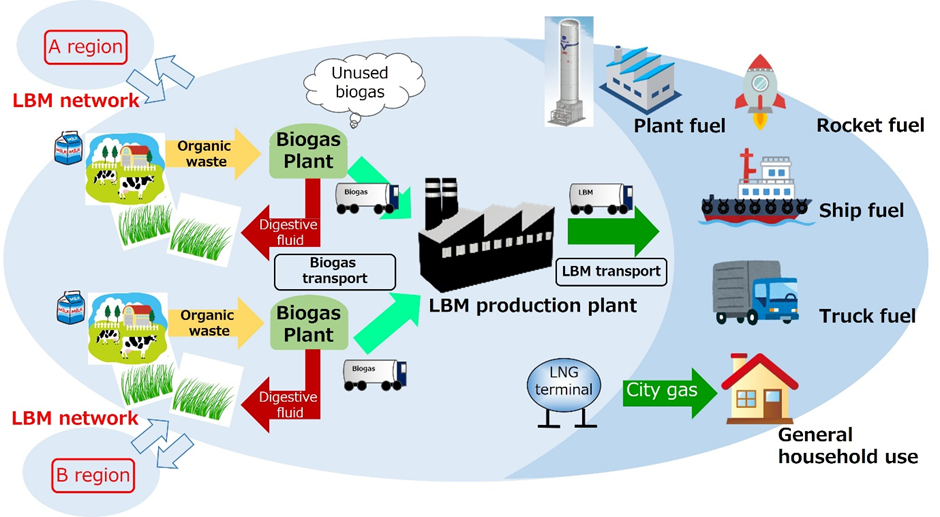
- Air Water, MOL, MOL Coastal Shipping, Cenergy, IHI Power Systems, and others completed a trial use of liquefied biomethane (LBM) derived from cattle manure as marine fuel on the domestic LNG-fueled vessel, Ise Mirai, in Ise Bay, Aichi Pref. This is the first use of carbon-neutral LBM derived from biomass in Japan.
- The trial was conducted based on an MoU signed between MOL and Air Water in February; partners involved are:
- Shipper: JERA
- Carrier: Techno Chubu
- Operator/Shipowner: Kyodou Kaiun (Joint owners: Techno Chubu and MOL Coastal Shipping)
- Truck transport: Cenergy
- Bunkering operator: Cenergy and Kyoudou Kaiun
- Engine manufacturer: IHI Power Systems
- The seven companies confirmed that LBM could be transported through the existing domestic LNG supply chain, truck-to-ship bunkering using existing LNG tank trucks, and LBM to be used as marine fuel.
- CONTEXT: LNG fuels reduce CO2 by 25% compared to conventional bunker oil, but LBM can reduce it further. Methane is the main component of both LBM and LNG; thus, the existing LNG supply chains can be used, and LBM can be an effective solution to reduce CO2 from ship operations. Since Japan’s leading companies in shipping and fueling are involved in this trial, it’s clear that the adoption of LBM is considered a real possibility for decarbonizing the marine industry.
INPEX and Astomos supplied first biofuel bunker to VLGC in the Middle East
(Company statement, June 22)
- INPEX completed the supply of a B24 biofuel bunker to a very large gas carrier (VLGC), Lycaste Peace chartered by Astomos Energy at Sharjah port in the UAE. The biofuel was supplied through the bunker vessel, Monjasa Shaker, operated by Monjasa, one of the world’s top 10 marine fuel suppliers.
- B24 biofuel consists of 24% fatty acid methyl ester (FAME) produced from waste cooking oil collected from restaurants and hotels in the UAE. The balance, 76%, consists of very low sulfur fuel oil (VLSFO), a conventional bunker fuel.
Toyota and Mitsubishi introduce Thailand’s first biogas-derived hydrogen equipment
(Company statement, June 26)
- Toyota, Toyota Tsusho, and Mitsubishi Kakoki plan to introduce biogas-derived hydrogen production equipment in Thailand.
- The equipment, manufactured by Mitsubishi Kakoki, will utilize biogas derived from local chicken manure and food waste to produce hydrogen. Toyota and Toyota Tsusho will collaborate on systems for compression, storage, and transportation of biogas and hydrogen, as well as establishing an operating system.
- The companies will optimize equipment design for local conditions and utilize Japan’s hydrogen-related technologies to promote clean energy.
Sagawa and Euglena strike biodiesel deal, asking individuals to pay extra for clean delivery
(Company statement, June 26)
- Euglena and Sagawa Express, one of Japan’s top logistics companies, have structured a deal in which the latter will use the former’s biodiesel for some deliveries.
- Buyers of Euglena consumer products will be able to donate ¥1,000 via its e-commerce website when they place orders for its cosmetics and supplements. In return, Sagawa will make the delivery using Euglena’s next-gen biodiesel fuel. The idea is that all parties – the customer, the product manufacturer, and the distributor – contribute to the cost of moving from fossil to sustainable fuels.
- The emissions saved through this deal will be certified as a carbon credit certificate from Sagawa to Euglena.
TAKEAWAY: Euglena is aiming to promote a new business model that spreads the cost of the energy transition. A similar approach was trialed by the DHL courier service for its jet fuels, in which customers pay extra to switch to sustainable aviation fuel (SAF). But DHL’s customers are mainly companies, whereas Euglena is targeting individuals.
Mitsubishi’s rice-paddy methane-reduction project approved for J-Credit Scheme
(Company statement, June 28)
- Mitsubishi got approval from Japan’s J-Credit scheme to register its rice-paddy methane-reduction project. This extends mid-season drainage, decreasing rice paddy methane emissions, which account for about 40% of Japan’s total.
- By prolonging drainage periods, methane emissions are reduced by up to 30%.
- The project aims to monitor and calculate the reduction amounts, offering growers credits that can be exchanged for monetary compensation. Mitsubishi will collaborate with rice growers nationwide, hoping to encourage wider participation.
In Brief:
- Mitsubishi Chemical Group and L&F Korea, a leading supplier of cathode materials for Lithium-ion batteries (LiB), signed an MoU on supply chains for anode material. Production starts in 2024.
- LanzaTech and Primetals Technologies (a MHI subsidiary) renewed cooperation for another 10 years to work on “green steel”.
- MOL and Chevron Singapore signed an MoU to research next-gen fuels that may be used in marine energy.
- “K” Line conducted a demo test voyage with the tugboat Aihomaru using next-gen biodiesel fuel supplied by Toyotsu Energy; the fuel’s made from waste cooking oil.
- Mitsui and Microwave Chemical (MWCC) will develop a low-carbon lithium ore processing technology using microwaves, aiming to start commercial production from 2026; the goal is to create an eco-friendly method for processing lithium.
NEWS: POWER MARKETS

Round 2 offshore wind tenders worth ¥1 trillion attract heavy bidding
(Nikkei, Japan NRG, June 30)
- Bids for Round 2 of offshore wind power tenders in Japan closed on June 30. The tenders for four sites off the Sea of Japan coast should create a combined generation capacity of about 1.8 GW. The tender value is estimated at over ¥1 trillion.
- The fixed-bottom offshore wind projects in Nagasaki, Niigata, and Akita attracted 20 companies. Winners will be decided by late FY2023 (which ends in March 2024).
- After Round 1 saw a Mitsubishi Corp led consortium sweep the board, tender rules were changed. So, from this time, each group could bid for no more than 1 GW of capacity if bidding on multiple sites. The govt also capped bids at ¥19/ kWh, ¥10 lower than in Round 1.
- CONTEXT: Japan aims to hold auctions for 10 GW of offshore wind capacity by 2030. In 2020, tenders were held for Round 1. Winners were announced in December 2021. The fact that Mitsubishi and a unit of Chubu Electric won all three of the main Round 1 auctions prompted an outcry from competitors. Calls for reform of the system led to lengthy review of the auction rules, which delayed Round 2.
- Participants in the current Round 2 tender are:
- Happo-cho, off the shore of Noshiro, Akita Pref
- Japan Wind Energy Development
- JRE, ENEOS, Tohoku Electric
- TEPCO Renewable Power
- JERA, J-Power
- Oga city, Katagami city, off the shore of Akita city in Akita Pref
- Osaka Gas, Mitsui
- TEPCO Renewable Power
- Cosmo Eco Power
- Marubeni, Tokyo Gas
- JERA
- Murakami city, off the shore of Tainai city in Niigata Pref
- Taisei, Honma Gumi, Cosmo Eco Power
- Obayashi
- RWE, Mitsui, Osaka Gas
- Invenergy
- Vena Energy
- Sumitomo
- Tohoku Electric
- SSE Pacifico
- Saikai city, off the shore of Ejima in Nagasaki Pref
- J-Power, Sumitomo
- JRE, Skyborn
- Happo-cho, off the shore of Noshiro, Akita Pref
TAKEAWAY: There is no official estimate for the cost of the projects, but the Nikkei reported a combined figure of ¥1 trillion. This would make it one of the biggest investment projects in energy in the country for decades. These kinds of investment numbers – and the rising costs in the offshore wind sector – have seen some expected bidders pull out of the race. While the govt maintains that Japan’s aim is to lower the cost of offshore wind to about ¥10/ kWh, in other countries inflation in raw materials prices and grid adjustments are pushing the overall costs up. It is not yet clear how Japanese operators could significantly reduce costs from the current position. Still, the govt’s support and national net-zero strategies indicate that offshore wind will be one of the bigger growth energy sectors in the company decades in Japan, which explains the currently strong industry interest. Businesses will hope that the govt won’t take too long to decide on the results for Round 2 and move expeditiously to Round 3.
Nuclear power plant restarts are delayed
(Nikkei, June 28)
- Only four of seven NPPs planned for a restart have resumed operations. None are in eastern Japan, which could lead to a hike in electricity prices in the Tokyo area.
- The Kashiwazaki-Kariwa NPP, which supplies electricity to the Tokyo metropolitan area, is facing challenges due to a lack of trust from local residents. The NRA is reevaluating TEPCO’s qualification to operate the plant.
- Additionally, the Tokai Unit 2 NPP has yet to formulate a local evacuation plan.
- CONTEXT: Japan set a target of increasing the proportion of nuclear power in the country’s energy mix to 20-22% by FY2030. To achieve this goal, about 25 to 28 NPPs would need to be in operation, with around 15 additional units restarted.
TAKEAWAY: As Japan NRG detailed in a June 5, 2023 Analysis piece, the much-promised quick restart of nuclear reactors by PM Kishida has failed to materialize. This is partly because the prime minister was never in a position to deliver on the promise. He could only state the govt’s desire, but it is up to the NRA, the regulator, to approve plant restarts and the local authorities to give the final green light. The discrepancy between PM Kishida’s vows and reality is now starting to be picked up by the mainstream media. How the public will react is not yet clear. They may see this as a negative in terms of politicians not fulfilling their promises. Or, the focus could turn to the regulator, putting greater pressure on the NRA to justify the time they have spent on reviews.
Kyushu Electric explores ammonia/ hydrogen and coal co-firing
(Nikkei, June 29)
- Kyushu Electric is exploring low-carbon thermal power generation by mixing and burning ammonia or hydrogen with coal or LNG.
- The company’s coal/ ammonia co-firing test was a success, but the mixing ratio was only 0.1%. The amount of ammonia mixed was 300 kg for about 300 tons of coal.
- The aim is to increase the ammonia ratio to 20% by 2030 while addressing technical and cost issues. Kyushu Electric plans to rely on imports of the clean fuels and will explore joint procurement and storage options with other power companies.
- SIDE DEVELOPMENT:
Hokkaido Electric joins hydrogen and ammonia alliance
(Company statement, June 30)- Hokkaido Electric will join the hydrogen and ammonia alliance formed by JERA, Kyushu, Chugoku, Shikoku, Tohoku, and Hokuriku EPCOs.
- The seven companies seek economical ways to purchase hydrogen and ammonia; set up safe ways for transport and storage; set up regulations with the govt; and exchange opinions and further collaborate on hydrogen-ammonia supply chains in Japan.
Offshore wind: Daido Metal invests ¥6 billion for new turbine bearing facility in Czechia
(New Energy Business, June 26)
- Daido Metal will supply power-generating turbine bearings for offshore wind in the EU. It will invest ¥6 billion to build a factory to make several hundred systems a year.
- It will be located on the site of Daido Metal Czechia, in the Czech Republic, and start production in 2025.
- Daido’s bearings support rotating shafts of steam and gas turbines and power generators that reduce noise and vibration, saving energy.
- This system allows bearings (set inside the nacelle) to be replaced without removing the blades, which eliminates the need for a large ship or crane for maintenance.
AGMs reject EPCOs exit from nuclear, and spin off of power transmission units
(Company statements, June 28)
- The annual general shareholder meetings of major power utilities (EPCOs) rejected minority shareholder resolutions demanding a withdrawal from nuclear operations, the spin off of power transmission units, and the establishment of a compliance committee, among other demands.
- Over 200 Tokyo Electric shareholders demanded a halt to the release of treated water from the Fukushima NPP site, but this was rejected by the AGM.
- At the Chugoku Electric AGM, Nakagawa Kengo was elected as president and Ashitani Shigeru as chairman. Their predecessors resigned over charges of cartel price fixing.
Osaka Gas enters battery storage and distributed energy generation in the U.S.
(Company statement, June 26)
- Osaka Gas USA (OGUSA) entered the BESS (battery energy storage system) market in the U.S. working with Summit Ridge Energy, a solar and energy storage company. They will build, own, and operate a portfolio of over 30 MWh of BESS projects in New York city and more than 100 MW of distributed solar power projects in Virginia.
- The BESS projects are in New York City. They will contribute to grid stabilization.
- OGUSA has been participating in distributed solar power generation projects in Maine and Illinois through collaboration with Summit Ridge.
20 successful bidders in latest solar auction
(OCCTO, various media, June 26)
- OCCTO held Round 16 of the solar auctions. This time, the auction was done as a unified system for the first time. Previously, the bids were split between FIT and FIP categories.
- The number of bids (offered capacity) was 105 MW, and the maximum supply price was ¥9.50/ kWh.
- There were 35 bids in total, of which 20 were successful. The full 105 MW of capacity was awarded.
- The lowest bid price (by Daiwa House Industry) was ¥9/ kWh and the highest price was ¥9.49. The weighted average bid price was ¥9.34. The biggest bid, for 89.6 MW, was from Pacifico Energy.
- Round 17 will offer 110.89 MW of capacity at a maximum price of ¥9.43.
Toyota Tsusho to build solar plant in Saudi Arabia, the company’s first in the region
(Company statement, June 28)
- Toyota Tsusho, in partnership with TotalEnergies Renewables and Altaaqa Renewable Energy, will build and operate a solar power plant in Wadi Ad Dawasir, Saudi Arabia. The 119 MW plant will operate as an IPP for the sale of electricity.
- This project marks Toyota Tsusho’s first such venture in Saudi Arabia. It’s supported by Japan’s Ministry of Environment through its financing program for Joint Crediting Mechanism Model Projects.
- Construction began, commercial operation is slated for March 2025. The $100 million project has financing from Riyad Bank and APICORP.
JEPX to gradually lift ban on resale of wholesale power purchases
(Denki Shimbun, June 28)
- JEPX will gradually lift the ban on the resale of wholesale power.
- Some wholesale trades are subject to conditions such as a ban on resale, restrictions on the amount of electricity that can be purchased and tendered, and restrictions on supplying electricity outside the area in which it was purchased.
- Govt officials have determined that this approach can hinder competition and prevent companies from developing more flexible purchasing strategies.
- Also, the idea is to create a fairer landscape for domestic and foreign retail electricity providers and more market transparency.
TEPCO PG to control transmission line overloads with new relay
(Denki Shimbun, June 28)
- TEPCO Power Grid (PG) is Japan’s first company to introduce a device that uses sensors to control overloads in the middle of a transmission line.
- A sensor transmission type overload protection relay (OLR) was installed on a 66,000 V transmission line in Moka City, Tochigi Pref, and began operation.
- As more solar capacity is rolled out, there’s a risk that the intermediate section of the transmission line will overload. Finding smart solutions is important since wholesale work to reinforce transmission lines would cost several billion yen.
Kyocera and Kyudenko form a company for onsite PPA
(Company statement, June 28)
- Kyocera and Kyudenko set up Kyocera Green Innovation to start a renewable energy service business for a “carport onsite PPA scheme”.
- The company will install solar panels in a client’s carport to generate electricity that will be sold to a contracted company.
- Kyocera mainly purchases solar power generation equipment, and Kyudenko installs and maintains the equipment.
mmGuard and FCC partner in solar power plant maintenance with drones
(Company statement, June 26)
- mmGuard offers “Drone View”, an AI technology to detect problems in solar power plants, hydro dams, and railroad infrastructure. FCC, which is based in Shizuoka Pref, is a maker of automobile clutches and will focus on AI drone sales and support.
- The two companies will monitor and maintain solar panels using drones.
Sharing Energy and Mitsui Sumitomo Insurance collaborate on solar PV analytics
(Company statement, June 27)
- Sharing Energy and Mitsui Sumitomo Insurance (MSI) will collaborate in data analysis, utilizing solar PV-related data and knowledge owned by Sharing Energy and insurance-related data and knowledge owned by MSI.
- The project will contribute to stable solar power generation by using RisTech Analysis Service, one of MSI’s initiatives, to identify the characteristics of disaster-prone areas and properties based on past accident information.
- The companies carried out a pilot data analysis, identifying the residential areas of target customers. The system considers data such as age of buildings and floor area.
NEWS: OIL, GAS & MINING

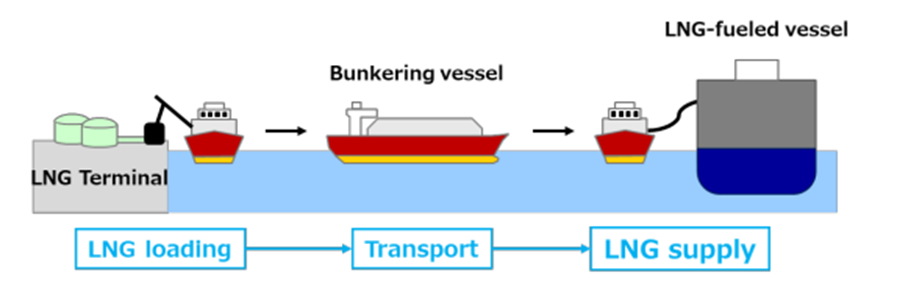
Osaka Gas starts LNG bunkering in Osaka/ Setouchi area
(Company statement, June 27)
- Osaka Gas will start supplying LNG to marine vessels using the ship-to-ship method in the bays of Osaka and Setouchi, starting 2026. Osaka Gas will sell and deliver LNG from the production facility to the marine vessels.
- This year, the company’s subsidiaries – Osaka Gas International Transport, NS United Tanker, and Kobe-Osaka International Port – were approved for LNG bunkering by the Ministry of Land, Infrastructure, Transport and Tourism. Construction on a bunkering vessel, with a 1,500-ton capacity, starts in FY2026.
TAKEAWAY: A 50% reduction in GHG emissions by 2050 is the goal set by the International Maritime Organization. This seems to be driving demand for LNG-fueled vessels. Osaka Gas plans to supply e-methane (carbon neutral synthetic methane) to accelerate the decarbonization of bunker fuel. Osaka Gas and its Daigas Group intend to expand LNG bunkering and to commercialize e-methane.
LNG stocks fall to 2.23 million tons
(Government data, June 28)
- LNG stocks of 10 power grids stood at 2.23 million tons as of June 25, down 5.9% from 2.37 million tons a week earlier.
- The end-June stocks last year were 2.14 million tons. The five-year average for this time of year was 1.95 million tons.
Middle East oil imports fall 4.3% YoY
(Japan NRG, June 29)
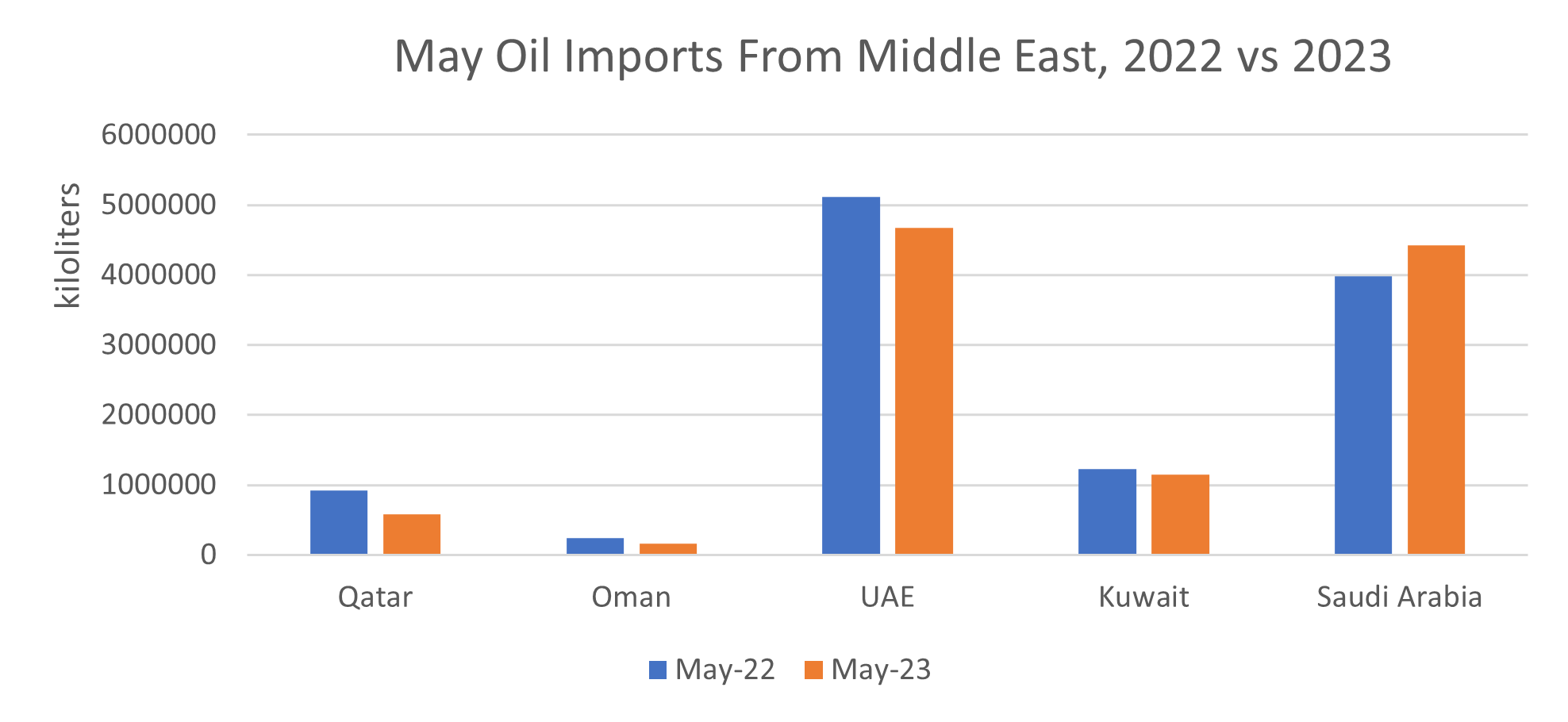
- Japan’s May crude oil imports from the Middle East decreased 4.3% YoY to 11 million kiloliters (69 million barrels): Imports from Qatar slumped 37.4%, Oman down 33.4%, UAE down 8.6%, Kuwait down 5.9%; while those from Saudi Arabia increased 11.2%.
- Middle Eastern oil accounted for 96.7% of Japan’s total imports of 11.4 mln kiloliters,
- Japan’s total import volume was down 6.7% YoY; while the import value was down 21.7% to ¥836 billion.
LNG imports from the Middle East plummet 73%
(Japan NRG, June 29)
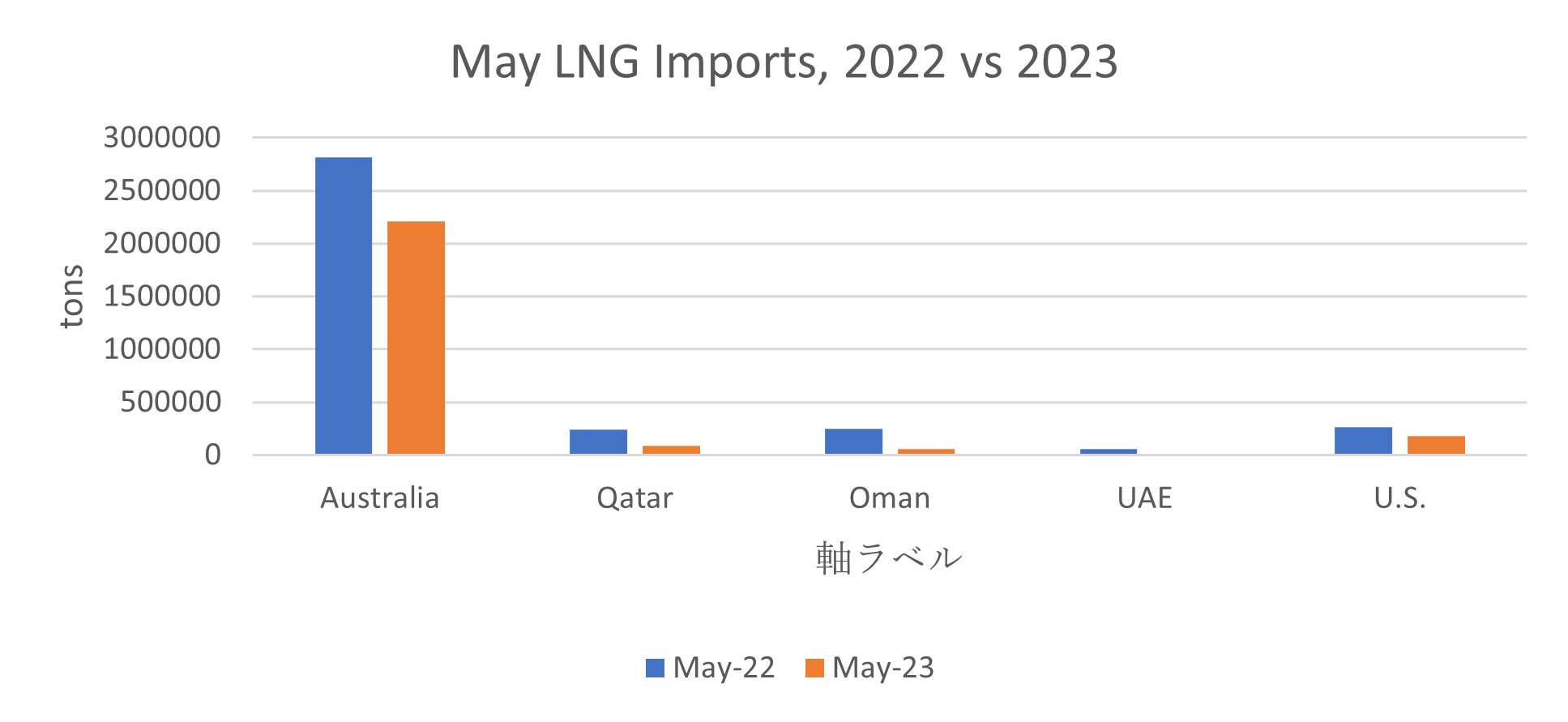
- Japan’s May LNG imports from the Middle East plummeted 73% YoY to 0.15 million tons, from 0.5 million tons: Qatar down 62.6%, and Oman down 76.1%. In May 2022, Japan imported 60,000 tons from the UAE but they were zero in May 2023.
- Imports from other top suppliers fell: Australia down 21.5; the U.S. down 31.7%.
- Total LNG imports were 4.6 million tons, down 19.9% YoY; the import value was ¥413 billion, down 31.6%.
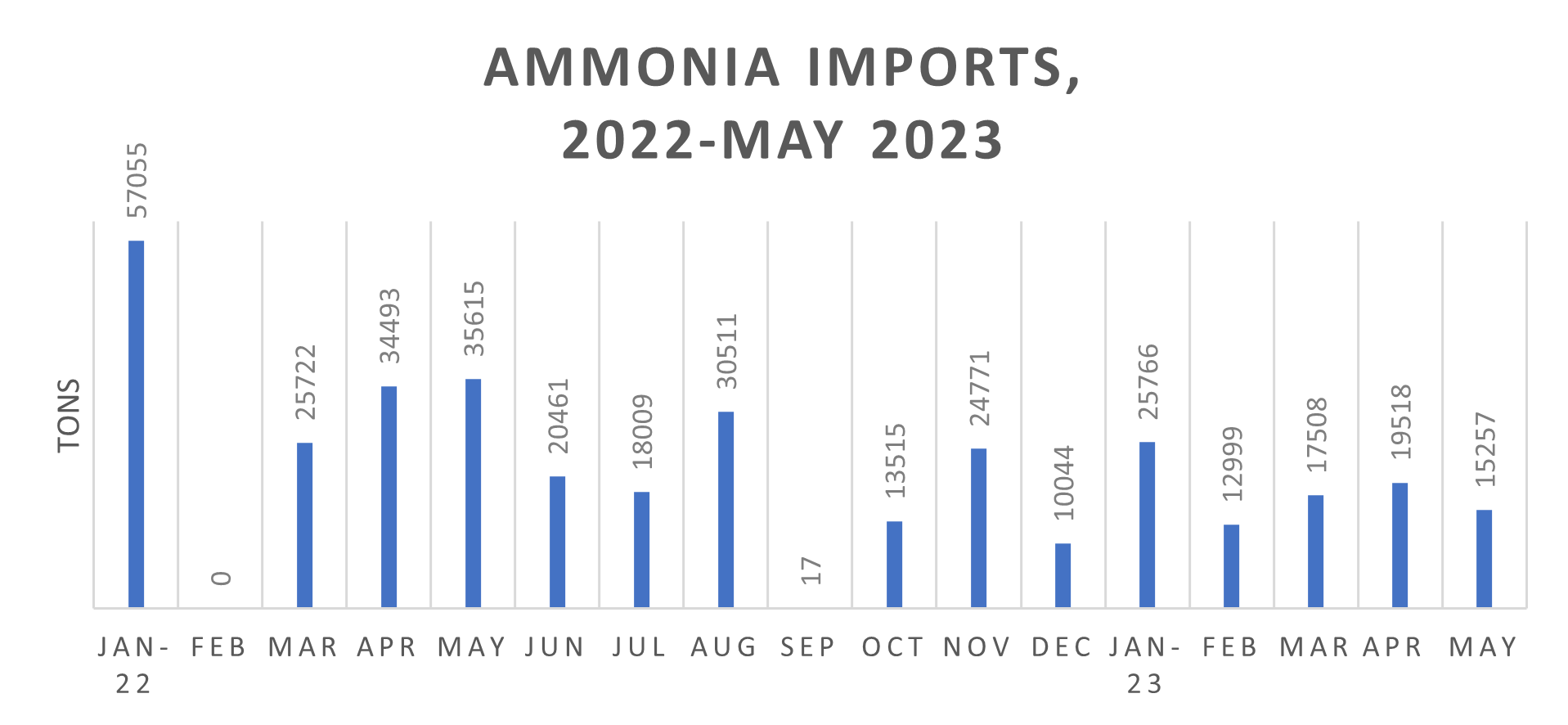
Ammonia imports down 57% YoY
(Japan NRG, June 29)
- In May, Japan imported 15,257 tons of ammonia, mostly from Australia, down 57% YoY. The total value of imports was ¥725 million, down 86.4% YoY. The import price averaged ¥47,000/ ton, down from ¥149,000/ ton a year ago.
- The figures are for a type of ammonia which could be used as fuel. Imports have been decreasing this year, and the 57% YoY decline is the biggest drop so far.
- Australia, Indonesia and the UAE are the major ammonia suppliers to Japan.
ANALYSIS
BY MAYUMI WATANABE
Calls for Climate Action Reverberate at Japan’s AGMs
Many say that the rainy season in June makes them sleepy. But in the corporate calendar, June is no time to relax because it’s when over 2,000 Japanese listed firms host their annual general meeting (AGM). What’s made the month particularly stormy of late is the rising number of shareholder resolutions put to management. Climate issues feature prominently among them.
This AGM season saw a record 90 shareholder resolutions filed, with more than 10% climate related. Activists demanded changes to company charters to reflect climate ambitions aligned with the Paris Agreement goals. There were calls for an exit from financing or investing in coal; and there were several demands for more disclosure.
Japan’s original climate activist shareholders were non-profit organizations or their staff. In recent years, however, European institutional investors have joined the movement, supporting and sometimes even initiating shareholder demands.
The campaigns generally receive strong media coverage, partly helped by the fact that most of the resolutions are tabled against blue chip companies and some of Japan’s most famous brands. This year, even Toyota Motor came under the spotlight. But how much impact are climate activists having on corporate decisions in Japan?
2020-2022 climate resolutions attract unexpected support
In Japan, the climate resolution boom took off in 2020 when a Mizuho Financial Group individual shareholder, who was also a member of activist group Kiko Network, filed a first-ever climate resolution. The activist demanded Mizuho to include Paris Agreement commitments to the Articles of Incorporation. Proxy advisory firms Glass Lewis and Institutional Shareholder Services were in support, and it won 34.5% of the votes, thanks to backing from Nordea Asset Management, Sweden’s AP7, Denmark’s AkademikerPension, and Allianz Global Investors among others.
In 2021, the Australian climate activist group Market Forces joined the movement, filing similar resolutions to trading house Sumitomo Corp, while Kiko Network filed resolutions to Mitsubishi UFJ Group. Glass Lewis and ISS were not supportive this time, but Japanese asset management funds were. The resolutions secured shareholder support rates of 20% and 23%, respectively. Separately, European funds filed similar resolutions to J-Power and saw 26% backing.
While the resolutions came up short of a majority and did not pass, they sent shock waves across financial markets. In Japan, shareholder resolutions – activist driven or not – rarely won over 20% of the vote. There are no legally binding rules on shareholder voting in Japan. They are left to the discretion of the company and its shareholders, resulting in some rules that are not fair to minority shareholders. For example, blank votes are automatically counted as votes in favor of the management.
Traditionally, so many AGMs are held in such a short time that each one is expected to be short and sweet. On June 29 alone almost 600 companies held their shareholders’ meeting.
Resolutions add to the AGM agenda and make it more eventful. They are also a new trend for many Japanese retail investors. In one 2023 AGM, management needed to explain shareholder rights to a confused individual, who asked the assembly why she was receiving resolution proposals from two parties.
This year, four climate activists filed resolutions to three banks, one trading house and two power utilities; and European funds filed to J-Power. The AGMs were held from June 23 to 29. None passed. J-Power said the funds’ two resolutions got 15% and 21% of the votes, down from last year. The exact support percentage and other details of the other resolution votes were not immediately available.
Climate action resolutions
| Shareholders | Companies | Changes in Articles of Corporation demanded | |
| 2020 | Kiko Network | Mizuho FG | Disclosure of climate risks; Make plans to ensure investments align with the Paris Agreement (34.5%) |
| 2021 | Kiko Network, Market Forces, RainForest Action Network (RAN), 350.org Japan | MUFJ | Disclosure of climate risks; Make plans to ensure investments align with the Paris Agreement (23%) |
| Market Forces | Sumitomo Corp. | Make and disclose plans to ensure operations align with the Paris Agreement (20%) | |
| 2022 | Kiko Network, 350.org Japan, Friends of the Earth (FoE) Japan, RAN | SMBC FG | Make business plans align with the Paris Agreement (27.05%)
Lending policy aligning with IEA scenario (9.55%) |
| Mitsubishi Corp. | Make business plans that align with the Paris Agreement (20.19%)
Disclosure of its analysis of investments that are alignment with net zero goals (16.22%) | ||
| TEPCO | Disclosure of its analysis of assets’ durability in the light of net zero goals (9.55%) | ||
| Chubu Electric | Disclosure of its analysis of assets’ durability in the light of net zero goals (19.9%) | ||
| Man Group, Amundi, HSBC Asset Management, Australian Centre for Corporate Responsibility (ACCR) | J-Power | Disclosure of short- and medium-term emission targets, how investments align with the targets, and how remuneration policies incentivise progress towards meeting emission reduction targets (26%) | |
| 2023 | Amundi, HSBC Asset Management, Man Group, ACCR | J-Power | Disclosure of short- and medium-term emission targets, how company investments align with the targets (21%), and how remuneration policies incentivize progress towards meeting emission reduction targets (15%) |
| Kiko Network, RAN, Market Forces | MUFJ | Aligning investment and lending activities to the Paris Agreement | |
| SMBC | Aligning investment and lending activities to the Paris Agreement | ||
| Mizuho FG | Aligning investment and lending activities to the Paris Agreement | ||
| FoE Japan, Market Forces | Mitsubishi Corp | Disclosure of short-term and mid-term GHG emission reduction targets aligned with the goals of the Paris Agreement; Disclosure of its assessment of progress | |
| Kiko Network, Market Forces | TEPCO | Aligning capital allocation to the Paris Agreement | |
| Kiko Network, Market Forces | Chubu Electric | Aligning capital allocation to the Paris Agreement |
Impact on corporate decisions
Overseas, energy firms have been grappling with environmental activists and activist investors pushing for more climate action for a lot longer. Some have found that the best defense, from their point of view, was better and more communication with various stakeholders.
For example, Australia’s biggest oil and gas producer, Woodside Energy, has unsurprisingly faced withering attacks from activists, which say the company is delaying a shift away from fossil energy. In response, Woodside said it has conducted about 60 investor engagements on climate and governance issues.
In Japan, which has relatively small oil and gas firms compared to global majors, climate activists have primarily targeted businesses with a high exposure to coal-fired power generation. Like Woodside, many Japanese firms found that they need to be more vocal and engaging. Several targeted company officials told Japan NRG that activist campaigns led them to change their communication strategies and stakeholder engagement.
“We were influenced because thanks to them, we became highly aware of the need to communicate our side of the climate story,” said an official from a Japanese energy company. However, he noted that changes in his company’s business strategies — to make a partial shift away from fossil fuel – were influenced by government policy and market forces.
In short, Japanese firms feel that the core drivers of their business are state policy, as well as via regulatory and market trends. Taking orders on strategy from activists is not on their agenda, and in some cases, it’s not even considered feasible.
Take early closure of coal-fired power plants, as an example. Owing to concerns about capacity shortages and energy security, last year the government introduced rules that prevent utilities from decommissioning thermal power plants unless they get express approval from METI. The rationale is that the ministry needs to be consulted and on the lookout for potential gaps in energy supplies.
Furthermore, company executives in Japan doubt that the demands of a vocal minority for significant changes in corporate strategies would win approval from the majority of the shareholders. After all, institutional investors also have a fiduciary duty to extract the best possible returns from a business.
Activists themselves partly admit that their goals may not meet with majority approval. Kiko Network’s resolution vote analysis showed that while support for its demands for more disclosure was generally high, most shareholders were not strongly in favor of pushing companies to alter their business strategies.
Since climate activists in their essence are single-issue focused, they are seen by target company officials as having a narrow perspective. What’s more, officials claim that the activists are inconsistent in their demands, simply aligning their focus with the most recent trends in climate discourse and dismissing a more integrated approach to the energy transition.
“Power utilities can’t change strategies every year like activists,” said one executive.
Antitrust not a concern
One area in Japan’s power sector that climate activists have not discussed hardly at all is competition. A fair and competitive playing field is essential for spurring the growth of new clean energy supplies, and it won’t be possible to phase out fossil fuel generation without robust renewables market players.
Earlier this year, some of Japan’s biggest power utilities were accused by antitrust officials of cartel behavior. What’s worse, it was discovered that the grid units of the utilities, which are supposed to run the electricity transmissions network in a neutral manner that’s open to all market players, passed information about competitors to the utilities’ retail divisions. That directly affected some renewables operators.
When asked about this, however, activists including Market Forces say they are not interested in the cartel issue. Bernadette Maheandiran, Asia director of Market Forces, said the organization has no position on the cartel issues. Meanwhile, Kiko Network recognizes the importance of the cartel incident, and said it will continue engagements with Chubu Electric, one of the firms accused of anticompetitive behavior by government officials.
What’s next?
Climate activists have made more headway in Japan in the climate tech startups scene and with ESG consultancies. There is also a widely held belief in such circles that the government’s introduction of the GX Promotion Act, which took effect June 30, will help activists persuade companies that climate engagement cannot be separated from business strategy any longer.
Even so, the activists may need to tweak their approach. Pushing for a change in the corporate charter is unlikely to yield results. Japan NRG surveyed major business federations and found that, as of today, there does not appear to be any major company that articulates the Paris Agreement goals in their corporate charter and there is little appetite among those surveyed for that to change.
Even among climate solution startups, which often include a sustainability philosophy in their corporate charter, only one said that it was considering adding a similar commitment to the Paris Agreement.
There are also questions over whether these fights over documents and disclosures benefit the climate. After all, company share prices tend to reflect profits rather than climate action and there are currently no accounting schemes that directly tie emissions to financial results.
As Japan’s government now steps in to pressure domestic firms to improve their climate disclosures, activists will need to find a new approach before next year’s AGMs. If it offers businesses a way to convert emission reductions into real profit and a higher share price, officials say they will be all ears.
X
ANALYSIS
BY FILIPPO PEDRETTI
Hydroelectric Power: Japan Has to Stop Going with the Flow
As Japan accelerates its energy transition, the country will have to tap into every possible renewable energy resource in order to fully replace fossil fuels and end their use by 2050. Hydropower is an area that has seen nearly flat growth in recent decades. But the potential is there, if the government is willing to commit the resource and partner with the private sector.
Japan is the world’s sixth largest producer of hydropower, but most such plants are pumped-storage plants. Conventional hydropower plants account for roughly 20 GW out of the total installed hydro capacity of 50 GW.
Even though hydro is Japan’s second most important renewable energy source after solar energy, it’s often overlooked in renewable energy discussions and plans. The main obstacle is cost and return on investment. Hydropower plants require proximity to rivers that are often located in remote, mountainous regions. This in turn often leads to higher than usual transmission losses.
Unlike the U.S., Brazil and Russia, all of which have many large rivers, and hence, large-scale hydropower facilities, in Japan the rivers tend to be much smaller. This brings in problems related to the cost of scale for hydro plants. Japan has many small and micro hydro installations, with some offering just 30-40 kW of capacity.
Additionally, environmental concerns over large dam projects have been a factor limiting hydro’s development. Altogether, these factors have put a brake on the expansion of generation from large hydropower sources. Still, amply endowed with mountainous terrain and flowing rivers, Japan would be making a mistake not to find ways to further tap into this clean energy source.
Obstacles to development
During the early Showa period, from 1930 to 1950, hydro played a vital role in the expansion of Japan’s electricity generation. By the late 1960s, however, that growth began to slow in the face of limited suitable locations for large dam construction.
Today, the size classification references the Feed-in Tariff system. Large hydro is anything above 30 MW of capacity; medium is within a range of 1 MW to 30 MW; and small is anything under 1 MW. Pumped-storage hydropower is regarded as a separate category, while micro-hydro facilities refer to systems within the 5-100 kW range.
The primary obstacles for hydro development include high costs, stringent government regulation and community opposition. First and foremost, the construction and maintenance costs, including sediment removal and forest reclamation, are significant.
Furthermore, the concept of ‘back allocation’, where construction costs are retroactively borne by those benefiting from the facility, poses a challenge for hydro developers, as it can significantly reduce potential profits from power generation and sales.
Additionally, utilizing existing multipurpose dams for hydro can face opposition from nearby residents. Increasing water storage for electricity production may require releasing stored water during typhoons or heavy rain, potentially causing downstream flooding. Repurposing multipurpose dams for power generation is also difficult due to current laws, which stipulate that their use should be determined at the construction stage.
Japan’s biggest hydropower plants (excluding pumped hydro facilities)
| Power Plant Name | Company | Capacity (MW) |
| Okutadami Power Plant | J-Power | 560 |
| Tagokura Power Plant | J-Power | 400 |
| Sakuma Hydroelectric Plant | J-Power | 350 |
| Kurobegawa N.4 Power Station | Kansai Electric | 335 |
| Arimine N.1 Hydroelectric Plant | Hokuriku Electric | 265 |
Source: Agora
Potential of small and mid-sized hydro
In total, by 2035 hydropower generation is anticipated to grow by 5%. However, when this is broken down by size, capacity and type, there’s a very different picture. The forecast for large hydro capacity is negligible growth. Pumped hydro, however, is projected to grow by 9%. The problem is that building large hydro facilities can take decades from project phase to full operation. For example, construction of Japan’s largest hydro projects began in the late ’20s/early ’30s and were completed only after WWII.
Meanwhile, a 2019 report by the MoE indicated that small and mid-sized hydroelectric power plants have the potential to more than double installed capacity (now between 3.2 and 4.1 GW). However, it will be necessary to grapple with high construction costs, securing investment in an increasingly competitive capital market for renewable energy projects, and community approval.
Estimated costs for mid-sized hydroelectric power plants are comparable to coal-fired, LNG-fired and nuclear stations. Small-scale hydropower costs are much higher in terms of ¥/kWh partly because maintenance costs are about four times higher than for larger facilities, says METI. In addition, there are cost challenges in integrating small hydro into the grid.
One solution for new hydro facilities is to apply for a FIT license and, in the future, the Feed-in Premium (FIP) program.
Forecast Power Generation Costs in 2030 by Source
| Source | ¥/kWh |
| Coal | 13.6 |
| LNG | 10.7 |
| Nuclear | 11.7 |
| Oil | 24.9 |
| Onshore wind | 14.7 |
| Offshore wind | 25.9 |
| Solar (utility scale) | 11.2 |
| Solar (residential) | 14.2 |
| Small hydro | 25.2 |
| Medium-sized hydro | 11.0 |
| Geothermal | 16.7 |
| Biomass (co-firing) | 14.2 |
| Biomass (mono-firing) | 29.9 |
| Gas cogeneration | 13.5 |
| Oil cogeneration | 28.1 |
Source: MoE
Pumped-storage hydro: a viable solution
Pumped-storage hydropower, which stores and generates electricity using reservoirs at different elevations, has emerged as a valuable energy storage system in Japan, which ranks second globally in pure pumped hydro capacity, with 21.9 GW.
Initially developed to “store” surplus power from nuclear and thermal sources by using excess electricity to move water to a higher elevation, pumped hydro can now also be applied for solar.
As renewable energy gains traction, pumped-storage hydro is an increasingly vital energy storage system, helping to balance the intermittent nature of renewable sources like solar and wind. This function will continue to make it an attractive option for Japan’s energy sector.
Case studies: success stories and innovations
In Tochigi Prefecture, the Momura Power Plant, with its Units 1-2 (120 kW total), utilizes the elevation of an agricultural canal to generate electricity. Along with technologies like spiral water turbines and pressure reducing valves, this project demonstrates the potential for further growth in small and mid-sized hydropower generation. Water sources such as agricultural water, surplus from dams, and water supply and sewerage systems, can then be used.
One example is Gokase, a small town in Kyushu, which established the Gokase Research Institute of Renewable Energy (GRIRE) to promote renewables. With community involvement, from 2013 to 2019 they installed over 10 micro-hydro plants, ranging from 1 kW to 200 kW each. They also sold the electricity through the FIT program.
The Tagokura Power Station (400 MW) in Fukushima Prefecture has been generating hydropower since 1959. After the incident at the Fukushima Dai-Ichi NPP in 2011, the local prefecture decided to expand its hydropower facilities. Currently, with 11 dams and 14 power plants built in close proximity to the Tagokura Dam, this area has become a major hydro hub in the prefecture.
In 2015, Hinohara Hydroelectric set up a subsidiary, Suikoten, which is the first small hydro plant in Tokyo. It utilizes the natural drop (91 meters) of a river. With help from the state the company obtained water rights that paved the way for future hydro projects. The company sells electricity through the FIT program.
Future outlook and challenges
While the MoE predicts growth by 2050 in the small and medium-sized hydropower sector, which is forecasted at a 1.5-fold rise, there are reasons for skepticism. Unless the national government acts and offers financial support, many existing and potential plans will struggle to succeed. Integrating electricity from small hydro into the grid is one of the main obstacles due to the small volumes involved and high maintenance costs.
While companies may be interested in hydro, low production volume and remote locations with challenging grid connections mean that such investments won’t be profitable any time soon. This is especially true for run-of-river or irrigation channel projects, which lack storage capabilities.
On the contrary, pumped hydro solutions are gaining interest due to their ability to address intermittency issues.
Small hydro facilities can be a solution for small communities when state support is available. Many such projects benefit from FIT and there is a lot more potential for the sector via this funding mechanism than from solar. While solar PV capacity grew from 13.6 GW to 78.8 GW in the 2013-2022 period, hydro stayed almost flat, moving from 48.9 GW to 50 GW in the same period.
Further advantages could come under the FIP program. To maximize the effectiveness of such a program, which means managing the supply of weather-dependent solar and wind power generation, the use of storage batteries and other adjustment equipment will play an important role.
Hydro offers a relatively stable supply capacity and the ability to adjust output based on demand. Consequently, it becomes possible to sell electricity during periods of high demand and favorable market prices, making small hydropower a great fit for the FIP system.
GLOBAL VIEW
BY JOHN VAROLI
Below are some of last week’s most important international energy developments monitored by the Japan NRG team because of their potential to impact energy supply and demand, as well as prices. We see the following as relevant to Japanese and international energy investors.
Australia/ Green hydrogen
Australia green-lit building a A$51 million renewable hydrogen plant in Victoria state. The 10 MW electrolyzer to be built in Wodonga in Victoria will be bigger than any current such unit in Australia.
Australia/ Nuclear power
BHP Group wants Australia to lift its ban on nuclear energy. Laura Tyler, the company’s CTO, said: “To make sure we have that safe, reliable energy mix, we need to be able to mix it up… by partnering nuclear with wind, solar, batteries and other sources of electricity.”
China/ LNG
China’s ENN will buy 1.8 million tons annually of LNG from Cheniere on a free-on-board basis for a purchase price indexed to Henry Hub, plus a fixed liquefaction fee. Deliveries begin in mid-2026. The agreement extends to 2050.
Italy/ Oil
Eni will acquire UK-based Neptune Energy for $4.9 billion, the largest cash deal in the EU oil and gas sector in a decade. Eni will acquire Neptune for $2.6 billion, while Vår Energi, Eni’s Norwegian subsidiary, will acquire Neptune’s operations in Norway for $2.3 billion.
Italy/ Wind power
In a revision of the country’s energy and climate strategy, Italy plans to get 65% of its electricity from renewables by 2030, up from a previous target of 55%. Also, hydrogen will power 42% of industrial needs by 2030.
Mongolia/ Critical minerals
The U.S. and Mongolia plan to work together on critical minerals. The countries signed a MoU on June 27, 2023, to jointly advance secure and resilient critical mineral supply chains in the Indo-Pacific region.
Natural gas
Companies such as Shell and Chevron will invest more in natural gas, as Chinese and EU importers sign long-term LNG deals. Shell’s CEO Wael Sawan said: “LNG can be easily transported to where it’s needed most. On average, natural gas emits about 50% less carbon emissions than coal when used to produce electricity.”
Norway/ Oil and gas
Norway approved oil and gas projects worth $18.5 billion. The 19 projects include new developments, additional development of producing oil and gas fields, and investments to increase resource recovery in producing fields.
Renewable energy
Global energy demand rose 1% last year, slowing from 5.5% in 2021. Record renewables growth was unable to challenge fossil fuels, which accounted for 82% of supply, according to Statistical Review of World Energy. Last year saw the largest ever increase in renewables capacity, for a total 266 GW; solar led the growth.
Wind power
Siemens Energy shares continue to fall, hit by target price cuts and rating downgrades in the wake of problems at its wind turbine division. The group’s loss in market valuation is about €7.4 billion.
U.S./ Gas plants
Gas plant capacity is booming, according to the Federal Energy Regulatory Commission. Nearly 4.47 GW of natural gas-fired generation came online in the first four months this year, up from 0.55 GW in the same period in 2022.
2023 EVENTS CALENDAR
A selection of domestic and international events we believe will have an impact on Japanese energy
Disclaimer
This communication has been prepared for information purposes only, is confidential and may be legally privileged. This is a subscription-only service and is directed at those who have expressly asked K.K. Yuri Group or one of its representatives to be added to the mailing list. This document may not be onwardly circulated or reproduced without prior written consent from Yuri Group, which retains all copyright to the content of this report.
Yuri Group is not registered as an investment advisor in any jurisdiction. Our research and all the content express our opinions, which are generally based on available public information, field studies and own analysis. Content is limited to general comment upon general political, economic and market issues, asset classes and types of investments. The report and all of its content does not constitute a recommendation or solicitation to buy, sell, subscribe for or underwrite any product or physical commodity, or a financial instrument.
The information contained in this report is obtained from sources believed to be reliable and in good faith. No representation or warranty is made that it is accurate or complete. Opinions and views expressed are subject to change without notice, as are prices and availability, which are indicative only. There is no obligation to notify recipients of any changes to this data or to do so in the future. No responsibility is accepted for the use of or reliance on the information provided. In no circumstances will Yuri Group be liable for any indirect or direct loss, or consequential loss or damages arising from the use of, any inability to use, or any inaccuracy in the information.
K.K. Yuri Group: Hulic Ochanomizu Bldg. 3F, 2-3-11, Surugadai, Kanda, Chiyoda-ku, Tokyo, Japan, 101-0062.