
JAPAN NRG WEEKLY
OCT 10, 2023
JAPAN NRG WEEKLY
Oct 10, 2023
NEWS
TOP
- Toyota to source its EV batteries from LG, which will invest
$3 bln in its U.S. plant - TEPCO begins second release of Fukushima treated water into the ocean; fishing sector to be compensated
- Australia responds to Japan’s concerns over stable LNG supplies, pledges to “always be” reliable
ENERGY TRANSITION & POLICY
- Sakata coast given “promising offshore wind zone” status
- BlackRock to cooperate with Japan firms on decarbonization
- ANRE eyes creating new standards for GX bond-financed H2/ ammonia projects
- India, Japan launch $600 mln fund for low carbon projects
- Carbon EX launches carbon credits and emissions exchange
- Business group proposes Scope 3 data sharing standards
- Top shipping companies to sail large liquid H2 carrier in 2024
- Hitachi Zosen to expand biomethane supply business in Italy
ELECTRICITY MARKETS
- Rapidus estimates creating huge power demand in Hokkaido
- Futures market for August up 13%, off-bourse trading down
- Electricity data from smart meters opened to corporate use
- Long-Term Decarbonization Capacity auction registration opens
- Tokyo’s Narita Airport aims for 180 MW in solar capacity by 2045
- JERA decommissions 2.6 GW of thermal power capacity
- TEPCO EP resumes HV and EHV electricity service offering
OIL, GAS & MINING
- Toshiba considers partnering with Furuya Metal on iridium supply
- Lundin in talks with Japanese trading houses on Argentina mine
- LNG stocks rise slightly but remain well below 5yr average
ANALYSIS
JAPAN GOES FAR OFFSHORE WITH FLOATING
WIND TECHNOLOGY
With potential estimated at 424 GW, floating wind technology offers triple the opportunity in terms of capacity than fixed-bottom turbines. As the R&D is still in its infancy, it’s difficult to predict which floating technology will win out, but several projects are front-runners. For those companies that develop the most efficient turbine for Japan, the prize could be the world’s largest floating offshore wind market.
GEOPOLITICAL TENSIONS CLOUD JAPAN-CHINA ENERGY COOPERATION
Since 1945, Chinese-Japanese relations in energy have evolved, influenced by changing economic priorities and global energy dynamics. Today, due to Japan’s push to strengthen economic security, development of Japan-China energy ties has been limited. Still, some Japanese companies seek to establish cooperation with Chinese partners. Here’s a brief overview of current energy relations between the two countries.
GLOBAL VIEW
A wrap of top energy news from around the world.
EVENTS SCHEDULE
A selection of events to keep an eye on in 2023.
JAPAN NRG WEEKLY
PUBLISHER
K. K. Yuri Group
Events
Editorial Team
Yuriy Humber (Editor-in-Chief)
John Varoli (Senior Editor, Americas)
Mayumi Watanabe (Japan)
Wilfried Goossens (Events, global)
Kyoko Fukuda (Japan)
Filippo Pedretti (Japan)
Regular Contributors
Chisaki Watanabe (Japan)
Takehiro Masutomo (Japan)
SUBSCRIPTIONS & ADVERTISING
Japan NRG offers individual, corporate and academic subscription plans. Basic details are our website or write to subscriptions@japan-nrg.com
For marketing, advertising, or collaboration opportunities, contact sales@japan-nrg.com For all other inquiries, write to info@japan-nrg.com
OFTEN USED ACRONYMS
|
METI |
The Ministry of Economy, |
mmbtu |
Million British Thermal Units | |
|
MoE |
Ministry of Environment |
mb/d |
Million barrels per day | |
|
ANRE |
Agency for Natural Resources and Energy |
mtoe |
Million Tons of Oil Equivalent | |
|
NEDO |
New Energy and Industrial Technology Development Organization |
kWh |
Kilowatt hours (electricity generation volume) | |
|
TEPCO |
Tokyo Electric Power Company |
FIT |
Feed-in Tariff | |
|
KEPCO |
Kansai Electric Power Company |
FIP |
Feed-in Premium | |
|
EPCO |
Electric Power Company |
SAF |
Sustainable Aviation Fuel | |
|
JCC |
Japan Crude Cocktail |
NPP |
Nuclear power plant | |
|
JKM |
Japan Korea Market, the Platt’s LNG benchmark |
JOGMEC |
Japan Organization for Metals and Energy Security | |
|
CCUS |
Carbon Capture, Utilization and Storage | |||
|
OCCTO |
Organization for Cross-regional Coordination of Transmission Operators | |||
|
NRA |
Nuclear Regulation Authority | |||
|
GX |
Green Transformation |
NEWS: ENERGY TRANSITION & POLICY

Toyota to source its EV batteries from LG which will invest $3 bln in U.S. plant
(Company statement, Oct 5)
- Toyota Motor inked a deal with South Korea’s LG Energy Solution (LGES) to supply lithium-ion batteries for EVs that Toyota will produce in North America from 2025.
- LGES will invest about $3 billion in its plant in Michigan to build a new production line for Toyota. Expected to be operational in 2025, annual production capacity will be 20 GWh, equal to about 280,000 units of Toyota’s bZ4X model.
- CONTEXT: In 2026, Toyota plans to increase global EV sales to 1.5 million units, rising to 3.5 million in 2030. Having sold only 24,000 in 2022, the company must increase its sales by more than 60 times by 2026. Stabilizing its battery procurement network is essential if EV production is to proceed at a rapid pace.
TAKEAWAY: Toyota has always been internationally minded on battery procurement. When it signed a partnership with China’s CATL in 2019, concerns were raised about national economic security issues. However, Toyota said that it’s open to work with Chinese partners because it makes cars in China. Similarly, the LG partnership is limited to supplying batteries to Toyota’s North American plants, not for Toyota operations in Japan.
Yamagata Pref’s Sakata coast given “promising offshore wind zone” status
(Government statement, Oct 3)
- METI and MLIT named the Sakata Coast of Yamagata Pref as a promising zone to install large offshore wind farms. “Promising zone” status is given to areas with offshore wind project potential. In FY2024, JOGMEC will do studies of the area.
- There are nine promising zones in total. Following further studies, the zones with proven potential will be elevated into the next and final level – “promotion zones”.
- The govt also said the coast along Yuza Town in Yamagata Pref and the Sea of Japan Coast of Aomori Pref (also known as the southern coast) gained “promotion zone” status, following public consultation of the govt proposal. The govt will hold auctions to choose operators of projects in the promotion zones.
- SIDE DEVELOPMENT:
Two areas in Hokkaido tapped as “preparatory zone” for floating offshore wind sites
(Government statement, Oct 3)- Hokkaido’s Ganwu-Minami Siribesi Coast and Shimamaki Coast were tapped as sites with potential for floating offshore wind projects, said METI and MLIT. The two areas now have “preparatory zone” status, a level below “promising zones”.
- Earlier, the two received “promising zone” status for fixed-foundation installations. The floating facilities will be further out at sea, without overlapping.
- JOGMEC will launch geological surveys in the two areas in FY2024.
- There are eight areas in the preparatory zone category in total.
Offshore wind project status
|
Status upgrades |
Area |
|
Promotion Zone (confirmed) |
Coast along Yuza Town in Yamagata Pref, 450 MW |
|
Sea of Japan Coast of Aomori Pref (also known as the southern coast), 600 MW | |
|
Upgraded to Promising from Preparatory Zone |
Sakata Coast of Yamagata Pref, 500 MW |
|
New Preparatory Zones for floating wind projects |
Ganwu-Minami Siribesi Coast, Hokkaido, project size to be decided |
|
Shimamaki Coast, Hokkaido, project size to be decided |
BlackRock to cooperate with Japan on decarbonization, eyeing hydrogen tech
(Nikkei, Oct 6)
- BlackRock plans joint investments with Japanese companies for decarbonization, said CEO Larry Fink during his visit to Japan. The firm is interested in new technologies to reduce clean energy costs, like Japan’s hydrogen technology.
- Fink sees potential for growth through combining private and public funds, and noted the global need for robust electrical grids with the rise of EVs.
- SIDE DEVELOPMENT:
ANRE to write standards for GX bond-financed hydrogen/ ammonia projects
(Government statement, Oct 4)- ANRE plans to write standards for choosing hydrogen/ ammonia projects to be financed by GX transition bonds by year’s end. It also plans a regulatory approach to increase hydrogen/ ammonia consumption in addition to subsidizing their sale.
- Other ideas include mandating govt-funded projects to realize low carbon footprints.
India, Japan launch $600 mln fund for low carbon emission projects
(Company statement, Oct 4)
- India’s National Investment and Infrastructure Fund and the Japan Bank for International Cooperation (JBIC) launched a $600 million fund to invest in renewable energy, EVs, and waste management in India.
- JBIC will contribute 51% of that figure, and India the rest.
- CONTEXT: Japan and India are members of the Quad partnership; the two others are Australia and the U.S. The four are committed to supporting an open, stable and prosperous Indo-Pacific that is inclusive and resilient. The Quad is important for Japan and the U.S. because India is seen as having a pivotal role in shaping the basic direction of global politics through its geography, demographics, economic potential, and IT skills.
Carbon EX launches carbon credit and emission rights exchange service
(Company statement, Oct 4)
- At the end of September, Carbon EX, a JV between Asuene and SBI HD, launched a carbon credit and emission rights exchange service. It’s the first major Japanese financial institution to start such a trading hub.
- The platform serves as a starting point for the creation of carbon credit-related businesses, and enables domestic and foreign project developers and buyers to trade CO2-related contracts.
- A total of 35 types of credits and non-fossil certificates can be handled via the platform, which has more than 300 companies pre-registered with over 1.3 million tons of CO2 equivalent in credits.
- CONTEXT: Carbon EX has also signed an MoU with Sumitomo Mitsui Financial Group for carbon credit and environmental value transactions, and has an agreement with SBI Shinsei Bank for carbon credit related business.
Business group proposes Scope 3 data sharing standards
(Japan NRG, Oct 2)
- The Green X Digital Consortium compiled data sharing standards for measuring Scope 3 emissions throughout supply chains, it told CEATEC 2023.
- The consortium comprises 139 multinational companies. The standards are compatible with those of the World Business Council for Sustainable Development.
- To cover the full supply chain, it’s proposed to use secondary data from third party sources to measure emissions when primary data is lacking, labeling them as such.
- To protect business secrets, companies would share final emissions data but not details such as the raw materials used, the treatment processes and the breakdown of emission origins.
- CONTEXT: The consortium standards are not legally binding, but METI, MLIT, MAFF and other ministries participated as observers during the writing of the standards.
Top shipping companies join forces to sail large liquid H2 carrier in 2024
(Japan NRG, Oct 6)
- JSE Ocean plans to sail the world’s first liquefied hydrogen-fueled carrier by 2024. The company is a JV of three top shipping companies and Japan Suiso Energy (JSE), which sailed the world’s first liquefied H2 carrier in 2022.
- Nippon Yusen, Kawasaki Kisen, and Mitsui O.S.K. Lines (MOL) became JSE Ocean’s shareholders on Sept 22. JSE owns 50.2%; the three others have 16.6% each.
- The JV focuses on safe transport of hydrogen (preventing leakage, minimizing tank corrosion), and developing a framework for vessel ownership and operation.
- CONTEXT: The vessel for the 2024 voyage will be built by Kawasaki Heavy Industries, which made the first liquefied H2 carrier, Suiso Frontier, which can hold 75 tons of liquefied H2.
TAKEAWAY: Liquefied H2’s main advantage is its purity. After converting the liquid back to gas, it can be directly used for applications that require high purity hydrogen, such as fuel cells. The challenges are the costs of liquefaction, gasification, building new ships and infrastructures, and scaling up transport capacity from 75 to several tens of thousands of tons.
- SIDE DEVELOPMENT:
Kawasaki Heavy Industries delivers new LPG/ ammonia-powered ship
(Company statement, Sept 29)- Kawasaki Heavy Industries delivered the ship, Eneos Gunjo, which can transport both LPG and ammonia.
- The ship is equipped with a diesel engine that reduces SOx and CO2 emissions, along with other technologies to enhance fuel efficiency. Additionally, the vessel has the flexibility to potentially use ammonia as fuel in the future.
Hitachi Zosen to expand biomethane supply business in Italy
(Company statement, Sept 28)
- Hitachi Zosen Inova (HZI) is launching a biomethane supply project in Italy, and will design, finance, build, own, and operate the plant via a wholly owned subsidiary.
- The plant will process 42,500 tons of organic waste annually, producing about 35 GWh-equivalent of biomethane. It will start operation in early 2025.
- CONTEXT: This marks HZI’s third biogas facility, following ones in the U.S. and Sweden, that uses wet methane fermentation technology to produce biomethane from organic waste. The project supports the goals of the European Commission’s REPowerEU plan to expand biomethane and hydrogen use for energy security.
ENEOS, HIF Global to cooperate on e-fuel
(Japan NRG, Oct 4)
- ENEOS and HIF Global will promote synthetic fuel (e-fuel) in Japan. HIF is the world’s first producer of e-fuel, producing 840 barrels/ year at its demo plant in Chile. HIF uses renewable energy-derived hydrogen and carbon captured from air and biogenic sources as feed to produce e-methanol, which is converted into e-fuel.
- HIF plans a total output of 150,000 barrels/ day when plants in the U.S. and Australia are operational. ENEOS will receive supplies from the new plants. The Chilean plant received German and Chile govt funding.
- The two companies will also explore 1) building supply chains of CO2 collected in Japan; and 2) building facilities in Japan to convert e-methanol into e-fuel.
TAKEAWAY: By 2028, ENEOS plans to produce around 107,000 barrels / year of e-fuel domestically. The company told Japan NRG it’s not ruling out the possibility of importing e-fuel from HIF to meet 2028 target.
erex inks agreement for biomass fuel supply in Vietnam
(Company statement, Oct 2)
- In partnership with Japan Bank for International Cooperation and Sumitomo Mitsui Bank, erex will produce and sell biomass fuel in Vietnam via its local subsidiaries.
- erex will build wood pellet factories in the states of Yen Bai and Tuyen Quang. Half of the pellets will be used for power generation in Japan.
- CONTEXT: Founded in 1999 as an electric power retail supplier, in 2013 erex aims to be also a renewables operator with a special focus on biomass-fired power.
Idemitsu, Petronas ink agreement on SAF
(Company statement, Oct 5)
- Idemitsu Kosan and Malaysia’s Petronas will study setting up sustainable aviation fuel (SAF) supply chains, from procurement of fuel feedstock to production.
- CONTEXT: Idemitsu plans to start producing SAF in Chiba in 2026 using the alcohol to jet (AJT) method. It also considers applying hydro-processed esters and fatty acids (HEFA) technology in the future.
- SIDE DEVELOPMENT:
Military jets fueled by Euglena’s SAF at the F1 Japan Grand Prix final
(Company statement, Oct 2)- Euglena supplied SUSTEO, its domestically produced SAF, to fuel the Japanese air force’s acrobatic aerial group, Blue Impulse.
- The jets took to the air for the Formula 1 Japan Grand Prix final on Sept 24.
INPEX, Air Liquide, etc to study ammonia production in Texas
(Company statement, Oct 3)
- INPEX, France’s Air Liquide, U.S.-based LSB Industries and Vopak Moda agreed to conduct front-end engineering and design (FEED) studies to produce ammonia at the Houston Ship Channel petrochemical zone in Texas.
- They plan to produce 1.1 million tons/ year of low-carbon ammonia by late 2027.
- The bulk of the production would be used for power plants in Asia, and some volumes could be used in Europe and the U.S.
- CONTEXT: As part of Japan’s effort to expand the use of ammonia, Mitsubishi plans to convert an LPG facility in the Hiroshima area into an ammonia import hub. Last month, Itochu said it will study development of an ammonia bunkering hub in Spain.
Chubu Electric developed a charging management system for commercial EVs
(Company statement, Sept 28)
- Chubu Electric and Aakel Technologies developed “OPCAT”, a management system for charging commercial EVs such as public buses and delivery trucks using fast chargers. The service starts later this month.
- OPCAT helps optimize charging multiple EVs simultaneously, as well as to promote charging when the electricity price is low.
EV battery tester expands capacity as demand ramps up
(Nikkei, Oct 5)
- Espec will double its in-house testing equipment for EV batteries, anticipating higher demand for its services from manufacturers.
- CONTEXT: The equipment measures the performance of batteries through repeated cycles of charging and discharging — which typically degrades the capacity of the lithium-ion batteries that EVs mainly use — and detects any abnormalities.
TAKEAWAY: As EV production increases, demand for battery testing is growing. Manufacturers can run short of equipment and workers during rapid expansion, which means they have to outsource this function to companies like Espec.
MOL joins “Tokyo Bay eSG 2023 Priority Project” for wind and hydrogen
(Company statement, Oct 4)
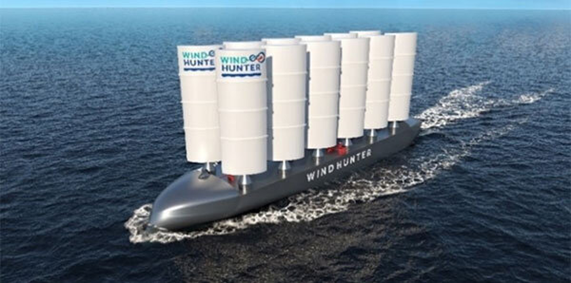
- Mitsui OSK Line (MOL) said its ship Wind Hunter was chosen as a renewable energy project under the “Tokyo Bay eSG Priority Project”.
- Wind Hunter combines wind propulsion sailing technology and wind energy converted to generate a stable supply of hydrogen.
- SIDE DEVELOPMENT:
MOL will exhibit Wind Challenger and Wind Hunter at COP28
(Company statement, Oct 4)- MOL will exhibit two new vessels, Wind Challenger and Wind Hunter, at the Japan Pavilion at COP28 in Dubai from Nov 30 to Dec 12.
- Wind Challenger is a next-generation vessel with a wind-propelled sail, and Wind Hunter, according to MOL, is a green hydrogen-producing vessel.
NEWS: POWER MARKETS

TEPCO begins second release of Fukushima treated water into the ocean
(Denki Shimbun, Oct 2)
- On Oct 5, TEPCO began the second release of treated water from the Advanced Liquid Processing System (ALPS) at the Fukushima Daiichi NPP.
- The first release took place from Aug 24 to Sept 11, during which the facility operated steadily, and no abnormal tritium levels were detected.
- Monitoring of the ocean near the discharge point is now conducted daily, instead of weekly.
- CONTEXT: TEPCO plans to release about 460 tons of treated water per day, for the next three weeks, at a distance of 1 km off the coast via an underwater tunnel. Over the next 30 years, TEPCO aims to dispose of 1.34 million tons of water or about 98% of storage capacity, pooled in over 1,000 tanks at the power plant.
- SIDE DEVELOPMENT:
In the wake of China’s ban, TEPCO will hear compensation claims from fishing industry
(Asahi Shimbun, Oct 3)- TEPCO is accepting compensation claims for reputational damage suffered by fishermen due to the discharge of treated water from the Fukushima NPP.
- The amount of compensation will be done on an individual basis, with 2022 as the baseline year, recognizing the drop in price, post-discharge, as the loss in question.
- According to August trade statistics, since China’s ban took effect, seafood exports to China decreased 75.7% YoY, and the situation is expected to worsen. A survey by the Fisheries Agency revealed a price drop of 11-27% in scallop exports from four prefectures, including Hokkaido.
- CONTEXT: If China’s ban continues, total compensation might rise significantly. Initially, TEPCO anticipated a sales drop in seafood from areas near the nuclear plant due to the water discharge, but China’s total ban was not expected.
Rapidus’ power demand in Hokkaido would total 10-20% of current capacity
(Hokkaido Shimbun, Sept 30)
- After mass production of its semiconductors begins in 2027, Rapidus will need 600 MW of electricity capacity, or 10-20% of Hokkaido’s current total.
- Discussions began with Hokkaido Electric (HEPCO) to ensure stable power supply. The utility will consider investments to increase transmission lines and power sources.
- Rapidus prioritizes the use of renewable energy, but such demand volumes will likely impact plans to restart the nearby Tomari Nuclear Power Station that’s owned by HEPCO, which plans to restart one of its reactors in December 2026.
- CONTEXT: Rapidus was established in August 2022 through public and private efforts to create a new national champion for the semiconductor industry. The company’s shareholders are eight major Japanese firms: Denso, Kioxia, MUFG Bank, NEC, NTT, SoftBank, Sony, and Toyota. Rapidus’ first plant will open in 2027 in Chitose (near Sapporo).
Daiwa, Fuyo, and Astmax invest in grid-scale storage battery in Hokkaido
(Company statement, Sept 29)
- Daiwa Energy & Infrastructure, Fuyo General Lease, and Astmax Trading set up a new company, DAX, to invest in a storage battery in Sapporo, Hokkaido. Daiwa has a 50.98% stake, Fuyo 46.0% and Astmax 3.02%.
- The plan is to build the 50 MW Shinkawa Grid Scale Storage Battery Station. Construction starts in 2023 and operation in FY2025.
Futures market for August up 13%, but off-bourse trading declines
(Denki Shimbun, Oct 4)
- The August contract volume on the Tokyo Commodity Exchange (TOCOM) electricity futures market reached 36.6 GWh, an increase of 13.2% over July. There was no significant rise in spot prices compared to summer 2022. Trading outside the regular session remained minimal.
- Market participants suggest that the decline in off-hours trading contributed to the overall stability of the market.
- In August, spot prices reached as high as ¥25/ kWh, and there were no significant spikes. Some market participants view more stable markets as reducing the need for hedging through futures contracts.
Japan opens electricity data from smart meters to corporate use
(Nikkei, Oct 2)
- Japan has dropped restrictions on corporate use of electricity data. This will allow companies to tap the information to launch various services.
- With roughly 20 corporate groups including Daiwa House Industry and Toshiba poised to introduce services, Japan hopes the move will lead to solutions for various issues related to decarbonization and a graying population.
- CONTEXT: Electricity usage data is collected from smart meters that log power consumption. Japan has 80 million smart meters, more than the U.S. or European countries. Until now, only utilities had access to this data, but a legal revision allows other companies to use it for a fee.
- Some companies are considering services that aid the global shift away from GHG emissions. Daiwa House Asset Management plans to calculate CO2 emissions based on electricity use by residents of about 240 properties owned by the group. It hopes that environmentally friendly services, like helping residents conserve energy based on this data, boost profits for the group’s real estate business.
- Mitsubishi and Chubu Electric are teaming up on a service that detects abnormalities in the routines of elderly relatives in real time.
Registration for first Long-Term Decarbonization Capacity auction opens on Oct 16
(Japan NRG, Oct 3)
- The registration of operators to bid in the Long-Term Decarbonization Capacity Auction (LTDA) will begin on Oct 16. The plan was launched by METI to spur investments into non-fossil power sources.
- The first auction will take place in January. Winners will enter a 20-year Capacity Reserve Agreement, receiving capacity reserve payment to cover fixed costs.
Tokyo’s Narita Airport aims for 180 MW in solar capacity by 2045
(Japan NRG, Oct 2)
- Tokyo International Airport, (Narita Airport), began building a 2 MW solar power station on a cargo terminal rooftop, the first among its projects to install 180 MW in solar capacity by 2045.
- Narita aims to be carbon neutral by 2050, and already has rooftop and ground solar with a total capacity of 2.2 MW.
- CONTEXT: Govt guidelines on renewables capacity at airports were updated in December 2022, clarifying conditions for installations along runways, where solar panels are discouraged since reflections can distract pilots and traffic controllers. The govt is urging airports to add storage batteries, hydrogen and wind systems.
TAKEAWAY: As airport energy systems fall outside the scope of the Aviation Act and the Radio Act, airport authorities won’t require regulatory approvals to install renewables. The govt wants airports to take advantage of this and deploy solar panels and small wind turbines, as long as they do not obstruct flights or radio communications.
|
Airport |
Key clean energy systems (location) |
|
Kansai International Airport |
11.6 MW solar (idle space outside runway protection areas), 14.7 KW wind (pedestrian park) |
|
Tokyo International (Narita) Airport |
2.2 MW solar (cargo terminal rooftops, idle ground space), plans 2 MW solar (cargo terminal rooftop) |
|
Haneda International Airport |
1.1 MW solar (cargo terminal rooftop) plans 30 KW solar (disaster prevention center building rooftop) |
|
Iwami Airport |
3.5 MW solar (idle space outside runway protection areas) |
|
Okayama Airport |
3.5 MW solar (idle space outside runway protection areas) |
|
Chubu Centrair International Airport |
Hydrogen-fueled forklifts (cargo facilities) |
|
New Chitose Airport |
Snow-driven cooling system |
|
Hakodate Airport |
Plans a geothermal system |
|
Kumamoto Airport |
Plans 1.1 MW solar (car parking facility rooftop) |
|
Nanki-Shirahama Airport |
Plans 280 KW solar (idle space) and 10 KWh storage battery system |
|
Hiroshima Airport |
Plans 2.56 MW solar (car park) |
|
Sendai Airport |
Plans 1.8 MW solar (car park) |
JERA decommissions 2.6 GW of capacity at Hirono Thermal Power Station
(Asahi Shimbun, Oct 5)
- JERA announced full closure of Units 1, 3, and 4 (totaling 2.6 GW) at the Hirono Thermal Power Station. Unit 1 ceased operations in April 2016; Units 3 and 4 ceased operations in July 2018. The remaining Units 2, 5, and 6 will continue to operate.
- The Hirono Thermal Power Station has used crude oil and heating oil for Units 1 to 4, and coal for Units 5 and 6. The oldest, Unit 1, began operations in April 1980.
- Also, JERA is upgrading its Goi Thermal Power Station in Chiba Pref (Units 1 to 3) and Unit 2 of Yokosuka Thermal Power Station in Kanagawa Pref, (3 GW total).
TEPCO EP resumes high voltage and extra-high voltage electricity service offering
(Denki Shimbun Oct 2)
- TEPCO Energy Partner resumed its standard menu for electricity tariffs targeting special high voltage and extra-high voltage customers.
- CONTEXT: New market entrants (known as shin denryoku) had been striving to reacquire high voltage and extra-high voltage customers while TEPCO EP suspended its standard service offering. But rising prices last year forced many of the new entrants into hard times as their business model was based on a trend for lower electricity prices. The wholesale JEPX market’s average (spot) price per kWh was ¥11.21 in FY2020, ¥13.46 in FY2021, and ¥20.41 in FY2022.
TAKEAWAY: Understanding of market risk has increased in recent years among both power retailers and clients in Japan, leading to a more mature market. However, the retreat from the market by many new providers in the last 8-10 months is reducing the level of competition and again creating a dominant scenario for EPCOs. Also, a more stable price period lulls many buyers into a false sense of security, and reduces their appetite to spend on risk hedging. This will surely vex many METI officials that wish to see more competition in the electricity retail sector, though how they address it without affecting energy security issues is unclear.
Suttsu council election seen as positive step for nuclear waste disposal site study
(NHK, Oct 3)
- In Suttsu, Hokkaido, a majority of council seats were won by candidates who support allowing the town to advance to the next phase of review of its suitability as the site for a national nuclear waste disposal facility.
- This election could impact the town’s decisions in advancing to the “preliminary survey” phase, which is post the current “literature survey” stage.
- Regulations require nuclear waste to be disposed of 300 meters underground. The town plans a public referendum before moving to the next phase.
- CONTEXT: Surveys are made by Japan’s Nuclear Waste Management Organization (NUMO). The current phase to select a nuclear waste disposal site, the “literature survey,” entails evaluating site suitability without conducting on-site research. The next phase would verify whether the region meets facility conditions stipulated by law.
TAKEAWAY: This is positive news for NUMO, especially after the Mayor of Tsushima City (Nagasaki Pref) declined to accept a “literature survey” last week despite the city council’s earlier approval. Since the search for a nuclear waste disposal site began in 2002, these surveys have only taken place in two localities in Hokkaido, in Suttsu and Kamoenai. As the surveys take years to conduct, they can easily be canceled if elections bring new leaders to power. For example, in 2007 the mayor of Toyo nominated his town to host the disposal site; three months later, however, he lost the election and the new mayor withdrew the town’s candidacy.
KEPCO and ANRE to discuss intermediate storage of used nuclear fuel
(Nikkei, Oct 5)
- On Oct 10, KEPCO vice-president Mizuta Hitoshi and ANRE officials will visit Fukui Pref to discuss the intermediate storage of used nuclear fuel. KEPCO has promised Fukui Governor to identify candidate storage sites outside the prefecture.
- This follows a June announcement about sending 200 tons of used nuclear fuel to France for research, scheduled in the late 2020s; this move was supported by the government but met with demands for re-explanation in Fukui.
- The inability to confirm candidate sites could lead to the halting of operations at three of KEPCO’s nuclear facilities.
Chugoku Electric participates in IPP project in Vietnam
(Company statement, Oct 2)
- Chugoku Electric invested in renewable energy IPP projects in Vietnam; it will take a 35% stake in three solar power companies (50 MW each) and one hydro power company (45 MW).
- Other stakeholders are Foxlink Group (Taiwan) with 35% and BB Power Holdings (Vietnam) with 30%. Foxlink Group is Chugoku Electric’s partner company in the hydroelectric power generation business in Taiwan.
ClassNK and JOGMEC will cooperate on offshore wind projects in Japan
(Company statement, Oct 5)
- JOGMEC and Nippon Kaiji Kyoukai, known as ClassNK, agreed to work on offshore wind projects. In March, ClassNK registered as a verification body under the Electricity Business Act regarding technological standards for wind power facilities.
- JOGMEC has been researching the sea floor, meteorological conditions, and conducting oceanographic surveys for offshore wind development.
MOL partners with Odfjell Oceanwind in Norway
(Company statement, Oct 5)
- MOL became a shareholder in Odfjell Oceanwind, a Norwegian company active in floating offshore wind technologies.
- Odfjell already has partnerships with Source Galileo, a European investment firm, as well as with KEPCO and Ingka, the investment arm of IKEA.
- Odfjell’s floating wind technology “Deepsea” has been certified for 15 MW turbines that can be deployed even in harsh areas.
- SIDE DEVELOPMENT:
MOL joins with EDF Renewables for offshore wind and green hydrogen
(Company statement, Oct 4)- Mitsui OSK Line (MOL) and EDF Renewables signed a MoU to accelerate development of offshore wind and development of green hydrogen. The companies didn’t provide any details.
Nippon Steel supplies low-carbon steel to Dutch geothermal company
(Company statement, Sept 28)
- Nippon Steel will supply its low-carbon steel, NSCarbolex Neutral, to a Dutch geothermal developer, 85 Degrees Renewables.
- Together with Foresight Group Holdings, 85 Degrees Renewables is building 200 MW of geothermal power capacity in the Netherlands.
NEWS: OIL, GAS & MINING

Resources Minister: Australia will “always be” reliable supplier of gas to Japan
(Australian Financial Review, Oct 6)
- Amid LNG supply concerns on the road to net zero in 2050, Resources Minister Madeleine King says Australia will “always be” a reliable exporter of gas to Japan.
- After former Tokyo Gas chairman Michiaki Hirose warned on Oct 6 that any disruption to LNG supplies would have a “huge impact”, Ms King moved to reassure Japan.
- CONTEXT: Australia is among the world’s top LNG exporters, with its highest exports ever, in 2022, reaching 81.5 mmt. Over the past 30 years, Japan’s investment has been crucial in the development of Australia’s gas export industry; and today Japan gets over 35% of its natural gas from Australia. Meanwhile, Australia has legislated GHG reduction targets for the gas industry and said it aims to reach net zero by 2050.
TAKEAWAY: In recent years, Australia has made regulatory interventions in gas projects and there has been a logjam of project approvals. This has hurt the confidence of Asian investors in the country, which see Australian supply as vital for their energy security.
- SIDE DEVELOPMENT:
Labor government’s natural gas policy raises supply fears in Japan
(Australian Financial Review, Oct 6)- As the Kishida administration prepares for high-level talks with Australian PM Albanese on energy security and investment, Michiaki Hirose, who was Tokyo Gas chairman until he retired in June, said that disruptions to Australian LNG supply would have a “huge impact” on millions of people in both countries.
- Tokyo Gas has 12 million users, mainly in the Tokyo area, and the energy needs of more than half are supplied by LNG from Australia, said Hirose.
- CONTEXT: Japanese gas buyers are anxious that Australia is “quietly quitting” LNG. Japanese officials said that a discussion paper released this week by Resources Minister Madeleine King ignored the role of Australian gas in beefing up energy security for Asian allies.
TAKEAWAY: Hirose’s comments reflect anxiety in Japan about the stability of Australian gas supply and come just days after producers warned that PM Albanese’s decarbonization policy ignores increasing demand for LNG from Asian trading partners, such as Japan.
Toshiba may partner with Furuya Metal on iridium supply with an eye on green hydrogen
(Company statement, Oct 6)
- Toshiba is looking to form a partnership to establish a supply network for iridium. Its subsidiary, Toshiba Energy Systems & Solutions, signed an MoU with Furuya Metal, a Mitsubishi group metal supplier focused on platinum group metals.
- Toshiba aims to build equipment for green hydrogen production using renewable energy, with iridium as a vital catalyst in the electrolyzers’ membranes that extract hydrogen from water.
- CONTEXT: Global production of iridium is limited to around seven tons annually; prices are rising due to increasing demand as hydrogen energy gains in popularity. Toshiba is also working on a membrane that needs less iridium, which would reduce hydrogen production costs.
TAKEAWAY: Furuya Metal is a top global trader in iridium, rhodium, and ruthenium, which are used in clean energy technologies. Rhodium was the most expensive metal until last year, when surpassed by iridium. Substitution and price plunge usually follow a price hike, so working with Toshiba may be Furuya’s strategy to retain customers after a possible price crash. However, this new alliance could lead to further price moves since iridium is a small market, and the companies need to operate carefully so that price equilibrium is maintained.
Lundin Mining in talks with Japanese trading houses to develop Argentina copper mine
(Reuters, Oct 5)
- Canadian-Swedish Lundin Mining is in talks with Japanese trading houses for a stake of as much as 50% in Argentina’s Josemaria mine, said new CEO Jack Lundin.
- A risk analysis is underway to finalize the choice of partners to help develop the copper and gold mine. A final decision is expected next year. The project will require about $3 billion to develop.
TAKEAWAY: Copper is a major component in EVs – used in electric motors, batteries, inverters, wiring and in charging stations. Amid a global economic slowdown, there’s been a downward trend in copper prices since late January when the metal traded at $4.29/ pound. The metal now trades at about $3.60/ pound, and if prices continue to fall below that mark then mining companies could be forced to cut copper production.
LNG stocks rise 3.8% to 1.62 million tons
(Government data, Oct 4)
- LNG stocks of 10 power utilities stood at 1.62 million tons as of Oct 1, up 3.8% from 1.56 million tons a week earlier.
- The end-October stocks last year were 2.53 million tons. The five-year average for this time of year was 2.01 million tons.
ANALYSIS
BY KYOKO FUKUDA
Japan Looks Far Offshore with Floating Wind Technology
As the pace of adding new solar farms slows and onshore wind farms face greater scrutiny from local officials, offshore wind may prove the best route to expand Japan’s renewables capacity in the coming decades. The challenge, however, is deciding and then developing the type of wind turbines that are most optimal for Japan’s coastal waters.
There are two types of offshore wind turbine platforms – fixed bottom and floating. Fixed-bottom are best for waters that are less than 80 meters deep, while floating platforms can perform well in waters that are 100 meters and deeper.
Plans to develop fixed-bottom wind farms in Japan are well underway, but experts and companies are looking at the next step — floating offshore wind technology, because of its many advantages. As the R&D is still in an experimental stage, it’s difficult to predict which turbine and floating platform will win out, but several projects are emerging as front-runners.
For those companies that develop the most efficient turbine for Japan, the prize is what some experts say could be the world’s largest floating offshore wind market. With surveyed potential estimated at 424 GW, according to the Japan Wind Power Association, floating wind technology offers triple the opportunity in terms of capacity than fixed-bottom units.
Background
In the past decade, total global offshore wind power installation has increased rapidly. According to the Global Wind Energy Council, over 380 GW of offshore wind will be added in the next ten years in about 30 countries, bringing total capacity to 444 GW, up from the current 64 GW. Asia Pacific will account for about half of the total new capacity.
In 2022, Japan added a paltry 84 MW of fixed-bottom offshore wind to reach a total capacity of 228 MW, according to the Japan Wind Power Association. This is almost nothing for a nation with 18,000 kilometers of coastline along its four major islands. This figure is a tiny fraction of China’s 30 GW in fixed-bottom offshore wind capacity.
Another island nation, the UK, is making a bid to be the global leader in floating offshore wind, aiming to build 34 GW of capacity by 2040, according to that country’s Floating Offshore Wind Taskforce. Meanwhile, in the Asia Pacific region, in the next decade, floating offshore wind will account for 1.5 GW, or 6% of the total 26 GW of new offshore capacity that’s expected in the region, (excluding China), according to Wood Mackenzie.
Floating offshore wind enjoys several key advantages over fixed-bottom: the wind blows harder and more regularly far from shore. This means more energy can be produced. Since they bob with the waves, floating platforms are less impacted by storms and high waves, as well as earthquakes and tsunamis. Also, there’s less conflict with stakeholders. Recently, more countries are seeing local pushback against wind farms close to shore. The industry will have to move further out, which essentially means switching to floating turbines. The seas surrounding Japan become quite deep a short distance offshore.
Also, the position of the wind power generator near the water’s surface means easier access for repairs, lowering maintenance costs. Floating axis turbines can be brought to a wind farm already built and ready to float, eliminating crane work and reducing construction time.
However, floating offshore wind technology faces a number of challenges. State financing is still vital, especially in the current experimental stage. And, Japan yet has to set up a legal framework for floating offshore wind, opening acreage in its exclusive economic zone (EEZ), which covers 4.5 million square kilometers.
Japan was an early pioneer in floating offshore wind power, when in October 2013 it launched the turbine, “Fukushima Mirai” about 20 km off the coast of the town of Naraha (Fukushima Pref). About seven years later, the pilot project was shuttered due to poor performance.
Not many people want to remember that failure, and it highlights the uncertainty around the future of floating offshore wind as an energy source. But the government is determined to return to this sector and is taking the lead. That task has fallen to NEDO, the national research hub, to stimulate innovation in the sector.
Which technology is best for Japan?
Last month, METI’s subcommittee on renewable energy and next-generation electricity networks singled out floating offshore wind power and perovskite solar cells as top areas for innovation in renewables, and called for a suitable industrial strategy and targets to expand into the waters of the EEZ.
METI’s Green Innovation Fund will contribute by helping with the development of new floating offshore wind technologies, technical standards, selection of ocean/sea areas and operators for large-scale demos. JOGMEC will survey wind conditions and geological features to help determine the optimal sites; this information will be accessible to companies.
By leveraging Japan’s shipbuilding skills and infrastructure, NEDO envisages creating tech that can optimize floating bases and mooring systems. Low-cost construction technologies will also be developed to create the world’s first mass production system for floating turbines.
Floating wind platforms come in three types – Spar; Tension-leg Platform (TLP); and Semi-submersible. Japan is trialing all three.
Spar is a floating structure connected to a heavyweight spar and anchored to the seabed by a cable-based mooring system. Using tethers, TLPs offer stability of floating systems with minimal mooring footprint. However, the spread mooring used for semi-submersible platforms is more suitable for mooring sites where the seabed geology is not suited for driving in TLP foundation piles. Both TLP and semi-submersible have the same basic floating structure of three columns connected by upper and lower box girders and a wind turbine installed on top of one column.
|
Spar |
Semisubmersible |
TLP | |
|
Overview |
|
|
|
|
Benefits |
|
|
|
|
Challenges |
|
|
|
Source: GWEC Global Offshore Wind Report 2020
Leading projects
In August 2018, NEDO announced plans to develop innovative floating offshore wind turbines, and to provide financial support. The goal is to develop commercially viable “ocean energy power generation technology by 2030”, said NEDO, using its own specific term for floating offshore wind.
BARGE
Engineering giant Hitachi Zosen Corp has been involved in this space since 2015. In May 2019, together with partners Marubeni and Kyuden Mirai Energy, Hitachi Zosen launched “Hibiki”, a barge-type floating wind turbine about 15 km off the coast of Kitakyushu where the water depth is between 50-100 meters.
The module features BW Ideol’s “damping pool” floating foundation and a 3.2 MW two-bladed turbine made by Aerodyn Engineering. BW Ideol is a French company, while Aerodyn is German. The goal is to achieve low-cost power generation of ¥20/ kWh by 2030, as well as to find ways for efficient maintenance.
SEMI-SUB
In October 2022, Japan Marine United (JMU), Japan Shipyard, K-Line Wind Service, and Toa Construction also began to test a semi-submersible platform 3 km off the coast of Akita Prefecture. The goal is to test the platform’s durability and the possibility of cutting costs with this approach.
JMU is designing and testing a semi-submersible type of floating platform suitable for 12 MW wind turbines. The project involves testing hybrid anchoring by combining steel chain and synthetic nylon rope, and verifying if it can endure cold winters and strong winds such as typhoons.
TLP
In August 2022, MODEC, JERA, Toyo Construction, and Furukawa Electric began testing the TLP type of floating offshore wind turbine in Hokkaido. This goal is to research its impact on the sea bottom. If successful, TLP could become the main solution for the floating offshore wind, with its relatively low cost of power generation and minimal impact on fisheries and ships. Phase 1 of the experiment will last until late March 2024, while phase 2 would extend until early 2031.
FLOATING AXIS
Finally, this past June, a consortium led by electric utility J-Power began testing a 20-kW floating axis wind turbine that aims to cut installation costs by half. If all goes well, a 5 MW pilot will start field tests in 2026. The goal is to commercially launch a 15 MW model by 2032. J-Power’s 20 kW turbines use 10-meter blades, while the 5 MW turbines will use 110-meter blades.
Other partners in this project include Tokyo-based wind power startup Albatross Technology, Chubu Electric, Osaka University, TEPCO, and shipping company Kawasaki Kisen Kaisha. Unlike conventional windmill-type turbines, the floating axis model works like a spinning vertical cylinder propelled by three outer blades that catch the wind. It will be anchored to the ocean floor by a chain.
Recent setback
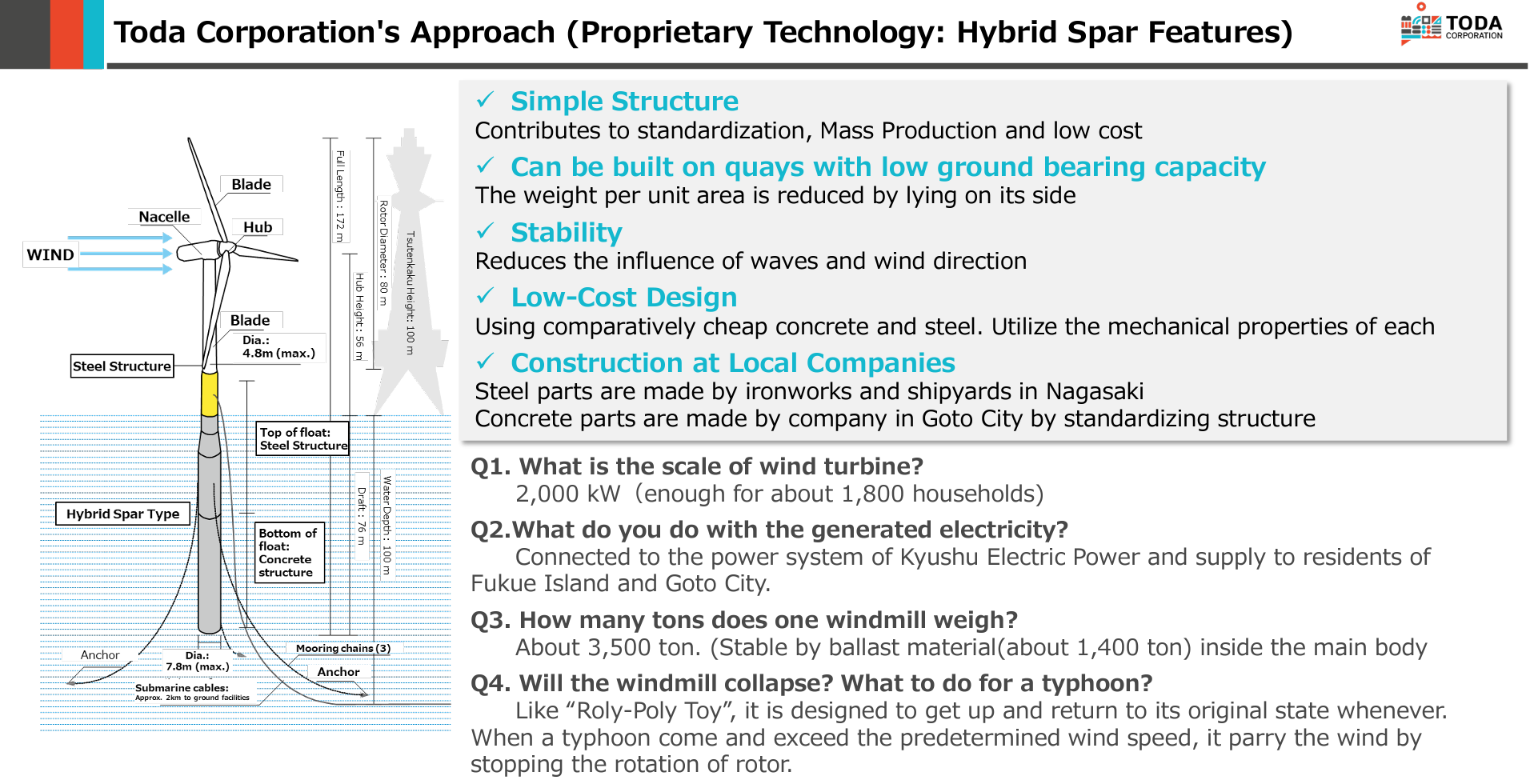
Japan’s offshore floating wind ambitions recently faced a blow when defects were found in the platforms for the Goto Floating Wind Farm, which is the country’s first major floating wind project – 16.8 MW (eight turbines, each 2.1 MW). The Goto farm is being developed by an all-Japanese group led by Toda Corp and involves Osaka Gas, INPEX, Kansai Electric and Chubu Electric among others.
Located off the coast of Goto city, (Nagasaki Pref), the wind farm plans to utilize Hitachi’s hybrid spar and TLP platforms. Construction began last year, but while operations were to start in January 2024, the project now faces a two-year delay that’s due to glitches in two floating structure units assembled onshore. One of the three units installed offshore was brought onshore for checks. Two other units might also be brought back onshore.
Conclusion
At the moment, floating wind’s technologies are in their infancy, but by the end of the decade it has the potential to play an increasingly important role in Japan’s effort to decarbonize its power generation sector.
Some other major issues, however, that so far are getting scant attention are the vast amounts of material and investment needed to build the transmission lines that will extend from far out at sea to onshore substations; not to mention the port infrastructure to build and service these floating wind farms.
These are all an entire set of other challenges that have yet to be fully addressed. For now, the public and private sector in Japan will hope they will have a reason to take on those other challenges once a commercially successful floating turbine is delivered within this decade.
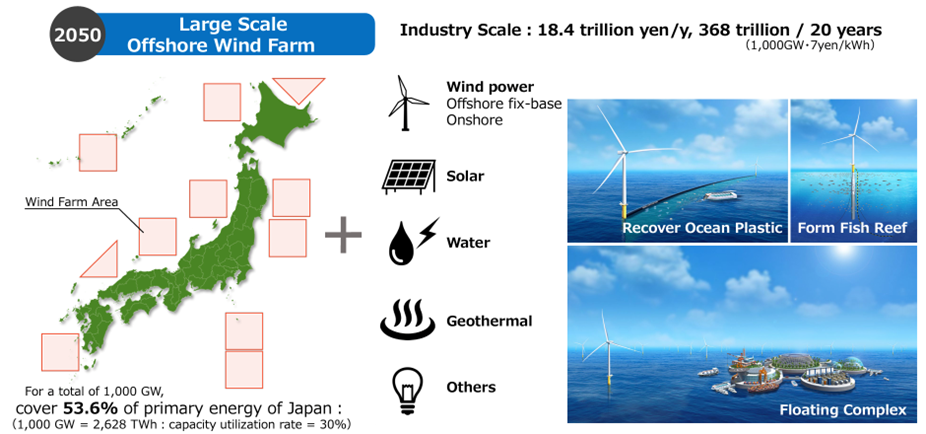
Source: Toda Corporation via ICEF
ANALYSIS
BY MASUTOMO TAKEHIRO
Geopolitical Tensions Cloud Japan-China Energy Cooperation
Since 1945, Chinese-Japanese relations in the energy sector have evolved significantly, influenced by changing economic priorities, diplomatic goals, and global energy dynamics. Today, due to geopolitical shifts caused by the 18-month war in Ukraine and Japan’s push to strengthen economic security by deepening relations with G7 allies, further development of Japan-China energy ties will be limited.
Despite obvious advantages in potential cooperation, as well as geographical proximity, the two countries have been cautious about collaborating in energy. Often eyeing each other as rivals for upstream energy projects around the globe, the two countries have only really connected in LNG and, more recently, in the hydrogen sector.
Nevertheless, amid this frosty geopolitical context, some Japanese companies are trying to find room to maneuver and establish cooperation with Chinese partners. Here’s a brief overview and survey of current energy relations between China and Japan, with a sober analysis of how feasible growth and development might possibly play out.
A brief history
Since World War II, Chinese-Japanese energy relations have evolved through several phases. Initially in the post-War era, Japan was trying to cope with energy shortages, and turned to China for coal supplies. But that changed when the Communists came to power in 1949 and the new regime severely curtailed relations with liberal democracies that it viewed as hostile.
Diplomatic normalization in 1972 between China and western countries marked an era of increased economic cooperation. For its part, Japan explored investment opportunities in China’s energy sector, notably importing Chinese coal during the 1970s and 1980s. These cheap resources proved crucial in fueling Japan’s rapid growth in the 1980s. At the time, China’s economic miracle was barely at the starter stage.
As China’s economy and manufacturing rapidly developed in the 2000s, it started to take over the top global positions that Japanese firms had initially held in solar panels, batteries, and other energy sectors. With China’s growing competitive strength, its politics towards Japan also became more demanding with historical issues mixed in with tensions about raw material supply chains. In 2010, China limited the export of rare earth metals to Japan after a territorial dispute gained prominent attention.
Despite the ominous political picture, energy and trade between the two countries remained active in the last decade. The vast majority of solar panels that Japan has installed in the last 11 years, in which time it built the world’s third-largest solar capacity, have come from China.
LNG
While Japan last year was the world’s largest buyer of LNG, China was close behind in second. The latter is poised to overtake Japan in the next few years as it signs more long-term deals with Middle Eastern and U.S. suppliers. (China temporarily held the top global spot for LNG imports in 2021).
Still, while the two countries compete for new LNG projects, investments and procurements, they have also had a moderate level of success in collaborations. In July 2020, Diamond Gas International (DGI), a subsidy of Mitsubishi Corp, signed a four-year LNG purchase agreement with Guangdong Energy Group (GEG) for 2020-2023. This marked GEG’s first LNG term contract with a foreign company and DGI’s first LNG term contract with China. GEG imports LNG at its 6%-owned Guangdong Dapeng receiving terminal.
With an eye to expand its LNG business, JERA, Japan’s largest utility, established its Beijing office in 2022. As early as 2018, the firm, alongside TEPCO Fuel and Power, signed an agreement with China Huadian Green Energy to promote cooperation in energy infrastructure projects related to power generation and LNG in third countries. Also, JERA holds a 5% stake in the construction of the Ganyu LNG terminal in Jiangsu.
LNG firms from China and Japan have also found joint opportunities in third countries. Mitsui and JOGMEC have a joint 10% stake in Russia’s Arctic LNG 2 project, while China’s CNOOC and CNPC also hold a 10% stake. The two Japanese entities have maintained their stakes in the project even after Japan condemned Russia. Prime Minister Kishida’s government endorses this policy because the withdrawal would damage the nation’s energy security and likely allow China to increase its stake on favorable terms.
Meanwhile, in 2019, Japan’s Saibu Gas and Russia’s Novatek agreed to jointly sell LNG in Asia. At the end of 2020, the two companies jointly transported LNG in small lots to Shanghai after filling the liquid at the Hibiki LNG terminal located on the Sea of Japan, marking their first joint export.
Before Russia’s invasion of Ukraine, the two firms had planned to expand the project by FY2024 and increase annual supply to China by up to 140,000 tons. Now, however, talks between the two companies are suspended. In October 2022, Saibu Gas confirmed that negotiations won’t resume.
Wind and Solar
After helping to drive Japan’s 72-GW-solar rollout since 2010, Chinese firms thought there would also be opportunities in wind power generation, especially after all major Japanese turbine makers withdrew from the sector.
Geopolitical tensions are interfering with those plans. Mingyang Smart Energy, one of China’s leading wind and solar power companies, recently entered the Japanese market. The company has delivered three 3-MW wind turbines to the town of Nyuzen (Toyama Prefecture), and sees itself as catering to the clients that need such smaller turbines rather than the big units where Siemens, GE and Vestas are dominant.
Mingyang is no minnow. It is the sixth largest wind turbine maker globally. It has also vowed to take measures at the Nyuzen project and any future projects to ensure that crucial data such as ocean currents, which are essential for national defense, won’t be misused.
But with data sharing and coastal water security under greater scrutiny, Mingyang will find it tough to score more deals. Japanese manufacturers, which previously may have entered into a JV to localize production, are also weary of partnership with Chinese firms. Meanwhile, the bigger wind farms are planned further out at sea and this only deepens the issue of security.
Power
Japan and China have long cooperated in energy conservation. At their summit in 2022, President Xi Jinping and Prime Minister Kishida agreed to boost cooperation in the green economy, including energy conservation.
In February, 17 MoUs were signed for projects in the public, private, and academic spheres at the Japan-China Comprehensive Forum on Energy Conservation and Environment. Trade Minister Nishimura Yasutoshi expressed his hope that the forum would serve as an opportunity to accelerate the energy transition in the two countries.
Shanghai Electric, the world’s largest maker of steam turbines, is also expanding into Japan via its subsidiary, Shanghai Electric Japan, which is now a member of the Keidanren. Several of its subsidiaries and affiliates have joined renewable power generation projects in Iwakuni City, Yamaguchi Prefecture, Tsukuba City, Ibaraki Prefecture, and Osaka City, etc. However, some Japanese politicians are wary of those projects from a security perspective and take their concerns to sympathetic media.
EVs and FCVs
Toyota’s sales in China fell 4.9% YoY in the January-July period this year. In response, Toyota terminated the contracts of 1,000 term workers at its joint venture with Guangzhou Automobile Group. However, the Japanese auto giant is redoubling efforts at its Changshu-based R&D center, hoping to improve its position in the Chinese market.
Toyota has also redirected its sales focus for hydrogen fuel cell cars from the North American market to China and Europe. This fits with the more aligned views in China and Japan on the development of hydrogen-fueled transport.
The EV and FCV arena is, however, a space in which Chinese and Japanese firms are likely to be rivals rather than allies. Chinese battery manufacturers lead the world in the current lithium-ion technology and are forging ahead in new chemistries based on sodium and zinc. But Japanese auto and battery makers hope to get back in front with the development of a next-gen all-solid-state battery.
The best of frenemies
The manufacturing strength of both countries and their similar outlook for energy transition pathways suggests that there could be a number of energy collaboration opportunities. The vector of political relations will dictate whether some or none of these are utilized.
For Chinese firms in sectors from hydrogen to batteries to nuclear, there is merit in finding partners in Japan, not only for local sales but also to jointly explore opportunities in other Asian markets. For Japanese companies, there is a nagging concern that a Chinese partner today could tomorrow mirror their technology and strike out on its own.
The only thing that could bridge the gaps and build trust is a common cause. Climate change was considered to be just that. In the current geopolitical climate, however, it does not seem to be enough.
GLOBAL VIEW
BY JOHN VAROLI
Below are some of last week’s most important international energy developments monitored by the Japan NRG team because of their potential to impact energy supply and demand, as well as prices. We see the following as relevant to Japanese and international energy investors.
Asia Pacific/ Energy transition
The region will invest $3.3 trillion on power generation over the next decade. Nearly 50% will go towards wind and solar, while storage and nuclear will receive 12% and 11%, respectively. Led by China, the region accounts for over half of global electricity demand.
Bulgaria/ Energy protests
Protesters blocked roads for several days to protest govt plans to shut down coal-burning power plants as part of the energy transition. Bulgarian miners and other energy-sector workers took to the streets.
Canada/ Renewables
In a $1 billion deal, investment firm Brookfield will acquire UK-based Banks Renewables, which owns operational onshore wind farms in northern England and Scotland, as well as a large portfolio of onshore wind, solar and battery assets that are in development.
China/ Grid investment
Investments in Chiba’s power sector may exceed 100 trillion yuan ($13.7 trillion) from 2020 to 2060. The timeframe is in line with President Xi Jinping’s pledge for China to attain net-zero emissions by 2060.
EU/ Carbon tax
On Oct 8, the EU launched its Carbon Border Adjustment Mechanism. Foreign-based, carbon-intensive industries will have to report their emissions if they want to enter the EU market. Russia and China said this violates free trade.
Germany/ Coal power
Coal-fired power plants will again be utilized this winter, from October until late March, to replace natural gas and avoid power shortages. By next summer, the govt will propose how to offset increased CO2 from these plants.
Oil Markets
Russia and Saudi Arabia will continue voluntary production cuts to the end of this year amid tightening supply and rising demand. Their pledge came hours before a ministerial panel of OPEC+ convened.
Saudi Arabia/ Natural gas
Aramco will acquire a $500 million stake in MidOcean energy, as it aims to expand gas production by at least 50% until 2030 compared to 2021 levels. Its Jafurah field starts production in 2025. Aramco believes the LNG market is positioned for long-term growth.
South Africa/ Offshore drilling
The environment ministry approved plans by TotalEnergies to drill offshore for gas and oil, rejecting appeals from lobby groups challenging the decision. TotalEnergies discovered two massive gas fields off South Africa in 2019 and 2020.
UAE/ Natural gas
ADNOC awarded two contracts worth a combined $17 billion for its Hail & Ghasha field, its largest gas project ever. Ghasha is set to produce more than 1.5 bcfd of gas by 2030. The Emirati company confirmed it had taken a final investment decision on the project.
UK/ CCS
British oil services firm Petrofac won a $600 million contract from ADNOC Gas for the Habshan carbon capture and storage project in the UAE. The deal involves delivery of carbon capture units, pipeline infrastructure and a network of wells for CO2 recovery and injection.
Uranium prices
Uranium prices have climbed roughly 50% so far this year to a 12-year high, now trading at about $72/ pound as markets see rising demand. The World Nuclear Association forecasts nuclear capacity growing nearly 80% and demand for uranium roughly doubling by 2040.
2023 EVENTS CALENDAR
A selection of domestic and international events we believe will have an impact on Japanese energy
Disclaimer
This communication has been prepared for information purposes only, is confidential and may be legally privileged. This is a subscription-only service and is directed at those who have expressly asked K.K. Yuri Group or one of its representatives to be added to the mailing list. This document may not be onwardly circulated or reproduced without prior written consent from Yuri Group, which retains all copyright to the content of this report.
Yuri Group is not registered as an investment advisor in any jurisdiction. Our research and all the content express our opinions, which are generally based on available public information, field studies and own analysis. Content is limited to general comment upon general political, economic and market issues, asset classes and types of investments. The report and all of its content does not constitute a recommendation or solicitation to buy, sell, subscribe for or underwrite any product or physical commodity, or a financial instrument.
The information contained in this report is obtained from sources believed to be reliable and in good faith. No representation or warranty is made that it is accurate or complete. Opinions and views expressed are subject to change without notice, as are prices and availability, which are indicative only. There is no obligation to notify recipients of any changes to this data or to do so in the future. No responsibility is accepted for the use of or reliance on the information provided. In no circumstances will Yuri Group be liable for any indirect or direct loss, or consequential loss or damages arising from the use of, any inability to use, or any inaccuracy in the information.
K.K. Yuri Group: Hulic Ochanomizu Bldg. 3F, 2-3-11, Surugadai, Kanda, Chiyoda-ku, Tokyo, Japan, 101-0062.