Activist fund led by Murakami looks to dismantle Cosmo Energy
Hamas-Israel conflict will be very long war: foreign policy expert; consequences in energy terms could escalate
LNG stockpiles rise more than 16% over last week
ANALYSIS
CABLE THEFTS ON THE RISE, POTENTIALLY SLOWING BESS INVESTMENT AT SOLAR FARMS
Metal thefts are rising in Japan, where the number of such incidents in 2022 doubled over 2020’s levels. Half occur at solar operators, which are now forced to divert some of their budget for battery energy storage systems (BESS) to facility repairs and security improvement. If this situation is allowed to fester any further, it has the potential to become a national economic and even international security issue.
ENERGY JOBS IN JAPAN: CHOOSING A REPRESENTATIVE – EXPAT OR LOCAL HIRE?
Making a move to set up a local office is a big decision, and shows commitment and intent to be active long-term. Companies need to find the right balance between engagement with local stakeholders and alignment with plans set by global HQ that has made this decision and investment. This often leads to a challenging conundrum on whether to send an expat to Japan or hire a local as the in-country director or representative.
Tokyo Stock Exchange (TSE) began trading carbon credits on Oct 11. Registered members can trade the existing carbon credit format, known as a J-Credit.
The new market will simplify companies buying and selling credits, and provide transparency in carbon pricing.
As of Sept 19, a total of 188 entities had registered to trade, said the TSE.
During the first day, trading volume was equivalent to 3,689 metric tons of CO2. The transaction price for a J-Credit in the energy-saving sub category was ¥2,850/ ton-CO2; a J-Credit in the forest sub category traded at ¥9,900 in the morning session, and ¥7,000 in the afternoon session.
CONTEXT: The TSE held a pilot from September 2022 to January 2023, initially allowing trading of about 70 types and sub categories of J-Credits. However, the high rate of failed trades led to a narrowing of the focus to six types, making it easier for trades to be completed. In April, Japan began the phased introduction of a carbon pricing scheme to encourage companies and cities to curb emissions.
TAKEAWAY: The government wants to have a clear, definitive carbon price to better evaluate the costs of different energy sources in a net-zero environment. In theory, this is a sure way to demonstrate how clean energy technologies are cost-competitive. However, the challenges to forging a unified price on 1 ton of CO2 are not small. After all, carbon credits represent a “negative” value; in other words, the cost of avoiding or reducing the existence of a ton of CO2, rather its creation. Seen in that light, pricing reflects the various degrees of effort across disparate industries that CO2 reduction involves. At some future point, the carbon credits market will need to reflect the differences. But as the trials last year showed, initially trading needs to be as streamlined as possible to take root.
The Nagano prefectural assembly passed an ordinance requiring solar operators to file land conservation and natural scenery protection plans, effective April 2024. The rule covers all new installations above 10 kW, excluding rooftop panels.
Any solar project, no matter its size, in the areas reserved for forestation and natural disaster protection, will require approval of the Nagano governor.
A prefecture official told Japan NRG that due to its wide scope, the prefecture is studying the possibility of splitting regulatory oversight: 10-50 kW projects under local municipalities; while projects above 50 kW under prefectural authority.
CONTEXT: There’s roughly 200 MW of solar capacity now in operation in Nagano Pref. Solar restrictions started to emerge at village and city levels in 2021.
TAKEAWAY: Four prefectures and 20 municipalities have similar ordinances on natural scenery protection, targeting large installations. The Nagano ordinance is the most stringent.
METI plans to revamp the environmental impact assessment process, dividing potential projects into three categories: 1) no impact, 2) possible impact, and 3) major impact on the environment.
The ministry plans to increase the items on its checklist to review project scoping and primary environment consideration. These might include the amount of land refills, distance from the nearest residential building, etc.
CONTEXT: In the first half of FY2023, the environmental impact of 44 clean energy power plants were reviewed – 39 were wind projects, each over 50 MW in capacity. However, some large projects were cancelled following community opposition.
The World Bank, Japan and several other countries launched the Resilient and Inclusive Supply-chain Enhancement (RISE) to diversify renewable energy supply chains amid concerns over reliance on China for critical materials essential for EVs and solar panels.
RISE aims to support emerging nations financially and technologically in processing raw materials and assembling final products to ensure a stable global supply and to mitigate economic security risks. With initial contributions exceeding $40 million, this partnership targets developing countries in Asia, Africa, and Latin America.
CONTEXT: China holds a significant share in processing raw materials and assembling EV batteries. It accounts for 10% of global lithium production, but 55% of its processing. In total, China holds a 75% share in battery production. At least 90% of substrates used in solar panels, such as glass and silicon, are also made in China.
Idemitsu Kosan and Toyota Motor have partnered to accelerate the mass production of all-solid-state batteries for battery electric vehicles (BEVs), targeting commercialization by 2027-28.
Their collaboration will primarily focus on developing mass production technology for solid electrolytes and enhancing productivity. They aim to improve sulphide solid electrolytes, which are crucial for high-capacity BEVs.
The collaboration will progress through phases: developing and testing sulphide solid electrolytes, initiating mass production at a large pilot facility, and evaluating full-scale mass production for future commercialization.
TAKEAWAY: Automakers are required to phase out gasoline vehicle production, but the Japanese market lags behind the net zero trend as EVs account for only 2% of total car sales, and FCVs are less than 0.1%. Imported EVs account for the majority of such sales in Japan. The local auto industry hopes that solid-state battery development, not just by Toyota but also by other automakers, will be a gamechanger.
Honda Motor, Mitsubishi in talks to form EV-based power balancing venture
(Company statement, Oct 11)
Honda Motor and Mitsubishi are in talks to form a JV to offer vehicle-to-grid (V2G) power balancing services through which EVs store excess renewable power.
The JV will be set up in 2024. Honda’s EV model “N-VAN e”, which will be released in spring 2024, will be used to store power. The JV plans to launch a service framework allowing vehicle owners to sell power in 2026.
TAKEAWAY: The govt is likely to push the spread of V2G as well as V2H (vehicle-to-home) services by providing subsidies for equipment called “power exporter,” which is required for increasing power output from batteries. Vehicle battery output is limited to 1,500 watts when not driving. Honda Motor told Japan NRG that any Japanese EV and FCV models following the CHAdeMo charging standards will be able to connect to the V2G network. Tesla models, however, are not compatible with CHAdeMo.
SIDE DEVELOPMENT: Nissan, Hitachi group test “V2X” water supply system (Company statement, Oct 12)
Nissan Motor, Hitachi Building Systems and Hitachi Industrial Equipment Systems tested running a water supply system of a condominium powered by batteries mounted on a Nissan Sakura model passenger vehicle.
The fully charged 20-kWh Sakura batteries supplied 21,171 liters of water into the condominium until the charge rate hit 10%. The water volume was enough to supply 8,468 people for a day.
The companies will continue to test “V2X” systems in various situations.
Together with solar power developer Renewable Japan (RJ), Tokyu Land will invest as much as ¥300 billion in the EU renewables sector over the next five years to acquire and develop capacity.
As a first step, Tokyu Land and RJ acquired a 40 MW solar plant in Spain, spending about ¥10 billion. The energy produced will be sold to a major EU power company.
Eventually, Tokyu Land wants to build 1 GW of (mostly) solar capacity in Europe. It will launch a special purpose company (SPC) for each project.
This will be one of the largest investments in EU renewables by a Japanese company. It’s also Tokyu’s first overseas expansion into renewables. The company now operates 70 clean energy generation plants in Japan.
Japan boosts electrified aircraft with ¥30 billion fund aimed at hydrogen fuel cells
(METI statement, Oct 9)
Japan will back technology development for electrified aircraft, with a focus on hydrogen fuel cell systems. METI is allocating a total of ¥30.6 billion, aiming to bolster the country’s competitive edge in this aerospace segment.
CONTEXT: This initiative comes amidst global endeavors, like Airbus’ plan for a hydrogen-powered commercial aircraft by 2035. The ministry seeks to kickstart research by 2024 and aims for prototype testing by 2030, eyeing a significant role for Japanese firms in the global supply chain for hydrogen-fueled aircraft.
Funding will be sourced from the Green Innovation Fund, which is managed by NEDO.
Japanese hydrogen startup, Biotechworks-H2, expands in Europe
(Japan NRG, Oct 12)
Biotechworks-H2, a Tokyo startup launched in July to produce hydrogen from textile wastes using plasma gasification tech, will open offices in Dusseldorf and Nice.
Plasma gasification is less energy intensive compared to the usual heat treatment of wastes. The company’s parent, Yamagen, licensed the base technologies from a U.S. engineering firm and built a pilot plant in California.
Its business model is to turn waste into hydrogen and CO2, and use the hydrogen for power generation and sell CO2 as feed for dry ice and carbonated drinks.
It plans to start building plasma gasification plants in Japan and Malaysia in 2025, and start operations in 2026. The technology has the potential of replacing waste incineration plants worldwide, a company executive told Japan NRG.
INPEX and Green Hydrogen International (GHI) signed a study agreement to produce green hydrogen and green ammonia in Texas. It’s called the Hydrogen City Project.
GHI has developed a cost model using salt cavern storage and “behind the meter” renewable power that it claims to be cost-competitive.
Mitsubishi tapped by U.S. Dept of Energy to join two hydrogen hubs
(Company statement, Oct 13)
Mitsubishi Power Americas was tapped as a sub-recipient in two hydrogen hubs selected by the U.S. Department of Energy.
On Oct 13, President Biden announced recipients of $7 billion in grants to develop 7 regional hydrogen hubs that will jump-start domestic clean hydrogen production to supply industries like steel and cement.
The Texas hub, called HyVelocity, is led by Exxon, Chevron, Mitsubishi Power Americas, Orsted and Sempra.
Amazon, Mitsubishi Power and Air Liquide are partners in the Pacific Northwest hub, joining Fortescue Future Industries.
Most of these hubs include the use of natural gas to power hydrogen production, which officials said would need to install carbon capture technology to qualify.
CONTEXT: Mitsubishi Power Americas said its goal is to become a major player in hydrogen infrastructure development in North America. The company is a subsidiary of Tokyo-based MHI, and it provides power generation solutions that include gas, steam, and aero-derivative turbines; geothermal systems; PV solar development; and environmental controls. Energy storage solutions include green hydrogen, battery energy storage systems, and services.
Hokkaido consortium launched to produce hydrogen using offshore wind
(Company statement, Oct 12)
Nord SeaEra, a consortium of businesses, academia and the Hakodate City authority, was launched to explore producing hydrogen using offshore wind power in Hokkaido.
The consortium aims to produce hydrogen for local consumption and to widen the energy consumption to ports, construction projects, and emergency backup power.
Hokkaido University and the National Institute of Technology will develop technologies to produce and transport hydrogen, and hydrogen power generation.
The consortium is soliciting participation from Hakodate-based businesses and others. It presently consists of: MOL Techno-Trade (main organizer), Air Water, AIRDO, Tsugaru Kaikyo Ferry, ABS Group, Hokkaido University, the National Institute of Technology (Hakodate College), North Pacific Bank, and Hakodate City.
Toshiba ESS and Bekaert sign an MoU for collaboration on green hydrogen production
(Company statement, Oct 10)
Bekaert and Toshiba Energy Systems & Solutions (Toshiba ESS) signed an MoU to develop a global partnership on Membrane Electrode Assembly (MEA) for Proton Exchange Membrane electrolysis, which is applied for green hydrogen production.
Bekaert is a leader in producing Porous Transport Layers (PTL) for MEAs in water electrolyzers; Toshiba ESS is advancing the development of MEAs for large-scale, PEM water electrolyzers with iridium-saving technology.
SIDE DEVELOPMENT: Eurus awarded green hydrogen production license in Netherlands (Company statement, Oct 13)
Eurus Energy Europe was awarded a license to produce green hydrogen using a 20 MW electrolyzer in an industrial complex in the Groningen province. It will source power from the 38.7 MW Mondriaan wind farm and supply the complex.
The electrolysis plant is planned for commercial launch in 2025.
MHI invests in startup for hydrogen production and CO2 utilization
(Company statement, Oct 10)
MHI invested in Syzygy Plasmonics, a U.S.-based startup developing photocatalytic technology for hydrogen production and CO2 utilization.
Syzygy builds reactors that employ light instead of combustion for energizing chemical manufacturing processes, with the potential to facilitate more eco-friendly and safe industrial operations.
Syzygy can help minimize costs and emissions across numerous chemical reactions, enabling production of zero-emission hydrogen from ammonia, low-emission hydrogen via a non-combustive method of steam methane reforming, and efficient conversion of methane and captured CO2 into sustainable fuels and methanol.
Revo International to establish seven biofuel plants in Japan
(Nikkei, Oct 11)
Revo International is expanding biodiesel production from used cooking oil (UCO), aiming to establish seven factories in Japan by 2030.
Work on a ¥4 billion factory is already underway in Aichi Pref, and there will be expansion in the Kanto region, Hokkaido, Chugoku, and Kyushu. Each factory aims to produce 10,000 to 20,000 kiloliters of biodiesel annually.
The company also plans to build Sustainable Aviation Fuel (SAF) production.
SIDE DEVELOPMENT: Revo International to go public on Oct 31 (Company statement, Oct 11)
Tokyo Stock Exchange approved Revo International’s application to list on the Tokyo Pro Market section effective Oct 31.
Toyota Tsusho begins biofuel trial with Fukuoka City
(Company statement, Oct 12)
Toyota Tsusho is collaborating with Fukuoka City, supplying biodiesel to a marine clean-up ship to study the impact on CO2 emissions reduction at Hakata Port.
The trial will extend until March 2024. Produced using used cooking oil gathered from Toyota Group facilities, the biofuel project marks Toyota Tsusho’s first venture into supplying biofuel for ships.
KEPCO to utilize nuclear-derived hydrogen at three NPPs
(Denki Shimbun, Oct 12)
KEPCO and Tsuruga city aim to utilize nuclear-derived hydrogen at Mihama, Takahama, and Ooi nuclear plants to enhance energy efficiency and expand hydrogen usage beyond fueling FCVs.
From Oct 11 to March 31, they anticipate producing about 1,470 cubic meters of hydrogen. Specific units at these NPPs will use hydrogen for cooling generators or adjusting primary coolant volumes, building on a successful demo project that tracked nuclear-derived hydrogen from generation to FCV utilization.
KEPCO and Cosmo Energy consider CCS value chain in Sakai-Senboku area
(Company statement, Oct 13)
Cosmo Energy and KEPCO signed an MoU for collaboration on setting up a CCS value chain in the Sakai-Senboku area.
In this study, both companies will capture and collect CO2 emitted from their local operations.
They will jointly liquefy and store the CO2 before shipping it to storage sites, evaluating the design and economic feasibility of the CCS value chain.
JERA to collaborate with Vietnam Energy on country’s decarbonization
(Company statement, Oct 10)
JERA will collaborate with Vietnam Electricity on a decarbonization roadmap, to promote info sharing. Also, they’ll explore the use of ammonia and hydrogen for thermal power plants.
CONTEXT: Vietnam Electricity, along with its subsidiaries, accounts for about 40% of national electricity generation capacity, making it the country’s largest. With economic growth rising, Vietnam expects higher power demand. JERA sees Vietnam as a vital hub in Southeast Asia.
Japan plans to hold ASEAN, Australia summit on decarbonization
(Reuters, Oct 8)
In December, Japan plans to hold the first summit meeting on a zero-carbon emission framework with Australia and Southeast Asian nations.
Leaders from Japan, Australia and nine countries in ASEAN will come to Tokyo to discuss plans to strengthen cooperation on hydrogen and other tech, as well as supply chains for key minerals.
CONTEXT: The Asia Zero Emission Community (AZEC) was proposed by PM Kishida last year to promote decarbonization in Asia. The first ministerial meeting was held in March, and Japan pledged financial and technological support.
Okoppe Town starts test production of methanol from cow manure
(NHK, Oct 13)
Okoppe Tow in Hokkaido began trial production of methanol (2 tons) and formic acid (10 tons) from biogas generated from cow manure. The town began biogas-fueled power generation in 2016 but diversified to methanol and formic acid production due to a lack of power transmission line capacity and falling power sale rate.
NEWS: POWER MARKETS
Eurus Energy cancels 600 MW Michinoku wind farm, no reason given
(Company statement, Oct 10)
Eurus Energy canceled the 600 MW Michinoku wind farm (Aomori Pref), without stating a reason. The project had prepared to conduct an environmental assessment.
The Aomori governor Miyashita, who was elected in June, has been calling for the project’s cancellation.
TAKEAWAY: While the company has not given an explanation, one factor that may have influenced Eurus Energy is the changing of the leadership in Aomori Pref and the recent comments by the new governor. Miyashita’s predecessor was Mimura Shingo, who served as the governor for 20 years; local business and political circles were watching the new governor from afar. They hardly reacted to Miyashita’s idea to levy a new tax on renewable installations, which was unveiled last month.
Hitachi facilitates first power transmission from world’s largest offshore wind farm
(Company statement, Oct 10)
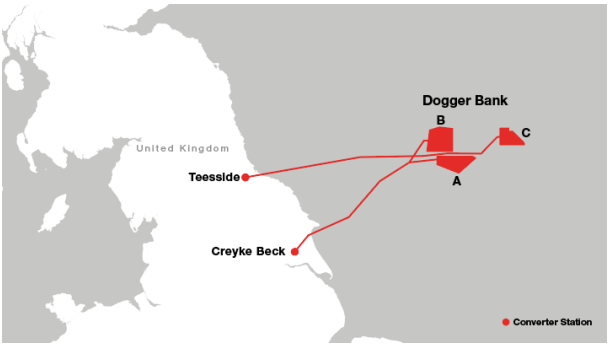
Hitachi Energy has successfully transmitted power from the UK’s Dogger Bank A, the first of three phases of the Dogger Bank Wind Farm, the world’s largest offshore wind farm. It runs on High-Voltage Direct Current (HVDC) technology.
Dogger Bank A, (1.2 GW total capacity), is located about 130 km off England’s Northeast coast, and was built in 38 months. Once fully operational in 2026, Dogger Bank will provide a total of 3.6 GW of power, about 5% of the UK’s electricity needs.
CONTEXT: The UK plans to source up to a third of its electricity from offshore wind by 2030, and so the country provides much opportunity for Japanese companies such as Hitachi Energy. The HVDC systems convert generated wind power to a transmittable form with minimal losses.
UK-based Aventus Energy has partnered with Horizon Ocean Management (HOM), which offers consultancy and IMR services for Japan’s offshore wind sector.
HOM was formed in 2021 by Japanese conglomerate Mitsui and Japan’s wind turbine maintenance company Hokutaku.
Marubeni signs MoU with UK on clean energy projects
(Company statement, Oct 11)
Along with its partners, Marubeni pledged to invest £10 billion in clean energy in the UK over the next ten years. The company signed an MoU with the UK’s Department for Business and Trade regarding offshore wind in Scotland, green hydrogen, and etc.
Marubeni, which will invest £1 billion of its own, expects support from the UK govt, including the guarantee of stable revenue from the offshore wind project.
CONTEXT: Both Japan and the UK seek to be leaders in offshore wind power and hydrogen. Among the planned investments, Scotland’s 3.6 GW Ossian floating offshore wind farm will be the biggest. That project, which is a JV between SSE Renewables, Marubeni and Copenhagen Infrastructure Partners, is expected to consist of 270 wind turbines.
Microsoft inks first renewable energy purchase deal in Japan, to start in December
(Company statement, Oct 13)
Shizen Energy signed a 20-year agreement with Microsoft to provide 25 MW of solar power capacity from a project in Inuyama City (Aichi Pref).
Shizen’s solar power plant is scheduled to begin operating this December.
The power purchase agreement (PPA) — a scheme used to lock in an electricity supply at a negotiated rate — is part of Microsoft’s goal to become carbon neutral by 2025.
Société Générale has provided ¥10.9 billion in financing. This is Japan’s first project in which non-recourse financing is used for a combination of a virtual PPA (for the sale of non-fossil fuel certificate) and a long-term electricity sales contract, which includes balancing.
CONTEXT: Big Tech firms such as Microsoft and Amazon are striking such renewable energy deals as they face mounting pressure to go carbon neutral; regulators and shareholders are increasingly concerned about the vast quantities of electricity consumed by Big Tech.
SIDE DEVELOPMENT: TEPCO PG area demand to increase by 7 GW in early 2030s as data centers expand (Denki Shimbun, Oct 12)
Demand within the TEPCO Power Grid area, which includes the nation’s capital, is expected to require an additional 7 GW of capacity by 2035 to meet rising consumption. This will be driven by the proliferation of data centers that consume lots of electricity.
The city of Inzai (Chiba Prefecture) will be one of the hubs for such data centers. Therefore, TEPCO PG is setting up new substations.
The Inzai area will account for 2.5 GW of the projected 7 GW increase in capacity required to accommodate the new data centers by 2035.
Sumitomo opens public consultation for 1 GW offshore wind farm
(Company statement, Oct 12)
Trading house Sumitomo Corp has launched a public consultation on plans to build a 1 GW offshore wind power farm in Ishikari City (Hokkaido).
The project calls for 67 wind turbines, each 15-20 MW in capacity. The area is 36,000 hectares, located 2-5 kilometers off the coast of Ishikari City. The platform depth is 40 meters; turbine height will be 140-165 meters.
The turbines will have fixed-foundation platforms, but the exact design hasn’t been chosen – options include monopile, gravity-based, suction bucket or jacket structures.
The consultation period closes Nov 17.
Advantec and Philippines to partner on solar projects for factories and emergency backup
(Nikkei, Oct 12)
Advantec inked a deal with the Philippines to provide renewable energy to factories and to set up emergency backup power systems. A solar farm with 3.6 GWh annual capacity will be deployed across 30 facilities in the Pampanga Economic Zone.
Managed by the Philippine Economic Zone Authority, the initiative is expected to cut electricity costs by over 10% and reduce CO2 emissions.
Marking its first overseas renewable energy supply, Advantec aims to extend its integrated solar power, battery storage, and energy management solutions to address the Philippines’ emergency power needs.
CONTEXT: This project aligns with the Japan International Cooperation Agency’s public-private partnership agenda to introduce the Philippines to innovative, sustainable technologies from Japan.
KEPCO unveils plan for temporary spent nuclear fuel storage in Fukui Pref
(Jiji Press, Oct 10)
KEPCO’s Mizuta Hitoshi, head of the company’s Nuclear Business Division, met with Fukui Prefecture’s vice governor and unveiled a plan for a “dry storage facility” with air-cooling for temporary storage of spent nuclear fuel generated.
He indicated that the interim storage facility is expected to begin operations by 2030.
After FY2026, the plan is to send used fuel to the reprocessing plant in Rokkasho, (Aomori Pref). Also, KEPCO might increase the amount of MOX fuel to be sent to France starting around 2030.
SIDE DEVELOPMENT: Minister Nishimura, Fukui governor meet to discuss KEPCO’s spent fuel plans (Japan NRG, Oct 13)
METI Minister Nishimura visited Fukui Pref for discussions with the governor regarding KEPCO’s plan to keep the spent fuel at the Fukui site until its sent to the intermediate storage facility in Rokkasho in 2026.
Emphasizing that the spent fuel will eventually be removed from Fukui, Nishimura pointed out that KEPCO must clarify plans to alleviate local stakeholder concerns.
Chubu Electric’s total hydroelectric capacity reaches 5.47 GW with 200 plants operational
(Denki Shimbun, Oct 10)
Chubu Electric began commercial operations of the Seinaiji Hydropower Plant (Nagano Pref). The plant has a 5.6 MW capacity.
Construction delays occurred due to a 2021 roadside collapse caused by heavy rain, delaying the operational start from its originally planned June 2022.
Chubu Electric now has a total of 200 hydropower facilities, with a combined capacity of about 5.47 GW.
NEWS: OIL, GAS & MINING
Japan looks to Qatar to boost LNG supplies amid concerns about future supply
(Nikkei Asia, Oct 8)
Mitsui is considering taking a share in Qatar’s North Field in the Persian Gulf, where two expansion projects are in progress, both set to launch in 2026.
Upon completion, Qatar’s annual LNG production capacity is expected to hit 126 million tons, overtaking the U.S. and Australia.
Mitsui’s final decision will be influenced by factors including contract term, price, and profitability. The goal is to establish a Japanese consortium that has a stake in North Field, with power provider JERA also evaluating participation.
CONTEXT: Japan is the world’s largest LNG importer, purchasing 72 million tons in 2022, with 10% coming from Russia’s Sakhalin-2 project. As relations with Moscow have soured, Japan is eager to secure LNG supply from friendly nations.
In Indonesia, Mitsubishi, INPEX and others are expanding production at the Tangguh gas field to 11.4 mt/ year. Of the increased production, KEPCO will procure up to 1 million tons to fuel power plants.
Foreign Minister Yoko Kamikawa asked Brunei for a stable supply of LNG during a visit to the country and met with Erywan Yusof, Brunei’s second foreign minister. Both agreed to strengthen economic relations between Japan and Brunei.
Also, Kamikawa and Erywan said that Japan and Brunei will work together in responding to forceful efforts to change the status quo in the South China Sea.
TAKEAWAY: Since the war in Ukraine and western sanctions disrupted global energy supplies, Japanese traders see Qatari LNG projects as a viable investment. The visit of Qatar’s energy minister to Japan late last month signaled potential for new LNG deals as concerns about security of supply mount, pushing more diversification of procurement. However, historical tensions, contractual disagreements over LNG off-takes and geopolitical factors still pose challenges to Japanese-Qatari cooperation. Notably, stringent terms for long-term contracts could exclude Japanese companies from Qatar’s LNG projects.
Cosmo Energy’s management believes that Murakami is intent on dismantling their business rather than looking for ways to boost its value in the current shape. Cosmo management wants to keep the oil and renewables businesses in the same company, seeing the latter as a carbon offset for the former.
Cosmo will soon decide whether to hold an EGM to determine takeover defense measures. If 10% of minority shareholders are unhappy with Cosmo’s current corporate value, it’s likely that voters won’t approve takeover defense measures.
Meanwhile, Cosmo is searching for a “white knight” to come in as a major shareholder and defend it from Murakami. The company is in talks with multiple parties, such as Kansai Electric, a major Cosmo shareholder.
CONTEXT: Activist investor Murakami Yoshiaki has become one of the top shareholders of Cosmo Energy Holdings, Japan’s third-largest oil refining company and also an investor in wind power. Murakami seeks to change the company’s strategy, but management resists his growing influence. In June, management won approval from shareholders to install a ‘poison pill’ defense that effectively blocks the activist investor from owning more than 20% of the company.
TAKEAWAY: After several rounds of industry consolidation, Japan is left with three major oil and oil production wholesalers. Activist investor Murakami seems to believe that this is one too many. Aside from the corporate governance angle, the situation touches on an important difference of opinion around the energy transition. Some believe that traditional energy firms should not lead development of new energy systems; others see this as not only inevitable but also a prerequisite for net zero.
Hamas-Israel conflict will be very long war: foreign policy expert
(Japan NRG, Oct 11)
The Hamas-Israeli conflict is likely to be “a very long war”, said Miyake Kunihiko, a former Foreign Ministry official, now a research fellow at Canon Institute for Global Studies. He spoke at the RISCON Tokyo conference.
Depending on if Iran gets involved, the conflict could spread to Persian Gulf states, eventually impacting Japan’s energy supplies.
CONTEXT: The Middle East accounts for about 95% of Japan’s crude oil and a substantial portion of its LNG supplies. Qatar and Saudi Arabia are Japan’s main energy suppliers in the region.
TAKEAWAY: Japan will be cautious of any political statements around this conflict in case it escalates beyond Israeli-Hamas fighting. Japan’s G7 partners have already strongly backed Israel, angering Arab countries; and thus, Japan could suffer through guilt by association. This year, PM Kishida has worked hard to improve relations with key powers in the Middle East. That success could be undone if civilian casualties on the Palestinian side inflame public opinion across the Middle East and the global Muslim community.
SIDE DEVELOPMENT:JPMorgan CEO: “Most dangerous time the world has seen in decades”(Japan NRG, Oct 13)
Speaking about quarterly earnings, JPMorgan Chase CEO Jamie Dimon warned that “…the war in Ukraine compounded by last week’s attacks on Israel may have far-reaching impacts on energy and food markets, global trade, and geopolitical relationships. This may be the most dangerous time the world has seen in decades.”
LNG stocks rise more than 16% over last week to 1.89 million tons
(Government data, Oct 11)
LNG stocks of 10 power utilities stood at 1.89 million tons as of Oct 8, up 16.7% from 1.62 million tons a week earlier.
The end-October stocks last year were 2.53 million tons. The five-year average for this time of year was 2.01 million tons.
ANALYSIS
BY MAYUMI WATANABE
Cable Thefts on the Rise, Potentially Slowing BESS Investments at Solar Farms
This summer, copper thefts soared globally, most notably dealing a $200 million loss to Aurubis, a Germany-based copper producer. Metal thefts are also rising in Japan, where the number of such incidents in 2022 doubled over 2020’s levels, and will reach a record high this year.
In Gunma Prefecture, copper thefts increased six-fold from last year, and the figures are doubling and tripling in other prefectures. Half of the thefts occur at solar operators, which are now forced to divert some of their budget earmarked for battery energy storage systems (BESS) to facility repairs and security improvement.
Confounding the situation is the fact that the culprits are rarely caught, and so they act with a feeling of impunity. Even if high copper prices subside, thieves would most likely target other items from solar farms that can be recycled and resold.
If this situation is allowed to fester any further, it has the potential to become a national economic and even international security issue. As states add protectionist moves in the name of securing essential minerals, markets could fragment and prices elevate, triggering even more thefts of metals in general and not just copper.
Solar panels as desired prey
From 2020 to 2022, metal thefts in Japan doubled from 5,478 to 10,368 incidents, driven by strong copper demand. In Q1 of 2022, international copper prices rose above $10,000/ ton, compared to pre-COVID levels of $6,000/ ton.
Prices subsided in the second half, and copper now trades at around $8,000/ ton. Thefts, however, show no sign of abating, and in fact, they’re increasing at a faster pace. This is in part related to the government lifting COVID restrictions in May. Since then, requests for enhanced security systems from solar operators have surged.
“Inquiries from solar farms in the north Kanto region namely Ibaraki, Gunma and Tochigi prefectures are up,” one security official told Japan NRG.
Number of metal thefts (copper, steel and alloy items)
2020
5,478
2021
7,534
2022
10,368
Source: National Police Agency
Note: The police do not provide national data on copper thefts.
Ibaraki, north of Tokyo, accounts for over 10% of nationwide metal thefts, ranking it top among prefectures. Ibaraki is likely the theft hotspot because it has the country’s largest solar capacity – 4.4 GW. Copper cables at the region’s solar farms are the most lucrative target.
“The thieves are mostly taking things of higher value. They tend to leave behind thin cables and take the thick ones,” one Ibaraki police officer told Japan NRG.
Ibaraki Pref metal thefts data
Month
Total thefts
Solar operator incidents
% share of solar operators
July 2020
930
578
62%
July 2021
718
344
48%
July 2022
883
308
35%
July 2023
1,392
714
51%
Source: Ibaraki police
Scrap copper cable retails at twice the price of scrap copper tubes, and over five times more than aluminum or steel scrap. In addition, solar plants are easy targets because their equipment is placed in wide outdoor spaces.
Nearly all solar farms are located in sparsely populated areas. Cables can be cut and removed easily, requiring little manpower. Two to three people with large knives and a truck to haul their prey away can carry out a heist in less than 30 minutes.
Solar plant thefts typically take place when it’s dark and there’s no generation. Power stations supplying low-voltage power are targeted more than those with high-voltage power.
With manned security seen as expensive, solar sites tend to rely on remote monitoring. But operators often become aware of the theft only when they notice power generation is low for hours despite ample sunlight.
To compare, wind, geothermal and hydroelectric power plants, which are also located in sparsely populated areas, have not suffered copper thefts. Their equipment is installed in buildings and often have walls or tall fences around the premises. Solar power plants operated by regional utilities have also escaped thefts. They have security staff monitoring the plants remotely, 24/7.
Thefts to slow BESS deployment plans
BESS is a vital part of renewables energy infrastructure, compensating for solar or wind’s intermittency by enabling a stable supply of electricity and thus avoiding curtailment. Reasons for intermittency include weather conditions and power grid limitations.
But copper thefts are now slowing down or delaying battery energy storage system (BESS) installations at Japanese solar farms as operators have to be careful of costs amid tight profit margins, an energy consultancy told Japan NRG. Besides the loss itself, insurance rates rise after the thefts.
Losses from a single cable theft can total around several million yen. Before these incidents became common, operators were able to rely on their insurance. At that time, insurance companies were competing for solar clients and some offered low rates. The operators benefited, but that’s not the case anymore; insurance rates are skyrocketing, one operator told Japan NRG.
For example, a 600 kW Hanyu City solar plant was hit four times by thieves in the last three years. Now, the rise in insurance costs is pushing operators to take security seriously. Thefts causing losses of over ¥10 million are rare, but do occur. For context, a 1 MW solar operator on the Feed-in-Tariff would have received about ¥10 million in 2022 for supplying 1 GWh of power.
The current record is a theft of 6.5 kilometers of cables worth ¥45 million in Kofu City in February last year.
Copper cable thefts exceeding ¥10 million
Date
Location
Stolen cable length
Value of stolen cables
Feb 2022
Kofu City (Yamanashi)
6.5 km
¥45 million
Dec 2022
Hokuto City (Yamanashi)
3 km
¥19 million
Sep 2022
Sagamihara City (Kanagawa)
3 km
¥15 million
Oct 2022
Katori (Chiba)
3 km
¥15 million
Mar 2022
Ota City (Gunma)
2.5 km
¥13 million
Jul 2017
Kashima City (Ibaraki)
1.9 km
¥12 million
Source: Media reports
Total financial damages from the thefts include damaged equipment and lost revenue from disruptions in generation output. One victimized 1 MW solar operator said it took three days to restore the cables and restart power generation.
Bigger plants can remain offline for a week or longer, the operator said. The Hokuto City government that operates the 2 MW power station, which was hit by a ¥19 million cable theft last year, will take ¥100 million to fully recover from damages. The ¥15 million theft at a 1 MW power station in Sagamihara City saw total damage of ¥40 million.
Beefing up security
Aware of the grueling threat, plant operators are investing in security. A video surveillance system for a 1 MW plant costs several million yen, including installation work. A second operator has deployed an infrared ray intruder detection system but it was setting off alarms when birds flew over. An AI-assisted surveillance camera was offered as an alternative.
Camera systems, however, have limited impact. Japan’s privacy protection law does not allow the use of high-resolution video with images of identifiable people. It is legal to take high-resolution video, but in order to analyze the video, people in the video need to be notified. Any changes in privacy laws would possibly invalidate cross-border privacy data transfer agreements and would be challenging.
Since thieves are market driven, their target items are changing. Steel scrap may possibly be the next target. Steelmakers worldwide are shutting blast furnaces that use carbon-intensive coke and iron ore, and are building electric arc furnaces. Electric arc furnaces use scrap as feed.
When the new wave of electric arc furnaces comes on-stream in a few years, global scrap demand will inflate by several million tons/ year, likely outstripping supply. Thieves could turn to steel fences on sidewalks or even rip out car bodies at unattended EV and hydrogen charging stations.
Indeed, charging stations face the same vulnerability as solar plants: equipment and cars are outside in an open space. One EV station manager told Japan NRG that he feels no threat because he’s insured. That certainly provides a peace of mind at least in the financial sense. But it’s also exactly what solar operators were saying just a few years ago.
COLUMN: ENERGY JOBS IN JAPAN
BY ANDREW STATTER
Choosing a Representative in Japan: Expat or Local Hire?
As the Japanese energy market evolves, we’re seeing an increase in the number of multinational firms investing in the country, and setting up a local entity and creating a direct presence. Making a move to set up a local office is a big decision, and shows commitment and intent to be active long-term.
Companies need to find the right balance between engagement with local stakeholders and alignment with plans set by global HQ that has made this decision and investment. This often leads to a challenging conundrum on whether to send an expat to Japan or hire a local as the in-country director or representative.
Factors to keep in mind
Some high-level pros and cons for taking the expat route:
Pros:
A known voice is reporting back to HQ, speaks the internal language and understands how to navigate the company, gain approvals and investment, etc.
Bringing a true expert from an advanced market can be attractive for business partners, and also for purposes of talent attraction.
As a non-Japanese, there’s more room to bend the rules and take a different approach to the business.
Cons:
Language and cultural barriers. Since Japan is a highly homogenous country, even an expat with a high level of language and cultural understanding will be seen as an outsider.
Communication gaps with business partners, and failure to ‘read the air’ in Japanese business can render the company to be a second choice, and then face a struggle to penetrate the market.
Risk of creating an image of a lack of commitment to Japan’s market.
On the surface it seems companies that prioritize internal communication and alignment would take an expat route, while those who put local partnerships at the forefront of their wishlist would invest in a local hire. However, the situation is often more complex.
Maturity of your specific market
The Japanese energy industry has historically learnt from overseas markets and then adapted to its own needs. Post-Fukushima (March 2011) the country has leaned heavily on European players for the solar boom; the liberalization of the power retail business was modeled closely on the UK market; and offshore wind is currently looking to leverage European expertise, etc. This can lead to a window of opportunity for a foreign firm to bring new value to the market. However, once the business becomes localized, Japanese firms will hold a clear advantage.
A good example is the solar business. At the start of the FIT era, European firms flooded the market and created a value chain largely outside of Japanese circles. Foreign developers built projects with foreign EPCs, financed by overseas investors. Once Japanese firms gained experience in structuring finance for MW-sized solar projects, and gained the necessary engineering expertise, they became increasingly competitive.
Currently, with a proven, de-risked business model, large Japanese firms with access to powerful offtakers and abundant cheap capital have a stronger business plan and value proposition than many of the foreign players that were dominant before.
On the other hand, areas where business models are not yet proven and not yet de-risked will see a high level of interest for Japanese companies to partner with and learn from foreign players from more mature markets. The BESS (Battery Energy Storage) space is a good example of this.
The current Japanese market is heavily dependent on subsidies from METI. Local players are typically developing small (<2MW) projects, both to learn how to monetize and operate this asset class, and also because Japanese banks are not willing to provide project financing since they also lack an understanding of how to scrutinize and de-risk such projects.
Simply put, bringing experts from overseas holds higher value in immature markets. However, it’s also important to ensure that this person holds genuine, valuable market knowledge that will be seen as a strategic asset by local industry partners.
Image of commitment: are you coming or going?
As we’ve written in this column previously, the Japanese tend to value stability; whether this be for a consortium partner, a technology vendor, or an employer. Seeing a clear, long term vision for the local business and commitment is key to winning business and talent here.
The message to the market is very different based on the timing of when a company decides to put an expat in the top position at the local firm.
Sending an expat from Day 1, with a newly established entity is fine, providing that two clear criteria are met. Firstly, that person brings real experience and value to the market. Secondly, this person is seen as a temporary solution: their mission is to hire a local Japanese leadership team to develop a succession pipeline and thus take over the role once their expatriate assignment is over.
Successfully making this transition to a local hire after the first expat sends a message to the market that the company has gained a strong foothold, has identified clear growth potential and is comfortable in giving autonomy to the local entity.
On the other hand, assigning an expat to the role that was previously occupied by a local leader sends a message that HQ has serious questions about the local market, and are considering whether to continue investing or start making an exit. We can already see examples of this in the offshore wind sector as subsequent bid rounds increase in competitiveness, in supply chain complexity and material costs increase.
Representative or other key leadership position?
Consider also the vertical hierarchy of Japanese corporations. In a meeting with multiple stakeholders, business cards are exchanged, and a hierarchy of who is who – and who should be talking to whom – is established very quickly. This is reflected in the seating arrangements and meeting flow. If your business is reliant on close partnerships with local Japanese companies, then having a local hire as country representative can ensure smooth communication and trust.
Sending an expatriate in another key role – Project Director, Technical Director, Commercial Manager, etc – allows HQ to have their own person with home market values in place without trading this in for a show of commitment to the local market.
Key points when looking at hiring a local representative:
Agility. Many Japanese leaders come from large, well-structured organizations with clear processes and manners of doing business. Test to see how many different environments your prospective leader has been in, and how quickly they’ve adapted. Even those who worked for one company their whole career may have gained agility via secondments and overseas assignments.
Decision-making ability. Beware of decision-making by consensus and distributed accountability. Screen for risks taken, examples of your candidate making a decision against the majority, starting a new initiative on the side, etc.
Managing up. A ‘yes man’ is only acceptable when business is good enough not to see their flaws. During your interview process, challenge your candidate to criticize your firm; and to come up with a Japan-specific strategy that includes pitching to you regarding the investment that they’ll need from HQ in order to achieve their goals.
GLOBAL VIEW
BY JOHN VAROLI
Below are some of last week’s most important international energy developments monitored by the Japan NRG team because of their potential to impact energy supply and demand, as well as prices. We see the following as relevant to Japanese and international energy investors.
Australia/ LNG strike
Workers at Chevron’s Gorgon and Wheatstone LNG plants gave notice to resume strikes from Oct 19, which could send prices higher. Workers are required to give seven working days notice before stoppages begin. Negotiations are ongoing but have come to an impasse.
China/ Diesel fuel
The U.S. and Europe are counting on Chinese exports to ease tight global supplies of diesel, heating oil and jet fuel. While China is not a major source of crude, its growing refining capacity has made the country a fuel exporter in recent years. Russia’s ban on diesel exports has sparked higher prices globally.
Finland/ Pipeline attack
A gas pipeline connecting Finland and Estonia under the Baltic Sea was damaged in what may have been an attack. The gas in the pipeline comes from Russia. Gas accounts for 5% of Finland’s energy mix.
France/ LNG
TotalEnergies signed a 27-year LNG deal with Qatar, extending France’s commitment to fossil fuels beyond 2050. Starting in 2026, Qatar will supply 3.5 million tons of LNG annually to France. This will be Qatar’s largest and longest deal with a European company.
Mozambique/ LNG
Eni wll make a final decision on its second floating LNG project in Mozambique by next July. The deal is “90% done”, the company said. The floating LNG ship would start producing and exporting within four years.
Oil markets forecast
The IEA lowered its forecast for oil demand growth in 2024 to 880,000 bpd, from 1 million bpd, amid worries of worsening global economic conditions. By contrast, OPEC forecasts that demand will rise by 2.25 million bpd in 2024. The difference between the two forecasts is 1.37 million bpd, or about 1% of daily global use.
Russia and Iraq/ Oil policy
Vladimir Putin and Iraqi PM Al-Sudani met in Moscow to coordinate within OPEC+ in order to stabilize world markets. These talks come as Saudi Arabia and Russia will continue with voluntary oil supply cuts of a combined 1.3 million barrels of oil per day.
Russia/ LNG exports
Gazprom is against the Murmansk LNG export project planned by rival Novatek, saying Russia won’t have enough gas for domestic needs. Gazprom had a sharp fall in output in the first half of this year, to 100 bcm/ year. Murmansk LNG would receive about 30 bcm/ year.
Venezuela/ Oil exports
Venezuela is circumventing U.S. sanctions by using a dark fleet of tankers and various strategies to conceal their location. The dark fleet that ships Venezuela’s oil to customers, mainly in Asia, has grown with help from Russia and Iran.
U.S./ Hydrogen power
President Biden announced recipients of $7 billion in federal grants across 16 states to develop 7 regional hydrogen hubs to jump-start clean hydrogen production to supply industrial users like steelmakers and cement plants.
U.S./ Oil merger
ExxonMobil will buy rival Pioneer Natural Resources in a $59.5 billion deal, making the company the biggest producer in the leading U.S. oilfield. The deal combines the largest U.S. oil company with one of the most successful names to emerge from the shale revolution.
2023 EVENTS CALENDAR
A selection of domestic and international events we believe will have an impact on Japanese energy
ASEAN-Japan summit to mark 50 years of cooperation
Last market trading day (December 30)
Disclaimer
This communication has been prepared for information purposes only, is confidential and may be legally privileged. This is a subscription-only service and is directed at those who have expressly asked K.K. Yuri Group or one of its representatives to be added to the mailing list. This document may not be onwardly circulated or reproduced without prior written consent from Yuri Group, which retains all copyright to the content of this report.
Yuri Group is not registered as an investment advisor in any jurisdiction. Our research and all the content express our opinions, which are generally based on available public information, field studies and own analysis. Content is limited to general comment upon general political, economic and market issues, asset classes and types of investments. The report and all of its content does not constitute a recommendation or solicitation to buy, sell, subscribe for or underwrite any product or physical commodity, or a financial instrument.
The information contained in this report is obtained from sources believed to be reliable and in good faith. No representation or warranty is made that it is accurate or complete. Opinions and views expressed are subject to change without notice, as are prices and availability, which are indicative only. There is no obligation to notify recipients of any changes to this data or to do so in the future. No responsibility is accepted for the use of or reliance on the information provided. In no circumstances will Yuri Group be liable for any indirect or direct loss, or consequential loss or damages arising from the use of, any inability to use, or any inaccuracy in the information.