While most of Japan’s population lives on five large islands there are another 300 smaller isles in need of power. Some rely on an undersea power cable to connect with the national grid. Other islands rely on stand-alone diesel generators as they’re too small to support a thermal power plant. This situation is an opportunity to experiment and deploy more renewables. But far from being an isolated and local affair this trend has support on the national level.
Concern about the environmental impact of the world’s No. 3 polluting industry has set off a whirlpool of creative thinking among Japanese fashion companies. As we enter the Recycling 2.0 era, in which an old textile can be reborn not only as a new textile, business opportunities abound for those willing to seek creative solutions for second-hand resources. Biotechworks-H2 is a startup that turns textile waste into feedstock for making hydrogen. Founded in Tokyo in July, the company has launched three domestic hydrogen production projects.
GLOBAL VIEW
A wrap of top energy news from around the world.
EVENTS SCHEDULE
A selection of events to keep an eye on in 2023.
JAPAN NRG WEEKLY
PUBLISHER K. K. Yuri Group
Editorial Team Yuriy Humber (Editor-in-Chief) John Varoli (Senior Editor, Americas) Mayumi Watanabe (Japan) Wilfried Goossens (Events, global) Kyoko Fukuda (Japan) Magdalena Osumi (Japan) Filippo Pedretti (Japan) Tim Young (Japan)
Miyagi became the first Japanese prefecture to introduce a tax on renewable energy projects involving forest development. The decision, which had been pending approval from the Internal Affairs Ministry, received a green light on Nov 17.
The tax will help to curb deforestation while promoting renewable energy in locations that won’t generate conflict with local residents. The ordinance is set to take effect on April 1, 2024.
The tax will be levied on solar, wind, and biomass power facilities with deforestation of more than 0.5 hectares, and will be equivalent to 20% of operating income. It will be waived if the municipality certifies there are no obstacles to approval from the local communities.
CONTEXT: In July, Miyagi passed an ordinance establishing a new tax. The issue of large-scale renewable energy facilities has triggered concerns that such facilities will cause landslides or could damage the landscape. Miyagi has already seen protests against renewables projects related to use of forest sites or resources.
TAKEAWAY: A movement to introduce taxes is gaining momentum in Japan with dozens of municipalities believed to be working on tax schemes that would affect a portion of solar and wind projects. Local authorities see this both as a way to regulate the location of new projects and get a buy-in from nearby communities, while also raising extra tax income. But the trend is causing concern among developers, especially those with investment overseas, who argue the taxation could put some at a financial or regulatory disadvantage. There are also questions over how the new taxation will affect the cost of renewables in Japan, which is already above the level of similar markets. Still, in practical terms it is unlikely that the national govt will allow the taxation trend to spiral out of control as that would jeopardize Japan’s 2030 goals for reducing emissions. The Miyagi development should be seen in the context of the national govt allowing local authorities a greater share of control (and thus buy-in) into the renewables sector development.
METI and ANRE are taking measures regarding curtailment of renewable energy facilities in the Kyushu area, seeking ways to allow more surplus green electricity to be transmitted to other regions at times of oversupply.
In the case of the Kanmon Interconnection Line that links the Kyushu and Chugoku regions, officials have concluded that in order to transmit more surplus renewable electricity to other areas the grid needs a greater degree of control over the operation of solar and wind generation facilities.
Officials plan to install control devices on about 300 MW of large solar farms and about 200 MW of wind power capacity, which would allow grid operators to immediately stop power transmission in the event of a line failure.
The govt is also ready to support the installation of these control devices via subsidies. ANRE allocated ¥2 billion for the FY2023 supplementary budget, approved by the Cabinet to cover expenses to mitigate curtailment.
CONTEXT: In Kyushu, installed solar capacity has increased every year, reaching 11.56 GW in FY2022, about 1.5 times that of five years earlier. The forecast for the curtailment rate in FY2023 is 6.7%, the highest among all Japanese regions.
METI will push the scale-up of perovskite solar cell (PSC) projects, said Minister Nishimura when asked to comment on China’s plan to launch PSC products in 2024.
This fiscal year, METI plans to provide budgets for large demo projects and seeks to finance PSC supply chain building in 2024.
Japanese PSC technologies have competitive advantages on endurance and module sizes, Nishimura said, adding that METI will fulfill the need for major financing in order for PSC projects to scale up.
CONTEXT: Chinese and European companies are speeding up their PSC mass production plans, putting pressure on the Japanese. Demo projects were launched in Japan this year and grew to over a dozen.
TAKEAWAY: EneCoat plans to mass produce PSC modules in 2024 and Sekisui plans PSC commercialization in 2025. This timeline means business and requires major cost reductions. At the same time, companies need to address challenges, such as raising power efficiency and endurance. Japan NRG expects alliance building among companies with the key technologies in and outside the PSC domain. METI’s financial backing will likely spur more business ties.
Major PSC demos
Companies involved
Project overview
JERA, Sekisui Chemical
Thermal power plant, eyeing PSC solar power supplies
NTT Data, Sekisui Chemical
PSC-equipped data centers
Tokyo metropolitan govt, Sekisui Chemical
PSC-equipped water recycling systems
Tokyu Group, Toshiba Energy Systems
PSC-equipped railway station (JR West installation in 2025)
JR West, Sekisui Chemical
Toyota Motor, EneCoat
PSC-equipped cars
Toyoda Gosei, EneCoat
PSC-equipped cars
Notas, Peccell Technologies
Farms (to power fences and camera systems, starting spring 2024)
TEPCO Holdings, Sekisui Chemical
PSC-equipped buildings (building construction completed in 2028)
Mitsui Fudosan Residential, EneCoat
PSC-equipped condominium (start 2024)
Panasonic
PSC-equipped homes
Macnica, Peccell Technologies
Ports
JGC, EneCoat
Logistic facilities (start 2024)
Aisin
PSC-powered manufacturing plant (start 2025)
Yokohama City, Toshiba Energy Systems
Temporary installation in an exhibition hall
Macnica, Tokyo metropolitan govt, EneCoat
PSC-powered air quality monitoring system
SIDE DEVELOPMENT: Sekisui Chemical explores second PSC production site (Japan NRG, Nov 24)
Sekisui Chemical is studying setting up a second perovskite solar cell (PSC) production site in addition to the one developing processes to manufacture large PSC modules that are one-meter wide.
Most PSC modules used by other companies in demos are smaller. PSC requires nano-scale control of perovskite-shaped crystals and electrodes; scaling up its size has been difficult.
“There’s no ramp up of production, but we’re studying the possibility and there are several candidate sites,” the company told Japan NRG.
Toshiba shareholders voted to delist from the Tokyo Stock Exchange and Nagoya Stock Exchange, effective Dec 20.
432,853,307 shares issued will be consolidated into four shares, effective Dec 22.
CONTEXT: Toshiba fulfills various nuclear infrastructure and defense contracts, such as state-of-the-art radar systems and drone detection systems. It is also one of Japan’s PSC developers.
TAKEAWAY: Delisting came after many years of shareholder discord that followed scandals around accounting and other issues. In the end, Japanese buyout fund JIP led a group of more than 20 domestic companies to take Toshiba private. The fact that the buyer is an all-Japanese consortium appeases those that worry about Toshiba’s sensitive technologies being sold overseas. It also suggests that Toshiba may now work in concert with some of the companies that invested in it. One of those investors is Chubu Electric.
JAPEX, JGC Corp, Kawasaki Kisen Kaisha (K Line) and Malaysia’s Petronas CCS Ventures inked a Key Principles Agreement to commercialize a carbon capture and storage project in offshore Malaysia by late 2028.
Front-end engineering design (FEED), which will include choosing technologies for CO2 compression and injection, designing pipelines and terminals to receive liquefied CO2, will begin in 2024. Companies plan to inject CO2 from Malaysia and Japan into depleted oil and gas fields.
Initially, the annual target injection is for 2 mln tons of CO2; this will expand to 5 mln tons / year by 2030, and to more than 10 mln tons / year in the early 2030’s.
CONTEXT: This project falls outside of the govt’s Seven Advanced CCS Projects that are case studies for future policies. Another project with Petronas CCS’ parent company Petronas, Mitsui and TotalEnergies is among the advanced projects.
TAKEAWAY: The parties will make a final investment decision in the mid-2020s. This could become Japan’s first commercial CCS project in SE Asia if it launches as planned in 2028.
IHI and Vopak signed an MoU on ammonia terminal development and operation.
They’ll study the terminal layout, specification of tanks and other facilities, and area demand forecasts for cost efficiency. They’ll first work on projects in Japan and then possibly expand overseas.
CONTEXT: IHI is Japan’s largest ammonia tank manufacturer with a 70% market share, while Vopak (Netherlands) runs energy terminals globally. Vopak also works with INPEX on an ammonia project in Houston.
TAKEAWAY: Potential ammonia demand centers in Japan are Hekinan (Aichi Pref), Osaka, Shunan (Yamaguchi) and Hitachinaka-Kashima (Ibaraki). To save on costs, municipalities eye the reuse of legacy facilities such as LPG tanks; cost efficiency is key to win in the terminals business.
Tokyo Gas and Australia’s Santos Ventures signed a MoU to explore synthetic methane (e-methane) production in Australia for export to Japan.
They’ll study producing green hydrogen in Cooper Basin, where Santos is testing its direct air capture (DAC) technology.
CONTEXT: E-methane is produced from CO2 and hydrogen. Santos, the parent company of Santos Ventures, signed a contract with Osaka Gas in March this year to start pre-FEED studies to export 60,000 tons of e-methane to Japan in 2030.
TAKEAWAY: As shown in the table, Tokyo Gas lags behind Osaka Gas in the e-methane collaboration with Santos. Tokyo Gas has another goal with Santos Ventures to obtain data for writing future multinational carbon accounting rules.
Comparison of gas utilities’ agreement with Santos
KEPCO, Panasonic, and four other companies will cooperate on the transportation and use of hydrogen in the Himeji area (Hyogo Pref).
KEPCO is mulling a hydrogen import terminal, and developing infrastructure in collaboration with local businesses. The companies aim to build a cost-effective and efficient hydrogen supply network by the 2030s.
JR West, JR Freight, NTT, and NTT Anode Energy are also participating. They’ll set up a base to receive liquefied hydrogen from overseas, and build a supply network using pipelines along railway lines and communication cable lines. Panasonic might use hydrogen in its own fuel cells.
Yamanashi Pref and JERA will partner on a regional hydrogen value chain.
Yamanashi uses polymer electrolyte membrane (PEM) water electrolysis equipment. JERA is focusing on global collaborations in hydrogen production and transportation.
Their goal is to generate and supply carbon-free power and hydrogen fuel; and to set up hydrogen power-generating equipment in Komekurayama (Yamanashi Pref).
TAKEAWAY: Yamanashi is presently the only supplier of green hydrogen that can supply on a spot basis. The other potential partners for JERA might be Obayashi Corp, which produces green hydrogen in Oita Pref, and Resonac, which produces fuel ammonia from plastic waste.
Hitachi Energy and PowerCell unveiled a hydrogen-powered generator demo unit in Sweden. It is meant for locations where grid connections are not workable and diesel generators are unsuitable.
There are two types: medium-power for temporary installations that offer 400-600 kVA; and a high-power one for permanent installations with 1 MVA or more per unit.
CONTEXT: Hitachi Energy has already delivered a solution for connecting a 20 MW electrolyzer to the power grid in Sweden and is currently implementing a comparable solution for a 20 MW project in Finland.
During a ministerial meeting of the Indo-Pacific Economic Framework at the APEC leaders summit, Japan, the U.S. and Australia agreed to provide around $30 million to a new fund to assist decarbonization efforts in emerging countries.
Japan also said it would prioritize IPEF members while supporting emerging and developing countries in the Global South. It has allocated ¥140 billion ($927 million) toward such support in a new supplementary budget proposal for FY2023.
PM Kishida said he wants to boost economic cooperation with IPEF members in supply chains and businesses to counter China’s influence in Asian economies.
Japan will join Aviation Green Lane launched by the U.S. and Singapore in 2022, a MLIT official said at an International Civil Aviation Organization meeting in Dubai.
Japan endorses all types of SAF that meet the CORSIA standard and aims to raise its SAF share to 10% of aviation fuel by 2030 (at least for domestic air travel). Policy coordination and supply capacity building are key to realize uniform rules and to ensure fuel quality, he said.
The U.S.-Singapore framework aims to share information in policy, industry development, infrastructure planning and workforce transformation.
The power retailers that took on board the lessons of the energy crisis two years ago now seem to be the ones suffering the most. Perversely, the retailers that dismissed the learnings of the 2021 electricity price spikes and volatility are currently doing well.
CONTEXT: Against the backdrop of high fuel prices, capacity shortages and a cold snap, electricity prices soared at the start of 2021. Even after the price receded, volatility remained high. Companies (and consumers) that relied on the spot market for their electricity volumes and prices were hit hardest, pushing retailers to negotiate direct contracts with generators and seek other ways to manage risk.
Among firms that embraced new strategies was electricity generator and trader Erex. Anticipating higher prices, it locked in volumes for more than ¥30/ kWh. Wholesale prices on the JEPX since then have been lower than expected, forcing the company to resell contracted volumes at a loss. Erex posted a ¥16.1 billion deterioration in income for FY 2023 due to electricity retail and procurement.
Meanwhile, the decline in spot power prices has led to a tailwind for providers that offer market-linked plans, even though risk management remains a major challenge for those companies. The market-linked plans offered by EPCOs do not fully reflect spot prices, which makes for a poor comparison.
Some power retailers fear that the current situation will send the wrong signals to the sector about risk management and that another price spike will cause problems.
TAKEAWAY: Japan’s electricity market is still at a relatively early stage of maturity, with contracts for electricity futures available for less than four years. Since the 2021 price spike, METI has pushed market participants to strengthen their risk management and use tools such as futures to hedge their exposure. The ministry has, however, made an extra effort to monitor energy markets to avoid volatility. That government oversight is perhaps one of the reasons for complacency among some market participants, which believe that METI would put stability above market competition in times of crisis. This may eventually lead officials to add risk management to the regulatory framework rather than merely advising companies to introduce related functions to their operations. After all, Japan’s industry and public are much more sensitive to changes in electricity prices than gasoline or other transport fuels.
In the August report, the share of electricity sold by new market entrants, also known as shin denryoku, has decreased to 17.5% of total sales, which is down 3 percentage points compared with a year earlier, though up 1 percentage point since July.
August electricity sales volume rose 2.5% YoY to 77.03 TWh (up 12% from July), according to the Electricity and Gas Market Surveillance Commission.
Special high voltage saw a 2.8-point YoY decrease to 5.1% (unchanged from July); high voltage decreased by 6 points to 16.4% (down 0.6-points from July).
In August, the YoY change in sales volume for power retailers was most pronounced in Hokuriku: +7.6% (+9.9% from July); Tohoku: +8.3% (+12.5% from July); and Tokyo: +11.2% (+10.6% from July)
OCCTO outlined its draft guidelines for the 2024 additional capacity auction (for actual supply and demand in FY2025). A final decision on whether to run the auction will be made in April, with bids then expected in May.
The changes from the FY 2023 main auction guidelines include allowing multiple bids from a single site. This will apply in particular to those sources that can fulfill their contracted capacity and also supply on a demand-response basis.
The status of storage batteries has also been clarified. Suppliers of power from storage batteries can choose to be categorized as a stable power source or an ”activation instruction” (i.e. demand-response) power source.
In December, the draft guidelines will be opened for public comments and the final version will be disclosed in January 2024. Participant registration begins in February.
Japan ranks 4th in global geothermal patents, 8th in offshore wind
(Japan NRG, Nov 22)
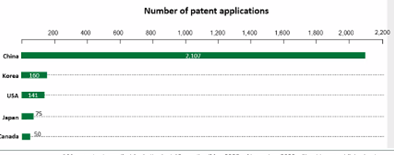
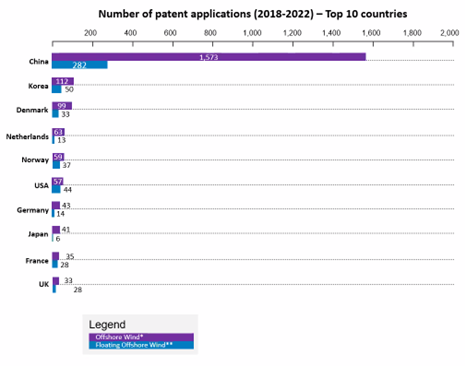
In 2018-2022, Japan ranked fourth in global geothermal patent applications and eighth for offshore wind, said UK-based Sagentia Innovation during a World Intellectual Property Organization webinar.
Japan filed 75 geothermal patents. China 2,107; South Korea 160; and the U.S. 141.
Japan filed 41 offshore wind patents, of which six were related to floating systems. China was top with 1,573, of which 282 were for floating systems. Second was South Korea followed by Denmark, and the Netherlands.
MHI and Indonesia’s Institut Teknologi Bandung (ITB) will extend their R&D effort, building upon last year’s ammonia-fired power generation research in gas turbines.
The goal is to integrate such technology into MHI’s H-25 gas turbine. The project promotes ammonia co-firing in Indonesia.
CONTEXT: In 2020, MHI and ITB signed an MoU to work on clean energy and power plant data analysis. In 2022, they extended the MoU for an extra five years. A new focus emerged in the research, centering on ammonia-fired power generation.
Renova launched commercial operation of its biomass power plant (Sendai Gamo Biomass), in Sendai, Miyagi Pref. The 75 MW plant generates electricity using wood pellets and palm kernel shells (PKS) as fuel.
The plant is expected to generate 553 GWh per year. The electricity will be sold at ¥24/ kWh (excluding tax) under the FIT system.
The operator, Morinomiyako Biomass Energy, is a JV formed by Renova, Sumitomo Forestry, Mizuho Leasing, etc
TAKEAWAY: The company leases the plant site from Sendai City, which has strict rules on solar panel installation. But this biomass plant shows that despite Japan’s reluctance to make new investments in renewables, municipalities are warming up to projects with big potential under the national govt’s improved management plans such as the one set for Miyagi.
The NRA discussed changes to safety regulations of TEPCO’s Kashiwazaki-Kariwa NPP (Niigata Pref). The NRA approved TEPCO’s application that includes clarifying the president’s leadership. The changes are expected to soon be authorized.
CONTEXT: The NRA is conducting extra inspections on the Kashiwazaki-Kariwa NPP due to inadequacies in counter-terrorism measures.
TAKEAWAY: It’s too early to say if TEPCO’s only operable NPP is now moving towards a restart, but this is one of the first notable positive news the utility has received in a long time. This augurs well for TEPCO to cautiously proceed with restart plans for 2024.
Chugoku Electric and KEPCO plan to build an interim storage facility for spent nuclear fuel in Kaminoseki, Yamaguchi Pref.
As of Nov 19, Chugoku Electric hadn’t begun the forest clearing for the project.
On Nov 20 Chugoku Electric said it’s still preparing a detailed explanation to local governments. Literature research has been conducted, but they can’t start the boring survey without completing the forest clearing.
TAKEAWAY: As the spent nuclear fuel storage capacity for Chugoku Electric and KEPCO’s NPPs reaches its limits, building an interim storage facility is very important. However, it’s still not clear when and where such a facility will be built, and delays don’t help. Without such a facility, they’ll have to enlarge on-site storage facilities at the NPPs, most likely facing further opposition from local communities. Also, the lack of appropriate spent nuclear fuel storage hinders the govt’s plan of a fully closed nuclear fuel cycle.
KEPCO will drastically scale back plans to build wind farms across four towns in Hokkaido’s Goshi region; this is in response to opposition from environmental groups and local communities.
The company has removed the town of Niki from the plan and will reduce the number of wind turbines from 64 to 18. The site of the wind farm will now be limited to two towns – Furubira and Yoichi.
In documents sent to the MoE on Nov 21, the company revised the projected power output, reducing it from the planned 269 MW to 76 MW.
It’s unclear when the revised wind farm will begin operation.
Sojitz and Energi Mitra Investama (EMI), the largest rooftop solar firm in Indonesia, set up a JV for decarbonization solutions such as roof-mounted solar power for industrial and commercial use.
Surya Nippon Nusantara (SNN) plans to install a total of 100 MWp of solar power capacity by 2030, mainly for businesses.
CONTEXT: Indonesia pledged carbon neutrality by 2060. Currently, it relies on coal for more than 60% of its electricity generation. Sojitz operates 70 MW of solar in Indonesia and plans to develop storage batteries, EV-related business, energy conservation, as well as hydrogen, ammonia, and biofuels.
Osaka Gas acquired a 40% stake in the Sano solar farm operated by Sonnedix, a global renewables producer. The investment helped the firm reach its interim expansion goal of 2.5 GW.
The plant has a 42 MW capacity. Osaka Gas will purchase all generated electricity through wholesale and will use it with non-fossil fuel certificates for distribution.
CONTEXT: The Daigas Group that owns Osaka Gas seeks to acquire 5 GW of renewable energy capacity in Japan and abroad by 2030.
Panasonic will do a demo of electricity supply and demand operation at its UK subsidiary to cover 100% of the energy consumed with renewables, using pure hydrogen fuel and solar cells.
The demo in Cardiff begins in 2024. The firm has installed 21 pure hydrogen fuel cells, solar power generation, and a 1 MWh power storage system.
CONTEXT: Since 2022, Panasonic has been operating the world’s first carbon neutral manufacturing plant in Kusatsu (Shiga), which runs on solar power and hydrogen systems. The power cost, however, has increased over three-fold by going carbon neutral, a company official told Japan NRG earlier.
Fujifilm’s U.S. subsidiary signed a virtual PPA (VPPA) for 300 GWh of solar power that will switch almost all of its power used in the U.S. and Canada to renewables.
The subsidiary, which procures power for all group sites in North America, signed a 15-year contract with National Grid Renewables, a U.S. energy firm, to purchase electricity from a solar plant to be built in Blevins, Texas.
The VPPA will cover about 9% of Fujifilm group’s global annual CO2 emissions.
Mitsui decided to sell all of its shares (28%) in International Power Holdings (IPAH), which operates power generation and electricity and gas retail services in Australia.
The shares were sold to a subsidiary of ENGIE (France), which now has full control of IPAH. The value of the deal wasn’t disclosed.
CONTEXT: Set up in 2003, IPAH’s business focus is thermal and wind power generation, as well as electricity and gas retail services.
NTT Anode Energy plans to build a solar power plant with a maximum capacity of 47 MW in Sumoto, Hyogo Pref. Operation is slated to start in late 2025.
It will be on flat land, without any tree cutting.
TEPCO completes third release of Fukushima treated water
(Japan NRG, Nov 20)
TEPCO completed the third round of treated water discharge from Fukushima NPP.
Another round will be completed by the end of the current fiscal year.
CONTEXT: Over the next 30 years, TEPCO will release into the sea about 1.34 mmt of treated water that’s held in 1,000 tanks at the NPP’s site. The total amount of tritium released will be around 5 trillion becquerels, well below the annual limit of 22 trillion becquerels.
NEWS: OIL, GAS & MINING
Japan pushes LNG importers to secure long-term contracts
(Bloomberg, Nov 21)
The govt wants LNG importers to sign long-term supply contracts to boost energy security and avoid supply disruptions and sanctions on Russian exports.
Japan seeks stable gas supplies while transitioning to clean energy sources. Japan will continue to rely on long-term contracts alongside spot market purchases.
A survey predicts a 30% decrease in Japan’s annual long-term LNG supply contracts over 2022 levels, falling to 55 million tons by 2030.
CONTEXT: In recent months, EU and Asian competitors secured 27-year deals with Qatar. Since 2022, global gas markets have been in disarray. Prices have skyrocketed to historical highs over concerns about energy security.
TAKEAWAY: The anticipated 30% decrease in LNG procurements by 2030 is in large part due to Japan’s plans to restart its dormant fleet of nuclear reactors, and to a lesser extent due to efforts to cut energy consumption through public conservation campaigns. Nevertheless, Japanese firms have still signed a few new long-term deals over the last 18 months, such as the 20-year agreements with Oman signed by trading houses Mitsui and Itochu, and by JERA. Mitsui is also considering taking a stake in the North Field expansion project in Qatar as a way to ensure stable supply of LNG. In recent months, interest in the LNG sector inside Japan’s government has increased with those backing greater usage pointing out that it is also a way to cut coal volumes. The problem from the Japanese buyer’s perspective is that there remains a great deal of uncertainty about domestic demand for gas 10-20 years from now, largely due to the decarbonization trend. So, if the govt is encouraging buyers to commit to long-term contracts, it’s likely also offering some guarantees in that regard.
METI approved JERA’s plan to acquire additional natural gas under the state’s Strategic Buffer LNG to increase stockpiles in case of emergencies. The SBL system formally launches in December.
The govt will finance costs required for stockpiling. Importers are required to submit purchase plans in advance.
The two ruling coalition parties and the opposition National Democratic Party will discuss possible cuts in the gasoline tax, said METI minister Nishimura. METI will draft a plan following the talks.
During the Nov 22 parliament session, NDP leader Tamaki urged PM Kishida to cut the gasoline tax and Kishida replied he will consider it,
CONTEXT: Govt levies ¥53.8/ liter gasoline tax and other taxes at retail outlets. There is a trigger clause in the tax rule that allows the govt to reduce the tax if it determines the fuel price rise is insupportable. In 2011, the government froze the trigger clause, to use the tax proceeds to finance reconstruction from the Tohoku earthquake.
TAKEAWAY: This may be the beginning of an exit from the two-year long energy subsidies. The previous plan was to terminate the subsidies in September this year.
LNG stocks of 10 power utilities was 2.49 million tons as of Nov 19, up 3.3% from 2.41 million tons a week earlier.
This is the 8th week in a row that weekly stocks have increased. It’s 17.5% higher than the 2018-2022 average at the end of November, which was 2.12 million tons.
ANALYSIS
BY CHISAKI WATANABE
Off-Grid Renewables on Islands to Cut Reliance on Diesel Generators
Shifting a country’s entire energy system to renewables is challenging, but experiments in smaller, isolated grid areas could pave the way to understanding how to achieve a higher adoption of green electricity in Japan.
While Japan comprises more than 14,000 islands, most of the population lives on five large islands – the mainland (Honshu), Hokkaido, Shikoku, Kyushu, and the main Okinawa isle. But there are another 300 smaller isles that require power to sustain their residents.
Some of these small islands, called rito (離島; “remote island”), rely on an undersea power cable to connect with the grid. Others rely on standalone diesel generators as they are too small to support a regular-sized thermal power plant.
This situation is being turned into an opportunity by local authorities and power companies to experiment and install new energy systems to deploy more renewables. But far from being an isolated and local affair this trend is receiving support on the national level.
Policy update
In April, Japan updated the Remote Islands Development Act to add deployment of renewable energy on remote islands to key roles these islands play. The act, which covers 256 rito, bypassing only those in the Okinawa, Ogasawara and Amami areas, stipulates that the central and local governments will provide support to effectively and efficiently develop renewable energy systems on rito.
The regulatory change is supported by an informational campaign. The MoE has released a handbook for developers and local officials on how to improve energy self-sufficiency rates for renewables on remote islands, as well as best-practices ideas.
Switching an island from fossil fuels to renewables carries a number of advantages, only some of which are environmental. As well as reducing emissions, replacing diesel generators with solar panels, for example, avoids blackout risk that comes with typhoons and tsunami blocking new fuel deliveries; lowers labor demands for facility maintenance; cuts operational costs.
In short, according to MoE, a renewables system on a remote island improves its resilience to natural disasters, as well possibly boosting the local economy.
The know-how gained from clean power systems on rito could then be elevated to a regional level, supporting a broader decarbonization push in Japan, the MoE posits in the handbook.
There’s a little-known benefit for those living on the bigger islands of Japan, too. Current rules stipulate that energy costs for residents on remote isles should be comparable to users elsewhere. This “universal service for remote islands”, was introduced in April 2016, and spreads the costs to generate power on remote islands on the shoulders of all ratepayers.
This leaves the rest of the country subsidizing the expense of ferrying diesel and other petroleum fuels to remote locations and back. It is hoped that more solar and wind would significantly reduce the bills to generate electricity on remote islets.
Case study 1: Kagoshima
Kagoshima Prefecture in southwest Japan has 26 remote islands with a combined population of 160,000. Much of the local electricity is generated from burning heavy oil.
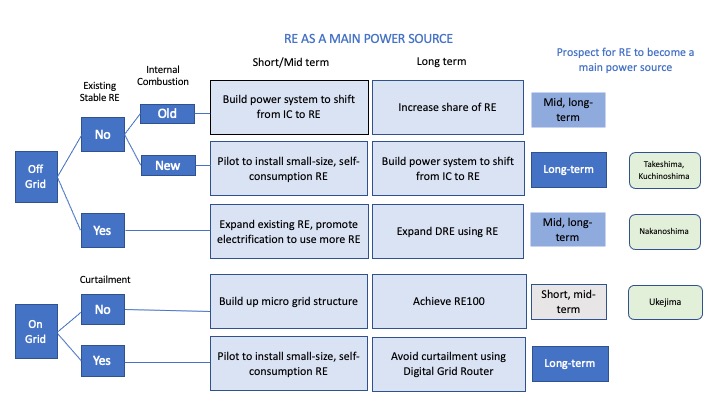
The prefecture released a report in March that identified several models for smaller islands to use renewables as a main source of electricity. The report was based on a study of power supply and demand, and the cost and technology challenges faced by four islands (Kuchinoshima, Nakanoshima, Takeshima, and Ukejima), and the potential for green systems.
The report picked a suitable model for each island taking into account variables and conditions such as the age of their main power facilities, undersea cable connection to bigger islands, and the ways the island wants to use renewable energy. The main local industries are agriculture, cattle raising, and fishing.
Table 1 is the conclusion from the report for each of the four islands.
Chart 1
Source: Kagoshima Prefecture
Table 1
Island
Population
Recommended models and projects
1 Kuchinoshima
99
RENEWABLE ENERGY SELF-CONSUMPTION / SMART INDUSTRY MODEL
Pilot for self-consumption of solar power at public facilities
Pilot for self-powering island industries
2 Nakanoshima
142
UTILIZATION OF STABLE RENEWABLE POWER SUPPLY MODEL
-Pilot for demand response at public facilities using renewables, EV and chargers
-Pilot for utilizing water resources
3 Takeshima
58
MICRO-SIZE ISLAND MODEL
-Installation of PV, batteries at local school and facility
-Pilot to make renewables a major power source for public buildings
4 Ukejima
90
MICRO-GRID STRUCTURE BUILDING MODEL
– Deployment of PV at public facilities
– Building of micro grid using renewables
Source: Kagoshima Prefecture
Case study 2: Okinawa
In Okinawa, Okinawa Electric supplies electricity to 38 inhabited islands in the region. Because of its geography, the area is not connected to the transmission lines of other EPCOs. Ten of the remote islands in the region are not even connected to the main island of Okinawa.
As a result, the small islets rely on oil-fired generators, which makes them susceptible to hikes in the price of crude and also delivery fees. Okinawa Electric actually takes a loss in order to supply these remote islands with electricity, but according to a company document in May renewables have contributed to reducing the use of fossil fuels on some islands.
Miyakojima
Population: about 50,000 Location: about 287 km southwest of the main island of Okinawa
Miyakojima Mirai Energy Company (MMEC) offers a service to install residential solar panels and batteries for free, with options to add EV chargers and “Eco Cute” heat pump water heaters. Users pay for solar power from their rooftops, which is cheaper than electricity from Okinawa Electric. In case of blackouts, the storage battery provides electricity. MMEC sells excess power to Okinawa Electric.
Tesla supplies its Powerwall storage batteries for the project and more than 300 units have been installed on the island, according to Tesla. A total of 600 Powerwall units are expected to be installed by the end of 2023. That will contribute to achieving the island’s target to have 49% of its electricity supplied by renewables by 2050, according to the company.
The island is also looking to use green hydrogen. In a pilot project supported by the NEDO, Okinawa Electric, Nextems, and the Central Research Institute of Electric Power Industry (CRIEPI) will study the potential for hydrogen derived from renewables. The group also plans to put together an action plan for local consumption of hydrogen.
Haterumajima
Population: 454
Location: Japan’s southernmost inhabited island, about 460 km southwest of Okinawa.
Two wind turbines that can be tilted to prepare for approaching typhoons were installed in 2009, the first such turbines to be set up in Japan. A “tiltable” turbine has two blades, instead of the typical three, and the tower is supported by four wires.
The installation came after many turbines were knocked down by typhoons, leading to costly repairs due to the expense of transporting and leasing heavy machinery.
Okinawa Electric decided to try a turbine made by French company Vergnet which can be tilted nearly 90 degrees before a typhoon arrives. The utility won approval from Vergnet to make the turbine towers in Japan to adjust specifications to Japanese requirements. Eventually, two 38-meter turbines with 245kW of capacity each started operating in December 2009. Five more were installed on three other Okinawa islands.
So far, no further damage to the turbines has been recorded. The units provide about 20% of electricity on Haterumajima, and 10% on Minami Daitojima. Five tiltable turbines have also been supplied to the island nation of Tonga in an official development assistant program by the Japan International Cooperation Agency.
In 2016, Okinawa Electric began testing the feasibility of maximizing the use of wind energy on Haterumajima in a pilot hosted by the Okinawa prefectural government. Aside from the two tiltable turbines (245 kW each), the island already had a 1,500 kWh lead-acid battery, and a diesel generator (1,250 kW). A 300 kW set of a motor and generator was added to the system so it can be switched on when electricity from wind turbines exceeds demand.
Diesel generators can only reduce their output to 50% of capacity, while motor-generator sets are not bound by the same rule, which means that motor-generators can reduce their output to better match wind generation with actual demand. Excess wind power can also be stored in the battery, which can then be used to start the motor-generator set. After some trial and error, the island was able to run on 100% wind power for 10 straight days from late November to early December, 2020.
Seeing a larger business opportunity in these projects, Okinawa Electric in April 2021 founded a company called SeED Okinawa to expand its renewable and grid business abroad. Okinawa wants to build on its expertise in expanding renewables and stabilizing the grid with storage batteries on remote islands and provide services to small islands outside Japan.
Challenges remain despite all the innovations and progress that have been made. Projects often rely on subsidies. There is no one single model that fits all of these islands. Even so, pushing ahead with the decarbonization of electricity supply by adding more clean energy and storage devices on small islands offers many benefits including reduced CO2 emissions from diesel generators and a backup power source to prepare for disasters and blackouts.
ANALYSIS
BY MAYUMI WATANABE
Hydrogen Tech Becomes a Fashion Trendsetter
A new rule in France that requires producers of waste-generating consumer products to disclose data on recyclability is having a ripple effect in Japan. The rule was introduced only this year, but it has already accelerated the fashion industry’s efforts to reduce its CO2 footprint and even helped give birth to one of Japan’s hottest startups.
Japan’s textile exports are strongly dependent on European high fashion brands as clients. And while the domestic textile industry has always looked at ways to improve efficiency and engaged in some recycling, concern about the environmental impact of the world’s No. 3 polluting industry has set off a whirlpool of creative thinking among Japanese fashion companies.
The change has been a boon for Biotechworks-H2, a startup that turns textile waste into a feedstock for making hydrogen. Founded in Tokyo only in July, the company has launched three domestic hydrogen production projects and is preparing another in Malaysia next year, claiming that it will supply “green” H2.
Concern over how to transform industrial waste into new products of value isn’t limited to Japan’s fashion industry. Waste-recycling initiatives are starting to pop up in the agri, food, and even steel sectors. They are driven both by regulatory pressure and advances in material reprocessing. As we enter the Recycling 2.0 era, in which an old textile can be reborn not only as a new textile, business opportunities are arising for those willing to seek creative “second-life” solutions for second-hand resources.
Producing hydrogen from fashion pollution
‘Damaged’ jeans are a standard line in casual clothing, with some designers taking this concept further, deliberately making a $10,000 coat look mangled and used. In the West, the roots of damaging clothes, especially jeans, stems back to young people expressing anger against social norms and institutions, but over the years the look has become a mainstream fashion trend.
In Japan, some consumers have mistakenly assumed that the ‘damaged’ look was about supporting sustainability in fashion. But actual efforts to collect old, unused clothing for recycling have been few and far between.
Tokyo startup Biotechworks-H2 decided to seize this opportunity. Its business model is collecting waste from customers, the apparel manufacturers and retailers, and providing them with CO2 reduction certificates. Then, it can use the collected items as feedstock to make green hydrogen.
The Ministry of Environment estimates that each year Japan’s population throws away 800,000 tons of clothing, of which only 300,000 tons are reused or recycled, and 500,000 tons incinerated.
What Biotechworks-H2 does is cut the used textile into 10 x 10 centimeter pieces and treat them with plasma technology to decompose the material into hydrogen, CO2 and other gases. Compared to heating textile (which is how most of it is recycled today), the CO2 release is 82% lower, said the founder Nishikawa Akihide.
The company could then sell CO2 as dry ice, such as to carbonated drinks manufacturers, and offer hydrogen to power suppliers. The company also offers licensing of its textile treatment plant.
One of the startup’s facilities costs ¥3-5 billion for a 2,000 square meter site, excluding pre-waste treatment and hydrogen purification equipment. The 2,000 square meters site is large enough for a 100 tons/ day waste processing capacity.
In California, Biotechworks-H2 has a pilot plant of 30 tons/ day; five kilos of city waste generates 0.45 kg of hydrogen; polyester textiles 6% hydrogen, cotton textiles 8% of the weight of the material,” Nishikawa said.
Polyester textiles account for the largest share of textile waste, around 60%. In theory, they’d potentially generate 16,000 tons/ year of hydrogen if converted into gasses rather than disposed of at incinerators. The table below shows the breakdown of textile waste by destination.
Textile waste destination
Total amount of clothes thrown away
712,000 tons / year
15% recycled into textiles and other chemical products
19% resold at flea markets, recycle shops and reused
66% thrown away
25,000 tons reused
445,000 tons incinerated and buried
Source: Ministry of Environment
In 2025-26, the company plans to bring online textile-waste-to-hydrogen plants in three municipalities in Japan and one in Malaysia. The latter may start ahead of the Japanese sites, depending on regulatory approval. Nishikawa said his long-term goal is to build a plant in every municipality, which would allow places without solar power to source their own green hydrogen.
In October, Opa, the apparel arm of the major retailer Aeon, inked a partnership with Biotechsworks-H2. Starting 2025, Opa will collect used clothing at its outlets, and will use the hydrogen to power its facilities. To date, 33 companies in Japan, China and Southeast Asia have expressed intention to collaborate with Biotechsworks-H2.
New sustainable fashion materials
Some Japanese textile makers are looking at switching to materials that can be recycled without the need to resort to chemicals.
Nagoya Spinning is starting to combine waste leather shreds, polyester, polyurethane and nylon to produce “hybrid leather” for wallets and bags.
Chiba-based Kashiwa Leather is developing a prototype of peanut leather using waste peanut skins from peanut snack processing plants.
Miyagi-based Amu collects old nylon fishing nets and recycles them into T-shirts, rain coats and 14 other products.
Tokyo-based Nichimou makes apple leather containing 66% apple waste and pulp, and 34% water-based polyurethane. The latter element doesn’t contain the harmful toluene or dimethylformamide chemicals.
Partly, this innovation is driven by demand for new materials from companies that want to redesign their employee uniforms to reflect their sustainability philosophy, said an official from Tokyo-based Wansie Uniform. The company’s clients, which include apparel firms, jewelry retailers, services providers and manufacturers, have diverse goals ranging from reducing carbon footprint, raising recycling rates, and reducing waste to zero.
“They want materials that are completely biodegradable, last long but look good enough to raise the corporate image,” he said, adding that manufacturers in particular tend to rigorously measure the carbon footprint of the uniforms.
Producing textiles from steel emissions
A completely different approach to recycling textiles would be to make the original material with waste from other industries, such as plastic bottles or even industrial emissions.
Aichi-based Moririn Corporation, founded in 1903 and perhaps the oldest among waste recycling firms, decided to develop a new synthetic textile made from ethylene glycol (EG) which comprises carbon monoxide, CO2 and hydrogen. The company calls the process “Coupcle”. It generates 0.08 kg of EG from emissions released from 1 kg of steel production. Carbon footprint of the recycled EG is 55% less than virgin EG, the company said.
To source the gases necessary to produce the new material, Moririn decided to approach a major Tokyo-based steelmaker, thinking that it would prove to be a mutually beneficial collaboration. Moririn asked for space in the steelworks to collect exhaust gases from one of the blast furnaces.
Unexpectedly, the steelmaker refused and even got angry, a Moririn official said.
“We were literally told, get out of here. We are not a dirty enterprise. We are one of the cleanest steelmakers in the world and we’ve worked very hard to get here,” the official told Japan NRG.
Later, Moririn was able to find a partner in China.
Regulatory pressure pushes sustainable fashion
Thanks to the EU’s push for greener fashion, Japanese apparel makers have started replacing the lining of fabrics with sustainable textiles. Experimentation with treating old textiles with chemicals is proliferating, though still at an early stage as producers look to create the materials that fashion brands might want to actually use.
Equally, Recycling 2.0 can only take off if there are commercial avenues to recoup the investments. Biotechworks-H2 has latched onto the recent boom in hydrogen to build its business, but others may need to explore other products. Among those that may be promising are ammonia made from plastic and food wastes, and bioethanol made from cotton waste.
In any case, the Japanese fashion industry has to act. “The European clients of Japanese apparel products may make business decisions based on carbon footprints,” METI has warned the industry. Consumer demand for ‘green’ products and regulatory pressure will likely bring more variety in recycled products to the fore.
This winter Tokyo’s fashion trends are glitter and vivid colors to celebrate rejuvenation from COVID. The style is still street-driven and anything oversized or undersized is “in”. Perhaps wearing a “vegan” leather coat and accessorizing with waste-derived sequins will help consumers feel real support for sustainability.
ASIA ENERGY REVIEW
BY JOHN VAROLI
This new weekly column will replace Global View and will focus on energy events in Asia and those that directly impact markets in the region.
China / Bioenergy
China has the highest bioenergy capacity globally at 19 GW, accounting for 27% of the total. Next is Brazil with 13.3 GW; the U.S. with 7.8 GW; the UK with 4.3 GW; Indonesia with 3.9 GW; and Japan with 2.8 GW. China also has 7.6 GW of prospective capacity which is 39% of global projects announced or in construction.
China / Energy projects
Some 72 out of the 481 power projects under the Belt & Road Initiative have been canceled or put on hold due to China’s halt of building coal projects abroad, reports Wood Mackenzie. Of those on hold, over 60% were in Asia, and 32% in Africa. These included 33 GW of coal.
Coal
The World Coal Association has rebranded into a new organization, FutureCoal. This is part of an effort to modernize the coal industry. “The total contribution of coal and the growing global population should not be dismissed. Coal… will be needed in any energy transition,” said Michelle Manook, CEO of FutureCoal.
India / Coal
In contrast to the G7, India has asked private firms to invest in new coal-fired power plants to meet rising electricity demand. Coal now accounts for 36% of India’s total installed capacity.
Indonesia / Energy transition
The country’s energy transition plan is ready, with an outline of the $20 billion investment for the Just Energy Transition Partnership that’s backed by the G7. However, the plan faces criticism that it doesn’t address the spread of off-grid coal-fired power plants.
Indonesia / Geothermal
The market cap of Barito Renewables Energy soared sixfold since going public a month ago, to 840 trillion rupiah making it the second-most valuable company on the IDX exchange. Barito operates three geothermal power plants on Java through subsidiary Star Energy Geothermal, with a total power generation capacity of 890 MW.
Malaysia / Solar
JLand Group and Cenergi SEA Berhad, a subsidiary of UEM, inked a partnership to invest $29 million to develop rooftop solar and energy efficiency to power Johor industrial parks.
Pakistan / Grid
The Asian Development Bank (ADB) approved $250 million in loans for ADB’s Power Transmission Strengthening Project to support the power grid and increase transmission volume. The goal is a high-voltage transmission of 500 kV and 200 kV, and upgrade transmission lines to reduce power losses.
Philippines / Nuclear power
The U.S. and the Philippines inked a deal that will allow the export of nuclear technology and material to Manila. “We see nuclear energy becoming a part of the Philippines’ energy mix by 2032”, said President Ferdinand Marcos Jr.
UAE
Abu Dhabi Future Energy (Masdar), with Abu Dhabi National Energy and EDF Renewables, launched the largest single-site solar power plant ever, with a 2 GW capacity. The Al Dhafra project will cancel over 2.4 million tons of CO2 annually.
2023 EVENTS CALENDAR
A selection of domestic and international events we believe will have an impact on Japanese energy
ASEAN-Japan summit to mark 50 years of cooperation
Last market trading day (December 30)
Disclaimer
This communication has been prepared for information purposes only, is confidential and may be legally privileged. This is a subscription-only service and is directed at those who have expressly asked K.K. Yuri Group or one of its representatives to be added to the mailing list. This document may not be onwardly circulated or reproduced without prior written consent from Yuri Group, which retains all copyright to the content of this report.
Yuri Group is not registered as an investment advisor in any jurisdiction. Our research and all the content express our opinions, which are generally based on available public information, field studies and own analysis. Content is limited to general comment upon general political, economic and market issues, asset classes and types of investments. The report and all of its content does not constitute a recommendation or solicitation to buy, sell, subscribe for or underwrite any product or physical commodity, or a financial instrument.
The information contained in this report is obtained from sources believed to be reliable and in good faith. No representation or warranty is made that it is accurate or complete. Opinions and views expressed are subject to change without notice, as are prices and availability, which are indicative only. There is no obligation to notify recipients of any changes to this data or to do so in the future. No responsibility is accepted for the use of or reliance on the information provided. In no circumstances will Yuri Group be liable for any indirect or direct loss, or consequential loss or damages arising from the use of, any inability to use, or any inaccuracy in the information.