
JAPAN NRG WEEKLY
APRIL 22, 2024
JAPAN NRG WEEKLY
APRIL 22, 2024
NEWS
TOP
- JERA launches global renewables firm based in London, sets 20 GW goal by 2035
- KEPCO’s electricity generation from nuclear in FY2024 expected to be highest since 2011
- Osaka Gas, Sumitomo, etc invest in India’s gas networks through Singapore fund
- MLIT revises guidelines for climate disclosures in real estate sector
- Paris Agreement exit strategy urged depending on U.S. elections
- MoE includes CO2 removal by concrete in 2022 GHG report
- Panasonic Energy has new Li-on facility in Osaka, will boost R&D
- NEDO awards grant to Nippon Steel hydrogen steel project
- KEPCO, American WiTricity to promote wireless power transfer
- Mitsubishi joins DAC project in the U.S. that’s led by Shell
- Iwatani to hike price of hydrogen by 36% amid rising costs
- EEX adds TTF and JKM derivatives to LNG futures to lessen risk
- JERA-affiliated offshore wind farm to supply power to data center
- Vena Energy begins construction of largest wind farm in Fukui
- J-Power to acquire Australian renewables firm Genex Power
- TEPCO to test safety equipment at Kashiwazaki-Kariwa Unit 7
- IAEA starts review at one of the units of Mihama NPP
- Nuclear Disaster Council has survey results on Noto earthquake
- MOL to acquire carrier to transport offshore wind components
- Mitsui, Mitsubishi to produce LNG with 90% emissions reduction
- Idemitsu increases stake in Fuji Oil, buys shares from JERA
- March oil imports slide, thermal coal deliveries drop by a tenth
ANALYSIS
HOW JAPANESE STEEL IS TURNING
GREEN: PART 1
Japan has great expectations for the steel sector, and domestic firms are set to receive the biggest slice of state R&D financing for clean tech. As the top industrial emitter, the steel sector could make the biggest difference in efforts to meet national CO2 emission reduction goals. Changing how steel is made could drive a shift in many other industries and help deliver on economic growth. Japan NRG put together a roadmap for the sector, noting what’s required to transition to new technologies and potential bottlenecks.
MARKET PLAYERS CALL ON METI TO INDUCE CAPACITY MARKET TOWARD RENEWABLES
Recent changes in Japan’s energy trading sector have drawn a strong response from major players who now call on the government to make the market more suitable for renewable energy sources. In response to METI’s review of current electricity trading platforms, these major players have told the ministry to either scrap the capacity market or revise it in a way that will stimulate the construction of clean energy generation capacity.
ASIA ENERGY VIEW
A wrap of top energy news that impacts other Asian countries.
EVENTS SCHEDULE
A selection of events to keep an eye on in 2024.
JAPAN NRG WEEKLY
PUBLISHER
K. K. Yuri Group
Editorial Team
Yuriy Humber (Editor-in-Chief)
John Varoli (Senior Editor, Americas)
Mayumi Watanabe (Japan)
Wilfried Goossens (Events, global)
Kyoko Fukuda (Japan)
Magdalena Osumi (Japan
Filippo Pedretti (Japan)
Tim Young (Japan)
Regular Contributors
Chisaki Watanabe (Japan)
Takehiro Masutomo (Japan)
Events
SUBSCRIPTIONS & ADVERTISING
Japan NRG offers individual, corporate and academic subscription plans. Basic details are our website or write to subscriptions@japan-nrg.com
For marketing, advertising, or collaboration opportunities, contact sales@japan-nrg.com For all other inquiries, write to info@japan-nrg.com
OFTEN-USED ACRONYMS
|
METI |
The Ministry of Economy, Trade and Industry |
mmbtu |
Million British Thermal Units | |
|
MoE |
Ministry of Environment |
mb/d |
Million barrels per day | |
|
ANRE |
Agency for Natural Resources and Energy |
mtoe |
Million Tons of Oil Equivalent | |
|
NEDO |
New Energy and Industrial Technology Development Organization |
kWh |
Kilowatt hours (electricity generation volume) | |
|
TEPCO |
Tokyo Electric Power Company |
FIT |
Feed-in Tariff | |
|
KEPCO |
Kansai Electric Power Company |
FIP |
Feed-in Premium | |
|
EPCO |
Electric Power Company |
SAF |
Sustainable Aviation Fuel | |
|
JCC |
Japan Crude Cocktail |
NPP |
Nuclear power plant | |
|
JKM |
Japan Korea Market, the Platt’s LNG benchmark |
JOGMEC |
Japan Organization for Metals and Energy Security | |
|
CCUS |
Carbon Capture, Utilization and Storage | |||
|
OCCTO |
Organization for Cross-regional Coordination of Transmission Operators | |||
|
NRA |
Nuclear Regulation Authority | |||
|
GX |
Green Transformation |
NEWS: ENERGY TRANSITION & POLICY

JERA launches global renewables firm based in London, sets 20 GW goal by 2035
(Company statement, April 15)
- Japan’s largest power company, JERA, has launched a global renewables subsidiary, JERA Nex, with its HQ in London.
- The news came with JERA’s announcement of its new goal to develop 20 GW of renewable power generation capacity globally by FY2035.
- JERA Nex will develop, invest in and operate a range of renewable energy assets, including offshore and onshore wind, solar power and battery energy storage systems.
- CONTEXT: In 2023, JERA acquired Belgium-based offshore wind developer Parkwind in a €1.55 billion deal, boosting its total renewable installed power capacity to 3 GW. Parkwind operates across north Europe and even in New Zealand, and is now a major player in Norway’s growing offshore wind sector. JERA Nex will take over the majority of the group’s assets and 10 GW development pipeline.
TAKEAWAY: JERA was started as a collection of ‘cast-off’ coal and gas-fired power assets of TEPCO and Chubu Electric. It was created partly to help TEPCO separate its thermal fleet from the liabilities of the Fukushima disaster, but also with the idea that the parent companies would have more scope to focus on other, cleaner forms of energy. And yet, less than a decade since its founding, it is JERA that is moving aggressively into clean energy (without abandoning its coal and gas plants). TEPCO and Chubu Electric’s forays into renewables, nuclear and other forms of clean energy sources have been far less pronounced.
Over the past few years, JERA has forged partnerships with a number of leading energy companies in allied nations in North America and Europe, as well as in India and Southeast Asia; cooperating in a wide range of clean energy activities that hold the most potential, ranging from ammonia production to offshore wind.
For Japan to claim that it’s among the leaders of the decarbonization movement, it needs its top power companies to have global scale and global clout. JERA is making a claim that it can play that role better than the utilities that seeded it.
- SIDE DEVELOPMENT:
JERA, India’s ReNew ink 100,000 tons / year green ammonia deal
(Company statement, April 19)- JERA and India’s ReNew E-Fuels Private Ltd inked a deal to produce 100,000 tons / year of green ammonia in the Odisha state of India. All production will supply JERA.
- Renewable power supplies of almost 500 MW will be utilized to produce hydrogen and convert it into ammonia.
- CONTEXT: ReNew is one of India’s leading decarbonization solutions companies, with a clean energy generation capacity portfolio of over 13.5 GW.
MLIT revises guidelines for climate-related financial disclosures in real estate sector
(Nikkan Real Estate Economic News, April 15)
- The Ministry of Land, Infrastructure, Transport and Tourism (MLIT) has revised guidance for handling the Task Force on Climate-Related Financial Disclosures (TCFD) in the real estate sector.
- The guidance contains real-life examples of information disclosure by Tokyu Fudosan, Mitsubishi Estate, Tokyo Tatemono, and other large real estate developers.
- CONTEXT: In 2017, the TCFD first released climate-related financial disclosure recommendations designed to help companies provide better information to support market transparency and more informed capital allocation.
Academics urge Paris Agreement exit strategy, depending on U.S. elections results
(Group statement, April 16)
- 16 academics on energy issues have written a Seventh Basic Energy Plan- Non-government version that cited the need for a Paris Agreement exit strategy depending on the outcome of the U.S. presidential election.
- The group urges a bilateral pact, with the U.S. addressing energy and economic security, making this a basis for building a post-Paris global framework.
- The paper urges re-assessment of climate change impact, as not all weather and environmental phenomena are directly caused by global warming.
- CONTEXT: The authors are on the extreme opposites of the opinion leaders associated with the Renewable Energy Institute, which recently has been attacked for allegedly misleading policy discussions. The group is led by Sugiyama Taishi, Research Director of the Canon Institute for Global Studies.
TAKEAWAY: Debates will become more colorful as various political forces become more assertive. This year, METI will publish the Seventh Basic Energy Plan that outlines policy directions based on long-term outlook, updated every three years. As gaps between the Sixth Plan and reality widen, the next version will include new goals and reset directions. For example, Nikkei reported the next plan will include a 2035 national target to cut emissions by 66% from 2013, and a 2040 energy mix scenario.
MoE includes CO2 removal by concrete in 2022 report: a world first
(Government statement, April 12)
- The MoE reported 17 tons of CO2 were removed by four concrete products in its 2022 GHG inventory report to the UN, a world first.
- The concretes were: CO2-SUICOM that absorbed CO2; SUSMICS-C containing biochar; and T-eConcrete and Clean-Crete N that used industrial wastes as feed.
- The MoE also reported 350,000 tons of carbon removals by seagrass meadows and macroalgal beds, also a world first. The govt is studying adding salt and tidal marshes to blue carbon resources.
- The net GHG release, factoring in the removals that totaled 50 billion tons, was 1.085 billion tons of CO2 equivalent, down 22.9% from 2013. The period under review ran from April 2022 to March 2023.
TAKEAWAY: The MoE says the figures show that the country is on track with its 2030 goal of a 46% GHG reduction. However, the shift away from fossil fuels is still the core net zero solution and the govt needs to show how it is reinforcing this pathway or how other approaches can work at scale.
Panasonic Energy has new Li-on facility, to constitute Japan’s largest R&D battery center
(Company statement, April 11)
- Panasonic Energy completed a new facility in Suminoe (Osaka) for Li-on battery production to meet growing demand in Japan and globally.
- Together with another Panasonic facility in Osaka, the Suminoe facility is expected to constitute the largest battery R&D system in Japan.
- The Suminoe factory will utilize renewable energy, including solar panels on the roof and off-site corporate PPAs
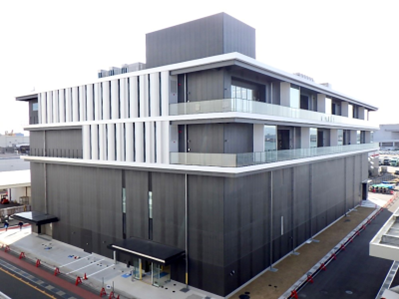
(Panasonic Energy’s new Li-on production facility)
NEDO awards Nippon Steel hydrogen steel project with ¥23 bln over five years
(Government statement, April 15)
- NEDO has awarded Nippon Steel and the Japan Research and Development Center for Metals a project to develop a direct iron reduction (DRI) method using only hydrogen and a new electric furnace to process the reduced iron.
- The goal is to establish a minimum 100 ton / hour (880,000 tons / year) DRI process by FY2028.
- The Green Innovation Fund will provide ¥23 billion over FY2024-2028
TAKEAWAY: Nippon Steel, JFE Steel and Kobe Steel have worked together on other Green Investment Fund steel projects. However, Kobe Steel’s affiliate in the U.S. is a global leader of DRI, and JFE Steel will launch DRI field studies this year. See this week’s Analysis section for further details on ‘green steel’ developments in Japan.
KEPCO, American WiTricity, etc set up council to promote wireless power transfer
(Company statement, April 17)
- Five firms – Kansai Electric, electronic manufacturing firm Daihen, energy service provider Sinanen, Mitsubishi Research Institute and U.S. wireless charging tech firm WiTricity – are setting up an EV Wireless Power Transfer Council.
- The council will promote the application and spread of wireless power transfer for EVs and will:
- formulate and propose introduction and dissemination scenarios and roadmaps
- support demo experiments
- provide guidelines for installation and operation
- study the standards and specifications required for power supply networking
- CONTEXT: EV wireless power transfer is expected to help expand the use of renewables and help adjust the electricity supply-demand balance by enabling power transfer while a vehicle is in motion, as well as to maintain a constant connection between EVs and the power grid.
Mitsubishi joins DAC project in the U.S. that’s led by Shell Gas & Power
(Company statement, April 16)
- Mitsubishi Corp will collaborate with multiple technology companies on Direct Air Capture (DAC), joining a project in Louisiana, U.S.
- The goal is to identify innovative technologies to substantially lower costs, with the goal of facilitating the early commercialization of DAC.
- This project will be in collaboration with Shell US Gas & Power, which is leading the project’s engineering and deployment.
Iwatani to hike price of hydrogen by 36% amid rising costs
(Bloomberg, April 17)
- Amid rising costs, effective June 1, Iwatani Corp will hike the price of hydrogen for FCVs by 36% to ¥1,650/kg, up from ¥1,210/kg.
- CONTEXT: Amid inflationary pressure, ENEOS has raised its FCV-grade hydrogen price by 33% to ¥2,200/kg, effective April 1.
- SIDE DEVELOPMENT:
Mitsubishi Heavy, NGK to develop membranes to retrieve hydrogen from ammonia
(Company statement, April 18)- Mitsubishi Heavy Industries and NGK Insulators will develop a hydrogen purification system composed of membranes that separate hydrogen from ammonia.
- The membranes will be used in a process following ammonia cracking, which is breaking up hydrogen and nitrogen compounds in ammonia gas.
Kawasaki Heavy begins work on 8 MW hydrogen co-fired generator
(Japan NRG, April 15)
- Kawasaki Heavy Industries (KHI) began building a 8 MW power generator fueled by 30% hydrogen and 70% city gas at its Kobe facility. It will start in October.
- The facility’s legacy 7.5 MW generator that runs on city gas will be converted to accommodate hydrogen. Commercial grade hydrogen for FCVs will be used, rather than the high purity liquefied hydrogen the company imports.
- CONTEXT: In 2023, KHI sold and delivered a 8 MW generator to Nisshin Oilio Group, but plans call for it to launch in April 2025. KHI aims to boost its hydrogen-gas co-firing experience.
TAKEAWAY: In theory, these KHI generators accommodate 100% hydrogen firing, but technical skills are required to successfully and safely run them. The next milestone is to run a fully hydrogen-fueled 30 MW system this year at its affiliate RWE Generation in Germany.
MoE seeks proposals for JCM hydrogen projects
(Government statement, April 15)
- The MoE seeks proposals for climate initiatives using hydrogen and other new technologies for use in countries participating in the Joint Crediting Mechanism framework.
- The govt will fund up to half of the project costs. Applications close on June 28.
Diamond Electric’s ammonia ignition system hits world record
(Company statement, April 16)
- Osaka-based Diamond Electric developed a prototype ammonia ignition system for car and ship engines, with energy output of up to 700 milijoules / 220cc.
- This is a world record.
Nippon Life Insurance chairman tapped to lead GX promotion body
(Government statement, April 19)
- METI approved the launch of the GX Promotion Organization, naming Tsutsui Yoshinobu, the Nippon Life Insurance chief, as its chairman.
- The organization will provide financial support, run the emissions trading scheme, collect fossil fuel tariffs, etc. It begins operation in July.
NEWS: ELECTRICITY MARKETS

KEPCO’s electricity generation from nuclear in FY2024 expected to be highest since 2011
(Company statement)
- KEPCO released its NPP maintenance and operation plan for FY2024. The total electricity generated is expected to increase by 10.9% over FY2023 levels, reaching 49 billion KWh.
- The utilization rate of NPPs is expected to increase by about 8.4 percentage points over FY2023 to about 85%. This will likely lead to lower generation costs.
- CONTEXT: All of KEPCO’s seven nuclear units are now operating. The Kansai region is Japan’s second-largest industrial area and second most populated. Before the 2011 Fukushima nuclear disaster, the region’s 11 nuclear reactors supplied almost 50% of the region’s power.
TAKEAWAY: The amount of electricity that these seven units will generate in FY2024 will likely be the highest since 2011 when the country’s nuclear fleet was shut down following the Tohoku earthquake and Fukushima disaster. Importantly, higher utilization rates will likely help KEPCO cut their operating costs and lead to lower electricity prices in the region. That can be used by nuclear proponents to argue for more reactor restarts in other regions.
EEX adds TTF and JKM gas derivatives to LNG futures to mitigate price risk
(Japan NRG, April 15)
- EEX added new futures products related to natural gas and LNG. It now trades Dutch TTF futures and JKM, the LNG spot index for Asia.
- These products can be traded up to six years in advance, allowing Japanese LNG buyers to hedge against price volatility risk. The standard trading unit for both is 10,000 MMBTU.
- The average monthly price of JKM futures is calculated based on daily valuations provided by Platts (Japan / Korea Marker). For TTF futures, the final settlement price is converted into USD on the basis of the euro-denominated price.
- Also, with the addition, the spark spread (the difference between the price for procurement of natural gas and the market price of electricity) can now be fixed by combining it with Japanese electricity futures already available on the EEX.
- CONTEXT: The decision about the addition was made amid growing demand, and in response to calls to mitigate the risk of LNG price volatility in power and gas markets in Japan and elsewhere due to natural gas supply uncertainty.
JERA-affiliated Hokkaido offshore wind farm inked deal to supply power to data center
(Company statement, April 15)
- GPI and Kyocera Communication Systems inked a deal to supply power from the Ishikari Bay offshore wind farm to a data center that KCS plans to open this autumn.
- The 112 MW wind farm, which is owned by GPI, a JV between JERA and Green Power Investment Corp, began operation in January.
- The data center will have a demand of 2-3 MW and will be Japan’s first data center run on 24/7 carbon-free power, using offshore wind power, 6 MWh of BESS power and 1.8 MW of solar power.
- About 80% of the data center’s annual power consumption, when operating at max capacity, will be covered by offshore wind. The remainder will be supplied by solar.
Vena Energy begins construction of largest wind farm in Fukui Pref
(Company statement, April 12)
- Renewables firm Vena Energy began construction of the 50 MW Nimaida onshore wind farm.
- It will be Fukui Pref’s largest. The project is slated for completion in 2026, with 12 wind turbines (4.2 MW each).
- The electricity from the wind farm will be sold to Hokuriku Electric under the FIT.
J-Power to acquire full stake in Australian renewables firm
(Company statement, April 12)
- Electric Power Development (J-Power) began the full acquisition of Australian renewables firm, Genex Power. The deal might be completed by July.
- J-Power currently holds a 7.72% stake in Genex and will invest A$351 million (¥34.7 billion) to acquire 100% of its shares.
- Genex develops, builds, and operates renewable energy and energy storage facilities in Australia. It is currently developing a “clean energy hub” consisting of solar, pumped hydro, and wind power generation in Kidston, Queensland.
- CONTEXT: Final approval of the acquisition requires a Genex shareholders meeting, as well as approval by an Australian court and the country’s Foreign Investment Review Board. The Genex independent committee approved the proposal unanimously, concluding that “the transaction is in the best interest of Genex shareholders as a whole.”
TEPCO to test safety equipment, load fuel at Kashiwazaki-Kariwa NPP Unit 7
(Company statement, April 15)
- TEPCO obtained approval from the NRA for a test of safety equipment at Kashiwazaki-Kariwa NPP Unit 7.
- There will be pre-use inspections before reactor startup and fuel loading.
- CONTEXT: TEPCO thinks the restart of just one unit at Kashiwazaki-Kariwa could lead to a ¥110 billion annual improvement in its finances.
TAKEAWAY: While there’s been a surge in TEPCO’s stock due to expectations of the reactor restarting, TEPCO still needs local consent. Niigata Pref has not yet given its approval, with the governor’s decision crucial. TEPCO has heavy debt related to the Fukushima Daiichi NPP accident, and thus, many investors remain cautious.
- SIDE DEVELOPMENT:
Niigata Pref holds technical meeting on Kashiwazaki-Kariwa NPP safety
(Nikkei, April 16)- Niigata Pref held a technical committee meeting on safety management at Kashiwazaki-Kariwa NPP. A representative of the NRA attended and responded to questions from the prefecture and committee.
- The Niigata Governor views the discussions at the technical committee as one factor in deciding whether to allow the restart of the plant.
IAEA starts review at Mihama NPP Unit 3
(Company statement, April 16)
- The IAEA began a safety review at Mihama NPP Unit 3 for long-term operation.
- CONTEXT: Mihama NPP Unit 3 launched in late 1976. If it gains approval, Unit 3 would be Japan’s first nuclear reactor to restart and surpass 40 years of operation.
- SIDE DEVELOPMENT:
Nuclear Disaster Council releases results of surveys on Noto earthquake
(Government statement, April 12)- The Shiga Regional Nuclear Disaster Prevention Council reported that after the Noto Peninsula earthquake four locations in the Emergency Planning Zones (EPZ) near Shiga NPP had damaged roads and lacked detour routes.
- CONTEXT: The damage reopened debates in Japan about evacuation planning in case of emergency at a nuclear plant. While nuclear power plants are built to withstand a very high level of natural disaster, including earthquakes, the infrastructure around the plan is more vulnerable to disruptions.
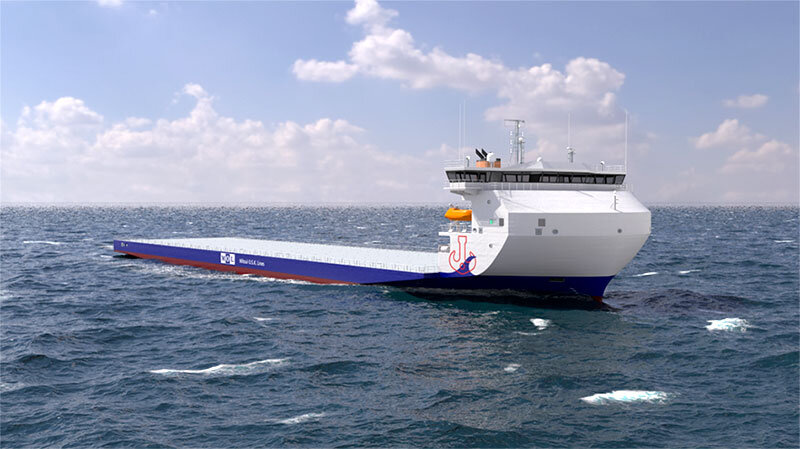 MOL to acquire Japan’s first carrier to transport offshore wind components
(Company statement, April 15)
- Mitsui O.S.K. Lines (MOL) inked a deal with Taizhou Sanfu Ship Engineering in China to build a new module carrier to transport components for offshore wind turbine foundations; this will be the first such coastal module carrier in Japan.
- The vessel is scheduled for delivery in spring 2026. It will transport offshore wind turbine foundations from JFE Engineering’s manufacturing base in Kasaoka City (Okayama Pref) to offshore wind turbine sites.
- It will have a dynamic positioning system (DPS) and a higher weather resistance than non-self-propelled barges, providing direct delivery of cargo to self-elevating platform (SEP) vessels at offshore wind construction sites.
NTT Anode Energy releases environmental assessment for solar plant in Hyogo
(Company statement, April 18)
- NTT Anode Energy disclosed an environmental impact assessment for a 52 MW solar plant in Sumoto City (Hyogo Pref).
- Construction will be over a 1.5-year period, on 67 ha of the permitted 183 ha of forest land under a 30-year land lease agreement.
- Commercial operation is expected to begin within 2 years after construction starts.
- CONTEXT: The project is relatively large-scale for that part of Hyogo Pref. While not yet approved, environmental impact assessments are often issued following a preliminary review by METI. NTT Anode Energy has been working on renewables projects that procure the generated energy and supply electricity to the wider NTT Group, including its planned large-scale data centers.
Taisei and Kaneka set up JV to expand use of exterior power generation system
(Company statement, April 15)
- Japan’s major general contractor Taisei and chemical manufacturer Kaneka set up G.G.Energy to expand sales channels and the use of a system that generates electricity using solar cell modules built in the walls and windows of buildings.
- The system, Green Multi Solar, was developed by the two firms in 2019 but full-scale operation is set to begin this month.

Example of solar modules fitted on a skyscraper
Source: Taisei
NEWS: OIL, GAS & MINING

Osaka Gas, Sumitomo, etc invests in India’s gas networks through Singapore fund
(Company statement, April 15)
- Osaka Gas, Sumitomo Corp and Japan Overseas Infrastructure Investment Corp acquired a minority stake in Natural Gas Transition Platform, a Singapore-based fund investing in city, LNG and biogas distribution networks in India.
- India plans to increase the share of natural gas in its national energy mix to 15% in 2030, up from today’s 7%.
- CONTEXT: Last week, Osaka Gas, Sumitomo Corp and others announced plans to make investments of about $370 million in AG&P LNG Marketing in India.
- SIDE DEVELOPMENT:
Singapore’s EMA and JERA ink MoU on LNG
(Company statement, April 16)- Singapore’s Energy Market Authority (EMA) and JERA inked an MoU on LNG procurement and management.
- CONTEXT: This follows the spirit of an MoU on LNG cooperation inked in Oct 2022 between METI and the Ministry of Trade and Industry of Singapore.
Mitsui, Mitsubishi and Sempra to produce LNG with a 90% reduction of CO2 emissions
(Nikkei, April 12)
- Mitsui, Mitsubishi Corp, and Sempra Infrastructure plan to produce LNG through a process that reduces up to 90% of CO2 emissions compared to conventional methods.
- They aim to transition from gas turbines to electric motors powered by solar power. The process also includes using carbon capture technology.
- CONTEXT: Sempra is the operator of the 12 Mtpa Cameron LNG facility. Together with Japanese partners, Sempra is expanding the Cameron facility to add 6.75 Mtpa, with production expected to begin around 2029. The additional capacity is equivalent to 10% of Japan’s annual LNG demand.
Idemitsu increases stake in Fuji Oil, buys shares from JERA
(Company statement, April 16)
- Idemitsu Kosan acquired 8.75% of Fuji Oil’s shares from JERA, bringing its stake to 21.79%. The deal is valued at ¥2.46 billion.
- The goal is to set up a manufacturing and supply hub for carbon-neutral fuel and petroleum products.
- Key aspects include joint crude oil procurement and distribution. They’ll also invest to develop a decarbonised fuel supply base.
- Idemitsu will appoint two part-time director candidates to Fuji Oil’s board.
March oil imports slide 4.5%, thermal coal even more, but LNG steady
(Government data, April 17)
|
Imports |
Volume |
YoY |
Value (Yen) |
YoY |
|
Crude oil |
12.5 million kiloliters |
-4.5% |
972.8 billion |
2.8% |
|
LNG |
5.6 million tons |
-3.0% |
532.6 billion |
-9.5% |
|
Thermal coal |
7.6 million tons |
-10.4% |
180.2 billion |
-50.8% |
LNG stocks little changed from previous week, down by a third from last year
(Government data, April 17)
- LNG stocks of the 10 major power utilities were 1.61 million tons as of April 14, little changed from a week earlier. The government revised the previous week’s data from 1.6 to 1.61 million tons.
- The reserves are 34% down from end April (2.44 million tons) in 2023, and 20.3% down from the 5-year average of 2.02 million tons.
ANALYSIS
BY MAYUMI WATANABE
How Japanese steel is turning green
Part I : A Blast from the Past
The government has great expectations for the steel sector – perhaps the greatest of all industries in Japan. And it’s putting money behind those expectations. Domestic steel firms are set to receive the biggest slice of state R&D financing for clean tech: At least 20% of the entire Green Innovation Fund.
As the top industrial emitter, the steel sector could make the biggest difference in the country’s efforts to meet CO2 emission reduction goals. But that’s not all. Steel is often defined as one of the four pillars of modern civilization. Changing the way steel is made could drive a shift in a number of other industries and, the government hopes, deliver on economic growth in the net zero era.
So far, details on how the sector has responded to the challenge of revamping almost its entire manufacturing and supply chain have been scant. There is a widely mentioned government target for Japan to forge 10 million tons of “green steel” by 2030, but little explanation around how that label will be applied and what is needed to achieve it.
Based on some recent demonstration projects by Japanese steel firms, and analysis of corporate actions and strategies, Japan NRG has put together a roadmap for the sector, noting what the companies say they require to transition to new technologies and what the bottlenecks may be. Our conclusion is that the government targets are possible, but the conditions required are far from straightforward.
This is the first of a two-part series that delves into “green steel” in Japan.
Worst emitter after electricity generation
In FY2022, the Japanese steel sector emitted 113.8 million tons of CO2 and produced 83.5 million tons of steel. That is 11% of the nation’s emissions of 1,031 million tons, the largest share after the electricity sector. The figures do not include methane and other GHGs.
The biggest reason for emissions in steelmaking is the use of coking coal, which is used in a process known as “reduction” because it removes oxygen from iron ore. This causes 80% of steelmaking’s carbon footprint because as the coal is heated, it releases gases including carbon oxides. In a blast furnace, the gases combine to strip away oxygen from the metallic iron.
As it reacts with oxygen, carbon also releases heat, which melts the iron into a material known as “pig iron”. This takes place in a blast furnace that runs at 900-1,800°C. Next, the pig iron is placed in a rotating furnace to remove silicon, sulfur and phosphorus, before the metal is rolled and shaped into bars, plates and sheets.
This is the process that most of Japan’s steelmakers deploy, but there is an alternative technology to blast furnaces. About 23% of Japanese steel is produced by recycling steel in electric furnaces, which releases half the carbon of a blast furnace. The process required high electricity input, but this isn’t the only challenge. While recycling rates in Japan are high, there isn’t enough scrap to replace iron ore.
Scope 1 emissions from a blast furnace are 1.2 tons per ton of steel. Including emissions from iron ore and coal shipping, as well as the pre-treatment of iron ore (called sintering) needed before it can be added to the blast furnace, the Scope 1 and 2 emissions of one ton of steel comes to around 2 tons of CO2 equivalent.
Low hanging fruit
Like the other industries, Japanese steelmakers first looked to reduce emissions by improving the existing processes using legacy infrastructure. The companies are exploring the possibility of replacing some coal gases with zero-emission hydrogen, and connecting a carbon capture and separation unit to blast furnaces.
Hydrogen as a replacement for coal was a natural choice as the sector’s top players Nippon Steel, Nisshin Steel (now part of Nippon Steel), JFE Steel and Kobe Steel have already spent many years researching new iron reduction technologies using hydrogen or hydrogen-rich natural gas. Some of the R&D goes back more than 20 years, before climate concerns became the global issue that they are today.
The companies were originally driven by the need to diversify feedstock supply sources and to create more flexibility around their technologies. In 2020, these studies were elevated to the status of national projects with state funding, and were dubbed the “CO2 Ultimate Reduction System for Cool Earth 2050” (Course50).
With closer government involvement, there was a push to set more concrete targets. One of the key goals for the Course50 program was to oversee a 30% reduction in emissions in blast furnaces. METI pushed for this to occur by 2030 with the commercialization of techniques that would replace part of the coal gases volume with hydrogen (leading to a 10% CO2 cut) and by installing a carbon separation unit (20% reduction).
This initial limit on hydrogen input – the 10% cap – was decided for technological reasons rather than price considerations. Inside a blast furnace, hydrogen absorbs heat rather than maintaining it like carbon oxides. This requires higher furnace temperatures to compensate and can affect the quality of pig iron production.
Next step
The initial Course50 program is supposed to evolve in time to adapt to a higher hydrogen input. At the stage Super Course50, the idea is to have hydrogen both replace some coal gases in the blast furnace (10%) and at other stages of the manufacturing process inside the steel plant (10%), combining for a 20% emissions reduction. This stage requires more hydrogen supplies to be available and assumes that total emissions could be cut by 50% from present levels.
All these numbers seemed speculative given the lengthy R&D process to date and lack of visible results, but in February this year Nippon Steel announced an encouraging breakthrough. The nation’s top steel producer said that it had managed to install and test a Super Course50 process at its Kimitsu Works in Chiba Prefecture over the last two months of 2023. It ran a test at a 12 m3, 34/ day capacity pilot line in the factory and recorded a 33% cut in emissions compared with the regular blast furnace process.
Source: The Japan Iron and Steel Federation
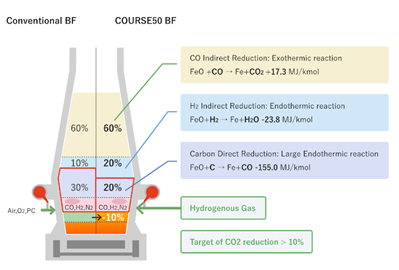
Technologies to reduce CO2 emissions | COURSE50 | The Japan Iron and Steel Federation
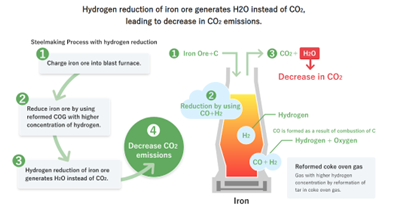
The pilot line was connected to a carbon capture and separation unit with a 30 ton / day capacity. According to the company, this was a world record for the size of CO2 reduction achieved in a blast furnace. It cited factors such as better heat management and improved air flow control in the furnace.
In short, Nippon Steel heated hydrogen to the point at which it still performed the role of separating the metal core from the oxygen without losing control of the process.
Time will tell
Based on this success, Japanese steel-makers believe they can now move onto the next stage of the technological shift. Their target is a 50% reduction in emissions at a bigger-sized furnace. The deadline: commercial operations of the technology by 2040.
The timelines don’t gel with the government’s 2030 emission reductions. But if the companies were able to accelerate their actions, or the government subsidized their technological shift so that it took place before it was deemed commercially viable, then we believe the following scenario would be required.
At least two and likely three or more steelmaking units in Japan would need to shift to the Super Course50 technology by 2030, and at least two DRI shaft furnaces would need to make the switch also.
Details on this, and the cost-side of the equation, will be in the second part of this series.
Japan NRG Scenario for 2030 “Green Steel” in Japan
|
Super Course50 blast furnaces |
Nippon Steel’s 5.7 mln tons/ year Kimitsu plant |
JFE Steel and/or Kobe Steel 6-10 mln / year plant |
|
DRI shaft furnace |
Several steelmakers that run a couple facilities each with an approximate 1 mln / year capacity | |
Disclaimer: This is a simplified scenario based on available information. It is subject to change depending on how technologies and markets develop.
ANALYSIS
BY MAGDALENA OSUMI
Market Players Call on METI to Induce Capacity Market Toward Renewables
Recent changes in Japan’s energy trading sector have drawn a strong response from major players who are now calling on the government to make the market more suitable for renewable energy sources.
In response to METI’s review of current electricity trading platforms, these major players have told the ministry to either scrap the capacity market or revise it in a way that will stimulate the construction of clean energy generation.
The purpose of METI’s review is to find ways to amend and improve existing markets by synchronizing some of the platforms. In one step towards electricity market optimization, the Agency for Natural Resources and Energy (ANRE) proposed a bidding system in which electricity supply (spot market) and adjustment (balancing market) are simultaneously contracted. The proposal is based on the British nodal scheme adopted in 2022 under which prices are determined on a node-by-node basis, taking into account grid congestion.
Another model that METI is also considering is a “Three-Part Offer” that takes into consideration three key factors in securing electricity in the market: availability of capacity; availability of volume; and the cost and time involved in acquiring this electricity so that it’s at hand and ready to be consumed. To some extent, this model mirrors the North American PJM and NYISO mechanisms.
While discussions on market reform continue, METI’s website contains a selection of comments from market players on its revision plan; albeit the comments were made anonymously, and there are also responses to those comments.
One view echoed by a number of market players was that the current main capacity market appears to be well suited to preserving the operations of existing thermal power plants, and does little to stimulate building new renewables capacity. Such an opinion goes on to say that this fails to meet Japan’s objective of marching towards 2050 net zero goals and to increase the share of green electricity in the national energy mix.
Such a view reflects concerns that were raised by the Organization for Cross-regional Coordination of Transmission Operators (OCCTO) which in its major report in 2020 stressed that: “In the wholesale energy markets, rules must account for the variable availability of renewable resources and the distinct properties of storage and demand response resources.”
The report summarized discussions on development of the capacity market and stressed that it should be open to all energy resources. It also added, however, that: “Capacity market rules now must reflect the actual ability of these new resources to contribute to system reliability.”
Market participant feedback also included suggestions to reduce bid capacity for the main auction, to ban power sources that are 11 years or older from participating, and to increase the amount of credits tied to the FIT system.
They pointed out that bidding capacity is 15-16% more than the maximum power capacity, which includes factors such as severe weather response, contingent supply and demand fluctuations and additional capacity. In other words, the bidding capacity duplicates the role that should be performed in the supply-demand adjustment markets, creating a situation in which participating power sources are unable to function effectively in any of those.
The respondents suggested introducing ways to favor renewables in the main capacity auction, saying that the recently introduced Long-Term Decarbonization Capacity Power Source Auction, which was designed to promote investment in new power sources, is still flawed.
The new Auction is supposed to include non-FIT/FIP renewables and batteries, as well as other energy storage systems such as pumped hydro. However, when the first FY2023 Long-Term Decarbonization Power Source Auction was launched in January, of the 4 GW on offer, batteries and pumped hydro energy storage options were capped at 1 GW. Meanwhile, the Auction is open to LNG-fired capacity if it vows to replace dirtier coal-fired generation. Thus, contrary to the industry members’ expectations, the market structure has become more supportive of existing power sources.
What’s more, market players have told METI that the main auction’s benchmark price (Net-CONE) has remained unchanged, based on the assumption of 40 years of gas combined cycle thermal (CCGT) operation. They requested that the government review whether the capacity market is consistent with the system’s original intent.
“The capacity market is not a solution to global warming, as it supports old fossil fuel-fired power generation,” said one comment.
Before the launch of the Long-Term Decarbonization Power Source Auction, industry players had high hopes that it would be a game changer for BESS. However, the public feedback revealed growing concerns that under the new auction system much of the cost burden could fall on new power market entrants while favoring incumbents such as the EPCOs.
Feedback to METI asked the ministry to re-examine the scheme to ensure fair access to power sources so that new power companies are not forced to pay capacity contributions that include those power sources to which they don’t have access.
METI responded to the comments by saying that the purpose of the capacity market is mainly to secure power supply in advance, and also to support new investment in power facilities. The ministry said it believes that this objective should help secure “the necessary adjustment capacity for the mass introduction of renewable energy.”
METI’s main goal is to foster a market mechanism that will stabilize business operations in the power sector, and, therefore, electricity prices. Achieving that goal still requires much work, and so METI has vowed to continue its review of the market systems and to address what has been pointed out as significant flaws that are in need of solutions.
ASIA ENERGY REVIEW
BY JOHN VAROLI
This weekly column focuses on energy events in Asia and the Pacific
Australia / BESS
Quinbrook Infrastructure Partners began building the first stage of a 250 MW / two-hour battery energy storage system (BESS) in Queensland; it invested around A$325 mln in the project that’s part of a A$2.5 billion battery and data center facility at South Pine.
China / Clean energy goods
U.S. Treasury Secretary Yellen said China’s investments in manufacturing of clean energy goods creates an unfair playing field that puts U.S. businesses at risk. And from a supply chain standpoint, she “thinks it creates risks that we’re clearly seeking to mitigate”.
Data centers
By 2030, the world’s data centers are expected to use more electricity than India. AI’s voracious need for computing power is threatening to overwhelm energy sources, said Arm Holdings CEO Rene Haas, adding that a solution must be found.
Energy Transition
High interest rates will “disproportionately affect” renewables, nuclear power and new technologies, and could slow the energy transition, reports Wood Mackenzie. In contrast, companies in the metals, oil and gas sectors will be less impacted due to their low gearing.
Indonesia / Oil
Shares of Indonesia Energy Corp surged more than 100% last week, but then dropped, though still trading above the April 11 mark of $2.74. On April 15, shares surged to $6.08, settling at $5.26 on April 20. These movements reflect growing concern that the price of oil might skyrocket if there’s a major war in the Middle East.
Malaysia / Electricity markets
The govt approved establishment of Energy Exchange Malaysia (Enegem) to facilitate the sale of renewable electricity to neighboring countries. An auction will begin with a pilot run of 100 MW, utilizing the existing interconnection between Singapore and Malaysia.
SE Asia / Energy transition
Southeast Asia is “woefully off track” on green investments to reduce emissions, and needs new policies and financial mechanisms to bridge the gap, said consultancy Bain. While green investment grew 20% last year, it falls short of the $1.5 trillion required this decade.
Thailand / EV batteries
Two major EV battery producers in China are showing interest in producing power cells in Thailand, with a possible combined first phase investment at over 30 billion baht, said the Board of Investment. Thailand has attracted significant foreign investment in EV production.
Vietnam / Energy transition
Vietnam and Australia agreed to collaborate on climate and energy development to boost sustainability. Australia also committed A$105 mln to support development in sustainable infrastructure in Vietnam, with a focus on clean energy.
2024 EVENTS CALENDAR
A selection of domestic and international events we believe will have an impact on Japanese energy
|
January |
|
|
February |
|
|
March |
|
|
April |
|
|
May |
|
|
June |
|
|
July |
|
|
August |
|
|
September |
|
|
October |
|
|
November |
|
|
December |
|
Disclaimer
This communication has been prepared for information purposes only, is confidential and may be legally privileged. This is a subscription-only service and is directed at those who have expressly asked K.K. Yuri Group or one of its representatives to be added to the mailing list. This document may not be onwardly circulated or reproduced without prior written consent from Yuri Group, which retains all copyright to the content of this report.
Yuri Group is not registered as an investment advisor in any jurisdiction. Our research and all the content express our opinions, which are generally based on available public information, field studies and own analysis. Content is limited to general comment upon general political, economic and market issues, asset classes and types of investments. The report and all of its content does not constitute a recommendation or solicitation to buy, sell, subscribe for or underwrite any product or physical commodity, or a financial instrument.
The information contained in this report is obtained from sources believed to be reliable and in good faith. No representation or warranty is made that it is accurate or complete. Opinions and views expressed are subject to change without notice, as are prices and availability, which are indicative only. There is no obligation to notify recipients of any changes to this data or to do so in the future. No responsibility is accepted for the use of or reliance on the information provided. In no circumstances will Yuri Group be liable for any indirect or direct loss, or consequential loss or damages arising from the use of, any inability to use, or any inaccuracy in the information.
K.K. Yuri Group: Hulic Ochanomizu Bldg. 3F, 2-3-11, Surugadai, Kanda, Chiyoda-ku, Tokyo, Japan, 101-0062.