Three years have passed since Japan wrote its Sixth Basic Energy Plan, but that period has proven to be decisive for Japan’s transition to clean energy. Now the time has come for a seventh edition, taking into account the new realities. Accompanying that strategy will be an energy plan that Kishida dubs “GX 2.0” that will show specific transition pathways. 16 members of a Strategic Policy Committee will be writing the updated energy plan. Japan NRG studied their initial talking points.
Until recently, nuclear fusion was a little-discussed topic in Japan. Widely seen as a technology with great promise but only a distant future, fusion has long been on the fringes of Japan’s clean energy transition debate. That’s now changing. Today, there’s a burgeoning ecosystem of startups trialing various ways to achieve energy’s holy grail. However, research comes with a cost, and in the case of fusion that’s quite high. JapanNRG takes a look at the achievements to date and the challenges.
ASIA ENERGY VIEW
A wrap of top energy news that impacts other Asian countries.
EVENTS SCHEDULE
A selection of events to keep an eye on in 2024.
JAPAN NRG WEEKLY
PUBLISHER K. K. Yuri Group
Editorial Team Yuriy Humber (Editor-in-Chief) John Varoli (Senior Editor, Americas) Mayumi Watanabe (Japan) Wilfried Goossens (Events, global) Kyoko Fukuda (Japan) Magdalena Osumi (Japan Filippo Pedretti (Japan) Tim Young (Japan)
The govt said it’s considering raising the capacity on offer for the second round of the long-term decarbonized power auction (LTDA) from just under 4 GW to an excess of 4 GW. The capacity tendered in Round 1 exceeded 7.8 GW.
Acknowledging the high ratio of bids to approved projects in the BESS and pumped storage category, the govt working group reviewing the auction said it will look for ways to accommodate the strong interest in this section.
Also under consideration is raising the minimum bid capacity for storage batteries from 10 MW to 30 MW. The auctioned BESS were required to be operational for at least 3 hours, but the govt could revise this criteria to 3-6 hours, or more than 6 hours.
For pumped storage, the minimum bidding capacity could be set at 30 MW, the same for general hydropower.
CONTEXT: The govt plans to reflect actual BESS demand given that the average capacity bid in the first round held in January was 35 MW. The changes will also reflect the original purpose of the auction: to gather large-scale power sources.
Separately, the criteria for LNG-fired power plants may also be altered after almost the entire three-year quota of 6 GW for this generation type was allocated in Round 1. The LNG quota in the LTDA was separate from the 4 GW on offer to other sources.
A new deadline for the start of supply of LNG-fired power is under consideration. The original deadline was 6 years but many operators face construction delays.
For nuclear energy, the govt said it also plans to establish new solicitation frameworks that would cover “investment in safety measures” for existing stations.
Seeing some LTDA categories, such as upgrades of existing thermal plants, receive less interest than expected, the govt said it will consider improving the remuneration rate, the refund rate for other market revenues, and the maximum price. However, it warned that improving the incentives will need to be balanced with not putting much more burden on consumers, or distorting the fairness of other markets. So, changes will not be forthcoming immediately, but will be part of an ongoing review process.
TAKEAWAY: As expected, the govt is now reviewing the LTDA results and proposing ways that the auction will be amended going forward. The review process will likely take a while and seek to gather opinions from market participants, before firming up the criteria before the start of the Round 2 auction, expected late this year. Initial readings suggest that METI is encouraged by the strong BESS showing, but also wants LTDA to support a wide range of generation sources, including hydro, nuclear, and a revamp of thermal generation via ammonia co-firing and similar.
Makers of storage batteries, semiconductors, machine tools and industrial robots, advanced electronics, and aviation components — the sectors covered by the Economic Security Act — will have to put in place data breach prevention measures.
Companies receiving subsidies will report to METI core technologies that will be protected from potential breach. Required risk management processes include confidentiality agreements with business partners and prior consultation with METI before ramping up production overseas.
If the companies fail to implement sufficient data protection, they might have to return the subsidies related to economic security.
CONTEXT: From May 1, patents on sensitive technologies won’t be disclosed, and patent holders will be banned from applications overseas. However, the govt will compensate patent holders over possible losses due to these measures. On May 10, the Security Clearance Act, which limits persons accessing classified data, was enacted.
TAKEAWAY: Amid speedy development, some sensitive technologies become outdated or irrelevant. Updating the govt with technology evolution may be complicated as multiple govt agencies will have oversight. METI handles data protection and export control, while the Cabinet office oversees patent control.
The Public-Private Sector Council to Expand Deployment and Strengthen Competitiveness of Next-Gen Solar Cells”, simply known as the Perovskite Council, came up with six action plans:
Learning from past solar policies
Setting system installation and price goals
Identifying issues on promoting installations
Building domestic supply chains
Setting overseas business expansion strategies
Recycling PSC modules
Council meetings won’t be public but reference materials will be disclosed.
In its presentation to the Green Innovation Fund, Toshiba said it will develop PSC modules that realizes a power generation cost of ¥20/ kWh by 2025.
CONTEXT: Reducing the cost of sealing materials used in the PSC module is the key to the overall cost cut.
TAKEAWAY: The present 2030 METI target is ¥14/ kWh or less. One PSC researcher told JapanNRG that this is a “nameplate cost target” disclosed to the public, and there is a separate “real cost target” that’s ¥7/ kWh, or the cost of nuclear power generation.
Toyota, Mazda, and Subaru have developed prototypes of hydrogen-powered internal combustion engines.
Their goal is to develop smaller engines compatible with decarbonization goals and EV platforms.
Toyota believes there’s still a market for fuel-burning engines and seeks to create engines that use various fuels.
The automakers showcased compact, powerful engine prototypes, with Subaru maintaining its signature boxer engine adapted for alternative fuels, such as e-fuel (synthetic fuel), biofuels, and liquid hydrogen.
TAKEAWAY: This move is in contrast with many G7 governments that are pushing for the auto sector’s full electrification. The companies emphasized that these new hydrogen prototypes can be alternatives to EVs and help decarbonize the car sector.
Starting November, TSE plans to revamp Japan’s carbon credit market, expanding access to major companies with high emissions. Since its launch in Oct 2023, the TSE’s carbon market has seen trading of 310,000 tons of carbon credits.
In comparison, South Korea traded 5.7 million tons in the first year. China traded over 170 million tons in the first six months of its carbon market.
Companies that reduce emissions through renewable energy or forest management can trade J-Credits. Yet, the annual lot of J-Credits is limited to about 1 million tons. So, it restricts market growth for large emitters.
TSE will allow companies in the GX League to participate; these include large emitters such as Nippon Steel, ENEOS, and TEPCO. They’ll be able to sell surplus credits if they exceed their emission reduction targets.
In what is called an “industry first,” BHP and Rio Tinto will cooperate with Komatsu and Caterpillar on testing large battery-electric haul trucks in Western Australia.
CONTEXT: Diesel combustion accounted for about 40% of BHP’s Scope 1 and 2 emissions in FY2020. For Rio Tinto, it accounted for 12% in 2023.
Two Komatsu 930 haul trucks will be tested starting in 2026 at mine sites in Western Australia’s Pilbara region.
The mining companies will test battery systems, and static and dynamic charging systems.
CONTEXT: In late 2023, Komatsu acquired American Battery Solutions, which has enabled Komatsu to develop and produce its own battery operated construction and mining equipment.
TAKEAWAY: The BHP and Rio Tinto collaboration with Komatsu could eventually involve other Western Australia miners such as Fortescue Metals, further boosting demand for battery-run, heavy-duty equipment.
The govt will develop a domestic recycling system for electronic waste such as home appliances. It will invest ¥30 billion over three years to create around 10 reuse centers in partnership with companies such as Mitsubishi Materials.
CONTEXT: Demand for metals is increasing in relation to decarbonization and digitalization. Japan wants to prevent the outflow overseas of the copper, rare metals etc. in the electronic waste, thus strengthening economic security.
The new initiative will be included in the Basic Plan for Recycling, which will be decided by the Cabinet in June. The plan will set a new target of increasing the amount of e-waste recycled domestically to 500,000 tons by 2030. This is 50% more than in 2020.
Osaka Gas will work with battery maker GS Yuasa on field tests using a new type of PCS-combined storage battery system under development.
The system integrates storage batteries, PCS (next-gen solar), and remote monitoring, enabling transport and delivery of such individual systems without the need for special vehicles or large cranes.
The number of compact units could be easily adjusted to the required capacity.
A BESS prototype will be installed on the firm’s premises to verify multi-use operation in response to multiple power market transactions, including the response to the new addition of short response time regulating power in the balancing market.
Tokyo-based firms Kandenko that focuses on building infrastructure and window systems maker YKK AP plan to develop Building Integrated Photovoltaic systems (BPIVs) including perovskites.
The firms plan to develop two types of BIPV systems:
A BPIV internal window (for existing and newly constructed buildings) that can be easily installed and maintained,
A curtain wall type with a built-in spandrel panel (for new buildings).
YKK AP will be in charge of product development, while Kandenko will work on installation technology and system development, including electrical components.
Sumitomo Rubber Industries and Yamanashi Pref will test a Power to Gas (P2G) system at a tire manufacturing plant in the city of Shirakawa.
Yamanashi Pref has developed a P2G-based green hydrogen production system. In this field study, the Sumitomo plant will combine the P2G-derived hydrogen with hydrogen sourced from third parties, as well as power sourced from the local utility, in-house solar power and other energy supplies available to reduce emissions.
The Tokyo metropolitan govt is accepting applications for subsidies to purchase fuel cell trucks and procure hydrogen fuel.
Subsidies for purchasing 2.5- to 8-ton trucks are up to ¥13 million, and for larger vehicles up to ¥56 million.
Fuel subsidies are ¥22.3/ km travel for 2.5- to 8-ton trucks, and ¥60 for larger trucks.
NEWS:ELECTRICITY MARKETS
EEX to launch options, add fiscal-year annual contracts for electricity futures
(Japan NRG, May 29)
The EEX plans to expand clearing services for electricity futures trading in Japan by introducing annual contracts that run the traditional fiscal year (April to March), and also start offering options for power trades.
The exchange plans to phase out calendar futures, and move to fiscal-year futures to help major and new power firms synchronize trading with accounting and supply-demand planning.
EEX also plans to extend the number of tradable expiries for its seasonal contracts.
CONTEXT: EEX estimates it averages a 99% share of the electricity futures trading market in Japan this year. It currently offers monthly and seasonal electricity futures contracts (summer and winter). Its most popular contracts are seasonal, but in terms of lots the number of day contracts traded is growing rapidly, it said.
Japan now ranks at No. 7 in terms of countries where EEX offers electricity trading. The bourse has had 22.25 TWh of Japan power traded on its platform to date in 2024.
This year’s average monthly volumes are up 3.5 times from last year to 5.225 TWh; the number of deals is up to 819 per month from 379 in 2023.
As of April 2024, futures volumes are around 25% of the volume on Japan’s spot electricity market (JEPX), according to EEX. The platform has 74 trading participants from 15 countries. Domestic players number 34.
TAKEAWAY: EEX is one of the success stories in the Japanese electricity market. While the govt expected the domestic TOCOM exchange to dominate, especially due to closer links with major power utilities, the German company’s ability to adjust its products quickly has met client needs and attracted international traders to Japan. Expanding the product range to options and offering LNG-based hedging contracts could see its presence in Japan grow further. Most importantly, the success reflects on how quickly international capital can galvanize when it sees opportunities in Japan, and these opportunities are opened up to all, not just domestic players.
The European Energy Exchange (EEX) officially opened its subsidiary in Japan to increase its presence in the market and strengthen ties with local authorities and stakeholders.
The move comes as the exchange marks the fourth anniversary of the launch of its Japanese power derivatives marketplace.
Since the launch, it has facilitated trading in 54 TWh of power. The exchange saw a record volume of 6.6 TWh in February 2024.
J-Power plans to launch ammonia-coal co-firing at the No.1 and No. 2 Tachibanawan thermal power plants (Tokushima Pref) after 2030.
The two units each have a 1.05 GW capacity.
CONTEXT: J-Power has been conducting ammonia-coal co-firing R&D since 2021. In December, the company together with Chugai Ro, Osaka University, and Central Research Institute of Electric Power Industry, were awarded a NEDO project to scale up the co-firing system to 760 kW from the present 100 kW.
TAKEAWAY: The two Tachibanawan units will likely require over 1 million tons/ year of ammonia combined at 20% co-firing, assuming they and those of JERA have similar ammonia consumption levels. The Tachibanawan units are slightly larger than JERA’s 1 GW Hekinan units, suggesting J-Power could possibly become the largest fuel ammonia consumer depending on the amount of ammonia mixed into the fuel. Combined with Kobe Steel that also plans ammonia co-firing, the total ammonia demand will be 2.75 million tons/ year at the ammonia fuel mix ratio of 20%.
The Organization for Cross-regional Coordination of Transmission Operators (OCCTO) proposed a new scheme to track medium- to long-term adjustment power capacity using the capacity market framework.
This includes verifying additional information like the presence of adjustment functions during capacity registration that’s expected to come online.
In the capacity market, the upper limit for introducing dispatchable power sources will remain. If the limit is exceeded, sources with higher effectiveness in past performance tests will be given priority.
Concerns have been raised about the adequacy of capacity for medium- to long-term adjustments, especially with the increased adoption of renewable energy. OCCTO aims to confirm the readiness of facilities using the capacity market framework.
During a recent meeting, OCCTO outlined a plan to obtain additional information during capacity registration, including: (1) the presence of adjustment functions; (2) the supply capacity of different products in the supply-demand adjustment market; and (3) potential capacity after control line installation.
New power sources are required to report estimated capacities.
An ANRE panel seeks to reduce the solicited volume of the tertiary balancing capacity for Day-Ahead commodities in the balancing market.
The market has had shortages in the solicited volume of the tertiary balancing capacity since the start of a temporary halt of additional procurement on May 1.
The suspension should help reduce the weekly procurement of the cross section of secondary and tertiary products, and to procure an additional amount of the shortfall together with tertiary products.
The proposal includes:
Eliminating the large imbalance between the amount of solicitation and the amount of bids received;
Controlling procurement costs, including the use of excess capacity;
Maintaining the business feasibility of new resources.
The Electricity and Gas Market Surveillance Commission (EGC) discussed resumption of the public solicitation for balancing power that ended in March in order to attract more bids for pumped storage resources in the balancing market.
The decrease in the volume of bids received is due to the fact that the operating entity of pumped storage will change from FY2024, and the weight is shifting to price difference transactions in the wholesale power market.
They discussed the possibility of setting a cap on pumped storage capacity procured by general transmission and distribution firms and capping the procurement period under a single contract to encourage competition among generators.
JEPX results of the final trade in the Non-Fossil Fuel Value Trading Market for FY2023 show that the average volume of non-FIT, non-fossil certificates dropped by 85.2% from the previous time to 177.09 GWh.
The majority of retail electricity suppliers are believed to have increased procurement through other arrangements, resulting in a low commitment volume. But the volume of FIT certificates remained brisk at around 8.4 TWh.
The advanced market for FIT certificates that handles non-renewables sources, and which is mainly nuclear-derived, saw a 92.7% drop from the previous survey to 2.2 GWh.
The renewables designation market, which includes large hydropower plants, also saw a sharp decline of 82.5% to 149 GWh. In both cases, all purchase bids were executed, with the price sticking to the lower limit of ¥0.6.
The fourth contracted volume in renewables, where FIT certificates are traded, increased by 2.9% to 8.48 TWh. Contract price was at the lower limit of ¥0.4.
CONTEXT: It appears that most retail electricity providers had procured power in advance through relative arrangements such as off-site PPAs, because despite preliminary estimates suggesting tight supply-demand balance in the final auction, the number of purchase bids was only slightly higher than expected.
In April, the Japan Electric Power Exchange (JEPX) reported a 4.8% MoM increase in the average daily sell order volume to 1.086 TWh, and an 11.2% decrease in buy order volume to 789.7 GWh.
The total monthly sell orders rose 1.4% to 32.6 TWh, while buy orders fell 14.1% to 23.7 TWh.
Warm temperatures saw demand drop, while increased solar activity boosted supply.
Average sell order volumes increased across various time slots, while buy orders saw a significant decline.
JERA set up a subsidiary to provide custom decarbonization consulting and retail electricity services.
Launching on June 1, JERA Cross will help businesses develop and implement decarbonization strategies while supplying carbon-free electricity.
The company’s comprehensive approach will target various sectors such as data centers and logistics.
TAKEAWAY: JERA’s entry into the retail electricity market to support the corporate green transformation is causing concern among existing power companies. JERA’s move is expected to intensify competition and reshape the retail electricity landscape.
ORIX will build one of Japan’s largest energy storage facilities, (output 134 MW), in Maibara City (Shiga Pref). Construction begins in autumn; operations set for 2027.
Earlier this year, the company secured capacity for the Maibara-Koto Energy Storage Plant in Japan’s first long-term decarbonized power auction (LTDA) that seeks to encourage investments into decarbonized energy sources.
ORIX will lease about 26 km2 owned by Maibara City to build the plant, which will have 140 containers of lithium-ion storage batteries on the premises.
CONTEXT: Since April 21, the govt has incentivized 27 grid-scale battery storage projects and awarded a total output of 1.09 GW across 30 BESS projects in its inaugural LTDA. By 2030, Japan expects BESS energy capacity to grow in the range of 14.1 to 23.8 GWh.
KEPCO’s Takahama NPP Units 3 and 4, which will reach 40 years of operation in 2025, secured NRA approval for an operational extension of up to 20 years.
This extension will allow the plant to operate for up to 60 years.
KEPCO now has five nuclear reactors approved for operation beyond 40 years.
To ensure 60 years of operation, starting from 2025 KEPCO will need to submit a “Long-term Facility Management Plan” every 10 years.
At the end of May, Tohoku Electric completed safety measures at its Onagawa NPP Unit 2 ahead of schedule. The completion had been scheduled for June.
The company is now working on preparation for fuel loading and reactor restart ahead of resuming operation in Sept.
CONTEXT: In December, Tohoku Electric sent a request for reviewing the plant’s safety standards record. If the plant resumes operation this year, it would be the first time since the March 2011 Fukushima disaster.
TAKEAWAY: Expectations for the plant’s restart led to a 12% surge in Tohoku Electric’s shares, to a temporary high of ¥1,565.50 on May 28, the highest in over five years. Mizuho Securities sees growth opportunities for Tohoku Electric in eastern Japan. Nomura Securities holds a more cautious stance, noting past failures in NPP equipment.
The president of Japan Nuclear Fuel Ltd (JNFL) reaffirmed its target to complete the spent nuclear fuel reprocessing plant in Rokkasho by September.
Still, there is the possibility of more inspections and safety adjustments.
CONTEXT: Construction on the Rokkasho facility began in 1993 with an initial completion target of 1997, but it has faced many delays. This is the 26th postponement due to technical and regulatory challenges. The plant will process spent fuel and help reduce capacity issues in storage pools across Japan.
Eurus Energy, Windlab launch first hybrid renewables facility in Australia
(Company statement, May 29)
Eurus Energy and Australian renewables firm Windlab began commercial operation of Australia’s first large-scale hybrid renewable energy facility in Queensland.
Kennedy Energy Park, owned by Eurus Energy and Windlab, has 43.2 MW of wind, 15 MW of solar and a 2 MW/ 4MWh battery capacity in a single facility.
The operators say the hybrid facility’s advantage is a reduction in weather-induced fluctuation in generation compared to individual wind and solar power plants.
The project has a PPA to sell power to CS Energy, an electric company owned by the Queensland govt.
Chubu Electric filed a damage compensation suit of ¥70 million in Nagoya District Court against Shimizu Shibenobu, its former VP, for allegedly neglecting his duty to prevent antitrust violations.
In April, the Japan Fair Trade Commission charged Chubu Electric, Chubu Electric Power Miraiz and Toho Gas of colluding in major city gas deals.
Chubu Electric auditors had a law firm conduct a probe that found Shimizu liable.
Chubu Electric will also seek damage compensation from two other former officials and Miraiz has disciplined one official.
CONTEXT: The JFTC charged penalties of ¥19.33 million to Chubu Electric, and ¥7.45 million to Miraiz. The ¥70 million claim possibly includes lost business.
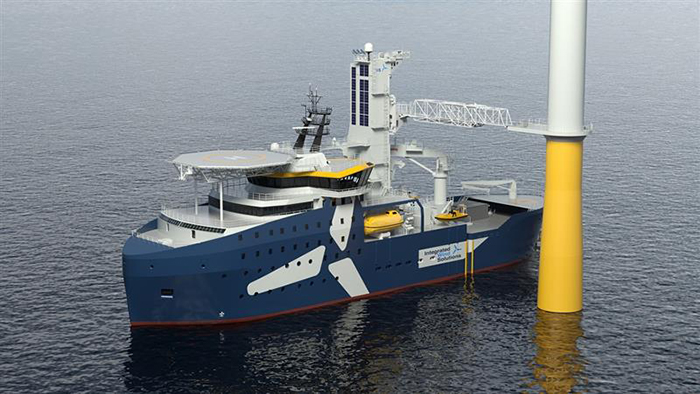
Sumitomo Corp inked a deal to take a stake in IWS Fleet, a Norwegian owner and operator of vessels in the offshore wind industry.
Sumitomo plans to foster IWS Fleet’s expansion through its network of wind power developers and other industry partners.
Sumitomo is set to purchase shares to be issued by IWS Fleet’s parent company, Integrated Wind Solutions. Shares worth €60 million will be issued. Sumitomo will acquire 25.38% outstanding shares in IWS Fleet.
CONTEXT: The firm estimates that by 2027 about 60 Commissioning Service Operation Vessels (CSOVs) will be needed worldwide, rising to over 100 by 2030 amid growing demand for support vessels as the number of offshore wind farms continues to rise. The vessels are used in construction, operation and maintenance.
During the periodic inspection of Genkai NPP Unit 4, Kyushu Electric detected a malfunctioning pump; one of the two motor-driven auxiliary feedwater pumps failed to start during an emergency power test.
A circuit breaker was replaced and the pump resumed function.
Hitachi Energy will provide HVDC tech to increase the supply and improve the flow of electricity between Italy’s mainland grid and Corsica and Sardinia.
The firm’s HVDC Light solution is based on VSC tech, which converts AC to DC for long-distance, underwater transmission, and DC to AC where the electricity is returned to the grid.
CONTEXT: The new connection is expected to make the electricity system more efficient and reliable for the islands and Tuscany. The firm was selected by Italy’s TSO Terna and France’s EDF.
Hokkaido Gas signed a 10-year LNG offtake deal with Santos SG Trading, a subsidiary of Australia’s Santos. The contract spans 2027 to 2036, covering about 3.5 million tons of LNG for the Ishikari LNG Base.
CONTEXT: In FY2023, Hokkaido Gas bought about 700,000 tons of LNG. The company plans to further increase this by 2030.
NYK set up OPearl LNG Ship Management in Hong Kong. It’s a JV with CMES LNG, a subsidiary of China Merchants Energy Shipping, and CETS Investment Management. The latter is a subsidiary of CNOOC Group.
OPearl is NYK’s sixth LNG carrier management company. They include six vessels chartered to CNOOC Gas and Power Singapore Trading & Marketing.
LNG stocks of 10 power utilities were 2.06 mln tons as of May 26, down 8.9% from the previous week (2.26 mln tons). This is 14.5% down YoY (2.41 mln tons), and 2.4% down from the past 5-year average of 2.11 mln tons.
Since April 21, the LNG stock levels had small fluctuations ranging between 2.01 and 2.26 mln tons. Due to the weak yen in the foreign exchange market, LNG imports are made just to cover the necessary volumes.
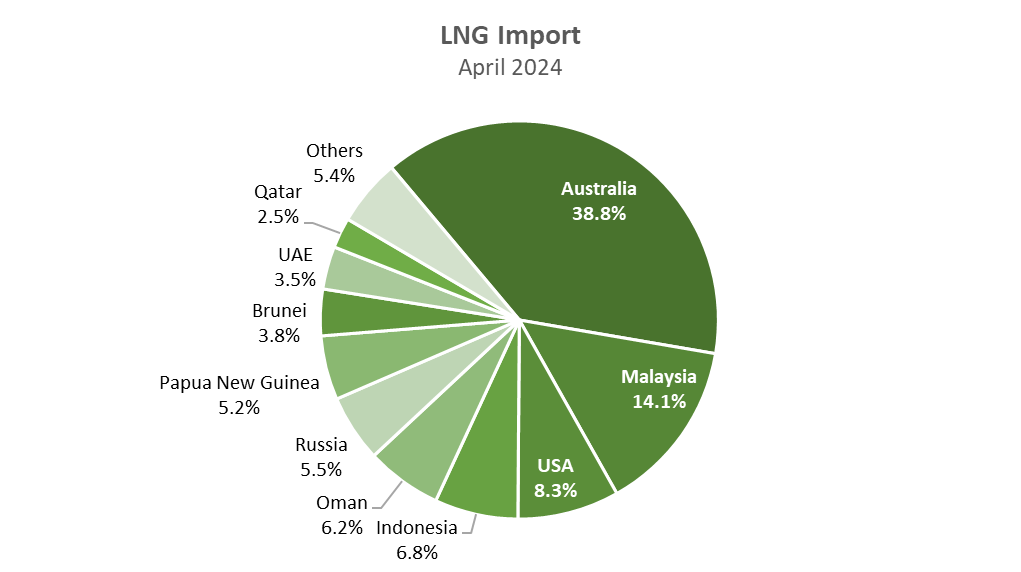
CONTEXT: Nearly 40% of LNG comes from Australia, and about 15% from Malaysia, which are not influenced by the crisis in the Middle East.
Temperatures in Japan are on the rise toward record highs again this year.
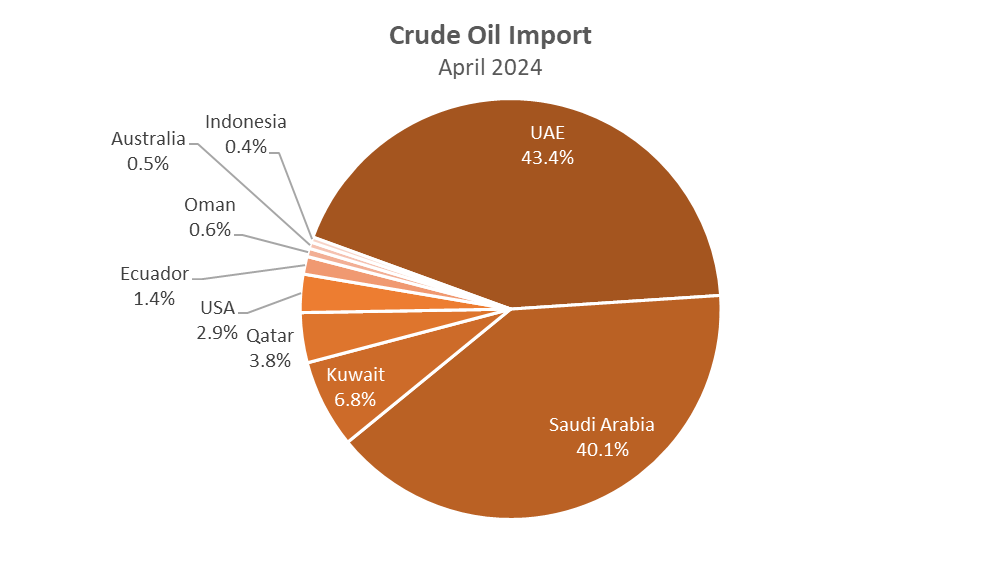
The UAE remains the top crude oil supplier, and Japan’s total import volume is stable at around 12 mln kiloliters from Jan to April.
LNG imports to Japan have decreased each month since Dec 2023, but the volume was up 17% YoY. Of the 5.3 mln tons of April’s LNG imports, just under 70% came from the Asia Pacific region.
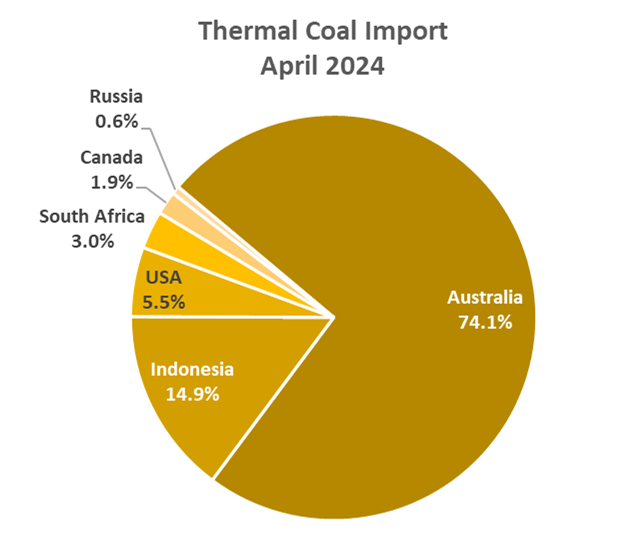
The level of thermal coal imports in April was almost the same as in March, and nearly 90% came from Australia and Indonesia.
ANALYSIS
BY MAYUMI WATANABE
The Outlook for Japan’s Next Energy Strategy
Only three years have passed since Japan wrote its Sixth Basic Energy Plan, but that short period has proven to be highly eventful and decisive for Japan’s plans to transition to clean energy. Now the time has come for a seventh edition of the Plan, taking into account the new realities on the ground and more forceful and binding energy policies approved by allies and partners.
While Japan’s 2050 carbon neutrality goal is written into law, the Basic Energy Plan, which is the national long-term energy strategy, is currently not legally binding. Faced with a geopolitically tumultuous past three years, the government of Prime Minister Kishida has had to deviate significantly from the Sixth Plan that was written in 2021, which, for example, called for reducing reliance on nuclear power.
More clarity for the essence of the upcoming Seventh Basic Energy Plan came on May 13 when Kishida spelled out the main direction, stating that there’ll be a grand national strategy showing pathways to a ‘green’ industrial revolution, or in his words, “big socioeconomic changes integrated with green transformation (GX)”.
Accompanying that strategy will be an energy plan that Kishida has dubbed “GX 2.0”, which will show specific transition pathways. Just a few days later, the 16 members of the Strategic Policy Committee of Natural Resources and Energy, who will write the updated energy plan, kicked off their official discussions. Japan NRG studied their preliminary talking points.
Outlook for 2040
The basic theme of the upcoming Seventh Basic Energy Plan (also sometimes referred to as the Strategic Energy Plan) reveals Japan’s energy landscape through 2040. This is a stretch in the time frame – the previous plan was based on 2030 scenarios. The official rationale for making 2040 the target year is that due to the magnitude of the transitions, a clearer outlook for 2040 is needed to develop greater visibility for the next ten years, through 2035.
The reality that’s been hitting hard is the fact that industries need more time to come up with energy transition strategies that are economically viable. At the May 15 meeting, Hashimoto Eiji, the Nippon Steel president, said businesses need to make investment decisions this year for projects that will come to fruition in the 2030’s because it takes years to implement any new initiative.
Nippon Steel is one of the country’s top emitters, but also one of the biggest employers and energy users, with several in-house thermal power generation facilities. The steel firm, like its domestic peers, is working on the technology, supply chain, and economics of switching some of its manufacturing processes to hydrogen instead of coal.
However, due to a lack of visibility over green power volumes and green hydrogen supplies in the years ahead, companies like Nippon Steel say they can’t make decisions about 2030 projects.
“Companies might as well go overseas,” Hashimoto warned.
Another reality faced by big manufacturers is that several nuclear plants, which tend to provide lower-cost baseload power, will start to reach the end of their permit lives from the late 2030s. Plans for new reactor constructions are uncertain, and if nuclear is to remain a key part of the energy mix, these projects need to start today.
“Decarbonization tech development is Japan’s last chance for economic recovery,” said Hashimoto.
The dilemma here is that clean energy is needed for any net zero solution development and that scale of investment will need to be recouped. Japan is also finally starting to grapple with inflation after almost three decades without upward price pressure. That’s a worry for the impact on electricity costs for energy-intensive industries.
“With all prices going up, it will be impossible to keep energy prices down”, said Ito Mami, representative director of Nihon Dento Kougyo, which electroplates electrical and electronic parts.
There is a genuine threat of clean power shortages and difficult decisions may have to be made over which industries get access to this decarbonized energy. “Either we start investing into clean power sources [now] or it will be too late,” Ito added.
Several other members stressed the need for the government to provide “visibility” to businesses to spur capital investments.
Varied “visibility” requirements
So what exactly is the visibility the businesses crave to invest in power sources? Writing a 2040 energy mix reflecting ambitions to boost decarbonized power hardly contributes to improved visibility, as businesses are skeptical that this plan will actually unfold. Companies developing power sources need confidence of demand and market design.
Takamura Yukari, professor of Tokyo University, said the bottom line of any power mix scenario is creating structures of industries that will allow Japanese companies to win in global markets. This reflected a shift in government thinking in recent months to align decarbonization strategies with those for industrial and digital developments.
Big industrial and digital energy buyers require a different kind of visibility, according to Japan’s top telecommunications group NTT and chemical major Asahi Kasei, who voiced their priority as not only cheap and green, but also stable power prices.
Sawada Jun, the chairman of NTT, known as Nippon Telegraph & Telephone, called for further reform of the power sector to create better interconnection between the nation’s grids, allowing electricity to move around the country more efficiently.
“Supply chains are building up in Japan thanks to the weak yen, but the high power rates are discouraging businesses,” Sawada said. Kobori Hideki, the chairman of Asahi Kasei, added that on his wishlist was reducing the volatility of electricity prices.
One thing the government could do to balance competing energy needs is curb power demand growth, according to Takamura and Kudo Teiko, the deputy president of Sumitomo Mitsui Banking Corporation. Further clarify around the nuclear business environment should improve visibility for all sides, noted Kurosaki Ken, a Kyoto University professor.
Other suggestions included government moves to encourage industries to relocate into areas with abundant renewables power and creating frameworks to spur non-fossil power investments.
Thermal power comeback?
Some members were indirectly taking shots at the Sixth Plan which put renewables as the primary power source with 36-38% of the power mix in 2030. Nippon Steel’s Hashimoto, for example, said one should forget about putting “renewables first” and conduct an “objective” analysis of the energy reality.
Rising national security risks have underscored the importance of fossil fuel, added Professor Yamauchi Hirotaka of Hitotsubashi University. Waseda University Professor Endo Noriko suggested keeping coal out of the energy mix, but still holding onto coal generation assets in reserve, rather than dismantling them entirely.
The experts also itemized actions to take without waiting for 2040, pointing out:
There are interconnection hiccups between the regional utilities, due to the system specifications, limiting the sharing of electricity between regions;
Nuclear power plants need to restart in significant numbers;
Siting of new nuclear reactors is problematic and creating facilities offshore should be considered;
Nuclear fusion development requires more structured planning.
The panel’s wish list is long and could get longer, but it all comes down to who is going to implement the plans.
Who’s in charge?
Effective May 15, Sumi Shuzo, the advisor to Tokio Marine and Nichido Fire Insurance, replaced Shiraishi Takashi, Kumamoto University professor, as chairman of the Strategic Policy Committee of Natural Resources and Energy, the main export advisory panel for the energy strategy process. The change possibly reflected METI’s intention to show that big businesses matter, some observers say.
There will also be changes in the policy making responsibilies. Traditionally, the Ministry of Environment and METI have shared the climate policy making arena. It was not always clear how the two ministries’ roles differed, as the MoE was active also in the energy industry, for example by providing subsidies to Power Purchase Agreement projects, carbon capture and storage studies and EV and FCV promotion. The two ministries jointly oversee the Joint Crediting Mechanism (JCM) system and MoE Minister’s input is required for decisions on big renewables projects.
However, another document published very recently by the MoE suggests that the above roles are starting to shift.
On May 21, the MoE published the Sixth Basic Environment Plan, written by the Comprehensive Policy Sub-Committee of the Central Environment Council. Takamura of Tokyo University chairs that Sub-Committee.
The plan, which is updated every six years, puts expanding renewables as one of the key solutions to achieving man’s harmonious cohabitation with nature. But the latest edition was directed more on nature and biodiversity issues and touched much less on energy production and distribution.
While the MoE will surely remain committed to promoting offshore wind projects in Exclusive Economic Zone waters, and installing solar panels in government offices and facilities, its hands-on role in major energy projects seems reduced. Even when discussing the hot issue of the day – how to power an upcoming boom in AI and IoT – the Environmental Plan referred only to technologies’ role in finding solutions for environmental issues and glazed over power supply constraints.
Japan NRG believes the roles of the two ministries will demarcate as METI uses its administrative “muscles” to support the larger-scale energy projects, industrial strategy and infrastructure building. Meanwhile, the MoE will focus on nature conservation, biodiversity, and CO2 monitoring.
ANALYSIS
BY FILIPPO PEDRETTI
Funding Fusion: Japan Seeks to Stay Competitive in the Global Race
Until recently, nuclear fusion was a little-discussed topic in Japan. Widely seen as a technology with great promise but only a distant future, fusion has long been on the fringes of Japan’s clean energy transition debate. That’s now changing.
In 2022, Japan began to outline a nuclear fusion strategy, releasing a draft in 2023. Today, there’s a burgeoning ecosystem of startups that are trialing various ways to achieve energy’s holy grail. However, research and experiments come with a cost, and in the case of fusion that’s quite high. Movement in financing is in the very early stages.
Other factors are helping accelerate Japan’s fusion sector footprint. A recent founding of an industry group, J-Fusion, will not only help give the tech a stronger voice in official energy discussions domestically, but aims to bolster domestic players as they keep pace with international rivals.
JapanNRG takes an in-depth look at the achievements to date and challenges yet to be overcome.
Fusion council unites major players
Fusion’s tantalizing allure is its promise to generate boundless energy from small amounts of fuel with no CO2 emissions, and with relatively little radioactive waste. While conventional nuclear fission requires constant monitoring to prevent radiation leaks, fusion reactions cease when fuel injections stop, thereby avoiding the risk of meltdowns.
Like the Sun and other stars, nuclear fusion’s basic principle is to create energy by coaxing hydrogen nuclei inside the isotopes tritium and deuterium, and fusing them into helium. Hydrogen can be retrieved from seawater, and a gram of fuel could theoretically release as much energy as eight tons of oil.
In 2022, fusion logged a milestone that generated much excitement when the Lawrence Livermore National Laboratory in the U.S. managed to produce more energy than was used to start the reaction. The results were small (around 1 MJ of energy was generated), did not include the energy volumes required to power the equipment, and not easily replicable. But this milestone still sparked enthusiasm for subsequent research.
On the back of this, fusion startups, especially in North America, have raised impressive amounts. In 2021, about $2.6 billion of investment flowed into fusion-related firms, Crunchbase data show. Since then, the total annual dollar amount has declined, but the number of deals keeps growing.
Realizing that Japan was lagging behind some of its G7 allies, on March 29, 2024 the government helped to set up an organization dedicated to promoting nuclear fusion power. The Japan Fusion Energy Council (J-Fusion) seeks to stimulate the development and commercialization of nuclear fusion. Chaired by Konishi Satoshi (Kyoto Fusioneering), the vice-chairs are Kitajima Seiji (Sumitomo Corp) and Taguchi Takaya (Helical Fusion).
Other members include IHI, JGC Holdings, and Obayashi, INPEX Corp, Kyoto Fusioneering and EX-Fusion, as well as metals, chemicals and trading firms.
Japan Fusion Energy Council Members
Special Members
Regular Members
Associate Members
Academic Members
Atox Co.
A.L.M.T. Corp
Haseko Corp.
The Japan Society of Plasma Science and Nuclear Fusion Research
Blue Laser Fusion
Asahi Kinzoku Kogyo
Horiba
National Institutes for Quantum Science and Technology
EX-Fusion
Idemitsu Kosan
Mitsui Mining & Smelting Co.
Faraday Factory Japan
Hazama Ando Corp
MUFG Bank
Fujikura
JGC Corp.
Nippon Steel Chemical & Material
Furukawa Electric
Kajima Corp
Nitto Optical
Helical Fusion
Metal Technology Co.
PwC Consulting
IHI Corp
MiRESSO Co
Shoritsu Kogyo
INPEX Corp
Mitsui Chemicals
Tokyo Electronics
JGC Japan Corp
Mizuho Bank
Kyoto Fusioneering
SB Power Corp
LINEA Innovations
Sojitz Machinery Corp.
Mitsubishi Corp
Sumitomo Electric Industries
Mitsubishi Heavy Industries
Takenaka Corp
Mitsui & Co
Mitsui Fudosan
Mitsui Sumitomo Insurance Company
Nippon Telegraph and Telephone Corp
Shimizu Corp
Sumitomo Corp
Taisei Corp
KEPCO
Toshiba Energy Systems & Solutions Corp
Yamato Gokin
Source: Japan Fusion Energy Council
J-Fusion will focus on the industry’s technological needs, as well as gathering expertise and resources. Moreover, the group will help the government to set regulations and technological standards. But perhaps the council’s most crucial mission will be to secure funding for the domestic sector to stay competitive with international peers.
Stepping stones to the mainstream
While the U.S. and Europe are making progress, Japan’s fusion industry is playing catch-up. In 2018, the Ministry of Education, Culture, Sports, Science and Technology (MEXT) released its first roadmap for a demo fusion reactor, but it set the goal of achieving power generation only in 2050. The fact that MEXT, rather than METI, was in charge of the roadmap highlighted the more academic bent of Japan’s fusion R&D at the time.
Government interest firmed up after the 2022 breakthroughs in the U.S. By April 2023, a Fusion Energy Innovation Strategy was unveiled – this time, by the Cabinet Office. The latter has great authority but less technical expertise, and so the Strategy was useful in noting the need for Japan to become more serious about fusion, but lacked any details on timelines, funding, or concrete action plans.
Still, the promotion of fusion to the Cabinet’s attention served the purpose of putting fusion energy on the radar of the energy planners and linked it directly to the country’s clean energy future. It also hinted at the delays in Japan’s fusion R&D in comparison to the goals set by other countries. China, the U.S. and U.K., for example, plan to succeed in fusion power generation by 2040.
According to METI, a key part of fusion’s development rests on being able to make technological and material advances that will allow fusion plasma to sustain itself after the initial ignition stops. This is where Japan may hold a comparative global advantage as it has a rich ecosystem of materials companies.
But before Japan moves to the stage of testing fusion in a demo reactor, to prove the tech’s practical application and economic viability, the government wants to gather experience via international collaboration projects.
ITER’s ‘sister’ in Japan
To date, Japan’s main activity in the realm of fusion comprises its membership in the International Thermonuclear Experimental Reactor (ITER). Tokyo hopes that ITER’s research can help Japan build a prototype reactor. However, budget issues and technical problems have delayed ITER’s operations from the original deadline of 2025.
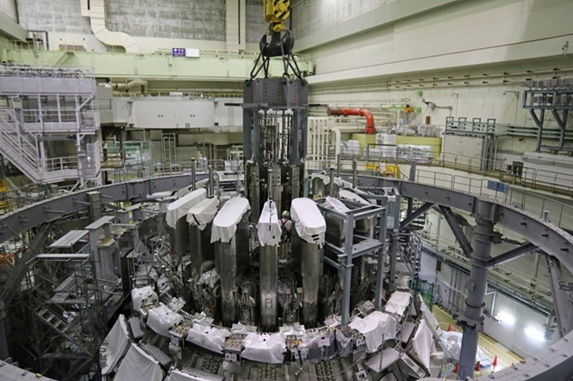
ITER’s fusion ‘sister’, the JT-60SA reactor, is a joint project with the EU and located in Naka (Ibaraki Pref); it aims to provide plasma consistently. Plasma is the key component inside the tokamak, a special reactor for nuclear fusion. Generating plasma results in superhot gas of ions and electrons that’s magnetically kept separate from the tokamak’s walls.
In October 2023, JT-60SA achieved its first plasma, heated at 200 million C. Next is the second stage: building and testing an experimental fusion reactor.
The JT-60SA fusion project in Japan
Source: ITER
While the government’s attention has been primarily on international collaborations and grand strategies, a small ecosystem of about half a dozen fusion startups has managed to take root in Japan within a time. These include Kyoto Fusioneering, Helical Fusion, Ex-Fusion, and MiRESSO. Others, like Blue Laser Fusion are based overseas but have a strong Japanese team or Japanese investors, or both.
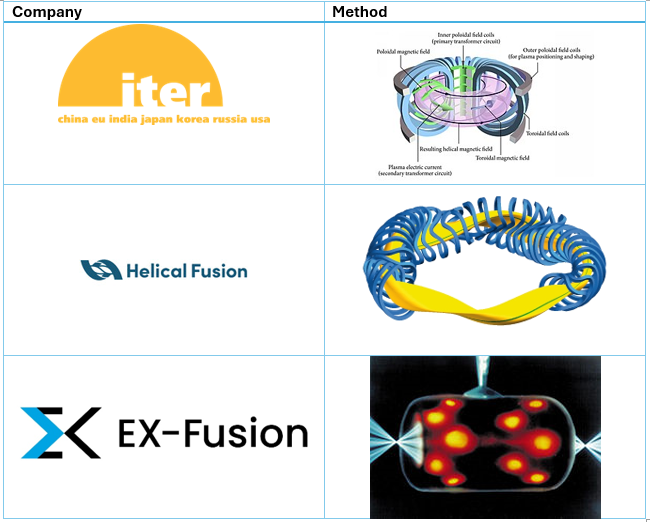
Arguably the most ambitious plans, in terms of speed of development, as from Helical Fusion, which seeks to launch a pilot fusion power generation facility as soon as 2034. Unlike the ITER and JT-60SA projects, which use the more traditional donut-shaped tokamak machine design, Helical Fusion is experimenting with installing helical coils that create a magnetic field to confine the plasma. While a tokamak needs a heating device to confine plasma for long periods, the coils promise to work more efficiently long-term, although they have their own drawbacks.
A third method involves focusing lasers to irradiate a fuel pellet of tritium and deuterium to incite fusion; this is the method that the U.S. laboratory used in 2022 for its breakthrough. Unlike the tokamak and helical coil approaches, the application of lasers is constrained by security issues since the process can also be diverted for military purposes. Still, the Osaka University startup, EX-Fusion, is working on this method.
Industry experts say it is crucial to continue researching all three technologies. The final goal is the same: replicate on an industrial scale that which was achieved in the laboratory.
Sources: Iter, Helical Fusion, EX-Fusion and Wikipedia
Crunching the numbers
In 2023, total investments into the fusion industry grew 27% worldwide, with the U.S. Fusion Industry Association claiming that private inflows reached over $6 billion.
U.S.-based Commonwealth Fusion Systems and TAE Technologies had secured over $3.2 billion in funding as of June 2023. ENN Science and Technology Development of China secured $400 million, and the U.K.’s Tokamak Energy $250 million.
In contrast, Japanese companies have raised only $98 million, with more than 90% of that going to a single player, Kyoto Fusioneering. That’s a paltry amount given that six to seven times that may be required to build a demo reactor. If more funding is not forthcoming, Japanese firms in the sector won’t be able to compete globally.
Despite this, Japan could still carve out its own space in a future fusion industry as a producer of materials or components. It’s interesting to note the significant presence of entities from the material sectors in J-Fusion’s membership list.
For example, Furukawa Electric produces superconductor wires for fusion reactors, including the ones for ITER. Recently, MHI supplied an additional batch of divertors for the ITER tokamak. In similar fashion, Japan has already positioned itself as an exporter of parts for traditional nuclear power plants.
Benefits from pursuing fusion R&D are not limited to creating a new kind of power plant. The technologies developed for fusion can be applied in other industries. For instance, MiRESSO, a startup based in Misawa city (Aomori Pref.) specializes in refining beryllium, an element that’s essential for fusion. MiRESSO’s innovative work, however, could also help with processing critical energy transition metals like nickel.
Since commercial nuclear fusion is not on the near-term horizon, investing in this energy source will require a long, long-term strategy. In the meantime, presenting a national strategy and creating industry-wide initiatives like J-Fusion will serve mainly one purpose: igniting more interest in government circles and private sector partnerships in the hopes of securing more funding. That should help inch the industry towards realizing Japan’s fusion goals.
ASIA ENERGY REVIEW
BY JOHN VAROLI
This weekly column focuses on energy events in Asia and the Pacific
Australia / Renewable energy
By 2033, non-hydropower renewable energy capacity is expected to reach 101 GW, which is more than double over the current 46 GW. Strong state policy support is cited as the reason for this expected progress.
China / Emissions
China aims to reduce CO2 emissions of key industries equal to about 1% of the 2023 national total by improving efficiency in every sector ranging from steel production to transportation. The govt action plan says the economy will require 2.5% less energy for every unit of GDP growth in 2024.
China / Renewable energy
Chinese renewable products exports grew by 35% from 2019 to 2023 due to their competitive prices and production capacity, with local manufacturers supplying over 65% of total global demand. Wood Mackenzie said that manufacturing costs in China were as much as fourfold lower compared to Western firms in the sector.
India / Solar power
Avaada Energy, a leading player in the renewable energy sector and an arm of Avaada Group won the single largest bid of 1.05 GW capacity in a recent solar capacity tender. Avaada now has Letters of Award and PPAs for over 15 GW in India.
Indonesia / Renewable energy
Abu Dhabi-based Masdar signed an MoU with Pertamina Power Indonesia to develop solar, wind, and green hydrogen projects in the country and abroad, banking on its current partnership with Pertamina Geothermal Energy.
Oil
In May, Asia’s imports of crude oil rose to their highest in 12 months, driven by demand from India. Asia is expected to have arrivals of 27.81 million bpd, up from 26.89 mln bpd in April, said LSEG Oil Research. That’s an MoM increase of 920,000 bpd, with most accounted for by India, where imports are expected to rise to an all-time high of 5.26 mln bpd, up 710,000 bpd from April’s 4.55 mln bpd.
Philippines / Offshore energy
Billionaire Ramon Ang called on Manila to disregard tensions with China and develop untapped offshore oil and natural gas reserves. Such a move, however, would require joint maritime patrols with the U.S. to deter the Chinese coast guard. China has competing claims with the Philippines in the South China Sea.
Southeast Asia / LNG
High temperatures are driving up LNG demand as importers seek supplies as summer begins; imports are hitting record highs amid intense air-conditioner use. Prices are now at a six-month peak above $12/ mmBtu and are expected to remain elevated.
South Korea / UAE cooperation
The UAE will invest $30 billion in South Korea spanning the nuclear power, defence, hydrogen and solar energy sectors. UAE President bin Zayed Al Nahyan visited Seoul for the occasion. South Korea already has contracts to build nuclear reactors in the UAE.
Vietnam / Coal power
As factories owned by some of the world’s leading tech firms face weeks of blackouts, coal-fired power plants are making up for the demand. Coal power accounts for just over a third of Vietnam’s total installed power generation capacity, but in recent weeks coal has generated around 67% of total national electricity output.
2024 EVENTS CALENDAR
A selection of domestic and international events we believe will have an impact on Japanese energy
January
First market trading day (Jan 4)
IEA “Renewables 2023: Analysis and Market Forecast to 2028” released (Jan 11)
Renewable Energy Exhibition (Jan 31 – Feb 2)
Taiwan presidential election (Jan 13)
Japan’s Diet convenes
IEA “Electricity 2024 / Analysis and Forecast to 2026” released (Jan 24)
February
CFAA International Symposium (Feb 2)
India Energy Week 2024 (Feb 6-9)
Lunar New Year (Feb 10-17)
Indonesia presidential election (Feb 14)
Japan-Ukraine Conference for Promotion of Economic Reconstruction (Feb 19)
FIT/FIP solar auction (Feb 19 – March 1)
Smart Energy Week (Feb 28-Mar 1)
March
Announcement of auction result for Offshore Wind Round 2 (for Akita Happo-Noshiro Project)
Onshore wind auctions (March 4-15; results on March 22)
International LNG Congress (LNGCON) 2024, Milan, Italy (March 11-12)
Russian president election (March 15-17)
World Petrochemical Conference, Houston, TX, USA (March 18-22)
IAEA Nuclear Energy Summit @ Belgium (March 21)
Ukraine presidential election (due before March 31)
Happo Noshiro, Murakami-Tainai, Oga-Katagami-Akita and Saikai-Eshima wind project auctions close (June 30)
July
Tokyo governor election (July 7)
7th Basic (Strategic) Energy Plan draft published (expected)
August
7th Basic (Strategic) Energy Plan draft presented to Cabinet (expected)
September
Global Offshore Wind Summit Japan 2024, Sapporo, Hokkaido (Sept 3-4)
The United Nations Summit of the Future (Sept 22-23)
Gastech 2024, Houston, TX (Sept 17-20)
IAEA General Conference
GX Week in Tokyo (expected late Sept to October)
Asia Green Growth Partnership Ministerial Meeting
Asia CCUS Network Forum
International Conference on Carbon Recycling
International Conference on Fuel Ammonia
GGX x TCFD Summit
October
IEA World Energy Outlook 2024 Release
BP Energy Outlook 2024 Release
Innovation for Cool Earth Forum (expected)
Connecting Green Hydrogen Japan 2024 (Oct 16-17)
Japan Wind Energy 2024 Summit (Oct 16-17)
Solar Energy Future Japan 2024 (Oct 16-17)
Japan Mobility Show (Oct 25-Nov 5)
November
US presidential election (Nov 5)
COP 29 in Azerbaijan (Nov 11-22)
Abu Dhabi International Petroleum Exhibition Conference (ADIPEC) 2024, Abu Dhabi, UAE (Nov 11-14)
APEC 2024 @ Lima, Peru
International Conference on Nuclear Decommissioning (TBD)
G20 Rio de Janeiro Summit (Nov 18-19)
Offshore Energy Exhibition & Conference (OEEC) 2024, Amsterdam, the Netherlands (Nov 26-27)
Biomass & BioEnergy Asia Conference (TBD)
European Biomethane Week 2024
December
Last market trading day (December 30)
Disclaimer
This communication has been prepared for information purposes only, is confidential and may be legally privileged. This is a subscription-only service and is directed at those who have expressly asked K.K. Yuri Group or one of its representatives to be added to the mailing list. This document may not be onwardly circulated or reproduced without prior written consent from Yuri Group, which retains all copyright to the content of this report.
Yuri Group is not registered as an investment advisor in any jurisdiction. Our research and all the content express our opinions, which are generally based on available public information, field studies and own analysis. Content is limited to general comment upon general political, economic and market issues, asset classes and types of investments. The report and all of its content does not constitute a recommendation or solicitation to buy, sell, subscribe for or underwrite any product or physical commodity, or a financial instrument.
The information contained in this report is obtained from sources believed to be reliable and in good faith. No representation or warranty is made that it is accurate or complete. Opinions and views expressed are subject to change without notice, as are prices and availability, which are indicative only. There is no obligation to notify recipients of any changes to this data or to do so in the future. No responsibility is accepted for the use of or reliance on the information provided. In no circumstances will Yuri Group be liable for any indirect or direct loss, or consequential loss or damages arising from the use of, any inability to use, or any inaccuracy in the information.