Japan is a leader in liquified hydrogen, one of several ways that hydrogen can be transported and stored. But while it has invested significantly into this energy solution, it’s still unclear whether this approach will catch on. Recently, promoters of liquified hydrogen technologies in Japan delivered a report to the government. These discussions are inconclusive but Korean and European shipping sectors are taking similar steps to propose international standards and rules for liquefied hydrogen.
As new opportunities and technologies appear in Japan’s energy landscape, the number of overseas companies entering the market is increasing. When the need to make hires arises, a number of cultural clashes and misunderstandings tend to pop up. Let’s take a look at the nuances of communication in an employment interview – when a foreign firm is looking for a Japanese hire – that commonly cause misunderstandings, badly managed expectations and suboptimal outcomes for hiring companies, and how these can best be avoided.
ASIA ENERGY VIEW
A wrap of top energy news that impacts other Asian countries.
EVENTS SCHEDULE
A selection of events to keep an eye on in 2024.
JAPAN NRG WEEKLY
PUBLISHER K. K. Yuri Group
Editorial Team Yuriy Humber (Editor-in-Chief) John Varoli (Senior Editor, Americas) Mayumi Watanabe (Japan) Kyoko Fukuda (Japan) Magdalena Osumi (Japan Filippo Pedretti (Japan) Tim Young (Japan)
PM Kishida will propose a collaboration framework to speed up decarbonization in Central Asia. No concrete details have been given so far.
He will join the summit of five Central Asian nations to be held in Kazakhstan in mid-August.
The summit will discuss a wide range of areas, such as the spread of green technologies, infrastructure development to improve regional connectivity, human resource growth in the fields of IT and governance, and the expansion of trade in agricultural goods.
CONTEXT: Kazakhstan is among the world’s top uranium miners, as well as a producer of nickel, chromite ore, tungsten, rare earths, etc. The Japan-Kazakhstan Treaty on Peaceful Uses of Nuclear Energy took effect in 2011. The following year, state-owned Kazatomprom and Sumitomo Corp set up a JV for rare earths production.
TAKEAWAY: Maintaining close ties with Central Asian states, notably Kazakhstan, is important not only for expanding political influence in the former Soviet states, but also for stronger clean energy supply chains. Since Kazakhstan is landlocked, cargoes are usually transported through China to reach Japan, and this limits bilateral trade potential.
The govt plans to amend the Effective Resource Use Promotion Act in 2025 requiring storage battery manufacturers to reuse scrap metals generated during production.
METI plans to ask manufacturers such as Panasonic and GS Yuasa to report on recycling goals and progress, and to penalize companies not following their plans. The ministry aims to broaden the scope of this regulation to metals recovered from end-of-life storage batteries and their components.
CONTEXT: When a battery is recycled, it is shredded and its base metals separated. Valuable metals that make up key parts of the battery, such as lithium, nickel and cobalt, are known as ‘black mass’.
To date, recycled battery materials known as “black mass” have been exported and hardly re-used domestically.
CONTEXT: The Basel Convention that limits the cross-border flows of lead batteries was effective in keeping such supplies in Japan. However, the Convention lacks clarity on ‘black mass’ and other e-wastes, resulting in governments implementing diverse regulations, including export controls in the name of a circular economy.
TAKEAWAY: In the past, the govt has considered export controls on industrial raw materials, including used aluminum beverage cans used for car parts, not just rare metals. Requests for export tariffs, approval systems, etc, were made to the govt but they were not implemented as they might violate WTO rules. Instead, changes were made in the customs coding system to monitor the material flows.
UACJ and Kyoto University have developed a liquid solution to reproduce end-of-life aluminum products into aluminum with minimum 99.9% purity.
UACJ and Nippon Light Metal plan to commercialize the 99.9% recycling in the 2030s. The recycled metal could be used in aerospace and electronics.
CONTEXT: Japan imports 2 million tons/ year of primary aluminum products made from bauxite minerals. Beverage cans and other products are recycled into secondary alloys that usually contain up to 90% aluminum. The carbon footprint of secondary aluminum is less than 10% of that of primary aluminum.
TAKEAWAY: In theory, expanding the use of domestic aluminum scrap reduces dependence on imports and strengthens supply chains. However, 99.9% purity is too low to be called primary-equivalent. Japanese consumers use 99.98% purity, which is above the global market standard of 99.97%. Aluminum purity is not important; more important is reducing certain impurities (iron, silicon, etc) to the minimum. In short, the UACJ-Nippon Light Metal collaboration may result in innovative alloys for specialized applications, but their products will unlikely replace primary aluminum imports.
PM Kishida held the first ministerial meeting to promote the circular economy by:
Launching schemes to recycle solar panels, car components and manufactured products,
Reducing food loss,
Developing local production-consumption business models, etc.
From August, he will hold community meetings nationwide, with a focus on the youth. New policies will be written by the end of the calendar year.
CONTEXT: Recycling end-of-life cars is almost 100% for gasoline and hybrid cars. Automakers have integrated recycling into their supply chains on a voluntary basis by positioning resource recycling as a business. The ministerial meeting aims for stronger guidelines, possibly legally binding, to push recycling in other sectors.
The MoE seeks public feedback on its proposal to revise green corporate bond issuance guidelines, so that it reflects guidance from the Loan Market Association and the International Capital Markets Association on key performance indicators, etc.
Japan Climate Leaders Partnership, a lobby group consisting of 244 companies, has made policy proposals to METI and the MoE that include:
To set a 2035 goal of 75% emission cuts from 2013 levels;
To increase renewables’ share in the power mix to over 60% by 2035;
To open policy making to renewable energy consumers, notably those running global business operations, since presently govt panels are dominated by academics and consultancies;
To boost the current 74 GW renewables capacity in Japan (69 GW solar; 4.5 GW wind) to 268 GW by 2035 (194 GW solar; 30 GW onshore wind; 44 GW offshore wind).
TAKEAWAY: The JLCP proposal is clear on its support for renewables. But beyond arguing against anything that “locks in fossil fuels”, it doesn’t clarify its stance on other GX pathways being pursued by the Japan govt, such as coal-ammonia co-firing, LNG-hydrogen co-firing and CCS. It also did not provide comments on the long-term decarbonized power source auction system.
Kawasaki Heavy Industries (KHI) and Kajima Corp will conduct joint research about how to combine Kawasaki’s Direct Air Capture (DAC) technology with Kajima’s CO2-SUICOM carbon-negative concrete.
Kawasaki’s DAC captures CO2 directly from the air using a solid adsorbent made of a porous material and an amine compound.
Kajima’s CO2-SUICOM absorbs CO2 during concrete production to achieve net-zero CO2 emissions.
The collaboration aims to integrate DAC into precast concrete plants.
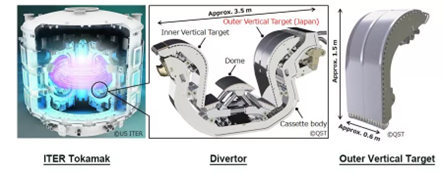
MHI and the National Institutes for Quantum Science and Technology (QST) produced a prototype of the Outer Vertical Target (OVT) for the ITER fusion reactor in southern France.
The OVT is essential for the divertor, which manages heat and impurities in the reactor’s plasma. The prototype is ready for production.
MHI and QST will make six OVT units by FY2025.
CONTEXT: ITER brings together 35 nations to build the world’s largest tokamak, a magnetic fusion device designed to prove the feasibility of fusion as a large-scale and carbon-free source of energy based on the same principle that powers the stars.
EneCoat perovskite module hits 20% power efficiency
(Japan NRG, Aug 2)
EneCoat Technologies has achieved a power efficiency of over 20% for its perovskite solar module sized 7.5 cm by 7.5 cm, a performance which nearly equals that of silicon solar modules at 20-30%.
The company plans to achieve similar power efficiencies for modules of larger sizes.
CONTEXT: Sharp holds the world record for the highest solar power generation efficiency of 33.7% outside laboratories.
In March 2025, the East Japan Railway group plans to open the Takanawa Gateway City, a 10-hectare “zero-emission” shopping and business district in Tokyo.
The City features:
“Zero emission” logistics: The tenants will forward cargoes to a depot in Heiwajima; FC trucks will transport cargoes to Takanawa Gateway City,
The country’s largest heat storage tank for air conditioning,
FC buses,
A biogas cogeneration system using food waste from restaurants as feed,
A FC battery system at a new Takanawa Gateway train station.
ENECHANGE announced Hirata Masayoshi as its new head; he assumed the position of Chairman of the Board of Directors on July 30.
Hirata replaced Kiguchi Yohei, the firm’s founder and CEO who stepped down.
The company said Hirata was chosen based on previous management experience.
Hirata is a former executive at Toshiba, who was responsible for restoring management after the company’s accounting fraud was uncovered in 2015.
CONTEXT: Kiguchi’s resignation comes in response to problems in accounting uncovered in March after which the former CEO took responsibility for the mishandling. ENECHANGE also decided to decentralize the authority of top management and appoint a full-time head of the internal audit office to improve corporate governance. Kiguchi was accused of making an opaque indirect investment in a special purpose company for EV charging facilities. An external investigation committee’s report in June revealed problems with internal controls at the firm. Kiguchi tendered his resignation at the board of directors meeting on March 29.
Japan’s largest wind power developer Eurus Energy, and Bywill, a Tokyo firm promoting decarbonization services, will partner on carbon neutral initiatives.
The two firms aim to create and distribute environmental value with an aim to trade carbon credits, which will be suited to each region and create new business models.
Panasonic began testing a system that makes use of heat released from hydrogen FCs for air conditioning.
The test facility, called the H2 Kibou Field, installed a new absorption refrigerator that uses heat from ten FC systems for cooling, rather than conventional vapor compression refrigerators powered by electricity.
The FC systems release heat at 80 C while the refrigeration system requires a heat source at 60 C. They were adjusted to support 70 C.
Starting October, Toyota Motor plans to conduct a trial run of delivering liquefied hydrogen at -253 C to a FCV service station in the City of Kariya, Aichi Pref.
The Aomori Governor will support operation of Japan’s first interim storage facility for spent nuclear fuel in Mutsu city.
In August the prefecture will sign a “safety agreement” with operators and Mutsu city.
Governor Miyashita said he received assurances on the eventual further removal of the spent fuel to a permanent site. Mutsu’s mayor also supports the agreement.
On July 23, Miyashita met with METI minister Saito who indicated potential further removal sites, including the Rokkasho Reprocessing Plant.
The interim storage facility in Aomori will be operated by Recyclable-Fuel Storage Co (RFS) that’s funded by TEPCO and Japan Nuclear Fuel Ltd. It will temporarily store spent fuel until sent elsewhere to be reprocessed.
The facility plans to start operations in September. It will first receive spent fuel from TEPCO’s Kashiwazaki-Kariwa NPP.
CONTEXT: In 2004, TEPCO requested cooperation from local authorities, and in 2005, Aomori Pref agreed to its construction. Following prolonged safety reviews, the facility will begin accepting spent fuel.
TAKEAWAY: Delays in completing the Rokkasho plant still raise concerns in Aomori. While Mutsu’s interim storage facility will be operational, there’s no ironclad guarantee of permanent storage somewhere else. The capacity for storing spent fuel at NPPs is nearing their limits, with about 80% of storage capacity nationwide already utilized. Japan’s nuclear fuel cycle plan aims to reprocess spent fuel, but the repeated delays in the reprocessing plant’s completion raise doubts about the plan’s feasibility.
Tokyo Commodity Exchange (TOCOM) set up an expert panel to address issues related to the application of “hedge accounting” for electricity futures.
This type of accounting aligns financial transactions to reduce risk.
However, it’s difficult to apply under Japanese accounting standards, and thus discourages electricity companies from engaging in futures trading. The panel aims to identify practical challenges and consider lobbying the relevant institutions.
On July 29, TEPCO Power Grid recorded its largest summer capacity usage, at 56.97 GW, which exceeded the previous year’s maximum (55.24 GW), and this was the first time in two years that it exceeded 56 GW.
Inside cooling demand grew due to hot weather across the region, including the hottest temperature of 41°C observed in Sano City, Tochigi Pref, which is the hottest on record.
TEPCO PG secured over 1 GW as an additional supply capacity measure.
Kyushu Electric announced that the average September electricity bill for a standard household (250 kWh usage) will be ¥6,556. This is ¥997 less than for August.
Kyushu Electric’s standard rates include a ¥1,000 govt subsidy.
CONTEXT: This decrease is the first in 15 months, and is due to the govt’s temporary reinstatement of subsidies for three months to ameliorate the impact of rising prices.
METI, the MoE, and the Ministry of Land, Infrastructure, Transport and Tourism launched a 11-member study group to establish a methodology to measure the environmental impact of offshore wind farms.
The study group will identify possible causes and how to measure impact during construction and after the turbines begin operation, such as noise from building work and how marine life is affected.
KEPCO plans to develop an offshore wind farm off the coast of Matsumae Town in Hokkaido with a capacity of up to 360 MW.
The firm filed an environmental impact assessment consideration.
The govt designated the area off Matsumae coast as a “promising area.”
The project covers 3,354 hectares, and will accommodate between 15 and 25 wind turbines, (each 14 MW to 22.6 MW capacity).
CONTEXT: In the surrounding area, several companies are considering offshore wind power development off Hiyama, north of Matsumae. Both Hiyama and Matsumae were among the five newly designated ‘promising zones’ last year, alongside Ishikari, Ganu-Minamishiribeshi and Shimamaki in Hokkaido.
Sumitomo and JGC Japan, a domestic EPC operating company of JGC Holdings, inked a deal to mass-produce and create a supply chain of components for floating offshore wind systems.
The firms will collaborate in:
Detailed design of components;
Partnering with steel and shipbuilding manufacturers to manufacture components;
Transportation of components to base ports for offshore wind power generation.
The firms will form an association with 20 manufacturers in relevant fields, aiming to establish a system to produce around 100 floating wind turbines per year by 2030.
CONTEXT: Sumitomo is a lead member in a consortium for a power generation project off the coast of Enoshima Island in Saikai, Nagasaki Pref, and is in discussions with Oshima Shipbuilding, a member of the Sumitomo Group, with a view to utilizing its large-scale shipbuilding facilities and mass production tech in production of floating structures.
TAKEAWAY: This new association shows strong commitment from both local manufacturers and the govt to help the sector expand in Japan and abroad; the mass produced platforms will be shipped first to Europe. With a few pilot projects underway, Japan seeks to take the lead in floating wind power, and at this pace may become successful in reaching technological proficiency, since there are no commercial-scale floating wind farms operating anywhere.
On Aug 1, Goi Thermal Power Station Unit 1 (Chiba Pref) began commercial operation as part of a modernization carried out by JERA, ENEOS, and Kyushu Electric. Unit 1 has a nameplate capacity of 780 MW.
JERA said this “thermal power plant features world-leading power generation efficiency and mitigates environmental impact through reduced CO2 emissions.”
Units 2 and 3 (each 780 MW) are scheduled to begin commercial operation in November 2024 and March 2025, respectively.
In line with the stake in the JV responsible for construction, operation, and maintenance, JERA will have pro-rata ownership of 1.4 GW of capacity; ENEOS will take 780 MW; and Kyushu Electric will own 156 MW of the three units in total.
Chugoku Electric applied for NRA approval of its long-term facility management plan for Shimane NPP Unit 2. This follows the recent amendments to the Reactor Regulation Act.
The amended law takes effect on June 6, 2025, and mandates that NPP operators secure approval for continued operations beyond 30 years. A long-term plan must be approved by June 5, 2025, and must include measures to ensure safe management of essential equipment and structures.
CONTEXT: On April 24, the NRA approved changes to the safety regulations for Shimane Unit 2 based. The long-term management plan builds on this. It specifies measures for degradation management, such as monitoring temperature and pressure changes. It requires testing for neutron irradiation embrittlement, and replacing pipes when necessary.
The NRA accepted its review team’s conclusion that Japan Atomic Power Company’s Tsuruga NPP Unit 2 does not meet new regulatory standards. This is due to the potential existence of an active fault beneath the reactor.
The NRA will now draft an evaluation that deems the plant “non-compliant.”
CONTEXT: Under new rules set after the 2011 earthquake and tsunami, reactors can’t restart if there is an active fault underneath. JAPC proposed further investigation, but the NRA found it lacking and unclear. This marks the first time since 2012 that a reactor has been denied restart approval. It will force JAPC to consider decommissioning Tsuruga Unit 2.
Japan’s Digital Transformation Minister Taro Kono said he now supports restarting idled NPPs.
He also promotes nuclear fusion research due to a predicted rise in electricity demand. This marks a shift from his earlier anti-nuclear stance as he seeks support within the ruling LDP ahead of its leadership election in Sept.
Kono showed some acceptance of NPP restarts during the LDP leadership election in 2021. He has recently moderated his energy policy stance, and cited the rapid spread of generative AI and EVs as factors changing electricity demand.
This month, TEPCO EP will begin supplying low-carbon city gas, which is a package of gas and certified J-Credits (domestic carbon credits). The credits allow companies to reflect CO2 emissions reduction in their reporting.
“TEPCO Carbon Offset Gas” will be sold to corporate customers and will likely be about 10% more expensive than regular gas.
Tokyo Gas and Osaka Gas also sell city gas paired with environmental certificates. Actual reductions in CO2 emissions are expected after 2030 when alternative fuels such as hydrogen and synthetic methane are expected to become available.
CONTEXT: Environmental certificates are an interim option to show reduced CO2 emissions, with strong demand in manufacturing sectors. Japan consumes about 40 billion m3 of city gas, with around 60% used industrially. CO2 emissions from industrial gas usage account for 10-20% of the sector’s total emissions.
Saibu Gas said that the average city September gas bill for a standard household (23 m3 usage) will be ¥6,201. This is ¥423 cheaper due to state subsidies.
Japan’s petrol stations count decreased 2% in FY2023, with the total number falling to 27,414. The govt offered subsidies to keep gasoline prices low. Yet, demand remains weak, leading to closures and business shifts.
The drop is attributed to slumping oil demand due to decarbonization.
LNG stocks of 10 power utilities were 2.15 million tons as of July 28, down 2.3% from the previous week (2.35 million tons). This is 10.8% up from end July 2023 (1.94 million tons), but 1.8% down from the past 5-year average of 2.19 million tons.
CONTEXT: The weather is now more tropical with squalls in the evening. JMA alerts mention thunderstorms and small tornadoes. LNG stock levels have been up and down recently – within 10% of 2 million tons – but sufficient to cope with the hot summer.
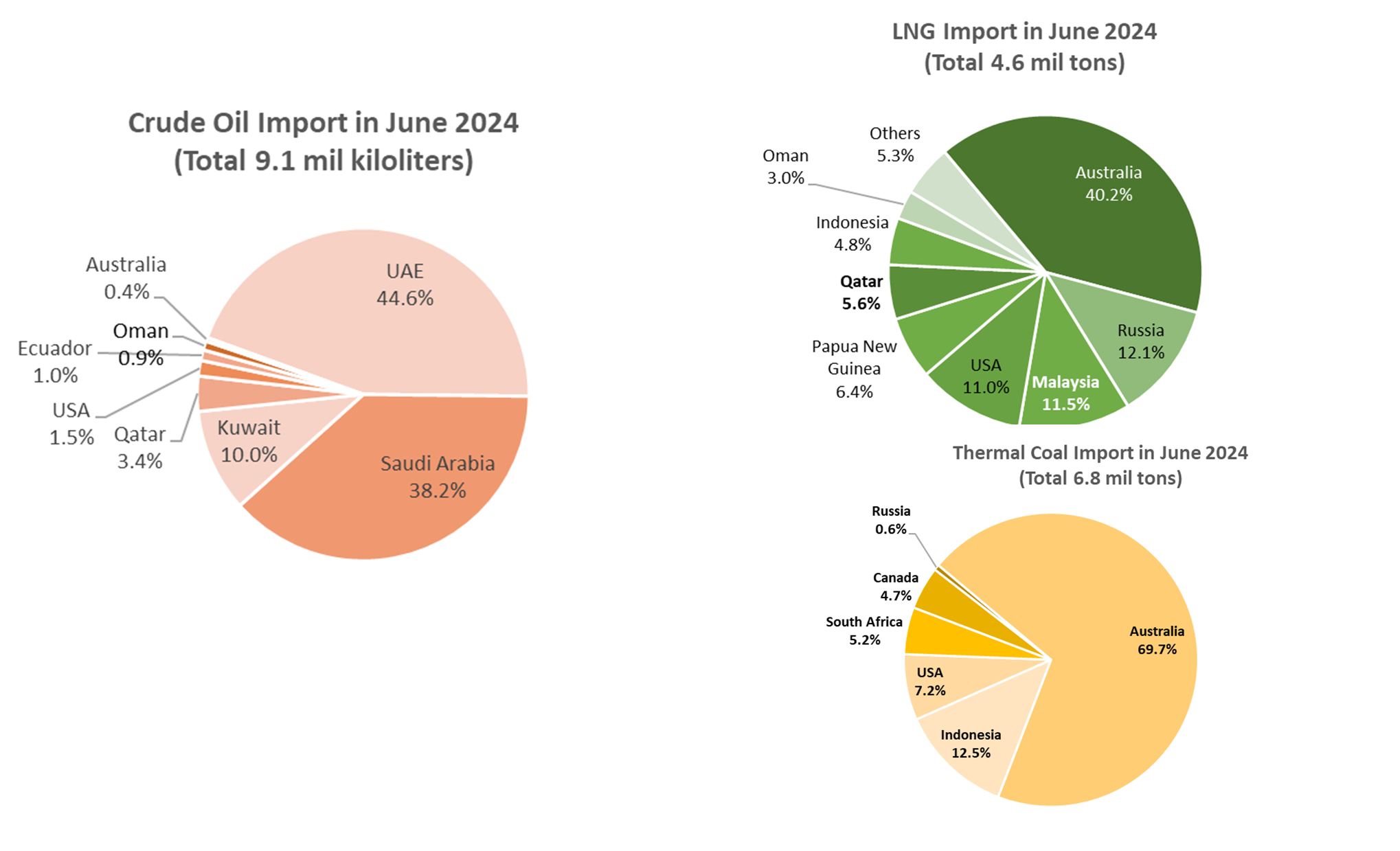
June crude oil imports YoY volume dropped 14%, and was also down 14.8% over May. The UAE stays at the top of importing countries, ahead of Saudi Arabia.
June LNG imports were about the same as a year ago, but down 6.3% over May. Australia was the main source, so far supplying an average of 2 million tons monthly.
June’s thermal coal import volume dropped 6.9% YoY, but rose 12.5% over May. Nearly 70%, or 4.7 million tons of thermal coal came from Australia, a monthly increase of 13.1% (Australia alone). Imports from Canada, USA, and South Africa also increased. Imports from Russia decreased drastically over May (down 76.7%).
ANALYSIS
BY MAYUMI WATANABE
Japan Seeks Data Validation to Show Liquified Hydrogen Has Strong Future
Japan is an obvious leader in liquified hydrogen, which is one of several ways that hydrogen can be transported and stored. But while it has invested significant money and engineering hours into this energy solution, it’s still unclear whether this approach will catch on.
At a time when Japan seeks to become a major player in this clean-burning fuel, the issue of what is the optimal means to transport hydrogen is crucial. Investing heavily in infrastructure around one solution, only to see another approach win mass adoption, would end up wasting large state funds and damage Japan’s goal of acting as a regional energy transition leader.
Meanwhile, other hydrogen carrier options are progressing in terms of supply chain development and technological breakthroughs. Hydrogen can also be converted into ammonia, which has become the go-to solution among Japanese power utilities; it can be carried via methanol (the fuel of choice for some major shipping firms in Europe); or bonded into compounds such as methylcyclohexane (MCH).
Still, backers of the liquified hydrogen solution are not giving up. Building on the successful 2021 launch of the oceangoing liquefied hydrogen bulk vessel, SuisoFrontier, the companies behind this technology in Japan promise to offer commercial-scale equipment for their supply chain within this decade. They also claim that they are well positioned to hit 2030 government cost targets and that in some ways liquified hydrogen is safer than ammonia and MCH, which are classified as dangerous chemicals.
Recently, the promoters of the liquified hydrogen technologies in Japan delivered a report to the government on their progress. These discussions are inconclusive but Korean and European shipping sectors are taking similar steps to to propose international standards and rules for liquefied hydrogen.
Japan’s IMO ambition
Each hydrogen carrier option has its pros and cons. With liquefied hydrogen, the risks include a chance that it ignites. If temperatures rise above -253 C and the pressure changes, then the liquid evaporates into gas and may become explosive. This, some critics argue, potentially makes it more risky to transport over long distances, compared with ammonia or MCH.
The inconclusive nature of debates around various technological solutions can only be solved with practical evidence. Which is why, a lot of Japanese efforts today are focused on collecting data on liquified hydrogen solutions to prove their viability.
The Japanese government also wants to take such data to global institutions in order to have a role in formulating international standards around hydrogen transport and usage. Japan is especially keen to lead the hydrogen rulemaking discussions within the International Maritime Organization. That entity sets rules for the International Code of the Construction and Equipment of Ships (IGC). This code is applied to all forms of ocean gas transport of all IMO members.
Data collection for the IGC discussions is a part of the national project called the Large-Scale Hydrogen Supply Chain Establishment that’s funded by the state-run Green Innovation Fund. The project began in July 2023 and will be completed in March 2025.
A consortium called the CO2-free Hydrogen Energy Supply Chain Technology Research Association (Hystra), consisting of the SuisoFrontier’s builder Kawasaki Heavy Industries, hydrogen producer Iwatani Corporation, and the operator of the vessel, Shell group, is gathering the data.
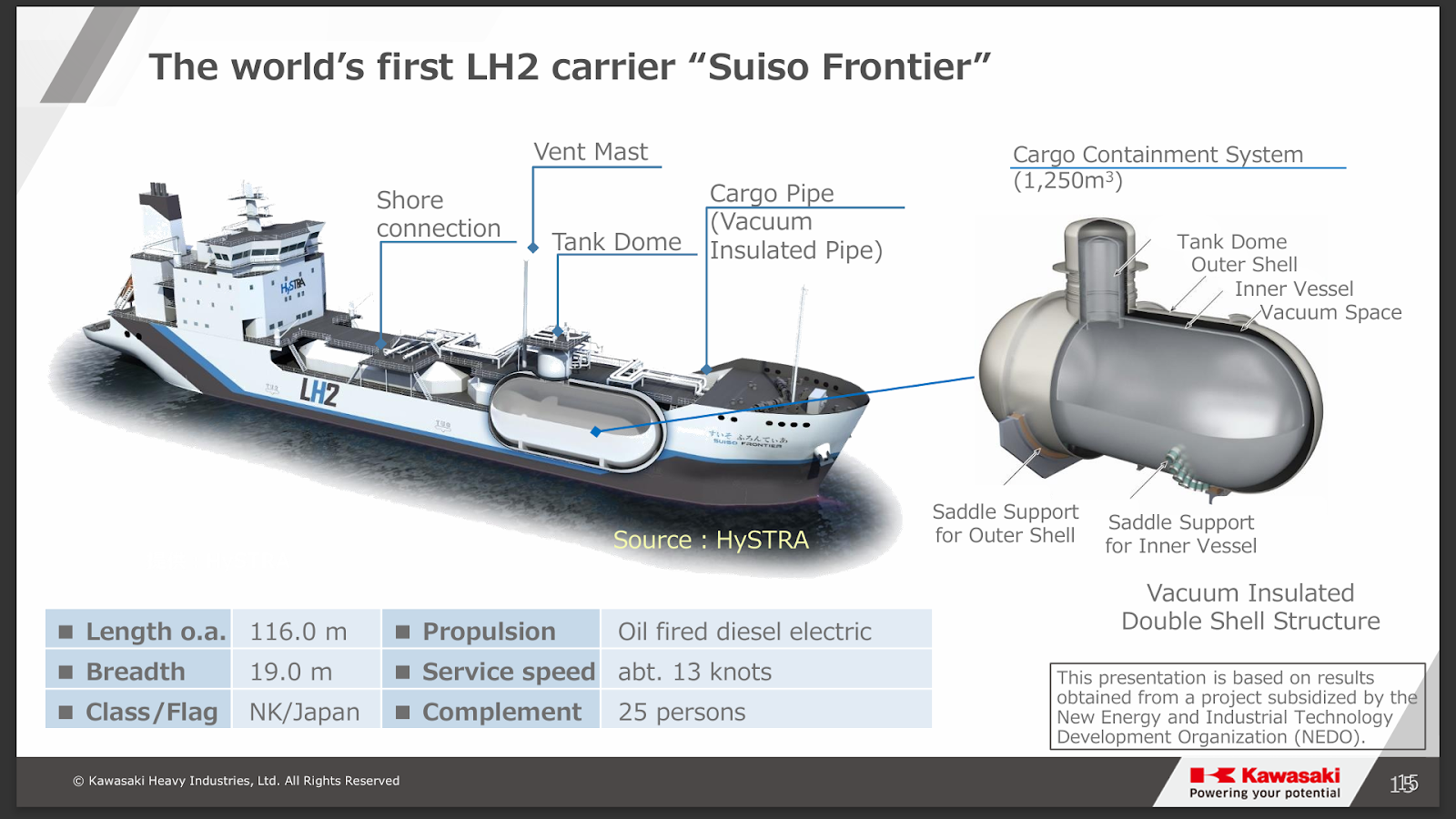
SuisoFrontier is no ordinary bulk vessel — it has proprietary features to keep the tank temperatures at -253 C throughout the sail. KHI had previously developed liquefied hydrogen-propelled rocket systems that had applications for SuisoFrontier. It designed a double-shelled tank with a vacuum between the two shells to insulate heat. Glass fiber reinforced plastics, laminated heat insulators and thermal protection panels were also used to insulate heat and radiation.
Initial findings
Sept 2023-March 2024 activities
Technology challenges
Solutions
Study scope
Thermal and radiation insulation
Double-shell structured tank with a vacuum space between the two shells
Check whether long-term exposure to hydrogen at -253 C causes any changes to the properties of stainless steel used for the tank (shrinkage, erosion, etc),
How weather, ocean conditions and cargo loads affect the temperatures in the tank,
Identifying the best operational practices during the sail.
Use of Glass Fiber Reinforced Plastics to insulate heat
Laminated heat insulation material covering the inner wall of the shell
Thermal protection panel on the outer shell
Cargo pipes also double-shelled
Gas slip
Leakage detection system
How much hydrogen is released when vent systems undergo temperature changes
Unloading liquefied hydrogen onshore
Continuous loading using proprietary hydrogen loading arm system
On July 18, Hystra reported its initial results at the New Energy and Industrial Technology Development (NEDO) event in Yokohama. The report focused on:
The boil off gas rate, or the pace of liquid evaporating into gas, during transport;
The impact of temperature changes on the exhaust vent safety system;
Continuous operation of onshore loading arms to offload cargo.
During the period under review, which was from July 2023 to June 2024, Suiso Frontier made a round trip to and from Australia: First, it sailed 19,000 kilometers of the Singapore-Hastings-Kobe route with its tank empty, and from April 11 to May 17 that distance was 17,000 km from Sydney to Kobe with the tank filled with 75 tons of liquefied hydrogen.
Hystra reported that the boil-off gas rate, or the pace of liquid evaporating, was 0.3% per day, meaning 75 tons becomes 70 tons after 20 days. That’s higher than about 0.028% per day for LNG. It also said the chemical composition of the cargo did not change during the 17,000 km journey. However, Hystra didn’t say if the changes in the cargo volume impacted the storage conditions in any way, or if there was no change at all.
An exhaust vent system, which is a safety mechanism to release hydrogen into the atmosphere in emergencies, was tested for the first time. There were two tests: the warm vent test with temperatures of -35 C, and cold vent test at -109 C. In both cases, only hydrogen was released and did not cause environmental damage, Hystra said. It did not provide data on the amount of the gas release, but asserted that the tests verified liquefied hydrogen was safer compared to ammonia or MCH.
Continuous liquefied hydrogen loading tests were conducted using proprietary hydrogen loading arms (LAS). Loading was performed six consecutive times. The tank temperatures were changed from -253 C to -50 C, creating deliberate stress. The equipment safety features did not change.
Hystra said the tests verified the high safety levels of SuisoFrontier’s equipment. Furthermore, this year it will conduct more tests that include:
Changing the pressure conditions inside the tank during loading
Testing equipment tolerance to long haul travels
Measuring impact of equipment exposure to both liquefied hydrogen and hydrogen gas as heat stress is applied to the molecules
Continuous LAS loading operations
The tests will be completed in March 2025. The Japanese government will provide the Hystra data and a preliminary standard proposal to the Sub-Committee on Carriage of Cargoes and Containers (CCC) meeting of the IMO later in 2025.
After 2025, Hystra will continue testing with a larger vessel than the Suiso Frontier, which has only a 75-ton transport capacity and is too small for commercial operations. Data obtained from the larger vessel tests will be provided to the IMO and hopefully, new standards will be written by 2030.
Industry wary of high costs
Industry insiders have expressed mixed feelings about the advances in liquefied hydrogen. On July 25, Japan Suiso Energy, the KHI-Iwatani venture, said it will construct a liquefied hydrogen import terminal in the Kawasaki waterfront area that includes an offloading terminal and a 50,000 m3-sized tank.
The facilities will be built by FY2028, and will be running on a commercial basis in FY2030. Some hydrogen backers are excited, but others are wary of the high capital costs of building onshore and offshore facilities; not to mention the ships. The skeptics say that the amount of effort that’s being put into creating suitable equipment for liquid hydrogen transport and data gathering to make global standards does not correspond to the business opportunities in this technology.
“We could have the best technologies and be the ones [who take the lead in] writing the international standards, but no one will care, because liquefied hydrogen is just too expensive. We won’t get any new business” from all this effort, said a concerned official from a gas inspection system manufacturer. His company has decided to focus on sustainable aviation fuel instead.
Liquefied hydrogen is far from a mature technology. Hydrogen is highly permeable, meaning it leaks easily from joints and tanks, ignites easily and cannot be noticed by human eyes when burning. It could explode and destroy its storage tanks when pressures change. For sure, such risks could be mitigated by developing new technologies, but this additional R&D will raise costs further.
In order to improve the safety standards, special heat insulating materials and components might be needed – and in large quantities. This not only increases costs, but makes it more challenging to make sure there is sufficient amount of special materials available to build the large tanks and ships of the liquid hydrogen supply chain.
This challenge has not gone unnoticed by those working on liquid hydrogen equipment.
Toyo Kanetsu, a tank manufacturer that spoke at the NEDO event, said it was planning to build a 5,000 m3-sized liquefied hydrogen tank on a trial basis. “The biggest challenge in scaling up the tank size to 50,000 m3 is sourcing raw material supplies… it will be difficult to collect materials for a 50,000 m3 tank,” said a Toyo Kanetsu official.
With widespread use of liquid hydrogen in Japan, there’ll also be a need to build ships that distribute the fuel around the country. Current tests and calculations show that carrying thousands of tons of the molecules on trolley trucks is inefficient.
Despite the challenges, Japan Suiso Energy told Japan NRG that by 2030 it aims to clear the ¥30/ NN3 hydrogen cost target set by the government, which means today’s much higher costs will be reduced. Liquefied hydrogen projects, ranging from data gathering to facility developments, get funded by the government through the Green Innovation Fund and other grants.
Ally and competition in the neighborhood
While many of those involved in the hydrogen sector say they have lukewarm expectations for the development of a commercial scale liquid hydrogen supply chain, Japan has some support in this field in neighboring South Korea.
In June, Korea Shipbuilding & Offshore Engineering, Samsung Heavy Industries, Hanwha Ocean, POSCO, Hyundai Steel, and the Korean Register signed a MoU to standardize testing methods of materials used for liquefied hydrogen ship tanks.
HD Hyundai group is also working with Japan’s Mitsui OSK Lines to develop a liquefied hydrogen carrier to be commercially available by 2030. And, they plan to work with the American Bureau of Shipping to write draft standards. These alliances could possibly support the push for liquefied hydrogen but they could be competitors to the KHI-Iwatani-Japan Suiso Energy alliance.
With so many resources, financial and engineering, invested in promoting liquefied hydrogen as a viable commercial product, Japan may feel that it simply cannot back down now. Whether backers of this form of hydrogen manage to convince consumers to take the plunge on their vision remains to be seen.
ANALYSIS
BY ANDREW STATTER
Energy Jobs in Japan: Reading Between the Lines with Japanese Candidates
As new opportunities and technologies appear in Japan’s energy landscape, the number of overseas companies entering the market has been steadily increasing. Japan’s External Trade Organisation (JETRO) has noted energy-related firms as among the top three industries of new market entrants over the past year.
Often, this is a foreign company’s first foray into the Japanese market. Many of these have previously supported Japanese clients in their overseas projects, or provided products and services from a regional base. However, they have not had a reason to attract and recruit local talent in Japan. And when the need to make such hires finally arises, a number of cultural clashes and misunderstandings tend to pop up.
Let’s take a look at the nuances of communication in an employment interview – when a foreign firm is looking for a Japanese hire – that commonly cause misunderstandings, badly managed expectations and ultimately suboptimal outcomes for hiring companies; and how these can best be avoided.
Very high context communication culture
Erin Meyer’s book, The Culture Map, provides a deep dive into low context and high context communication cultures. The U.S., UK and Australia rank as the lowest context communication cultures globally, whereas Japan is on the opposite side of the spectrum.
In a practical sense, Americans mean what they say and nothing more. You can decipher their message simply by understanding the words communicated. Furthermore, repetition is common in low context cultures. An American will likely start their point by outlining what they will say, then saying it and finally summarizing what they said to make sure it is clearly understood.
The Japanese on the other hand tend to communicate on multiple levels below verbalized words. Vocal tone, body language, posture, time taken to reply, word choice and the choice to not say certain words or verbalize a particular point need to be observed when communicating.
In the U.S., the phrase “I can see your point of view” would likely be read as “now I understand and we agree.” In Japan, however, this may be a polite way of saying “I disagree completely, but you have your opinion and I don’t feel like confronting you on this topic.”
This first misread, whether it’s the Japanese failing to express a point clearly, or the American being unable to read the air of communication, can set the tone for the rest of the interview to become increasingly distant and disconnected.
The Japanese are able to communicate with each other in a high context manner, partially due to the fact that it’s an island nation that was closed off for centuries. Though there are certainly differences between regions, the Japanese have a good amount of shared experiences growing up that allow for a mutual understanding with less verbal input.
Conversely, in a younger, larger nation with a significantly more multicultural population such as the U.S., the amount of shared experiences in childhood is far less. The result is a culture where people explain their point of view very clearly to ensure proper understanding, whereas the Japanese can implicitly understand each other. In fact, Japanese has a popular word ‘KY, or kuuki yomenai’ that translates as ‘person who cannot read the air’, which is used to describe those who fail to pick up implicitly communicated messages.
When interviewing a Japanese professional, pay attention to the details and nuances. In a case where you aren’t 100% sure of their intent in what they say, don’t be afraid to pause, take a step back and clarify the point, before moving on to the next topic.
Modesty is elegant, we succeed together
As a 14-year resident of Japan, one common difference of perception I often have with foreign interviewers is the self-confidence of a Japanese candidate. Another Japanese word that’s important in understanding the national character is ‘kenkyou’ which most closely translates as ‘modesty’. However, it has a higher context that includes respectfulness, appreciation and gratitude. To be kenkyou is to be sophisticated, well educated, knowing one’s place in society.
In the context of a job interview, it is clear that the candidate in almost all cases will see themselves as the junior party, therefore requiring an attitude of kenkyou. Their body language, word choice, way of expressing achievements will be modest and downplaying their achievements, while showing respect and appreciation to the support of others in the achievement of their goals.
For more context, a typical Japanese response to a compliment is ‘sonno koto nai’, meaning, ‘no that is not the case’. Another example is that prior to eating, Japanese say ‘itadakimasu’ which conveys appreciation to everyone and everything involved in the meal – from the farmers, to the animals and the soil, as well as the delivery driver who brought the food to the supermarket.
In an interview, the typical embodiment of this is the ‘we, not I communication’. When the interviewer looks at the CV, picks out a bullet point describing a successful project and asks the candidate to describe what they did, the candidate proceeds to describe the work of the team and how they reached the goal.
Our interviewer then assumes the candidate must have played a minor role in the project and therefore discounts the experience and achievement. The solution is to understand the contextual communication and dig deeper. Asking again about the project and about the candidate’s personal contribution will extract the answer that the interviewer was initially looking for.
For those interviewers who typically hire in the U.S., UK or even more Westernized Asian cultures such as Singapore, they’re used to taking the candidates’ description of their achievements with a grain of salt because the competitive nature of those cultures often leads to an exaggeration of one’s achievements. When in Japan, flip the script.
Is the candidate really interested?
A common misread of foreign interviewers is on a candidate’s level of interest in the job based on how they present themselves and communicate in the interview. It is very common for Japanese professionals to state that they’re not actually looking for a job. The interviewer then feels that this may be a waste of time and that the candidate lacks interest or passion for the opportunity.
Understanding that Japanese professionals often have a high level of loyalty and pride in their company is key. Though they’re not actively looking, this should not be taken as a statement that they’re not interested. Rather, it means that they lack sufficient information whether to decide to leave their current position and join yours.
Negativity bias plays a part in this as well. Many foreigners see the Japanese as risk averse, but a more accurate description would be that they carefully and objectively analyze risks. When presented with a new idea, the natural first thought is ‘what could go wrong’ rather than ‘what is the potential upside’.
This leads to a Japanese professional asking questions in an interview in order to better understand downside risks; whereas the Western professional’s line of questioning will likely drive toward what can be done to maximize upside potential.
These communication nuances often leave the overseas interviewer sharing feedback to our agency that the candidate seemed disinterested, lacked confidence in the business and doesn’t want to leave her company anyway!
But when we catch up with the candidate to debrief, they are bubbling with excitement. From gathering more information about the company, the role, the vision in the interview, and the interviewer allaying some of their concerns and managing risk during the Q&A session, they have more context and confidence in the opportunity and strongly hope to proceed.
Every culture has its own nuances and peculiarities. On the spectrum of high context and low context communication, egalitarian and hierarchical, and how confrontational people are in discussions, there’s a wide gap between Japan and many Western countries.
Taking the time to slow down communication, probing more deeply, and asking for clarification will be key steps to communicate and hire smoothly in Japan.
Andrew Statter is a Partner at Titan GreenTech, an executive recruitment agency focused on the clean energy space.
ASIA ENERGY REVIEW
BY JOHN VAROLI
This weekly column focuses on energy events in Asia and the Pacific
Australia / Solar power
Ark Energy applied for a 500 MW solar-plus-storage project in New South Wales that will incorporate a 275 MW /2.2 GWh BESS with eight hours of capacity, making it amongst the largest connected to the National Electricity Market. Ark Energy is a subsidiary of Korea Zinc Co, a zinc smelter.
China / Power grid
This year, the State Grid Corp will complete 600 billion yuan in grid investment, an increase of 71 billion yuan over 2023. The funds will strengthen the connection between local power grids and large power grids, upgrade their digitalization, and promote the transmission of large wind power and PV in western regions.
China / Solar panels
China reported a record 120 GW of solar module capacity exports in the first half of 2024, ensuring the country remains the dominant solar supplier. China has exported nearly 720 GW of solar module capacity since 2020, said think tank Ember.
India / Equity sale
Adani Group held its first fundraising in equity markets since a $2.5 billion share sale was canceled in Feb 2023. Last week, Abu Dhabi Investment Authority and Qatar Investment Authority took a $1 billion stake in Adani Energy Solutions.
India / Nuclear power
India’s nuclear power program reached a milestone last week when the Atomic Energy Regulatory Board approved fuel loading and low-power testing for the 500-MW prototype fast breeder reactor at Kalpakkam, Tamil Nadu.
LNG
Asia continues to draw LNG from Europe. Imports in July rose the most in six months, even as spot prices stayed near seven-month highs. The region is on track for imports of 24.85 MMT, up from 22.6 MMT in June, and which is the highest since January’s 26.2 MMT, according to Kpler.
Philippines / Electricity
The country has achieved 93.12% electrification as of Q1 2024. By the start of 2025, the Philippines aims to increase this to 94.83%, and achieve full electrification by 2028.
Oil imports
In July, Asia’s crude oil imports dropped to the lowest in two years as demand remained weak in China and eased in India. A total of 24.88 mbpd arrived in Asia, down 6.1% from June, and the lowest on a daily basis since July 2022, according to LSEG Oil Research.
Singapore / Biomass
To help advance green data centers, PacificLight Energy inked a 10-year deal with Rexus Bioenergy to supply local Google facilities with renewable energy generated from a 13-MW waste wood-to-energy plant
Vietnam / LNG
To promote LNG use and protect consumers from high prices, Vietnam set a price cap on generators’ sales of electricity fuelled by imported LNG. But power producers are concerned that the cap fails to reflect the LNG market’s volatility and will make gas-fired plants uneconomical if prices spike as they did in 2022.
2024 EVENTS CALENDAR
A selection of domestic and international events we believe will have an impact on Japanese energy
January
First market trading day (Jan 4)
IEA “Renewables 2023: Analysis and Market Forecast to 2028” released (Jan 11)
Renewable Energy Exhibition (Jan 31 – Feb 2)
Taiwan presidential election (Jan 13)
Japan’s Diet convenes
IEA “Electricity 2024 / Analysis and Forecast to 2026” released (Jan 24)
February
CFAA International Symposium (Feb 2)
India Energy Week 2024 (Feb 6-9)
Lunar New Year (Feb 10-17)
Indonesia presidential election (Feb 14)
Japan-Ukraine Conference for Promotion of Economic Reconstruction (Feb 19)
FIT/FIP solar auction (Feb 19 – March 1)
Smart Energy Week (Feb 28-Mar 1)
March
Announcement of auction result for Offshore Wind Round 2 (for Akita Happo-Noshiro Project)
Onshore wind auctions (March 4-15; results on March 22)
International LNG Congress (LNGCON) 2024, Milan, Italy (March 11-12)
Russian president election (March 15-17)
World Petrochemical Conference, Houston, TX, USA (March 18-22)
IAEA Nuclear Energy Summit @ Belgium (March 21)
Ukraine presidential election (due before March 31)
Happo Noshiro, Murakami-Tainai, Oga-Katagami-Akita and Saikai-Eshima wind project auctions close (June 30)
July
Tokyo governor election (July 7)
7th Basic (Strategic) Energy Plan draft published (expected)
August
7th Basic (Strategic) Energy Plan draft presented to Cabinet (expected)
September
Global Offshore Wind Summit Japan 2024, Sapporo, Hokkaido (Sept 3-4)
The United Nations Summit of the Future (Sept 22-23)
Gastech 2024, Houston, TX (Sept 17-20)
IAEA General Conference
GX Week in Tokyo (expected late Sept to October)
Asia Green Growth Partnership Ministerial Meeting
Asia CCUS Network Forum
International Conference on Carbon Recycling
International Conference on Fuel Ammonia
GGX x TCFD Summit
October
IEA World Energy Outlook 2024 Release
BP Energy Outlook 2024 Release
Innovation for Cool Earth Forum (expected)
Connecting Green Hydrogen Japan 2024 (Oct 16-17)
Japan Wind Energy 2024 Summit (Oct 16-17)
Solar Energy Future Japan 2024 (Oct 16-17)
Japan Mobility Show (Oct 25-Nov 5)
November
US presidential election (Nov 5)
COP 29 in Azerbaijan (Nov 11-22)
Abu Dhabi International Petroleum Exhibition Conference (ADIPEC) 2024, Abu Dhabi, UAE (Nov 11-14)
APEC 2024 @ Lima, Peru
International Conference on Nuclear Decommissioning (TBD)
G20 Rio de Janeiro Summit (Nov 18-19)
Offshore Energy Exhibition & Conference (OEEC) 2024, Amsterdam, the Netherlands (Nov 26-27)
Biomass & BioEnergy Asia Conference (TBD)
European Biomethane Week 2024
December
Last market trading day (December 30)
Disclaimer
This communication has been prepared for information purposes only, is confidential and may be legally privileged. This is a subscription-only service and is directed at those who have expressly asked K.K. Yuri Group or one of its representatives to be added to the mailing list. This document may not be onwardly circulated or reproduced without prior written consent from Yuri Group, which retains all copyright to the content of this report.
Yuri Group is not registered as an investment advisor in any jurisdiction. Our research and all the content express our opinions, which are generally based on available public information, field studies and own analysis. Content is limited to general comment upon general political, economic and market issues, asset classes and types of investments. The report and all of its content does not constitute a recommendation or solicitation to buy, sell, subscribe for or underwrite any product or physical commodity, or a financial instrument.
The information contained in this report is obtained from sources believed to be reliable and in good faith. No representation or warranty is made that it is accurate or complete. Opinions and views expressed are subject to change without notice, as are prices and availability, which are indicative only. There is no obligation to notify recipients of any changes to this data or to do so in the future. No responsibility is accepted for the use of or reliance on the information provided. In no circumstances will Yuri Group be liable for any indirect or direct loss, or consequential loss or damages arising from the use of, any inability to use, or any inaccuracy in the information.