The GxxD reports series follows the mega-trends, business models, and innovations that sit at the crossover between our society’s shift to digital tech and clean energy. With stories on topics as diverse as AI, the CO2 economy, robotics, and fusion, we share intelligence that anyone with an eye on Japan will want to explore further.
We will be hosting a GxxD event in the coming months. Look out for more details.
SUBSCRIPTIONS & ADVERTISING
Japan NRG offers individual, corporate and academic subscription plans. Basic details are our website or write to subscriptions@japan-nrg.com
METI began public consultation on its proposal for low-carbon hydrogen standards and subsidies to promote supplies. Feedback is open until Sept 11.
Hydrogen’s scope for decarbonization includes hydrogen, ammonia (hydrogen and nitrogen), synthetic fuel and synthetic methane (hydrogen and CO2).
Low carbon hydrogen has a GHG footprint measured in CO2 equivalent of 3.4 kg or below for production of 1 kg of hydrogen;
Ammonia is 0.78 kg or below;
Synthetic fuel scores a value of 39.8 or less, and the value is calculated by subtracting the amount of CO2 reused for producing one megajoule of the fuel, from the total CO2 emission throughout its lifecycle;
Synthetic methane scores 49.3 or less, following the same calculation method as synthetic fuel.
METI also proposed rules on carbon accounting for hydrogen produced overseas, safety inspections, draft application forms for subsidies, etc.
CONTEXT: The proposed standards supplement the Hydrogen Society Promotion Act that passed the Diet in June. METI followed the most common international standards for the low-carbon criteria: European standards for hydrogen and ammonia, and International Standard Organization (ISO) for synthetic fuel and synthetic methane.
The govt seeks public feedback on its proposed basic principles on biodiversity following the enactment of the Regional Biodiversity Promotion Act in April. The feedback period closes on Sept 4.
City, town and village municipalities will be able to define areas which require measures to promote biodiversity but that fall outside the scope of national parks, forestry and other protected areas.
PM Kishida canceled his trip to Central Asia planned for Aug 9 to 12 in order to focus on possible earthquake emergencies.
CONTEXT: The PM had planned to attend a summit of five Central Asian nations in Kazakhstan to discuss a wide range of areas, such as the spread of green technologies, infrastructure development, human resource growth in the fields of IT and governance, and the expansion of trade.
ANRE launched a public consultation on its proposal to change the renewables surcharge collection system. This would also change rules for the existing order in which power sources are curtailed (“Priority Dispatch Rules”).
The surcharge, the source of FIT payments to renewables operators, is automatically added onto monthly power bills but some (industrial) users were exempted.
ANRE proposes to change the exemption rules and new energy conservation reporting requirements for the exemptions. Feedback is accepted until Sept 11.
The govt’s proposal also encourages switching from the FIT to FIP with transition incentives through several avenues:
Prioritize FIT plants for curtailment, which could lead to a drop in energy sales and reduced income for operators;
Exempt FIP projects that use storage batteries from curtailment.
CONTEXT: When there’s excess electricity output, that of thermal power plants is reduced first, and electricity is transferred to regions with a deficit of power. If there’s still excess power, then renewables generation is suppressed in the order of biomass, solar and wind. Curtailments reached a record 1.88 TWh in FY2023, and could swell to 2.42 TWh in FY2024.
TAKEAWAY: By making changes to the “priority dispatch rules”, METI is nudging a further shift from state-subsidized pricing for renewable energy to market-based pricing. The switch from FIT to FIP has been slow partly because financing for new projects is easier to secure with a FIT business model. Squeezing the revenue of FIT-based facilities, however, should even out their cash flow risk profiles with FIP, which (in METI’s eyes) should motivate more operators to swap FIT for FIP and, in the process, encourage the installation of storage batteries. For electricity markets, this is also a boon in that more renewable energy volumes should be market-aligned. While there’s been a surge in standalone battery projects in the last year or so, only a small percentage of solar developers have so far added onsite storage batteries.
ANRE is studying amendments to the Sophisticated Methods Act to increase the share of biogas and synthetic methane supplies in city gas.
ANRE proposes mandating Tokyo Gas, Osaka Gas and Toho Gas to raise the share of clean gas supplies to 5% by 2030.
After 2030, the system will be revamped to cover smaller utilities.
TAKEAWAY: This is a very bold move since only a year ago the gas utilities were asking the government to push back their synthetic methane (e-methane) target of 1% of city gas sales by 2030. It indicates that there is expectation for greater e-methane volumes to be available globally by the end of this decade and that the Japanese gas companies feel more confident about price and security of supply.
Mitsubishi Heavy Industries (MHI) will issue its third series of transition bonds. The company has updated its Green/ Transition Finance Framework.
The revisions include new uses of proceeds such as solar power, biogas production, and nuclear energy systems.
The transition bonds will be issued later this month, with a maturity of five years and a total of ¥10 billion. Managers include: Nomura Securities, Mizuho Securities, SMBC Nikko Securities, Daiwa Securities, Mitsubishi UFJ Morgan Stanley Securities, and BofA Securities Japan.
Eligible projects include wind, solar and geothermal power, and also include hydrogen and ammonia power generation, and biogas production.
CONTEXT: Transition projects include LNG-fueled turbines, ammonia co-firing, nuclear energy systems, and SAF. Also, they include blue and turquoise hydrogen and ammonia production, CCS, and CO2 transport.
Denso to test SOEC electrolyzer at JERA’s thermal power plant
(Japan NRG, Aug 5)
Denso and JERA inked a MoU to test solid oxide electrolysis cell (SOEC) electrolyzers at thermal power plants starting FY2025.
Heat released at JERA’s power plant will perform electrolysis to produce hydrogen from steam.
Denso has been testing an SOEC prototype of several kW at its Hirose plant since July last year. It developed a 200 kW system that will be tested at JERA’s plant. Multiple systems will be linked to increase hydrogen output.
JERA plans to blend green hydrogen into ammonia fuel mix at the Hekinan power station. Denso has no plan to partner with other power utilities on the SOEC.
CONTEXT: Denso’s original plan was to install a solar power system at the Hirose plant in 2025 to power the electrolyzer. This is under review. At a 1% blending rate, Hekinan Unit 4 will need 8,000 tons/ year of hydrogen.
Denso inked a licensing agreement with U.K.-based Ceres Power Holdings to manufacture solid oxide electrolysis cell (SOEC) electrolyzer utilizing the stack structure Ceres had developed.
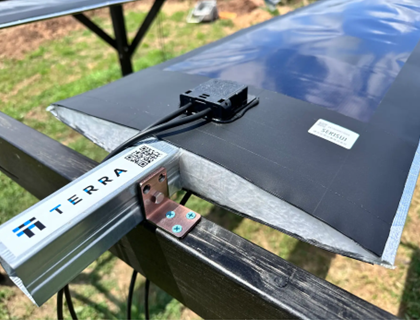
Sekisui Chemical and TERRA launched Japan’s first perovskite solar cell studies at a farm in Sosa (Chiba Pref) that will grow barley and other crops.
Sekisui’s PSC film sheets were placed on the top and back of a lens-shaped panel developed by TERRA. The panel shape reduces wind load by one third, requiring less supporting columns, cutting installation time and costs.
CONTEXT: Sekisui PSC modules have a power efficiency of about 15%. TERRA has installed four panels, each with four of Sekisui 30 x 100 cm2 films. TERRA plans to first grow barley that belongs to the same grass family as rice, Japan’s main crop.
TAKEAWAY: Silicon solar panels are usually configured in the east-west direction but thanks to the PSC flexibility on curved surfaces, north-south installations are now possible, resulting in higher power output during morning and evening hours. The output pattern may have positive impacts on the grids.
TERRA’s lens-shaped panel
Saitama Pref’s first green hydrogen system goes onstream
(Japan NRG, Aug 7)
A 500 kW PEM electrolyzer went onstream at Taisei U-Lec, a concrete manufacturer in the city of Kawagoe, Saitama Pref.
The electrolyzer, made by Yamanashi Hydrogen Co, uses a solar power system on the concrete plant’s roof.
The system outputs at 60 NM3/ hour (667 kg/ hour). The hydrogen will partly replace city gas fuel for the plant’s boiler. Its design capacity is 120 NM3/ hour.
CONTEXT: Saitama will be the fourth prefecture to start green hydrogen production following Fukushima, Oita and Yamanashi.
The city of Sapporo is studying possibly building Hokkaido’s largest hydrogen production plant on a property owned by Hokkaido Railways in Naebo.
Hiroshima panel to review Mazda’s ammonia power plant project
(Japan NRG, Aug 7)
This month, the Hiroshima City Environmental Impact Examination Committee will review a plan by Mazda Motor and Mitsubishi Corp Clean Energy to replace a coal power plant with a 110 MW power plant fully fueled by ammonia.
The companies launched a public consultation on Aug 1, soliciting opinions from residents. The consultation ends Sept 14.
CONTEXT: This is Japan’s first public consultation on construction of an ammonia-fired power plant. By 2030, Mazda plans to bring onstream the 110 MW gas turbine combined cycle plant that would consume up to 1,240 tons of ammonia daily.
TAKEAWAY: The Mazda plant won’t require state approvals as its output is below the 112.5 MW threshold. However, local residents can request a public vote. The city panel may take time to draw conclusions as operators have not specified whether they will use ammonia or ammonia cracking gas to generate power.
MHI and Taiwan Fertilizer inked an MoU to study an ammonia value chain consisting of an import terminal, storage facilities, transportation and handling of the material, and power generation.
METI and ANRE will revise the nation’s cybersecurity guidelines for the Energy Resource Aggregation Business (ERAB) that oversees small-scale “distributed energy resources” such as solar power, BESS and private power generation equipment at homes and factories.
The guidelines will be revised by the end of FY2024, in light of the increase in demand response (DR) services that do not involve gateways (GW), which enable networks with different communication protocols to communicate with each other.
CONTEXT: When controlling air conditioning, BESS, and EVs as DR services, aggregators collect information such as the amount of electricity consumed by the equipment. If this were to be leaked, it could lead to burglaries or other crime.
CONTEXT: Traditionally, the main method for building energy management systems (BEMS) and home energy management systems (HEMS) has been to place GW devices for communication and control, but DR services via manufacturer clouds that do not involve GW have become increasingly popular in recent years. METI will review requirements and policies for security measures based on changes in the environment. Cyber attacks on IoT devices such as home appliances are also on the rise, and the security requirements for IoT devices to be controlled by ERAB will also be a key point of revision.
Itochu, ENEOS, Japan Airlines, Mizuho Bank, Mizuho Research & Technologies, Nippon Express Holdings and Narita International Airport Corp began test trades of credits resulting from sustainable aviation fuel (SAF).
This is the world’s first initiative to share the SAF associated costs among various parties in the air transport value chain.
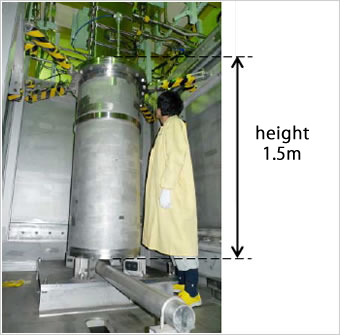
The Japan Atomic Energy Agency (JAEA) received pre-use confirmation from the NRA for the Steady State Critical Experiment Facility (STACY).
STACY resumed operations on Aug 2 and will conduct experiments, simulating nuclear characteristics of mixed molten fuel debris, resulting from NPP accidents.
The goal is to establish criticality evaluation methods for fuel debris from the Fukushima Daiichi NPP. The data obtained will aid in the plant’s decommissioning.
CONTEXT: The facility launched in 1995, collecting data for managing nuclear fuel cycle materials. After the Fukushima accident in March 2011, STACY was modified for debris research and experiments.
deepC Store and Azuli International were awarded GHG acreages offshore Australia. In cooperation with J-POWER, they’ll develop a commercial-scale CO2 sequestration project that aims to store CO2 from Japan, Australia, and the region.
The awarded sites, GHG23-1 and GHG23-2, cover areas in the Bonaparte and Browse Basins, which will use existing depleted fields and saline aquifers for CO2 storage. The partnership includes developing a full value chain for liquified CO2 transport.
Nitto Denko plans to invest around $13.6 million to mass-produce CO2 separation membranes by next year, claiming it can remove about 90% of emissions.
These membranes will be assembled into modules and can handle up to 3,000 tons of CO2 per year in a small to midsize factory.
JFE Engineering will introduce a carbon-capture system combining these membranes with zeolite. The goal is to achieve 99.5% CO2 capture. Toray Industries is also developing carbon fiber-based membranes by 2030.
CONTEXT: Japan leads globally in separation membrane patents, with Toray and Nitto Denko at the forefront. Traditional solvent-based carbon-capture methods are costly and large. Membrane technology promises significant cost reductions.
Climate-tech firm Asuene has raised $5.3 million in funding for its Series C second round through a third-party allocation of shares.
The investors include Japan Green Investment for Carbon Neutrality (JICN), a public-private fund under JERA, the MoE, Nippon Life Insurance, etc.
The second round brought the total Series C funding to $33 million, with overall fundraising reaching $67 million.
CONTEXT: Asuene, which is a carbon accounting platform, is advancing multiple products in climate tech, focusing on decarbonization and ESG. Asuene Veritas, will provide third-party verification for climate change and non-financial data, offering one-stop support from third-party assurance to verification during disclosure.
Rinnai, a Japanese gas appliances manufacturer, has acquired Smart Energy Group, a home energy products distributor in Australia.
This marks Rinnai Group’s entry into the PV power generation business.
CONTEXT: Smart Energy is a distributor of home energy products, specializing in PV systems and BESS.
Community gym installs world’s first hydrogen-powered air conditioner
(Japan NRG, Aug 7)
A community gym in the city of Shunan (Yamaguchi Pref) installed the world’s first hydrogen-fueled air conditioner, which is made by Ebara Refrigeration Equipment and Systems, for a field study until March 2025.
The gym is 200 meters from the Tokuyama Corp plant that supplies hydrogen. A pipeline connects the gym and the plant.
CONTEXT: The city is a petrochemical hub producing 8,000 tons/ year of hydrogen as byproducts. There is also an underground pipeline connecting the plants.
TAKEAWAY: The next phase is Honda Motor and Mitsubishi Corp building a hydrogen-powered data center in Shunan. Like the gym, Tokuyama plans to supply hydrogen via the pipeline.
ANRE temporarily suspended FIT/ FIP subsidies for 342 farm-based solar power generation projects that were found to be in violation of the Agricultural Land Law.
The suspended projects were run by 20 operators, with a total capacity of 17.5 MW. As many as 14 operators (327 projects) lacked permission to convert agricultural land within three years of FIT certification.
The other six operators violated orders to improve or restore the original conditions.
CONTEXT: The measure to temporarily suspend FIT/ FIP subsidies was introduced in April to encourage businesses in violation of laws to address the issues. The decision follows the disciplinary measures imposed April 2 on nine solar power generation projects in clear violation of the Forest and Forestry Basic Act.
TAKEAWAY: This action will have almost no impact on the operation of serious solar developers in Japan, but it should help improve the reputation of the sector with local communities nationwide because citizens will see poorly executed projects and their owners punished. Should all of the suspended projects end up being canceled, the loss in new capacity for Japan will be negligible.
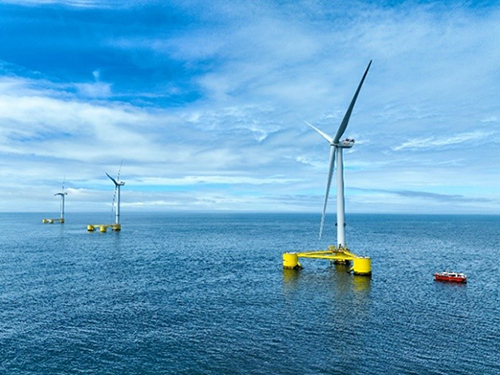
Japan’s largest gas provider, Tokyo Gas, plans to buy a 21.2% stake in WindFloat Atlantic that operates a 25 MW floating wind farm in Portugal off the Atlantic coast.
It’s majority-owned by Ocean Winds, a JV between Portugal’s main utility EDP and France’s Engie. Commercial operation launched in July 2020.
Windfloat Atlantic is one of only a few floating offshore wind farms in the world with around 10 MW-class wind turbines in commercial operation. It has three turbines, each with a capacity of 8 MW.
The tech used in the wind farm allows for operation in heavy storms with a max wave height of 20 meters and an instantaneous wind speed of up to 38.8 meters/ sec.
TAKEAWAY: Tokyo Gas is among the Japanese pioneers rushing to invest in overseas projects with an intent to bring the floating offshore wind tech home from advanced markets. With the recently launched Floating Offshore Wind Technology Research Association and a group aiming to harness production tech for floating wind turbines, participation in projects like WindFloat Atlantic is likely to benefit Japan in the next few years as long as the domestic floating wind power sector doesn’t stall.
JEPX: June sees 3.3% spike in daily spot market offers due to high temperatures
(Japan NRG, Aug 9)
In June, daily sale offers in the spot market at the Japan Electric Power Exchange (JEPX) rose 3.3% over the previous month to 1.18 TWh; buying bids were also up, 2.6% to 814 GWh.
With more thermal power plants coming back online after repairs and inspections, and solar generation high, the offers exceeded 1 TWh in all but two days in June. Daily contracted volumes fell below 600 GWh for only four days in the month.
Total monthly sell offers were 33.2 TWh, down 0.1% from May; while buying bids were at 24.4 GWh, down 0.7% from May.
The average amount of electricity offered for sale per product in June increased 3.3% to 23 GWh. The average purchase of one product rose 2.6% to 17 GWh.
The biggest sales took place on June 1, between 11:30 am and noon.
Kyushu Electric recorded the highest maximum power capacity use, 16.87 GW, on Aug 2, which exceeded the record of 16.56 GW set on the previous day, in large part due to growing demand for air conditioning.
The figure was nearly 2% higher than in the same period in 2023.
This was the largest increase in demand since FY2016, when the company began announcing demand results at the transmission end of the grid.
CONTEXT: In order to secure supply capacity during the evening and night when solar generation declines, Kyushu Electric’s transmission and distribution unit requested the ability to command power supply from 5:30 pm to 8 pm.
Trading houses Toyota Tsusho and Sojitz plan to build wind farms in Uzbekistan.
Eurus Energy, owned by Toyota Tsusho, will develop and operate a wind farm with a generating capacity of 500 MW. This will be the first wind farm overseen by a Japanese firm in Uzbekistan.
Sojitz will build and operate a 1 GW wind farm in Uzbekistan’s Navoiy region. The start of operations has not yet been determined.
Sojitz also plans to build a natural gas-fired plant in Uzbekistan, with operations scheduled to begin in 2026.
Operating expenses and investment totals have not been disclosed.
CONTEXT: Fossil-fuel plants using natural gas accounted for 88% of Uzbekistan’s electricity as of 2022. Solar and wind accounted for just about 1 %, with a total of only 253 MW that year. However, with a newly set 27 GW target of renewables capacity and 40% of electricity production from renewables by 2030, the Uzbek govt hopes to expand use of wind and solar power.
Toyota Tsusho group firm Aeolus, which is active in renewables in Africa, will participate in two solar PV projects in Tunisia. It will build and operate two 50 MW solar power plants in Sidi Bouzid and Tozeur, and sell the electricity in Tunisia.
This will be Toyota Tsusho’s first renewables project in the country, and the first project for Aeolus, which was established in March 2024. Toyota Tsusho’s wholly owned subsidiaries, CFAO and Eurus Energy, each have 50%.
The total project cost is €79 million and it was selected by the MoE for Joint Crediting Mechanism Model Projects, which provides financial support covering up to half of the initial investment costs.
CONTEXT: Tunisia relies heavily on energy imports such as oil and natural gas. Thermal power generation accounts for the majority of the country’s power generation capacity. The govt, however, has recently shifted its policy with an aim to increase renewables’ share to 35% of the national energy mix by 2030.
JERA Nex, JERA’s global renewable energy business, has acquired two U.S. solar projects with a total capacity of 480 MWdc (395 MWac) from Lightsource bp, a developer of solar energy and BESS projects.
This is JERA Nex’s first acquisition since its launch in April 2024, and its first solar assets in the U.S.
The solar farms are: Oxbow solar farm in Louisiana (345 MWdc/ 300 MWac), the largest in the state; and Happy solar farm in Arkansas (135 MWdc/ 95 MWac). Both are in commercial operation.
Mitsubishi HC Capital Energy and South Korea’s Samsung C&T, inked a JV on the grid-scale storage battery business.
The two firms will operate in the service area of Hokkaido Electric through a special purpose company. Mitsubishi will hold a 90% stake.
Construction of grid storage batteries with an output of 25 MW and a capacity of 50 MWh will launch in April 2025, with operation scheduled to begin in January 2027.
Mitsubishi HC Capital Energy plans to outsource battery operation and trading in the electricity markets (spot, capacity and balancing) to Osaka Gas.
This will be Mitsubishi HC Capital Energy’s first grid-scale storage battery business.
Dai Nippon Printing (DNP), Japan’s largest diversified printing/ coating tech firm, will invest ¥3 billion by 2025 in its Izumizaki Plant, (Fukushima Pref) to double the production capacity of encapsulating materials used to protect solar cells.
The firm will also continue to develop materials such as reflective sheets for solar power plants, aiming for annual sales of ¥20 billion by FY2027.
CONTEXT: The global market for solar cells is growing at an average annual rate of 10-20%, and by 2030, the cumulative global installed capacity is expected to be about 5.5 TW, with solar power generation accounting for 12% of global electricity demand.
The NRA requested all NPPs to confirm their disaster prevention measures after the Japan Meteorological Agency issued its first-ever “emergency information” related to a potential Nankai Trough earthquake.
Several NPPs could be affected by a Nankai Trough earthquake. These include Shikoku Electric’s Ikata NPP Unit 3 in Ehime Pref, and Kyushu Electric’s Sendai NPP Units 1 and 2 in Kagoshima Pref.
CONTEXT: Ikata Unit 3 is now offline for inspection; at the Sendai plant, Unit 2 is operational, and Unit 1 is offline for inspection. Decisions about NPP operation during earthquakes are made by each operator based on NRA regulations.
In the fall, Suttsu Town in Hokkaido will hold a second round of meetings for residents. One goal is to explain the results of the ‘literature survey’, the first phase of the site investigation, and then to discuss proceeding with the second phase.
On Aug 1, METI approved a draft revision of the literature survey in Suttsu and Kamoenai villages. Suttsu will consider whether to proceed based on a local vote.
CONTEXT: In contrast to the first stage, the second phase involves physical exploration, such as air, surface, water, and borehole surveys. The goal is to confirm stability and impact from earthquakes and active faults.
Osaka Gas, Sumitomo Corp and the Japan Overseas Infrastructure Investment Corp invested $370 million to take a 25% stake in AG&P LNG Marketing.
AG&P is expanding its gas distribution network in India, sourcing fuel from imported LNG and delivering it to consumers via underground pipes.
Osaka Gas will contribute expertise in infrastructure development and safety maintenance.
CONTEXT: AG&P has secured exclusive gas supply rights in several regions across ten Indian states. By 2030, India aims to increase the share of natural gas in its energy mix to 15%.
Osaka Gas inked an MoU with ADNOC to buy LNG from the Ruwais LNG Project in Abu Dhabi, with an annual production capacity of 9.6 MMT.
This long-term contract starts in the latter half of the 2020s and involves buying up to 800,000 tons of LNG a year under DES (delivered ex ship) terms.
CONTEXT: In July, it was revealed that Mitsui made a $550 million investment in Ruwais, taking a 10% stake.
TAKEAWAY: In 2023, Japan’s top LNG suppliers were Australia, Malaysia, Russia and the U.S. This MoU, together with Mitsui’s stake, are part of Japan’s shift in LNG suppliers amidst geopolitical instability.
LNG stocks of 10 power utilities were 1.92 million tons as of Aug 4, down 10.3% from the previous week (2.14 million tons).
This is 1% down from the end of July (1.94 million tons) in 2023, and 12.3% down from the past five-year average of 2.19 million tons.
CONTEXT: The weather throughout Japan is still very hot (regularly above 35 degrees Celsius), and air-conditioner use is widespread. However, the demand for thermal power plants (fueled by LNG) is not as high as it used to be, since other alternatives, such as solar and nuclear, are filling the gap.
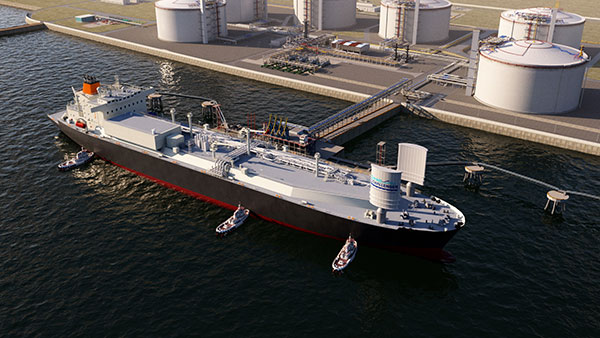
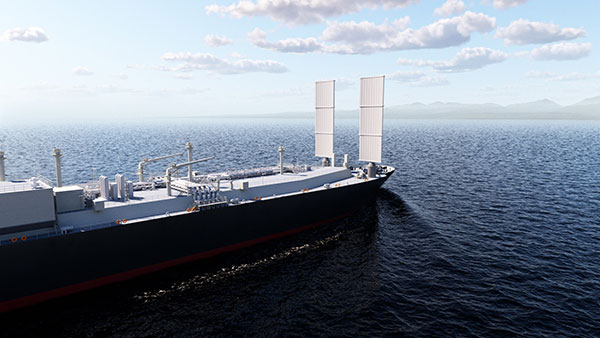
MOL obtained approval in principle (AiP) from Nippon Kaiji Kyokai (ClassNK) for the design of a membrane LNG carrier equipped with Wind Challenger sails.
This is the first approval of its kind for an LNG carrier.
The project is jointly with Hanwha Ocean, and features two Wind Challenger sails and a cargo tank with a capacity of 174,000 m3. The detailed design work is ongoing.
CONTEXT: MOL aims to achieve net zero GHG emissions by 2050, and plans to introduce 25 vessels equipped with Wind Challenger sails by 2030, and 80 by 2035.
ASIA ENERGY REVIEW
BY JOHN VAROLI
This weekly column focuses on energy events in Asia and the Pacific
Australia / Solar and wind
In July, the country added 21 new utility-scale solar, wind and energy storage projects with 9.6 GW of capacity to its renewable energy development pipeline, reported Rystad Energy.
China / Electricity
The National Energy Administration issued 486 million green certificates, a 13-fold YoY increase. This includes 197 million certificates for wind power generation, 102 million for conventional hydropower, 133 million for solar, 54.35 million for biomass, and 16,500 for other renewable energy power generation.
China / High temperatures
Eastern China has faced high temperatures recently, with excessive heat lingering in coastal cities in the industrialized provinces of Jiangsu and Zhejiang. In the east and northwest of China, temperatures reached 43.9 C, boosting power consumption.
China / Renewable power
In the first half of 2024, China added only 8 GW of coal capacity, far less than wind’s 25 GW, and solar’s 105 GW. By 2026, solar is expected to surpass coal as China’s primary energy source.
India / Hydropower
The Cabinet Committee on Economic Affairs approved $6.95 billion in investment for the 669 MW Lower Arun Hydro Electric Project. The power generated will be fully utilized in both Nepal’s and India’s grids.
LNG
Asia continues to draw LNG from Europe as imports in July rose the most in six months, even as spot prices stayed near seven-month highs. The region is on track for imports of 24.85 MMT, up from 22.6 MMT in June, and which is the highest since January’s 26.2 MMT, according to Kpler.
Malaysia / Fuel subsidies
Malaysia is phasing out gasoline and diesel subsidies as inflation eases. Fuel subsidies put a cap on prices, with the govt covering the excess difference. Malaysia’s gasoline retail price is about 20% of the price in neighboring Singapore
Philippines / Solar power
Nexif Ratch Energy’s Calabanga Solar Project (CARE) in South Luzon launched commercial operation. CARE is a 74.2 MWp ground-mounted solar PV project and the first utility-scale solar power project in the Bicol Region.
Singapore / Electricity
On Aug 6, the Energy Transition Measures and Other Amendments Bill was introduced in Parliament for its first reading, following a public consultation in May. Under the Bill, Singapore’s energy regulator will be able to order licensees and consumers to ration power in emergencies when electricity supply is disrupted.
Vietnam / LNG
ITECO inked a deal with U.S.-based Excelerate to develop a 1.2 mtpa capacity LNG terminal in Haiphong. The first phase would have a capacity of 0.7 mtpa with a planned commercial start in 2027.
2024 EVENTS CALENDAR
A selection of domestic and international events we believe will have an impact on Japanese energy
January
First market trading day (Jan 4)
IEA “Renewables 2023: Analysis and Market Forecast to 2028” released (Jan 11)
Renewable Energy Exhibition (Jan 31 – Feb 2)
Taiwan presidential election (Jan 13)
Japan’s Diet convenes
IEA “Electricity 2024 / Analysis and Forecast to 2026” released (Jan 24)
February
CFAA International Symposium (Feb 2)
India Energy Week 2024 (Feb 6-9)
Lunar New Year (Feb 10-17)
Indonesia presidential election (Feb 14)
Japan-Ukraine Conference for Promotion of Economic Reconstruction (Feb 19)
FIT/FIP solar auction (Feb 19 – March 1)
Smart Energy Week (Feb 28-Mar 1)
March
Announcement of auction result for Offshore Wind Round 2 (for Akita Happo-Noshiro Project)
Onshore wind auctions (March 4-15; results on March 22)
International LNG Congress (LNGCON) 2024, Milan, Italy (March 11-12)
Russian president election (March 15-17)
World Petrochemical Conference, Houston, TX, USA (March 18-22)
IAEA Nuclear Energy Summit @ Belgium (March 21)
Ukraine presidential election (due before March 31)
Happo Noshiro, Murakami-Tainai, Oga-Katagami-Akita and Saikai-Eshima wind project auctions close (June 30)
July
Tokyo governor election (July 7)
7th Basic (Strategic) Energy Plan draft published (expected)
August
7th Basic (Strategic) Energy Plan draft presented to Cabinet (expected)
September
Global Offshore Wind Summit Japan 2024, Sapporo, Hokkaido (Sept 3-4)
The United Nations Summit of the Future (Sept 22-23)
Gastech 2024, Houston, TX (Sept 17-20)
IAEA General Conference
GX Week in Tokyo (expected late Sept to October)
Asia Green Growth Partnership Ministerial Meeting
Asia CCUS Network Forum
International Conference on Carbon Recycling
International Conference on Fuel Ammonia
GGX x TCFD Summit
October
IEA World Energy Outlook 2024 Release
BP Energy Outlook 2024 Release
Innovation for Cool Earth Forum (expected)
Connecting Green Hydrogen Japan 2024 (Oct 16-17)
Japan Wind Energy 2024 Summit (Oct 16-17)
Solar Energy Future Japan 2024 (Oct 16-17)
Japan Mobility Show (Oct 25-Nov 5)
November
US presidential election (Nov 5)
COP 29 in Azerbaijan (Nov 11-22)
Abu Dhabi International Petroleum Exhibition Conference (ADIPEC) 2024, Abu Dhabi, UAE (Nov 11-14)
APEC 2024 @ Lima, Peru
International Conference on Nuclear Decommissioning (TBD)
G20 Rio de Janeiro Summit (Nov 18-19)
Offshore Energy Exhibition & Conference (OEEC) 2024, Amsterdam, the Netherlands (Nov 26-27)
Biomass & BioEnergy Asia Conference (TBD)
European Biomethane Week 2024
December
Last market trading day (December 30)
Disclaimer
This communication has been prepared for information purposes only, is confidential and may be legally privileged. This is a subscription-only service and is directed at those who have expressly asked K.K. Yuri Group or one of its representatives to be added to the mailing list. This document may not be onwardly circulated or reproduced without prior written consent from Yuri Group, which retains all copyright to the content of this report.
Yuri Group is not registered as an investment advisor in any jurisdiction. Our research and all the content express our opinions, which are generally based on available public information, field studies and own analysis. Content is limited to general comment upon general political, economic and market issues, asset classes and types of investments. The report and all of its content does not constitute a recommendation or solicitation to buy, sell, subscribe for or underwrite any product or physical commodity, or a financial instrument.
The information contained in this report is obtained from sources believed to be reliable and in good faith. No representation or warranty is made that it is accurate or complete. Opinions and views expressed are subject to change without notice, as are prices and availability, which are indicative only. There is no obligation to notify recipients of any changes to this data or to do so in the future. No responsibility is accepted for the use of or reliance on the information provided. In no circumstances will Yuri Group be liable for any indirect or direct loss, or consequential loss or damages arising from the use of, any inability to use, or any inaccuracy in the information.