
JAPAN NRG WEEKLY
SEPTEMBER 9, 2024
JAPAN NRG WEEKLY
SEPTEMBER 9, 2024
NEWS
TOP
- Toyota, other major automakers to boost domestic battery production capacity with ¥1 trillion investment
- Aomori expert panel proposes zones where renewables development won’t be allowed
- Non-fossil value trading sees huge increase in renewable energy-designated contracts
- NIMS seeks partnerships to research solid ammonia
- METI to strengthen battery production and supply chain
- MoE urges scaling down Kazuno wind project
- Japan may subsidize shift to new tech for data centers
- Japanese investment firm to back U.S. ammonia startup
- Shimizu Corp begins hydrogen energy storage demo
- Building Japan’s tallest skyscraper calls for 90 kl of SAF
- MHI issues third batch of transition bonds
- Mitsubishi UFJ Bank enters electricity futures market
- JEPX baseload market sees low volume in first ’24 session
- 5% of capacity market winners didn’t meet obligations
- KEPCO and Fukui Gov discuss spent nuclear fuel removal
- J-Power delays safety construction work at Oma NPP
- OTL, Riamwind to start selling compact windmills
- IHI and Indonesia explore green ammonia for coal plants
- TEPCO and NTT to install solar power at local facilities
- Japan’s oil and gas self-sufficiency at 37.2% in 2023
- Tokyo Gas invests in CO2 emissions trading fund
ANALYSIS
BOOMING BATTERY STORAGE PIPELINE GIVES NEW IMPETUS TO ENERGY TRANSITION
Integrating Battery Energy Storage Systems (BESS) into the grid is essential to accelerate clean energy projects, but securing a grid connection has led to bottlenecks due to limited transmission capacity. The government is addressing this through subsidies and other initiatives to encourage BESS adoption. As Japan takes a leading role in Asia’s grid-scale energy storage market, it’s attracting both domestic and international companies, including major players like Tesla.
JAPAN LOOKS TO FARMLAND FOR SOLAR EXPANSION AMID INDUSTRY SLOWDOWN
In an effort to boost solar power capacity, Japan seeks to install more panels on farmland. With large-scale utility solar projects facing a shortage of open space and increasing scrutiny from residents who worry about panels located on steep slopes, agrisolar looks like an optimal solution. Japan’s solar power goals for 2030 have given new impetus to this niche. If it succeeds, it could significantly boost total solar power capacity in the country.
ASIA ENERGY VIEW
A wrap of top energy news that impacts other Asian countries.
EVENTS SCHEDULE
A selection of events to keep an eye on in 2024.
JAPAN NRG WEEKLY
PUBLISHER
K. K. Yuri Group
Events
Editorial Team
Yuriy Humber (Editor-in-Chief)
John Varoli (Senior Editor, Americas)
Mayumi Watanabe (Japan)
Kyoko Fukuda (Japan)
Magdalena Osumi (Japan
Filippo Pedretti (Japan)
Tim Young (Japan)
Regular Contributors
Chisaki Watanabe (Japan)
Takehiro Masutomo (Japan)
SUBSCRIPTIONS & ADVERTISING
Japan NRG offers individual, corporate and academic subscription plans. Basic details are our website or write to subscriptions@japan-nrg.com
For marketing, advertising, or collaboration opportunities, contact sales@japan-nrg.com For all other inquiries, write to info@japan-nrg.com
OFTEN-USED ACRONYMS
|
METI |
The Ministry of Economy, Trade and Industry |
mmbtu |
Million British Thermal Units | |
|
MoE |
Ministry of Environment |
mb/d |
Million barrels per day | |
|
ANRE |
Agency for Natural Resources and Energy |
mtoe |
Million Tons of Oil Equivalent | |
|
NEDO |
New Energy and Industrial Technology Development Organization |
kWh |
Kilowatt hours (electricity generation volume) | |
|
TEPCO |
Tokyo Electric Power Company |
FIT |
Feed-in Tariff | |
|
KEPCO |
Kansai Electric Power Company |
FIP |
Feed-in Premium | |
|
EPCO |
Electric Power Company |
SAF |
Sustainable Aviation Fuel | |
|
JCC |
Japan Crude Cocktail |
NPP |
Nuclear power plant | |
|
JKM |
Japan Korea Market, the Platt’s LNG benchmark |
JOGMEC |
Japan Organization for Metals and Energy Security | |
|
CCUS |
Carbon Capture, Utilization and Storage | |||
|
OCCTO |
Organization for Cross-regional Coordination of Transmission Operators | |||
|
NRA |
Nuclear Regulation Authority | |||
|
GX |
Green Transformation |
NEWS: ENERGY TRANSITION & POLICY

Toyota, Nissan, etc to boost domestic battery production capacity with ¥1 trillion investment
(Nikkei, Sept 6)
- Toyota Motor, Nissan Motor and other manufacturers will invest ¥1 trillion to expand production for storage batteries in Japan by 50% with the help of state support.
- The investments will go mainly toward automotive batteries for EVs and would lift total capacity to 120 GWh from the current 80 GWh.
- METI is set to announce ¥350 billion in aid, seeking to reach 150 GWh by 2030. METI will offer aid for production of battery components and related equipment.
- Toyota’s investment is expected to be around ¥250 billion. The firm plans to include a new factory for EV batteries, slated to begin operation by the end of 2028. It is also working to develop solid-state battery tech.
- Nissan plans to invest around ¥150 billion in producing automotive lithium-iron phosphate batteries and start supplying them in 2028.
- Panasonic will make core lithium-ion battery components for Mazda and Subaru in Japan. The investment is expected to total ¥550 billion.
- CONTEXT: The initiative seeks to ensure a stable domestic supply of components that’s not scattered across other Asian countries. The initiatives are part of a broader effort to help small and midsize firms seeking to enter the electrification field. A group comprising about 20 firms including Nissan, Toyota and Itochu seeks to create the nation’s first resource recycling system for used EV batteries. The goal is to extract rare metals from batteries that had previously been discarded and to reuse them.
- SIDE DEVELOPMENT:
METI requests ¥178 billion to strengthen battery production and supply chain
(Denki Shimbun, Sept 2)- In its budget request for FY2025, METI seeks more support for capital investment into the storage battery sector, including all-solid-state batteries.
- The total budget request is ¥2.36 trillion, a 23% increase over the initial FY2024 budget. The FY2025 budget includes:
- ¥177.8 billion to support strengthening the battery production supply chain, including support for capital investment in all-solid-state batteries.
- ¥77.7 billion to help build the GX supply chain, including support for capital investment in PSC cells to be installed on building walls and windows.
- A total of ¥982 billion is allocated for GX-related measures, up 53% over FY2024; and ¥782 billion is allocated for a special account for energy measures.
- CONTEXT: Compared to lithium-ion batteries, all-solid-state batteries can double cruising distance, and have a longer range with shorter recharge times than li-ion batteries. Toyota Motor and Idemitsu Kosan aim to commercialize the batteries around 2027-2028.
TAKEAWAY: News of Japanese automakers planning a major expansion of domestic battery capacity was followed just a few days later by media reports that Toyota has actually decided to reduce its global EV production target for 2026 by 30%. The reason is little to do with climate change, the energy transition or Toyota. It’s simply that there has been a notable slowdown in EV sales, apart from in China, where the government’s lavish subsidies and other support to domestic players have ensured that oversea automakers will struggle to compete. Japanese automakers have to be ready for this EV sales trend to reverse and putting more resources into battery R&D and new production capacity makes sense. However, given the uncertainty over future EV interest, the government clearly feels it has to step in to de-risk the investments of the auto companies.
Aomori expert panel proposes zones where renewables development won’t be allowed
(Government statement, Sept 4)
- The Cohabitation Study Committee, a panel studying new ordinances for onshore wind and other renewable energy installations in Aomori Pref, proposed identifying preservation and protection zones where such projects won’t be allowed.
- Some areas will be determined as “co-habitation zones” where renewable energy projects are possible only if there is local community support.
- The panel also outlined procedures to seek community consensus.
- In the image below, the red areas are protected zones where renewable energy projects will be banned outright, and yellow areas are preservation zones where such projects could be possible if they win community consent.
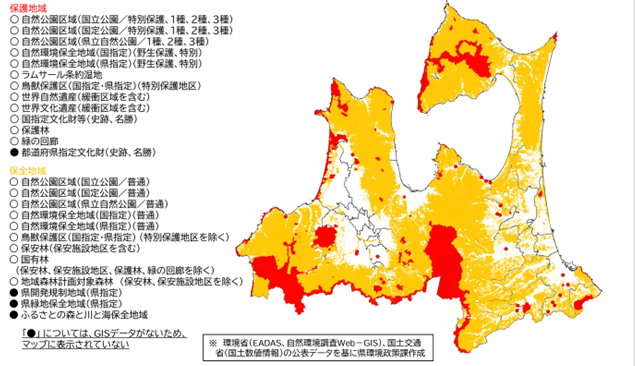
- CONTEXT: In the past few years there’s been a public backlash against new solar and wind farms in some communities. Last year, spurred by increasing local discontent over the rapid local growth in renewables, the new Aomori governor vowed to slow the rate of new installations by levying a new tax on operators. Now, local authorities will assume greater control over solar and onshore wind projects. A panel has recommended that the prefecture uses zoning rules, and placed an emphasis on installing an official community consultation procedure.
TAKEAWAY: Among the major nations that have pledged specific goals for the energy transition, Japan probably has the strongest sense of local identity and activist communities that are willing to stand up to the plans of the central government and major corporations. The country is currently at a stage of rebalancing between the needs and wishes of local communities and national climate ambitions. But once the new equilibrium is reached, we expect industry growth to resume.
- SIDE DEVELOPMENT:
Environment Minister urges scaling down Kazuno wind project
(Government statement, Sept 6)- The Minister of Environment said the 106 MW East Kazuno Citizen’s wind farm may need to scale down if its impact on birdlife, plants, etc can’t be mitigated. There are bird protection zones around the site.
- Kazuno Green Energy plans to build 20-25 wind turbines, (capacity ranging from 4.2 to 6.1 MW), in a 2,700 hectare mountain area in the eastern part of Kazuno city.
- Launch is slated for 2032.
Japan may subsidize shift to new tech for data centers to lower energy needs
(Nikkei Asia, Sept 2)
- Japan plans to support the development of high-speed, light-based communication tech that could lead to the construction of more data centers outside major cities.
- The government is considering subsidies to promote this tech, aiming to begin next year, with discussions between key ministries scheduled for this month.
- Light-based networks offer faster data processing and lower energy consumption; they could help handle large data flows from technologies like generative AI and autonomous vehicles, with potential benefits for dispersing data centers nationwide.
NIMS seeks partnerships with businesses to research solid ammonia
(Japan NRG, Sept 6)
- The state-run National Institute of Materials Science (NIMS) seeks partnerships with businesses to research converting ammonia gas into a solid at room temperature.
- In May 2023, Dr. Morishita Masao, while a Hyogo University professor, discovered that ammonia could convert into solid form at room temperatures by trapping the substance into borate glass, which resembles a fried donut filled with ice cream.
- Dr. Morishita, who joined NIMS earlier this year, heads the NIMS project team on “Building thermodynamic mathematical models on the structure and formation of solid ammonia, the dream hydrogen carrier”.
- CONTEXT: Ammonia converts into liquid at -30C and could be transported, but there are safety issues such as slips and corrosion of containers and equipment in contact with it. Dr. Morishita was initially studying hydrogen storage in ammonia borane compounds, and said that his discovery of solid ammonia was purely accidental.
TAKEAWAY: Dr. Morishita found that ammonia stays intact in borate glass until 52C. If this ammonia borane mechanism could be fully explained, it could resolve ammonia transport and storage issues, and widen the hydrogen family’s energy potential. NIMS projects are mostly conducted in-house, but some projects are in partnerships with universities and businesses.
Japanese investment firm to back U.S. ammonia startup
(Nikkei, Sept 3)
- Mercuria Holdings, which is affiliated with the Development Bank of Japan, will invest several hundred million yen in U.S.-based First Ammonia, a startup specializing in the efficient production of ‘green ammonia’ from renewable energy.
- The investment will be done with Manies Group, an investment bank that specializes in funding for renewables, and Osaka-based T.N. Plan. The three will each spend several hundred million yen, but in total they’ll hold less than 5% of equity.
- The investment aims to support ammonia supply to Japan and Asia, with future plans for an infrastructure fund to invest in ammonia production facilities.
- First Energy focuses on developing solid oxide electrolyser cell (SOEC) technology.
Shimizu Corp begins hydrogen energy storage demo
(Company statement, Sept 4)
- Shimizu Corp began a demo of hydrogen energy storage using the Hydro Q-BiC TriCE system at its NOVARE innovation center in Tokyo. This system stores hydrogen in metal hydride tanks and converts it to electricity.
- In 2024, Shimizu plans to receive 40 GJ of hydrogen gas from a green hydrogen production site in Yamanashi Pref to power four buildings at NOVARE. The Hydro Q-BiC system, which is co-developed with the National Institute of Advanced Industrial Science and Technology (AIST), stores hydrogen at room temperature and low pressure, making it suitable for general facilities.
- Shimizu plans to store 910 GJ of hydrogen annually at NOVARE, integrating onsite and offsite hydrogen supply, and aims to use NOVARE as a testing ground for advanced carbon-neutral technologies.
- SIDE DEVELOPMENT:
Yamanashi Pref to launch hydrogen transport cost reduction trial
(YBS News, Sept 3)- Yamanashi Pref is advancing its green hydrogen supply hub to reduce hydrogen transport costs by half, and will launch an experiment later this year.
- A new facility is under construction in Kofu City’s Yonekurayama area, where research will focus on compressing hydrogen to more than double its current pressure, from 200 to 450 atmospheres, to increase the amount of hydrogen transported.
- The experiment is a collaboration of private companies utilizing state subsidies; the goal is to enhance hydrogen supply chain profitability by addressing transport costs.
- SIDE DEVELOPMENT:
Japan Hydro completes hydrogen engine R&D facility
(Yomiuri Shimbun, Sept 6)- Japan Hydro completed the country’s first R&D facility for hydrogen-propelled ship engines; it’s located in the city of Fukuyama, Hiroshima Pref.
- The company plans field tests of prototype engines in 2026.
JOGMEC selects companies for engineering design for Advanced CCS Projects
(Company statement, Sept 4)
- JOGMEC chose Itochu Corp, Nippon Steel, Taiheiyo Cement, MHI, INPEX, Taisei, and Itochu Oil Exploration (CIECO) for an engineering design project.
- This is for the Advanced CCS Projects that plan to capture CO2 at industrial plants, transport it via ships, and store it underground.
- A feasibility study was done in 2023; next is the Front End Engineering Design (FEED) phase that will cover CO2 separation, capture, transport, and storage.
- SIDE DEVELOPMENT:
METI seeks public feedback on drilling equipment for carbon storage
(Government statement, Sept 2)- METI welcomes feedback from the public on proposed definitions and technical requirements for drilling and other equipment used for carbon storage.
- Feedback is accepted until Oct 1.
Battery manufacturer NGK Insulators to provide NaS batteries for demo in Hungary
(Company statement, Aug 30)
- Battery manufacturing firm NGK Insulators won an order for sodium-sulfur (NaS) power storage batteries to be installed at the Duna Center Therm Uzemi Szolgaltato, a subsidiary of Hungary’s state-owned energy company MVM Balance.
- MVM intends to utilize the full-scale storage batteries for adjusting the supply-demand balance of renewables. This project will enable the Hungarian firm to verify the feasibility of grid-scale storage batteries.
- NGK Insulators is the only company in the world that produces molten NaS batteries on a commercial scale.
- CONTEXT: Hungarian law calls for carbon neutrality by 2050. Due to its flat topography, Hungary is unable to rely on pumped-storage batteries, which require height differences in the terrain. Hence, Hungary will have to rely on large grid-scale storage batteries to balance supply and demand from renewable energy sources. The NaS battery is a molten-salt battery that uses liquid sodium and liquid sulfur electrodes. This type of battery has a similar energy density as lithium-ion batteries, and is produced with inexpensive and non-toxic materials.
KEPCO gets certification for li-ion battery deterioration diagnosis
(Company statement, Sept 5)
- KEPCO received certification from the Japan Electrical Safety & Environment Technology Laboratories (JET), which handles certification of electrical appliances, for its procedures and evaluation methods for Li-ion battery deterioration diagnosis.
- Normally, measurement companies have used their own procedures to diagnose degradation, such as capacity status and safety. But KEPCO’s internal procedures have been certified as appropriate. It is the first such case in Japan.
- CONTEXT: KEPCO is set to start a li-ion battery diagnostic business in FY2024. The move comes as the market for recycling li-ion batteries is expanding.
Construction of Japan’s tallest skyscraper calls for 90 kl of SAF
(Japan NRG, Sept 3)
- Torch Tower, which would be Japan’s tallest building if completed as planned in 2027, will require about 90 kiloliters of sustainable aviation fuel (SAF) to cut emissions 90% during construction, Shimizu Corp said.
- Torch Tower, planned for Tokyo’s downtown, will have 62 floors. Mitsubishi Estate, the project owner, and contractor Shimizu decided to replace diesel oil and heavy fuel oil with SAF to be used in heavy construction machinery.
- Euglena Co will supply the SAF. The Tokyo Metropolitan Government will grant up to ¥80 million for this fuel replacement.
MHI issues third batch of transition bonds
(Company statement, Aug 3)
- MHI held its third series of transition bonds. Worth a total of ¥10 billion, the bonds have a 5-year maturity and an interest rate of 0.7%.
- The proceeds will be used for new investments, and to refinance existing projects, as well as decarbonize infrastructure, and develop hydrogen and CO2 solutions.
- Japan Credit Rating Agency gave the bond a AA- rating.
NEWS: ELECTRICITY MARKETS

Non-fossil value trading sees huge increase in renewable energy-designated contracts
(Denki Shimbun, Sept 2)
- The first session of the 2024 non-fossil value trading market saw a sharp contrast: the volume of trading in non-FIT certificates for “non-designated renewable energy” plummeted by 97.7% to 262 GWh, while that of “renewable energy-designated” certificates rose by 2.8 times (280%) to 1.7 TWh.
- Bid volumes for both certificates were settled at the minimum price of ¥0.6/ kWh.
- CONTEXT: This specific market was established to enable trading of certificates representing the CO2 avoided by generating electricity from clean energy rather than the burning of fossil fuels. In other words, it represents the trading of the environmental ‘value’ of electricity generated from clean power sources.
- Renewable energy-designated certificates have gained in popularity due to full tracking of non-fossil certificates that includes detailed source information, aligning with international initiatives like RE100. Non-designated renewable energy certificates, which are mainly derived from the generation of power from nuclear plants, saw an oversupply but limited demand.
- SIDE DEVELOPMENT:
Mitsubishi UFJ Bank enters electricity futures market
(Denki Shimbun, Sept 2)- Mitsubishi UFJ Bank entered the electricity futures market operated by TOCOM, becoming the first major bank to obtain trading and clearing qualifications.
- The bank aims to expand electricity spot market activity and plans to take a 49% stake in Enechain’s subsidiary, eClear, to provide credit risk reduction services for wholesale power transactions.
- Starting in October, the bank will handle client orders in the futures market from trade execution to clearing.
- CONTEXT: The move is expected to boost trading volume, enhancing liquidity.
JEPX baseload market sees low volume due to reduced supply
(Denki Shimbun, Sept 2)
- The FY2024’s first JEPX baseload (BL) market auction saw low transaction volumes, with only 41 MW in Tokyo, 14.8 MW in Kansai, and 300 kW in Kyushu.
- Total transaction volume for one-year contracts in the three areas decreased 87.3% compared to the previous year’s first auction.
- A government policy adjustment reduced mandatory supply obligations for sellers, contributing to the decline in auction volumes.
- The contract price was ¥15.60/ kWh in Tokyo; ¥12.97 in Kansai; and ¥13.41 in Kyushu. TOCOM futures prices (as of the trading close on Aug 29), which can be used as a reference, were ¥15.42 for the East Area BL average for FY2013, and ¥12.78 for the West Area BL; while the European Energy Exchange (EEX) is ¥15.40 for the Tokyo BL and ¥12.74 for the Kansai BL.
OCCTO says 5% of capacity market auction winners didn’t meet obligations
(Denki Shimbun, Sept 2)
- OCCTO said that about 5% of auction winners in the capacity market since the start of FY2024 had their payments reduced for failing to meet supply conditions during low reserve periods in April.
- Most power generators (95.3%) fulfilled their obligations, but 2.1% of winners saw payment reductions of less than 10%; while 1.6% of winners saw a payment cut of between 10-50%; and 1% lost over 50% of the fee due to missed requirements.
- Meanwhile, nearly all the capacity contribution fees (¥142.46 billion) collected from retail electricity providers for April were processed.
- SIDE DEVELOPMENT:
OCCTO seeks public comments on long-term capacity market
(Organization statement, Sept 2)- OCCTO is collecting feedback Sept 4 to 18 on the Long-term Decarbonization Power Source Auction (LDTA).
Opinions can be made on participant registration, bidding, and capacity securement contract conclusion for FY2024. - Based on comments, some revisions will be made, such as possibly clarifying the descriptions and extending the deadline for submitting the documents necessary for registering power source information.
- OCCTO is collecting feedback Sept 4 to 18 on the Long-term Decarbonization Power Source Auction (LDTA).
JOGMEC to set up office for offshore wind power research in Hokkaido
(Company statement, Sept 2)
- In October, JOGMEC will set up the Hokkaido Liaison Office for Offshore Wind Power Research in Iwanai Town.
- JOGMEC will set up a system to cooperate with local officials to conduct surveys on seabed, wind, weather and sea conditions related to offshore wind power.
- The survey results will be provided to offshore wind power generation applicants.
KEPCO’s President and Fukui Governor discuss spent nuclear fuel removal
(Nikkei, Sept 5)
- KEPCO President Mori Nozomu met with Fukui Governor Sugimoto Tatsuji to discuss revising the timeline for the removal of spent nuclear fuel from the prefecture. This follows the delay in the completion of JNFL’s reprocessing plant in Rokkasho.
- The plant’s completion has been pushed back to FY2026, marking the 27th delay since construction began in 1993. KEPCO had planned to begin fuel reprocessing in FY2025, and removal by FY2026. Governor Sugimoto expressed disappointment, calling for an expedited revision of the schedule.
- CONTEXT: KEPCO operates seven nuclear reactors in Fukui, and the utility faces pressure as its spent fuel storage capacity is almost full. In 2021, KEPCO promised to halt operation of Mihama NPP Unit 3, and Takahama NPP Units 1 and 2, if no solution was found. KEPCO has a stake in JNFL and has dispatched employees to help with the reprocessing plant’s construction and regulatory review.
- CONTEXT: On Aug 30, KEPCO officials also met with ANRE and Fukui Pref officials to discuss the same issue. Deputy Governor Washizu Mio said KEPCO should show a strong commitment and solve the problem as soon as possible.
TEPCO secured approval for Kashiwazaki-Kariwa design and construction work plan
(Company statement, Sept 2)
- TEPCO received NRA approval for its design and construction work plan for Kashiwazaki-Kariwa NPP Unit 6. The work is done to improve the safety of the facility in line with upgraded nuclear regulations.
- The application was initially submitted in September 2013, with amendments added in 2023, as well as this summer.
- CONTEXT: This approval is part of the NRA’s three-phase review. In 2017, Unit 6 received approval for “reactor installation modification,” which involved revising its basic design. The next step is the NRA’s review of the “safety regulations.”
- SIDE DEVELOPMENT:
TEPCO applied for pre-use inspection for Kashiwazaki-Kariwa Unit 6
(Company statement, Sept 6)- TEPCO applied to NRA and METI for pre-use inspection for Kashiwazaki-Kariwa NPP Unit 6. It confirms that safety measures are being implemented.
- CONTEXT: For now, the restart is slated for FY2025. However, since Niigata Pref hasn’t given its approval, TEPCO has yet to announce an official date.
- SIDE DEVELOPMENT:
TEPCO and METI discuss halt to debris removal work at Fukushima
(Nikkei, Sept 4)- TEPCO President Kobayakawa met with METI Minister Saito to explain the Aug 22 suspension of debris retrieval work at Fukushima Daiichi NPP Unit 2. The cause was a mistake relating to the sequence of pipes needed to insert the retrieval device into the reactor containment vessel.
- TEPCO hasn’t provided a date for resuming operations, though Kobayakawa said the goal is to restart as soon as possible.
- Saito said TEPCO must oversee preparations and procedures. He urged TEPCO to review its approach and ensure comprehensive checks.
Tohoku Electric begins fuel loading at Onagawa NPP Unit 2
(Company statement, Sept 3)
- Tohoku Electric began fuel loading for Onagawa NPP Unit 2. The process will take about one week.
- CONTEXT: Fuel loading involves inserting fuel assemblies into the reactor. The NPP is expected to restart in November, and commercial operations are slated for December. The plant’s reactor is a BWR, the same type as Fukushima Daiichi NPP. If it restarts, it will be the first BWR to do so since the March 2011 disaster.
TAKEAWAY: Despite Tohoku Electric’s optimism, the restart of Onagawa NPP isn’t a certainty. The plant has faced many delays, and it’s now nine months behind schedule due to safety issues. At this stage, it’s difficult to identify defects, which might only emerge during full operation, thereby increasing the chance of further stoppage.
The NRA confirms the safe operation of Shika NPP after Noto earthquake
(Nikkei, Sept 6)
- The NRA discussed the impact of the Noto Peninsula earthquake on safety at Shika NPP (operated by Hokuriku Electric).
- Hokuriku Electric reported 79 instances of surface deformation at the site, but said cracks only appeared on asphalt surfaces. The NRA reaffirmed its previous assessment that there are no active faults at the site.
- The NRA also reviewed the assessment of the nearby Fukuura Fault, concurring there are no issues that needed to be addressed.
- CONTEXT: Hokuriku Electric is undergoing a review for the restart of Shika NPP Unit 2. In March 2023, the NRA accepted the utility’s claim that no active faults exist on-site. The latest meeting focused on whether the recent earthquake impacted previous evaluations.
J-Power announces delay of safety construction work at Oma NPP
(Nikkei, Sept 6)
- J-Power said safety upgrades for Oma NPP (Aomori Pref) will be delayed due to prolonged NRA inspections.
- This marks the sixth postponement. The goal to begin operations by FY2030 remains unchanged.
- J-Power’s vice president explained to Prefectural officials that it may take two years to set a new target for the start of construction. He reiterated the importance of the 2030 goal for realizing the MOX fuel (recycled nuclear fuel) plan. Aomori Pref Deputy Governor said the delays could cause anxiety in the local community.
- CONTEXT: Oma NPP is unique in that it would utilize a 100% MOX fuel core. MOX is a blend of reprocessed uranium and plutonium. Construction began in 2008 but was halted after the 2011 Great East Japan Earthquake. Construction resumed in October 2012, and the plant has been under review since 2014.
OTL, Riamwind to sell compact windmills that withstand typhoons
(Nikkei, Sept 5)
- Okinawa Total Logistics, a transportation firm, will sell small power-generating windmills that can generate up to 1 kWh of electricity (enough to power a fridge for a few hours).
- The company is working with a Kyushu University startup, Riamwind, to develop the tech, which can generate electricity even in strong winds when turbines would normally be stopped to prevent damage.
- The tech uses rotating blades that are surrounded by a circular cover about 2 meters in diameter, and the wind hitting the cover creates a vortex that draws it into the turbine by creating a difference in atmospheric pressure.
- CONTEXT: The move comes amid growing demand from local govts for evacuation centers, especially as typhoon routes are more diverse and often pass through the southernmost part of Japan. The company is also considering a service that combines a stockpile warehouse and wind power generation for when a disaster strikes.
- SIDE DEVELOPMENT:
Startup Challenergy tests compact wind turbines for disasters
(Company statement, Aug 29)- Challenergy, a wind power development startup, began a field trial using a small wind turbine in Kanazawa City, Ishikawa Pref.
- This will be a one-year demo to see whether it can maintain a certain amount of power generation even during the winter season. Total power generation capacity is 300 W. The electricity generated is stored in batteries.
- CONTEXT: Unlike a propeller-type generator, the one used by Challenergy is less likely to break down in strong winds and be impacted by snow. The firm expects the system will be used by companies for business continuity plans (BCP) and by evacuation shelters in disasters.
IHI partners with Indonesian firms to explore green ammonia for coal power plant
(Company statement, Sept 2)
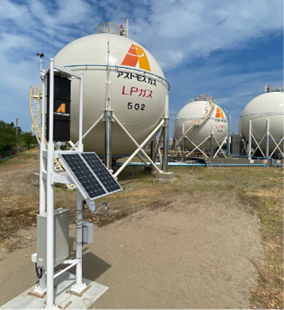
- IHI inked an MoU with PLN Indonesia Power and Pupuk Kujang to explore the use of green ammonia as fuel at the 300 MW Labuan coal-fired power plant.
- The firms will assess the technical and economic feasibility of converting the plant’s fuel from coal to green ammonia, with IHI focusing on the technical aspects and Pupuk Kujang handling ammonia production and supply.
JERA upgrades thermal power station with safety equipment
(Company statement, Sept 3)
- JERA completed new safety upgrades to prevent fires at its Taketoyo Thermal Power Station (1 GW nameplate capacity). These include installing a dedicated pneumatic conveyor for biomass transport, and reduced conveyor speed to lessen dust generation and ignition risk.
- CONTEXT: On Jan 31, a fire broke out at Taketoyo Thermal Power Station due to an explosion caused by the accumulation of biomass dust that ignited due to friction in the coal feeder.
TEPCO and NTT to install solar power at Mobara public facilities
(Company statement, Sept 2)
- TEPCO and NTT chose TN Cross, in which both firms have stakes, to install solar power generation equipment at public facilities in Mobara City, Chiba Pref.
- The goal is to reduce GHG emissions and to secure energy during times of disasters.
- The service will be operational in April 2025.
NEWS: OIL, GAS & MINING

Japan’s oil and gas self-sufficiency at 37.2% in 2023
(Government statement, Sept 3)
- Japan’s oil and gas self-sufficiency rate, which is the ratio of supplies from upstream projects owned by Japanese companies in the total supplies, was 37.2% in 2023, up from 33.4% in 2022.
- The total supplies consist of imports and domestic production.
- CONTEXT: The national goal is to hit 50% self-sufficiency by FY2030.
Tokyo Gas invests in CO2 emissions trading fund
(Company statement, Sept 2)
- Tokyo Gas invested up to $25 million in the Nature Based Carbon Fund that’s managed by Climate Asset Management in London.
- The fund focuses on creating carbon credits from initiatives like afforestation and restoration.
- Tokyo Gas is the only Asian investor in the fund. It aims to secure scarce removal carbon credits over a 12-year period.
ANALYSIS
BY MAGDALENA OSUMI
Booming Battery Storage Pipeline Gives New Impetus to Energy Transition
Japan’s expanding data center industry and the growth of digital infrastructure are driving up energy demand, spurring the adoption of innovative green solutions such as battery storage systems that are crucial for the long-term success of renewable power generation.
For many renewables developers and major power users, integrating Battery Energy Storage Systems (BESS) into the grid is becoming essential to accelerate clean energy projects and make them viable. However, securing a grid connection has led to bottlenecks, with the green project pipeline increasingly congested due to limited transmission capacity.
Both central and local governments are addressing this issue through subsidies and other initiatives to encourage the adoption of battery storage. One such initiative, the Long-Term Decarbonized Power Sources Auction (LTDA) launched last year, has been particularly successful in fueling the BESS boom. The results of the first round convinced METI to double the capacity allocated for battery storage.
As Japan takes a leading role in Asia’s grid-scale energy storage market, it’s attracting international companies, including players like Tesla, which is known for its large-scale battery storage product, the Megapack.
Japan NRG examines the latest trends in Japan’s grid-scale battery market.
Intensifying activity in power markets
In March 2023, the government announced a grid expansion master plan that requires investment of up to ¥7 trillion through 2050. If successful then peak power demand would largely be covered by solar and wind generation by mid century. Such a goal is opening up many business opportunities for BESS, which could become the key to accommodating more intermittent renewables sources in the power system.
The number of grid-scale storage batteries under consideration for connection has tripled in the past year and will continue to grow. Earlier this summer ANRE said that just under 40 GW of installed renewables capacity is already considering connection to storage battery systems. By 2030, Japan’s storage battery capacity is forecasted to reach between 14.1 and 23.8 GWh.
In the medium term, energy storage is expected to gain momentum in various power trading markets, with the majority of BESS investors currently assessing the scope and accessibility of the spot, intraday, balancing, and capacity marketplaces, among other options. The base business case here is that BESS growth required to balance the increasing renewables load and to lessen green curtailments will necessarily filter into power trading platforms because a pure battery storage business model is said to be less suitable to tariff pricing and PPAs.
Rising energy prices and a tight supply-demand balance for electricity, coupled with state subsidies for energy storage facilities, are expected to further drive demand for BESS as a power source for both private consumption and supply-demand adjustment.
Japan’s battery storage systems will likely make up only 4% of the global market in 2024, but domestic market growth expectations are high and investment capital is gathering quickly. New investors are also exploring BESS operational models that deploy Demand Response (DR) and Virtual Power Plant (VPP) services, as well as combination projects in which storage batteries are part of a system that supports on-site PPA arrangement.
BESS as business model for non-energy sector
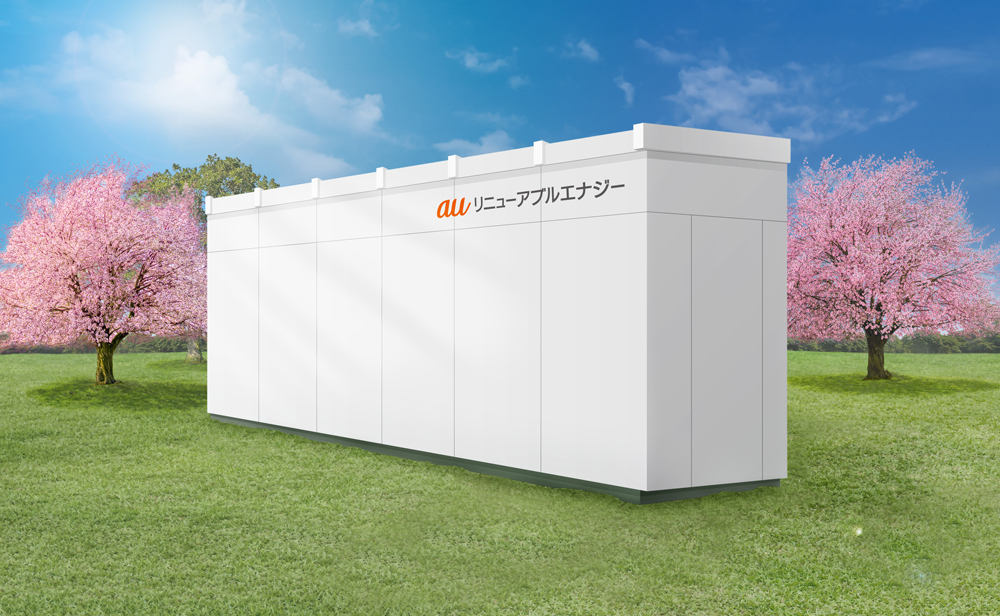
One of Japan’s big three telecom operators, KDDI, is among the non-energy companies to announce plans to build grid-connected storage facilities. KDDI subsidiary au Renewable Energy, a partnership with TEPCO and ENERES, plans to launch a battery business in the second half of FY2025. au Renewable Energy will manage the system.
At the KDDI Oyama Network Center in Tochigi Prefecture, the business partners will install a 324-square-meter BESS with an output of 1.99 MW and a capacity of 5.6 MWh. Construction is set to begin in December 2024. The system will use GS Yuasa’s ternary (NCM) lithium-ion batteries and Meidensha-made inverters.
According to the business group, the project will generate revenue through participation in balancing and capacity markets, among other sales channels. The project has also received a ¥343 million subsidy from the Tokyo Metropolitan Government. ENERES will manage power trading and battery control, while TEPCO Holdings will leverage its grid operations and battery expertise to handle design and maintenance.
Another communications firm, NTT Anode Energy, began building an “energy distribution platform” to promote its green aggregation business. The goal is to develop three businesses as an aggregator: renewable energy aggregation, regulating power aggregation, and demand aggregation.
The role of aggregators will increase since they’ll be able to control batteries and distributed energy resources (DER), introducing optimization on both the electricity supply and demand side. NTT Anode Energy seeks to bulk up the sale of its offering in power regulation with its own storage batteries and through providing integrated and centralized control services to other BESS operators.
As part of this effort, together with Kyushu Electric and Mitsubishi Corp, NTT Anode Energy has begun operating a 1.4 MW/ 4.3 MWh storage battery in Kawara Town, Fukuoka Prefecture.
Since FY2023, the company is also introducing medium-scale batteries, having been selected for the Tokyo government and METI’s 2023 projects to promote grid-connected energy storage solutions. By the end of FY2024, the firm plans 18 more storage facilities nationwide.
Business opportunities for international firms
A recent survey by Tokyo-based research firm Fuji Keizai forecasts that the global energy storage market will grow 3.4 times in value to ¥11.5 trillion by 2040, when it will have a capacity of around 700 GWh. The domestic energy storage market may see similar growth.
Japan was the first Asian destination for Elon Musk’s Tesla electric cars and now the firm is now making local inroads with its Megapack storage system.
With an output of 10.8 MW and a storage capacity of 43 MWh, Tesla’s Megapack has been installed and is operational on the premises of Sendai Power Station. In June, Tesla said the system would be connected to the grid and participate in the balancing market.
The Megapack installation is part of Tesla’s integrated solution, which includes lithium-ion batteries, a power conversion system, thermal management, and controls.
Notably, the Megapack will participate in the primary adjustment power category, which has the fastest response time. This marks the first time in Japan that the Megapack will be used for primary regulating power.
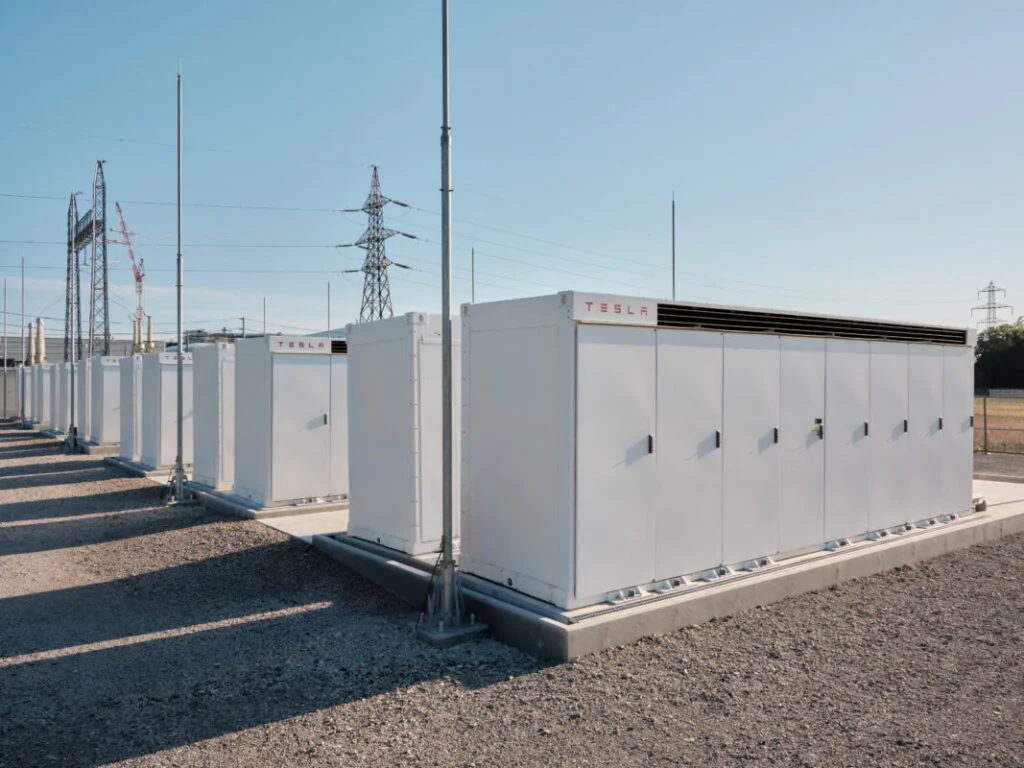
TESLA’s Megapacks
All the above developments reveal that Japan’s BESS sector, almost non-existent two years ago, is on the verge of a breakout phase. However, it needs more investment and state support to ensure the fast start and enthusiasm translates into a considerable role in the nationwide energy system. Scale at a regional level will be required for batteries to be recognized by the state energy planners as more than a local or microgrid balancing solution.
Meanwhile, the sector must grapple with finding solutions to lower costs per kilowatt, part of which will come through the standardization of projects and technologies. With almost no BESS projects in existence, as yet, that can demonstrate how their batteries perform over the course of decades, investors will be looking at projects with good management track records and understanding of power trading to give them the confidence to splash the cash.
ANALYSIS
BY CHISAKI WATANABE
Japan Looks to Farmland for Solar Expansion Amid Industry Slowdown
In an effort to boost solar power capacity, Japan is looking to install more solar panels on farmland. While efforts go back more than a decade, widespread development has been slow to catch on. However, Japan’s solar power goals for 2030 have given new impetus to this niche. If it succeeds, it could significantly boost total solar power capacity in the country, and serve as an example to others.
Often referred to as “agrisolar,” this approach refers to the dual use of land to cultivate crops and generate electricity from solar panels installed above farmland. In Japan, it’s also called “solar sharing,” while in Europe and North America it’s known as agri-voltaics. Whatever the name, this approach to solar allows operators to generate extra income from producing clean electricity.
The dual-use / dual-income strategy is gaining more traction in Japan recently with international solar developers and big domestic firms getting involved. For some, this is a chance to test new technologies. For many, this is an avenue for new capacity growth, with large-scale utility solar projects today facing challenges such as a shortage of open space and increasing scrutiny from residents who see solar farms as an eyesore or worry about panels located on steep slopes.
Japan NRG takes a closer look at the challenges and opportunities facing the agrisolar industry.
Over 4,000 projects to date
Agrisolar in Japan is already two decades old, and development has been measured in small and slow steps. Akira Nagashima of CHO Technology Institute in Japan is credited with leading early development of solar sharing. He filed for a patent in 2004 but opened the technology to the public in 2005 so anyone in any country could tap into the technology for free.
In Japan, developing an agrisolar project requires permission for temporary land conversion to set up poles to support photovoltaic panels while continuing to grow crops. Poles need to be installed in a simple, easy-to-dismantle way.
The Ministry of Agriculture, Forestry and Fisheries (MAFF) sent a notice in March 2013 to governors and local agricultural officials to clarify that installing solar panels over farmland requires permission. Agrisolar got a boost in May 2018 when the MAFF eased rules regarding the temporary conversion of farmland by extending the duration of projects to ten years from three, if certain criteria are met.
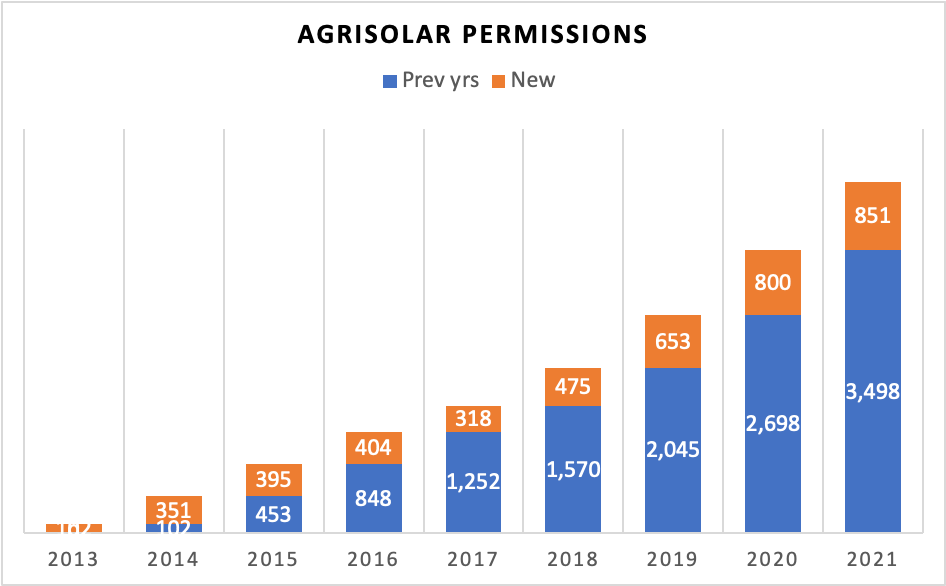
As of March 2022, the MAFF has given permissions to 4,349 projects on 1,007 hectares of farmland across Japan. The density of solar panel capacity is 480 kW per hectare for agrisolar and 1,330 kW per hectare for average ground-mounted projects. (The figures are calculated by Japan NRG based on estimates provided by the Japan Photovoltaic Energy Association).
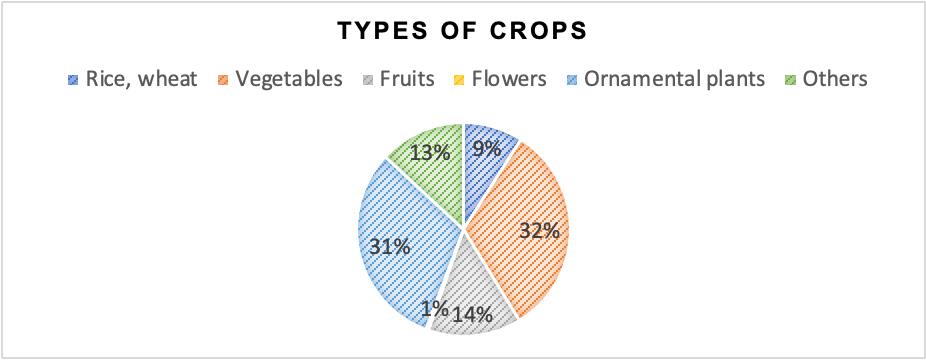
The number of new permissions has risen ever since 2013 (except for in 2017). Crops grown under solar panels include vegetables, fruits, ornamental plants, rice, and wheat.
Chart 1: Agrisolar Permissions
Source: MAFF (fiscal year)
Chart 2: Types of crops grown under PVs
Source: MAFF
Among the 4,165 agrisolar projects that responded to a MAFF survey, 65% were built by power generation firms, with the rest installed by farmers or land owners, according to a document released in October 2023. Recently, even large international players, such as China’s Trina Solar, have entered this sector. Trinasolar’s latest agrivoltaic project in Kyoto Pref. combines solar PVs with yam cultivation, which requires low light saturation.
In the same survey, MAFF asked operators who had received permissions before FY2021 whether they faced any issues growing crops under solar panels. About 21% of the 3,314 projects reported they did – a strong majority reporting a drop in yield due to poor maintenance of farmland by farmers. Others cited natural disasters and delays in construction.
Under MAFF rules, officials give guidance to agrisolar operators failing to meet the requirement. There have been cases in which the operator is not allowed to reapply for permission after refusing to follow the guidance, according to a white paper on agriculture published in May.
The 1,007 hectares used for 4,349 projects is only a small fraction of total farmland in Japan – about 4.3 million hectares. As it becomes more difficult to find wide-open space for utility scale solar farms and more local governments adopt ordinances to curb large solar installations, farmland is increasingly becoming a more promising option.
The JPEA said in a solar outlook report in July that Japan has a total of 2,380 GW (dc) of solar potential, of which 1,593 GW (67%) is on agricultural land. That includes 1,276 GW on arable fields and 286 GW on abandoned farmland. Japan’s total solar capacity stands at about 74 GW.
Chart 3: Solar potential (GW dc)
|
|
JPEA |
MOE (2021) |
|
Residential |
240 |
175 |
|
Non-residential |
391 |
279 |
|
Ground mounted |
43 |
5 |
|
Agriculture |
1,593 |
1,001 |
|
On water |
87 |
4 |
|
Other types |
27 |
0 |
|
Total |
2,380 |
1,465 |
Source: JPEA
There are cases in which solar panels over farmland have been helping farmers increase their crop. Farmclub, in Gunma Prefecture, runs a 16-acre farm with 111 kW solar panels on top of greenhouses growing rockets and lettuce.
The yield from the greenhouses are three times more compared with farms nearby that are without solar panels, according to the MAFF. Solar electricity generated from the panels brings in ¥4.9 million a year. Income from the project over the 20 years is estimated at ¥50 million.
Not all operators are complying
In April 2024, rule changes and a set of guidelines took effect detailing the criteria for receiving ministry permission. Projects won’t be allowed if their yield drops more than 20%, if they fail to submit annual reports, and if panels are installed in ways hindering the use of machinery on farmland. The move followed some projects prioritizing power generation over farming, prompting the need to exclude such projects, the MAFF said in a statement.
In August, the METI said it had suspended paying subsidies to 342 agrisolar projects by 20 operators. Of them, 327 cases (14 operators) did not meet the criteria to receive subsidies under the feed-in tariff (FIT) scheme as they failed to receive permissions for land conversion within three years of receiving FIT approval.
The rest of the projects were found at fault for failing to remove panels after the duration of the temporary land conversion had expired, or not growing crops properly.
Opportunities for new tech
The agricultural sector needs to decarbonize just like other sectors and that calls for electrification of equipment and the heating source for greenhouses, Takeaki Masukawa, Secretary-General of JPEA told Japan NRG. Solar panels can contribute to the decarbonization of the agricultural sector and strengthen the business base for farmers by supplying cheap solar electricity for self-consumption, he said. Furthermore, excess solar power can be sold to increase profits while contributing to the national decarbonization goals.
In July, Renewable Energy Institute (REI) said that among the potential sectors for Japan’s solar deployment, immediate focus should be on utilizing buildings as it is not difficult to install panels on buildings whether they are for residential or not. In the meantime, developing agrisolar is a mid- and long-term effort that also calls for expanding a farming population.
Local governments should lead efforts in expanding agrisolar to leverage on strengths unique to each region while aligning with national farming policies. Financial institutions, especially regional banks, should provide support for local power producers and power consumers, REI said.
Already, agrisolar is providing opportunities for new technologies and entrants. Sekisui Chemical began a pilot project in Chiba prefecture with TERRA, a Chiba-based company specializing in agrisolar and promoting the technology across Japan with its group company Citizen Energy Chiba. The pilot will use Sekisui’s perovskite solar panel on a curved surface.
Other agrisolar proponents are Kyocera and Sharp. Both led the early development of PV in Japan before their market share was eclipsed by Chinese rivals. Sharp supports farmers in finding the best ways to lay out power generation systems over their farmland.
Attracting new farmers and expanding agriculture in Japan faces headwinds such as the difficulty of securing land as well as high-cost investments in equipment. Kyocera said it will start building greenhouses with rooftop panels for farmers so they can have on-site solar generation at no initial cost. Instead, farmers will pay a monthly fee for the equipment, according to a July press release.
Utility companies are also developing agrisolar projects. Chugoku Electric said in January that its first agrisolar plant started operations and signed a power purchase agreement with Toyo Kohan, a steel sheet maker.
The utility grows cleyera japonica, a type of shade plant that requires less sunlight and allows for more panels to be installed over land. Chugoku plans to develop 64 MW of agrisolar capacity for Toyo.
In April, Chubu Electric signed a loan agreement with JA Mie Shinren, an agricultural bank in Mie Prefecture, for seven agrisolar projects with a combined capacity of 2 MW in Mie. Chubu will also collaborate with JA Mie to promote decarbonization and sustainable agriculture.
“The primary mission of solar panels is to play a supporting role to help farmers,” Masukawa of JPEA said.
If more farmers are convinced, the potential for agrisolar in Japan could easily grow from a niche to a renewables mainstay.
ASIA ENERGY REVIEW
BY JOHN VAROLI
This weekly column focuses on energy events in Asia and the Pacific
Australia / Solar power
Coal generated 49.1% of the country’s electricity, while renewables accounted for 48.7%. Climate finance expert Tim Buckley said August’s record figures were caused by strong winds and a warm start to spring that reduced demand on the grid by up to 20%.
China / Energy transition
Primary aluminum smelters are producing record volumes and the domestic market surplus is exported in the form of semi-manufactured products. China’s primary aluminum production hit a monthly peak of 3.69 MMT in July, according to the International Aluminium Institute.
China / Hydrogen
Chinese electrolyzer manufacturer Hygreen Energy and its partners will invest more than €2 billion in green hydrogen projects in Spain’s region of Andalusia. The electrolyser production factory will have a capacity of up to 5 GW, and will initially focus on 5-MW electrolysers.
India / Biofuel
A push to make more corn-based ethanol has turned India (Asia’s top corn exporter) into a net importer for the first time in decades. The jump in import demand comes after India in January hiked the procurement price of corned-based ethanol to drive a shift away from sugarcane-based ethanol for blending in gasoline.
India / Power grid
As record-breaking heatwaves ravaged most of India earlier this year, thousands of overloaded transformers on power lines were damaged and caught fire, causing 12-hour-long blackouts even in big cities.
LNG
North America’s LNG export capacity is set to more than double between 2024 and 2028, from 11.4 Bcf/d in 2023 to 24.4 Bcf/d in 2028, if projects now under construction eventually launch as planned.
LNG Carriers
Chinese shipyards are taking more market share in building LNG vessels. Strong global demand for LNG has left shipyards in South Korea unable to meet the need for new vessels. Although Chinese shipyards build 6% of the current fleet (by volume), they are set to deliver over 20% of new LNG carriers on order. The average cost of building an LNG carrier in China is about $247 mln, compared with $265 mln in South Korea.
Malaysia / Aviation emissions
Malaysia aims for net zero emissions in its aviation sector by 2050, the transport ministry said. The blueprint includes reducing carbon emissions by up to 18% in aircraft technology, and increasing the use of sustainable aviation fuel to reduce emissions by 46%.
Vietnam / Offshore wind
Norway’s Equinor canceled plans to invest in Vietnam’s offshore wind sector and entirely closed its office in the country. Delays in regulatory reforms have recently pushed some would-be investors to reconsider plans. This is the first time Equinor has closed an international office focused on offshore wind development.
2024 EVENTS CALENDAR
A selection of domestic and international events we believe will have an impact on Japanese energy
|
January |
|
|
February |
|
|
March |
|
|
April |
|
|
May |
|
|
June |
|
|
July |
|
|
August |
|
|
September |
|
|
October |
|
|
November |
|
|
December |
|
Disclaimer
This communication has been prepared for information purposes only, is confidential and may be legally privileged. This is a subscription-only service and is directed at those who have expressly asked K.K. Yuri Group or one of its representatives to be added to the mailing list. This document may not be onwardly circulated or reproduced without prior written consent from Yuri Group, which retains all copyright to the content of this report.
Yuri Group is not registered as an investment advisor in any jurisdiction. Our research and all the content express our opinions, which are generally based on available public information, field studies and own analysis. Content is limited to general comment upon general political, economic and market issues, asset classes and types of investments. The report and all of its content does not constitute a recommendation or solicitation to buy, sell, subscribe for or underwrite any product or physical commodity, or a financial instrument.
The information contained in this report is obtained from sources believed to be reliable and in good faith. No representation or warranty is made that it is accurate or complete. Opinions and views expressed are subject to change without notice, as are prices and availability, which are indicative only. There is no obligation to notify recipients of any changes to this data or to do so in the future. No responsibility is accepted for the use of or reliance on the information provided. In no circumstances will Yuri Group be liable for any indirect or direct loss, or consequential loss or damages arising from the use of, any inability to use, or any inaccuracy in the information.
K.K. Yuri Group: Hulic Ochanomizu Bldg. 3F, 2-3-11, Surugadai, Kanda, Chiyoda-ku, Tokyo, Japan, 101-0062.