The race to determine a successor to outgoing PM Kishida culminates on Sept 27. Of the nine candidates vying to head the ruling LDP, and thus the prime minister, all but one support nuclear energy in some form, and all but one sound keen to promote renewable energy. Japan’s energy policy is at a critical juncture as it’s set to approve a new Basic Energy Plan. Japan NRG takes a look at the candidates and where they stand on energy.
Singapore has long been Asia Pacific ‘s hub with a highly capable talent pool, but it might no longer be sufficient to cover regional professional job demand as the economy grows, especially the energy sector. Can Japan step up and play a major role in supplying regional talent in Asia Pacific? Let’s look at the talent that Japan already has, with the ability to deliver beyond, as well as arguments for Japan acting as a regional hub both in hiring local talent and using Tokyo as an expat base.
ASIA ENERGY VIEW
A wrap of top energy news that impacts other Asian countries.
EVENTS SCHEDULE
A selection of events to keep an eye on in 2024.
JAPAN NRG WEEKLY
PUBLISHER K. K. Yuri Group
Editorial Team Yuriy Humber (Editor-in-Chief) John Varoli (Senior Editor, Americas) Mayumi Watanabe (Japan) Kyoko Fukuda (Japan) Magdalena Osumi (Japan Filippo Pedretti (Japan) Tim Young (Japan)
On Sept 12, METI’s subcommittee on energy policy agreed that the next Basic Energy Plan to be released by the end of FY2024 should ensure continuity with existing policies such as the GX Promotion Strategy.
The subcommittee also stressed the importance of minimizing the overall social costs associated with decarbonization initiatives, taking into account that these costs may ultimately be borne by taxpayers, as well as the need to reflect industry voices.
On next-gen fuels, CCUS and critical minerals, ANRE said the policy should be formulated with an understanding of current costs and future installation estimates.
The other points included:
Boosting state support for hard-to-abate sectors such as steel, chemical, transportation and power generation;
Promoting recycling to secure critical minerals due to Japan’s dependency on primary supply from certain countries;
Ensuring energy resilience in light of the country’s frequent natural disasters.
Regarding the increase in electricity demand due to digital transformation, (DX), committee members also called for an integrated development of data centers and electric power facilities; and some requested more weight to be given to promoting energy conservation and energy-saving tech.
CONTEXT: Since May 2024, the Basic Policy Subcommittee has been conducting various studies in preparation for the next Basic Energy Plan. This is in response to discussions at the GX Implementation Council, the joint meeting of the Industrial Structure Council and the Central Environment Council, and other related councils, as well as the situation in Japan and abroad.
Later this month, METI plans to set up a study group to write a strategy to increase demand for steel with a low carbon footprint. Steel, automotive and housing sector parties will be involved.
CONTEXT: JFE Steel will finalize its plan to build a new green steel furnace in Kurashiki Works (Okayama Pref) by the end of this fiscal year, slated to start production in 2027. Nippon Steel and Kobe Steel also have green steel business plans.
The Ministry of Land, Infrastructure, Transport and Tourism (MLIT) set up a 20-member study group to write facility and technical standards for methanol bunkering and to identify issues in spreading it.
CONTEXT: Study groups for LNG and ammonia bunkering were set up earlier but methanol was ignored. In June, Toyofuji Shipping began to operate the country’s first methanol-fueled ships.
Japan Hydrogen Fund announced the first closing of its hydrogen-focused investment fund, securing over $400 million in commitments from major investors.
Key investors include Toyota Motor Corp, Iwatani Corp, Sumitomo Mitsui Banking Corp, MUFG Bank, Tokyo Century Corp, the Organization for Supporting Carbon Neutrality, TotalEnergies, and Fukuoka Bank.
The fund aims to accelerate the development of the global hydrogen supply chain, with a focus on Japan, through investments in hydrogen production, storage, transportation, and infrastructure.
Supported by METI, the fund is supposed to play a crucial role in building hydrogen supply chains within a U.S. and Japan-led framework — the Indo-Pacific Economic Framework for Prosperity (IPEF).
Tungsten tool maker Tungaloy began using green hydrogen at its Yamanashi plant for metal reduction processes, replacing some of its fossil fuel-based hydrogen.
The switch is expected to reduce CO2 emissions by 300 tons annually.
The plant will use 120,000 m3 of green hydrogen from Yamanashi Hydrogen Company, with plans to switch fully in the coming years.
The company said the increased costs is essential for continuing business, especially with more environmentally conscious European customers.
ANRE is considering revising its long-term grid plan to accommodate increasing demand from data centers and semiconductor factories.
The current plan, finalized in March 2023, calls to invest ¥6 to ¥7 trillion to upgrade inter-regional power grids, including HVDC lines between Hokkaido and Tokyo.
The review will take into account renewable energy, nuclear power, and major industrial demand, with updates reflecting changes in the new energy policy.
CONTEXT: Power demand forecasts suggest that electricity needs could grow significantly nationwide by 2033 due to new industrial facilities, especially those related to AI and other high-tech applications.
The site of a waste treatment facility in Chitose City, adjacent to the semiconductor plant being built by Rapidus, is the likely choice for a hydrogen production facility considered by Mitsubishi Corp and three other companies.
The hydrogen plant would be operational in FY2027 and potentially supply hydrogen to Rapidus for semiconductor production.
It might also provide the New Chitose Airport with fuel/ heat for its boilers.
METI will boost support for hydrogen fuel cell track and bus sales by identifying prefectures that show the most interest in promoting this type of mobility.
The subsidies will come in a kind of contract-for-difference format, through which the state will cover three-quarters of the difference in cost between using existing fossil fuels and those fuels based on ‘low-carbon’ hydrogen.
CONTEXT: Japan has only around 8,500 hydrogen fuel cell (FC) vehicles and 163 stations where they can refuel. Part of METI’s FC mobility support will be to simplify and standardize FC refueling station regulations.
METI selection criteria for offering FC mobility subsidies will be based on the current efforts of regions. Ministry officials will look at the mileage and number of registered FC vehicles in each prefecture and the status of local government efforts to establish sales targets. The selection of eligible regions will start this winter and a final subsidy decision will be made by March 2025.
TAKEAWAY: Current government FC mobility efforts focus on commercial vehicles such as trucks and buses, rather than passenger cars. Among the sectors most interested in FC vehicles are public transport and shipping operators. In the future, METI wants to set conversion targets for companies to switch diesel trucks of 8 tons and more to clean-burning fuels like hydrogen FC. The biggest bottlenecks for businesses are the cost of FC vehicles and a lack of access to refueling stations. That’s why METI wants to concentrate support for FC vehicle adoption in a few areas so that resources can tap into the network effect.
Panasonic Energy will produce cylindrical EV battery cells for Tesla, its leading customer. Production is set to begin in late 2024 in Wakayama Pref.
The cells are named “4680” after their size: 46 mm in diameter and 80 mm high. They can store five times as much energy as standard Panasonic 2170 cells.
The new cells require fewer parts than the 21 mm cells and have higher capacity than conventional cells; this allows automakers to reduce the number of cells in each car, thus lowering cost while improving efficiency.
Panasonic plans to double domestic cell production, adding 22.5 GWh by 2030 as it seeks partnerships with other car makers.
CONTEXT: With Subaru, Panasonic also plans a new battery plant in Gunma Pref. Another partnership is planned with Mazda. Panasonic will produce and supply cylindrical Li-ion batteries starting FY2027. By 2030, it aims for domestic production capacity of 10 GWh/ year with Mazda, and 16 GWh with Subaru.
CONTEXT: Growth in EV battery production has been slowing – in January to July 2024, about 8.5 million EVs were made globally, which is 21% YoY growth; however, this is down from 40% growth in the same period in 2023.
TAKEAWAY: Batteries are the biggest cost driver for original equipment manufacturers, pushing manufacturers to advance battery cell tech. Li-ion batteries will remain mainstream in the near future, even though some companies are experimenting with innovations. Japan’s recent bid to strengthen financial support for storage batteries reflects growing opportunities for new, more efficient energy storage tech in Japan despite slowing EV sales.
Power-X, a startup in the storage battery business, has raised ¥2.46 billion in funding from investors including Toda Corp and SMBC Nikko Securities.
The funds will be used to develop new grid-scale stationary storage batteries.
The firm will also invest in the stationary storage batteries it currently manufactures, and will increase the pace of production at its affiliated plant in Tamano City.
More than six firms, including financial institutions that are existing shareholders, have subscribed to the third-party allotment of new shares. The cumulative amount raised by the startup to date is now up to ¥26 billion.
Mitsubishi Corp joined the ExxonMobil-led hydrogen and ammonia production project in Texas, and will now pursue talks on both offtake and equity interests.
The Japanese trading house seeks to supply low-carbon ammonia to the Shikoku and Chugoku regions for power generation and industrial use. Mitsubishi is interested in an equity and offtake jointly with oil refiner Idemitsu Kosan.
CONTEXT: Idemitsu is developing a hydrogen hub near Mitsubishi’s Namikata Terminal that’s slated for conversion from a liquified petroleum gas (LPG) receiving facility to one that can also handle ammonia transshipment. By 2030, the Namikata Terminal may handle around 1 million tons per year of low-carbon ammonia.
The Texas project aims to produce 1 billion c/f of hydrogen and over 1 million tons of ammonia annually, to start in 2029. It claims that 98% of the CO2 will be removed.
Just before the start of official campaigning, current METI Minister Saito Ken dropped out of the LDP leadership race to select a successor to PM Kishida.
The LDP leadership race is set for Sept 27, and the winner is expected to automatically assume the post of Prime Minister.
CONTEXT: In mid August, PM Kishida said that he’d step down in September, succumbing to discontent over political scandals and rising living costs that marred his nearly three-year rule.
TAKEAWAY: Saito doesn’t belong to any LDP faction. He’s a five-term lawmaker who has served as agriculture and then justice minister. His candidacy has been viewed as a move to boost his name recognition and to negotiate for a good post in the new administration. (For more information on the LDP leadership race, including candidate views on energy policy, check out the Analysis section in this week’s issue).
Shinshu University plans to build a large-scale artificial photosynthesis facility in Iida City, Nagano, aiming to produce hydrogen cheaply and efficiently.
The project will use sunlight to get hydrogen from water and CO2, mimicking plant photosynthesis, with a facility covering 3,000 m3.
Researchers aim to improve hydrogen production efficiency from 1% to 4%, supplying the hydrogen for local use, such as bus fuel.
CONTEXT: In artificial photosynthesis, solar energy produces hydrogen from water using a biochemical process that mimics natural photosynthesis. This is a promising source of clean energy, but development is at a very early stage.
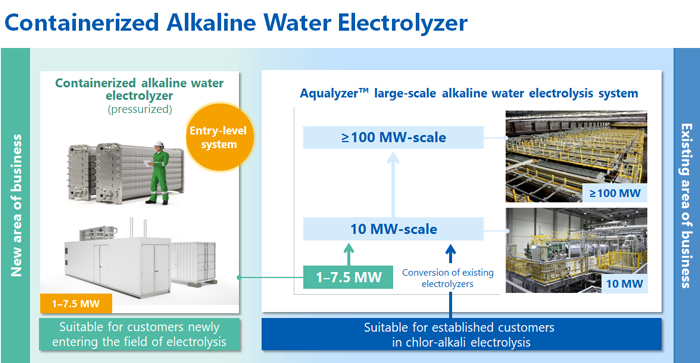
Asahi Kasei and Italy’s De Nora signed an MOU to develop, evaluate, and market a container-type alkaline water electrolysis system.
Designed for new market entrants, the system offers lower costs, smaller space requirements, and shorter lead times compared to Asahi Kasei’s larger Aqualyzer system. As such, the tech is aimed at small-scale production and hydrogen stations.
Ebara Corp will invest ¥16 billion to establish a commercial product testing and development center for liquid hydrogen pumps in Futtsu City, Chiba.
The facility is set to partially open in 2025, and will do full-scale testing of liquid hydrogen pumps using actual liquid hydrogen at -253°C.
It will be the first center capable of commercial-scale testing for liquid hydrogen infrastructure equipment, supporting both domestic and international hydrogen technology development.
Nikkiso Corp, an expert in cryogenic pumps, successfully tested a 132kW pump for transferring liquid ammonia and LPG.
The pump uses a submerged structure with a canned motor to prevent leaks and protect from corrosive ammonia. It’s designed for use in power plants mixing ammonia into fuel, aiding large-scale ammonia transfer from storage tanks to boilers.
Toyota Central R&D Labs showed a molecular catalyst that synthesizes propanol (C3H7OH) from CO2. It is the world’s first molecular catalyst that can synthesize a C3 compound from CO2.
The catalyst facilitates the reduction of CO2 into various compounds. They include: C3 propanol, C2 ethanol and ethylene, and C1 methane.
CONTEXT: Selective synthesis of propanol hasn’t been achieved yet. Still, the ability to create C3 compounds from CO2 is groundbreaking.
TAKEAWAY: This discovery opens the door for synthesizing higher-value compounds and enhancing CO2 re-utilization. The research represents a major step toward more efficient CO2-to-fuel conversion technologies.
METI minister Saito met with Kyrgyzstan’s Minister of Energy, Taalaibek Ibraev, to discuss improving bilateral cooperation in the economic and energy sectors.
After the meeting, an MoU was signed between Kyrgyzstan’s Ministry of Energy and Japanese companies for hydropower projects.
Getabec Public, a Thai manufacturer of boiler products, set up a subsidiary in Japan to handle sales, installation, and maintenance of biomass boilers.
The boiler can burn a variety of biomass resources such as wood pellets, wood chips, construction waste, palm kernel shells (PKS), food residues, and bamboo, and also has been adopted under the JCM (Joint Crediting Mechanism).
Trading house Sumitomo Corp plans to invest ¥100 billion in renewables in India in partnership with local startup Ampin Energy Transition. They will set up a JV, and Sumitomo will acquire a 49% stake; Ampin will have 51%.
The companies plan to build large-scale solar and onshore wind power plants to supply electricity locally, mainly through power purchase agreements.
The JV will focus on solar power in the states of Rajasthan and Tamil Nadu where PPAs are allowed by law. Sumitomo is also considering installing storage battery systems.
The new JV plans to begin generating power by the end of FY2026, with a goal of eventually reaching 1 GW of installed capacity. Sumitomo plans to sell the power to Japanese automakers and European companies operating in India.
CONTEXT: India is the fastest-growing economy among the world’s largest nations, growing 8.2% in FY23/24. Growth was boosted by public infrastructure investment, especially into new energy capacity. India is the world’s second largest consumer of coal as its energy sector relies heavily on that fossil fuel. India has pledged to reach net-zero by 2070, which lags behind the 2050 target of most G20 countries.
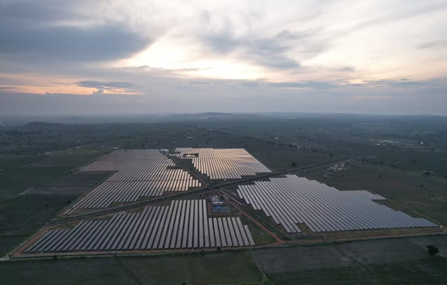
A solar power plant owned by Ampin Energy Transition in India
Power retailer and biomass plant operator eREX is shifting its focus away from market-linked electricity plans in order to offer more stable pricing options, particularly for corporate clients. Concerns over market price spikes are driving the demand for fixed-price options.
To address this, eREX is turning to electricity futures as a hedge against price fluctuations, offering fixed-price contracts for specific periods, such as summer and winter, when prices tend to rise. This allows businesses to avoid unexpected costs and lock in predictable annual budgets.
The company trades on both TOCOM and the EEX platforms, and unlike most plant operators it deals directly, rather than through brokers or traders, believing that this approach gives the company more control over its electricity pricing strategy.
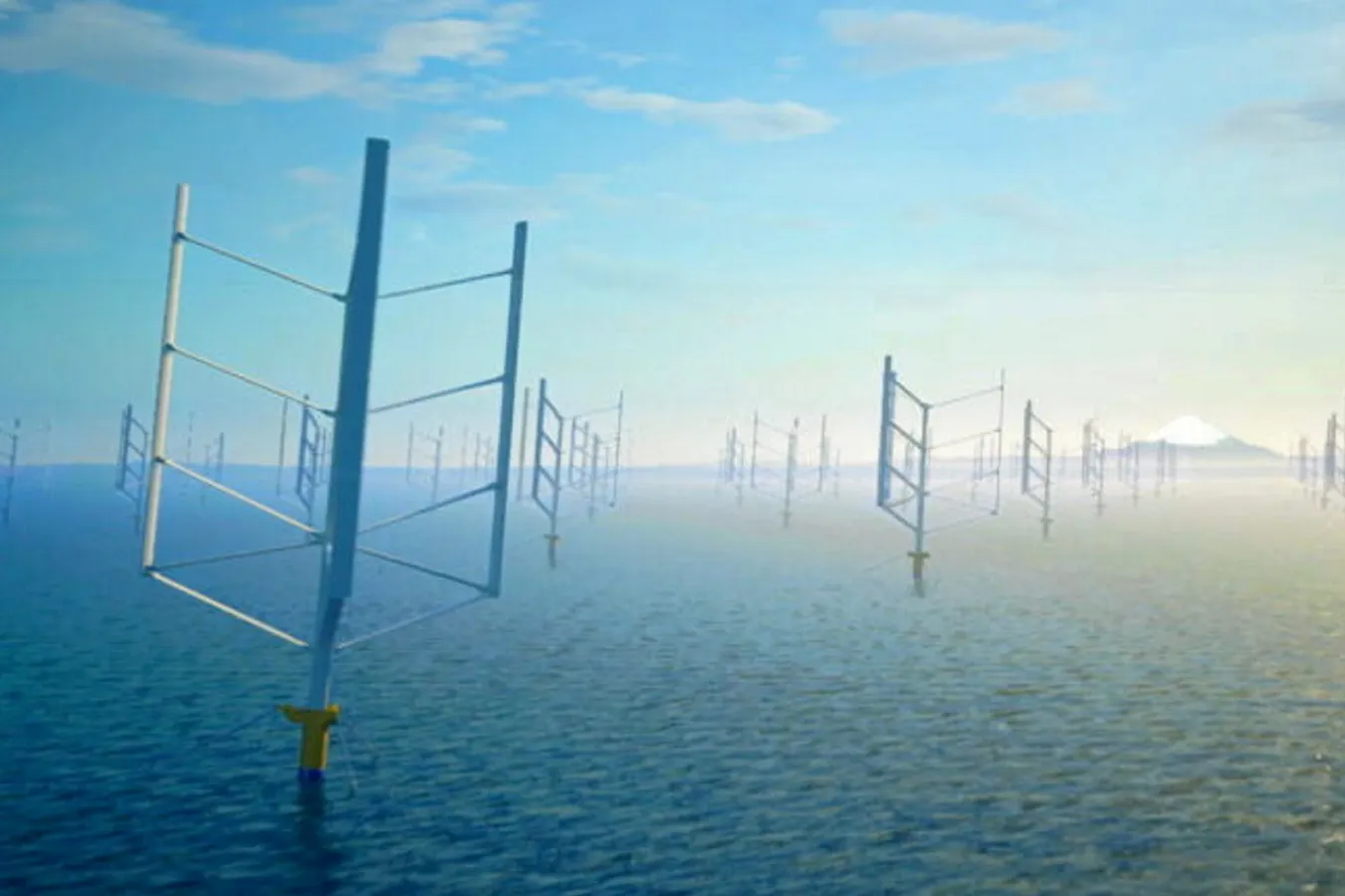
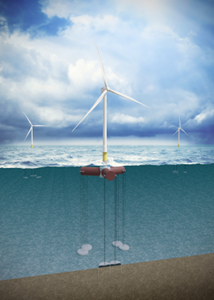
A group of five companies, including TEPCO and J-POWER, were selected to conduct a feasibility study to develop a large-scale vertical axis floating wind turbine.
The study is part of NEDO’s public call for projects to advance next-gen wind tech. The study aims to show the viability of large-scale commercial vertical axis (floating axis) wind turbines, where both the turbine and floating foundation rotate together, thanks to the structure’s low center of gravity.
The other three companies are: Albatross Technology, Kawasaki Kisen Kaisha, and Sumitomo Heavy Industries Marine Engineering.
CONTEXT: According to the consortium, large-scale vertical axis wind turbines can achieve efficiency similar to conventional (horizontal axis) wind turbines while offering smaller and more cost-effective floating structures.
A consortium comprising TEPCO, Hokkaido Electric and construction firm Taisei seek to develop compact semi-submersible floating offshore wind power tech with a Taut mooring system applicable to deep waters.
NEDO selected the proposal under its program aimed at promoting next-gen floating offshore wind tech.
The tech is expected to decrease production costs. The Taut mooring allows for usage of synthetic fiber cables, which are less expensive per unit length than steel chains and occupy a smaller area in sea waters; concrete is more readily available than steel.
Under the same NEDO program, Obayashi was selected for its project to develop support structures for TLP-type hybrid floating offshore wind turbines. The project will develop tech that enables mass production and cost reduction of those structures.
The firm will run demo tests with installed wind turbines to prepare for implementation starting 2030. The tests will run through March 2026.
Invenergy plans to develop an onshore wind farm near Kaminokuni Town in southwest Hokkaido. The max capacity will be 49.8 MW.
The firm plans to use up to 16 turbines. The site covers 2,172 hectares over three towns: Kaminokuni, Assabu and Kikonai.
Construction launches in April 2028; commercial operation to start in April 2031.
CONTEXT: Several projects are planned nearby, including a 48 MW project by Japan Wind Development in Kikonai Town. Invenergy has submitted scoping documents to Hokkaido Pref and local govts as part of the environmental impact assessment.
Environment Minister Ito urged Chubu Electric and renewables firm OSCF to revise measures to manage the ecosystem at its Hachibuseyama wind farm in Fukui Pref.
The 54.6 MW project in Tsuruga and Minami-echizen towns will have as much as 13 turbines. Commercial launch is planned for December 2028.
The minister urged to:
Reconsider measures to preserve the ecosystem where golden eagles and hawks nest, and to prevent collisions with turbines;
Revise the plan to prevent turbines from being seen by hikers visiting Mount Hachibuse on the south side of the selected site;
Chubu Electric Power Miraiz inked a 20-year Power Purchase Agreement with electrical equipment producer Fuji Electric.
The utility will supply power from solar farms in Aichi and Mie Prefs. The solar power plants will be installed by Jenex, a Chubu Electric Group firm.
A total of 15 solar power plants will be built, and operations will begin in stages starting April 2025. The total capacity involved is expected to reach 10.7 MW, the largest scale to date under a corporate PPA for Chubu Electric.
The power generated will be supplied to Fuji Electric’s plant in Matsumoto City (Nagano Pref) that makes power chips, and its subsidiary Fuji Electric Power Semiconductor’s two plants in Omachi and Iiyama towns, Nagano Pref.
On Sept 11, several utilities in the Tokyo area received extra power supply amid higher than expected temperatures that impacted the power demand-supply situation.
Between 4:30 p.m. and 5 p.m., TEPCO Power Grid received up to 300 MW of extra power from Chubu Electric.
Between 5:30 p.m. and 7 p.m., Tohoku Electric received up to 450 MW of extra power from four firms — TEPCO Power Grid, KEPCO, Hokkaido Electric and Hokuriku Electric.
That day in the evening JERA, the largest utility with thermal power plants in the Tokyo metropolitan and Chubu areas, raised power output at eight of its units to cope with the tight supply and demand situation.
Between 5:30 p.m. and 6:30 p.m. on Sept 12, due to tight power reserves amid higher than expected temperatures in the area, KEPCO’s subsidiary Kansai Transmission and Distribution received up to 420 MW of additional power from Chubu Electric.
JEPX recorded a 2.9% MoM increase in spot market trading volume for August, reaching a daily average of 785 GWh, the fourth consecutive month of growth.
West Japan experienced record-breaking heat, pushing wholesale market prices up and widening the price gap with East Japan. On Aug 30, prices hit a yearly high of ¥45/ kWh due to the impact of a strong typhoon on power supply.
The August total volume rose to 24.3 TWh, with spot trading accounting for 29.3% of total power demand.
System prices climbed across most categories, with the 24-hour average price reaching ¥14.48, up ¥0.33 MoM.
The Japan Fair Trade Commission seeks feedback on its proposed revision of guidelines for retail power trading.
This seeks to clarify that leading regional power companies (EPCOs), which ask retailers not to resell the power sold, would be violating the Antimonopoly Act.
The feedback period ends Oct 11.
CONTEXT: A retailer (or trader / broker) can buy electricity from an EPCO and then resell it to another party. The EPCOs, however, often do not want their buyers to do so, seeing resale as a form of competition. Now, the regulator is making it clear that EPCOs can only control the terms of the initial sale and should have no influence on further transactions related to electricity. In theory, this should allow for a more open power market and boost derivatives.
TEPCO began a test removal of fuel debris from Fukushima Daiichi NPP Unit 1. Over the next two weeks, TEPCO plans to remove small amounts of the melted debris, weighing less than 3 grams.
An earlier attempt on Aug 22 was halted due to incorrect pipe connections assembled by a subcontractor.
CONTEXT: The debris resulted from the March 2011 accident in Units 1 to 3, when nuclear fuel melted and mixed with internal structures. An estimated 880 tons of debris remain strewn across the three reactors. TEPCO planned to start removal by late 2021, but it has been delayed three times. TEPCO plans to complete decommissioning by 2051.
TAKEAWAY: The radioactive debris prevents human access; thus, TEPCO had to resort to robots and drones. This test phase is critical for decommissioning. If this and following trial tests are successful, TEPCO will employ larger devices for removal.
J-Power now expects operation of Tachibana Bay Thermal Power Station Unit 1 to resume by late November. Operation had been suspended due to a crack in the high-temperature reheating steam pipe, discovered in February.
The company expected operations to resume by late February 2025, but after the company replaced the damaged pipe, it announced the restart ahead of schedule.
CONTEXT: In May, J-Power expected the suspension of operations to reduce sales by ¥18 billion for FY2024. The firm is now reassessing the financial impact in light of the earlier-than-expected resumption.
Narita International Airport Corp authorized Shell to use the pipeline that connects the airport and a port in the city of Chiba to supply imported jet fuel to airlines.
CONTEXT: Some airports have been hit with jet fuel shortages due to limited truck and ship availability to transport the fuel from refineries. In July, Japanese refineries exported 698,817 kiloliters (4.4 mln barrels) of jet fuel, but there were no imports. Jet fuel demand begins to drop after August, but rises in December.
ANRE is strengthening measures to ensure supplies of fossil fuels including coal. Japan’s energy security strategy has thus far been LNG-focused, but now it has added coal for the first time.
To bring LNG supply security to higher levels:
ANRE plans a new “LNG stability index”, assessing the reliability of importers on the ratio of long-term contracts, upstream project stakes, etc.
ANRE seeks vacant oil storage tanks in and outside Japan to stockpile LNG.
Officials will introduce a new classification of LNG supplies: Emergency, Collaborative, and Competitive stocks.
There’ll be further expansion and promotion of the Coalition for LNG Emission Abatement toward net-zero (CLEAN) framework, inviting the private sector to join.
Energy security status for coal is seen by the government as imperative because financial institutions have divested coal assets in recent years, bringing down the coal self-sufficiency rate to 40.8% from 61.1% in 2016. The status would aim to justify the lending on security grounds.
Proposed LNG classification
Emergency supplies
State-managed supplies to cope with emergencies beyond control of the private sector
Collaborative supplies
Operators share supplies in times of market upheavals, etc.
Saudi Aramco notified Japan’s wholesalers that it will raise the LPG export price for September shipments, the second consecutive month of increases.
Propane will rise $15/ ton (3% MoM) to $605/ ton. Butane will increase $25/ ton (4% MoM) to $595/ ton.
CONTEXT: This is the first time that propane prices surpassed $600/ ton since April shipments. One factor is strong demand for petrochemical raw materials in Asia. Another is the approaching winter. The rebound in demand is also attributed to the end of summer maintenance at petrochemical plants.
The LNG stocks of 10 power utilities were 2.09 million tons as of Sept 8, a rise of 14.2% from the previous week (1.83 million tons). This is 27.4% up from the end of Sept 2023 (1.64 million tons), and up 5% from the five-year average (1.99 million tons).
CONTEXT: 35˚C heat has returned to Tokyo and central Japan areas with demand for air conditioning rapidly rising again. Power utilities are also taking advantage of a recent strengthening of the yen to start rebuilding stocks and help cover any sudden increases in power demand. JMA forecasts that Japan will have higher than average temperatures through November.
ANALYSIS
BY TAKEHIRO MASUTOMO
Candidates Favor Realistic Energy Policies in LDP Leadership Race
The most diverse, unpredictable and even chaotic leadership race to determine a successor to outgoing Prime Minister Kishida will culminate in a vote on Sept 27. For all the drama and rhetoric, however, energy policy is one of the few issues on which almost all the candidates diverge.
Of the nine candidates vying to become the head of the ruling LDP, and thus automatically the prime minister, all but one support nuclear energy in some form, and all but one seem keen to promote renewable energy. In prior years, the two stances were often set apart and politicians would align with one or the other. Japan’s current situation seems to have blunted the ideological dichotomy. Instead, there is growing emphasis on the need for both to coexist.
This lean into pragmatism on the energy front follows two key realizations among the public and lawmakers. One is that electricity prices in Japan’s post-2016 liberalized market can go up, as well as down, and even rise rapidly – due to wars, transport and climate issues, and a weaker domestic currency. The other is that the government’s digital push and tech revival, coupled with a global AI boom, will have unintended consequences: namely, the need for much more energy.
Japan’s energy policy is at a critical juncture as the government is revising the Basic Energy Plan this fiscal year. Before stepping down, Kishida has redoubled the effort to restart TEPCO’s Kashiwazaki-Kariwa Nuclear Power Plant after years of issues. Whether the new premier will support the replacement of aging reactors with new ones is unclear, but policy battle lines are no longer starkly drawn. There is a greater urgency to utilize all possible options.
Under the circumstances, several of the LDP candidates have noticeably revised their prior stance on energy planning. Japan NRG takes a closer look at where each stands.
Elections primer
Official candidacy for an LDP leadership election requires the endorsement of 20 MPs. In the showdown on election day, 367 votes from local constituencies and 367 MP votes will be cast. If no candidate receives a majority, a runoff will immediately follow between the top two candidates, with a significantly greater weight given to the MP portion. The total number of votes in round two is 414 (367 MPs and 47 prefectural chapters).
By early October, a new prime minister will be nominated by the Diet. To ensure that the LDP remains in power, the new Prime Minister is likely to call a snap election immediately, with the possibility of a general election as early as the first half of November.
Regarded as a frontrunner, Koizumi Shinjiro, was once a cheerleader for green energy when he served as Environment Minister, successfully raising the target for renewable energy to 36-38% of Japan’s national energy mix by 2030 in the current version of the Basic Energy Plan. While he once opposed the restart of reactors and the construction of additional nuclear power plants, in recent months he has modified his antagonism. Now he says that without restarting reactors, Japan could soon face an electricity shortage.
Still, following in the footsteps of his father and ex-premier Koizumi Junichiro, his reformist spirit appears to be intact. Recently, in regard to decarbonization-related business opportunities, Koizumi expressed his hope for Toyota to lead a transformation of the auto industry. He even asserted that Japan’s eight automakers can’t afford to compete against each other in the domestic market.
Another major candidate, Kono Taro, dramatically repositioned his energy policy at the press conference announcing his bid. Formerly the rare anti-nuclear figure in the party, he said: “We must invest in all available technologies to maximize power supply,” citing the expected power demand hike. Kono also admitted the potential need to replace existing NPPs. Likewise, his stubborn objection to the recycling of nuclear waste has now disappeared.
One of the eye-grabbing young candidates is Kobayashi Takayuk (age 49). An ex-MOFA official and former Economic Security Minister, Kobayashi has similarly changed his energy stance over the years. A decade ago, he advocated for reducing dependence on nuclear power, but by 2018 he shifted to a position that nuclear power is indispensable and that Japan should consider new nuclear plants.
Instead, Kobayashi criticizes the current Basic Energy Plan as too focused on renewables. He stresses the need to push for the relaunch of nuclear reactors, while arguing that adding further renewables capacity causes issues including volatility of power supply and rising electricity costs.
Meanwhile, Kobayashi praised fusion energy as “wonderful” for several reasons: its potential as a major energy source, inherent safety, the lack of high-level radioactive waste, and the abundance of energy sources. A nationalist, Kobayashi has also slammed Japan’s Fusion Energy Innovation Strategy unveiled last year, urging the government to accelerate the target year for commercial use in the wake of fierce global competition.
Takaichi Sanae, another popular nationalist contender, was the author of this fusion strategy, but she has also pledged to revise it and invest in refrigerant application technologies for energy conservation. Takaichi’s objective is to have Japan move towards 100% energy self-sufficiency. In addition to believing in the restart of existing reactors, she wants the country to shift to SMRs and bet more on fusion energy. Takaichi is one of the few politicians also addressing the issue of critical raw materials, seeing a need to develop domestic production of rare earths and other key metals.
Ishiba Shigeru, one of the three candidates alongside Koizumi and Takaichi seen as most likely to make it through to the second round, is the lone antinuclear voice this time.
“We should make every effort to reduce our reliance on nuclear power. This will be achieved through use of renewable energy, such as solar and wind,” said Ishiba.
He highlighted the potential of small-scale hydropower and geothermal energy. But he stopped short of dismissing the option of replacing or building new nuclear power facilities.
Second round politics
In the likely scenario of a second-round runoff due to no single candidate immediately winning outright, it will be crucial to gain the support of other camps that no longer have a chance of winning. In this context, it’s worth examining the energy policies of less prominent candidates.
Koizumi can already bank on the support of Noda Seiko, an experienced lawmaker who originally planned to run but failed to secure enough endorsements. He may also pick up the vote and supporters of current METI Minister Saito Ken. Saito suffered a similar fate to Noda and bowed out of the race a day before the official candidate registration deadline. His backers are reported to include Obuchi Yuko, chair of the LDP election campaign committee, and former Justice Minister Furukawa Sadahisa.
Saito hasn’t yet announced which candidate he’ll now support, but he recently said it was important to maximize decarbonized energy supply as the investors of data centers demand. In this light, he said, “The next Energy Basic Plan is in an extremely challenging situation. The only certainty is that we will focus on maximizing the use of renewable energy”.
Some veteran lawmakers that in previous years would have been seen as a shoe-in for the top post are polling very badly. One of these is Motegi Toshimitsu, who headed METI under the Abe administration, revising the Basic Energy Plan, which reversed the zero-nuclear course. Joining the race, he has shown strong enthusiasm for continuing with Kishida’s Green Transformation (GX) strategy.
Like Takaichi, Motegi is keen on administrative reforms, eying the integration of MoE and ANRE.
Another well-spoken veteran with weak support numbers is current Chief Cabinet Secretary Hayashi Yoshimasa, who advocates for advancing the integrated development of data centers and power plants. On the other hand, former Chief Cabinet Secretary under the renewables-inclined Suga Yoshihide government, Kato Katsunobu, is committed to researching and developing new technologies such as offshore wind power, hydrogen energy, and energy storage batteries.
Finally, attention should also be paid to who emerges as kingmaker after this fierce political battle. Suga, who publicly endorsed Koizumi and set the course for decarbonization and more renewable energy while Prime Minister, might return to the commanding heights of the political arena.
Suga set Japan on course for net-zero 2050. At a time of pragmatism, his ideological alignment may yet alter the flavor of Japan’s next Basic Energy Plan and the GX strategy.
Shinjiro Koizumi
Shigeru Ishiba
Sanae Takaichi
Taro Kono
Takayuki Kobayashi
Ken Saito
Renewables advocate but realist
Anti-nuclear candidate
Pro-nuclear nationalist
Originally anti-nuclear but realist
Pro-innovation nationalist
Ex-METI bureaucrat and historian
Original stance on nuclear
Reduce reliance on nuclear energy
Allow the restart of nuclear reactors; Don’t allow new reactors; Gradually abolish nuclear power plants
Promote the restart of existing reactors; Advocate next-gen reactors and nuclear fusion technology
Anti-nuclear waste cycle
Nuclear power is essential; Consider replacement and new nuclear reactors
Maximize nuclear use
Stance on nuclear power during the campaign
Maintain nuclear energy to meet necessary electricity demand
Make maximum efforts to realize zero nuclear; options to replace or build new nuclear power facilities should not be excluded
Advocate next-gen reactors and nuclear fusion technology
Replacement and nuclear fusion as options; Maintain nuclear waste cycle
Promote the restart of existing reactors
?
Original stance on renewables
Increased renewables share of total electricity in the 2021 Basic Energy Plan as Environment Minister
Skeptical and concerned from national security perspective
Strengthen power grid
Expand renewables
Maximize renewables use
Stance on renewables during the campaign
?
Maximize solar, wind, small-scale hydroelectric power and geothermal
Establish disposal regulations for early-model solar panels; Promote the use of perovskite solar cells.
Promote hydrogen, ammonia and CCS
Challenges including instability, cost and troubles with local communities
Maximize renewables
Would modify latest Basic Energy Plan?
Presentation style should be changed
?
Yes, current targets are harmful to Japanese business activities
?
Yes, lower the renewables targets
“Deep” discussions needed
Political allies
Suga
(Suga)
Abe faction
Aso
Abe faction, junior MPs
(Ishiba)
ANALYSIS
BY ANDREW STATTER
Energy Jobs in Japan: The Country as a Regional Talent Hub
In the Asia Pacific region, Singapore has traditionally been seen as the primary regional hub. Its central location provides easy access to all key Asian markets. Political stability, public safety, high levels of education, and low income and corporate taxes make it an attractive location for global executives to be based.
Boasting a multicultural population and world-class education system has fostered a capable talent pool, which can be found employed widely in the energy sector, especially in investment and trading functions.
As Asia Pacific is the largest growth market in the rapidly transforming energy sector, Singapore’s talent, however, might not be enough to cover the increasing regional demand.
Can Japan, which has traditionally been a leader in providing financing and technology across the region, step up and play a larger role in providing regional talent in Asia?
Let’s look at the talent that already exists in Japan with the capability to deliver beyond, as well as arguments for Japan performing effectively as a regional hub, and the challenges that will be faced both in hiring local talent and using Tokyo as an expatriate base.
The case for Japan as a regional talent hub
The first in Japan’s trifecta of advantages is the history, ability and willingness to invest heavily beyond her borders. Japanese banks have long been a leader in project financing for major infrastructure projects across the region.
Contrary to popular belief, Japanese financiers are willing to move into new sectors where a strong business case is presented; take, for example, Mizuho and SMBC’s involvement in the world’s largest BESS project financing deal with BlackRock’s Akaysha Energy.
Beyond debt financing, Japanese corporations, from the large trading houses to mid-sized energy developers such as Renova and Shizen Energy, are leading the charge in renewable energy development across Southeast Asia for both utility scale and commercial/ industrial projects.
Toyota Tsusho’s Eurus Energy is one of the largest developers and operators of wind farms in Australia. Traditional utilities and oil & gas companies, such as JERA and INPEX, have long been heavy investors across LNG and thermal infrastructure in the Asian and Oceania regions, with their investments ever increasing.
Through GX initiatives, the Japanese government is clearly pushing a new industrial revolution, with the goal of increasing its position as a technology exporter, even though China has a leading position in traditional photovoltaic and battery technologies.
Japanese corporations are heavily investing in perovskites and solid state battery technologies. Beyond this, Japan has long been a technology leader in turbines, piping and other key infrastructure for hydrocarbons, and actively looking to retain a leading position to drive hydrogen, ammonia and other clean fuel technologies. In addition, Japanese engineering firms have been central in designing, constructing and operating energy infrastructure across the region.
Demand makes up the third and most recent facet in Japan’s regional leadership potential. Japanese corporations are second only to the U.S. in the number of companies signed up to RE100 (committing to 100% renewable energy).
As manufacturing has been offshored in recent decades, and pressure is on corporations to mitigate not only their direct impact but also to improve Scope 2 & 3 emissions, Japanese firms have a vested interest in decarbonising operations and supply chains, especially throughout Southeast Asia.
What talent does Japan offer?
Like Singapore, Japan has world class educational institutions, with four of the top 100 technical universities, and seven of the top institutions for finance and economics. Every year, Japan turns out a high volume of intelligent, well-educated young professionals.
Largely as a result of Japan’s legacy culture of lifetime employment, as well as a focus on job security and high social standing based upon one’s employer, large Japanese firms with a significant international footprint tend to hire the bulk of graduates from top universities. These include Japanese megabanks and development banks, trading companies, engineering firms and technology manufacturers.
From a corporate perspective, Japan already has a sizable, well-educated, healthy talent pool with strong track records and who can function at a regional or even global level.
Challenges in accessing Japanese talent
The question ‘Can global firms hire globally minded Japanese talent?’ is key here. As described above, the Japanese education system produces sufficient talent, and domestic companies have easy access to such talent. Why then, do foreign firms struggle to find qualified, bilingual, global minded talent?
The answer lies in the fact that the bulk of multinational firms look to hire Japanese talent for their in-country business, not as regional or international talent. The opportunity for these professionals to work on APAC projects is most often very limited.
In most cases, large Japanese firms, whether we are talking about trading houses, EPC firms, banks or otherwise, have a clear divide between international and domestic divisions. This results in the following conundrum:
The international focused talent are bilingual and globally minded; however they are not experienced in domestic projects, often not familiar with local regulations, and their primary interest is working in a global setting.
Domestic focused talent, however, have all the necessary network, market knowledge and track record to deliver on domestic projects; but >90% of this talent pool are monolingual Japanese, and tend to take a more conservative approach to career development.
In recent years, we’ve seen a handful of multinational firms hiring Japanese talent for positions that will be Tokyo-based, covering both domestic and regional investments and projects. This is a winning combination that attracts the most relevant, interested and willing candidates to join and deliver value both in the Japanese market and on a wider regional scale.
Japan as an expat hub?
From a global corporate perspective, there will likely be significant business ties to Japan even without having projects on the ground. Whether it be debt financing from Japanese banks, joint ventures with trading houses or utility companies, or simply procuring equipment and services from Japanese manufacturers and engineering firms, most energy companies active in the APAC region will have strong business ties to Japanese companies.
Though we have seen some large global firms place expatriates into Tokyo to play a regional role, this is still the exception, not the rule. For an expat, Japan is not easy from a travel and language perspective, where basic things such as opening bank accounts, and securing accommodation cause more challenges than in other locales.
Cost can also be an obstacle, with high taxation rates, as well as costs for international education and luxuries that may be considered normal in the expat’s home country, such as a family car.
Whether it be financial, technical, commercial, or project management specialists, Japan has cultivated a solid pool of talent with experience in global projects.
Developing your business to allow these professionals to leverage their experience at a regional level will unlock a talent pool beyond the traditional regional hub of Singapore.
Andrew Statter is a Partner at Titan GreenTech, an executive recruitment agency focused on the clean energy sector.
ASIA ENERGY REVIEW
BY JOHN VAROLI
This weekly column focuses on energy events in Asia and the Pacific
Australia / Solar power and BESS
In Queensland, the local arm of Spain’s Iberdrola began building a solar-plus-storage with a 180 MW/ 260 MWh battery system. The Broadsound Solar and Battery will feature 376 MW of solar PV alongside the co-located BESS. The power will be exported to the grid.
China / Coal power
China accounts for more than half of the world’s pipeline of new coal mines, said Global Energy Monitor. China is developing enough new mines to produce 1.28 billion metric tons of coal each year.
India seeks to attract $9.52 billion in investment to boost efforts to develop its green hydrogen sector as part of its National Green Hydrogen Mission.
Indonesia / Green financing
The country is still waiting for cheaper financing to retire its coal-fired power fleet. The country was promised $20 billion as part of the G7’s Just Energy Transition Partnership, but very little has been disbursed. Indonesia requires $94.6 billion by 2030 to develop clean power transmission and generation.
LNG
At the APPEC conference in Singapore, major LNG buyers raised concerns over sourcing cargoes from the U.S. in the wake of the White House’s pause on export permits to countries without Free Trade Agreements. The move has sparked concern among key industry players, particularly in Asia, where energy security and supply reliability are paramount.
Pakistan / Electricity rates
Pakistan is renegotiating contracts with independent power producers to rein in unsustainable electricity tariffs, the power ministry said. Rising power tariffs have stirred social unrest and shuttered industries as inflation hits record highs.
Oil refining
Last week, Asian refiner margins slumped to their lowest seasonal levels since 2020 as supplies of diesel and gasoline rose after peak summer travel demand ended. Asia has been cutting runs since May by 400,000-500,000 bpd. Persistent weak margins could prompt refiners to trim output again, adding to a round of cuts that took place earlier in the year.
Singapore / Electricity
The Energy Market Authority, which is responsible for Singapore’s energy supply, has granted conditional approvals to seven Indonesia power projects that would allow the city-state to import a total of 3.4 GW of low-carbon electricity.
UAE / Nuclear power
Emirates Nuclear Energy Co and the Nuclear Power Corp of India inked an MoU for the maintenance and operations of the Barakah NPP, which is the UAE’s first NPP, and the first on the Arabian Peninsula. It’s located close to the border with Qatar.
2024 EVENTS CALENDAR
A selection of domestic and international events we believe will have an impact on Japanese energy
January
First market trading day (Jan 4)
IEA “Renewables 2023: Analysis and Market Forecast to 2028” released (Jan 11)
Renewable Energy Exhibition (Jan 31 – Feb 2)
Taiwan presidential election (Jan 13)
Japan’s Diet convenes
IEA “Electricity 2024 / Analysis and Forecast to 2026” released (Jan 24)
February
CFAA International Symposium (Feb 2)
India Energy Week 2024 (Feb 6-9)
Lunar New Year (Feb 10-17)
Indonesia presidential election (Feb 14)
Japan-Ukraine Conference for Promotion of Economic Reconstruction (Feb 19)
FIT/FIP solar auction (Feb 19 – March 1)
Smart Energy Week (Feb 28-Mar 1)
March
Announcement of auction result for Offshore Wind Round 2 (for Akita Happo-Noshiro Project)
Onshore wind auctions (March 4-15; results on March 22)
International LNG Congress (LNGCON) 2024, Milan, Italy (March 11-12)
Russian president election (March 15-17)
World Petrochemical Conference, Houston, TX, USA (March 18-22)
IAEA Nuclear Energy Summit @ Belgium (March 21)
Ukraine presidential election (due before March 31)
Happo Noshiro, Murakami-Tainai, Oga-Katagami-Akita and Saikai-Eshima wind project auctions close (June 30)
July
Tokyo governor election (July 7)
7th Basic (Strategic) Energy Plan draft published (expected)
August
7th Basic (Strategic) Energy Plan draft presented to Cabinet (expected)
September
Global Offshore Wind Summit Japan 2024, Sapporo, Hokkaido (Sept 3-4)
The United Nations Summit of the Future (Sept 22-23)
Gastech 2024, Houston, TX (Sept 17-20)
IAEA General Conference
GX Week in Tokyo (expected late Sept to October)
Asia Green Growth Partnership Ministerial Meeting
Asia CCUS Network Forum
International Conference on Carbon Recycling
International Conference on Fuel Ammonia
GGX x TCFD Summit
October
IEA World Energy Outlook 2024 Release
BP Energy Outlook 2024 Release
Innovation for Cool Earth Forum (expected)
Connecting Green Hydrogen Japan 2024 (Oct 16-17)
Japan Wind Energy 2024 Summit (Oct 16-17)
Solar Energy Future Japan 2024 (Oct 16-17)
Japan Mobility Show (Oct 25-Nov 5)
November
US presidential election (Nov 5)
COP 29 in Azerbaijan (Nov 11-22)
Abu Dhabi International Petroleum Exhibition Conference (ADIPEC) 2024, Abu Dhabi, UAE (Nov 11-14)
APEC 2024 @ Lima, Peru
International Conference on Nuclear Decommissioning (TBD)
G20 Rio de Janeiro Summit (Nov 18-19)
Offshore Energy Exhibition & Conference (OEEC) 2024, Amsterdam, the Netherlands (Nov 26-27)
Biomass & BioEnergy Asia Conference (TBD)
European Biomethane Week 2024
December
Last market trading day (December 30)
Disclaimer
This communication has been prepared for information purposes only, is confidential and may be legally privileged. This is a subscription-only service and is directed at those who have expressly asked K.K. Yuri Group or one of its representatives to be added to the mailing list. This document may not be onwardly circulated or reproduced without prior written consent from Yuri Group, which retains all copyright to the content of this report.
Yuri Group is not registered as an investment advisor in any jurisdiction. Our research and all the content express our opinions, which are generally based on available public information, field studies and own analysis. Content is limited to general comment upon general political, economic and market issues, asset classes and types of investments. The report and all of its content does not constitute a recommendation or solicitation to buy, sell, subscribe for or underwrite any product or physical commodity, or a financial instrument.
The information contained in this report is obtained from sources believed to be reliable and in good faith. No representation or warranty is made that it is accurate or complete. Opinions and views expressed are subject to change without notice, as are prices and availability, which are indicative only. There is no obligation to notify recipients of any changes to this data or to do so in the future. No responsibility is accepted for the use of or reliance on the information provided. In no circumstances will Yuri Group be liable for any indirect or direct loss, or consequential loss or damages arising from the use of, any inability to use, or any inaccuracy in the information.
NEWS
・Govt to focus on GX cost cuts, support for hard-to-abate sectors in next Basic Energy Plan
・Japan Hydrogen Fund announces initial launch with $400 mln, and key investors including Toyota, TotalEnergies
・Sumitomo to invest ¥100 billion in India to build solar and onshore wind farms, battery storage a possibility