The challenge of capturing CO2 in a fully sustainable manner is pushing researchers and companies to be more creative and embrace different approaches. One solution is direct ocean capture (DOC) developed by the California-based startup Captura, which has support from important Japanese investors. Captura’s system amplifies the ocean’s natural role as a carbon sink. While Captura appears to be solidly ‘green’, it’s still a CO2 capture and storage technology that aims to alleviate industrial emissions and not prevent them entirely. Thus, it faces many of the same challenges associated with the still-underdeveloped CCS industry in general.
As Japan prepares to launch trillions-of-yen in subsidies to support companies in building domestic hydrogen infrastructure, one interest group with an eye on the prize will likely be airports and the aviation sector. The bigger revolution, however, is expected to come in the 2030s as aircraft themselves enter the hydrogen age. And three of the top airports in the Kansai area have now teamed up with Airbus, the world’s largest aerospace firm, to plan how to adapt to hydrogen-fueled air travel.
COP29 – OVERVIEW
A wrap of top stories from the ongoing UN climate summit in Baku, Azerbaijan.
EVENTS SCHEDULE
A selection of events to keep an eye on in 2024.
JAPAN NRG WEEKLY
PUBLISHER K. K. Yuri Group
Editorial Team Yuriy Humber (Editor-in-Chief) John Varoli (Senior Editor, Americas) Kyoko Fukuda (Japan) Magdalena Osumi (Japan Filippo Pedretti (Japan) Tim Young (Japan) Tetsuji Tomita (Japan)
METI and MLIT plan to revise price evaluation points in offshore wind auctions to ensure that developers can achieve expected returns when submitting bids.
A METI subcommittee is specifically looking at changes in materials costs and exchange rate fluctuations between the bidding and construction phases.
The govt also seeks to introduce a semi-premium level. Currently, a zero-premium level is set at a FIP reference price of ¥3/ kWh, which is a benchmark rate to ensure that consumers face no additional burden. This level is much lower than market rates.
The new semi-zero premium rate will refer to the average wind power profile market price over the past 3 years in the wholesale electricity market. As the current 3-year average stands at ¥14.94/ kWh, the rate will be set at ¥14/ kWh to limit any burden on consumers.
The proposal includes adjustment mechanisms in case of inflation or deflation. The new system is expected to launch in FY2025, coinciding with the Round 4 tender.
CONTEXT: A proposal was presented where a price of ¥14/ kWh would yield 104 points in the price evaluation part of bids. The logic is that awarding 104 points for ¥14/ kWh is based on the average point gap of around 16 between those operators that were selected and the runners-up in the business feasibility part of the evaluation in Round 2 tenders. Under the previous system, if a project bidder offered ¥3/ kWh and the runner-up bid ¥9/ kWh, the point gap was 80 points, making it nearly impossible for the runner-up to catch up in the non-price section of the evaluation.
TAKEAWAY: Due to rising costs, some global wind power projects face interruptions or cancellation, prompting governments to revise their sector support frameworks. Japan is only following suit. With those factors in mind, while maintaining the zero-premium level concept, the policy will recognize that even bids above this level, if reasonably priced, can alleviate the burden on consumers. The new approach aims to promote business plans resilient to changes such as cost fluctuations.
To counteract rising fuel bills, Japan will resume subsidizing electricity and gas bills starting January 2025 and running until March.
A subsidy for electricity and gas bills was introduced in January 2023 to alleviate the burden on household budgets, and was terminated in May 2024. But it was reinstated from August to October 2024 due to the hot summer that in turn led to higher bills.
The gasoline subsidy, which was due to expire at the end of the year, is expected to be extended until March 2025.
CONTEXT: The government has allocated more than ¥11 trillion to subsidies for gasoline and electricity and gas bills. In addition to discontent over the huge budget outlay, there’s persistent criticism that such subsidies go against the market-based pricing mechanism and decarbonization efforts.
METI disclosed the name of an electricity provider, Smart Tech, that failed to pay levies collected from electricity users by Oct 31, and also missed the extended deadline specified by OCCTO (Nov 11).
CONTEXT: Under the Renewable Energy Special Measures Act, the METI Minister is obligated to publicly disclose the name of any electricity retailer that fails to comply with such payment obligations.
ANRE outlined key issues necessary to set up a support system for a thriving carbon capture and storage industry in Japan. The goals of this system include enabling Japanese companies to offer competitively priced and stable CCS solutions, supporting the international competitiveness of carbon-intensive industries, and advancing decarbonization in the energy sector.
To make CCS commercially viable, subsidies are proposed to bridge the cost gap between CCS and conventional CO2 abatement methods, covering both capital expenditures and operational expenses. This support should be sustained over the medium to long -term until CCS costs fall below those of traditional abatement.
The system should avoid duplicating existing support measures, such as the “auction for compensation” for power generators within the GX-ETS (Green Transformation Emission Trading System), and the inclusion of thermal power with CCS in long-term decarbonization auctions. Also, toward the goal of launching CCS projects by 2030, it’s essential to develop storage sites at home and internationally.
CONTEXT: The global CCS market is still in an early and uncertain stage. While Europe and the U.S. support CCS with budgets, tax incentives, and credits, Japan faces challenges due to limited storage potential in depleted oil and gas fields, making it difficult to create a cost-effective CCS value chain.
TAKEAWAY: With the passage of the Hydrogen Society Promotion Act, Japan’s “Low-Carbon Hydrogen Supply Chain Construction Support Project” is set to launch. It mandates adherence to carbon intensity standards for low-carbon hydrogen. Until green hydrogen becomes widely available, blue hydrogen derived from fossil fuels is likely to dominate. For fossil-fuel-based hydrogen, CCS and non-fossil fuel certifications are required, making CCS crucial for the broader adoption of low-carbon hydrogen and related fuels.
Osaka Gas and Sylvera will cooperate to enhance the quality of carbon credits for Japanese companies; the goal is to reduce risks of greenwashing and price volatility.
CONTEXT: Sylvera is a carbon data company. It will aid Osaka Gas in advancing an AI system to assess carbon credit quality that will be first applied to biochar projects and designed for quick, multi-criteria evaluations.
Kyoto Fusioneering launched an industry-academia collaboration called FAST (Fusion Advancement through Strategic Teamwork) that aims to prove the feasibility of harnessing fusion power generation.
CONTEXT: Collaborators include researchers from Tokyo University and Kyushu University; as well as Mitsubishi Corp, Mitsui & Co, and Fujikura.
TAKEAWAY: KF is a key member of the J-Fusion council that promotes fusion. The set up of FAST aims to provide the link between research and industry, bringing together all the main stakeholders.
The Tokyo governor announced plans for the city to conduct a trial for the world’s first hydrogen exchange dedicated to trading green hydrogen.
It will include establishing hydrogen production facilities on public land and developing a supply infrastructure with pipelines to support efficient distribution.
Governor Koike unveiled the plan at the COP29 conference in Baku, seeking to portray Tokyo as a global leader in urban climate action.
CONTEXT: Tokyo has a number of GX (Green Transformation) initiatives, including trials of floating solar, perovskite solar cells and offshore wind technologies.
TAKEAWAY: The governor has previously touted an exchange to trade hydrogen made with renewable energy. The volumes of domestic production and current demand levels, however, suggest that trading on an exchange is far away. It’s also questionable whether such an exchange will be particularly useful in the next decade. The Tokyo government has a patchy history of launching new trading initiatives.
Iwatani will invest ¥300 billion to build a hydrogen production plant at a Cosmo Oil refinery, aiming to supply 3,000 tons annually by FY2026 and expand its total capacity by 30% to 13,000 tons.
Iwatani plans to reduce hydrogen production costs from ¥100 to ¥30/ m3 by 2030, aligning with Japan’s national targets and boosting annual sales to 300,000 tons.
The initial hydrogen production will be from natural gas with no carbon capture technologies. These will be added later, according to Iwatani.
CONTEXT: Cosmo Oil operates refineries in Chiba, Mie, and Osaka. As domestic oil demand declines, Cosmo OIl is looking to repurpose its refineries for hydrogen production and sustainable aviation fuel (SAF).
The National Institute of Advanced Industrial Science and Technology and the University of Tsukuba have developed a method to directly synthesize formic acid from CO2 and hydrogen, avoiding CO2 emissions and offering a pathway for hydrogen storage and production.
Formic acid might be used as a hydrogen carrier and can be stored at room temperature. Traditional formic acid production releases CO2, but the new method, employing hexafluoroisopropanol as a solvent, stabilizes the reaction to produce formic acid without decomposition.
The new technology captures CO2 at a rate of over 99% when extracting hydrogen from formic acid, creating a nearly CO2-free, reusable hydrogen source.
CONTEXT: Typically, hydrogen requires high-pressure, cryogenic conditions for transport and storage.
By FY2028, Taiyo Oil plans to produce 220,000 kiloliters of sustainable aviation fuel (SAF) annually, using alcohol-to-jet technology from LanzaJet that involves sugarcane and corn sourced from Brazil, the U.S., and other regions.
Taiyo has a single refinery, located in Okinawa. Given its distance from Japan’s major airports, Taiyo Oil aims to supply SAF to airlines in Taiwan and South Korea.
CONTEXT: Japan mandates SAF to account for 10% of all aviation fuel by 2030. Five refiners are expected to produce up to 1.9 million kiloliters of SAF in 2030.
INPEX and Saitama Institute of Technology held a public road trial of an autonomous bus powered by renewable diesel made from used oils and animal/plant-based oils.
This is INPEX’s first supply of RD for an autonomous vehicle.
ANRE announced plans to develop measures to promote the adoption of synthetic methane (e-methane), incorporating feedback from companies that back methanation technology. Synthetic methane production also has support from the Green Innovation Fund.
Following passage of the Hydrogen Society Promotion Act, synthetic methane qualifies as a low-carbon hydrogen source and is eligible for financial support, provided it adheres to carbon recycling fuel accounting rules.
City gas companies and other stakeholders have requested a framework to mitigate business risks related to foreign exchange fluctuations and variable costs to better support business expenses. Additionally, they hope that the next Basic Energy Plan will see the government intensify discussions on creating a favorable business environment, clarifying the pathway to widespread synthetic methane adoption.
CONTEXT: Achieving carbon neutrality in the city gas sector requires a viable market and expanded use of synthetic methane and biogas. Challenges include enhancing production efficiency, establishing CO2 accounting rules, and ensuring sustainable investment.
Romania aims to partner with Japan on decarbonization technologies, such as hydrogen production from natural gas and carbon capture.
Romania is set to become the EU’s largest natural gas producer, and sees collaboration with Japan via JVs to make blue ammonia and co-fire thermal power plants.
Romania is keen to ease its reliance on Chinese technologies.
Hirano Tecseed, Japan’s major coater producer for batteries, has developed a coating machine for perovskite solar cells.
Starting in January 2025, the company will begin accepting orders. The machine applies a thin, uniform light-absorbing layer to resin film substrates at high speed, with plans to produce up to 20 meters of 0.55-meter-wide film per minute.
CONTEXT: The global market for PSC is projected to grow 26-fold by 2032 to $2.4 billion, with flexible film-based cells expected to dominate in the long-term.
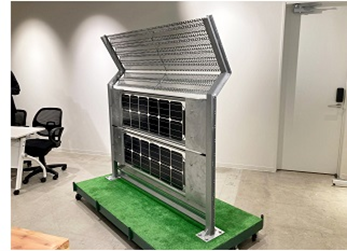
Hokkaido Shizen Energy, a renewables developer set up by Shizen Energy to service the northern region, in partnership with Riken Kogyo, will develop solar-powered snow- and wind-resistant fences and wildlife-repellent solar panels.
These products aim to enhance road safety, promote use of renewables, and address wildlife issues in Hokkaido.
CONTEXT: Riken Kogyo is a leading producer with a 70% share of the domestic snow fence market. Solar-equipped snow fences could support renewable energy deployment and offset infrastructure maintenance costs.
Asuene USA, has partnered with Tokyo Electron Device America to provide CO2 visualization and decarbonization services, focusing on Japan-affiliated firms in the U.S., particularly in California.
The partnership aims to assist semiconductor and electronics manufacturers in complying with new California regulations mandating GHG disclosures.
CONTEXT: California is the first U.S. state to mandate climate-related disclosures; starting 2026 it will require Scope 1 and 2 emissions disclosures, and Scope 3 emissions disclosures in 2027.
Asahi Kasei and Honda Motor inked a shareholder agreement to convert the existing Asahi Kasei subsidiary in Canada into a JV for production of Lithium-ion battery separators to be used in EVs.
Honda will invest C$417 million (USD$300 million) into this JV.
CONTEXT: Japanese firms, such as Panasonic, Mitsubishi, Sumitomo and Hitachi, have growing interest in Canada’s energy market, including battery storage.
CONTEXT: This is an opinion piece by Tanabe Yuki (of JACSES), Susanne Wong (Oil Change International), and Goni Ben Gera (Solutions for Our Climate).
Japan is still one of the largest public financiers of oil and gas globally; one of the biggest in developing countries. It locks Asian regions into fossil fuel dependency and hinders the global transition to renewables.
They cite Japan’s involvement in gas projects in Vietnam, Bangladesh, Philippines, and Thailand. Japan’s GX strategy and its AZEC initiative support gas, ammonia, and hydrogen. For the authors this is “greenwashing” of fossil fuel reliance.
They argue that Japan should shift its international investments towards renewable energy, and call for Japan to redefine its role in climate leadership under PM Ishiba, especially given the LDP’s poor electoral performance.
Japan awarded 885.25 MW of onshore wind power capacity to 17 successful bidders in its fourth auction that offered a maximum of 1 GW. The weighted average bid price was ¥12.73/ kWh, with individual bids ranging from ¥11.39/ kWh to ¥13.99/ kWh, under a cap of ¥14/ kWh.
ENEOS Renewable Energy emerged as the main winner, securing five projects with a total capacity of 290.7 MW. Four had some of the lowest bid prices, ranging from ¥11.33 to ¥11.99/ kWh. The lowest bid price was awarded for a project with a capacity of 75.6 MW. The highest bid price of ¥13.99/ kWh went to Eco Cosmo Power for a 128.73 MW project, and to SymEnergy for a 37.62 MW project.
Under METI’s bidding guidelines, no additional auction for FY2024 will be held since the bid volume in this latest tender was below the 1.3 GW threshold.
Japan’s lead marine contractor Penta-Ocean Construction inked a letter of intent with a subsidiary of Singapore’s state-owned Seatrium to build a heavy lift vessel (HLV) with a fully rotating 5,000-ton crane.
As wind turbines continue to increase in size, the weight of monopile foundations has grown, making HLVs essential for installation. The contract is scheduled to be finalized by March 2025.
CONTEXT: Seatrium is an engineering solutions provider for offshore, marine and energy industries such as design and construction of rigs, offshore platforms and specialized vessels.
OCCTO’s third (FY2024) auction for bottom-fixed offshore wind power generation projects drew no bids.
On offer was a total capacity of 190 MW, with a price cap set at ¥24/ kWh.
CONTEXT: The auction is held separately from tenders under the Act on Promotion of Use of Marine Areas for Development of Marine Renewable Energy Generation Facilities overseen by METI and MLIT.
TAKEAWAY: The officials continue to seek lower prices / tariffs from renewable energy developers but the lack of bids in this auction shows that ricing EPC and materials costs no longer make smaller projects feasible even at ¥24. Equally, this indicates that those companies interested in offshore wind are more likely to work on projects of several hundred MWs. The time of buildings small to medium-sized offshore wind farms is likely coming to an end.
OCCTO’s latest auction for biomass power generation projects ended with no winners as the auction round failed to attract any bids.
OCCTO offered 30 MW of capacity with a price cap set at ¥17.8/ kWh.
CONTEXT: The eligible facilities in this tender were power generation facilities using general wood biomass and with a power output of 10 MW or more, as well as facilities using liquid biomass fuel limited to those with a capacity of 50 kW or more. The price cap was not disclosed.
The power sector regulator, the Electricity and Gas Market Surveillance Commission (EGC), sent a business improvement recommendation to JERA, citing Article 66 of the Electricity Business Act that aims to protect consumers. The commission said that JERA withheld surplus electricity from the spot (day-ahead) market between April 2019 (or earlier) and October 2023.
From Oct 2020 to Oct 2023, about 5.4 TWh of electricity was withheld, which caused significant price impacts, with daily settlement prices rising by more than ¥50/ kWh on certain days. This practice was found to violate the Guidelines on Proper Electricity Transactions, which prohibit actions intended to manipulate or significantly impact market prices through trading or withholding trades.
JERA repeatedly failed to submit bids when power plant output was reduced due to issues such as transmission line inspections. The company attributed this to malfunctions in its bidding tools, but did not take corrective action despite some employees being aware of the issue as early as 2019.
JERA has been instructed to:
Conduct a comprehensive review of its bidding processes for the spot market, identify practices that may have influenced prices outside genuine supply-demand dynamics, and update systems and revise relevant policies.
Implement measures to prevent recurrence, including stronger internal oversight and compliance training for employees on regulatory adherence.
JERA must submit a report outlining corrective measures by Dec 12.
TAKEAWAY: Suppliers with significant market power are expected to offer to the wholesale market their surplus electricity at marginal cost and in full volume. Unjustified deviations, such as withholding electricity or pricing above marginal costs, may be construed as market manipulation. This recommendation seeks to ensure transparency and fair competition in the wholesale electricity market and to strengthen public trust.
Kansai Electric announced plans to raise up to ¥504.9 billion through new share issuance and the sale of treasury shares. This marks the company’s second public equity offering since 1982 and represents its largest-ever fundraising effort.
The money received will be used to upgrade high-efficiency LNG power equipment, invest in data centers and nuclear power plant life extensions.
KEPCO plans to issue around 148.28 million new shares through a public offering and another 29.09 million shares through a third-party allotment. This will increase its total outstanding shares from about 938.73 million to roughly 1.116 billion.
From the raised funds, ¥215.9 billion will be allocated to updating equipment at the Nanko Power Station in Osaka; ¥17 billion will go toward extending the operational life of Units 3 and 4 at the Takahama NPP in Fukui Pref to 60 years.
KEPCO will also sell nearly all of its 45.7 million treasury shares through the public offering. The price for the shares will be determined based on market close between Nov 26-29, with payment dates set for Dec 2-5.
CONTEXT: Equity issuance by electric utilities is rare, as they typically rely on corporate bonds for financing. The last significant case of a utility issuing public equity was Tokyo Electric’s ¥446.9 billion issuance in 2010, prior to the 2011 Great East Japan Earthquake. KEPCO’s planned fundraising will surpass this.
TAKEAWAY: For most of the last decade and a half, power utilities in Japan have been a poor investment. As a company highly reliant on NPPs, KEPCO has faced a public backlash both in the aftermath of the Fukushima accident and due to a bribery scandal involving top management and nuclear facilities. Still, in September 2023 KEPCO’s shares finally recovered to the level prior to the March 2011 Fukushima accident. Despite a recent selloff, the utility and its peers are starting to draw investor interest again largely due to the belief that new construction of data centers and other IT infrastructure will require more clean electricity. KEPCO is trying to capitalize on the investor interest now before the market trend inevitably changes.
Tekoma Energy, a Japanese renewables developer, secured a $50 million investment from ABC Impact, a private equity fund under Singapore’s Temasek.
The funds are expected to support Tekoma’s goal of expanding its domestic solar PV portfolio to over 400 MW within five years and add new PPA deals. Tekoma’s projects include agrisolar PV and battery storage systems.
CONTEXT: Tekoma was acquired by HSBC Asset Management’s Energy Transition Infrastructure (ETI) Team in June 2023. The developer is primarily active in Japan. ABC Impact has $850 million assets under management (AUM).
Tokyu Land will acquire Renewable Japan for about ¥30 billion, and will privatize it. The deal involves a management buyout led by RJ’s president, Manabe.
Tokyu Land formed a capital alliance with RJ in 2017 and gradually increased its stake, now owning about 16%.
The firm will launch a tender to purchase RJ shares at ¥1,250/ share to acquire nearly half of RJ’s outstanding shares; the process is expected to finalize by January.
CONTEXT: Renewable Japan is a leader in the country’s renewables sector; its main business is developing and operating wind farms, solar power plants, and other renewable energy sources.
On Nov 9 at 20:22, there was a wide-area power outage affecting up to 365,300 households in the Shikoku area; the issue was resolved at 21:49.
The cause was an operational error in the balancing system on the DC interconnection line with the Kansai area due to a difference in understanding between Shikoku Electric and Kansai Electric while working on the supply-demand balance.
The frequency dropped sharply due to a decrease in the supply capacity in Shikoku caused by a sudden increase in the power flow to Kansai; the supply-demand balance maintenance device was activated, and transmission was stopped.
CONTEXT: Shikoku has two interconnection lines with Honshu. The Chugoku area side is the Honshu-Shikoku Interconnection Line connecting Kagawa and Okayama, and has two AC lines. The Kansai area side is the Anan-Kihoku DC Trunk Line that connects Tokushima and Wakayama, and has two DC lines. On that day, one of the two lines on each interconnection line was stopped due to maintenance work.
Chugoku Electric submitted to the NRA a revised pre-operation application for Shimane NPP Unit 2, a boiling water reactor (BWR). The restart date is Dec 7.
This was due to changes in the pre-operation inspection. After completion of fuel loading on Nov 3, the company provided a timeline for reactor startup prep.
If inspections and tests proceed as planned after the Dec 7 startup, commercial operation will resume in January 2025.
CONTEXT: The plant halted operation in January 2012 in the wake of the Fukushima disaster and has been idle since then.
TAKEAWAY: The restart of Shimane NPP Unit 2 is now under the spotlight. Onagawa NPP Unit 2 was supposed to pave the way for more BWR restarts in East Japan, but there were delays due to malfunctioning equipment. The nuclear sector needs a smooth restart at Shimane NPP to project a positive public image.
Tohoku Electric determined that at Onagawa NPP Unit 2 a nut at the connection of the guide pipe came loose due to lack of tightening.
Tohoku had replaced the guide pipe in May. It’s possible tightening wasn’t sufficient.
CONTEXT: After restarting the plant on Oct 29, Tohoku Electric halted operations due to a measuring detector that stopped working.
TAKEAWAY: The utility says there’ll be no impact on the start of commercial operation set for December; but the Miyagi Pref Governor issued a stern warning.
Japan Atomic Power Company aims to reapply for restart of its Tsuruga NPP Unit 2 in Fukui Pref. This follows the NRA’s rejection of the plant’s restart application.
The NRA cited the possible presence of an active fault beneath the reactor. JAPC will make extra geological surveys based on external expert opinions.
CONTEXT: At the end of August, the NRA denied the restart of Tsuruga Unit 2. This was the first such denial since the NRA was created in 2012. The NRA cited the presence of a K fault line near the NPP, as well as the possible connection of the fault with yet another one.
TAKEAWAY: JAPC’s efforts are widely seen to be in vain. Given the presence of multiple fault lines in the area, the chances of a restart are unlikely. But the company has only two NPPs and both face restart issues.
Chubu Electric will change the design policy for the tsunami protection wall and other safety measures at its Hamaoka NPP Units 3 and 4.
Based on NRA feedback, Chubu Electric will strengthen its design by increasing the height of the existing seawall by 6 meters to reach 28 m. It is also updating design policies for hydrogen management, cooling measures, and dry storage for spent fuel.
CONTEXT: Following the Fukushima Daiichi accident in 2011, Chubu Electric built a 18-meter high wall that was then raised to 22 meters in 2015.
Fuel debris from Fukushima Daiichi NPP Unit 2 arrived at The Japan Atomic Energy Agency’s Fuel Monitoring Facility (FMF) in Oarai, Ibaraki Pref.
It will analyze the debris to better understand internal reactor conditions and develop methods for fuel debris removal, safety protocols, and storage solutions.
CONTEXT: TEPCO gathered the debris on Oct 30. The debris resulted from melted nuclear fuel mixed with internal reactor structures.
Shizuoka Gas inked a deal with Vietnamese Hoan Loc Viet to acquire a 25% stake in its subsidiary My Son-Hoan Loc Viet Solar Energy.
This marks SG’s first business venture in Vietnam’s renewable energy sector.
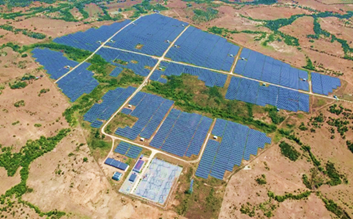
Shizuoka Gas will oversee operations at MSHLV’s Myson Power Plant, a 50 MW solar farm in Ninh Thuan Province that enjoys favorable solar conditions.
NEWS: OIL, GAS & MINING
Japan’s gas prices becoming more correlated with Europe’s TTF benchmark
(Japan NRG, Nov 13)
The TTF-Northeast Asia spot gas prices have steadily become more correlated in recent years, with the current level at about 80%, says Argus Media. The correlation is partly based on European gas stockpile levels.
Meanwhile, the TTF forward curve for summer-inter price spreads is in steep “backwardation”, which has only intensified this month. So far this year, there’s been a strong rebound in LNG demand, which has outpaced supply growth.
CONTEXT: “Backwardation” refers to the situation in which current prices for an asset are higher than those in the futures market. That suggests demand for an asset today supersedes interest in the commodity in the coming months. A wave of new U.S. LNG production capacity is due online starting Q2 of 2025.
Argus also forecasts a boost in associated gas supply from the U.S. as a result of expectedly pro-oil policies by incoming President Trump. U.S. shale growth could enter into a “new paradigm”.
Stronger U.S. oil and gas output is likely to cause a shift in global attention from the Brent crude benchmark to the West Texas Intermediate (WTI) benchmark.
Japanese companies are expanding LNG production to meet rising power demand, viewing LNG as a cleaner alternative to coal.
Mitsubishi Corp and Mitsui & Co are leading the increase in investments. Mitsubishi is expanding its share in Malaysia’s LNG projects, and is ready to launch the “LNG Canada” on that country’s west coast. Mitsui is investing in a UAE LNG project.
CONTEXT: Global LNG production will likely increase from 474 Mt in early 2024, to 667 Mt by 2028. There’ll be major growth in supply from the U.S. and Qatar.
The U.S. is considering more sanctions on Russia, prohibiting transactions between Gazprombank and U.S. banks.
Gazprombank facilitates payments for Sakhalin-2. Although the G7 has strict sanctions on Russia’s top banks, there’s no ban on transactions for natural gas.
CONTEXT: Mitsui and Mitsuishi Corp own stakes in Sakhalin-2, which supplies roughly 10% of Japan’s LNG imports. Japanese companies often rely on U.S. banks for transactions when purchasing Russian LNG.
Saudi Aramco notified Japan’s LPG distributors that it will raise the export prices for LPG shipments. This regards shipments scheduled for November, marking the fourth consecutive month of increase.
The price rise is due to heightened crude oil prices driven by Middle East tensions, along with the onset of peak LPG demand season.
For propane, used in heating and water heating, the price was set at $635 per ton, up $10 (2%) from the previous month. Butane, used as a petrochemical feedstock, was also raised by $10 (2%) to $630 per ton.
CONTEXT: Since LPG is a byproduct of crude oil production, it’s susceptible to fluctuations in crude oil prices. WTI crude oil futures reached a two-month high in early Oct at $78 per barrel. This was due to supply concerns after Israel initiated ground attacks in Lebanon. Winter demand for LPG in East Asia will increase. Last year, prices also rose until November.
As of Nov 10, LNG stocks of 10 power utilities were 2.21 million tons, a 4.3% rise from the previous week (2.12 million tons); and up 2.3% from end November 2023 (2.16 million tons). It’s also 3.8% up from the 5-year average of 2.13 million tons.
CONTEXT: Utility companies are restocking LNG in preparation for colder weather, but Tokyo recently enjoyed 20 degree Celsius temperature. Last week, Mt. Fuji saw its first snow cap this year, the latest date on record.
ANALYSIS
BY FILIPPO PEDRETTI
Direct Ocean Capture: Can CCS Go Green?
The challenge of capturing CO2 in a fully sustainable manner is pushing researchers and companies to be more creative and embrace different approaches. One solution is direct ocean capture (DOC) developed by the California-based startup Captura, which has support from important Japanese investors.
Captura’s technology was presented by the company’s CEO Steve Oldham at Smart Energy Week in Tokyo on October 2. Captura is as green as carbon capture can possibly be, which sets it apart from other CCS methods that are often criticized by environmental groups for being too aligned with the interests of the oil and gas industry.
In brief, Captura’s system amplifies the ocean’s natural role as a carbon sink, since the ocean can naturally capture CO2 from the air. This feature could make Captura an interesting environmental solution for decarbonization, and it would be far less costly and complex than current systems.
While Captura appears to be solidly ‘green’, it’s still a CO2 capture and storage technology that aims to alleviate industrial emissions and not prevent them entirely. Thus, it faces many of the same challenges associated with the still-underdeveloped CCS industry in general.
The technology
Research shows that the ocean naturally captures about one-third of the CO2 emitted into the atmosphere. Still, as atmospheric CO2 levels have increased in recent decades, the safe levels that the ocean can absorb are reaching a critical point; for example, rising carbon levels increase seawater acidification and other detrimental impacts.
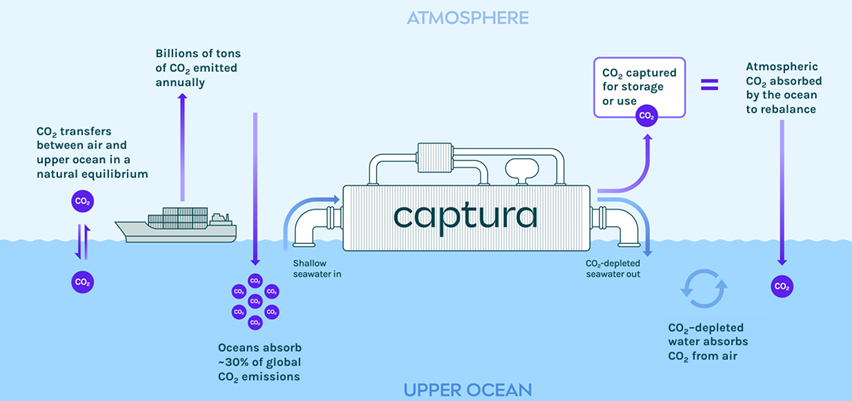
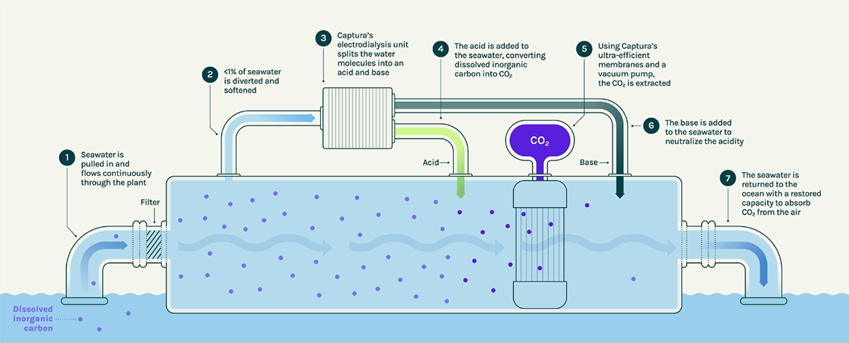
How does Captura’s DOC tech work? It diverts a small part of the seawater pumped through its system, taking the salt water, sodium chloride, hydrogen and oxygen, and reassembling them as hydrochloric acid and sodium hydroxide. The acid is introduced into the seawater, causing a reaction that releases dissolved CO2, which is then captured.
After the CO2 removal, alkali is added to the seawater to counteract increased acidity from the previous step. Finally, the resulting seawater mixture is returned to the ocean. Once the CO2 is removed from the water, the ocean absorbs more carbon from the atmosphere to maintain equilibrium between the gas dissolved in the liquid and the one above the liquid.
Source: Captura
DOC operates using seawater, renewable electricity, a proprietary membrane and electrodialysis technology. According to Captura, around 70% of the total energy consumed by the system owes to electrodialysis, which operates only for a few hours a day. Captura believes it can work well with renewables, using facilities during the day when energy production is higher than grid demand.
Once captured, a possible final destination for CO2 is storage through geologic sequestration, but it can also be reused to create sustainable products and fuels. In particular, the system offers opportunities for sectors like aviation and shipping.
Plants and functions
The first DOC pilot was installed at Caltech’s Kerckhoff Marine, launching in 2022. It removed one ton of CO2 per year. The second-generation system launched in 2023, and is located at the AltaSea marine research facility in the Port of Los Angeles, having a capacity to remove 100 tons per year. A third pilot, capable of capturing 1,000 tons per year, is under construction in Hawaii, in partnership with Equinor. Operations are slated to start in 2025. Captura also recently announced pilot plants in Quebec and Norway.
The system will be deployed utilizing desalination plants and utilities that use seawater for cooling, aiming to capture up to 10,000 tons of CO2 per year, per site. Inactive oil and gas platforms can also be used, and would accommodate up to 1 Mtpa of CO2, per site. Both these options lower costs and protect the environment, without any need to build new infrastructure.
Captura says the technology has no harmful byproducts and, even if deployed at a gigaton scale, it won’t damage the marine environment. Possibly it could benefit the ocean: after CO2 removal, the water is less acidic than that of untreated seawater.
With a diversified portfolio of investors, including Japan Airlines and Hitachi, Captura raised $45.3 million in its Series A round. Full operations are set to come online by 2026, with plans to license the technology and form JVs with partners.
The global aviation industry has strict decarbonization targets, and the International Air Transportation Association (IATA) sees CO2 capture and SAF as clean fuel solutions. IATA said that the industry plans to prevent as much as 1,100 Mtpa of CO2 by utilizing SAF, and up to 500 Mtpa with the help of CO2 removal.
Investors
Japan Airlines
Hitachi
Edp
Future Planet
Translink Capital
EIC Rose Rock
Maersk
Caltech
Eni
National Grid
Aramco
Equinor
Freeflow
In March, Japan Airlines invested in Captura through its Innovation Fund, along with Nationalgrid; Captura raised around $10 million. JAL’s innovation fund was launched in 2019 with a total capital of $70 million. It now has a portfolio of 12 startups, in three areas: mobility, digital and sustainability.
Competitors: DAC and other DOC systems
According to the International Energy Agency (IEA), achieving net zero will require the recovery of a total of about 1 billion tons of CO2 by 2050. Direct air capture (DAC) is currently the leading method of recovery, but still in its infancy. In principle, DOC is similar to DAC. Yet, ocean water has a CO2 concentration that’s about 150% higher volumetrically than the atmosphere.
Since DOC requires less energy to sequester the same amount of CO2, Captura expects the costs to be 50% less than DAC. Other contributing factors include the technology’s deployability, limiting the majority of its energy intake to just a few hours a day, and the absence of sorbents used in the process.
The Japan Agency for Marine-Earth Science and Technology (JAMSTEC) is also developing a DOC technology. But, unlike Captura, it plans to recover CO2 using a system like DAC paired with renewable energy (namely, wind).
JAMSTEC aims to start prototype experiments in 2025 and hopes to commercialize the technology around 2040, but it faces challenges regarding cost, which are currently higher than recovery from the atmosphere.
Globally, Captura’s three main competitors are Brineworks, Sea02, and Ebb Carbon. Brineworks, based in Amsterdam, utilizes electrolysis to separate CO2. It is also producing hydrogen as a by-product, which could become an extra revenue stream. Sea02, a Delft University spin-off, employs electrodialysis (like Captura), and it seeks partnerships for CO2 sequestration in Europe, aiming to scale its carbon removal by 2045. Ebb Carbon’s approach targets facilities processing seawater. It creates an alkaline solution that, when returned to the ocean, binds CO2 as bicarbonate, a long-term storage form. This way, it also helps combat ocean acidification, benefiting marine ecosystems.
Conclusion
Captura’s DOC technology positions itself as the greenest form of CCS available utilizing ocean water – something that is abundant on the planet and readily available. Yet, the notion that CO2 storage should be underground has already become ingrained in the minds of many in this sector.
Meanwhile, CCS has many capable critics who raise doubts on the effectiveness of this approach in reducing emissions, as well as its safety. The critics may not be swayed by Captura’s DOC technology no matter how much of an improvement it purports to be on regular DAC facilities. This also means that investors interested in going green will likely prefer established and less controversial technologies for CO2 storage.
To meet tangible CO2 reducing emission goals, Captura plans to deploy DOC on a scale ten times larger than the pilot’s current 1,000 tons per year. But sufficient funding is needed, either from industries interested in receiving carbon credits or from companies eager to use CO2-derived products.
Using DOC for SAF offers hope that this technology might find use in industry and prove viable over the long term. Still, SAF itself is still far from being widely accepted and utilized, and faces its own uphill battles in solving technological and production challenges.
While new technologies often contain the vision needed to shape tomorrow’s world, such innovations inevitably run-up against the realities of market forces. State subsidies can help get a technology off the ground, but long-term viability requires economic sense, and DOC technology still has to prove itself.
ANALYSIS
BY THOMAS SHOMAKER
Kansai Airports, KHI and Airbus Prepare for Hydrogen Flight
As Japan prepares to launch trillions-of-yen in subsidies to support companies in building domestic hydrogen infrastructure, one interest group with an eye on the prize will likely be airports and the aviation sector.
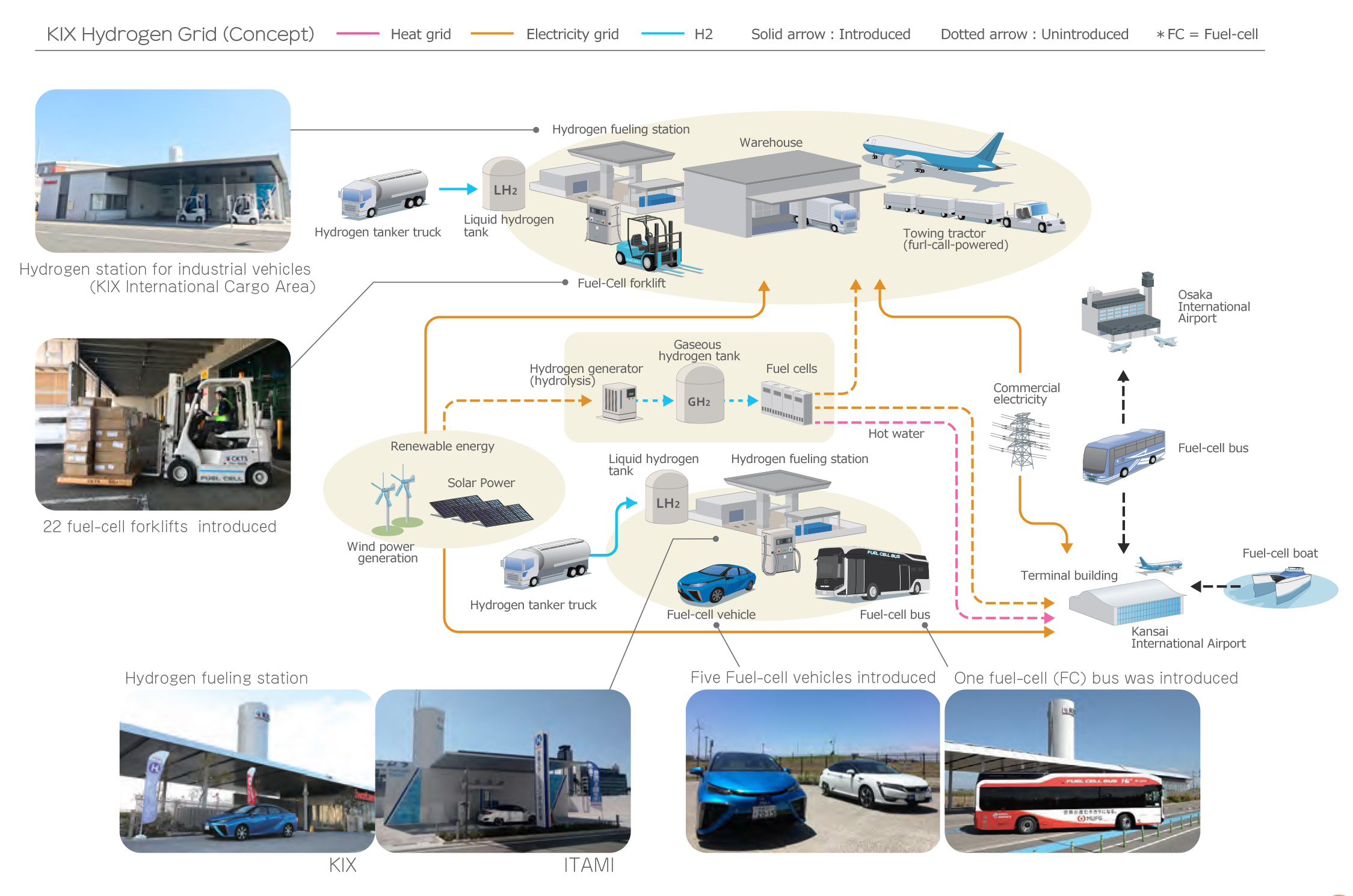
Moves to shift some operations at Japanese airports away from fossil fuels and to hydrogen, as well as other clean energy sources, have been in motion for several years already. Several hubs are trialing hydrogen fuel cell support and cargo loading vehicles, such as forklifts.
The bigger revolution, however, is expected to come in the 2030s when aircraft themselves enter the hydrogen age. And three of the top airports in the Kansai area have now teamed up with Airbus, the world’s largest aerospace firm, to plan how to adapt to hydrogen-fueled air travel.
In part, Kansai International Airport (KIX), Osaka International Airport and Kobe Airport are simply following a global trend in their sector to build out the necessary infrastructure to support commercial hydrogen flight. However, the Kansai group also includes hydrogen engineering specialist Kawasaki Heavy Industries (KHI), which has a history of success in both advancing new technologies for hydrogen handling and storage, as well as securing state grants.
Japan NRG reviews the airport project specifications and state of development.
Lighter than air
As the transport sector weighs up the various options to decarbonize, it’s becoming clear that the solutions favored by, say, passenger road transport, may not apply as well to marine and air travel. The much-touted electrification push for cars will be hard to replicate when it comes to aircraft, and so many in the aviation field have turned to options including hydrogen.
In theory, hydrogen is appealing because it has about 2.8 times the energy density of crude oil-based aviation fuel by mass and can potentially be produced via renewables at or near airports. But challenges remain. Although less liquid hydrogen fuel mass is needed to achieve the same power, the difficulties of storing this alternative means that a hydrogen aircraft’s combined fuel and tank weight would be greater than that of today’s planes.
Still, the top airports in the Kansai region have joined the ranks of peers internationally that believe that the technical hurdle might just be overcome, paving the way for hydrogen-powered commercial air travel by the mid-2030s.
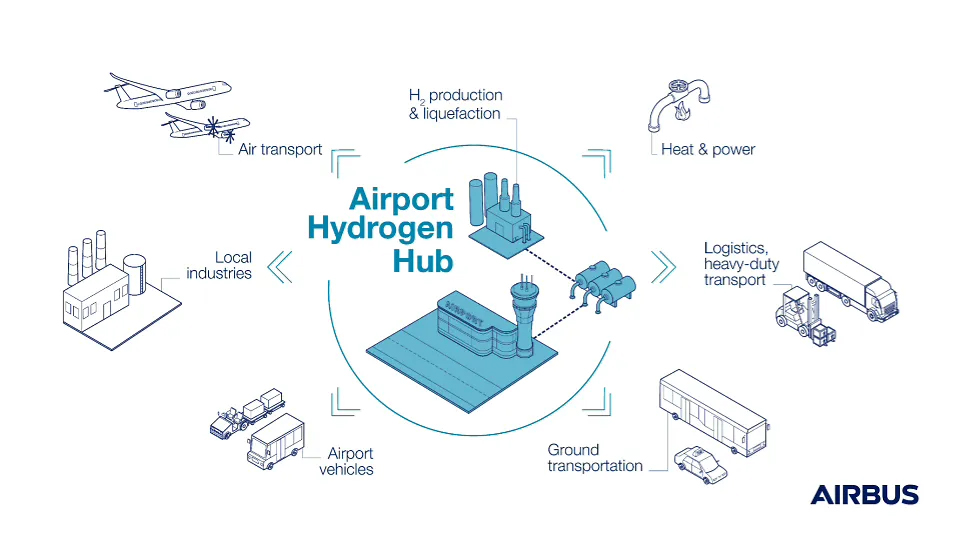
KIX, Osaka International and Kobe airports have agreed to join Airbus’ global “Hydrogen Hub at Airports” program and build upon their work with the aerospace company in 2022 to begin a more detailed feasibility study of creating the necessary infrastructure to enable hydrogen flight.
The three airports were all early movers with hydrogen, signing up for the transport ministry’s “Basic Policy for Promotion of Decarbonization of Aviation” program that started in 2022 with the goal of mapping a roadway for carbon neutral aviation by mid-century. KIX and Osaka International’s decarbonization plans were certified by the ministry (MLIT) as part of the first cohort on December 1, 2023, with Kobe Airport attaining certification on July 31.
KIX’s hydrogen infrastructure is currently the most mature. It has two supply stations serving three FC cars, 21 FC forklifts, and a number of other FC forklifts owned by separate companies that work at the airport. In 2022, a subsidy program from the Ministry of the Environment and Osaka Prefecture helped launch an FC shuttle bus that runs between KIX and Osaka International, where there is one hydrogen supply station and several FC vehicles.
Future hydrogen supply chain hubs
While hydrogen infrastructure has not yet been introduced at Kobe Airport proper, a Kawasaki Heavy-led demo project has built a liquified hydrogen supply chain terminal on the airport island in the Port of Kobe, which received its first shipment in 2022.
According to Airbus, that’s good groundwork for exploring the feasibility of turning the airports into future hydrogen supply chain hubs. Airbus, the three Kansai airports, and KHI have signed an MoU to pursue conducting a feasibility study on this topic.
Japan’s latest iteration of the Basic Hydrogen Strategy, released in June 2023, estimates that ¥15 trillion ($97 billion) in public and private investments into hydrogen supply chains are required over the next 15 years. The government will only cover a fraction of the amount.
A new Contract for Difference subsidies plan, to launch this month or in early December, will offer as much as ¥3 trillion for domestic supply chains (i.e. distributors and end users) that want to switch to hydrogen or ammonia without losing out economically. Money will also be made available for those embarking on hydrogen infrastructure construction.
Since 2017, Airbus has had an agreement with METI to cooperate on the development of a local aviation ecosystem, and the two sides met in summer 2023 to align on decarbonization. This collaboration translates more readily into real-life support since two of the Kansai airports involved with Airbus, KIX and Osaka International, are run by the government-funded New Kansai International Airport Co. Further state support seems implicit when reviewing why the Kansai airports joined Airbus’ Hydrogen Hubs at Airports program.
Airbus has already carried out a liquified hydrogen demand forecast for Kansai Airports, and anticipates a few tons of hydrogen fuel per day will be needed to support hydrogen aircraft “in the early stages of introduction”, meaning 2035 and shortly thereafter.
The plans will incorporate technology tested by Airbus’ four hydrogen-fueled ZEROe concept planes. The ZEROe models were designed in 2020 and can carry 100-200 passengers or less on flights of up to 1,000 to 2,000 nautical miles. Around 2050, Airbus anticipates that several hundred tons of hydrogen fuel will be needed each day across the three airports.
Kawasaki’s hydrogen experience
While Airbus focuses on the demand of new hydrogen-fueled planes, it falls to KHI to consider the airport support infrastructure, which will require overcoming engineering challenges around how to move and store liquid hydrogen in fuel form.
KHI has made several breakthroughs with liquid hydrogen. In 2022, its Suiso Frontier – the world’s first liquefied hydrogen carrier – made its maiden international voyage to Australia, where it loaded 1,250 cubic meters of liquified hydrogen before returning to Kobe Airport Island. In addition to a 2,250 cubic-meter liquefied hydrogen tank built on Kobe Airport Island in 2020, KHI has a design for a 10,000 cubic meter tank at the site, which would be the largest in the world if and when built.
KHI has also been instrumental in developing a Loading Arm System (LAS) to connect liquified hydrogen ships with terminals. For these technologies, the company leaned on its decades of experience with LNG.
Much of Kawasaki Heavy’s R&D into liquid hydrogen handling has benefited from government support. On May 31, the company was awarded three of the first ten Hydrogen Society Promotion Act grants for three separate hydrogen feasibility studies.
How about on-site production?
Of course, the most efficient way to utilize hydrogen in aviation would be for airports to produce at least some of the fuel onsite, especially since renewable energy can be deployed to power electrolyzers that split water into its oxygen and hydrogen components.
The idea isn’t entirely far-fetched. KIX is currently building a 23.8 MW solar farm adjacent to its Terminal 2 that will be used partly to power electrolysis. Due to come online in spring 2025, KIX hasn’t said how much of the facility will generate electricity for use as is, and how much will be devoted to electrolyzers.
A comparable installation is the 10 MW Fukushima Hydrogen Energy Research Field, which was the world’s largest green hydrogen production facility when it opened in 2020. It can produce up to 1,200 Nm3 of hydrogen per hour from 20 MW of onsite solar capacity. KIX should be able to generate similar volumes, which would be about 110 kg of H2 an hour.
According to BMW, a fuel cell car can travel 100 kilometers on one kilo of hydrogen. But the volumes required for a busy airport are many times greater. Meanwhile, there is a limit on the space that airports can dedicate to solar or other renewables facilities.
This is where Airbus and the Japanese consortium parties will need to get creative and find solutions. Roadmaps for commercial hydrogen aviation suggest that those solutions will need to arrive this decade.
COP29 WRAP-UP
BY JOHN VAROLI
This week and next, the column will focus on major developments at COP29 in Baku. Here are some of the main stories.
Voluntary transition credits could help finance the phase-out of coal-fired power plants in Asia, but familiar risks over project permanence and buyer appetite are seen as major barriers to scaling up such credits, concluded a COP29 panel discussion.
Paul Everingham, CEO of the Asia Natural Gas & Energy Association, said much of Asia uses coal because it’s familiar and inexpensive. He said that natural gas is the logical choice as a much cleaner burning alternative to coal.
A secret recording shows the head of Azerbaijan’s COP29 team, Elnur Soltanov, discussing “investment opportunities” in that country’s state oil and gas company with a man posing as a potential investor. “We have a lot of gas fields that are to be developed,” Soltanov says, reported the BBC.
The Argentinian delegation withdrew from COP29 on the orders of President Javier Milei, who is cultivating a friendship with U.S. President-elect Donald Trump, whose own climate and energy stances need no special introduction.
French Ecology Minister Agnes Pannier-Runacher pulled out of COP29 after Azerbaijan’s President Aliyev accused France of carrying out colonialist crimes in New Caledonia. Since May, a crackdown by French police has killed 13 people and left 169 wounded during protests by indigenous people.
The World Bank and other international development banks announced that they were on track to provide $120 billion per year for low-income and middle-income countries by 2030, up from $74.7 billion last year.
China, India, Iran, Indonesia and Russia had the biggest increases in emissions from 2022 to 2023, while Venezuela, Japan, Germany, the UK and U.S. had the biggest decreases in emissions.
Seven states or provinces spew more than 1 billion metric tons of GHGs, all of them in China, except Texas, which ranks sixth, according to data from an NGO co-founded by former U.S. Vice President Al Gore and released at COP29.
The world’s most polluting cities are: Shanghai, 256 MMT of GHGs; Tokyo, 250 MMT; New York City, 160 MMT; Houston, 150 MMT; and Seoul, 142 MMT.
COP29 negotiators are expected to wrap up the conference on Nov 22. Climate financing will be the key issue, which could be in the range of $300 billion annually. The larger figure could be $1 trillion a year and would include both international institutional funding, as well as hundreds of billions of private sector funds.
2024 EVENTS CALENDAR
A selection of domestic and international events we believe will have an impact on Japanese energy
November
US presidential election (Nov 5)
COP 29 in Azerbaijan (Nov 11-22)
Abu Dhabi International Petroleum Exhibition Conference (ADIPEC) 2024, Abu Dhabi, UAE (Nov 11-14)
APEC 2024 @ Lima, Peru
International Conference on Nuclear Decommissioning (TBD)
G20 Rio de Janeiro Summit (Nov 18-19)
Result of solar auction #22 (Nov 26)
Offshore Energy Exhibition & Conference (OEEC) 2024, Amsterdam, the Netherlands (Nov 26-27)
APAC Wind Energy Summit (Nov 26-28)
Biomass & BioEnergy Asia Conference (TBD)
European Biomethane Week 2024
December
Last market trading day (Dec 30)
January 2025
First market trading day (Jan 4)
FIT/FIP solar auction #23 (Jan 6-24)
World Forum Offshore Wind (WFO) Global Summit 2025, Barcelona, Spain (Jan 21-22)
Offshore Technology & ENEX Exhibition @ Tokyo Big Sight (Jan 29-31)
February
Result of solar auction #23 (March 7)
Disclaimer
This communication has been prepared for information purposes only, is confidential and may be legally privileged. This is a subscription-only service and is directed at those who have expressly asked K.K. Yuri Group or one of its representatives to be added to the mailing list. This document may not be onwardly circulated or reproduced without prior written consent from Yuri Group, which retains all copyright to the content of this report.
Yuri Group is not registered as an investment advisor in any jurisdiction. Our research and all the content express our opinions, which are generally based on available public information, field studies and own analysis. Content is limited to general comment upon general political, economic and market issues, asset classes and types of investments. The report and all of its content does not constitute a recommendation or solicitation to buy, sell, subscribe for or underwrite any product or physical commodity, or a financial instrument.
The information contained in this report is obtained from sources believed to be reliable and in good faith. No representation or warranty is made that it is accurate or complete. Opinions and views expressed are subject to change without notice, as are prices and availability, which are indicative only. There is no obligation to notify recipients of any changes to this data or to do so in the future. No responsibility is accepted for the use of or reliance on the information provided. In no circumstances will Yuri Group be liable for any indirect or direct loss, or consequential loss or damages arising from the use of, any inability to use, or any inaccuracy in the information.
NEWS
・METI/ MLIT to consider revision to pricing and evaluation criteria for offshore wind based on FX moves
・Govt will resume subsidizing electricity and gas bills in Jan
・ENEOS wins big in latest onshore wind auction
・Japan’s gas prices becoming more correlated with Europe’s TTF benchmark