
WEEKLY
AUGUST 18, 2025
ANALYSIS
THE ANALYSIS SECTION IS TAKING A SUMMER BREAK THIS WEEK
ASIA PACIFIC REVIEW
This column provides a brief overview of the region’s main energy events from the past week
NEWS
- Bain buys ¥50 billion stake in Japan power retailer
- Sojitz to study gallium production in Australia
- Mitsubishi Corp to acquire stake in Copper World mining project
ELECTRICITY MARKETS
HYDROGEN
- Honda, Mitsubishi test using power supply from reused fuel cells for data centers
- Fuji and Mitsubishi Gas work on fuel cell system using methanol
- KHI begins making large liquefied H2 tanks
SOLAR AND BATTERIES
- Schroders buys stake in JERA’s U.S. solar portfolio
- Sekisui Chemical to issue first green bond for PSCs
- Hokkaido Electric to launch AI service for grid battery bidding and operation
WIND POWER AND OTHER RENEWABLES
- Japan aims for 15 GW of floating offshore wind power by 2040
- JERA and bp launch offshore wind JV
- Kitakyushu offshore wind farm reaches 60% use of locally made materials
- KEPCO to issue transition bonds to fund nuclear upgrades
- NRA to develop new rules for fusion power
- JAPC submits operation extension approval report for Tokai No.2
- JERA, Cheniere Energy sign long-term LNG deal
- INPEX begins FEED work for Abadi LNG
CARBON CAPTURE & SYNTHETIC FUELS
- METI seeks adjustments to GX-ETS allocation rules
- Nippon Steel, etc to study possible CCUS hub in Asia
- ENEOS Holdings to halve group firms, focus on next-gen fuels
EVENTS
Aug 27-28 Asia-Pacific Economic Cooperation / Energy Ministerial Meeting @ Busan, South Korea
Sept 9-12 Gastech 2025, Milan
Sept 15-19 IAEA General Conference 2025
Sept 16-18 APAC Wind Energy Summit @ Melbourne, Australia
Sept 17-19 Smart Energy Week Autumn 2025 / EV-HV-FCV Expo / Green Factory Expo / H2 & FC Expo / PV Expo / Battery Japan / Smart Grid Expo / Wind Expo / CCUS Expo / Decarbonization Expo / Circular Economy Expo @ Makuhari Messe
PUBLISHER
K. K. Yuri Group
Editorial Team
Yuriy Humber (Chief Editor)
John Varoli (Senior Editor, Americas)
Kyoko Fukuda (Data, Events)
Magdalena Osumi (Renewables & Storage)
Filippo Pedretti (Thermal, CCS, Nuclear)
Tetsuji Tomita (Power Market, Hydrogen)
George Hoffman (Sales, Business Development)
Tim Young (Design)
SUBSCRIPTIONS & ADVERTISING
Japan NRG offers individual, corporate and academic subscription plans. Basic details are our website or write to subscriptions@japan-nrg.com
For marketing, advertising, or collaboration opportunities, contact sales@japan-nrg.com For all other inquiries, write to info@japan-nrg.com

NEWS: GENERAL OUTLOOK AND TRENDS
Bain Capital to take stake in power retailer Rezil in ¥50 billion deal
(Nikkei, August 14)
- Rezil, a residential electricity wholesaler, said it will sell shares to U.S. investment fund Bain Capital through an initial public offering.
- The deal’s value is expected to be about ¥50 billion ($340 million).
- Last year, Rezil was listed on the TSE Growth market.
- Upon news of the deal, Rezil’s stock price soared. The closing price on August 14 rose 24% to ¥2,574, bringing its market cap to ¥490 billion.
- CONTEXT: Bain’s acquisition plan aims to position Rezil for a more aggressive merger and acquisition strategy.
TAKEAWAY: Bain Capital is one of the most active foreign investors in Japan’s energy market, focusing on renewable and digital energy solutions. In 2024, it sold Japan Wind Development, a major wind farm operator, for $1.53 billion. Along with the purchase of the stake in Rezil, the goal is to capitalize on new entrant opportunities in Japan’s liberalized energy market. While Bain is driving sector consolidation, it will eventually have to face issues related to long-term governance in some of these investments.
Sojitz begins study for gallium production in Australia
(Company statement, August 4)
- Sojitz and JOGMEC formed a JV — Japan Australia Gallium Associates (JAGA) — to study gallium production in Australia.
- JAGA agreed with the Australian unit of Alcoa to assess the feasibility of producing gallium as a byproduct at one of Alcoa’s alumina refineries, with a final investment decision planned by end-2025 and potential production starting in 2026.
- CONTEXT: The project aims to establish a stable and diversified supply of gallium, designated as a critical mineral by Japan, Australia, the U.S., UK, and the EU, for applications such as LEDs, solar cells and semiconductors. Sojitz is targeting sales to Japan and other markets. Production generally involves separating and extracting gallium as a byproduct in the alumina and zinc refining process.
TAKEAWAY: According to JOGMEC, Japan imported about 97 tons of gallium out of the 167 tons the country consumed in 2021. Of total imports, 57%, or 55 tons, was sourced from China. Those imports have been on the decline since Beijing tightened export controls in 2023. Gallium is a critical input for high-performance semiconductors, LEDs, and certain PV applications. The tightening of Chinese exports has pushed Japanese manufacturers to diversify supply, explore recycling from industrial scrap, and to invest in alternative sources from Germany and the U.S.
Mitsubishi Corp to acquire stake in Copper World mine project
(Company statement, August 14)
- Mitsubishi Corp will invest $600 million for a 30% stake in the Copper World mining project in Arizona, its first U.S. copper mine investment in 45 years.
- The mine is owned by Hudbay Minerals. The two firms will do a feasibility study, with a final investment decision around 2026.
- Mitsubishi, already Japan’s top copper producer, plans to boost its global output from 329,000 tons in 2024 to over 400,000 tons by 2030; this comes amid growing concerns over global supply constraints.
- The investment is expected to help meet surging demand for EVs, data centers, and renewables infrastructure.
- CONTEXT: The U.S. mine is expected to start operations around 2029. Arizona is a leading mining region with around 70% of domestic copper mine production.
TAKEAWAY: The move comes as the U.S., the world’s second-largest copper consumer after China, pushes to expand domestic copper production and adds new tariffs on certain copper imports. The Arizona mine offers low geopolitical risk and fits Japan’s push to diversify away from more volatile regions such as South America.
NEWS: ELECTRICITY MARKETS
EPCOs report lowest fossil fuel consumption of past decade
(Denki Shimbun, August 4)
- In Q1 FY2025, JERA and eight major power utilities (EPCOs) had their lowest consumption of fossil fuels in the past 10 years; the third consecutive year of decline.
- Total LNG consumption in the quarter fell 1% YoY to 6.74 Mt.
- KEPCO saw a huge drop due to increased reliance on electricity trading and power purchases from other suppliers.
- Tohoku Electric reduced LNG use following restart of Onagawa NPP Unit 2. JERA’s consumption rose 5.5% as it compensated for coal plant maintenance shutdowns.
- Coal consumption in the quarter dropped 2.4% to 9.85 Mt, falling below 10 Mt for the first time in 14 years. Some utilities (Hokkaido, Hokuriku, Chugoku, and Shikoku) increased coal use. JERA used 13% less due to extended maintenance shutdowns.
- Heavy oil use plummeted 42% to 125,000 kiloliters, the lowest since FY2020. The decline is due to plant closures, including Akita Thermal Power Plant Unit 4 (Tohoku) and the shutdown of Hirono Thermal Power Plant Unit 2 (JERA).
- Among the nine utilities, only KEPCO reported any crude oil consumption.
- CONTEXT: The low fossil fuel consumption is due to many factors, such as nuclear restarts, market trading, renewable energy development, and other efforts to reduce emissions.
TAKEAWAY: Waning domestic demand, especially for LNG, has been a feature for the last decade. Whether this trend continues is dependent on many factors such as future increased potential demand from data centers and geopolitical agreements such as more imports from the U.S. As electricity demand starts to grow again in terms of volume, as has been the case over the past year, fuel imports are also expected to rebound.
ANRE plans to begin power trading in new mid- to long-term market
(Government statement, August 8)
- In 2028, ANRE is considering launching a new mid- to long-term power trading market.
- Alongside this, starting FY2030, electricity retailers will be asked to firm up their source of supply (kWh) to make sure it’s locked in partially ahead of time.
- Retailers selling under 500 GWh annually will have lighter obligations for five years after system launch. These lighter rules will ask them to secure 25% of demand three years before delivery, and have at least 50% locked in one year before.
- The goal of the system change and new market is to give retailers stronger, more predictable procurement options and to reduce any disadvantage in bilateral negotiations with generators. It should also improve the investment outlook for generators.
- Outstanding issues include treatment of retailers relying on others for supply, enforcement for non-compliance, coordination with the capacity market, etc.
- CONTEXT: At the previous meeting, ANRE proposed mandating electricity retailers to secure supply to support smooth mid- to long-term trading. It also reviewed the approach to expand and restructure trading systems that enable mid- to long-term electricity procurement, as well as their relationship with trading markets.
TAKEAWAY: Regarding short-term procurement, discussions around a “simultaneous market” that integrate JEPX’s spot market and intraday market and balancing market (EPRX) have been underway for two years. Now, detailed design work has begun for mid- to long-term procurement. However, there are many issues to consider, such as products to be handled, the bidding process, contract terms, delivery, and settlement. It will be necessary to closely monitor future deliberations.
ANRE proposes plan to recover costs of developing large-scale power grids
(Government statement, August 8)
- ANRE proposed a new system allowing part of the large-scale grid construction costs to be recovered through transmission charges – starting during the construction phase, instead of after the launch of operations.
- With METI approval, utilities could bill retailers for these early recoveries, placing the funds into a newly established reserve to avoid double-charging.
- The measure aims to ease cost recovery and encourage grid investment. It would apply to certain certified interconnection and internal grid projects, with recovery rates set case-by-case and possible caps to ensure fairness across types of generations.
- CONTEXT: In the framework of the 7th Basic Energy Plan, the govt has been seeking to develop measures to facilitate financing of grid projects. Grid modernization is one of the most crucial tasks for the national system.
- SIDE DEVELOPMENT:
- ANRE discusses power source investment with financial institutions
- (Government statement, August 8)
- ANRE held hearings with financial institutions to discuss power source investment.
- Sumitomo Mitsui Banking Corp explained the challenges with sustainable development of large decarbonized power plants. MUFG Morgan Stanley Securities said that corporate bond issuance for power has grown with low interest rates.
- Both highlighted potential large financial burdens for developers of large-scale decarbonized power sources and concerns over worsening financing conditions amid rising debt repayments.
- The banks emphasized a need for state-backed financial support.
TOCOM power futures trading hits record open interest in July as volumes surge
(Denki Shimbun, August 15)
- Electricity futures trading on the TOCOM reached 663 GWh in July, down from June but 9.8 times higher than a year earlier.
- Open interest at the end of July rose for the second straight month to a record 1.58 TWh.
- Monthly contracts for FY2025 delivery dominated trading, while weekly contracts surged to 199 GWh, the third-highest on record, helped by looser market-maker spread rules.
- Off-exchange deals also fixed prices for October 2025–March 2026 at ¥13.89/ kWh (East baseload) and ¥11.85/ kWh (West baseload), with one atypical one-year contract at ¥15.70 (East daytime) and ¥11.55 (West baseload).
NEWS: HYDROGEN
Honda, Mitsubishi test power supply from reused fuel cells to data centers
(Company statement, August 1)
- Honda, Tokuyama, and Mitsubishi Corp launched a test for power supply from reused vehicle fuel cells to data centers using by-product hydrogen in Shunan City.
- Tokuyama produces hydrogen at its salt electrolysis plant, and the electricity generated by Honda’s FCs is consumed by Mitsubishi Corp’s data centers.
- The goal is to explore the potential for reusing vehicle FCs as power sources.
- CONTEXT: In June 2023, this demo was selected as one of NEDO’s Technology Development Projects for Building a Hydrogen Society. The three companies have been conducting studies and preparations since then.
TAKEAWAY: Power demand from data centers is expected to grow rapidly in the coming decade. Potential power supply from used vehicles might be a minor energy source, but Japan is keen to mobilize all possible options at this stage. Data centers would also be strong clients for an emerging power technology that can deliver CO2-free electricity.
Fuji Electric and Mitsubishi Gas begin work on fuel cell system using methanol
(Company statement, August 1)
- Fuji Electric and Mitsubishi Gas Chemical began a demo of a power generation system that integrates a fuel cell with a hydrogen generator using methanol.
- The two companies plan to begin tests within FY2026 toward the commercialization of a “methanol-reforming hydrogen FC system” that efficiently and cost-effectively produces hydrogen from methanol and generates electricity.
- Fuji Electric, with over 20 years of operational experience and 100+ fuel cell installations worldwide, is developing a low-cost, high-response hydrogen FC system. Mitsubishi Gas Chemical is a leading methanol producer.
- CONTEXT: Methanol, a hydrogen carrier, could be a promising option for hydrogen production at the point of consumption, since it is a liquid at normal temperature and pressure, making it easy to store and transport.
KHI begins production of large liquefied H2 storage tanks
(Company statement, August 7)
- Kawasaki Heavy Industries began building a 50,000 m³ liquefied hydrogen storage tank at its Harima Works.
- It’s the world’s first commercial-scale, above-ground, flat-bottom cylindrical liquefied hydrogen storage tank, capable of storing more liquefied hydrogen than conventional above-ground spherical tanks with vacuum insulation structures.
- CONTEXT: KHI has a proven track record of manufacturing, operating, and maintaining spherical liquefied hydrogen storage tanks at JAXA’s Tanegashima Space Center. KHI also possesses extensive know-how accumulated over many years in the production of flat-bottomed cylindrical LNG storage tanks.
Panasonic and Osaka Gas develop heating/cooling compatible with H2 co-firing
(Company statement, August 7)
- Panasonic, Osaka Gas, and Daigas Energy developed the first absorption-type heating and cooling water system compatible with both hydrogen and city gas co-firing.
- It supports a multi-fuel range with a co-firing ratio of 0%–100% and can be upgraded to a hydrogen-compatible unit by replacing parts in systems that use city gas.
- CONTEXT: Panasonic’s absorption chillers are highly efficient, energy-saving air-conditioning systems. Using water as a refrigerant instead of fluorocarbons, they’re environmentally friendly with minimal impact on ozone depletion. Daigas Energy develops and sells gas burners for commercial and industrial use, leveraging expertise in combustion technology and air–fuel ratio control.
NEWS: SOLAR AND BATTERIES
Schroders Greencoat buys stake in JERA Nex’s U.S. solar portfolio
(Company statement, August 7)
- Schroders Greencoat, the renewables manager arm of UK-based Schroders Capital, acquired a 50% stake in JERA Nex’s 395 MW U.S. solar portfolio.
- JERA Nex is JERA’s global renewables subsidiary, with a portfolio comprising the 300 MW Oxbow Solar Farm, the largest in the state of Louisiana, and the 95 MW Happy Solar Farm in Arkansas.
- JERA Nex acquired both projects from Lightsource bp last year.
Sekisui Chemical to issue first green bond, to advance PSCs
(Company statement, August 7)
- Sekisui Chemical will issue its first green bond in September, raising ¥20 billion over five years to finance capital expenditures, as well as for perovskite solar cells R&D.
- The offering is underwritten by Daiwa Securities, SMBC Nikko, MUFG Morgan Stanley, Nomura, and Mizuho.
- CONTEXT: Through its subsidiary Sekisui Solar Film, Sekisui Chemical is developing lightweight, flexible, film-type PSCs for use on buildings and other structures where traditional silicon panels are not feasible. The company plans to begin mass production in 2027.
- SIDE DEVELOPMENT:
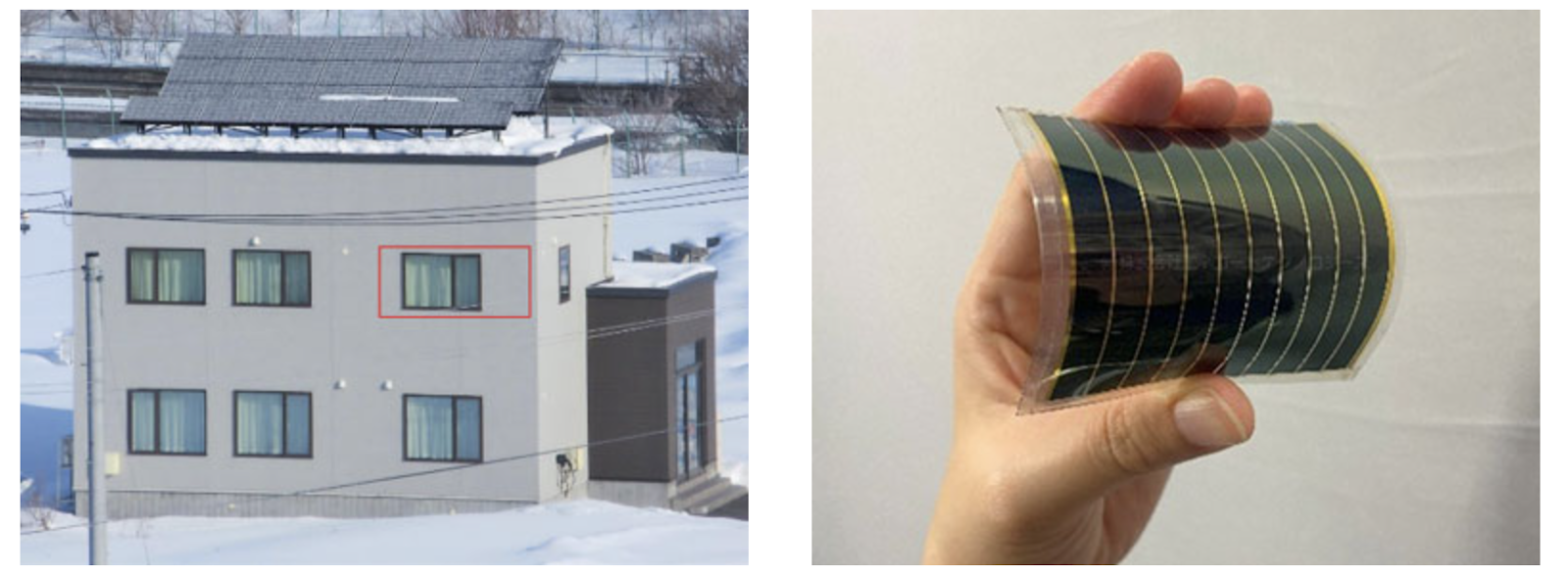
- Hokkaido Electric and Mitsubishi HC Capital begin field test of PSCs
- (Company statement, August 6)
- Hokkaido Electric will do a field test of perovskite solar cells, partnering with Mitsubishi HC Capital and startup Enecoat Technologies, focusing on performance in snowy, cold climates. The project will run through October 2026.
- The trial will use Enecoat’s cells in environments as cold as -25°C, and on windows and exterior walls, with results guiding potential future use in PPAs and other direct-to-customer power sales.
Hokkaido Electric to launch AI service for grid battery bidding and operation
(Company statement, August 1)
- In April 2026, Hokkaido Electric will launch a service for grid-scale battery operators that uses AI to optimize charging, discharging, and bidding into multiple electricity markets, based on a system developed by Tokyo-based Grid Inc.
- The platform will analyze past weather, market prices, and demand data to forecast prices and plan operations, with the utility earning fees from participating operators.
Japan Battery Storage and Kyudenko to develop multiple grid-scale projects
(Company statement, August 7)
- Japan Battery Storage agreed with construction firm Kyudenko to develop grid-scale battery projects in the Kyushu region, aiming to build 30 sites by FY2026.
- The first 1.99 MW/ 8.14 MWh project in Karatsu City, Saga Pref, is set to begin operations in October and will also serve as a local emergency power source.
- The companies are developing the second and third projects in Kumamoto Pref, with Kyudenko providing EPC services for Japan Battery Storage–led developments.
Daiwa House Industry to enter grid-scale BESS market
(Company statement, August 14)
- Daiwa House Industry, one of Japan’s major construction firms, will enter the grid-scale battery storage business to balance supply and demand for renewables.
- It began building its first battery plant at its factory in Kurate Town, Fukuoka Pref, aiming to begin operations in July 2026. It will have four units (1.9 MW/ 9.8 MWh).
- Daiwa House will expand and develop commercial facilities with on-site batteries.
NEWS: WIND POWER AND OTHER RENEWABLES
Japan aims for 15 GW of floating offshore wind power by 2040
(Government statement, August 8)
- METI has set a 2040 deployment target of 15 GW for floating offshore wind power, and aims to develop large-scale floating wind projects as soon as FY2029.
- The govt will designate suitable offshore areas (based on wind, fishing grounds and other factors) and invite public bids.
- The strategy will promote attracting major foreign players and nurturing domestic industry, with a goal of sourcing at least 65% of parts domestically.
- The plan also sets a target for Japanese companies to participate in overseas floating projects totaling 30 GW by 2040.
- CONTEXT: The govt views floating wind — since it is easier to install in deep waters — as key to advancing renewables deployment in Japan. The strategy builds on recent updates in legislation expanding eligible installation areas to the Exclusive Economic Zone (EEZ). Challenges include rising construction costs, coordination with fisheries and shipping, as well as revising bidding rules to account for price inflation between bid award and investment decision.
TAKEAWAY: Japan does not currently have domestic wind turbine manufacturers, with most of the local firms at best acting as suppliers of components to overseas turbine makers. The govt is keen to persuade overseas players to set up local manufacturing in Japan, but there is a reticence there due to market size. This makes the 65% target look difficult. Still, Japanese shipbuilders and engineering firms are well-positioned to lead in floating foundations, and many local firms can produce cables, ropes, and smaller components. If the govt is able to balance attracting foreign investment while steadily building domestic capacity, it could help secure Japan’s place in the global offshore wind supply chain and protect its industrial independence.
JERA and bp launch offshore wind JV with 13 GW portfolio
(Company statement, August 4)
- JERA and bp launched a 50:50 London-headquartered JV – named JERA Nex bp – to develop, own, and operate offshore wind farms.
- The venture has a global offshore wind portfolio of 13 GW: 1 GW of operational assets, 7.5 GW in development, and 4.5 GW in secured leases.
- The partners pledged investment of up to $5.8 billion through 2030.
TAKEAWAY: Amid rising costs and inflation, the partnership aims to establish economies of scale in procurement, staffing, and project execution. With 20 projects spanning Japan and Europe and a big investment plan, this is a major bet on the wind sector by JERA that shows commitment to balancing a largely fossil fuel portfolio with green assets.
Kitakyushu offshore wind farm reaches 60% use of locally made materials
(Nikkei, August 4)
- Hibiki Wind Energy, backed by J-Power and Kyushu Electric, said its 220 MW Kitakyushu Hibikinakada Offshore Wind Farm, one of Japan’s largest, reached 60% use of domestically manufactured materials.
- While turbines are sourced from Denmark’s Vestas, components like steel jackets are from Nippon Steel Engineering and subsea cables from Furukawa Electric.
- The procurement ratio aligns with METI’s goal of 60% use of domestically produced infrastructure by 2040.
- CONTEXT: Amid rising costs and a weak yen, METI has signed MoUs with Vestas, Siemens Gamesa, and GE Vernova to reduce reliance on overseas manufacturing facilities.
TAKEAWAY: While this project and a few others like JERA and GPI’s Ishikari Bay wind farm claim to have achieved METI’s domestic procurement ratio, most projects accepted through public bids have not set the 60% targets.
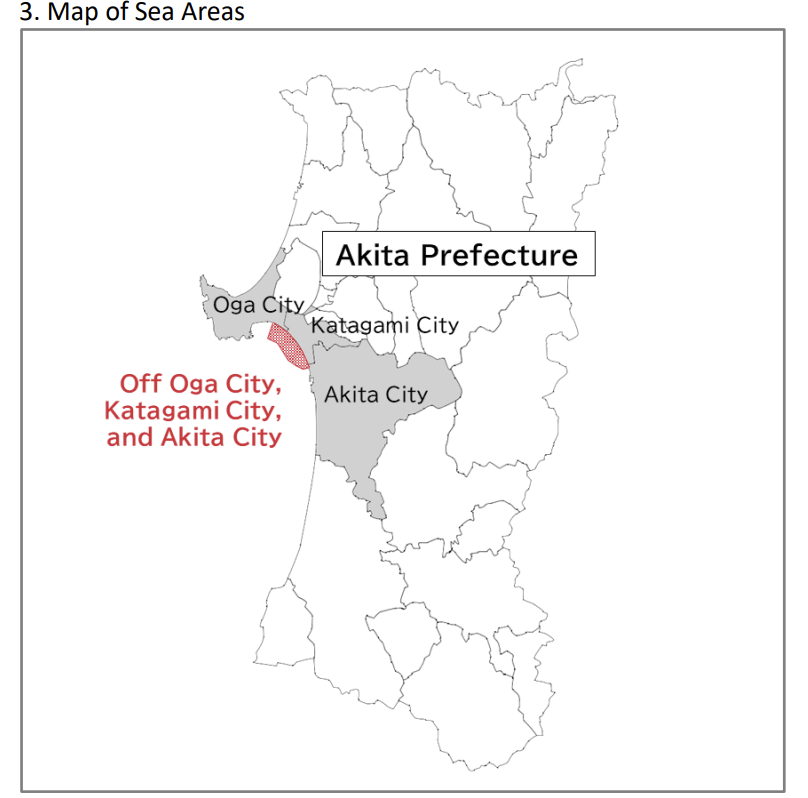
MoE urges enhanced environmental measures for Oga-Katagami-Akita wind farm
 (Government statement, August 8)
- The MoE urged Oga, Katagami, and Akita Offshore Green Energy to draw up an environmental monitoring plan for a planned 315 MW wind farm.
- The project plans to use 21 Vestas wind turbines, each 15 MW capacity. Start of commercial operation is planned for June 2028. It was awarded in Round 2 of Japan’s offshore wind power tender.
- In an official statement, the MoE minister suggested the consortium comprising JERA, J-Power, Tohoku Electric, should consider introducing additional environmental protection measures, and report the process.
- SIDE DEVELOPMENT:
- MoE calls to reduce noise, land and wildlife impact at Hokkaido wind farm
- (Government statement, August 5)
- MoE urged HSE, developer of an onshore wind farm in Tomamae Town (Hokkaido) to reduce noise, shadow flicker, etc on nearby residences, and to control land alteration to prevent sediment runoff, and protect local ecosystems.
- The project will have up to 70 turbine units, each 4-6 MW capacity. HSE is a subsidiary of Mitsubishi HC Capital.
- SIDE DEVELOPMENT:
- MoE calls to strengthen environmental measures for Migai wind farm
- (Government statement, August 5)
- The MoE also urged HSE to minimize noise and shadow impacts on nearby residences, provide thorough prior explanations, and implement environmental safeguards for another project in Miyagi Pref.
- The 64 MW project, in Ishinomaki City and Onagawa Town in Miyagi Pref, is expected to have 15 turbine units, each 4.26 MW.
Akita wind O&M cost-cut project tapped by comms ministry
(Company statement, August 1)
- A consortium comprising several firms including Akita Cable Television, JERA, Meidensha, Akita University and the Akita Pref govt, was selected for the communications ministry’s project to reduce wind power O&M costs.
- The project will install high-speed local 5G and Wi-Fi networks inside turbines to enable remote inspections via quadruped robots, cameras, and smart glasses.
- CONTEXT: This aims to improve efficiency and reduce the high maintenance costs that account for over 30% of offshore wind project expenses, particularly at remote EEZ sites where mobile coverage is poor.
J-Power-backed MEL begins work on third hydro plant in Indonesia
(Company statement, July 30)
- PT Mulya Energi Lestari (MEL), a hydropower developer in Indonesia partially owned by J-Power (27.23% stake since Nov 2024), began building the 14.6 MW Tomuan Hydropower Plant in North Sumatra in July.
- The project is MEL’s third under construction and is a run-of-river plant set to begin operation by August 2027.
JB Energy leads Brazil’s first floating offshore pilot
(Japan NRG, August 12)
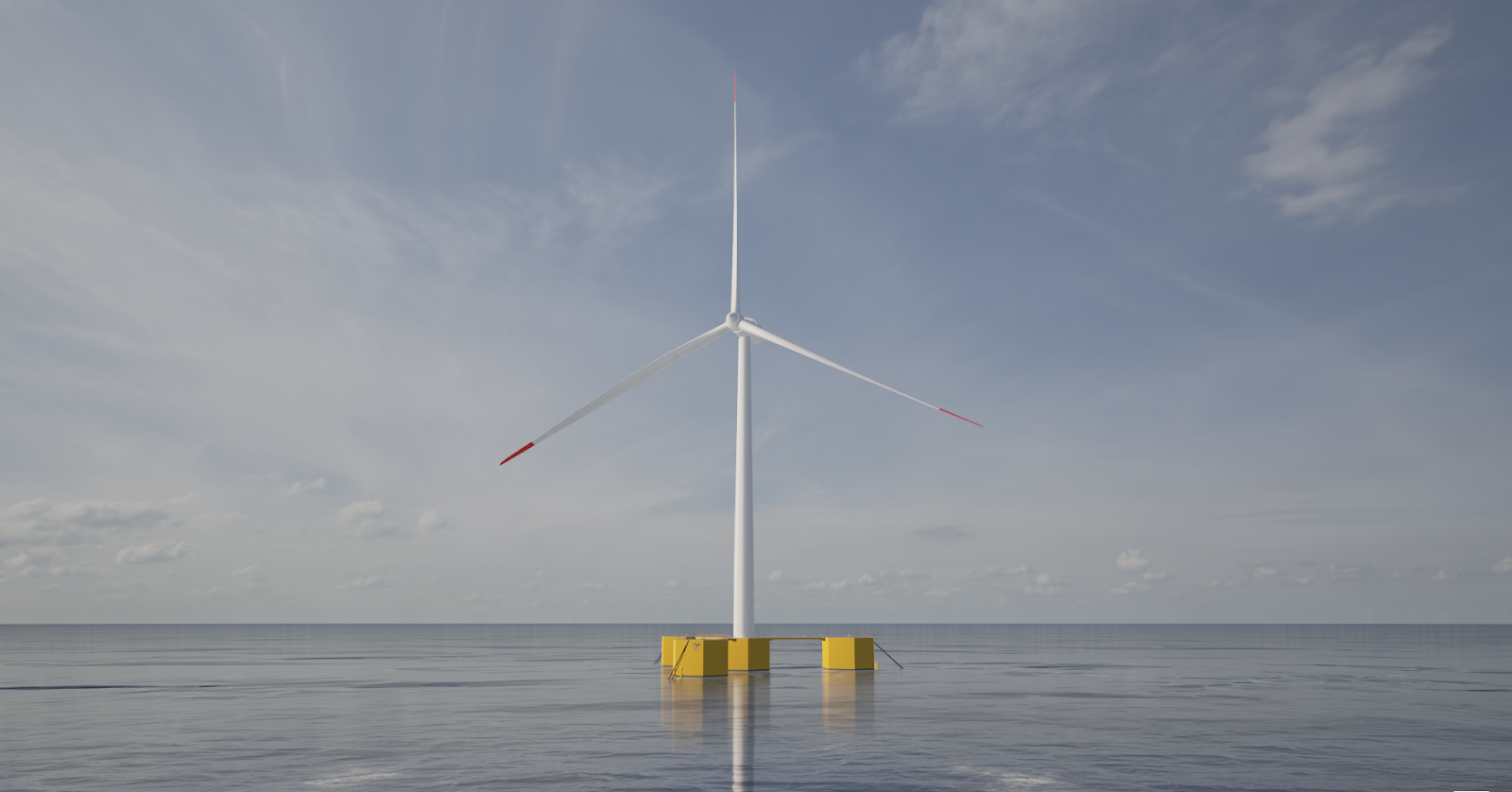
- Tokyo-based JB Energy is partnering with the Union of Renewable Energy Industries of Rio Grande do Sul to launch Brazil’s first floating offshore wind pilot – Aura Sul Wind.
- JB Energy developed a semi-submersible Raijin floating offshore wind turbine, which uses pre-cast and pre-stressed concrete panels as a platform, and does not require specialized shipyards for building such turbines or storage space. The panels can be built in small factories and can be easily transported to the coastal regions.
- The project is part of Brazil’s Green Ports Program to foster Rio Grande do Sul’s plan to decarbonize logistics. The results could offer useful lessons for Japan.
- The project, officially launched in June, plans to install a deep-water platform near the port of Rio Grande, with testing set to begin by 2030.
 TAKEAWAY: The pilot raises hopes for accelerating floating wind tech in Japan, where such tech is still in early development, yet is seen as key to driving renewables development. Such cooperation can help address a number of Japan’s challenges such as supply chain limitations – the lack of turbine manufacturers capable of mass production and lack of specialized installation vessels. Brazil’s supply chain infrastructure, based on the oil and gas industry, can offer insights on operations in deep waters with minor modifications for wind installations.
Source: JB Energy
Toyota Tsusho tapped to explore environmental tech in Thailand and Côte d’Ivoire
(Nikkei, August 15)
- The trading house Toyota Tsusho was selected for METI’s Global South Future-Oriented Co-Creation subsidy for projects in Thailand and Côte d’Ivoire.
- In Thailand, the project will assess demand and potential for dairy sector environmental solutions, including biogas from cow manure, composting, and methane-reducing function feed. In Côte d’Ivoire, the company will do feasibility studies for projects to develop local water supply.
NEWS: NUCLEAR ENERGY
KEPCO to issue ¥45 billion transition bonds for nuclear upgrades
(Company statement, August 8)
- KEPCO plans to issue ¥45 billion in transition bonds to fund decarbonization initiatives. The proceeds will specifically support nuclear plant safety upgrades.
- They include potential geological surveys for the Mihama Nuclear Plant in Fukui Pref, and will also cover hydrogen power generation trials. Other targeted areas are high-efficiency thermal plant retrofits, and grid modernization.
- Bond maturities are 7, 10, and 20 years. Annual yields are 1.591%–2.887%. Underwriters are Mizuho Securities, MUFG Morgan Stanley Securities.
NRA to develop new rules for fusion power
(Nikkei, August 15)
- The NRA is developing new safety rules for nuclear fusion power, aiming to outline key regulatory points by March 2026.
- The govt will assess if current laws need revision or if new legislation is needed.
- Currently, regulation for small-scale experimental reactors falls under Radioisotopes Control Law, different from laws governing conventional NPPs.
- Larger commercial-scale facilities may need new regulations due to increased radioactive material use.
JAPC submits operation extension approval report for Tokai No.2
(Company statement, August 8)
- JAPC submitted to METI an operation extension approval report for Tokai No. 2 NPP. This follows the amended Electricity Business Act’s enactment in June.
- CONTEXT: In 2018, Tokai No.2 received a 20-year operational extension approval from the NRA. Following an amendment to the Electricity Business Act the firm had to submit this report within three months (by early Sept).
Kyushu Electric submits improvement plan after drone incident at Genkai NPP
(Nikkei, August 14)
- Kyushu Electric met with the NRA on Aug 7, and submitted an improvement plan related to Genkai NPP’s security.
- On July 26, security personnel at Genkai NPP spotted three unidentified flying objects, suspected to be drones, entering the facility’s premises.
- The plan includes faster reporting, and clearer criteria about what to report.
NEWS: TRADITIONAL FUELS
JERA and Cheniere Energy sign long-term LNG deal
(Company statement, August 8)
- Cheniere Energy and JERA inked a long-term LNG sale and buy agreement. From 2029 to 2050, JERA will buy about 1 Mtpa of LNG from Cheniere Marketing, priced at Henry Hub plus a fixed liquefaction fee.
- CONTEXT: This follows a heads of agreement with Cheniere in June. JERA has similar deals with other U.S. firms such as NextDecade, Commonwealth and Sempra. The total amount of LNG under such deals is 5.5 Mtpa.
INPEX begins FEED work for Abadi LNG
(Company statement, August 4)
- INPEX began FEED work for Abadi LNG in Indonesia’s Masela block.
- The work includes a gas export pipeline and an onshore LNG plant, all with CCS elements.
- CONTEXT: INPEX (a 65% stake) operates the project with Pertamina (20%) and Petronas (15%). They aim to produce 9.5 Mtpa of LNG plus 35,000 barrels/ day of condensate and 150 million cubic feet/day of natural gas from the project. The revised 2023 development plan includes CCS technologies.
TAKEAWAY: The FEED stage of a large infrastructure project usually takes about a year. As such, INPEX should have a detailed assessment of the engineering side and the technical processes next year, and be on course to make the final investment decision in 2027. This is a major project for the company and would double the number of LNG plants it operates. How well Japan is supplied with LNG contracts at that stage will surely feed into INPEX considerations for the FID.
JGC and Fluor win FEED contract for LNG Canada expansion
(Company statement, August 6)
- JGC Holdings Corp and Fluor Corp won a contract to update FEED for the proposed Phase 2 expansion of LNG Canada in Kitimat, British Columbia.
- Phase 1 became operational in June 2025 (14 Mtpa capacity). Phase 2 aims to double production, reinforcing Canada’s role as a low-carbon LNG supplier. JGC is currently executing EPC (Engineering, Procurement, Construction) for Phase 1.
- CONTEXT: LNG Canada shareholders are Shell, Petronas, PetroChina, Mitsubishi, and KOGAS.
LNG stocks up from previous week, up YoY
(Government data, August 13)
- As of Aug 10, the LNG stocks of 10 power utilities were 1.96 Mt, up 1.6% from the previous week (1.93 Mt), up 15.3% from end Aug 2024 (1.7 Mt), and down 3.9% from the 5-year average of 2.04 Mt.
- CONTEXT: On Aug 5, Japan’s highest temperature was recorded – 41.8 °C in Isezaki City. The past 10 years have seen record-high temperatures in several locations across Japan, but it has never been as frequent as this year.
NEWS: CARBON CAPTURE & SYNTHETIC FUELS
METI proposes adjustments to GX-ETS allocation rules
(Government statement, Aug 7)
- METI released a draft with adjustments to emissions allowance allocations under the GX-ETS, proposing Activity-Based Adjustments.
- If a facility’s operational activity deviates by 7.5% or more from its 2 year average baseline, the emission allowance will be adjusted.
- New plants will receive allowances in the next year based on first-year operational data. Closed plants will have excess allowances deducted from the next allocation.
- Facilities in regions hit by major disasters can use their previous year’s activity level for baseline calculations.
BHP, Nippon Steel, etc to study possible CCUS hub in Asia
(Company statement, Aug 11)
- BHP Group, Nippon Steel, and others will study the feasibility of creating a CCUS hub in Asia. The project would transport CO2 from steel plants via pipelines or ships to storage sites in Asia or northern Australia.
- A consortium will include AM/NS India (a Nippon Steel–ArcelorMittal JV), India’s JSW Steel, Hyundai Steel, Chevron, and Mitsui & Co.
- The study will run until late 2026, and will examine technical and commercial feasibility, costs, schedules, and cross-border CCUS regulations.
ENEOS Holdings to halve group firms, focus on next-gen fuels
(Nikkei, August 1)
- By FY2028, ENEOS Holdings will cut the number of its group firms by more than half from 651, targeting ¥43 billion in profit improvement through consolidation or divestment of low-value operations.
- The savings will fund investment in next-gen fuels such as sustainable aviation fuel (SAF) and synthetic fuels. The streamlining focuses mainly on domestic petroleum, chemicals, and materials businesses.
- CONTEXT: The move aims to boost efficiency, improve ROE, and accelerate the shift toward decarbonized energy as gasoline demand declines.
Demo tests begin on CO2 capture integrated IGCC plants
(Government statement, Aug 1)
- NEDO and Osaki CoolGen began field tests to enhance the adjustable capacity of carbon capture tech in the Integrated Coal Gasification Combined Cycle.
- The project focuses on flexibility and responsiveness of IGCC plants with CO2 capture systems. It should allow them to adjust power output in response to grid demand variations.
- CONTEXT: NEDO and Osaki CoolGen achieved over 90% CO2 capture efficiency in IGCC systems. They tested 50% biomass co-firing between 2023 and 2024. The ongoing tests simulate seasonal and hourly electricity demand patterns. The results will help refine operational strategies and ensure long-term reliability.
INPEX to work with Gunma Pref in carbon credits generation
(Nikkei, Aug 14)
- INPEX will work with Gunma Pref Forest and Greenery Maintenance Fund and Aero Toyota to create carbon credits.
- The project will manage about 325 hectares of forest, aiming to generate 16,300 tons of credits over eight years. This will be conducted under the govt certified J-Credit program.
- INPEX will support decarbonization efforts along its local gas pipeline routes. Aero Toyota will provide forest analysis using aerial laser surveying data.
ASIA ENERGY REVIEW
BY JOHN VAROLI
A brief overview of the region’s main energy events from the past week
Australia / Grid
Australia reached a final investment decision for the 750 MW Marinus Link Stage 1 undersea electricity cable project that will connect Tasmania and Victoria.
China / Metals
Lithium prices and stocks spiked after battery giant Contemporary Amperex Tech stopped operations at a major mine, spurring speculation that Beijing might suspend other projects.
China / Renewables
Chinese renewable energy manufacturers are boosting their global presence despite rising trade tensions, said Wood Mackenzie. In 2024, China set up 35 new overseas manufacturing facilities, bringing their total to 114 across the wind, solar, and battery sectors.
India / PPA
Amazon Web Services inked a PPA with Gentari for an 80 MW wind energy project in Tamil Nadu. The project is set to launch in early 2027.
India / Renewables
At the end of June, India’s renewable energy installed capacity reached 185 GW, with about 22 GW of new additions in H1 2025, about 60% higher YoY.
Indonesia / Minerals
Investments in the energy and mineral resources sectors reached $13.9 billion in H1 2025, the highest first-half figures in the past five years, said the govt.
Malaysia / Solar power
At Solar Week Malaysia, the Deputy Minister for Energy said renewables, particularly solar power, is an ‘immediate necessity for environmental sustainability and economic resilience’
South Korea / Energy reform
South Korea launched a sweeping national ‘megagrowth plan’ that seeks to put the country at the forefront of AI and the energy transformation. For example, KEPCO plans to invest around 73 trillion won by 2038 to expand transmission lines and upgrade the power infrastructure serving major semiconductor complexes
Taiwan / Nuclear power
On Aug 23, Taiwan will hold a referendum on whether or not the Maanshan NPP – which stopped operating in May after 40 years of service – should restart.
Disclaimer
This communication has been prepared for information purposes only, is confidential and may be legally privileged. This is a subscription-only service and is directed at those who have expressly asked K.K. Yuri Group or one of its representatives to be added to the mailing list. This document may not be onwardly circulated or reproduced without prior written consent from Yuri Group, which retains all copyright to the content of this report.
Yuri Group is not registered as an investment advisor in any jurisdiction. Our research and all the content express our opinions, which are generally based on available public information, field studies and own analysis. Content is limited to general comment upon general political, economic and market issues, asset classes and types of investments. The report and all of its content does not constitute a recommendation or solicitation to buy, sell, subscribe for or underwrite any product or physical commodity, or a financial instrument.
The information contained in this report is obtained from sources believed to be reliable and in good faith. No representation or warranty is made that it is accurate or complete. Opinions and views expressed are subject to change without notice, as are prices and availability, which are indicative only. There is no obligation to notify recipients of any changes to this data or to do so in the future. No responsibility is accepted for the use of or reliance on the information provided. In no circumstances will Yuri Group be liable for any indirect or direct loss, or consequential loss or damages arising from the use of, any inability to use, or any inaccuracy in the information.
K.K. Yuri Group: Hulic Ochanomizu Bldg. 3F, 2-3-11, Surugadai, Kanda, Chiyoda-ku, Tokyo, Japan, 101-0062.