Japan is rethinking its role in Central Asia, a landlocked but resource-rich region. But there are formidable obstacles. Central Asia’s geography limits direct maritime access.
Despite this, Japanese companies are carving out niches in energy, minerals, and transport. The aim is not quick wins, but long-term partnerships that can anchor Japan more firmly in the region.
ASIA PACIFIC REVIEW
This column provides a brief overview of the region’s main energy events from the past week
CONTEXT: This information is based on an exclusive interview with Nikkei.
EU executive Stephane Sejourne said the bloc wants to partner with Japan on developing rare earths and other resources in Greenland, aiming to build supply chains independent of the U.S. and China.
Greenland is believed to hold abundant reserves of rare earths and graphite, key for batteries, a growing market in Japan.
The proposal builds on the Japan-EU Competitiveness Alliance launched in July. Sejourne said joint public-private projects should extend beyond EU territory.
He also said the EU will simplify regulations to boost competitiveness while maintaining environmental and digital goals.
TAKEAWAY: This is a strategically significant statement, especially so in light of the current U.S. administration’s outspoken desire to take control of Greenland. Japan has signed critical mineral agreements with both the U.S. and the EU, seeking to improve its supply chain for vital raw materials, but few actual deals have been forthcoming.
METI will provide ¥35 billion through the Green Innovation Fund for R&D on solid oxide electrolysis cells (SOECs).
SOECs can reuse heat generated during water electrolysis and utilize external heat, improving energy efficiency over conventional systems.
The program supports scaling, modularization, and integration of new materials, with subsidies covering two-thirds initially and half during field tests.
Field tests combining SOECs, external heat, and hydrogen use aim for completion by FY2032, targeting equipment costs below ¥68,000/ kW.
CONTEXT: SOECs are still in the R&D stage. They operate in high-temperature environments, offering high electrolysis efficiency and an advantage in operating costs, with potential for further cost reduction. To accelerate their technological development and demonstration, a proposal to include SOEC in the GI Fund projects was presented at the working group meeting in July.
TAKEAWAY: In developing SOEC water electrolysis technology, Europe and the U.S. are moving toward commercialization with MW-scale demos and mass production systems. In contrast, Japan is still at the research stage. While SOEC technology is included in NEDO’s R&D projects, more significant progress is expected via the larger-scale GI Fund projects.
NEWS: ELECTRICITY MARKETS
KEPCO TSO secures power from Chubu Electric for supply-demand balance
(Company statement, September 17)
Acting on OCCTO’s instructions, KEPCO TSO received electricity from Chubu TSO to improve its power supply-demand balance – up to 820 MW was received between 14:30 and 18:00.
Due to increased electricity demand caused by high temperatures, without intervention the Kansai regional reserve margin was seen falling below 3%.
CONTEXT: OCCTO directs TSOs to provide cross-regional power interchange when power supply-demand becomes tight in a supply area.
TAKEAWAY: This is at least the third time this year that OCCTO has helped Kansai’s grid get supplemental volumes from the Chubu area. The Kansai TSO has received over 7,090 MWh of support in less than three months, indicating its regional supply-demand balance has become unusually tight despite a high volume of nuclear baseload. KEPCO faced similar issues last year, which shows why the major utility is now accelerating investment in flexible supply resources and grid reinforcement. See news below.
Kansai Electric announced in spring 2025 that it aims to become the top operator of grid-scale storage in Japan, with a target of 1 GW capacity by the early 2030s.
Current capacity stands at 247 MW, including the 48 MW Kinokawa plant (with Orix) commissioned in December 2024 and the 99 MW Tanagawa project under construction with an infrastructure fund.
The company sees storage as a profitable trading business in balancing markets, supported by its in-house expertise (Kindens engineering, E-Flow market operations) and new AI-based optimization.
It is leveraging land advantages – building storage on existing or former power station and substation sites – giving it a grid-connection edge over rivals.
Kansai Electric is financing projects without relying on the LTDA, instead structuring project finance backed by wholesale market revenues, a domestic first.
TAKEAWAY: Kansai’s strategy is more than opportunistic – it is a reflection of the utility’s increasing grid flexibility challenges. Scaling BESS storage could help stabilize the region’s increasingly strained supply-demand balance. Many BESS developers look at the Kansai area as an opportunity. It’s clear that KEPCO also wants to be involved in local battery sector development, seeing home advantage in navigating volatility with balancing services.
TEPCO PG activates dispatchable power for the first time this fiscal year
(Denki Shimbun, September 19)
On Sept 18, Tokyo Electric Power Grid (TEPCO PG) enacted dispatchable power and stable supply measures for the first time this fiscal year as reserves were expected to fall below 4%.
The measures, from 14:00–18:00, added up to 680 MW at peak, improving reserve margins to around 4–5%.
Dispatchable power, mainly demand response, is procured through the capacity market and can be used up to 12 times a year, for a maximum of 3 hours each.
CONTEXT: On Sept 11, TEPCO PG said that in anticipation of high electricity demand on Sept 17–18 due to excessive heat, it would coordinate with power generators to suspend maintenance work in line with grid operation guidelines.
Girasol Energy obtained OpenADR (Open Automated Demand Response) certification for its aggregator system, an international smart grid standard.
This allows the company to bid into Japan’s supply-demand adjustment market for services such as Secondary Reserve, and Tertiary Reserves, using grid-connected storage batteries.
By the end of FY2025, the system will be integrated into three new grid batteries. Girasol will act as an aggregator.
CONTEXT: Japan’s transmission operators require OpenADR-certified systems to receive dispatch commands. This will enable Girasol to fully commercialize its aggregator business.
Hokkaido Electric introduced the GridMetrix platform developed by Reactive Technologies (UK) to improve power grid stability.
This will help the utility to:
Monitor and analyze grid oscillations
Measure and visualize frequency across the network
Assess inertia (resistance to sudden frequency changes)
Conduct event analysis to identify and mitigate stability issues
CONTEXT: Traditionally, inertia has been supplied by large rotating turbines in fossil fuel power plants. As renewable sources like wind and solar expand, providing less natural inertia, managing and understanding grid stability has become important. GridMetrix helps utilities address this challenge by offering real-time insights into grid dynamics.
On Sept 15, as part of Tokyo GX Week, METI hosted the “Ministerial Meeting on Sustainable Fuels” and the “7th Hydrogen Energy Ministerial Meeting” in Osaka.
At the first Sustainable Fuels Ministerial, co-chaired by Japan and Brazil, the discussion focused on expanding the use of sustainable fuels – including biofuels, biogas, synthetic fuels, and synthetic methane – in the areas of aviation, shipping, road transport, and industry.
At the 7th Hydrogen Ministerial Meeting, participants discussed hydrogen demand creation, shared policy progress, and explored international cooperation, featuring the IEA’s release of the Global Hydrogen Review 2025.
CONTEXT: This year METI is hosting an extended “Tokyo GX Week” from Sept 15- Oct 10. It includes events that focus on sustainable fuels, hydrogen, carbon recycling, and innovation.
Toyota Motor, Kansai Electric, Daimler Truck, and Hamburger Hafen und Logistik signed an MoU with Kawasaki Heavy Industries for the Japan-Germany Hydrogen Supply Chain.
Signed at METI’s Hydrogen Ministerial Meeting, the goal is to build a cost-effective hydrogen supply chain by combining Japanese and German demand and promoting cross-border hydrogen use in logistics, mobility, and power generation.
The Ministry of Land, Infrastructure, Transport and Tourism (MLIT) said a draft safety standard for hydrogen-fueled ships was agreed upon at the International Maritime Organization (IMO) meeting.
A draft safety guideline for ships using liquid or gaseous hydrogen is set for approval at IMO’s 111th Maritime Safety Committee (MSC 111) next May.
Starting July, ammonia cargo will be allowed as fuel under the revised International Gas Carrier Code.
CONTEXT: Japan is leading the development of zero-emission ships, including hydrogen-fueled engines, and seeks to create international safety rules for hydrogen-powered vessels via the IMO to enable their use on global shipping routes. Safety guidelines for ships using ammonia as fuel were established last year.
(1) Perovskite Solar Cell Deployment Support – to lower initial costs and create models that drive sustained demand expansion for next-gen solar.
(2) Solar & Storage Cost Reduction Support – to promote price reduction of PV systems and support battery deployment (only available when applying together with program 1, not standalone).
Japan is ramping up domestic production of iodine, a key material for next-gen perovskite solar cells (PSCs). Nichibo Chemical is investing ¥3 billion to drill new wells in Chiba Pref, aiming to raise output by 10% by 2030.
Japan produces 26% of the world’s iodine (second after Chile); Chiba accounts for 80% of domestic supply thanks to its iodine-rich groundwater.
CONTEXT: Demand for iodine is rising not only for medical and industrial uses but also as a core material in PSCs, which Japan’s govt targets for 20 GW of domestic production by 2040.
Other producers such as AGC’s Ise Chemicals, Godo Shigen, K&O Iodine, ENEOS, and INPEX are also expanding capacity, or recycling iodine.
Officials expect Japan to fully cover domestic demand (200–300 tons for perovskites) and potentially export to global markets as capacity grows.
Fukuoka-based Tensor Energy began offering a one-stop service to help solar power operators currently under the FIT transition to the FIP.
This includes:
Support for FIP applications and transition procedures
Battery storage simulation
Aggregation services after transition
The company leverages its proprietary AI for power generation forecasting and revenue optimization. It has experience in FIP battery operations and a strong track record in the Kyushu region, where solar curtailments are frequent.
The firm plans features such as simulations that incorporate participation in the supply-demand adjustment market, bidding and contract management tools and algorithms for automatic optimization across multiple markets.
CONTEXT: Tensor Energy has a software platform called Tensor Cloud that helps owners/ operators of renewables (especially solar and battery storage) to optimize their assets’ financial and operational performance.
TAKEAWAY: The shift from FIT to FIP is urgent. In Kyushu, solar power capacity is high, output curtailments are frequent, and FIT-based plants will soon face curtailments before FIP-based ones due to the new priority supply rules. Thus, FIT site owners could see revenues fall by about 30%. However, FIP transition also comes with challenges, including administrative procedures and risks from forecasting errors that lead to imbalance costs.
REXEV launched services to help large-scale solar power plants, especially those under Japan’s FIT scheme at ¥32/ kWh or higher, transition to the FIP scheme by adding battery storage.
CONTEXT: REXEV is a Japanese energy solutions firm specializing in EV management, battery control tech and renewables integration.
The firm will handle operations, trading, and revenue optimization to ease administrative burdens, using advanced control tech developed from EV management.
The service includes battery design and procurement support, control platforms, revenue-sharing or SaaS models, and monitoring/reporting tools.
It will offer two business models: 1) operators invest in batteries and REXEV manages operations, and 2) REXEV installs the batteries and shares profits.
Pilot projects are already underway, with operations to begin in 2025.
Panasonic Energy will begin sample shipments of solid-state batteries in FY2026, targeting industrial machinery and automotive sensors.
The firm plans to start mass production soon afterwards, addressing demand for high heat resistance and safety in factory automation.
For its core Li-ion batteries, supplied to Tesla and other firms, Panasonic aims to boost energy density 25% by FY2027 (from 800 Wh/ L to 1,000 Wh/ L) by adopting Li-metal anodes and developing anode-free batteries. It expects to reach 900 Wh/ L using silicon anodes within FY2025.
CONTEXT: Higher energy density will allow greater EV range and lighter vehicles, supporting the rising power needs of AI-equipped cars.
DIC, a Japanese chemical firm that develops and produces specialty plastics and compounds and biochemicals, created GELRAMIC, a heat-absorbing pad that prevents fires from spreading during Li-ion battery thermal runaway.
The pad contains a special gel that soaks up heat and turns into ceramic at high temperatures, providing insulation. In tests, it kept the outer surface below 90°C even when internal battery temperatures exceeded 1,300°C.
The tech will first be used in battery recycling boxes and later expanded to e-bikes and EVs, with sales goals of ¥1 billion by 2030.
CONTEXT: Japan’s new recycling rules that start this year make such fire-safety solutions increasingly important.
On Sept 19, Hayashi Kingo, Chairman of the Federation of Electric Power Companies of Japan (FEPC) called on the govt to design offshore wind support measures that can respond to unpredictable circumstances such as inflation, yen depreciation, and surging construction costs.
The govt plans additional support for awarded projects, with industry pushing for power price subsidies and property tax relief.
CONTEXT: Remaining offshore wind developers are piling the pressure on the government after Mitsubishi Corp’s withdrawal from three offshore wind projects due to costs more than doubling from the 2021 auction estimates.
An Akita prefectural survey found that 72 out of 298 local firms are affected by Mitsubishi’s exit, with 12 having invested tens of billions of yen in preparation for the development of the sector locally.
Akita Governor Suzuki Kenta submitted an urgent request to METI for countermeasures and an early re-bidding to minimize local impact.
Foreign Trade Council Chairman Yasunaga Tatsuo, who is also chair of trading house Mitsui, said the business environment for offshore wind in Japan and globally has become “technically and economically very difficult.”
Even though the Mitsubishi Corp-led consortium withdrew, other trading houses like Itochu, Mitsui, Sumitomo, and Marubeni are still pursuing projects.
Yasunaga said if developers bear all unforeseen costs, projects may collapse, urging a clearer division of risks between private firms and the govt, with more support.
Eurus Energy scraps plan for wind farm in Kagoshima after failing to secure funds
(Japan NRG, September 17)
Eurus Energy, a renewables subsidiary of trading house Toyota Tsusho, suspended its planned large-scale wind farm on Osumi Peninsula in Kagoshima Pref.
Rising material and labor costs made the project financially unfeasible.
Most of the proposed site (about 80%) overlapped with Kagoshima University’s research forest. Eurus initially considered redesigning the project to avoid the area, but ultimately halted the plan.
The project envisioned up to 32 wind turbines with a total capacity of 192 MW, aiming to start construction in 2026 and begin operations in 2029.
TAKEAWAY: Eurus Energy’s cancellation underscores how soaring costs and land-use conflicts are shrinking Japan’s onshore wind pipeline, adding to recent offshore troubles. To keep the wind sector viable, Japan will need clearer land-use frameworks, streamlined permitting, and stronger financial support mechanisms to de-risk investments.
Starting Oct 1, Kyushu Electric subsidiary Kyuden Mirai Energy will start selling non-FIT, non-fossil certificate-backed electricity from geothermal and hydropower plants for FY2026 to retail electricity providers.
Sales will use the Enechain Group’s fully electronic wholesale platform, eSquare Live, allowing continuous trading in real time.
Combined with corporate PPAs, about 2.3 million MWh of renewable electricity is planned to be sold in FY2026.
Two products will be offered: a “geothermal-hydro mix” (with fixed periods of 1 year, 3 months, or 1 month) and “geothermal only” (1-year period).
All deliveries are 24/7 in the Kyushu area and stop once reaching the sales cap.
CONTEXT: Wholesale electricity trading involves buying and selling power between generators and retailers. Kyuden Mirai Energy conducts bilateral trades using its own geothermal and hydro renewable sources.
The Floating Offshore Wind Technology Research Association (FLOWRA), a consortium of about 20 firms including KEPCO and JERA, signed an MoU with the European Marine Energy Centre to collaborate on floating offshore wind tech.
The partnership will allow Japanese developers to test technologies in real marine conditions, helping to identify and solve challenges early.
FLOWRA Chairman Terazaki Masakatsu said the goal is to accelerate R&D, set up evaluation methods, and support market growth in floating wind.
TAKEAWAY: Despite setbacks due to Mitsubishi’s withdrawal from fixed offshore wind, floating offshore wind is emerging as Japan’s next driver for wind power growth. The govt encourages investment, but given the sector’s early stage, stronger METI support, such as seabed surveys and risk-sharing measures, is critical.
Hitachi used its “Dam Operation Optimization Solution” to simulate operations of the Susobana Dam and Power Plant in Nagano Pref using 25 years of data (2000–2024).
The analysis showed the dam’s theoretical maximum generation is 19% higher than past averages; annual output could increase by 14% without additional investment.
The solution leverages historical operational data to optimize release plans based on current inflow and water levels, enabling rapid implementation.
Hitachi and Nagano Pref will discuss practical adoption, while Hitachi aims to expand the solution to other hydro operators to enhance renewable energy.
CONTEXT: The 7th Basic Energy Plan calls to maximize hydro and optimize existing dams to boost electricity without new investments. Nagano’s Susobana Plant (15.5 MW) was studied to quantify generation gains from operational adjustments under both ideal and realistic inflow conditions.
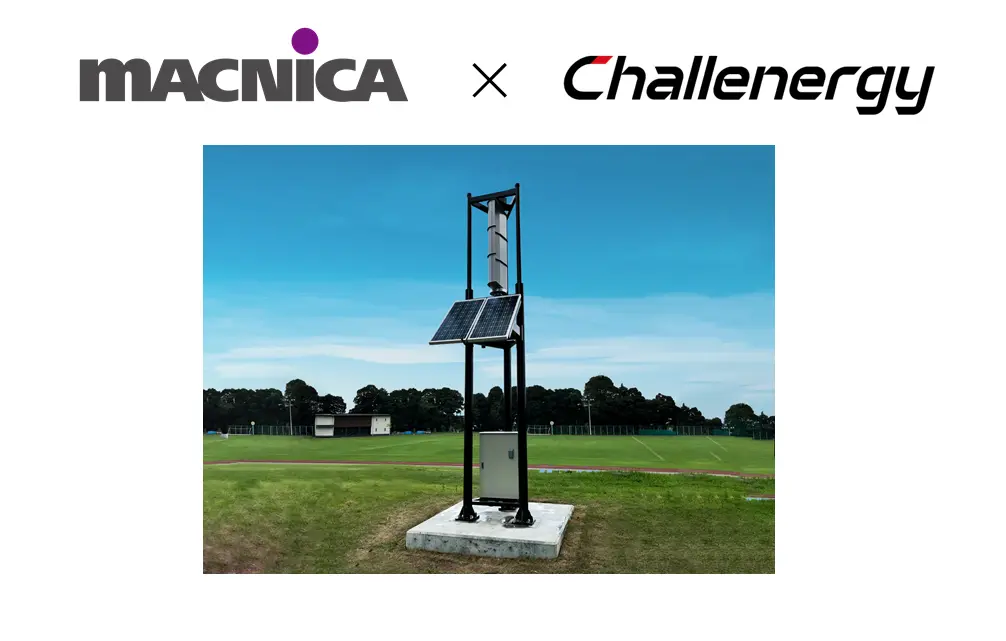
Macnica, a tech solutions provider focusing on energy management and IoT, signed a sales deal with Challenergy, developer of robust small blade-free wind turbines.
The turbines, using a vertical-axis design without blades, are quiet and safe, and are useful for disaster backup power, remote sites, and urban rooftops.
In November, Kansai Electric (KEPCO) will begin geological surveys at Mihama NPP, to study the feasibility of building a next-gen nuclear reactor.
The surveys will run until 2029–2030, covering areas to the south (within the site) and the north (including outside the site).
After the surveys, KEPCO will decide whether to proceed with construction. They will also consider the progress of next-gen innovative light-water reactor tech.
The plan aims to replace decommissioned reactors at Mihama, where Units 1 and 2 are shut down and only Unit 3 remains in operation.
Hokuriku Electric said Shika NPP Unit 2 regained the ability to receive electricity from all five external power lines.
Since the 2024 Noto Peninsula earthquake, two lines were out of service. Emergency restoration was completed by using a mobile substation.
The plant’s main transformer was damaged in the quake and will take considerable time to replace. Until full reparation, the plant will rely on the emergency system for external power supply.
JERA is in talks to buy U.S. natural gas production assets for about $1.7 billion from GEP Haynesville II, which is backed by Blackstone, GeoSouthern Energy, and Williams Companies Inc.
This could be JERA’s first direct investment in shale gas production, and would give the company more control over its LNG supply chain. JERA outbid several U.S. energy companies, though a deal is not yet guaranteed.
The Haynesville shale basin in Texas and Louisiana, where GEP operates, is a major U.S. gas hub close to LNG export terminals. GEP’s production should double by 2028, making the assets attractive amid global energy demand.
CONTEXT: A recent U.S.-Japan trade deal committed Tokyo to $7 billion in annual U.S. energy purchases. JERA is interested in Alaska’s $44 billion LNG export project.
Nippon Yusen (NYK) and the Global Centre for Maritime Decarbonisation (GCMD) completed testing long-term use and storage (LOTUS) of B24 biofuel in Singapore.
Over six months on a car carrier, no technical issues were found, and stored fuel met ISO standards, confirming safe and sustainable use.
A comprehensive evaluation found that biofuels can be safely and immediately used as drop-in fuels with existing ship infrastructure.
CONTEXT: Founded in Singapore in 2021, GCMD promotes maritime decarbonization. NYK joined in 2023 as the only Japanese partner. Its initiatives include ammonia fuel adoption, green fuel certification frameworks, and onboard CO2 capture and value chains. Over 100 partners now contribute funding, expertise, and resources to lower barriers for low-carbon technologies.
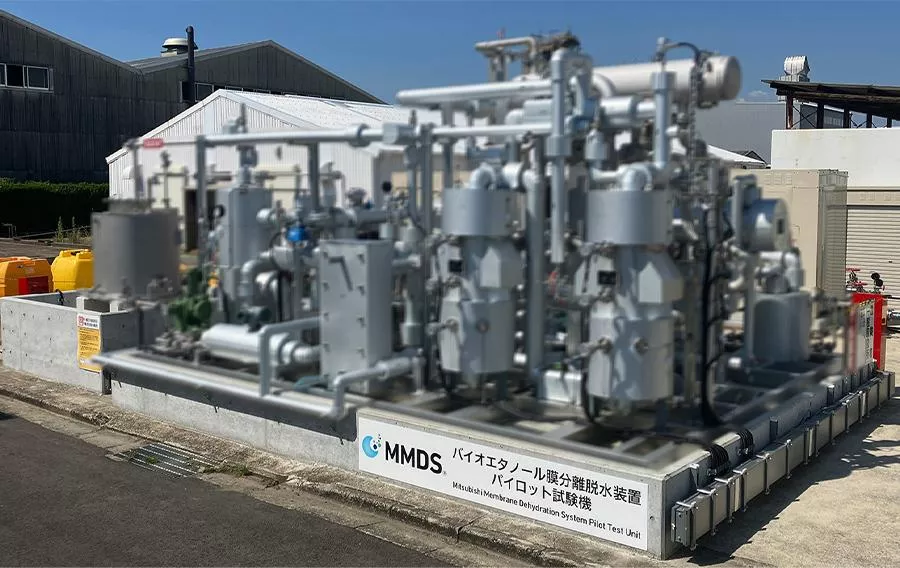
Mitsubishi Heavy Industries developed a membrane-based dehydration system (MMDS) for bioethanol production. The system achieved the target ethanol purity of 99.5 vol%, meeting Japan’s fuel standards.
The system aims to reduce energy consumption by over 30% compared to conventional dehydration methods.
Next, Mitsubishi plans to move from pilot testing to a demo plant.
CONTEXT: MMDS replaces a power-intense drying step with a lightweight, membrane-based filter system; bioethanol production is cheaper and greener.
As of Sept 14, the LNG stocks of 10 power utilities were 1.76 Mt, down 2.8% from the previous week (1.81 Mt), down 3.8% from end Sept 2024 (1.83 Mt), and down 14.2% from the 5-year average of 2.05 Mt.
METI unveiled detailed proposals for its national emissions trading system (ETS), outlining how the govt will divide emission allowances among companies.
The system will use benchmarking for large emitters and grandfathering (based on past emissions) for others. Other factors will be considered to adjust a company’s free allowance allocation, such as:
1) Reward companies that reduced emissions before the system starts. This relates to a period between a defined past year and the 2023-2025 baseline. METI proposes using 2013 as the starting point for these efforts.
2) Use data from the existing Superior Hub for Knowledge (SHK) reporting system to verify past emissions.
Companies in “carbon leakage” sectors will receive extra allowances to prevent moving abroad due to carbon costs. A sector is at risk if its trade share (imports + exports as a share of domestic production) exceeds 10% (like Australia’s model).
A company in such a sector will get extra allowances if the cost of buying permits exceeds a certain threshold of its revenue.
CONTEXT: The national ETS will launch in April 2026.
TAKEAWAY: Companies said benchmarks should also reflect the time required to introduce low-carbon technologies and that there should be rules allowing continued operation of coal-fired plants. The latter are described as necessary for Japan’s stable electricity supply, at least during a transition phase. Switching from coal to LNG requires about 13 years, making short-term benchmarks unrealistic. Benchmarks should be set for each fuel type (coal, LNG, etc.), not across all power sources. Regional conditions, such as Okinawa’s small grid size, need special consideration. These nuances are important and will need to be factored into the ETS. Between now and the start of operation, several adjustments to the rules are likely to take place.
METI approved test drilling permits for two offshore sites near Tomakomai, Hokkaido that’s part of a CCS project led by JAPEX, Idemitsu Kosan, Hokkaido Electric, and JOGMEC.
First test well drilling should start in November 2026, completion expected May 2027. The second well’s schedule is for January 2027. Depth is about 1,540 meters below the seabed.
The estimated cost totals ¥15–20 billion, funded partly by a supplementary budget.
Commercial CCS operations should start by 2030 and will capture CO2 from Idemitsu’s refinery and Hokkaido Electric’s Tomatoh-Atsuma power plant. They will store them under the seabed via pipeline.
METI designated part of the Kujukuri offshore area (Chiba Pref) as another CCS “special zone.” There, a consortium including INPEX and Japan Steel plans to capture CO2 from factories and store it offshore.
CONTEXT: These are Japan’s first large-scale CCS projects, part of a five-site domestic initiative that is expected to bring the hubs online by 2030.
ANRE launched discussions on the framework for the upcoming CCS Business Act to take effect in May 2026.
It set up a CCS Business System Working Group. It will be working with the Central Environment Council’s Carbon Management Subcommittee.
The group will hold 3–4 meetings by the end of 2025 to complete operational rules, safety measures, and funding arrangements.
They will discuss underground CO2 storage and measures to prevent leakage, and will check tracking CO2 flow, concentration, and pressure at least once per year.
They should also align with marine pollution standards. They mandate CO2 purity of 99% or higher in principle, with possible flexibility under certain conditions.
Projects will also require closure measures after project-life completion to ensure long-term safety.
Idemitsu Kosan invested in U.S. startup Vycarb, which is developing technology to remove CO2 from the atmosphere.
Its Marine Alkalinization Technology uses alkaline minerals (like limestone) to react with seawater or river water. The reaction solidifies and removes the dissolved CO2.
A key advantage is the use of real-time sensors to measure, report, and verify the amount of CO2 removed.
The Electric Power Council for a Low-Carbon Society announced the FY2024 CO2 emissions from members such as electric utilities and new power suppliers.
Total CO2 emissions were 390 million tons, down 3 million tons from FY2023.
The emission factor (provisional) was 0.416 kg-CO2 per kWh, an improvement of 0.006 compared to the previous year.
The reduction is due to improved efficiency of thermal power plants and more use of renewable energy. Also, an important contribution came from nuclear power.
Japan Airlines (JAL) will co-invest in BEV Fund managed by U.S.-based Breakthrough Energy Ventures.
The fund, led by American Airlines and Alaska Airlines, aims to expand the future aviation fuel market by investing in innovative, cost-competitive SAF technologies and building a global supply chain.
CONTEXT: The aviation industry needs SAF for decarbonization, but limited supply, high costs, and lack of investment hinder development and use of next-gen SAF.
ANALYSIS
BY JOHN VAROLI
Japan’s Pivot to Central Asia Diversifies Resource Interests and Partnerships
This article is Part 2 of Japan NRG’s closer look at Tokyo’s growing energy relations with the countries of Central Asia.
As global competition for resources intensifies, Japan is rethinking its role in Central Asia, a landlocked but resource-rich region. Long overshadowed by Russia and China, the region has become newly attractive to Tokyo as supply chains splinter and energy security climbs back to the top of policy agendas.
Progress has been halting since the Central Asian republics gained independence in 1991, but the past 18 months have seen Tokyo send a clear signal that it wants to deepen ties amid shifting geopolitical tectonics. For Japan, Central Asia offers a potential hedge against overreliance on the Middle East and Southeast Asia, and an alternative to new resource gambits in Africa. It is also a region eager to welcome Japan’s infrastructure and technology.
Formidable obstacles remain. Central Asia’s geography – hemmed in by Russia to the north, and Afghanistan and Iran to the south – limits direct maritime access. The only practical overland corridor is through China, with whom Tokyo’s relationship is fraught and increasingly competitive in both business and diplomacy. Beijing’s close alignment with Moscow further complicates Japan’s position, as does the growing confrontation between China and the G7. That makes it awkward for Japanese firms to tap into Chinese-financed infrastructure now lacing the region.
Despite these barriers, Japanese companies are carving out niches in energy, minerals, and transport, often backed by official development assistance and technical know-how. The aim is not quick wins, but long-term partnerships that can anchor Japan more firmly in a region it can ill afford to neglect.
Mining in Uzbekistan
Currently, overall trade between Japan and Uzbekistan is imbalanced. In FY2024, Japan exported ¥66.26 billion (mostly machinery) and imported a paltry ¥2.71 billion worth of goods from Uzbekistan. That is changing, however, as Japan seeks to acquire more natural resources from Uzbekistan in order to fuel its power sector.
Japan’s focus on Uzbekistan reflects strategic imperatives. As more nuclear reactors restart, Tokyo seeks diversified sources of uranium to bolster energy security. Uzbekistan’s uranium reserves rank among the world’s top 10 in terms of uranium reserves. Japan currently acquires most of its uranium from Australia, Canada, Niger and the U.S.
In 2020, Uzbekistan’s Navoi Mining inked $1 billion in uranium supply deals with Itochu and Marubeni, securing deliveries to 2030. Five years later, Itochu deepened its role by taking a minority stake in Nurlikum Mining, marking Japan’s first direct equity in Uzbek uranium and underscoring Tokyo’s push for greater diversification of its nuclear fuel supply chain. This deal is expected to produce up to 700 tons of uranium annually for at least a decade. Itochu is already a major uranium trader, handling around 5,000 tons yearly.
While uranium dominates the investments to date, Japanese money is eyeing other mined commodities, such as gold or copper. In 2024, the Japan Bank for International Cooperation (JBIC) signed an MOU with the Islamic Corporation for the Insurance of Investment and Export Credit to support “structuring environmental preservation projects” across the five Central Asia countries.
The nuance of the MOU phrasing is important. It seeks to emphasize “quality infrastructure” through ODA and private investment – which is how Japan differentiates itself from China’s Belt and Road Initiative that often prioritizes scale over sustainability.
The Uzbek side expects this collaboration to extend to hydrogen, battery storage and smart grids, among other areas.
Selection of Recent Japanese Energy/Resource Deals in Central Asia
Country
Year
Japanese Entity
Project/Area
Details
Kazakhstan
2024
JBIC
Framework financing with DBK
Up to $200m for energy and infrastructure projects
Kazakhstan
2024
JOGMEC
Critical minerals cooperation
MoC with Ministry of Industry for metals sector collaboration
Kazakhstan
Ongoing
INPEX
Kashagan oil field
Equity partner; crude supplied to Germany via Druzhba pipeline
Turkmenistan
2023–2024
Kawasaki Heavy Industries
Ahal GTG plant
O&M and service contracts for world’s first GTG plant
Turkmenistan
2025
Multiple (via MFA framework)
Second GTG plant & energy transition
EPC contract framework, updated MoC on energy transition
Tajikistan
2021
JICA
Electric substations in Dushanbe
¥2.19bn grant (~$20m) to build/rehabilitate 110/10 kV substations
Uzbekistan
2025
Itochu
Nurlikum Mining, an Uzbek-French uranium JV
Trading house acquired minority stake, following up on 2020 deals to source Uzbek uranium concentrate
Building up soft power
Western nations, including the U.S. and European Union, have ramped up engagement in central Asia since the 1991 Soviet collapse, focusing on diversification away from Moscow. South Korea, too, has made inroads, exemplified by Hyundai Motor Group’s 2024 agreement to supply high-speed rail cars to Uzbekistan and Kia Motors’ market entry there.
Uzbek officials welcome the overseas capital and attention, especially since Uzbekistan is building an entirely new government capital — New Tashkent — that is slated to be a cutting edge technical marvel that’s fully electrified.
In this context, the Uzbek side describes relations with Japan as “long-term, future-oriented, and built on trust.” Already, engineering giants Hitachi and Toshiba have contributed to power transmission and chemical plants, while automakers Toyota and Suzuki eye the burgeoning auto market, potentially challenging Uzbekistan’s GM-centric dominance by introducing hybrid and electric technologies.
But Japan’s cautious approach to business has cost it many local opportunities and the country ranks a distant 25th as an export destination for the broader Caucasus-Central Asia region (including Azerbaijan, Armenia, and Georgia), trailing China, Russia, the U.S. and even Italy.
Direct investment from the U.S. surpasses Japan’s, and in Uzbekistan’s automotive sector – dominated by state-owned UzAuto Motors with over 80% market share – competitors like China’s BYD and South Korea’s Kia are gaining ground.
Japan distinguishes itself through a patient, quality strategy rooted in ODA. Since the early post-Soviet years, Tokyo has prioritized technical cooperation tailored to local needs, funding railway modernization, renewable energy projects, and environmental initiatives.
This approach has cultivated enduring relationships with regional officials, providing a foundation for commercial expansion. In Kazakhstan, the region’s economic heavyweight and a major exporter of uranium and rare metals to global markets, Japanese Foreign Minister Iwaya’s meetings with Foreign Minister Murat Nurtleu last month set humanitarian issues as a priority, not just natural resources.
Japan pledged state-of-the-art medical equipment to diagnose radiation exposure victims from Soviet-era nuclear tests at Semipalatinsk, a gesture that resonates deeply with Kazakhstan and underscores Tokyo’s soft-power diplomacy. Iwaya emphasized mineral development and increased business involvement, building on existing investments by trading houses such as Marubeni and Mitsui in uranium extraction and power generation.
Turkmenistan
Extending southward, Japan’s activities in Turkmenistan reflect a similar blend of altruism and pragmatism. Turkmenistan, often overlooked due to its isolationist policies, presents another opportunity.
On September 1, Toyo Engineering secured a contract for design and procurement in renovating a gas chemical complex. Partnering with a subsidiary of Turkey’s Renaissance Holding, the project – slated for completion in 2028 – encompasses gas separation, ethylene production, and polypropylene facilities.
Though the contract value remains undisclosed and the complex’s prior shutdown unexplained, this initiative revives a 2018 facility, signaling Turkmenistan’s tentative opening to foreign expertise amid its vast natural gas reserves.
Conclusion
Tokyo’s Central Asian strategy seeks to counter the scale of the local Chinese investments with emphasis on sustainability and transparency. Unlike the Belt and Road Initiative’s debt-heavy model, Japanese ODA puts focus on promoting environmental standards and raising the level of local human resources. While Beijing prioritizes scale, Tokyo emphasizes “quality infrastructure”.
Japan lags in sheer economic volume and operates at a slower diplomatic pace, but in combining diplomatic finesse with technological prowess it aims to position itself as a key and reliable partner. And by addressing humanitarian legacies like nuclear fallout and investing in green technologies, Tokyo not only secures resource access but also contributes to regional stability.
This all combines well with the Central Asia nation’s interest in welcoming a wide range of countries as partners in economic development, thereby preventing any single one from acquiring outsized influence.
Japan’s incremental gains could yet transform geographic constraints in Central Asia into bridges for enduring collaboration.
ASIA ENERGY REVIEW
BY JOHN VAROLI
A brief overview of the region’s main energy events from the past week
Australia / Fossil fuels
The Treasury forecasts that the value of Australia’s coal and gas exports will drop 50% over the next five years as global demand for fossil fuel falls.
Australia / Solar and BESS
Trina Solar will build the 500 MW Kiewa Valley BESS in Victoria. The $453 million project will store renewable energy during the day and release it into the grid during peak demand.
Cambodia / Grid
The Asian Development Bank granted a $52.7 million loan for the country’s Grid Expansion Project in order to integrate more renewable energy into the national grid.
China / BESS
China unveiled a national energy storage plan, targeting 180 GW of new energy storage capacity by 2027, nearly doubling the total amount today.
China / Natural gas
China imported a record 5.5 Mt of gas by overland pipeline in August. The surge was thanks to record Russian volume piped through the Power of Siberia.
India / Carbon emissions
CO2 emissions from the power sector fell by 1% in H1 of 2025, only the second drop in half a century. Coal for electricity generation accounts for 50% of India’s CO2 emissions.
India / Geothermal
With its new National Policy on Geothermal Energy, India pledges to leverage this clean and reliable energy source for power generation and direct-use applications.
India / Renewables
Inox Neo Energies will acquire a 640 MW wind-solar hybrid portfolio, including five hybrid projects across the State of Maharashtra.
Singapore / Renewables
Singapore is a leader in the shift to renewable energy in Asia Pacific, with 30% of companies sourcing over half their energy from low-carbon sources.
Turkmenistan / Natural gas
Iraq’s attempt to ease its chronic power shortage with gas from Turkmenistan – routed through neighbouring Iran – has failed under the force of U.S. threats, leaving Baghdad without alternatives to keep the lights on.
Disclaimer
This communication has been prepared for information purposes only, is confidential and may be legally privileged. This is a subscription-only service and is directed at those who have expressly asked K.K. Yuri Group or one of its representatives to be added to the mailing list. This document may not be onwardly circulated or reproduced without prior written consent from Yuri Group, which retains all copyright to the content of this report.
Yuri Group is not registered as an investment advisor in any jurisdiction. Our research and all the content express our opinions, which are generally based on available public information, field studies and own analysis. Content is limited to general comment upon general political, economic and market issues, asset classes and types of investments. The report and all of its content does not constitute a recommendation or solicitation to buy, sell, subscribe for or underwrite any product or physical commodity, or a financial instrument.
The information contained in this report is obtained from sources believed to be reliable and in good faith. No representation or warranty is made that it is accurate or complete. Opinions and views expressed are subject to change without notice, as are prices and availability, which are indicative only. There is no obligation to notify recipients of any changes to this data or to do so in the future. No responsibility is accepted for the use of or reliance on the information provided. In no circumstances will Yuri Group be liable for any indirect or direct loss, or consequential loss or damages arising from the use of, any inability to use, or any inaccuracy in the information.

 (Company statement, September 18)