
WEEKLY
November 04, 2025
ANALYSIS
JAPAN’S $550 BILLION WAGER ON U.S. GROWTH, OR THE PRICE OF FRIENDSHIP?
- Trump was in Tokyo this week with a simple message: the U.S. must rebuild its industrial base to compete with China, and Japan should help foot the bill. Investments focus primarily on LNG and oil, thermal power plants, nuclear power, and a few projects in energy storage and hydrogen.
- However, details on the $550 billion in announced investments are scant. Japan NRG gives a breakdown of what we know so far.
- PLUS: An analytical review of Japanese media coverage of the Trump visit, the approach taken by PM Takaichi, and the agreements themselves.
ASIA PACIFIC REVIEW
This column provides a brief overview of the region’s main energy events from the past week
NEWS
- Japan’s $550 billion U.S. investment pact to prioritize grid and fuel infrastructure
- Japan begins first imports of non-China processed rare earths
- Political consensus to abolish long-standing fuel surtaxes to relieve inflation
- Govt to cut procurement volumes and tighten price cap in balancing market; BESS sector affected
- ANRE review suggests supply-demand balance in non-fossil certs trading is changing
- Mitsubishi and JEL to build a CCGT, hydrogenready power plant in Singapore
- Mitsubishi Fuso unveils concept of large fuel cell truck
- Japanese companies ink deal to finance solar farms and BESS in Uzbekistan
- NGK to end NAS battery production and sales, shrinking home battery tech options
- METI to further assess utility-scale solar project following local concerns
WIND POWER AND OTHER RENEWABLES
- Construction firms still committed to offshore wind despite Mitsubishi’s sector exit
- Kansai Electric buys Irish offshore wind developer
- Chubu Electric profit up despite offshore wind loss
- Helical Fusion develops magnets for fusion reactors, a world first
- Kashiwazaki-Kariwa NPP unit ready for restart
- TEPCO cash-flow worsens
- PM Takaichi says won’t ban Russian LNG imports
- Mozambique LNG to lift force majeure status but insurgency risk is on the rise again
CARBON CAPTURE & SYNTHETIC FUELS
- METI to accelerate carbon recycling tech for industrial use
- Coca-Cola agrees with Rhinoflux on biomass
EVENTS
Nov 10-21 COP30 @ Belem, Brazil
Dec 4 Japan CCS Forum 2025 @Tokyo
Jan 28-30 Renewable Energy 2026 @Tokyo Big Sight
PUBLISHER
K. K. Yuri Group
Editorial Team
Yuriy Humber (Chief Editor)
John Varoli (Senior Editor, Americas)
Kyoko Fukuda (Data, Events)
Magdalena Osumi (Renewables & Storage)
Filippo Pedretti (Thermal, CCS, Nuclear)
Tetsuji Tomita (Power Market, Hydrogen)
Aglaé Bange (Renewables and Biomass)
George Hoffman (Sales, Business Development)
Tim Young (Design)
SUBSCRIPTIONS & ADVERTISING
Japan NRG offers individual, corporate and academic subscription plans. Basic details are our website or write to subscriptions@japan-nrg.com
For marketing, advertising, or collaboration opportunities, contact sales@japan-nrg.com For all other inquiries, write to info@japan-nrg.com
NEWS: GENERAL OUTLOOK AND TRENDS

Japan’s $550 billion U.S. investment pact to prioritize grid and fuel infrastructure
(Nikkei Asia, October 27)
- U.S. Commerce Secretary Lutnick said the $550 billion U.S.–Japan investment framework will focus on “power, pipelines, and other national security infrastructure,” describing them as low-risk, highpriority sectors.
- Lutnick said about a dozen Japanese companies will explore such projects, with the first investments expected by year-end.
- Over half of total investment would go into electricity and energy development – including gas turbines, transformers, and cooling systems – to expand U.S. power capacity amid rising data center demand.
- Lutnick highlighted Alaska LNG, calling it a “giant project” with Japan as an offtaker.
- The U.S. will ease visa rules for employees of companies investing.
- CONTEXT: Energy and economic security cooperation between the countries has developed steadily in recent years, aiming to resolve supply-chain vulnerabilities.
- TAKEAWAY: For more details, see this week’s Analysis section for a breakdown of the deals on the table, the context, criticism, and implications.
Japan begins first imports of non-China processed rare earths
(Company statement, October 30)
- Sojitz Corp began importing heavy rare earths – dysprosium and terbium – from Lynas Rare Earths’ Mount Weld mine in Western Australia.
- This is Japan’s first procurement of rare earths refined outside China. The ores are processed in Malaysia before shipments to Japan.
- The imports follow Sojitz and JOGMEC’s AU $200 million investment ( ≈ ¥21 billion) in Lynas in 2023. Up to 65% of Lynas’ dysprosium and terbium output will be supplied to Japan, roughly 30% of national demand.
- CONTEXT: The move is part of Japan’s strategy to diversify supply chains amid China’s export restrictions on HREs announced in April. China controls nearly 100% of global heavy-rare-earth production.
- Japan is boosting resource security, such as a rare-earth supply pact reached at the Japan–U.S. summit last week, and JOGMEC and Iwatani Corp’s €100 million stake in France’s Caremag project (to supply 20% of Japan’s needs).
- TAKEAWAY: Japan is building a supply chain for critical minerals, using state-backed financing and alliances with Western partners with other trading houses following Sojitz’s example. Toyota Tsusho will use an Indian refinery to process neodymium–praseodymium from Angola via the UK’s Pensana. Sumitomo Corp has partnered with U.S. supplier MP Materials. Japan even has plans to begin seabed extraction trials for nodules in 2026. However, refinement of HREs outside of China is likely to be more expensive and the supply chains are longer, stretching half the globe. That’s why some Japanese firms are also pursuing technologies that eliminate or minimize HRE use.
Political consensus to abolish long-standing fuel surtaxes to relieve inflation
(Asahi Shimbun & ANN News, October 31)
- Ruling and opposition parties – including the LDP, Komeito, CDP, DPFP, JCP, and Japan Innovation Party – agreed to abolish the ¥25.1/ liter gasoline surtax on Dec 31, and the ¥17.1 diesel surtax on April 1, 2026.
- CONTEXT: The move marks PM Takaichi’s first major anti-inflation initiative, intended to reduce retail gasoline prices by about ¥15/ liter, lowering prices from roughly ¥175 to ¥160. The govt had capped atthe-pump prices at ¥180, paying retailers the difference to ensure rising fuel prices did not spark further inflation.
- Temporary fuel subsidies will increase in three stages: to ¥15/ liter on Nov 13; ¥20 on Nov 27; and ¥25.1 on Dec 11; the full tax removal takes effect at year-end.
- This will lead to about ¥1.5 trillion annual loss in tax revenue, of which ¥1 trillion will be from gasoline. This has prompted parties to pledge spending reforms, corporate tax incentive reviews, and higher taxes on ultra-wealthy individuals.
- Lawmakers aim to finalize the cross-party agreement on Nov 5 and amend an existing opposition bill to pass it during the current extraordinary Diet session.
- TAKEAWAY: Takaichi came to power promising to prioritize the rising cost of living and reducing this tax was on the agenda from the start, especially as it was already proposed by opposition parties. This gives the new PM an early win, but finding ways to plug the tax revenue will not be easy. The provisional fuel taxes were originally introduced in 1974 as a two-year road funding measure, but have been extended repeatedly for over 50 years.
Lenovo and Nidec promote liquid-cooling solutions for DCs
(Company statement, October 28)
- Lenovo Enterprise Solutions and Nidec are collaborating to improve data center (DC) energy efficiency and reduce environmental impact through advanced liquid cooling.
- CONTEXT: With AI data centers growing in scale and generating high heat from GPUs, traditional air cooling is insufficient.
- The partnership combines the Lenovo Neptune liquid cooling technology with Nidec’s Coolant Distribution Unit (CDU), claiming to deliver stable, efficient cooling that reuses water and cuts power usage.
- TAKEAWAY: The proliferation in DCs across developed nations has led to rise in power demand that is only starting. Energy-saving technologies are crucial to mitigate demand, and the efficiency of cooling systems has the greatest impact. There is a shift from traditional air-cooling toward more efficient methods, such as liquid cooling and immersion cooling.
NEWS: ELECTRICITY MARKETS

ANRE to cut procurement volume and tighten price cap in balancing market
(Government statement, October 29)
- ANRE outlined policy revisions for the balancing market from FY2026 onward, aimed at cost control and supply stability.
- Procurement volumes will be limited to one standard deviation (1σ), with the remainder covered by reserves to prevent excessive costs and shortages in Primary and Secondary-1 ancillary services.
- All products will be subject to a ¥7.21/ ΔkW·30 min price cap (down from ¥19.51), except for Tertiary-2 that remains uncapped due to its volume-adjustment mechanism.
- Officials said the price index is designed to encourage new resources such as battery storage, while avoiding overinvestment in high-cost projects. Caps are intended to support this balance.
- Measures to reduce balancing group (BG) risks due to pumped-storage operations will continue beyond FY2026, since day-ahead trading alone does not fully resolve mismatch or assessment issues.
- CONTEXT: Starting April 2026, weekly balancing products (Primary to Tertiary-1) will shift to dayahead trading to reduce pricing risks, improve price transparency, and lower entry barriers caused by overlapping requirements. This major reform will require close monitoring of its impact on market operations.
- TAKEAWAY: While some BESS developers may worry the price cap will constrain returns, in this case regulators seek to discourage speculative, short-term investment and ensure that market participation favors long-term players – especially given the recent surge in grid applications from BESS projects. In short, smaller HV projects that aimed for returns within a year or two may become less feasible. This is a trend that was already seen taking place in the second half of this decade.The balancing market (EPRX: Electric Power Reserve eXchange), which began full operations in April 2024, has faced periodic price spikes due to insufficient contracted volumes – particularly in day-ahead segments. ANRE gradually reduced required procurement volumes and starting June introduced deductions for off-market reserves. Minimizing procurement costs will depend on continued reliance on flexible generation and pumped storage. Starting FY2026, the system’s revised design is expected to provide adequate balancing capacity at more sustainable prices. Since these adjustments will influence the simultaneous market, next year’s trading outcomes will be closely watched.
- SIDE DEVELOPMENT:
- EGC discusses monitoring and price rules for balancing market after FY2026
- (Government statement, October 29)
- The Electricity and Gas Market Surveillance Commission (EGC) has reviewed the monitoring and pricing rules in the balancing market and proposed new measures. o Since the market’s launch, shortages of bids and high clearing prices have been common, prompting measures such as reducing procurement volumes for individual products.
- Some products have recently seen greater competition from new entrants.
- EGC proposed the following to be considered for FY2026.
- The Type B Power Source scheme, under which part of the ΔkW price is determined through consultation with the EGC, will be abolished starting in FY2026.
- Limited pre-checks will remain for certain operators, while monitoring will shift to stricter ex-post oversight.
- Balancing Market Guidelines will be revised to specify sanctionable actions, including cases such as outsized profits from unreasonable bids or system settings that adversely affect other operators.
- CONTEXT: Starting in FY2026, all products in the balancing market will move to day-ahead and 30-minute trading. In light of this shift, the EGC has reviewed earlier measures that had been in place since the market’s launch.
ANRE presents key issues of non-fossil power ratio starting FY2026
(Government statement, October 29)
- ANRE has reviewed progress on non-fossil value trading and the non-fossil power ratio, presenting key issues for discussion from FY2026 onward.
- The share of retailers meeting their non-fossil targets has risen to 95%, supported by mandatory procurement rules that have boosted non-fossil power use.
- Trading volumes of FIT and non-FIT certificates are increasing, and demand may soon outstrip supply — prompting calls for greater market usability and reliability.
- Despite higher trading volumes, prices have stayed close to their lower bound, underscoring the need to review pricing mechanisms to ensure fair valuation of non-fossil attributes.
- Given expected advances in non-fossil power, the 2040 target under the Act on Sophisticated Methods of Energy Supply Structures could be raised to 60% or higher, in line with the government’s FY2040 energy mix outlook.
- ANRE also signaled that the “fossil fuel grandfathering” policy for retailers will likely continue beyond FY2026.
- CONTEXT: The Act on Sophisticated Methods of Energy Supply Structures requires power suppliers to achieve a non-fossil energy ratio of at least 44% by FY2030. The period up to FY2030 is divided into three phases: Phase 1 (FY2020–2022); Phase 2 (FY2023–2025); Phase 3 (FY2026 onward). Progress toward interim targets is reviewed at each transition, with system revisions made as needed. Retail electricity providers without non-fossil generation can raise their ratios by purchasing certificates through the Non-Fossil Value Trading Market.
- TAKEAWAY: The review highlights a maturing but uneven market. If nearly all retailers now meet their nonfossil targets, but certificate prices still remain low – despite growing volumes – then this is a weak price signal for clean-energy assets. The positive news is that ANRE is suggesting that demand may soon exceed supply. This may also cause short-term price volatility until supply adjusts. Overall, the changes point to a shift from compliance toward creating better economic value for non-fossil power.
Osaka Gas unit launches risk management platform for power market
(Energy Information Center, October 2025)
- Osaka Gas and OGIS Research Institute have developed a quantitative risk management platform that visualizes revenue volatility in the electricity market.
- The system integrates financial risk modeling, replacing manual Excel-based management with standardized, simulation-driven risk analysis.
- The system provides four-step analytics – such as market valuation, sensitivity (delta) analysis, and hedge optimization – allowing users to identify portfolio risk and determine optimal hedge prices.
- Designed for non-specialist users, the software supports scenario testing for virtual trades and market positions to help power retailers and generators stabilize profits.
- CONTEXT: As Japan’s electricity markets mature, the number of tools related to risk management is growing, targeting those that are not trading specialists but who need to navigate price volatility, regulatory reform, and the rise of derivatives transactions.
NEWS: HYDROGEN

Mitsubishi and JEL to build a CCGT, hydrogen-ready power plant in Singapore
(Company statement, October 23)
- PacificLight Power chose a consortium of Mitsubishi Power and Jurong Engineering to build a 670 MW combined cycle gas turbine power plant in Singapore.
- The facility is “hydrogen-ready,” able to run on 30% hydrogen and eventually transition to 100% hydrogen.
- When completed, it will be Singapore’s largest and most efficient CCGT facility.
- It will use Mitsubishi Power’s advanced M701JAC gas turbine and be the first in Singapore integrated with a large-scale BESS.
- The plant should begin operations in 2029.
- SIDE DEVELOPMENT:
- Mitsubishi unveils first JAC gas turbine assembled in Saudi Arabia
- (Company statement, October 14)
- Mitsubishi Power unveiled the first JAC gas turbine (M501JAC) assembled in Saudi Arabia, at its Dammam facility.
- Designed to be “hydrogen-ready” for co-firing, eventually up to 100% hydrogen.
- CONTEXT: The first turbine will power Amiral Cogeneration Plant in Jubail.
- TAKEAWAY: Mitsubishi Power’s CEO has said global orders for gas turbines are expected to rise over 20% in 2025, due to growing U.S. and Middle East demand for data centers and new manufacturing capacity. Order slots for 2028 are nearly full.
Mitsubishi Fuso unveils concept of large fuel cell truck equipped with liquid H2
(Company statement, October 22 / Nikkei, October 29)
- Mitsubishi Fuso Truck and Bus (MFTBC) will unveil two hydrogen-powered heavy truck concept models at Japan Mobility 2025 (Oct 30-Nov 9).
- The H2IC engine truck runs on compressed hydrogen gas and uses shared diesel components for easier transition, suiting high-power users like construction.
- The H2FC fuel cell truck uses liquid hydrogen, achieving up to a 1,200 km range and refueling in under 15 minutes, with no cargo space loss.
- MFTBC is working with Iwatani Corp to establish sLH₂ refueling tech in Japan and promote ISO standardization.
- CONTEXT: MFTBC, a commercial vehicle manufacturer owned 89.29% by Daimler Truck and 10.71% by Mitsubishi Group companies, develops, produces, and sells FUSO-brand trucks, buses, and engines in about 170 markets. METI and the Tokyo Govt are promoting FCVs by providing support – such as fueling stations – for commercial vehicles: heavy-duty trucks, light trucks, and buses.
NEWS: SOLAR AND BATTERIES

Japanese companies ink deal to finance solar farms and BESS in Uzbekistan
(Company statement, October 29)
- Sumitomo Corp – in collaboration with ACWA Power, Shikoku Electric and Chubu Electric – agreed with a consortium of banks to build, own, and operate solar power plants and large-scale BESS in Uzbekistan.
- The consortium includes JBIC, the Asian Development Bank, the European Bank for Reconstruction and Development, and the Islamic Development Bank.
- ACWA will own 51% of the project equity, with Sumitomo holding 20.2%, and Shikoku Electric and Chubu Electric at 14.4% each.
- The financing will be covered by overseas project loan insurance from Nippon Export and Investment Insurance (NEXI).
- Phase 1 commercial operations are targeted to begin in 2027, and Phase 2 in 2028. The solar farms will have a total generation capacity of 1 GW (equally split between two sites); total BESS storage capacity will be 1.34 GWh (spread over two sites). The sites will be in the cities of Samarkand and Bukhara.
- All generated electricity will be sold to the state-owned power transmission company of Uzbekistan under a 25-year PPA.
- SIDE DEVELOPMENT:
- JBIC to finance major renewables projects in Uzbekistan
- (Company statement, October 28)
- The Japan Bank for International Cooperation (JBIC) will arrange a roughly $1.45 billion cofinancing package for the solar and BESS project led by Sumitomo Corp and ACWA in Uzbekistan.
- JBIC will provide most financing, with $635 million. o CONTEXT: Nearly 80% of Uzbekistan’s electricity generation relies on natural gas. The goal is to increase the share of renewable energy in the mix from around 10% today to 54% by 2030. Uzbekistan’s GDP is growing at an annual rate of over 6%.
NGK to end NAS battery production and sales, shrinking home tech options
(Company statement, October 31)
- NGK Insulators will end production and sales of NAS (sodium–sulfur) batteries, ceasing new orders and completing final shipments around January 2027.
- The decision follows failure of partnership talks with Germany’s BASF in September, amid persistent high material costs and competition from lithium-ion batteries.
- CONTEXT: NAS batteries, first commercialized globally by NGK in 2002, were touted as long-duration, large-capacity storage systems for renewable integration, but struggled to achieve sustained market growth.
- The Energy Storage business accounted for just 1.04% of consolidated sales in FY2025, at ¥6.47 billion out of ¥619.5 billion total revenue. The company expects a ¥18 billion loss in FY2026 related to this development.
- TAKEAWAY: Since sales began over two decades ago, NGK installed a total capacity of over 700 MW/ 4.9 GWh of its NAS tech. The UN Industrial Development Organization website even gave NGK and its sodium-sulfur batteries its own page, rating it as one of the most prominent sustainable technologies. While the NAS system has an energy density three times that of lead batteries, high charge/ discharge efficiency of 75-90%, and a long operating life of 15 years or 4,500 cycles, the operating costs and maintenance fees are high. Japan NRG covered the tech in our Sept 12, 2022 edition. NGK’s exit from the battery market, however, is largely symbolic since few BESS developers are interested in this technology. But, METI’s push to add a 6-hour category to the latest LTDA aimed to channel some business to firms like NGK, since NAS was designed for multi-hour discharges. Now, the pool of domestic battery makers that the govt can encourage now focuses on GS Yuasa and PowerX as the main options in the BESS space.
METI to further assess utility-scale solar project following local concerns
(Organization statement, Oct 16)
- The MoE requested METI’s assessment over concerns about potential noise and light pollution from a planned utility-scale solar farm.
- The 100 MW project, to be developed by Blue Leaf Energy in Ashibetsu City (Hokkaido), will launch in 2031, and include BESS connected to the grid.
- Concerns were raised over two residential buildings in the planned construction site, as well as other structures nearby.
- TAKEAWAY: Japanese law requires operators to implement nuisance-abatement measures, especially for largescale facilities such as utility-scale solar plants. Operators need to be very cautious in this regard. In January 2025, a project in Gojo City (Nara Pref) was even canceled by the prefectural governor due to local opposition.
- SIDE DEVELOPMENT:
- MoE: Utility-scale solar projects won’t be approved if communities ignored
- (Nikkei, October 27)
- Newly appointed MoE Minister Ishihara said large-scale solar farms can only be approved if they harmonize with communities and the ecosystem.
- There is no law that regulates large-scale solar projects, thus Ishihara said it’s essential to consider such regulations.
INPEX enters grid-scale BESS market with PowerX as supplier
(Company statement, October 28)
- INPEX is entering the large-scale grid-scale battery storage business; startup PowerX won an order from INPEX to supply a BESS.
- PowerX will build two battery units in Tochigi City, Tochigi Pref, with a total capacity of 5.4 MWh. • INPEX will manage the operation of charging and discharging electricity. Operations to start in December 2026.
- CONTEXT: Power X offers a turnkey service that includes land acquisition, PowerX battery systems, transformers, power receiving and transformation equipment, grid connection procedure management and permit acquisition and maintenance services.
Mitsubishi Logistics and JERA Cross sign virtual PPA
(Company statement, October 24)
- Mitsubishi Logistics and JERA Cross inked a virtual PPA. JERA Cross will provide environmental value certificates generated from about 8 MW of solar power.
- The electricity will be sold through the wholesale electricity market.
- Both firms agreed to collaborate toward achieving emission reduction goals. Mitsubishi Logistics has a 2050 net-zero target and aims to cut GHG emissions 42% by FY2030 compared to FY2022.
Researchers harness near-infrared light in PSCs
(University statement, October 28)
- A team led by Prof Miyasaka Tsutomu (Toin University), the inventor of perovskite cells, and Prof Ishii Ayumi (Waseda University) developed a method to convert weak near-infrared (NIR) light into visible light using rare-earth nanoparticles.
- The team used indocyanine green, a dye that efficiently absorbs NIR light, transferring its energy to rare-earth ions in the nanoparticles, which then emit visible light. This enhanced conversion boosted the photocurrent density of solar cells.
- TAKEAWAY: The breakthrough could pave the way for creating more efficient solar cells by expanding the range of sunlight that can be converted into electricity.
- SIDE DEVELOPMENT:
- YKK tests PSC generation system in head office
- (Company statement, Oct 28)
- YKK is testing a solar power generation system using glass-type PSCs installed on the inner windows of their head office in Osaka.
J-Power invests in MIT-backed startup for PSC development
(Company statement, October 24)
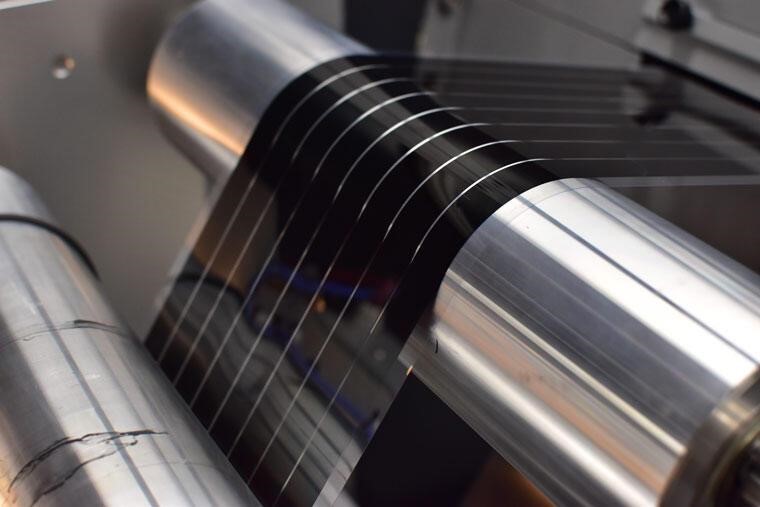
- J-Power invested in U.S. startup Active Surfaces, which develops PSCs. Founded in 2022, the startup is based on research at the Massachusetts Institute of Technology.
- Its film-type PSCs are lightweight and flexible, like those in Japan, allowing easy installation on roofs, walls, and curved surfaces.
- They can cut installation costs by up to 90% compared to conventional siliconbased panels. These modules are also durable in real-world conditions such as high heat and humidity, and achieve more than 25% efficiency and over 10 years of durability.
- The startup also developed advanced sealing and printing tech to address degradation and uniformity, which are key challenges for PSCs.
Port launches grid-scale battery for power balancing market
(Company statement, October 16)
- Tokyo-based Port launched a grid-connected battery system for the electricity supply-demand balancing market.
- Located in Isesaki City, Gunma Pref, the project has a capacity of 2 MW/ 8 MWh.
- Port is trading in the wholesale power market, and now testing entrance into the more profitable balancing market.
- Port is developing two other similar-scale battery systems (also in Gunma). The total investment of the three assets is about ¥1 billion.
- SIDE DEVELOPMENT:
- Saibu Gas launches renewables-integrated storage battery
- (Company statement, October 27)
- Saibu Gas Group’s subsidiary Ene Seed added a battery storage system to its solar farm in Nagasaki City, switching from FIT to the FIP.
- The solar farm has an output of about 900 kW and is now equipped with a 2.2 MWh battery made by GS Yuasa.
Tohoku Electric and ITES develop defect detection in solar panels
(Company statement, October 24)
- Tohoku Electric and ITES (IT-enabled services provider) jointly developed PVScope, which can detect defects in solar panels during daytime operation, eliminating the need for nighttime or darkroom inspections.
- Using a specialized InGaAs sensor camera capturing infrared light, and image analysis software, PVScope can identify defects without halting power generation.
- The system is now commercially available. It supports drone-based wide-area inspections and is compatible with perovskite solar panels.
Idemitsu Kosan’s CIGS solar cells deployed on JAXA mission
(Company statement, October 24)
- Idemitsu Kosan’s CIGS (Copper-Indium-Gallium-Selenide) solar cells were deployed on JAXA’s nextgen space solar cell demo mission, SDX.
- SDX will monitor performance in orbit at 400 km for two months under harsh space conditions. CIGS cells are noted for high radiation resistance.
- TAKEAWAY: Solar power is essential for satellites and space infrastructure, but panels must withstand space’s vacuum, radiation, and extreme temperatures. Japan has long been testing next-gen space solar cells and Idemitsu Kosan is a key player with its CIGS cells that stand out as lightweight, thin, and highly radiationresistant, unlike conventional silicon panels.
TERRA and UPDATER create company to develop solar sharing overseas
(Company statement, Oct 28)
- TERRA and UPDATER created TERRA International to develop a solar sharing business in the UAE, Ethiopia, Bangladesh and Vietnam.
- TERRA will utilize farming methods under solar PVs to hold carbon within the soil and reduce emissions.
NTT Anode Energy begins site inspections for new solar farm
(Company statement, Oct 22)
- NTT Anode Energy began site inspections for a planned solar farm in Hyogo Pref.
- With a maximum total capacity of around 52 MW, construction will take 1.5 years.
NEWS: WIND POWER AND OTHER RENEWABLES

Construction firms still committed to offshore wind despite Mitsubishi exit
(Nikkei XTECH, September 2025)
- Mitsubishi Corp’s withdrawal from its three offshore wind projects won’t stop major construction firms from investing in the industry despite concerns about costs.
- In a Nikkei XTECH survey of major construction firms all six respondents voiced concerns over project profitability and fragile supply chains, especially dependence on European turbine makers after domestic producers like MHI exited large-turbine manufacturing.
- However, despite cost pressures, most companies – including Shimizu, Penta-Ocean and Obayashi – plan to continue investing heavily in vessels, technology, and skilled labor through 2030. Shimizu has spent about ¥50 billion on a self-elevating platform vessel (SEP), and Penta-Ocean around ¥79 billion on foundation and cable-lay ships.
- The builders also welcome floating offshore wind. Obayashi is developing a TLP (tension-leg platform) design that reduces seabed footprint and fisheries impact.
- Also, companies are more likely to pool resources. Toda and Kumagai agreed to co-own SEP vessels.
- TAKEAWAY: The sector’s survival and growth depends on many factors, but to see one of the major supply chain segments remaining committed is a big boon, underscoring that for METI and other ministries the motivation to continue support is not only about developers, it’s more about ensuring a healthy domestic supply chain. In the govt’s ideal version of events, there would be a viable domestic turbine maker, but for now there’s little appetite among large machinery firms to perform more than a vendor role in offshore wind.
Kansai Electric acquires Irish offshore wind developer
(Company statement, October 31)
- Kansai Electric acquired a majority stake in Simply Blue Energy, an Irish offshore wind developer. The purchase price was not disclosed.
- Simply Blue specializes in early-stage offshore wind project development.
- CONTEXT: Kansai aims to build 9 GW of renewables capacity in Japan by 2040.
- TAKEAWAY: With Japan’s offshore wind sector stalled, companies seek to import expertise from mature markets; Kansai’s acquisition is one such example expected to help accelerate wind power development in Japan.
Chubu Electric profit up after offshore wind exit
(Nikkei, October 29)
- For April–Sept (Q1 and Q2), Chubu Electric reported a 13% YoY rise in net profit to ¥166.3 billion, despite a ¥13.6 billion loss linked to its withdrawal from three offshore wind power projects.
- Profits were boosted by a gain from fuel cost adjustments in electricity pricing.
- President Hayashi said the company is on track to meet its medium-term targets, helped by higher summer temperatures.
JOGMEC selects Toyo to assess geothermal tech
(Company statement, Oct 27)
- JOGMEC selected Toyo Engineering to do a feasibility study on coaxial closed-loop geothermal power generation technology.
- CONTEXT: Toyo Engineering has partnered with the U.S. company GreenFire Energy to develop this technology by finding potential demo sites in Japan and Indonesia, and to conduct feasibility studies.
NEWS: NUCLEAR ENERGY

Helical Fusion develops magnets for fusion reactors, a world first
(Nikkei Asia, October 28)
- Helical Fusion claims a “world first” in developing high-temperature superconducting (HTS) magnets essential for creating the powerful magnetic fields to confine the super-hot plasma where fusion occurs.
- The firm tested full-sized HTS magnet coils in conditions close to a fusion reactor.
- Helical Fusion will build a demo reactor, aiming for a full-scale, operational pilot by 2040.
- CONTEXT: This news comes as PM Takaichi pledged support for fusion energy.
Kashiwazaki-Kariwa NPP Unit 6 ready for restart
(Nikkei, October 28)
- TEPCO finished technical preparations for restarting Kashiwazaki-Kariwa NPP Unit 6, confirming major equipment is functional for reactor startup.
- The next step is to secure local agreement. If approved, the restart and connecting the reactor to the grid will take about two months.
- CONTEXT: Niigata Pref is conducting a public opinion survey on the NPP restart until Nov 7. The governor will make his decision based on the results.
- TAKEAWAY: Niigata Pref Governor Hanazumi plans to inspect Kashiwazaki-Kariwa NPP as early as Nov 14. An opinion exchange meeting might be held on Nov 14 with mayors of seven municipalities located within 30 km of the plant. So far, the localities outside of those hosting the NPP have not spoken positively about a restart.
- SIDE DEVELOPMENT:
- TEPCO cash-flow worsens
- (Nikkei, October 31)
- TEPCO is facing worsening cash-flow issues. In April–Sept, it posted a large net loss due to rising costs related to decommissioning Fukushima Daiichi NPP. Cash reserves dropped and are nearing the lowest level needed to maintain operations.
- To secure funds, TEPCO issued corporate bonds. But, free cash flow remains negative as spending, especially for safety measures, grows.
- TAKEAWAY: With no nuclear reactors currently operating, fuel costs for thermal power are also a heavy burden. TEPCO hopes to restart Unit 6 of Kashiwazaki-Kariwa NPP next spring, pending local approval. A restart could improve annual profit by about ¥100 billion and ease financial pressure. Yet, even with one reactor running, it may take years to stabilize cash flow. Also, total Fukushima decommissioning costs remain uncertain.
Hokkaido Electric to cut electricity rates on pending Tomari NPP restart
(Nikkei, October 31)
- Hokkaido Electric will cut household electricity rates by 11% to reflect reduced fuel costs once Tomari NPP Unit 3 resumes operation in 2027.
- For an average household, this will mean roughly ¥1,000 less per month. Corporate rates will also drop by about 6%, which may help attract industry to the region.
- CONTEXT: Major Japanese utilities are lowering electricity prices as they move to restart NPPs. Out of 10 major utilities, five have already restarted reactors. Nuclear fuel costs are far cheaper than fossil fuels, translating into about ¥1.9/ kWh, compared with ¥6.3 for coal and ¥9 for LNG.
- CONTEXT: Higher nuclear usage makes discounting easier. Tohoku Electric offered temporary discounts after restarting the Onagawa plant in early 2024. Chugoku Electric lowered corporate rates after launching operations at Shimane NPP in 2025.
KEPCO gets NRA approval for dry storage at Mihama NPP
(Company statement, October 29)
- KEPCO received NRA approval to build a dry storage facility for spent nuclear fuel at Mihama NPP. The location is within the plant, for Unit 3.
- The facility will be able to store about 100 tons of spent fuel across 10 casks.
- Construction will take place from 2026 to 2030, using reinforced concrete for each cask. The facility has a 60-year storage period.
NEWS: TRADITIONAL FUELS

PM Takaichi says Japan can’t ban Russian LNG imports
(Reuters, October 29)
- PM Takaichi told President Trump that Japan can’t ban imports of Russian LNG, because they account for 9% of Japan’s total and are crucial for its energy stability.
- Takaichi said if Japanese companies were to withdraw from the Sakhalin-2 project in Russia, it would benefit China which might take over their ownership.
- Japan is increasing purchases of U.S. LNG to diversify its sources.
- CONTEXT: Mitsui has a 12.5% stake and Mitsubishi has a 10% stake in the operating entity of the Sakhalin-2 project.
- TAKEAWAY: Replacing the Russian gas from Sakhalin-2 when those contracts expire between 2026 and 2033 would be costly, possibly leading to higher electricity prices. An exit ahead of contract expiration would also incur penalties and financial losses for the companies involved. Japan buys little Russian oil, with the bulk of its oil coming from the Middle East.
Mozambique LNG notifies govt to lift force majeure status, but risks rising – again
(French and Japanese media, October 29)
- The consortium of the Mozambique LNG project notified the Mozambique govt of its plan to lift its “force majeure” declaration. But a recent increase in Islamic insurgency in the area once again threatens work on the project.
- CONTEXT: Mitsui is an investor.
- TotalEnergies, the project’s largest shareholder with a 26.5% stake, confirmed the plan to go ahead to resume construction work. The force majeure will be officially lifted after negotiations with the govt.
- The project targeted a 2024 start, but halted due to the regional insurgency. Mozambique’s govt has since improved security. Restart is now slated for 2029 or 2030. Once operational, the project will be the country’s first major onshore LNG plant, with 13 Mt annual production capacity.
- However, Exxon, which is developing a project nearby, canceled a joint briefing with the Mozambique president in the past week due to concerns about the security situation. The insurgency is once again intensifying and critics warn that the presence of the energy companies could inflame the situation.
Tokyo Gas announces new medium-term plan
(Company statement, Nikkei, October 29)
- Tokyo Gas unveiled a three-year medium-term management plan through FY2028, to invest ¥350 billion in overseas businesses, mostly in the U.S., focusing on shale gas development and LNG production.
- The company’s total return ratio target will rise to about 60%, up from 40%, reversing years of reduced returns due to decarbonization investments.
- CONTEXT: Under Trump, natural gas development is favored, making U.S. shale projects attractive. Tokyo Gas is expanding its involvement in the U.S., acquiring shale developer Rockcliff Energy and obtaining a majority stake in Chevron’s Texas shale fields. It is also considering long-term LNG procurement from Alaska.
Chugai Technos tests biomass thermal decomposition
(Company statement, Oct 20)
- Chugai Technos began tests to analyze thermal decomposition of biomass feedstock.
- Main tests include:
- Analysis of gas and oil composition.
- Analysis of residue composition, including ash.
- Comparison of reactivity based on mixing ratio of raw materials.
- Evaluation of decomposition effects.
- Tests determine decomposition and renewability traits of biomass feedstock.
Tohoku Electric inks deal with Global Coal
(Government statement, October 28)
- Global Coal Sales Group announced a multi-year deal for U.S.-sourced thermal coal with Tohoku Electric, valued at over $100 million.
- TAKEAWAY: Tohoku Electric hasn’t disclosed details; the deal was reported by the White House. Still, it’s clearly a part of the U.S. push for more exports to Japan.
LNG stocks down from previous week, up YoY
(Government data, October 29)
- As of Oct 26, the LNG stocks of 10 power utilities were 1.97 Mt; down 7.5% from the previous week (2.13 Mt); up 7.1% from end Oct 2024 (1.84 Mt), and down 3% from the 5-year average of 2.03 Mt.
September Oil/ Gas/ Coal trade statistics
(Government data, October 30)
| Imports Volume YoY Value (Yen) YoY | ||||
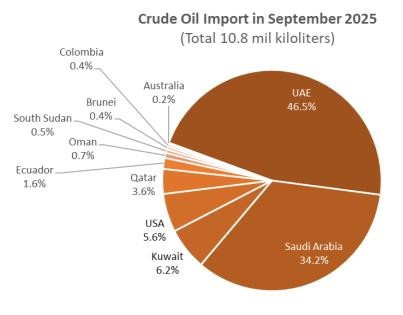
| LNG | 10.8 million kiloliters (68.1 million barrels) | 1.4% | 733.9 billion | -8.6% |
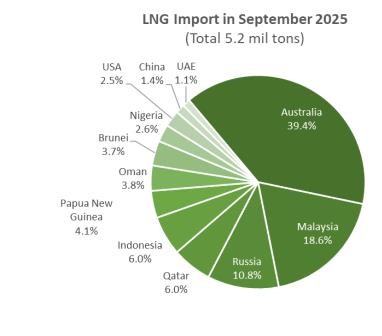
| LNG | 5.2 million tons | -5.0% | 425 billion | -13.3% |
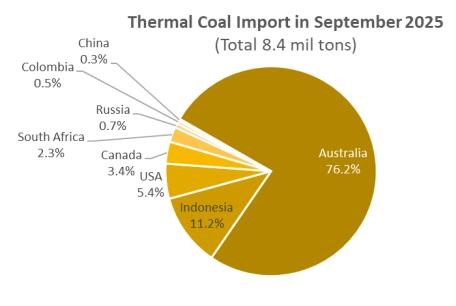
| Thermal coal | 8.4 million tons | -22.1% | Thermal coal | -36.4% |
- Japan imported 10.8 million kiloliters of crude oil in September, down 3.2% from August and up 1.4% YoY. In the month, a little over 91% of total crude oil imports came from the Middle East, which is a couple of percentage points less than the number in the prior eight months. A small volume of imports came from Colombia for the first time this year. Imports from the U.S. jumped from less than 100,000 kiloliters in early 2025 to over 400,000 ~ 500,000 kiloliters.
- September LNG imports totaled 5.2 Mt, down 3.7% over August (5.4 Mt), and down 5% YoY. The imported volume from Russia was still four times higher than from the U.S. in September, but this may change due to rising political pressure in coming months.
- September thermal coal imports were 8.4 Mt, down 20.6% from August, and down 22.1% YoY. The value per ton was ¥17,856, down 0.1% from the previous month and down 18.3% YoY. Japan increases thermal coal imports ahead of the winter demand season.
NEWS: CARBON CAPTURE & SYNTHETIC FUELS

METI to accelerate carbon recycling tech for industrial use
(Denki Shimbun, October 27)
- METI and leading industrial players are expanding efforts to commercialize carbon recycling, with a focus on converting captured CO2 into fuels, chemicals, and building materials.
- The idea is to build on the Carbon Recycling Roadmap revised in 2024, which sets targets for industrial-scale deployment by 2030 and export competitiveness by 2050.
- MHI, JGC, and IHI conduct field tests for CO2-to-methanol synthesis; ENEOS and Osaka Gas explore synthetic fuels for shipping and aviation.
- CONTEXT: Osaka and Fukuoka regions plan to launch carbon utilization clusters, linking emitters with chemical and materials industries to test CO2 reuse at scale.
- TAKEAWAY: Carbon recycling is probably the most important component of the carbon capture ecosystem. Without it, CCS is costly and difficult to bring to a commercial setting. The challenge has been to find uses for CO2 as economically efficient as Enhanced Oil Recovery. Synthetic fuels, such as e-methane, are one option but require advances also in clean hydrogen production.
Coca-Cola agrees with Rhinoflux on biomass
(Company statement, Oct 28)
- Starting 2026, Coca-Cola Bottlers Japan will test a new biomass industrial process capable of generating both electricity and high purity CO2. The feedstock will be based on tea and coffee grounds generated in their factory in Kyoto.
- Using wet chemical looping, an emerging tech that captures CO2, the test will evaluate its performance at providing 1kW of electricity and 99.9% pure CO2.
ANALYSIS
BY YURIY HUMBER
Japan’s $550 Billion Wager on U.S. Growth, or the Price of Friendship?
President Donald Trump arrived in Tokyo with a simple message: America must rebuild its industrial base to compete with China, and Japan should help foot the bill. The prize for Japan may be a sturdier security guarantor, but other benefits, like details on the $550 billion in announced investments, remain scant.
The deals announced are not legally binding, yet walking away, or declining to finance particular projects, could trigger higher U.S. tariffs on Japanese goods. Critics in Tokyo called this a U.S.-led, U.S.-favored scheme that would divert Japanese public funds into American industrial policy for meager financial upside. Washington’s only concession, tucked into the fine print, is that Japanese vendors will be preferred “where possible.”
Tokyo’s officials have tried to present the initiative as strategic: a way to align with a core ally on energy security, supply-chain resilience and industrial upgrading, while smoothing trade frictions and reaffirming cooperation in advanced technologies. The White House, by contrast, sold it as another win for the “Dealmaker in Chief”, an infusion of foreign capital to advance America’s own economic and security interests.
Investments focus primarily on LNG and oil, thermal power plants, nuclear power, and a few projects in energy storage and hydrogen. Missing entirely are commitments to renewables such as solar, wind or geothermal. Access to critical minerals features more prominently, reflecting the determination of both governments to lessen dependence on China.
The power imbalance is stark. Project selection sits with the White House. Profits, after a modest threshold, flow 90% to the U.S. and only 10% to Japan. For Japanese policy banks, the deal risks turning development finance into tribute. Yet the deal guarantees Tokyo respite from tariff threats and offers a seat at the table for heavy-industry champions – such as Toshiba, Hitachi, MHI– in the next wave of American energy and AI infrastructure projects.
How Japan will marshal such a torrent of capital is unclear. Most funds will likely come from loans and guarantees rather than equity, and disbursed gradually through privatesector participation. The agreement also sharpens attention on currency dynamics: a weaker yen makes dollar projects costlier to fund, but any future yen appreciation – should the Fed cut rates further while the Bank of Japan edges toward tightening – would cheapen U.S. assets in yen terms and narrow the very bilateral trade gap that triggered Trump’s demands.
Ultimately, the greater risk is strategic rather than financial. By anchoring so much capital and goodwill in a single ally, Japan edges away from its traditional insurance policy – diversification across partners and regions. If the $550 billion pledge turns out to be more signal than substance, that may be by design. Ambiguity, after all, has long been Tokyo’s most reliable form of risk management.
Background
- Japan’s trade surplus with the U.S. reached roughly ¥10 trillion in 2024, making it one of Washington’s biggest targets.
- Trump threatened a 25% tariff on autos and parts — a risk to Japan’s key exporters.
- Under pressure, Tokyo agreed in July to an investment-for-tariff-relief arrangement: Japan’s pledge of $550 billion would secure a tariff cut to 15%, down from the initially threatened 25%.
- Japan’s trade surplus with the U.S. in the first half of FY2025 (April–September) shrank 22.6% year-on-year to ¥3.32 trillion, the steepest drop since 2020. • The goal of the investment deals is to reduce Japan’s trade surplus by 62% to about ¥3.8 trillion.
Deals announced before the Trump visit
- JERA to invest about $1.5 billion in U.S. shale gas assets and to contract 5.5 Mtpa of U.S. LNG from 2030; it also signed a letter of intent signaling interest in future procurement from the Alaska LNG project.
- Tokyo Gas signed a similar letter regarding the Alaska LNG project, which targets a final investment decision in 2026.
- Hitachi plans to invest over $1 billion to build a transformer factory in Virginia by end-2027 and expand plants in Pennsylvania and Tennessee.
- Non-energy deals: Fujifilm to invest $3.2 billion in a biopharma plant, to be one of the largest in the U.S.; Takeda to spend $30 billion over five years on U.S. manufacturing and R&D; Daiichi Sankyo to spend $350 million to expand its Ohio plant by 2027; ANA, JAL, and Skymark plan to purchase about 100 Boeing aircraft.
Deals announced during the visit
- Energy (~$330 billion potential total) o
- Westinghouse – Building AP1000 nuclear reactors and SMRs, involving Japanese partners like MHI, Toshiba, and IHI. (Up to $100 bln)
- GE Vernova / Hitachi – Joint development of the SMR model BWRX-300 (Up to $100 bln)
- Bechtel – EPC services for large-scale power and industrial infrastructure, with Japanese participation. (Up to $25 bln)
- Kiewit – EPC services with Japanese companies. (Up to $25 bln)
- GE Vernova – Supply of turbines, generators, and HVDC/substation systems for grid reliability. (Up to $25 bln)
- SoftBank Group – Development and operation of large-scale power infrastructure. (Up to $25 bln)
- Carrier – Supply of cooling and thermal systems essential for power infrastructure. (Up to $20 bln)
- Kinder Morgan – Natural gas transmission and infrastructure services. (Up to $7 bln)
- NuScale / ENTRA1 Energy – Exploring gas-thermal and nuclear power generation dedicated to AI data centers.
- AI and Semiconductors (~$60+ billion)
- Toshiba – Supply of power modules, data-center transformers, and substations to strengthen U.S. supply chains.
- Hitachi – Projects in HVDC transmission links, transformers, and datacenter power systems.
- Mitsubishi Electric – Supply of power station systems, chillers, UPS, and emergency generators for U.S. data centers. (Up to $30 bln)
- Fujikura – Supply of optical fiber cables. (Up to $20 bln) o TDK – Supply of advanced electronic components and power modules for AI infrastructure.
- Murata Manufacturing – Production of MLCCs, inductors, battery modules, and converters for backup and energy-storage systems. (Up to $15 bln)
- Panasonic – Supply of energy-storage systems and electronics for U.S. supply chains. (Up to $15 bln)
- Critical Minerals and Related Industries (~$6.5 bln+)
- Falcon Copper – Copper smelting and refining facility in the western U.S., with Japanese suppliers/ off-takers. (~$2 bln)
- Carbon Holdings – Greenfield ammonia and fertilizer project. (Up to $3 bln)
- Element Six Holdings – Facility for synthetic diamond grit (HPHT) production. (~$0.5 bln)
- Max Energy – Upgrading southern U.S. crude-oil export routes to handle 100,000-ton vessels. (~$0.6 bln)
- MitraChem – Building a lithium-iron-phosphate battery material plant. (~$0.35 bln)
Additional energy-related agreements
- Japan to pursue new sanctions frameworks to target vessels linked to shadow fleets and disrupt shadow fleet activity in close coordination with the U.S.
- U.S. and Japan to expand shipbuilding capacity in both nations – align on the tech.
- Accelerate AI adoption by driving research for use in science, industry, and society.
- Strengthen collaboration in quantum information science, fusion energy, and space.
Contrasting presentations of the deals
U.S. framing (White House) Japanese framing (JETRO / METI)
CONTROL | U.S. President and Commerce Secretary decide projects | Joint consultation mechanism before U.S. decision |
PURPOSE | Create U.S. jobs, rebuild U.S. industry | Deepen bilateral cooperation and avoid tariffs |
PROFITS | Flows overwhelmingly to U.S. economy | Financial support for Japanese suppliers |
TARIFFS | Enforcement tool if Japan under-invests | Avoidance incentive for compliance |
| KEY QUOTE | Commerce Secretary Howard Lutnick: “The Japanese government will contribute the capital to build the project in America, and America will own the project, and then we will split the proceeds with the Japanese government until they get all of their money back, so that the Japanese taxpayers, over a long period of time, it cost them no money.” | MEI Minister Akazawa: “This $550 billion investment framework is quite open-ended. It’s not confined to Japanese or U.S. companies alone — firms from third countries may also participate, and funds from third-country institutions could likewise be involved.” |
Critical response in Japan
Kiuchi Nobuyuki, Nomura Research Institute, identified the agreement’s four main problems:
- U.S. control of investment decisions:
All investment targets are chosen by the White House, based on recommendations from an Investment Committee chaired by the U.S. Secretary of Commerce, with no Japanese participation in the committee itself. - Tariff threat as leverage:
If Japan fails to provide funding, the U.S. can impose tariffs on Japanese products. - Unclear beneficiary structure:
Although Japan supplies the capital, the memorandum does not specify that Japanese companies will make the actual investments – implying U.S. firms could invest using Japanese-provided funds. - Profit distribution skewed toward the U.S.:
Investment returns are paid out early as “deemed dividends”, with 50% of profits below a benchmark and 90% above it going to the U.S. government. This could boost U.S. fiscal revenues upfront, even before projects generate real returns.
Meanwhile, Japan’s state-backed financial institutions (such as JBIC and NEXI), which exist to promote corporate growth, may instead become tools to finance U.S. industrial revival. The White House website states that the goal is “creating hundreds of thousands of American jobs, expanding domestic manufacturing, and securing U.S. prosperity for generations.” Talk of shared goals etc, reads more like diplomatic cover.
The positive spin
- Most Japanese companies mentioned in the investment memorandum were already looking at making investments in the U.S. and see that market as higher growth and higher margin that the domestic one.
- Access to critical raw materials and processing, especially in areas like rare earths, has been a weak point for Japan and there’s been little progress in terms of actual deals and smelters in recent years despite paper agreements with allies; this suggests moves to make actual investments.
- Japanese heavy industry players and nuclear vendors, such as MHI and Toshiba, will benefit from a potential $80 billion boom in nuclear construction in the U.S., securing large contracts.
- PM Takaichi had barely a week to prepare for the visit and is navigating a minority government; with such a weak domestic position, she needed Trump’s visit to proceed smoothly to ward off further tensions, leaving some issues with this investment plan for resolution at a later date.
- Japan benefits from a strong U.S. in terms of a security and economic partner.
Conclusion
As in all political theater, separating the message from the content is tough. But these issues are worth keeping an eye on:
- What projects actually reach SPV funding and when? Does the momentum build or wane as Trump’s presidential term nears the end?
- Tariff trigger discipline: Does Washington test the penalty clause if Tokyo balks on marginal projects?
- FX levels and interest rates are the real heart of any financing deal and they are likely to set the tone for all budgeting, hedging, and deal optics.
For now, Japan’s pledge is part insurance premium, part investment thesis. It buys political calm, a few industrial contracts and perhaps a stronger ally, at the cost of deeper exposure to Washington’s whims. In the end, the arrangement may prove less about money than management of allies, of markets, and of appearances.
Appendix: Japanese Media Reaction to the Visit
1. Strategic continuity and PR
- Nikkei describes PM Takaichi as a strategist who modelled her first meeting with Trump on Abe Shinzo’s rapport-building with the U.S. president during his first term.
- The paper highlights her “careful choreography,” from timing to tone, framing the encounter as a successful “first step” toward restoring personal trust with Washington. Nikkei says she consciously evoked Abe’s legacy, projecting herself as his political heir while avoiding missteps.
- Asahi Shimbun takes a sharper tone, calling her “calculating and prepared.” The paper details her flattering remarks, such as praising Trump’s diplomacy in Southeast Asia as “historic,” and even nominating him for the Nobel Peace Prize – echoing Abe’s gesture in 2019.
- The article portrays this as part of a “carefully scripted performance” to appeal to Trump’s vanity, showing political cunning rather than deference.
2. Fluid role, from rock star to sycophant
- Mainichi Shimbun notes that some diplomats were impressed by her confidence and stagecraft: “She behaved like a rock star—something ordinary Japanese politicians would never dare.”
- Tokyo Shimbun, by contrast, derides her flattery as Abe-style pandering, quoting critics who say Japan has reverted to “kowtowing diplomacy” toward Washington.
- The paper says her Nobel Prize nomination of Trump was an “embarrassing repetition” of Abe’s tactics, questioning whether she has an independent diplomatic vision.
3. Policy skepticism
- Diamond and JBpress shift focus to her broader agenda rather than the summit itself, skeptical about her “strong nation, strong economy” rhetoric.
- Diamond argues that Japan must first develop the “four pillars of geoeconomic power” before such slogans can mean anything, implying her talk exceeds her institutional leverage.
- JBpress concludes she likely passed Trump’s first test, but leaves open whether she can sustain the relationship beyond the optics.
- Business Nikkei and Nikkei Asia emphasize the meeting’s symbolic value, saying it projected “a rock-solid alliance both at home and abroad.” But their tone is not celebratory, showing skepticism about the substance of the U.S.-Japan agreement.
ASIA ENERGY REVIEW
BY JOHN VAROLI
A brief overview of the region’s main energy events from the past week
Australia / BESS
Developer Eku Energy and LP Renewables announced plans for a 400MW/ 1.6 GWh Belah BESS in Queensland.
Australia / Solar and BESS
The solar and BESS sectors had strong performance in Q3 of 2025, with grid-scale solar output reaching 1.7 GW; BESS capacity expanded by 2.94 GW from Q3 of 2024.
China / Grid output
The CEO of ChatGPT recommends the U.S. prioritize “closing the electron gap” with China by building 100 GW a year of new energy capacity. In 2024, China added 429 GW of new power capacity, more than 1/3 of the entire U.S. grid, which contributed just 51 GW.
China / Natural gas
The U.S. said it will sell more oil and gas to Beijing if it cuts back on Russian purchases. The U.S. is the world’s largest oil and gas exporter, while China is the biggest importer.
India / Renewables
India’s total installed electricity capacity surpassed 500 GW, with renewable and other nonfossil sources now accounting for more than half of the nation’s power mix.
India / Corporate Solar
Ingka Investments, a part of the IKEA empire, made a 100% stake investment in a subsidy-free 210 MWp solar project in Bikaner, Rajasthan.
Indonesia / Geothermal
The Asian Development Bank approved a $180 million loan to support PT Geo Dipa Energy to further boost the country’s geothermal power generation.
Malaysia / Natural gas and Solar
The govt plans to increase investment in natural gas and solar energy to reduce coal dependency.
Philippines / Grid
The Asian Development Bank is preparing to finance up to $1 billion to modernize the national power grid.
Taiwan / Natural gas
Utilities boosted natural gas-fired electricity generation; over 87% of Taiwan’s electricity supply was produced by fossil fuels in the first eight months of 2025, says Ember.
Disclaimer
This communication has been prepared for information purposes only, is confidential and may be legally privileged. This is a subscription-only service and is directed at those who have expressly asked K.K. Yuri Group or one of its representatives to be added to the mailing list. This document may not be onwardly circulated or reproduced without prior written consent from Yuri Group, which retains all copyright to the content of this report.
Yuri Group is not registered as an investment advisor in any jurisdiction. Our research and all the content express our opinions, which are generally based on available public information, field studies and own analysis. Content is limited to general comment upon general political, economic and market issues, asset classes and types of investments. The report and all of its content does not constitute a recommendation or solicitation to buy, sell, subscribe for or underwrite any product or physical commodity, or a financial instrument.
The information contained in this report is obtained from sources believed to be reliable and in good faith. No representation or warranty is made that it is accurate or complete. Opinions and views expressed are subject to change without notice, as are prices and availability, which are indicative only. There is no obligation to notify recipients of any changes to this data or to do so in the future. No responsibility is accepted for the use of or reliance on the information provided. In no circumstances will Yuri Group be liable for any indirect or direct loss, or consequential loss or damages arising from the use of, any inability to use, or any inaccuracy in the information.
K.K. Yuri Group: Hulic Ochanomizu Bldg. 3F, 2-3-11, Surugadai, Kanda, Chiyoda-ku, Tokyo, Japan, 1010062.