
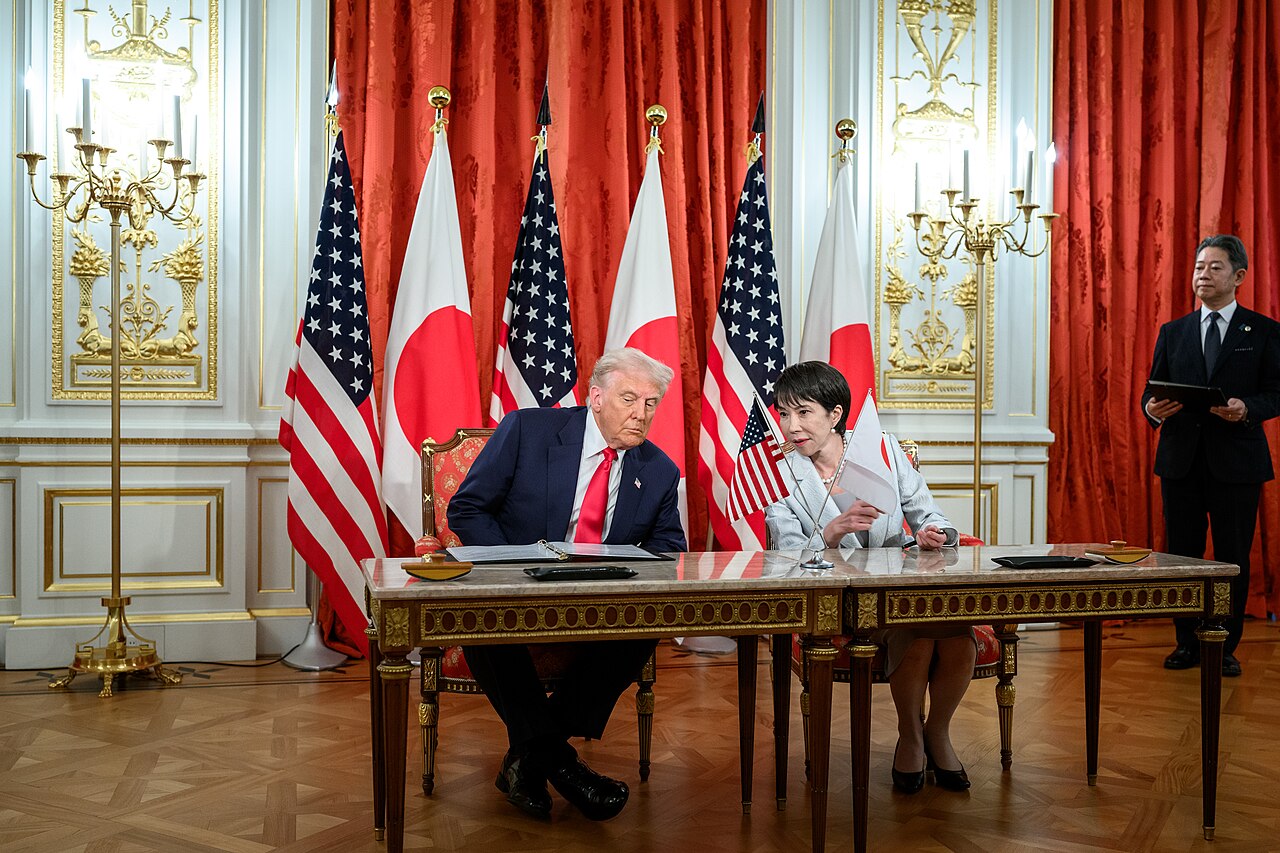
President Donald Trump arrived in Tokyo with a simple message: America must rebuild its industrial base to compete with China, and Japan should help foot the bill. The prize for Japan may be a sturdier security guarantor, but other benefits, like details on the $550 billion in announced investments, remain scant.
The deals announced are not legally binding, yet walking away, or declining to finance particular projects, could trigger higher U.S. tariffs on Japanese goods. Critics in Tokyo called this a U.S.-led, U.S.-favored scheme that would divert Japanese public funds into American industrial policy for meager financial upside. Washington’s only concession, tucked into the fine print, is that Japanese vendors will be preferred “where possible.”
Tokyo’s officials have tried to present the initiative as strategic: a way to align with a core ally on energy security, supply-chain resilience and industrial upgrading, while smoothing trade frictions and reaffirming cooperation in advanced technologies. The White House, by contrast, sold it as another win for the “Dealmaker in Chief”, an infusion of foreign capital to advance America’s own economic and security interests.
Investments focus primarily on LNG and oil, thermal power plants, nuclear power, and a few projects in energy storage and hydrogen. Missing entirely are commitments to renewables such as solar, wind or geothermal. Access to critical minerals features more prominently, reflecting the determination of both governments to lessen dependence on China.
The power imbalance is stark. Project selection sits with the White House. Profits, after a modest threshold, flow 90% to the U.S. and only 10% to Japan. For Japanese policy banks, the deal risks turning development finance into tribute. Yet the deal guarantees Tokyo respite from tariff threats and offers a seat at the table for heavy-industry champions – such as Toshiba, Hitachi, MHI– in the next wave of American energy and AI infrastructure projects.