BY THOMAS SHOMAKER
In the ongoing cleanup from the 2011 Fukushima disaster, attention often focuses on the power plant itself, which on June 2 began fuel removal. But as that decommissioning proceeds, another massive operation takes place outside the facility’s walls to decontaminate the land.
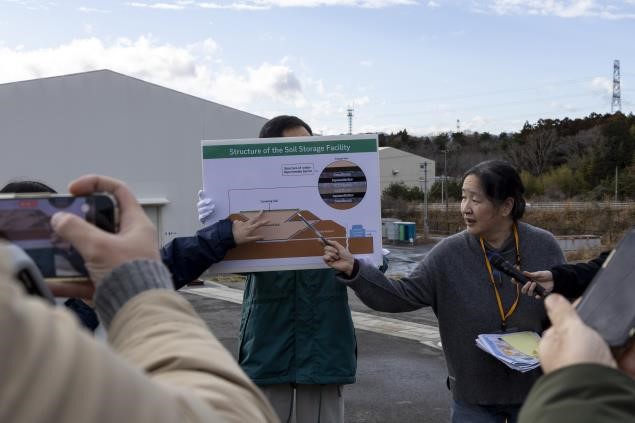
This ongoing effort under the Ministry of the Environment (MoE) has so far isolated 14.36 million cubic meters of irradiated soil on a dedicated site around the power plant dubbed the Interim Storage Facility, as well as hundreds of thousands of tons of tsunami debris.
The monumental task of collecting, transporting, processing – in some cases incinerating – and storing these materials has come with a massive carbon footprint. As the operation winds down from its peak, the environmental impact is clear.
Two towns bordering the Fukushima Daiichi Nuclear Power Plant provided the land for the 16-square-kilometer Interim Storage Facility – a territory slightly larger than Tokyo’s special ward of Shibuya – on the condition that the MoE remove all the contaminated material by 2045.
Without a decided-upon final destination, the MoE’s stated goal is to recycle and reuse as much of the material as possible ahead of this deadline. The scale of the task is daunting. The 14.36 million m3 of soil alone is equivalent to the volume of about 11 Tokyo Domes.
While some of the soil is radioactive enough to warrant indefinite isolation, about 75% is deemed safe for reuse in construction projects. Much of the incombustible tsunami debris, such as concrete, is also applicable for a second life. The question is whether the world’s largest decontamination effort can turn into one of its largest recycling operations.