JAPAN ENERGY WEEKLY
NEWS ALERT
June 20 to June 26, 2020
COMPANIES IN FOCUS
NEWS > JXTG changes company name to ENEOS BREAKING… | DATA > Oil imports volume |
|
ANALYSIS / CONTEXT:
|
CONTACT US nrgnews@yuri-invest-research.com
NEWS
OIL
JXTG changes company name to “ENEOS” (Sekiyu Tsushin, June 26)
- JXTG Holdings has officially changed its name to ENEOS Holdings.
- The resolution was ratified at the June 25 meeting of shareholders.
Behind the Scenes: Former Nippon Oil execs oust Tonen colleagues to form ENEOS(Diamond, June 25)
- Just three years after Japan’s largest oil company JX Holdings (now ENEOS) merged with third-ranked Tonen General to form JXTG Holdings, former Nippon Oil executives have achieved complete domination of the JXTG board.
- JX, itself the product of mergers between Nippon Oil and several other competitors, was characterized by a distinctly Japanese corporate culture. Tonen, on the other hand, inherited a rational, westernised culture from Exxon Mobil.
- JX executives detested their Tonen colleagues’ relentless pursuit of efficiency.
- While the makeup of JXTG’s first Board of Directors attempted to achieve a balance between JX and Tonen, JX executives subsequently used their greater numbers to push out all Tonen people.
- With the change of the name to ENEOS, all traces of the Tonen roots are gone.
- Executive Officer Saito Takeshi has a reputation for being sharp witted, and is popular with gas station proprietors.
Gasoline prices rises for 6 consecutive weeks(Nikkei Shimbun, June 26)
- Regular gasoline price at the pump was 220.9 yen per liter, up 0.7 yen on the previous week. This is the 6th straight weekly increase, mirroring the comeback in global crude oil prices and the return of demand locally.
- Gasoline sales are back to same level as year ago, says one unnamed gasoline station operator in Tokyo area
Japanese government protests Russian exploration in EEZ(TBS News via Yahoo News, June 26)
- Japan’s Ministry of Foreign Affairs says it has been informed by Russian counterparts that Russia has commenced a geographical survey in the Sea of Okhotsk, which will impinge on Japan’s exclusive economic zone (EEZ).
- The survey is planned to last for three months, and will evaluate the size of petroleum deposits and the area’s viability for military exercises.
- Japan has condemned the survey, which will take place near a group of Russian islands over which Japan claims sovereignty.
GAS
Toho Gas marketing new system for boosting calorific value (Nikkan Kogyo Shimbun, June 25)
- Toho Gas is ramping up efforts to market a proprietary system that allows more efficient mixing of natural gas and LPG, thereby offering cost savings of 10% compared with existing technologies, and a carbon footprint that is 40% smaller.
- The AtoMS system claims to more efficiently atomise the LPG mixed with reticulated natural gas. It is aimed at major gas users such as factories and hospitals.
- Toho aims to sell two systems per year to new and existing operators.
Tokyo Gas to release highly-efficient fuel cell aimed at commercial users (Nikkan Kogyo Shimbun, June 24)
- Tokyo Gas plans to release a solid oxide fuel cell (SOFC) in the early 2020s that achieves a record 65% efficiency.
- The fuel cell will have an output of 5 kW and is aimed at convenience stores, offices, and other small commercial premises.
- CONTEXT: Competitor Osaka gas released a domestic fuel cell with an efficiency of 55% in April, while Mitsubishi Hitachi Power Systems recently released a 220-kW fuel cell that is also 55% efficient. Efficiency of 65% represents a significant improvement.
- SIDE DEVELOPMENT: Osaka Gas’s fuel cell has recently been selected by South Korea, which plans to use it to build out hydrogen filling infrastructure such as for hydrogen-fuelled vehicles (FCVs).
Ministry instructs utilities to extend payment holiday (Jiji Press, June 24)
- The Ministry of Economy, Trade and Industry said on June 24 that electricity and gas utilities must now extend the reprieve given to subscribers affected by the coronavirus pandemic to 4 months.
- CONTEXT: Individuals and businesses who have lost income due to the coronavirus pandemic are required to apply to their energy utilities to receive a payment holiday.
POWER
KEPCO: Former directors sued for 9.2 billion yen (Nikkei, June 23)
- Five shareholders of Kansai Electric Power Co. have sued 22 former executives, including ex-chairman Yagi Makoto and former CEOs Iwane Shigeki and Morimoto Takashi, for 9.2 billion yen in damages in relation to recent bribery revelations.
- The shareholders say the directors’ use of revenue from electricity subscribers to pay personal taxes amounts to a serious breach of trust, and described KEPCO’s actions in topping up executive salaries as a “fraudulent hiking of electricity tariffs”.
KEPCO apologizes, reveals disgraced directors’ salaries (Nikkan Kogyo Shimbun, June 26)
- KEPCO convened a meeting of shareholders on June 25, the first since bribery revelations involving former directors came to light.
- The chair kicked off the meeting with an apology for the incident.
- In response to a question, KEPCO disclosed the amounts of compensation paid to former directors Yagi Makoto and Iwane Shigeki in 2019. (Both men received 44 million yen.)
SIDE DEVELOPMENT: KEPCO also said it will and adopt a new committee structure in which the oversight and executive functions are separated.
In heartland of Japan’s auto industry, Chubu Electric says demand dropped 12% in May; CEO concerned (NHK, June 25)
- Chubu Electric Power CEO Hayashi Kingo revealed that demand for electricity in May had fallen over 12% after manufacturers and commercial operations shut down amid coronavirus fears.
- The slump is the biggest since April 2017 and continues a streak of 7 straight months of demand deflation compared with year earlier.
- SIDE DEVELOPMENT: In contrast, June demand (as of June 24) in the central Japan area that includes Toyota Motor’s heartland, of was only down 5.4% YoY (Denki Shimbun)
TEPCO raised its bond sales limit this fiscal year to 700 billion yen from 450 billion yen (Denki Shimbun, June 23)
- The co. has already sold 280 billion yen in bonds this FY.
TEPCO offers monthly plan with no basic fee via tie-up with Yamada Homes (Denki Shimbun, June 26)
- TEPCO will launch the new price plan with no basic monthly fee for new homeowners through a tie-up with residential builder Yamada Homes.
- A typical family of four in the Kanto region can expect to save nearly ¥20,000 per year with the new plan.
Household energy consumption jumps 8% as the public stays home (Denki Shimbun, June 23)
- A survey of patterns in energy consumption during the coronavirus pandemic conducted by the Jyukankyo Research Institute found that household energy consumption (electricity, gas, and kerosene) rose 7.7% against the previous year.
- Another survey commissioned by energy platform developer Enechange found that power consumption in pachinko parlours and hotels fell by over 30%.
J-Power to transfer thermal operations to subsidiary (Denki Shimbun, June 26)
- J-Power said on June 21 that it will transfer all operations relating to thermal power plants, including maintenance, to subsidiary J Pack.
- By 2024/25, J Power plans to move 300 staff, whose duties will be made redundant by the restructuring, to renewable energy and other growth areas.
Hokuriku Electric apologizes for low share price (Nikkei, June 25)
- At a meeting of shareholders, the CEO of the Hokuriku Electric Power Co. apologised for the co.’s share price performance, which is currently at its fourth lowest level ever. He pledged to improve performance.
- The shares stood at ¥672 at the end of trading on June 25, 40% below the level at the beginning of the year.
- CEO Kanai Yutaka promised to rectify faults with coal-fired power stations so that they could be reliably returned to service.
COAL
Mizuho rejects AGM demand to end coal financing (Japan Times, June 25)
- Mizuho Financial Group shareholders rejected a resolution from some of their peers that sought an end to the bank’s financing of coal power project. Mizuho is among the world’s biggest lender to coal-fired generation projects.
- Shareholders accounting for 34.5% of the votes backed the resolution, which asked Mizuho to also disclose climate risks and its actions in light of the Paris Agreement.
SIDE DEVELOPMENT: Shareholders of TEPCO also rejected a proposal for the electric utility to cease coal fire generation, as well as a proposal that sought a delay to the construction of the Higashidori Nuclear Power Plant.
OTHER
Japan seeks bidders for first floating wind farm (Ministry for Energy Trade and Industry release, June 24)
- Japan govt starts auction to build the nation’s first floating offshore wind farm in waters to the east of the southern city of Nagasaki.
- Deadline for bids is Dec. 24. Winner to be named around June 2021.
- Govt has mandated that wind farm should have minimum capacity of 16.8MW and operate on a feed-in tariff of 36 yen per kilowatt hour.
Kyushu Electric Power Co aims to develop 5GW of renewable energy in next 10 years (Gas Energy Shimbun, June 29)
- Co. also confirms plan to build largest wood-burning biomass power plant in Japan.
- Kyushu EPCO also targets commercialization of LNG bunkering in its new 5-year business strategy unveiled on June 23.
Power companies advocate for nuclear energy at shareholder meetings (Denki Shimbun, June 26)
- As AGMs were convened around the country by Japan’s power utilities, executives advocated for the continued use of nuclear energy.
- Chubu Electric Power CEO Hayashi Kingo told shareholders that nuclear power remains essential because it offers an alternative to fossil fuels and can be economical.
JERA establishes floating wind power JV with France (Denki Shimbun, June 23)
- JERA said June 22 that it has reached a basic agreement to establish a floating offshore wind power development company with France’s Ideol, a maker of the offshore technology, and a French state company.
- The three parties will form a company in France, in which JERA will be an investor for around 30 percent. The idea is to build 2GW of offshore technology within 5 years.
Zero emissions platform gaining traction as oil industry’s spending backfires (Nikkei, June 22)
- Western oil firms spent large on exploration permits and now are forced to write down the value of their assets as the coronavirus pandemic forces restructuring.
- Coronavirus has put the Paris agreement back in the spotlight because the pandemic is expected to result in an 8% reduction in CO2 emissions in 2020. To achieve the Paris Agreement target of 7.6%, current emission levels must be maintained.
- Idemitsu Kosan CEO Kito says Idemitsu will need to revise profit targets in light of the slump in demand. Kito says Idemitsu will turn focus to high function fuels.
- The pandemic has forced energy and utility companies to make genuine efforts to move away from fossil fuels. Those who cannot afford to transition to renewables quickly may not be unable to escape the risk of oil dependency until it is too late.
- BACKGROUND: Zero-carbon initiatives are gaining momentum in Japan. Last week saw the first meeting of the Tokyo Bay Zero Emissions Initiative, which is led by Japan’s top oil and electricity utilities. The meeting was also attended by officials from both the energy ministry and local governments. A similar imitative spearheaded by Japan’s big-business lobby Keidanren, is called “Challenge Zero”. The latter aims to create a society by 2050 that does not use carbohydrates. The domestic gas firms are charged with developing certain parts of the roadmap for the initiative, such as how to reduce carbon in city gasification by exploring fuel cells, carbon storage, and hydrogen.
OIL DATA
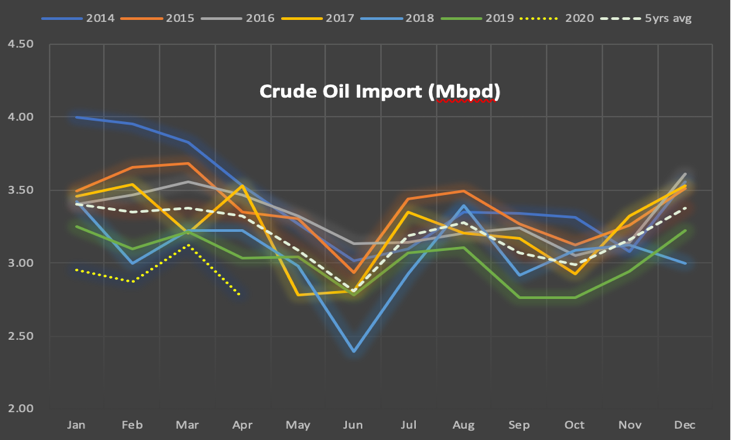
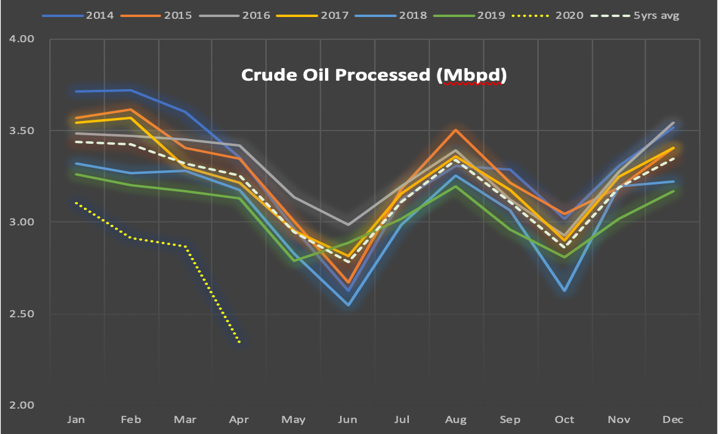
GAS DATA
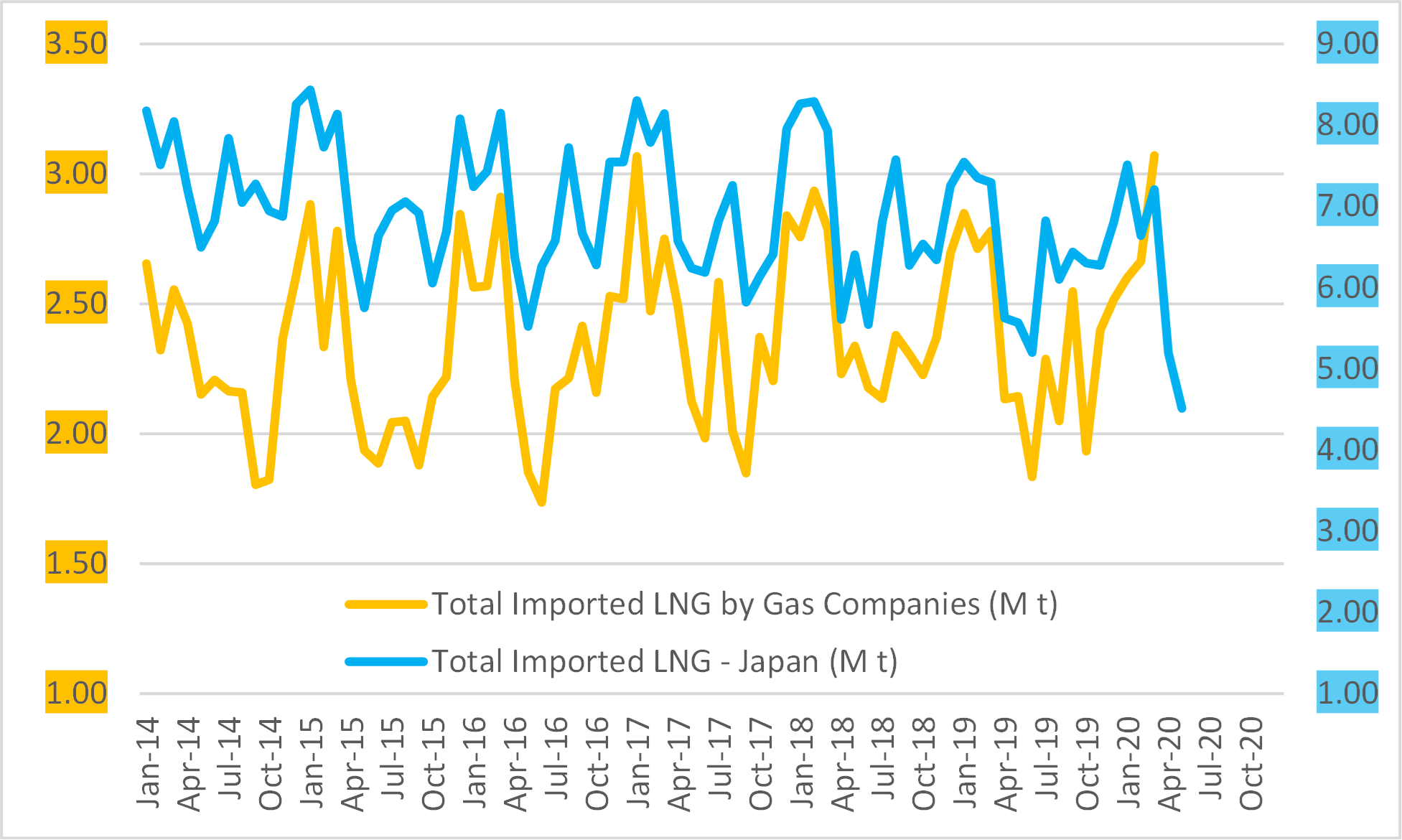
ELECTRICITY DATA
ANALYSIS
| COMMENT | Japan EPCOs slow LNG buying, seeking faster switch to nuclear |
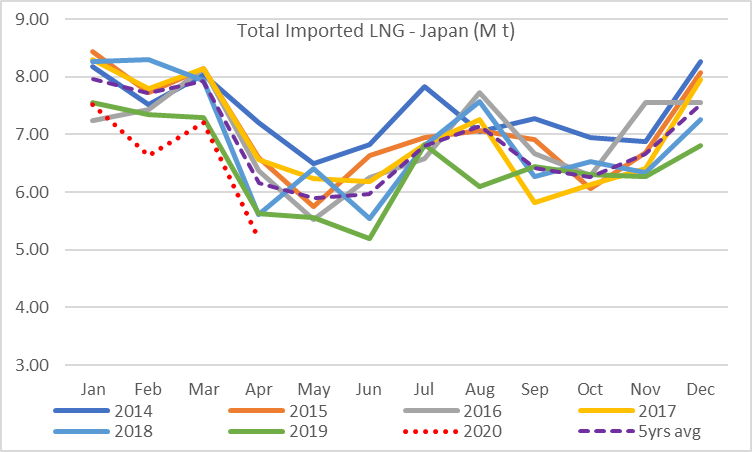
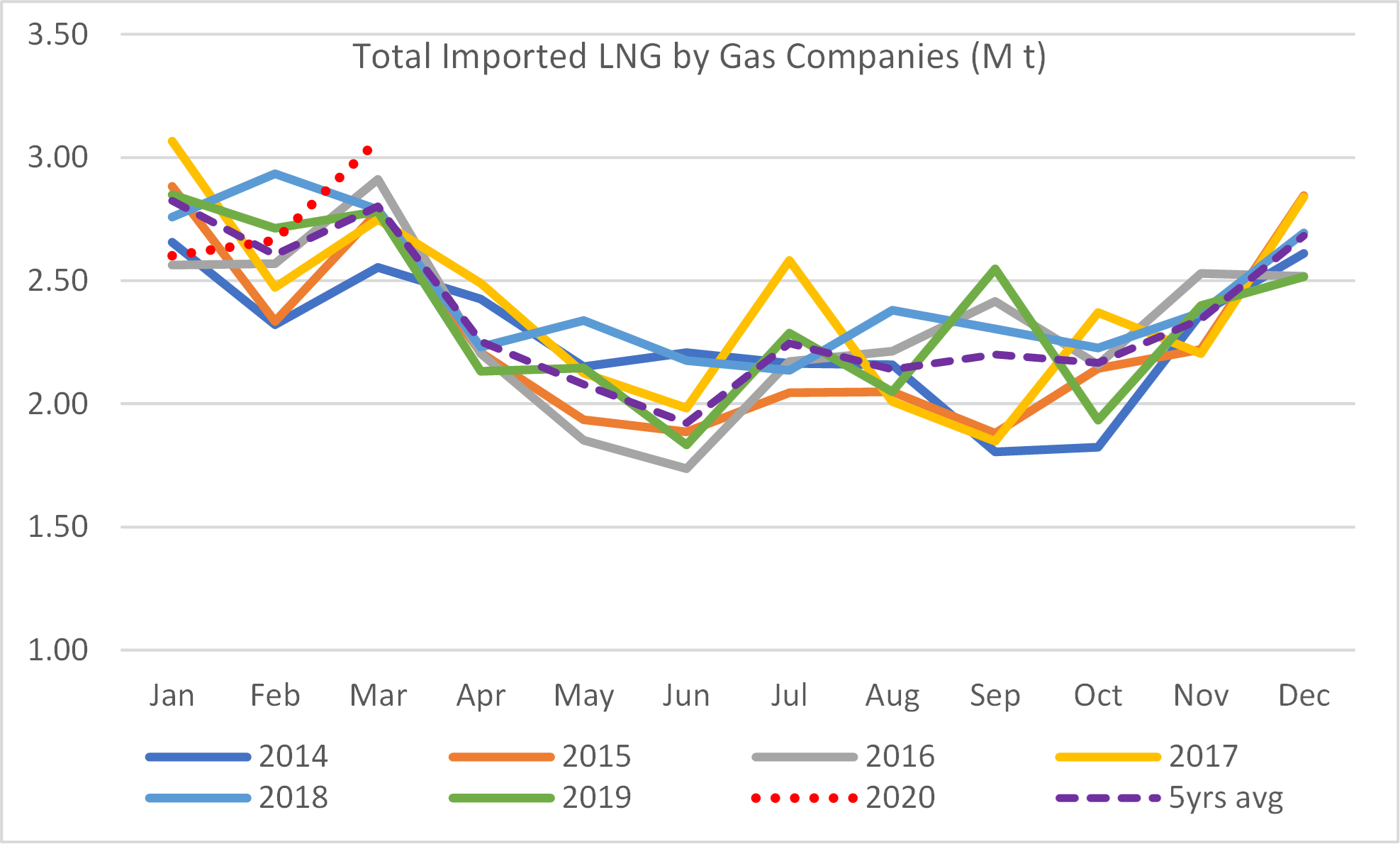
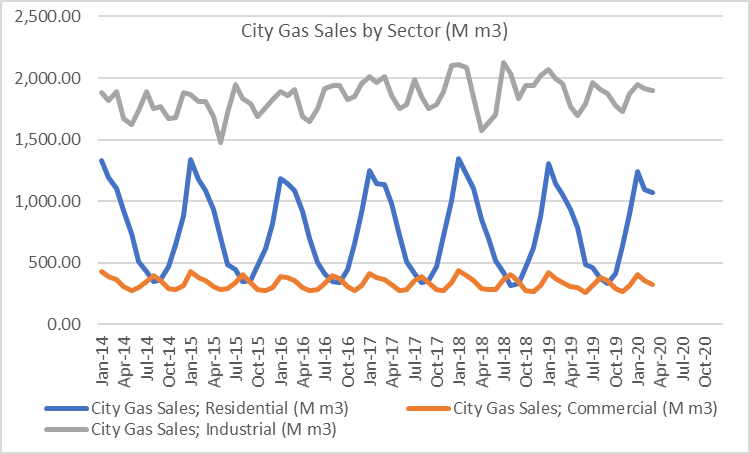
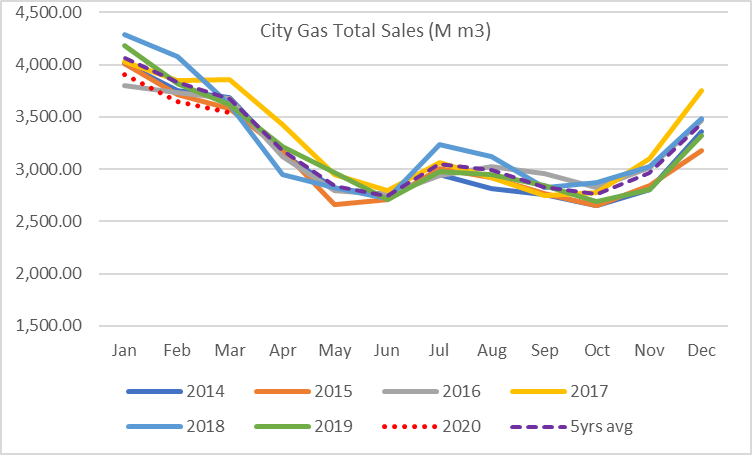
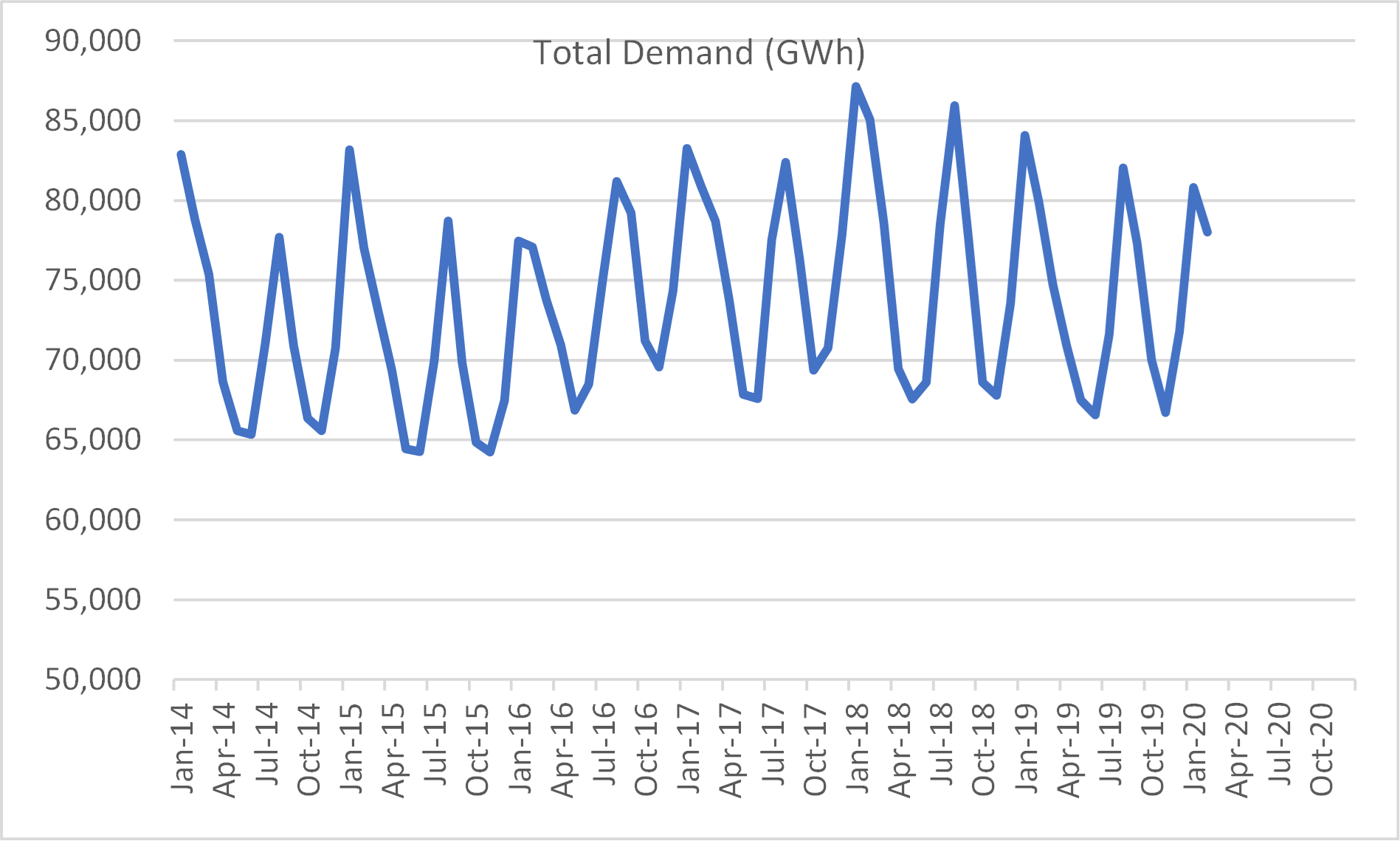
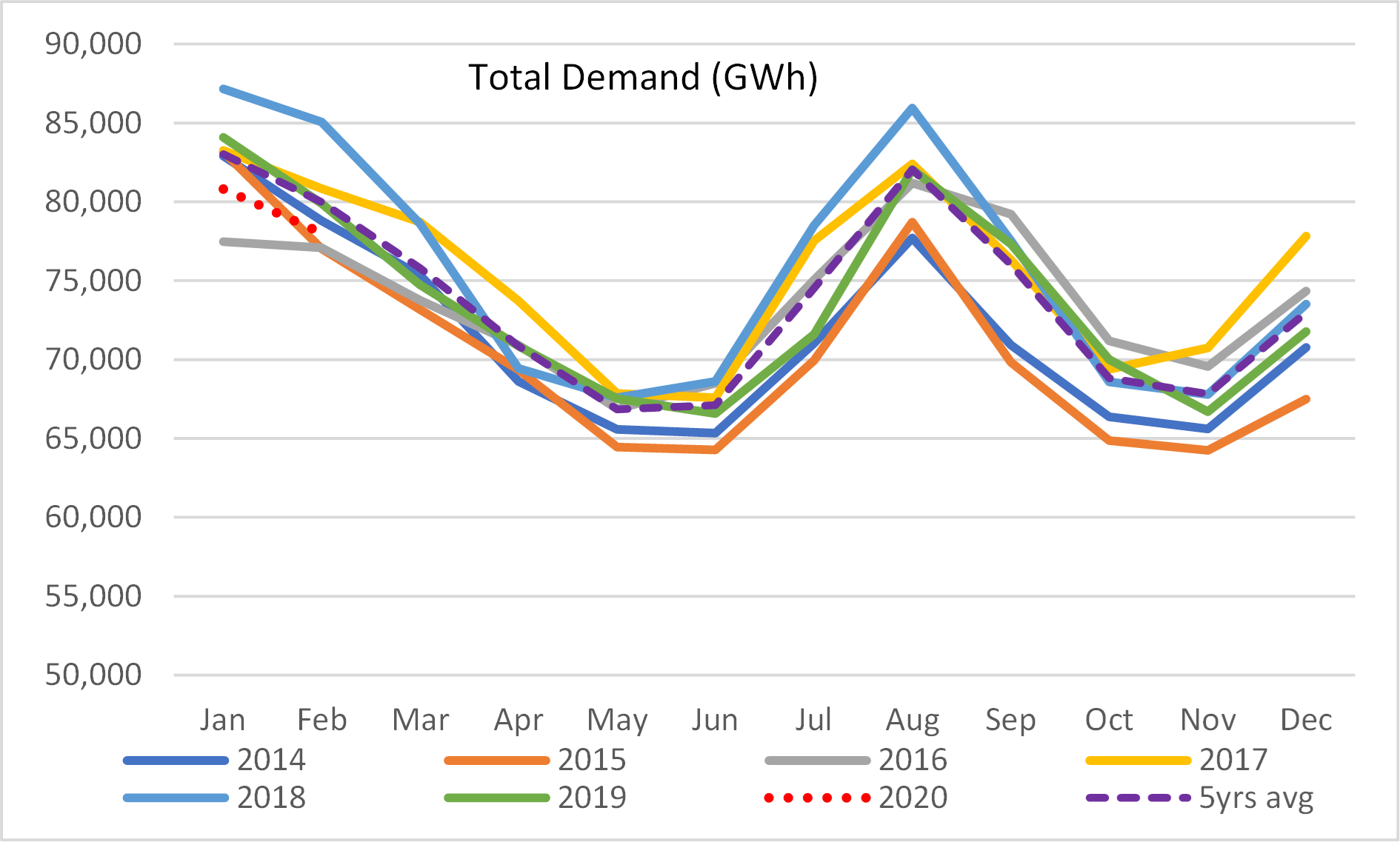
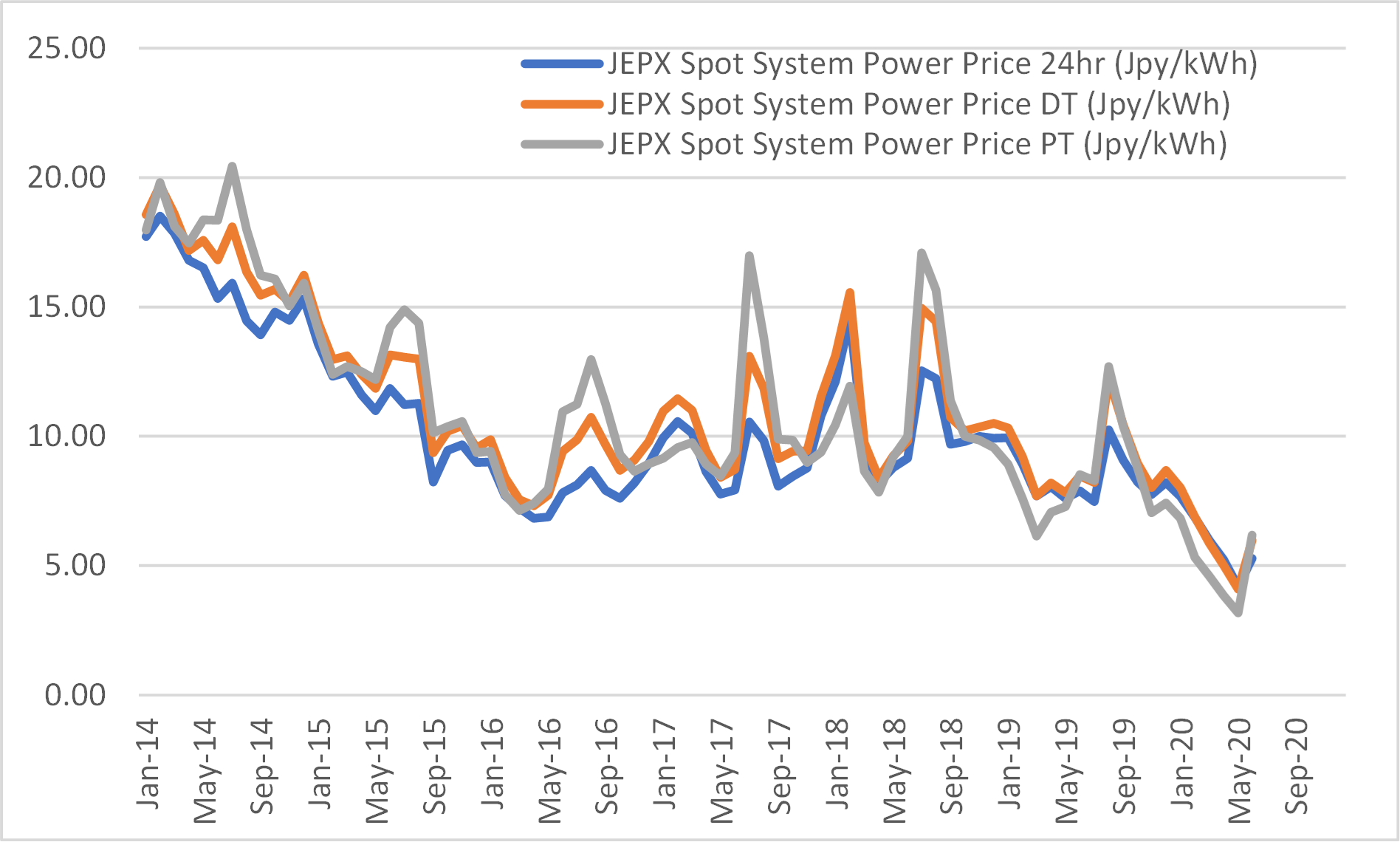
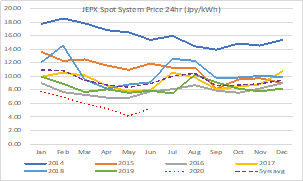
In early April, the Independent Commodity Intelligence Services (ICIS) released a report forecasting that Japan’s LNG imports will shrink 1.1% YoY to 76.2 million tons. That increasingly looks over-optimistic, as purchases by Japanese power utilities drop off a cliff. More than a straight response to lower demand due to coronavirus-induced “lockdowns,” the lower imports seem like an accelerating response to the longer-term goal of reducing LNG’s share of Japan’s energy mix. Japan’s total LNG imports in April fell 15.5% versus the average for the last 5 years. In May, there were down 23.4% vs 5y avg.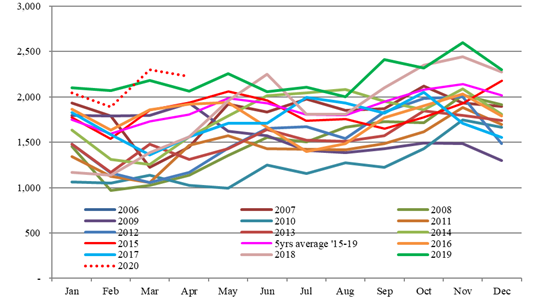 To be sure, Japan has slowly reduced purchases over the years, yet even in 2019, for 3 of the months import volumes punched above the 5y avg line. LNG use in April 2020 fell 6% from a year earlier, yet LPG usage and natural gas figures were up in the period. A milder winter in 2019/2020 helped gas inventories grow 6.7% in April, compared with a year earlier. Still, inventories are down from their Dec. 19 peak. Yet, the pullback in Japan’s LNG imports for April and May far exceeds the mitigating factors above.It also exceeds the demand drop from Japan’s industrial, commercial and residential users. While exact figures for domestic sales since April are not yet available, gas sales in 1Q of 2019 were close to their 5y avg and Japan’s industrial production was down just 9.8% MoM in April. 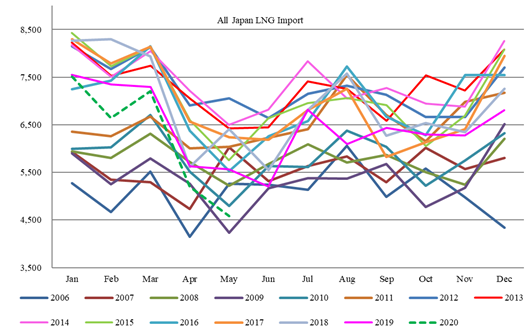 That indicates the biggest loss of interest in LNG volumes comes from Japan’s power utilities (the regional EPCOs). Again, data for total power demand after February is not yet available, yet there is an approximate picture in the power price trend. Comparing the monthly average JEPX spot price change from January to June over recent years, Japan’s 2020 LNG imports are already running at a pace of minus 6.9% YoY (based on Jan-May data, the latest available). An optimist might see Japan’s EPCOs opportunistically coming back into the LNG market later in the year, tempted by lower prices. One other way to view this is as an opportunistic move by EPCOs to revert to the strategy of scaling back Japan’s LNG interest over the 2020s. In 2017, LNG accounted for 39.5% of Japan’s power generation, according to OCCTO data. For 2030, the government wants LNG’s share to fall to 27%, making room for more nuclear generation. In times of great global upheavals, as this year, Japan remembers that it is extremely reliant on overseas fossil fuels for its energy needs and that thought brews concern. EPCO executives used the AGMs last week to talk up use of Japan’s nuclear power capacity, which has been mostly dormant since the 2011 accident at Fukushima Dai-Ichi station. Expect a stronger industry push to re-start idled nuclear stations in the next few years and for that LNG number to keep inching down. |
| CONTEXT | No. of major gasoline chain brands in Japan shrinks to 2 |
Idemitsu Kosan Co. and Showa Shell Sekiyu Co. agreed to merge in April 2019. Since then, the two companies have worked to unify crude purchasing and refining operating. Earlier this month announced a rebranding of the merged firm’s gas station brands to “apollostation”.
|