OIL
Defence Ministry purchases 770,000 kl of diesel via tender process (RIM Intelligence, July 10)
- The Ministry of Defense invited tenders for the supply of 770,000 kL of diesel for naval vessels over the 12 months from September. All tenders have now been filled.
- Most of the diesel will be supplied by Nakagawa Shoji.
- TAKEAWAY: The bids in some tenders were questionably low, as little as 42,000 yen per kilolitre.
ENEOS Holdings’ bonds rated AA- (Japan Credit Rating Agency, July 10)
- JCR rated ENEOS Holdings’ recent bond issues AA-.
- TAKEAWAY: JCR said it believes the profitability of oil and gas drilling is declining in real terms, and outlook for the sector as a whole remains bleak with falling demand and a slump in overseas petrochemical markets.
- SIDE DEVELOPMENT: Chubu Electric on July 9 sold 20 billion yen in 5-year bonds paying 0.12% annually.
Gasoline scandal focuses attention on high octane fuel (Best Car Web via Yahoo News, July 10)
- In the wake of revelations that competing gas station chains, while claiming that their high-octane fuels were unique, were in fact bartering fuel with each other and sharing storage tanks, public attention has focused on what exactly these fuels are, how they are different from regular gasoline and their benefits.
- While improvements to engine technology in the 1980s enabled good performance to be obtained with regular (91 octane) gasoline, in all driving conditions, some people opt for high octane fuels in the belief that it will improve uphill driving performance.
- TAKEAWAY: Refiners expended a lot of resources into marketing and differentiating their high-octane blends, but this scandal shows that sales of high-octane blends are falling and companies are struggling to maintain thier supply at a profit.
Researchers believe massive oil fields existed in Ibaraki (Ibaraki Shimbun via Yahoo News, July 9)
- A team of researchers at Ibaraki University says they believe the area was home to massive oil and gas deposits 70 million years ago. Based on an analysis of rocks found in the area, the researchers believe the region once contained nearly 100 billion cubic meters of gas deposits.
- Researchers say their find raises the chances of finding existing petrochemical deposits in the area
- TAKEAWAY: Japan may have its own hydrocarbon reserves after all.
Gasoline prices rise for eighth consecutive week (TBS News via Yahoo News, July 8)
- The Energy and Natural Resources Agency says the price of gasoline rose for the eighth consecutive week, as demand is expected to increase now that coronavirus restrictions have been lifted.
- Agreements among oil producing nations to cut production are also factors in the price rise.
- The Oil Information Center projects prices will continue to rise next week.
Petrolimex plans to buy Eneos stake frozen due to Vietnam political hiatus (Nikkei Shimbun, July 8)
- Eneos President Ota Katsuyuki says still ready to have state-owned Petrolimex, Vietnam’s top gasoline seller, buy a stake in the Japanese company. However, talks over the share purchase are stalled due to the political situation in Vietnam.
- CONTEXT: Eneos bought 6% of Petrolimex in 2016 and the Vietnamese side was due to reciprocate. However, there is uncertainty over the nation’s leadership as General Secretary Nguyen Phu Trong nears the end of his term and state firms who make a loss on investments have recently had government investigations opened into their operations, leading local management to grow more cautious.
GAS
Japan LNG buyers need more flexible price and destination terms in long-term contracts: JERA (Yuri Invest Research, 8 July)
- Coronavirus pandemic added to the demand uncertainty that Japanese city gas firms face since industry was deregulated and unbundled in last few years.
- The market’s prevalent long-term Sales and Purchase Agreements (SPAs), which tend to have rigid terms for pricing and where a cargo must be delivered are “no longer suitable” for Japan’s rapidly changing market, Nishizawa Hitoshi, senior executive officer at JERA, said during a session of the Japan Gas & LNG Virtual Summit on July 8.
- Japan LNG buyers want more flexible terms and “creativity” in pricing, Nishizawa said. The current gap between the long-term price and spot price is too great, he said.
- TAKEAWAY: Japan LNG buyers have prioritized security of supply above all else until now, but can no longer afford to secure LNG volumes at all cost. The ability to delay delivery or even re-sale of cargos becoming equally important for Japan buyers.
City of Osaka to broadcast emergency information on gas appliances (Nikkan Kogyo Shimbun, July 10)
- In a nationwide first, the city of Osaka says it will use speakers built into household gas appliances to make emergency broadcasts.
- The system will go live on August 19 and is being conducted in collaboration with Osaka gas. The emergency information will be broadcast in four languages.
POWER
JERA CEO welcomes Japan plan to phase out old coal-fired plants… (Japan Maritime, July 10)
… And vows to build new “more efficient” coal-fired plants (Mainichi Shimbun, July 10)
- JERA CEO Onoda Satoshi said he agrees that all coal-fired power stations not using Ultra Super Critical (USC) technology should be decommissioned. He welcomed the fact that the Ministry of Economy, Trade and Industry stipulated a specific deadline of 2030 for the decommissioning of inefficient coal-fired stations.
- Executive Director Okuta Hisahide said while old power stations offer a competitive advantage, they score very low points for environmental performance, and before the Ministry made its announcement JERA had already been mulling whether to keep the stations.
- Now, JERA will not spend money to maintain ageing plants, Okuta said. JERA has two inefficient coal-fired stations in Aichi prefecture.
- Instead, JERA intends to construct new, “more efficient” coal-fired stations, which will reduce CO2 emissions, CEO Onoda said at a press conference on July 9.
- TAKEAWAY: Japan’s new government policy on coal-fired generation follows the plans and actions of domestic utilities rather than leading them in a new direction.
Japanese government conditionally approves export of coal-fired power stations (Denki Shimbun, July 10)
- On July 9, the Japanese government announced a new strategy on the export of coal-fired generation technology.
- While the government will continue to support the export of Ultra Super Critical coal fired stations to those countries forced to rely on coal generation for reasons of energy security, on the condition that the countries in question have plans in place to reduce their reliance on fossil fuels.
- Japan will “generally” not support the export of coal-fired stations to countries with which Japan lacks a bilateral framework for the discussion of energy policy.
- TAKEAWAY: See Analysis section.
TEPCO: Journalist sues over alleged privacy breach (Teleview Fukushima via Yahoo News, July 8)
- A Fukushima journalist is suing the prefectural government for allegedly giving her name and personal details to TEPCO after she said she was investigating them.
- The incident occurred after the journalist submitted a request with the prefectural government to disclose information on reconstruction work performed at TEPCO’s J-Village facility.
- CONTEXT: While TEPCO-owned community facility J-Village is heralded by the authorities as an example of the region’s recovery, concerns remain about radiation levels in the area, and the effects of radiation on local flora and fauna as well as on residents who use the facility.
TEPCO considers sale of Grid and Energy Partner businesses as JERA IPO plans crumble, while cash needs remain (Zaiten, July issue)
- After the fanfare of appointing ex-Hitachi chairman Kawamura Takashi as their own chairman, TEPCO are waving goodbye to him as he failed to achieve very much in his 3 years. The co. is meanwhile facing serious issues.
- Kawamura’s goal was to re-start units 6 and 7 of Kashiwazaki Kariwa, the world’s largest nuclear power plant. Yet, communications with local officials have gone so badly that instead of that, the locals are asking for a speed-up of decommissioning of the station’s units 1-5.
- On top of the added financial pressures this creates, TEPCO is facing ballooning costs around decommissioning of the Fukushima nuclear station. The current estimate of 8 trillion yen will blow up further, says a person familiar with the situation.
- There’s no sign of a much-promised new business plan / strategy for TEPCO.
- A few years ago, METI parachuted their own Shimada Takashi into TEPCO to help plan a restructuring. Shimada tried to dilute allergies to TEPCO’s nuclear brand by bringing together TEPCO, Chubu Electric, Hitachi and Toshiba into a single venture that would spearhead nuclear power in Japan. Shimada hoped that the consortium approach would help get local approval for Kashiwazaki Kariwa restarts and move forward the stalled construction of the Higashidori nuclear plant in northern Japan.
- Hitachi and Chubu Electric fear that clubbing together with TEPCO might in some way get them involved in the problems around the Fukushima decommissioning (and compensation issue).
- Shimada then tried to engineer a quick listing of TEPCO-backed JERA venture (the JV between TEPCO and Chubu Electric). The fallout from the coronavirus pandemic has killed LNG prices and this leaves a JERA listing unrealistic in the near term.
- Plan B for raising funds to cover mounting Fukushima costs is to sell TEPCO’s grid and power retailing (TEPCO Energy Partner) businesses to other industry players and use taxpayer money. Tokyo Gas and JXTG (now ENEOS) are seen as potential buyers.
Sony ties up with Osaka Gas, CD Energy to create discount electricity plan for gamers (Denki Shimbun, July 10)
- Osaka Gas and CD Energy Direct have launched a new electricity plan for domestic consumers in collaboration with Sony Interactive Entertainment.
- The plan bundles online services for the Sony PlayStation with electricity payments, for a discounted rate.
KEPCO pledges to make improvements after bribery scandal (Kyoto Shimbun, July 10)
- Six KEPCO executives visited the Miyazu City Office to formally apologize to Mayor Kizaki Masafumi and explain measures the company was taking to improve compliance, which include increased emphasis on external watchdogs.
- CONTEXT: Miyazu City is situated near the Takahama nuclear power station that was the subject of the bribery allegations against KEPCO.
- TAKEAWAY: As the scandal continues to draw media attention, restarts of nuclear plants in Japan get delayed yet further. Fukui prefecture, which is in KEPCO’s catchment area, hosts more nuclear stations than any other prefecture in Japan.
SIDE DEVELOPMENT: Japan needs to consider a new energy mix (Nikkei Shimbun, July 10)
- Japan needs 30 nuclear units running to meet the govt.’s current 2030 energy mix target. But, only 9 have restarted.
- Current plans are relying heavily on fossil fuels, but as well as climate risks this carries supply risk due to geopolitical tensions.
JERA aims to sell debut corporate bonds as soon as this fiscal year (Denki Shimbun, July 10)
- Financing goals are part of process of JERA becoming independently managed from its joint owners TEPCO and Chubu Electric. In the next two years, JERA aims to stop relying on seconded staff from owner firms.
- Co. in June paid 27 billion yen in dividends to TEPCO and Chubu Electric for the first time.
COAL
OTHER
Japan to make renewed push in offshore wind with 3-4 projects approvals per year (Nikkei Shimbun, July 8)
- The Ministry of Economy, Trade and Industry, or METI, vows to approve about 1,000 MW of capacity a year from fiscal 2021. The idea is to have 3-4 projects approved a year and a total of 30 over a decade.
- CONTEXT: Japan currently has 4 sides generating offshore wind, the total capacity is just 20MW. After an operator is selected, it normally takes at least five years until commercial operations begin.
Chubu Electric and Mitsubishi Corporation mull 350MW offshore wind farm (Nikkan Kogyo Shimbun, July 10)
- Chubu Electric and Mitsubishi Corp.’s power unit began discussing a project to build an anchored offshore wind farm comprising up to 37 wind turbines off the coast of Chiba prefecture.
- Each wind unit would have an 8MW to 12MW capacity.
KEPCO to lease electric vehicles (Jiji, July 10)
- KEPCO has launched an electric vehicle lease service aimed at corporate clients.
- KEPCO will charge 105,000 yen per month for lease of an electric car and for the necessary charging accessories.
- TAKEAWAY: Major utilities like KEPCO seek marketing strategies to show that they are making effort to become more “green”.
Mitsui to promote zero emissions electricity (Nikkan Kogyo Shimbun, July 10)
- Mitsui & Co. has launched a zero-emissions electricity service.
- The service works by using carbon credits to offset CO2 emissions, and is compatible with the RE100 (100% renewable power) project being implemented overseas.
- All Mitsui’s Japanese offices are already supplied by zero-emissions electricity.
- CONTEXT: Mitsui is one of Japan’s largest general trading firms and one of the biggest energy investors outside of the utilities.
Just what is a carbon tax and how will it affect me? (Financial Field via Yahoo News, July 8)
- The Japanese government recently said it abandoned its goal of introducing a carbon tax by 2021/22.
- Since peaking in 2013, Japanese carbon dioxide emissions have decreased consistently.
- However, emissions by oil refineries and power stations are increasing.
- The proposed tax of ¥6,000 per metric ton of carbon translates into an increase in the price of gasoline by as much as 4 yen per litre.
- TAKEAWAY: The coronavirus pandemic is likely to delay carbon tax introduction even further than 21/22. In the meantime, to push through some form of decarbonisation, the government will need to think of consumer-driven incentives to stimulate a switch to lower-carbon vehicles and appliances.
Sale of remote island to Japan’s Defense Ministry may signal plan to use it as site for contaminated water and soil from Fukushima (ZAITEN, July Issue)
- Last November, Ministry of Defense bought most of Mageshima island, in southern Japan, for 16 billion yen from Taston Airport, a Tokyo-based development company.
- Taston president, Tateishi Isao, formerly touted a plan to ship all the contaminated soil and water from around Fukushima nuclear station to a remote island, which could be fitted with a waste processing plant. Before, Tateishi suggested to do this on Minamitori island, and then dispose of the waste deep under the sea.
- There is currently no solution for where to dump this waste, but the Mageshima island sale may suggest Tateishi’s proposal is starting to gain traction.
Kansai Electric agrees to buy 48.5% interest in Texas Wind Farm Operator (Kansai Electric press release, July 10)
- KEPCO buys into Aviator Wind Holding, owner of 525MW, 191-wind-turbine project that will begin commercial operations in August
- CONTEXT: Aviator is Kansai Electric’s first renewable energy investment in the US
ANALYSIS 1
LNG wins more fans in Japan for security of supply during Covid-19 lockdowns
Last week saw the first virtual (online-only) hosting of the Japan LNG & Gas Summit. Hosted by DMG with support from Japan’s METI the conference, which was one of the first to re-connected the industry since the COVID-19 outbreak. Below is a summary of some of the conference highlights.
Takeshi Soda
Director, Oil & Gas Division Ministry of Economy, Trade & Industry (METI), Japan
- “In the face of the enormous impact of COVID-19, it has been proven that LNG is the most reliable energy source for Japan. Even in the midst of COVID disaster, the supply of LNG has not been disrupted.” Soda said this shows the resilience of the LNG network.
- Japan is working on creating a very liquid LNG market in Asia. “This would ultimately lead to a stable supply in Japan.”
- While Japan recognizes a rising global commitment to decarbonation and climate change, “we should also support electricity to rural areas” with sustainable and affordable power.
- CONTEX: In this case “sustainable” is not referencing renewables. This is METI’s way to say that for countries that have ample and cheap coal resources, coal is the sustainable energy source.
- “LNG is the best partner for renewable energy.”
- “We should explore the possibility of using more eco-friendly LNG.”
- Japan is working on a new energy policy due in 2021
- “Our hope is for restarts of nuclear power plants.”
Hitoshi Nishizawa
JERA, Executive Officer, Senior Operating Officer, Optimization Dept.
- We may see some switching from coal to gas in Japan as a result of lower oil / LNG spot prices.
- LNG and large-scale renewables are “complementary”. JERA aims to be a leader in these two businesses in Asia.
- In city gas (in Japan), LNG used to be a base to mid power source, but now it is getting to be mid to peak as more renewables come in to the power mix. This means the traditional Asian T&C LNG contract is no longer suitable for the market. “We need creativity in the Term Price.” Given “increased volatility and disparity in the market… transactions should be mutually beneficial for sellers and buyers.”
- Japan buyers want LNG spot price reflected a bit more in the L-T prices “not for the opportunistic” money saving reason, but to help buyers navigate spikes or dips in demand within Japan.
- TAKEAWAY: If LNG contracts and pricing are more flexibility, Japan buyers would have more reason to lobby for an expanded use of LNG domestically.
- Current LNG prices are too low to draw investment for future projects, and “I don’t think it’s healthy”. A low $4 price would be fairer for buyers and sellers.
Ajay Singh
Founder & Director, Global Hydrogen Development, (Ex-JAPEX advisor)
- Green hydrogen becoming a realistic alternative energy option
- Companies will be taking decisions on commercial-scale green hydrogen projects within 5 years and realizing them within 8 years.
- Hydrogen development focused on achieving scale and bringing down the price, but application cases are already available as there are several hydrogen-fueled cars on the market, and there are even wind turbines that can be fueled with hydrogen
Jun Arima
Senior Policy Fellow on Energy & Environment, ERIA & Professor, Graduate School of Public Policy, University of Tokyo
- “ASEAN Countries will continue to rely on fossil fuels whether we like it or not.”
- In Asia, the competition for LNG comes from coal, not from renewables, as is the case in Europe. LNG needs more flexible contracts, pricing formula, and innovation in various parts of the LNG chain, including cheaper liquefaction, to make it more cost competitive in Asia (vs coal).
- What could change the competitive field in Asia is a carbon price. However, that will push up prices in Asian countries and thus is very hard to introduce politically.
Gavin Thompson
Vice Chairman, Energy – Asia Pacific, Wood Mackenzie
- LNG industry needs to stay competitive to continue to attract investment and that will come from reducing the industry’s carbon footprint. “It’s very important the industry keeps pushing to reduce the carbon intensity of the process. The industry must remain investable. We must remain attractive.”
- Percentage of gas that gets converted into energy is still low. That should be a focus area for improvement.
- Blue hydrogen is a bridge to renewable tech.
ANALYSIS 2
Japan Coal Plant Exports: What Happened?
As we wrote in last week’s newsletter,
Japan’s support for coal-fired generation remains intact despite the government leaking news to local media about plans to shutter 100 old coal-fired stations.
This week saw a continuation in the government’s affirmation of coal stations via a new policy on exports.
Amid growing international pressure on Japan to quit the promotion of coal-fired generation,
Environment Minister Koizumi initiated a review of the coal-promotion policy at the start of 2020.
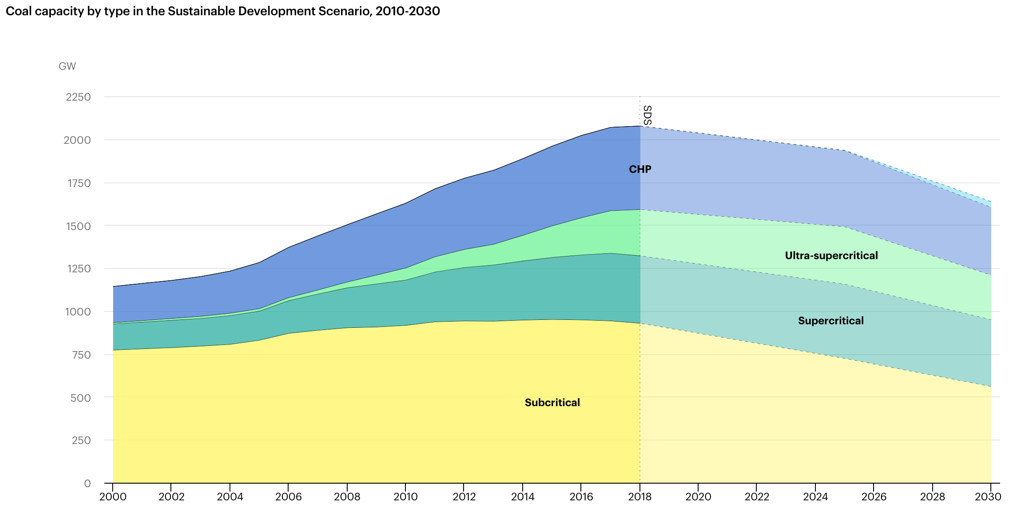
The review was completed recently and as a response to it the Ministry for Energy, Trade and Industry, or METI, released an updated policy that said Japan would only support exports of “efficient” coal-fired technology. Specifically, this referred to 43% efficiency or higher Ultra Super Critical coal-fired stations. METI presented this policy as a necessary lifeline for those economies that have no other choice but to burn coal.
Japan offers support for coal-fired tech by backstopping financing of overseas power plant projects that buy the Japanese coal-fired technology.
Incidentally, as noted by Bloomberg’s Stephen Stapczynski, the technology that Japan offers overseas is already at the 43% USC criteria specified by METI.
As numerous environmental commentators said, the new METI policy is not very new and keeps Japan’s commitment to coal-fired generation.
However, when thinking about why Japan remains wedded to coal and what it would take to change this approach a few factors need to be considered:
- Japan was one of the world’s top suppliers of nuclear power stations. The 2011 accident at the Fukushima Dai-Ichi plant, as well as rising competition from China, Korea and Russia have almost decimated the export potential for Japanese nuclear power technology.
- Like with nuclear, Japan has spent decades developing coal-burning generation technology and is one of the global leaders in carbon capture and storage and other coal-related tech. Who would compensate the sunk costs and where would these companies (and Japan as a whole) find replacement business lines?
- Japan lost out in the race to develop solar panels to China.
- Hitachi’s withdrawal from wind turbine business leaves Japan with just one main producer in the wind space: Mitsubishi Heavy Industries
- Japan has good geothermal plant designs, but this is a niche product that applies to a small number of geographies
- Japan’s most obvious export markets in Southeast Asia and India do not plan to give up on coal and are actually growing in its coal dependence.
- The types of power generation that are considered to be climate-friendly today may not be so in 10 years’ time, especially as more assessments of the materials used in making renewable energy equipment and the full-cycle emissions come to light. This makes it risky for Japan or any nation to switch all efforts to developing the renewable energy tech popular today.
Source: IEA
TAKEAWAY: While demand for coal-fired generation in Asia continues, it would be unrealistic to ask Japan to withdraw from meeting that demand, especially when it has invested so much time and money in developing the technology. Japan manufacturer will surely move to other power plant technology over time, but until they have viable commercial products in renewables, green hydrogen, or other climate-friendly tech, and there are sufficient buyers for these offerings, Japan’s government energy policy will not change. In Japan, policy tends to re-affirms the industry’s status and direction, rather than seek to disrupt it.