
JAPAN NRG WEEKLY
SEPTEMBER 28, 2020
JAPAN NRG WEEKLY
September 28, 2020
NEWS
TOP
- Japan Inc. signals the country is moving to zero-carbon goal as the Environment Ministry and top business lobby sign accord;
Ministry also pledges support for cities setting carbon-free targets - Tokyo Commodity Exchange to introduce LNG futures by 2022; move to create first yen-based LNG benchmark
- Japan leads global race in battery storage innovation via patents
- Amazing back-story of a bid to create Japan’s “Nuclear Waste Town”
OIL & GAS
- Major shift in power industry endangers Mitsubishi Corp.’s status
as King of Japan’s LNG - ENEOS acquires 1% in Vietnam’s Petrolimex for overseas growth
- COLUMN: The risks for Japan in moving away from fossil fuels
POWER & NUCLEAR
- Kansai Electric edges closer to restart of two more nuclear units; TEPCO gets ready to restart its first reactor since Fukushima
- Energy Agency to set criteria for coal-fired power plant closures,
as Mitsubishi Power withdraws from coal operations - Chubu Electric CEO sees Covid recovery taking up to 5years
- Kansai Electric brings in RITE, Kawasaki for carbon capture plan
- Hitachi exits major U.K. nuclear power project;
and puts aside USD100 million to bolster high-tension switching - Japan’s steel trade group asks for lower electricity prices
RENEWABLES, OTHER
- JERA establishes U.S. unit to seek out renewables projects
- Spain’s Iberdrola enters Japan market, buys Acacia Renewables
- Nippon TV gets embroiled in scandal over “fake” solar panels
- Marubeni, Chubu Electric join forces to build biomass plant
- Penta-Ocean to issue ¥10 billion in green bonds for offshore wind project financing
ANALYSIS
NEW PREMIER – SAME ENERGY POLICY? NOT QUITE. EXPECT FASTER RESOLUTION OF THORNY ISSUES.
On Sept. 16, Suga Yoshihide was appointed Japan’s 99th prime minister. As a close associate of his predecessor Abe Shinzo, PM Suga’s energy policies are unlikely to change significantly. However, we should expect faster resolution of some long-standing energy issues. China’s recent pledge to be carbon-neutral by 2060 has exposed even further Japan’s foot-dragging on decarbonization. Suga will need to double down on nuclear plant restarts or seek massive acceleration of offshore wind and hydrogen programs. Meanwhile, Japan’s energy firms will be looking for cues on the nature of the Japan-U.S. relationship before expanding bets on America’s “freedom” gas.
JAPAN EDGES TOWARD FINAL WIND PRICE MODEL; KEY PANEL SAYS EUROPE NOT BEST PRICE MARKER
A powerful government panel has recommended how to price offshore wind power in Japan. As the Minister of Economy, Trade and Industry and his senior officials prepare a final decision on the issue, the panel advised against setting one tariff level and instead urged to install a price cap that will slide over time. What’s more, the minister will be asked to disregard European wind project data as a benchmark. The wind market in Europe is already mature and the turbine efficiency rates there are unlikely to be immediately replicated in Japan. Instead, Japan should adopt a competitive pricing model that reflects its own market development.
HOUSE VIEW: Back to lockdown?
Only recently traders were getting excited about demand recovery in oil and gas prices as major buyers including Japan jumped back into those spot markets. Suddenly, most of Western Europe is discussing a return to lockdowns. The market reaction is likely to signal what happens to energy prices going into 2021.
EVENT INFO: Japan-Africa Forum
Details of the event co-organized by the NRG team.
NEWS: OIL & GAS
Tokyo Commodity Exchange aims to trade yen denominated LNG futures by 2022
(Sankei Biz, Sept. 17)
- Tokyo Commodity Exchange President Ishizaki Takashi told media that the bourse aims to commence trading in LNG futures as early as 2022.
- The move comes in response to calls from electricity generators for ways to hedge volatility risk. The futures contracts will stabilize price and earnings of power companies.
- The exchange started trialing an electricity futures contract in Sept. last year for a three-year period. Initially, just under 10 parties signed up to trade the contracts, but this has now risen to more than 45. A further 20 companies are considering registering to trade the electricity futures contract.
- The reason Japan’s major power utilities have hesitated over joining the power futures trading so far is the low creditworthiness of the entity handling the clearing of the contracts. The entity is a unit of the exchange. However, this issue was resolved in July this year through a merger with a large settlements agency, Ishizaki said.
- CONTEXT: The exchange, also known by its TOCOM acronym, is now one of two offering electricity futures in Japan. The other is EEX, or European Energy Exchange, Europe’s largest power bourse, which entered Japan with its electricity futures platform in May. However, there have not yet been any LNG futures contracts on Japanese markets.
- SIDE DEVELOPMENT:
Major shifts in power industry endangers Mitsubishi Corp’s status as King of Japan’s LNG
(Diamond online, Sept. 19)- Mitsuibishi has grown its LNG business so strongly thanks to close relations with power utilities that can be relied on to buy large quantities over a long time. Mitsubishi is involved in LNG projects that supply 55% of Japan’s imports of the fuel.
- This business model is being challenged as the major utilities no longer have a protected, dominant market position. Deregulation and the phase out of tariffs spells the end for utilities’ business model of passing on the LNG costs to consumers, which allowed Mitsubishi to book tidy profits along the way.
- Utilities will now start to look for shorter LNG supply contracts and a more diverse supplier network. Mitsubishi will not be able to rely on Japanese power companies and the Japan market alone for its resources business.
- This is why Mitsubishi partnered with Chubu Electric to buy Dutch power giant Eneco earlier this year for ¥500 billion (with the trading firm paying four-fifths of that). Mitsubishi wanted to tap into Eneco’s large renewables know-how.
- Eneco has lots of interesting projects in wind. Mitsubishi needs to learn quickly to make sure it can secure an alternative line of business as future profits from LNG may be under pressure.
TAKEAWAY: The introduction of LNG futures contracts could well be a pivotal event for Japan. It would create a public, yen-based price for LNG that potentially could serve as a benchmark for physical deliveries in the future. It would also arguably kick-start the process of making Japanese buyers more responsible for the price they pay for LNG. To date, the biggest buyers – the power utilities – simply passed on LNG costs to consumers via tariffs. Thus, their priority in negotiating LNG deals has always been stability of delivery, and not the price. That is likely to change. A deregulation of the Japanese power and gas markets in the last three-four years, and the impending expiration of the tariff system, will put the onus on utilities to be more sensitive to price when negotiating new LNG deals. Hedging price risk with derivatives will likely form part of the new approach.
TOCOM President Ishizaki suggested that utilities stayed away from trading power on the exchange due to credit issues in the clearing. That is very unlikely as the reason the big power companies stayed away. However, the fact that he said the situation is now “resolved” suggests utilities are willing to come to the trading table after struggling with the mass swings in costs and power demand during this pandemic-affected year. Importantly, TOCOM’s offering is that utilities will be able to trade both power and LNG contracts, thus potentially locking in costs and profits. Companies that do this well will also become much more attractive to stock investors.
ENEOS acquires 1% stake in Vietnam’s Petrolimex
(Vietjo, Sept. 22, 2020)
- ENEOS has acquired a 1% stake in Petrolimex, Vietnam’s largest petrochemical dealer. The shares were purchased between August 27 and September 14.
- Petrolimex sold 13 million treasury shares in the same period. It is likely that ENEOS was the buyer.
- CONTEXT: Petrolimex agreed to invest in ENEOS back in 2018 and established a JV with the Japanese oil refinery firm last year. This is part of a plan to develop a reciprocal business relationship under which the Vietnam company gets equity in the Japanese business, which in turn offers the Japanese firm sales channels in a growing market. ENEOS, then known as JX Nippon Oil & Energy, bought 8% of Petrolimex in 2016.
TAKEAWAY: As recently as July, ENEOS’s new president, Ota Katsuyuki, said he was waiting for Petrolimex to complete their equity investment in the Japanese company. Instead, it is ENEOS that has increased its stake in the Vietnamese partner. One issue for both sides is political uncertainty in Vietnam. The elite Politburo is due to meet in January 2021 to discuss who will be the nation’s leader. ENEOS may be trying to shore up its position in Vietnam as a kind of pledge of commitment to the authorities. With Japan’s petroleum market shrinking, ENEOS cannot afford to lose its standing in one of the best markets in Southeast Asia.
COLUMN: The risks to Japan in moving away from fossil fuels
(Nikkei, Sept. 23)
- CONTEXT: The author of this column is a regular Nikkei Shimbun contributor. Fujii Hideaki is Professor of Kyoto Sangyo University and a specialist in energy economics.
- When a country’s electricity network is split into generators and transmission service providers, the lack of central control can result in vulnerability.
- During Japan’s rapid growth period, oil was treated as a strategic resource. A network of domestic refineries and a stable supply of cheap crude ensured that supply was able to keep pace with variations in domestic demand.
- Electricity now represents around 30% of Japan’s energy use, and this figure is rising. If we are going to transition to a low-carbon society characterized by distributed supply networks, we need to be sure that we are able to procure critical components used in generation and transmission infrastructure.
TAKEAWAY: The key message here is that Japan needs to develop its own manufacturers of components for renewable energy if the country is to embrace more solar and wind power, among other green sources. A lack of own natural resources made Japan reliant on imports to meet energy needs. A transition to renewables will not ease that reliance and may even make it worse because China is the key supplier of solar panels and many other renewables components. With U.S.-China tensions already drawing battle lines in the tech sector, which prohibit some sales between Japanese and Chinese firms, the concern in Japan is that geopolitics could endanger its energy security. After all, the U.S. has already moved to ban the import of transformers and other grid components from countries it identifies as adversaries. If the U.S. asks allies to do the same, the risks associated with relying on Middle East hydrocarbons will pale in comparison.
NEWS: POWER & NUCLEAR
No. of operable nuclear reactors | 33 | |||
of which | applied for restart | 25 | ||
approved by regulator | 16 | |||
restarted | 9 | |||
in operation today | 3 | |||
| able to use MOX fuel | 4 | ||
No. of nuclear reactors under construction | 3 | |||
No. of reactors slated for decommissioning | 27 | |||
of which | competed work | 1 | ||
started process | 4 | |||
| yet to start / not known | 22 | ||
Source: JANSI and JAIF, as of Sept. 17, 2020
KEPCO aims for nuclear reactor restarts after safety improvements completed
(Nikkei, Various, Sept. 19)
- Kansai Electric (KEPCO) said on Sept. 18 that it had completed work to improve the safety of Unit 3 at the Mihama nuclear power plant (NPP) and Unit 1 at the Takahama NPP.
- The work was required to enable reactors to be used beyond the end of their 40-year license. The extension is for 20 years.
- KEPCO aims to restart the reactors between January and March of 2021, subject to an inspection by the nuclear regulator and an agreement with the local community. This would be the first time in Japan that reactors this old were restarted since the 2011 nuclear disaster.
- SIDE DEVELOPMENTS:
One year on from bribery scandal, rough road to redemption for KEPCO
(Nikkan Kogyo Shimbun, Sept. 25)- Sept. 27 marks one year from revelations that Kansai Electric (KEPCO) directors received secret payments – a scandal that has rocked the company.
- KEPCO’s response was to beef up governance and compliance protocols and shift to a corporate structure that makes it more difficult to engage in impropriety.
- KEPCO’s new CEO says in order to restore public confidence, the utility must increase dialogue between management and employees in order to bring the latter on board.
- The scandal has also impacted KEPCO’s nuclear ambitions. While four of the utility’s nuclear power stations are now running again, in order to restart the Mihama No. 3 and Takahama No. 1 reactors, KEPCO needs to obtain the consent of the communities around the plants.
- SIDE DEVELOPMENTS:
TEPCO almost ready to restart Kashiwazaki nuclear reactors
(NHK, Sept. 23, 2020)- On Sept. 23, the nuclear Regulation Authority approved a new safety protocol submitted by TEPCO that explicitly makes TEPCO and its executive responsible for any future nuclear accident.
- The Authority says the approval represents a major milestone in the process to restart Unit 7 of the Kashiwazaki Kariwa NPP.
TAKEAWAY: The longer a reactor sits idle, the harder it is to restart operations. This is true for all generation facilities, but especially true for NPPs. Both units in question are listed as having been offline since 2011, which means it will be almost a full decade since they last operated. What’s more, the units are two of the three oldest reactors in Japan’s operable nuclear fleet, aged 43 (Mihama-3) and 45 (Tahahama-1). As such, in addition to political and public pressures, KEPCO will need to navigate major manufacturing challenge. These restarts will be a test case in more ways than one.
The amazing back-story of the bid to create Japan’s “Nuclear Waste Town”
(FACTA, October 2020 edition)
- CONTEXT: Japan has not yet selected or even began the process of selecting a place to store its high-radioactive nuclear waste. Officials had hoped to attract municipalities to put their hand up for hosting rights with ever-increasing financial incentives. However, mayors who have suggested the idea publicly have tended to lose their next election.
- CONTEXT: This August, the town of Suttsu, on the northern island of Hokkaido, started the first stage of official discussions over whether to put itself forward as a host site. The bid is led by town mayor, Mr. Kataoka Haruo. Prefectural government of Hokkaido has already said it is completely opposed to the idea.
- Suttsu’s Mayor Kataoka is not new to the energy sector. He played a key role in establishing the country’s first wind farms operated by a local government. The Suttsu wind farm now runs 11 turbine units, generating some ¥700 million for the town from electricity sales. Mayor Kataoka also heads the wind-power industry bodies. He is chair of the National Council for Wind Power Generation Promotion. Mayor Kataoka’s lobbying efforts got the Suttsu wind facility to be included in the Feed-In Tariff (FIT) system.
- For some people around the mayor, his call for Suttsu to be host to the country’s long-term nuclear waste facility looks like “he has gone to the dark side.” A man with an impeccable reputation has “lost it.”
- The truth is much more complicated. Suttsu, like many rural areas in Japan, is struggling with finances. In 2015, Japan introduced a furusato nozei (“local tax donation”) system, which allows residents to select any locality in Japan to be the recipient of their local tax payment. Many rural areas seized on the scheme to offer payees their local food produce in return, as a gift. Suttsu offered seafood and saw its tax “donations” jump to ¥200 million in 2015 from ¥70,000 the previous year. By 2019, Suttsu tax revenue hit ¥1.1 billion.
- However, the tax scheme carries a high risk. Payees can easily switch to another locality the following year. Meanwhile, Suttsu’s revenue from wind-power sales is also due to drop as the FIT terms end and the system gets phased out.
- Suttsu plans to install two more wind turbines to prop up revenues. This will require several hundred million yen in initial investments.
- By applying for a government assessment of land suitability for the nuclear site, Suttsu can earn ¥1 billion in grants over a two-year period.
- The Nuclear Waste Management Organization of Japan (NUMO) raised the grant amount by almost five times in 2007. Despite this, there was only one known application, by the town of Toyocho. The application was subsequently cancelled when Toyocho mayor resigned in the face of fierce opposition.
- The position of Suttsu Mayor Kataoka may be stronger. He heads the town since 2001. Some locals decry him as a dictator, yet many also support his idea to invite the state assessment.
- Kataoka’s supporters say he is not only driven by money but a frustration at Japan’s lack of resolve to tack the nuclear power issue. He has, apparently, been calling for more progress on the issue for a while.
- Kataoka has also been diagnosed with lung cancer. Those close to him say he is driven by a civic duty to act on the important nuclear waste issue while he can.
- There are plenty of sceptics, however, suggesting that Kataoka is a pawn in the hands of METI, the powerful energy ministry. METI minister Kajiyama said in August that there are “several local governments in addition to Suttsu making inquiries with us.” This is likely a smoke screen to camouflage the main (and only) candidate: Suttsu.
Energy Agency to set efficiency targets for coal plant closures
(Denki Shimbun, Sept. 23)
- As momentum increases to phase out coal-fired power stations, the Agency for Natural Resources and Energy is currently determining the minimum efficiency targets that electricity generators will be required to meet by 2030.
- While the Agency’s recommendations previously took the form of non-binding guidance, with the transition to the new targets the Agency aims to introduce more binding regulations.
- The 2030 benchmarked targets include both efficiency targets for the individual fuel sources (41% for coal and 48% for LNG), and overall efficiency targets that each generator is required to meet.
- CONTEXT: The nature of these targets will effectively decide how many of Japan’s 140 coal-fired units will be asked to close. Initial reports in the Japanese media suggested that 114 units would need to shut, but METI declined to give a public figure.
- SIDE DEVELOPMENT:
Mitsubishi Power quietly shuts down coal operation
(Nikkei, Sept. 24) - Mitsubishi Power has stopped advocating for the construction of more efficient coal-fired power stations, and instead shifted its focus to maintenance services.
- The move comes as General Electric announced its withdrawal from the coal-fired electricity generation business. Siemens has already discontinued its coal-fired operations.
- While Mitsubishi Heavy Industries, the main player in Mitsubishi Power, currently derives the lion’s share of its electricity generation turnover from coal-fired technology, Mitsubishi Heavy is moving to a new business model amid a lackluster market for coal-fired stations in Southeast Asia.
Chubu Electric CEO sees post-Covid recovery taking 3-5 years; time of opportunities
(President, October 2)
- While Chubu Electric Power’s new CEO believes energy consumption is unlikely to return to pre-Covid levels in the coming three to five years, he says the social changes brought about by the pandemic represent business opportunities.
- The new CEO says Chubu is working to rapidly implement new business models that will allow it to provide services and business solutions for a post-Covid world. In July, the utility signed an agreement with a Keio University start-up that provides remote consultation services for obstetricians.
TAKEAWAY: In the summer, the leader of one of Japan’s biggest utilities saw demand bouncing back in a couple of years. Now, that the time-frame is seen as three to five years. Of course, no one knows how long the country will need for its economic recovery. Still, it’s interesting that the expectations are being lowered. What’s less clear is how Chubu and other EPCOs see their post-Covid future in a rapidly changing policy and business landscape.
KEPCO brings in RITE and Kawasaki Heavy for carbon capture scheme
(Denki Shimbun, Sept. 25)
- The Research Institute of Innovative Technology for the Earth says it has partnered with Kawasaki Heavy Industries on a carbon dioxide separation and recovery project at the Kansai Electric (KEPCO) coal-fired power station in Maizuru.
- An experimental carbon dioxide removal system is expected to remove 40 metric tons of CO2 from the that the 1.8 GW plant exhausts every day.
TAKEAWAY: Both the Maizuru coal units rank as ultra-supercriticial (USC), which should mean that they do not fall into the category of “inefficient” coal plants that Japan’s government plans to close on environment concerns. However, as well as this being a good test site for new carbon capture (CCUS) technologies, plant operator KEPCO will see this action as one more surety for continued operations at this large coal-fired station.
Steel trade group asks for lower electricity charges or changes to tax system
(JISF website, Sept. 17)
- In an official opinion, the Japan Iron and Steel Foundation has called on the government to reduce or abolish the fixed asset tax on depreciable assets, or to lower the country’s power tariffs, in order to make Japan’s steel industry more competitive.
- The opinion says the industry’s high costs, together with the reemergence of protectionist trade policies, a slowing Chinese economy and the coronavirus pandemic, make it difficult to compete globally.
- CONTEXT: The steel industry is one of the biggest power consumers.
Dark clouds over maintaining nuclear tech: Hitachi withdraws from UK nuclear project
(Nikkei Business; Sept. 23, 2020)
- CONTEXT: Hitachi Ltd. made a formal announcement that it will withdraw entirely from plans to build a new nuclear power plant in Wales, U.K. The project was frozen in January 2019 as the Japanese firm looked at ways to improve the station’s financing model. U.K. government proposals did not offer enough for Hitachi to go-ahead with the plans.
- For Hitachi, the timing for withdrawing from the UK nuclear project was perfect for avoiding public criticism, as the UK is in the midst of separating from the EU and the pandemic.
- Hitachi will discuss with the UK about handling the planned construction site and about Hitachi’s nuclear construction license.
- Hitachi has three new nuclear projects in Japan, and its focus is currently maintenance and inspection services in preparation to restart nuclear plants.
- A major problem for Hitachi is maintaining motivation in employees involved in this maintenance and inspection work.
- SIDE DEVELOPMENT:
Hitachi ABB Power Grids to bolster high-tension switching devices operation
(Denki Shimbun, Sept. 25)- Hitachi ABB Power Grids says it is investing 100 million US dollars in its Asian and Middle Eastern manufacturing and engineering centers. Both areas see growing demand for high tension switching devices.
- The corporation’s global engineering center in India plans to hire 250 more engineers by 2022.
NEWS: RENEWABLES & OTHERS
Environment Ministry and the Keidanren sign zero carbon agreement
(SankeiBiz, Sept. 25)
- Industry association Keidanren and the Ministry of the Environment have signed an agreement to work towards a zero-carbon economy.
- In a move calculated to send the rest of the world a message that Japan is a climate leader. The parties agreed to work towards an economy that produces zero net carbon dioxide emissions.
- While the bodies had already committed to increased adoption of renewables, as well as fuels that do not create carbon dioxide emissions, like hydrogen, the existing Japanese energy policy did not call for CO2 emissions to be eliminated altogether, and this had attracted criticism from Europe.
- CONTEXT: Keidanren is Japan’s top business lobby group and is essentially the main voice of big-business.
- SIDE DEVELOPMENTS:
Environment ministry to support local bodies that make “zero carbon” declaration
(Nikkan Kogyo Shimbun, Sept. 23)- The Environment Ministry has beefed up support offered to cities that promise to be at “zero carbon” by 2050. The ministry will give preferential treatment to the establishment of local power companies and other initiatives taken by these municipalities to meet that carbon-free pledge.
- After Environment Minister Koizumi Shinjiro recently called for more cities to commit to a carbon-free future, dozens of local authorities took up the challenge. The number of municipalities in Japan that have made a carbon-free declaration now stands at 153.
TAKEAWAY: For a detailed look at Japan’s predicaments in balancing climate change pledges with energy security, and how that may change with the arrival of a new prime minister, please see the top feature in our analysis section.
JERA to establish U.S. subsidiary to seek out renewables projects
(Denki Shimbun, Sept. 18)
- JERA has established a U.S.-based subsidiary, staffed by six American business development experts that will not only seek out prospective acquisition targets but also initiate development projects.
- The entity is currently focused on solar and wind projects in the western and central U.S.
- Because of increased interest in America for investing in renewable energy, it is becoming more expensive to acquire existing generation plants. JERA decided that building generation facilities from scratch offered greater flexibility and was more cost-effective.
- SIDE DEVELOPMENT:
Mitsui invests in Morocco wind power project (Mitsui Press Release, Sept. 9)- France’s EDF and trading house Mitsui started construction of the first phase of a wind farm in northern Morocco. The Taza project will feature 27 turbines and have initial capacity of 87.2 MW.
- Operations start in 2022 and there is a 20-year power purchase contract with the local utility and state agencies.
- Japan Bank for International Cooperation and private Japanese banks will provide project finance. Mitsui will take a 40% stake in the project.
TAKEAWAY: As profiled in the Aug. 24 edition of Japan NRG Weekly, JERA is the new energy colossus in Japan, born in as a 50/50 joint venture between Chubu Electric and Tokyo Electric (TEPCO) to create a separate thermal power generation operating conglomerate. The nature of its formation means it has little green energy in its portfolio. Yet, it seems that JERA’s directors plan to change this. The company has made a series of small investments in wind and solar abroad that span India, Thailand, Taiwan and the U.K. Now JERA declares that the build-out of “large-scale renewable energy” projects, especially offshore wind, is one of its two main business goals; the other is further LNG development. In August, JERA appointed former NRG Energy CEO David Crane to its Board of Directors. Mr. Crane is famous for turning coal-heavy NRG Energy to more green businesses, such as solar, and he is a self-confessed renewables evangelist. Putting this all together, it seems that JERA is quietly undergoing its own energy transition.
Japan leads battery tech race with a third of global patent filings
(Nikkei Asia, Sept. 23, 2020)
- According to a joint study by the European Patent Office and the International Energy Agency, Japan produced international patent applications published in 2018 for 2,339 inventions related to batteries—that’s almost twice as much as second-ranked South Korea’s 1,230.
- The study measured patent applications filed in two or more countries. Of these, 7,153 applications were for inventions related to electricity storage, up sharply from the 1,029 of 2000. Most of this activity was in batteries.
- Among battery cell patents, most of the innovation involved lithium-ion cells, used in mobile phones and notebook computers.
- The idea is that improved battery cells could allow electric vehicles to travel further on a single charge. Storage is also needed to balance out the power generation of intermittent renewables sources, such as solar and wind generation.
Iberdrola enters Japan market by acquiring Acacia Renewables
(NNA Europe, Sept. 18)
- Major Spanish electricity utility Iberdrola said on September 17 that it had acquired Japanese renewable project developer Acacia Renewables.
- The purchase was financed by the Green Investment Group, a subsidiary of the Australia’s Macquarie Group. Iberdrola and Macquarie would be equal partners in developing the Acacia portfolio.
- Iberdrola said it intends to use the acquisition to further development of offshore wind turbines.
- CONTEXT: Acacia Renewables has two offshore wind projects in the development stage, with a combined capacity of 1.2 GW. It has a further four projects in its pipeline, with a total capacity of 2.1 GW.
Nippon TV HD received ¥1 billion in FIT subsidies for “fake” solar panels
(Bunshun, Sept. 24 edition)
- CONTEXT: Nippon TV is one of the main broadcasters in Japan. In order to supplement dwindling ad revenue in television, it expanded into the solar power business around 2014. The TV firm’s solar business was subcontracted to Synergy Corporation, whose president is Mr. Hayatsu Ken.
- Nippon TV set up two solar power plants, one in Iwate and another in the Kumamoto prefecture. The plants won permits to operate a Feed-In Tariff that guarantees around ¥1 billion in revenue. The FIT contract is for 20 years.
- All steps of construction and certification were handled by Synergy Corp.
- Now, Synergy President Hayatsu claims that the solar panels installed at the Kumamoto plant are “fake,” because they are not the same as the equipment that was described in documents sent to the government for permit approval. Some of the panels at the Kumamoto plant were originally ordered for a different project that Nippon TV later canceled. Rather than waste the panels, 4 MW of panel capacity was redirected to Kumamoto, but not declared to METI. The equipment was moved with “fake labels”, according to Mr. Hayatsu.
- Nippon TV claims they were not aware of the issue. Mr. Hayatsu claims he tried to let them know several times.
- Nippon TV has been asked by the authorities to explain the matter. The company says it is investigating the issue. If the documentation is found to be incorrect, the projects could lose their FIT contracts.
TAKEAWAY: In recent months there have been more and more articles in the Japanese media about problems local authorities or operators have faced in the solar power industry. After years of strong public support, the critical voices are rising. With so much top government focus on offshore wind, and issues around financing for new solar projects still unresolved, as reported in the Aug. 3 edition of the Japan NRG Weekly, some solar developers feel the industry is going through a difficult patch.
Marubeni and Chubu Electric to build biomass-fired power station
(Morningstar, Sept. 25)
- Marubeni and Chubu Electric Power say they have established a special purpose company with the aim of constructing a biomass fired power station in Gifu prefecture.
- The station, which will primarily burn locally felled timber, will have an output of 7.5 MW.
Penta-Ocean to issue 10 billion yen of green bonds to finance offshore wind projects
(Kankyo Business Online, Sept. 10)
- Penta-Ocean Construction said on September 8 it would raise ¥10 billion through an issue of five-year “green” bonds.
- Revenue from the bond issue will be used to finance construction of self- elevating platforms used to erect wind turbines.
- The bonds are scheduled to become available in October.
ANALYSIS
TOM O’SULLIVAN,
DIRECTOR,
K.K. MATHYOS
New Premier – Same Energy Policies? Not Quite.
Expect Faster Resolution of Thorny Energy Issues.
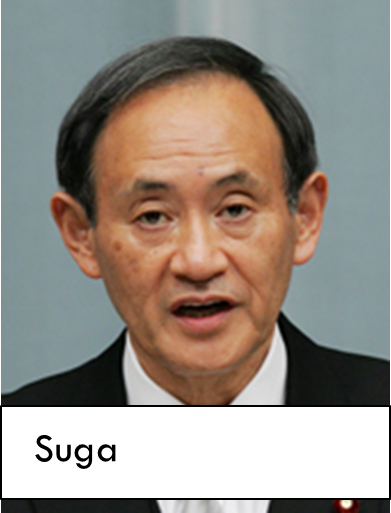
On Sept. 16, Suga Yoshihide was appointed Japan’s 99th prime minister. As a close associate of predecessor Abe Shinzo, PM Suga’s energy policies are unlikely to change significantly. However, we should expect faster resolution of long-standing energy challenges.
China’s recent pledge to be carbon-neutral by 2060 has exposed even further Japan’s foot-dragging on decarbonization. Suga will need to double down on nuclear plant restarts or seek massive acceleration of offshore wind and hydrogen programs. Meanwhile, Japan’s energy firms will be looking for cues on the developing nature of the Japan-U.S. relationship before expanding their bets on America’s “freedom” gas.
Suga, 71, was the longest serving chief cabinet secretary in Japanese history prior to taking over as premier. He is seen as a deft administrator after climbing the totem pole despite not having any political ancestry, as is traditional in the case of almost all Japanese leaders. Suga hails from a farming family in one of Japan’s poorest prefectures, Akita. As such, he is acutely aware of the severe economic decline in much of Japan outside large metropolitan areas. He is also aware that expensive energy prices have contributed to this decline in rural Japan.
As premier, Suga’s few declared policy initiatives so far have focused on reducing costs for general consumers. That is not a usual path for top Japanese politicians, who tend to favor big business interests. Suga has immediately zeroed in on the need to cut mobile phone charges, and not by a little. Shares of mobile operators predictably fell.
Suga’s approach to electricity prices may be similar.
As a whole, Suga’s approach seems to be about removing administrative inefficiencies and improving the speed of action. For example, he has committed to an overhaul of the bureaucracy’s digital platforms. High voter dissatisfaction with the government’s Covid response is correlated with the slow handout of state subsidies. This factor seriously hurt the popular standing of PM Abe.
Suga’s challenges in energy, however, may be among his toughest.
Japan is the most exposed G7 country in terms of external energy dependencies in what is becoming one of the tensest geopolitical regions in the world. Japan spends over $300 billion per year in importing oil, natural gas, and coal, which now represents over 5% of GDP.
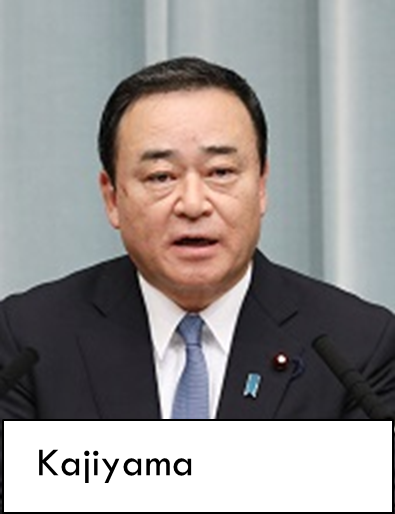
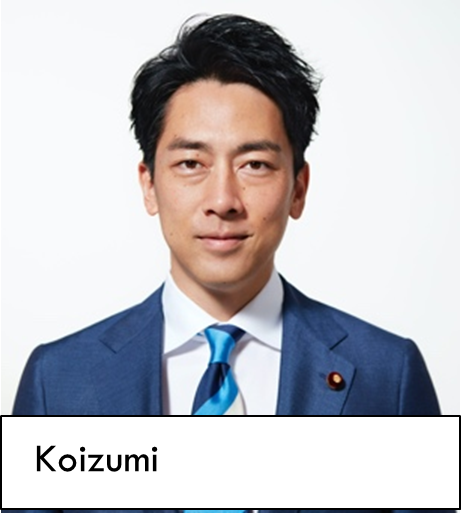
In his first cabinet Suga left Kajiyama Hiroshi in charge of the Ministry of Economy Trade and Industry (METI), which is the core ministry responsible for energy policies. Koizumi Shinjiro was retained as the Ministry of the Environment (MoE), the second most influential post in the energy and climate portfolio.
Koizumi, 39, is the son of a former prime minister, a ministerial novice, and may not have the full confidence of Suga. Also, Koizumi’s contributions to Japan’s environmental policies have so far been mostly derided. However, he is popular with the public and could be an important asset if Suga decides to push through a snap general election in 2020. Speculation is rife that Suga could call for a vote in October or November to secure a longer mandate.
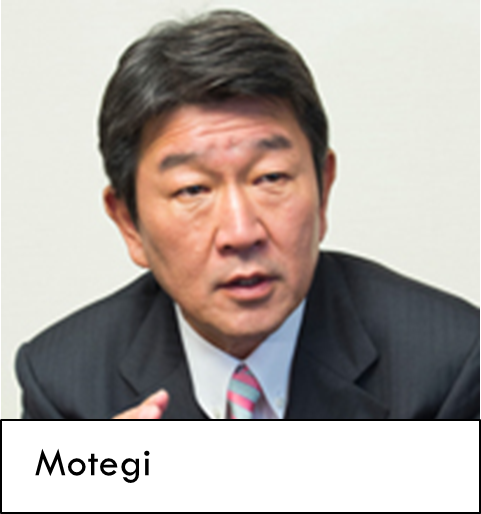
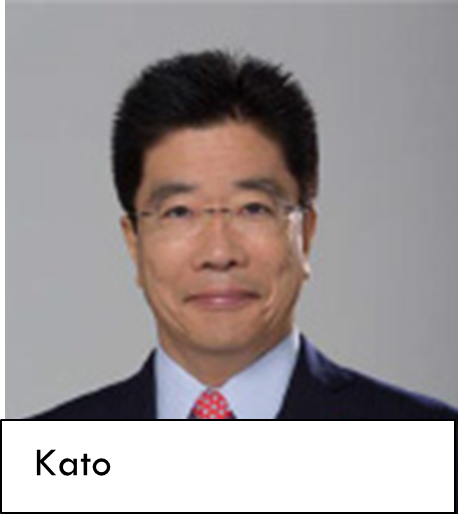
Suga also retained Motegi Toshimitsu as foreign minister. Motegi is a former METI minister who recently negotiated a trade agreement with the UK, which is expected to be approved by the Japanese parliament in late October. Motegi is expected to be a very influential figure in the Suga cabinet as well as Chief Cabinet Secretary Kato Katsunobu.
SEIZING CONTROL OF THE BUREAUCRACY
One of Suga’s earliest initiatives was to clip the wings of METI bureaucrats. Suga will lessen the remits and responsibilities of METI and rotate key personnel there. One casualty was the powerful Imai Takaya, who rose through the ranks at METI to become an executive secretary to PM Abe and one of his closest aides.
Imai was in charge of accelerating plans to restart nuclear reactors and also had ambitions to restructure the dominant regional power companies (EPCOs), fostering mergers on the weaker players.
One likely scenario of how this will happen is a broader restart of nuclear reactors in Japan. There are 33 units approved as operable and only nine restarted. To reach the government’s 2030 energy mix target, in which nuclear is supposed to account for 22% of electricity generation, Japan must restart another 10 to 15 reactors.
Suga will also need to deftly manage decommissioning of the stricken Fukushima nuclear plant, a multi-decade, half-a-trillion-dollar operation that is also a thorny political issue. Suga made a point of visiting the Fukushima facility, heavily damaged during the 2011 earthquake and tsunami, just 10 days after taking office.
Retiring nuclear point-man Imai does not mean Suga will steer Japan away from nuclear power. It looks more like a criticism of how little Imai achieved in the field. Japan currently has only four nuclear units in active operation, which generate less than 2% of the country’s electricity. The equivalent numbers in the U.S. and France are over 20% and 50% respectively. South Korea has over 20 operating nuclear reactors and of one of the cheapest electricity rates in the world. Japan’s electricity rates, however, are among the world’s most expensive.
WARMER ON RENEWABLES, BUT CAUTIOUS
Japan under Suga may also be a boon for certain types of renewable energy, especially offshore wind. A recent METI price guidance for offshore wind projects in Japan offered a ceiling of ¥29/kWh. That’s two to three times higher than tariffs in Europe, even if industry backers say that setting up wind stations in Japan is more costly at this stage.
Hydrogen development would be another area to watch under Suga. Japan has set up the world’s biggest renewable energy-powered hydrogen production facility. The 10 MW unit is located in Fukushima as the prefecture seeks to promote renewable power development.
Next year Japan is expected to announce an updated energy plan that will target Japan’s medium and long-term energy mix including contributions by nuclear, coal, and LNG. That would be a prequel to Japan’s appearance at the COP-26 climate policy meeting in Glasgow in Nov. 2021. For decades, Japan was among the leaders in climate policies. In the last 10 years, struggling to confirm its long-term energy course post Fukushima, Japan’s waning contributions to climate policies have raised concern.
Meanwhile, President Xi Jinping recently announced that China would become carbon neutral by 2060, and that the world’s largest emitter would achieve peak emissions by 2030. Japan has yet to make a similar commitment. Should the U.S. president change after the November election, Suga will be under even more pressure to act.
Unlike their peers in western Europe, many Japan energy experts feel reticent about a strong move toward renewable energy. The intermittency of solar and wind does not square with Japan’s demand for stable power systems. The country is also one of the world’s top importers and consumers of fossil fuels – for power, refining, and its industrial complex.
In contrast, Japan’s supply chains in solar and wind are highly dependent on imports.
Any energy transition in Japan will be highly dependent on energy security. It’s no surprise that one of the first calls Suga made after his appointment was to UN Secretary General Guterres. Japan is seeking a permanent seat on the UN Security Council.
The UN secretary general will be one of the parties pressuring Suga to accelerate the country’s Paris Agreement commitments. At the UNGA last week Guterres stressed the need for all countries to commit to carbon neutrality by 2050. He also called for a moratorium on public funding of coal-powered plants (an area both Japan and China are heavily involved in) and to boost funding for renewables.
How Suga will proceed in positioning Japan’s energy and climate policies may become clearer at upcoming G7 and G20 meetings. The chair of the latter will be Saudi Arabia, which is also Japan’s top oil supplier.
How much Japan eases away from hydrocarbons, and the extent of the role given to nuclear and renewable energy is not yet clear. But one fact is certain – Suga must make major decisions within the next year and what he decides will determine Japan’s energy course for the next half century.
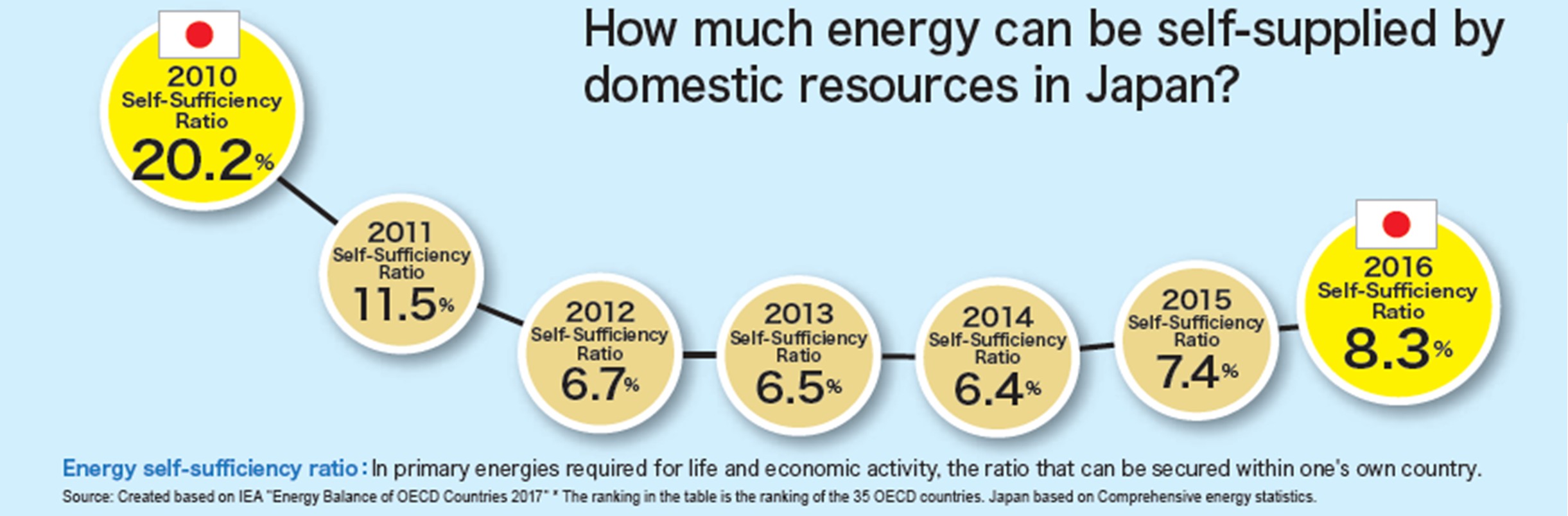
Source: METI energy statistics report 2017
ANALYSIS
MAYUMI WATANABE,
RESEARCHER,
YURI INVEST RESEARCH
Japan Edges Towards Final Wind Price Model;
Key Panel Says Europe Not Best Price Marker
A powerful government panel has made its final recommendations for the pricing of offshore wind power in Japan. As the Minister of Economy, Trade and Industry and his senior officials prepare a final decision on the issue, they will be advised against setting one tariff level and instead urged to install a price cap that will slide over time.
What’s more, the minister will be asked to disregard European wind project data as a benchmark. The wind market in Europe is already mature and turbine efficiency rates there are unlikely to be immediately replicated in Japan. Instead, Japan should adopt a competitive pricing model that reflects its own market development.
Those were the key recommendations delivered to METI (the energy ministry) by a five-member tariff panel, chaired by Yamauchi Hirotaka, a professor at Hitotsubashi University. The panel is responsible for examining Feed-In Tariff (FIT) rates for renewable energy. Its latest meeting was concluded on Sept. 15.
The minister and senior METI officials are due to make their conclusion on offshore wind pricing before March 31, 2021. Several government committees and entities have examined the issue of electricity pricing for offshore wind projects, yet the panel chaired by Prof. Yamauchi arguably carries the most weight.
After the Fukushima nuclear accident in 2011, Japan has managed to triple its renewable energy capacity, spurred by the need to dial back from an increased reliance on fossil fuel imports and to cut emissions. The vast majority of Japan’s renewables capacity, however, is in solar. There’s been little progress with wind, geothermal, biomass and other alternative sources.
Wind power is Japan’s second smallest source of power after geothermal energy, comprising 0.8% of all power generated in fiscal 2019, according to the Institute of Sustainable Energy Policies.
Near all of Japan’s current wind capacity is onshore. The biggest potential for future harnessing of wind power, however, lies offshore, according to both the government and business outlook.
There are an estimated 50 to 100 offshore wind projects in Japan in various stages of planning, environmental assessment or construction. Of those, just 10 projects with a combined capacity of 668 MW were FIT-approved as of March 2020, according to METI. Nearly all “operating” projects have yet to generate electricity or get grid connection.
Among the front-runners in the sector is Tokyo Electric (TEPCO). In January 2019, the company’s offshore wind power station off the coast of Choshi, Chiba Prefecture, which was deployed for research in August 2009, became TEPCO’s first offshore wind power station to be put into commercial operation.
Key Assumptions from METI Panel Presentation
Item | Data | Notes |
Capital Costs | ¥267,000 / kW | Calculated from the formula of NEDO fixed floor offshore wind power generation cost survey. Capital costs do not include the portion of the connection costs that excludes the range from the wind turbine to the onshore substation. |
Operating and Maintenance Costs | ¥970,000 million / kW per year | Calculated from the formula of NEDO fixed floor offshore wind power generation cost survey. |
Decommissioning Costs | ¥56,000 / kW | Based on the idea that 70% of the project investment goes to construction costs, calculated from the formula of NEDO fixed floor offshore wind power generation cost survey. |
Operating Capacity | 33.2% | Based on a 100 m hub height, 7.56 m/s annual average wind speed, calculated using an operating rate of 95%, plus accounting for various losses (transmission loss 3.1%, wake loss 10.0%, other losses 3.0%). Calculated from the formula of NEDO fixed floor offshore wind power generation cost survey. |
Source: METI panel presentation documents
PRICING BATTLE
A law enacted in November 2018 sought to better outline the rules of engagement for offshore wind in Japan. The legislation stated that a sea area can be selected as a Promotion Zone, and an operator that wins a permit for a project inside the zone can exploit it for up to 30 years.
In July 2019, the Agency for Natural Resources and Energy, an entity under the METI umbrella, and the Ports and Harbours Bureau, which is under the Ministry of Land, Infrastructure, Transport and Tourism (MLIT), identified 11 areas as having “progressed to a certain level of preparations” to move forward with offshore wind projects. Of those, four were seen as particularly promising.
Once an area is deemed to be a Promotion Zone, project developers are invited to bid for the rights to work there via a public tender process.
The 2018 law also designated state-run New Energy and Industrial Technology Development Organization (NEDO) as the authority in charge of designing various cost and price calculation models. NEDO also reports to METI.
Last year, NEDO’s calculated an optimum tariff for fixed foundation offshore wind at ¥36/kWh (USD 34 cents/kWh). NEDO’s calculation was based on the European offshore wind market’s capital costs, running costs and run rate data. NEDO took into account local variables such as wind speed, water depth, distance from the shore, and estimated time taken to construct the facilities.
The five-person panel chaired by Prof. Yamauchi disagreed with NEDO’s methodology, calling the reliance on European figures questionable. For example, could Japanese projects hope to replicate in the near term the 95% run rate of European wind farms? Meanwhile, costs of running a wind farm in Japan are estimated to be 1.9 times higher than in Europe due to an undeveloped supply chain.
The panel also noted that pricing calculations should reflect fees wind farms pay to grid companies and a pre-tax internal rate of return (IRR) of 10%. These factors were apparently excluded in the NEDO methodology.
BUILDING WIND POWER SUPPLY CHAIN
To date, Japan has no manufacturer capable of assembling offshore wind power plant infrastructure and components are largely imported, according to a separate METI working group, which formed on Sept. 17 to promote offshore development.
While Japan’s offshore industry is still in its infancy, it also needs motivation to grow and seek efficiencies, Prof. Yamauchi’s panel said in its recommendations. That is best done with a price cap system, which would guide operators to improve their run rates and compete.
Japan’s limited track record in wind means the country does not have sufficient data and accurate enough calculations to suggest a single, fair power tariff, according to the panel.
Japan’s long-term goal is to bring down the cost of offshore wind power to ¥8-9/kWh. Using a price cap that reduces over time, market competition would allow the country to reach this goal, the panel said. This is based on data from the three new offshore projects, which all have 10 MW capacity and which operate in similar environments: wind speeds average at 7.5-7.62 meters/second, water depth at roughly 18-19 meters and deployed 6 kilometers from shore.
The proposed price cap took into account capital and operational costs, deeming the interconnection charges to be around ¥5,000/kW.
HOUSE VIEW
New Wave of Lockdowns and Turmoil
To Test Appetite for Energy in Post-Covid Era
Only recently traders were getting excited about demand recovery in oil and gas prices as major buyers including Japan jumped back into those spot markets. Suddenly, most of Western Europe is discussing a return to lockdowns with strong government calls for another wave of constraints on movement. In the U.S., the top Covid specialist Dr. Anthony Fauci says the country is not even out of the first wave.
While the Covid situation in most parts of Asia and in Japan is deemed to be less severe, full or partial lockdowns in Europe will almost certainly hurt export-driven Asian economies. Few more so than Japan, which saw its economy contracting an annualized 28.1% in Q2.
This year’s restricted international travel — including access to/from Japan — is already impeding commerce and slowing down M&A and other financial activity. Toshiba on Sept 27 postponed plans to conduct an IPO of its semiconductor business, due in October. Some international airlines are now talking about a recovery period of as much as a decade to get back to the travel volumes of 2019, which is pushing oil prices back to the USD40 a barrel level.
American Airlines announces plans to cut more than 40,000 jobs, including 19,000 through furloughs and layoffs, in October. Japan’s flagship carrier ANA Holdings, which as recently as late June told shareholders it had “no problems with financing for the time being,” is reported to be mulling a ¥200 billion share sale to raise more capital.
Barring a miracle, it seems likely that major economic and social disruptions will continue at least for another six to eight months. How energy markets and major buyers like Japan react to the latest set of Covid disruptions will indicate whether prices plummet again or retain some measure of balance going into 2021.
NRG EVENTS
The Japan-Africa Forum
Hosted on Sept. 15, at the FCCJ in Tokyo
NRG co-organized, moderated and presented at a forum on Africa at the Foreign Correspondents Club in Japan on Sept. 15.
NRG made a presentation on recent developments in Africa around oil, gas, and electricity, as well as Japan’s engagement in these various projects on the continent, including the recent LNG investment in Mozambique.
Four African ambassadors attended the forum including the Dean and Vice-Dean of the African Diplomatic Corps in Tokyo. The ambassadors in attendance were:
- Ambassador Estifanos Afeworki of Eritrea and Dean of the African Diplomatic Corps;
- Ambassador Ahmed Araita Ali of Djibouti and Vice-Dean of African Diplomatic Corps;
- Ambassador Mohamed Elloumi of Tunisia; and
- Ambassador Blamoh Nelson of Liberia.
Four other African countries were also represented: the Democratic Republic of Congo, Morocco, Togo, and Uganda.
Professor Sadaharu Kataoka of Waseda University and Ms. Sayoko Uesu of Graduate Research Institute for Policy Studies also presented on the security situation in the Sahel.
The forum included participants from six OECD embassies: the United States, Canada, Brazil, Hungary, Italy and Ireland. Mr. Kazuya Takahashi of Japan’s Ministry of Foreign Affairs also attended.
The private sector was also well represented with representation from oil and gas and electricity industries.
A copy of the NRG presentation on energy developments in Africa is available to subscribers on request.
STOCK MARKET PERFORMANCE
| As of close on September 25, 2020 | Ticker | Market Cap | 1W (%) | MTD (%) | YTD (%) |
billions of yen | ||||||
Energy | ||||||
INPEX CORP | 1605 JP | 833.38 | -5.32 | -48.94 | -12.97 | |
JAPAN PETROLEUM EXPL. | 1662 JP | 94.65 | -7.07 | -43.18 | -8.36 | |
ENEOS HOLDINGS INC | 5020 JP | 1275.96 | -1.25 | -18.29 | -4.36 | |
IDEMITSU KOSAN CO LTD | 5019 JP | 700.58 | -3.05 | -19.87 | 1.77 | |
COSMO ENERGY HOLD. | 5021 JP | 130.72 | -5.75 | -35.44 | -6.38 | |
Industrials | ||||||
JGC HOLDINGS CORP | 1963 JP | 282.80 | 0.18 | -36.98 | -4.80 | |
CHIYODA CORP | 6366 JP | 66.90 | -3.75 | -9.19 | -3.75 | |
MITSUBISHI CORP | 8058 JP | 3899.28 | 1.82 | -6.91 | 12.52 | |
MITSUI & CO LTD | 8031 JP | 3250.48 | 0.85 | -0.25 | 6.17 | |
Utilities | ||||||
TOKYO ELECTRIC POWER | 9501 JP | 469.25 | -3.95 | -37.47 | -6.11 | |
CHUBU ELECTRIC POWER | 9502 JP | 1005.87 | -0.60 | -12.54 | 1.53 | |
KANSAI ELECTRIC POWER | 9503 JP | 982.38 | -0.99 | -15.55 | 1.31 | |
KYUSHU ELECTRIC POWER | 9508 JP | 461.38 | -0.10 | 4.70 | 4.06 | |
J-POWER | 9513 JP | 301.12 | -1.79 | -36.79 | 4.05 | |
TOKYO GAS CO | 9531 JP | 1079.99 | 2.76 | -6.90 | 5.40 | |
OSAKA GAS CO | 9532 JP | 872.94 | 1.16 | 1.39 | 2.70 | |
TOHO GAS CO | 9533 JP | 551.26 | 5.88 | 17.66 | 13.23 | |
SAIBU GAS CO | 9536 JP | 102.71 | 1.14 | 10.07 | 12.51 | |
SHIZUOKA GAS CO | 9543 JP | 70.86 | 2.20 | -1.35 | 7.89 | |
DATA
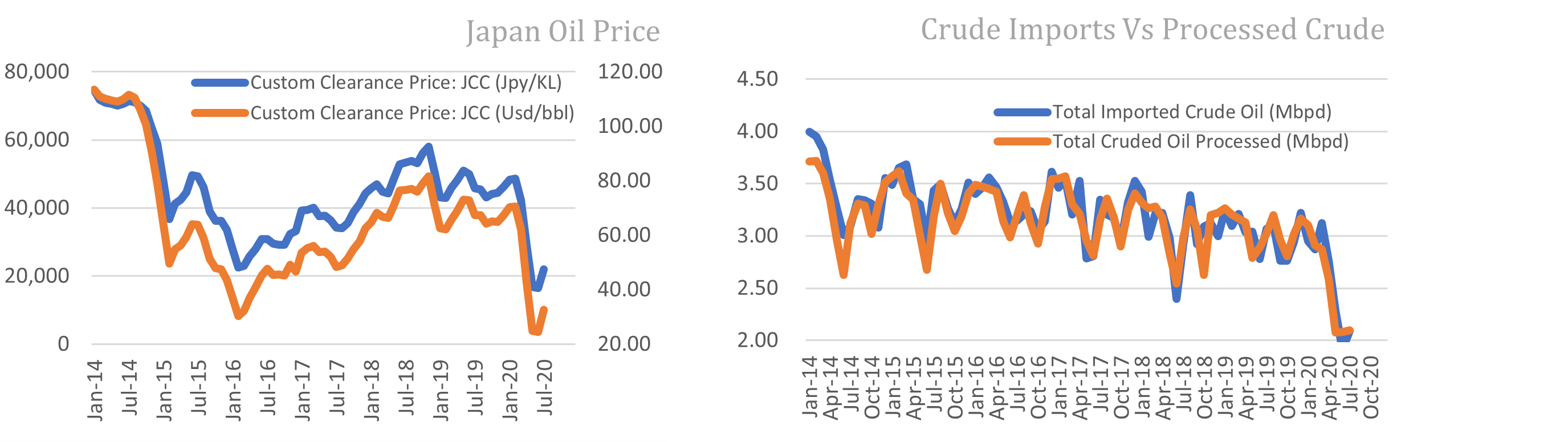
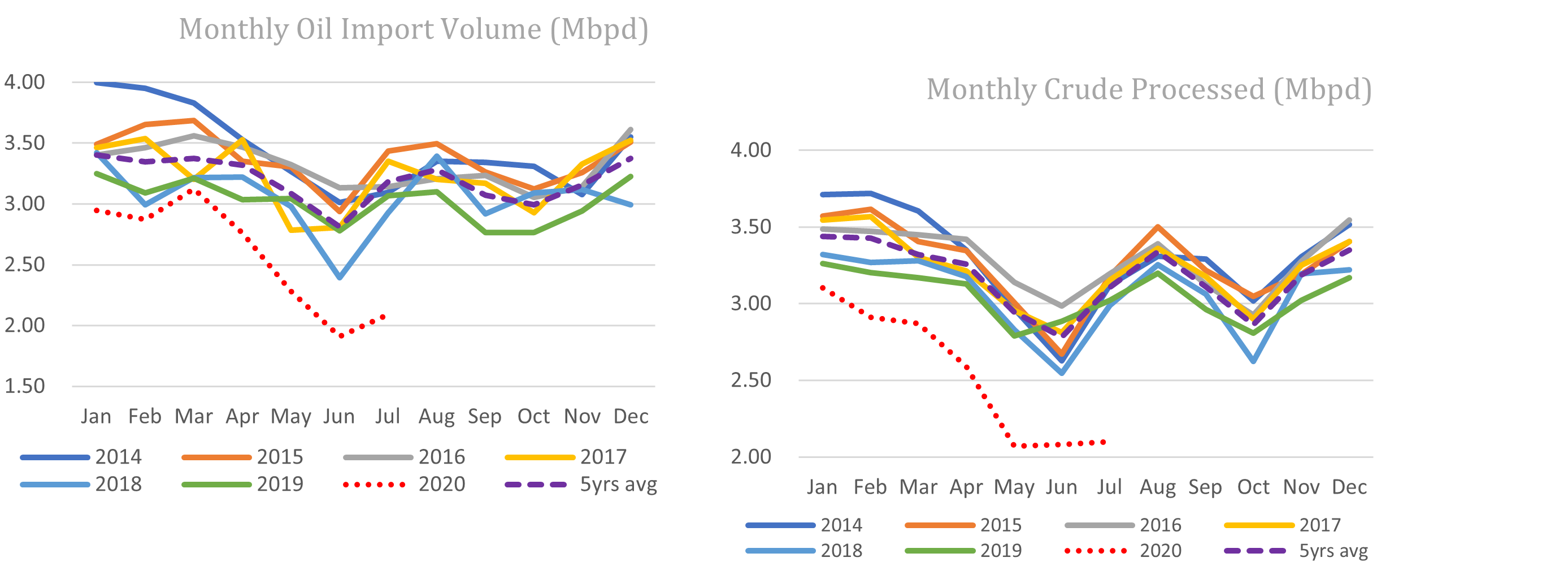
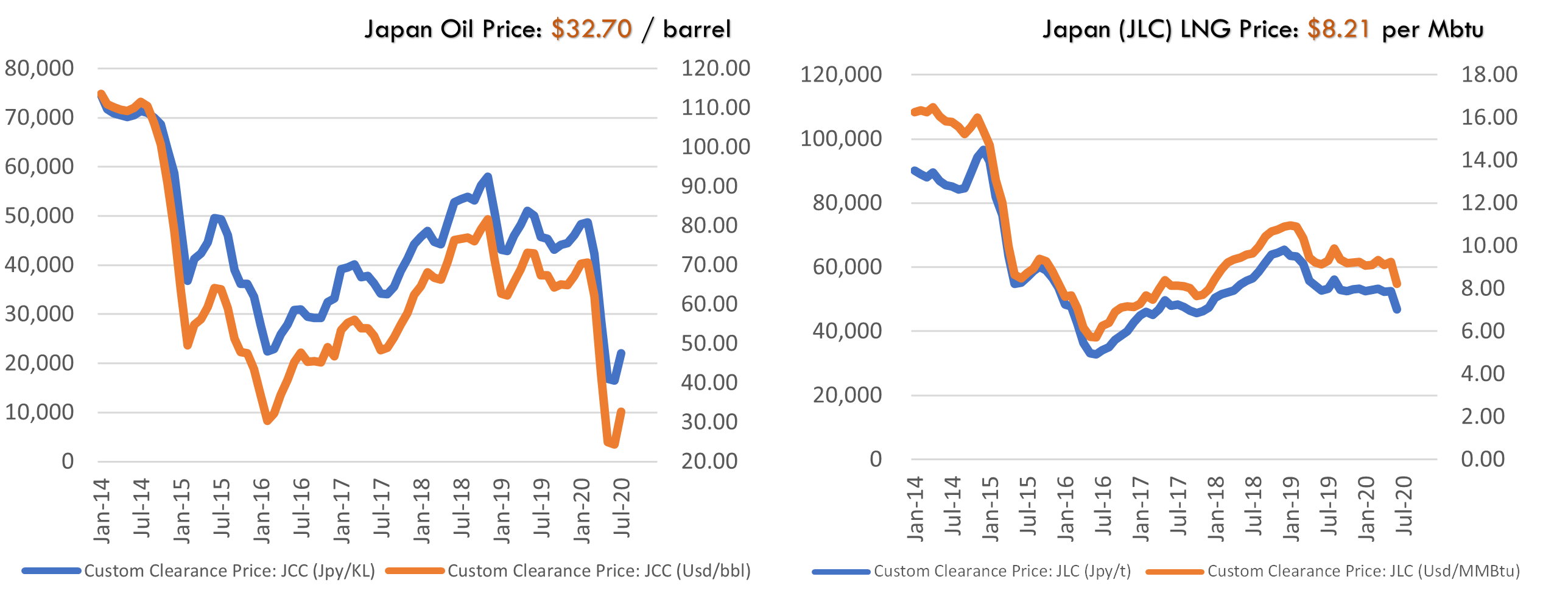
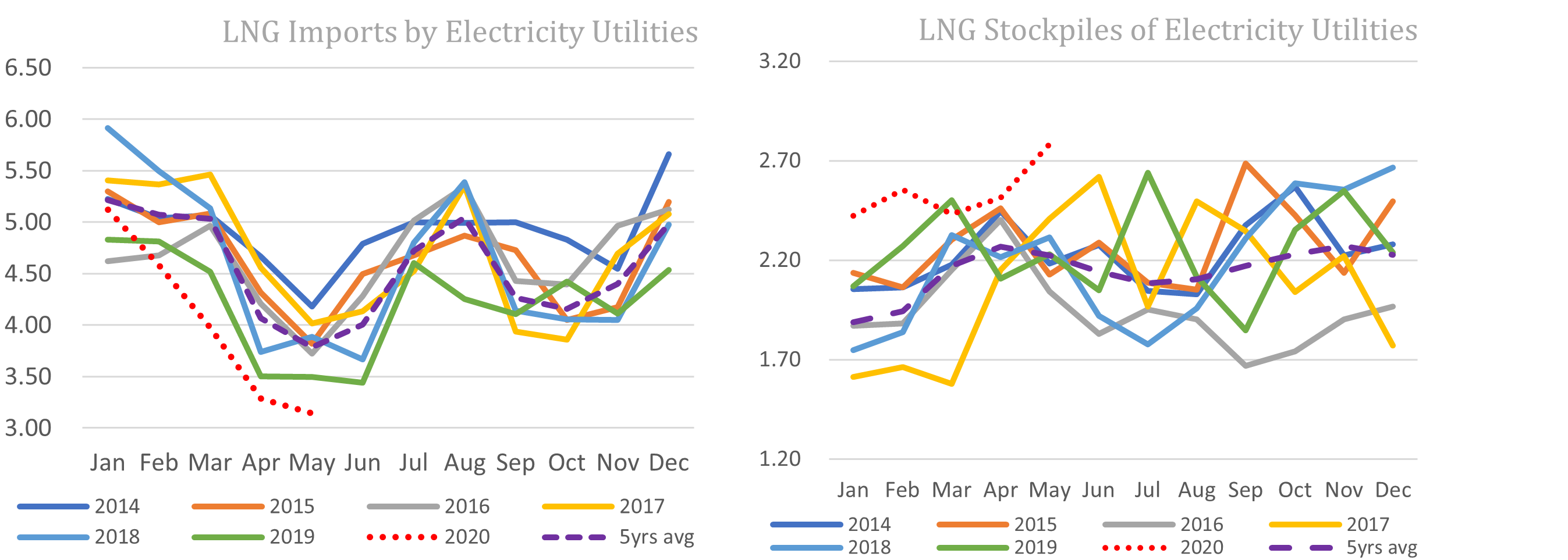
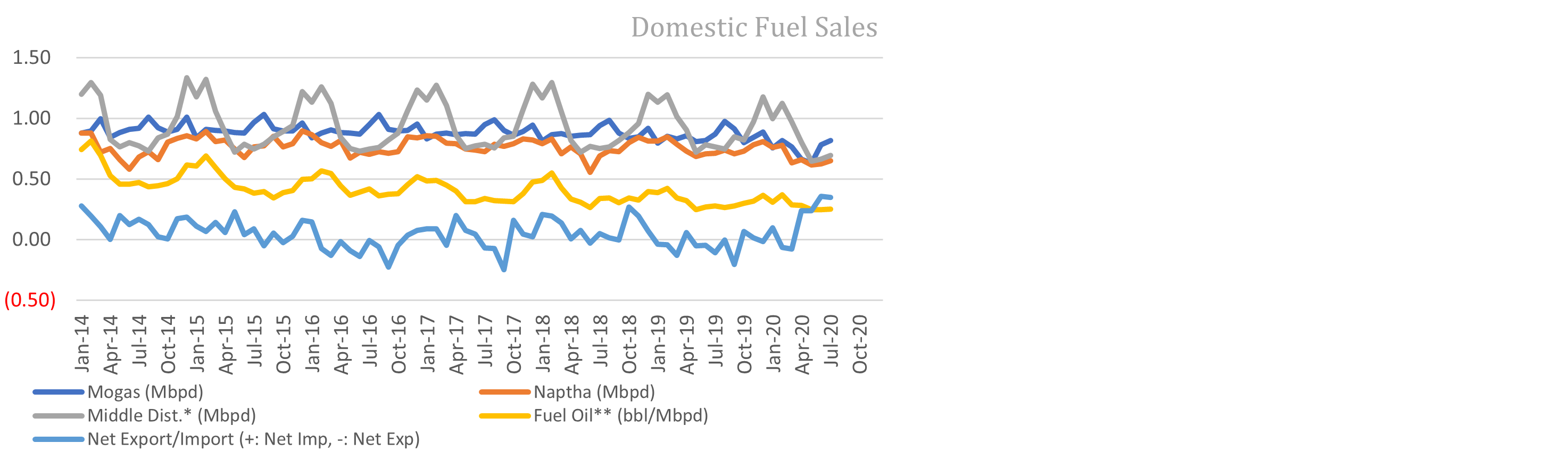 SOURCES: the Ministry of Economy, Trade, and Industry (METI), Ministry of Finance, and the Petroleum Association of Japan
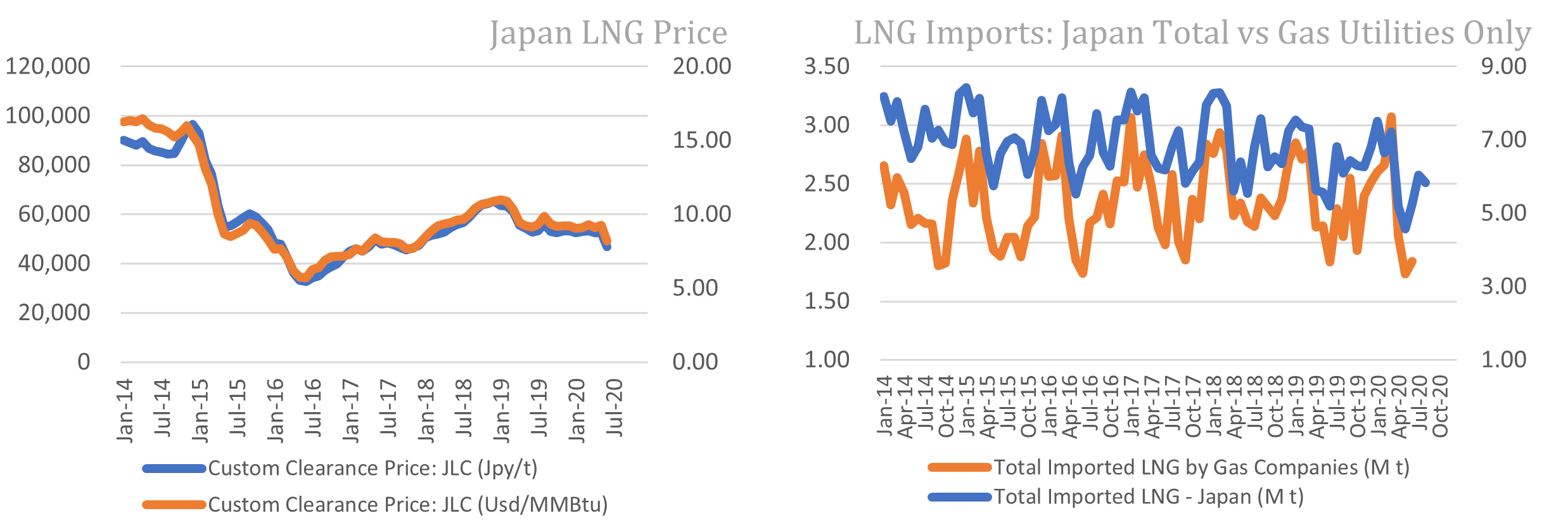
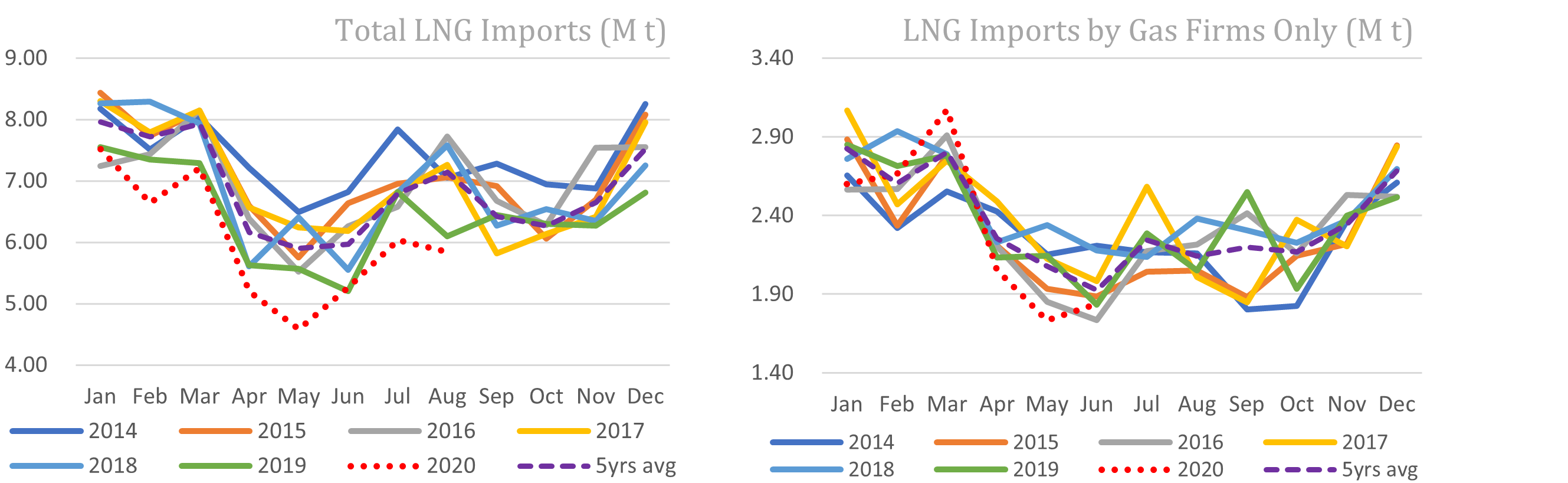
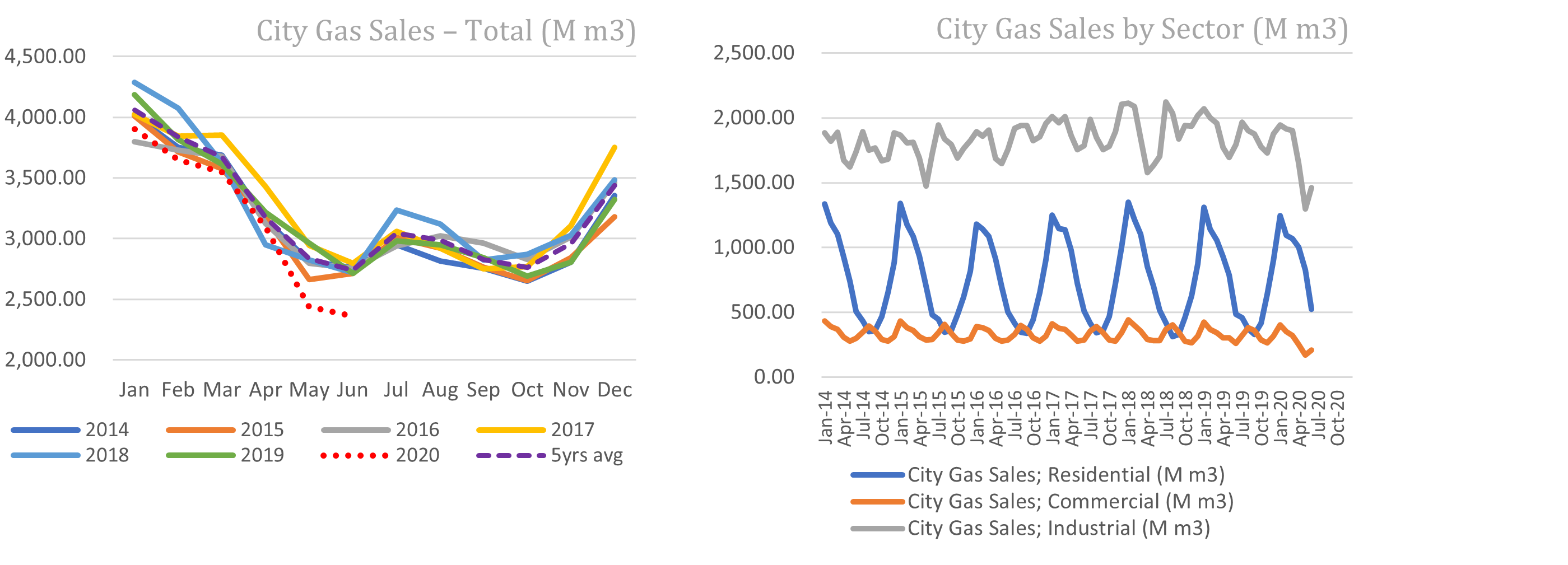
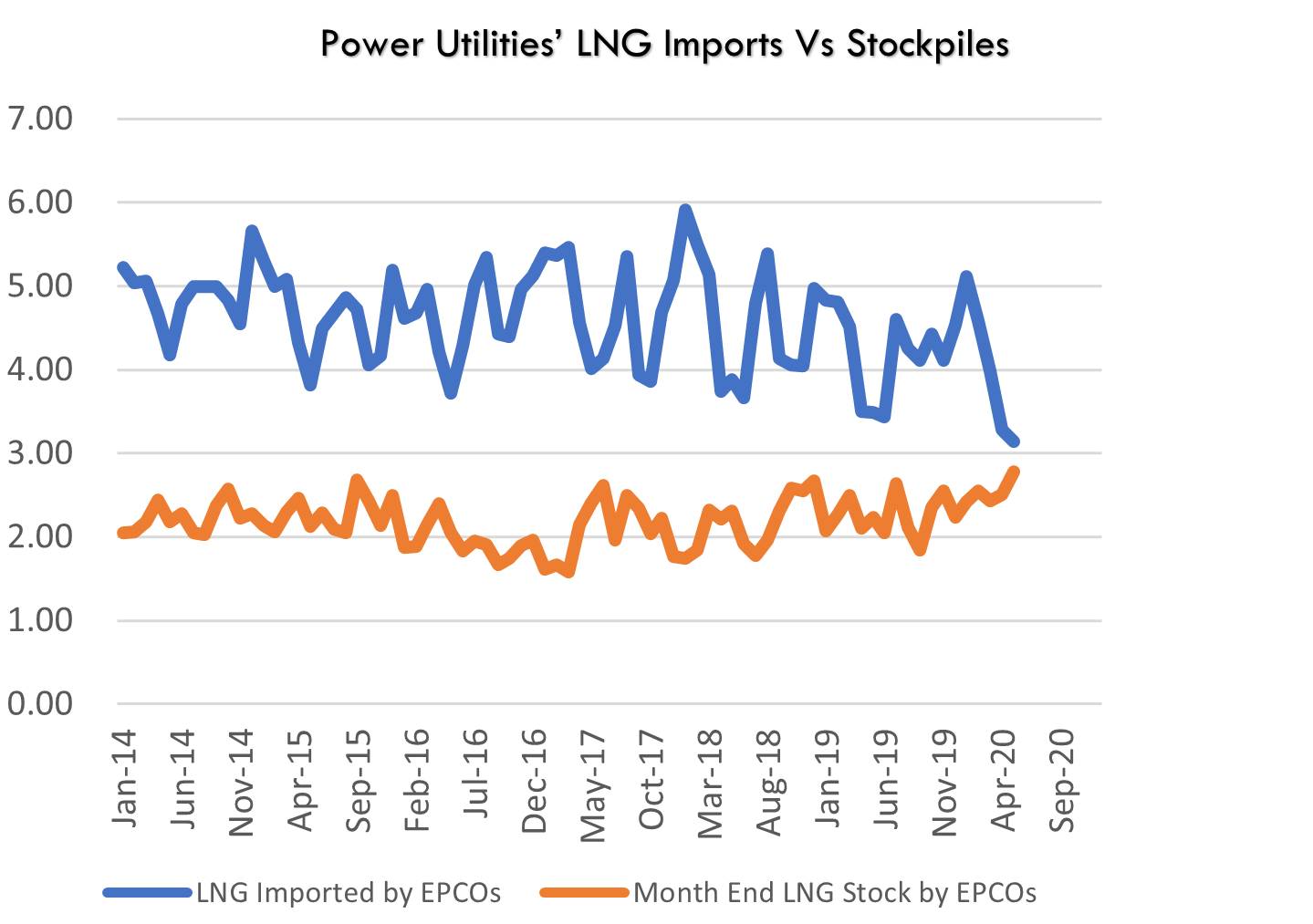
SOURCES: the Ministry of Economy, Trade, and Industry (METI),
Ministry of Finance
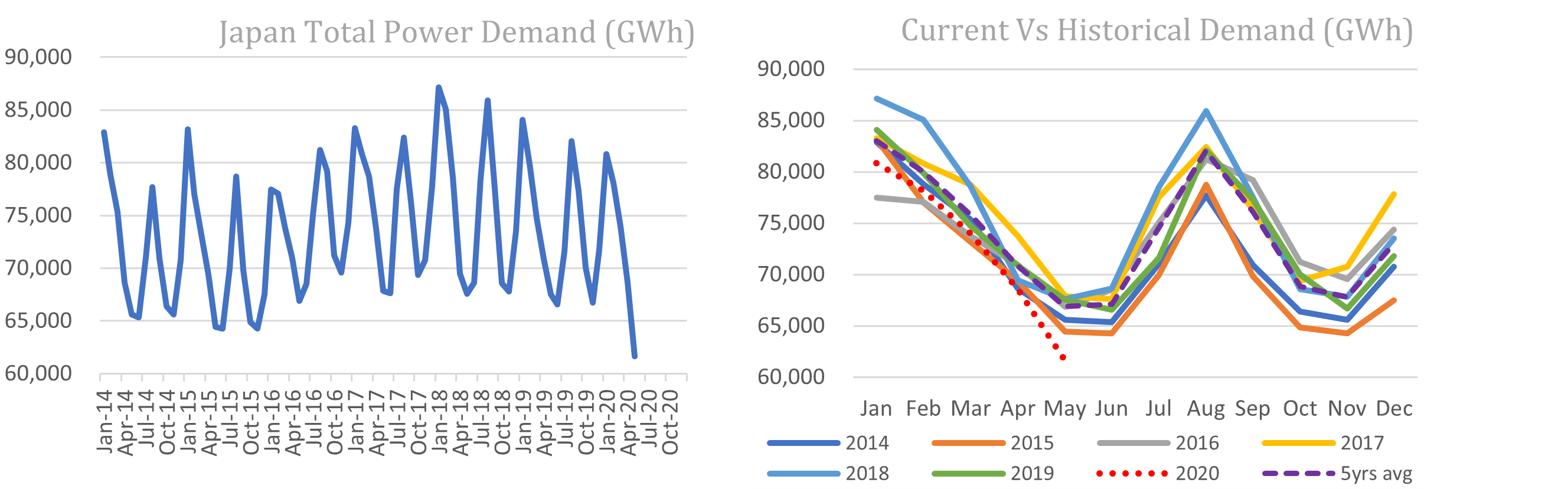
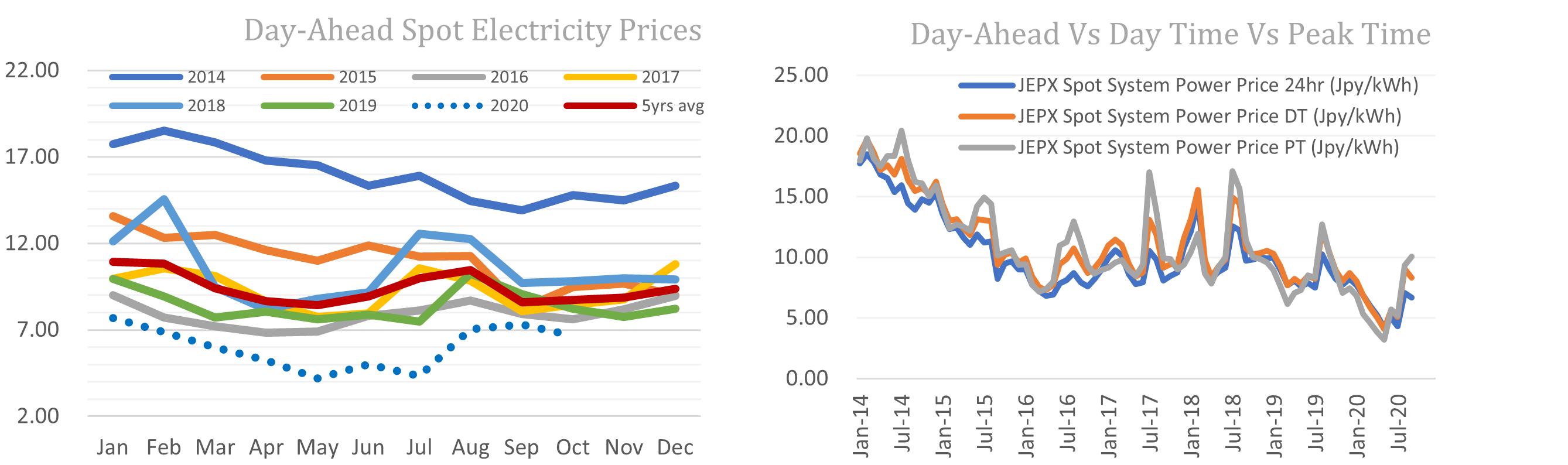
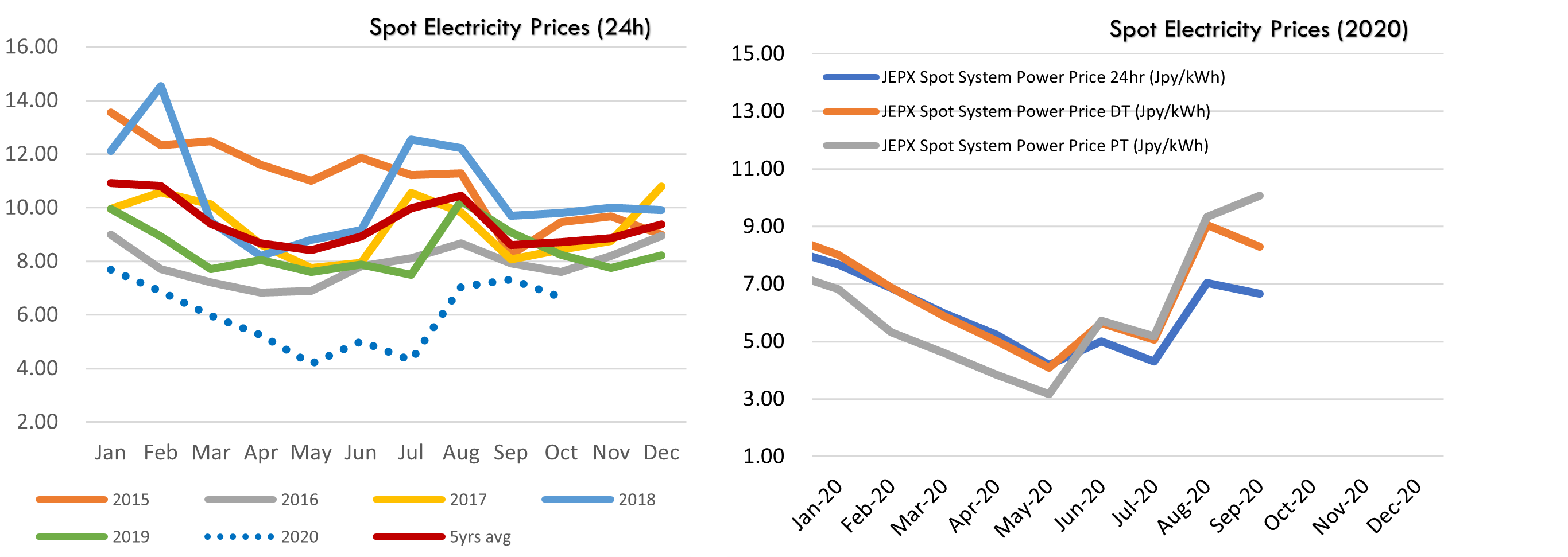
SOURCES: the Ministry of Economy, Trade, and Industry (METI), and the Japan Electric Power Exchange
Disclaimer
This communication has been prepared for information purposes only, is confidential and may be legally privileged.
This is a subscription-only service and is directed at those who have expressly asked Yuri Invest Research Ltd. or one of its representatives to be added to the mailing list. This document may not be onwardly circulated or reproduced without the prior written consent of Yuri Invest Research Ltd., which retains all copyright to the content of this report.
Yuri Invest Research Ltd. is not registered as an investment advisor in any jurisdiction. Our research and all the content of our reports express our opinions, which are generally based on available public information, field studies and own analysis.
Content is limited to general comment upon general political, economic and market issues, asset classes and types of investments. The report and all of its content does not constitute a recommendation or solicitation to buy, sell, subscribe for or underwrite any product or physical commodity, or a financial instrument.
Recipients of this report should ensure that they fully understand the legal, tax and accounting implications before making an investment decision and independently determine that the transaction is appropriate based on their own objectives, experience and resources.
The information contained in this report is obtained from sources believed to be reliable and in good faith. No representation or warranty is made that it is accurate or complete. Opinions and views expressed are subject to change without notice, as are prices and availability, which are indicative only. There is no obligation to notify recipients of any changes to this data or to do so in the future. No responsibility is accepted for the use of or reliance on the information provided.
In no circumstances will Yuri Invest Research Ltd. or its partner K.K Yuri Group be liable for any indirect or direct loss, or consequential loss or damages including without limitation, loss of business or profits arising from the use of, any inability to use, or any inaccuracy in the information.
Yuri Invest Research Ltd.: Room 602, Wah Yuen Building, 149 Queen’s Road Central, Central, Hong Kong.
K.K. Yuri Group: Oonoya Building 8F, Yotsuya 1-18, Shinjuku-ku, Tokyo, Japan, 160-0004.