
JAPAN NRG WEEKLY
OCTOBER 12, 2020
JAPAN NRG WEEKLY
October 12, 2020
NEWSTOP
OIL & GAS
POWER & NUCLEAR
RENEWABLES, OTHER
| ANALYSIS JAPAN TARGETS EMERGING ASIA LNG PROJECTS Japanese companies, encouraged by the government, are proactively racking up new LNG businesses overseas, largely in Asia where demand is swelling. Such ventures are set to help Japan maintain its central role in the global LNG market. Nevertheless, there is concern that China’s quick rise in LNG consumption could displace Japan as the top buyer, while the shift by oil majors into natural gas will diminish investment opportunities. Equally important is finding future offtake for gas from vast Japanese upstream investments in Russia, the U.S., Mozambique and Australia, among others. JAPAN SEEKS TO DOUBLE BIOMASS CAPACITY, BUT LACK OF FUEL MEANS RELIANCE ON IMPORTS Japan’s government has ambitious targets for biomass. By FY 2030, it aims for biomass to make up about 20% of Japan’s renewables capacity. This is a significant increase considering that in FY 2019 biomass power plants in Japan generated just 1.95% of the country’s electricity total. As such, biomass generation capacity will have to double within a decade for Japan to hit its stated target. One problem will be where to source the required fuel. HOUSE VIEW: Climate Change Vows Japan’s Ministry of Economy Trade & Industry (METI) hosted two international conferences virtually last week on a back-to-back basis — the Innovation for Cool Earth Forum (ICEF), and the Task Force on Climate-Related Financial Disclosures (TCFD). The Japanese prime minister addressed the TCFD event, and the METI minister addressed both events. We believe this underlines the new Japanese government’s desire to take a leading international role in climate change issues. |
JAPAN NRG WEEKLY
PUBLISHER
K. K. Yuri Group and Yuri Invest Research Ltd.
Editorial Team
Yuriy Humber
Tom O’Sullivan
John Varoli
Contributors
Mayumi Watanabe
Daniel Shulman
Art & Design
22 Graphics Inc.

SUBSCRIPTIONS
Individual, corporate and academic plans are available. Please contact one of the Editorial Team members or write to nrgnews@yuri-invest-research.com for more details.
ADVERTISING
For marketing, advertising, or collaboration inquiries, please write to nrgnews@yuri-invest-research.com
Disclaimer
This communication has been prepared for information purposes only, is confidential and may be legally privileged.
This is a subscription-only service and is directed at those who have expressly asked Yuri Invest Research Ltd. or one of its representatives to be added to the mailing list. This document may not be onwardly circulated or reproduced without the prior written consent of Yuri Invest, which retains all copyright to the content of this report.
Yuri Invest Research Ltd. is not registered as an investment advisor in any jurisdiction. Our research and all the content of our reports express our opinions, which are generally based on available public information, field studies and own analysis. Content is limited to general comment upon general political, economic and market issues, asset classes and types of investments. The report and all of its content does not constitute a recommendation or solicitation to buy, sell, subscribe for or underwrite any product or physical commodity, or a financial instrument.
The information contained in this report is obtained from sources believed to be reliable and in good faith. No representation or warranty is made that it is accurate or complete. Opinions and views expressed are subject to change without notice, as are prices and availability, which are indicative only. There is no obligation to notify recipients of any changes to this data or to do so in the future. No responsibility is accepted for the use of or reliance on the information provided. In no circumstances will Yuri Invest Research Ltd. or its partner K.K Yuri Group be liable for any indirect or direct loss, or consequential loss or damages including without limitation, loss of business or profits arising from the use of, any inability to use, or any inaccuracy in the information.
Yuri Invest Research Ltd.: Room 602, Wah Yuen Building, 149 Queen’s Road Central, Central, Hong Kong.
K.K. Yuri Group: Oonoya Building 8F, Yotsuya 1-18, Shinjuku-ku, Tokyo, Japan, 160-0004.
NEWS: OIL & GAS
Japan’s sudden interest in spot LNG deals climbs on cold winter forecasts
(Nikkei, Oct. 6)
- While the market for LNG has been in a slump, this week saw a rapid uptick in Asian markets amid forecasts for a colder than usual winter.
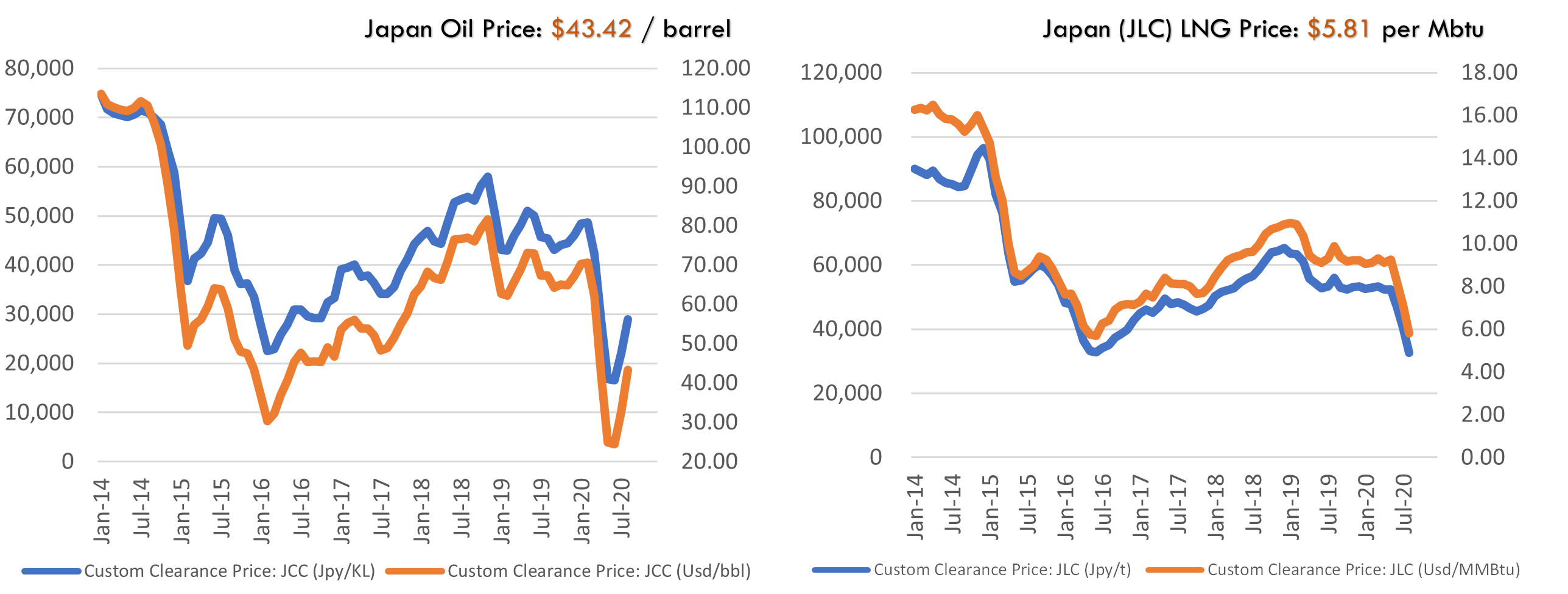
- In Northeast Asia, LNG trades for $5.20 per million Btu. While lower than the $6 levels seen the same time last year, this is still 2.9 times more than the sub-$1.90 levels witnessed earlier this year.
- Most LNG consumed in Japan is purchased under long-term contracts, but there is currently a lot of interest in the spot market as it offers lower prices than those paid for Japan’s imports from Australia (over $7 / mBtu).
- SIDE DEVELOPMENT:
Japan seeks to reduce environmental impact from LNG imports
(Nikkei Shimbun, Oct. 10)- Decarbonization efforts will be applied to the entire industry value chain, from moving to zero-emissions ships that transport LNG to adding carbon capture and storage infrastructure at gas fields
- Emissions trading to procure CO2 offsets and more forestation projects are other ideas the government is looking at
- Japan will work on the issue with Australia and ASEAN (South East Asia) nations, and seek cooperation from the U.S. and the Middle East.
- CONTEXT: Japan is concerned that overt scrutiny of LNG as a fossil fuel will endanger the ability of future projects from being developed, including due to difficulties in raising financing.
Tokyo Gas to invest in offshore LNG platform in the Philippines
(Various, Oct. 9)
- Major Philippines electricity generator First Gen said it had received approval from local authorities to construct a floating storage and regasification unit for LNG near its gas-fired power station on the island of Luzon.
- While the parties had initially planned to construct a land-based facility, they opted for a floating unit instead because of cost benefits.
- Tokyo Gas has a 20% stake in the $300 million project, which will begin construction in October. The Japanese partner will help build, operate and maintain the FSRU facility.
- The Interim Offshore LNG Terminal, located near Batangas City, aims to start importing LNG to the Philippines as early as the second half of 2022.
- Eventually, the facility may have a capacity of 5.26 mtpa.
TAKEAWAY: We explain the background of this and other overseas LNG investments by Japanese companies in this edition of the Japan NRG Weekly. Please see the Analysis section.
Tokyo Gas joins bid for Sendai gas business to expand in LNG
(Sentaku, October issue)
- Sendai City is privatizing its gas business. A consortium of Tohoku Electric, JAPEX, and Tokyo Gas has now been joined by local LP gas operator Kamei.
- Tokyo Gas was reticent to proceed with the bid as it figured that it would need to second as many as 300 staff to the new company over five years to revamp operations, yet the arrival of experienced local player Kamei should reduce this need.
- Tokyo Gas sees the bid as a way to expand its LNG business to Sendai and sees it as an attractive market.
TAKEAWAY: The deregulation of the gas and electricity markets has created new opportunities for market consolidation across Japan. It’s interesting to note Tokyo Gas seeking a foothold in the northeast Tohoku area of Japan in partnership with the major local electricity utility, Tohoku EPCO. Meanwhile, JAPEX has recently strengthened its operations in the area with the launch of the Soma LNG Terminal and power plant. The Soma facility lies just 60 kilometers south of Sendai City.
Idemitsu seeks ways to prevent corrosion at refineries
(Hokkaido Kensetsu Shimbun, Oct. 9)
- The unique location and climate of Idemitsu’s Hokkaido refinery means it is susceptible to corrosion, caused by salt water. The Co. has decided to team up with the National Institute of Technology’s Tomakomai College to find ways to prevent corrosion and improve the performance of effluent processing.
- Idemitsu hopes the research will help optimize and standardize its systems for preventing corrosion at all refineries.
NEWS: POWER & NUCLEAR
| No. of operable nuclear reactors | 33 | |||
| of which | applied for restart | 25 | ||
| approved by regulator | 16 | |||
| restarted | 9 | |||
| in operation today | 2 | |||
| able to use MOX fuel | 4 | |||
| No. of nuclear reactors under construction | 3 | |||
| No. of reactors slated for decommissioning | 27 | |||
| of which | completed work | 1 | ||
| started process | 4 | |||
| yet to start / not known | 22 | |||
Source: Company websites, JANSI and JAIF, as of Oct. 10, 2020
Kansai Electric Shuts Takahama NPP Unit 4 for maintenance
(Company website, Oct 5.)
- Shutdown of the 870 MW unit planned for Oct. 7 and to last for about 4 months for maintenance and inspection.
- Separately, the Co. also said Oct. 7 that it won approval from the Nuclear Regulatory Authority for the anti-terrorist safety measures installed at the Takahama Units 3 and 4.
- CONTEXT: This leaves Kansai Electric (KEPCO) with just one nuclear reactor in operation and Japan with just two units running at this point out of 33 judged to be operable. However, approval of the safety measures from the regulator is a positive for the company as many believed it was running behind the deadline to have these installed.
TAKEAWAY: The inspection means Takahama Unit 4 is unlikely to be sending power to the grid until February 2020. With KEPCO’s other nuclear reactors yet to edge towards restarts amid ongoing political fallout from its bribery scandal, the dominant utility in the second-largest industrial region of Japan will need to rely on LNG and coal plants to manage what is increasingly being seen as a cold winter.
- SIDE DEVELOPMENT:
KEPCO CEO apologizes to local residents for bribery scandal
(Shinano Mainichi Shimbun, Oct. 9)- On Oct. 8 the Kansai Electric invited local residents of Mihama (Fukui) to a meeting to discuss the restart of the area’s nuclear power plant.
- At the meeting, CEO Morimoto Takashi said he takes the trust of the community very seriously and apologized for the recent bribery scandal.
- In his opening remarks, Morimoto said KEPCO’s operation was founded on a base of cooperation and coexistence, and called for candor.
- CONTEXT: For over a year, KEPCO has faced the fallout from a scandal that revealed payments related to its nuclear facilities. Its former directors are also being sued by shareholders for allegedly using company revenue to pay personal taxes.
- SIDE DEVELOPMENT:
KEPCO scandal sapping staff morale
(SENTAKU, October issue)- Former KEPCO President Mori Shosuke sought to dismiss the lawsuits against him from the company. Mori felt betrayed that KEPCO proceeded with the lawsuit. He had personally installed some of the current company directors, including President Morimoto, and Chairman Sakakibara Sadayuki, the former head of the Keidanren lobby group.
- On the other hand, KEPCO employees are losing their morale due to the debt that the company carries now from compensation sent to Mori and his team. Current company staff suffer from cuts to pay and bonuses.
- This situation is making citizens in localities around KEPCO nuclear plants even less likely to trust the company.
- SIDE DEVELOPMENT:
Next Energy partners with Kansai Electric Power Company
(Kankyo Business, Oct. 2)- Next Energy & Resources said on Sept. 30 that it had signed an investment agreement with the Kansai Electric under which Next would provide KEPCO with energy services
- CONTEXT: Next Energy mainly provides services related to solar power plants.
JERA reveals plans to build two new LNG-fired plants at its Chita complex
(Nikkei, Oct. 6)
- On Oct. 6, JERA released plans to build two more units at its Chita power station, each with a capacity of 650 MW.
- The new units would start operating in August and December of 2027.
- Older Units 1 to 5 at the Chita plant will be progressively retired from 2021/22 to help reduce CO2 emissions.
- CONTEXT: JERA, a JV between TEPCO and Chubu Electric, is Japan’s biggest power generation company with about 70 GW of capacity. It supplies about 30% of the nation’s electricity. However, its portfolio is overwhelmingly in thermal power and the company needs to cut its emissions. So far, JERA’s footprint in renewables energy is small.
- SIDE DEVELOPMENT:
Sumitomo Chemical to cut CO2 emissions by 20% with new gas turbine
(Nikkan Kogyo Shimbun, Oct. 6)- Sumitomo Chemical said on Oct. 6 that it would install a highly efficient 45 MW gas turbine at its Chiba factory to replace an existing petroleum coke fired generator.
- When the turbine becomes operational in 2023 it will enable the plant to reduce its CO2 emissions by 20%.
TAKEAWAY: Japanese industrial and utility players are increasingly investing in adjustments to their existing generation capacities, shifting from oil and coal to gas to improve the emissions metrics.
Power capacity market slammed for burdening consumers, propping up coal and nuclear
(Tokyo Shimbun, Oct. 4)
- CONTEXT: Launched in July 2020, the power capacity market enables utilities to bid not for kilowatt hours of electricity, but power capacity. As capacity market trading is allowed for up to four years into the future, it helps the bigger industry players better manage future revenue. The market also allows power companies to feel more secure about investing in construction of new facilities.
- Under a new capacity market scheme, wholesale electricity purchasers that on-sell power to domestic customers will be subject to steep levies, which will be used to support electricity generators. There are concerns that retailers will be forced to pass these charges on to consumers.
- While the scheme will be very lucrative for operators of nuclear and thermal power plants, most renewable generators will not receive any extra money.
- Electricity retailers will be levied a whopping ¥1.6 trillion in 2024/25, the first year of the scheme’s operation.
- The scheme, created by METI, aims to prop up operators of fossil fuel and nuclear plants, which are facing falling revenues due to the increased uptake of renewables. METI is concerned that if legacy power stations are allowed to close, Japan could face power shortages during weather conditions that do not favor solar and wind generation.
- The scheme could also encourage utilities to keep inefficient coal plants operating for longer.
- SIDE DEVELOPMENT:
Renewables lobby environment minister to intervene in capacity market
(Denki Shimbun, Oct. 7)- Environment Minister Koizumi Shinjiro said on Oct. 6 that he had received petitions, predominantly from retailers of renewable energy, requesting more transparency and fairness in the capacity trading market.
- Saying that retailers have told him high bid prices will hit their bottom line hard, the minister said he will convey their concerns to METI.
- Minister Koizumi warned that METI should listen to a range of views on the capacity market and engage in discussion.
Two northern Japan towns seek to host long-term nuclear waste storage
(Yomiuri Shimbun, Oct 10)
- The town of Suttsu, in the northernmost Hokkaido prefecture of Japan, has made its application, mayor Kataoka Haruo said Oct. 9 at a press briefing. This will begin a government survey of the locality to assess if it can host a facility that will house Japan’s nuclear waste.
- The same day, the mayor of Kamoenai village, which lies 40 kilometers north of Suttsu, said his municipality will also apply for the initial feasibility study.
- A full site selection process would last about 20 years. After the first two-year survey, a geographical assessment would require another four years, and then 14 years would be set aside for a detailed review of the final site.
- Both localities may yet hold a referendum on the matter.
- CONTEXT: Both localities are struggling with depopulation and a decline of the local economies from a shrinking fishing industry and others. Suttsu has a population of around 2,900. Kamoenai had about 800 people. By inviting the national survey, a locality can receive up to ¥2 billion (USD 19 million) in state subsidies over two years.
- CONTEXT: A 2017 geological survey showed areas where a final nuclear waste repository could sit. Parts of Suttsu and Kamoenai lie in the suitable area.
TAKEAWAY: This issue is one of the core problems for maintaining nuclear power generation in Japan. The current volume of spent nuclear fuel is close to capacity. Various temporary fixes are being put into place, but the truth is that if Japan were to run all its nuclear energy plants at capacity then within less than a decade there would be nowhere to store the used fuel. Selecting a site for storage is also closely linked to the development of the nuclear fuel cycle in the country. It’s hard to expect a resolution to the above soon. However, the emergence of two localities showing interest in hosting a nuclear waste storage hub is the most progress that the issue has seen in Japan for over a decade.
Cunning scheme may ensure coal plants’ survival
(Nikkei Shimbun, Oct. 9)
- CONTEXT: Japan announced plans earlier this year to shut down all coal-fired power plants that do not meet certain efficiency criteria. At the time, it was seen as referring to 114 of the 140 coal-fired units in the country. However, utilities have been looking for ways to improve the energy efficiency of their plants and the final government decision on what plants are deemed “efficient” have yet to be published.
- Operators of coal-fired power stations have realized that by blending biomass or ammonia with fuel stock, they are able to increase their plants’ efficiency to at least 41%, thereby enabling them to be classified as “efficient” under the government’s initial guidelines.
- Members of the government’s coal working group have called for a policy that does not place restrictions on the way generators are allowed to reduce their CO2 emissions.
- However, others in the industry are critical of the approach, and say that plants using a blend of coal and biomass should also be phased out.
TAKEAWAY: See our deep-dive on the biomass industry in this issue on ways power plant operators are looking to bump up their efficiency ratings.
Ongoing opposition to release of Fukushima’s tritium-radiated water into the ocean
(NHK, Oct. 8)
- On Oct. 8, the government held its seventh meeting of parties affected by the Fukushima nuclear disaster at which representatives of the fishing industry voiced their opposition to the release of radioactive isotopes into the sea.
- This was in response to a government working group recommendation that tritium and other radioactive isotopes contained in contaminated water at the reactor site should be released, in diluted form, into the atmosphere or ocean.
- CONTEXT: The tanks holding contaminated water at the site of the damaged Fukushima Dai-Ichi nuclear power plant are close to capacity. Site operator, TEPCO, has asked for permission to empty them into the ocean, assuring the public that the level of radiation in the water, which has been processed to remove most of the radioactive particles, is lower and well within international limits. Irrespective of the science, the issue is highly political and has global repercussions.
EDITORIAL: Government must send clear message on MOX nuclear fuel
(Saga Shimbun editorial, Oct. 9)
- Spent MOX (mixed oxide) fuel rods will soon be collected from the No. 3 reactor at Kyushu Electric’s Genkai nuclear power plant in Saga for the first time. It was the first reactor in Japan able to burn MOX, starting commercial operation in 2009.
- With no agreement on where MOX waste should be taken or how it should be processed, the removal of the fuel rods is likely to create concern among local residents.
- While the government’s 2005 nuclear energy policy stated that Japan would begin reprocessing spent MOX waste around 2010, these plans were derailed by the Fukushima nuclear disaster. While the government stands by its plan to reprocess MOX fuel, no decision has been made in regard to the construction of a second reprocessing facility to handle this. In fact, the Agency for Natural Resources and Energy has not even established a committee to discuss the issue.
- The prefectural government should urge discussion about the disposal of the waste sooner rather than later, and call on Kyushu Electric to reassure residents about the dangers posed by the waste.
TAKEAWAY: As explained in the Japan NRG Weekly Aug. 17 issue, MOX fuel is a more complicated material to handle because it contains plutonium from the start. Japan’s only commercial fuel reprocessing plant, Rokkasho, has yet to start operation. Even when it does, possibly in 2021, it will not be able to handle spent MOX fuel rods. Building and starting operations at Rokkasho will have taken over three decades. It’s possible that Japan will need to ask overseas industry players to handle its MOX reprocessing. The removal of MOX rods from the Genkai NPP immediately raises the urgency on solving this issue.
Number of power transmission & distribution companies in Japan rises to 30
(Shin Energy Shinpo, Oct. 9)
- New entrant in Osaka, I&I, brings the number of firms registered with the Ministry of Economy, Trade and Industry to 30 as of Oct. 1.
- The number of registered power retailers grew by 7 last month to total 679.
NEWS: RENEWABLES & OTHERS
 JRE Corp. plans massive 860 MW wind farm in Yamaguchi
(Nikkei Shimbun, Oct. 6)
- Japan Renewable Energy Corp. is planning to construct a wind farm in Yamaguchi prefecture. At 860 MW, the project would have one of the highest capacities in Japan.
- JRE shared a preliminary environmental impact statement for the project with the local municipality on Oct. 1.
- JRE plans to erect 20 wind turbines on a 1,000-ha site. Construction would begin in 2024 and the station would begin generating electricity in 2027.
- CONTEXT: The size of the project would rank it in the top 10 globally for onshore wind power stations. The entire wind power capacity of Japan is around 4,000 MW at present.
- SIDE DEVELOPMENT:
ENEOS, Tohoku EPCO pledge support for JRE Corp. in offshore wind
(Nikkei Shimbun, Oct. 5)- Tohoku Electric and ENEOS announced that if a JRE bid to build a 155 MW wind farm off the coast of Akita is successful, they will invest an undisclosed sum in the project.
- JRE hopes the endorsements will lead to its selection.
- In July the government designated the area in question as one of the focus areas for wind power.
Toyota and JR East to develop hydrogen-powered train
(Response.jp, Oct. 6)
- On Oct. 6 Toyota, JR East Japan, and Hitachi announced they would jointly develop a prototype train that will run on a hybrid system of hydrogen-powered fuel cells and storage batteries. Tests on the train, dubbed the “Hybari”, will begin in 2022.
- The train will use technology from Toyota’s Mirai fuel-cell car and Sora fuel-cell bus, and a hybrid train propulsion system developed by Hitachi and JR East. Hitachi will also handle power converters and storage batteries for the main circuit.
- The train will have a maximum speed of 100 km/h and a range of 140 km.
- JR East will invest ¥4 billion in the development and testing.
- CONTEXT: JR East has vowed to reduce its CO2 emissions to zero by 2050.
- SIDE DEVELOPMENT:
Toyota to develop heavy-duty fuel cell truck for North America market
(Asia Nikkei, Oct 6)- Toyota Motor and subsidiary Hino Motors said they will jointly develop a heavy-duty fuel cell truck that will feature Toyota’s hydrogen fuel cell technology
- Prototype, based on Hino’s XL series, is due in the first half of 2021 and mass production is seen by 2024
- CONTEXT: Toyota and Hino said in March that they would develop a fuel cell truck for Japan.
Japan hydrogen systems market could jump to ¥1.2 trillion by 2030: Institute
(Economic News, Oct. 2)
- On Sept. 2 the Yano Research Institute released a report on the current state of the Japanese market for hydrogen energy systems and its projections for the future.
- The report says that polymer electrolyte fuel cells and solid oxide fuel cells are the main candidates for use in domestic applications. While PEFC operates in a temperature range of 70 to 90°C, SOFC operates at significantly higher temperatures: 700 to 1000°C.
- Most demand from domestic PEFC fuel cells comes from the residential construction industry, while demand for SOFC fuel cells is attributed to both apartment dwellers and those retrofitting existing houses.
- Yano estimates the market for hydrogen energy systems will be worth ¥1.2 trillion by 2030 and ¥3.8 trillion by 2050.
The technologies and start-ups to watch in the race for a hydrogen society
(Jiji.com, September 11)
- Consulting data company Astamuse says Japan stands to benefit from the hydrogen economy due to the fact that hydrogen can be synthesized from a variety of sources, which is good from the point of view of energy security.
- Astamuse has released a list of hydrogen industry start-ups to watch. When performing its analysis, Astamuse focused on hydrogen infrastructure and applications, and maintenance and security services aimed at the hydrogen value chain.
- The start-ups the consultancy identified were:
– Hydrogen synthesis technology developers Powerhouse Energy Group and Joi Scientific
– Hydrogen storage alloy developers H2 Industries and GRZ Technologies
– Hydrogen, transportation and supply specialists Ergosup and Steelhead Composites
– Fuel cell manufacturers GenCell and Loop Energy
– Hydrogen turbine and engine manufacturers Turbotech and DynaCERT
– Energy service providers Hybrid Energy Storage Solutions and Redox Power Systems
– Vehicle manufacturers PowerCell Sweden and Horizon Fuel Cell Technologies
– Hydrogen value chain security and maintenance providers H2 Scan and Plug Power - CONTEXT: At the moment, there are few pure-play investments in hydrogen in Japan since most of the listed companies involved are large corporates, whose main profits will continue to come from other businesses for the foreseeable future. The above list from Astamuse provides a useful starting point for finding investments more closely aligned with a possible hydrogen future.
Kansai Electric starts commercial operations at 525MW Texas wind farm
(KEPCO press release, Oct. 1)
- The 525MW Aviator Wind Farm, located in Texas, U.S. started commercial operations. Kansai Electric (KEPCO) owns 48.5% of the project.
- The project brings KEPCO’s attributable renewable power capacity overseas to 949 MW. The company owns about 2,861 MW of capacity outside of Japan.
- CONTEXT: KEPCO’s global renewable generation capacity now stands at 4.7 GW.
- SIDE DEVELOPMENT:
SB Energy and Invenergy solar farm goes online
(X-Tech Active, Oct. 2)- A new solar farm in Fukushima prefecture, a joint venture between SB Energy and Invenergy, started commercial operations.
- The 24-ha facility has an output of 9.2 MW, enough to power over 2,700 homes.
- Invenergy holds a 60% stake in the venture, while SB Energy holds a 40% stake.
Saga wind farm: harmony with nature or just another source of visual pollution?
(Data Max, Oct. 8)
- A 32 MW wind farm planned in Saga (Kyushu prefecture) has attracted opposition from local residents, who say the location is unsuitable for a wind project. The project area impinges on national park space.
- Locals say the farm will create visual pollution and question the value of building a wind farm in an area that is not known for high winds.
J-Power, KDDI cut wind farm inspections time by 90% with drones
(Shin Energy Shinpo, Oct. 4)
- J-Power (Electric Power Development Co.) and mobile phone carrier KDDI said they have tested and proved the effectiveness of automatic inspections of wind power generators using drones equipped with auto-flight software.
- The drones automatically film along the blades of the wind turbine and get the work done in about one-tenth the time required for a conventional inspection. The use of autoflight technology eliminates the need for drone operators. There is a shortage of skilled drone operators and most such inspections take place during the summer.
ANALYSIS
DAMON EVANS,
INDEPENDENT
RESEARCH & ANALYSIS
Japan Targets Emerging Asia LNG Opportunities
To Retain Influence in the Global Market for the Fuel
Japanese companies, encouraged by the government, are proactively racking up new LNG businesses overseas, largely in Asia where demand is swelling. Such ventures are set to help Japan maintain its central role in the global LNG market.
Nevertheless, there is concern that China’s quick rise in LNG consumption could displace Japan as the top buyer, while the shift by oil majors into natural gas will diminish investment opportunities. Equally important is finding future offtake for gas from vast Japanese upstream investments in Russia, the U.S., Mozambique and Australia, among others.
Maintaining influence in global LNG markets serves several purposes for Japan. It helps to secure a stable fuel supply for the country over the long term. Also, LNG is a technology-intensive sector in which Japan has developed competitive businesses, from shipping vessels to import terminal infrastructure. JCG Corp. and Chiyoda Corp., both based in Yokohama, are among the top contractors globally in construction and maintenance of LNG facilities.
Japan’s own LNG purchases have declined in four of the last five years. However, power demand is surging across South and Southeast Asia on the back of rapid economic growth. With coal increasingly shunned even in developing economies, there is more interest in LNG. The Japanese government, together with the private sector, aims to take a leading role in nurturing this growing interest by supporting the construction of LNG import facilities, associated infrastructure and power plants, all across the Asian region.
In 2019, South and Southeast Asia consumed a total of 50 million tons of LNG. By 2040, some forecast that the region’s imports will more than quadruple and make up a third of global LNG demand. Japan’s main energy ministry, METI, sees the country’s share of purchases sliding to 12% of total from a third today based on a demographic decline, more energy efficiency and a growing contribution from renewable energy.
COMPETITIVE EDGE – FINANCING
Still, to make future LNG prognoses a reality, significant capital needs to be invested in Asian gas infrastructure, both at the transportation and distribution level and in generation capacity. This is another area that Japan has an advantage.
Many new LNG-to-power projects are under consideration in Indonesia, Vietnam, Myanmar, the Philippines, Bangladesh and Pakistan – particularly as funding for coal-fired power developments has started to dry up. LNG-to-power schemes are a relatively rapid way of adding significant grid capacity.
However, credit risk in emerging markets is usually a major issue. It is frequently too high for commercial lenders due to the political and economic uncertainties. As a result, many LNG-to-power projects seek support from export credit agencies (ECAs).
Japan’s LNG-to-power push in Southeast Asia was kickstarted by proactive involvement of The Japan Bank for International Cooperation (JBIC), a Japanese ECA.

The 1.76GW Jawa-1 gas power plant and associated floating storage regasification unit (FSRU) in Indonesia is the first integrated LNG-to-power scheme in Southeast Asia. Due to start in 2022, it is jointly developed by Indonesia’s Pertamina and Japanese trading houses Sojitz and Marubeni. The project made headway after securing a $604 million loan from JBIC. Commercial banks, including Mizuho Bank, Mitsubishi UFG Bank, Credit Agricole, OCBC Bank and Societe Generale, followed with a joint financing package for another $1.31 billion.
The loans are covered by Japan’s Nippon Export and Investment Insurance (NEXI). Japan’s Mitsui O.S.K. Lines (MOL) is entrusted with the FSRU construction supervision, maintenance, and operation.
Jawa-1’s success triggered further proposals for similar integrated LNG-to-power schemes in Myanmar, Philippines, Vietnam and Bangladesh.

JBIC announced in July that it will loan $265 million to Reliance Bangladesh LNG & Power Co.’s proposed Meghnaghat II 718MW gas-fired power plant. JERA, Japan’s top LNG buyer and a power generator, also owns an equity stake. In total, some $640 million worth of project financing will be provided by JBIC, Asian Development Bank and commercial lenders, including Mizuho, MUFG, Sumitomo Mitsui Banking Corporation and Societe Generale.
Again, Japan’s state insurer NEXI is covering the loans. The transaction marks the first major project in Bangladesh financed by JBIC and backed by NEXI.
Bangladesh’s first LNG import facility was also financed in part by Japanese parties. The Japan International Cooperation Agency (JICA) helped Excelerate Energy and Petrobangla fund construction of the terminal, which started in 2018.
Meanwhile, trading house Mitsubishi Corp. has a 25% stake in the country’s second terminal developed by Bangladesh’s largest infrastructure provider, Summit Group. SMBC, a Japanese bank, was the lead debt arranger.
SWITCHING HORSES FROM COAL TO LNG
In Myanmar, Japan originally argued that coal would be a more appropriate fuel. Since the government came out in support for several proposed LNG-to-power projects the Japanese stance changed.

Recently, Marubeni, Mitsui and Sumitomo, were all competing for a share of Myanmar’s emerging LNG sector. After the Ministry of Electricity and Energy (MoEE) noted that it would accept only one Japanese project, the three rival trading houses clubbed together to create the Thilawa 1.25GW LNG-to-power project. This $1.5 to $2 billion project, a JV between Myanmar’s Eden Group and the three Japanese firms, was announced in July.
The financing has yet to be announced, yet it seems certain that it will come from Japanese institutions. JICA’s has previously made a loan to upgrade a 50MW gas-fired plant in the Thilawa Special Economic Zone.
 Notably, the Thilawa project marks a win for Japan in an area where China had competed hard for deals. A JV backed by Chinese interests previously won contracts for three smaller emergency LNG-to power plants.
Another major LNG opportunity for Japan lies in Vietnam. Tokyo Gas already holds a 24.9% stake in a gas distribution subsidiary of state-backed PetroVietnam Gas (PV Gas), which has started building Vietnam’s first LNG import terminal in the port of Thi Vai. Marubeni has also voiced its ambitions for gas-to-power projects in Vietnam.
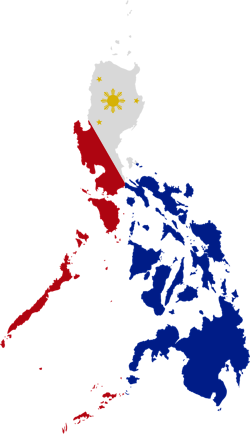 JBIC has been actively encouraging LNG-to-power developments in the Philippines. In September, local utility First Gen, together with Tokyo Gas, received approval to develop a FSRU to start receiving LNG in the second half of 2022. Tokyo Gas will have a 20% stake in the project, which could expand to 5.26 mpta in the future.
Tokyo’s big domestic rival, Osaka Gas together with JBIC has taken a minority stake in Singapore-based AGP International Holdings, a company focused on developing gas projects across emerging LNG importers in Asia.
Even Japan’s upstream vehicle, the state-owned Japan Oil, Gas and Metals National Corporation (JOGMEC), was given an official nod in June to support projects further down the chain, such as LNG receiving terminals.
The old business model of investing in upstream LNG projects abroad to secure the fuel and sell it to Japanese power utilities is dying. Instead, Japanese firms are carving out future markets for LNG in emerging Asia. This impetus gives Japan an edge in the rapidly changing global industry.
ANALYSIS
DANIEL SHULMAN,
PRINCIPLE
SHULMAN ADVISORY
Japan Plans to Double Biomass Capacity Within a Decade
Yet, Country Still Lacks the Fuel to Power This Expansion
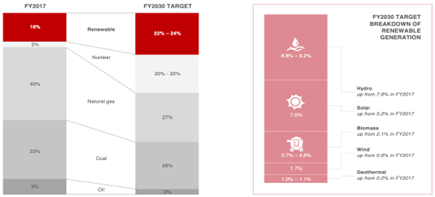
Japan’s government has ambitious targets for biomass. By FY 2030, it aims for biomass to make up about 20% of Japan’s renewables capacity, or between 3.7% and 4.6% of the total power generation. This is a significant increase considering that in FY 2019 (April 2019 – March 2020) biomass power plants in Japan generated just 16,816 GWh, or 1.95% of the country’s total.
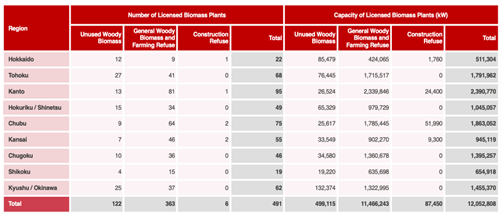
As such, biomass generation capacity will have to double within a decade for Japan to hit its stated target. Japan had 491 licensed biomass power plants (both operating and planned) with a total capacity of approximately 12,000 MW as of March 2017.
Japan’s power generation mix targets.
Source: Agency for Natural Resources and Energy.
However, to hit the targets, these plants and any new projects will have to secure enough fuel. This will prove to be an immense challenge given that more than 80% of the biomass projects already approved for Feed-In Tariffs (FIT) are offline due to their inability to procure fuel.
While forests cover about two-thirds of Japan’s land area, difficult terrain increases the cost of using that land to produce biomass fuel. Japan’s aging and shrinking population has hit rural areas the most, leading to a lack of manpower for fuel collection. As a result, domestic production of wood pellets, the main fuel used in biomass power, has been stagnant for the last five years.
Domestic operators have turned to supply channels abroad. Mitsubishi and Marubeni managed to secure 1.5 million tons of wood pellets annually from U.S. supplier Enviva starting in 2021, and Mitsui signed a 10-year contract with Australia’s Altus Renewable to procure 100,000 tons.
In September, oil major Idemitsu said it began cultivating sorghum in Australia on a trial basis for use in biomass power generation. The project is being performed in an unused area of land belonging to a coal mine in Queensland, which is 85% owned by Idemitsu. The sorghum can be turned into pellets and mixed with coal for burning.
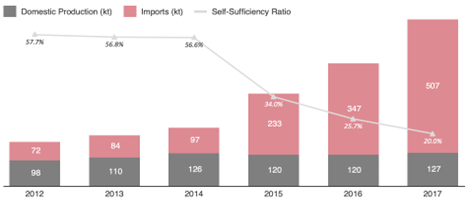
Overall, wood pellet imports have increased more than sixfold between 2012 and 2017, decreasing Japan’s self-sufficiency ratio from almost 60% to just 20% over the same period.
Japan’s biomass fuel production and imports.
Source: Ministry of Finance.
WHERE ARE THE PLANTS?
The Kanto region around Tokyo has both the most licensed biomass power plants in Japan and the biggest capacity in this sector. It is followed by Chubu and Tohoku regions. The three combined carry 6,044 MW of capacity, just over half the nation’s total.
Some of the largest operational biomass power plants in Japan include:
• Muroran Biomass Power Plant (74.9 MW) – JXTG Energy (now ENEOS) brought this woody biomass power plant in Hokkaido into operation in May 2020. It is fueled with palm kernel shells (PKS) imported from Southeast Asia. All electricity generated at this power plant is sold.
• Itoigawa Biomass Power Plant (50.0 MW) – This plant started operations in January 2005 and is run by Summit Myojo Power, a JV between Sumitomo Corp unit Summit Energy and Myojo Cement, a unit of Taiheiyo Cement. The plant procures woody biomass fuel from Myojo Cement’s adjacent plant and uses ash from the power plant as a raw material for cement.
• Hofu Biomass Coal Co-Firing Power Station (112.0 MW) – AWEP Yamaguchi, a JV between Air Water and Chugoku Electric, commissioned this plant in July 2019. Their plan is to generate electricity by co-firing coal and up to 50% biomass. The biomass fuel will include unused thinned wood, procured from the Federation of Forest Owners Cooperative Associations of Yamaguchi Prefecture, and imported woody biomass.
Japan’s paper mills are among the bigger operators of biomass power plants in the country. In 2014, Japan Pulp and Paper Co. formed a partnership with New Energy Development Co. to build a 14 MW woody biomass power plant in Noda, Iwate Prefecture. Nippon Paper has been involved in biomass power generation as well, starting with its Ishinomaki power plant built in 2018.
While Nippon Paper eventually aims to fuel its plants with woody biomass produced in its own forests, at this point, it relies on imported fuel.
Source: Agency for Natural Resources and Energy.
CHALLENGES – GROWING THE FUEL TO GROW THE MARKET
The biggest issue for developing biomass in Japan is undoubtedly the lack of affordable and sustainable fuel options. Over the last year, numerous planned projects by Nippon Paper, Kansai Electric (KEPCO) and others have been scrapped primarily for that reason. After all, fuel accounts for 70% of the cost of woody biomass generation.
The Agency for Natural Resource and Energy, part of METI, has budgeted ¥1.5 billion in FY 2021 for demonstration projects in biomass power generation that use fast-growing local trees. These broadleaved species yield 2.5 times the energy of coniferous trees and can be grown for a third of the cost.
The Agency is also reviewing the possibility of buying forestry land to guarantee feedstock, as well as ways to support improvements in efficient fuel procurement and transportation. This would complement similar efforts by a study group in the agriculture ministry, which is looking at ways to develop forestry and thus reduce fuel costs.
In total, biomass is expected to receive 20% of the government’s incentives for renewable generation in the coming decade. Some will come via grants to start-up biomass producers.
The government is invested in overcoming fuel challenges and not only for the reason of developing more renewable generation sources. Woody biomass is seen as being able to support regional economies. A focus on local revitalization was one of the first tenets of the economic policy of the new Prime Minister, Suga Yoshihide. Energy from biomass may be one way to deliver both on the economic and political front.
Although its contribution to total power generation is likely to remain modest, biomass has the potential to be a growth industry in Japan worth watching in the coming decade.
HOUSE VIEW
Japan Hosts Two International Conferences on
Emissions & Climate-Related Financial Disclosure
Japan’s Ministry of Economy Trade & Industry (METI) hosted two international conferences virtually last week on a back-to-back basis — the Innovation for Cool Earth Forum (ICEF), and the Task Force on Climate-Related Financial Disclosures (TCFD). The Japanese prime minister addressed the TCFD event, and the METI minister addressed both events.
We believe this underlines the new Japanese government’s desire to take a leading international role in climate change issues and support for big-ticket measures such as requiring publicly listed companies to disclose their energy-related emissions in financial statements.
Japan recently formulated an ‘Environment Innovation Strategy’ in order to create, commercialize, and spread innovation in the energy and environmental fields through international cooperation. The government has also said it will help attract financing for companies that work on decarbonation technologies.
This year’s annual ICEF event stressed the need for continued investments in hydrogen as an energy carrier to reduce emissions. The other areas identified for further funds were power transmission systems, to cope with increasing amounts of renewable energy, and Small Modular Nuclear Technology (SMRs).
Carbon recycling and the circular economy were also important themes at this year’s ICEF.
Among the speakers who addressed the ICEF event were Laurence Tubiana, one of the principal architects of the Paris Climate Agreement, the 2019 Chemistry Nobel Laureate Yoshino Akira, and Professor Richard Lester of M.I.T. were also among the speakers who addressed the ICEF event.
ICEF Chairman, Tanaka Nobuo, also pressed for greater female participation in the energy industry. Tanaka went as far as to suggest that the Fukushima nuclear accident in 2011 may never have happened if there were more women in senior management in Japan.
This year’s annual TCFD event included addresses by Mark Carney, the former governor of the Bank of England and now the U.N. Special Envoy for Climate Action and Finance, and Mary Schapiro, the former Chair of the U.S. Securities and Exchange Commission during the Obama administration. Shapiro is now Head of the Task Force on Climate-related Financial Disclosure Secretariat. Among the Japanese participants were Mizuno Hiromichi, the former CIO of Japan’s Government Pension Investment Fund and now Board Member of Tesla, and Miyahara Koichiro, the president and CEO of the Tokyo Stock Exchange.
A senior EU EVP also addressed the conference. However, there was no representation from the U.S. government. Democratic Party presidential nominee Joe Biden has committed to fully decarbonizing the U.S. electricity sector by 2035 as part of his policy platform.
CEOs of BlackRock and State Street represented the global asset management industry at the event.
Japan has around 300 publicly listed organizations that embrace the TCFD reporting principles, the largest national group among the 1,400 TCFD members. There are currently four main sets of global reporting standards for ESG investments with the Japan-backed TCFD supported by the Financial Stability Board, the international body that monitors the global financial system. Kuroda Hajime, the governor of the Bank of Japan, recently stated that climate change is the most pressing challenge faced by the financial system.
NRG will continue to monitor how sustainability and ESG reporting develops in Japan particularly among the listed oil and gas and energy companies.
The more important and immediate issue for Japan, however, may be whether it firms up on National Determined Contributions under the Paris Agreement, and if it commits to an accelerated path to emissions reductions.
STOCK MARKET PERFORMANCE
| As of close on October 9, 2020 | Ticker | Market Cap | 1W (%) | MTD (%) | YTD (%) | |
| billions of yen | ||||||
| Energy | ||||||
| INPEX CORP | 1605 JP | 832.21 | -0.14 | -49.01 | -10.07 | |
| JAPAN PETROLEUM EXPL. | 1662 JP | 103.34 | 6.35 | -37.04 | 1.15 | |
| ENEOS HOLDINGS INC | 5020 JP | 1245.27 | 2.15 | -17.98 | -3.31 | |
| IDEMITSU KOSAN CO LTD | 5019 JP | 676.75 | 1.61 | -20.57 | -1.66 | |
| COSMO ENERGY HOLD. | 5021 JP | 136.99 | 6.32 | -32.34 | -1.04 | |
| Industrials | ||||||
| JGC HOLDINGS CORP | 1963 JP | 267.25 | -0.87 | -40.45 | -8.44 | |
| CHIYODA CORP | 6366 JP | 65.34 | 0.40 | -11.31 | -5.99 | |
| MITSUBISHI CORP | 8058 JP | 3790.82 | 1.01 | -7.16 | 2.27 | |
| MITSUI & CO LTD | 8031 JP | 3174.07 | 1.45 | -0.51 | -2.05 | |
| Utilities | ||||||
| TOKYO ELECTRIC POWER | 9501 JP | 462.82 | -4.00 | -38.33 | -5.88 | |
| CHUBU ELECTRIC POWER | 9502 JP | 975.17 | 0.51 | -13.59 | -1.98 | |
| KANSAI ELECTRIC POWER | 9503 JP | 959.39 | -0.34 | -15.53 | -1.54 | |
| KYUSHU ELECTRIC POWER | 9508 JP | 456.16 | -0.41 | 5.40 | 1.39 | |
| J-POWER | 9513 JP | 287.21 | -1.20 | -38.42 | -3.47 | |
| TOKYO GAS CO | 9531 JP | 1055.65 | -0.44 | -7.88 | 1.89 | |
| OSAKA GAS CO | 9532 JP | 841.69 | -0.39 | -1.07 | -1.29 | |
| TOHO GAS CO | 9533 JP | 548.10 | 0.39 | 17.58 | 10.64 | |
| SAIBU GAS CO | 9536 JP | 98.55 | -1.30 | 6.92 | -0.07 | |
| SHIZUOKA GAS CO | 9543 JP | 71.09 | 0.11 | -1.03 | 6.39 | |
DATA
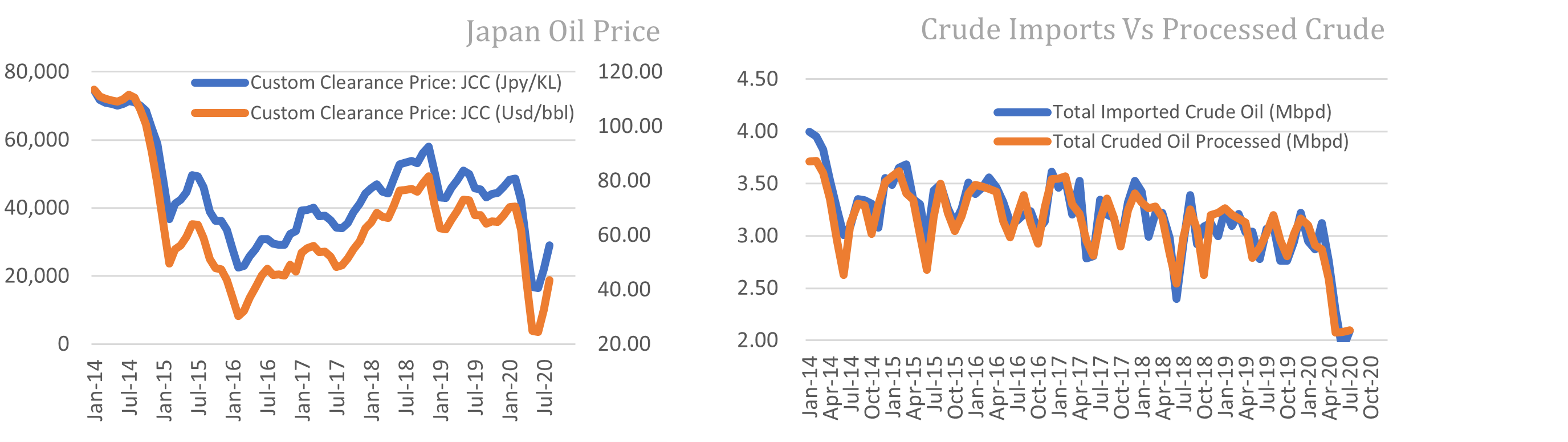
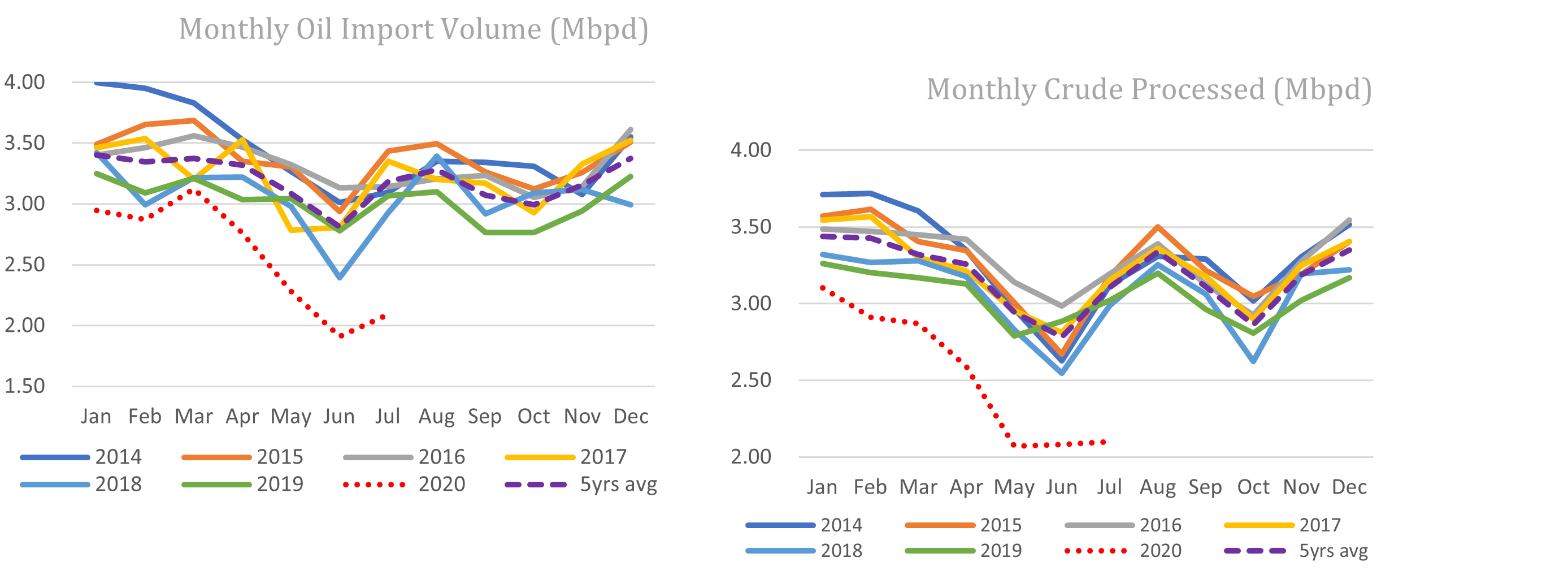
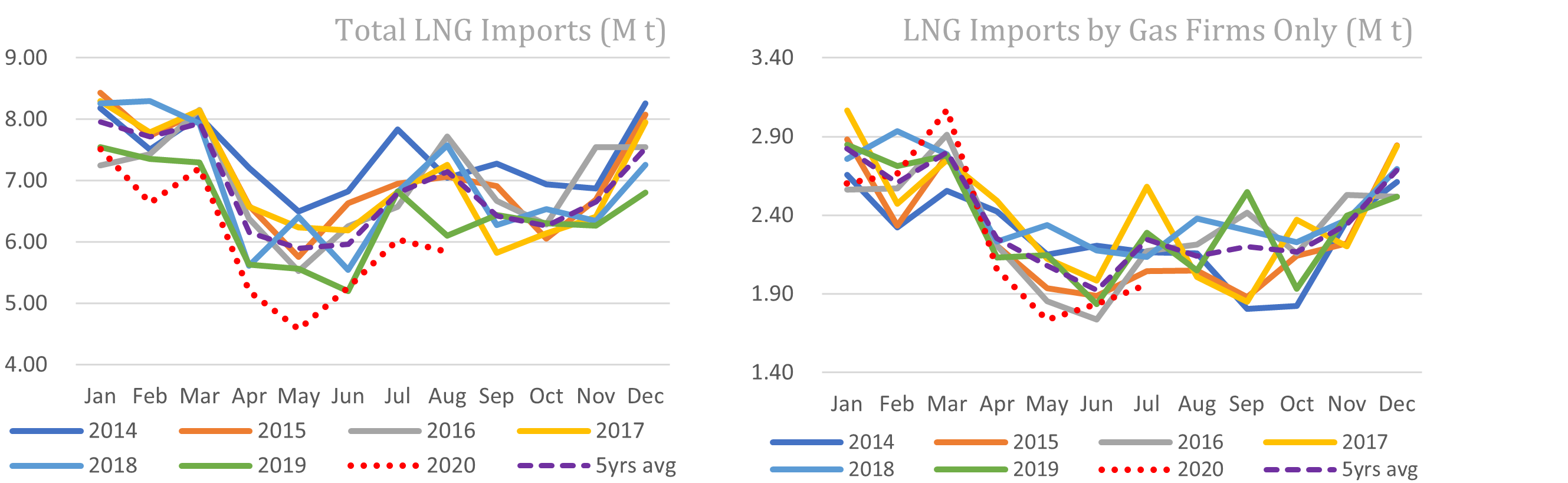
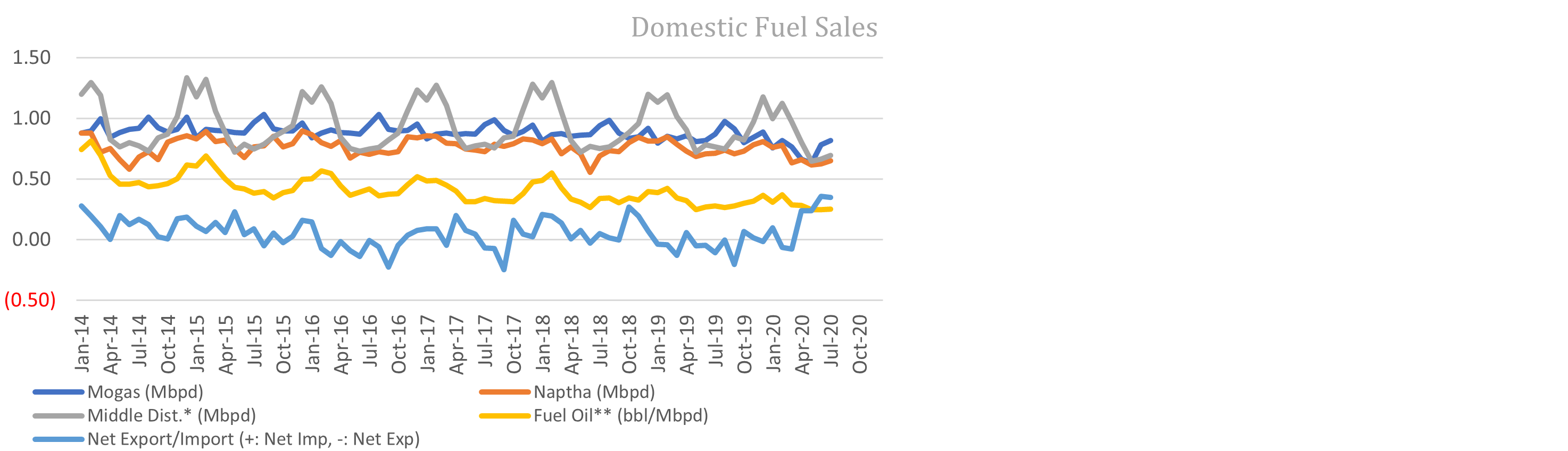 SOURCES: the Ministry of Economy, Trade, and Industry (METI), Ministry of Finance, and the Petroleum Association of Japan
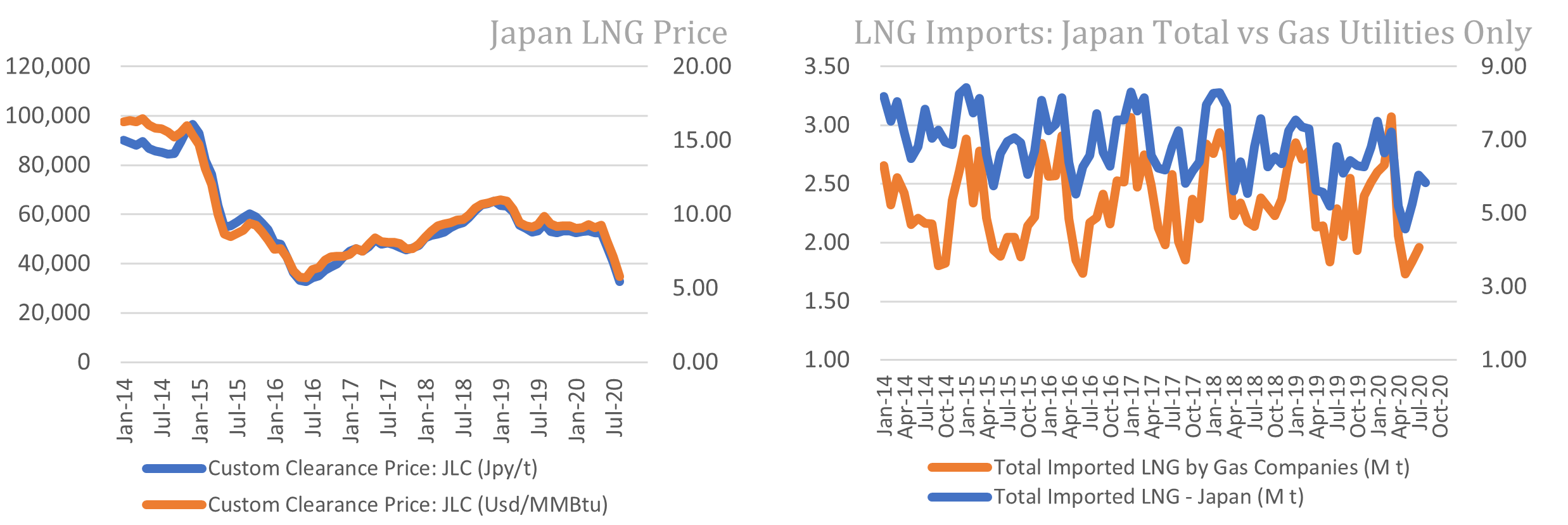
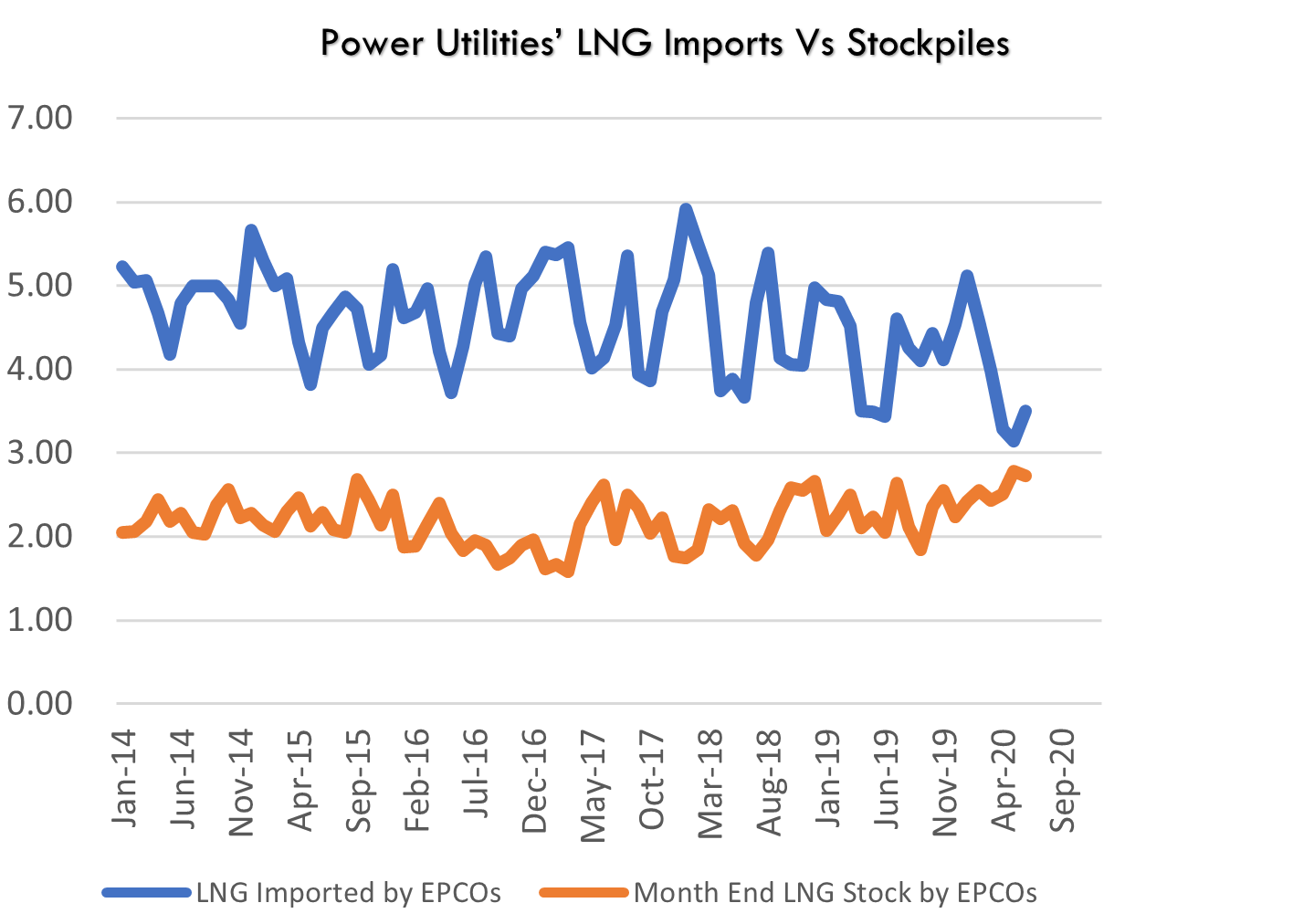
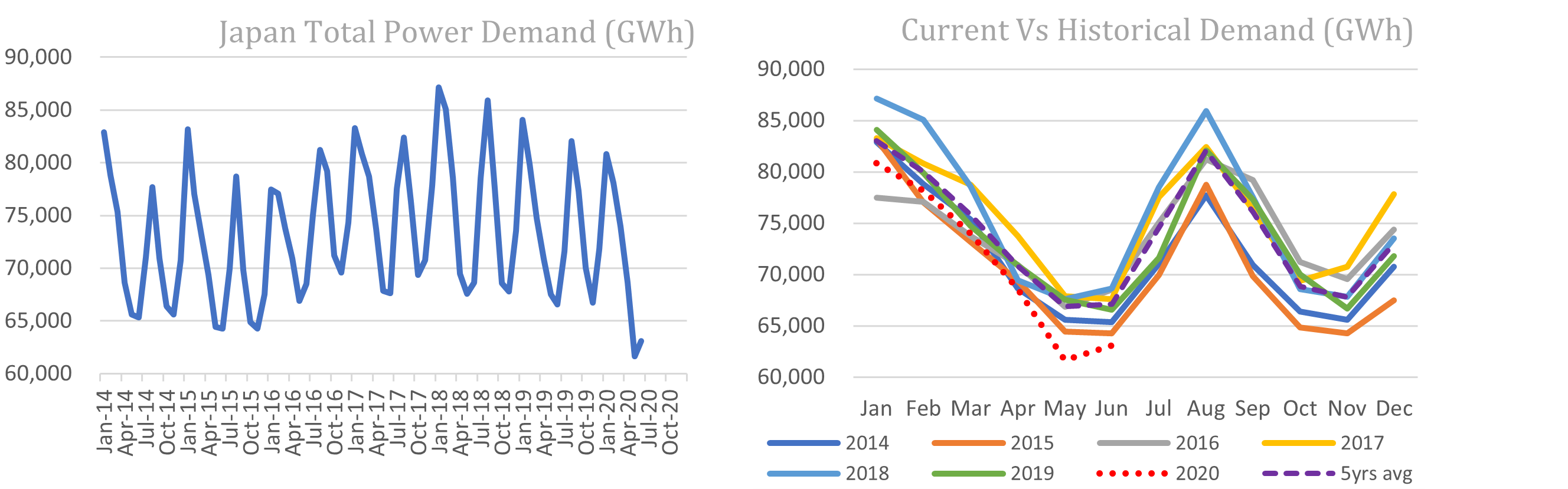
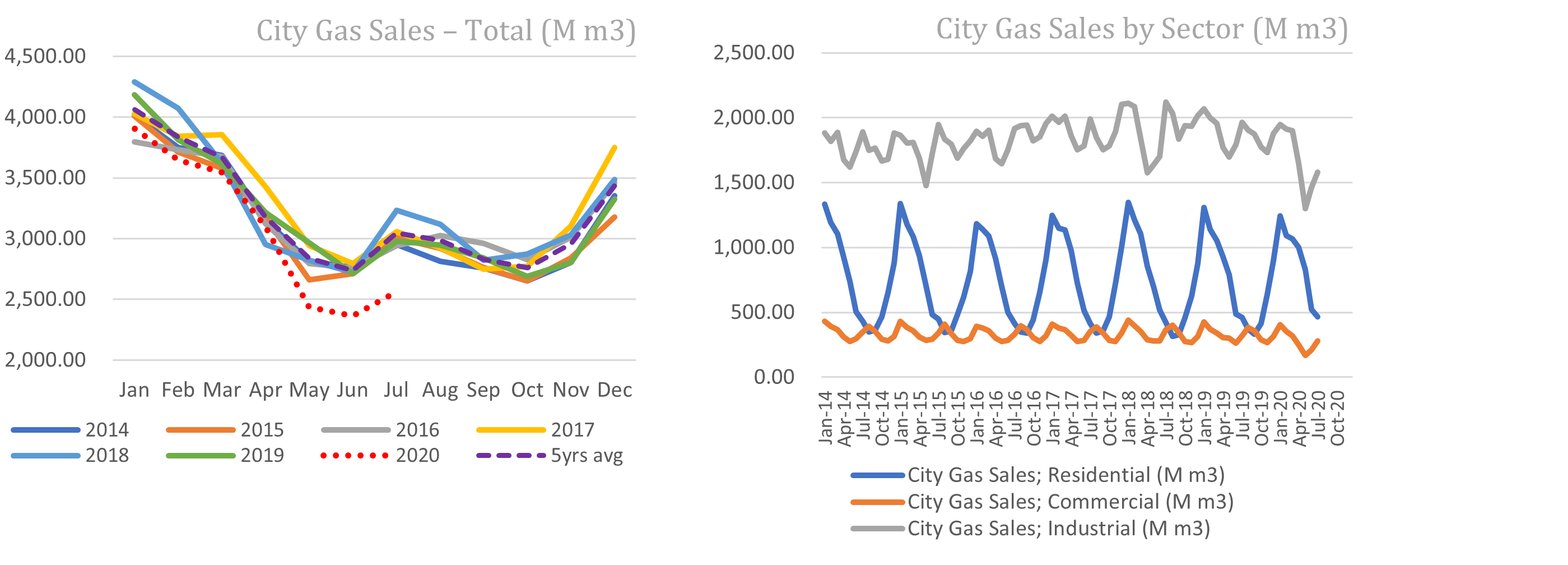 SOURCES: the Ministry of Economy, Trade, and Industry (METI),
Ministry of Finance
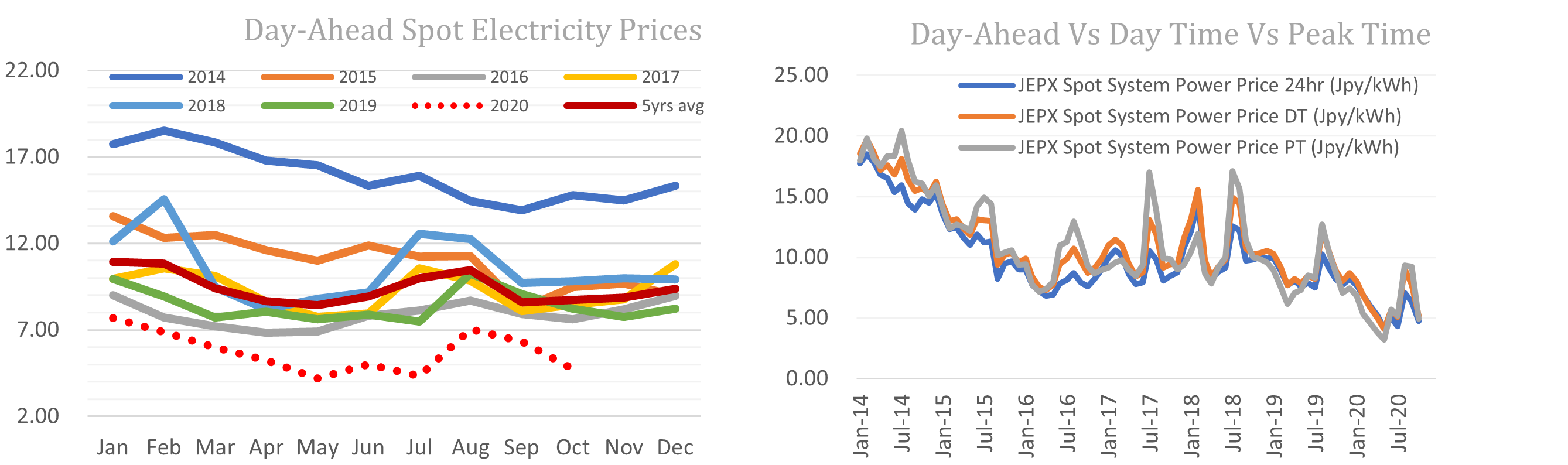
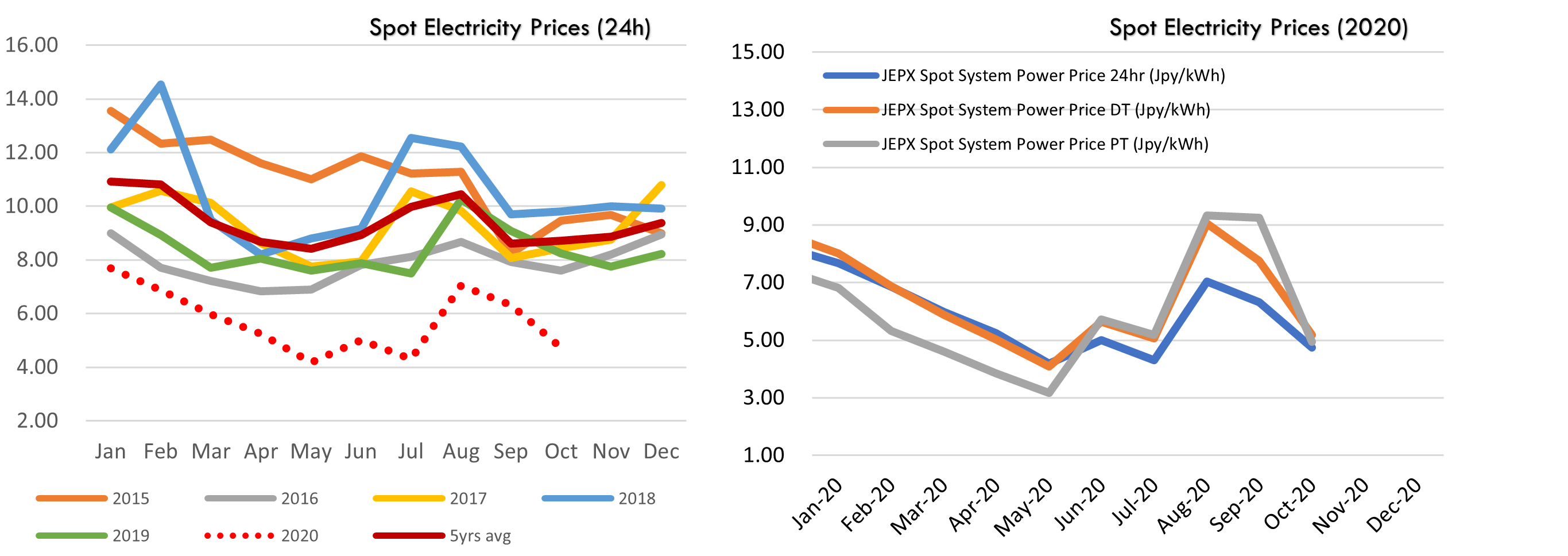
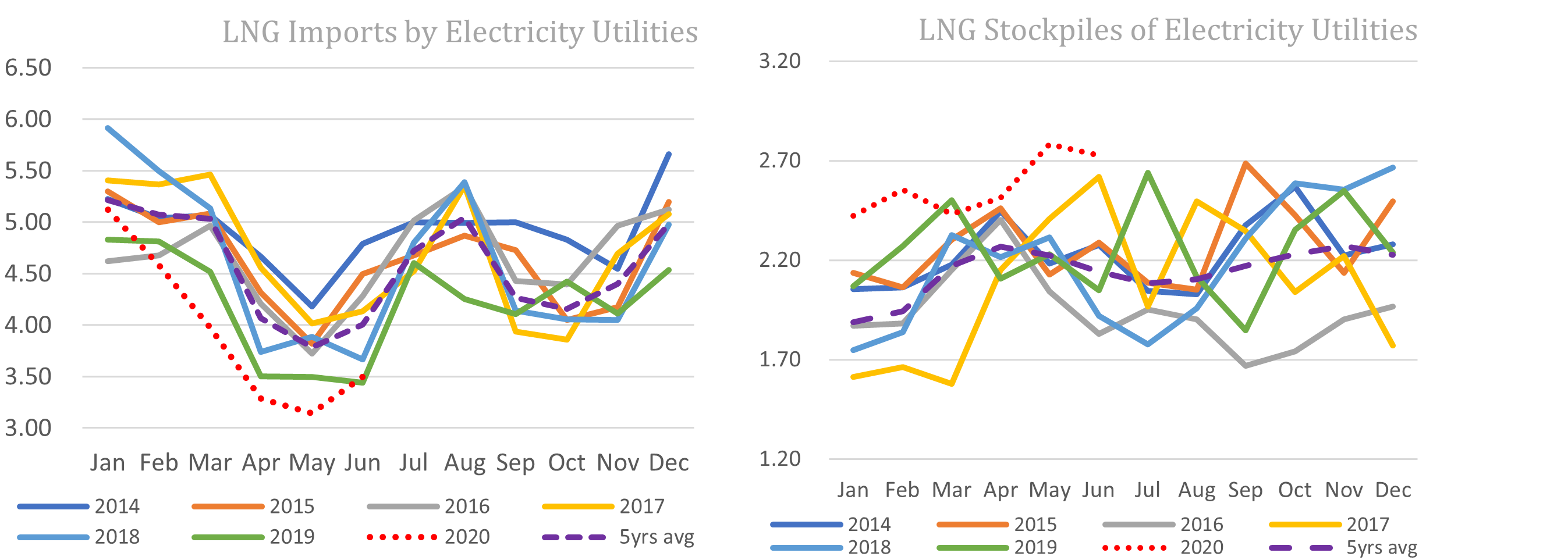 SOURCES: the Ministry of Economy, Trade, and Industry (METI), and the Japan Electric Power Exchange