
JAPAN NRG WEEKLY
NOVEMBER 2, 2020
JAPAN NRG WEEKLY
November 2, 2020
TOP
- Japan pledges to be net-zero greenhouse gas emitter by 2050; Prime Minister Suga vows to use renewables “to the maximum,” and to change coal policy “drastically”; REI says Japan must cut emissions by 45% by 2030; the govt. sends uncertain message on nuclear; major power utilities say they can’t meet new emissions target without technology breakthroughs
- ENEOS to shutter another Japanese oil refinery in 2021
- Japan to bolster inter-regional power grid to help renewables
- JERA signs Vietnam LNG accord with ExxonMobil; starts LNG bunkering business
OIL & GAS
- Mitsubishi Corp. to establish nationwide LNG fueling network
- Govt. to step up ammonia purchases to cut CO2 emissions
- Osaka Gas to sell Australian petrochemical subsidiary
POWER & NUCLEAR
- SoftBank trials technology to regulate electricity demand
- TEPCO profit drops 64% as rivals and the pandemic hurt demand
- Japan’s nuclear watchdog says it was hacked
- Court overturns petition to shut coal-fired power station
RENEWABLES, OTHER
- Japan to encourage building geothermal, solar in national parks
- Ministry approves JERA’s 520 MW offshore wind project; Kyushu Electric and RWE are told to revise their project proposal
- Sumitomo Corp. plans 500 MW offshore wind farm in Yamagata; 30 wind operators join forces in Yamagata for project surveys
- METI clamps down on solar generators who flout the rules
- Renova, Sumitomo Forest to proceed with 75 MW biomass plant
- MOL Coastal Shipping builds biomass transportation ship
- Orix officially announces investment in India renewables firm
PRIME MINISTER PLEDGES THAT JAPAN WILL HIT
NET-ZERO EMISSIONS BY 2050 IN POLICY SPEECH
In his first policy speech as Japanese prime minister, Suga Yoshihide pledged on Oct. 26 to make the world’s second largest developed economy achieve net-zero carbon emissions by mid-century. This is a significant departure for Japan’s energy strategy. Suga’s announcement surprised the global community given Japan’s low energy self-sufficiency, and its lukewarm commitment to address global warming issues in recent years. We examine the issue.
JAPAN TURNS SUPER-BULLISH ON LNG FUTURE,
SETS 2030 TARGET TO HANDLE 100 MILLION TONS
Almost all forecasts, including the government’s own, pointed to a drop-off in Japan’s imports of liquified natural gas (LNG) over the next two decades due to domestic factors, such as a shrinking population. In a spectacular turnaround, a recent proposal by the Agency for Natural Resources and Energy (ANRE) calls for Japan to defend its status as the world’s No.1 LNG buyer by increasing the volumes its companies handle to 100 million metric tons.
STATUS REPORT ON EVERY OPERABLE NUCLEAR REACTOR IN JAPAN AND RESTART ASSESSMENT
Nuclear energy is both emissions-free and plentiful in Japan. Yet, despite Prime Minister Suga’s pledge to move Japan to zero-net-emissions by 2050, the future of the domestic nuclear power industry is troubled. We examine the latest issues, provide a forecast for the timing of restarts, and offer a detailed status report on every operable reactor in the country.
GLOBAL VIEW
This week we review the collapse of oil prices below the break-even average needed by most producers, the impact from rising anti-French sentiment, a stock market rout and more.
JAPAN NRG WEEKLY
K. K. Yuri Group and Yuri Invest Research Ltd.
Editorial Team
Yuriy Humber (Editor-in-Chief)
Tom O’Sullivan (Japan, Middle East, Africa)
John Varoli (Americas)
Contributors
Mayumi Watanabe
Daniel Shulman
Art & Design
22 Graphics Inc.

SUBSCRIPTIONS & ADVERTISING
Japan NRG offers individual, corporate and academic subscription plans. For further details, or to discuss marketing, advertising, or collaboration opportunities, please contact one of the Editorial Team members or write to nrgnews@yuri-invest-research.com
Disclaimer
This communication has been prepared for information purposes only, is confidential and may be legally privileged. This is a subscription-only service and is directed at those who have expressly asked Yuri Invest Research Ltd. or one of its representatives to be added to the mailing list. This document may not be onwardly circulated or reproduced without the prior written consent of Yuri Invest, which retains all copyright to the content of this report.
Yuri Invest Research Ltd. is not registered as an investment advisor in any jurisdiction. Our research and all the content of our reports express our opinions, which are generally based on available public information, field studies and own analysis. Content is limited to general comment upon general political, economic and market issues, asset classes and types of investments. The report and all of its content does not constitute a recommendation or solicitation to buy, sell, subscribe for or underwrite any product or physical commodity, or a financial instrument.
The information contained in this report is obtained from sources believed to be reliable and in good faith. No representation or warranty is made that it is accurate or complete. Opinions and views expressed are subject to change without notice, as are prices and availability, which are indicative only. There is no obligation to notify recipients of any changes to this data or to do so in the future. No responsibility is accepted for the use of or reliance on the information provided. In no circumstances will Yuri Invest Research Ltd. or its partner K.K Yuri Group be liable for any indirect or direct loss, or consequential loss or damages including without limitation, loss of business or profits arising from the use of, any inability to use, or any inaccuracy in the information.
Yuri Invest Research Ltd.: Room 602, Wah Yuen Building, 149 Queen’s Road Central, Central, Hong Kong.
K.K. Yuri Group: Oonoya Building 8F, Yotsuya 1-18, Shinjuku-ku, Tokyo, Japan, 160-0004.
NEWS: OIL & GAS
Japan Oil Price: $46.20 / barrel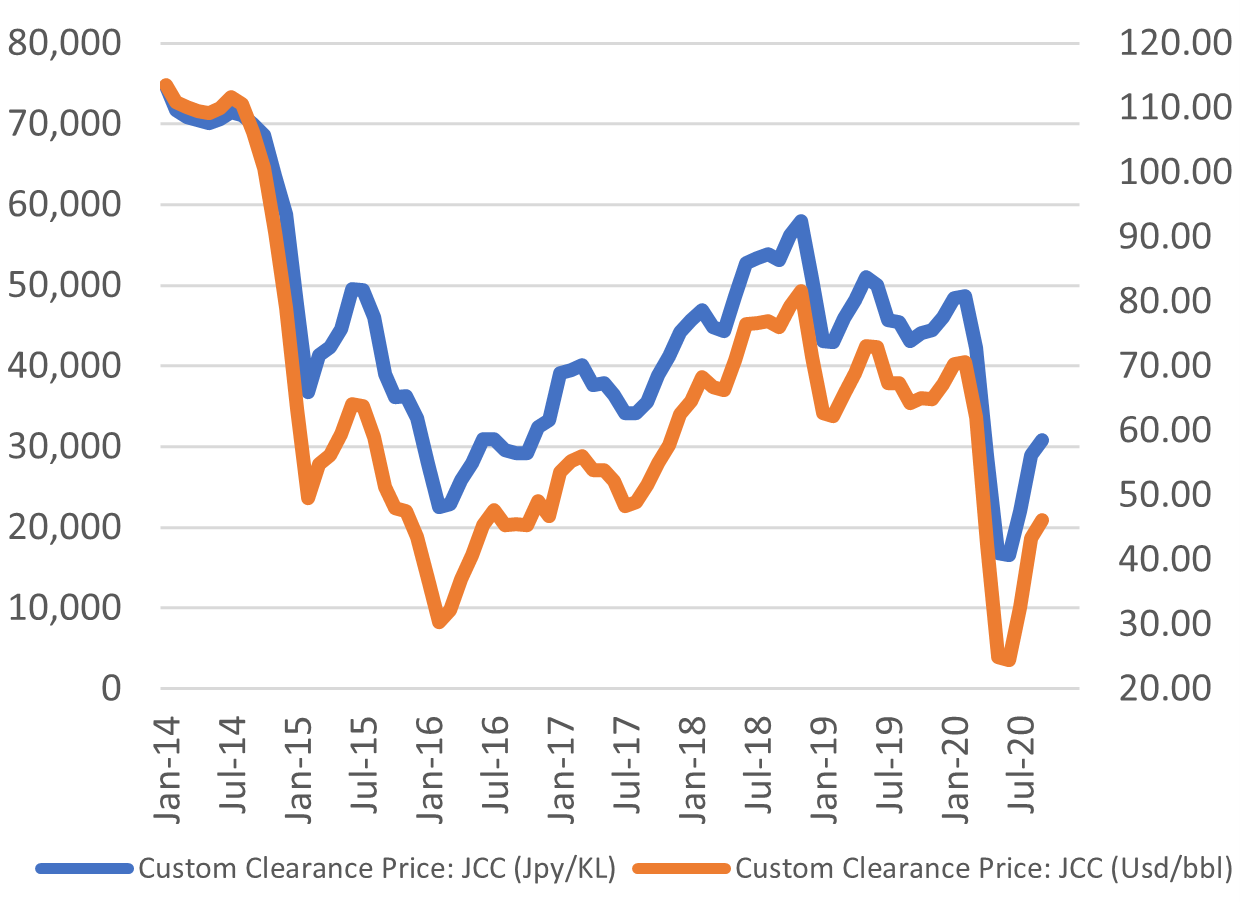
Japan (JLC) LNG Price: $5.39 per Mbtu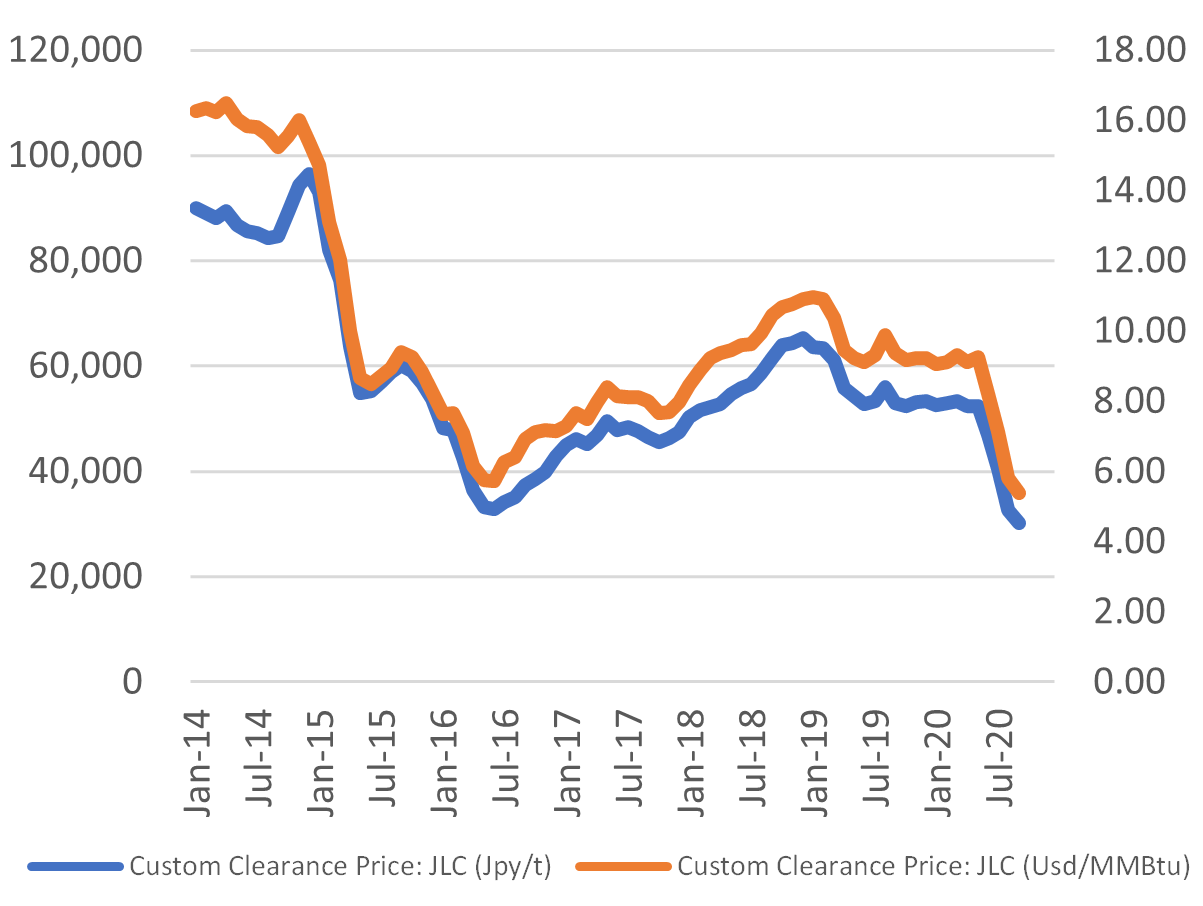
ENEOS says will shut down another oil refinery in 2021
(Nikkei, Oct. 27)
- ENEOS announced the planned closure of its Chita refinery in Oct. 2021 due to a drop in local demand. The news sent shockwaves through the local business community.
- While ENEOS says it will find new roles for refinery workers, the Chita refinery is the only ENEOS facility of its type in the region. With many industrial facilities in the central Chubu region nearing 50 years in age, making them uncompetitive compared to larger, newer facilities overseas, this trend is expected to continue.
- CEO Ota Katsuyuki says that a portion of the plant and facilities will be sold to Idemitsu, although the details have not yet been confirmed.
- Some of the 1,300,000 m² site could be converted into a solar farm, said Ota.
- CONTEXT: The refinery annually produces 400,000 metric tons of paraxylene, a chemical used to make PET plastic bottles and x-ray film. Even after the closure, ENEOS would still have annual output capacity of more than three million tons.
TAKEAWAY: In the Japan NRG Weekly Oct. 5 edition, we explained that oil refinery shutdowns in Japan would now accelerate in line with the global trend of declining demand for oil-products, as well as due to a shrinking population. We wrote that we foresee closures of three mid-sized refineries in crowded locations, and Chita fits that description. The refinery sits almost next door to a similar-sized facility, also making paraxylene for rival Idemitsu Kosan. It’s no surprise that the closure by ENEOS will involve part-absorption of its facilities, and maybe staff, by Idemitsu.
ENEOS signaled a few months ago that further industry consolidation and slimming down of capacity is needed. The company shut its Osaka refinery this month, and in recent years closed at least two more facilities. The benefit for ENEOS is that by moving first among Japan’s top three refiners, it is first to try out the alternatives. It will be worth paying attention to how exactly ENEOS moves forward with solar farm plants on the grounds of the Chita refinery. Will it bring in a dedicated solar developer?
JERA signs Vietnam accord with ExxonMobil to build LNG power, import facilities
(Nihon Kaiji Shimbun, Denki Shimbun, Oct. 29)
- Japan’s largest power firm, JERA, said on Oct. 28 that it signed a memorandum of understanding with Exxon Mobil and the Vietnamese city of Hai Phong for an LNG value chain project in the region. The signing took place at the Indo-Pacific Business Forum.
- While JERA has not disclosed the details of the project, local media say JERA may construct a floating storage, or floating storage and regasification unit, to enable the receipt of LNG shipments.
- The project likely involves a 4.5 GW of LNG-fired power capacity, as well as LNG receiving facilities, with ExxonMobil due to take the lead. Half of that power capacity would come online in 2026 or 2027, and the other half three years later.
- This project is part of the Japan-U.S. Strategic Energy Partnership, which aims to strengthen energy cooperation between the two countries.
- CONTEXT: Demand for power in Hai Phong, Vietnam’s largest port city, is projected to double in the next 10 years.
TAKEAWAY: Japanese energy companies have been aggressively looking at new LNG infrastructure projects in Southeast Asia. The trend is supported by the Japanese government, also through financing. See the full story in this week’s Analysis section for more details and context.
- SIDE DEVELOPMENT:
JERA enters the LNG fuel bunkering business
(Denki Shimbun, Oct. 24)- The new venture will supply LNG fuel to ships in the Chubu region of Japan. JERA said this is the first commercial ship-to-ship fuel supply venture in Japan.
- JERA’s partners in the business are Kawasaki Kisen Kaisha (K-Line), Toyota Tsusho and NYK.
Mitsubishi Corporation to establish nationwide LNG fueling network
(Nikkei, Oct. 27)
- Mitsubishi Corp. has unveiled an LNG fueling stand comprising a modified shipping container developed in conjunction with major industrial gas supplier Air Water.
- The fueling stand has a smaller footprint than the prototype previously used by Mitsubishi for testing, and is capable of refueling 60 trucks per day.
- Mitsubishi and Air Water say they will establish a nationwide network of fueling stations, with the inaugural unit to be installed in Ishikari, Hokkaido, in November.
- Isuzu has donated an LNG-fueled truck for use in testing.
- CONTEXT: While China already has an estimated 260,000 LNG trucks, Japan had been putting its efforts into cleaner diesel, and is late to the development of this technology.
Government steps up ammonia purchasing to cut CO2 emissions
(Nikkei, Oct. 26)
- The Ministry of Economy, Trade and Industry (METI) says it will increase the amount of ammonia it procures. Ammonia can be mixed with coal to reduce the carbon dioxide emissions of thermal power stations.
- METI also plans to export ammonia blending technologies to other countries in Asia.
- The technology will make its commercial debut in 2021/22 with a trial to blend 20% ammonia in coal fuel stock, thereby reducing carbon dioxide emissions by 10%.
- Most of the 20 million metric tons of ammonia traded internationally every year is used as fertilizer. METI believes there is a need to develop more sources of the commodity in order to ensure a sufficient supply for power generation.
TAKEAWAY: This seems to be one of the key strategies to retaining coal-fired power plants in Japan at least over the next couple of decades.
Osaka Gas to sell Australian petrochemical subsidiary
(Nikkan Kogyo Shimbun, Oct. 28)
- Osaka Gas says it will sell its stake in Osaka Gas Nuigini, an Australian-based oil and gas developer whose goal is oil and gas extraction in Papua New Guinea, to Australian entity Alan Energy for an undisclosed sum, after a reassessment of the viability of the business.
- While Osaka Gas acquired partial rights to Papuan oil and gas fields in 2013 for ¥7.5 billion, plans to begin commercial production in 2015 were put on hold.
NEWS: POWER & NUCLEAR
| No. of operable nuclear reactors | 33 | |||
| of which | applied for restart | 25 | ||
| approved by regulator | 16 | |||
| restarted | 9 | |||
| in operation today | 2 | |||
| able to use MOX fuel | 4 | |||
| No. of nuclear reactors under construction | 3 | |||
| No. of reactors slated for decommissioning | 27 | |||
| of which | completed work | 1 | ||
| started process | 4 | |||
| yet to start / not known | 22 | |||
Power Utilities’ LNG Imports Vs Stockpiles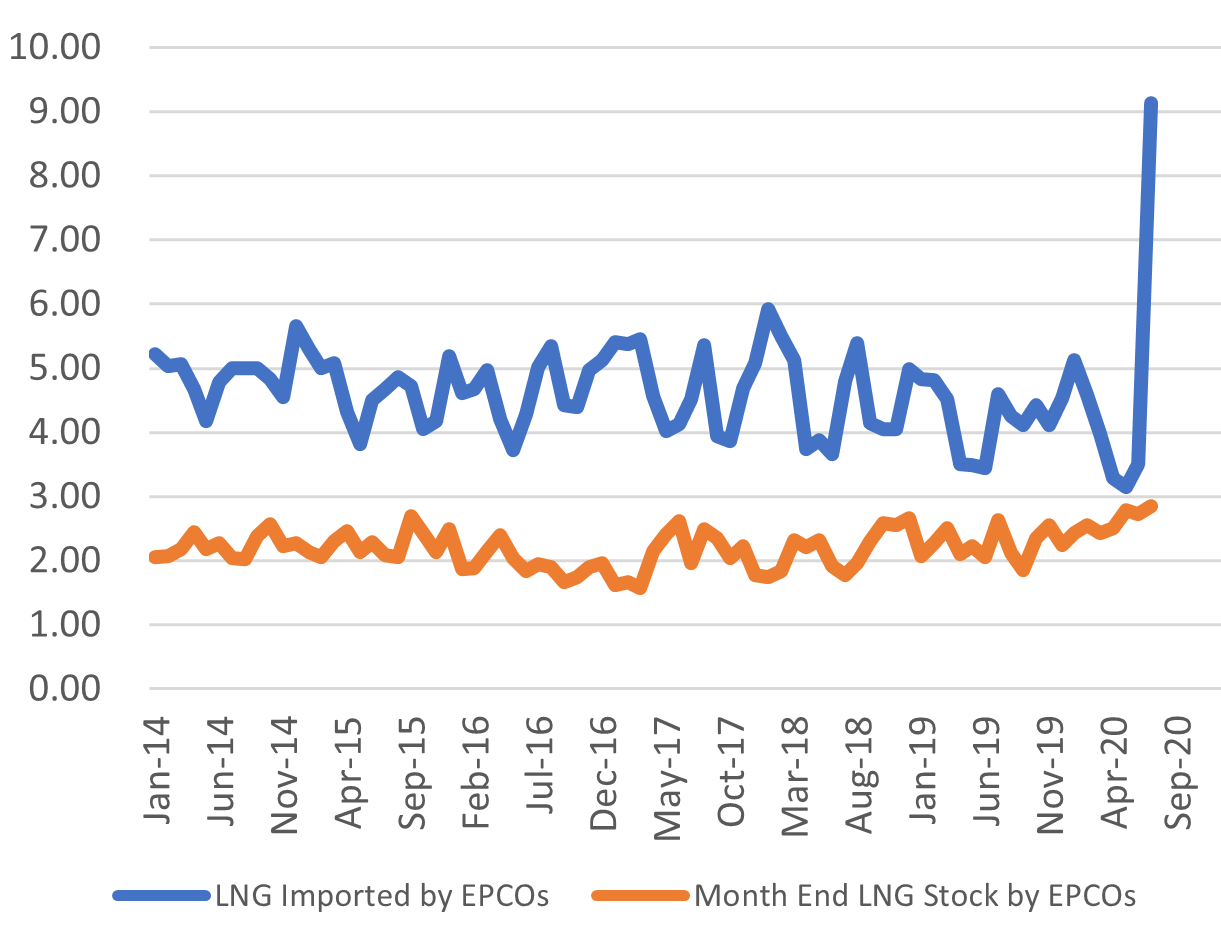
Source: Company websites, JANSI and JAIF, as of Nov. 2, 2020
Japan to bolster power lines between regions to welcome more renewables capacity
(Nikkei Shimbun, Oct. 31)
- CONTEXT: The country’s grid is split into several regions, with only a few lines running between them. This makes it difficult to balance a sudden rise in power demand in one area with surplus electricity in another. Given the susceptibility of solar and wind power to the weather, better management of the nation’s grid is vital. Adding more inter-connecting power lines capacity should help balance out the issue of power supply and demand across regions.
- The Ministry of Economy, Trade and Industry will review the nation’s grid and its interconnecting capacities. A concrete plan on additional cross-regional power lines will presented in spring 2021.
- Among the bottlenecks that should be addressed are the connections between Tohoku and Hokkaido, between Kyushu and Chugoku, and between Tokyo and Chubu regions.
TAKEAWAY: Better connections across Japan would not only help renewable energy. All generators with slack capacity would benefit. One immediate issue that the government wants to solve is the intermittency of solar and wind power stations. Having baseload thermal or nuclear capacity that can step in as needed in another region would make it less risky for local energy systems to accept more renewable energy generators. Depending on how much the inter-regional power lines are strengthened, this could also eat away at the dominance enjoyed by the incumbent regional utilities (EPCOs). It could even spur on the industry’s reorganization through mergers and acquisitions.
SoftBank trials technology to regulate electricity demand
(Denki Shimbun, Oct. 28, 2020)
- SoftBank Power says that a trial of a demand-response scheme in 4,000 households suggests that the technology can be used to regulate demand for electricity when spot market prices are high, as well as to prevent power shortages.
- In the trial, subscribers received monetary compensation via PayPay in exchange for reducing their power use at peak times.
- Over 50% of trial participants made voluntary power savings, resulting in a total saving of 29,000 kWh.
TEPCO 1H profit down 64% as demand for its electricity falls
(Nikkan Kogyo Shimbun, Oct. 29)
- On Oct. 28, TEPCO Holdings announced its results for the April to September period. TEPCO recorded a 10.8% drop in sales, a 10.1% drop in recurring profit, and a 64.7% drop in total profit compared with the same period last year.
- TEPCO says that half of the 8.3% drop in electricity sold against the same period last year was attributable to the coronavirus pandemic, and the company blamed increasing competition and cooler temperatures for the rest.
- While electricity consumption by TEPCO’s household customers rose one percent in the period, consumption by commercial and industrial clients fell by over seven percent.
- Executive Officer Otsuki Rikuo said he believes year-on-year performance will improve in the next quarter.
Nuclear watchdog hacked
(NHK, Oct. 27)
- Japan’s Nuclear Regulation Authority says it was the victim of a cyber-attack mounted by an external server on Oct. 26. While it took evasive action, its network may have been compromised, says the NRA.
- The Authority is now working to establish whether sensitive information on physical defenses put in place to guard nuclear materials was compromised.
- While data links to the outside world have been deactivated as a precaution, the NRA reassured the public that it is still able to communicate with power plant operators using a separate dedicated line in the event of an incident.
Sendai court overturns petition to shut down coal-fired power station
(Tokyo Shimbun, Oct. 28)
- The Sendai District Court has dismissed a petition by over 100 local residents seeking an injunction that would have required the Sendai power station to cease operating.
- The petition claimed that nitrogen oxides and microscopic particles contained in the exhaust of the coal-fired plant had caused asthma and lung cancer and adversely affected local wetlands.
NEWS: RENEWABLES & OTHERS
Spot Electricity Prices (24h)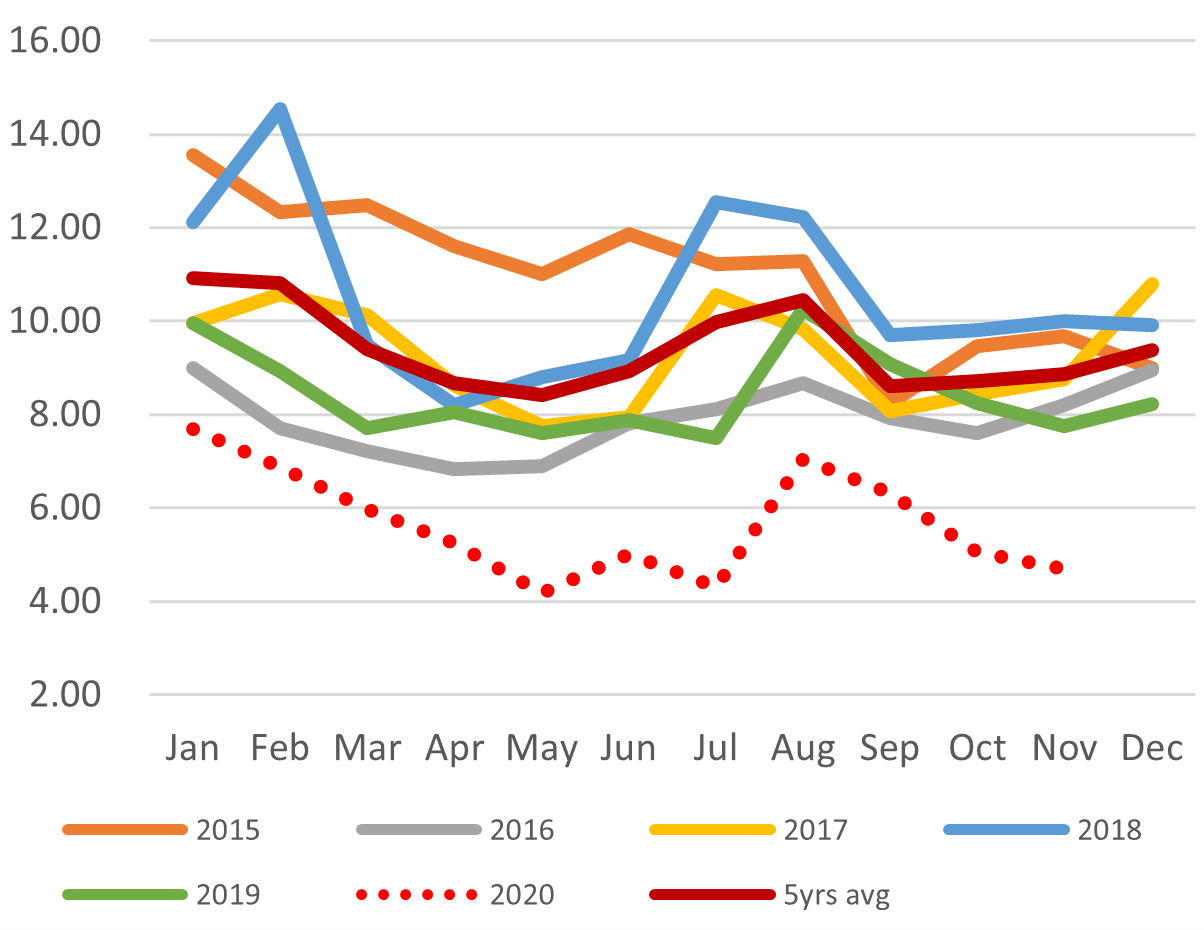
Spot Electricity Prices (2020)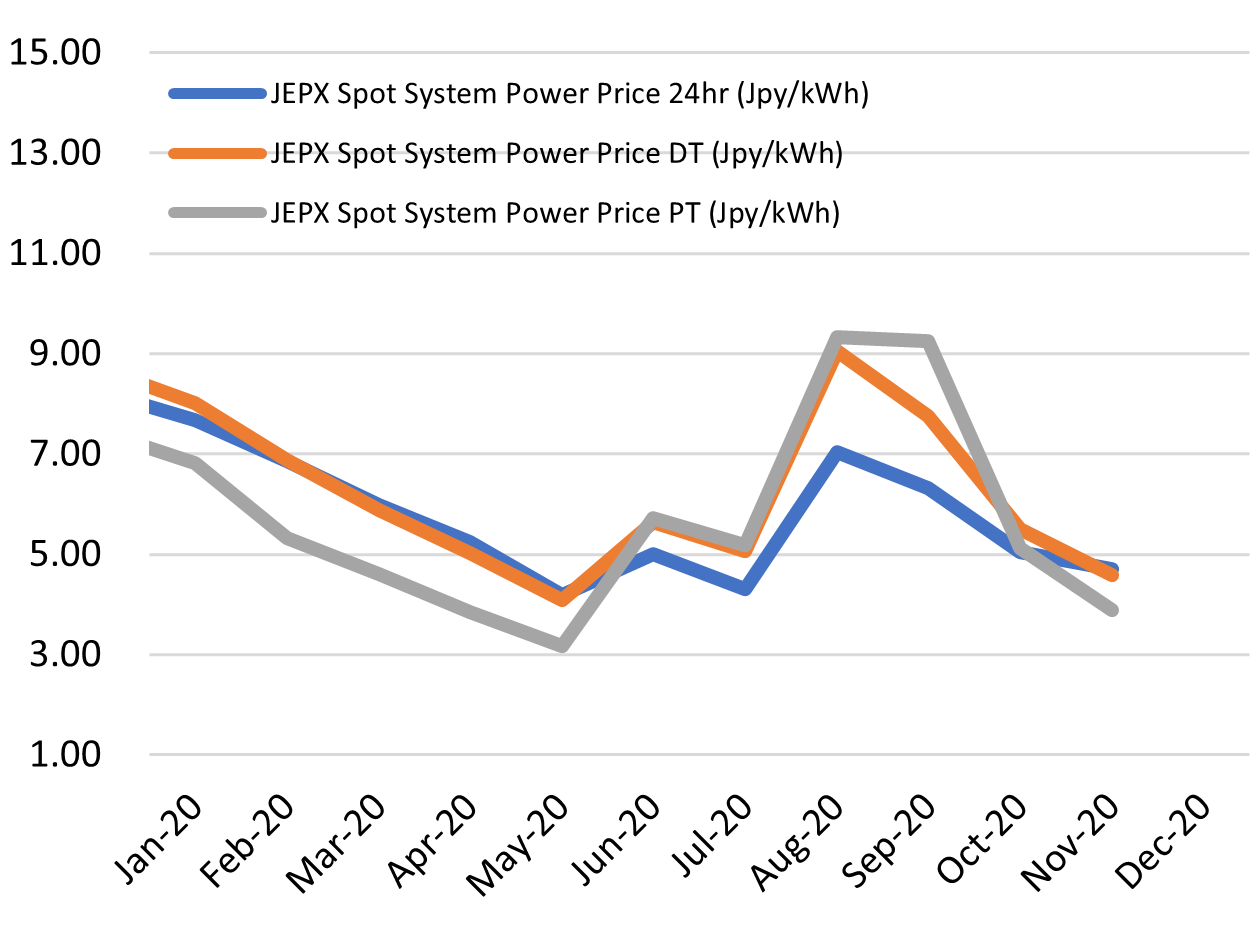
Prime Minister Suga pledges to make Japan net-zero greenhouse emitter by 2050
(Yomiuri Shimbun, Various, Oct. 26)
TAKEAWAY: Please see the Analysis section for a full report on the news and the main takeaways from the Japan NRG team.
- In first address to parliament since becoming prime minister, Suga said he aims to move Japan to becoming net-zero greenhouse gas emitter by 2050. Suga said he wants to make the country a “Green Society”.
- Suga vowed to continue the policies of predecessor Abe Shinzo, while balancing economic growth with concern for the environment. Decarbonization efforts will include promoting nuclear energy while keeping it safe, and supporting better forest care as a way to absorb CO2.
- CONTEXT: Japan’s previous 2050 policy called for an 80% reduction in emissions.
- SIDE DEVELOPMENT:
Full text of PM Suga’s speech in Japanese
(Prime Minister’s website, Oct. 26) - SIDE DEVELOPMENT:
METI to re-work 2030 Japan’s energy mix based on new net-zero emissions pledge
(Kankyo Business, Oct. 23) - SIDE DEVELOPMENT:
Suga promises to use renewables “to the maximum”, change coal policy “drastically”
(Kankyo Business, Oct. 26) - SIDE DEVELOPMENT:
REI says 45% Emission Reduction is Needed by 2030
(Renewable Energy Institute website, Oct. 26)- The institute backed by Softbank owner Son Masayoshi says near-term emissions cut target is needed to meet Suga’s 2050 goals
- SIDE DEVELOPMENT:
Coal share in energy mix must drop to 4% by 2030 to meet Japan emissions pledge
(International Energy Agency, Oct. 29)- IEA commented on recent announcement by Japan on 2050 emissions goal.
- IEA said that to reach target Japan must drop its coal capacity to 17 GW by 2040 from 51 GW in 2019, which would put it in line to receive just four percent of electricity from coal-fired power plants in 2030.
- Renewables such as solar, wind, and hydropower need to rise to a third of the total by 2030 and “almost half of all power” by 2040 for Japan to meet its goal, the EIA said.
- Agency wants to see concrete details from Japan on its commitment.
- SIDE DEVELOPMENT:
Japan Climate Leaders Partnership lobbies for renewables at 50% in the 2030 energy mix
(JCLP website, Oct. 26) - SIDE DEVELOPMENT:
Ex-Energy Minister says Japan needs to build new nuclear reactors
(NHK News Web, Oct. 27)- House of Counsellors Secretary General Seko Hiroshige says new nuclear power plants may need to be built in order to achieve the government’s objective of zero greenhouse gas emissions by 2050. Seko also called for more use of hydrogen.
- Seko, who used to be Minister of Economy, Trade and Industry, described the 2050 target as very ambitious and said many hurdles must be overcome to achieve it.
- SIDE DEVELOPMENT:
Japan is not considering new nuclear plants at this time, says Chief Cabinet Secretary
(Asahi Shimbun, Oct. 28)- At a news conference Chief Cabinet Secretary Kato Katsunobu was asked about the need for new nuclear power plants.
- “The government does not expect to build new nuclear power plants or replace [aging capacity] at this time”: Kato “We will make the most of what we have, including nuclear power, which has been confirmed to be safe.”
- METI began to review the basic energy plan in October, and nuclear will remain part of Japan’s mix: Kato
- SIDE DEVELOPMENT:
Major power utilities say they cannot meet Japan’s new emissions target
(Bloomberg News, Oct. 29)- Several of Japan’s 10 major regional power utilities said that it is too challenging for them to meet the 2050 emissions target as things stand, and that they cannot afford to close down power plants that burn fossil fuels.
- Shikoku Electric executive said the company cannot declare a net-zero emissions target at this point.
- Hokuriku Electric said it remains competitive because it can burn cheap coal
- Tohoku Electric and Hokkaido Electric said they currently do not have the technology to allow them to lower emissions.
- JERA is the only regional utility in Japan to announce a 2050 net-zero emissions goal.
Japan to encourage building of geothermal, solar and wind capacity in national parks
(Asia Nikkei, Oct. 28)
- Construction of new power plants is restricted in most of Japan’s 34 national parks, but this will change as the govt. seeks to cut red tape and encourage the construction of new geothermal, solar and wind capacity.
- Environment Minister Koizumi Shinjiro told Nikkei in an interview that the govt. will change its approach and will balance conservation with better land use.
- The minister will support municipalities that seek to introduce projects in the renewable space and make efforts at decarbonization.
- Electric cars for logistics and transport sectors will be supported with subsidies, and such vehicles will be promoted as an emergency energy source during a natural disaster: Koizumi
- SIDE DEVELOPMENT:
Japan to use snow to cool data-centers so as to lower emissions
(Bloomberg News, Oct. 30)- Environment Ministry said it will subsidize 50% of the cost of a new zero-carbon data center or to upgrade existing facilities. Centers in areas with a colder climate are being encouraged.
- The ministry has asked for a budget of ¥757 billion ($7.3 billion) for the next fiscal year, and it includes eco-friendly subsidies like the data center handouts.
Environment ministry approves JERA’s 520 MW offshore wind farm proposal
(New Energy Business News, Oct. 28)
- The environment ministry released an official opinion on a JERA project to build a wind farm off Ishikari, Hokkaido, on Oct. 23.
- The Minister has called on JERA to review the local zoning plan while proactively engaging the prefecture and local musicality in discussions and reflecting their input as necessary.
- The wind farm will comprise 65 bottom-fixed turbines occupying a 527 km² area off the coast of Otaru, and have a maximum output of 520 MW.
- SIDE DEVELOPMENT:
Ministry tells Kyushu Electric, RWE to reduce impact of offshore wind project on birds
(New Energy Business News, Oct. 29)- Ministry submitted its opinion on the Yurihonjo City Offshore Wind Farm Project in Akita Prefecture, planned by Kyushu EPCO and RWE Renewables Japan. It says that the developers need to reduce impact of wind turbines on the local environment as it currently impacts bird travel routes.
- Project would have 840 MW of capacity and consist of around 70 turbines, each with a capacity of 9,500 kW to 12,000 kW. The farm would have an area of approximately 130 km2 off the coast of Yurihonjo City, Akita Prefecture.
Sumitomo Corp. plans 500 MW offshore wind farm in Yamagata
(New Energy Business News, Oct. 29)
- Sumitomo plans to develop the project for an offshore wind farm off the coast of Yuza Town, Yamagata Prefecture. The maximum output is 500 MW.
- The company submitted an environmental assessment report for the project on Oct. 28.
- The project would cover about 3,960 ha and include a maximum of 45 wind turbines, each with a 9,500 kW to 14,000 kW capacity.
- SIDE DEVELOPMENT:
Offshore wind developers get together for local surveys, community relations in Yamagata
(Nikkei, Oct. 26)- A consortium comprising 30 different developers of wind farm projects off the coast of Yuza, Yamagata will soon begin consultation with local residents.
- All 30 developers have taken the unusual approach of coordinating their efforts to liaise with the local community in order to minimize disruption and confusion and send out a coordinated message.
- Developers are currently experiencing considerable opposition to wind farm projects, as seen with a recent proposal to build a farm in Dewa Sanzan (inland Yamagata) that was cancelled after local opposition.
- One academic praised the consultative approach taken on the Yuza project, and says developers of land-based wind farms could learn from it.
METI clamps down on solar generators who flout the rules
(Kensetsu Shimbun, Oct. 28)
- The Ministry of Economy, Trade and Industry will make fencing and signage compulsory from the moment small-scale solar generators commence operations this is in response to a large number of reports about operators violating the rules.
- A recent survey found that despite a warning issued in 2018, six percent of operators still failed to fence off their solar farms, while 45% had not erected signage.
- The ministry will also put measures in place to ensure the local body is informed about the generating facility as soon as a generator files an application under the feed-in tariff scheme.
Renova, Sumitomo Forestry make final decision on 75MW Sendai biomass power plant
(New Energy Business News, Oct. 30)
- Renova has made a final investment decision on Sendai Gamo biomass, a biomass power generation project in Sendai city, Miyagi Prefecture. The company has also secured project financing.
- Renova will have an initial stake of 29.0%. Other investors include Sumitomo Forestry, Mizuho Leasing, and an affiliate of Daiwa Securities.
- The plant will run on wood pellets and palm shells (PKS) and the generated electricity will be sold under the FIT system at a price of ¥24 /kWh. Construction will start in 2021 and operation will begin in 2023.
MOL Coastal Shipping builds biomass transportation ship
(New Energy business News, Oct. 27)
- MOL Coastal Shipping has completed the construction of a ship that will be used to transport biomass fuel to Kaita Biomass Power in Hiroshima.
- The 2,100-metric ton Shoei has a below deck capacity of 4300 m³ and is capable of unloading around 1000 m³ per hour.
- Kaita Biomass Power, a joint venture between the Chubu Electric Power Company and Hiroshima Gas, operates a 110 MW thermal power station that is fueled by a blend of coal and wood pellets.
Orix officially announces investment in Indian renewables firm
(Nikkei Shimbun, Oct. 23)
- Orix says it signed an agreement with India’s Greenco Energy Holdings (Greenco) on Sept. 11 under which Oryx will invest $980 million in Greenco in exchange for a 20% stake in the entity.
- The parent company of one of India’s two main renewables companies, Greenko owns a total of 4.4 GW of solar, wind, and hydroelectric capacity in India, and it’s in the process of purchasing an additional 1.2 GW of hydroelectric capacity.
- By combining renewable energy with pumped hydro, Greenco is able to provide renewable-sourced electricity at a comparable cost for electricity from thermal power stations, but in all weathers.
ANALYSIS
DIRECTOR,
K.K. MATHYOS
In First Major Policy Speech, Opening Debate on the Details
In his first policy speech as Japanese prime minister, Suga Yoshihide pledged on Oct. 26 to make the world’s second largest developed economy achieve net-zero carbon emissions by mid-century. This represents a significant departure in Japan’s overall energy strategy.
Suga’s announcement surprised the global community given Japan’s very low energy self-sufficiency, and its lukewarm commitment to address global warming issues in recent years.
The pledge followed a recent commitment at the U.N. General Assembly by China’s president to make the world’s largest CO2 emitter carbon neutral by 2060, and to peak China’s CO2 emissions by 2030. The South Korean president followed up with a similar commitment last week to make the world’s 12th largest economy carbon neutral by 2050.
These three G20 Asian economies account for $23 trillion of global GDP, which is one quarter of the global total. They also represent over 30% of the world’s carbon emissions. The net-zero commitments are regarded as a major step forward in meeting the goals of the Paris Agreement and were enthusiastically received by the United Nations, the convener of the 2015 Paris Agreement.
The Japanese pledge comes at a difficult time for the country. As with other major economies, Japan has been severely impacted by COVID-19. Its economy contracted by over 25% quarter-on-quarter in Q2, and last Thursday the Bank of Japan downgraded Japan’s growth forecast for the current fiscal year to -5.5%.
A comprehensive energy transition in Japan will be expensive and could easily cost a trillion dollars.
Japan’s carbon emissions peaked in 2013 two years after the Great East Japan Earthquake. It still relies on fossil fuel imports for over 90% of its primary energy consumption. Currently, domestic hydropower and solar account for most of the balance, with nuclear power providing less than 1%.
Prior to the prime minister’s announcement, the Ministry of Economy Trade and Industry (METI), which is responsible for formulating and enforcing Japan’s energy policies, announced a major reorganization to upgrade its renewable energy bureau and appoint a new senior official close to the Cabinet Office to oversee the unit.
Japan formally adopted the Paris Climate Agreement in November 2016 and famously hosted the conference that adopted the Kyoto Protocol in 1999, the precursor to the Paris Agreement, which first sought to limit greenhouse gas emissions in the atmosphere. The U.S., Japan’s second largest trading partner, opted out of the Kyoto Protocol in 2001, and opted out of Paris Agreement commitments in 2017.
Still, Suga’s pledge does not yet have legal force. The U.K., Sweden, France, Denmark, and New Zealand have all enshrined net-zero commitments into law, while the EU, Spain, Fiji, and Chile are considering similar moves.
Japan’s total greenhouse gas emissions
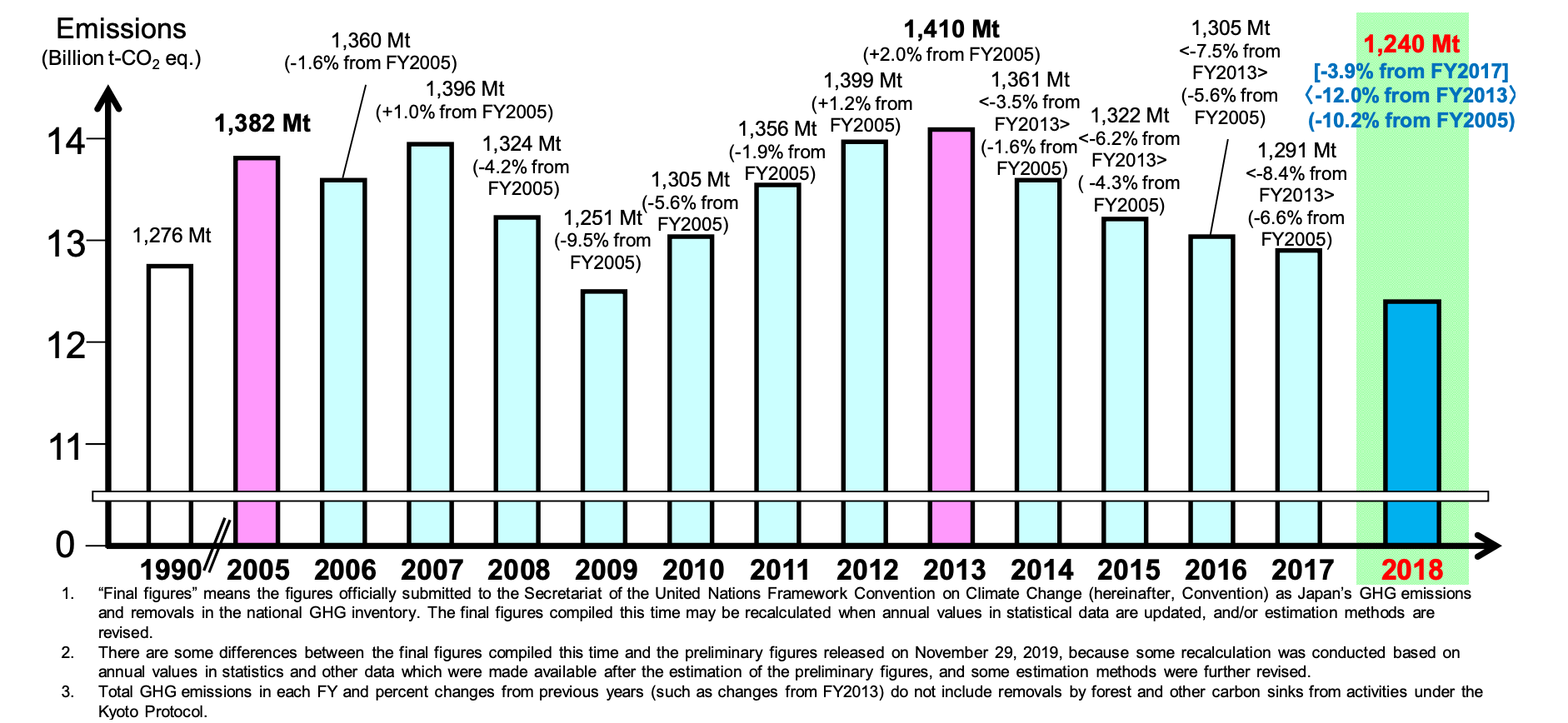
Source: Ministry of the Environment
ENERGY IMPLICATIONS OVERSEAS
Japan’s current fossil fuel consumption is equivalent to over eight million barrels of oil per day, with oil accounting for 45%, coal 30%, and natural gas 25%. Coal and oil account for around 80% of Japan’s CO2 emissions. The rest is from gas. Electricity and heat generation emit almost 50% of Japan’s CO2.
Saudi Arabia, UAE, Qatar, Australia, and Russia are major suppliers of fossil fuels to Japan so any change in the energy strategy will impact those relationships. Those nations will need to reorientate their own energy industries to fit better with Japan’s new strategy. There are signs that such a process has started. In the last 12 months or so, Saudi Arabia has sent Japan trial shipments of blue ammonia; Russia offered to produce hydrogen with electricity from its nuclear plants; and Australia is due to ship its first hydrogen produced in tandem with carbon capture early in 2021.
How Japan’s revised energy mix will look is not yet finalized. METI is due to formulate an updated Basic Energy Plan by June 2021.
In addition, Japan will be expected to submit its revised Nationally Determined Contributions, as per the Paris Agreement, at the next COP summit in November 2021 in Glasgow.
Japan’s Renewable Energy (RE) Institute, a think-tank funded by Son Masayoshi, the founder of SoftBank, has called for renewables to supply 45% of Japan’s electricity by 2030 – up from roughly 17% today. This alone may involve constructing an additional 120GW of RE capacity which could cost over $50 billion in capital expenditure over the next decade.This could significantly impact consumer power bills with Japan’s electricity rates already among the highest in the world, at over 20 U.S. cents per kWh.
Suga’s announcement was almost immediately followed by more calls for a detailed roadmap, and more near-term goals. In 2050, Suga himself will be 100 years old.
The Japanese prime minister will also need to call a general election within the next 12 months, as well as deal with his party’s presidential election in September 2021. The political stakes are not insignificant, with the largest opposition party calling for a complete abandonment of nuclear power.
ENERGY TRANSITION WINNERS & LOSERS
In his policy speech Suga also referenced solar and carbon capture and storage technologies as platforms that could transform Japan’s energy landscape. At a later parliamentary question time, Suga also referenced the need for more decentralized power systems.
Suga’s cabinet secretary, arguably the No. 3 position in government, indicated last week that Japan might need to consider a phase-out of nuclear power. The majority of Japanese are still opposed to nuclear following the devastating 2011 accident in Fukushima.
From now on, the government, industry and civil society will likely be locked in strong debates over the role of coal and nuclear power in light of the new net-zero commitment. Japan’s most recent energy plan had coal and nuclear accounting for 26% and 22% of the electricity mix, respectively, by 2030. Without either of those two energy sources, prefectures in the very north and very south of the country would currently struggle to meet their power needs.
The switch in power policies will most impact industries such as utilities, shipping, logistics, steel, oil and gas, large-scale retail, railways, data centers, and automobiles. JERA, the top operator of thermal power stations, by itself accounts for 13% of Japan’s overall emissions.
It’s unsurprising then that the pushback from industry has begun. The chairman of one of Japan’s largest railway companies, Kasai Yoshiyuki, called for an increased reliance on nuclear to meet the new decarbonization pledge.
There will be significant capital markets implications for Japan’s upstream oil and gas companies as they consider which assets may need to be phased out and depreciated.
Of course, partly this is a global trend. Exxon, the largest U.S. oil producer, has seen its shares dive 60% this year, and for the first time in 38 years the company told investors that it would not be increasing its dividend. In contrast, the stocks of renewable energy firms will likely gain. Chinese solar companies surged after the nation’s 2060 pledge was announced.
To date, there has not been a Japanese energy firm ready to abandon its fossil fuel ties and position itself as a green energy champion, such as Orsted A/S of Denmark (formerly DONG Energy). Neither has a significant new player emerged whose business is entirely built on clean energy, such as NexEra Energy in the U.S.
Prime Minister Suga’s pledge, for all of its lack of details, has created the conditions for such companies to emerge in Japan. Investors are paying attention.
ANALYSIS
DIRECTOR,
YURI INVEST RESEARCH
Agency Proposes 2030 Target to Handle 100 Million Tons a Year
Almost all forecasts, including the Japanese government’s own, pointed to a drop in the country’s imports of liquified natural gas over the next two decades due to domestic factors, such as a shrinking population. In a spectacular turnaround, a recent proposal by the Agency for Natural Resources and Energy (ANRE) calls for Japan to defend its status as the world’s No.1 buyer of LNG by increasing the volumes its companies handle to 100 million metric tons.
While Japan’s needs will drop, the country’s purchases can still grow if its buyers turn suppliers to burgeoning markets across Asia. By winning the role of preferred LNG supplier in other countries, Japanese companies will ensure that their home nation retains influence in this key energy space and, by extension, this will improve the reliability and security of LNG supply for Japan itself.
“Acquiring flexible [LNG] capacity and forming flexible and highly liquid international LNG markets is vital,” the ANRE said in a presentation made at the latest meeting of the Study Group for the Gas Industry’s Development Until 2050. “To improve LNG security in Japan, the expansion of LNG demand in Asia through the participation of Japanese companies and the expansion of LNG supply to Japan in the event of an emergency are necessary.”
Only a couple of months earlier, when the Study Group first formed, the view from the Ministry of Economy, Trade and Industry (METI), of which ANRE is a part, was for Japan’s share in global purchases of LNG to wane by 2040. METI estimated that Japan’s imports by that year would amount to just 12% of the world’s total, compared to over 20% today.
A shrinking population and the need to cut emissions were cited among the reasons for the decline. Japan’s LNG import volumes have declined for four of the last five years to reach 77.3 million tons in 2019, according to government data.
China has been catching up with Japan on LNG import volumes. The country’s strong economic rebound after the initial COVID-19 outbreak has put it on course to import a record volume of the fuel this year, seen at around 65 million tons.
By 2030, China aims to be buying 100 million tons of LNG, and Japan should aim to match that, according to ANRE’s proposal. In the eyes of the energy agency officials, Japanese companies should actively seek to grow their deal levels in cargos destined for outside of Japan, which would help their home country in case of emergency.
One of the reasons Japan entered into conflict with the U.S. during World War II was to secure oil resources. To this day, Japan views its oil supplies with some concern, given that one area, the Middle East, accounts for 89% of deliveries. In contrast, Japan’s LNG suppliers are spread out across all parts of the globe, including the Middle East, Australia, Southeast Asia, Russia, the U.S. and Africa.
Japanese companies have already started to invest in and trade non-Japan related LNG cargos. Tokyo Gas, the country’s second-biggest importer of the molecules, is setting up a global LNG trading desk in Singapore. The company announced plans to trade 5 million tons per year by 2030.
Several of the major upstream gas investments by Japanese companies make sense only if viewed as securing supply for trading with non-Japan consumers. Contracted or considered volumes from new projects in Mozambique, Russia, and even the U.S. leave Japanese gas consumers oversupplied in the coming decades.
During the October LNG Producer Consumer Conference hosted by METI, executives from JERA and Mitsubishi Corp, two of Japan’s biggest LNG buyers, discussed the need to make sure there is a strong secondary market for the fuel in Asia to allow for trading. At present, most of the LNG that Japan buys is delivered under long-term contract with rigid destination and pricing clauses, which make it nearly impossible or impractical to resell cargos and profit. Last week, Tokyo Gas reported a loss of about ¥10 billion ($96 million) from April to September on the resale of LNG from long-term contracts, which are linked to oil prices.
A key growth area for Japanese LNG sales will be Southeast Asia. As reported in the Oct. 12 edition of Japan NRG Weekly, Japanese companies are investing in projects to build and run LNG infrastructure in Vietnam, Myanmar, Indonesia, Bangladesh and the Philippines, among other places. These projects are directly supported by the government via funding commitments from The Japan Bank for International Cooperation (JBIC) and the nation’s export credit agencies.
In fiscal year 2018, Japanese firms already traded almost 10 million tons of LNG that had no connection to consumers in Japan, according to ANRE.
A shift to more purchasing of supplies on short-term deals or on the spot market is another way to create additional flexibility that Japan seeks.
As Japan vies with China for the privilege of being the top market consumer, it will also need to consider the rise of India’s appetite for LNG. Tellurian CEO Meg Gentle last week forecasted that India has the potential to import 120 million tons of LNG by 2030.
If Japanese firms are some of India’s suppliers, however, the latter’s import volumes won’t necessarily be competition, but rather a great business opportunity for Tokyo.
ANALYSIS
DIRECTOR,
YURI INVEST RESEARCH
Status Update on Every Operable Reactor in Japan
Nuclear energy is both emissions free and plentiful in Japan. Yet, despite Prime Minister Suga’s recent pledge to move Japan to zero-net-emissions by 2050, the future of nuclear power in the country is troubled.
Japan has 33 nuclear reactors classified as operable and these facilities were expected to deliver as much as 22% of Japan’s electricity by 2030. That energy mix vision is currently under review as Suga’s government looks to rebalance generation away from fossil fuels and in favor of low to zero-emissions sources. It should be a boon for nuclear, which the prime minister said he continues to support. And yet, we expect nuclear’s role to decline when the new energy mix is announced in spring 2021.
What’s more, key Cabinet members said last week that the government is not considering adding new nuclear capacity at this moment.
In this article, we will examine the main factors holding back nuclear power in Japan and the status of each of the 33 operable reactors. We also offer forecasts on what the use of nuclear power will be over the next decade.
TOO MUCH LIES OUTSIDE OF NUCLEAR INDUSTRY’S CONTROL
All Japanese nuclear facilities where at one point shut down after the 2011 accident at the Fukushima Dai-Ichi NPP, operated by Tokyo Electric Power Co. (TEPCO). The road to restart them has involved setting up a new industry regulatory body, the Nuclear Regulation Authority (NRA), and mandating a whole raft of additional safety measures that would help protect Japanese NPPs against earthquakes, tsunami, terrorist attacks and other potential disasters.
In just the first three years since the Fukushima accident, Japanese electricity utilities (EPCOs) had spent ¥1.3 trillion on facility upgrades. However, that is only part of the path to a restart. After this, an operator must:
- file an application with the NRA;
- pass a review of the site’s technical, operational and geological conditions;
- secure the blessing of local government (both prefectural and municipal).
The last part is a tradition, not a legal requirement, yet it has never been bypassed. The green light from politicians is translated as approval from the NPP’s host population.
Of the above three steps, only the first is i the hands of the utilities. Even at this stage, however, it’s worth noting that only 25 of the 33 operable reactors have applied for the NRA review to restart.
THE INDUSTRY’S UNLIMITED REGULATION
In the aftermath of the Fukushima disaster, the NRA’s predecessor was accused of overly close ties with the industry. Since its formation in September 2012, the NRA has displayed fierce independence. So much so that some industry players say face-to-face meetings (even prior to COVID-19) were nigh impossible to secure and even basic emails were not always answered.
All that would be fine if there was some predictability about the NRA’s actions. For example, in the U.S. the regulator is obliged to make a decision on restart applications within a year. In Japan, the NRA has no such constraints. Some restart applications are already into their eighth year of review and there is no end in sight.
There is also no strong pattern in the length of review. Age of reactors has not been an issue. Regional reliance on nuclear power has played a role, yet inconsistently. It’s true that NPPs in Western Japan, which are mostly the LWR nuclear reactor type (as opposed to the BWR type used at Fukushima), saw their restart applications go through in a few years, yet a few BWR units also won approval.
For the utilities locked into arguments with the NRA about whether an active geological fault lies near NPP sites, it’s not clear when these discussions will end and a final decision be delivered.
On top of the NRA review, utilities must contend with strong and persistent public sentiment against the nuclear industry. In the current climate, few governors or mayors are prepared to risk public anger close to an election. This limits the windows of approval opportunity. And in the meantime, many politicians make non-committal statements that keep the status quo and the reactors offline.
And yet, something will have to give. Nuclear power’s contribution to Japan’s electricity consumption is in the low single digits. In Suga government’s new energy mix due next year, that reality will need to be acknowledged or a bold push made to resuscitate nuclear.
Our forecast at Japan NRG is that only 22 of the 33 reactors classified as operable will ever be restarted. Given regular maintenance needs, that means NPPs are only able to deliver around 15% of the nation’s electricity, at best.
New NPPs are needed to replace aging facilities. Yet, given the public opposition, the Minister for Economy, Trade and Industry, Kajiyama Hiroshi, said last week that the government did not have the construction of new NPPs on its current agenda. If that opinion persists, 15% will represent the peak of nuclear’s contribution, which will drop to a maximum of around 10% by 2035.
| Company | NPP Name | Capacity | Reactor Type | Status | Since | Known or Expected Restart* | |
| Hokkaido | Tomari-1 | 579 MW | PWR | Under inspection | 2011.04.22 | at earliest, late 2021 | |
| Tomari-2 | 579 MW | PWR | Under inspection | 2011.08.26 | at earliest, late 2021 | ||
| Tomari-3 | 912 MW | PWR | Under inspection | 2012.05.05 | at earliest, late 2021 | ||
| Tohoku | Higashidori-1 | 1,100 MW | BWR | Under inspection | 2011.02.06 | at earliest, in 2022 | |
| Onagawa-2 | 825 MW | BWR | Under inspection | 2010.11.06 | at earliest, in 2022 | ||
| Onagawa-3 | 825 MW | BWR | Not applied for restart | 2011.09.10 | at earliest, mid 2020s | ||
| Tokyo | Kashiwazaki Kariwa-1 | 1,100 MW | BWR | Not applied for restart | 2011.08.06 | unlikely to restart | |
| Kashiwazaki Kariwa-2 | 1,100 MW | BWR | Not applied for restart | 2007.02.19 | unlikely to restart | ||
| Kashiwazaki Kariwa-3 | 1,100 MW | BWR | Not applied for restart | 2007.09.19 | unlikely to restart | ||
| Kashiwazaki Kariwa-4 | 1,100 MW | BWR | Not applied for restart | 2008.02.11 | unlikely to restart | ||
| Kashiwazaki Kariwa-5 | 1,100 MW | BWR | Not applied for restart | 2012.01.25 | unlikely to restart | ||
| Kashiwazaki Kariwa-6 | 1,356 MW | ABWR | Under inspection | 2012.03.26 | possibly, late 2021 | ||
| Kashiwazaki Kariwa-7 | 1,356 MW | ABWR | Under inspection | 2011.08.23 | at earliest, late spring 2021 | ||
| Chubu | Hamaoka-3 | 1,100 MW | BWR | Under inspection | 2010.11.29 | unlikely to restart | |
| Hamaoka-4 | 1,137 MW | BWR | Under inspection | 2012.01.25 | unlikely to restart | ||
| Hamaoka-5 | 1,380 MW | ABWR | Not applied for restart | 2012.03.22 | unlikely to restart | ||
| Hokuriku | Shika-1 | 540 MW | BWR | Not applied for restart | 2011.10.08 | unlikely to restart | |
| Shika-2 | 1,206 MW | ABWR | Under inspection | 2011.03.11 | at earliest, late 2021 | ||
| Kansai | Mihama-3 | 826 MW | PWR | Under inspection | 2011.05.14 | 2020.01.xx | |
| Ohi-3 | 1,180 MW | PWR | Under inspection | 2020.07.20 | possibly, spring 2021 | ||
| Ohi-4 | 1,180 MW | PWR | Stopping Nov. 3 | 2020.01.17 | |||
| Takahama-1 | 826 MW | PWR | Under inspection | 2011.01.10 | 2020.03.xx | ||
| Takahama-2 | 826 MW | PWR | Under inspection | 2011.11.25 | 2020.06.xx | ||
| Takahama-3 | 870 MW | PWR | Under inspection | 2020.01.06 | 2020.12.22 | ||
| Takahama-4 | 870 MW | PWR | Under inspection | 2020.10.07 | 2021.01.25 | ||
| Chugoku | Shimane-2 | 820 MW | BWR | Under inspection | 2012.01.27 | possibly, late 2021 | |
| Shikoku | Ikata-3 | 890 MW | PWR | Under inspection | 2019.12.26 | at earliest, mid-2020 | |
| Kyushu | Genkai-3 | 1,180 MW | PWR | Under inspection | 2020.09.18 | 2020.11.23 | |
| Genkai-4 | 1,180 MW | PWR | In operation | 2019.11.20 | – | ||
| Sendai-1 | 890 MW | PWR | Under inspection | 2020.03.16 | 2020.11.26 | ||
| Sendai-2 | 890 MW | PWR | Under inspection | 2020.05.20 | 2020.12.26 | ||
| J- Atomic | Tokai-2 | 1,100 MW | BWR | Under inspection | 2011.05.21 | at earliest, 2023 | |
| Tsuruga-2 | 1,160 MW | PWR | Under inspection | 2011.08.29 | unlikely to restart | ||
* Dates in the “Known or Expected Restart” column are left-aligned when they come from company statements or media reports and centered when they are based on Japan NRG calculations
Source: Company websites, JAIF, Japan NRG calculations
THE REACTOR BY REACTOR BREAKDOWN
Hokkaido EPCO: Tomari NPP (Units 1-3)
The utility applied for a restart license from the NRA in July 2013, and it has been waiting more than seven years for a decision. How long the regulator will continue its deliberation is unclear. The latest issue is that a fault, called F-1, was discovered around the NPP’s site. Given the number of earthquakes Japan has each year, and the fact that the 2011 Fukushima disaster stemmed from a giant earthquake, such geology is not taken lightly. Any fault that was active within the last 130,000 years is considered by the NRA to be an active fault. The company argues that the fault may be the result of human activity and only one ground layer is involved. The NRA has been digging around the issue for over a year and a half, but said the data is inconclusive. At a September press briefing, a member of the F-1 investigation panel said that he “hopes” a conclusion may be reached at the next meeting. In the meantime, the regulators have asked the utility to provide yet more documentation.
Although ostensibly this is a separate issue, the recently announced desire by local governments in two small towns of Hokkaido to play host to Japan’s nuclear waste site has overtaken the local debate around Tomari NPP. The fate of the waste site, however, could play a vital role in the NPP’s restart. If the NRA finally gives the green light, the next major challenge will be to win approval from the Hokkaido governor, and he in turn would look to public opinion and the view of local businesses. According to a Hokkaido Shimbun survey in October, 47.5% of businesses in the prefecture favor the restart of Tomari NPP. Still, if the governor decided that this is still too low a percentage and he risks re-election chances by approving the restart, the energy ministry, METI, could trade waste hostage interest for a Tomari restart.
Tohoku EPCO: Higashidori (Unit 1) and Onagawa (Units 2-3)
Since the year of the Fukushima disaster, Tohoku EPCO has reported to the local Aomori prefecture authorities how it is improving its Higashidori NPP disaster preparedness. The two sides have apparently opened up a hotline to speed up communication in time of disaster, and have other collaborative measures to improve risk response. For the first time, the company’s activity towards the government was made public in October this year.
However, if Tohoku EPCO has made headway in terms of securing local government support, the NRA approval for restart still does not feel close. At a recent October meeting, the regulator said that the current seismic motion assessment needs to be improved in its approach. Although the NPP has completed the geological review, the seismic motion evaluation has yet to determine the impact of inter-lace and intra-oceanic plate earthquakes on the facility. After that, another set of earthquakes and a fault detected to the east of the facility will have to be reviewed, according to the NRA. The latter especially will be a “major discussion point”, the regulator said at the latest meeting.
The picture around Onagawa NPP is also mixed. The positive news for Tohoku EPCO is that the local governor of Miyagi prefecture is prepared to give his consent for Onagawa restarts. The less positive news is that this cannot happen until 2022 due to upgrades to safety features that are still being completed at the site. One more thing that the company will need to navigate is at least one legal action brought by a local citizens’ group that’s trying to prevent the restart on the basis of there being no effective evacuation measures in case of disaster. The citizens have been defeated in the courts twice, but have vowed to continue their appeals.
Tokyo EPCO: Kashiwazaki Kariwa (Unit 1-7)
TEPCO, as the utility is best known, has already lost its two major NPPs, the Fukushima Dai-Ichi and the Fukushima Dai-Ni. The former was wrecked during the 2011 disaster, while the latter lay too close to the former and was sucked into the same decommissioning wave. That leaves TEPCO with just one asset, an NPP that was once the world’s largest by capacity. Even that asset is likely to shrink considerably. Reactors 1-5 are already more or less discarded, sacrificed like pawns in a bigger game of buying goodwill to start the more advanced Units 6 and 7. TEPCO President Kobayakawa Tomoaki said as much in August 2019 when acquiescing to the demands of the NPP’s host city mayor.
Unfortunately for TEPCO, despite these massive concessions, local permission for the restart of its reactors has still not materialized. The nuclear regulator gave approval for Units 6 and 7 to restart in December 2017. Without that final green light from the local governor and city mayor, however, tradition obliges TEPCO to wait. In order to force the issue, the utility took the unusual step of (unofficially) declaring in October its intention to start loading fuel into Unit 7. TEPCO hopes for a March-April start. However, with the 10th anniversary of the Fukushima disaster due in March 2021, politics may delay any restarts until late spring or summer.
Chubu EPCO: Hamaoka (Units 3-5)
In May 2011, two months after the Fukushima disaster, then-Prime Minister Kan Naoto went on television to ask Chubu Electric to close the Hamaoka NPP, claiming that it was the most dangerous plant in Japan. In the late 1990s, the site of the NPP was discovered to sit near a fault line, and some seismologists claimed this made it vulnerable to earthquakes and tsunami; which is a highly alarming prospect since it is located 120 miles southwest of Tokyo. By the summer of 2011, despite idling the NPP, Chubu Electric faced lawsuits brought by citizen groups and some local politicians. The critics demanded full decommissioning.
To appease the critics, Chubu Electric build a 1.6 km, 22-meter-high wall reinforced with 40,000 tons of steel on the beach in front of the plant. The utility sunk nearly $3 billion to shore up Hamaoka defenses. And yet, it is likely that this plant will never restart.
Chubu Electric did not even bother to apply for a restart license for all of the NPP’s units. The regulator is only reviewing applications for Units 3 and 4. But, even if a decision arrives some time during 2011, and the local government and public magically acquiesces, Chubu Electric will face with restarting machinery that has not operated for over a decade. The more a nuclear plant sits idle, the less likely it will function properly again due to the degradation of machinery.
The utility’s only way back to nuclear power would be via mid-construction NPP projects. Last year, TEPCO offered to tie-up on one such project, yet Chubu Electric’s response was lukewarm. One more option mooted of late is for Chubu Electric to buy a smaller rival EPCOs with existing nuclear power assets.
Hokuriku EPCO: Shika (Units 1-2)
If Chubu Electric decides to expand domestically via M&A, Hokuriku Electric is a likely target and owner of a smaller NPP with two operable reactors. However, Hokuriku has only applied for a restart for the relatively new and larger Unit 2. It’s been awaiting NRA judgement already for six years and there is no resolution in site.
In a recent meeting between the company and local council members, a public official asked Hokuriku EPCO to provide a “full-scale examination and all the appropriate documents” to explain how the station is safe despite sitting on what the industry regulator deems an active geological fault.
The NRA discovered the fault in 2015. Legislature adopted after 2011 forbids the construction of nuclear facilities above an active fault. Based on this, the NRA hinted that Unit 1 would best be decommissioned. The utility disagreed and ever since the situation has devolved into counter-arguments and documentation-exchanges.
Kansai EPCO: Mihama (Unit 3), Takahama (Units 1-4), and Ohi (Units 3-4)
The utility has NRA permission to restart all seven of its operable reactors. Of those, only four actually switched back on between 2016-2018, but due to regulator maintenance requirements, late completion of safety upgrades, and bribery scandals around the former management team, as of Nov. 4 the utility has none of its facilities generating electricity.
Kansai Electric’s three oldest reactors are each over 40-years-old, the original permitted license term. However, the three — Mihama (Unit 3) and Tahakama (Units 1-2) — won NRA approval to extend their terms for another 20 years based on the promise to complete additional upgrades, which was completed for Mihama-3 and Takahama-1 in September 2020, and should be completed at Tahakama-2 by April 2021. Theoretically, the units can then go online. The utility hopes Mihama will be back online in January 2021, and Takahama-1 in March. The second Takahama unit could then be brought online from June.
The younger Takahama Units 3 is expected to resume operation after repairs and regular maintenance in December 2020. Unit 4 shut last month because it did not complete on-time the installation of counter-terrorism safety measures. The utility signaled that a few extra months are needed to finish the work and the facility could be switched back on in February 2021.
The issues at Ohi NPP is a cracked pipe at Unit 3, which recently forced urgent repair work with no official restart date, and regular maintenance for Unit 4. The latter would be able to restart mid-January 2021 if there are no technical issues.
And, yet, the biggest problem Kansai Electric faces in the restart of any of its reactors is not the technical side but social and political pressure. Over a year ago it was discovered that many of its top management were involved in both bribes to local officials in areas around the NPPs and in using company cash to top up their bonuses after publicly declaring that they would accept cuts to compensation to atone for poor performance. Even the conservative, business-friendly newspaper, Yomiuri Shimbun, ran an angry editorial against the company. In this environment, it is difficult to expect local politicians to sign off on restarts.
How long Kansai Electric will need to pay penance is unclear. Should the first planned restart in Dec. 2020 take place, the rest of the schedule will follow. If the local authorities push back, all restarts could be delayed by at least several months.
Chugoku EPCO: Shimane (Unit 2)
The utility thought it had played the game by volunteering to decommission Unit 1 of the NPP and applying for restart of Unit 2 early, back in 2013. Yet anti-nuclear sentiment and the dogged approach of the nuclear regulator has worked against its plans. The NRA has not delivered a positive decision for close to seven years and has not hinted at any near-term conclusions either. In a recent press event, the company’s president said that after 117 meetings with the NRA, he believes the inspection is at its end stage. Unfortunately, that is only the view of the company and the NRA has not hinted at any near-term resolution.
In the meantime, the company will also need to win back the public. Local protests and petitions bubbled up after a crack on a welded joint inside the reactor was discovered in 2017. Meetings between Chugoku Electric and the local population continue to this day. At stake for Chugoku is also the fate of Shimane Unit 3, which is still under construction and the fate of which also lies with the NRA.
Shikoku EPCO: Ikata (Unit 3)
The NPP passed the NRA exams and restarted without too many problems. However, once it shut down on Dec. 26, 2019 for a periodic inspection, technical troubles appeared. In addition, the local Hiroshima High Court in January 2020 ordered suspension of operations at the facility, pointing out the possibility that it lies near an active fault line and that there’s concern about the impact on the NPP in case of a large eruption of a nearby volcano. Shikoku Electric filed its objection to the ruling in February 2020.
The fate of the NPP currently lies with the courts. According to local media, the next court decision on the matter is expected in March 2021.
Kyushu EPCO: Genkai (Units 3 and 4) and Sendai (Units 1 and 2)
Kyushu Electric has been the most successful of all Japanese utilities in restarting nuclear facilities. It was the first to bring back its reactors after an NRA inspection. The current closure of all three of its four operable facilities is due to scheduled maintenance or the need to complete safety upgrades. Sendai NPP missed the spring deadline to complete the installation of additional anti-terrorism measures and has temporarily shut both units. Genkai-1 is down for regular inspection and maintenance.
Like elsewhere in Japan, Kyushu Electric has faced opposition from the population. However, local politicians have largely been supportive and most court cases against Kyushu Electric’s restarts have been overturned.
Japan Atomic Power Co: Tokai (Unit 2) and Tsuruga (Unit 2)
Like Kansai EPCO, Japan Atomic owns a reactor that reached its 40-year license limit and had to apply to the NRA to extend the license for Tokai-2. It received approval in September 2018 and has since been working to install additional safety measures, such as a 1.7km-long sea wall to protect the plant from a potential tsunami as high as 17.1 meters. The works are expected to be done by December 2022, which suggests a 2023 restart — should the local Ibaraki prefecture politicians agree.
The fate of the company’s other NPP is less certain. In 2015, the NRA concluded that Tsuruga-2 lies on top of a geological fault, which is deemed active. The company argued otherwise and presented two tomes of geological data (spanning more than 900 pages) to prove its case. Upon closer inspection, in February 2020 the NRA said the latest data from a drilling survey conducted by Japan Atomic had been modified, with some original data deleted and rewritten without explanation. Dozens of terms that pointed to an active element in the fault were switched to say otherwise.
The regulator called the action “unthinkable”. The company later apologized, claiming that the alterations were not done on purpose. The NRA responded by saying that it cannot continue the probe without establishing trust between the two sides. It will be a long time before Japan Atomic will be able to atone for this error. Hence, we feel that the chance of this facility ever restarting is very low.
GLOBAL VIEW
Below are some of last week’s most important international energy developments monitored by the Japan NRG team because of their potential to impact energy supply and demand, as well as prices. We see the following as relevant to Japanese and international energy investors.
Stock Markets:
European and U.S. stock markets suffered their worst declines last week since March as markets digested the impact of U.S. electoral uncertainty and of lockdowns. Several oil majors announced Q3 results with Exxon and Chevron posting losses and announcing layoffs. Exxon also warned of potential impairments of up to $30 billion on gas assets. The S&P 500 oil and gas index is now down 50% year-to-date. The broader U.S. markets were down almost 4% last week, and German markets almost 10%.
China:
The Chinese Communist Party (CCP) completed four days of strategy meetings and is expected to formally adopt its latest five-year plan through 2025 at a forum in March 2021. Achieving self-sufficiency seemed to be the prevailing aspiration, and promotion of green and low-carbon development was also referenced in the CCP statement. Oil is China’s second largest import item after semi-conductors.
South Korea:
The South Korean president pledged to achieve carbon neutrality by 2050.
Philippines:
President Rodriquez Duterte lifted a six-year ban on oil exploration in the South China Sea.
Myanmar:
Concerns are rising over a Nov. 8 general election that could threaten the rule of Aung San Suu Kyi’s National League for Democracy (NLD) Party. Myanmar is one of ASEAN’s most important natural gas producers and is a major supplier of the fuel to Thailand and China. Three of Japan’s trading companies, Sumitomo, Mitsui and Marubeni, were recently granted a license to construct an LNG gas-fired power plant in the country.
Australia:
Recent net-zero carbon pledges by Japan, China and South Korea could threaten Australia’s $17 billion coal exports to North East Asia.
Middle East:
1) Qatar is offering Oman $1 billion in financial aid to overcome difficulties caused by lower oil prices.
2) Israel and Lebanon continue negotiations over a Mediterranean maritime border dispute. The border is adjacent to very lucrative natural gas fields.
Africa:
1) A new ceasefire in Libya allows oil exports to resume.
2) Sudan followed Bahrain and UAE in establishing diplomatic ties with Israel. Sudan’s oil reserves are thought to be around five billion barrels.
France:
Tensions over the murder of Samuel Paty have escalated to a boycott of French goods in some Middle East countries. This could also cause difficulties for France’s overseas energy interests. Total, the nation’s largest oil and gas company, has investments in Saudi Arabia, Oman, Yemen, UAE, Qatar, Nigeria, and Mozambique. Japan’s largest oil company, INPEX, is a co-investor with Total in several projects.
Americas:
1) Two of Canada’s largest oil producers, Cenovus and Husky, agreed to a $3 billion all-stock merger, creating Canada’s second largest refiner. Cenovus is invested in oil sands where Japan’s JAPEX is also invested. Hong Kong’s Li Ka-shing owns Husky Energy. Low oil prices are severely impacting the Canadian economy.
2) Lordstown and Fisker, two EV companies, were listed on Nasdaq and NYSE respectively last week.
STOCK MARKET PERFORMANCE
| As of close on October 30, 2020 | Ticker | Market Cap | 1W (%) | MTD (%) | YTD (%) | |
| billions of yen | ||||||
| Energy | ||||||
| INPEX CORP | 1605 JP | 738.47 | -7.25 | -54.76 | -7.54 | |
| JAPAN PETROLEUM EXPL. | 1662 JP | 94.93 | -8.89 | -42.16 | 0.54 | |
| ENEOS HOLDINGS INC | 5020 JP | 1,150.30 | -2.65 | -24.23 | -4.76 | |
| IDEMITSU KOSAN CO LTD | 5019 JP | 636.54 | -1.97 | -25.29 | -4.13 | |
| COSMO ENERGY HOLD. | 5021 JP | 132.58 | -2.19 | -34.51 | 4.76 | |
| Industrials | ||||||
| JGC HOLDINGS CORP | 1963 JP | 228.37 | -8.42 | -49.11 | -15.61 | |
| CHIYODA CORP | 6366 JP | 59.35 | -6.17 | -19.43 | -6.17 | |
| MITSUBISHI CORP | 8058 JP | 3,538.99 | -2.52 | -13.33 | -4.85 | |
| MITSUI & CO LTD | 8031 JP | 2,906.20 | -5.53 | -8.90 | -5.63 | |
| Utilities | ||||||
| TOKYO ELECTRIC POWER | 9501 JP | 454.79 | -1.74 | -39.40 | 0.35 | |
| CHUBU ELECTRIC POWER | 9502 JP | 946.74 | 2.38 | -16.11 | -0.08 | |
| KANSAI ELECTRIC POWER | 9503 JP | 902.78 | -4.12 | -20.52 | -3.93 | |
| KYUSHU ELECTRIC POWER | 9508 JP | 434.35 | 1.44 | 0.36 | -3.07 | |
| J-POWER | 9513 JP | 275.67 | -1.70 | -40.90 | -3.83 | |
| TOKYO GAS CO | 9531 JP | 1,060.30 | 2.85 | -7.47 | 1.70 | |
| OSAKA GAS CO | 9532 JP | 840.03 | 2.75 | -1.26 | 1.26 | |
| TOHO GAS CO | 9533 JP | 589.28 | 7.51 | 26.42 | 10.28 | |
| SAIBU GAS CO | 9536 JP | 95.20 | 1.67 | 3.29 | -1.88 | |
| SHIZUOKA GAS CO | 9543 JP | 71.01 | 2.08 | -1.14 | 2.53 | |
DATA
Crude Imports Vs Processed Crude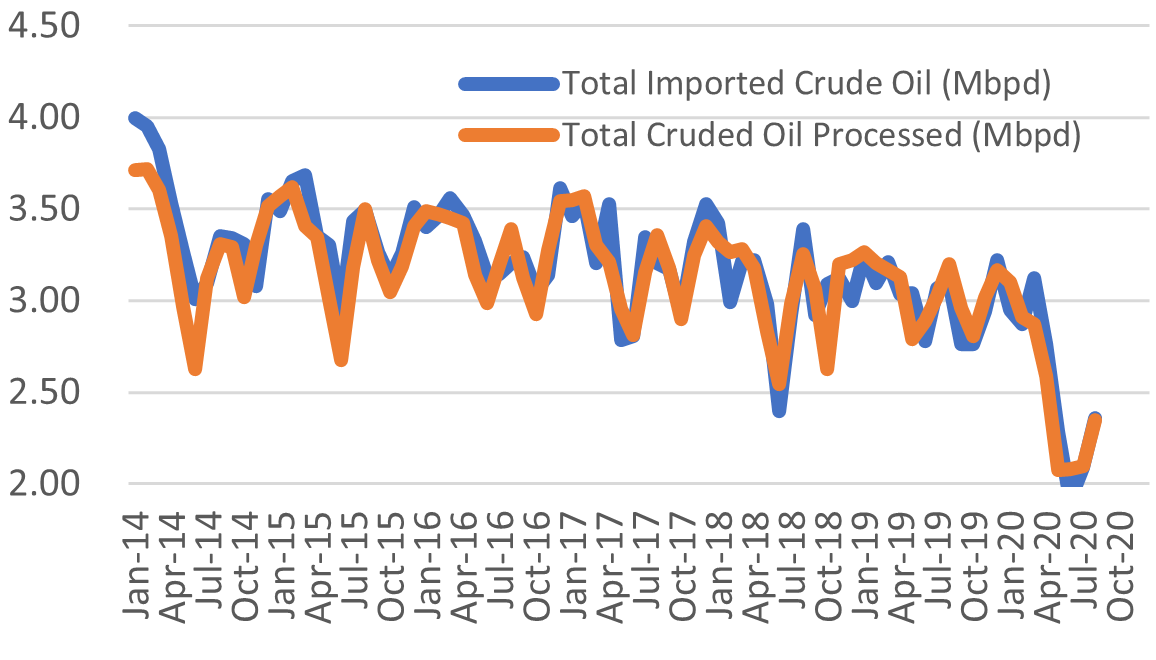
Japan Oil Price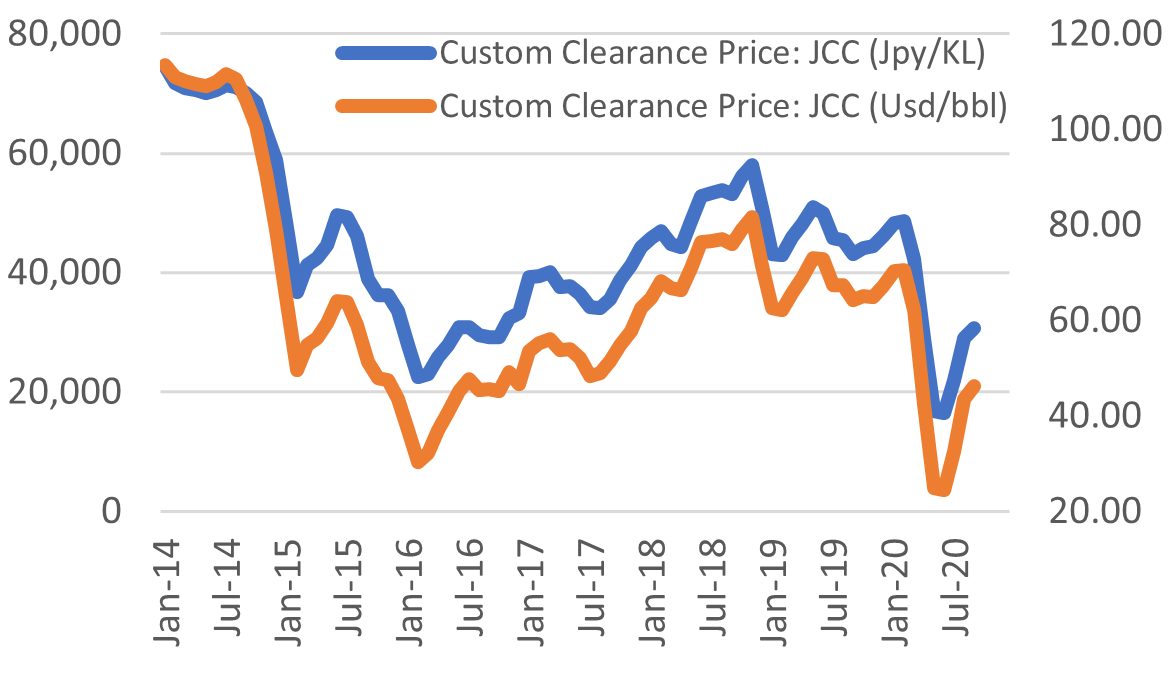
Monthly Oil Import Volume (Mbpd)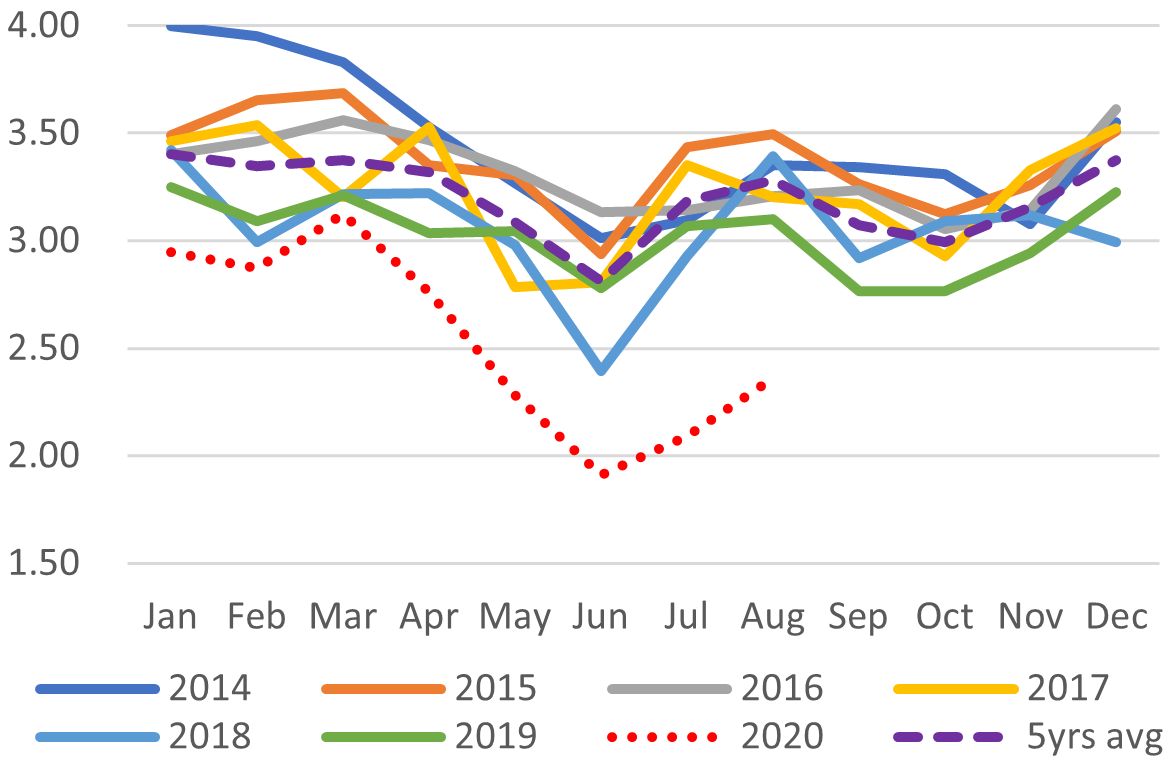
Monthly Crude Processed (Mbpd)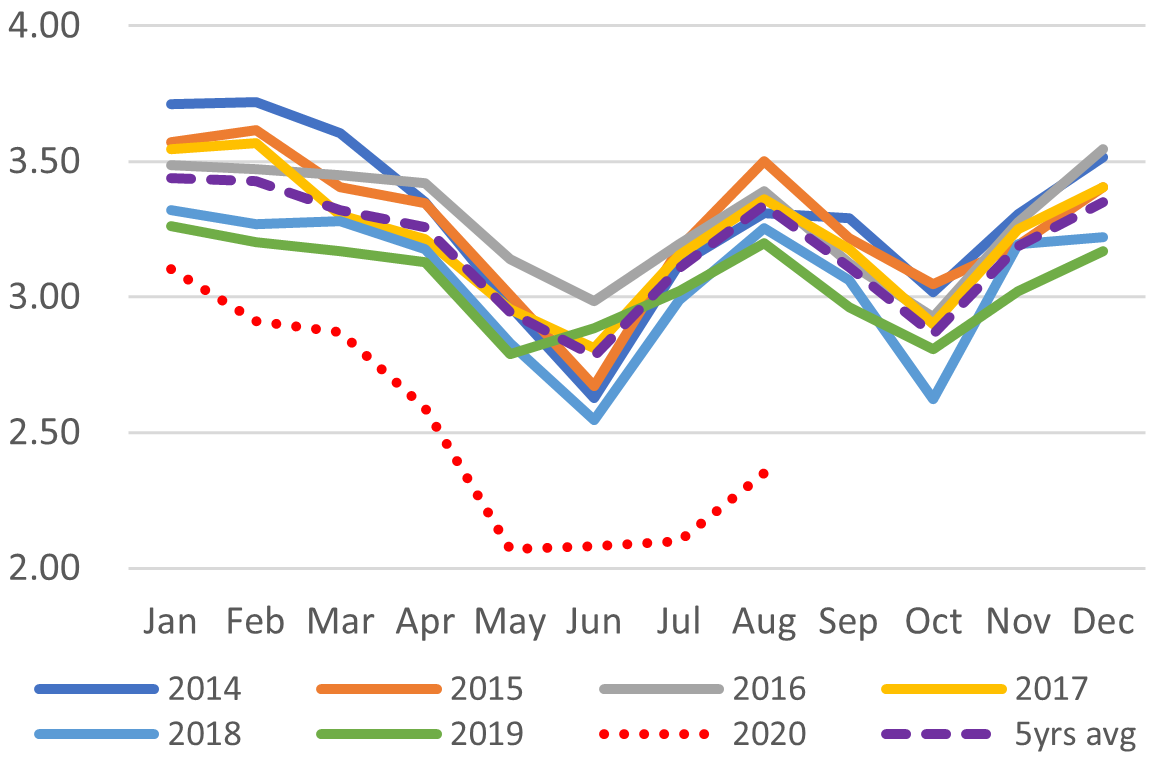
Domestic Fuel Sales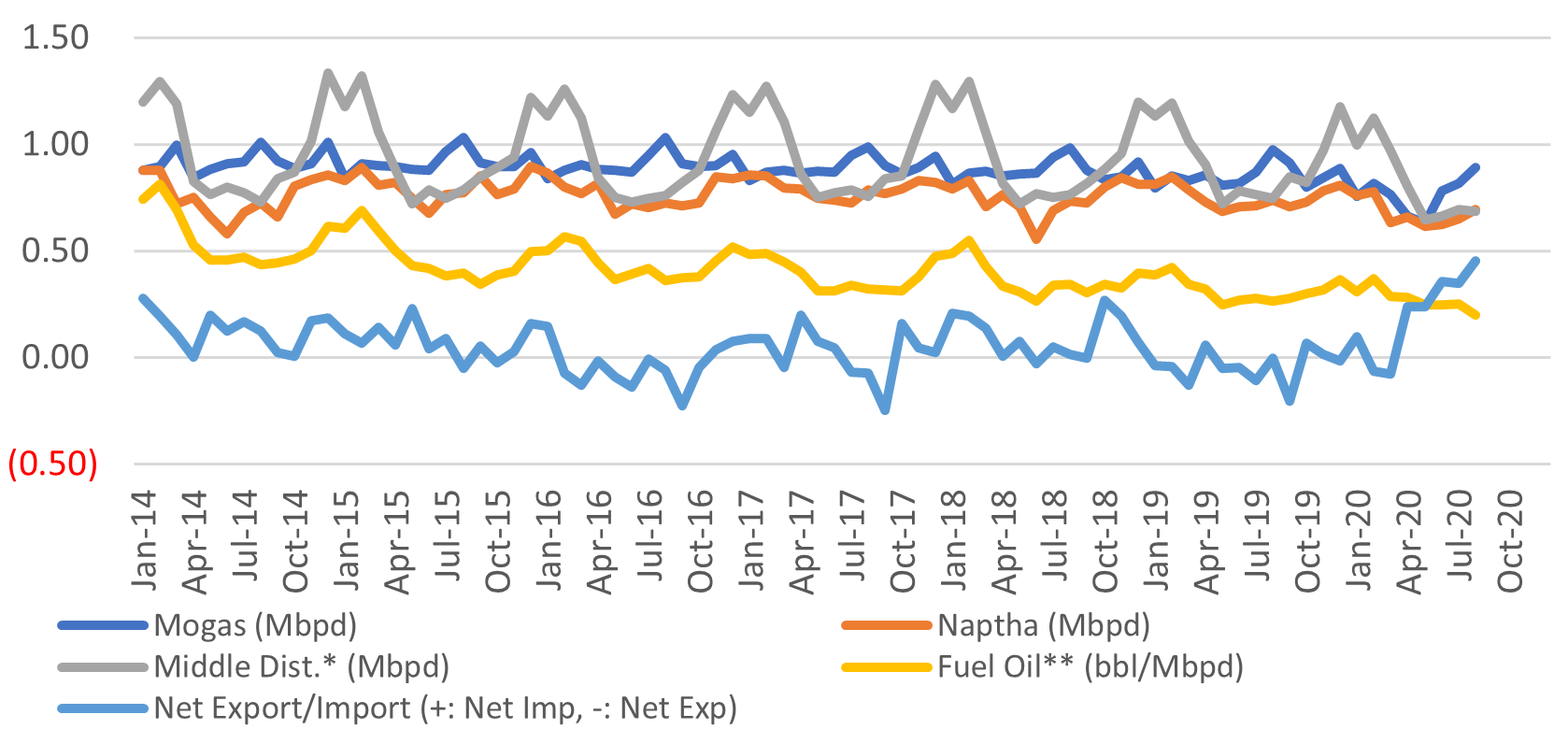
SOURCES: the Ministry of Economy, Trade, and Industry (METI), Ministry of Finance, and the Petroleum Association of Japan
Japan LNG Price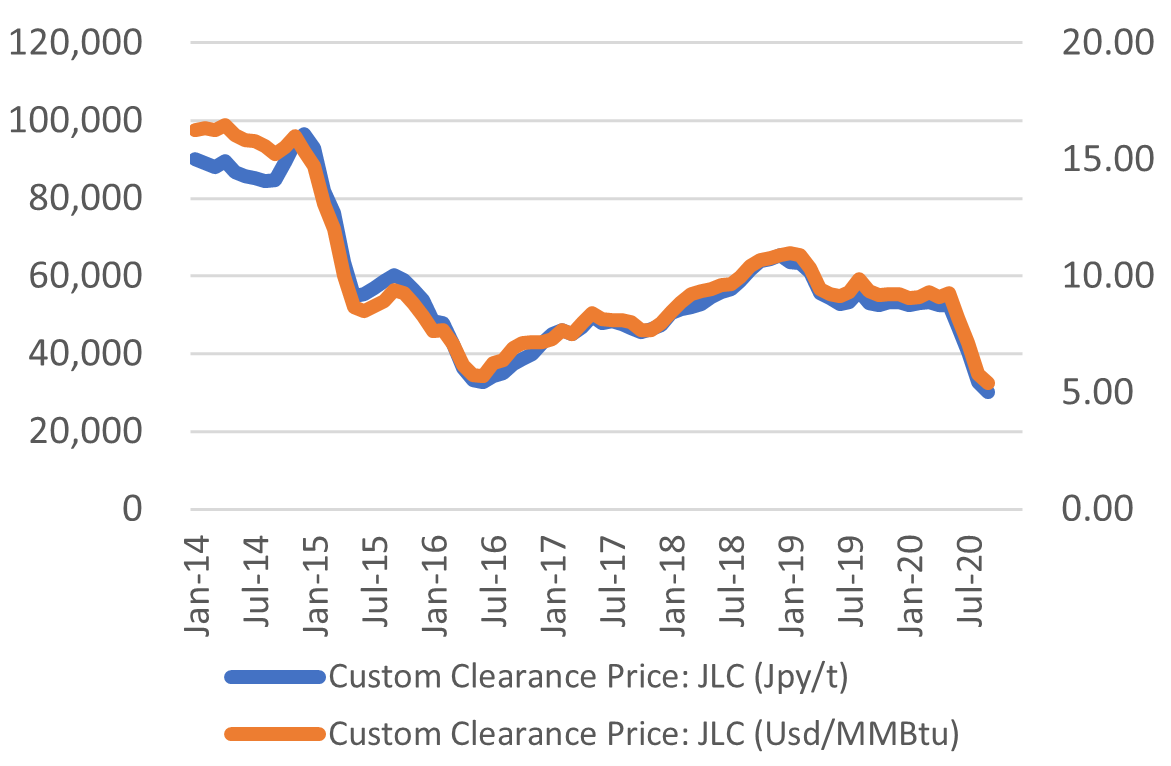
LNG Imports: Japan Total vs Gas Utilities Only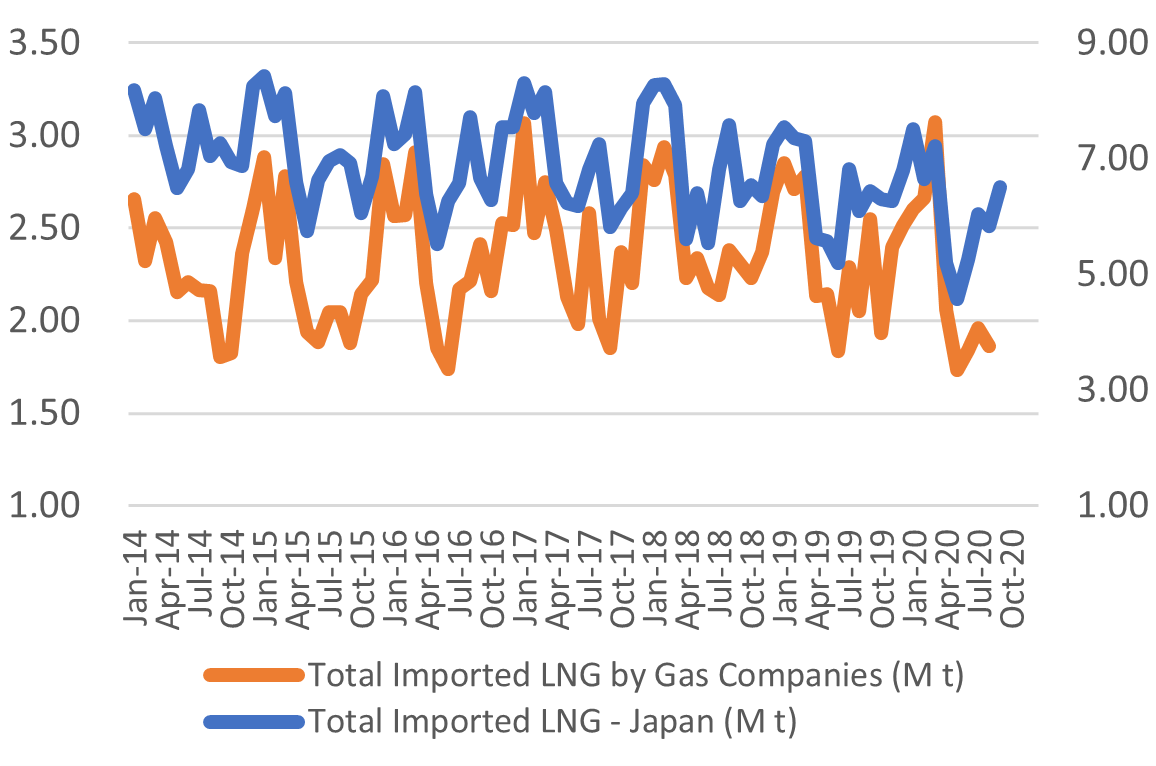
Total LNG Imports (M t)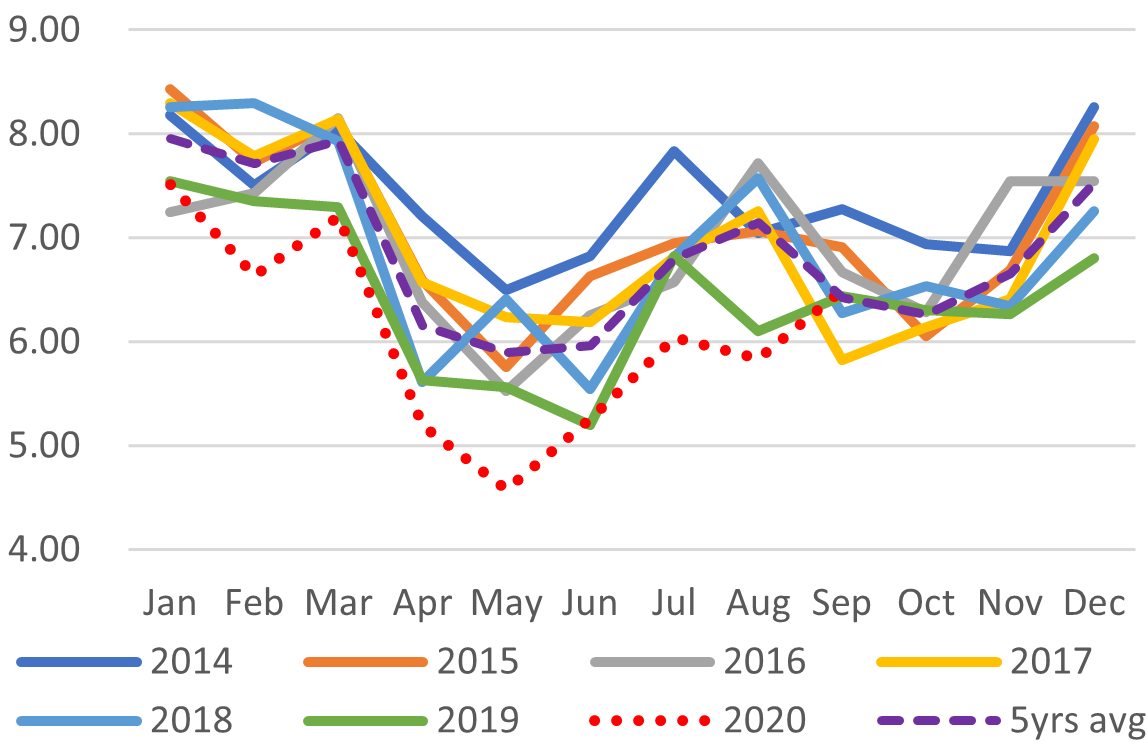
LNG Imports by Gas Firms Only (M t)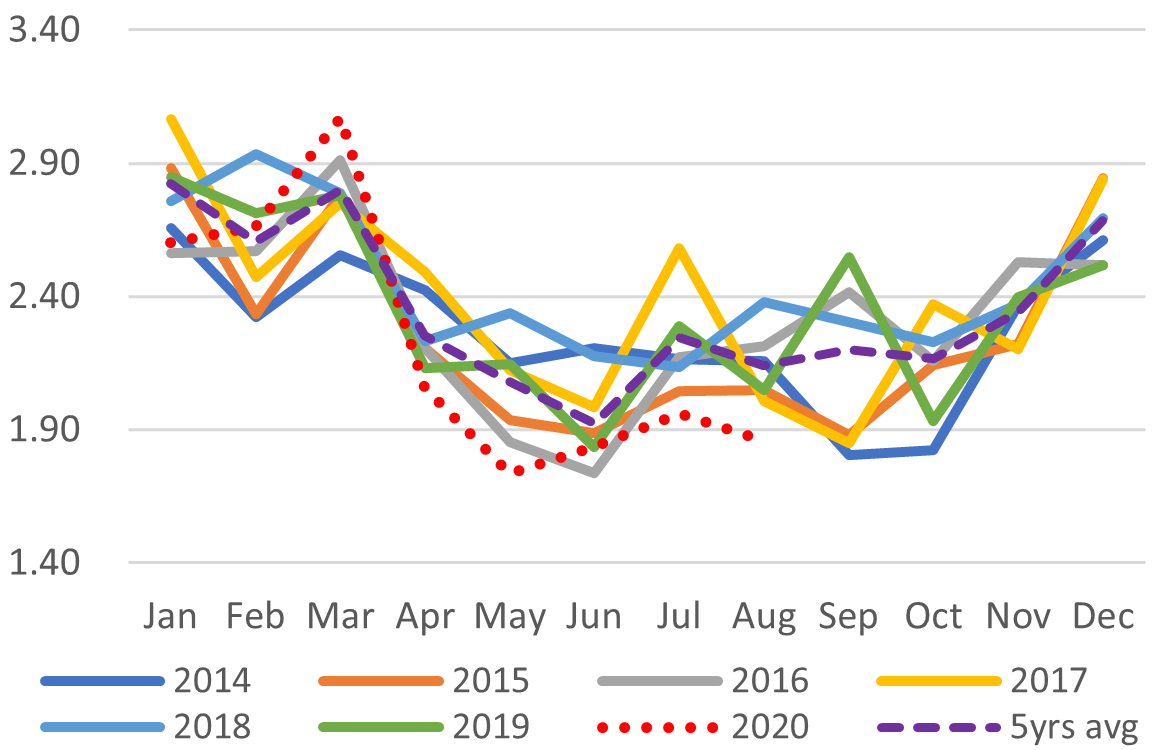
City Gas Sales – Total (M m3)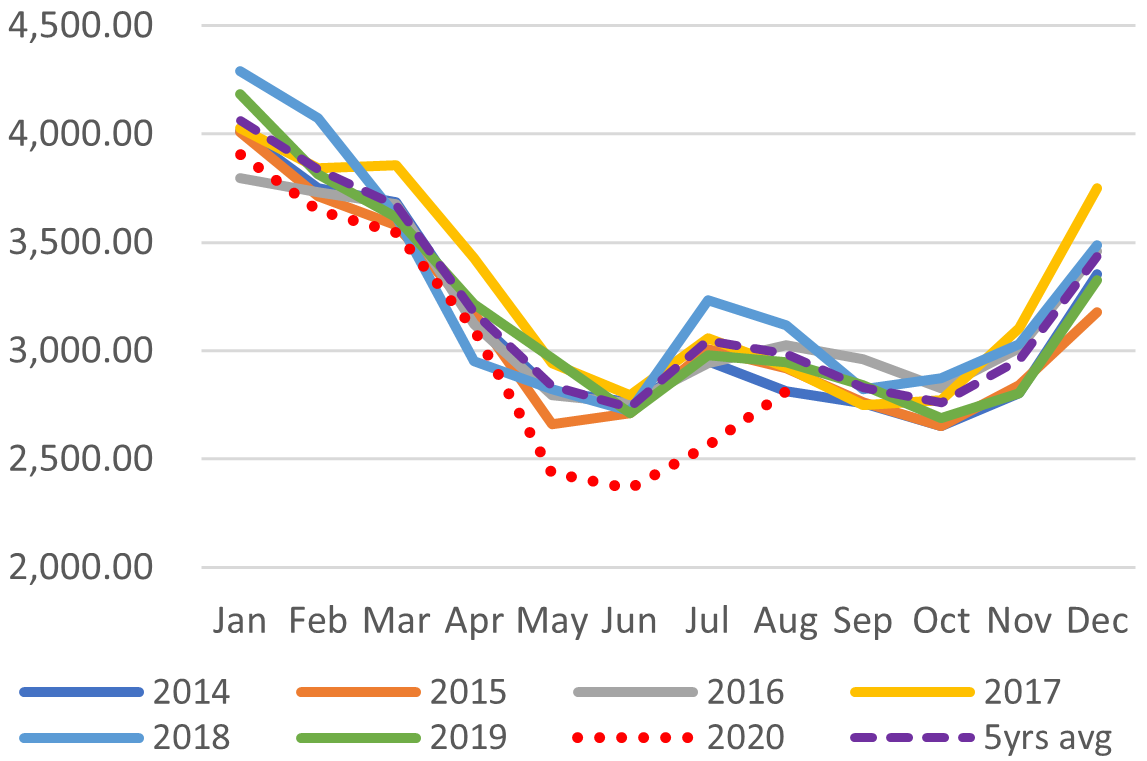
City Gas Sales by Sector (M m3)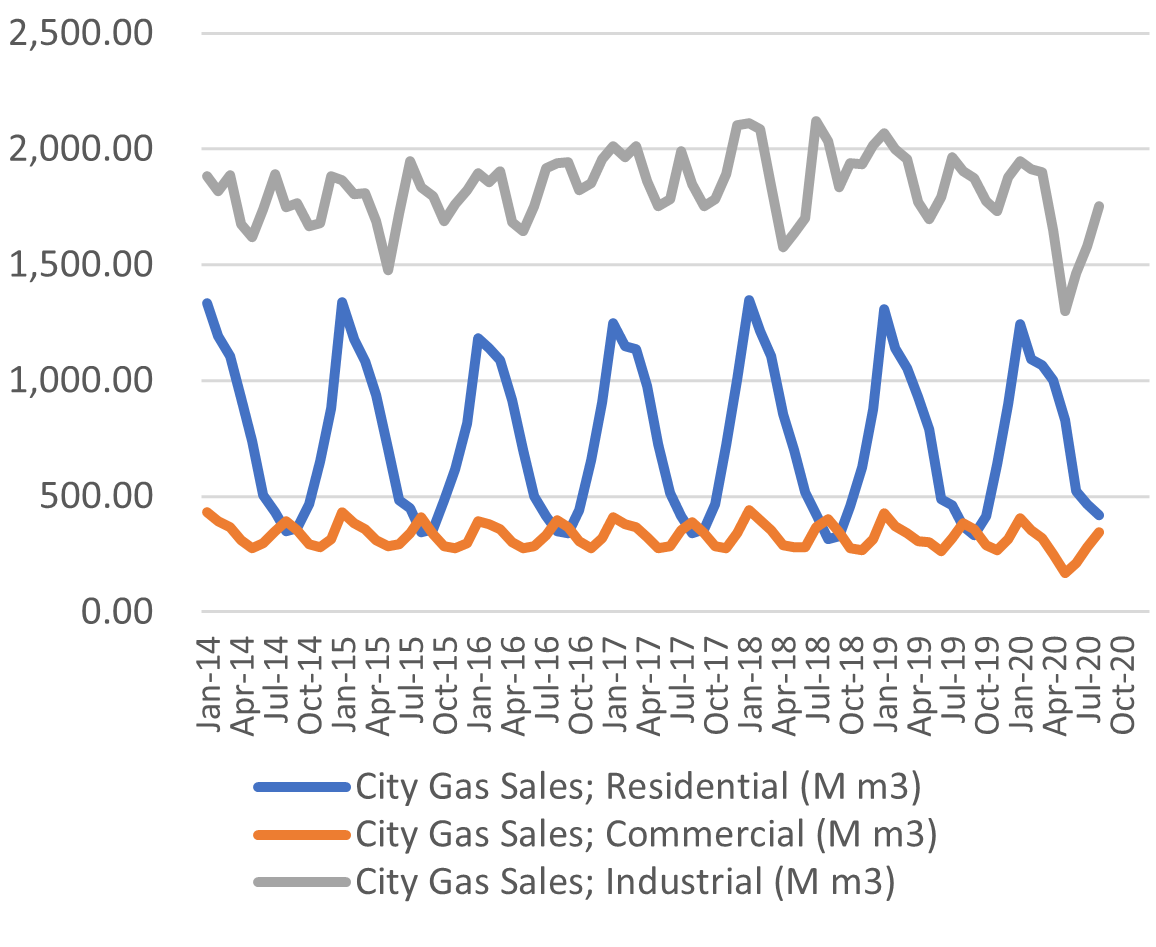
SOURCES: the Ministry of Economy, Trade, and Industry (METI),
Ministry of Finance
Japan Total Power Demand (GWh)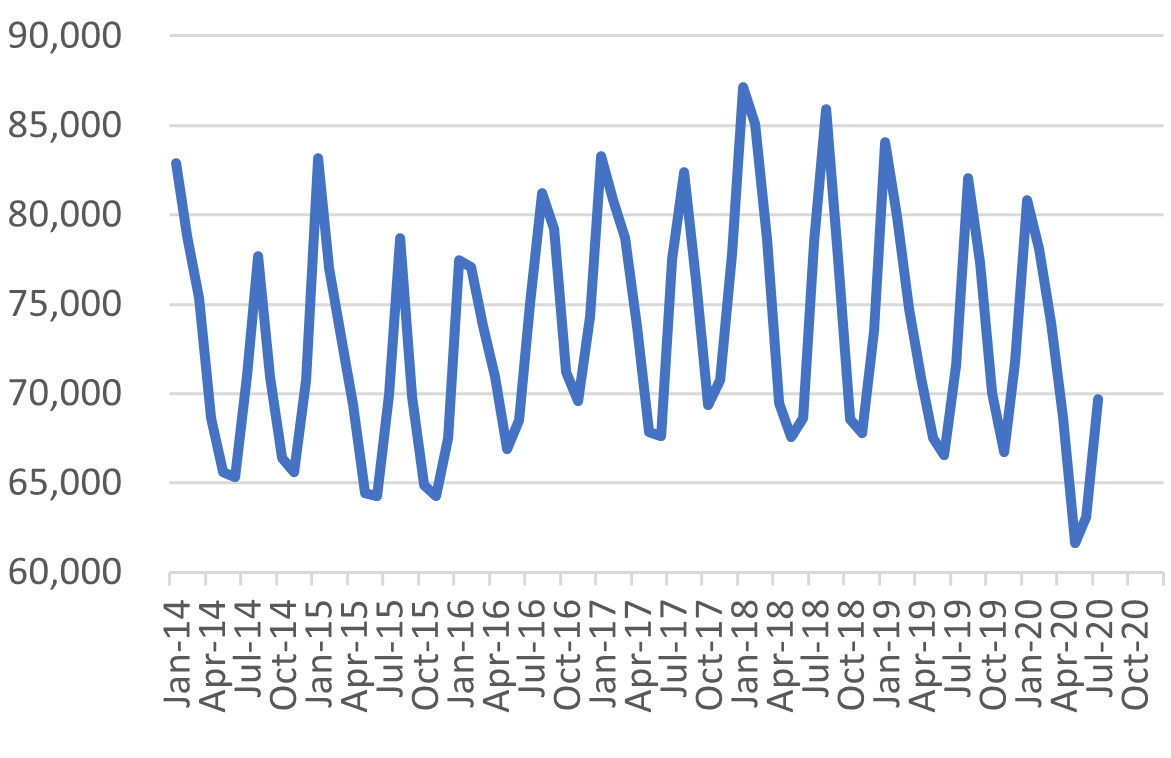
Current Vs Historical Demand (GWh)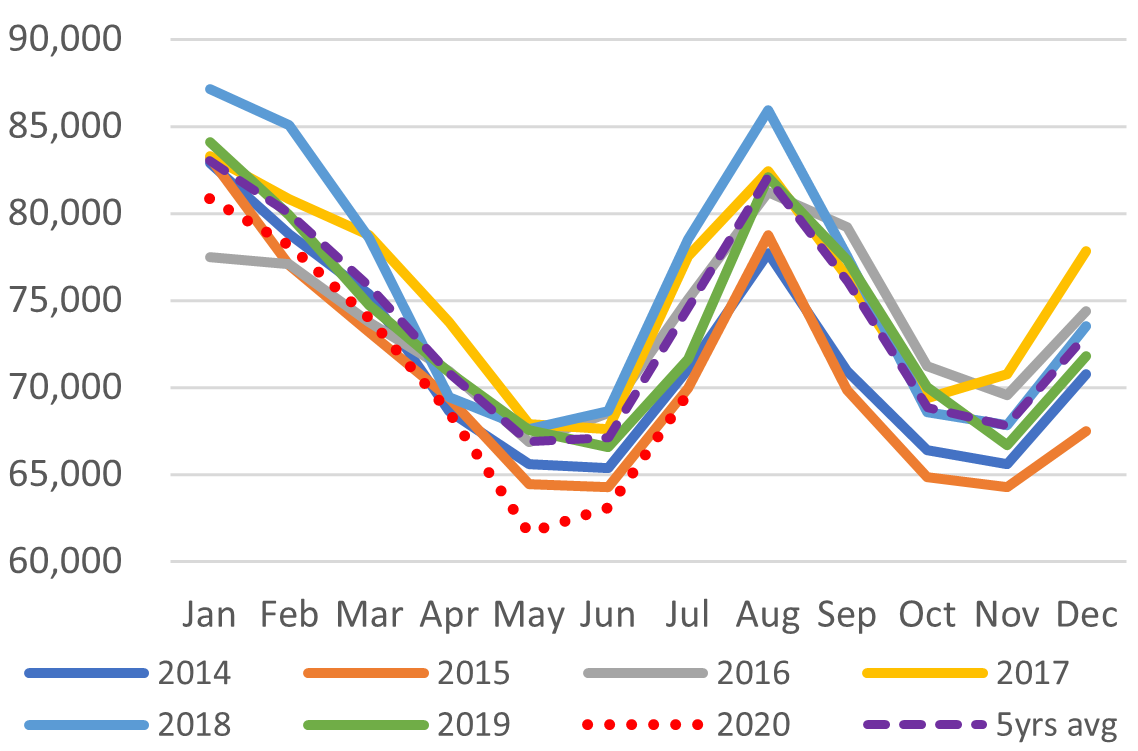
Day-Ahead Spot Electricity Prices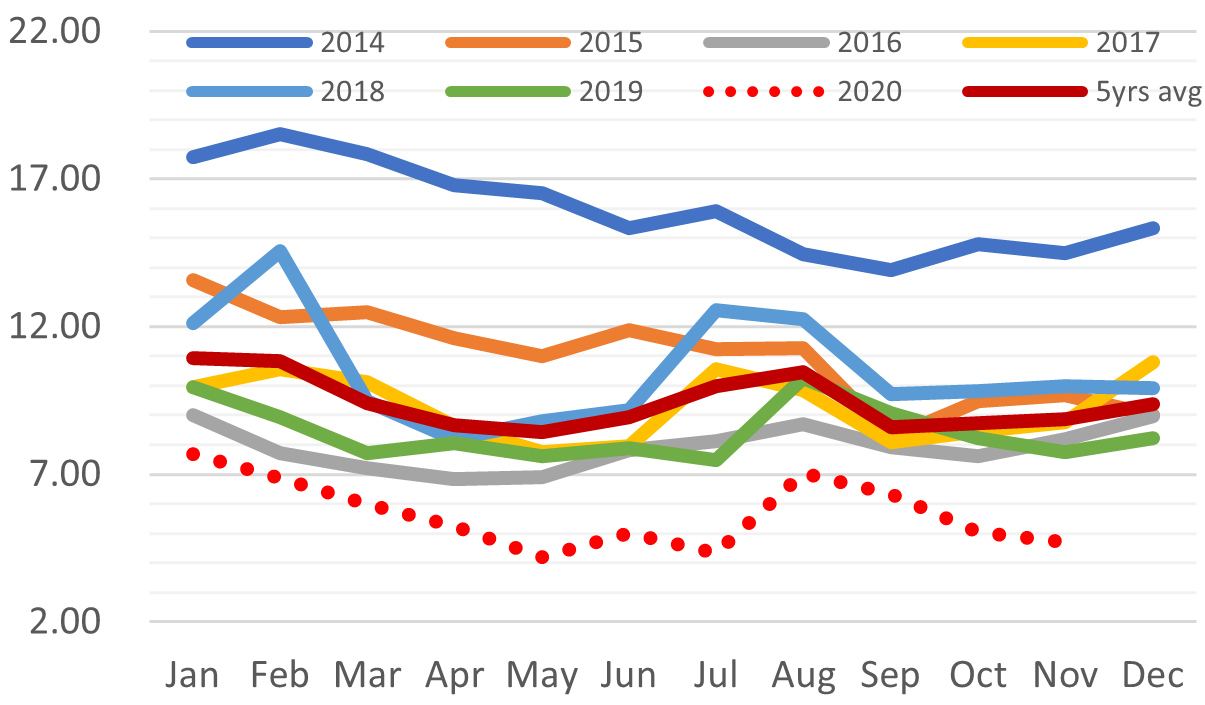
Day-Ahead Vs Day Time Vs Peak Time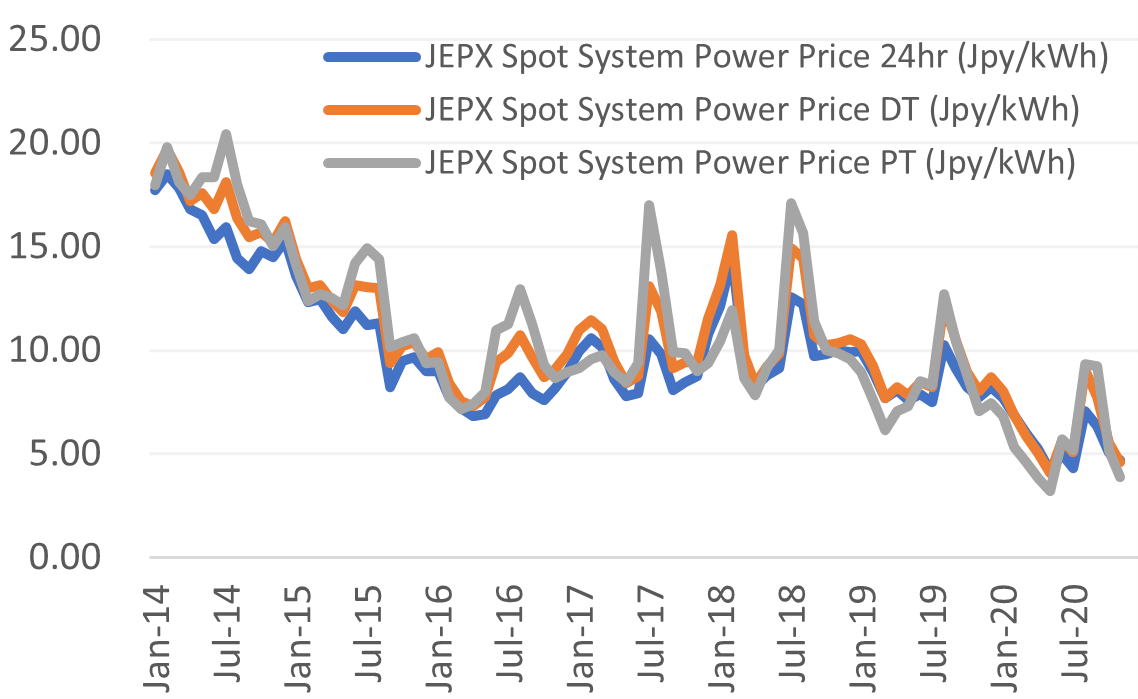
LNG Imports by Electricity Utilities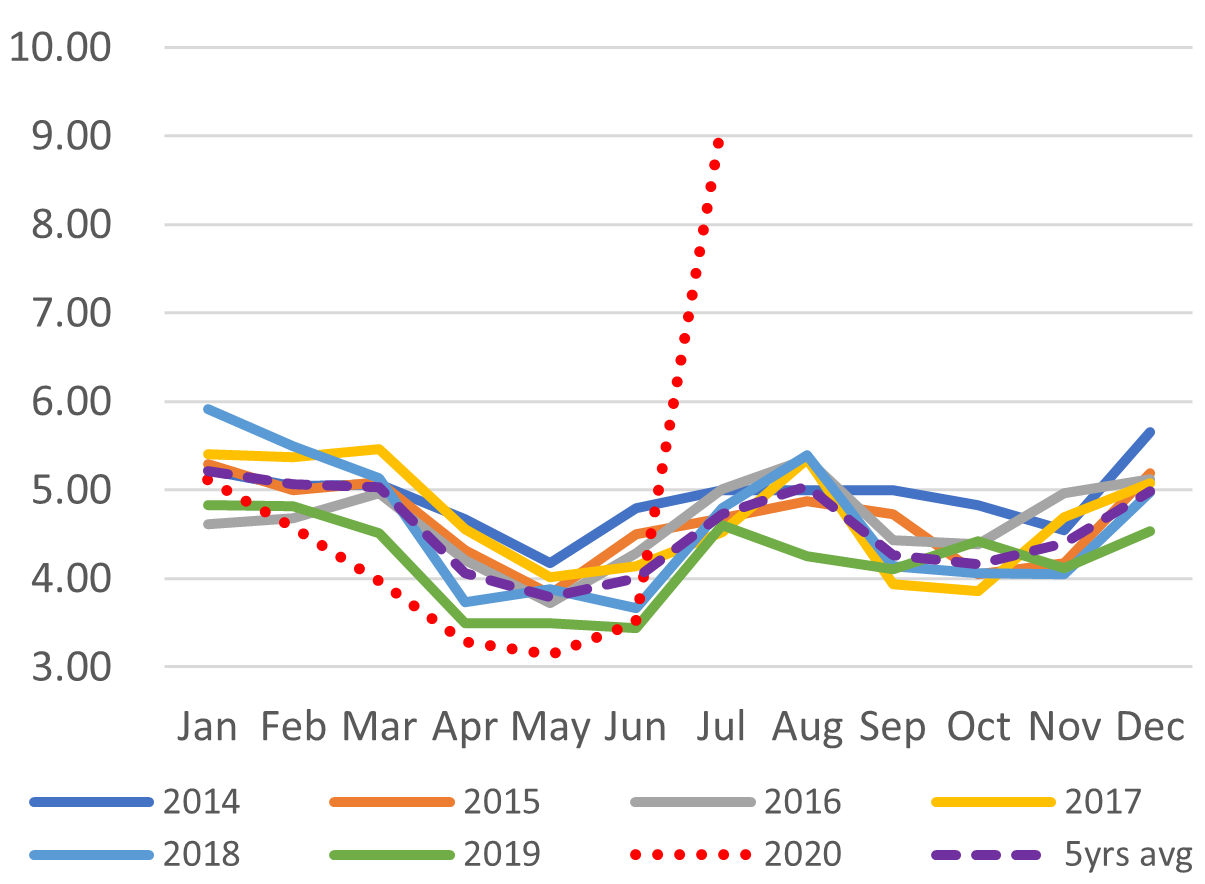
LNG Stockpiles of Electricity Utilities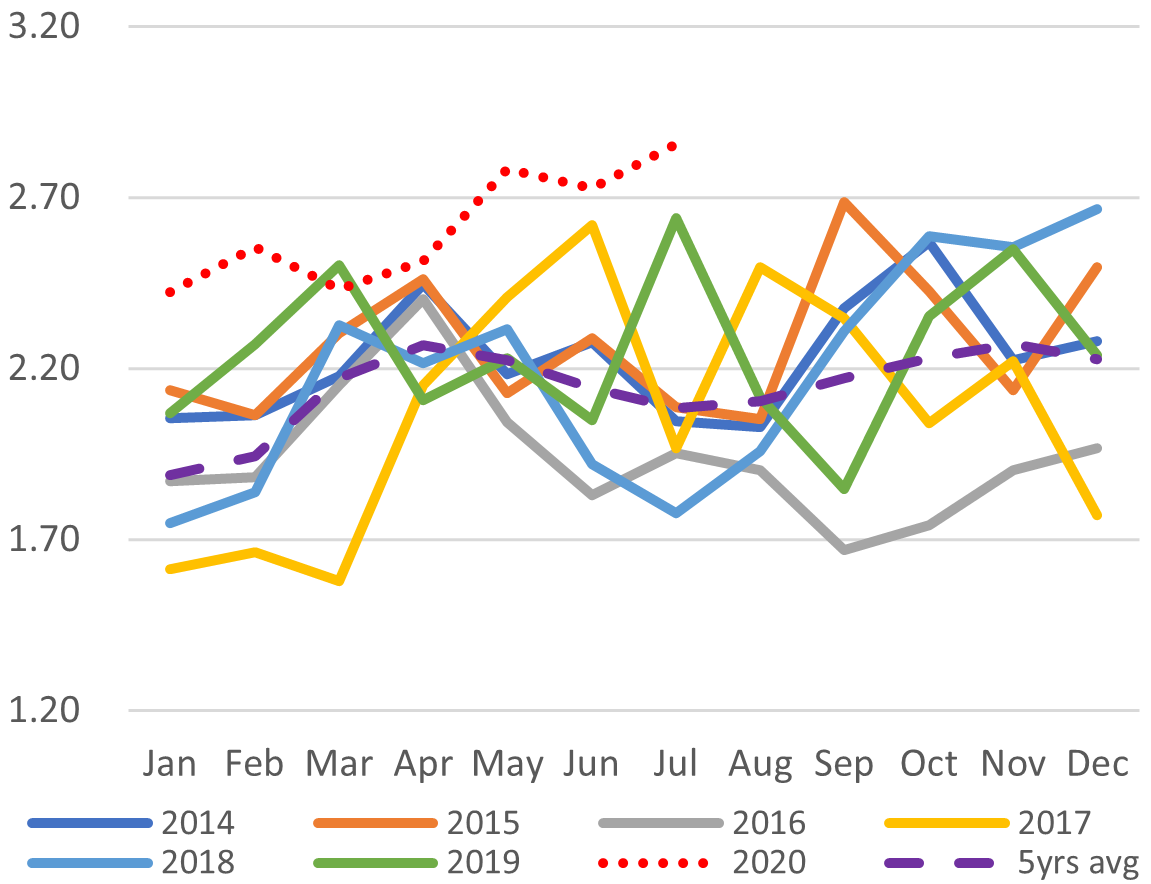
SOURCES: the Ministry of Economy, Trade, and Industry (METI), and the Japan Electric Power Exchange