
JAPAN NRG WEEKLY
NOVEMBER 16, 2020
JAPAN NRG WEEKLY
November 16, 2020
TOP
- Japan decarbonization body identifies which energy sources must be supported; govt. holds meeting to outline key support areas
- Japan to offer tax-breaks to push companies to cut carbon, enter green tech, including wind power generation equipment space
- METI minister pledges support for ammonia-coal co-firing tech
- JERA considers LNG contracts tied to Japanese spot power price
- Localities hosting TEPCO nuclear station hold elections; TEPCO vows to cut CO2 by half; decision on new nuclear plant due by March 2021; TEPCO gets green light for new used fuel storage
OIL & GAS
- TEPCO faces difficult decision on gas unit as breakup looms
- Gasoline stations face languishing sales but margins remain high
POWER & NUCLEAR
- Kyushu Electric brings forward Sendai NPP restart by a week
- J-Power sees loophole to secure financing despite utilizing coal
- Governor approves Onagawa NPP restart despite legal challenge
- Carbon-neutral policy will spur consolidation in power industry
- Why is Toshiba getting out of coal and betting on renewables?
- Dominance of 10 regional EPCOs is already a thing of the past
- Carbon-neutral policy not helping nuclear reactor manufacturers
RENEWABLES, OTHER
- Erex, ENEOS mull building world’s biggest biomass-fired plant
- Bids in latest solar auction see FIT prices drop to just ¥11.5/kWh
- Hokkaido invites submissions to build 1 GW offshore windfarm
- Japan EV makers challenge China, Korea rivals with new batteries
- Toshiba to build carbon-capture unit for waste-to-ethanol plant
- Shinsei Bank, Daiwa Energy to provide mezzanine financing for renewables projects
JAPAN TONES DOWN ITS COAL PHASE OUT
In the summer, the government announced bold plans to close most of Japan’s coal-fired plants and lead the nation to carbon neutrality by 2050. In subsequent talks with domestic industry, however, that progressive tone on coal has notably weakened. On Oct. 30, the key ministry for energy policy rolled out a new regulatory framework for power utilities and non-utility operators of “inefficient” coal-fired power plants. It asked utilities to submit annual reports detailing plans to move away from coal. There was no such request for steel, cement, paper and chemical manufacturers, as well as others that operate 80 coal-fired power plants in Japan. Non-utilities will likely be exempt.
COMPANY PROFILE: KANSAI ELECTIC
The story of Kansai Electric shows how tricky energy transition will be for Japan’s regional power utilities. Kansai Electric, the dominant supplier in Japan’s No. 2 industrial region, currently cannot use a fifth of its capacity due to multiple nuclear energy issues. One-sixth of its generation is coal-fired, and for over a year it has been embroiled in a scandal that has raised big questions about its corporate culture and way of doing business. As Prime Minister Suga asks the nation to decarbonize, the Co. needs to quickly find a new identity and strategy for an era in which its market position is no longer protected and guaranteed tariffs are on the way out. How the Co. will look a decade from now – whether it even exits in its current form – may depend on M&A and some recent initiatives.
GLOBAL VIEW
Investments in renewable energy by oil and gas firms will jump tenfold within the next five years, according to the IEA. Russia’s top oil firm forecasts losses. And France is reneging on solar contracts. See details on these and other political and business events in our regular Global View column.
JAPAN NRG WEEKLY
K. K. Yuri Group
Editorial Team
Yuriy Humber (Editor-in-Chief)
Tom O’Sullivan (Japan, Middle East, Africa)
John Varoli (Americas)
Contributors
Mayumi Watanabe
Daniel Shulman
Art & Design
22 Graphics Inc.

SUBSCRIPTIONS & ADVERTISING
Japan NRG offers individual, corporate and academic subscription plans. See details here.
For further details, or to discuss marketing, advertising, or collaboration opportunities, please contact one of the Editorial Team members or write to info@japan-nrg.com
Disclaimer
This communication has been prepared for information purposes only, is confidential and may be legally privileged. This is a subscription-only service and is directed at those who have expressly asked K.K. Yuri Group or one of its representatives to be added to the mailing list. This document may not be onwardly circulated or reproduced without the prior written consent of Yuri Group, which retains all copyright to the content of this report.
Yuri Group is not registered as an investment advisor in any jurisdiction. Our research and all the content of our reports express our opinions, which are generally based on available public information, field studies and own analysis. Content is limited to general comment upon general political, economic and market issues, asset classes and types of investments. The report and all of its content does not constitute a recommendation or solicitation to buy, sell, subscribe for or underwrite any product or physical commodity, or a financial instrument.
The information contained in this report is obtained from sources believed to be reliable and in good faith. No representation or warranty is made that it is accurate or complete. Opinions and views expressed are subject to change without notice, as are prices and availability, which are indicative only. There is no obligation to notify recipients of any changes to this data or to do so in the future. No responsibility is accepted for the use of or reliance on the information provided. In no circumstances will Yuri Group be liable for any indirect or direct loss, or consequential loss or damages including without limitation, loss of business or profits arising from the use of, any inability to use, or any inaccuracy in the information.
K.K. Yuri Group: Oonoya Building 8F, Yotsuya 1-18, Shinjuku-ku, Tokyo, Japan, 160-0004.
NEWS: OIL & GAS
Japan Oil Price: $46.20 / barrel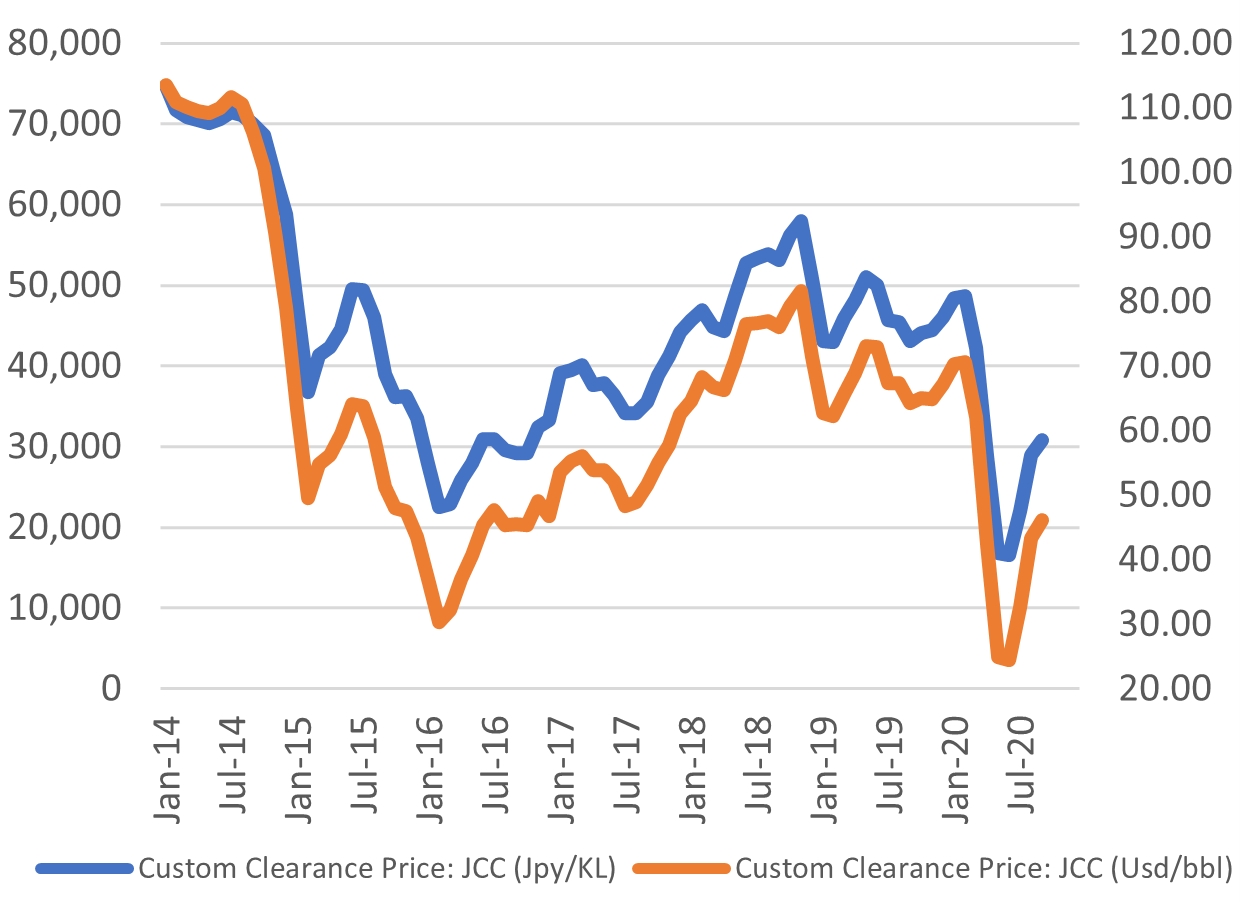
Japan (JLC) LNG Price: $5.39 per Mbtu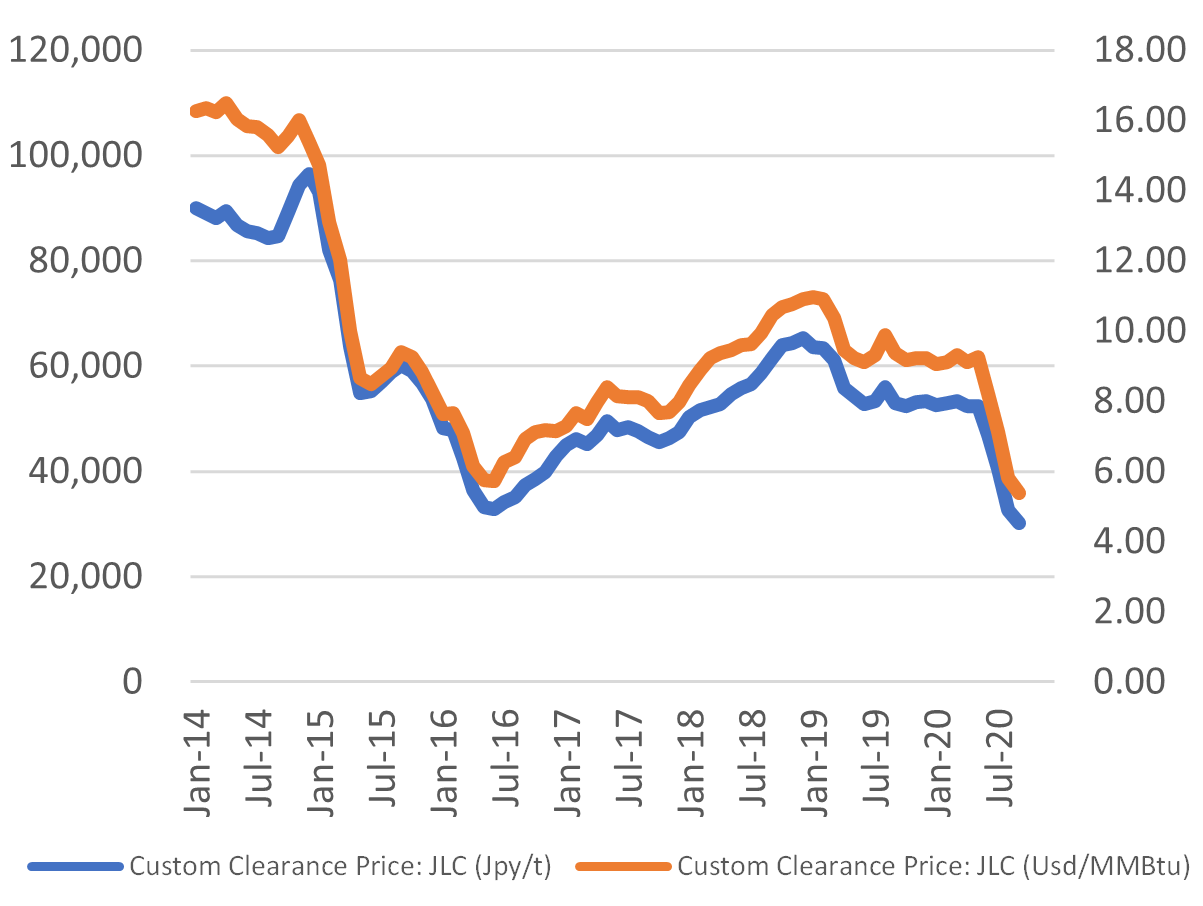
JERA considers LNG contracts tied to Japanese electricity prices instead of oil-link
(Bloomberg, Nov. 9)
- CONTEXT: Several Japanese companies including JERA said at the LNG Producer-Consumer conference 2020 in mid-October that they would like LNG contracts to start reflecting Japanese market fundamentals. See the Oct. 19 edition of Japan NRG for details.
- A number of Japanese utilities have had discussions with LNG sellers about using the country’s spot market for electricity as a benchmark for future contracts, traders, including JERA, told Bloomberg
- Discussions remain at an early stage. The new LNG contracts would be only partly linked to electricity prices on the Japan Electricity Power Exchange (JEPX).
- Japanese utilities are still unsure about adopting new benchmarks such as JKM because of questions over transparency and hedging liquidity.
- CONTEXT: Volumes on JEPX surged this year to over 40% of the total Japanese electricity demand. This is the highest since the market was liberalized in 2016.
- JERA’s head of JERA Global Markets trading unit, Kasai Kazunori, said his company was approached by LNG sellers about creating contracts with a link to JEPX prices. JERA is yet to fully consider this development.
- It’s possible some Japanese utilities that do not have alternative hedging tools could see JEPX-linked contract pricing as useful, Kasai said.
- CONTEXT: JERA buys about 35 million tons of LNG a year. Of that, about seven million tons come through spot and short-term deals that are managed via the JERA Global Markets unit. The parent company is also Japan’s biggest power generation utility, burning mostly LNG or coal for fuel.
- SIDE DEVELOPMENTS:
Japan looks at replacing oil with hydrogen in carbon-neutral push(Bloomberg, Nov. 9)
- Hydrogen may represent 40% of Japan’s energy by 2050, according to Kawasaki Heavy, an engineering firm developing the world’s first hydrogen tanker
- Hydrogen offers the greatest potential to decarbonize emissions-heavy sectors like steel, cement and heavy-duty transport: BNEF
- As much as $425 billion in investment might be needed for Japan to reach its hydrogen goal, Shin Furuno, a senior manager with the Asia Investor Group on Climate Change, tells Bloomberg.
TEPCO faces difficult decisions over gas unit as breakup looms
(Diamond, Nov. 11)
- Faced with dwindling subscriber numbers, TEPCO Holdings made the bold decision to enter the domestic gas market in 2017 via an alliance with Nichigas.
- While TEPCO once boasted over two million gas subscribers, this number is now declining, causing concern at TEPCO Energy Partners.
- Under pressure from its lenders, Tokyo Energy Partners has begun terminating agreements with some of its sales branches, as well as raising tariffs, in an effort to become profitable.
- Some senior staff at Energy Partners have been reallocated to positions at Tokyo Power Grid, prompting speculation over the future of Tokyo Energy Partners. Some say the company could be split off and sold to ENEOS.
Gasoline stations hit by languishing sales
(Nikkei, Nov. 12)
- The COVID-19 pandemic has meant people are driving less, and demand for gasoline is down.
- While gasoline prices continue to trend downward, service stations’ profit margins are healthy and growing.
- Although the price of Dubai crude has fallen by 30% since January, this only translated into a 10% drop in petrol prices as domestic petrochemical companies raised margins.
- Lower prices have also meant reduced competition in the industry, as own brand retailers find it difficult to undercut major oil companies on price.
- Notably, DIY retailer Joyful Honda recently sold its petrol station business to Idemitsu.
- CONTEXT: See the Oct. 5 edition of Japan NRG for a detailed explanation of the lucrative margins enjoyed by Japanese oil refineries. While the industry is in a sweet spot right now, it knows this is temporary and a move towards new business development is necessary.
NEWS: POWER & NUCLEAR
| No. of operable nuclear reactors | 33 | |||
| of which | applied for restart | 25 | ||
| approved by regulator | 16 | |||
| restarted | 9 | |||
| in operation today | 1 | |||
| able to use MOX fuel | 4 | |||
| No. of nuclear reactors under construction | 3 | |||
| No. of reactors slated for decommissioning | 27 | |||
| of which | completed work | 1 | ||
| started process | 4 | |||
| yet to start / not known | 22 | |||
Power Utilities’ LNG Imports Vs Stockpiles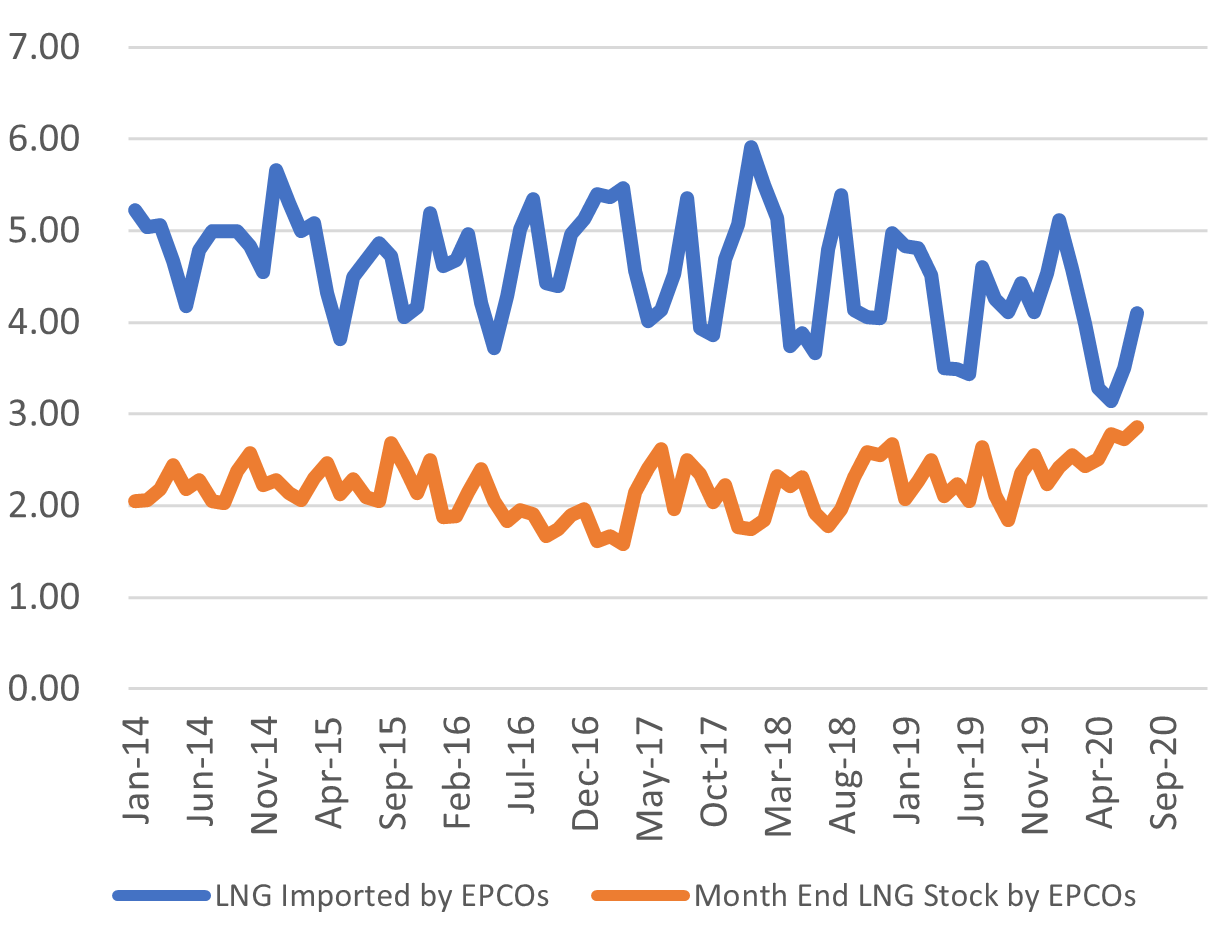
Source: Company websites, JANSI and JAIF, as of Nov. 15, 2020
Towns hosting TEPCO’s nuclear plant held elections that could impact reactor restart
(Japan NRG, Nov. 16)
- The town of Kashiwazaki and the village of Kariwa, the two municipalities that co-host the remaining operable nuclear power plant of Tokyo Electric Power Co. (TEPCO), hosted local government elections on Nov. 15.
- Kashiwazaki featured a runoff between incumbent Sakurai Masahiro (58), who ran as an independent, and Kondo Masamichi (73), a former member of the House of Councilors.
- Sakurai’s stance on nuclear was that it is necessary for Japan’s decarbonization plans. He announced “conditional support” for the resumption of operations at the Kashiwazaki-Kariwa NPP.
- Kondo opposed all restarts, claiming nuclear technology to be unsafe. Kondo was backed by several national opposition parties.
- Sakurai won 32,146 votes to his opponent’s 11,433. This was an even stronger lead than Sakurai had in the previous election in 2016, suggesting the local vote is now backing the idea of restarting the nuclear plant.
- In Kariwa, the race was between incumbent Shinada Hiro (63), running for his sixth term, and Goto Hiromasa (59), an administrative scrivener at a nearby town and a political neophyte. Shinada was cautiously positive on nuclear energy on the morning of the election, saying Japan cannot disengage from nuclear power and the village had to follow the nation’s energy policy. Goto said he believes the local nuclear reactors can restart at any time as there is no risk involved with them.
- Shinada won 2,200 votes to his opponent’s 301. Both candidates were pro-nuclear. The re-election of the incumbents suggests the cautiously positive move toward restarts will continue.
- SIDE DEVELOPMENT:
Many challenges ahead for TEPCO as it pledges to half CO2 emissions(Nikkei, Nov. 6)
- In an unusual move for a Japanese power generator, TEPCO Holdings has pledged to reduce its CO2 emissions to half of 2013 levels by 2030. This amounts to a reduction of nearly 17 million metric tons of CO2 per annum.
- To achieve this ambitious goal, TEPCO will need to both boost renewables and restart its nuclear reactors. However, approval from local residents will be essential to restart nuclear power units, and it is too early to say how this will pan out.
- Increasing competition internationally for generation sites suitable for renewable energy could also threaten TEPCO’s ability to develop more renewable capacity.
TAKEAWAY: A sign-off from the local governments is all that stands in the way of the restart at the Kashiwazaki-Kariwa NPP, the only operable nuclear facility owned by TEPCO. The company secured the permit for a restart of Units 6 and 7 of the facility back in Dec. 2017. However, that local sign-off has taken so long to procure that earlier this month the company filed another application to the regulator, the NRA, to confirm that it can go ahead with the restart. TEPCO’s record as operator of the disaster-struck Fukushima Dai-Ichi NPP continues to weigh heavy on the brand and rumors persist that its remaining nuclear assets will pass to another entity, or even a state entity.
These local elections are unlikely to lead to an immediate restart of Kashiwazaki-Kariwa NPP, however, as TEPCO still needs to get the sign off from the Niigata governor. Still, with the local vote on its side, the company will feel that it is in a strong position to persuade the governor to cast his weight behind them. The utility clearly feels that there is positive momentum for its first restart of a nuclear facility since the 2011 Fukushima accident. Fuel has already been loaded into parts of the NPP, an unusually forward step.
A shrewd move from a public relations viewpoint would be for TEPCO to delay the restarts until after the 10-year Fukushima anniversary, in March 2021, and even after the 2020 Tokyo Olympic Games, which are due to take place in July 2021. However, TEPCO has rarely been an astute practitioner of public relations and the company is probably rushing to restart the NPP as soon as it can so that it can then move onto the Higashidori nuclear construction project. The next six months will be critical for TEPCO and its survival in the current form.
- SIDE DEVELOPMENTS:Decision on TEPCO’s Higashidori nuclear plant due by March 2021
(Too Nippo, Nov. 14)
- TEPCO Holdings CEO, Kobayakawa Tomoaki, said on Nov. 13 that a decision would be made by the end of March 2021 on a proposal that would see Toshiba, Hitachi, Chubu Electric Power and TEPCO jointly operate the Higashi-dori nuclear power plant, which is still under construction.
- Construction at the plant was halted after the 2011 Fukushima disaster.
- SIDE DEVELOPMENT:
- TEPCO CEO: we will compensate residents over radioactive water
- (NHK, Nov. 13)
- TEPCO Holdings CEO, Kobayakawa Tomoaki, said his company will compensate local residents for damage to the area’s reputation resulting from the release of tritium and other radioactive isotopes into the sea.
- CONTEXT: the news refers to the water built up in tanks at the Fukushima Dai-Ichi nuclear station site.
- SIDE DEVELOPMENT:
- Green light for TEPCO used nuclear fuel storage facility
- (Yomiuri Shimbun, Nov. 11)
- Japan’s nuclear regulator said on Nov. 11 that it approved the safety plans for an interim storage facility for nuclear waste in the town of Mutsu, Aomori prefecture. This completes the facility’s screening process.
- The site will receive its first nuclear waste as early as 2021. Waste will be stored at the facility until it is able to be reprocessed.
- The temporary storage facility is deemed necessary due to the fact that the Rokkasho reprocessing plant is currently not operational and few local bodies are prepared to approve the construction of nuclear waste dumps.
- Only fuel from TEPCO and Japan Atomic Power (J-Atomic) will be stored at the facility.
- CONTEXT: This will be Japan’s first facility to store spent fuel outside of a nuclear station and Rokkasho.
METI Minister Kajiyama Vows Support for Ammonia-Coal Co-Firing
(Japan NRG via ADIPEC Virtual 2020 Conference, Nov. 9)
- METI minister gave a keynote speech at one of the strategic panels during the ADIPEC Virtual 2020 sessions. Below is an extract of some of his comments.
- “As the demand for energy continues to grow across the world, especially in Asia, Japan will support the clean use of fossil fuels in developing countries.”
- Japan will go carbon-neutral for the whole of its LNG value chain, Kajiyama said, repeating his announcement from last month.
- “Japan will also lead the world in carbon recycling. The reuse of CO2 from fossil fuels is the same as that of the Circular Carbon Economy (CCE) agreed upon at the G20 Energy Ministers’ Meeting held in September.” As carbon emissions gain pace across the world, “Japan will continue to pursue innovation in carbon recycling for the realization of a virtuous cycle between the economy and the environment.”
- Japan will lead the way in creating a hydrogen society, “including the establishment of international supply chains that include oil-producing countries.”
- “Japan is newly focusing on fuel ammonia. Through discussions between the public and private sector, we are aiming at a reduction in CO2 emissions by co-firing ammonia at coal-fired power plants. With these efforts we will promote responsible energy policies.”
- Due to COVID, there has been a drop in investment into upstream energy projects. “It is necessary for us to avoid a downturn in upstream investment, as this would lead to an energy supply crunch in the medium to long term. Here, I would like to emphasize the need for greater cooperation and coordination between oil-producing and consuming countries.”
Kyushu Electric brings forward Sendai nuclear reactor restart by a week
(Nikkei Shimbun, Nov 14)
- The utility was due to bring back online Unit 1 of the Sendai NPP on Nov. 26, but this will now take place a week earlier, on Nov. 19, after the regulatory inspection finished earlier than expected.
- The restart due date for Unit 2 has not yet changed from Dec. 26, but this date will depend on the inspection timing of the facility.
- CONTEXT: Japan is currently operating just one nuclear reactor, which is also owned by Kyushu Electric. The restart of Sendai NPP was expected as it already had local approvals. The Sendai units were stopped only because work to upgrade the anti-terrorism measures at the site overran deadlines due to COVID outbreak stoppages.
TAKEAWAY: Should all go as planned, Kyushu Electric will have all four of its nuclear reactors back online by the end of this year. Even if one of the unit restarts is delayed, this would already triple the output of nuclear generation in the country. Another reactor due to be back online in the next couple of months is the Takahama-3, operated by Kansai Electric. The latter is facing a number of trust issues with the local population. For an in-depth look at Kansai Electric, see our profile of the company in this week’s Analysis section.
J-Power sees loophole to secure coal financing despite pressure over ESG
(Sentaku, Nov. 2020 edition)
- J-Power has been asked by its overseas investors to present a plan for reducing CO2 emission. This means the company must reduce its core thermal power generation business. The Co. is under pressure to go as far as divesting its thermal power assets.
- Internally, the Co. executives want to stay quiet and say nothing, fearing that any roadmap on CO2 reductions would “strangle our own neck.”
- CONTEXT: J-Power, also known as Electric Power Development Co., is one of Japan’s biggest utilities. And yet, it does not have a single proposal for reducing CO2.
- Japanese power utilities have generally relied on improving the efficiency of its generation assets to improve their emissions numbers, as opposed to abandoning stations that burn fossil fuels.
- The industry body, the Federation of Electric Power Companies (FEPC), has set a goal for its members to work towards “0.37kg of carbon emissions per kWh by 2030.” The Ministry of Economy Trade and Industry (METI) supports this goal, and the govt. has presented these numbers in the past to show that Japan is working on improving ecological norms.
- J-Power too has showed such emission reduction goals to overseas investors, yet the latter are not satisfied. Foreign investors hold about 30% of J-Power shares, which means the Co. cannot ignore their demands.
- To make a major difference to its CO2 emissions, J-Power must install new technology, such as carbon-capture. The Co. estimates that this will drive up costs so much that its assets will no longer be profitable.
- J-Power has pleaded to METI that it needs to continue to use coal because Japan has limited access to resources. The ministry’s response was cold. An industry insider said that METI is no longer supportive of J-Power as before because the Co. fought against the entry of new players into the electricity market after it was liberalized.
- J-Power’s last hope is that investors won’t press it too hard on ESG, since that would directly affect their dividends. Investment funds, however, are also under pressure to pick stocks based on ESG lines.
- The Co. is relying on the big Japanese banks to save it. Although the big three lenders all announced pledges to stop lending to coal-fired generation projects, this only prohibits financing for specific projects. General purpose loans and other funding avenues are not affected.
- J-Power does not see its funding drying up “for quite a while”, according to a Co. executive.
- Most of all, the Co. is upset that it is seen as a bad actor when in fact pursuing coal-fired generation was a strategic decision made by the government.
Miyagi Governor gives green light to restarting Onagawa reactor
(Jiji, Nov. 10)
- Sources revealed on Nov. 10 that Miyagi Governor Murai Koji has decided to give his approval to the restarting of the No. 2 reactor at the Onagawa nuclear power station, and will make an official announcement on Nov. 11, having discussed the matter with the mayors of the municipalities affected.
- This will be the first time a region affected by the 2011 tsunami and nuclear disaster has approved restarting a nuclear reactor.
- CONTEXT: Onagawa NPP has two operable reactors (Units 2 and 3). Tohoku Electric has so far only applied for the restart of Unit 2.
- SIDE DEVELOPMENT:
- Tohoku Electric to restart Onagawa reactor despite locals’ concerns
- (Tokyo Shimbun, Nov. 12)
- The mayor of Misato, a town 30 km from the Onagawa NPP, is opposed to the restart as it will mean the need to formulate an evacuation plan for Misato residents in case of disaster.
- Local fishermen are also opposed to the restarting of the reactor. The only way to evacuate the isolated Oshiga peninsula in the event of a nuclear accident is by boat, and as of yet, no evacuation drills have been carried out.
- However, while saying they don’t want the area to be the “next Fukushima”, many local residents were resigned to the decision to restart the reactor, saying the area needs the money.
- SIDE DEVELOPMENT:
- Fukushima residents protest restarting of Onagawa reactor
- (Kahoku Shimpo, Nov. 13)
- Plaintiffs in a lawsuit against Tohoku Electric and the Japanese government have issued a statement condemning the decision. In a statement, the residents cite the difficulty of evacuating the area in the event of an accident and call Miyagi Governor Murai irresponsible.
- The plaintiffs are residents of Fukushima and surrounding prefectures. They are using legal process to prevent the restart of the Onagawa NPP.
TAKEAWAY: Onagawa NPP is an unusual case in Japan. The station has now won the local political approval for a restart, but it has yet to secure the final green light from the industry regulator, the NRA. As detailed in a recent Japan NRG report on the state of nuclear energy in the country, Tohoku Electric has clashed with regulators on the readings of seismic motion underneath the facility. The geological assessment of the Onagawa site is complete, but the seismic motion evaluation is not. In an October announcement, the NRA said it wants to review another geological fault recently detected to the east of the facility. That will be a “major discussion point”, according to the NRA. In that sense, Tohoku Electric is lucky in not planning the actual restart of Onagawa Unit 2 until 2022. The utility is conducting work to upgrade the facility. If the restart schedule is to be maintained, the company has a little over a year to convince the NRA that the NPP is safe. That will not be an easy feat.
Carbon-neutral policy is a catalyst for consolidation in the power industry
(Diamond, Nov. 12)
- JERA plans to phase out its inefficient coal-fired power stations by 2030, and blend ammonia with the coal burned by its more efficient stations to reduce their carbon footprint. By 2050, JERA plans to replace all of its coal-fired stations with ammonia-fired ones.
- In a recent radio appearance, JERA executive director Okuta Hisahide said his company is looking for partners, both from the electricity industry and from other industries, who could work with JERA to achieve a sustainable society. While this sounds commendable, in reality, JERA is using the move away from carbon as a way to absorb its competitors.
- Industry insiders say JERA is already approaching regional generators. The Chugoku Electric Power Company is most worried about the prospect of a takeover, say insiders.
- While Chugoku Electric denies cooperating with JERA, it is in a difficult financial position, with some 60% of its coal-fired power stations classified as inefficient. The utility is also faced with a bill of ¥600 billion for safety improvements at its nuclear power stations.
- Chugoku’s debt levels are relatively high. It has a capital adequacy ratio of less than 18%.
Why is Toshiba withdrawing from coal and betting on renewables?
(Nikkei, Nov. 11)
- Toshiba said it will stop taking orders for new coal-fired power stations. It will honor the work commitments on the 10 or so existing coal-fired projects.
- Instead, Toshiba said it will shift strategy to renewable energy. Investments in green energy will rise to ¥160 billion within two-three years, which is five times the current level. Sales related to green energy equipment are expected to grow ¥650 billion within a decade, from around ¥190 billion today. Most of that will be in solar and wind power equipment.
- Co. noted that as the movement to reduce greenhouse gas emissions gathers pace, world demand for coal-fired power stations has slumped. The recent U.S. election also points to more investments in renewables, according to Toshiba executives.
- Toshiba will still provide maintenance services to existing coal-fired stations.
- CONTEXT: Siemens and GE are among Toshiba’s direct overseas competitors that have withdrawn from coal-fired power generation.
- SIDE DEVELOPMENT:Mitsui E&S resumes construction of a coal-fired power plant in Indonesia
(Asia Nikkei, Nov. 10)
- Work was halted earlier this year due to the COVID pandemic. The Japanese engineering company was supposed to finish building two 1,000 MW facilities by November.
- Following setbacks caused by a defective pipe discovered in 2018, Mitsui E&S has already lost ¥150 billion ($1.45 billion) on the project since signing the deal in 2012.
Dominance of the big 10 regional power utilities already a thing of the past
(Diamond, Nov. 11)
- Ten major electricity generators have dominated the Japanese market since World War II, but that is about to change, as Prime Minister Suga sets out a roadmap that aims to make Japan carbon-neutral by 2050.
- Noted academic Tachikawa Takeo says that based on the experience of deregulation in Germany, Japan might soon only have six electricity utilities. Ten is unsustainable, he says.
- One scenario involves Tokyo Power Grid merging with Tohoku Electric Power Network.
- There is also a possibility that major nuclear power plants such as Kashiwazaki-Karima will be nationalized, says Tachikawa.
Carbon-free policy not necessarily good news for nuclear reactor manufacturers
(Diamond Online, Nov. 13)
- Jobseekers are expressing increased interest in employment seminars hosted by nuclear reactor manufacturers Hitachi, Mitsubishi and Toshiba, with applications to attend these seminars doubling in the last year.
- However, while the Japanese government’s decision to become carbon neutral by 2050 may seem like good news for reactor manufacturers, the government is reluctant to replace aging reactors, instead pursuing an approach of progressively restarting existing reactors while attempting to gain public support.
- Manufacturers’ efforts to sell reactors overseas have also failed completely, with projects in Lithuania, Taiwan, the U.S., Turkey and the U.K. all either cancelled or frozen.
NEWS: RENEWABLES & OTHERS
Spot Electricity Prices (24h)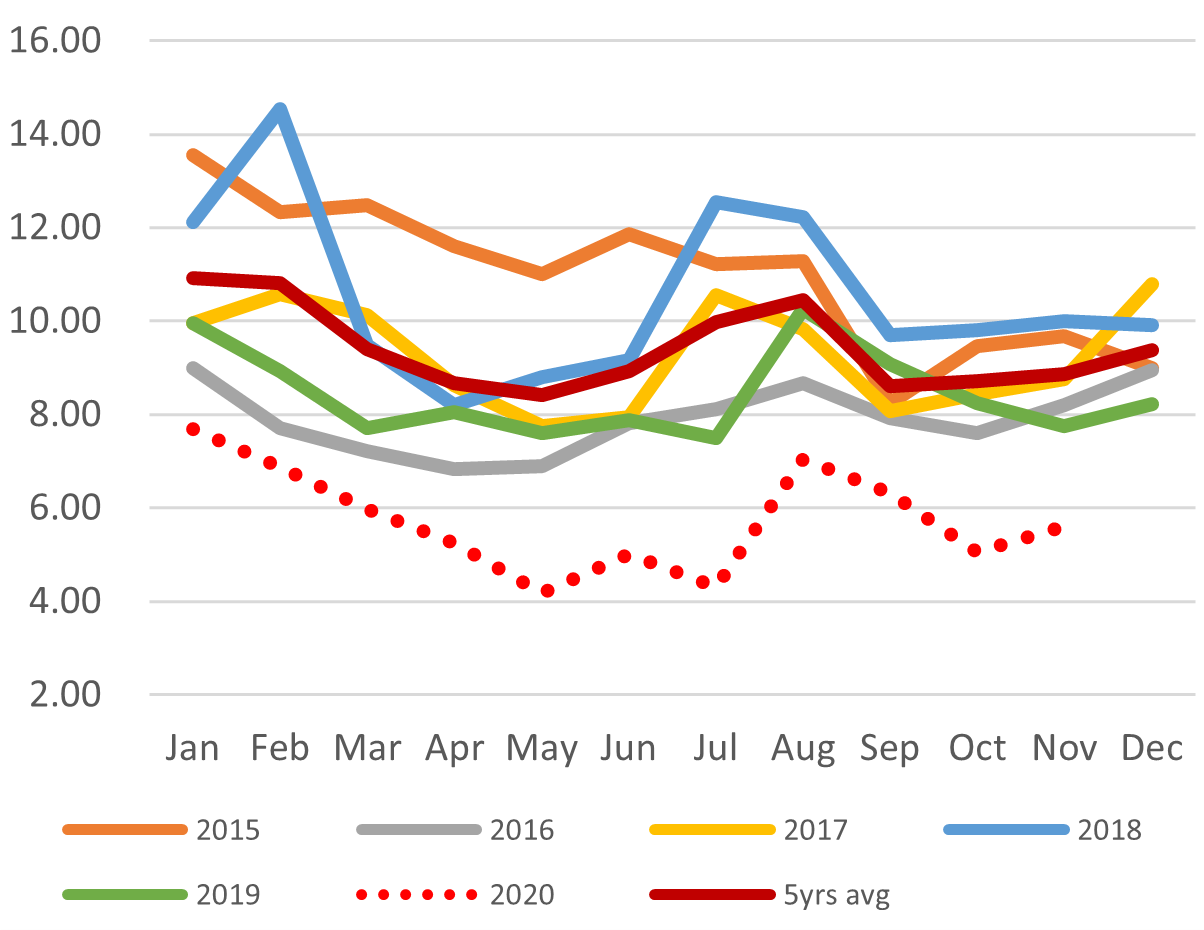
Spot Electricity Prices (2020)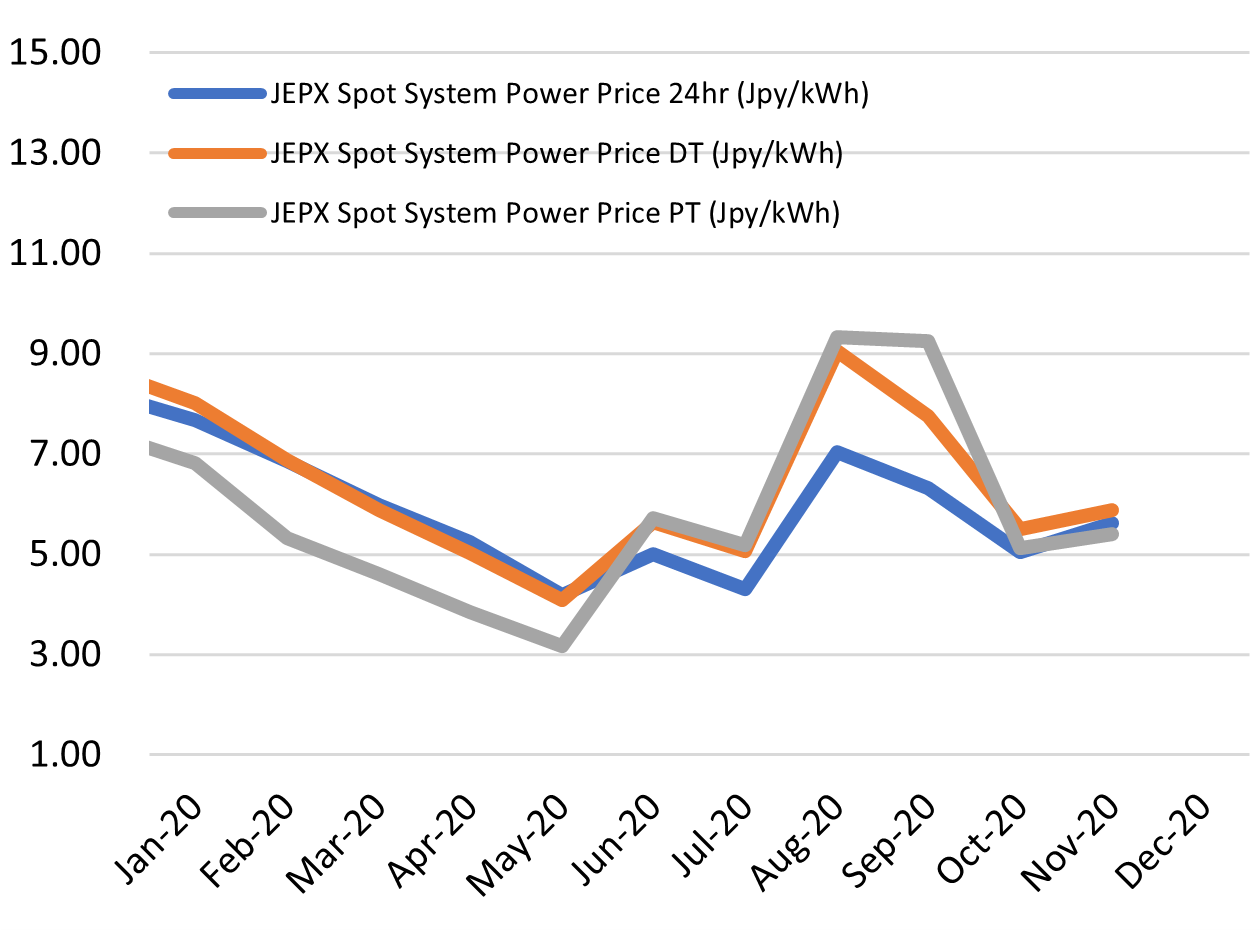
Key Japan decarbonization body identifies which energy sources should be supported
(Japan NRG, Nov 15)
- Green Innovation Strategy Conference, a private-private sector body set up this year to develop and support carbon-neutral technologies, published its plans for future action.
- CONTEXT: The Conference was established in July. It comprises academics, experts from national research institutes, as well as officials from the public and private sector. The government officials from the Cabinet, METI, and other ministries are classified as “observers” in the Conference.
- At its third meeting, the Conference identified hydrogen, storage batteries, carbon recycling and offshore wind power as sectors the country should promote.
- The body plans to develop a roadmap for action by year’s end. The roadmap will suggest what should be done in R&D to achieve cost reduction, mass production and large pilot projects, as well as changes in regulations and standardization frameworks. Its recommendations would also touch on project financing, international cooperation and market forecasts.
- The Conference’s next meeting is in mid-December.
- SIDE DEVELOPMENT:Japanese government holds meeting to discuss zero emissions
(Denki Shimbun; Nov. 11, 2020)
- The Japanese government held a meeting on Nov. 9 to discuss going carbon neutral by 2050.
- The government may consider providing financial support for green investments and development cost for technologies such as small modular reactors (SMR) and carbon-capture utilization and storage (CCUS).
Japan to promote carbon-reduction through tax-breaks and establish fund for green tech
(Nikkei, Nov. 12)
- Govt. wants to incentivize the private sector to invest in products and equipment the reduce carbon emissions to help the country meet its 2050 carbon-neutral goal. Tax breaks could be available from next year.
- This could spur investment in the manufacture of components for wind turbines. Firms that enter the field would enjoy a partial corporate tax exemption. The size of the tax break should be decided by the end of the year.
- The incentives would stretch to next-generation lithium-ion batteries for EVs and hybrids, as well as for power storage. Semiconductor makers might also qualify for their work in regulating voltage.
- In addition, govt. and the ruling LDP party consider setting up a fund to support R&D in green technology.
- CONTEXT: What qualifies as “green technology” will likely be in line with the recommendations of key public-private bodies such as the Green Innovation Strategy Conference. See the news item above.
TAKEAWAY: We have discussed the details of this issue in several earlier editions of Japan NRG. In short, the govt. would feel much more comfortable supporting solar and wind power if the country had manufacturers that supplied the relevant equipment. Most solar panels and related tech are imported from China or South Korea. In wind, Japan boasts just one manufacturer (MHI), and even that company outsources much of its turbine work to its Danish business partner (Vestas). In previous years, other Japanese manufacturers exited the wind turbines market, citing low profitability. For now, it is not clear which major manufacturers would be tempted by the tax breaks. Toshiba, for example, has declared its intention to enter the grid and Virtual Power Plant space. Toyota is heavily invested in batteries and storage, as are Panasonic and Murata. More will need to come forward to create a vibrant renewables supply chain in the domestic market.
- SIDE DEVELOPMENT:
- Top big business group proposes new growth strategy with focus on decarbonization
- (Denki Shimbun, Nov. 10)
- Keidanren (the Japan Business Federation) has announced its new growth strategy for 2030. It calls for five actions, among which is greater use of decarbonization technology.
- This initiative supports the construction of new types of steel furnace by 2030 and calls on the government to provide tax incentives for firms to go green or to develop new green technologies.
- Chairman Nakanishi Hiroaki stressed that while Japanese corporate investment in energy has been stagnant of late, the new govt. carbon-neutrality target requires companies to pour capital into technical innovation.
- CONTEXT: The proposal from an industry group, which includes the major steel manufacturers, supports a switch from blast furnaces to electric-arc furnaces in the steelmaking process. The latter has lower emissions.
- SIDE DEVELOPMENT:
- Biden will be ‘180-degree turnaround’ from Trump on climate, says Environment Minister Koizumi
- (Asia Nikkei, Nov. 11)
Erex and ENEOS may build world’s biggest biomass-fired plant in Niigata
(Nikkei, Nov. 10)
- Major biomass generator Erex said Nov. 10 that it was discussing partnering with ENEOS to build one of the world’s largest biomass-fired power plants, in Niigata.
- The 300 MW plant would be built on the site of a golf course owned by ENEOS, and require an investment of around ¥100 billion.
- Erex would not take advantage of the feed-in tariff system when selling electricity generated by the plant, and instead aims to achieve profitability by developing cheaper feedstock.
- CONTEXT: Japan’s government set a target of sourcing 4.6% of total electricity from biomass by 2030.
Bids in sixth solar feed-in-tariff tender drop to an average of ¥11.5/kWh
(Smart Japan, Nov. 11)
- The Green Investment Promotion Organization released the outcome of its sixth tender for FIT (feed-in tariff) solar electricity.
- The weighted average of the 254 bids submitted was ¥11.48 per kilowatt hour. The lowest bid entered was ¥10.0 per kilowatt hour.
- The upper limit imposed on bids, not disclosed to bidders until after the tender process has concluded, was set at ¥12 per kilowatt hour. This is down ¥1 per kilowatt hour from the last tender.
TAKEAWAY: Earlier this year, METI made a presentation to renewable energy investors hinting that it saw FIT pricing heading down to ¥12 / kWh. That drew gasps from the audience, yet it has obviously been absorbed by the industry as the price levels of the latest bids show.
Hokkaido government inviting submissions for 1 GW offshore wind farm at Ishikari
(City of Sapporo, Nov. 13)
- Public submissions are now being sought in response to the environmental impact assessment for the wind farm planned by Japan Renewable Energy.
- A wind farm with an output of 1 GW is planned.
Toshiba to build carbon-capture unit for Sekisui Chemical waste-to-ethanol plant
(New Energy Business News, Nov. 13)
- Toshiba Energy Systems will install a carbon-capture and utilization unit at an experimental plant being built by Sekisui Chemical in Iwate that will turn household waste into ethanol.
- The facility is scheduled to go online in June.
- While the carbon-capture unit will only capture 10 kg of CO2 per day, the technology is easily scalable.
- The technology makes use of a property of aqueous solutions to absorb carbon dioxide at low temperatures and release it at high temperatures, and can be applied to any process that emits carbon dioxide.
Japanese EV autos chase Chinese, South Korea rivals with new storage batteries
(Asia Nikkei, Nov. 7)
- Japanese firms betting on solid-state battery technology to catch up with market leaders in China such as CATL and BYD.
- Solid-state batteries use solid electrodes and solid electrolytes to produce electric current. This helps create a long-life, heat-resistant battery that are also quick to charge.
- A solid-state battery offers autos a 1,000 km run on a single charge, which means that Japan retains its technological lead in this battery category. Toyota and Panasonic are working on an in-vehicle solid-state battery, set to launch before 2025.
Shinsei Bank, Daiwa Energy to provide ¥40 billion of mezzanine finance for renewables
(Nikkei BP, Nov. 2)
- Beginning on Oct. 28, Shinsei Bank and Daiwa Energy Infrastructure will offer mezzanine financing for renewable energy projects via Shinsei Trust & Banking.
- By offering generators more financing options than simply senior bank loans and equity, Shinsei and Daiwa aim to encourage environmentally friendly generation projects.
- Mezzanine financing of large energy projects allows the generator to make use of leveraging so that it needs to put up less of the required equity.
Asahi joins RE100, pledges to transition to 100% renewable energy by 2050
(New Energy Business News, Nov. 9)
- Asahi Holdings has joined RE100, an international initiative for the use of 100% renewably-generated electricity, and aims to source 100% of its electricity from renewable sources by 2050.
- Asahi is the first Japanese beverage manufacturer to join RE100.
- Asahi’s pledge was supported by the Japan Climate Leaders’ Partnership, an industry body that aims to create a sustainable, carbon-free world.
ANALYSIS
RESEARCHER, JAPAN
Starts to Soften as Non-Utility Users Push Back
Since the summer, the government has announced bold plans to close most of Japan’s coal-fired plants and lead the nation to carbon neutrality by 2050. In subsequent talks with the domestic industry, however, that progressive tone on coal has notably weakened.
On Oct. 30, the key ministry for energy policy, the Ministry of Economy, Trade and Industry (METI), rolled out a new regulatory framework for power utilities and non-utility operators of “inefficient” coal-fired power plants. It asked utilities to submit annual reports detailing plans to move away from coal. There was no such request for steel, cement, paper and chemical manufacturers, as well as for major trading houses that operate some 80 coal-fired power plants in Japan. According to METI, non-utilities are likely to be exempt.
INFO BOX
| Japan has 150 power plants or units that utilize coal. Of these, 114 fall under the “inefficient” label as it was initially explained by METI in July 2020. These 114 units account for 16% of Japan’s power generation capacity as of fiscal 2018, according to METI data. | |
| What is deemed “efficient” is important since that’s the basis for Japan determining which coal-fired plants have to be retired. The original METI announcement called for the retirement of subcritical and supercritical coal-fired technologies, while classifying ultra-supercritical (USC) plants as “efficient”. These terms refer to the heat and pressure level at which a plant operates in relation to the critical point of water; higher temperatures tend to allow for better energy efficiency. As such, Japan could be said to have 29 “efficient” coal power plants since they are of the USC class and boast 41%-43% energy efficiency. The remainder of Japan’s coal units are Integrated Coal Gasification Combined Cycle (IGCC) plants, which score 46%-50% energy efficiency. | |
| According to METI calculations, “efficient” coal plants account for 13% of Japan’s power generation capacity and could make up 20% of total in the foreseeable feature. |
To be fair, the bulk of Japan’s coal-fired assets is owned by the regional electricity companies (EPCOs), which count 70 units with a generation capacity of about 39 GW. The 80 plants owned by non-utilities have a capacity of 9 GW. Still, the majority of that capacity in the hands of manufacturers is old, relatively small-scale and not efficient.
Steelmakers, which as an industry are Japan’s biggest greenhouse gas (GHG) emitters after the power sector, run 26 coal units. Most are 10-20 years old and either of the sub-critical or supercritical rank. Initially in summer, METI said that Japan would keep only coal-fired units that use ultra-supercritical technology. Since then, the ministry has suggested that the efficiency percentage may be more important than the base technology
The oldest coal plant run by a non-utility is the 75 MW station in Niihama City that’s owned by a unit of Sumitomo Chemical. The station went online in 1959.
Japan’s steelmakers have pushed back hard against the government on coal plant closures. In a presentation to METI on Aug. 25, the Japan Iron and Steel Federation argued that its members run coal-fired technology for a good reason. These power plants re-use methane, hydrogen and other gases released from blast furnaces and coke ovens, according to the federation. The plants also need to burn coal because various gases with volatile properties could not be stable fuel sources.
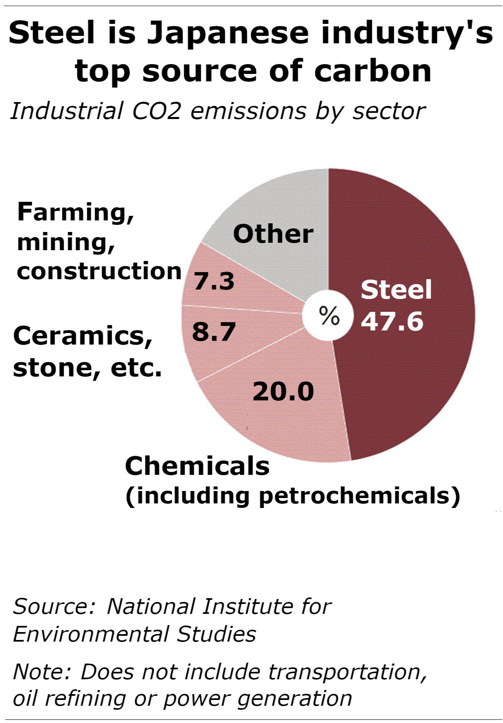
Furthermore, Japanese steelmakers argued that they are already the greenest among global peers and have the best energy efficiency records. The industry federation urged METI to drop plans to increase their energy reduction targets.
The pleas seemed to have worked. METI’s response in the October presentation was to say that further new measures are unlikely to follow. At present, non-utilities are only required to report their energy efficiency records to METI if they consume more than 1,500 kiloliters of fossil fuels.
Source: The National Institute for Environmental Studies via the Asia Nikkei
Note: the chart does not include transportation, oil refining or power generation
UTILITIES ASK FOR TIME TO EXIT COAL
Japanese power utilities have also argued against a rapid exit from coal. Still, the power industry seems more prepared to move away from the fuel. Since the 2009 introduction of the Structural Upgrading Act for Energy Supplies, utilities have been under pressure to lower emissions. The Act also mandated a decrease over the long-term for coal, oil and LNG use.
That decade-old legislation asked that by 2030 Japanese utilities should source at least 44% of their electricity from non-fossil fuel sources. METI has been conducting periodic checks on compliance and the latest results, published in October, show that 19 of 46 power utility operators have achieved their fossil-fuel reduction targets.
With less than 10 years left, METI does not seem to display any urgency to hurry the rest of the utilities to comply. “The question is, should there be new regulation that reinforces [the Act via] a reduction in coal-fired power in particular?” METI wrote in its Oct. 30 update. The ministry’s own answer was to “continue consultations” with utilities on what coal-specific regulations might be necessary.
For now, utilities have asked METI to allow them time to phase out coal-fired assets. To get a sense of how much time is required, utilities stated that “around a decade” is required to build a new power plant from scratch.
Utilities also asked METI for a methodology that would “reward” their shift to green energy by reflecting their increased use of renewables in the energy portfolio.
NEXT STEPS
To promote a faster move away from coal, METI has said it will implement:
- Stricter energy reduction goals that will be spelled out for each sector under the Energy Conservation Law;
- Redesign of the power capacity market to discourage coal-fueled power;
- Facilitate access to the nationwide grid that incentivizes renewables (rather than working on a first-come, first-served basis that tends to help coal and other thermal baseload sources).
The first power capacity auction was held earlier this year, as featured in the Oct. 26 edition of Japan NRG Weekly. The results were met with dismay by many electricity retail firms that argued the auction’s high prices supported thermal generation, such as coal-fired capacity, at the expense of renewables and the consumer.
As such, METI said it will now study whether there is a rationale in putting equal value on coal and non-coal capacity. The ministry wants experts to consider if a mechanism that discounts coal capacity could work in the current auction and market conditions.
A final recommendation based on expert opinions is due to be presented and implemented before the 2021 capacity auction.
METI OFFERS COAL OPERATORS PRIVACY
In what is perhaps the oddest softening of stance, METI also said it wants to offer coal-fired plant operators protection from public scrutiny.
The ministry plans to bundle reports from individual companies into a single document before public disclosure, which will redact the names of operators.
The ministry said that this was appropriate since identification of a coal facility owner may affect their competitive strength and relations with the local community, and potentially create unanticipated challenges to coal phase-out plans.
ANALYSIS
DIRECTOR,
K.K. MATHYOS
Struggling for Identity and Strategy in Post-Carbon World
The story of Kansai Electric Power Co. (KEPCO) shows how tricky energy transition will be for Japan’s regional power utilities. The dominant supplier in Japan’s No. 2 industrial region, KEPCO currently cannot use a fifth of its capacity due to multiple nuclear energy issues. One-sixth of its generation is coal-fired. And, for over a year it has been embroiled in a scandal that has raised big questions of its corporate culture and way of doing business.
As Prime Minister Suga asks the nation to decarbonize, KEPCO needs to quickly find a new identity and strategy for an era in which its market position is no longer protected and guaranteed tariffs are on the way out. How KEPCO will look a decade from now – whether it even continues as the current entity – will depend on recent initiatives in electrification and a burgeoning wave of industry consolidation.
The last 12 months have not been kind to Japan’s second-largest power company by market capitalization. Earlier this month, KEPCO closed Unit 4 at its Ohi nuclear station in Fukui Prefecture for maintenance. This left the firm’s entire reactor fleet offline for the first time in over three years.
Some of KEPCO’s seven reactors were due to be restarted by this point. However, gaining approval for the restarts from local politicians (considered a social must), has so far proved impossible since a bribery scandal around KEPCO’s nuclear division erupted last year.
The utility is being sued by shareholders based on revelations that the late, former deputy mayor of Takahama city, which hosts one of KEPCO’s nuclear stations, made payments to senior KEPCO officials. Since 1987, money and gifts worth over ¥300 million were sent over a 30-year period. In return, firms with which the deputy mayor was affiliated won work contracts.
The case led the nation’s biggest newspaper, Yomiuri Shimbun, to slam KEPCO in an editorial, a very rare occurrence. In September, the governor of Fukui said that public confidence in KEPCO has been lost.
Without nuclear, KEPCO faces a massive challenge in responding to the recent government pledge to make Japan carbon neutral by 2050. While JERA and Tokyo Gas, two of the biggest utilities, quickly unveiled their own roadmaps to net-zero emissions, KEPCO has so far kept quiet.
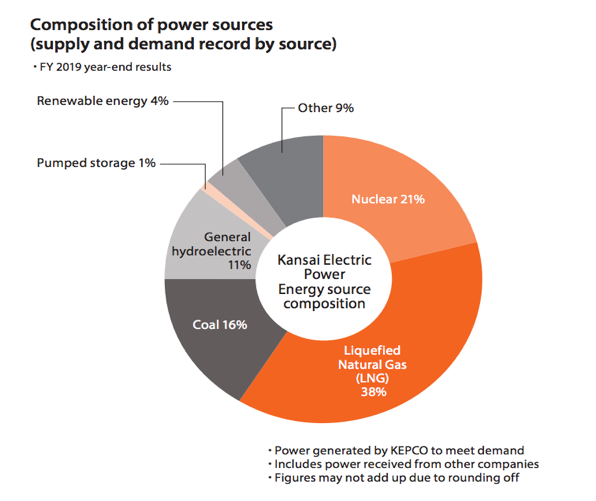
Burning coal and gas generated around 60% of KEPCO’s output last year, resulting in 39 million tons of CO2, or 0.33 kg of C02/kWh. A few years ago, KEPCO pledged to cut CO2 emissions in half by 2030, but used 2013 as the benchmark year. In that year, KEPCO’s CO2 emissions were at a peak due to a shutdown of most nuclear assets in the aftermath of the Fukushima disaster. Compared to pre-Fukushima 2010 numbers, 2013 emissions were up 56%.
In other words, KEPCO’s emissions pledge was mainly predicated on being able to restart all their nuclear units.
Kansai Electric’s CO2 Emissions (at the bottom) Plotted against NPP Utilization (grey triangles)
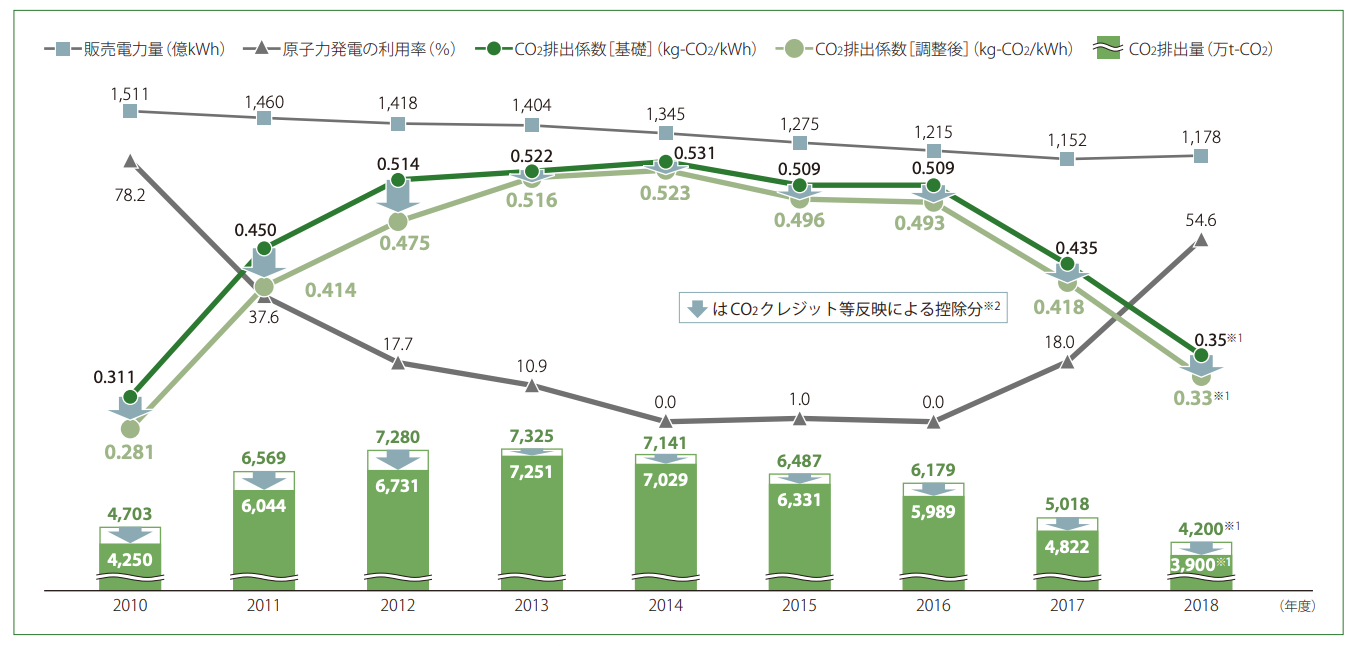
Source: KEPCO 2019 CSR report
COMPANY OVERVIEW
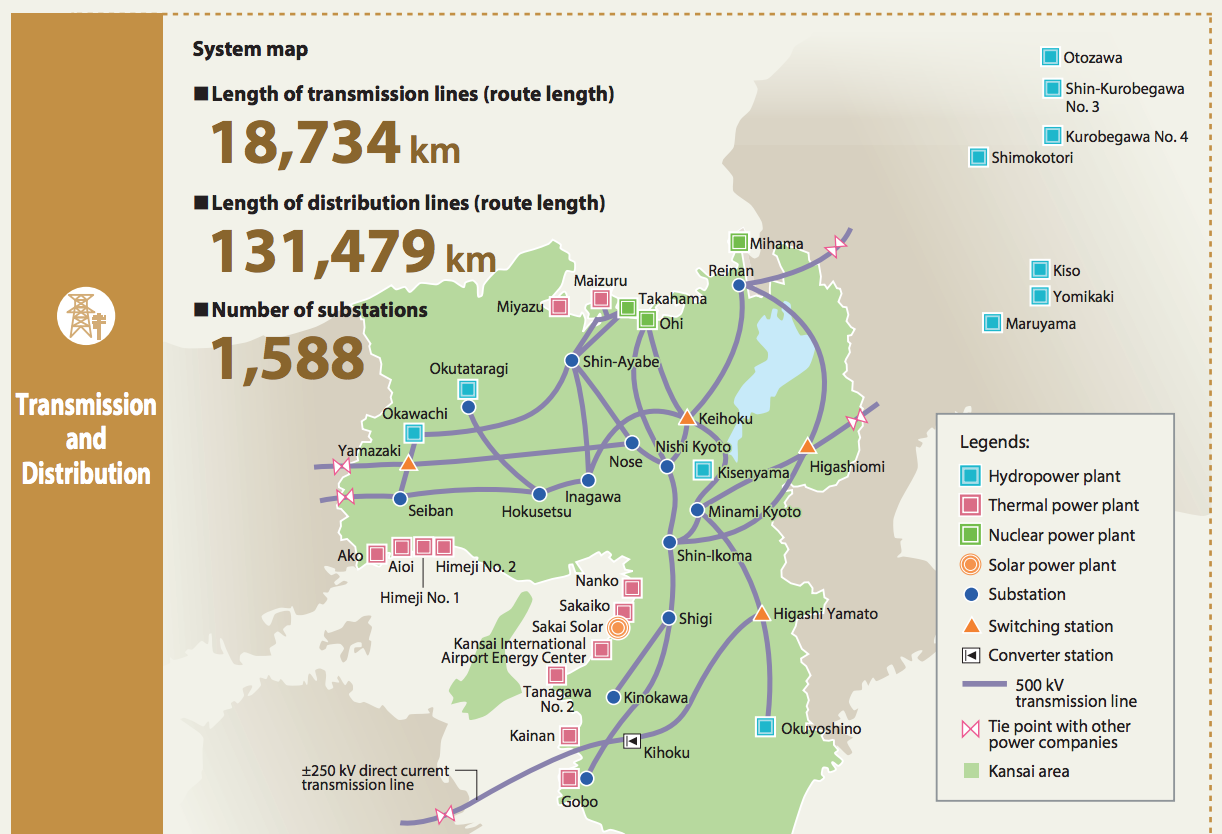
KEPCO, headquartered in Osaka City, serves a $1 trillion economy in Western Japan with annual power generation needs of 120 billion kWh. That is 15% of Japan’s total, bringing the utility annual revenues of almost $30 billion.
KEPCO’s home territory is adjacencies with three other EPCOs: Hokuriku Electric to the north; Chubu Electric to the east; and Chugoku Electric to the west.
KEPCO operates 170 power-generation facilities. Of those, renewables energy capacity stands at just 4 GW. By 2030, KEPCO’s current goal is to expand that to 6 GW, which seems to be modest by multiple orders of magnitude.
Without nuclear, KEPCO relies on LNG and coal, imported mainly from Australia and Indonesia. The company’s fuel costs in FY2019 were $5 billion.
In addition, KEPCO had to buy around $4.7 billion of power from other producers and the wholesale power market in 2019 to meet demand.
KEPCO operated three nuclear facilities – the Mihama NPP, Ohi NPP and Takahama NPP, all in the Fukui region. The stations have a total of 11 reactors, however four are being decommissioned. Three of the remaining seven had their life cycles extended beyond the initial 40 years. The book value of KEPCO’s nuclear facilities was $3.5 billion at the end of FY2019.
Source: Kansai Electric
Most recently, KEPCO reported negative free cash flow of $1.5 billion in H2 FY2020 due to capital expenditure outlays, many of those related to mandated upgrades at nuclear plants. As of September, KEPCO had accumulated debt of almost $40 billion. This dwarves the company’s $9 billion market capitalization.
The stock has doubled since the Fukushima accident in 2011, yet it is still down 75% since a market peak in 2007. It trades at close to 50% of book value. Chubu Electric, headquartered in Nagoya, is now the largest Japanese utility by market capitalization at $9.5 billion.
KEPCO paid dividends of $360 million in FY2019, an important attribute for its retail investors. Government and domestic financial institutions own over 40% of the company, with foreign ownership around 25%.
Also, KEPCO has 2.8 GW of overseas assets in 11 countries including the U.K., Indonesia, Laos, Philippines, Taiwan, and Myanmar.
POST-DEREGULATION, NEW BUSINESS CHANCE
The government fully deregulated the domestic retail electricity market in April 2016, resulting in significant competition for the indigenous power companies including KEPCO. As part of the deregulation, KEPCO separated its transmission and distribution business from generation and retail. Since then, KEPCO has lost 10% of its regional retail market. However, it now sells electricity also in the Tokyo area to around 190,000 households.
The government also deregulated the domestic retail gas market in 2017, which prompted KEPCO to enter the gas distribution business. It now generates around $2 billion in revenues from gas sales.
In gas, KEPCO has strategic cooperation agreements with Tokyo Gas. For renewables, KEPCO’s partner has often been Kyocera.
Since the unbundling of the gas and power industries, incumbent utilities have looked for new business areas. One field that KEPCO has explored is transport electrification. The company committed to developing a fully electric ship to feature at the 2025 World Expo, which will be hosted by KEPCO’s home city of Osaka.
More power demand will come from greater use of electric cars and other road transport. What’s more, SBI one of Japan’s leading investment banks, is pushing for the creation of a financial services hub in the Kansai region, which would be another tailwind for power demand and KEPCO.
On a positive note, KEPCO is diversifying its domestic business lines by entering home security, healthcare and leasing businesses. Internationally, the utility is expanding to onshore wind energy investments in Finland and the U.S. This May, KEPCO’s first U.S. greenfield project, the Hickory Run 1,000 MW thermal plant in Pennsylvania, started commercial operation.
GLOBAL VIEW
Below are some of last week’s most important international developments monitored by the Japan NRG team because of their potential to impact energy supply and demand, as well as prices. We see the following as relevant to Japanese and international energy investors.
Last Tuesday the International Energy Agency (IEA) issued its global ‘Renewables (RE) 2020–Analysis and Forecasts to 2025 Report’.
IEA findings included:
- Global investments in RE will increase 4% in FY2020 to almost 200 GW despite an expected overall YoY decrease in energy consumption of 5%.
- Auctioned RE capacity is up 15% YoY in the nine months to September.
- RE capacity additions now represent 90% of total power capacity additions.
- RE capacity additions in China and the U.S. are up 30% YoY.
- RE capacity additions in India are expected to double YoY in 2021.
- Total installed wind and solar PV capacity is on course to surpass natural gas in 2023 and coal in 2024.
- Renewables will overtake coal to become the largest source of electricity generation worldwide in 2025.
- Major oil and gas companies’ investments in new renewable electricity capacity are expected to increase tenfold from 2020 to 2025.
Oil:
IEA and OPEC both revised downward oil consumption forecasts to a YoY decrease of 9 & 10 mbpd, respectively, for 2020. OPEC also revised downward its 2021 forecast by 300,000 bpd.
However, the vaccine announcement by Pfizer pushed oil prices up by $5 last week, with WTI reaching $40 and Brent $43. Energy stocks in the U.S. were up 20% last week.
Covid-19:
Infection rates in the U.S. have exceeded 100,000 cases for nine consecutive days and on Thursday exceeded 150,000 cases, dampening the outlook for fuel consumption in the U.S.
China:
Twenty bulk carriers carrying Australian coal are anchored off the Chinese port of Jingtang, Hebei Province due to the ongoing diplomatic spat between China and Australia.
ASEAN:
Annual ASEAN and East Asian Summits are underway this month where oil and gas exploration in the South China Sea may be discussed. Vietnam, Philippines, Malaysia, and Brunei all have exploration and territorial disputes with China in the South China Sea. Most of Vietnam’s electricity is generated from South China Sea-sourced natural gas. Japan’s Prime Minister Suga attended the ASEAN summit last Thursday, committing to $19 billion of port and railway infrastructure investments.
Philippines:
Typhoon Goni disabled six power plants on the island of Luzon last week causing significant power outages in 125 cities and towns. Goni, which may have been the strongest tropical cyclone in history, caused 16 fatalities and resulted in half a million people evacuated.
Malaysia:
Petronas, the state-run oil and gas monopoly, has set a target to achieve net-zero carbon emission by 2050.
Australia:
The country’s top science body, CSIRO, and its Bureau of Meteorology, issued its bi-annual State of the Climate report on Friday warning of further significant climate change impacts similar to the bush fires in 2019 and 2020 that caused $7 billion of damage. The country’s economy relies heavily on coal and natural gas exports to Japan and North Asia.
Myanmar:
The gas-rich ASEAN country held a general election on Nov. 8, the result of which is being disputed by the military-backed opposition parties.
Russia:
The country’s largest oil and gas company, Rosneft, is now forecasting a loss for the current fiscal year due to low oil prices. Europe’s BP has a $10 billion stake in Rosneft.
Middle East/Africa:
The World Bank is now forecasting that the dual shock of low oil prices and Covid-19 will cost the MENA region $230 billion of output in 2020.
Zambia is expected to be the first African country to default on sovereign debt obligations post Covid-19.
EU:
1). The French government is reneging on solar power contracts signed between 2006 and 2010 that it says are generating excessive profits for investors. Savings of E600 million are expected for the French government.
2). At a meeting in Paris on Wednesday, 450 global public development banks signed a declaration committing to align lending policies with the Paris Agreement, but stopped short of ruling out loans for fossil fuel investments. The Asian Development Bank, which is run by Japan’s Asakawa Masatsugu, declined to sign the declaration.
UK:
Prime Minister Johnson is expected to make a major set-piece policy speech next week outlining how the UK will meet its net-zero 2050 CO2 pledge. The UK will exit the EU in seven weeks, and the issue of electricity and gas transmission between the EU and UK is now part of Brexit negotiations.
Americas:
1). Peabody Energy, the largest coal producer in the U.S., may be forced to file bankruptcy for a second time due to a collapse in coal prices.
2). The Keystone and Dakota Access oil pipelines may be early targets of the incoming Biden administration, which plans a return to climate change commitments.
3). Latin America’s largest oil producer, Brazil, is holding municipal elections this month in a major test for President Bolsonaro. Outcomes may impact the country’s energy and climate policies.
STOCK MARKET PERFORMANCE
| As of close on Nov 13, 2020 | Ticker | Market Cap | 1W (%) | MTD (%) | YTD (%) | |
| billions of yen | ||||||
| Energy | ||||||
| INPEX CORP | 1605 JP | 786.73 | 7.60 | -51.80 | 0.00 | |
| JAPAN PETROLEUM EXPL. | 1662 JP | 100.14 | 3.55 | -38.99 | 2.22 | |
| ENEOS HOLDINGS INC | 5020 JP | 1178.41 | 0.36 | -22.38 | -1.41 | |
| IDEMITSU KOSAN CO LTD | 5019 JP | 652.92 | 1.86 | -23.36 | -0.63 | |
| COSMO ENERGY HOLD. | 5021 JP | 142.33 | 5.13 | -29.70 | 7.22 | |
| Industrials | ||||||
| MITSUBISHI CORP | 8058 JP | 3700.19 | 3.17 | -9.38 | 1.36 | |
| MITSUI & CO LTD | 8031 JP | 3058.16 | 3.37 | -4.14 | -0.81 | |
| JGC HOLDINGS CORP | 1963 JP | 241.33 | 4.26 | -46.22 | 1.31 | |
| CHIYODA CORP | 6366 JP | 63.26 | 4.74 | -14.13 | 0.41 | |
| Utilities | ||||||
| TOKYO ELECTRIC POWER | 9501 JP | 461.21 | 2.14 | -38.54 | -2.38 | |
| CHUBU ELECTRIC POWER | 9502 JP | 962.28 | 0.99 | -14.73 | 2.59 | |
| KANSAI ELECTRIC POWER | 9503 JP | 933.66 | 1.62 | -17.80 | -0.34 | |
| KYUSHU ELECTRIC POWER | 9508 JP | 433.40 | 1.44 | 0.14 | -1.72 | |
| J-POWER | 9513 JP | 274.21 | 2.25 | -41.21 | 0.20 | |
| TOKYO GAS CO | 9531 JP | 1144.36 | 4.55 | -0.13 | 10.25 | |
| OSAKA GAS CO | 9532 JP | 907.53 | 6.82 | 6.67 | 10.06 | |
| TOHO GAS CO | 9533 JP | 661.10 | 5.39 | 41.82 | 19.24 | |
| SAIBU GAS CO | 9536 JP | 113.98 | 9.97 | 23.66 | 20.10 | |
| SHIZUOKA GAS CO | 9543 JP | 75.74 | -1.78 | 5.44 | 8.87 | |
DATA
Japan Oil Price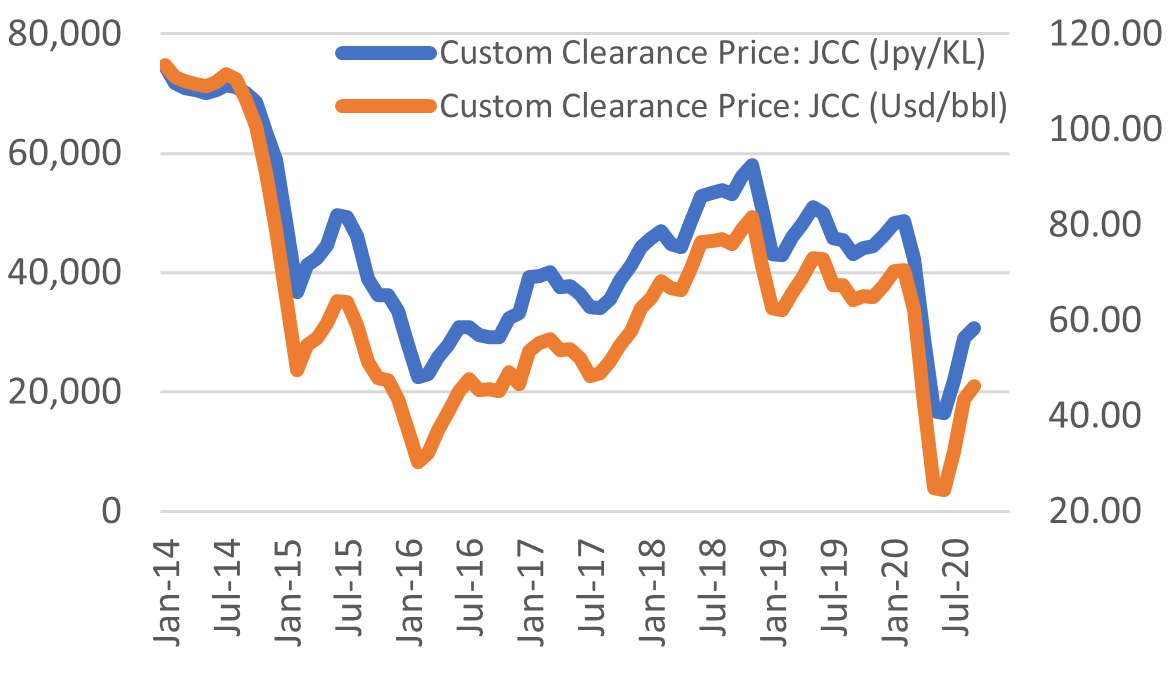
Crude Imports Vs Processed Crude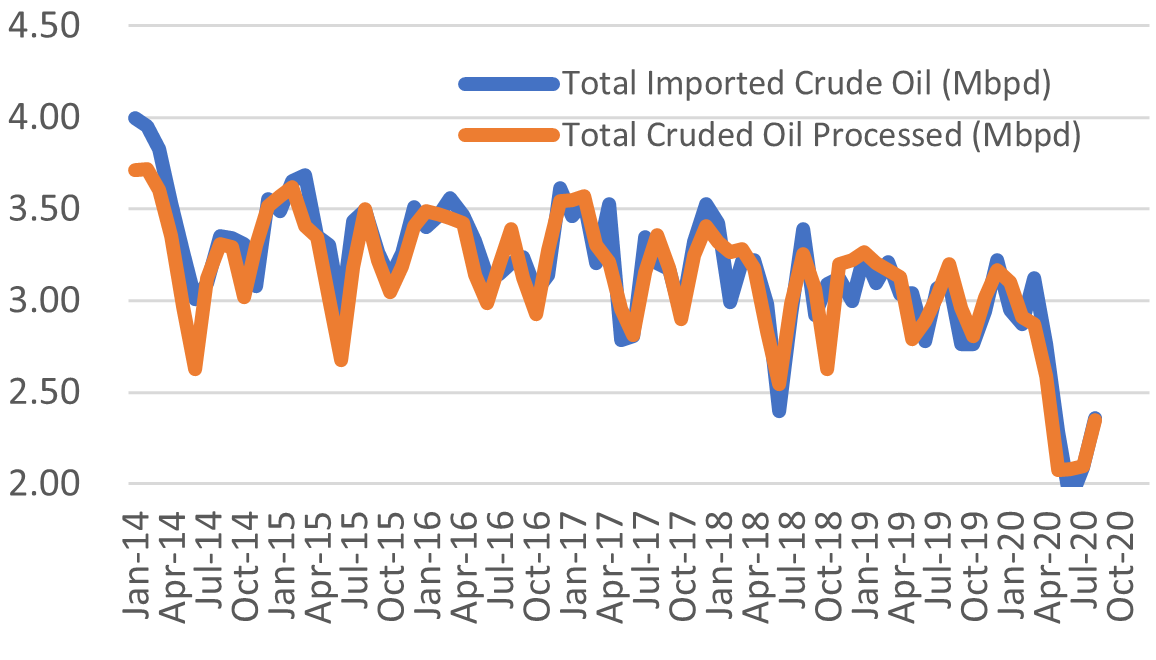
Monthly Oil Import Volume (Mbpd)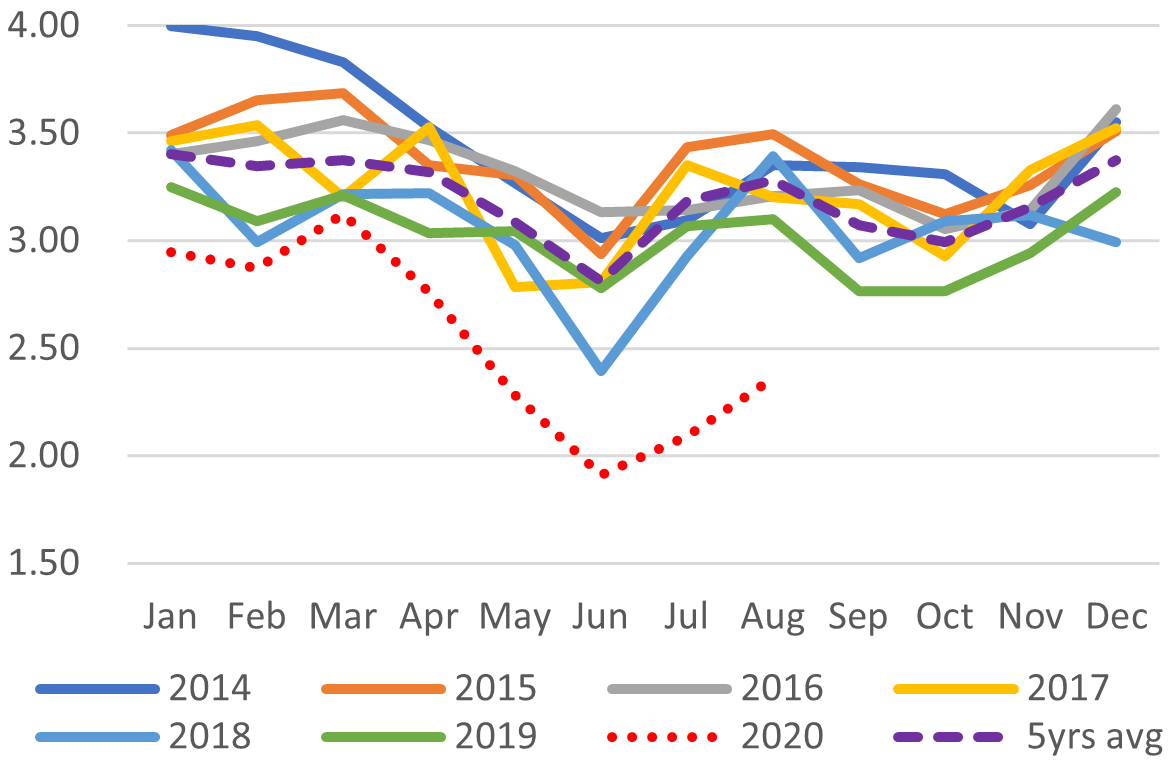
Monthly Crude Processed (Mbpd)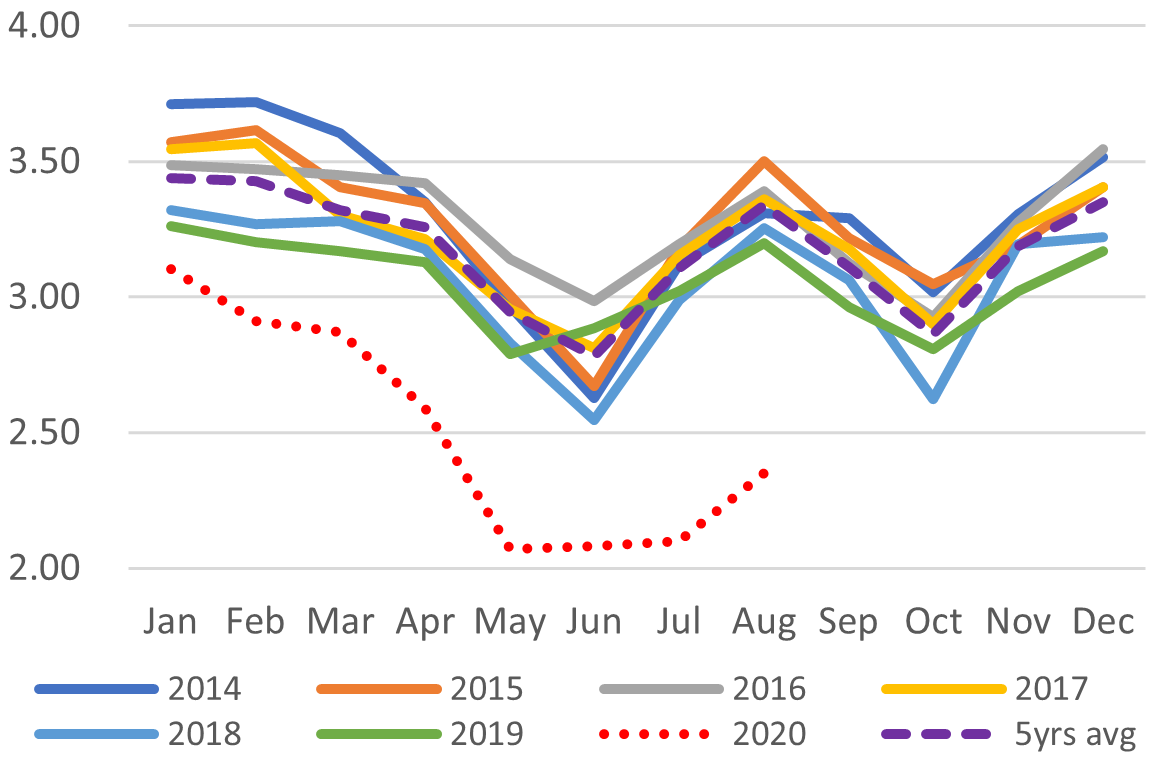
Domestic Fuel Sales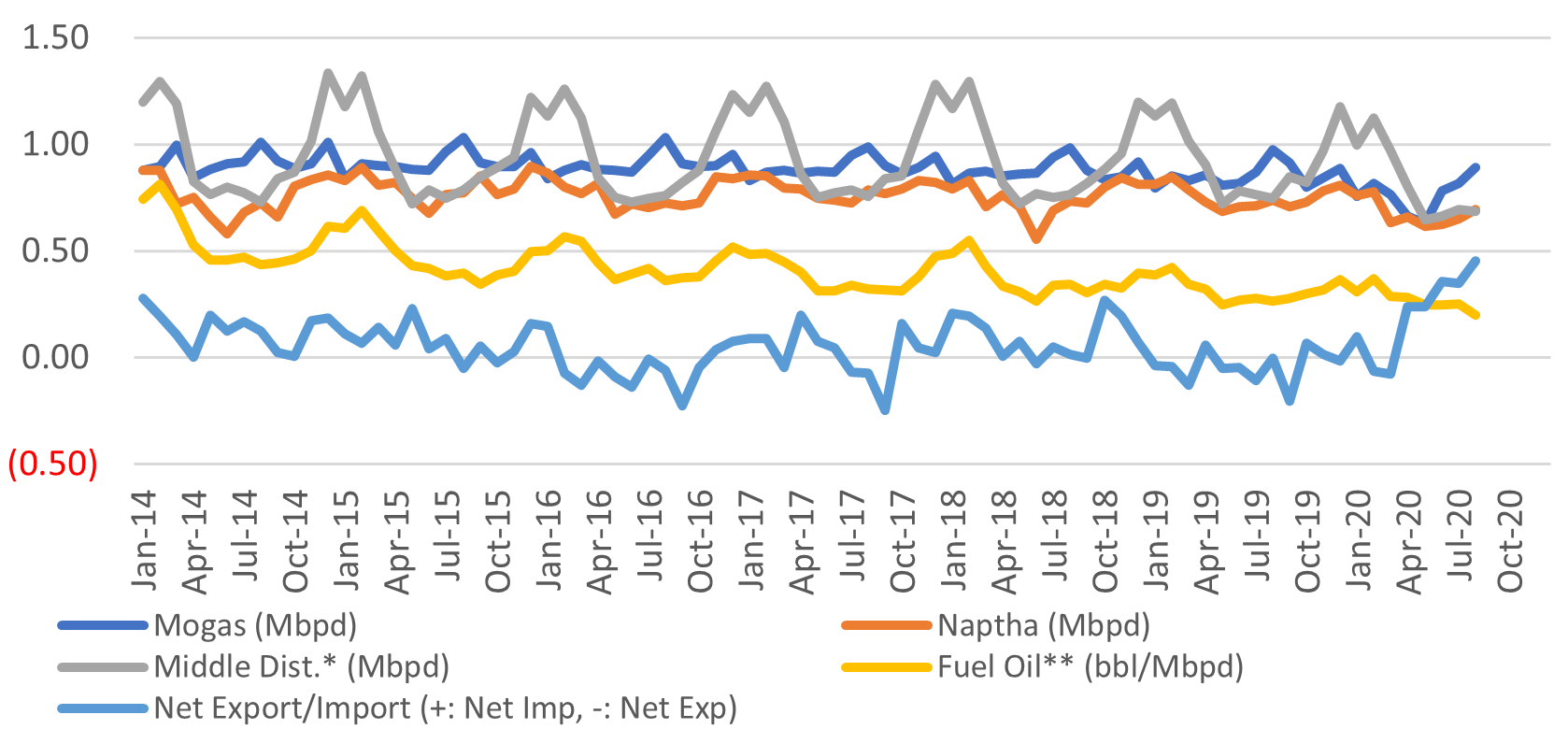
SOURCES: the Ministry of Economy, Trade, and Industry (METI), Ministry of Finance, and the Petroleum Association of Japan
Japan LNG Price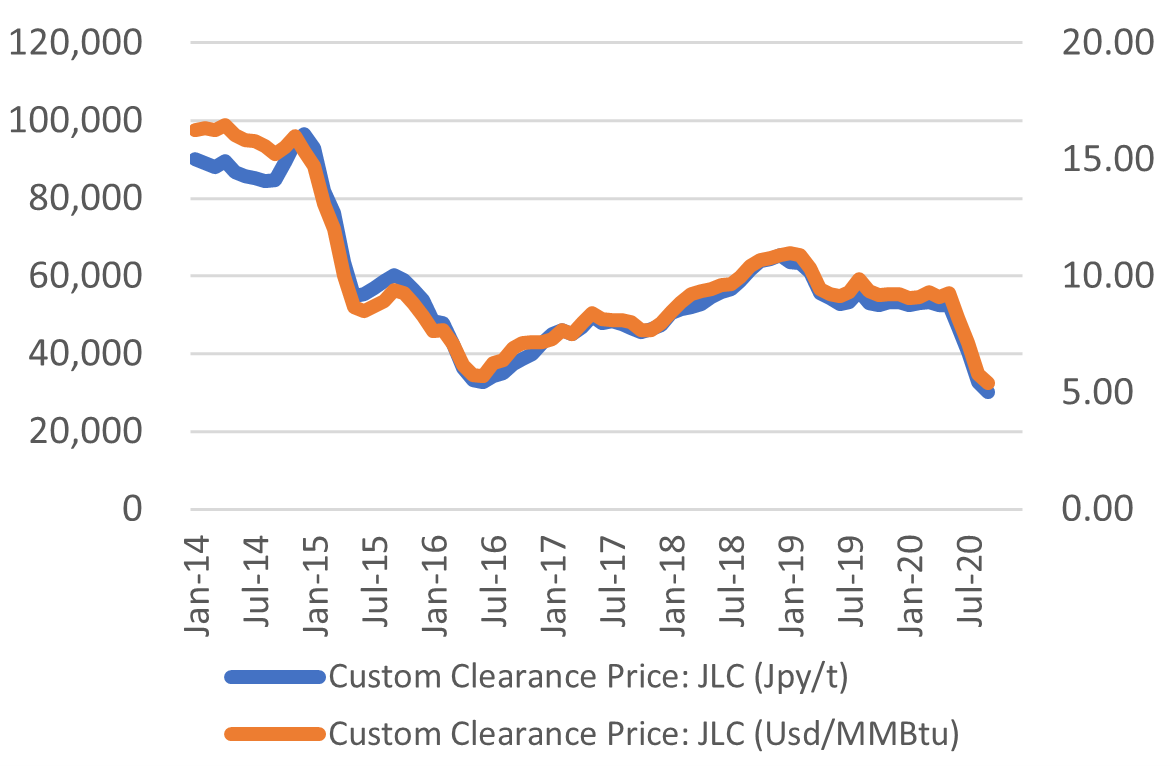
LNG Imports: Japan Total vs Gas Utilities Only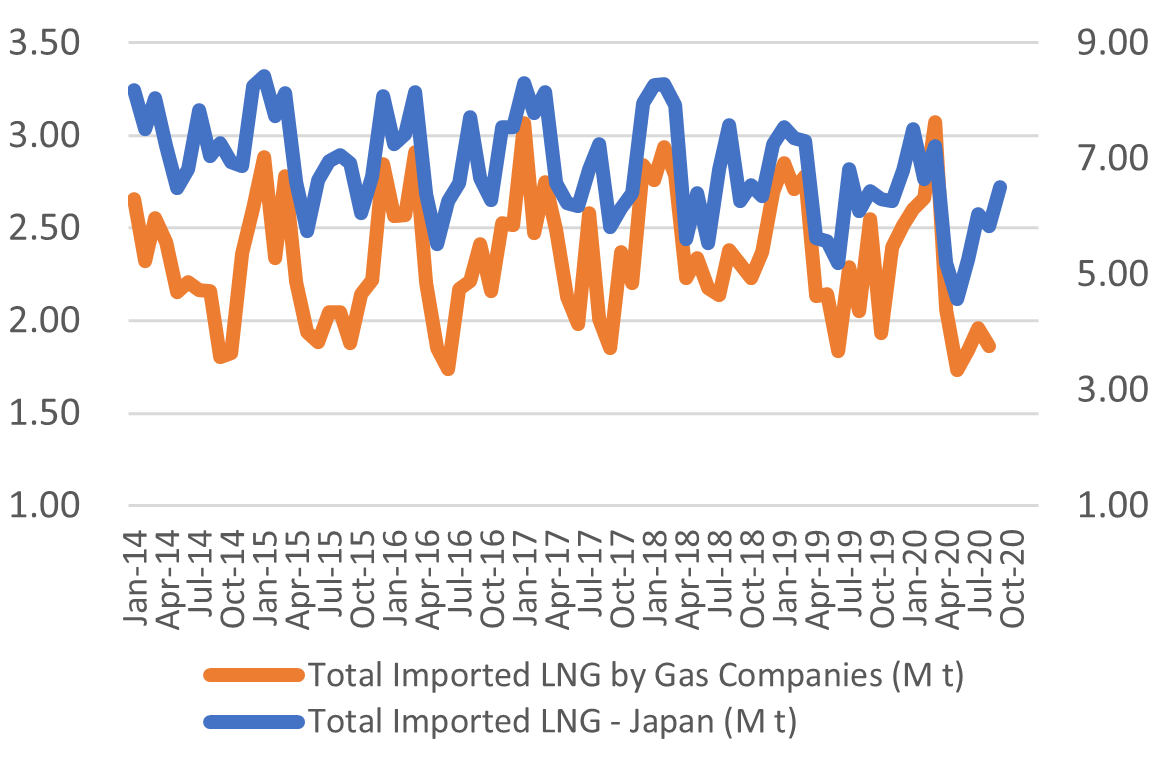
Total LNG Imports (M t)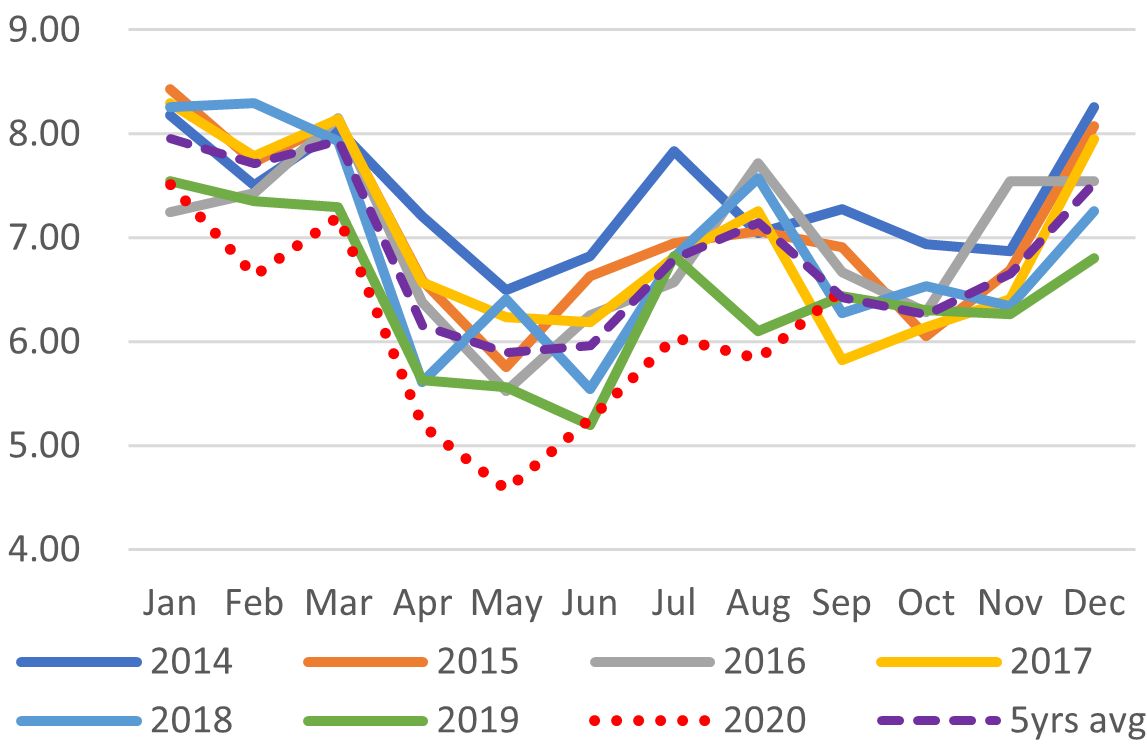
LNG Imports by Gas Firms Only (M t)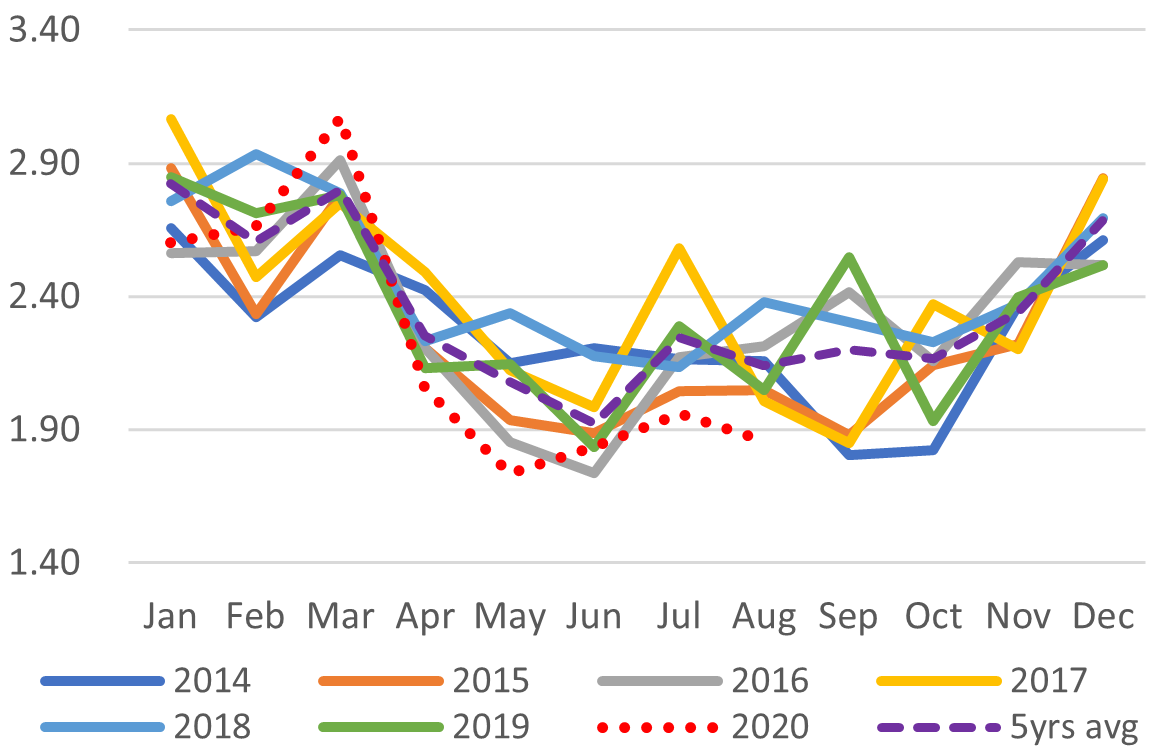
City Gas Sales – Total (M m3)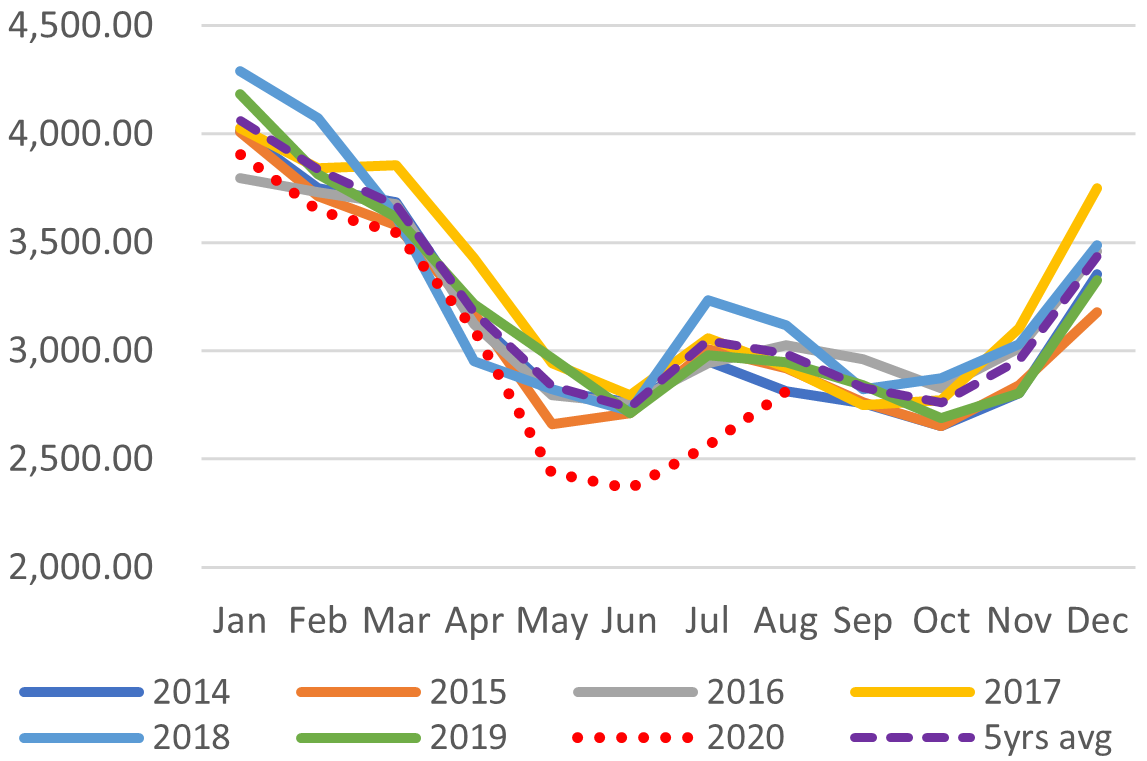
City Gas Sales by Sector (M m3)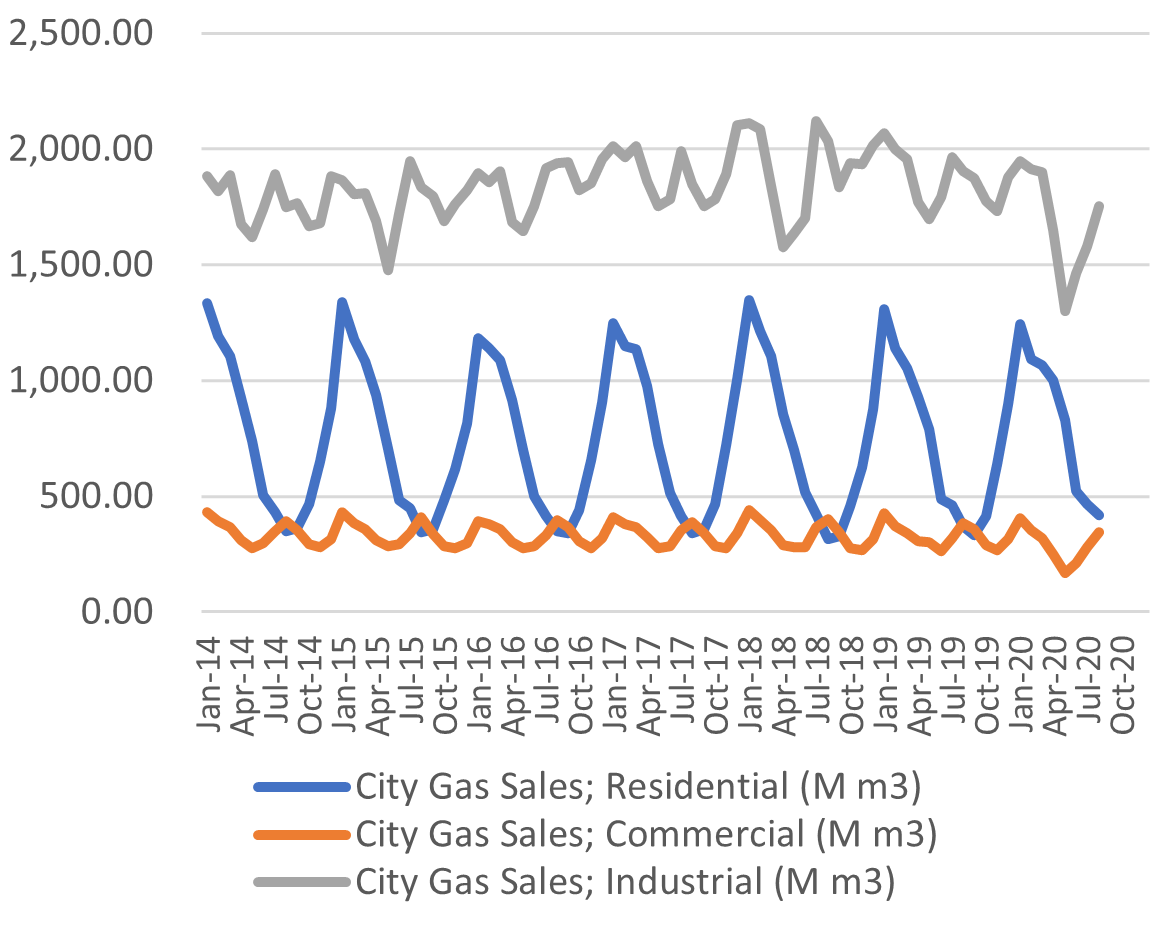
SOURCES: the Ministry of Economy, Trade, and Industry (METI),
Ministry of Finance
Japan Total Power Demand (GWh)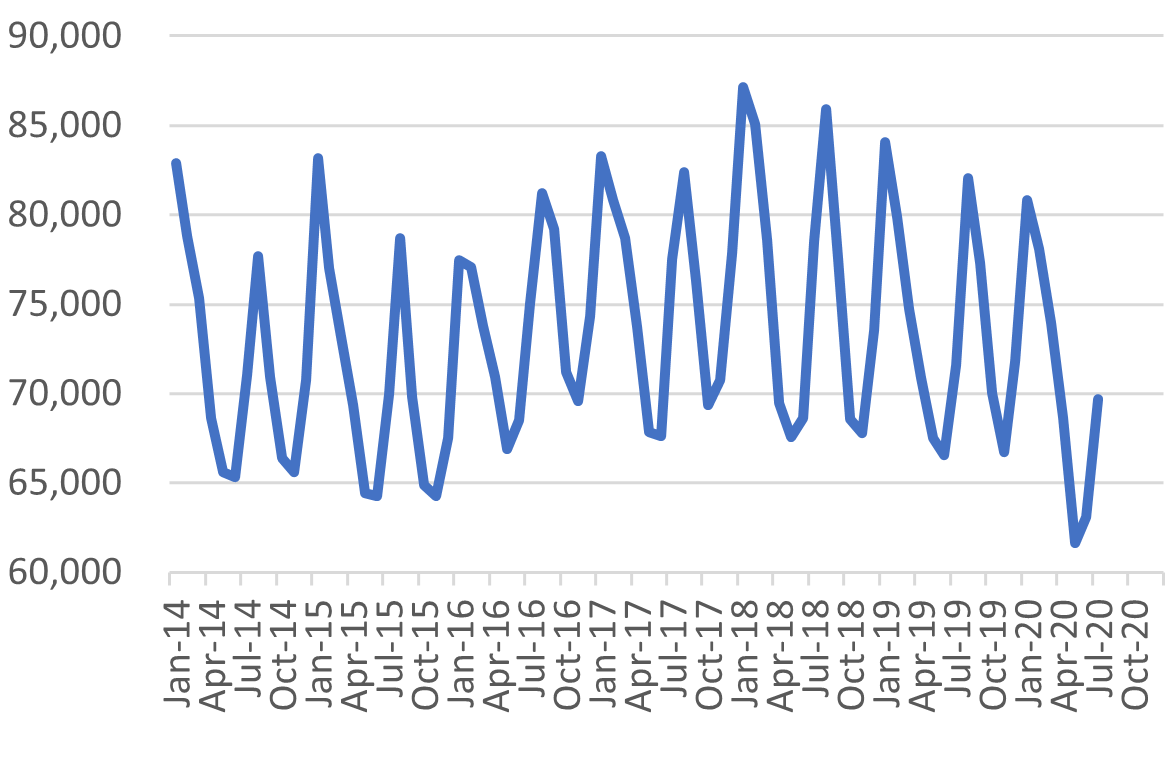
Current Vs Historical Demand (GWh)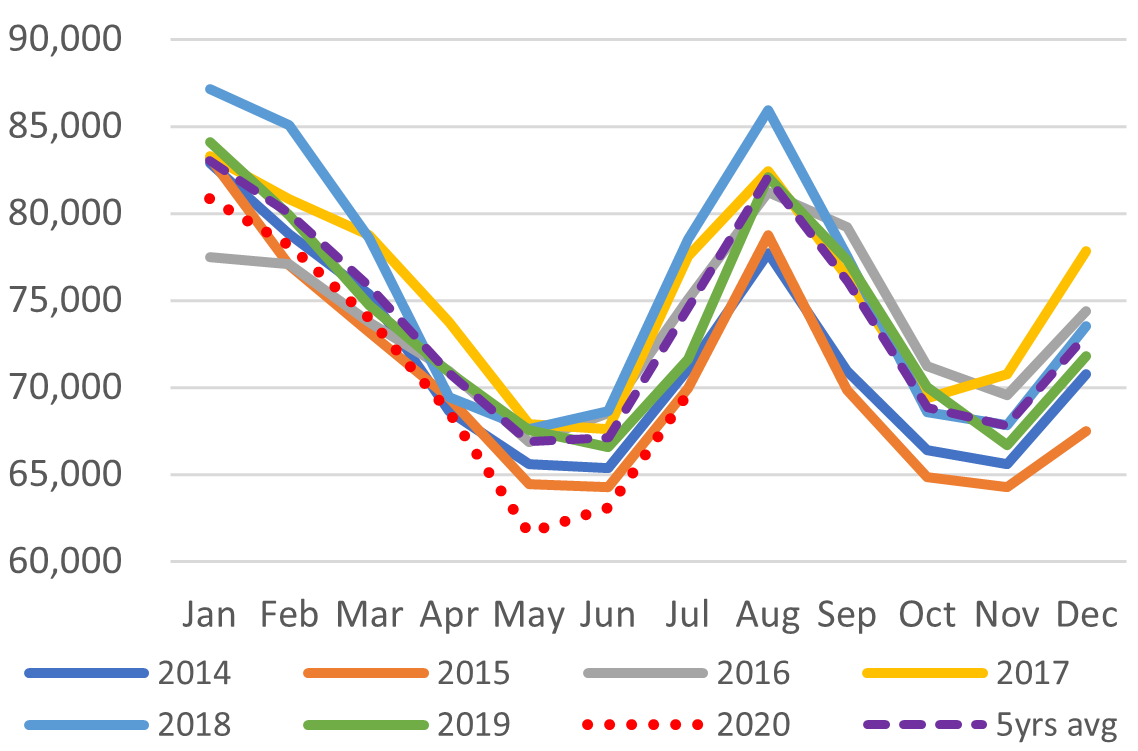
Day-Ahead Spot Electricity Prices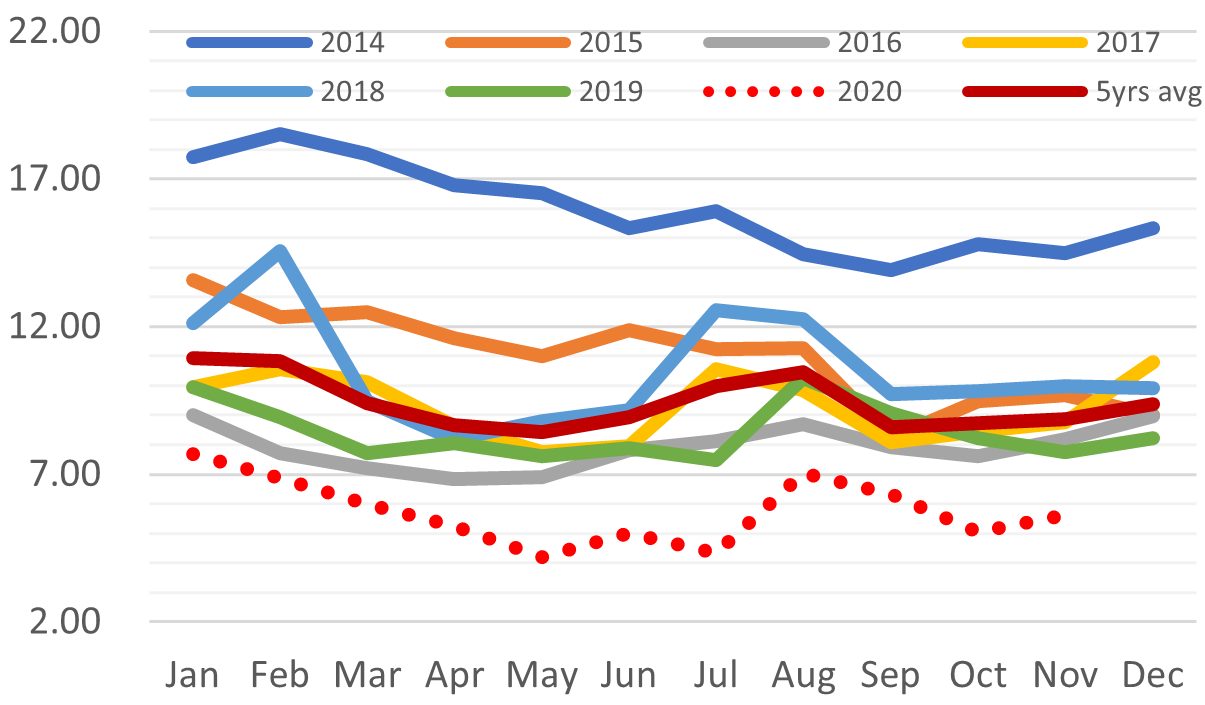
Day-Ahead Vs Day Time Vs Peak Time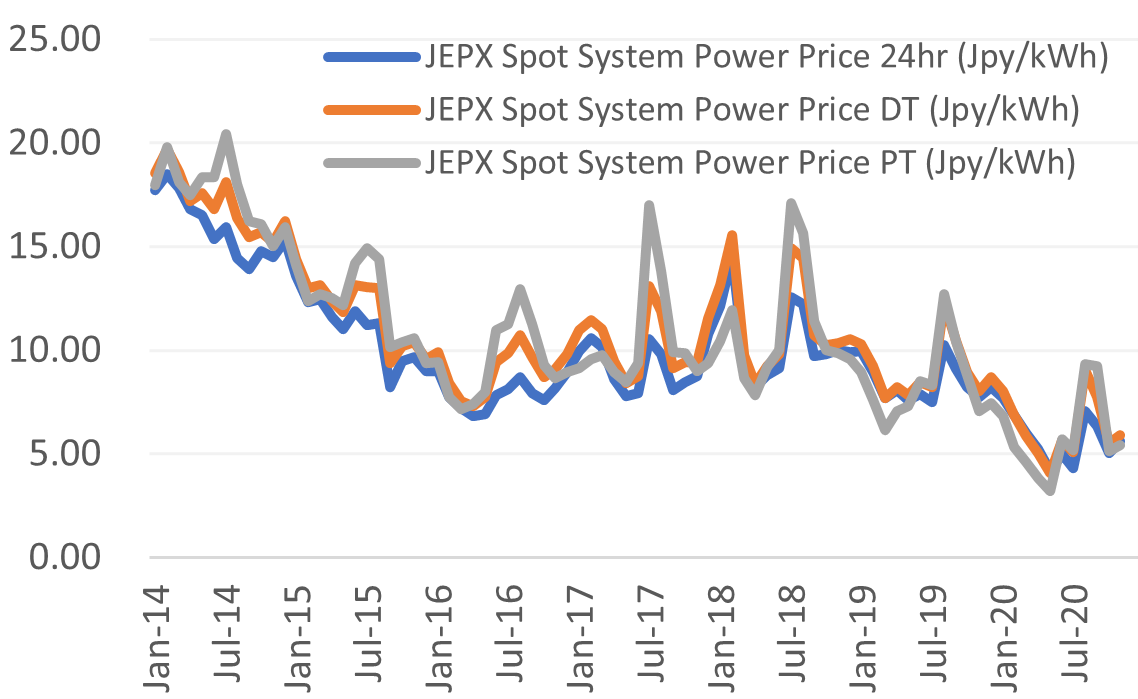
LNG Imports by Electricity Utilities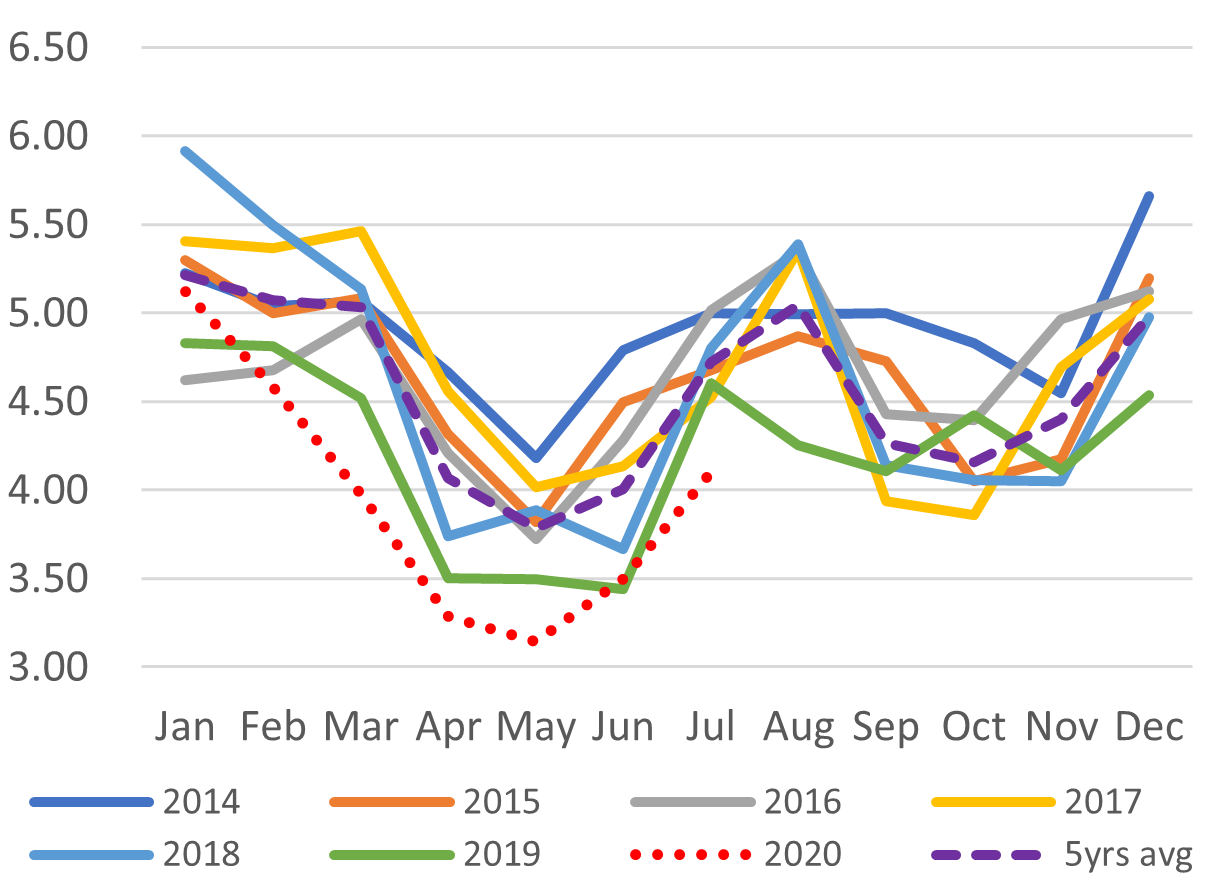
LNG Stockpiles of Electricity Utilities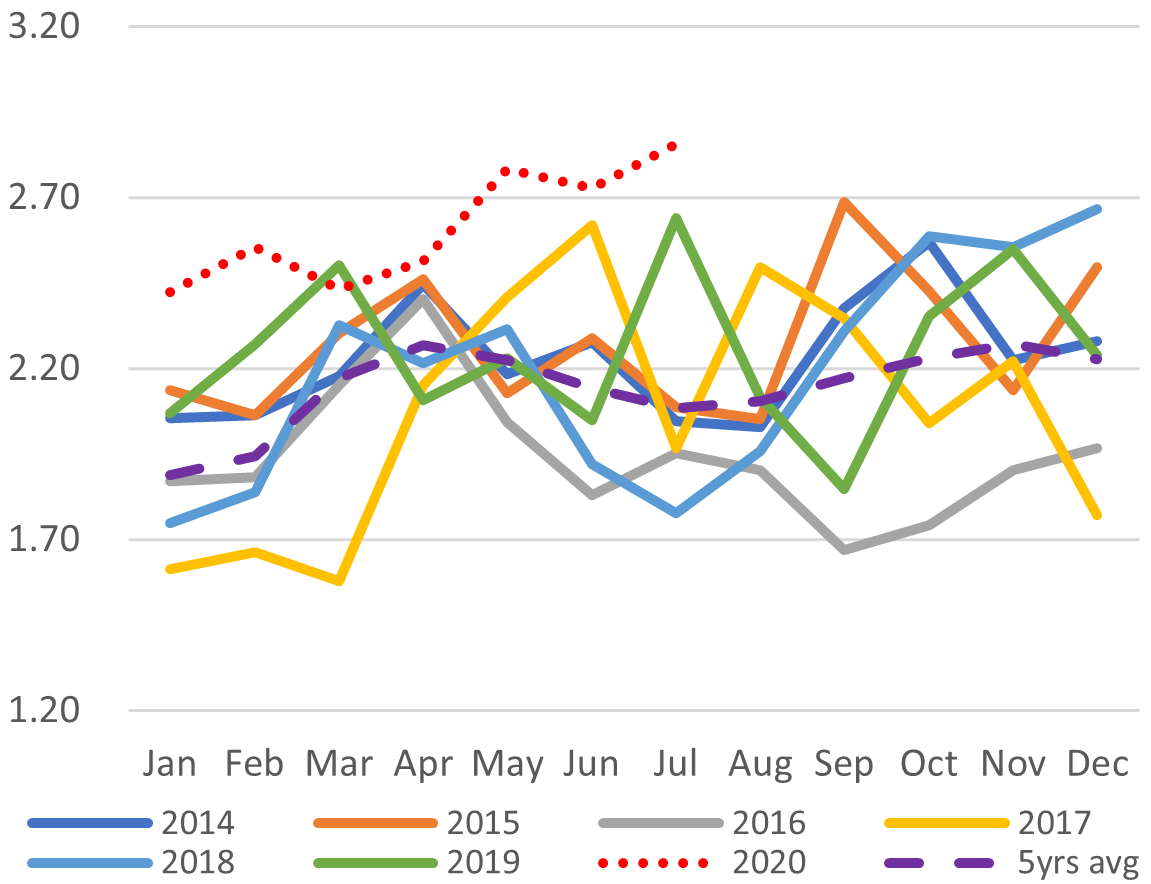
SOURCES: the Ministry of Economy, Trade, and Industry (METI), and the Japan Electric Power Exchange