
JAPAN NRG WEEKLY
DECEMBER 7, 2020
JAPAN NRG WEEKLY
December 7, 2020
NEWSTOP
OIL & GAS
POWER & NUCLEAR
RENEWABLES, OTHER
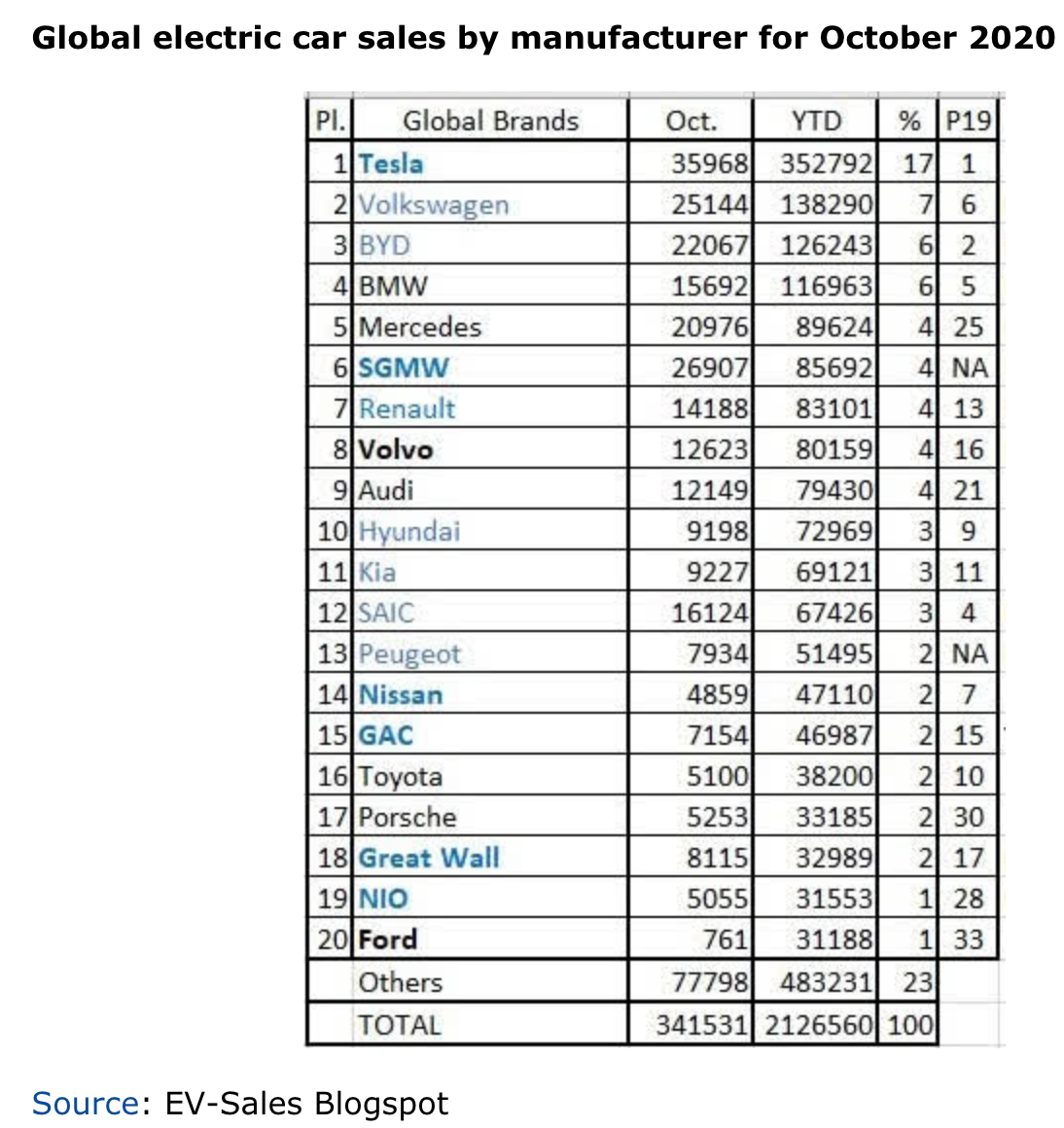
| ANALYSISESG INVESTING AND CO2 DISCLOSURES ADD NEW While the government’s 2050 net-zero emissions pledge adds regulatory pressures on firms to decarbonize, the financial industry has started to turn its own screws on corporate Japan. Stricter rules on climate related financial disclosures introduced in the last year are pushing BlackRock and other international asset managers, which now own over 30% of the listed companies in Japan, to apply the same green principles to the firms they invest in. Many corporates executives say the demands from the financial community are becoming relentless. And, if a new disclosure proposal by the environment ministry wins government approval, investors will get an outsized tool with which to punish firms that are not improving their carbon footprint. WHO IS DRIVING DECARBONIZATION POLICY IN JAPAN? PART I: THE KEY COMMITTEES AT METI Although Prime Minister Suga made the pledge to decarbonize Japan’s economy only two months ago, the country has worked on the issue for years. An investigation by Japan NRG has identified close to 30 different government panels, committees, and forums working on decarbonization policy plans. This week, we publish the first of our two-part directory charting a kind of Who’s Who of Decarbonization Policy in Japan. We outline which are the key committees to watch and highlight the key individuals. This week’s edition looks at the groups associated with METI. Next week, we will do the same for other ministries and state organs. GLOBAL VIEWNo Japanese automaker makes the Top 10 for global electric vehicle sales. OPEC+ agrees to raise oil output from January. This year will be the second-hottest on record. And the green revolution is pushing the price of associated metals to multi-year highs. See details on these and other political and business events in our regular Global View column. |
JAPAN NRG WEEKLY
PUBLISHER
K. K. Yuri Group
Editorial Team
Yuriy Humber (Editor-in-Chief)
Tom O’Sullivan (Japan, Middle East, Africa)
John Varoli (Americas)
Contributors
Mayumi Watanabe (Japan)
Daniel Shulman (Japan)
Damon Evans (Indonesia)
Art & Design
22 Graphics Inc.

SUBSCRIPTIONS & ADVERTISING
Japan NRG offers individual, corporate and academic subscription plans. Basic details are our website or write to subscriptions@japan-nrg.com For marketing, advertising, or collaboration opportunities, contact sales@japan-nrg.com For all other inquiries, write to info@japan-nrg.com
Disclaimer
This communication has been prepared for information purposes only, is confidential and may be legally privileged. This is a subscription-only service and is directed at those who have expressly asked Yuri Invest Research Ltd. or one of its representatives to be added to the mailing list. This document may not be onwardly circulated or reproduced without the prior written consent of Yuri Invest, which retains all copyright to the content of this report.
Yuri Invest Research Ltd. is not registered as an investment advisor in any jurisdiction. Our research and all the content of our reports express our opinions, which are generally based on available public information, field studies and own analysis. Content is limited to general comment upon general political, economic and market issues, asset classes and types of investments. The report and all of its content does not constitute a recommendation or solicitation to buy, sell, subscribe for or underwrite any product or physical commodity, or a financial instrument.
The information contained in this report is obtained from sources believed to be reliable and in good faith. No representation or warranty is made that it is accurate or complete. Opinions and views expressed are subject to change without notice, as are prices and availability, which are indicative only. There is no obligation to notify recipients of any changes to this data or to do so in the future. No responsibility is accepted for the use of or reliance on the information provided. In no circumstances will Yuri Invest Research Ltd. or its partner K.K Yuri Group be liable for any indirect or direct loss, or consequential loss or damages including without limitation, loss of business or profits arising from the use of, any inability to use, or any inaccuracy in the information.
Yuri Invest Research Ltd.: Room 602, Wah Yuen Building, 149 Queen’s Road Central, Central, Hong Kong.
K.K. Yuri Group: Oonoya Building 8F, Yotsuya 1-18, Shinjuku-ku, Tokyo, Japan, 160-0004.
NEWS: OIL & GAS
Japan to ban the sale of new gasoline-burning cars by the mid-2030s
(NHK, Dec. 3)
- METI wants to set rules that will allow for the sale of only electric or hybrid vehicles from the second half of the 2030s.
- Seeing the global trend away from the internal combustion engine (ICE) that runs on gasoline or diesel, Japan wants to make sure it is leading in this area.
- Electrification of transport by the mid 2030s is a big part of what is needed to achieve Suga’s 2050 net-zero emissions pledge, according to govt. officials.
- CONTEXT: The move away from ICE would allow not only EVs but also fuel cell, gasoline-electric and plug-in hybrid vehicles. Currently, gasoline-powered autos account for 60% of Japanese new car sales and hybrids most of the rest. EVs remain a tiny part of domestic car sales.
- CONTEXT: GHG from vehicles made up 16% of Japan’s total emissions in 2018.
TAKEAWAY: China has said it will phase out sales of gasoline-only cars by 2035, and California has pledged the same. Several European countries have even faster programs for phasing out the ICE. In that context, Japan is hardly taking the lead, but it is quickly following a global trend and hoping it’s not too late. See the Global View section of this report for a table of global EV sales by brand this year. No Japanese automaker made the Top 10.
- SIDE DEVELOPMENT:
Japan to mandate carbon trading for its automakers
(Nikkei Shimbun, Dec. 4)- The government will begin talks to establish a carbon offset market for the domestic automakers in order to encourage them to move towards EVs and other low and zero-emissions vehicles.
- New policy would require Japan’s auto giants to sell a certain percentage of EVs as part of their product mix. Should they fail to meet the targets, manufacturers would be tasked with buying emissions credits to make up the difference.
- The carbon trading market would be introduced in the late 2020s. It would be modeled on a similar one used in California.
- METI plans a conference with automotive firms on Dec. 10 to discuss the details of the emissions credit trading system as well as EV quotas.
Japan needs to ease reliance on Middle East, tilt to Asia for energy supplies
(Japan NRG, Dec. 6)
- METI’s influential subcommittee met on Dec. 2 to discuss the country’s energy strategy in the traditional fossil fuels arena. The Advisory Committee for Natural Resources and Energy’s Resource and Fuel Subcommittee made some of the following recommendations.
- Japan should lower its reliance on energy imports from the Middle East and move closer to Asia for procuring gas and other energy supplies.
- A pan-Asian gas market and oil stockpile should be created to improve energy security.
- Japan should continue to aim toward increasing its procurement of LNG and reach the volume of 100 million metric tons by 2030.
- The subcommittee noted that western investors seem to be partly withdrawing from LNG investments due to sustainability concerns.
- Panel recommended looking into development of synthetic e-fuels, green propane gas using hydrogen, and other measures.
TAKEAWAY: For a full breakdown of who is moving the needle in Japan’s energy policy and contributing to the decarbonization story, see our Analysis section in this edition and next week’s report.
Saibu Gas exports fist LNG shipment, from trading JV with Russia’s Novatek
(Nikkei, Dec. 2)
- Saibu Gas said on Dec. 1 that it exported its first LNG shipment in conjunction with Russia’s Novatek. The spot sale was conducted by Saibu Gas and Novatek Gas & Power Asia and the buyer was China’s Tiger Gas.
- In a trial shipment, 36 metric tons of LNG supplied by Saibu Gas was shipped to Shanghai in a Novatek vessel, using the buying party’s ISO containers.
- The two parties are now in talks with the aim of establishing a joint venture to sell LNG.
TAKEAWAY: With domestic gas and LNG demand predictably shrinking, Japanese utilities including Saibu Gas are looking at sales in other Asian markets. Saibu Gas is probably the smallest gas utility to have ventured outside the domestic market to date, seeking to emulate the path of JERA, Tokyo Gas, and others. However, as attractive as third-party sales to China sound from the Japanese perspective, the question remains as to why Chinese buyers would contract with Saibu Gas, as opposed to procuring directly – including from Novatek. In a more liquid Asia-wide LNG marketplace, sales of surplus LNG cargos certainly make sense. How much of a regular business a company like Saibu can enjoy, however, is yet to be seen.
Inpex signs MoU to supply LNG from Abadi project to Indonesia’s state-owned utility
(Company News Release, Dec. 4)
- Agreement signed with Indonesia’s state-owned Perusahaan Gas Negara (PGN) and discussions on volumes and price of offtake from INPEX-led Abadi LNG project will now take place
- CONTEXT: Supply will come from Abadi project’s Masela block, which is estimated to support annual LNG production of 9.5 million tons. The $20 billion Abadi LNG project has yet to commence construction, with INPEX projecting a Final Investment Decision in 2022.
TAKEAWAY: Given Indonesia’s growing gas demand an accord with PGN was very much expected. The issue, however, as described in the Nov. 24 issue of Japan NRG, when we took an in-depth look at the Abadi project, is pricing. The cap on domestic gas prices in Indonesia means INPEX will struggle to make those sales profitable, which puts even more pressure on the export portion.
- SIDE DEVELOPMENT
Inpex seeks to delay LNG shipments due to Ichthys output issues
(Bloomberg News)- Inpex has requested to delay several LNG cargoes scheduled for December / January loading to term buyers due to an issue at its Ichthys export facility in Australia. Ichthys is expected to supply ~10 LNG cargoes per month: Inpex
- The action pushed up North Asian LNG spot prices
Japan, U.S. vow to jointly help Vietnam switch from coal to LNG
(Asia Nikkei, Dec. 4)
- The three countries held a forum on LNG, during which Japan and the U.S. pledged to provide financial assistance to Vietnam for the construction of LNG-fired power plants and receiving terminals.
- Japan and the U.S. believe the fuel is key to curbing emissions in Southeast Asia and replacing the use of coal.
- The move is also a geopolitical ploy to lessen Chinese influence in the region.
- SIDE DEVELOPMENT:
JERA’s plan to “save” coal-fired plants requires millions of tons of ammonia
(Bloomberg, Nov. 30)- JERA aims to replace coal with ammonia in thermal power plants to lower emissions, which would require massive investments and would see imports of ammonia jump 100 times from where they are today.
- Ammonia imports would need to reach 20 million tons a year by 2030 to replace 20% of coal used by Japanese power plants: JERA
- JERA wants to switch its coal-fired thermal plants to run entirely on ammonia by 2050
Japan and Kuwait create joint petroleum reserve for East Asia exports
(Yomiuri Shimbun, Nikkei, Dec. 1)
- Japan agreed to give Kuwait Petroleum Corp 3.14 million barrels of storage capacity on the western island of Kyushu free of charge.
- The storage tanks are owned by ENEOS and can be used by the Kuwait firm for exports to eastern Asia. The oil is due to arrive in March.
- In return, Japan will get priority claim for the oil in times of emergency.
- CONTEXT: The volume is equivalent to about 1.5 days of Japanese demand, according to METI data. Japan has similar deals with Abu Dhabi National Oil Co. and Saudi Aramco.
TAKEAWAY: Japan has in recent years become even more concerned about security of gas and oil supply, with national stockpiles able to meet demand for a maximum of a few months.
Mitsubishi Chemical and ENEOS may merge petrochemical business
(Chemical Daily, Dec. 4)
- Mitsubishi chemical has begun discussions with ENEOS regarding the integration of the two companies’ operations to manufacture ethylene, polyolefin, and other petrochemicals.
- The move would help Mitsubishi Chemical achieve its goal of transitioning to a next-generation petrochemical company more committed to the circular economy.
NEWS: POWER & NUCLEAR
| No. of operable nuclear reactors | 33 | |||
| of which | applied for restart | 25 | ||
| approved by regulator | 16 | |||
| restarted | 9 | |||
| in operation today | 3 | |||
| able to use MOX fuel | 4 | |||
| No. of nuclear reactors under construction | 3 | |||
| No. of reactors slated for decommissioning | 27 | |||
| of which | completed work | 1 | ||
| started process | 4 | |||
| yet to start / not known | 22 | |||
Source: Company websites, JANSI and JAIF, as of Dec. 5, 2020
Court rescinds Kansai Electric permission to run Ohi nuclear reactors, slams regulator
(NHK, Dec. 4)
- The Osaka District Court ruled against a Nuclear Regulation Authority (NRA) decision to restart Units 3 and 4 of the Ohi nuclear power plant (NPP).
- The lawsuit is part of a class action by residents who demanded the annulment of the NRA decision, citing the plant’s vulnerability to earthquakes.
- This is the first time since the 2011 Fukushima disaster that a court has annulled a decision to allow the construction or restarting of a nuclear power station after regulatory permission was granted.
- CONTEXT: The NRA approved the restart of the Ohi reactors in May 2017 and the reactors in question went back online in 2018. They are currently both offline for planned maintenance, some of which was extended after the discovery of a ruptured pipe at Unit 4.
- CONTEXT: The reactors were due to resume operations early next year, even as soon as January for Unit 3.
TAKEAWAY: This decision can be appealed, but will need to be challenged by the government since it rules against the actions of a state agency, the NRA, as opposed to the actions of the operating company, Kansai Electric. The NRA’s initial response was that it will need to discuss the situation with the Ministry of Justice, which would presumably be the party representing the NRA in court.
In many ways, this is a surprising ruling. For one, while almost all nuclear reactors in Japan face litigation, all the rulings that have sided with the anti-nuclear citizen groups have come from judges about to retire and thus could be seen as a “parting gift”. This one does not fit the same pattern. The passing judge is both younger and seemingly not afraid to push back on various controversial issues.
While an appeal will likely see the motion defeated, what the plaintiffs win is time. One injunction can push the restart of a nuclear facility back by as much as a year, as has been the case with Shikoku Electric’s Ikata NPP. That translates into more costs for the operating utility and more negative publicity, which also makes the local politicians tasked with giving the final approval more nervous.
In some ways, this unprecedented ruling is appropriate in that it connects the disparate parts of the restart project. Since the previous administration, the government has been very low key in terms of lending its vocal support for nuclear power. That has left the regulator to make the technical decisions and local politics to shoulder the responsibility for the political sign-off. Given what is at stake, this could be a good time for the national government to come out and either defend the entire nuclear energy program, or accept public opinion and openly signal the program’s curtailment.
Tohoku Electric cuts CO2 emissions 5% by replacing gas turbine, may switch to shale gas
(Sunday News, Dec. 2)
- In a nationwide first, Tohoku Electric has replaced one of the gas turbines at its Higashi-Niigata thermal plant with a more efficient turbine recovered from a decommissioned plant.
- The move will reduce CO2 emissions by 5%, says the utility.
- Tohoku Electric is also considering switching the fuel source used to power the turbine in question to cheap shale gas.
Polish climate minister keen to involve Japan in nuclear projects
(Nikkei, Nov. 30)
- Poland’s Minister of Climate and Environment, Michal Kurtyka, has said he believes there are possibilities for Poland and Japan to work together on nuclear power plant construction in Poland.
- Kurtyka also says he wants to bolster ties with Japan, which he described as the most technologically advanced country in the world, in regard to offshore wind farms.
- Poland relies on coal for 80% of its electricity needs, making the establishment of green alternatives a pressing need.
TAKEAWAY: The Polish minister has talked about this development for several months. However, Japan’s ability to work with Poland on the Gen IV nuclear reactor it has designed is actually hampered by its own policies. The design favored by the Poles would not allow for the reprocessing of used fuel. Since Japan’s nuclear policy is based on the fuel-cycle, which assumes that used fuel can be processed and re-used, the design that Poland wants has not received Japanese government support. This means that while the Japan Atomic Energy Agency can act as an advisor, as things stand, Japanese parties cannot participate in the construction and operation of the new nuclear reactor in Poland.
Regulator to question Japan Atomic Power over deletion of fault data
(NHK, Nov. 30)
- The Nuclear Regulation Authority said it’s launching an investigation into the Japan Atomic Power Co’s conduct in deleting the records of past seismic observations of a fault line that runs directly under the Tsuruga nuclear power station.
- When making its submission in support of the restarting of Unit 2 reactor at the Tsuruga plant, J-Atomic, as the firm is also known, provided only the latest seismic data, and deleted historical data.
- The company says the deletion of the data was not intentional, and was merely the result of unclear internal procedures on data handling.
OPINION: Japan cannot meet carbon neutral promise without nuclear
(Nikkan Kogyo Shimbun, Dec. 2)
- While carbon neutrality represents, in the words of one power company executive, a “very challenging” goal, with the Prime Minister pledging to make Japan carbon neutral by 2050, and the U.S. preparing to sign the Paris Agreement, the transition to carbon neutrality is now unavoidable.
- While the government is hurrying to increase output from renewables, there is no denying that it currently lacks the resources to replace coal-fired plants with renewables alone. Academics agree that the sustainable utilization of nuclear power will be an essential part of the equation if Japan is to become self-sufficient in energy.
- Nuclear power currently represents only 6% of demand, far below the government’s target of at least 20%. Restarting nuclear reactors will also help reduce the price of electricity—currently among the highest in the world.
NEWS: RENEWABLES & OTHERS
Japan creates $19 billion green fund to promote green tech, hydrogen, carbon recycling
(Nikkei Shimbun, Dec. 4)
- Prime Minister Suga announced on Dec. 4 ambitious plans to create a ¥2 trillion ($19 billion) fund to assist in development of technologies seen as helping the nation meet its 2050 net-zero emissions pledge.
- The green tech fund is part of the “green + digital” focus that Suga has outlined since taking over as prime minister this autumn.
- The tech Suga specifically mentioned included hydrogen-powered airplanes and cargo ships, low-cost storage batteries to support renewable energy and for electric cars, as well as carbon-recycling technology. The latter seeks to turn greenhouse gases (GHG) into plastics and fuel, according to Suga.
- Zero emissions from vehicles is a must for meeting the 2050 goal: Suga
- About half of the fund’s headline figure will go to developing 6G and other digitalization initiatives.
- SIDE DEVELOPMENT:
Japan’s sizzling days set to double if Paris accord fails to deliver
(Asia Nikkei, Dec. 5)- Japan will experience twice the number of days of extreme heat at the end of the century if the Paris Agreement on climate does not meet its goals, government officials said.
- If targets are not met, the temperature could jump 4 C.
- SIDE DEVELOPMENT:
Japan warns against allowing EU to set emission rules
(Financial Times, Dec. 6)- Suntory’s chief executive tells FT that Japan risks losing its competitive edge if international standards are set by European regulators.
- Crux of the issue is what happens to hybrids. Japan is a leader in hybrid cars, but some European countries want to phase out all new vehicles with a gasoline component.
Japan government says aims for ¥8-¥9/kWh wind power price
(Japan NRG, Dec. 6)
- The government-private sector committee on offshore wind power development held a meeting at which the government representatives outlined a longer-term ambition for wind power prices to drop as low as ¥8 / kWh.
- Manufacturers asked for the government to do more to turn Japanese industry specs into global standards and to identify what parts should be produced locally and what should be imported in order to develop an efficient supply chain.
- Wind industry representatives also called for the development of wind farms to be concentrated in a few selected areas as opposed to all over the country.
AEG offers just ¥10 / kWh Feed-In Tariff in latest solar capacity tender
(New Energy Business News, Dec. 1)
- Fukuoka-based solar installation provider AEG was one of the successful bidders in the sixth FIT tender, after making the lowest bid of ¥10.0 per kilowatt hour.
- AEG will construct 544 kW of capacity by 2021, and says it may sell the solar farm to a third party upon completion for the right price.
- Established in 1995, AEG specializes in supplying solar panels, hot water heaters, and air conditioning for residential applications.
- SIDE DEVELOPMENT:
Central Japan retailer offers residents ¥8 per kilowatt hour for solar power
(New Energy Business News, Nov. 30)- Chiba-based power producer and supplier Choshi-Denryoku is offering residential subscribers with rooftop solar panels up to ¥8 per kilowatt hour for their surplus electricity.
- The offer is available to all subscribers in mainland Japan.
- CONTEXT: Under Japan’s feed-in tariff scheme, the government buys back electricity generated by residential solar generators at a fixed rate for a period of 10 years. Choshi-Denryoku’s offer is aimed at generators no longer covered by the FIT scheme.
METI starts tenders for three huge offshore wind farms in Akita and Chiba
(New Energy Business News, Dec. 2)
- The Ministry of Economy, Trade and Industry and the Ministry of Land, Infrastructure, Transport and Tourism are now accepting proposals to construct offshore wind farms in three zones designated for renewable energy, two in Akita and one in Chiba.
- The government will pay a maximum of ¥29 per kilowatt hour over a 20-year period. The successful operators will enjoy exclusive rights to the wind farm area for a 30-year period.
- The specifications for the two Akita windfarms (one of which will comprise two geographically separate zones) and the Chiba windfarm call for capacities of 420 MW, 730 MW, and 551 MW respectively. While there is no upper limit on installed capacity, actual capacity must not fall more than 20% below specification.
- SIDE DEVELOPMENT:
Power companies, trading companies eye wind farm tenders
(Jiji, November 28)- The process of selecting contractors for the Akita and China tenders started on Nov. 27.
- This is the first time that a public bidding process has been carried out to place contracts for offshore wind farms that use fixed bottom turbines.
- Tenders close in May, and several dozen electric power companies, trading companies, and oil companies are expected to submit bids.
Environmental ministry threatened with losing wind power oversight over red tape
(NHK, Dec. 4)
- In a meeting with Environment Ministry officials, Minister of State for Regulatory Reform Kono Taro has called for the relaxation of the environmental impact requirements placed on windfarm developers.
- The Environment Ministry officials were noncommittal, however, saying that buy-in from local communities is essential in any wind project.
- Kono countered by stressing the importance of speed in decision-making and saying that the Environment Ministry needed to commit to timeframes. Kono threatened to have the Prime Minister remove wind farms from the Ministry’s jurisdiction if officials remained uncooperative.
Kirin Beer will move four factories to PPA contracts from Feb. 2021
(New Energy Business, Dec. 4)
- The Power Purchase Agreement model will cover 8.56 MW of power capacity and be based on installed solar panels at the plants.
- The PPA accord will move the sales of electricity outside of FIT and cut GHG by about 4,500 tons a year. It will also improve Kirin Brewery’s total renewable energy ratio to 22% from 18% today.
- MCKB Energy Service, a subsidiary of Mitsubishi Corp. Power, will become the PPA operator and install the solar power equipment on the roofs of the four factories.
TAKEAWAY: See the Nov. 30 edition of Japan NRG for how the PPA contracts are starting to change the fortunes of renewable energy in Japan.
Kawasaki Heavy Industries opens world’s first hydrogen loading terminal
(New Energy Business News, Dec. 4)
- Kawasaki Heavy Industries recently completed construction of Hytouch Kobe, a dedicated liquid hydrogen fueling terminal at Kobe port.
- Featuring a double-walled, cryogenic vacuum tank, the facility can store 2500 m³ of hydrogen at a temperature of -253°C. A special loading arm is used to transfer liquid hydrogen to dedicated tankers.
- The terminal is part of an initiative by HySTRA (the Hydrogen energy Supply-chain Technology Research Association) that aims to implement a CO2-free hydrogen supply chain, and will be used in a NEDO-funded trial to ship liquid hydrogen from Australia to Japan.
Mitsubishi Heavy Industries dumps aircraft for green tech
(Asahi Shimbun, Dec. 1)
- Mitsubishi Heavy Industries (MHI) set up a special unit focused on decarbonization and will invest ¥200 billion into decarbonization businesses between 2021 and 2024, an increase of 50% over the previous three-year period.
- MHI hopes green technologies will take over from its ill-fated aircraft business as a driver of long-term growth.
- MHI will concentrate its efforts on technologies such as carbon dioxide retrieval and the generation of electricity from hydrogen and ammonia.
- MHI Executive Vice President Hosomi Kentaro said the corporation plans to define the necessary decarbonization technologies by 2030 with a view to commercialization in the 2040s.
Iwatani in discussions with Stanwell over project to import green hydrogen to Japan
(New Energy Business News, Dec. 2)
- Iwatani is in discussions with Australian energy company Stanwell regarding a project to synthesize hydrogen from renewably-generated electricity in Australia for liquefaction and export to Japan.
- The largest government operated electricity generator in Queensland, Stanwell has an extensive transmission network and expertise in renewables.
Toho Gas to research hydrogen enrichment of the piston engine
(New Energy Business News, Dec. 1)
- Toho Gas will partner with the National Institute of Advanced Industrial Science and Technology (NEDO) to conduct basic research into the effects of running piston engines on a mixture of natural gas and hydrogen.
- The findings of the research will be published in 2022.
- Toho Gas and AIST aim to apply the research findings to gas engine cogeneration systems.
Sojitz to trial hydrogen transport in China
(Nikkei, Nov. 30)
- Sojitz Corp., a Japanese trading house, said on Nov. 30 that it was embarking on research in China into technologies for safely transporting hydrogen for use in transport applications.
- Sojitz plans to react hydrogen with the organic solvent toluene to turn it into the more stable and more easily transportable methylcyclohexane. After arriving at its destination, methylcyclohexane can be separated into hydrogen and toluene again.
- The research will take place in China’s Shandong province, whose many chemical factories produce a large volume of unwanted hydrogen.
Showa Denko trials waste-to-energy and electric motorbikes
(New Energy Business News, Dec. 2)
- Showa Denko, in collaboration with McDonald’s Japan and the municipality of Kawasaki, is undergoing a trial to extract hydrogen from plastic waste generated by McDonald’s restaurants using gasification technology.
- The hydrogen generated will be used to power fuel cell vehicles and also to recharge electric motorbikes used by the McDonald’s delivery service.
Mitsubishi UFJ Lease participates in Irish wind farm project
(New Energy Business News, Dec. 4)
- The Mitsubishi UFJ Lease has acquired a stake in Arjun Infrastructure Partners, in conjunction with existing shareholder Brookfield Renewable Partners. Arjun operates a total of 47 MW of wind capacity in the Irish counties of Clare and Cork, which supply the Irish wholesale market.
- This is Mitsubishi’s second investment in Irish wind projects.
SONY goes open source on software for microgrids to encourage renewables
(Asia Nikkei, Dec. 1)
- Sony will make software code for regulating microgrids freely available, hoping to popularize the use of renewable energy in these small local power networks.
ANALYSIS
TOM O’SULLIVAN,
DIRECTOR,
K.K. MATHYOS
ESG Investing and CO2 Disclosures:
A New Reality Dawns for Japan’s Publicly Trading Emitters
As the government’s 2050 net-zero emissions pledge adds regulatory pressures on companies to decarbonize, the financial industry has started to turn the screws on corporate Japan.
Stricter rules on climate related financial disclosures introduced in the last year are pushing BlackRock and other international asset managers, which now own over 30% of the listed companies in Japan, to apply the same green principles to the firms they invest in. Many corporates executives say the demands from the financial community are becoming relentless. And, if a new disclosure proposal by the Ministry for the Environment wins government approval, investors will get an outsized tool with which to punish firms that are not improving their carbon footprint.
According to one prominent green activist in Japan, some of the biggest steel, chemicals and other manufacturers are now reaching out to discuss what they can do to shed carbon volumes. A year ago, the same activist couldn’t score a meeting with the firms.
As institutional investors push corporate Japan to publish C02 and other Greenhouse Gas (GHG) emissions as part of their environmental, social, and governance (ESG) disclosures, the impact will be immense.
According to Japan NRG calculations, up to 50% of the market capitalization of the Japan Stock Exchange, or around $3 trillion, is expected to bear the brunt of the demand for increased emissions disclosure. Should a global carbon tax be introduced at a rate of, say, $100 per ton, this could cost Japanese companies in excess of $100 billion per annum.
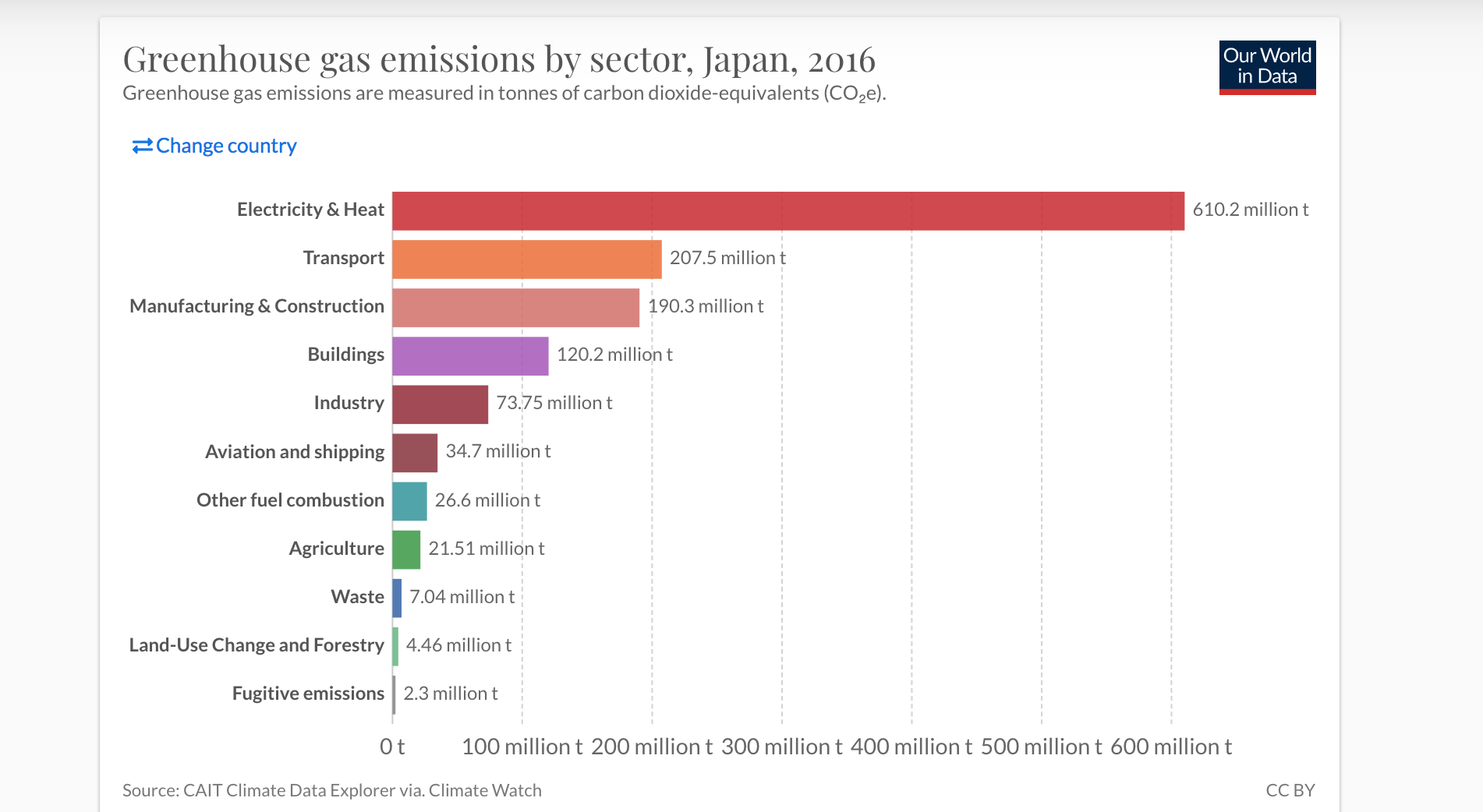
A failure to disclose emissions or plan for decarbonization could result in asset divestitures, forced exits from supply chains, investment downgrades or ‘zombification’ in a worst-case scenario.
At present, few companies in Japan are required to divulge their emissions data and it’s not a listing requirement. That will change should Japan start to require all companies to divulge emissions, down to the operating unit level, as per environmental ministry recommendations. The move would prevent large groups from “diluting” the emissions of their polluting assets with data from other, non-emitting business lines.
Japan’s shosha, the trading houses recently favored by Warren Buffett, are an ideal example of groups that can include 1,000 or more businesses, spanning both heavy industrial assets such as mines and oil fields, and eco-friendly units that process waste or engage in commerce.
The sectors that would likely be most impacted by greater emissions disclosure in Japan include transportation, namely automobiles, airlines, railroads, and shipping; the iron and steel sector; oil and coal; electric power; and pharmaceuticals and chemicals companies.
TIME TO CATCH UP
Japan’s economy was described last month as an ecological laggard even by Nikkei, the pro-business newspaper, which presented data suggesting that in terms of CO2 per unit of GDP, Japan’s figures have remained unchanged since the 1990s.
Motivations to change this has been sporadic and largely consigned to major retail brands, such as Fast Retailing’s Uniqlo, which engaged in collecting old clothes for recycling and the sourcing of sustainable materials.
Recent moves to green the financial system, including the launch of a Task Force for Climate Related Financial Disclosures (TCFD) and a similar body for central banks (NGFS), are starting to filter through to a much broader section of companies.
Institutional investors active in Japan, including BlackRock, Vanguard, and State Street Global Advisers, have strong sway. As well as owning a major part of the shares on the Japan Stock Exchange (JPX), BlackRock manages part of the money in Japan’s public pension fund. JPX has even activated an ESG knowledge hub on its platform to assist Japanese corporates.
It’s notable that U.S. President Elect, Joe Biden, has just nominated BlackRock’s head of sustainability investing, Brian Deese, as his director of the National Economic Council. Tighter environmental disclosures in the U.S. will echo in Japan.
The governor of the Bank of Japan recently stated that he expects the impacts of climate change to have a significant impact on Japan’s economy. The BoJ itself could enact the change and become a climate activist. The central bank announced last week that it owns ¥45 trillion of Japanese equities, making it Japan’s largest shareholder.
The stricter ESG environment could well become a boon for the wider economy by unleashing some of the corporate cash hordes. The government also plans to add tax incentives to promote capital investments that advance carbon neutrality.
Change is already apparent in those Japanese corporates who are closest to the international financial sector. Japanese banks have had to carefully gauge their credit exposures for climate change risks. As a result, all three major banks said they will stop financing new coal projects.
It will be harder for Japan’s most significant CO2 emitters, automobile and transportation companies, which account for around 20% of Japan’s market capitalization or $1 trillion.
There are two billion internal combustion engine (‘ICE’) vehicles on global motorways and 70 million in Japan. Japanese auto companies may have sold over 15% to 20% of the global ICE vehicle stock.
In a recent ranking of global sellers of electric vehicles this year, no Japanese automaker made the Top 10. Toyota, the highest ranked of the Japanese, and the country’s biggest company by market value, said in its latest environmental report on Nov. 6 that it aims to reduce CO2 emissions from new vehicles by 90% by 2050.
Another sector likely to be punished by investors, unless there is visible action, is the power and gas utilities. Tokyo Gas and JERA were two that got ahead of the game in announcing 2050 net-zero emissions plans even before Prime Minister Suga did the same for Japan. Rival utilities have so far failed to follow. For more details, see the Nov. 16 edition of Japan NRG Weekly for a company profile of Kansai Electric.
All of Japan’s 10 electricity utilities are public companies, as are its upstream oil and gas companies. They will need to show investors a road map of how to get to net-zero, or risk divestitures.
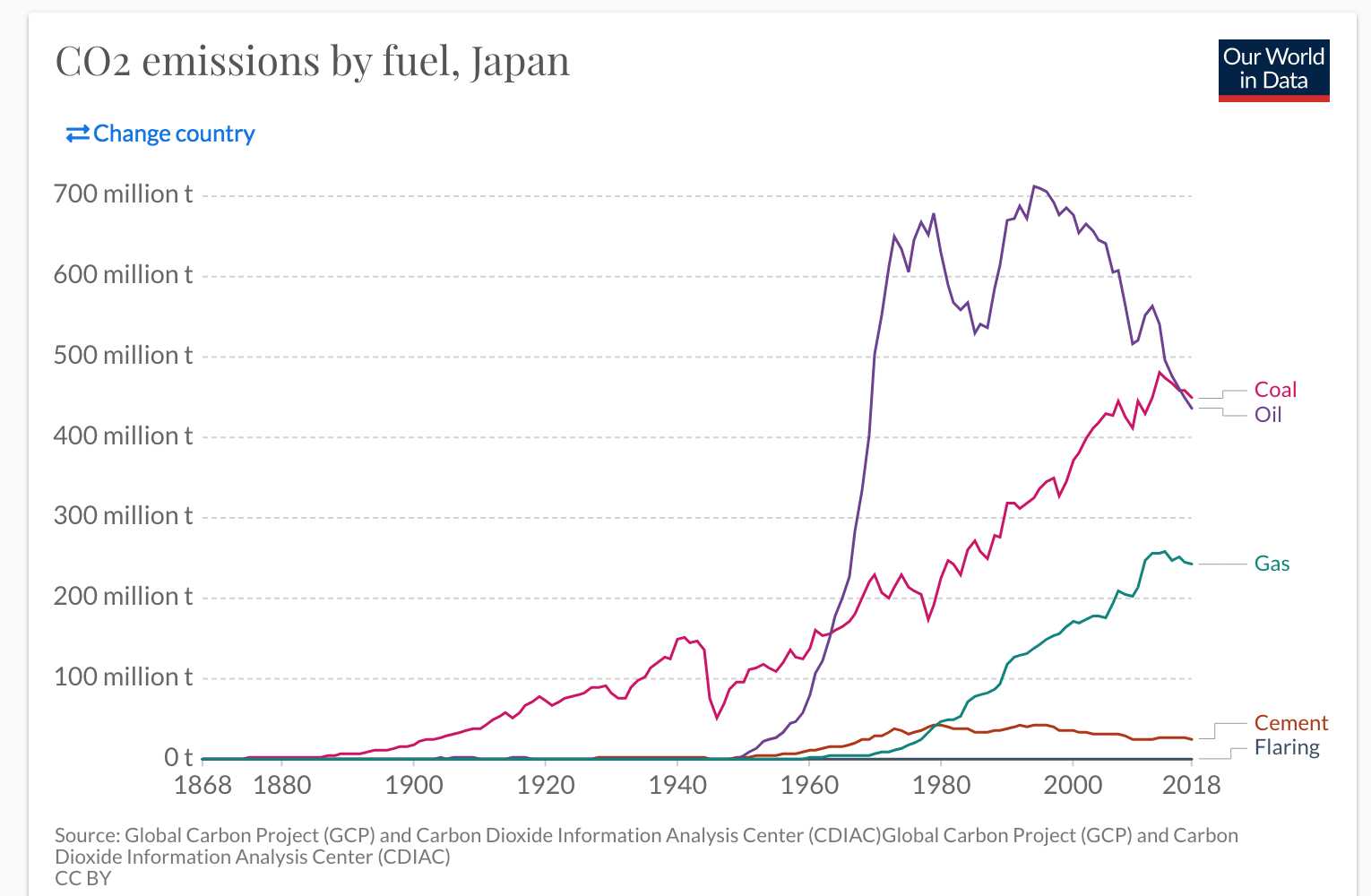
At a minimum, companies will be forced to disclose ‘scope 1’ emissions: direct emissions from own activities; ‘scope 2’ emissions: indirect emissions arising from purchased energy; and ‘scope 3’ emissions: all other indirect emissions attributable to a company’s value chain.
CURRENT GREEN INITIATIVES FROM JAPANESE COMPANIES
It would be unfair to suggest that Japanese companies have not yet grappled with climate change issues.
For example, most companies have publicly endorsed the 17 U.N. Sustainable Development Goals (SDGs). More than 10 Japanese companies have already joined the RE100 list, which is a list of firms committed to ‘go 100% renewable’ by 2050. This includes Aeon, Fujitsu, Panasonic, Sekisui Chemical, Dentsu and Ajinomoto.
Last month, Tokyo hosted the second TCFD Summit, bringing together global leaders of industrial and financial organizations. In 2019, when the first summit was held, 863 organizations from around the world, as well as 198 in Japan, showed their support for TCFD recommendations. Since then, as of October 20, 2020 the number of such organizations has increased by 609 to reach 1,472 worldwide; while in Japan that figure has risen by 113 and now totals 311.
Mizuno Hiromichi, the former CIO of Japan’s Government Pension Investment Fund, actively participated in TCFD. Mizuno is now on the board of Tesla, which is sometimes regarded as the poster child for clean energy investors.
Only last week, the Lord Mayor of the City of London addressed a gathering of financiers in Tokyo saying that London would work with the Japanese financial community to tighten ESG disclosures.
With investor interest in ESG factors rising exponentially, Japanese companies will need to reexamine their entire portfolios, revise strategy, and innovate in order to comply.
ANALYSIS
JAPAN NRG TEAM
Who Is Driving the Decarbonization Agenda and Policy in Japan?
Last week, the government announced that it will create a National Council of experts and business representatives to consider how Japan can decarbonize by 2050. The Council’s role is to collate a wide range of opinions on carbon-neutral options, with youth leaders and green activists among the participants. Top ministers and Prime Minister Suga are also expected to attend the Council’s first meeting in mid-December.
This initiative might give the impression that Japan has only begun to debate how to realize Suga’s 2050 net-zero emissions pledge. But the reality is quite different. An investigation by Japan NRG has identified close to 30 different government panels, forums, groups and committees working on decarbonization plans. Some have been active for at least the last three years.
The entities we identified often include a nexus of academics, business representatives, and bureaucrats. A few are platforms that involve multiple ministries. Some have overlapping memberships. Many have similar mandates and consider related areas. The policy advice that emerges from this network of public-private groups feeds into the government apparatus and will likely sway energy regulations as much as key Cabinet members.
Evaluating the comparative influence of these institutions is not straightforward, given the fluid nature of politics and favor inside the bureaucratic corridors of Kasumigaseki, Japan’s civil service hub. We outlined the five main Cabinet decision makers in the Sept. 28 edition of the Japan NRG. In general, greater political weight should be accorded to any of the committees that include METI Minister Kajiyama, Environment Minister Koizumi, Chief Cabinet Secretary Kato, or even Administrative Reform Minister Kono. That said, these key policymakers are at times only “observers” in the groups and thus enjoy lesser sway.
What’s more, groups outside of the Cabinet clearly enjoy strong access. We have included the policy arms of the LDP, the ruling party of Prime Minister Suga. The views from the three big business lobby groups also carry weight, with Keidanren the strongest in converting its positions into policy.
Still, if we had to pick a few key groups to watch, it would include the Cabinet-level Council on Economic and Fiscal Policy (CEFP), METI’s Green Innovation Strategy Promotion Council (GISPC) and its related working group, and MoE’s Central Environment Council (CEC).
The GISPC is chaired by the highly influential Yamaji Kenji, director-general of the Research Institute of Innovative Technology for the Earth (RITE). Dr. Yamaji (right) is also president of the Japan Society of Energy and Resources, and vice-president of the Japan Institute of Energy. The chief researcher of RITE, Akimoto Keigo, also deserves a mention.
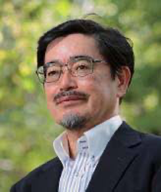
DR. YAMAJI KENJI
GREEN TECH SPECIALIST
Yamaji leads several METI groups, including the GISPC. One is the General Innovation Strategy Promotion Council, which stressed silo-breaking and cross-sectoral action in its “Strategy for Promoting Integrated Innovation”, published Jan. 21, 2020. The Strategy offers policy advice across five key sectors: energy, transport, industry, business-households, and primary industries. It also calculates the GHG reductions from initiatives that get frequent mention of late: hydrogen society, carbon recycling, zero-emissions technologies, and the Task Force for Financial Disclosure (TCFD). For a detailed analysis of the impact of TCFD, see the other analytical text in this report, which focuses on ESG.
The Yamaji-led Green Innovation Strategy Promotional Council continues elaborating the various decarbonization pathways, and is due to deliver a summary report on December 12. The Council’s work will probably serve as the foundation for the Suga government’s “Green Growth Strategy” and inform its spending, tax incentives and other targets, according to policy experts including Andrew DeWit, a Professor at Rikkyo University’s School of Economic Policy Studies.
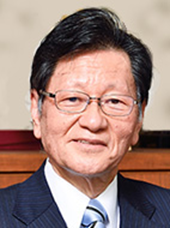
PROF. JINNO NAOHIKO
GREEN FINANCE SPECIALIST
Another prominent policy leader in the area of decarbonization is Jinno Naohiko, President of Japan College of Social Works. He is also a Council Member with the Renewable Energy Institute, which was set up by SoftBank Group founder Son Masayoshi. Prof. Jinno specializes in public finance and is also emeritus professor at The University of Tokyo. He serves on many government committees and advisory councils related to tax, social security and decentralization, as well as carbon pricing and green taxation.
Other policy leaders of note include:
Shiraishi Takashi, President of National Graduate Institute for Policy Studies (GRIPS) and Chancellor of the University of Kumamoto. Shiraishi, an international relations specialist, now heads METI’s Basic Policy Subcommittee, which probably indicates how important cross-border cooperation is to Japan’s energy policy – past, present and future.
SUMI SHUZO
VOICE OF INDUSTRY
-
Sumi Shuzo, Tokyo Marine & Nichido Fire and Insurance Senior Executive Advisor, is chair of the “old energy economy” at METI’s Natural Resources and Fuels Subcommittee. He is also one of the vice chairs of Keidanren, the most powerful big business lobby. How Japan’s crude oil, gas, and heavy industry moves to decarbonization will be as important as the shift to renewables energy.
To be sure, the groups are not an exhaustive list of government and bureaucratic bodies devoted to decarbonization issues. However, we believe they are honing the policy tools that will shape Japan’s zero-emissions drive. They are less visible, but perhaps more influential than the upcoming National Council.
This week, we start by featuring the committee network of METI, the Ministry of Economy, Trade and Industry, the most powerful ministry in terms of energy policy.
NET-ZERO POLICY DIRECTORY: PART I
Note 1: some of the panels/councils below also have working groups attached to them and where information is readily available it is included in the “Related” line item.
Note 2: cross-ministry groups are highlighted in dark red
MINISTRY OF ECONOMY, TRADE AND INDUSTRY (METI)
|
Name |
Industry Structure Council |
|
Related |
Subcommittee on Industrial Technology (産業技術環境分科会 地球環境小委員会) |
|
Mission |
To promote the Paris Accord and outline measures to balance decarbonization with economic growth |
|
Members |
Chaired by Uchiyama Yoji, Tsukuba University professor. Uchiyama chairs the Ibaraki Nuclear Council and is a member of various energy organizations. There are 21 other members from various backgrounds including consulting, media, law firms, academia, industrial associations for power sector, steel, petrochemicals, and labor unions. |
|
Status |
Meets several times a year |
|
Name |
Advisory Committee on Energy |
|
Related |
Subcommittee on power utility resilience amid decarbonization |
|
Mission |
Develop policies that enable decarbonization while maintaining power supply stability |
|
Members |
Chaired by Yamaji Kenji, Director-General of RITE. Yamaji has sat in the Environment Ministry council and the Japan Atomic Energy Commission. The other 13 members are from consulting and law firms, academia, consumer body representative; utilities are observers. |
|
Status |
Has not convened since its release of an interim report in August 2019 |
|
Name |
Green Innovation Strategy Conference |
|
Related |
Study groups (研究会) |
|
Mission |
Establish technologies, and transfer them into profit-making businesses |
|
Members |
Lead by Yamaji Kenji, DG of RITE; 15 members are mostly academics from national research institutes, and representatives from the private sector (Mitsubishi Chemicals and Asahi Kasei). In addition to METI, staff from ministries for education, environment, land, transport and infrastructure, internal affairs and communications, agriculture and the Cabinet secretariat participate as observers. |
|
Status |
Meets almost monthly. Next meeting is in December. The Conference will dissolve in March 31 2021. |
|
Name |
Study Group for Revolutionary Innovation Strategies for the Environment |
| Related | |
| Mission | Identifies issues in pushing environmental innovations in current frameworks and find solutions |
| Members | Also led by Yamaji of RITE. 15 members are mostly academics, as well as representatives from Mitsubishi Chemical. Environment Ministry, Ministry of Education, Ministry of Agriculture (MAAF), Ministry of Land / Transport (MLIT), the Cabinet are observers. |
| Status | Established in August 2019, to meet three to four times a year. |
| Name | Government-private sector council on ammonia fuel 燃料アンモニア導入官民協議会 |
| Related | |
| Mission | To promote the broad implementation of using ammonia at coal power plants, share industry issues and set targets for their resolutions |
| Members | Chairman not appointed. 17 members, 10 from the private sector, 7 from Natural Resources and Energy Agency and national banks. Specifically: JERA, IHI, Mitsubishi Heavy Industries, Mitsubishi Corp, Nikki, Marubeni, Japan Bank for International Corporation, and Nippon Export and Investment Insurance. |
| Status | Writing a roadmap to employ ammonia-combustion systems at coal power plants, in two phases. Mitsubishi Corp., JERA and Marubeni conducted presentations in the first meeting on October 27.NOTE: Domestic producers of ammonia for fertilizers and the Toyota group are developing ammonia combustion for fuel cells, but are not part of this Council. |
| Name |
Study group on forestry growth and wood chip biomass power generation |
| Related | |
| Mission | Calls for more efficient approaches throughout the supply chain from collection to usage of biomass materials. |
| Members | A 11-member panel from forestry, paper, recycling, biomass associations, and research organizations. Joint panel of METI and Ministry of agriculture, environment and internal affairs ministry are observers. |
| Status | Organized on July 20 2020, compiled a policy recommendation report on October 13 |
| Name |
Next generation energy system and social framework council |
| Related | |
| Mission | Connects various METI organizations to set standards and organize relevant items, to balance security of energy supplies while promoting new vehicles and new energy. |
| Members | 8 academics |
| Status | Has not convened since February 2017 |
| Name | Green Value Chain Platform 脱炭素経営促進ネットワーク会員 |
| Related | |
| Mission | Share experiences and offer each other guidance on decarbonization |
| Members | This is a Network of companies with emission SBT (Science Based Targets). 125 companies signed up. Mizuho Information & Research serves the secretariat. Jointly run by METI and Ministry of Environment |
| Status |
Posted its last update on Nov 24, 2020 |
GLOBAL VIEW
Below are some of last week’s most important international energy developments monitored by the Japan NRG team because of their potential to impact energy supply and demand, as well as prices. We see the following as relevant to Japanese and international energy investors.
EVs:
Globally, EV sales rose 127% YoY in October, the fastest rate of growth in eight years, with an almost 5% market share. Europe outperformed other regions with growth of 195% and a 13% EV share of the automobile sales market.
Goldman Sachs lifted its stock rating for Tesla to ‘Buy’ last week, saying that the stock still had $300 of upside. An uplift of $300 would give the company a market capitalization close to $1 trillion.
Luminar Technologies was the latest EV company to IPO on Nasdaq when it listed last Thursday. The company makes sensors for autonomous driving.
OPEC+:
The 13 members of OPEC, together with Russia, agreed to raise oil production by 500,000 barrels a day starting January 2021. Brent oil rose to $49, the highest level in nine months.
Libya, Venezuela, and Iraq are the three OPEC countries that are expected to suffer the largest YoY GDP declines in 2020 due to low oil prices and disrupted production.
Climate Change:
The World Meteorological Agency is forecasting that 2020 will be the second hottest year on record, after 2016.
A new United Nations report forecasts that oil, gas and coal production in 2030 will be twice the level required to curb global warming.
Energy Efficiency:
An IEA report released last week shows global energy efficiency progress set to slow to 1% in 2020 – the lowest rate in a decade. This puts efficiency progress far below the pace needed to reach energy and climate goals.
Copper Prices:
Demand for copper for renewables and energy infrastructure projects has moved the metal’s price to a multi-year high of $7,700 per ton.
South Korea:
Ineos, the U.K. energy, petrochemicals and automotive group, is exploring options with Hyundai Motor to supply hydrogen to the Korean auto manufacturer. Also, Ineos may use Hyundai’s fuel cell system in its off-road utility vehicle, the Grenadier. Ineos bought BP’s petrochemicals business in June 2020 for $5 billion.
China:
1). The IEA forecasts that China will overtake the U.S. as the world’s largest oil refiner in 2021.
2). The U.S. administration is expected to add CNOOC, one of China’s largest oil and gas producers, to a list of sanctioned companies due to ties with China’s military establishment. The company produces 1.4 million boed.
3). Eighteen Chinese coal miners were killed last week after a carbon monoxide leak at a coal mine at the Diaoshuidong mine in the municipality of Chongqing in southwest China.
Middle East:
Iran approved a law last week that obliges the government to halt UN inspections of nuclear sites, and step up uranium enrichment beyond limits established under the 2015 Iranian nuclear deal if sanctions are not eased in two months. Prior to the commencement of the latest sanctions Iran was OPEC’s third largest oil producer in 2018, after Saudi Arabia and Iraq.
Holland:
Two environmental groups took Royal Dutch Shell to court last week demanding that it drastically reduce oil and gas production to limit CO2 emissions.
Denmark:
The Danish parliament last week banned new oil and gas exploration and will end its fossil fuel production in the North Sea by 2050 to become CO2 neutral. The country was the third largest European producer of oil and gas for many years after the U.K. and Norway but became a net importer of oil in 2018. Eighty per cent of the country’s electricity currently comes from renewable sources, mainly wind and biomass.
United Kingdom:
The U.K. government will invest $270 million in a prototype of a nuclear fusion power station to enable a commercial plant to be constructed by 2040.
Americas:
1). Exxon announced a $20 billion write-down on its natural gas portfolio.
2). President-elect Biden is now expected to face significant pushback from the U.S. power sector over 2035 net-zero decarbonization plans.
DATA
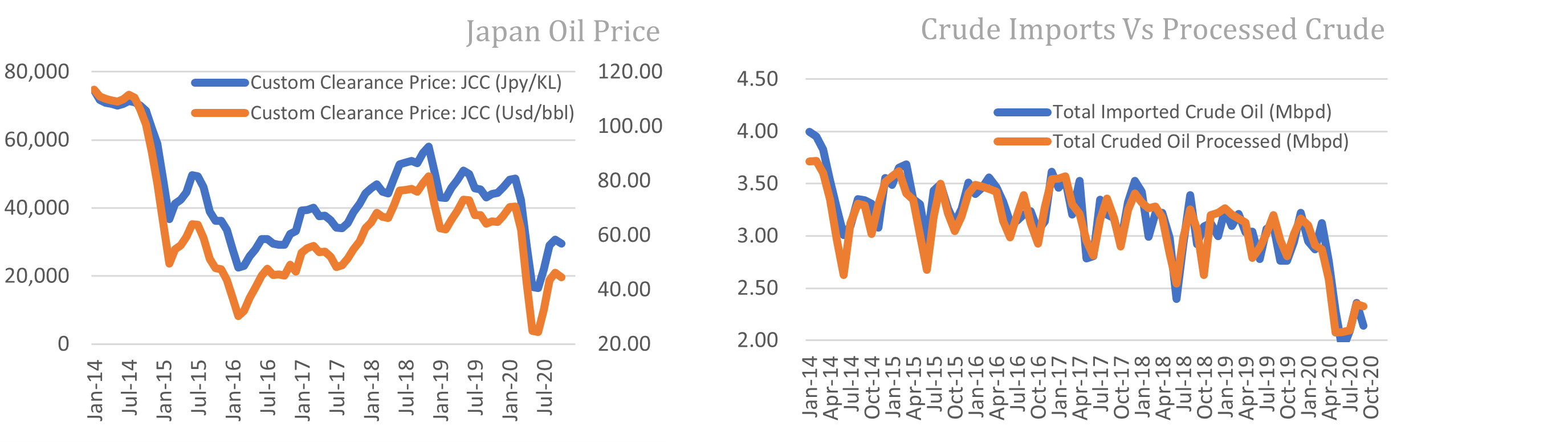
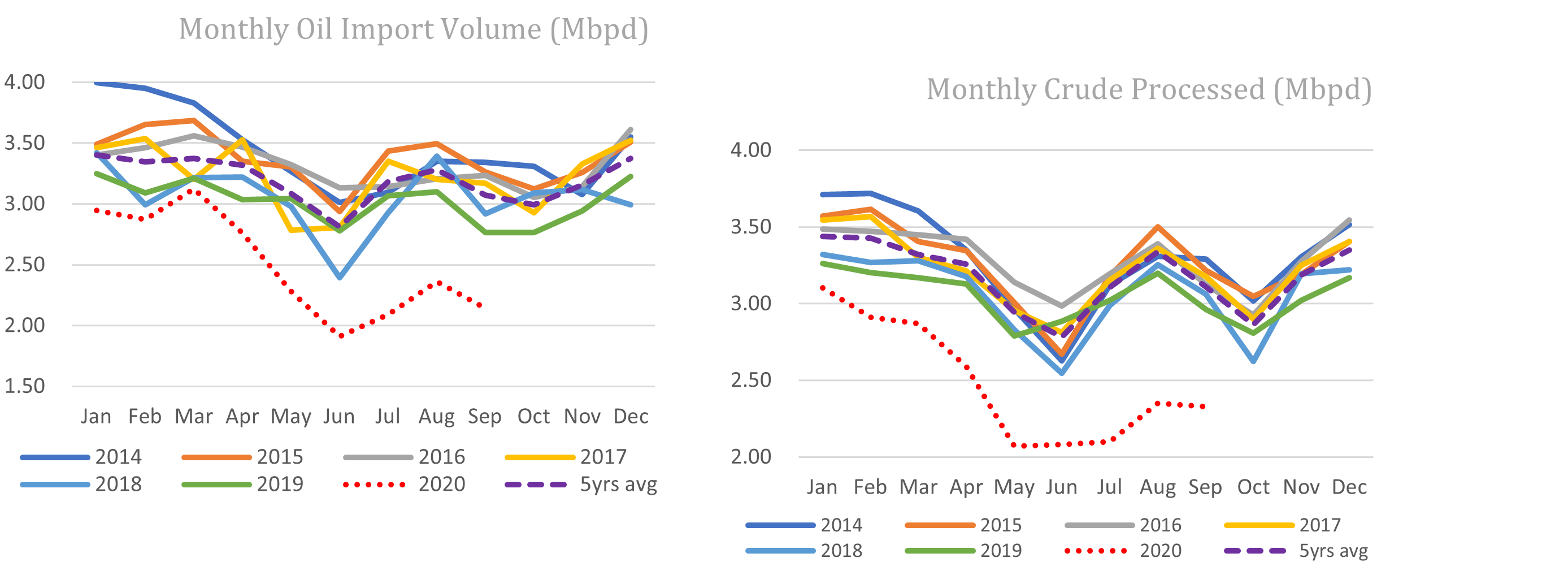
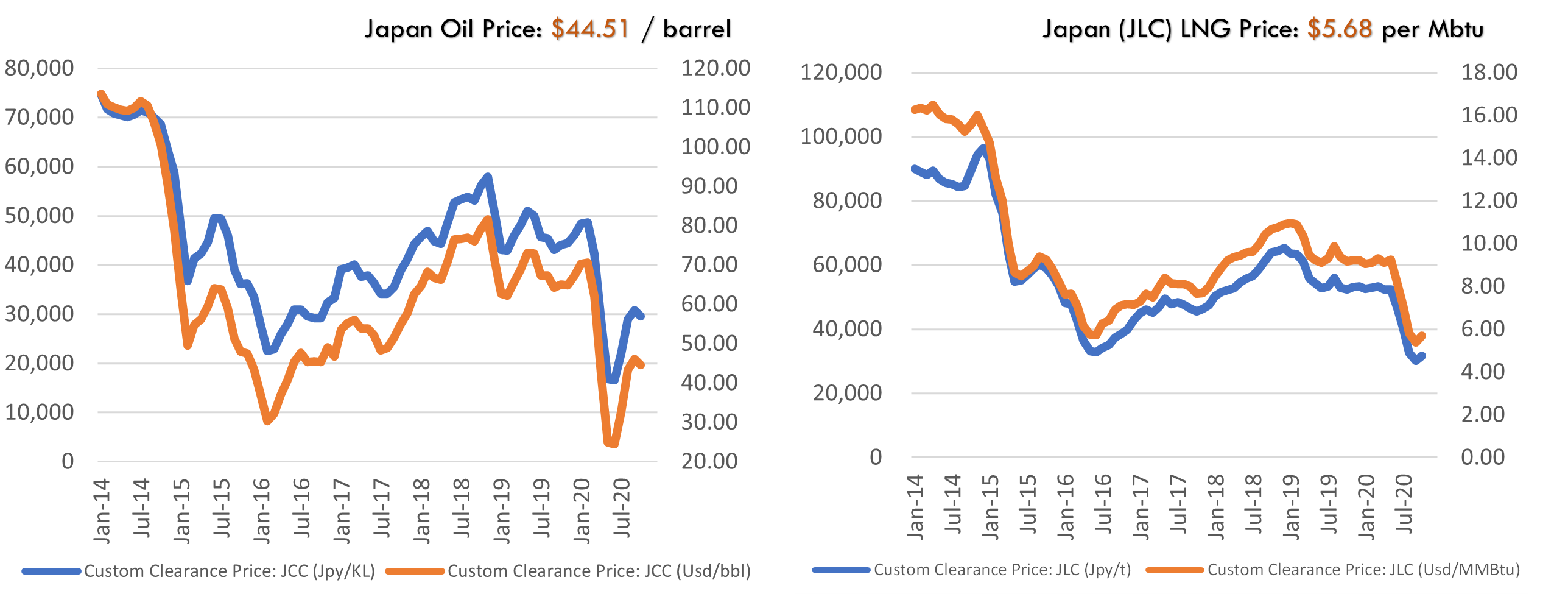
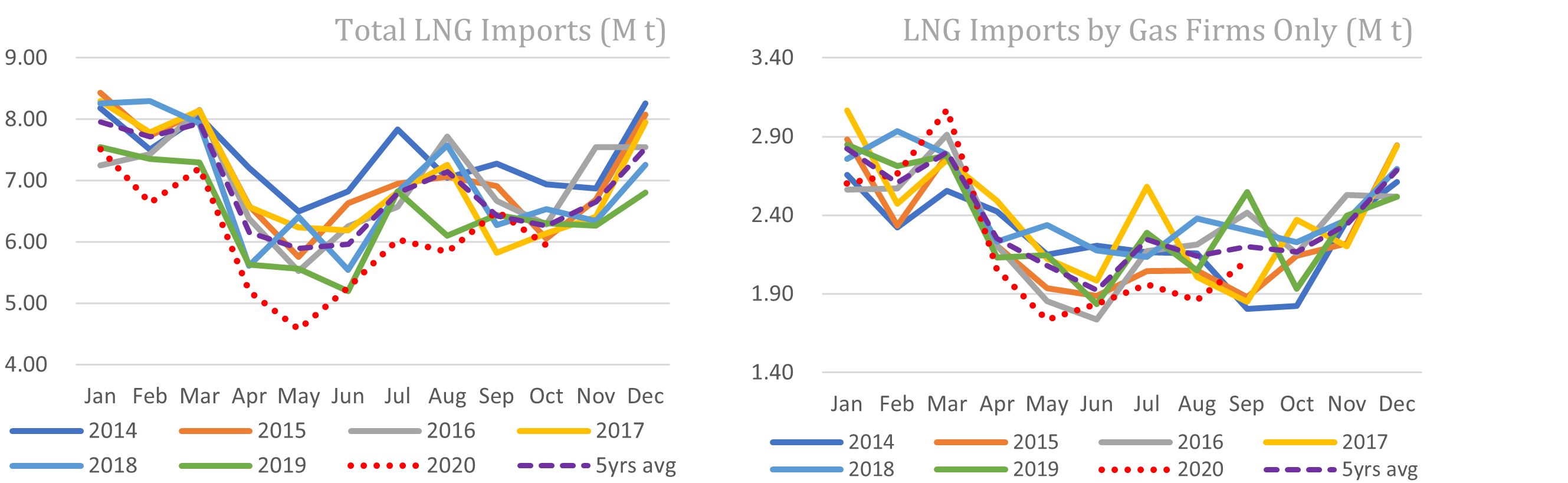
 SOURCES: the Ministry of Economy, Trade, and Industry (METI), Ministry of Finance, and the Petroleum Association of Japan
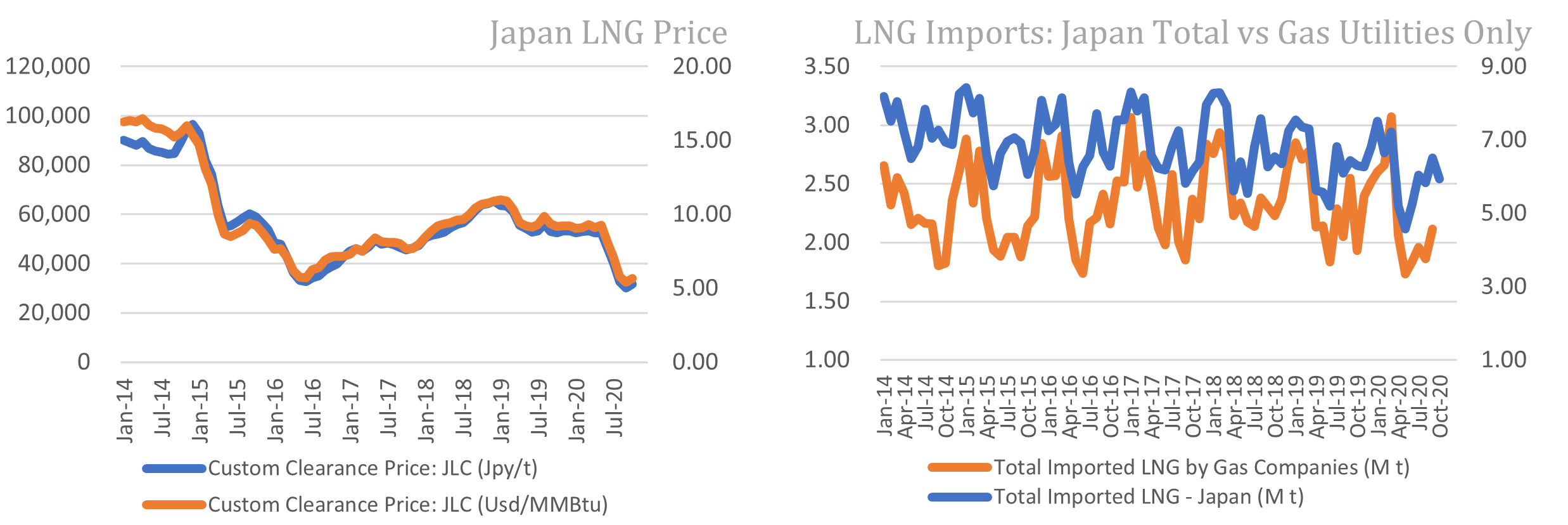
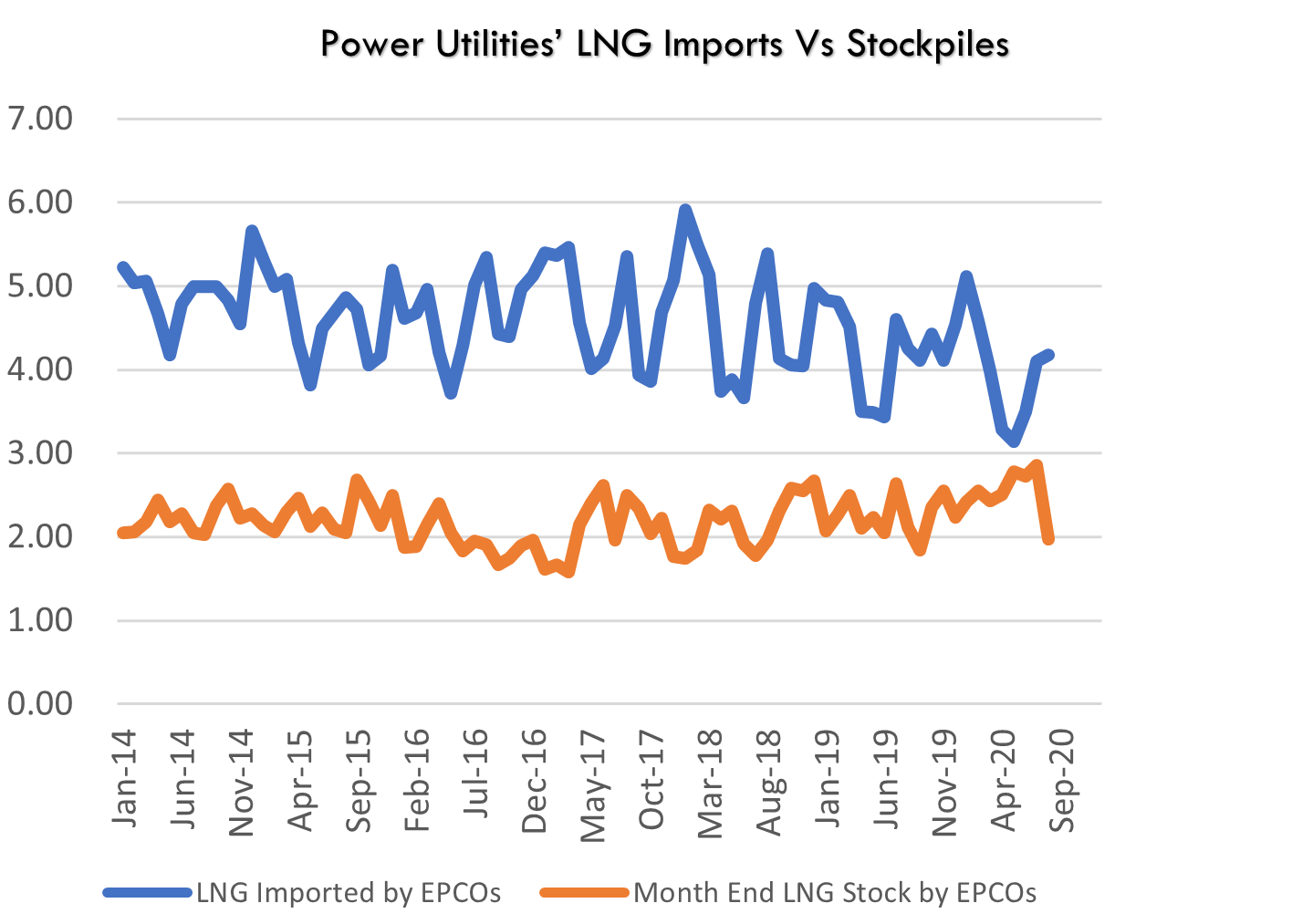
 SOURCES: the Ministry of Economy, Trade, and Industry (METI),
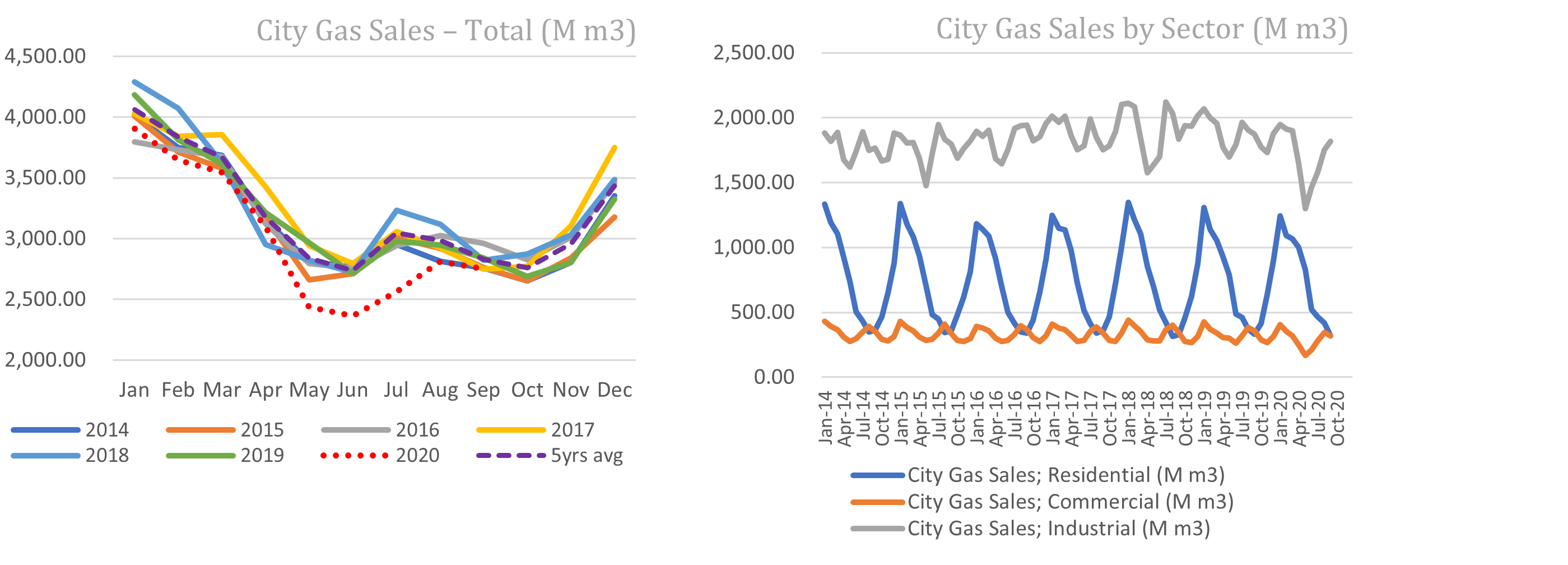
Ministry of Finance
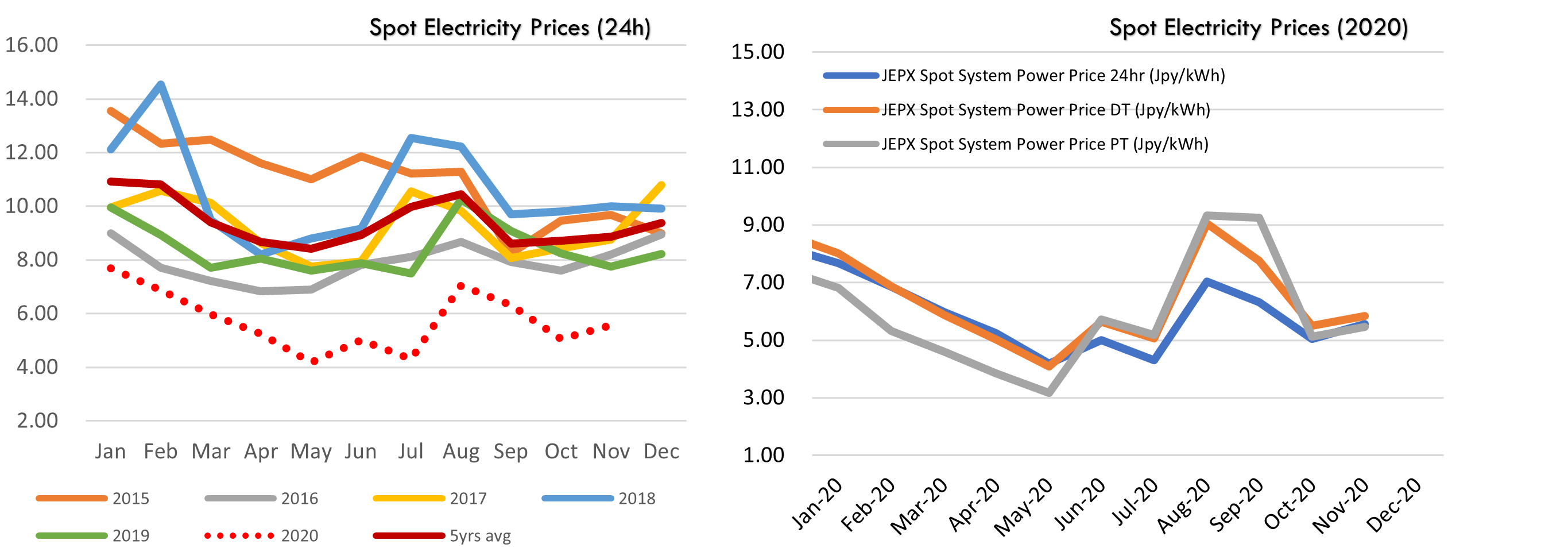
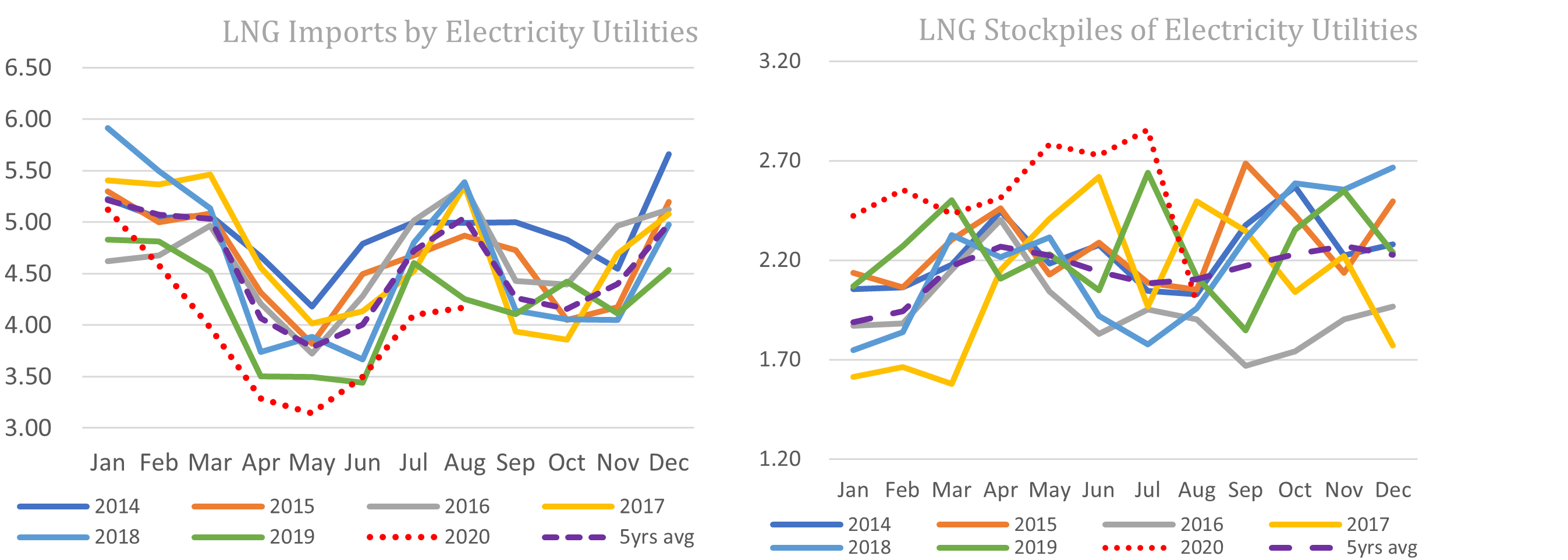 SOURCES: the Ministry of Economy, Trade, and Industry (METI), and the Japan Electric Power Exchange