
JAPAN NRG WEEKLY
DECEMBER 14, 2020
JAPAN NRG WEEKLY
DECEMBER 14, 2020
TOP
- Japan aims to bring total lifetime auto emissions down to zero
- Japan bets that hydrogen will be the main fuel in 30 years; sets annual target of 10 million tons to lower hydrogen cost to that of LNG; Japanese manufacturers join forces to promote hydrogen
- Japan’s Green Growth Strategy picks 15 key areas with major focus on offshore wind and higher 2040 capacity target; Cabinet approves ¥15 trillion ($144b), five-year plan to boost infrastructure
- Toyota unveils both new fuel cell auto and fuel cell truck; the auto giant to debut next-generation EV battery as early as 2021
- Japan offers 10% tax break for companies investing in green tech; aims for ¥1 trillion of green tech exports over the next five years
- Asia LNG price (JKM) jumps above $10 for first time in two years
OIL & GAS
- Japan’s traditional energy players report planned CO2 cuts
- Mitsubishi signs 10-year LNG supply deal based on a spot price
- Shipper Mitsui OSK says LNG key to demand growth; to switch coal transportation to sail-assisted barges
POWER & NUCLEAR
- Nuclear regulator dumbfounded by court ruling against its reactor restart permits; anti-nuclear activists feel emboldened
- Okinawa Electric becomes first of Big 10 regional power utilities to declare 2050 net-zero emissions target; TEPCO mulls similar
- Japan’s first commercial MOX nuclear fuel plant gets approval; Kansai Electric hopes to share TEPCO’s nuclear waste facility
- JFE completes biomass-blended 112 MW coal plant in Hokkaido
- Inside story of PM Suga’s 2050 pledge and KEPCO’s nuclear woes
RENEWABLES, OTHER
- Toshiba group mulls recycling CO2 to make sustainable jet fuel
- Offshore wind players worry lengthy tender will push up prices
- KEPCO group trials multiple-storage-batteries system
- Erex and ENEOS plan 300 MW biomass-fired power station
- Sumitomo Life invests ¥11 billion in BlackRock renewables fund
- Mizuho joins global investors in pledge to push net-zero agenda
JAPAN’S PLANS TO RETIRE THE GASOLINE ENGINE REST ON ITS NEXT-GENERATION BATTERY TECH
On Dec. 4, Japan’s prime minister clarified that a major part of the national goal to turn carbon-neutral by 2050 involves domestic automakers meeting new emissions standards and ceasing output of gasoline cars. This now forces Japanese automakers to bring forward the break from gasoline-only vehicles by 20 years to 2030. The shock tactic from Prime Minister Suga means to unleash a furious period of investment and innovation at Toyota Motor, Honda, Nissan and other Japanese makers. Yet, none of this will matter for the industry that carried the world’s third-largest economy for the last three decades unless Japan succeeds in mastering one key component: next-generation batteries. For that, Japan Inc. has prepared a plan. The problem: it has to be implemented in record time.
WHO IS DRIVING DECARBONIZATION POLICY IN JAPAN? PART II: MINISTRY OF ENVIRONMENT
Last week we published the first part of our deep-dive into which policy makers from the public and private sectors are compiling the agenda and pathways for Japan to move toward its 2050 net-zero emissions goal. After introducing the key committees and other groupings under the umbrella of METI, we present the entities operating under the Ministry of Environment, MAFF, the Cabinet Office, the Prime Minister’s Office, the ruling Liberal Democratic Party, and the top three business groups. The information is presented in the form of a directory, also highlighting the key persons in the structure.
GLOBAL VIEW
Carbon prices in the EU hit a 14-year high as the bloc voted in a new emissions roadmap. Activist investors are attacking ExxonMobil for its spending. China is stepping up investments in Iraq. And an Australian firm wants to inject CO2 into a site in the Indian Ocean. See details on these and other political and business events in our regular Global View column.
JAPAN NRG WEEKLY
K. K. Yuri Group
Editorial Team
Yuriy Humber (Editor-in-Chief)Tom O’Sullivan (Japan, Middle East, Africa)
John Varoli (Americas)
Contributors
Mayumi Watanabe (Japan)
Daniel Shulman (Japan)
Damon Evans (Indonesia)
Art & Design
22 Graphics Inc.

SUBSCRIPTIONS & ADVERTISING
Japan NRG offers individual, corporate and academic subscription plans. Basic details are our website or write to subscriptions@japan-nrg.com For marketing, advertising, or collaboration opportunities, contact sales@japan-nrg.com For all other inquiries, write to info@japan-nrg.com
Disclaimer
This communication has been prepared for information purposes only, is confidential and may be legally privileged. This is a subscription-only service and is directed at those who have expressly asked Yuri Invest Research Ltd. or one of its representatives to be added to the mailing list. This document may not be onwardly circulated or reproduced without the prior written consent of Yuri Invest, which retains all copyright to the content of this report.
Yuri Invest Research Ltd. is not registered as an investment advisor in any jurisdiction. Our research and all the content of our reports express our opinions, which are generally based on available public information, field studies and own analysis. Content is limited to general comment upon general political, economic and market issues, asset classes and types of investments. The report and all of its content does not constitute a recommendation or solicitation to buy, sell, subscribe for or underwrite any product or physical commodity, or a financial instrument.
The information contained in this report is obtained from sources believed to be reliable and in good faith. No representation or warranty is made that it is accurate or complete. Opinions and views expressed are subject to change without notice, as are prices and availability, which are indicative only. There is no obligation to notify recipients of any changes to this data or to do so in the future. No responsibility is accepted for the use of or reliance on the information provided. In no circumstances will Yuri Invest Research Ltd. or its partner K.K Yuri Group be liable for any indirect or direct loss, or consequential loss or damages including without limitation, loss of business or profits arising from the use of, any inability to use, or any inaccuracy in the information.
Yuri Invest Research Ltd.: Room 602, Wah Yuen Building, 149 Queen’s Road Central, Central, Hong Kong.
K.K. Yuri Group: Oonoya Building 8F, Yotsuya 1-18, Shinjuku-ku, Tokyo, Japan, 160-0004.
NEWS: OIL & GAS
Japan Oil Price: $44.51 / barrel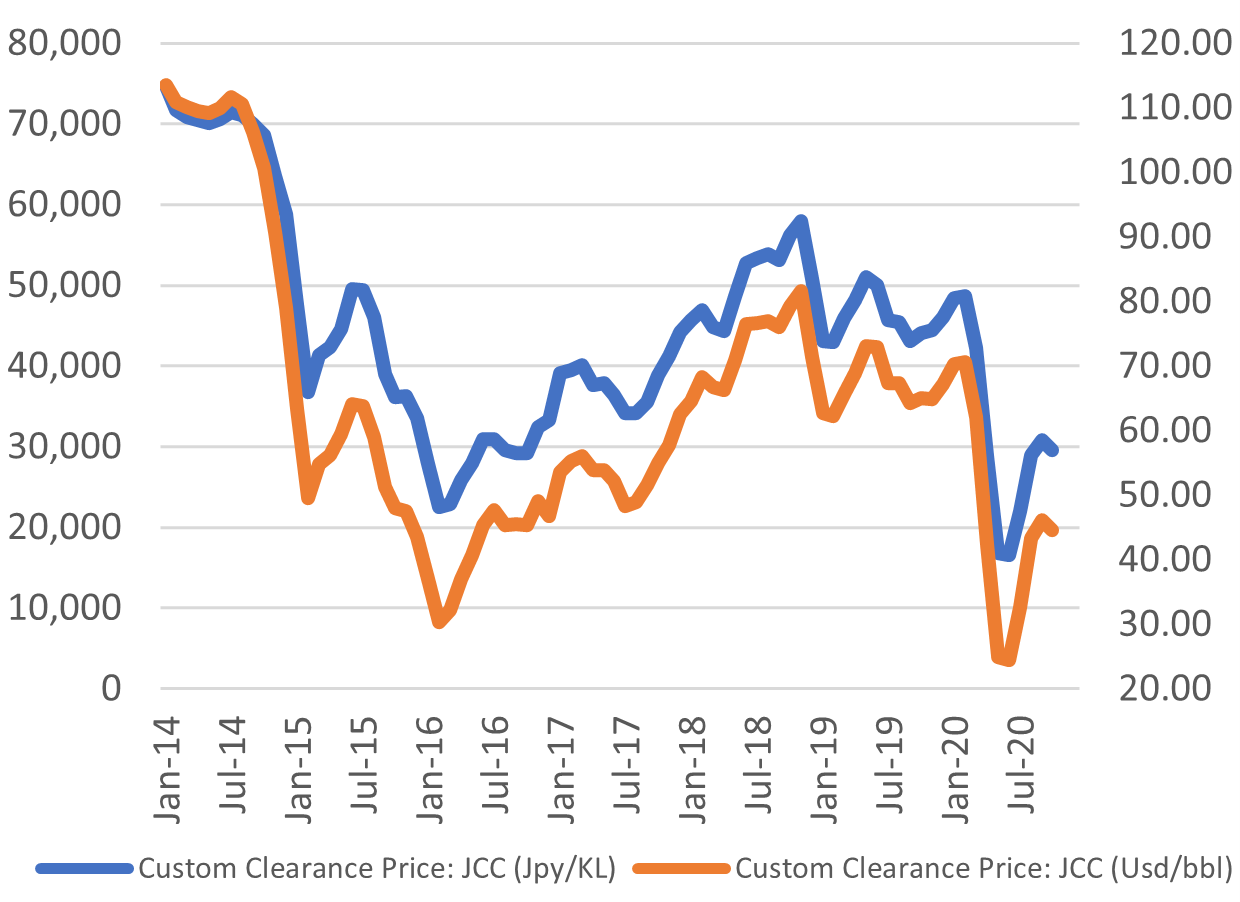
Japan (JLC) LNG Price: $5.68 per Mbtu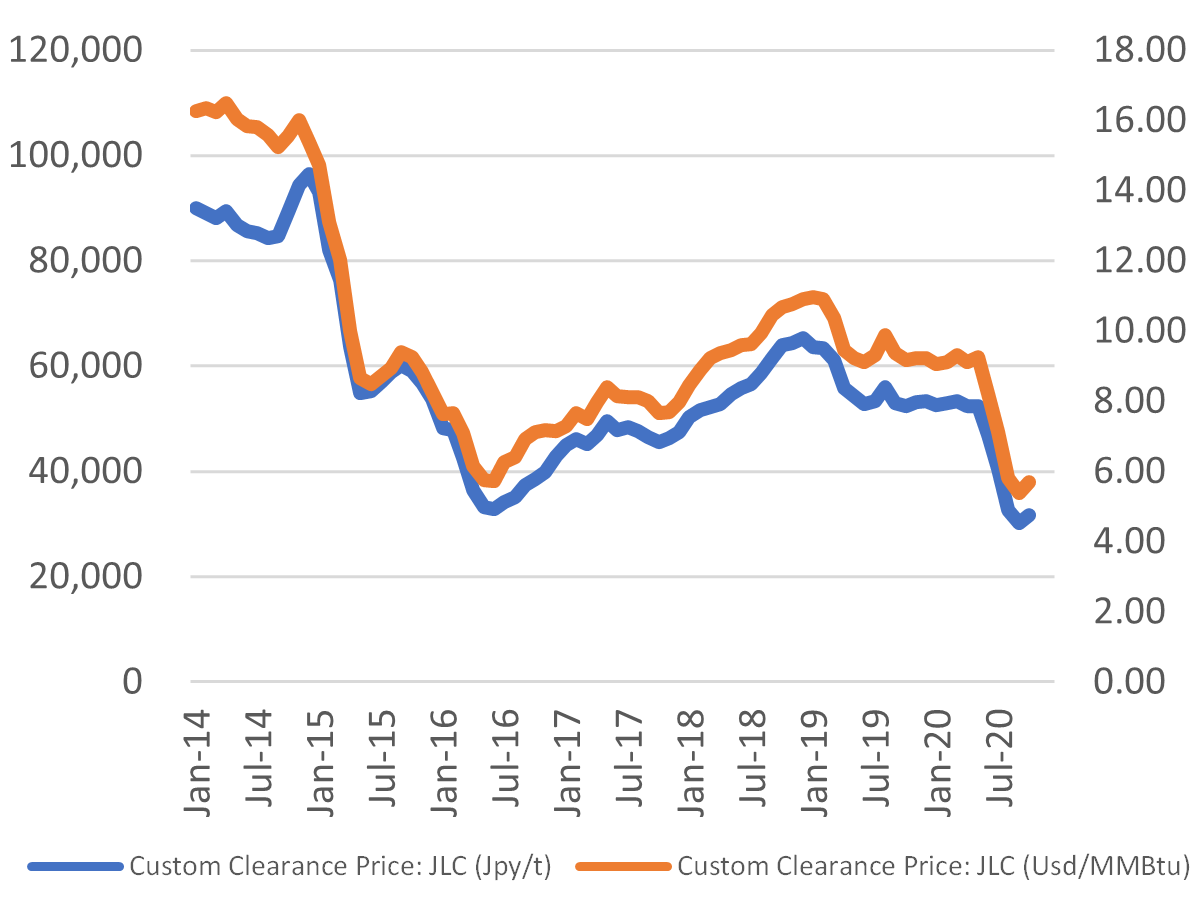
JKM price for LNG in Asia jumps above $10 for first time in two years
(Japan NRG, Dec. 12)
- The Japan-Korea Marker benchmark, that applies for LNG delivering to North Asia, rose to a two-year high amid a shortage of cargo vessels and disruptions in supply from some projects, including from INPEX Corp.’s Ichthys project in Australia.
- Bids in the $11 / mmbtu range available for January delivery cargoes via Platts.
- METI said Japanese spot LNG prices also rose in November
Japan’s traditional energy players give estimate for potential CO2 reductions
(Japan NRG, Dec. 12)
- The Earth and Environment Subcommittee of METI’s Industry Structure Council held its latest meeting, during which representatives from seven traditional energy industries outlined their potential for CO2 emission cuts. Oil refiners, power utilities, coal and mining bodies and others reported their emissions as of now, and their 2030 decarbonization targets.
- Power utilities see a potential 7 million tons of CO2 reduction for the current fiscal year based on “best available technologies”; by 2030, a potential 11 million tons of CO2 could be cut, industry representatives said.
- Oil refineries in Japan had 34 million tons of CO2 emissions in 2019, down from 36 million tons a year ago. The industry wants to reduce that by a further 2.7 million tons by 2030.
- Upstream oil and gas operators cut 2019 emissions by 8% from a year ago, and aim for a 5% reduction for 2020 (compared to 2015 levels). By 2030, the industry aims for a 28% cut in emissions (compared to 2016 levels). Industry initiatives include decarbonization of overseas gas field operations.
- City gas operators said they would look to cut CO2 through the spread of cogeneration, fuel cells, hydrogen, methane, and LNG bunkering.
Energy Research Council calls for higher fossil fuel self-sufficiency target
(Japan NRG, Dec. 12)
- The oil and gas subcommittee of METI’s Energy Research Council met to discuss the industry’s development through to 2050.
- The subcommittee proposed raising Japan’s self-sufficiency target for fossil fuel to 40% by 2030.
Mitsubishi Corp signs up for 10 years of LNG supply with Santos in landmark deal
(Company press release, Dec. 7)
- Australia’s Santos to supply Diamond Gas International, a unit of Mitsubishi, with 1.5 million tons of LNG from the Barossa project. The price will be based on the Platts Japan-Korea Marker (JKM).
- Santos has options to pursue other LNG transactions with the Mitsubishi unit
- The deal is a massive boost for Santos reaching a final investment decision on Barossa, which is due in 1H2021.
- The two sides will investigate opportunities for carbon-neutral LNG from Barossa.
- CONTEXT: The deal’s volume represents 80% of Santos’ production share in the project.
TAKEAWAY: The fact that an LNG producer is willing to sell the majority of its offtake to a buyer based on a spot price contract (JMK) is a massive change for the industry. Traditionally, LNG producers have looked for stable, long-term prices indexed to oil, or at the very least on a cost + margin basis. This will surely embolden more buyers from Japan and elsewhere in Asia to seek long-term contracts on a similar basis, perhaps also using the JKM benchmark. The Japanese trading company has been one of the biggest champions of JKM as a pricing tool this year and will likely push more counter-parties to utilize it.
From a Mitsubishi perspective, the next step will be to make sure JKM is more broadly embraced in Japan and, importantly, in other key Asian markets, such as Southeast Asia, India and perhaps China. That would ease the path to cargo resale. From a producer perspective, it denotes confidence in underlying Asia demand to keep JKM relatively high. And, perhaps this is also recognition by the LNG producer-side that oil prices have become more volatile and less certain to rise in the future due to current net-zero emissions initiatives.
LNG demand key to growth for shipper Mitsui OSK Lines: CEO
(Nikkei Shimbun, Dec. 11)
- Hashimoto Tsuyoshi, who has long served as CEO of the shipping company, will move to chairman from April 2021. In a briefing to announce his successor, who will be Ikeda Junichiro, Hashimoto noted that the LNG business will be key to the company’s business growth.
- Hashimoto, who ran the gas department at Mitsui before becoming CEO, argued that demand from the power generation sector remains strong and that renewables alone cannot solve energy needs in Southeast Asia, India and Africa, among other places.
TAKEAWAY: Japan’s preference for LNG is well known since the country is the world’s biggest buyer. However, recent commentary from the EU suggests that the idea of LNG as a “transition” fuel is no longer universally shared. A recent report from Wood McKenzie even suggested that 77% of new LNG supply may never come online as demand switches to hydrogen because of emissions concerns. Mitsui OSK will likely need to examine this prospect even as it looks to expand its LNG customer base.
- SIDE DEVELOPMENT:
Mitsui OSK Lines plans to transport coal on sail-assisted barges
(Nikkei, Dec. 10)- Mitsui OSK Lines said on Dec. 10 that it will begin using wind power to transport shipments of coal in 2022.
- The shipments will carry Australian coal to power plants operated by the Tohoku Electric Power Company.
- The use of a single sail will reduce greenhouse gas emissions by up to 8% per voyage.
- Each sail weighs 200 metric tons.
Idemitsu cuts CO2 emissions at naphtha plant with new energy-efficient furnace
(PR Times, Dec. 11)
- Idemitsu Kosan has constructed a new naphtha cracking furnace at its Tokuyama plant in Yamaguchi, which requires 30% less energy to synthesize ethylene than conventional furnaces. This translates into a 16,000-metric-ton reduction in annual carbon dioxide emissions.
ENEOS-affiliate Fuji Kosan facing activist investor fund with links to Murakami
(Sentaku, December edition)
- ENEOS affiliate Fuji Kosan Co. is facing an aggressive takeover. Aslead Capital, an investment fund, now owns 11.2% of its shares and is almost at the same level as ENEOS, which owns 11.5% of Fuji Kosan.
- Another individual, Shigeta Mitsutoki, the son of the founder of Hikari Tsushin Inc., has taken a further 6.19% stake.
- It is assumed that Aslead and Shigeta are working together to encourage ENEOS to sell out. ENEOS does not wish to do so, seeing no buyer able to help Fuji Kosan with distribution.
- Aslead, based in Singapore, is extremely close to Murakami Yoshiaki, the infamous activist investor, who also helped progress a deal between Idemitsu and Showa Shell.
- Market rumors see Fuji Kosan being sold off in parts with no-brand overseas oil retailers potentially interested.
NEWS: POWER & NUCLEAR
| No. of operable nuclear reactors | 33 | |||
| of which | applied for restart | 25 | ||
| approved by regulator | 16 | |||
| restarted | 9 | |||
| in operation today | 3 | |||
| able to use MOX fuel | 4 | |||
| No. of nuclear reactors under construction | 3 | |||
| No. of reactors slated for decommissioning | 27 | |||
| of which | completed work | 1 | ||
| started process | 4 | |||
| yet to start / not known | 22 | |||
Power Utilities’ LNG Imports Vs Stockpiles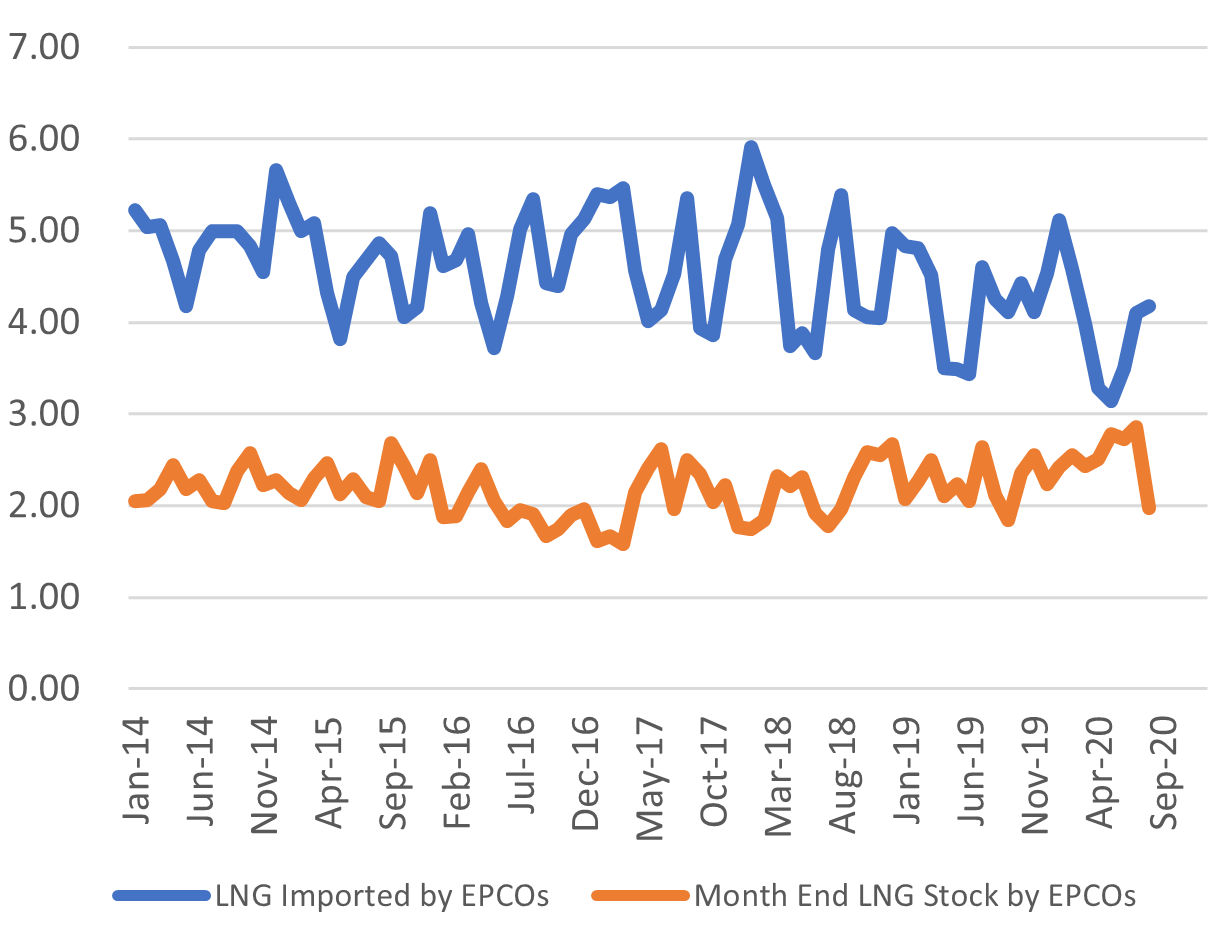
Source: Company websites, JANSI and JAIF, as of Dec. 5, 2020
Nuclear regulator dumbfounded by court ruling that challenges its restart permit
(Tokyo Shimbun, Dec. 4)
- A recent ruling by the Osaka District Court to veto the Nuclear Regulation Authority’s decision to restart the number three and four reactors at the Ooi nuclear power plant found that the Authority failed to give adequate consideration to unknown factors when making its assessment.
- Authority spokesperson Tamura Shin’ichi appeared dumbfounded by the verdict, and told reporters the Authority had expected to win. The decision places question marks over the credibility of plant inspections that the Authority claims are the toughest in the world.
- The signs were there, however: in 2016, prominent geologist and then acting NRA chair Shimazaki Kunihiko questioned KEPCO’s modelling of tremors on the site, which he said underestimated actual tremor intensity by almost 50%. Government geologists have also questioned the modelling methods used by the Authority.
- SIDE DEVELOPMENT:
Osaka nuclear reactor decision emboldens plaintiffs in Shiga lawsuit
(Kyoto Shimbun, Dec. 10)- A group of residents seeking an injunction against the restarting of the Ohi, Takahama and Mihama nuclear power stations appeared in the Ozu District court for its 27th round of oral testimony on Dec. 10.
- Counsel for the group said they would be stepping up their arguments about the vulnerability of the three power plants to earthquakes, in light of a recent decision by the Osaka District court to annul the Nuclear Regulation Authority’s decision to restart units three and four at the Ooi nuclear power plant.
- Chief counsel revealed that the judge in the Ozu case had requested that the Osaka judgement be submitted as evidence, which suggests the court wants to review the impact of the Osaka decision as quickly as possible.
Japan’s Okinawa Electric Power aims to achieve Net-Zero Emissions by 2050
(Company press release, Dec. 8)
- A more immediate target for 2030 is to cut emissions by 26% versus 2005 levels
- Japan’s smallest regional utility commits to adding 100 MW of renewables capacity by 2030, half in solar and half in wind, and invest in grid stabilization to be able to increase its ration of green energy in the mix.
- Short-term, Okinawa Electric will switch to using more LNG instead of coal, and simultaneously look to introduce carbon-free fuels such as hydrogen, ammonia and others in generation
- Oil generation to convert to LNG, while coal-fired capacity to add biomass component to reduce emissions
- Storage batteries, VPP and Demand-Response among the directions being considered by the utility.
- CONTEXT: Okinawa is only the second Japanese power utility to make a 2050 net-zero decarbonization pledge this year after JERA.
TAKEAWAY: Okinawa Electric was considered to be among the worst cases of Japan’s regional utilities given its mostly coal-fired generation and a lack of connection with the mainland grid. And yet, it has become the second power utility to make the net-zero pledge. Admittedly, the company’s plan looks very rough and it reads as if prepared by someone at METI. Still, if Okinawa Electric can make the pledge, there’s no excuse for larger utilities. Unless, they are still waiting on the fate of their nuclear generation before deciding future strategy.
- SIDE DEVELOPMENT:
TEPCO Holdings to cut CO2 emissions by 370 million tons
(Denki Shimbun, Dec. 11)- TEPCO Holdings has unveiled a plan to cut annual CO2 emissions by over 370 million metric tons in or after 2030.
- The savings will be made through TEPCO’s mobility business and initiatives to encourage industries using other power sources to transition to electricity.
- This reduction amounts to 1/3 of Japan’s goal of 1 billion metric tons by 2050.
- CONTEXT: TEPCO is said to be considering a net-zero emissions 2050 plan, but it has yet to declare this goal officially.
Japan’s first commercial MOX nuclear fuel manufacturing plant gets green light
(NHK, Dec. 9)
- The Nuclear Regulation Authority says Japan’s first commercial plutonium reprocessing facility at the Rokkasho complex (Aomori prefecture) has passed its safety inspection.
- The new facility, which is currently under construction, will use plutonium extracted from spent nuclear fuel to manufacture a plutonium-enriched nixed oxide fuel (MOX).
- Facility operator, Japan Nuclear Fuel, aims to complete the ¥2 trillion plant by early 2022.
- CONTEXT: Currently, only four reactors in Japan are permitted and able to run on MOX fuel. Japan has 46 tons of plutonium in its stockpile already, but 80% of that is stored in the U.K. and France.
TEPCO’s nuclear waste facility may be opened to other utilities to help Kansai Electric
(Jiji, Kyodo, Dec. 11)
- The Federation of Electric Power Companies of Japan is working on getting approval for a plan that would open up a nuclear waste facility to all national utilities. Currently, only Tokyo Electric (TEPCO) and Japan Atomic Power Co. can deposit used nuclear fuel at the facility.
- The facility in Mutsu city, Aomori prefecture, will only become operational in fiscal 2021. It was built to allocate temporary space for used fuel before it is sent for processing.
- The Federation is trying to convince TEPCO and other parties to allow other utilities to be able to deposit used fuel there in return for fees. The scheme would primarily help Kansai Electric.
- Mutsu mayor and Aomori prefectural government would need to approve any new facility use rules.
- CONTEXT: Japan has about 19,000 tons of spent nuclear fuel, of which all but 3,000 tons lies at the bottom of storage pools at nuclear power plants.
TAKEAWAY: This situation is a game of dominos that has serious implications for Kansai Electric and the nuclear story in Japan, in general. The Kansai utility is under obligation before Fukui prefecture, where all its nuclear plants are located, to move used fuel from reactor storage pools to a location outside of Fukui. Until that happens, Fukui government will not allow Kansai Electric to build new nuclear plants and may continue to obfuscate the restart of its current nuclear facilities. Kansai Electric badly wants to restart its nuclear fleet and add more reactors to lower its carbon emissions and cut costs.
JFE Engineering builds biomass-blended 112 MW coal plant in Hokkaido
(New Energy Business News, Dec. 9)
- JFE Engineering has completed construction of a 112MW power plant in Kushiro, Hokkaido that will be operated by local generator KK Kushiro Karyoku Hatsudensho.
- The new plant uses environmentally-friendly circulating fluidized bed (CFB) technology in which a liquid catalyst is circulated through the fuel to reduce pollution.
New coal-fired plant in Kyushu trapped between old and new energy strategies
(Nikkei, Dec. 9)
- While there was much trumpeting about the fact that Kushiro’s new coal-fired power station would use locally-dug coal, its opening couldn’t have come at a worse time according to industry insiders.
- With the Suga government pledging to become carbon neutral by 2050, coal-fired power stations are facing increasing criticism over their environmental impact.
- Planned in 2011 after the nuclear disaster, the Kushiro plant operates at subcritical temperatures, and is therefore classified by the government as inefficient.
- The plant will burn 200,000 metric tons of locally produced coal every year.
Japan’s biggest steelmaker pledges to be carbon neutral by 2050
(Asia Nikkei, Dec. 10)
- Nippon Steel has set a goal to reach net-zero emission by 2050. This could push other manufacturers to do the same.
- The company is Japan’s biggest steelmaker and the industry is the worst polluter after the power sector.
- Nippon Steel will introduce a new way of steelmaking using hydrogen, which can reduce carbon emissions by up to 80% compared with conventional methods of production.
- The steelmaker’s new green target will be announced around March 2021.
Keidanren chief says nuclear power essential in order to achieve carbon neutrality
(TBS News, Dec. 7)
- Industry lobby group Keidanren has issued a statement calling for the restarting of mothballed nuclear power stations and the construction of new nuclear plants, in order to achieve the Suga government’s goal of carbon neutrality by 2050.
- Keidanren chair Nakanishi Hiroaki praised what he says is a bold initiative from Suga. Nakanishi said tax breaks for green technologies are now needed, as well as a more plentiful, consistent supply of low-cost, carbon free energy.
Hitachi ABB Power Grids trials tech to help U.K. transition to renewables
(JCN; Dec. 5, 2020)
- Hitachi ABB Power Grids has launched a year-long trial of the world’s first hybrid solution, which combines a STATCOM (static compensator) with a synchronous condenser. (The company is working with SP Energy Networks, the University of Strathclyde and the Technical University of Denmark.)
- This new tech will contribute to the U.K.’s carbon-neutral future by facilitating a smooth transition from traditional energy generation to renewable power.
- The project is expected to save over 62,000 tons of carbon emissions, which is equivalent to electricity use of over 6,000 homes.
- As part of the trial, Hitachi ABB Power Grids has installed the world’s first hybrid solution: a strategic 275 kilovolt (kV) substation on SP Energy Networks’ transmission network near Glasgow in Scotland.
Inside story of the 2050 net-zero pledge and Kansai Electric’s nuclear woes
(Sentaku, December edition)
- CONTEXT: this is the top feature in the magazine, Sentaku, which looks at what’s behind Prime Minister Suga’s recent 2050 net-zero emissions pledge.
- PM Suga saw that Joe Biden was likely to win the U.S. presidential election and so he decided to jump in with the 2050 pledge first.
- Key METI people under the Abe Shinzo administration saw “decarbonization” as a way to bring back nuclear power. However, internal divisions and a lack of belief in “decarbonization” as a force to bring back nuclear in Japan delayed action.
- Now Suga has taken over and things are finally moving forward, but his METI minister Kajiyama believes it will take another 10 years to restart Japan’s existing nuclear reactors and, until this is achieved, it’s not time for the government to talk about new nuclear construction.
- Ironically, new nuclear construction plans were moving well last year. Kansai Electric Vice President at the time, Toyomatsu Hideki, won local citizens’ approval to build Unit 4 at Mihama NPP. The plan was due to be announced in Sept. 2019, but instead a scandal broke around the company. This greatly annoyed METI and all plans for new nuclear construction were called off. Now the locals don’t want to listen to politicians about new nuclear assets.
- The day before the prime ministerial run off, Suga met with Komeito Party leader Yamaguchi and discussed his top 9 policies. One was “establishment of a decarbonized society.” It was already on the mind of Suga, who had heard from Environment Ministry Koizumi Shinjiro how strongly he was attacked at the COP25 meeting last December.
- Suga then met with Mizuno Hiromichi, a METI special advisor, on Sept. 27. Mizuno advised Suga that if he acts quickly the bureaucratic and business establishments will not oppose him. Mizuho is originally an environmental economist who strongly believes in the elimination of thermal power. He is not liked by METI’s Energy Agency for having pushed against the export of coal-fired power plants to Vietnam.
- The country’s current basic energy plan does not talk about the construction of new nuclear plants, but the bureaucrats’ understanding is that without this Japan cannot meet its 2050 decarbonization targets.
- Kansai Electric’s plans for restarting more reactors and new construction also depend on finding a way to removing nuclear waste from Fukui prefecture, where all its reactors are based. The utility promised to present a solution to the governor of Fukui by 2018, but failed to do so.
- Now, Kansai Electric is trying to talk to Aomori prefecture to see if it can move some of its waste to the local Mutsu City storage facility, which at present is reserved only for waste from Tokyo Electric and Japan Atomic Power. If Kansai Electric can move the waste from Fukui, it should get approval to restart its older Mihama nuclear facility and build a new unit there.
- One politician firmly behind nuclear construction is Nikai Toshihiro, secretary general of the ruling LDP. He established the “2050 Carbon-Neutral Promotions Council” and placed himself at the head. During the policy group’s first meeting on Nov. 11, he met with President Ikeda of Kyushu Electric and said “new nuclear construction is absolutely necessary.”
- Based on the current 40-year permit for nuclear facilities, Japan will have just two reactors still running in 2050.
- The new Basic Energy Plan 2030 has still not been passed on to ministers for internal discussion. Next summer, Japan has to revise its national emission reduction targets.
NEWS: RENEWABLES & OTHERS
Spot Electricity Prices (24h)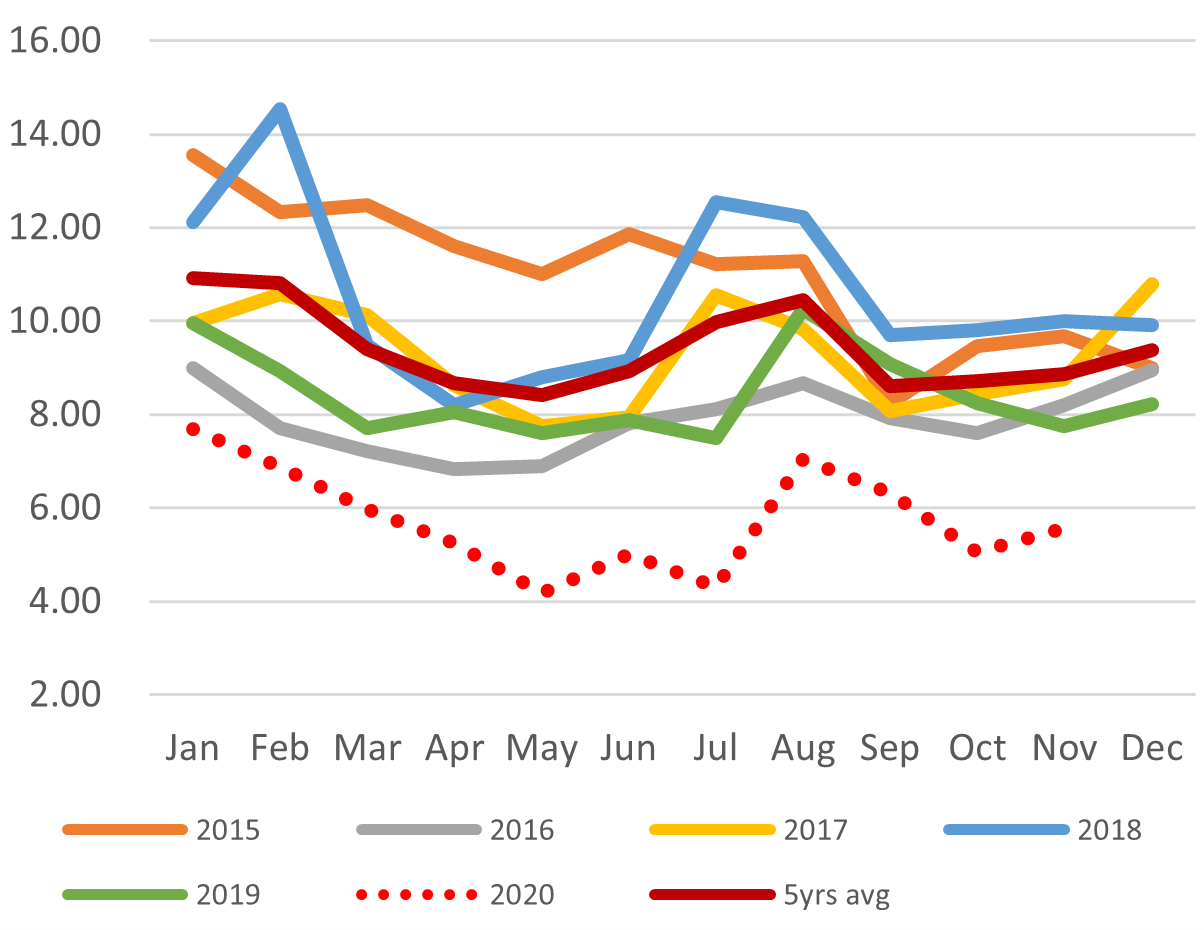
Spot Electricity Prices (2020)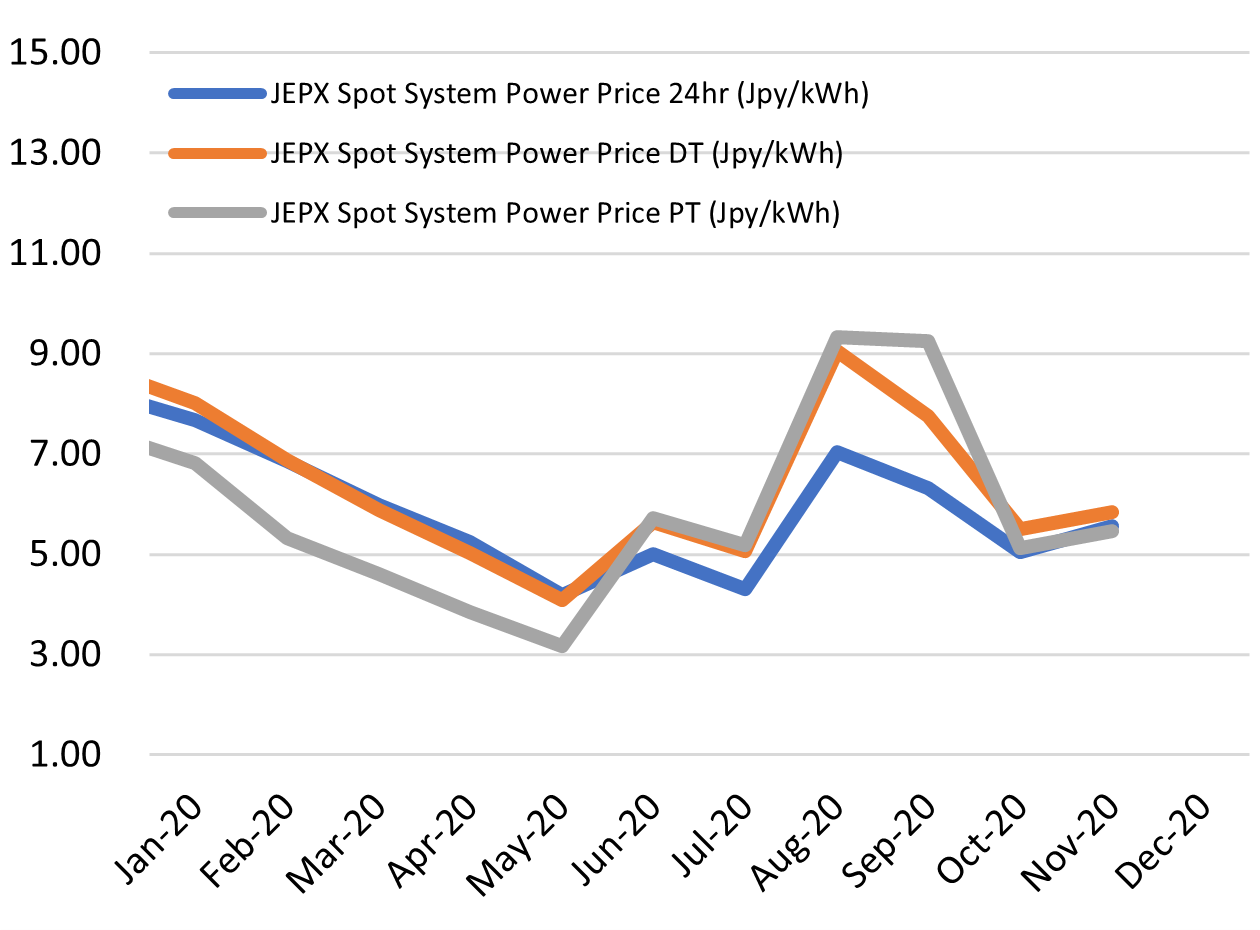
Japan bets that hydrogen will be main fuel in 30 years, sets annual target of 10 million tons
(Nikkei Shimbun, Dec. 8)
- Japanese government has doubled down on its bet that hydrogen will become the main alternative to fossil fuels in the future. The govt. is looking at setting a target of burning 10 million tons of hydrogen a year by 2030, with as much as 10% of the country’s power mix to be allocated to the fuel.
- Japan sees its hydrogen target able to displace the equivalent of 30 nuclear reactors.
- Solar, wind and other renewable energy sources are seen as important, but due to their weather dependence the govt. wants to find another power source to balance the energy mix. Also, hydrogen could be used at existing thermal power plants after upgrades.
- CONTEXT: Hydrogen technically can be produced with green energy and it does not emit when burned.
- The govt. believes excess power generated from renewables could be used to power the manufacture of hydrogen.
- A barrier to wider use is the high cost, which on a cubic-meter basis is seven times more expensive than LNG.
- Hydrogen would be both used in transport, via fuel cell vehicles, and as a fuel in electric power stations.
- Major power generators and heavy industry, such as steelmakers, say hydrogen cost must come down before they can switch to it.
- CONTEXT: Japan’s Kawasaki Heavy Industries is developing the world’s first hydrogen carrier ship. The gas would be transported in liquid shape. Commercial hydrogen carriers are still about 10 years away.
- CONTEXT: Japan’s Iwatani and Kansai Electric utility plan by 2025 to commercialize ships powered by hydrogen.
- Another option for hydrogen is as an electricity storage system. Toshiba has technology that converts electricity to hydrogen, which can be stored or transported until the gas is later converted back to electricity. This could be complementary for renewable power.
- SIDE DEVELOPMENT
Japan says 10-million-ton output level would lower hydrogen price to that of LNG
(Nikkei Shimbun, Dec. 8)- Currently, hydrogen costs are around ¥100 per 1 N cubic meter. For the same amount of energy via LNG, the cost is about ¥13.
- Should production levels of hydrogen reach 10 million tons, the price will fall to the same level as LNG, according to the Japanese govt.
- The cost cutting will be achievable in the 2030s.
- SIDE DEVELOPMENT:
Japanese Manufacturers join forces to promote hydrogen
(TV Asahi News, Dec. 7)- A consortium of 88 companies, including Toyota, formed the Hydrogen Value Chain Promotion Council, which will lobby the government to boost hydrogen usage.
- Members of the association, shortened as JH2A, include hydrogen supplier Iwatani, ENEOS, Kawasaki Heavy Industries, Kansai Electric, Kobe Steel, Toshiba, Mitsui & Co.and Japan’s three biggest banks — Sumitomo Mitsui Financial Group, Mizuho Financial Group and Mitsubishi UFJ Financial Group.
- The consortium plans to submit a proposal to the government in February 2021 on how to boost demand, stimulate investment, and create supporting policies for hydrogen use.
- At present, the high cost of hydrogen and strict regulations on its handling mean there is little demand for the fuel.
- JH2A would like to create a new system of indirect finance into hydrogen projects backed by the government, or a scheme to attract green investments from institutional investors. The JH2A plans to set up and manage a fund to enact this financing.
Japan’s Green Growth Strategy picks 15 key areas with focus on offshore wind
(Yomiuri Shimbun, Dec. 10)
- The government published its “Green Growth Strategy” on Dec. 9 that outlines some of the paths the nation can take to achieve net-zero greenhouse gas emissions by 2050.
- As part of the plan, the government designated 15 priority areas, one of which is offshore wind power generation. The govt. wants the country to install between 30 GW and 45 GW of offshore wind power by 2040. The current target is to build 10 GW of offshore wind capacity by 2030.
- The Green Growth Strategy will be discussed at an inter-ministerial panel of experts before being finalized by the government at the end of the year.
- For each of the 15 priority fields, the govt. will outline targets and necessary actions to support R&D, trial projects and widespread adoption.
- In offshore wind, Japan plans to speed development by making sure local companies can join the supply chain, thus raising the level of domestic procurement of components to 60%.
- A floating offshore wind system is slated for commercialization in Japan in the 2030s.
- The cost of hydrogen production should be one-fifth of current levels by 2050, according to the Strategy.
- In nuclear, Japan aims to safely restart current reactors while also working on next-generation nuclear tech, such as small modular reactors.
- The Strategy also applies targets to non-energy areas, such as agriculture, fisheries and housing.
- SIDE DEVELOPMENT:
Cabinet approves ¥15 trillion ($144b), five-year plan to boost infrastructure
(Kyodo News, Dec 12)- The five-year plan, starting in April, will allocate spending on anti-disaster measures and seek to replace aging infrastructure. The spending will come from the state budget, local govt. and private companies.
- Public works projects include transport, weather forecasting, and energy infrastructure.
Toyota unveils both new fuel cell auto and fuel cell truck
(IT Media Business, Various, Dec. 11)
- On Dec. 9, Toyota started sales of its second-generation fuel cell electric car, the Mirai, which is touted as the world’s first mass-produced FCV (fuel cell vehicle). The new version has an 850-km cruising range, a 30% upgrade.
- It also uses a lithium-ion battery, unlike the previous model which ran on a nickel-metal hydride battery.
- Two days later, Toyota unveiled a new fuel cell truck prototype at an event in the U.S. The Mirai big rig also features a second-generation fuel cell system and offers a much-improved range of 500 km, transporting a 36-metric-ton payload.
- The passenger car has three hydrogen tanks. The fuel is used to generate power for the electric motor. The suggested model retail price is ¥7.1 million, but with domestic subsidies and tax breaks the cost to the consumer should come down by ¥1.4 million.
- Toyota wants to sell 30,000 Mirai FCVs a year. That’s 10 times the sales of the original edition, which was released in 2014.
- In trucks too, FC technology is becoming a strong focus for Toyota. The automaker plans to trial an FC big rig in Japan in early 2022 in conjunction with Asahi Group Holdings and Yamato Transport.
- CONTEXT: Japan had less than 130 hydrogen fueling stations in spring 2020. That’s equivalent to station per 1 million population.
- CONTEXT: Toyota is not the only Japanese automaker with an FCV. Honda has a model called Clarity.
TAKEAWAY: In the current global context, Toyota’s new FCV launches were met with positive reviews, despite most commentators noting that neither the price (close to $60,000) nor the scarcity of refueling stations made it possible to expect mass market appeal. Oddly, the automaker was also gently rebuked by some global media for spending too much time on the passenger vehicle side and not enough on trucks, which the media say are a better fit for FC tech.
Still, there are several factors to consider. Toyota surely sees its FCV sales being led by China, rather than Japan, and hence even the passenger model will likely be a strong commercial success. Toyota has been supporting FCV development in China for years, sharing some of its technology too. China has said it wants to bring sales of FCVs to 1 million in the next decade.
As reported in previous editions of Japan NRG, Toyota is equally throwing its weight behind heavy truck FC development. The company said on Oct. 6 that together with partner Hino Motors it will develop a Class 8 fuel cell electric truck for the North American market – and a first trial will take place in 1H21.
The challenge for Toyota will be to manage FCV development, especially on the supporting infrastructure side, while remaining competitive and competing in EVs, which is the current go-to favorite in non-gasoline vehicles. So far, it has been far behind Tesla, Chinese rivals and even Volkswagen. This may change by the middle of the decade. See our deep-dive on Japan’s next-generation batteries developments in the Analysis section of this report.
Beyond Toyota, Japan is also working on hydrogen ships, trains and airplanes, although all are in early stages of development. This shift to hydrogen has the backing of the Japanese government.
Toyota to debut next-generation EV battery as early as 2021
(Nikkei, Dec. 10)
- The new solid-state lithium-ion battery will charge from zero to full in 10 minutes and offer 500 km cruise range on one charge. That is twice the power of current EV batteries.
- Commercial application of the new battery due in “early 2020s.”
- Toyota has over 1,000 patents in solid-state battery tech.
- Toyota’s supply chain for the batteries includes Mitsui Mining and Smelting, also known as Mitsui Kinzoku, and oil major Idemitsu Kosan, for solid electrolytes, and Sumitomo Chemical for the sulfides that go into solid electrolytes.
TAKEAWAY: This battery tech is described as a massive game-changer for Electric Vehicles. See our Analysis section for a deep-dive on what Toyota, and more broadly Japan, is doing to win the race in next-generation batteries.
Japan aims to bring total lifetime auto emissions down to zero
(Nikkei Asia, Dec. 11)
- The government plans to launch another net-zero emissions initiative by 2050: making all the manufacture and running of cars on renewables only.
- Prime Minister Suga’s govt. believes that reducing the industry’s carbon footprint via a move to electric vehicles is not enough. Japan must strive to cut greenhouse gases produced during the entire life cycle of a car.
- While EVs emit no carbon, producing them and their batteries generates nearly twice as much carbon dioxide as making gasoline autos.
- SIDE DEVELOPMENT:
Tokyo Governor pledges to beat Japan’s electric vehicle goal by 5 years
(NHK, Dec. 8)- Gov. Koike Yuriko pledges to lead Japan in transition to hybrids and EVs
- Koike says Tokyo will ban sale of new gasoline-only powered cars by 2030, which is 5 years earlier than the national target proposed by METI.
- Koike also set the goal of eliminating new sales of gasoline-powered motorcycles by 2035.
- CONTEXT: Tokyo authorities do not have the power to enforce such a rule. The city officials said they will “request” that companies comply with its policy. There will be no penalties.
Japan offers 10% tax break for companies investing in green tech
(Nikkei, Various, Dec. 10)
- Tax deductions of 5% to 10% available to companies that can show their investment in goods or processes will lead to a reduction in emissions.
- The ruling party’s committees leading the charge for tax policy revisions.
- The government will make a final decision on what changes and capex would qualify. Current proposals include efforts related to lithium-ion batteries, hydrogen fuel cells, power semiconductor devices for voltage control and wind power equipment. Businesses that invest in the manufacture of green technology such as wind turbines and electric vehicles would also be eligible.
- The approval system would be set up after amending the Act on Strengthening Industrial Competitiveness. The tax policy would be in effect for three years from fiscal 2021.
- SIDE DEVELOPMENT:
Japan aims for ¥1 trillion of green technology exports over the next five years
(Nikkei Shimbun, Dec. 9)- The Ministry of Economy, Trade and Industry (METI) and Nippon Export and Investment Insurance (NEXI) will create a new system that guarantees up to the full amount of losses incurred when Japanese companies export decarbonization technology. This is done to reduce the demand risk for Japanese businesses and to support exports of ¥1 trillion in five years.
- That export amount would be five times higher than exports of renewable energy equipment from Japan in the last six years, according to METI.
- The new scheme would cover the export of equipment for offshore wind power and hydrogen.
- CONTEXT: Trade insurance usually covered losses of up to 90%.
Toshiba consortium to study recycling CO2 to make sustainable jet fuel
(New Energy Business News, Dec. 10)
- A group including Toshiba Energy Systems, Toshiba, Toyo Engineering, Idemitsu Kosan, and airline carrier ANA plan to further research a technology developed by Toshiba that converts recycled CO2 from exhaust gases into sustainable jet fuel.
- Using CO2 separated and recovered from exhaust gases of industrial equipment as a raw material, the group plans to manufacture aviation fuel, powering the process with renewable energy and hydrogen.
- The concept, known as Power to Chemicals (P2C), will be studied all the way from upstream to downstream of the supply chain to jet flights.
Offshore wind developers bemoan lengthy tender process, noting it will increase cost
(Sentaku, December edition)
- Companies and professionals involved in the offshore wind industry are bemoaning the fact that applications for the recently launched tenders in three key areas are open for as long as six months. Just two or three months would have been enough.
- This clearly favors bids from construction firms and related entities, which have no experience in this field. Industry players fear the lengthy auction is one way for the Ministry of Land, Infrastructure, Transport and Tourism to help construction companies.
- Winners of the offshore wind tender will be required to pay a portion on their earnings to local fishery organizations and to use local construction firms. Some wind industry players say this will lead to “piling cash” on the table and ultimately push up the price of power from offshore wind.
Virtual power plants: KEPCO consortium trials multiple storage battery system
(New Energy Business News, Dec. 7)
- A group of 13 energy corporations led by the Kansai Electric Power Company has launched a trial of “resource aggregation” technology that aims to centrally control multiple storage batteries.
- The group is also developing a system that will enable frequency control using domestic Internet connections.
- The trial will determine whether K-LIBRA, a system developed by KEPCO in collaboration with NEC to centrally control storage batteries, is able to control storage resources via a resource aggregation system.
- The trial will run until the end of January.
- SIDE DEVELOPMENT:
Toshiba Energy Systems to offer VPP services on a subscription basis
(New Energy Business News, Dec. 8)- Toshiba Energy Systems has launched two new services aimed at small solar generators that project future output and demand.
- The services harness advanced modelling and incorporate weather forecasts and data on power consumption and solar farm output.
- Plans for the photovoltaic output forecast service start at ¥200,000 per month. The power demand forecast service is priced from ¥400,000 per month.
Erex and ENEOS plan 300 MW biomass-fired power station
(New Energy Business News print edition, Dec. 5)
- Erex and ENEOS have begun an environmental assessment of a biomass fired power station project planned for Niigata.
- The power station would be the world’s first ultra-super critical biomass fired plant, using 600° C steam at over 200 times atmospheric pressure.
- Aiming to be financially self-sufficient, the power station would be Japan’s first renewable project not to utilize the government’s feed-in tariff scheme.
Sumitomo Life invests ¥11 billion in BlackRock real assets renewables fund
(New Energy Business News, Dec. 9)
- Sumitomo Life says it will invest approximately ¥11 billion in a fund to build renewable generation capacity throughout the OECD.
- Aiming to bring about a positive social and environmental impact, while also generating returns for investors, the fund monitors its impact with reference to the United Nations sustainable development goals.
Mizuho joins global group of 30 asset managers that use funds to push net-zero emissions
(Asia Nikkei, Dec. 12)
- Mizuho Financial Group joined a group of 30 asset managers that said its members will commit to achieving net-zero greenhouse gas emissions across their combined $9 trillion portfolio by 2050.
- Mizuho is the only signatory from Japan in the Net Zero Asset Managers initiative, which launched Dec. 11. Other members include France’s Axa Investment Managers and Fidelity International.
- Signatories will urge portfolio companies to reduce carbon emissions through dialogue and their shareholder votes. The group also will seek cooperation from pension funds and other investors, as well as financial authorities, stock exchanges and credit rating agencies.
ENEOS installs solar panels above farmland as solar-sharing takes off
(Nikkei, Dec. 10)
- ENEOS Holdings is one of several corporations venturing into “solar sharing”, in which solar panels are suspended above farmland.
- ENEOS subsidiary ENEOS Innovation Partners has entered into an alliance with the municipality of Shintomicho (Miyazaki prefecture) with the aim of reducing carbon emissions. Solar sharing is one of their initiatives.
- While solar sharing presents challenges due to the difficulty of selecting crops unaffected by the reduction in sunlight, it is gaining popularity due to a lack of sites suitable for conventional large-scale solar farms.
- Solar generation capacity on Japanese farmland is projected to exceed 4 GW by 2030.
ANALYSIS
Needs a Technological Breakthrough in Batteries Within 5 YearsOn Dec. 4, Japan’s prime minister clarified that a major part of the national goal to turn carbon-neutral by 2050 involves domestic automakers meeting new emissions standards and ceasing output of gasoline cars. This now forces Japanese automakers to bring forward the break from gasoline-only vehicles by 20 years to 2030. The shock tactic from Prime Minister Suga means to unleash a furious period of investment and innovation at Toyota Motor, Honda, Nissan and other Japanese makers.
Yet, none of this will matter for the industry that carried the world’s third-largest economy for the last three decades unless Japan succeeds in mastering one key component: next-generation batteries. For that, Japan Inc. has prepared a plan. The problem: it has to be implemented in record time.
Under Japan’s previous emissions targets, the country aimed for a 90% reduction in emissions by 2050 compared to 2010 levels. That allowed automakers to hold off on the shift to hybrid, electric, hydrogen or green fuels until 2050. The Dec. 4 statement by Prime Minister Suga and Kajiyama Hiroshi, the Minister for Economy, Trade and Industry (METI), changed the timeline drastically.
The most intense pressure created by the accelerated timeframe can be seen in the race to develop more effective car battery technology. Electric Vehicles (EVs) – whether they create power from a fuel cell (FCEV), use a gasoline engine for support (Plug-in Hybrid, or PHEV), or run solely on a battery pack (BEV) – all require a battery to drive.
Japan was an early leader in battery technology and made the world’s first lithium-ion battery. However, during the early days of EVs, Japan’s top automaker, Toyota, saw more potential in FCEV technology, which can work with a much smaller battery. FCEVs suck in oxygen and mix it with hydrogen from an on-board tank to create electricity.
This left plucky startups like Tesla to figure out how to make the much larger and more energy intensive car batteries for “pure” electric vehicles, or BEVs.
One way to judge the divergent strategies is to compare the market value of Tesla against that of Toyota. The former is pushing above $600 billion, up 800% YTD. The latter hovers around $100 billion, up just a few percent in 2020. Global sales of EVs this year suggest that the trend may not be easy to reverse. Not a single Japanese auto manufacturer made the Top 10.
However, the Japanese government believes the country’s car makers can catch up. The sense of urgency created by the prime minister is meant to spur Japanese firms to produce commercially viable, next-generation battery technology.
METI has examined a wide range of such potential tech, from zinc air batteries and green diesel fuel, to those that complement hydrogen-fuel cells. In the end, the ministry singled out solid-state lithium-ion batteries as the country’s strategic focus for cars. The goal now is to bring this tech to market within the next five years and popularize it as the global default for the rest of the century.
“The possibility of breakthroughs is now in view,” according to METI documents.
How METI sees the Japan Auto Market by 2030
| Hybrids | 30-40% |
| Battery EVs and Plug-in EVs | 20-30% |
| Fuel Cell EVs | Up to 3% |
| Green Diesel | 5-10% |
| Overall Ratio of Cars that Meet Long-Term Net-Zero Emissions Goal | 50-70% |
Source: METI
WHO IS DRIVING THE CHANGE?
In 2013, the ministry organized LIBTEC, which is a consortium of state agencies, universities and private companies to develop solid lithium batteries. Nobel Prize laureate Dr. Yoshino Akira, one of the world’s leading authorities on lithium-ion batteries, was named chairman of LIBTEC’s board. The New Energy and Industrial Technology Development Organization (NEDO), a METI agency, provided about ¥4.5 billion ($43 million) to fund LIBTEC.
What exactly are lithium solid batteries and what are the advantages? They are enhanced lithium-ion batteries, which is the technology currently employed in EVs. The next-generation battery design has stable chemical properties made possible due to the fact that there are less decomposition processes. This means the new design is not liable to become flammable when exposed to strong heat. Solid lithium batteries offer higher energy efficiency, longer life and improved safety, according to LIBTEC.
LIBTEC said that its goal is to make the sale of solid lithium batteries commercially viable by the mid-2020’s. Next, in the late 2020’s and early 2030’s, the batteries will be positioned as the fundamental standard for all cars.
The project goal is to create batteries that cost one-third of the current price, with an energy intensity that’s three times greater the present level, and which require one-third of the charging time.
The LIBTEC consortium has 32 corporate members from the automotive, battery, battery materials and processing sectors, as well as 15 research organizations. Top members include Toyota, Honda, Nissan, Mazda and Yamaha, while battery makers Yuasa and Panasonic, and battery materials makers Sumitomo Metal Mining and Mitsui Mining and Smelting, are also involved.
Toyota also has its own, separate R&D project in solid batteries. In 2018, the company announced plans to roll out prototypes of solid battery-powered taxis during the Tokyo Olympics. Like the LIBTEC project, Toyota’s timeframe for a mass rollout of solid-state batteries is around 2025. The battery upgrade will be key for Toyota in overturning the current lag in global EV sales volumes compared with U.S. Chinese, and German rivals.
On Dec. 10, the Nikkei ran a scoop that suggested Toyota’s new battery might be ready as soon as 2021 (see the News section for details). However, 2021 seems to refer to a prototype launch. Mass production is likely to materialize closer to the original 2025 timeline.
Tesla and another U.S. firm backed by Volkswagen are also racing to create the world’s first solid battery-powered car.
Japanese patent applications for solid batteries accounted for 54% of the global share from 2014-2018, according to an International Energy Agency survey.
Patent disputes on electric vehicles and battery technology are also rising and could disrupt the R&D process.
This year, Sharp filed a complaint in a German federal court against automaker Daimler for violating its Long-Term Evolution (LGT) wireless communication patent. The automaker argued that the technology was standard. The German court did not agree, ruling in favor of Sharp.
Sharp has filed a similar suit against Tesla this year, asking Tokyo District Court to suspend Tesla car sales in Japan.
FORECASTS FOR 2021 DEVELOPMENTS
Automakers have complained that escalating licensing fees, including for patents not relevant to batteries, could constrain vehicle development. Still, Japan NRG expects that 2021 will be a landmark year for Japan’s solid-state lithium battery sector.
Condenser manufacturer Murata plans to launch commercial production of solid cells for wearable health gadgets during Q1. Lithium-ion batteries cannot be used in wearables due to their flammable properties, a Murata spokeswoman told Japan NRG.
Whereas Murata batteries are intended for smaller devices, the batteries in EVs need to use lithium sulfide. In the first quarter of 2021, oil refiner Idemitsu will launch commercial production of lithium sulfide ions for solid batteries.
The government plans to further accelerate R&D with tax breaks. Lithium batteries were listed as one of the initiatives that will be eligible for the mass tax incentives unveiled by Prime Minister Suga on Dec. 7.
Japan may have slipped behind in automotive tech of late. Suga’s 2050 emissions pledge means there is now more than car sales at stake in this race. Carbon neutrality in the auto sector has become a national strategic goal.
NET-ZERO POLICY DIRECTORY: PART II
Who Is Driving the Decarbonization Agenda and Policy in Japan?
Last week we published the first part of our deep-dive into which policy makers from the public and private sectors are compiling the agenda and pathways for Japan to move toward its 2050 net-zero emissions goal. After introducing the key committees and other groupings under the umbrella of METI, this week in our Part II we present the other entities operating under various ministries, state organs and political and business lobby groups.
Note 1: some of the panels/councils below also have working groups attached to them and where information is readily available it is included in the “Related” line item.
Note 2: cross-ministry groups are highlighted in dark red
MINISTRY OF THE ENVIRONMENT (MoE)
| Name | Central Environment Council (CEC) 中央環境審議会 |
| Related | Mandated by Environment Law and has 9 sub-committees. The key ones include the Long-Term Vision on Low Carbon Society Sub-Committee and the Study Group on Systems to Promote Global Warming Measures. These two are in described in the following two boxes. |
| Mission | To research and advise on policies related to environment, including water, air, recycling, pollution. Established in January 2001. |
| Members | Chaired by Takeuchi Kazuhiko, professor at Tokyo University and deputy chairman of Science Council of Japan. Has 30 members with a two-year tenure for each. The Long-Term Vision on Low Carbon Society Sub-Committee has 18 members, comprised of academics and representatives from the power and steel associations. |
| Status | Convenes a large meeting at least once a year |
| Name | Global Environmental Measures / Long-Term Vision on Low Carbon Society Sub-Committee, a Joint Working Group 中央環境審議会地球環境部会中長期の気候変動対策検討小委員会・産業構造審議会産業技術環境分科会地球環境小委員会地球温暖化対策検討ワーキンググループ |
| Related | MoE’s Central Environment Counci (CEC) and METI’s Industry Structure Council (ISC) |
| Mission | To review global warming measures in line with Japan’s international commitment and to set ambitious decarbonization goal metrics |
| Members | Chaired by Yamaji Kenji, Director-General of RITE. The eight other members include representatives from the Japan Chamber of Commerce and Industry, Japan Iron and Steel Federation, Development Bank of Japan, Keidanren, media, environment research institutes, and academia |
| Status | Met for the first time in September 2020. METI delivered a presentation on energy policy and MoE made a presentation on GHG goals and action plan.. |
| Name | Study Group on Systems to Promote Global Warming Measures中央環境審議会 地球環境部会 中長期の気候変動対策検討小委員会 |
| Related | |
| Mission | Design frameworks to align with The Law for Promoting Global Warming Measures enforced in 1998. |
| Members | Chaired by of Otsuka Tadashi of Waseda University, a specialist on global warming and waste recycling legal issues. 8 members from universities and research institutes. METI is an observer. |
| Status | First met in November 5, 2020. |
| Name | Study Group on Promoting “Green Taxation”税制全体のグリーン化推進検討会 |
| Related | |
| Mission | To assess the effectiveness of current “green taxes” and develop future policies on taxation |
| Members | Chaired by Jinno Naohiko, President of Japan College of Social Works. 8 members from academia |
| Status | Meets several times a year, most recently in July 2020 |
| Name | High Level Meeting on ESG FinanceESG 金融懇談会 |
| Related | |
| Mission | Spreading ESG awareness in the financial community and making recommendations to the government on necessary steps |
| Members | 20 members from banks, security brokers, insurance associations, academics, think tanks and the stock exchange. METI, FSA and BoJ are observers. |
| Status | Last met in June 2018 |
| Name | Cool Choice Promotion Team「COOL CHOICE」団結 |
| Related | A campaign platform inside of the ministry |
| Mission | To promote low-carbon lifestyles |
| Members | Led by the Ministry of the Environment. 14 members including media, labor union, Japan Federation of Economic Association, Japan Association of New Economy, Sogo department store, Watami bar chain. |
| Status | Last met in November 2019 |
| Name | Study Group on Carbon Pricingカーボンプライシングのあり方に関する検討会 |
| Related | |
| Mission | Collects opinions from experts and businesses on carbon pricing as a way to reduce emissions, while looking for resolutions for various socioeconomic issues that arise from this. |
| Members | Chaired by Jinno Naohiko, President of Japan College of Social Works. Jinno chaired several tax councils at the Ministry of Finance and Ministry of Internal Affairs and Communications. Other details of membership unknown. |
| Status | Last released a report in March 2018 |
| Name | Study Group of Experts on Facts Surrounding Government Support for Coal Power Plant Exports石炭火力発電輸出への公的支援に関する有識者ファクト検討会 |
| Related | This is a little more than just another study group as it was pointedly ordered and created by Environment Minister Koizumi himself. |
| Mission | Compiling a fact book that details what is being done on the topic overseas in terms of financing, technology, costs analysis and responses to climate changes |
| Members |
Chaired by Takamura Yukari, a professor at the University of Tokyo, who focuses on environmental conservation measures and international law in the environmental field. The group has 6 members. Others represent Bloomberg LP, Mitsubishi UFJ Morgan Stanley Securities, consultancies, academia. Takamura actively speaks to the media, also sits in the METI working group to assess power transmission operators. Environment tax law specialist: Prof Takamura  |
| Status | First met in April 2020 and published the Fact book in May |
MINISTRY OF LAND, INFRASTRUCTURE, TRANSPORT AND TOURISM (MLIT)
| Name | Council for Social Infrastructure社会資本審議会 |
| Related | Sub-committee on climate change and water related disaster measures |
| Mission | Designs Japan’s disaster prevention systems to cope with climate change |
| Members | 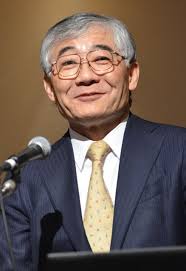 Headed by Koike Toshio, the head of The International Centre for Water Hazard and Risk Management. Well known for having overhauled dam-based water control systems and introduced the micro flood control systems. 20 members, mostly academics.Water resources specialist: Prof Koike |
| Status | Meets almost monthly |
| Name | Technology Study Group on Flood Control amid Climate Change 気候変動を踏まえた治水計画に係る技術検討会 |
| Related | |
| Mission | Determines methodologies to revise flood control parameters and plans |
| Members | Headed by Koike Toshio, the head of The International Centre for Water Hazard and Risk Management. 13 members, mostly university scholars. |
| Status | Meets two-three times a year |
| Name | Study Group on ESG for Real Estate
ESG不動産投資のあり方検討会 |
| Related | |
| Mission | Designs framework to advance ESG principles in real estate transactions |
| Members | Headed by Nakagawa Masayuki, Nihon University professor. 7 members, comprised of university scholars and urban planning consultants. |
| Status | Established in February 2019, has met four times |
| Name |
Study Group on the Role of Blue Carbon in Measures against Global Warming
|
| Related | |
| Mission | Integrating blue carbon into emission reduction plans, promoting blue carbon |
| Members | No chair appointed. 7 members, comprised of research institutes for ocean and port infrastructures, an NPO, Mitsubishi UFJ Research and Consulting, MAAF, Ministry of Environment, and observers from Fukuoka and Yokohama cities. |
| Status | Established in September 2020, meetings open to public |
| Name |
Study Group on De-carbonizing Large Motor Vehicles
|
| Related | |
| Mission | Identifying issues in decarbonizing trucks and buses and how to resolve them |
| Members | Headed by Daisho Yasuhiro, Waseda University professor. 12 members, academics and motor vehicle industry association representatives. METI, Ministry of Environment are observers. |
| Status | Established in November 2019, meets once 2 months |
MINISTRY OF AGRICULTURE, FORESTRY AND FISHERIES (MAAF)
| Name | Study Group on Carbon Traceability of Food Supply Chain
「フードサプライチェーンにおける脱炭素化の実践とその可視化の在り方検討会 |
| Related | |
| Mission | Making food supply chain traceable, on the basis of TFCD recommendations |
| Members | No chair appointed. 10 members, food retailer Aeon, food makers Nippon Ham, Kagome, academics, associations. Secretariat run by Deloitte Tohmatsu Consulting and Sumpo. |
| Status | Group first met in September 2020, group’s role terminates on March 31, 2021 |
MINISTRY OF EDUCATION, CULTURE, SPORTS,
SCIENCE AND TECHNOLOGY (MEXT)
| Name |
Study Group on assessment of energy and environment technologies that have future potentials
|
| Related | |
| Mission | Assess potentials of emerging technologies, their development bottlenecks, and demand for them |
| Members | Jointly headed by relevant senior officials at METI and MEXT. Six members are from academia. Ministry of Environment, the Cabinet are observers. |
| Status | Published a report in June 2019 |
PRIME MINISTER’S OFFICE (KANTEI)
| Name | Headquarters for Measures to Prevent Global Warming地球温暖化対策推進本部 |
| Related | Founded based on the Law to Prevent Global Warming, enacted in 1998 |
| Mission | Coordinate relevant ministry actions in the long-term fight against climate change |
| Members | Headed by the prime minister, and three deputies: Chief Cabinet Secretary, Environment Minister and METI minister. Members are limited to minister-level. |
| Status | Has met 42 times to date |
THE CABINET OFFICE (NAIKAKUFU) /
MINISTRY OF FINANCE (MOF)
| Name | Research Commission on Tax Systems税制調査会 |
| Related | |
| Mission | Reviews new tax systems including a potential carbon tax, as well as taxation procedures |
| Members | Chaired by Nakazato Minoru, Tokyo University professor. Has 20 regular members mostly scholars and media, and 20 extraordinary members including various industry representatives. |
| Status | Active |
| Name | Special Team to Promote Wider Use of Renewable Energy*再生エネルギー拡大へ特別チーム* |
| Related | Operates as a task force. |
| Mission | Promote wider use and acceptance of renewable energy and other sources |
| Members | Administrative Reform Minister Kono announced in November that he plans to set up this “Special Team” to inspect regulations across multiple ministries and local governments and encourage necessary revisions in order to expand the introduction of renewable energy. The Team would work toward fulfillment of the net-zero 2050 goal. Kono plans to lead the team, which will consist of four people, including Obayashi Mika, director of the Renewable Energy Institute, Takahashi Hiroshi, an academic, and two ex-METI officials who now run private consultancy businesses. |
| Status | Held first meeting on Dec. 1, 2020, at which the discussion centered on the capacity auction market. |
*Proper name not yet known.
SCIENCE COUNCIL OF JAPAN
| Name | Long Life and Decarbonization Sub-Committee of Environment Committee長寿社会における脱炭素健康住宅への道筋 |
| Rank | Mainly a promotional campaign, but also a policy recommendation tool |
| Mission | Review household energy consumption and other items to realize the goal of low-carbon society while making sure people can enjoy a long life |
| Members | Chaired by Tanabe Shinichi, Waseda University professor. 12 members, academics. |
| Status | Launched in March 2018, meets three-four times a year |
LIBERAL DEMOCRATIC PARTY
| Name | 2050 Decarbonization Promotion Headquarters2050年の脱炭素社会実現へ 党推進本部 |
| Rank | |
| Mission | Coordinates decarbonization plans that across all of the party units / entities |
| Members | Headed by party secretary general Nikai Toshihiro. |
| Status | Inaugural meeting was held on Nov. 10, 2020. The group swiftly moved to put together recommendations for energy policy and present them to Prime Minister Suga on Dec. 4. These mainly noted that nuclear should play a role alongside renewable energy, and that hydrogen and CO2 recycling were other key technologies to enable decarbonization. One of its recommendations, specifically the setting up of a state-backed fund to support green tech R&D has already been taken up and announced by Suga, as reported in last week’s edition of the Japan NRG. Other measures like tax-breaks and financial incentives to accelerate green investments are also coming through national government policy. Two more areas that the LDP’s Decarbonization HQ wants to promote are aid to municipalities for local decarbonization initiatives and the rebuilding / rejuvenation of forests via promotion of more wooden construction. |
| Name | Economic Industry Research Group経済産業部会提言、政務調査会 |
| Rank | |
| Mission | Publish policy recommendations on emerging economic issues from Abenomics to decarbonization |
| Members | |
| Status | Since March, the Group held study sessions on the three themes of autonomous driving, the aircraft industry, and the service industry, and summarized its policy recommendations that were then delivered to Suga. |
| Name | Committee for Environment Groups環境関係団体委員会 |
| Rank | An official division of the party |
| Mission | Coordinate environmental policy within the party |
| Members | Chaired by Miki Toru, an Upper House lawmaker and former vice-minister for Finance. Five deputies listed in the committee. |
| Status |
BUSINESS LOBBY GROUPS
KEIDANREN
| Name | Environment Safety Committee環境安全委員会 |
| Rank | |
| Mission | |
| Members | Co-chaired by Sugimori Tsutomu, ENEOS Holdings chairman, Kobori Hideki, Asahi Kasei president, Noda Yumiko, Veolio Japan chairman. |
| Status |
JAPAN CHAMBER OF COMMERCE AND INDUSTRY
| Name | Energy and Environment Committee エネルギー・環境委員会 |
| Rank | |
| Mission | |
| Members | |
| Status |
JAPAN ASSOCIATION OF CORPORATE EXECUTIVES
| Name | Committee on Environment, Resources and Energy 環境・資源エネルギー 委員会 |
| Rank | |
| Mission | Propose new strategies and goals for climate change, environment and energy issues. Examine solutions and make proposals to the international community. |
| Members | Co-chaired by Accenture advisor Hodo Chikatomo and Value Management Institute chair person Kurihara Mitsue. |
| Status |
GLOBAL VIEW
Below are some of last week’s most important international energy developments monitored by the Japan NRG team because of their potential to impact energy supply and demand, as well as prices. We see the following as relevant to Japanese and international energy investors.
Pipelines:
Gazprom resumed work on the remaining 160km of the Nord Stream 2 pipeline that will transport natural gas across the Baltic from Narva Bay in Russia to Greifswald in Northern Germany. The pipeline’s end point is in Chancellor Merkel’s home constituency in the State of Mecklenburg-Vorpommern. The pipeline is expected to cost Gazprom more than $11 billion.
Carbon Prices:
The EU Emissions Trading System recorded its highest price in 14 years last week hitting $37 per ton of CO2 following the announcement by the EU bloc that it will reduce carbon emissions 55% by 2030.
Carbon Emissions:
The Global Carbon Project, an international group of scientists, forecasts a YoY 7% decline in 2020 of global C02 emissions, a drop of 2.4 billion metric tons.
ESG:
1). Several activist funds, including D.E. Shaw, have taken ownership positions in Exxon’s stock in an attempt to force the oil company to reduce exploration and production activities.
2). Asset managers controlling $9 trillion of assets have set 2050 as the deadline for achieving net zero carbon emissions across their portfolios. Asset Management One, a major Japanese institutional investor, is among those having already made this commitment.
Paris Agreement – 5th Anniversary:
The UK, France and the UN co-hosted a Climate Ambition Summit on Dec. 12 to mark the Paris Agreement’s fifth anniversary. UN Secretary General Guterres called for governments to declare ‘a state of climate emergency’, warning that temperatures could rise by 3 Celsius this century. At least 24 countries announced new commitments to reach carbon neutrality, with some ambitious dates to reach net zero: Finland by 2035, Austria by 2040 and Sweden by 2045.
Pakistan announced it is scrapping plans for new coal power plants, and India will double its renewable energy target. China committed to increasing the share of non-fossil fuel in primary energy consumption to around 25% by 2030. Australia and Brazil were among the countries not invited to address the conference.
China:
China is stepping up its energy investments in Iraq and is expected to provide several billion dollars of credit facilities that may be repaid in oil. Chinese energy companies may also acquire Exxon’s 30% stake in the West Qarna oilfield in South-Eastern Iraq near Basra.
Malaysia:
Petronas made its first oil discovery in Suriname, South America with the successful drilling of an offshore exploration well in an area north of Paramaribo, the capital city.
Australia:
A Perth-based company is exploring carbon capture and storage options with various Japan energy companies to inject CO2 emissions into an offshore under-sea injection site in the Indian Ocean.
Turkey:
The EU is drawing up plans to sanction several Turkish individuals over unauthorized natural gas drilling off Cyprus.
Middle East:
1). Abu Dhabi discovered an additional 22 billion barrels of unconventional oil and gas reserves, and has pledged $122 billion of capital expenditure by Abu Dhabi National Oil Company over the next five years.
2). Israel and Morocco agreed to normalize diplomatic ties, with the U.S. recognizing Morocco’s control of the disputed Western Sahara region. This is likely to be disputed by Algeria, a major global natural gas supplier. Ten Japanese JGC employees were killed in a terrorist attack at a natural gas facility in Eastern Algeria eight years ago.
Africa:
President Trump ordered the withdrawal of all 700 U.S. troops from Somalia five days before the Biden inauguration. The Japanese cabinet approved a one-year extension of its maritime force in the Horn of Africa that helps ensure the safety of oil shipping routes through the Bab-el-Mandeb strait linking the Red Sea with the Gulf of Aden. Japan has a military base in neighboring Djibouti.
EU:
The 27-member bloc increased its collective commitment to reduce emissions from 40% to 55% by 2030. The EU Commission also agreed to a seven-year $1.3 trillion budget for 2021-2027. An additional $900 billion has been established as a Covid-19 recovery fund, and $650 billion of that total will be set aside for green infrastructure. Portugal will assume the EU presidency from Germany on Jan. 1.
Norway:
Norway’ Supreme Court is set to rule in a climate change lawsuit challenging the government’s licensing of new offshore oil drilling in the Arctic region. The decision could, for the first time anywhere in the world, make offshore petroleum production illegal on climate change grounds. Norway is one of the world’s largest exporters of oil and gas. Rystad Energy estimates Norway is the world’s seventh largest exporter of emissions, with the country exporting 10 times more emissions than it generates domestically.
Americas:
1). United Airlines (‘UA’) has announced it will become carbon neutral by 2050. The airline plans to achieve this goal by making investments in carbon capture technology and sustainable aviation fuel. UA will make a multimillion-dollar investment to physically remove carbon dioxide from the air and pump greenhouse gases underground. Funding will go towards the construction of a direct-air carbon capture plant in the U.S. that can extract up to one million tons of carbon dioxide.
2) General Electric was fined $200 million by the Securities and Exchange Commission over reporting and accounting irregularities in its gas-turbine power business.
DATA
Japan Oil Price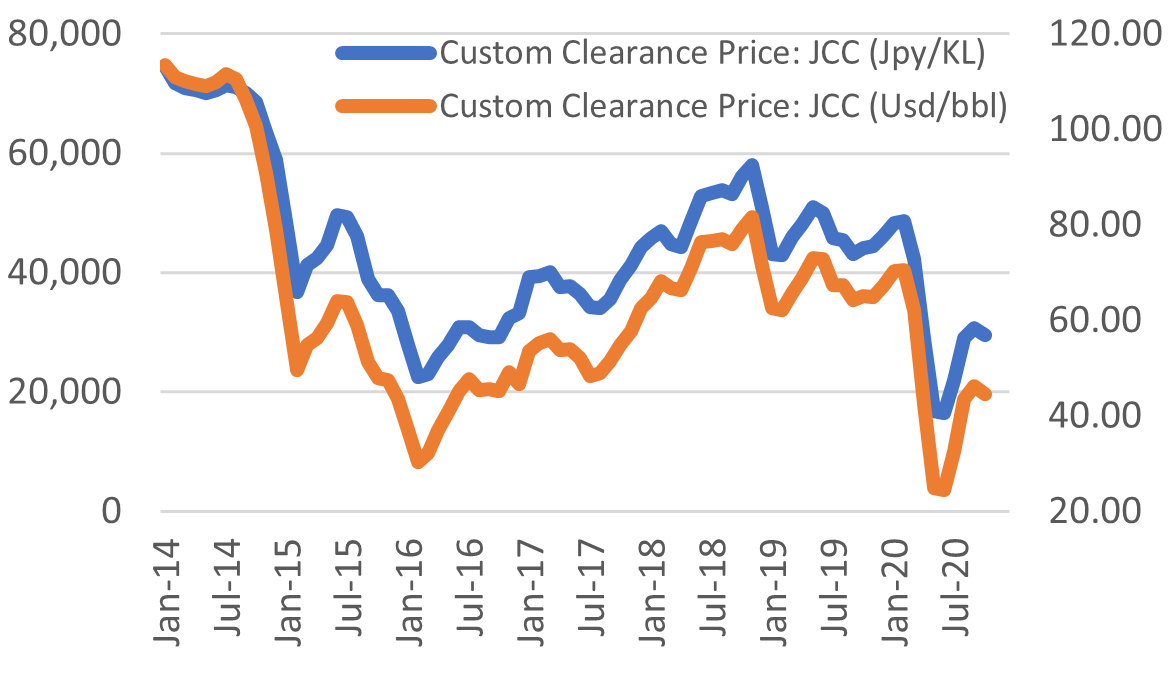
Crude Imports Vs Processed Crude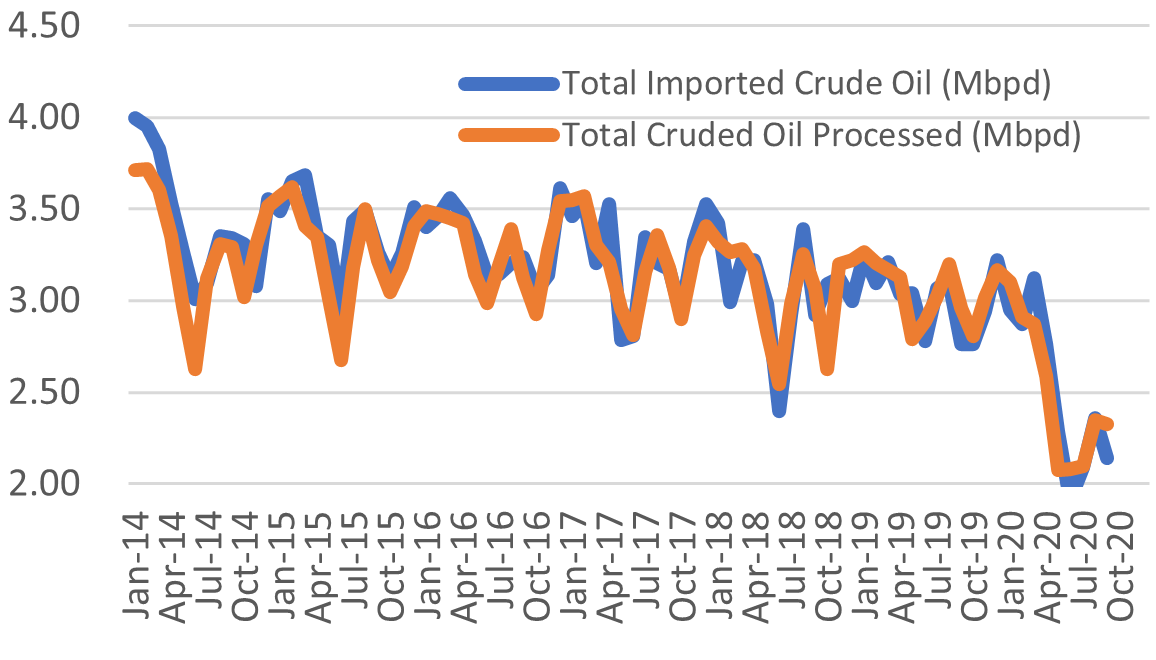
Monthly Oil Import Volume (Mbpd)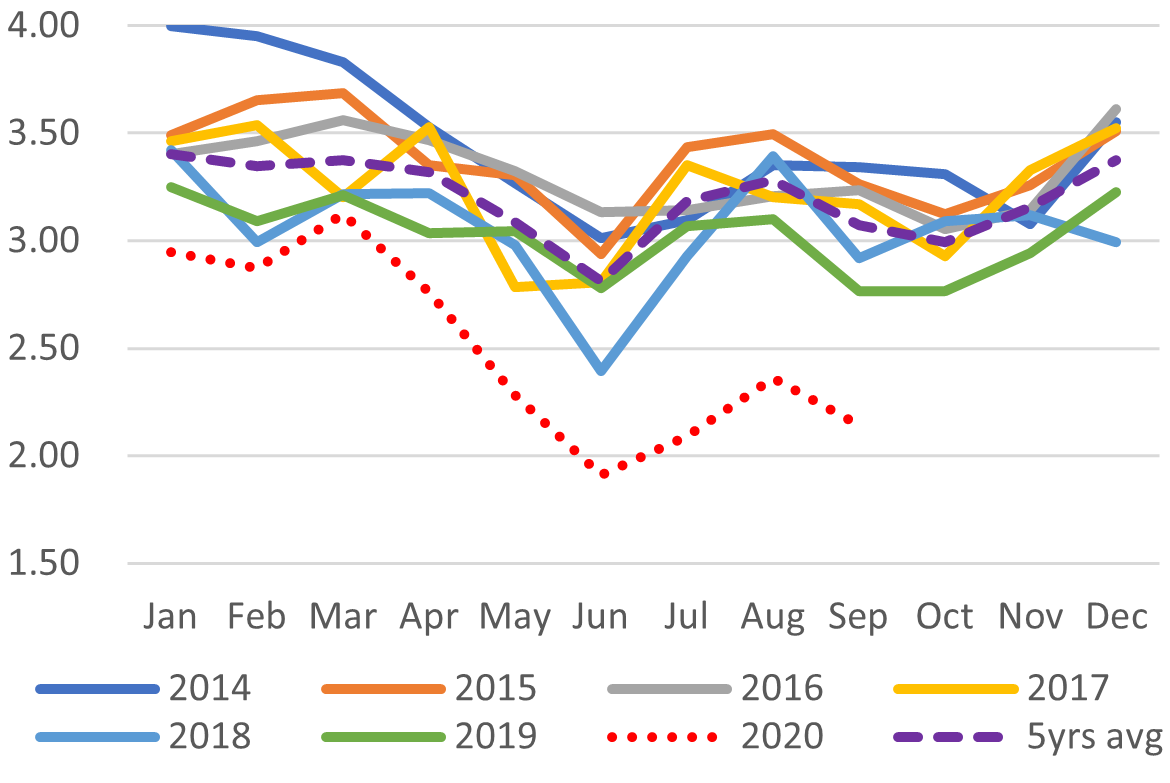
Monthly Crude Processed (Mbpd)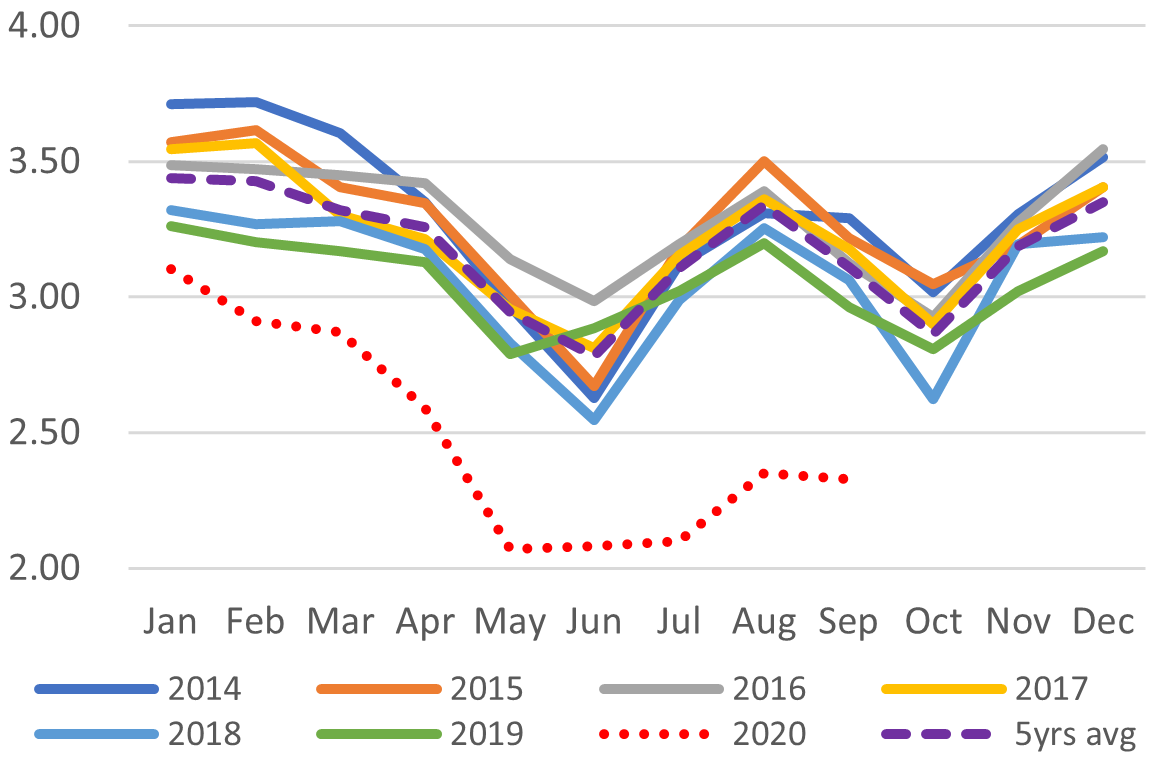
Domestic Fuel Sales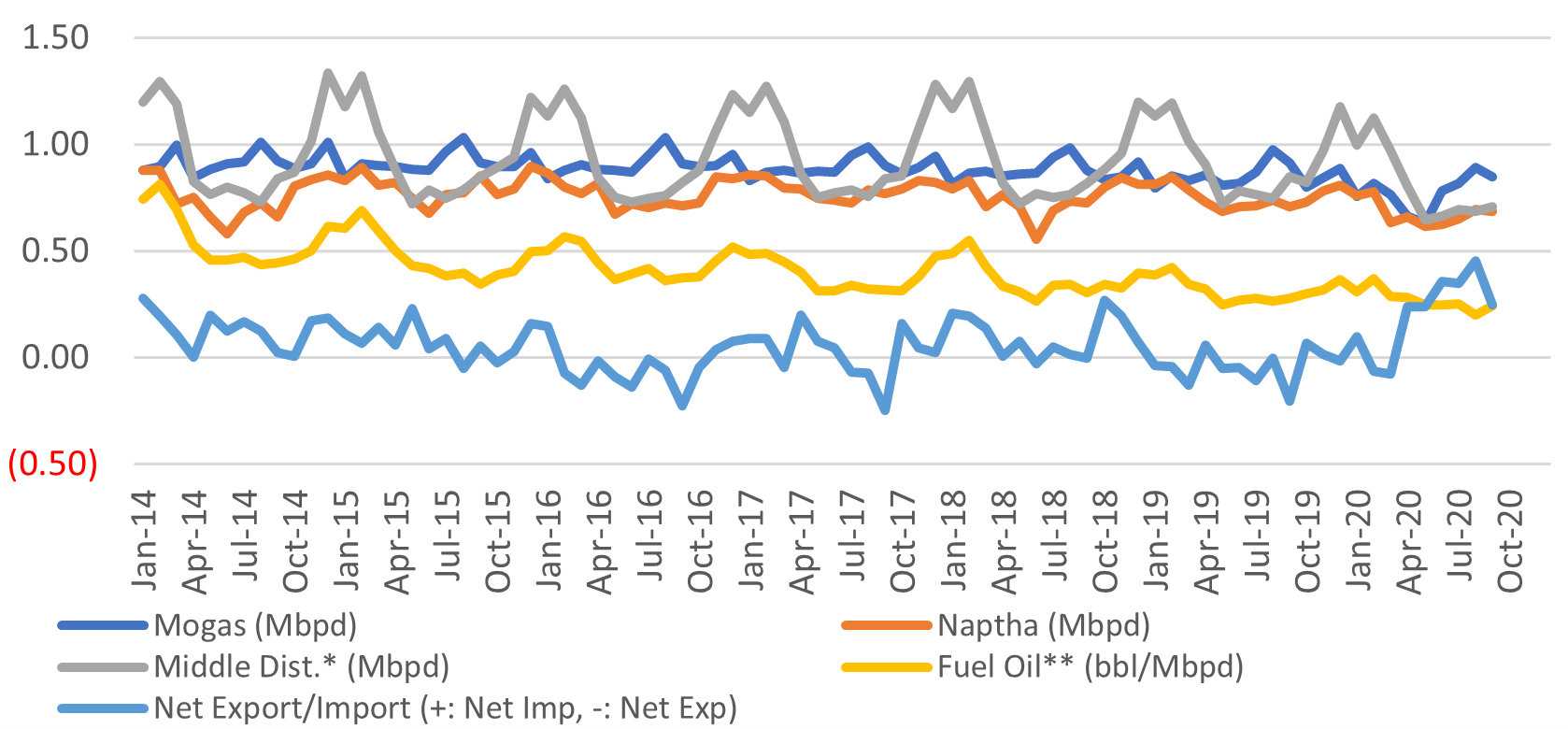
SOURCES: the Ministry of Economy, Trade, and Industry (METI), Ministry of Finance, and the Petroleum Association of Japan
Japan LNG Price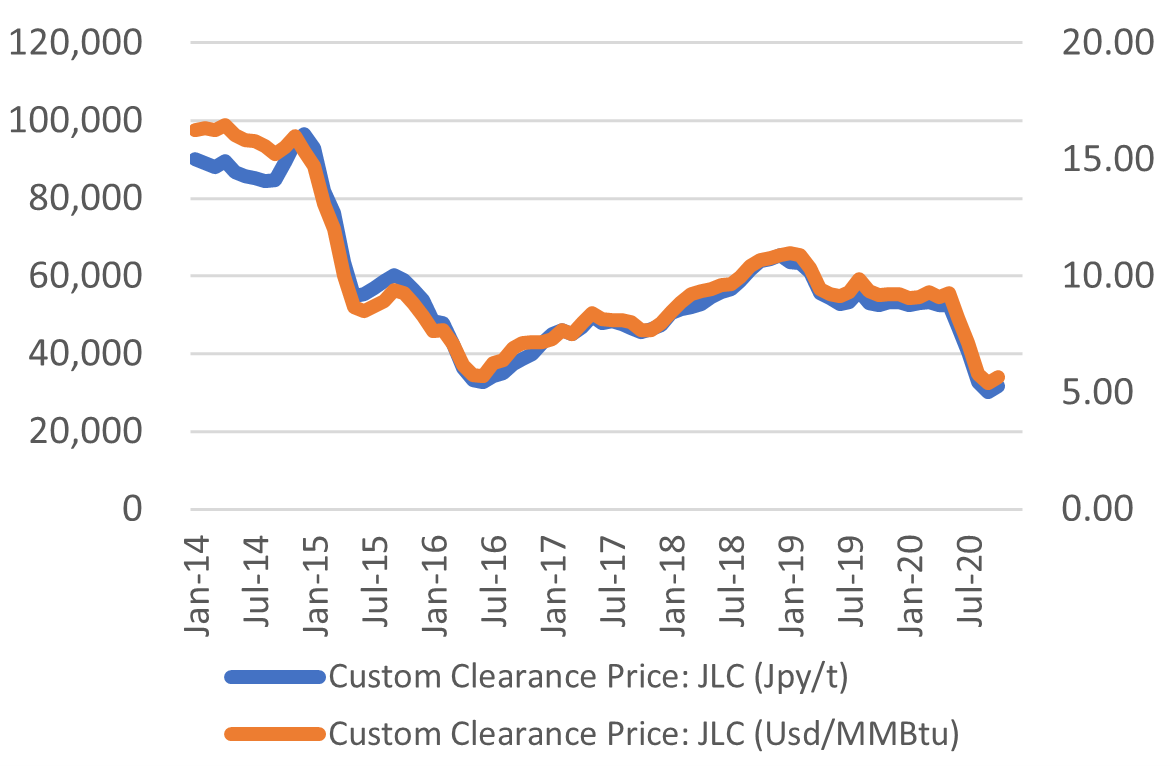
LNG Imports: Japan Total vs Gas Utilities Only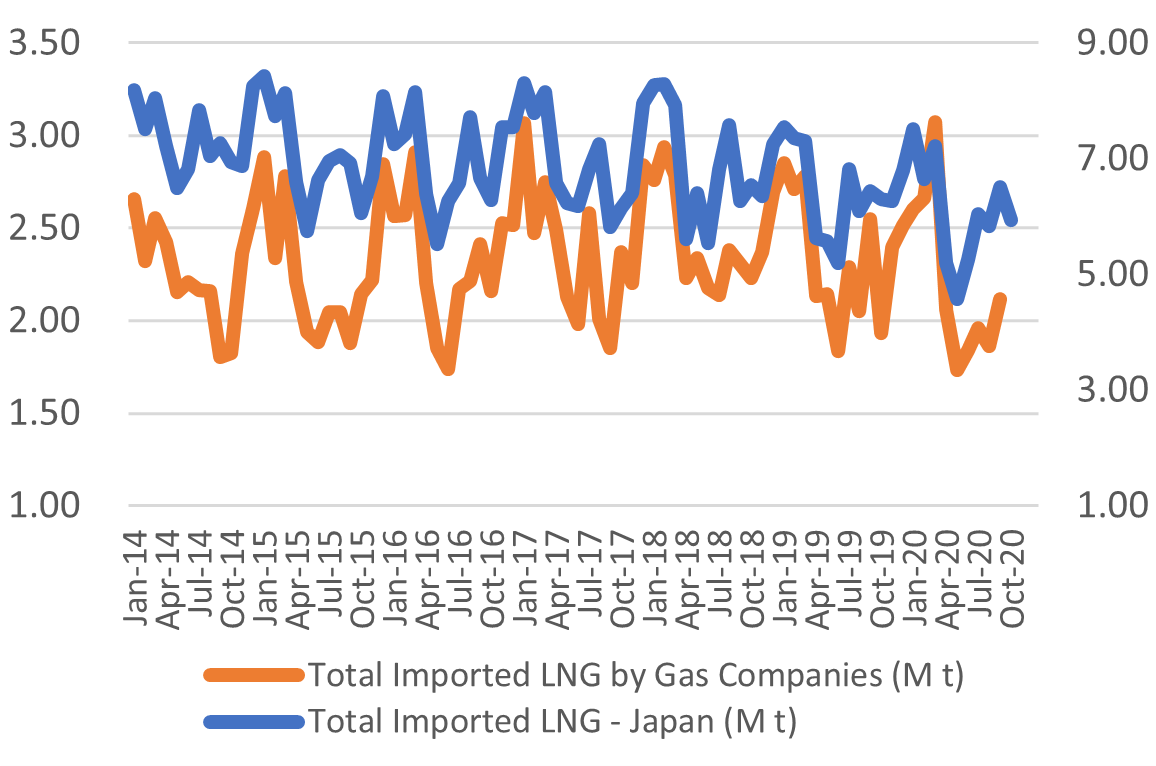
Total LNG Imports (M t)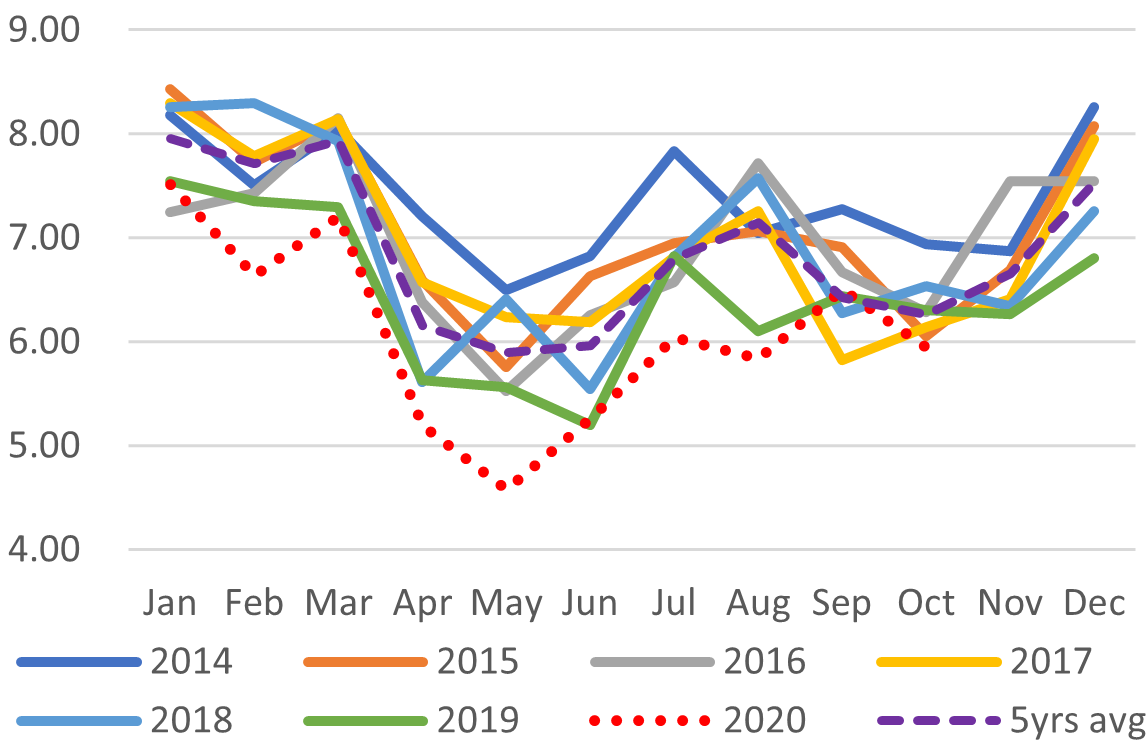
LNG Imports by Gas Firms Only (M t)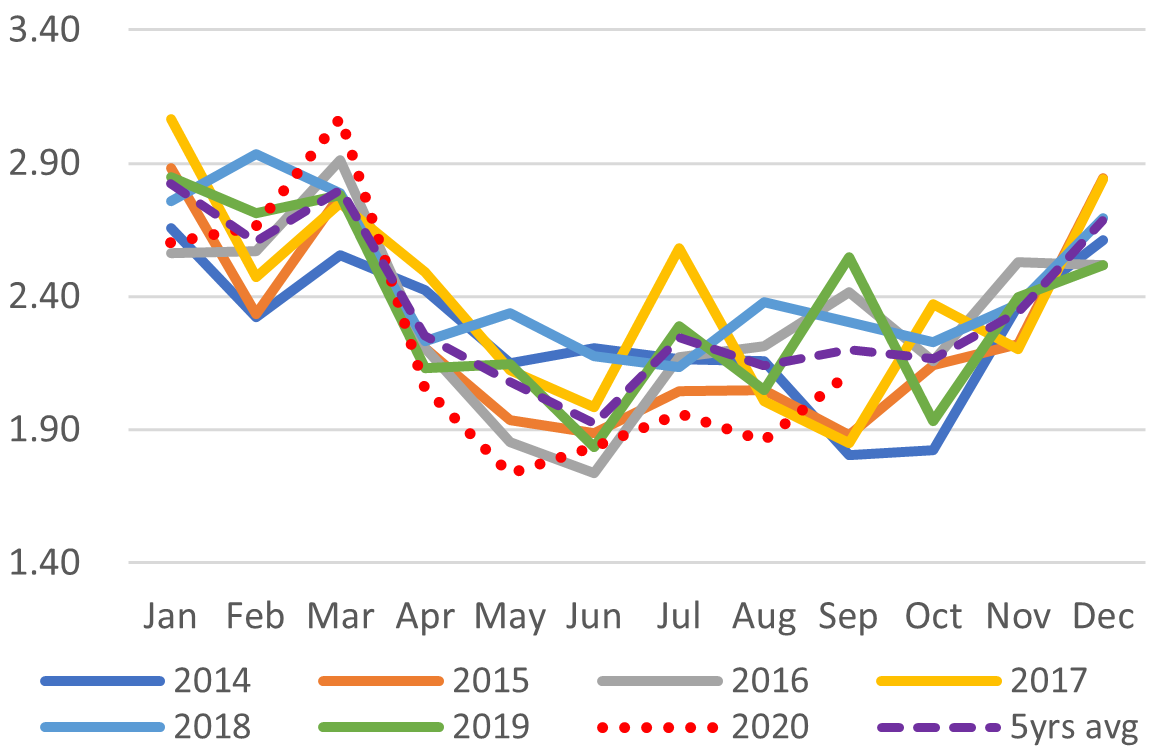
City Gas Sales – Total (M m3)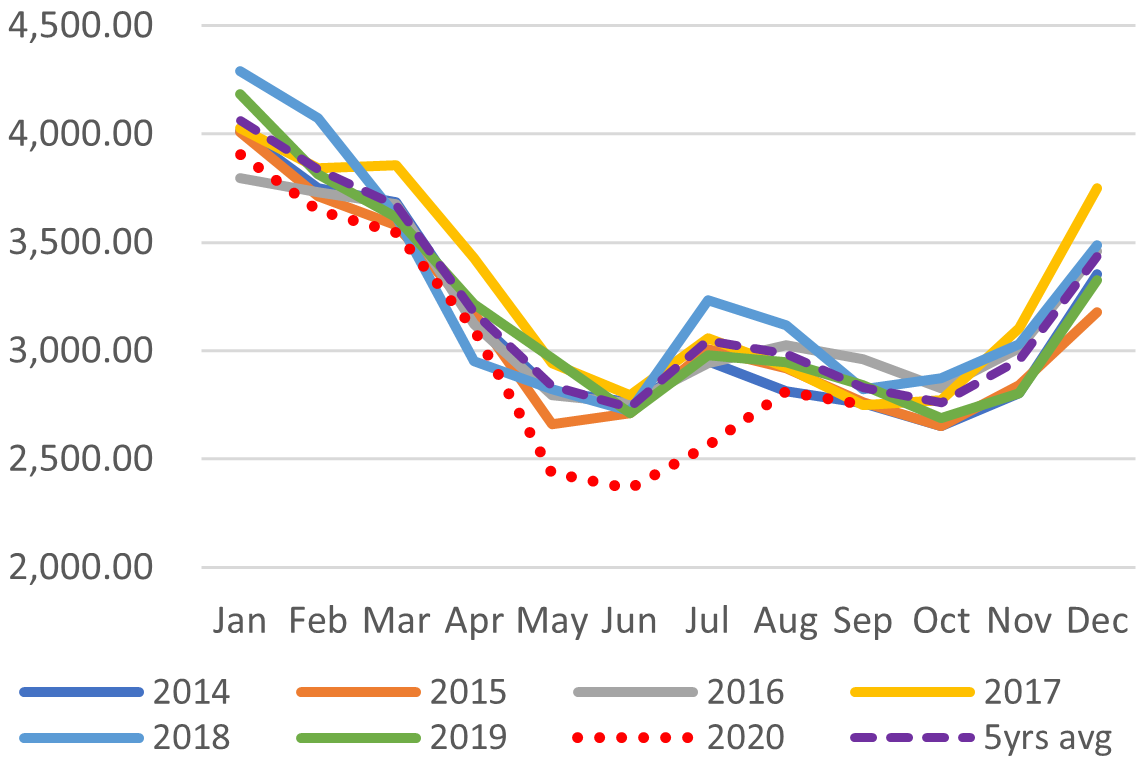
City Gas Sales by Sector (M m3)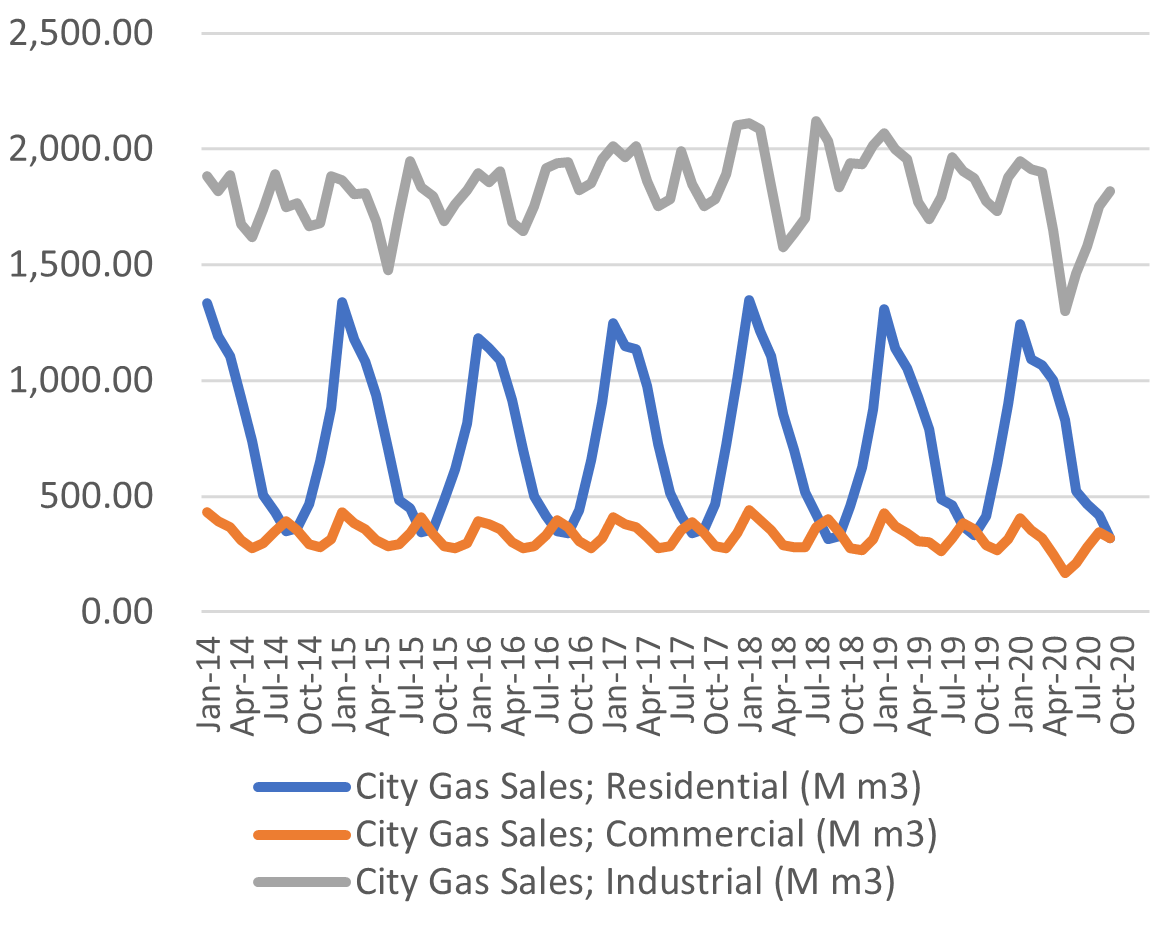
SOURCES: the Ministry of Economy, Trade, and Industry (METI),
Ministry of Finance
Japan Total Power Demand (GWh)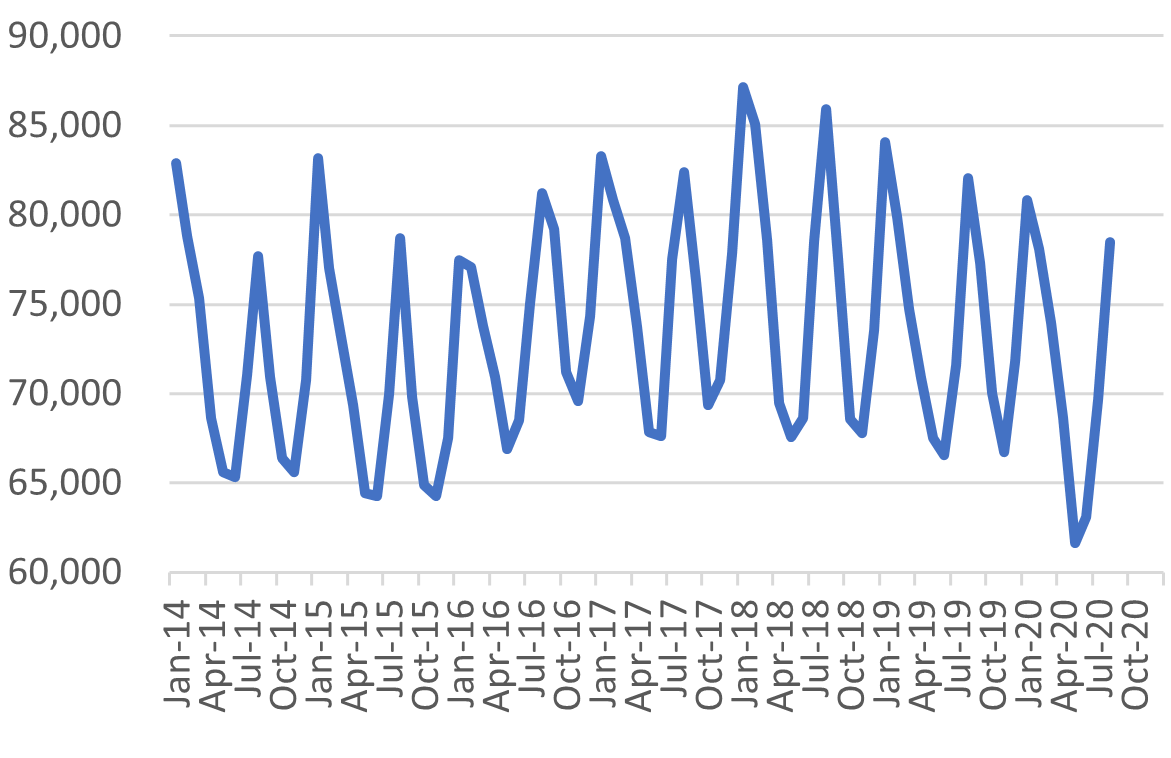
Current Vs Historical Demand (GWh)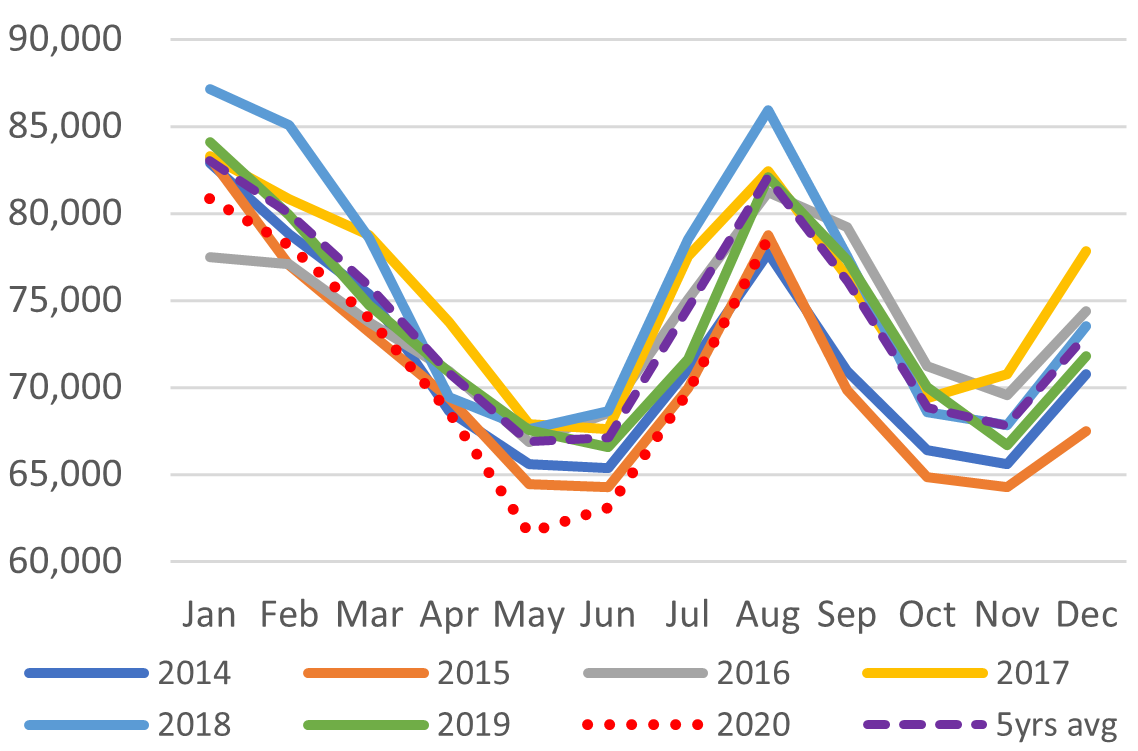
Day-Ahead Spot Electricity Prices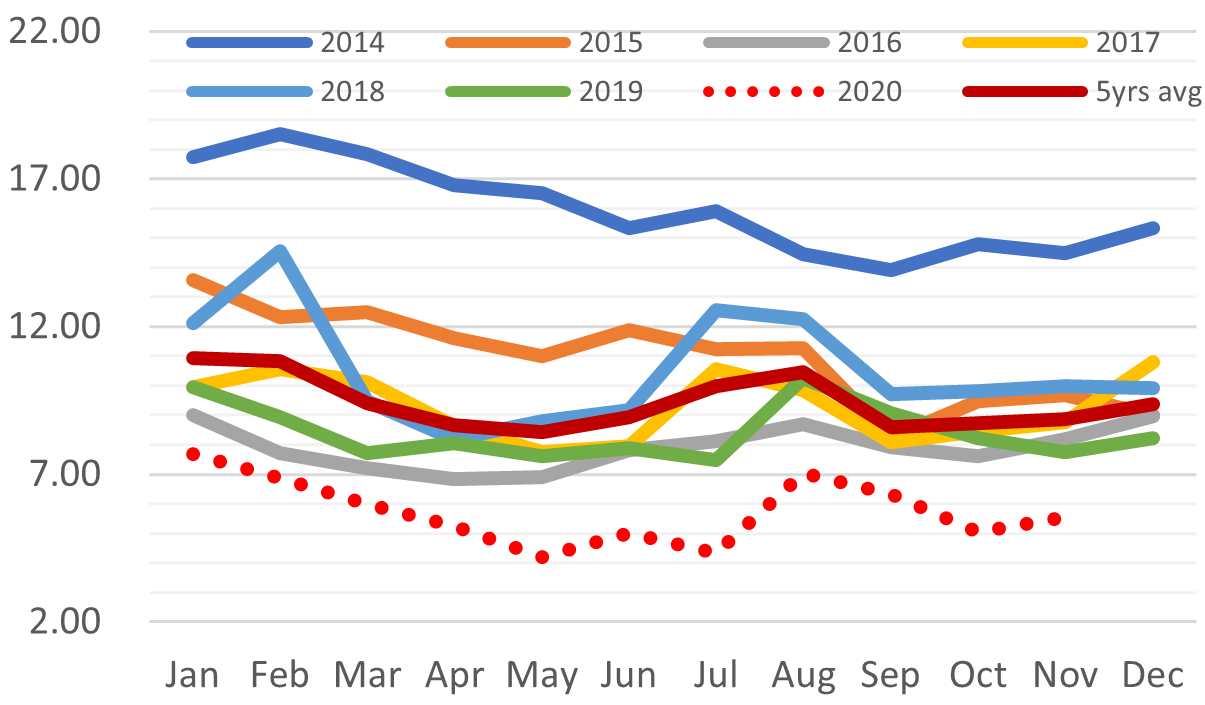
Day-Ahead Vs Day Time Vs Peak Time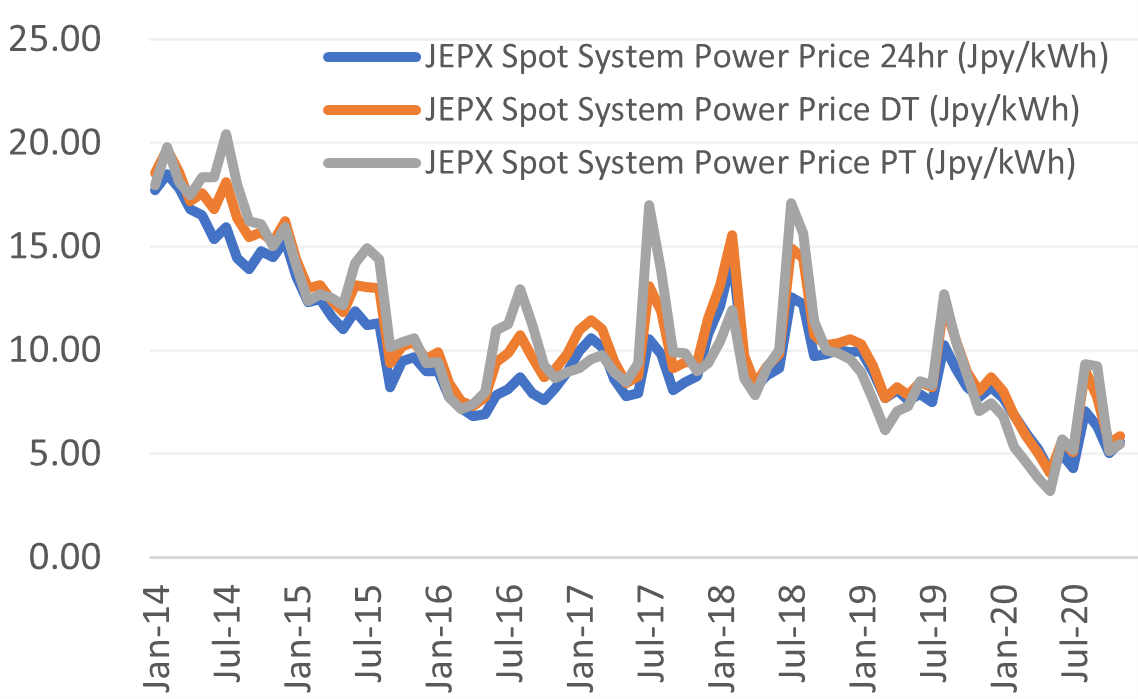
LNG Imports by Electricity Utilities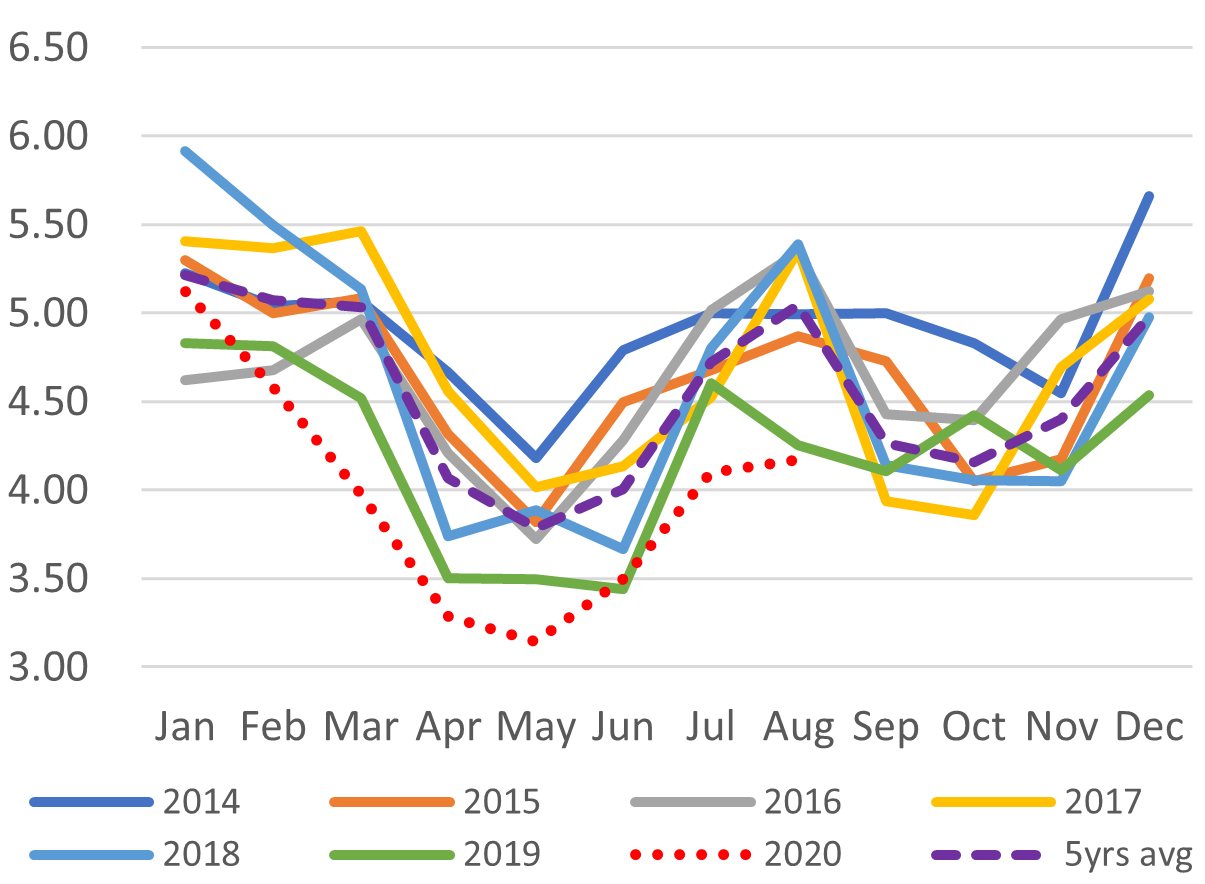
LNG Stockpiles of Electricity Utilities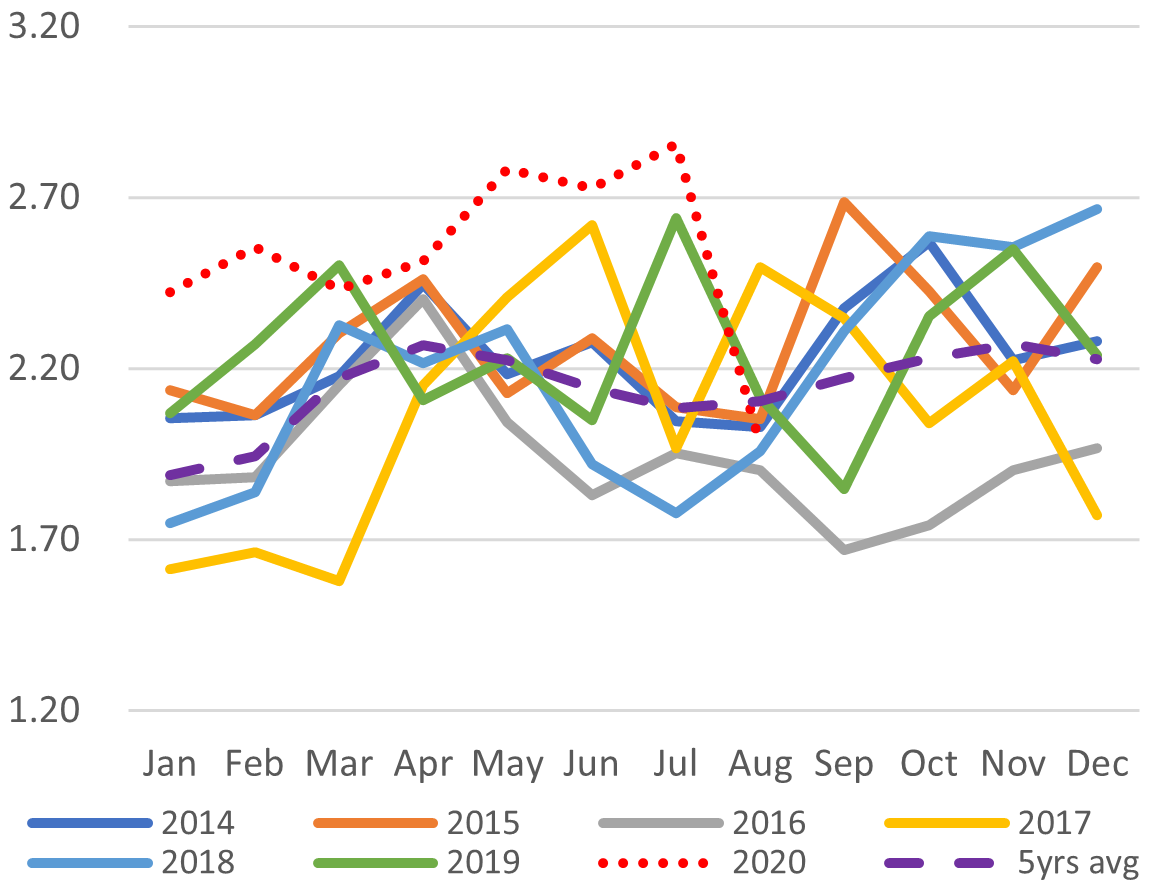
SOURCES: the Ministry of Economy, Trade, and Industry (METI), and the Japan Electric Power Exchange