
JAPAN NRG WEEKLY
JANUARY 12, 2021
JAPAN NRG WEEKLY
January 12, 2021
TOP
- Japan’s electricity and Asian LNG prices surge to records during a cold snap; Tokyo grid asks manufacturers to send surplus power; utilities ask for help; Japan should declare power emergency
- Japan unveils Green Growth Strategy roadmap for 2050; great expectations for offshore wind, carbon capture; fossil fuels to remain in place; guidance for multiple industries (Table)
- Japan and South Korea invest in coal plant despite carbon pledge
ENERGY TRANSITION & POLICY
- An update on COVID situation in Japan
- PM Suga’s 2050 net-zero goal hinges on carbon capture success
- Govt. wants local supply of offshore wind parts; ¥8/ kWh target
- Solid-state battery market to be worth ¥2.1 trillion by 2035: Study
- Sharp settles EV battery patent court battle with Tesla, which also inks new EV battery supply deal with Panasonic
- NTT eyes strong entry into green tech with bet on battery storage
- Toshiba wants to generate power from building surfaces, clothing
- TEPCO gets serious about EVs
- Toho Gas opens Japan’s first green hydrogen filling station
- Kyocera invests into fuel cell research; Yanmar promises fuel cell boats by 2025; Kawasaki Heavy builds largest hydrogen storage tank; Hitachi Zosen and Itochu win $1.2 billion waste-energy order
- METI to support 22 geothermal feasibility study projects
ELECTRICITY MARKETS
- CME to launch Japanese electricity futures, ¥-based LNG futures
- Tokyo Gas buys into U.K. renewables supplier Octopus Energy
- TEPCO retail arm may ditch power suppliers (which include JERA) amid poor operating results; ENEOS may buy the retail firm
- The latest news on nuclear reactors and storage and more…
UPSTREAM: OIL & GAS
- Saibu Gas strikes first overseas deal buying into Vietnam utility
- Japan’s petrochemical industry forced into radical changes
- Mitsui make an FID for Australian onshore gas / LNG project
IN THE BACKGROUND OF U.S-CHINA TENSIONS JAPAN-CHINA GREEN TECH TIES STRENGTHENING
Japan’s energy relationship with its neighbor China remains robust and continues to strengthen. An end-of-year bilateral energy forum went largely unnoticed, yet it saw top officials from both sides outline areas of potential collaboration. Japanese businesses signed 14 agreements with Chinese partners, including in the fields of carbon recycling and hydrogen. All of them concerned business opportunities in the Chinese market, and none were vice versa.An official from METI exclusively revealed that while Japan-China ties will be impacted by worsening U.S.-China relations, the partnerships in green tech will remain resilient.
TOP ENERGY EVENTS AND DATES TO WATCH IN 2021
This is expected to be a momentous year for Japan’s energy planners as they flesh out commitments to meet carbon neutrality by 2050. We offer a calendar of some of the key dates / events for this year.
GLOBAL VIEW
Saudi Arabia gave the oil and gas world a massive gift by announcing unilateral production cuts. Are Apple and Baidu planning to create their own EVs? Asian shippers may soon need to pay EU emissions tariffs. And Japan’s ORIX buys big in Spain. See details on these and other political and business events.
GLOBAL VIEW: GUEST COLUMN
Tomas Kåberger, the executive chair of the Renewable Energy Institute (REI) in Tokyo, argues that 2020 will not be only remembered for COVID-19 but for the year renewable energy truly hit the mainstream. New solar and wind capacity added last year amounted to 200 GW, or half the world’s nuclear capacity. A few places went 100% renewables. Rather than policies, it is now business rationale driving energy transition.
JAPAN NRG WEEKLY
PUBLISHER
K. K. Yuri Group
Editorial Team
Yuriy Humber (Editor-in-Chief)
Tom O’Sullivan (Japan, Middle East, Africa)
John Varoli (Americas)
Regular Contributors
Mayumi Watanabe (Japan)
Daniel Shulman (Japan)
Damon Evans (Indonesia)
Art & Design
22 Graphics Inc.

SUBSCRIPTIONS & ADVERTISING
Japan NRG offers individual, corporate and academic subscription plans. Basic details are our website or write to subscriptions@japan-nrg.com
For marketing, advertising, or collaboration opportunities, contact sales@japan-nrg.com For all other inquiries, write to info@japan-nrg.com
Disclaimer
This communication has been prepared for information purposes only, is confidential and may be legally privileged. This is a subscription-only service and is directed at those who have expressly asked K.K. Yuri Group or one of its representatives to be added to the mailing list. This document may not be onwardly circulated or reproduced without prior written consent from Yuri Group, which retains all copyright to the content of this report.
Yuri Group is not registered as an investment advisor in any jurisdiction. Our research and all the content express our opinions, which are generally based on available public information, field studies and own analysis. Content is limited to general comment upon general political, economic and market issues, asset classes and types of investments. The report and all of its content does not constitute a recommendation or solicitation to buy, sell, subscribe for or underwrite any product or physical commodity, or a financial instrument.
The information contained in this report is obtained from sources believed to be reliable and in good faith. No representation or warranty is made that it is accurate or complete. Opinions and views expressed are subject to change without notice, as are prices and availability, which are indicative only. There is no obligation to notify recipients of any changes to this data or to do so in the future. No responsibility is accepted for the use of or reliance on the information provided. In no circumstances will Yuri Group be liable for any indirect or direct loss, or consequential loss or damages arising from the use of, any inability to use, or any inaccuracy in the information.
K.K. Yuri Group: Oonoya Building 8F, Yotsuya 1-18, Shinjuku-ku, Tokyo, Japan, 160-0004.
NEWS: ENERGY TRANSITION & POLICY
An update on the COVID situation and measures in Japan
(Japan NRG, Jan .10)
- As of midnight Jan. 7, Tokyo and its surrounding prefectures have gone into a month-long State of Emergency (SoE). Osaka, the country’s second-largest metropolitan and industrial area, also announced an SoE the following day.
- Several other prefectures are requesting the national government to expand the SoE to their region.
- The SoE conditions are lighter than in most countries since the government lacks strict enforcement powers. Some conditions are as follows:
- Citizens are asked not to go out after 8 p.m.
- All F&B places must shut by 8 p.m., ending alcohol service an hour earlier
- Goal of 70% reduction in commuter traffic, companies urged to WFH
- Schools to remain open, university test exams to go ahead as planned
- Events will still be allowed, but with a limit of 5,000 people as long as that is 50% or less of capacity (i.e. baseball games can have spectators)
- Tokyo hit a one-day record of 2,447 new cases on Jan. 7. New infections number was below 1,000 for the whole of 2020, but broke through that level with a sudden spike on Dec. 31.
- The majority of new infections are among the under 40s.
- Tokyo has 3,119 patients hospitalized with COVID and, as of Jan. 10, only 4,000 beds allocated for those afflicted with the virus. Of those in hospital, 129 people are described as in a serious condition.
Japanese government unveils Green Growth Strategy roadmap for 2050
(Japan NRG, Dec. 25)
- The govt. published its strategy to meet the goal of net-zero emissions in Japan by 2050. The strategy stated that its proposals would generation ¥190 trillion ($1.83 trillion) in economic impact.
- The strategy implied that Japan cannot rely on renewable energy sources for more than 50% to 60% of its electricity because of constraints such as a lack of suitable land space.
- The plan doesn’t assume zero fossil fuel use in 2050, however, and rather calls for the offsetting of fossil fuel emissions by planting trees.
- At a press conference, Prime Minister Suga assured reporters that the roadmap would not hamper growth.
- Main points from the Strategy:
| Renewables, in general | Triple their share in the power generation mix to at least 50% by 2050 |
| Offshore wind power | Add 45 GW of capacity by 2040 from negligible levels today |
| Transportation | Electrify the sector as much as possible; phase out sales of new gasoline-only cars by 2035, including the “minicars” or light cars, a popular vehicle category with small engine power that accounts for about 40% of all new cars sold in Japan |
| Batteries | Target a 50% reduction in cost of batteries to ¥10,000 or less per kWh by 2030 to help bring down cost of electric vehicles |
| Thermal power plants | “Dilute” fossil fuels in the fuel mix of thermal power plants with at least 20% ammonia |
| Hydrogen | Ramp up consumption across all industries to around 20 million metric tons by 2050; have hydrogen and ammonia account for 10% of the electricity mix |
| Nuclear | Develop new types of reactors |
| Shipping and Aviation | Replace shipping fuel with hydrogen or another non-emitting alternative by 2050;Work towards electrification of airplanes or other means to make them emissions-free |
| Agriculture | Cut emissions to zero |
| Construction | New buildings and homes to be net-zero emissions by 2030 |
| Electricity Demand | Moving large parts of the economy to electric power will boost domestic electricity demand between 30% and 50% by 2050 |
| Carbon Tax | A regulatory system for carbon emissions and a carbon tax is “needed” to push businesses to make progress on net-zero targets |
- SIDE DEVELOPMENT:
Toyota CEO says Japan’s green strategy could strongly damage its auto industry(Asia Nikkei, Dec. 26) - CEO Toyoda Akio says moving away from the gasoline engine hard to do in the outlined timeframe without groundbreaking technological innovation. Japanese automakers lose international competitiveness unless the entire industry supply chain is able to restructure.
- CONTEXT: Electric vehicles only use about half as many components as those with a combustion engine.
Much of Suga’s 2050 net-zero goal depends on carbon capture tech
(Zaiten, January edition)
- PM Suga set the carbon neutral 2050 goal because 40% of the greenhouse gases in Japan come from power generation. This will be the focus sector for the government to reduce emissions.
- Outside energy, Japanese companies will be encouraged to switch raw materials to low-carbon ones. This is understood as being very difficult and the idea that new low-carbon materials will be invested is seen as a long shot.
- Much of Suga government’s 2050 thinking relies on the success of carbon capture technology. There’s also great expectation for carbon recycling. However, there’s uncertainty about the materials made in this process, and what happens to them when the recycled CO2 is re-processed as waste. It’s not clear if these materials would release the CO2 used to make them. Similarly, it’s unclear how well recycling can work over several processing cycles.
- Japan will need to persuade the rest of the world and take the lead on carbon recycling for this technology to succeed. Without its own raw materials base, this may be a necessity for Japan.
Govt. wants 60% of offshore wind parts made domestically to drop wind price to ¥8/ kWh
(New Energy Business News, Dec. 22)
- The Ministry of Economy, Trade and Industry (METI) and the Ministry of Land, Infrastructure, Transport and Tourism set a goal of increasing the domestic procurement ratio of the offshore wind supply chain to 60% by 2040 in the draft of their first “Offshore Wind Industry Vision”.
- The vision has four basic strategies: creation of an attractive domestic market, investment promotion / supply chain formation, next-gen technology development with an eye to expand into Asia, and international collaboration.
- The ministries have set industry the goal of reducing the cost of fixed-bottom offshore wind stations to ¥8 – ¥9/ kWh by 2030-2035.
- The government is targeting human resource training programs and more tax breaks to foster the development of a significant offshore wind industry in Japan.
Solid-state battery market will be worth ¥2.1 trillion in 2035: Report
(New Energy Business News, Dec. 24)
- The market size for solid-state batteries will be worth ¥2.1 trillion in 2035, according to research by Fuji Keizai.
- The market will initially be led by polymer and oxide-based solid-state batteries, but sulfide solid electrolytes technology is expected to grow significantly, mainly for electric vehicles (EV). Sample shipments of sulfide solid state batteries have already started.
- The capacity base of solid-state batteries available for EVs by 2035 should reach 101,660 MWh.
- The market for non-lithium batteries will then be worth ¥55.5 billion, and starting in 2030 second-generation sodium-ion batteries are expected to dominate. Companies in Europe and China lead in their development. Their use is for energy storage and backup power supplies.
- SIDE DEVELOPMENT:
BYD’s EV battery recycling goes global with Itochu
(Asia Nikkei, Dec. 25)- The Chinese auto company to repurpose old EV batteries into power storage for renewable energy and factories. Japanese trading house Itochu will be its partner.
Burgeoning offshore wind sector could generate equivalent of 552 nuclear reactors
(Shukan Economist Online, Jan. 4)
- The METI conducted tenders for five offshore wind projects in 2020. This year, successful contractors will be announced and work on the projects will begin.
- Some projections say Japan has the potential to generate as much as 128 GW of electricity from anchored turbines, and an additional 424 GW from floating turbines.
- Companies that stand to benefit from the turbine business include TEPCO Holdings, Mitsui & Co, Sumitomo Corporation, Mitsubishi Heavy Industries, Penta-Ocean Construction, Japan Steel, and JFE.
- The fuel cell industry is also set to benefit from the wind boom, as batteries are required to compensate for fluctuations in output. You can expect the likes of Hitachi Zosen, Toshiba and Fuji Electric to profit from fuel cell related sales.
Sharp withdraws EV battery patent infringement suit against Tesla
(Japan NRG, Jan. 8)
- Sharp has withdrawn patent infringement litigations filed against Tesla Motors Japan in Tokyo District Court last year, according to court records.
- Several lawyers told Japan NRG that the firms are likely to have reached an agreement on licensing fees.
- CONTEXT: Sharp alleged Tesla violated its patents on wireless technology by utilizing components based on this tech in electric vehicles. Zero emission vehicles are expected to feature automated driving and other advanced features using wireless and IoT technologies.
- METI plans to introduce an “amicus brief” system into complex patent disputes, whereby any concerned third parties, from companies to industry organizations, are invited to submit written opinions on the designated issues ahead of court rulings. The briefs are intended to provide the court broad perspectives as well as hard evidence on industry practices.
- The Japan Patent Office started to solicit public feedback on the amicus brief plan in December. The U.S. also uses the brief system to settle patent disputes.
TAKEAWAY: The AI and IoT patent costs will weigh on component producers and eventually the auto giants. In the auto industry, car makers tend to cover most fees.
- SIDE DEVELOPMENT:
Tesla strikes new deal with Panasonic to supply EV batteries
(Asia Nikkei, Jan. 5)
Telco giant NTT eyes strong entry into green energy space with bet on battery storage
(Nikkei Asia, Jan. 5)
- NTT looks to transform itself in line with the global trend for decarbonization. The company plans to create strong green energy business lines.
- Towards this goal, NTT is considering to install batteries at its 7,300 telecom service buildings across Japan to store electricity produced from local renewable sources.
- NTT may also replace its 10,000-vehicle fleet with EVs, which can then be used as backup power sources for essential facilities during disaster.
- Together with Mitsubishi Corp., NTT is also entering the virtual power plant business to provide a system to connect distributed renewable energy providers.
Toshiba looks to generate power from office building surfaces, clothing
(Nikkei, Jan. 4)
- A technology being developed by Toshiba could allow electricity to be generated from the surfaces of office buildings, mobile phones, curtains, and even clothing.
- Toshiba is now able to engineer film-type solar cells with a record 14.1% efficiency. The flexible perovskite cells can be made transparent if necessary.
- Historically, Japan has lost out to China in the battle for the solar cell market. Japanese manufacturers can’t afford to make the same mistake with perovskite cells, says Miyasaka Tsutomu, the inventor of the technology.
- Miyasaka also called for industry to drastically improve its energy efficiency.
Toho Gas opens Japan’s first green hydrogen filling station
(Kankyo Business Online, Jan. 1)
- On Dec. 24, Toho Gas opened a hydrogen filling station in Aichi, the first in Japan to supply carbon-neutral hydrogen isolated from reticulated gas supply.
- The greenhouse gases emitted when producing hydrogen are offset by carbon credits from local renewable electricity producers.
TEPCO gets serious about electric vehicles
(Kyoto Shimbun, Jan. 8)
- TEPCO Holdings is trialing a scheme that will allow users of electric vehicles to share charging stations, thereby reducing the outlay per user.
- The initiative will help households and enterprises with solar panels make better use of surplus electricity, which can be stored in vehicle batteries.
- In the trial, users are able to share rapid charging points in Yamanashi. The price paid for electricity depends on the time of day.
- TEPCO says if the trial is successful it will promote the scheme nationwide.
METI to support 22 geothermal feasibility study projects
(METI press release, Dec. 28)
- l New project launches by Kyushu Electric, TEPCO, Obayashi
Hitachi Zosen, Itochu win order for $1.2 billion waste-to-energy plant in Dubai
(Nikkei Shimbun, Dec. 22)
- Engineering firm Hitachi Zosen, in partnership with trading house Itochu, has won an order to build and operate one of the world’s largest waste-to-energy plants in Dubai. The order is for ¥120 billion ($1.16 billion).
- The 200 MW facility will generate electricity by burning trash from households in the United Arab Emirates city. It will produce enough power for 140,000 households.
- Hitachi Zosen and Itochu will operate the plant under a 35-year contract.
- SIDE DEVELOPMENT:
Hitachi Zosen to help build giant methane production plant in China - (Nikkei Asia; Dec. 20, 2020)
- Japan and China will launch a joint project to create one of the world’s largest methane production facilities in northern China that reuses carbon dioxide and surplus hydrogen.
- The two countries hope to provide this tech to emerging and developing nations.
- Japanese companies (including Hitachi Zosen and Japan Coal Energy Center) will participate.
- Commercial production set for mid-2020s.
TAKEAWAY: See the Analysis section for a detailed take on Japan-China cooperation in green tech.
Kyocera ploughs ¥10 billion into fuel cell research hub
(Nikkei, Dec. 18)
- Kyocera said on Dec. 18 it will construct a fuel cell research facility in Kyushu for ¥10 billion.
- The plant will serve as a development hub for the “cell stacks” that are the core component in fuel cells, as well as capacitors, ceramic packages and other electronic components.
- Kyocera aims to have the plant operational by September 2022.
Yanmar to release fuel cell-powered boat by 2025
(Okinawa Times, Dec. 29)
- It was learned on Dec. 28 that Yanmar Holdings plans to develop and commercialize a fuel cell based marine propulsion system by 2025.
- The fuel cell technology is expected to complement Yanmar’s competencies in marine engines.
- Development will begin in March and Yanmar says it is considering testing the technology on the site of the 20205 Osaka-Kansai Expo.
Kawasaki Heavy creates electricity retail firm; builds world’s largest hydrogen storage tank
(New Energy Business News, Jan. 5)
- Kawasaki Heavy Industries established a retail electricity company that utilizes waste-power generation. The unit is called Kawasaki Green Energy Co. The engineering company also build the world’s largest spherical liquefied hydrogen storage tank with a storage capacity at 10,000 m3.
NEWS: POWER MARKETS
| No. of operable nuclear reactors | 33 | |||
| of which | applied for restart | 25 | ||
| approved by regulator | 16 | |||
| restarted | 9 | |||
| in operation today | 3 | |||
| able to use MOX fuel | 4 | |||
| No. of nuclear reactors under construction | 3 | |||
| No. of reactors slated for decommissioning | 27 | |||
| of which | completed work | 1 | ||
| started process | 4 | |||
| yet to start / not known | 22 | |||
Spot Electricity Prices
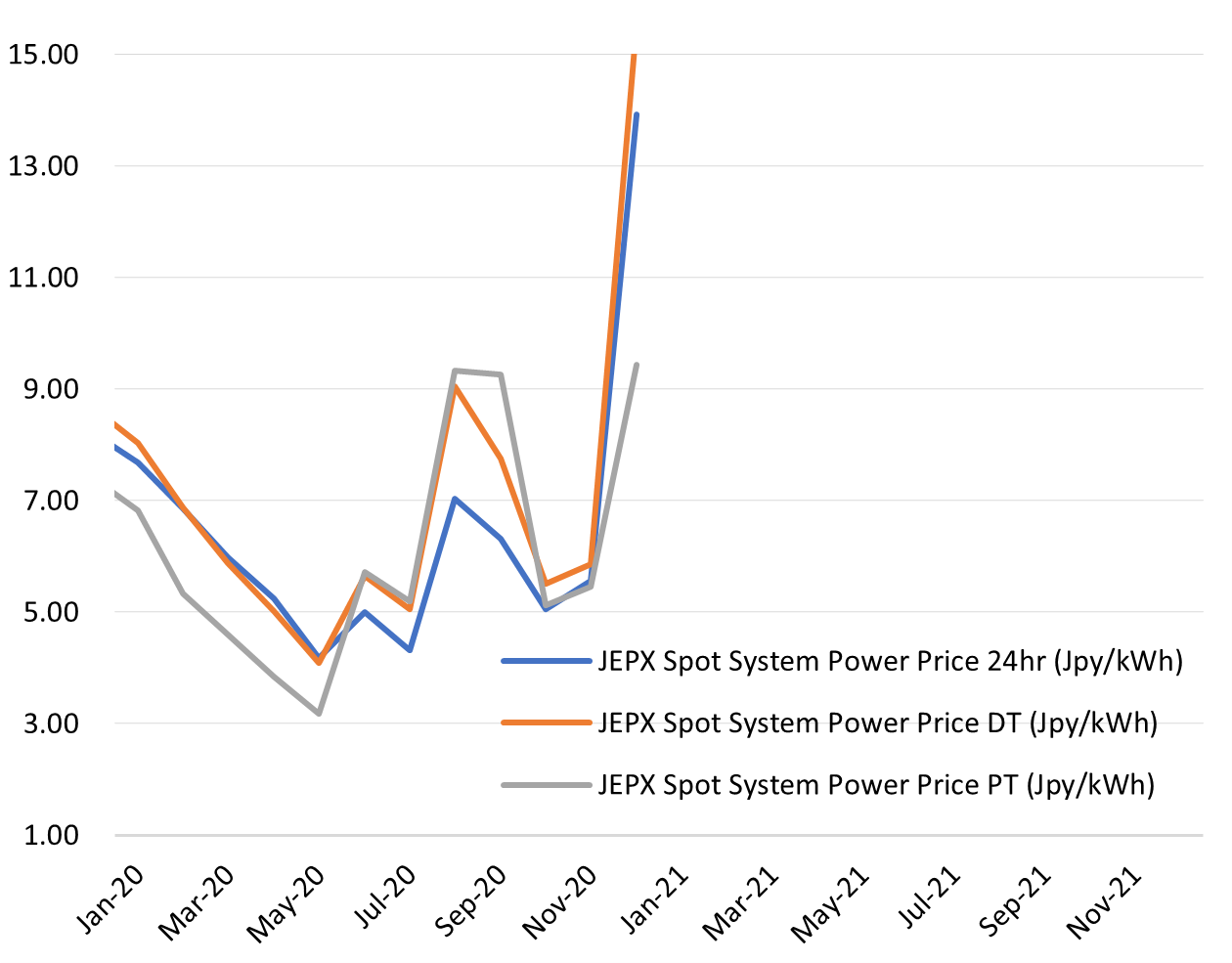
Source: Company websites, JANSI and JAIF, as of Jan. 8, 2021
Japan and South Korea invest in coal plant despite zero-carbon pledge
(Yahoo News, Dec. 31)
- Japan and South Korea will invest a total of ¥180 billion in the Vung Ang 2 coal-fired power station project in Vietnam, despite increasing criticism internationally.
- The government-run Japan Bank for International Cooperation said it will provide nearly $640 million of financing for the project. The Bank says the Export-Import Bank of Korea will also make a significant investment.
- While the Japanese government announced more stringent restrictions on overseas coal-fired power ventures in July, it did not go so far as to withdraw government support for such projects or pull the plug on existing projects.
CME to launch Japanese electricity futures and LNG futures contracts from Feb. 8
(Company Press Release, Jan. 6)
- CME Group is starting trading in four new Japanese electricity futures contracts and two new yen-denominated LNG futures contracts from Feb. 8, 2021
- Group aims to cater to Japanese power utilities that need to manage price risk
- The contracts are all settled in Japanese yen and are based on the average of the 30-minute spot market (day-ahead) prices published by the Japan Wholesale Power Exchange (JEPX) for the relevant region of the country.
- The LNG contracts will be based on the DES form of the JKM benchmark and on the Japan Crude Cocktail price
Tokyo Gas in strategic partnership with Octopus Energy
(Dec. 23, Reuters)
- Tokyo Gas said on Dec. 23 that it had formed an alliance with U.K. renewable power and gas provider Octopus Energy. Tokyo Gas is investing ¥20 billion into Octopus in return for a nearly 10% stake.
- The partnership aims to promote renewable energy, as well as increase the Japanese gas utility’s presence in the electricity market.
TEPCO retail arm prepares to ditch suppliers amid falling demand, poor performance
(Nikkei, Dec. 28)
- TEPCO Energy Partner, the retail division of TEPCO, is planning to cull some of its more expensive electricity suppliers in a bid to lower costs.
- The volume of electricity sold by the company has fallen as the battle for subscribers in the now deregulated domestic electricity market intensifies.
- It is unusual for TEPCO Energy Partner, Japan’s largest electricity retailer, to terminate long-term agreements with generators.
- While TEPCO EP has yet to decide specifically which generators it will ditch, it is expected that most of those affected will be thermal power stations.
- SIDE DEVELOPMENT:
ENEOS emerges as “buyer” of TEPCO Energy Partner
(Zaiten, January edition)- CONTEXT: TEPCO Energy Partner is the electricity retail company inside the Tokyo Electric Power Co. Holdings.
- TEPCO Energy Partner has lost revenue for five straight years and is now in a dire situation. To cut costs, the company is reorganizing contracts with suppliers and going paperless, as well as raising its prices.
- The company has managed to survive until now in the hope of a dramatic turnaround in revenue at TEPCO group from the restart of the Kashiwazaki Kariwa Nuclear Power Plant (NPP). However, TEPCO has not yet gained approval for the restart from local politicians, and timing remains unclear.
- TEPCO Energy Partner also risks reporting a loss this fiscal year. Lenders and its holding company are pushing the company to improve earnings and further cut costs.
- The company is likely soon to be sold since the METI has finally decided to get serious about dismantling the TEPCO group.
- ENEOS is emerging as the potential buyer. TEPCO President Kobayakawa has recently met with ENEOS chairman Sugimori several times.
Fukushima: TEPCO to delayed removal of fuel debris from reactors 1 and 2
(M Data, Dec. 23)
- Tokyo Electric Power Company is postponing the removal of debris from reactor No. 2 at the Fukushima Dai-ichi nuclear power plant after tests of a robotic arm set to take place in the UK were cancelled due to the coronavirus pandemic.
- TEPCO is instead making arrangements to test the robotic arm in Japan. The debris removal is the greatest hurdle facing the decommissioning operation. The delay is for at least a year.
TEPCO invests in grid to help renewables and deflect criticism from high reliance on coal
(Jan. 2, Newswitch)
- Slow progress in restarting nuclear reactors means that much of Japan’s electricity is currently generated from coal. This has sparked criticism overseas, and it is unclear how long Japan will be able to sustain its current level of coal use.
- While tariffs paid to generators under the FIT scheme have tumbled from ¥48 per kilowatt hour in 2009 to only ¥14 in 2019, Japan now has 78 GW of FIT-approved renewable generation capacity (including capacity under construction). When adding wind farms under construction this more or less is enough to meet the government’s 2030 target of 22%.
- TEPCO Power Grid recently responded to the growth in solar farms in Chiba by investing ¥130 billion in upgrading transmission infrastructure. TEPCO hopes that by diversifying electricity sources to include renewables, it will be able to deflect criticism of its fossil fuel use.
KEPCO crisis prompts TEPCO to propose restructuring of nuclear operations
(Diamond, Jan. 7)
- On Dec. 18, Kansai Electric Power Co. (KEPCO) CEO Morimoto Takashi held a conference to announce his company’s intention to send nuclear waste to a new storage facility being built in Mutsu (Aomori prefecture), with the agreement of the local community.
- The announcement was made in response to an order issued by METI minister Kajiyama in July that demanded generators to improve their arrangements for disposing of nuclear waste. Improved waste disposal was of course merely a pretext—in reality, the government is trying to assist KEPCO, which currently lacks interim storage facilities for spent nuclear fuel.
- The governor of Fukui, a region that’s home to all 11 of KEPCO’s reactors, has ordered the company to make a shortlist of 20 potential sites for interim storage facilities outside of Fukui.
- Fuel rod storage pools attached to the Mihama and Ooi plants could reach capacity by as early as 2025 and 2027, respectively.
- TEPCO has invited KEPCO to share its Mutsu storage facility.
- According to energy market analysts, in return for the favor, TEPCO is pressuring KEPCO to participate more actively in a nuclear industry lobby group whose members includes the Tohoku and Chubu Electric utilities, KEPCO, and Hitachi. Nicknamed the “Higashi-Dori Seven”, the conglomerate’s agenda is to restructure Japan’s nuclear sector.
- SIDE DEVELOPMENTS:
Arguments for KEPCO reactor restart shot down by court decision (editorial) - (Dec. 19, Business Journal)
- A recent Osaka District Court decision found failings in the process followed by the Nuclear Regulation Authority when reviewing the application to restart Units 3 and 4 at the Ohi nuclear power plant.
- The decision has destroyed the power company’s claim that the reactors meet Japan’s post-Fukushima safety standards, the strictest in the world.
- The court criticized KEPCO’s calculations, which only demonstrated the reactors’ ability to withstand an earthquake of average size. The Authority’s guidelines stipulate that reactors must also be able to withstand unusually large earthquakes.
- KEPCO and the Authority were dismissive of the plaintiff’s arguments, which they regarded as ill-informed. However, while claiming that the reactors satisfied the world’s strictest safety criteria, then Authority chair Tanaka Shun’ichi also shirked responsibility, saying he couldn’t categorically guarantee the plant’s safety.
- The nuclear lobby’s attitude has come back to bite them. The loss is an unprecedented setback for both KEPCO and the government.
- However, decisions unfavorable to the nuclear industry have historically been overturned on appeal by high court judges keen to appease the government.
Prime Minister’s key backer, Nikai, key to TEPCO nuclear plant restart
(Diamond, Jan. 7)
- Restarting the Kashiwazaki-Kariwa Nuclear Power Plant (NPP) would be extremely lucrative for TEPCO, with each reactor generating over ¥10 billion annual revenue.
- Any restart will need the consent of local residents, according to a “gentlemen’s agreement” between the heads of the local municipality and the government.
- Niigata Governor Hanazumi notably worked under LDP Secretary-General Nikai when the latter was Transport Minister. Nikai is seen as having significant influence over the governor.
- Hanazumi will stand for re-election in June 2022 with a platform that includes restarting the Kashiwazaki plant.
- To avoid the negative publicity associated with TEPCO, the government has proposed the plant be sold to a quango, provisionally named “East Japan Atomic Power”, in which the Japan Atomic Power Company would hold a stake, thereby enabling the plant to drop the TEPCO brand.
TAKEAWAY: Japan current has just three reactors in operation and all of these are in the Kyushu prefecture, the westernmost of the main islands of Japan. Efforts to restart nuclear reactors in the key industrial area of Kansai have stalled for now and progress in the areas north of Tokyo is slow. The nuclear industry may need to wait until after the March 11 anniversary of the nuclear accident at Fukushima to build up momentum and persuade the skeptical public.
Mitsui & Co. to start exit from overseas coal power plant investments from 2021: CEO
(Yomiuri Shimbun, Jan. 1)
- CEO gives interview and says sale of assets in coal power generation may begin this year.
Chubu Electric to shore up Ugandan electricity supply
(Nikkan Kogyo Shimbun, Dec. 29)
- The Chubu Electric Power Co. and Chubu Electric Power Grid will perform improvements to Uganda’s electricity network under a contract from the Japan International Cooperation Agency.
- Chubu will first work to understand why the nation’s transmission network and substations are so unreliable, before implementing measures to improve reliability and reduce power outages.
- The three-year project will last until the end of 2023.
JERA begins commercial operations at Taiwan wind farm
(Nikkei, Jan. 6)
- JERA said Jan. 6 that the wind farm it operates off the coast of Taiwan has commenced commercial operation. The Formosa 1 wind farm has an output of 128 MW and is 32.5% owned by JERA.
- The second stage of the Formosa wind project will commence operations during 2021. JERA owns 49% of stage 2.
Chubu Electric and Mitsubishi Corporation consider Akita wind farm bid
(Akita Sakigake Shimpo)
- It was learned on Dec. 28 that the Chubu Electric and Mitsubishi Corp are considering making a joint bid in the offshore wind farm tender that will see wind farms constructed in Happocho and Noshiro (Akita).
- Local sources say representatives of Chubu Electric and Mitsubishi visited the Noshiro city office on Dec. 22.
Kansai Electric Power and ENEOS to build 62 MW solar plant by 2023
(New Energy Business News, Dec. 22)
- The two firms plan a new 62 MW solar farm in Ago-gun, Hyogo prefecture. Operations are due to start in January 2023.
- The facility, which is a 50-50 venture between Kansai Electric and ENEOS, will sell power via the FIT system. The project has a 20-year power sales contract set at ¥15.37 / kWh.
Lowest bid rises to ¥10.48/ kWh in seventh round of solar electricity tenders
(Smart Japan, Jan. 6)
- The seventh round of FIT tenders for electricity from solar generators took place on Dec. 25.
- The maximum allowed bid was set at ¥11.50/ kWh, ¥0.5 less than last time.
- The lowest successful bid was ¥10.48.
- A total of 69.4 MW of capacity was sold for an average price of ¥11.20/ kWh.
- The tender process is not public.
NEWS: OIL & GAS
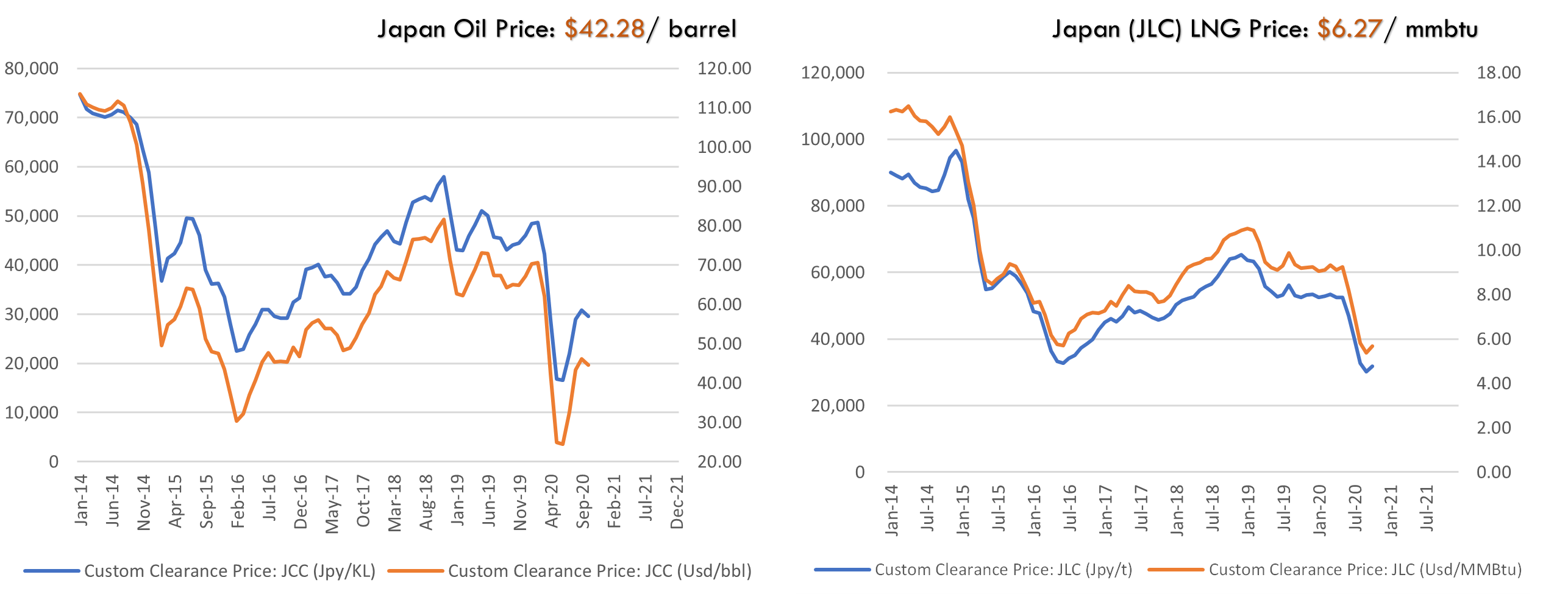
LNG prices surge to all-time records as Japan and neighbors go through cold snap
(Japan NRG, Jan. 11)
- Bids for spot LNG cargoes jumped to around $28/ mmbtu, according to S&P Platts data, and the Japan-Korea Marker (JKM), a leading Asian LNG benchmark, broke through the $20 ¥/ mmbtu level. Both are all-time records.
- The price increase follows a wave of cold temperatures across Japan, China and South Korea. The cold snap saw parts of China experience lowest temperatures in over 50 years; South Korea’s peak power demand is rising; and Japanese utilities are struggling to secure enough electricity supply.
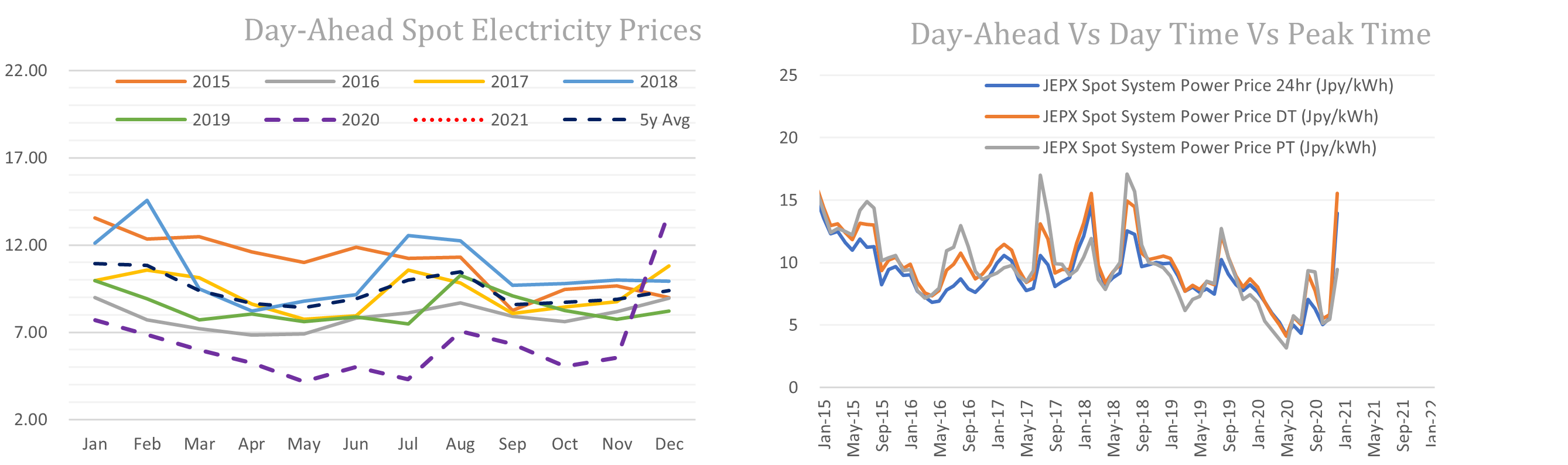
- Higher cost of fuel had a knock-on effect on Japanese electricity prices, which spiked at ¥117.39 per kilowatt-hour on Jan. 11 for day-ahead 24-hour pricing. The average for 2020 was ¥6.43/ kWh. The price has never breached ¥100.
- Japan’s power grid oversight body, OCCTO, and Tokyo Electric Power Co. ask businesses and homes to be conservative with their energy consumption.
- CONTEXT: The reasons for the price spike in Asian LNG are various and the cold temperatures are only part of the story.
- There has been a shortage of LNG carrying vessels in the global market over the last month or so
- Several LNG projects in Australia, Malaysia and the Middle East had to delay production or shipping recently due to technical issues and this has added to a tightness of supply in the market
- U.S. LNG exports to Asia have been constrained by extra coronavirus prevention procedures
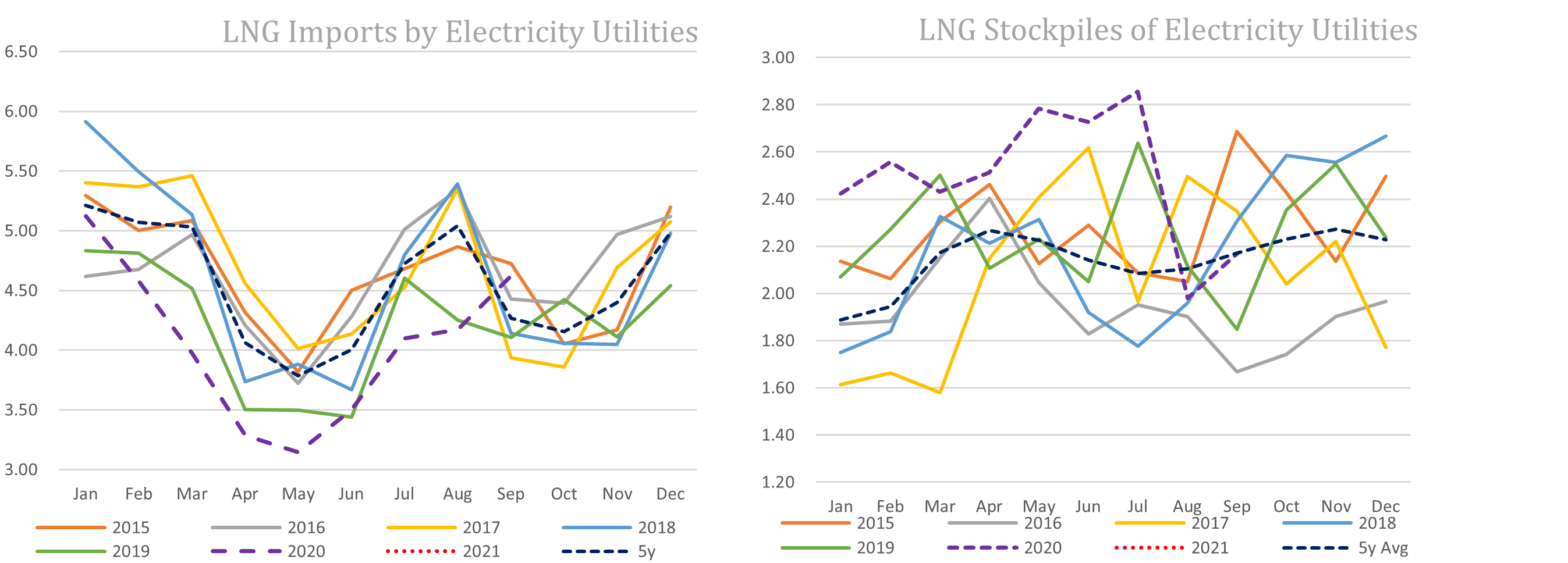
- Japan’s LNG inventories are only built to secure about two weeks of supply and a sudden surge in demand can quickly drain the volumes; plus, the fuel is technically hard to store for longer periods
- Several nuclear reactors in Japan that were expected to be online are not due to a citizen-group led court injunction and unplanned repairs
- Snowfall even in the southern main island of Japan covered solar panels, limiting output
- SIDE DEVELOPMENT:
Tokyo grid operator asks non-utilities to supply electricity to avert blackouts - (Nikkei, Jan. 6)
- Tepco Power Grid, a unit of Tokyo Electric Power Co. Holdings, has asked non-utilities that have private power generation equipment to help bring more supply into the system as the most-populated area of the country faces shortages.
- Steel, chemical and oil companies have some generation facilities that power their factories. Tepco Power Grid is asking these firms to sell any surplus.
- CONTEXT: The last time the grid operator asked non-utilities to contribute was in 2011, after a major earthquake and tsunami devastated Japan’s northeast and led to most nuclear power plants being taken offline.
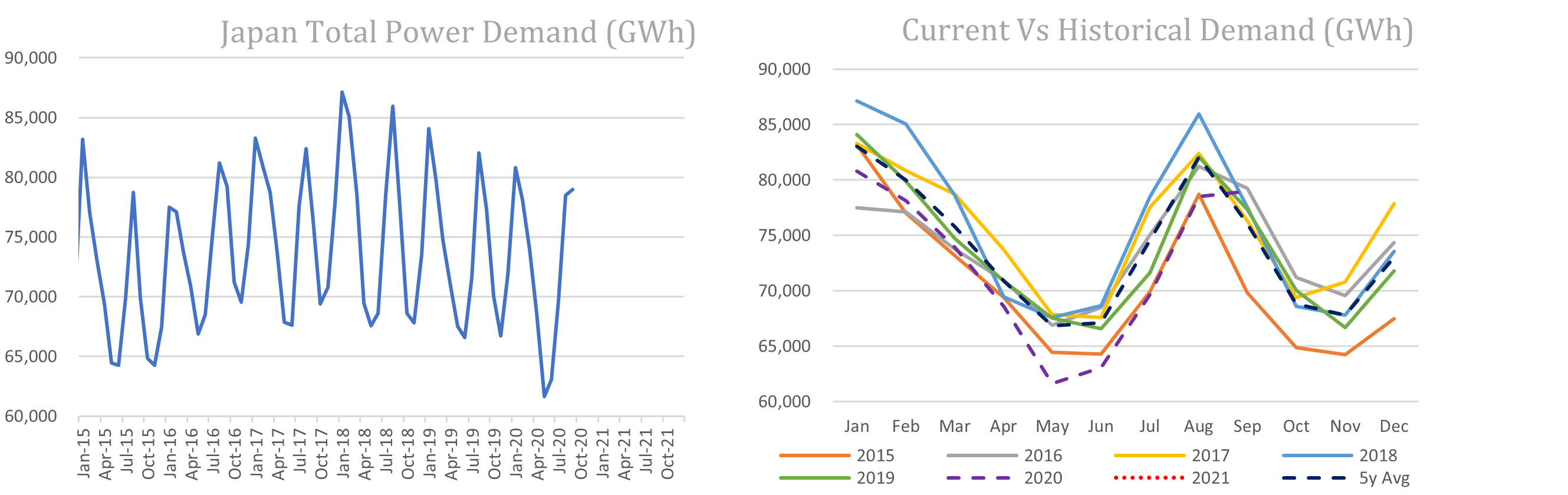
- Power demand in December was about 4% higher than a year ago.
- SIDE DEVELOPMENT:Kyushu Electric asks other utilities for electricity for the first time(NHK, Jan. 8)
- The utility for the Kyushu region said demand is exceeding supply at peak hours due to heating
- CONTEXT: This follows a similar request from four other regional power utilities the previous day
- The utility for the Kyushu region said demand is exceeding supply at peak hours due to heating
- CONTEXT: This follows a similar request from four other regional power utilities the previous day
- SIDE EVELOPMENT:Takeuchi: Japan should declare a power emergency
- (Nikkei, Jan. 8)
- Takeuchi Sumiko, Director and Chief Researcher at 21st Century Public Policy Institute, a public policy think tank of the big-business lobby Keidanren, writes an opinion column for Nikkei.
- Takeuchi’s column suggests that Japan may have been better served by long-term LNG contracts, securing supply, and thermal and nuclear generation. Moving to more spot LNG trading, relying on intermittent sources such as solar, and opening up the market to competition has done little to make sure there is adequate power supply at this critical time, according to Takeuchi.
TAKEAWAY: While the temperatures are forecast to flip to warmer than average within a week, expect the debate about energy supply security in Japan to reignite and the conservative lobby to raise the arguments as per the one cited above.
Saibu Gas invests in Vietnamese utility, first investment overseas
(Gas Energy News, Jan. 1)
- Saibu Gas said on Dec. 24 that it had acquired a 21% stake in Ho Chi Minh-based PetroVietnam Low Pressure Gas Distribution (PVGD), its first ever investment in an overseas energy company.
- Tokyo Gas also owns part of PVGD, which is itself a subsidiary of PetroVietnam Gas.
- PVDG provides natural gas to commercial clients in industrial zones using its own distribution network. PVDG sold 1 billion cubic meters of gas in 2018.
Petrochemical industry forced to make radical changes
(Nikkan Kogyo Shimbun, Dec. 29)
- The Japanese government’s declaration to achieve carbon neutrality by 2050 is forcing the petrochemical industry to diversify the range of services offered at petrol stations as decline in demand for gasoline seems unavoidable.
- Petroleum Association of Japan chair (and chair of ENEOS Holdings) Sugimori Tsutomu has said the Association plans to beef up its long-term low carbon vision, which was released in May 2019 and does not currently set any specific targets.
- Sugimori also said he wants to include hydrogen and other synthetic “e-fuels” in the vision, and boost awareness of hydrogen.
- Higher uptake of hydrogen is reliant on the availability of cheap, carbon neutral hydrogen, either through electrolysis of water using electricity generated by renewable means or the gasification of lignite.
Tokyo Gas CEO pushes back against calls for all-electric infrastructure
(Asahi Shimbun, Dec. 29)
- Tokyo Gas CEO Uchida Takashi has criticized the government’s proposal for achieving net zero emissions by 2050, saying that the government will be unable to achieve its goals through renewables and electric infrastructure alone.
- Reticulated gas must be part of the solution, says Uchida, who claims gas has a role to play in complementing electric technologies. The CEO also highlighted the importance of redundancy in the energy network, citing recent power outages.
- Tokyo Gas has pledged to achieve net zero carbon dioxide emissions group-wide sometime before 2050.
Mitsui, Beach Energy agree to go ahead with Australia onshore gas project
(Company Press Release, Dec. 23)
- The two companies made a final investment decision (FID), subject to necessary government approvals, to go ahead with the second stage of the Waitsia gas field development in Western Australia. Mitsui has a 50% interest in Waisia.
- Waitsia is one of the largest onshore gas fields in Australia.
- Stage 2 of Waitsia development will involve investments of ¥59.3 billion to add a new gas plant and drill additional wells.
- CONTEXT: This is one of the first LNG projects to get FID since the onset of the COVID-19 pandemic.
ANALYSIS
BY MAYUMI WATANABE
In the Background of China-U.S. Tensions,
Japan-China Green Technology Collaboration Strengthens
While U.S.-China tensions remain high, Japan’s energy relationship with its powerful neighbor remains robust and will continue to strengthen. An end-of-year energy forum between Japan and China that went largely unnoticed saw top officials from both sides outline areas of potential collaboration. Also, Japanese businesses signed 14 agreements with Chinese partners, including in the fields of carbon recycling and hydrogen.
Note, all 14 of these agreements concerned the entry of Japanese firms into the Chinese market, and none were vice versa. An official from Japan’s Ministry of Economy, Trade and Industry (METI) exclusively revealed that while Japan-China ties will be impacted by worsening U.S.-China relations, the partnerships in green tech will remain resilient because of the relations built up by the private sector over the past decade.
The Japan-China Forum on Energy Conservation and Environment has taken place every year since 2006, yet it has never been as relevant as during the recent Dec. 20, 2020 edition. Just months earlier, China’s premier Xi Jinping declared his country will be carbon neutral by 2060. Soon after, Prime Minister Suga said Japan will achieve net-zero emissions a decade earlier, in 2050. South Korean president Moon Jae-in followed days later, promising that his country will be carbon neutral by 2050.
The forum, sometimes referred to as the Japan-China Green Forum, started life as a platform for Japanese firms to apply their technologies to help combat China’s pollution, and it enjoys strong backing both from the state and private sectors. The forum is just one example of how Japan-China business ties remains strong.
Japan’s METI minister Kajiyama delivered a clear message at the forum that this progress needs to continue, and that among a dozen green technologies, hydrogen and carbon recycling are of highest importance for the two countries.
Zhang Wen Jiang, who heads the science and technology unit of CHN Energy, echoed Kajiyama. “Why we cooperate…Japan and China have a combined 40% global share of hydrogen production…65% of fuel cell vehicles in the world are in this region…we can standardize technologies through joint developments of solid oxide fuel cells, gas turbines and fuel cells,” he said in his presentation.
The METI official said the 14 agreements signed for bilateral green projects was a landmark achievement, and they add to the more than 400 energy JVs launched since 2006 between the two countries. These span energy conservation, pollution control, and other areas.
Projects signed at the 2020 Japan-China Green Forum (Extract)
- Marubeni-JGC-Juhua joint venture on the reuse of hydrogen, a byproduct of Juhua’s caustic soda and other plants, as a fuel to generate power and as a material for polymer electrolyte fuel cells. The power generators and the fuel cells will have a test-run at Juhua’s chemical plants.
- Japan Coal Energy Center, Hitachi Zosen, Shaanxi-Yulin Economic Development Zone on testing Hitachi Zosen’s carbon recycling techy, assessing the costs of running facilities and their returns, and how the technology fits in the energy supply chain. Studies to take place in 2021-2022.
- Japan’s Global Consortium for Energy and Environment (GCFEN)-China Hunan Taohuajiang Nuclear Power Company on production of hydrogen using solar energy
- Japan’s CMI Corporation and Jilin International Power Investment to share data on use of hydrogen in renewables
The last two projects didn’t reveal details because they’re confidential, officials said. One Japanese company said the government hasn’t allocated any money for the project, and companies are able to develop businesses on their own in China. There are no investment or trade barriers in China to launch hydrogen projects.
Japan classifies the energy sector as vital to national security, and under the Foreign Exchange and Trade Act, foreign investors need to clear regulatory reviews by the Finance Ministry and the Bank of Japan if they want to hold more than a 1% stake in any energy company, public or private. The regulatory process is even more rigorous for foreign state-owned companies, and many Chinese players are state-owned.
Of course, the most important Japan-China hydrogen project of the year was presented well ahead of the December forum. In June, Toyota Motor announced that it was forming an R&D joint venture with four Chinese automakers to develop commercial vehicle fuel cell systems in China.
As is often the case with Toyota, it both supports government initiatives and pursues its own path. Toyota’s Chinese JV falls outside the government-led collaboration program, but the automaker contributed to the forum by delivering a presentation on its new Mirai hydrogen passenger car, released only 11 days earlier.
The upgraded Mirai milestones included: cutting production costs to one-third of the first model, and increasing hydrogen volume by 21% while increasing travel distance by 30%. Toyota plans annual production of over 1 million Mirai and EVs by 2030.
This kind of tech and ambition is valuable for China. The country had just 2,000 hydrogen vehicles in 2019, but the government plans to increase this to 50,000 vehicles by 2025 and 1.3 million vehicles by 2035. Unlike Japan, China sees more of a use for hydrogen in buses and trucks, rather than passenger vehicles.
The four bilateral hydrogen and carbon recycling projects are just the tip of the iceberg, and many more Japan-China JVs are expected to be launched outside of government purview. For example, Japanese manufacturers of fuel cell battery components, and their suppliers in lower tiers, are expected to soon launch new ventures in China. The success of these JVs will prove vital for both countries to justify forging ahead with hydrogen and carbon recycling.
ANALYSIS
BY TOM O’SULLIVAN
2021: The Events that Will Impact Japan’s Energy Policy Trajectory
2021 is expected to be a momentous year for Japan’s energy planners as they are forced to flesh out commitments to meet carbon neutrality by 2050.
A revised mid-term energy mix vision and, based on that, refreshed emission targets will likely be the most important announcements from the Japanese authorities this year. Japan needs to firm up on the country’s near-term emissions plans for 2025 and 2030 as part of the nationally determined contributions submission that will be officially presented at the November COP26 meeting in Glasgow.
These are a number of other key events and dates in 2021 that will be important milestones for Japan’s future energy policies. We compile the list and include international events where Japan may participate and/or where we believe climate and energy security will be important agenda items.
NOTE: due to the ongoing COVID-19 pandemic, below dates may change.
| January | Joe Biden Inauguration as U.S. President;Japan Petroleum Center – Annual Conference;Biden Cabinet including Energy Interior & Transportation Secretaries – U.S. Senate approvals |
| February | Prime Minister Suga to visit the U.S.;Approval of Fiscal 2021 Budget by Japanese parliament including energy funding projects;Smart Energy Week – Tokyo;CMC LNG Conference |
| March | 10th Anniversary of Fukushima Nuclear Accident;End of Fiscal Year in Japan;Renewable Energy Institute – Annual Conference;Quarterly OPEC Meeting;Japan LPG Annual Conference;
Full completion of all aspects of the multi-year deregulation of Japan’s electricity market; |
| April | Japan Atomic Industrial Forum – Annual Nuclear Power Conference;38th ASEAN Annual Conference-Brunei;Japan LNG & Gas Summit (DMG)-Tokyo |
| May | Bids close in first tender for commercial offshore wind projects in Japan; |
| June | Release of New Japan National Basic Energy Plan;G7 Meeting – U.K. – tentative;Forum for China-Africa Cooperation Summit (Senegal) |
| July | Tokyo Metropolitan Govt. Assembly Elections;Commencement of 2020 Tokyo Olympics |
| August | Hydrogen Ministerial Conference in conjunction with IEA |
| September | Ruling LDP Presidential Election;UN General Assembly Annual Meeting that is expected to address energy/climate challenges;IMF/World Bank Annual Meetings (multilateral and central banks expected to take further action on emissions disclosures and lending to fossil fuel projects);End of H1 FY2021 Fiscal Year in Japan;Japan-Russia: Eastern Economic Forum (Vladivostok) |
| October | Last possible month for holding Japan’s 2021 General Election;METI Sponsored LNG Producer/Consumer Conference;Innovation for Cool Earth Forum – Tokyo Conference;Task Force on Climate-Related Financial Disclosure (TCFD) – Tokyo Conference;G20 Meeting-Italy |
| November | COP26 (Glasgow);Asian Development Bank (‘ADB’) Annual Conference;Japan-Canada Energy Forum;East Asia Summit (EAS) – Brunei |
| December | Asia Pacific Economic Cooperation (APEC) Forum – New Zealand;Final details expected from METI on proposed unbundling of natural gas pipeline network scheduled for 2022. |
GLOBAL VIEW
BY TOM O’SULLIVAN
Below are some of last week’s most important international energy developments monitored by the Japan NRG team because of their potential to impact energy supply and demand, as well as prices. We see the following as relevant to Japanese and international energy investors.
Oil & Gas:
1). Oil benchmarks re-established footholds above $50 last week with the surprising outcome from the OPEC+ meeting when Saudi Arabia agreed to a unilateral production cut of 1 million bpd in February and March 2021. WTI closed at $51 on Friday and Brent at $56. Russia and Kazakhstan will marginally increase production.
2). Write-downs by EU and U.S. oil and gas companies reached $145 billion in the first three quarters of 2020 equivalent to 10% of their market values.
3). Fitch, the credit rating agency, are predicting $15-$18 billion of energy related high-yield bond U.S. defaults in 2021, the most of any sector. High-yield bond defaults in the U.S. energy sector in 2020 were $48 billion.
Transportation/EVs/Autonomous Vehicles:
1). Some market analysts predicted last week that Apple, China’s Baidu, and Foxconn could enter the autonomous and EV transportation market. Tesla’s market value exceeded $830 billion last week with Morgan Stanley now forecasting that EV sales will rise by 50% in 2021. One analyst even recommended that Tesla purchase GM.
2). Italy’s Fiat Chrysler will merge with France’s PSA Peugeot to create the fourth largest auto company after Toyota, VW, and Renault-Nissan. The new company is expected to generate sales of $5 billion annually, with a production capacity of 8.7 million vehicles.
Shipping:
The EU is examining plans to bring the 60,000-vessel global shipping industry into its Emissions Trading System (‘ETS’), which might require Asian shippers to pay ETS tariffs on EU dockings.
China:
Over 12 Chinese cities across four provinces, including Hunan, imposed restrictions on electricity consumption due to shortages of thermal coal caused mainly by a blockade on Australian thermal coal imports.
South Korea:
Ssangyong Motors filed for bankruptcy due to a liquidity shortfall. Creditor banks include JP Morgan, Bank of America and BNP Paribas. Ssangyong is 75% owned by India’s automobile company Mahindra & Mahindra.
Indonesia:
The government is expected to commence a second round of fund-raising for its new sovereign wealth fund in late January. The first round raised $16 billion. Canadian and Dutch pension funds might invest in the second round.
India:
ArcelorMittal, the world’s largest steel producer, has announced that it will construct an electric arc furnace with Japan’s Nippon Steel in Alabama as part of a 50:50 joint venture. U.S. steel prices have risen 70% in the last three months.
Pakistan:
1). Pakistan suffered a nation-wide power blackout on Saturday caused by a plunge in the frequency of the power transmission system. The outage impacted over 200 million citizens and all major cities.
2). Pakistan will commence construction of a 1,100 km natural gas pipeline to Russia in July as part of plans to increase LNG imports.
3). Last week, 11 coal miners were killed in an Islamic terrorist attack in southwestern Baluchistan at the Machh coalfield 48 km east of Quetta.
Iraq:
Iraq chose ZhenHua Oil Co., a subsidiary of China’s largest state-owned defense contractor, for a multibillion-dollar oil-supply prepayment contract.
Iran:
The IRGC seized the South Korean (RoK) tanker, Hankuk Chemi, near Hormuz on Monday, arresting five RoK sailors. An RoK delegation has been in Tehran since Thursday and a vice-minister is expected to join the negotiations. RoK is thought to be holding $7 billion in bank accounts subject to oil-related sanctions restrictions.
Qatar:
Saudi Arabia and other GCC countries announced an end to the three-year blockade of Qatar and will end air, land, and sea restrictions, as well as restore diplomatic relations. The border between Saudi Arabia and Qatar was opened on Friday and flights between Doha and Riyadh resumed on Monday. Qatar is a major supplier of LNG to Japan.
Africa:
Total, the French oil and gas company, partially evacuated its LNG facility in Cabo Delgado in Northern Mozambique last week due to Islamic terrorist attacks. The $20 billion project is the largest private sector investment in Africa. Mitsui Tdg. has a 20% interest in the project and $16 billion in financing was arranged last summer mainly from Japanese private sector banks with a $3 billion commitment from JBIC. The project is expected to produce 13 million tons of LNG annually.
Serbia:
The Balkan country opened a 400 km section of the Turkish Stream pipeline that will transport Russian gas to Serbia through Bulgaria and Turkey. Serbia ruled against LNG from the U.S. on concerns about cost.
Spain:
Japan’s ORIX will acquire 80% of Elawan, a Spanish renewable power company that operates over 700 MW of projects, for around $1 billion.
France:
Engie, the French clean energy group that’s 25% controlled by the French state, announced plans to sell assets in 2021 that could impact one-third of its workforce.
Denmark:
Vestas, the wind turbine manufacturer, will invest $500 million in an Energy Transition Fund that in turn will finance new global wind energy projects in a tie-up with Copenhagen Infrastructure Partners.
Italy:
Eni, the Italian oil company, announced it will reduce its breakeven oil price to the “low 40s” in order to cope with increased volatility in oil prices.
U.K:
1). Royal Dutch Shell (RDS) will take an additional $4.5 billion asset write-down charge in Q4 on a Gulf of Mexico oilfield project, a refinery closure, and out-of-the-money LNG contracts. This is incremental to $18 billion of write-downs that RDS already announced in FY2020.
2). Alok Sharma has resigned as U.K business minister to become full-time President of COP26 which will be the largest summit the U.K. has ever hosted.
Americas:
1) TerraPower, a manufacturer of molten salt reactors backed by Bill Gates, is partnering with Southern Company, a U.S. utility, and Core Power in the U.K.
and France’s Orano, to build a scaled down version of a molten salt reactor that could be used for maritime transportation.
2) Cisco, the U.S. technology infrastructure company, will terminate its Cisco Kinetic for Cities investment vehicle that was supposed to invest in Smart City infrastructure as part of a restructuring plan.
3) Smithfields Foods in Missouri is planning to sell biogas from its farm operations as part of a renewable energy initiative that will generate renewable-fuel credits. Biogas could reach 10% to 30% of total U.S. natural gas supply by 2040.
GLOBAL VIEW: GUEST COLUMN
BY TOMAS KÅBERGER
EXECUTIVE BOARD CHAIR
RENEWABLE ENERGY INSTITUTE (REI), TOKYO

2020: The Year that Attitudes to Climate Change Finally Changed
And Renewables Staked Their Claim as the Top Energy Sector
The year 2020 will be remembered as the year of the COVID-19 pandemic. But it will also go into the history books as the year when disruption of the energy sector took off, avoiding the threat of rapid climate change.
Though few paid much attention, a number of important peaks were achieved in the past decade: peak nuclear in 2006; peak coal in 2013; peak oil extraction in 2018; peak fossil-fuel electricity in 2018; and peak CO2 emissions in 2019. It’s possible that some of these peaks might be reached again in coming years, but chances are that they won’t.
Power production
Global fossil fuel consumption decreased significantly in 2020. Fossil-fuel generated electricity production decreased for the second consecutive year, posting its largest decrease ever. Nuclear power also decreased as some amortised reactors shut due to uncompetitiveness. Only renewable electricity production continued to increase. But these are not only temporary reductions in production. Coal-fired stations and nuclear reactors are shut around the world and fewer new constructions are started.
In Europe, India and the U.S., fossil fuel and nuclear-generated electricity decreased and only renewable-generated electricity increased. All sorts of electricity production may have increased in China, but renewables growth outpaced all other sectors of electricity production. A dramatic example is Spain where 50% of all coal plants will be closed in just one year.
Despite Trump’s rhetoric supporting coal, economic competitiveness drives real world developments. In the U.S., renewables provided more electricity than coal for the first time since the 19th century. Also, renewables topped nuclear power for the first time since 1984.
Global solar and wind energy capacity continued to increase, adding around 200 GW in 2020 alone. That added capacity is equivalent to half of total global nuclear capacity in operation.
In October, South Australia reported its first hour of generating 100% of electricity from solar power, while in December the country had a whole day with 99.6% solar and wind electricity. In Germany, wind power alone contributed more electricity than hard coal and lignite combined in 2020.
Cost development
Solar and wind-generated electricity are now the cheapest source for new electricity generating capacity almost everywhere in the world. In 2020 they are cheaper than any other electricity technology in history. Cost reductions continued as the industry learned from experience and as economies of scale gave further advantages.
The real-world progress of 2020 is closely related to the industrial progress now seen to have resolved some of the most relevant problems hindering the future of renewable energy. Mobile phones, laptop computers and, more recently, electric vehicles have created the demand that has facilitated battery industry to lower costs, learning by experience and scaling up production.
Meanwhile, in countries far from the equator and where solar seasonal variation is large or reliance on wind energy requires larger storage capacity, hydrogen and other electro-fuels offer great opportunities. This is possible as renewable-generated electricity has become cheaper than oil per unit of energy content. This is sometimes also true for natural gas and even for coal when carbon emissions are priced in.
Low cost renewables and the industrialisation of a range of hydrolysis technologies make renewable hydrogen a feasible alternative, substituting petroleum as a fuel, or coal and natural gas in industrial processes.
Technology creates tipping points
The Hornsdale Tesla battery in Australia was more effective in stabilising the electricity grid at lower cost than traditional generating systems. In 2020 this experience was reproduced as stabilising services were procured in Europe. Electrolysers may supplement batteries offering flexibility along the time scale, improving economic benefits beyond just substituting for fossil fuels.
Battery costs have fallen to such an extent that solar electricity and batteries can provide competitive and continuous electricity for a growing number of consumers across the globe.
Reactions from Industry and the financial community
Perhaps more decisive for the energy sector is the apparent foresight displayed by major oil companies such as BP and Shell. When announcing their forecasts for decreased demand, telling shareholders that they will invest in renewables while spending less on sourcing oil, they reassured their financial backers. But this came as a huge shock to other players in the oil industry.
The financial sector has learned from years of experience that there are risks in fossil fuel energy and non-renewables; and such risks can now lead to big financial losses. In the last five years, the five largest coal mining companies in the U.S. have gone bankrupt. In 2020, some of the most prominent U.S. companies in the shale gas industry also filed for bankruptcy.
As a result, financial institutions have started to avoid new fossil fuel investments and are divesting from this sector. For a sector used to easy access to capital this poses new challenges and will further reduce competitiveness. Big Finance is changing the energy landscape, and renewables is now the place to make money.
Reactions from the political system
The renewables sector was initially supported by government policies, and public support came from a desire to avoid nuclear reactor disasters, fight climate change and end dependence on oil imports. Denmark initiated wind power developments, later supported by the U.S., Germany and China. The U.S., Germany and China led industrial development in solar PV, an industry where Japan was the early front-runner.
This success has made it easier for today’s political leaders to embrace bold ambitions, and such ambitions came true in 2020.
Joe Biden winning the 2020 U.S. election is a victory for renewable energy. In September, Xi Jinping announced that China will be carbon neutral by 2060. Not to be outdone, one month later Japan’s new prime minister Yoshihide Suga, claimed Japan would be carbon-neutral by 2050. South Korea and Australian states have done the same, together showing Pacific-Asian leadership on the issue of climate.
The EU Green Deal is the most decisive effort ever from the European Community outlining a ”Green Growth” scenario and making significant funding avaliable. This has inspired Poland, long one of Europe’s most coal dependent countries, to make a leap forward in 2020, with deputy minister Adam Guibourgé-Czetwertynski stating in September that his country was committed to carbon neutrality and would transform its entire economy toward that goal.
Europe has also dramatically increased its ambitions for CO2 reductions between 2019 and 2030 from a 40% cut to 55%.
Challenges remain, but the hope is growing
Nevertheless, challenges remain. Some fossil fuel companies still have resources in the form of loyal politicians. First Energy in Ohio is just one such example. That case involved $60 million in bribes to politicians to convince them to have Ohio residents foot a $1 billion bill that would allow the company to keep its nuclear and coal stations operational.
Governments will continue to support nuclear energy as a way of securing knowledge, equipment and materials they need to have the nuclear weapon capability they desire.
Despite these challenges, one thing is certain – the global energy system changed drastically in 2020. Energy statistics are clear about this. In addition, some major energy companies, financial institutions, governments and key international organisations have embraced a common vision of the future.
For those countries and companies that fail to keep up with the energy transition, the year 2020 may become less about the COVID-19 pandemic and more about the time they lost control of their economic future.
Dr Tomas Kåberger is the Executive board chair of Renewable Energy Institute in Tokyo. He is also the affiliate professor at Chalmers University of Technology and a member of the board of directors of the European utility Vattenfall. He is a former director general of the National Swedish Energy Agency.
DATA
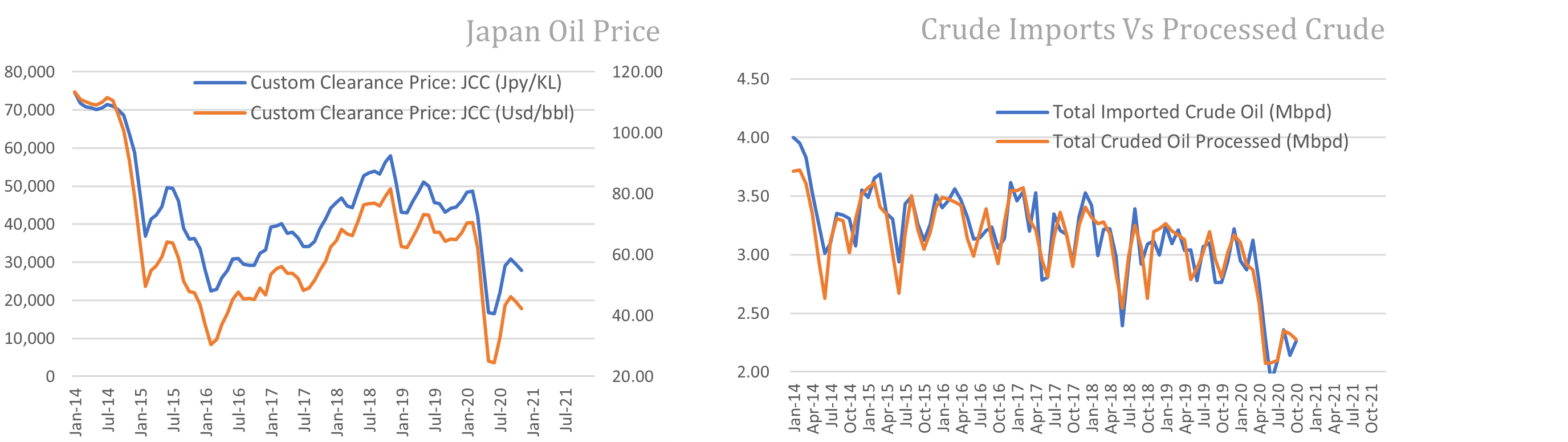
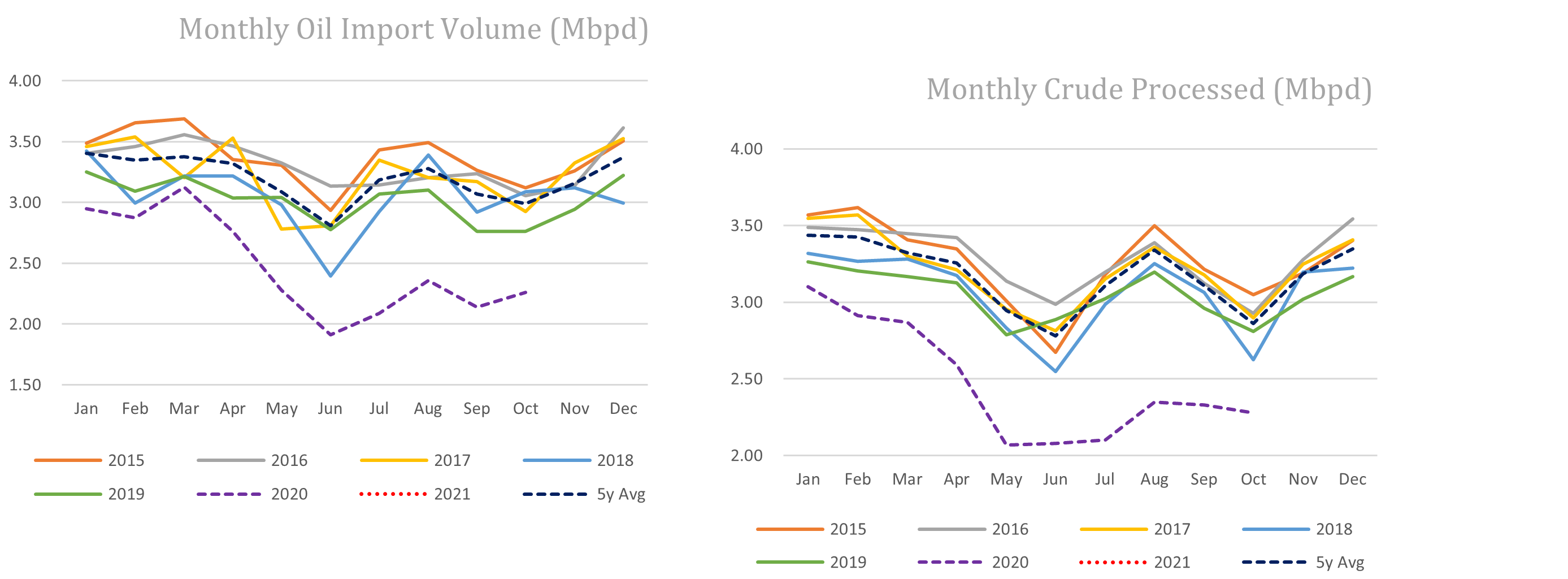
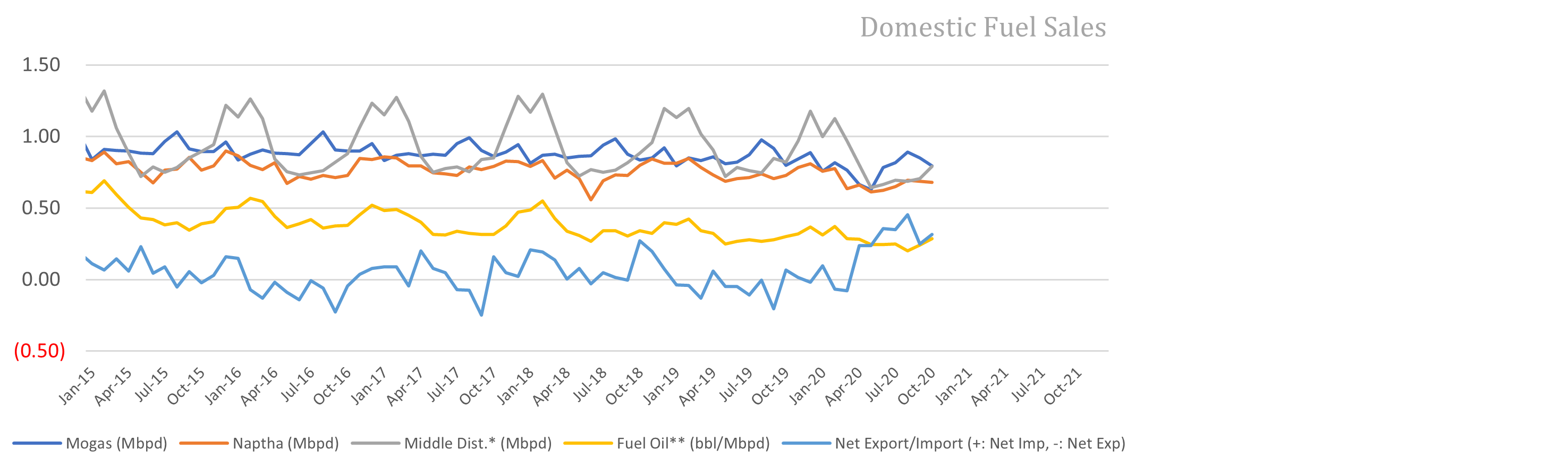
SOURCES: Ministry of Economy, Trade, and Industry (METI), Ministry of Finance, and the Petroleum Association of Japan
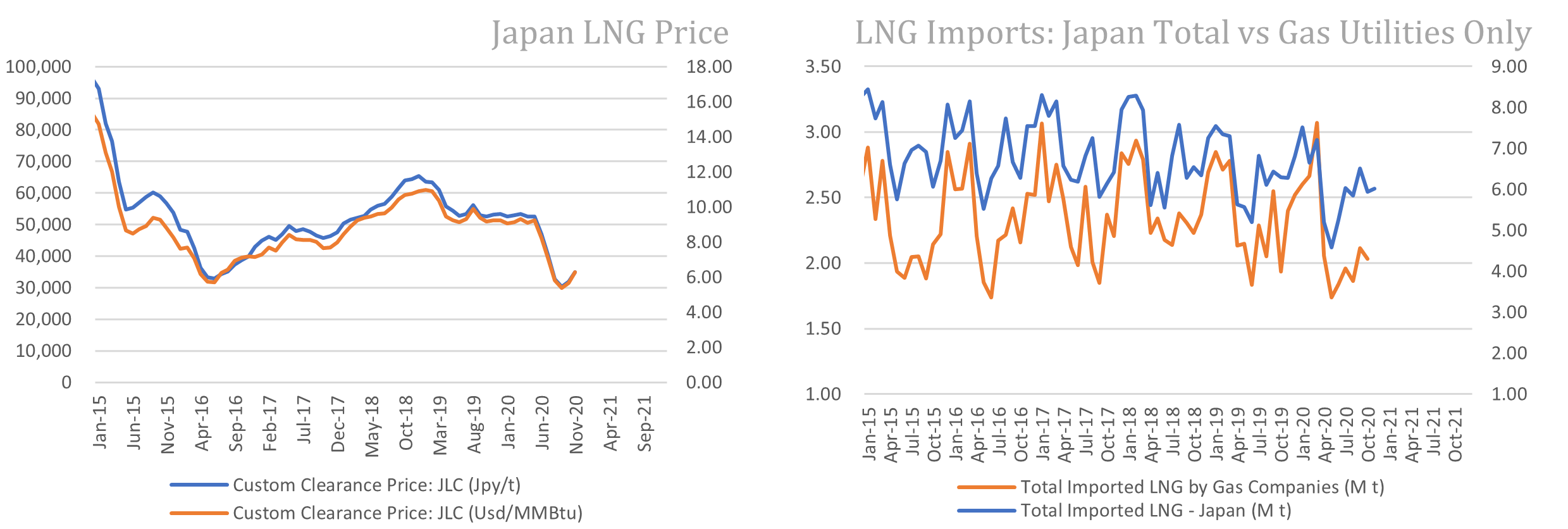
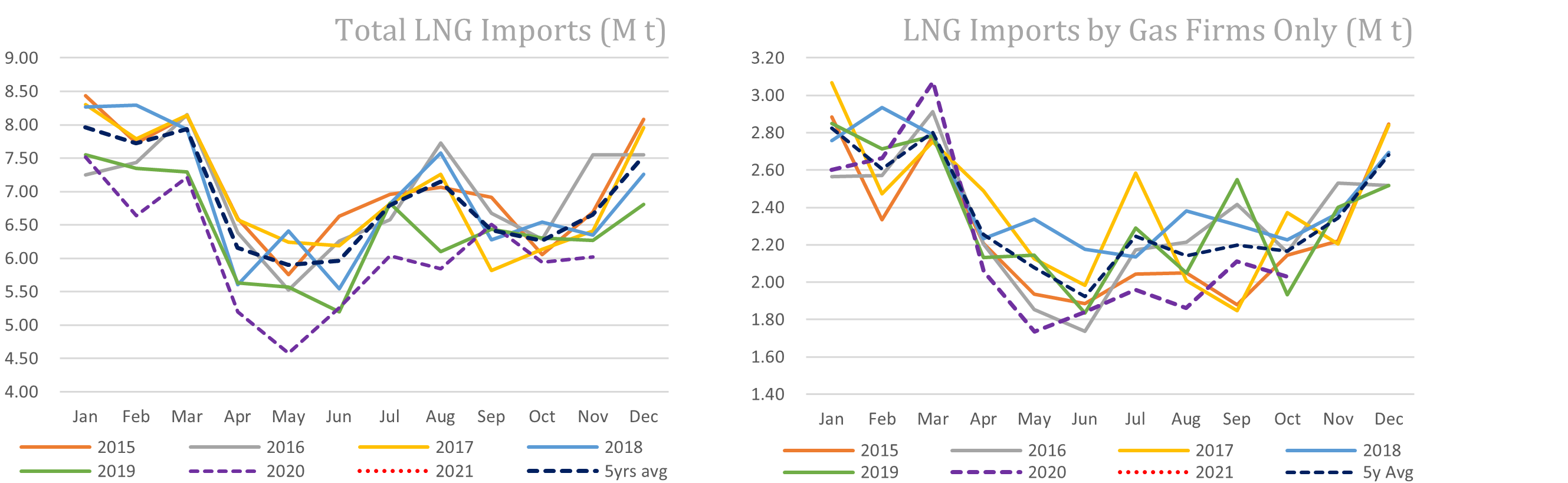
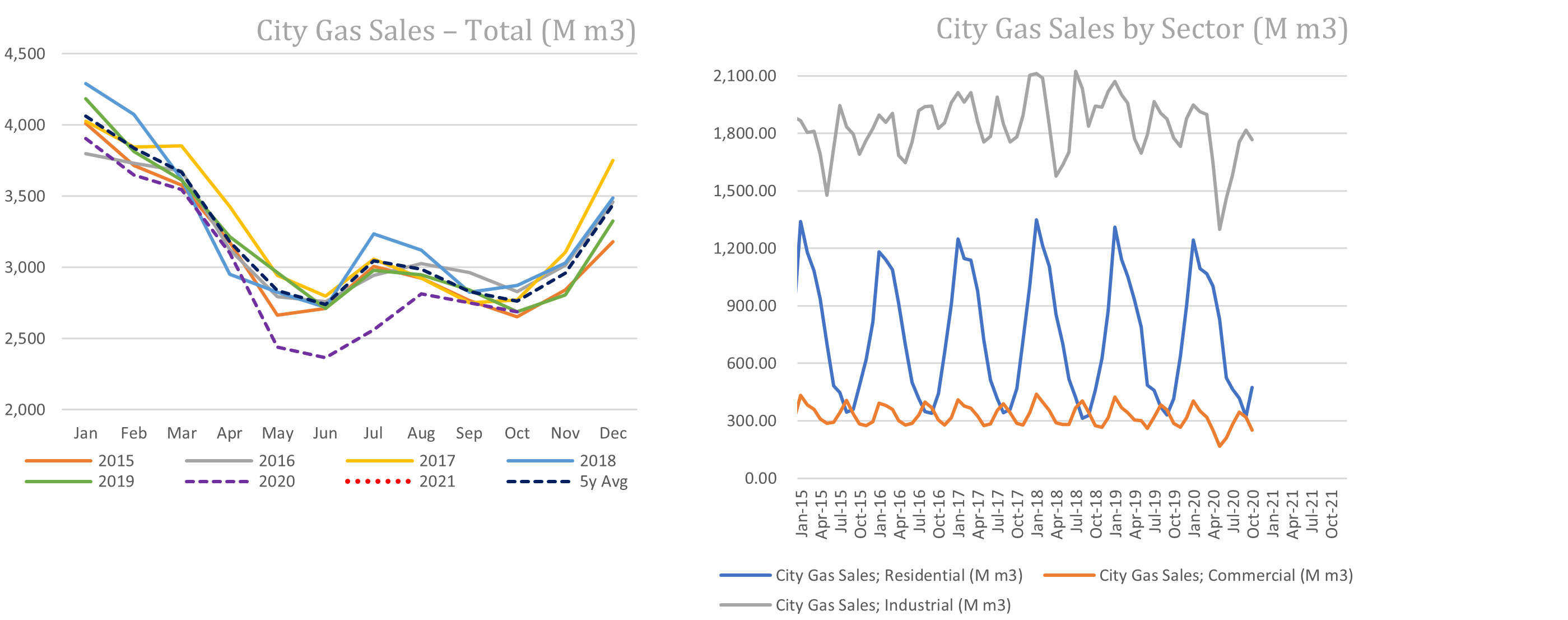
SOURCES: Ministry of Economy, Trade, and Industry (METI), Ministry of Finance
SOURCES: Ministry of Economy, Trade, and Industry (METI), and the Japan Electric Power Exchange