
JAPAN NRG
WEEKLY
JANUARY 25, 2021
JAPAN NRG
WEEKLY
January 25, 2021
NEWS
TOP
- Japan power utilities’ LNG inventories start to recover, but still down almost 50% from last year; Electricity futures trading at all-time high on EEX; prices start to ease off on milder weather
- Development Bank of Japan starts $500 million fund focused on growing local wind power sector; biggest fund of its kind
- Sumitomo Corp plans green hydrogen project in Australia; Mitsubishi Heavy mulls green hydrogen venture in Germany
ENERGY TRANSITION & POLICY
- TDK eyes $5 billion push into EV batteries and clean energy; Teijin to disclose emissions from making auto parts for EU clients; competition with Chinese peers in EV components intensifies
- METI forms panel to rethink environmental assessment structure
- Japan’s top banks back zero-carbon infrastructure with new funds; industry regulator to oversee banks’ climate change policies
- Japan Climate Initiative lobbies govt. to raise 2030 renewables target to 40-50% with many blue-chip companies on board
- Hokuriku Electric taps AI to boost hydropower output, cut CO2
- 6,000 unused school pools may help boost solar power capacity
- Mitsubishi Kakoki trials algae farm for biomass generation
- Nagasaki area to trial tidal power plant
- Japan taps Indonesia projects for joint emissions credits
ELECTRICITY MARKETS
- Power retailers in crisis; Kansai Electric hopes for LNG help from Singapore unit; power suppliers turn to truck-mounted units
- Seven utilities plan to increase electricity prices from March
- Hitachi’s fate in hands of ABB and transmissions business; Hitachi enters solar power in Thailand, EV charging business in the U.K.
- Govt. wins one nuclear court battle, but still struggling in the war
OIL, GAS & MINING
- Mitsui & Co sells Mozambique coal operation to Vale
- Japan seeks to commercialize rare metal mining in EEZ
- Idemitsu to stop investments in Australia coal; switch to lithium
ANALYSIS
METI SEEKS TO INTRODUCE NEW COAL STANDARD
AMID DEBATE ON WHICH COAL PLANTS TO CLOSE
In a bid to speed up decarbonization technology development while maintaining a stable source of power, Japan will establish a new power efficiency target for coal-fired power plants. The current efficiency benchmarks have target metrics for oil, gas and coal-fueled power plants combined. However, only by improving oil and gas power generation, while emission from coal rises, has it been possible to achieve the targets. Coal’s lack of efficiency has been cleverly concealed; thus, the government has decided that a separate coal benchmark is needed.
PRICE INCENTIVES FOR JAPAN’S OFFSHORE WIND
WEAK DESPITE GOVERNMENT’S GRAND AMBITIONS
The 2050 Green Growth Strategy published at the tail end of 2020 calls for ¥8/ kWh wind power prices as soon as 2030. However, a failed offshore wind capacity tender at the end of last year shows how different the government view is from industry expectations. We review the discrepancies in the 2050 Strategy as regards offshore wind and give an update on the current core auction developments.
GLOBAL VIEW
President Biden has canceled the Keystone XL pipeline and ordered the U.S. to reenter the Paris Climate Agreement. Renault unveiled an aggressive EV plan. Occidental Petroleum claims it does more for the climate than Tesla. And Total is betting big on India while exiting the American Petroleum Institute. See details on these and other global events.
2021 EVENT CALENDAR
Our ongoing list for important industry and political events for Japan energy during this year.
DATA
Gas, power, and oil stats
ACRONYMS
Common terms
JAPAN NRG WEEKLY
PUBLISHER
K. K. Yuri Group
Editorial Team
Yuriy Humber (Editor-in-Chief)
Tom O’Sullivan (Japan, Middle East, Africa)
John Varoli (Americas)
Regular Contributors
Mayumi Watanabe (Japan)
Daniel Shulman (Japan)
Damon Evans (Indonesia)
Art & Design
22 Graphics Inc.
Sponsored

SUBSCRIPTIONS & ADVERTISING
Japan NRG offers individual, corporate and academic subscription plans. Basic details are our website or write to subscriptions@japan-nrg.com
For marketing, advertising, or collaboration opportunities, contact sales@japan-nrg.com For all other inquiries, write to info@japan-nrg.com
Disclaimer
This communication has been prepared for information purposes only, is confidential and may be legally privileged. This is a subscription-only service and is directed at those who have expressly asked K.K. Yuri Group or one of its representatives to be added to the mailing list. This document may not be onwardly circulated or reproduced without prior written consent from Yuri Group, which retains all copyright to the content of this report.
Yuri Group is not registered as an investment advisor in any jurisdiction. Our research and all the content express our opinions, which are generally based on available public information, field studies and own analysis. Content is limited to general comment upon general political, economic and market issues, asset classes and types of investments. The report and all of its content does not constitute a recommendation or solicitation to buy, sell, subscribe for or underwrite any product or physical commodity, or a financial instrument.
The information contained in this report is obtained from sources believed to be reliable and in good faith. No representation or warranty is made that it is accurate or complete. Opinions and views expressed are subject to change without notice, as are prices and availability, which are indicative only. There is no obligation to notify recipients of any changes to this data or to do so in the future. No responsibility is accepted for the use of or reliance on the information provided. In no circumstances will Yuri Group be liable for any indirect or direct loss, or consequential loss or damages arising from the use of, any inability to use, or any inaccuracy in the information.
K.K. Yuri Group: Oonoya Building 8F, Yotsuya 1-18, Shinjuku-ku, Tokyo, Japan, 160-0004.
NEWS:
ENERGY TRANSITION & POLICY
Japan development bank launches $500m fund to grow wind sector
(New Energy Business News, Jan. 22)
- The government-backed Development Bank of Japan and renewable energy provider Green Power Investment (GPI) have formed the country’s first and largest fund for wind power investments. It is set at ¥53 billion ($509 million) and is meant to help drive the expansion of the domestic wind power industry.
- The DBJ put in ¥13 billion of the money with the rest coming from GPI and institutional investors, including Bank of Kyoto and other regional banks and insurers.
- The new fund bought three wind farms and two solar energy projects operated by GPI, which have a combined capacity of 220 MW. GPI will continue to manage them for at least 20 years, while using proceeds from the sale to construct new wind farms.
- CONTEXT: The government wants to help bring faster returns to the sector so that operators can reinvest the money into new projects.
Sumitomo Corp to start producing “green” hydrogen in Australia
(Various, Jan. 22)
- Trading house Sumitomo Corp has contracted engineering firm JGC Holdings to set up a hydrogen production facility in Australia. The idea is to produce hydrogen using small solar-powered electrolyzers.
- The initial investment for the project is under ¥1 billion, which will create a small water electrolyzer that’s the size of two shipping containers. This will make it easy to transport and install.
- Initial project output will be 250-300 tons of hydrogen a year, powered by solar farms, which will be enough for 3,000 fuel cell vehicles. The fuel will be sold to local factories and fuel cell buses.
- Production is expected from 2023.
- SIDE DEVELOPMENT:
- Mitsubishi Heavy, Vattenfall, Shell mull “green” hydrogen plant in Germany
- (Nikkei, Jan. 23)
- The three companies and Hamburg Heat Supply Co. of Germany are looking at creating a commercial hydrogen plant on the site of a closed coal-fired power plant. The new facility would have 100 MW of electrolyzer capacity and be powered by wind and other renewable energy.
- Operations are planned for around 2025 with local ships likely to be the hydrogen buyers.
TAKEAWAY: The cost of producing green hydrogen has been the main sticking issue to its realization to date, and yet the Sumitomo project, according to media reports, aims to have that cost down to A$2/kg, which would be around a quarter of the European level. It seems that for the moment Japanese firms are scouring the globe for the best test projects, many of which are linked to local supply as opposed to export potential for Japan. However, once the test projects move to larger scale, we would expect the export potential to be a factor in both project selection and investment. While trading firms like Sumitomo are working on the supply side, engineering firms including Kawasaki Heavy, Chiyoda and Mitsubishi Heavy are considering how best to transport the fuel. The basic outline for Japan’s hydrogen society is already starting to take shape.
TDK eyes $5bn push into electric vehicle batteries and clean energy
(Nikkei, Jan. 15)
- Maker of electronic components plans to scale up manufacturing volumes of parts for electric vehicles. TDK putting aside ¥520 billion in investments to boost capacity of batteries and other clean energy related products.
- TDK President Ishiguro told Nikkei that rechargeable batteries will form the core of the company’s growth as it shifts focus from smartphones to EVs, motorcycles and scooters.
- SIDE DEVELOPMENT:
- Teijin to disclose emissions from making auto parts
- (Asia Nikkei, Jan. 20)
- Chemicals company tries to meet CO2 emission standards expected by European carmakers.
- SIDE DEVELOPMENT:
- Competition with Chinese companies in EV component market intensifies
- (Nikkei; Jan. 13, 2021)
- Chinese companies account for 60 to 70% of the world market share of the four main components in lithium-ion batteries used for electric vehicles.
- Japanese companies (such as Hitachi Metals and Shin-Etsu Chemical) used to hold a majority share of the market for neodymium magnets used for motors, but Chinese companies now have 80% of the global market share.
METI forms panel to review environment assessment for renewable plants
(Japan NRG, Jan. 24)
- The ministry announced that it formed a new panel, which will review the format of the environmental impact assessment for renewable energy power plant construction.
- The 9-person panel of academics will take direction from the Cabinet Office’s Minister of State for Special Missions.
- The panel held its first meeting on Jan. 21. Japan Wind Power Association, Shizen Energy, The Nature Conservation Society of Japan, the Japan Wild Birds Association, Aichi Prefecture, and Kitakyushu City were among those making a presentation at the inaugural meeting.
- CONTEXT: The new panel is part of the process of speeding up the environmental impact assessment or at the very least combining it with other regulatory procedures to help ease the development of wind power generation in Japan. See the story on offshore wind in the Analysis section for more details.
Japan’s top banks back zero-carbon infrastructure with new funds
(Nikkei, Jan. 22)
- Japan’s top three banks have pledged to invest hundreds of millions of dollars into overseas infrastructure projects through new investment funds.
- Sumitomo Mitsui DS Asset Management, a unit of Sumitomo Mitsui Financial Group, launched its first international infrastructure debt fund in late December. The ¥10 billion ($96 million) fund buys debt for projects including solar and offshore wind farms, airports, toll roads and other infrastructure.
- The asset manager plans to set up another ¥20 billion fund as early as fiscal 2021.
- Asset Management One, part of Mizuho Financial Group, will roll out a third ¥100 million fund investing in domestic and foreign infrastructure.
- Mitsubishi UFJ Financial Group plans to launch an infrastructure fund as early as next month. The fund will use environmental, social and governance (ESG) factors into its investment decisions.
- SIDE DEVELOPMENT:
- Japan finance watchdog to oversee banks’ climate change policies
- (Asia Nikkei, Jan. 20)
- The Financial Services Agency will urge banks and companies to accelerate decarbonization by adding climate change measures to its bank guidance policy, favoring companies that want to invest in renewable energy.
Japan Climate Initiative lobbies government to raise 2030 Renewables Target to 40-50%
(Company press release, Jan. 18)
- The Japan Climate Initiative (JCI), supported by Renewable Energy Institute together with WWF Japan and CDP Japan, announced that a total of 92 Japan Climate Initiative (JCI) member corporations who support either RE100, SBT, CDP, TCFD released a message calling on the Japanese government to raise its renewable energy share to 40-50% in its 2030 electricity mix.
- Signatories include some of Japan’s biggest retail and manufacturing firms, and also chemicals and construction companies.
- CONTEXT: Japan’s most recently announced Green Growth Strategy calls for renewables to make up about 50% of the electricity mix by 2050. JCI seeks to speed up that trend.
- SIDE DEVELOPMENT:
- Japan developers go green at Tokyo office buildings
- (Asia Nikkei, Jan. 18)
- Mitsubishi Estate and Tokyu Land pivot to renewables as draw for tenants.
Hokuriku taps AI to boost hydropower output and lower its emissions
(Nikkan Kogyo Shimbun, Jan. 21)
- The Hokuriku Electric Power Co, one of Japan’s pre-eminent hydro dam operators, aims to reduce its carbon footprint by increasing its hydroelectric output.
- Hokuriku’s ability to offer the lowest electricity prices in Japan is made possible by its network of hydrogen dams in the Northern Japan Alps.
- The utility’s Asaida dam uses artificial intelligence to accurately project future dam levels based on historical rainfall data. In 2019/20, this technology enabled the utility to provide an additional 5 GWh of electricity.
Green energy boom as disused school pools are converted to solar power plants
(Mainichi Shimbun, Jan. 19)
- A solar generation system installed over a swimming pool at a disused school in Kagoshima is the latest in many such initiatives to make better use of disused infrastructure.
- The firm that developed the system hopes to see it rolled out nationwide.
- The developers say that when solar panels are floated on water, the cooling effect of the water improves the panels’ efficiency.
- There are over 6,000 disused schools in Japan, and often no plan is in place for the future of the facilities.
Mitsubishi Kakoki trials algae farm for biomass generation
(New Energy Business News, Jan. 21)
- Mitsubishi Kakoki is trialing a “photo bioreactor” system for growing algae for use as biomass feedstock for fuels.
- The company has been developing biofuels since the 1980s and also manufactures disk separators for use in the manufacture of jet biofuel.
- Mitsubishi Kakoki also plans to use the CO2 yielded when hydrogen is isolated from natural gas as a food source for the algae.
Nagasaki area to get tidal power plant as Japan seeks its commercialization
(Smart Japan, Jan. 21)
- Kyuden Mirai Energy said on Jan. 15 that work had commenced on a tidal power generation plant being built in Nagasaki.
- The project is part of an initiative by the Environment Ministry that aims to commercialize tidal power generation in Japan.
Japan taps Indonesian projects to generate over 17,000 tons of joint emissions credits
(Smart Japan, Jan. 21)
- The issue of over 17,000 metric tons of joint emissions credits has been approved in relation to projects carried out in Indonesia in cooperation with the Japanese government.
- The Japanese government will acquire 8,837 tons worth of credits.
- Under the Joint Crediting Mechanism created by the United Nations Framework Convention on Climate Change, Japan is able to claim emissions credits for emission reducing initiatives implemented in developing countries.
Energy market: committee calls for review of solar tender process
(New Energy Business News, Jan. 20)
- The METI committee in charge of overseeing the electricity tender process met on Jan. 12 to express its approach to tenders to supply electricity generated by commercial solar operations.
- The committee says it continues to actively review the amount of power sold via tender. If some capacity is unsold during a tender, part of it will remain on the market until the next round of tenders.
- Tenders for the first round of electricity auctions this year will be accepted from April 19.
Tokyo Gas said it has cut 168,000 tons of CO2 through sales of a home power system
(New Energy Business News, Jan. 21)
- The Enefarm system uses city gas and LP gas. The system recycles heat made during power generation to make hot water.
NEWS:
POWER MARKETS
|
No. of operable nuclear reactors |
33 | |||
|
of which |
applied for restart |
25 | ||
|
approved by regulator |
16 | |||
|
restarted |
9 | |||
|
in operation today |
4 | |||
|
|
able to use MOX fuel |
4 | ||
|
No. of nuclear reactors under construction |
3 | |||
|
No. of reactors slated for decommissioning |
27 | |||
|
of which |
completed work |
1 | ||
|
started process |
4 | |||
|
|
yet to start / not known |
22 | ||
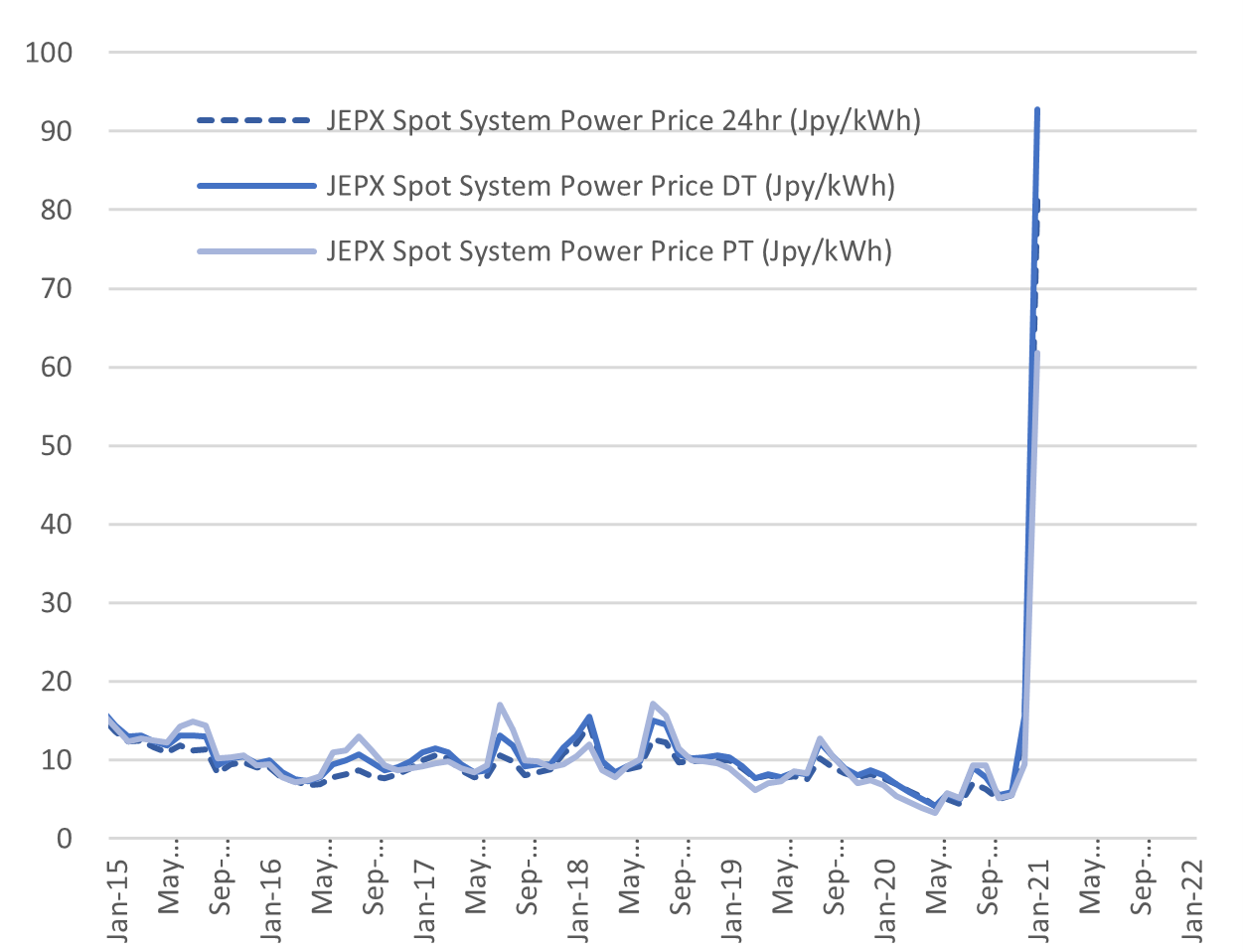
Spot Electricity Prices
Source: Company websites, JANSI and JAIF, as of Jan. 8, 2021
Two-week weather forecast from Japan Meteorological Agency
(Japan NRG, Jan. 24)
- Northern Japan: temperatures expected to be higher than normal for the next five days, then drop below average
- Eastern and Western Japan: temperatures will likely be quite high for the next give days before reverting to the seasonal average
- Southern Japan (Okinawa): temperature expected to stay higher or in line with average for this time for the next four days before reverting to average
- Detailed forecast by regions: here.
https://www.data.jma.go.jp/gmd/cpd/twoweek/en/?fuk=1
Japan power companies’ LNG inventories start to recover, but still down YoY
(Bloomberg, Jan. 19)
- LNG inventories of Japan’s major power utilities were at 1.91 million tons at the start of December 2020, due to higher-than-normal power demand, but by Jan. 11 that volume was down by about half, according to a METI report.
- The volumes have started to recover, however, and were already at 1.24 million tons on Jan. 17, METI said.
- METI report is available here, with LNG storage on p. 15.
TAKEAWAY: The LNG inventory held by Japan’s big EPCOs in Jan. last year was 2.42 million tons. If the inventories are now at 1.24-million-ton level, the drop would be almost 49% from las year.
The full ministry data on LNG inventories is published with a two-three-month lag, and the most recent officially released numbers (for Sept. 2020) are covered in the DATA section of Japan NRG. The more recent numbers in this story are individual data points prepared in a separate METI report, and likely publicized to help the domestic LNG buyers regain some control of their spot purchase price negotiations. A spokesperson from Mitsui & Co. trading house was also making comments to the media to the effect that Japanese utilities will have plenty of time to replenish their LNG stockpiles before the busy summer heat period.
EEX-traded Japan electricity futures contract volume jumps to all-time high
(Company statement, Jan. 18)
- The EEX Japanese Power Futures set new records for the second week in a row. 30 trades were executed for 113 lots representing a volume of 258 GWh.
- This brings the total of trades executed so far this month to 50, for a total of 228 lots or 653 GWh, surpassing last year’s total volume of 578 GWh in just two weeks.
Power retailers in crisis as government warns about market-based electricity tariffs
(Nikkei X-Tech, Jan. 18)
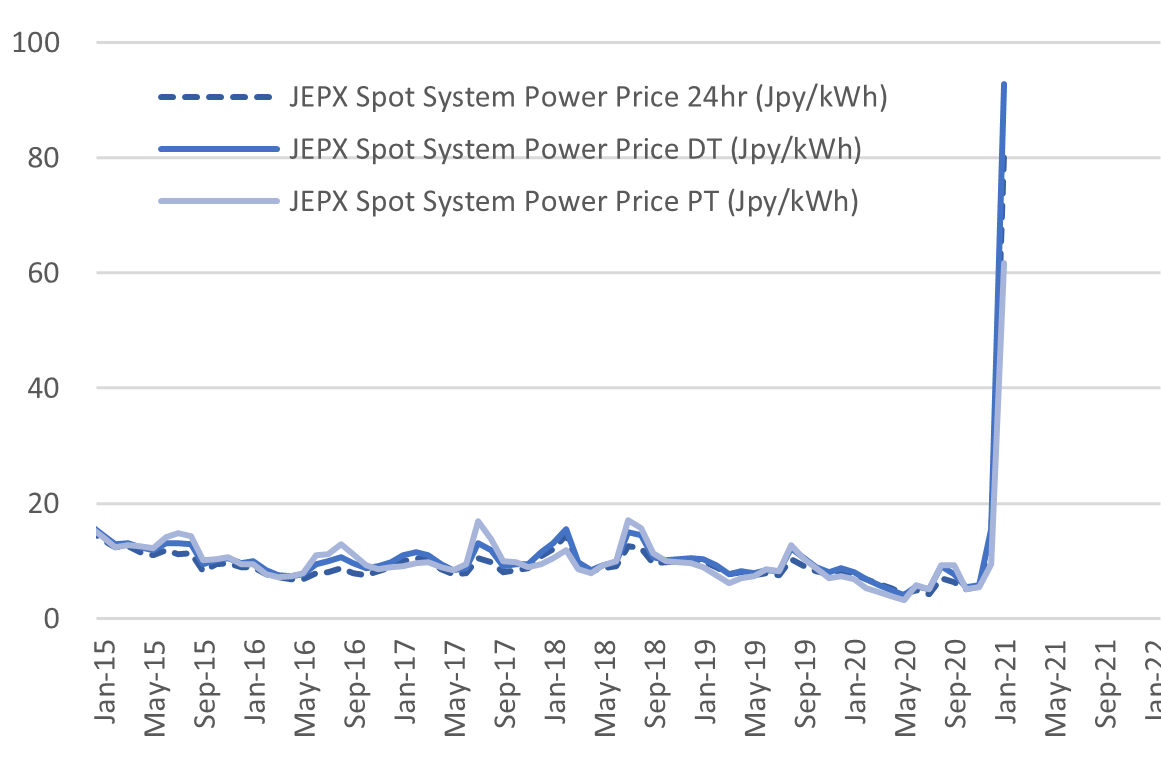
- The government watchdog, the Electricity and Gas market Surveillance Commission, has urged subscribers to check the terms of their electricity contracts after spot prices for electricity on the Japan Electric Power Exchange skyrocketed in mid-December.
- Subscribers on market-based plans from retailers such as Lpio, Shizen Energy, Genie Energy, and Direct Power are now facing extremely large power bills.
- The situation is a far cry from 2020, when market-based plans were by far the cheapest available.
- SIDE DEVELOPMENT:
- Power suppliers send 216 cries for help as cold snap and LNG shortages bite
- (Asahi Shimbun, Jan. 18)
- As the power shortage continues, hard-hit generators such as Kansai Electric are sending requests for help to generators like TEPCO that are able to produce surplus electricity.
- Some 216 requests for assistance have been issued since December 15, placing the current shortage on a par with those seen at the time of natural disasters.
- SIDE DEVELOPMENT:
- Truck-mounted generators deployed amidst cold snap
- (Fukui Shimbun, Jan. 22)
- The Tohoku Electric Power Co. has deployed a fleet of truck-mounted generators to top up the electricity supply as cold weather creates surging demand in the Tohoku area.
- The utility owns 20 such trucks, which are capable of generating a total of 4.8 MW.
Seven utilities plan to increase power prices from March
(Shikoku Shimbun, Jan. 21)
- Seven of Japan’s ten major power companies will raise their domestic tariffs in March.
- The greatest increase is by Chubu Electric, whose subscribers will see their power bill rise by an average of ¥100 compared with a month before.
- TEPCO, KEPCO, and Tohoku Electric have also imposed significant increases.
Kansai Electric finally out of nuclear drought, hopes for Singapore LNG unit’s help
(Nikkei, Jan. 18)
- Reactor 4 at Kansai Electric (KEPCO)’s Ohi nuclear power station has been restarted after being shut down for inspection. This means that, for the first time in 2 1/2 months, KEPCO is producing electricity from nuclear reactors.
- Still, KEPCO is not out of the woods yet. Recent figures show KEPCO is reliant on LNG for 48% of the electricity it supplies, some 11 points higher than the national average.
- KEPCO hopes its Singaporean LNG trading subsidiary, established in 2017, will help it weather the current crisis.
- SIDE DEVELOPMENT:
- Mayor says restart of KEPCO’s Mihama reactor needs at least another month
- (Asahi Shimbun, Jan. 16)
- Mayor of Toshima City says a restart within January is impossible and the outstanding issues around Unit. 3 reactor will take at least a month to sort out.
- SIDE DEVELOPMENT:
- KEPCO issues ¥70 billion yen in bonds
- (Denki Shimbun, Jan. 22)
- The bond maturities are five, 10, and 20-year.
Hitachi’s fate in the hands of the power distribution business acquired from ABB
(Toyo Keizai, Jan. 23)
- Hitachi’s acquisition of ABB Power Grids was due to three reasons: decarbonization, decentralization, and digitization.
- Although the Japanese power industry is conservative and dislikes using overseas products, VP of Hitachi Nishino Toshikazu has reformed the company’s culture. He hopes to double the value of ABB by 2024.
- Whether Hitachi will be able to create synergy between ABB and Lumada is yet to be seen.
TAKEAWAY: This is a long feature in a weekly magazine, and it covers many aspects of the ABB-Hitachi deal. Still, one dichotomy that comes through in the story is the difference between Hitachi, which seeks to become a more global, agile and progressive firm, and the conservative leaning of the Japanese electricity industry. The power industry seems to wish to perpetuate the “all-Japan” familiarity, which involves having documents and communications localized, and minor yet costly customizations. It would be tempting to assume that these conservative attitudes are everywhere. The Hitachi example, however, and the emergency of new power companies since 2011 shows that conservatism is not specifically a “Japan” issue and more a reflection of the character of the country’s incumbent electricity utilities, which had never before been challenged in their own markets. The pace of power reforms will depend on how well the progressive factions handle the conservative attitudes.
- SIDE DEVELOPMENT:
- Hitachi Capital, Hitachi Asia, and Suntech Power Solutions execute joint-business memorandum for solar energy
- (Denki Shimbun; Jan. 12, 2021)
- Hitachi Capital, Hitachi Asia, and Suntech Power Solutions executed a joint-business memorandum for solar energy in Thailand.
- Hitachi Capitol will become an energy producer in Thailand and will provide customers that need solar energy with solar panels for free. In exchange, customers will pay the cost of power to Hitachi Capital.
- SIDE DEVELOPMENT:
- Hitachi and NEDO to work together on upgrading power systems and sustainable energy in Thailand
- (Denki Shimbun; Jan. 13, 2021)
- Hitachi and NEDO (New Energy and Industrial Technology Development Organization) will work together on upgrading power systems and sustainable energy in Thailand.
- By reducing operations at thermal power plants, carbon dioxide emissions are expected to be reduced by up to 20,000 tons per year.
- SIDE DEVELOPMENT:
- Hitachi Capital invests £10m in Gridserve
- (Forecourt Trader; Jan. 12, 2021)
- Hitachi Capital (UK) has announced a £10m investment in Gridserve Holdings Limited.
- In 2020, Hitachi Capital UK funded over £24m in Gridserve projects, including funding to help deliver the completion of the Braintree Electric Forecourt.
- Over the next five years, Gridserve aims to build more than 100 Electric Forecourts across the UK, delivering fast, ultra-convenient and reliable charging for EVs.
METI select committee overwhelmingly pro-nuclear in defiance of public sentiment
(Tokyo Shimbun, Jan. 20)
- CONTEXT: Tokyo Shimbun is the smallest of the big daily newspapers in Japan and has a left-leaning viewpoint.
- Despite a majority of the Japanese public calling for the phasing out of nuclear power, the METI select committee in charge of reviewing the government’s energy policy has issued many statements endorsing nuclear power.
- Some committee members have expressed misgivings about the implications of pushing ahead with policy supportive of nuclear power while remaining at odds with public opinion.
- Many members of the committee, such as IHI’s Mizumoto Nobuko, have ties to the nuclear industry. Mizumoto says that Japan must build new nuclear reactors in order to maintain expertise in the industry.
High Court orders government to broaden Fukushima compensation
(Toyo Keizai Online, Jan. 20)
- The outcomes of two trials about to start at the Tokyo High Court may force the Japanese government to rethink its policy on nuclear power.
- The plaintiffs, comprising134 persons from 54 households, are all former residents of disaster-ravaged Fukushima who were forced to evacuate to other prefectures.
- Because radiation levels in the area in question are less than 20 mSv per year, the government has refused to pay compensation, saying this level of radiation presents no health risk.
- An earlier Sendai High Court decision ordered the government to pay damages to residents after finding that it failed to properly exercise its powers to ensure the safety of nuclear operations.
- The government has appealed the Sendai High Court’s decision. If, rather than compensating the victims of the disaster, the government decides to fight such court challenges to the bitter end, it is sure to generate a public outcry.
- SIDE DEVELOPMENT:
- High Court finds in favor of government in nuclear disaster trial
- (Tokyo Shimbun, Jan. 21)
- On Jan. 21 the Tokyo High Court overturned an earlier decision that found the Japanese government liable for damages incurred by former residents of Fukushima. The court found that the government did not fail to properly guard against tsunami damage.
- The Court found that liability for damages incurred by the residents lay solely with TEPCO, which it ordered to pay a total of ¥120 million in damages to 90 of the 91 complainants in the suit. This is over ¥80 million more than the amount awarded in the earlier, district court, trial.
TAKEAWAY: The national government has so far managed to win some of the litigations brought before it from former Fukushima residents. And yet, in this case, there is almost no scenario in which the government can actually call this a “win”. Even if all the courts settle in its favor, on the eve of the 10th anniversary of the Fukushima disaster the public scrutiny on the national government will be immense. Should all courts find that TEPCO is the liable party, then it still leaves the bill on the government’s desk, since the utility is now state-controlled. Given the money already expended on Fukushima area compensation, it seems odd that the national government is even fighting these claims in the first place.
Joint venture partner sues TEPCO over dirty tactics
(Toyo Keizai, Jan. 22)
- Panair, a service provider in the retail electricity and gas market, is suing TEPCO Energy Partners for damages, claiming that TEPO poached its staff and passed off software developed by Panair as its own.
- The allegations involve PinT, a joint venture between TEPCO EP and Panair in which TEPCO holds the controlling stake. TEPCO is accused of poaching Panair’s Chief Technology Officer, who abruptly resigned from Panair despite his employer’s protests. He was subsequently hired by PinT, an action that Panair says breached the terms of his non-poaching agreement.
Fukushima plant: Anomaly observed in reactor containment vessel
(NHK, Jan. 22)
- TEPCO is investigating a drop in pressure in the containment vessel enclosing the Fukushima nuclear plant’s Unit 1 reactor at around 6:30 pm on Jan. 21.
- The incident happened when a “guide pipe”, which will house a camera used to inspect the reactor, was being attached to the containment vessel.
- Nitrogen is injected into the containment vessel under pressure to reduce the risk of explosion.
- TEPCO says no radiation leak has been observed and denies that there is a safety issue.
Market share of new power retailers up in 2020; total number of retailers climbed
(Japan NRG, Jan. 24)
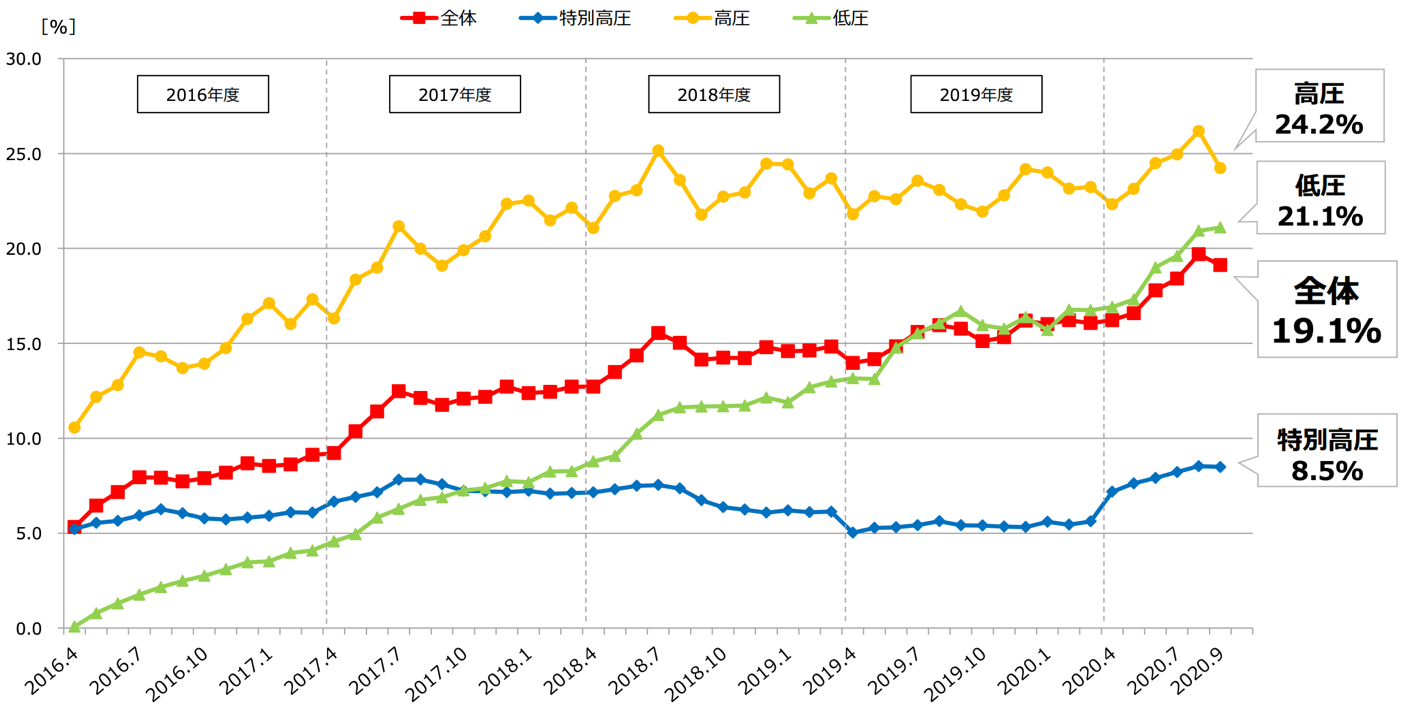
- Market share of new entrants to the electricity retailing market rose during 2020. See chart below published by the Basic Gas Policy sub-committee.
- Total share was up at almost 20%, before dropping to 19.1% in Sept.
- The new power retailers gained a 21.1% market share for low-voltage power (i.e., mostly households) by Sept. 2020. This is up from zero as of April 2016.
- The trend of the 10 major power utilities expanding their business outside of their original geography has also continued. Some 4.2% of electricity sold in Japan last year came from the 10 power utilities acting outside of their “home” territory. As a consequence, the market share of the 10 power utilities selling electricity within their home territories shrank to 78.9% by Sept. 2020, down from 94.8% five years earlier.
- LEGEND:
Red: Total electricity sales;
Blue: Special High-Voltage;
Yellow: High-Voltage;
Green: Low-Voltage.
NEWS:
OIL, GAS & MINING
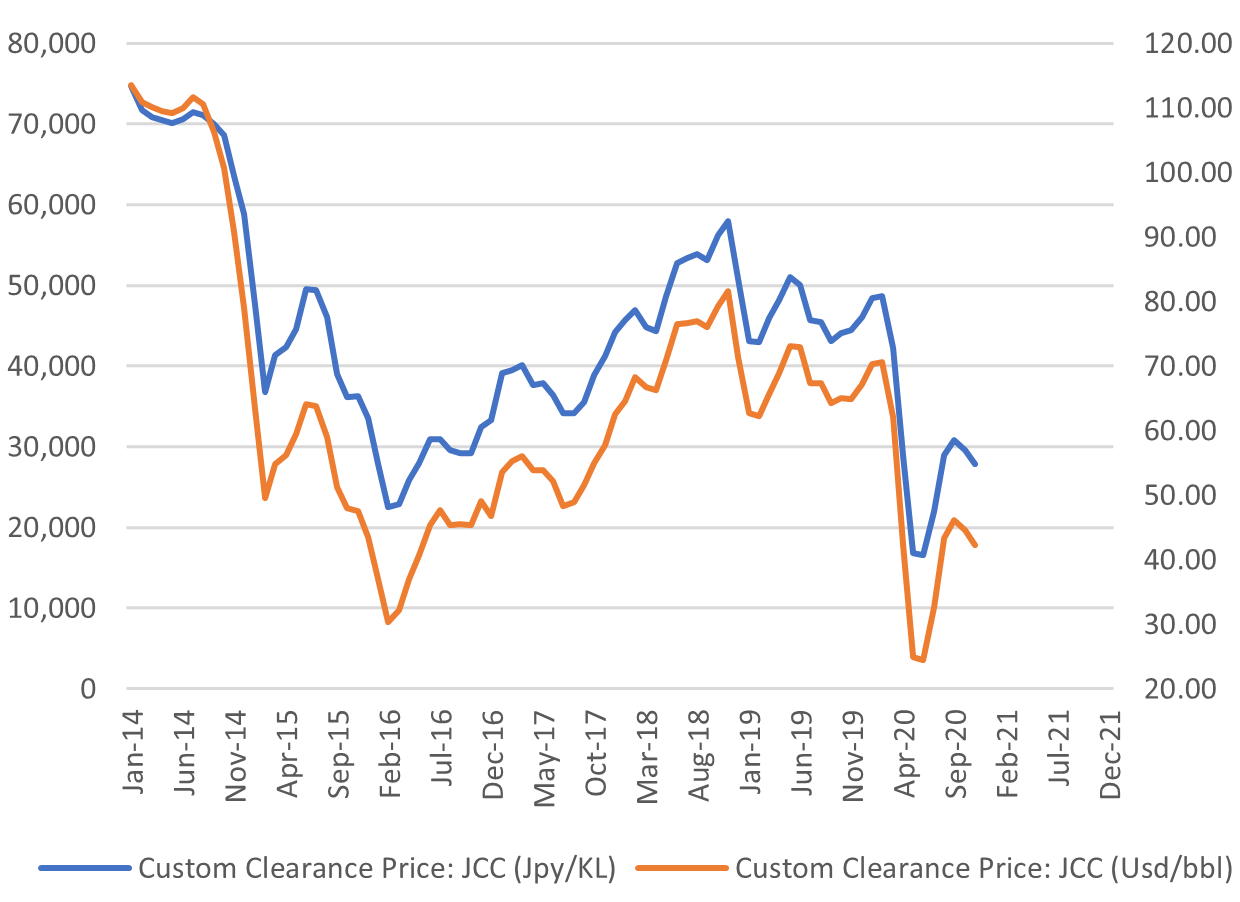
Japan Oil Price:
$42.28
/ barrel
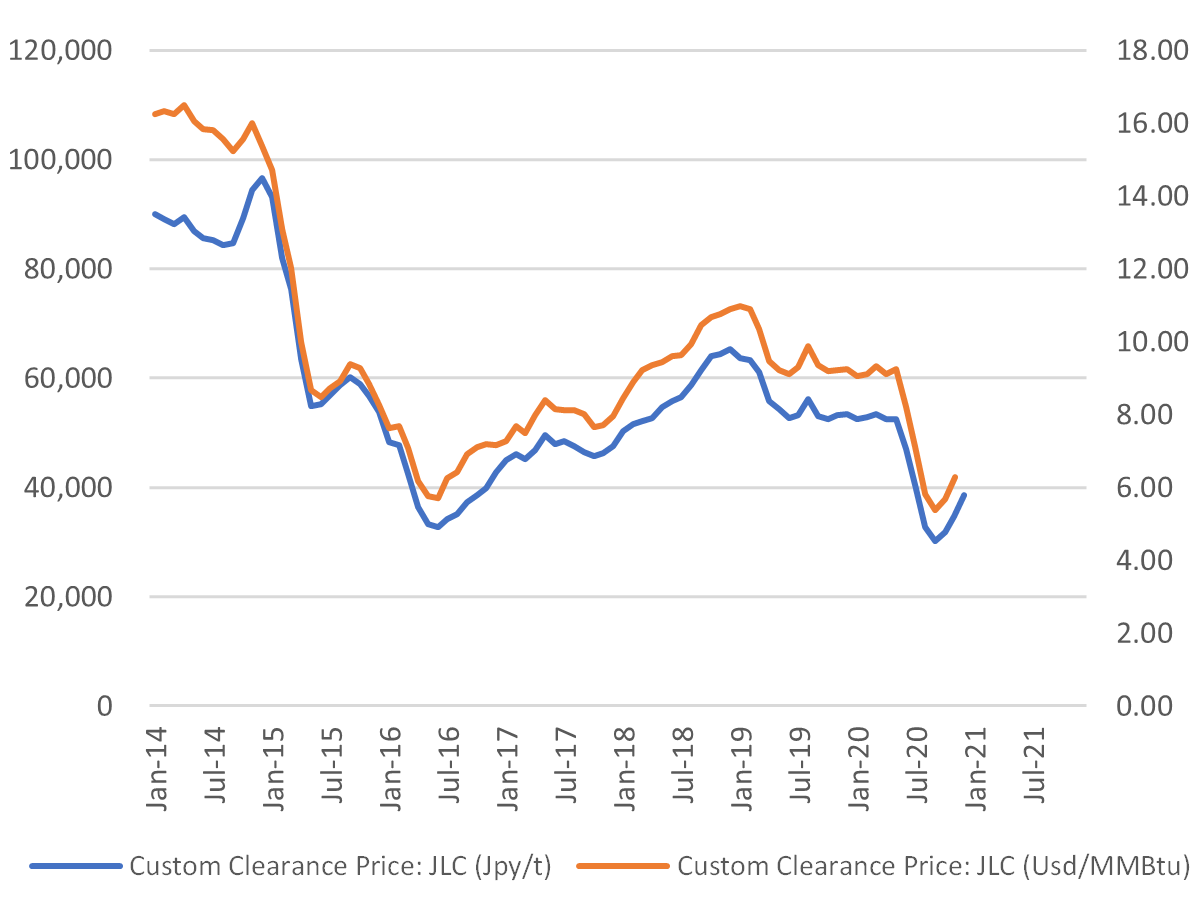
Japan (JLC) LNG Price:
$6.27
/ mmbtu
Mitsui & Co divests from Mozambique coal mine
(Jiji, Jan. 21)
- Mitsui & Co says it has agreed in principle to sell the entirety of its interests and investments in the Mozambique Moatize coal mine, as well as related, rail and port infrastructure, to Brazilian mining company Vale.
TAKEAWAY: This move away from coal has been flagged by the CEO in an interview published at the turn of the year. The immediate beneficiary is likely to be China, which is looking for new sources of supply outside of Australia due to a political standoff between the two nations.
Government to commercialize rare metal exploration in EEZ
(Yomiuri Shimbun, Jan. 18)
- The government has decided to begin commercial extraction of cobalt and other rare metals from the seabed surrounding Japan’s easternmost island, Minami Torishima.
- In a world first, a Japanese team successfully extracted rare metals from the seabed 900 meters below the ocean surface last year.
- The government plans to perfect its extraction technology, and decide on drilling locations within Japan’s exclusive economic zone, by 2028.
- Japan currently relies on cobalt imports from politically unstable regions like the Democratic Republic of Congo, but aims to source more of the mineral domestically.
Idemitsu to stop new investments in Australian coal business, eyes lithium mining
(Bloomberg, Jan. 18)
- Idemitsu Kosan, the Japanese oil major, plans to stop making new investments in its coal business in Australia, CEO Kito Shunichi said in an interview. Idemitsu has considered selling the business, but believes it would be hard to do so in the current environment of heightened ESG awareness.
- Coal demand will remain in the power sector of emerging economies, Kito said.
- Idemitsu is also looking at ways to reorganize the coal business, including by exploring ways to turn the mining sites into solar farms, or farms to cultivate crops for biomass.
- Idemitsu also wants to enter the lithium mining business, Kito said.
- Idemitsu plans to announce its net-zero emissions by 2050 target and roadmap when it posts annual financial results in May, but it won’t be taking on Scope 3 emission pledges, Kito said.
- Synthetic fuels, or e-fuels that can be used in aviation as a cleaner alternative, is another focus area for the company, Kito said.
- CONTEXT: Idemitsu is Japan’s No. 2 oil refining company and has three coal mines in Australia.
ANALYSIS
BY MAYUMI WATANABE
METI Looking for New Efficiency “Coal Benchmark” to Set Standards
for Coal-Fired Power Plant and Mark Evolution to Ammonia
In a bid to speed up decarbonization technology development while maintaining a stable source of power, Japan will establish a new power efficiency target for coal-fired power plants.
The current efficiency benchmarks have target metrics for oil, gas and coal-fueled power plants combined. However, only by improving oil and gas power generation, while emission from coal rises, has it been possible to achieve the targets. Coal’s lack of efficiency has been cleverly concealed; thus, the government has decided that a separate coal benchmark is needed.
The context here is that Japan’s Ministry of Economy, Trade and Industry (METI) said last July it wants to close down “inefficient” coal power plants by 2030. While it didn’t give an official figure, media reported that 114 coal-fired units would be closed. Japan has 150 coal-fired units and of those almost half are owned by manufacturers that use the power for their own consumption while sending surplus to the grid.
The proposed coal benchmark involves 46 thermal power plant operators and won’t require formal public endorsement. Yet, there must be clarity on how the benchmark will relate to the 2030 goal. METI has a difficult challenge ahead – to balance various stakeholder interests while setting new coherent rules on how to meet the 2030 goal of removing “inefficient” coal power plants, as well as the 2050 net-zero goal.
The government’s goal is not to close all coal-fired power plants. In fact, on Jan. 8, power company JERA brought on-stream a new coal-fired power plant in Ibaraki prefecture. In addition, around 15 new coal-fired plants are expected to come online in the coming years.
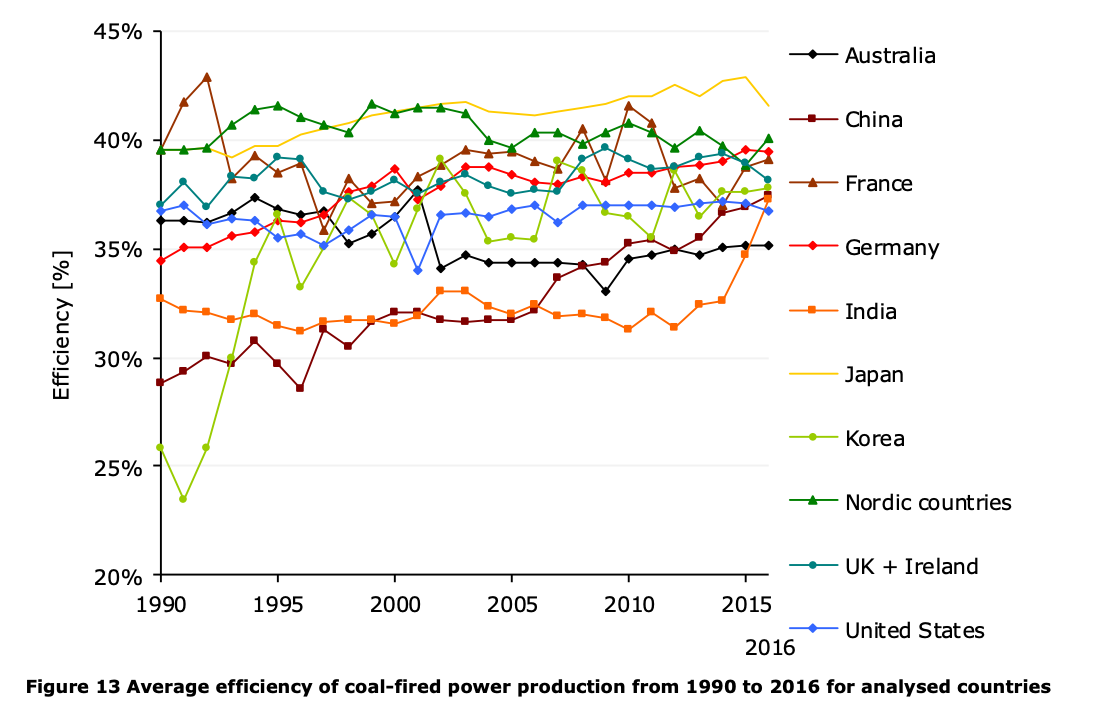
SOURCE: ECOFYS report “International comparison of fossil power efficiency and CO2 intensity – Update 2018
Average efficiency of coal-fired power generation: ECOFYS analysis
Rather, the country’s policy seeks to push existing coal power plants, both under-performers and over-achievers, to continually improve power efficiency and reduce carbon emissions. With this in mind, at the end of December, METI presented a rough plan for a “coal efficiency benchmark” to the Coal-fired Thermal Plant Working Group, an eight-member panel of the influential Energy Research Council. The coal-efficiency benchmark targets 46 thermal power plant operators that include traditional power utilities and manufacturers selling electricity to third parties.
Following months of bargaining with plant operators METI has proposed a “standard” rather than singular numerical efficiency targets. Operators argue that flexibility is needed because each power generator is different. Moreover, energy efficiency numbers are not only dependent on generation type. As a rule, smaller plants and those used more often enjoy higher efficiencies, a point METI’s new “standard” approach tries accommodate.
METI’s criteria for the new standard are:
● 41%-46% power efficiency for plants that employ the “best available” technology
● 50% efficiency for plant operators that rank in the top 10-20% of the industry
The ministry argues that this standard exceeds the global benchmarks, which are around 35%-40% energy efficiency.
The problems with a diplomatic approach
Already, the proposed new approach has sparked debate. Online panel members at the Dec. 25 meeting questioned whether the standard should apply for each single power plant, or on a company-wide basis.
One participant said that since METI’s model efficiency calculations are power plant-based, the regulatory approach should also be based on each unit of generation. Toshiyuki Sakamoto of the Institute of Energy Economics said there’s no point ranking operators and setting top figures as the standard because operators might score similar figures anyway.
The JERA power plant that came on-line on January 8 has the most advanced desulfurization and dust filtering units and boasts power efficiency of 46%, which appears to clear METI’s new proposed coal benchmark. However, the methodology to measure the efficiency is not uniform — that 46% is based on JERA’s calculations, which are independent from METI.
The efficiency measurement methodology will likely be the next point of contention as METI tries to sell the coal plant closures to the industry.
Adding ammonia into the equation
METI has tied to placate all sides so far, but this might become untenable as coal-fired generation starts to include new elements, such as adding ammonia into the fuel mix and adding carbon capture technology.
Already, operators have been told that they can factor in the use of clean fuels such as biomass, ammonia and hydrogen into their thermal power plant efficiency numbers. By METI’s own calculation, if ammonia and hydrogen comprised 10% of the primary energy source, power generation efficiency would rise by 4%.
This opens the possibility of old and inefficient coal-fired plants adding a clean fuel into the mix and gaming the efficiency numbers through co-firing. If small, busy coal plants are re-engineered also to burn ammonia, will METI still insist on the 114 plant closures?
For the foreseeable future and until 2030, the date by which METI said it wants to enact the coal plant closures, it will be unrealistic to expect hydrogen and ammonia to account for 10% or more of Japan’s fuel mix. The rollout of the new benchmark may also require revisions to METI ordinances, and changes are likely to be bundled with other regulatory reforms required for carbon neutrality.
Still, the success of any regulation depends on clarity of its rationale and consistency of implementation methodologies. Decarbonization is a continuous process and its policies need to last for the next three decades. For METI to sell the new coal benchmark to all stakeholders, not just the power industry, it will need to outline how hydrogen, ammonia, carbon capture and other technologies will affect the rules.
Meanwhile, METI has another urgent deadline. The ministry has to deliver a new energy strategy by summer that will outline, among other things, the allocation for coal-fired generation in the country’s energy mix.
Japan’s idea of “out-phasing coal” may in fact mean giving longer life to coal power plants under the name of “being efficient”.
Generating Efficiency per fuel source (2014 – 2016)
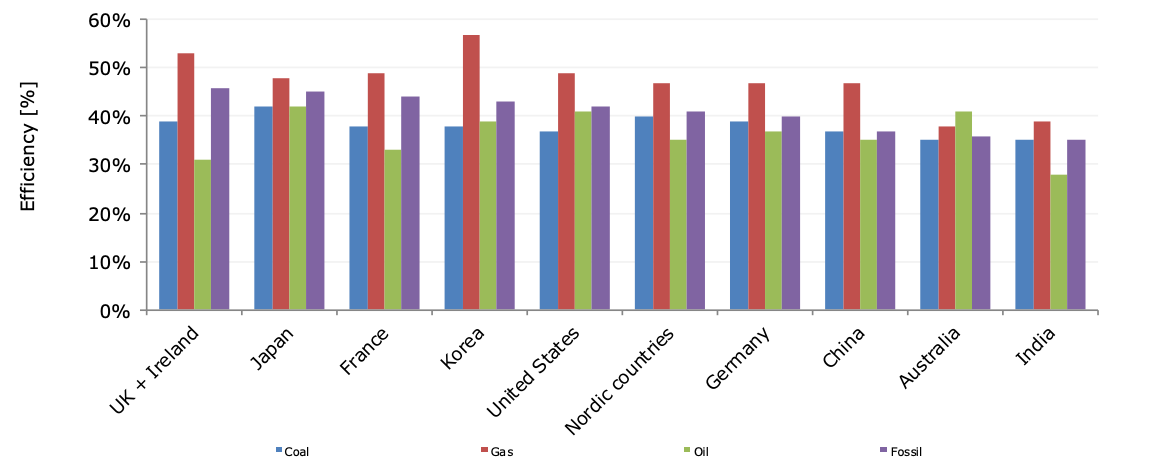
SOURCE: ECOFYS report “International comparison of fossil power efficiency and CO2 intensity – Update 2018
ANALYSIS
BY YURIY HUMBER
Government Vision for Offshore Wind Does Not Lack Ambition,
But May Lack Price Incentives as Operators Weigh Risk-Return Picture
At the end of last year, Japan held its first power capacity auction for offshore wind under the Feed-In Tariff (FIT) scheme. A total of 120 MW was on offer. There was only one bidder, however, for 4.8 MW of fixed bottom wind capacity. It didn’t win.
This first auction of its kind in Japan did not disclose the price cap on offer, which explains why the only entrant failed. Even if the auction were a success, it would have made little dent in the recently unveiled government plan to build as much as 45 GW of offshore wind capacity in Japan within two decades. And yet, the results of this auction, aimed at small projects outside of the “core” offshore wind promotion zones, is further evidence of a worrying disconnect between government ambitions and industry expectations.
The 2050 Green Growth Strategy published at the tail end of 2020 calls for ¥8/ kWh wind power prices as soon as 2030. The sole bidder in the FIT auction mentioned above sought ¥1 more than the event’s ¥34 price ceiling, itself a more generous cap than what’s on offer for bigger offshore wind developments.
As per the government’s own comment in the Strategy, competition among Asian countries to welcome offshore wind developments and secure turbine supply is becoming “fierce”. The margins in Japan, coupled with local supply chain risks, are starting to give some wind developers pause for thought.
Government publishes vision for offshore wind
Japan had about 4.4 GW of wind capacity installed as of mid-2020. Even if all wind projects currently under development and FIT-approved are completed, that number will reach just 11.6 GW.
So, when the government published its Green Growth Strategy on Dec. 25, its vision for the offshore wind development was nothing if not revolutionary. Not only did the Strategy call for Japan to have 8% of an expected 526 GW of global offshore wind capacity by 2040, it selected this energy source as the nation’s No. 1 priority. Offshore wind sits at the top of the Strategy’s to-do list.
|
What government promises to do to speed up offshore wind development |
|
|
|
|
|
There are good reasons to focus on offshore wind. It promises to deliver dozens of GWs of emissions-free electricity and could power facilities that generate hydrogen. Offshore wind, alongside nuclear and hydro, are estimated to be the lowest carbon intensity options for powering hydrogen products, according to a recent assessment completed by the Canadian government.
Floating offshore wind turbines is also a field that currently has no global leaders and could be a business opportunity with future export potential for Japanese shipbuilders, according to the Green Growth Strategy.
However, while the government’s vision lays out precise numerical targets for offshore wind, it also makes some very risky assumptions.
Near-term developments
While the FIT auction mentioned at the beginning is aimed at projects in the 30 MW range and less, the vast majority of offshore wind developments in Japan will initially take place in four designated areas. (See the next page for a map). These are: off the coast of Akita prefecture (the Noshiro, the Yurihonjo City North and the Yurihonjo City South zones); Chiba prefecture (near Choshi City); and Nagasaki prefecture (near Goto City).
In addition, zones in Aomori and Hokkaido prefectures are seen as good candidates for auctions in the near term.
The first auction for development of a large project in the Akita and Chiba zones opened on Nov. 27, 2020, with the results due by May 27, 2021.
In addition, Japan will publish a detailed roadmap for technical development in offshore wind during this year, according to the Strategy.
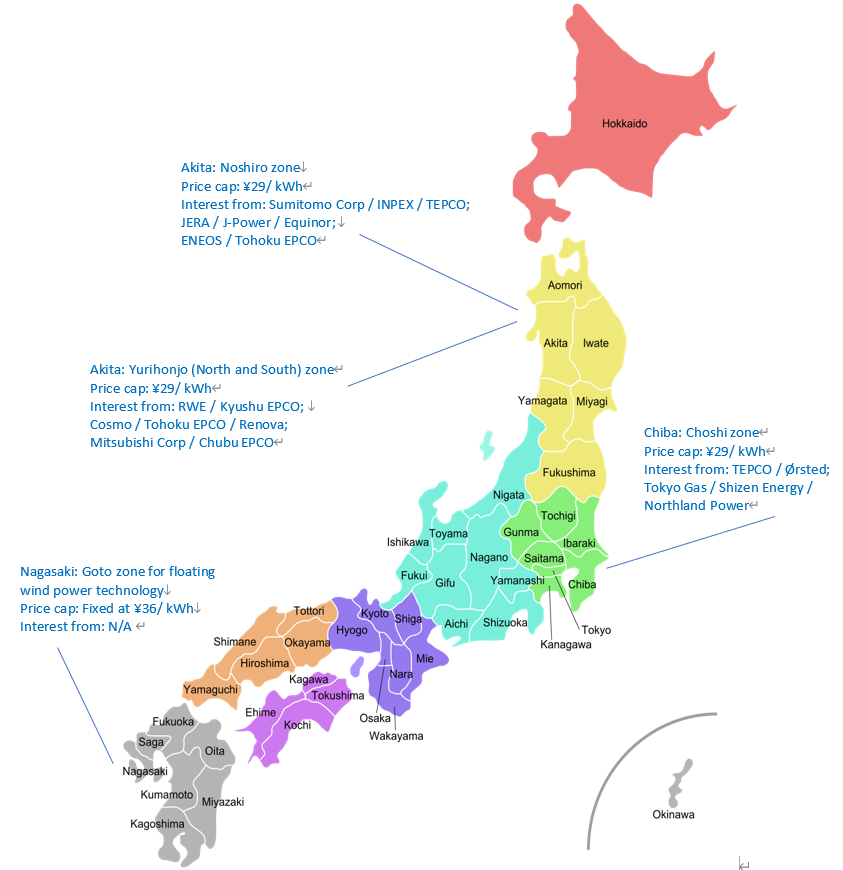
SOURCE: company statements, media reports, METI
GLOBAL VIEW
BY TOM O’SULLIVAN
Below are some of last week’s most important international energy developments monitored by the Japan NRG team because of their potential to impact energy supply and demand, as well as prices. We see the following as relevant to Japanese and international energy investors.
Oil:
On Monday, the IEA revised down its forecast for global oil demand by 0.6 mb/d for 1Q21, and 0.3 mb/d for FY2021, due to the prolonged impact of the pandemic. IEA now projects world oil demand will rise by 5.5 mb/d this year to 96.6 mb/d, following last year’s 8.8 mb/d contraction. They also predict world oil supply will rise by over 1 mb/d this year, with OPEC+ adding more barrels than those outside OPEC. In 2019 world oil demand was 100 mb/d and world oil supply was 95 mb/d.
Pipelines:
1). President Biden canceled the Keystone XL pipeline permit on day 1 of his administration. The $8 billion pipeline was expected to transport over 800,000 b/d of Albertan oil across the U.S.-Canadian border to refineries on the U.S. Gulf Coast. Jason Kenney, the Alberta premier, has called for retaliatory sanctions against the U.S. JAPEX, Japan’s third largest oil and gas company, has investments in Albertan oil sands. Canadian oil prices hit a low of $8 in March but have since recovered to $40.
2). The German state of Mecklenburg-Western Pomerania, which will host the endpoint of Nord Stream 2, the Russian pipeline that will transport natural gas to Germany, has launched an environmental foundation to overcome U.S. objections to the pipeline. Gazprom, the owner and operator of the pipeline, will invest E20 million in the foundation.
Coal:
BHP wrote down the value of its coal assets by an incremental $1.3 billion in 4Q20.
EVs:
1). Renault, the French automaker, committed to further EV investments as part of its ‘Renaulution’ strategy announced last Thursday that aims to cut E3 billion in costs and generate E6 billion in incremental cash flow by 2025 and unwind the Carlos Ghosn strategy. Renault has a 44% voting stake in Nissan, which in turn has a 15% non-voting stake in Renault.
2). Rivian Automotives, the U.S. EV start-up, raised $2.7 billion in new funding last week. Amazon and Ford are investors in Rivian.
3). BYD, the Chinese EV company backed by Warren Buffett, raised $3.9 billion in new equity last week.
4). Ford and GM are the top performers in the S&P 500 equity index Jan. YTD, up by over 30% due to plans to expand EV platforms.
Palm Oil:
1). Palm oil prices touched $961 a ton this month, the highest level since 2011, due to production shortages caused by pandemic lockdowns. Palm oil is used extensively for the production of biodiesel.
2). Malaysia and Indonesia, the two major palm oil producers, have also joined forces in an advocacy campaign in Europe to overcome tight EU regulations.
Wind Energy:
Clarksons, the shipping broker, estimates that investments in global shipping fleets to service the 26,000 offshore wind turbines expected to be in place by 2030 will need to almost double to $23 billion by 2025.
Carbon Capture and Storage (‘CCUS’):
Occidental Petroleum claimed last week that its annual injections of 20 million tons of CO2 exceed Tesla’s greenhouse gas emissions credentials. Occidental claims that their CCUS injections are equivalent to taking four million cars off the road. Tesla sold 500,000 EVs in 2020. Occidental’s share price has halved over the last 12 months and its market capitalization is now 2.5% of Tesla’s.
Energy Storage:
1). The Biden administration is expected to introduce an investment tax credit for energy storage as part of their green energy policy plans.
2). The price of nickel has risen by 70% over the last nine months to $18,410 per ton as EV sales grow and more nickel is required for battery production.
Airlines:
Last week, United Airlines and Delta Airlines announced combined losses of $20 billion for 2020 as the industry struggles through the worst crisis in its history. Demand for jet fuel is expected to remain sluggish.
China:
China sanctioned 28 members of the outgoing Trump administration last week including Keith Krach, the former under secretary of state for energy and the environment, at the State Department. The sanctions prohibit travel to China and doing business with China. In December the EU signed a Comprehensive Agreement on Investment with China which is the subject of some tension between the U.S. and the E.U. Also, China continues to be the major investor in the two nuclear power projects at Hinkley and Sizewell in the U.K.
India:
1). France’s Total has acquired a 20% stake in Adani Green Energy for $2.5 billion. The deal will include a 50% share in a 2.35 GW solar asset portfolio.
2). The Renew Oceans project in the city of Varanasi that was meant to deal with the plastic waste crisis has been terminated due to constraints caused by the pandemic. The project was funded by some of the world’s largest oil and gas companies.
Russia:
Trafigura has announced a $7.3 billion 10% investment into Vostok Oil, a Siberian oil project, that is expected to produce 1 million b/d by 2028. Oil from the project will be sold into the EU and Asia via the northern sea route. The deal has been partially financed by the Credit Bank of Moscow. The investment underlines Trafigura’s strong commitment to Russia and Rosneft.
UAE:
Sultan Al Jaber, head of the Abu Dhabi National Oil Company, aims to raise UAE oil production by over 60% to 5mb/d by 2030 as other oil majors retreat. UAE is currently OPEC’s third largest producer after Saudi Arabia and Iraq.
France:
1). On Friday, Total, France’s oil and gas major, became the first global energy company to quit the American Petroleum Institute, the main U.S. oil and gas lobby organization.
2). Two private equity firms are seeking a takeover of Suez, the French utility company, after Veolia took a 30% stake last October.
Germany:
Volkswagen will pay an E100 million fine for failing to meet the EU emissions reduction target of 100 grams of CO2 per km driven last year. Despite this setback, VW still plans to sell 26 million EVs this decade.
Mexico:
CFE, the state electricity company, has attributed the cause of December’s major power outage in Mexico City, which impacted 10.3 million users, to intermittent renewable energy.
U.S.:
1). The State of New York (‘NY’) has opened bidding on three high voltage transmission projects including a 330-mile line running from the Canadian border to Manhattan as it seeks to bolster its transmission infrastructure as part of a target to achieve 70% renewable energy by 2030. President Biden has also appointed Al Zaidi, the chairman of NY’s climate policy division, as his deputy national climate adviser.
2). On Wednesday, President Biden commenced the process for the U.S. to re-enter the Paris Agreement and instructed federal agencies to reinstate more than 100 environmental regulations that had been rolled back by President Trump.
EVENTS CALENDAR
Below is a selection of domestic and international events that we believe will have an impact on the Japanese energy and electricity industry.
|
January |
Japan Petroleum Center – Annual Conference; Joe Biden Cabinet including Energy Interior & Transportation Secretaries – U.S. Senate approvals; EEX Digital Summit: Building Markets Together – Japan 2021 |
|
February |
Prime Minister Suga to visit the U.S.; Approval of Fiscal 2021 Budget by Japanese parliament including energy funding projects; Smart Energy Week – Tokyo; CMC LNG Conference |
|
March |
10th Anniversary of Fukushima Nuclear Accident; End of Fiscal Year in Japan; Renewable Energy Institute – Annual Conference; Quarterly OPEC Meeting; Japan LPG Annual Conference; Full completion of all aspects of the multi-year deregulation of Japan’s electricity market; |
|
April |
Japan Atomic Industrial Forum – Annual Nuclear Power Conference; 38th ASEAN Annual Conference-Brunei; Japan LNG & Gas Summit (DMG)-Tokyo |
|
May |
Bids close in first tender for commercial offshore wind projects in Japan; |
|
June |
Release of New Japan National Basic Energy Plan; G7 Meeting – U.K. – tentative; Forum for China-Africa Cooperation Summit (Senegal) |
|
July |
Tokyo Metropolitan Govt. Assembly Elections; Commencement of 2020 Tokyo Olympics |
|
August |
Hydrogen Ministerial Conference in conjunction with IEA |
|
September |
Ruling LDP Presidential Election; UN General Assembly Annual Meeting that is expected to address energy/climate challenges; IMF/World Bank Annual Meetings (multilateral and central banks expected to take further action on emissions disclosures and lending to fossil fuel projects); End of H1 FY2021 Fiscal Year in Japan; Japan-Russia: Eastern Economic Forum (Vladivostok) |
|
October |
Last possible month for holding Japan’s 2021 General Election; METI Sponsored LNG Producer/Consumer Conference; Innovation for Cool Earth Forum – Tokyo Conference; Task Force on Climate-Related Financial Disclosure (TCFD) – Tokyo Conference; G20 Meeting-Italy |
|
November |
COP26 (Glasgow); Asian Development Bank (‘ADB’) Annual Conference; Japan-Canada Energy Forum; East Asia Summit (EAS) – Brunei |
|
December |
Asia Pacific Economic Cooperation (APEC) Forum – New Zealand; Final details expected from METI on proposed unbundling of natural gas pipeline network scheduled for 2022. |
DATA
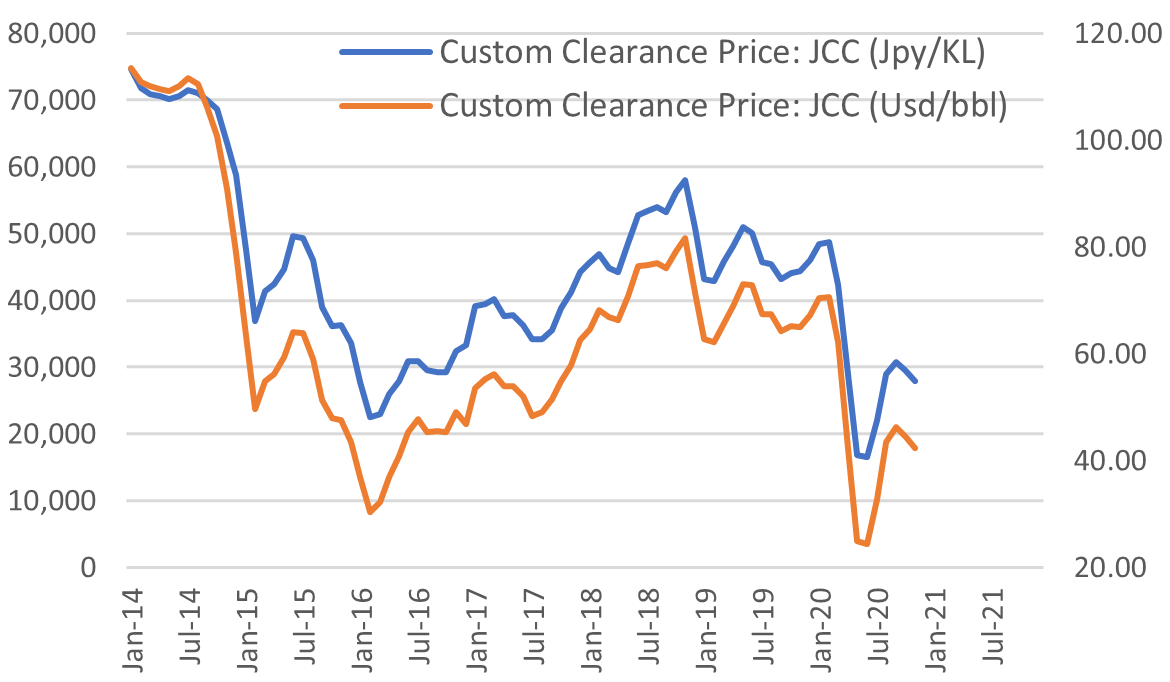
Japan Oil Price
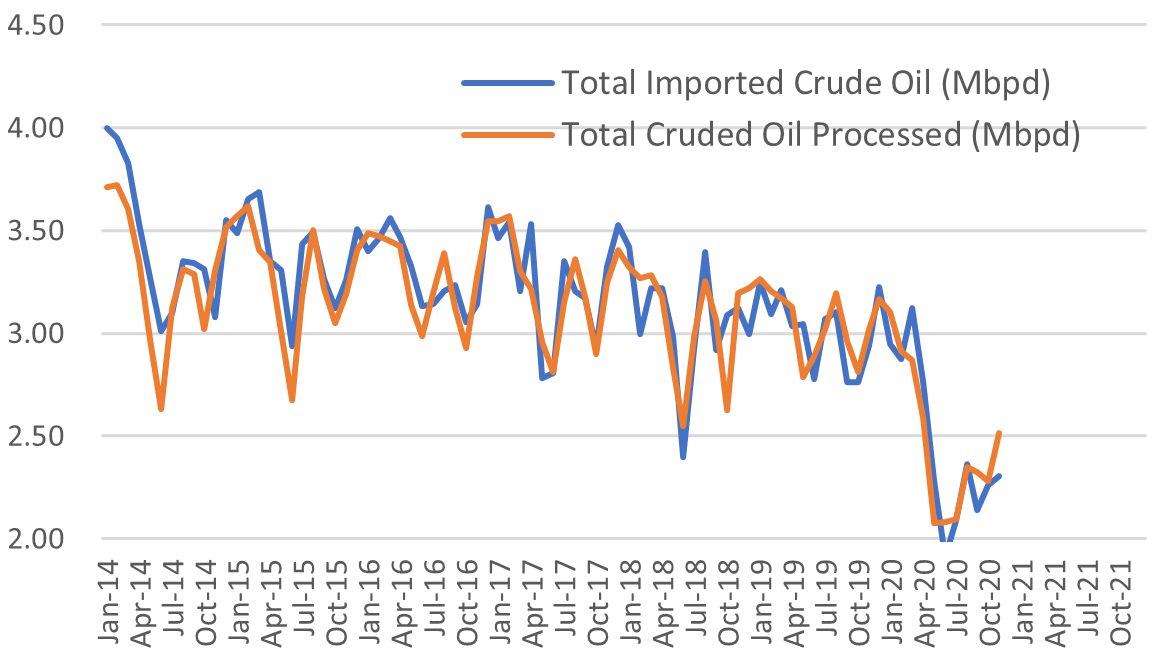
Crude Imports Vs Processed Crude
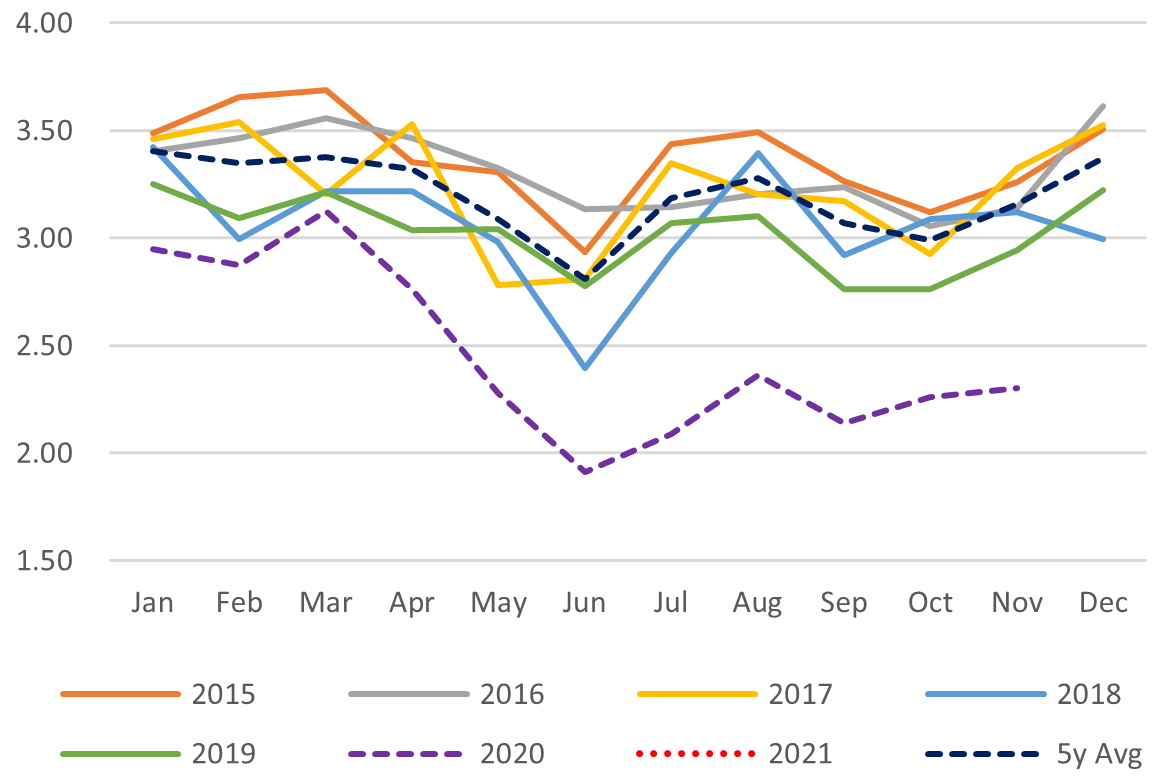
Monthly Oil Import Volume (Mbpd)
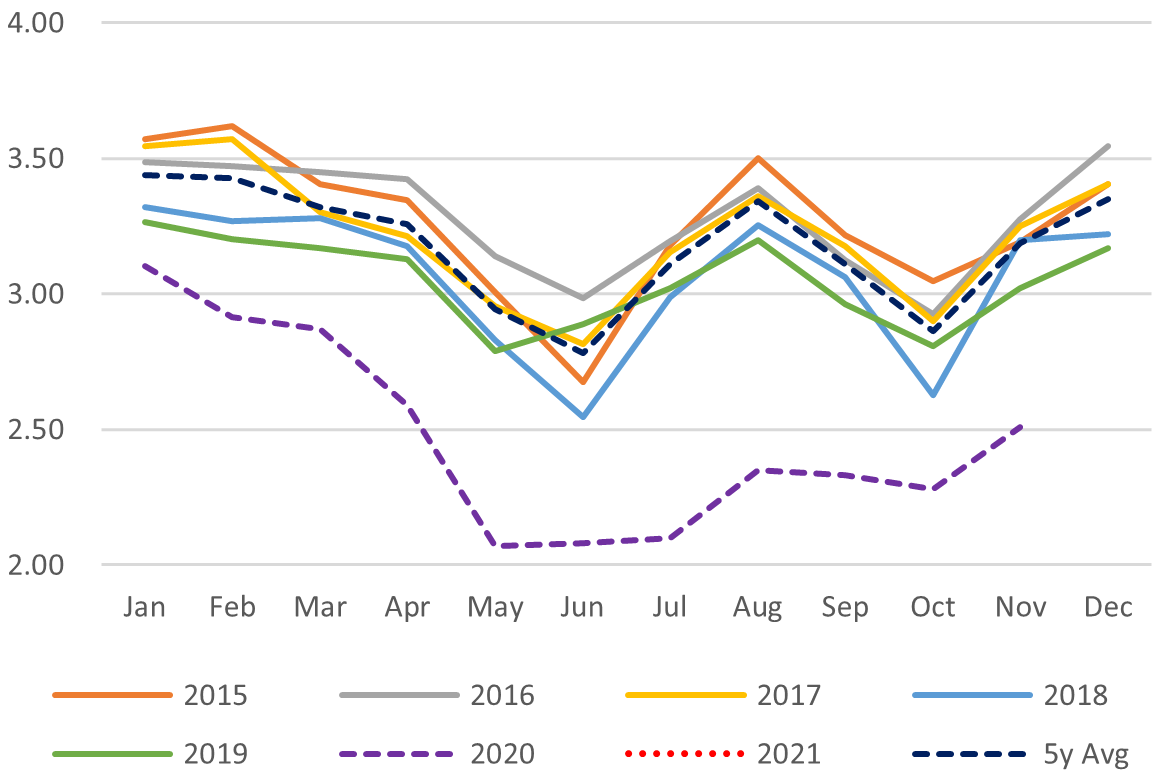
Monthly Crude Processed (Mbpd)
Domestic Fuel Sales
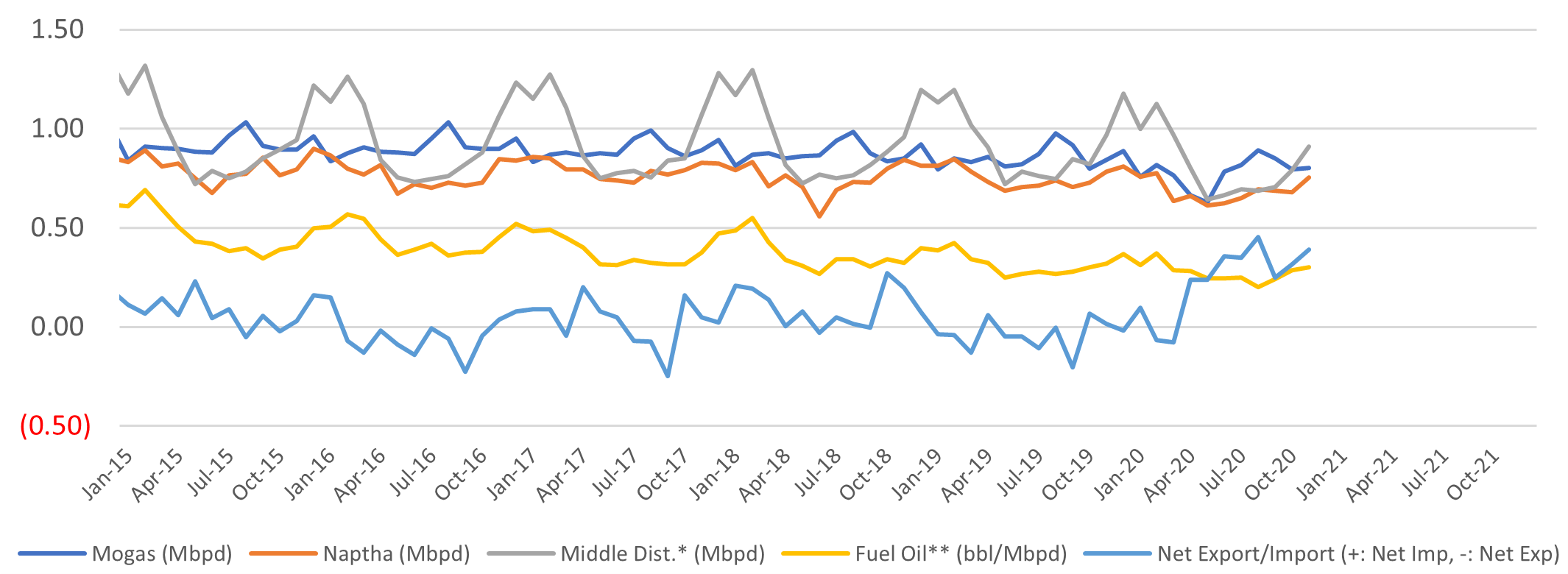
SOURCES: Ministry of Economy, Trade, and Industry (METI), Ministry of Finance, and the Petroleum Association of Japan
Japan LNG Price
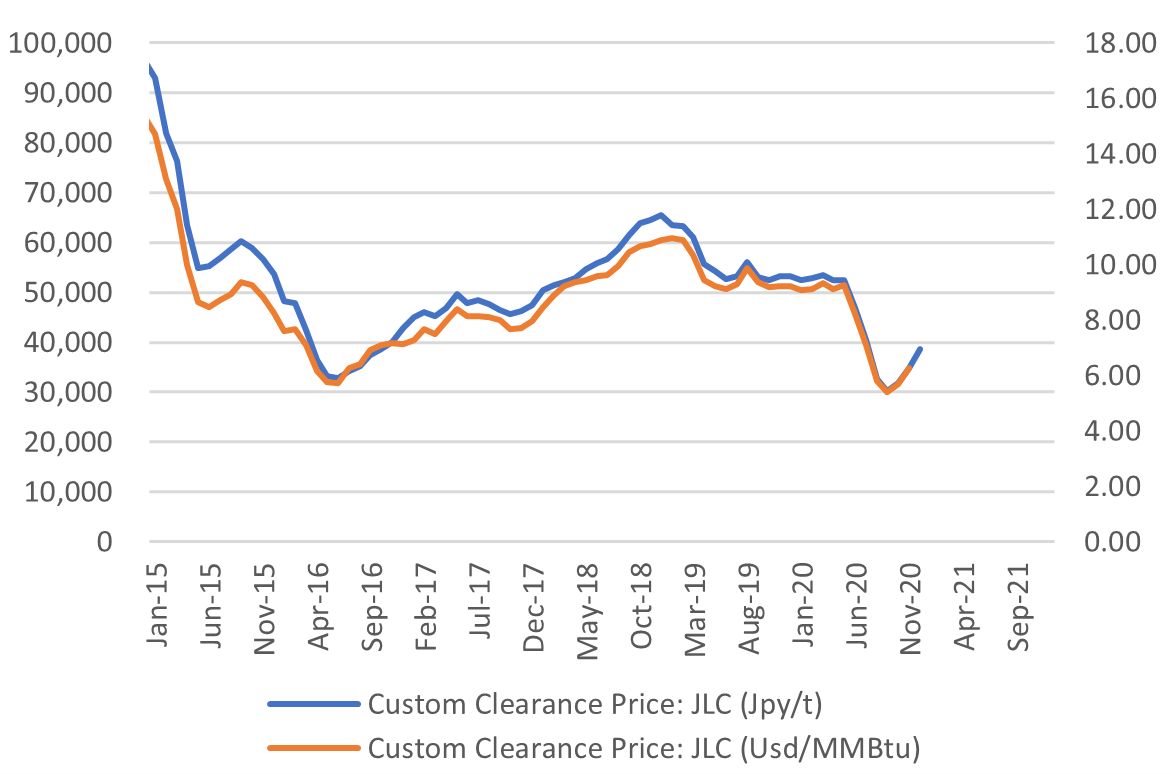
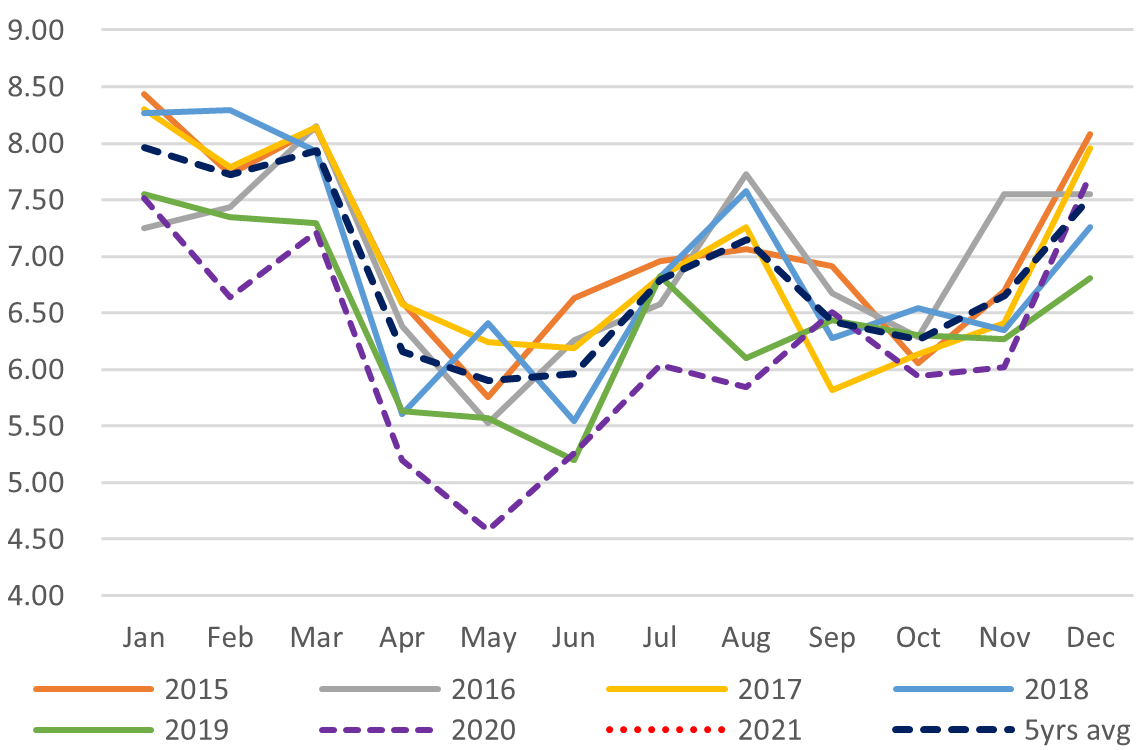
LNG Imports: Japan Total vs Gas Utilities Only
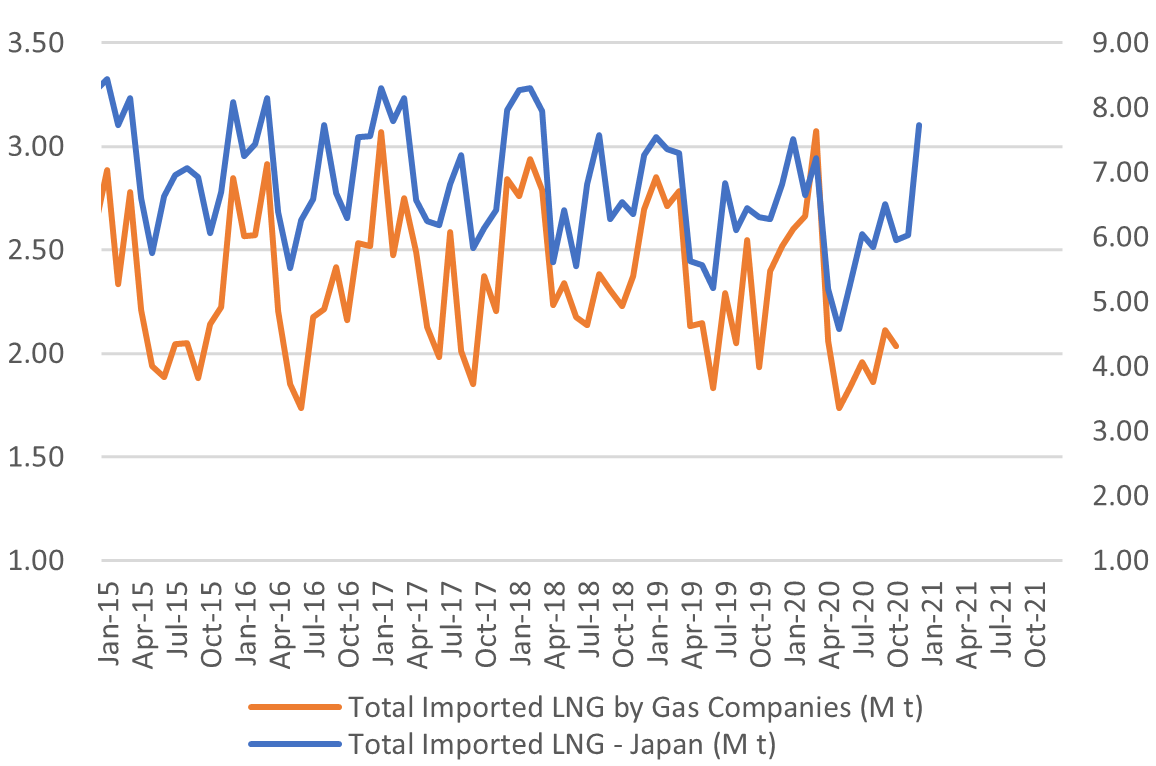
Total LNG Imports (M t)
LNG Imports by Gas Firms Only (M t)
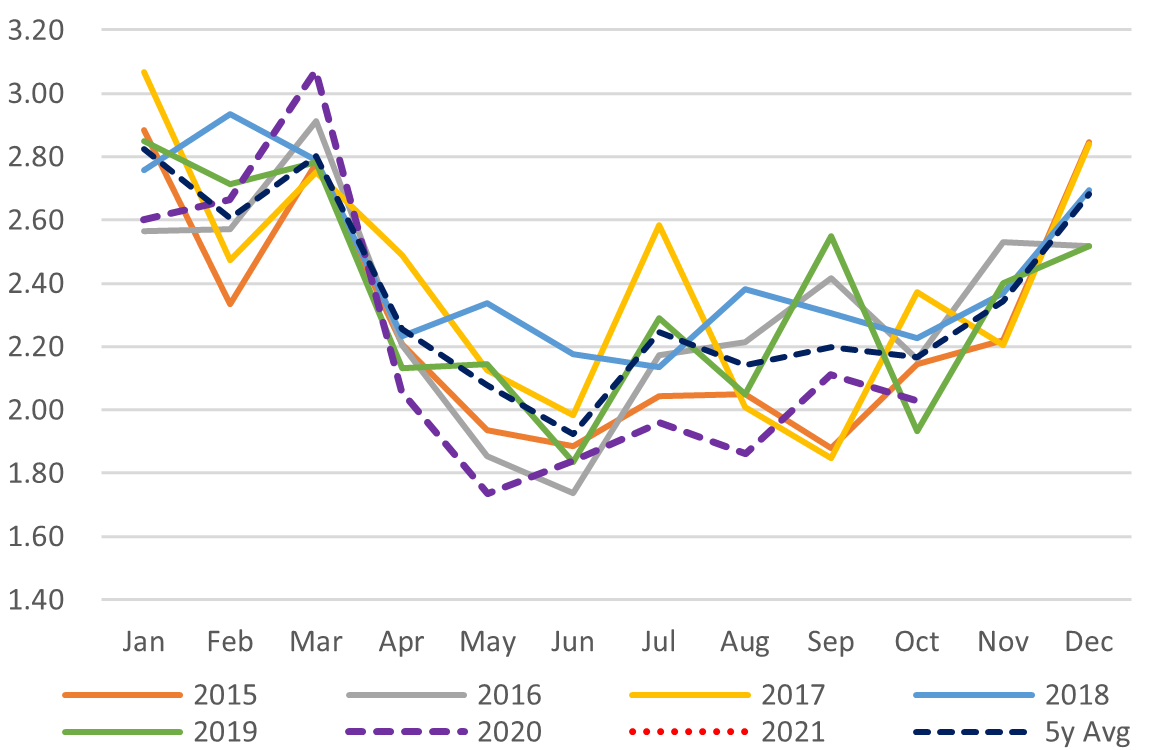
City Gas Sales – Total (M m3)
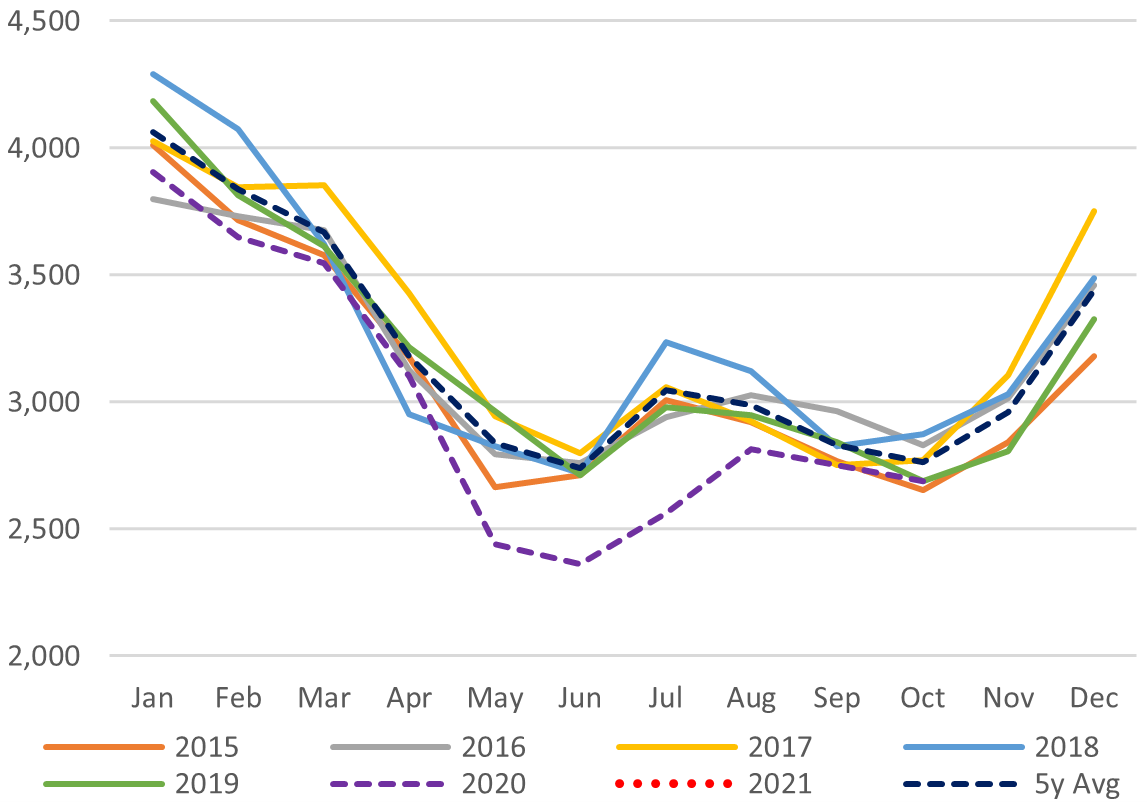
City Gas Sales by Sector (M m3)
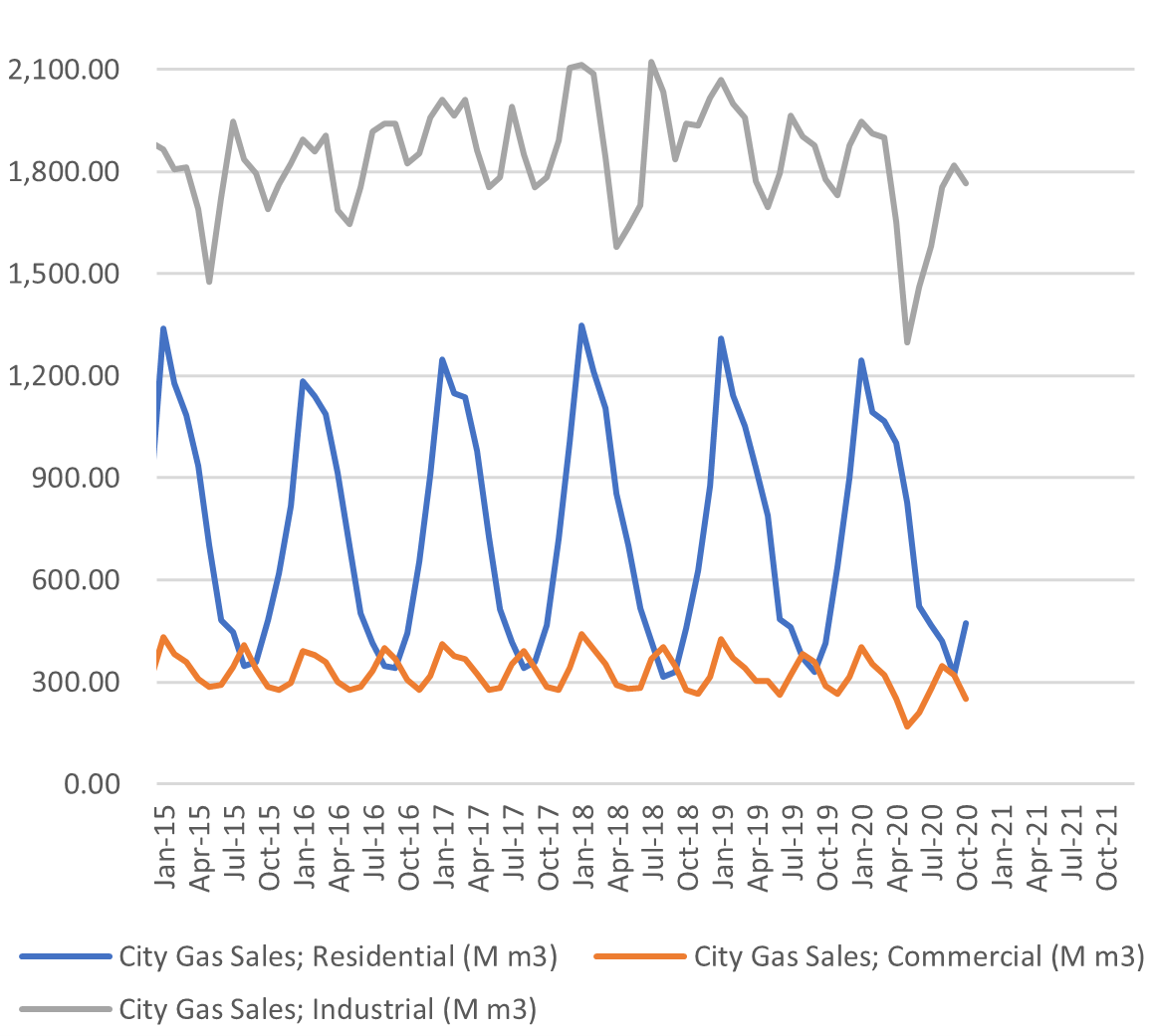
SOURCES: Ministry of Economy, Trade, and Industry (METI),
Ministry of Finance
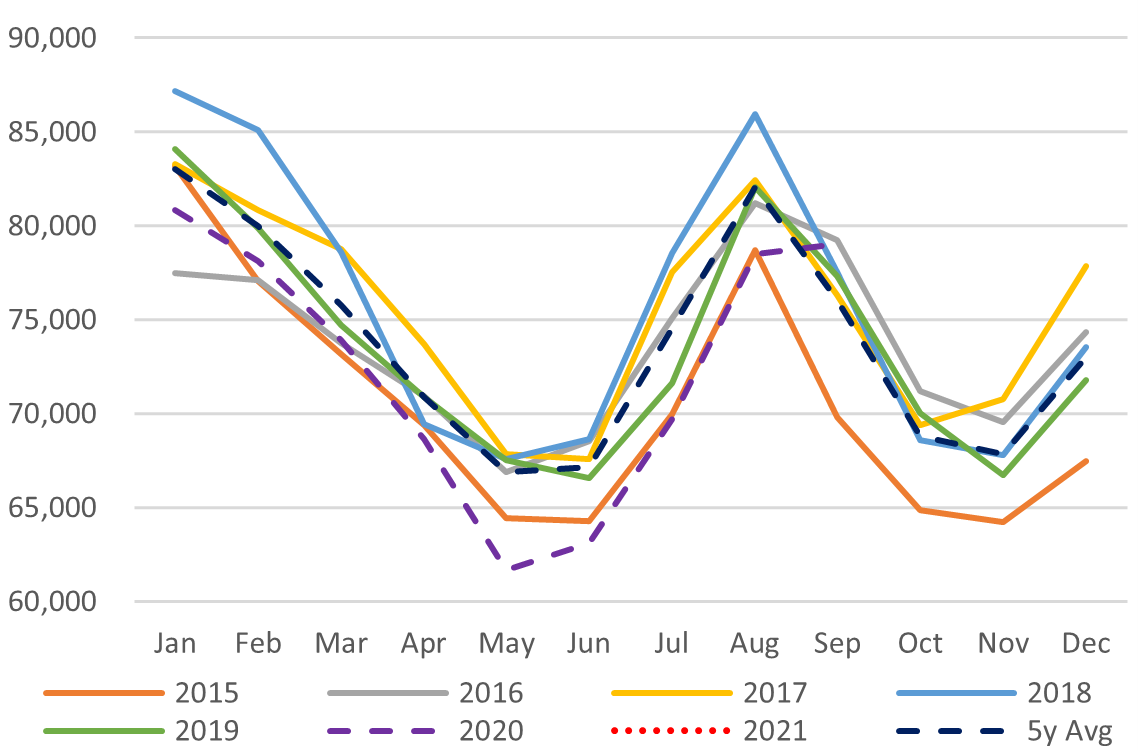
Japan Total Power Demand (GWh)
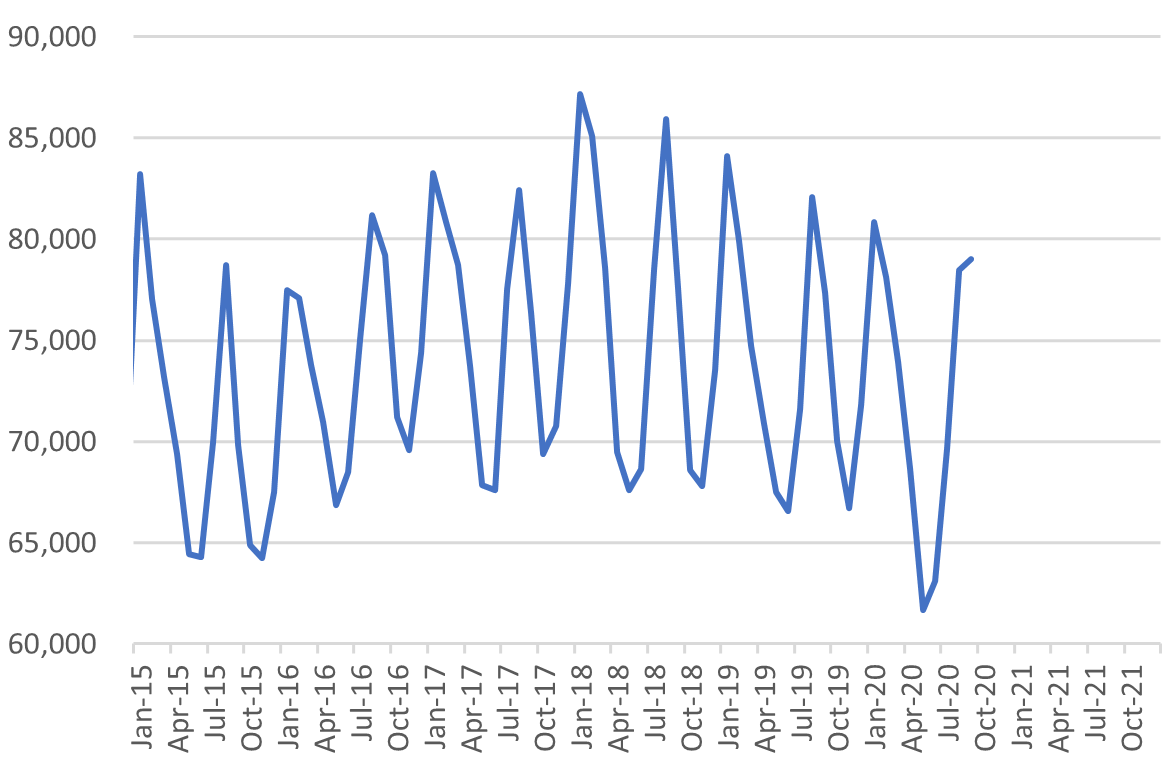
Current Vs Historical Demand (GWh)
Day-Ahead Spot Electricity Prices
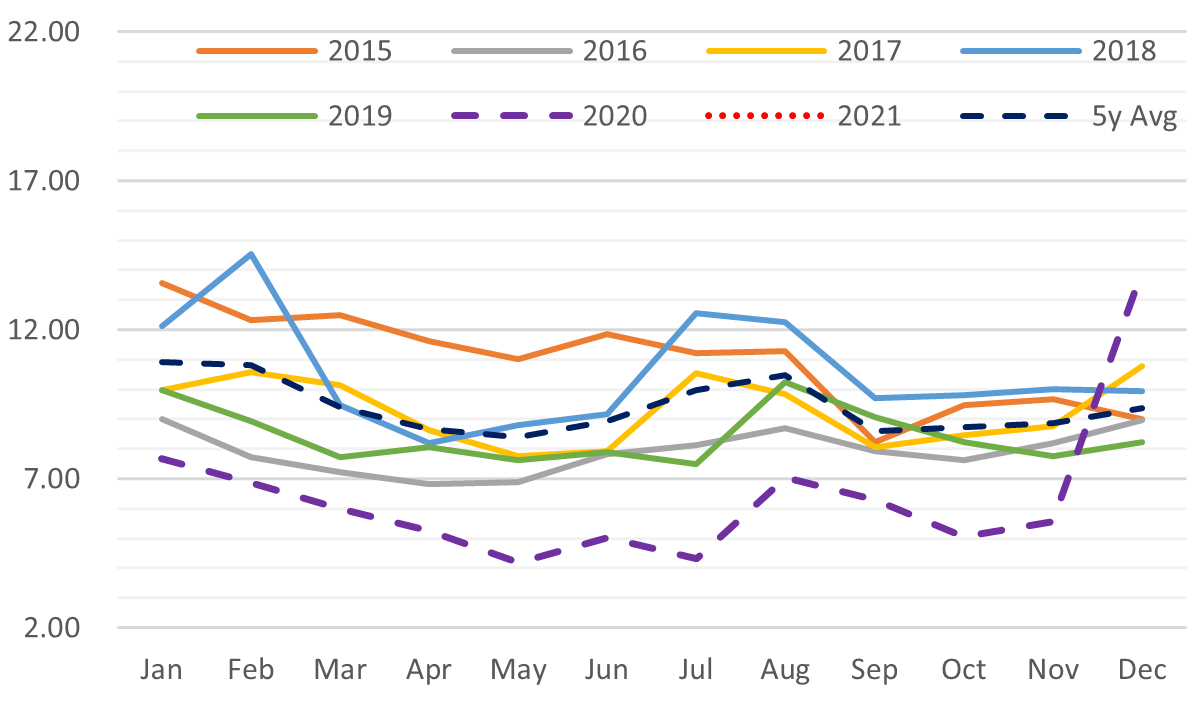
Day-Ahead Vs Day Time Vs Peak Time
LNG Imports by Electricity Utilities
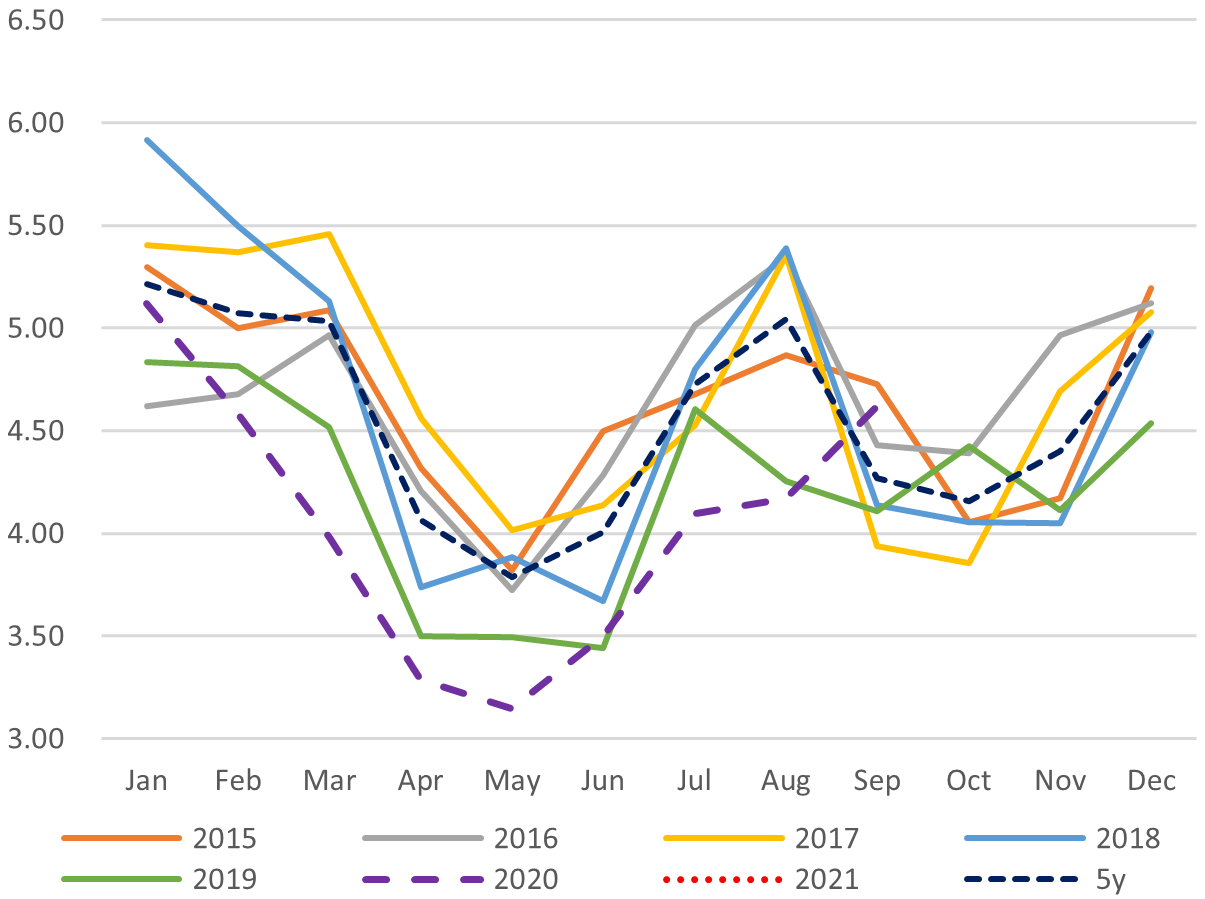
LNG Stockpiles of Electricity Utilities
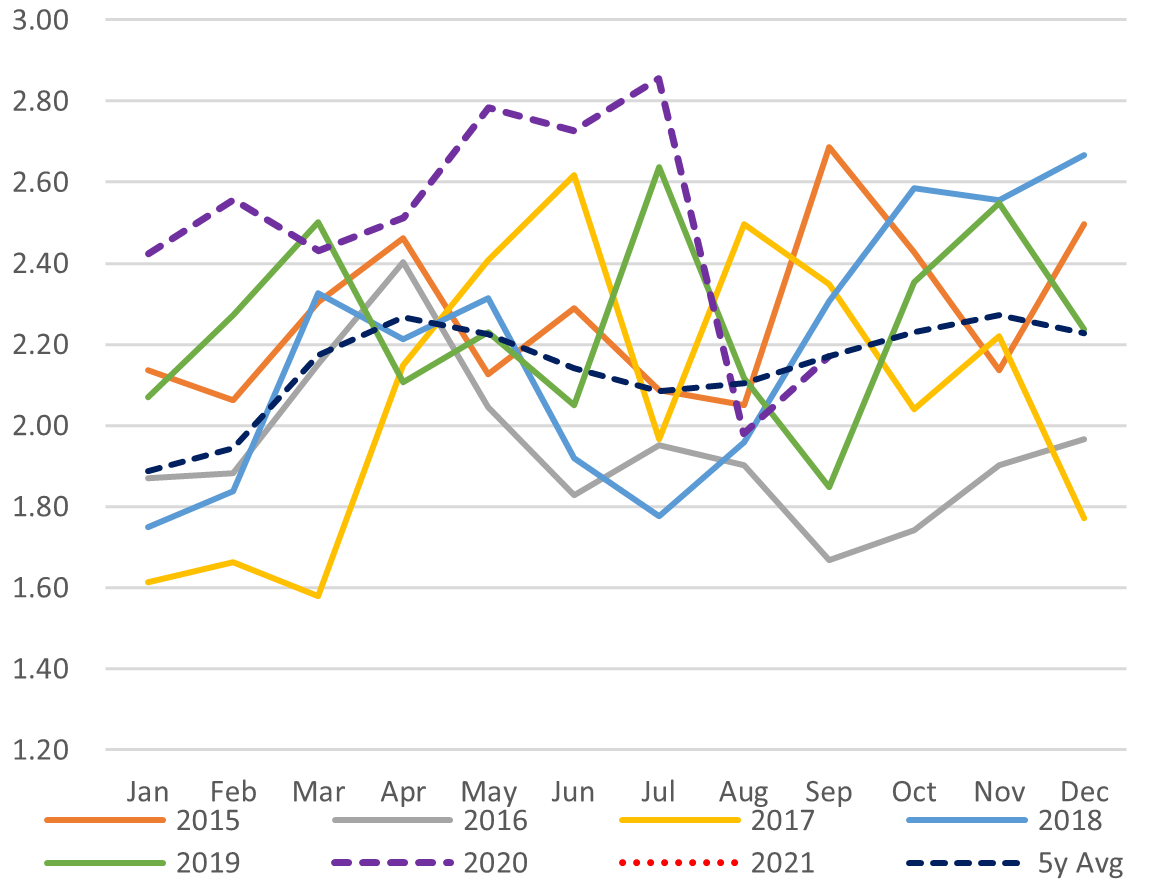
SOURCES: Ministry of Economy, Trade, and Industry (METI), and the Japan Electric Power Exchange
ACRONYMS
|
METI |
The Ministry of Energy, Trade and Industry |
mmbtu |
Million British Thermal Units |
|
TEPCO |
Tokyo Electric Power Company |
mb/d |
Million barrels per day |
|
KEPCO |
Kansai Electric Power Company |
mtoe |
Million Tons of Oil Equivalent |
|
EPCO |
Electricity power company, refers to the 10 regional utilities that used to control all parts of the Japanese power industry | ||
|
JCC |
Japan Crude Cocktail | ||
|
JKM |
Japan Korea Market, the Platt’s LNG benchmark | ||
|
CCUS |
Carbon Capture, Utilization and Storage |