
JAPAN NRG WEEKLY
FEBRUARY 1, 2021
JAPAN NRG WEEKLY
February 1, 2021
NEWS
TOP
- Panasonic to quit solar cell/panels business, focus on smart cities
- Fallout from the “energy emergency” in power / gas continues: some power retailers stop operations; two utilities drop financial forecasts; monthly futures trading exceeds 1Twh for the first time
- One of Japan’s top investors, Nippon Life, to sell stocks of firms that don’t take action to cut CO2 and push holdings on plans
ENERGY TRANSITION & POLICY
- Japan to help heavy CO2 emitters raise funds to decarbonize
- Kawasaki Heavy to build 80 hydrogen carriers (9M tons) by 2050; Mitsubishi Heavy aims to design world’s first liquid CO2 tanker
- Nidec chief predicts EVs at $3,000; demand jump in India, Africa
- Hitachi to use CO2 emissions as one of the criteria for investment
- Govt. announces solar (FIT) tariff rates for the next two years
- Sumitomo conducts feasibility study for Oman hydrogen project
- Mitsui O.S.K. to explore potential for wave power projects in Asia
- INPEX makes carbon-neutral 2050 pledge; aims to deploy CCUS
- JFE starts testing carbon capture tech at cleaning plants in Tokyo
- Osaka Gas urges clients to switch to LNG and outlines plans for carbon neutrality based on efficient methane synthesis … [MORE]
ELECTRICITY MARKETS
- Top-10 power retailer Rakuten stops new subscribers amid market collapse; companies plead for lower power use
- TEPCO says it plans to restart Kashiwazaki NPP but locals protest
- Kansai Electric sees restart delays for Takahama NPP Units 3 & 4; Local mayor gives green light for restart of Units 1 & 2
- Fukushima: Regulator says new plan needed for debris removal
- Mitsubishi Corp defends plans to build coal plant in Vietnam
OIL, GAS & MINING
- Japan’s LNG imports dropped 3.7% to 74.47M tons last year
- Sumitomo Corp to stop all new oil investments in ESG shift
- Sumitomo Metal Mining to double anode output on EV demand
- Saibu Gas swings to loss, Toho Gas profits tumble on lockdowns
ANALYSIS
UNLIKELY HERO OF JAPAN’S POWER INDUSTRY
SADDLED WITH “SINS” OF PAST ENERGY CHOICES
As Japan’s energy emergency unfolded at the start of the year, one company (and one fuel type) in particular kept the lights on. Electric Power Development Co., better known as J-Power, and its heavily coal-reliant generator fleet ran at close to the limit. The stock market rewarded J-Power by pushing its stock up 30% in days. Yet, the coal-dependent utility’s future is under a cloud as it struggles to adjust to the energy transition. We explore its predicament.
JAPAN’S POWER GRID IS CHANGING.
SO IS ITS FUNDING MODEL.
Having been built mainly in the late 20th century, Japan’s power grid is aging and needs an upgrade. What’s more, the emergence of renewable energy as a considerable component of the power mix is changing the way that a grid must operate and raising the costs of running the electricity network. Japan now plans to reexamine the way that the grid is funded. The agility and strength of the power network is vital if Japan is to truly embrace a higher renewables component in the electricity mix. But who is going to pay for that?
GLOBAL VIEW
President Biden continues to promote greater urgency on climate change. BP cuts 80% of its team for oil and gas exploration. GM becomes first major automaker to say it’ll stop selling gasoline cars by 2035. See details on these and other global events.
EVENT REVIEW
The Japan Petroleum Center hosted its 39th annual conference. ENEOS laid out decarbonization plan.
2021 EVENT CALENDAR
Industry / political events related to Japan energy.
DATA Gas, power, and oil stats
JAPAN NRG WEEKLY
PUBLISHER
K. K. Yuri Group
Editorial Team
Yuriy Humber (Editor-in-Chief)
Tom O’Sullivan (Japan, Middle East, Africa)
John Varoli (Americas)
Regular Contributors
Mayumi Watanabe (Japan)
Daniel Shulman (Japan)
Damon Evans (Indonesia)
Art & Design
22 Graphics Inc.
Sponsored

SUBSCRIPTIONS & ADVERTISING
Japan NRG offers individual, corporate and academic subscription plans. Basic details are our website or write to subscriptions@japan-nrg.com
For marketing, advertising, or collaboration opportunities, contact sales@japan-nrg.com For all other inquiries, write to info@japan-nrg.com
Disclaimer
This communication has been prepared for information purposes only, is confidential and may be legally privileged. This is a subscription-only service and is directed at those who have expressly asked K.K. Yuri Group or one of its representatives to be added to the mailing list. This document may not be onwardly circulated or reproduced without prior written consent from Yuri Group, which retains all copyright to the content of this report.
Yuri Group is not registered as an investment advisor in any jurisdiction. Our research and all the content express our opinions, which are generally based on available public information, field studies and own analysis. Content is limited to general comment upon general political, economic and market issues, asset classes and types of investments. The report and all of its content does not constitute a recommendation or solicitation to buy, sell, subscribe for or underwrite any product or physical commodity, or a financial instrument.
The information contained in this report is obtained from sources believed to be reliable and in good faith. No representation or warranty is made that it is accurate or complete. Opinions and views expressed are subject to change without notice, as are prices and availability, which are indicative only. There is no obligation to notify recipients of any changes to this data or to do so in the future. No responsibility is accepted for the use of or reliance on the information provided. In no circumstances will Yuri Group be liable for any indirect or direct loss, or consequential loss or damages arising from the use of, any inability to use, or any inaccuracy in the information.
K.K. Yuri Group: Oonoya Building 8F, Yotsuya 1-18, Shinjuku-ku, Tokyo, Japan, 160-0004.
NEWS: ENERGY TRANSITION & POLICY
Panasonic to quit solar cells and panels business by 2022, focus on smart cities
(Nikkei Shimbun, Jan. 31)
- Chinese rivals make the cells and panels much cheaper, and Panasonic no longer sees a future in manufacturing solar energy related panels and cells. Co. plans exit by March 22.
- Panasonic plans to continue solar panel installation for residential use, but will use other makers’ devices.
- Panasonic will instead turn attention to power management systems for smart cities.
- CONTEXT: Kyocera and Sharp will be the only major Japanese players in the solar panel industry.
TAKEAWAY: Leaders in solar panels a decade ago, the decline of Japan’s manufacturers has been rapid and accelerating in recent years, and largely due to expansion by Chinese companies. In 2011, Panasonic bought Sanyo Electric’s cell business and aspired to be a global force in the industry. Last year, it ended a solar JV with Tesla, and the latest announcement is merely the official confirmation of the exit from this business. What has to worry Japanese energy officials is which companies in Japan will step up to manufacture the next generation of cells and panels that promise to spread much further than the current equipment because of their lightness and malleability.
Japan to help steel and other heavy industry fund emission cuts
(Asia Nikkei, Jan. 27)
- The government will set guidelines to allow the sale of bonds and other financial products for climate transition projects. The aim is to help CO2-heavy industries such as steel, chemicals, electricity and maritime shipping.
- The govt. hopes to draw in investors for industries that have so far struggled to attract financing via green bonds.
- The govt will use a report on climate transition finance issued last month by the International Capital Market Association as the basis for its guidelines.
- SIDE DEVELOPMENT:
One of Japan’s largest investors to force stocks it owns to decarbonize - (Asia Nikkei, Jan. 30)
- Nippon Life Insurance, one of Japan’s largest private institutional investors, aims to achieve net-zero emissions for companies in its stock and bond portfolios by 2050.
- The insurer will urge targets to cut C02 emissions and will consider divesting if companies fail to make progress.
- Nippon Life becomes the first major Japanese institutional investor to adopt such an investment policy.
- Nippon Life holds equity or debt in roughly 1,500 Japanese companies. Based on the size of its stakes and other factors, Nippon Life’s holdings account for an estimated 12 million tons of carbon dioxide per year.
Kawasaki Heavy to build 80 hydrogen carriers able to import 9M tons of the fuel by 2050
(Reuters, Jan. 27)
- Co. will complete two commercial-scale ships to import 225,000 tons of hydrogen by 2030 and expand from there to 80 carriers, importing 9 million tons by 2050.
- Co. starts hydrogen imports from Australia this spring. The volume, extracted from brown coal and liquified in Victoria, will be just 75 tons of hydrogen, enough for 15,000 fuel cell vehicles.
- Kawasaki Heavy has experience in LNG shipping and is using that to build up its hydrogen transportation system. In the process, it hopes hydrogen supply costs will drop to ¥29.7 per normal cubic meter (Nm3) by 2030 from ¥100 now.
- SIDE DEVELOPMENT:
Mitsubishi Heavy aims to design world’s first liquid CO2 ship carrier
(Nikkei, Jan. 31)- Co. aims to put such a ship into commercial action around 2025.
- The carrier is expected to be used in tandem with CCUS technologies. C02 captured from heavy industry would be liquified and transported to port, from which a ship would take it to the underground storage facility.
Nidec chief predicts a $3,000-car era with spread of EVs
(Asia Nikkei, Jan. 25)
- CEO Nagamori said China’s release of a $4,300 EV in July is pointing the way and opening up new demand for EVs in India, Africa and the Middle East.
Hitachi uses investment criteria that includes CO2 emissions and a set price per CO2
(Nikkei; Jan. 25, 2021)
- Investors are increasingly selecting companies based on their CO2 emissions.
- Nomura Asset Management converts CO2 emissions of companies (which was non-financial information), into costs, incorporates them into financial reports, and uses them for investment decisions.
- Hitachi uses capital investment criteria that includes CO2 emissions: CO2 emitted per ton is set at ¥5,000.
Committee announces solar FIT pricing targets for the next two years
(Kankyo Business Online, Jan. 25)
- On Jan. 22, the METI committee in charge of electricity procurement tariffs released its proposal for tariffs paid to solar generators under the Feed-in Tariff system. The new tariffs take into account the effects of the market-pegged Feed-in Premium system scheduled for introduction in 2022.
- The committee proposed a tariff of ¥19/ kWh for newly installed small-scale solar facilities on 10-year contracts, reducing to ¥17 in 2022.
- The proposed tariff for mid-size (10 to 50 kW) facilities on 20-year contracts is ¥12, reducing to ¥11 in 2022.
- The proposed tariff for large solar farms on 20-year contracts is ¥11, reducing to ¥10 in 2022 (excludes consumption tax).
Sumitomo Corporation performing feasibility study into Omani hydrogen project
(New Energy Business News, Jan. 26)
- Sumitomo Corporation commenced a feasibility study for a hydrogen development project in Oman that calls for the establishment of a hydrogen supply chain using hydrogen isolated from gaseous byproducts produced during petrochemical extraction and processing, using solar power. Omani petrochemical developer ARA Petroleum would partner with Sumitomo.
- The project would begin commercial operation in 2023, and see up to 400 metric tons of hydrogen produced every year, most of which would be used by ARA to power fuel cells used on site.
- A total of 20 MW of photovoltaic solar generation capacity would be installed.
- Carbon dioxide would also be retrieved for reuse by local industries.
Mitsui O.S.K. Lines to explore potential for wave power projects in Asia
(New Energy Business News, Jan. 27)
- Mitsui O.S.K. Lines has signed an agreement with UK renewable energy manufacturer Bombora Wave Power to explore possible wave generation projects in Japan and Asia.
- Having performed a technical review of Bombora’s mWave generating system, Mitsui will now consider the possibility of connecting wave generation facilities to offshore wind farms to increase their output.
- While marine-based methods of generation such as wave power and offshore wind have yet to become established as a serious commercial option internationally, Mitsui says these methods hold the potential to become significant energy sources in future.
Tokyo Grid agrees to accept renewable electricity in Ibaraki, Chiba on one condition
(Nikkan Kogyo Shimbun, Jan. 27)
- Tokyo Power Grid has begun accepting electricity supplied by solar farms and wind turbines and other renewable generated electricity in Ibaraki and Chiba, on the condition that generators agree to throttle their output as instructed.
- Such throttling arrangements are already commonplace in Kyushu with its high number of renewable generators.
- Tokyo Power Grid made the decision to source power from renewable generators to avoid having to upgrade its transmission infrastructure in the area at an estimated cost of ¥160 billion.
INPEX vows to cut CO2 emissions close to zero by 2050 including via CCUS
(Company announcement, Jan. 27)
- Japan’s top oil and gas explorer said on Jan. 27 that it will cut CO2 in business activities to almost zero by 2050.
- INPEX intends to develop CCUS technology to capture, store and reuse CO2, and strengthen hydrogen and renewable energy businesses.
- SIDE DEVELOPMENT:
INPEX to change official company name to “INPEX” from March
(Denki Shimbun, Jan. 28)- The company known as 国際石油開発帝石 in Japanese (“INternational Petroleum EXploration”), and INPEX in English, is going to change its name officially to “INPEX” from April 1 to better reflect its aim to become a global brand.
JFE starts testing carbon capture tech at cleaning plants in Tokyo
(New Energy Business News, Jan. 27)
- JFE Engineering has started a trial test of
- CCU technology to capture CO2 from exhaust gas at cleaning plants in Mitaka and Choufu areas of greater Tokyo.
- The trial will last until the end of 2022. By applying CO2 capture technology to the incineration plant and combining it with biomass, it is possible to achieve “negative carbon (CO2 capture exceeds actual emissions)”.
- In addition to CO2 capture technology, JFE Engineering plans to conduct various tests on chemical recycling, which would use the captured CO2. For example, it is possible to use the end product as a fuel in the form of methane gas. The company will also accelerate research and development of methanol, which can be produced from CO2 and hydrogen, and which is the basis of various chemical products.
Osaka Gas urges customers to switch to LNG to save the environment
(Nikkei, Jan. 27)
- Osaka Gas announced goals to reduce yearly CO2 emissions by 10 million metric tons by 2030/31, and eventually achieve zero net emissions by 2050.
- Osaka Gas is moving to boost its decarbonization credentials by expanding renewable capacity to 5 GW by 2030, and having it make up about 50% of the domestic power generation portfolio.
- In addition, the company is also developing a specialist methanation technology. The utility plans to achieve this goal by creating new technology to convert carbon dioxide into methane, by 2030.
- CEO Fujiwara said this target will be partly achieved by inducing commercial clients, which currently use fuel oil or coal as energy, to switch to natural gas.
- Methane, the main component of LNG, is a raw material for city gas and is made up of CO2 and hydrogen. It’s thought to offset the CO2 generated when burned.
- SIDE DEVELOPMENT:
Osaka Gas plans for carbon neutrality based on efficient methane synthesis
(New Energy Business News, Various, Jan. 28)- In a nationwide first, Osaka Gas has managed to successfully construct a commercial-scale solid oxide electrolysis cell that electrolyzes steam and carbon dioxide at high temperatures to produce hydrogen and carbon monoxide, which are then combined in the presence of a catalyst to form methane.
- By reusing the heat generated during synthesis, the process achieves energy efficiencies of over 85%, which compares favorably to existing technologies, as well as to processes that synthesize methane from electrolyzed hydrogen.
- The new process also does away with the need to use ceramic-coated electrodes, which are costly and difficult to scale.
Osaka Gas to develop technology that burns coal without using atmospheric oxygen
(New Energy Business News, Jan. 29)
- Osaka Gas and the Japan Coal Energy Center have won a contract with the NEDO to develop a chemical looping combustion process that would allow coal and biomass to be burned without using atmospheric oxygen.
- In chemical looping, fuels are combusted at high temperatures with metallic oxides such as iron oxide without the addition of air. The carbon dioxide yielded is highly concentrated, making it easier to retrieve.
- Osaka Gas and the Japan Coal Energy Center aim to build a working 300 kW reactor by 2024.
Toho Gas to research technology to directly recover CO2 in atmosphere with LNG
(Jiji Press, Jan. 25)
- Toho Gas said it has started research on new technology to directly recover carbon dioxide in the atmosphere by using the unused cold heat of LNG.
- NEDO and four universities, Nagoya, Tokyo Science, Tokyo, and Chukyo, are involved in the research project.
- This 10-year project is one of the moonshot R&D projects included in the Cabinet Office’s effort to realize “sustainable resource recycling so as to restore the global environment”.
Mitsubishi Heavy invests in U.S. maker of electrofuels, Infinium
(New Energy Business News, Jan. 29)
- Mitsubishi Heavy Industries has invested in California-based Infinium, which has technology to generate clean fuel “Electrofuels” from CO2 and renewable energy.
- The company is raising funds to develop a commercial-scale electrofuel supply facility to help the transport sector to decarbonize.
NEWS: POWER MARKETS
|
No. of operable nuclear reactors |
33 | |||
|
of which |
applied for restart |
25 | ||
|
approved by regulator |
16 | |||
|
restarted |
9 | |||
|
in operation today |
4 | |||
|
|
able to use MOX fuel |
4 | ||
|
No. of nuclear reactors under construction |
3 | |||
|
No. of reactors slated for decommissioning |
27 | |||
|
of which |
completed work |
1 | ||
|
started process |
4 | |||
|
|
yet to start / not known |
22 | ||
Source: Company websites, JANSI and JAIF, as of Jan. 15, 2021
Japan’s monthly electricity futures trading volumes exceeds 1 TWh for first time
(Various, Jan. 31)
- The volume of trading in electricity futures contracts on the European Energy Exchange (EEX) and the Tokyo Commodity Exchange (TOCOM) exceeded 1 TWh in a month for the first time, based on data from the two.
- Electricity futures were only launched in Japan in 2019 and take-up has been slow to date.
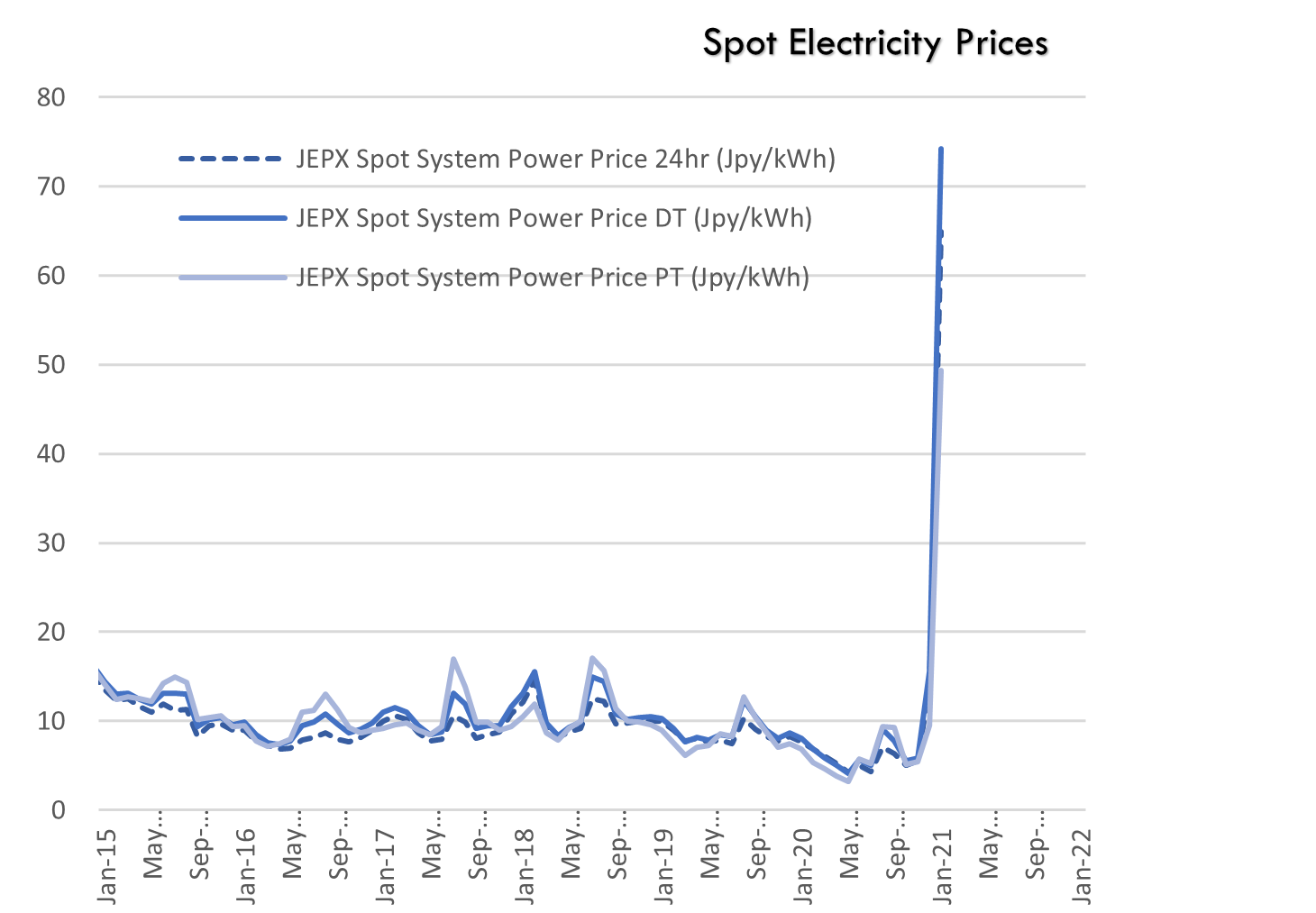
- The underlying electricity spot market, traded on the Japan Electric Power Exchange (JEPX), registered 27.4 TWh of trading volume in January.
- CONTEXT: Traditionally, derivative markets are larger than their underlying physical commodity markets. That had not been the case in Japan’s power markets so far.
High wholesale tariffs forced power retailer to shut down services
(Nikkei, Jan. 25)
- Akita-based electricity start-up Kazuno Power discontinued all business operations in mid-February in response to skyrocketing electricity tariffs, after discontinuing both its commercial and domestic services earlier in the month.
- Kazuno said on some days in January it only earned ¥400,000 in revenue for electricity it had purchased for ¥4.5 million on the wholesale market. The power company’s debts are forecast to reach ¥50 million.
- SIDE DEVELOPMENT:
Top-10 power retailer Rakuten freezes subscriptions amid market collapse
(Nikkei Business, Jan. 27)- Rakuten Energy, Japan’s 10th largest domestic electricity supplier, said on Jan. 26 that it stopped accepting applications for both its electricity plan and gas plan.
- Despite using hedging arrangements to cover around 90% of demand to protect against winter volatility, Japan’s electricity retailers have sustained significant losses in the recent cold snap.
- The situation is even more serious for smaller providers, which do not have Rakuten’s cash reserves. Many are considering walking away from the businesses and are looking for prospective buyers.
- CONTEXT: Rakuten is Japan’s No.2 e-commerce player, lagging only Amazon. The large conglomerate has also emerged in the last year as Japan’s No. 4 mobile phone operator, and owns a number of other sports and entertainment businesses.
- SIDE DEVELOPMENT:
Turn down your thermostat, plead power companies
(Kobe Shimbun, Jan. 29)- The Federation of Electric Power Companies of Japan has responded to the current power shortage by calling on consumers to set their heat pumps at around 20°C and clean air conditioner filters once every two weeks to cut down on power consumption.
- The Federation also asked consumers to turn off lights and other appliances where possible.
- On Jan. 12 demand for electricity on the KEPCO network reached 99% of capacity.
- SIDE DEVELOPMENTS:
Kyushu Electric, J-Power pull full-year financial result forecasts after recent price spikes
(Company statements, Jan. 29)- See the Analysis section for a deep-dive on J-Power.
TEPCO says it aims to restart Kashiwazaki nuclear plant, but locals protest
(Tokyo Shimbun, Jan. 25)
- TEPCO held a public meeting to discuss the restarting of Unit 7 at the Kashiwazaki-Kariwa nuclear power plant in Niigata on Jan. 25.
- Despite TEPCO’s efforts to garner support for the restarting of the reactor, all local residents making comments were opposed to the move.
- The utility said with the safety inspection completed, it planned to insert fuel rods into the reactor in March/April.
- SIDE DEVELOPMENT:
TEPCO staff gained unauthorized access to Kashiwazaki NPP’s control room
(Niigata Nippo, Jan. 28)- The mayor of Kashiwazaki town filed a petition with the Nuclear Regulation Authority on Jan. 28 that called for TEPCO to apologize to local residents over fraudulent use of security passes at the company’s Kashiwazaki-Kariwa nuclear power station last year.
- It was revealed recently that a worker, who was unauthorized to enter the power station’s control room, gained access by using the security pass of another employee.
- SIDE DEVELOPMENT:
Court rejects bid to stop TEPCO collaborating on J-Atomic nuclear plant project- Tokyo District Court has rejected a petition filed by TEPCO shareholders calling for a cease-and-desist order that would have prevented TEPCO from assisting the Japan Atomic Power Company (J-Atomic) to restart Unit 2 of the Tokai Nuclear Power Plant.
- The shareholders argued that TEPCO is faced with enormous bills for compensation over the Fukushima disaster and cannot afford to incur additional costs in relation to the Tokai NPP.
Fukushima: Nuclear regulator says new strategy needed as debris removal work fails
(Tokyo Shimbun, Jan. 27)
- Nuclear Regulation Authority chair Fuketa Toyoshi said that an operation to remove radioactive debris from Units 2 and 3 at the Fukushima Dai-Ichi nuclear power plant will have to be rethought in light of new findings.
- All attempts to vent high-pressure radioactive steam present in the reactor of Unit 2 have been unsuccessful.
- In addition, extremely high levels of radioactivity have been measured around the “sealed plugs” that cover the containment vessels for Units 2 and 3. This is a new “discovery”.
- If the current approach continues to be unsuccessful, the containment vessels may need to be filled with water before further attempts are made to remove debris, in order to shield workers from radiation.
- The regulator aims to prepare a report later this year to detail the findings from inspections and analysis performed over 2019/20.
Kansai Electric announces delay to restart of Takahama NPP Units 3 and 4
(Denki Shimbun, Jan. 26)
- The two nuclear reactors are undergoing regular inspection and also repairs on the heat transfer tubes that connect to the steam generator. Both are being treated to wash off iron oxide from the piping.
- With the countermeasures in place, it is expected that Unit 3 will resume operation in late February, and Unit 4 from late March.
- SIDE DEVELOPMENT:
Takahama Mayor to Announce Agreement to Restart Older Reactor Units
(Kyodo News, Jan. 28)- Mayor of Takahama Town, Fukui prefecture, is due to announce next week his consent to restarting Units 1 and 2 of the Takahama NPP.
- This is the first time in Japan that a local mayor consents to the restart of reactors that are older than 40 years.
- After the consent of the mayor, it is customary for the prefectural assembly and the governor to make a decision. Until now, Governor Sugimoto Tatsuji had requested KEPCO to give an outline of where they will be moving spent nuclear fuel before giving any restart approvals.
- KEPCO still has no answer to the governor’s request, and so it’s unclear whether they will get the approval at governor level.
- SIDE DEVELOPMENT:
KEPCO to issue ¥70 in bonds in 5-, 10- and 20-year maturities
(Nikkan Kogyo, Jan. 22)
Mitsubishi hits out at opponents to its Vietnam coal power plant projects
(Tokyo Shimbun, Jan. 25)
- Partners in the Vung Ang 2 coal-fired power station project in Vietnam have responded to an open letter from local young people concerned about the environment that was published earlier this month.
- The youth are critical of the project, which they said was not in Vietnam’s interests and violated Japan’s commitments under the Paris Agreement.
- Vung Ang 2 has also been the target of protests by Fridays for Future, a group calling for restrictions on coal plants, and these protests have been endorsed by Swedish activist Greta Thunberg.
- Project partner Mitsubishi Corporation has responded by saying that Hanoi is beset by chronic power shortages which lead to frequent scheduled power outages. The city needs a new solution to its power issues that will provide a constant supply of electricity day and night, says Mitsubishi.
- Lenders Mitsubishi UFJ, Sumitomo Mitsui, and Mizuho all refused to comment on their involvement in the project, although all five corporations mentioned their initiatives to reduce CO2 emissions in their responses.
NEWS: OIL, GAS & MINING
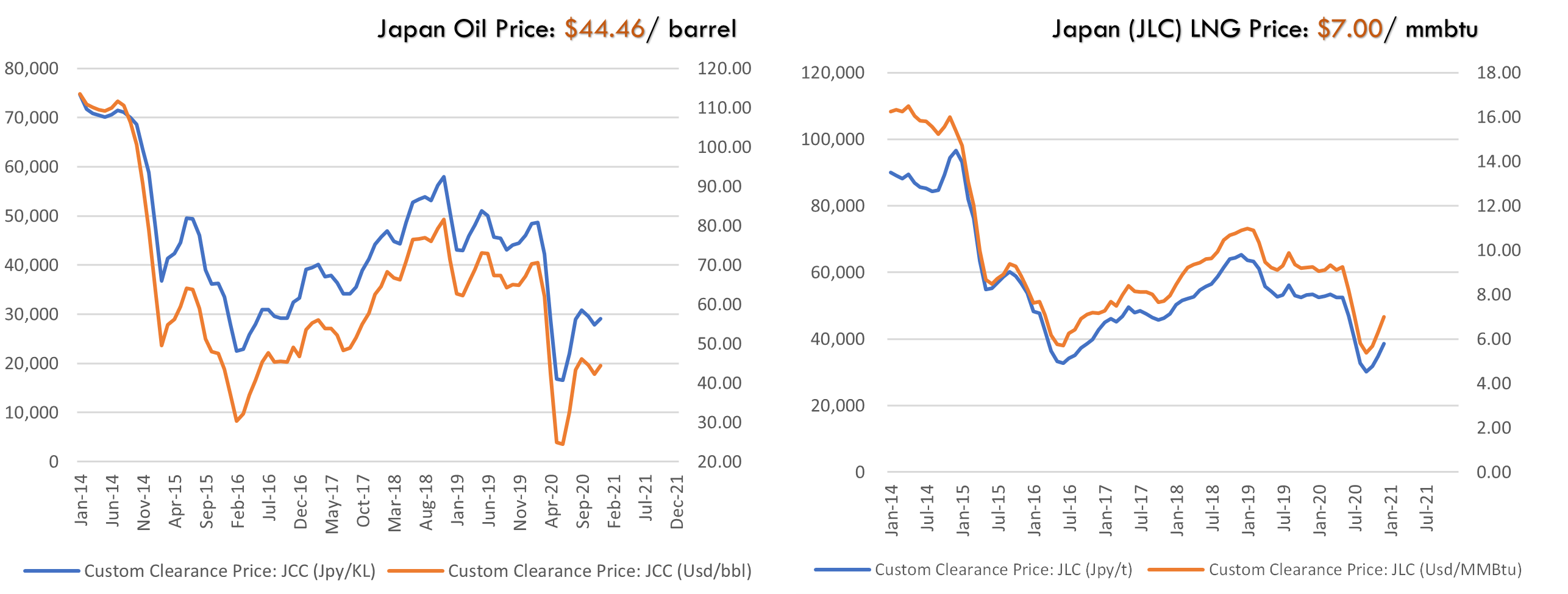
Japan’s LNG imports dropped 3.7% last year to 74.47M tons
(Japan NRG, Jan. 27)
- Annual total came to 74.47 million tons, less than the 77.33 million tons in 2019 and the lowest since 2011.
- December imports were at 7.72 million tons, the highest in three years for the same time period.
TAKEAWAY: Japan’s LNG shortages at the start of this year may well be down to LNG purchase activities for October and November deliveries. Both months were 4-5% lower than the year earlier even though purchasing activities for the previous two months were closer aligned with previous years’ levels.
Sumitomo Corp to stop all new oil field investments in green shift
(Nikkei, Jan. 25)
- Trading house Sumitomo Corp. will stop investing in new oil development projects. The Co. will be the first of the nation’s trading houses to begin a shift away from crude.
- The trading house wants to improve its ESG credentials amid pressure from climate activists and investors.
- The company will continue holding existing oil investments.
- Sumitomo will shift its focus to renewable energy projects.
TAKEAWAY: While most of its trading house peers were freezing investment in or exiting coal mining altogether, Sumitomo Corp doubled down in recent years. The swift turnaround in global attitudes to fossil fuels leaves the company with a large coal portfolio that will likely contrast with that of its domestic peers. Since Sumitomo is not a strong player in oil, it seems it has exited from this fossil fuel segment to improve its image. The company has also sold out of U.S. oil holdings.
It’s unlikely that Sumitomo will stop trading in oil, since oil demand is not suddenly going to disappear; but its decision to stop actively investing in oil will be enough to satisfy investors.
Sumitomo Metal Mining to Double Anode Production on EV demand
(Nikkei, Jan. 22)
- Fujiwara Sumitomo Metal Mining plans to double production of anodes for electric vehicle batteries by 2027.
- Sumitomo is also considering building a nickel refinery in Indonesia to this end.
- Sumitomo’s interests in nickel mines give it the advantage of controlling all aspects of the anode supply chain, and puts the company in a good position to compete against Chinese anode manufacturers. Under an agreement with a state-owned Indonesian mining company last year, Sumitomo enjoys preferential rights to the mineral.
- CONTEXT: Extremely high demand for nickel from Chinese battery manufacturers has created a risk of interruptions to supply.
Saibu Gas swings to ¥300 million loss as public stay home and commerce withers
(Nagasaki Shimbun, Jan. 29)
- On. Jan. 28, Saibu Gas announced its financial performance for the nine months to December.
- The company recorded a loss of ¥300 million in the period, a contrast with the ¥1 billion profit it posted in the same period the year before.
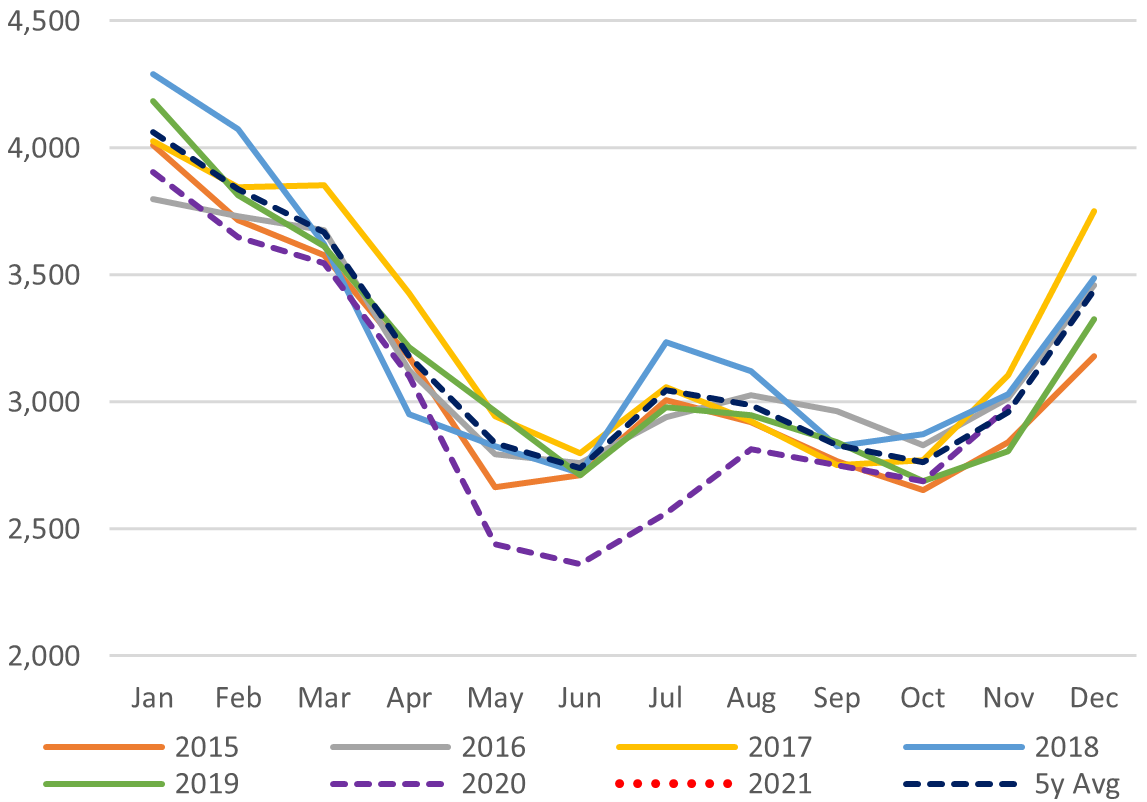
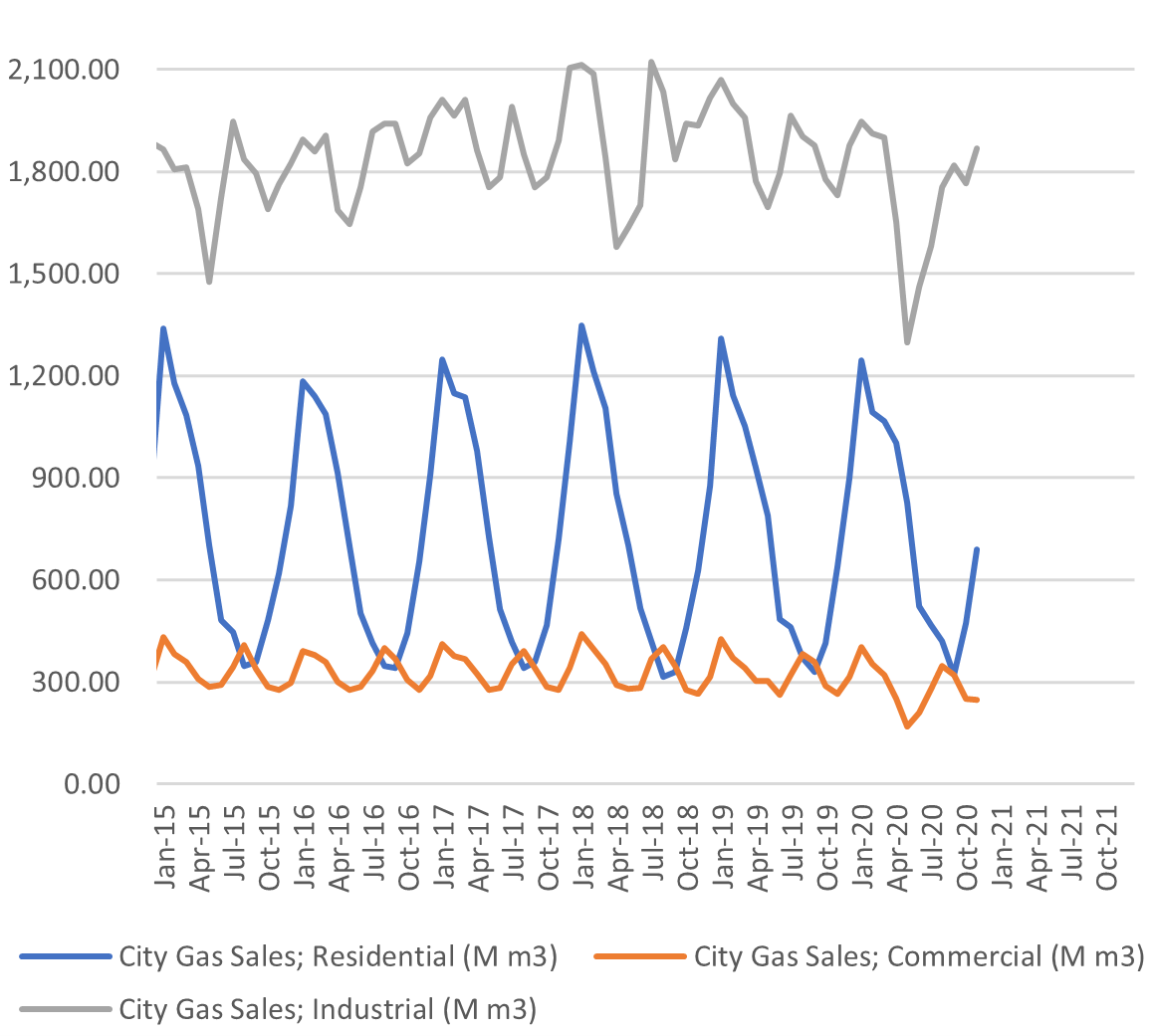
- While gas consumption by domestic consumers increased 4% as the public stayed home, demand from commercial subscribers fell by 11%.
- CEO Michinaga Yukinori said he is worried that another state of emergency will be declared, causing commercial demand to fall again.
- SIDE DEVELOPMENT:
Toho Gas sees profits tumble as commercial clients reduce gas use
(Jiji Press, Jan. 29)- Toho Gas recorded a decrease in both revenue and income in the nine months to December as the coronavirus pandemic caused commercial subscribers to cut back on gas.
- Toho Gas sold 7% less gas than in the same period in the preceding year as demand from commercial subscribers fell by over 8%.
ANALYSIS
BY TOM O’SULLIVAN
Unlikely Hero of Japan’s Electricity Industry
Saddled with the “Sins” of the Country’s Past Energy Choices
As Japan’s energy emergency unfolded at the start of the year, one company (and one fuel type) in particular kept the lights on. Electric Power Development Co., better known as J-Power, and its heavily coal-reliant generator fleet ran at close to the limit. Even when one of its coal units sputtered due to boiler trouble, the company switched it to oil and pushed the machinery as much as it could.
For a change, there was some reward for J-Power’s toils. Its stock soared 30% over a few days, adding $1 billion in market value, after halving during 2020. Still, the company that has perennially rescued Japan during its worst power crunches faces an uncertain future. The very assets that it used to help Japan avoid blackouts are now pariah. And yet, both its coal and mid-construction nuclear facilities are merely the result of the nation’s energy planning. J-Power only fully privatized in 2004.
The utility that provides 1/12th of Japan’s electricity and owns facilities in China, the U.S., Southeast Asia and the U.K. desperately needs to re-invent itself for the new green age. It would be to Japan’s disadvantage not to help its key industry player negotiate the transition.
January’s dirty little secret
The focus at the start of this year was on problems in securing LNG. An emergency rush to mobilize oil-burning units and generators attached to trucks took the headlines. The reason Japan avoided major electricity shortages, however, was its coal plants. Only 2.1 GW of coal capacity was offline during the first three weeks of the year, with about 44 GW constantly delivering electricity during the period – 10% more capacity than available a year earlier.
Meanwhile, Japan’s gas-fired capacity only fully came online during the second week of 2021. On Jan. 1, the country had 23 GW of gas-fired power plants offline.
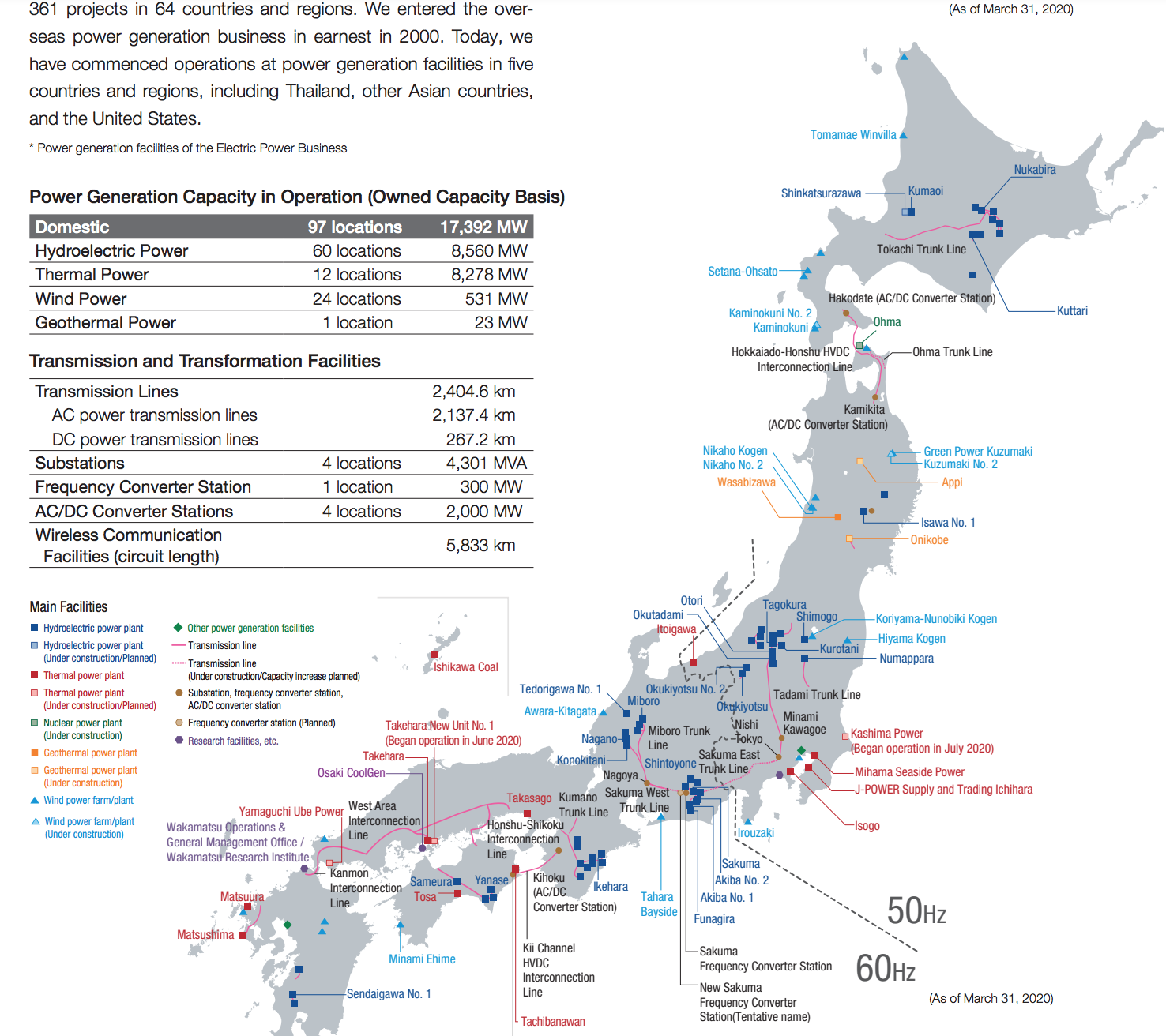
J-Power operates 14 coal-fired generators in Japan, the most of any company. Of these, eight are consider as old and “inefficient” judging by the initial METI benchmarks publicized in the summer of 2020. Coal plants that are deemed “inefficient” will need to shut within a decade according to METI plans, which have yet to be finalized.
Japan’s newly publicized shift to decarbonization and net-zero emissions by 2050 is a daunting prospect for J-Power. Its thermal power assets have a book value of $3 billion and an average age of 31 years. J-Power said it will look to phase out old plants by the country’s 2030 deadline, but details are as yet unclear.
The electricity company was set up shortly after World War II to help build new generation facilities at a time of great shortages. It also stepped up to the plate in the aftermath of the 2011 Fukushima disaster, playing the role of market stabilizer with its large thermal power fleet.
In a statement of just how important J-Power is to Japan’s energy industry, in 2008 METI famously rejected a proposal by the Children’s Investment Fund (U.K.) to increase its holdings of J-Power to as much as 20%, citing national energy security concerns.
J-Power is Japan’s largest power wholesaler and operates across all of the country’s islands in both generation and transmission. It is in a unique position to supplement power shortages in that the 10 regional electricity utilities (EPCOs) are its major customers. The operational plans of all the EPCOs, apart from Okinawa, have been disrupted over the uncertainty of nuclear power assets.
While all utilities worked to maximize their capacity utilization in early 2021, J-Power’s record stands out. It had only one unplanned shutdown since Christmas 2020. Even that coal-fired unit was re-purposed to run on low-sulphur fuel oil to help stave power shortages.
The tenacity compares to a glum 2020 for J-Power as it was cast among the potential losers from the decarbonization trend. In H1 of FY2020 it suffered financially because of lower wholesale prices caused in part by the pandemic with lower levels of economic activity and reduced power consumption. The company’s revenues averaged ¥10/ kWh in the first six months of FY2020, with a 75% load factor on its generation assets.
Last year, to better approach the need to transition its asset base, J-Power transferred all of its thermal fleet to a new company called J-POWER Generation Service.
Energy transition scenarios
The market has rewarded the fact that J-Power’s electricity sales are linked to JEPX electricity spot prices, but the company has also seen capital markets become more cautious on financing future projects. Many banks already face restrictions on new financing for coal projects, while J-Power still has $16 billion of debt on its balance sheet and ongoing construction. J-Power burns 20 million tons of coal annually, which is procured mainly from Australia, Indonesia and Russia.
What’s more, the company is trying to complete a 1.3 GW nuclear power plant in Ohma, Aomori Prefecture, its first venture into nuclear power.
Given the financing risks now associated with both coal and nuclear, J-Power has made a belated push into other alternative energy sources to build on its strong position in domestic hydropower, which accounts for 60% of its Japanese facilities.
J-Power has invested $25 million in Sydney-based renewables developer, Genex, which is developing a major hydropower project in northern Queensland, Australia. It also bought into its first solar project in the U.S., last year in Texas.
The company sold a 40% stake in a thermal Taiwanese utility last year to raise ¥20 billion for investments in renewables.
J-Power has quickly built up a 500 MW portfolio in wind energy, and last year partnered with JERA and Equinor of Norway to pursue offshore wind projects in northern Japan. Together with KDDI, the company is also pioneering the use of drone technology for conducting inspections of wind power facilities.
Meanwhile, the utility is exploring options that may help to extend the lifespan of existing thermal facilities by retrofitting or converting them. J-Power has started to replace coal with sewage sludge at some power units and is testing the idea of converting some coal plants to run on syngas (gas synthesized from coal). Hydrogen is another option as J-Power pursues a brown hydrogen project in Australia.
Despite its troubles with energy transition, J-Power’s pivotal role in the Japanese market could make it an important player in efforts to consolidate the industry and merge weaker players. J-Power’s significant hydropower asset fleet will also be a competitive advantage in the race to carbon neutrality.
J-Power Factsheet
|
Annual revenue |
$8 billion |
|
EBITDA |
$2 billion |
|
Generating asset base |
Close to 24 GW |
|
Generation volume (FY2020) |
65 TWh (about 8% of Japan’s total) |
|
Transmission assets |
Around 2,500 km of transmission lines, including the trunk lines that link the four main Japanese islands |
|
Total asset value |
$28 billion |
|
Company staff |
Over 7,000 |
ANALYSIS
BY DANIEL SHULMAN
PRINCIPLE
SHULMAN ADVISORY
Japan’s Power Grid is Changing. So Is Its Funding Model.
Having been built mainly in the late 20th century, Japan’s power grid is aging and needs an upgrade. What’s more, the emergence of renewable energy as a considerable component of the power mix is changing the way that a grid must operate and raising the costs of running the electricity network.
With more of the smaller, distributed power facilities coming online recently to join the large plants owned by traditional utilities, Japan is starting to reexamine the way that the grid is funded. The agility and strength of the power network will be vital if the country is to truly embrace a higher renewables component in its electricity mix. But who is going to pay for that?
The traditional cost-sharing between consumers and power generators is getting revamped.
The Changing Role of the Japanese Power Grid
Before the deregulation of the Japanese power market, large regional utilities like TEPCO and Kansai Electric served as the power generator, transmission and distribution agent, and retailer of electricity. Each major electric power company (EPCO) focused only on its region.
Physically, power was delivered from large power plants operated by these utilities to consumers in each utility’s island zone. The flow of power within the grid was relatively simple and unidirectional. Power generated at large power plants was transmitted to transformer substations through high-voltage lines, and from there it was distributed to consumers through low-voltage lines.
With deregulation and increased adoption of renewable generation and other distributed power sources, the power grid has become more complex. Not only are there many more power plants on the grid than in the past, but the flow of power is no longer unidirectional. This is because new power sources often feed into low-voltage lines; from there, the power has to flow into high-voltage lines to be transmitted to other parts of the grid.
The deregulation and subsequent increase in the number of power generators also mean that the grid has gone from primarily benefiting consumers, who need it to receive power, to also benefiting power generators, who need it to sell their power.
Changes to the Way the Grid Is Funded
The increasing complexity of power flow within the grid, along with the grid’s aging, require more funding to keep the system operational. That has led the Japanese government to reconsider the way grid infrastructure maintenance and expansion are funded.
Overall, there are three types of grid infrastructure and each is funded differently. Power supply lines connect power plants to primary substations, and are paid for by power generators. Local power grid costs are shared among power generators and consumers in proportion to the benefit each receives. Finally, distribution systems, which deliver power from substations to end consumers, are fully paid for by consumers.
In short: power generators pay their share of the costs when connecting their power plants to the grid, while the contribution from consumers comes over time as an ongoing basis payment known as wheeling charges.
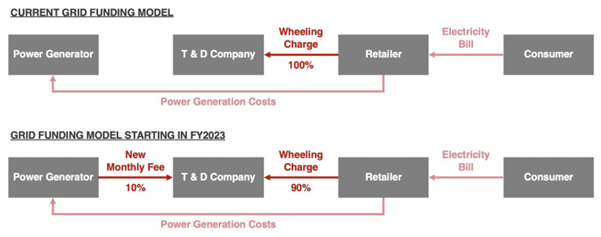
That simple division of payments is no longer deemed fair. To reflect the changing dynamics in grid usage, starting in FY 2023, the Japanese government plans to increase the share of grid infrastructure costs paid by power generators by introducing mandatory monthly fees. Because grid infrastructure is designed based on capacity rather than generated volume, the new fees are expected to be calculated based on each power plant’s capacity rather than actual generation volumes, although this point remains up for further debate.
While the exact fee will depend on the power generator’s location, the national average is expected to be around ¥150/ kW. Micro-generators under 10 kW will be exempt from the new fee. Also, some power generators may receive a discount under conditions such as operating in an area with a well-developed grid infrastructure and having lower marginal transmission cost than the zone’s average.
It is expected that regional differences in the new monthly fees will result in a lower overall total cost to deliver power to consumers. Under the new system, power generators will not only need to consider a location’s ability to generate electricity from the sun or wind, but also the amount of monthly fees they will need to pay. The amount saved with the new fees could reach ¥20 billion in wind generation alone, according to a study by big-business lobby Keidanren.
Backlash Against the Changes
In 2018, the government amended the upper limit of the cost paid by consumers for a power plant’s initial grid connection. Before June 2018, the maximum amount covered by consumers varied by power source. The amount for biomass plants could be as high as ¥49,000/ kW, while for solar plants it was at just ¥15,000/ kW. In other words, consumers paid less for power sources with lower utilization rates. Since 2018, the standardized cap for all power sources is ¥41,000/ kW.
Even though the amendment was made to compensate power generators for the new burden coming in the form of monthly fees, some industry players have noted that not all power generators benefit from the amendment. For many, the new monthly fees simply result in increased costs.
The way the monthly fees are calculated has also drawn criticism from operators of renewables projects, who claim that the payment is not consistent with the new rules (currently under government review) on grid access priority.
When it comes to grid access, solar and other renewable power plants are expected to get preferential treatment compared to coal and other less environmentally friendly power plants. When it comes to a universal monthly fee, however, solar and wind operators claim they are at a disadvantage due to the fact that their generation volume depends on weather conditions, and thus, their utilization rates are generally low.
As a result, the monthly fee for a solar plant with a 15% utilization would end up adding ¥1.37/ kWh to costs, according to Japan Photovoltaic Energy Association estimates. For a thermal power plant with a 70% utilization rate, the additional cost would work out as ¥0.26/ kWh. A wind power plant with a 25% utilization rate would take on an extra ¥0.82/ kWh cost burden.
An Ongoing Debate
There is little doubt as to whether the new monthly fees will be introduced. In fact, in December 2020, various groups representing renewable power operators including the Japan Photovoltaic Energy Association, Japan Wind Power Association, and Japan Geothermal Association expressed their agreement with the introduction of the new fees.
However, since those same associations also oppose using maximum output capacity (kW) to calculate the charges, lobbying instead for them to be based on actual generated volume (kWh), how the new fees will be calculated remains to be determined.
The government’s plan is to introduce those charges in FY 2023. The original deadline for making the decision (April last year) has already passed, suggesting a final ruling is likely in the next 12 months.
GLOBAL VIEW
BY TOM O’SULLIVAN
Below are some of last week’s most important international energy developments monitored by the Japan NRG team because of their potential to impact energy supply and demand, as well as prices. We see the following as relevant to Japanese and international energy investors.
Biden:
The U.S. president issued several new executive orders on Wednesday (‘Climate Day’) addressing climate change and elevating the issue to a national security priority. He described climate change as the “existential threat of our time”, established a National Climate Task Force, and ordered his Director of National Intelligence to prepare an estimate of the security costs of climate change.
Biden also ordered a suspension on new oil and gas exploration on federal lands and offshore waters, which could impact over 20% of U.S. oil production. He announced plans to halt all fossil fuel subsidies and to convert the federal government’s transport fleet to EVs.
Biden will host an international climate summit on April 22 to which Japan is expected to be invited, and prior to which the U.S. is expected to announce its carbon reduction plans for 2030.
Biden also directed the Interior Department to identify steps to double U.S. offshore wind capacity by 2030.
At the same time, the president announced a “Buy American” government procurement plan that is likely to negatively impact Japanese exporters.
Oil:
1). BP, the U.K. oil major, is reported to have cut its senior oil and gas exploration team by almost 80%, to 100 staff, as it transitions from fossil fuels to carbon neutrality.
2). Horizonal rig counts in the Shale Permian Basin have now recovered by 60% since last July’s lows due to higher oil prices. Haliburton, Baker Hughes, and Schlumberger, the three major U.S. oil services companies, are all reporting improved revenues.
3). Exxon has announced plans to overhaul the structure of its board of directors and step-up sustainability investments.
EVs:
1). General Motors became the first car-major to announce it will stop selling petrol and diesel cars by 2035.
2). Tesla, which has a market capitalization of $790 billion, announced its first ever annual profit of $720 million for fiscal 2020.
3). The market capitalization of Evergrande Auto, the Chinese EV company listed in Hong Kong, exceeded $51 billion following a strategic investment of $3.3 billion.
4). Proterra, a U.S. electric bus maker, and EVgo Services, a U.S.-based charging network, went public via a SPAC listing bringing the total number of EV-related SPAC listings to 18 since the beginning of last year.
Covid-19:
1). Following international requests Panasonic is trialing ultra-cold freezer box technology for storage of Covid-19 vaccines..
2). New Zealand has announced its international borders will be closed throughout most of 2021.
China:
1). Wind, solar, and hydropower accounted for $11 billion of China’s Belt & Road energy infrastructure investments in 2020, exceeding fossil fuel investments for the first time.
2). China overtook the U.S. as the largest destination for FDI in 2020 with inbound investments increasing by 4% YoY to $163 billion.
3). John Kerry criticized China’s recent climate goals as “inadequate”.
4). Xi Jinping called for more global cooperation on climate change in a virtual address at the World Economic Forum last week.
Taiwan:
Chinese fighter jets and bombers flew into Taiwan’s air defense zone last weekend, creating more tensions around the island. China has warned Taiwan that a declaration of independence would be an act of war. Taiwan’s representative to the U.S. attended the presidential inauguration on Jan. 20 as an invited guest, angering China.
South Korea:
Hyundai Motor plans to increase EV sales by 60% in 2021 to 160,000 units.
Vietnam:
The ruling Communist Party commenced its congress meeting last Tuesday in Hanoi, which convenes every five years to pick the party’s general secretary, the country’s president and prime minister. Prime Minister Suga’s first overseas trip was to Vietnam where Japan has considerable energy investments.
Indonesia:
1). Indonesia seized an Iranian oil tanker off West Kalimantan Province in Borneo for illegal transfers of fuel oil.
2). Indonesia’s maritime minister, Lahut Binsar Panjaitan, has obtained commitments from the U.S. government to invest $2 billion in Indonesia’s sovereign wealth fund. Part of the fund may be used to construct the new capital city on the island of Borneo, which is expected to cost over $30 billion and be extremely energy intensive.
India:
Cairn Energy, the U.K. oil and gas company listed on the London Stock Exchange, is threatening to seize Indian government assets unless the country’s government reimburses a $1.2 billion tax settlement ordered by an Indian court.
Saudi Arabia:
1). Saudi officials announced that they plan to double the assets of the Public Investment Fund, the country’s sovereign wealth fund, to $1 trillion by 2025. The PFI has invested $45 billion in SoftBank-controlled Vision Fund and derives most of its revenues from Aramco, the listed oil monopoly.
2). It was also revealed last week that the U.S. military is expanding its regional defense footprint in Saudi Arabia to the western parts of the Arabian Peninsula.
3). The new U.S. administration has also ordered a suspension and review of arms sales to Saudi Arabia and UAE.
Iran:
Severe power shortages in Iran are increasingly being blamed on bitcoin mining. After the recent round of oil and gas sanctions an estimated 60% of Iranians are thought to live below the poverty line.
Syria:
Delta Crescent Energy, a small U.S.-owned oil company with a U.S. waiver exemption, is exploring options to extract, refine and export oil from an area in northeast Syria that is controlled by Kurdish militias.
Russia:
1). Russian vessels re-commenced work on the Nord Stream 2 pipeline inside Denmark’s EEZ as Gazprom races to complete the project, which will double Russia’s gas exports to Germany.
2). Calls for additional sanctions against Russia because of the arrest of Alexei Navalny were not approved by E.U. officials.
Nigeria:
Royal Dutch Shell has been found liable by a Dutch court for damages caused to agriculture by two oil spills in the Nigerian delta over a decade ago. The company had already suffered losses in excess of $1 billion for clean-ups in Ogoniland.
France:
Hydrogen Refueling Solutions, a French refueling company, listed its stock on Euronext last week, raising E70 million, and valuing the company at E360 million.
Germany:
Siemens Energy which manufactures gas and power turbines, announced strong Q1 results with EBITDA of E243 million and a new order book of over E5 billion for Q1.
Spain:
Siemens Gamesa, the Spanish wind turbine group, reported very strong Q4 profits, attributable mainly to its offshore wind and services divisions.
United Kingdom:
1). EDF is seeking an additional Stg500 million to complete the Hinkley Point nuclear project and has asked for an additional six-month extension. Total project completion costs are now estimated at $32 billion, with an expected delivery date in mid-2026.
2). Royal Dutch Shell announced the acquisition of the largest E.V. public charging network in the U.K, Ubitricity, which has 2,700 charge points in the U.K.
3). The U.K. is facing criticism for the level of its financial commitments in the recently announced green energy/climate program, which is around 30% of the commitments announced by Germany and France.
Ecuador:
Credit Suisse and ING announced they would cease trading and financing support for exports of the country’s Amazonian oil because of climate change issues.
United States:
1). Due to regulatory challenges, NextEra Energy has taken an impairment charge of $1.2 billion on the Mountain Valley natural gas pipeline that was meant to transport shale gas from West Virginia to adjacent Virginia.
2). Charif Souki, the CEO of Tellurian, has called for a complete ban on methane leaks on natural gas projects, and the introduction of a carbon tax in the U.S.
3). Larry Fink, the BlackRock CEO, demanded last week that all investee companies disclose carbon emissions reduction targets and outline plans for net-zero by 2050.
5). The CME has announced plans to introduce trading in carbon-offset futures.
EVENT REPORT
The Japan Petroleum Center Annual Conference: Jan. 28
Last Thursday the JCCP, the Japan Petroleum Center, hosted its 39th annual conference virtually, chaired by the CEO of Cosmo Oil who also chairs the JCCP.
Energy ministers and senior executives from Saudi Arabia, Indonesia, Philippines, Iraq, Vietnam, Qatar, UAE, Mexico and Iran participated.
ENEOS, the largest listed oil and gas company on the Tokyo Stock Exchange, laid out their strategy to cope with the expected decarbonization trends impacting the oil and gas sector. Chiyoda Corporation, the engineering company with a global footprint in LNG and oil facility construction, also outlined their strategies for decarbonization.
Dr. Fereidun Fesharaki, the chairman of Facts Global Energy, also presented his views on oil prices, oil demand, outlook for refiners, and his timelines for carbon neutrality.
EVENTS CALENDAR
Below is a selection of domestic and international events that we believe will have an impact on the Japanese energy and electricity industry.
|
February |
Prime Minister Suga to visit the U.S.; Approval of Fiscal 2021 Budget by Japanese parliament including energy funding projects; Smart Energy Week – Tokyo; CMC LNG Conference |
|
March |
10th Anniversary of Fukushima Nuclear Accident; End of Fiscal Year in Japan; Renewable Energy Institute – Annual Conference; Quarterly OPEC Meeting; Japan LPG Annual Conference; Full completion of all aspects of the multi-year deregulation of Japan’s electricity market; |
|
April |
Japan Atomic Industrial Forum – Annual Nuclear Power Conference; 38th ASEAN Annual Conference-Brunei; Japan LNG & Gas Virtual Summit (DMG)-Tokyo |
|
May |
Bids close in first tender for commercial offshore wind projects in Japan; World Economic Forum in Singapore |
|
June |
Release of New Japan National Basic Energy Plan; G7 Meeting – U.K. – tentative; Forum for China-Africa Cooperation Summit (Senegal) |
|
July |
Tokyo Metropolitan Govt. Assembly Elections; Commencement of 2020 Tokyo Olympics |
|
August |
Hydrogen Ministerial Conference in conjunction with IEA |
|
September |
Ruling LDP Presidential Election; UN General Assembly Annual Meeting that is expected to address energy/climate challenges; IMF/World Bank Annual Meetings (multilateral and central banks expected to take further action on emissions disclosures and lending to fossil fuel projects); End of H1 FY2021 Fiscal Year in Japan; Japan-Russia: Eastern Economic Forum (Vladivostok) |
|
October |
Last possible month for holding Japan’s 2021 General Election; METI Sponsored LNG Producer/Consumer Conference; Innovation for Cool Earth Forum – Tokyo Conference; Task Force on Climate-Related Financial Disclosure (TCFD) – Tokyo Conference; G20 Meeting-Italy |
|
November |
COP26 (Glasgow); Asian Development Bank (‘ADB’) Annual Conference; Japan-Canada Energy Forum; East Asia Summit (EAS) – Brunei |
|
December |
Asia Pacific Economic Cooperation (APEC) Forum – New Zealand; Final details expected from METI on proposed unbundling of natural gas pipeline network scheduled for 2022. |
DATA
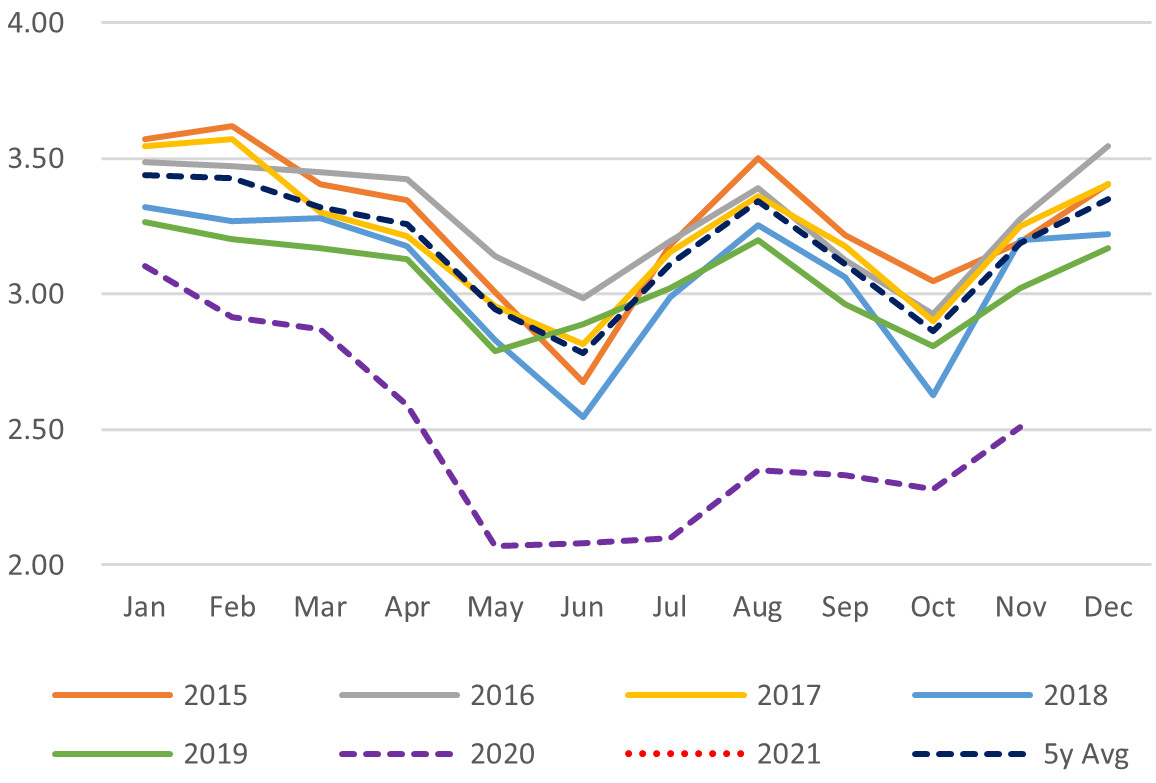
Japan Oil Price
Crude Imports Vs Processed Crude
Monthly Oil Import Volume (Mbpd)
Monthly Crude Processed (Mbpd)
Domestic Fuel Sales
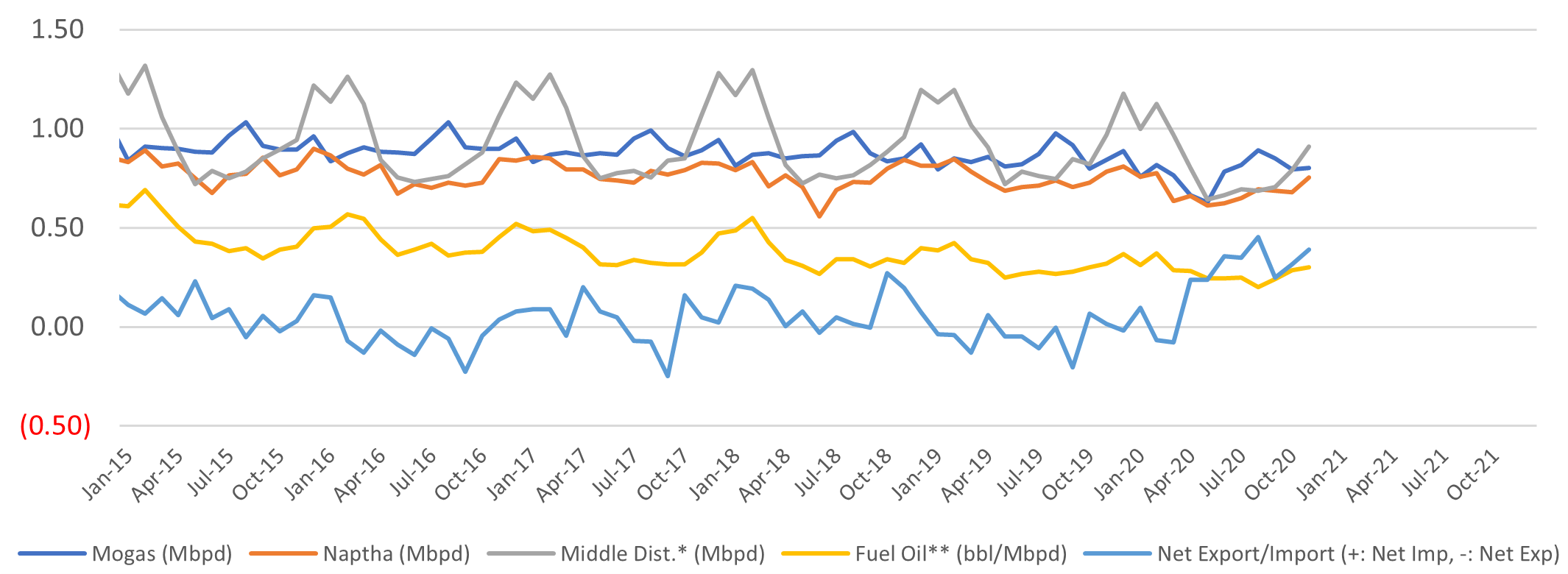
SOURCES: Ministry of Economy, Trade, and Industry (METI), Ministry of Finance, and the Petroleum Association of Japan
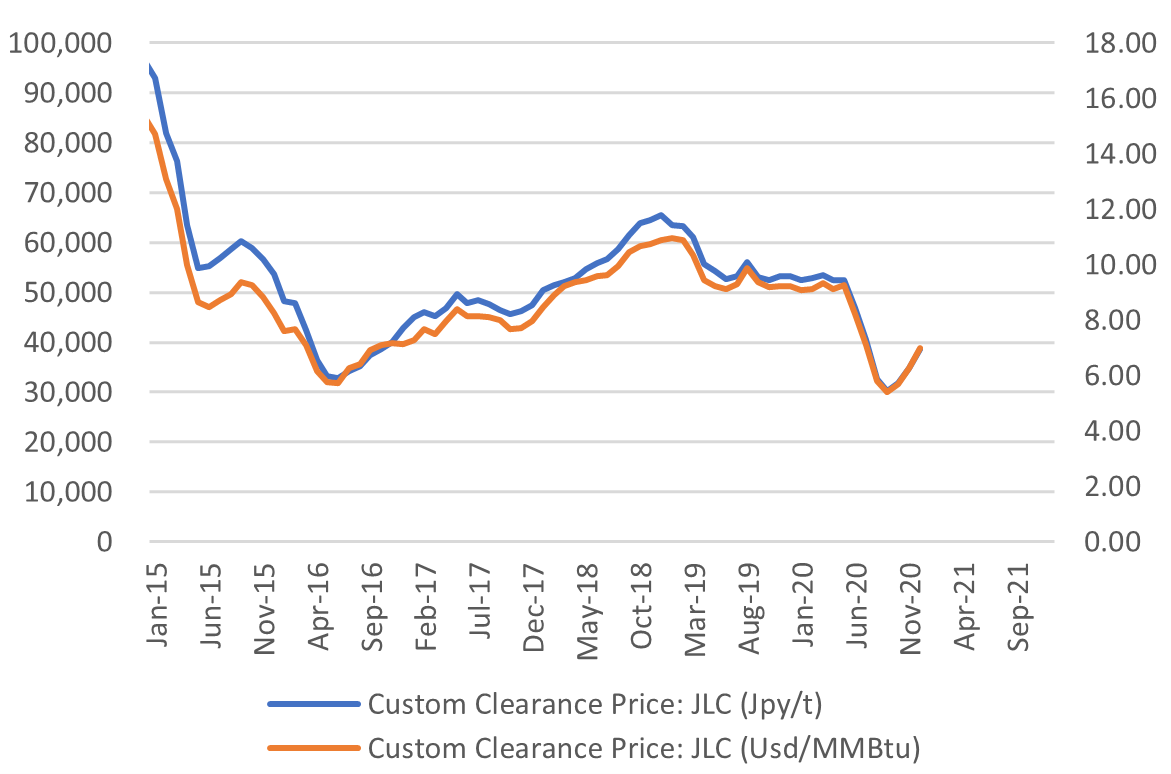
Japan LNG Price
LNG Imports: Japan Total vs Gas Utilities Only
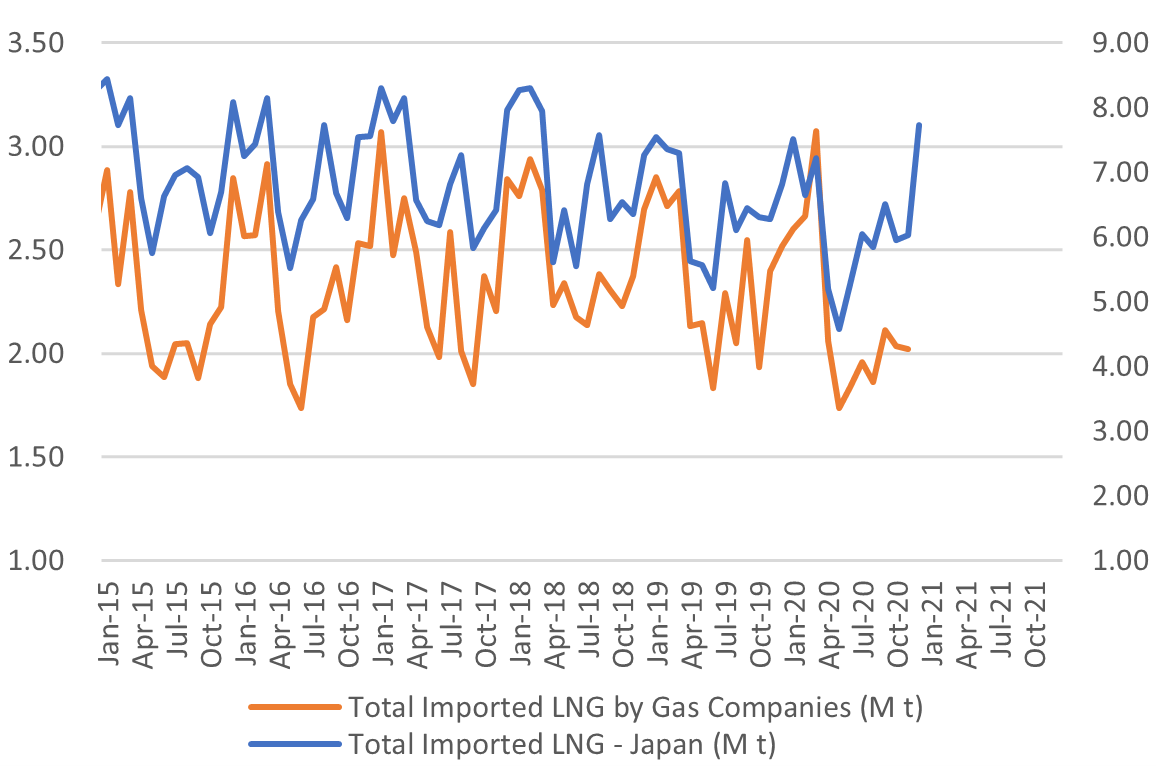
LNG Imports by Gas Firms Only (M t)
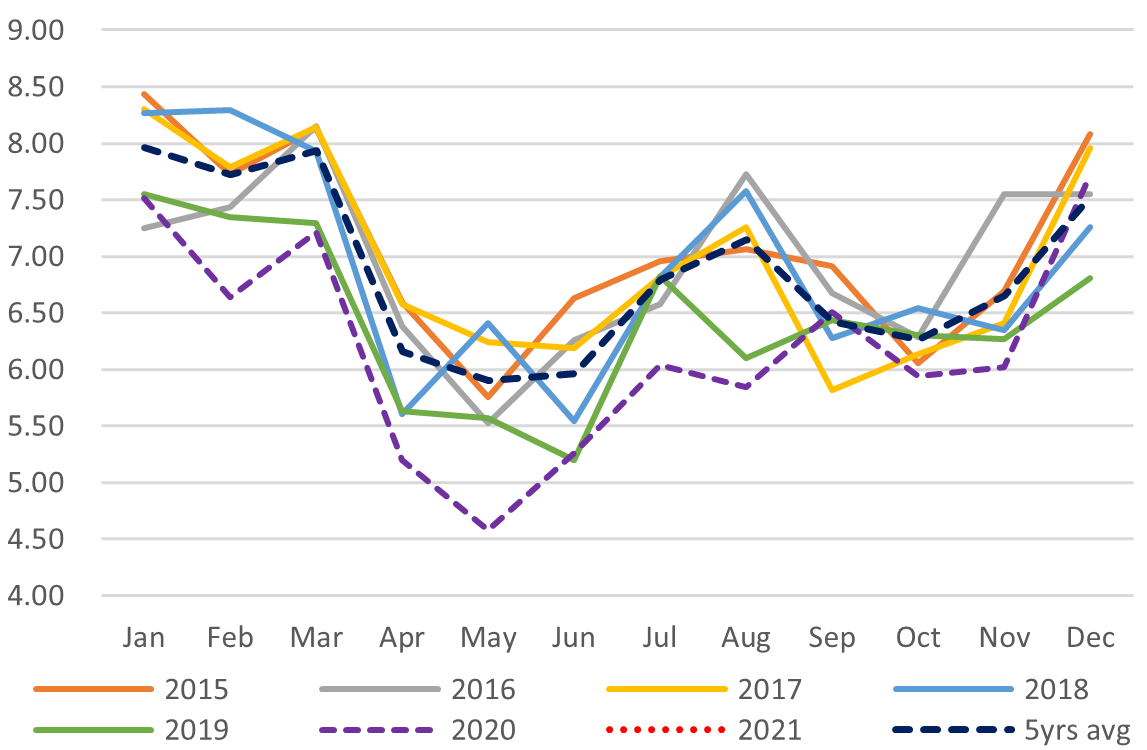
Total LNG Imports (M t)
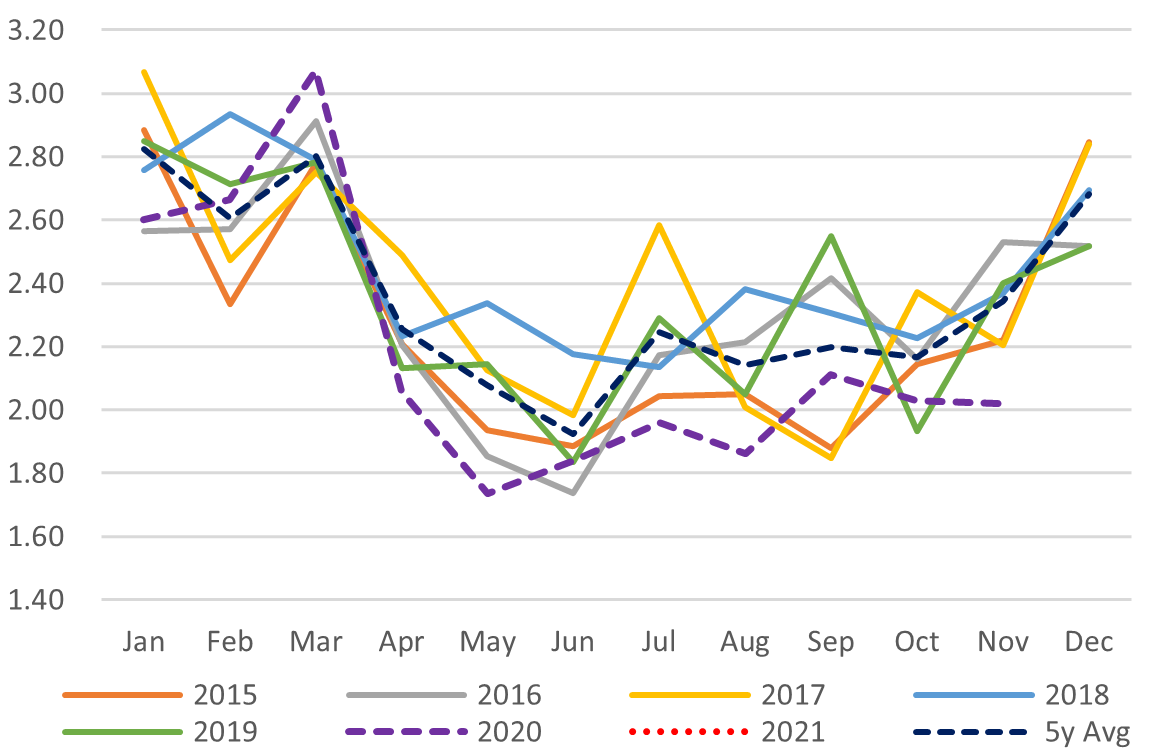
City Gas Sales – Total (M m3)
City Gas Sales by Sector (M m3)
SOURCES: Ministry of Economy, Trade, and Industry (METI),
Ministry of Finance
Japan Total Power Demand (GWh)
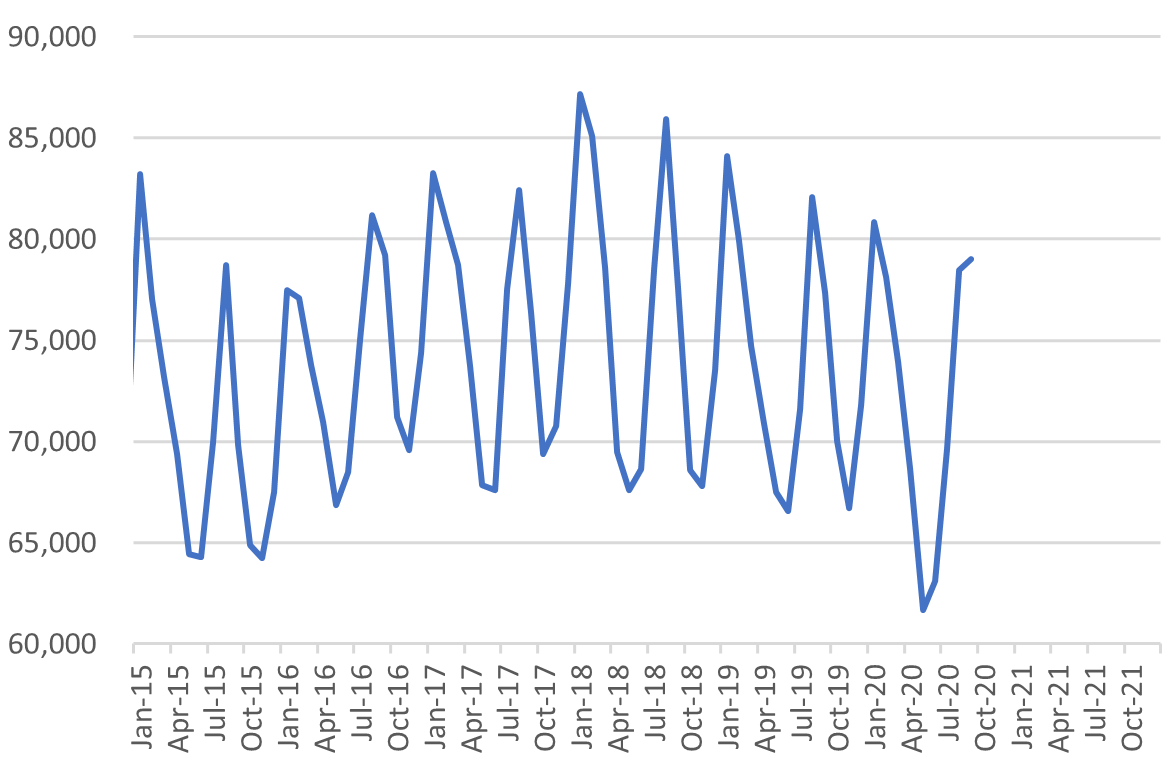
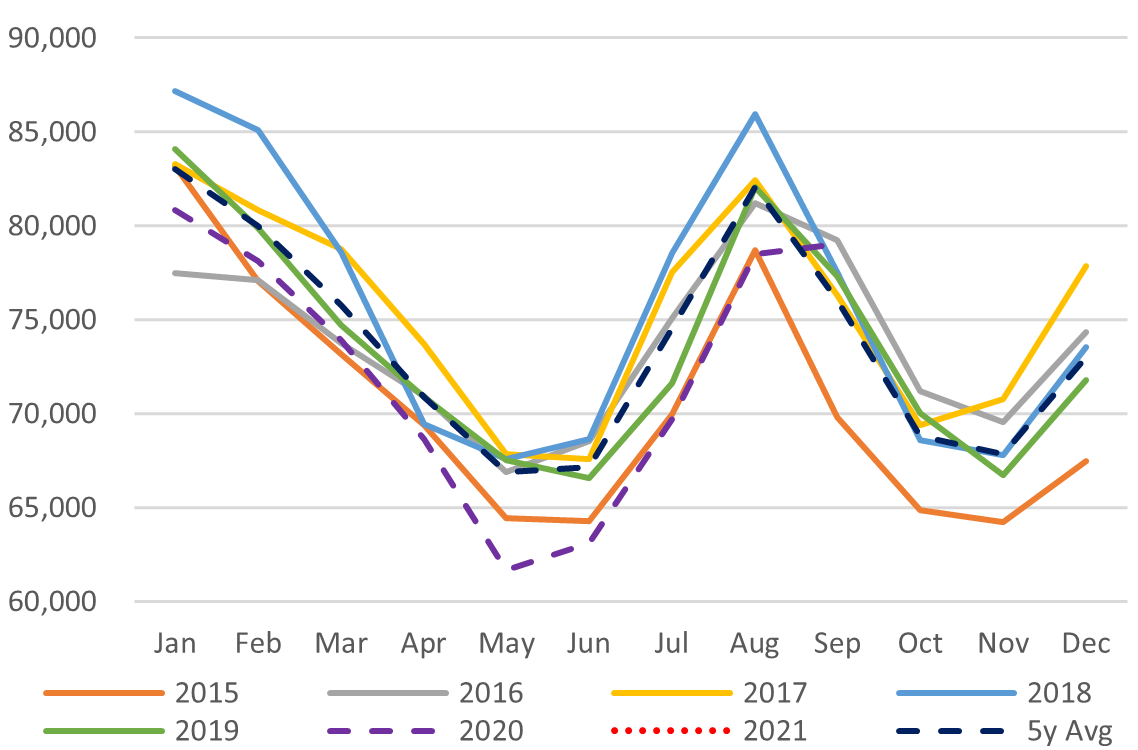
Current Vs Historical Demand (GWh)
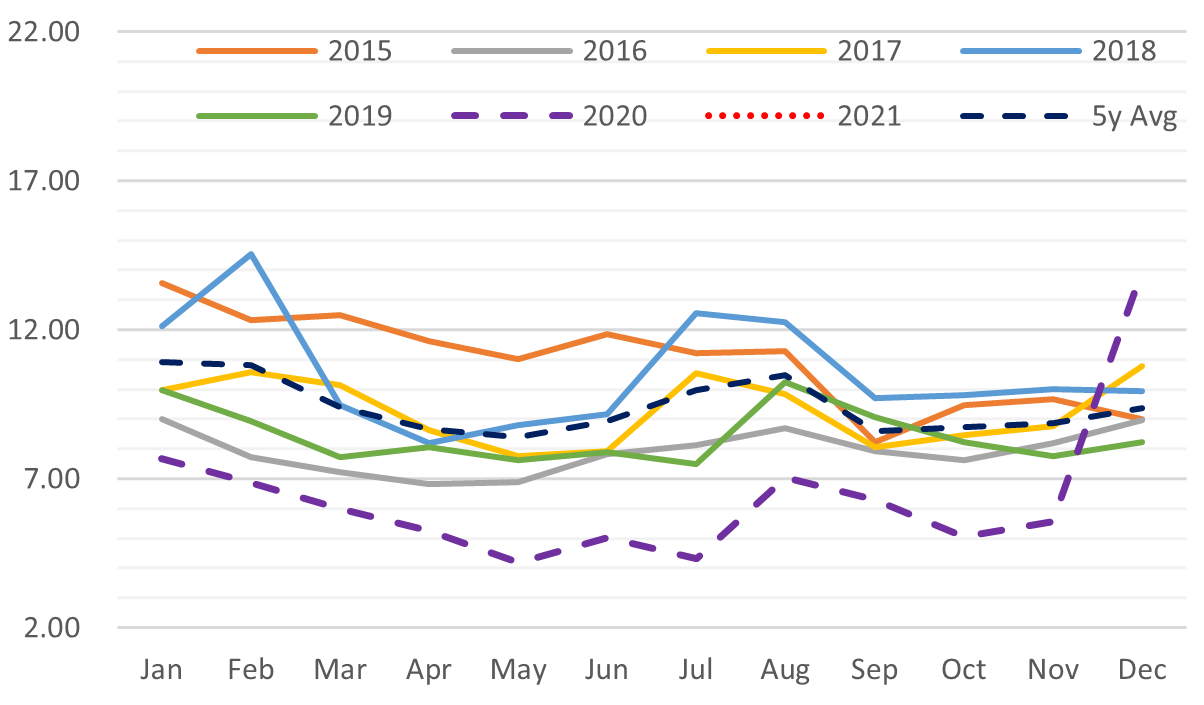
Day-Ahead Spot Electricity Prices
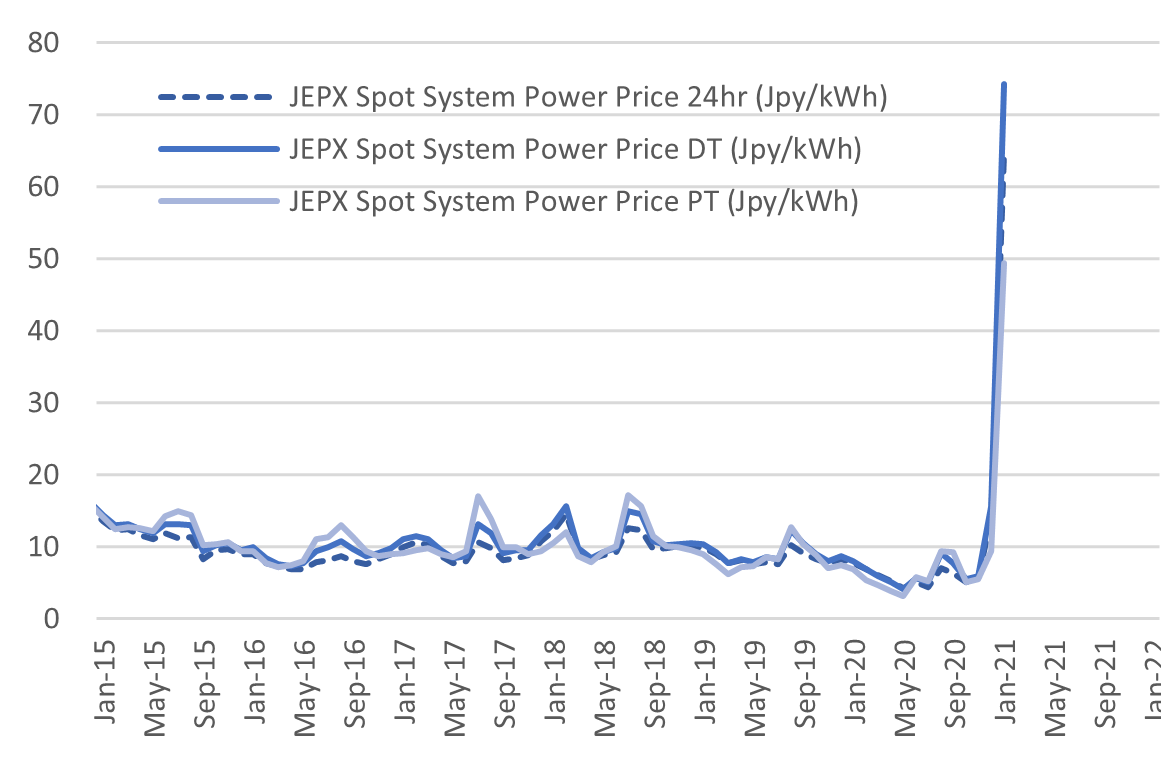
Day-Ahead Vs Day Time Vs Peak Time
LNG Imports by Electricity Utilities
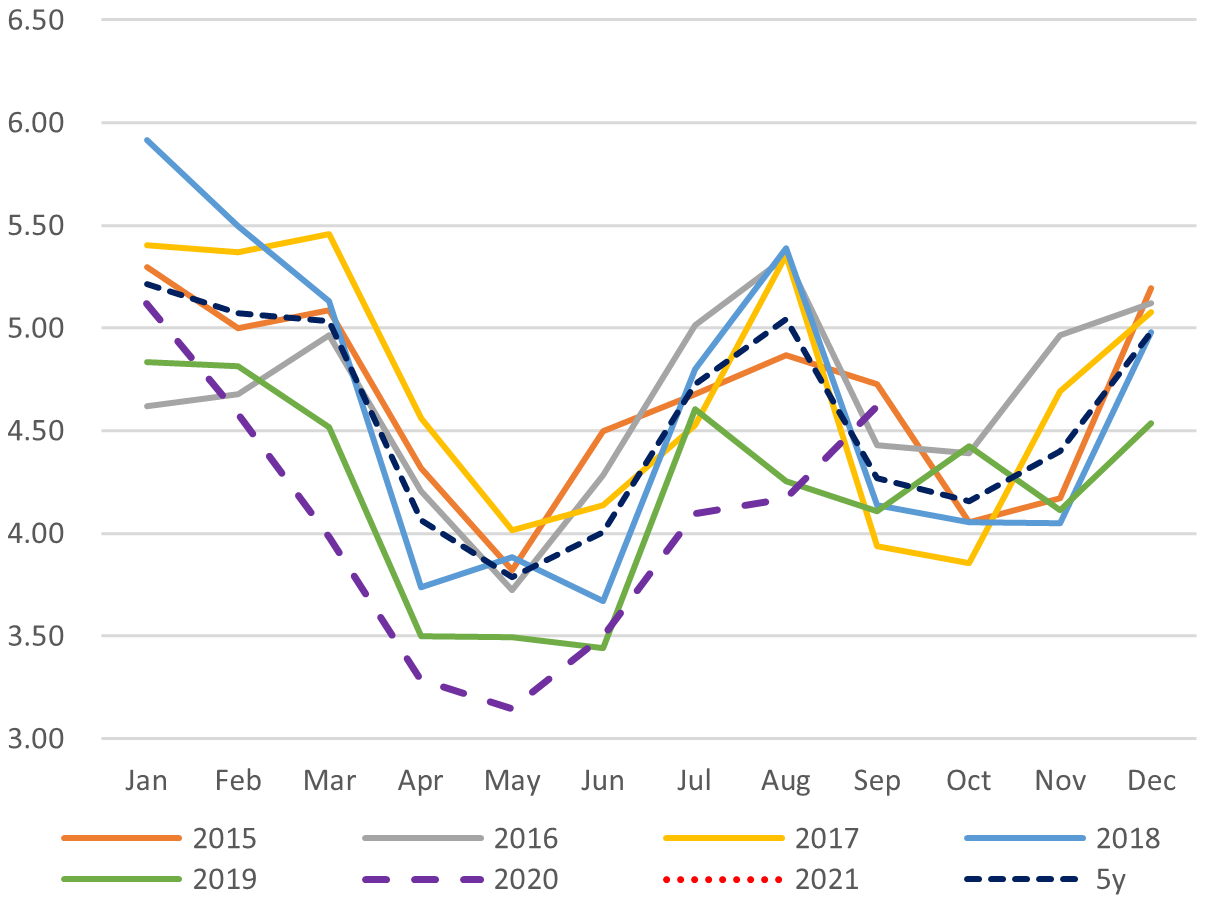
LNG Stockpiles of Electricity Utilities
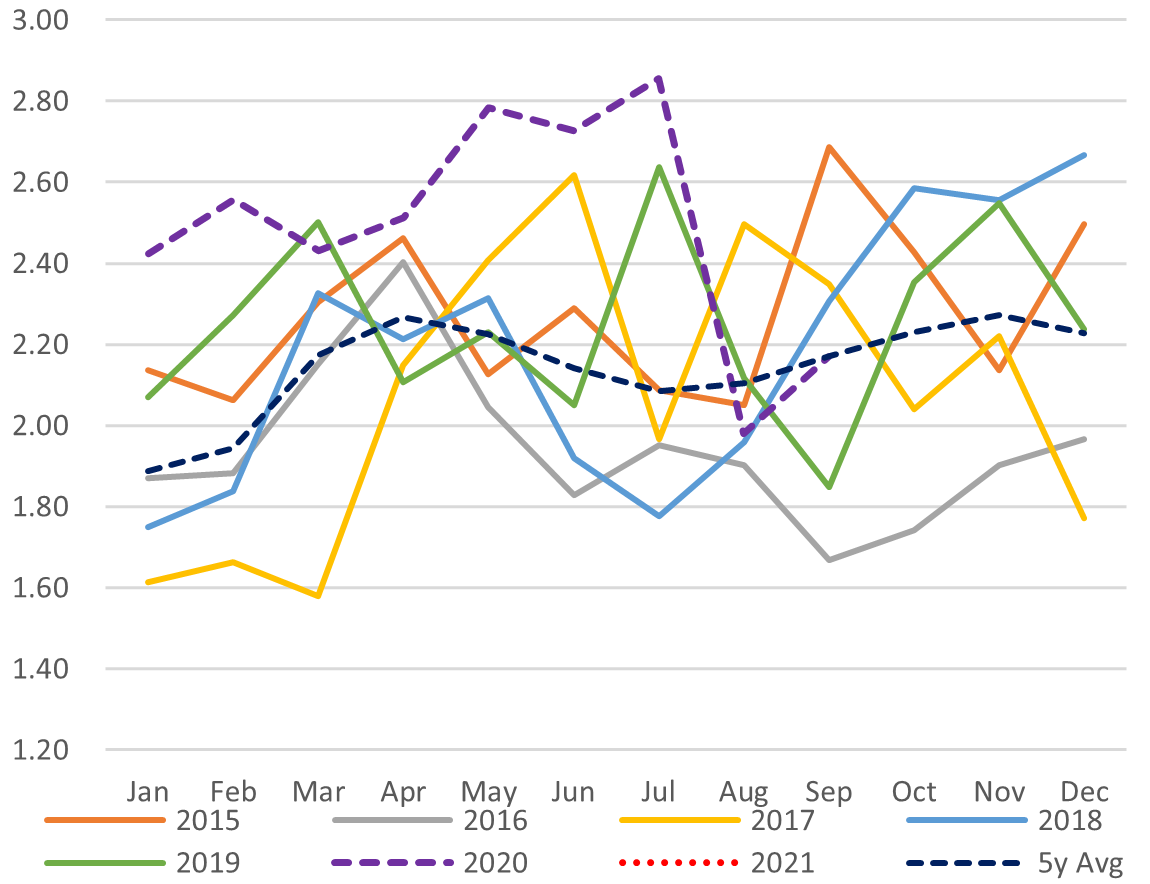
SOURCES: Ministry of Economy, Trade, and Industry (METI), and the Japan Electric Power Exchange
ACRONYMS
|
METI |
The Ministry of Energy, Trade and Industry |
mmbtu |
Million British Thermal Units |
|
TEPCO |
Tokyo Electric Power Company |
mb/d |
Million barrels per day |
|
KEPCO |
Kansai Electric Power Company |
mtoe |
Million Tons of Oil Equivalent |
|
EPCO |
Electricity power company, refers to the 10 regional utilities that used to control all parts of the Japanese power industry |
kWh |
Kilowatt hours (electricity generation volume) |
|
NEDO |
New Energy and Industrial Technology Development Organization | ||
|
JCC |
Japan Crude Cocktail | ||
|
JKM |
Japan Korea Market, the Platt’s LNG benchmark | ||
|
CCUS |
Carbon Capture, Utilization and Storage | ||
|
CCUR |
Carbon Capture, Utilization and |