
JAPAN NRG WEEKLY
FEBRUARY 15, 2021
JAPAN NRG WEEKLY
February 15, 2021
NEWS
TOP
- Momentum for nuclear restarts gathers as Kansai Electric offers local govt. new plan and METI minister shows support; Hokkaido Electric also starting to win over regulator in the restart review
- Japan considers introducing carbon tax at the border
- Almost half of Qatar’s $29 billion LNG expansion goes to Chiyoda, giving Mitsubishi an edge in future supplies
ENERGY TRANSITION & POLICY
- Government shifts raw material focus to hydrogen / rare metal
- Turbine breakthrough makes hydro viable in low water areas
- JERA, Petronas to cooperate on LNG, ammonia and hydrogen
- Hitachi successfully tests battery-powered tram in Italy
- Toyota reverses course, promising two EVs for U.S. this year
- Can Japan’s trading houses survive in carbon-neutral age; Mitsubishi unit to supply Amazon with renewable energy
- Next Energy develops double-sided solar cells … [MORE]
ELECTRICITY MARKETS
- One million households temporarily lose power after quake
- Nuclear industry in crisis as 2030 “cliff” looms; OPINION: Govt. has effectively ditched nuclear from future energy mix
- TEPCO unit boosts earnings eightfold on solar panel servicing
- TEPCO power retail unit rumored to face breakup and sale
- METI grants electricity retailers payment delay due to volatility
- Truth behind the energy crisis: bad LNG purchase planning
- Power utilities report a drop in profit due to the pandemic
- GE Hitachi Nuclear Energy forms Canadian SMR business
OIL, GAS & MINING
- Japan’s January LNG spot price more than doubled to $18.5
- Tokyo Gas invited to study Bangladesh LNG bunkering project
- ENEOS sells soon-to-close Chita refinery to Idemitsu
- INPEX posts first-ever annual loss; ENEOS profit down due to its copper mine; Idemitsu revises loss forecast to a profit … [MORE]
ANALYSIS
CARBON-NEUTRAL LNG (VERY) SLOWLY
GAINING TRACTION IN JAPAN
In 2019, Japan claimed to be the first recipient of “carbon-neutral” LNG. Since then, development of a local market for such LNG cargos has been glacial, yet there are a few (small) signs of a thaw. A number of domestic users recently signed multi-year contracts for carbon-neutral gas, helping Tokyo Gas, Japan’s main distributor of the product, be cautiously optimistic on further gains. What’s more, METI officials have joined the company in trying to convince local consumers to demand carbon-neutral LNG and are in the process of creating a new scheme that will support it. There’s also talk of a link to domestic carbon credits.
GREEN AMMONIA PLANS REVEAL
JAPAN’S COAL COST NOW ON PAR WITH SOLAR
Recent announcements on Japan’s ammonia strategy suggest the future of the colorless gas may not be as bright as initially hoped. The expected cost of burning ammonia in tandem with coal looks more expensive than solar power. Switching thermal plants exclusively to ammonia-fired generation would also see them lose in a price war with wind, hydro and biomass. Most surprisingly, however, the government’s calculations inadvertently show that the cost of coal-fired electricity is no longer the cheapest option (after nuclear). In fact, coal generation is now almost on par with solar.
GLOBAL VIEW
Rolls-Royce says its small nuclear reactor may be ready for grid use by 2030. China commissions its first home design Hualong One reactor. MS says that all coal-fired power in the U.S. will stop by 2033. ICE’s carbon trading to move to Amsterdam from London. See section for details on these and other global energy-related news.
2021 EVENT CALENDAR
Industry / political events related to Japan energy.
DATA Gas, power, and oil stats
JAPAN NRG WEEKLY
PUBLISHER
K. K. Yuri Group
Editorial Team
Yuriy Humber (Editor-in-Chief)
Tom O’Sullivan (Japan, Middle East, Africa)
John Varoli (Americas)
Regular Contributors
Mayumi Watanabe (Japan)
Daniel Shulman (Japan)
Damon Evans (Indonesia)
Art & Design
22 Graphics Inc.
Sponsored

SUBSCRIPTIONS & ADVERTISING
Japan NRG offers individual, corporate and academic subscription plans. Basic details are our website or write to subscriptions@japan-nrg.com
For marketing, advertising, or collaboration opportunities, contact sales@japan-nrg.com For all other inquiries, write to info@japan-nrg.com
Disclaimer
This communication has been prepared for information purposes only, is confidential and may be legally privileged. This is a subscription-only service and is directed at those who have expressly asked K.K. Yuri Group or one of its representatives to be added to the mailing list. This document may not be onwardly circulated or reproduced without prior written consent from Yuri Group, which retains all copyright to the content of this report.
Yuri Group is not registered as an investment advisor in any jurisdiction. Our research and all the content express our opinions, which are generally based on available public information, field studies and own analysis. Content is limited to general comment upon general political, economic and market issues, asset classes and types of investments. The report and all of its content does not constitute a recommendation or solicitation to buy, sell, subscribe for or underwrite any product or physical commodity, or a financial instrument.
The information contained in this report is obtained from sources believed to be reliable and in good faith. No representation or warranty is made that it is accurate or complete. Opinions and views expressed are subject to change without notice, as are prices and availability, which are indicative only. There is no obligation to notify recipients of any changes to this data or to do so in the future. No responsibility is accepted for the use of or reliance on the information provided. In no circumstances will Yuri Group be liable for any indirect or direct loss, or consequential loss or damages arising from the use of, any inability to use, or any inaccuracy in the information.
K.K. Yuri Group: Oonoya Building 8F, Yotsuya 1-18, Shinjuku-ku, Tokyo, Japan, 160-0004.
NEWS: ENERGY TRANSITION & POLICY
Japan considers introducing a carbon tax at the border for top polluters
(Nikkei, Feb. 11)
- METI will consider the introduction of a “border carbon tax”, which would be put on the import of goods from places that have loose emissions standards and “insufficient environmental measures”.
- Experts will gather on Feb. 17 to discuss this measure, hoping to reach a conclusion by summer. Japan is aware that similar discussions are taking place in Europe and the U.S., with a draft European system due by June this year.
- CONTEXT: The aim of a carbon tax is to prevent companies from moving production to places with loose environmental regulations.
TAKEAWAY: The idea of taxing environmental impact is one of the most important initiatives of this year. Japan is trying to make sure it is moving at a similar pace to the EU and the U.S., but the real question is how much of an impact all three will have unless China, the world’s No.1 polluter, comes on board. A carbon tax will likely hurt Chinese manufacturing the most, but the cost of the tax could as easily be passed onto the end consumer of Chinese products.
Government shifts focus to hydrogen/rare metals
(Yomiuri Shimbun, Feb. 9)
- As part of its goal to become carbon neutral by 2050, the Japanese government has shifted the focus of its strategic efforts to procure commodities from oil and natural gas to ammonia, hydrogen, and rare metals.
- The export of environmentally friendly technologies is also part of the government’s new strategy.
- METI will formally outline the new strategy in mid-Feb. in the hope of encouraging private sector companies to invest in these technologies.
- The difficulty of procuring all Japan’s future hydrogen requirements domestically makes it likely that Japanese corporations will form partnerships with the US, Australia, and the Middle East that allow them to produce hydrogen on-site for shipping to Japan.
Turbine breakthrough to make small hydro viable with low water volume
(Kahoku Shinpo, Feb. 10)
- A research group led by Tohoku Small Hydropower Co. said that it has developed a new hydroelectric turbine that makes areas with small water volumes effective enough to generate electricity on a commercial basis.
- Tohoku Small Hydro, Waseda University and the Akita prefecture govt. conducted a demonstration trial of the technology and it proved efficient. The trial of the turbine, which suppresses vibration and blurring that can occur in low water conditions, was held at the Yoroibata power plant in Semboku City in Akita.
- The group sees the potential to commercialize the turbine by the end of 2021.
- The president of Tohoku Small Hydropower said the turbine will open up an additional 20,000 places in Japan for hydropower.
- The technology development and its trial were sponsored by national and local govt. funding.
JERA and Malaysia’s Peronas agree to cooperate on LNG, ammonia and hydrogen
(Various, Feb. 10)
- The two companies signed an MoU to work together on decarbonization projects. These are listed in company statements as promoting the use of LNG in Asia and creating supply chains for ammonia and hydrogen.
- The two seek to collaborate to synthesize hydrogen and ammonia from renewable sources.
- The companies will also work on upstream LNG and gas-to-power infrastructure in several countries, as well as promoting the switching of ships to LNG. The partners plan to establish a global bunkering supply network.
- CONTEXT: Petronas is one of the top suppliers of ammonia in Asia with annual output of 2 million tons. This ammonia is not, however, produced via renewable energy sources.
TAKEAWAY: As the biggest owner of coal-fired capacity in Japan, JERA will likely also become the biggest ammonia buyer from the country and most of it will be imported. For a detailed look at Japan’s ammonia strategy, please see this week’s Analysis section.
Hitachi successfully tests battery-powered tram in Florence, Italy
(New Energy Business News, Feb. 10)
- Hitachi Rail (Italy), a group company of Hitachi, Ltd., has succeeded in the first test operation of a storage battery-powered tram in Florence, Italy. A storage battery was installed in the tram “Sirio” manufactured by Hitachi, which is already in operation in Florence, and part of the route was driven by the storage battery.
- Conventional trams require overhead lines supported by utility poles to supply power. Battery-powered can reduce the cost of installing such infrastructure and reduce the impact on beautiful historic streets and cityscapes like Florence.
- The tram also recharges the battery when it decelerates and brakes.
Toyota reverses course in U.S. to debut two EVs during this year
(Bloomberg, Feb. 10)
- Toyota Motor said it plans to start sales of two battery-powered vehicles in the U.S. this year, seemingly changing its earlier skeptical stance towards EVs.
- The automaker will also roll out an unspecified plug-in hybrid model in the U.S. market.
- CONTEXT: Toyota withdrew from EVs in the U.S. seven years ago due to poor sales. It has since developed its own BEV platform called e-TNGA, which can be used for multiple models.
Survival in a carbon-neutral age: can Japanese trading houses change their ways?
(Toyo Keizai, Feb. 6)
- Sumitomo Corp recently wrote down its investment in the Blue Waters coal-fired power station in Australia by ¥25 billion, after failing to secure refinancing for the project. Australian banks stopped lending to the coal industry in 2019.
- Mitsubishi Corp has also said it will not participate in any further coal-fired power station projects after the Vietnamese Dung Ang 2 project.
- Mitsui & Co was the first Japanese trading house to declare a target of zero greenhouse gas emissions by 2050.
- Mitsubishi Corp entered the windfarm industry 10 years ago, and recently purchased Dutch sustainable energy company Eneco.
- Itochu Corp, which has strengths in the consumer sector, also plans to boost its green operations. Itochu manufactures and markets domestic storage batteries for rooftop solar systems, which are able to optimize power usage and generation using artificial intelligence.
- SIDE DEVELOPMENT:
Mitsubishi to supply Amazon with renewable energy in Europe
(Nikkei, Feb. 8)- It was learned on Feb. 8 that Mitsubishi Corporation will provide Amazon’s European operations with electricity generated from 100% renewable sources.
- The 130 MW required will be supplied by an offshore wind farm operated by Mitsubishi Corporation subsidiary Eneco that is scheduled to begin operating in 2023.
- The move sends a clear signal to the world of Mitsubishi’s intentions to transition to carbon neutral electricity.
Hitachi Zosen to supply green electricity for Osaka government buildings
(Denki Shimbun, Feb. 9)
- Hitachi Zosen said on Feb. 8 that it would supply electricity generated from 100% renewable sources for the Osaka Prefectural Government buildings. The electricity will be generated from waste incineration, among other sources.
- Hitachi Zosen won the tender to supply approximately 5 million kWh over a one-year period beginning in April.
Next Energy develops new double-sided solar cell for car parks which catches reflected light
(New Energy Business News, Feb. 12)
- Next Energy & Resources has started selling a double-sided solar cell module integrated carport. The new panels are mainly targeted at small and medium-sized parking lots with an output of up to about 500 kW with cost of production and construction severely reduced.
- Solar carports are overhead canopies built to cover parking areas. An industrial solar carport uses a double-sided solar cell that converts reflected light into electric power.
NEWS: POWER MARKETS
| No. of operable nuclear reactors | 33 | |||
| of which | applied for restart | 25 | ||
| approved by regulator | 16 | |||
| restarted | 9 | |||
| in operation today | 4 | |||
| able to use MOX fuel | 4 | |||
| No. of nuclear reactors under construction | 3 | |||
| No. of reactors slated for decommissioning | 27 | |||
| of which | completed work | 1 | ||
| started process | 4 | |||
| yet to start / not known | 22 | |||
Source: Company websites, JANSI and JAIF, as of Feb. 9, 2021
Close to 1 million households temporarily lose power after earthquake
(Japan NRG, Feb. 14)
- A 7.3 magnitude earthquake off the coast Fukushima prefecture late on Saturday night (Feb. 13) temporarily knocked power facilities offline, leaving close to 1 million households without electricity for several hours.
- The Japan Meteorological Agency has warned of possible aftershocks that could be of a similar magnitude over the next week.
- The biggest outages were in the catchment area of Tokyo Electric (TEPCO), with some also in the region mostly served by Tohoku Electric.
- Around 7 GW of thermal capacity was shut down following the quake for inspection.
- No significant abnormalities were reported at the nuclear facilities in the area, but there was a minor spill of water from the containment pool at the Fukushima Dai-Ni nuclear power plant.
Kansai Electric tells local governor solution to nuclear storage due by 2023
(Nikkei, Feb. 12)
- Kansai Electric CEO Morimoto met with Fukui Governor Sugimoto on Feb. 12 and presented the utility’s plan to resolve the issue of its used nuclear fuel storage. The CEO showed a plan that calls for Kansai Electric to offer a solution where to move the fuel from its Fukui area facilities by 2023.
- METI minister Kajiyama was due to join the meeting virtually.
- CONTEXT: The used fuel is currently stored in special pools at the three nuclear power plants that Kansai Electric has in the Fukui prefecture, which are all of its nuclear power facilities. However, the utility promised the Fukui government that the used fuel rods would be moved and not stay inside the prefecture indefinitely. The initial plan was to inform the governor of concrete waste removal plans by the end of 2020, but that did not occur. In response, the governor has not given his approval for any nuclear restart applications by Kansai Electric.
TAKEAWAY: Kansai Electric are buying time so that they can win over the local government in Mutsu, Aomori prefecture, to allow them to share the local nuclear waste depository there. As of now, that facility is set aside only for used fuel from TEPCO and J-Atomic Power. How those plans will proceed is still unclear, but one thing to note about the current standoff between Kansai Electric and Fukui prefectural government is that METI minister Kajiyama has joined in the conversation. METI is usually present in the background of such discussions. The minister’s presence shows the national government is finally ready to step in on the restart process in a more active way.
- SIDE DEVELOPMENT:
Hokkaido Electric’s Tomari reactor restart debate moves forward
(Nikkei, Feb. 12)- The latest meeting between the Nuclear regulator and Hokkaido Electric over the fate of the latter’s Tomari NPP Unit 3 showed some signs of progress. The regulator indicated it may reconsider its stance on whether the facility stands on an active geological fault.
- The regulator and the utility have carried out surveys for years. The utility says that the data it has uncovered supports their claim that the reactor is not on an active fault.
- A regulator official remarked it’s “likely” there’ll be a ruling supporting the utility’s claim.
- The Tomari NPP has been under review for over seven years.
- SIDE DEVELOPMENT:
Mihama mayor “one step closer” to approving reactor restart
(Fukui TV via Yahoo! News, Feb. 10)- In a meeting with KEPCO executives on Feb. 10, Mihama Mayor Toshima Hideki acknowledged KEPCO’s contribution to the local community and said he believed the town was now one step closer to approving the restart of the Mihama nuclear power plant’s Unit 3, which is over 40 years old.
- KEPCO has rolled out a host of initiatives in the town aimed at boosting the technical capabilities of local industry and matching businesses to opportunities.
Regulator revises reporting process after Kashiwazaki security breach
(Denki Shimbun, Feb. 12)
- The Nuclear Regulation Authority will revise protocol for reporting of irregularities in the wake of an incident in which an unauthorized worker entered the Kashiwazaki-Kariwa reactor control room.
- Previously, incidents categorized as having the lowest importance were only reported to the NRA committee on a quarterly basis. In future, all breaches will be required to be reported promptly.
TAKEAWAY: This seems like a minor incident, but unfortunately adds to the long catalog of small and large mistakes, misses and miscalculations by TEPCO over the last 10 years. As each incident crops up, critics note that it shows once again why the utility should never be allowed to operate nuclear assets again. The left-leaning Asahi Shimbun published just such an editorial recently. Of course, Asahi readers are already anti-nuclear and this incident will change little. However, TEPCO does need to win over the neutrals in the nuclear debate and, largely, it’s not succeeding.
Nuclear industry in crisis as 2030 “cliff” looms
(Nikkei Sangyo Shimbun, Feb. 8)
- IHI is one of many companies that developed specialized manufacturing techniques for the nuclear power industry. However, a lack of clear policy direction around nuclear power means that the industry is currently gripped by a crisis. The engineering workforce is aging fast, and soon there will be no more experienced engineers able to pass down their skills.
- IHI’s revenue from nuclear energy halved after the Fukushima disaster.
- A single annealing furnace used in the manufacture of pressure vessels for nuclear power plants costs the company ¥1 billion annually to maintain. IHI has not received an order for a pressure vessel for years, though, and may be forced to shut down the line.
- The nuclear power industry also faces a recruitment crisis, with job fairs attracting only a quarter of the number of graduates they did 10 years ago.
- Graduates with degrees in chemistry, civil engineering, and other fields not directly related to atomic energy are now much less likely to choose a career in the nuclear power industry.
- SIDE DEVELOPMENT:
OPINION: Govt. has effectively ditched nuclear from its energy policy
(Kahoku Shimpo, Feb. 7)- Energy expert and academic Kikkawa Takeo says while the government’s goal of carbon neutrality has been welcomed by Japan’s nuclear power lobby, he believes the nuclear industry will be left high and dry by the government’s energy policy, and cites the government’s reluctance to commit to building new nuclear power stations or replacing existing ones.
- If nuclear power plants continue to be decommissioned at the current rate, they will supply less than 10% of Japan’s power needs in 2050.
- Kikkawa dismisses the much vaunted “small modular reactor” concept that features in the government’s green growth strategy as a distraction, saying that such concepts are meaningless without new nuclear plants.
- Pointing to the fact that the government’s 2050 strategy only sets a combined target for power from thermal power stations (equipped with carbon capture technology) and nuclear energy, Kikkawa says he believes the government has already decided to ditch nuclear power.
TEPCO unit boosts earnings eightfold in a decade by servicing solar panels
(Denki Shimbun, Feb. 12)
- Thanks to its expertise in high-voltage electrical systems, TEPCO group company Tokyo Densetsu Service has succeeded in growing revenue eight-fold from services to external clients since 2010.
- TDS has strong demand for maintenance and inspection services for solar generation facilities.
- In addition to small-scale solar generation facilities, TDS is licensed to work on large solar farms, including those that produce over 2 MW of electricity and feed the 66,000-volt grid directly.
- While 10 years ago, 90% of TDS’ revenue came from services to TEPCO, revenue from services provided to third parties has now eclipsed internal contracts.
TEPCO’s power retail subsidiary rumored to face breakup and near-term sale
(Sentaku, February issue)
- TEPCO’s sale of its retail subsidiary, TEPCO Energy Partner (EP), is increasingly likely by the day. The retailer is losing money as it continues to buy electricity at high prices from TEPCO group companies, and company management is worsening.
- EP broke free from its onerous contract to buy power from JERA but hasn’t improved its financials much due to high expenses.
- TEPCO wants to help its subsidiary but METI is unlikely to allow this, so the breakup of EP and its sale is becoming very realistic.
- Rumored buyer for EP is ENEOS.
TAKEAWAY: As explained in previous issues of Japan NRG, despite the unbundling of the power utilities in 2016, TEPCO and its regional peers have kept the distribution and retail companies within a holding structure and thus continue to exercise a great deal of control over the mid- and downstream. This means that the profits of TEPCO’s grid or retailer subsidiaries were “sacrificed” to help the generation business. If METI and its power market watchdog get tougher on enforcing unbundling boundaries, such practices by regional utilities will need to change. TEPCO EP will be the first major test case for how much the ministry wants to enforce the new market rules.
- SIDE DEVELOPMENT:
METI grants electricity retailers payment extension to deal with price volatility
(Japan NRG, Feb. 12)- Retail companies will be allowed to extend payments for electricity by a month, and in some cases up to 4 months, if they apply to METI for an extension.
- The ministry said it’s still investigating why electricity prices spiked in January.
The truth behind the “energy crisis” this winter: bad LNG purchase planning
(Sentaku, February issue)
- CONTEXT: This is a long article outlining the various facets of the “energy emergency” in January. Most details are already known, but some conclusions are interesting and support some of the critical voices in government with regards to the regional power utilities (EPCOs).
- The problem with the LNG shortage comes from poor fuel management by major Japanese EPCOs, which took it for granted that LNG can be secured at any time due to oversupply.
- METI is reluctant to offer too much help to the new power market entrants, which challenge the EPCOs. However, the more powerful of these new entrants are lobbying a key committee in the ruling party run by Kono Taro, the powerful reforms minister who advocates for green energy.
Covid-19: six power companies report lower profits
(Denki Shimbun, Feb. 12)
- Consolidated financial results for Japan’s 10 largest electricity companies for the nine months to December are out.
- Only four reported an increase in recurring profit against the same period the year before, with the remaining six reporting decreased profits.
- With the exception of the Kyushu Electric Power Company, all utilities on the top-ten list also reported a decrease in revenue during the period, as subscribers switched to other providers and the Covid pandemic caused a reduction in demand.
GE Hitachi Nuclear Energy Announces Formation of Canadian SMR Business
(Business Wire, Feb. 11)
- GE Hitachi Nuclear Energy (GEH) announced the formation of GEH SMR Technologies Canada to support the deployment of the BWRX-300 Small Modular Reactor (SMR) in Canada.
- With the establishment of the Canadian SMR business, they look forward to building on the legacy and bringing the world’s first grid-scale SMR to Canada, positioning Ontario as a hub for SMR technology.
- GE Hitachi Nuclear Energy (GEH) is a world-leading provider of advanced reactors and nuclear services. Established in 2007, GEH is a global nuclear alliance created by GE and Hitachi to serve the global nuclear industry.
Okinawa Electric to offer CO2-free electricity from April
(New Energy Business News, Feb. 9)
- Okinawa’s main power utility will start to offer CO2-free electricity plans based on its biomass and solar generation facilities. The electricity sales will be backed by Japan’s “non-fossil-fuel” certificates.
- The main clients will be large corporates buying high-voltage power.
- The utility will also be buying solar electricity from residents whose FIT terms have expired.
- Okinawa Electric has been mixing in woody biomass into some of its thermal plants since March 2010.
- SIDE DEVELOPMENT:
Okinawa Electric buys stake in company that retails PV systems, batteries
(New Energy Business News, Feb. 9)- Co. buys 23.5% of Nextems Co., which sells photovoltaic power generation systems, storage batteries, and EcoCute, as well as testing distributed power, mainly in the Miyakojima area.
NEWS: OIL, GAS & MINING
Qatar Hires Japan’s Chiyoda for $29 Billion LNG Expansion Project
(Nikkei, Feb. 9)
- Chiyoda, the engineering company associated with Mitsubishi Corp., won the biggest design, procurement and construction order from Qatar, which is expanding its LNG output capacity with new facilities.
- Qatar’s new LNG facilities will boost the country’s annual output to 110 million tons from the current 77 million tons, and will be completed between 2025 and 2027. The facilities will have carbon capture technology that will sequester 25% of their emissions.
- Chiyoda has been involved in building 12 of Qatar’s 14 current LNG plants (known as “trains”).
- Chiyoda’s new contract is worth $13 billion.
TAKEAWAY: Chiyoda has won almost half the project’s total budget and is getting perhaps the biggest order for an oil and gas facility in the next few years. This is great news for the engineering company’s financials as it triples its order pipeline, and it also suggests that a lot of that new LNG capacity may be heading to Asia via Japanese companies. The carbon-reduction aspect is also clearly much more than a nod to ESG as Japan looks to popularize carbon-neutral LNG sales. See our Analysis section for more details on the latter.
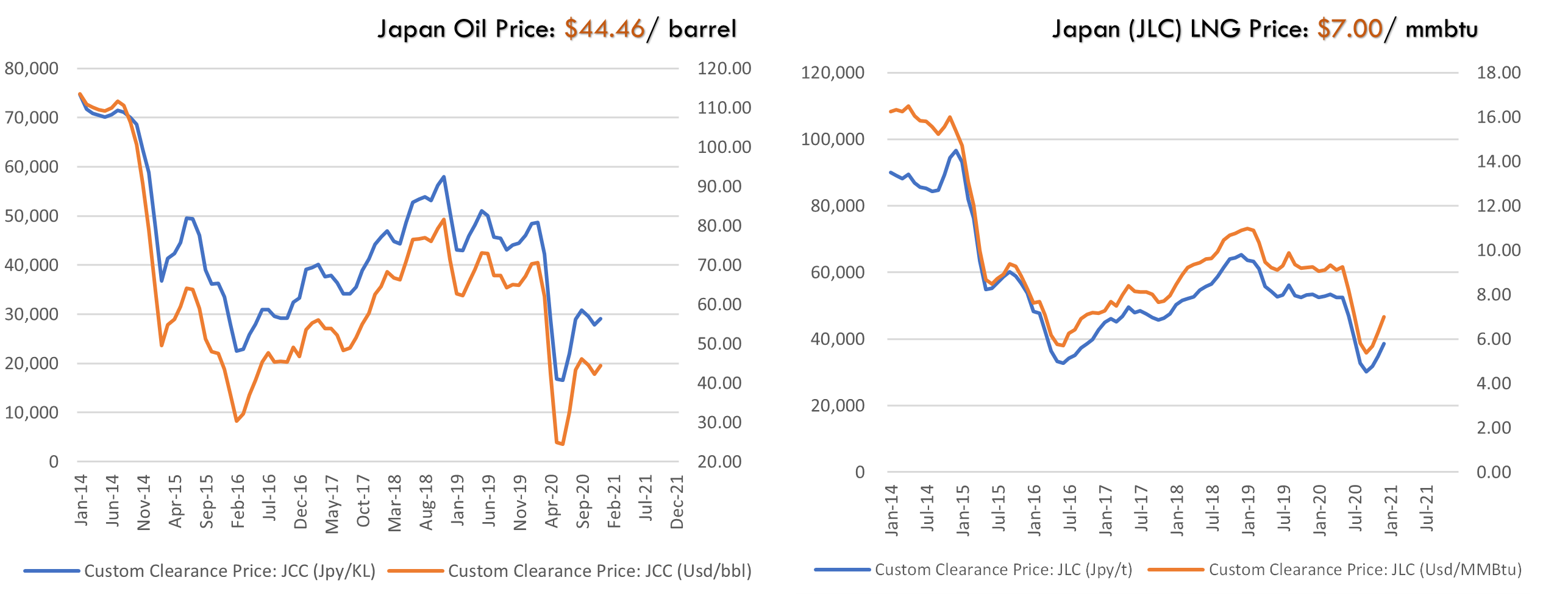
Japan’s January LNG spot price more than doubled to average $18.5 mmbtu
(Japan NRG, Feb. 12)
- Japan’s January LNG spot “contract” price hit $18.5 mmbtu, up from $7.4 in December.
- The “arrival” price, or the average for spot cargoes arriving in January, was $15.5, up from $6.8 in December.
- CONTEXT: “Arrival” price differs from “contract” price in that it counts the contract based on its cargo’s month of delivery. “Contract” price refers to LNG spot trades concluded that month. “Contract” price doesn’t include the price of longer-term deals concluded in the period.
- CONTEXT: All pricing is on a DES (delivered ex-ship) basis.
Tokyo Gas invited to study Bangladesh LNG bunkering project
(Gas Energy News, Feb. 8)
- Tokyo Gas Engineering Solutions has said that it will perform a feasibility study on a project to construct a land-based LNG bunkering station in Bangladesh.
- The study will be performed jointly with Nippon Koei and state-owned Petrobangla.
- While Bangladesh produces some LNG, rising domestic demand means that it is now a net importer of the commodity.
ENEOS sells soon-to-close Chita refinery to domestic peer Idemitsu
(Yomiuri Shimbun, Feb. 11)
- ENEOS said on Feb. 10 that it had agreed to transfer the entirety of its Chita refinery to competitor Idemitsu Kosan.
- The refinery occupies the lion’s share of a 1.3 million square meter site. The land will be leased to Idemitsu.
- The refinery is scheduled to be closed later this year, and the assignment to Idemitsu is scheduled to be completed by September 2022.
Idemitsu Kosan updates annual loss forecast to profit after crude price rebound
(Nikkei, Feb. 9)
- Idemitsu Kosan said on Feb. 9 that it anticipates a final profit for the year ending March 2021 of ¥15 billion, a significant improvement from its initial projection of a ¥20 billion loss.
- The improvement is attributed to a reduction in inventory write-downs on the back of improving crude prices, and to reduced costs.
ENEOS takes profit hit on Caserones copper mine, Japan electricity price jump
(Sekiyu Tsushin, Feb. 12)
- ENEOS announced its financial results for the December quarter on Feb. 10, and its revenue and operating profit fell YoY. Revenue from the sale of petrochemical products was down nearly 30% due to the slump in demand caused by the coronavirus pandemic.
- ENEOS reported a ¥43 billion loss on its exploration business during the period. This is mostly attributable to the partial suspension of operations at its Caserones copper mine in Chile, as well as to coronavirus measures at the mine.
- While ENEOS restarted idle electricity generation facilities in an attempt to weather the recent power shortage, it was still forced to purchase electricity at a premium on the spot market to ensure stable supply to its subscribers.
INPEX reports first ever full-year loss due to low crude prices and write-downs
(Asahi Shimbun, Feb. 11)
- Japan’s largest oil company INPEX reported on Feb. 10 that it lost over ¥100 billion in 2020.
- This is INPEX’s first full-year loss since its inception in 2008.
- The result was attributed to a major drop in revenue as a result of low crude prices and a ¥190 billion write-down of Australian and US oil and LNG operations.
- INPEX predicts it will make a net profit of ¥100 billion this year as crude prices recover.
Gas appliances maker Rinnai flying high due to “stay home” demand
(Toyo Keizai, Feb. 13)
- Gas appliance manufacturer Rinnai has benefited from the coronavirus pandemic. It appears that many consumers used their ¥100,000 government stimulus check to upgrade gas appliances in order to make their time at home more comfortable.
- Rinnai’s sales of hobs, clothes dryers, and jet baths have been strong.
Fracta partnership helps Toho Gas boost returns on pipeline network
(Denki Shimbun, Feb. 12)
- Toho Gas and US start-up Fracta said on Feb. 10 that they had created the world’s first algorithm for predicting and visualizing the degradation of gas-distribution infrastructure.
- The two companies, which have been collaborating on the project since August 2019, say their algorithm significantly boosts return on investment in the scheduled replacement of gas pipes.
- The collaboration has drawn on Toho Gas’ expertise in gas services. Before working with Toho Gas, Fracta’s expertise was with chiefly with water services.
ANALYSIS
BY MAYUMI WATANABE
Carbon-neutral LNG (very) slowly gaining traction in Japan
In 2019, Japan claimed to be the first recipient of “carbon-neutral” LNG. Since then, development of a local market for environmentally conscious LNG cargos has been glacial, yet there are a few (small) signs of a thaw.
A number of domestic gas users have signed multi-year contracts for carbon-neutral gas in recent months, helping Tokyo Gas, Japan’s main distributor of the product, be cautiously optimistic on further gains. What’s more, officials at METI have joined the gas company in trying to convince local consumers to demand carbon-neutral LNG and are in the process of creating a new scheme with incentives to support this. There’s also talk of a link to domestic carbon credits.
Still, growing a market for “blue LNG” – (a fuel that has its emissions either captured and sequestered, or otherwise fully offset) – promises to be no mean feat, even in the world’s biggest importing nation.
Scarred by the price jump
The LNG price spike this winter broke all records, setting off a strong debate inside Japan about the wisdom of relying so heavily on energy imports and one fuel in particular. Furthermore, after a doubling of Japan’s spot contract prices to $18.5 mmbtu in January, approaching local consumers with an LNG plan that invariably means charging a premium won’t be easy.
Despite the above, Tokyo Gas has made some progress recently. Yakult, the maker of the eponymous yoghurt drink, has agreed to buy 0.8 million m3 of carbon-neutral gas for its HQ and research facilities in Tokyo over a five-year period starting April 2021. A similar accord was signed between the gas company and Tamagawa Academy and University, also for 0.8 million m3 but over three years.
Hotel New Ohtani is another client of blue LNG, while Sakai Chemical became the first industrial buyer of the product last year, securing supply for its Matsubara cosmetics manufacturing plant.
The volumes are a fraction of Japan’s total, yet the trickle of orders has been enough to turn a single carbon-neutral LNG cargo into a term contract, according to a Japanese energy official.
The value of blue LNG for Japan’s 2050 pledge
In the last decade, LNG has become the bedrock and top component of the nation’s electricity mix. Gas-fired generation may account for 27% of Japan’s installed capacity, but it produces about 32% of its electricity. As a result of that, and coal use, the power sector is the second-highest contributor to Japan’s emissions, with 372 million tons of CO2 for 2018.
Without a significant revival in nuclear power, Japan will need to slim down its emissions from thermal power plants to make a dent in the national emissions over the coming decade. As detailed in last week’s Japan NRG, the government does not expect to see an adoption of efficient, commercial-scale carbon capture technology until 2030. And Japan’s switching from coal to carbon-free ammonia will also require paying a premium to the fuel costs of today. (See the other Analysis feature for details).
This leaves the greening of the LNG sector as Japan’s most realistic bet for lowering CO2 emissions in the immediate future. That’s where “carbon-neutral” LNG comes in.
FACT SHEET
| What is carbon-neutral LNG? | The same as regular LNG, except that the seller of the fuel also agrees to offset the carbon emissions associated with the burning of the fuel by creating new carbon-free power facilities (i.e., a solar power plant) or planting trees to extract the equivalent CO2 from the atmosphere. Thus, the carbon dioxide released when burning LNG is offset by other projects.
An average LNG cargo of about 70,000 tons emits about 240,000 tons of CO2 across the value chain, according to Shell. |
| When was the first sale of this LNG product? | The first cargos were shipped by Shell to Japan’s Tokyo Gas and GS Energy of South Korea in July 2019. Both received one cargo, with Shell saying each cargo was enough to power 330,000 homes for a year. The CO2 associated with the full cycle of that LNG, from well to power plant, was offset with credits Shell gained from conservation projects in Indonesia and in Peru.
At almost the same time, a unit of Japan’s JERA announced delivery of a carbon-neutral LNG to India, which only counted the emissions of the fuel itself. JERA offset the emissions with UN-certified credits via renewable electricity projects in India. |
| Publicized carbon-free sales | The market for this kind of LNG cargo is not transparent, with no obligation from either the seller or buyer for disclosure. However, so far, known carbon-neutral sales have included:
|
| Challenges with delivering more carbon-neutral LNG? | There is no uniform calculation across the industry for emissions, with some only counting the CO2 from generation. So far, only a few LNG sellers have been able to deliver carbon offsets as an option. The cost to offset 1 ton of CO2 varies wildly by geography and project, which makes it difficult to scale. And there are many issues over verification. |
The pioneer that went silent
Since claiming to import the world’s first cargo of carbon-neutral LNG in 2019, Tokyo Gas has been very quiet on further developments.
For Japan’s biggest gas utility to buy more carbon-neutral LNG cargoes it needs customers to demand the same. Local gas users, however, tend to have more options to decarbonize than blue LNG, one of which is simply to source more of their electricity from renewables.
That’s exactly why most of Japan’s other major gas companies have avoided blue LNG. Saibu Gas, based in the Kyushu area, said it has no plans to pursue carbon-neutral LNG due to high premiums and difficulty in finding local buyers. Toho Gas from northern Japan wants to find other carbon offset mechanisms. It was not possible to speak with Osaka Gas on this topic.
Evidence of just how hard it has been for Tokyo Gas to find willing clients can be seen in its supply deal with Sakai Chemical that was announced last March. Tokyo Gas noted that the source for the blue LNG would be the Shell purchase from 2019 — which was just one cargo, delivered almost a year earlier.
Most gas buyers in Japan don’t want to pay the premiums, according to one METI official. Since the Tokyo Gas deal with Shell, no other Japanese buyer has concluded similar contracts, but that initial cargo deal may have been extended into a longer-term contract, the official said. Recent multi-year deals with buyers in Japan seem to confirm this. Tokyo Gas demurred when asked to discuss details.
METI is aware of the demand-side problem in Japan and is currently designing a system to promote carbon-neutral LNG to local consumers, such as creating a better recognition or certification system, the ministry official said.
Japan has operated a limited carbon credits scheme for over a decade. The program is known as J-Credit.
The J-Credit secretariat, which is under the METI umbrella, has already started discussions with the ministry’s gas division about aligning the credits scheme with LNG. If domestic LNG importers start to employ J-Credits, the hope is it would help popularize carbon-neutral LNG packages in Japan, according to another ministry official who’s working on the plans.
A jump in demand and price at the latest J-Credit auction in January is encouraging METI to think that this mechanism could be made to work.
Without many other clear paths to reducing CO2 in the power sector in the near term, Japanese officials know they need carbon-neutral LNG to grow into a real market.
ANALYSIS
BY YURIY HUMBER
Japan’s Green Ammonia Plans Reveal Coal Cost Now on Par with Solar
Given the essential need for supply security and system stability, cost is not always paramount in the energy sector. Still, cost matters a great deal. And looking at recent announcements on Japan’s ammonia strategy, the future of the colorless gas isn’t as bright as expected.
The expected cost of burning ammonia in tandem with coal or gas now looks more expensive than solar power. Switching thermal plants exclusively to ammonia-fired generation would also see them lose in a price war with wind, hydro and biomass.
Most surprisingly, however, the government’s ammonia strategy calculations inadvertently show that the cost of coal-fired electricity is no longer the cheapest option after nuclear. In fact, it’s almost on par with solar, and that can impact future coal-fired projects at a time when Japan’s government is re-thinking the country’s long-term energy mix.
The above findings are based on several presentations made to the government. The most recent was a mid-term report made by METI’s public-private council in charge of promoting the use of ammonia.
COMMODITY / FUEL COLOR SCHEME
NOTE* This is a re-interpretation of the hydrogen production color scheme that Japan NRG plans to extend to all energy resources in light of recent greater global awareness to the energy sources used to produce materials and products.
| Brown | Energy derived from coal, with CO2 emitted into the atmosphere |
| Grey | Energy derived from natural gas, a lesser emitter than coal, but with emissions also released into the atmosphere |
| Blue | Energy derived from brown (coal) / grey (gas) sources, but with emissions captured and sequestered, or otherwise fully offset |
| Green | Energy derived from non-carbon emitting sources such as renewable energy |
Roadmap to green ammonia
For at least the last five to six years Japan’s academics and policy experts have considered the potential of burning ammonia or hydrogen in power generation facilities. Back then, it was labeled “CO2-free ammonia”. Now, the favored term is “green” or “blue” ammonia, depending on how the colorless compound of nitrogen and hydrogen is produced. (See table above for details on the color scheme)
The government’s pledge for net-zero emissions by 2050 has reignited these deliberations and produced a general roadmap on how Japan will move towards using the gas for power generation. At present, ammonia is mostly used for fertilizer (80%) and refrigeration.
The roadmap’s salient points, promoted by various policy and industry groups since at least the fall of last year, recommend that coal-fired power plants are adapted so that they can use both coal and ammonia. At the first stage, coal- or gas-fired plants should use ammonia for 20% of their energy mix, moving incrementally higher before entirely switching to the colorless gas.
JERA, Japan’s top thermal power generator, will test coal-ammonia co-firing (80/20) at its Hekinan Power Station in Aichi prefecture later this year.
Meanwhile, later this month, IHI Corp will wrap up the world’s first testing of ammonia as fuel for gas turbines. The engineering group is working with Saudi Aramco on the trial that’s taking place at IHI’s Yokohama facilities. The group aims to supply ammonia co-firing technology for both gas turbines and coal-fired burners.
Blue ammonia could be market-ready by 2025, including the infrastructure, technology and supply chain, according to the Green Ammonia Consortium, which includes the top Japanese engineering, industrial and power companies, as well as three regional governments of Australia, and overseas firms such as Equinor ASA, Fortescue Metals Group, and Yara International.
Green ammonia would need more time to scale up the technology and supply chain, and would be available on the market only from around 2030 once the Japanese domestic market is at 3 million to 5 million tons a year, the Consortium noted in an Oct. 2020 presentation.
Even at the 20% ratio, the market potential and CO2 impact would be significant, according to the METI council on ammonia. At that rate, Japan’s emissions would decrease by 40 million tons of CO2, or 10% of the power sector’s entire carbon outlay.
For that ratio to be met, however, the council warned that Japan would need to utilize 20 million tons of ammonia – much higher than the figures now touted both by the industry Consortium or the council itself. The latter saw Japan’s market expanding to 3 million tons based on the assumption that ammonia production costs would drop to between ¥15 and ¥19 per Nm3. At present, they’re in the ¥20 to ¥25 range.
Japan might import as much as 30 million tons of ammonia by 2050, the council estimates.
A few good numbers
In discussing the future potential of ammonia, the council showed a cost level for coal and coal-ammonia-mix generation that’s starting to look increasingly at odds with recent price movements in renewables.
Below is a price table for the different generation types based on current tariffs as well as the government’s own estimates. Note: ammonia and hydrogen price levels are based on the cost of the raw materials today. Also, the council doesn’t explain if its ammonia or hydrogen price calculations are based on blue or green classifications. It did say that blue ammonia costs only a third, or half, as much as its green cousin.
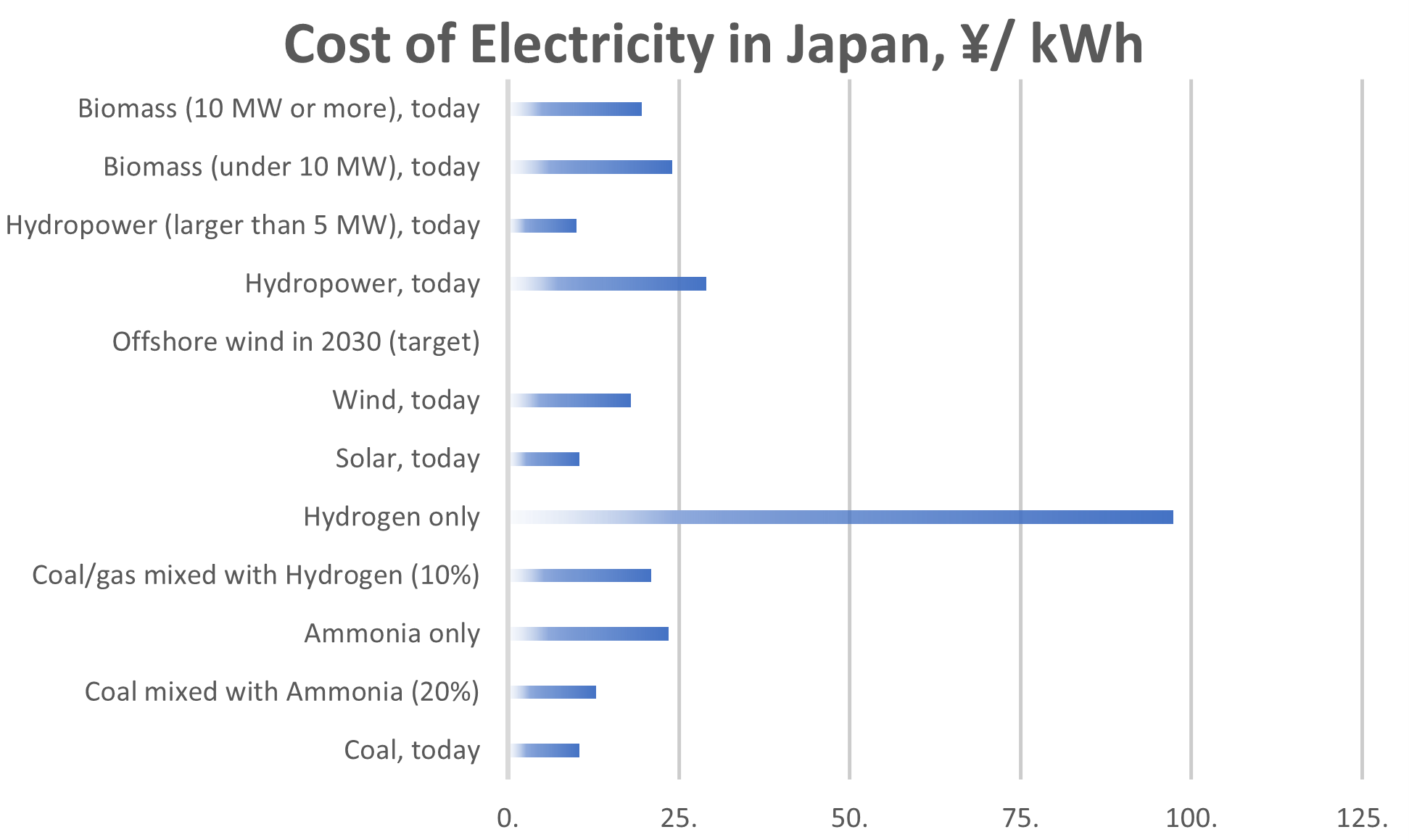
Source: Japan NRG via FIT tariff auction announcements, government reports
GLOBAL VIEW
BY TOM O’SULLIVAN
Below are some of last week’s most important international energy developments monitored by the Japan NRG team because of their potential to impact energy supply and demand, as well as prices. We see the following as relevant to Japanese and international energy investors.
Nuclear Power:
1). On Jan. 30, unit 5 of the Fuqing nuclear power plant operated by China National Nuclear Corporation began commercial operation. The unit is the first of the site’s two demonstration Hualong One reactors and is the world’s first Hualong One to be commissioned. Unit 6 is scheduled to begin operation by the end of 2021.
2). Unit 1 of the Rosatom nuclear power plant under construction in Belarus reached 100% capacity on Jan. 12. The reactor, based in the Grodno region, uses the AES-2006 design, the first of its kind built outside Russia.
3). A tender to decide who builds the new unit at the Dukovany nuclear power plant in the Czech Republic was delayed after concerns were raised about participation of bidders from China and Russia. The main Czech power utility, CEZ, which is 70% state-owned, planned to start a tender in 2020 and pick the winner in 2022. The project will cost $7.2 billion, making it the country’s largest ever investment.
4). Rolls-Royce has almost completed the feasibility stage in the development of its UK small modular reactor and in May will focus on securing investment. The technology will undergo the Generic Design Assessment process with UK regulators in 2024 and may be ready for grid use before 2030.
5). Bulgaria approved the construction of a seventh unit at the Kozloduy nuclear power plant using Russian-supplied equipment. Westinghouse was also considered.
6). In its latest white paper the World Nuclear Association called on policymakers to: a) consider nuclear power’s socio-economic, environmental and public health benefits in energy transition plans, and enact policies to ensure the realization of nuclear energy’s benefits; b) accelerate the implementation of the 108 reactors already planned by governments and ensure the long-term operation of the 290 reactors that have been operational for 30+ years; and c) unlock finance for nuclear projects that will drive investment and provide better value for energy consumers.
Coal:
Morgan Stanley predicted that all coal generation in the U.S. will be stop by 2033.
Oil:
According to the IEA’s latest oil report, global oil demand will grow to 96.4 mb/d in 2021, recovering about 60% of 2020’s record decline. Global oil supply rose to 93.6 mb/d in January as OPEC+ cuts eased & non-OPEC+ pumped more. EIA also forecasts that the U.S. will return to being a net petroleum importer in 2021 and 2022.
WTI prices closed just below $60 on Friday, with Brent at $62.
Natural Gas:
EIA reported that warm weather and high storage levels kept U.S. natural gas prices low this winter. Henry Hub prices peaked at $3.3 mmbtu in October, but have mostly stayed below $3 since then.
EVs:
Worldwide electric car sales grew by an estimated 40% in 2020, with more than 10 million EVs on the road globally.
Energy Transition:
1). Carbon Tracker has identified 40 “petro-states” whose economies rely heavily on revenues from oil and gas, and which could collectively face a $9 trillion income shortfall over the next 20 years as the global transition to clean energy accelerates. Angola, Azerbaijan, Bahrain, East Timor, Equatorial Guinea, Oman and South Sudan are identified as the most vulnerable.
2). Francois Villeroy de Galhau, the governor of the French central bank, is calling for a full decarbonization of the ECB bond portfolio. The request is expected to be addressed in an ECB strategy review due by September.
Carbon Trading:
The ICE Exchange will move its EU carbon trading platform to Amsterdam from London over the next few months due to Brexit.
Bitcoin:
The bitcoin network now consumes 121 TWh of electricity per year, more than either Argentina or the United Arab Emirates. Tesla announced last week that it had invested $1.5 billion in the digital currency raising the price by 20% to $48,000. Tesla also said that it will accept Bitcoin for settlement of sales transactions.
China:
1). Coal prices in China have risen by over 80% to $130 a ton since mid-2020 due to the ban on Australian imports. Coal represents over 60% of China’s energy consumption, with 50% of coal used for electricity generation.
2). Officials in the U.S. are probing Chinese solar panel exporters with production facilities in Xinjiang. The region is thought to account for over 50% of Chinese solar panel production due to cheap supplies of coal-powered electricity.
South Korea:
Apple denied that it’s in talks with either Kia or Hyundai to develop an EV platform.
Myanmar:
Japanese companies may face significant write-offs for investments made over the last decade as impacts of the Feb. 1 coup d’état worsen and international sanctions are applied.
India:
1). On Feb. 9, the IEA released its India Energy Outlook 2021 report showing India will see the largest rise in energy demand of any country over the next 20 years. India will need to invest $1.4 trillion in clean energy technologies over the next two decades.
2). On Sunday a melting glacier in the Himalayan state of Uttarakhand slammed into two hydroelectric plants killing 32 people.
Russia:
Polyus, Russia’s largest gold miner, will switch its two largest mines from coal-fired electricitry to hydropower as it ramps up decarbonization efforts.
Iran:
The U.N. confirmed in a report last week that Iran resumed cooperation with North Korea on long-range missile development, and that it started production of uranium metal at the Isfahan nuclear facility in contravention of the 2015 nuclear agreement. Japan was an importer of Iranian oil prior to sanctions.
Greece:
Officials from Saudi Arabia, Bahrain, and the UAE met in Athens last week as tensions over offshore resource rights escalate between Turkey and Greece.
Germany:
Mercedes-Benz announced that EV sales will match ICE sales by 2030. Tesla plans to establish a production facility in Berlin.
Denmark:
Vestas announced it will build offshore wind turbines 260 meters in height in a bid to compete with GE and Siemens Gamesa. That would be equivalent to 80% of the height of Tokyo Tower.
France:
Total, the oil major, reported a net loss of $7.2 billion for 2020 and said it will change its name to TotalEnergies as it increases focus on renewables and electricity.
UK:
Royal Dutch Shell (RDS) announced that its oil production and emissions peaked in 2019, and its goal is to reduce oil output by 2% a year, with overall gasoline and diesel production to be 55% lower by 2030. The company aims to be net-zero by 2050.
BHP, the mining company, overtook RDS to become the largest company by market capitalization on the London Stock Exchange.
Mexico:
President Andres Manuel Obrador will introduce a law that would give priority to the state electricity utility, CFE, to send power to the grid ahead of private generators.
Argentina:
YPF, the country’s largest oil group, rolled over a $413 million interest payment last week in a last-minute deal with creditors, including Fidelity and BlackRock, avoiding a default.
U.S.:
1). The $2.8 billion Vineyard Wind Project off the coast of Massachusetts is awaiting approval from the Bureau of Ocean Management in a first test of the Biden Administration’s commitment to double offshore wind power over the next decade.
2). Chesapeake Energy, the shale oil producer, emerged from Chapter 11 bankruptcy last week, having eliminated $9 billion of debt.
3). FERC, which oversees the U.S. electricity sector, is creating a senior position on environmental justice that will vet new pipeline and LNG projects to avoid harming minority communities.
4). Orion Energy Partners, based out of New York, raised almost $1 billion last week for its latest energy-infrastructure credit fund.
EVENTS CALENDAR
Below is a selection of domestic and international events that we believe will have an impact on the Japanese energy and electricity industry.
| February | Approval of Fiscal 2021 Budget by Japanese parliament including energy funding projects;
CMC LNG Conference |
| March | 10th Anniversary of Fukushima Nuclear Accident;
Smart Energy Week – Tokyo; Quarterly OPEC Meeting; Japan LPG Annual Conference; Full completion of all aspects of the multi-year deregulation of Japan’s electricity market; End of 2020/21 Fiscal Year in Japan; |
| April | Japan Atomic Industrial Forum – Annual Nuclear Power Conference;
38th ASEAN Annual Conference-Brunei; Japan LNG & Gas Virtual Summit (DMG)-Tokyo Three crucial by-elections in Hokkaido, Nagano & Hiroshima – April 25th |
| May | Bids close in first tender for commercial offshore wind projects in Japan;
Prime Minister Suga to visit the U.S.-tentative |
| June | Release of New Japan National Basic Energy Plan-2021;
G7 Meeting – U.K. Forum for China-Africa Cooperation Summit (Senegal) |
| July | Tokyo Metropolitan Govt. Assembly Elections;
Commencement of 2020 Tokyo Olympics |
| August | Hydrogen Ministerial Conference in conjunction with IEA World Economic Forum in Singapore – Deferred from May |
| September | Ruling LDP Presidential Election;
UN General Assembly Annual Meeting that is expected to address energy/climate challenges; IMF/World Bank Annual Meetings (multilateral and central banks expected to take further action on emissions disclosures and lending to fossil fuel projects); End of H1 FY2021 Fiscal Year in Japan; Japan-Russia: Eastern Economic Forum (Vladivostok)-tentative |
| October | Last possible month for holding Japan’s 2021 General Election;
METI Sponsored LNG Producer/Consumer Conference; Innovation for Cool Earth Forum – Tokyo Conference; Task Force on Climate-Related Financial Disclosure (TCFD) – Tokyo Conference; G20 Meeting-Italy |
| November | COP26 (Glasgow);
Asian Development Bank (‘ADB’) Annual Conference; Japan-Canada Energy Forum; East Asia Summit (EAS) – Brunei |
| December | Asia Pacific Economic Cooperation (APEC) Forum – New Zealand;
Final details expected from METI on proposed unbundling of natural gas pipeline network scheduled for 2022. |
DATA
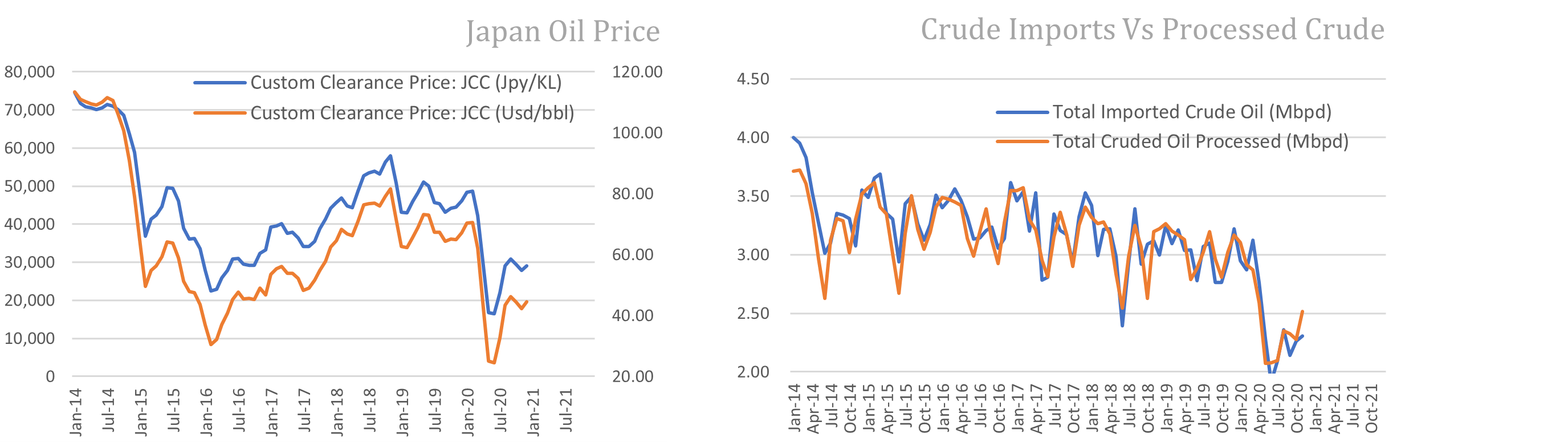
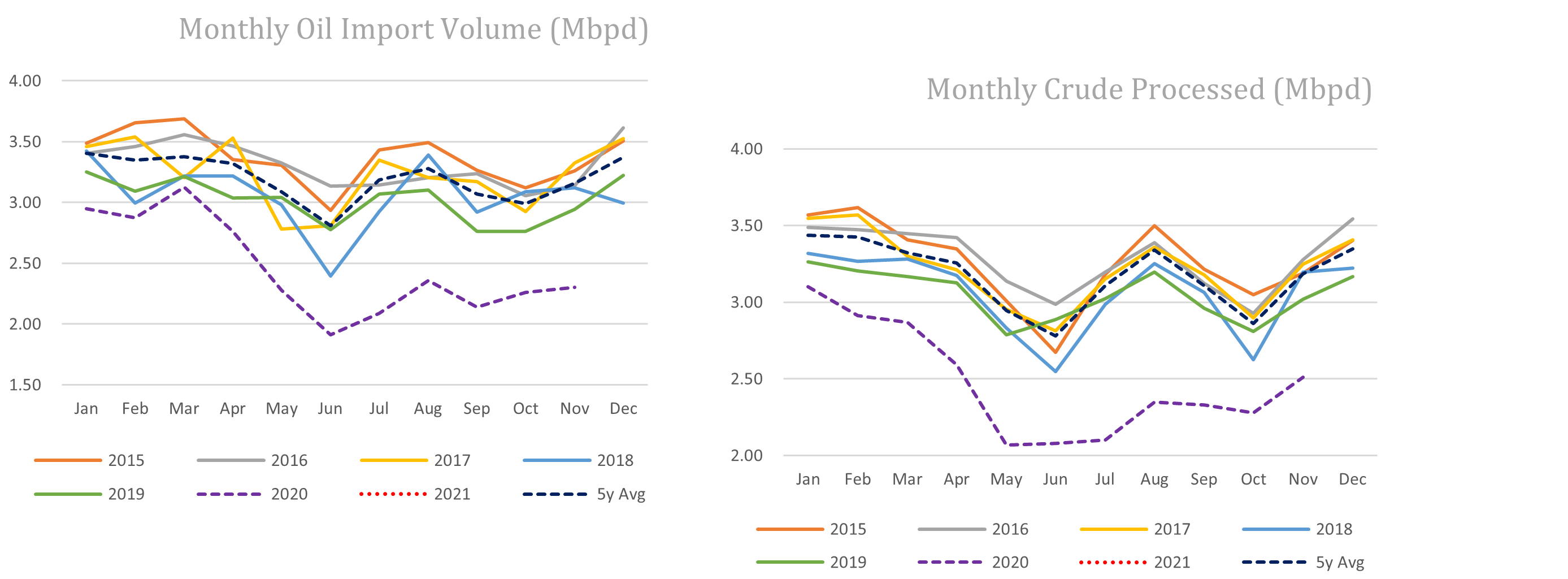
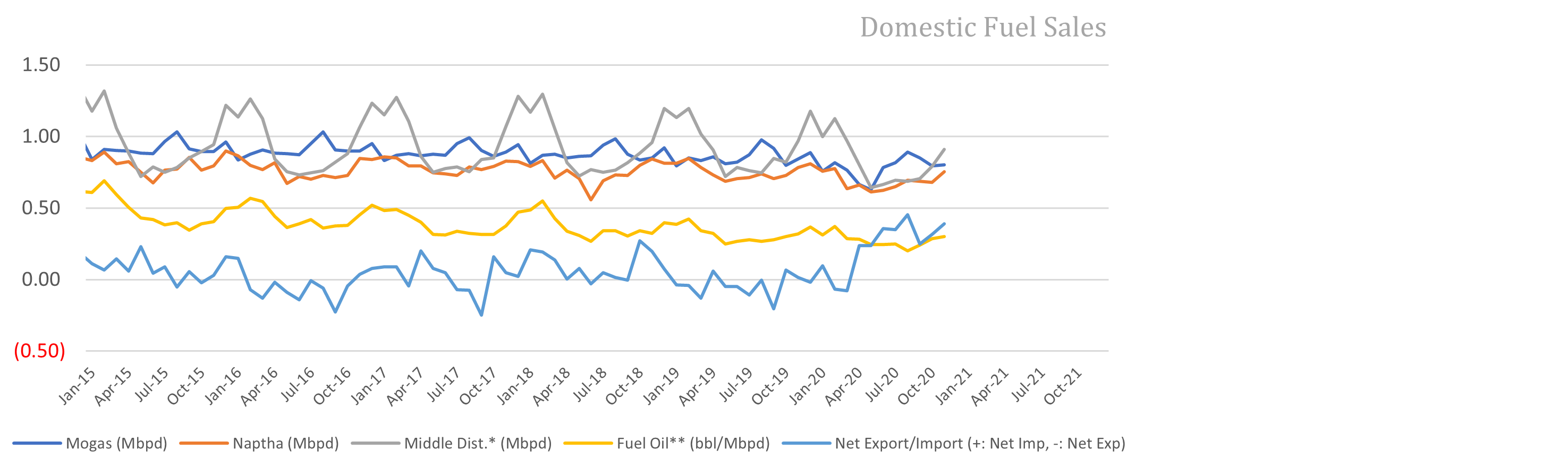
SOURCES: Ministry of Economy, Trade, and Industry (METI), Ministry of Finance, and the Petroleum Association of Japan
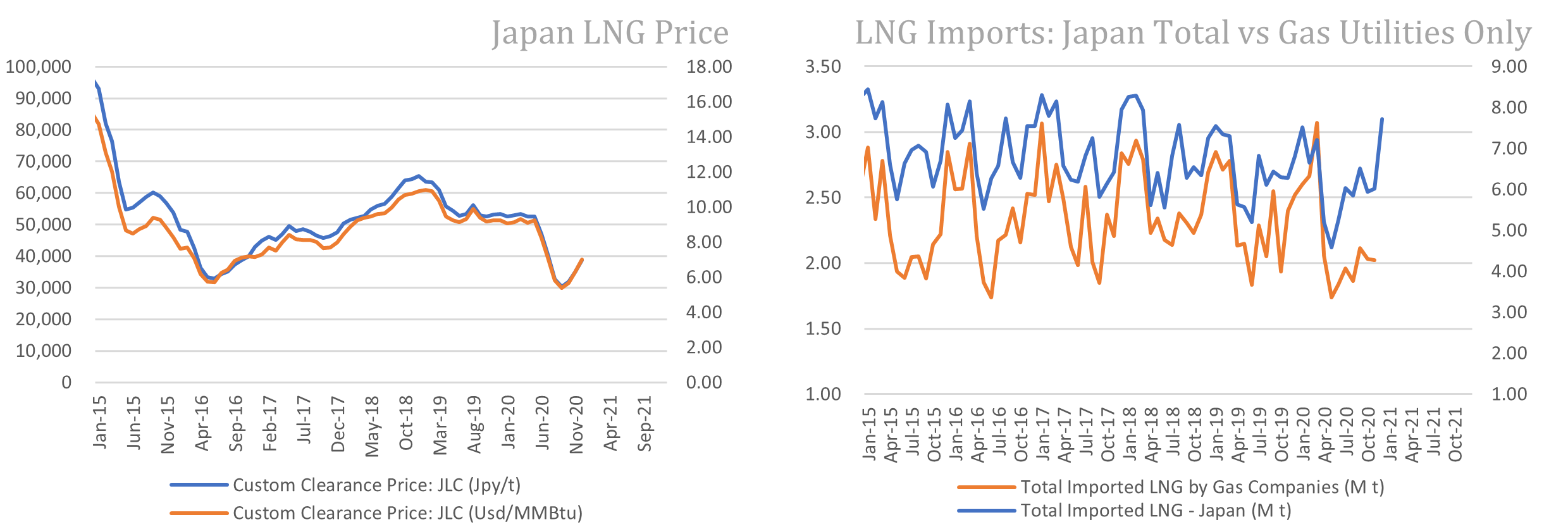
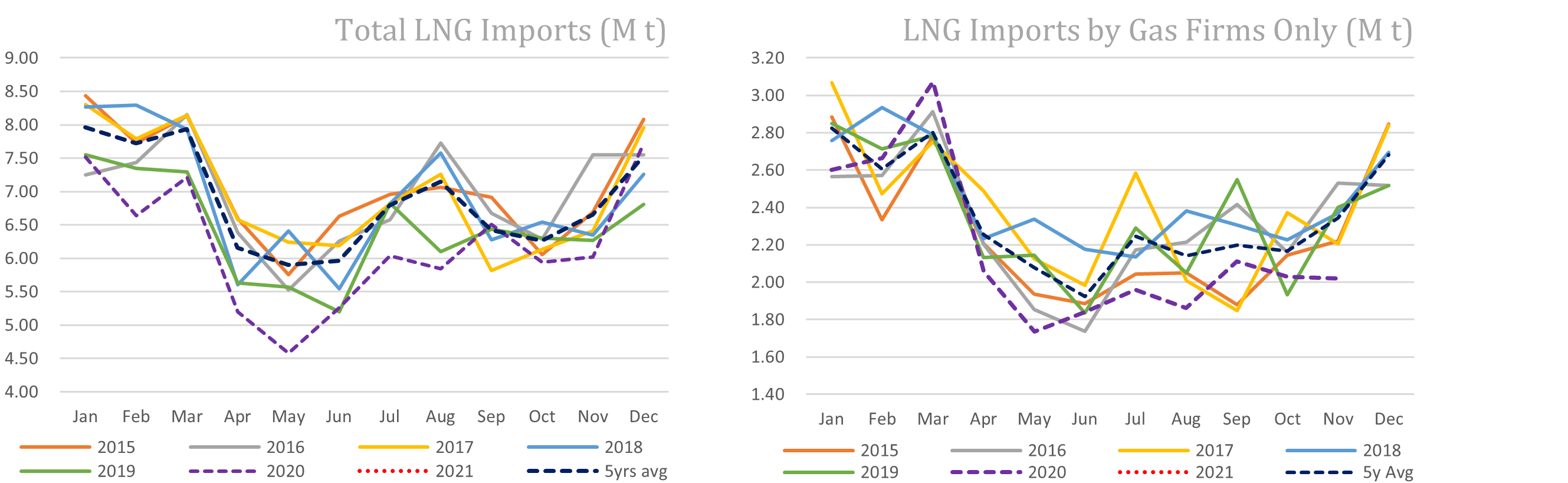
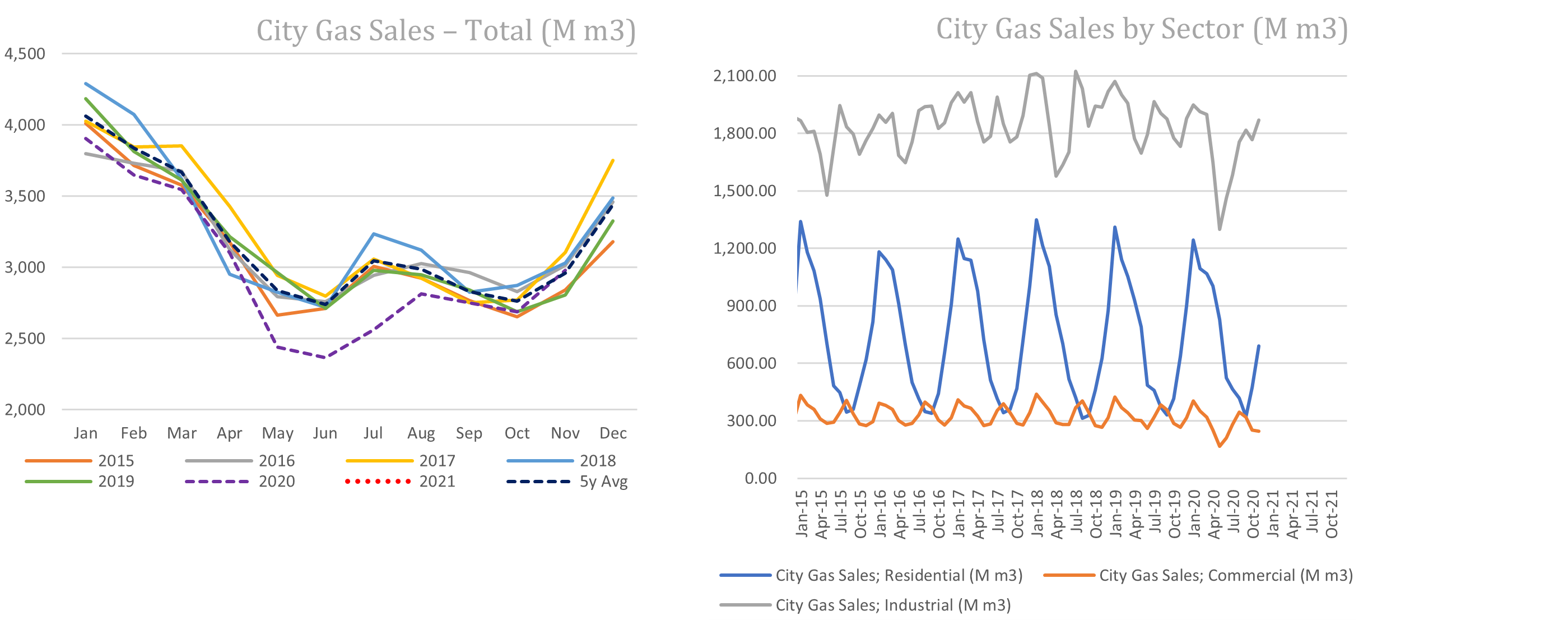
SOURCES: Ministry of Economy, Trade, and Industry (METI),
Ministry of Finance
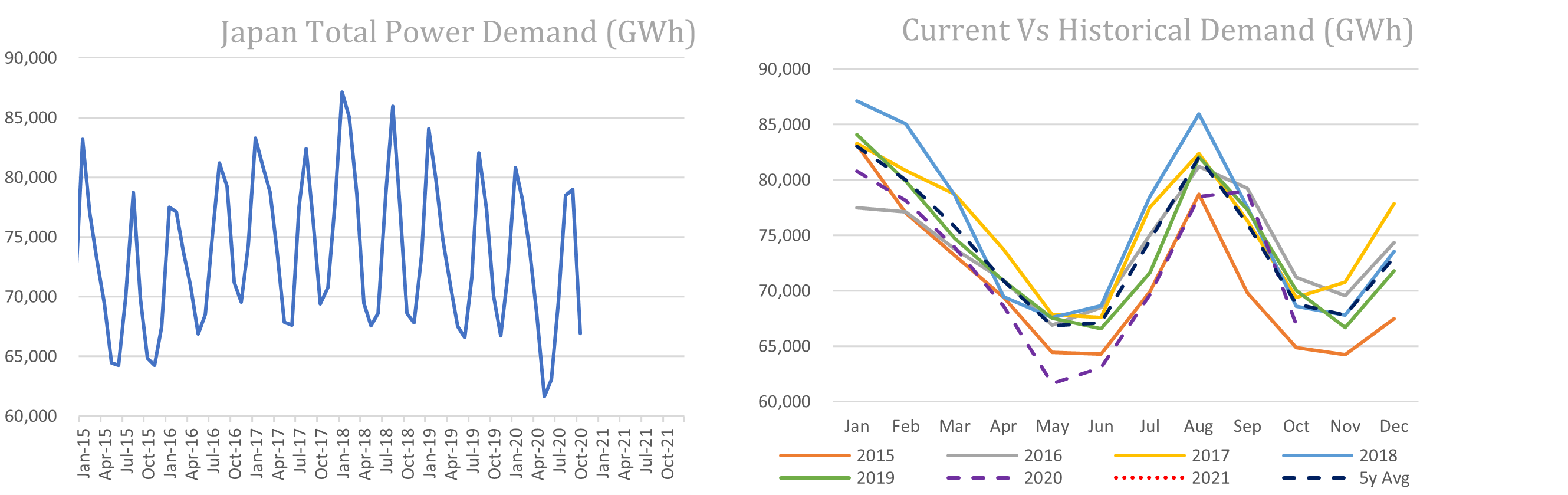
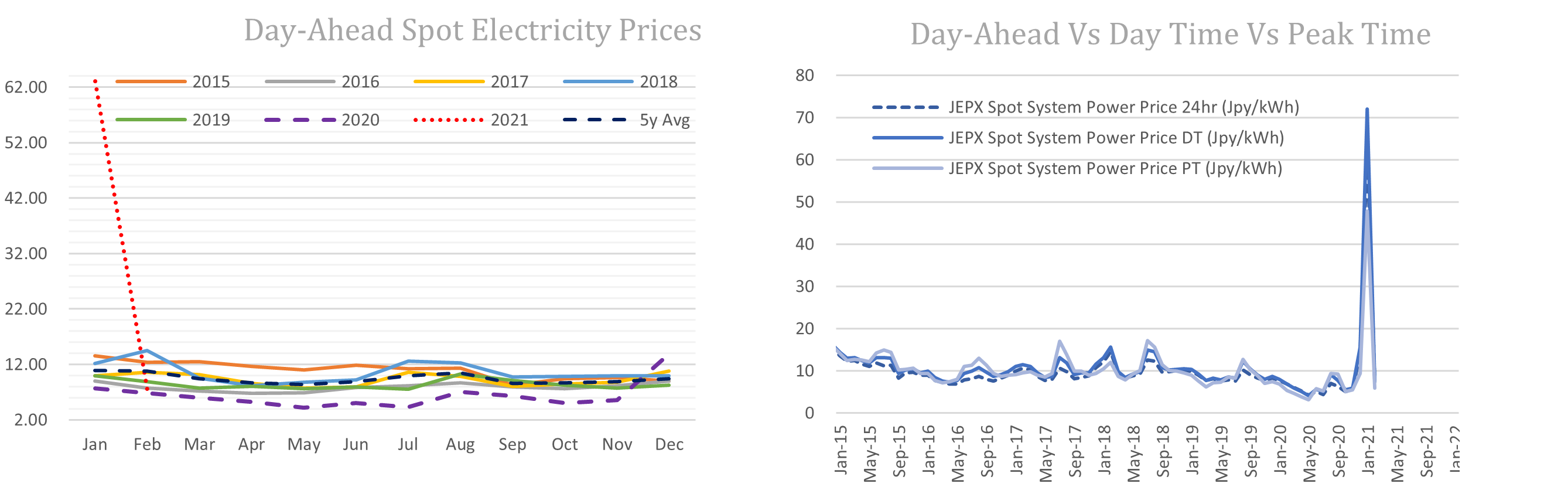
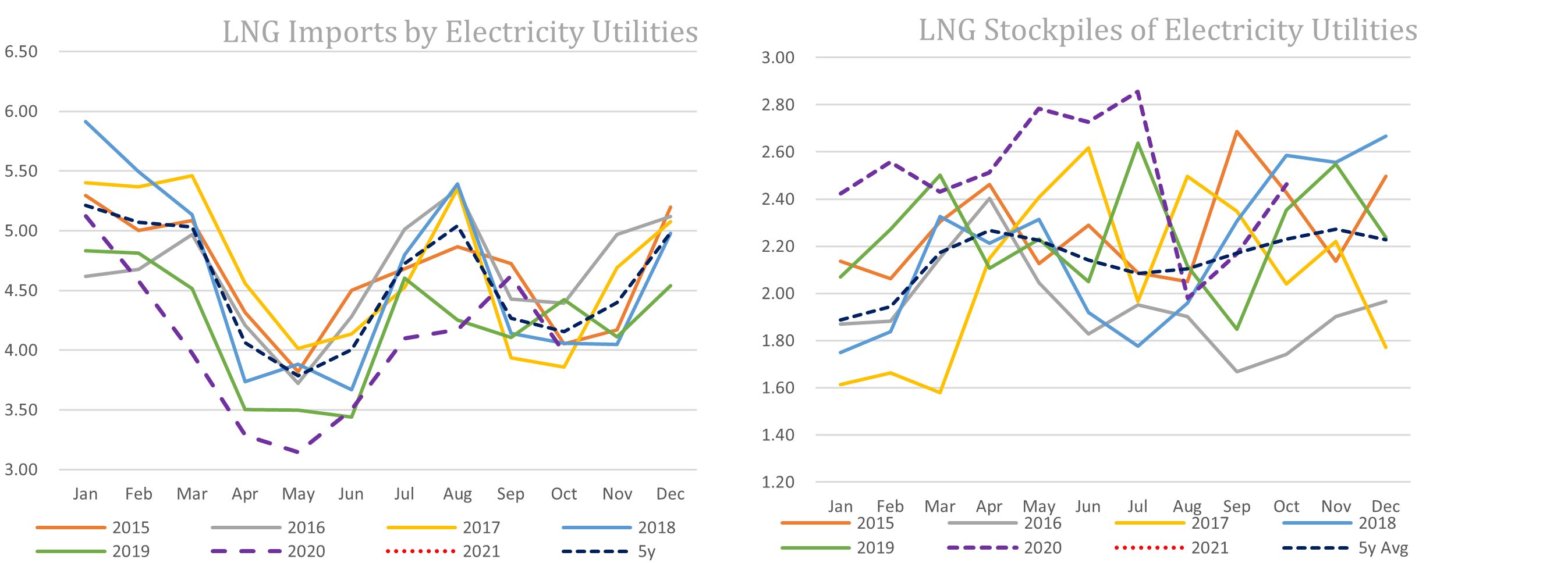
SOURCES: Ministry of Economy, Trade, and Industry (METI), and the Japan Electric Power Exchange
ACRONYMS
| METI | The Ministry of Energy, Trade and Industry | mmbtu | Million British Thermal Units |
| ANRE | Agency for Natural Resources and Energy | mb/d | Million barrels per day |
| TEPCO | Tokyo Electric Power Company | mtoe | Million Tons of Oil Equivalent |
| KEPCO | Kansai Electric Power Company | kWh | Kilowatt hours (electricity generation volume) |
| EPCO | Electricity power company, refers to the 10 regional utilities that used to control all parts of the Japanese power industry | ||
| NEDO | New Energy and Industrial Technology Development Organization | ||
| JCC | Japan Crude Cocktail | ||
| JKM | Japan Korea Market, the Platt’s LNG benchmark | ||
| CCUS | Carbon Capture, Utilization and Storage | ||
| CCUR | Carbon Capture, Utilization and |