
JAPAN NRG WEEKLY
MARCH 8, 2021
JAPAN NRG WEEKLY
March 8, 2021
NEWS
TOP
- Hitachi Zosen develops world’s highest capacity solid-state battery; Marubeni invests in startup offering super-fast battery alternative; Panasonic to commercialize cobalt-free tech soon
- Kansai Electric restarts one nuclear unit at Takahama NPP and plans another unit restart next month
- Top insurer vows to sell $6.5B of stocks to cut CO2 in portfolio
ENERGY TRANSITION & POLICY
- Top Japan rail operator to boost renewables use to 20% by 2030; Tractor maker Kubota to cut emissions 30% by 2030;
- Rare earths prices surging on electrical vehicle demand
- Mitsubishi Heavy trials CO2-absorbing liquid in Norway
- Toyota develops modular fuel cell system; Toho Gas opens Japan’s first “CO2-free” hydrogen service station
- Sony to use own transmission lines to carry renewable energy
- Sumitomo wins geothermal deal in New Zealand … [MORE]
ELECTRICITY MARKETS
- Approved renewables to cover 24% of Japan’s power mix in 2030
- Tokyo Gas to launch nationwide power retail brand with Octopus
- TEPCO CEO says will create new industry in Fukushima based on reactor decommissioning; TEPCO removes last fuel from Unit 3 of the Dai-Ichi plant; Mayor of city near TEPCO plant attacks legal documents related to nuclear restarts
- Green power certificates priced at ¥1.2/ kWh in Feb. auctions
- Marubeni plans 1GW offshore wind farm in Hokkaido
- Kansai Electric, Chugoku Electric, J-Power announce 2050 net-zero emissions goal with hydrogen, nuclear in the picture
- The history of Japan’s only decommissioned nuclear reactor
OIL, GAS & MINING
- ENEOS signs MoU with Petrolimex to develop LNG, Oil, Solar
- Government approves plan to reorganize No. 4 gas utility, Saibu
- Hokkaido Gas to buy carbon-neutral LNG from Mitsui
- ENEOS to shut down bitumen-fired power plant
ANALYSIS
FUKUSHIMA PREFECTURE 10 YEAR ON:
AREA WANTS TO BE SILICON VALLEY OF RENEWABLES
Fukushima prefecture vowed soon after the accident at TEPCO’s Dai-Ichi nuclear station in March 2011 that the disaster would not define it. True to its word, the area has reinvented itself as a bastion of renewables and of energy and industry experimentation that is eliciting interest from startups and industry veterans alike. Ten years on, the prefecture generates over 80% of its electricity from renewable sources and says it will reach 100% soon.
Japan NRG spoke with local officials and businesses to see what the energy future of Fukushima looks like and whether it will apply to the country as a whole.
JANUARY’S ELECTRICITY PRICE SPIKE DIDN’T KILL THE POWER RETAIL INDUSTRY, IT MADE IT STRONGER
This January saw a record electricity price spike in Japan. This disrupted many facets of the market, but perhaps none as much as the business of electricity retail firms, many of which rely on market purchases to procure their volumes. Soon after the price spike came reports of electricity retailers struggling to stay in business. It looked like a major segment of the market might collapse. And yet, as Mark Twain might have said, reports of the death of Japan’s power retailers have been greatly exaggerated. As the fog clears, it looks as if many of the retailers have passed the stress test and are now in an even stronger position to challenge the incumbent power utilities.
GLOBAL VIEW
Myanmar’s situation is turning worse amid reports of fatalities. Global CO2 emissions are rising again. Texas energy crisis fallout deepens. UK to launch new carbon trading system. See this section for details on these and other global energy-related news.
2021 EVENT CALENDAR
Industry / political events related to Japan energy.
JAPAN NRG WEEKLY
PUBLISHER
K. K. Yuri Group
Editorial Team
Yuriy Humber (Editor-in-Chief)
Tom O’Sullivan (Japan, Middle East, Africa)
John Varoli (Americas)
Regular Contributors
Mayumi Watanabe (Japan)
Daniel Shulman (Japan)
Takehiro Masutomo (Japan)
Art & Design
22 Graphics Inc.
Sponsored
SUBSCRIPTIONS & ADVERTISING
Japan NRG offers individual, corporate and academic subscription plans. Basic details are our website or write to subscriptions@japan-nrg.com
For marketing, advertising, or collaboration opportunities, contact sales@japan-nrg.com
For all other inquiries, write to info@japan-nrg.com
OFTEN USED ACRONYMS
METI
The Ministry of Energy, Trade and Industry
ANRE
Agency for Natural Resources and Energy
NEDO
New Energy and Industrial Technology Development Organization
TEPCO
Tokyo Electric Power Company
KEPCO
Kansai Electric Power Company
EPCO
Electric Power Company
JCC
Japan Crude Cocktail
JKM
Japan Korea Market, the Platt’s LNG benchmark
CCUS
Carbon Capture, Utilization and Storage
mmbtu
Million British Thermal Units
mb/d
Million barrels per day
mtoe
Million Tons of Oil Equivalent
kWh
Kilowatt hours (electricity generation volume)
NEWS: ENERGY TRANSITION & POLICY
Hitachi Zosen develops potentially world’s highest capacity solid-state battery
(Nikkei, March 4)
- Hitachi Zosen unveiled a solid-state battery with world-beating capacity and temperature tolerance, allowing it to be used in space for satellites and for industrial machinery.
- The battery, exhibited in Tokyo, features 1,000 milliamp hours of capacity, about seven times better than the previous Hitachi Zosen model. It can also operate at temperatures ranging from 100 degrees to minus 40 degrees Celsius.
- The Co. will begin small-scale production of the prototype and in the meantime seek to double the current capacity by 2025, as well as to explore commercialization options.
- CONTEXT: Hitachi Zosen produces solid electrolytes without use of sealant or solvent. This improves the battery’s electrical resistance and lowers risk of inflammation. The Co. has already agreed with Japan’s space program to test its batteries in orbit.
- SIDE DEVELOPMENT:
- Marubeni invests in startup offering super-fast battery alternative
- (Nikkei, March 4)
- Marubeni trading house has invested in an Estonian startup, Skeleton Technologies, which is working on ultra-capacitors. These are fast-charging energy storage devices that perform about 100 times better than lithium-ion batteries.
- Marubeni will be the sales agent for Skeleton’s products in Japan and the rest of Asia.
- Tesla invested in company developing similar technology in 2019.
- SIDE DEVELOPMENT:
Who will be the battery powerhouse? China, Japan and the West compete
(Asia Nikkei, March 2)- In the near future, countries that dominate battery production may wield the same kind of power as nations rich in oil and gas.
- Panasonic is among Japan’s biggest battery makers. The Co. aims to commercialize cobalt-free batteries within three years to avoid the need to source the metal from the Democratic Republic of Congo, which has child labor issues, and relying on the Chinese supply chain.
Dai-Ichi Life insurer to sell $6.5B in assets to bring down CO2 of stocks portfolio
(Asia Nikkei, March 5)
- One of Japan’s top portfolio investors, which manages ¥36 trillion in assets, will sell off about ¥700 billion of stocks within three years to cut its holdings in heavy emitters of carbon dioxide.
- The insurer aims to reduce the portfolio’s associated CO2 emissions by 30% by 2025. The target covers stocks, corporate bonds, and real estate.
- Dai-Ichi plans to engage in dialog with companies that have large carbon footprints and sell off the assets of those not making progress on CO2 reductions.
- CONTEXT: This is the time first that an institutional investor in Japan has set a target for the near term. Rival insurers have long-term emission reduction targets.
- SIDE DEVELOPMENTS:
Tractor maker Kubota vows to cut emissions 30% by 2030
(Nikkei, March 2)- Osaka-based company plans to reduce CO2 from its farming and construction equipment by 30% over the next decade, Kubota President Kitao said in an interview.
- The company will offer electric versions of mini excavators and compact tractors within the next three years.
- Kubota is also considering how to develop its machinery to run on hydrogen fuel cells and to run on biofuels.
- CONTEXT: Farming and construction equipment produce high emissions as they release the CO2 trapped in the soil into the atmosphere.
Japan’s biggest rail operator to boost renewable energy use to 20% by 2030
(Nikkei, March 5)
- East Japan Railways, also known as JR East, expects 20% of power for its rail operations to come from green sources by 2030. The company will replace its energy intake with private power generation from solar and wind.
- JR East buys 40% of its electricity from outside power utilities.
- JR East is considering converting one of four LNG thermal power plants to a cycle that combines gas turbines and fuel cells by around 2030.
- The Co. aims to cut its CO2 emissions by half to about 1 million tons by 2030, compared to FY2019.
Rare earth price surges on electric vehicle demand
(Livedoor News, March 2)
- According to a Chinese website that provides information on nonferrous metal prices, the average price of didymium oxide hit 474,000 yuan per metric ton on Feb. 22, an increase of nearly 17% since the beginning of the year.
- The high prices are driven by demand for the permanent magnets used in electric vehicle motors, which are manufactured using rare earths.
- Zheshang Securities projects demand for neodymium magnets for electronic vehicles will more than quadruple by 2025.
Mitsubishi heavy industries trials CO2 absorbing liquid in Norway
(Morningstar via Yahoo! Japan, March 5)
- Mitsubishi Heavy Industries subsidiary MHI Engineering has formed an agreement with Norway’s CO2 Technology Centre Mongstad relating to the conducting of experiments with a carbon-dioxide-absorbing liquid developed by Mitsubishi heavy industries at the Centre beginning in May.
- The trial aims to evaluate long-term use of the KS-21 amine-based solvent, which is part of the advanced KM CDR process jointly developed by Mitsubishi Heavy Industries and KEPCO.
Toyota develops modular fuel cell system for third-party use
(New Energy Business News, March 5)
- Toyota has developed a new modular fuel cell system for release as early as spring. The system packages air and hydrogen services, cooling, power control, and other services into a single compact unit.
- The target audience will be operators of trains, ships, trucks and buses, as well as power companies. Toyota will provide the support of experienced engineers to determine the optimal layout for each application.
- The system is available in both vertical and horizontal configurations, and in 60 kW and 80 kW variants, enabling it to be integrated into a wide range of vehicles. With a supply voltage of 400 to 750 V, the unit is compatible with existing electric equipment.
TAKEAWAY: Toyota is actively creating the market for fuel cells, not only via its own cars and trucks, but now also on the servicing side. This should help popularize fuel cells and their acceptance, widen their applications and eventually lower costs. The fuel cell market at present lacks infrastructure and that is a bottleneck for further growth. Providing such infrastructure is the route to celling more fuel cell vehicles for Toyota, so even if this move helps rivals it is less of a concern for the car company.
- SIDE DEVELOPMENT:
Toho Gas opens Japan’s first “CO2-free” hydrogen service station
(Dempa Publications, March 2)- Toho Gas said it has opened Japan’s first hydrogen service stations that supply fuel without attributable CO2 emissions. The utility is using carbon offsets and ramping up its renewable energy output to make its hydrogen qualify for net-zero emissions.
Sony using own transmission lines to carry renewable energy
(New Energy Business News, March 2)
- Sony, in collaboration with Digital Grid Corporation and FD Corporation, plans to use photovoltaic panels mounted on the roofs of cattle pens in rural Aichi to supply power to a manufacturing facility 30 km away.
- The panels, which generate around 400 kW of power, will be switched on in April.
- While Sony is no stranger to large solar farms, this represents the first time that power generated off premises will be transmitted to Sony factories over private transmission lines.
Sumitomo Corp wins contract to build 150 MW geothermal power station in New Zealand
(New Energy Business News, March 2)
- Sumitomo Corporation has been contracted by New Zealand’s Contact Energy to design and construct the 150 MW Tauhara geothermal power station near Lake Taupo.
- Sumitomo contracted Fuji Electric to supply geothermal generation equipment for the plant, including steam turbines and generators, and local construction company Naylor Love to do the construction work.
- The ¥41 billion project is scheduled to be completed by 2023.
- The power station will be the world’s largest single-turbine geothermal power station, surpassing the 140-megawatt Nga Awa Purua Geothermal Power Station, also in New Zealand.
- Sumitomo Corporation previously teamed up with Fuji Electric on two occasions to construct geothermal power stations in New Zealand, and Tauhara will be their third such project.
OPINION: Decarbonization, what industry needs to learn from past failures
(Nikkei, March 3)
- CONTEXT: The author is Nakata Yukihiko, a lecturer at Ritsumeikan Asia-Pacific University.
- Nakata says that while the global race to cut carbon dioxide emissions may hold the key to the survival of Japan’s electronics industry, commercial success will not be easy.
- Prime Minister Suga’s recent announcement of an ambitious plan to make Japan carbon neutral by 2050 is reminiscent of Sharp’s 1974 “Sunshine Project” to develop solar generation technologies, and many subsequent, similar projects, says Nakata.
- Japan’s geographical location makes it suited to offshore wind farms, and manufacturers such as Toshiba are already preparing to manufacture turbines for these farms.
- Japanese manufacturers have also made impressive achievements in the development of perovskite solar cells.
- However, a lack of competitiveness saw Japan’s LCD panel and semiconductor manufacturers lose out to South Korean rivals. If we do not want to see history repeated in renewables, we must invest in the sector now and learn from our industry’s past failures, says Nakata.
Kumagai Gumi invests in Vietnamese solar project
(New Energy Business News, March 5)
- Japanese construction firm Kumagai Gumi has purchased a 30% stake in Vietnamese solar farm operator Bind Ding TTP Energy & High Technology.
- Bind Dung operates the 1 GW Cat Hiep solar farm in southern Vietnam, which has a 20-year agreement to sell electricity to the state-owned Vietnam electricity company at a rate of 9.35 cents per kilowatt hour.
NEWS: POWER MARKETS
| No. of operable nuclear reactors | 33 | |||
| of which | applied for restart | 25 | ||
| approved by regulator | 16 | |||
| restarted | 9 | |||
| in operation today | 5 | |||
| able to use MOX fuel | 4 | |||
| No. of nuclear reactors under construction | 3 | |||
| No. of reactors slated for decommissioning | 27 | |||
| of which | completed work | 1 | ||
| started process | 4 | |||
| yet to start / not known | 22 | |||
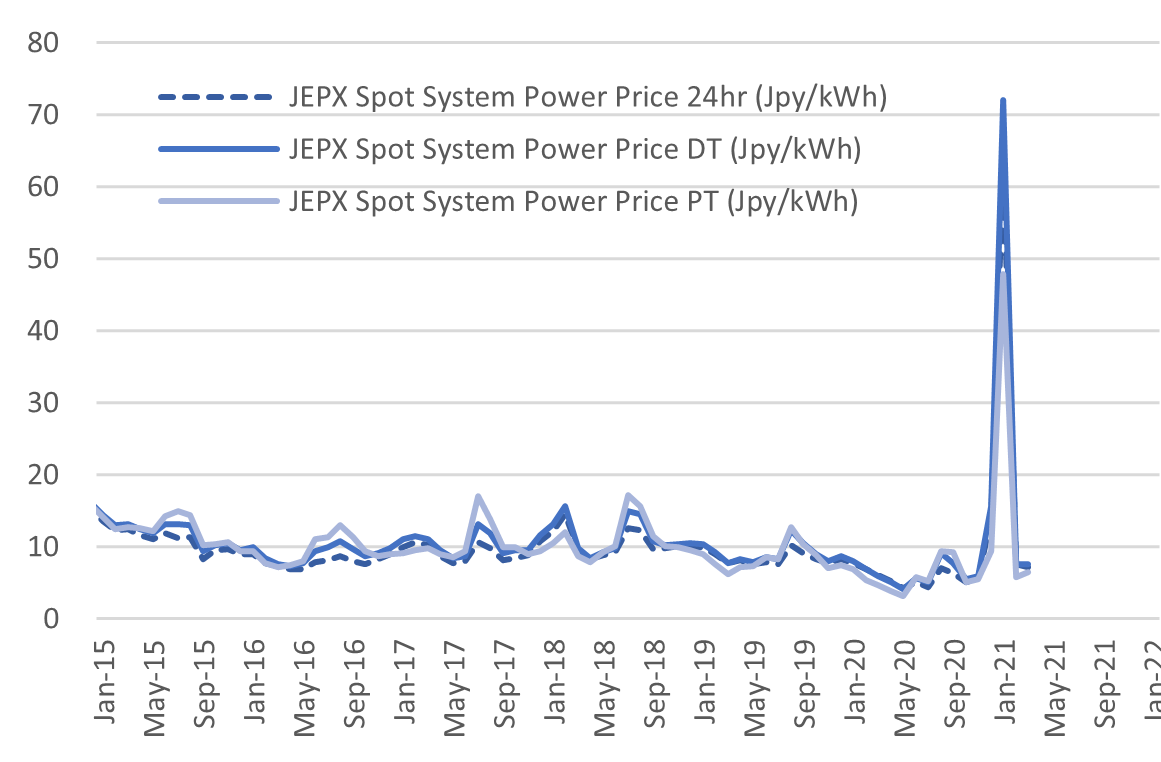
Spot Electricity Prices
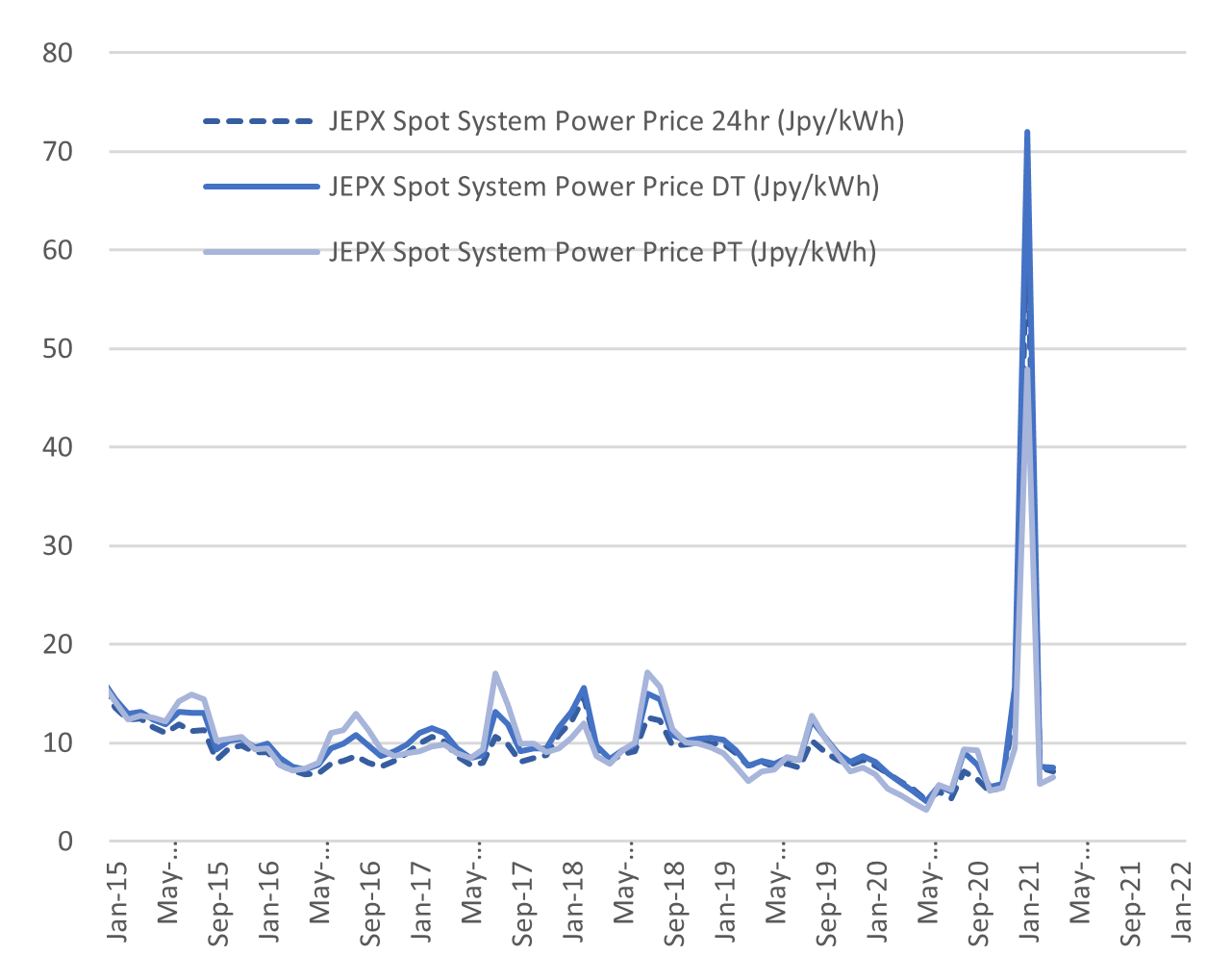
Source: Company websites, JANSI and JAIF, as of Feb. 18, 2021
Approved renewables capacity to account for 24% of Japan’s power mix by 2030
(Japan NRG, March 4)
- Taking into account all the approved renewable energy projects and those already in the construction phase, green sources will make up 22 to 24% of Japan’s electricity by 2030, according to a progress report issued by a METI panel on March 1.
- Additions in the hydro and geothermal space are all on-schedule.
Kansai Electric restarts Takahama NPP reactor Unit 3, and plans Unit 4 restart
(Various, March 7)
- Kansai Electric said on March 5 that it will restart Unit 3 of its Takahama nuclear power plant in Fukui prefecture on March 7. The reactor will reach criticality on March 8 and will run in power adjustment mode from March 10.
- Commercial operation will begin after comprehensive load performance inspection in the first 10 days of April.
- The reactor was closed for planned maintenance work on Jan. 6, 2020. The shutdown period was extended after damaged heat transfer piping was discovered.
- The utility also plans to restart Unit 4 of the same NPP in the first 10 days of April, aiming for commercial operations to being on May 7.
TAKEAWAY: The restarts indicate that Kansai Electric has managed to overturn negative public opinion in the Fukui region after its corruption scandal erupted 18 months ago. It shows that the antagonistic stance of Fukui prefecture’s governor has also softened, likely due to pressure from the national government. Should the two restarts proceed according to plan, Japan will have the most reactors online since May 2020. That would give at least a small momentum for the industry to push for a greater return to the Japanese electricity market. However, with so many false starts in the last few years, it is hard to be certain of any outcome for the nuclear sector at this point.
Tokyo Gas to launch new nationwide power retail brand with Octopus know-how
(Dempa Publications, March 2)
- Tokyo Gas and U.K. energy firm Octopus Energy registered their joint venture on Feb. 15. This marks a step towards Tokyo Gas’ goal of rolling out a new domestic electricity retail business starting this autumn, together with Octopus.
- The joint venture will market to households in the Japanese capital. At the same time, Tokyo Gas will unveil a new unit that will retail electricity almost to the entire country, but under another brand. This will be a first for the gas company.
- Tokyo Gas will use the know-how from Octopus Energy, which is famous for expanding business via online sales, to do the same in Japan. The Japanese firm wants to promote its electricity plans to customers online and for electricity from renewable energy sources to play a prominent role.
- Tokyo Gas invested ¥20 billion into Octopus Energy and plans to work with the U.K. firm to invest in energy-related businesses in various European countries. Tokyo Gas has a 70% stake in the new venture.
TEPCO CEO says will create a new industry in Fukushima based on reactor decommissioning
(Nikkei, March 6)
- President Kobayakawa gave an interview in which he expressed his intention to create a new industry in Fukushima prefecture based on the business of decommissioning the Fukushima Dai-Ichi NPP, site of the major accident 10 years ago.
- Under current plants, TEPCO plans to complete the decommissioning sometime between 2041 and 2051.
- TEPCO is supposed to shoulder about ¥16 trillion in costs associated with the accident and says it needs the restart of its Kashiwazaki-Kariwa NPP to help generate funds. However, President Kobayakawa acknowledged that the company has lost public trust and it will take an “extremely long time”. He also said the company / operator must change.
- TEPCO believes the restart of nuclear is key for Japan to meets its decarbonization goals.
- Meanwhile, TEPCO wants to develop core, large-scale renewable energy, according to Kobayakawa.
- SIDE DEVELOPMENT:
Mayor of city near TEPCO nuclear plant attacks legal issues around reactors
(Denki Shimbun, March 5)- Kashiwazaki Mayor Sakurai Masahiro said on Feb. 25 that he’ll look into establishing a legal basis for the amendment of Japan’s Reactor Regulation Act.
- The mayor called attention to the “safety agreements” that exist between municipalities and power producers, which are not legally binding.
- The Mayor said he was uncomfortable with a non-legally binding document that can significantly impact reactor restarts and nuclear energy policy.
- The Mayor’s comments represent a significant departure from the approach of his predecessors, who have not intervened in issues of nuclear energy.
- The Mayor has been extremely critical of TEPCO after the company’s recent security breaches.
Green power certificates priced at ¥1.2/ kWh in February auctions
(Japan NRG, March 4)
- METI published a status report on non-fossil fuel energy certificates, which are tools used to certify that an electricity buyer has procured their supply from a renewable energy source.
- CONTEXT: The certificates are meant to act as a non-fossil fuel energy value and can be traded.
- In February auctions, the contract price for non-fossil fuel energy certificates that apply to electricity purchased outside of the Feed-In Tariff scheme was ¥1.2/ kWh.
- Certificates for more than 10 billion kWh of electricity were sold at the auction, which was the third of its kind in Japan.
- The ministry report suggested that the auction framework will likely be changed before next year since not all power retailers are actively utilizing the scheme.
Marubeni planning 1 GW wind farm in Hokkaido
(New Energy Business News, March 1)
- Marubeni has begun the environmental assessment process for a planned wind farm in Ishikari Bay, Hokkaido. Marubeni released its environmental impact statement of Feb. 26.
- The 78,000-ha farm would comprise up to 105 turbines producing up to 1 GW of electricity.
- While the farm would feature principally anchored turbines, Marubeni is also considering the use of floating turbines in deeper water.
Fukushima Dai-Ichi: TEPCO removes last remaining fuel from Unit 3
(Nikkei, Feb. 28)
- TEPCO Holdings said on Feb. 28 that it had removed the last 566 fuel rods from the spent fuel pool attached to the Unit 3 reactor at the Fukushima Daiichi nuclear power plant.
- This is the second pool to have all its spent fuel removed, which comes before the nuclear disaster’s 10th anniversary. The recovery effort has taken four years longer than expected.
- However, around 1,000 fuel rods remain in the pools attached to Units 1 and 2, and work has not even begun on the removal of highly radioactive molten reactor debris from Units 1, 2 or 3.
Kansai Electric announces carbon-neutral vision
(Nikkei, Feb. 27)
- On Feb. 26, KEPCO released a document entitled Zero Carbon Vision 2050 in which it articulates plans to achieve net zero carbon emissions.
- The document identifies supply side decarbonization, demand side decarbonization, and the transition to hydrogen as the three main drivers of CO2 reductions.
- The report says KEPCO will accelerate its transition to renewable energy sources and also consider the deployment of new technologies, such as small modular reactors.
- KEPCO says hydrogen will be an indispensable part of the zero-carbon society, and pledged to manufacture, transport, supply, and use the fuel in future.
- SIDE DEVELOPMENT:
Chugoku Electric, J-Power, KEPCO announce 2050 net-zero carbon goal
(Denki Shimbun, March 1)- The three utilities all announced plans to move to a net-zero emissions business model by 2050, adding to similar statements made last year by Okinawa Electric and JERA.
- The utilities hope to increase the use of renewables and nuclear, as well as to promote electrification and switching to hydrogen as part of the decarbonization strategy.
- Chugoku Electric and Kansai Electric also said the companies will not build any more coal-fired plants. Chugoku, however, said it will complete the construction of one coal-fired unit where work is already in progress.
Toshiba Renewable Power: people key to cutting costs
(Japan Maritime Daily, March 5)
- Addressing Wind Expo 2021 held in Tokyo, Toshiba Renewable Power Executive Director Inoue Shinsuke said personnel training and the reduction of construction and maintenance costs were challenges to be overcome if wind was to become a major source of energy in Japan.
- According to Inoue, Toshiba, which operates a wind farm in Chiba in cooperation with Denmark’s Orsted, will continue to implement the latest European technology as it expands in offshore wind.
METI singles out “healthy” Chubu Electric for praise
(Denki Shimbun, March 5)
- On March 4, the Ministry of Economy Industry and Trade, in partnership with the Tokyo Stock Exchange, issued a list of 48 “healthy” businesses from 29 industries in which management, trade unions, and workers join as a team to improve the health of the business and its employees. To be selected, businesses also needed to demonstrate strong return on equity.
- Chubu Electric was among those named, in recognition of initiatives to provide free antibody testing, endoscopy, cancer screening, and other services to its employees.
The history of Japan’s only decommissioned nuclear reactor
(Nikkei X-Tech, March 4)
- When you mention decommissioning of nuclear plants, most people think of the Fukushima Dai-Ichi, which is expected to take another 20 to 30 years to decommission, at a cost of ¥8 trillion. However, Fukushima is a special case, due to the difficulty of collecting molten debris generated by the meltdown and subsequent explosion.
- All of Japan’s nuclear power plants will have to be decommissioned sooner or later. Japanese law requires nuclear plants to be decommissioned at the end of their 40-year operating life, and 24 of Japan’s 60 reactors are already slated for decommissioning.
- There is only one example of a Japanese nuclear reactor that has been successfully decommissioned: the Japan Power Demonstration Reactor, which was fully decommissioned by 1996. The former reactor site can now be used for construction.
NEWS: OIL, GAS & MINING
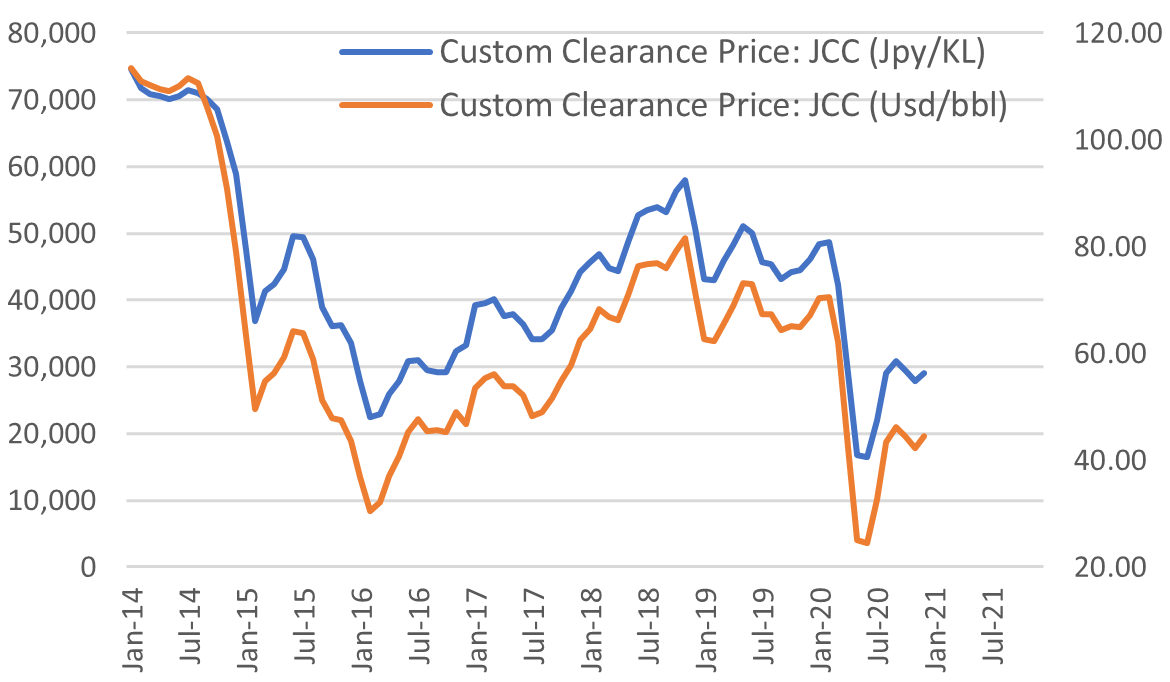
Japan Oil Price: $50.09/ barrel
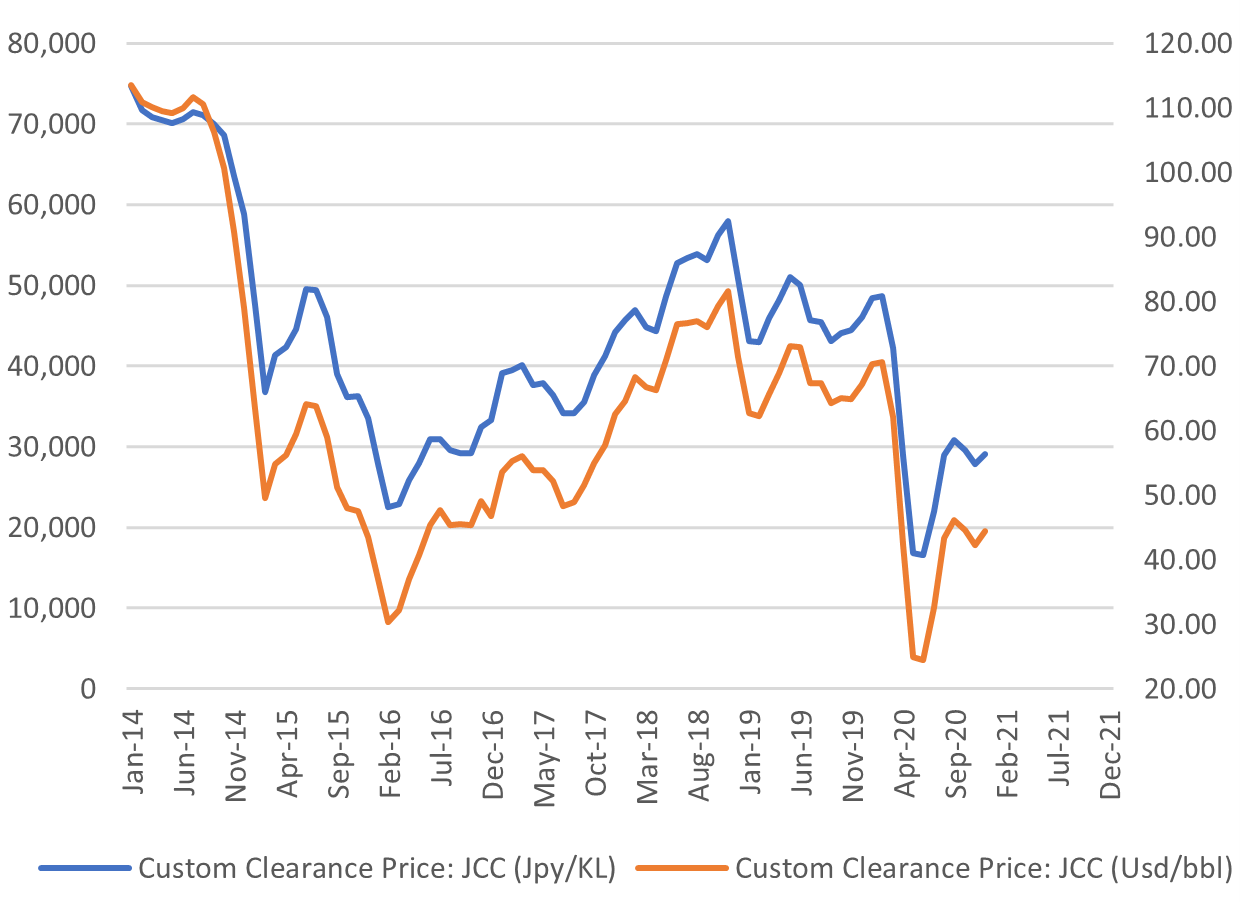
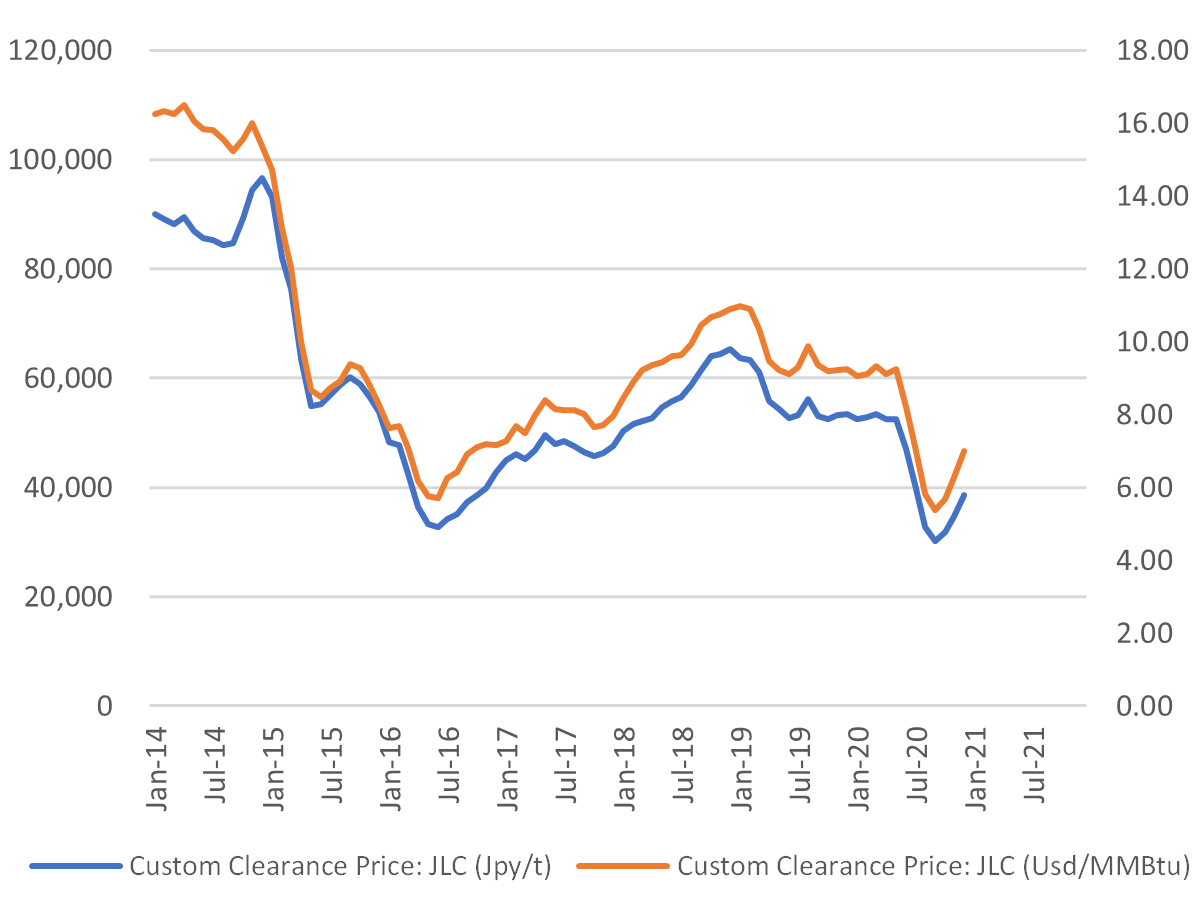
Japan (JLC) LNG Price: $8.27/ mmbtu
ENEOS signs MoU with Vietnam’s Petrolimex to Develop LNG, Oil, Solar Generation
(Company statement, media reports, March 4)
- ENEOS said it has signed a Memorandum of Understanding with state-owned Vietnam National Petroleum Group, also known as Petrolimex. The two parties agreed to pursue a number of business expansions in Vietnam.
- ENEOS said it will promote its partnership with Petrolimex also by increasing its shareholding in the Vietnamese company.
- Top of the agenda for the two companies is a plan to build and operate an LNG terminal and gas-fired power plant in the country. ENEOS and Petrolimex will make joint procurement of LNG for the facilities.
- ENEOS will also improve Petrolimex’s petroleum products business by linking more of the procurement to its own refineries. In return, Petrolimex offers ENEOS access to its petroleum import terminal.
- The partners will look at the potential to develop a hydrogen business in Vietnam, and also study solar power generation opportunities, such as by installing panels at service stations and terminals in the country.
- CONTEXT: In April 2016, ENEOS first took a stake in Petrolimex, buying 8% of the state company. The idea was for ENEOS to get access to distribution channels in a growing economy, while the Vietnamese company would gain know-how from the Japanese side.
TAKEAWAY: Last year’s transactions, once cleared, should allow ENEOS to raise its stake in Petrolimex to around 10%. A major delay was the political uncertainty in Vietnam, with the elite Politburo meeting due in January 2021. The meeting concluded with the Feb. 1 re-election of Nguyen Phu Trong as the General Secretary of the Communist Party and de facto leader of the country. This political resolution seems to have instilled confidence on both sides and the original ENEOS-Petrolimex partnership is now expanding from petroleum products to LNG infrastructure, hydrogen and renewables.
Government approves plan to reorganize No. 4 gas utility, Saibu Gas
(Japan NRG, March 4)
- CONTEXT: Saibu Gas is Japan’s No. 4 gas utility, ranking together with Tokyo, Osaka and Toho as the biggest players in the domestic industry. Since 2016, the government has committed to an unbundling and deregulation of the electricity and gas industries.
- METI announced on March 1 that it agreed on a plan to restructure Saibu Gas, the group based in the Fukuoka, Kyushu area.
- The company will be split into four: Saibu Gas Break-up Preparation Co., Saibu Gas Kumamoto, Saibu Gas Nagasaki, and Saibu Gas Sasebo. All the entities will be under the control of a holding company. The changes will be made by March 2023.
- The government believes that this will increase the value of the separate entities and also lower the gas unit cost by as much as 16%.
- The new entities will find it easier to make real estate acquisitions and to increase their capital, according to a METI statement.
Hokkaido Gas to purchase carbon-neutral LNG from Mitsui
(Denki Shimbun, March 1)
- Hokkaido Gas said on Feb. 26 that in a first for Hokkaido Prefecture it will soon supplement the gas it provides with carbon-neutral LNG procured from Mitsui and Co.
- The first shipment will arrive on March 18.
- Mitsui and Co. will supply Hokkaido Gas with 64,000 metric tons of carbon neutral LNG each year., or around 10% of the utility’s total annual supply,
TAKEAWAY: See our Feb. 15 edition for details of how the carbon-neutral LNG market in Japan, which is mostly supported by Tokyo Gas, is developing.
ENEOS to shut down bitumen-fired power plant
(Sekiyu Shimbun, March 2)
- ENEOS said on Feb. 26 that it will shut down its Osaka bitumen-fired power plant in autumn.
- While the plant plays an important role in disposing of heavy distillates yielded by ENEOS’ oil refinery, the company decided that changes in the electricity market and in demand for heavy petroleum products, as well as new International Maritime Organization regulations on fuel oil quality, mean that the plant should be closed to enhance ENEOS’ competitiveness.
- The 159 people employed at the 130 MW plant will be transferred to other areas. Bitumen is also known as asphalt.
ANALYSIS
BY MAYUMI WATANABE
Ten Years on from the Nuclear Accident,
Fukushima Area Aims to be a Silicon Valley of Renewable Energy
Fukushima prefecture vowed soon after the accident at TEPCO’s Dai-Ichi nuclear station in March 2011 that the disaster would not define it. True to its word, the area has reinvented itself as a bastion of renewables and energy experimentation that has elicited interest from startups and industry veterans alike.
Before 2011, Fukushima was home to 10 reactors, the second-largest concentration of nuclear power in Japan. Ten years on, the prefecture generates over 80% of its electricity from renewable sources and says this will reach 100% within four more years. In March 2020, one of the world’s largest green hydrogen facilities opened in the local town of Namie.
While it’s unlikely that Fukushima’s new energy blueprint will be adopted wholesale across Japan, the region has become a hotbed of innovation that will have a notable impact nationwide.
Fukushima’s achievements stem from much more than token efforts at reparations.
One of the world’s biggest green hydrogen plants is in Fukushima Prefecture
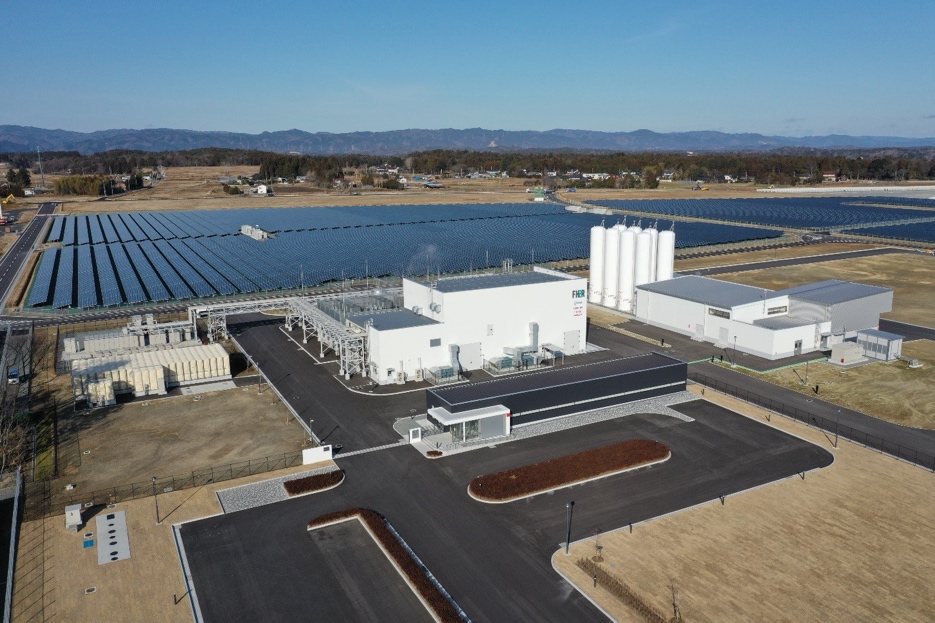
Source: Namie town
From ghost town to gas town
In the aftermath of the accident at Dai-Ichi NPP, caused by the March 11 earthquake and tsunami, Namie became a ghost town. Lying about 20 km north of the NPP, its population was evacuated and put into temporary housing. The town was part of a no-go zone around the wrecked nuclear station.
Many said life in towns like Namie would never return. Many questioned the rationale and the budgets expended by the government in rehabilitating the lands around the Dai-Ichi site.
Namie has shown a will not only to revive, but to do in a way that’s an example for the rest of the country.
This year, the town’s authorities started construction of an industrial zone that will be fully powered by renewable energy when it opens in 2023. The locality of 1,200 or so has two solar plants and a wind farm. A biomass power plant is due onstream in the coming months. There are feasibility studies under way for a small hydropower plant and even an experimental wave power plant.
“We offer no subsidies,” a Namie town official said. “Sure, the town receives subsidies from the prefectural and national governments for some projects, but that is not why businesses of all types are coming to Namie. They are not here for the government money. They come because there’s an entrepreneurial spirit here.”
The town population is slowly starting to recover, even though there is a lack of available housing. Since the 2011 accident, reconstruction focused on infrastructure such as industrial parks, power plants and research centers, leaving housing stock repairs behind.
The industrial revival and the extraordinary circumstances allowed Namie to cut the red tape and open itself up to trials of various alternative energy projects.
Brother Industry is testing hydrogen pipelines in the area, studying their transmission efficiency and safety when the pipes are affixed to electric poles.
The town has its own drone testing ground and Nissan Motor has used the locality for automated driving trials.
Sumitomo Corp. has plans to build a “multi-vehicular hydrogen service station”. This would be no ordinary stopover for fuel cells. The facility is designed to service both passenger and commercial fuel cell autos, as well as other vehicles that are yet to be created. For example, hydrogen bicycles.
Since last March, Namie also plays host to the Fukushima Hydrogen Energy Research Field (FH2R), one of the world’s top hydrogen production plants. It is situated in the Tanashio Industrial Zone along the coast and has a 10 MW capacity, while also powered by a 20 MW of solar capacity.
FH2R is already connected to the Tohoku Electric grid, which means it can be used as part of the local electricity supply, as well as a hydrogen-generating facility.
The plant made headlines in December last year when it supplied the fuel cell systems that powered rock concerts at the giant Saitama Arena stadium.
FH2R also has plans to add its own hydrogen service station and to conduct on-site smart car system tests. Town officials expect delivery of the first fuel cell vehicles to the town sometime this month.
“All sorts of pioneers have come here, from trading houses to construction firms, carmakers, manufacturers, and academics,” the Namie town official said.
Prefecture-wide rollout of renewables
The rest of Fukushima is much like Namie, renewables-minded. On Feb. 9, the prefecture government said it wants all of the electricity consumed in the region to come from renewable sources by 2025. In 2019, renewables accounted for 80.5% of Fukushima’s power consumption, or 12.07 billion kWh.
Based on 2025 power demand forecasts holding flat at 15 billion kWh, the region needs to increase its renewable output by 25%.
Since the 2011 accident, the expansion in local renewables capacity has been immense, rising seven-fold to 2,582 MW by the end of 2019. Most of that is due to the installation of solar farms. Solar capacity has surged to 2,110 MW, which is a whopping 32-fold increase.
This strong expansion convinced Fukushima Souden, a JV between a local power utility and TEPCO, to add new transmission lines in January 2020 in order to link the new solar plants to TEPCO’s grid system, bringing their energy to a wider market.
The solar push has come despite the fact that Fukushima is not a sunny region. The area gets 1,700 hours of sunlight a year, less than the national average of 1,900 hours. However, Fukushima has strong winds, with over 6 m/s on average. It also has the fourth-largest forest lands in the country and a strong agriculture sector, as well as many small rivers. Heavy snows in the Aezu area could also be turned into an energy source, according to the prefecture’s studies.
Over the next decade, the regional government says it wants to make a concerted effort in non-solar renewable sources.
The reconstruction of Fukushima is far from complete, even ten years on from the disaster. The area’s advances in energy infrastructure and innovation are yet to be matched by a revival in comfort and entertainment facilities and even basic lifestyle essentials, such as supermarkets and drug stores.
Still, Namie officials say the local mood is upbeat and motivated. There is a strong collaborative spirit and belief in entrepreneurship.
“Every day there are problems, but people help each other.” The key to any real reconstruction is “comradery, not money.”
Renewables Capacity in Fukushima
| In 2011 | End of FY2019 | |
| Solar | 66 MW | 2,100 MW |
| Wind | 144 MW | 177 MW |
| Small hydro | 14 MW | 17 MW |
| Geothermal | 65 MW | 30 MW (due to a plant closure) |
| Biomass | 73 MW | 250 MW |
| TOTAL | 363 MW | 2,582 |
ANALYSIS
BY DANIEL SHULMAN
PRINCIPLE
SHULMAN ADVISORY
January’s Electricity Price Spike Didn’t Kill the Retail Market;
It Opened New Opportunities for “Good Actors
As Mark Twain might have said, reports of the death of Japan’s power retailers have been greatly exaggerated. In fact, many of the “new electricity firms” that appeared after the market’s deregulation are now in an even stronger position to succeed and challenge the incumbent power utilities. Here’s why.
Industry impact of the crisis
About 35% of power generated in Japan is traded on the Japan Electric Power Exchange (JEPX). As such, when the 24-hour average system price spiked for a few days in January 2021, and even briefly hit an all-time high of ¥154.6/ kWh on Jan. 13, many facets of the market were disrupted. Undoubtedly, one of the most-affected groups was Japan’s new power retailers, which rely on the exchange to procure the vast majority of their customers’ electricity volumes.
Rakuten Energy, Japan’s 10th-largest household power retailer, stopped accepting new contract applications. Kazuno Power, established in 2019 to sell renewable energy in Akita prefecture, suspended all operations. Looop, a large retailer and renewable power generator, opened talks with several parties to buy distressed power retail business assets.
While the price spike affected power retailers in general, it especially put pressure on those offering variable-rate plans. This only applies to 1.86% of Japan’s power sales, and yet it still adds up to as many as 800,000 contracts, mostly residential.
As the name suggests, the price that customers on variable plans have to pay is, to a varying degree, tied to the JEPX day-ahead market price and, generally, recalculated every 30 minutes. This works in the customer’s favor when JEPX prices are low, but it can flip into a higher power bill if spot electricity prices increase. In the case of the recent spike, some saw their power bills more than double.
Making things even worse was the fact that many of the retailers aggressively promoted their variable-rate plans during 2020 when JEPX day-ahead prices were low. The average weekday price in the Tokyo zone in November was just ¥5.51/ kWh, down from ¥9.03/ kWh a year earlier.
ENEOS and Nissan even started to announce electric vehicle charging costs based on variable-rate plan power prices.
How power retailers reacted
Contractually, retailers are not required in any way to compensate customers on variable-rate plans for a rising price. However, some decided to do so anyway in the aftermath of the price spike to take partial responsibility and acknowledge that the average residential customer might not have understood the risks of such pricing.
Genie Energy, a retailer that offers both variable- and fixed-rate plans, gave customers on the variable plan the option to switch.
Those with only a variable-rate plan offered up-to-date power price information and even an easy way to exit their contract. Shizen Energy reminded customers that their contracts did not carry a termination fee. Fellow retailer Direct Power waived its ¥2,000 fee for cancellations.
Shizen also announced that it would discount variable-rate electricity bills by up to ¥30,000 yen as compensation. Hachidori Denryoku promised to match the bills offered by the incumbent power utilities in its customers’ areas, and that it would carry all excess costs until the end of February.
The above showed a higher level of customer service that the new power retail companies have brought to the Japanese electricity market.
That said, clearly some of the retailers failed this litmus test. One firm, Haluene, suspended its main phone line and limited call center availability, blaming the changes on COVID-19. METI went on to issue formal warnings to a number of industry players after certain call center response rates dropped below 50%.
Officials may escalate this further and issue an “order for business improvement” to some retail firms for their failure to properly explain the nature of variable-rate plans to customers. There’s precedent for this last year after Chubu Electric Power Miraiz was issued such an order for failure in some cases to deliver legal contract documents to customers. Violating these orders can be punished with penalties of up to ¥3 million and even revocation of retailer registration.
As a consequence, we expect some retailers to introduce price caps on variable-rate plans.
Market share of electricity sales held by new power retail companies (2020)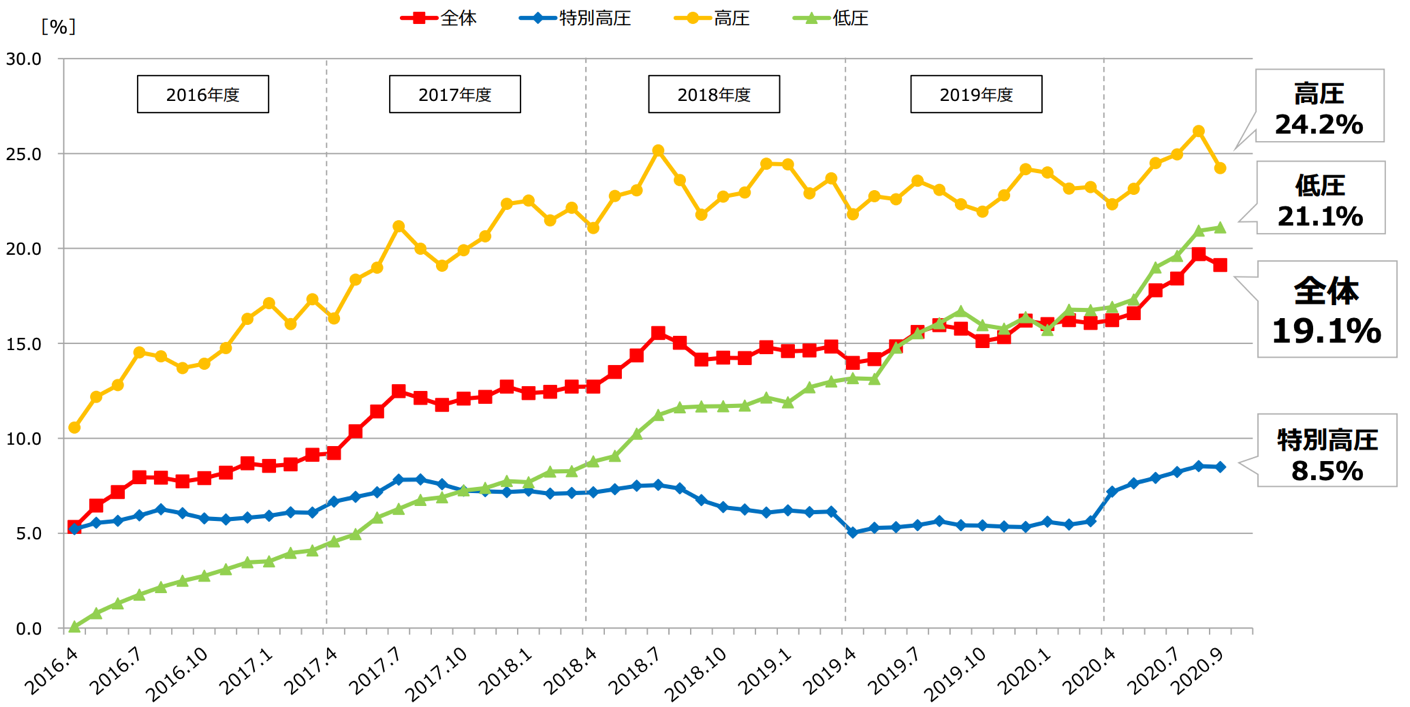
LEGEND
Red: Total electricity sales;
Blue: Special High-Voltage;
Yellow: High-Voltage;
Green: Low-Voltage.
New opportunities for power retailers
While the recent JEPX price spike means that retailers have to rethink the way they structure and present their offerings, the situation also highlighted opportunities in the Japanese market for products and services that help limit volatility. These include fixed-rate plans, residential power purchase agreements (PPAs), peer-to-peer (P2P) power trading, and energy resource aggregation businesses (ERAB).
Increasing adoption of residential PPAs will allow households (just like they allow corporations) to secure power at a stable rate for a long period of time. For example, Sharing Energy, a company which entered this space about three years ago, offers agreements in which it installs solar panels for free in exchange for the household buying power from the company. After 10 years, ownership of the panels is transferred to the house owner.
Okinawa EPCo is also eyeing this market. Starting in April, it will offer residential PPAs that include solar panels and storage batteries.
Creating more opportunities for P2P power trading will allow power consumers access to new supply sources. Denryoku Sharing started a P2P trading system among farmers in December 2020. Through this, farmers with agri-voltaic systems can supply excess power to their neighbors.
Lastly, the growth of ERAB will help stabilize JEPX prices by reducing imbalances between supply and demand through the introduction of virtual power plants and demand response services. Yano Research Institute estimates that this market will grow from ¥4.4 billion in FY2019 to as much as ¥73 billion in FY2030. Some companies that entered this market recently include Symenergy, which introduced a demand response service for high-voltage customers, and Enechange and Looop, which jointly started a demand response service for low-voltage customers.
In addition to opportunities on the consumer side, there are options to explore in power procurement. Trading on the futures markets has already significantly increased, and opportunities related to risk management products and services are expected to grow.
In the short-term, many will remember the JEPX price spike as an energy crisis that “burned” the burgeoning power retail sector. However, it also acted as a stress test to weed out the “bad actors” that abandoned their customers and highlighted those that acted with superior customer service.
It’s not yet clear how many of the 800,000 customers with a variable price plan will switch to a fixed rate. But, it’s fair to say that the actions of the “good actors” weaken any government rationale to reverse deregulation of the electricity market, as some conservative voices in Japanese energy have called for since the advent of the price spike.
.
GLOBAL VIEW
BY TOM O’SULLIVAN
Below are some of last week’s most important international energy developments monitored by the Japan NRG team because of their potential to impact energy supply and demand, as well as prices. We see the following as relevant to Japanese and international energy investors.
Myanmar:
The unfolding situation in Myanmar following the Feb. 1 coup is continuing to create significant commercial and diplomatic challenges for other Asian countries, including Japan. More than 50 civilian protestors have been killed over the last five weeks, and it seems a nation-wide strike is imminent that could close access to energy networks, including the oil and gas pipelines linking the port of Kyaukphyu on the Bay of Bengal to Kunming in China. Infrastructure sabotage may also be a risk for investors. Last Wednesday was the bloodiest day so far, with 38 fatalities including children.
One Japanese company has been put on a watch-list by a major institutional investor because of its links to companies controlled by the military junta. At least 60 other foreign firms are thought to have economic connections with the junta.
As well as the implementation of sanctions, U.S. government officials halted the movement of $1 billion in the name of the Central Bank of Myanmar shortly after the coup. Various sanctions have been enacted by the U.S. and the EU against members of the junta, but they appear to have been ineffective so far. However, local bank strikes are crippling the economy.
Air travel into the country is limited due to access to jet fuel at airports. ANA is refueling in Okinawa prior to completing round-trip flights to Yangon to evacuate Japanese nationals. Marubeni, Mitsui, Toyota Tsusho, Hitachi Metals, Sumitomo, and Sojitz are among the 400 Japanese corporate investors in the country. The total cumulative Japanese FDI investment in Myanmar may exceed $2 billion. France’s Total, Petronas, and Chevron are also invested in the country. At one point, workers on a Petronas offshore platform were stranded due to the coup.
The Myanmar army, the Tatmadaw, is the biggest in South East Asia after Vietnam, with over 500,000 personnel, and a budget of over $2.5 billion or 10% of GDP. Russia, China and North Korea are its major suppliers. Japan’s Ministry of Foreign Affairs is considering suspending official development aid to the country as Japan’s Development Cooperation Charter calls for ODA suspensions when basic human rights are violated.
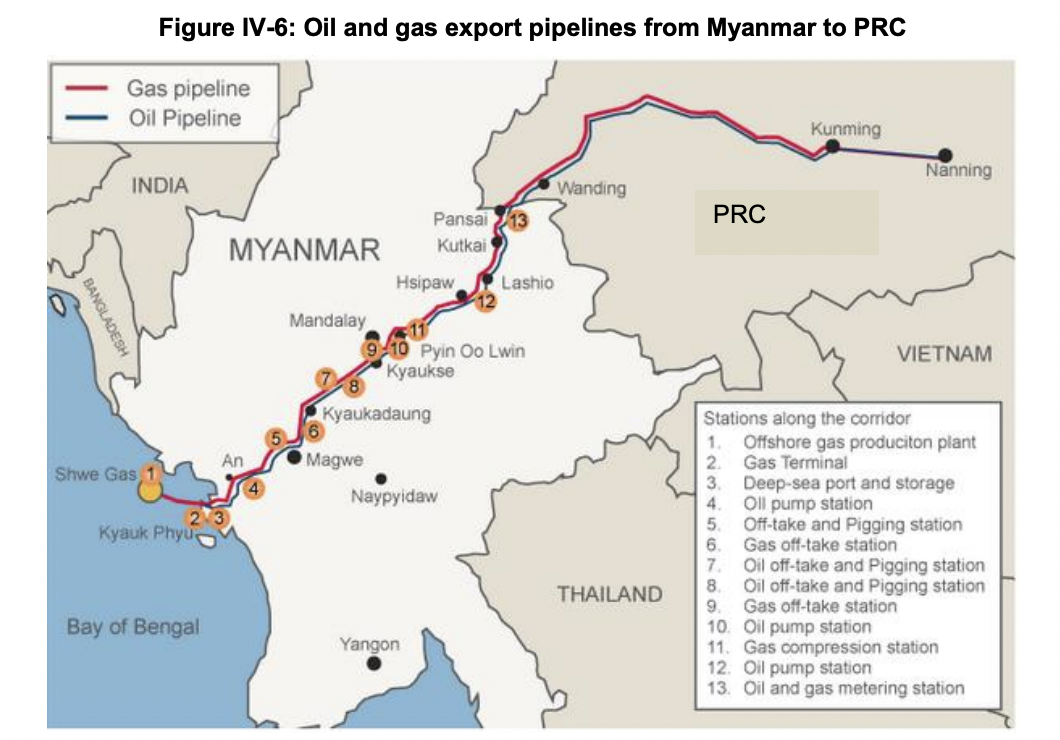
Oil:
Brent closed the week just below $70, up $20 YTD, following the OPEC+ announcement to keep production cuts in place for an additional month. Rystad believes oil prices could go significantly higher.
However, the 23 OPEC+ countries are thought to need an average $95 oil price to balance fiscal budgets.
Meanwhile, CEO of Occidental Petroleum, Vicki Hollub, said she believes U.S. oil production will never recover to the pre-pandemic peaks.
Biomass:
Microsoft will build a negative-emissions biomass plant in Mendota, California with Schlumberger and Chevron.
CO2 Emissions:
Global energy-related CO2 emissions were 2% higher in December 2020 YoY reversing the pandemic-induced reductions.
Aviation:
1). Skydio, a Californian drone-maker, became the first U.S. drone-maker to be valued at more than $1 billion.
2). Lufthansa reported the worst loss in its history, for FY2020 — $6.6 billion — and does not expect a full recovery before 2025.
Critical Rare Metals:
1). Last week copper prices exceeded $9,000 a ton. Polymetal, the Russian precious metals producer, announced it will increase its exploration budget for copper and other rare metals as the energy transition gains momentum.
2). Tesla signed a deal to buy nickel with a New Caledonian mine, the Goro mine, to strengthen its lithium-ion cell production supply chains. Tesla also lost almost $100 billion in market capitalization last week.
ESG:
Cevian Capital, the activist investor, is demanding that ESG targets be used to determine executive compensation.
COP26:
Alok Sharma has been on his first diplomatic tour since taking on the role of COP26 U.K. President on a full-time basis. He has visited Belgium, Nepal, India, Nigeria, Egypt, Ethiopia, and Gabon last month.
China:
At the NPC conclave in Beijing, China announced an economic growth target of 6% for 2021 and is planning to create 11 million new urban jobs this year. In the five-year plan released on Friday, China stressed the need to achieve energy security alongside the goals of peaking emissions by 2030 and achieving carbon neutrality by 2060. Specifically, the country committed to build an additional 20 GW of nuclear power by 2025 including SMRs, third-generation coastal plants, and offshore floating nuclear plants; reduce carbon intensity and energy use per unit of GDP by 18% and 14% respectively; and promised that 20% of the country’s energy will come from non-fossil sources by 2025, an increase of 25% compared with 2020.
South Korea:
LG Chem will build a battery factory with GM in Tennessee.
India:
India is investigating whether China orchestrated the 2020 Mumbai power blackouts.
Pakistan:
Pakistan is expected to issue $1 billion in inaugural nature bonds, or sustainability-linked bonds, later this year that will be used to finance nature-based solutions to climate-change.
Russia:
1). Moscow will quadruple the number of electric buses by 2030, phasing out all petrol and diesel-powered vehicles.
2). The U.S. Treasury sanctioned Alexander Bortnikov, the head of the FSB, and seven other senior Russian officials and 14 entities in connection with the attempted murder of Alexei Navalny. The EU applied similar Magnitsky-style sanctions on four different Russian officials including the prosecutor-general and the heads of the national guard and the prison service.
3). The U.S. has also imposed sanctions against Igor Kolomoisky, a Russian oligarch, for corruption committed in Ukraine.
Israel:
An Israeli-owned cargo ship was attacked in the Gulf of Oman, with PM Netanyahu attributing the attack to Iran.
Egypt:
1). Japan will allocate $240 million to Egypt through JICA to support the green economy and the development of renewable energies.
2). Egypt is considering making a formal application to host the COP27 summit in 2022. Under the UN system of regional rotation, it would be the turn of Africa to host the next climate summit. A decision is expected to be made at COP26.
Sweden:
Volvo will transition its entire fleet to EVs by 2030 and phase out dealerships with all sales conducted on-line.
Portugal:
EDP, the Portuguese utility, announced that it will double RE capacity to almost 75 GW by 2030.
France:
France’s Total will develop a carbon-negative renewable gas with Clean Energy Fuels, a U.S. company, for use as a transport fuel.
United Kingdom:
1). Chancellor Rishi Sunak introduced a two-year ‘super deduction’ tax break in his budget last week to enable companies to finance net-zero investments.
2). In May 2021, the UK will launch a national carbon trading system.
Canada:
Canada’s Neo Performance Materials Inc. will team up with two U.S companies, Energy Fuels and Chemours, to produce rare earths from monazite sands for use in EVs.
U.S:
1). ERCOT fired CEO Bill Magnus following the Texas freeze fiasco.
2). Brazos, a generation and transmission cooperative in Texas, filed for Chapter 11 bankruptcy with debts of over $2 billion arising from the Texas freeze. Bank of America is now thought to have gained millions from the same extreme market volatility in Texas as part of its hedging derivatives unit.
3). Charif Souki, the founder of Tellurian, the Houston-based natural gas company, described the power grids in California and Texas as “dysfunctional”.
4). Exxon appointed two new independent directors and will increase its investments in carbon capture and storage.
5). The American Society of Civil Engineers gave U.S infrastructure a C- grade in its annual assessment and called for $6 trillion of infrastructure investments over the next decade. Professor Jeffrey Sachs of Columbia University also believes that U.S. defense budgets need to be cut by $200 billion per annum to finance the build-out of infrastructure.
6). The Association of American Railroads will release a paper today for the U.S. administration outlining emissions reduction strategies that favor railroad freight transportation over road haulage.
7). The American Petroleum Institute is now expected to endorse an economy-wide price on carbon in a policy announcement expected in the near future.
8). Last week the annual CERAWeek energy conference featured Bill Gates and John Kerry as energy transition gains momentum with the advent of the new U.S. administration.
9). In his annual letter to shareholders Warren Buffett disclosed that Berkshire is the largest holder of fixed assets in the U.S. with over $150 billion, and his energy portfolio is unlikely to pay a dividend before 2030 due to capital investments required to reinforce the U.S. power grid.
South America:
1). The EU-Mercosur trade deal negotiated with Brazil, Argentina, Uruguay, and Paraguay continues to stall because of environmental concerns over deforestation in the Amazon.
2). In Brazil, four Petronas board members quit following the sacking of the CEO.
EVENTS CALENDAR
A selection of domestic and international events we believe will have an impact on Japanese energy.
| February | Approval of Fiscal 2021 Budget by Japanese parliament including energy funding projects;CMC LNG Conference |
| March | 10th Anniversary of Fukushima Nuclear Accident;Smart Energy Week – Tokyo;
Quarterly OPEC Meeting; Japan LPG Annual Conference; Full completion of all aspects of the multi-year deregulation of Japan’s electricity market; End of 2020/21 Fiscal Year in Japan; |
| April | Japan Atomic Industrial Forum – Annual Nuclear Power Conference;38th ASEAN Annual Conference-Brunei;
Japan LNG & Gas Virtual Summit (DMG)-Tokyo Three crucial by-elections in Hokkaido, Nagano & Hiroshima – April 25th |
| May | Bids close in first tender for commercial offshore wind projects in Japan;Prime Minister Suga to visit the U.S.-tentative |
| June | Release of New Japan National Basic Energy Plan-2021;G7 Meeting – U.K.
Forum for China-Africa Cooperation Summit (Senegal) |
| July | Tokyo Metropolitan Govt. Assembly Elections;Commencement of 2020 Tokyo Olympics |
| August | Hydrogen Ministerial Conference in conjunction with IEA World Economic Forum in Singapore – Deferred from May |
| September | Ruling LDP Presidential Election;UN General Assembly Annual Meeting that is expected to address energy/climate challenges;
IMF/World Bank Annual Meetings (multilateral and central banks expected to take further action on emissions disclosures and lending to fossil fuel projects); End of H1 FY2021 Fiscal Year in Japan; Japan-Russia: Eastern Economic Forum (Vladivostok)-tentative |
| October | Last possible month for holding Japan’s 2021 General Election;METI Sponsored LNG Producer/Consumer Conference;
Innovation for Cool Earth Forum – Tokyo Conference; Task Force on Climate-Related Financial Disclosure (TCFD) – Tokyo Conference; G20 Meeting-Italy |
| November | COP26 (Glasgow);Asian Development Bank (‘ADB’) Annual Conference;
Japan-Canada Energy Forum; East Asia Summit (EAS) – Brunei |
| December | Asia Pacific Economic Cooperation (APEC) Forum – New Zealand;Final details expected from METI on proposed unbundling of natural gas pipeline network scheduled for 2022. |
DATA
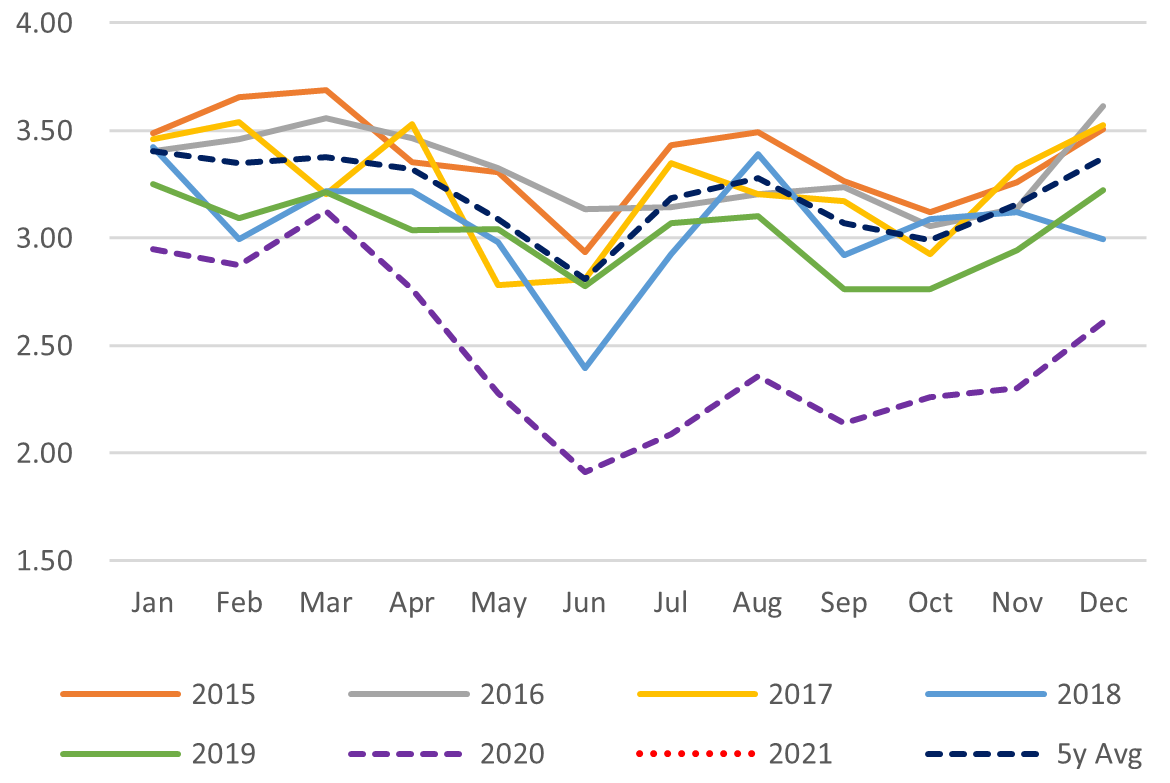
Japan Oil Price
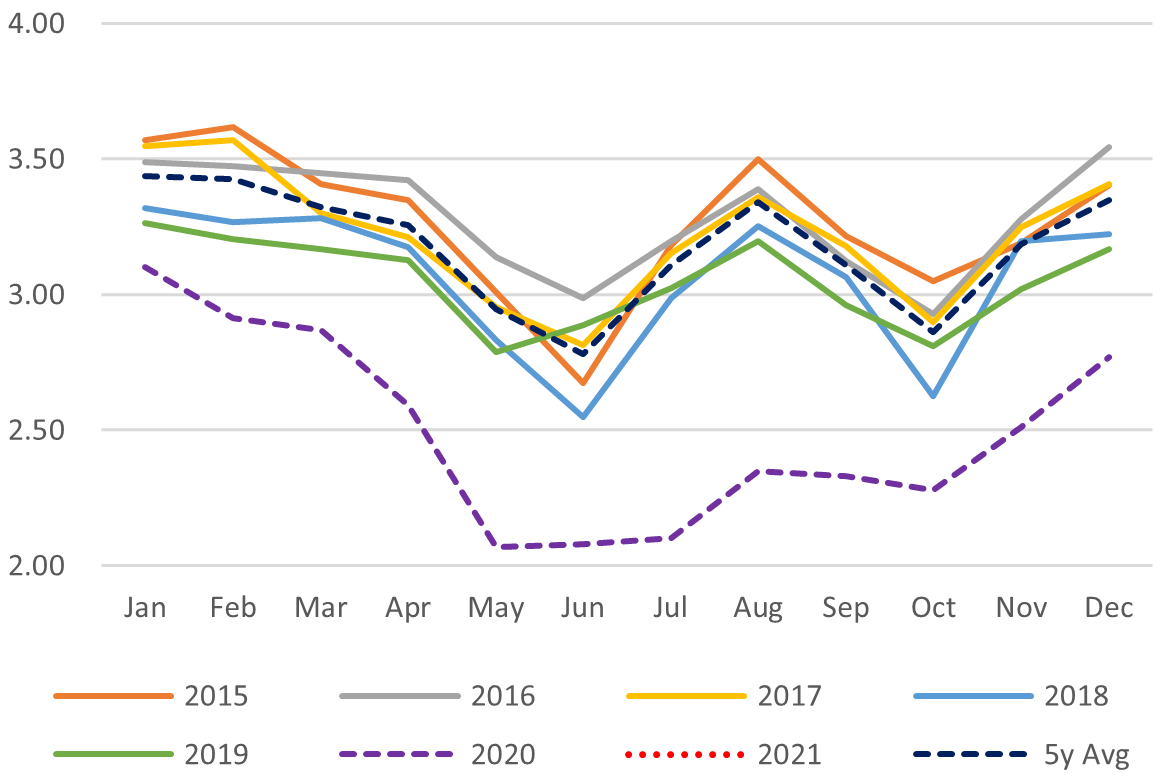
Crude Imports Vs Processed Crude
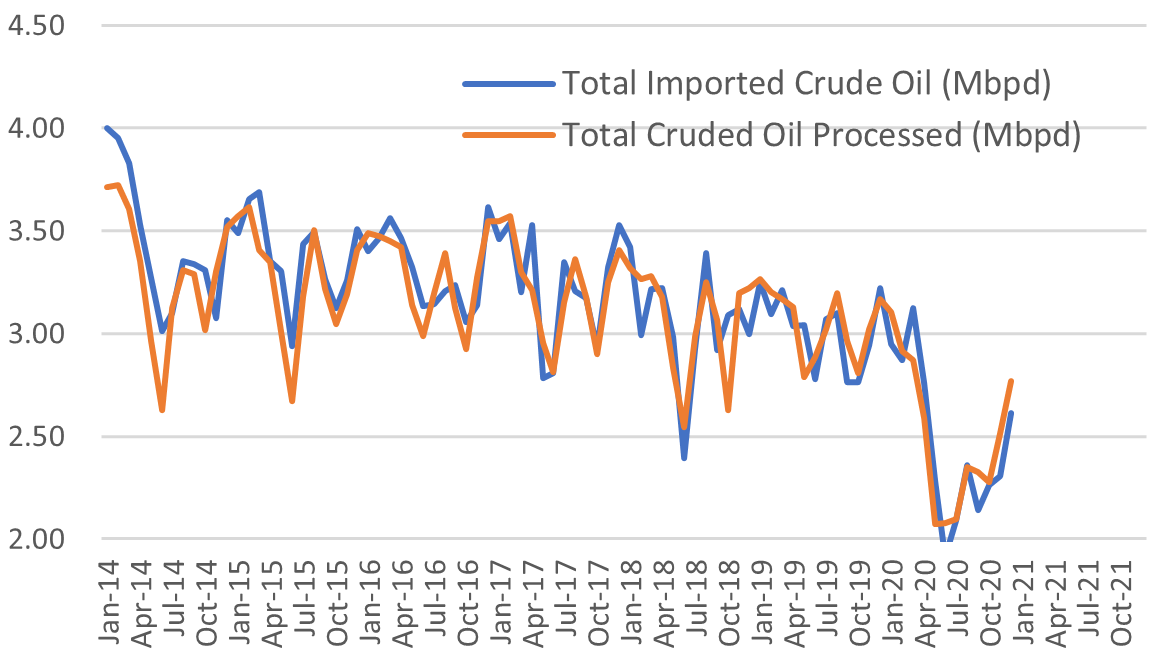
Monthly Oil Import Volume (Mbpd)
Monthly Crude Processed (Mbpd)
Domestic Fuel Sales
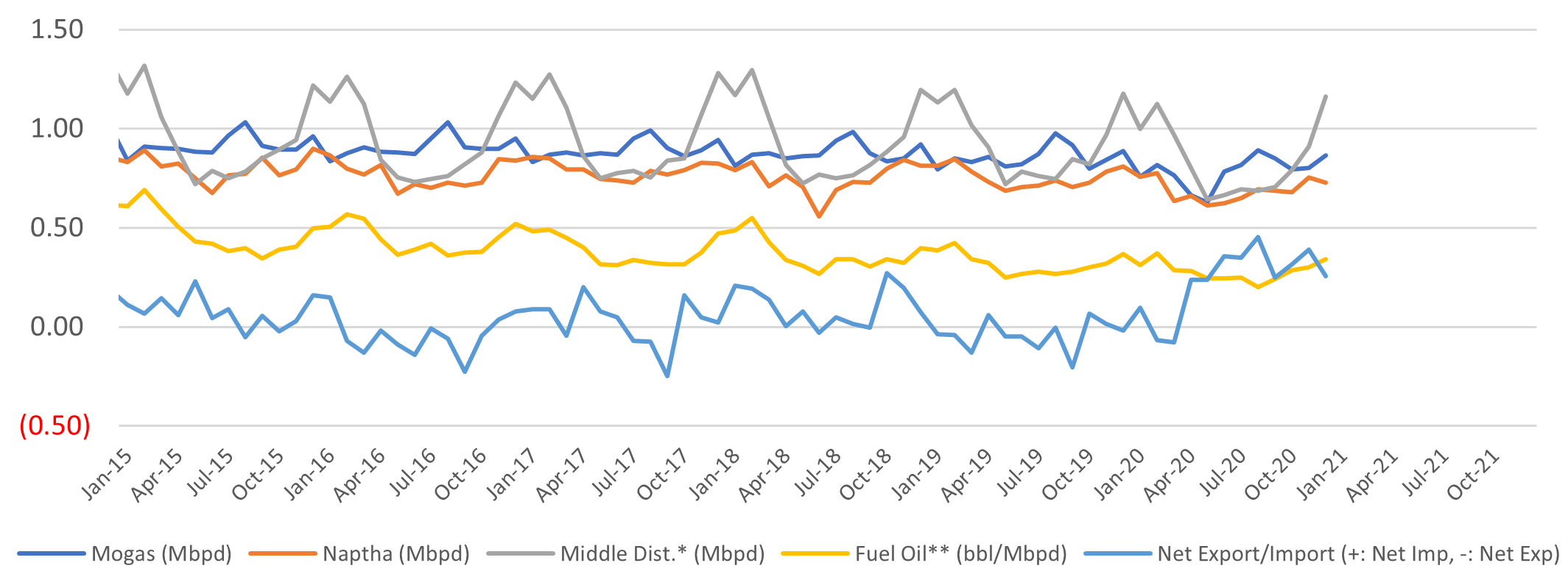
SOURCES: Ministry of Economy, Trade, and Industry (METI), Ministry of Finance, and the Petroleum Association of Japan
Japan LNG Price
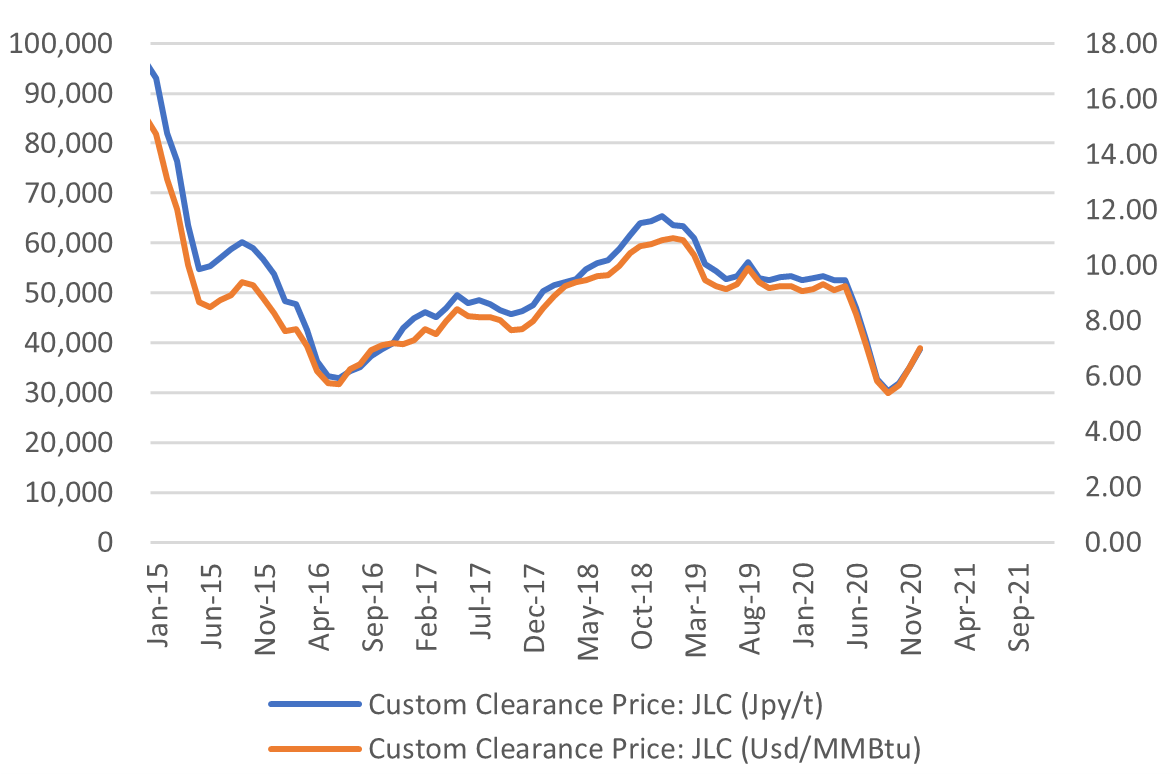
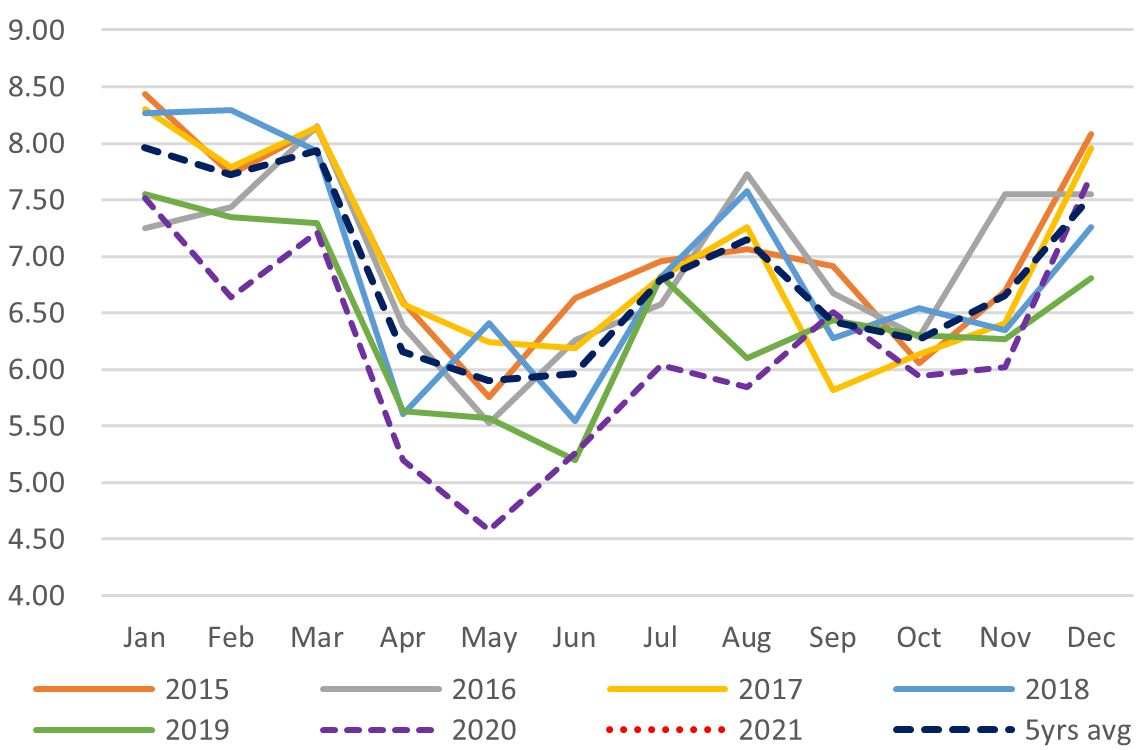
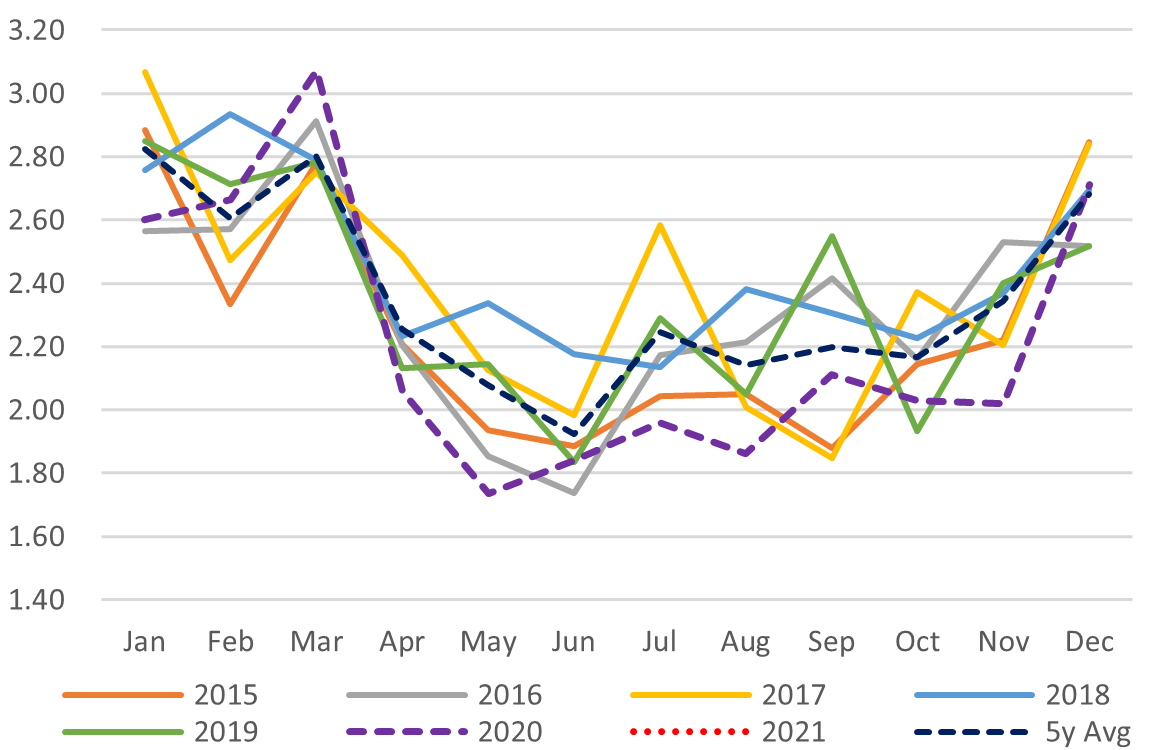
LNG Imports: Japan Total vs Gas Utilities Only
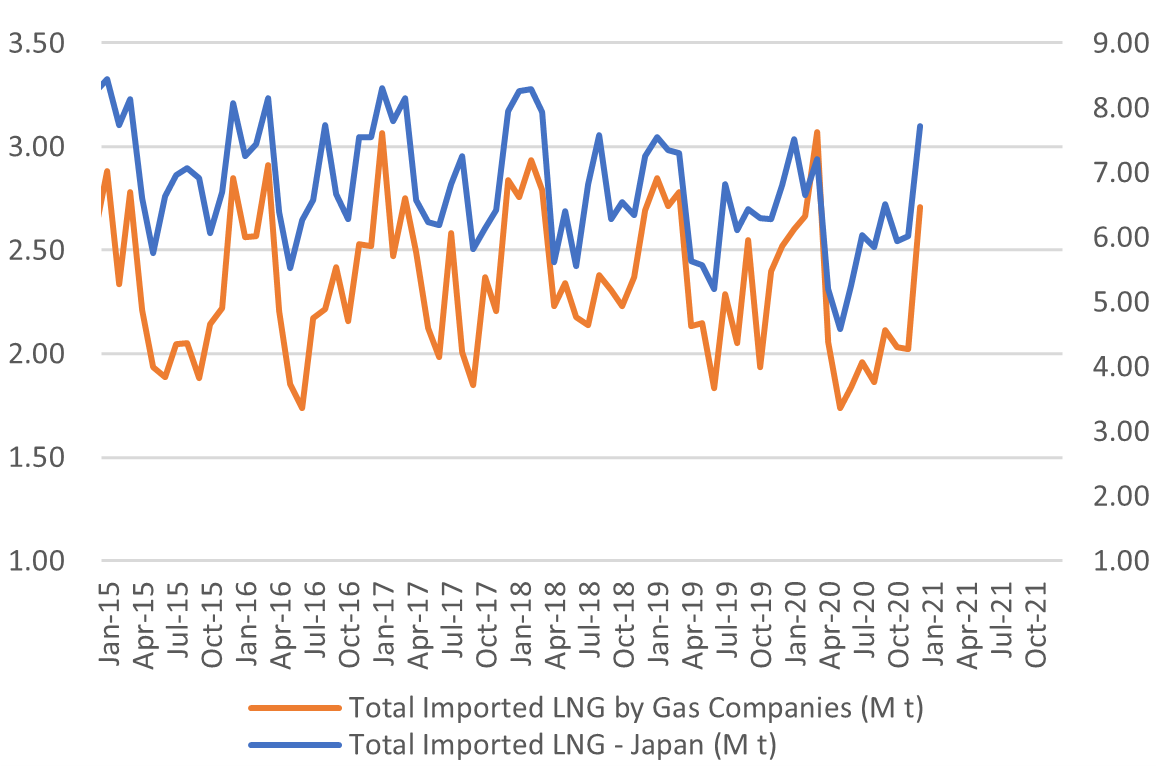
Total LNG Imports (M t)
LNG Imports by Gas Firms Only (M t)
City Gas Sales – Total (M m3)
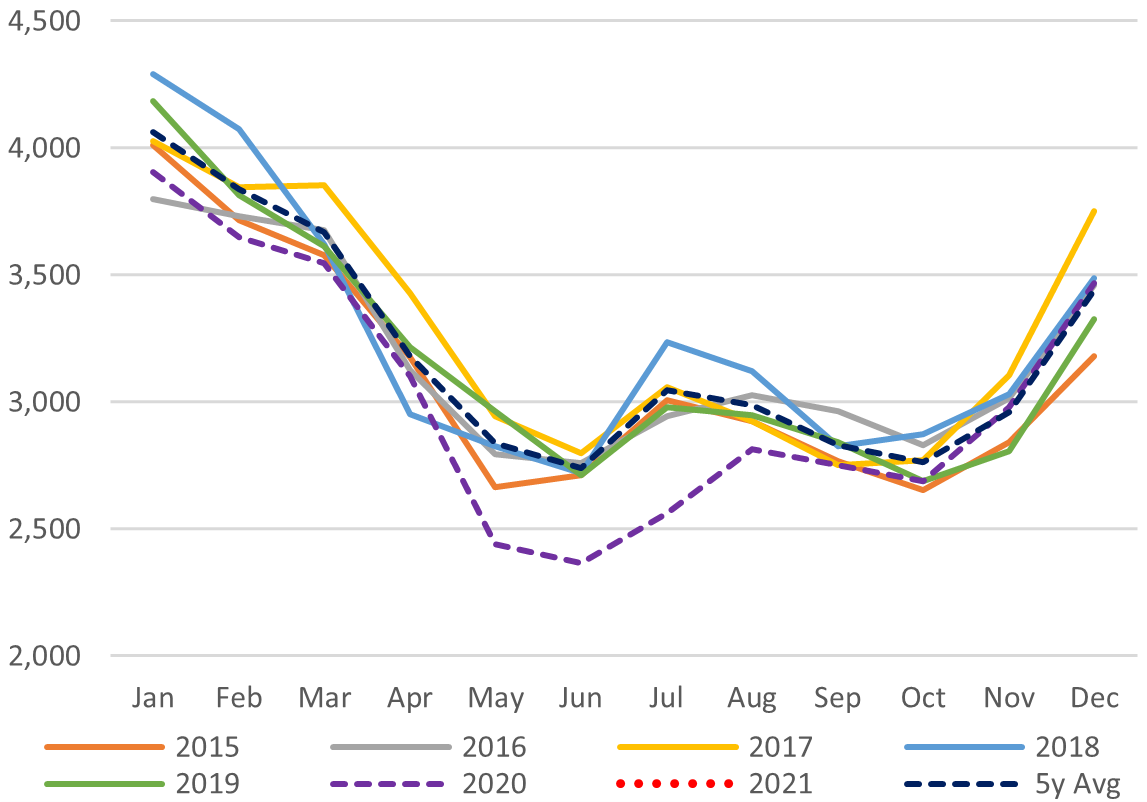
City Gas Sales by Sector (M m3)
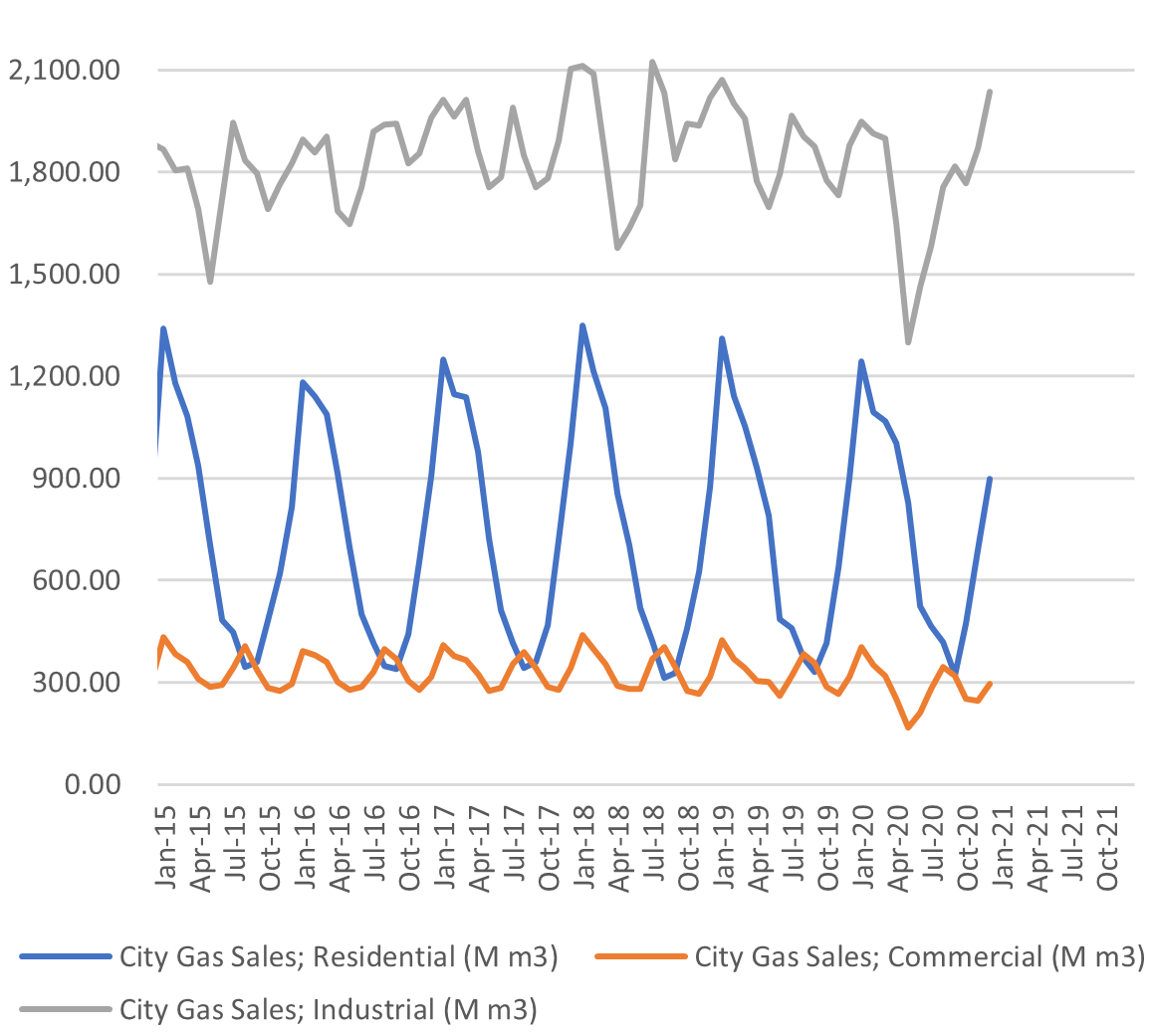
SOURCES: Ministry of Economy, Trade, and Industry (METI),
Ministry of Finance
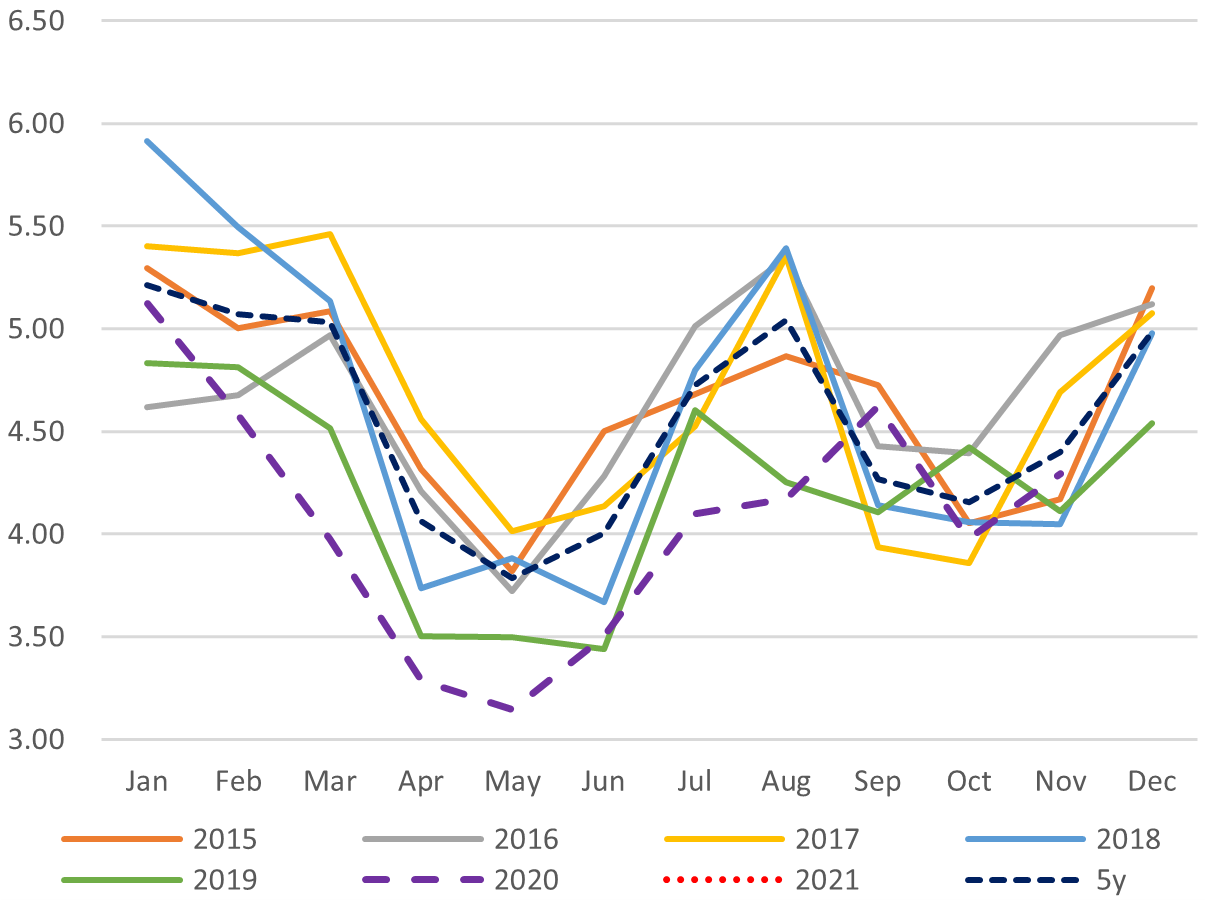
Japan Total Power Demand (GWh)
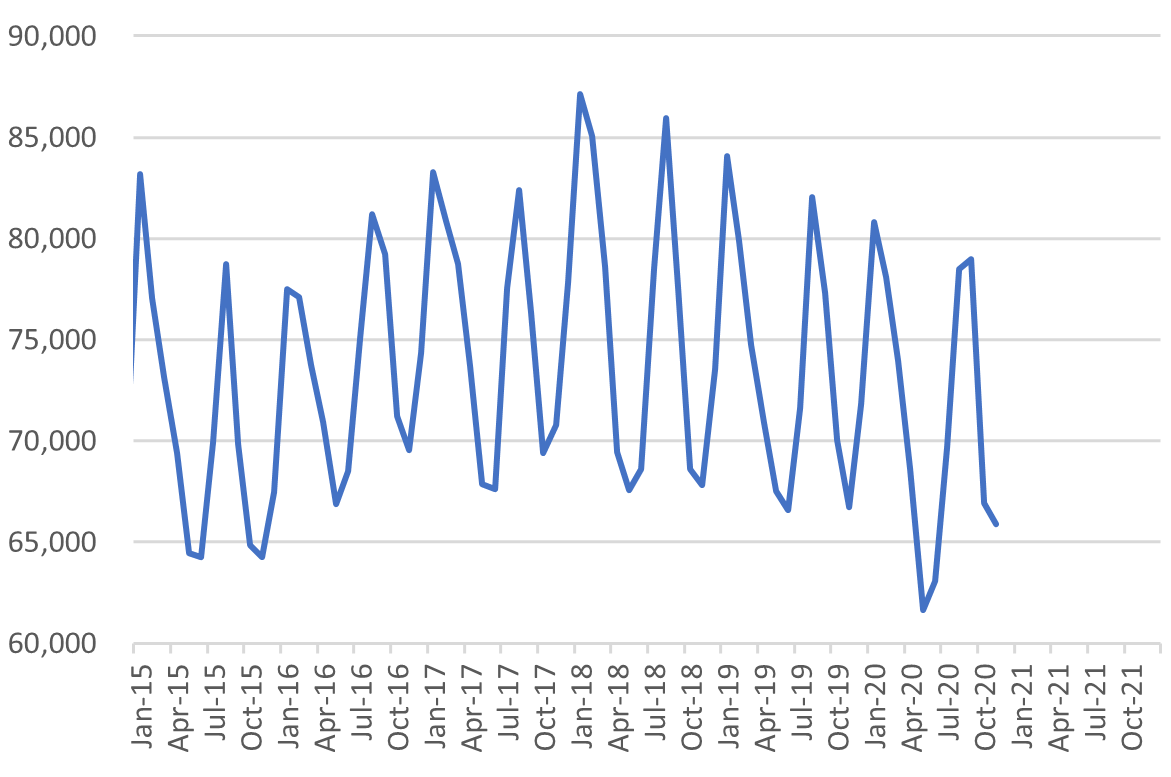
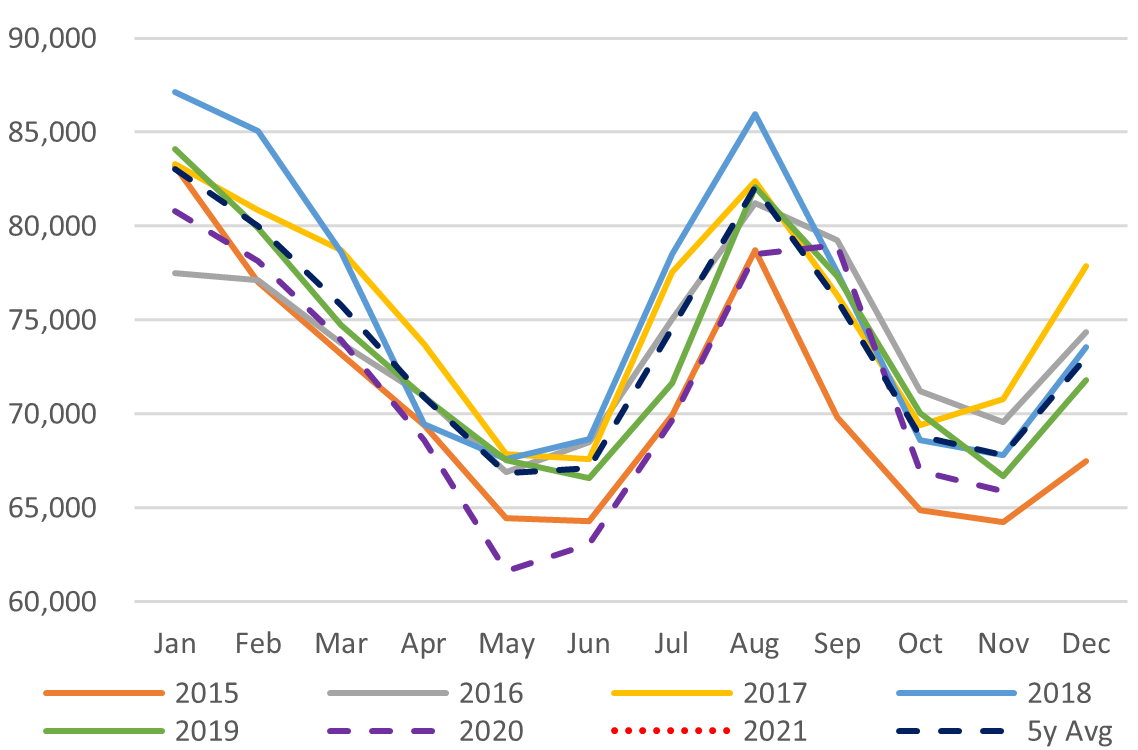
Current Vs Historical Demand (GWh)
Day-Ahead Spot Electricity Prices
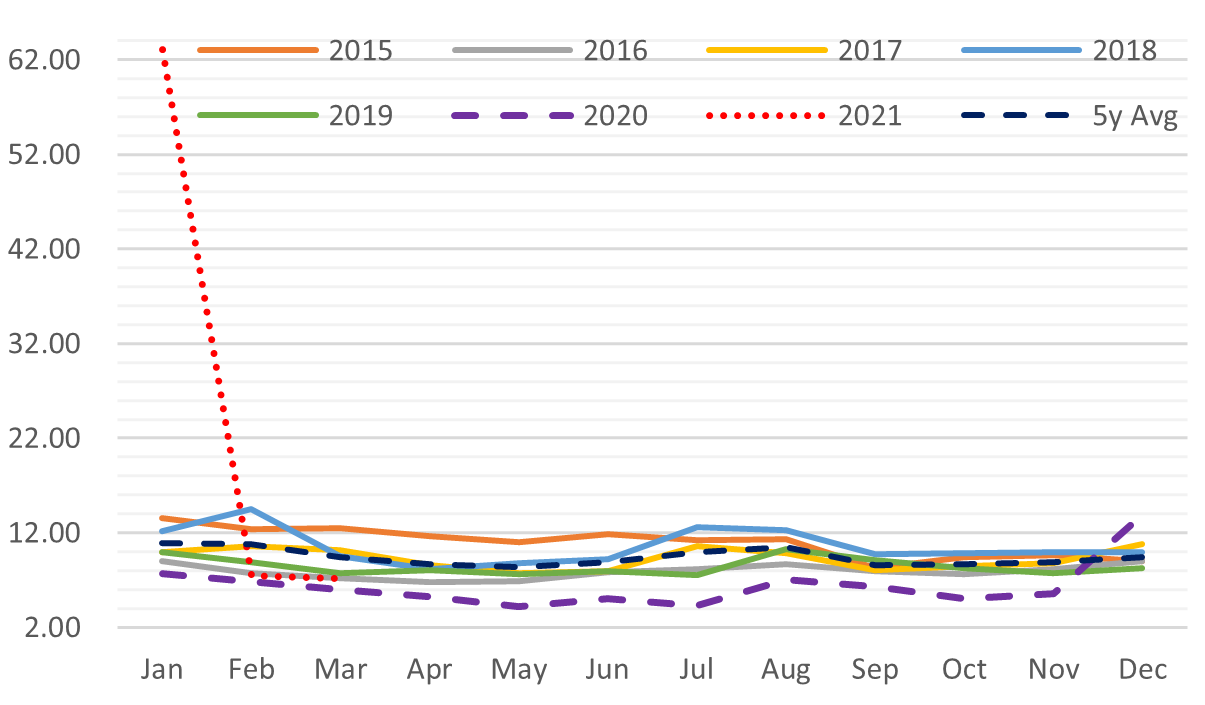
Day-Ahead Vs Day Time Vs Peak Time
LNG Imports by Electricity Utilities
LNG Stockpiles of Electricity Utilities
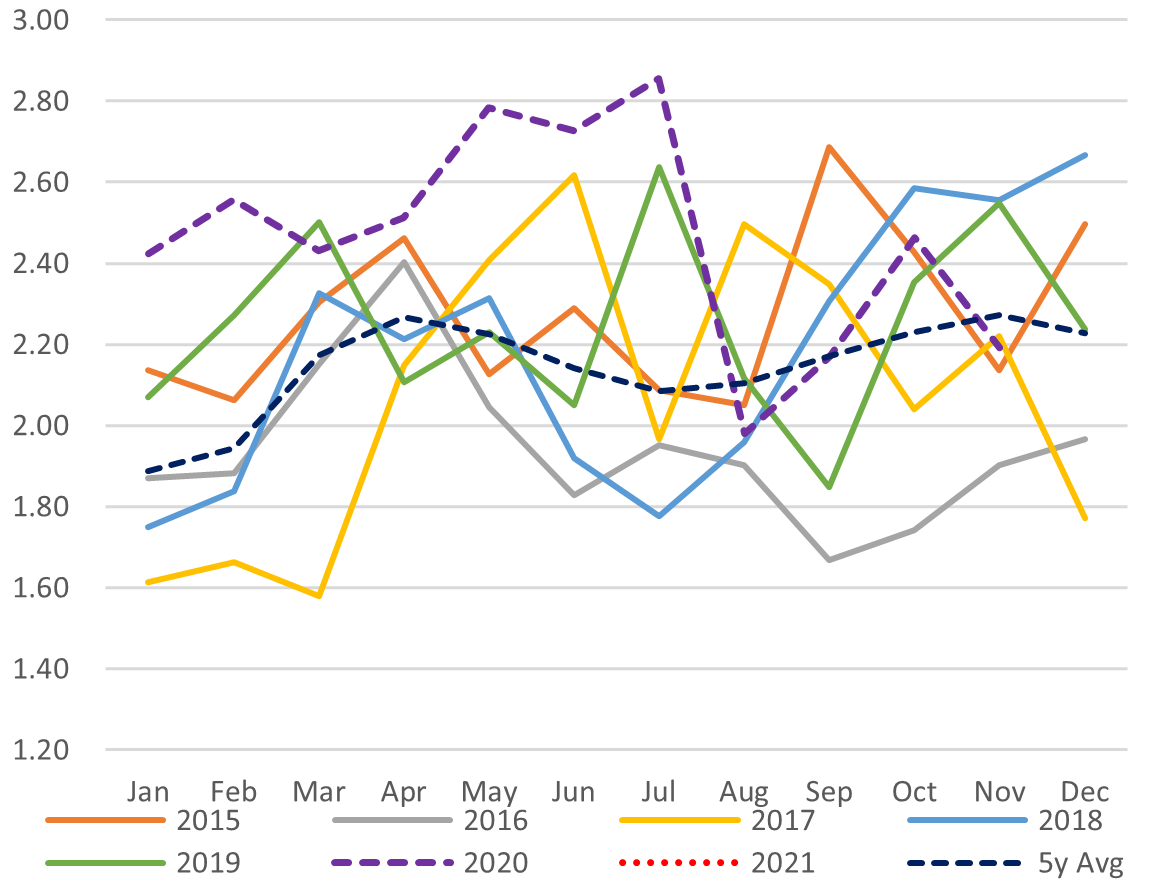
SOURCES: Ministry of Economy, Trade, and Industry (METI), and the Japan Electric Power Exchange
Disclaimer
This communication has been prepared for information purposes only, is confidential and may be legally privileged. This is a subscription-only service and is directed at those who have expressly asked K.K. Yuri Group or one of its representatives to be added to the mailing list. This document may not be onwardly circulated or reproduced without prior written consent from Yuri Group, which retains all copyright to the content of this report.
Yuri Group is not registered as an investment advisor in any jurisdiction. Our research and all the content express our opinions, which are generally based on available public information, field studies and own analysis. Content is limited to general comment upon general political, economic and market issues, asset classes and types of investments. The report and all of its content does not constitute a recommendation or solicitation to buy, sell, subscribe for or underwrite any product or physical commodity, or a financial instrument.
The information contained in this report is obtained from sources believed to be reliable and in good faith. No representation or warranty is made that it is accurate or complete. Opinions and views expressed are subject to change without notice, as are prices and availability, which are indicative only. There is no obligation to notify recipients of any changes to this data or to do so in the future. No responsibility is accepted for the use of or reliance on the information provided. In no circumstances will Yuri Group be liable for any indirect or direct loss, or consequential loss or damages arising from the use of, any inability to use, or any inaccuracy in the information.
K.K. Yuri Group: Oonoya Building 8F, Yotsuya 1-18, Shinjuku-ku, Tokyo, Japan, 160-0004.