
JAPAN NRG WEEKLY
MARCH 15, 2021
JAPAN NRG WEEKLY
March 15, 2021
NEWS
TOP
- Environment Ministry report says renewables can replace thermal power in the country; Industry group aims for Japan to have 125 GW of solar power by 2030; Environment Minister Koizumi tapped as climate change envoy for COP26
- Japan considers laying underwater grid to facilitate offshore wind
- Goldman Sachs considers sale of Japan Renewable for ~$2.5B
ENERGY TRANSITION & POLICY
- Japanese govt may invest in U.S. / Australian ammonia projects; Australia and Japan start operation of a hydrogen plant in Victoria
- Sumitomo Corp joins group to test ammonia as a shipping fuel
- Panasonic, Sumitomo Metal to create battery supply chain body
- Toda Corp and JBEC trial extracting hydrogen from sewage
- TEPCO unit seeks to commercializes heat storage
- EDITORIAL: Renewables/nuclear mix is key to energy transition; Young ruling party lawmaker urges PM Suga to abandon nuclear
- Sumitomo Mitsui to start operation of floating solar power plant
- J-Power looks at producing jet biofuel from algae … [MORE]
ELECTRICITY MARKETS
- Kyushu Electric to restart its final nuclear reactor on March 17
- Cosmo Energy’s wind unit to expand capacity fourfold by 2030
- Hokkaido resorts to welcome a number of geothermal projects
- JERA plans 600 MW offshore wind project near Tsugaru, Aomori
- Kyushu Electric starts to offer all-renewables electricity plan
- TEPCO CEO pledges to fulfill duty to Fukushima residents
- Chubu Electric trials new groundwater seal for nuclear plants
OIL, GAS & MINING
- Tokyo Gas, Toshiba establish Japan’s carbon-neutral LNG alliance
- Petrochemical firms roll out new services as gas stations struggle
- Osaka Gas to invest $5B into overseas and renewables assets; Co. decides to pay executives in stock options
- Hokuriku Electric, Toho Gas get nod in Kanazawa gas privatization
ANALYSIS
JAPAN LOOKS FOR WAYS TO SPEED UP ROLLOUT OF INFRASTRUCTURE FOR EV AND FUEL CELL VEHICLES
Initial findings from a recently created carbon-neutral mobility panel shows electric vehicles (EVs) and those powered by hydrogen fuel cells (FCVs) face a severe shortage of refueling options outside central areas. FCV infrastructure rollout, in particular, is far off course in preparing for the 200,000 FCV units Japan expects to have on the road by 2025. With this in mind, the govt. panel has put forward several recommendations for accelerating the development of FCV and EV infrastructure.
JAPAN’S WIND CAPACITY GROWTH HITS A RECORD
Wind power capacity in Japan rose to 4,372 MW at the end of 2020, after a record 449 MW was added during the year. We break down the growth by region, turbine manufacturer, and also review the situation in the offshore wind space.
NUCLEAR INDUSTRY UPDATE: 10Y AFTER FUKUSHIMA
Ten years have passed since the accident at the Dai-Ichi nuclear plant in Fukushima. We give an overview of the status of the nation’s nuclear reactors today, consider what factors are holding back restarts and what positives, if any, the industry can take from some recent turn of events.
GLOBAL VIEW
China avoids giving details on coal plant closures. AXA stops insuring RWE due to coal investments. Tesla’s battery R&D heavily relies on China. A major Japanese firm pulls out of Myanmar. See this section for details on these and other global energy-related news.
2021 EVENT CALENDAR
Industry / political events related to Japan energy
DATA SECTION
JAPAN NRG WEEKLY
PUBLISHER
K. K. Yuri Group
Sponsored
Editorial Team
Yuriy Humber (Editor-in-Chief)
Tom O’Sullivan (Japan, Middle East, Africa)
John Varoli (Americas)
Regular Contributors
Mayumi Watanabe (Japan)
Daniel Shulman (Japan)
Takehiro Masutomo (Japan)
Art & Design
22 Graphics Inc.
SUBSCRIPTIONS & ADVERTISING
Japan NRG offers individual, corporate and academic subscription plans. Basic details are our website or write to subscriptions@japan-nrg.com
For marketing, advertising, or collaboration opportunities, contact sales@japan-nrg.com
For all other inquiries, write to info@japan-nrg.com
OFTEN USED ACRONYMS
METI The Ministry of Energy, Trade and Industry
ANRE Agency for Natural Resources and Energy
NEDO New Energy and Industrial Technology Development Organization
TEPCO Tokyo Electric Power Company
KEPCO Kansai Electric Power Company
EPCO Electric Power Company
JCC Japan Crude Cocktail
JKM Japan Korea Market, the Platt’s LNG benchmark
CCUS Carbon Capture, Utilization and Storage
mmbtu Million British Thermal Units
mb/d Million barrels per day
mtoe Million Tons of Oil Equivalent
kWh Kilowatt hours (electricity generation volume)
NEWS: ENERGY TRANSITION & POLICY
Environment Ministry report says renewables can completely replace thermal power
(Japan NRG, March 8)
- The Environment Ministry’s global environment bureau met to discuss the development of solar power. According to the bureau’s latest surveys and research, renewables can generate between 1,095.4 TWh and 2,618.6 TWh of power in Japan – enough to completely replace thermal power.
- CONTEXT: Japanese annual electricity demand is around 977 TWh.
- Based on the Ministry’s maximum case scenario, offshore wind is able to contribute the most with close to 60% of total, followed by solar generation.
- The Ministry estimated the potential for renewables based on what is economically feasible and additional investments in power transmission. The potential capacity it sees for offshore wind is between 178 GW and 460 GW. The potential for onshore wind is at 118 GW to 163 GW.
- Economically feasible solar capacity is seen at 38 GW to 41 GW.
- SIDE DEVELOPMENT:
Industry group says Japan should have 125 GW of solar power by 2030
(Japan NRG, March 8)- Japan Photovoltaic Energy Association, JPEA, says it aims for Japan to have 31 GW of residential solar and 94 GW of utility-scale solar installed by 2030.
- JPEA figures are based on residential solar’s utilization rate of 13.7% and a utility scale rate of 16%.
- Utility solar power should drop to ¥7/ kWh by about 2025, JPEA forecasts
- SIDE DEVELOPMENT:
Environment Minster Koizumi named Japan’s special climate change envoy for COP26
(Nikkei, March 9)- The post is newly created. Koizumi will coordinate Japan’s preparations for COP26.
Japan considers laying underwater power grid to facilitate offshore wind expansions
(Nikkei, March 13)
- METI, the main ministry responsible for energy policy, is looking into the possibility of laying an underwater power grid, which would connect with offshore wind plants to quicker deliver the power to top demand areas, such as the region around Tokyo.
- This would be much faster and cheaper to install than running the power along land. The govt. may need to buy up more land rights.
- It would also strengthen the power grid specifically for renewable energy.
- One of the first underwater grid lines could connect Hokkaido and Tokyo.
- The underwater grid is already a feature of renewable energy in Europe.
- METI will call an experts meeting on March 15 to discuss the project, possible routes, and cost, which is expected to go as high as ¥1 trillion.
Japanese government may invest in U.S./Australian ammonia projects
(NNA Asia, March 12)
- Clean Fuel Ammonia Association vice chair, Muraki Shigeru, said the Japanese government is considering investing in U.S. and Australian ammonia development projects as part of a strategy of managing Japan’s ammonia supply chain.
- By 2050, the Japanese government hopes to have a global ammonia value chain in place that is capable of supplying 100 million metric tons per year.
Sumitomo Corp joins group to explore ammonia as a shipping fuel
(Company press release, March 10)
- A.P. Moller – Maersk A/S, Fleet Management Limited, Keppel Offshore & Marine, Maersk Mc-Kinney Moller Center for Zero Carbon Shipping, Sumitomo Corporation and Yara International ASA are pleased to announce that the parties entered into a Memorandum of Understanding to conduct a feasibility study aiming to be one pioneers in establishing a comprehensive and competitive supply chain for the provision of green ammonia ship-to-ship bunkering at the Port of Singapore.
- Emitting zero CO2 when combusted, ammonia has long been considered as one of the most promising alternative marine fuels to reduce greenhouse gas (GHG) emissions.
- The study aims to cover the entire end-to-end supply chain of ammonia bunkering, which includes the development of a cost-effective green ammonia supply chain, design of ammonia bunkering vessels, as well as related supply chain infrastructure.
- The study will assess the supply of ammonia including potential synergies with Liquefied Petroleum Gas (LPG) as a starting point.
- “With this MoU, we embark on our ambition to build the world’s first Ship-to-Ship ammonia bunkering base …”: said Mr Hajime Mori, executive officer of Sumitomo Corp.
- SIDE DEVELOPMENT:
Australia and Japan start operation of a hydrogen plant in Victoria
(Japan NRG, March 12)- On March 12 companies from Australia and Japan announced the start of the Hydrogen Energy Supply Chain (HESC) Pilot Project in Victoria, Australia; billed as the world’s first “integrated supply chain” hydrogen manufacturing project.
- Australia and Japan governments support this project, which is creating hydrogen gas from local coal deposits, liquifying it, and shipping it to Japan.
- Project consortium includes Kawasaki Heavy Industries, J-POWER, Iwatani, Marubeni, AGL and Sumitomo Corp.
Panasonic, Sumitomo Metal Mining to establish battery supply chain council
(New Energy Business News, March 11)
- Kanazawa, a consortium of 28 companies including GS Yuasa, Sumitomo Metal Mining, Mitsubishi Corporation, Mitsui&Co, DNP, Vehicle Energy Japan, and Panasonic, will establish the “Battery Association for Supply Chain”, or BASC, in April with the aim of promoting the healthy development of industries relating to battery manufacture and increasing Japan’s competitiveness in this area.
- The Association aims to lobby for carbon neutrality and policy that boosts Japan’s international competitiveness, as well as monitoring international standards and proposing its own standards.
Toda Corporation to extract hydrogen from sewage
(New Energy Business News, March 9)
- Japan Blue Energy (JBEC) and construction company Toda Corporation have begun a trial in a sewage processing plant in Tokyo that aims to establish a commercially viable operation for extracting hydrogen.
- An experimental plant capable of extracting one dry metric ton of hydrogen will begin operating as early as April.
- The plant will use an advanced gasification module to extract hydrogen gas from dried sewage.
TEPCO commercializes heat storage
(Nikkei, March 7)
- TEPCO Energy Partners began marketing a system that uses a thermal storage medium to store waste heat from factories and other commercial premises for reuse.
- A variety of applications are possible for the thermal energy, including providing heating for spa facilities.
- TEPCO Energy Partners aims to eventually achieve annual sales of ¥1 billion for the system, which it developed in conjunction with NEDO and Takasago Thermal Engineering in 2019.
EDITORIAL: Combination of renewables and nuclear key to energy transition
(Nikkan Kogyo Shimbun, March 10)
- CONTEXT: Nikkan Kogyo is a business paper aimed at the manufacturing and industrial sectors.
- The 2011 Fukushima nuclear disaster taught the Japanese people just how wrong the government’s assessment of the plant’s safety was.
- To date, only a few of Japan’s nuclear power plants have been turned back on after being modified to comply with the new, stricter safety regulations.
- While low oil prices and the growth of renewables have spared us from higher electricity prices for the time being, Japan’s over-reliance on fossil fuels poses risks in terms of energy security. Any change in the political situation in the Middle East could immediately plunge Japan into an energy crisis.
- While renewables have a role to play, the recent phasing out of the feed-in tariff system has lessened investors’ appetite for solar projects, and the need to build additional transmission lines to carry electricity from solar farms will also result in higher power bills.
- Japan’s other option is to rethink nuclear energy, which has an excellent cost and emissions profile.
- Rather than embarking on costly modifications of existing nuclear plants, however, we should be building new plants that incorporate new technologies, such as small modular reactor technology. This way, nuclear will be able to play a major role in Japan’s decarbonization.
- SIDE DEVELOPMENT:
Young ruling party lawmaker urges Japan PM Suga to abandon nuclear
(Bloomberg, March 10)- LDP lawmaker Akimoto Masatoshi gives an interview to Bloomberg in which he claims that he was one of a group of younger, non-faction-affiliated lawmakers who helped the current prime minister into power.
- Akimoto says his stance is anti-nuclear, because the cost of maintaining atomic power is too high and the country can meet its power needs with offshore wind and solar.
- Akimoto also claims that he has discussed energy policy with PM Suga, and the prime minister told him that he’s not a supporter of nuclear power.
Nissan and Mitsubishi to roll out electric minicar for under $18,000
(Asia Nikkei, March 10)
- Nissan Motor and Mitsubishi Motors plan to launch an electric minicar as early as next year. It will cost less than ¥2 million ($18,400) after subsidies, which is close to the price of a conventional gasoline car.
- The partners are jointly developing a so-called kei (light or mini) car with a common platform and battery. Because mini-cars are typically used for short-range day-to-day driving, one battery charge will be limited to around 200 km.
Sumitomo Mitsui Construction to start operation of floating solar power plant
(New Energy Business News, March 10)
- Sumitomo Mitsui Construction will start operating the 1.957 MW Hasuike Floating Solar Power Station in April. The facility lies in a pond near Sakaide city, Kagawa prefecture, and will sell power based on the FIT pricing system.
- The government tasked Sumitomo Mitsui Construction with developing floating solar technology in 2014. The company has now completed a number of projects: seven in Japan and five abroad.
J-Power is looking at producing green jet fuel from algae
(Nikkei, March 13)
- J-Power wants to pursue a business to made biofuel from algae as a way to help aviation decarbonize. It is looking at a few different approaches to realize large-volume algae cultivation.
- The research is being done by NEDO at its institute in Kitakyushu City, which seems for commercialization around 2030.
- Currently, biofuels for jets cost about 16 times the fuels made from petroleum, according to METI.
Sojitz and Osaka Gas join Vietnamese green fuel venture
(NNZ Asia, March 12)
- Sojitz and Osaka Gas said on March 11 that they will participate in a Vietnamese project that aims to enable food factories to switch to greener fuels.
- Sojitz and Osaka will supply gas to factories operated by the Vietnamese subsidiary of Japanese food manufacturer, Ace Cook, thereby enabling the factories to decommission coal-fired boilers and reduce their CO2 emissions.
- The companies say this initiative will save 76,000 metric tons of CO2 over 10 years.
NGK, Next Energy to develop solar power + storage batteries service
(Newswitch, March 9)
- NGK said on March 4 that it was considering launching a new renewable energy service in conjunction with Nagano-based Next Energy & Resources.
- By combining NGK’s “NAS” range of storage batteries with Next’s photovoltaic technology, the companies will enable power users to both cut energy costs and reduce CO2 emissions.
- The service being considered involves supplying industrial users with electricity generated from photovoltaic cells that are erected on their own property but owned by the service provider.
- The companies aim to release the service by summer.
Idemitsu opens hydrogen filling station in Chiba
(New Energy Business News, March 11)
- Idemitsu Kosan has opened a new hydrogen filling station in Chiba prefecture in collaboration with Japan H2 Mobility (JHyM). The station, Idemitsu’s second in Chiba, is able to supply around 300 normal cubic meters of hydrogen at a pressure of 82 MPa. Equipment at the station is powered by 100% renewable electricity provided by Idemitsu Green Power.
TAKEAWAY: For a detailed story of how the hydrogen service station market in Japan is developing, see this issue’s Analysis section.
Itochu and Nippon Coke in Kyushu hydrogen project
(Chemical Daily, March 9)
- Itochu, Nippon Coke & Engineering, and Belgian shipping giant CMB say they have agreed to conduct a feasibility study into establishing a model hydrogen supply chain in northern Kyushu.
- Hydrogen supply would begin in 2023/24, subject to regulatory approval.
- Itochu plans to leverage its relationship with the steelmaking industry, which is expected to transition to hydrogen as a fuel source in the future.
Hitachi becomes a COP26 principal partner
(Nikkei; March 10, 2021)
- Hitachi has become a principal partner for COP26 (2021 UN Climate Change Conference).
NEWS: POWER MARKETS
| No. of operable nuclear reactors | 33 | |||
| of which | applied for restart | 25 | ||
| approved by regulator | 16 | |||
| restarted | 9 | |||
| in operation today | 5 | |||
| able to use MOX fuel | 4 | |||
| No. of nuclear reactors under construction | 3 | |||
| No. of reactors slated for decommissioning | 27 | |||
| of which | completed work | 1 | ||
| started process | 4 | |||
| yet to start / not known | 22 | |||
Source: Company websites, JANSI and JAIF, as of March. 14, 2021
Goldman Sachs considers sale of Japan Renewable Energy stake for $2.5 billion
(Bloomberg, March 9)
- The financial group is exploring the sale of its 75% stake in Japan Renewable Energy, which might go for $2.5 billion.
- The bank is using its own team and Bank of America to shop the asset to potential buyers.
- Goldman set up Japan Renewable Energy in 2012 to invest in solar and wind power in Japan soon after the government introduced high Feed-In Tariffs for renewables.
TAKEAWAY: The sale would result in the exit of one of the first major investors in Japan’s solar power market after the Fukushima accident. It also fits a recent trend of exits from the country’s solar market, indicating a changing of investor profile in the Japanese renewables space.
Kyushu Electric will restart its final offline reactor on March 17
(Japan NRG, March 12)
- Kyushu Electric said in a press statement that it plans to restart Unit 4 of its Genkai NPP on March 17, with commercial operations sending electricity to the grid due to commence on March 19.
- The unit was offline for regular maintenance.
- Kyushu EPCO already has three of its four reactors in operation, and with Unit 4 at Genkai, all of these will have been restarted in the last 3-4 months. Given the traditional 18-month term before maintenance, the utility should be well equipped to deal with this summer and next winter’s peak loads.
TAKEAWAY: Anti-nuclear activist lawsuits might still hinder the utility’s nuclear operations, however. Kyushu won two judgements on March 12, but numerous cases by citizen groups are pending against all Japan’s nuclear facilities. Once considered to be a low-risk event, the situation changed after an Osaka court ruled last year against Kansai Electric. This could be the biggest risk for the industry this year, and one the government has almost no control over.
Cosmo Energy’s wind power unit aims to expand capacity fourfold by 2030
(Japan NRG, March 10)
- The wind power subsidiary of Cosmo Energy Holdings, Cosmo Eco Power, held a briefing to announce plans to boost its capacity to between 1 GW and 1.5 GW by 2030, and to grow earnings to ¥20 billion by that time, according to various reports.
- CONTEXT: Cosmo Eco Power is Japan’s No.3 wind power player, with 265.7 MW of capacity and annual earnings of about ¥5 billion.
- Cosmo believes the six offshore wind projects it’s working on will be key drivers for growth. Also, three onshore wind projects are due to come online in the next 12 months, adding 112 MW of capacity.
- Winner of the 700 MW Yurihonjo offshore wind power project, for which Cosmo is bidding in a group with Renova, JR East and Tohoku Electric, will not be announced until October 2021.
Hokkaido sees raft of geothermal generation projects
(Nikkei, March 10)
- Noted Hokkaido thermal resorts, including Kawayu and Niseko, are the subject of interest from geothermal developers, both large corporations and local municipalities.
- Officials from the town of Teshikaga, in eastern Hokkaido, believe they are sitting on up to 50 MW of geothermal power.
- Surveying work will begin soon in collaboration with KEPCO, as the municipality prepares to construct a geothermal power plant.
- Other local bodies in Hokkaido are already piping surplus geothermal energy to hothouses.
JERA plans 600 MW offshore wind power station off Tsugaru City, Aomori Prefecture
(New Energy Business News, March 12)
- JERA is planning to develop a fixed-bottom offshore wind farm off the coast of Tsugaru City, Aomori Prefecture. The maximum capacity planned is 600 MW. The company announced the completion of environmental assessment documents for the project.
- The estimated project area is approximately 120 km2 off Tsugaru City, Aomori Prefecture and Ajigasawa Town. A maximum of 63 wind power turbines, each with a capacity of 9.5 MW to 15 MW will be installed. The construction period is assumed to be 36 months.
Kyushu Electric starts to offer all-renewables electricity plan to households for extra fee
(New Energy Business News, March 11)
- Kyushu Electricity started to offer residential users an electricity plan that’s 100% based on renewables output. The Co. has had such a plan for corporates since 2018, but this is the first such plan for regular households.
- The CO2-free electricity plan adds ¥500 per month to a user’s monthly bill.
- The electricity for the plan will come from Kyushu Electric’s hydropower and geothermal power assets, and from non-FIT non-fossil fuel energy certificates.
- CONTEXT: This is an important development not just from the point of view of giving ordinary users a choice of going green. Buying CO2-free electricity is part of the rules to qualify for government subsidies of up to ¥800,000 on purchases of a new electric vehicle.
TEPCO CEO pledges to fulfill duty to Fukushima residents
(Shizuoka Shimbun, March 11)
- In a speech to employees on March 11, TEPCO CEO Kobayagawa Tomoaki said the utility won’t draw a line under the Fukushima nuclear disaster just because 10 years have passed since the accident.
- Rather, Kobayagawa urged staff to help TEPCO fulfill its duty to Fukushima residents.
- Kobayagawa also stressed the importance of rebuilding community trust by reminding themselves why TEPCO failed to prevent what should have been a preventable accident.
- The remarks came after a moment of silence to mark 10 years since the accident. Kobayagawa did not take questions from the media.
- SIDE DEVELOPMENT:
Nuclear disaster museum forced to change display amid criticism
(Mainichi Shimbun, March 7)- A facility opened in Fukushima to educate visitors on the nuclear disaster, but it faces criticism for not including displays that mention the prefectural government’s role in lobbying to have the Fukushima Dai-Ichi plant constructed in Fukushima.
- Information explaining how unsafe design practices contributed to the disaster was also missing, say critics.
- Changes have been made to the display in response to criticism that the museum perpetuated the myth that nuclear energy is safe.
Chubu Electric to trial new groundwater protection for nuclear plants
(Nikkan Kogyo Shimbun, March 12)
- The Chubu Electric Power Company will trial a new technology devised by researchers at Nagoya University for protecting nuclear power plants from groundwater.
- The technology uses a carbonate concretion phenomenon to maintain a watertight seal around buried infrastructure.
- The Nagoya University proposal was selected from a total of nine proposals. The trial will run until 2025/26.
NEWS: OIL, GAS & MINING
Tokyo Gas, Toshiba establish carbon-neutral LNG alliance
(Nikkan Kogyo Shimbun, March 10)
- A group of 15 corporations announced on March 9 the establishment of what they’re calling the “CNL Buyers Alliance” to promote “carbon neutral” LNG. This refers to LNG sold together with carbon offset credits, which represent the same value as the CO2 in the LNG cargo.
- The consortium comprises Tokyo Gas, Asahi Group Holdings, Isuzu, Olympus, Sakai Chemical Industry, Duskin, Tamagawa Academy, Toshiba, Toho Titanium, New Otani, Sumitomo Mitsui Trust Bank, Mitsubishi Estate, Yakult, Marunouchi Heat Supply, and Lumine.
- Tokyo Gas currently uses carbon credits purchased from Shell to make its LNG carbon neutral plans. The consortium will now look at adding other suppliers of credits to future LNG sales.
- Tokyo Gas VP Nohata said the company is trying to increase the CNL Buyers club in Japan.
- CONTEXT: In 2019, Tokyo Gas was the world’s first importer of carbon-neutral LNG, supplied by Shell.
TAKEAWAY: Japan NRG reported on Feb. 15 the details on the momentum gathering behind carbon neutral LNG in the country. This announcement by Tokyo Gas indicates that the process is happening even faster than we estimated. The CNL Buyers Alliance suggests that Tokyo Gas already has 14 buyers for carbon-neutral LNG packages. In addition, as Japan NRG reported last week, Mitsui has announced the import of another carbon-neutral LNG cargo and its resale to Hokkaido Gas. That deal represents one cargo of about 64,000 tons, which is about 10% of Hokkaido Gas’s annual LNG purchase volumes. The LNG is due to arrive this month. By 2030, gas industry experts suggest that as much as 5% of Japan’s LNG will come in via carbon-neutral cargos, which would indicate a volume of close to 4 million tons.
Petrochemical companies roll out new services as gas stations battle to survive
(SankeiBiz, March 8)
- Petrochemical companies like Eneos and Idemitsu have started adding laundromats and electric vehicle charging stations to their service stations to offset falling revenue from gasoline sales.
- Worsening profits have seen Japan’s service station network halve in size from its historical peak.
- Currently available in Hiroshima, Eneos’ laundromats are popular with working couples and senior citizens, both of which are growing demographic. Eneos plans to roll out its laundromat service nationwide as early as 2023.
- Cosmo Energy Holdings is focusing on auto lease services, and had signed up over 80,000 customers by December.
- SIDE DEVELOPMENTS:
ENEOS Holdings trials delivery robots in bid to win customers
(Nikkan Kogyo Shimbun, March 12)- In a joint venture with Tokyo-based robotics manufacturers ZMP and AnyCary, ENEOS Holdings recently trialed the use of delivery robots in Tokyo’s Chuo City.
- The 1-meter-tall car-like robots warn pedestrians when passing and turning. ENEOS says the robots were well received thanks to their “cute” appearance.
- If the trial is successful, ENEOS plans to roll out the robots to its network of 13,000 service stations in 2022/23.
TAKEAWAY: To read more about how energy companies are developing Japan’s hydrogen and electricity service station network, check out this week’s Analysis section.
Osaka Gas to invest close to $5B over three years in renewables and overseas assets
(Asahi Shimbun, March 11)
- Osaka Gas said it will invest ¥500 billion in growth fields in the three years from 2021. This will include the renewable energy business and an overseas expansion of the gas business.
- Other spending goals will be further development of its real estate (Tokyo area condominiums and warehousing) and other new businesses.
- The gas utility has a particular focus on renewable energy. It has spent ¥78.5 billion on this in the last four years, but the budget for renewables will rise to ¥120 billion in the next three years.
- Osaka Gas is interested in construction of onshore and offshore wind power, and in retail of electricity generated by solar assets of other companies.
- The company feels that its North American shale and LNG business is now stable and could be further expanded, with an eye on Asian markets.
- Overseas businesses should account for one-third of total operating profit by FY2023.
- SIDE DEVELOPMENT:
Osaka Gas to pay executive in stock options
(Denki Shimbun, March 12)- On March 10, Osaka Gas announced introducing a stock options program for its directors and officers. The initiative aims to provide incentives for directors to increase the company’s value.
- Company officers are paid a monthly salary of up to ¥63 million, part of which is paid in stock options. Directors are paid a monthly salary of up to ¥72 million, which may include up to 48,000 shares.
Hokuriku Electric, Toho Gas get nod in Kanazawa privatization project
(New Energy Business News, March 10)
- As the Kanazawa City government prepares to sell its gas and electricity generation infrastructure to the private sector, a consortium of six companies, including Hokuriku Electric Power and Toho Gas, was awarded preferential bargaining status. The parties will now begin negotiating the details of the deal.
- Kanazawa City plans to privatize the operation of the infrastructure in April 2022, and hopes the deal will enable it to better serve its citizens, as well is respond to the challenges of climate change and population decline.
INPEX and JFE Engineering win Niigata gas supply contract
(Sekiyu Tsushin, March 10)
- INPEX, JFE Engineering and Hokuriku Gas were given preferred contractor status in negotiations to provide gas, water and sewage services in Myoko, Niigata.
- The Myoko government plans to outsource these services to the private sector.
- The three corporations will provide services via a joint entity in which JFE Engineering owns the controlling stake. The service will begin in April 2022.
ANALYSIS
BY YURIY HUMBER /
MAYUMI WATANABE
Slow start in EVs and Fuel Cell auto infrastructure;
Government looks for incentives to speed up shift
As Japan embarks on plans to decarbonize its economy, the government has begun to take stock of the situation in transport. Initial findings from a recently created carbon-neutral mobility panel provide a sobering picture. Both electric vehicles (EVs) and those powered by hydrogen fuel cells (FCVs) face a severe shortage of refueling options outside a few central areas.
FCV infrastructure rollout, in particular, is far off course in terms of meeting the needs of the 200,000 FCV units that Japan expects to have on the road by 2025. Should this number actually materialize, the mismatch with the availability of service stations could be vast.
The government’s carbon-neutral mobility panel also put forward several recommendations for how to incentivize the development of FCV and EV infrastructure. Most look to improve the end-user experience and see domestic tourism and local government purchases as the biggest factors driving FCV and EV sales in coming years.
Decarbonizing transport is one of the priorities in Japan’s 2050 net-zero emissions agenda, and METI has recently created its first policy unit dedicated to the task. The carbon-neutral mobility panel held its inaugural meeting earlier this month, aiming first to assess the state of the sector and put forward basic recommendations.
Representatives of the EV and FCV infrastructure industries delivered reports on the state of their progress to the panel, while local governments from Nagano and Yokohama discussed their efforts in proliferating the use of non-gasoline vehicles.
FCVs
The presentation from Japan’s Hydrogen Alliance, JHyM, showed that the country has recorded the sale of 4,337 FCVs as of the end of 2020. That’s up from 3,633 units at the end of the previous year, a 19.4% increase. For context, there were 23,354 FCVs sold worldwide at the end of 2019, according to data compiled by IEA.
While FCV sales have inched up since the launch of Toyota’s second-generation Mirai fuel cell saloon, the growth trend in refueling infrastructure was less impressive. Japan added 24 hydrogen service stations in FY2020, bringing the total to 162 nationwide. During this fiscal year 2021, another 21-25 stations will be built, according to JHyM.
These service station additions have the industry’s growth in line with a government roadmap, according to JHyM. However, if Japan continues at this pace, which averages about 20 stations / year, the nationwide network would number just 250-260 stations at the end of 2025. That would see each station service about 784 FCVs a day, based on the government’s figure of 200,000 FCVs predicted to be on the road.
At present, the average Japanese hydrogen refueling station services less than 32 FCVs a day. In comparison, Japan has about 31,000 gasoline and diesel service stations serving about 68.9 million autos.
What’s more, the distribution of hydrogen stations is currently uneven. The Tokyo and Aichi area account for 62.6% of all FCVs in Japan. However, the two areas account for 35.7% of the hydrogen service stations.
A quarter of Japan’s prefectures have no hydrogen refueling infrastructure at all, while most of the current service areas are clustered in central Japan.
Distribution of hydrogen fuel stations in Japan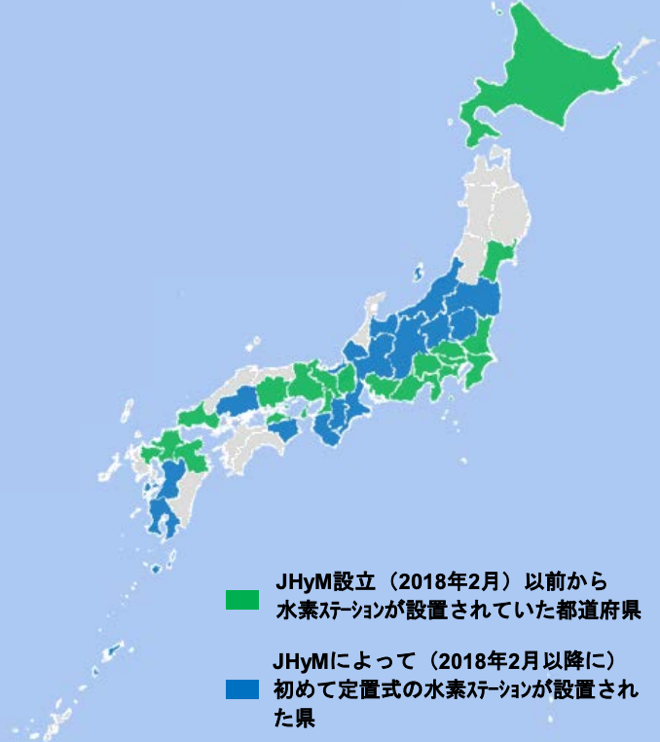
Source: JHyM
LEGEND
Green: hydrogen stations added before Feb 2018
Blue: stations added since Feb 2018
Grey: no infrastructure
EVS
The infrastructure story repeats itself for electric charging points, which number about 30,000 in Japan, or about 10 locations for every EV in the country, according to official data. The number of fast chargers, however, is only at about 6,500.
The industry is particularly vulnerable because current first-generation EV fast-chargers have a short life span of just 8 years, and many of Japan’s facilities will need replacing or upgrading in the 2022 to 2024 period, according a report delivered to the government panel by e-Mobility Power.
That’s despite the fact that most of the current EV infrastructure has low utilization rates. The run rates range from 1% to 9%, with the higher percentage for those installed in car dealerships, according to Nomura Research Institute data cited by e-Mobility.
What’s more, most of the current charging infrastructure is in cities but in not-easy-to-access locations. The coverage area has lots of “blind” spots, also concentrated in the north and southern parts of Japan, where there are no fast chargers within a 10 km2 area.
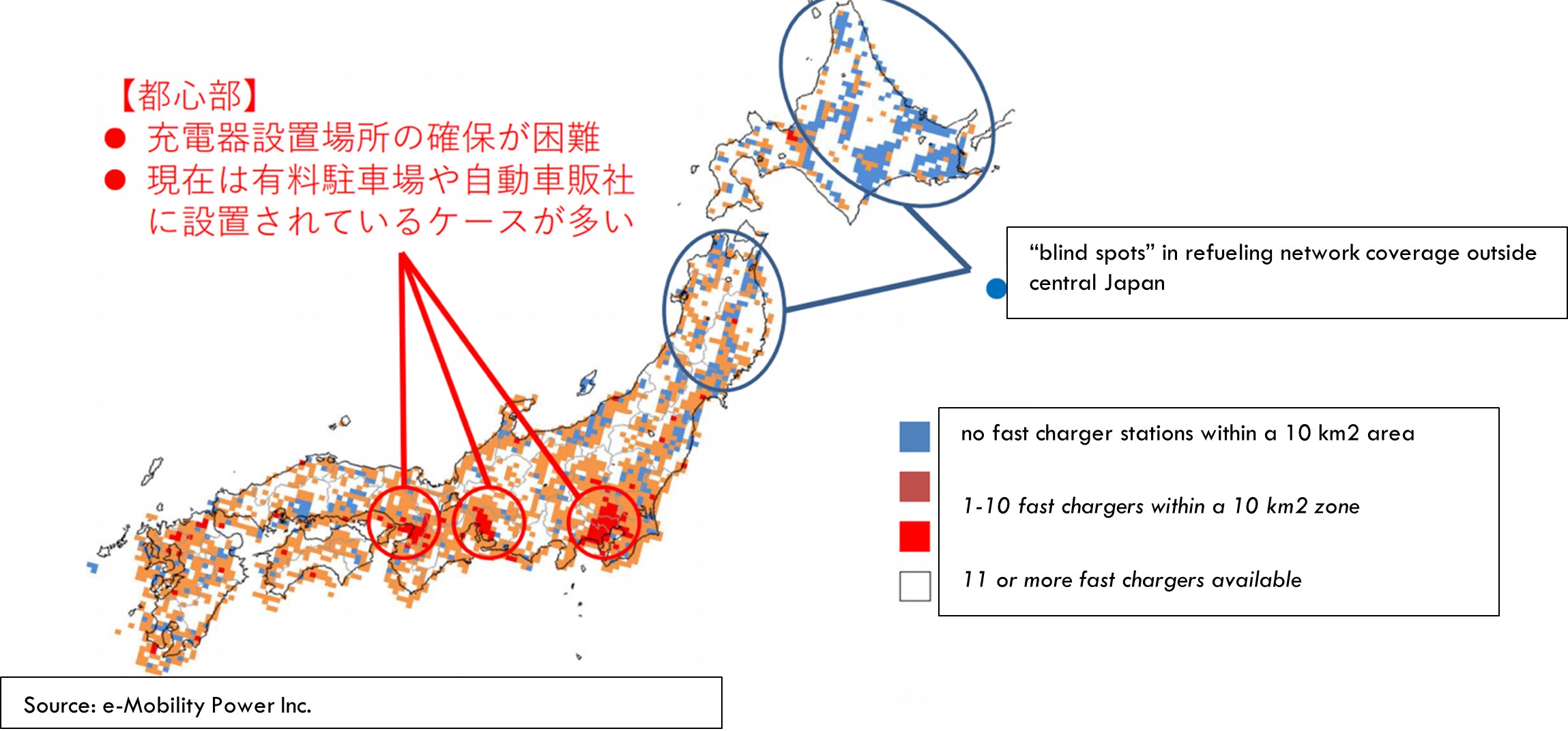
Part of the slow rollout for EV chargers is the facilities’ low profitability. Even at higher run rates, EV charger margins are thin and long lines start to form as soon as run rates reach 20% or more. There’s also a lack of available space for charging in parking areas.
For the EV charging market in Japan to become sustainable and independent of government support, around 1 million to 1.5 million charging points need to be operating, according to e-Mobility Power estimates.
Strategies for growth
Initial carbon-neutral mobility panel findings called for the government to except non-gasoline engine vehicles from highway tolls, for them to have priority in public parking, and to introduce additional subsidies for their purchase and refueling.
One other interesting driver for Japan’s switch to EVs and FCVs will come from regional governments. In addition to buying CO2-free vehicles for their own fleet, officials from Nagano prefecture said they are planning tourism campaigns focused on EV and FCV drivers with offerings such as special and restricted parking spaces, preferential access to certain nature areas and other benefits.
Nagano also plans to add more EV and hydrogen service stations.
While seemingly a small perk, giving EV and FCV travelers greater and better access to popular domestic resorts and parks could play a notable role in Japanese sales of the vehicles. Such incentives would promote EVs and FCVs as more than a one-for-one replacement for gasoline vehicles, and add to existing subsidies.
Whether the government will be able to promote the wider use of both EVs and FCVs, however, remains in doubt, given limits on infrastructure investments and subsidies. One way to judge which technology will win out, then, may be to look at the purchasing plan of Nagano prefectural government. As it switches the regional fleet to non-polluting autos, its spending plan reads: 25 EVs; 2 FCVs.
ANALYSIS
BY YURIY HUMBER
Based on materials in the
Shin Energy Shimpo
Japan’s Wind Capacity Growth Set a Record Last Year
Wind power capacity in Japan rose to 4,372 MW at the end of 2020, after a record 449 MW was added during the year. The country had 2,531 wind turbines as of Dec. 31, 2020, which is 141 units more than the previous year after 19 new wind power stations came online, according to preliminary figures released by the Japan Wind Power Association (JWPA).
Annual Wind Power Capacity Additions, Japan
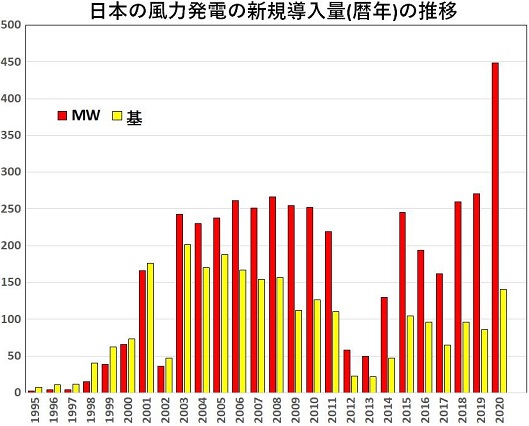
Source: Japan Wind Power Association (JWPA) via Shin Energy Shimpo
Eight years have passed since the enactment of environmental assessment legislation in October 2012, and several large-scale projects have started operations. In April, Japan’s largest wind farm the Tsugaru Wind Power Station (121.6MW) was brought online by Green Power Investment in Aomori prefecture. The following month, in Akita prefecture, Wenty Japan, Mitsubishi Corporation Power, and Seatech starting operating the Akita Katagami Wind Farm (65.99MW).
Other notable additions are the Setana Osato Wind Farm (50 MW) in Hokkaido, the Nikaho No. 2 Wind Farm (41.4 MW) in Akita, and the Kuzumaki No. 1 Nikaho power plant (44.6MW) also in Akita.
In terms of installation volume by prefecture, Akita ranked first with 646 MW; Aomori ranked second with 624 MW; and Hokkaido ranked third with 507 MW. By region, Tohoku has 1,561 MW, which is about three times that of other areas, followed by the island of Kyushu with 530 MW, and the island of Hokkaido with 507 MW.
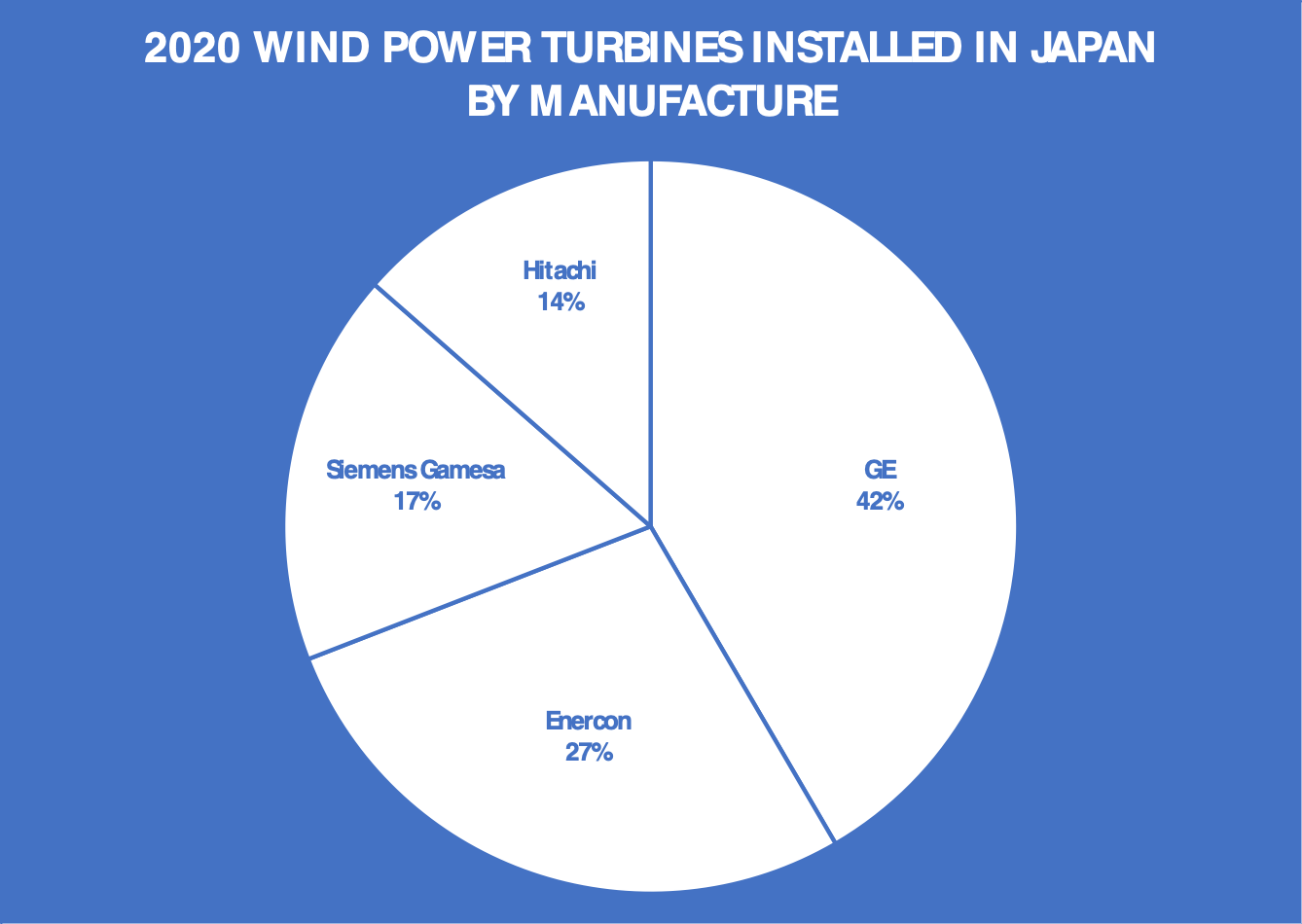
GE was the most widely used maker of wind turbines installed last year, and its turbines accounted for 201.47 MW of the installed volume, which is 42% of the total. Germany’s Enercon was second with 133.22 MW (27%), and Siemens Gamesa Renewable Energy was in third with 84 MW (17%). Hitachi, the only Japanese producer, was in fourth place with 65.599 MW (14%).
Offshore capacity lagging behind
In terms of offshore wind power installations, at the end of 2020 Japan had a total of 58.6 MW in capacity spread across 28 units in seven power stations. This total includes “semi-offshore” wind power, which can be accessed from the coast.

If we count only pure offshore facilities, as in those with a berthing distance of two km or more, the capacity total shrinks to 14.4 MW from five units at four power plants. Of these, 12 MW (four units at three power projects) are floating offshore wind facilities: the 2 MW project off the coast of Goto City, Nagasaki Prefecture; the 3 MW unit near Kitakyushu City, Fukuoka Prefecture and two units (2MW and 5MW) near Fukushima City, Fukushima Prefecture. The Fukushima units have since been marked for decommissioning.
The remaining 2.4 MW of offshore capacity is from a single bottom-fixed turbine unit, such as those commonly used in Europe, stationed near Choshi, Chiba prefecture.
New projects are also starting in port and bay areas. Construction has begun on a project at Akita Port (55 MW) and at Noshiro Port (88 MW), both in Akita prefecture and both slated for commissioning in 2022.
For true offshore in the open, bidding has opened for four sites (1.5-1.8 GW in total):
– Goto City, Nagasaki prefecture (floating type);
– Choshi City, Chiba prefecture;
– Yurihonjo, Akita prefecture (north and south),
– Noshiro Mitane Oga, Akita prefecture.
Winners of the four areas will be decided in 2021.
ANALYSIS
Japan’s Nuclear Industry 10 Years After Fukushima Accident: Status Report
The last 12 months: worst drop-off in capacity in years.
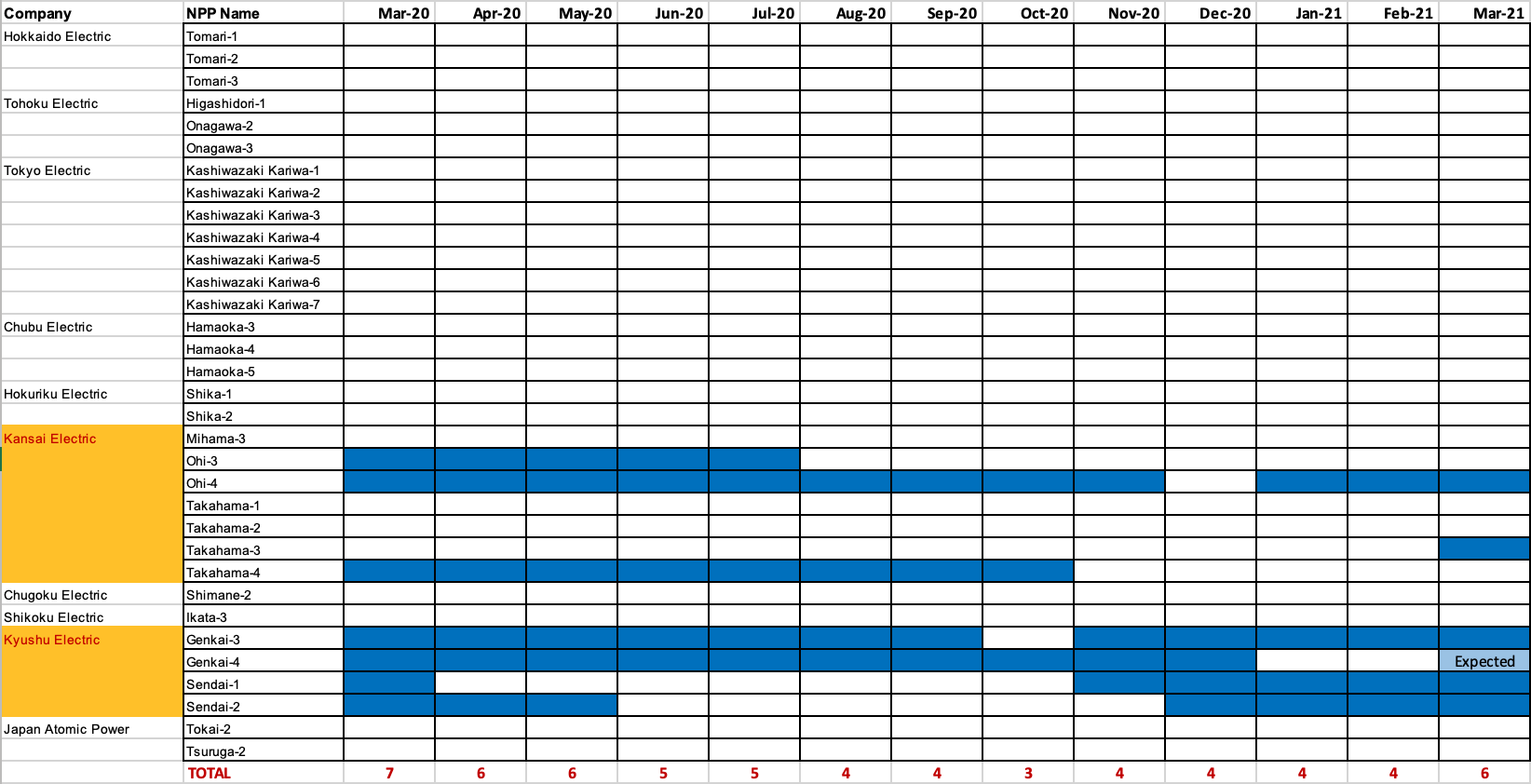
Restart momentum from 2014 to 2015 is lost.
-
- Less than 1/3 of reactors that applied have been able to restart operations so far
- Less than half of those that did restart are in operation as of today
- No reactors have been restarted in more than 2.5 years
Regulatory process stuck?
-
- Only one restart approval made by the Nuclear Regulatory Authority (NRA) in the last three years
- Some of the NRA reviews are coming up to their ninth year
- Lack of time limit for decision-making directly hurts the business case for restarts since the additional time translates into additional cost
- Several of the reviews are locked in seemingly subjective consideration around whether a reactor sits on an active fault
Issues arise as time passes.
-
- The average age of the Japanese nuclear fleet has increased. It was at ~24 years in 2011 and stands at ~29 years today.
- Older reactors require more maintenance, which translates into higher costs
- Problems with recruiting young staff add to the aging workforce
- Traditional nuclear suppliers turning business to focus on other energy sources (ammonia, hydrogen, offshore wind, etc.)
Will nuclear play a role in the 2050 net-zero emissions goal?
-
- Without new construction, nuclear’s role will be limited. Even if all the current reactors win a 20-year license extension, allowing them to run to 60 years, only 15 will be eligible to operate at the end of 2050.
- Without the 20-year extension, Japan will have zero reactors operable by 2050.
- There are three mid-construction projects in Japan. One of these is owned by TEPCO, which makes it an even higher-risk project in terms of realization.
- Japan’s new energy strategy outlined at the end of last year lumps nuclear with thermal energy, the first such categorization of the two and an unusual step. Some industry experts suspect that it indicates the government is not committed to nuclear power over the longer term.
Recent green shoots of recovery.
-
- Kansai Electric seems to have made progress in winning support from the local govt. in Fukui prefecture to restart its nuclear assets (which are all in that prefecture). Evidence to this is this month’s unexpected restart of Takahama Unit 3 and the utility’s announcement that Unit 4 will go online in April.
- METI minister Kajiyama seemingly played a major part in resolving the gridlock between Kansai Electric and Fukui govt. This shows a more proactive stance from the govt. than was visible in the last few years.
- Kansai Electric could see all seven of its reactors restart this year, should the govt support continues.
- Hokkaido Electric has indicated that its long-running debate with the NRA over whether its Tomari NPP lies on an active fault may be edging to a favorable resolution. That could “unlock” 3 more reactor restarts.
- Tohoku Electric has won final local approvals to restart Unit 2 of Onagawa NPP. Actual operations won’t restart until FY2022 due to ongoing work on additional safety measures. The approval should encourage Tohoku to apply to restart Unit 3 of the same NPP.
- January’s electricity price spike reinforced a concern among many in the govt. and business circles that renewable energy needs a “sparring partner”.
Forecast for 2030:
-
- We expect nuclear power’s ratio to drop in the revised 2030 energy mix due to be published this summer. The stated drop is unlikely to be drastic as the govt. will not want to show that it is abandoning nuclear power. Still, we see the ratio dropping at least three to five percentage points from the current 20% to 22% band.
- Japan may move towards some form of consolidation in the nuclear industry. In part, this will be to phase out the TEPCO brand and allow a new entity to take over Kashiwazaki Kariwa NPP and complete the construction of Higashidori NPP.
- We expect some funding to go toward SMR program and possibly other nuclear tech programs to retain Japanese capabilities and to provide options for the hydrogen-society supply chain.
GLOBAL VIEW
BY TOM O’SULLIVAN
Below are some of last week’s most important international energy developments monitored by the Japan NRG team because of their potential to impact energy supply and demand, as well as prices. We see the following as relevant to Japanese and international energy investors.
Coal:
China failed to announce any specific plans to reduce or impose moratoriums on coal-fired power plants in the NPC meetings last week, disappointing many analysts.
However, China has told Bangladesh that it will no longer fund coal mining or coal-fired power stations through its Belt and Road platform.
Bangladesh, Philippines, Vietnam and Indonesia cut 62 GW of newly planned coal projects in 2020. Now, India also cut planned new coal projects (from 240 GW in 2015 to 30 GW).
Some analysts are calling for coal assets to be stripped out into separate legal entities or alternatively establish a ‘bad bank’ to take over coal assets.
HSBC announced that it would overhaul its coal financing activities and set targets for reduction of exposure to carbon intensive assets. AXA, the French insurer, will no longer provide insurance cover to Germany’s RWE because of its coal investments.
Batteries:
Tesla is expected to construct a 100 MW energy storage plant near Houston as part of an expansion plan into residential energy technology.
Tesla & China:
Tesla may be conducting much of its EV tech development in China, according to the Eurasia Group. The Shanghai factory is based on advanced robotics and automation processes developed in the U.S., and uses a lot of Kuka robots, a German maker bought by China’s Midea. On advanced battery technology, Tesla is partnering with Chinese EV battery leader CATL. Tesla may be relying on Chinese government support and preferential loans, with Tesla benefiting from “made in China 2025” and other industrial policies. As Musk has close ties to the U.S. military sector via SpaceX, his investments in China may get much closer attention from the new U.S. govt.
Shipping:
Hapag-Lloyd, the German shipper, placed an order for six new container ships that can carry up to 23,000 containers each to meet demand for Europe-China trade.
Aviation:
GE will sell GE Capital Aviation Services (GECAS), its aircraft leasing business (1,600 aircraft), to Ireland’s AerCap for $30 billion. The combined leasing company will own over 2,000 aircraft, or 7% of the global fleet, and will have almost 20% of the jet leasing market, making it industry leader. GE is expected to use the $24 billion in cash proceeds to pay off debt. The sale effectively terminates GE Capital.
Climate Change:
1). China and the U.S. agreed to co-chair a G-20 group of study groups focused on climate-related financial risks.
2). The UN criticized global pandemic recovery plans for only allocating 18% to green investments when emissions need to fall by 7% annually by 2030.
ESG:
The EU introduced new rules covering sustainable finance disclosure regulations (SFDR) last week that are meant to avoid “greenwashing” by the asset management industry. The new rules will apply to all asset managers who raise funds in the EU.
China:
1). For the first time since the 1989 Tiananmen Square incident, the EU will impose sanctions later this month against four Chinese individuals and one entity concerning human rights abuses in Xinjiang.
2). CNOOC, China’s largest offshore oil producer, was delisted in New York.
South Korea:
LG Energy Solution will invest $4.5 billion in U.S. battery production by 2025, creating over 10,000 jobs in the U.S.
Hong Kong:
China Evergrande, the Chinese property company, is diversifying into EVs through a listed HK subsidiary, Evergrande New Energy Vehicle, that now has a market capitalization of $63 billion.
Three other US-listed Chinese EV companies are thought to be planning HK IPOs, Li Auto, Nio, and Xpeng, which could collectively raise $5 billion.
Malaysia:
AirAsia Group, the Malaysian LCC, will launch a four-seater air taxi service and a drone delivery service as part of a diversification strategy.
Singapore:
Singapore plans to increase investments in solar power four-fold by 2025 and a further 50% by 2030 as it seeks to green its electricity mix. Emphasis is being placed on floating solar farms.
India:
Shipping Corp. of India, the country’s largest shipper, has been put up for sale by the government. Vedanta, an oil and gas producer, is one of the bidders.
Myanmar:
France’s Total, Thailand’s PTT and Chevron are being urged to halt royalty payments for the Yadana offshore gas field to Myanmar Oil and Gas Enterprise following U.N. accusations of “crimes against humanity” by the junta. The U.S. is offering 1,600 Myanmar citizens in the U.S. ‘protected status’. One Japanese business was burned down last week for failing to comply with the nation-wide strikes while a major Japanese firm has ceased all operations in the country.
Australia:
Former Australian prime minister, Malcolm Turnbull, is advocating for further significant investments in pumped hydro storage while the infrastructure for green hydrogen is built out.
Russia:
Russian foreign minister Sergey Lavrov will discuss regional conflicts, energy and investment cooperation during a Gulf tour later this month. He will visit the UAE, Saudi Arabia and Qatar to discuss regional issues, such as Iran, after the Gulf reconciliation and the expansion of economic ties through more investments and further coordination of oil production within the OPEC+ group.
Israel:
1). The U.S. government reimposed sanctions on Dan Gertler, the Israeli mining magnate, for corruption committed in the Democratic Republic of Congo. Gertler was a close associate of Joseph Kabila, the former Congolese president.
2). The Israeli prime minister was unable to complete his first trip to the UAE this week due to restrictions in Jordanian and Saudi air space that prevented his travel. A general election will be held in Israel on Mar. 23.
Iran:
1). Iranian oil exports to China are now thought to have averaged over 300,000 barrels a day over the last 14 months, with a significant increase in Q4 2020.
2). An Iranian container ship, owned by the state-run shipping company, was damaged in an attack in the Mediterranean on Wednesday. Iran will take legal action to identify the perpetrators of what it called “terrorism” and naval piracy. The Shahre Kord vessel was slightly damaged in the incident by an explosive object that caused a small fire but there were no injuries.
Saudi Arabia:
1). The EV start-up, Lucid Motors, will build an assembly plant in Saudi Arabia. It’s backed by the country’s sovereign wealth fund, the PIF, to the tune of $1 billion.
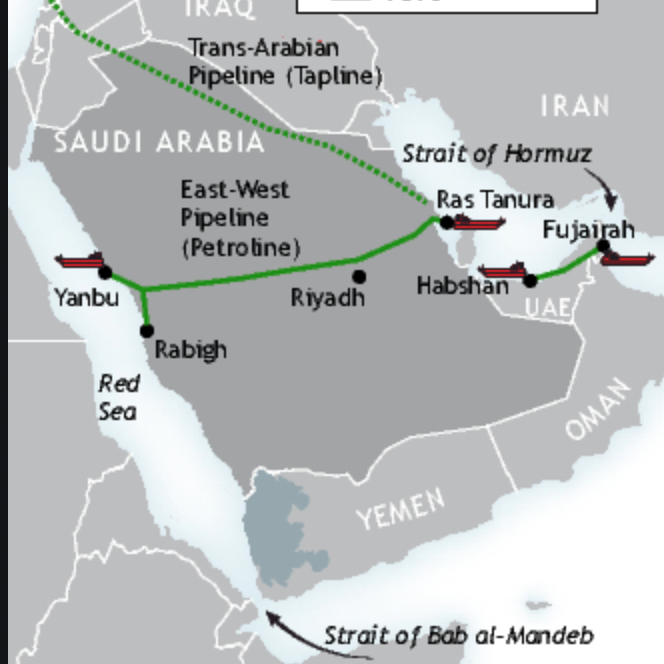
2). The Ras Tanura oil export terminal was attacked last Sunday by missiles and drones launched by the Houthis. There were no injuries or loss of life.
Mozambique:
Mozambique’s President Filipe Nyusi has fired the head of the army and the air force amid a brutal Islamist insurgency in the Cabo Delgado province that may impact the Mozambique LNG project led by France’s Total and partially financed by Japan.
Greece:
Public Power Corporation, the state utility, raised E650 million through a sustainability-linked junk bond sale, the first of its kind, with a coupon slightly less than 4%.
Sweden:
The Swedish battery company, Northvolt, will acquire the U.S. battery start-up Cuberg, which has focused mainly on storage for the aviation industry until now.
Germany:
Saudi Arabia has signed an MOU with Germany for the production of hydrogen.
United Kingdom:
1). Cairn Energy, the UK oil and gas group, reported a loss of almost $70 million for FY2020 and will acquire Royal Dutch Shell’s Egyptian Western Desert assets for almost $650 million with Chevron.
2). Royal Dutch Shell appointed Sir Andrew Mackenzie, the former CEO of BHP, as chairman to oversee a strategy to reduce its dependence on oil.
3). The UK will announce the establishment of a new infrastructure bank later this month.
Canada:
Canada has issued new carbon credit trading regulations that are expected to create opportunities for farmers, foresters, the waste industry, and indigenous communities to earn revenues from projects that cut GHG emissions. Canada aims to cut emissions by 30% vs. 2005 levels and plans to be net-zero by 2050.
U.S.:
1). Chevron will increase investments in clean energy to $3 billion by 2028 while flat-lining its oil and gas investments. CAPEX on new oil and gas projects will be limited to between $14 billion and $16 billion a year, a decrease of almost 50%.
2). The U.S. Interior Department has cleared the construction of the 62-turbine Vineyard Wind project off Martha’s Vineyard in Massachusetts. The project will have a generation capacity of 800 MW and will cost $3 billion. Copenhagen Infrastructure Partners and Iberdrola are the developers.
3). Several energy companies in Texas including Vistra Energy, NRG, and Exelon continue to suffer valuation drops following the Texas freeze. Just Energy, a retailer, has also issued a ‘going concern ‘warning.
4). Following the successful passage of the U.S. stimulus bill through both houses of Congress last week, all eyes are now on a potential $4 trillion infrastructure package that may have a significant impact on the energy complex.
5). Piedmont Lithium Ltd, a North Carolina lithium miner, is expected to launch the first new lithium mine in the U.S. in decades. Lithium prices have surged by over 100% since last summer to $13,000 per ton.
6). Hawaii declared a state of emergency last week following heavy rains that could have caused dam failures in Maui`1`.
7). The U.S. Senate confirmed Michael Regan as administrator of the Environmental Protection Agency last week.
8). John Kerry visited London, Brussels, and Frankfurt in his first overseas trip as U.S. Special Presidential Envoy for Climate.
Argentina:
President Alberto Fernandez was attacked by mining opponents on Saturday as he visited the Patagonia region. The government had planned to resume open-pit mining for uranium in the region.
EVENTS CALENDAR
A selection of domestic and international events we believe will have an impact on Japanese energy.
| February | Approval of Fiscal 2021 Budget by Japanese parliament including energy funding projects;CMC LNG Conference |
| March | 10th Anniversary of Fukushima Nuclear Accident;Smart Energy Week – Tokyo;
Quarterly OPEC Meeting; Japan LPG Annual Conference; Full completion of all aspects of the multi-year deregulation of Japan’s electricity market; End of 2020/21 Fiscal Year in Japan; |
| April | Japan Atomic Industrial Forum – Annual Nuclear Power Conference;38th ASEAN Annual Conference-Brunei;
Japan LNG & Gas Virtual Summit (DMG)-Tokyo Three crucial by-elections in Hokkaido, Nagano & Hiroshima – April 25th |
| May | Bids close in first tender for commercial offshore wind projects in Japan;Prime Minister Suga to visit the U.S.-tentative |
| June | Release of New Japan National Basic Energy Plan-2021;G7 Meeting – U.K.
Forum for China-Africa Cooperation Summit (Senegal) |
| July | Tokyo Metropolitan Govt. Assembly Elections;Commencement of 2020 Tokyo Olympics |
| August | Hydrogen Ministerial Conference in conjunction with IEA World Economic Forum in Singapore – Deferred from May |
| September | Ruling LDP Presidential Election;UN General Assembly Annual Meeting that is expected to address energy/climate challenges;
IMF/World Bank Annual Meetings (multilateral and central banks expected to take further action on emissions disclosures and lending to fossil fuel projects); End of H1 FY2021 Fiscal Year in Japan; Japan-Russia: Eastern Economic Forum (Vladivostok)-tentative |
| October | Last possible month for holding Japan’s 2021 General Election;METI Sponsored LNG Producer/Consumer Conference;
Innovation for Cool Earth Forum – Tokyo Conference; Task Force on Climate-Related Financial Disclosure (TCFD) – Tokyo Conference; G20 Meeting-Italy |
| November | COP26 (Glasgow);Asian Development Bank (‘ADB’) Annual Conference;
Japan-Canada Energy Forum; East Asia Summit (EAS) – Brunei |
| December | Asia Pacific Economic Cooperation (APEC) Forum – New Zealand;Final details expected from METI on proposed unbundling of natural gas pipeline network scheduled for 2022. |
DATA
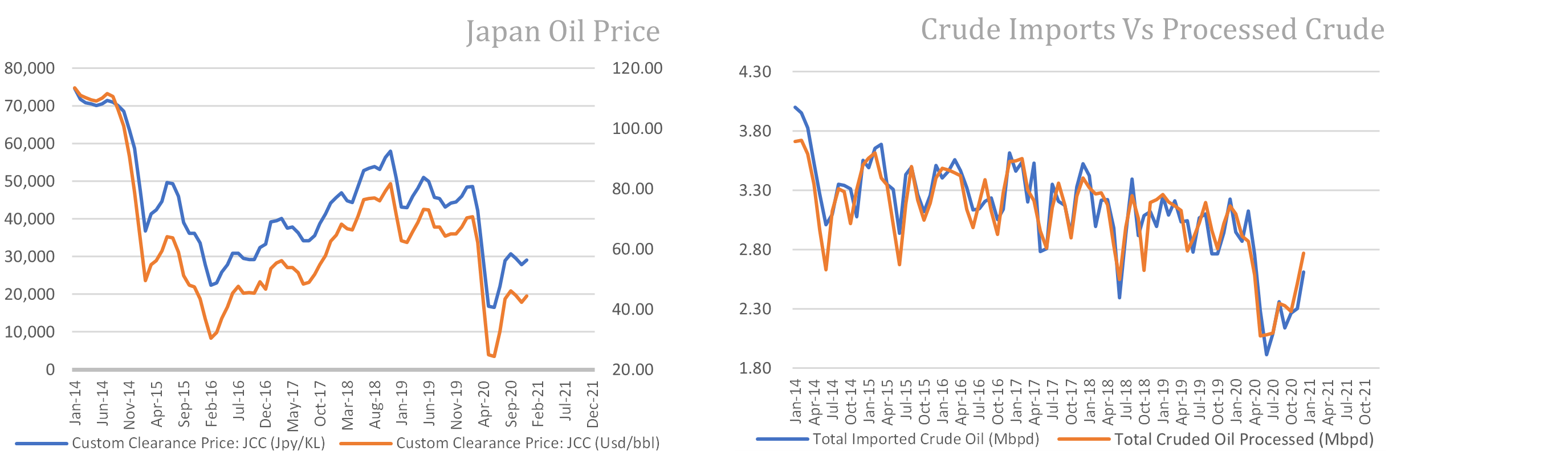
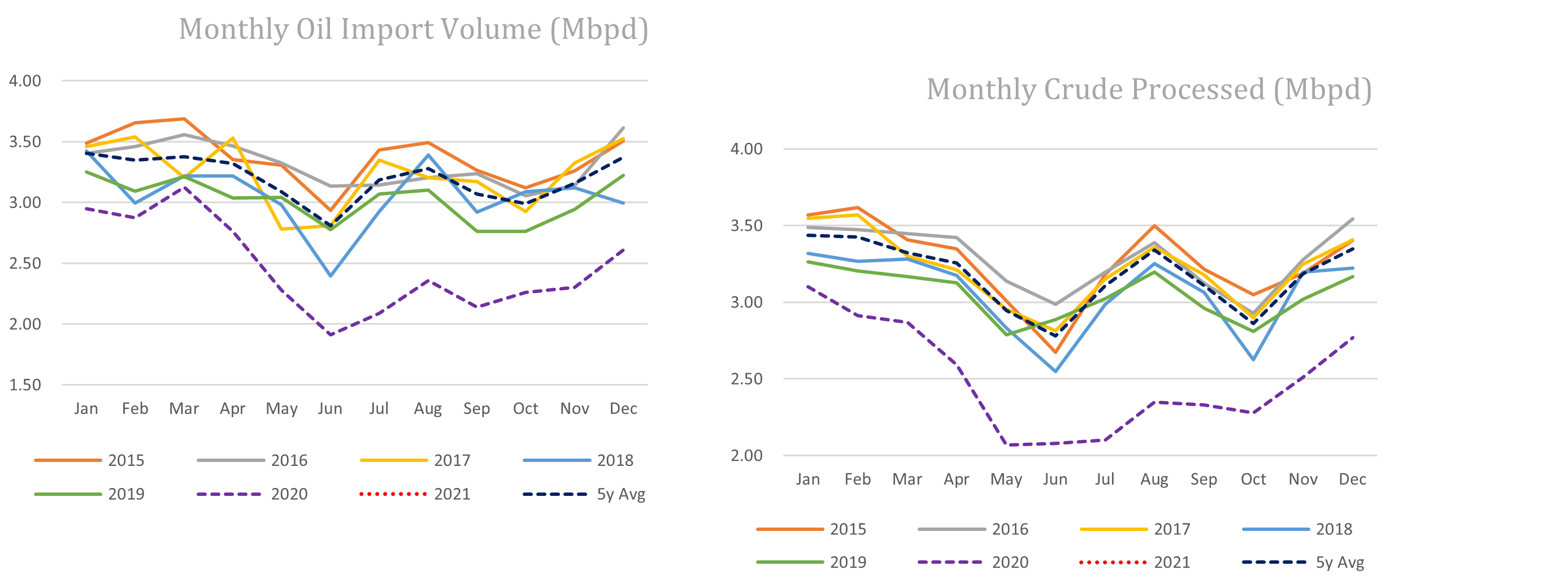
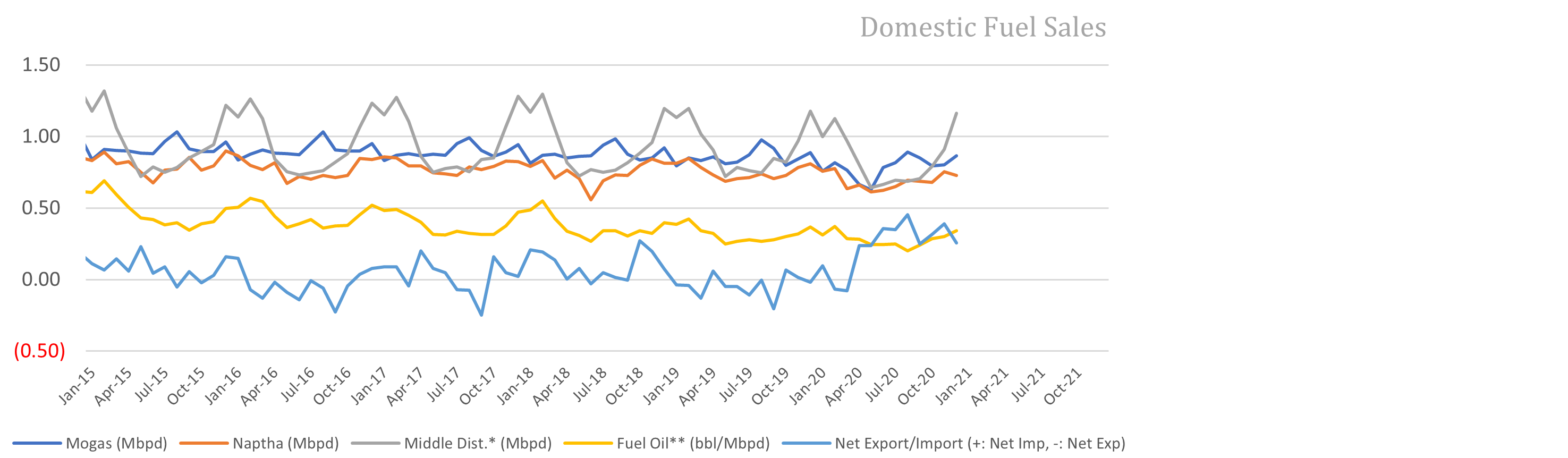
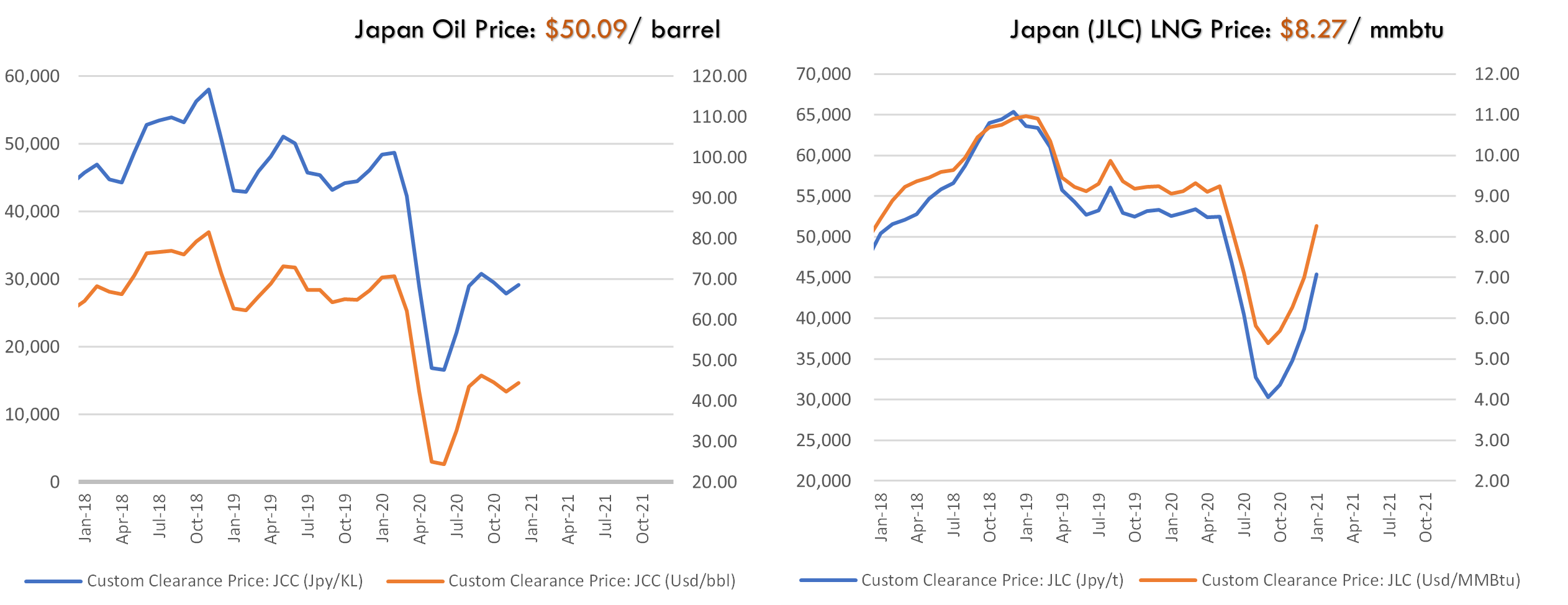
SOURCES: Ministry of Economy, Trade, and Industry (METI), Ministry of Finance, and the Petroleum Association of Japan
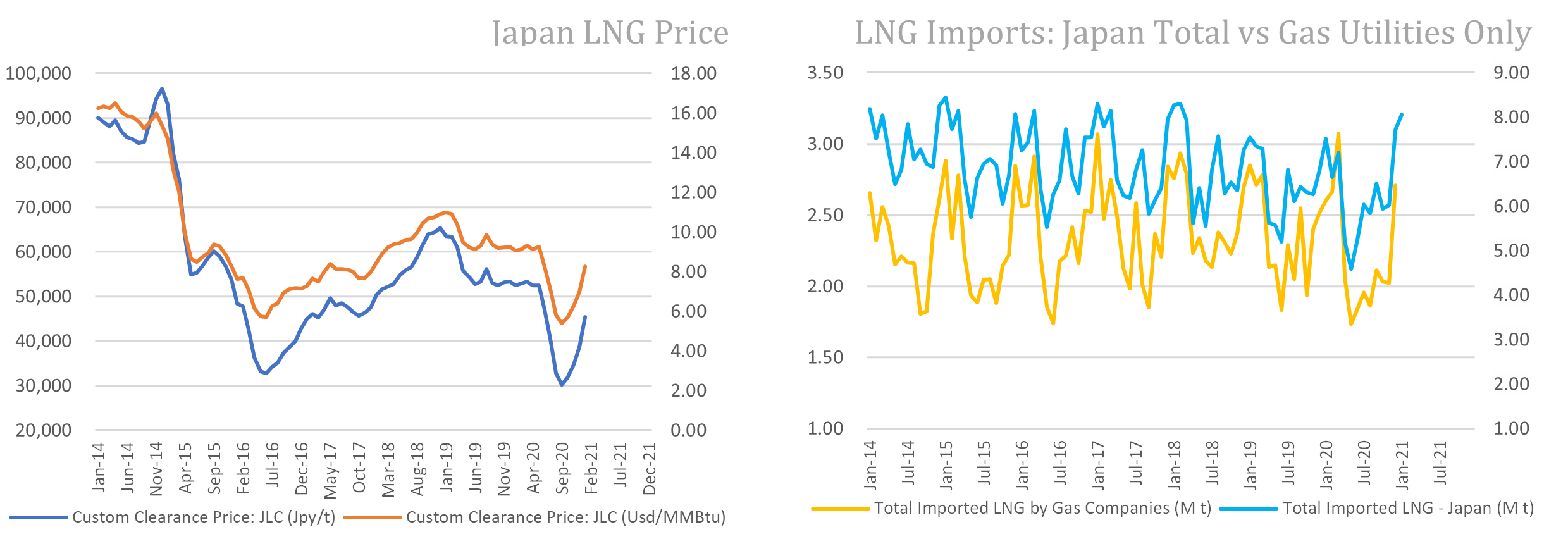
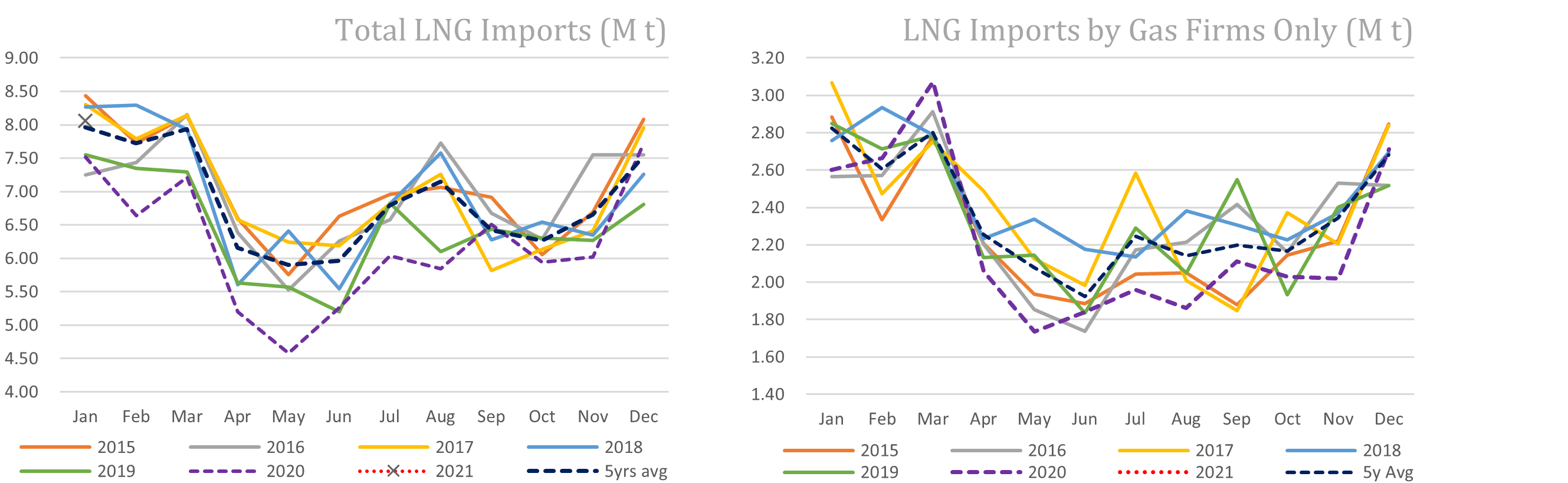
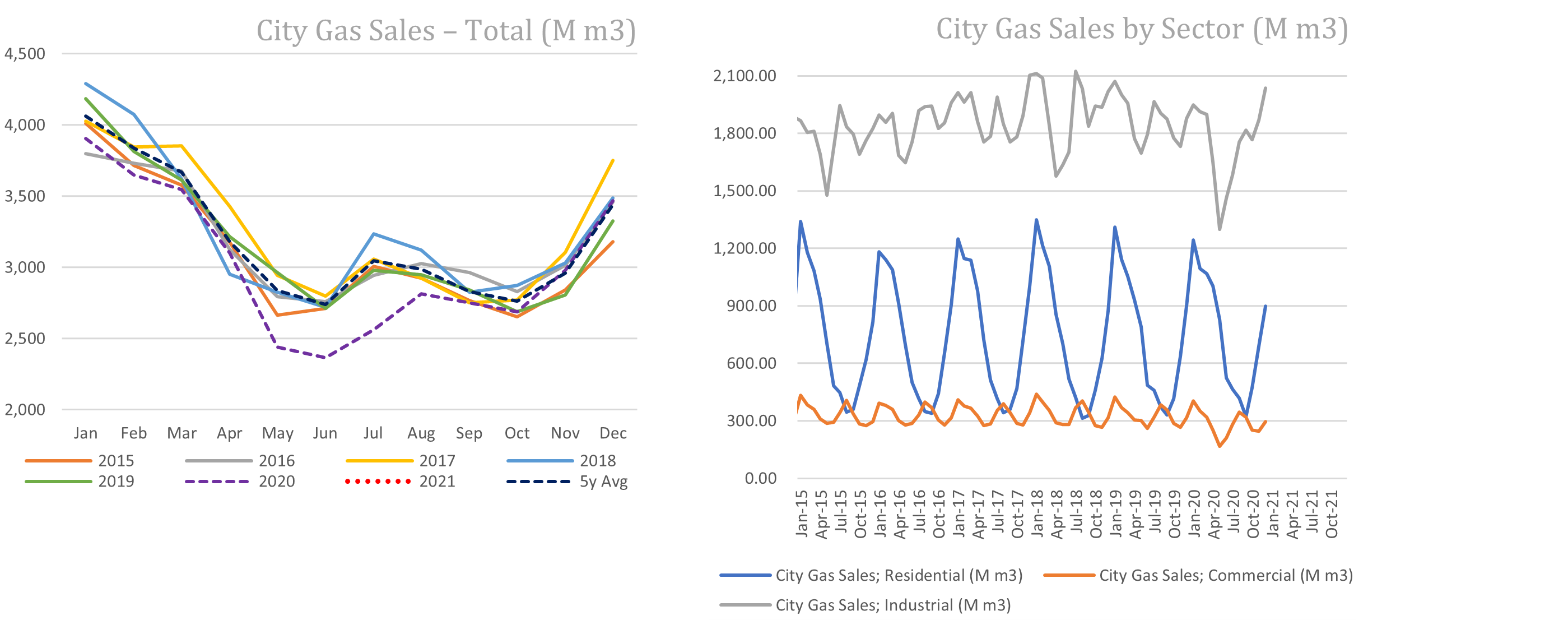
SOURCES: Ministry of Economy, Trade, and Industry (METI),
Ministry of Finance
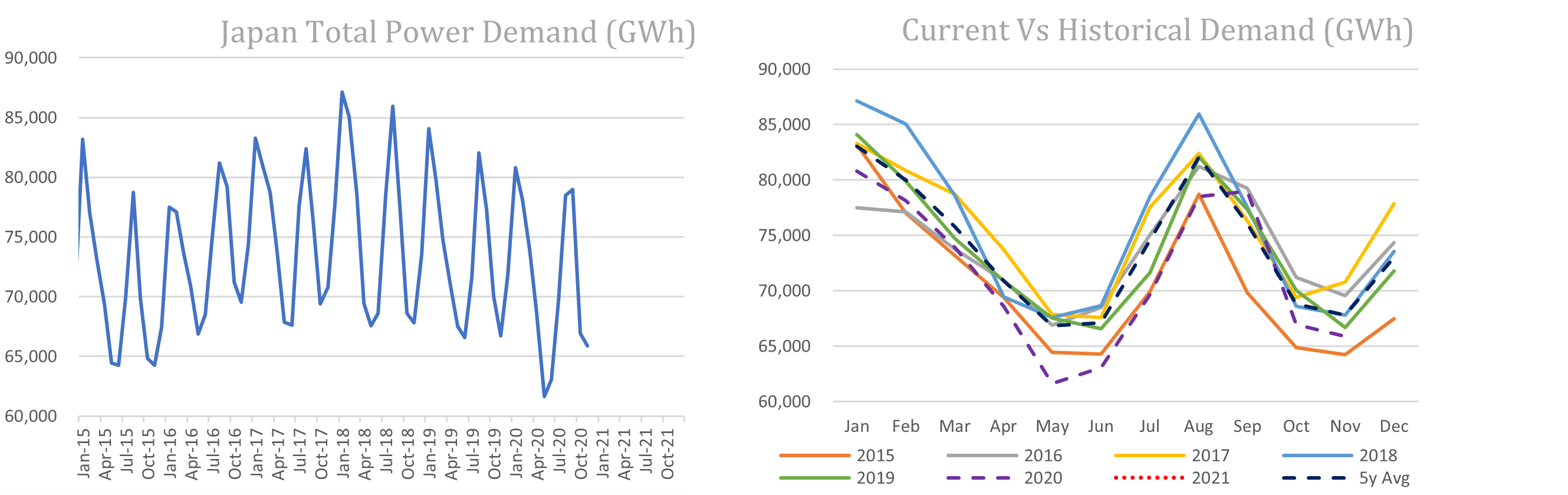
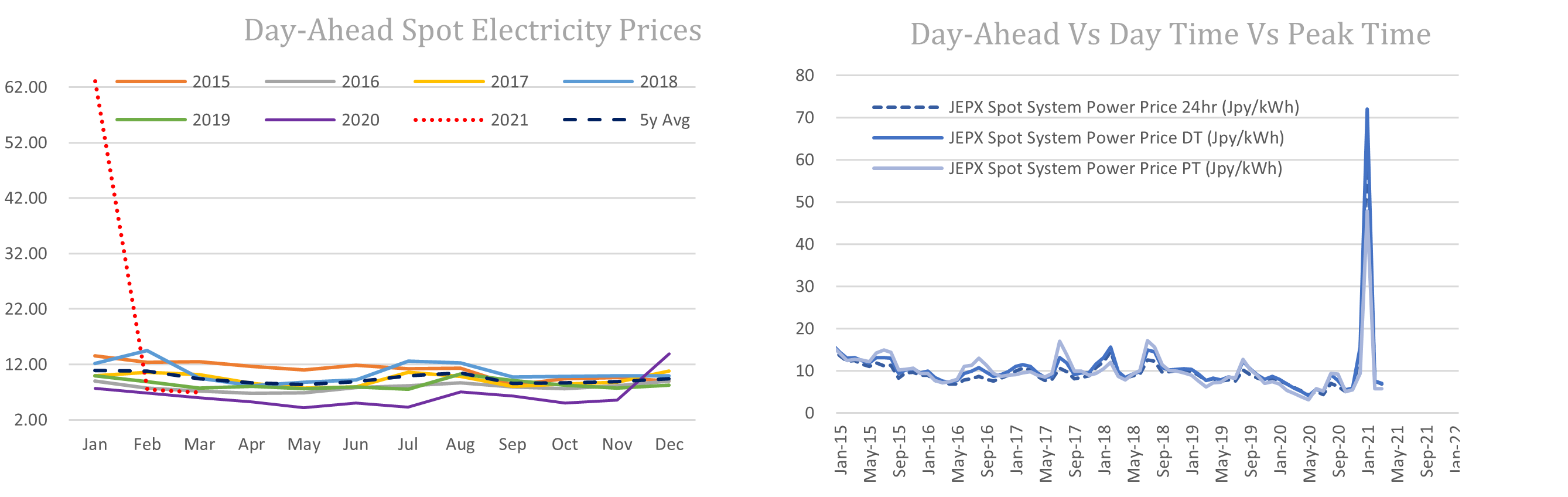
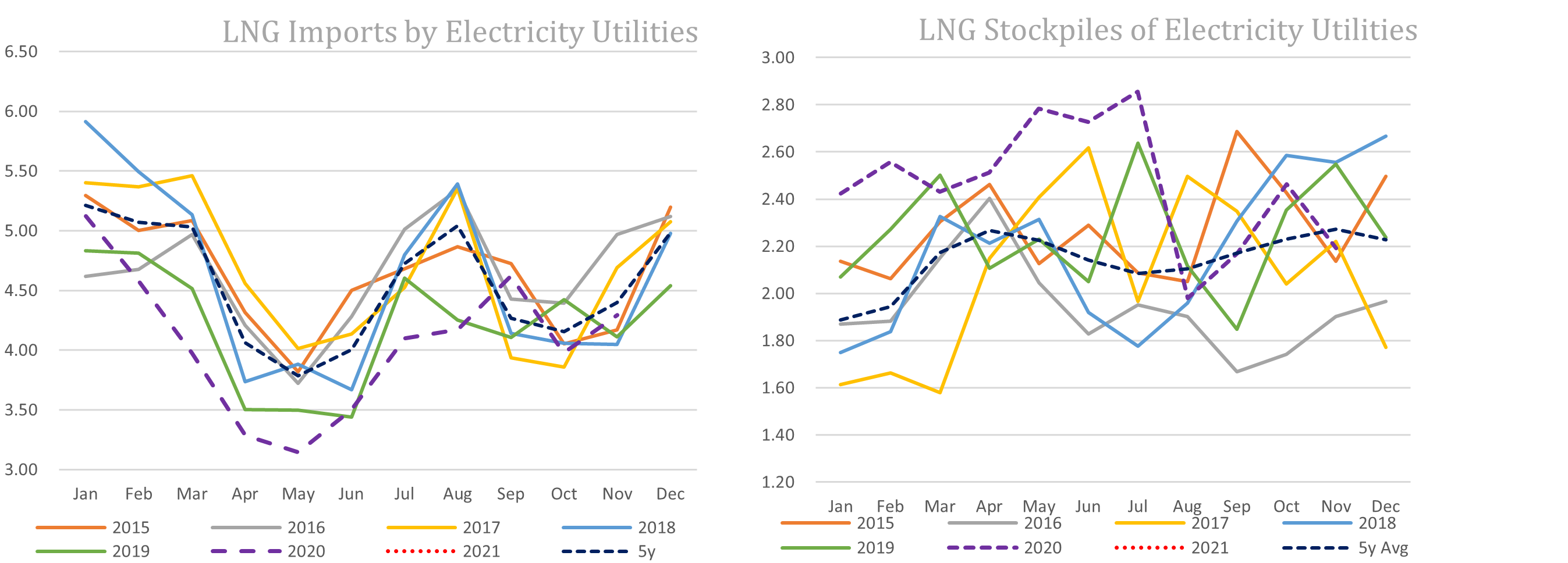
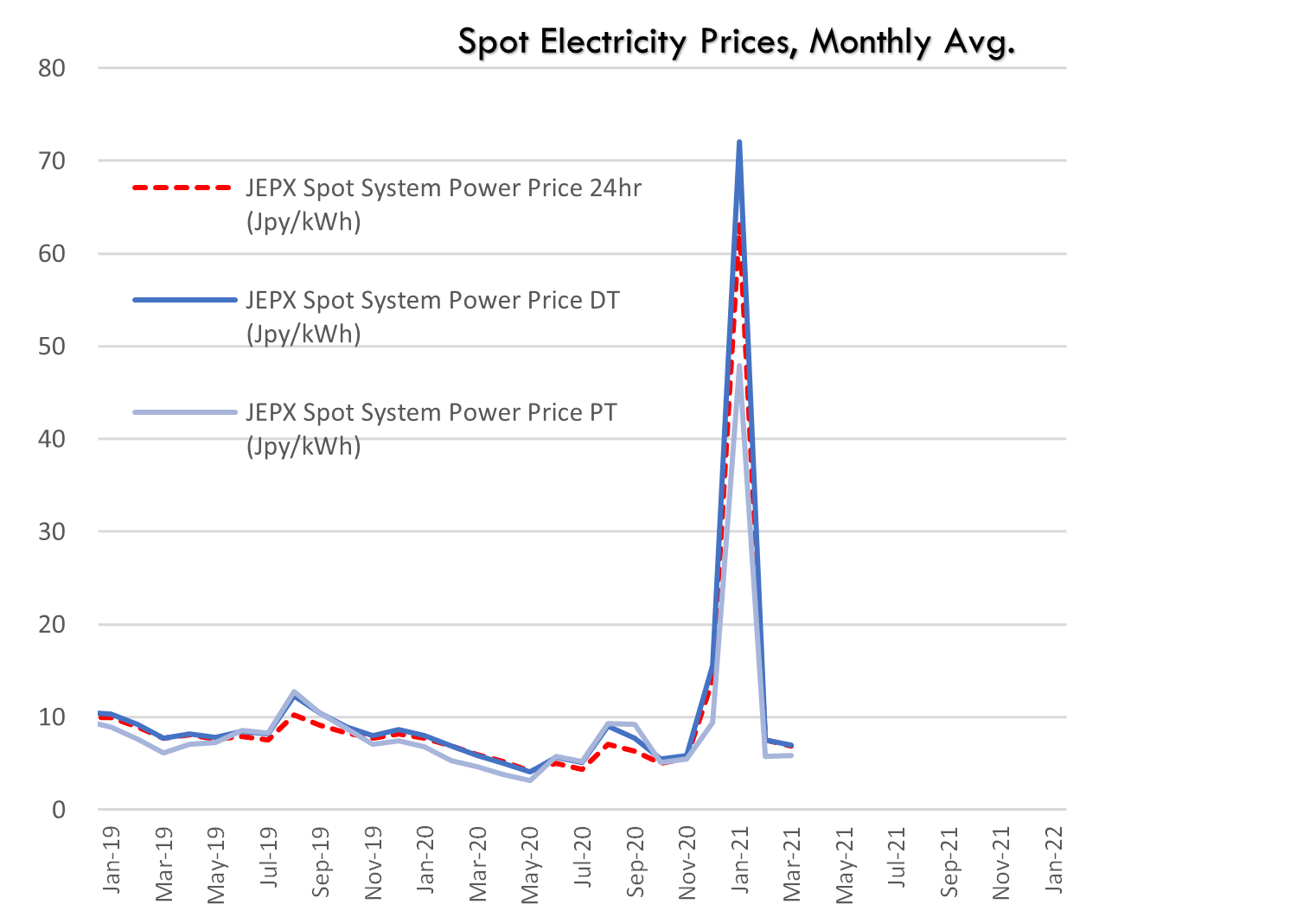
SOURCES: Ministry of Economy, Trade, and Industry (METI), and the Japan Electric Power Exchange
Disclaimer
This communication has been prepared for information purposes only, is confidential and may be legally privileged. This is a subscription-only service and is directed at those who have expressly asked K.K. Yuri Group or one of its representatives to be added to the mailing list. This document may not be onwardly circulated or reproduced without prior written consent from Yuri Group, which retains all copyright to the content of this report.
Yuri Group is not registered as an investment advisor in any jurisdiction. Our research and all the content express our opinions, which are generally based on available public information, field studies and own analysis. Content is limited to general comment upon general political, economic and market issues, asset classes and types of investments. The report and all of its content does not constitute a recommendation or solicitation to buy, sell, subscribe for or underwrite any product or physical commodity, or a financial instrument.
The information contained in this report is obtained from sources believed to be reliable and in good faith. No representation or warranty is made that it is accurate or complete. Opinions and views expressed are subject to change without notice, as are prices and availability, which are indicative only. There is no obligation to notify recipients of any changes to this data or to do so in the future. No responsibility is accepted for the use of or reliance on the information provided. In no circumstances will Yuri Group be liable for any indirect or direct loss, or consequential loss or damages arising from the use of, any inability to use, or any inaccuracy in the information.
K.K. Yuri Group: Oonoya Building 8F, Yotsuya 1-18, Shinjuku-ku, Tokyo, Japan, 160-0004.