
JAPAN NRG WEEKLY
MARCH 29, 2021
JAPAN NRG WEEKLY
March 29, 2021
NEWS
TOP
- Japan prepares for a more ambitious emissions cut target as PM Suga gets ready for his first meeting with U.S. President Biden; meanwhile, METI loosens some emissions targets for steelmakers
- Ministry deregulates use of agricultural land to help solar projects
- Government raises renewables surcharge on power bill by ~10%
ENERGY TRANSITION & POLICY
- Group of RE100 members lobby govt. to raise renewables target
- Seiko Epson to invest ~$1B in decarbonization over a decade
- Osaka Gas to add 2.5 GW of renewables by FY2023; Kansai Electric to invest ~$2.7B in renewables over next five years
- Toshiba inventions speeds up CO2 processing to help CCS tech
- Local govt. launches online tender process for renewable energy
- Japan firms to build hybrid renewable/diesel plant in Cape Verde
- ENEOS partners with Nagoya carbon offset and forestry specialist
- Toyota decides to site key fuel cell parts factory in China, a first
ELECTRICITY MARKETS
- January power price spike leads F-Power to file for bankruptcy; METI adjusts imbalance pricing to delay payments from retailers
- Chugoku Electric’s Shimane reactor edges closer to a restart
- METI publishes renewables tariffs for FY2021; solar price down
- Japan aims to have pluthermal reprocessing by end of decade
- METI asks IAEA to intervene in Fukushima radiated water issue
- Regulator bans TEPCO from refueling Kashiwazaki nuclear plant; TEPCO finds high radiation lump at Fukushima site, while water levels in one of the Dai-Ichi containment vessels continue to fall
- Survey shows 80% of public wants nuclear power phased out
- Chubu Electric vows to be carbon-neutral by 2050
OIL, GAS & MINING
- JERA CEO says will work with existing LNG partners to build ammonia and hydrogen supply chain
- ESG targets are making it harder to procure key raw materials
ANALYSIS
JAPAN BEGINGS TO EXAMINE CARBON PRICING
WITH SEVERAL OPTIONS ON THE TABLE
Pricing of carbon is expected to have a considerable impact on Japan’s energy strategy today and in the future. The task of how to do so has fallen to a newly created 10-member expert panel, that has embarked on a quick series of meetings on the issue, vowing to consider four major options – including the creation of a completely new carbon pricing mechanism in Japan. The outcome of the debates, due to be submitted to the government before the year-end, will impact the cost of business for power generators, LNG and oil importers, and domestic manufacturers, among others. Japan is racing against time to make sure it is not behind similar developments on carbon overseas.
COMBINED HEAT AND POWER (CHP) OFFERS JAPAN NEW OPPORTUNITIES FOR ENERGY SAVING
More than half of Japan’s primary energy goes to waste. As the world’s No. 5 consumer of primary energy seeks to tame its carbon emissions, turning this waste, which is mostly emitted in the form of heat from thermal power, into useful energy will play a significant role. With the wider rollout of renewable energy planned in Japan, waste heat is also seen as a key tool to help balance the power grid, as well as make it more resilient against natural disasters. It also has the potential to be a hidden kingmaker in Japan’s energy transition, bringing efficiencies to traditional sources like LNG, as well as to green power.
GLOBAL VIEW
Suez Canal crisis causes huge impact on shipping, oil, gas and other markets. China agrees to invest $400B in Iran over 25 years. RWE and EDF consider spinoff of renewables assets. Details on these stories and more in our global wrap of major energy-related developments.
2021 EVENT CALENDAR
DATA SECTION
JAPAN NRG WEEKLY
PUBLISHER
K. K. Yuri Group
Sponsored
Editorial Team
Yuriy Humber (Editor-in-Chief)
Tom O’Sullivan (Japan, Middle East, Africa)
John Varoli (Americas)
Regular Contributors
Mayumi Watanabe (Japan)
Daniel Shulman (Japan)
Takehiro Masutomo (Japan)
Art & Design
22 Graphics Inc.
SUBSCRIPTIONS & ADVERTISING
Japan NRG offers individual, corporate and academic subscription plans. Basic details are our website or write to subscriptions@japan-nrg.com
For marketing, advertising, or collaboration opportunities, contact sales@japan-nrg.com
For all other inquiries, write to info@japan-nrg.com
OFTEN USED ACRONYMS
METI The Ministry of Energy, Trade and Industry
ANRE Agency for Natural Resources and Energy
NEDO New Energy and Industrial Technology Development Organization
TEPCO Tokyo Electric Power Company
KEPCO Kansai Electric Power Company
EPCO Electric Power Company
JCC Japan Crude Cocktail
JKM Japan Korea Market, the Platt’s LNG benchmark
CCUS Carbon Capture, Utilization and Storage
mmbtu Million British Thermal Units
mb/d Million barrels per day
mtoe Million Tons of Oil Equivalent
kWh Kilowatt hours (electricity generation volume)
NEWS: ENERGY TRANSITION & POLICY
Japan to announce stricter 2030 emission cuts plan by June
(Nikkei, March 23)
- Japan will announce a more ambitious cut in emissions than the currently planned 26% reduction by 2030. The new target has yet to be set, but it should be decided before the G7 meeting in June.
- A new target is needed to help Japan meet its 2050 net-zero emissions goal.
- Prime Minister Suga hopes to brief U.S. President Biden on Japan’s 2030 goals during his upcoming trip to the U.S. in early April. The Biden administration considers climate change a major policy focus, and will host a summit on the issue with the major economies on April 22.
- CONTEXT: Most major economies are currently thinking of how much they can reduce emissions in the next decade. The EU has among the toughest goals, planning to reduce emissions by 55% between 1990 and 2030. The UK wants a 68% reduction over the same period. The U.S. and Canada are yet to announce their near-term emission cuts.
- Japan’s government originally planned to announce its new 2030 emissions goal at the UN Climate change Conference in the U.K. this November, after finalizing a new energy-mix target. METI is also wary of announcing a specific emissions figure to the international community too early, before the government could present a clear rationale for a new goal.
- However, with several key international gatherings coming up before then, “we need to consider when we announce our 2030 emissions reduction goal,” Japanese Chief Cabinet Secretary Kato told media.
- SIDE DEVELOPMENT:
METI revises energy efficiency benchmarks
(Kankyo Business Online, March 25)- The Ministry of Manufacturing, Economy, Trade and Infrastructure released a report on March 23 stating that it was revising the energy efficiency benchmarks used to rate commercial emitters.
- METI has downwardly revised the emissions target for steelmakers using arc furnaces to 0.150kl/toe (ton of oil equivalent) from 0.143kl/toe.
- Notably, the emissions target for small-scale convenience stores is now benchmarked at 308 kWh per million yen of turnover, a significant decrease from the previous 845 kWh.
- Businesses are also now able to use an online interface to file reports on their energy use.
Agriculture ministry deregulates use of wasteland for solar energy
(New Energy Business News, March 26)
- The Ministry of Agriculture, Forestry and Fisheries signaled an overhaul of legislation governing the conversion of wasteland to solar farms.
- The Ministry will do away with agricultural yield requirements on agricultural sections that are also used to generate solar electricity, and speed up the process for rezoning unproductive agricultural land.
- In the past, agricultural land fitted with photovoltaic panels in “solar sharing” arrangements was still required to produce 80% of the standard crop yield.
Group of RE100 members calls for government to increase renewables
(Kankyo Business Online, March 25)
- In a public letter to the Japanese government, 53 members of renewable energy lobby group RE100, including Google, AstraZeneca, Nestlé, Ricoh, and Panasonic, have called for the target for electricity generated from renewable sources to be increased to 50% by 2030.
- The target currently stands at 22-24%.
- Japan lags significantly behind other nations in its uptake of renewable energy, and in a recent survey RE100 companies listed Japan as one of the top 10 most difficult markets in which to transition to renewable energy.
Seiko Epson to invest ¥100 billion over 10 years in decarbonization
(New Energy Business News, March 23)
- Seiko Epson says all of its Japanese offices and factories will use electricity from 100% renewable sources by FY2021.
- By 2023, all of the corporation’s offices and factories worldwide will use electricity sourced entirely from renewable sources, thereby conserving around 360,000 metric tons of carbon dioxide a year.
- The transition is part of the corporation’s long-term plan, dubbed “Environmental Vision 2050”.
Osaka Gas to contribute 2.5 GW to renewable electricity capacity by FY2023
(New Energy Business News, March 23)
- As Japan transitions to renewable sources of electricity, Osaka Gas aims to contribute 2.5 GW of additional renewable generation capacity by 2023/24.
- By 2030, the corporation plans to have developed, managed, or procured a total of 5 GW of renewable generation capacity internationally.
- The goals are outlined in the Daigas Group mid-term strategy document entitled, “2023: Creating Value for a Sustainable Future”.
Kansai Electric to invest ~$2.7 billion in renewables over the next five year
(Nikkei, March 26)
- The power utility is putting together its next five-year management plan to FY2025, which will feature investing more than ¥300 billion in renewable energy generation. This is part of the utility’s plan to meet a net-zero emissions target for 2050.
- The utility also wants to improve its corporate structure and add more services businesses.
- Kansai Electric aims to try its hand at producing hydrogen.
- CONTEXT: This is not an official announcement by the company but a scoop from Nikkei.
Toshiba invention speeds up CO2 processing
(NHK, March 22)
- A device invented by Toshiba is able to convert CO2 into carbon monoxide and other chemicals 60 times faster than existing technologies.
- The breakthrough was made by increasing the surface area of the electrolytic plates used to split carbon dioxide. The machine is able to process over one metric ton of CO2 per year.
- It is hoped that, once scaled, the technology will find an application in carbon capture and recycling.
Kanagawa government launches online tender process for renewable energy
(Kankyo Business, March 24)
- The Kanagawa government has launched a system that enables businesses to bid for renewable energy using a reverse auction process.
- The service is made possible thanks to a joint venture with energy auction operator Enerbank.
- Businesses that procure renewably-generated electricity using the site will receive official accreditation from the prefectural government of their percentage renewables use (30%+, 70%+, or 100%+).
Kyuden International and Chugoku Electric to build hybrid renewable/diesel plant
(Kankyo Business, March 23)
- On March 19, Kyuden International and the Chugoku Electric Power Company won a tender from the Japan International Cooperation Agency to build a hybrid generation system that combines diesel generators with renewable energy in the West African archipelago of Cape Verde.
- The plant will take two years to build and be completed by March 2023.
- Cape Verde aims to source 50% of its electricity from renewables, chiefly wind, by 2025.
ENEOS and WasteBox to cooperate on tree planting
(New Energy Business News, March 26)
- ENEOS has entered into a partnership with Nagoya-based carbon offset and forestry specialist WasteBox to help reduce its CO2 emissions. The deal involves the acquisition of a stake in WasteBox by ENEOS Innovation Partners.
- ENEOS is also partnering with Tokyo-based Woodinfo to promote the sequestration and collection of carbon dioxide.
Marubeni wins contract to build first major Saudi solar plant
(Asia Nikkei, March 23)
- Marubeni plans to build a 300 MW solar plant in Saudi Arabia and start operation by June 2023. It’ll be the company’s first solar project in the country.
- Marubeni has formed a joint venture with Saudi utility Al Jomaih Energy & Water for the project, to be built in Mecca Province. The Rabigh solar plant will sell power over a 25-year period. It will serve an industrial region, and Marubeni will handle construction, maintenance and operation.
- The trading house owns 50.1% of the new venture.
- A total of ¥17 billion ($156 million) in financing will come from three banks, including the Japan Bank for International Cooperation.
In a first, Toyota decides to produce key fuel cell components in China
(Nikkei, March 23)
- This will be Toyota’s first factory for key components overseas. The idea is to boost adoption of fuel cell technology in China and elsewhere.
- Components produced in China will be used in buses and other commercial vehicles. Production may start as early as next year. Toyota is working with a Tsinghua-affiliated company to build a manufacturing facility for fuel cell driving systems, a Chinese expert told Nikkei.
- China asked Toyota to open production locally, and offered support.
- CONTEXT: China aims to put as many as 1 million fuel cell vehicles on the road by 2035.
Japan’s Big Four motorbike makers agree to interchangeable batteries for electric bikes
(Nikkei, March 27)
- Honda, Suzuki, Yamaha and Kawasaki Heavy agreed to develop standardized batteries for electric motorcycles, which will allow them to work on any of their models. This will also lead to the development of a standardized charger.
- The idea is to minimize waste as the industry shifts to decarbonization. It also allows for drivers to swap a spent battery for a charged one at a service station, rather than wait to charge their own. The firms are already field testing such battery-swap stations.
- CONTEXT: The Big Four control about half the global market for motorbikes.
OPINION: More efficient battery manufacture key to electric vehicle transition
(Nikkei X-Tech opinion, March 25)
- CONTEXT: This is a column by Nakata Yukihiko, a former Sharp executive of 33 years, who now an professor emeritus at the College of Asia Pacific Studies.
- Japan’s reliance on coal means that at present an electric vehicle (EV) driven in Japan is actually responsible for more CO2 emissions than a hybrid vehicle.
- This is seen as a hurdle in Japan’s adoption of EVs. However, if we treat our predicament as a challenge rather than a handicap, we may be able to leverage it to create world-leading EV technologies.
- While Japanese manufacturers Mitsubishi, Japan Steel, and Hitachi have all pulled out of wind turbine manufacture, Toshiba plans to make wind turbines in Japan as part of a joint venture with General Electric.
- Japanese manufacturers have significant expertise in the production of EV batteries, and while this is a highly energy-intensive process, due to the need to use annealing furnaces, if Japanese manufacturers can come up with a greener process then the country could become a world leader in EV battery technology.
Euglena biodiesel now available to the public
(New Energy Business News, March 26)
- Biodiesel manufactured by biofuels producer Euglena will be available to the public for the first time between April 9 and 11.
- The fuel is only available at a single Life Hakudo service station in Tokyo’s Katsushika City.
NEWS: POWER MARKETS
| No. of operable nuclear reactors | 33 | |||
| of which | applied for restart | 25 | ||
| approved by regulator | 16 | |||
| restarted | 9 | |||
| in operation today | 6 | |||
| able to use MOX fuel | 4 | |||
| No. of nuclear reactors under construction | 3 | |||
| No. of reactors slated for decommissioning | 27 | |||
| of which | completed work | 1 | ||
| started process | 4 | |||
| yet to start / not known | 22 | |||
Source: Company websites, JANSI and JAIF, as of March. 22, 2021
Government to raise renewables surcharge on power bills by almost 10%
(NHK, March 25)
- The government will raise the renewables surcharge on electricity bills by ¥1,000, (close to $10), bringing it to an annual payment of about ¥10,476 for a regular household. In April, the increase will start on power consumed.
- CONTEXT: In order to promote renewable energy, Japan requires major electric power utilities to purchase renewable energy, with most of the additional cost that this involves added to the electricity bill.
- METI expects the increase in the surcharge to bring in an additional ¥320 billion, totaling the amount raised from the component to ¥2.7 trillion (about $24.6 billion), on an annual basis.
TAKEAWAY: Billed as a way to support the renewables industry, this surcharge will rankle more than just the odd consumer. This is a major issue for Japanese industry, which is already paying among the highest electricity bills in the world. Proponents of renewables say these charges are due to a lack of renewables in the country, and Japan needs to raise its reliance on solar, wind and other green energy forms to at least half of the electricity mix in the next decade. Critics believe that Japan’s geography and economics will not allow power prices to fall through a greater reliance on green power. Either way, the government will need to show that its energy policy can bring down the cost of electricity or face a possible industrial exodus.
January power price spike leads to F-Power bankruptcy
(New Energy Business News, March 25)
- One of the electricity companies created since the deregulation of the power market in 2016 has filed for bankruptcy, citing the huge price spike in January.
- The company has filed for corporate reorganization, citing also intensifying competition in the market. The firm will seek to rebuild its business while under court supervision.
- Several businesses are considering coming in to “sponsor” the company in its rebuild.
TAKEAWAY: F-Power was once one of the top independent power retailers in Japan and seems to be the biggest corporate casualty of the energy crisis in January, which saw LNG and power prices jump to record levels. As Japan NRG noted in a March 8 deep dive, overall, the new electricity retailers have come through the test this January and will be stronger for it. However, some near-term corporate casualties are expected. It will be very interesting to see who decides to take over the F-Power business.
- SIDE DEVELOPMENT:
METI adjusts imbalance pricing
(New Energy Business News, March 23)- The Ministry of Economy, Trade and Industry has released a suite of measures to counter the effects of the surge in wholesale electricity prices seen in January.
- METI is asking transmission operators to allow the imbalance charges and renewable energy supply charges payable by clients to be spread over a period of up to nine months, instead of the current four or five months.
- The final imbalance price announced in March was almost ¥78 per kilowatt hour, significantly higher than the provisional forecast of ¥59. The new METI measures are designed to help electricity retailers and consumers that had calculated their cash flow position based on this provisional figure.
- In addition, METI has requested lending institutions, including the Japan Finance Corporation, to be more flexible in accommodating the needs of electricity retailers, as well as consumers on market-based tariffs, who were affected by high wholesale electricity prices.
Chugoku Electric’s Shimane No. 2 reactor edges closer to a restart
(Nikkei, March 27)
- A nuclear regulator meeting on March 26 almost concluded with approval of the safety revie around Unit 2 of the Shimane NPP, operated by Chugoku Electric Power Co. Should it pass, the facility will technically be able to restart.
- A document giving the regulator’s approval is expected in May.
- Local approval still needed for the utility to move ahead. In addition to approval from the home Shimane prefecture, the utility will likely also need to get the neighboring Tottori prefecture govt. on board. Tottori is within 30 km of Shimane NPP and would therefore be affected in case of any emergency evacuation.
- Chugoku Electric says the restart should cut its CO2 emissions by 10%.
- CONTEXT: This will be the first reactor restart approval by the NRA in three years, expanding the total of units able to operate to 10.
TAKEAWAY: The NRA has been extremely cautious in its workings, especially in the last few years, but this approval marks a turnaround. Several other NPPs have been stuck in the review process for eight or more years. However, as the newspaper report notes, the regulatory permission is only half the problem. The greater uncertainty lies with local government approvals. The first key test on local sentiment will likely come next month and the neighboring town of Matsue holds its mayoral and city government elections (April 11).
2021 Feed-In Tariff Rates are announced; small-sized solar at ¥11-19
(Japan NRG, March 28)
- METI published the Feed-In Tariff (FIT) rates for the coming fiscal year, FY2021.
- Solar projects with a capacity of 250 kW and higher are now subject to auctions. Those less than 250 kW but more than 50 kW will be awarded at FIT of ¥11/ kWh, ¥1 less than a year earlier. For smaller-sized solar projects, the tariff goes up to ¥19, which is again less than previously.
- For wind power, offshore projects with fixed-bottom turbines will be offered ¥32. In FY2020, such projects were subject to auctions. Floating wind power plants will be offered ¥36, the same as FY2020.
- Onshore wind that is 250 kW or higher will be subject to auction, with a limit of ¥17 in place.
- Woody biomass FIT for projects with a capacity of 10 MW of less will be unchanged at ¥24. Those that are bigger or involve liquid fuel will need to bid at an auction.
- Geothermal FIT pricing will be unchanged at ¥40 for projects smaller than 15 MW and ¥26 for those at that marker or above.
Japan aims to have pluthermal reprocessing technology in second half of this decade
(Japan NRG, March 22)
- Japan plans to establish domestic pluthermal reprocessing technology during 2025-2030 timeframe, according to a METI presentation made this month.
- CONTEXT: This refers to the processing of spent MOX fuel, a nuclear fuel made from the mixing of uranium with plutonium. Currently, only four reactors in Japan can run on MOX, which is created by recycling used uranium fuel pellets.
- Japan expects to have nuclear fuel recycling capacity of 6,000 tons by 2030.
METI asks IAEA to intervene in water controversy
(Nikkei, March 23)
- On March 23, METI minister Kajiyama held an online meeting with International Atomic Energy Association director Rafael Grossi in which he requested assistance from the IAEA to counter negative publicity regarding the processing of contaminated water on the site of the Fukushima Daiichi nuclear power plant.
- Director Grossi pledged his total cooperation in solving what Kajiyama described as a long-standing issue for Japan.
- It was agreed that after the Japanese government determines how to process the over 1000 tanks full of contaminated water on the site, the IAEA would verify that the proposed approach satisfies international safety standards. The IAEA would also assist monitoring ambient radiation levels and disseminating information.
Regulator bans TEPCO from loading nuclear fuel after Kashiwazaki scandal
(Sankei News, March 24)
- After revelations about safety breaches at TEPCO’s Kashiwazaki-Kariwa nuclear plant the Nuclear Regulation Authority has temporarily prohibited the utility from charging nuclear reactors or otherwise transporting nuclear fuel rods.
- After considering a range of options, including the revocation of TEPCO’s license to operate nuclear power plants, the NRA determined that a prohibition on reactor charging was the most feasible way to reduce risk.
- TEPCO can appeal the sanction before it becomes final.
- SIDE DEVELOPMENT:
TEPCO says odd high radiation mass found in Fukushima nuclear site
(Sankei Shimbun, March 25)- TEPCO said on May 25 that a gel-like mass with a high level of radiation was found stuck to the ground in the waste storage area of the Fukushima Dai-Ichi NPP. The container with the waste may have corroded and the contents may have leaked, the company said.
- According to TEPCO, the lump is 90 centimeters long and 30 centimeters wide and less than 1 centimeter thick. It has a reading of 13 milisieverts per hour, which sparked a radiation alarm.
- The mass was discovered March 22, and has now been decontaminated.
- TEPCO said that since January it has moved about 270 water containers stored outside to a storage facility, and that rainwater may have had contact with the exposed mass after the move, and flowed into a drainage canal.
TAKEAWAY: This is just the latest reminder that the radiated water stored at the Fukushima site is not a practical long-term solution. The government is concerned about disposing of the water into the ocean because it will likely face international criticism. Yet, keeping things in place is also not an option.
- SIDE DEVELOPMENT:
TEPCO: Not qualified to run a nuclear plant?
(Toyo Keizai Online opinion, March 24)- Nuclear energy expert Sato Akira says the “red” safety score recently conferred to TEPCO’S Kashiwazaki-Kariwa plant by the Nuclear Regulation Authority is unprecedented, not only in Japan, but also in the US, which has operated a similar rating system for over 20 years.
- The latest scandal is the last in a long line of breaches that reveal unethical conduct and willful non-compliance by TEPCO employees. This is the kind of culture that can bring about a major accident, says Sato.
- Even Niigata Governor Hanazumi has become exasperated by TEPCO’s failings, and publicly questioned whether the utility has the technical expertise necessary to operate a nuclear reactor.
- A “red” score indicates a protracted or serious deterioration in safety. If future inspections reveal more issues, the rating could be further downgraded to “conditions under which the plant cannot be allowed to operate”.
- The NRA also can’t be let off the hook. For years, the NRA left TEPCO to monitor its own nuclear security issues, and wasn’t debriefed on the situation at the plant.
- SIDE DEVELOPMENT:
Fukushima Dai-ichi: water level in containment vessel continues to fall
(NHK, March 23)- TEPCO increased the rate at which water is injected into Unit 1’s containment vessel at the Fukushima Dai-chi nuclear power plant in response to a continued fall in the water level since the March 13 earthquake.
- TEPCO says the water level in the vessel reached just 90 cm on the evening of March 22.
- This recent earthquake is believed to have enlarged cracks formed after the 2011 earthquake, causing water to leak more quickly.
10 years after Fukushima, 80% want nuclear power phased out
(Tokyo Shimbun, March 22)
- In a recent survey of 6,200 citizens conducted by 14 regional newspapers, 82% of respondents said nuclear power should be phased out.
- This category includes respondents who called for the immediate shutdown of all reactors (17%), those who said they wanted existing reactors to be phased out proactively (43%), and those who preferred a gradual phase-out in which existing reactors were allowed to operate until the end of their design life (22%).
Chubu Electric vows to be carbon neutral by 2050
(Kankyo Business Online, March 25)
- On March 23 the Chubu Electric Power company pledged to achieve zero net greenhouse gas emissions by 2050.
- The utility plans to achieve the goal by maximizing use of non-fossil fuel energy sources, as well as investing in the commercialization of hydrogen technologies and carbon recycling.
JERA joins Macquarie, Orsted group to develop Taiwan offshore wind
(Denki Shimbun, March 23)
- JERA has joined an association of 8 companies, which include Denmark’s Orsted and Macquarie Green Investment, that seek to develop an offshore wind resources in Taiwan.
- The Taiwan Offshore Wind Power Industry Association will promote the industry’s development, and will communicate with the government on offshore wind strategies and policies.
- CONTEXT: By 2025, Taiwan seeks to have 5.7 GW of offshore wind capacity, and increase that to 15.7 GW by 2035.
Toho Gas, Chubu Electric invest in Toyota Tsusho’s 75 MW biomass plant
(Gas Energy News, March 22)
- Toho Gas and Chubu Electric agreed to invest in Kumamoto Forest Power Co., Ltd., an operating company established by Ene Vision, a subsidiary of Toyota Tsusho; and announced on March 16 that the company signed a loan agreement with Mizuho and Development Bank of Japan for project finance.
- The company will build and operate the 75 MW Yatsushiro Biomass Power Plant in Yatsushiro City, Kumamoto prefecture. The plan will be fueled by wood pellets procured from Vietnam and Malaysia, and wood chips made from unused thinned timber from Kumamoto prefecture.
- Construction starts in April 2022, with planned operation by June 2024.
Chubu Electric issues its first green bonds, 10Y maturity, ¥10 billion in total
(Denki Shimbun, March 24)
- Electric utility said it will use the proceeds to invest in build and maintaining renewable energy generation.
- SMBC Nikko, Mitsubishi UFJ Morgan Stanley and Mizuho Securities will manage the placement.
- CONTEXT: Tokyo Gas, J-Power, and Tohoku Electric are among the Japanese utilities to have issued green bonds so far.
NEWS: OIL, GAS & MINING
JERA CEO Onoda discusses LNG, emissions, ammonia plans in interview
(Nikkan Kogyo Shimbun, March 24)
- Japan can’t switch entirely to renewables, as in Europe, due to lack of suitable sites for green energy projects, so the country has to keep using thermal power plants. JERA wants to source carbon-free fuel overseas and import it to burn at its thermal plants, CEO Onoda said in an interview.
- JERA will close “inefficient” coal plants, switching the other coal plants to co-firing with ammonia, and later with hydrogen: CEO
- Hydrogen is too expensive at this point, so first JERA wants ammonia to be the co-firing fuel of choice. But, from the 2030s, it may be possible to use hydrogen instead of ammonia: CEO
- JERA will work with existing partners and its existing LNG network to build the ammonia and hydrogen supply chain: CEO
- JERA is currently building up its knowledge of offshore wind by working on projects in Taiwan and elsewhere, also with European partners. It’s also gaining understanding of floating wind tech.
ESG targets hurdle to cobalt, nickel, procurement
(Nikkei, March 24)
- While electric vehicles are seen as something of a secret weapon in the fight to cut carbon dioxide emissions, the stable procurement of the minerals used in electric vehicle batteries could be a challenge in the future.
- The recent surge in cobalt prices has trading companies concerned. The price of cobalt has risen by around 60% since the year’s start, to around $25 per pound, as the Covid 19 pandemic causes major producer the Democratic Republic of Congo to cut supply.
- The introduction of carbon pricing could also threaten battery manufacture, as factories tend to be situated in developing countries and use electricity generated by coal fired plants.
- Cobalt and nickel mining also generates large volumes of tailings, which need to be stored in dams, and often involves the deforestation of tropical rainforest.
Osaka Gas subsidiary boosts industrial water treatment services
(Denki Shimbun, March 25)
- Osaka Gas subsidiary Daigas Energy announced on March 24 its new partnership with water service providers Miura and Acquas that would enable it to provide a greater range of water treatment services to factories and other industrial clients.
- The arrangement will see Daigas increase its range of effluent disposal and well water treatment services.
ANALYSIS
BY MAYUMI WATANABE
Japan wrestles with the idea of how to put a price on carbon;
Government sets up panel to decide on what approach to pursue
Pricing of carbon is expected to have a considerable impact on Japan’s energy strategy today and in the future. The task of how to price carbon has fallen to a newly created 10-member expert panel, that has embarked on a quick series of meetings to debate the issue, vowing to consider four major options – including the creation of a completely new carbon pricing mechanism in Japan.
The outcome of the debates, due to be submitted to the government before the year-end, will impact the cost of business for power generators, LNG and oil importers, and domestic manufacturers, among others.
The panel has started its work by closely examining Japan’s existing carbon taxes, which already collect the world’s third-highest state revenue from carbon levies. It is also looking carefully at the option of building on Japan’s existing offset schemes, which could serve as a component for more comprehensive regulation.
With U.S. and EU governments also considering more carbon-related penalties, and China last month launching a nationwide cap and trade carbon market, Japan knows that delay in action at home risks having its industry subsumed by regulation from overseas.
Carbon Taxes in Japan
| Petroleum and Coal Tax | For imported crude oil, coal, oil products and hydrocarbon-based gases. In effect, it applies to fuels mostly used for electricity generation. Nominal tax rate: ¥289 ($2.75) / ton of CO2 |
| Diesel Oil Delivery Tax | For diesel used in transport, as well as in the residential and commercial sector |
| Gasoline Tax (and its sub-taxes) | For gasoline used in transport sector. Nominal rate: 40,000 ($400)/ kiloliter |
| Oil Gas Tax | For LPG used in transport sector |
| Aircraft Fuel Tax | For fuels used by domestic aviation sector |
| Power Development Promotion Tax | For electricity sales |
| Emissions trading systems (ETS) | Applied at local government level |
Source: Japan govt. data, OECD
Heavyweight cast of decision-makers
METI’s Carbon Neutrality Panel, created on Feb. 17, includes the elite of Japan energy policy and industry. Top business lobby Keidanren, the Japan Chamber of Commerce and Industry (JCCI), and the top chemicals, power generation, and steelmakers associations, are joined by the Central Research Institute of Electric Power Industry (CRIEPI), the Institute of Energy Economics, Japan (IEEJ), and several other star policy makers.

The group is led by Prof. Ohashi Hiroshi (left), of Tokyo University, an expert in innovative technologies on industrial production and a veteran of past carbon pricing committees under the umbrella of the Ministry of Environment (MoE).
Ohashi (51), has been given a tall order by the panel’s sponsor, METI. His committee is asked to find a way for the economy to shed billions of tons of CO2, to define clear carbon borders, while also incentivizing business investment into decarbonization and new technology R&D. The panel’s carbon idea also needs to spur GDP growth.
So far, the panel has sat three times, the latest on March 23, and it promised to be open-minded on all approaches to carbon pricing, yet several tendencies are already emerging.
Option 1: Carbon tax
In line with recommendations from Ohashi’s previous policy groups, the new panel is skeptical of the benefits that a “pure” carbon tax would bring. On the one hand, it would put Japanese industry at an immediate disadvantage in the global marketplace. On the other, the panel believes that the punitive approach doesn’t actually work.
Japan already has a form of carbon taxation (outlined in the table above), which collected ¥240 billion in fiscal 2019, the third-highest revenue globally after France and Sweden. The money has helped finance energy savings projects. What it hasn’t done, however, is lead firms to cut emissions.
As reported by Japan NRG last week, Japan Climate Leaders Partnership, an industry group with members including Google and Ricoh, has asked the government to set the carbon tax at ¥5,000 ($46). The International Energy Agency (IEA) estimates that carbon taxes need to be as high as $50-100/ ton of CO2 to deter emissions. At the end of the Obama administration the U.S federal government had estimated the social cost of carbon at $51 per ton.
At those levels, the cost of Japanese power would jump above $200/ MWh, which would cause severe damage to the economy, METI officials warned the panel.
Japan’s industry already effectively pays $164.4/ MWh for electricity, compared to $68.3/ MWh in the U.S. (Japan’s figure includes the electricity tariff, carbon tax, fuel tax and a Feed-in-Tariff top-up charge for power derived from renewables.)
Option 2: Emissions trading
The committee is also lukewarm on the potential for CO2 emissions allowance trading, also known as cap and trade. Such a scheme was successful in California and is now being rolled out nationwide in China.
Emissions allowance trading could trigger CO2 cuts, but METI believes that businesses would not pay heed to these price signals in future business planning.
The skepticism stems from the low participation in Japan’s current emissions trading systems (ETS).
The Tokyo metropolitan government started Japan’s first ETS more than a decade ago. Since the FY2010 launch, which was accompanied by legislation mandating cuts for large-scale emitters, the industry take-up has been negligible. Sixteen deals, for 84,050 tons of CO2, were registered in the nine-month period to January 2021.
Tokyo’s ETS price settles twice a year. The latest range, from the December 2020 settlement, was ¥4,900 to ¥6,400/ ton of CO2, unchanged from a year earlier.
Ohashi’s panel has not discounted emissions trading schemes completely. Several members voiced support for the idea of tying ETS to non-fossil fuel energy certificates, that are part of a trading system set up by METI to help businesses prove they are buying “green” electricity.
One benefit of tying ETS to the certificates scheme is that the volume of green electricity in Japan is set to increase, which should infuse liquidity. The certificates would then act in a similar way for emissions allowance, according to Ohashi.
In FY2019, Japan’s non-fossil fuel energy certificates trading volume reached ¥570 million for 440 million kWh of green electricity. That volume potentially could show triple-digit growth by FY2030 if renewables’ share of the electricity mix rises to 40%, as many in Japanese business circles are advocating.
Option 3: Carbon offsets
Offset credit systems do not necessarily push companies to reduce emissions as long as the additional cost of an offset can be passed onto the consumer.
In practice, however, carbon offsets demand premiums that end users cannot easily absorb, as the global LNG market shows. LNG cargos sold in tandem with carbon offset certificates retail for 10% higher and in some cases as much at a 40% premium
Japan has been a pioneer in developing the global carbon-neutral LNG market, but most of its imported LNG use carbon credits that originated overseas, that do not result in energy efficiency improvements in the domestic economy.
As such, the government is keener to develop its existing J-Credit offtake credit scheme. Like Tokyo city’s ETS, J-Credit has been around in various formats for over a decade, but it has barely grown in that time. Currently, J-Credit’s two auctions a year attract between 10 to 30 bidders. (See Japan NRG Weekly from March 1 for further details on J-Credit).
Option 4: Fresh start
From the start, Ohashi’s panel and METI have stressed the need for Japan to think outside the box to determine carbon pricing. While developing J-Credits is an attractive idea for some panel members, there is also an interest in creating a new market-driven mechanism.
One way to configure the new scheme would be to synchronize it with the new pricing schemes that METI has launched in the electricity markets for wholesale, baseload, and capacity trading. Non-fossil fuel energy certificates are another METI innovation added just in May 2018.
An entirely new carbon scheme will need to be simpler and easier to implement than current options. It will need to quickly build liquidity and become a reference point for business planning.
One of the panel members, Prof. Arimura Toshi of Waseda University, believes that the final decision is unlikely to fall on Option 4, with Option 3 being the most likely.
“Carbon pricing has already been discussed since 2018 at a Ministry of Environment panel,” he said in an interview. “Rather than launching a whole new system, it’s more likely we’ll see a revitalization of J-Credit, or similar.”
Many in Japanese industry may find Option 2 also acceptable, as it would mean expanding an existing instrument with no initial costs.
Arimura noted that the current level of carbon tax in Japan is too low to be meaningful and that the ¥5,000 number proposed by JCLP might work better. However, that price level will meet resistance from METI, and the steel and power sector groups.
Another option for Japan is to use the proceeds from a higher carbon tax to lower taxes for companies engaged in decarbonization. That is what Arimura proposed to the MoE.
Whichever scheme the Japanese policymakers recommend, they’ll also need to have to synchronize with global carbon pricing efforts or risk home companies being hit by double taxation. With seven months to go before COP26 in Glasgow, Japan is in a race to make its carbon proposal count.
ANALYSIS
BY DANIEL SHULMAN
PRINCIPLE
SCHULMAN ADVISORY
Combined Heat and Power (CHP) Market in Japan:
A Way to Increase Efficiency and Help both Renewables and LNG
More than half of Japan’s primary energy goes to waste. As the world’s No. 5 consumer of primary energy seeks to tame its carbon emissions, turning this waste, which is mostly emitted in the form of heat from thermal power, into useful energy will play a significant role.
With the wider rollout of renewable energy planned in Japan, waste heat is also seen as a key tool to help balance the power grid, as well as make it more resilient against natural disasters.
Though not a trendy topic, waste heat has the potential to be a hidden kingmaker in Japan’s energy transition, bringing efficiencies to both traditional sources like LNG and also green power.
Heat Consumption and Waste Heat in Japan
In Japan, only about 40% of the energy produced by thermal power plants reaches end users as electricity. While some loss (about 4%) occurs during transmission through the grid, as much as 56% of the input is lost as waste heat. Industrial settings and transport are another major contributor of waste heat.
One solution is installing combined heat and power (CHP) systems, which work well in situations where demand for both heat and power exists within a relatively small area. In those cases, CHP can turn as much as 75% to 80% of inputs into useful energy. As a result, in addition to saving power, carbon emissions can be reduced by as much as 40%.
As thermal power plants continue to provide more than 70% of Japan’s energy, and demand for heat from industry remains high, CHP presents an opportunity to increase Japan’s energy efficiency.
Figure 1: CHP facilities in Japan as of March 2020.
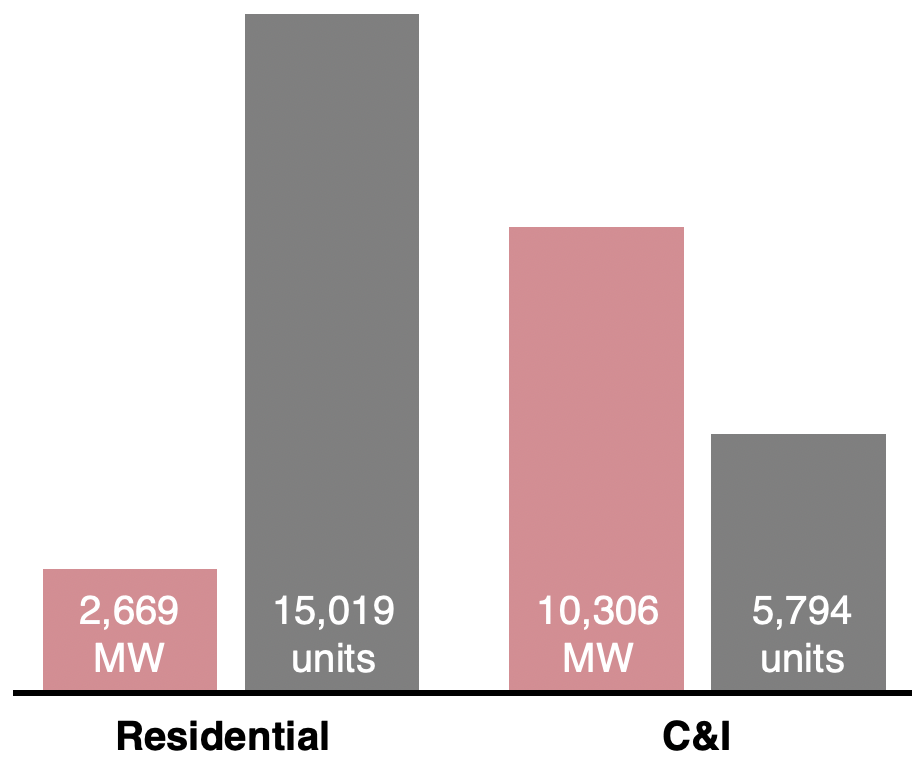
Japan’s final energy consumption in FY2019 was 12,959 petajoules. About 40% of that was used to meet demand for heat in the form of air conditioning, water heating, and steam production, among others. However, more than half of the primary energy is emitted as waste heat.
There are several ways to harness the currently wasted energy:
High-temperature waste heat from waste incineration plants, sewage sludge incineration plants, factories, and thermal power plants can be used as a heat source for absorption freezers and as a direct source of heat
Low-temperature waste heat from power substations, underground cables, and subway exhaust can be used as a heat source for heat pumps
Waste cold from LNG cryogenic generators can be used directly as cold air
Current State of CHP in Japan
In FY2020, the total installed CHP capacity in Japan reached 12.9 GW. Of that, 80% was installed in industrial and 20% in non-industrial settings. While CHP systems can be powered by a variety of fuels including biomass, wood, coal, waste heat, and oil, city gas-powered CHP systems have been the most installed type over the last decade, at a 93% share.
Since CHP systems are economically viable only in situations where significant onsite demand for heat exists, the power and chemical industries are the primary users of the technology in Japan. Each accounts for about 23% of the total industrial CHP capacity. Primary non-residential users include hospitals and nursing homes, each accounting for about 20% of Japan’s total non-industrial CHP capacity.
Seeing the benefits of CHP to further energy efficiency, the Japanese government has started to actively promote the use of CHP and, by FY2030, aims to increase the total installed CHP capacity to 16.9 GW. Yet, growth in installed capacity so far has been slow, especially over the last decade. In fact, between 2005 and 2010, newly installed capacity decreased five years in a row.
While the decrease has been primarily driven by rising LNG prices, that is not the sole reason behind Japan’s fairly slow adoption of CHP. Another significant reason is that over 80% of waste heat generated in Japan is below 250 degrees Celsius. This temperature is not enough to operate heat exchangers efficiently.
In order to utilize this low-temperature waste heat, NEDO has been investing in the research and development of heat insulation and storage, heat pumps, and waste heat power generation. In FY2020, the state research body budgeted 650 million yen for this purpose.
New Models for CHP Usage in Japan
Despite the slowdown in CHP growth and the technology’s downsides, new models of CHP use have been emerging in Japan and are expected to drive growth in adoption over the next decade.
The first such model is the business continuity district (BCD), a concept promoted by the Ministry of Land, Infrastructure, Transport and Tourism (MLIT). These districts are meant to attract foreign investment into major cities in Japan, with the main selling point, as their name suggests, being the provision of a stable supply of energy necessary for business continuity even in the event of disasters.
To date, 31 BCD projects have been implemented in Tokyo, Yokohama, Kawasaki, Nagoya, Osaka, Fukuoka, and Sapporo. MLIT offers support in the form of a subsidy of up to ¥2 billion per project to build a heat and power supply network.
Lastly, large power companies including Okinawa Electric and Hokkaido Electric have also been involved in developing projects utilizing CHP. In 2022, Okinawa plans to build an energy center to supply heat and power to its headquarters and a new building with a hotel and offices. Hokkaido has formed a joint venture with Mitsui and started operation of a 1.8 MW CHP plant in Shimokawa Town.
There is also potential to use CHP in conjunction with solar PV systems. Solar panels can be used to increase the temperature of the heat produced by CHP. Also, CHP can be used to produce power when solar power generation is not possible due to unfavorable weather.
With the need for distributed power sources expected to increase, operators can sell excess electricity generated by CHP into the power grid for balancing purposes.
Going Forward
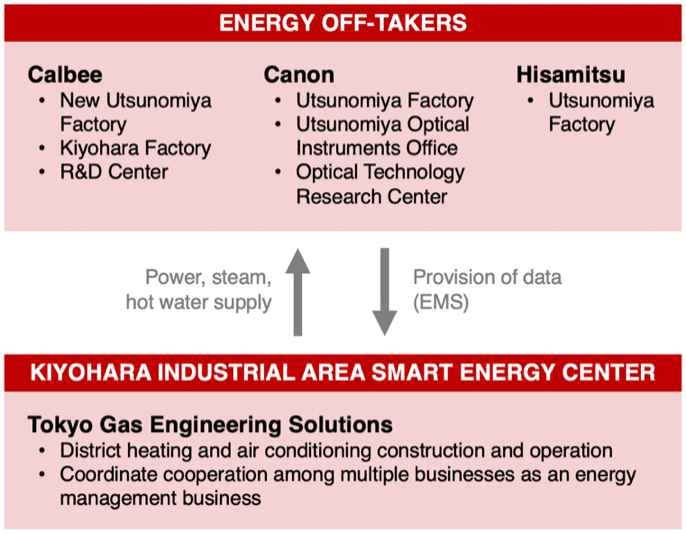
Traditionally, investments in CHP in Japan were made on an individual company basis. Recently, however, projects that rely on joint use of CHP systems by multiple companies like BCDs and the Kiyohara Industrial Area have been on the rise, making the economics of using CHP more favorable to end users.
Additionally, with more weather-dependent renewable capacity being installed in Japan, the need for balancing power on the grid is expected to increase significantly. In FY2021, a balancing market will be started in the country, and CHP and other distributed power sources are expected to play a considerable role in it.
Additionally, in October 2020, METI announced that it will promote the use of LNG CHP and fuel cells to improve resilience against disasters.
With the introduction of the new models as well as the changing structure of the Japanese power system, it’s expected that the growth of CHP will accelerate over the next few years.
GLOBAL VIEW
BY TOM O’SULLIVAN
Below are some of last week’s most important international energy developments monitored by the Japan NRG team because of their potential to impact energy supply and demand, as well as prices. We see the following as relevant to Japanese and international energy investors.
Shipping:
Shipping freight rates jumped ten-fold over the last few days following the jamming of the Suez Canal last Wednesday with over 200 carriers backed up on the north and south sides of the passageway, including 10 crude oil tankers carrying 13 million barrels of oil. An additional 300 vessels are en route to the canal. The backed-up Japanese-owned vessel, the Ever Given, was traveling from China to Rotterdam. Several ships have opted to go around the Cape of Good Hope adding over $400,000 to incremental transportation costs and 10 days of additional travel time. Piracy off the coast of Somalia and in the Gulf of Guinea are additional concerns for that route and for vessels “parked’ outside the canal in the Gulf of Suez. Cheniere, the U.S. LNG exporter, is already moving two LNG carriers from the Gulf of Mexico destined for Asia around the Cape of Good Hope.
Several major carriers including Maersk and Hapag-Llyod are looking at alternative routes. Most Russian oil and gas to Japan transits Suez. Brent oil prices fluctuated wildly during the week between $60 and $65 as the scale of the logjam unfolded. Asia LNG benchmark JKM was relatively stable at $7 mmbtu as natural gas inventories in Asia are relatively stable with the winter season finished and most of the gas supply to Asia originates east of Suez.
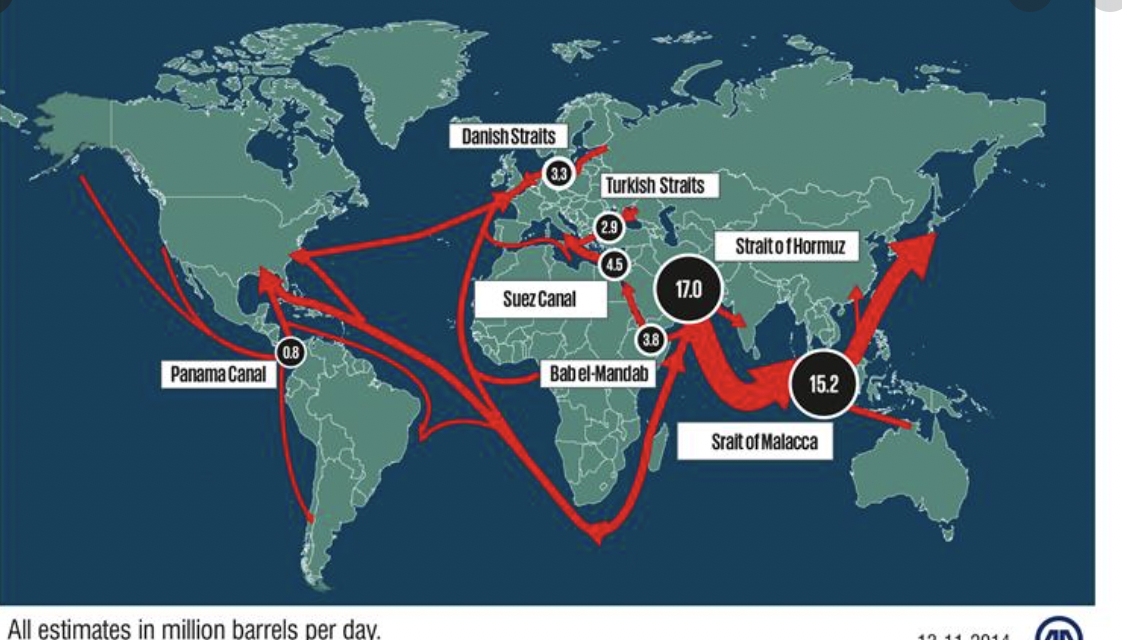
In a separate incident an Israeli vessel was attacked by missile fire in the Gulf of Oman on Thursday. The Liberian-flagged container ship, Lori, was traveling from Dar es Salaam in Tanzania to Mundra on the west coast of India, when it was struck.
Renewable Energy:
1). Several large European energy companies including RWE and EdF are considering spinning off their renewable energy (RE) assets into separate listed companies. EdF is considering a “blue EdF” for its nuclear assets and a “green Edf” for its RE assets.
2). According to Rystad Energy capital expenditure for RE projects is set for a new FY2021 record of $243 billion narrowing the gap with oil and gas investments that are projected to be flat at $311 billion.
Wind Energy:
Germany’s wind turbines manufacturer Nordex expects to increase sales to $6 billion in 2022 as the EU ramps up onshore wind capacity by 23 GW per annum to meet the 2050 net-zero target.
Fossil Fuel Financing:
1). Large global banks provided $750 billion of loans to coal, oil and gas projects in FY2020 despite their Paris Agreement commitments with BNP Paribas registering a 40% YoY increase to $41 billion.
2). A group of 89 central banks identified nine ways they can address climate risks including lower interest rates for greener borrowers and the grading of collateral for emissions intensity.
Carbon Pricing:
Canada’s Supreme Court last week upheld a 2018 decision by the Trudeau government to impose a nation-wide carbon price. The price will increase from $24 per ton at present to $138 per ton by 2030.
Climate:
President Biden has invited China’s President Xi and Russia’s President Putin to attend the Apr. 22 Earth Day Summit with 40 other heads of government.
Airlines:
IAG, the British Airways parent company, was forced, for the first time, to offer its landing slots at Heathrow and Gatwick as collateral for accessing $1.8 billion of emergency funding.
EVs:
1). Audi’s profits from its latest EV model, the Q4 E-tron, are expected to have the same margins as its ICE models by 2023 or 2024. That’s a significantly shorter margin convergence between EVs and ICEs than expected previously.
2). VW will build six EV battery factories in Europe and plans to sell 1 million EVs or hybrids this year.
China:
1). Geely, Volvo’s parent company, has launched a premium EV brand called Zeekr to compete against Tesla in the domestic market.
2). Separately, Elon Musk praised China for their decarbonization plans. Musk believes China will be Tesla’s largest market in the long term.
Myanmar:
A large Japanese investor with an 80-year record of investing in Myanmar withdrew its last employee from the country last week as the situation continues to deteriorate.
India:
1). The New Delhi government is seeking EV investments of $14 billion over the next five years as it strives for global leadership in the sector.
2). Coal India, the world’s largest coal miner, plans to invest in a 3 GW solar energy project as part of a joint venture with state-run NLC India. The company also wants to compete in India’s solar auctions and win projects by offering the lowest prices.
Bangladesh:
JICA continues to examine the feasibility of investing in the 1.2 GW Matarbari coal-powered project.
Saudi Arabia:
Aramco will pay a $75 billion dividend to its shareholders, mainly the Saudi government, despite a 44% drop in profits for FY2020 to $49 billion. The company IPO’d in Dec. 2019 and currently has a market capitalization of $1.8 trillion, over two times Saudi GDP. Aramco says its highest priority for the next 50 years will be meeting China’s energy demands.
Iran:
Iran and China have signed a 25-year strategic cooperation agreement. The Comprehensive Strategic Partnership Agreement covers a range of economic activity including oil and mining as well as transportation.
Mozambique:
On Wednesday military forces had to airlift workers to safety from Palma, a town situated near Total’s LNG gas site on the Afungi peninsula in the Cabo Delgado province, after a raid by Jihadist militants. Total has suspended all work at the LNG facility.
Finland:
Finnish utility, Teollisuuden Voima Oyj, has been granted a permit by the Nuclear Safety Authority to load fuel into Reactor 3 at Olkiluoto. Construction at Olkiluoto started in 2005. The facility is scheduled to enter commercial operation early in 2022.
Norway:
The Norwegian government has blocked the sale of Rolls Royce’s maritime engine maker (Norwegian-based Bergen Engines) to Russia’s TMH on national security grounds. Bergin Engines specializes in propulsion equipment for offshore oil and gas vessels.
Italy:
Claudio Descalzi, the CEO of Eni, was cleared of corruption charges by a Milan court in connection with a 2011 Nigerian oil deal.
Germany:
European-based Nord Stream 2 investors – Engie, OMV, Shell, Uniper, and Wintershall – all face increasing U.S. pressure to disengage from the Gazprom natural gas pipeline project that is 95% complete. The U.S. is expected to activate additional sanctions against Russia in early June.
UK:
1). Mubadala, the UAE sovereign wealth fund, will invest up to $7 billion in UK green energy projects.
2). Octopus Energy, one of the fasting growing UK energy suppliers, will acquire Octopus Renewables for over $4 billion in a move that will hand the private company a portfolio of 300 RE projects, across six different countries, enough to power more than 50 million homes by 2027.
Canada:
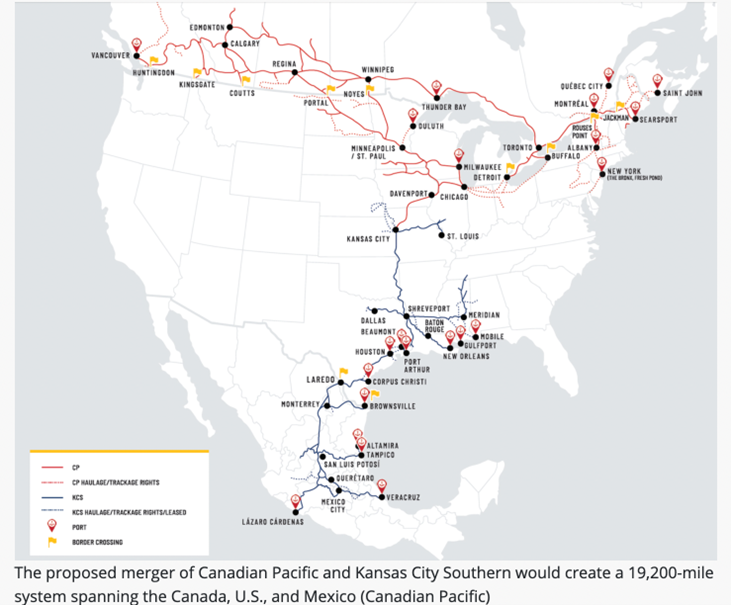
Canadian Pacific, the railway freight group, will buy Kansas City Southern, the smallest of the seven U.S. railway groups, for $30 billion creating the first Canadian-US-Mexico integrated railway group and the largest ever North American railway combination by transaction value. The combined group will transport oil, gas, and propane from Alberta to ports on the Gulf of Mexico. The rail network will span 32,000 km and link hubs on the Atlantic and the Pacific Oceans.
U.S.:
1). Thirteen states are suing the Biden administration to end the suspension of new oil and gas leases on federal lands and water.
2). Warren Buffett’s Berkshire Energy has offered to construct 10 large natural gas plants in Texas at a cost of $8.3 billion to meet electricity emergencies.
Mexico:
Pemex have discovered a new 1.2 billion onshore oil reserve in the state of Tabasco.
EVENTS CALENDAR
A selection of domestic and international events we believe will have an impact on Japanese energy.
| February | Approval of Fiscal 2021 Budget by Japanese parliament including energy funding projects;
CMC LNG Conference |
| March | 10th Anniversary of Fukushima Nuclear Accident;
Smart Energy Week – Tokyo; Quarterly OPEC Meeting; Japan LPG Annual Conference; Full completion of all aspects of the multi-year deregulation of Japan’s electricity market; End of 2020/21 Fiscal Year in Japan; |
| April | Japan Atomic Industrial Forum – Annual Nuclear Power Conference;
38th ASEAN Annual Conference-Brunei; Japan LNG & Gas Virtual Summit (DMG)-Tokyo Three crucial by-elections in Hokkaido, Nagano & Hiroshima – April 25th |
| May | Bids close in first tender for commercial offshore wind projects in Japan;
Prime Minister Suga to visit the U.S.-tentative |
| June | Release of New Japan National Basic Energy Plan-2021;
G7 Meeting – U.K. Forum for China-Africa Cooperation Summit (Senegal) |
| July | Tokyo Metropolitan Govt. Assembly Elections;
Commencement of 2020 Tokyo Olympics |
| August | Hydrogen Ministerial Conference in conjunction with IEA World Economic Forum in Singapore – Deferred from May |
| September | Ruling LDP Presidential Election;
UN General Assembly Annual Meeting that is expected to address energy/climate challenges; IMF/World Bank Annual Meetings (multilateral and central banks expected to take further action on emissions disclosures and lending to fossil fuel projects); End of H1 FY2021 Fiscal Year in Japan; Japan-Russia: Eastern Economic Forum (Vladivostok)-tentative |
| October | Last possible month for holding Japan’s 2021 General Election;
METI Sponsored LNG Producer/Consumer Conference; Innovation for Cool Earth Forum – Tokyo Conference; Task Force on Climate-Related Financial Disclosure (TCFD) – Tokyo Conference; G20 Meeting-Italy |
| November | COP26 (Glasgow);
Asian Development Bank (‘ADB’) Annual Conference; Japan-Canada Energy Forum; East Asia Summit (EAS) – Brunei |
| December | Asia Pacific Economic Cooperation (APEC) Forum – New Zealand;
Final details expected from METI on proposed unbundling of natural gas pipeline network scheduled for 2022. |
DATA
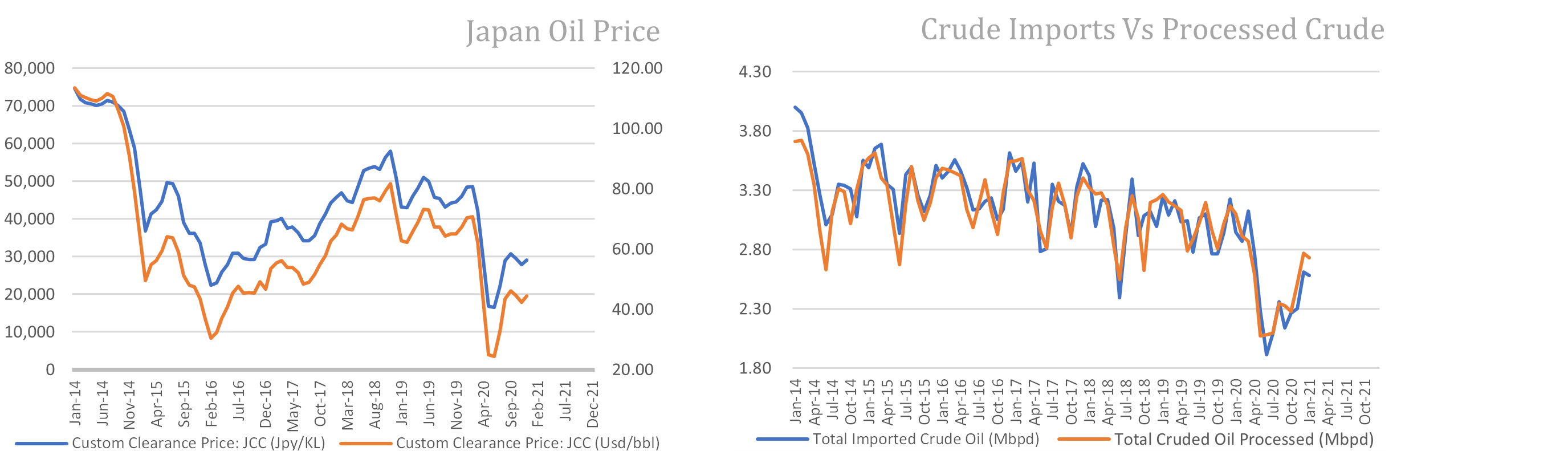
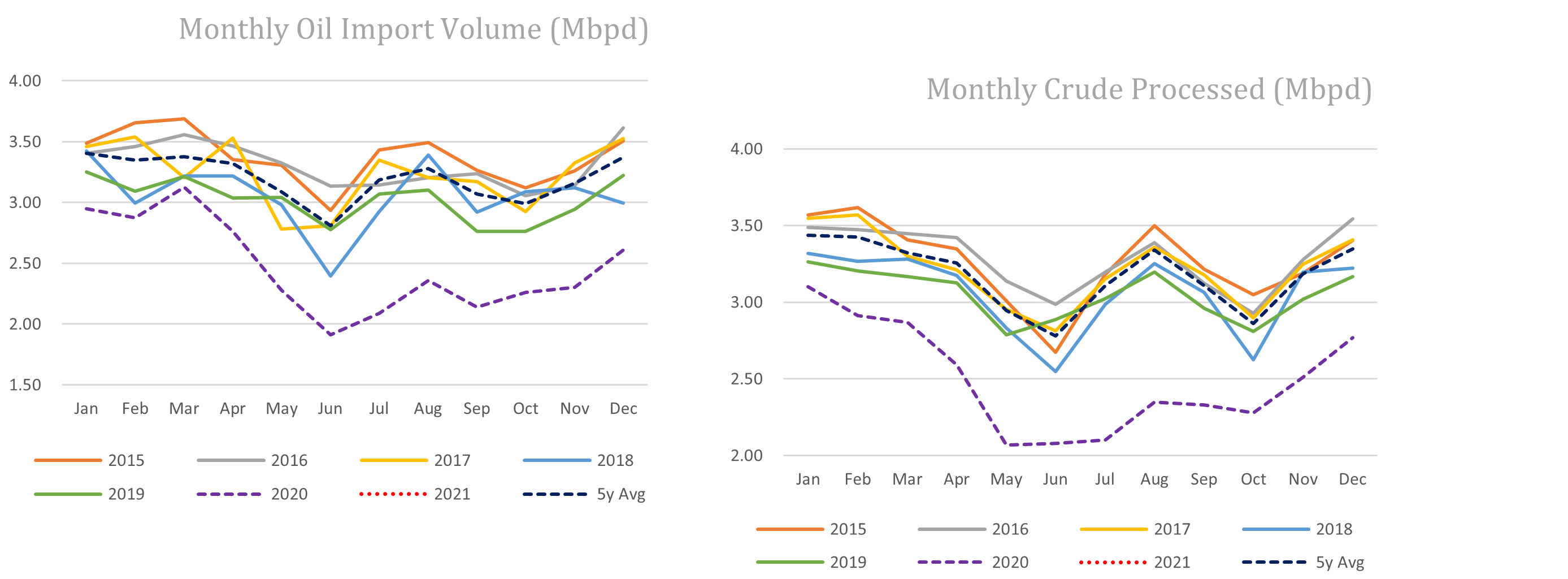
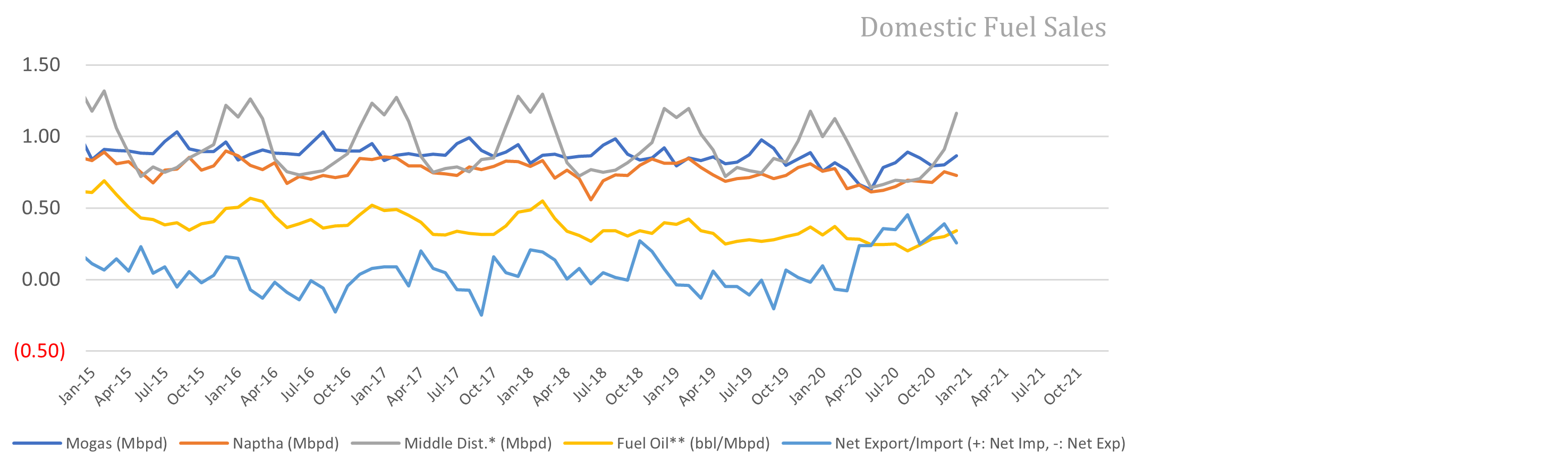
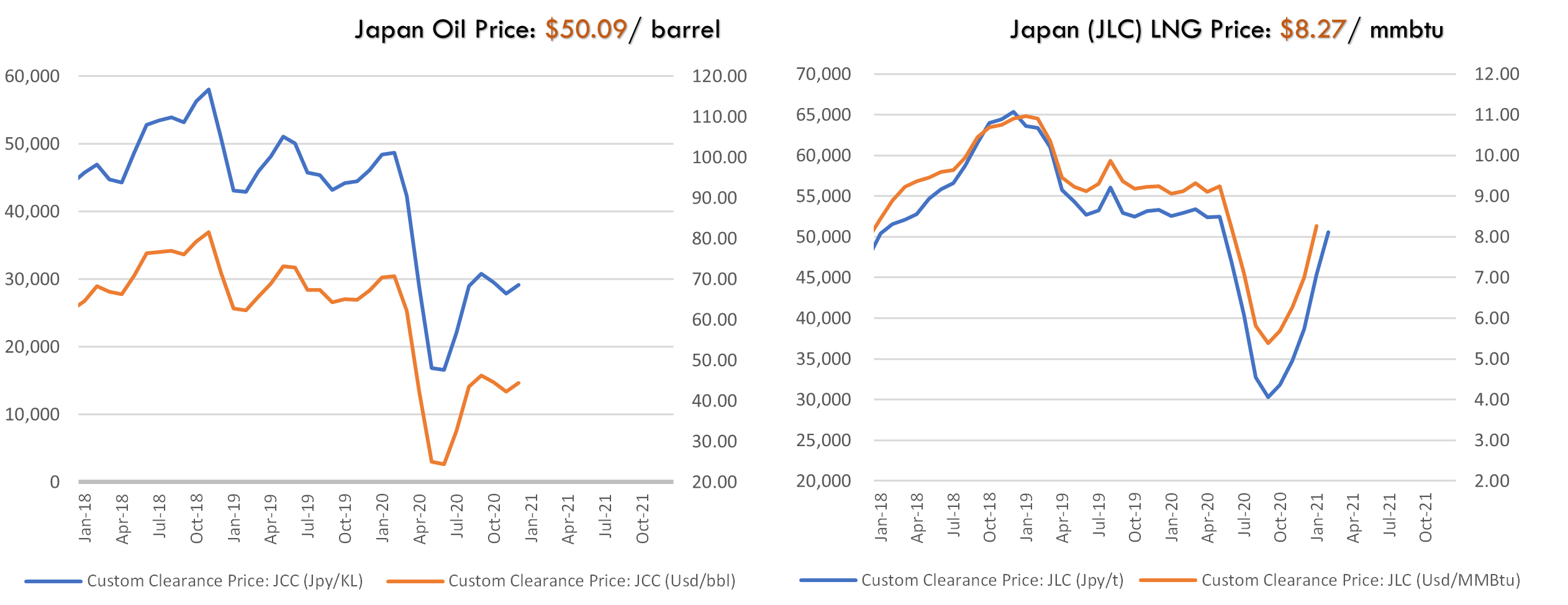
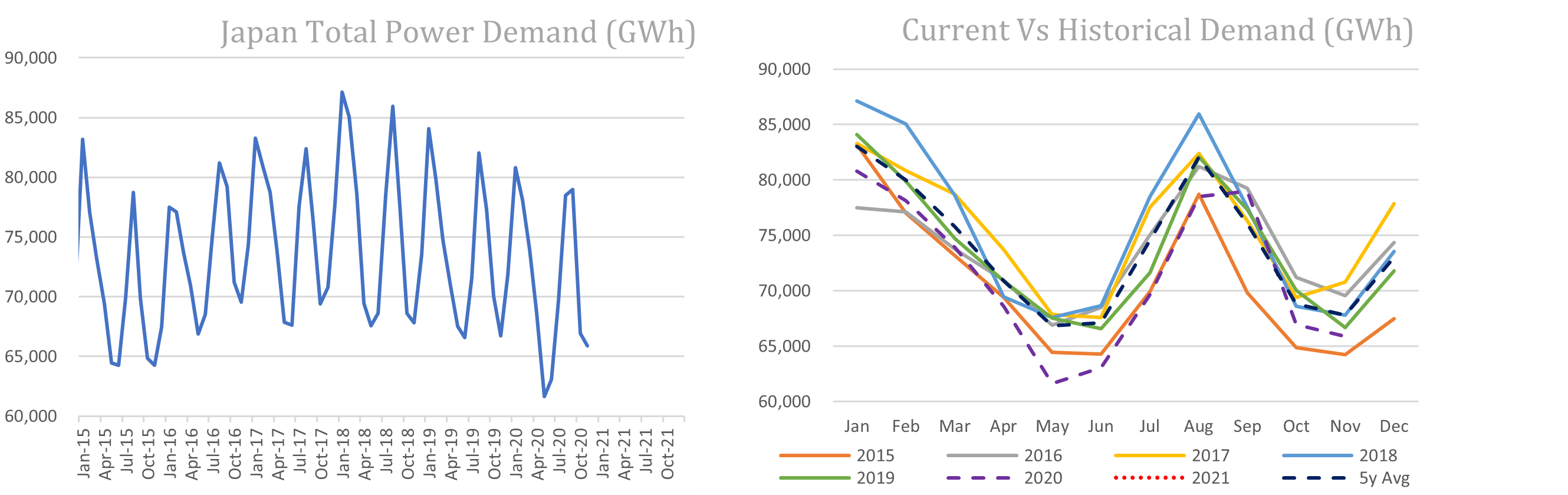
SOURCES: Ministry of Economy, Trade, and Industry (METI), Ministry of Finance, and the Petroleum Association of Japan
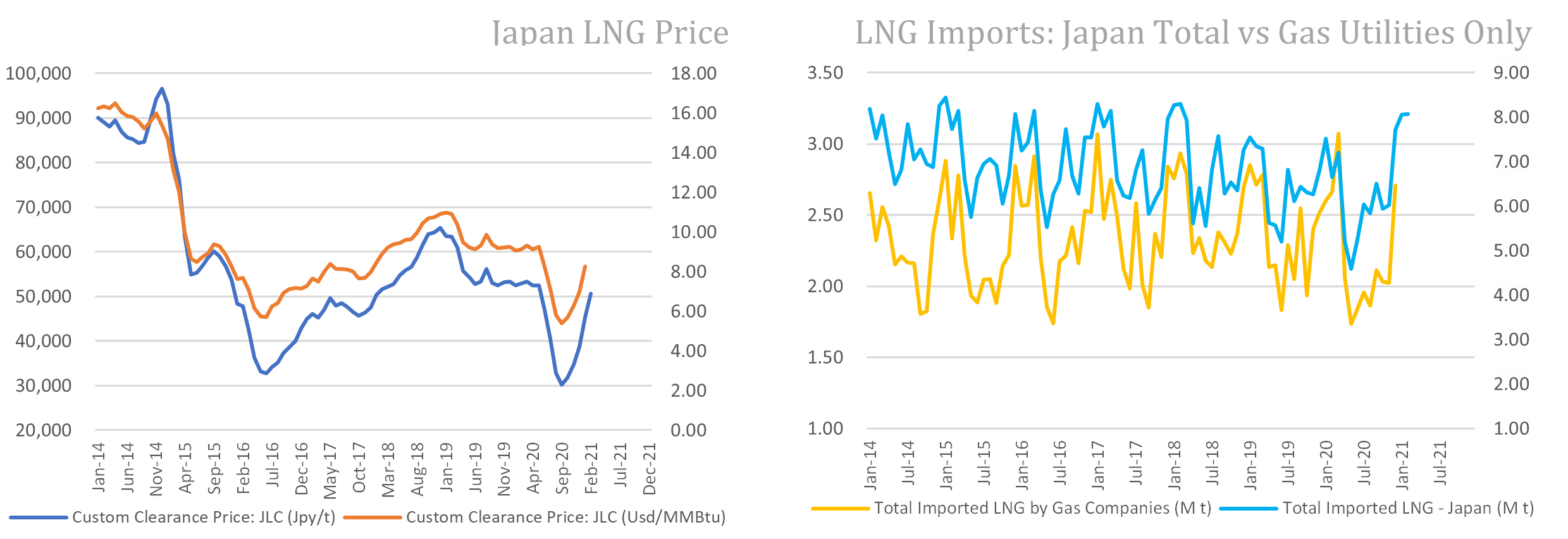
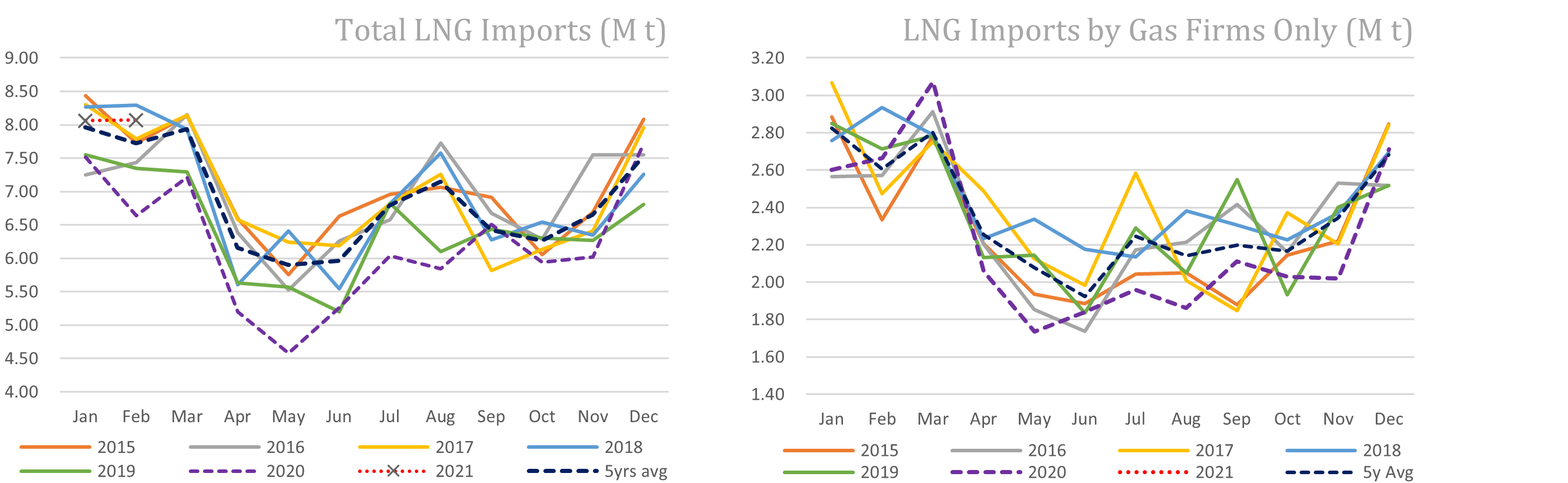
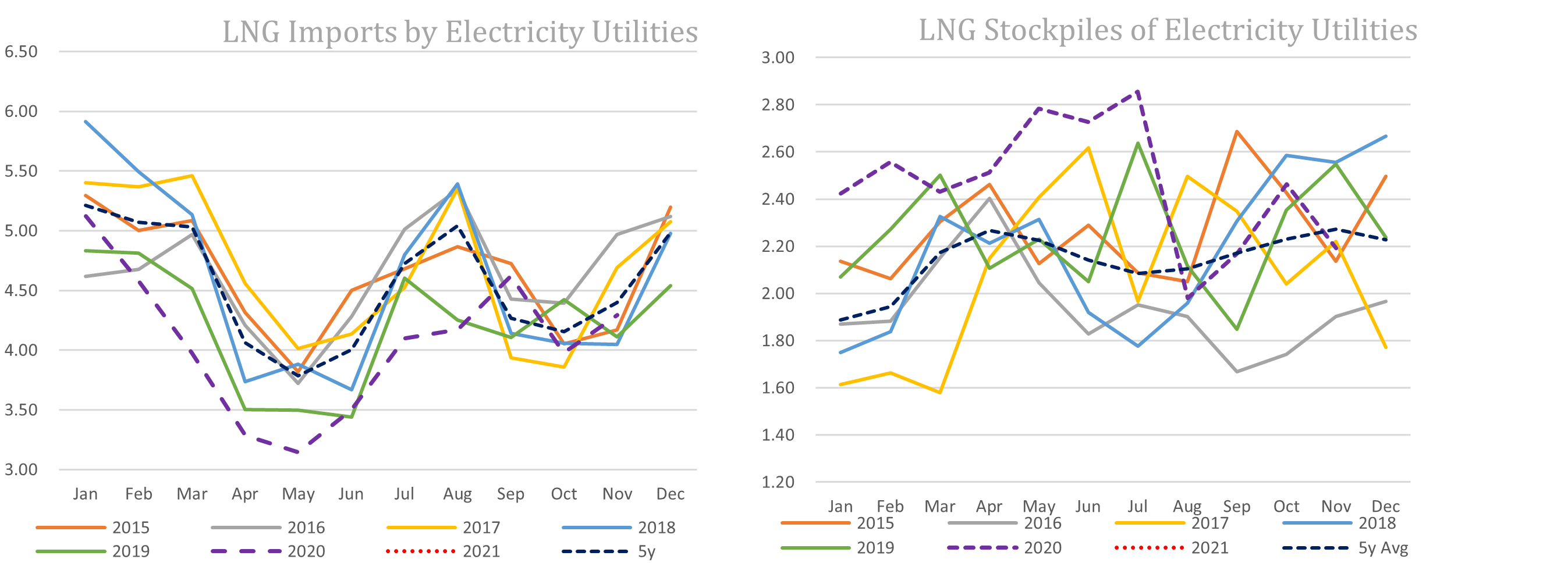
SOURCES: Ministry of Economy, Trade, and Industry (METI),
Ministry of Finance
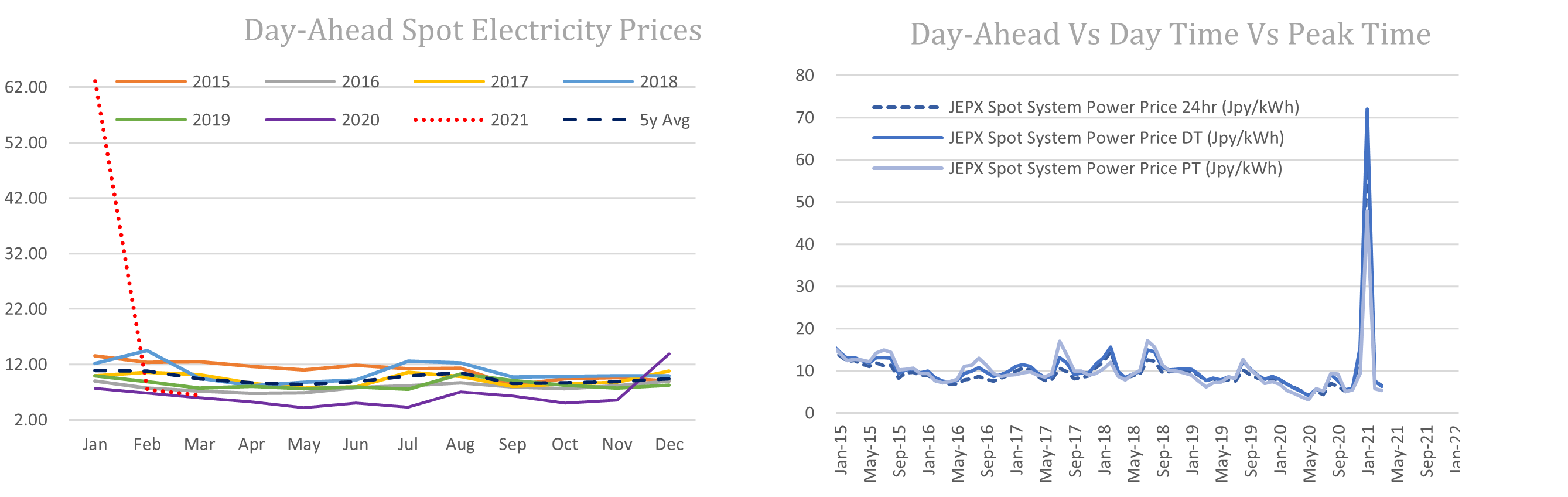
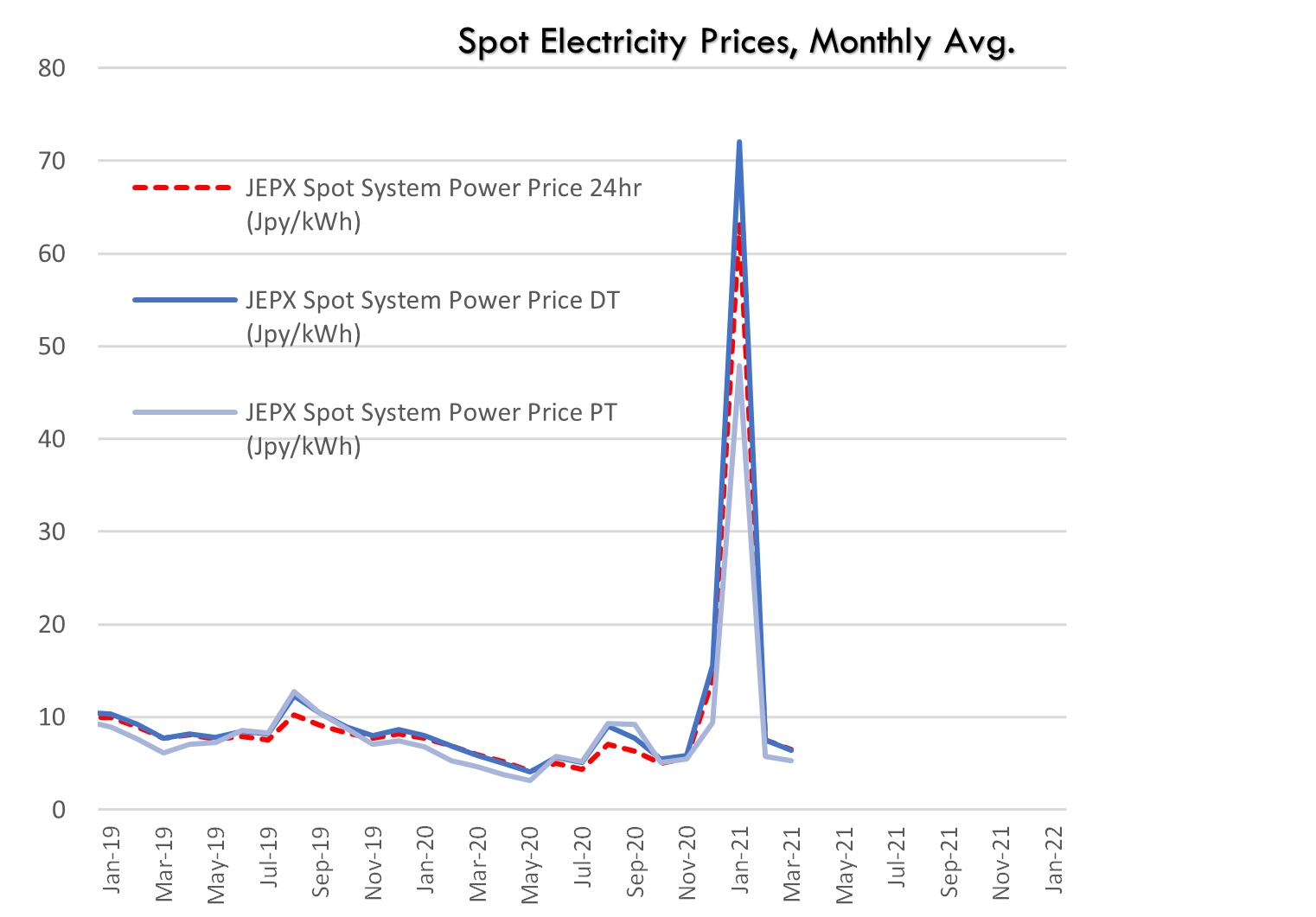
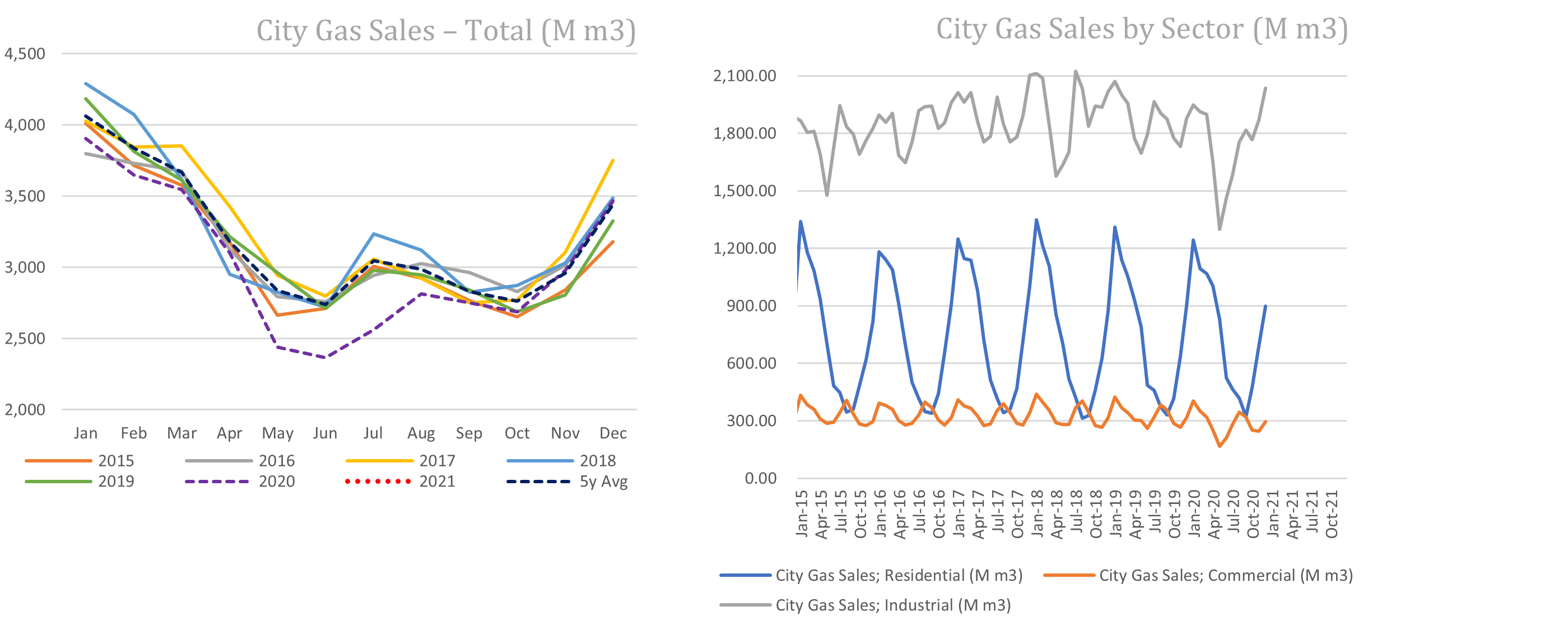
SOURCES: Ministry of Economy, Trade, and Industry (METI), and the Japan Electric Power Exchange
Disclaimer
This communication has been prepared for information purposes only, is confidential and may be legally privileged. This is a subscription-only service and is directed at those who have expressly asked K.K. Yuri Group or one of its representatives to be added to the mailing list. This document may not be onwardly circulated or reproduced without prior written consent from Yuri Group, which retains all copyright to the content of this report.
Yuri Group is not registered as an investment advisor in any jurisdiction. Our research and all the content express our opinions, which are generally based on available public information, field studies and own analysis. Content is limited to general comment upon general political, economic and market issues, asset classes and types of investments. The report and all of its content does not constitute a recommendation or solicitation to buy, sell, subscribe for or underwrite any product or physical commodity, or a financial instrument.
The information contained in this report is obtained from sources believed to be reliable and in good faith. No representation or warranty is made that it is accurate or complete. Opinions and views expressed are subject to change without notice, as are prices and availability, which are indicative only. There is no obligation to notify recipients of any changes to this data or to do so in the future. No responsibility is accepted for the use of or reliance on the information provided. In no circumstances will Yuri Group be liable for any indirect or direct loss, or consequential loss or damages arising from the use of, any inability to use, or any inaccuracy in the information.
K.K. Yuri Group: Oonoya Building 8F, Yotsuya 1-18, Shinjuku-ku, Tokyo, Japan, 160-0004.