
JAPAN NRG WEEKLY
APRIL 12, 2021
JAPAN NRG WEEKLY
April 12, 2021
NEWS
TOP
- Govt. panel recommends Japan keeps coal plants beyond 2030 if they hit 43% energy efficiency; most units will need upgrading
- Major power companies aim to add 25 GW of renewable energy capacity over next decade or so: a breakdown of each utility’s plans; Chubu Electric banks on biomass to green coal operations
- Japan’s oil products demand forecast to drop 5.7% in five years
ENERGY TRANSITION & POLICY
- Make nuclear power official policy: ruling party lobby group says
- Biden, Suga to draw up guidelines for hydrogen infrastructure
- Govt. imposes stricture requirements on “green” claims
- ENEOS brings forward synthetic fuel research plan by 10 years
- Seibu Railway launches Japan’s first “carbon-neutral” train
- IHI successfully burns 70% ammonia blend in gas turbine
- Prefecture govts. set higher renewables target than national one
- Local protests against renewables projects on the increase
- Japan startup to launch all-plastic lithium ion battery this year
- Hitachi launches emissions calculation service for companies
- Sumitomo see carbon credits from farming …. [MORE]
ELECTRICITY MARKETS
- Japan’s JGC invests in U.S. small modular reactor builder NuScale
- Kansai Electric delays restart of Takahama NPP Unit 4 till mid-April
- J-Power to develop solar generation/storage project in Virginia
- Govt. expected to approve ocean discharge of Fukushima water; TEPCO says unsure what some Fukushima containers now hold; TEPCO executives take voluntary pay cuts as co. stock plummets
- Toshiba buyout offer raises concern about fate of nuclear assets
OIL, GAS & MINING
- Shipper Mitsui OSK to spend $1.8B on decarbonization via LNG
- Toho Gas receives first carbon-neutral LNG shipment
- Chevron and Hokkaido Gas sign five-year LNG supply agreement
- Tohoku Electric and Tobu Gas partner up on gas/electricity plans
ANALYSIS
JAPAN CONSIDERS BOOSTING LNG STOCKPILES
VIA OVERSEAS HUBS AND DIPLOMACY
Japan has fewer than three weeks of gas supply on-hand, and even less when it comes to the reserve for power generation. For a country that relies on LNG for around 40% of its power, that’s a fine margin. The unprecedented spike in LNG prices in January revived a long-running concern among Japanese bureaucrats that this just-in-time supply system needs an overhaul. The energy agency has put forward an idea of creating an LNG stockpile, similar to the oil reserves created in the wake of the 1970s crude supply shock. Rather than touting trillions-yen investments in underground repositories, however, the agency is proposing a novel approach: a geographically diversified Asia reserves network.
JAPAN ACCELERATES SUPPORT FOR EMISSION CUTS OVERSEAS TO COIN CREDITS AGAINST OWN TOTAL
As Japan looks for ways to improve its emissions reduction targets ahead of this year’s COP26 climate conference, one ace up the government’s sleeve may be the increasing number of carbon-reducing projects it is sponsoring abroad. Most of them will generate credits that Japan could use to offset its own emissions total. In the past year, Japan has notably widened the flow of projects getting approved under schemes such as the Joint Crediting Mechanism (JCM). Such activity can help Japan shave a couple percentage points off its total.
GLOBAL VIEW
The first nuclear power plant in the Arab world goes online. U.S. expected to announce emissions cuts of 50% by 2030. Global methane emissions rose last year. China to boost LNG buying. Details on these and other stories in our global wrap of major developments.
2021 EVENT CALENDAR
DATA SECTION
JAPAN NRG WEEKLY
PUBLISHER
K. K. Yuri Group
Editorial Team
Yuriy Humber (Editor-in-Chief)
Tom O’Sullivan (Japan, Middle East, Africa)
John Varoli (Americas)
Regular Contributors
Mayumi Watanabe (Japan)
Daniel Shulman (Japan)
Takehiro Masutomo (Japan)
Art & Design
22 Graphics Inc.
Sponsored
SUBSCRIPTIONS & ADVERTISING
Japan NRG offers individual, corporate and academic subscription plans. Basic details are our website or write to subscriptions@japan-nrg.com
For marketing, advertising, or collaboration opportunities, contact sales@japan-nrg.com
For all other inquiries, write to info@japan-nrg.com
OFTEN USED ACRONYMS
METI The Ministry of Energy, Trade and Industry
ANRE Agency for Natural Resources and Energy
NEDO New Energy and Industrial Technology Development Organization
TEPCO Tokyo Electric Power Company
KEPCO Kansai Electric Power Company
EPCO Electric Power Company
JCC Japan Crude Cocktail
JKM Japan Korea Market, the Platt’s LNG benchmark
CCUS Carbon Capture, Utilization and Storage
mmbtu Million British Thermal Units
mb/d Million barrels per day
mtoe Million Tons of Oil Equivalent
kWh Kilowatt hours (electricity generation volume)
NEWS: ENERGY TRANSITION & POLICY
Govt. panel recommends allowing coal-fired plants with 43% efficiency to operate post 2030
(Asia Nikkei, April 10)
- A METI committee recommended to the government to allow coal-fired power plants to operate beyond 2030 if they have an energy efficiency ratio of 43% or higher. This is seen as a very high target by the industry and is supposed to encourage utilities to make upgrades to make sure only the cleanest-burning coal plants remain in service.
- The 43% figure is at the top of what coal power plants today can achieve. Just two facilities in Japan met that benchmark in FY2019. A further 31 were at 40% or higher.
- METI does not plan to hand out penalties to companies that fail to meet the new benchmark. The ministry will also give guidance to companies on how to achieve the new standards.
- CONTEXT: Japan asks power companies to maintain an efficiency rate of 44.3% across all thermal power, including LNG and oil. Most utilities would need to upgrade current facilities to increase their coal efficiency numbers.
- CONTEXT: Coal-fired capacity accounted for 32% of total in FY2019, second-highest after LNG.
- SIDE DEVELOPMEN:
METI committee sees 43%-44% efficiency level optimal for USC coal
(Japan NRG, April 10)- A separately METI committee discussed setting efficiency levels at 43% to 44% for USC coal-fired technology and 46% for IGCC at a meeting on March 22.
TAKEAWAY: Since METI’s announcement in the summer of 2020 that it will seek to close all “inefficient” coal capacity by 2030 there have been continuing arguments among bureaucrats and experts as to what constitutes “efficient” and how many facilities should be allowed to close. Japan NRG has covered several of the committees dealing with the issue, all of which tried to provide a methodology that won some and had others in the industry furious. Having one simple number apply across the entire industry seems like a fair approach.
However, this panel recommendation, should it be accepted by METI, will also have plenty of opponents. For one, many utilities have started to experiment with co-firing – using two fuels at one power plant, and aggregating the energy efficiency. Biomass has been the most popular second fuel for coal plants with the major Japanese utilities. However, so far, most of these coal plants use only about 2% to 4% biofuel. It’s possible that raising the percentage to 10% or so will be enough to boost the overall efficiency numbers of the coal-fired facility and have it meet the new 43% threshold. The same could be said of adding ammonia as the second fuel, or in the future hydrogen.
As a result, Japan could end up keeping a large portion of its 150 coal-firing units, at least as reserve capacity. The second fuel would help “rebrand” coal plants and suggest that they are transition facilities that will switch to ammonia-only or biofuel-only at a later date. Should this occur, Japan’s demand for LNG is likely to keep declining. The other major question, however, is what happens to emissions.
Keeping the bulk of the coal plants, Japan will likely struggle to significantly cut the energy sector’s CO2 in the medium term.
Make nuclear power official policy says LDP lobby
(Nikkei editorial, April 5)
- A group of LDP Diet members will soon begin lobbying the government to amend its energy policy to endorse the building of new nuclear power stations and the replacement of existing stations.
- Led by prominent Diet members Amari Akira and Nukaga Fukushiro, the pro-nuclear group will first convene on April 12. It says nuclear energy is the key to decarbonizing industry and ensuring Japan’s energy security.
- Stressing recent safety advances, the group says it is time for the government to take the lead and endorse nuclear power.
- Prime Minister Suga has maintained that his government currently has no plans to build more nuclear power plants.
TAKEAWAY: There has been very little open support for nuclear power among politicians in the last 10 years. However, the industry has been a somewhat upward trajectory in the last few months and the fact that the Fukushima accident has now passed its 10th anniversary mark suggests the public attention to it may start to wane.
Biden and Suga to draw up guidelines for hydrogen power infrastructure
(Nikkei, April 6)
- As Japan PM Suga travels to the U.S. to meet President Biden, the two sides are preparing to reach agreement on guidelines for future infrastructure in fields like hydrogen power, as well as 5G and others.
Government imposes stricter requirements on “green” claims
(Kankyo Business, April 2)
- Under a new set of guidelines issued by METI on April 1, electricity retailers will need to disclose their carbon offsetting arrangements in order to be able to refer to themselves or their services as “green”.
- The move comes as the certification of the carbon neutrality of non-FIT electricity becomes law.
ENEOS brings green research plan forward 10 years
(Nikkei Xtech, April 1)
- Japan’s petrochemical industry is battling falling demand for fuel. However, Eneos CEO Fujiyama Yuichiro wants to turn adversity into opportunity. Eneos’ plan for the future focuses on carbon reduction, digital technology, chemicals, and recycling, and nearly a third of the firm’s capital investment between FY2020 and FY2022 will go into environmental projects.
- Eneos brought its target for developing synthetic renewable fuels forward by 10 years in response to the Japanese government’s pledge to achieve carbon neutrality by 2050.
- The company is working to have a certifiable and commercially viable synthetic fuel on the market sometime in the 2030s. It aims to achieve production capacity of 100 barrels of synthetic fuel per day by 2025, ramping up to 10,000 barrels a day by 2030.
Seibu Railway launches carbon neutral train
(Kankyo Business, April 5)
- In a national first, Seibu Railway made its Yamaguchi Line carbon neutral on April 1.
- All electricity consumed by trains running on the Yamaguchi line is sourced from the company’s Takeyama solar power station.
- The Yamaguchi line used to be responsible for 300 metric tons of CO2 emissions a year.
IHI successfully burns 70% ammonia blend in gas turbine
(New Energy Business News, April 7)
- IHI has developed a gas turbine in which liquid ammonia can be injected directly into the reactor and burnt along with natural gas.
- In a world first, the IHI engineers achieved stable operation while deriving up to 70% of total energy from ammonia, and even had some success with burning pure ammonia.
- While IHI successfully demonstrated operation on 20% blends (on an energy basis) in the past, the high cost of modifying turbines to allow the injection of large volumes of liquid ammonia presented an obstacle.
- The latest breakthrough is the result of a collaboration with a team from Tohoku University who had the idea of directly injecting ammonia in its liquid state, thereby eliminating the need for an evaporation system.
Japanese prefectures vow to raise renewables component by themselves
(Various reports, April 10)
- Kumamoto prefecture said it will aim to raise the percentage of electricity it derives from renewables to 50% by 2030 from 20% at present.
- The locality faced energy crises after the 2011 Fukushima accident and the 2016 Kyushu earthquake. The government says that these events pointed to decentralized energy sources as the best way forward to maintain security of energy supply.
- Meanwhile, Okinawa prefecture said it aims to raise its renewables component to 16% by 2030 from just 6% at present.
- CONTEXT: Okinawa is heavily reliant on coal-fired generation and is not connected to the power grid of mainland Japan.
TAKEAWAY: As more regional governments make commitments to raise the local share of renewables in the mix, it makes it easier for the national government to raise the percentage in the long-term energy strategy of Japan.
Residents’ group protests Tokushima wind farm as anti-renewables clamor grows
(NHK, April 5)
- Many Tokushima residents have put their names to letter calling for the scrapping of plans to build a wind farm in a mountainous part of the prefecture. The letter was officially submitted to Governor Iijima.
- Residents cite environmental destruction and the risk of landslides as reasons for their opposition to the project.
- The group is asking the Governor to take a position on the issue that more reflects the views of experts and local residents.
TAKEAWAY: Opposition to renewables projects in local areas has noticeably grown in recent years. The number of local ordinances on solar and wind has jumped to 134 in FY2020 from 26 in FY2016. Most of it is the NIMBY factor, but some are due to by falling solar panels and other accidents.
Japan startup to launch all-plastic lithium ion batteries this year
(Asia Nikkei, April 7)
- APB, a Japanese startup, plans to start this year commercial production of a lithium-ion battery made entirely from plastic. This is said to make the battery safer.
- The batteries will be offered to wind and solar farms to store energy, according to APB founder, an ex-Nissan engineer.
- The battery uses special polymers that can conduct electricity. Polymers have higher resistance to electrical currents, which means APB’s batteries would not dramatically heat up.
Sumitomo Corporation explores agricultural uses for unwanted carbon dioxide
(Nikkei, April 8)
- Sumitomo Corporation has partnered with American start-up Indigo Ag, which has pioneered the sale of carbon credits for CO2 used for agricultural purposes.
- By reducing fertilizer use, farmers are able to increase the amount of CO2 taken up by the soil.
- While the Paris Agreement on climate change recognizes the importance of soil as a carbon sink, the difficulty of measuring the amount of CO2 dissolved in the soil had been a barrier to emissions trading.
- Indigo Ag’s methodology has been accredited under the Verified Carbon Standard.
Hitachi launches emissions calculation service
(New Energy Business News, April 9)
- Hitachi has launched a new service that helps corporations calculate their CO2 emissions with the aim of improving their ESG scores.
- While calculating carbon emissions has traditionally been a time-consuming task, the new system automates the collation of data and the calculation of supply chain carbon footprints. The system is also able compatible with Carbon Disclosure Project reporting and accreditation in respect to Science-Based Targets.
Construction company launches “off grid” power units for worker accommodation
(Kankyo Business, April 8)
- Construction company Aktio built solar powered accommodation units for construction workers that are self-sufficient in electricity.
- Utilizing a hybrid power system developed by Tokyo-based Eliiy Power, the units are able to store up to 6.2 kWh of electricity. The units will be available for lease from June 1.
Trina Solar releases a record capacity 670 W photovoltaic module
(New Energy Business News, April 7)
- Trina Solar has begun accepting orders for a new solar module that can generate a record 670 W per panel, an improvement of 34% over conventional 500 W panels.
- In a further innovation, the new panels will be shipped flat, as opposed to on their sides, to overcome restrictions presented by the height of shipping containers. This will allow a 12% increase in the generation capacity that can be shipped in a single container, thereby reducing transport costs.
Itochu and Hitachi Zosen secure financing for $900 million Dubai waste-to-energy project
(New Energy Business News, April 8)
- Itochu and Hitachi Zosen Inova entered into a $900 million financing agreement for a project to build a waste fired power plant in Dubai, along with the Japan Bank for International Cooperation, Sumitomo Mitsui Banking Corporation, Mizuho Bank, Societe Generale, KfW IPEX Bank, Standard Chartered Bank, Credit Agricole Corporate and Investment Bank, and Siemens Bank.
- Work will begin on the plant later this month and construction completed in 2024. Located in the Warsan area, the plant will process 1.9 million metric tons of waste every year, while generating around 200 MW of electricity.
Orix planning onsite PPA with a 2.2 MW solar installation for denim factory
(Kankyo Business, April 7)
- Orix said on April 5 that it would install 2.2 MW of solar generation capacity on the roof of a denim factory in Hiroshima.
- The facility will operate under a solar power purchase agreement according to which Orix is responsible for operating and maintaining the system and sells the electricity generated to the factory.
NEWS: POWER MARKETS
|
No. of operable nuclear reactors |
33 | |
|
of which |
applied for restart |
25 |
|
approved by regulator |
16 | |
|
restarted |
9 | |
|
in operation today |
6 | |
|
|
able to use MOX fuel |
4 |
|
No. of nuclear reactors under construction |
3 | |
|
No. of reactors slated for decommissioning |
27 | |
|
of which |
completed work |
1 |
|
started process |
4 | |
|
|
yet to start / not known |
22 |
Spot Electricity Prices, Monthly Avg.
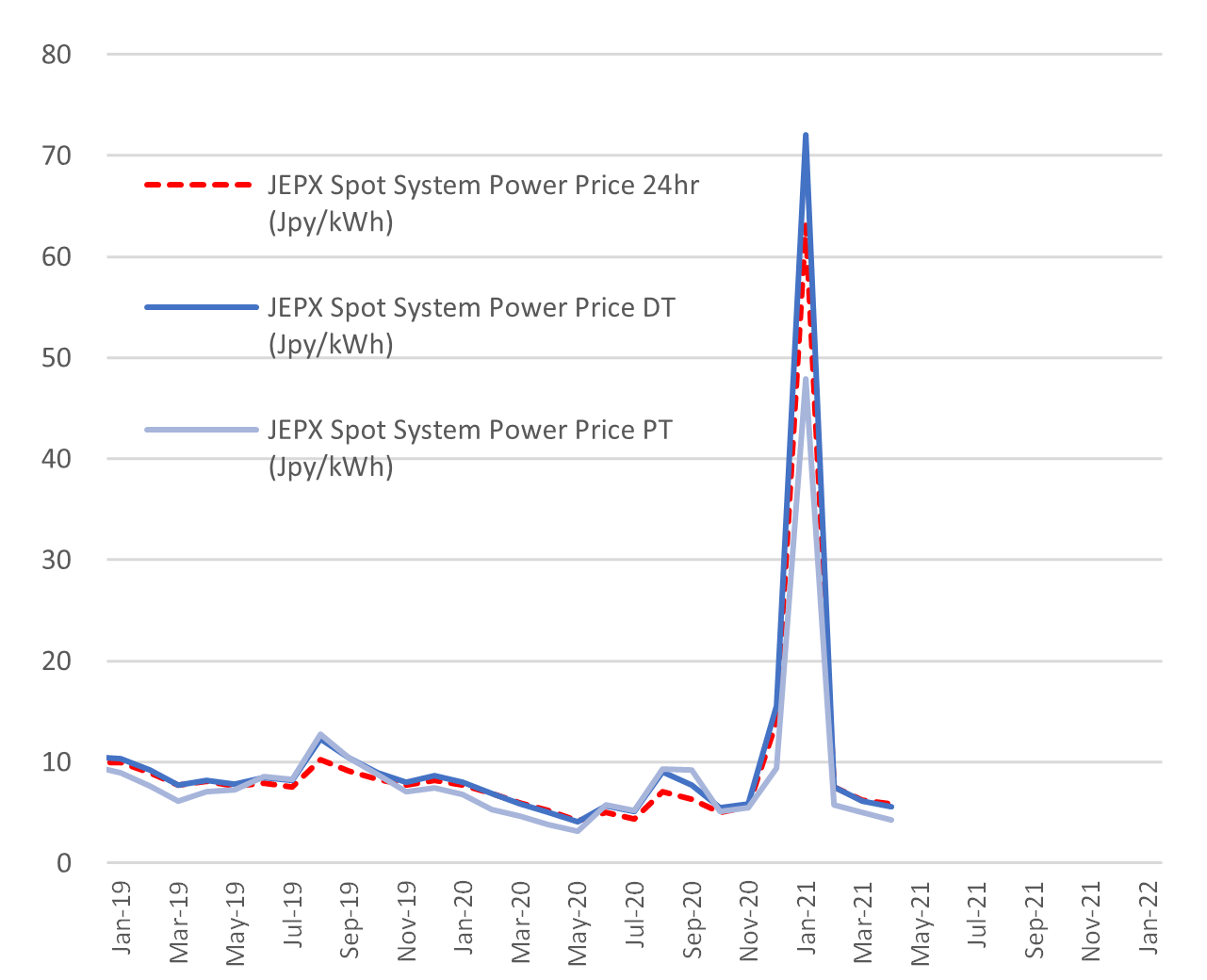
Source: Company websites, JANSI and JAIF, as of April. 5, 2021
Industry body publishes renewable capacity targets for all of Japan’s major power utilities
(Japan NRG, April 7)
- The Federation of Electric Power Companies, or FEPC, made a report to METI’s Next Generation Electricity Network Subcommittee on the current plans by the country’s dominant power utilities (EPCOs) to increase their renewable energy capacity. Below is a summary of those plans.
|
Company |
Renewables Capacity / Output Target |
|
Hokkaido Electric |
Add 300 MW or more by FY2030 |
|
Tohoku Electric |
Develop 2 GW mainly in the six prefectures of the Tohoku area and in Niigata prefecture |
|
TEPCO |
By mid 2030s, add 6 GW to 7GW of new capacity |
|
Chubu Electric |
Develop 2 GW by around 2030 |
|
Hokuriku Electric |
By FY2030 boost annual output from renewables by 2 billion kWh compared to the FY2018 level |
|
Kansai Electric |
Add 2 GW of new capacity in Japan and overseas and aim for 6 GW of renewables during the 2030s |
|
Chugoku Electric |
By FY2030, add 300 MW to 700 MW of new capacity |
|
Shikoku Electric |
Add 500 MW in Japan and overseas by FY2030 |
|
Kyushu Electric |
Have 5 GW of renewable capacity in Japan and overseas in 2030 |
|
Okinawa Electric |
By FY2030, add 100 MW of new capacity |
|
J-Power |
By FY2025, add 1 GW of new capacity in Japan and abroad compared to the 2017 level |
- FEPC also reported the renewables plants of utilities with a breakdown by generation type. On this basis, the biggest capacity additions were for wind power, led by Tohoku Electric’s Tsugaru 480 MW offshore wind project, and similar sized offshore wind projects in Akita prefecture from Tohoku, Kansai Electric and TEPCO.
- Chubu Electric is currently the leading developer of biomass power, using it as a co-firing solution for coal-fired power plants. The utility is building a 1 GW second unit at the Misumi power plant which will burn both biomass and coal.
- SIDE DEVELOPMENT:
Chubu Electric, Hiroshima Gas start operations at a 112 MW biomass plant
(New Energy Business News, April 7)- Kaita Biomass Power Co., a joint venture between Chubu Electric and Hiroshima Gas, has started commercial operations at its coal-wood biomass co-firing 112 MW power plant in Hiroshima prefecture.
- The plant is on the FIT pricing scheme and sources 80% of its fuel from local waste timber and woody biomass such as white pellets and palm coconut shells from overseas. The other 20% of the fuel is coal.
TAKEAWAY: A consortium Chubu Electric is invested in has also just started construction of a 75 MW biomass power plant in Nagoya city, Aichi prefecture. The plant will start generating power in July 2023. These kinds of JVs and consortiums allow Chubu Electric to clock up capacity that can be counted towards its renewables targets without doing the heavy lifting of pushing through the project. We would expect EPCOs to remain a back-seat driver in renewables projects unless they hit a certain capacity level of at least 200 MW or so.
Japan’s JGC invests in U.S. small modular reactor builder NuScale to develop the technology
(Nikkei, April 5)
- JGC, one of Japan’s biggest engineering firms, will join a U.S. project to build a 600 MW to 700 MW small modular reactor (SMR). JGC will invest $40 million for a 3% stake in NuScale Power, a company that designs SMRs.
- JGC will help to build NuScale’s first SMR reactor in Idaho.
- NuScale’s design involves immersing the containment units in a pool of water, which is seen as a safety feature that can prevent reactor meltdowns. The company also believes it can complete the construction of a SMR project for considerably less than the cost of a larger-scale traditional nuclear reactor design.
- NuScale is majority owned by Fluor, a U.S. engineering firm.
TAKEAWAY: With public opposition to nuclear power remaining strong in Japan, the government has tried to avoid making positive statements about building more nuclear reactors in the future. However, in the new Green Growth Strategy, nuclear power does feature with SMR and another design named as the most promising next generation nuclear tech. JGC’s investment represents the first visible Japanese involvement in the creation of SMRs.
Kansai Electric delays restart of Takahama Unit 4 till mid-April
(Denki Shimbun, April 5)
- The utility expected to restart Unit 4 of Takahama NPP in the first 10 days of April, but due to water leak at a thermometer outlet pipe the timing has moved by about a week. Repair work on the water leak is already completed.
- SIDE DEVELOPMENT:
- Fukui prefecture governor close to approving 3 Kansai reactor restarts
- (Chunichi Shimbun, April 10)
- Fukui prefecture officials are due to do a site visit of several NPPs of Kansai Electric in mid-April and approve their reactor restarts.
- This will affect Units 1 and 3 of Takahama NPP and Mihama Unit 3.
J-Power to develop solar generation/storage project in Virginia, U.S.
(Kankyo Business, April 5)
- J-Power said on March 31 that it signed a memorandum of understanding with U.S. investment company Fortress in relation to a project to construct a solar farm and battery facility in Virginia.
- Work on the “Birchwood” facility, which is able to supply 50 MW from photovoltaic cells in addition to up to 190 kW from storage batteries, will begin in 2022, and the facility will begin supplying the grid in 2023.
- Birchwood will be J-Power’s third solar project in the U.S.
TEPCO executive take pay cut over reactor scandal
(NHK, April 7)
- Several TEPCO executives, including CEO Kobashigawa, are voluntarily paying back 30% of their monthly salary for the time being in response to revelations of compliance breaches at the Kashiwazaki-Kariwa nuclear power plant.
- SIDE DEVELOPMENT:
TEPCO Holdings stock plummets after executives offer no excuse for breaches
(DZH Financial Research, April 7)- TEPCO Holdings’ stock took a dive after reports on April 7 that the utility offered no defense to a Nuclear Regulation Authority decision to revoke its right to recharge nuclear reactors following revelations about inadequate anti-terrorism measures at TEPCO’s Kashiwazaki-Kariwa nuclear power plant.
- TEPCO Holdings had until April 7 to submit a written defense to the NRA.
Government to discharge Fukushima nuclear site’s treated water into the ocean
(NHK, April 9)
- The government will approve the release into the ocean of water stored on the site of the Fukushima nuclear disaster. Related ministries will meet on April 13 to officially approve the discharge.
- The government says it will monitor changes in radiation levels and fully compensate those affected by negative publicity about the discharge.
- This is water from the Fukushima site that has been treated to remove most of its radioactive elements. One element that is impossible to remove, however, is tritium.
- The release of wastewater into the ocean will begin in about two years. Levels of tritium oxide (water in which the hydrogen atoms have been replaced with radioactive tritium) will be seven times lower than the maximum permitted by the WHO, the Japanese government says.
- METI Minister Kajiyama has stressed the importance of transparency in the process, while the Minister of Agriculture Nogami stressed the importance of considering the demands of local fisheries operators.
- Meanwhile, Environment Minister Koizumi cautioned against delaying the release of the water any further, saying delays would jeopardize efforts to rebuild Fukushima.
- SIDE DEVELOPMENT:
Fukushima mismanagement: 4,000 shipping containers contain unknown levels of waste
(Tokyo Shimbun, April 6)- Contents of 4,000 of the 85,000 shipping containers currently occupying the grounds of the Fukushima Daiichi nuclear power station are unknown.
- A TEPCO spokesperson said that determining the contents of the mystery containers would be time-consuming, and that in some cases it would be impossible to determine what was inside.
- The containers were used to store highly radioactive rubble, plastic pipes, protective suits, and other waste that was generated in the aftermath of the disaster. While TEPCO made records of the contents, it says it has lost track of which record corresponds to which container.
Toshiba buyout offer from CVC raises concern about fate of its nuclear assets
(Japan NRG, April 9)
- Luxembourg-based private equity fund CVC has made an offer to buy all of Toshiba, taking one of Japan’s iconic engineering companies private. The offer is said to be at 30% above the market price of Toshiba before news of the offer was published. It is seen as a response by Toshiba CEO, a former CVC executive, to extract the company from the ongoing scandals with current shareholders, which include activist funds Effissimo and others.
- CVC, as any foreign buyer of a Japanese firm listed as strategic, will need to get clearance from the government’s regulators. METI, the Ministry of Finance, and the Ministry of Defense will likely be key voices in the review, with Toshiba also a significant defense contractor.
- A major question for the government will also be the fate of Toshiba’s nuclear assets. It is one of only three domestic nuclear reactor vendors to Japanese power plants and is also in charge of maintenance. Toshiba’s nuclear equipment is used by TEPCO, Tohoku Electric and Chubu Electric, and the company provides its nuclear services via the Toshiba Energy Systems & Solutions unit.
- A carve-out of the nuclear assets may be necessary for a foreign fund to take control of Toshiba, with regulators likely to see this as a particularly sensitive issue. However, any split would require there being a willing buyer. In recent years, major Japanese engineering companies have been either exiting the nuclear business or minimizing its part of their operations and few remain fully committed to this energy sector.
- The Chairman of the ruling LDP’s Policy Research Council, Shimomura has already told media that the government will be interesting to see if CVC intends to interfere with Toshiba’s management.
- CVC told Toshiba that it expects to partner with JIC (Japan Investment Corp, a state backed fund that is also involved in the acquisition of Hitachi Construction Machinery) and Development Bank of Japan in the deal. Other domestic firms that have some synergies with Toshiba may get involved, according to CVC.
TAKEAWAY: It would be very surprising if CVC has gone into such a monumental deal without first sounding out the reaction of Japanese government officials. This would suggest that at least a part of the bureaucracy would like to make the deal happen. We expect the reason for it is to act as a step in a broader restructuring of the nuclear assets of Japan. If nuclear is to remain one of the energy sources beyond the next couple of decades, Japan must start planning and implementing the construction of more reactors. Most of the current facilities are aging and will need to be phased out before 2050.
However, the private sector has found it hard to retaining nuclear assets intact in the current environment. It may be that the government has finally decided to come into the sector in a more noticeable capacity, or at the very least pass over important nuclear assets to a trusted Japanese company that is wholly dedicated to nuclear energy development. If Japan’s nuclear industry is to survive and thrive, it needs a positive business leader. At the moment, such a company is lacking.
Tokyo Gas, Vena change tack on Kashima offshore wind venture after Hitachi exit
(Nikkei, April 7)
- On April 5, subsidiaries of the Wind Power Group, Tokyo Gas, and Singapore’s Vena Energy announced a new approach to the project to construct an offshore wind farm at Ibaraki’s Kashima Port.
- The move comes after Hitachi pulled out of the project.
- The ¥100 billion project will be undertaken by an entity named Wind Power Energy, which is jointly owned by the three participating companies. Wind Power Energy aims to start work in 2024.
- The 1.6 GW farm could begin supplying the grid as early as 2026.
NEWS: OIL, GAS & MINING
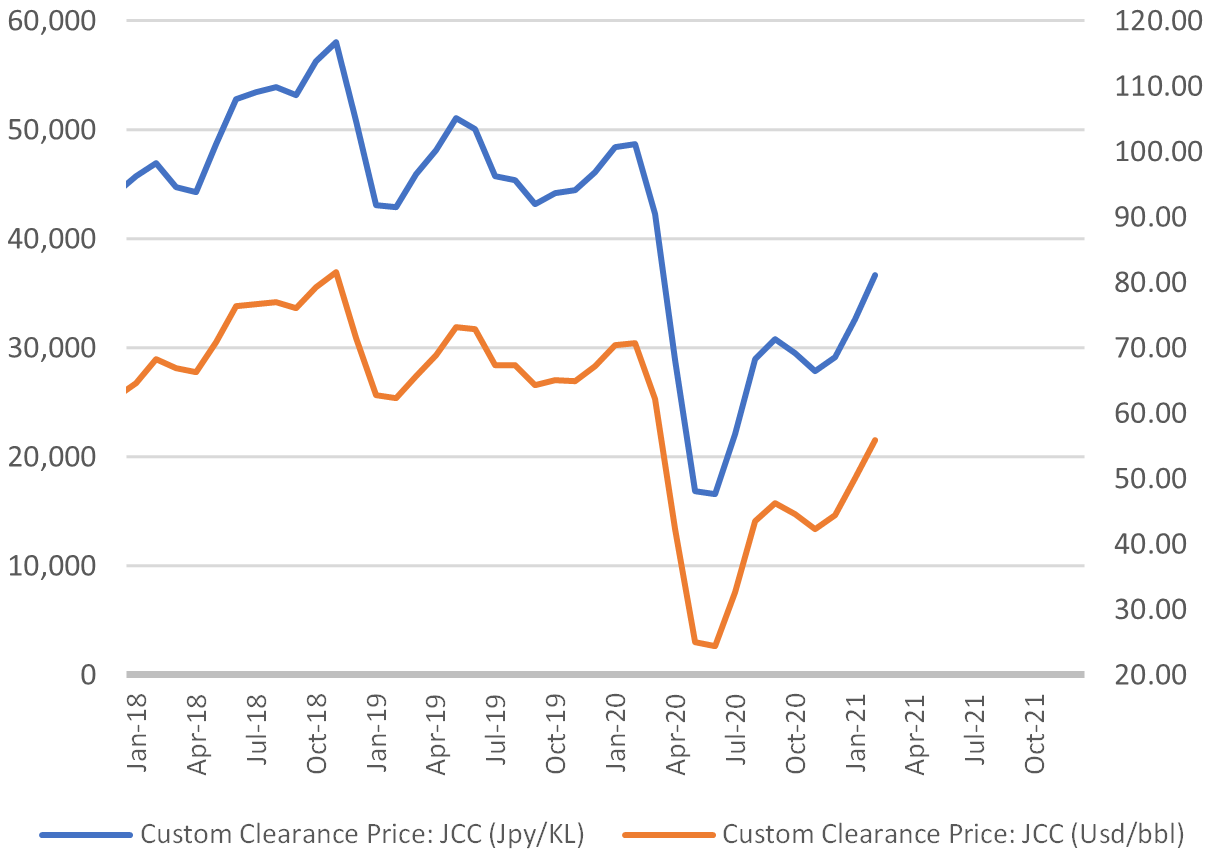
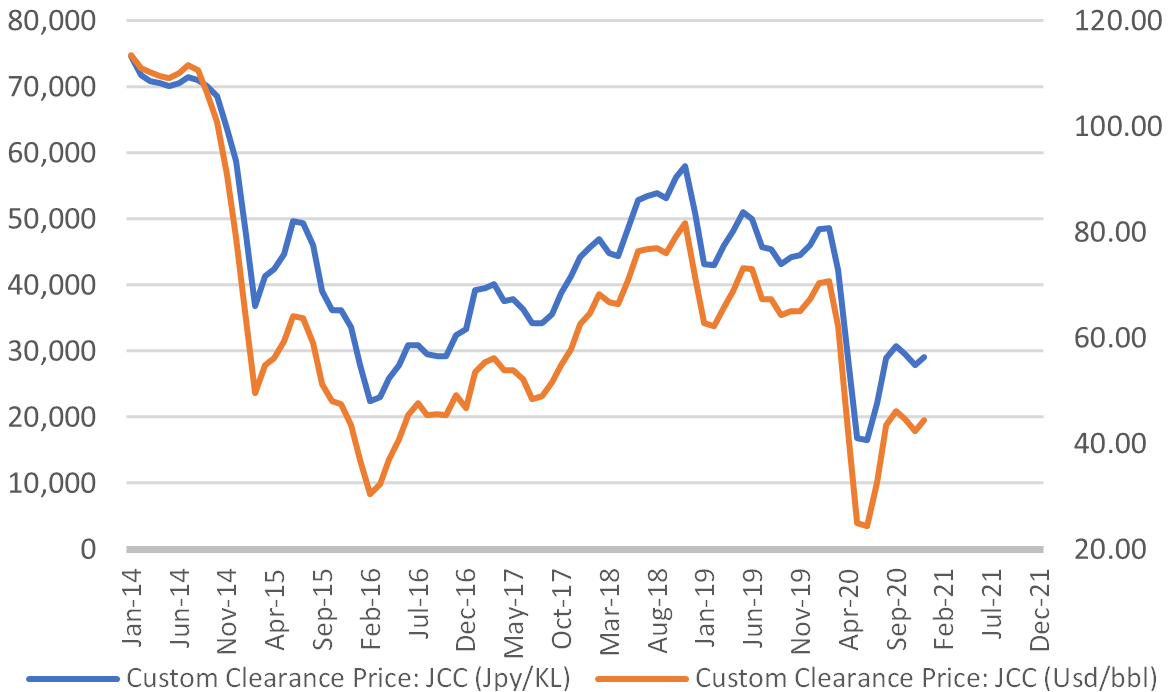
Japan Oil Price: $55.80/ barrel
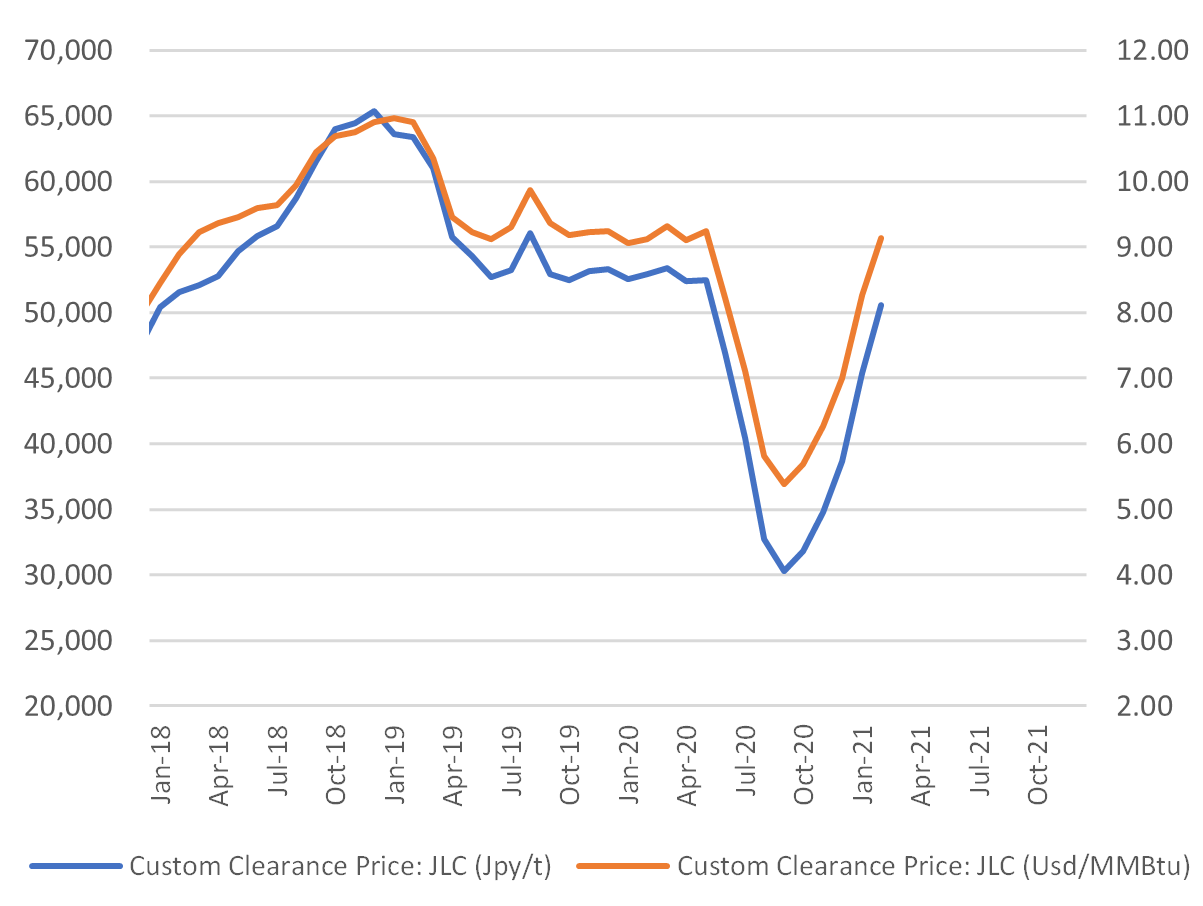
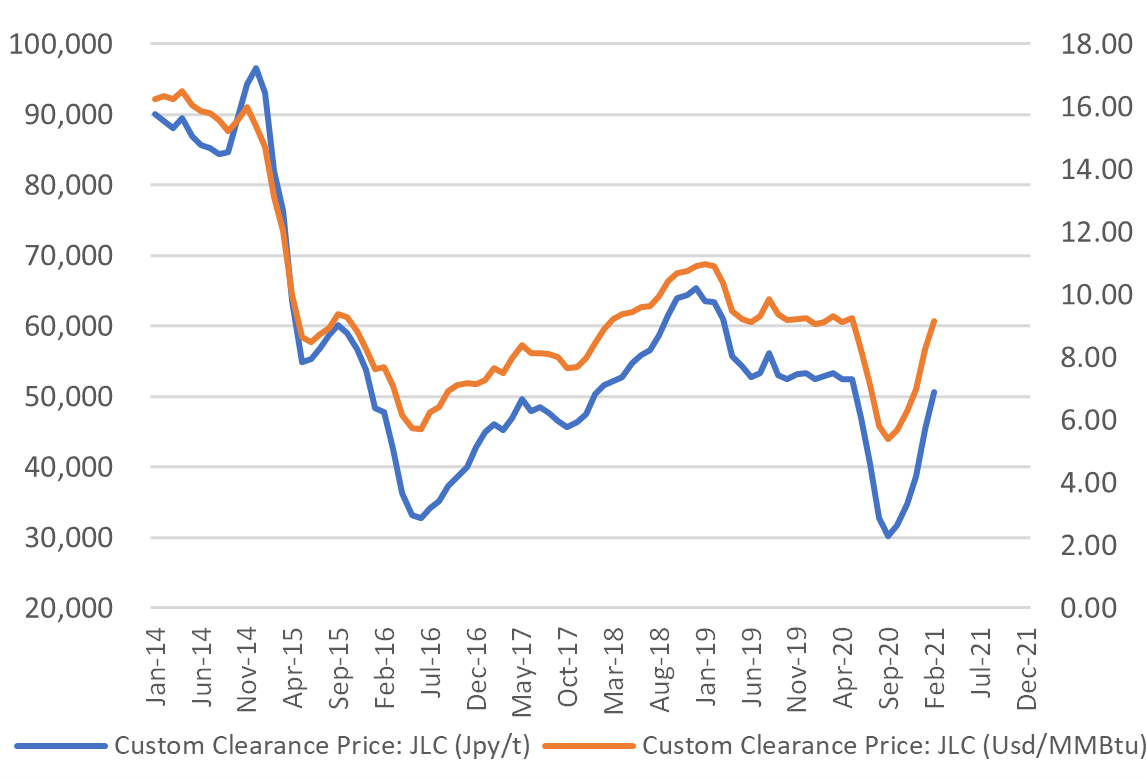
Japan (JLC) LNG Price: $9.14/ mmbtu
Japan’s oil products demand forecast to drop 5.7% by 2025; fuel oil worst hit
(Japan NRG, April 6)
- METI has published its forecasts for Japan’s oil products demand over the next five years. The ministry’s expert group on the subjects expects total demand for all oil products (apart from Type C heavy oil used in power generation) to drop by 5.7% to 143.82 million kiloliters in FY2025, compared with FY2021.
- Compared with pre-Covid demand in FY2019, the drop will be even bigger – close to 10%. Japan used 159.54 million kiloliters of oil products in FY2019.
- Gasoline demand is expected to be among the worst hit, dropping 9.3% in FY2025 from the expected FY2021 level. It will be down 14.26% from FY2019.
- The smallest decline is expected in jet fuel, with FY2025 forecasts only slightly below FY2019 levels and up massively on the COVID-affected FY2020 / FY2021 levels.
TAKEAWAY: METI’s calculations, which also include figures for naphtha, kerosene, light crude and others, assume that Japan’s GDP will continue to grow at a healthy pace. This makes the demand drop predicated mainly on the move toward carbon neutrality in the power generation and industrial sectors, as well as transport. Demographics will also continue to play a role.
With such a strong demand drop in most oil products, and gasoline in particular, it’s clear that further oil refinery closures or curtailments in Japan are inevitable. For a full picture of the situation, see our Analysis piece from Oct. 5, 2020.
Shipper Mitsui OSK to spend $1.8B on decarbonization with LNG tankers
(Nikkei, April 6)
- Japanese shipping firm Mitsui OSK Lines plans to spend ¥200 billion ($1.8 billion) over three years to cut its CO2 emissions, and aims to hit net-zero emissions by 2050.
- Part of this plan involves switching to ships fueled by LNG, especially for large vessels such as car carriers and crude oil tankers.
- It’s expected that about 30% to 40% of Mitsui OSK’s fleet will run on LNG within the next 10 years, and President Hashimoto said he believes LNG to be the leading fuel of the 2020s.
- Further in the future, the shipper will need to switch to hydrogen and ammonia, Hashimoto added. LNG only cuts emissions by 30% compared with the current fuel of choice – heavy fuel oil.
- The shipper may also invest in wind power, especially in offshore wind, to help it reduce its emissions further.
- CONTEXT: The co. originally planned to achieve net-zero by 2100.
TAKEAWAY: Despite concerns about the climate credential of gas in Europe, most of Asia views LNG as the next realistic step towards a low carbon society, and the transition of major Japanese shippers to LNG illustrates this broader trend. Even the green lobby in Japan supports LNG as a partner for renewables, much more than it supports a wider rollout of hydrogen at this stage. The potential for shippers to get involved in offshore wind projects is also an area to watch.
Toho Gas receives first shipment of carbon-neutral LNG
(Company statement, April 8)
- Toho Gas received its first shipment of carbon neutral LNG today at its Chita terminal in Aichi prefecture.
- The LNG, whose carbon content has been offset by the use of carbon credits, was purchased from Mitsubishi Corporation subsidiary Diamond Gas International.
- This initiative is part of Toho Gas’ ongoing efforts to reduce its carbon footprint.
Chevron and Hokkaido Gas sign five-year LNG supply agreement
(Company statement, April 7)
- Chevron U.S.A. Inc. (Singapore Branch) has signed a binding Sale and Purchase Agreement with Hokkaido Gas Co., Ltd. for the delivery of liquefied natural gas from Chevron’s global LNG portfolio to the Hokkaido area.
- Under the agreement, CUSA will supply Hokkaido Gas with about a half million tons of LNG over a period of five years starting April 2022.
TAKEAWAY: This relatively small deal is significant because it shows Chevron’s interest in securing a new client in Japan, one that traditionally may have procured all of its gas via Tokyo Gas, as well as the trading houses Mitsui and Mitsubishi. It’s also a multi-year deal in a market that has been largely moving towards spot or short-term contracts in the last year or so. Even a small amount locked in over time seems like a good deal for Chevron. This agreement also shows that Hokkaido, which has traditionally resisted switching from coal citing geographical and grid connection issues, may be getting more serious about gas generation.
Tohoku Electric partners with Tobu Gas on combo utility plan
(New Energy Business News, April 6)
- Tohoku Electric agreed with local reticulated gas supplier Tobu Gas for the marketing of electricity/gas combo plans. Tobu Gas will launch its Tobu Gas Denki Powered by Tohoku Denryoku plan in June. A similar plan will be offered to consumers that use LPG tanks, via a partnership between Tohoku Electric and Akita-based Nikaho Gas.
ANALYSIS
BY MAYUMI WATANABE
Japan considers boosting LNG stockpiles
Via overseas hubs and diplomacy
Japan has fewer than three weeks of gas supply on-hand, and even less when it comes to the reserve for power generation. For a country that relies on LNG for around 40% of its power, that’s a fine margin.
The unprecedented spike in LNG prices in January, coupled with shipping problems that made quick delivery of the fuel nigh impossible, revived a long-running concern among Japanese bureaucrats that this just-in-time supply system needs an overhaul.
The Agency of Natural Resources and Energy (ANRE) has once again put forward the idea of creating an LNG stockpile for Japan, similar to the oil reserves created in the wake of the 1970s crude supply shock. Rather than touting trillions-yen investments in underground repositories, however, this time ANRE is proposing a novel approach: a geographically diversified reserves network.
Multiple supply shocks in the last year
The common view among Japanese energy officials has traditionally been that gas is a less risky commodity. The country relies on the Middle East for around 80% of its oil supply – an acknowledged geopolitical risk in the world’s No. 4 importer. In contrast, Japan’s 75 million tons of LNG last year was sourced from 15 countries, with Asia-Pacific supplies accounting for over 60% of total.
That traditional wisdom was subjected to several shocks in the last year. Last summer, the COVID-19 pandemic held up passage of LNG cargos from the U.S. The price rally at the end of last year, which peaked at $32.494/ MMBtu on Jan. 12, was driven as much by the sudden jump in demand in Asia as by a shortage of available ships. Then, last month, a cargo ship stuck in the Suez Canal stranded dozens of LNG carriers, delaying delivery by days if not weeks.
Supply disruptions at individual LNG projects are common. Problems in transport that affect large swathes of the supply network on a regular basis is a recent trend that had even LNG suppliers like Tellurian calling for more efforts and investments in gas storage infrastructure around the world.
In Japan, the idea of adding physical storage has long been unpopular with the private sector. Five years ago, ANRE proposed creating underground storage in the depleted gas fields of Niigata prefecture. The idea received backing form the Niigata government, but relied on changes to gas safety regulation to allow the pumping of gas into underground caverns.
The scheme never materialized because it required large investments and there were questions over the safety of such repositories. Further questions arose over who would cover ongoing costs. In the end, the Niigata proposal and broader national LNG stockpiles idea were shelved.
This February, the energy agency returned with a new plan. While details are scant, it seems Niigata storage is no longer part of it. Both the local government and Japan Petroleum Exploration (JAPEX), which pumps gas in the Niigata area, said building storage in Niigata is not feasible. It would require major spending at a time when the bulk of public and private money is going to decarbonization initiatives.
Instead, ANRE wants to create across the region a diversified network of storage facilities for LNG, as well as oil products, which could offer members fuel in an emergency. As the cause of recent disruptions was delivery, rather than production, bureaucrats see an effective solution in better management of transport and geographical diversity.
An overseas storage network would also create further demand for Japanese LNG storage tanks and would appeal to domestic steelmakers, engineering firms and construction companies, according to Kawabata Tomoya, an engineering professor at Tokyo University.
“Japanese companies have cutting edge LNG tank technologies,” Kawabata said.
Hosting the stockpiles offshore?
A few small building blocks for this network have already formed. ANRE said that Kuwait, Vietnam and the Philippines have agreed to be part of such a pan-Asia energy stockpile.
Last December, Japan and Kuwait announced the creation of a joint petroleum reserve for Asia. Housed on Japanese soil, the 3.14-million-barrel stockpile is meant to act as a buffer against supply disruptions in Southeast Asia. Japan does, however, have priority access to the reserve.
The energy agency is cagey about revealing further details on how a pan-Asian stockpile mechanism for LNG would work or where bases would be located. The broader vision is to support the build-out of LNG stockpile infrastructure in Asia, such as helping others to install more tanks and pipelines that would carry gas from ports to tanks to consumers. Japan is also a major manufacturer of LNG carriers.
Back at home, Japan has its own infrastructure problems should a pan-Asian LNG network materialize. For one, Japan too lacks a nationwide gas pipeline system to move the fuel between regions. Smaller ports cannot handle the ultra-chilled commodity. Also, the country’s LNG storage capacities are limited to just 14 days for utilities and 20 days for Tokyo Gas. This adds to the complexity of quickly moving fuel across the country in case of emergency.
Ignoring the problem, or pointing to the difficulty of storing gas, which evaporates over time, is no longer an option. In addition to supply disruptions, Japan’s increasing reliance on renewables necessitates more baseload power capacity on hand to cover intermittency issues. Until sufficient battery storage or other means are available, the potential for a drop in wind or solar power must be covered with other energy sources. Without coal or nuclear, Japan’s options would narrow to LNG.
One practical alternative to building more pipelines and underground storage facilities would be to locate some LNG stockpiles on offshore platforms, Kawabata said.
As ammonia and hydrogen take over the government’s agenda, planning more and more, ANRE knows it has to look for creative rather than costly solutions to LNG storage at a time when the fuel’s delivery risk-rating is rising.
ANRE’s aspirations lie in persuading more neighboring countries to share LNG supply risks. It would then fall on Japan’s diplomatic efforts to ensure its Asian neighbors are willing to share the fuel in times of a national emergency.
ANALYSIS
BY YURIY HUMBER
Japan Accelerates Support for Emission Cuts Overseas,
Coining Joint Credits Worth 1.5% of Own GHG Emissions
As Japan looks for ways to improve its emissions reduction targets ahead of this year’s COP26 climate conference, one ace up the government’s sleeve may be the increasing number of carbon-reducing projects it is sponsoring abroad. Most of them will generate credits that Japan could use to offset its own emissions total.
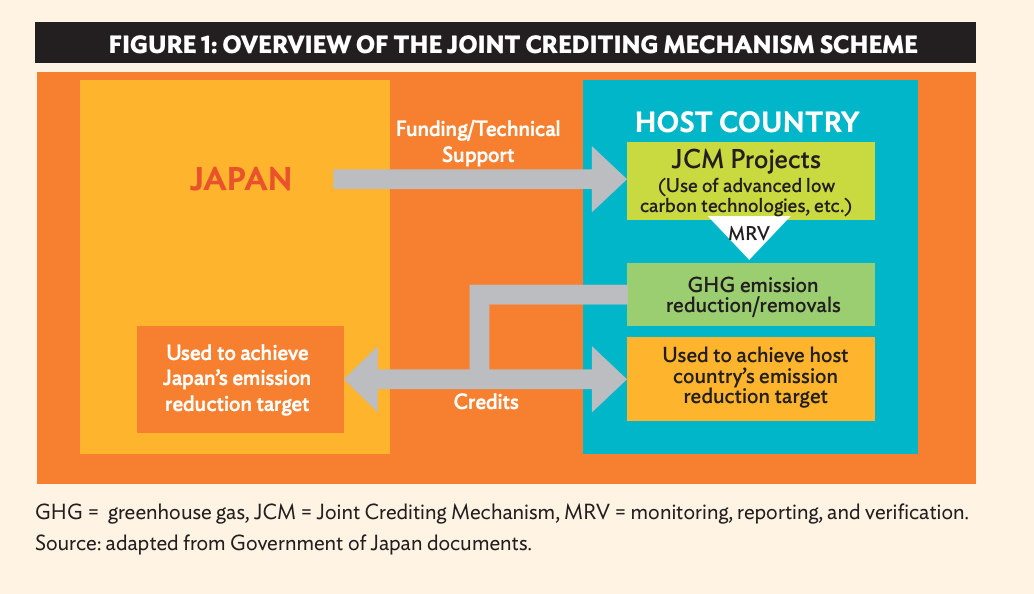
In the past year, Japan has notably widened the flow of projects getting approved under schemes such as the Joint Crediting Mechanism (JCM), which support efforts to lower the carbon footprints of developing economies.
Such activity has boosted the total expected reduction in greenhouse gases (GHG) that Japan can claim from JCM alone to 17.9 million tons by 2030. That’s equivalent to 1.48% of the Japan’s GHG total for FY2019 – a small, but not insignificant volume.
By 2030, Japan hopes to register enough JCM projects to cut emissions by 100 million tons of CO2 equivalent. What’s more, the credits forged through JCM carry monetary value.
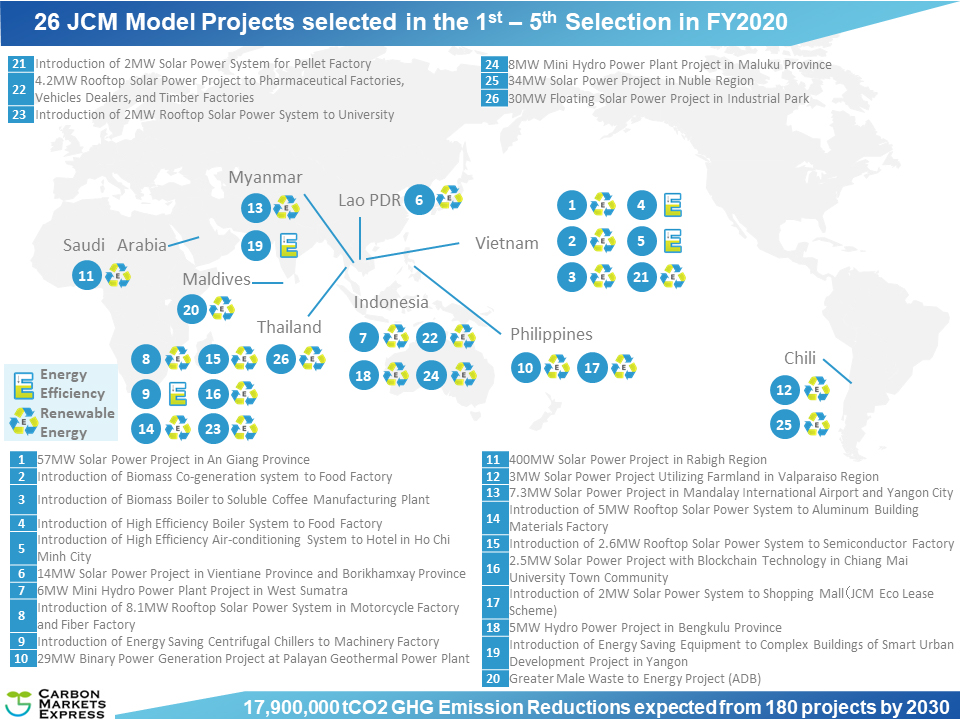
Source: Environment Ministry of Japan
What is JCM?
JCM is an offshoot of the “Joint Implementation” (JI) mechanism that was devised under the Kyoto Protocol and expanded at later COP meetings to include the “Clean Development Mechanism”. In short, the latter motivates richer countries to reduce global emissions faster by allowing them to sponsor work that lowers CO2 levels in developing nations. Generally, this makes it cheaper to cut 1 ton of global emissions. It also facilitates clean energy technology transfer to developing nations. In return, project sponsors are rewarded with credits, which countries can use to reduce their own GHG total.
Japan proposed the Joint Crediting Mechanism (JCM) to the UN in 2013. It is a project-based bilateral offset crediting mechanism that aims to facilitate the diffusion of low-carbon technologies.
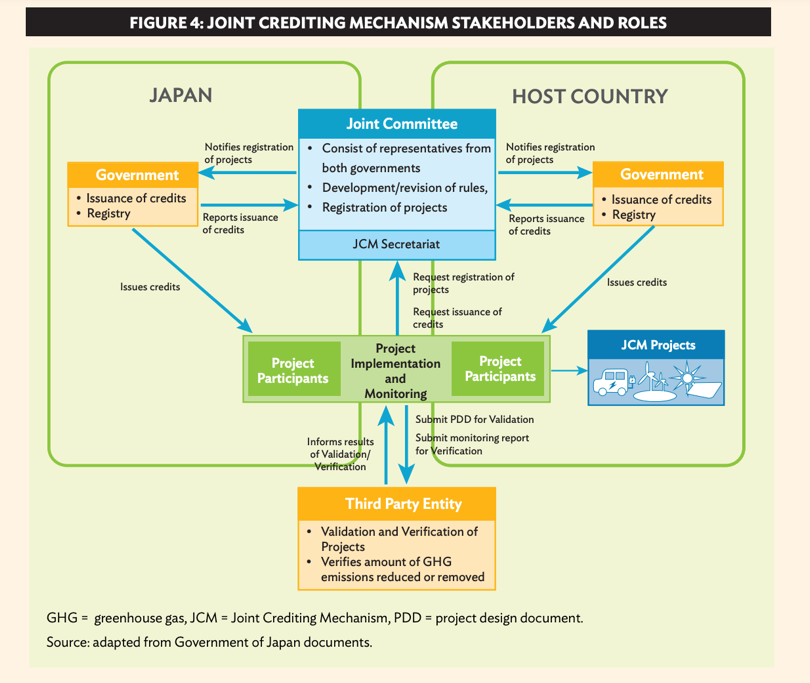
Financial support under the JCM is provided through the government, affiliated organizations, and the Asia Development Bank (ADB). Environment Ministry is in charge of the majority of JCM projects, although METI is also involved in the scheme.
Partner countries:
Since rolling out JCM in 2015, Japan has partners with 17 countries in the scheme. These are: Mongolia, Bangladesh, Ethiopia, Kenya, Maldives, Viet Nam, Lao PDR, Indonesia, Costa Rica, Palau, Cambodia, Mexico, Saudi Arabia, Chile, Myanmar, Thailand and the Philippines.
Project volume:
As of February, 2021, the JCM scheme has 66 registered projects. It has issued credits to 37 projects, and overseen financing to more than 180 projects.
Are JCM tradable?
JCM was created as a nontradable crediting mechanism, yet from the start Asia Development Bank said that JCM could become tradable “at a future date.” Today, the Environment Ministry says on its website that JCM credit transactions are possible, but need to be conducted through the JCM registry. JCM credits cannot be transferred internationally, so “for companies based overseas to trade credits, it is necessary to open an account in the JCM registry in Japan.” However, the ministry notes that government will not be a buyer of JCM credits issued to project participants.
What do companies get out of this?
Japanese companies can use the mechanism to get subsidies for up to half of the expenses associated with realizing energy-improvement work abroad. Companies can also use credits to offset their own GHG calculations, but the same credit cannot be used both by the government and the corporate.
Source: Asia Development Bank
Decarbonizing Japan – abroad
In the five years of running the JCM scheme, Japan has registered 66 projects that qualify for the credits. Of those, 26 were selected in FY2020, a jump from the annual average of 10 projects from prior years.
A further 23 projects have applied for registration, according to the JCM directory. The start of the selection process for this fiscal year, FY2021, begins in early May and will last until the end of October.
Most of the projects chosen last year are based in Asia and involve the installation of solar panels at existing industrial facilities. A typical example is Idemitsu adding 2MW of roof-mounted PV to a pellet factory in Vietnam, which makes fuel for biomass power plants. The panels will be operational next year.
However, there is also Marubeni’s utility-scale 400 MW solar plant in Saudi Arabia, which is due to generate one of the biggest CO2 reductions of the FY2020 selection (See Table at the end for project details).
Another major cut in emissions is attributed to a Mitsubishi Heavy Industries plan to build a 29 MW geothermal power facility in the Philippines. An Italian unit of the Japanese group will add a binary geothermal OCR generator to an existing power plant on Luzon island, which will be able to utilize waste heat to save 72,200 tons of emissions a year.
Projects that promote switching from coal to gas can also qualify. Trading house Sojitz and Osaka Gas are helping Japanese instant noodle maker Acecook move its Vietnam manufacturing operations to gas-fired generation from this summer. New high-efficiency boilers at Acecook factories will be able to run on LPG as well as natural gas, saving an estimated 76,300 tons of emissions over 10 years.
Of course, some projects may not materialize, in which case their credits and CO2 reduction would not country. One example of a project that may have trouble in fulfilling its commitments is an energy saving urban redevelopment in Yangon, Myanmar, also registered in FY2020. The country’s recent military coup and escalating internal conflict leaves the future all energy developments uncertain.
Still, the escalation in the number of Japanese companies pursuing energy improvement projects overseas and the government’s interest in cutting emissions quickly and cheaply bodes well for the future of JCM and similar mechanisms. They may not help Japan cancel out all of its 1.213 billion metric tons of CO2 equivalent in annual emissions (as per FY2019). Still, they may well knock off a few percentage points. In a race to drastically lower emissions within this decade, those few percent may well prove useful.
Source: Asia Development Bank
|
Partner Country |
Project Title |
Representative Participant |
Expected GHG Emission Reduction (tCO2/year) |
|
Chile |
34 MW Solar Power Project in Nuble Region |
Sharp Energy Solutions Corporation |
25,576 |
|
Chile |
3 MW Solar Power Project Utilizing Farmland in Valparaiso Region |
FARMLAND Co., Ltd. |
2,632 |
|
Indonesia |
8 MW Mini Hydro Power Plant Project in Maluku Province |
Aura-Green Energy Co. |
18,034 |
|
Indonesia |
4.2 MW Rooftop Solar Power Project to Pharmaceutical Factories, Vehicles Dealers, and Timber Factories |
Alamport Inc. |
3,961 |
|
Indonesia |
5 MW Hydro Power Project in Bengkulu Province |
Voith Fuji Hydro K.K. |
15,299 |
|
Myanmar |
Introduction of Energy Saving Equipment to Complex Buildings of Smart Urban Development Project in Yangon |
Yuko Keiso Co., Ltd. |
1,544 |
|
Myanmar |
7.3 MW Solar Power Project in Mandalay International Airport and Yangon City |
Tokyo Century Corporation |
3,276 |
|
Philippines |
Introduction of 2 MW Solar Power System to Shopping Mall(JCM Eco Lease Scheme) |
Tokyo Century Corporation |
1,476 |
|
Saudi Arabia |
400 MW Solar Power Project in Rabigh Region |
Marubeni Corporation |
477,129 |
|
Thailand |
30 MW Floating Solar Power Project in Industrial Park |
Shizen Energy Inc. |
13,739 |
|
Thailand |
Introduction of 2 MW Rooftop Solar Power System to University |
SHIZUOKA GAS CO. |
868 |
|
Thailand |
Introduction of 5 MW Rooftop Solar Power System to Aluminum Building Materials Factory |
Sumitomo Mitsui Finance and Leasing Company |
2,116 |
|
Thailand |
Introduction of 2.6 MW Rooftop Solar Power System to Semiconductor Factory |
Kansai Electric Power Company |
1,188 |
|
Thailand |
2.5 MW Solar Power Project with Blockchain Technology in Chiang Mai University Town Community |
Inabata Co., Ltd. |
1,093 |
|
Vietnam |
Introduction of 2 MW Solar Power System for Pellet Factory |
Idemitsu Kosan Co. |
1,024 |
GLOBAL VIEW
BY TOM O’SULLIVAN
Below are some of last week’s most important international energy developments monitored by the Japan NRG team because of their potential to impact energy supply and demand, as well as prices.
UAE Nuclear Power:
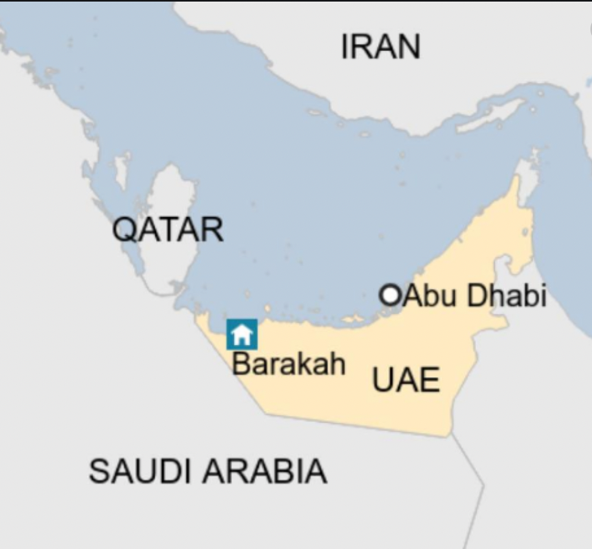
In a historic first for the Arab World, the UAE connected the country’s and the Arab World’s first nuclear power plant to the grid last week. The Barakah Nuclear Power Plant’s four nuclear reactors are forecast to supply up to 25% of the UAE’s electricity needs and save the country up to 21 million tons of CO2 emissions a year.
The NPP consists of four APR-1400 reactors with a total capacity of 5.6 GW and is situated on the Persian Gulf. The plant was built by Korea Electric Power (KEPCO) for $20 billion and was delivered on time and on budget. Construction started a decade ago.
Japan’s METI also announced on Thursday that it will work with the UAE on technology to produce hydrogen including the creation of an international supply chain. A memorandum of cooperation has been signed.
U.S. CO2 Reduction Goals:
The Biden administration is expected to announce a climate goal later this month of cutting U.S. carbon emissions by 50% by 2030. The goal should move the U.S. into a global leadership role on climate change with a transformative shift away from the use of fossil fuels in energy and transport.
Gina McCarthy, the White House National Climate Adviser, is developing U.S. climate commitments for 2030 ahead of a virtual global climate summit on Earth Day, Apr. 22, which will be hosted by President Biden. Over 40 heads of state are expected to attend.
U.S. High Voltage (HV) Transmission:
Included in the recent Biden Infrastructure plan are investment tax credits for 20 GW of HV transmission infrastructure. U.S. HV infrastructure capacity may need to triple by 2050 to accommodate the increased amount of renewable energy. The plan also calls for the establishment of a Grid Deployment Authority within the DoE that would streamline ‘rights of way’ issues.
Hydrogen:
Three companies in the U.S. Baker Hughes, Plug Power and Chart Industries – will launch a fund focused on hydrogen-technology investments. Initial investments will exceed $300 million and focus on production, storage, and distribution.
GHG Emissions in 2020:
Methane concentrations in 2020 rose YoY by 14.7 parts per billion, according to the U.S. National Oceanic and Atmospheric Administration. CO2 concentrations rose to 412.5 per million although overall CO2 emissions were down 6% YoY due to the pandemic. The 2020 increase in methane emissions represents the biggest increase since record keeping began in 1983.
Uranium:
Uranium backed assets have soared 35% YTD on the back of increased need for nuclear energy to meet decarbonization goals.
Lithium:
On May 3, CME will launch a futures contract for lithium hydroxide delivered to Japan, South Korea, and China, taking advantage of increased demand by battery makers for EV production.
Clean Steel:
Volvo has announced a collaboration with Swedish metals group SSAB to produce the world’s first fossil-free steel. The steel will be produced using hydrogen.
Data Centers:
Applied Materials estimates that data centers will consume 15% of the world’s electricity in 2025, up from 2% in 2020.
Aviation:
Lillium, the German electric air taxi service, is planning to raise $450 million through a New York SPAC listing.
China:
All three Chinese oil and gas majors, CNOOC, Sinopec, Petrochina, have announced plans to scale up natural gas investments. Sinpopec expects to spend $10 billion on upstream gas exploration in 2021. Petrochina’s gas output now accounts for 47% of its total production and it is planning to increase that to 55% by 2025. CNOOC also plans to increase its gas production to 30% of total production by 2025.
South Korea:
Iran released an RoK oil tanker, the MT Hankuk Chemi, on Friday after holding it for several months in Bandar Abbas for alleged environmental breaches committed in the Persian Gulf.
Indonesia:
1). UAE became the first external investor in Indonesia’s recently launched sovereign wealth fund committing $10 billion. Indonesian authorities hope to raise $100 billion in total which will be used for energy, roads and port investments. Indonesia had planned to move its capital from Java to Borneo starting in 2024 but the pandemic has delayed those plans.
2). Over 150 people were killed when torrential rains caused by Tropical Cyclone Seroja struck East Nusa Tengarra Province and East Timor on Monday also causing power outages. Over 10,000 people were displaced.
Myanmar:
At a public event in Tokyo, an elected member of the Myanmar parliament, Dr. Sasa, criticized the EU for weak sanctions and specifically mentioned that Total, the French oil and gas major, with natural gas interests in Myanmar, should cease all royalty payments to companies affiliated with the junta. He also criticized Japan for a weak response to the Feb. 1 coup saying that Russian, Chinese and DPRK links with the junta could threaten Japan’s security interests in the region. Most of Myanmar’s natural gas exports go to Thailand and China. A Dutch pension fund is also calling for South Korean conglomerate Posco to cut its ties with Myanmar. Posco operates a steel JV with MEHL, a junta-controlled holding company.
India:
1). The government has asked domestic refiners to reduce dependence on Middle East oil and reduce oil import costs. Imported oil cost India $80 billion in 2019 and this is expected to triple to $250 billion by 2040. India has overtaken Japan as the world’s third largest oil importer and consumer. India is exploring options with other suppliers including Guyana, Iran, Kazakhstan and Russia.
2). Saudi Arabia’s Aramco is exploring options to buy a 20% stake in Reliance Industry’s oil business as well as investments in a JV to build a 1.2 mbpd oil refinery in India.
Iran:
1). Progress at the Vienna JCPOA discussions may result in the lifting of some oil sanctions before the presidential election on Jun. 18.
2). An Iranian vessel, the Saviz, thought to be controlled by the Islamic Revolutionary Guard, was attacked in the Red Sea on Tuesday in what appears to be tit-for-tat strikes on seaborne vessels between Israel and Iran.
Saudi Arabia:
Aramco is considering selling a 49% stake in the Saudi national oil pipeline network to Chinese investors for between $10 to $15 billion.
Iraq:
The U.S. committed to the withdrawal of all combat forces from OPEC’s second largest oil producer at a date yet to be determined.
Ethiopia:
Ethiopia, Egypt, Sudan failed to reach an agreement on the $5 billion Grand Ethiopian Renaissance Hydroelectric Dam at DRC-sponsored talks on Tuesday. Egypt has threatened military action against Ethiopia if any Nile waters are diverted. Ethiopia is planning to fill the dam in July and start electricity production in August.
Egypt:
The Suez Canal Authority continues to hold the Japanese-owned Ever Green vessel and is demanding compensation exceeding $1 billion.
South Africa:
Anglo American, the mining group, will demerge its South African thermal coal operation into a new company called Thungela Resources that will be listed on the Johannesburg Stock Exchange.
Norway:
The country’s $1.3 trillion oil fund will pay $1.4 billion for a 50% stake in an offshore wind farm operated by Denmark’s Orsted. This is part of a $14 billion allocation to RE investments by the world’s largest sovereign wealth fund.
France:
The French government may buy out the minority shareholders (circa 15%) of EdF, the world’s largest operator of nuclear assets, thereby fully nationalizing the company that is listed on the Euronext Paris Exchange. EdF has a market capitalization of $44 billion. EdF’s stock price rose by 10% on Tuesday.
UK:
BP is expected to cut its debt by $4 billion in Q4 when it reports Q1 results on Apr. 27. Disposal proceeds may also exceed $5 billion for the quarter including the sale of a petrochemical business to Ineos. BP has committed to cut fossil fuel production by 40% by 2030.
Greenland:
The government in the Danish autonomous arctic island was ousted on Tuesday due to objections to the development of a uranium mine by an Australian/Chinese company, Greenland Minerals, in Kuannersuit, in the south of the island. Investments exceeding $100 million have already been made in the Kvanefjeld mining project that will now be terminated. President Trump had considered buying Greenland in 2019 but that offer was rejected by the Danish government.
U.S.:
1). The Texas state government is passing legislation that will require wind and solar companies to purchase ancillary services, including replacement power, due to the intermittency of these power sources.
2). Bank of America will commit $1.5 trillion to green finance by 2030, an increase of $1 trillion.
3). BlackRock launched its ‘U.S. Carbon Transition Readiness ETF Fund’ raising $1.25 billion, the largest ever ETF launch.
4). Over 30 lawsuits are now in progress in Texas relating to the Texas Freeze including for natural gas price gouging during the emergency. A SoftBank subsidiary, Fortress Investment, is thought to have made significant profits from the market volatility. Royal Dutch Shell says the Texas disruption cost it $200 million in Q1.
South America:
Over two million hectares of Amazonian forest was lost to deforestation in 2020, the third highest loss since 2000, and a 17% increase YoY. All four countries bordering the Amazon, Bolivia, Ecuador, Peru and Brazil, recorded losses. Brazil accounted for 65% of the loss. The EU is refusing to sign a trade agreement with the region unless the deforestation is halted.
EVENTS CALENDAR
A selection of domestic and international events we believe will have an impact on Japanese energy.
|
February |
Approval of Fiscal 2021 Budget by Japanese parliament including energy funding projects; CMC LNG Conference |
|
March |
10th Anniversary of Fukushima Nuclear Accident; Smart Energy Week – Tokyo; Quarterly OPEC Meeting; Japan LPG Annual Conference; Full completion of all aspects of the multi-year deregulation of Japan’s electricity market; End of 2020/21 Fiscal Year in Japan; |
|
April |
Japan Atomic Industrial Forum – Annual Nuclear Power Conference; 38th ASEAN Annual Conference-Brunei; Japan LNG & Gas Virtual Summit (DMG)-Tokyo Three crucial by-elections in Hokkaido, Nagano & Hiroshima – April 25th |
|
May |
Bids close in first tender for commercial offshore wind projects in Japan; Prime Minister Suga to visit the U.S.-tentative |
|
June |
Release of New Japan National Basic Energy Plan-2021; G7 Meeting – U.K. Forum for China-Africa Cooperation Summit (Senegal) |
|
July |
Tokyo Metropolitan Govt. Assembly Elections; Commencement of 2020 Tokyo Olympics |
|
August |
Hydrogen Ministerial Conference in conjunction with IEA |
|
September |
Ruling LDP Presidential Election; UN General Assembly Annual Meeting that is expected to address energy/climate challenges; IMF/World Bank Annual Meetings (multilateral and central banks expected to take further action on emissions disclosures and lending to fossil fuel projects); End of H1 FY2021 Fiscal Year in Japan; Japan-Russia: Eastern Economic Forum (Vladivostok)-tentative |
|
October |
Last possible month for holding Japan’s 2021 General Election; METI Sponsored LNG Producer/Consumer Conference; Innovation for Cool Earth Forum – Tokyo Conference; Task Force on Climate-Related Financial Disclosure (TCFD) – Tokyo Conference; G20 Meeting-Italy |
|
November |
COP26 (Glasgow); Asian Development Bank (‘ADB’) Annual Conference; Japan-Canada Energy Forum; East Asia Summit (EAS) – Brunei |
|
December |
Asia Pacific Economic Cooperation (APEC) Forum – New Zealand; Final details expected from METI on proposed unbundling of natural gas pipeline network scheduled for 2022. |
DATA
Japan Oil Price
Crude Imports Vs Processed Crude
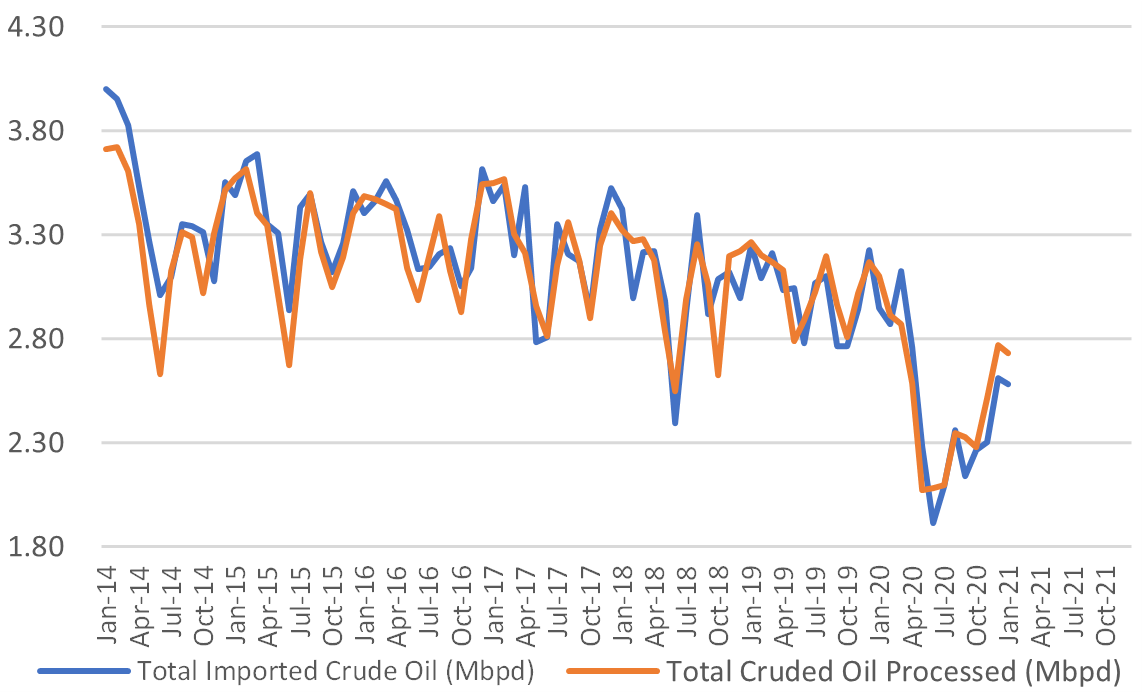
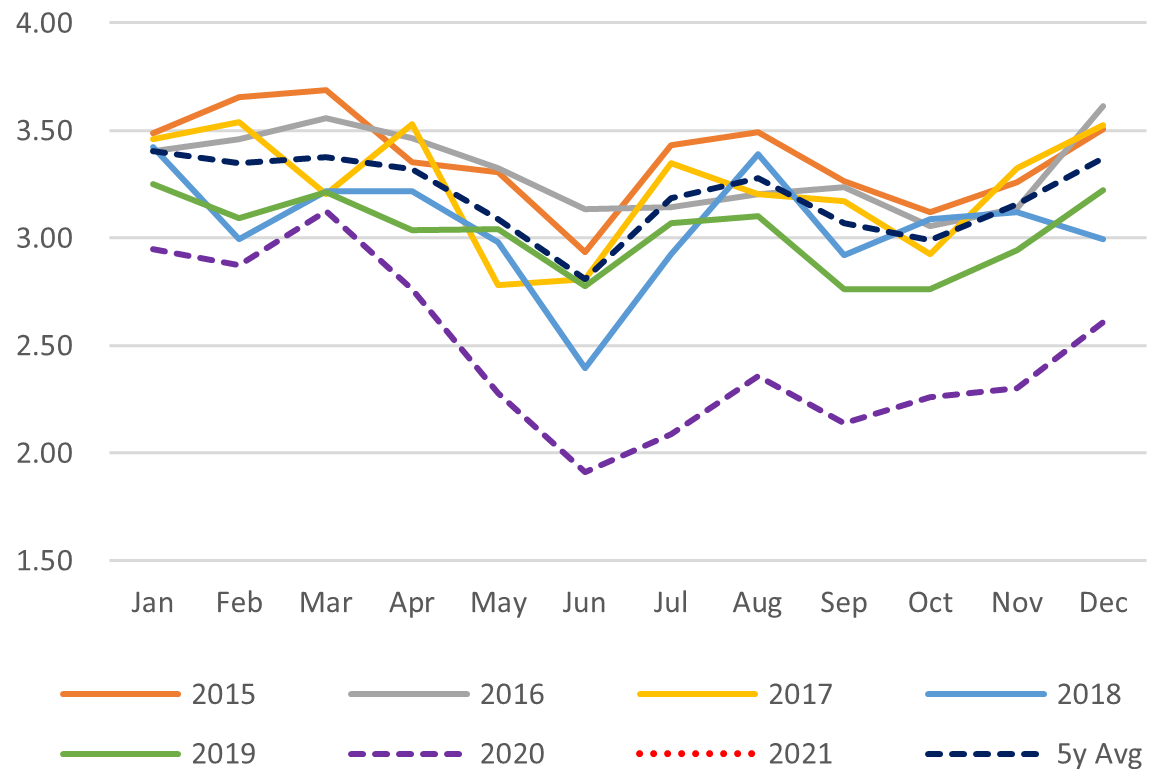
Monthly Oil Import Volume (Mbpd)
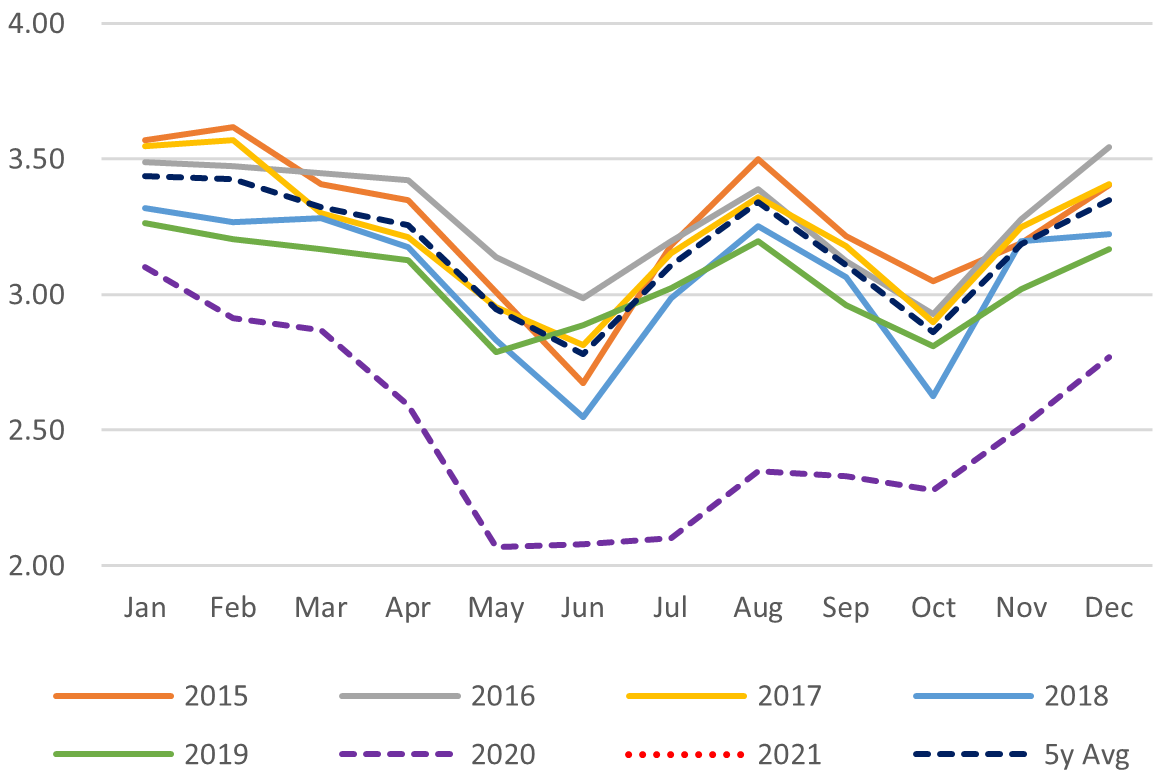
Monthly Crude Processed (Mbpd)
Domestic Fuel Sales
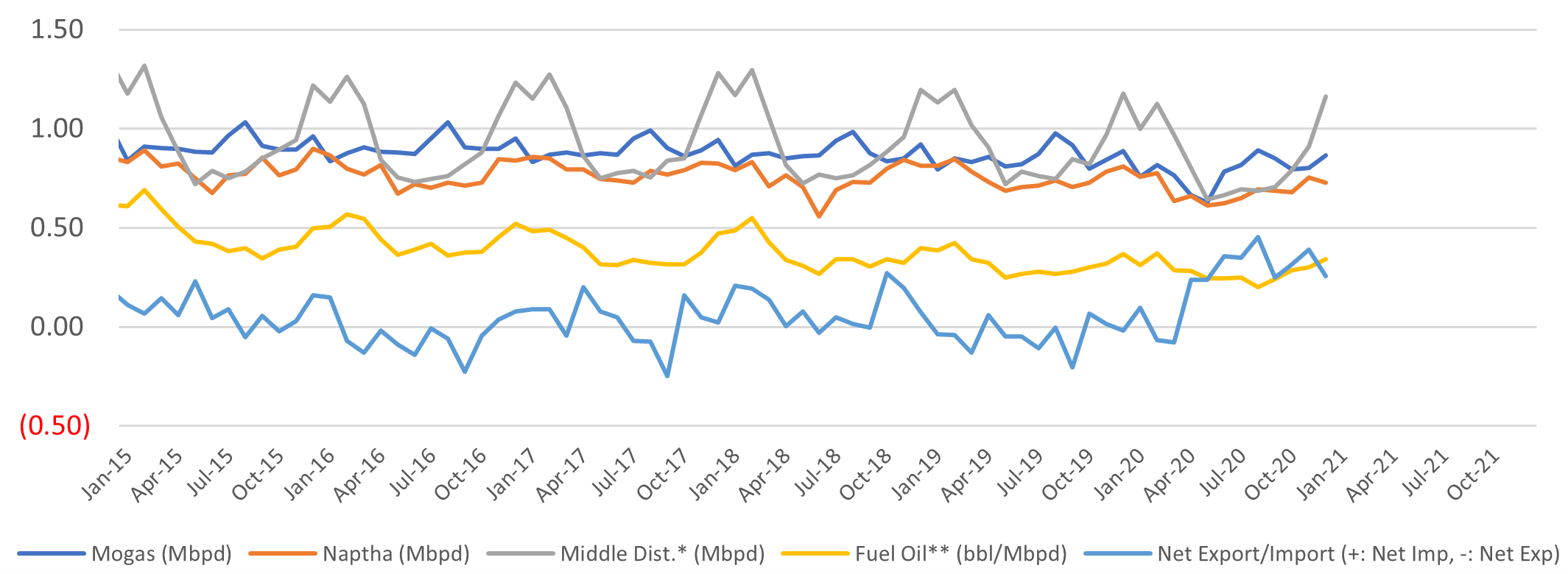
SOURCES: Ministry of Economy, Trade, and Industry (METI), Ministry of Finance, and the Petroleum Association of Japan
Japan LNG Price
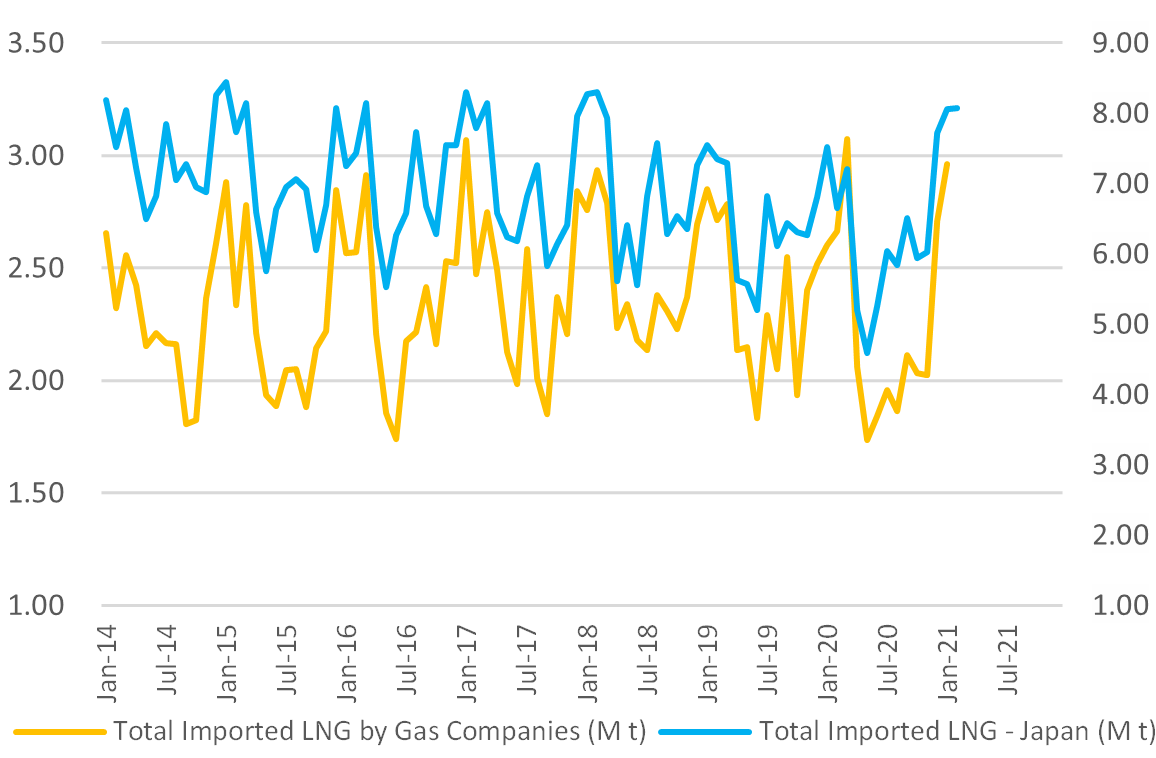
LNG Imports: Japan Total vs Gas Utilities Only
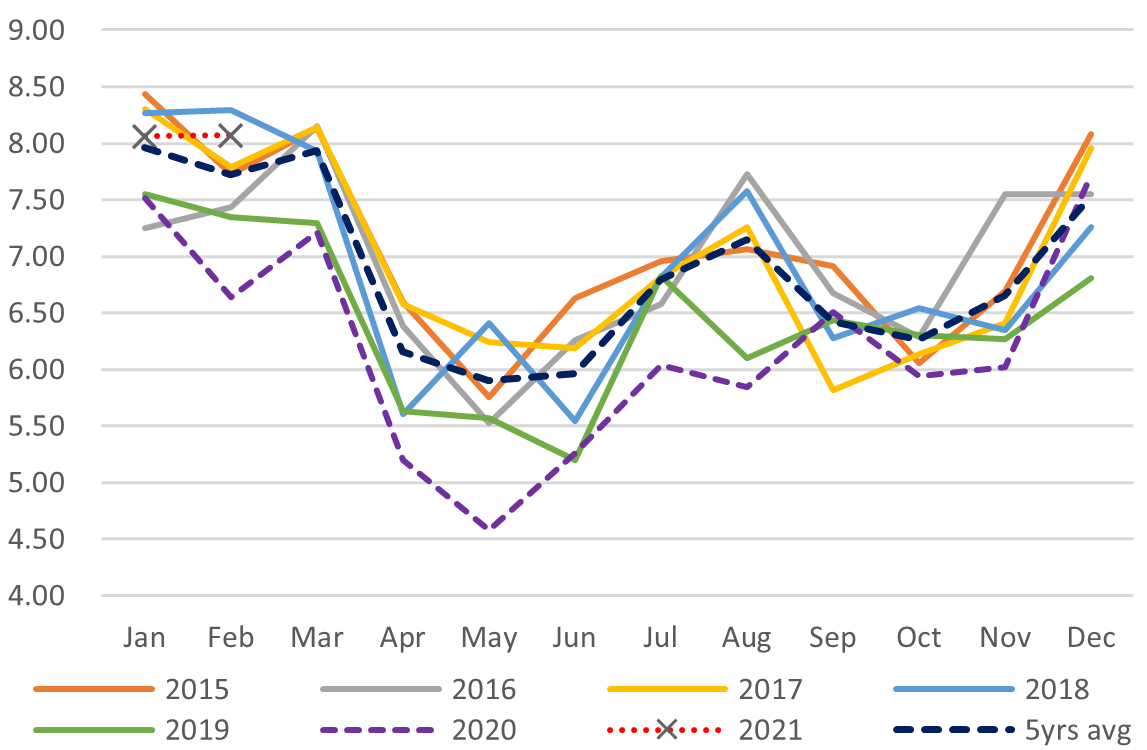
Total LNG Imports (M t)
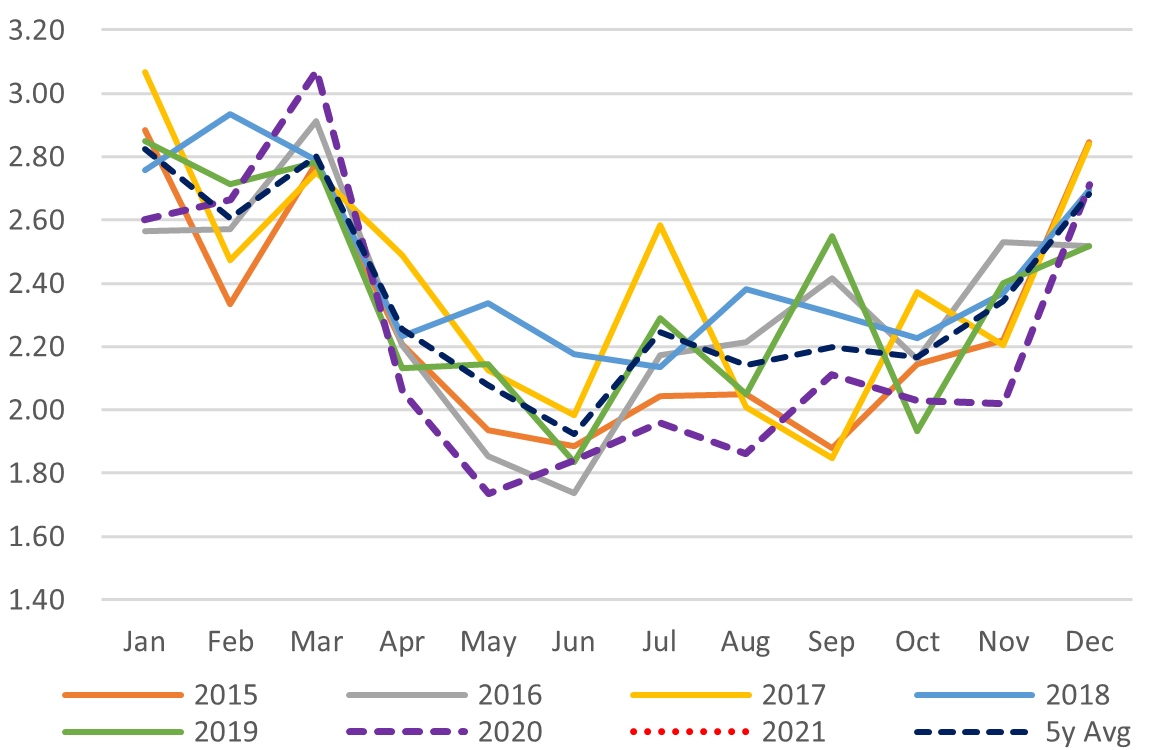
LNG Imports by Gas Firms Only (M t)
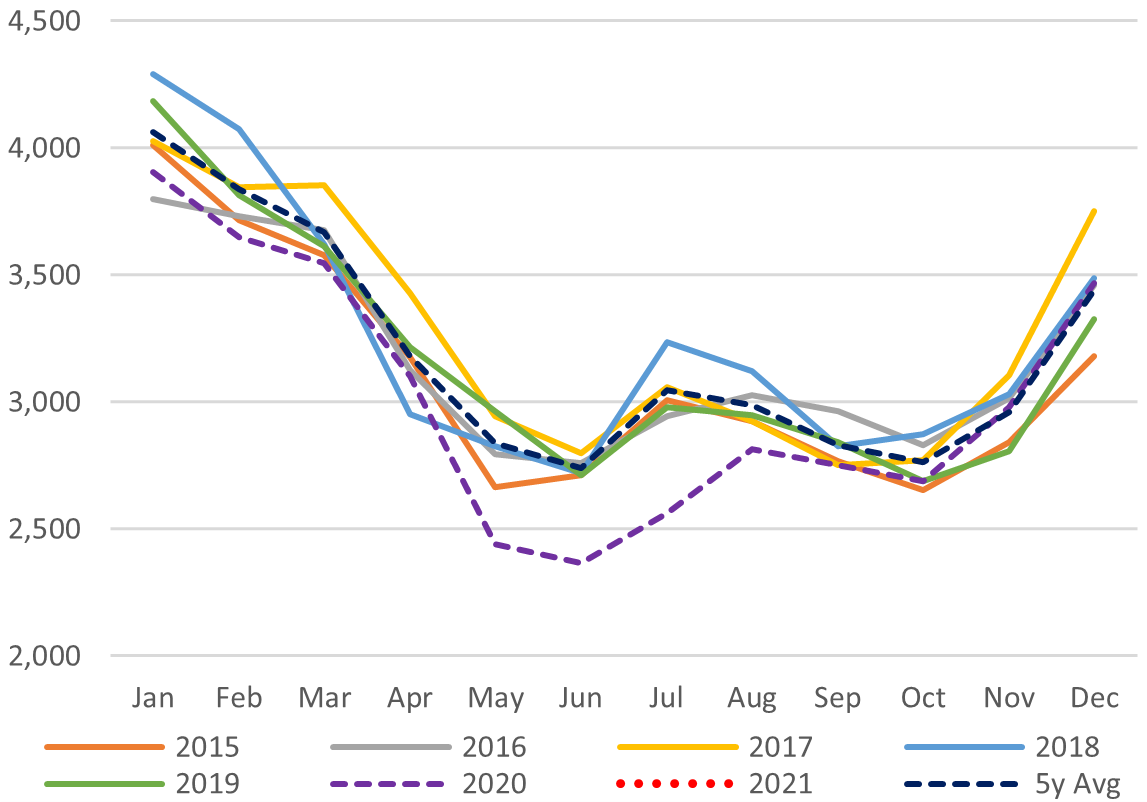
City Gas Sales – Total (M m3)
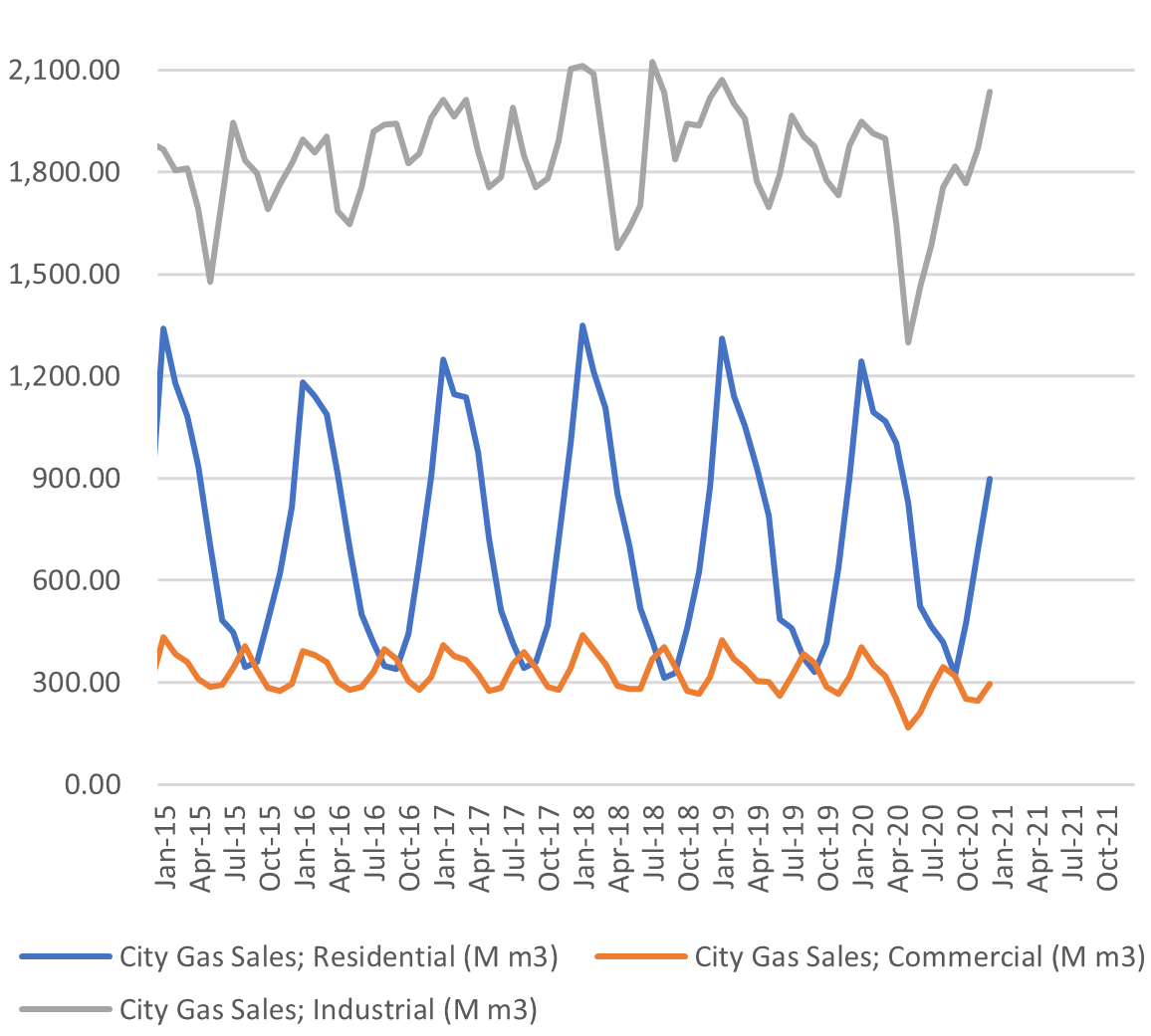
City Gas Sales by Sector (M m3)
SOURCES: Ministry of Economy, Trade, and Industry (METI),
Ministry of Finance
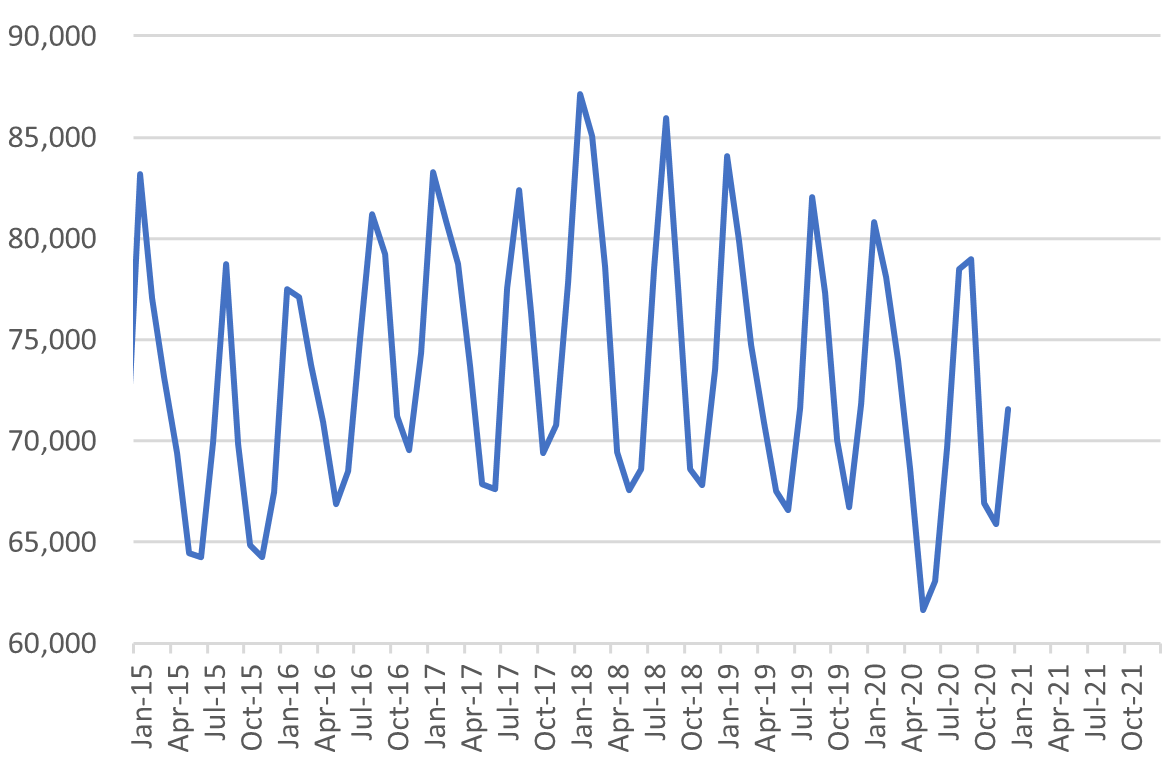
Japan Total Power Demand (GWh)
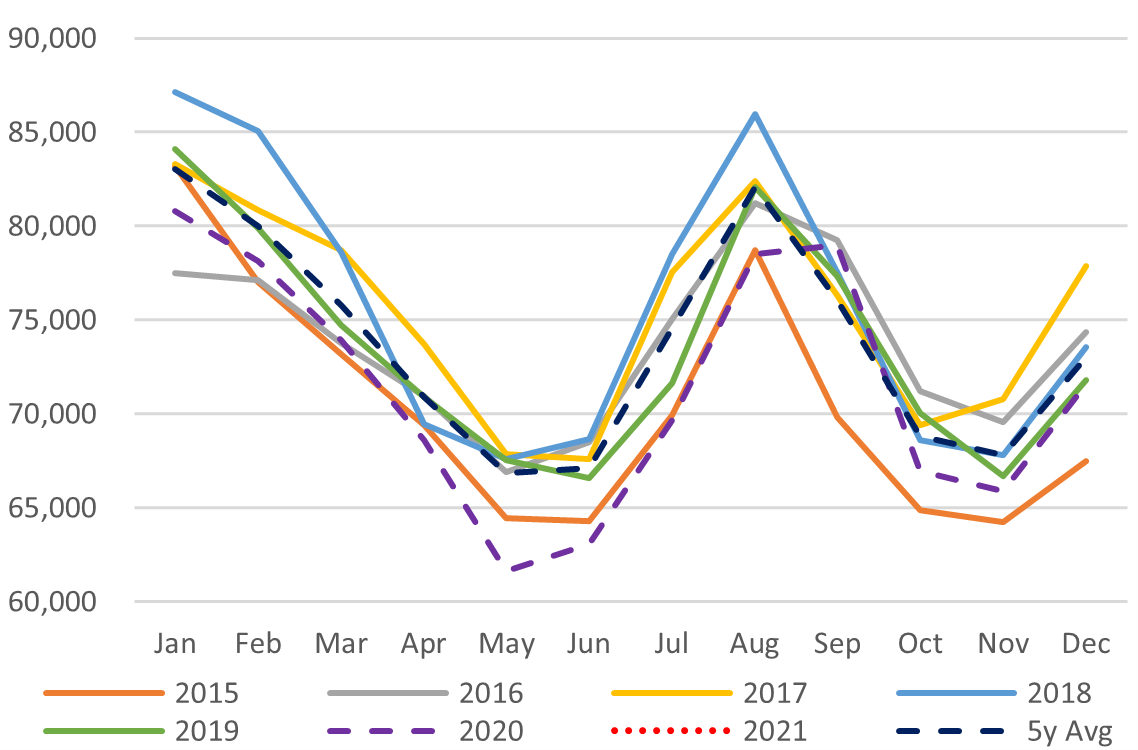
Current Vs Historical Demand (GWh)
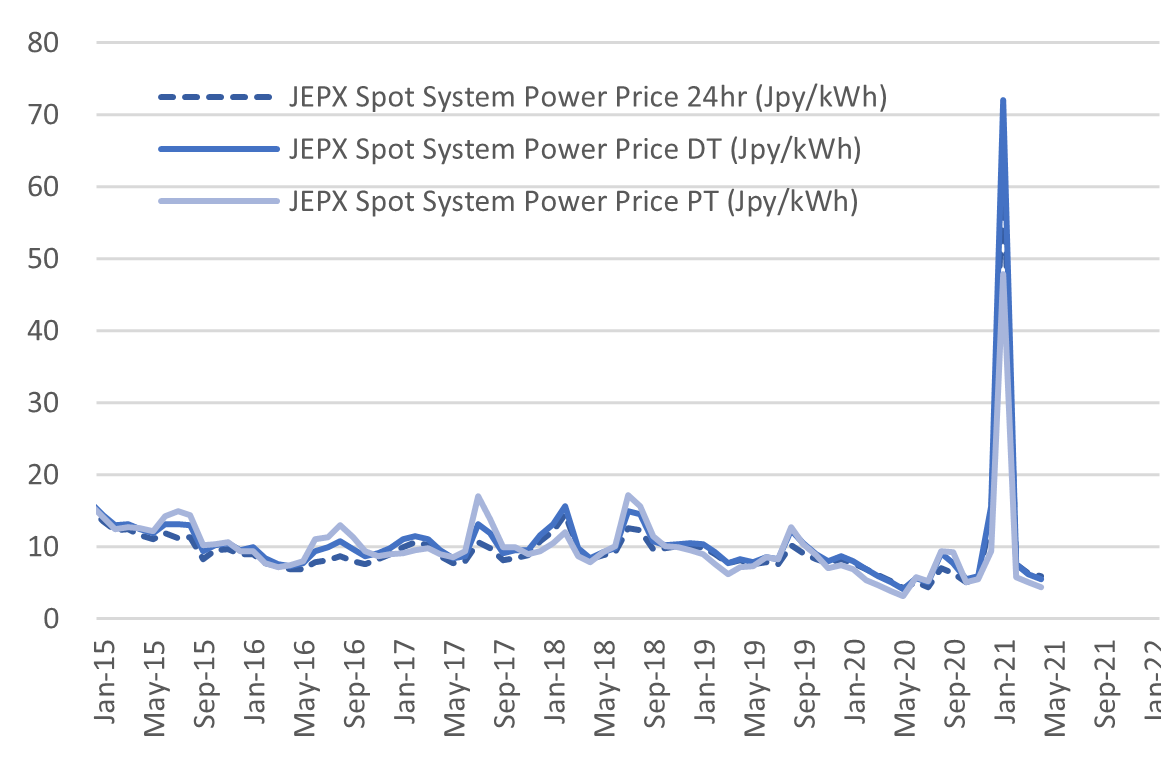
Day-Ahead Spot Electricity Prices
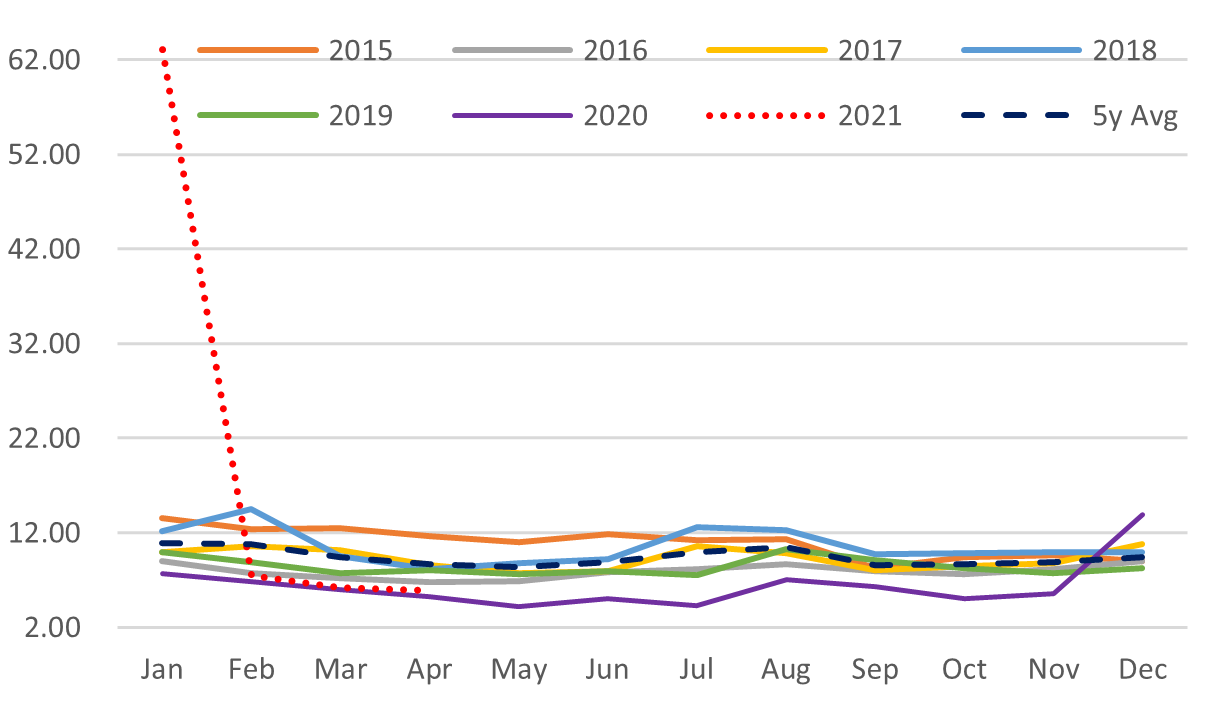
Day-Ahead Vs Day Time Vs Peak Time
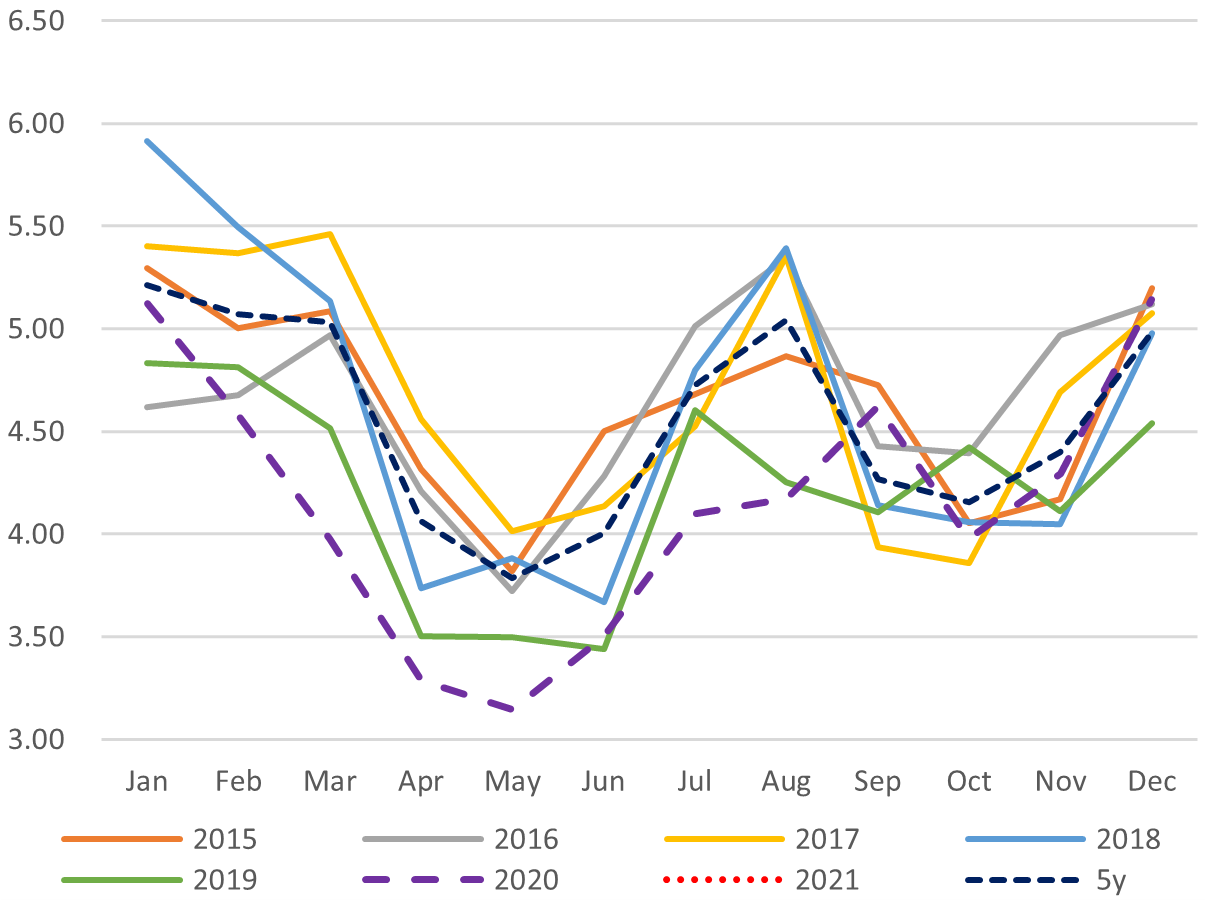
LNG Imports by Electricity Utilities
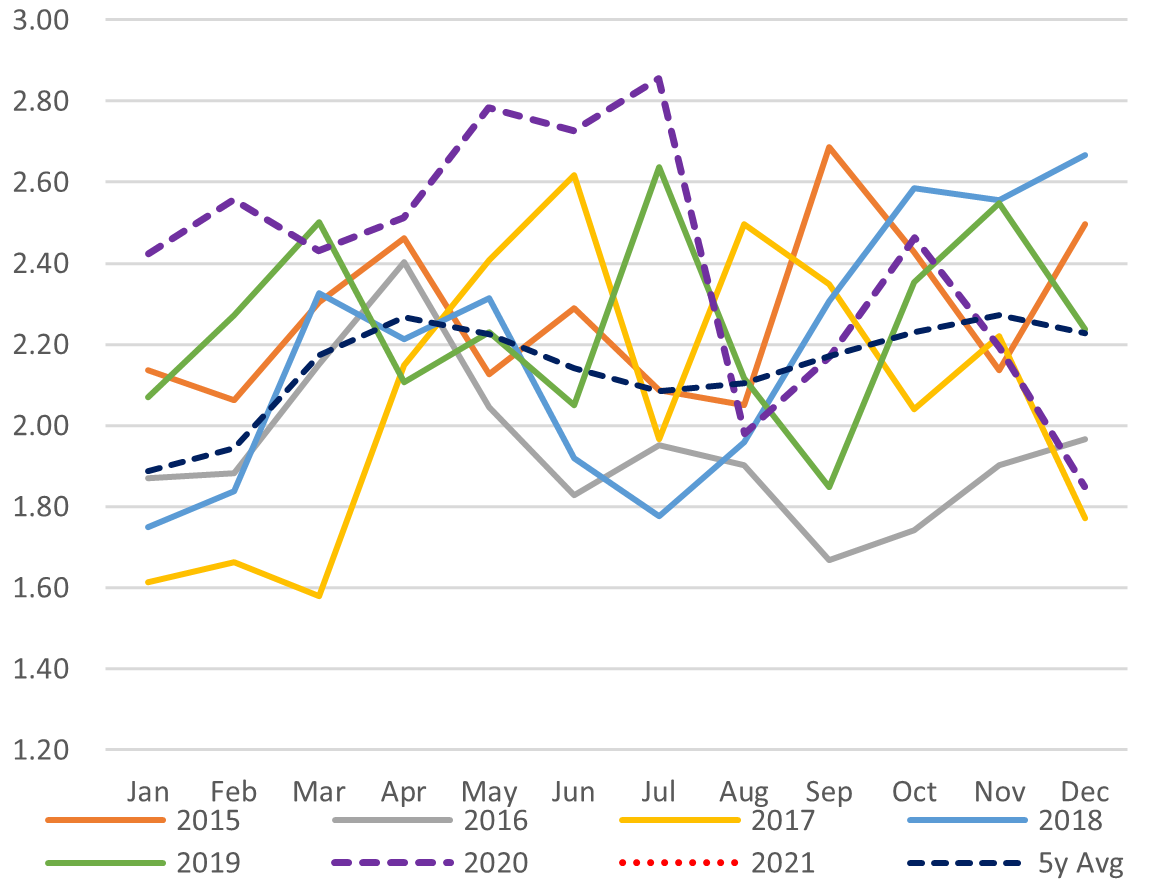
LNG Stockpiles of Electricity Utilities
SOURCES: Ministry of Economy, Trade, and Industry (METI), and the Japan Electric Power Exchange
Disclaimer
This communication has been prepared for information purposes only, is confidential and may be legally privileged. This is a subscription-only service and is directed at those who have expressly asked K.K. Yuri Group or one of its representatives to be added to the mailing list. This document may not be onwardly circulated or reproduced without prior written consent from Yuri Group, which retains all copyright to the content of this report.
Yuri Group is not registered as an investment advisor in any jurisdiction. Our research and all the content express our opinions, which are generally based on available public information, field studies and own analysis. Content is limited to general comment upon general political, economic and market issues, asset classes and types of investments. The report and all of its content does not constitute a recommendation or solicitation to buy, sell, subscribe for or underwrite any product or physical commodity, or a financial instrument.
The information contained in this report is obtained from sources believed to be reliable and in good faith. No representation or warranty is made that it is accurate or complete. Opinions and views expressed are subject to change without notice, as are prices and availability, which are indicative only. There is no obligation to notify recipients of any changes to this data or to do so in the future. No responsibility is accepted for the use of or reliance on the information provided. In no circumstances will Yuri Group be liable for any indirect or direct loss, or consequential loss or damages arising from the use of, any inability to use, or any inaccuracy in the information.
K.K. Yuri Group: Oonoya Building 8F, Yotsuya 1-18, Shinjuku-ku, Tokyo, Japan, 160-0004.